GLOBAL | PATENTS AND TAX
NOVEMBER 2014 WWW.MANAGINGIP.COM
26
T
he UK Patent Box scheme, reducing taxes paid by UK businesses by about £1
billion ($1.6 billion) a year by 2016-17, has attracted stiff opposition from
some other European countries for unfair competition for foreign investment.
The Patent Box scheme was considered useful in supporting growth and innovation
in a country if it attracts real economic activity. It is not so if it merely encourages
companies to shift profits from the location in which value was created to another
location where they may be taxed at a lower rate. The Patent/IP Box regimes were
set up to discourage multinationals from using low tax havens, for example virtual
holding companies by offering lower tax rate.
The Organization for Economic Co-operation and Development (OECD) and the
EU Commission are stamping out treaty shopping including tax-friendly regimes in
Bermuda, Mauritius, Ireland, Luxembourg and Malta. Microsoft, Facebook,
Amazon and Google are among companies who have allegedly transferred IP rights
to such low tax jurisdictions Selective tax advantages may amount to state aid which
affects trade between member states and threatens to distort competition see Apple
(Ireland), Starbucks (Netherlands) and Fiat (Luxembourg). The consequence of
unlawful state aid is that the benefits can be clawed back retrospectively for a peri-
od of up to 10 years and these companies may be forced to pay billions of euros in
back taxes.
This article reviews the latest reforms designed to close loopholes and increase
transparency in the context of the present qualifying criteria set out for the
European IP Box regimes. Low tax schemes designed to attract virtual holding
companies comprising all intangible assets must be reviewed along with the IP
regimes designed to encourage or reward good behaviour in the form of R&D tax
credits and IP regimes.
Background
OECD initiatives were agreed at the G20 meeting on September 21 2014 to count-
er aggressive tax practices (eliminating hybrid mismatches, addressing treaty shop-
ping, minimising abuse of transfer pricing for intangibles, country-by-country
reporting on global allocation of profits, economic activity and taxes of multina-
tionals) and ensure profits are taxed where economic activities generating profits are
performed and where value is created, realigning taxation of profits with substantial
activities. The reforms will force multinationals to report revenue, profit and tax fig-
ures country-by-country, exposing how they shuffle income around the world.
Action Item 5 of the base erosion and profit shifting (BEPS) Action Plan was creat-
ed to develop solutions to counter harmful regimes, and review the substantial activ-
ity requirement with regard to intangible regimes and improving transparency
through compulsory spontaneous exchange on rulings related to IP preferential
regimes. Further, clarification of the definition of intangibles and transfer pricing
rules of intangibles was agreed.
G20/OECD BEPS agreed that there would be no special tax regime for digital
companies at this time but further review will follow. Digitisation, greatly facilitat-
ing cross-border business, has presented challenges for taxing of the digital econo-
my. Particularly challenging is the ability of a company to have significant digital
presence in another country without being liable to taxation due to the lack of
nexus. For example, collection, processing and monetisation of data, that is exten-
sive collection of personal data in a country over the internet, could trigger a tax-
able nexus in that country − this does not occur under current tax rules.
The EU Commission has also countered against aggressive tax practices along
with G20/OCED BEPS. Member states are expected to implement a revised Parent-
OECD cracks down on the Patent Box
So-called IP Box regimes offering tax advantages are popular with both governments and businesses.
But, as Afzana Anwer reports, the OECD and EU Commission are putting them under threat
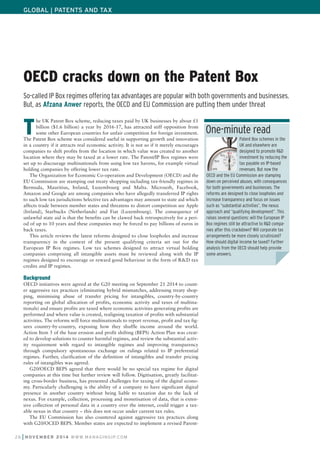
Patent Box schemes in the
UK and elsewhere are
designed to promote R&D
investment by reducing the
tax payable on IP-based
revenues. But now the
OECD and the EU Commission are stamping
down on perceived abuses, with consequences
for both governments and businesses. The
reforms are designed to close loopholes and
increase transparency and focus on issues
such as “substantial activities”, the nexus
approach and “qualifying development”. This
raises several questions: will the European IP
Box regimes still be attractive to R&D compa-
nies after this crackdown? Will corporate tax
arrangements be more closely scrutinized?
How should digital income be taxed? Further
analysis from the OECD should help provide
some answers.
One-minute read
Subsidiary Directive by December 2014 to prevent companies
using abusive tax practices essentially preventing cross-border
companies from planning their intra-group payments to enjoy
double non-taxation.
The EU Economic and Financial Affairs Council
(ECOFIN) has invited the EU Code of Conduct group to
review all patent boxes in the EU by the end of 2014. For
the UK, this review is based on lack of transparency and
breaches of two of the five provisions of the EU code: (1)
grant of tax benefits without requiring any real economic
activity and substantial economic presence in the UK, for
example the company owns the intel-
lectual property in the UK but conducts
R&D in other countries; and (2) prof-
its are not associated with individual
patents allowing for the inclusion of a
broad scope of income.
The fight against BEPS practices is
now on with companies having to recon-
sider their corporate structures and at issue is whether or not
IP Box regimes are attractive alternatives.
The OECD “substantial activities” requirement
The policy aim of IP Box regimes is to attract R&D and
increase commercialisation of innovation from domestic com-
panies. Some countries have attempted to tie this policy to
real activities while others have targeted the income streams
associated with intellectual property. Arguably, these policies
poorly target incentivising new innovative activities since IP
boxes target the income from successful projects and not the
underlying research. Here, the tax relief is not directly linked
to the scale of the underlying innovative activities. This
diminishes the incentive to undertake new risky and expen-
sive research, for example the pharma and life sciences, hav-
ing a highly uncertain expected profit stream and high prob-
ability of failure.
In this regard, the OECD substantial activity test uses the
nexus approach to grant benefits only to income that arises
from IP where the actual R&D activity was undertaken by the
IP box claimant itself. The nexus approach takes the front-end
tax regimes that apply to expenditures incurred in creation of
IP and extends this to back-end tax regimes that apply the
income earned after the creation and exploitation of the IP.
There must be a direct nexus between income (from for exam-
ple sales, royalties, sales of IP assets) receiving benefits and
expenditures contributing to that income allowing for a pref-
erential rate on IP-related income to the extent it was generat-
ed by qualifying expenditures. Qualifying expenditures only
GLOBAL | PATENTS AND TAX
WWW.MANAGINGIP.COM NOVEMBER 2014 27
How companies can meet the development condition
QUALIFYING COMPANY
Owner of qualifying IPRs
OR
Exclusively License-in IPRs
Company qualifies if satifises development
condition by significantly creating OR
significantly developing patented invention
FOUR EXAMPLES TO SATISFY
DEVELOPMENT CONDITION
Company member of group must satisfy
active ownership condition
Company engages in significant
management activity
Condition A Condition B Condition C Condition D
Patent box company does the devel-
opment itself but does not join or
leave the group.
Subsiduary member of group does
the development and is acquired by
the parent company and subsiduary
continues the development for 12
months.
Subsiduary member of group does
the development and another mem-
ber of the group holds the IP (IP
Holding Company).
Subsiduary member of group does
the development and is acquired by
the parent company and another
member of the group holds the IP
and development continues for 12
months post- acquistion.
Particularly challenging is the ability of a
company to have significant digital presence in
another country without being liable to
taxation due to the lack of nexus
GLOBAL | PATENTS AND TAX
NOVEMBER 2014 WWW.MANAGINGIP.COM
28
include expenditures necessary for actual R&D activities and
include all types of expenditures now granted as R&D credits
but do not include interest payments, building costs, acquisi-
tion costs or any costs that could not be directly linked to a
specific IP asset.
Jurisdictions can modify the nexus approach slightly so nexus
is between expenditures, products from IP assets and income.
Companies must track expenditures, IP assets and income-receiv-
ing benefits that actually arise from expenditures that qualified for
those benefits and the benefit expires at a fair and reasonable
time, for example average life of all patents. For example, if a
claimant company has only one IP asset that it has fully self-devel-
oped and that provides all its income, then qualifying expendi-
tures incurred by that company will determine the benefits to be
granted to all the IP income earned by that company. For multi-
ple IP assets, tracking becomes essential whether using the prod-
uct-based approach or patent-based approach. Further, under the
nexus approach for acquired IP, only expenditures incurred for
improving the IP asset after it was acquired should be treated as
qualifying expenditures, excluding acquisition costs.
All intangible IP regimes are now under review by
G20/OECD BEPS regarding the substantial activity require-
ment include Belgium, Colombia, France, Hungary, Israel,
Luxembourg, Portugal, Netherlands, Spain, Switzerland
(Nidwalden), Turkey and the UK.
UK Patent Box development condition
For the UK Patent Box, a nexus will be required between
expenditures derived from elements of a qualifying develop-
ment test and the income called relevant IP income (RIPI)
which comes from one of the following: selling patented prod-
ucts (or products incorporating the patented invention or
bespoke spare part); licensing out patent rights; selling patent-
ed rights; infringement income; or damages, insurance or other
compensation related to patent rights.
“Qualifying development” requires:
• creating, or significantly contributing to the creation of, the
patented invention; or
• performing a significant amount of activity to develop the
patented invention, any product incorporating the patented
invention, or any process incorporating the patented invention.
Whether or not activity is significant is fact specific related to
costs, time or effort or value of the idea but simply filing a patent
or acquiring rights to and marketing a fully developed patent or
invention, or product incorporating the invention, is insufficient.
Also merely commercialising a fully developed product or process
will not satisfy this test. However, a breakthrough idea, or testing
or enhancing the viability of an idea, or second medical use
claims, would all be considered significantly contributing.
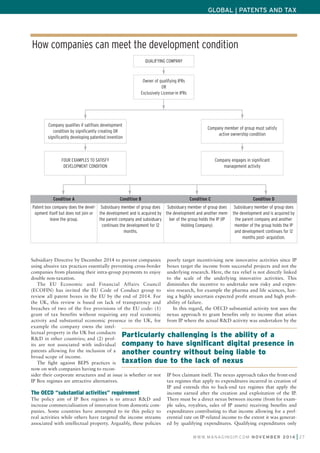
There are four ways that companies can meet the develop-
ment condition (see diagram) wherein group is defined broad-
ly to include Controlled Foreign Companies, joint venture
entities and smaller groups:
• Conditions A and B apply when the company has under-
taken the development itself. Where the Patent Box compa-
ny undertakes the development itself and
does not subsequently join or leave the
group (Condition A).
• When a Patent Box Company
does the development itself but is later
acquired by another larger group, the
Patent Box Company must continue to
develop for at least 12 months post
acquisition (Condition B).
• Conditions C and D allow a company to qualify if another
group company has undertaken the significant develop-
ment, where one group company does the R&D activity
but the arising IP is owned or transferred to another group
company, an IP holding company (Condition C).
• Where the Patent Box Company is acquired by another
larger group, where the larger group may centralise R&D
in one company and/or consolidate its IP holdings in a
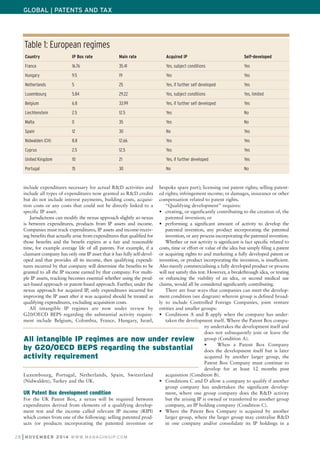
Table 1: European regimes
Country IP Box rate Main rate Acquired IP Self-developed
France 16.76 35.41 Yes, subject conditions Yes
Hungary 9.5 19 Yes Yes
Netherlands 5 25 Yes, if further self developed Yes
Luxembourg 5.84 29.22 Yes, subject conditions Yes, limited
Belgium 6.8 33.99 Yes, if further self developed Yes
Liechtenstein 2.5 12.5 Yes No
Malta 0 35 Yes No
Spain 12 30 No Yes
Nidwalden (CH) 8.8 12.66 Yes Yes
Cyprus 2.5 12.5 Yes Yes
United Kingdom 10 21 Yes, if further developed Yes
Portugal 15 30 No No
All intangible IP regimes are now under review
by G20/OECD BEPS regarding the substantial
activity requirement
different company. Here IP and R&D can be separated pro-
vided the group as a whole continues development for at
least 12 months following the acquisition (Condition D).
Further for a UK qualifying company, which is a member of
a group there is an active ownership condition which requires
the company to have either developed its IP portfolio itself or
where for acquired IP by a member group be actively managing
it insofar as the company must perform a significant amount of
management activity, for example, is involved in planning and
decision making activities of the IP port-
folio. Also likely required is the signifi-
cant people function including IP man-
agement, for example an IP board.
European IP regimes
Table 1 shows the variation in the IP
regimes across Europe. The tax rate
ranges from 0% in Malta to 16.76% in France. Malta, Cyprus
and Liechtenstein offer the lowest rates. Ireland opted out of
the Patent Box where corporation tax for trading income is
12.5%, and any royalty income derived from a “qualifying
patent” is exempt from income tax and corporation tax. Malta
also offers an exemption from income.
Although the types of eligible IP for the IP regimes vary
across Europe, all European IP Box regimes apply to patents.
Outside the UK, other European IP regimes have expanded the
scope to intangible assets to include other types of IP, such as
copyright, processes, designs, utility models, trade secrets and
trade marks. However, the UK Patent Box takes the narrowest
definition limited to essentially patents.
Qualifying IP for the special rate may be acquired from third
parties by acquiring the qualifying IP by licensing-in, or acquir-
ing a company holding qualifying IP and continue to benefit
from the Patent Box subject to further development thus ensur-
ing some real activity before the benefit can be claimed. For
example, a company licenses IP from another company and then
generates income from that IP that is taxed at the lower patent
box rate. Most IP regimes allow Self-Developed IP and Acquired
IP subject to conditions, such as the need to further develop IP
post-acquisition. UK, Belgium, France, Spain, Luxembourg and
the Netherlands allow acquired IP subject to conditions.
Luxembourg allows acquired patents provided patent is
acquired from an unrelated third party, (not a parent, subsid-
uary or sister company). In France, acquired IP is allowed sub-
ject to a two-year holding period for acquired patents.
In response for conformity with OECD and EU standards,
the Swiss Federal Council is introducing a nationwide Licence
Box (IP Box) for 2018 for creating a tax privilege on income
derived from the research, development and innovation
(R&D&I) process. The scope of eligible IP along with sub-
stance requirements are at present unclear.
Outstanding questions
Whether or not the European IP Box regimes will be attractive
enough after the OECD’s BEPS crackdown, when exploitation
of low-tax havens and company restructuring diminish, will
depend upon which IP box regimes are the most generous in
terms of their offerings including rates, breadth of IP, scope of
qualifying income, cap on benefits and treatment of expenses
relating to qualifying IP income; in which case the UK Patent
Box does not appear to provide enough.
Most IP regimes do not require research activity giving rise
to qualifying IP to be conducted in the country granting the tax
benefit. At issue is whether or not IP Box regimes should
require real economic domestic activity but according to EU
law requiring freedom of establishment and free movement of
services, companies can perform R & D anywhere. Arguably,
the purpose behind the IP regimes was to encourage companies
to do more innovation and to do more of it at home.
A level playing field will be required across all IP regimes
and not to the detriment of non-member IP regimes where for
example governmental subsidies, or up-front non-repayable
grants, as exemplified in Germany, are considered fairer alter-
natives compared to IP regimes. The regimes must be linked to
real economic substance which must be defined. For those
regimes that restrict relief to acquired IP and do not require
substantive domestic economic innovative activity will be
under challenge.
Post-acquisition restructuring, or co-ownership through
partnership, joint venture or cost-sharing arrangements and
the creation of IP holding companies could be more closely
scrutinised to see if they fall within anti-avoidance provisions
of the IP regimes along with restructuring schemes designed to
capture benefit from licensing-in arrangements.
Where IP Box regimes capture the results of the R&D
process at the end of the value chain, then these IP regimes must
meet the OECD nexus approach, of direct linkage between
expenditures and income, extended with front end of value
chain consideration, which may be more incentivising for inno-
vation capturing the underlying research. For example, the IP
Box regime in Netherlands applies at the moment of filing the
patent application. In the UK Patent Box, although there is the
patent pending period where you can claim benefits back six
years before grant, it is not possible to go back further than
April 1 2013 (the start of the UK Patent Box regime) and the
date for which the patent was applied for.
Further work on how to tax the digital economy should con-
sider expanding the scope of qualifying IP to other intangible
assets such as software, namely copyright for software, trade
secrets, database protection and domain names. The next gen-
eration of innovations in a digital economy including games,
software, music businesses, online marketplaces, cloud tech-
nology and mobility, network effects, use of data and digital
distribution will most likely not fall within the UK Patent Box
regime (albeit one very limited exception in the case of licens-
ing-in exclusively all IP can come in if “for the same purpose”).
This is because they are targeted at income streams from EP/UK
granted patents and patent procurement is unlikely because
grants of software/IT patents or business method patents in
Europe usually lack patentable subject matter or inventive step
and lack technical solutions to technical problems.
We await the outcome of the second part of G20/OECD BEPS
due in September 2015 incorporating non-OECD countries with
further work on harmful tax practices and the digital economy.
GLOBAL | PATENTS AND TAX
WWW.MANAGINGIP.COM NOVEMBER 2014 29
Afzana Anwer
© Afzana Anwer 2014. The author is an IP lawyer at Key Criteria
Technology Limited
Most IP regimes do not require research activity
giving rise to qualifying IP to be conducted in
the country granting the tax benefit

OCED PAPER NOV 2014

  • 1.
    GLOBAL | PATENTSAND TAX NOVEMBER 2014 WWW.MANAGINGIP.COM 26 T he UK Patent Box scheme, reducing taxes paid by UK businesses by about £1 billion ($1.6 billion) a year by 2016-17, has attracted stiff opposition from some other European countries for unfair competition for foreign investment. The Patent Box scheme was considered useful in supporting growth and innovation in a country if it attracts real economic activity. It is not so if it merely encourages companies to shift profits from the location in which value was created to another location where they may be taxed at a lower rate. The Patent/IP Box regimes were set up to discourage multinationals from using low tax havens, for example virtual holding companies by offering lower tax rate. The Organization for Economic Co-operation and Development (OECD) and the EU Commission are stamping out treaty shopping including tax-friendly regimes in Bermuda, Mauritius, Ireland, Luxembourg and Malta. Microsoft, Facebook, Amazon and Google are among companies who have allegedly transferred IP rights to such low tax jurisdictions Selective tax advantages may amount to state aid which affects trade between member states and threatens to distort competition see Apple (Ireland), Starbucks (Netherlands) and Fiat (Luxembourg). The consequence of unlawful state aid is that the benefits can be clawed back retrospectively for a peri- od of up to 10 years and these companies may be forced to pay billions of euros in back taxes. This article reviews the latest reforms designed to close loopholes and increase transparency in the context of the present qualifying criteria set out for the European IP Box regimes. Low tax schemes designed to attract virtual holding companies comprising all intangible assets must be reviewed along with the IP regimes designed to encourage or reward good behaviour in the form of R&D tax credits and IP regimes. Background OECD initiatives were agreed at the G20 meeting on September 21 2014 to count- er aggressive tax practices (eliminating hybrid mismatches, addressing treaty shop- ping, minimising abuse of transfer pricing for intangibles, country-by-country reporting on global allocation of profits, economic activity and taxes of multina- tionals) and ensure profits are taxed where economic activities generating profits are performed and where value is created, realigning taxation of profits with substantial activities. The reforms will force multinationals to report revenue, profit and tax fig- ures country-by-country, exposing how they shuffle income around the world. Action Item 5 of the base erosion and profit shifting (BEPS) Action Plan was creat- ed to develop solutions to counter harmful regimes, and review the substantial activ- ity requirement with regard to intangible regimes and improving transparency through compulsory spontaneous exchange on rulings related to IP preferential regimes. Further, clarification of the definition of intangibles and transfer pricing rules of intangibles was agreed. G20/OECD BEPS agreed that there would be no special tax regime for digital companies at this time but further review will follow. Digitisation, greatly facilitat- ing cross-border business, has presented challenges for taxing of the digital econo- my. Particularly challenging is the ability of a company to have significant digital presence in another country without being liable to taxation due to the lack of nexus. For example, collection, processing and monetisation of data, that is exten- sive collection of personal data in a country over the internet, could trigger a tax- able nexus in that country − this does not occur under current tax rules. The EU Commission has also countered against aggressive tax practices along with G20/OCED BEPS. Member states are expected to implement a revised Parent- OECD cracks down on the Patent Box So-called IP Box regimes offering tax advantages are popular with both governments and businesses. But, as Afzana Anwer reports, the OECD and EU Commission are putting them under threat Patent Box schemes in the UK and elsewhere are designed to promote R&D investment by reducing the tax payable on IP-based revenues. But now the OECD and the EU Commission are stamping down on perceived abuses, with consequences for both governments and businesses. The reforms are designed to close loopholes and increase transparency and focus on issues such as “substantial activities”, the nexus approach and “qualifying development”. This raises several questions: will the European IP Box regimes still be attractive to R&D compa- nies after this crackdown? Will corporate tax arrangements be more closely scrutinized? How should digital income be taxed? Further analysis from the OECD should help provide some answers. One-minute read
  • 2.
    Subsidiary Directive byDecember 2014 to prevent companies using abusive tax practices essentially preventing cross-border companies from planning their intra-group payments to enjoy double non-taxation. The EU Economic and Financial Affairs Council (ECOFIN) has invited the EU Code of Conduct group to review all patent boxes in the EU by the end of 2014. For the UK, this review is based on lack of transparency and breaches of two of the five provisions of the EU code: (1) grant of tax benefits without requiring any real economic activity and substantial economic presence in the UK, for example the company owns the intel- lectual property in the UK but conducts R&D in other countries; and (2) prof- its are not associated with individual patents allowing for the inclusion of a broad scope of income. The fight against BEPS practices is now on with companies having to recon- sider their corporate structures and at issue is whether or not IP Box regimes are attractive alternatives. The OECD “substantial activities” requirement The policy aim of IP Box regimes is to attract R&D and increase commercialisation of innovation from domestic com- panies. Some countries have attempted to tie this policy to real activities while others have targeted the income streams associated with intellectual property. Arguably, these policies poorly target incentivising new innovative activities since IP boxes target the income from successful projects and not the underlying research. Here, the tax relief is not directly linked to the scale of the underlying innovative activities. This diminishes the incentive to undertake new risky and expen- sive research, for example the pharma and life sciences, hav- ing a highly uncertain expected profit stream and high prob- ability of failure. In this regard, the OECD substantial activity test uses the nexus approach to grant benefits only to income that arises from IP where the actual R&D activity was undertaken by the IP box claimant itself. The nexus approach takes the front-end tax regimes that apply to expenditures incurred in creation of IP and extends this to back-end tax regimes that apply the income earned after the creation and exploitation of the IP. There must be a direct nexus between income (from for exam- ple sales, royalties, sales of IP assets) receiving benefits and expenditures contributing to that income allowing for a pref- erential rate on IP-related income to the extent it was generat- ed by qualifying expenditures. Qualifying expenditures only GLOBAL | PATENTS AND TAX WWW.MANAGINGIP.COM NOVEMBER 2014 27 How companies can meet the development condition QUALIFYING COMPANY Owner of qualifying IPRs OR Exclusively License-in IPRs Company qualifies if satifises development condition by significantly creating OR significantly developing patented invention FOUR EXAMPLES TO SATISFY DEVELOPMENT CONDITION Company member of group must satisfy active ownership condition Company engages in significant management activity Condition A Condition B Condition C Condition D Patent box company does the devel- opment itself but does not join or leave the group. Subsiduary member of group does the development and is acquired by the parent company and subsiduary continues the development for 12 months. Subsiduary member of group does the development and another mem- ber of the group holds the IP (IP Holding Company). Subsiduary member of group does the development and is acquired by the parent company and another member of the group holds the IP and development continues for 12 months post- acquistion. Particularly challenging is the ability of a company to have significant digital presence in another country without being liable to taxation due to the lack of nexus
  • 3.
    GLOBAL | PATENTSAND TAX NOVEMBER 2014 WWW.MANAGINGIP.COM 28 include expenditures necessary for actual R&D activities and include all types of expenditures now granted as R&D credits but do not include interest payments, building costs, acquisi- tion costs or any costs that could not be directly linked to a specific IP asset. Jurisdictions can modify the nexus approach slightly so nexus is between expenditures, products from IP assets and income. Companies must track expenditures, IP assets and income-receiv- ing benefits that actually arise from expenditures that qualified for those benefits and the benefit expires at a fair and reasonable time, for example average life of all patents. For example, if a claimant company has only one IP asset that it has fully self-devel- oped and that provides all its income, then qualifying expendi- tures incurred by that company will determine the benefits to be granted to all the IP income earned by that company. For multi- ple IP assets, tracking becomes essential whether using the prod- uct-based approach or patent-based approach. Further, under the nexus approach for acquired IP, only expenditures incurred for improving the IP asset after it was acquired should be treated as qualifying expenditures, excluding acquisition costs. All intangible IP regimes are now under review by G20/OECD BEPS regarding the substantial activity require- ment include Belgium, Colombia, France, Hungary, Israel, Luxembourg, Portugal, Netherlands, Spain, Switzerland (Nidwalden), Turkey and the UK. UK Patent Box development condition For the UK Patent Box, a nexus will be required between expenditures derived from elements of a qualifying develop- ment test and the income called relevant IP income (RIPI) which comes from one of the following: selling patented prod- ucts (or products incorporating the patented invention or bespoke spare part); licensing out patent rights; selling patent- ed rights; infringement income; or damages, insurance or other compensation related to patent rights. “Qualifying development” requires: • creating, or significantly contributing to the creation of, the patented invention; or • performing a significant amount of activity to develop the patented invention, any product incorporating the patented invention, or any process incorporating the patented invention. Whether or not activity is significant is fact specific related to costs, time or effort or value of the idea but simply filing a patent or acquiring rights to and marketing a fully developed patent or invention, or product incorporating the invention, is insufficient. Also merely commercialising a fully developed product or process will not satisfy this test. However, a breakthrough idea, or testing or enhancing the viability of an idea, or second medical use claims, would all be considered significantly contributing. There are four ways that companies can meet the develop- ment condition (see diagram) wherein group is defined broad- ly to include Controlled Foreign Companies, joint venture entities and smaller groups: • Conditions A and B apply when the company has under- taken the development itself. Where the Patent Box compa- ny undertakes the development itself and does not subsequently join or leave the group (Condition A). • When a Patent Box Company does the development itself but is later acquired by another larger group, the Patent Box Company must continue to develop for at least 12 months post acquisition (Condition B). • Conditions C and D allow a company to qualify if another group company has undertaken the significant develop- ment, where one group company does the R&D activity but the arising IP is owned or transferred to another group company, an IP holding company (Condition C). • Where the Patent Box Company is acquired by another larger group, where the larger group may centralise R&D in one company and/or consolidate its IP holdings in a Table 1: European regimes Country IP Box rate Main rate Acquired IP Self-developed France 16.76 35.41 Yes, subject conditions Yes Hungary 9.5 19 Yes Yes Netherlands 5 25 Yes, if further self developed Yes Luxembourg 5.84 29.22 Yes, subject conditions Yes, limited Belgium 6.8 33.99 Yes, if further self developed Yes Liechtenstein 2.5 12.5 Yes No Malta 0 35 Yes No Spain 12 30 No Yes Nidwalden (CH) 8.8 12.66 Yes Yes Cyprus 2.5 12.5 Yes Yes United Kingdom 10 21 Yes, if further developed Yes Portugal 15 30 No No All intangible IP regimes are now under review by G20/OECD BEPS regarding the substantial activity requirement
  • 4.
    different company. HereIP and R&D can be separated pro- vided the group as a whole continues development for at least 12 months following the acquisition (Condition D). Further for a UK qualifying company, which is a member of a group there is an active ownership condition which requires the company to have either developed its IP portfolio itself or where for acquired IP by a member group be actively managing it insofar as the company must perform a significant amount of management activity, for example, is involved in planning and decision making activities of the IP port- folio. Also likely required is the signifi- cant people function including IP man- agement, for example an IP board. European IP regimes Table 1 shows the variation in the IP regimes across Europe. The tax rate ranges from 0% in Malta to 16.76% in France. Malta, Cyprus and Liechtenstein offer the lowest rates. Ireland opted out of the Patent Box where corporation tax for trading income is 12.5%, and any royalty income derived from a “qualifying patent” is exempt from income tax and corporation tax. Malta also offers an exemption from income. Although the types of eligible IP for the IP regimes vary across Europe, all European IP Box regimes apply to patents. Outside the UK, other European IP regimes have expanded the scope to intangible assets to include other types of IP, such as copyright, processes, designs, utility models, trade secrets and trade marks. However, the UK Patent Box takes the narrowest definition limited to essentially patents. Qualifying IP for the special rate may be acquired from third parties by acquiring the qualifying IP by licensing-in, or acquir- ing a company holding qualifying IP and continue to benefit from the Patent Box subject to further development thus ensur- ing some real activity before the benefit can be claimed. For example, a company licenses IP from another company and then generates income from that IP that is taxed at the lower patent box rate. Most IP regimes allow Self-Developed IP and Acquired IP subject to conditions, such as the need to further develop IP post-acquisition. UK, Belgium, France, Spain, Luxembourg and the Netherlands allow acquired IP subject to conditions. Luxembourg allows acquired patents provided patent is acquired from an unrelated third party, (not a parent, subsid- uary or sister company). In France, acquired IP is allowed sub- ject to a two-year holding period for acquired patents. In response for conformity with OECD and EU standards, the Swiss Federal Council is introducing a nationwide Licence Box (IP Box) for 2018 for creating a tax privilege on income derived from the research, development and innovation (R&D&I) process. The scope of eligible IP along with sub- stance requirements are at present unclear. Outstanding questions Whether or not the European IP Box regimes will be attractive enough after the OECD’s BEPS crackdown, when exploitation of low-tax havens and company restructuring diminish, will depend upon which IP box regimes are the most generous in terms of their offerings including rates, breadth of IP, scope of qualifying income, cap on benefits and treatment of expenses relating to qualifying IP income; in which case the UK Patent Box does not appear to provide enough. Most IP regimes do not require research activity giving rise to qualifying IP to be conducted in the country granting the tax benefit. At issue is whether or not IP Box regimes should require real economic domestic activity but according to EU law requiring freedom of establishment and free movement of services, companies can perform R & D anywhere. Arguably, the purpose behind the IP regimes was to encourage companies to do more innovation and to do more of it at home. A level playing field will be required across all IP regimes and not to the detriment of non-member IP regimes where for example governmental subsidies, or up-front non-repayable grants, as exemplified in Germany, are considered fairer alter- natives compared to IP regimes. The regimes must be linked to real economic substance which must be defined. For those regimes that restrict relief to acquired IP and do not require substantive domestic economic innovative activity will be under challenge. Post-acquisition restructuring, or co-ownership through partnership, joint venture or cost-sharing arrangements and the creation of IP holding companies could be more closely scrutinised to see if they fall within anti-avoidance provisions of the IP regimes along with restructuring schemes designed to capture benefit from licensing-in arrangements. Where IP Box regimes capture the results of the R&D process at the end of the value chain, then these IP regimes must meet the OECD nexus approach, of direct linkage between expenditures and income, extended with front end of value chain consideration, which may be more incentivising for inno- vation capturing the underlying research. For example, the IP Box regime in Netherlands applies at the moment of filing the patent application. In the UK Patent Box, although there is the patent pending period where you can claim benefits back six years before grant, it is not possible to go back further than April 1 2013 (the start of the UK Patent Box regime) and the date for which the patent was applied for. Further work on how to tax the digital economy should con- sider expanding the scope of qualifying IP to other intangible assets such as software, namely copyright for software, trade secrets, database protection and domain names. The next gen- eration of innovations in a digital economy including games, software, music businesses, online marketplaces, cloud tech- nology and mobility, network effects, use of data and digital distribution will most likely not fall within the UK Patent Box regime (albeit one very limited exception in the case of licens- ing-in exclusively all IP can come in if “for the same purpose”). This is because they are targeted at income streams from EP/UK granted patents and patent procurement is unlikely because grants of software/IT patents or business method patents in Europe usually lack patentable subject matter or inventive step and lack technical solutions to technical problems. We await the outcome of the second part of G20/OECD BEPS due in September 2015 incorporating non-OECD countries with further work on harmful tax practices and the digital economy. GLOBAL | PATENTS AND TAX WWW.MANAGINGIP.COM NOVEMBER 2014 29 Afzana Anwer © Afzana Anwer 2014. The author is an IP lawyer at Key Criteria Technology Limited Most IP regimes do not require research activity giving rise to qualifying IP to be conducted in the country granting the tax benefit