Employee fraud costs the U.S. $300 billion a year.
Fraudsters are becoming more sophisticated and clever in
their schemes, but when it comes to manipulating data,
the numbers rarely lie. According to Benford’s Law, named
for physicist Frank Benford, irregularities can be spotted by
analyzing digits in numerical data.
Benford analyzed the distribution of the first digit in a
natural population of numbers and discovered that the
number 1 as the first digit of every number occurs in 30.6%
of the cases compared to the number 9 as the first digit in
only 4.57% of the analyzed cases. Extensive research by
other experts has proven that numbers starting with lower
digits occur more frequent
than higher digits. Known
as the “First-Digit Law,” it
has helped accountants and
auditors detect fraud and
uncover deceptive practices.
Decades later, Benford’s
Law has infiltrated purpose-
built data analytics tools
and used in forensic
accounting investigations. Mark Luciani, National Field
Examination Manager for CIT Commercial Services, a
leading provider of factoring services, and a unit of CIT
Group Inc. (NYSE: CIT), a leading provider of commercial
lending and leasing services, and Lee Sullivan, Assistant
Field Examination Manager, first became acquainted with
Benford’s Law in 2000 while attending data analytics
training.
“We utilize Benford’s Law on every exam engagement,”
said Luciani,. “It provides a quick perspective on the
characteristics of the specific database being analyzed.
Then, based on our years of industry experience, we can
compare and contrast features of the data set we are
analyzing against the backdrop of similar data across a
wide spectrum of industries and time periods.”
CIT Commercial Services, relies on its field examiners to
examine and audit clients and prospective clients. The
group analyzes financial records of U.S. corporations
in various industries, specifically current assets such
as accounts receivable and inventory, to evaluate and
test internal controls and systems. More than a dozen
examiners, mostly collateral auditors, provide information
to loan officers and senior credit officers to help mitigate
risks inherent in providing secured loans and factoring
facilities to clients and potential clients.
For the past 14 years, CIT Commercial Services examiners
have relied on data analytics tools to help them examine
large amounts of data to
analyze the characteristics
of various client data
such as cash, accounts
receivable, inventory and
liabilities. The examiners
frequently apply Benford’s
Law to any scenario where
data could be deliberately
manipulated.
When reviewing financial statements, digital analysis
can be applied multiple ways to examine irregularities or
abnormalities in transactions. For example, manipulation
of checks, cash on hand, accounts, double payments or
invoice numbers, and others. It is also effective in analyzing
systematically incorrect valuations of inventories, and
looking for amounts just below limit and/or approval levels.
The Numbers Never Lie:
Applying Benford’s Law with Data Analytics
An Audit Division That Has Mastered Its Use
“The utilization of IDEA (data analysis software)
enables us to discern meaningful relationships
with seemingly unrelated data. Recognition
of often non-intuitive relationships within our
database can help us anticipate, rather than react
to, client needs and spot potential new business
opportunities”
Mark Luciani
National Field Examination Manager, CIT Group Inc.
TIP
Benford’s Law can only be used for naturally
occurring data such as inventory, purchasing,
payables, etc. Large data sets yield the most
useful results.
“The utilization of IDEA (data analysis software) enables
us to discern meaningful relationships within seemingly
unrelated data,” said Luciani, “Recognition of often
non-intuitive relationships within our databases can help
us anticipate, rather than react to, client needs and spot
potential new business opportunities.”
IDEA Version 9 included new Benford’s Law fraud-fighting
tests, developed by renowned expert Dr. Mark Nigrini. CIT
Commerical Services examiners adopted these new tests
to help them uncover material errors and identify unusual
patterns in client data, which upon further investigation,
sometimes revealed instances of fraud.
“The improvements to IDEA’s digital analytics in V9
allowed us to test digits for deviance,” said Luciani.
“We often use the Last Two Digits Test when evaluating
inventory, payables and accounts receivable data. We
perform subsequent and more detailed analyses on
subsets derived from Benford’s Law tests.”
According to Luciani, Benford’s Law benefits examiners
and auditors well beyond the mere technical application of
the theory.
“It has caused us to think more deeply and expansively
about number theory in general,” said Luciani.
“Specifically, how we can develop algorithms that can
identify patters in large data sets. It helps us think in terms
of Big Data to see patterns within the numbers that we
wouldn’t normally find. Benford’s is hard to beat, even for
the cleverest fraudster.”
1250 Wood Branch Park Dr., Ste. 480, Houston,TX 77079
888.641.2800 • sales@audimation.com • audimation.com
Newly Added Benford’s LawTests
Included in IDEA
Last Two Digits Test
Analyzes the frequency of the last two digits. Useful
for analyzing inventory counts, election results, or
any situation where padding or number invention is
suspected.
Second Order Test
Based on the digits of the differences between amounts
that have been sorted from smallest to largest (ordered).
The first two digits of the differences should follow the
digit frequencies of Benford’s Law. Useful for indicating
data integrity issues.
Summation Test
Similar to the traditional Benford’s Law test, but instead
of calculating the number of occurrences for each first
two digits, it sums each amount. Useful for identifying
significant amounts that do not follow the expected
results of Benford’s Law.
Advanced Settings
Extract “suspicious” data whose digit frequencies do
not follow the digit frequencies of Benford’s Law. With
Advanced Settings, you can also refine this output to
limit the size of the output database.

benfords Law

  • 1.
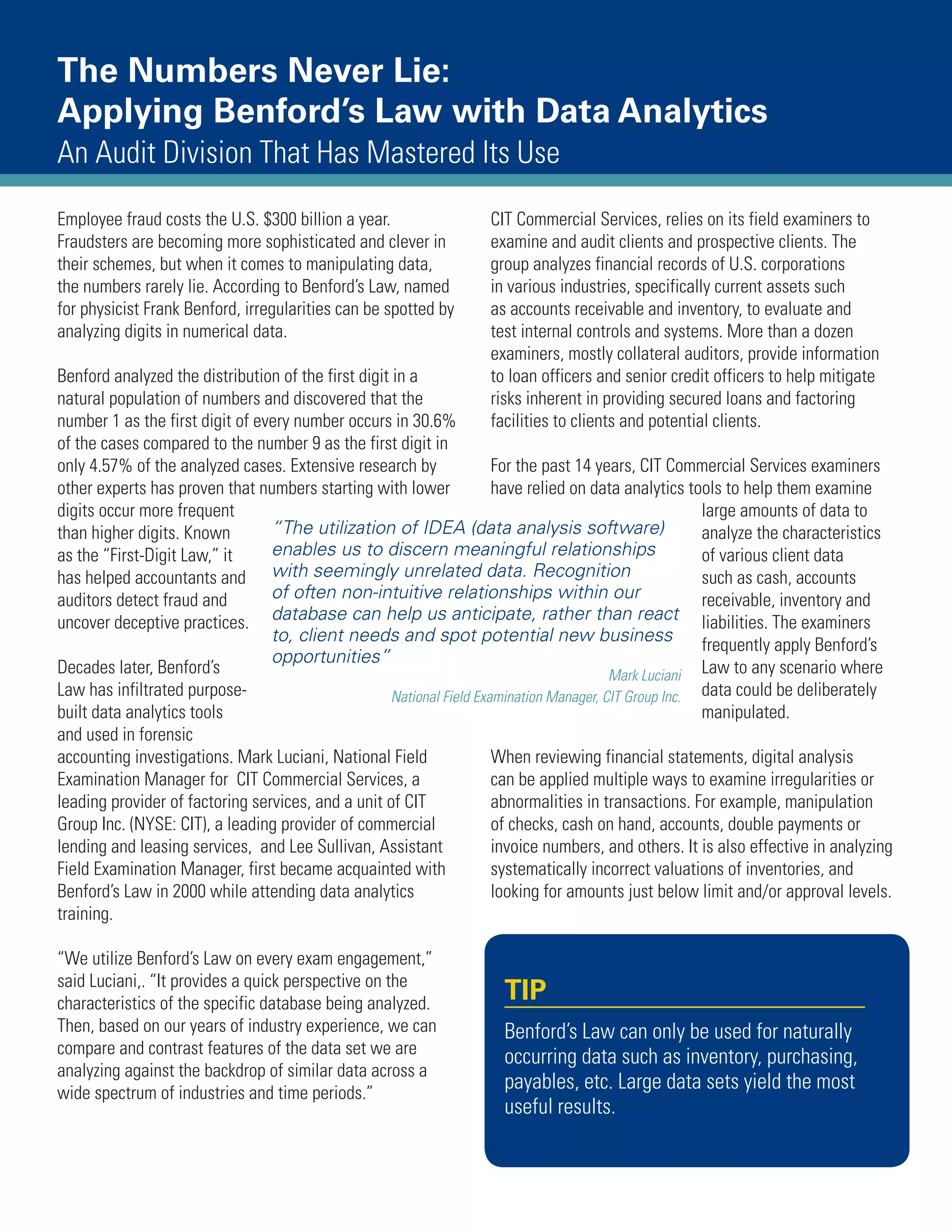
    Employee fraud coststhe U.S. $300 billion a year. Fraudsters are becoming more sophisticated and clever in their schemes, but when it comes to manipulating data, the numbers rarely lie. According to Benford’s Law, named for physicist Frank Benford, irregularities can be spotted by analyzing digits in numerical data. Benford analyzed the distribution of the first digit in a natural population of numbers and discovered that the number 1 as the first digit of every number occurs in 30.6% of the cases compared to the number 9 as the first digit in only 4.57% of the analyzed cases. Extensive research by other experts has proven that numbers starting with lower digits occur more frequent than higher digits. Known as the “First-Digit Law,” it has helped accountants and auditors detect fraud and uncover deceptive practices. Decades later, Benford’s Law has infiltrated purpose- built data analytics tools and used in forensic accounting investigations. Mark Luciani, National Field Examination Manager for CIT Commercial Services, a leading provider of factoring services, and a unit of CIT Group Inc. (NYSE: CIT), a leading provider of commercial lending and leasing services, and Lee Sullivan, Assistant Field Examination Manager, first became acquainted with Benford’s Law in 2000 while attending data analytics training. “We utilize Benford’s Law on every exam engagement,” said Luciani,. “It provides a quick perspective on the characteristics of the specific database being analyzed. Then, based on our years of industry experience, we can compare and contrast features of the data set we are analyzing against the backdrop of similar data across a wide spectrum of industries and time periods.” CIT Commercial Services, relies on its field examiners to examine and audit clients and prospective clients. The group analyzes financial records of U.S. corporations in various industries, specifically current assets such as accounts receivable and inventory, to evaluate and test internal controls and systems. More than a dozen examiners, mostly collateral auditors, provide information to loan officers and senior credit officers to help mitigate risks inherent in providing secured loans and factoring facilities to clients and potential clients. For the past 14 years, CIT Commercial Services examiners have relied on data analytics tools to help them examine large amounts of data to analyze the characteristics of various client data such as cash, accounts receivable, inventory and liabilities. The examiners frequently apply Benford’s Law to any scenario where data could be deliberately manipulated. When reviewing financial statements, digital analysis can be applied multiple ways to examine irregularities or abnormalities in transactions. For example, manipulation of checks, cash on hand, accounts, double payments or invoice numbers, and others. It is also effective in analyzing systematically incorrect valuations of inventories, and looking for amounts just below limit and/or approval levels. The Numbers Never Lie: Applying Benford’s Law with Data Analytics An Audit Division That Has Mastered Its Use “The utilization of IDEA (data analysis software) enables us to discern meaningful relationships with seemingly unrelated data. Recognition of often non-intuitive relationships within our database can help us anticipate, rather than react to, client needs and spot potential new business opportunities” Mark Luciani National Field Examination Manager, CIT Group Inc. TIP Benford’s Law can only be used for naturally occurring data such as inventory, purchasing, payables, etc. Large data sets yield the most useful results.
  • 2.
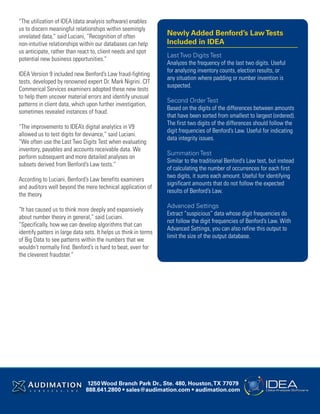
    “The utilization ofIDEA (data analysis software) enables us to discern meaningful relationships within seemingly unrelated data,” said Luciani, “Recognition of often non-intuitive relationships within our databases can help us anticipate, rather than react to, client needs and spot potential new business opportunities.” IDEA Version 9 included new Benford’s Law fraud-fighting tests, developed by renowned expert Dr. Mark Nigrini. CIT Commerical Services examiners adopted these new tests to help them uncover material errors and identify unusual patterns in client data, which upon further investigation, sometimes revealed instances of fraud. “The improvements to IDEA’s digital analytics in V9 allowed us to test digits for deviance,” said Luciani. “We often use the Last Two Digits Test when evaluating inventory, payables and accounts receivable data. We perform subsequent and more detailed analyses on subsets derived from Benford’s Law tests.” According to Luciani, Benford’s Law benefits examiners and auditors well beyond the mere technical application of the theory. “It has caused us to think more deeply and expansively about number theory in general,” said Luciani. “Specifically, how we can develop algorithms that can identify patters in large data sets. It helps us think in terms of Big Data to see patterns within the numbers that we wouldn’t normally find. Benford’s is hard to beat, even for the cleverest fraudster.” 1250 Wood Branch Park Dr., Ste. 480, Houston,TX 77079 888.641.2800 • sales@audimation.com • audimation.com Newly Added Benford’s LawTests Included in IDEA Last Two Digits Test Analyzes the frequency of the last two digits. Useful for analyzing inventory counts, election results, or any situation where padding or number invention is suspected. Second Order Test Based on the digits of the differences between amounts that have been sorted from smallest to largest (ordered). The first two digits of the differences should follow the digit frequencies of Benford’s Law. Useful for indicating data integrity issues. Summation Test Similar to the traditional Benford’s Law test, but instead of calculating the number of occurrences for each first two digits, it sums each amount. Useful for identifying significant amounts that do not follow the expected results of Benford’s Law. Advanced Settings Extract “suspicious” data whose digit frequencies do not follow the digit frequencies of Benford’s Law. With Advanced Settings, you can also refine this output to limit the size of the output database.