Queensland University of Technology
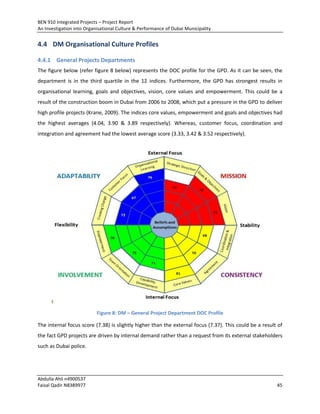
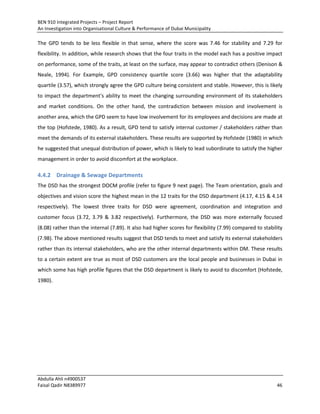
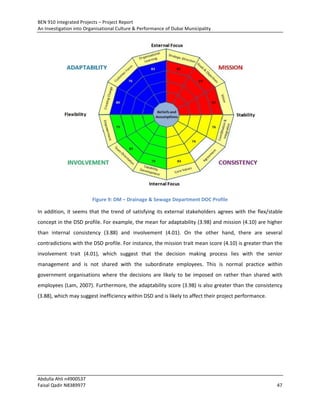
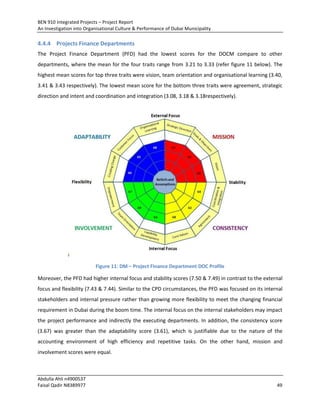
Faculty of Built Environment & Engineering
BEN910
Integrated Project
Project Report:
An Investigation into the Organisational Culture and Performance
of the Dubai Municipality
Unit: BEN910 โ€“ Integrated Project
Semester: Semester 1, 2012
Unit Coordinator: Dr Wim Dekkers
Supervisor: Dr Vaughan Coffey
Authors: Abdulla Ahli โ€“ N4900537
Faisal Qadir โ€“ N8389977
Due Date: 01 Jun 2012
i
ABSTRACT
This research paper analyses organisational culture and effectiveness / performance of Dubai
Municipality (DM). The literature review summarises the debates and materials available on the subject
of organisational culture and performance. It also provides an overview of the critiques that has been
presented on the subject by other researchers and further discussed from the authorsโ€™ perspectives.
Furthermore, the research methodology presented the tussle between qualitative and quantitative
approaches, where equal numbers of researchers have supported both methodologies. The four
departments of DM considered to test the proposition of organisational culture and performance
measurement were the Contracts and Purchasing Department, General Projects Departments, Project
Finance Department and Sewage and Drainage Department. The Denison Organisational Culture Model
(DOCM) survey was carried out in order to profile the DOCM for each department.
The collected data was subject to a number of data verification and validation tests such as reliability
and validity test in order to ensure the accuracy of the generated results and conclusion. Coefficient
alpha was conducted to test the reliability of the data, which ranged between (0.70) and (0.94). No
validity test was conducted as one of the researchers was present at all time to assist the respondentsโ€™
in-filling the survey. The survey results were further analysed with respect to their financial performance
that gave relevance to research. The collected data was analysed in a way to develop results that can
lead to certain conclusions for DMโ€™s culture and performance.
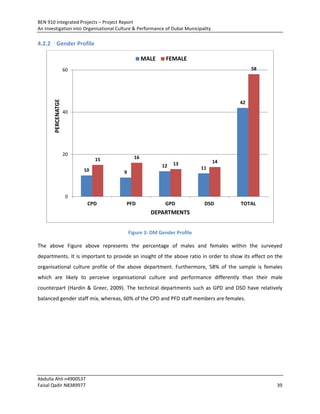
The general statistical results suggested that DM employed more females than their male counterparts.
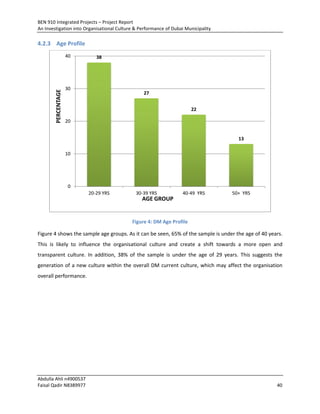
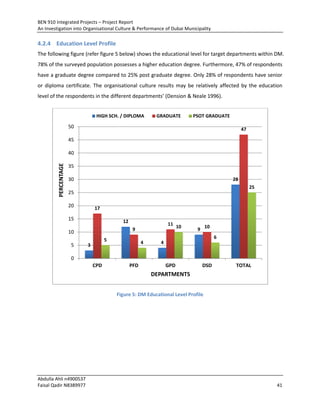
It also showed that the majority of the samples possess at least a graduate certificate and are aged
between 20-35 years. In addition, the research found that the mission was by far the most important
trait and had the highest mean score for the three out of four targets departments. In contrast, the
adaptability trait had the lowest mean score. In addition, the internal and external focus score for the
four departments suggested that DM has a lack of stakeholdersโ€™ management. Despite the relatively
strong organisational culture of the target departments, the research found that the majority of DM
projects for both General Project and Drainage and Sewage Departments were completed behind
schedule and over the allocated budget.
Key words: Culture, Organisational Culture, Organisation Performance, Denison Model
ii
ACKNOWLEDGEMENT
We are thankful to almighty Allah for giving us strength to undertake this research. We would like to
sincerely thank Dr. Vaughan Coffey for his kind supervision, inspiration and guidance throughout the
project.
We would also like to show our gratitude to Dubai Municipality who unequivocally allowed us to
interview their employees and conduct the survey. We were given an open hand to access their financial
and organisational data. Special thanks to the employees of the Contract and Purchasing Department,
General Project Department, Finance Department and Drainage and Sewage Department for their
unlimited support and time to enable this research to happen.
We would also like to thank our families who tolerated and assisted us in the process of our research
work. Though we were close friends before the start of research work but in the process of research
work we developed a relationship of brotherhood. That we hope to cherish for times to come.
iii
STATEMENT OF ORIGINAL WORKS
The authors declare that the work contained in this study has not been previously submitted for any
other tertiary degree or diploma at the Queensland University of Technology or any other tertiary
educational institution. To the best of the authorsโ€™ knowledge, no material that has been previously
published or written by any other person has been included in this report, unless properly cited and
referenced.
Signed.............................................................................. Date:.....................
(Name Printed)
Signed.............................................................................. Date:.....................
(Name Printed)
iv
TABLE OF CONTENTS
1 CHAPTER โ€“ INTRODUCTION..........................................................................................................1
1.1 CHAPTER INTRODUCTION....................................................................................................................1
1.2 PROPOSITIONS ..................................................................................................................................2
1.3 PROJECT SCOPE.................................................................................................................................2
1.3.1 Aim ........................................................................................................................................2
1.3.2 Objectives..............................................................................................................................2
1.3.3 Significance ...........................................................................................................................2
1.4 EXPECTED OUTCOMES........................................................................................................................3
1.5 LIMITATIONS.....................................................................................................................................3
1.6 EXCLUSIONS......................................................................................................................................4
1.7 RESEARCH STRUCTURE .......................................................................................................................4
1.7.1 Stage 1 โ€“ Preliminary ............................................................................................................5
1.7.2 Stage 2 โ€“ Initiation................................................................................................................5
1.7.3 Phase 3 โ€“ Planning................................................................................................................5
1.7.4 Stage 4 โ€“ Execution...............................................................................................................5
1.7.5 Phase 5 โ€“ Closeout ................................................................................................................5
2 CHAPTER โ€“ LITERATURE REVIEW ..................................................................................................6
2.1 CHAPTER INTRODUCTION....................................................................................................................6
2.2 ORGANISATIONAL CULTURE.................................................................................................................7
2.3 CULTURE OR CLIMATE RESEARCH FOCUS FOR ORGANISATIONAL BEHAVIOUR.............................................12
2.4 ORGANISATIONAL EFFECTIVENESS / PERFORMANCE ..............................................................................16
2.5 MEASUREMENT OF ORGANISATIONAL CULTURE / THEORIES...................................................................18
2.6 SUMMARY......................................................................................................................................21
3 CHAPTER โ€“ RESEARCH METHODOLOGY ......................................................................................23
3.1 CHAPTER INTRODUCTION..................................................................................................................23
3.2 PURPOSE OF THE RESEARCH ..............................................................................................................23
3.3 EXTENT OF RESEARCHER INFLUENCE AND STUDY SETTING ......................................................................23
3.3.1 Researcher Influence...........................................................................................................23
3.3.2 Study Setting .......................................................................................................................23
3.4 UNIT OF ANALYSIS ...........................................................................................................................23
3.5 TIME HORIZON................................................................................................................................24
3.6 DATA COLLECTION...........................................................................................................................24
3.6.1 Method................................................................................................................................24
3.6.2 Sample.................................................................................................................................26
3.6.3 Analysis ...............................................................................................................................28
3.7 ETHICAL CONSIDERATION..................................................................................................................30
3.8 PROPOSITION QUESTIONS.................................................................................................................30
v
3.9 DENISON MODEL ............................................................................................................................31
3.9.1 Overview .............................................................................................................................31
3.9.2 Involvement.........................................................................................................................32
3.9.3 Consistency..........................................................................................................................33
3.9.4 Adaptability.........................................................................................................................33
3.9.5 Mission................................................................................................................................34
3.9.6 Internal / External Focus .....................................................................................................35
3.9.7 Stability / Flexibility.............................................................................................................35
3.9.8 Contradiction.......................................................................................................................36
3.9.9 Questionnaire......................................................................................................................36
3.10 SUMMARY......................................................................................................................................37
4 CHAPTER โ€“DISCUSSION & RESULTS.............................................................................................38
4.1 CHAPTER INTRODUCTION ..................................................................................................................38
4.2 STATISTICAL DESCRIPTIVE ANALYSIS....................................................................................................38
4.2.1 Research Population ...........................................................................................................38
4.2.2 Gender Profile .....................................................................................................................39
4.2.3 Age Profile...........................................................................................................................40
4.2.4 Education Level Profile........................................................................................................41
4.2.5 Years with Organisation Profile ..........................................................................................42
4.2.6 Sample Function Profile ......................................................................................................43
4.3 DATA RELIABILITY ............................................................................................................................44
4.4 DM ORGANISATIONAL CULTURE PROFILES ..........................................................................................45
4.4.1 General Projects Departments............................................................................................45
4.4.2 Drainage & Sewage Departments.......................................................................................46
4.4.3 Contracts & Purchasing Departments.................................................................................48
4.4.4 Projects Finance Departments ............................................................................................49
4.5 PROJECT PERFORMANCE...................................................................................................................50
4.5.1 Brief.....................................................................................................................................50
4.5.2 Time Performance...............................................................................................................50
4.5.3 Budget Performance ...........................................................................................................51
4.6 DM DEPARTMENTS PROFILES VS PERFORMANCE..................................................................................52
4.7 THE IDEAL DOCM FOR DM DEPARTMENTS........................................................................................53
4.8 SUMMARY......................................................................................................................................53
5 CHAPTER โ€“ CONCLUSION & RECOMMENDATIONS ......................................................................54
5.1 CONCLUSION ..................................................................................................................................54
5.2 RECOMMENDATIONS .......................................................................................................................55
Appendix A โ€“ Dubai Municipality Organisational Chart
vi
LIST OF TABLES
TABLE 1: DIFFERENCE BETWEEN CULTURE AND CLIMATE..........................................................................................................15
TABLE 2: ORGANISATIONAL EFFECTIVENESS QUESTIONS ADOPTED FROM LEWIN AND MINTON (1986, P 16) .....................................19
TABLE 3: RELATIONSHIP BETWEEN ORGANISATIONAL CULTURE AND SUCCESS FACTORS IN DUBAI MUNICIPALITY..................................30
TABLE 4: DM DENISON ORGANISATIONAL CULTURE SURVEY DATA VALIDITY ...............................................................................44
LIST FIGURES
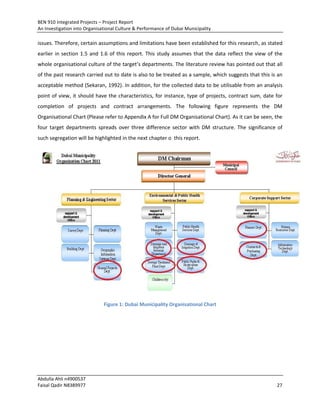
FIGURE 1: DUBAI MUNICIPALITY ORGANISATIONAL CHART.......................................................................................................27
FIGURE 2: DENISON ORGAADAPTEDNAL CULTURE MODEL ADOPTED FROM (DENISON AND NEALE, 1996)........................................31
FIGURE 3: DM GENDER PROFILE.........................................................................................................................................39
FIGURE 4: DM AGE PROFILE ..............................................................................................................................................40
FIGURE 5: DM EDUCATIONAL LEVEL PROFILE ........................................................................................................................41
FIGURE 6: POPULATION YEAR OF SERVICE IN DM ...................................................................................................................42
FIGURE 7: POPULATION FUNCTION IN DM............................................................................................................................43
FIGURE 8: DM โ€“ GENERAL PROJECT DEPARTMENT DOC PROFILE .............................................................................................45
FIGURE 9: DM โ€“ DRAINAGE & SEWAGE DEPARTMENT DOC PROFILE ........................................................................................47
FIGURE 10: DM โ€“ CONTRACT & PURCHASING DEPARTMENT DOCM PROFILE ............................................................................48
FIGURE 11: DM โ€“ PROJECT FINANCE DEPARTMENT DOC PROFILE ............................................................................................49
FIGURE 12: DM PROJECTS TIME PERFORMANCE....................................................................................................................51
FIGURE 13: DM PROJECTS CONTRACT VALUE PERFORMANCE...................................................................................................51
vii
LIST OF ABBREVIATIONS
DM Dubai Municipality
CDP Contracts & Purchasing Department
GPD General Projects Department
DSD Drainage & Sewage Department
PFD Projects Finance Department
DOCM Denison Organisational Culture Model
BEN 910 Integrated Projects โ€“ Project Report
An Investigation into Organisational Culture & Performance of Dubai Municipality
Abdulla Ahli n4900537
Faisal Qadir N8389977 1
1 Chapter โ€“ Introduction
1.1 Chapter Introduction
Dubai, due to its location and superior leadership, has transformed into a world leader of urban
development and mega projects in very little time. Projects like Burj Khalifa, the Palm and the World
Islands have set a new benchmark for landmarks in the field of construction and urban development for
the rest of the world to follow (Krane, 2009). Dubai, which was once known for its sandy beaches and
small fishing villages has now transformed into one of the world most luxurious and desired tourist
destinations (Krane, 2009). Dubai is home to signature names in entertainment, banking, sports,
business, shopping malls and man-made wonders, put simply, Dubai is a trend setter for the rest of the
world (Pacione, 2005).
The question arises, as to how is it possible that a small fishing town can transform into a world leader
and trend setter for the rest of the world in the fields of entertainment, real estate and urban
development in just a few years? The credit, single-handedly, goes to Sheikh Mohammed, his team and
his predecessors who through their superior leadership and dedication have transformed Dubai into
worldโ€™s most advanced city (Acuto, 2010). Dubai Municipality (DM) is responsible for translating Sheikh
Mohammedโ€™s vision of modern Dubai into a reality. DM is the sponsor organisation for these projects
and has a project budget of over 1.25 billion US dollars annually (Bitar, 2011). DM manages building
permits for construction projects carried out in DMโ€™s area of responsibility. DM has a multinational
workforce that represents diverse cultural and ethnic groups. Moreover, such a mix of various
nationalities creates diversity, which affects organisational culture, organisational effectiveness and
ultimately influences DM performance (Krane, 2009). As such, no study has been conducted to identify
DM organisational culture. Despite its tremendous success stories there are a number of projects, which
could not achieve their desired performance parameters. Is there a missing link in DMโ€™s organisational
culture and performance?
BEN 910 Integrated Projects โ€“ Project Report
An Investigation into Organisational Culture & Performance of Dubai Municipality
Abdulla Ahli n4900537
Faisal Qadir N8389977 2
1.2 Propositions
DM has a strong organisational culture that influences its organisational performance in the form of
superior services and products. From this observation the following two propositions are put forward:
Proposition 1: DM has a positive / superior organisational culture.
Proposition 2: DMโ€™s organisational culture influences organisational performance that results in
superior services and products.
1.3 Project Scope
1.3.1 Aim
There are a number of aims in this report, which are:
๏‚ท Identify and analyse organisational culture of DM for its strengths / weakness.
๏‚ท Review the financial performance of DM projects in terms of approved budget and final contract
price.
๏‚ท Profile the surveyed departmentโ€™s organisational culture.
1.3.2 Objectives
There are numbers of objectives that the report aims to achieve, which are:
๏‚ท Benchmark DMโ€™s performance by analysing its financial performance.
๏‚ท Correlate cultural trends and organisational performance to ascertain future development
criteria.
๏‚ท Suggest an organisational culture profile that is likely to increase DM projects and services
effectiveness.
๏‚ท Suggest areas of improvement for DM to enhance organisational performance.
1.3.3 Significance
The findings of this research project will be used by DM to assess and evaluate current organisational
culture and its influence on DM performance. These will facilitate DM to identify strengths and
weakness of its organisational culture and take steps to overcome problem areas for better
organisational performance.
BEN 910 Integrated Projects โ€“ Project Report
An Investigation into Organisational Culture & Performance of Dubai Municipality
Abdulla Ahli n4900537
Faisal Qadir N8389977 3
1.4 Expected Outcomes
DM is not well aware of its cultural strengths and weaknesses. On one hand, DMโ€™s diverse culture
strengthens the organisation, but at the same time threatens its performance, due to cultural
disharmony. Dubai has a small local population, thus cannot meet the constructional industryโ€™s
requirements through local resources and will require a large expatriate workforce for years to come.
Assessment of DM culture and its influence on performance will facilitate DM to improve shortcomings
in its organisational culture and performance, which may yield savings in time and money.
1.5 Limitations
The following factors might influence research analysis and data collection, which are beyond authorsโ€™
control:
๏‚ท Language barrier, as a large number of employees do not speak English, thus they are likely to
remain out of the survey.
๏‚ท Non-availability of a large number of organisational employees at all tiers of management to
conduct survey.
๏‚ท Employees will remain hesitant to share their true feelings despite assurance of privacy.
๏‚ท Data collected through the survey will not be a sufficient sample to establish comprehensive
conclusions.
๏‚ท Organisational cultureโ€™s trends might not be as per ideal conditions.
๏‚ท Despite the fact that DM is performing very well its organisational culture may not be plotted as
positive as compared to its performance.
๏‚ท Most employees are on work visas and would like to present a positive picture to their
organizations. This might not coincide with the performance of DM.
๏‚ท The survey will be carried out in Dubai, which may present geographical challenge to return for
more data collection.
BEN 910 Integrated Projects โ€“ Project Report
An Investigation into Organisational Culture & Performance of Dubai Municipality
Abdulla Ahli n4900537
Faisal Qadir N8389977 4
Efforts are made to address above-mentioned shortcomings to ensure that data collection is as close to
actual trends present in DM as possible. Following measures will be implemented:
๏‚ท Explain to the employees the spirit behind this research and the effectiveness of the Denison
model before conducting the survey.
๏‚ท Provide the Denison Model survey (Denison, 1984) in English and Arabic for those employees for
whom English is not their preferred language.
๏‚ท Survey minimum 25 โ€“ 30 employees from each department, through a questionnaire based on
the Denison Model of organisational effectiveness and performance (Denison, 1984) .This
sample size will be sufficient to identify trends and generate a meaningful discussion and
conclusions.
๏‚ท Ensure privacy of employees. The sample will be asked to mention only their departments.
๏‚ท Take authorisation of senior management to conduct survey. Results / data collection will be
kept confidential. Surveys will be directly conducted and collected by one of the authors. DM
will not have access to survey forms. However, will be allowed access to comprehensive picture.
1.6 Exclusions
The research project will not be able to survey all departments of DM, as it requires a lot of time and
resources. Thus our survey will limit itself to four departments. Conclusions will be drawn based on
sample analysis of collected data. The following departments will be surveyed only:
๏‚ท Contracts and Purchasing Department (CPD).
๏‚ท General Projects Departments (GPD).
๏‚ท Project Finance Department (PFD).
๏‚ท Drainage and Sewage Department (DSD).
1.7 Research Structure
This proposal is the first step to establishing the main project report. Therefore, the project report will
be divided into five different stages in order to manage the project more effectively. The five stages are
briefly described as follows:
BEN 910 Integrated Projects โ€“ Project Report
An Investigation into Organisational Culture & Performance of Dubai Municipality
Abdulla Ahli n4900537
Faisal Qadir N8389977 5
1.7.1 Stage 1 โ€“ Preliminary
The preliminary stage spans from 22/11/11 to 23/02/12 and involves the generation and evaluation of
different project topics by the authors, selection of the supervisor and collection of the primary data
required for the project report. The preliminary proposal will be developed after a topic is approved. All
the work is carried out before the commencement of semester one 2012. The main deliverable of this
stage is a topic confirmation proposal.
1.7.2 Stage 2 โ€“ Initiation
The initiation stage will commence 24/02/12 (with Semester 1 of 2012) to 06/03/12. It involves setting
the referencing management tool (Endnote), preliminary literature and the topic registration. This stage
is concluded by the main deliverable, which is the topic registration.
1.7.3 Phase 3 โ€“ Planning
The planning stage spans from 06/03/12 to the 30/03/12 and consists of structuring the basis for the
research. It includes aims, objectives, methods, limitations and reference. The third stage deliverable is
the formal written research proposal.
1.7.4 Stage 4 โ€“ Execution
The execution stage develops research, which includes the collecting and processing of the data,
literature review, the discussion and the findings produced from the collected data and literature. This
stage starts from 24/02/12 and ends on 25/05/12. The deliverable of this stage is research data, analysis,
findings and the supporting literature.
1.7.5 Phase 5 โ€“ Closeout
The closeout stage involves the delivery of the final paper. It includes conclusions, recommendations
and the complete project reflective log and supervisor/student contact sheets. The key deliverable of
this final stage is the project report and reflective log.
BEN 910 Integrated Projects โ€“ Project Report
An Investigation into Organisational Culture & Performance of Dubai Municipality
Abdulla Ahli n4900537
Faisal Qadir N8389977 6
2 Chapter โ€“ Literature Review
2.1 Chapter Introduction
The term โ€œcultureโ€ originally referred to cultivation / development of soul and minds. The Evidence of its
existence can be traced back to the early days of human history. In those days โ€œMight is rightโ€ was the
overarching factor of human relationship. However, due to interaction, hunting and socialization; initial
forms of cultural norms were developed. These early human interactions laid foundation stones of
society that nourished various forms of culture that are researched and taught today (Guy, 1999).
The term culture has its roots in anthropology. Aberle (1987) has referred to anthropology as science of
history. As noted by Johnson and Levi Strauss (2003) Cultural anthropology is a branch of anthropology
that deals with studies of culture variation and its effects on human life. Furthermore, the effects of
cultural variations in humans on economic progress are also a focus for anthropology. This is achieved
through various methods that include participant observation, interviews and surveys. Culture was used
in its present form by one English researcher in the late eighteenth century, who referred it to be as
โ€˜cultivation of soulโ€™ and explained the phenomena by comparing it with agriculture development
process, Velkley (1997). The concept was based on enhancement of the human race (Schein, 1992).
Arnold (1869), a researcher and poet used the word โ€˜cultureโ€™ to represent superior human capabilities
as in his opinion the culture represents superior human capabilities that have been achieved so far. It is
assumed that culture is a set of positive traits that influence human behaviour for better results.
However, Arnold (1869) did not talk about the traits that have negative effects on culture. It was only in
nineteen century that โ€˜cultureโ€™ was associated with behaviour sciences and was studied for capacity
building. Thereafter, culture took centre place of research studies with a focus to understand human
behaviour (Simmel, 1971). This was the reason that research in the field of culture gained popularity in a
very short time as it promised greater gains with increases in positive cultural values.
Culture can be attributed as a way of life adopted by a group of people. It is a combination of their
โ€˜beliefs, norms, rituals, behaviours and valuesโ€™ that they accept to be righteous and practiced. In most of
the cases next generations adopt these values and believe without even questioning their validity,
Schein (Schein, 1990). In other words, cultural influence on human behaviour works like โ€˜slow poisoningโ€™
where the victim is not aware of its being victimised by a cultural onslaught. The phrase that โ€˜I do it the
way my father and forefather used to do itโ€™ speaks of our unintentional submission to cultural invasion.
BEN 910 Integrated Projects โ€“ Project Report
An Investigation into Organisational Culture & Performance of Dubai Municipality
Abdulla Ahli n4900537
Faisal Qadir N8389977 7
We want to continue with our cultural values and traditions that have been passed to us by our elders.
This proves Scheinโ€™s (1990) claim that culture is passed on to the next generations.
This is very much understandable in a multicultural environment where people doing different things
get a cultural refuge to legitimize their acts that are not welcomed or appreciated in different cultural
settings. Kotter (1992) also supports the idea that culture is a combination of beliefs, norms and values
possessed by a society or a group of people.
In North West Frontier Province (NWFP) of Pakistan, a tribal system prevails where tribes get united to
fight against their enemy tribes. Their life is governed by the cultural norms and traditions which are
considered sacred and are respected. Some of these traditions influencing their lifestyle are very
different and are not understandable, but still traditions and culture are adopted, for instance, forgiving
an enemy if he comes to your home and requests forgiveness. Protecting and feeding a guest even at
the cost of the hostโ€™s life. Living in groups (tribes) and having joint defence agreements. It is
understandable that the development of unique cultural traits and strong bindings within the tribes is
influenced by the harsh nature of terrain, lack of civic facilities, interdependences of tribes and
compulsion to unite and fight for survival of the fittest that has been practised by their forefathers and is
the unwritten law of the land.
2.2 Organisational Culture
The topic of organisational culture gained momentum in the late seventies. The extensive investigation
on this topic by the researchers drew attention to the importance of the organisational culture on
business domains and its impact on organisational effectiveness (Quinn & Cameron, 1983). As a result, it
gained wide acceptance as a way to understand human systems from the early development of โ€œtheory
(X)โ€ and โ€œtheory (Y)โ€ (Schein, 1992) to an "open-systems" perspective (Schein, 1990).
A number of researchers consider the study of organisational culture to be one of the major areas of
organisational research and even consider organisational culture to be the most important and relevant
to organisational studies, (Ouchi & Wilkins, 1985). Barney (1986) noted that there have been very few
concepts in organisational theory that have such large number of conflicting definitions of
โ€œorganisational cultureโ€. Moreover, organisational culture is mostly defined as a complex set of values,
beliefs, assumptions, and symbols that define the way in which a firm conducts its business and that
BEN 910 Integrated Projects โ€“ Project Report
An Investigation into Organisational Culture & Performance of Dubai Municipality
Abdulla Ahli n4900537
Faisal Qadir N8389977 8
influences its performance. The organisational culture aspects are considered an important
environmental condition affecting the system and its subsystems. In addition, the examination of
organisational culture is a valuable analytical tool, in modern times, to assess the organisationโ€™s success
(Yusuff, Busu, & Zulkifli, 2008).
Coffey (2005) is of the opinion that researchers of anthropology are confused on a standard definition of
culture that is acceptable to all researchers. However, he (Ibid 2005) suggests that it is important for the
researchers to first identify true traits of culture, what is its importance for an organisation and how can
an organisation measure and improve its prevailing culture. This will speed up the research work and
will patch up the gaps between the different factions of cultural researchers.
Lim (1995), while referring to Denison (1984), states that the term organisational culture was first used
in America to explain the economic success of Japanese companies. The essence of this concept was a
highly motivated and dedicated work force that was employed to achieve the cultural values, beliefs and
assumptions that were set as a target to be achieved. Cultural studies in America were basically
conducted to analyse superior Japanese industrial performance that was influenced by the cultural
ability of an organisation to increase its performance. This represents the desire of American
manufacturers to catch up with Japanese industrial growth and researchers suggesting the use of
culture as a force multiplier (Schein, 1990).
Schein (1986) presents culture at two different levels of โ€˜Microโ€™ and โ€˜Macroโ€™ in which the former deals
with the well-being of employees and organisations, whereas, the latter refers to the business
effectiveness and development of an organisation.
Considering the above discussion, it is important to understand the Dubai cultural environment before
we compare it with others contained in the literature review. Dubai is a hub of development and
financial activity that has attracted a workforce from all over the world (Krane, 2009). The senior tiers of
organisations generally consist of Europeans or Dubai nationals who are well trained and have
experience in multinational projects. They understand culture and its potential for transforming
organisations. However, the bulk of the work force is formed largely by operatives that are uneducated
and who have flocked from neighbouring developing countries of Pakistan, India and Bangladesh in
search of jobs. This workforce therefore has its own distinct culture formed from a meld of national
cultures that influences behaviour. Due to only undertaking a short duration of stay in Dubai and having
BEN 910 Integrated Projects โ€“ Project Report
An Investigation into Organisational Culture & Performance of Dubai Municipality
Abdulla Ahli n4900537
Faisal Qadir N8389977 9
a main focus on earning money, this multinational workforce does not either understand, or participate
in, cultural formation. Moreover, language is the biggest hurdle at all tiers of the workforce. Moreover, a
general reluctance to point out any negative aspect in the workplace or the organisation prevails due to
insecure job environments. Therefore, formation of organisational culture remains a difficult proposition.
Organisations do have โ€˜micro cultureโ€™ as it relates to the well-being of employees but due to the
aforementioned factor and an attitude of โ€œboss is always rightโ€, they do not develop and display โ€˜macro
cultureโ€™. In such an environment the line manager always has final and unchallenged authority that
normally does not exist in multinational organisations. Employee involvement in decision making and
goal setting does not exist at all. The decisions are based on the bossโ€™ desires, where the financial sense
does not get requisite consideration if the go ahead signal for actions is given.
Schein (1992) refers to organisational culture as a set of behaviours and assumptions that are
transferred to new members of organisations as an instinct. Moreover, culture can be referred to as a
set pattern of behaviours those members of an organisation, or society, posses. It is a reflection of
organisational values and norms. Organisational culture is the depiction of the way employees or
members of an organisation behave in a particular situation. Pettigrew (1979) used the term
organisational culture for the first time in โ€œAdministrative Science Quarterlyโ€ journal. Colville, Waterman
and Weick (1999) have also pointed that organisations making exceptional business or personnel growth
have strong organisational culture that also leads to corresponding financial growth. A true definition of
organisational culture has been presented by Schein (1990, p. 111)
โ€œa pattern of basic assumptions that a group has invented, discovered or developed
in learning to cope with its problems of external adaptation and internal integration,
and that have worked well enough to be considered valid, and therefore, to be taught
to new members as the correct way to perceive, think, and feel in relation to those
problemsโ€.
BEN 910 Integrated Projects โ€“ Project Report
An Investigation into Organisational Culture & Performance of Dubai Municipality
Abdulla Ahli n4900537
Faisal Qadir N8389977 10
Burkhart (1995, p. 5) refers definition of organisational culture by Alder (1989)
โ€œA relatively stable picture of organisationโ€™s personality shared by its members.
Cultures are usually shaped in the organisationโ€™s early days, often by its earliest
leaders. Everyday customs and rituals both reflect the culture and continue to shape
itโ€.
(Coffey, 2005, p. 30) has synthesized several definitions to form the following specific definition of
organisational culture as โ€œA set of shared ideals, values and standards of behaviour; it is the common
denominator that makes the actions of individuals intelligible to the groupโ€.
An organisation is known by its culture; which represents norms and values practiced within the
organisation. Moreover, understanding of organisational culture helps to improve its performance.
Reflection of cultural strength can be strongly felt in all fields of life of an organisation. Corporate world
benefited from studies unearthing potentials of organisational culture and its benefits towards
enhanced financial performance. Researchers for organisational effectiveness and performance believe
that organisational culture is an important factor that formulates organisational, individuals and group
behaviour that subsequently influences the organisationโ€™s effectiveness and performance (Kwantes,
Arbour and Boglarsky, 2007).
From the definitions of organisational culture above and subsequent discussion in the extant literature,
it is evident that organisational culture is a combination of beliefs and norms that are practiced and
shared by all members of an organisation. However, relating this back to the case study organisation in
this research (Dubai Municipality), it seems to be the other way around as this organisation has a
multinational workforce that does not share a common culture, religion and above all a common
language. As a result, the organisation is segregated into individual sub groups that maintain their own
traditions and culture that may not be always in line with organisational culture, which often creates
โ€˜silo effectโ€™. So the question arises, how is it possible that a group of people, who donโ€™t have a common
culture and language are still able to participate in forming a cohesive culture?
Van Den (2004) refers to organisational culture as the โ€œglueโ€ that binds a group of individuals into one
unit. This binding force stimulates employees to selflessly work for betterment of the organisation.
However, he (Ibid 2004) maintains that researchers have little focused on how to utilise this strength as
BEN 910 Integrated Projects โ€“ Project Report
An Investigation into Organisational Culture & Performance of Dubai Municipality
Abdulla Ahli n4900537
Faisal Qadir N8389977 11
a force multiplier. Organisational culture can be defined as a specific method of performing
organisational tasks that are standard to an organisation and has matured over the passage of time. This
โ€˜standardโ€™ is a reflection of organisational knowledge and competence.
Hemmelgarn et al (2006) describes organisational culture as โ€œway things are done in an organisationโ€œ.
They further opine that organisational culture refers to shared norms, beliefs and behaviours that are
expected from employees of an organisation. These beliefs and behaviours form the very basis of social
interaction that forms an organisational culture. Such phenomena of organisational culture can be seen
at work in some multinational organisations working in Dubai. These multinationals have certain
standards of quality and performance and their members are always expected to perform according to
these desired performance levels.
Yauch and Steudel (2003) while referring to Schein (1992) note that to identify the culture of any
organisation, three basic factors have to be gauged such as โ€˜artefactsโ€™, โ€˜espoused valuesโ€™ and โ€˜basic
assumptionsโ€™. It is important for researchers to understand the basic assumptions of an organisation as
this then leads to an understanding of โ€˜artefactsโ€™ and โ€˜espoused valuesโ€™ prevailing in an organisation.
Moreover, they (Ibid 2003) opine that behaviours and norms present precedence for new employees to
get adjusted into the organisation. They attain positions of unwritten rules and regulations that
members of an organisation are supposed to follow. Schein (1992) considers culture to be a
phenomenon that surrounds us. It consists of norms, values, behaviour patterns, rituals and traditions. It
implies structural stability, patterning and integration. Above all, it is an accumulated shared learning
from history.
Despite the extreme cultural diversity of its workforce, Dubai-based organisations display some or all of
these traits mentioned in the definitions above. The physical and social environments of these
organisations are governed by the rules and regulations that exist in the country. However, each
organisation has its own environment that is governed by the strategic vision and policies of its
leadership and values are not always standard as the workforce is multinational and has its own
dominating multi-culture. Even within such companies there are various subcultures that prevail due to
different groups within the workforce undertaking projects.
BEN 910 Integrated Projects โ€“ Project Report
An Investigation into Organisational Culture & Performance of Dubai Municipality
Abdulla Ahli n4900537
Faisal Qadir N8389977 12
Van Den (2004), while supporting organisational practices as a yardstick to measure organisational
culture, notes that a number of researchers have used an assessment of โ€˜valuesโ€™ to define organisational
culture. In Van Denโ€™s (2004) opinion, organisational values cannot be observed directly from the
workforce but are reflected in organisational practices. Thus organisational practices are a true
representation of organisational culture.
Delobbe (2002) has talked of various layers of organisational culture and notes that, โ€œvaluesโ€ and
โ€œnormsโ€ are the intermediate level of cultural layers whereas โ€œartefactsโ€, are the top level layer with
โ€œbasic assumptionsโ€ forming the core layer of an organisation.
Yauch and Steudel (2003) noted that values, assumptions, and behavioural norms are cultural factors
that help an entity to successfully achieve its goals and objectives. While referring to Scheinโ€™s (1992)
three level organisational culture model, theses authors (Ibid 2003) note that artefacts, espoused
values, and basic assumptions are key factors in organisational culture identification. As it is difficult to
truly analyse basic assumptions, behaviour norms are thus referred to as a factor of organisational
culture. The above discussion refers to different views of researchers on the construct of organisational
culture.
Murphy (1986) refers to culture as a set of traditions borne by a society and transferred to its next
generations. It is a representation of norms, values and standards that are adopted by people in their
day to day life, Lewis et al, (1993), Asif, (2011) and Schneider, (1990) grade organisational climate as a
temporary phase that has less influence and effects upon organisational culture and that represents the
feelings of members. In addition, organisational culture has greater influence in the long run on
organisational performance. Cameron and Quinn (2011) similar to Van Den (2004) as mentioned earlier,
consider organisational culture to be the โ€œsocial glueโ€ that sticks together all components of an
organisation.
2.3 Culture or Climate Research Focus for Organisational Behaviour
The difference of opinion between the researchers to use organisational culture or organisational
climate as a pathway to explore avenues of organisational behaviour, performance and effectiveness
BEN 910 Integrated Projects โ€“ Project Report
An Investigation into Organisational Culture & Performance of Dubai Municipality
Abdulla Ahli n4900537
Faisal Qadir N8389977 13
has created an interesting conflict of interest. A large number of organisational theory researchers have
used organisational culture as the focus of their research work, whereas, an equally large number of
organisational theory researchers have considered organisational climate to further their research work.
Researchers, who followed organisational culture as the basis of their research work, often preferred
qualitative methodology to conduct research, whereas researchers, who opted for organisational
climate as an instrument to explore organisations, generally preferred quantitative methodology for
their research. However, it appears that in recent studies both the differences are fading away (Denison,
(1996).
Coffey (2005) while analysing both culture and climate as an option for his own research methodology in
the field of organisational studies opines that the major difference between both the methodologies is
that the โ€œcultural pathwayโ€ to organisational studies for organisational effectiveness measurement is
based on โ€˜practices that produce measurable outcomesโ€™ where as the โ€œclimate pathwayโ€ to
organisational studies is focused on โ€˜overt viewsโ€™ that employees have about their organisation at a
specific moment of time.
A large amount of research has been carried out on both aspects of organisational theory. Despite the
dispute on the issue of culture and climate, both have attracted a large number of researchers in
research work. This is not an academic interest only but has facilitated understanding of โ€œcomplexities of
organisational operationsโ€ (Peterson and Spencer, (Peterson & Spencer, 1990).
Yauch (2003) while referring to Schein (1990), notes that culture is viewed as an reflection of โ€˜what an
organisation is or has โ€˜and is focused on โ€˜behavioural patterns, values, beliefs, or ideologiesโ€™ that
represents uniqueness of an organisation.
Peterson and Spencer (1990) have very logically presented the linkage between culture and climate and
have analysed influence of each other on organisational behaviour. While referring to Tichy (1983) they
note that culture has been identified as a key factor for organisational effectiveness, whereas
commenting in support of organisational climate while referring to Blackburn & Pitney (1988), they note
(Ibid , 1990) that climate has been considered for a long time as a key factor for individual performance.
As evident from above statements, climate and culture both have been adopted as a means to conduct
research. Culture and climate however provide an understanding of purpose and true meaning of the
BEN 910 Integrated Projects โ€“ Project Report
An Investigation into Organisational Culture & Performance of Dubai Municipality
Abdulla Ahli n4900537
Faisal Qadir N8389977 14
existence of the organisation and their role in its success. This forms a guideline for new employees and
steers them in the right direction. The combination of organisational culture and climate gives strength
to a sense of ownership and pride in their work and their relationship to the organisation they represent
(Peterson & Spencer, 1990).
The phenomena of organisational culture and climate are transitional in nature and can vary depending
on the factors that contribute to organisational effectiveness, behaviour and performance. The โ€˜cultural
identityโ€™ creates an image of an organisation that represents its face or image. This image or face acts as
an inspiration for positive performance of an organisation. In case the organisationโ€™s image or face is
presenting negativity, new employees will find it difficult to get inspiration for their work, (Peterson &
Spencer, 1990).
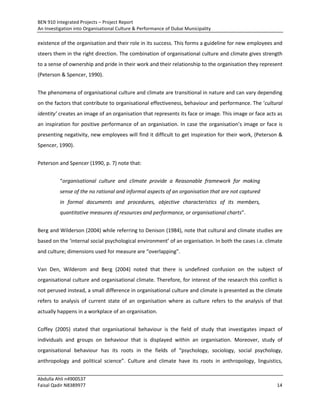
Peterson and Spencer (1990, p. 7) note that:
โ€œorganisational culture and climate provide a Reasonable framework for making
sense of the no rational and informal aspects of an organisation that are not captured
in formal documents and procedures, objective characteristics of its members,
quantitative measures of resources and performance, or organisational chartsโ€.
Berg and Wilderson (2004) while referring to Denison (1984), note that cultural and climate studies are
based on the โ€˜internal social psychological environmentโ€™ of an organisation. In both the cases i.e. climate
and culture; dimensions used for measure are โ€œoverlappingโ€.
Van Den, Wilderom and Berg (2004) noted that there is undefined confusion on the subject of
organisational culture and organisational climate. Therefore, for interest of the research this conflict is
not perused instead, a small difference in organisational culture and climate is presented as the climate
refers to analysis of current state of an organisation where as culture refers to the analysis of that
actually happens in a workplace of an organisation.
Coffey (2005) stated that organisational behaviour is the field of study that investigates impact of
individuals and groups on behaviour that is displayed within an organisation. Moreover, study of
organisational behaviour has its roots in the fields of โ€œpsychology, sociology, social psychology,
anthropology and political scienceโ€. Culture and climate have its roots in anthropology, linguistics,
BEN 910 Integrated Projects โ€“ Project Report
An Investigation into Organisational Culture & Performance of Dubai Municipality
Abdulla Ahli n4900537
Faisal Qadir N8389977 15
psychology and sociology. Both have been used to represent behavioural sciences in various time
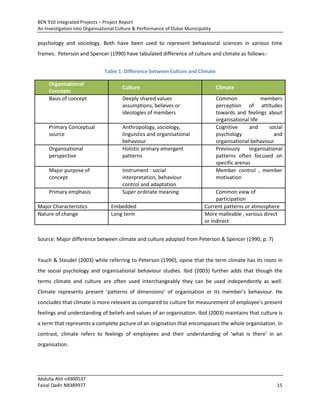
frames. Peterson and Spencer (1990) have tabulated difference of culture and climate as follows:-
Table 1: Difference between Culture and Climate
Organisational
Concepts
Culture Climate
Basis of concept Deeply shared values
assumptions, believes or
ideologies of members
Common members
perception of attitudes
towards and feelings about
organisational life
Primary Conceptual
source
Anthropology, sociology,
linguistics and organisational
behaviour
Cognitive and social
psychology and
organisational behaviour
Organisational
perspective
Holistic primary emergent
patterns
Previously organisational
patterns often focused on
specific arenas
Major purpose of
concept
Instrument : social
interpretation, behaviour
control and adaptation
Member control , member
motivation
Primary emphasis Super ordinate meaning Common view of
participation
Major Characteristics Embedded Current patterns or atmosphere
Nature of change Long term More malleable , various direct
or indirect
Source: Major difference between climate and culture adopted from Peterson & Spencer (1990, p. 7)
Yauch & Steudel (2003) while referring to Peterson (1990), opine that the term climate has its roots in
the social psychology and organisational behaviour studies. Ibid (2003) further adds that though the
terms climate and culture are often used interchangeably they can be used independently as well.
Climate represents present โ€˜patterns of dimensionsโ€™ of organisation or its memberโ€™s behaviour. He
concludes that climate is more relevant as compared to culture for measurement of employeeโ€™s present
feelings and understanding of beliefs and values of an organisation. Ibid (2003) maintains that culture is
a term that represents a complete picture of an origination that encompasses the whole organisation. In
contrast, climate refers to feelings of employees and their understanding of โ€˜what is thereโ€™ in an
organisation.
BEN 910 Integrated Projects โ€“ Project Report
An Investigation into Organisational Culture & Performance of Dubai Municipality
Abdulla Ahli n4900537
Faisal Qadir N8389977 16
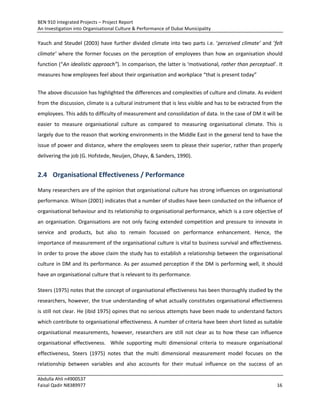
Yauch and Steudel (2003) have further divided climate into two parts i.e. โ€˜perceived climateโ€™ and โ€˜felt
climateโ€™ where the former focuses on the perception of employees than how an organisation should
function (โ€œAn idealistic approachโ€). In comparison, the latter is โ€˜motivational, rather than perceptualโ€™. It
measures how employees feel about their organisation and workplace โ€œthat is present todayโ€
The above discussion has highlighted the differences and complexities of culture and climate. As evident
from the discussion, climate is a cultural instrument that is less visible and has to be extracted from the
employees. This adds to difficulty of measurement and consolidation of data. In the case of DM it will be
easier to measure organisational culture as compared to measuring organisational climate. This is
largely due to the reason that working environments in the Middle East in the general tend to have the
issue of power and distance, where the employees seem to please their superior, rather than properly
delivering the job (G. Hofstede, Neuijen, Ohayv, & Sanders, 1990).
2.4 Organisational Effectiveness / Performance
Many researchers are of the opinion that organisational culture has strong influences on organisational
performance. Wilson (2001) indicates that a number of studies have been conducted on the influence of
organisational behaviour and its relationship to organisational performance, which is a core objective of
an organisation. Organisations are not only facing extended competition and pressure to innovate in
service and products, but also to remain focussed on performance enhancement. Hence, the
importance of measurement of the organisational culture is vital to business survival and effectiveness.
In order to prove the above claim the study has to establish a relationship between the organisational
culture in DM and its performance. As per assumed perception if the DM is performing well, it should
have an organisational culture that is relevant to its performance.
Steers (1975) notes that the concept of organisational effectiveness has been thoroughly studied by the
researchers, however, the true understanding of what actually constitutes organisational effectiveness
is still not clear. He (ibid 1975) opines that no serious attempts have been made to understand factors
which contribute to organisational effectiveness. A number of criteria have been short listed as suitable
organisational measurements, however, researchers are still not clear as to how these can influence
organisational effectiveness. While supporting multi dimensional criteria to measure organisational
effectiveness, Steers (1975) notes that the multi dimensional measurement model focuses on the
relationship between variables and also accounts for their mutual influence on the success of an
BEN 910 Integrated Projects โ€“ Project Report
An Investigation into Organisational Culture & Performance of Dubai Municipality
Abdulla Ahli n4900537
Faisal Qadir N8389977 17
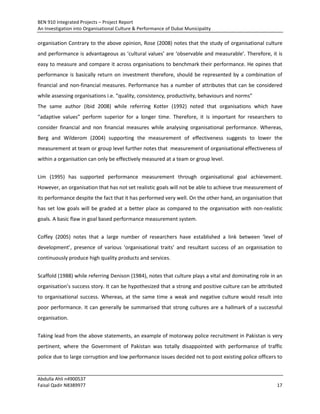
organisation Contrary to the above opinion, Rose (2008) notes that the study of organisational culture
and performance is advantageous as โ€˜cultural valuesโ€™ are โ€˜observable and measurableโ€™. Therefore, it is
easy to measure and compare it across organisations to benchmark their performance. He opines that
performance is basically return on investment therefore, should be represented by a combination of
financial and non-financial measures. Performance has a number of attributes that can be considered
while assessing organisations i.e. โ€œquality, consistency, productivity, behaviours and normsโ€
The same author (Ibid 2008) while referring Kotter (1992) noted that organisations which have
โ€œadaptive valuesโ€ perform superior for a longer time. Therefore, it is important for researchers to
consider financial and non financial measures while analysing organisational performance. Whereas,
Berg and Wilderom (2004) supporting the measurement of effectiveness suggests to lower the
measurement at team or group level further notes that measurement of organisational effectiveness of
within a organisation can only be effectively measured at a team or group level.
Lim (1995) has supported performance measurement through organisational goal achievement.
However, an organisation that has not set realistic goals will not be able to achieve true measurement of
its performance despite the fact that it has performed very well. On the other hand, an organisation that
has set low goals will be graded at a better place as compared to the organisation with non-realistic
goals. A basic flaw in goal based performance measurement system.
Coffey (2005) notes that a large number of researchers have established a link between โ€˜level of
developmentโ€™, presence of various โ€˜organisational traitsโ€™ and resultant success of an organisation to
continuously produce high quality products and services.
Scaffold (1988) while referring Denison (1984), notes that culture plays a vital and dominating role in an
organisationโ€™s success story. It can be hypothesized that a strong and positive culture can be attributed
to organisational success. Whereas, at the same time a weak and negative culture would result into
poor performance. It can generally be summarised that strong cultures are a hallmark of a successful
organisation.
Taking lead from the above statements, an example of motorway police recruitment in Pakistan is very
pertinent, where the Government of Pakistan was totally disappointed with performance of traffic
police due to large corruption and low performance issues decided not to post existing police officers to
BEN 910 Integrated Projects โ€“ Project Report
An Investigation into Organisational Culture & Performance of Dubai Municipality
Abdulla Ahli n4900537
Faisal Qadir N8389977 18
new motorway police as their organisational culture had too many negative traits. The government
decided to recruit a completely new police force to monitor motorways. This new police force was given
better salaries/ working environments and better organisational culture of pride and comradeship. This
new police force performed exceptionally well and there was not even a single report against them for
corruption or low performance. Thus, it proves that an organisation with a superior culture will perform
better. As the same set of people perform far superior working under superior organisational culture as
compared to them performing under adverse cultural environments.
Coffey (2005) noted that till 1987 financial reporting systems were used as a basis of measurement for
organisational performance and effectiveness. However, these measures were not considered suitable
for true performance measurement as researchers concluded that results could be โ€˜distorted if it was
based on inadequate goals. This paved the way for โ€˜system basedโ€™ organisational models based on
multiple sets of criteria to measure organisational performance. In 1990s, โ€œbalanced performance
measurement matrixโ€ was presented by Keegan (1989). Ibid (1989) focused on โ€œcost, non cost, internal
and external dimensions of an organisationโ€. Kennerley and Neely (2002) as referred by Coffey (2005)
outlined that for a successful organisational performance measurement system must be able to present
a โ€˜balance pictureโ€™ of an organisation; present holistic overview of organisational performance; should
be โ€˜comprehensive and multidimensionalโ€™ in nature and at the same time be โ€˜integrated across
organisational functions and hierarchyโ€™.
An effective measurement system that is holistic and presents a complete picture of the organisation
under scrutiny cannot be based on a single attribute of organisational culture, therefore, the
organisational performance measurement system has to be based on set of attributes that covers all
aspects of organisational life (Keegan, Eiler, & Jones, 1989).
2.5 Measurement of Organisational Culture / Theories
Denison and Mishra (1995) note that organisational culture and effectiveness is an important subject for
researchers. However, it remained neglected and was pursued at a relatively slow speed due to inherent
research problems. As in their opinion organisational measurement theory must have โ€˜core
assumptionsโ€™ that relates to โ€˜visible artefactsโ€™, โ€˜social structure to individual meaningsโ€™. Researchers are
still not fully convinced on such a theory for measurement of organisational culture. It is still a debate as
BEN 910 Integrated Projects โ€“ Project Report
An Investigation into Organisational Culture & Performance of Dubai Municipality
Abdulla Ahli n4900537
Faisal Qadir N8389977 19
to whether culture can be assessed in a way that two organisations can be equated with each other
based on their performance. Peterson & Spencer (1990) noted that โ€˜successful organisations possess
certain cultural traits of excellenceโ€™.
Kotter (1992) noted that organisational culture has become the centre of research due to the
assumption that a certain type of organisational culture enhances the overall performance of an
organisation. This added advantage / financial gain has been instrumental in a number of research
studies conducted in this field. Despite the fact that a large number of studies have been conducted on
the organisational culture but, there is very few studies that have focused on the relationship of
organisational culture and performance.
Lewin and Minton (1986) have presented various questions that researchers must consider before
measuring organisational effectiveness. These questions are tabulated as below:-
Table 2: Organisational effectiveness questions adopted from Lewin and Minton (1986, p 16)
Questions to be asked by researchers for organisational effectiveness
โ€˜What is effectivenessโ€™?
โ€˜What are its indicatorsโ€™?
โ€˜What are its predictorsโ€™?
โ€˜Can it be specified or measuredโ€™?
โ€˜Can it be related to particular perspectives, environments, behaviours or
structuresโ€™?
โ€˜Is it a constant or an idealโ€™?
โ€˜Does it change with time and organisational maturityโ€™?
โ€˜Can it be sought, gained, enhanced, or lostโ€™?
โ€˜Why is one organisation effective at one time and not at another, or why is one
โ€˜organisation effective and another notโ€™?
Above tabulated questions serve as a guideline for all researchers for measurement of organisational
effectiveness. Fjortoft and Smart (1994) have noted that several cultural theories / models have been
presented to measure organisational effectiveness. Whereas, Meek (1988) notes that organisational
BEN 910 Integrated Projects โ€“ Project Report
An Investigation into Organisational Culture & Performance of Dubai Municipality
Abdulla Ahli n4900537
Faisal Qadir N8389977 20
cultural theories can be generally categorised into two categories. Firstly, those theories who consider
organisational culture to be a โ€˜variableโ€™ i.e. what an โ€˜organisation hasโ€™. Secondly, those theories who
consider organisational culture to be what an โ€˜organisation isโ€™. In his opinion, the latter approach is
aligned with the definition of culture as presented by anthropologists. Culture is a combination of
โ€˜negotiated and shared symbols and meaningsโ€™ that members of an organisation inherited and practised
in their daily life considering them to be righteous. Early researchers used qualitative data analysis for
the measurement of organisational culture, which lacked strong relationships between various
components of measured data, for example, performance and individual behaviour (Koberg & Chusmir,
1987). However, a number of researchers used quantitative data for measurement of organisational
culture. Most commonly used models are โ€œCompeting Values Frame Workโ€ Cameron & Quinn (2011)
and Denison organisational culture measurement model Denison and Mishra (1995). This research will
limit itself to Denisonโ€™s organisational survey model to ascertain the organisational culture of DM.
There are number of well-established models to measure the organisational culture, and investigate the
link between organisational culture and business performance. These models have provided assistance
for many leading corporations regarding organisational change, leadership development, and the
cultural issues associated with mergers & acquisitions, turnaround, and globalisation to overcome
inconsistencies, improve performance and employees satisfaction Dension & Spreitzer (1991).
The Denison model is one of the most recognised tools, which specialises in the areas of organisational
culture, effectiveness and leadership (D. Denison & A. K. Mishra, 1995) The Denison Model focuses on
four main areas: adaptability, involvement, consistency and mission (D. Denison & A. K. Mishra, 1995). It
also demonstrates the important relationships between these areas, which shape the balance of the
internal and external focus, flexibility and stability of an organisation (D. Denison & A. K. Mishra, 1995).
The model was developed, like many other products and services, for the North American and, to a
lesser degree, Western European markets. It does not take into account the cultural differences of the
nations; for example, some acts considered norms in Australia are not necessarily accepted norms in the
UAE (Fey & Denison, 2003). Quinn and Rohrbaugh (1983) developed the Competing Values Framework
(CVF) in the early eighties. Later, the model was further developed by Quinn and Cameron. It was based
on the four types of cultures, which are; clan, market, adhocracy and hierarchy. It also had the four
polarities, as per the Denison model Quinn & Cameron (1983). However, model had a contradictory
BEN 910 Integrated Projects โ€“ Project Report
An Investigation into Organisational Culture & Performance of Dubai Municipality
Abdulla Ahli n4900537
Faisal Qadir N8389977 21
approach viewing culture and effectiveness of the organisation, (D. R. Dension & Spreitzer, 1991). For
example, it suggests flexibility and control or internal and external focus and could not exist
simultaneously in an organisation.
Furthermore, Coffey (2009) suggests in the initial stages most organisational performance and
effectiveness was measured based on single criteria of financial performance of an organisation.
However, the 1980s and 1990s saw an increase in multi criteria based performance measurement
models. There are number of studies, which identified significant correlation between performance and
employee encouraging organisational culture (Ogaard, Larsen and Marnburg, 2005). They also conclude
a healthy encouraging work environment, which focuses on goal setting and achievement is likely to
reduce turnover and increase employeesโ€™ satisfaction. In addition, Liu (2003) indicates that the rationale
of studying organisational culture has many aspects, but the key principle is to discover the affects of
the organisational performance with a view to improving the performance.
2.6 Summary
Culture can be defined as the system of norms, beliefs, and traditions that prevail around us and
transform our behaviours and actions. It is a term that has been amply researched and inquired. Initially,
researchers focused only on one aspect of culture i.e. its ability to mould out behaviours. However, it
was only in the nineteenth century that researchers were able to identify cultural influences on
organisational performance and the resultant increase in the profitability. This discovery transformed
the way researchers looked towards culture. The industrial world was keen to know the secrets of
Japanese industrial might and superior performance of its workforce. The triangular relationship of
culture with organisations culture and organisational performance became centre of focus for all
researchers.
However, researchers are not sure how to measure it. A large number of researchers are supporting
qualitative whereas an equally large number of researchers have favoured quantitative methods to
measure organisational performance. At the same time an academic tussle between culture and climate
as basis of organisational culture measurement has been centre of research. Despite, these major
differences some researchers agree that organisational culture should be measured using both
quantitative and qualitative methods as it gives yet another angle to analyse data. This adds to its
authenticity.
BEN 910 Integrated Projects โ€“ Project Report
An Investigation into Organisational Culture & Performance of Dubai Municipality
Abdulla Ahli n4900537
Faisal Qadir N8389977 22
Dubai being a multicultural destination, presents a lot of challenges for the Denison measurement
model as the model itself was designed for South American organisations that had a work force with
largely the same cultural and social background. Whereas, the workforce had some influence in
formation of overall strategy of the organisation. However, on the contrary the workforce in Dubai was
mostly based on multinational groups from neighbouring countries who had no or limited interaction
with local culture as they were there to earn money and could not speak the local language or English. In
most cases, interpreters were a commonly use communication tool. However, to get some sort of
organisational cultural trend in DM sub organisations the Denison survey model has been used. Though,
it will not be able to give real picture of cultural disperse and its influence on organisational
performance however, this research can be used as a base line for further research work. That can focus
on a greater number of employees with better combination to ascertain the actual organisational
culture spread and its influence on organisational performance.
BEN 910 Integrated Projects โ€“ Project Report
An Investigation into Organisational Culture & Performance of Dubai Municipality
Abdulla Ahli n4900537
Faisal Qadir N8389977 23
3 Chapter โ€“ Research Methodology
3.1 Chapter Introduction
The purpose of this section is to illustrate the methods that will be used to carry out the investigation of
organisational culture and the effectiveness of DM. This includes the purpose of study, the extent of the
researchers influence, study setting, the unit of analysis, time horizon, measurements and measures,
data collection, ethical considerations, the proposition questions and the Denison Model (Denison,
1984).
3.2 Purpose of the Research
The purpose of the study is to test propositions which have been developed in section 3.8 and the
relationship between the organisational culture and the project performance for DM. By testing the
statement thoroughly, as much uncertainty as possible will be eliminated and this will be replaced with
knowledge.
3.3 Extent of Researcher Influence and Study Setting
3.3.1 Researcher Influence
Positivistic and descriptive research will be used as it was established in section 3.2 that propositional
testing will be carried out. Additionally, objectivity should be used for this type of testing. The level of
influence from the two researchers will be minimal so that a natural order of events can be found.
3.3.2 Study Setting
The investigation will be conducted using a case study, therefore aspects of the case study will be
examined and there will be no opinion or favouritism towards a specific result, unless supported with
evidence.
3.4 Unit of Analysis
The literature review revealed that the majority of research carried out to date has occurred at many
levels, which includes project and organisational levels. Therefore, in this study the analysis has also
occurred at the level of projects performance verse the department organisational cultural scores.
BEN 910 Integrated Projects โ€“ Project Report
An Investigation into Organisational Culture & Performance of Dubai Municipality
Abdulla Ahli n4900537
Faisal Qadir N8389977 24
3.5 Time Horizon
The study aims to find out how the circumstances stand at this given point of time. Therefore, the study
will be carried out in a cross-sectional format over the course of three months. This technique is suitable
as the results will be purified to be presented in a meaningful and beneficial way.
3.6 Data Collection
3.6.1 Method
The discipline of organisational culture has long remained engulfed in a โ€™paradigm warโ€™ situation
between followers of rational and non rational approaches. At various times each approach combined
research and produced new theories, which could not have been evolved by one or other approach
alone (Cameron & Ettington, 1988). There are two different methodologies, which have been used to
assess organisational culture, namely the qualitative and quantitative approaches. A number of
researchers have described both processes as mutually exclusive (Yauch & Steudel, 2003). However, in
many recent cultural studies, it has been identified that using both qualitative and quantitative
approaches in tandem as a โ€˜mixed methodโ€™ not only gives a new angle to analyse the information but
gives better results and is more beneficial. Mixed method approach allows โ€œtriangulationโ€ of data
gathered by qualitative and quantitative approaches. This will help to shape the data and decrease bias,
enhancing the authenticity of data analysis and increasing understanding of organisational culture
substantially (Yauch & Steudel, 2003).
The qualitative and quantitative approaches adopted by researchers to explore organisational theory
are not mutually exclusive. Moreover, both methodologies differ in โ€˜form, focus, and emphasesโ€™. As it
has been identified by various researchers that qualitative research methodology represents โ€˜mixture of
the rational, serendipitous, and intuitiveโ€™. In such a case the data analysis totally relies on personal
experiences and understanding of the researchers. Moreover, the qualitative research work focuses on
โ€œunfolding of social processes as compared to focusing on social structureโ€ as focused by quantitative
researchers (Van Maanen, 1979). In addition, the qualitative and quantitative data can be
differentiated based on the method of data collection. The quantitative method of research is based on
numeric data, whereas, the qualitative data research is based on weights assigned to various traits of
organisational culture. The quantitative data can be collected through surveys, whereas, the qualitative
BEN 910 Integrated Projects โ€“ Project Report
An Investigation into Organisational Culture & Performance of Dubai Municipality
Abdulla Ahli n4900537
Faisal Qadir N8389977 25
data can be collected through interviews, expert opinion or focus group (Hofstede, et al., 1990). Yauch
(2003) while referring to Morgan and Smircich (1980), notes that qualitative and quantitative methods
represent two different schools of thought on cultural measurement. Furthermore, Van Maanen (1979)
stated that the selection of research methodology will entirely depend on the researcherโ€™s assumptions
and phenomena that are to be studied.
Greene, Caracelli, and Graham (1989) While discussing reasons for mix method cultural research as
referred by Yauch (2003) had identified three basic benefits for mixed method cultural research. Firstly
โ€œTriangulationโ€ can help to get better validity of captured data. Secondly, โ€œcomplementarilyโ€,
explanation of analysis results and thirdly โ€œdevelopmentโ€ for further data collection guidance.
Yauch (2003) referring to Jick (1979) and Stake (2000), opines that mixed method research by using
qualitative and quantitative methods is adopted to achieve a multi-dimensional explanation of the
phenomena under study. Moreover, the mixed method research can give โ€œunique varianceโ€ that might
not be possible through single method research (Sekaran, 1992).
Lim (1995) referring to Schein (1990) has proposed conceptualizations of organisational culture based
on two dimensions, for instance, โ€˜process orientedโ€™ , โ€˜classification approachesโ€™ and โ€˜process orientedโ€™
approach. Sackman (1991) has suggested that qualitative approaches are handicapped as they requires
large number of studies to arrive on conclusions, which is more time and money consuming, therefore,
classification approach is more useful. Quantitative approach as compared to the qualitative approach
has a number of methods to measure organisational culture where a large set of data can be analysed at
a very low cost (Sackmann, 1991).
A survey provides a quantitative description of the sample being studied, through the data collection
process of posing questions (Hasson, Keeney, & McKenna, 2000). Jick (1979) stated that through the
quantitative data collected through the use of a questionnaire, the researcher will be able to generalise
the findings from the sample of responses to the population. According to Remenyi (1996) surveys offer
an opportunity to collect large quantities of data, which therefore can be used for statistical analysis
that is representative of the whole population. Calleja (2009) have the same opinion with the Remenyi
(1996) and adds that survey researchers sample a large number of respondents, as well as measures
BEN 910 Integrated Projects โ€“ Project Report
An Investigation into Organisational Culture & Performance of Dubai Municipality
Abdulla Ahli n4900537
Faisal Qadir N8389977 26
variables, tests multiple hypotheses, and deduces information regarding the respondentโ€™s attitudes,
behaviour and characteristics.
Collis and Hussey (2003) suggested that research methods refer to a range of tools by which the data is
collected, analysed and the data collection process explained. Based on the project scope as stated in
Section 1.3 in Chapter 1 and the proposition, a surveys approach was the most suitable method for this
project proposition so that large amounts of data could be collected in order to conduct statistical
procedures effectively (Remenyi, 1996). The survey method of data collection tests a sample of people
that are drawn from the population in order to make deductions about that population (Collis & Hussey,
2003). The survey was administered through the use of questionnaires over one month on site at the
DM main branch. The use of the surveys ensured that the questions were all the same and the contents
of the questionnaires were understood by all respondents present at the data collection sessions (Collis
& Hussey, 2003). The Data will be collected from DMโ€™s four different departments, for example, CPD and
PFD are supporting departments and the DSD and GPD are execution departments. The Denison
Organisational Culture Model survey (DOCM) will be used to collect and analyse the data. There is
minimal chance of qualitative methods to be included in the analysis, which aims to find out if there
were any factors and issues that the literature does not address.
3.6.2 Sample
In order to achieve best results, the authors will desire to sample 100 % of the population of an
organisation at all tiers. However, this is not practicable due to paucity of time and resources. Therefore,
the compromise has to be made by trading off sample size of time. According to Black and Champion
(1976), the survey sample is a portion taken from a population, which represents trends found in a
population. Our research data will be collected based on close-ended questions survey (Denison, 1984).
As Roscoe (1975) stated that the sample sizes larger than 30 and less than 500 are appropriate for most
researchโ€. Therefore, the research target to survey minimum 30 employees will help to formulate a
meaningful picture of DM organisational culture and subsequent conclusions. The DOCM survey will be
further discussed in the coming section 3.9.9 Furthermore, In order to ascertain the correct view of the
departmentsโ€™ organisational culture, the collection of data is to be done from a sample of employees in
the targetโ€™s departments. Moreover, it would be difficult to obtain data from different departments
especially the financial data due to the sensitivity of information and financial performance disclosure
BEN 910 Integrated Projects โ€“ Project Report
An Investigation into Organisational Culture & Performance of Dubai Municipality
Abdulla Ahli n4900537
Faisal Qadir N8389977 27
issues. Therefore, certain assumptions and limitations have been established for this research, as stated
earlier in section 1.5 and 1.6 of this report. This study assumes that the data reflect the view of the
whole organisational culture of the targetโ€™s departments. The literature review has pointed out that all
of the past research carried out to date is also to be treated as a sample, which suggests that this is an
acceptable method (Sekaran, 1992). In addition, for the collected data to be utilisable from an analysis
point of view, it should have the characteristics, for instance, type of projects, contract sum, date for
completion of projects and contract arrangements. The following figure represents the DM
Organisational Chart (Please refer to Appendix A for Full DM Organisational Chart). As it can be seen, the
four target departments spreads over three difference sector with DM structure. The significance of
such segregation will be highlighted in the next chapter o this report.
Figure 1: Dubai Municipality Organisational Chart
BEN 910 Integrated Projects โ€“ Project Report
An Investigation into Organisational Culture & Performance of Dubai Municipality
Abdulla Ahli n4900537
Faisal Qadir N8389977 28
3.6.3 Analysis
The data in this research has been analysed by using a sample set of statistical methods, which may
include coefficient alpha, mean, standard deviation and linear regression. Having established the
statistics, the data will be compared and contrasted to show the results of the most suitable
organisational culture profile for DM in order to enhance its performance. In doing this, the data will be
sorted in a table presenting the characteristics discussed in section 3.6.2. Furthermore, once all the data
are transformed on the Excel spreadsheet, it will be organised so that it could be analysed and would be
a better representation of different types of Denison profile and project performance.
The quantitative data were analysed using Excel spreadsheets. Firstly, the information from all the
surveys was analysed statistically using descriptive analysis (Calleja, 2009). Descriptive statistics are used
to summarise a set of scores that are obtained from respondents and in order to illustrate basic patterns
in data (Harris, 1998). According to Harris (1998), the benefits of performing a descriptive analysis is
keeping the researchers focused on the data and enabling the researchers to understand the
distribution of each variable across the survey respondents. Descriptive statistics were used to
summarise the respondents' profile in terms of age, education level, year with DM and function. In
addition, it has been used to test the reliability of the data obtained from the DOCM.
In addition, simple tables and graphs were used to summarise, illustrate and understand the data in
order to make the results easy to illustrate as well as enabling the authors to get a basic idea of the
characteristics of the data (Sekaran, 1992). Furthermore, Sekaran (1992) suggested that the calculation
of the mean and standard deviations of the data can be used to develop descriptive analysis. He defines
the mean as the average that offers a general picture of the data without overwhelming the research
outcomes. Whereas, the standard deviation was used to measure the dispersion of the data, which
describes how the data are clustered around the mean.
The reliability and validity of research results are very important aspects to be considered when
evaluating a research instrument (Collis & Hussey, 2003). They are the statistical criteria used to assess
whether the research provides a good measure (Harris, 1998). He further defines reliability as the
degree to which an instrumentโ€™s measures are free from error, therefore yielding consistent results.
Research findings are reliable if they can be repeated (Collis & Hussey, 2003). There are three
BEN 910 Integrated Projects โ€“ Project Report
An Investigation into Organisational Culture & Performance of Dubai Municipality
Abdulla Ahli n4900537
Faisal Qadir N8389977 29
fundamental methods that are accepted for estimating the reliability of responses of a measurement
scale: test-retest, split-halves method and internal consistency method (Collis & Hussey, 2003). The
reliability of the questionnaire used in this research was assessed through the use of Cronbachโ€™s Alpha
or coefficient alpha. Cortina (1993) stated that the Cronbachโ€™s Alpha measures the internal consistency
of the instrument, which refers to the degree to which the measuring instrument items are homogenous
and reflect identical underlying constructs. The Cronbach Alpha, once calculated, it will produce a value
that varies between 1 (representing perfect internal reliability) and 0 (representing no internal
consistency), with the values above 0.60 denotes a good level of internal reliability (Cortina, 1993).
Validity is the extent to which research findings accurately represent what is really happening in a
situation that is being researched, and therefore a test is valid if it measures what the researcher claims
it does (Collis & Hussey, 2003). Many studies conducted argue that it is possible for a research
instrument to have high reliability and low validity (Calleja, 2009), (Cortina, 1993) and (Collis & Hussey,
2003). There are a number of ways in which validity of a measurement can be assessed, with the
foremost ways being face validity and construct validity (Harris, 1998). The face validity of a measuring
instrument refers to the subjective agreement that the instrument logically appears to reflect accurately
what it purports to measure (Sekaran, 1992). On the other hand, construct validity confirms how well
the results obtained from the use of the measuring instrument fit the theory around which the test is
designed (Sekaran, 1992: 173).
However, the validity analysis will not be conducted for this research as one of the authors was always
present to assist respondents in completing the questionnaire as accurately as possible. The fact that
the research instrument used in this research had low validity is not necessarily problematic because, as
explained by Collis and Hussey (2003) in which they suggested that a research proposition focus on the
precision of measure and the ability to repeat the measure reliably and therefore there is always the
possibility that the instrument will have low validity. The results of the statistical analyses will be
discussed in detail in section 4 of this report.
BEN 910 Integrated Projects โ€“ Project Report
An Investigation into Organisational Culture & Performance of Dubai Municipality
Abdulla Ahli n4900537
Faisal Qadir N8389977 30
3.7 Ethical Consideration
The ethical considerations for this research include:
๏‚ท The information provided by the organisations was kept strictly confidential and was not made
available to anyone other than the authors.
๏‚ท The author understood the importance of respecting the data collected from the organisations, and
endeavoured to protect the essence of the data, ensuring that no misrepresentation of data was
committed.
๏‚ท The organisations that contributed to the completion of this research will receive a copy of the
report.
3.8 Proposition Questions
The project report will investigate four proposition questions as Table 3 outlines.
Table 3: Relationship between organisational culture and success factors in Dubai Municipality
OC vs OE OC C vs OE OC
Is relatively high/low
combined levels of the
four traits relate to
high/low-level
performance?
Do any of the four traits
considerably contribute
to success rate than
others?
Is there any significant
relationship between
success rate and the any
profile of four traits
based on the Horizontal
& vertical split of the
Denison OC Model?
What is the ideal
organisational
culture profile to
enhance the DM
projects
performance?
PQ1 PQ2 PQ3 PQ4
BEN 910 Integrated Projects โ€“ Project Report
An Investigation into Organisational Culture & Performance of Dubai Municipality
Abdulla Ahli n4900537
Faisal Qadir N8389977 31
3.9 Denison Model
3.9.1 Overview
Denison and Neale (1994) suggest that in most cases methodology used for collection of data for
qualitative data analysis is based on; interviews, focus groups and seminars. The Data collected in any
form focuses on four main questions besides covering various aspects of performance criteria.
Denison (1984) proposed a multi dimensional cultural research model. Denison considered four key
traits of organisational performance that have influence on each other, which are the involvement,
consistency, adaptability, and mission (Denison, 1990b). The Denison Model (see Figure 2 below) similar
to the other models of organisational performance and effectiveness not only focuses on the
measurement of the independent performance traits, but also at the same time record โ€˜tensions /
contradictionsโ€™ that appears in the organisational measurement traits.
Figure 2: Denison Organisational Culture Model adopted from (Denison and Neale, 1996)
BEN 910 Integrated Projects โ€“ Project Report
An Investigation into Organisational Culture & Performance of Dubai Municipality
Abdulla Ahli n4900537
Faisal Qadir N8389977 32
The Denison Model analyses the tension between stability and flexibility and at the same time internal
and external focus is also addressed. Each aspect of organisational culture considered in the Denison
model will be briefly discussed as follows:
3.9.2 Involvement
The literature suggests that high level of involvement within organisations is one of the factors that
contribute to organisational success. It creates a sense of ownership and belonging to the organisation,
which may transform into organisational commitment. As a result, it motivates the employees to take
action on their own as deemed necessary in the greater interest of the organisation (Coffey, 2005). โ€˜My
unit my homeโ€™ is a famous slogan by the military units in an attempt to display and enhance the sense of
ownership within the unit. This feeling generates a sense of pride in having relation with the unit / outfit
and makes them ready to undertake daring combat actions. In return, all members of the unit ensure
that their deeds result in the betterment of the unit. Moreover, Coffey (2009) elaborates that
involvement represents employee orientation, empowerment and capability development. In
organisations, where employees are involved in organisational affairs their effectiveness is far superior
as compared to other organisations. The notion of involvement has been further subdivided into three
traits, as follows:
Empowerment - Individuals have the authority, initiative, and ability to manage their own work.
This creates a sense of ownership and responsibility to the organization.
Team Orientation - Value is placed on working cooperatively toward common goals for which all
employees feel mutually accountable. The organization relies on team effort to get work done.
Capability Development - The organization continually invests in the development of
employeeโ€™s skills in order to stay competitive and meet on-going business needs.
The trait of empowerment has been considered to ascertain the role of members in an organisation,
where they can have authority to manage and take initiative to do their work. Team orientation has a
vital role to play in the success of an organisation. All members join their capabilities towards
attainment of team goals and work in harmony with each other. Capability development is to analyse
organisational ability to develop its workforce to meet future challenges. This has a direct relationship
with external focus as an organisation will increase its workforceโ€™s skill set in response to meet new
demands of the market.
BEN 910 Integrated Projects โ€“ Project Report
An Investigation into Organisational Culture & Performance of Dubai Municipality
Abdulla Ahli n4900537
Faisal Qadir N8389977 33
3.9.3 Consistency
Denison (1996) while referring Scaffold (1988) notes that effective organisations are well integrated.
Coffey (Coffey, 2005) notes that notion of consistency and involvement are similar in nature as a
integrated and consistent organisation will be able to handle issues relating to democratic process based
decision making. Denison (1990) notes that the consistency theory is based on โ€˜conformity, consensus
and consistencyโ€™ this counters low participation and involvement by members of an organisation.
Furthermore, effective organisations keep its members on board while devising strategies for future
operations. These organisations implement strategies that have been evolved by the involvement of its
members. Organisations that are consistent in their operations endeavour to promote a common
understanding within an organisation to promote โ€˜governanceโ€™ based on consensus. The members of
these organisations out of their involvement and devotion to their organisation develop a set of โ€˜Do and
โ€˜donโ€™tโ€™ that steers the organisation in the right direction. This promotes stability and integration
(Denison, 1990b). The three traits of consistency are โ€˜
Core Values - Members of the organization share a set of values which create a sense of identity
and a clear set of expectations.
Agreement - Members of the organization are able to reach agreement on critical issues. This
includes both the underlying level of agreement and the ability to reconcile differences when
they occur.
Coordination and Integration - Different functions and units of the organization are able to
work together well to achieve common goals. Organizational boundaries do not interfere with
getting work done.
Core values represent the values that have been adopted by the members of an organisation and create
a common sense of identity. The trait of agreement and coordination and integration reflects the ability
of employees of an organisation to solve their internal issues with consensus and work in harmony with
each other for the achievement of organisational goals.
3.9.4 Adaptability
Coffey (Coffey, 2005) while referring Starbuck (1971), notes that organisations that want to remain
viable and competitive have to continuously transform their business process to accommodate ever
changing requirements of the market and competitors. A common saying in Urdu language also
BEN 910 Integrated Projects โ€“ Project Report
An Investigation into Organisational Culture & Performance of Dubai Municipality
Abdulla Ahli n4900537
Faisal Qadir N8389977 34
supports the concept of adaptability that โ€œthose trees that get more fruit tend to bend to adjust weightโ€.
It is evident from the example that trees are adapting to changing environments by bending to
accommodate the weight of fruit. โ€˜Organisations that do not change and evolve to meet the external
environments become historyโ€™. Coffey (Coffey, 2005) notes three distinct aspects of organisational
adaptability. In his opinion a successful organisation should be able to understand the demands of its
customers (internal / external), competitors and market. The adaptability quadrant is divided into three
aspects, which are:
Creating Change - The organization is able to create adaptive ways to meet changing needs. It is
able to read the business environment, react quickly to current trends, and anticipate future
changes.
Customer Focus - The organization understands and reacts to their customers and anticipates
their future needs. It reflects the degree to which the organization is driven by a concern to
satisfy their customers.
Organizational Learning - The organization receives, translates, and interprets signals from the
environment into opportunities for encouraging innovation, gaining knowledge, and developing
capabilities.
Creating change reflects an organisational ability to identify changing demands of its external
environments that include internal and external customers, market, technological trends and
competitors. Thereafter, implement change management process to achieve external and internal
demands. Customer focus reflects an organisational ability to identify the demands of its customers and
incorporate them into their business plan. Organisational learning reflects an organisationโ€™s ability to
learn from its experiences and improve its function / capabilities with help of these learningโ€™s.
3.9.5 Mission
Organisations, which have been effective and successful, have clearly identified their aim, objectives and
goals that are necessary to be achieved for attainment of their mission. A strategic direction is very
important for an organisation as it sets a path for all efforts that have to be undertaken by the
organisation and its members (Denison, 1990b). The mission is a combination of tactical and strategic
directions. Strategic direction indicates futuristic plans of an organisation where as tactical plans are
drawn to deal with issues of a minor nature, while staying within strategic boundaries. Furthermore,
Denison (1995) opines that the mission directs an organisation to reshape its culture to meet future
BEN 910 Integrated Projects โ€“ Project Report
An Investigation into Organisational Culture & Performance of Dubai Municipality
Abdulla Ahli n4900537
Faisal Qadir N8389977 35
requirements. Leadership has a key role in transforming an organisation as the mission defined by
leadership sets goal and objective for an organisation. The correct mission definition will set achievable
goals. Thus, enhances effectiveness of an organisation. The mission is further separated into three
different viewpoints, which are:
Strategic Direction and Intent - Clear strategic intentions convey the organizationโ€™s purpose and
make it clear how everyone can contribute and โ€œmake their markโ€ on the industry.
Goals and Objectives - A clear set of goals and objectives can be linked to the mission, vision,
and strategy, and provide everyone with a clear direction in their work.
Vision - The organization has a shared view of a desired future state. It embodies the core
values and captures the hearts and minds of the organizationโ€™s people, while providing guidance
and direction.
The strategic direction and organisational intent represent the big picture that the organisation has to
follow in order to achieve its goal and objectives. It steers the organisation in the right direction and set
unidirectional destination for members of the organisation. Goals and objectives are set to achieve the
overall mission of an organisation.
3.9.6 Internal / External Focus
The profile splits horizontally to distinguish between an external focus (top half) and an internal focus
(bottom half). The involvement and consistency address the internal dynamics of an organization, but
do not address the interaction of the organization with the external environment (Denison & Neale,
1994). The adaptability and mission, in contrast, make their focus the relationship between the
organization and the external environment (Denison, 1990).
3.9.7 Stability / Flexibility
The profile splits vertically to distinguish between a flexible organization (left half) and a stable
organization (right half). The involvement and adaptability emphasize an organization's capacity for
flexibility and change. In contrast, consistency and mission emphasize the organization's capacity for
stability and direction. A system oriented toward adaptability and involvement will introduce more
variety, more input, and more possible solutions to a given situation than a system oriented toward a
BEN 910 Integrated Projects โ€“ Project Report
An Investigation into Organisational Culture & Performance of Dubai Municipality
Abdulla Ahli n4900537
Faisal Qadir N8389977 36
high level of consistency and a strong sense of mission (Denison & Neale, 1994). In contrast, a bias
towards consistency and mission is more likely to reduce the variety and place a higher emphasis on
control and stability (Denison, 1990).
3.9.8 Contradiction
Denison and Neale (1994) stated that each of the four traits in the model have a positive impact on
performance, some of the traits, at least on the surface, may appear to contradict others (Denison and
Neale, 1996). For example, highly consistent cultures may become inbred, and may be the most difficult
to change. In contrast, highly adaptive cultures may have difficulty in achieving the highest rates of
efficiency or shared sense of purpose often found in cultures that are well integrated. In a similar sense,
the traits of mission and involvement may also seem contradictory. For example, the direction
established by an organisational mission may limit the involvement of some of the organization's
members (Denison & Neale, 1994). As many organizations have discovered, simply declaring a new
organizational mission does not necessarily imply the support and commitment of the organization's
members, in contrast, high involvement among an organization's members does not necessarily imply a
clear sense of direction and purpose (Denison & Neale, 1994).
3.9.9 Questionnaire
In order to achieve the best results, the authors aimed to sample 100 % population of an organisation at
all tiers, however, this is not possible due to paucity of time and resources. Therefore one has to
compromise by trading off sample size. According to Black and Champion (1976), the survey sample is a
portion taken from a population, which represents trends found in a population. Our research data will
be collected based on a close-ended questionnaire survey. As Roscoe (1975) states โ€œsample sizes larger
than 30 and less than 500 are appropriate for most researchโ€. Therefore, our target to survey minimum
30 employees will help to formulate a meaningful picture of DM organisational culture and subsequent
conclusions. Research will be based on quantitative data collected through Denison organisational
cultural survey. The questionnaire consists of four parts and a total of 60 close ended questions that
demand response regarding various facets of organisational culture and performance. Though, at times
close-ended questionnaire tend to be biased. However, in this situation employees are asked to grade
from 1-6). Cohen (1989) defines a questionnaire as โ€œa self-report instrument used for gathering
information about variables of interest to an investigationโ€. Each question has six different options;
BEN 910 Integrated Projects โ€“ Project Report
An Investigation into Organisational Culture & Performance of Dubai Municipality
Abdulla Ahli n4900537
Faisal Qadir N8389977 37
where 1 is lowest and 6 highest. These responses will be logged into a computer to see cultural spread.
The four departments of DM will be surveyed to ascertain its culture and its relationship with
organisational performance. The financial performance of DM will be analysed by comparing its budget
and actual cost of projects. This will help to ascertain the performance of various departments.
3.10 Summary
This chapter has detailed the research methodology and outlined the importance of the research
proposition, the influence of the researchers. Furthermore, it has examined comprehensively the
process of data collection, characteristic of the sample and the analytical tool that applied in order to
enable the authors to analysis the outcomes of the DOCM survey. It also has clearly and concisely
described the dimensions of the DOCM.
BEN 910 Integrated Projects โ€“ Project Report
An Investigation into Organisational Culture & Performance of Dubai Municipality
Abdulla Ahli n4900537
Faisal Qadir N8389977 38
4 Chapter โ€“Discussion & Results
4.1 Chapter introduction
The purpose of this section is to discuss the DM organisational culture data collected using the DOCM.
This includes a sample characteristic such as gender, age, education level and years in the organisation.
In addition, this chapter will discuss the DM organisational culture profile for it different department as
well as comparing culture with performance.
4.2 Statistical Descriptive Analysis
4.2.1 Research Population
The research described in this report was carried out in four departments within DM, which has a total
of 33 departments. The main target groups within the research population were senior executives,
middle managers and contract managers, technical staff and admin staff who are direct employees of
DM. The target groups have been educated to senior certificate, bachelor or / and masterโ€™s degree
levels or above. Based on the analysis of the returned questionnaires (100 out of 150 distributed
questionnaires โ€“ 67% return rate) was used as the basis for data collection for this proposition. Around
78% of the respondents had the desired managerial level and educational profile in order to eliminate
possible โ€˜noiseโ€™ factors that could affect the accuracy of this proposition. In addition, the sample has
different ethical and geographical background, which mainly includes Middle Eastern, European, Asian
and American.
BEN 910 Integrated Projects โ€“ Project Report
An Investigation into Organisational Culture & Performance of Dubai Municipality
Abdulla Ahli n4900537
Faisal Qadir N8389977 39
4.2.2 Gender Profile
Figure 3: DM Gender Profile
The above Figure above represents the percentage of males and females within the surveyed
departments. It is important to provide an insight of the above ratio in order to show its effect on the
organisational culture profile of the above department. Furthermore, 58% of the sample is females
which are likely to perceive organisational culture and performance differently than their male
counterpart (Hardin & Greer, 2009). The technical departments such as GPD and DSD have relatively
balanced gender staff mix, whereas, 60% of the CPD and PFD staff members are females.
10 9
12 11
42
15 16
13 14
58
0
20
40
60
CPD PFD GPD DSD TOTAL
PERCENATGE
DEPARTMENTS
MALE FEMALE
BEN 910 Integrated Projects โ€“ Project Report
An Investigation into Organisational Culture & Performance of Dubai Municipality
Abdulla Ahli n4900537
Faisal Qadir N8389977 40
4.2.3 Age Profile
Figure 4: DM Age Profile
Figure 4 shows the sample age groups. As it can be seen, 65% of the sample is under the age of 40 years.
This is likely to influence the organisational culture and create a shift towards a more open and
transparent culture. In addition, 38% of the sample is under the age of 29 years. This suggests the
generation of a new culture within the overall DM current culture, which may affect the organisation
overall performance.
38
27
22
13
0
10
20
30
40
20-29 YRS 30-39 YRS 40-49 YRS 50+ YRS
PERCENTAGE
AGE GROUP
BEN 910 Integrated Projects โ€“ Project Report
An Investigation into Organisational Culture & Performance of Dubai Municipality
Abdulla Ahli n4900537
Faisal Qadir N8389977 41
4.2.4 Education Level Profile
The following figure (refer figure 5 below) shows the educational level for target departments within DM.
78% of the surveyed population possesses a higher education degree. Furthermore, 47% of respondents
have a graduate degree compared to 25% post graduate degree. Only 28% of respondents have senior
or diploma certificate. The organisational culture results may be relatively affected by the education
level of the respondents in the different departmentsโ€™ (Dension & Neale 1996).
Figure 5: DM Educational Level Profile
3
12
4
9
28
17
9
11
10
47
5
4
10
6
25
0
5
10
15
20
25
30
35
40
45
50
CPD PFD GPD DSD TOTAL
PERCENTAGE
DEPARTMENTS
HIGH SCH. / DIPLOMA GRADUATE PSOT GRADUATE
BEN 910 Integrated Projects โ€“ Project Report
An Investigation into Organisational Culture & Performance of Dubai Municipality
Abdulla Ahli n4900537
Faisal Qadir N8389977 42
4.2.5 Years with Organisation Profile
Figure 6 shows the sample year of services in DM. The respondentsโ€™ years of services with DM are
important in order to create, adapt and maintain the culture of DM (Fey & Denison, 2003). The data
show that three quarters of the respondents served at least 6-10 years in DM. This may suggest that DM
has strong cultural of norms and artefacts developed and maintained by this group. However, there is
potential of weak culture transfer to the new employees, which make up a quarter of the respondent
due to the absence of induction progress for new joiners (Syed Omar Shanifuddin & Rowland, 2004). In
addition, 16% of the respondents serving more the 15 years with DM and 34% between 11-15 years.
This data also suggest a shift towards a new organisational culture rather than holding back to the
original culture created and maintained by the first generation employees of DM. Another important
aspect that could be the knowledge transfer within DM is likely to be affected due to 50% of its staff
serving less than 10 years. As a result, new culture could be formed.
Figure 6: Population Year of Service in DM
BEN 910 Integrated Projects โ€“ Project Report
An Investigation into Organisational Culture & Performance of Dubai Municipality
Abdulla Ahli n4900537
Faisal Qadir N8389977 43
4.2.6 Sample Function Profile
The below figure (refer figure 7 below) demonstrates the functional category of respondents. As it can
be seen, the majority of the respondents fall under the technical category such as engineering and
quantity surveying. This may influence the results of the DOCM survey as this category tend to have low
understanding of the organisation culture and are likely to work in solo (Anderson, Spataro, & Flynn,
2008). Igo and Skitmore (2006) found that technical staff has employee focused culture, which indicates
a misalignment between what employees thought was needed and what was perceived to exist. This
finding is considered to identify the detrimental effect of task-oriented culture, and the supporting role
of employee focused cultures, in achieving construction project quality outcomes. In addition, many
studies suggest the engineering profession is more likely to be introverted compared to other
professions (Tieger & Barron-Tieger, 1997). Therefore, it is likely for two cultures to exist in one
department due to the high ratio of technical staff compare to other categories such and admin and
senior management. The effect of subculture within one department will be further discussed in the
later section of this report.
Figure 7: Population Function in DM
BEN 910 Integrated Projects โ€“ Project Report
An Investigation into Organisational Culture & Performance of Dubai Municipality
Abdulla Ahli n4900537
Faisal Qadir N8389977 44
4.3 Data Reliability
Table 4 presents the results for DOCM survey data reliability. It also includes the means, standard
deviations, and internal consistency estimates for the culture items and indexes examined using in this
study.
Table 4: DM Denison organisational Culture Survey Data Validity
As shown in Table 4, coefficient alphas for the four dimensions, this ranges from 0.70 to 0.94 indicating
an acceptable level of internal consistency (Cortina, 1993). Nonetheless, this negatively-worded indices
(highlighted) from the above table are still retained in the rest of the analysis because the alpha
coefficient for the dimension itself still reaches an acceptable level of 0.70 and above (Cortina, 1993).
BEN 910 Integrated Projects โ€“ Project Report
An Investigation into Organisational Culture & Performance of Dubai Municipality
Abdulla Ahli n4900537
Faisal Qadir N8389977 45
4.4 DM Organisational Culture Profiles
4.4.1 General Projects Departments
The figure below (refer figure 8 below) represents the DOC profile for the GPD. As it can be seen, the
department is in the third quartile in the 12 indices. Furthermore, the GPD has strongest results in
organisational learning, goals and objectives, vision, core values and empowerment. This could be a
result of the construction boom in Dubai from 2006 to 2008, which put a pressure in the GPD to deliver
high profile projects (Krane, 2009). The indices core values, empowerment and goals and objectives had
the highest averages (4.04, 3.90 & 3.89 respectively). Whereas, customer focus, coordination and
integration and agreement had the lowest average score (3.33, 3.42 & 3.52 respectively).
Figure 8: DM โ€“ General Project Department DOC Profile
The internal focus score (7.38) is slightly higher than the external focus (7.37). This could be a result of
the fact GPD projects are driven by internal demand rather than a request from its external stakeholders
such as Dubai police.
BEN 910 Integrated Projects โ€“ Project Report
An Investigation into Organisational Culture & Performance of Dubai Municipality
Abdulla Ahli n4900537
Faisal Qadir N8389977 46
The GPD tends to be less flexible in that sense, where the score was 7.46 for stability and 7.29 for
flexibility. In addition, while research shows that the four traits in the model each has a positive impact
on performance, some of the traits, at least on the surface, may appear to contradict others (Denison &
Neale, 1994). For Example, GPD consistency quartile score (3.66) was higher that the adaptability
quartile (3.57), which strongly agree the GPD culture being consistent and stable. However, this is likely
to impact the department's ability to meet the changing surrounding environment of its stakeholders
and market conditions. On the other hand, the contradiction between mission and involvement is
another area, which the GPD seem to have low involvement for its employees and decisions are made at
the top (Hofstede, 1980). As a result, GPD tend to satisfy internal customer / stakeholders rather than
meet the demands of its external stakeholders. These results are supported by Hofstede (1980) in which
he suggested that unequal distribution of power, which is likely to lead subordinate to satisfy the higher
management in order to avoid discomfort at the workplace.
4.4.2 Drainage & Sewage Departments
The DSD has the strongest DOCM profile (refer to figure 9 next page). The Team orientation, goals and
objectives and vision score the highest mean in the 12 traits for the DSD department (4.17, 4.15 & 4.14
respectively). The lowest three traits for DSD were agreement, coordination and integration and
customer focus (3.72, 3.79 & 3.82 respectively). Furthermore, the DSD was more externally focused
(8.08) rather than the internal (7.89). It also had higher scores for flexibility (7.99) compared to stability
(7.98). The above mentioned results suggest that DSD tends to meet and satisfy its external stakeholders
rather than its internal stakeholders, who are the other internal departments within DM. These results
to a certain extent are true as most of DSD customers are the local people and businesses in Dubai in
which some has high profile figures that the DSD department is likely to avoid to discomfort (Hofstede,
1980).
BEN 910 Integrated Projects โ€“ Project Report
An Investigation into Organisational Culture & Performance of Dubai Municipality
Abdulla Ahli n4900537
Faisal Qadir N8389977 47
Figure 9: DM โ€“ Drainage & Sewage Department DOC Profile
In addition, it seems that the trend of satisfying its external stakeholders agrees with the flex/stable
concept in the DSD profile. For example, the mean for adaptability (3.98) and mission (4.10) are higher
than internal consistency (3.88) and involvement (4.01). On the other hand, there are several
contradictions with the DSD profile. For instance, the mission trait mean score (4.10) is greater than the
involvement trait (4.01), which suggest that the decision making process lies with the senior
management and is not shared with the subordinate employees. This is normal practice within
government organisations where the decisions are likely to be imposed on rather than shared with
employees (Lam, 2007). Furthermore, the adaptability score (3.98) is also greater than the consistency
(3.88), which may suggest inefficiency within DSD and is likely to affect their project performance.
BEN 910 Integrated Projects โ€“ Project Report
An Investigation into Organisational Culture & Performance of Dubai Municipality
Abdulla Ahli n4900537
Faisal Qadir N8389977 48
4.4.3 Contracts & Purchasing Departments
The Contracts and Purchasing Department (CPD) has the second highest score in the four target groups.
The three traits with the highest mean scores were empowerment, core values and organisational
learning (4.00, 3.94 & 3.99 respectively) (refer figure 10 below).
Figure 10: DM โ€“ Contract & Purchasing Department DOCM Profile
Furthermore, the CPD was more towards an internal focus and stability (7.50 & 7.49) rather than
external focus and flexibility (7.43 & 7.44). This could be due to the role of CPD with the organisational
chart of DM in which CPD primary role to serve the other department such as GPD and DSD in term of
contracts and procurement support. In addition, these results also support the contradiction tension
explained by Denison (Denison, 1990). For example, the mean score for the mission (3.82) was high in
comparison to the involvement (3.83). Furthermore, the CPD consistency quartile mean score (3.67) was
greater than the adaptability quartile mean score (3.61), which agree with the DOCM for CPD being
stable. As a result, CPD may lack the necessary adaptability in order to meet the external market and
stakeholdersโ€™ requirements, which may have an impact on the executing department performance, for
instance, DSD and GDP.
BEN 910 Integrated Projects โ€“ Project Report
An Investigation into Organisational Culture & Performance of Dubai Municipality
Abdulla Ahli n4900537
Faisal Qadir N8389977 49
4.4.4 Projects Finance Departments
The Project Finance Department (PFD) had the lowest scores for the DOCM compare to other
departments, where the mean for the four traits range from 3.21 to 3.33 (refer figure 11 below). The
highest mean scores for top three traits were vision, team orientation and organisational learning (3.40,
3.41 & 3.43 respectively). The lowest mean score for the bottom three traits were agreement, strategic
direction and intent and coordination and integration (3.08, 3.18 & 3.18respectively).
Figure 11: DM โ€“ Project Finance Department DOC Profile
Moreover, the PFD had higher internal focus and stability scores (7.50 & 7.49) in contrast to the external
focus and flexibility (7.43 & 7.44). Similar to the CPD circumstances, the PFD was focused on its internal
stakeholders and internal pressure rather than growing more flexibility to meet the changing financial
requirement in Dubai during the boom time. The internal focus on the internal stakeholders may impact
the project performance and indirectly the executing departments. In addition, the consistency score
(3.67) was greater than the adaptability score (3.61), which is justifiable due to the nature of the
accounting environment of high efficiency and repetitive tasks. On the other hand, mission and
involvement scores were equal.
BEN 910 Integrated Projects โ€“ Project Report
An Investigation into Organisational Culture & Performance of Dubai Municipality
Abdulla Ahli n4900537
Faisal Qadir N8389977 50
4.5 Project Performance
4.5.1 Brief
This section of the report will provide details on DSD and GPD project performance in terms of time and
budget. In general, the โ€œDSโ€ and โ€œIRโ€ project code reference to DSD project. On other hand, โ€œPJโ€ project
code references to GPD projects. The DSD has 5 projects, whereas the GPD has 14 projects. The
researcher neutralised the variations, extension of time and other claims from the performance data in
order to accurately assess the department's performance.
4.5.2 Time Performance
The below figure (refer figure 12 below) shows DM project performance in terms of a number of
projects completed on time. It is clearly evident that more the 85% of DM projects completed behind
schedule. There are number of reasons for such a result, for example, change order during construction
period and lack of stakeholdersโ€™ management. In addition, DSD relatively performed better than the
GPD in terms of timely project delivery. The GPD has 50% (7 out of 14) of its projects delivered
significantly behind time, whereas, DSD has relatively low delays on their projects (not exceeding 15% of
project duration).
BEN 910 Integrated Projects โ€“ Project Report
An Investigation into Organisational Culture & Performance of Dubai Municipality
Abdulla Ahli n4900537
Faisal Qadir N8389977 51
Figure 12: DM Projects Time Performance
4.5.3 Budget Performance
Figure 13 below demonstrates DM final contract value compared to the approved contract value
performance. The GPD and the DSD generally completed their contracts on the approved budget.
However, there is quite a significant variation between the approved contract value and the final
contract value. This could be due to scope creep, projects delays and claims.
Figure 13: DM Projects Contract Value Performance
BEN 910 Integrated Projects โ€“ Project Report
An Investigation into Organisational Culture & Performance of Dubai Municipality
Abdulla Ahli n4900537
Faisal Qadir N8389977 52
4.6 DM Departments Profiles Vs Performance
The above sections 4.4 and 4.5 described the DM departmentsโ€™ organisational culture and project
performance in terms of time and budget. This section will discuss the relationship between the culture
and performance as suggested in section 3.8 of this report. This section will not discuss the PFD and CPD
as they are supporting departments rather than executing ones. However, it will discuss their influence
on the DSD and GPD performance.
The overall organisational culture for the four target departments was relatively strong. However, the
projects performances were relatively poor. The projects were delivered over time and budget. This is
not directly a product of weak or strong organisational culture rather than the differences in culture
between these four departments (Denison & Mishra, 1995). For example, the DOCM result for the DSD
suggests that the department is more externally focused and flexible to the market conditions and
stakeholder expectations. On the other hand, the support departments, CPD and PFD, were on the
opposite side seeking internal focus and stability. The contradiction of approach and direction between
the executing and support department is likely to impact upon the projectโ€™s performance and also the
bottom line of the overall organisation (Dension & Smerek, 2007).
Furthermore, the departmentsโ€™ different missions are likely to affect the project performance (Yilmaz &
Ergun, 2008). For instance, one of the missions of the DSD department is to connect 90% of Dubai
communities to a drainage and sewage network. Whereas, one of the PFDโ€™s missions was to reduce
expenditure by 5% each financial year. In addition, the CPD also had a similar mission to the PFD in
terms of reduce contract sum awarded and reduce overall expenditure. This clearly can be seen from
figure 13 were majority of the DSD and GPD contracts were finalised under budget. In addition, the
current DM organisational chart, refer to figure 1 and Appendix A, does not support smooth integration
and cohesive cultural development in which the different sectors have diverse strategic direction and
vision that is not likely to be similar to the other sectors (Kowalczyk & Pawlish, 2002). As a result, the
misalignment of business strategy may contribute to the development of different cultures within the
DM department, which impact on the performance of the departments. Furthermore, the organisational
culture contradictions between consistency / adaptability and mission / involvement within the four
departments suggested sort of rigidity that is likely not be in favour of good organisational performance.
BEN 910 Integrated Projects โ€“ Project Report
An Investigation into Organisational Culture & Performance of Dubai Municipality
Abdulla Ahli n4900537
Faisal Qadir N8389977 53
4.7 The Ideal DOCM FOR DM Departments
The findings of the earlier sections strongly suggest the need to create a unified organisational culture in
order to enhance the DM performance. Many studies based on organisational culture suggest a strong
correlation between culture and effectiveness (Denison & Mishra, 1995). Furthermore, the need to
realign business strategy and restructure the organisational chart in order to gather similar departments
in terms business environment is likely to deliver better results (Yilmaz & Ergun, 2008).
Yilmaz and Ergun (Yilmaz & Ergun, 2008) stated that a balanced combination of mission, consistency,
involvement and adaptability is likely to produce better organisational performance in comparison to
imbalanced combination. In addition, the DOMCS for DM agree with the Yilmaz and Ergun that on the
importance of the mission traits in terms of promoting the general organisation performance, which is
clearly evident in the DM. For example, the different missions for the departments and sectors may
contribute to low or high performance. In addition, while imbalanced combinations of certain pairs of
cultural traits exert the expected negative effects on performance indicators, others seem to have
positive effects.
4.8 Summary
This chapter has detailed the specific data and results obtained from the application of the Denison
Organisational Culture Model Survey (DOCMS) and have then described the findings from these results
relevant to the research proposition questions. It also has provided a comparison between the result of
DM organisational culture and the project performance related to the concerned departments. In
addition, the report described the relation between culture and performance within the DM
environment.
BEN 910 Integrated Projects โ€“ Project Report
An Investigation into Organisational Culture & Performance of Dubai Municipality
Abdulla Ahli n4900537
Faisal Qadir N8389977 54
5 Chapter โ€“ Conclusion & Recommendations
5.1 Conclusion
This report aim to investigate the organisational culture and performance of DM. Dubai is one of the
fastest growing cities and has multi-culture population. DM plays a key role in the development of the
city, which raises a question how DM can deliver such successful projects and manage the fast growth of
Dubai. The report test the proposition of how strong DM culture and how it affects the DMโ€™s projects
performance.
A great number of literature suggested that a strong correlation between culture and performance
exists. This has been historically proven as the performance of Japanese companies forced the
researchers to explore and implement the unknown Ginni of organisational culture in America and get
benefit from its vistas. This was the reason that studies relating to organisational culture, performance
enhancement and measurement were carried out at a much greater speed than were done in the past.
Moreover, the division between climate and culture has created two distinct schools of thought that
strongly advocate their own opinion. However, recently a number of researchers have also supported
mixed types of organisational performance and effectiveness measurement that incorporates culture
and climate both. This will give a holistic picture of what truly happens in an organisational workplace.
The climate may be representing the feelings of members within an organisation, in contrast, the culture
covers the complete picture of the organisationโ€™s workplace. Thus a combination of culture and climate
can yield greater benefits. However, this research was conducted based on single DOCM that relied on a
survey of organisational culture through the questionnaire based survey.
The research data was based on quantitative analysis, which utilized the Denison Model (Denison and
Neale 1994) in order to develop the four departmentsโ€™ organisational culture profiles. The research
findings were significant, which found that the majority of the sample were females, possessed at least
graduate certificate and aged between 20-35 years. Furthermore, the four surveyed departments had
relatively strong culture, however, majority of DM projects were delivered behind schedule and over
allocated budget. In addition, it was found that the mission traits were the most significant in the four
development traits and also suggested a conflict in the performance of all four departments.
BEN 910 Integrated Projects โ€“ Project Report
An Investigation into Organisational Culture & Performance of Dubai Municipality
Abdulla Ahli n4900537
Faisal Qadir N8389977 55
From the research analysis both the propositions were validated. It is proved that DM has a culture that
has its influence on DMโ€™s performance and being a superior culture it has left positive effects on the
performance of its members. This is the reason that despite not performing well on certain projects DM
has still achieved good overall organisational cultures.
5.2 Recommendations
Based on the discussion and the findings of this report, the following recommendations can be made for
DMโ€™s consideration:
๏‚ท Develop a master stakeholdersโ€™ management plan that addresses internal and external
stakeholders. The organisational culture and performance results clearly identify the lack of such
plan, which is likely to impact the performance of departments. Absence of such a plan will
hinder DMโ€™s ability to undertake projects that have multiple stakeholders with diverse interests.
๏‚ท Create a unified organizational culture for departments with similar working environments in
order to avoid conflicts of interest and mission.
๏‚ท Conduct workshops such as RACI, team building and ladder of interference, which address the
different cultures within DM. Moreover, advise departments on ways to work around the
diversity of organisational culture so that the overall objective of the whole DM is achieved.
๏‚ท Initiate organisational chart re-restructuring in order to make better use of internal resources
and expertise. Moreover, align sectors and departments objectives with overall DM objectives.
This initiative is likely to reduce overlapping processes and eliminate conflict missions and
interests.
BEN 910 Integrated Projects โ€“ Project Report
An Investigation into Organisational Culture & Performance of Dubai Municipality
REFERENCE
Aberle, D. F. (1987). Distinguished lecture: What kind of science is anthropology? American
anthropologist, 89(3), 551-566.
Acuto, M. (2010). High-rise Dubai urban entrepreneurialism and the technology of symbolic power.
Cities, 27(4), 272-284. doi: 10.1016/j.cities.2010.01.003
Alder, R. (1989). Communicating at Work Principles and Pratices for Bussiness and the professions (2nd
ed. Vol. 2). New York Random House
Anderson, C., Spataro, S. E., & Flynn, F. J. (2008). Personality and organizational culture as determinants
of influence. Journal of Applied Psychology, 93(3), 702-710. doi: 10.1037/0021-9010.93.3.702
Arnold, M. (1869). Culture and Anarchy, ed. J. Dover Wilson (Cambridge: Cambridge University Press,
1960), 75, 81.
Asif, F. (2011). Estimating the impact of Denison's (1996), โ€šร„รบWhat is the difference between
organizational culture and organizational climate? A native's point of view on a decade of
paradigm warsโ€šร„รน. Journal of Business Research, 64(5), 454-459. doi:
10.1016/j.jbusres.2010.03.004
Barney, J. B. (1986). Organizational Culture: Can It Be a Source of Sustained Competitive Advantage? The
Academy of Management Review, 11(3), 656-665.
Bitar, Z. (2011, 14.01.2011). 2011 budget to enhance Dubai's economic growth, Gulfnews. Retrieved
from http://gulfnews.com/business/economy/2011-budget-to-enhance-dubai-s-economic-
growth-1.746134
Blackburn, R. T., & Pitney, J. A. (1988). Performance appraisal for faculty: Implications for higher
education: University of Michigan.
Burkhart, J. (1995). Understanding Organizational Culture.
Calleja, P. (2009). C. Teddlie, A. Tashakkori, ,Foundations of Mixed Methods Research: Integrating
Quantitative and Qualitative Approaches in the Social and Behavioural Sciences (2008) Sage
Publications,Los Angeles RRP: $AUD 81.00. ISBN: 9780761930129. Australasian Emergency
Nursing Journal, 12(4), 145. doi: 10.1016/j.aenj.2009.07.004
Cameron, K. S., & Ettington, D. R. (1988). The conceptual foundations of organizational culture. Higher
education: Handbook of theory and research, 4(429-447).
BEN 910 Integrated Projects โ€“ Project Report
An Investigation into Organisational Culture & Performance of Dubai Municipality
Cameron, K. S., & Quinn, R. E. (2011). Diagnosing and Changing Organizational Culture : Based on the
Competing Values Framework Retrieved from
http://QUT.eblib.com.au/patron/FullRecord.aspx?p=706769
Coffey. (2005). The Organisational Culture and Effectiveness of Companies involved in Public Sector
Housing Construction in Hong Kong. DBA Thesis. Graduate School of Business. Curtin University.
Perth, Australia.
Coffey, V. (2009). Understanding organisational Culture in the construction industry. London: Spon
Press. .
Collis, J., & Hussey, R. (2003). Business research: A practical guide for undergraduate and postgraduate
students (2nd ed.). London Palgrave Macmilla.
Colville, I. D., Waterman, R. H., & Weick, K. E. (1999). Organizing and the search for excellence: Making
sense of the times in theory and practice. Organization, 6(1), 129-148.
Cortina, J. M. (1993). What is coefficient alpha? An examination of theory and applications. Journal of
Applied Psychology, 78(1), 98-104. doi: 10.1037/0021-9010.78.1.98
Delobbe, N., Haccoun, R. R., & Vandenberghe, C. (2002). Measuring core dimensions of organizational
culture: A review of research and development of a new instrument. Unpublished manuscript,
Universite catholique de Louvain, Belgium.
Denison. (1984). Bringing corporate culture to the bottom line: Periodicals Division, American
Management Associations.
Denison, & Mishra, A. K. (1995). Toward a theory of organizational culture and effectiveness.
Organization Science, 204-223.
Denison, D. (1984). Bringing corporate culture to the bottom line. [Article]. Organizational Dynamics,
13(2), 5-22.
Denison, D. (1990a). Corporate culture and organizational effectiveness. New York: Wiley.
Denison, D. (1990b). Corporate culture and organizational effectiveness: John Wiley & Sons.
Denison, D. (1996). What is the difference between organizational culture and organizational climate? A
native's point of view on a decade of paradigm wars. Academy of management review, 619-654.
Denison, D., & Mishra, A. K. (1995). Organizational Culture and Organizational Effectiveness: A Theory
and Some Preliminary Empirical Evidence.
BEN 910 Integrated Projects โ€“ Project Report
An Investigation into Organisational Culture & Performance of Dubai Municipality
Denison, D., & Neale, W. (1994). Denison Organizational Culture Survey. Aviat, Ann Arbor: MI.
Denison, D. R. (1996). What is the difference between organizational culture and organizational climate?
A native's point of view on a decade of paradigm wars. Academy of management review, 619-
654.
Denison, D. R., & Mishra, A. K. (1995). Toward a Theory of Organizational Culture and Effectiveness.
Organization Science, 6(2), 204-223.
Dension, D. R., & Smerek, R. E. (2007). Social Capital in Organizations: Understanding the Link to Firm
Performance. Retrieved from www.denisonconsulting.com website:
http://www.denisonconsulting.com/Libraries/Resources/Smerek-2007-AOM-
Bestpaper.sflb.ashx
Dension, D. R., & Spreitzer, G. M. (1991). Organizational Culture and Organizational Development: A
Competing Value Approach. Research in Organizatioana Change and Development, 5. Retrieved
from
Fey, C. F., & Denison, D. R. (2003). Organizational Culture and Effectiveness: Can American Theory Be
Applied in Russia? [Article]. Organization Science, 14(6), 686-706.
Fjortoft, N., & Smart, J. C. (1994). Enhancing organizational effectiveness: The importance of culture
type and mission agreement. Higher Education, 27(4), 429-447.
Guy, T. C. (1999). Culture as context for adult education: The need for culturally relevant adult education.
New directions for adult and continuing education, 1999(82), 5-18.
Hardin, M., & Greer, J. D. (2009). The Influence of Gender-role Socialization, Media Use and Sports
Participation on Perceptions of Gender-Appropriate Sports. Journal of Sport Behavior, 32(2),
207-226.
Harris, M. B. (1998). Basic statistics for behavioural science research (2nd ed.). Boston: Allyn and Bacon.
Hasson, F., Keeney, S., & McKenna, H. (2000). Research guidelines for the Delphi survey technique.
Journal of Advanced Nursing, 32(4), 1008-1015. doi: 10.1046/j.1365-2648.2000.t01-1-01567.x
Hemmelgarn, A. L., Glisson, C., & James, L. R. (2006). Organizational culture and climate: Implications for
services and interventions research. Clinical Psychology: Science and Practice, 13(1), 73-89.
Hofstede, G. (1980). Motivation, leadership, and organization: Do American theories apply abroad?
Organizational Dynamics, 9(1), 42-63. doi: 10.1016/0090-2616(80)90013-3
BEN 910 Integrated Projects โ€“ Project Report
An Investigation into Organisational Culture & Performance of Dubai Municipality
Hofstede, G., Neuijen, B., Ohayv, D. D., & Sanders, G. (1990). Measuring organizational cultures: A
qualitative and quantitative study across twenty cases. Administrative Science Quarterly, 286-
316.
Igo, T., & Skitmore, M. (2006). Diagnosing the organizational culture of an Australian engineering
consultancy using the competing values framework. Construction Innovation, 6(2), 121-139. doi:
10.1191/1471417506ci610oa
Jick, T. D. (1979). Mixing Qualitative and Quantitative Methods: Triangulation in Action. Administrative
Science Quarterly, 24(4), 602-611.
Johnson, C., & Levi-Strauss, C. (2003). The Formative Years: Cambridge, UK: Cambridge University Press.
Keegan, D. P., Eiler, R. G., & Jones, C. R. (1989). Are your performance measures obsolete? Management
accounting, 70(12), 45-50.
Koberg, C. S., & Chusmir, L. H. (1987). Organizational culture relationships with creativity and other job-
related variables. Journal of Business Research, 15(5), 397-409. doi: 10.1016/0148-
2963(87)90009-9
Kotter, J. (1992). Heskett. JL (1992). Corporate culture and performance.
Kowalczyk, S. J., & Pawlish, M. J. (2002). Corporate branding through external perception of
organizational culture. Corporate Reputation Review, 5(2/3), 159-174.
Krane, J. (2009). Dubai The Story of the World's Fastest City. London: Atlantic Books.
Kwantes, C. T., Arbour, S., & Boglarsky, C. A. (2007). ORGANIZATIONAL CULTURE FIT AND OUTCOMES IN
SIX NATIONAL CONTEXTS: AN ORGANIZATIONAL LEVEL ANALYSIS. Journal of Organizational
Culture, Communication and Conflict, 11(2), 95-111.
Lewin, A. Y., & Minton, J. W. (1986). Determining organizational effectiveness: Another look, and an
agenda for research. Management science, 514-538.
Lewis, M., Haviland-Jones, J. M., & Barrett, L. F. (1993). Handbook of emotions: Guilford Press New York.
Lim, B. (1995). Examining the organizational culture and organizational performance link. Leadership &
Organization Development Journal, 16(5), 16-21.
Liu, A. M. (2003). organizational culture profile of the Chinese contractors. Paper presented at the CIB TG
23 international conference, Hong Knog.
Meek, V. L. (1988). Organizational culture: Origins and weaknesses. Organization studies, 9(4), 453-473.
BEN 910 Integrated Projects โ€“ Project Report
An Investigation into Organisational Culture & Performance of Dubai Municipality
Ogaard, T., Larsen, S., & Marnburg, E. (2005). Organizational culture and performance โ€“ evidence from
the fast food restaurant industry. Food Service Technology, 5(1), 23-34. doi: 10.1111/j.1471-
5740.2005.00109.x
Ouchi, W. G., & Wilkins, A. L. (1985). Organizational culture. Annual review of sociology, 457-483.
Pacione, M. (2005). Dubai. Cities, 22(3), 255-265. doi: 10.1016/j.cities.2005.02.001
Peterson, M. W., & Spencer, M. G. (1990). Understanding academic culture and climate. New directions
for institutional research, 1990(68), 3-18.
Pettigrew. (1979). On studying organizational cultures. Administrative science quarterly, 24(4), 570-581.
Quinn, R. E., & Cameron, K. (1983). Organizational Life Cycles and Shifting Criteria of Effectiveness: Some
Preliminary Evidence. Management Science, 29(1), 33-51.
Quinn, R. E., & Rohrbaugh, J. (1983). A Spatial Model of Effectiveness Criteria: Towards a Competing
Values Approach to Organizational Analysis. Management Science, 29(3), 363-377.
Remenyi, D. (1996). So you want to be an academic researcher in business and management studies!
Where do you start and what are the key philosophical issues to think about?โ€. South African
Journal of Business Management, 27(1), 22-23.
Roscoe, J. T. (1975). Fundamental research statistics for the behavioral sciences. New York: Holt.
Rose. (2008). Organizational culture as a root of performance improvement: Research and
recommendations. Contemporary Management Research, 4(1), 43-56.
Sackmann, S. (1991). Cultural Knowledge in Organizations Exploring the Collective Mind. Newbury Park,
CA: Sage Publications.
Saffold , G. S. (1988). Culture traits, strength, and organizational performance: Moving beyond" strong"
culture. Academy of management review, 546-558.
Schein, E. H. (1990). Organizational culture. American Psychologist, 45(2), 109-119. doi: 10.1037/0003-
066x.45.2.109
Schein, E. H. (1990). Organizational culture. American psychologist, 45(2), 109.
Schein, E. H. (1992). Organizational culture and leadership (Vol. 2): Jossey-Bass San Francisco.
Schneider, B. (1990). Organizational climate and culture. San Francisco: Jossey-Bass.
BEN 910 Integrated Projects โ€“ Project Report
An Investigation into Organisational Culture & Performance of Dubai Municipality
Sekaran, U. (1992). Research methods for business: A skill building approach (2nd ed.). New York: John
Wiley & Sons.
Simmel, G. (1971). On individuality and social forms; selected writings: University of Chicago Press.
Steers, R. M. (1975). Problems in the measurement of organizational effectiveness. Administrative
Science Quarterly, 546-558.
Syed Omar Shanifuddin, S.-I., & Rowland, F. (2004). Knowledge management in a public organization: a
study on the relationship between organizational elements and the performance of knowledge
transfer. Journal of Knowledge Management, 8(2), 95-111.
Tichy, N. M. (1983). Managing strategic change: Technical, political, and cultural dynamics (Vol. 3): John
Wiley & Sons Inc.
Tieger, P. D., & Barron-Tieger, B. (1997). Nature by nurture. Boston: Little, Brown & Coy. .
Van Den Berg, P. T., & Wilderom, C. P. M. (2004). Defining, measuring, and comparing organisational
cultures. Applied Psychology, 53(4), 570-582.
Van Maanen, J. (1979). Reclaiming qualitative methods for organizational research: A preface.
Administrative Science Quarterly, 24(4), 520-526.
Velkley, R. (1997). The Tension in the Beautiful: On Culture and Civilization in Rousseau and German
Philosophy. The Legacy of Rousseau, 65-86.
Wilson, A. M. (2001). Understanding organisational culture and the implications for corporate marketing.
European Journal of Marketing, 35(3/4), 353-367.
Yauch, C. A., & Steudel, H. J. (2003). Complementary use of qualitative and quantitative cultural
assessment methods. Organizational Research Methods, 6(4), 465-481.
Yilmaz, C., & Ergun, E. (2008). Organizational culture and firm effectiveness: An examination of relative
effects of culture traits and the balanced culture hypothesis in an emerging economy. Journal of
World Business, 43(3), 290-306. doi: 10.1016/j.jwb.2008.03.019
Yusuff, R. M., Busu, A., ;, A. R., & Zulkifli, N. (2008). Influence of organisational culture on company
performance. Journal of Achievements in Materials and Manufacturing Engineering, 31(2), 837-
845.
BEN 910 Integrated Projects โ€“ Project Report
An Investigation into Organisational Culture & Performance of Dubai Municipality
APPENDIX A
DUBAI MUNICIPALITY ORGANISATIONAL CHART
BEN 910 Integrated Projects โ€“ Project Report
An Investigation into Organisational Culture & Performance of Dubai Municipality
Appendix A โ€“ Dubai Municipality Organisational Chart
BEN 910 Integrated Projects โ€“ Project Report
An Investigation into Organisational Culture & Performance of Dubai Municipality
Appendix A โ€“ Dubai Municipality Organisational Chart

dubai organisational picture

  • 1.
    Queensland University ofTechnology Faculty of Built Environment & Engineering BEN910 Integrated Project Project Report: An Investigation into the Organisational Culture and Performance of the Dubai Municipality Unit: BEN910 โ€“ Integrated Project Semester: Semester 1, 2012 Unit Coordinator: Dr Wim Dekkers Supervisor: Dr Vaughan Coffey Authors: Abdulla Ahli โ€“ N4900537 Faisal Qadir โ€“ N8389977 Due Date: 01 Jun 2012
  • 2.
    i ABSTRACT This research paperanalyses organisational culture and effectiveness / performance of Dubai Municipality (DM). The literature review summarises the debates and materials available on the subject of organisational culture and performance. It also provides an overview of the critiques that has been presented on the subject by other researchers and further discussed from the authorsโ€™ perspectives. Furthermore, the research methodology presented the tussle between qualitative and quantitative approaches, where equal numbers of researchers have supported both methodologies. The four departments of DM considered to test the proposition of organisational culture and performance measurement were the Contracts and Purchasing Department, General Projects Departments, Project Finance Department and Sewage and Drainage Department. The Denison Organisational Culture Model (DOCM) survey was carried out in order to profile the DOCM for each department. The collected data was subject to a number of data verification and validation tests such as reliability and validity test in order to ensure the accuracy of the generated results and conclusion. Coefficient alpha was conducted to test the reliability of the data, which ranged between (0.70) and (0.94). No validity test was conducted as one of the researchers was present at all time to assist the respondentsโ€™ in-filling the survey. The survey results were further analysed with respect to their financial performance that gave relevance to research. The collected data was analysed in a way to develop results that can lead to certain conclusions for DMโ€™s culture and performance. The general statistical results suggested that DM employed more females than their male counterparts. It also showed that the majority of the samples possess at least a graduate certificate and are aged between 20-35 years. In addition, the research found that the mission was by far the most important trait and had the highest mean score for the three out of four targets departments. In contrast, the adaptability trait had the lowest mean score. In addition, the internal and external focus score for the four departments suggested that DM has a lack of stakeholdersโ€™ management. Despite the relatively strong organisational culture of the target departments, the research found that the majority of DM projects for both General Project and Drainage and Sewage Departments were completed behind schedule and over the allocated budget. Key words: Culture, Organisational Culture, Organisation Performance, Denison Model
  • 3.
    ii ACKNOWLEDGEMENT We are thankfulto almighty Allah for giving us strength to undertake this research. We would like to sincerely thank Dr. Vaughan Coffey for his kind supervision, inspiration and guidance throughout the project. We would also like to show our gratitude to Dubai Municipality who unequivocally allowed us to interview their employees and conduct the survey. We were given an open hand to access their financial and organisational data. Special thanks to the employees of the Contract and Purchasing Department, General Project Department, Finance Department and Drainage and Sewage Department for their unlimited support and time to enable this research to happen. We would also like to thank our families who tolerated and assisted us in the process of our research work. Though we were close friends before the start of research work but in the process of research work we developed a relationship of brotherhood. That we hope to cherish for times to come.
  • 4.
    iii STATEMENT OF ORIGINALWORKS The authors declare that the work contained in this study has not been previously submitted for any other tertiary degree or diploma at the Queensland University of Technology or any other tertiary educational institution. To the best of the authorsโ€™ knowledge, no material that has been previously published or written by any other person has been included in this report, unless properly cited and referenced. Signed.............................................................................. Date:..................... (Name Printed) Signed.............................................................................. Date:..................... (Name Printed)
  • 5.
    iv TABLE OF CONTENTS 1CHAPTER โ€“ INTRODUCTION..........................................................................................................1 1.1 CHAPTER INTRODUCTION....................................................................................................................1 1.2 PROPOSITIONS ..................................................................................................................................2 1.3 PROJECT SCOPE.................................................................................................................................2 1.3.1 Aim ........................................................................................................................................2 1.3.2 Objectives..............................................................................................................................2 1.3.3 Significance ...........................................................................................................................2 1.4 EXPECTED OUTCOMES........................................................................................................................3 1.5 LIMITATIONS.....................................................................................................................................3 1.6 EXCLUSIONS......................................................................................................................................4 1.7 RESEARCH STRUCTURE .......................................................................................................................4 1.7.1 Stage 1 โ€“ Preliminary ............................................................................................................5 1.7.2 Stage 2 โ€“ Initiation................................................................................................................5 1.7.3 Phase 3 โ€“ Planning................................................................................................................5 1.7.4 Stage 4 โ€“ Execution...............................................................................................................5 1.7.5 Phase 5 โ€“ Closeout ................................................................................................................5 2 CHAPTER โ€“ LITERATURE REVIEW ..................................................................................................6 2.1 CHAPTER INTRODUCTION....................................................................................................................6 2.2 ORGANISATIONAL CULTURE.................................................................................................................7 2.3 CULTURE OR CLIMATE RESEARCH FOCUS FOR ORGANISATIONAL BEHAVIOUR.............................................12 2.4 ORGANISATIONAL EFFECTIVENESS / PERFORMANCE ..............................................................................16 2.5 MEASUREMENT OF ORGANISATIONAL CULTURE / THEORIES...................................................................18 2.6 SUMMARY......................................................................................................................................21 3 CHAPTER โ€“ RESEARCH METHODOLOGY ......................................................................................23 3.1 CHAPTER INTRODUCTION..................................................................................................................23 3.2 PURPOSE OF THE RESEARCH ..............................................................................................................23 3.3 EXTENT OF RESEARCHER INFLUENCE AND STUDY SETTING ......................................................................23 3.3.1 Researcher Influence...........................................................................................................23 3.3.2 Study Setting .......................................................................................................................23 3.4 UNIT OF ANALYSIS ...........................................................................................................................23 3.5 TIME HORIZON................................................................................................................................24 3.6 DATA COLLECTION...........................................................................................................................24 3.6.1 Method................................................................................................................................24 3.6.2 Sample.................................................................................................................................26 3.6.3 Analysis ...............................................................................................................................28 3.7 ETHICAL CONSIDERATION..................................................................................................................30 3.8 PROPOSITION QUESTIONS.................................................................................................................30
  • 6.
    v 3.9 DENISON MODEL............................................................................................................................31 3.9.1 Overview .............................................................................................................................31 3.9.2 Involvement.........................................................................................................................32 3.9.3 Consistency..........................................................................................................................33 3.9.4 Adaptability.........................................................................................................................33 3.9.5 Mission................................................................................................................................34 3.9.6 Internal / External Focus .....................................................................................................35 3.9.7 Stability / Flexibility.............................................................................................................35 3.9.8 Contradiction.......................................................................................................................36 3.9.9 Questionnaire......................................................................................................................36 3.10 SUMMARY......................................................................................................................................37 4 CHAPTER โ€“DISCUSSION & RESULTS.............................................................................................38 4.1 CHAPTER INTRODUCTION ..................................................................................................................38 4.2 STATISTICAL DESCRIPTIVE ANALYSIS....................................................................................................38 4.2.1 Research Population ...........................................................................................................38 4.2.2 Gender Profile .....................................................................................................................39 4.2.3 Age Profile...........................................................................................................................40 4.2.4 Education Level Profile........................................................................................................41 4.2.5 Years with Organisation Profile ..........................................................................................42 4.2.6 Sample Function Profile ......................................................................................................43 4.3 DATA RELIABILITY ............................................................................................................................44 4.4 DM ORGANISATIONAL CULTURE PROFILES ..........................................................................................45 4.4.1 General Projects Departments............................................................................................45 4.4.2 Drainage & Sewage Departments.......................................................................................46 4.4.3 Contracts & Purchasing Departments.................................................................................48 4.4.4 Projects Finance Departments ............................................................................................49 4.5 PROJECT PERFORMANCE...................................................................................................................50 4.5.1 Brief.....................................................................................................................................50 4.5.2 Time Performance...............................................................................................................50 4.5.3 Budget Performance ...........................................................................................................51 4.6 DM DEPARTMENTS PROFILES VS PERFORMANCE..................................................................................52 4.7 THE IDEAL DOCM FOR DM DEPARTMENTS........................................................................................53 4.8 SUMMARY......................................................................................................................................53 5 CHAPTER โ€“ CONCLUSION & RECOMMENDATIONS ......................................................................54 5.1 CONCLUSION ..................................................................................................................................54 5.2 RECOMMENDATIONS .......................................................................................................................55 Appendix A โ€“ Dubai Municipality Organisational Chart
  • 7.
    vi LIST OF TABLES TABLE1: DIFFERENCE BETWEEN CULTURE AND CLIMATE..........................................................................................................15 TABLE 2: ORGANISATIONAL EFFECTIVENESS QUESTIONS ADOPTED FROM LEWIN AND MINTON (1986, P 16) .....................................19 TABLE 3: RELATIONSHIP BETWEEN ORGANISATIONAL CULTURE AND SUCCESS FACTORS IN DUBAI MUNICIPALITY..................................30 TABLE 4: DM DENISON ORGANISATIONAL CULTURE SURVEY DATA VALIDITY ...............................................................................44 LIST FIGURES FIGURE 1: DUBAI MUNICIPALITY ORGANISATIONAL CHART.......................................................................................................27 FIGURE 2: DENISON ORGAADAPTEDNAL CULTURE MODEL ADOPTED FROM (DENISON AND NEALE, 1996)........................................31 FIGURE 3: DM GENDER PROFILE.........................................................................................................................................39 FIGURE 4: DM AGE PROFILE ..............................................................................................................................................40 FIGURE 5: DM EDUCATIONAL LEVEL PROFILE ........................................................................................................................41 FIGURE 6: POPULATION YEAR OF SERVICE IN DM ...................................................................................................................42 FIGURE 7: POPULATION FUNCTION IN DM............................................................................................................................43 FIGURE 8: DM โ€“ GENERAL PROJECT DEPARTMENT DOC PROFILE .............................................................................................45 FIGURE 9: DM โ€“ DRAINAGE & SEWAGE DEPARTMENT DOC PROFILE ........................................................................................47 FIGURE 10: DM โ€“ CONTRACT & PURCHASING DEPARTMENT DOCM PROFILE ............................................................................48 FIGURE 11: DM โ€“ PROJECT FINANCE DEPARTMENT DOC PROFILE ............................................................................................49 FIGURE 12: DM PROJECTS TIME PERFORMANCE....................................................................................................................51 FIGURE 13: DM PROJECTS CONTRACT VALUE PERFORMANCE...................................................................................................51
  • 8.
    vii LIST OF ABBREVIATIONS DMDubai Municipality CDP Contracts & Purchasing Department GPD General Projects Department DSD Drainage & Sewage Department PFD Projects Finance Department DOCM Denison Organisational Culture Model
  • 9.
    BEN 910 IntegratedProjects โ€“ Project Report An Investigation into Organisational Culture & Performance of Dubai Municipality Abdulla Ahli n4900537 Faisal Qadir N8389977 1 1 Chapter โ€“ Introduction 1.1 Chapter Introduction Dubai, due to its location and superior leadership, has transformed into a world leader of urban development and mega projects in very little time. Projects like Burj Khalifa, the Palm and the World Islands have set a new benchmark for landmarks in the field of construction and urban development for the rest of the world to follow (Krane, 2009). Dubai, which was once known for its sandy beaches and small fishing villages has now transformed into one of the world most luxurious and desired tourist destinations (Krane, 2009). Dubai is home to signature names in entertainment, banking, sports, business, shopping malls and man-made wonders, put simply, Dubai is a trend setter for the rest of the world (Pacione, 2005). The question arises, as to how is it possible that a small fishing town can transform into a world leader and trend setter for the rest of the world in the fields of entertainment, real estate and urban development in just a few years? The credit, single-handedly, goes to Sheikh Mohammed, his team and his predecessors who through their superior leadership and dedication have transformed Dubai into worldโ€™s most advanced city (Acuto, 2010). Dubai Municipality (DM) is responsible for translating Sheikh Mohammedโ€™s vision of modern Dubai into a reality. DM is the sponsor organisation for these projects and has a project budget of over 1.25 billion US dollars annually (Bitar, 2011). DM manages building permits for construction projects carried out in DMโ€™s area of responsibility. DM has a multinational workforce that represents diverse cultural and ethnic groups. Moreover, such a mix of various nationalities creates diversity, which affects organisational culture, organisational effectiveness and ultimately influences DM performance (Krane, 2009). As such, no study has been conducted to identify DM organisational culture. Despite its tremendous success stories there are a number of projects, which could not achieve their desired performance parameters. Is there a missing link in DMโ€™s organisational culture and performance?
  • 10.
    BEN 910 IntegratedProjects โ€“ Project Report An Investigation into Organisational Culture & Performance of Dubai Municipality Abdulla Ahli n4900537 Faisal Qadir N8389977 2 1.2 Propositions DM has a strong organisational culture that influences its organisational performance in the form of superior services and products. From this observation the following two propositions are put forward: Proposition 1: DM has a positive / superior organisational culture. Proposition 2: DMโ€™s organisational culture influences organisational performance that results in superior services and products. 1.3 Project Scope 1.3.1 Aim There are a number of aims in this report, which are: ๏‚ท Identify and analyse organisational culture of DM for its strengths / weakness. ๏‚ท Review the financial performance of DM projects in terms of approved budget and final contract price. ๏‚ท Profile the surveyed departmentโ€™s organisational culture. 1.3.2 Objectives There are numbers of objectives that the report aims to achieve, which are: ๏‚ท Benchmark DMโ€™s performance by analysing its financial performance. ๏‚ท Correlate cultural trends and organisational performance to ascertain future development criteria. ๏‚ท Suggest an organisational culture profile that is likely to increase DM projects and services effectiveness. ๏‚ท Suggest areas of improvement for DM to enhance organisational performance. 1.3.3 Significance The findings of this research project will be used by DM to assess and evaluate current organisational culture and its influence on DM performance. These will facilitate DM to identify strengths and weakness of its organisational culture and take steps to overcome problem areas for better organisational performance.
  • 11.
    BEN 910 IntegratedProjects โ€“ Project Report An Investigation into Organisational Culture & Performance of Dubai Municipality Abdulla Ahli n4900537 Faisal Qadir N8389977 3 1.4 Expected Outcomes DM is not well aware of its cultural strengths and weaknesses. On one hand, DMโ€™s diverse culture strengthens the organisation, but at the same time threatens its performance, due to cultural disharmony. Dubai has a small local population, thus cannot meet the constructional industryโ€™s requirements through local resources and will require a large expatriate workforce for years to come. Assessment of DM culture and its influence on performance will facilitate DM to improve shortcomings in its organisational culture and performance, which may yield savings in time and money. 1.5 Limitations The following factors might influence research analysis and data collection, which are beyond authorsโ€™ control: ๏‚ท Language barrier, as a large number of employees do not speak English, thus they are likely to remain out of the survey. ๏‚ท Non-availability of a large number of organisational employees at all tiers of management to conduct survey. ๏‚ท Employees will remain hesitant to share their true feelings despite assurance of privacy. ๏‚ท Data collected through the survey will not be a sufficient sample to establish comprehensive conclusions. ๏‚ท Organisational cultureโ€™s trends might not be as per ideal conditions. ๏‚ท Despite the fact that DM is performing very well its organisational culture may not be plotted as positive as compared to its performance. ๏‚ท Most employees are on work visas and would like to present a positive picture to their organizations. This might not coincide with the performance of DM. ๏‚ท The survey will be carried out in Dubai, which may present geographical challenge to return for more data collection.
  • 12.
    BEN 910 IntegratedProjects โ€“ Project Report An Investigation into Organisational Culture & Performance of Dubai Municipality Abdulla Ahli n4900537 Faisal Qadir N8389977 4 Efforts are made to address above-mentioned shortcomings to ensure that data collection is as close to actual trends present in DM as possible. Following measures will be implemented: ๏‚ท Explain to the employees the spirit behind this research and the effectiveness of the Denison model before conducting the survey. ๏‚ท Provide the Denison Model survey (Denison, 1984) in English and Arabic for those employees for whom English is not their preferred language. ๏‚ท Survey minimum 25 โ€“ 30 employees from each department, through a questionnaire based on the Denison Model of organisational effectiveness and performance (Denison, 1984) .This sample size will be sufficient to identify trends and generate a meaningful discussion and conclusions. ๏‚ท Ensure privacy of employees. The sample will be asked to mention only their departments. ๏‚ท Take authorisation of senior management to conduct survey. Results / data collection will be kept confidential. Surveys will be directly conducted and collected by one of the authors. DM will not have access to survey forms. However, will be allowed access to comprehensive picture. 1.6 Exclusions The research project will not be able to survey all departments of DM, as it requires a lot of time and resources. Thus our survey will limit itself to four departments. Conclusions will be drawn based on sample analysis of collected data. The following departments will be surveyed only: ๏‚ท Contracts and Purchasing Department (CPD). ๏‚ท General Projects Departments (GPD). ๏‚ท Project Finance Department (PFD). ๏‚ท Drainage and Sewage Department (DSD). 1.7 Research Structure This proposal is the first step to establishing the main project report. Therefore, the project report will be divided into five different stages in order to manage the project more effectively. The five stages are briefly described as follows:
  • 13.
    BEN 910 IntegratedProjects โ€“ Project Report An Investigation into Organisational Culture & Performance of Dubai Municipality Abdulla Ahli n4900537 Faisal Qadir N8389977 5 1.7.1 Stage 1 โ€“ Preliminary The preliminary stage spans from 22/11/11 to 23/02/12 and involves the generation and evaluation of different project topics by the authors, selection of the supervisor and collection of the primary data required for the project report. The preliminary proposal will be developed after a topic is approved. All the work is carried out before the commencement of semester one 2012. The main deliverable of this stage is a topic confirmation proposal. 1.7.2 Stage 2 โ€“ Initiation The initiation stage will commence 24/02/12 (with Semester 1 of 2012) to 06/03/12. It involves setting the referencing management tool (Endnote), preliminary literature and the topic registration. This stage is concluded by the main deliverable, which is the topic registration. 1.7.3 Phase 3 โ€“ Planning The planning stage spans from 06/03/12 to the 30/03/12 and consists of structuring the basis for the research. It includes aims, objectives, methods, limitations and reference. The third stage deliverable is the formal written research proposal. 1.7.4 Stage 4 โ€“ Execution The execution stage develops research, which includes the collecting and processing of the data, literature review, the discussion and the findings produced from the collected data and literature. This stage starts from 24/02/12 and ends on 25/05/12. The deliverable of this stage is research data, analysis, findings and the supporting literature. 1.7.5 Phase 5 โ€“ Closeout The closeout stage involves the delivery of the final paper. It includes conclusions, recommendations and the complete project reflective log and supervisor/student contact sheets. The key deliverable of this final stage is the project report and reflective log.
  • 14.
    BEN 910 IntegratedProjects โ€“ Project Report An Investigation into Organisational Culture & Performance of Dubai Municipality Abdulla Ahli n4900537 Faisal Qadir N8389977 6 2 Chapter โ€“ Literature Review 2.1 Chapter Introduction The term โ€œcultureโ€ originally referred to cultivation / development of soul and minds. The Evidence of its existence can be traced back to the early days of human history. In those days โ€œMight is rightโ€ was the overarching factor of human relationship. However, due to interaction, hunting and socialization; initial forms of cultural norms were developed. These early human interactions laid foundation stones of society that nourished various forms of culture that are researched and taught today (Guy, 1999). The term culture has its roots in anthropology. Aberle (1987) has referred to anthropology as science of history. As noted by Johnson and Levi Strauss (2003) Cultural anthropology is a branch of anthropology that deals with studies of culture variation and its effects on human life. Furthermore, the effects of cultural variations in humans on economic progress are also a focus for anthropology. This is achieved through various methods that include participant observation, interviews and surveys. Culture was used in its present form by one English researcher in the late eighteenth century, who referred it to be as โ€˜cultivation of soulโ€™ and explained the phenomena by comparing it with agriculture development process, Velkley (1997). The concept was based on enhancement of the human race (Schein, 1992). Arnold (1869), a researcher and poet used the word โ€˜cultureโ€™ to represent superior human capabilities as in his opinion the culture represents superior human capabilities that have been achieved so far. It is assumed that culture is a set of positive traits that influence human behaviour for better results. However, Arnold (1869) did not talk about the traits that have negative effects on culture. It was only in nineteen century that โ€˜cultureโ€™ was associated with behaviour sciences and was studied for capacity building. Thereafter, culture took centre place of research studies with a focus to understand human behaviour (Simmel, 1971). This was the reason that research in the field of culture gained popularity in a very short time as it promised greater gains with increases in positive cultural values. Culture can be attributed as a way of life adopted by a group of people. It is a combination of their โ€˜beliefs, norms, rituals, behaviours and valuesโ€™ that they accept to be righteous and practiced. In most of the cases next generations adopt these values and believe without even questioning their validity, Schein (Schein, 1990). In other words, cultural influence on human behaviour works like โ€˜slow poisoningโ€™ where the victim is not aware of its being victimised by a cultural onslaught. The phrase that โ€˜I do it the way my father and forefather used to do itโ€™ speaks of our unintentional submission to cultural invasion.
  • 15.
    BEN 910 IntegratedProjects โ€“ Project Report An Investigation into Organisational Culture & Performance of Dubai Municipality Abdulla Ahli n4900537 Faisal Qadir N8389977 7 We want to continue with our cultural values and traditions that have been passed to us by our elders. This proves Scheinโ€™s (1990) claim that culture is passed on to the next generations. This is very much understandable in a multicultural environment where people doing different things get a cultural refuge to legitimize their acts that are not welcomed or appreciated in different cultural settings. Kotter (1992) also supports the idea that culture is a combination of beliefs, norms and values possessed by a society or a group of people. In North West Frontier Province (NWFP) of Pakistan, a tribal system prevails where tribes get united to fight against their enemy tribes. Their life is governed by the cultural norms and traditions which are considered sacred and are respected. Some of these traditions influencing their lifestyle are very different and are not understandable, but still traditions and culture are adopted, for instance, forgiving an enemy if he comes to your home and requests forgiveness. Protecting and feeding a guest even at the cost of the hostโ€™s life. Living in groups (tribes) and having joint defence agreements. It is understandable that the development of unique cultural traits and strong bindings within the tribes is influenced by the harsh nature of terrain, lack of civic facilities, interdependences of tribes and compulsion to unite and fight for survival of the fittest that has been practised by their forefathers and is the unwritten law of the land. 2.2 Organisational Culture The topic of organisational culture gained momentum in the late seventies. The extensive investigation on this topic by the researchers drew attention to the importance of the organisational culture on business domains and its impact on organisational effectiveness (Quinn & Cameron, 1983). As a result, it gained wide acceptance as a way to understand human systems from the early development of โ€œtheory (X)โ€ and โ€œtheory (Y)โ€ (Schein, 1992) to an "open-systems" perspective (Schein, 1990). A number of researchers consider the study of organisational culture to be one of the major areas of organisational research and even consider organisational culture to be the most important and relevant to organisational studies, (Ouchi & Wilkins, 1985). Barney (1986) noted that there have been very few concepts in organisational theory that have such large number of conflicting definitions of โ€œorganisational cultureโ€. Moreover, organisational culture is mostly defined as a complex set of values, beliefs, assumptions, and symbols that define the way in which a firm conducts its business and that
  • 16.
    BEN 910 IntegratedProjects โ€“ Project Report An Investigation into Organisational Culture & Performance of Dubai Municipality Abdulla Ahli n4900537 Faisal Qadir N8389977 8 influences its performance. The organisational culture aspects are considered an important environmental condition affecting the system and its subsystems. In addition, the examination of organisational culture is a valuable analytical tool, in modern times, to assess the organisationโ€™s success (Yusuff, Busu, & Zulkifli, 2008). Coffey (2005) is of the opinion that researchers of anthropology are confused on a standard definition of culture that is acceptable to all researchers. However, he (Ibid 2005) suggests that it is important for the researchers to first identify true traits of culture, what is its importance for an organisation and how can an organisation measure and improve its prevailing culture. This will speed up the research work and will patch up the gaps between the different factions of cultural researchers. Lim (1995), while referring to Denison (1984), states that the term organisational culture was first used in America to explain the economic success of Japanese companies. The essence of this concept was a highly motivated and dedicated work force that was employed to achieve the cultural values, beliefs and assumptions that were set as a target to be achieved. Cultural studies in America were basically conducted to analyse superior Japanese industrial performance that was influenced by the cultural ability of an organisation to increase its performance. This represents the desire of American manufacturers to catch up with Japanese industrial growth and researchers suggesting the use of culture as a force multiplier (Schein, 1990). Schein (1986) presents culture at two different levels of โ€˜Microโ€™ and โ€˜Macroโ€™ in which the former deals with the well-being of employees and organisations, whereas, the latter refers to the business effectiveness and development of an organisation. Considering the above discussion, it is important to understand the Dubai cultural environment before we compare it with others contained in the literature review. Dubai is a hub of development and financial activity that has attracted a workforce from all over the world (Krane, 2009). The senior tiers of organisations generally consist of Europeans or Dubai nationals who are well trained and have experience in multinational projects. They understand culture and its potential for transforming organisations. However, the bulk of the work force is formed largely by operatives that are uneducated and who have flocked from neighbouring developing countries of Pakistan, India and Bangladesh in search of jobs. This workforce therefore has its own distinct culture formed from a meld of national cultures that influences behaviour. Due to only undertaking a short duration of stay in Dubai and having
  • 17.
    BEN 910 IntegratedProjects โ€“ Project Report An Investigation into Organisational Culture & Performance of Dubai Municipality Abdulla Ahli n4900537 Faisal Qadir N8389977 9 a main focus on earning money, this multinational workforce does not either understand, or participate in, cultural formation. Moreover, language is the biggest hurdle at all tiers of the workforce. Moreover, a general reluctance to point out any negative aspect in the workplace or the organisation prevails due to insecure job environments. Therefore, formation of organisational culture remains a difficult proposition. Organisations do have โ€˜micro cultureโ€™ as it relates to the well-being of employees but due to the aforementioned factor and an attitude of โ€œboss is always rightโ€, they do not develop and display โ€˜macro cultureโ€™. In such an environment the line manager always has final and unchallenged authority that normally does not exist in multinational organisations. Employee involvement in decision making and goal setting does not exist at all. The decisions are based on the bossโ€™ desires, where the financial sense does not get requisite consideration if the go ahead signal for actions is given. Schein (1992) refers to organisational culture as a set of behaviours and assumptions that are transferred to new members of organisations as an instinct. Moreover, culture can be referred to as a set pattern of behaviours those members of an organisation, or society, posses. It is a reflection of organisational values and norms. Organisational culture is the depiction of the way employees or members of an organisation behave in a particular situation. Pettigrew (1979) used the term organisational culture for the first time in โ€œAdministrative Science Quarterlyโ€ journal. Colville, Waterman and Weick (1999) have also pointed that organisations making exceptional business or personnel growth have strong organisational culture that also leads to corresponding financial growth. A true definition of organisational culture has been presented by Schein (1990, p. 111) โ€œa pattern of basic assumptions that a group has invented, discovered or developed in learning to cope with its problems of external adaptation and internal integration, and that have worked well enough to be considered valid, and therefore, to be taught to new members as the correct way to perceive, think, and feel in relation to those problemsโ€.
  • 18.
    BEN 910 IntegratedProjects โ€“ Project Report An Investigation into Organisational Culture & Performance of Dubai Municipality Abdulla Ahli n4900537 Faisal Qadir N8389977 10 Burkhart (1995, p. 5) refers definition of organisational culture by Alder (1989) โ€œA relatively stable picture of organisationโ€™s personality shared by its members. Cultures are usually shaped in the organisationโ€™s early days, often by its earliest leaders. Everyday customs and rituals both reflect the culture and continue to shape itโ€. (Coffey, 2005, p. 30) has synthesized several definitions to form the following specific definition of organisational culture as โ€œA set of shared ideals, values and standards of behaviour; it is the common denominator that makes the actions of individuals intelligible to the groupโ€. An organisation is known by its culture; which represents norms and values practiced within the organisation. Moreover, understanding of organisational culture helps to improve its performance. Reflection of cultural strength can be strongly felt in all fields of life of an organisation. Corporate world benefited from studies unearthing potentials of organisational culture and its benefits towards enhanced financial performance. Researchers for organisational effectiveness and performance believe that organisational culture is an important factor that formulates organisational, individuals and group behaviour that subsequently influences the organisationโ€™s effectiveness and performance (Kwantes, Arbour and Boglarsky, 2007). From the definitions of organisational culture above and subsequent discussion in the extant literature, it is evident that organisational culture is a combination of beliefs and norms that are practiced and shared by all members of an organisation. However, relating this back to the case study organisation in this research (Dubai Municipality), it seems to be the other way around as this organisation has a multinational workforce that does not share a common culture, religion and above all a common language. As a result, the organisation is segregated into individual sub groups that maintain their own traditions and culture that may not be always in line with organisational culture, which often creates โ€˜silo effectโ€™. So the question arises, how is it possible that a group of people, who donโ€™t have a common culture and language are still able to participate in forming a cohesive culture? Van Den (2004) refers to organisational culture as the โ€œglueโ€ that binds a group of individuals into one unit. This binding force stimulates employees to selflessly work for betterment of the organisation. However, he (Ibid 2004) maintains that researchers have little focused on how to utilise this strength as
  • 19.
    BEN 910 IntegratedProjects โ€“ Project Report An Investigation into Organisational Culture & Performance of Dubai Municipality Abdulla Ahli n4900537 Faisal Qadir N8389977 11 a force multiplier. Organisational culture can be defined as a specific method of performing organisational tasks that are standard to an organisation and has matured over the passage of time. This โ€˜standardโ€™ is a reflection of organisational knowledge and competence. Hemmelgarn et al (2006) describes organisational culture as โ€œway things are done in an organisationโ€œ. They further opine that organisational culture refers to shared norms, beliefs and behaviours that are expected from employees of an organisation. These beliefs and behaviours form the very basis of social interaction that forms an organisational culture. Such phenomena of organisational culture can be seen at work in some multinational organisations working in Dubai. These multinationals have certain standards of quality and performance and their members are always expected to perform according to these desired performance levels. Yauch and Steudel (2003) while referring to Schein (1992) note that to identify the culture of any organisation, three basic factors have to be gauged such as โ€˜artefactsโ€™, โ€˜espoused valuesโ€™ and โ€˜basic assumptionsโ€™. It is important for researchers to understand the basic assumptions of an organisation as this then leads to an understanding of โ€˜artefactsโ€™ and โ€˜espoused valuesโ€™ prevailing in an organisation. Moreover, they (Ibid 2003) opine that behaviours and norms present precedence for new employees to get adjusted into the organisation. They attain positions of unwritten rules and regulations that members of an organisation are supposed to follow. Schein (1992) considers culture to be a phenomenon that surrounds us. It consists of norms, values, behaviour patterns, rituals and traditions. It implies structural stability, patterning and integration. Above all, it is an accumulated shared learning from history. Despite the extreme cultural diversity of its workforce, Dubai-based organisations display some or all of these traits mentioned in the definitions above. The physical and social environments of these organisations are governed by the rules and regulations that exist in the country. However, each organisation has its own environment that is governed by the strategic vision and policies of its leadership and values are not always standard as the workforce is multinational and has its own dominating multi-culture. Even within such companies there are various subcultures that prevail due to different groups within the workforce undertaking projects.
  • 20.
    BEN 910 IntegratedProjects โ€“ Project Report An Investigation into Organisational Culture & Performance of Dubai Municipality Abdulla Ahli n4900537 Faisal Qadir N8389977 12 Van Den (2004), while supporting organisational practices as a yardstick to measure organisational culture, notes that a number of researchers have used an assessment of โ€˜valuesโ€™ to define organisational culture. In Van Denโ€™s (2004) opinion, organisational values cannot be observed directly from the workforce but are reflected in organisational practices. Thus organisational practices are a true representation of organisational culture. Delobbe (2002) has talked of various layers of organisational culture and notes that, โ€œvaluesโ€ and โ€œnormsโ€ are the intermediate level of cultural layers whereas โ€œartefactsโ€, are the top level layer with โ€œbasic assumptionsโ€ forming the core layer of an organisation. Yauch and Steudel (2003) noted that values, assumptions, and behavioural norms are cultural factors that help an entity to successfully achieve its goals and objectives. While referring to Scheinโ€™s (1992) three level organisational culture model, theses authors (Ibid 2003) note that artefacts, espoused values, and basic assumptions are key factors in organisational culture identification. As it is difficult to truly analyse basic assumptions, behaviour norms are thus referred to as a factor of organisational culture. The above discussion refers to different views of researchers on the construct of organisational culture. Murphy (1986) refers to culture as a set of traditions borne by a society and transferred to its next generations. It is a representation of norms, values and standards that are adopted by people in their day to day life, Lewis et al, (1993), Asif, (2011) and Schneider, (1990) grade organisational climate as a temporary phase that has less influence and effects upon organisational culture and that represents the feelings of members. In addition, organisational culture has greater influence in the long run on organisational performance. Cameron and Quinn (2011) similar to Van Den (2004) as mentioned earlier, consider organisational culture to be the โ€œsocial glueโ€ that sticks together all components of an organisation. 2.3 Culture or Climate Research Focus for Organisational Behaviour The difference of opinion between the researchers to use organisational culture or organisational climate as a pathway to explore avenues of organisational behaviour, performance and effectiveness
  • 21.
    BEN 910 IntegratedProjects โ€“ Project Report An Investigation into Organisational Culture & Performance of Dubai Municipality Abdulla Ahli n4900537 Faisal Qadir N8389977 13 has created an interesting conflict of interest. A large number of organisational theory researchers have used organisational culture as the focus of their research work, whereas, an equally large number of organisational theory researchers have considered organisational climate to further their research work. Researchers, who followed organisational culture as the basis of their research work, often preferred qualitative methodology to conduct research, whereas researchers, who opted for organisational climate as an instrument to explore organisations, generally preferred quantitative methodology for their research. However, it appears that in recent studies both the differences are fading away (Denison, (1996). Coffey (2005) while analysing both culture and climate as an option for his own research methodology in the field of organisational studies opines that the major difference between both the methodologies is that the โ€œcultural pathwayโ€ to organisational studies for organisational effectiveness measurement is based on โ€˜practices that produce measurable outcomesโ€™ where as the โ€œclimate pathwayโ€ to organisational studies is focused on โ€˜overt viewsโ€™ that employees have about their organisation at a specific moment of time. A large amount of research has been carried out on both aspects of organisational theory. Despite the dispute on the issue of culture and climate, both have attracted a large number of researchers in research work. This is not an academic interest only but has facilitated understanding of โ€œcomplexities of organisational operationsโ€ (Peterson and Spencer, (Peterson & Spencer, 1990). Yauch (2003) while referring to Schein (1990), notes that culture is viewed as an reflection of โ€˜what an organisation is or has โ€˜and is focused on โ€˜behavioural patterns, values, beliefs, or ideologiesโ€™ that represents uniqueness of an organisation. Peterson and Spencer (1990) have very logically presented the linkage between culture and climate and have analysed influence of each other on organisational behaviour. While referring to Tichy (1983) they note that culture has been identified as a key factor for organisational effectiveness, whereas commenting in support of organisational climate while referring to Blackburn & Pitney (1988), they note (Ibid , 1990) that climate has been considered for a long time as a key factor for individual performance. As evident from above statements, climate and culture both have been adopted as a means to conduct research. Culture and climate however provide an understanding of purpose and true meaning of the
  • 22.
    BEN 910 IntegratedProjects โ€“ Project Report An Investigation into Organisational Culture & Performance of Dubai Municipality Abdulla Ahli n4900537 Faisal Qadir N8389977 14 existence of the organisation and their role in its success. This forms a guideline for new employees and steers them in the right direction. The combination of organisational culture and climate gives strength to a sense of ownership and pride in their work and their relationship to the organisation they represent (Peterson & Spencer, 1990). The phenomena of organisational culture and climate are transitional in nature and can vary depending on the factors that contribute to organisational effectiveness, behaviour and performance. The โ€˜cultural identityโ€™ creates an image of an organisation that represents its face or image. This image or face acts as an inspiration for positive performance of an organisation. In case the organisationโ€™s image or face is presenting negativity, new employees will find it difficult to get inspiration for their work, (Peterson & Spencer, 1990). Peterson and Spencer (1990, p. 7) note that: โ€œorganisational culture and climate provide a Reasonable framework for making sense of the no rational and informal aspects of an organisation that are not captured in formal documents and procedures, objective characteristics of its members, quantitative measures of resources and performance, or organisational chartsโ€. Berg and Wilderson (2004) while referring to Denison (1984), note that cultural and climate studies are based on the โ€˜internal social psychological environmentโ€™ of an organisation. In both the cases i.e. climate and culture; dimensions used for measure are โ€œoverlappingโ€. Van Den, Wilderom and Berg (2004) noted that there is undefined confusion on the subject of organisational culture and organisational climate. Therefore, for interest of the research this conflict is not perused instead, a small difference in organisational culture and climate is presented as the climate refers to analysis of current state of an organisation where as culture refers to the analysis of that actually happens in a workplace of an organisation. Coffey (2005) stated that organisational behaviour is the field of study that investigates impact of individuals and groups on behaviour that is displayed within an organisation. Moreover, study of organisational behaviour has its roots in the fields of โ€œpsychology, sociology, social psychology, anthropology and political scienceโ€. Culture and climate have its roots in anthropology, linguistics,
  • 23.
    BEN 910 IntegratedProjects โ€“ Project Report An Investigation into Organisational Culture & Performance of Dubai Municipality Abdulla Ahli n4900537 Faisal Qadir N8389977 15 psychology and sociology. Both have been used to represent behavioural sciences in various time frames. Peterson and Spencer (1990) have tabulated difference of culture and climate as follows:- Table 1: Difference between Culture and Climate Organisational Concepts Culture Climate Basis of concept Deeply shared values assumptions, believes or ideologies of members Common members perception of attitudes towards and feelings about organisational life Primary Conceptual source Anthropology, sociology, linguistics and organisational behaviour Cognitive and social psychology and organisational behaviour Organisational perspective Holistic primary emergent patterns Previously organisational patterns often focused on specific arenas Major purpose of concept Instrument : social interpretation, behaviour control and adaptation Member control , member motivation Primary emphasis Super ordinate meaning Common view of participation Major Characteristics Embedded Current patterns or atmosphere Nature of change Long term More malleable , various direct or indirect Source: Major difference between climate and culture adopted from Peterson & Spencer (1990, p. 7) Yauch & Steudel (2003) while referring to Peterson (1990), opine that the term climate has its roots in the social psychology and organisational behaviour studies. Ibid (2003) further adds that though the terms climate and culture are often used interchangeably they can be used independently as well. Climate represents present โ€˜patterns of dimensionsโ€™ of organisation or its memberโ€™s behaviour. He concludes that climate is more relevant as compared to culture for measurement of employeeโ€™s present feelings and understanding of beliefs and values of an organisation. Ibid (2003) maintains that culture is a term that represents a complete picture of an origination that encompasses the whole organisation. In contrast, climate refers to feelings of employees and their understanding of โ€˜what is thereโ€™ in an organisation.
  • 24.
    BEN 910 IntegratedProjects โ€“ Project Report An Investigation into Organisational Culture & Performance of Dubai Municipality Abdulla Ahli n4900537 Faisal Qadir N8389977 16 Yauch and Steudel (2003) have further divided climate into two parts i.e. โ€˜perceived climateโ€™ and โ€˜felt climateโ€™ where the former focuses on the perception of employees than how an organisation should function (โ€œAn idealistic approachโ€). In comparison, the latter is โ€˜motivational, rather than perceptualโ€™. It measures how employees feel about their organisation and workplace โ€œthat is present todayโ€ The above discussion has highlighted the differences and complexities of culture and climate. As evident from the discussion, climate is a cultural instrument that is less visible and has to be extracted from the employees. This adds to difficulty of measurement and consolidation of data. In the case of DM it will be easier to measure organisational culture as compared to measuring organisational climate. This is largely due to the reason that working environments in the Middle East in the general tend to have the issue of power and distance, where the employees seem to please their superior, rather than properly delivering the job (G. Hofstede, Neuijen, Ohayv, & Sanders, 1990). 2.4 Organisational Effectiveness / Performance Many researchers are of the opinion that organisational culture has strong influences on organisational performance. Wilson (2001) indicates that a number of studies have been conducted on the influence of organisational behaviour and its relationship to organisational performance, which is a core objective of an organisation. Organisations are not only facing extended competition and pressure to innovate in service and products, but also to remain focussed on performance enhancement. Hence, the importance of measurement of the organisational culture is vital to business survival and effectiveness. In order to prove the above claim the study has to establish a relationship between the organisational culture in DM and its performance. As per assumed perception if the DM is performing well, it should have an organisational culture that is relevant to its performance. Steers (1975) notes that the concept of organisational effectiveness has been thoroughly studied by the researchers, however, the true understanding of what actually constitutes organisational effectiveness is still not clear. He (ibid 1975) opines that no serious attempts have been made to understand factors which contribute to organisational effectiveness. A number of criteria have been short listed as suitable organisational measurements, however, researchers are still not clear as to how these can influence organisational effectiveness. While supporting multi dimensional criteria to measure organisational effectiveness, Steers (1975) notes that the multi dimensional measurement model focuses on the relationship between variables and also accounts for their mutual influence on the success of an
  • 25.
    BEN 910 IntegratedProjects โ€“ Project Report An Investigation into Organisational Culture & Performance of Dubai Municipality Abdulla Ahli n4900537 Faisal Qadir N8389977 17 organisation Contrary to the above opinion, Rose (2008) notes that the study of organisational culture and performance is advantageous as โ€˜cultural valuesโ€™ are โ€˜observable and measurableโ€™. Therefore, it is easy to measure and compare it across organisations to benchmark their performance. He opines that performance is basically return on investment therefore, should be represented by a combination of financial and non-financial measures. Performance has a number of attributes that can be considered while assessing organisations i.e. โ€œquality, consistency, productivity, behaviours and normsโ€ The same author (Ibid 2008) while referring Kotter (1992) noted that organisations which have โ€œadaptive valuesโ€ perform superior for a longer time. Therefore, it is important for researchers to consider financial and non financial measures while analysing organisational performance. Whereas, Berg and Wilderom (2004) supporting the measurement of effectiveness suggests to lower the measurement at team or group level further notes that measurement of organisational effectiveness of within a organisation can only be effectively measured at a team or group level. Lim (1995) has supported performance measurement through organisational goal achievement. However, an organisation that has not set realistic goals will not be able to achieve true measurement of its performance despite the fact that it has performed very well. On the other hand, an organisation that has set low goals will be graded at a better place as compared to the organisation with non-realistic goals. A basic flaw in goal based performance measurement system. Coffey (2005) notes that a large number of researchers have established a link between โ€˜level of developmentโ€™, presence of various โ€˜organisational traitsโ€™ and resultant success of an organisation to continuously produce high quality products and services. Scaffold (1988) while referring Denison (1984), notes that culture plays a vital and dominating role in an organisationโ€™s success story. It can be hypothesized that a strong and positive culture can be attributed to organisational success. Whereas, at the same time a weak and negative culture would result into poor performance. It can generally be summarised that strong cultures are a hallmark of a successful organisation. Taking lead from the above statements, an example of motorway police recruitment in Pakistan is very pertinent, where the Government of Pakistan was totally disappointed with performance of traffic police due to large corruption and low performance issues decided not to post existing police officers to
  • 26.
    BEN 910 IntegratedProjects โ€“ Project Report An Investigation into Organisational Culture & Performance of Dubai Municipality Abdulla Ahli n4900537 Faisal Qadir N8389977 18 new motorway police as their organisational culture had too many negative traits. The government decided to recruit a completely new police force to monitor motorways. This new police force was given better salaries/ working environments and better organisational culture of pride and comradeship. This new police force performed exceptionally well and there was not even a single report against them for corruption or low performance. Thus, it proves that an organisation with a superior culture will perform better. As the same set of people perform far superior working under superior organisational culture as compared to them performing under adverse cultural environments. Coffey (2005) noted that till 1987 financial reporting systems were used as a basis of measurement for organisational performance and effectiveness. However, these measures were not considered suitable for true performance measurement as researchers concluded that results could be โ€˜distorted if it was based on inadequate goals. This paved the way for โ€˜system basedโ€™ organisational models based on multiple sets of criteria to measure organisational performance. In 1990s, โ€œbalanced performance measurement matrixโ€ was presented by Keegan (1989). Ibid (1989) focused on โ€œcost, non cost, internal and external dimensions of an organisationโ€. Kennerley and Neely (2002) as referred by Coffey (2005) outlined that for a successful organisational performance measurement system must be able to present a โ€˜balance pictureโ€™ of an organisation; present holistic overview of organisational performance; should be โ€˜comprehensive and multidimensionalโ€™ in nature and at the same time be โ€˜integrated across organisational functions and hierarchyโ€™. An effective measurement system that is holistic and presents a complete picture of the organisation under scrutiny cannot be based on a single attribute of organisational culture, therefore, the organisational performance measurement system has to be based on set of attributes that covers all aspects of organisational life (Keegan, Eiler, & Jones, 1989). 2.5 Measurement of Organisational Culture / Theories Denison and Mishra (1995) note that organisational culture and effectiveness is an important subject for researchers. However, it remained neglected and was pursued at a relatively slow speed due to inherent research problems. As in their opinion organisational measurement theory must have โ€˜core assumptionsโ€™ that relates to โ€˜visible artefactsโ€™, โ€˜social structure to individual meaningsโ€™. Researchers are still not fully convinced on such a theory for measurement of organisational culture. It is still a debate as
  • 27.
    BEN 910 IntegratedProjects โ€“ Project Report An Investigation into Organisational Culture & Performance of Dubai Municipality Abdulla Ahli n4900537 Faisal Qadir N8389977 19 to whether culture can be assessed in a way that two organisations can be equated with each other based on their performance. Peterson & Spencer (1990) noted that โ€˜successful organisations possess certain cultural traits of excellenceโ€™. Kotter (1992) noted that organisational culture has become the centre of research due to the assumption that a certain type of organisational culture enhances the overall performance of an organisation. This added advantage / financial gain has been instrumental in a number of research studies conducted in this field. Despite the fact that a large number of studies have been conducted on the organisational culture but, there is very few studies that have focused on the relationship of organisational culture and performance. Lewin and Minton (1986) have presented various questions that researchers must consider before measuring organisational effectiveness. These questions are tabulated as below:- Table 2: Organisational effectiveness questions adopted from Lewin and Minton (1986, p 16) Questions to be asked by researchers for organisational effectiveness โ€˜What is effectivenessโ€™? โ€˜What are its indicatorsโ€™? โ€˜What are its predictorsโ€™? โ€˜Can it be specified or measuredโ€™? โ€˜Can it be related to particular perspectives, environments, behaviours or structuresโ€™? โ€˜Is it a constant or an idealโ€™? โ€˜Does it change with time and organisational maturityโ€™? โ€˜Can it be sought, gained, enhanced, or lostโ€™? โ€˜Why is one organisation effective at one time and not at another, or why is one โ€˜organisation effective and another notโ€™? Above tabulated questions serve as a guideline for all researchers for measurement of organisational effectiveness. Fjortoft and Smart (1994) have noted that several cultural theories / models have been presented to measure organisational effectiveness. Whereas, Meek (1988) notes that organisational
  • 28.
    BEN 910 IntegratedProjects โ€“ Project Report An Investigation into Organisational Culture & Performance of Dubai Municipality Abdulla Ahli n4900537 Faisal Qadir N8389977 20 cultural theories can be generally categorised into two categories. Firstly, those theories who consider organisational culture to be a โ€˜variableโ€™ i.e. what an โ€˜organisation hasโ€™. Secondly, those theories who consider organisational culture to be what an โ€˜organisation isโ€™. In his opinion, the latter approach is aligned with the definition of culture as presented by anthropologists. Culture is a combination of โ€˜negotiated and shared symbols and meaningsโ€™ that members of an organisation inherited and practised in their daily life considering them to be righteous. Early researchers used qualitative data analysis for the measurement of organisational culture, which lacked strong relationships between various components of measured data, for example, performance and individual behaviour (Koberg & Chusmir, 1987). However, a number of researchers used quantitative data for measurement of organisational culture. Most commonly used models are โ€œCompeting Values Frame Workโ€ Cameron & Quinn (2011) and Denison organisational culture measurement model Denison and Mishra (1995). This research will limit itself to Denisonโ€™s organisational survey model to ascertain the organisational culture of DM. There are number of well-established models to measure the organisational culture, and investigate the link between organisational culture and business performance. These models have provided assistance for many leading corporations regarding organisational change, leadership development, and the cultural issues associated with mergers & acquisitions, turnaround, and globalisation to overcome inconsistencies, improve performance and employees satisfaction Dension & Spreitzer (1991). The Denison model is one of the most recognised tools, which specialises in the areas of organisational culture, effectiveness and leadership (D. Denison & A. K. Mishra, 1995) The Denison Model focuses on four main areas: adaptability, involvement, consistency and mission (D. Denison & A. K. Mishra, 1995). It also demonstrates the important relationships between these areas, which shape the balance of the internal and external focus, flexibility and stability of an organisation (D. Denison & A. K. Mishra, 1995). The model was developed, like many other products and services, for the North American and, to a lesser degree, Western European markets. It does not take into account the cultural differences of the nations; for example, some acts considered norms in Australia are not necessarily accepted norms in the UAE (Fey & Denison, 2003). Quinn and Rohrbaugh (1983) developed the Competing Values Framework (CVF) in the early eighties. Later, the model was further developed by Quinn and Cameron. It was based on the four types of cultures, which are; clan, market, adhocracy and hierarchy. It also had the four polarities, as per the Denison model Quinn & Cameron (1983). However, model had a contradictory
  • 29.
    BEN 910 IntegratedProjects โ€“ Project Report An Investigation into Organisational Culture & Performance of Dubai Municipality Abdulla Ahli n4900537 Faisal Qadir N8389977 21 approach viewing culture and effectiveness of the organisation, (D. R. Dension & Spreitzer, 1991). For example, it suggests flexibility and control or internal and external focus and could not exist simultaneously in an organisation. Furthermore, Coffey (2009) suggests in the initial stages most organisational performance and effectiveness was measured based on single criteria of financial performance of an organisation. However, the 1980s and 1990s saw an increase in multi criteria based performance measurement models. There are number of studies, which identified significant correlation between performance and employee encouraging organisational culture (Ogaard, Larsen and Marnburg, 2005). They also conclude a healthy encouraging work environment, which focuses on goal setting and achievement is likely to reduce turnover and increase employeesโ€™ satisfaction. In addition, Liu (2003) indicates that the rationale of studying organisational culture has many aspects, but the key principle is to discover the affects of the organisational performance with a view to improving the performance. 2.6 Summary Culture can be defined as the system of norms, beliefs, and traditions that prevail around us and transform our behaviours and actions. It is a term that has been amply researched and inquired. Initially, researchers focused only on one aspect of culture i.e. its ability to mould out behaviours. However, it was only in the nineteenth century that researchers were able to identify cultural influences on organisational performance and the resultant increase in the profitability. This discovery transformed the way researchers looked towards culture. The industrial world was keen to know the secrets of Japanese industrial might and superior performance of its workforce. The triangular relationship of culture with organisations culture and organisational performance became centre of focus for all researchers. However, researchers are not sure how to measure it. A large number of researchers are supporting qualitative whereas an equally large number of researchers have favoured quantitative methods to measure organisational performance. At the same time an academic tussle between culture and climate as basis of organisational culture measurement has been centre of research. Despite, these major differences some researchers agree that organisational culture should be measured using both quantitative and qualitative methods as it gives yet another angle to analyse data. This adds to its authenticity.
  • 30.
    BEN 910 IntegratedProjects โ€“ Project Report An Investigation into Organisational Culture & Performance of Dubai Municipality Abdulla Ahli n4900537 Faisal Qadir N8389977 22 Dubai being a multicultural destination, presents a lot of challenges for the Denison measurement model as the model itself was designed for South American organisations that had a work force with largely the same cultural and social background. Whereas, the workforce had some influence in formation of overall strategy of the organisation. However, on the contrary the workforce in Dubai was mostly based on multinational groups from neighbouring countries who had no or limited interaction with local culture as they were there to earn money and could not speak the local language or English. In most cases, interpreters were a commonly use communication tool. However, to get some sort of organisational cultural trend in DM sub organisations the Denison survey model has been used. Though, it will not be able to give real picture of cultural disperse and its influence on organisational performance however, this research can be used as a base line for further research work. That can focus on a greater number of employees with better combination to ascertain the actual organisational culture spread and its influence on organisational performance.
  • 31.
    BEN 910 IntegratedProjects โ€“ Project Report An Investigation into Organisational Culture & Performance of Dubai Municipality Abdulla Ahli n4900537 Faisal Qadir N8389977 23 3 Chapter โ€“ Research Methodology 3.1 Chapter Introduction The purpose of this section is to illustrate the methods that will be used to carry out the investigation of organisational culture and the effectiveness of DM. This includes the purpose of study, the extent of the researchers influence, study setting, the unit of analysis, time horizon, measurements and measures, data collection, ethical considerations, the proposition questions and the Denison Model (Denison, 1984). 3.2 Purpose of the Research The purpose of the study is to test propositions which have been developed in section 3.8 and the relationship between the organisational culture and the project performance for DM. By testing the statement thoroughly, as much uncertainty as possible will be eliminated and this will be replaced with knowledge. 3.3 Extent of Researcher Influence and Study Setting 3.3.1 Researcher Influence Positivistic and descriptive research will be used as it was established in section 3.2 that propositional testing will be carried out. Additionally, objectivity should be used for this type of testing. The level of influence from the two researchers will be minimal so that a natural order of events can be found. 3.3.2 Study Setting The investigation will be conducted using a case study, therefore aspects of the case study will be examined and there will be no opinion or favouritism towards a specific result, unless supported with evidence. 3.4 Unit of Analysis The literature review revealed that the majority of research carried out to date has occurred at many levels, which includes project and organisational levels. Therefore, in this study the analysis has also occurred at the level of projects performance verse the department organisational cultural scores.
  • 32.
    BEN 910 IntegratedProjects โ€“ Project Report An Investigation into Organisational Culture & Performance of Dubai Municipality Abdulla Ahli n4900537 Faisal Qadir N8389977 24 3.5 Time Horizon The study aims to find out how the circumstances stand at this given point of time. Therefore, the study will be carried out in a cross-sectional format over the course of three months. This technique is suitable as the results will be purified to be presented in a meaningful and beneficial way. 3.6 Data Collection 3.6.1 Method The discipline of organisational culture has long remained engulfed in a โ€™paradigm warโ€™ situation between followers of rational and non rational approaches. At various times each approach combined research and produced new theories, which could not have been evolved by one or other approach alone (Cameron & Ettington, 1988). There are two different methodologies, which have been used to assess organisational culture, namely the qualitative and quantitative approaches. A number of researchers have described both processes as mutually exclusive (Yauch & Steudel, 2003). However, in many recent cultural studies, it has been identified that using both qualitative and quantitative approaches in tandem as a โ€˜mixed methodโ€™ not only gives a new angle to analyse the information but gives better results and is more beneficial. Mixed method approach allows โ€œtriangulationโ€ of data gathered by qualitative and quantitative approaches. This will help to shape the data and decrease bias, enhancing the authenticity of data analysis and increasing understanding of organisational culture substantially (Yauch & Steudel, 2003). The qualitative and quantitative approaches adopted by researchers to explore organisational theory are not mutually exclusive. Moreover, both methodologies differ in โ€˜form, focus, and emphasesโ€™. As it has been identified by various researchers that qualitative research methodology represents โ€˜mixture of the rational, serendipitous, and intuitiveโ€™. In such a case the data analysis totally relies on personal experiences and understanding of the researchers. Moreover, the qualitative research work focuses on โ€œunfolding of social processes as compared to focusing on social structureโ€ as focused by quantitative researchers (Van Maanen, 1979). In addition, the qualitative and quantitative data can be differentiated based on the method of data collection. The quantitative method of research is based on numeric data, whereas, the qualitative data research is based on weights assigned to various traits of organisational culture. The quantitative data can be collected through surveys, whereas, the qualitative
  • 33.
    BEN 910 IntegratedProjects โ€“ Project Report An Investigation into Organisational Culture & Performance of Dubai Municipality Abdulla Ahli n4900537 Faisal Qadir N8389977 25 data can be collected through interviews, expert opinion or focus group (Hofstede, et al., 1990). Yauch (2003) while referring to Morgan and Smircich (1980), notes that qualitative and quantitative methods represent two different schools of thought on cultural measurement. Furthermore, Van Maanen (1979) stated that the selection of research methodology will entirely depend on the researcherโ€™s assumptions and phenomena that are to be studied. Greene, Caracelli, and Graham (1989) While discussing reasons for mix method cultural research as referred by Yauch (2003) had identified three basic benefits for mixed method cultural research. Firstly โ€œTriangulationโ€ can help to get better validity of captured data. Secondly, โ€œcomplementarilyโ€, explanation of analysis results and thirdly โ€œdevelopmentโ€ for further data collection guidance. Yauch (2003) referring to Jick (1979) and Stake (2000), opines that mixed method research by using qualitative and quantitative methods is adopted to achieve a multi-dimensional explanation of the phenomena under study. Moreover, the mixed method research can give โ€œunique varianceโ€ that might not be possible through single method research (Sekaran, 1992). Lim (1995) referring to Schein (1990) has proposed conceptualizations of organisational culture based on two dimensions, for instance, โ€˜process orientedโ€™ , โ€˜classification approachesโ€™ and โ€˜process orientedโ€™ approach. Sackman (1991) has suggested that qualitative approaches are handicapped as they requires large number of studies to arrive on conclusions, which is more time and money consuming, therefore, classification approach is more useful. Quantitative approach as compared to the qualitative approach has a number of methods to measure organisational culture where a large set of data can be analysed at a very low cost (Sackmann, 1991). A survey provides a quantitative description of the sample being studied, through the data collection process of posing questions (Hasson, Keeney, & McKenna, 2000). Jick (1979) stated that through the quantitative data collected through the use of a questionnaire, the researcher will be able to generalise the findings from the sample of responses to the population. According to Remenyi (1996) surveys offer an opportunity to collect large quantities of data, which therefore can be used for statistical analysis that is representative of the whole population. Calleja (2009) have the same opinion with the Remenyi (1996) and adds that survey researchers sample a large number of respondents, as well as measures
  • 34.
    BEN 910 IntegratedProjects โ€“ Project Report An Investigation into Organisational Culture & Performance of Dubai Municipality Abdulla Ahli n4900537 Faisal Qadir N8389977 26 variables, tests multiple hypotheses, and deduces information regarding the respondentโ€™s attitudes, behaviour and characteristics. Collis and Hussey (2003) suggested that research methods refer to a range of tools by which the data is collected, analysed and the data collection process explained. Based on the project scope as stated in Section 1.3 in Chapter 1 and the proposition, a surveys approach was the most suitable method for this project proposition so that large amounts of data could be collected in order to conduct statistical procedures effectively (Remenyi, 1996). The survey method of data collection tests a sample of people that are drawn from the population in order to make deductions about that population (Collis & Hussey, 2003). The survey was administered through the use of questionnaires over one month on site at the DM main branch. The use of the surveys ensured that the questions were all the same and the contents of the questionnaires were understood by all respondents present at the data collection sessions (Collis & Hussey, 2003). The Data will be collected from DMโ€™s four different departments, for example, CPD and PFD are supporting departments and the DSD and GPD are execution departments. The Denison Organisational Culture Model survey (DOCM) will be used to collect and analyse the data. There is minimal chance of qualitative methods to be included in the analysis, which aims to find out if there were any factors and issues that the literature does not address. 3.6.2 Sample In order to achieve best results, the authors will desire to sample 100 % of the population of an organisation at all tiers. However, this is not practicable due to paucity of time and resources. Therefore, the compromise has to be made by trading off sample size of time. According to Black and Champion (1976), the survey sample is a portion taken from a population, which represents trends found in a population. Our research data will be collected based on close-ended questions survey (Denison, 1984). As Roscoe (1975) stated that the sample sizes larger than 30 and less than 500 are appropriate for most researchโ€. Therefore, the research target to survey minimum 30 employees will help to formulate a meaningful picture of DM organisational culture and subsequent conclusions. The DOCM survey will be further discussed in the coming section 3.9.9 Furthermore, In order to ascertain the correct view of the departmentsโ€™ organisational culture, the collection of data is to be done from a sample of employees in the targetโ€™s departments. Moreover, it would be difficult to obtain data from different departments especially the financial data due to the sensitivity of information and financial performance disclosure
  • 35.
    BEN 910 IntegratedProjects โ€“ Project Report An Investigation into Organisational Culture & Performance of Dubai Municipality Abdulla Ahli n4900537 Faisal Qadir N8389977 27 issues. Therefore, certain assumptions and limitations have been established for this research, as stated earlier in section 1.5 and 1.6 of this report. This study assumes that the data reflect the view of the whole organisational culture of the targetโ€™s departments. The literature review has pointed out that all of the past research carried out to date is also to be treated as a sample, which suggests that this is an acceptable method (Sekaran, 1992). In addition, for the collected data to be utilisable from an analysis point of view, it should have the characteristics, for instance, type of projects, contract sum, date for completion of projects and contract arrangements. The following figure represents the DM Organisational Chart (Please refer to Appendix A for Full DM Organisational Chart). As it can be seen, the four target departments spreads over three difference sector with DM structure. The significance of such segregation will be highlighted in the next chapter o this report. Figure 1: Dubai Municipality Organisational Chart
  • 36.
    BEN 910 IntegratedProjects โ€“ Project Report An Investigation into Organisational Culture & Performance of Dubai Municipality Abdulla Ahli n4900537 Faisal Qadir N8389977 28 3.6.3 Analysis The data in this research has been analysed by using a sample set of statistical methods, which may include coefficient alpha, mean, standard deviation and linear regression. Having established the statistics, the data will be compared and contrasted to show the results of the most suitable organisational culture profile for DM in order to enhance its performance. In doing this, the data will be sorted in a table presenting the characteristics discussed in section 3.6.2. Furthermore, once all the data are transformed on the Excel spreadsheet, it will be organised so that it could be analysed and would be a better representation of different types of Denison profile and project performance. The quantitative data were analysed using Excel spreadsheets. Firstly, the information from all the surveys was analysed statistically using descriptive analysis (Calleja, 2009). Descriptive statistics are used to summarise a set of scores that are obtained from respondents and in order to illustrate basic patterns in data (Harris, 1998). According to Harris (1998), the benefits of performing a descriptive analysis is keeping the researchers focused on the data and enabling the researchers to understand the distribution of each variable across the survey respondents. Descriptive statistics were used to summarise the respondents' profile in terms of age, education level, year with DM and function. In addition, it has been used to test the reliability of the data obtained from the DOCM. In addition, simple tables and graphs were used to summarise, illustrate and understand the data in order to make the results easy to illustrate as well as enabling the authors to get a basic idea of the characteristics of the data (Sekaran, 1992). Furthermore, Sekaran (1992) suggested that the calculation of the mean and standard deviations of the data can be used to develop descriptive analysis. He defines the mean as the average that offers a general picture of the data without overwhelming the research outcomes. Whereas, the standard deviation was used to measure the dispersion of the data, which describes how the data are clustered around the mean. The reliability and validity of research results are very important aspects to be considered when evaluating a research instrument (Collis & Hussey, 2003). They are the statistical criteria used to assess whether the research provides a good measure (Harris, 1998). He further defines reliability as the degree to which an instrumentโ€™s measures are free from error, therefore yielding consistent results. Research findings are reliable if they can be repeated (Collis & Hussey, 2003). There are three
  • 37.
    BEN 910 IntegratedProjects โ€“ Project Report An Investigation into Organisational Culture & Performance of Dubai Municipality Abdulla Ahli n4900537 Faisal Qadir N8389977 29 fundamental methods that are accepted for estimating the reliability of responses of a measurement scale: test-retest, split-halves method and internal consistency method (Collis & Hussey, 2003). The reliability of the questionnaire used in this research was assessed through the use of Cronbachโ€™s Alpha or coefficient alpha. Cortina (1993) stated that the Cronbachโ€™s Alpha measures the internal consistency of the instrument, which refers to the degree to which the measuring instrument items are homogenous and reflect identical underlying constructs. The Cronbach Alpha, once calculated, it will produce a value that varies between 1 (representing perfect internal reliability) and 0 (representing no internal consistency), with the values above 0.60 denotes a good level of internal reliability (Cortina, 1993). Validity is the extent to which research findings accurately represent what is really happening in a situation that is being researched, and therefore a test is valid if it measures what the researcher claims it does (Collis & Hussey, 2003). Many studies conducted argue that it is possible for a research instrument to have high reliability and low validity (Calleja, 2009), (Cortina, 1993) and (Collis & Hussey, 2003). There are a number of ways in which validity of a measurement can be assessed, with the foremost ways being face validity and construct validity (Harris, 1998). The face validity of a measuring instrument refers to the subjective agreement that the instrument logically appears to reflect accurately what it purports to measure (Sekaran, 1992). On the other hand, construct validity confirms how well the results obtained from the use of the measuring instrument fit the theory around which the test is designed (Sekaran, 1992: 173). However, the validity analysis will not be conducted for this research as one of the authors was always present to assist respondents in completing the questionnaire as accurately as possible. The fact that the research instrument used in this research had low validity is not necessarily problematic because, as explained by Collis and Hussey (2003) in which they suggested that a research proposition focus on the precision of measure and the ability to repeat the measure reliably and therefore there is always the possibility that the instrument will have low validity. The results of the statistical analyses will be discussed in detail in section 4 of this report.
  • 38.
    BEN 910 IntegratedProjects โ€“ Project Report An Investigation into Organisational Culture & Performance of Dubai Municipality Abdulla Ahli n4900537 Faisal Qadir N8389977 30 3.7 Ethical Consideration The ethical considerations for this research include: ๏‚ท The information provided by the organisations was kept strictly confidential and was not made available to anyone other than the authors. ๏‚ท The author understood the importance of respecting the data collected from the organisations, and endeavoured to protect the essence of the data, ensuring that no misrepresentation of data was committed. ๏‚ท The organisations that contributed to the completion of this research will receive a copy of the report. 3.8 Proposition Questions The project report will investigate four proposition questions as Table 3 outlines. Table 3: Relationship between organisational culture and success factors in Dubai Municipality OC vs OE OC C vs OE OC Is relatively high/low combined levels of the four traits relate to high/low-level performance? Do any of the four traits considerably contribute to success rate than others? Is there any significant relationship between success rate and the any profile of four traits based on the Horizontal & vertical split of the Denison OC Model? What is the ideal organisational culture profile to enhance the DM projects performance? PQ1 PQ2 PQ3 PQ4
  • 39.
    BEN 910 IntegratedProjects โ€“ Project Report An Investigation into Organisational Culture & Performance of Dubai Municipality Abdulla Ahli n4900537 Faisal Qadir N8389977 31 3.9 Denison Model 3.9.1 Overview Denison and Neale (1994) suggest that in most cases methodology used for collection of data for qualitative data analysis is based on; interviews, focus groups and seminars. The Data collected in any form focuses on four main questions besides covering various aspects of performance criteria. Denison (1984) proposed a multi dimensional cultural research model. Denison considered four key traits of organisational performance that have influence on each other, which are the involvement, consistency, adaptability, and mission (Denison, 1990b). The Denison Model (see Figure 2 below) similar to the other models of organisational performance and effectiveness not only focuses on the measurement of the independent performance traits, but also at the same time record โ€˜tensions / contradictionsโ€™ that appears in the organisational measurement traits. Figure 2: Denison Organisational Culture Model adopted from (Denison and Neale, 1996)
  • 40.
    BEN 910 IntegratedProjects โ€“ Project Report An Investigation into Organisational Culture & Performance of Dubai Municipality Abdulla Ahli n4900537 Faisal Qadir N8389977 32 The Denison Model analyses the tension between stability and flexibility and at the same time internal and external focus is also addressed. Each aspect of organisational culture considered in the Denison model will be briefly discussed as follows: 3.9.2 Involvement The literature suggests that high level of involvement within organisations is one of the factors that contribute to organisational success. It creates a sense of ownership and belonging to the organisation, which may transform into organisational commitment. As a result, it motivates the employees to take action on their own as deemed necessary in the greater interest of the organisation (Coffey, 2005). โ€˜My unit my homeโ€™ is a famous slogan by the military units in an attempt to display and enhance the sense of ownership within the unit. This feeling generates a sense of pride in having relation with the unit / outfit and makes them ready to undertake daring combat actions. In return, all members of the unit ensure that their deeds result in the betterment of the unit. Moreover, Coffey (2009) elaborates that involvement represents employee orientation, empowerment and capability development. In organisations, where employees are involved in organisational affairs their effectiveness is far superior as compared to other organisations. The notion of involvement has been further subdivided into three traits, as follows: Empowerment - Individuals have the authority, initiative, and ability to manage their own work. This creates a sense of ownership and responsibility to the organization. Team Orientation - Value is placed on working cooperatively toward common goals for which all employees feel mutually accountable. The organization relies on team effort to get work done. Capability Development - The organization continually invests in the development of employeeโ€™s skills in order to stay competitive and meet on-going business needs. The trait of empowerment has been considered to ascertain the role of members in an organisation, where they can have authority to manage and take initiative to do their work. Team orientation has a vital role to play in the success of an organisation. All members join their capabilities towards attainment of team goals and work in harmony with each other. Capability development is to analyse organisational ability to develop its workforce to meet future challenges. This has a direct relationship with external focus as an organisation will increase its workforceโ€™s skill set in response to meet new demands of the market.
  • 41.
    BEN 910 IntegratedProjects โ€“ Project Report An Investigation into Organisational Culture & Performance of Dubai Municipality Abdulla Ahli n4900537 Faisal Qadir N8389977 33 3.9.3 Consistency Denison (1996) while referring Scaffold (1988) notes that effective organisations are well integrated. Coffey (Coffey, 2005) notes that notion of consistency and involvement are similar in nature as a integrated and consistent organisation will be able to handle issues relating to democratic process based decision making. Denison (1990) notes that the consistency theory is based on โ€˜conformity, consensus and consistencyโ€™ this counters low participation and involvement by members of an organisation. Furthermore, effective organisations keep its members on board while devising strategies for future operations. These organisations implement strategies that have been evolved by the involvement of its members. Organisations that are consistent in their operations endeavour to promote a common understanding within an organisation to promote โ€˜governanceโ€™ based on consensus. The members of these organisations out of their involvement and devotion to their organisation develop a set of โ€˜Do and โ€˜donโ€™tโ€™ that steers the organisation in the right direction. This promotes stability and integration (Denison, 1990b). The three traits of consistency are โ€˜ Core Values - Members of the organization share a set of values which create a sense of identity and a clear set of expectations. Agreement - Members of the organization are able to reach agreement on critical issues. This includes both the underlying level of agreement and the ability to reconcile differences when they occur. Coordination and Integration - Different functions and units of the organization are able to work together well to achieve common goals. Organizational boundaries do not interfere with getting work done. Core values represent the values that have been adopted by the members of an organisation and create a common sense of identity. The trait of agreement and coordination and integration reflects the ability of employees of an organisation to solve their internal issues with consensus and work in harmony with each other for the achievement of organisational goals. 3.9.4 Adaptability Coffey (Coffey, 2005) while referring Starbuck (1971), notes that organisations that want to remain viable and competitive have to continuously transform their business process to accommodate ever changing requirements of the market and competitors. A common saying in Urdu language also
  • 42.
    BEN 910 IntegratedProjects โ€“ Project Report An Investigation into Organisational Culture & Performance of Dubai Municipality Abdulla Ahli n4900537 Faisal Qadir N8389977 34 supports the concept of adaptability that โ€œthose trees that get more fruit tend to bend to adjust weightโ€. It is evident from the example that trees are adapting to changing environments by bending to accommodate the weight of fruit. โ€˜Organisations that do not change and evolve to meet the external environments become historyโ€™. Coffey (Coffey, 2005) notes three distinct aspects of organisational adaptability. In his opinion a successful organisation should be able to understand the demands of its customers (internal / external), competitors and market. The adaptability quadrant is divided into three aspects, which are: Creating Change - The organization is able to create adaptive ways to meet changing needs. It is able to read the business environment, react quickly to current trends, and anticipate future changes. Customer Focus - The organization understands and reacts to their customers and anticipates their future needs. It reflects the degree to which the organization is driven by a concern to satisfy their customers. Organizational Learning - The organization receives, translates, and interprets signals from the environment into opportunities for encouraging innovation, gaining knowledge, and developing capabilities. Creating change reflects an organisational ability to identify changing demands of its external environments that include internal and external customers, market, technological trends and competitors. Thereafter, implement change management process to achieve external and internal demands. Customer focus reflects an organisational ability to identify the demands of its customers and incorporate them into their business plan. Organisational learning reflects an organisationโ€™s ability to learn from its experiences and improve its function / capabilities with help of these learningโ€™s. 3.9.5 Mission Organisations, which have been effective and successful, have clearly identified their aim, objectives and goals that are necessary to be achieved for attainment of their mission. A strategic direction is very important for an organisation as it sets a path for all efforts that have to be undertaken by the organisation and its members (Denison, 1990b). The mission is a combination of tactical and strategic directions. Strategic direction indicates futuristic plans of an organisation where as tactical plans are drawn to deal with issues of a minor nature, while staying within strategic boundaries. Furthermore, Denison (1995) opines that the mission directs an organisation to reshape its culture to meet future
  • 43.
    BEN 910 IntegratedProjects โ€“ Project Report An Investigation into Organisational Culture & Performance of Dubai Municipality Abdulla Ahli n4900537 Faisal Qadir N8389977 35 requirements. Leadership has a key role in transforming an organisation as the mission defined by leadership sets goal and objective for an organisation. The correct mission definition will set achievable goals. Thus, enhances effectiveness of an organisation. The mission is further separated into three different viewpoints, which are: Strategic Direction and Intent - Clear strategic intentions convey the organizationโ€™s purpose and make it clear how everyone can contribute and โ€œmake their markโ€ on the industry. Goals and Objectives - A clear set of goals and objectives can be linked to the mission, vision, and strategy, and provide everyone with a clear direction in their work. Vision - The organization has a shared view of a desired future state. It embodies the core values and captures the hearts and minds of the organizationโ€™s people, while providing guidance and direction. The strategic direction and organisational intent represent the big picture that the organisation has to follow in order to achieve its goal and objectives. It steers the organisation in the right direction and set unidirectional destination for members of the organisation. Goals and objectives are set to achieve the overall mission of an organisation. 3.9.6 Internal / External Focus The profile splits horizontally to distinguish between an external focus (top half) and an internal focus (bottom half). The involvement and consistency address the internal dynamics of an organization, but do not address the interaction of the organization with the external environment (Denison & Neale, 1994). The adaptability and mission, in contrast, make their focus the relationship between the organization and the external environment (Denison, 1990). 3.9.7 Stability / Flexibility The profile splits vertically to distinguish between a flexible organization (left half) and a stable organization (right half). The involvement and adaptability emphasize an organization's capacity for flexibility and change. In contrast, consistency and mission emphasize the organization's capacity for stability and direction. A system oriented toward adaptability and involvement will introduce more variety, more input, and more possible solutions to a given situation than a system oriented toward a
  • 44.
    BEN 910 IntegratedProjects โ€“ Project Report An Investigation into Organisational Culture & Performance of Dubai Municipality Abdulla Ahli n4900537 Faisal Qadir N8389977 36 high level of consistency and a strong sense of mission (Denison & Neale, 1994). In contrast, a bias towards consistency and mission is more likely to reduce the variety and place a higher emphasis on control and stability (Denison, 1990). 3.9.8 Contradiction Denison and Neale (1994) stated that each of the four traits in the model have a positive impact on performance, some of the traits, at least on the surface, may appear to contradict others (Denison and Neale, 1996). For example, highly consistent cultures may become inbred, and may be the most difficult to change. In contrast, highly adaptive cultures may have difficulty in achieving the highest rates of efficiency or shared sense of purpose often found in cultures that are well integrated. In a similar sense, the traits of mission and involvement may also seem contradictory. For example, the direction established by an organisational mission may limit the involvement of some of the organization's members (Denison & Neale, 1994). As many organizations have discovered, simply declaring a new organizational mission does not necessarily imply the support and commitment of the organization's members, in contrast, high involvement among an organization's members does not necessarily imply a clear sense of direction and purpose (Denison & Neale, 1994). 3.9.9 Questionnaire In order to achieve the best results, the authors aimed to sample 100 % population of an organisation at all tiers, however, this is not possible due to paucity of time and resources. Therefore one has to compromise by trading off sample size. According to Black and Champion (1976), the survey sample is a portion taken from a population, which represents trends found in a population. Our research data will be collected based on a close-ended questionnaire survey. As Roscoe (1975) states โ€œsample sizes larger than 30 and less than 500 are appropriate for most researchโ€. Therefore, our target to survey minimum 30 employees will help to formulate a meaningful picture of DM organisational culture and subsequent conclusions. Research will be based on quantitative data collected through Denison organisational cultural survey. The questionnaire consists of four parts and a total of 60 close ended questions that demand response regarding various facets of organisational culture and performance. Though, at times close-ended questionnaire tend to be biased. However, in this situation employees are asked to grade from 1-6). Cohen (1989) defines a questionnaire as โ€œa self-report instrument used for gathering information about variables of interest to an investigationโ€. Each question has six different options;
  • 45.
    BEN 910 IntegratedProjects โ€“ Project Report An Investigation into Organisational Culture & Performance of Dubai Municipality Abdulla Ahli n4900537 Faisal Qadir N8389977 37 where 1 is lowest and 6 highest. These responses will be logged into a computer to see cultural spread. The four departments of DM will be surveyed to ascertain its culture and its relationship with organisational performance. The financial performance of DM will be analysed by comparing its budget and actual cost of projects. This will help to ascertain the performance of various departments. 3.10 Summary This chapter has detailed the research methodology and outlined the importance of the research proposition, the influence of the researchers. Furthermore, it has examined comprehensively the process of data collection, characteristic of the sample and the analytical tool that applied in order to enable the authors to analysis the outcomes of the DOCM survey. It also has clearly and concisely described the dimensions of the DOCM.
  • 46.
    BEN 910 IntegratedProjects โ€“ Project Report An Investigation into Organisational Culture & Performance of Dubai Municipality Abdulla Ahli n4900537 Faisal Qadir N8389977 38 4 Chapter โ€“Discussion & Results 4.1 Chapter introduction The purpose of this section is to discuss the DM organisational culture data collected using the DOCM. This includes a sample characteristic such as gender, age, education level and years in the organisation. In addition, this chapter will discuss the DM organisational culture profile for it different department as well as comparing culture with performance. 4.2 Statistical Descriptive Analysis 4.2.1 Research Population The research described in this report was carried out in four departments within DM, which has a total of 33 departments. The main target groups within the research population were senior executives, middle managers and contract managers, technical staff and admin staff who are direct employees of DM. The target groups have been educated to senior certificate, bachelor or / and masterโ€™s degree levels or above. Based on the analysis of the returned questionnaires (100 out of 150 distributed questionnaires โ€“ 67% return rate) was used as the basis for data collection for this proposition. Around 78% of the respondents had the desired managerial level and educational profile in order to eliminate possible โ€˜noiseโ€™ factors that could affect the accuracy of this proposition. In addition, the sample has different ethical and geographical background, which mainly includes Middle Eastern, European, Asian and American.
  • 47.
    BEN 910 IntegratedProjects โ€“ Project Report An Investigation into Organisational Culture & Performance of Dubai Municipality Abdulla Ahli n4900537 Faisal Qadir N8389977 39 4.2.2 Gender Profile Figure 3: DM Gender Profile The above Figure above represents the percentage of males and females within the surveyed departments. It is important to provide an insight of the above ratio in order to show its effect on the organisational culture profile of the above department. Furthermore, 58% of the sample is females which are likely to perceive organisational culture and performance differently than their male counterpart (Hardin & Greer, 2009). The technical departments such as GPD and DSD have relatively balanced gender staff mix, whereas, 60% of the CPD and PFD staff members are females. 10 9 12 11 42 15 16 13 14 58 0 20 40 60 CPD PFD GPD DSD TOTAL PERCENATGE DEPARTMENTS MALE FEMALE
  • 48.
    BEN 910 IntegratedProjects โ€“ Project Report An Investigation into Organisational Culture & Performance of Dubai Municipality Abdulla Ahli n4900537 Faisal Qadir N8389977 40 4.2.3 Age Profile Figure 4: DM Age Profile Figure 4 shows the sample age groups. As it can be seen, 65% of the sample is under the age of 40 years. This is likely to influence the organisational culture and create a shift towards a more open and transparent culture. In addition, 38% of the sample is under the age of 29 years. This suggests the generation of a new culture within the overall DM current culture, which may affect the organisation overall performance. 38 27 22 13 0 10 20 30 40 20-29 YRS 30-39 YRS 40-49 YRS 50+ YRS PERCENTAGE AGE GROUP
  • 49.
    BEN 910 IntegratedProjects โ€“ Project Report An Investigation into Organisational Culture & Performance of Dubai Municipality Abdulla Ahli n4900537 Faisal Qadir N8389977 41 4.2.4 Education Level Profile The following figure (refer figure 5 below) shows the educational level for target departments within DM. 78% of the surveyed population possesses a higher education degree. Furthermore, 47% of respondents have a graduate degree compared to 25% post graduate degree. Only 28% of respondents have senior or diploma certificate. The organisational culture results may be relatively affected by the education level of the respondents in the different departmentsโ€™ (Dension & Neale 1996). Figure 5: DM Educational Level Profile 3 12 4 9 28 17 9 11 10 47 5 4 10 6 25 0 5 10 15 20 25 30 35 40 45 50 CPD PFD GPD DSD TOTAL PERCENTAGE DEPARTMENTS HIGH SCH. / DIPLOMA GRADUATE PSOT GRADUATE
  • 50.
    BEN 910 IntegratedProjects โ€“ Project Report An Investigation into Organisational Culture & Performance of Dubai Municipality Abdulla Ahli n4900537 Faisal Qadir N8389977 42 4.2.5 Years with Organisation Profile Figure 6 shows the sample year of services in DM. The respondentsโ€™ years of services with DM are important in order to create, adapt and maintain the culture of DM (Fey & Denison, 2003). The data show that three quarters of the respondents served at least 6-10 years in DM. This may suggest that DM has strong cultural of norms and artefacts developed and maintained by this group. However, there is potential of weak culture transfer to the new employees, which make up a quarter of the respondent due to the absence of induction progress for new joiners (Syed Omar Shanifuddin & Rowland, 2004). In addition, 16% of the respondents serving more the 15 years with DM and 34% between 11-15 years. This data also suggest a shift towards a new organisational culture rather than holding back to the original culture created and maintained by the first generation employees of DM. Another important aspect that could be the knowledge transfer within DM is likely to be affected due to 50% of its staff serving less than 10 years. As a result, new culture could be formed. Figure 6: Population Year of Service in DM
  • 51.
    BEN 910 IntegratedProjects โ€“ Project Report An Investigation into Organisational Culture & Performance of Dubai Municipality Abdulla Ahli n4900537 Faisal Qadir N8389977 43 4.2.6 Sample Function Profile The below figure (refer figure 7 below) demonstrates the functional category of respondents. As it can be seen, the majority of the respondents fall under the technical category such as engineering and quantity surveying. This may influence the results of the DOCM survey as this category tend to have low understanding of the organisation culture and are likely to work in solo (Anderson, Spataro, & Flynn, 2008). Igo and Skitmore (2006) found that technical staff has employee focused culture, which indicates a misalignment between what employees thought was needed and what was perceived to exist. This finding is considered to identify the detrimental effect of task-oriented culture, and the supporting role of employee focused cultures, in achieving construction project quality outcomes. In addition, many studies suggest the engineering profession is more likely to be introverted compared to other professions (Tieger & Barron-Tieger, 1997). Therefore, it is likely for two cultures to exist in one department due to the high ratio of technical staff compare to other categories such and admin and senior management. The effect of subculture within one department will be further discussed in the later section of this report. Figure 7: Population Function in DM
  • 52.
    BEN 910 IntegratedProjects โ€“ Project Report An Investigation into Organisational Culture & Performance of Dubai Municipality Abdulla Ahli n4900537 Faisal Qadir N8389977 44 4.3 Data Reliability Table 4 presents the results for DOCM survey data reliability. It also includes the means, standard deviations, and internal consistency estimates for the culture items and indexes examined using in this study. Table 4: DM Denison organisational Culture Survey Data Validity As shown in Table 4, coefficient alphas for the four dimensions, this ranges from 0.70 to 0.94 indicating an acceptable level of internal consistency (Cortina, 1993). Nonetheless, this negatively-worded indices (highlighted) from the above table are still retained in the rest of the analysis because the alpha coefficient for the dimension itself still reaches an acceptable level of 0.70 and above (Cortina, 1993).
  • 53.
    BEN 910 IntegratedProjects โ€“ Project Report An Investigation into Organisational Culture & Performance of Dubai Municipality Abdulla Ahli n4900537 Faisal Qadir N8389977 45 4.4 DM Organisational Culture Profiles 4.4.1 General Projects Departments The figure below (refer figure 8 below) represents the DOC profile for the GPD. As it can be seen, the department is in the third quartile in the 12 indices. Furthermore, the GPD has strongest results in organisational learning, goals and objectives, vision, core values and empowerment. This could be a result of the construction boom in Dubai from 2006 to 2008, which put a pressure in the GPD to deliver high profile projects (Krane, 2009). The indices core values, empowerment and goals and objectives had the highest averages (4.04, 3.90 & 3.89 respectively). Whereas, customer focus, coordination and integration and agreement had the lowest average score (3.33, 3.42 & 3.52 respectively). Figure 8: DM โ€“ General Project Department DOC Profile The internal focus score (7.38) is slightly higher than the external focus (7.37). This could be a result of the fact GPD projects are driven by internal demand rather than a request from its external stakeholders such as Dubai police.
  • 54.
    BEN 910 IntegratedProjects โ€“ Project Report An Investigation into Organisational Culture & Performance of Dubai Municipality Abdulla Ahli n4900537 Faisal Qadir N8389977 46 The GPD tends to be less flexible in that sense, where the score was 7.46 for stability and 7.29 for flexibility. In addition, while research shows that the four traits in the model each has a positive impact on performance, some of the traits, at least on the surface, may appear to contradict others (Denison & Neale, 1994). For Example, GPD consistency quartile score (3.66) was higher that the adaptability quartile (3.57), which strongly agree the GPD culture being consistent and stable. However, this is likely to impact the department's ability to meet the changing surrounding environment of its stakeholders and market conditions. On the other hand, the contradiction between mission and involvement is another area, which the GPD seem to have low involvement for its employees and decisions are made at the top (Hofstede, 1980). As a result, GPD tend to satisfy internal customer / stakeholders rather than meet the demands of its external stakeholders. These results are supported by Hofstede (1980) in which he suggested that unequal distribution of power, which is likely to lead subordinate to satisfy the higher management in order to avoid discomfort at the workplace. 4.4.2 Drainage & Sewage Departments The DSD has the strongest DOCM profile (refer to figure 9 next page). The Team orientation, goals and objectives and vision score the highest mean in the 12 traits for the DSD department (4.17, 4.15 & 4.14 respectively). The lowest three traits for DSD were agreement, coordination and integration and customer focus (3.72, 3.79 & 3.82 respectively). Furthermore, the DSD was more externally focused (8.08) rather than the internal (7.89). It also had higher scores for flexibility (7.99) compared to stability (7.98). The above mentioned results suggest that DSD tends to meet and satisfy its external stakeholders rather than its internal stakeholders, who are the other internal departments within DM. These results to a certain extent are true as most of DSD customers are the local people and businesses in Dubai in which some has high profile figures that the DSD department is likely to avoid to discomfort (Hofstede, 1980).
  • 55.
    BEN 910 IntegratedProjects โ€“ Project Report An Investigation into Organisational Culture & Performance of Dubai Municipality Abdulla Ahli n4900537 Faisal Qadir N8389977 47 Figure 9: DM โ€“ Drainage & Sewage Department DOC Profile In addition, it seems that the trend of satisfying its external stakeholders agrees with the flex/stable concept in the DSD profile. For example, the mean for adaptability (3.98) and mission (4.10) are higher than internal consistency (3.88) and involvement (4.01). On the other hand, there are several contradictions with the DSD profile. For instance, the mission trait mean score (4.10) is greater than the involvement trait (4.01), which suggest that the decision making process lies with the senior management and is not shared with the subordinate employees. This is normal practice within government organisations where the decisions are likely to be imposed on rather than shared with employees (Lam, 2007). Furthermore, the adaptability score (3.98) is also greater than the consistency (3.88), which may suggest inefficiency within DSD and is likely to affect their project performance.
  • 56.
    BEN 910 IntegratedProjects โ€“ Project Report An Investigation into Organisational Culture & Performance of Dubai Municipality Abdulla Ahli n4900537 Faisal Qadir N8389977 48 4.4.3 Contracts & Purchasing Departments The Contracts and Purchasing Department (CPD) has the second highest score in the four target groups. The three traits with the highest mean scores were empowerment, core values and organisational learning (4.00, 3.94 & 3.99 respectively) (refer figure 10 below). Figure 10: DM โ€“ Contract & Purchasing Department DOCM Profile Furthermore, the CPD was more towards an internal focus and stability (7.50 & 7.49) rather than external focus and flexibility (7.43 & 7.44). This could be due to the role of CPD with the organisational chart of DM in which CPD primary role to serve the other department such as GPD and DSD in term of contracts and procurement support. In addition, these results also support the contradiction tension explained by Denison (Denison, 1990). For example, the mean score for the mission (3.82) was high in comparison to the involvement (3.83). Furthermore, the CPD consistency quartile mean score (3.67) was greater than the adaptability quartile mean score (3.61), which agree with the DOCM for CPD being stable. As a result, CPD may lack the necessary adaptability in order to meet the external market and stakeholdersโ€™ requirements, which may have an impact on the executing department performance, for instance, DSD and GDP.
  • 57.
    BEN 910 IntegratedProjects โ€“ Project Report An Investigation into Organisational Culture & Performance of Dubai Municipality Abdulla Ahli n4900537 Faisal Qadir N8389977 49 4.4.4 Projects Finance Departments The Project Finance Department (PFD) had the lowest scores for the DOCM compare to other departments, where the mean for the four traits range from 3.21 to 3.33 (refer figure 11 below). The highest mean scores for top three traits were vision, team orientation and organisational learning (3.40, 3.41 & 3.43 respectively). The lowest mean score for the bottom three traits were agreement, strategic direction and intent and coordination and integration (3.08, 3.18 & 3.18respectively). Figure 11: DM โ€“ Project Finance Department DOC Profile Moreover, the PFD had higher internal focus and stability scores (7.50 & 7.49) in contrast to the external focus and flexibility (7.43 & 7.44). Similar to the CPD circumstances, the PFD was focused on its internal stakeholders and internal pressure rather than growing more flexibility to meet the changing financial requirement in Dubai during the boom time. The internal focus on the internal stakeholders may impact the project performance and indirectly the executing departments. In addition, the consistency score (3.67) was greater than the adaptability score (3.61), which is justifiable due to the nature of the accounting environment of high efficiency and repetitive tasks. On the other hand, mission and involvement scores were equal.
  • 58.
    BEN 910 IntegratedProjects โ€“ Project Report An Investigation into Organisational Culture & Performance of Dubai Municipality Abdulla Ahli n4900537 Faisal Qadir N8389977 50 4.5 Project Performance 4.5.1 Brief This section of the report will provide details on DSD and GPD project performance in terms of time and budget. In general, the โ€œDSโ€ and โ€œIRโ€ project code reference to DSD project. On other hand, โ€œPJโ€ project code references to GPD projects. The DSD has 5 projects, whereas the GPD has 14 projects. The researcher neutralised the variations, extension of time and other claims from the performance data in order to accurately assess the department's performance. 4.5.2 Time Performance The below figure (refer figure 12 below) shows DM project performance in terms of a number of projects completed on time. It is clearly evident that more the 85% of DM projects completed behind schedule. There are number of reasons for such a result, for example, change order during construction period and lack of stakeholdersโ€™ management. In addition, DSD relatively performed better than the GPD in terms of timely project delivery. The GPD has 50% (7 out of 14) of its projects delivered significantly behind time, whereas, DSD has relatively low delays on their projects (not exceeding 15% of project duration).
  • 59.
    BEN 910 IntegratedProjects โ€“ Project Report An Investigation into Organisational Culture & Performance of Dubai Municipality Abdulla Ahli n4900537 Faisal Qadir N8389977 51 Figure 12: DM Projects Time Performance 4.5.3 Budget Performance Figure 13 below demonstrates DM final contract value compared to the approved contract value performance. The GPD and the DSD generally completed their contracts on the approved budget. However, there is quite a significant variation between the approved contract value and the final contract value. This could be due to scope creep, projects delays and claims. Figure 13: DM Projects Contract Value Performance
  • 60.
    BEN 910 IntegratedProjects โ€“ Project Report An Investigation into Organisational Culture & Performance of Dubai Municipality Abdulla Ahli n4900537 Faisal Qadir N8389977 52 4.6 DM Departments Profiles Vs Performance The above sections 4.4 and 4.5 described the DM departmentsโ€™ organisational culture and project performance in terms of time and budget. This section will discuss the relationship between the culture and performance as suggested in section 3.8 of this report. This section will not discuss the PFD and CPD as they are supporting departments rather than executing ones. However, it will discuss their influence on the DSD and GPD performance. The overall organisational culture for the four target departments was relatively strong. However, the projects performances were relatively poor. The projects were delivered over time and budget. This is not directly a product of weak or strong organisational culture rather than the differences in culture between these four departments (Denison & Mishra, 1995). For example, the DOCM result for the DSD suggests that the department is more externally focused and flexible to the market conditions and stakeholder expectations. On the other hand, the support departments, CPD and PFD, were on the opposite side seeking internal focus and stability. The contradiction of approach and direction between the executing and support department is likely to impact upon the projectโ€™s performance and also the bottom line of the overall organisation (Dension & Smerek, 2007). Furthermore, the departmentsโ€™ different missions are likely to affect the project performance (Yilmaz & Ergun, 2008). For instance, one of the missions of the DSD department is to connect 90% of Dubai communities to a drainage and sewage network. Whereas, one of the PFDโ€™s missions was to reduce expenditure by 5% each financial year. In addition, the CPD also had a similar mission to the PFD in terms of reduce contract sum awarded and reduce overall expenditure. This clearly can be seen from figure 13 were majority of the DSD and GPD contracts were finalised under budget. In addition, the current DM organisational chart, refer to figure 1 and Appendix A, does not support smooth integration and cohesive cultural development in which the different sectors have diverse strategic direction and vision that is not likely to be similar to the other sectors (Kowalczyk & Pawlish, 2002). As a result, the misalignment of business strategy may contribute to the development of different cultures within the DM department, which impact on the performance of the departments. Furthermore, the organisational culture contradictions between consistency / adaptability and mission / involvement within the four departments suggested sort of rigidity that is likely not be in favour of good organisational performance.
  • 61.
    BEN 910 IntegratedProjects โ€“ Project Report An Investigation into Organisational Culture & Performance of Dubai Municipality Abdulla Ahli n4900537 Faisal Qadir N8389977 53 4.7 The Ideal DOCM FOR DM Departments The findings of the earlier sections strongly suggest the need to create a unified organisational culture in order to enhance the DM performance. Many studies based on organisational culture suggest a strong correlation between culture and effectiveness (Denison & Mishra, 1995). Furthermore, the need to realign business strategy and restructure the organisational chart in order to gather similar departments in terms business environment is likely to deliver better results (Yilmaz & Ergun, 2008). Yilmaz and Ergun (Yilmaz & Ergun, 2008) stated that a balanced combination of mission, consistency, involvement and adaptability is likely to produce better organisational performance in comparison to imbalanced combination. In addition, the DOMCS for DM agree with the Yilmaz and Ergun that on the importance of the mission traits in terms of promoting the general organisation performance, which is clearly evident in the DM. For example, the different missions for the departments and sectors may contribute to low or high performance. In addition, while imbalanced combinations of certain pairs of cultural traits exert the expected negative effects on performance indicators, others seem to have positive effects. 4.8 Summary This chapter has detailed the specific data and results obtained from the application of the Denison Organisational Culture Model Survey (DOCMS) and have then described the findings from these results relevant to the research proposition questions. It also has provided a comparison between the result of DM organisational culture and the project performance related to the concerned departments. In addition, the report described the relation between culture and performance within the DM environment.
  • 62.
    BEN 910 IntegratedProjects โ€“ Project Report An Investigation into Organisational Culture & Performance of Dubai Municipality Abdulla Ahli n4900537 Faisal Qadir N8389977 54 5 Chapter โ€“ Conclusion & Recommendations 5.1 Conclusion This report aim to investigate the organisational culture and performance of DM. Dubai is one of the fastest growing cities and has multi-culture population. DM plays a key role in the development of the city, which raises a question how DM can deliver such successful projects and manage the fast growth of Dubai. The report test the proposition of how strong DM culture and how it affects the DMโ€™s projects performance. A great number of literature suggested that a strong correlation between culture and performance exists. This has been historically proven as the performance of Japanese companies forced the researchers to explore and implement the unknown Ginni of organisational culture in America and get benefit from its vistas. This was the reason that studies relating to organisational culture, performance enhancement and measurement were carried out at a much greater speed than were done in the past. Moreover, the division between climate and culture has created two distinct schools of thought that strongly advocate their own opinion. However, recently a number of researchers have also supported mixed types of organisational performance and effectiveness measurement that incorporates culture and climate both. This will give a holistic picture of what truly happens in an organisational workplace. The climate may be representing the feelings of members within an organisation, in contrast, the culture covers the complete picture of the organisationโ€™s workplace. Thus a combination of culture and climate can yield greater benefits. However, this research was conducted based on single DOCM that relied on a survey of organisational culture through the questionnaire based survey. The research data was based on quantitative analysis, which utilized the Denison Model (Denison and Neale 1994) in order to develop the four departmentsโ€™ organisational culture profiles. The research findings were significant, which found that the majority of the sample were females, possessed at least graduate certificate and aged between 20-35 years. Furthermore, the four surveyed departments had relatively strong culture, however, majority of DM projects were delivered behind schedule and over allocated budget. In addition, it was found that the mission traits were the most significant in the four development traits and also suggested a conflict in the performance of all four departments.
  • 63.
    BEN 910 IntegratedProjects โ€“ Project Report An Investigation into Organisational Culture & Performance of Dubai Municipality Abdulla Ahli n4900537 Faisal Qadir N8389977 55 From the research analysis both the propositions were validated. It is proved that DM has a culture that has its influence on DMโ€™s performance and being a superior culture it has left positive effects on the performance of its members. This is the reason that despite not performing well on certain projects DM has still achieved good overall organisational cultures. 5.2 Recommendations Based on the discussion and the findings of this report, the following recommendations can be made for DMโ€™s consideration: ๏‚ท Develop a master stakeholdersโ€™ management plan that addresses internal and external stakeholders. The organisational culture and performance results clearly identify the lack of such plan, which is likely to impact the performance of departments. Absence of such a plan will hinder DMโ€™s ability to undertake projects that have multiple stakeholders with diverse interests. ๏‚ท Create a unified organizational culture for departments with similar working environments in order to avoid conflicts of interest and mission. ๏‚ท Conduct workshops such as RACI, team building and ladder of interference, which address the different cultures within DM. Moreover, advise departments on ways to work around the diversity of organisational culture so that the overall objective of the whole DM is achieved. ๏‚ท Initiate organisational chart re-restructuring in order to make better use of internal resources and expertise. Moreover, align sectors and departments objectives with overall DM objectives. This initiative is likely to reduce overlapping processes and eliminate conflict missions and interests.
  • 64.
    BEN 910 IntegratedProjects โ€“ Project Report An Investigation into Organisational Culture & Performance of Dubai Municipality REFERENCE Aberle, D. F. (1987). Distinguished lecture: What kind of science is anthropology? American anthropologist, 89(3), 551-566. Acuto, M. (2010). High-rise Dubai urban entrepreneurialism and the technology of symbolic power. Cities, 27(4), 272-284. doi: 10.1016/j.cities.2010.01.003 Alder, R. (1989). Communicating at Work Principles and Pratices for Bussiness and the professions (2nd ed. Vol. 2). New York Random House Anderson, C., Spataro, S. E., & Flynn, F. J. (2008). Personality and organizational culture as determinants of influence. Journal of Applied Psychology, 93(3), 702-710. doi: 10.1037/0021-9010.93.3.702 Arnold, M. (1869). Culture and Anarchy, ed. J. Dover Wilson (Cambridge: Cambridge University Press, 1960), 75, 81. Asif, F. (2011). Estimating the impact of Denison's (1996), โ€šร„รบWhat is the difference between organizational culture and organizational climate? A native's point of view on a decade of paradigm warsโ€šร„รน. Journal of Business Research, 64(5), 454-459. doi: 10.1016/j.jbusres.2010.03.004 Barney, J. B. (1986). Organizational Culture: Can It Be a Source of Sustained Competitive Advantage? The Academy of Management Review, 11(3), 656-665. Bitar, Z. (2011, 14.01.2011). 2011 budget to enhance Dubai's economic growth, Gulfnews. Retrieved from http://gulfnews.com/business/economy/2011-budget-to-enhance-dubai-s-economic- growth-1.746134 Blackburn, R. T., & Pitney, J. A. (1988). Performance appraisal for faculty: Implications for higher education: University of Michigan. Burkhart, J. (1995). Understanding Organizational Culture. Calleja, P. (2009). C. Teddlie, A. Tashakkori, ,Foundations of Mixed Methods Research: Integrating Quantitative and Qualitative Approaches in the Social and Behavioural Sciences (2008) Sage Publications,Los Angeles RRP: $AUD 81.00. ISBN: 9780761930129. Australasian Emergency Nursing Journal, 12(4), 145. doi: 10.1016/j.aenj.2009.07.004 Cameron, K. S., & Ettington, D. R. (1988). The conceptual foundations of organizational culture. Higher education: Handbook of theory and research, 4(429-447).
  • 65.
    BEN 910 IntegratedProjects โ€“ Project Report An Investigation into Organisational Culture & Performance of Dubai Municipality Cameron, K. S., & Quinn, R. E. (2011). Diagnosing and Changing Organizational Culture : Based on the Competing Values Framework Retrieved from http://QUT.eblib.com.au/patron/FullRecord.aspx?p=706769 Coffey. (2005). The Organisational Culture and Effectiveness of Companies involved in Public Sector Housing Construction in Hong Kong. DBA Thesis. Graduate School of Business. Curtin University. Perth, Australia. Coffey, V. (2009). Understanding organisational Culture in the construction industry. London: Spon Press. . Collis, J., & Hussey, R. (2003). Business research: A practical guide for undergraduate and postgraduate students (2nd ed.). London Palgrave Macmilla. Colville, I. D., Waterman, R. H., & Weick, K. E. (1999). Organizing and the search for excellence: Making sense of the times in theory and practice. Organization, 6(1), 129-148. Cortina, J. M. (1993). What is coefficient alpha? An examination of theory and applications. Journal of Applied Psychology, 78(1), 98-104. doi: 10.1037/0021-9010.78.1.98 Delobbe, N., Haccoun, R. R., & Vandenberghe, C. (2002). Measuring core dimensions of organizational culture: A review of research and development of a new instrument. Unpublished manuscript, Universite catholique de Louvain, Belgium. Denison. (1984). Bringing corporate culture to the bottom line: Periodicals Division, American Management Associations. Denison, & Mishra, A. K. (1995). Toward a theory of organizational culture and effectiveness. Organization Science, 204-223. Denison, D. (1984). Bringing corporate culture to the bottom line. [Article]. Organizational Dynamics, 13(2), 5-22. Denison, D. (1990a). Corporate culture and organizational effectiveness. New York: Wiley. Denison, D. (1990b). Corporate culture and organizational effectiveness: John Wiley & Sons. Denison, D. (1996). What is the difference between organizational culture and organizational climate? A native's point of view on a decade of paradigm wars. Academy of management review, 619-654. Denison, D., & Mishra, A. K. (1995). Organizational Culture and Organizational Effectiveness: A Theory and Some Preliminary Empirical Evidence.
  • 66.
    BEN 910 IntegratedProjects โ€“ Project Report An Investigation into Organisational Culture & Performance of Dubai Municipality Denison, D., & Neale, W. (1994). Denison Organizational Culture Survey. Aviat, Ann Arbor: MI. Denison, D. R. (1996). What is the difference between organizational culture and organizational climate? A native's point of view on a decade of paradigm wars. Academy of management review, 619- 654. Denison, D. R., & Mishra, A. K. (1995). Toward a Theory of Organizational Culture and Effectiveness. Organization Science, 6(2), 204-223. Dension, D. R., & Smerek, R. E. (2007). Social Capital in Organizations: Understanding the Link to Firm Performance. Retrieved from www.denisonconsulting.com website: http://www.denisonconsulting.com/Libraries/Resources/Smerek-2007-AOM- Bestpaper.sflb.ashx Dension, D. R., & Spreitzer, G. M. (1991). Organizational Culture and Organizational Development: A Competing Value Approach. Research in Organizatioana Change and Development, 5. Retrieved from Fey, C. F., & Denison, D. R. (2003). Organizational Culture and Effectiveness: Can American Theory Be Applied in Russia? [Article]. Organization Science, 14(6), 686-706. Fjortoft, N., & Smart, J. C. (1994). Enhancing organizational effectiveness: The importance of culture type and mission agreement. Higher Education, 27(4), 429-447. Guy, T. C. (1999). Culture as context for adult education: The need for culturally relevant adult education. New directions for adult and continuing education, 1999(82), 5-18. Hardin, M., & Greer, J. D. (2009). The Influence of Gender-role Socialization, Media Use and Sports Participation on Perceptions of Gender-Appropriate Sports. Journal of Sport Behavior, 32(2), 207-226. Harris, M. B. (1998). Basic statistics for behavioural science research (2nd ed.). Boston: Allyn and Bacon. Hasson, F., Keeney, S., & McKenna, H. (2000). Research guidelines for the Delphi survey technique. Journal of Advanced Nursing, 32(4), 1008-1015. doi: 10.1046/j.1365-2648.2000.t01-1-01567.x Hemmelgarn, A. L., Glisson, C., & James, L. R. (2006). Organizational culture and climate: Implications for services and interventions research. Clinical Psychology: Science and Practice, 13(1), 73-89. Hofstede, G. (1980). Motivation, leadership, and organization: Do American theories apply abroad? Organizational Dynamics, 9(1), 42-63. doi: 10.1016/0090-2616(80)90013-3
  • 67.
    BEN 910 IntegratedProjects โ€“ Project Report An Investigation into Organisational Culture & Performance of Dubai Municipality Hofstede, G., Neuijen, B., Ohayv, D. D., & Sanders, G. (1990). Measuring organizational cultures: A qualitative and quantitative study across twenty cases. Administrative Science Quarterly, 286- 316. Igo, T., & Skitmore, M. (2006). Diagnosing the organizational culture of an Australian engineering consultancy using the competing values framework. Construction Innovation, 6(2), 121-139. doi: 10.1191/1471417506ci610oa Jick, T. D. (1979). Mixing Qualitative and Quantitative Methods: Triangulation in Action. Administrative Science Quarterly, 24(4), 602-611. Johnson, C., & Levi-Strauss, C. (2003). The Formative Years: Cambridge, UK: Cambridge University Press. Keegan, D. P., Eiler, R. G., & Jones, C. R. (1989). Are your performance measures obsolete? Management accounting, 70(12), 45-50. Koberg, C. S., & Chusmir, L. H. (1987). Organizational culture relationships with creativity and other job- related variables. Journal of Business Research, 15(5), 397-409. doi: 10.1016/0148- 2963(87)90009-9 Kotter, J. (1992). Heskett. JL (1992). Corporate culture and performance. Kowalczyk, S. J., & Pawlish, M. J. (2002). Corporate branding through external perception of organizational culture. Corporate Reputation Review, 5(2/3), 159-174. Krane, J. (2009). Dubai The Story of the World's Fastest City. London: Atlantic Books. Kwantes, C. T., Arbour, S., & Boglarsky, C. A. (2007). ORGANIZATIONAL CULTURE FIT AND OUTCOMES IN SIX NATIONAL CONTEXTS: AN ORGANIZATIONAL LEVEL ANALYSIS. Journal of Organizational Culture, Communication and Conflict, 11(2), 95-111. Lewin, A. Y., & Minton, J. W. (1986). Determining organizational effectiveness: Another look, and an agenda for research. Management science, 514-538. Lewis, M., Haviland-Jones, J. M., & Barrett, L. F. (1993). Handbook of emotions: Guilford Press New York. Lim, B. (1995). Examining the organizational culture and organizational performance link. Leadership & Organization Development Journal, 16(5), 16-21. Liu, A. M. (2003). organizational culture profile of the Chinese contractors. Paper presented at the CIB TG 23 international conference, Hong Knog. Meek, V. L. (1988). Organizational culture: Origins and weaknesses. Organization studies, 9(4), 453-473.
  • 68.
    BEN 910 IntegratedProjects โ€“ Project Report An Investigation into Organisational Culture & Performance of Dubai Municipality Ogaard, T., Larsen, S., & Marnburg, E. (2005). Organizational culture and performance โ€“ evidence from the fast food restaurant industry. Food Service Technology, 5(1), 23-34. doi: 10.1111/j.1471- 5740.2005.00109.x Ouchi, W. G., & Wilkins, A. L. (1985). Organizational culture. Annual review of sociology, 457-483. Pacione, M. (2005). Dubai. Cities, 22(3), 255-265. doi: 10.1016/j.cities.2005.02.001 Peterson, M. W., & Spencer, M. G. (1990). Understanding academic culture and climate. New directions for institutional research, 1990(68), 3-18. Pettigrew. (1979). On studying organizational cultures. Administrative science quarterly, 24(4), 570-581. Quinn, R. E., & Cameron, K. (1983). Organizational Life Cycles and Shifting Criteria of Effectiveness: Some Preliminary Evidence. Management Science, 29(1), 33-51. Quinn, R. E., & Rohrbaugh, J. (1983). A Spatial Model of Effectiveness Criteria: Towards a Competing Values Approach to Organizational Analysis. Management Science, 29(3), 363-377. Remenyi, D. (1996). So you want to be an academic researcher in business and management studies! Where do you start and what are the key philosophical issues to think about?โ€. South African Journal of Business Management, 27(1), 22-23. Roscoe, J. T. (1975). Fundamental research statistics for the behavioral sciences. New York: Holt. Rose. (2008). Organizational culture as a root of performance improvement: Research and recommendations. Contemporary Management Research, 4(1), 43-56. Sackmann, S. (1991). Cultural Knowledge in Organizations Exploring the Collective Mind. Newbury Park, CA: Sage Publications. Saffold , G. S. (1988). Culture traits, strength, and organizational performance: Moving beyond" strong" culture. Academy of management review, 546-558. Schein, E. H. (1990). Organizational culture. American Psychologist, 45(2), 109-119. doi: 10.1037/0003- 066x.45.2.109 Schein, E. H. (1990). Organizational culture. American psychologist, 45(2), 109. Schein, E. H. (1992). Organizational culture and leadership (Vol. 2): Jossey-Bass San Francisco. Schneider, B. (1990). Organizational climate and culture. San Francisco: Jossey-Bass.
  • 69.
    BEN 910 IntegratedProjects โ€“ Project Report An Investigation into Organisational Culture & Performance of Dubai Municipality Sekaran, U. (1992). Research methods for business: A skill building approach (2nd ed.). New York: John Wiley & Sons. Simmel, G. (1971). On individuality and social forms; selected writings: University of Chicago Press. Steers, R. M. (1975). Problems in the measurement of organizational effectiveness. Administrative Science Quarterly, 546-558. Syed Omar Shanifuddin, S.-I., & Rowland, F. (2004). Knowledge management in a public organization: a study on the relationship between organizational elements and the performance of knowledge transfer. Journal of Knowledge Management, 8(2), 95-111. Tichy, N. M. (1983). Managing strategic change: Technical, political, and cultural dynamics (Vol. 3): John Wiley & Sons Inc. Tieger, P. D., & Barron-Tieger, B. (1997). Nature by nurture. Boston: Little, Brown & Coy. . Van Den Berg, P. T., & Wilderom, C. P. M. (2004). Defining, measuring, and comparing organisational cultures. Applied Psychology, 53(4), 570-582. Van Maanen, J. (1979). Reclaiming qualitative methods for organizational research: A preface. Administrative Science Quarterly, 24(4), 520-526. Velkley, R. (1997). The Tension in the Beautiful: On Culture and Civilization in Rousseau and German Philosophy. The Legacy of Rousseau, 65-86. Wilson, A. M. (2001). Understanding organisational culture and the implications for corporate marketing. European Journal of Marketing, 35(3/4), 353-367. Yauch, C. A., & Steudel, H. J. (2003). Complementary use of qualitative and quantitative cultural assessment methods. Organizational Research Methods, 6(4), 465-481. Yilmaz, C., & Ergun, E. (2008). Organizational culture and firm effectiveness: An examination of relative effects of culture traits and the balanced culture hypothesis in an emerging economy. Journal of World Business, 43(3), 290-306. doi: 10.1016/j.jwb.2008.03.019 Yusuff, R. M., Busu, A., ;, A. R., & Zulkifli, N. (2008). Influence of organisational culture on company performance. Journal of Achievements in Materials and Manufacturing Engineering, 31(2), 837- 845.
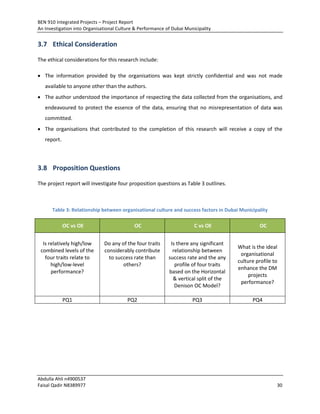
  • 70.
    BEN 910 IntegratedProjects โ€“ Project Report An Investigation into Organisational Culture & Performance of Dubai Municipality APPENDIX A DUBAI MUNICIPALITY ORGANISATIONAL CHART
  • 71.
    BEN 910 IntegratedProjects โ€“ Project Report An Investigation into Organisational Culture & Performance of Dubai Municipality Appendix A โ€“ Dubai Municipality Organisational Chart
  • 72.
    BEN 910 IntegratedProjects โ€“ Project Report An Investigation into Organisational Culture & Performance of Dubai Municipality Appendix A โ€“ Dubai Municipality Organisational Chart