Pimpri Chinchwad Polytechnic,
Nigdi.
1
Chapter 04-Power Transmission System
PRESENTED BY
Ms. M.R. Zade
C406.4 Select suitable drives and Mechanisms for a particular
application.
Course Name: Theory of Machines C406
Year of Study: 2016-17
Introduction
• Rotating elements which possess mechanical
energy has to be utilized at required place by
transmitting.
– From prime mover to machine
– From one shaft to another
3
Transmission system
• The system that is used to transmit power
from one mechanical element to another
mechanical element.
4
Types of transmitting system
• Belt drives
• Rope drives
• Chain drives
• Gear drives
5
Factors to select transmission system
• Distance between driver and driven pulley
shaft.
• Operational speed.
• Power to be transmitted.
6
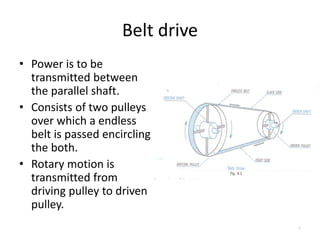
Belt drive
• Power is to be
transmitted between
the parallel shaft.
• Consists of two pulleys
over which a endless
belt is passed encircling
the both.
• Rotary motion is
transmitted from
driving pulley to driven
pulley.
7
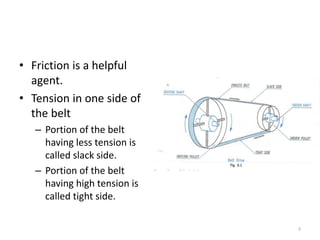
• Friction is a helpful
agent.
• Tension in one side of
the belt
– Portion of the belt
having less tension is
called slack side.
– Portion of the belt
having high tension is
called tight side.
8
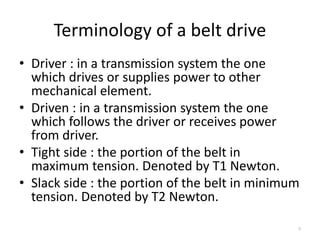
Terminology of a belt drive
• Driver : in a transmission system the one
which drives or supplies power to other
mechanical element.
• Driven : in a transmission system the one
which follows the driver or receives power
from driver.
• Tight side : the portion of the belt in
maximum tension. Denoted by T1 Newton.
• Slack side : the portion of the belt in minimum
tension. Denoted by T2 Newton.
9
• Arc / angle of contact : it is the portion of the
belt which is in contact with pulley surface.
Denoted by
10
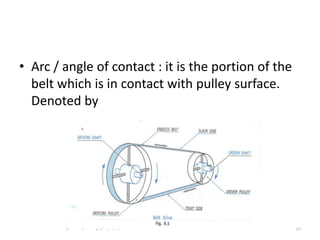
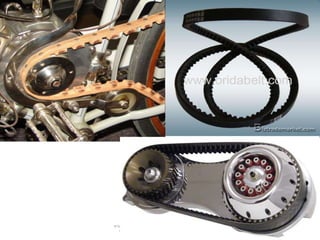
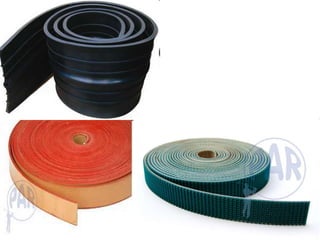
Belt materials
• Rubber
• Leather
• Canvas
• Cotton
• Steel
11
12
www.bookspar.com | Website for Students |
VTU NOTES | QUESTION PAPERS
13
Classification
• Open belt drive
• Closed belt drive
14
Open belt drive
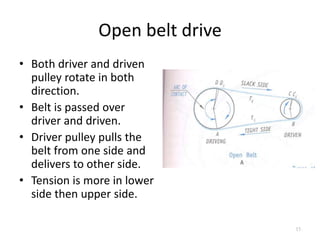
• Both driver and driven
pulley rotate in both
direction.
• Belt is passed over
driver and driven.
• Driver pulley pulls the
belt from one side and
delivers to other side.
• Tension is more in lower
side then upper side.
15
Cross belt drive
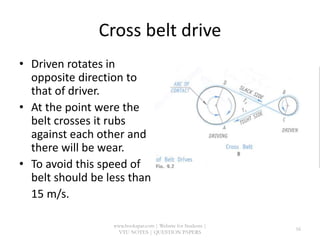
• Driven rotates in
opposite direction to
that of driver.
• At the point were the
belt crosses it rubs
against each other and
there will be wear.
• To avoid this speed of
belt should be less than
15 m/s.
16
www.bookspar.com | Website for Students |
VTU NOTES | QUESTION PAPERS
Comparison between Open belt drive and Close belt
drive
17
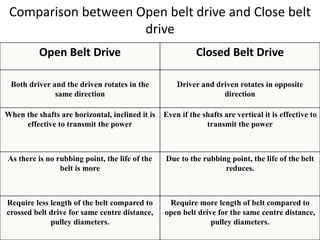
Open Belt Drive Closed Belt Drive
Both driver and the driven rotates in the
same direction
Driver and driven rotates in opposite
direction
When the shafts are horizontal, inclined it is
effective to transmit the power
Even if the shafts are vertical it is effective to
transmit the power
As there is no rubbing point, the life of the
belt is more
Due to the rubbing point, the life of the belt
reduces.
Require less length of the belt compared to
crossed belt drive for same centre distance,
pulley diameters.
Require more length of belt compared to
open belt drive for the same centre distance,
pulley diameters.
www.bookspar.com | Website for Students |
VTU NOTES | QUESTION PAPERS
18
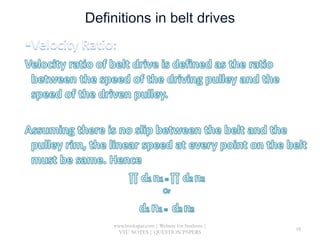
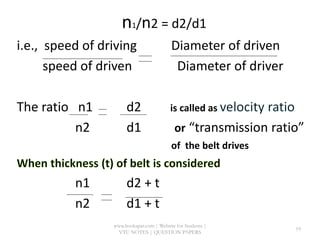
n1/n2 = d2/d1
i.e., speed of driving Diameter of driven
speed of driven Diameter of driver
The ratio n1 d2 is called as
n2 d1 or “transmission ratio”
of the belt drives
n1 d2 + t
n2 d1 + t
www.bookspar.com | Website for Students |
VTU NOTES | QUESTION PAPERS
19
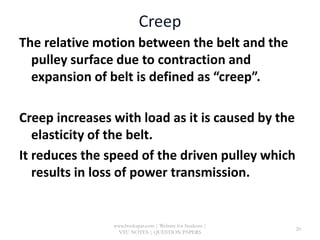
The relative motion between the belt and the
pulley surface due to contraction and
expansion of belt is defined as “creep”.
Creep increases with load as it is caused by the
elasticity of the belt.
It reduces the speed of the driven pulley which
results in loss of power transmission.
www.bookspar.com | Website for Students |
VTU NOTES | QUESTION PAPERS
20
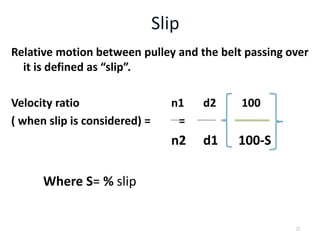
Relative motion between pulley and the belt passing over
it is defined as “slip”.
Velocity ratio n1 d2 100
( when slip is considered) = =
n2 d1 100-S
Where S= % slip
21
• Running and maintenance cost is low.
• Possibility to transmit power over a
moderately long distance.
• Efficient at high speeds.
www.bookspar.com | Website for Students |
VTU NOTES | QUESTION PAPERS
22
• Not preferred for short centre distance.
• Belt joints reduces the life of the belt.
• Loss of power due to slip and creep.
www.bookspar.com | Website for Students |
VTU NOTES | QUESTION PAPERS
23
Gear Trains
• When two or more gears are made to mesh with each
other to transmit power from one shaft to other. Such
an arrangement is called gear train.
• Simple gear train (SGT)
• Compound gear train (CGT)
www.bookspar.com | Website for Students |
VTU NOTES | QUESTION PAPERS
24
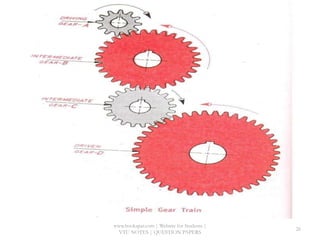
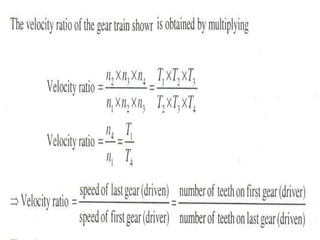
Simple gear train
• Arrangement of gears in series is known as
simple gear train.
• Intermediate gears are provided between
the driver and driven.
The function of the idler gears is
1. To cover the space between the driver and
driven gears and to
2. Obtain the desired direction of driven
www.bookspar.com | Website for Students |
VTU NOTES | QUESTION PAPERS
25
www.bookspar.com | Website for Students |
VTU NOTES | QUESTION PAPERS
26
www.bookspar.com | Website for Students |
VTU NOTES | QUESTION PAPERS
27
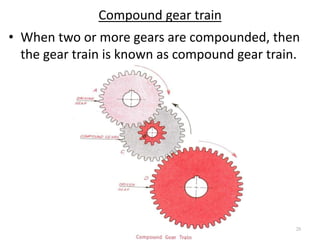
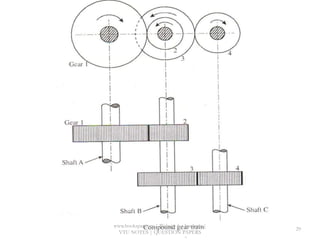
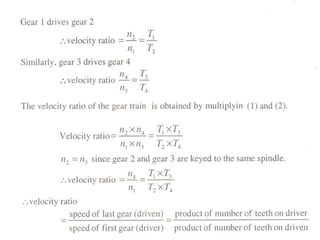
Compound gear train
• When two or more gears are compounded, then
the gear train is known as compound gear train.
www.bookspar.com | Website for Students |
VTU NOTES | QUESTION PAPERS
28
www.bookspar.com | Website for Students |
VTU NOTES | QUESTION PAPERS
29
www.bookspar.com | Website for Students |
VTU NOTES | QUESTION PAPERS
30

Belt drive,chain drive

  • 1.
    Pimpri Chinchwad Polytechnic, Nigdi. 1 Chapter04-Power Transmission System PRESENTED BY Ms. M.R. Zade
  • 2.
    C406.4 Select suitabledrives and Mechanisms for a particular application. Course Name: Theory of Machines C406 Year of Study: 2016-17
  • 3.
    Introduction • Rotating elementswhich possess mechanical energy has to be utilized at required place by transmitting. – From prime mover to machine – From one shaft to another 3
  • 4.
    Transmission system • Thesystem that is used to transmit power from one mechanical element to another mechanical element. 4
  • 5.
    Types of transmittingsystem • Belt drives • Rope drives • Chain drives • Gear drives 5
  • 6.
    Factors to selecttransmission system • Distance between driver and driven pulley shaft. • Operational speed. • Power to be transmitted. 6
  • 7.
    Belt drive • Poweris to be transmitted between the parallel shaft. • Consists of two pulleys over which a endless belt is passed encircling the both. • Rotary motion is transmitted from driving pulley to driven pulley. 7
  • 8.
    • Friction isa helpful agent. • Tension in one side of the belt – Portion of the belt having less tension is called slack side. – Portion of the belt having high tension is called tight side. 8
  • 9.
    Terminology of abelt drive • Driver : in a transmission system the one which drives or supplies power to other mechanical element. • Driven : in a transmission system the one which follows the driver or receives power from driver. • Tight side : the portion of the belt in maximum tension. Denoted by T1 Newton. • Slack side : the portion of the belt in minimum tension. Denoted by T2 Newton. 9
  • 10.
    • Arc /angle of contact : it is the portion of the belt which is in contact with pulley surface. Denoted by 10
  • 11.
    Belt materials • Rubber •Leather • Canvas • Cotton • Steel 11
  • 12.
    12 www.bookspar.com | Websitefor Students | VTU NOTES | QUESTION PAPERS
  • 13.
  • 14.
    Classification • Open beltdrive • Closed belt drive 14
  • 15.
    Open belt drive •Both driver and driven pulley rotate in both direction. • Belt is passed over driver and driven. • Driver pulley pulls the belt from one side and delivers to other side. • Tension is more in lower side then upper side. 15
  • 16.
    Cross belt drive •Driven rotates in opposite direction to that of driver. • At the point were the belt crosses it rubs against each other and there will be wear. • To avoid this speed of belt should be less than 15 m/s. 16 www.bookspar.com | Website for Students | VTU NOTES | QUESTION PAPERS
  • 17.
    Comparison between Openbelt drive and Close belt drive 17 Open Belt Drive Closed Belt Drive Both driver and the driven rotates in the same direction Driver and driven rotates in opposite direction When the shafts are horizontal, inclined it is effective to transmit the power Even if the shafts are vertical it is effective to transmit the power As there is no rubbing point, the life of the belt is more Due to the rubbing point, the life of the belt reduces. Require less length of the belt compared to crossed belt drive for same centre distance, pulley diameters. Require more length of belt compared to open belt drive for the same centre distance, pulley diameters.
  • 18.
    www.bookspar.com | Websitefor Students | VTU NOTES | QUESTION PAPERS 18
  • 19.
    n1/n2 = d2/d1 i.e.,speed of driving Diameter of driven speed of driven Diameter of driver The ratio n1 d2 is called as n2 d1 or “transmission ratio” of the belt drives n1 d2 + t n2 d1 + t www.bookspar.com | Website for Students | VTU NOTES | QUESTION PAPERS 19
  • 20.
    The relative motionbetween the belt and the pulley surface due to contraction and expansion of belt is defined as “creep”. Creep increases with load as it is caused by the elasticity of the belt. It reduces the speed of the driven pulley which results in loss of power transmission. www.bookspar.com | Website for Students | VTU NOTES | QUESTION PAPERS 20
  • 21.
    Relative motion betweenpulley and the belt passing over it is defined as “slip”. Velocity ratio n1 d2 100 ( when slip is considered) = = n2 d1 100-S Where S= % slip 21
  • 22.
    • Running andmaintenance cost is low. • Possibility to transmit power over a moderately long distance. • Efficient at high speeds. www.bookspar.com | Website for Students | VTU NOTES | QUESTION PAPERS 22
  • 23.
    • Not preferredfor short centre distance. • Belt joints reduces the life of the belt. • Loss of power due to slip and creep. www.bookspar.com | Website for Students | VTU NOTES | QUESTION PAPERS 23
  • 24.
    Gear Trains • Whentwo or more gears are made to mesh with each other to transmit power from one shaft to other. Such an arrangement is called gear train. • Simple gear train (SGT) • Compound gear train (CGT) www.bookspar.com | Website for Students | VTU NOTES | QUESTION PAPERS 24
  • 25.
    Simple gear train •Arrangement of gears in series is known as simple gear train. • Intermediate gears are provided between the driver and driven. The function of the idler gears is 1. To cover the space between the driver and driven gears and to 2. Obtain the desired direction of driven www.bookspar.com | Website for Students | VTU NOTES | QUESTION PAPERS 25
  • 26.
    www.bookspar.com | Websitefor Students | VTU NOTES | QUESTION PAPERS 26
  • 27.
    www.bookspar.com | Websitefor Students | VTU NOTES | QUESTION PAPERS 27
  • 28.
    Compound gear train •When two or more gears are compounded, then the gear train is known as compound gear train. www.bookspar.com | Website for Students | VTU NOTES | QUESTION PAPERS 28
  • 29.
    www.bookspar.com | Websitefor Students | VTU NOTES | QUESTION PAPERS 29
  • 30.
    www.bookspar.com | Websitefor Students | VTU NOTES | QUESTION PAPERS 30