Customer Case Study Aerospace 
Facts 
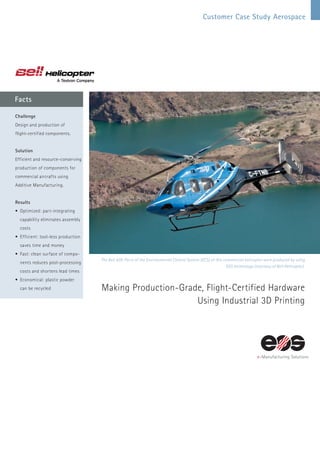
The Bell 429: Parts of the Environmental Control System (ECS) of this commercial helicopter were produced by using 
EOS technology (courtesy of Bell Helicopter). 
Making Production-Grade, Flight-Certified Hardware 
Using Industrial 3D Printing 
Challenge 
Design and production of 
flight-certified components. 
Solution 
Efficient and resource-conserving 
production of components for 
commercial aircrafts using 
Additive Manufacturing. 
Results 
• Optimized: part-integrating 
capability eliminates assembly 
costs 
• Efficient: tool-less production 
saves time and money 
• Fast: clean surface of compo-nents 
reduces post-processing 
costs and shortens lead times 
• Economical: plastic powder 
can be recycled
Bell Helicopter and Harvest Technologies Utilize Design-Driven 
Manufacturing with EOS Technology 
Short Profile 
Founded in 1935 as Bell Aircraft 
Corporation and headquartered 
in Fort Worth/Texas (USA) Bell 
Helicopter Textron Inc. continues 
to set the pace for the industry 
and expand the scope of vertical 
lift. 
Headquartered in Belton/Texas 
(USA) Harvest Technologies has 
almost 20 years of experience 
in the Additive Manufacturing 
industry. The company has over 
40 AM systems, many of them 
used to create end-use compo-nents 
and assemblies. 
Further Information 
www.bellhelicopter.com 
www.harvest-tech.com 
Sometimes, a company’s entire manufacturing history begins with prototyping. In 1941, Arthur M. 
Young demonstrated an ingeniously engineered model helicopter flying on a tether while working 
for Bell Aircraft Corporation. Just five years later, Bell Helicopter received the first-ever certification 
for a commercial helicopter. Today, Bell Helicopter Textron Inc. has made and sold more than 35,000 
helicopters worldwide. 
The engineering-driven company already produced prototypes for different components of their 
­aircraft 
using Additive Manufacturing (AM) and now wanted to use the technology for functional 
parts. Harvest Technologies, one of the world’s largest suppliers of AM technologies, provided the 
deep knowledge of the technology Bell Helicopter was looking for. 
Challenge 
However, before production could 
begin, Bell Helicopter and Harvest 
needed to prove out the EOSINT P 
730 and its processing capabilities 
in order to certify this platform 
for use. The technological ad-vances 
and sheer platform size 
would certainly provide greater 
efficiencies, but Bell Helicopter 
and Harvest needed to ensure 
this was not at the cost of part 
integrity. Furthermore, heat dis-tribution, 
powder degradation, 
dimensional accuracy, repeatabil-ity, 
part quality and performance, 
and the economics of the plat-form 
were examined. “We charac-terized 
the mechanical properties 
of each additively manufactured 
build so that we could confirm 
that the EOS system met our 
specification requirements and 
produced the same quality prod-uct 
each time,” said Elliott Schulte, 
Engineer III at Bell Helicopter. This 
systematic testing was done with 
a number of different materials 
lots and a series of individual 
builds to establish that EOS’ tech-nology 
was robust and highly 
repeat­able 
with identical results. 
Solution 
Now, Bell Helicopter and Harvest 
could begin the meticulous se-quence 
of manufacturing aero-space 
hardware. First, the engi-neering 
team would call up the 
same database used to qualify 
the EOSINT P 730. Based on the 
mechanical properties specified, 
engineers would then design the 
part. “Material characterization is 
a critical consideration for us 
during design,” said Christopher 
Gravelle, Bell Helicopter’s Rapid 
Prototyping Lab lead. “For in-stance, 
if you’re creating bosses 
for attachment points in addi-tively 
manufactured nylon, it’s a 
new material and process – you 
can’t just use the exact configu-ration 
you would for a metal 
part.” 
After a final review of design for 
system producibility, Bell Heli-copter 
would send a 3D CAD 
model along with a request for 
EOS technology is capable of 
creating complex shapes such as 
the ductwork above 
(courtesy of Bell Helicopter and 
Harvest Technologies).
quote (RFQ) to Harvest for review 
and for development of a build 
strategy. Once Bell Helicopter 
­accepted 
the quote, production 
would begin in earnest at Harvest. 
Before each batch, there was a 
rigorous checklist of pre-produc-tion 
inspections – developed by 
Harvest – for instance, a nitrogen 
leak rate check – that reduces 
waste and ensures part quality. 
“After every build, we test for 
tensile and flexural properties,” 
said Caleb Ferrell, Quality Manag-er 
at Harvest Technologies. This is 
a requirement established for 
process assurance that Harvest 
continuously monitors. 
Results 
At present, the helicopter compa-ny 
mostly produces parts for the 
Environmental Control System 
(ECS) by using EOS technology. 
And AM production is expanding: 
Bell Helicopter is interested in 
employing additively manufac-tured 
components throughout 
the aircraft systems of their 
­commercial 
helicopters. “Now the 
ECS engineers who’ve gained 
­experience 
with the material and 
the process are communicating 
to teams with other functions, 
and those teams are starting 
to incorporate additive manu­factured 
hardware into their 
­assemblies,” 
said Schulte. Bell 
­Helicopter 
will also be evaluating 
AM of high-temperature plastics 
intended for use in more de-manding 
roles and environments. 
Ferrell added: “In addition to the 
design advantages, there are 
­significant 
manufacturing bene-fits 
to EOS technology. Tool-less 
manufacturing means you don’t 
face ­certain 
limitations and up-front 
costs. And if you need to 
change something, you can build 
new ­revisions 
simply by changing 
the CAD file – no moulds, no new 
machining tool paths, and very 
little wasted time or money.” 
“Because of the larger EOS build 
platform, we could build bigger 
components in one piece rather 
than in sections,” said Lewis 
Simms, Marketing Director at 
Harvest. Engineers are now learn-ing 
to take greater advantage of 
the freedom of design that comes 
with applying EOS technology. 
“Our engineers are using the 
part-integrating capability to 
eliminate assembly costs,” Grav-elle 
said. 
Another advantage of the EOS 
system was the clean surface it 
produces. “We were able to 
achieve the desired quality with 
the other AM system,” said Ron 
Clemons, Director of Business 
Development at Harvest, “but 
there was a lot more finishing 
“The EOS technology gives us 
a great deal of flexibility and 
freedom. The parts that we get 
have very good feature defini-tion 
and the mechanical prop-erties 
have been good as well. 
We’re especially happy with the 
larger platform size and the 
nestability we’ve been able to 
achieve.” 
Caleb Ferrell, Quality Manager 
at Harvest Technologies 
“The EOS technology produces 
a robust and highly repeatable 
process. We have done a num-ber 
of conversions of aircraft 
parts from previous processes 
to Additive Manufacturing. 
With the EOSINT P 730, we 
­often 
discovered that the pro-duction 
cost per piece is sub-stantially 
reduced compared to 
conventional manufacturing 
methods. The system complies 
with our specification.” 
Elliott Schulte, Engineer III at 
Bell Helicopter 
­labour 
associated with it than on 
the EOS platform.” The EOSINT P 
730 incorporated a software fix 
that provided crisper detail and 
smoother surfaces. As a result, 
there was relatively little periph-eral 
powder melting and adhesion. 
Switching to the EOS system of-fered 
significant post-processing 
cost savings and shorter lead 
times for Bell Helicopter. 
An important secondary benefit 
of EOS’ technology was increased 
recyclability of the plastic pow-der. 
Other AM processes left 
­behind 
a significant amount of 
partially melted and therefore 
unusable powder. The reduction 
of this waste in the EOSINT P 730 
made much of the leftover pow-der 
more recyclable. 
Harvest has acquired a second 
EOSINT P 730 system, and an 
­EOSINT 
P 760 system, from EOS 
and is currently working with Bell 
Helicopter to implement the man-ufacture 
of one-off or two-off 
orders of spares, nested in with 
their existing batch production. 
“We have a strong legacy of using 
3D-printed thermoplastic parts,” 
Schulte says. “We definitely want 
to stay at the forefront of new 
EOS materials and processes, so 
we’ll continue our IRAD (Indepen-dent 
Research and Development), 
supply chain integration, and our 
industry involvement with Additive 
Manufacturing.”
Status 8/2014. Technical data subject to change without notice. EOS is certified according to ISO 9001. 
EOS GmbH 
Electro Optical Systems 
Corporate Headquarters 
Robert-Stirling-Ring 1 
82152 Krailling/Munich 
Germany 
Phone +49 89 893 36-0 
Fax +49 89 893 36-285 
Further EOS Offices 
EOS France 
Phone +33 437 49 76 76 
EOS India 
Phone +91 44 28 15 87 94 
EOS Italy 
Phone +39 02 33 40 16 59 
EOS Korea 
Phone +82 32 552 82 31 
EOS Nordic & Baltic 
Phone +46 31 760 46 40 
EOS of North America 
Phone +1 248 306 01 43 
EOS Singapore 
Phone +65 6430 05 50 
EOS Greater China 
Phone + 86 21 602307 00 
EOS UK 
Phone +44 1926 62 31 07 
www.eos.info • info@eos.info 
Think the impossible. You can get it.

Bell Helicopter makes production grade flight certified hardware via Selective Laser Sintering with EOS Additive Manufacturing

  • 1.
    Customer Case StudyAerospace Facts The Bell 429: Parts of the Environmental Control System (ECS) of this commercial helicopter were produced by using EOS technology (courtesy of Bell Helicopter). Making Production-Grade, Flight-Certified Hardware Using Industrial 3D Printing Challenge Design and production of flight-certified components. Solution Efficient and resource-conserving production of components for commercial aircrafts using Additive Manufacturing. Results • Optimized: part-integrating capability eliminates assembly costs • Efficient: tool-less production saves time and money • Fast: clean surface of compo-nents reduces post-processing costs and shortens lead times • Economical: plastic powder can be recycled
  • 2.
    Bell Helicopter andHarvest Technologies Utilize Design-Driven Manufacturing with EOS Technology Short Profile Founded in 1935 as Bell Aircraft Corporation and headquartered in Fort Worth/Texas (USA) Bell Helicopter Textron Inc. continues to set the pace for the industry and expand the scope of vertical lift. Headquartered in Belton/Texas (USA) Harvest Technologies has almost 20 years of experience in the Additive Manufacturing industry. The company has over 40 AM systems, many of them used to create end-use compo-nents and assemblies. Further Information www.bellhelicopter.com www.harvest-tech.com Sometimes, a company’s entire manufacturing history begins with prototyping. In 1941, Arthur M. Young demonstrated an ingeniously engineered model helicopter flying on a tether while working for Bell Aircraft Corporation. Just five years later, Bell Helicopter received the first-ever certification for a commercial helicopter. Today, Bell Helicopter Textron Inc. has made and sold more than 35,000 helicopters worldwide. The engineering-driven company already produced prototypes for different components of their ­aircraft using Additive Manufacturing (AM) and now wanted to use the technology for functional parts. Harvest Technologies, one of the world’s largest suppliers of AM technologies, provided the deep knowledge of the technology Bell Helicopter was looking for. Challenge However, before production could begin, Bell Helicopter and Harvest needed to prove out the EOSINT P 730 and its processing capabilities in order to certify this platform for use. The technological ad-vances and sheer platform size would certainly provide greater efficiencies, but Bell Helicopter and Harvest needed to ensure this was not at the cost of part integrity. Furthermore, heat dis-tribution, powder degradation, dimensional accuracy, repeatabil-ity, part quality and performance, and the economics of the plat-form were examined. “We charac-terized the mechanical properties of each additively manufactured build so that we could confirm that the EOS system met our specification requirements and produced the same quality prod-uct each time,” said Elliott Schulte, Engineer III at Bell Helicopter. This systematic testing was done with a number of different materials lots and a series of individual builds to establish that EOS’ tech-nology was robust and highly repeat­able with identical results. Solution Now, Bell Helicopter and Harvest could begin the meticulous se-quence of manufacturing aero-space hardware. First, the engi-neering team would call up the same database used to qualify the EOSINT P 730. Based on the mechanical properties specified, engineers would then design the part. “Material characterization is a critical consideration for us during design,” said Christopher Gravelle, Bell Helicopter’s Rapid Prototyping Lab lead. “For in-stance, if you’re creating bosses for attachment points in addi-tively manufactured nylon, it’s a new material and process – you can’t just use the exact configu-ration you would for a metal part.” After a final review of design for system producibility, Bell Heli-copter would send a 3D CAD model along with a request for EOS technology is capable of creating complex shapes such as the ductwork above (courtesy of Bell Helicopter and Harvest Technologies).
  • 3.
    quote (RFQ) toHarvest for review and for development of a build strategy. Once Bell Helicopter ­accepted the quote, production would begin in earnest at Harvest. Before each batch, there was a rigorous checklist of pre-produc-tion inspections – developed by Harvest – for instance, a nitrogen leak rate check – that reduces waste and ensures part quality. “After every build, we test for tensile and flexural properties,” said Caleb Ferrell, Quality Manag-er at Harvest Technologies. This is a requirement established for process assurance that Harvest continuously monitors. Results At present, the helicopter compa-ny mostly produces parts for the Environmental Control System (ECS) by using EOS technology. And AM production is expanding: Bell Helicopter is interested in employing additively manufac-tured components throughout the aircraft systems of their ­commercial helicopters. “Now the ECS engineers who’ve gained ­experience with the material and the process are communicating to teams with other functions, and those teams are starting to incorporate additive manu­factured hardware into their ­assemblies,” said Schulte. Bell ­Helicopter will also be evaluating AM of high-temperature plastics intended for use in more de-manding roles and environments. Ferrell added: “In addition to the design advantages, there are ­significant manufacturing bene-fits to EOS technology. Tool-less manufacturing means you don’t face ­certain limitations and up-front costs. And if you need to change something, you can build new ­revisions simply by changing the CAD file – no moulds, no new machining tool paths, and very little wasted time or money.” “Because of the larger EOS build platform, we could build bigger components in one piece rather than in sections,” said Lewis Simms, Marketing Director at Harvest. Engineers are now learn-ing to take greater advantage of the freedom of design that comes with applying EOS technology. “Our engineers are using the part-integrating capability to eliminate assembly costs,” Grav-elle said. Another advantage of the EOS system was the clean surface it produces. “We were able to achieve the desired quality with the other AM system,” said Ron Clemons, Director of Business Development at Harvest, “but there was a lot more finishing “The EOS technology gives us a great deal of flexibility and freedom. The parts that we get have very good feature defini-tion and the mechanical prop-erties have been good as well. We’re especially happy with the larger platform size and the nestability we’ve been able to achieve.” Caleb Ferrell, Quality Manager at Harvest Technologies “The EOS technology produces a robust and highly repeatable process. We have done a num-ber of conversions of aircraft parts from previous processes to Additive Manufacturing. With the EOSINT P 730, we ­often discovered that the pro-duction cost per piece is sub-stantially reduced compared to conventional manufacturing methods. The system complies with our specification.” Elliott Schulte, Engineer III at Bell Helicopter ­labour associated with it than on the EOS platform.” The EOSINT P 730 incorporated a software fix that provided crisper detail and smoother surfaces. As a result, there was relatively little periph-eral powder melting and adhesion. Switching to the EOS system of-fered significant post-processing cost savings and shorter lead times for Bell Helicopter. An important secondary benefit of EOS’ technology was increased recyclability of the plastic pow-der. Other AM processes left ­behind a significant amount of partially melted and therefore unusable powder. The reduction of this waste in the EOSINT P 730 made much of the leftover pow-der more recyclable. Harvest has acquired a second EOSINT P 730 system, and an ­EOSINT P 760 system, from EOS and is currently working with Bell Helicopter to implement the man-ufacture of one-off or two-off orders of spares, nested in with their existing batch production. “We have a strong legacy of using 3D-printed thermoplastic parts,” Schulte says. “We definitely want to stay at the forefront of new EOS materials and processes, so we’ll continue our IRAD (Indepen-dent Research and Development), supply chain integration, and our industry involvement with Additive Manufacturing.”
  • 4.
    Status 8/2014. Technicaldata subject to change without notice. EOS is certified according to ISO 9001. EOS GmbH Electro Optical Systems Corporate Headquarters Robert-Stirling-Ring 1 82152 Krailling/Munich Germany Phone +49 89 893 36-0 Fax +49 89 893 36-285 Further EOS Offices EOS France Phone +33 437 49 76 76 EOS India Phone +91 44 28 15 87 94 EOS Italy Phone +39 02 33 40 16 59 EOS Korea Phone +82 32 552 82 31 EOS Nordic & Baltic Phone +46 31 760 46 40 EOS of North America Phone +1 248 306 01 43 EOS Singapore Phone +65 6430 05 50 EOS Greater China Phone + 86 21 602307 00 EOS UK Phone +44 1926 62 31 07 www.eos.info • info@eos.info Think the impossible. You can get it.