


Richard Kenny, EMEA Marketing ManagerThe Future of Customer Service
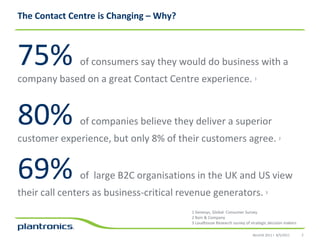
75% of consumers say they would do business with a company based on a great Contact Centre experience. 180%of companies believe they deliver a superior customer experience, but only 8% of their customers agree. 269%of  large B2C organisations in the UK and US view their call centers as business-critical revenue generators. 3The Contact Centre is Changing – Why?8/5/201121 Genesys, Global  Consumer Survey 2 Bain & Company3 Loudhouse Research survey of strategic decision makers
Believe38/5/2011
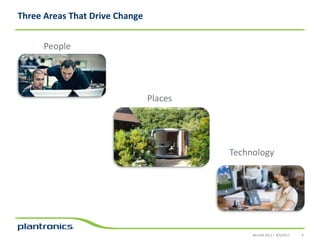
Three Areas That Drive Change8/5/20114PeoplePlacesTechnology
The Right People58/5/2011
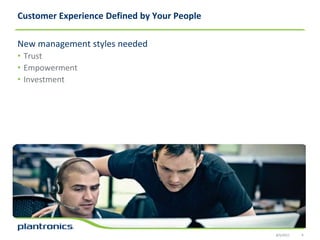
Customer Experience Defined by Your PeopleNew management styles neededTrustEmpowermentInvestment8/5/20116
Culture based on TrustRemote/mobile workers harder/longer
Shared belief that people want to do a good jobEmployer and Employee on the same sidePursuing same cause, vision, goal, objective, resultPeople are self-motivatedWith freedom, employees naturally take greater responsibilityEvery customer interaction influences your brand  Positively or negativelyA New Work Dynamic - TRUST8/5/20117
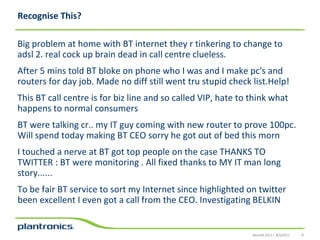
Big problem at home with BT internet they r tinkering to change to adsl 2. real cock up brain dead in call centre clueless.After 5 mins told BT bloke on phone who I was and I make pc's and routers for day job. Made no diff still went tru stupid check list.Help!This BT call centre is for biz line and so called VIP, hate to think what happens to normal consumersBT were talking cr.. my IT guy coming with new router to prove 100pc. Will spend today making BT CEO sorry he got out of bed this mornI touched a nerve at BT got top people on the case THANKS TO TWITTER : BT were monitoring . All fixed thanks to MY IT man long story......To be fair BT service to sort my Internet since highlighted on twitter been excellent I even got a call from the CEO. Investigating BELKINRecognise This?8/5/20118
David CarollUnited Breaks Guitars (Youtube – 9.5M views)Youp van ‘t HekDe Help (@youpvanthek - 75,000 followers)Lily Allen@lilyroseallen – 2.5M followersHave You Heard of ...?8/5/20119
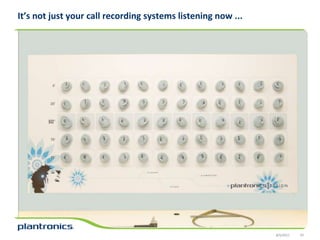
It’s not just your call recording systems listening now ...8/5/201110
Customers are more empowered with knowledge gathered through self-service channelsCompanies can no longer afford to ‘follow the scripts’Poor service for customersFrustrating for agentsDirect link between self-determination and job satisfactionHigher job satisfaction = lower agent turnoverA New Work Dynamic - EMPOWERMENT8/5/201111Lynn Holdsworth, Susan Cartwright, (2003) "Empowerment, stress and satisfaction: an exploratory study of a call centre", Leadership & Organization Development Journal, Vol. 24 Iss: 3, pp.131 - 140
You trust your team ...You’ve empowered them to solve problems ...But you’re not training them?And you want them to use last century’s technology?Investment in Contact Centres8/5/201112
The Workplace Revolution138/5/2011
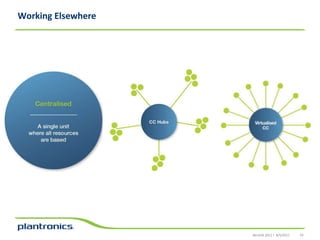
Working Elsewhere8/5/201114
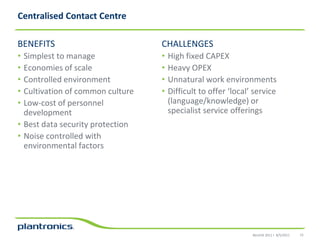
Centralised Contact CentreBENEFITSSimplest to manageEconomies of scaleControlled environmentCultivation of common cultureLow-cost of personnel developmentBest data security protectionNoise controlled with environmental factorsCHALLENGESHigh fixed CAPEXHeavy OPEXUnnatural work environmentsDifficult to offer ‘local’ service (language/knowledge) or specialist service offerings158/5/2011
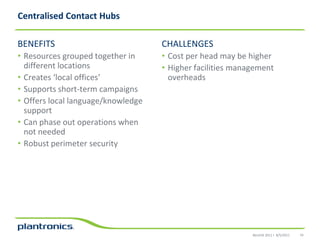
Centralised Contact HubsBENEFITSResources grouped together in different locationsCreates ‘local offices’Supports short-term campaignsOffers local language/knowledge supportCan phase out operations when not neededRobust perimeter securityCHALLENGESCost per head may be higherHigher facilities management overheads168/5/2011
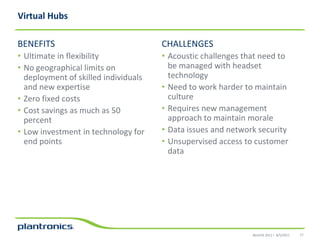
Virtual HubsBENEFITSUltimate in flexibilityNo geographical limits on deployment of skilled individuals and new expertise Zero fixed costsCost savings as much as 50 percentLow investment in technology for end pointsCHALLENGESAcoustic challenges that need to be managed with headset technologyNeed to work harder to maintain cultureRequires new management approach to maintain moraleData issues and network securityUnsupervised access to customer data178/5/2011
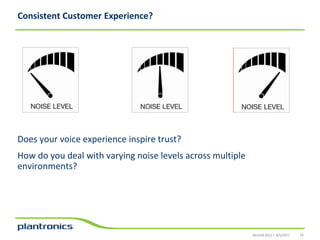
Does your voice experience inspire trust?How do you deal with varying noise levels across multiple environments?Consistent Customer Experience?8/5/201118
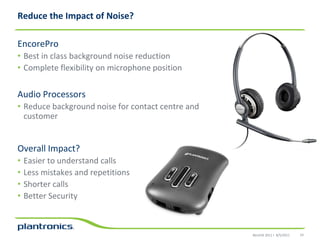
EncoreProBest in class background noise reductionComplete flexibility on microphone positionAudio ProcessorsReduce background noise for contact centre and customerOverall Impact?Easier to understand callsLess mistakes and repetitionsShorter callsBetter SecurityReduce the Impact of Noise?8/5/201119
Believe in Technology
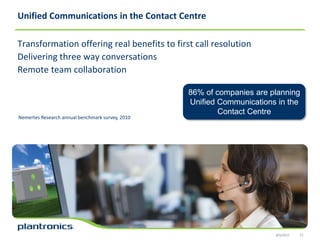
Unified Communications in the Contact CentreTransformation offering real benefits to first call resolutionDelivering three way conversationsRemote team collaboration8/5/20112186% of companies are planning Unified Communications in the Contact CentreNemertes Research annual benchmark survey, 2010
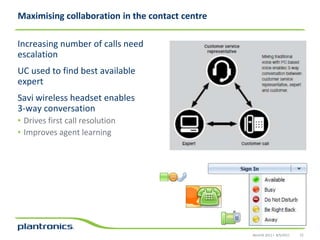
Maximising collaboration in the contact centreIncreasing number of calls need escalationUC used to find best available expertSavi wireless headset enables 3-way conversationDrives first call resolutionImproves agent learning228/5/2011
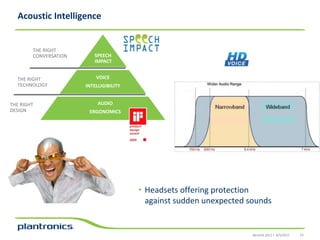
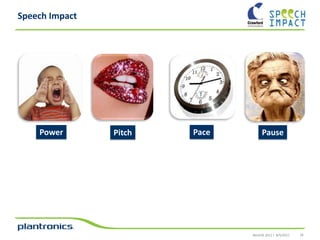
Acoustic Intelligence8/5/201123THE RIGHT CONVERSATIONSPEECH IMPACTVOICEINTELLIGIBILITYTHE RIGHT TECHNOLOGYAUDIOERGONOMICSTHE RIGHT DESIGNHeadsets offering protection against sudden unexpected soundsSpeech Impact8/5/201124PacePowerPausePitch
Believe258/5/2011
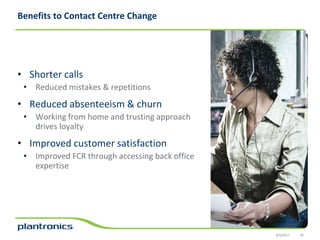
Benefits to Contact Centre ChangeShorter callsReduced mistakes & repetitionsReduced absenteeism & churnWorking from home and trusting approach drives loyaltyImproved customer satisfactionImproved FCR through accessing back office expertise8/5/201126
Believe in the Contact CentreManagement by trustLiberate your workplaceUse the power of technology8/5/201127
Richard.kenny@plantronics.comwww.mycontactcentre.com@mycontactcentre

Believe in your call centre

  • 1.
    Richard Kenny, EMEAMarketing ManagerThe Future of Customer Service
  • 2.
    75% of consumerssay they would do business with a company based on a great Contact Centre experience. 180%of companies believe they deliver a superior customer experience, but only 8% of their customers agree. 269%of large B2C organisations in the UK and US view their call centers as business-critical revenue generators. 3The Contact Centre is Changing – Why?8/5/201121 Genesys, Global Consumer Survey 2 Bain & Company3 Loudhouse Research survey of strategic decision makers
  • 3.
  • 4.
    Three Areas ThatDrive Change8/5/20114PeoplePlacesTechnology
  • 5.
  • 6.
    Customer Experience Definedby Your PeopleNew management styles neededTrustEmpowermentInvestment8/5/20116
  • 7.
    Culture based onTrustRemote/mobile workers harder/longer
  • 8.
    Shared belief thatpeople want to do a good jobEmployer and Employee on the same sidePursuing same cause, vision, goal, objective, resultPeople are self-motivatedWith freedom, employees naturally take greater responsibilityEvery customer interaction influences your brand Positively or negativelyA New Work Dynamic - TRUST8/5/20117
  • 9.
    Big problem athome with BT internet they r tinkering to change to adsl 2. real cock up brain dead in call centre clueless.After 5 mins told BT bloke on phone who I was and I make pc's and routers for day job. Made no diff still went tru stupid check list.Help!This BT call centre is for biz line and so called VIP, hate to think what happens to normal consumersBT were talking cr.. my IT guy coming with new router to prove 100pc. Will spend today making BT CEO sorry he got out of bed this mornI touched a nerve at BT got top people on the case THANKS TO TWITTER : BT were monitoring . All fixed thanks to MY IT man long story......To be fair BT service to sort my Internet since highlighted on twitter been excellent I even got a call from the CEO. Investigating BELKINRecognise This?8/5/20118
  • 10.
    David CarollUnited BreaksGuitars (Youtube – 9.5M views)Youp van ‘t HekDe Help (@youpvanthek - 75,000 followers)Lily Allen@lilyroseallen – 2.5M followersHave You Heard of ...?8/5/20119
  • 11.
    It’s not justyour call recording systems listening now ...8/5/201110
  • 12.
    Customers are moreempowered with knowledge gathered through self-service channelsCompanies can no longer afford to ‘follow the scripts’Poor service for customersFrustrating for agentsDirect link between self-determination and job satisfactionHigher job satisfaction = lower agent turnoverA New Work Dynamic - EMPOWERMENT8/5/201111Lynn Holdsworth, Susan Cartwright, (2003) "Empowerment, stress and satisfaction: an exploratory study of a call centre", Leadership & Organization Development Journal, Vol. 24 Iss: 3, pp.131 - 140
  • 13.
    You trust yourteam ...You’ve empowered them to solve problems ...But you’re not training them?And you want them to use last century’s technology?Investment in Contact Centres8/5/201112
  • 14.
  • 15.
  • 16.
    Centralised Contact CentreBENEFITSSimplestto manageEconomies of scaleControlled environmentCultivation of common cultureLow-cost of personnel developmentBest data security protectionNoise controlled with environmental factorsCHALLENGESHigh fixed CAPEXHeavy OPEXUnnatural work environmentsDifficult to offer ‘local’ service (language/knowledge) or specialist service offerings158/5/2011
  • 17.
    Centralised Contact HubsBENEFITSResourcesgrouped together in different locationsCreates ‘local offices’Supports short-term campaignsOffers local language/knowledge supportCan phase out operations when not neededRobust perimeter securityCHALLENGESCost per head may be higherHigher facilities management overheads168/5/2011
  • 18.
    Virtual HubsBENEFITSUltimate inflexibilityNo geographical limits on deployment of skilled individuals and new expertise Zero fixed costsCost savings as much as 50 percentLow investment in technology for end pointsCHALLENGESAcoustic challenges that need to be managed with headset technologyNeed to work harder to maintain cultureRequires new management approach to maintain moraleData issues and network securityUnsupervised access to customer data178/5/2011
  • 19.
    Does your voiceexperience inspire trust?How do you deal with varying noise levels across multiple environments?Consistent Customer Experience?8/5/201118
  • 20.
    EncoreProBest in classbackground noise reductionComplete flexibility on microphone positionAudio ProcessorsReduce background noise for contact centre and customerOverall Impact?Easier to understand callsLess mistakes and repetitionsShorter callsBetter SecurityReduce the Impact of Noise?8/5/201119
  • 21.
  • 22.
    Unified Communications inthe Contact CentreTransformation offering real benefits to first call resolutionDelivering three way conversationsRemote team collaboration8/5/20112186% of companies are planning Unified Communications in the Contact CentreNemertes Research annual benchmark survey, 2010
  • 23.
    Maximising collaboration inthe contact centreIncreasing number of calls need escalationUC used to find best available expertSavi wireless headset enables 3-way conversationDrives first call resolutionImproves agent learning228/5/2011
  • 24.
    Acoustic Intelligence8/5/201123THE RIGHTCONVERSATIONSPEECH IMPACTVOICEINTELLIGIBILITYTHE RIGHT TECHNOLOGYAUDIOERGONOMICSTHE RIGHT DESIGNHeadsets offering protection against sudden unexpected soundsSpeech Impact8/5/201124PacePowerPausePitch
  • 25.
  • 26.
    Benefits to ContactCentre ChangeShorter callsReduced mistakes & repetitionsReduced absenteeism & churnWorking from home and trusting approach drives loyaltyImproved customer satisfactionImproved FCR through accessing back office expertise8/5/201126
  • 27.
    Believe in theContact CentreManagement by trustLiberate your workplaceUse the power of technology8/5/201127
  • 28.

Editor's Notes

  • #3 Time and again, surveys of customers show that quality service is a differentiator that improves customer satisfaction. These stats are some of many that show how good service allows companies to differentiate themselves in a world of increasingly similar products.If you can, add some personal anecdotes here about the way you felt when you received good or bad service from a company.However, there appears to be a major disconnect between how companies view the quality of the service they deliver, and the consumers view of that service. This is reflected in the poor perception of contact centres, and the rise of social media and online interactions with companies.What is the benefit of this change to companies?
  • #4 As with every initiative, this will only succeed if it is driven from the top down – not just team leaders, but CEO/MD level must Believe in the value of the contact centreAs an example, Ken Kannappan knows the average speed to answer calls in the PLT contact centres. He monitors this, and questions any change seen. He believes in offering excellent customer service.
  • #6 Addressing all issues around getting the right people
  • #8 Later in the presentation, we’ll show that working outside of a central environment is becoming more common. This implies that a great deal more trust is needed between managers and employees – no more management by walking around!A number of studies have shown that when people are given the freedom to work remotely, or at home, they work harder or longer. In some cases this is proving that they are worthy of the trust being put in them, and changing their work approach to ensure they keep that ability to work where suits them best.Main point to emphasise on this slide is that with that advent of social media, then every interaction has the potential to influence your brand – positively or negatively.
  • #9 This is an extract from Twitter – the author is Lord Alan Sugar with approx 170K followers.The point to get over here is that those 170K followers drive a very large amount of influence. By posting on social media, people with a large amount of followers have more influence over getting a company to deliver the service they want or expect. The channel doesn’t have to be Twitter, it can be Facebook, Quora, LinkedIn, Xing, Youtube or any similar ‘social’ platform If you aren’t in the UK, then swap this slide out and replace with a local version showing a similar interaction
  • #10 These are further examples of social media interactions that have proved to be negative for companies. David Carroll allegedly caused a 10% reduction in the price of United’s shares (think about how powerful this argument is for C level executives)Lily Allen’s tweet about BT managed to get the CEO of BT onto the phone to solve her problem directly – how expensive is this for companies to work like this?What do all of these have in common? None of them started on social media – they all started through traditional contact centre media such as the phone. All those companies that are investing large amounts in social media are mistaken – invest in your traditional channels as that’s where interactions start. If you deliver good service there, then your interactions on social media will be positive as people recommend your company – you won’t need to have the immediate panic response on social media that most companies use.
  • #12 Customers are more empowered through internet driven knowledge. Dealing with customers who have this higher level of knowledge requires a different approach to ensure customer satisfaction. Companies can no longer follow a scripted approach – a ‘one size fits all’ method. Agents must be given the knowledge, tools, and flexibility to treat customers individually. Empowering them with this knowledge, and saying ‘you can’ will lead to improved customer service.Another benefit of empowering agents, is that this gives them greater self-determination – they have more control over what they say and do. They no longer feel part of a machine, and can allow a human touch to come through in their service. This greater self-determination leads to higher job satisfaction, which leads to more loyalty. Loyalty is a key measure in contact centres as high turnover of staff is a major expense. So, there is a financial benefit to companies by empowering staff – they have lower hiring, recruitment and training costs. There is also an additional benefit that knowledge is retained within an organisation enabling them keep a high level of service.
  • #13 So with all this improvement in how you treat people, are you still going to make them work with last century’s tools?PLT CC teams get 10hrs training per monthWe’re not looking for people to use cutting edge innovation (example of ipad and BT headset), but to use the best technology that helps them meet their objectives. They should also invest in training for teams to ensure knowledge is kept up to date.
  • #16 Most traditional contact centres have followed the centralised model, which is a single organisational unit where all resources are based. This is the simplest of the three models to manage as all resources and costs are in one place and can be co-ordinated en-masse: all calls are made, received and processed from within a single building by a regular, fixed workforce. Centralised contact centres are a good solution for long-term, routine contact with a large base of customers, all of whom share similar cultures, or at least speak the same languages. They offer the most controlled environment for relentlessly improving the customer experience. Having the entire workforce under a single roof enables the cultivation of a sense of community and common culture, which can really help create consistency across all employees’ work. Additionally, it enables teamwork and competition to be introduced to motivate employee performance, and also creates opportunities for the rapid escalation of customer issues between different departments. Most beneficially, however, the centralised contact centre model is the optimal model for low-cost personal development. Development programmes can be created, teaching sessions easily arranged, and on-the-job training also provided at a stroke. Moreover, having everyone in one place leads, inevitably, to anecdotal skills transfer, perhaps in the staff canteen over lunch for example. In an industry whose number one challenge is maintaining consistent skills, the ability to deliver training so effectively is a key benefit of the centralised model. From a data security perspective, centralised contact centres offer the best protection, as their IT systems can be standardised and locked-down for most employees, with restricted access from outside the building. That means that while employees may be able to access personal details of individual customers as required, only privileged system users have access to many records at the same time, and it’s near impossible to hack-in from outside. Moreover, centralised contact centres provide the best perimeter security and it’s very difficult for employees to record and steal customers’ personal information and credit details. In an age of ever increasing data liability, and depending on the industry, security may be a crucial consideration. In general, the centralised contact centre offers control over every aspect of the working environment, from the computer systems used right through to the acoustic environment. With modern headset technology, the level of background noise can even be moderated and tuned to make sure that customers hear nothing but the person they’re speaking to. Centralised contact centres offer strong economies of scale: they are often based in high occupancy offices on non-premium real estate; administration is much easier, with payroll, HR and people-management functions co-located under one roof; bulk discounts can be negotiated on capital investments like technology, and strong savings can also be made on operating costs. However, while they can offer good returns per employee, they do also require a high fixed capital investment, which is usually spread over several years. They are not, therefore, a flexible option. Indeed, with their heavy overall operating costs, centralised contact centres become very expensive if, for any reason, they operate below capacity, or, indeed, become unable to operate at all. Issues like technical redundancy therefore become crucial to ensure that phone lines can still be kept up, for example, even when the primary telecommunications supplier goes down. Another problem with centralised contact centres is that they can feel like unnatural working environments to employees. A common complaint is “battery hen syndrome”, and some people would rule-out contact centre work altogether, although that tends to diminish in roles with greater autonomy. From the customer perspective, a centralised contact centre is the model most likely to provide a consistent quality of service, but many customers prefer to believe they are receiving a more personalised service, particularly in the case of high-value products. For businesses that frequently need to offer highly specialist advice, or operate across several different cultures and language-zones, attempting to centralise all resources in a single location may be counter-productive. Moreover, for many businesses, the set-up costs of even quite modest centralised contact centres are prohibitively high
  • #17 An increasing trend over recent years is to create contact centre hubs, which group resources together in different locations, connected with modern technology. All office resources and costs are managed and controlled by the business, and all calls are made, received and processed from each location. Contact centre hubs are, effectively, local offices, and are perfect for dealing with customers that are distributed over a large area, or for short-term campaigns in different areas. The model shares many of the benefits of the centralised model, although each hub is typically smaller. That means the set-up and operating costs may be lower per hub, but so too will the economies of scale, so the cost per employee may well be higher. Contact centre hubs also offer a highly controlled environment for relentlessly improving the customer experience. Indeed, they share most of the advantages of centralised contact centres in creating strong communities and cultivating teamwork. Plus, although culturally different – perhaps the reason they were set-up in different locations in the first place – there are strong opportunities to encourage competition. Crucially, the training advantages of centralised contact centres apply to hubs too. The two main reasons for businesses to deploy hub contact centres are to include local knowledge, culture or languages within their service offering, or to make it easier to access certain kinds of people as employees. In the first case, it might be simply that a business needs telephone-based support for a product launch in England, France and Germany. While it would certainly be possible to recruit multi-lingual employees to a centralised contact centre, it might just be easier to resource contact centre hubs in each country. In addition to speaking the language more naturally, the customer experience may well be improved with shared cultural references and easier rapport. Moreover, with smaller offices on shorter leases, there is the added flexibility to phase out the operation after a period of time. Hubs are also ideal for capitalising on particular groups of people as employees. For example, if a business in a particular industry makes redundancies, an opportunist competitor might open a local hub to benefit from the available, skilled workforce. Alternatively, in the example just above, the product launch business might locate a remote hub in Switzerland to give access to many people who speak French, German and English. Alternatively, hubs can be set-up in locations to capture certain demographics as employees, such as mothers returning to work or older workers who want to go part-time. Although perimeter security is just as strong as with the centralised model, contact centre hubs are reliant on sharing information over public networks to co-ordinate activities, which creates a nominal additional security risk. There are also higher facilities management overheads in managing multiple hub sites, and those that operate below capacity also pose similar financial risks to centralised contact centres. To employees and customers, hubs are not very dissimilar to centralised contact centres. There is still a contact centre culture, and still a commute to a fixed place of work, although they are often found in more central locations.
  • #18 The long-promised goal of home working, or “home shoring”, is at last becoming a reality, with skilled individuals using modern technology to connect with customers, contact centres, hubs and each other. In this model, the employees operate remotely, usually with systems supplied by the business, and calls are typically made, received and processed via a contact centre, hub or other business-owned resource. Home workers represent the ultimate in flexibility for a contact centre, offering scalability at zero fixed cost and negligible incremental cost. They are by far the lowest cost option for contact centre resourcing. Those who work from home are considerably more loyal than centralised or hub employees. In the very worst cases, staff turnover can be as high as 60 per cent in centralised contact centres, but it’s in single digits for home workers, and typically less than 5 per cent. Home workers can offer skills and expertise via the contact centre that may not be within physical commuting distance. That means a business can potentially launch new services, up-size existing ones, or expand into new territories quickly and easily by using remote workers. Indeed, home workers make it possible for businesses to experiment with new service offerings without making any additional fixed investment. The virtual contact centre model can also be attractive to those who would choose not to work in a typical contact centre environment, or for whom the cost or time involved in commuting is prohibitive. The evolution towards virtual contact centres is being made possible by new technology that enables calls to be routed seamlessly to home working agents. Systems vary in complexity but typically don’t require any additional hardware investment other than existing phone lines and perhaps a home computer. Calls are routed to employees based on their skills, availability and the need to balance call volumes, and managers can keep a close eye on performance and call resolution with detailed, real-time statistics. Modern headsets can compensate for the more unpredictable home acoustic environment, with the ever-present risk of external noises such as children or barking dogs. Of course, the change in working practices also creates a need for brand new management approaches. Isolated home workers enjoy none of the physical community, cultural, competitive or training benefits of the centralised or hub models, and nor do they have any physical supervision. While an effective company extranet can provide up-to-date training materials and modern technology can deliver opportunities for remote management and social interaction, daily action is required to nurture team spirit and maintain morale, just as in physical contact centres. Additionally, home working creates data issues both in network security, where there are many more public network nodes that can be targeted by hackers, and also in perimeter security. The idea of individuals having unsupervised access to customer data from the privacy of their own homes is truly terrifying to some business leaders. Even with access to only one record at a time, it would be easy for an errant employee to record 500 sets of credit card data in just a week if they were handling 100 calls per day. Secure technology solutions are being developed to counter this issue, but there has been very little real-world evidence to suggest that this kind of fraud is actually a serious problem. Industries such as finance and medical, which were initially cautious about adopting virtual contact centres, are increasingly being won over by the benefits. And those benefits are substantial. For business, it means capital investment can be rationalised with potential cost savings of as much as 50 per cent; more flexible capacity planning is possible, with the potential to ramp-up resources exactly as required; there is less risk of a costly single point of technical failure as in the case of a dedicated contact centre, and loyal workers also make skills retention much easier. Employees enjoy flexible working hours, increased autonomy, and no commuting. Finally, for customers, it can mean access to more highly skilled people, specialist services and faster problem resolution
  • #19 One of the advantages of a contact centre environment is that it is generally a controlled environment for noise. Most companies make some effort to control the level (and type) of background noise. When yo move out from these centres to hubs, and especially a home environment, the level and type of noise changes.Even if background noise in a contact centre is high, it sounds like general office noise and gives some measure of confidence to customers calling in.However, in a home environment, the background noise types can be vehicles (in the street), children, animals. These are obviously not typical ‘office’ sounds, and so if a customer hears these, it will lead to a loss of trust between customer and organisation.
  • #20 So how do we reduce the impact of that background noise? This is where we start to bring in Plantronics strengths.EncorePro – the headset with the best noise cancelling. See next slide for competitive positioning. The ability to move the microphone freely ensures best performanceAudio Processors also work to reduce noise. They are best described as a ‘switch’ – if the noise level is below a threshold, they turn off the microphone reducing the effect of background noise even furtherSo, if there is less background noise, then the conversation can be heard clearer and easier, with less mistakes and repetitions. This leads to shorter calls – for contact centres this can mean less people for same level of service, or higher level of service with same number of people.Why better security? Well if you are talking to agent 1, and you can hear agent 2 reading out the credit card details of another customer, this is a major security compromise. By using the best noise cancelling, you can reduce these cross-conversations and hence reduce the security risk. This can also help with PCI compliance.
  • #23 Large amounts of ‘easy’ customer service is moving to self-service – through options such as IVR or web. This means the calls coming into contact centres are increasingly more complex. This complexity is driving greater collaboration and escalation to resolve the issues.Escalation is a hit and miss affair currently – stand up, wave your hands. With UC, escalation becomes much easier to find the person who has both the right knowledge and is available. Savi then enables you to have a 3 way conversation between customer, expert and agent – this ensures the customer gets their issue resolved on the first call (First Call Resolution is a major measurement for contact centre managers). Companies are trying UC to use IM as an escalation route, but this is not a satisfactory interaction for customers as the agent keeps typing messages and acting as a relay to the expert. Some UC systems are using skill based presence – rather than having to know a name, you can find availability of an expert by their skill rather than name.Savi is still the only headset that enables this 3 way mixing – no other competitive products do this. And yes, an SI can enable this at the PBX level, but a headset is still a quick an easy way to implement this.
  • #24 Acoustic Intelligence is a practice that runs across contact centre and office – its all about Getting the design of headsets right – the weight, balance, comfort. Evidence of this is our IF award for the EncoreProThe right technology – a key example here is wideband audio or HD Voice. All PLT professional headsets are wideband already.Once you get the technology right, now its time to get the most from your voice – The Speech Impact course will teach you this