
Being effective
with legacy projects
Konstantin Kudryashov | @everzet
What are the two
hardest problems in
software
development?
What are the two hardest problems
in software development?
1. Order of arguments in string and array
functions
2. Which line do you put an opening bracket
on
What is a good
software design?
A software design is
contextual to the
people that use and
produce it
A good design is a
design that supports
people interacting
with it
Any design is a good
design in a system
that nobody uses or
develops
What are the two hardest problems
in software development?
1. Making sure users keep using it
2. Making sure developers keep developing it
Legacy
Technical debt
3 analogies
Restaurant kitchen
Tetris
Broken windows
theory
How do we get a
legacy problem?
How do we get a legacy problem?
1. Users want the software to change
2. Developers want to change the software
3. Constantly
Legacy is a side-effect
of a constant use and
adaptation
In other words...
The system without a
legacy problem is the
system that is not
actively used
Every mature business
has a legacy problem
Greenfield does not
exist in universes
where Excel is
invented
1
paraphrasing Alberto Brandolini
Taking control of
legacy
A technical problem
How do we get a legacy problem?
1. Users want the software to change
2. Developers want to change the software
3. Constantly
People want change
A technical problem
Legacy is a human,
not a technology
problem
You don't deal with
legacy by rewriting
your software
You deal with legacy
by rewriting your
collaboration
Deliberate Discovery
Dealing with legacy in 6 steps
1. Technology Context
2. Business Context
3. Constraints
4. Risk Areas
5. Changing the way we change the software
6. Separating commodity logic from domain
logic
Step 1
Technology Context
Visualise the insight
Step 2
Business Context
Get access to
analytics and business
monitoring tools
People controlling
data are the people
controlling the
direction of change
Get access to
stakeholders
Step 3
Constraints
Sit with operators
Analyse customers
and their journeys
Research the bug
tracker
Step 4
Map Risk Areas
Highlight risk areas on the map
using discovered
4 Real Data
4 Business Objectives
4 Usage Constraints
4 Technical Constraints
4 Bugs
Step 5
Change the way we change the
software
"We must return
products back to
stock during refund"
5.1: Categorise the change
1. Is it a mission-critical change?
2. Is it a change in a mission-critical area?
3. Will this change affect any area of risk?
5.2: Discover the current behaviour
1. What does this thing do?
2. What if it suddenly stops doing it?
3. How would you know if it doesn't work?
4. How would you know if it does?
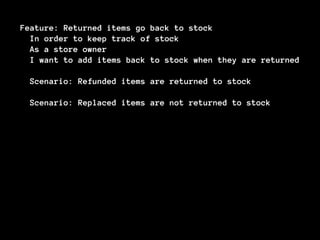
Feature: Returned items go back to stock
In order to keep track of stock
As a store owner
I want to add items back to stock when they are returned
Scenario: Refunded items are returned to stock
Scenario: Replaced items are not returned to stock
Feature: Returned items go back to stock
In order to keep track of stock
As a store owner
I want to add items back to stock when they are returned
Scenario: Refunded items are returned to stock
Scenario: Replaced items are not returned to stock
@legacy
Scenario: Item refunded with in-shop credits
@legacy
Scenario: Item refunded to bank account
@legacy
Scenario: Item refunded to PayPal account
5.3: Protect the current behaviour
1. Cover @legacy behaviour in an end-to-end
fashion
2. Make sure that scenarios are green
3. Refactor code to make isolated system-
testing possible
4. Convert scenarios to isolated system-
tests
5. Remove @legacy tag
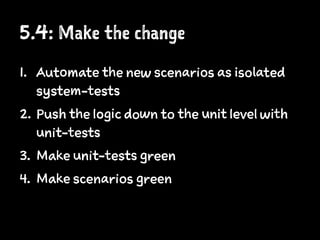
5.4: Make the change
1. Automate the new scenarios as isolated
system-tests
2. Push the logic down to the unit level with
unit-tests
3. Make unit-tests green
4. Make scenarios green
Step 6
Separate commodity logic from
domain logic
Separate commodity logic from
domain logic
4 Not every sub-system needs to change
4 Different sub-systems will change at
different cadence
4 The more aligned our changes are to our
objectives, the smaller they would be
Rewrites are rarely
effective, because
businesses rarely
want to change the
entire system
A full-system rewrite
is an admission of
defeat
We're not stuck with
unsustainable
codebase
We're stuck with
unsustainable
approach to it
If we stop running
from legacy as if it
was a plague...
... and start looking
at it as a normal
phase in a system life
Everything that is
possible in greenfield
becomes possible in
legacy
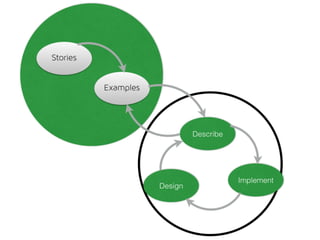
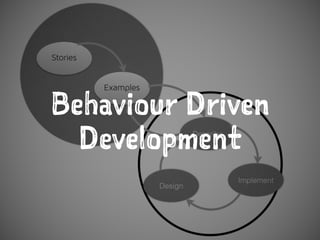
Behaviour Driven
Development
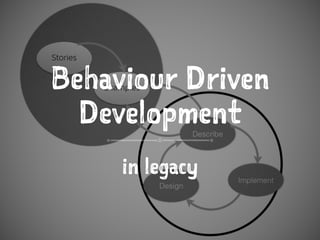
Behaviour Driven
Development
in legacy
Being effective
with legacy projects
Delivering outcomes,
not software
4 Rate talk: https://joind.in/talk/6b377
4 Join us: http://bit.ly/inviqa-careers
4 Get help: http://bit.ly/inviqa-contact

Being effective with legacy projects