I
f you’re a photographer with an intense
interest in contemporary music, perhaps
you’ve toyed with the idea of making a living
shooting the music scene. But it takes more
thanenthusiasmandphotographychopstobreak
into and make a living in this highly competitive
niche. Both are important, but a keen business
acumen and an ability to differentiate yourself
from others aspiring to shoot from the footlights
are vital to getting—and staying—in the game.
Breaking In
ErikaGoldring’sfirstpublishedimage—shotonspec—cameoutinRelix,
a national music publication,in the fall of 2001.The New Orleans–based
ASMP student affiliate—whose shot of R.E.M. front man Michael Stipe
graced the cover of the ASMP Bulletin’s Winter 2005 issue—has been
pitchingstorieseversinceandnowgetsregularassignmentsfromRelixto
cover the NoLa music scene,as well as music festivals such asAustin City
Limits and Farm Aid Chicago. Goldring, a former marketing
professional, decided soon after her first several photography classes at
theNewOrleansAcademyof Artsthatshewantedtofocusonmusic.Her
path was similar to many photographers drawn to the field—they were
either immersed in their local music scene, were musicians themselves,
knew musicians,or they worked in the music industry.
C.Taylor Crothers credits the demand for his skills as a music shooter
to good timing. In the early Nineties, he was based inVirginia, shooting
unknown but regionally popular bands, including the Dave Matthews
Band and Phish, both of which grew to become major rock acts. A
portfolio filled with live shots of these bands gave Crothers an edge with
magazineandrecordcompanyartdirectorswhenhemovedtoNewYork
City in the mid-Nineties. Crothers still does projects for the Dave
MatthewsBand,andheworkedwithPhishuntiltheydisbandedin2004.
“That type of a relationship was the exception rather than the rule,”
saysCrothers.“Iwasbadatgettingeditorialwork,butgreatatdeveloping
a relationship with bands.”
Developing such long–lasting photographer–musician relationships
is indeed a rarity in the music business. If the musician’s label is footing
the marketing bill, the label’s art director usually makes the final call.
Austin, Texas–based editorial and advertising photographer Michael
O’Brien began shooting musicians in his hometown of Memphis,
A S M P B U L L E T I N 2 0
BEHIND THE
SHOOTERS SHARE TIPS ON GETTING IN AND
STAYING ON TOP IN THE MUSIC NICHE
MUSIC
©ErikaGoldring
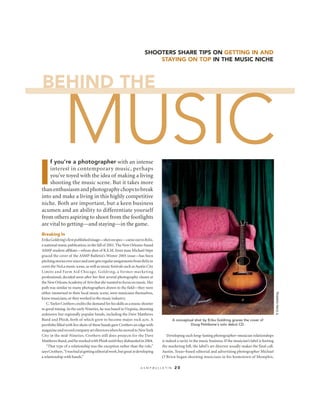
A conceptual shot by Erika Goldring graces the cover of
Doug Pettibone's solo debut CD.
REV_ASMP_FeatureR2 2/6/06 4:44 PM Page 2
BY AMY BLANKSTEIN
Tennessee, in the late Sixties, but the majority of his assignments have
not come from the musicians themselves. O’Brien says musicians don’t
often stick with one photographer for creative reasons.“They wouldn’t
use the same producer on every album—musicians are always trying to
do something different.”
MAKE YOUR MARK
As you would with any type of client, find ways to make yourself
indispensable.“Make [your subjects] wonder what they did before you
came along”says Crothers,who’s logged more than 10 years working in
this niche.“I try to establish a relationship, give them something they
need, and hopefully impress on them that it’s important to keep the
relationship going.”
One way to do so is by anticipating your
clients’ future needs.“I shoot pictures [my
subjects]don’taskmetodo,butmayneedin
the future,” he says. “A band always needs
pictures of the crowd going crazy, so you
know if you have that shot,[they’ll] use it.”
BootsyHollerstartedcoveringtheSeattle
music scene in the late Nineties. Clients
come to this former film production stylist
when they’re looking for more than just a
photo.“Theycometomebecausetheydon’t
have a look or style.I try to help build a look
out of an identity. I’m pre-coaching bands
to get them to start thinking about what
they’re putting out there:their clothes,their
look as a group.”
Evenif abandbarelyhasabudget,Holler
makesitapointtogotheextramile.“Inever
do a job half-ass,even if I’m not being paid well,”says Holler.“You never
know what can happen, if people like you and the work is good, your
name gets around.I get jobs and people have never seen my book.”
REMEMBER YOU’RE A PRO
Perhaps it was the fact that Canadian–born, New York–based shooter
Patrick Harbron was a seasoned music journalist before he made the
move to photography, but from his first assignment in the late
Seventies on, he treated his work with musicians as a business—a
rarity at that time. He recalls photographers working for free or
handing over copyrights for the opportunity to attend a show, or, in
the case of one competitor who landed a shoot with David Bowie, for
free albums. “That was that business [back then]. People would
[shoot] for nothing,” says Harbron. “No one would go to Merrill
Lynch and offer to do work for free.”
Beforeheacceptedjobs—whethertheywereeditorial,fromthelabel,
at live shows or in a studio—he would insist on keeping his copyright.
He would also create a budget, narrowly define the usage rights and
ultimately send a detailed invoice.“Photographers are business people,
but they don’t know it,”says Harbron.“ They think,‘I got a job,wow I’m
lucky.’It’s not luck.”
“They’re using you because you did the right thing, marketed
yourself, got yourself there,” adds Harbron. “They’re not doing you a
favor.Just because you enjoy what you’re doing,it doesn’t mean it’s not
business. They called because they want you—if [your work is] good
enough to use, then it’s good enough to pay for.” Then living and
working in Canada, Harbron was shooting the likes of Grace Jones,
Julian Lennon and Chick Corea—all international stars at the time.
Although Harbron admits his firm stance turned some people off,“It
put me in good stead for the future.”
A S M P B U L L E T I N 2 1
©MichaelO’Brien©BootsyHoller
Above: Bootsy
Holler used a Nikon
D70 with a 16mm
f2.8 D AF fisheye to
shoot Pearl Jam in
a cramped Seattle
music store, using
only ambient light.
ZZ Top shows Michael O'Brien their biggest talent—
beard trimming—in an editorial shoot for Texas Monthly.
REV_ASMP_FeatureR2 2/6/06 4:46 PM Page 3
Retaining your copyright is important, but it’s also vital to carefully
define usage rights. There is an aftermarket for your images. Media
evolves—think about how many CDs you’ve purchased to replace your
favorite records; many groups are releasing DVDs of live shows. Record
companies re-release music, including remastered classics or box sets.
Theseallrequirepackaging,andit’sagoodbetthatimageswillbereused.
As new technologies are created—Web sites, cell phones, pod casts, you
name it—there are more opportunities to license your work.
Getting an appropriate fee and negotiating copyright and usage is
never easy, and each circumstance is different. Musicians who are just
starting out rarely have enough of a budget to even cover your services.
And an established artist’s representatives will try to push for as much
control over your images as possible. If you’re faced with the choice of
ceding too much control or losing the opportunity to shoot their client,
it’s a tough decision, especially for photographers who are still working
to establish their name and develop relationships in the business.
Askyourself whatyou’regettinginreturn.If youdoashootforlittleor
nothing, will it afford an opportunity to explore a new creative avenue,
give your portfolio a boost or enable you to work with an influential art
director? If you’re handing over too many usage rights or accepting a
work-for-hire contract,have you just given away a lucrative future?
NEGOTIATING RIGHTS
Ittakesskilltomaintainimportantrelationshipsandnegotiatefairterms.
Evenbandsthat“knewyouwhen”willaskyoutorubberstampacontract.
“If the band is worth their salt and has decent management, you’ll see it:
work-for-hire,merchandising rights,exclusivity,”says Crothers.
“Content is in the forefront of record companies’ interests,” agrees
Scott Mc Kiernan, veteran photojournalist and founder of Zuma Press
photo agency and wire service.“They want to control it.”
The key to getting through each contract negotiation with industry
relationships intact is to remember this is just business. The job of a
musician’s management team is to make deals that are the most
advantageous for their client.“[Music industry people] are not educated
on rights,” adds Mc Kiernan,“so you have to educate them. Understand
what they want and figure out how it can work for you and them.”
If they won’t budge on owning all rights to an image, don’t get angry.
If youagreetoawork-for-hire,makesureyourfeeiscommensurate.And
if you can’t come to a consensus,you can always walk away.
Perhaps best known for her legendary work as a rock and celebrity
portrait photographer, Lynn Goldsmith has proven her expertise in a
variety of roles, as a director, band manager and even as a musician. In
1976, she founded the LGI Photo Agency, prompted by her experience
of trying to recover original images from a client,as well as the desire to
refer other talented photographers. The agency grew to include 10
agents representing more than 200 photographers.
Goldsmith says that she has limited time—and patience—for
negotiatingwithclientsoverterms.Heradvice?If youcan’tnegotiatefor
yourself,then get someone else—if not a rep,then a relative or colleague
you trust—to do it for you.
Covering the music industry is a challenging and competitive job.
In order to sustain success, you need to understand your bottom line,
your worth as a photographer and your rights. Once you’ve got those
basics down, you need to prepare to make your clients understand
these things as well—and have both the patience and the stamina to
stay the course.
For more information on contracts and copyright, go to <www.asmp.org
/commerce/legal/copyright/>.
A S M P B U L L E T I N 2 2
Want an editorial assignment? Do research at a chain bookstore or newsstand. Check out the
music magazines and identify the ones that best match either your musical interests or shooting
style. While you’re at it, flip through the music coverage in general interest magazines, local
newspapers and alternative weeklies as well.
Once you’ve identified the publications you want to target, send your promo materials to the
art director, but don’t forget to also contact editors, photo researchers or even the research
assistants—they’re easier to get to and they’re likely to be making recommendations to their
bosses. Be strategic, but also be realistic about the people you contact—if photographs in a
magazine are shot by the writer or editor, this probably means there is little opportunity for
freelance work.
Looking to land an album cover? While knowing a musician or manager doesn’t hurt, if you’re
interested in shooting album covers or advertising materials, your best bet is to get your portfolio
in front of the record company art director.
Know your market. If your portfolio is full of punk bands, it’s less likely a country music magazine will
tapyouforanassignment. Peopleinthemusicindustrywillpigeonholeyou,soifyoubecomeknown
for your live shots, but also want to do portrait work, you’ll have to work extra hard to promote those
skills. Above all, getting a gig is about what they need, not what you want.
Follow up. Don’tassumeanartdirectororeditorwillhavetimetogetbacktoyouaboutyourpromo
card. You have to follow up to make it happen. Be persistent—but don’t become a nuisance.
WHERE TO START?
BEHIND THE
MUSIC
©C.TaylorCrothers
Taylor Crothers kept shooting while My Morning Jacket played through
a storm at the 2004 Bonnaroo Music Festival in Manchester, Tennessee.
REV_ASMP_FeatureR2 2/6/06 4:49 PM Page 4

BehindTheMusic

  • 1.
    I f you’re aphotographer with an intense interest in contemporary music, perhaps you’ve toyed with the idea of making a living shooting the music scene. But it takes more thanenthusiasmandphotographychopstobreak into and make a living in this highly competitive niche. Both are important, but a keen business acumen and an ability to differentiate yourself from others aspiring to shoot from the footlights are vital to getting—and staying—in the game. Breaking In ErikaGoldring’sfirstpublishedimage—shotonspec—cameoutinRelix, a national music publication,in the fall of 2001.The New Orleans–based ASMP student affiliate—whose shot of R.E.M. front man Michael Stipe graced the cover of the ASMP Bulletin’s Winter 2005 issue—has been pitchingstorieseversinceandnowgetsregularassignmentsfromRelixto cover the NoLa music scene,as well as music festivals such asAustin City Limits and Farm Aid Chicago. Goldring, a former marketing professional, decided soon after her first several photography classes at theNewOrleansAcademyof Artsthatshewantedtofocusonmusic.Her path was similar to many photographers drawn to the field—they were either immersed in their local music scene, were musicians themselves, knew musicians,or they worked in the music industry. C.Taylor Crothers credits the demand for his skills as a music shooter to good timing. In the early Nineties, he was based inVirginia, shooting unknown but regionally popular bands, including the Dave Matthews Band and Phish, both of which grew to become major rock acts. A portfolio filled with live shots of these bands gave Crothers an edge with magazineandrecordcompanyartdirectorswhenhemovedtoNewYork City in the mid-Nineties. Crothers still does projects for the Dave MatthewsBand,andheworkedwithPhishuntiltheydisbandedin2004. “That type of a relationship was the exception rather than the rule,” saysCrothers.“Iwasbadatgettingeditorialwork,butgreatatdeveloping a relationship with bands.” Developing such long–lasting photographer–musician relationships is indeed a rarity in the music business. If the musician’s label is footing the marketing bill, the label’s art director usually makes the final call. Austin, Texas–based editorial and advertising photographer Michael O’Brien began shooting musicians in his hometown of Memphis, A S M P B U L L E T I N 2 0 BEHIND THE SHOOTERS SHARE TIPS ON GETTING IN AND STAYING ON TOP IN THE MUSIC NICHE MUSIC ©ErikaGoldring A conceptual shot by Erika Goldring graces the cover of Doug Pettibone's solo debut CD. REV_ASMP_FeatureR2 2/6/06 4:44 PM Page 2
  • 2.
    BY AMY BLANKSTEIN Tennessee,in the late Sixties, but the majority of his assignments have not come from the musicians themselves. O’Brien says musicians don’t often stick with one photographer for creative reasons.“They wouldn’t use the same producer on every album—musicians are always trying to do something different.” MAKE YOUR MARK As you would with any type of client, find ways to make yourself indispensable.“Make [your subjects] wonder what they did before you came along”says Crothers,who’s logged more than 10 years working in this niche.“I try to establish a relationship, give them something they need, and hopefully impress on them that it’s important to keep the relationship going.” One way to do so is by anticipating your clients’ future needs.“I shoot pictures [my subjects]don’taskmetodo,butmayneedin the future,” he says. “A band always needs pictures of the crowd going crazy, so you know if you have that shot,[they’ll] use it.” BootsyHollerstartedcoveringtheSeattle music scene in the late Nineties. Clients come to this former film production stylist when they’re looking for more than just a photo.“Theycometomebecausetheydon’t have a look or style.I try to help build a look out of an identity. I’m pre-coaching bands to get them to start thinking about what they’re putting out there:their clothes,their look as a group.” Evenif abandbarelyhasabudget,Holler makesitapointtogotheextramile.“Inever do a job half-ass,even if I’m not being paid well,”says Holler.“You never know what can happen, if people like you and the work is good, your name gets around.I get jobs and people have never seen my book.” REMEMBER YOU’RE A PRO Perhaps it was the fact that Canadian–born, New York–based shooter Patrick Harbron was a seasoned music journalist before he made the move to photography, but from his first assignment in the late Seventies on, he treated his work with musicians as a business—a rarity at that time. He recalls photographers working for free or handing over copyrights for the opportunity to attend a show, or, in the case of one competitor who landed a shoot with David Bowie, for free albums. “That was that business [back then]. People would [shoot] for nothing,” says Harbron. “No one would go to Merrill Lynch and offer to do work for free.” Beforeheacceptedjobs—whethertheywereeditorial,fromthelabel, at live shows or in a studio—he would insist on keeping his copyright. He would also create a budget, narrowly define the usage rights and ultimately send a detailed invoice.“Photographers are business people, but they don’t know it,”says Harbron.“ They think,‘I got a job,wow I’m lucky.’It’s not luck.” “They’re using you because you did the right thing, marketed yourself, got yourself there,” adds Harbron. “They’re not doing you a favor.Just because you enjoy what you’re doing,it doesn’t mean it’s not business. They called because they want you—if [your work is] good enough to use, then it’s good enough to pay for.” Then living and working in Canada, Harbron was shooting the likes of Grace Jones, Julian Lennon and Chick Corea—all international stars at the time. Although Harbron admits his firm stance turned some people off,“It put me in good stead for the future.” A S M P B U L L E T I N 2 1 ©MichaelO’Brien©BootsyHoller Above: Bootsy Holler used a Nikon D70 with a 16mm f2.8 D AF fisheye to shoot Pearl Jam in a cramped Seattle music store, using only ambient light. ZZ Top shows Michael O'Brien their biggest talent— beard trimming—in an editorial shoot for Texas Monthly. REV_ASMP_FeatureR2 2/6/06 4:46 PM Page 3
  • 3.
    Retaining your copyrightis important, but it’s also vital to carefully define usage rights. There is an aftermarket for your images. Media evolves—think about how many CDs you’ve purchased to replace your favorite records; many groups are releasing DVDs of live shows. Record companies re-release music, including remastered classics or box sets. Theseallrequirepackaging,andit’sagoodbetthatimageswillbereused. As new technologies are created—Web sites, cell phones, pod casts, you name it—there are more opportunities to license your work. Getting an appropriate fee and negotiating copyright and usage is never easy, and each circumstance is different. Musicians who are just starting out rarely have enough of a budget to even cover your services. And an established artist’s representatives will try to push for as much control over your images as possible. If you’re faced with the choice of ceding too much control or losing the opportunity to shoot their client, it’s a tough decision, especially for photographers who are still working to establish their name and develop relationships in the business. Askyourself whatyou’regettinginreturn.If youdoashootforlittleor nothing, will it afford an opportunity to explore a new creative avenue, give your portfolio a boost or enable you to work with an influential art director? If you’re handing over too many usage rights or accepting a work-for-hire contract,have you just given away a lucrative future? NEGOTIATING RIGHTS Ittakesskilltomaintainimportantrelationshipsandnegotiatefairterms. Evenbandsthat“knewyouwhen”willaskyoutorubberstampacontract. “If the band is worth their salt and has decent management, you’ll see it: work-for-hire,merchandising rights,exclusivity,”says Crothers. “Content is in the forefront of record companies’ interests,” agrees Scott Mc Kiernan, veteran photojournalist and founder of Zuma Press photo agency and wire service.“They want to control it.” The key to getting through each contract negotiation with industry relationships intact is to remember this is just business. The job of a musician’s management team is to make deals that are the most advantageous for their client.“[Music industry people] are not educated on rights,” adds Mc Kiernan,“so you have to educate them. Understand what they want and figure out how it can work for you and them.” If they won’t budge on owning all rights to an image, don’t get angry. If youagreetoawork-for-hire,makesureyourfeeiscommensurate.And if you can’t come to a consensus,you can always walk away. Perhaps best known for her legendary work as a rock and celebrity portrait photographer, Lynn Goldsmith has proven her expertise in a variety of roles, as a director, band manager and even as a musician. In 1976, she founded the LGI Photo Agency, prompted by her experience of trying to recover original images from a client,as well as the desire to refer other talented photographers. The agency grew to include 10 agents representing more than 200 photographers. Goldsmith says that she has limited time—and patience—for negotiatingwithclientsoverterms.Heradvice?If youcan’tnegotiatefor yourself,then get someone else—if not a rep,then a relative or colleague you trust—to do it for you. Covering the music industry is a challenging and competitive job. In order to sustain success, you need to understand your bottom line, your worth as a photographer and your rights. Once you’ve got those basics down, you need to prepare to make your clients understand these things as well—and have both the patience and the stamina to stay the course. For more information on contracts and copyright, go to <www.asmp.org /commerce/legal/copyright/>. A S M P B U L L E T I N 2 2 Want an editorial assignment? Do research at a chain bookstore or newsstand. Check out the music magazines and identify the ones that best match either your musical interests or shooting style. While you’re at it, flip through the music coverage in general interest magazines, local newspapers and alternative weeklies as well. Once you’ve identified the publications you want to target, send your promo materials to the art director, but don’t forget to also contact editors, photo researchers or even the research assistants—they’re easier to get to and they’re likely to be making recommendations to their bosses. Be strategic, but also be realistic about the people you contact—if photographs in a magazine are shot by the writer or editor, this probably means there is little opportunity for freelance work. Looking to land an album cover? While knowing a musician or manager doesn’t hurt, if you’re interested in shooting album covers or advertising materials, your best bet is to get your portfolio in front of the record company art director. Know your market. If your portfolio is full of punk bands, it’s less likely a country music magazine will tapyouforanassignment. Peopleinthemusicindustrywillpigeonholeyou,soifyoubecomeknown for your live shots, but also want to do portrait work, you’ll have to work extra hard to promote those skills. Above all, getting a gig is about what they need, not what you want. Follow up. Don’tassumeanartdirectororeditorwillhavetimetogetbacktoyouaboutyourpromo card. You have to follow up to make it happen. Be persistent—but don’t become a nuisance. WHERE TO START? BEHIND THE MUSIC ©C.TaylorCrothers Taylor Crothers kept shooting while My Morning Jacket played through a storm at the 2004 Bonnaroo Music Festival in Manchester, Tennessee. REV_ASMP_FeatureR2 2/6/06 4:49 PM Page 4