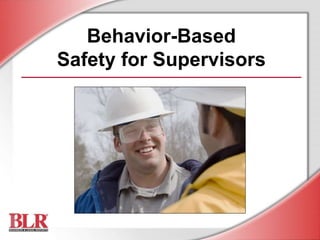
Behavior-Based
Safety for Supervisors
© Business & Legal Reports, Inc. 0706
Session Objectives
You will be able to:
• Understand how safety behavior is shaped
• Analyze employee behavior
• Pinpoint, observe, and measure specific
behaviors
• Provide effective feedback
• Use positive reinforcement successfully
to improve safety performance
© Business & Legal Reports, Inc. 0706
What You Need to Know
• ABC analysis
• Types of consequences
• How to strengthen consequences
• Pinpointing, observation, and measurement
• Feedback and goal setting
• Types of positive reinforcement
• Reinforcement mistakes
© Business & Legal Reports, Inc. 0706
Why Employees Engage
In At-Risk Behaviors
• Jobs get done faster
• Perception of risk is low
• ‘Nothing’s going to happen to me’ attitude
• At-risk behavior is reinforced
• Lack of awareness that behavior is risky
© Business & Legal Reports, Inc. 0706
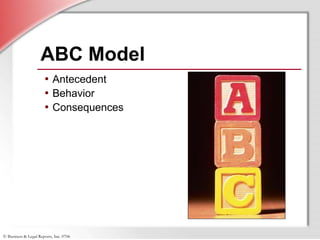
ABC Model
• Antecedent
• Behavior
• Consequences
© Business & Legal Reports, Inc. 0706
Antecedents
• Prompt people to act
• Precede the behavior
• Communicate
information
• Work best with
consequences
• Work only in short term
if no consequences
© Business & Legal Reports, Inc. 0706
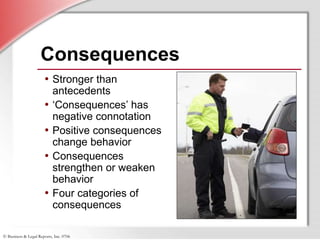
Consequences
• Stronger than
antecedents
• ‘Consequences’ has
negative connotation
• Positive consequences
change behavior
• Consequences
strengthen or weaken
behavior
• Four categories of
consequences
© Business & Legal Reports, Inc. 0706
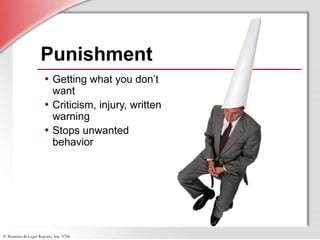
Punishment
• Getting what you don’t
want
• Criticism, injury, written
warning
• Stops unwanted
behavior
© Business & Legal Reports, Inc. 0706
Extinction
• Is not getting what you want
• Is no recognition, no acknowledgement
• Often decreases wanted or safe behavior
• Can cause safe performers to slip
© Business & Legal Reports, Inc. 0706
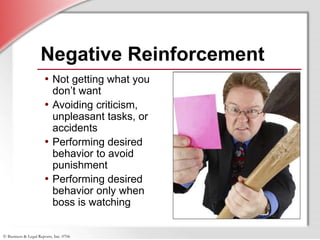
Negative Reinforcement
• Not getting what you
don’t want
• Avoiding criticism,
unpleasant tasks, or
accidents
• Performing desired
behavior to avoid
punishment
• Performing desired
behavior only when
boss is watching
© Business & Legal Reports, Inc. 0706
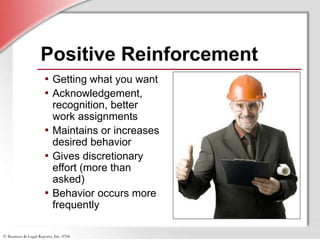
Positive Reinforcement
• Getting what you want
• Acknowledgement,
recognition, better
work assignments
• Maintains or increases
desired behavior
• Gives discretionary
effort (more than
asked)
• Behavior occurs more
frequently
© Business & Legal Reports, Inc. 0706
Examine the Behavior
• Results of the
consequences
• How employee
receives it
• Behavior increasing
• Behavior decreasing
© Business & Legal Reports, Inc. 0706
Strength of Consequences
• Type—positive or
negative
• When—immediate or
future
• Probability—certain or
uncertain
© Business & Legal Reports, Inc. 0706
Powerful Consequences
• Most powerful—both immediate and certain
• Moderately powerful—either immediate or
certain
• Least powerful—both future and uncertain
© Business & Legal Reports, Inc. 0706
ABC Analysis
• Describe the behavior
• List all antecedents and consequences
and describe strength of consequence
• Determine which consequences are
motivating behavior
• Solution to problem behavior—make weak
consequences strong
© Business & Legal Reports, Inc. 0706
Behavioral Safety Basics
• Do you understand the
information presented
in the previous slides?
© Business & Legal Reports, Inc. 0706
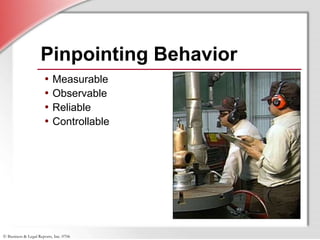
Pinpointing Behavior
• Measurable
• Observable
• Reliable
• Controllable
© Business & Legal Reports, Inc. 0706
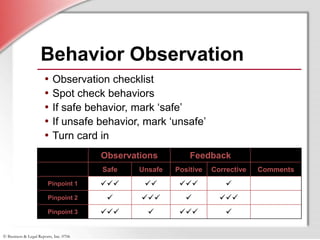
Behavior Observation
• Observation checklist
• Spot check behaviors
• If safe behavior, mark ‘safe’
• If unsafe behavior, mark ‘unsafe’
• Turn card in
Observations Feedback
Safe Unsafe Positive Corrective Comments
Pinpoint 1    
Pinpoint 2    
Pinpoint 3    
© Business & Legal Reports, Inc. 0706
Measurement
• Records observations and analyzes
• Uses objective measurement
• Measures safety process, not just results
• Gives feedback to employees and captures
small improvements
• Is specific about performance and becomes
positive reinforcement
© Business & Legal Reports, Inc. 0706
Positive Verbal Feedback
• Be specific
• Be sincere
© Business & Legal Reports, Inc. 0706
Positive Verbal Feedback
(cont.)
• Deliver immediately
• Be personal
• Don’t use ‘but’ or
‘however’
© Business & Legal Reports, Inc. 0706
Corrective
Verbal Feedback
• Don’t ignore unsafe
behavior
• Acknowledge small
improvements
• Be objective
• Be specific
• Use a questioning
approach
• Use a 4:1 ratio
© Business & Legal Reports, Inc. 0706
Graphic Feedback
• Past performance
or baseline
• Current goals
• Presented and
discussed frequently
© Business & Legal Reports, Inc. 0706
Goal Setting
• Short-term and
achievable
• Employee input
• More opportunities for
positive reinforcement
© Business & Legal Reports, Inc. 0706
Types of Positive
Reinforcement
Social reinforcement:
• Written
• Verbal
• Physical
• Smile
• Humor
• Time or attention
© Business & Legal Reports, Inc. 0706
Types of Positive
Reinforcement (cont.)
Tangible reinforcement:
• Food
• Money
• Gifts
• Certificates
• Privileges
© Business & Legal Reports, Inc. 0706
Using Tangibles
• Anchor the memory
• Be spontaneous
• Discuss behavior
• Different tangibles
• Avoid high-value tangibles
• Do not overuse tangibles
© Business & Legal Reports, Inc. 0706
Reinforcement
• Do you understand the
information presented
in the previous slides?
© Business & Legal Reports, Inc. 0706
Reinforcement Mistakes
• Too much positive reinforcement
• Expecting behavior to change too soon
• Reinforcement before behavior
• Giving unearned positive reinforcement
© Business & Legal Reports, Inc. 0706
Key Points to Remember
• Learn how to use consequences effectively
• Analyze safety behavior with the ABC model
• Pinpoint behaviors and make observations
• Study collected data to measure results
objectively
• Give positive feedback for safe performance
and corrective feedback for unsafe behavior

Behavior Based Safety.ppt

  • 1.
  • 2.
    © Business &Legal Reports, Inc. 0706 Session Objectives You will be able to: • Understand how safety behavior is shaped • Analyze employee behavior • Pinpoint, observe, and measure specific behaviors • Provide effective feedback • Use positive reinforcement successfully to improve safety performance
  • 3.
    © Business &Legal Reports, Inc. 0706 What You Need to Know • ABC analysis • Types of consequences • How to strengthen consequences • Pinpointing, observation, and measurement • Feedback and goal setting • Types of positive reinforcement • Reinforcement mistakes
  • 4.
    © Business &Legal Reports, Inc. 0706 Why Employees Engage In At-Risk Behaviors • Jobs get done faster • Perception of risk is low • ‘Nothing’s going to happen to me’ attitude • At-risk behavior is reinforced • Lack of awareness that behavior is risky
  • 5.
    © Business &Legal Reports, Inc. 0706 ABC Model • Antecedent • Behavior • Consequences
  • 6.
    © Business &Legal Reports, Inc. 0706 Antecedents • Prompt people to act • Precede the behavior • Communicate information • Work best with consequences • Work only in short term if no consequences
  • 7.
    © Business &Legal Reports, Inc. 0706 Consequences • Stronger than antecedents • ‘Consequences’ has negative connotation • Positive consequences change behavior • Consequences strengthen or weaken behavior • Four categories of consequences
  • 8.
    © Business &Legal Reports, Inc. 0706 Punishment • Getting what you don’t want • Criticism, injury, written warning • Stops unwanted behavior
  • 9.
    © Business &Legal Reports, Inc. 0706 Extinction • Is not getting what you want • Is no recognition, no acknowledgement • Often decreases wanted or safe behavior • Can cause safe performers to slip
  • 10.
    © Business &Legal Reports, Inc. 0706 Negative Reinforcement • Not getting what you don’t want • Avoiding criticism, unpleasant tasks, or accidents • Performing desired behavior to avoid punishment • Performing desired behavior only when boss is watching
  • 11.
    © Business &Legal Reports, Inc. 0706 Positive Reinforcement • Getting what you want • Acknowledgement, recognition, better work assignments • Maintains or increases desired behavior • Gives discretionary effort (more than asked) • Behavior occurs more frequently
  • 12.
    © Business &Legal Reports, Inc. 0706 Examine the Behavior • Results of the consequences • How employee receives it • Behavior increasing • Behavior decreasing
  • 13.
    © Business &Legal Reports, Inc. 0706 Strength of Consequences • Type—positive or negative • When—immediate or future • Probability—certain or uncertain
  • 14.
    © Business &Legal Reports, Inc. 0706 Powerful Consequences • Most powerful—both immediate and certain • Moderately powerful—either immediate or certain • Least powerful—both future and uncertain
  • 15.
    © Business &Legal Reports, Inc. 0706 ABC Analysis • Describe the behavior • List all antecedents and consequences and describe strength of consequence • Determine which consequences are motivating behavior • Solution to problem behavior—make weak consequences strong
  • 16.
    © Business &Legal Reports, Inc. 0706 Behavioral Safety Basics • Do you understand the information presented in the previous slides?
  • 17.
    © Business &Legal Reports, Inc. 0706 Pinpointing Behavior • Measurable • Observable • Reliable • Controllable
  • 18.
    © Business &Legal Reports, Inc. 0706 Behavior Observation • Observation checklist • Spot check behaviors • If safe behavior, mark ‘safe’ • If unsafe behavior, mark ‘unsafe’ • Turn card in Observations Feedback Safe Unsafe Positive Corrective Comments Pinpoint 1     Pinpoint 2     Pinpoint 3    
  • 19.
    © Business &Legal Reports, Inc. 0706 Measurement • Records observations and analyzes • Uses objective measurement • Measures safety process, not just results • Gives feedback to employees and captures small improvements • Is specific about performance and becomes positive reinforcement
  • 20.
    © Business &Legal Reports, Inc. 0706 Positive Verbal Feedback • Be specific • Be sincere
  • 21.
    © Business &Legal Reports, Inc. 0706 Positive Verbal Feedback (cont.) • Deliver immediately • Be personal • Don’t use ‘but’ or ‘however’
  • 22.
    © Business &Legal Reports, Inc. 0706 Corrective Verbal Feedback • Don’t ignore unsafe behavior • Acknowledge small improvements • Be objective • Be specific • Use a questioning approach • Use a 4:1 ratio
  • 23.
    © Business &Legal Reports, Inc. 0706 Graphic Feedback • Past performance or baseline • Current goals • Presented and discussed frequently
  • 24.
    © Business &Legal Reports, Inc. 0706 Goal Setting • Short-term and achievable • Employee input • More opportunities for positive reinforcement
  • 25.
    © Business &Legal Reports, Inc. 0706 Types of Positive Reinforcement Social reinforcement: • Written • Verbal • Physical • Smile • Humor • Time or attention
  • 26.
    © Business &Legal Reports, Inc. 0706 Types of Positive Reinforcement (cont.) Tangible reinforcement: • Food • Money • Gifts • Certificates • Privileges
  • 27.
    © Business &Legal Reports, Inc. 0706 Using Tangibles • Anchor the memory • Be spontaneous • Discuss behavior • Different tangibles • Avoid high-value tangibles • Do not overuse tangibles
  • 28.
    © Business &Legal Reports, Inc. 0706 Reinforcement • Do you understand the information presented in the previous slides?
  • 29.
    © Business &Legal Reports, Inc. 0706 Reinforcement Mistakes • Too much positive reinforcement • Expecting behavior to change too soon • Reinforcement before behavior • Giving unearned positive reinforcement
  • 30.
    © Business &Legal Reports, Inc. 0706 Key Points to Remember • Learn how to use consequences effectively • Analyze safety behavior with the ABC model • Pinpoint behaviors and make observations • Study collected data to measure results objectively • Give positive feedback for safe performance and corrective feedback for unsafe behavior