.NET
User
Group
Bern
Jonas Bandi
http://blog.jonasbandi.net
jb@jonasbandi.net
twitter: @jbandi
DNUG Bern Sponsoren
High quality technical screencasts created by
experts on the latest and most important
technologies. Buy access to a single series or
subscribe for as little as $19 a month.
tekpub.com
ASP.NET MVC
Ayende Rahien
Rob Conery
jQuery
Dave Ward
Ruby on Rails
ASP.NET Ajax
LINQ
nHibernate
About me
TechTalk is a software
development and consulting
company with ~60 people located
in Vienna, Budapest and Zürich.
We focus on Scrum and .NET.
Jonas Bandi
At TechTalk since 2009
Committer to SpecFlow
http://blog.jonasbandi.net
Twitter: @jbandi
The audience?
• Who is practicing agile
Development?
• Who is practicing TDD?
• Wo is doing Acceptance Test Driven
Development or Behavior Driven
Development?
• Wo is using Cucumber, Fitnesse,
Concordion, NBehave or a similar
tool?
• Who knows SpecFlow?
Agenda
• The Communication Gap: A reason why
we are failing
• Agile software development promises
improvement
• BDD as a possible approach to improve
• SpecFlow as tool that supports BDD
• Advanced topics and loose ends
Let´s discuss!
"We're still figuring
this stuff out.
All of us."
- Jay Fields
Thoughts on developer Testing:
http://blog.jayfields.com/2009/02/thoughts-on-developer-testing.html
Once upon a
time...
... in the golden
Age of the
Waterfall.
… and they lived happily ever after!
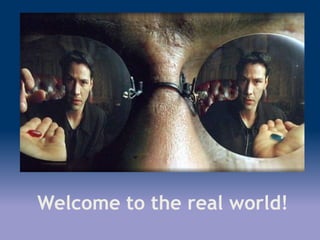
Welcome to the real world!
... the golden age is over!
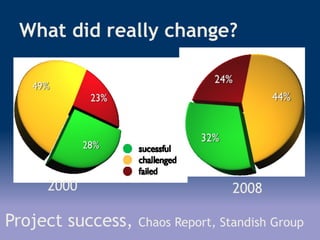
What did really change?
Project success, Chaos Report, Standish Group
2000 2008
What is the problem?
"I believe that the hardest
part of software projects,
the most common source
of project failure, is
communication with the
customers and users of
that software."
- Martin Fowler,
DSL Book
What defines successful software?
Software development is about
delivering business value!
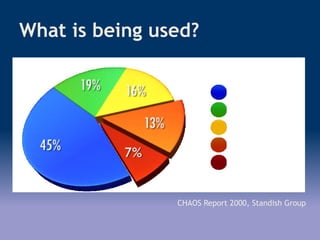
What is being used?
CHAOS Report 2000, Standish Group
Providing Business Value?
• Only 20% of all delivered features are
actually used?
• Something is wrong!
• We can profit tremendously when we
improve in
• requirements gathering
• transporting them successfully to the
implementation
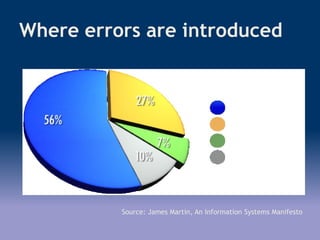
Where errors are introduced
Source: James Martin, An Information Systems Manifesto
Fighting Errors?
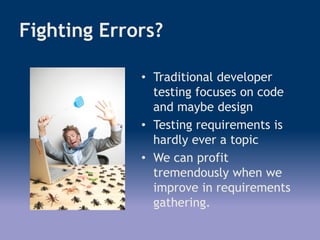
• Traditional developer
testing focuses on code
and maybe design
• Testing requirements is
hardly ever a topic
• We can profit
tremendously when we
improve in requirements
gathering.
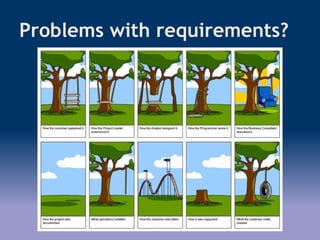
Problems with requirements?
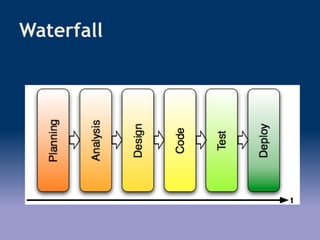
Waterfall
_
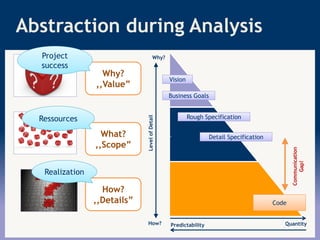
Abstraction during Analysis
Level
of
Detail
Why?
How?
Rough Specification
Rough Specification
Business Goals
Business Goals
Why?
,,Value”
What?
,,Scope”
How?
,,Details”
Project
success
Ressources
Realization
Quantity
Predictability
Code
Vision
Vision
Detail Specification
Communication
Gap!
Abstraction during Analysis
The Traditional Approach
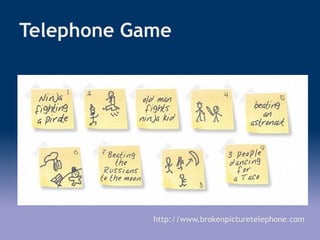
Telephone Game
http://www.brokenpicturetelephone.com
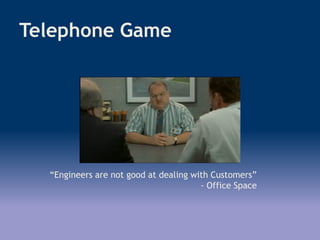
Telephone Game
“Engineers are not good at dealing with Customers”
- Office Space
Agile to the rescue!
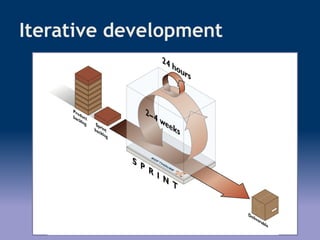
Iterative development
Streaming requirements
• Not all of the
requirements are
delivered upfront
• Requirements are
delivered just in time
• Incrementally reveal
details just-in-time
• Pull instead of push
• Embrace Change
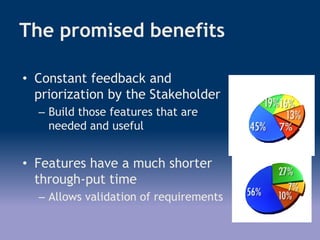
The promised benefits
• Constant feedback and
priorization by the Stakeholder
– Build those features that are
needed and useful
• Features have a much shorter
through-put time
– Allows validation of requirements
Remaining challenges
• How to communicate requirements
effectively?
• How to ensure that requirements are
understood and implemented correctly?
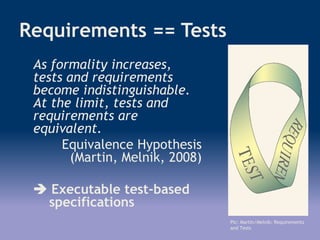
Requirements == Tests
As formality increases,
tests and requirements
become indistinguishable.
At the limit, tests and
requirements are
equivalent.
Equivalence Hypothesis
(Martin, Melnik, 2008)
 Executable test-based
specifications
Pic: Martin/Melnik: Requirements
and Tests
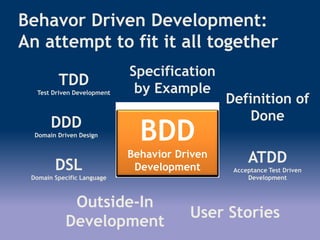
Behavor Driven Development:
An attempt to fit it all together
BDD
Behavior Driven
Development
TDD
Test Driven Development
DDD
Domain Driven Design
ATDD
Acceptance Test Driven
Development
User Stories
Specification
by Example
Definition of
Done
Outside-In
Development
DSL
Domain Specific Language
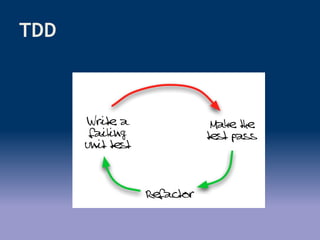
TDD
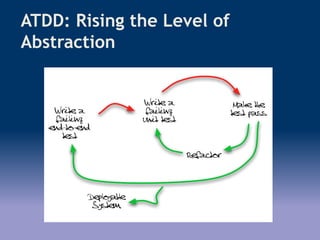
ATDD: Rising the Level of
Abstraction
The real Goal
Pic: http://www.projectcartoon.com/
• Test Driven Development is about
Design
• Acceptance Test Driven
Development is about
Specification and Communication
• Writing acceptance tests early
– is a requirements engineering
technique
– builds a common understanding
– defines clear goals and a
common definition of done
Specification by Example
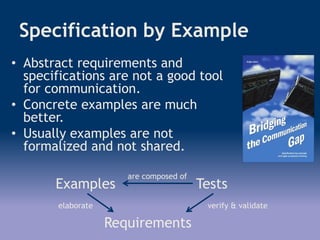
• Abstract requirements and
specifications are not a good tool
for communication.
• Concrete examples are much
better.
• Usually examples are not
formalized and not shared.
Examples Tests
Requirements
are composed of
elaborate verify & validate
_
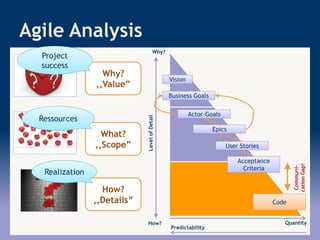
Agile Analysis
Level
of
Detail
Why?
How?
Actor-Goals
Actor-Goals
Epics
Epics
Business Goals
Business Goals
User Stories
User Stories
Acceptance
Acceptance
Criteria
Why?
,,Value”
What?
,,Scope”
How?
,,Details”
Project
success
Ressources
Realization
Quantity
Predictability
Code
Communi-
cation
Gap!
Vision
Vision
_
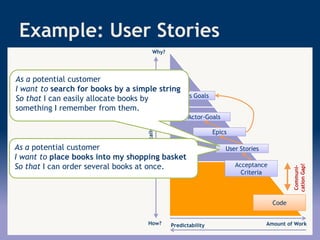
Example: User Stories
Detailgrad
Why?
How?
Actor-Goals
Actor-Goals
Epics
Epics
Business Goals
Business Goals
User Stories
User Stories
Acceptance
Acceptance
Criteria
Amount of Work
Predictability
Code
As a potential customer
I want to search for books by a simple string
So that I can easily allocate books by
something I remember from them.
As a potential customer
I want to place books into my shopping basket
So that I can order several books at once.
Communi-
cation
Gap!
_
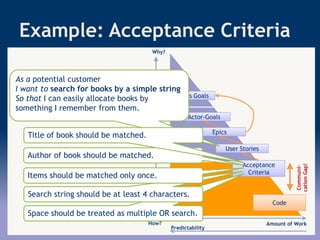
Example: Acceptance Criteria
Detailgrad
Why?
How?
Actor-Goals
Actor-Goals
Epics
Epics
Business Goals
Business Goals
User Stories
User Stories
Acceptance
Acceptance
Criteria
Amount of Work
Predictability
Code
As a potential customer
I want to search for books by a simple string
So that I can easily allocate books by
something I remember from them.
Author of book should be matched.
Space should be treated as multiple OR search.
Search string should be at least 4 characters.
Items should be matched only once.
Title of book should be matched.
Communi-
cation
Gap!
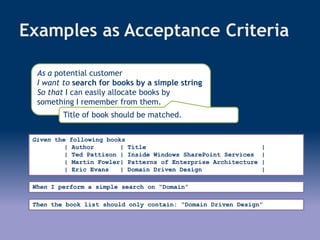
Examples as Acceptance Criteria
As a potential customer
I want to search for books by a simple string
So that I can easily allocate books by
something I remember from them.
Title of book should be matched.
Given the following books
| Author | Title |
| Ted Pattison | Inside Windows SharePoint Services |
| Martin Fowler| Patterns of Enterprise Architecture |
| Eric Evans | Domain Driven Design |
When I perform a simple search on “Domain”
Then the book list should only contain: “Domain Driven Design”
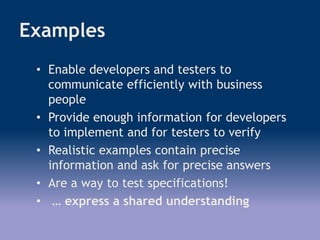
Examples
• Enable developers and testers to
communicate efficiently with business
people
• Provide enough information for developers
to implement and for testers to verify
• Realistic examples contain precise
information and ask for precise answers
• Are a way to test specifications!
• … express a shared understanding
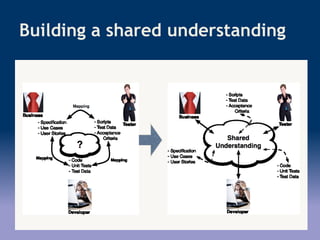
Building a shared understanding
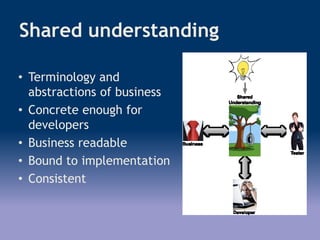
Shared understanding
• Terminology and
abstractions of business
• Concrete enough for
developers
• Business readable
• Bound to implementation
• Consistent
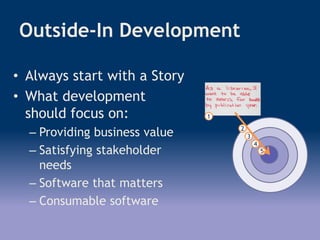
Outside-In Development
• Always start with a Story
• What development
should focus on:
– Providing business value
– Satisfying stakeholder
needs
– Software that matters
– Consumable software
1
2
3
4
5
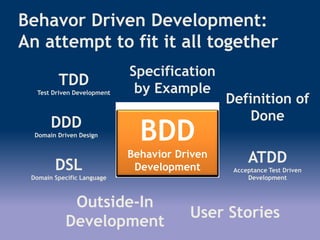
Behavor Driven Development:
An attempt to fit it all together
BDD
Behavior Driven
Development
TDD
Test Driven Development
DDD
Domain Driven Design
ATDD
Acceptance Test Driven
Development
User Stories
Specification
by Example
Definition of
Done
Outside-In
Development
DSL
Domain Specific Language
Remember
BDD is a Mindset not a Tool!
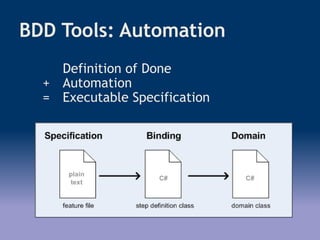
BDD Tools: Automation
Definition of Done
+ Automation
= Executable Specification
SpecFlow
• Open-source BDD tool for .NET
– www.specflow.org
– github.com/techtalk/SpecFlow
• Focus on high level behavior: features /
acceptance tests
• Focus on story-style plain text
specifications
• Using Gherkin as DSL for specifications
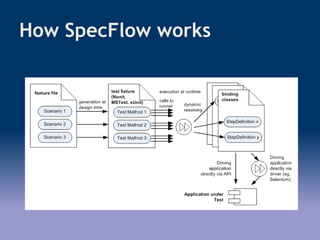
• Uses existing testing frameworks for
execution (Nunit, MSTest, xUnit)
– VisualStudio / Build integration
www.specflow.org
SpecFlow History
• SpecFlow was founded in late 2009 by
TechTalk
• Goals:
– A pragmatic BDD tool for .NET
– Provide a frictionless experience for .NET
environments
– Use existing tools: VisualStudio, UnitTest-
Frameworks
• SpecFlow is used in several projects by
TechTalk
www.specflow.org
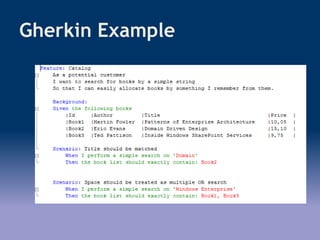
Gherkin
• A language (DSL) for story-style
plain text specifications
– “Given“-“When“-“Then“
• Rooted in the Ruby World:
Cucumber
• Business readable / writeable
• Sufficient formality
– Enable automation
– Executable specification
• http://github.com/aslakhellesoy/gherkin/ www.cukes.info
Gherkin Example
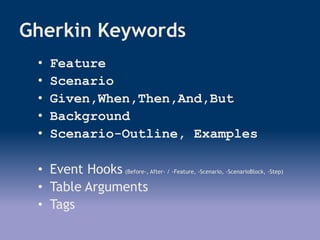
Gherkin Keywords
• Feature
• Scenario
• Given,When,Then,And,But
• Background
• Scenario-Outline, Examples
• Event Hooks (Before-, After- / -Feature, -Scenario, -ScenarioBlock, -Step)
• Table Arguments
• Tags
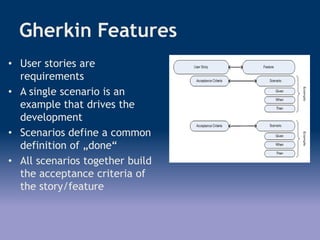
Gherkin Features
• User stories are
requirements
• A single scenario is an
example that drives the
development
• Scenarios define a common
definition of „done“
• All scenarios together build
the acceptance criteria of
the story/feature
How SpecFlow works
Demo
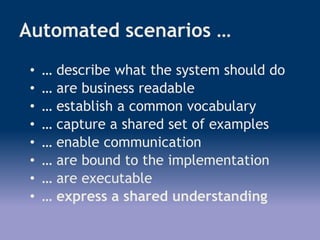
Automated scenarios …
• … describe what the system should do
• … are business readable
• … establish a common vocabulary
• … capture a shared set of examples
• … enable communication
• … are bound to the implementation
• … are executable
• … express a shared understanding
Advanced Topics
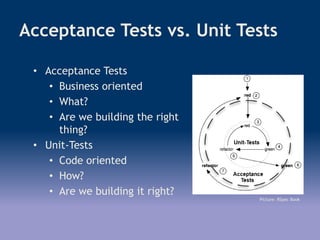
Acceptance Tests vs. Unit Tests
• Acceptance Tests
• Business oriented
• What?
• Are we building the right
thing?
• Unit-Tests
• Code oriented
• How?
• Are we building it right?
Picture: RSpec Book
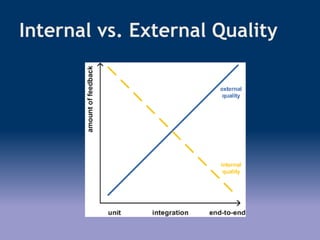
Internal vs. External Quality
Behavior Specifications are
Examples
• Demonstrating each important aspect
of a system
– Standard cases
– Edge cases
– Critical areas
• The main goal is not a full regression
– However the artifacts of automated examples
can be reused for regression testing
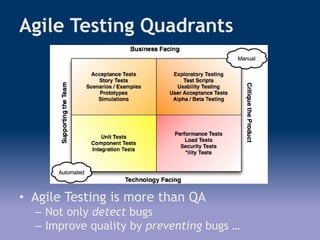
Agile Testing Quadrants
• Agile Testing is more than QA
– Not only detect bugs
– Improve quality by preventing bugs …
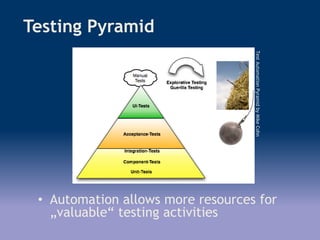
Testing Pyramid
• Automation allows more resources for
„valuable“ testing activities
Test
Automation
Pyramid
by
Mike
Cohn
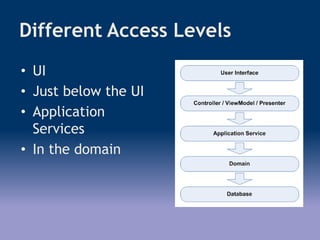
Different Access Levels
• UI
• Just below the UI
• Application
Services
• In the domain
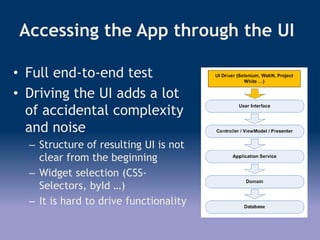
Accessing the App through the UI
• Full end-to-end test
• Driving the UI adds a lot
of accidental complexity
and noise
– Structure of resulting UI is not
clear from the beginning
– Widget selection (CSS-
Selectors, byId …)
– It is hard to drive functionality
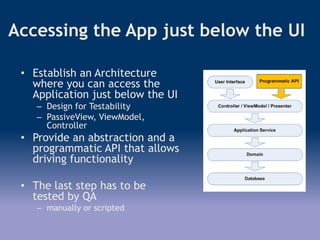
Accessing the App just below the UI
• Establish an Architecture
where you can access the
Application just below the UI
– Design for Testability
– PassiveView, ViewModel,
Controller
• Provide an abstraction and a
programmatic API that allows
driving functionality
• The last step has to be
tested by QA
– manually or scripted
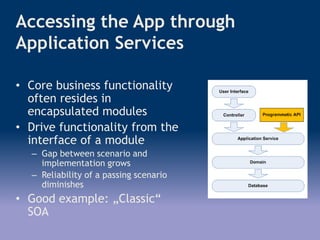
Accessing the App through
Application Services
• Core business functionality
often resides in
encapsulated modules
• Drive functionality from the
interface of a module
– Gap between scenario and
implementation grows
– Reliability of a passing scenario
diminishes
• Good example: „Classic“
SOA
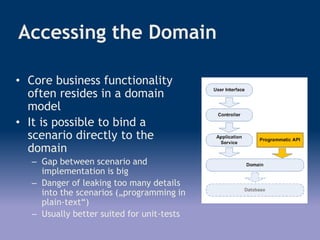
Accessing the Domain
• Core business functionality
often resides in a domain
model
• It is possible to bind a
scenario directly to the
domain
– Gap between scenario and
implementation is big
– Danger of leaking too many details
into the scenarios („programming in
plain-text“)
– Usually better suited for unit-tests
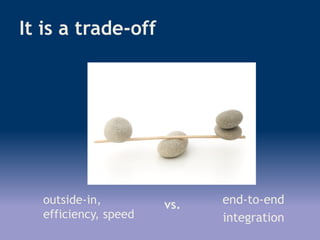
It is a trade-off
outside-in,
efficiency, speed
end-to-end
integration
vs.
Stubbing
• Stubbing helps to isolate the feature
– Better for driving the development
– Worse for testing the application
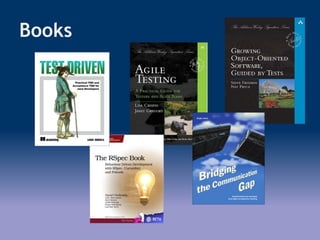
Books
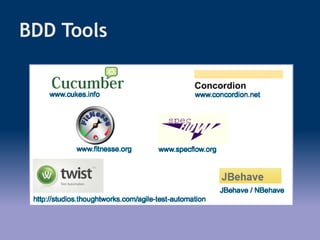
BDD Tools
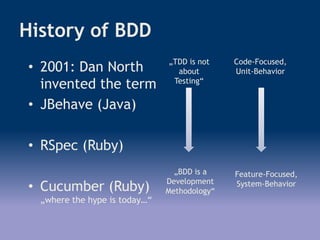
History of BDD
• 2001: Dan North
invented the term
• JBehave (Java)
• RSpec (Ruby)
• Cucumber (Ruby)
„where the hype is today…“
„TDD is not
about
Testing“
„BDD is a
Development
Methodology“
Code-Focused,
Unit-Behavior
Feature-Focused,
System-Behavior
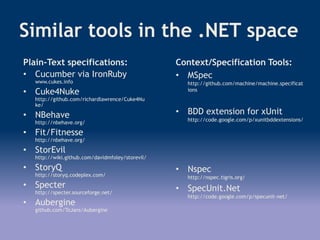
Similar tools in the .NET space
Plain-Text specifications:
• Cucumber via IronRuby
www.cukes.info
• Cuke4Nuke
http://github.com/richardlawrence/Cuke4Nu
ke/
• NBehave
http://nbehave.org/
• Fit/Fitnesse
http://nbehave.org/
• StorEvil
http://wiki.github.com/davidmfoley/storevil/
• StoryQ
http://storyq.codeplex.com/
• Specter
http://specter.sourceforge.net/
• Aubergine
github.com/ToJans/Aubergine
Context/Specification Tools:
• MSpec
http://github.com/machine/machine.specificat
ions
• BDD extension for xUnit
http://code.google.com/p/xunitbddextensions/
• Nspec
http://nspec.tigris.org/
• SpecUnit.Net
http://code.google.com/p/specunit-net/
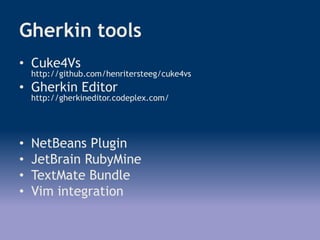
Gherkin tools
• Cuke4Vs
http://github.com/henritersteeg/cuke4vs
• Gherkin Editor
http://gherkineditor.codeplex.com/
• NetBeans Plugin
• JetBrain RubyMine
• TextMate Bundle
• Vim integration
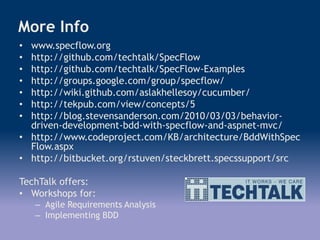
More Info
• www.specflow.org
• http://github.com/techtalk/SpecFlow
• http://github.com/techtalk/SpecFlow-Examples
• http://groups.google.com/group/specflow/
• http://wiki.github.com/aslakhellesoy/cucumber/
• http://tekpub.com/view/concepts/5
• http://blog.stevensanderson.com/2010/03/03/behavior-
driven-development-bdd-with-specflow-and-aspnet-mvc/
• http://www.codeproject.com/KB/architecture/BddWithSpec
Flow.aspx
• http://bitbucket.org/rstuven/steckbrett.specssupport/src
TechTalk offers:
• Workshops for:
– Agile Requirements Analysis
– Implementing BDD
TechTalk Schweiz sucht Mitarbeiter!
TechTalk ist eine Entwicklungsfirma mit ca. 60 Mitarbeiter in
Wien und Budapest und Zürich. Wir fokussieren auf die .NET
Plattform und auf Scrum.
Wir suchen erfahrene Entwickler für den Aufbau des Standorts
Schweiz:
• Mehrjährige Erfahrung in diversen Projekten, idealerweise in
unterschiedlichen Branchen
• Grosse Flexibilität, Eigeninitiative und Selbstmotivation
• Erfahrung und Bereitschaft für On-Site Einsätze bei Kunden
Wir bieten:
• Aufbau eines jungen Unternehmens in einem kleinem Team
• Möglichkeit eines Aufenthaltes in Wien / Budapest
• Weiterbildung und Verwirklichung eigener Ideen
jobs@techtalk.ch
Fragen und Diskussion

Behavior Driven Development

  • 1.
  • 2.
  • 3.
    High quality technicalscreencasts created by experts on the latest and most important technologies. Buy access to a single series or subscribe for as little as $19 a month. tekpub.com ASP.NET MVC Ayende Rahien Rob Conery jQuery Dave Ward Ruby on Rails ASP.NET Ajax LINQ nHibernate
  • 4.
    About me TechTalk isa software development and consulting company with ~60 people located in Vienna, Budapest and Zürich. We focus on Scrum and .NET. Jonas Bandi At TechTalk since 2009 Committer to SpecFlow http://blog.jonasbandi.net Twitter: @jbandi
  • 5.
    The audience? • Whois practicing agile Development? • Who is practicing TDD? • Wo is doing Acceptance Test Driven Development or Behavior Driven Development? • Wo is using Cucumber, Fitnesse, Concordion, NBehave or a similar tool? • Who knows SpecFlow?
  • 6.
    Agenda • The CommunicationGap: A reason why we are failing • Agile software development promises improvement • BDD as a possible approach to improve • SpecFlow as tool that supports BDD • Advanced topics and loose ends
  • 7.
    Let´s discuss! "We're stillfiguring this stuff out. All of us." - Jay Fields Thoughts on developer Testing: http://blog.jayfields.com/2009/02/thoughts-on-developer-testing.html
  • 8.
    Once upon a time... ...in the golden Age of the Waterfall.
  • 9.
    … and theylived happily ever after!
  • 10.
    Welcome to thereal world!
  • 11.
    ... the goldenage is over!
  • 12.
    What did reallychange? Project success, Chaos Report, Standish Group 2000 2008
  • 13.
    What is theproblem?
  • 14.
    "I believe thatthe hardest part of software projects, the most common source of project failure, is communication with the customers and users of that software." - Martin Fowler, DSL Book
  • 15.
    What defines successfulsoftware? Software development is about delivering business value!
  • 16.
    What is beingused? CHAOS Report 2000, Standish Group
  • 17.
    Providing Business Value? •Only 20% of all delivered features are actually used? • Something is wrong! • We can profit tremendously when we improve in • requirements gathering • transporting them successfully to the implementation
  • 18.
    Where errors areintroduced Source: James Martin, An Information Systems Manifesto
  • 19.
    Fighting Errors? • Traditionaldeveloper testing focuses on code and maybe design • Testing requirements is hardly ever a topic • We can profit tremendously when we improve in requirements gathering.
  • 20.
  • 21.
  • 23.
    _ Abstraction during Analysis Level of Detail Why? How? RoughSpecification Rough Specification Business Goals Business Goals Why? ,,Value” What? ,,Scope” How? ,,Details” Project success Ressources Realization Quantity Predictability Code Vision Vision Detail Specification Detail Specification Communication Gap!
  • 24.
  • 25.
  • 26.
  • 27.
    Telephone Game “Engineers arenot good at dealing with Customers” - Office Space
  • 28.
    Agile to therescue!
  • 29.
  • 30.
    Streaming requirements • Notall of the requirements are delivered upfront • Requirements are delivered just in time • Incrementally reveal details just-in-time • Pull instead of push • Embrace Change
  • 31.
    The promised benefits •Constant feedback and priorization by the Stakeholder – Build those features that are needed and useful • Features have a much shorter through-put time – Allows validation of requirements
  • 32.
    Remaining challenges • Howto communicate requirements effectively? • How to ensure that requirements are understood and implemented correctly?
  • 33.
    Requirements == Tests Asformality increases, tests and requirements become indistinguishable. At the limit, tests and requirements are equivalent. Equivalence Hypothesis (Martin, Melnik, 2008)  Executable test-based specifications Pic: Martin/Melnik: Requirements and Tests
  • 34.
    Behavor Driven Development: Anattempt to fit it all together BDD Behavior Driven Development TDD Test Driven Development DDD Domain Driven Design ATDD Acceptance Test Driven Development User Stories Specification by Example Definition of Done Outside-In Development DSL Domain Specific Language
  • 35.
  • 36.
    ATDD: Rising theLevel of Abstraction
  • 37.
    The real Goal Pic:http://www.projectcartoon.com/ • Test Driven Development is about Design • Acceptance Test Driven Development is about Specification and Communication • Writing acceptance tests early – is a requirements engineering technique – builds a common understanding – defines clear goals and a common definition of done
  • 38.
    Specification by Example •Abstract requirements and specifications are not a good tool for communication. • Concrete examples are much better. • Usually examples are not formalized and not shared. Examples Tests Requirements are composed of elaborate verify & validate
  • 39.
    _ Agile Analysis Level of Detail Why? How? Actor-Goals Actor-Goals Epics Epics Business Goals BusinessGoals User Stories User Stories Acceptance Acceptance Criteria Why? ,,Value” What? ,,Scope” How? ,,Details” Project success Ressources Realization Quantity Predictability Code Communi- cation Gap! Vision Vision
  • 40.
    _ Example: User Stories Detailgrad Why? How? Actor-Goals Actor-Goals Epics Epics BusinessGoals Business Goals User Stories User Stories Acceptance Acceptance Criteria Amount of Work Predictability Code As a potential customer I want to search for books by a simple string So that I can easily allocate books by something I remember from them. As a potential customer I want to place books into my shopping basket So that I can order several books at once. Communi- cation Gap!
  • 41.
    _ Example: Acceptance Criteria Detailgrad Why? How? Actor-Goals Actor-Goals Epics Epics BusinessGoals Business Goals User Stories User Stories Acceptance Acceptance Criteria Amount of Work Predictability Code As a potential customer I want to search for books by a simple string So that I can easily allocate books by something I remember from them. Author of book should be matched. Space should be treated as multiple OR search. Search string should be at least 4 characters. Items should be matched only once. Title of book should be matched. Communi- cation Gap!
  • 42.
    Examples as AcceptanceCriteria As a potential customer I want to search for books by a simple string So that I can easily allocate books by something I remember from them. Title of book should be matched. Given the following books | Author | Title | | Ted Pattison | Inside Windows SharePoint Services | | Martin Fowler| Patterns of Enterprise Architecture | | Eric Evans | Domain Driven Design | When I perform a simple search on “Domain” Then the book list should only contain: “Domain Driven Design”
  • 43.
    Examples • Enable developersand testers to communicate efficiently with business people • Provide enough information for developers to implement and for testers to verify • Realistic examples contain precise information and ask for precise answers • Are a way to test specifications! • … express a shared understanding
  • 44.
    Building a sharedunderstanding
  • 45.
    Shared understanding • Terminologyand abstractions of business • Concrete enough for developers • Business readable • Bound to implementation • Consistent
  • 46.
    Outside-In Development • Alwaysstart with a Story • What development should focus on: – Providing business value – Satisfying stakeholder needs – Software that matters – Consumable software 1 2 3 4 5
  • 47.
    Behavor Driven Development: Anattempt to fit it all together BDD Behavior Driven Development TDD Test Driven Development DDD Domain Driven Design ATDD Acceptance Test Driven Development User Stories Specification by Example Definition of Done Outside-In Development DSL Domain Specific Language
  • 48.
    Remember BDD is aMindset not a Tool!
  • 49.
    BDD Tools: Automation Definitionof Done + Automation = Executable Specification
  • 50.
    SpecFlow • Open-source BDDtool for .NET – www.specflow.org – github.com/techtalk/SpecFlow • Focus on high level behavior: features / acceptance tests • Focus on story-style plain text specifications • Using Gherkin as DSL for specifications • Uses existing testing frameworks for execution (Nunit, MSTest, xUnit) – VisualStudio / Build integration www.specflow.org
  • 51.
    SpecFlow History • SpecFlowwas founded in late 2009 by TechTalk • Goals: – A pragmatic BDD tool for .NET – Provide a frictionless experience for .NET environments – Use existing tools: VisualStudio, UnitTest- Frameworks • SpecFlow is used in several projects by TechTalk www.specflow.org
  • 52.
    Gherkin • A language(DSL) for story-style plain text specifications – “Given“-“When“-“Then“ • Rooted in the Ruby World: Cucumber • Business readable / writeable • Sufficient formality – Enable automation – Executable specification • http://github.com/aslakhellesoy/gherkin/ www.cukes.info
  • 53.
  • 54.
    Gherkin Keywords • Feature •Scenario • Given,When,Then,And,But • Background • Scenario-Outline, Examples • Event Hooks (Before-, After- / -Feature, -Scenario, -ScenarioBlock, -Step) • Table Arguments • Tags
  • 55.
    Gherkin Features • Userstories are requirements • A single scenario is an example that drives the development • Scenarios define a common definition of „done“ • All scenarios together build the acceptance criteria of the story/feature
  • 56.
  • 57.
  • 58.
    Automated scenarios … •… describe what the system should do • … are business readable • … establish a common vocabulary • … capture a shared set of examples • … enable communication • … are bound to the implementation • … are executable • … express a shared understanding
  • 59.
  • 60.
    Acceptance Tests vs.Unit Tests • Acceptance Tests • Business oriented • What? • Are we building the right thing? • Unit-Tests • Code oriented • How? • Are we building it right? Picture: RSpec Book
  • 61.
  • 62.
    Behavior Specifications are Examples •Demonstrating each important aspect of a system – Standard cases – Edge cases – Critical areas • The main goal is not a full regression – However the artifacts of automated examples can be reused for regression testing
  • 63.
    Agile Testing Quadrants •Agile Testing is more than QA – Not only detect bugs – Improve quality by preventing bugs …
  • 64.
    Testing Pyramid • Automationallows more resources for „valuable“ testing activities Test Automation Pyramid by Mike Cohn
  • 65.
    Different Access Levels •UI • Just below the UI • Application Services • In the domain
  • 66.
    Accessing the Appthrough the UI • Full end-to-end test • Driving the UI adds a lot of accidental complexity and noise – Structure of resulting UI is not clear from the beginning – Widget selection (CSS- Selectors, byId …) – It is hard to drive functionality
  • 67.
    Accessing the Appjust below the UI • Establish an Architecture where you can access the Application just below the UI – Design for Testability – PassiveView, ViewModel, Controller • Provide an abstraction and a programmatic API that allows driving functionality • The last step has to be tested by QA – manually or scripted
  • 68.
    Accessing the Appthrough Application Services • Core business functionality often resides in encapsulated modules • Drive functionality from the interface of a module – Gap between scenario and implementation grows – Reliability of a passing scenario diminishes • Good example: „Classic“ SOA
  • 69.
    Accessing the Domain •Core business functionality often resides in a domain model • It is possible to bind a scenario directly to the domain – Gap between scenario and implementation is big – Danger of leaking too many details into the scenarios („programming in plain-text“) – Usually better suited for unit-tests
  • 70.
    It is atrade-off outside-in, efficiency, speed end-to-end integration vs.
  • 71.
    Stubbing • Stubbing helpsto isolate the feature – Better for driving the development – Worse for testing the application
  • 72.
  • 73.
  • 74.
    History of BDD •2001: Dan North invented the term • JBehave (Java) • RSpec (Ruby) • Cucumber (Ruby) „where the hype is today…“ „TDD is not about Testing“ „BDD is a Development Methodology“ Code-Focused, Unit-Behavior Feature-Focused, System-Behavior
  • 75.
    Similar tools inthe .NET space Plain-Text specifications: • Cucumber via IronRuby www.cukes.info • Cuke4Nuke http://github.com/richardlawrence/Cuke4Nu ke/ • NBehave http://nbehave.org/ • Fit/Fitnesse http://nbehave.org/ • StorEvil http://wiki.github.com/davidmfoley/storevil/ • StoryQ http://storyq.codeplex.com/ • Specter http://specter.sourceforge.net/ • Aubergine github.com/ToJans/Aubergine Context/Specification Tools: • MSpec http://github.com/machine/machine.specificat ions • BDD extension for xUnit http://code.google.com/p/xunitbddextensions/ • Nspec http://nspec.tigris.org/ • SpecUnit.Net http://code.google.com/p/specunit-net/
  • 76.
    Gherkin tools • Cuke4Vs http://github.com/henritersteeg/cuke4vs •Gherkin Editor http://gherkineditor.codeplex.com/ • NetBeans Plugin • JetBrain RubyMine • TextMate Bundle • Vim integration
  • 77.
    More Info • www.specflow.org •http://github.com/techtalk/SpecFlow • http://github.com/techtalk/SpecFlow-Examples • http://groups.google.com/group/specflow/ • http://wiki.github.com/aslakhellesoy/cucumber/ • http://tekpub.com/view/concepts/5 • http://blog.stevensanderson.com/2010/03/03/behavior- driven-development-bdd-with-specflow-and-aspnet-mvc/ • http://www.codeproject.com/KB/architecture/BddWithSpec Flow.aspx • http://bitbucket.org/rstuven/steckbrett.specssupport/src TechTalk offers: • Workshops for: – Agile Requirements Analysis – Implementing BDD
  • 78.
    TechTalk Schweiz suchtMitarbeiter! TechTalk ist eine Entwicklungsfirma mit ca. 60 Mitarbeiter in Wien und Budapest und Zürich. Wir fokussieren auf die .NET Plattform und auf Scrum. Wir suchen erfahrene Entwickler für den Aufbau des Standorts Schweiz: • Mehrjährige Erfahrung in diversen Projekten, idealerweise in unterschiedlichen Branchen • Grosse Flexibilität, Eigeninitiative und Selbstmotivation • Erfahrung und Bereitschaft für On-Site Einsätze bei Kunden Wir bieten: • Aufbau eines jungen Unternehmens in einem kleinem Team • Möglichkeit eines Aufenthaltes in Wien / Budapest • Weiterbildung und Verwirklichung eigener Ideen jobs@techtalk.ch
  • 79.