Beginnings and Beyond Foundations in Early
Childhood Education 9th Edition Gordon Solutions
Manual download
https://testbankdeal.com/product/beginnings-and-beyond-
foundations-in-early-childhood-education-9th-edition-gordon-
solutions-manual/
Explore and download more test bank or solution manual
at testbankdeal.com
We have selected some products that you may be interested in
Click the link to download now or visit testbankdeal.com
for more options!.
Beginnings and Beyond Foundations in Early Childhood
Education 9th Edition Gordon Test Bank
https://testbankdeal.com/product/beginnings-and-beyond-foundations-in-
early-childhood-education-9th-edition-gordon-test-bank/
Foundations of Early Childhood Education Teaching Children
in a Diverse Society 6th Edition Gonzalez Test Bank
https://testbankdeal.com/product/foundations-of-early-childhood-
education-teaching-children-in-a-diverse-society-6th-edition-gonzalez-
test-bank/
Effective Practices in Early Childhood Education Building
a Foundation 2nd Edition Bredekamp Test Bank
https://testbankdeal.com/product/effective-practices-in-early-
childhood-education-building-a-foundation-2nd-edition-bredekamp-test-
bank/
Introduction to Intercultural Communication 8th Edition
Jandt Test Bank
https://testbankdeal.com/product/introduction-to-intercultural-
communication-8th-edition-jandt-test-bank/
Developmental Mathematics Basic Mathematics and Algebra
4th Edition Lial Test Bank
https://testbankdeal.com/product/developmental-mathematics-basic-
mathematics-and-algebra-4th-edition-lial-test-bank/
Contemporary Business Mathematics Canadian 11th Edition
Hummelbrunner Solutions Manual
https://testbankdeal.com/product/contemporary-business-mathematics-
canadian-11th-edition-hummelbrunner-solutions-manual/
Marketing 1st Edition Hunt Test Bank
https://testbankdeal.com/product/marketing-1st-edition-hunt-test-bank/
Environment The Science Behind the Stories Second Canadian
Edition with MyEnvironmentPlace Canadian 2nd Edition
Withgott Solutions Manual
https://testbankdeal.com/product/environment-the-science-behind-the-
stories-second-canadian-edition-with-myenvironmentplace-canadian-2nd-
edition-withgott-solutions-manual/
Doing Ethics Moral Reasoning and Contemporary Issues 2nd
Edition Vaughn Test Bank
https://testbankdeal.com/product/doing-ethics-moral-reasoning-and-
contemporary-issues-2nd-edition-vaughn-test-bank/
Chemistry 7th Edition McMurry Solutions Manual
https://testbankdeal.com/product/chemistry-7th-edition-mcmurry-
solutions-manual/
© 2014 Cengage Learning. All rights reserved. 37
CHAPTER 8 FAMILIES AND TEACHERS: PARTNERS IN
EDUCATION
Overview
In this chapter, the student is helped to recognize an awareness of the vital partnership that must
exist between home and school if children are to succeed. A sensitivity to what parents’
contributions are and suggestions for making a school or classroom “parent friendly” are discussed.
The collaborative effort families and teachers can establish is part of a movement toward more
support for families as they struggle to raise their children. The links between and among the
children, family, and community are the basis for a more family-centered approach as a way to
enhance the family’s contribution to their children’s education. Changing demographics challenge
teachers to a new level of multicultural awareness and perspective. The unique needs of special
family populations, such as single and immigrant parents and families of children with special
needs, are also discussed.
Family conference guidelines, parent-child separation techniques, and communication links give
the student practical suggestions for successful family-teacher relationships.
Outline
I. Promoting Strong and Effective
Partnerships
A. Historical Overview
B. Strengthening the Partnership
1. What Families Contribute
to the Partnership
a. How Families Benefit
b. Family Cultural
Influences
2. What Teachers Contribute
to the Partnership
3. What Children Gain
C. Becoming Full and Equal Partners
1. Public Recognition
II. The Complexity of Today’s Families
A. Understanding Parenthood
1. Patterns of Child Rearing
2. Stages of Parent Development
B. Families with Diverse Needs
1. Supporting Single Parent Families
C. Valuing Family Culture
III. Enhancing Communication to Support
Learning
A. Education and Involvement
B. Strategies for Keeping in Touch
C. The Separation Process: Learning to
Trust One Another
D. Parent/Family-Teacher Conferences
E. Maintaining Privacy and
Confidentiality
IV. End of Chapter Materials
A. Summary
B. Key Terms
C. Review Questions
D. Observe and Apply
E. Helpful Web Sites
F. References
Key Terms
precedent
pedagogista
separation process
charter school
magnet school
family-centered approach
© 2014 Cengage Learning. All rights reserved.
38
Objectives
• Identify strategies that promote strong partnerships and effective relationships between
families and schools and examine the importance of such collaborations
• Understand and value the complexity of today’s families and demonstrate skills necessary
to collaborate with diverse family situations
• Demonstrate effective strategies that enhance communication between teachers and
families through the separation process and family/teacher conferences
Teaching Tips and Lecture Ideas
This is an excellent chapter for involving parents: a panel of parents to discuss issues students
would like to have addressed from a parent’s point of view (discipline, living with children on a
24-hour basis, relationships with teachers, schools). The instructor and a parent might want to hold
a model parent-teacher conference. Students would enjoy role-playing the participants in a
parent-teacher conference. Students will become involved if the instructor encourages them to
reflect on their own upbringing—how their own parents were involved and what their attitudes
were toward children, child-rearing responsibilities, teachers, school administrators, curriculum.
There is an obvious link to the sections in Chapter 15 on crises in children’s lives, on families, and
on diversity. The instructor may want to assign readings from the chapter as some of the issues that
parents face emerge through class discussion.
Discussion questions might include the following:
• Is the separation process culturally appropriate for all families? For what cultural groups
should it be adjusted? Why?
• What changes in American demographics are evident in the classrooms in which these
students observe or teach? What parents with unique needs are represented in these classes?
How are their needs addressed?
Local bookstores abound with information and guidance geared to families. Ask students to
browse through and report back on the current state of parent education and the popular press.
Suggest they list what they find as the current topics of particular interest in these publications.
Ask them to define the issues, the approaches, the age levels being targeted, and their impression
of the depth of coverage.
Ask students to purchase a recent copy of Parents Magazine or Parenting and do the same. Have
them compare the quality of articles among these resources.
Ask students to attend a local PTA (PTO) meeting at a public school. Have them report back on
attendance and participation. Was there a difference in attendance if there was food involved, if
there was a school performance, if it was school function (like a carnival)? Why do you suppose
more parents came then than would otherwise?
Have students interview their own parents/guardians about the times they went to school to meet
with the student’s teachers. Was it only once a year for parent-teacher conferences? Did they
volunteer any other time? What was their reasoning behind being actively on inactively involved
with the school?
© 2014 Cengage Learning. All rights reserved. 39
Answers to Review Questions in Text
1. Following are three ways to encourage school/family to partnerships: a) Ask them to visit the
classroom and participate in a class activity. This may be a sewing, cooking, or art project or
sharing a cultural event. b) Take field trips to parents’ workplaces, especially if a number of
parents cannot accompany the class on field trips. c) Set up a home repair shop program in
which materials that need repair are sent to parents who could not otherwise participate. Toys,
books, and games could be repaired this way, involving both parents as well as other members
of the family.
Advantages of parent participation: For children: makes a bridge between home and school
brings more resources to the classroom shows their parents are interested in them research
indicates academic gain for children whose parents participate makes them feel important
when someone from their family participates For families: firsthand opportunity to see how
their child behaves in a group setting can learn guidance and behavior strategies from
teachers as they handle problem situations meet other parents with similar interests and
needs For teachers: an extra pair of hands resources (skills and talent) not otherwise
available another avenue toward understanding the child, the family, and their culture
Disadvantages: The number of working parents makes participation in the classroom
difficult. Both teachers and families need to explore nontraditional ways to interact and
communicate with one another in light of the current trend of working mothers and
single-parent families. For teachers, this may mean extra time allotted to ensure these
contacts are made.
2. Family includes foster parents, and adoptive parents, grandparents, aunts and uncles, siblings,
may be the parental figures in a household. Two people can be defined as a family.
A school/home partnership can be supported through:
a) Careful planning: written school policies outline the procedure; home visit set up
before child enters school; family member and child are prepared ahead of time for
what will happen and in what general time frame.
b) Close communication: teacher helps family member as well as child by taking the lead
and acting with conviction, both understanding that this is a gradual process about
which they will communicate regularly.
c) Sensitivity to one another: teacher reassures family child is acting normally and helps
them relax by seeing this as common behavior; parents encourage child’s participating
in class by asking questions and being interested in the classroom activity; includes
cultural sensitivity to family-member–child relationship.
3. When families are involved with their child’s school, the child feels more at home and secure
in the environment. Five effective ways to communicate with families are classroom
newsletters, bulletin boards, a parent family place, informal contacts, and home visits.
© 2014 Cengage Learning. All rights reserved.
40
Recommended Resources
Films/Videos
Helping Parents with Decision Making in Day Care. Pacific Oaks College, 714 W. California
Boulevard, Pasadena, CA 91105. Six filmstrips that help parents answer questions about
themselves, their children, and their care.
Involving Families in Active Learning Settings. High/Scope Press, Ypsilanti, MI. Video showing
how each family’s experiences and culture can be welcomed in an early childhood program. 23
minutes.
Mister Rogers Talks with Parents. NAEYC video in which Mister Rogers explores some of the
pressures on children today.
Partnerships with Parents. NAEYC video.
Other Resources
Diffily, D., & Morrison, K. (Eds.). (1996). Family-friendly communication for early childhood
programs. Washington, DC: NAEYC.
Web Sources
U.S. Bureau of the Census http://www.census.gov
Children’s Defense Fund http://www.childrensdefense.org
American Association for Single People http://www.singlesrights.com
National Association for the Education of Young Children http://www.naeyc.org
Center for Immigration Studies http://www.cis.org
National Parent Information Network http://www.npin.org
Culturally & Linguistically Appropriate Services http://www.clas.uiuc.edu
Zero to Three http://www.zerotothree.org
Parent Soup http://parenting.ivillage.com/
KidSource™ Online http://www.kidsource.com
The Fred Rogers Company http://www.fci.org/index.asp?
Other documents randomly have
different content
—To make clear what I have said in this chapter, it will perhaps be
well to give two illustrations drawn from the Domesday Book
(eleventh century) and from bailiffs’ accounts of a later period (end
of thirteenth century).
First we will take a manor in Warwickshire in the Domesday
Survey (1089)—Estone, now Aston, near Birmingham. It was one of
a number belonging to William, the son of Ansculf, who was tenant
in chief, but had let it to one Godmund, a sub-tenant in mesne. The
Survey runs: “William Fitz-Ansculf holds of the King Estone, and
Godmund of him. There are 8 hides.
11
The arable employs 20
ploughs; in the demesne the arable employs 6 ploughs, but now
there are no ploughs. There are 30 villeins with a priest, and 1
bondsman, and 12 bordars [i.e. cottars]. They have 18 ploughs. A
mill pays 3 {17} shillings. The woodland is 3 miles long and half a mile
broad. It was worth £4; now 100 shillings.”
11 A hide varied in size, and was (after the Conquest) equal to a
carucate, which might be anything from 80 to 120 or 180 acres. Perhaps
120 is a fair average, though some say 80.
Here we have a good example of a manor held by a sub-tenant,
and containing all the three classes mentioned in § 4 of this chapter
—villeins, cottars, and slaves (i.e. bondsmen). The whole manor
must have been about 5000 acres, of which 1000 were probably
arable land, which was of course parcelled out in strips among the
villeins, the lord, and the priest. As there were only 18 ploughs
among 30 villeins, it is evident some of them at least had to use a
plough and oxen in common. The demesne land does not seem to
have been well cultivated by Godmund the lord, for there were no
ploughs on it, though it was large enough to employ six. Perhaps
Godmund, being an Englishman, had been fighting the Normans in
the days of Harold, and had let it go out of cultivation, or perhaps
the former owner had died in the war, and Godmund had rented the
land from the Norman noble to whom William gave it.
§ 10. Cuxham Manor in the eleventh and thirteenth
centuries
—Our second illustration can be described at two periods of its
existence—at the time of Domesday and 200 years later. It was only
a small manor of some 490 acres, and was held by a sub-tenant
from a Norman tenant in chief, Milo Crispin. It is found in the
Oxfordshire Domesday, in the list of lands belonging to Milo Crispin.
The Survey says: “Alured [the sub-tenant] now holds 5 hides for a
manor in Cuxham. Land to 4 ploughs; now in the demesne, 2
ploughs and 4 bondsmen. And 7 villeins with 4 bordars have 3
ploughs. There are 3 mills of 18 shillings; and 18 acres of meadow.
It was worth £3, now £6.” Here, again, our three classes of villeins,
cottars or bordars, and slaves are represented. The manor was
evidently a good one, for though smaller than Estone it {18} was
worth more, and has three mills and good meadow land as well.
Now, by the end of the thirteenth century this manor had passed
into the hands of Merton College, Oxford, which then represented
the lord, but farmed it by means of a bailiff. Professor Thorold
Rogers gives us a description of it,
12
drawn from the annual accounts
of this bailiff, which he has examined along with a number of others
from other manors. We find one or two changes have taken place,
for the bondsmen have entirely disappeared, as indeed they did in
less than a century after the Conquest all through the land. The
number of villeins and bordars has increased. There are now 13
villeins and 8 cottars, and 1 free tenant. There is also a prior, who
holds land (6 acres) in the manor but does not live in it; also two
other tenants, who do not live in the manor, but hold “a quarter of a
knight’s fee” (here some 40 or 50 acres)—a knight’s fee comprising
an area of land varying from 2 hides to 4 or even 6 hides, but in any
case worth some £20. As the Cuxham land was good, the quantity
necessary for the valuation of a fee would probably be only the small
hide or carucate of 80 acres, and the quarter of it of course 20 acres
or a little more. The 13 serfs hold 170 acres, but the 8 cottars only
30 acres, including their tenements. The free tenant holds 12⁠
¾
acres, and Merton College as lord of the manor some 240 acres of
demesne. There are now two mills instead of three, one belonging
to the prior, and the other to another tenant. There were altogether,
counting the families of the villeins and cottars, but not the two
tenants of military fees, about 60 or 70 inhabitants, the most
important being the college bailiff and the miller.
12 In his Six Centuries of Work and Wages.
§ 11. Description of a manor village
—Now in both these country manors, as in all others, the central
feature {19} would be the dwelling of the lord, or manor-house. It
was substantially built, and served as a court-house for the annual
sittings of the court baron and court leet.
13
If the lord did not live in
it, his bailiff did so, and then the lord would come once or twice a
year to hold these courts. Near the manor-house generally stood the
church, often large for the size of the village, because the nave was
frequently used as a town-hall for meetings or for markets. Then
there would be the house of the priest, possibly in the demesne; and
after these two the most important building was the mill, which, if
there was a stream, would be placed on its banks in order to use the
water-power. The rest of the tenants generally inhabited the
principal street or road of the village, near the stream, if one ran
through the place. The houses of these villages were poor and dirty,
not always made of stone, and never (till the fifteenth century) of
brick, but built of posts wattled and plastered with clay or mud, with
an upper storey of poles reached by a ladder. The articles of
furniture would be very coarse and few, being necessarily of home
manufacture; a few rafters or poles overhead, a bacon-rack, and
agricultural tools being the most conspicuous objects. Chimneys
were unknown, except in the manor-houses, and so too were
windows, and the floor was of bare earth. Outside the door was the
“mixen,” a collection of every kind of manure and refuse, which must
have rendered the village street alike unsavoury, unsightly and
unwholesome. But though their life was rude and rough, it seems
that the villagers were fairly happy, and, considering all things, about
as well off as are their descendants now.
13 See note 4. p. 243, on Manorial Courts.
§ 12. The kinds of land in a manor
—Before concluding this chapter, it is necessary, in order to complete
our {20} sketch of the manorial system from the time of the Conquest
onwards, to understand how the land was divided up. We may say
that there were seven kinds of land altogether, (1) First came the
lord’s land round about the manor-house, the demesne land, which
was strictly his own, and generally cultivated by himself or his bailiff.
All other land held by tenants was called land in villeinage. (2) Next
came the arable land of the village held by the tenants in common
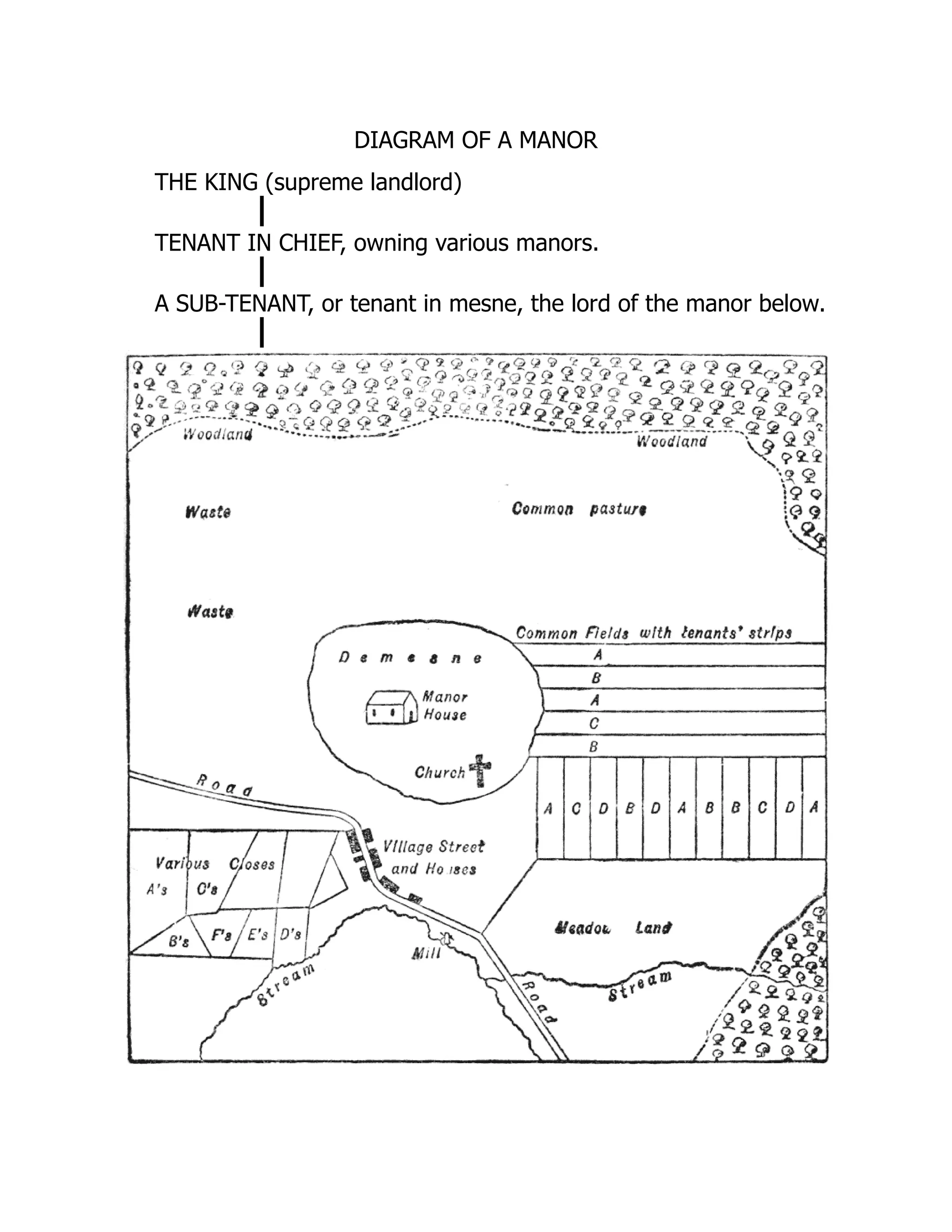
fields. Now these fields were all divided up into many strips, and
tenants held their strips generally in quite different places, all mixed
up anyhow (cf. diagram, where the tenants are marked A, B. C,
etc.). The lord and the parson might also have a few strips in these
fields. There were at least three fields, in order to allow the rotation
of crops mentioned before (p. 8). Each tenant held his strip only till
harvest, after which all fences and divisions were taken away, and
the cattle turned out to feed on the stubble. (3) Thirdly came the
common pasture, for all the tenants. But each tenant was restricted
or stinted in the number of cattle that he might pasture, lest he
should put on too many, and thus not leave enough food for his
neighbours’ cattle. Sometimes, however, we find pasture without
stint, as in Port Meadow at Oxford to this day. (4) Then comes the
forest or woodland, as in Estone, which belonged to the lord, who
owned all the timber. But the tenants had rights, such as the right of
lopping and topping certain trees, collecting fallen branches for fuel;
and the right of “pannage”—i.e. of turning cattle, especially swine,
into the woods to pick up what food they could. (5) There was also
in most manors what is called the waste—i.e. uncultivated—land,
affording rough pasture, and on which the tenants had the right of
cutting turf and bracken for fuel and fodder. Then near the stream
there would {21}
DIAGRAM OF A MANOR
THE KING (supreme landlord)
TENANT IN CHIEF, owning various manors.
A SUB-TENANT, or tenant in mesne, the lord of the manor below.
perhaps be some (6) Meadow land, as at Cuxham; but this always
belonged to the lord, and if he let it out, he always charged an extra
rent (say eightpence instead of sixpence an acre), for it was very
valuable as affording a good supply of hay for the winter. Lastly, if
the tenant could afford it, and wanted to have other land besides the
common fields, where he could let his cattle lie, or to cultivate the
ground more carefully, he could occupy (7) a close, or a portion of
land specially marked off and let separately. The lord always had a
close on his demesne, and the chief tenants would generally have
one or two as well. The close land was of course rented more highly
than land in the common fields.
The accompanying diagram shows a typical manor, held by a
sub-tenant from a tenant in chief, who holds it of the king. It
contains all the different kinds of land, though of course they did not
always exist all in one manor. It also shows the manor-house,
church, mill and village.
14
14 See note 5, p. 244, on Decay of Manorial System.
CHAPTER II
THE TOWNS AND THE GILDS
§ 1. The origin of towns
—As in the case of the manor, which was the Norman name for the
Saxon “townships,” the town, in the modern sense of the word, had
its origin from the primitive settlement known as the mark (p. 6).
The only difference between a town and a manor originally lay in the
number of its population, and in the fact that the town was a more
defensible place than the {23} “township,” or rural manor, probably
having a mound or moat surrounding it, instead of the hedges which
ran round the villages. In itself it was merely a manor or group of
manors; as Professor Freeman puts it, “one part of the district where
men lived closer together than elsewhere.” The town had at first a
constitution like that of a primitive village in the mark, but its
inhabitants had gradually gained certain rights and functions of a
special nature. These rights and privileges had been received from
the lord of the manor on which the town had grown up; for towns,
especially provincial towns, were at first only dependent manors,
which gained safety and solidity under the protection of some great
noble, prelate, or the king himself, who finally would grant the town
thus formed a charter.
§ 2. Rise of towns in England
—Towns first became important in England towards the end of the
Saxon period Saxon England had never been a settlement of towns,
but of villages and townships, or manors. But gradually towns did
grow up, though differing widely in the circumstances and manner of
their rise. Some grew up in the fortified camps of the invaders
themselves, as being in a secure position; some arose from a later
occupation of the once sacked and deserted Roman towns. Many
grew silently in the shadow of a great abbey or monastery. Of this
class was Oxford, which first came into being round the monasteries
of St Frideswide and Osney. Others clustered round the country
houses of some Saxon king or earl. Several important boroughs
owed their rise to the convenience of their site as a port or a trading
centre. This was the origin of the growth of Bristol, whose rise
resulted directly from trade; and London of course had always been
a port of high commercial rank. A few other towns, like Scarborough
and Grimsby, were at first {24} small havens for fishermen. But all the
English towns were far less flourishing before the arrival of the
Normans than they afterwards became.
§ 3. Towns in Domesday: London
—If, now, we once more go back to our great authority, the survey
made by William the Norman, we find that the status of these towns
or boroughs is clearly recognized, though they are regarded as held
by the lord of the manor “in demesne,” or in default of a lord, as
part of the king’s demesne. Thus Northampton at that time was a
town in the king’s demesne; Beverley was held in demesne by the
Archbishop of York. It was possible, too, that one town might belong
to several lords, because it spread over, or was an aggregate of,
several manors or townships. Thus Leicester seems to have included
four manors, which were thus held in demesne by four lords—one by
the king, another by the Bishop of Lincoln, another by a noble,
Simon de Senlis, and the fourth by Ivo of Grantmesnil, the sheriff. In
later times it was held under one lord, Count Robert of Meulan.
Now, in the Domesday Book there is mention made of forty-one
provincial cities or boroughs, most of them being the county towns
of the present day. There are also ten fortified towns of greater
importance than the others. They are Canterbury, York, Nottingham,
Oxford, Hereford, Leicester, Lincoln, Stafford, Chester, and
Colchester. London was a town apart, as it had always been, and
was the only town which had a civic constitution, being regulated by
a port-reeve and a bishop, and having a kind of charter, though
afterwards the privileges of this charter were much increased.
London was of course a great port and trading centre, and had
many foreign merchants in it. It was then, as well as in subsequent
centuries, the centre of English national life, and {25} the voice of its
citizens counted for something in national affairs. The other great
ports of England at that time were Bristol, Southampton, and
Norwich, and as trade grew and prospered, many other ports rose
into prominence (see p. 64).
§ 4. Special privileges of towns
—Even at the time of the Conquest most towns, though small, were
of sufficient importance to have a certain status of their own, with
definite privileges. The most important of these was the right of
composition for taxation, i.e. the right of paying a fixed sum, or
rent, to the Crown, instead of the various tallages, taxes, and
imposts that might be required of other places. This fixed sum, or
composition, was called the firma burgi, and by the time of the
Conquest was nearly always paid in money. Previously it had been
paid both in money and kind, for we find Oxford paying to Edward
the Confessor six sectaries of honey as well as £20 in coin; while to
William the Norman it paid £60 as an inclusive lump sum. By the end
of the Norman period all the towns had secured the firma burgi, and
the right of assessing it themselves, instead of being assessed by
the sheriff; they had the right also of choosing a mayor of their own,
instead of the king’s bailiff or reeve. They had, moreover, their own
tribunals, a charter for their customs, and special rules of local
administration, and, generally speaking, gained entire judicial and
commercial freedom.
§ 5. How the towns obtained their charters
—It is interesting to see what circumstances helped forward this
emancipation of the towns from the rights possessed by the nobles
and the abbeys, or by the king. The chief cause of the readiness of
the nobles and kings to grant charters during this period (from the
Conquest to Henry III.) was their lack of ready money. Everyone
knows {26} how fiercely the nobles fought against each other in
Stephen’s reign, and how enthusiastically they rushed to the
Crusades under Richard I. They could not indulge their love of
fighting, which in their eyes was their main duty, without money to
pay for their fatal extravagances in this direction, and to get money
they frequently parted with their manorial rights over the towns that
had grown up on their estates. Especially was this the case when a
noble, or king, was taken prisoner, and wanted the means of his
ransom. In this way Portsmouth and Norwich gained their charters
by paying part of Richard I.’s ransom (1194). Again, Rye and
Winchelsea gained theirs by supplying the same king (in 1191) with
two ships for one of his Eastern crusades. Many other instances
might be quoted from the cases of nobles who also gave charters
when setting out upon these extraordinary religious and sentimental
expeditions. Indeed, the Crusades had a very marked influence in
this way upon the growth of English towns. Someone had to pay for
the wars in which the aristocracy delighted, and it is well to
remember the fact that the expenses of all our wars—and they have
been both numerous and costly—have been defrayed by the
industrial portion of the community. And the glories and cruelties of
that savage age of so-called knightly chivalry, which has been
idealized and gilded by romancers and history-mongers, with its
tournaments and torture-chambers, were paid for by that despised
industrial population of the towns and manors which contained the
real life and wealth of mediæval England.
§ 6. The gilds and the towns. Various kinds of gilds
—But besides the indirect effect of the Crusades, there was another
powerful factor in the growth and emancipation of the towns after
the Conquest. I refer to the merchant {27} gilds, which were
becoming more and more prominent all through this period, though
the height of their power was reached in the fourteenth century.
These merchant gilds were one out of four other kinds of gilds, all of
which seem to have been similar in origin. The earliest gilds are
found in Saxon times, and were very much what we understand by
clubs. At first they were associations of men for more or less
religious and charitable purposes, and formed a sort of artificial
family, whose members were bound by the bond not of kinship, but
of an oath; while the gild-feast, held once a month in the common
hall, replaced the family gatherings of kinsfolk. These gilds were
found both in towns and manors, but chiefly in the former, where
men were brought more closely together. Besides (1) the religious
gilds, we find in Saxon times (2) the frith gilds, formed for mutual
assistance in case of violence, wrong, or false accusation, or in any
legal affairs. But this class of gilds died out after the Conquest. The
most important were (3) the merchant gilds mentioned above,
which existed certainly in Edward the Confessor’s time, being called
in Saxon ceapemanne gilds, and they were recognized at the time of
the Conquest, for they are recorded in Domesday here and there as
possessing lands. The merchant members of these gilds had various
privileges, such as a monopoly of the local trade of a town, and
freedom from certain imposts. They had a higher rank than the
members of the (4) craft gilds. These last were associations of
handicraftsmen, or artisans, and were separate from the merchant
gilds, though also of great importance. If a town was large enough,
each craft or manufacture had a gild of its own, though in smaller
towns members of various crafts would form only one gild. Such
gilds were found, too, not only in towns but in country villages, as is
known, e.g., in the case of some {28} Norfolk villages, and remains of
their halls in villages have been found. Their gild feasts are probably
represented to this day in the parish feasts, survivals of ancient
custom.
§ 7. How the Merchant Gilds helped the growth of towns
—Now it was only natural that the existence of these powerful
associations in the growing boroughs should secure an increasing
extent of cohesion and unity among the townsmen. Moreover, the
craft and merchant gilds had a very important privilege, which could
make many men anxious to join their ranks, namely, that
membership in a gild for a year and a day made a tenant in
villeinage a free man, as were all the members of a gild. Thus the
gilds included all the free tenants in a town, and in becoming a
merchant gild the body of free citizens, who formed the only
influential portion of a town, began to enlarge their municipal
powers. It became their special endeavour to obtain from the king or
from their lord wider commercial privileges, grants of coinage, of
holding fairs, and of exemption from tolls. Then they asked for
freedom of justice and of self-government; and more especially did
the gilds, as representing practically the town, buy up the firma
burgi, or fixed tax, and thus became their own assessors, and finally
bought a charter, as we have seen, from a king or noble in need of
ready money. And so gradually, and by other steps which are not
always clear, the emancipation of the towns was won by the gilds;
the boroughs became free from their lords’ restrictions and dues; till
by the end of the twelfth century chartered towns, which were very
few at the time of the Conquest, became the general rule.
§ 8. How the Craft Gilds helped industry
—So far we have specially noted the work of the merchant gilds,
which, as it were, built up the constitution and freedom of the
towns. {29}
We must now look for a moment at the work of the artisans’
gilds, or craft gilds, which afterwards became very important. These
gilds are found not only in London, but in provincial towns. The
London weavers are mentioned as a craft gild in the time of Henry I.
(A.D. 1100), and most of these gilds seemed to have existed already
for a long period. The Goldsmiths’ Gild claimed to have possessed
land before the Norman Conquest, and it was fairly powerful in the
days of Henry II. (A.D. 1154), for he found it convenient to try and
suppress it. But it did not receive the public recognition of a charter
till the fourteenth century. They arose, of course, first in the towns,
and originally seem to have consisted of a small body of the leading
men of a particular craft, to whom was confided the regulation of a
particular industry, probably as soon as that industry was thought of
sufficient importance to be regulated. The gild tried to secure good
work on the part of its members, and attempted to suppress the
production of wares by irresponsible persons who were not members
of the craft. Their fundamental principle was, that a member should
work not only for his own private advantage, but for the reputation
and good of his trade; hence bad work was punished, and it is
curious to note that night-work is prohibited as leading to poor work.
The gild took care to secure a supply of competent workmen for the
future by training young people in its particular industry, and hence
arose the apprentice system, which at first, at any rate, had
considerable advantages.
The gild, moreover, exercised a moral control over its members,
and secured their good behaviour, thus forming an effective branch
of the social police. On the other hand, it had many of the
characteristics of a benefit {30} society, providing against sickness and
death among those belonging to it, as indeed all gilds did.
These institutions, however, did not only belong to the towns, but
were found in country districts also; thus we hear of the carpenters’
and masons’ rural gilds in the reign of Edward III. Even the peasant
labourers, according to Professor Thorold Rogers, possessed these
associations, which in all cases served many of the functions of the
modern trade unions. Later on (1381) we shall come to a very
remarkable instance of the power of these peasants’ unions in the
matter of Tyler’s rebellion.
§ 9. Life in the towns of this time
—The inhabitants of the towns were of all classes of society. There
was the noble who held the castle, or the abbot and monks in the
monastery, with their retainers and personal dependants; there were
the busy merchants, active both in the management of their trade
and of civic affairs; and there were artisans and master workmen in
different crafts. There were free tenants, or tenants in socage,
including all the burgesses, or burgage-tenants, as they were called;
and there was the lower class of villeins, which, however, always
tended to rise into free men as they were admitted into the gilds.
“To and fro went our forefathers in the quiet, quaint, narrow streets,
or worked at some handicraft in their houses, or exposed their
goods round the market-cross. And in those old streets and houses,
in the town-mead and market-place, amid the murmur of the mill
beside the stream, and the notes of the bell that sounded its
summons to the crowded assembly of the town-mote, in merchant
gild and craft gild, was growing up that sturdy, industrial life,
unheeded and unnoticed by knight or baron, that silently and surely
was building up the slow structure of England’s wealth and
freedom.”
15
15 V. Industry in England, p. 96; and Green, History, I. 212.
CHAPTER III
MANUFACTURES AND TRADE: ELEVENTH TO THIRTEENTH CENTURIES
§ 1. Economic effects of the Feudal System
—We shall find that for some time after the Norman Conquest
English industry does not develop very rapidly, and that for obvious
reasons. The feud that existed between Norman and Saxon—
although perhaps partially allayed by Henry I.’s marriage to an
English wife—and the social disorder that accompanied this feeling,
hardly tended to that quiet and security that are necessary for a
healthy industrial life. The frightful disorders that occurred during
the fierce struggle for the kingdom between Stephen of Blois and
the Empress Maud, and the equally frightful ravages and extortions
of their contending barons, must have been serious drawbacks to
any progress. As the old annalist remarks—“They fought among
themselves with deadly hatred; they spoiled the fairest lands with
fire and rapine; in what had been the most fertile of counties they
destroyed almost all the provision of bread.”
16
But this mighty
struggle fortunately ended in ruining many of the barons who took
part in it, and in the desirable destruction of most of their abodes of
plunder. And the accession of Henry II. (1154) marks a period of
amalgamation between Englishmen and Normans, not only in social
life, but in commercial traffic and intercourse.
16 Quoted by Green; History, I. 155.
But even when we come to look at the feudal system in a time of
peace, we see that it did not tend to any great growth of industry.
For it encouraged rather than diminished that spirit of isolation and
self-sufficiency {32} which was so marked a feature of the earlier
manors and townships, where, again, little scope was afforded to
individual enterprise, from the fact that the consent of the lord of a
manor or town was often necessary for the most ordinary purposes
of industrial life. It is true, as we have seen, that when the noble
owner was in pecuniary difficulties the towns profited thereby to
obtain their charters; and perhaps we may not find it altogether a
matter for regret that the barons, through their internecine
struggles, thus unwittingly helped on the industry of the land. It may
be admitted also, that though the isolation of communities
consequent upon the prevalent manorial system did not encourage
trade and traffic between separate communities, it yet tended to
diffuse a knowledge of domestic manufactures throughout the land
generally, because each place had largely to provide for itself.
The constant taxation, however, entailed by the feudal system in
the shape of tallages, aids, and fines, both to king and nobles, made
it difficult for the lower classes to accumulate capital, more
especially as in the civil wars they were constantly plundered of it
openly. The upper classes merely squandered it in fighting.
Agriculture suffered similarly; for the villeins, however well off, were
bound to the land, especially in the earlier period soon after the
Conquest, and before commutation of services for money rents
became so common as it did subsequently; nor could they leave
their manor without incurring a distinct loss, both of social status
and—what is more important—of the means of livelihood. The
systems of constant services to the lord of the manor, and of the
collective methods of cultivation, were also drawbacks to good
agriculture. Again, in trade, prices were settled by authority,
competition was unduly checked, {33} and merchants had to pay
heavy fines for royal “protection.”
§ 2. Foreign Trade. The Crusades
—But, on the other hand, the Norman Conquest, which combined
the Kingdom of England with the Duchy of Normandy in close
political relations, gave abundant opportunities for commerce, both
with France and the Continent, and foreign trade certainly received a
stimulus from this fact. It was further developed by the Crusades.
The most obvious effect of these remarkable expeditions for a
visionary success was the opening up of Trade Routes throughout
Europe to the shores of the Mediterranean Sea, and to the East in
general. They produced also a considerable redistribution of wealth
in England itself, for the knights and nobles that set out for the Holy
Land often mortgaged their lands and never redeemed them, or they
perished and their lands lapsed to the crown, or to some monastery
that took the place of a trustee for the absent owner. The growth of
towns also, as we saw, is directly attributable to the privileges and
freedom secured at this time by supplying money to a crusading
lord. As to foreign trade, our chief authority at this time is the old
chronicler, Henry of Huntingdon, whose history was published about
A.D. 1155. Like most historians, even of the present day, he says
very little about so insignificant a matter as trade; but the single
sentence which he devotes to it is probably of as great value as any
other part of his book. From it we gather that our trade with
Germany was extensive, and that we exported lead and tin among
the metals; fish and meat and fat cattle (which seems to point to
some improvement in our pastoral economy); and, most important
of all, fine wool, though at that time the English could not weave it
properly for themselves. Our imports, however, are very {34} limited,
comprising none of the necessities of life, and few of its luxuries
beyond silver and foreign furs. Other imports were fine woven
cloths, used for the dresses of the nobility; and, after the Crusades
began, of rich Eastern stuffs and spices, which were in great
demand, and commanded a high price. So too did iron, which was
necessary for agricultural purposes, as Englishmen had not yet
discovered their rich stores of this metal, but had to get it from the
lands on the Baltic shore. Generally speaking, we may say that our
imports consisted of articles of greater intrinsic value and scarcity
than our exports, and thus were fewer in number, though of course
balancing in total value, as imports and exports always must.
§ 3. The trading clauses in the Great Charter
—One great proof of the existence of a fair amount of foreign trade
is seen in the clauses which were inserted in the Great Charter
(1215), by the influence of the trading class. One enactment secures
to foreign merchants freedom of journeying and of trade throughout
the realm, and another orders a uniformity of weights and measures
to be enforced throughout the whole kingdom. The growth of home
industry in the towns is seen in the enactment which secures to the
towns the enjoyment of their municipal privileges, their freedom
from arbitrary taxation, and the regulation of their own trade. The
forfeiture of a freeman, even upon conviction of felony, was never to
include his wares, if he were a merchant. The exactions of forced
labour by the royal officers was also forbidden, and this must have
been a great boon to the agricultural population. There is also a
clause which endeavours to restrict usury exacted by the Jews, a
clause which points to the usual characteristics of the Hebrew race,
and which shows their growing importance {35} in economic England.
We will therefore briefly mention the facts concerning them at this
period.
§ 4. The Jews in England: their economic position
—The first appearance of the Jews in England may practically be
reckoned as occurring at the time of the Norman Conquest, for
immediately after 1066 they came in large numbers from Rouen,
Caen, and other Norman towns. They stood in the peculiar position
of being the personal property, or “chattels,” of the king, and a
special officer governed their settlements in various towns. These
settlements were called Jewries, of which those at London, Lincoln,
Bury St Edmund’s, and Oxford were at one time fairly considerable.
They were protected by the king, and of course paid him for their
protection. Their general financial skill was acknowledged by all, and
William II. employed them to farm the revenues of vacant sees,
while barons often employed them as stewards of their estates.
They were also the leading if not the only capitalists of that time,
and must have assisted merchants considerably in their enterprises,
of course upon the usual commission. After the death of Henry I. the
security which they had enjoyed was much weakened, in proportion
as the royal power declined in the civil wars, and in the twelfth and
thirteenth centuries they were in a precarious position. Stephen and
Matilda openly robbed them; Henry II. (in 1187) demanded one-
fourth of their chattels, and Richard I. obtained large sums from
them for his crusading extravagances. From 1144 to 1189, riots
directed against them became common, and the Jewries of many
towns were pillaged. In 1194 Richard I. placed their commercial
transactions more thoroughly under local officers of the crown. John
exploited them to great advantage, and levied heavy tallages upon
them, and Henry III. did very much the same. They were {36}
expelled from the kingdom in 1290, and before this had greatly sunk
from their previous position as the financiers of the crown, to that of
petty money-lenders to the poor at gross usury. What concerns us
more immediately to notice in this early period of English history, is
their temporary usefulness as capitalists in trading transactions, at a
time when capital was not easily accumulated or kept in safety.
17
17 See note 6, p. 244, on their return.
§ 5. Manufactures in this period: Flemish weavers
—We now turn from the subject of trade and finance to that of
manufacturing industry. On doing so, we find that the chief industry
is that of weaving coarse woollen cloth. An industry so necessary as
this, and one too that can be carried on in a simple state of society
with such ease, as a domestic manufacture, would naturally always
exist, even from the most uncivilized times. This had been the case
in England. But it is noticeable that although Henry of Huntingdon
mentions the export of “fine wool” as one of the chief English
exports, and although England had always been in a specially
favourable position for growing wool, her manufacture of it had not
developed to any great extent. Nevertheless it was practised as a
domestic industry in every rural and urban community, and at this
period already had its gilds—a sure sign of growth. Indeed one of
the oldest craft gilds was that of the London weavers, of which we
find mention in the time of Henry I. (A.D. 1100). And in this reign,
too, we first hear of the arrival of Flemish immigrants in this country,
who helped largely both then and subsequently in the development
of the woollen manufacture. Some Flemings had come over indeed
in the days of William the Norman, having been driven from Flanders
by an incursion of the sea, and had settled at Carlisle. But Henry I.,
as we read in {37} Higden’s Chronicle, transferred them to
Pembrokeshire in A.D. 1111: “Flandrenses, tempore regis Henrici
primi, ad occidentalem Walliæ partem, apud Haverford, sunt
translati.” Traces of them remained till a comparatively recent period,
and the names of the village of Flemingston, and of the road called
the Via Flandrica, running over the crest of the Precelly mountains,
afford striking evidence of their settlement there, as also does the
name Tucking Mill (i.e. Cloth-making mill, from German and Flemish
tuch, “a cloth”). Norfolk also had from early times been the seat of
the woollen industry, and had had similar influxes of Flemish
weavers. They do not, however, become important till the reign of
Edward III., when we shall find that English cloth manufacture
begins to develop considerably. In this period, all we can say is that
England was more famed for the wool that it grew than for the cloth
which it manufactured therefrom, and it had yet to learn most of its
improvements from lessons taught by foreigners.
§ 6. Economic appearance of England in this Period.
Population
—The England of the Domesday Book was very different from
anything which we can now conceive, nor did its industrial condition
change much during the next century or two. The population was
probably under 2,000,000 in all; for in Domesday Book only 283,342
able-bodied men are enumerated. These multiplied by five, to
include women and children, give 1,400,000 of general population,
and allowing for omissions we shall find two millions rather over
than under the mark. Nor indeed could the agricultural and industrial
state of the country have supported more. This population was
chiefly located in the Southern and Eastern counties, for the North of
England, and especially Yorkshire, had been laid waste by the
Conqueror, in {38} consequence of its revolt in 1068. The whole
country between York and the Tees was ravaged, and the famine
which ensued is said to have carried off 100,000 victims. Indeed, for
half-a-century the land “lay bare of cultivation and of men” for sixty
miles northward of York, and for centuries more never fully
recovered from this terrible visitation. The Domesday Book records
district after district, and manor after manor, in Yorkshire as “waste.”
In the East and North-west of England, now the most densely
populated parts of the country, all was fen, moorland, and forest,
peopled only by wild animals and lawless men. Till the seventeenth
century, in fact, Lancashire and the West Riding of Yorkshire were
the poorest counties in England. The fens of East Anglia were
reclaimed only in 1634. The main ports were London for general
trade; Southampton, for the French trade in wines; Norwich for the
export wool trade with Flanders, and for imports from the Baltic; and
on the west coast Bristol, which had always been the centre for the
western trade in Severn salmon and hides. At one time, too, it was
the great port for the trade of English slaves who were taken to
Ireland, but William the Norman checked that traffic, though it
lingered till Henry II. conquered Ireland. For internal trade market
towns, or villages as we should call them, were gradually springing
up. They were nearly always held in demesne by the lord of the
manor, who claimed the tolls, though in after years the town bought
them of him. Some of these markets had existed from Saxon times,
as is seen by the prefix “Chipping” (=chepinge, A.S. a market), as in
Chipping Norton, Chippingham, and Chepstowe; others date from a
later period, and are known by the prefix “Market,” as e.g. Market
Bosworth. But these market towns were very small, and indeed only
some {39} half-dozen towns in the kingdom had a population above
5000 inhabitants. These were London, York, Bristol, Coventry,
Norwich, and Lincoln.
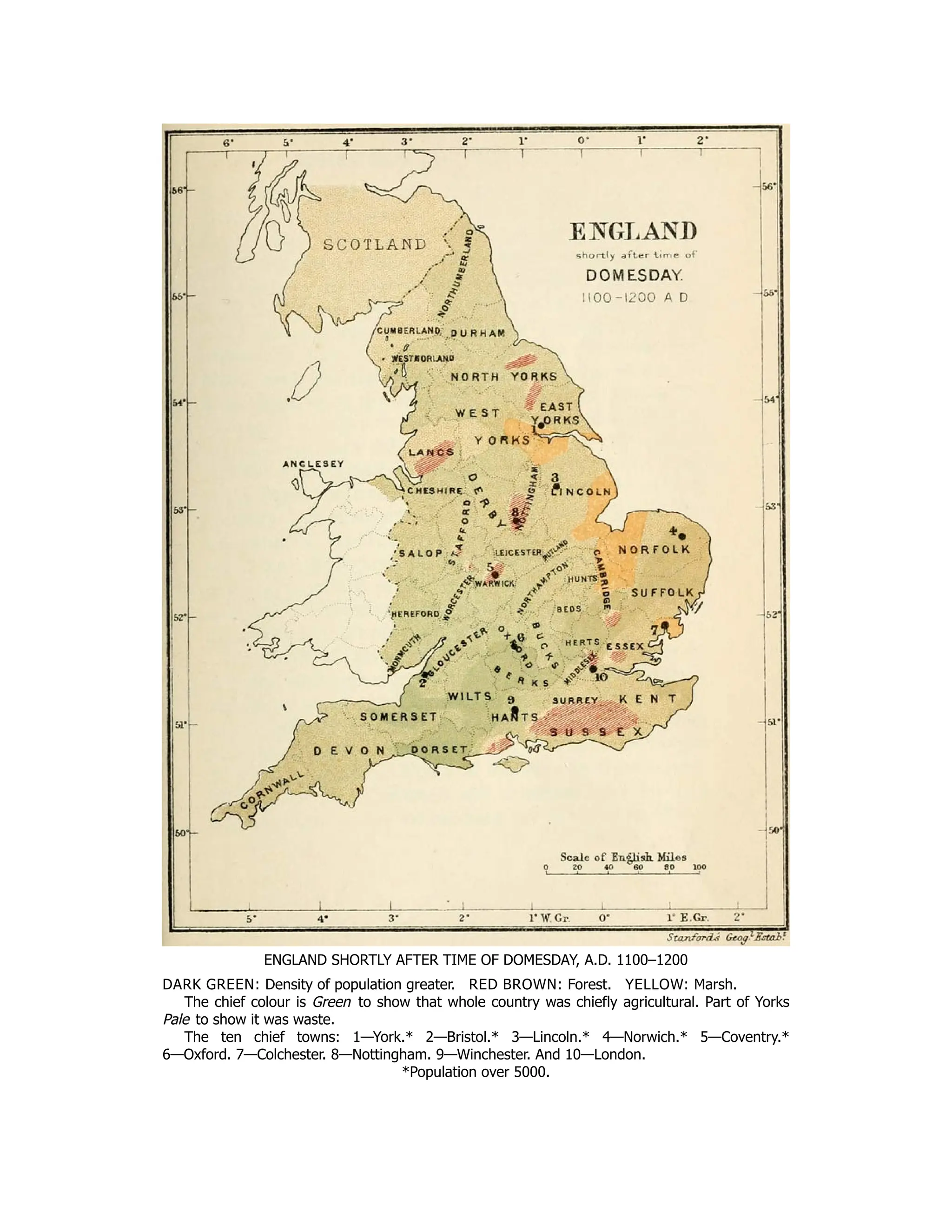
ENGLAND SHORTLY AFTER TIME OF DOMESDAY, A.D. 1100–1200
DARK GREEN: Density of population greater. RED BROWN: Forest. YELLOW: Marsh.
The chief colour is Green to show that whole country was chiefly agricultural. Part of Yorks
Pale to show it was waste.
The ten chief towns: 1—York.* 2—Bristol.* 3—Lincoln.* 4—Norwich.* 5—Coventry.*
6—Oxford. 7—Colchester. 8—Nottingham. 9—Winchester. And 10—London.
*Population over 5000.
§ 7. General condition of the Period
—Speaking generally for the whole period after the Conquest, we
may say that, though the economic condition of England was by no
means unprosperous, industrial development was necessarily slow.
The disputes between Stephen and Maud, and the civil wars of their
partisans, the enormous drain upon the resources of the country
caused by Richard I.’s expenses in carrying on Crusades when he
should have been ruling his kingdom, and the equally enormous
taxes and bribes paid by the worthless John to the Papal See, could
not fail seriously to check national industry. It is no wonder that in
John’s reign, at the beginning of the thirteenth century, we hear of
great discontent throughout all the land, of much misery and
poverty, especially in the towns, and of a general feeling of revolt.
That miserable monarch was only saved from deposition by his
opportune death.
Yet with all these evils the economic condition of England,
although depressed, was by no means absolutely unhealthy; and the
following reign (Henry III., 1216–1272), with its comparative peace
and leisure, afforded, as we shall see, sufficient opportunity to
enable the people to regain a position of general opulence and
prosperity. This time of quiet progress and industrial growth forms a
fitting occasion for the marking out of a new epoch.
PERIOD III
FROM THE THIRTEENTH TO THE END OF THE FIFTEENTH
CENTURY, INCLUDING THE GREAT PLAGUE (1216–1500)
CHAPTER I
AGRICULTURE IN MEDIÆVAL ENGLAND
§ 1. Introductory. Rise of a wage-earning class
—The long reign of Henry III., although occasionally troubled by
internal dissensions among the barons, was upon the whole a
prosperous and peaceful time for the people in general, and more
especially for those whom historians are pleased to call the lower
classes. For by this time a remarkable change had begun to affect
the condition of the serfs or villeins, a change already alluded to
before, by which the villeins became free tenants, subject to a fixed
rent for their holdings. This rent was rapidly becoming a payment in
money and not in labour, for, as we saw, the lords of the manors
were frequently in want of cash, and were ready to sell many of
their privileges. The change was at first gradual, but by the time of
the Great Plague (1348), money rents were becoming the rule rather
than the exception; and though labour rents were not quite
obsolete, it was an ill-advised attempt to extort them again that was
the prime cause of Wat Tyler’s insurrection (1381). Before the
Plague, in fact, villeinage in the old sense had become almost {41}
extinct, and the peasants, both great and small, had achieved
practical freedom. The richer villeins had developed into small
farmers; while the poorer villeins, and especially the cottars, had
formed a separate class of agricultural labourers, not indeed entirely
without land, but depending for their livelihood upon wages paid for
helping to cultivate the land of others. The rise of this class, that
lived by wages and not by tilling their own land, was due to the fact
that cottars and others, not having enough land of their own to
occupy their whole time, were free to hire themselves to those who
had a larger quantity of land. Especially would they become
labourers at a fixed wage for the lord of a manor when he had
commuted his rights to the unpaid services of all his tenants for a
fixed money rent. Of course this change came gradually, but its
effect is seen subsequently in the difficulties as to wages expressed
in the Statute of Labourers, difficulties which first became serious
after the Great Plague.
§ 2. Agriculture the chief occupation of the people
—Throughout the whole of this period the vast majority of the
population were continuously engaged in agricultural pursuits, and
this was rendered necessary owing to the very low rate of
production consequent upon the primitive methods of agriculture.
The production of corn was only about four, or sometimes eight,
bushels per acre, and this naturally had the effect of keeping down
the population, at this time still only between 1,500,000 and
2,000,000. It is a remarkable fact that even the inhabitants of the
towns used at harvest-time to go out into the country to get
agricultural work, and people often migrated from one district to
another for the same purpose, just as Irish agricultural labourers of
to-day are accustomed to cross over to England for the harvesting.
{42} Some attention was being paid to sheep farming, and a
noticeable increase in this branch of industry took place in the
beginning of the fourteenth century. One order of monks in
particular, the Cistercians, used to grow large quantities of wool; and
indeed England had almost a monopoly in the wool trade with
Flanders, for even Spanish wool could not be utilized without an
admixture of English. But the great increase of sheep farming occurs
rather later, at the beginning of the sixteenth century.
§ 3. Methods of cultivation. The capitalist landlord and his
bailiff. The “stock and land” lease
—The agriculture of the early part of this period is described to us by
Walter de Henley, who wrote a book on husbandry some time before
1250. It cannot be said that our agriculture was at this time at a
high level, for, as we have seen, the production of wheat (e.g.) was
exceedingly low, not being more than four to eight bushels per acre.
If we look at a typical manor, we shall find that the arable lands in it
were divided pretty equally between the landlord and the tenants of
the manor; and before the Great Plague the landlord was not merely
a rent-receiving master, but a capitalist land-owner, who cultivated
his land by means of his bailiff, subject to his personal supervision.
These bailiffs kept very accurate accounts, and we are thereby
greatly helped in our investigations in this period. The average rent
paid by tenants from the thirteenth to the sixteenth century was
sixpence per acre. In many cases, especially on lands owned by
monasteries, the land was held on the “stock and land” lease
system, by which the landlord let a certain quantity of stock with the
land, for which the tenant, at the expiration of his lease, had to
account either in money or kind. A relic of this kind of lease {43}
existed even in the eighteenth century, for Arthur Young occasionally
mentions the practice of the landlord letting cows to dairy farmers.
In mediæval times the person to whom cows were leased for dairy
purposes was the deye—i.e. dairyman or dairymaid. The stock and
land lease plan was favourable to the tenant, for it supplied his
preliminary want of capital, and if he was fortunate allowed him
often to make considerable profits, and even eventually purchase an
estate for himself.
§ 4. The tenant’s communal land and closes
—It must always be remembered, however, that the arable land in a
manor was “communal”—i.e. each tenant held a certain number of
furrows or strips in a common field, the separate divisions being
merely marked by a piece of unploughed land, where the grass was
allowed to grow. The ownership of these several strips was limited
to certain months of the year, generally from Lady Day to
Michaelmas, and for the remainder of the year the land was
common pasture. This simple and rudimentary system was utterly
unsuited to any advanced agriculture. The tenants, however, also
possessed “closes,” some for corn, others for pasture and hay. The
rent of a close was always higher than that of communal land, being
eightpence instead of sixpence per acre. Besides the communal
arable land, and his close, the husbandman also had access to two
or three kinds of common or pasture—(1) a common close for oxen,
kine, or other stock, pasture in which is stinted both for landlord and
tenant; (2) the open (“champaign” or “champion”) country, where
the cattle go daily before the herdsmen; (3) the lord’s out-woods,
moors, and heaths, where the tenants are stinted but the lord is not.
Thus the tenant had valuable pasture rights, besides the land he
actually rented. But the system of holding arable land in strips {44}
was very cumbrous and caused many disputes, since often a tenant
would hold a short lease on one strip and a longer lease on another;
or confusion of ownership would arise; while in many ways tenure
was made insecure, and no encouragement was given to advanced
agriculture.
§ 5. Ploughing
—As regards the cultivation of the land, it was generally ploughed
three times a year. Ordinary ploughing took place in the autumn, the
second ploughing in April, the third at midsummer. The furrows
were, according to Walter de Henley, a foot apart, and the plough
was not to go more than two fingers deep. The ploughing and much
other work was done by oxen, as being cheaper than horses. The
hoeing was undertaken by women, who also worked at harvest-time
in the fields. In Peres the Plowman’s Crede (about A.D. 1394) we
have a description of a small farmer ploughing while his wife leads
the oxen. “His wife walked by him with a long goad, in a cutted cote
cutted full high” (l. 433).
An average yield of six bushels per acre is what Walter de Henley
thinks necessary to secure profitable farming.
§ 6. Stock, Pigs and Poultry
—As to stock, the amount kept was generally rather large, and the
agriculturist of the thirteenth century was fully alive to the
importance of keeping it; for Walter de Henley advised stocking land
to the full extent it would bear. Oxen, as we saw, were kept for the
plough and draft; but not much stock was fatted for the table,
especially as it could not be kept in the winter. There was no attempt
to improve breeds of cattle, for the scarcity of winter food (winter
roots being unknown till much later), and the general want of means
for resisting the severities of the winter helped to keep all breeds
much upon the same level. On the other hand, {45} swine were kept
in large numbers, and every peasant had his pig in his sty, and,
indeed, probably lived on salt pork most of the winter. Care was
taken with the different breeds. The whole of the parish swine were
generally put in summer under the charge of one swineherd, who
was paid both by tenants and the lord of the manor. The keeping of
poultry, too, was at that time universal, so much so that they were
very rarely bought by anyone, and when sold were almost absurdly
cheap. This habit of keeping fowls, ducks, and geese must have
materially helped the peasant in ekeing out his wages, or in paying
that portion of his rent which was paid in kind; as e.g. in the case of
the Cuxham tenant (p. 15) who had to pay his lord six fowls in all
during the year.
§ 7. Sheep
—This animal is so important in English agriculture that we must
devote a special paragraph to it alone. For the sheep was, in the
earlier periods of English industrial history, the mainstay of the
British farmer, chiefly, of course, owing to the quantity of wool
required for export. England had, up to a comparatively recent
period, almost a monopoly of the raw wool trade, her only rival
being Spain. There were, as mentioned before, a great number of
breeds of sheep, and much care was taken to improve them. The
fleece however was light, being only as an average 1 lb. 7⁠
¾ oz.,
according to Professor Rogers, and the animal was small. The reason
of this was that the attempts of the husbandman to improve his
breeds were baffled by the hardships of the mediæval winter, and by
the prevalence of disease, especially the rot and scab. It is probable
that the average loss on the flocks was 20 per cent. a year. They
were generally kept under cover from November to April, and fed on
coarse hay, wheat, and oat straw, {46} or pea and vetch haulm; but
no winter roots were available.
§ 8. Increase of sheep farming
—A great increase of sheep farming took place after the Great
Plague (1348), and this from two causes. The rapid increase of
woollen manufactures promoted by Edward III. rendered wool
growing more profitable, while at the same time the scarcity of
labour, occasioned by the ravages of the Black Death, and the
consequently higher wages demanded, naturally attracted the
farmer to an industry which was at once very profitable, and
required but little paid labour. So, after the Plague, we find a
tendency among large agriculturists to turn ploughed fields into
permanent pasture, or, at any rate, to use the same land for pasture
and for crops, instead of turning portions of the “waste” into arable
land. Consequently from the beginning of the fifteenth century we
notice that the agricultural population decreases in proportion as
sheep farming increases; and the steady change may be traced in
numerous preventive statutes till we come (in 1536) to those of
Henry VIII. about decayed towns, especially in the Midlands and the
Isle of Wight, culminating in the excitements of 1549. Another cause
that, in Henry VIII.’s time, had a distinct influence in promoting
sheep farming, was the lack of capital that made itself felt, owing to
the general impoverishment of England in his wasteful reign, and
which naturally turned farmers to an industry that required little
capital, but gave quick returns.
§ 9. Consequent increase of enclosures
—One consequence of this more extensive sheep farming was the
great increase in enclosures made by the landlords in the sixteenth
century. So great were these encroachments and enclosures in
north-east Norfolk, that they led, in 1549, {47} to a rebellion against
the enclosing system, headed by Ket; but, though more marked,
perhaps, in Henry VIII.’s reign, the practice of sheep farming had
been growing steadily in the previous century. Fortescue, the Lord
Chancellor of Henry VI. (in the middle of the fifteenth century),
refers to its growth and the prosperity it caused in rural districts—a
prosperity, however, that must have been confined only to the great
land-owners. We receive other confirmation of this from various
statutes designed to prevent the rural population from flowing into
the towns, as, for example, the Acts of 1 and 9 Richard II. (1377
and 1385), of 17 Richard II. (1394), promoting the export of corn in
hopes of making arable land more valuable. Another Act was passed
in 1489 (4 Henry VII.) to keep the rural population from the towns.
But the growth of sheep farming is also connected with a great
economic and industrial development in England, the rise and
progress of cloth manufactures and of the weaving industry
generally, and to this we must now devote our next chapter.
CHAPTER II
THE WOOLLEN TRADE AND MANUFACTURES
§ 1. England’s monopoly of wool
—In the Middle Ages England was the only wool-producing country
in the North of Europe. Spain grew wool also, but it could not be
used alone for every kind of fabric, and besides it was more difficult
to transport wool from Spain to Flanders, the seat of the
manufacture of that article, than it was to send it across the narrow
German Ocean, where swarms of light craft plied constantly between
Flanders and the {48} eastern ports of England. Hence England had a
practical monopoly of the wool trade, which was due not only to its
favourable climate and soil, but also to the fact that even at the
worst periods of civil war—and they did not last for long—our island
was incomparably more peaceful than the countries of Western
Europe. From the thirteenth to the seventeenth century, the farmers
of Western Europe could not possibly have kept sheep, the most
defenceless and tender of domestic animals, amid the wars that
were continually devastating their homesteads; nor, as a matter of
fact, did they do so. But in England, especially after the twelfth
century, nearly everybody in the realm, from the king to the villein,
was concerned in agriculture, and was interested therefore in
maintaining peace. Even when the great landlords, after the Plague
of 1348, gave up the cultivation of their arable land, they went in, as
we saw, for sheep farming, and enclosed large tracts of land for that
purpose. Hence the export trade in wool became more and more
important, and there was always a continual demand for English
wool to supply the busy looms of the great manufacturing towns in
Flanders.
§ 2. Wool and Politics
—The most convincing proof of the importance of the wool trade is
seen in England’s diplomatic relations with Flanders, which, by the
way, afford an interesting example of the necessity of taking
economic factors into account in dealing with national history.
Flanders was the great manufacturing country of Europe at that
time. England supplied its raw material in vast quantities, and nine-
tenths of English wool went to the looms of Bruges and Ghent. A
stoppage of this export from England used to throw half the
population of the Flemish towns out of work. The immense
transactions that even then took place, are {49} seen from the fact
that a single company of Florentine merchants would contract with
the Cistercian monks of England for the whole year’s supply of the
wool produced on their vast sheep-ranges on the Yorkshire
moorlands; for the Cistercian order were among the foremost wool-
growers in the country. Now, it is a curious and significant fact that
when Edward I., Edward III., and Henry V. premeditated an attack
on France, they generally took care to gain the friendship of Flanders
first,
18
so as to use that country as a base from which to enter
France, or at least as a useful ally; and secondly, they paid a large
proportion of the expenses of their French expeditions by means of
a wool-tax in England. Thus, when Edward III. opened his campaign
against France in 1340, he did so from Flanders, with special help
afforded by a Flemish alliance. This king also received annually
£60,000 from the wool-tax alone, and on special occasions even
more. Again, it was a grant of 6s. 8d. on each sack of wool
exported that enabled Edward I. in 1275 to fill his treasury for his
subsequent invasion of Wales. The same king in 1297 got the means
for equipping an expedition against France, via Flanders, in the
same way. Similarly Henry V. took care to cultivate the friendship of
the Flemish and their rulers before setting out to gain the French
crown, and paid for his expedition by raising taxes on wool and
hides. The enormous revenues also which from the thirteenth to the
fifteenth century were exacted from England by the Papal Court, and
Welcome to our website – the perfect destination for book lovers and
knowledge seekers. We believe that every book holds a new world,
offering opportunities for learning, discovery, and personal growth.
That’s why we are dedicated to bringing you a diverse collection of
books, ranging from classic literature and specialized publications to
self-development guides and children's books.
More than just a book-buying platform, we strive to be a bridge
connecting you with timeless cultural and intellectual values. With an
elegant, user-friendly interface and a smart search system, you can
quickly find the books that best suit your interests. Additionally,
our special promotions and home delivery services help you save time
and fully enjoy the joy of reading.
Join us on a journey of knowledge exploration, passion nurturing, and
personal growth every day!
testbankdeal.com

Beginnings and Beyond Foundations in Early Childhood Education 9th Edition Gordon Solutions Manual

  • 1.
    Beginnings and BeyondFoundations in Early Childhood Education 9th Edition Gordon Solutions Manual download https://testbankdeal.com/product/beginnings-and-beyond- foundations-in-early-childhood-education-9th-edition-gordon- solutions-manual/ Explore and download more test bank or solution manual at testbankdeal.com
  • 2.
    We have selectedsome products that you may be interested in Click the link to download now or visit testbankdeal.com for more options!. Beginnings and Beyond Foundations in Early Childhood Education 9th Edition Gordon Test Bank https://testbankdeal.com/product/beginnings-and-beyond-foundations-in- early-childhood-education-9th-edition-gordon-test-bank/ Foundations of Early Childhood Education Teaching Children in a Diverse Society 6th Edition Gonzalez Test Bank https://testbankdeal.com/product/foundations-of-early-childhood- education-teaching-children-in-a-diverse-society-6th-edition-gonzalez- test-bank/ Effective Practices in Early Childhood Education Building a Foundation 2nd Edition Bredekamp Test Bank https://testbankdeal.com/product/effective-practices-in-early- childhood-education-building-a-foundation-2nd-edition-bredekamp-test- bank/ Introduction to Intercultural Communication 8th Edition Jandt Test Bank https://testbankdeal.com/product/introduction-to-intercultural- communication-8th-edition-jandt-test-bank/
  • 3.
    Developmental Mathematics BasicMathematics and Algebra 4th Edition Lial Test Bank https://testbankdeal.com/product/developmental-mathematics-basic- mathematics-and-algebra-4th-edition-lial-test-bank/ Contemporary Business Mathematics Canadian 11th Edition Hummelbrunner Solutions Manual https://testbankdeal.com/product/contemporary-business-mathematics- canadian-11th-edition-hummelbrunner-solutions-manual/ Marketing 1st Edition Hunt Test Bank https://testbankdeal.com/product/marketing-1st-edition-hunt-test-bank/ Environment The Science Behind the Stories Second Canadian Edition with MyEnvironmentPlace Canadian 2nd Edition Withgott Solutions Manual https://testbankdeal.com/product/environment-the-science-behind-the- stories-second-canadian-edition-with-myenvironmentplace-canadian-2nd- edition-withgott-solutions-manual/ Doing Ethics Moral Reasoning and Contemporary Issues 2nd Edition Vaughn Test Bank https://testbankdeal.com/product/doing-ethics-moral-reasoning-and- contemporary-issues-2nd-edition-vaughn-test-bank/
  • 4.
    Chemistry 7th EditionMcMurry Solutions Manual https://testbankdeal.com/product/chemistry-7th-edition-mcmurry- solutions-manual/
  • 5.
    © 2014 CengageLearning. All rights reserved. 37 CHAPTER 8 FAMILIES AND TEACHERS: PARTNERS IN EDUCATION Overview In this chapter, the student is helped to recognize an awareness of the vital partnership that must exist between home and school if children are to succeed. A sensitivity to what parents’ contributions are and suggestions for making a school or classroom “parent friendly” are discussed. The collaborative effort families and teachers can establish is part of a movement toward more support for families as they struggle to raise their children. The links between and among the children, family, and community are the basis for a more family-centered approach as a way to enhance the family’s contribution to their children’s education. Changing demographics challenge teachers to a new level of multicultural awareness and perspective. The unique needs of special family populations, such as single and immigrant parents and families of children with special needs, are also discussed. Family conference guidelines, parent-child separation techniques, and communication links give the student practical suggestions for successful family-teacher relationships. Outline I. Promoting Strong and Effective Partnerships A. Historical Overview B. Strengthening the Partnership 1. What Families Contribute to the Partnership a. How Families Benefit b. Family Cultural Influences 2. What Teachers Contribute to the Partnership 3. What Children Gain C. Becoming Full and Equal Partners 1. Public Recognition II. The Complexity of Today’s Families A. Understanding Parenthood 1. Patterns of Child Rearing 2. Stages of Parent Development B. Families with Diverse Needs 1. Supporting Single Parent Families C. Valuing Family Culture III. Enhancing Communication to Support Learning A. Education and Involvement B. Strategies for Keeping in Touch C. The Separation Process: Learning to Trust One Another D. Parent/Family-Teacher Conferences E. Maintaining Privacy and Confidentiality IV. End of Chapter Materials A. Summary B. Key Terms C. Review Questions D. Observe and Apply E. Helpful Web Sites F. References Key Terms precedent pedagogista separation process charter school magnet school family-centered approach
  • 6.
    © 2014 CengageLearning. All rights reserved. 38 Objectives • Identify strategies that promote strong partnerships and effective relationships between families and schools and examine the importance of such collaborations • Understand and value the complexity of today’s families and demonstrate skills necessary to collaborate with diverse family situations • Demonstrate effective strategies that enhance communication between teachers and families through the separation process and family/teacher conferences Teaching Tips and Lecture Ideas This is an excellent chapter for involving parents: a panel of parents to discuss issues students would like to have addressed from a parent’s point of view (discipline, living with children on a 24-hour basis, relationships with teachers, schools). The instructor and a parent might want to hold a model parent-teacher conference. Students would enjoy role-playing the participants in a parent-teacher conference. Students will become involved if the instructor encourages them to reflect on their own upbringing—how their own parents were involved and what their attitudes were toward children, child-rearing responsibilities, teachers, school administrators, curriculum. There is an obvious link to the sections in Chapter 15 on crises in children’s lives, on families, and on diversity. The instructor may want to assign readings from the chapter as some of the issues that parents face emerge through class discussion. Discussion questions might include the following: • Is the separation process culturally appropriate for all families? For what cultural groups should it be adjusted? Why? • What changes in American demographics are evident in the classrooms in which these students observe or teach? What parents with unique needs are represented in these classes? How are their needs addressed? Local bookstores abound with information and guidance geared to families. Ask students to browse through and report back on the current state of parent education and the popular press. Suggest they list what they find as the current topics of particular interest in these publications. Ask them to define the issues, the approaches, the age levels being targeted, and their impression of the depth of coverage. Ask students to purchase a recent copy of Parents Magazine or Parenting and do the same. Have them compare the quality of articles among these resources. Ask students to attend a local PTA (PTO) meeting at a public school. Have them report back on attendance and participation. Was there a difference in attendance if there was food involved, if there was a school performance, if it was school function (like a carnival)? Why do you suppose more parents came then than would otherwise? Have students interview their own parents/guardians about the times they went to school to meet with the student’s teachers. Was it only once a year for parent-teacher conferences? Did they volunteer any other time? What was their reasoning behind being actively on inactively involved with the school?
  • 7.
    © 2014 CengageLearning. All rights reserved. 39 Answers to Review Questions in Text 1. Following are three ways to encourage school/family to partnerships: a) Ask them to visit the classroom and participate in a class activity. This may be a sewing, cooking, or art project or sharing a cultural event. b) Take field trips to parents’ workplaces, especially if a number of parents cannot accompany the class on field trips. c) Set up a home repair shop program in which materials that need repair are sent to parents who could not otherwise participate. Toys, books, and games could be repaired this way, involving both parents as well as other members of the family. Advantages of parent participation: For children: makes a bridge between home and school brings more resources to the classroom shows their parents are interested in them research indicates academic gain for children whose parents participate makes them feel important when someone from their family participates For families: firsthand opportunity to see how their child behaves in a group setting can learn guidance and behavior strategies from teachers as they handle problem situations meet other parents with similar interests and needs For teachers: an extra pair of hands resources (skills and talent) not otherwise available another avenue toward understanding the child, the family, and their culture Disadvantages: The number of working parents makes participation in the classroom difficult. Both teachers and families need to explore nontraditional ways to interact and communicate with one another in light of the current trend of working mothers and single-parent families. For teachers, this may mean extra time allotted to ensure these contacts are made. 2. Family includes foster parents, and adoptive parents, grandparents, aunts and uncles, siblings, may be the parental figures in a household. Two people can be defined as a family. A school/home partnership can be supported through: a) Careful planning: written school policies outline the procedure; home visit set up before child enters school; family member and child are prepared ahead of time for what will happen and in what general time frame. b) Close communication: teacher helps family member as well as child by taking the lead and acting with conviction, both understanding that this is a gradual process about which they will communicate regularly. c) Sensitivity to one another: teacher reassures family child is acting normally and helps them relax by seeing this as common behavior; parents encourage child’s participating in class by asking questions and being interested in the classroom activity; includes cultural sensitivity to family-member–child relationship. 3. When families are involved with their child’s school, the child feels more at home and secure in the environment. Five effective ways to communicate with families are classroom newsletters, bulletin boards, a parent family place, informal contacts, and home visits.
  • 8.
    © 2014 CengageLearning. All rights reserved. 40 Recommended Resources Films/Videos Helping Parents with Decision Making in Day Care. Pacific Oaks College, 714 W. California Boulevard, Pasadena, CA 91105. Six filmstrips that help parents answer questions about themselves, their children, and their care. Involving Families in Active Learning Settings. High/Scope Press, Ypsilanti, MI. Video showing how each family’s experiences and culture can be welcomed in an early childhood program. 23 minutes. Mister Rogers Talks with Parents. NAEYC video in which Mister Rogers explores some of the pressures on children today. Partnerships with Parents. NAEYC video. Other Resources Diffily, D., & Morrison, K. (Eds.). (1996). Family-friendly communication for early childhood programs. Washington, DC: NAEYC. Web Sources U.S. Bureau of the Census http://www.census.gov Children’s Defense Fund http://www.childrensdefense.org American Association for Single People http://www.singlesrights.com National Association for the Education of Young Children http://www.naeyc.org Center for Immigration Studies http://www.cis.org National Parent Information Network http://www.npin.org Culturally & Linguistically Appropriate Services http://www.clas.uiuc.edu Zero to Three http://www.zerotothree.org Parent Soup http://parenting.ivillage.com/ KidSource™ Online http://www.kidsource.com The Fred Rogers Company http://www.fci.org/index.asp?
  • 9.
    Other documents randomlyhave different content
  • 10.
    —To make clearwhat I have said in this chapter, it will perhaps be well to give two illustrations drawn from the Domesday Book (eleventh century) and from bailiffs’ accounts of a later period (end of thirteenth century). First we will take a manor in Warwickshire in the Domesday Survey (1089)—Estone, now Aston, near Birmingham. It was one of a number belonging to William, the son of Ansculf, who was tenant in chief, but had let it to one Godmund, a sub-tenant in mesne. The Survey runs: “William Fitz-Ansculf holds of the King Estone, and Godmund of him. There are 8 hides. 11 The arable employs 20 ploughs; in the demesne the arable employs 6 ploughs, but now there are no ploughs. There are 30 villeins with a priest, and 1 bondsman, and 12 bordars [i.e. cottars]. They have 18 ploughs. A mill pays 3 {17} shillings. The woodland is 3 miles long and half a mile broad. It was worth £4; now 100 shillings.” 11 A hide varied in size, and was (after the Conquest) equal to a carucate, which might be anything from 80 to 120 or 180 acres. Perhaps 120 is a fair average, though some say 80. Here we have a good example of a manor held by a sub-tenant, and containing all the three classes mentioned in § 4 of this chapter —villeins, cottars, and slaves (i.e. bondsmen). The whole manor must have been about 5000 acres, of which 1000 were probably arable land, which was of course parcelled out in strips among the villeins, the lord, and the priest. As there were only 18 ploughs among 30 villeins, it is evident some of them at least had to use a plough and oxen in common. The demesne land does not seem to have been well cultivated by Godmund the lord, for there were no ploughs on it, though it was large enough to employ six. Perhaps Godmund, being an Englishman, had been fighting the Normans in the days of Harold, and had let it go out of cultivation, or perhaps the former owner had died in the war, and Godmund had rented the land from the Norman noble to whom William gave it.
  • 11.
    § 10. CuxhamManor in the eleventh and thirteenth centuries —Our second illustration can be described at two periods of its existence—at the time of Domesday and 200 years later. It was only a small manor of some 490 acres, and was held by a sub-tenant from a Norman tenant in chief, Milo Crispin. It is found in the Oxfordshire Domesday, in the list of lands belonging to Milo Crispin. The Survey says: “Alured [the sub-tenant] now holds 5 hides for a manor in Cuxham. Land to 4 ploughs; now in the demesne, 2 ploughs and 4 bondsmen. And 7 villeins with 4 bordars have 3 ploughs. There are 3 mills of 18 shillings; and 18 acres of meadow. It was worth £3, now £6.” Here, again, our three classes of villeins, cottars or bordars, and slaves are represented. The manor was evidently a good one, for though smaller than Estone it {18} was worth more, and has three mills and good meadow land as well. Now, by the end of the thirteenth century this manor had passed into the hands of Merton College, Oxford, which then represented the lord, but farmed it by means of a bailiff. Professor Thorold Rogers gives us a description of it, 12 drawn from the annual accounts of this bailiff, which he has examined along with a number of others from other manors. We find one or two changes have taken place, for the bondsmen have entirely disappeared, as indeed they did in less than a century after the Conquest all through the land. The number of villeins and bordars has increased. There are now 13 villeins and 8 cottars, and 1 free tenant. There is also a prior, who holds land (6 acres) in the manor but does not live in it; also two other tenants, who do not live in the manor, but hold “a quarter of a knight’s fee” (here some 40 or 50 acres)—a knight’s fee comprising an area of land varying from 2 hides to 4 or even 6 hides, but in any case worth some £20. As the Cuxham land was good, the quantity necessary for the valuation of a fee would probably be only the small hide or carucate of 80 acres, and the quarter of it of course 20 acres or a little more. The 13 serfs hold 170 acres, but the 8 cottars only
  • 12.
    30 acres, includingtheir tenements. The free tenant holds 12⁠ ¾ acres, and Merton College as lord of the manor some 240 acres of demesne. There are now two mills instead of three, one belonging to the prior, and the other to another tenant. There were altogether, counting the families of the villeins and cottars, but not the two tenants of military fees, about 60 or 70 inhabitants, the most important being the college bailiff and the miller. 12 In his Six Centuries of Work and Wages. § 11. Description of a manor village —Now in both these country manors, as in all others, the central feature {19} would be the dwelling of the lord, or manor-house. It was substantially built, and served as a court-house for the annual sittings of the court baron and court leet. 13 If the lord did not live in it, his bailiff did so, and then the lord would come once or twice a year to hold these courts. Near the manor-house generally stood the church, often large for the size of the village, because the nave was frequently used as a town-hall for meetings or for markets. Then there would be the house of the priest, possibly in the demesne; and after these two the most important building was the mill, which, if there was a stream, would be placed on its banks in order to use the water-power. The rest of the tenants generally inhabited the principal street or road of the village, near the stream, if one ran through the place. The houses of these villages were poor and dirty, not always made of stone, and never (till the fifteenth century) of brick, but built of posts wattled and plastered with clay or mud, with an upper storey of poles reached by a ladder. The articles of furniture would be very coarse and few, being necessarily of home manufacture; a few rafters or poles overhead, a bacon-rack, and agricultural tools being the most conspicuous objects. Chimneys were unknown, except in the manor-houses, and so too were windows, and the floor was of bare earth. Outside the door was the “mixen,” a collection of every kind of manure and refuse, which must
  • 13.
    have rendered thevillage street alike unsavoury, unsightly and unwholesome. But though their life was rude and rough, it seems that the villagers were fairly happy, and, considering all things, about as well off as are their descendants now. 13 See note 4. p. 243, on Manorial Courts. § 12. The kinds of land in a manor —Before concluding this chapter, it is necessary, in order to complete our {20} sketch of the manorial system from the time of the Conquest onwards, to understand how the land was divided up. We may say that there were seven kinds of land altogether, (1) First came the lord’s land round about the manor-house, the demesne land, which was strictly his own, and generally cultivated by himself or his bailiff. All other land held by tenants was called land in villeinage. (2) Next came the arable land of the village held by the tenants in common fields. Now these fields were all divided up into many strips, and tenants held their strips generally in quite different places, all mixed up anyhow (cf. diagram, where the tenants are marked A, B. C, etc.). The lord and the parson might also have a few strips in these fields. There were at least three fields, in order to allow the rotation of crops mentioned before (p. 8). Each tenant held his strip only till harvest, after which all fences and divisions were taken away, and the cattle turned out to feed on the stubble. (3) Thirdly came the common pasture, for all the tenants. But each tenant was restricted or stinted in the number of cattle that he might pasture, lest he should put on too many, and thus not leave enough food for his neighbours’ cattle. Sometimes, however, we find pasture without stint, as in Port Meadow at Oxford to this day. (4) Then comes the forest or woodland, as in Estone, which belonged to the lord, who owned all the timber. But the tenants had rights, such as the right of lopping and topping certain trees, collecting fallen branches for fuel; and the right of “pannage”—i.e. of turning cattle, especially swine, into the woods to pick up what food they could. (5) There was also
  • 14.
    in most manorswhat is called the waste—i.e. uncultivated—land, affording rough pasture, and on which the tenants had the right of cutting turf and bracken for fuel and fodder. Then near the stream there would {21}
  • 15.
    DIAGRAM OF AMANOR THE KING (supreme landlord) TENANT IN CHIEF, owning various manors. A SUB-TENANT, or tenant in mesne, the lord of the manor below.
  • 16.
    perhaps be some(6) Meadow land, as at Cuxham; but this always belonged to the lord, and if he let it out, he always charged an extra rent (say eightpence instead of sixpence an acre), for it was very valuable as affording a good supply of hay for the winter. Lastly, if the tenant could afford it, and wanted to have other land besides the common fields, where he could let his cattle lie, or to cultivate the ground more carefully, he could occupy (7) a close, or a portion of land specially marked off and let separately. The lord always had a close on his demesne, and the chief tenants would generally have one or two as well. The close land was of course rented more highly than land in the common fields. The accompanying diagram shows a typical manor, held by a sub-tenant from a tenant in chief, who holds it of the king. It contains all the different kinds of land, though of course they did not always exist all in one manor. It also shows the manor-house, church, mill and village. 14 14 See note 5, p. 244, on Decay of Manorial System.
  • 17.
    CHAPTER II THE TOWNSAND THE GILDS § 1. The origin of towns —As in the case of the manor, which was the Norman name for the Saxon “townships,” the town, in the modern sense of the word, had its origin from the primitive settlement known as the mark (p. 6). The only difference between a town and a manor originally lay in the number of its population, and in the fact that the town was a more defensible place than the {23} “township,” or rural manor, probably having a mound or moat surrounding it, instead of the hedges which ran round the villages. In itself it was merely a manor or group of manors; as Professor Freeman puts it, “one part of the district where men lived closer together than elsewhere.” The town had at first a constitution like that of a primitive village in the mark, but its inhabitants had gradually gained certain rights and functions of a special nature. These rights and privileges had been received from the lord of the manor on which the town had grown up; for towns, especially provincial towns, were at first only dependent manors, which gained safety and solidity under the protection of some great noble, prelate, or the king himself, who finally would grant the town thus formed a charter. § 2. Rise of towns in England —Towns first became important in England towards the end of the Saxon period Saxon England had never been a settlement of towns, but of villages and townships, or manors. But gradually towns did grow up, though differing widely in the circumstances and manner of their rise. Some grew up in the fortified camps of the invaders themselves, as being in a secure position; some arose from a later occupation of the once sacked and deserted Roman towns. Many grew silently in the shadow of a great abbey or monastery. Of this
  • 18.
    class was Oxford,which first came into being round the monasteries of St Frideswide and Osney. Others clustered round the country houses of some Saxon king or earl. Several important boroughs owed their rise to the convenience of their site as a port or a trading centre. This was the origin of the growth of Bristol, whose rise resulted directly from trade; and London of course had always been a port of high commercial rank. A few other towns, like Scarborough and Grimsby, were at first {24} small havens for fishermen. But all the English towns were far less flourishing before the arrival of the Normans than they afterwards became. § 3. Towns in Domesday: London —If, now, we once more go back to our great authority, the survey made by William the Norman, we find that the status of these towns or boroughs is clearly recognized, though they are regarded as held by the lord of the manor “in demesne,” or in default of a lord, as part of the king’s demesne. Thus Northampton at that time was a town in the king’s demesne; Beverley was held in demesne by the Archbishop of York. It was possible, too, that one town might belong to several lords, because it spread over, or was an aggregate of, several manors or townships. Thus Leicester seems to have included four manors, which were thus held in demesne by four lords—one by the king, another by the Bishop of Lincoln, another by a noble, Simon de Senlis, and the fourth by Ivo of Grantmesnil, the sheriff. In later times it was held under one lord, Count Robert of Meulan. Now, in the Domesday Book there is mention made of forty-one provincial cities or boroughs, most of them being the county towns of the present day. There are also ten fortified towns of greater importance than the others. They are Canterbury, York, Nottingham, Oxford, Hereford, Leicester, Lincoln, Stafford, Chester, and Colchester. London was a town apart, as it had always been, and was the only town which had a civic constitution, being regulated by a port-reeve and a bishop, and having a kind of charter, though afterwards the privileges of this charter were much increased.
  • 19.
    London was ofcourse a great port and trading centre, and had many foreign merchants in it. It was then, as well as in subsequent centuries, the centre of English national life, and {25} the voice of its citizens counted for something in national affairs. The other great ports of England at that time were Bristol, Southampton, and Norwich, and as trade grew and prospered, many other ports rose into prominence (see p. 64). § 4. Special privileges of towns —Even at the time of the Conquest most towns, though small, were of sufficient importance to have a certain status of their own, with definite privileges. The most important of these was the right of composition for taxation, i.e. the right of paying a fixed sum, or rent, to the Crown, instead of the various tallages, taxes, and imposts that might be required of other places. This fixed sum, or composition, was called the firma burgi, and by the time of the Conquest was nearly always paid in money. Previously it had been paid both in money and kind, for we find Oxford paying to Edward the Confessor six sectaries of honey as well as £20 in coin; while to William the Norman it paid £60 as an inclusive lump sum. By the end of the Norman period all the towns had secured the firma burgi, and the right of assessing it themselves, instead of being assessed by the sheriff; they had the right also of choosing a mayor of their own, instead of the king’s bailiff or reeve. They had, moreover, their own tribunals, a charter for their customs, and special rules of local administration, and, generally speaking, gained entire judicial and commercial freedom. § 5. How the towns obtained their charters —It is interesting to see what circumstances helped forward this emancipation of the towns from the rights possessed by the nobles and the abbeys, or by the king. The chief cause of the readiness of the nobles and kings to grant charters during this period (from the Conquest to Henry III.) was their lack of ready money. Everyone knows {26} how fiercely the nobles fought against each other in
  • 20.
    Stephen’s reign, andhow enthusiastically they rushed to the Crusades under Richard I. They could not indulge their love of fighting, which in their eyes was their main duty, without money to pay for their fatal extravagances in this direction, and to get money they frequently parted with their manorial rights over the towns that had grown up on their estates. Especially was this the case when a noble, or king, was taken prisoner, and wanted the means of his ransom. In this way Portsmouth and Norwich gained their charters by paying part of Richard I.’s ransom (1194). Again, Rye and Winchelsea gained theirs by supplying the same king (in 1191) with two ships for one of his Eastern crusades. Many other instances might be quoted from the cases of nobles who also gave charters when setting out upon these extraordinary religious and sentimental expeditions. Indeed, the Crusades had a very marked influence in this way upon the growth of English towns. Someone had to pay for the wars in which the aristocracy delighted, and it is well to remember the fact that the expenses of all our wars—and they have been both numerous and costly—have been defrayed by the industrial portion of the community. And the glories and cruelties of that savage age of so-called knightly chivalry, which has been idealized and gilded by romancers and history-mongers, with its tournaments and torture-chambers, were paid for by that despised industrial population of the towns and manors which contained the real life and wealth of mediæval England. § 6. The gilds and the towns. Various kinds of gilds —But besides the indirect effect of the Crusades, there was another powerful factor in the growth and emancipation of the towns after the Conquest. I refer to the merchant {27} gilds, which were becoming more and more prominent all through this period, though the height of their power was reached in the fourteenth century. These merchant gilds were one out of four other kinds of gilds, all of which seem to have been similar in origin. The earliest gilds are found in Saxon times, and were very much what we understand by
  • 21.
    clubs. At firstthey were associations of men for more or less religious and charitable purposes, and formed a sort of artificial family, whose members were bound by the bond not of kinship, but of an oath; while the gild-feast, held once a month in the common hall, replaced the family gatherings of kinsfolk. These gilds were found both in towns and manors, but chiefly in the former, where men were brought more closely together. Besides (1) the religious gilds, we find in Saxon times (2) the frith gilds, formed for mutual assistance in case of violence, wrong, or false accusation, or in any legal affairs. But this class of gilds died out after the Conquest. The most important were (3) the merchant gilds mentioned above, which existed certainly in Edward the Confessor’s time, being called in Saxon ceapemanne gilds, and they were recognized at the time of the Conquest, for they are recorded in Domesday here and there as possessing lands. The merchant members of these gilds had various privileges, such as a monopoly of the local trade of a town, and freedom from certain imposts. They had a higher rank than the members of the (4) craft gilds. These last were associations of handicraftsmen, or artisans, and were separate from the merchant gilds, though also of great importance. If a town was large enough, each craft or manufacture had a gild of its own, though in smaller towns members of various crafts would form only one gild. Such gilds were found, too, not only in towns but in country villages, as is known, e.g., in the case of some {28} Norfolk villages, and remains of their halls in villages have been found. Their gild feasts are probably represented to this day in the parish feasts, survivals of ancient custom. § 7. How the Merchant Gilds helped the growth of towns —Now it was only natural that the existence of these powerful associations in the growing boroughs should secure an increasing extent of cohesion and unity among the townsmen. Moreover, the craft and merchant gilds had a very important privilege, which could make many men anxious to join their ranks, namely, that
  • 22.
    membership in agild for a year and a day made a tenant in villeinage a free man, as were all the members of a gild. Thus the gilds included all the free tenants in a town, and in becoming a merchant gild the body of free citizens, who formed the only influential portion of a town, began to enlarge their municipal powers. It became their special endeavour to obtain from the king or from their lord wider commercial privileges, grants of coinage, of holding fairs, and of exemption from tolls. Then they asked for freedom of justice and of self-government; and more especially did the gilds, as representing practically the town, buy up the firma burgi, or fixed tax, and thus became their own assessors, and finally bought a charter, as we have seen, from a king or noble in need of ready money. And so gradually, and by other steps which are not always clear, the emancipation of the towns was won by the gilds; the boroughs became free from their lords’ restrictions and dues; till by the end of the twelfth century chartered towns, which were very few at the time of the Conquest, became the general rule. § 8. How the Craft Gilds helped industry —So far we have specially noted the work of the merchant gilds, which, as it were, built up the constitution and freedom of the towns. {29} We must now look for a moment at the work of the artisans’ gilds, or craft gilds, which afterwards became very important. These gilds are found not only in London, but in provincial towns. The London weavers are mentioned as a craft gild in the time of Henry I. (A.D. 1100), and most of these gilds seemed to have existed already for a long period. The Goldsmiths’ Gild claimed to have possessed land before the Norman Conquest, and it was fairly powerful in the days of Henry II. (A.D. 1154), for he found it convenient to try and suppress it. But it did not receive the public recognition of a charter till the fourteenth century. They arose, of course, first in the towns, and originally seem to have consisted of a small body of the leading men of a particular craft, to whom was confided the regulation of a
  • 23.
    particular industry, probablyas soon as that industry was thought of sufficient importance to be regulated. The gild tried to secure good work on the part of its members, and attempted to suppress the production of wares by irresponsible persons who were not members of the craft. Their fundamental principle was, that a member should work not only for his own private advantage, but for the reputation and good of his trade; hence bad work was punished, and it is curious to note that night-work is prohibited as leading to poor work. The gild took care to secure a supply of competent workmen for the future by training young people in its particular industry, and hence arose the apprentice system, which at first, at any rate, had considerable advantages. The gild, moreover, exercised a moral control over its members, and secured their good behaviour, thus forming an effective branch of the social police. On the other hand, it had many of the characteristics of a benefit {30} society, providing against sickness and death among those belonging to it, as indeed all gilds did. These institutions, however, did not only belong to the towns, but were found in country districts also; thus we hear of the carpenters’ and masons’ rural gilds in the reign of Edward III. Even the peasant labourers, according to Professor Thorold Rogers, possessed these associations, which in all cases served many of the functions of the modern trade unions. Later on (1381) we shall come to a very remarkable instance of the power of these peasants’ unions in the matter of Tyler’s rebellion. § 9. Life in the towns of this time —The inhabitants of the towns were of all classes of society. There was the noble who held the castle, or the abbot and monks in the monastery, with their retainers and personal dependants; there were the busy merchants, active both in the management of their trade and of civic affairs; and there were artisans and master workmen in different crafts. There were free tenants, or tenants in socage, including all the burgesses, or burgage-tenants, as they were called;
  • 24.
    and there wasthe lower class of villeins, which, however, always tended to rise into free men as they were admitted into the gilds. “To and fro went our forefathers in the quiet, quaint, narrow streets, or worked at some handicraft in their houses, or exposed their goods round the market-cross. And in those old streets and houses, in the town-mead and market-place, amid the murmur of the mill beside the stream, and the notes of the bell that sounded its summons to the crowded assembly of the town-mote, in merchant gild and craft gild, was growing up that sturdy, industrial life, unheeded and unnoticed by knight or baron, that silently and surely was building up the slow structure of England’s wealth and freedom.” 15 15 V. Industry in England, p. 96; and Green, History, I. 212.
  • 25.
    CHAPTER III MANUFACTURES ANDTRADE: ELEVENTH TO THIRTEENTH CENTURIES § 1. Economic effects of the Feudal System —We shall find that for some time after the Norman Conquest English industry does not develop very rapidly, and that for obvious reasons. The feud that existed between Norman and Saxon— although perhaps partially allayed by Henry I.’s marriage to an English wife—and the social disorder that accompanied this feeling, hardly tended to that quiet and security that are necessary for a healthy industrial life. The frightful disorders that occurred during the fierce struggle for the kingdom between Stephen of Blois and the Empress Maud, and the equally frightful ravages and extortions of their contending barons, must have been serious drawbacks to any progress. As the old annalist remarks—“They fought among themselves with deadly hatred; they spoiled the fairest lands with fire and rapine; in what had been the most fertile of counties they destroyed almost all the provision of bread.” 16 But this mighty struggle fortunately ended in ruining many of the barons who took part in it, and in the desirable destruction of most of their abodes of plunder. And the accession of Henry II. (1154) marks a period of amalgamation between Englishmen and Normans, not only in social life, but in commercial traffic and intercourse. 16 Quoted by Green; History, I. 155. But even when we come to look at the feudal system in a time of peace, we see that it did not tend to any great growth of industry. For it encouraged rather than diminished that spirit of isolation and self-sufficiency {32} which was so marked a feature of the earlier manors and townships, where, again, little scope was afforded to individual enterprise, from the fact that the consent of the lord of a
  • 26.
    manor or townwas often necessary for the most ordinary purposes of industrial life. It is true, as we have seen, that when the noble owner was in pecuniary difficulties the towns profited thereby to obtain their charters; and perhaps we may not find it altogether a matter for regret that the barons, through their internecine struggles, thus unwittingly helped on the industry of the land. It may be admitted also, that though the isolation of communities consequent upon the prevalent manorial system did not encourage trade and traffic between separate communities, it yet tended to diffuse a knowledge of domestic manufactures throughout the land generally, because each place had largely to provide for itself. The constant taxation, however, entailed by the feudal system in the shape of tallages, aids, and fines, both to king and nobles, made it difficult for the lower classes to accumulate capital, more especially as in the civil wars they were constantly plundered of it openly. The upper classes merely squandered it in fighting. Agriculture suffered similarly; for the villeins, however well off, were bound to the land, especially in the earlier period soon after the Conquest, and before commutation of services for money rents became so common as it did subsequently; nor could they leave their manor without incurring a distinct loss, both of social status and—what is more important—of the means of livelihood. The systems of constant services to the lord of the manor, and of the collective methods of cultivation, were also drawbacks to good agriculture. Again, in trade, prices were settled by authority, competition was unduly checked, {33} and merchants had to pay heavy fines for royal “protection.” § 2. Foreign Trade. The Crusades —But, on the other hand, the Norman Conquest, which combined the Kingdom of England with the Duchy of Normandy in close political relations, gave abundant opportunities for commerce, both with France and the Continent, and foreign trade certainly received a stimulus from this fact. It was further developed by the Crusades.
  • 27.
    The most obviouseffect of these remarkable expeditions for a visionary success was the opening up of Trade Routes throughout Europe to the shores of the Mediterranean Sea, and to the East in general. They produced also a considerable redistribution of wealth in England itself, for the knights and nobles that set out for the Holy Land often mortgaged their lands and never redeemed them, or they perished and their lands lapsed to the crown, or to some monastery that took the place of a trustee for the absent owner. The growth of towns also, as we saw, is directly attributable to the privileges and freedom secured at this time by supplying money to a crusading lord. As to foreign trade, our chief authority at this time is the old chronicler, Henry of Huntingdon, whose history was published about A.D. 1155. Like most historians, even of the present day, he says very little about so insignificant a matter as trade; but the single sentence which he devotes to it is probably of as great value as any other part of his book. From it we gather that our trade with Germany was extensive, and that we exported lead and tin among the metals; fish and meat and fat cattle (which seems to point to some improvement in our pastoral economy); and, most important of all, fine wool, though at that time the English could not weave it properly for themselves. Our imports, however, are very {34} limited, comprising none of the necessities of life, and few of its luxuries beyond silver and foreign furs. Other imports were fine woven cloths, used for the dresses of the nobility; and, after the Crusades began, of rich Eastern stuffs and spices, which were in great demand, and commanded a high price. So too did iron, which was necessary for agricultural purposes, as Englishmen had not yet discovered their rich stores of this metal, but had to get it from the lands on the Baltic shore. Generally speaking, we may say that our imports consisted of articles of greater intrinsic value and scarcity than our exports, and thus were fewer in number, though of course balancing in total value, as imports and exports always must. § 3. The trading clauses in the Great Charter
  • 28.
    —One great proofof the existence of a fair amount of foreign trade is seen in the clauses which were inserted in the Great Charter (1215), by the influence of the trading class. One enactment secures to foreign merchants freedom of journeying and of trade throughout the realm, and another orders a uniformity of weights and measures to be enforced throughout the whole kingdom. The growth of home industry in the towns is seen in the enactment which secures to the towns the enjoyment of their municipal privileges, their freedom from arbitrary taxation, and the regulation of their own trade. The forfeiture of a freeman, even upon conviction of felony, was never to include his wares, if he were a merchant. The exactions of forced labour by the royal officers was also forbidden, and this must have been a great boon to the agricultural population. There is also a clause which endeavours to restrict usury exacted by the Jews, a clause which points to the usual characteristics of the Hebrew race, and which shows their growing importance {35} in economic England. We will therefore briefly mention the facts concerning them at this period. § 4. The Jews in England: their economic position —The first appearance of the Jews in England may practically be reckoned as occurring at the time of the Norman Conquest, for immediately after 1066 they came in large numbers from Rouen, Caen, and other Norman towns. They stood in the peculiar position of being the personal property, or “chattels,” of the king, and a special officer governed their settlements in various towns. These settlements were called Jewries, of which those at London, Lincoln, Bury St Edmund’s, and Oxford were at one time fairly considerable. They were protected by the king, and of course paid him for their protection. Their general financial skill was acknowledged by all, and William II. employed them to farm the revenues of vacant sees, while barons often employed them as stewards of their estates. They were also the leading if not the only capitalists of that time, and must have assisted merchants considerably in their enterprises,
  • 29.
    of course uponthe usual commission. After the death of Henry I. the security which they had enjoyed was much weakened, in proportion as the royal power declined in the civil wars, and in the twelfth and thirteenth centuries they were in a precarious position. Stephen and Matilda openly robbed them; Henry II. (in 1187) demanded one- fourth of their chattels, and Richard I. obtained large sums from them for his crusading extravagances. From 1144 to 1189, riots directed against them became common, and the Jewries of many towns were pillaged. In 1194 Richard I. placed their commercial transactions more thoroughly under local officers of the crown. John exploited them to great advantage, and levied heavy tallages upon them, and Henry III. did very much the same. They were {36} expelled from the kingdom in 1290, and before this had greatly sunk from their previous position as the financiers of the crown, to that of petty money-lenders to the poor at gross usury. What concerns us more immediately to notice in this early period of English history, is their temporary usefulness as capitalists in trading transactions, at a time when capital was not easily accumulated or kept in safety. 17 17 See note 6, p. 244, on their return. § 5. Manufactures in this period: Flemish weavers —We now turn from the subject of trade and finance to that of manufacturing industry. On doing so, we find that the chief industry is that of weaving coarse woollen cloth. An industry so necessary as this, and one too that can be carried on in a simple state of society with such ease, as a domestic manufacture, would naturally always exist, even from the most uncivilized times. This had been the case in England. But it is noticeable that although Henry of Huntingdon mentions the export of “fine wool” as one of the chief English exports, and although England had always been in a specially favourable position for growing wool, her manufacture of it had not developed to any great extent. Nevertheless it was practised as a domestic industry in every rural and urban community, and at this
  • 30.
    period already hadits gilds—a sure sign of growth. Indeed one of the oldest craft gilds was that of the London weavers, of which we find mention in the time of Henry I. (A.D. 1100). And in this reign, too, we first hear of the arrival of Flemish immigrants in this country, who helped largely both then and subsequently in the development of the woollen manufacture. Some Flemings had come over indeed in the days of William the Norman, having been driven from Flanders by an incursion of the sea, and had settled at Carlisle. But Henry I., as we read in {37} Higden’s Chronicle, transferred them to Pembrokeshire in A.D. 1111: “Flandrenses, tempore regis Henrici primi, ad occidentalem Walliæ partem, apud Haverford, sunt translati.” Traces of them remained till a comparatively recent period, and the names of the village of Flemingston, and of the road called the Via Flandrica, running over the crest of the Precelly mountains, afford striking evidence of their settlement there, as also does the name Tucking Mill (i.e. Cloth-making mill, from German and Flemish tuch, “a cloth”). Norfolk also had from early times been the seat of the woollen industry, and had had similar influxes of Flemish weavers. They do not, however, become important till the reign of Edward III., when we shall find that English cloth manufacture begins to develop considerably. In this period, all we can say is that England was more famed for the wool that it grew than for the cloth which it manufactured therefrom, and it had yet to learn most of its improvements from lessons taught by foreigners. § 6. Economic appearance of England in this Period. Population —The England of the Domesday Book was very different from anything which we can now conceive, nor did its industrial condition change much during the next century or two. The population was probably under 2,000,000 in all; for in Domesday Book only 283,342 able-bodied men are enumerated. These multiplied by five, to include women and children, give 1,400,000 of general population, and allowing for omissions we shall find two millions rather over
  • 31.
    than under themark. Nor indeed could the agricultural and industrial state of the country have supported more. This population was chiefly located in the Southern and Eastern counties, for the North of England, and especially Yorkshire, had been laid waste by the Conqueror, in {38} consequence of its revolt in 1068. The whole country between York and the Tees was ravaged, and the famine which ensued is said to have carried off 100,000 victims. Indeed, for half-a-century the land “lay bare of cultivation and of men” for sixty miles northward of York, and for centuries more never fully recovered from this terrible visitation. The Domesday Book records district after district, and manor after manor, in Yorkshire as “waste.” In the East and North-west of England, now the most densely populated parts of the country, all was fen, moorland, and forest, peopled only by wild animals and lawless men. Till the seventeenth century, in fact, Lancashire and the West Riding of Yorkshire were the poorest counties in England. The fens of East Anglia were reclaimed only in 1634. The main ports were London for general trade; Southampton, for the French trade in wines; Norwich for the export wool trade with Flanders, and for imports from the Baltic; and on the west coast Bristol, which had always been the centre for the western trade in Severn salmon and hides. At one time, too, it was the great port for the trade of English slaves who were taken to Ireland, but William the Norman checked that traffic, though it lingered till Henry II. conquered Ireland. For internal trade market towns, or villages as we should call them, were gradually springing up. They were nearly always held in demesne by the lord of the manor, who claimed the tolls, though in after years the town bought them of him. Some of these markets had existed from Saxon times, as is seen by the prefix “Chipping” (=chepinge, A.S. a market), as in Chipping Norton, Chippingham, and Chepstowe; others date from a later period, and are known by the prefix “Market,” as e.g. Market Bosworth. But these market towns were very small, and indeed only some {39} half-dozen towns in the kingdom had a population above
  • 32.
    5000 inhabitants. Thesewere London, York, Bristol, Coventry, Norwich, and Lincoln.
  • 33.
    ENGLAND SHORTLY AFTERTIME OF DOMESDAY, A.D. 1100–1200 DARK GREEN: Density of population greater. RED BROWN: Forest. YELLOW: Marsh. The chief colour is Green to show that whole country was chiefly agricultural. Part of Yorks Pale to show it was waste. The ten chief towns: 1—York.* 2—Bristol.* 3—Lincoln.* 4—Norwich.* 5—Coventry.* 6—Oxford. 7—Colchester. 8—Nottingham. 9—Winchester. And 10—London. *Population over 5000.
  • 34.
    § 7. Generalcondition of the Period —Speaking generally for the whole period after the Conquest, we may say that, though the economic condition of England was by no means unprosperous, industrial development was necessarily slow. The disputes between Stephen and Maud, and the civil wars of their partisans, the enormous drain upon the resources of the country caused by Richard I.’s expenses in carrying on Crusades when he should have been ruling his kingdom, and the equally enormous taxes and bribes paid by the worthless John to the Papal See, could not fail seriously to check national industry. It is no wonder that in John’s reign, at the beginning of the thirteenth century, we hear of great discontent throughout all the land, of much misery and poverty, especially in the towns, and of a general feeling of revolt. That miserable monarch was only saved from deposition by his opportune death. Yet with all these evils the economic condition of England, although depressed, was by no means absolutely unhealthy; and the following reign (Henry III., 1216–1272), with its comparative peace and leisure, afforded, as we shall see, sufficient opportunity to enable the people to regain a position of general opulence and prosperity. This time of quiet progress and industrial growth forms a fitting occasion for the marking out of a new epoch.
  • 35.
    PERIOD III FROM THETHIRTEENTH TO THE END OF THE FIFTEENTH CENTURY, INCLUDING THE GREAT PLAGUE (1216–1500) CHAPTER I AGRICULTURE IN MEDIÆVAL ENGLAND § 1. Introductory. Rise of a wage-earning class —The long reign of Henry III., although occasionally troubled by internal dissensions among the barons, was upon the whole a prosperous and peaceful time for the people in general, and more especially for those whom historians are pleased to call the lower classes. For by this time a remarkable change had begun to affect the condition of the serfs or villeins, a change already alluded to before, by which the villeins became free tenants, subject to a fixed rent for their holdings. This rent was rapidly becoming a payment in money and not in labour, for, as we saw, the lords of the manors were frequently in want of cash, and were ready to sell many of their privileges. The change was at first gradual, but by the time of the Great Plague (1348), money rents were becoming the rule rather than the exception; and though labour rents were not quite obsolete, it was an ill-advised attempt to extort them again that was the prime cause of Wat Tyler’s insurrection (1381). Before the Plague, in fact, villeinage in the old sense had become almost {41} extinct, and the peasants, both great and small, had achieved practical freedom. The richer villeins had developed into small
  • 36.
    farmers; while thepoorer villeins, and especially the cottars, had formed a separate class of agricultural labourers, not indeed entirely without land, but depending for their livelihood upon wages paid for helping to cultivate the land of others. The rise of this class, that lived by wages and not by tilling their own land, was due to the fact that cottars and others, not having enough land of their own to occupy their whole time, were free to hire themselves to those who had a larger quantity of land. Especially would they become labourers at a fixed wage for the lord of a manor when he had commuted his rights to the unpaid services of all his tenants for a fixed money rent. Of course this change came gradually, but its effect is seen subsequently in the difficulties as to wages expressed in the Statute of Labourers, difficulties which first became serious after the Great Plague. § 2. Agriculture the chief occupation of the people —Throughout the whole of this period the vast majority of the population were continuously engaged in agricultural pursuits, and this was rendered necessary owing to the very low rate of production consequent upon the primitive methods of agriculture. The production of corn was only about four, or sometimes eight, bushels per acre, and this naturally had the effect of keeping down the population, at this time still only between 1,500,000 and 2,000,000. It is a remarkable fact that even the inhabitants of the towns used at harvest-time to go out into the country to get agricultural work, and people often migrated from one district to another for the same purpose, just as Irish agricultural labourers of to-day are accustomed to cross over to England for the harvesting. {42} Some attention was being paid to sheep farming, and a noticeable increase in this branch of industry took place in the beginning of the fourteenth century. One order of monks in particular, the Cistercians, used to grow large quantities of wool; and indeed England had almost a monopoly in the wool trade with Flanders, for even Spanish wool could not be utilized without an
  • 37.
    admixture of English.But the great increase of sheep farming occurs rather later, at the beginning of the sixteenth century. § 3. Methods of cultivation. The capitalist landlord and his bailiff. The “stock and land” lease —The agriculture of the early part of this period is described to us by Walter de Henley, who wrote a book on husbandry some time before 1250. It cannot be said that our agriculture was at this time at a high level, for, as we have seen, the production of wheat (e.g.) was exceedingly low, not being more than four to eight bushels per acre. If we look at a typical manor, we shall find that the arable lands in it were divided pretty equally between the landlord and the tenants of the manor; and before the Great Plague the landlord was not merely a rent-receiving master, but a capitalist land-owner, who cultivated his land by means of his bailiff, subject to his personal supervision. These bailiffs kept very accurate accounts, and we are thereby greatly helped in our investigations in this period. The average rent paid by tenants from the thirteenth to the sixteenth century was sixpence per acre. In many cases, especially on lands owned by monasteries, the land was held on the “stock and land” lease system, by which the landlord let a certain quantity of stock with the land, for which the tenant, at the expiration of his lease, had to account either in money or kind. A relic of this kind of lease {43} existed even in the eighteenth century, for Arthur Young occasionally mentions the practice of the landlord letting cows to dairy farmers. In mediæval times the person to whom cows were leased for dairy purposes was the deye—i.e. dairyman or dairymaid. The stock and land lease plan was favourable to the tenant, for it supplied his preliminary want of capital, and if he was fortunate allowed him often to make considerable profits, and even eventually purchase an estate for himself. § 4. The tenant’s communal land and closes —It must always be remembered, however, that the arable land in a manor was “communal”—i.e. each tenant held a certain number of
  • 38.
    furrows or stripsin a common field, the separate divisions being merely marked by a piece of unploughed land, where the grass was allowed to grow. The ownership of these several strips was limited to certain months of the year, generally from Lady Day to Michaelmas, and for the remainder of the year the land was common pasture. This simple and rudimentary system was utterly unsuited to any advanced agriculture. The tenants, however, also possessed “closes,” some for corn, others for pasture and hay. The rent of a close was always higher than that of communal land, being eightpence instead of sixpence per acre. Besides the communal arable land, and his close, the husbandman also had access to two or three kinds of common or pasture—(1) a common close for oxen, kine, or other stock, pasture in which is stinted both for landlord and tenant; (2) the open (“champaign” or “champion”) country, where the cattle go daily before the herdsmen; (3) the lord’s out-woods, moors, and heaths, where the tenants are stinted but the lord is not. Thus the tenant had valuable pasture rights, besides the land he actually rented. But the system of holding arable land in strips {44} was very cumbrous and caused many disputes, since often a tenant would hold a short lease on one strip and a longer lease on another; or confusion of ownership would arise; while in many ways tenure was made insecure, and no encouragement was given to advanced agriculture. § 5. Ploughing —As regards the cultivation of the land, it was generally ploughed three times a year. Ordinary ploughing took place in the autumn, the second ploughing in April, the third at midsummer. The furrows were, according to Walter de Henley, a foot apart, and the plough was not to go more than two fingers deep. The ploughing and much other work was done by oxen, as being cheaper than horses. The hoeing was undertaken by women, who also worked at harvest-time in the fields. In Peres the Plowman’s Crede (about A.D. 1394) we have a description of a small farmer ploughing while his wife leads
  • 39.
    the oxen. “Hiswife walked by him with a long goad, in a cutted cote cutted full high” (l. 433). An average yield of six bushels per acre is what Walter de Henley thinks necessary to secure profitable farming. § 6. Stock, Pigs and Poultry —As to stock, the amount kept was generally rather large, and the agriculturist of the thirteenth century was fully alive to the importance of keeping it; for Walter de Henley advised stocking land to the full extent it would bear. Oxen, as we saw, were kept for the plough and draft; but not much stock was fatted for the table, especially as it could not be kept in the winter. There was no attempt to improve breeds of cattle, for the scarcity of winter food (winter roots being unknown till much later), and the general want of means for resisting the severities of the winter helped to keep all breeds much upon the same level. On the other hand, {45} swine were kept in large numbers, and every peasant had his pig in his sty, and, indeed, probably lived on salt pork most of the winter. Care was taken with the different breeds. The whole of the parish swine were generally put in summer under the charge of one swineherd, who was paid both by tenants and the lord of the manor. The keeping of poultry, too, was at that time universal, so much so that they were very rarely bought by anyone, and when sold were almost absurdly cheap. This habit of keeping fowls, ducks, and geese must have materially helped the peasant in ekeing out his wages, or in paying that portion of his rent which was paid in kind; as e.g. in the case of the Cuxham tenant (p. 15) who had to pay his lord six fowls in all during the year. § 7. Sheep —This animal is so important in English agriculture that we must devote a special paragraph to it alone. For the sheep was, in the earlier periods of English industrial history, the mainstay of the British farmer, chiefly, of course, owing to the quantity of wool required for export. England had, up to a comparatively recent
  • 40.
    period, almost amonopoly of the raw wool trade, her only rival being Spain. There were, as mentioned before, a great number of breeds of sheep, and much care was taken to improve them. The fleece however was light, being only as an average 1 lb. 7⁠ ¾ oz., according to Professor Rogers, and the animal was small. The reason of this was that the attempts of the husbandman to improve his breeds were baffled by the hardships of the mediæval winter, and by the prevalence of disease, especially the rot and scab. It is probable that the average loss on the flocks was 20 per cent. a year. They were generally kept under cover from November to April, and fed on coarse hay, wheat, and oat straw, {46} or pea and vetch haulm; but no winter roots were available. § 8. Increase of sheep farming —A great increase of sheep farming took place after the Great Plague (1348), and this from two causes. The rapid increase of woollen manufactures promoted by Edward III. rendered wool growing more profitable, while at the same time the scarcity of labour, occasioned by the ravages of the Black Death, and the consequently higher wages demanded, naturally attracted the farmer to an industry which was at once very profitable, and required but little paid labour. So, after the Plague, we find a tendency among large agriculturists to turn ploughed fields into permanent pasture, or, at any rate, to use the same land for pasture and for crops, instead of turning portions of the “waste” into arable land. Consequently from the beginning of the fifteenth century we notice that the agricultural population decreases in proportion as sheep farming increases; and the steady change may be traced in numerous preventive statutes till we come (in 1536) to those of Henry VIII. about decayed towns, especially in the Midlands and the Isle of Wight, culminating in the excitements of 1549. Another cause that, in Henry VIII.’s time, had a distinct influence in promoting sheep farming, was the lack of capital that made itself felt, owing to the general impoverishment of England in his wasteful reign, and
  • 41.
    which naturally turnedfarmers to an industry that required little capital, but gave quick returns. § 9. Consequent increase of enclosures —One consequence of this more extensive sheep farming was the great increase in enclosures made by the landlords in the sixteenth century. So great were these encroachments and enclosures in north-east Norfolk, that they led, in 1549, {47} to a rebellion against the enclosing system, headed by Ket; but, though more marked, perhaps, in Henry VIII.’s reign, the practice of sheep farming had been growing steadily in the previous century. Fortescue, the Lord Chancellor of Henry VI. (in the middle of the fifteenth century), refers to its growth and the prosperity it caused in rural districts—a prosperity, however, that must have been confined only to the great land-owners. We receive other confirmation of this from various statutes designed to prevent the rural population from flowing into the towns, as, for example, the Acts of 1 and 9 Richard II. (1377 and 1385), of 17 Richard II. (1394), promoting the export of corn in hopes of making arable land more valuable. Another Act was passed in 1489 (4 Henry VII.) to keep the rural population from the towns. But the growth of sheep farming is also connected with a great economic and industrial development in England, the rise and progress of cloth manufactures and of the weaving industry generally, and to this we must now devote our next chapter.
  • 42.
    CHAPTER II THE WOOLLENTRADE AND MANUFACTURES § 1. England’s monopoly of wool —In the Middle Ages England was the only wool-producing country in the North of Europe. Spain grew wool also, but it could not be used alone for every kind of fabric, and besides it was more difficult to transport wool from Spain to Flanders, the seat of the manufacture of that article, than it was to send it across the narrow German Ocean, where swarms of light craft plied constantly between Flanders and the {48} eastern ports of England. Hence England had a practical monopoly of the wool trade, which was due not only to its favourable climate and soil, but also to the fact that even at the worst periods of civil war—and they did not last for long—our island was incomparably more peaceful than the countries of Western Europe. From the thirteenth to the seventeenth century, the farmers of Western Europe could not possibly have kept sheep, the most defenceless and tender of domestic animals, amid the wars that were continually devastating their homesteads; nor, as a matter of fact, did they do so. But in England, especially after the twelfth century, nearly everybody in the realm, from the king to the villein, was concerned in agriculture, and was interested therefore in maintaining peace. Even when the great landlords, after the Plague of 1348, gave up the cultivation of their arable land, they went in, as we saw, for sheep farming, and enclosed large tracts of land for that purpose. Hence the export trade in wool became more and more important, and there was always a continual demand for English wool to supply the busy looms of the great manufacturing towns in Flanders. § 2. Wool and Politics
  • 43.
    —The most convincingproof of the importance of the wool trade is seen in England’s diplomatic relations with Flanders, which, by the way, afford an interesting example of the necessity of taking economic factors into account in dealing with national history. Flanders was the great manufacturing country of Europe at that time. England supplied its raw material in vast quantities, and nine- tenths of English wool went to the looms of Bruges and Ghent. A stoppage of this export from England used to throw half the population of the Flemish towns out of work. The immense transactions that even then took place, are {49} seen from the fact that a single company of Florentine merchants would contract with the Cistercian monks of England for the whole year’s supply of the wool produced on their vast sheep-ranges on the Yorkshire moorlands; for the Cistercian order were among the foremost wool- growers in the country. Now, it is a curious and significant fact that when Edward I., Edward III., and Henry V. premeditated an attack on France, they generally took care to gain the friendship of Flanders first, 18 so as to use that country as a base from which to enter France, or at least as a useful ally; and secondly, they paid a large proportion of the expenses of their French expeditions by means of a wool-tax in England. Thus, when Edward III. opened his campaign against France in 1340, he did so from Flanders, with special help afforded by a Flemish alliance. This king also received annually £60,000 from the wool-tax alone, and on special occasions even more. Again, it was a grant of 6s. 8d. on each sack of wool exported that enabled Edward I. in 1275 to fill his treasury for his subsequent invasion of Wales. The same king in 1297 got the means for equipping an expedition against France, via Flanders, in the same way. Similarly Henry V. took care to cultivate the friendship of the Flemish and their rulers before setting out to gain the French crown, and paid for his expedition by raising taxes on wool and hides. The enormous revenues also which from the thirteenth to the fifteenth century were exacted from England by the Papal Court, and
  • 44.
    Welcome to ourwebsite – the perfect destination for book lovers and knowledge seekers. We believe that every book holds a new world, offering opportunities for learning, discovery, and personal growth. That’s why we are dedicated to bringing you a diverse collection of books, ranging from classic literature and specialized publications to self-development guides and children's books. More than just a book-buying platform, we strive to be a bridge connecting you with timeless cultural and intellectual values. With an elegant, user-friendly interface and a smart search system, you can quickly find the books that best suit your interests. Additionally, our special promotions and home delivery services help you save time and fully enjoy the joy of reading. Join us on a journey of knowledge exploration, passion nurturing, and personal growth every day! testbankdeal.com