Teaching Strategies to promote the Five Macro Skills
Miss Faith Lanie Lumayag,
MAEd
The Macro skills
T H E M A C R O S K I L L S
INTRODUCTION
Listening, speaking, reading, writing and
viewing are five macro skills in the
language, that one must be able to
develop effectively.
As teachers, especially of young learners,
we are tasked to help our students
develop those macro skills.
Elementary teachers play a crucial role
since they will start the learning procsee
of students. It is expecfted that graduating
in elementary, students in junior high
school must be well-learned in these
skills.
2 0 X X
objectives
1 Identify the five macro skills in language
2
Research for more examples of teaching strategies
that promote the five macro skills
3
create an activity that you can use to promote skills
while teaching the lesson
p r e s e n t a t i o n t i t l e
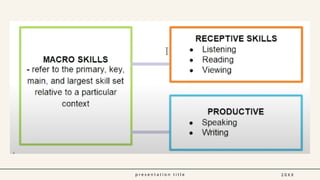
• It refers to the primary, key, main,
and largest skills relative to a
particular context.
Macro Skills
2 0 X X
• Listening, reading, and viewing
are receptive skills.
• Writing and speaking are
productive skills.
• They are used to send a message
or feedback to the receiver.
p r e s e n t a t i o n t i t l e 2 0 X X
listening
Teaching
p r e s e n t a t i o n t i t l e
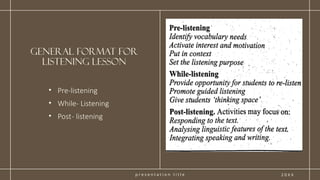
General format for
Listening Lesson
Listening
2 0 X X
• It is a receptive skill that first develops
in a human being.
• Learning to listen to the target
langauge improves langauge ability;
the sound, rhythm, intonation, and
stress the langauge can only be
perfectly adapted through listening.
• To understand nuances in a particular
langauge, one must be able to listen.
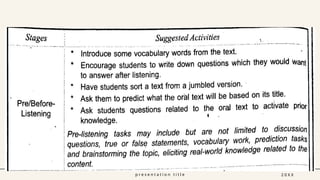
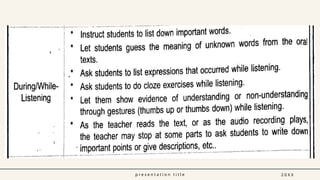
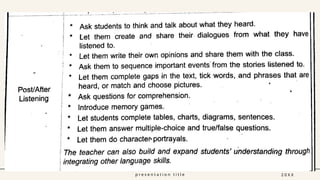
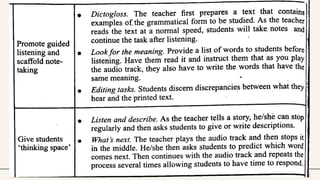
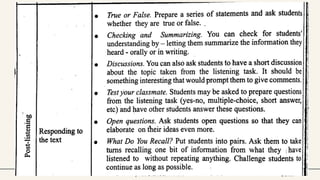
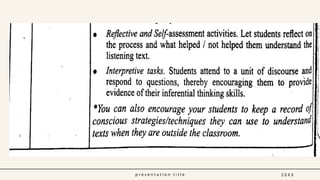
• Pre-listening
• While- Listening
• Post- listening
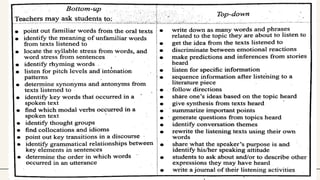
• Top-down process
• Bottom-up process
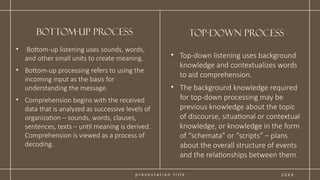
lISTENING PROCESSES
p r e s e n t a t i o n t i t l e
Top-down process
2 0 X X
• Bottom-up listening uses sounds, words,
and other small units to create meaning.
• Bottom-up processing refers to using the
incoming input as the basis for
understanding the message.
• Comprehension begins with the received
data that is analyzed as successive levels of
organization – sounds, words, clauses,
sentences, texts – until meaning is derived.
Comprehension is viewed as a process of
decoding.
• Top-down listening uses background
knowledge and contextualizes words
to aid comprehension.
• The background knowledge required
for top-down processing may be
previous knowledge about the topic
of discourse, situational or contextual
knowledge, or knowledge in the form
of “schemata” or “scripts” – plans
about the overall structure of events
and the relationships between them.
bottom-up process
p r e s e n t a t i o n t i t l e
Top-down process
2 0 X X
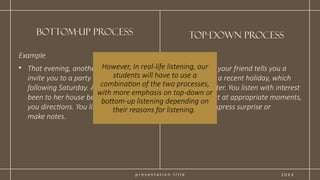
Example
• That evening, another friend calls to
invite you to a party at her house the
following Saturday. As you’ve never
been to her house before, she gives
you directions. You listen carefully and
make notes.
Example
• Over lunch, your friend tells you a
story about a recent holiday, which
was a disaster. You listen with interest
and interject at appropriate moments,
maybe to express surprise or
sympathy.
bottom-up process
However, In real-life listening, our
students will have to use a
combination of the two processes,
with more emphasis on top-down or
bottom-up listening depending on
their reasons for listening.
p r e s e n t a t i o n t i t l e 2 0 X X
p r e s e n t a t i o n t i t l e
General format for
Listening Lesson
2 0 X X
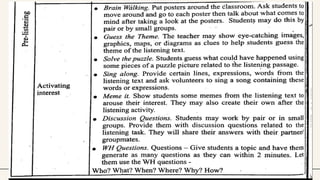
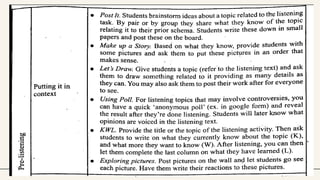
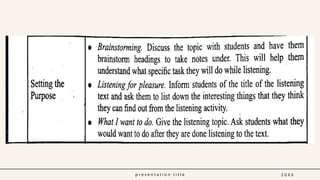
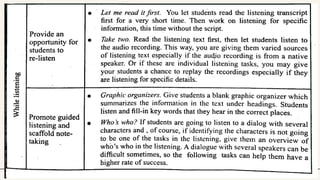
• Pre-listening
• While- Listening
• Post- listening
p r e s e n t a t i o n t i t l e 2 0 X X
p r e s e n t a t i o n t i t l e
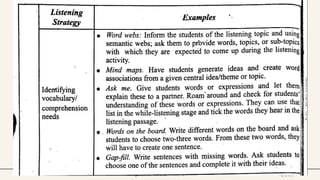
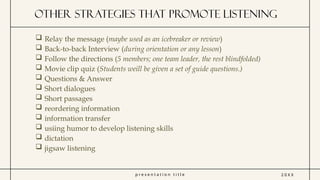
other strategies that promote listening
2 0 X X
 Relay the message (maybe used as an icebreaker or review)
 Back-to-back Interview (during orientation or any lesson)
 Follow the directions (5 members; one team leader, the rest blindfolded)
 Movie clip quiz (Students weill be given a set of guide questions.)
 Questions & Answer
 Short dialogues
 Short passages
 reordering information
 information transfer
 usiing humor to develop listening skills
 dictation
 jigsaw listening
READIng
Teaching
p r e s e n t a t i o n t i t l e
strategies
Reading
2 0 X X
• It is a process of decoding symbols,
that corresponds to meaning and
sounds.
• Reading comprehension is very
important.
• Skimming
• Scanning
• Extensive Reading
• Intensive
p r e s e n t a t i o n t i t l e
strategies that promote reading
2 0 X X
 What’s in the news?
 Students will be assigned to bring a news article individually.
 Read Aloud
 Students will be assigned a short story book or a story; group or individually
 Book Reviews
 a classic activity forn English or reading class
 Book Rewards
 Students would be given book rewards at the end of the quarter or year level.
 guessing word meanings by using context clues
 word formation clues
 considering syntax and sentence structure by noting the grammatical functions of unknown
words
 analyzing reference words
 predicting text content
 reading for specific pieces of information
 learning to use the dictionary effectively
p r e s e n t a t i o n t i t l e
other activities that promote reading
2 0 X X
 Distraction
 DVD Control Buttons
 One-student-One-Word
 Read-to-me Circle
 Walk-and-read
 Upside-down Reading
 Banned Words
 Reading Bingo
 Note that: many activities from other macro skill can also be
applicable and used in intensive reading, e.g. identifying
mistakes, and reordering sentence, etc.
viewIng
Teaching
p r e s e n t a t i o n t i t l e
Multimodal in viewing
Viewing
2 0 X X
• an important process of attending and
comprehending visual media such as
television, advertising images,
diagrams, symbols, etc.
• It refers to perceiving, examining,
interpreting, and constructing meaning
from visual images and is curical to
improving compreheshion fo print an
non-print materials
• To make it possible, they should have a
strong media and visual literacies (Carolino
& Queroda, 2019)
• Books are intertwined with
texts and other visual
elements, such as, drawing,
photographs, videos, web
pages, multimedia, etc.
p r e s e n t a t i o n t i t l e
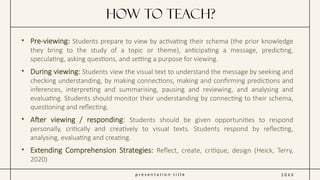
How to teach?
2 0 X X
• Pre-viewing: Students prepare to view by activating their schema (the prior knowledge
they bring to the study of a topic or theme), anticipating a message, predicting,
speculating, asking questions, and setting a purpose for viewing.
• During viewing: Students view the visual text to understand the message by seeking and
checking understanding, by making connections, making and confirming predictions and
inferences, interpreting and summarising, pausing and reviewing, and analysing and
evaluating. Students should monitor their understanding by connecting to their schema,
questioning and reflecting.
• After viewing / responding: Students should be given opportunities to respond
personally, critically and creatively to visual texts. Students respond by reflecting,
analysing, evaluating and creating.
• Extending Comprehension Strategies: Reflect, create, critique, design (Heick, Terry,
2020)
p r e s e n t a t i o n t i t l e 2 0 X X
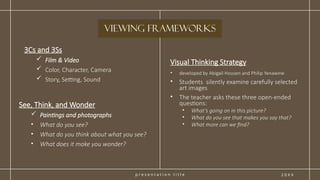
3Cs and 3Ss
 Film & Video
 Color, Character, Camera
 Story, Setting, Sound
Visual Thinking Strategy
• developed by Abigail Housen and Philip Yenawine
• Students silently examine carefully selected
art images
• The teacher asks these three open-ended
questions:
• What’s going on in this picture?
• What do you see that makes you say that?
• What more can we find?
viewing Frameworks
See, Think, and Wonder
 Paintings and photographs
• What do you see?
• What do you think about what you see?
• What does it make you wonder?
speaking
Teaching
p r e s e n t a t i o n t i t l e
How to teach
speaking in the
classroom?
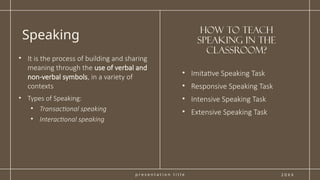
Speaking
2 0 X X
• It is the process of building and sharing
meaning through the use of verbal and
non-verbal symbols, in a variety of
contexts
• Types of Speaking:
• Transactional speaking
• Interactional speaking
• Imitative Speaking Task
• Responsive Speaking Task
• Intensive Speaking Task
• Extensive Speaking Task
p r e s e n t a t i o n t i t l e
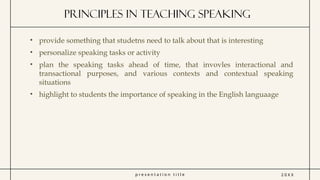
Principles in Teaching speaking
2 0 X X
• provide something that studetns need to talk about that is interesting
• personalize speaking tasks or activity
• plan the speaking tasks ahead of time, that invovles interactional and
transactional purposes, and various contexts and contextual speaking
situations
• highlight to students the importance of speaking in the English languaage
p r e s e n t a t i o n t i t l e
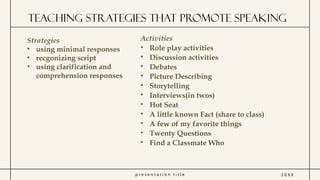
Teaching strategies that promote Speaking
2 0 X X
Activities
• Role play activities
• Discussion activities
• Debates
• Picture Describing
• Storytelling
• Interviews(in twos)
• Hot Seat
• A little known Fact (share to class)
• A few of my favorite things
• Twenty Questions
• Find a Classmate Who
Strategies
• using minimal responses
• recgonizing script
• using clarification and
comprehension responses
WritIng
Teaching
p r e s e n t a t i o n t i t l e
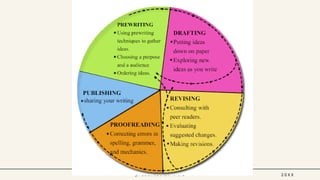
The writing process
Writing
2 0 X X
• It is the process of using symbols
(letters of the alphabet, punctuation,
and spaces) to communicate thoughts
and ideas in a readable form
• deeply reliant to the other macro skill,
especially with writing
p r e s e n t a t i o n t i t l e 2 0 X X
p r e s e n t a t i o n t i t l e
How to Teach?
2 0 X X
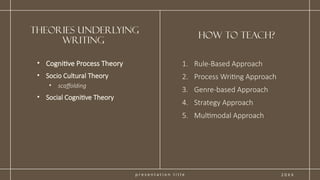
• Cognitive Process Theory
• Socio Cultural Theory
• scaffolding
• Social Cognitive Theory
1. Rule-Based Approach
2. Process Writing Approach
3. Genre-based Approach
4. Strategy Approach
5. Multimodal Approach
Theories underlying
writing
p r e s e n t a t i o n t i t l e
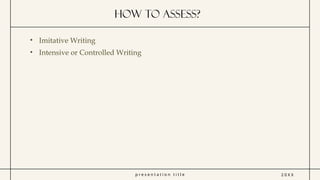
How to Assess?
2 0 X X
• Imitative Writing
• Intensive or Controlled Writing
p r e s e n t a t i o n t i t l e
Teaching strategies that promote writing
2 0 X X
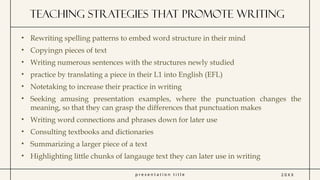
• Rewriting spelling patterns to embed word structure in their mind
• Copyingn pieces of text
• Writing numerous sentences with the structures newly studied
• practice by translating a piece in their L1 into English (EFL)
• Notetaking to increase their practice in writing
• Seeking amusing presentation examples, where the punctuation changes the
meaning, so that they can grasp the differences that punctuation makes
• Writing word connections and phrases down for later use
• Consulting textbooks and dictionaries
• Summarizing a larger piece of a text
• Highlighting little chunks of langauge text they can later use in writing
p r e s e n t a t i o n t i t l e
Teaching Activities that promote writing
2 0 X X
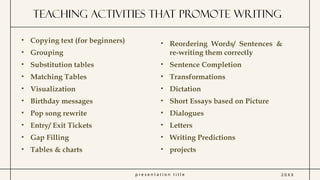
• Copying text (for beginners)
• Grouping
• Substitution tables
• Matching Tables
• Visualization
• Birthday messages
• Pop song rewrite
• Entry/ Exit Tickets
• Gap Filling
• Tables & charts
• Reordering Words/ Sentences &
re-writing them correctly
• Sentence Completion
• Transformations
• Dictation
• Short Essays based on Picture
• Dialogues
• Letters
• Writing Predictions
• projects
p r e s e n t a t i o n t i t l e
Vocabulary
2 0 X X
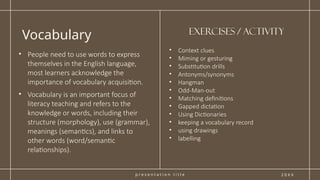
• Context clues
• Miming or gesturing
• Substitution drills
• Antonyms/synonyms
• Hangman
• Odd-Man-out
• Matching definitions
• Gapped dictation
• Using Dictionaries
• keeping a vocabulary record
• using drawings
• labelling
• People need to use words to express
themselves in the English language,
most learners acknowledge the
importance of vocabulary acquisition.
• ​
Vocabulary is an important focus of
literacy teaching and refers to the
knowledge or words, including their
structure (morphology), use (grammar),
meanings (semantics), and links to
other words (word/semantic
relationships).
Exercises / activity
p r e s e n t a t i o n t i t l e
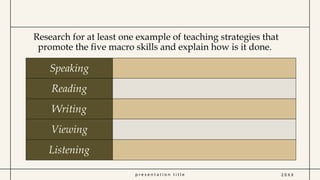
Research for at least one example of teaching strategies that
promote the five macro skills and explain how is it done.
Speaking
Reading
Writing
Viewing
Listening
2 0 X X
p r e s e n t a t i o n t i t l e
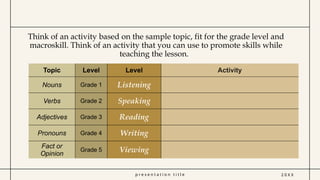
Think of an activity based on the sample topic, fit for the grade level and
macroskill. Think of an activity that you can use to promote skills while
teaching the lesson.
Topic Level Level Activity
Nouns Grade 1 Listening
Verbs Grade 2 Speaking
Adjectives Grade 3 Reading
Pronouns Grade 4 Writing
Fact or
Opinion
Grade 5 Viewing
2 0 X X
p r e s e n t a t i o n t i t l e
The approaches for
language arts
teaching
2 0 X X
objectives
1
Give examples of approaches, methodologies, and
techniques that can be use in Language Arts
2
Select approaches, strategies that support learner’s
understanding, participation, engagement and
achievement towards promoting literacy skills and
English language fluency.
p r e s e n t a t i o n t i t l e
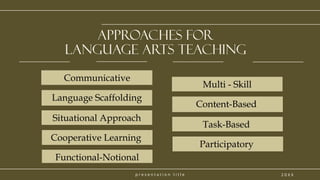
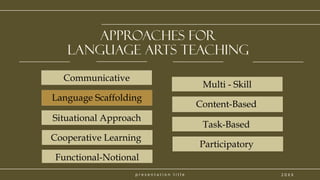
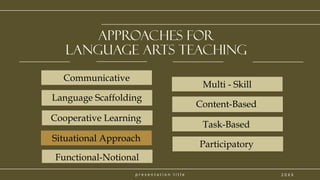
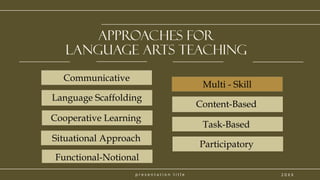
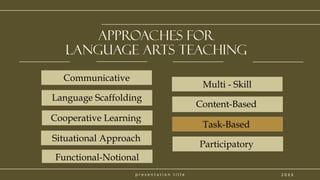
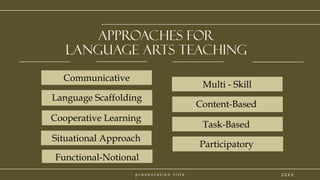
Approaches for
Language arts Teaching
Communicative
2 0 X X
Language Scaffolding
Situational Approach
Cooperative Learning
Functional-Notional
Multi - Skill
Content-Based
Task-Based
Participatory
Communicative
p r e s e n t a t i o n t i t l e
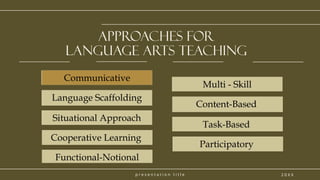
Approaches for
Language arts Teaching
Communicative
2 0 X X
Language Scaffolding
Situational Approach
Cooperative Learning
Functional-Notional
Multi - Skill
Content-Based
Task-Based
Participatory
Communicative
p r e s e n t a t i o n t i t l e
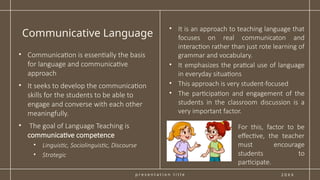
Communicative Language
2 0 X X
• Communication is essentially the basis
for language and communicative
approach
• It seeks to develop the communication
skills for the students to be able to
engage and converse with each other
meaningfully.
• The goal of Language Teaching is
communicative competence
• Linguistic, Sociolinguistic, Discourse
• Strategic
• It is an approach to teaching language that
focuses on real communicaton and
interaction rather than just rote learning of
grammar and vocabulary.
• It emphasizes the pratical use of language
in everyday situations
• This approach is very student-focused
• The participation and engagement of the
students in the classroom discussion is a
very important factor.
• For this, factor to be
effective, the teacher
must encourage
students to
participate.
p r e s e n t a t i o n t i t l e
Approaches for
Language arts Teaching
Communicative
2 0 X X
Language Scaffolding
Situational Approach
Cooperative Learning
Functional-Notional
Multi - Skill
Content-Based
Task-Based
Participatory
p r e s e n t a t i o n t i t l e
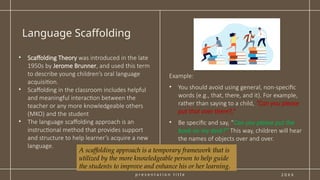
Language Scaffolding
2 0 X X
• Scaffolding Theory was introduced in the late
1950s by Jerome Brunner, and used this term
to describe young children’s oral language
acquisition.
• Scaffolding in the classroom includes helpful
and meaningful interaction between the
teacher or any more knowledgeable others
(MKO) and the student
• The language scaffolding approach is an
instructional method that provides support
and structure to help learner’s acquire a new
language.
Example:
• You should avoid using general, non-specific
words (e.g., that, there, and it). For example,
rather than saying to a child, “Can you please
put that over there?,”
• Be specific and say, “Can you please put the
book on my desk?” This way, children will hear
the names of objects over and over.
A scaffolding approach is a temporary framework that is
utilized by the more knowledgeable person to help guide
the students to improve and enhance his or her learning.
p r e s e n t a t i o n t i t l e
Approaches for
Language arts Teaching
Communicative
2 0 X X
Language Scaffolding
Situational Approach
Cooperative Learning
Functional-Notional
Multi - Skill
Content-Based
Task-Based
Participatory
p r e s e n t a t i o n t i t l e
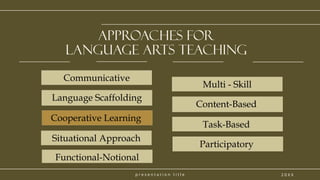
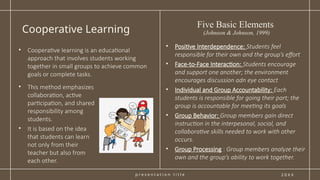
Cooperative Learning
2 0 X X
• This method emphasizes
collaboration, active
participation, and shared
responsibility among
students.
• It is based on the idea
that students can learn
not only from their
teacher but also from
each other.
• Positive Interdependence: Students feel
responsible for their own and the group’s effort
• Face-to-Face Interaction: Students encourage
and support one another; the environment
encourages discussion adn eye contact
• Individual and Group Accountability: Each
students is responsible for going their part; the
group is accountable for meeting its goals
• Group Behavior: Group members gain direct
instruction in the interpesonal, social, and
collaborative skills needed to work with other
occurs.
• Group Processing : Group members analyze their
own and the group’s ability to work together.
• Cooperative learning is an educational
approach that involves students working
together in small groups to achieve common
goals or complete tasks.
Five Basic Elements
(Johnson & Johnson, 1999)
p r e s e n t a t i o n t i t l e
Approaches for
Language arts Teaching
Communicative
2 0 X X
Language Scaffolding
Situational Approach
Cooperative Learning
Functional-Notional
Multi - Skill
Content-Based
Task-Based
Participatory
p r e s e n t a t i o n t i t l e
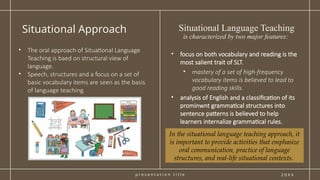
Situational Approach
2 0 X X
• focus on both vocabulary and reading is the
most salient trait of SLT.
• mastery of a set of high-frequency
vocabulary items is believed to lead to
good reading skills.
• analysis of English and a classification of its
prominwnt grammatical structures into
sentence patterns is believed to help
learners internalize grammatical rules.
• The oral approach of Situational Language
Teaching is baed on structural view of
language.
• Speech, structures and a focus on a set of
basic vocabulary items are seen as the basis
of language teaching.
Situational Language Teaching
is characterized by two major features:
In the situational language teaching approach, it
is important to provide activities that emphasize
oral communication, practice of language
structures, and real-life situational contexts.
p r e s e n t a t i o n t i t l e
Approaches for
Language arts Teaching
Communicative
2 0 X X
Language Scaffolding
Situational Approach
Cooperative Learning
Functional-Notional
Multi - Skill
Content-Based
Task-Based
Participatory
p r e s e n t a t i o n t i t l e
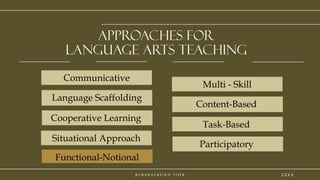
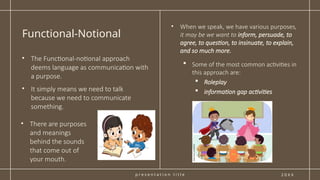
Functional-Notional
2 0 X X
• When we speak, we have various purposes,
it may be we want to inform, persuade, to
agree, to question, to insinuate, to explain,
and so much more.
 Some of the most common activities in
this approach are:
 Roleplay
 information gap activities
• The Functional-notional approach
deems language as communication with
a purpose.
• It simply means we need to talk
because we need to communicate
something.
• There are purposes
and meanings
behind the sounds
that come out of
your mouth.
p r e s e n t a t i o n t i t l e
Approaches for
Language arts Teaching
Communicative
2 0 X X
Language Scaffolding
Situational Approach
Cooperative Learning
Functional-Notional
Multi - Skill
Content-Based
Task-Based
Participatory
p r e s e n t a t i o n t i t l e
Multi-Skill Approach
2 0 X X
• As students practice skills, they are
reading non-fiction texts, discussing
ideas, and summarizing essential
information.
• The teacher’s role in skill-based
instruction is to set high expectations ,
facilitate skills, practice, and support all
students to become skilled individuals.
• Teachers serve as the coach of the team
in this approach.
• Also known as the “Skill-Based
Approach
• It is about planning, implementing, and
assessing literary skills.
• In a skill-based classroom, a good
amount of instructional time is
dedicated to practicing, assessing, and
reflecting on skills.
p r e s e n t a t i o n t i t l e
Approaches for
Language arts Teaching
Communicative
2 0 X X
Language Scaffolding
Situational Approach
Cooperative Learning
Functional-Notional
Multi - Skill
Content-Based
Task-Based
Participatory
p r e s e n t a t i o n t i t l e
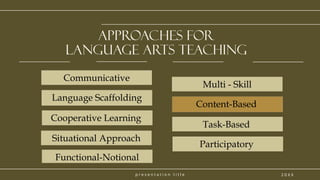
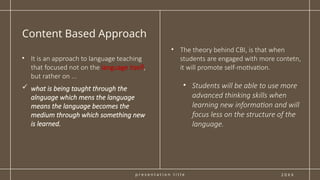
Content Based Approach
2 0 X X
• The theory behind CBI, is that when
students are engaged with more contetn,
it will promote self-motivation.
• Students will be able to use more
advanced thinking skills when
learning new information and will
focus less on the structure of the
language.
• It is an approach to language teaching
that focused not on the language itself,
but rather on ...
 what is being taught through the
alnguage which mens the language
means the language becomes the
medium through which something new
is learned.
p r e s e n t a t i o n t i t l e
Approaches for
Language arts Teaching
Communicative
2 0 X X
Language Scaffolding
Situational Approach
Cooperative Learning
Functional-Notional
Multi - Skill
Content-Based
Task-Based
Participatory
p r e s e n t a t i o n t i t l e
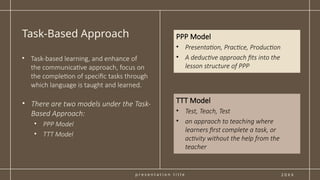
Task-Based Approach
2 0 X X
PPP Model
• Presentation, Practice, Production
• A deductive approach fits into the
lesson structure of PPP
• Task-based learning, and enhance of
the communicative approach, focus on
the completion of specific tasks through
which language is taught and learned.
• There are two models under the Task-
Based Approach:
• PPP Model
• TTT Model
TTT Model
• Test, Teach, Test
• an appraoch to teaching where
learners first complete a task, or
activity without the help from the
teacher
p r e s e n t a t i o n t i t l e
Approaches for
Language arts Teaching
Communicative
2 0 X X
Language Scaffolding
Situational Approach
Cooperative Learning
Functional-Notional
Multi - Skill
Content-Based
Task-Based
Participatory
p r e s e n t a t i o n t i t l e
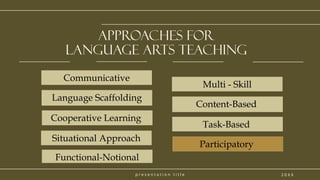
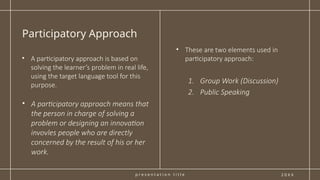
Participatory Approach
2 0 X X
• A participatory approach is based on
solving the learner’s problem in real life,
using the target language tool for this
purpose.
• A participatory approach means that
the person in charge of solving a
problem or designing an innovation
invovles people who are directly
concerned by the result of his or her
work.
• These are two elements used in
participatory approach:
1. Group Work (Discussion)
2. Public Speaking
p r e s e n t a t i o n t i t l e
Approaches for
Language arts Teaching
Communicative
2 0 X X
Language Scaffolding
Situational Approach
Cooperative Learning
Functional-Notional
Multi - Skill
Content-Based
Task-Based
Participatory
p r e s e n t a t i o n t i t l e
A Thousand
teachers,
a thousand
approaches .
Chinese Proverb
2 0 X X
end of prelim
The MAcro Skills
Approaches in teaching the
LAnguage ARts

BEED-Macroskills-Appraoches-Lessonnn.pptx

  • 1.
    Teaching Strategies topromote the Five Macro Skills Miss Faith Lanie Lumayag, MAEd The Macro skills
  • 2.
    T H EM A C R O S K I L L S INTRODUCTION Listening, speaking, reading, writing and viewing are five macro skills in the language, that one must be able to develop effectively. As teachers, especially of young learners, we are tasked to help our students develop those macro skills. Elementary teachers play a crucial role since they will start the learning procsee of students. It is expecfted that graduating in elementary, students in junior high school must be well-learned in these skills. 2 0 X X
  • 3.
    objectives 1 Identify thefive macro skills in language 2 Research for more examples of teaching strategies that promote the five macro skills 3 create an activity that you can use to promote skills while teaching the lesson
  • 4.
    p r es e n t a t i o n t i t l e • It refers to the primary, key, main, and largest skills relative to a particular context. Macro Skills 2 0 X X • Listening, reading, and viewing are receptive skills. • Writing and speaking are productive skills. • They are used to send a message or feedback to the receiver.
  • 5.
    p r es e n t a t i o n t i t l e 2 0 X X
  • 6.
  • 7.
    p r es e n t a t i o n t i t l e General format for Listening Lesson Listening 2 0 X X • It is a receptive skill that first develops in a human being. • Learning to listen to the target langauge improves langauge ability; the sound, rhythm, intonation, and stress the langauge can only be perfectly adapted through listening. • To understand nuances in a particular langauge, one must be able to listen. • Pre-listening • While- Listening • Post- listening • Top-down process • Bottom-up process lISTENING PROCESSES
  • 8.
    p r es e n t a t i o n t i t l e Top-down process 2 0 X X • Bottom-up listening uses sounds, words, and other small units to create meaning. • Bottom-up processing refers to using the incoming input as the basis for understanding the message. • Comprehension begins with the received data that is analyzed as successive levels of organization – sounds, words, clauses, sentences, texts – until meaning is derived. Comprehension is viewed as a process of decoding. • Top-down listening uses background knowledge and contextualizes words to aid comprehension. • The background knowledge required for top-down processing may be previous knowledge about the topic of discourse, situational or contextual knowledge, or knowledge in the form of “schemata” or “scripts” – plans about the overall structure of events and the relationships between them. bottom-up process
  • 9.
    p r es e n t a t i o n t i t l e Top-down process 2 0 X X Example • That evening, another friend calls to invite you to a party at her house the following Saturday. As you’ve never been to her house before, she gives you directions. You listen carefully and make notes. Example • Over lunch, your friend tells you a story about a recent holiday, which was a disaster. You listen with interest and interject at appropriate moments, maybe to express surprise or sympathy. bottom-up process However, In real-life listening, our students will have to use a combination of the two processes, with more emphasis on top-down or bottom-up listening depending on their reasons for listening.
  • 10.
    p r es e n t a t i o n t i t l e 2 0 X X
  • 11.
    p r es e n t a t i o n t i t l e General format for Listening Lesson 2 0 X X • Pre-listening • While- Listening • Post- listening
  • 12.
    p r es e n t a t i o n t i t l e 2 0 X X
  • 13.
    p r es e n t a t i o n t i t l e 2 0 X X
  • 14.
    p r es e n t a t i o n t i t l e 2 0 X X
  • 15.
    p r es e n t a t i o n t i t l e 2 0 X X
  • 16.
    p r es e n t a t i o n t i t l e 2 0 X X
  • 17.
    p r es e n t a t i o n t i t l e 2 0 X X
  • 18.
    p r es e n t a t i o n t i t l e 2 0 X X
  • 19.
    p r es e n t a t i o n t i t l e 2 0 X X
  • 20.
    p r es e n t a t i o n t i t l e 2 0 X X
  • 21.
    p r es e n t a t i o n t i t l e 2 0 X X
  • 22.
    p r es e n t a t i o n t i t l e 2 0 X X
  • 23.
    p r es e n t a t i o n t i t l e other strategies that promote listening 2 0 X X  Relay the message (maybe used as an icebreaker or review)  Back-to-back Interview (during orientation or any lesson)  Follow the directions (5 members; one team leader, the rest blindfolded)  Movie clip quiz (Students weill be given a set of guide questions.)  Questions & Answer  Short dialogues  Short passages  reordering information  information transfer  usiing humor to develop listening skills  dictation  jigsaw listening
  • 24.
  • 25.
    p r es e n t a t i o n t i t l e strategies Reading 2 0 X X • It is a process of decoding symbols, that corresponds to meaning and sounds. • Reading comprehension is very important. • Skimming • Scanning • Extensive Reading • Intensive
  • 26.
    p r es e n t a t i o n t i t l e strategies that promote reading 2 0 X X  What’s in the news?  Students will be assigned to bring a news article individually.  Read Aloud  Students will be assigned a short story book or a story; group or individually  Book Reviews  a classic activity forn English or reading class  Book Rewards  Students would be given book rewards at the end of the quarter or year level.  guessing word meanings by using context clues  word formation clues  considering syntax and sentence structure by noting the grammatical functions of unknown words  analyzing reference words  predicting text content  reading for specific pieces of information  learning to use the dictionary effectively
  • 27.
    p r es e n t a t i o n t i t l e other activities that promote reading 2 0 X X  Distraction  DVD Control Buttons  One-student-One-Word  Read-to-me Circle  Walk-and-read  Upside-down Reading  Banned Words  Reading Bingo  Note that: many activities from other macro skill can also be applicable and used in intensive reading, e.g. identifying mistakes, and reordering sentence, etc.
  • 28.
  • 29.
    p r es e n t a t i o n t i t l e Multimodal in viewing Viewing 2 0 X X • an important process of attending and comprehending visual media such as television, advertising images, diagrams, symbols, etc. • It refers to perceiving, examining, interpreting, and constructing meaning from visual images and is curical to improving compreheshion fo print an non-print materials • To make it possible, they should have a strong media and visual literacies (Carolino & Queroda, 2019) • Books are intertwined with texts and other visual elements, such as, drawing, photographs, videos, web pages, multimedia, etc.
  • 30.
    p r es e n t a t i o n t i t l e How to teach? 2 0 X X • Pre-viewing: Students prepare to view by activating their schema (the prior knowledge they bring to the study of a topic or theme), anticipating a message, predicting, speculating, asking questions, and setting a purpose for viewing. • During viewing: Students view the visual text to understand the message by seeking and checking understanding, by making connections, making and confirming predictions and inferences, interpreting and summarising, pausing and reviewing, and analysing and evaluating. Students should monitor their understanding by connecting to their schema, questioning and reflecting. • After viewing / responding: Students should be given opportunities to respond personally, critically and creatively to visual texts. Students respond by reflecting, analysing, evaluating and creating. • Extending Comprehension Strategies: Reflect, create, critique, design (Heick, Terry, 2020)
  • 31.
    p r es e n t a t i o n t i t l e 2 0 X X 3Cs and 3Ss  Film & Video  Color, Character, Camera  Story, Setting, Sound Visual Thinking Strategy • developed by Abigail Housen and Philip Yenawine • Students silently examine carefully selected art images • The teacher asks these three open-ended questions: • What’s going on in this picture? • What do you see that makes you say that? • What more can we find? viewing Frameworks See, Think, and Wonder  Paintings and photographs • What do you see? • What do you think about what you see? • What does it make you wonder?
  • 32.
  • 33.
    p r es e n t a t i o n t i t l e How to teach speaking in the classroom? Speaking 2 0 X X • It is the process of building and sharing meaning through the use of verbal and non-verbal symbols, in a variety of contexts • Types of Speaking: • Transactional speaking • Interactional speaking • Imitative Speaking Task • Responsive Speaking Task • Intensive Speaking Task • Extensive Speaking Task
  • 34.
    p r es e n t a t i o n t i t l e Principles in Teaching speaking 2 0 X X • provide something that studetns need to talk about that is interesting • personalize speaking tasks or activity • plan the speaking tasks ahead of time, that invovles interactional and transactional purposes, and various contexts and contextual speaking situations • highlight to students the importance of speaking in the English languaage
  • 35.
    p r es e n t a t i o n t i t l e Teaching strategies that promote Speaking 2 0 X X Activities • Role play activities • Discussion activities • Debates • Picture Describing • Storytelling • Interviews(in twos) • Hot Seat • A little known Fact (share to class) • A few of my favorite things • Twenty Questions • Find a Classmate Who Strategies • using minimal responses • recgonizing script • using clarification and comprehension responses
  • 36.
  • 37.
    p r es e n t a t i o n t i t l e The writing process Writing 2 0 X X • It is the process of using symbols (letters of the alphabet, punctuation, and spaces) to communicate thoughts and ideas in a readable form • deeply reliant to the other macro skill, especially with writing
  • 38.
    p r es e n t a t i o n t i t l e 2 0 X X
  • 39.
    p r es e n t a t i o n t i t l e How to Teach? 2 0 X X • Cognitive Process Theory • Socio Cultural Theory • scaffolding • Social Cognitive Theory 1. Rule-Based Approach 2. Process Writing Approach 3. Genre-based Approach 4. Strategy Approach 5. Multimodal Approach Theories underlying writing
  • 40.
    p r es e n t a t i o n t i t l e How to Assess? 2 0 X X • Imitative Writing • Intensive or Controlled Writing
  • 41.
    p r es e n t a t i o n t i t l e Teaching strategies that promote writing 2 0 X X • Rewriting spelling patterns to embed word structure in their mind • Copyingn pieces of text • Writing numerous sentences with the structures newly studied • practice by translating a piece in their L1 into English (EFL) • Notetaking to increase their practice in writing • Seeking amusing presentation examples, where the punctuation changes the meaning, so that they can grasp the differences that punctuation makes • Writing word connections and phrases down for later use • Consulting textbooks and dictionaries • Summarizing a larger piece of a text • Highlighting little chunks of langauge text they can later use in writing
  • 42.
    p r es e n t a t i o n t i t l e Teaching Activities that promote writing 2 0 X X • Copying text (for beginners) • Grouping • Substitution tables • Matching Tables • Visualization • Birthday messages • Pop song rewrite • Entry/ Exit Tickets • Gap Filling • Tables & charts • Reordering Words/ Sentences & re-writing them correctly • Sentence Completion • Transformations • Dictation • Short Essays based on Picture • Dialogues • Letters • Writing Predictions • projects
  • 43.
    p r es e n t a t i o n t i t l e Vocabulary 2 0 X X • Context clues • Miming or gesturing • Substitution drills • Antonyms/synonyms • Hangman • Odd-Man-out • Matching definitions • Gapped dictation • Using Dictionaries • keeping a vocabulary record • using drawings • labelling • People need to use words to express themselves in the English language, most learners acknowledge the importance of vocabulary acquisition. • ​ Vocabulary is an important focus of literacy teaching and refers to the knowledge or words, including their structure (morphology), use (grammar), meanings (semantics), and links to other words (word/semantic relationships). Exercises / activity

  • 44.
    p r es e n t a t i o n t i t l e Research for at least one example of teaching strategies that promote the five macro skills and explain how is it done. Speaking Reading Writing Viewing Listening 2 0 X X
  • 45.
    p r es e n t a t i o n t i t l e Think of an activity based on the sample topic, fit for the grade level and macroskill. Think of an activity that you can use to promote skills while teaching the lesson. Topic Level Level Activity Nouns Grade 1 Listening Verbs Grade 2 Speaking Adjectives Grade 3 Reading Pronouns Grade 4 Writing Fact or Opinion Grade 5 Viewing 2 0 X X

  • 46.
    p r es e n t a t i o n t i t l e The approaches for language arts teaching 2 0 X X
  • 47.
    objectives 1 Give examples ofapproaches, methodologies, and techniques that can be use in Language Arts 2 Select approaches, strategies that support learner’s understanding, participation, engagement and achievement towards promoting literacy skills and English language fluency.
  • 48.
    p r es e n t a t i o n t i t l e Approaches for Language arts Teaching Communicative 2 0 X X Language Scaffolding Situational Approach Cooperative Learning Functional-Notional Multi - Skill Content-Based Task-Based Participatory Communicative
  • 49.
    p r es e n t a t i o n t i t l e Approaches for Language arts Teaching Communicative 2 0 X X Language Scaffolding Situational Approach Cooperative Learning Functional-Notional Multi - Skill Content-Based Task-Based Participatory Communicative
  • 50.
    p r es e n t a t i o n t i t l e Communicative Language 2 0 X X • Communication is essentially the basis for language and communicative approach • It seeks to develop the communication skills for the students to be able to engage and converse with each other meaningfully. • The goal of Language Teaching is communicative competence • Linguistic, Sociolinguistic, Discourse • Strategic • It is an approach to teaching language that focuses on real communicaton and interaction rather than just rote learning of grammar and vocabulary. • It emphasizes the pratical use of language in everyday situations • This approach is very student-focused • The participation and engagement of the students in the classroom discussion is a very important factor. • For this, factor to be effective, the teacher must encourage students to participate.
  • 51.
    p r es e n t a t i o n t i t l e Approaches for Language arts Teaching Communicative 2 0 X X Language Scaffolding Situational Approach Cooperative Learning Functional-Notional Multi - Skill Content-Based Task-Based Participatory
  • 52.
    p r es e n t a t i o n t i t l e Language Scaffolding 2 0 X X • Scaffolding Theory was introduced in the late 1950s by Jerome Brunner, and used this term to describe young children’s oral language acquisition. • Scaffolding in the classroom includes helpful and meaningful interaction between the teacher or any more knowledgeable others (MKO) and the student • The language scaffolding approach is an instructional method that provides support and structure to help learner’s acquire a new language. Example: • You should avoid using general, non-specific words (e.g., that, there, and it). For example, rather than saying to a child, “Can you please put that over there?,” • Be specific and say, “Can you please put the book on my desk?” This way, children will hear the names of objects over and over. A scaffolding approach is a temporary framework that is utilized by the more knowledgeable person to help guide the students to improve and enhance his or her learning.
  • 53.
    p r es e n t a t i o n t i t l e Approaches for Language arts Teaching Communicative 2 0 X X Language Scaffolding Situational Approach Cooperative Learning Functional-Notional Multi - Skill Content-Based Task-Based Participatory
  • 54.
    p r es e n t a t i o n t i t l e Cooperative Learning 2 0 X X • This method emphasizes collaboration, active participation, and shared responsibility among students. • It is based on the idea that students can learn not only from their teacher but also from each other. • Positive Interdependence: Students feel responsible for their own and the group’s effort • Face-to-Face Interaction: Students encourage and support one another; the environment encourages discussion adn eye contact • Individual and Group Accountability: Each students is responsible for going their part; the group is accountable for meeting its goals • Group Behavior: Group members gain direct instruction in the interpesonal, social, and collaborative skills needed to work with other occurs. • Group Processing : Group members analyze their own and the group’s ability to work together. • Cooperative learning is an educational approach that involves students working together in small groups to achieve common goals or complete tasks. Five Basic Elements (Johnson & Johnson, 1999)
  • 55.
    p r es e n t a t i o n t i t l e Approaches for Language arts Teaching Communicative 2 0 X X Language Scaffolding Situational Approach Cooperative Learning Functional-Notional Multi - Skill Content-Based Task-Based Participatory
  • 56.
    p r es e n t a t i o n t i t l e Situational Approach 2 0 X X • focus on both vocabulary and reading is the most salient trait of SLT. • mastery of a set of high-frequency vocabulary items is believed to lead to good reading skills. • analysis of English and a classification of its prominwnt grammatical structures into sentence patterns is believed to help learners internalize grammatical rules. • The oral approach of Situational Language Teaching is baed on structural view of language. • Speech, structures and a focus on a set of basic vocabulary items are seen as the basis of language teaching. Situational Language Teaching is characterized by two major features: In the situational language teaching approach, it is important to provide activities that emphasize oral communication, practice of language structures, and real-life situational contexts.
  • 57.
    p r es e n t a t i o n t i t l e Approaches for Language arts Teaching Communicative 2 0 X X Language Scaffolding Situational Approach Cooperative Learning Functional-Notional Multi - Skill Content-Based Task-Based Participatory
  • 58.
    p r es e n t a t i o n t i t l e Functional-Notional 2 0 X X • When we speak, we have various purposes, it may be we want to inform, persuade, to agree, to question, to insinuate, to explain, and so much more.  Some of the most common activities in this approach are:  Roleplay  information gap activities • The Functional-notional approach deems language as communication with a purpose. • It simply means we need to talk because we need to communicate something. • There are purposes and meanings behind the sounds that come out of your mouth.
  • 59.
    p r es e n t a t i o n t i t l e Approaches for Language arts Teaching Communicative 2 0 X X Language Scaffolding Situational Approach Cooperative Learning Functional-Notional Multi - Skill Content-Based Task-Based Participatory
  • 60.
    p r es e n t a t i o n t i t l e Multi-Skill Approach 2 0 X X • As students practice skills, they are reading non-fiction texts, discussing ideas, and summarizing essential information. • The teacher’s role in skill-based instruction is to set high expectations , facilitate skills, practice, and support all students to become skilled individuals. • Teachers serve as the coach of the team in this approach. • Also known as the “Skill-Based Approach • It is about planning, implementing, and assessing literary skills. • In a skill-based classroom, a good amount of instructional time is dedicated to practicing, assessing, and reflecting on skills.
  • 61.
    p r es e n t a t i o n t i t l e Approaches for Language arts Teaching Communicative 2 0 X X Language Scaffolding Situational Approach Cooperative Learning Functional-Notional Multi - Skill Content-Based Task-Based Participatory
  • 62.
    p r es e n t a t i o n t i t l e Content Based Approach 2 0 X X • The theory behind CBI, is that when students are engaged with more contetn, it will promote self-motivation. • Students will be able to use more advanced thinking skills when learning new information and will focus less on the structure of the language. • It is an approach to language teaching that focused not on the language itself, but rather on ...  what is being taught through the alnguage which mens the language means the language becomes the medium through which something new is learned.
  • 63.
    p r es e n t a t i o n t i t l e Approaches for Language arts Teaching Communicative 2 0 X X Language Scaffolding Situational Approach Cooperative Learning Functional-Notional Multi - Skill Content-Based Task-Based Participatory
  • 64.
    p r es e n t a t i o n t i t l e Task-Based Approach 2 0 X X PPP Model • Presentation, Practice, Production • A deductive approach fits into the lesson structure of PPP • Task-based learning, and enhance of the communicative approach, focus on the completion of specific tasks through which language is taught and learned. • There are two models under the Task- Based Approach: • PPP Model • TTT Model TTT Model • Test, Teach, Test • an appraoch to teaching where learners first complete a task, or activity without the help from the teacher
  • 65.
    p r es e n t a t i o n t i t l e Approaches for Language arts Teaching Communicative 2 0 X X Language Scaffolding Situational Approach Cooperative Learning Functional-Notional Multi - Skill Content-Based Task-Based Participatory
  • 66.
    p r es e n t a t i o n t i t l e Participatory Approach 2 0 X X • A participatory approach is based on solving the learner’s problem in real life, using the target language tool for this purpose. • A participatory approach means that the person in charge of solving a problem or designing an innovation invovles people who are directly concerned by the result of his or her work. • These are two elements used in participatory approach: 1. Group Work (Discussion) 2. Public Speaking
  • 67.
    p r es e n t a t i o n t i t l e Approaches for Language arts Teaching Communicative 2 0 X X Language Scaffolding Situational Approach Cooperative Learning Functional-Notional Multi - Skill Content-Based Task-Based Participatory
  • 68.
    p r es e n t a t i o n t i t l e A Thousand teachers, a thousand approaches . Chinese Proverb 2 0 X X
  • 69.
    end of prelim TheMAcro Skills Approaches in teaching the LAnguage ARts