Bearings.ppt It will help to learn the topic Bearings.
1.
We are learningto:
- Finding connections between different words. (Which
PLT skills?)
-Accurately find bearings for practical problems.
(Grades D-C)
Always aim
high!
LESSON OBJECTIVES
Effective
Participator
Self
Manager
Independent
Enquirer
Creative
Thinker
Team
Worker
Reflective
Learner
PLT Skills Which ones are you using?
AUTHOR
Where are we in
our journey?
Real life
cross/curricular
links?
www.mistrymaths.co.uk
STARTER
Effective
Participator
Self
Manager
Independent
Enquirer
Creative
Thinker
Team
Worker
Reflective
Learner
Which ones areyou using?
PLT Skills
EXTENSION
TASK
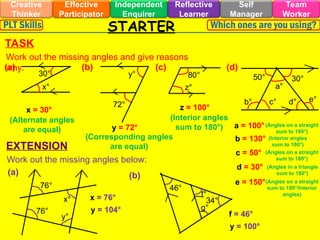
Work out the missing angles and give reasons
why.
(a) (b) (c) (d)
x°
30° y°
72°
z°
80° 50° 30°
a°
b° c° d° e°
76°
76°
x°
y°
(a) (b)
46°
f°
34°
g°
x = 30°
(Alternate angles
are equal) y = 72°
(Corresponding angles
are equal)
z = 100°
(Interior angles
sum to 180°) a = 100°(Angles on a straight
sum to 180°)
b = 130° (Interior angles
sum to 180°)
c = 50° (Angles on a straight
sum to 180°)
d = 30° (Angles in a triangle
sum to 180°)
e = 150°(Angles on a straight
sum to 180°/Interior
angles)
x = 76°
Work out the missing angles below:
y = 104°
f = 46°
y = 100°
Effective
Participator
Self
Manager
Independent
Enquirer
Creative
Thinker
Team
Worker
Reflective
Learner
PLT Skills Whichones are you using?
BEARINGS
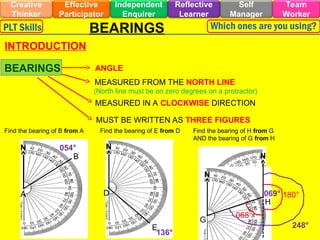
INTRODUCTION
ANGLE
MEASURED FROM THE NORTH LINE
(North line must be on zero degrees on a protractor)
MEASURED IN A CLOCKWISE DIRECTION
MUST BE WRITTEN AS THREE FIGURES
BEARINGS
N
Find the bearing of B from A
B
A
054° N
D
E
136°
N
Find the bearing of E from D
N
Find the bearing of H from G
AND the bearing of G from H
G
H
069° 180°
068°
248°
Effective
Participator
Self
Manager
Independent
Enquirer
Creative
Thinker
Team
Worker
Reflective
Learner
PLT Skills Whichones are you using?
BEARINGS
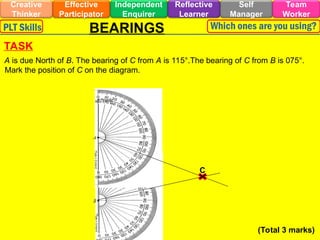
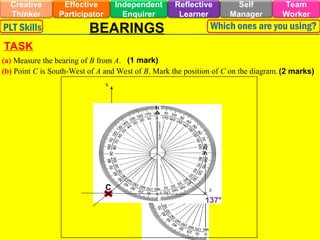
TASK
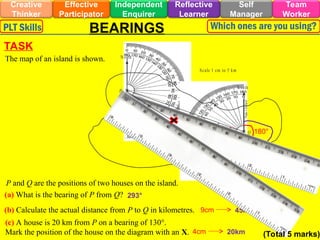
The map of an island is shown.
P and Q are the positions of two houses on the island.
(a) What is the bearing of P from Q?
(b) Calculate the actual distance from P to Q in kilometres.
(c) A house is 20 km from P on a bearing of 130°.
Mark the position of the house on the diagram with an X.
N orth
P
Scale 1 cm to 5 km
Q
N orth
180°
113°
293°
293°
9cm 45km
4cm 20km (Total 5 marks)
9.
Effective
Participator
Self
Manager
Independent
Enquirer
Creative
Thinker
Team
Worker
Reflective
Learner
PLT Skills Whichones are you using?
BEARINGS
TASK
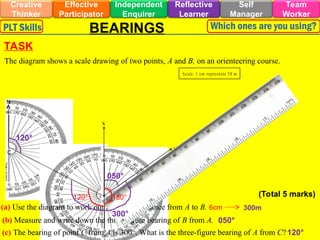
The diagram shows a scale drawing of two points, A and B, on an orienteering course.
(a) Use the diagram to work out the actual distance from A to B.
(b) Measure and write down the three-figure bearing of B from A.
(c) The bearing of point C from A is 300°. What is the three-figure bearing of A from C?
(Total 5 marks)
A
B
N
Scale: 1 cm represents 50 m
6cm 300m
050°
050°
180°
N
120°
300°
C
120°
120°
10.
N orth
Southport
Lancaster
M anchester
North
Effective
Participator
Self
Manager
Independent
Enquirer
Creative
Thinker
Team
Worker
Reflective
Learner
PLT Skills Which ones are you using?
BEARINGS
TASK
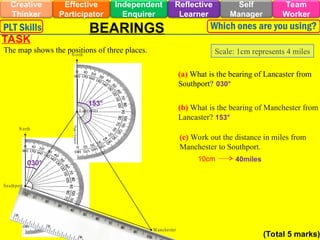
The map shows the positions of three places. Scale: 1cm represents 4 miles
(a) What is the bearing of Lancaster from
Southport?
(b) What is the bearing of Manchester from
Lancaster?
(c) Work out the distance in miles from
Manchester to Southport.
(Total 5 marks)
030°
030°
153°
153°
10cm 40miles
PLENARY ACTIVITY
FUNCTIONAL MATHSSTYLE QUESTION
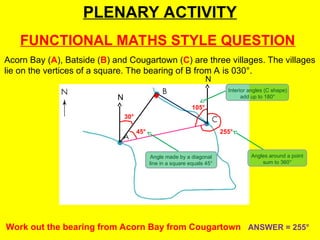
Acorn Bay (A), Batside (B) and Cougartown (C) are three villages. The villages
lie on the vertices of a square. The bearing of B from A is 030°.
Work out the bearing from Acorn Bay from Cougartown
N
30°
45°
N
105°
Interior angles (C shape)
add up to 180°
Angle made by a diagonal
line in a square equals 45°
255°
Angles around a point
sum to 360°
ANSWER = 255°
13.
Draw your brain
Whathave you learnt?
In your brain, write or draw everything you can remember about finding
bearings. It can be a skill or a reflection, or something else that might be
prominent in your brain.
What grade
are we
working at?
Where are we
in our
journey?
14.
.
How well doyou understand the task?
I don’t
understand
I nearly
understand
I fully
understand
Creative
Entrepreneur
Responsible
Citizen
Independent
Learner
Positive
Thinker
Team
Worker
Reflective
Learner
Enterprise Skills Which ones are you using?
SELF ASSESSMENT
Plenary Activity
www.mistrymaths.co.uk
15.
SELF ASSESSMENT
Plenary Activity
Onyour post it
notes…
Think about how you
can improve your
work.
WWW (What Went Well)
EBI (Even Better If)
Creative
Entrepreneur
Responsible
Citizen
Independent
Learner
Positive
Thinker
Team
Worker
Reflective
Learner
Enterprise Skills Which ones are you using?
www.mistrymaths.co.uk