Form 5
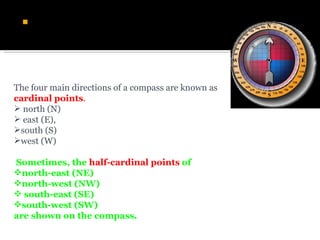
BEARINGS The four main directions of a compass are known as  cardinal points .  north (N) east (E), south (S)  west (W) Sometimes, the  half-cardinal points  of  north-east (NE) north-west (NW) south-east (SE) south-west (SW) are shown on the compass. 
north  representing  0° or 360° east  representing  90° south  representing  180° west  representing  270°
 
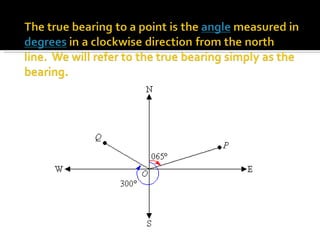
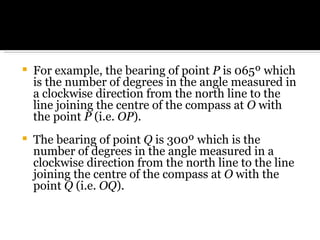
For example, the bearing of point  P  is 065º which is the number of degrees in the angle measured in a clockwise direction from the north line to the line joining the centre of the compass at  O  with the point  P  (i.e.  OP ). The bearing of point  Q  is 300º which is the number of degrees in the angle measured in a clockwise direction from the north line to the line joining the centre of the compass at  O  with the point  Q  (i.e.  OQ ).
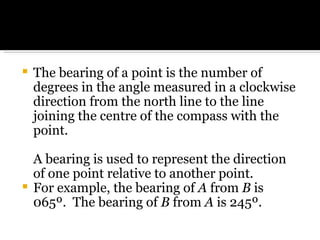
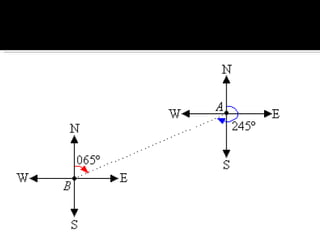
The bearing of a point is the number of degrees in the angle measured in a clockwise direction from the north line to the line joining the centre of the compass with the point. A bearing is used to represent the direction of one point relative to another point. For example, the bearing of  A  from  B  is 065º.  The bearing of  B  from  A  is 245º.


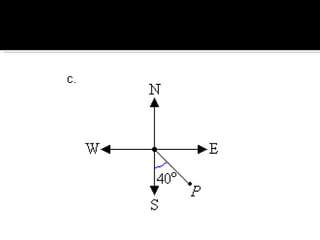
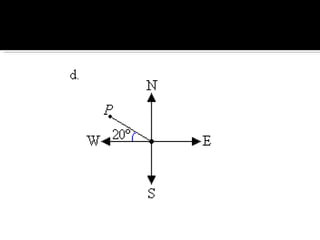
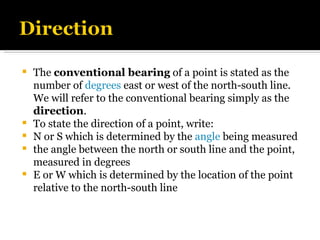
The  conventional bearing  of a point is stated as the number of  degrees  east or west of the north-south line.  We will refer to the conventional bearing simply as the  direction . To state the direction of a point, write: N or S which is determined by the  angle  being measured the angle between the north or south line and the point, measured in degrees E or W which is determined by the location of the point relative to the north-south line
 
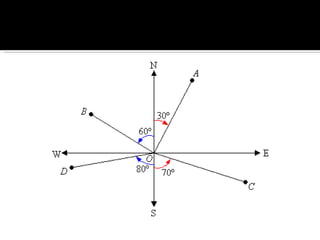
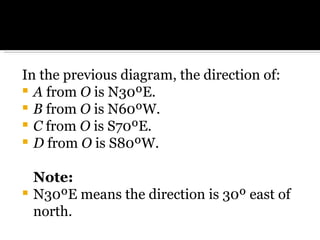
In the previous diagram, the direction of: A  from  O  is N30ºE. B  from  O  is N60ºW. C  from  O  is S70ºE. D  from  O  is S80ºW. Note: N30ºE means the direction is 30º east of north.
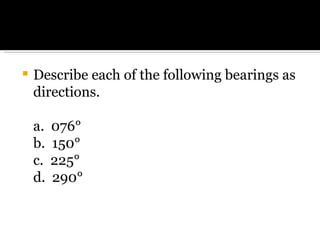
Describe each of the following bearings as directions. a.  076° b.  150° c.  225° d.  290°

Bearing form 5

  • 1.
  • 2.
    BEARINGS The fourmain directions of a compass are known as cardinal points .  north (N) east (E), south (S) west (W) Sometimes, the half-cardinal points of north-east (NE) north-west (NW) south-east (SE) south-west (SW) are shown on the compass. 
  • 3.
    north representing 0° or 360° east representing 90° south representing 180° west representing 270°
  • 4.
  • 5.
    For example, thebearing of point P is 065º which is the number of degrees in the angle measured in a clockwise direction from the north line to the line joining the centre of the compass at O with the point P (i.e. OP ). The bearing of point Q is 300º which is the number of degrees in the angle measured in a clockwise direction from the north line to the line joining the centre of the compass at O with the point Q (i.e. OQ ).
  • 6.
    The bearing ofa point is the number of degrees in the angle measured in a clockwise direction from the north line to the line joining the centre of the compass with the point. A bearing is used to represent the direction of one point relative to another point. For example, the bearing of A from B is 065º.  The bearing of B from A is 245º.
  • 7.
  • 8.
  • 9.
  • 10.
  • 11.
  • 12.
    The conventionalbearing of a point is stated as the number of degrees east or west of the north-south line.  We will refer to the conventional bearing simply as the direction . To state the direction of a point, write: N or S which is determined by the angle being measured the angle between the north or south line and the point, measured in degrees E or W which is determined by the location of the point relative to the north-south line
  • 13.
  • 14.
    In the previousdiagram, the direction of: A from O is N30ºE. B from O is N60ºW. C from O is S70ºE. D from O is S80ºW. Note: N30ºE means the direction is 30º east of north.
  • 15.
    Describe each ofthe following bearings as directions. a.  076° b.  150° c.  225° d.  290°