A presentation on “The Bear
Stearns Companies, Inc”
By
Aakarsh Shukla
2013A3PS162G
History of the company
Bear Stearns was founded as an equity trading house on May Day 1923 by Joseph
Ainslee Bear, Robert B. Stearns and Harold C. Mayer Sr. with $500,000 in capital.
In 1985, Bear Stearns became a publicly traded company.
Bear Stearns was also known for one of the most widely read market intelligence
pieces on the street, known as the "Early Look at the Market.
In 2005–2007, Bear Stearns was recognized as the "Most Admired" securities firm
in Fortune's "America's Most Admired Companies" survey, and second overall in the
security firm section.
When the clouds of trouble gathered!
By November, 2006, the company had total capital of approximately $66.7 billion and
total assets of $350.4 billion and according to the April 2005 issue of Institutional
Investor magazine, Bear Stearns was the seventh-largest securities firm in terms of
total capital.
Bear Stearns was carrying more than $28 billion in ”Level 3 assets”* on its books at
the end of fiscal 2007 versus a net equity position of only $11.1 billion. This $11.1
billion supported $395 billion in assets which means a leverage ratio of 35.6 to 1
• Assets whose fair value cannot be determined by using observable measures, such as market prices
or models. Level 3 assets are typically very illiquid, and fair values can only be calculated using
estimates or risk-adjusted value ranges.
• Leverage Ratio = Avg. Total Assets/ Avg. Total Equity .
“If The leverage ratio is too high, the company runs a risk of getting bankrupt”
When the clouds of trouble gathered!
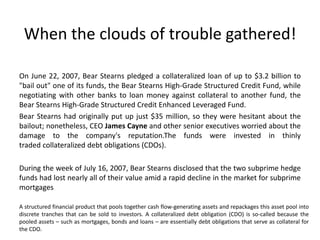
On June 22, 2007, Bear Stearns pledged a collateralized loan of up to $3.2 billion to
"bail out" one of its funds, the Bear Stearns High-Grade Structured Credit Fund, while
negotiating with other banks to loan money against collateral to another fund, the
Bear Stearns High-Grade Structured Credit Enhanced Leveraged Fund.
Bear Stearns had originally put up just $35 million, so they were hesitant about the
bailout; nonetheless, CEO James Cayne and other senior executives worried about the
damage to the company's reputation.The funds were invested in thinly
traded collateralized debt obligations (CDOs).
During the week of July 16, 2007, Bear Stearns disclosed that the two subprime hedge
funds had lost nearly all of their value amid a rapid decline in the market for subprime
mortgages
A structured financial product that pools together cash flow-generating assets and repackages this asset pool into
discrete tranches that can be sold to investors. A collateralized debt obligation (CDO) is so-called because the
pooled assets – such as mortgages, bonds and loans – are essentially debt obligations that serve as collateral for
the CDO.
The Sale!
On March 14, 2008, the Federal Reserve Bank of New York agreed to provide a $25
billion loan to Bear Stearns collateralized by free and clear assets from Bear Stearns in
order to provide Bear Stearns the liquidity for up to 28 days that the market was
refusing to provide. Apparently the Federal Reserve Bank of New York had a change of
heart and told Bear Stearns that the 28 day loan was unavailable to them.
The deal was then changed to where the NY FED would create a company to buy $30
billion worth of Bear Stearns assets. Two days later, on March 16, 2008, Bear Stearns
signed a merger agreement with JP Morgan Chase in a stock swap worth $2 a share or
less than 7 percent of Bear Stearns' market value just two days before.
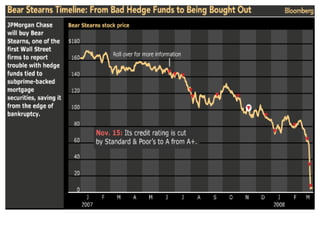
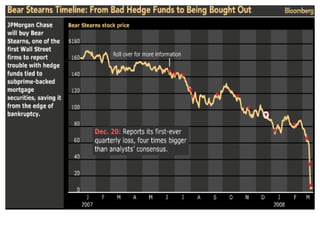
This sale price represented a staggering loss as its stock had traded at $172 a share as
late as January 2007, and $93 a share as late as February 2008. The new company is
funded by loans of $29 billion from the New York FRB, and $1 billion from JP Morgan
Chase.
James Cayne (CEO)
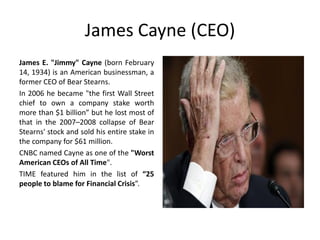
James E. "Jimmy" Cayne (born February
14, 1934) is an American businessman, a
former CEO of Bear Stearns.
In 2006 he became "the first Wall Street
chief to own a company stake worth
more than $1 billion” but he lost most of
that in the 2007–2008 collapse of Bear
Stearns' stock and sold his entire stake in
the company for $61 million.
CNBC named Cayne as one of the "Worst
American CEOs of All Time".
TIME featured him in the list of “25
people to blame for Financial Crisis”.
Stock Price Timeline of
Bear Sterns
Bear stearns
Bear stearns
Bear stearns
Bear stearns
Bear stearns
Bear stearns
Bear stearns
Bear stearns
Bear stearns
Bear stearns
Bear stearns
Bear stearns
Bear stearns
Bear stearns

Bear stearns

  • 1.
    A presentation on“The Bear Stearns Companies, Inc” By Aakarsh Shukla 2013A3PS162G
  • 2.
    History of thecompany Bear Stearns was founded as an equity trading house on May Day 1923 by Joseph Ainslee Bear, Robert B. Stearns and Harold C. Mayer Sr. with $500,000 in capital. In 1985, Bear Stearns became a publicly traded company. Bear Stearns was also known for one of the most widely read market intelligence pieces on the street, known as the "Early Look at the Market. In 2005–2007, Bear Stearns was recognized as the "Most Admired" securities firm in Fortune's "America's Most Admired Companies" survey, and second overall in the security firm section.
  • 3.
    When the cloudsof trouble gathered! By November, 2006, the company had total capital of approximately $66.7 billion and total assets of $350.4 billion and according to the April 2005 issue of Institutional Investor magazine, Bear Stearns was the seventh-largest securities firm in terms of total capital. Bear Stearns was carrying more than $28 billion in ”Level 3 assets”* on its books at the end of fiscal 2007 versus a net equity position of only $11.1 billion. This $11.1 billion supported $395 billion in assets which means a leverage ratio of 35.6 to 1 • Assets whose fair value cannot be determined by using observable measures, such as market prices or models. Level 3 assets are typically very illiquid, and fair values can only be calculated using estimates or risk-adjusted value ranges. • Leverage Ratio = Avg. Total Assets/ Avg. Total Equity . “If The leverage ratio is too high, the company runs a risk of getting bankrupt”
  • 4.
    When the cloudsof trouble gathered! On June 22, 2007, Bear Stearns pledged a collateralized loan of up to $3.2 billion to "bail out" one of its funds, the Bear Stearns High-Grade Structured Credit Fund, while negotiating with other banks to loan money against collateral to another fund, the Bear Stearns High-Grade Structured Credit Enhanced Leveraged Fund. Bear Stearns had originally put up just $35 million, so they were hesitant about the bailout; nonetheless, CEO James Cayne and other senior executives worried about the damage to the company's reputation.The funds were invested in thinly traded collateralized debt obligations (CDOs). During the week of July 16, 2007, Bear Stearns disclosed that the two subprime hedge funds had lost nearly all of their value amid a rapid decline in the market for subprime mortgages A structured financial product that pools together cash flow-generating assets and repackages this asset pool into discrete tranches that can be sold to investors. A collateralized debt obligation (CDO) is so-called because the pooled assets – such as mortgages, bonds and loans – are essentially debt obligations that serve as collateral for the CDO.
  • 5.
    The Sale! On March14, 2008, the Federal Reserve Bank of New York agreed to provide a $25 billion loan to Bear Stearns collateralized by free and clear assets from Bear Stearns in order to provide Bear Stearns the liquidity for up to 28 days that the market was refusing to provide. Apparently the Federal Reserve Bank of New York had a change of heart and told Bear Stearns that the 28 day loan was unavailable to them. The deal was then changed to where the NY FED would create a company to buy $30 billion worth of Bear Stearns assets. Two days later, on March 16, 2008, Bear Stearns signed a merger agreement with JP Morgan Chase in a stock swap worth $2 a share or less than 7 percent of Bear Stearns' market value just two days before. This sale price represented a staggering loss as its stock had traded at $172 a share as late as January 2007, and $93 a share as late as February 2008. The new company is funded by loans of $29 billion from the New York FRB, and $1 billion from JP Morgan Chase.
  • 6.
    James Cayne (CEO) JamesE. "Jimmy" Cayne (born February 14, 1934) is an American businessman, a former CEO of Bear Stearns. In 2006 he became "the first Wall Street chief to own a company stake worth more than $1 billion” but he lost most of that in the 2007–2008 collapse of Bear Stearns' stock and sold his entire stake in the company for $61 million. CNBC named Cayne as one of the "Worst American CEOs of All Time". TIME featured him in the list of “25 people to blame for Financial Crisis”.
  • 7.
    Stock Price Timelineof Bear Sterns