Introduction
• • Whatis a Beam Engine?
• • Historical background
• • Importance in the Industrial Revolution
3.
Basic Working Principle
•• Converts reciprocating motion into rotary
motion
• • Operates using steam pressure
• • Key feature: the overhead beam
4.
Main Components
• 1.Cylinder – where steam pressure is applied
• 2. Piston – moves within the cylinder
• 3. Beam – oscillates up and down
• 4. Connecting Rod – links beam to crank or
pump
• 5. Flywheel – helps smooth rotary motion
5.
Mechanism Diagram
• (Inserta labeled diagram of the beam engine)
• • Label all major components
• • Show steam input/output flow
6.
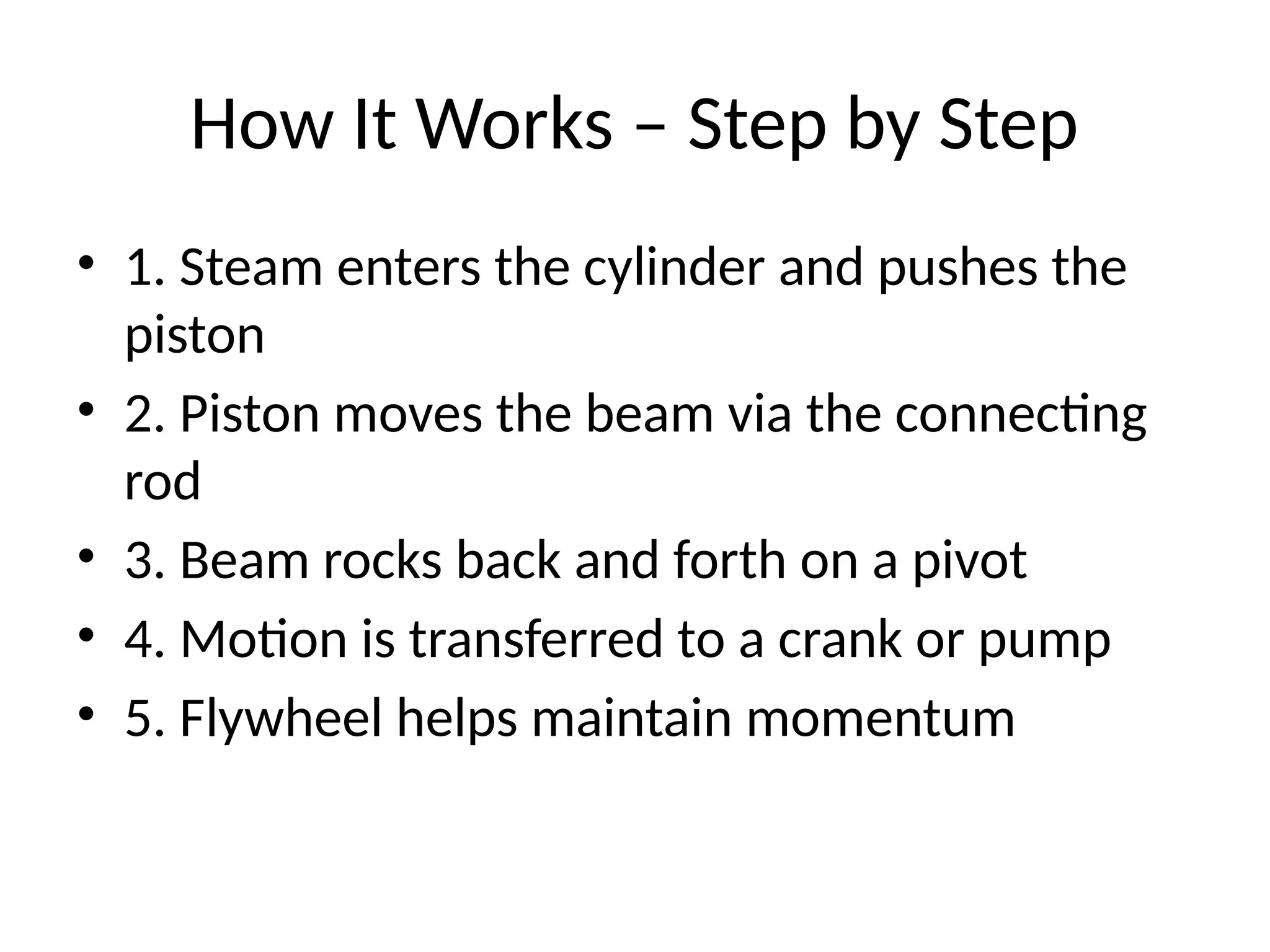
How It Works– Step by Step
• 1. Steam enters the cylinder and pushes the
piston
• 2. Piston moves the beam via the connecting
rod
• 3. Beam rocks back and forth on a pivot
• 4. Motion is transferred to a crank or pump
• 5. Flywheel helps maintain momentum
7.
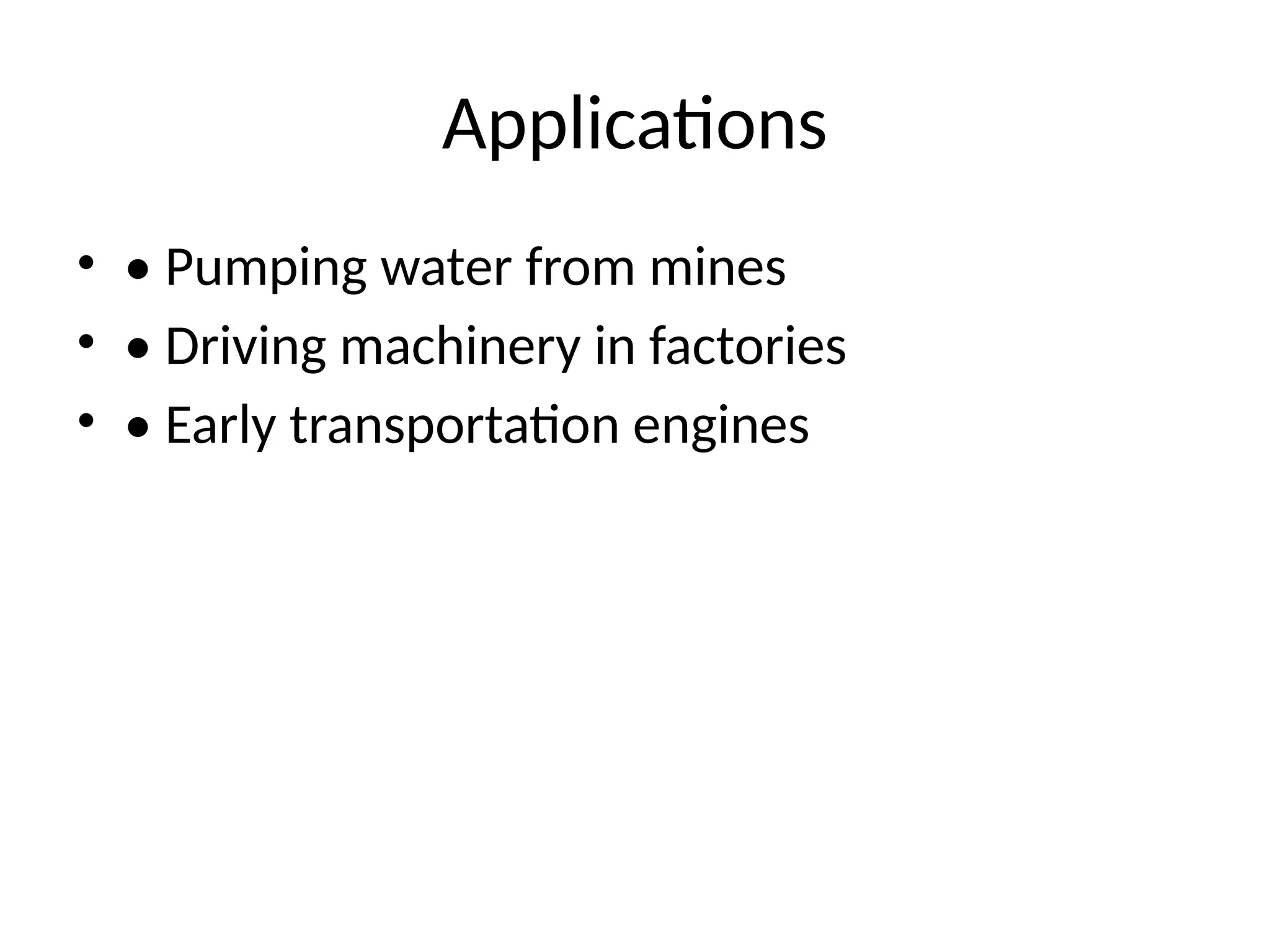
Applications
• • Pumpingwater from mines
• • Driving machinery in factories
• • Early transportation engines
8.
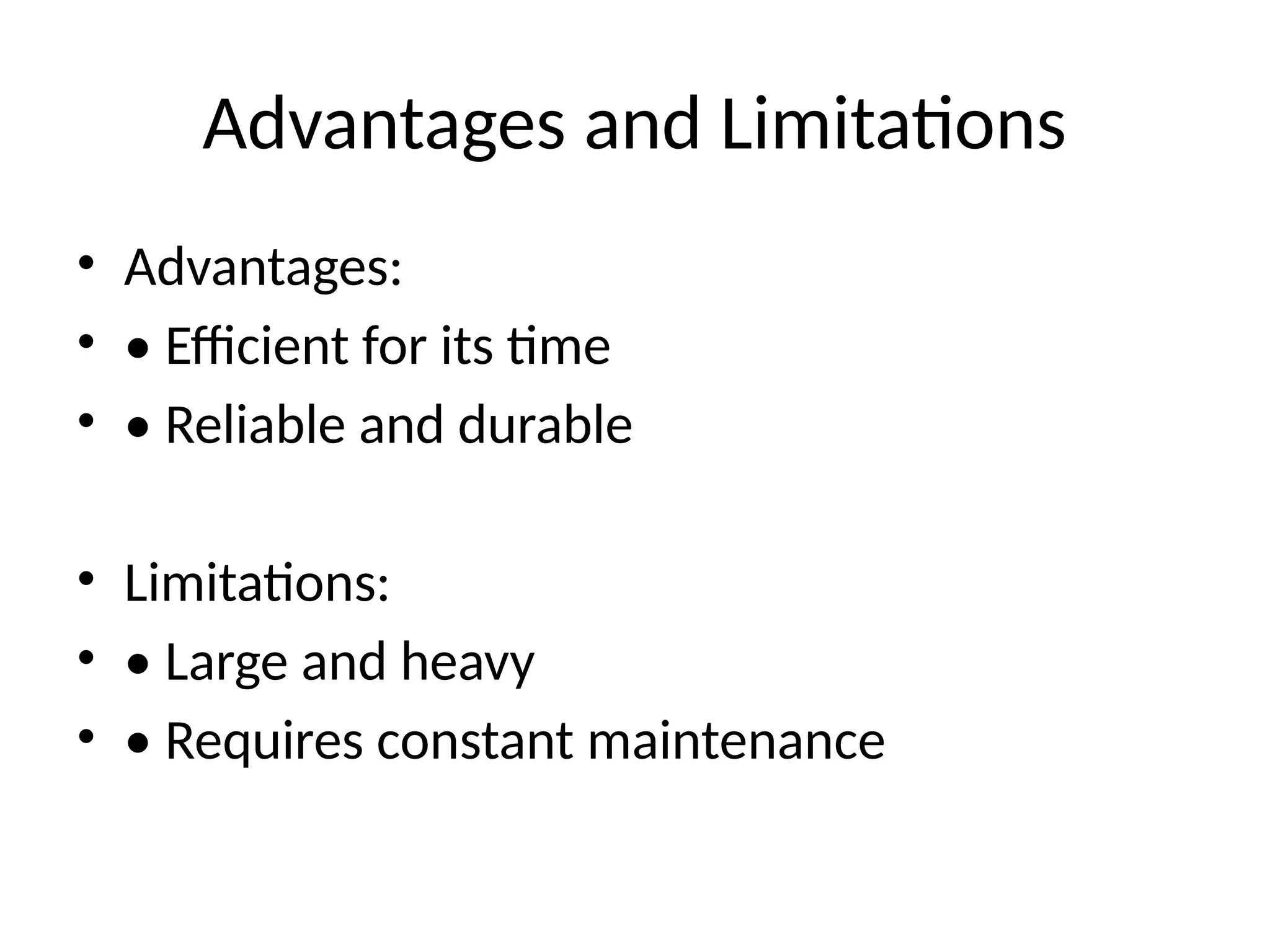
Advantages and Limitations
•Advantages:
• • Efficient for its time
• • Reliable and durable
• Limitations:
• • Large and heavy
• • Requires constant maintenance
9.
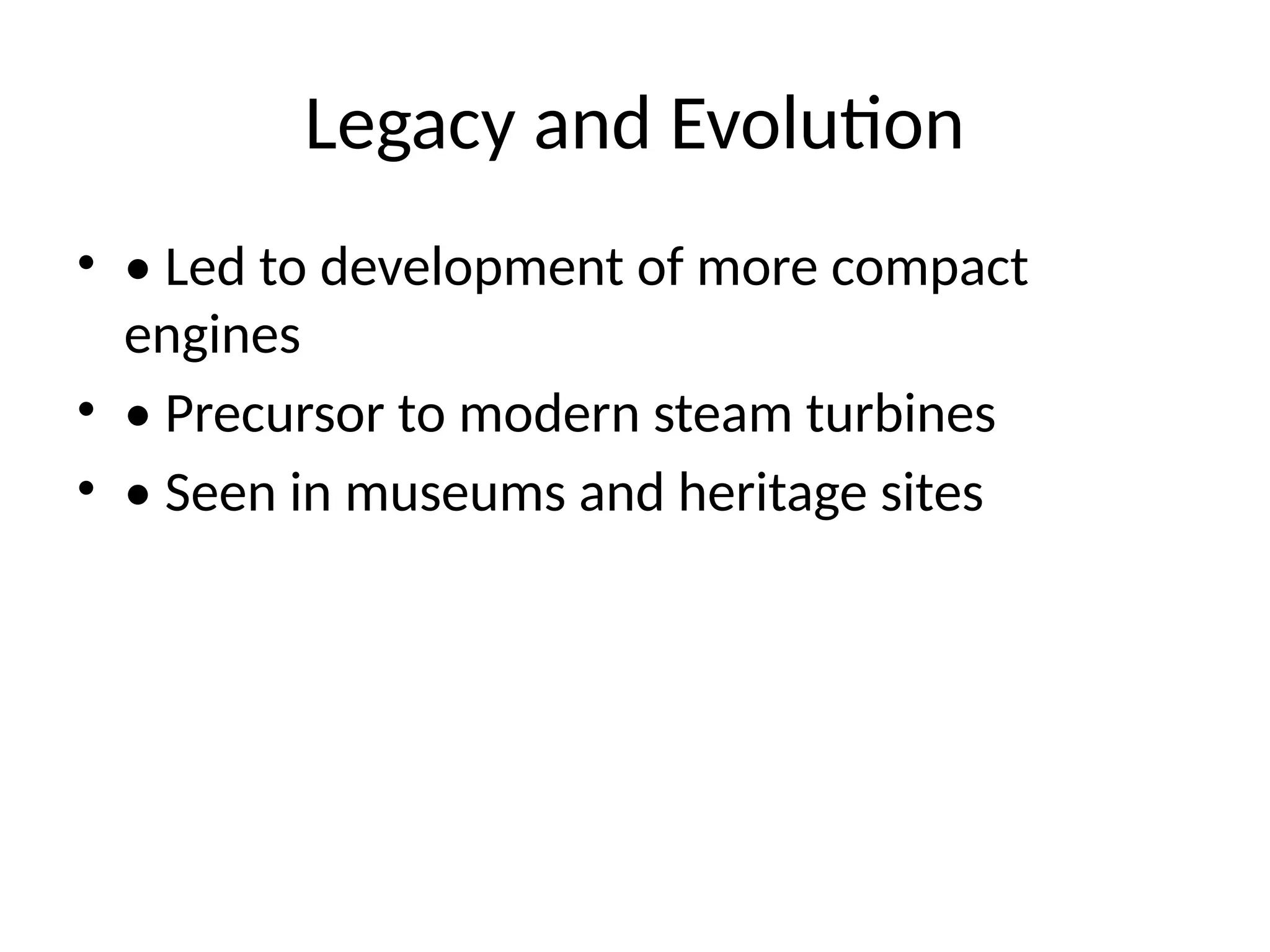
Legacy and Evolution
•• Led to development of more compact
engines
• • Precursor to modern steam turbines
• • Seen in museums and heritage sites
10.
Conclusion
• • Summaryof working and historical impact
• • Significance in mechanical engineering
history
• • Open for questions
![Beam Engine Mechanism
• A Historical Mechanical Marvel
• Presented by: [Your Name]
• Date: [Presentation Date]](https://image.slidesharecdn.com/beamenginemechanismpresentation-250415015854-1393efcf/75/Beam-Engine-Mechanism-Presentation-shshbebbs-1-2048.jpg)


![STEAM_ENGINE_PPT[1].pptx](https://cdn.slidesharecdn.com/ss_thumbnails/steamengineppt1-220915040230-d1aefb33-thumbnail.jpg?width=640&height=640&fit=bounds)


