Bead Dynamics
Tanisha
Dhami
1
Bead
Dynamics
Tanisha Singh Dhami
2
Problem statement
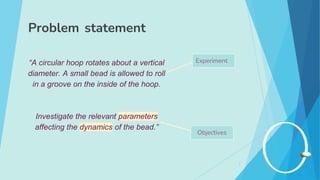
“A circular hoop rotates about a vertical
diameter. A small bead is allowed to roll
in a groove on the inside of the hoop.
Investigate the relevant parameters
affecting the dynamics of the bead.”
Experiment
Objectives
3
Index
Conclusion
Experiment
Quantitative
model
Qualitative
analysis
Parameters
4
The problem
A circular hoop
rotates about a
vertical
diameter. A
small bead is
allowed to roll
in a groove on
the inside of the
hoop
5
Mechanics
Fluids
Rigid bodies
Statics Dynamics
Deformable bodies
Particle dynamics Rigid body dynamics
Bead
dynamics
Classification
6
Part One:
Qualitative Analysis
7
8
Notations - introduction
m
g
mg cos ϕ
mg sin ϕ
ϕ r
m → mass of bead
r → radius of hoop
g → acceleration due to gravity
ϕ→ acute angle from axis of hoop
We will use ω as the angular velocity of the hoop
Assumptions:
The acceleration due to gravity is a constant=9.81.
The bead is an exact sphere for qualitative theory.
9
1. Angular velocity of hoop
2. Mass of bead
3. The radius of the hoop
4. The initial angle
5. Friction between hoop and bead
6. Acceleration due to gravity
Parameters
10
FORCES
Initially, the bead remains at rest.
When some angular velocity is
provided, it starts rising up along
the hoop, constrained to one side.
Then, it comes to rest at a point
midway through the height of the
hoop. This point is called an
equilibrium point, that we will be
looking into.
11
What the terms are
The forces acting on the bead:
- Centrifugal force (Fc)
- Acceleration due to gravity (mg)
- Normal (N)
- Friction (f)
Force due to gravity
Centrifugal term
12
EQUATIONS AND CALCULATION
OR
Force due to gravity
Friction term Centrifugal term
Friction
constant
13
EQUILIBRIUM POSITIONS
Two equilibrium positions occur when ϕ = 0°, 180° :
(without the friction term)
Centrifugal force
At ϕ = 0° or 180°, sin ϕ = 0, thus the net force on the bead equals zero. Although the 180 degree
theoretically is an equilibrium solution, the bead cant stay stationary there.
Similarly, When the second term = 0, As rω^2 approaches ∞
the equilibrium position
approaches ± 90°.
Which side is chosen (for the bead to rise to about 90°) depends on the initial disturbance.
Positions where there is no net force acting on the bead.
Force due to gravity
14
EQUILIBRIUM POSITIONS
Positions where there is no net force acting on the bead.
●
r
N
R
mg
θ
15
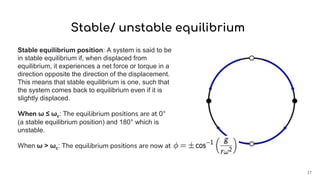
Stable/ unstable equilibrium
Stable equilibrium position: A system is said to be
in stable equilibrium if, when displaced from
equilibrium, it experiences a net force or torque in a
direction opposite the direction of the displacement.
This means that stable equilibrium is one, such that
the system comes back to equilibrium even if it is
slightly displaced.
When ω ≤ ωc: The equilibrium positions are at 0°
(a stable equilibrium position) and 180° which is
unstable.
When ω > ωc: The equilibrium positions are now at
17
Symmetry-broken solutions
In physics, symmetry breaking is a phenomenon in which (infinitesimally) small
fluctuations acting on a system crossing a critical point decide the system's fate, by
determining which branch of a bifurcation is taken. To an outside observer unaware
of the fluctuations (or "noise"), the choice will appear arbitrary.
Which of these two equilibrium points is actually selected depends on the initial
disturbance. Even though the two fixed points are entirely symmetrical, a slight
asymmetry in the initial conditions will lead to one of them being chosen
18
When does the bead start to rise?
We can see that the bead does not move from
the equilibrium position at all.
To understand why this happens, we need to
consider the equation:
Only if ω is greater than will the bead
start moving. This is because, at ω =
the angle is zero. As ω increases, the
angle increases.
19
slow spin 𝛄 ≤ 1
𝛄 > 1
𝛄 >> 1
Fast spin
spin needed
to reach 90
degree
Frictionless surface
20
Bifurcation diagram
A graphical depiction of the relationship between the
values of one parameter and the behaviour of the system.
γ < 1: the hoop is rotating slowly and the centrifugal force
is too weak to balance the force of gravity. Thus the bead
stays at the bottom φ = 0.
γ > 1: the hoop is spinning fast enough that the bottom
becomes unstable. The bead is therefore pushed up the
hoop until gravity balances the centrifugal force.
This is called a supercritical
pitchfork bifurcation.
So which side does it go?
21
Bifurcation Diagram of the ideal scenario Bifurcation Diagram with stress forces and friction
considered in a rigid-sphere model 22
Asymmetrical Pitch-fork Bifurcation diagram
Part Two:
Parameters
24
ANGULAR VELOCITY OF THE HOOP
The equilibrium position of the bead approaches ± 90° as the angular velocity of the
hoop increases.
At very small angular velocities, the bead remains stationary
As ω increases, the acceleration of the bead up the hoop increases.
As the hoop continues to spin, the bead moves from one side to another (not
reaching ± 90°) this change in sides happens because once the bead starts rolling
down one side, it has an inertia to climb the other side.
Once ω is high enough for the bead to reach the ± 90° positions, the bead directly
climbs up till 90° on a single side of the hoop.
Further increasing the angular velocity does not change the bead’s position.
PARAMETER ONE
25
MASS OF BEAD
If we do not consider friction, the mass of the bead
has no effect on its dynamics or equilibrium
positions. Thus, although we had hypothesized that
the mass of the bead will affect its dynamics, we
realize now that it is not an essential factor.
PARAMETER
TWO
26
RADIUS OF HOOP
Critical angular velocity will decrease with increase of radius. It is inversely
proportional to the square of the radius. ωo= g
r
Thus, as the radius of the hoop is increase, we will have to provide lesser
angular velocity to the hoop to make the bead rise.
We have plotted the change in θ max against change in radius.
PARAMETER THREE
√
27
INITIAL ANGLE OF BEAD
We have used simulations to observe the effects of changing the initial angle of the bead.
The initial angle of the bead has no impact on the dynamics. The bead slides down to zero degrees
(whatever initial angle we start from) and then follows the same pattern (keeping other factors
constant). Attaching the pictures of simulations:
PARAMETER FOUR
28
Initially, the bead remains at rest.
When some angular velocity is
provided, it starts rising up along
the hoop, constrained to one side.
Then, it comes to rest at a point
midway through the height of the
hoop. This point is called an
equilibrium point, that we will be
looking into.
7
Friction
PARAMETER FIVE
29
FRICTION
Friction helps in raising the bead and also maintaining it at the equilibrium position.
At the initial stationary position, friction has no significant role.
While the bead is rising, lesser the friction, higher the acceleration (rate of change
of angle with time). The bead will rise faster.
As we can see, when the friction constant (b) decreases, the net force increases.
PARAMETER FIVE
30
Part Three:
Quantitative model
32
SIMULATION
Since the friction could not be wholly neglected, i have used some simulations to work around that problem.
One was using java (ejs) and the other was using python (Trinket - GlowScript)
The software used is ejs (easy java simulations).
It allows me to choose a radius, and then change
the angular velocity and the initial angle. I can play
the simulation and see how the angle of the bead
changes instantaneously.
33
Angular velocity
I have varied angular velocity
and plotted the maximum
angle θ reached by the bead.
As seen in the graph angle
increases with the increase in
angular velocity till the angle
reaches 90 degree.
90 degrees in the equilibrium
position and even if we
further increase the angular
velocity, the position angle
does not increase.
34
Change in Radius
I have kept angular velocity
ω constant and gradually
increased the radius.
The maximum angle
reached by bead increases
with the increase in radius.
As you can see, there is an
asymptote at the 90 degree
position.
35
Change in Radius
I have kept angular
velocity ω constant
and gradually
increased the radius.
Maximum angle
reached by bead
increases with the
increase in radius
Maximum angle
reached initially
increases sharply and
it stabilises on
reaching near 90
degree
36
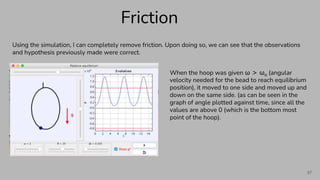
Friction
Using the simulation, I can completely remove friction. Upon doing so, we can see that the observations
and hypothesis previously made were correct.
When the hoop was given ω > ωo (angular
velocity needed for the bead to reach equilibrium
position), it moved to one side and moved up and
down on the same side. (as can be seen in the
graph of angle plotted against time, since all the
values are above 0 (which is the bottom most
point of the hoop).
37
ACCELERATION DUE TO GRAVITY
PARAMETER SIX
g=60 m/s2 g=10 m/s2
38
Part Four:
Experiment
39
EXPERIMENTAL SET-UP
A motor connected
to the hoop
Plastic sheet to
keep the bead
inside + block the
wind
Clay + hot glue to attach
the hoop onto the motor
40
The critical velocity
The radius of the hoop was 8 cm.
Thus, critical angular velocity (ωo ) can be calculated using:
ωo= √(g/r)
= √(9.81 m/s2 /8 cm )
= √(9.81 m/s2 / 0.08 m )
= √122.625
= 11.07 Hz or 69.58 rad/s (correct to four significant
figures)
Thus, only if the hoop is rotating at 69.58 rad/s will the
bead move from the initial equilibrium position.
41
The critical velocity
42
Angular velocity
RPM Rad per
second
Maximum
angle
Angle
calculated
125 13 45 44.32
250 26.18 80 79.70
500 52.36 90 87.44
Critical angular velocity calculated to be 11.07 rad/s or 105.75 RPM.
Experimentally too, the bead would only move if about 108 RPM was provided
43
EXTENDED RESEARCH: Multiple beads system
When multiple beads were used in the same experiment, approximately
half of them moved to one side whereas other half moved to the other.
The ones that were to the right, rose up to the right side of the hoop, and
the one which were slightly towards the left rise up on the left side of the
hoop.
This proves our theory that the side to which the bead rises depends on
the slight difference in its position from the wanted equilibrium position
at an angle of zero degrees,
The rotation was tried multiple times, the beads rose up to a similar
height everytime. When the set of beads start sliding down the side that
they initially rose to, they cross besides one another and move to the
opposite side. This proves the theory that the bead moves from side to
side after initially rising to one side because of its inertia.
44
Lagrangian equations
The same results can be arrived at when using Lagrangian equations of motion too,
thus, I will not be going into it in detail.
x = r sin θ cos φ ; x˙ = r˙ sin θ cos φ + r cos θ cos φ ˙θ − r sin θ sin φ φ˙
y = r sin θ sin φ ; y˙ = r˙ sin θ sin φ + r cos θ sin φ ˙θ + r sin θ cos φ φ˙
z = r cos θ ; z˙ = r˙ cos θ − r sin θ ˙θ
T = ½ m (x˙ 2 + y˙ 2 + z˙ 2 )
T = ½ m (r˙2 + r2 ˙θ2 + (r sin θ)2 φ˙2 )
T = 1 2m R˙ 2 + R 2 ˙θ 2 + (R sin θ) 2φ˙2
But R˙ = 0 , φ˙ = ω = constant
T = ½ m(R 2 ˙θ 2 + (R sin θ) 2 ω 2 ) (NB. R˙ = 0)
U = −mgR cos θ (U = 0 at θ = 90◦ )
L = T − U
L = ½ m(R 2 ˙θ 2 + (R sin θ) 2 ω 2 ) + mgR cos θ
One single generalized coordinate : θ
45
CONCLUSION
What I did:
Observed the motion of the bead when the hoop was rotated, and tried to find out
the different parameters that affect this motion.
How i did it:
I performed the experiment to observe the changes due to different parameters,
and used computer simulations to predict what would happen in cases that i could
not achieve at home.
What i learnt:
The motion is mainly dependant on radius of hoop, mass of hoop and the friction in
the hoop. The bead rises because it tries to go further from the centre.
47
https://stemfellowship.org/iypt-2021-references/bead-dynamics/
https://www.damtp.cam.ac.uk/user/reh10/lectures/ia-dyn-handout13.pdf
http://www.physics.hmc.edu/~saeta/courses/p111/uploads/Y2011/hw03sol.pdf
https://sites.google.com/site/kolukulasivasrinivas/mechanics/bead-on-a-rotating
https://www.youtube.com/watch?v=Io_7vG1rpDA&feature=youtu.be
http://www.physics.hmc.edu/~saeta/courses/p111/uploads/Y2011/hw03sol.pdf prob 3
https://users.physics.ox.ac.uk/~harnew/lectures/mechanics-lectures-20to29.pdf pg 66, 67
http://107.191.96.171/classes/phys3355_2005_fall/assignments/hw12_Lagrange-ans.pdf
https://mse.redwoods.edu/darnold/math55/DEproj/sp08/sengmeeks/BeadonaHoop.pdf - graphs
http://www.cs.ioc.ee/~dima/YFX1520/LectureNotes_3.pdf
https://www.youtube.com/watch?v=z46a9JVCm-c
https://iypt.ru/wp-content/uploads/2020/08/The-bead-on-a-rotating-hoop-revisited-an-unexpected-resonance.pdf
https://youtu.be/8qbR7SsJB9U
https://youtu.be/Io_7vG1rpDA
http://107.191.96.171/classes/phys3355_2005_fall/assignments/hw12_Lagrange-ans.pdf
https://physics.stackexchange.com/questions/314588/a-bead-on-a-spinning-wire-hoop-taylor
https://www.ias.ac.in/article/fulltext/reso/025/09/1261-1281
https://mse.redwoods.edu/darnold/math55/DEproj/sp08/sengmeeks/Spinninghooponline.pdf
REFERENCES
48
Part Five:
Appendix
49
1. Correction factor for geometry:
a. Moment of Inertia of solid sphere about the
instantaneous axis of rotation
a. Rolling without slipping condition on the groove
= Distance between the hoop’s centre to sphere’s COM
= Distance between the sphere’s instantaneous rotation centre and its Centre of Mass (COM)
= Gyration Constant for the moment of inertia
Investigating Parameters
Transverse section of the groove
52
⅖
2. Dissipation:
Introducing a tangential damping force:
Forces on the bead:
Qualitative Model 53

Bead Dynamics

  • 1.
  • 2.
  • 3.
    Problem statement “A circularhoop rotates about a vertical diameter. A small bead is allowed to roll in a groove on the inside of the hoop. Investigate the relevant parameters affecting the dynamics of the bead.” Experiment Objectives 3
  • 4.
  • 5.
    The problem A circularhoop rotates about a vertical diameter. A small bead is allowed to roll in a groove on the inside of the hoop 5
  • 6.
    Mechanics Fluids Rigid bodies Statics Dynamics Deformablebodies Particle dynamics Rigid body dynamics Bead dynamics Classification 6
  • 7.
  • 8.
  • 9.
    Notations - introduction m g mgcos ϕ mg sin ϕ ϕ r m → mass of bead r → radius of hoop g → acceleration due to gravity ϕ→ acute angle from axis of hoop We will use ω as the angular velocity of the hoop Assumptions: The acceleration due to gravity is a constant=9.81. The bead is an exact sphere for qualitative theory. 9
  • 10.
    1. Angular velocityof hoop 2. Mass of bead 3. The radius of the hoop 4. The initial angle 5. Friction between hoop and bead 6. Acceleration due to gravity Parameters 10
  • 11.
    FORCES Initially, the beadremains at rest. When some angular velocity is provided, it starts rising up along the hoop, constrained to one side. Then, it comes to rest at a point midway through the height of the hoop. This point is called an equilibrium point, that we will be looking into. 11
  • 12.
    What the termsare The forces acting on the bead: - Centrifugal force (Fc) - Acceleration due to gravity (mg) - Normal (N) - Friction (f) Force due to gravity Centrifugal term 12
  • 13.
    EQUATIONS AND CALCULATION OR Forcedue to gravity Friction term Centrifugal term Friction constant 13
  • 14.
    EQUILIBRIUM POSITIONS Two equilibriumpositions occur when ϕ = 0°, 180° : (without the friction term) Centrifugal force At ϕ = 0° or 180°, sin ϕ = 0, thus the net force on the bead equals zero. Although the 180 degree theoretically is an equilibrium solution, the bead cant stay stationary there. Similarly, When the second term = 0, As rω^2 approaches ∞ the equilibrium position approaches ± 90°. Which side is chosen (for the bead to rise to about 90°) depends on the initial disturbance. Positions where there is no net force acting on the bead. Force due to gravity 14
  • 15.
    EQUILIBRIUM POSITIONS Positions wherethere is no net force acting on the bead. ● r N R mg θ 15
  • 16.
    Stable/ unstable equilibrium Stableequilibrium position: A system is said to be in stable equilibrium if, when displaced from equilibrium, it experiences a net force or torque in a direction opposite the direction of the displacement. This means that stable equilibrium is one, such that the system comes back to equilibrium even if it is slightly displaced. When ω ≤ ωc: The equilibrium positions are at 0° (a stable equilibrium position) and 180° which is unstable. When ω > ωc: The equilibrium positions are now at 17
  • 17.
    Symmetry-broken solutions In physics,symmetry breaking is a phenomenon in which (infinitesimally) small fluctuations acting on a system crossing a critical point decide the system's fate, by determining which branch of a bifurcation is taken. To an outside observer unaware of the fluctuations (or "noise"), the choice will appear arbitrary. Which of these two equilibrium points is actually selected depends on the initial disturbance. Even though the two fixed points are entirely symmetrical, a slight asymmetry in the initial conditions will lead to one of them being chosen 18
  • 18.
    When does thebead start to rise? We can see that the bead does not move from the equilibrium position at all. To understand why this happens, we need to consider the equation: Only if ω is greater than will the bead start moving. This is because, at ω = the angle is zero. As ω increases, the angle increases. 19
  • 19.
    slow spin 𝛄≤ 1 𝛄 > 1 𝛄 >> 1 Fast spin spin needed to reach 90 degree Frictionless surface 20
  • 20.
    Bifurcation diagram A graphicaldepiction of the relationship between the values of one parameter and the behaviour of the system. γ < 1: the hoop is rotating slowly and the centrifugal force is too weak to balance the force of gravity. Thus the bead stays at the bottom φ = 0. γ > 1: the hoop is spinning fast enough that the bottom becomes unstable. The bead is therefore pushed up the hoop until gravity balances the centrifugal force. This is called a supercritical pitchfork bifurcation. So which side does it go? 21
  • 21.
    Bifurcation Diagram ofthe ideal scenario Bifurcation Diagram with stress forces and friction considered in a rigid-sphere model 22 Asymmetrical Pitch-fork Bifurcation diagram
  • 22.
  • 23.
    ANGULAR VELOCITY OFTHE HOOP The equilibrium position of the bead approaches ± 90° as the angular velocity of the hoop increases. At very small angular velocities, the bead remains stationary As ω increases, the acceleration of the bead up the hoop increases. As the hoop continues to spin, the bead moves from one side to another (not reaching ± 90°) this change in sides happens because once the bead starts rolling down one side, it has an inertia to climb the other side. Once ω is high enough for the bead to reach the ± 90° positions, the bead directly climbs up till 90° on a single side of the hoop. Further increasing the angular velocity does not change the bead’s position. PARAMETER ONE 25
  • 24.
    MASS OF BEAD Ifwe do not consider friction, the mass of the bead has no effect on its dynamics or equilibrium positions. Thus, although we had hypothesized that the mass of the bead will affect its dynamics, we realize now that it is not an essential factor. PARAMETER TWO 26
  • 25.
    RADIUS OF HOOP Criticalangular velocity will decrease with increase of radius. It is inversely proportional to the square of the radius. ωo= g r Thus, as the radius of the hoop is increase, we will have to provide lesser angular velocity to the hoop to make the bead rise. We have plotted the change in θ max against change in radius. PARAMETER THREE √ 27
  • 26.
    INITIAL ANGLE OFBEAD We have used simulations to observe the effects of changing the initial angle of the bead. The initial angle of the bead has no impact on the dynamics. The bead slides down to zero degrees (whatever initial angle we start from) and then follows the same pattern (keeping other factors constant). Attaching the pictures of simulations: PARAMETER FOUR 28
  • 27.
    Initially, the beadremains at rest. When some angular velocity is provided, it starts rising up along the hoop, constrained to one side. Then, it comes to rest at a point midway through the height of the hoop. This point is called an equilibrium point, that we will be looking into. 7 Friction PARAMETER FIVE 29
  • 28.
    FRICTION Friction helps inraising the bead and also maintaining it at the equilibrium position. At the initial stationary position, friction has no significant role. While the bead is rising, lesser the friction, higher the acceleration (rate of change of angle with time). The bead will rise faster. As we can see, when the friction constant (b) decreases, the net force increases. PARAMETER FIVE 30
  • 29.
  • 30.
    SIMULATION Since the frictioncould not be wholly neglected, i have used some simulations to work around that problem. One was using java (ejs) and the other was using python (Trinket - GlowScript) The software used is ejs (easy java simulations). It allows me to choose a radius, and then change the angular velocity and the initial angle. I can play the simulation and see how the angle of the bead changes instantaneously. 33
  • 31.
    Angular velocity I havevaried angular velocity and plotted the maximum angle θ reached by the bead. As seen in the graph angle increases with the increase in angular velocity till the angle reaches 90 degree. 90 degrees in the equilibrium position and even if we further increase the angular velocity, the position angle does not increase. 34
  • 32.
    Change in Radius Ihave kept angular velocity ω constant and gradually increased the radius. The maximum angle reached by bead increases with the increase in radius. As you can see, there is an asymptote at the 90 degree position. 35
  • 33.
    Change in Radius Ihave kept angular velocity ω constant and gradually increased the radius. Maximum angle reached by bead increases with the increase in radius Maximum angle reached initially increases sharply and it stabilises on reaching near 90 degree 36
  • 34.
    Friction Using the simulation,I can completely remove friction. Upon doing so, we can see that the observations and hypothesis previously made were correct. When the hoop was given ω > ωo (angular velocity needed for the bead to reach equilibrium position), it moved to one side and moved up and down on the same side. (as can be seen in the graph of angle plotted against time, since all the values are above 0 (which is the bottom most point of the hoop). 37
  • 35.
    ACCELERATION DUE TOGRAVITY PARAMETER SIX g=60 m/s2 g=10 m/s2 38
  • 36.
  • 37.
    EXPERIMENTAL SET-UP A motorconnected to the hoop Plastic sheet to keep the bead inside + block the wind Clay + hot glue to attach the hoop onto the motor 40
  • 38.
    The critical velocity Theradius of the hoop was 8 cm. Thus, critical angular velocity (ωo ) can be calculated using: ωo= √(g/r) = √(9.81 m/s2 /8 cm ) = √(9.81 m/s2 / 0.08 m ) = √122.625 = 11.07 Hz or 69.58 rad/s (correct to four significant figures) Thus, only if the hoop is rotating at 69.58 rad/s will the bead move from the initial equilibrium position. 41
  • 39.
  • 40.
    Angular velocity RPM Radper second Maximum angle Angle calculated 125 13 45 44.32 250 26.18 80 79.70 500 52.36 90 87.44 Critical angular velocity calculated to be 11.07 rad/s or 105.75 RPM. Experimentally too, the bead would only move if about 108 RPM was provided 43
  • 41.
    EXTENDED RESEARCH: Multiplebeads system When multiple beads were used in the same experiment, approximately half of them moved to one side whereas other half moved to the other. The ones that were to the right, rose up to the right side of the hoop, and the one which were slightly towards the left rise up on the left side of the hoop. This proves our theory that the side to which the bead rises depends on the slight difference in its position from the wanted equilibrium position at an angle of zero degrees, The rotation was tried multiple times, the beads rose up to a similar height everytime. When the set of beads start sliding down the side that they initially rose to, they cross besides one another and move to the opposite side. This proves the theory that the bead moves from side to side after initially rising to one side because of its inertia. 44
  • 42.
    Lagrangian equations The sameresults can be arrived at when using Lagrangian equations of motion too, thus, I will not be going into it in detail. x = r sin θ cos φ ; x˙ = r˙ sin θ cos φ + r cos θ cos φ ˙θ − r sin θ sin φ φ˙ y = r sin θ sin φ ; y˙ = r˙ sin θ sin φ + r cos θ sin φ ˙θ + r sin θ cos φ φ˙ z = r cos θ ; z˙ = r˙ cos θ − r sin θ ˙θ T = ½ m (x˙ 2 + y˙ 2 + z˙ 2 ) T = ½ m (r˙2 + r2 ˙θ2 + (r sin θ)2 φ˙2 ) T = 1 2m R˙ 2 + R 2 ˙θ 2 + (R sin θ) 2φ˙2 But R˙ = 0 , φ˙ = ω = constant T = ½ m(R 2 ˙θ 2 + (R sin θ) 2 ω 2 ) (NB. R˙ = 0) U = −mgR cos θ (U = 0 at θ = 90◦ ) L = T − U L = ½ m(R 2 ˙θ 2 + (R sin θ) 2 ω 2 ) + mgR cos θ One single generalized coordinate : θ 45
  • 43.
    CONCLUSION What I did: Observedthe motion of the bead when the hoop was rotated, and tried to find out the different parameters that affect this motion. How i did it: I performed the experiment to observe the changes due to different parameters, and used computer simulations to predict what would happen in cases that i could not achieve at home. What i learnt: The motion is mainly dependant on radius of hoop, mass of hoop and the friction in the hoop. The bead rises because it tries to go further from the centre. 47
  • 44.
    https://stemfellowship.org/iypt-2021-references/bead-dynamics/ https://www.damtp.cam.ac.uk/user/reh10/lectures/ia-dyn-handout13.pdf http://www.physics.hmc.edu/~saeta/courses/p111/uploads/Y2011/hw03sol.pdf https://sites.google.com/site/kolukulasivasrinivas/mechanics/bead-on-a-rotating https://www.youtube.com/watch?v=Io_7vG1rpDA&feature=youtu.be http://www.physics.hmc.edu/~saeta/courses/p111/uploads/Y2011/hw03sol.pdf prob 3 https://users.physics.ox.ac.uk/~harnew/lectures/mechanics-lectures-20to29.pdfpg 66, 67 http://107.191.96.171/classes/phys3355_2005_fall/assignments/hw12_Lagrange-ans.pdf https://mse.redwoods.edu/darnold/math55/DEproj/sp08/sengmeeks/BeadonaHoop.pdf - graphs http://www.cs.ioc.ee/~dima/YFX1520/LectureNotes_3.pdf https://www.youtube.com/watch?v=z46a9JVCm-c https://iypt.ru/wp-content/uploads/2020/08/The-bead-on-a-rotating-hoop-revisited-an-unexpected-resonance.pdf https://youtu.be/8qbR7SsJB9U https://youtu.be/Io_7vG1rpDA http://107.191.96.171/classes/phys3355_2005_fall/assignments/hw12_Lagrange-ans.pdf https://physics.stackexchange.com/questions/314588/a-bead-on-a-spinning-wire-hoop-taylor https://www.ias.ac.in/article/fulltext/reso/025/09/1261-1281 https://mse.redwoods.edu/darnold/math55/DEproj/sp08/sengmeeks/Spinninghooponline.pdf REFERENCES 48
  • 45.
  • 46.
    1. Correction factorfor geometry: a. Moment of Inertia of solid sphere about the instantaneous axis of rotation a. Rolling without slipping condition on the groove = Distance between the hoop’s centre to sphere’s COM = Distance between the sphere’s instantaneous rotation centre and its Centre of Mass (COM) = Gyration Constant for the moment of inertia Investigating Parameters Transverse section of the groove 52 ⅖
  • 47.
    2. Dissipation: Introducing atangential damping force: Forces on the bead: Qualitative Model 53