Be The Change Introduction to Change Management  Tel Aviv, June 18, 2008 Holger Nauheimer A GLOBAL PARTNER WHO MAKES CHANGE HAPPEN IN COMPLEX ENVIRONMENTS
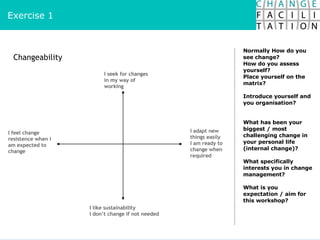
Changeability I like sustainability I don’t change if not needed I adapt new things easily I am ready to change when required I feel change resistence when I am expected to change I seek for changes in my way of working Exercise 1 Normally How do you see change? How do you assess yourself? Place yourself on the matrix? Introduce yourself and you organisation? What has been your biggest / most challenging change in your personal life (internal change)? What specifically interests you in change management? What is you expectation / aim for this workshop?
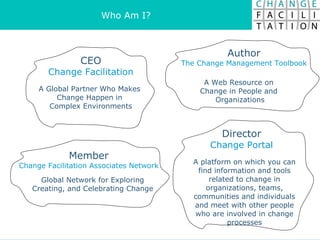
Who Am I? CEO Change Facilitation A Global Partner Who Makes  Change Happen in  Complex Environments Member Change Facilitation Associates Network Global Network for Exploring Creating, and Celebrating Change Author The Change Management Toolbook A Web Resource on  Change in People and  Organizations Director Change Portal A platform on which you can find information and tools related to change in organizations, teams, communities and individuals and meet with other people who are involved in change processes
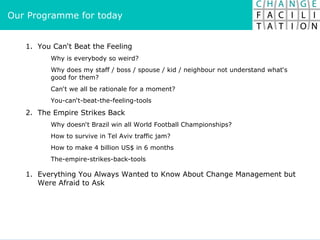
Our Programme for today You Can‘t Beat the Feeling Why is everybody so weird? Why does my staff / boss / spouse / kid / neighbour not understand what‘s good for them? Can‘t we all be rationale for a moment? You-can‘t-beat-the-feeling-tools 2.  The Empire Strikes Back Why doesn‘t Brazil win all World Football Championships? How to survive in Tel Aviv traffic jam? How to make 4 billion US$ in 6 months The-empire-strikes-back-tools Everything You Always Wanted to Know About Change Management but Were Afraid to Ask
Clifford Stoll  (astro-physicist and computer systems administrator) wrote in NEWSWEEK Feb 27, 1995: HYPE ALERT: WHY CYBERSPACE ISN'T,  AND WILL NEVER BE, NIRVANA Some Perspectives
“ After two decades online, I'm perplexed. It's not that I haven't had a gas of a good time on the Internet. I've met great people and even caught a hacker or two. But today, I'm uneasy about this most trendy and oversold community. Visionaries see a future of telecommuting workers, interactive libraries and multimedia classrooms. They speak of electronic town meetings and virtual communities. Commerce and business will shift from offices and malls to networks and modems. And the freedom of digital networks will make government more democratic.”  12 years ago
“ Baloney. Do our computer pundits  lack all common sense?“ “ no CD-ROM can take the place  of a competent teacher,” “ and no computer network will  change the way government works.”   Baloney? “ The thruth is: no online database will replace your daily newspaper“
“ Then there's cyberbusiness. We're promised instant catalog shopping--just point and click for great deals. We'll order airline tickets over the network, make restaurant reservations and negotiate sales contracts. Stores will become obselete. So how come my local mall does more business in an afternoon than the entire Internet handles in a month? Even if there were a trustworthy way to send money over the Internet--which there isn't--the network is missing a most essential ingredient of capitalism: salespeople.  Yet Nicholas Negroponte, director of the MIT Media Lab, predicts that we'll soon buy books and newspapers straight over the Intenet. Uh, sure.“
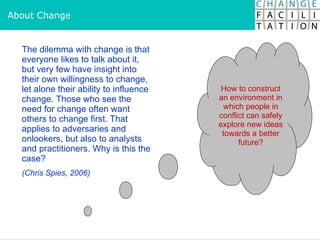
About Change The dilemma with change is that everyone likes to talk about it, but very few have insight into their own willingness to change, let alone their ability to influence change. Those who see the need for change often want others to change first. That applies to adversaries and onlookers, but also to analysts and practitioners. Why is this the case?  (Chris Spies, 2006) How to construct an environment in which people in conflict can safely explore new ideas towards a better future?
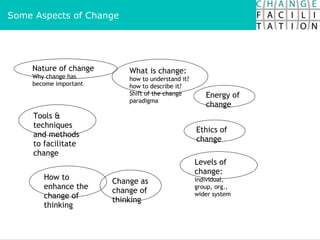
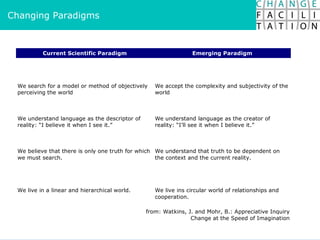
Some Aspects of Change Nature of change  Why change has become important What is change: how to understand it? how to describe it? Shift of the change paradigma Energy of change Ethics of change Levels of change:  individual, group, org., wider system Change as change of thinking How to enhance the change of thinking Tools & techniques and methods to facilitate change
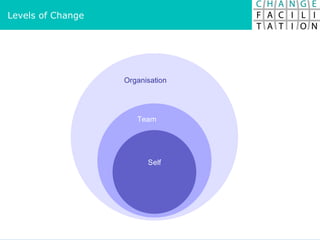
Levels of Change
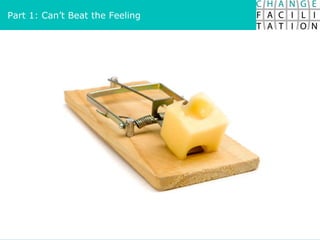
Part 1: Can’t Beat the Feeling
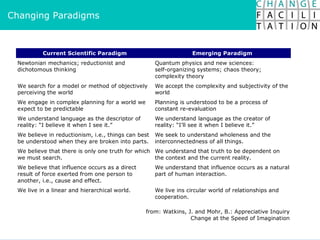
Changing Paradigms
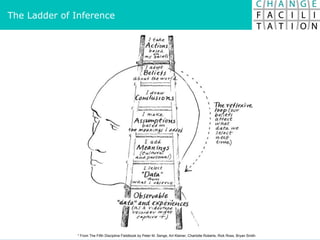
* From  The Fifth Discipline Fieldbook by Peter M. Senge, Art Kleiner, Charlotte Roberts, Rick Ross, Bryan Smith  The Ladder of Inference
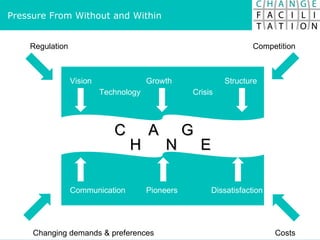
Regulation Changing demands & preferences Costs Competition Pressure From Without and Within Vision Growth Structure Technology Crisis Communication Pioneers Dissatisfaction C  H   A   N  G   E
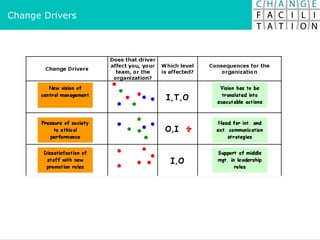
Change Drivers
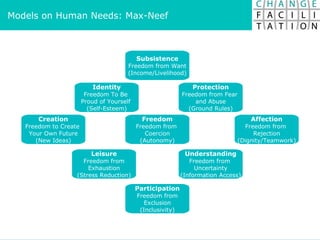
Models on Human Needs: Max-Neef Subsistence Freedom from Want (Income/Livelihood) Protection Freedom from Fear  and Abuse (Ground Rules) Affection Freedom from  Rejection (Dignity/Teamwork) Understanding Freedom from  Uncertainty (Information Access) Participation Freedom from Exclusion (Inclusivity) Leisure Freedom from Exhaustion (Stress Reduction) Creation Freedom to Create  Your Own Future (New Ideas) Identity Freedom To Be  Proud of Yourself  (Self-Esteem) Freedom Freedom from  Coercion (Autonomy)
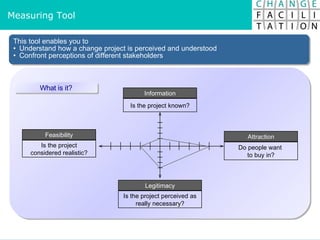
What is it? This tool enables you to Understand how a change project is perceived and understood Confront perceptions of different stakeholders Information Is the project known? Feasibility Is the project considered realistic? Attraction Do people want  to buy in? Legitimacy Is the project perceived as really necessary? Measuring Tool
 
Part 2: The Empire Strikes Back
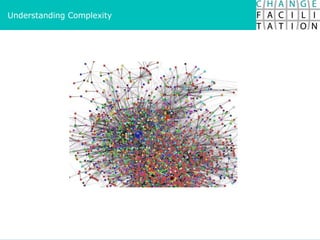
Understanding Complexity
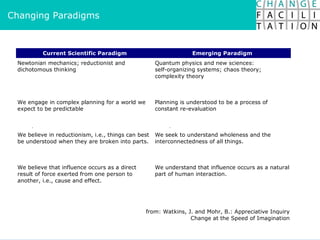
Changing Paradigms
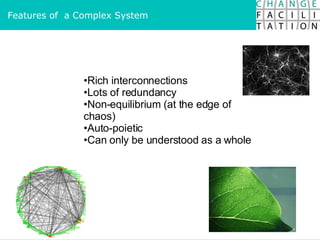
Features of  a Complex System Rich interconnections  Lots of redundancy  Non-equilibrium (at the edge of chaos)  Auto-poietic  Can only be understood as a whole
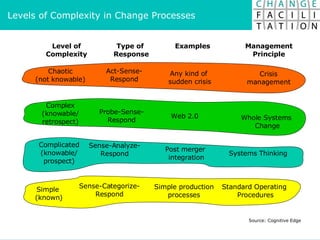
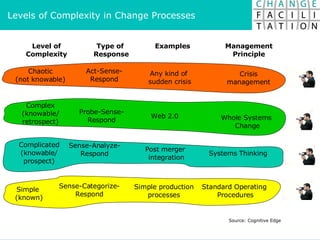
Levels of Complexity in Change Processes Level of Complexity Type of  Response Management Principle Source: Cognitive Edge Examples Chaotic (not knowable) Act-Sense- Respond Crisis management Any kind of  sudden crisis Complex (knowable/ retrospect) Probe-Sense- Respond Whole Systems  Change Web 2.0 Complicated (knowable/ prospect) Sense-Analyze- Respond Systems Thinking Post merger  integration Simple  (known) Sense-Categorize- Respond Standard Operating  Procedures Simple production processes
What do you think about Web 2.0 In 2008? Baloney?
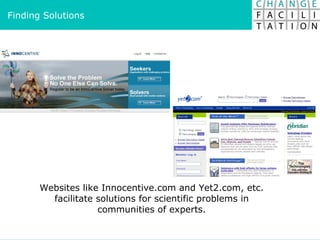
Websites like Innocentive.com and Yet2.com, etc. facilitate solutions for scientific problems in communities of experts. Finding Solutions
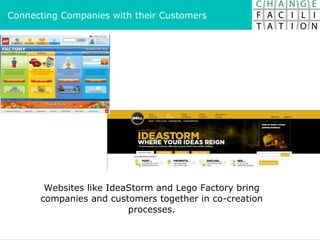
Websites like IdeaStorm and Lego Factory bring companies and customers together in co-creation processes. Connecting Companies with their Customers
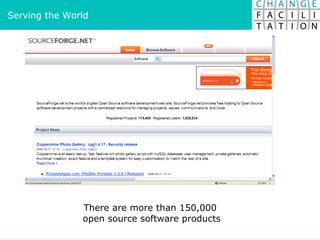
There are more than 150,000  open source software products Serving the World
OhMyNews is an online journal with  the motto  "Every Citizen is a Reporter“. Global Voices is a community of bloggers from around the world “shining light on places and people other media often ignore”. Journalism
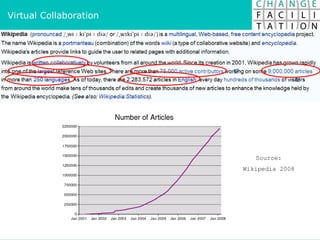
Virtual Collaboration Source: Wikipedia 2008
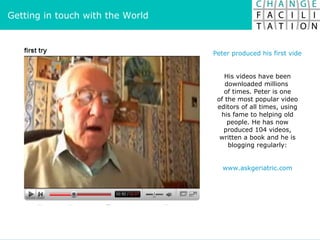
Peter produced his first videos in 2006. Within one week, he was no.1 on YouTube His videos have been downloaded millions  of times. Peter is one of the most popular video editors of all times, using his fame to helping old people. He has now produced 104 videos, written a book and he is blogging regularly: www.askgeriatric.com Getting in touch with the World
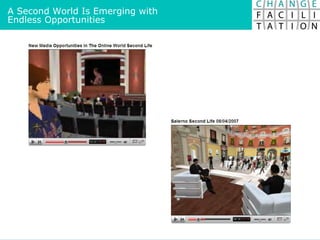
A Second World Is Emerging with  Endless Opportunities
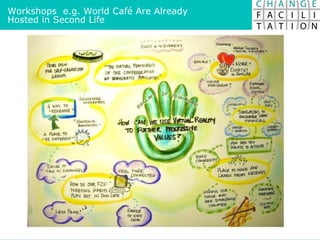
Workshops  e.g. World Café Are Already  Hosted in Second Life
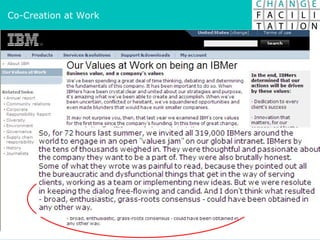
Co-Creation at Work
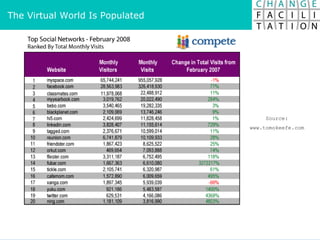
Source: www.tomokeefe.com The Virtual World Is Populated
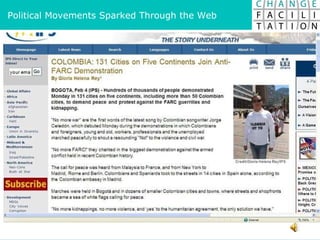
Political Movements Sparked Through the Web
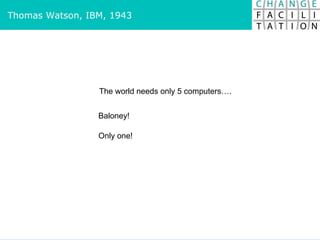
Thomas Watson, IBM, 1943 The world needs only 5 computers…. Baloney! Only one!
Changing Paradigms
Levels of Complexity in Change Processes Level of Complexity Type of  Response Management Principle Source: Cognitive Edge Examples Chaotic (not knowable) Act-Sense- Respond Crisis management Any kind of  sudden crisis Complex (knowable/ retrospect) Probe-Sense- Respond Whole Systems  Change Web 2.0 Complicated (knowable/ prospect) Sense-Analyze- Respond Systems Thinking Post merger  integration Simple  (known) Sense-Categorize- Respond Standard Operating  Procedures Simple production processes
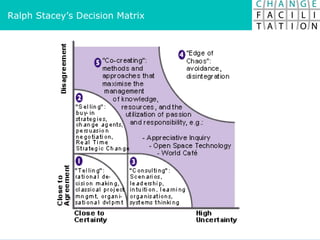
Ralph Stacey’s Decision Matrix
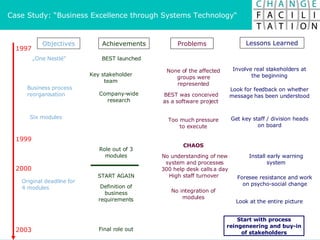
1997 1999 2000 2003 Objectives Achievements Problems Lessons Learned „ One Nestlé“ Business process reorganisation Six modules Original deadline for 4 modules BEST launched Key stakeholder team Company-wide research Role out of 3 modules START AGAIN Definition of business requirements Final role out None of the affected groups were represented BEST was conceived as a software project Too much pressure to execute CHAOS No understanding of new system and processes 300 help desk calls a day High staff turnover  No integration of modules Involve real stakeholders at the beginning Look for feedback on whether message has been understood Get key staff / division heads on board Install early warning system Foresee resistance and work on psycho-social change Look at the entire picture Start with process reingeneering and buy-in of stakeholders Case Study: “Business Excellence through Systems Technology“
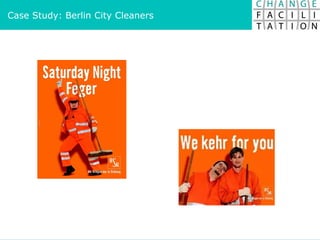
Case Study: Berlin City Cleaners
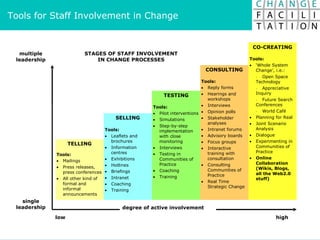
Tools for Staff Involvement in Change
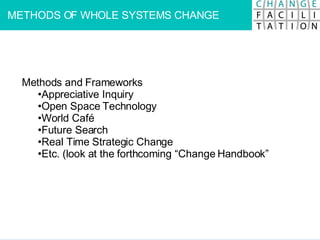
METHODS OF WHOLE SYSTEMS CHANGE Methods and Frameworks  Appreciative Inquiry  Open Space Technology  World Café  Future Search  Real Time Strategic Change  Etc. (look at the forthcoming “Change Handbook”
:: Change Needs Engagement :: Creating engagement means!  Widening the circle of involvement Connecting people to each other and strategy Creating collaboration for action Create democratic process for strategy alignment  Creating Engagement Means
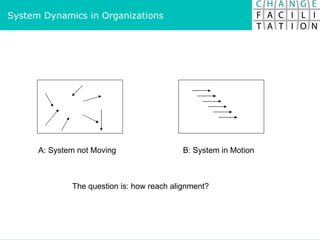
System Dynamics in Organizations A: System not Moving B: System in Motion The question is: how reach alignment?
PRINCIPLES OF WHOLE SYSTEMS CHANGE Bringing the whole system into one room  Search for common ground  Creating joint visions  Responsibility and passion  Self-organized processes
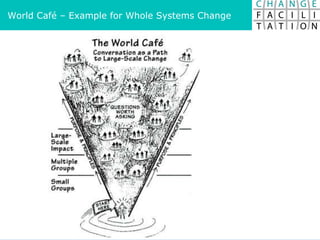
World Café – Example for Whole Systems Change
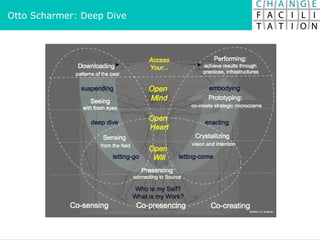
Otto Scharmer: Deep Dive
Planning for Change
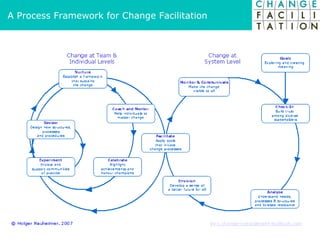
A Process Framework for Change Facilitation
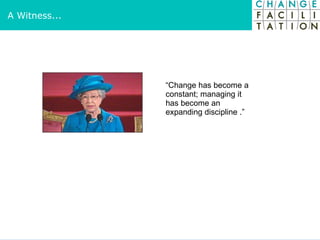
A Witness... “ Change has become a constant; managing it has become an expanding discipline .”

Be The Change Tel Aviv

  • 1.
    Be The ChangeIntroduction to Change Management Tel Aviv, June 18, 2008 Holger Nauheimer A GLOBAL PARTNER WHO MAKES CHANGE HAPPEN IN COMPLEX ENVIRONMENTS
  • 2.
    Changeability I likesustainability I don’t change if not needed I adapt new things easily I am ready to change when required I feel change resistence when I am expected to change I seek for changes in my way of working Exercise 1 Normally How do you see change? How do you assess yourself? Place yourself on the matrix? Introduce yourself and you organisation? What has been your biggest / most challenging change in your personal life (internal change)? What specifically interests you in change management? What is you expectation / aim for this workshop?
  • 3.
    Who Am I?CEO Change Facilitation A Global Partner Who Makes Change Happen in Complex Environments Member Change Facilitation Associates Network Global Network for Exploring Creating, and Celebrating Change Author The Change Management Toolbook A Web Resource on Change in People and Organizations Director Change Portal A platform on which you can find information and tools related to change in organizations, teams, communities and individuals and meet with other people who are involved in change processes
  • 4.
    Our Programme fortoday You Can‘t Beat the Feeling Why is everybody so weird? Why does my staff / boss / spouse / kid / neighbour not understand what‘s good for them? Can‘t we all be rationale for a moment? You-can‘t-beat-the-feeling-tools 2. The Empire Strikes Back Why doesn‘t Brazil win all World Football Championships? How to survive in Tel Aviv traffic jam? How to make 4 billion US$ in 6 months The-empire-strikes-back-tools Everything You Always Wanted to Know About Change Management but Were Afraid to Ask
  • 5.
    Clifford Stoll (astro-physicist and computer systems administrator) wrote in NEWSWEEK Feb 27, 1995: HYPE ALERT: WHY CYBERSPACE ISN'T, AND WILL NEVER BE, NIRVANA Some Perspectives
  • 6.
    “ After twodecades online, I'm perplexed. It's not that I haven't had a gas of a good time on the Internet. I've met great people and even caught a hacker or two. But today, I'm uneasy about this most trendy and oversold community. Visionaries see a future of telecommuting workers, interactive libraries and multimedia classrooms. They speak of electronic town meetings and virtual communities. Commerce and business will shift from offices and malls to networks and modems. And the freedom of digital networks will make government more democratic.” 12 years ago
  • 7.
    “ Baloney. Doour computer pundits lack all common sense?“ “ no CD-ROM can take the place of a competent teacher,” “ and no computer network will change the way government works.” Baloney? “ The thruth is: no online database will replace your daily newspaper“
  • 8.
    “ Then there'scyberbusiness. We're promised instant catalog shopping--just point and click for great deals. We'll order airline tickets over the network, make restaurant reservations and negotiate sales contracts. Stores will become obselete. So how come my local mall does more business in an afternoon than the entire Internet handles in a month? Even if there were a trustworthy way to send money over the Internet--which there isn't--the network is missing a most essential ingredient of capitalism: salespeople. Yet Nicholas Negroponte, director of the MIT Media Lab, predicts that we'll soon buy books and newspapers straight over the Intenet. Uh, sure.“
  • 9.
    About Change Thedilemma with change is that everyone likes to talk about it, but very few have insight into their own willingness to change, let alone their ability to influence change. Those who see the need for change often want others to change first. That applies to adversaries and onlookers, but also to analysts and practitioners. Why is this the case? (Chris Spies, 2006) How to construct an environment in which people in conflict can safely explore new ideas towards a better future?
  • 10.
    Some Aspects ofChange Nature of change Why change has become important What is change: how to understand it? how to describe it? Shift of the change paradigma Energy of change Ethics of change Levels of change: individual, group, org., wider system Change as change of thinking How to enhance the change of thinking Tools & techniques and methods to facilitate change
  • 11.
  • 12.
    Part 1: Can’tBeat the Feeling
  • 13.
  • 14.
    * From The Fifth Discipline Fieldbook by Peter M. Senge, Art Kleiner, Charlotte Roberts, Rick Ross, Bryan Smith The Ladder of Inference
  • 15.
    Regulation Changing demands& preferences Costs Competition Pressure From Without and Within Vision Growth Structure Technology Crisis Communication Pioneers Dissatisfaction C H A N G E
  • 16.
  • 17.
    Models on HumanNeeds: Max-Neef Subsistence Freedom from Want (Income/Livelihood) Protection Freedom from Fear and Abuse (Ground Rules) Affection Freedom from Rejection (Dignity/Teamwork) Understanding Freedom from Uncertainty (Information Access) Participation Freedom from Exclusion (Inclusivity) Leisure Freedom from Exhaustion (Stress Reduction) Creation Freedom to Create Your Own Future (New Ideas) Identity Freedom To Be Proud of Yourself (Self-Esteem) Freedom Freedom from Coercion (Autonomy)
  • 18.
    What is it?This tool enables you to Understand how a change project is perceived and understood Confront perceptions of different stakeholders Information Is the project known? Feasibility Is the project considered realistic? Attraction Do people want to buy in? Legitimacy Is the project perceived as really necessary? Measuring Tool
  • 19.
  • 20.
    Part 2: TheEmpire Strikes Back
  • 21.
  • 22.
  • 23.
    Features of a Complex System Rich interconnections Lots of redundancy Non-equilibrium (at the edge of chaos) Auto-poietic Can only be understood as a whole
  • 24.
    Levels of Complexityin Change Processes Level of Complexity Type of Response Management Principle Source: Cognitive Edge Examples Chaotic (not knowable) Act-Sense- Respond Crisis management Any kind of sudden crisis Complex (knowable/ retrospect) Probe-Sense- Respond Whole Systems Change Web 2.0 Complicated (knowable/ prospect) Sense-Analyze- Respond Systems Thinking Post merger integration Simple (known) Sense-Categorize- Respond Standard Operating Procedures Simple production processes
  • 25.
    What do youthink about Web 2.0 In 2008? Baloney?
  • 26.
    Websites like Innocentive.comand Yet2.com, etc. facilitate solutions for scientific problems in communities of experts. Finding Solutions
  • 27.
    Websites like IdeaStormand Lego Factory bring companies and customers together in co-creation processes. Connecting Companies with their Customers
  • 28.
    There are morethan 150,000 open source software products Serving the World
  • 29.
    OhMyNews is anonline journal with the motto "Every Citizen is a Reporter“. Global Voices is a community of bloggers from around the world “shining light on places and people other media often ignore”. Journalism
  • 30.
  • 31.
    Peter produced hisfirst videos in 2006. Within one week, he was no.1 on YouTube His videos have been downloaded millions of times. Peter is one of the most popular video editors of all times, using his fame to helping old people. He has now produced 104 videos, written a book and he is blogging regularly: www.askgeriatric.com Getting in touch with the World
  • 32.
    A Second WorldIs Emerging with Endless Opportunities
  • 33.
    Workshops e.g.World Café Are Already Hosted in Second Life
  • 34.
  • 35.
    Source: www.tomokeefe.com TheVirtual World Is Populated
  • 36.
  • 37.
    Thomas Watson, IBM,1943 The world needs only 5 computers…. Baloney! Only one!
  • 38.
  • 39.
    Levels of Complexityin Change Processes Level of Complexity Type of Response Management Principle Source: Cognitive Edge Examples Chaotic (not knowable) Act-Sense- Respond Crisis management Any kind of sudden crisis Complex (knowable/ retrospect) Probe-Sense- Respond Whole Systems Change Web 2.0 Complicated (knowable/ prospect) Sense-Analyze- Respond Systems Thinking Post merger integration Simple (known) Sense-Categorize- Respond Standard Operating Procedures Simple production processes
  • 40.
  • 41.
    1997 1999 20002003 Objectives Achievements Problems Lessons Learned „ One Nestlé“ Business process reorganisation Six modules Original deadline for 4 modules BEST launched Key stakeholder team Company-wide research Role out of 3 modules START AGAIN Definition of business requirements Final role out None of the affected groups were represented BEST was conceived as a software project Too much pressure to execute CHAOS No understanding of new system and processes 300 help desk calls a day High staff turnover No integration of modules Involve real stakeholders at the beginning Look for feedback on whether message has been understood Get key staff / division heads on board Install early warning system Foresee resistance and work on psycho-social change Look at the entire picture Start with process reingeneering and buy-in of stakeholders Case Study: “Business Excellence through Systems Technology“
  • 42.
    Case Study: BerlinCity Cleaners
  • 43.
    Tools for StaffInvolvement in Change
  • 44.
    METHODS OF WHOLESYSTEMS CHANGE Methods and Frameworks Appreciative Inquiry Open Space Technology World Café Future Search Real Time Strategic Change Etc. (look at the forthcoming “Change Handbook”
  • 45.
    :: Change NeedsEngagement :: Creating engagement means! Widening the circle of involvement Connecting people to each other and strategy Creating collaboration for action Create democratic process for strategy alignment Creating Engagement Means
  • 46.
    System Dynamics inOrganizations A: System not Moving B: System in Motion The question is: how reach alignment?
  • 47.
    PRINCIPLES OF WHOLESYSTEMS CHANGE Bringing the whole system into one room Search for common ground Creating joint visions Responsibility and passion Self-organized processes
  • 48.
    World Café –Example for Whole Systems Change
  • 49.
  • 50.
  • 51.
    A Process Frameworkfor Change Facilitation
  • 52.
    A Witness... “Change has become a constant; managing it has become an expanding discipline .”

Editor's Notes