DRIVEby Daniel PinkChapter 1The Rise and Fall of Motivation 2.0
Author Bio“Daniel H. Pink is the author of four provocative books about the changing world of work — including the New York Times bestsellers, A Whole New Mind and Drive. His latest is Drive: The Surprising  Truth About What Motivates Us, which uses 50 years of behavioral science to overturn the conventional wisdom about human motivation and offer a more effective path to high performance.  Drive reached every national bestseller list in its first month of publication and is now in its fifth month on the New York Times list. He lives in Washington, DC, with his wife and their three children.”       courtesy , www.danpink.com
Microsoft v. WikipediaIt’s 1995 and imagine you are having a discussion with an economist on the viability of two business ventures, Microsoft Encarta and Wikipedia.
Microsoft v. Wikipedia (cont.)The plan for Microsoft Encarta is to:Pay professional writers and editors to write on a variety of topics ANDSell the encyclopedia CDs and make them available online for a fee.
Microsoft v. Wikipedia (cont.)The plan for Wikipedia entails:Gathering hobbyist writers who also write on a variety of topics but with no compensation afforded to them ANDTo make their services free online.Which company is bound to be more successful?
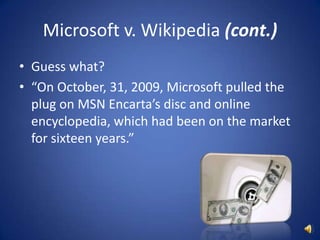
Microsoft v. Wikipedia (cont.)Guess what? “On October, 31, 2009, Microsoft pulled the plug on MSN Encarta’s disc and online encyclopedia, which had been on the market for sixteen years.”
Microsoft v. Wikipedia (cont.)“Wikipedia-the second model-ended up becoming the largest and most popular encyclopedia in the world. Just eight years after its inception.”In this area, how could Wikipedia overthrow Goliath Microsoft? It’s all about the nature of Motivation 2.0!
The Truth About Operating SystemsQ: When do we start noticing the impact of an operating system?A: When it breaks down!“Societies also have operating systems.”
The Truth About Operating Systems (cont.)Motivation 1.0 = Survival = First Drive Motivation 2.0 = “Humans are more than the sum of our biological urges.” = Second Drive
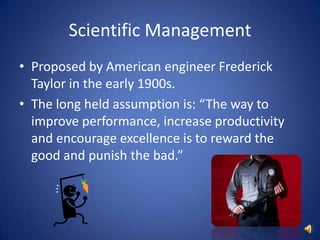
Scientific ManagementProposed by American engineer Frederick Taylor in the early 1900s.The long held assumption is: “The way to improve performance, increase productivity and encourage excellence is to reward the good and punish the bad.”
DiscussionWhat are the benefits of Taylor’s Scientific Management approach?What are its disadvantages?
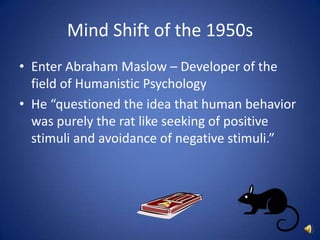
Mind Shift of the 1950sEnter Abraham Maslow – Developer of the field of Humanistic PsychologyHe “questioned the idea that human behavior was purely the rat like seeking of positive stimuli and avoidance of negative stimuli.”
Mind Shift of the 1950s (cont.)MIT professor Douglas McGregor became interested in Maslow’s study and in 1960 wrote a paper furthering the idea that people have “higher drives.”Motivation 2.1 = Some companies have upgraded to engage in more relaxed working atmospheres.
Time for an UpgradeMany companies are still operating on a Motivation 2.0 mind set and what they need is a “full-scale upgrade.”
Three Incompatibility ProblemsNew business model of the 21st century:     Open SourceExamples of Open Source products: Linux, Mozilla Firefox and Wikipedia
The Open Source MovementQ: Why are people lending their free time and interest by providing or sharpening their expertise for provision to the general public for a free service?A: In a recent study conducted by an MIT professor and a consulting group, they “found that what drives participants is ‘a set of predominately intrinsic motives’.”
A New Business OrganizationTraditional Views of BusinessProfit – make and maximize profitNonprofit – do goodA New Business Model: The Low-Profit Limited Liability Corporation (aka L3C)
A New Business Organization: L3C“An L3C operates like a for-profit business generating at least modest profits, but its primary aim [is] to offer significant social benefits.”
A New Business Organization: The For-Benefit Organization“This represents a new category of organization that is both economically self-sustaining and animated by a public purpose.”An example is TOM Shoes. Copy and paste to your browser or click on the link below to see how TOM Shoes are driven by a greater purpose.: http://www.youtube.com/watch?v=Kt3BQQ6dQaQ
A New Business Organization: B Corporation“A designation that requires companies to amend their bylaws so that the incentives favor long-term value and social impact instead of short-term economic gain.”
A New Business OrganizationProfit maximizers v. Purpose maximizers   (Old Business Paradigm) v. (New Business Paradigm)
DiscussionHave you ever taken a lower paying job that provided a clearer sense of purpose?How did you feel about that decision?This is known as behavioral economics. We often view economics as a study on money, when it’s really about the study of behavior.
The core of Drive“Intrinsic motivation is of great importance for all economic activities. It is inconceivable that people are motivated solely or even mainly by external activities,” says Bruno Frey, economist.
Two WorkflowsAlgorithmic: doing the same thing over and over.Heuristic: different steps to a solution <- this is the prevailing workflowWhat might be some examples of algorithmic or heuristic jobs?Which workflow best describes your job?
The New Wave of Management in AmericaMore managers are overseeing more numbers of people, which translates to less oversight of each individual person. Q: How many people do you think telecommute at least one day a month/day? A: 33.7 million/month and 14.7 million/day
Let’s Recap“Motivation 2.0 suffers from 3 compatibility problems.”1. People are intrinsically motivated purpose maximizers not just for profit interest.2. Motivation 2.0 can’t communicate economics. “Economists are finally realizing that we’re full fledged human beings, not robots.”3. For many people nowadays work is a creative process, rather than an algorithmic one.
Daniel Pink on the Surprising Science of MotivationWatch the following YouTube video. Comment or give observation on the following items of Pink’s presentation: Copy and paste or click on:http://www.youtube.com/watch?v=rrkrvAUbU9Y1. The Candle Problem2. Reward and Performance3. “Is there a mismatch between what science knows and what business does?”4. Autonomy, Mastery and Purpose: Fedex Day, 20% Time at Google, ROWE**Provide your discussion responses to iune@tjc.edu**
CreditsDrive: The Surprising Truth About What Motivates Us by Daniel PinkAll Clip Art and Photo Images are from Microsoft PowerPoint.www.danpink.com
Join us next time….Chapter 2 – Seven Reasons Carrots and Sticks (Often) Don’t WorkTuesday, June 15, 2010 Times: 2:00p-3:00p or 3:00p-4:00p in FCC Room (2 repeat sessions) AND 7:00p-8:00p CST via DimDim Web Conference Hosted by Ije “EJ” Unegbu (for the web conference you will receive sign in information upon RSVP)Thank you for viewing this presentation and see you next time!

Drive Chapter 1 Ppshow

  • 1.
    DRIVEby Daniel PinkChapter1The Rise and Fall of Motivation 2.0
  • 2.
    Author Bio“Daniel H.Pink is the author of four provocative books about the changing world of work — including the New York Times bestsellers, A Whole New Mind and Drive. His latest is Drive: The Surprising Truth About What Motivates Us, which uses 50 years of behavioral science to overturn the conventional wisdom about human motivation and offer a more effective path to high performance.  Drive reached every national bestseller list in its first month of publication and is now in its fifth month on the New York Times list. He lives in Washington, DC, with his wife and their three children.” courtesy , www.danpink.com
  • 3.
    Microsoft v. WikipediaIt’s1995 and imagine you are having a discussion with an economist on the viability of two business ventures, Microsoft Encarta and Wikipedia.
  • 4.
    Microsoft v. Wikipedia(cont.)The plan for Microsoft Encarta is to:Pay professional writers and editors to write on a variety of topics ANDSell the encyclopedia CDs and make them available online for a fee.
  • 5.
    Microsoft v. Wikipedia(cont.)The plan for Wikipedia entails:Gathering hobbyist writers who also write on a variety of topics but with no compensation afforded to them ANDTo make their services free online.Which company is bound to be more successful?
  • 6.
    Microsoft v. Wikipedia(cont.)Guess what? “On October, 31, 2009, Microsoft pulled the plug on MSN Encarta’s disc and online encyclopedia, which had been on the market for sixteen years.”
  • 7.
    Microsoft v. Wikipedia(cont.)“Wikipedia-the second model-ended up becoming the largest and most popular encyclopedia in the world. Just eight years after its inception.”In this area, how could Wikipedia overthrow Goliath Microsoft? It’s all about the nature of Motivation 2.0!
  • 8.
    The Truth AboutOperating SystemsQ: When do we start noticing the impact of an operating system?A: When it breaks down!“Societies also have operating systems.”
  • 9.
    The Truth AboutOperating Systems (cont.)Motivation 1.0 = Survival = First Drive Motivation 2.0 = “Humans are more than the sum of our biological urges.” = Second Drive
  • 10.
    Scientific ManagementProposed byAmerican engineer Frederick Taylor in the early 1900s.The long held assumption is: “The way to improve performance, increase productivity and encourage excellence is to reward the good and punish the bad.”
  • 11.
    DiscussionWhat are thebenefits of Taylor’s Scientific Management approach?What are its disadvantages?
  • 12.
    Mind Shift ofthe 1950sEnter Abraham Maslow – Developer of the field of Humanistic PsychologyHe “questioned the idea that human behavior was purely the rat like seeking of positive stimuli and avoidance of negative stimuli.”
  • 13.
    Mind Shift ofthe 1950s (cont.)MIT professor Douglas McGregor became interested in Maslow’s study and in 1960 wrote a paper furthering the idea that people have “higher drives.”Motivation 2.1 = Some companies have upgraded to engage in more relaxed working atmospheres.
  • 14.
    Time for anUpgradeMany companies are still operating on a Motivation 2.0 mind set and what they need is a “full-scale upgrade.”
  • 15.
    Three Incompatibility ProblemsNewbusiness model of the 21st century: Open SourceExamples of Open Source products: Linux, Mozilla Firefox and Wikipedia
  • 16.
    The Open SourceMovementQ: Why are people lending their free time and interest by providing or sharpening their expertise for provision to the general public for a free service?A: In a recent study conducted by an MIT professor and a consulting group, they “found that what drives participants is ‘a set of predominately intrinsic motives’.”
  • 17.
    A New BusinessOrganizationTraditional Views of BusinessProfit – make and maximize profitNonprofit – do goodA New Business Model: The Low-Profit Limited Liability Corporation (aka L3C)
  • 18.
    A New BusinessOrganization: L3C“An L3C operates like a for-profit business generating at least modest profits, but its primary aim [is] to offer significant social benefits.”
  • 19.
    A New BusinessOrganization: The For-Benefit Organization“This represents a new category of organization that is both economically self-sustaining and animated by a public purpose.”An example is TOM Shoes. Copy and paste to your browser or click on the link below to see how TOM Shoes are driven by a greater purpose.: http://www.youtube.com/watch?v=Kt3BQQ6dQaQ
  • 20.
    A New BusinessOrganization: B Corporation“A designation that requires companies to amend their bylaws so that the incentives favor long-term value and social impact instead of short-term economic gain.”
  • 21.
    A New BusinessOrganizationProfit maximizers v. Purpose maximizers (Old Business Paradigm) v. (New Business Paradigm)
  • 22.
    DiscussionHave you evertaken a lower paying job that provided a clearer sense of purpose?How did you feel about that decision?This is known as behavioral economics. We often view economics as a study on money, when it’s really about the study of behavior.
  • 23.
    The core ofDrive“Intrinsic motivation is of great importance for all economic activities. It is inconceivable that people are motivated solely or even mainly by external activities,” says Bruno Frey, economist.
  • 24.
    Two WorkflowsAlgorithmic: doingthe same thing over and over.Heuristic: different steps to a solution <- this is the prevailing workflowWhat might be some examples of algorithmic or heuristic jobs?Which workflow best describes your job?
  • 25.
    The New Waveof Management in AmericaMore managers are overseeing more numbers of people, which translates to less oversight of each individual person. Q: How many people do you think telecommute at least one day a month/day? A: 33.7 million/month and 14.7 million/day
  • 26.
    Let’s Recap“Motivation 2.0suffers from 3 compatibility problems.”1. People are intrinsically motivated purpose maximizers not just for profit interest.2. Motivation 2.0 can’t communicate economics. “Economists are finally realizing that we’re full fledged human beings, not robots.”3. For many people nowadays work is a creative process, rather than an algorithmic one.
  • 27.
    Daniel Pink onthe Surprising Science of MotivationWatch the following YouTube video. Comment or give observation on the following items of Pink’s presentation: Copy and paste or click on:http://www.youtube.com/watch?v=rrkrvAUbU9Y1. The Candle Problem2. Reward and Performance3. “Is there a mismatch between what science knows and what business does?”4. Autonomy, Mastery and Purpose: Fedex Day, 20% Time at Google, ROWE**Provide your discussion responses to iune@tjc.edu**
  • 28.
    CreditsDrive: The SurprisingTruth About What Motivates Us by Daniel PinkAll Clip Art and Photo Images are from Microsoft PowerPoint.www.danpink.com
  • 29.
    Join us nexttime….Chapter 2 – Seven Reasons Carrots and Sticks (Often) Don’t WorkTuesday, June 15, 2010 Times: 2:00p-3:00p or 3:00p-4:00p in FCC Room (2 repeat sessions) AND 7:00p-8:00p CST via DimDim Web Conference Hosted by Ije “EJ” Unegbu (for the web conference you will receive sign in information upon RSVP)Thank you for viewing this presentation and see you next time!