4th Annual Survey       

                                                                                                                                                                 Supply Chain 
                                                                                                                                                               Resilience 2012 
                                                                                                                                                                                Published November 2012 


                                      Supported by:                                                                                                            Supported by:            Supported by: 
                                                                                     An international survey of more than 530 organisations from 
                                                                                         over 65 countries, which considers the origin, causes and          
Supply Chain Resilience 2012.  Copyright © 2012 The Business Con nuity Ins   tute.  All Rights Reserved.          
                                                                                      consequences of supply chain disruption, along with proven                                                         1 

                                                                                      approaches to building confidence in supply chain resilience 
Contents 


                                                               03  Execu ve summary 
                                                               04  Introduc on 
                                                               05  Experience of disrup on 
                                                               09  Supply chain con nuity 
                                                               14  Business con nuity in tendering and contrac ng 
                                                               15  Geographical and sector perspec ves 
                                                               18  Lesson learned and key challenges 

                                                               19  Review and conclusions 
                                                               20  Respondent profile 
                                                               21  About the survey 
                                                               22  About the BCI, CIPS, Zurich & DHL Supply Chain 
                                                               26  Annex 1: Wri en comments by survey respondents 
                                                               32  Annex 2: Full sector and geographical data 
Supply Chain Resilience 2012.  Copyright © 2012 The Business Con nuity Ins tute.  All Rights Reserved.               2 
Execu ve Summary: Disrup on more consequen al, outsourcers under scru ny 


Introduc on                                                                       21% suffered more than €1M in costs for a            Review & Conclusions 
                                                                                      single  incident;  higher  than  2011  and  in  Since  2009  consistently  high  levels  of  supply 
This  survey  is  the  fourth  in  a  series,  star ng 
                                                                                      spite of lower overall levels of disrup on      chain  disrup ons  have  been  experienced  and 
back  in  2009,  that  sets  out  to  consider  the 
challenge  of  developing  resilient  supply                                      59%  cited  loss  of  produc vity  as  the        events  are  becoming  more  consequen al 
chains.                                                                             primary  impact  of  the  disrup on                with  absolute  levels  dipping  a er  2011,  
                                                                                                                                      even 
                                                                                    experienced,  up  from  49%  in  2011.  Across  a  year,  which  saw  the  Great  East  Japan    
Key Findings  
                                                                                    all  indicators  there  was  a  deepening  on   Earthquake  and  extensive  flooding  in         
 73%  of survey respondents experienced at                                        impact  experienced  with  an  average  of  Thailand. 
    least  one  disrup on  with  an  average  of                                    three dis nc ve consequences per incident         Business con nuity is widely seen as effec ve 
    five.  This  high level is consistent with the 
                                                                                  25%  of  respondents  have  s ll  to  consider   in resis ng the impact of disrup on, alongside 
    trend‐line over the past four years 
                                                                                      supply  chain  disrup on  in  their  business  its  core  benefits  of  enabling  con nuity  and 
 39%  of  analysed  disrup ons  originated                                          con nuity  programmes,  and  44%  of        faster recovery from incidents. 
    below  the  immediate  er  one  supplier,                                         respondents  have  weak  supply  chains,          The  drama c  rise  in  disrup on  through      
    underscoring  for  the  second  consecu ve                                        while  major  sector  differences  persist         outsourcer  service  failures  requires  further 
    year the deep‐rooted nature of disrup on                                          especially in manufacturing and  retail and       study  into  service  chains  and  the  specific  
 Unplanned  IT  or  telecom  outages  jumped                                        between countries such as the UK and USA          challenges inherent in them. 
    to  the  top  of  sources  of  disrup on  with                                While  47%  now  look  for  evidence  of  a     Given  the  dominance  of  supply  chain           
    52%  affected  to  some  or  a  high  degree.                                      business  con nuity  programme  over  a           disrup on  through  unplanned  IT  or  telecom     
    The level was 41% in 2011                                                         simple  plan and 23% run joint exercises—         outages, there is now  a need to evaluate the 
 Adverse weather maintained its prominent                                           all  improvements  on  2011—15%  s ll  do         contribu on of “the cloud” to resilience. 
    posi on  with  48%  ci ng  it  as  a  cause  of                                   not  collect  any  informa on  from  key          The  challenge  of  securing  execu ve  buy‐in 
    disrup on,  but  rela vely  unchanged  from                                       suppliers, and 41% do not validate that key       requires  an  understanding  of  the  broader 
    51% in 2011                                                                       supplier plans might work in prac ce              trends  driving  supply  chain  vulnerability  and 
 Failure  of  service  provision  by  outsourcing                               42%  stated  the  biggest  on‐going  challenge      its  disrup on.  In  this  way  it  will  become      
    suppliers has doubled from 17% to 35% of                                          is  to  secure  buy‐in  to  implement  supply     possible  to  demonstrate  that  high  levels  of 
    disrup on and joins the top three causes                                          chain con nuity prac ces in their firm             disrup on are not going to go away, however 
                                                                                                                                        fragile corporate memory may be. 
Supply Chain Resilience 2012.  Copyright © 2012 The Business Con nuity Ins tute.  All Rights Reserved.                                                                                   3 
Introduc on: 73% experienced at least one disrup
 
                                                                                                              ve supply chain incident with an average of five 
This  report  is  the  fourth  in  a  series  that,  tough challenges where they are s ll to find an  Chart 1: How many supply chain incidents would you   
                                                                                                      es mate your organisa on experienced in the past 12 
star ng  in  2009,  set  out  to  consider  the      answer,  insights  which  inform  the  Business  months that caused disrup on to your organisa on? 
challenge of developing resilient supply chains.    Con nuity Ins tute’s thinking on next steps. 
While  we  have  con nued  to  track  trends  in  So, what do we mean by supply chain?  Here is 
supply  chain  disrup on,  mi ga on  and             a reprise of the defini on that we first used in 
assurance methods employed, the 2012 survey  2011 (Christopher 2005): 
is  re‐focused  on  events  that  cause  at  least  The network of organisa ons that are involved, 
some  if  not  high  levels  of  disrup on,  rather  through  upstream  and  downstream  rela on-
than  disrup on  in  general,  much  of  which  can  ships,  in  the  different    processes  and  ac vi es 
be dealt with as part of business as usual.          that produce value in the form of products and 
                                                     services in the hands of the ul mate consumer. 
When  reviewing  the  results  it  is  naturally      
important  to  consider  the  profile  of  the          headline  figure  for  disrup on  in  the  2012 
                                                     The 
respondents:  In this case 82% of respondents  survey is that 73% of responding organisa ons 
work “in‐house” i.e. they are employed to run  experienced  at  least  one  disrup on  in  the     
business  con nuity,  supply  chain  or  risk        previous  12  months,  with  an  average  level  of 
programmes  with  18%  providing  consul ng  five  incidents.    In  2011,  supply  chains  were  Base:  389.  Excludes 97 who stated “Don’t Know”.  
services  in  these  domains.    The  organisa ons  widely  disrupted  by  the  Great  East  Japan     affec ng  supply  chain  disrup ons  across  the 
responding  are  typically  large  ones—42%     Earthquake  and  flooding  in  Thailand  causing  a  whole enterprise.  For 75% of respondents, this 
employ  between  one  thousand  and  fi y     jump  to  85%  in  the  deadline  disrup on  figure  is  therefore  not  the  case,  so  the  level  of        
thousand staff and 12% employ more than fi y  and  peaking  above  the  established  trend‐line,  disrup on  recorded  here  is  likely  to  be  an     
thousand people.                                     to which we have now returned.                       underes mate  of  actual  levels,  albeit  major 
The  2012  survey  has  also  achieved  a  stronger  It  is  also  worth  no ng  that  only  one  in  four  disrup ons  are  likely  to  be  picked  up  across 
balance  of  views  from  across  risk,  business   firms  have  the  full  picture  on  supply  chain     company  boundaries. 
con nuity and supply chain professionals.            disrup on, which would be achieved by record‐ We hope this year’s survey provides some new 
Finally, we asked respondents to ar culate the  ing, measuring and repor ng on performance‐ insights and would welcome your feedback. 

Supply Chain Resilience 2012.  Copyright © 2012 The Business Con nuity Ins tute.  All Rights Reserved.                                                           4 
Experience of Disrup on


    Origin of disrup on                                 down  in  the  supply  chain  ( er  three  or  four                           the full supply chain, I was able to review three 
    Following  on  from  providing  informa on  on  etc).  87% of respondents to this ques on were                                    of  the  disrup ons  that  I  was  made  aware  of 
                                                        able to provide an analysis of the source of dis‐
    the  number  of  disrup ve  incidents                                                                                             and  found  one  to  be  an  immediate  supplier  
    experienced  in  the  last 12  months,  those  who  rup on as seen in Chart 2.                                                    failure and two to be  er two” 
    had  experienced  disrup on  were  asked                                     61%  of  disrup on  originated  with  the              Causes of disrup on 
    whether they had analysed the original source                                immediate  supplier  according  to  this  year’s  When  considering  causes  of  disrup on  in  the 
    of the disrup on within their supply chain.  The                             survey  meaning  that  39%  originated  in  the    2012  survey,  we  refined  the  main  ques on  to 
    ques on specifically asked whether the disrup‐                                extended  supply  chain  ( er  two,  three,  etc).   dis nguish  between  disrup on  that  caused 
     on occurred with the immediate supplier ( er                                This level of disrup on is consistent with levels  some  impact  from  disrup on  that  had  high  
    one) or their supplier ( er two), or much lower                              reported  in  2011,  and  confirms  the  deep‐ impact  in  order  to  qualify  the  severity  of  the 
                                                                                             rooted  nature  of  disrup on.    The  disrup on.      The  results  in  Chart  3  show  the 
    Chart 2: The source of disrup on.  Base: 204 
                                                                                             comments  suggest  that  buying     totals of each threat type experienced over the 
                                                                                             organisa ons  take  it  upon  them‐ previous 12 months. 
                                                                                             selves  to  scru nise  their  extended 
                                                                                                                                        Overall  some  1,200  causes  of  disrup on  were 
                                                                                             supply  chain  rather  than  rely  on 
                                                                                                                                        reported with 301 of them designated as high 
                                                                                             their  immediate  supplier  to  audit 
                                                                                                                                        impact.    The  top  five  causes  by  high  impact 
                                                                                             their suppliers in turn, which would 
                                                                                                                                        represent 42% of severe events. 
                                                                                             be  an  alterna ve  method  of         
                                                                                             addressing a difficult challenge.            Unplanned IT or telecom outages are the most 
                                                                                                                                        commonly experienced source of some or high 
                                                                                             “We  reach  to  the  original  source  of 
                                                                                                                                        levels  of  disrup on  with  52%  of  responding 
                                                                                             the  supply  chain  to  minimize        
                                                                                                                                        organisa ons  selec ng  this  op on.  Adverse 
                                                                                             contamina on  to  produce  high     
                                                                                                                                        weather  drops  from  first  place  in  the  2011   
                                                                                             purity  products.  When  suppliers  of 
                                                                                                                                        survey to second place in 2012 at 48%. 
                                                                                             original  source  are  hired,  we  have 
                                                                                             excep onal  confidence  they  are  not  Failure  in  service  provision  by  an  outsourcer 
                                                                                             contamina ng”                              reaches  the  top  three  with  35%  sta ng  they 
                                                                                                                                        experienced some impact or high impact from 
                                                                                             “While  we  don’t  rou nely  analyse 
Supply Chain Resilience 2012.  Copyright © 2012 The Business Con nuity Ins tute.  All Rights Reserved.                                                                                  5 


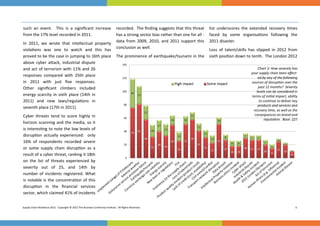
such  an  event.    This  is  a  significant  increase  recorded.  The finding suggests that this threat  list  underscores  the  extended  recovery  mes 
from the 17% level recorded in 2011.                   has a strong sector bias rather than one for all ‐  faced  by  some  organisa ons  following  the 
                                                       data  from  2009,  2010,  and  2011  support  this  2011 disaster. 
In  2011,  we  wrote  that  intellectual  property 
viola ons  was  one  to  watch  and  this  has  conclusion as well.                                        Loss  of  talent/skills  has  slipped  in  2012  from 
proved to be the case in jumping to 16th place  The prominence of earthquake/tsunami in the  sixth posi on down to tenth.  The London 2012 
above  cyber  a ack,  industrial  dispute 
and  act  of  terrorism  with  11%  and  26                                                                             Chart 3: How severely has 
                                                                                                                   your supply chain been affect-
responses  compared  with  25th  place                                                                                  ed by any of the following 
in  2011  with  just  five  responses.                                                                              sources of disrup on over the 
Other  significant  climbers  included                                                                                   past 12 months?  Severity 
                                                                                                                       levels can be considered in 
energy  scarcity  in  sixth  place  (14th  in                                                                       terms of ini al impact, ability 
2011)  and  new  laws/regula ons  in                                                                                     to con nue to deliver key 
                                                                                                                        products and services and 
seventh place (17th in 2011). 
                                                                                                                                       recovery  me, as well as the 
Cyber  threats  tend  to  score  highly  in                                                                                             consequences on brand and 
                                                                                                                                             reputa on.  Base: 227 
horizon  scanning  and  the  media,  so  it 
is interes ng to note the low levels of 
disrup on  actually  experienced:    only 
16%  of  respondents  recorded  severe 
or  some  supply  chain  disrup on  as  a 
result of a cyber threat, ranking it 18th 
on  the  list  of  threats  experienced  by 
severity  out  of  25,  and  14th  by      
number  of  incidents  registered.  What 
is  notable  is  the  concentra on  of  this 
disrup on  in  the  financial  services  
sector, which claimed 41% of incidents 


Supply Chain Resilience 2012.  Copyright © 2012 The Business Con nuity Ins tute.  All Rights Reserved.                                                            6 


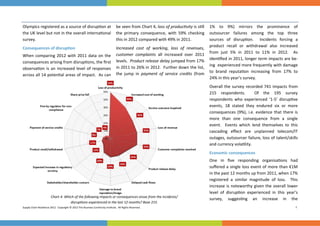
Olympics registered as a source of disrup on at  be seen from Chart 4, loss of produc vity is s ll  1%  to  9%)  mirrors  the  prominence  of            
the UK level but not in the overall interna onal  the  primary  consequence,  with  59%  checking  outsourcer  failures  among  the  top  three 
survey.                                              this in 2012 compared with 49% in 2011.              sources  of  disrup on.    Incidents  forcing  a  
                                                                                                          product  recall  or  withdrawal  also  increased 
Consequences of disrup on                            Increased  cost  of  working,  loss  of  revenues,  
                                                                                                          from  just  5%  in  2011  to  11%  in  2012.    As     
When  comparing  2012  with  2011  data  on  the  customer  complaints  all  increased  over  2011 
                                                                                                          iden fied in 2011, longer term impacts are be‐
consequences arising from disrup ons, the first  levels.  Product release delay jumped from 17% 
                                                                                                          ing  experienced more frequently with damage 
observa on  is  an  increased  level  of  responses  in 2011 to 26% in 2012.  Further down the list, 
                                                                                                          to  brand  reputa on  increasing  from  17%  to 
across all 14 poten al areas of impact.  As can  the  jump  in  payment  of  service  credits  (from 
                                                                                                          24% in this year’s survey. 
                                                                                                              Overall  the  survey  recorded  741  impacts  from 
                                                                                                              215  respondents.    Of  the  195  survey              
                                                                                                              respondents  who  experienced  ‘1‐5’  disrup ve 
                                                                                                              events,  18  stated  they  endured  six  or  more 
                                                                                                              consequences  (9%),  i.e.  evidence  that  there  is 
                                                                                                              more  than  one  consequence  from  a  single 
                                                                                                              event.    Events  which  lend  themselves  to  this 
                                                                                                              cascading  effect  are  unplanned  telecom/IT  
                                                                                                              outages, outsourcer failure, loss of talent/skills 
                                                                                                              and currency vola lity. 
                                                                                                              Economic consequences 
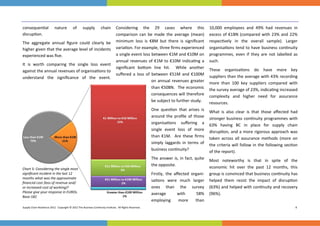
                                                                                                              One  in  five  responding  organisa ons  had 
                                                                                                              suffered a single loss event of more than €1M 
                                                                                                              in the past 12 months up from 2011, when 17% 
                                                                                                              registered  a  similar  magnitude  of  loss.    This  
                                                                                                              increase is noteworthy given the overall lower 
                                                                                                              level  of  disrup on  experienced  in  this  year’s 
                        Chart 4: Which of the following impacts or consequences arose from the incidents/
                                                                                                              survey,  sugges ng  an  increase  in  the             
                                    disrup ons experienced in the last 12 months? Base 215. 
Supply Chain Resilience 2012.  Copyright © 2012 The Business Con nuity Ins tute.  All Rights Reserved.                                                      7 


consequen al               nature          of          Considering  the  29  cases  where  this              employees  and  49%  had  revenues  in 
                                                    supply 
                                             chain                                                          10,000 
disrup on.                                             comparison  can  be  made  the  average  (mean)  excess  of  €1BN  (compared  with  23%  and  22% 
The  aggregate  annual  figure  could  clearly  be  minimum  loss  is  €8M  but  there  is  significant  respec vely  in  the  overall  sample).  Larger     
higher given that the average level of incidents  varia on. For example, three firms experienced  organisa ons tend to have business con nuity 
experienced was five.                                   a single event loss between €1M and €10M on  programmes,  even  if  they  are  not  labelled  as 
                                                       annual  revenues  of  €1M  to  €10M  indica ng  a  such. 
It  is  worth  comparing  the  single  loss  event 
                                                       significant  bo om  line  hit.    While  another  These  organisa ons  do  have  more  key          
against the annual revenues of organisa ons to 
                                                       suffered  a  loss  of  between  €51M  and  €100M  suppliers than the average with 43% recording 
understand  the  significance  of  the  event.    
                                                                             on  annual  revenues  greater 
                                                                                                            more  than  100  key  suppliers  compared  with 
                                                                             than €50BN.   The economic 
                                                                                                            the survey average of 23%, indica ng increased 
                                                                             consequences will therefore 
                                                                                                            complexity  and  higher  need  for  assurance    
                                                                             be subject to further study.  resources. 
                                                                                                          One  ques on  that  arises  is     What  is  also  clear  is  that  those  affected  had 
                                                                                                          around  the  profile  of  those     stronger  business  con nuity  programmes  with 
                                                                                                          organisa ons  suffering  a          63%  having  BC  in  place  for  supply  chain         
                                                                                                          single  event  loss  of  more 
                                                                                                                                             disrup on,  and  a  more  rigorous  approach  was 
                                                                                                          than  €1M.    Are  these  firms 
                                                                                                                                             taken  across  all  assurance  methods  (more  on 
                                                                                                          simply  laggards  in  terms  of    the  criteria  will  follow  in  the  following  sec on 
                                                                                                          business con nuity? 
                                                                                                                                             of the report). 
                                                                                                          The answer is, in fact, quite 
                                                                                                                                             Most  noteworthy  is  that  in  spite  of  the         
                                                                                                          the opposite. 
Chart 5: Considering the single most                                                                                                         economic  hit  over  the  past  12  months,  this 
significant incident in the last 12                                                                        Firstly,  the  affected  organi‐ group is convinced that business con nuity has 
months what was the approximate 
financial cost (loss of revenue and/
                                                                                                          sa ons  were  much  larger  helped  them  resist  the  impact  of  disrup on 
or increased cost of working)?                                                                            ones  than  the  survey            (63%) and helped with con nuity and recovery 
Please give your response in EUROs.                                                                       average         with       58%             
                                                                                                                                             (96%). 
Base:182 
                                                                                                          employing  more  than 
Supply Chain Resilience 2012.  Copyright © 2012 The Business Con nuity Ins tute.  All Rights Reserved.                                                                                        8 
Supply Chain Con nuity—25% of in‐house BC programmes do not consider supply chain disrup
 
                                                                                                                                                           on 
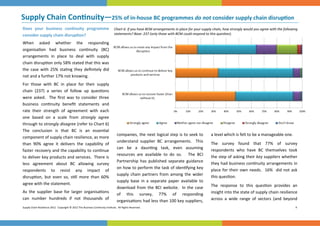
Does  your  business  con nuity  programme  Chart 6: If you have BCM arrangements in place for your supply chain, how strongly would you agree with the following 
consider supply chain disrup on?            statements? Base: 237 (only those with BCM could respond to this ques on). 

When  asked  whether  the  responding           
organisa on  had  business  con nuity  (BC)     
arrangements  in  place  to  deal  with  supply 
chain disrup on only 58% stated that this was 
the  case  with  25%  sta ng  they  definitely  did 
not and a further 17% not knowing. 
For  those  with  BC  in  place  for  their  supply 
chain  (237)  a  series  of  follow  up  ques ons 
were  asked.    The  first  was  to  consider  three 
business  con nuity  benefit  statements  and 
rate  their  strength  of  agreement  with  each 
one  based  on  a  scale  from  strongly  agree 
through to strongly disagree (refer to Chart 6)  
The  conclusion  is  that  BC  is  an  essen al    
                                                     companies, the next logical step is to seek to  a level which is felt to be a manageable one. 
component of supply chain resilience, as more 
                                                     understand  supplier  BC  arrangements.    This  
than  90%  agree  it  delivers  the  capability  of                                                        The  survey  found  that  77%  of  survey            
                                                     can  be  a  daun ng  task,  even  assuming         
faster recovery and the capability to con nue                                                              respondents  who  have  BC  themselves  took 
                                                     resources  are  available  to  do  so.      The  BCI 
to deliver key products and services.  There is                                                            the step of asking their key suppliers whether 
                                                     Partnership  has  published  separate  guidance  they had business con nuity arrangements in 
less  agreement  about  BC  allowing  survey    
                                                     on how to perform the task of iden fying key  place  for  their  own  needs.    16%    did  not  ask 
respondents  to  resist  any  impact  of              
                                                     supply  chain  partners  from  among  the  wider  this ques on. 
disrup on,  but  even  so,  s ll  more  than  60% 
                                                     supply  base  in  a  separate  paper  available  to 
agree with the statement. 
                                                     download  from  the  BCI  website.    In  the  case  The  response  to  this  ques on  provides  an     
As  the  supplier  base  for  larger  organisa ons                                                         insight into the state of supply chain resilience 
                                                     of  this  survey,  77%  of  responding                  
can  number  hundreds  if  not  thousands  of 
                                                     organisa ons had less than 100 key suppliers,  across  a  wide  range  of  sectors  (and  beyond 
Supply Chain Resilience 2012.  Copyright © 2012 The Business Con nuity Ins tute.  All Rights Reserved.                                                          9 


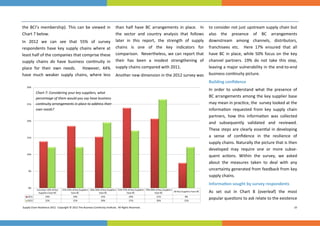
the  BCI’s  membership).  This  can  be  viewed  in  than  half  have  BC  arrangements  in  place.    In  to consider not just upstream supply chain but 
Chart 7 below.                                       the  sector  and  country  analysis  that  follows     also  the  presence  of  BC  arrangements       
In  2012  we  can  see  that  55%  of  survey            in  this  report,  the  strength  of  supply  downstream  among  channels,  distributors, 
                                                     later 
respondents  have  key  supply  chains  where  at  chains  is  one  of  the  key  indicators  for           franchisees  etc.    Here  17%  ensured  that  all 
least half of the companies that comprise these  comparison.  Nevertheless, we can report that  have  BC  in  place,  while  50%  focus  on  the  key 
supply  chains  do  have  business  con nuity  in  their  has  been  a  modest  strengthening  of     channel  partners.  19%  do  not  take  this  step, 
place  for  their  own  needs.      However,  44%  supply chains compared with 2011.                        leaving a major vulnerability in the end‐to‐end 
have  much  weaker  supply  chains,  where  less  Another new dimension in the 2012 survey was  business con nuity picture.   
                                                                                                              Building confidence 
                                                                                                              In  order  to  understand  what  the  presence  of 
           Chart 7: Considering your key suppliers, what 
           percentage of them would you say have business 
                                                                                                              BC arrangements among the key supplier base 
           con nuity arrangements in place to address their                                                   may mean in prac ce, the  survey looked at the 
           own needs?                                                                                         informa on  requested  from  key  supply  chain 
                                                                                                              partners,  how  this  informa on  was  collected 
                                                                                                              and  subsequently  validated  and  reviewed.  
                                                                                                              These  steps  are  clearly  essen al  in  developing 
                                                                                                              a  sense  of  confidence  in  the  resilience  of     
                                                                                                              supply chains. Naturally the picture that is then 
                                                                                                              developed  may  require  one  or  more  subse‐
                                                                                                              quent  ac ons.  Within  the  survey,  we  asked 
                                                                                                              about  the  measures  taken  to  deal  with  any  
                                                                                                              uncertainty generated from feedback from key 
                                                                                                              supply chains.    
                                                                                                              Informa on sought by survey respondents 
                                                                                                              As  set  out  in  Chart  8  (overleaf)  the  most      
                                                                                                              popular ques ons to ask relate to the existence 
Supply Chain Resilience 2012.  Copyright © 2012 The Business Con nuity Ins tute.  All Rights Reserved.                                                         10 


                                                      programme.   In 2011 only 28% of respondents  48%  in  2011.    The  self‐assessment  ques on‐
Chart 8: What informa on do you seek in order to be er 
understand the business con nuity management (BCM)    were looking for the BC programme.                        naire retains its popularity in second place with 
arrangements of key suppliers? Base 200.                                                                        45% of respondents selec ng this op on, while 
                                                      Standards  and  codes  of  prac ce  play  an        
                                                      important role in assessing the resilience of key  there has been a rise from 37% to 42% of those 
                                                      suppliers  with  37%  and  36%  respec vely     who  will  retrieve  informa on  through  audit.  
                                                      looking  for  alignment  or  compliance.                  Reques ng  an  independent  audit  is  s ll  the 
                                                                                                                least  popular  op on  among  those  who  collect 
                                                      Cer fica on lags behind on 28%. 
                                                                                                                informa on  at  9%,  down  from  12%  in  2011.  
                                                      One area with a significant increase from 2011,  15%  s ll  do  not  collect  any  informa on,        
                                                      is  asking  where  responsibility  for  BC  is  held  in  implying  it  is  good  enough  for  the  supplier  to 
                                                      the organisa on and the involvement of senior  just  state  they  have  business  con nuity  in 
                                                      management.  This clearly provides evidence of  place. 
                                                      the  level  of  commitment  behind  the  BC        
                                                      programme.    In  2011  the  figure  was  just  23%  “We do not ask to see their BCP but rather we 
                                                                                                                ask  that  they  state  whether  they  have  a  BCP 
                                                      but has jumped to 36% in this year’s survey. 
                                                                                                                and will only award the contract to those who 
                                                      The  least  likely  ques on  to  ask  is  around  the  have a BCP for key contracts” 
                                                      creden als  of  those  who  run  the  BC              
                                                      programme,  such  as  statutory  membership  of  There were a significant number of comments 
                                                      the BCI, which would seem to be a cri cal one  to illustrate approaches taken, which are listed 
                                                      given  the  programme  can  only  be  as  effec ve  in Annex 1, but four are quoted here to reflect 
                                                      as the people assigned to deliver it.  Only 18%  the range of approaches undertaken: 
of  a  business  con nuity  programme  (47%),  asked  this  ques on,  albeit  this  level  has                  “Ini al  ques onnaire  followed  up  with  further 
whether its scope is appropriate (44%) and rel‐ doubled from 2011.                                              ques ons,  mee ngs  and  site  visits  as              
evant  to  the  product  or  service  being  pur‐                                                               appropriate  to  nature  of  the  service  being    
                                                      How is the informa on collected? 
chased  (44%).    This  may  seem  obvious  but  in                                                             supplied” 
                                                      51%  of  survey  respondents  required  copies  of 
earlier  surveys  the  focus  was  on  the  business 
                                                      supplier  documenta on,  up  frac onally  from  “We would ask them to set out their BCM plans 
con nuity  plan  rather  than  the  overall          
                                                                                                                in response to par cular scenarios” 
Supply Chain Resilience 2012.  Copyright © 2012 The Business Con nuity Ins tute.  All Rights Reserved.                                                      11 


“We  personally  visit  each  key  supplier  each  ‐top  exercise  were  techniques  used  by  16%  of                              In  the  2012  survey,  44%  of  respondents  s ll 
year and if they have presented any significant  respondents, unchanged from 2011.  One area                                         wait  un l  contract  renewal  before  reviewing 
problems then have moved to audit them”            that  has  grown  in  popularity  is  the  running  of                           their  business  con nuity  requirements  with 
                                                   joint  exercises  based  around  likely  scenarios,                              key  suppliers  and  their  ability  to  meet  them.   
“Ac vi es  may  be  performed  by  various        
disciplines , for example, internal audit, depart- which  was  selected  by  23%  of  respondents 
                                                                                                                                    This has increased from 37% in 2011.   
ment-level vendor managers and procurement”  compared with just 17% in 2011.                                                         Having  said  this,  only  8%  never  review,          
                                                                                 One respondent summarises the challenge and  significantly  down  from  18%  in  the  2011       
Valida ng that plans may work in prac ce 
                                                                                 benefit of valida ng supplier planning:              survey.  Likewise ad hoc mee ngs have dipped 
The  crucial  step  of  valida ng  whether  plans 
                                                                                                                                     from 24% in 2011 to 21% in 2012.   Scheduled 
and inten ons might be effec ve in prac ce is                                     “The  extent  we  get  involved  does  depend  on 
                                                                                                                                     review  mee ngs  with  key  suppliers  at            
s ll one that 41% do not take.  The good news                                    risk,  coopera on  and  rela onships.    Most  key 
                                                                                                                                     appropriate  me intervals as part of an exis ng 
is that this level has fallen from the 49% figure                                 suppliers  are  open  to  close  engagement  and 
registered in 2011.                                                              see  the  opportunity  of  shared  learning  and    governance  process  has  jumped  to  40%  from 
                                                                                                                                     31%  in  2011,  providing  a  good  example  of    
                                                                                 improved  longer  term  rela onships  and         
A number of op ons were offered to respond‐                                                                                           embedding BC in the organisa on. 
                                                                                 resilience” 
ents and naturally most would use a variety of 
                                                                                                         Three  more  dynamic  op ons  are  less  popular, 
                                                Reviewing requirements 
techniques  depending  on  the  assigned         
                                                                                                         namely  reviewing  business  con nuity        
cri cality  of  the  supply  chain  partner.    The  One of the biggest changes in the 2012 survey 
                                                                                                         whenever there is a major change event at the 
most  popular  selec on  was  to  request              comes  in  the  sec on  on  reviewing  require‐
                                                                                                         buyer  (21%)  or  supplier  end  (20%),  and      
documented  outcome  reports  and  ac ons  ments.    Given  the  frequency  of  change  within 
                                                                                                         whenever  a  new  significant  external  threat  is 
plans  following  recent  exercises  conducted  by  organisa ons,  it  seems  highly  likely  that        
                                                                                                         iden fied (20%). 
the  supplier.    40%  chose  this  op on,  up  from  priori es, scope and resources around business 
34%  in  2011.    Another  angle  on  the  same     con nuity  programmes  may  change  more     Again  comments  received  provide  some  clues 
                                                                                                         into how prac oners approach this issue:  
technique  is  to  approve  the  scope  of  tests  in  frequently  than  key  supplier  contracts.        
advance  and sign‐off all post‐test reports, this  Likewise  new  threats  or  opportuni es  may  “We  plan  to  develop  a  schedule,  but  have  not 
was  used  by  11%  of  respondents.    Holding  a  arise  that  need  to  be  considered  within  an    at  this  me.    We  have  inadequate  staffing  to 
workshop with a key supplier or running a desk organisa on and through its supply chain.                 execute at this  me” 

Supply Chain Resilience 2012.  Copyright © 2012 The Business Con nuity Ins tute.  All Rights Reserved.                                                                                 12 


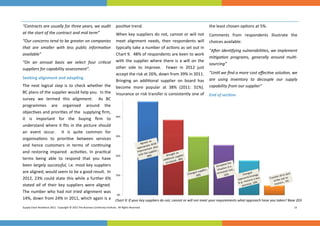
“Contracts are usually for three years, we audit  posi ve trend.                                                the least chosen op ons at 5%. 
at the start of the contract and mid term”               When  key  suppliers  do  not,  cannot  or  will  not  Comments  from  respondents  illustrate  the 
“Our concerns tend to be greater on companies  meet  alignment  needs,  then  respondents  will  choices available: 
that  are  smaller  with  less  public  informa on  typically take a number of ac ons as set out in 
                                                                                                                “A er iden fying vulnerabili es, we implement 
available”                                               Chart 9.  48% of respondents are keen to work 
                                                                                                                mi ga on  programs,  generally  around  mul -
“On  an  annual  basis  we  select  four  cri cal    with  the  supplier  where  there  is  a  will  on  the  sourcing” 
suppliers for capability assessment”.                    other  side  to  improve.    Fewer  in  2012  just    
                                                         accept the risk at 26%, down from 39% in 2011.   “Un l we find a more cost effec ve solu on, we 
Seeking alignment and adap ng 
                                                         Bringing  an  addi onal  supplier  on  board  has  are  using  inventory  to  decouple  our  supply   
The  next  logical  step  is  to  check  whether  the  become  more  popular  at  38%  (2011:  31%).   capability from our supplier” 
BC plans of the supplier would help you.  In the  Insurance or risk transfer is consistently one of 
                                                                                                                End of sec on. 
survey  we  termed  this  alignment.    As  BC      
programmes  are  organised  around  the          
objec ves and priori es of the  supplying firm, 
it  is  important  for  the  buying  firm  to              
understand  where  it  fits  in  the  picture  should 
an  event  occur.    It  is  quite  common  for          
organisa ons  to  priori se  between  services 
and  hence  customers  in  terms  of  con nuing 
and  restoring  impaired    ac vi es.  In  prac cal 
terms  being  able  to  respond  that  you  have 
been largely successful, i.e. most key suppliers 
are aligned, would seem to be a good result.  In 
2012,  23%  could  state  this  while  a  further  6% 
stated  all  of  their  key  suppliers  were  aligned.  
The  number  who  had  not  tried  alignment  was 
14%, down from 24% in 2011, which again is a  Chart 9: If your key suppliers do not, cannot or will not meet your requirements what approach have you taken? Base 203 
Supply Chain Resilience 2012.  Copyright © 2012 The Business Con nuity Ins tute.  All Rights Reserved.                                                          13 
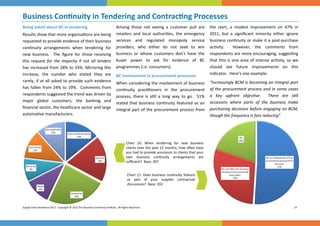
Business Con nuity in Tendering and Contrac ng Processes 


Being asked about BC in tendering                         Among  those  not  seeing  a  customer  pull  are  the  start,  a  modest  improvement  on  47%  in 
Results show that more organisa ons are being  retailers  and  local  authori es,  the  emergency  2011,  but  a  significant  minority  either  ignore 
requested to provide evidence of their business  services  and  regulated  monopoly  service                 business con nuity or make it a post‐purchase 
con nuity  arrangements  when  tendering  for  providers,  who  either  do  not  seek  to  win     ac vity.    However,  the  comments  from          
new  business.    The  figure  for  those  receiving  business  or  whose  customers  don’t  have  the  respondents are more encouraging, sugges ng 
this  request  for  the  majority  if  not  all  tenders  buyer  power  to  ask  for  evidence  of  BC           this  is  one  area  of  intense  ac vity,  so  we 
                                                                                                             that 
has increased from 28% to 33%. Mirroring this  programmes (i.e. consumers).                                  should  see  future  improvements  on  this        
increase,  the  number  who  stated  they  are     BC involvement in procurement processes                   indicator.  Here’s one example: 
rarely,  if  at  all  asked  to  provide  such  evidence                                                                                        “Increasingly BCM is becoming an integral part 
                                                          When considering the involvement of business 
has  fallen  from  24%  to  19%.    Comments  from                                                                                              of  the  procurement  process  and  in  some  cases 
                                                          con nuity  prac oners  in  the  procurement 
respondents suggested the trend was driven by  process,  there  is  s ll  a  long  way  to  go.    51%                                          a  key  upfront  objec ve.    There  are  s ll           
major  global  customers,  the  banking  and                                                                                                    occasions  where  parts  of  the  business  make 
                                                          stated  that  business  con nuity  featured  as  an 
financial sector, the healthcare sector and large  integral part of the procurement process from                                                 purchasing decisions before engaging on BCM, 
automo ve manufacturers.                                                                                                                        though the frequency is fast reducing” 


                                                                                         Chart  10:  When  tendering  for  new  business     
                                                                                         clients over the past 12 months, how o en have 
                                                                                         you had to provide assurance to clients that your 
                                                                                         own  business  con nuity  arrangements  are     
                                                                                         sufficient?  Base: 207 


                                                                                          Chart  11:  Does  business  con nuity  feature 
                                                                                          as  part  of  your  supplier  contractual        
                                                                                          discussions?  Base: 202 


Supply Chain Resilience 2012.  Copyright © 2012 The Business Con nuity Ins tute.  All Rights Reserved.                                                                                          14 
Geographical and Sector Perspec ves 


Sector comparisons 
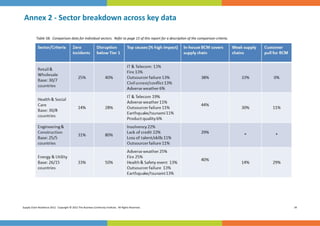
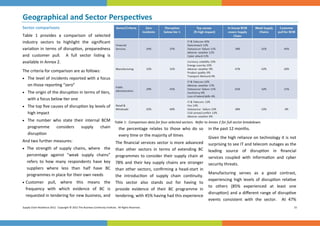
Table  1  provides  a  comparison  of  selected    
industry  sectors  to  highlight  the  significant  
varia on  in  terms  of  disrup on,  preparedness 
and  customer  pull.    A  full  sector  lis ng  is     
available in Annex 2. 
The criteria for comparison are as follows: 
 The level of incidents reported with a focus 
    on those repor ng “zero” 
 The origin of the disrup on in terms of  ers, 
    with a focus below  er one 
 The top five causes of disrup on by levels of 
    high impact 
 The  number  who  state  their  internal  BCM  Table 1:  Comparison data for four selected sectors.  Refer to Annex 2 for full sector breakdown. 
    programme                considers            supply 
                                            chain            percentage  relates  to  those  who  do  so  in the past 12 months. 
                                                         the 
    disrup on                                            every  me or the majority of  mes 
                                                                                                          Given the high reliance on technology it is not 
And two further measures:                             The financial services sector is more advanced  surprising to see IT and telecom outages as the 
 The  strength  of  supply  chains,  where    the  than  other  sectors  in  terms  of  extending  BC 
                                                                                                          leading  source  of  disrup on  in  financial        
    percentage  against  “weak  supply  chains”  programmes  to  consider  their  supply  chain  at 
                                                                                                          services  coupled  with  informa on  and  cyber 
    refers  to  how  many  respondents  have  key  78%  and  their  key  supply  chains  are  stronger 
                                                                                                          security threats. 
    suppliers  where  less  than  half  have  BC     than  other  sectors,  confirming  a  head‐start  in 
    programmes in place for their own needs                                                               Manufacturing  serves  as  a  good  contrast,     
                                                      the  introduc on  of  supply  chain  con nuity.  
                                                                                                          experiencing  high  levels  of  disrup on  rela ve 
 Customer  pull,  where  this  means  the           sector  also  stands  out  for  having  to       
                                                      This 
                                                                                                          to  others  (85%  experienced  at  least  one        
   frequency  with  which  evidence  of  BC  is       provide  evidence  of  their  BC  programme  in 
                                                                                                          disrup on)  and  a  different  range  of  disrup ve 
   requested in tendering for new business, and  tendering, with 45% having had this experience 
                                                                                                          events  consistent  with  the  sector.    At  47%   
Supply Chain Resilience 2012.  Copyright © 2012 The Business Con nuity Ins tute.  All Rights Reserved.                                                   15 


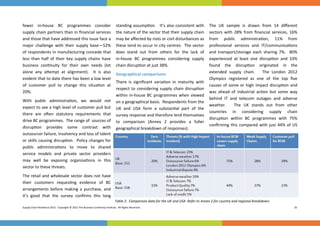
fewer  in‐house  BC  programmes  consider     standing assump on.   It’s also consistent with  The  UK  sample  is  drawn  from  14  different     
supply chain partners than in financial services  the nature of the sector that their supply chain  sectors  with  28%  from  financial  services,  16% 
and those that have addressed this issue face a  may be affected by riots or civil disturbances as  from  public  administra on,  11%  from           
major  challenge  with  their  supply  base—52%  these tend to occur in city centres.  The sector  professional  services  and  IT/communica ons 
of respondents in manufacturing concede that  does  stand  out  from  others  for  the  lack  of         transport/storage  each  sharing  7%.    80% 
                                                                                                             and 
less  than  half  of  their  key  supply  chains  have  in‐house  BC  programmes  considering  supply  experienced  at  least  one  disrup on  and  33% 
business  con nuity  for  their  own  needs  (let  chain disrup on at just 38%.                              found  the  disrup on  originated  in  the            
alone  any  a empt  at  alignment).    It  is  also     Geographical comparisons                             extended  supply  chain.      The  London  2012 
evident that to date there has been a low level                                                              Olympics  registered  as  one  of  the  top  five   
                                                        There  is  significant  varia on  in  maturity  with 
of  customer  pull  to  change  this  situa on  at                                                           causes  of  some  or  high  impact  disrup on  and 
                                                        respect  to  considering  supply  chain  disrup on 
20%.                                                                                                         was  ahead  of  industrial  ac on  but  some  way 
                                                        within  in‐house  BC  programmes  when  viewed 
                                                                                                             behind  IT  and  telecom  outages  and  adverse 
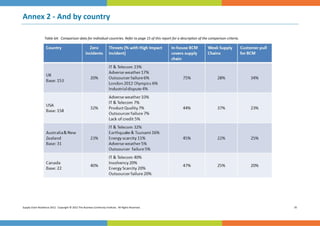
With  public  administra on,  we  would  not     on a geographical basis.  Respondents from the 
expect to see a high level of customer pull but  UK  and  USA  form  a  substan al  part  of  the     weather.      The  UK  stands  out  from  other    
                                                                                                             countries  in  considering  supply  chain             
there  are  o en  statutory  requirements  that  survey response and therefore lend themselves 
drive BC programmes.  The range of  sources of  to  comparison  (Annex  2  provides  a  fuller               disrup on  within  BC  programmes  with  75% 
                                                                                                             confirming  this  compared  with  just  44%  of  US 
disrup on  provides  some  contrast  with               geographical breakdown of responses). 
outsourcer failure, insolvency and loss of talent 
or skills causing disrup on.  Policy changes for 
public  administra ons  to  move  to  shared     
service  models  and  private  sector  providers 
may  well  be  exposing  organisa ons  in  this   
sector to these threats. 
The retail and wholesale sector does not have 
their  customers  reques ng  evidence  of  BC   
arrangements  before  making  a  purchase,  and 
it’s  good  that  the  survey  confirms  this  long 
                                                                                Table 2:  Comparison data for the UK and USA  Refer to Annex 2 for country and regional breakdown. 
Supply Chain Resilience 2012.  Copyright © 2012 The Business Con nuity Ins tute.  All Rights Reserved.                                                                                16 


respondents  and  similar  levels  in  Australia, 
New  Zealand  and  Canada.    The  UK  also  differs 
from  other  countries  in  respect  of  customer 
pull  for  the  provision  of  informa on  around 
business  con nuity  in  tendering  processes, 
where  34%  stated  that  they  typically  have  to 
do this compared with 23% in the US.  The US 
sample  in  this  survey  was  also  drawn  from  14 
sectors,  however  manufacturing  was  the  lead 
sector in terms of response at 18% with retail/
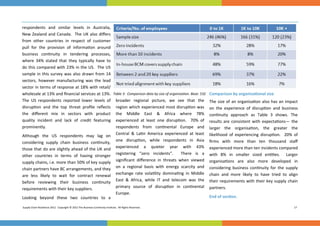
wholesale at 13% and financial services at 13%.   Table 3:  Comparison data by size of organisa on. Base: 532  Comparison by organisa onal size 
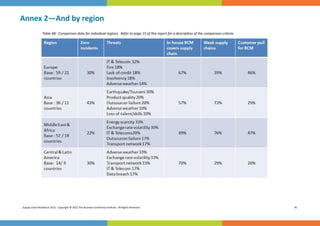
The  US  respondents  reported  lower  levels  of  broader  regional  picture,  we  see  that  the             The  size  of  an  organisa on  also  has  an  impact 
disrup on  and  the  top  threat  profile  reflects  region which experienced most disrup on was  on  the  experience  of  disrup on  and  business   
the  different  mix  in  sectors  with  product          the  Middle  East  &  Africa  where  78%               con nuity  approach  as  Table  3  shows.  The    
quality  incident  and  lack  of  credit  featuring  experienced  at  least  one  disrup on.    70%  of  results  are  consistent  with  expecta ons—  the 
prominently.                                            respondents  from  con nental  Europe  and     larger  the  organisa on,  the  greater  the         
Although  the  US  respondents  may  lag  on     Central  &  La n  America  experienced  at  least  likelihood  of  experiencing  disrup on.    20%  of 
considering  supply  chain  business  con nuity,  one  disrup on,  while  respondents  in  Asia     firms  with  more  than  ten  thousand  staff        
those that do are slightly ahead of the UK and  experienced  a  quieter  year  with  43%                       experienced more than ten incidents compared 
                                                        registering  “zero  incidents”.    There  is  a           8%  in  smaller  sized  en es.    Larger        
                                                                                                               with 
other  countries  in  terms  of  having  stronger 
                                                        significant  difference  in  threats  when  viewed  organisa ons  are  also  more  developed  in     
supply chains, i.e. more than 50% of key supply 
chain partners have BC arrangements, and they  on  a  regional  basis  with  energy  scarcity  and    considering  business  con nuity  for  the  supply 
                                                        exchange  rate  vola lity  domina ng  in  Middle  chain  and  more  likely  to  have  tried  to  align 
are  less  likely  to  wait  for  contract  renewal    
                                                        East  &  Africa,  while  IT  and  telecom  was  the    their requirements with their key supply chain 
before  reviewing  their  business  con nuity    
                                                        primary  source  of  disrup on  in  con nental    partners.  
requirements with their key suppliers. 
                                                        Europe. 
Looking  beyond  these  two  countries  to  a                                                                  End of sec on. 

Supply Chain Resilience 2012.  Copyright © 2012 The Business Con nuity Ins tute.  All Rights Reserved.                                                       17 
Lessons Learned and Key Challenges 


“Assurance from suppliers can only go so far.  A 
plan for dealing with the effects of a disrup on 
is  needed,  even  if  the  supplier’s  business      
con nuity arrangements are extremely robust” 
Survey  respondents  felt  the  main  lesson  to  be 
taken  away  from  the  disrup on  they              
experienced was to improve their approach to 
business con nuity in terms of risk assessment, 
mi ga on efforts, planning and exercising.   
“The  plans  we  have  in  place  and  work  we’ve 
done  with  suppliers  have  helped  an cipate    
incidents,  proac vely  plan  our  response,     
communicate  to  stakeholders  and  minimise  
impact.  Several years ago this would not have 
been the case” 
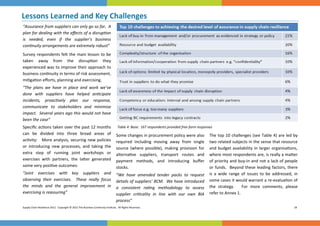
Specific ac ons taken over the past 12 months  Table 4: Base:  167 respondents provided free-form responses 
can  be  divided  into  three  broad  areas  of       
                                                    Some changes in procurement policy were also  The top 10 challenges (see Table 4) are led by 
ac vity:   More analysis, securing new policies  required  including  moving  away  from  single  two related subjects in the sense that resource 
or  introducing  new  processes,  and  taking  the  source  (where  possible),  making  provision  for  and  budget  availability  in  larger  organisa ons, 
extra  step  of  running  joint  workshops  or       
                                                    alterna ve  suppliers,  transport  routes  and   where most respondents are, is really a ma er 
exercises  with  partners,  the  la er  generated  payment  methods,  and  introducing  buffer  of priority and buy‐in and not a lack of people 
some very posi ve outcomes:                         stocks.                                             or  funds.    Beyond  these  leading  factors,  there 
“Joint  exercises  with  key  suppliers  and             have  amended  tender  packs  to  request 
                                                      “We                                                      is  a  wide  range  of  issues  to  be  addressed,  in 
observing  their  exercises.    These  really  focus  details of suppliers’ BCM.  We have introduced           some cases it would warrant a re‐evalua on of 
the  minds  and  the  general  improvement  in    a  consistent  ra ng  methodology  to  assess                the  strategy.      For  more  comments,  please   
exercising is reassuring”                             supplier  cri cality  in  line  with  our  own  BIA      refer to Annex 1. 
                                                                                 process” 
Supply Chain Resilience 2012.  Copyright © 2012 The Business Con nuity Ins tute.  All Rights Reserved.                                                            18 
Review & Conclusions—avoiding a $4 million failure 


Since  2009  consistently  high  levels  of  supply                             study  into  service  chains  and  the  specific     allow  a  calibrated  response  to  the  ques on 
chain  disrup on  have  been  experienced  and                                  challenges inherent in them.                        “how confident are you in the resilience of our 
events are becoming more consequen al even                                      Given  the  dominance  of  supply  chain            key supply chains?” 
with absolute levels dipping a er 2011, a year  disrup on  through  unplanned  IT  and  telecom  Another            business     con nuity     specific             
which  saw  the  Great  East  Japan  Earthquake outages,  there  is  now  a  need  to  evaluate  the  perspec ve  to  track  is  whether  the  new       
and extensive flooding in Thailand.              contribu on of “the cloud” to resilience.              interna onal  business  con nuity  standard  ISO 
One  area  for  further  work  is  a  be er              challenge  of  securing  execu ve  buy‐in     22301  will  make  efforts  to  seek  alignment    
                                                The 
understanding of the cascading nature of risks  requires  an  understanding  of  the  broader  easier  and  thereby  contribute  to  improved  
and  their  consequences  in  supply  chain        
                                                trends driving supply chain vulnerability and its  resilience. 
con nuity.  The research in 2012 has iden fied  disrup on.  In  this  way  it  will  become  possible  The  good  news  for  business  con nuity         
that there are mul ple consequences from the  to  demonstrate  the  trend  is  not  going  to  go  professionals  is  that  the  BC  methodology  is 
same event.                                     away, however fragile corporate memory may  widely seen as effec ve in resis ng the impact 
A  number  of  non‐tradi onal  business                be.                                                    of  disrup on,  alongside  its  core  benefits  of  
con nuity  risks  have  registered  in  this  year’s  More work  is also required to understand the  enabling  con nuity  and  faster  recovery  from 
survey,  most  notably  disrup on  caused  by    economic  impact  of  supply  chain  disrup on  incidents.  Good  prac ce  is  documented  in 
exchange  rate  vola lity.    Applying  business  including the value of investment in raising the  abundance  in  the  survey  and  there  is  li le   
con nuity  exper se  specifically  around               level of resilience in key supply chains.              excuse  for  not  trying  out  some  of  the  ideas. 
con ngency  planning  presents  an  excellent                                                                 The  value  of  moving  from  a  documenta on 
                                                       This la er work will help support the challenge 
opportunity for prac oners to provide a more                                                                  centric  approach  for  evalua ng  supply  chain 
                                                       of  unlocking  resources  through  execu ve  
valuable  service  to  their  organisa ons.    One                                                            resilience to one based on ac ve engagement 
                                                       commitment.    In  addi on,  the  broader  trends 
other  risk  type  also  became  more  visible,                                                               and joint exercises is also clear.  In closing, let’s 
                                                       that  are  driving  supply  chain  vulnerability  and 
namely  disrup on  caused  by  intellectual                                                                   not  find  ourselves  in  the  situa on  that  one 
                                                       hence  disrup on  need  to  be  be er                
property  viola ons,  and  this  deserves  further                                                            person did: 
                                                       understood. 
analysis.                                                                                                     “A  major  failure  that  impacted  our  customers 
                                                       One useful next step from this research would 
The  drama c  rise  in  disrup on  through                                                                    drew  management  a en on  to  the  issue.  It 
                                                       be to develop an assurance model that would 
outsourcer  service  failures  requires  further                                                              took a $4million (US) loss to get any a en on.” 

Supply Chain Resilience 2012.  Copyright © 2012 The Business Con nuity Ins tute.  All Rights Reserved.                                                                             19 
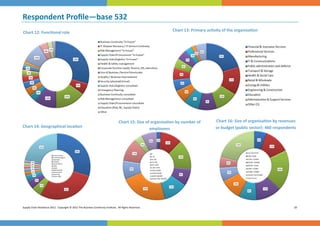
Respondent Profile—base 532 


Chart 12: Func onal role                                                                                      Chart 13: Primary ac vity of the organisa on 


                                                                                   Chart 15: Size of organisa on by number of       Chart 16: Size of organisa on by revenues 
Chart 14: Geographical loca on                                                                      employees                       or budget (public sector): 460 respondents 


Supply Chain Resilience 2012.  Copyright © 2012 The Business Con nuity Ins tute.  All Rights Reserved.                                                                       20 
About the Survey 


                  Fieldwork for the 4th Annual Supply Chain Resilience Survey commenced on 22nd June and closed on 31st August 2012 with 
                  532 responses validated.  All members of the Business Con nuity Ins tute received an individual email invita on to complete 
                  the  online  survey.    This  was  complemented  by  the  Chartered  Ins tute  of  Purchasing  and  Supply  invi ng  its  members  to     
                  contribute through their exis ng communica on methods.  In addi on, support is acknowledged from the following people 
                  and organisa ons: 
                       Chartered Ins tute of Logis cs & Transport 

                       AIRMIC 

                       Colin Ive MBCI and the BRiSC community 

                       Buyers Mee ng Point   

                       Kuniyuki Tashiro MBCI for transla ng the survey into Japanese. 

                  We would like to thank Zurich Insurance Group for sponsoring this research for the fourth successive year and DHL Supply 
                  Chain for joining them for a second year. 
                  We would also like to thank the BCI Partnership Working Party on Supply Chain Con nuity under Steve Wicks MBCI, and the 
                  wider BCI Partnership Steering Group for their support in the development of the survey. 
                  Author:  Lee Glendon CBCI, Head of Research & Advocacy, The Business Con nuity Ins tute 
                  Reviewers:  Lyndon Bird FBCI, Technical Director, The Business Con nuity Ins tute.  Deborah Higgins MBCI, Technical & 
                  Learning Manager, The Business Con nuity Ins tute 


Supply Chain Resilience 2012.  Copyright © 2012 The Business Con nuity Ins tute.  All Rights Reserved.                                                         21 
About 


     The Business Con nuity Ins tute                                                                          Business Con nuity 
     Based  in  Caversham,  United  Kingdom,  the  Business  Con nuity  Ins tute                              Business Con nuity (BC) is the capability of the organisa on 
     (BCI) was established in 1994 to “promote the art and science of business                                to  con nue  delivery  of  products  or  services  at  acceptable 
     con nuity  management”  and  to  assist  organisa ons  in  preparing  for and                            predefined levels following a disrup ve incident.  
     surviving  minor  and  large‐scale  man‐made  and  natural  disasters.    The   
                                                                                                              Business  Con nuity  Management  (BCM)  is  a  holis c      
     Ins tute  enables  members  to  obtain  guidance  and  support  from  their   
                                                                                                              management process that iden fies poten al threats to an 
     fellow prac oners, as well as offers professional training and cer fica on 
                                                                                                              organiza on and the impacts to business opera ons those 
     programmes  to  disseminate  and  validate  the  highest  standards  of        
                                                                                                              threats,  if  realized,  might  cause,  and  which  provides  a 
     competence  and  ethics.    It  has  over  7,000  members  in  more  than  100 
                                                                                                              framework  for  building  organiza onal  resilience  with  the 
     countries, ac ve in an es mated 2,500 organisa ons in private, public and 
                                                                                                              capability  of  an  effec ve  response  that  safeguards  the    
     third sectors. For more informa on go to: www.thebci.org 
                                                                                                              interests  of  its  key  stakeholders,  reputa on,  brand  and   
     The  BCI  Corporate  Partnership,  established  in  2007,  offers  corporate                              value‐crea ng ac vi es. 
     membership of the BCI with over 90 member organisa ons including: Aon 
                                                                                                              Source: ISO22301:2012 
     Risk  Consul ng,  BAE  Systems,  BP,  BSI  Management  Systems,  BT,         
     ClearView  Con nuity,  Con nuitySA,  Con nuity  Shop,  DHL  Supply  Chain,                               Contac ng the BCI 
     DNV  Business  Assurance,  eBay,  eBRP  Solu ons,  Hill  Dickinson,  iAgenci, 
                                                                                                              Lee Glendon CBCI, Head of Research & Advocacy 
     IBM, Itau‐Unibanco, KPN Corporate Market, LRQA, Link Associates, Milton                                  The Business Con nuity Ins tute 
     Keynes  Council,  Na onal  Grid,  Phoenix,  Pruden al,  PwC,  Reed  Elsevier,                            10‐11 Southview Park, Marsack Street 
     Royal  Mail,  Savant,  T‐Systems,  VocaLink  and  Zurich  Insurance  Group.                              Caversham, RG4 5AF, UK. 
     To join as a corporate member, go to: www.bcipartnership.com                                             Phone: +44 (0) 118 947 8215 
                                                                                                              E‐mail: research@thebci.org 


Supply Chain Resilience 2012.  Copyright © 2012 The Business Con nuity Ins tute.  All Rights Reserved.                                                                             22 
About 


                                   The Chartered Ins tute of Purchasing & Supply 
                                   The Chartered Ins tute of Purchasing & Supply (CIPS) is the world’s largest procurement and supply  
                                   professional  organisa on.    It  is  the  worldwide  centre  of  excellence  on  purchasing  and  supply       
                                   management  issues.    CIPS  has  a  global  community  of  over  88,000  in  150  different  countries,          
                                   including senior business people, high‐ranking civil servants and leading academics.  The ac vi es of 
                                   purchasing and supply chain professionals have a major impact on the profitability and efficiency of 
                                   all  types  of  organisa on  and  CIPS  offers  corporate  solu ons  packages  to  improve  business          
                                   profitability.   
                                   www.cips.org 


Supply Chain Resilience 2012.  Copyright © 2012 The Business Con nuity Ins tute.  All Rights Reserved.                                                 23 
About 


                                       Zurich 
                                       Zurich  is  a  thought  leader  in  supply  chain  risk  management.  It  has  developed  supply  chain  risk            
                                       assessment tools and an innova ve and award winning supply chain insurance product. The company 
                                       has  extensive experience of working with clients to help them make their supply chains more resilient.  

                                       Zurich  Insurance  Group  (Zurich)  is  a  leading  mul ‐line  insurance  provider  with  a  global  network  of   
                                       subsidiaries  and  offices  in  Europe,  North  America,  La n  America,  Asia‐Pacific  and  the  Middle  East  as 
                                       well  as  other  markets.  It  offers  a  wide  range  of  general  insurance  and  life  insurance  products  and      
                                       services  for  individuals,  small  businesses,  mid‐sized  and  large  companies  as  well  as  mul na onal      
                                       corpora ons.  Zurich  employs  about  60,000  people  serving  customers  in  more  than  170  countries. 
                                       Founded  in  1872,  the  Group  is  headquartered  in  Zurich,  Switzerland.  Zurich  Insurance  Company  Ltd 
                                       (ZURN)  is  listed  on  the  SIX  Swiss  Exchange  and  has  a  level  I  American  Depositary  Receipt  program 
                                       (ZFSVY)  which  is  traded  over‐the‐counter  on  OTCQX.  Further  informa on  about  Zurich  is  available  at 
                                       www.zurich.com  

                                       Zurich Contact Details 
                                       Nick Wildgoose, Global Supply Chain Product Manager 
                                       Phone: +44 (0) 0787 588 6068  
                                       Email: nick.wildgoose@uk.zurich.com 


Supply Chain Resilience 2012.  Copyright © 2012 The Business Con nuity Ins tute.  All Rights Reserved.                                                             24 
About 


                                   DHL 
                                   DHL is the global market leader in the logis cs industry and “The Logis cs company for the world”. DHL 
                                   commits its exper se in interna onal express, air and ocean freight, road and rail transporta on, contract 
                                   logis cs  and  interna onal  mail  services  to  its  customers.  A  global  network  composed  of  more  than  220 
                                   countries  and  territories  and  about  275,000  employees  worldwide  offers  customers  superior  service     
                                   quality and local knowledge to sa sfy their supply chain requirements. DHL accepts its social  responsibility 
                                   by suppor ng climate protec on, disaster management and educa on. 

                                   DHL Supply Chain Service Capability 
                                   DHL Supply Chain provides solu ons for all industry sectors including retail and fashion.  By understanding 
                                   your  business  needs,  DHL  delivers  cost  effec ve  supply  chain  solu ons  that  improve  efficiency.    From    
                                   consul ng and design, sourcing and transporta on through to warehousing, order assembly, distribu on 
                                   and  returns,  we  manage  the  full  supply  chain  opera on.  DHL  is  part  of  Deutsche  Post  DHL.  The  Group   
                                   generated revenue of 53 billion euros in 2011. 

                                   DHL Supply Chain Contact Details 
                                   DHL Supply Chain enquiry line: 0800 316 0498  


Supply Chain Resilience 2012.  Copyright © 2012 The Business Con nuity Ins tute.  All Rights Reserved.                                                      25 


                                                                                                   Annex 1 


Supply Chain Resilience 2012.  Copyright © 2012 The Business Con nuity Ins tute.  All Rights Reserved.        26 
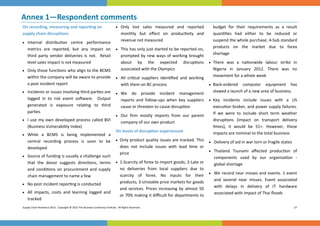
Annex 1—Respondent comments 


On recording, measuring and repor ng on                                          Only  lost  sales  measured  and  reported 
                                                                                                           budget  for  their  requirements  as  a  result 
supply chain disrup ons                                  monthly  but  effect  on  produc vity  and      quan es  had  either  to  be  reduced  or      
                                                         revenue not measured                              suspend the whole purchase; 4‐Sub standard 
 Internal  distribu on  centre  performance 
                                                                                                           products  on  the  market  due  to  forex       
   metrics  are  reported,  but  any  impact  on   This has only just started to be reported on, 
                                                                                                           shortage 
   third  party  vendor  deliveries  is  not.    Retail  prompted  by  new  ways  of  working  brought 
   level sales impact is not measured                                                                    There  was  a  na onwide  labour  strike  in     
                                                         about  by  the  expected  disrup ons             
 Only those func ons who align to the BCMS             associated with the Olympics                      Nigeria  in  January  2012.  There  was  no    
   within the company will be aware to provide   All  cri cal  suppliers  iden fied  and  working         movement for a whole week 
   a post incident report                                with them on BC process                         Back‐ordered  computer  equipment  has 
 Incidents or issues involving third par es are                                                                                 slowed a launch of a new area of business. 
                                                                                 We  do  provide  incident  management       
     logged  in  to  risk  event  so ware.    Output       reports  and  follow‐ups  when  key  suppliers   Key  incidents  include  issues  with  a  US        
     generated  is  exposure  rela ng  to  third           cause or threaten to cause disrup on                  execu on broker, and power supply failures. 
     par es                                                                                                      If  we  were  to  include  short  term  weather 
                                                        Our  firm  mostly  imports  from  our  parent 
   I  use  my  own  developed  process  called  BVI                                                            disrup ons  (impact  on  transport  delivery 
                                                           company of our own product 
     (Business Vulnerability Index)                                                                                mes),  it  would  be  51+.  However,  these    
                                                       On levels of disrup on experienced                        impacts are nominal to the total business 
   While  a  BCMS  is  being  implemented  a     
     central  recording  process  is  soon  to  be      Only product quality issues are tracked. This   Delivery of aid in war torn or fragile states 
     developed                                            does  not  include  issues  with  lead  me  or 
                                                                                                               Thailand  Tsunami  affected  produc on  of 
                                                          price 
   Source of funding is usually a challenge such                                                                components  used  by  our  organisa on  ‐   
     that  the  donor  suggests  direc ons,  terms   1‐Scarcity of forex to import goods; 2‐Late or             global shortage 
     and  condi ons  on  procurement  and  supply         no  deliveries  from  local  suppliers  due  to 
                                                                                                              
     chain management to name a few                       scarcity  of  forex.  No  inputs  for  their         We  record near  misses  and  events.  1  event 
                                                                                                                  and  several  near  misses.  Event  associated 
   No post incident repor ng is conducted               products; 3‐Unstable price markets for goods 
                                                          and  services.  Prices  increasing  by  almost  50      with  delays  in  delivery  of  IT  hardware       
   All  impacts,  costs  and  learning  logged  and                                                             associated with impact of Thai floods 
                                                          or 70% making it difficult for departments to 
     tracked 
Supply Chain Resilience 2012.  Copyright © 2012 The Business Con nuity Ins tute.  All Rights Reserved.                                                                          27 


 Three  different  Internet  providers.  In  one                                On incidents that caused financial losses     Country  shut  down  in  Nigeria  due  to  a 
   case,  two  of  them  failed  to  deliver  service                                                       week’s  unrest  following  the  government’s 
                                                        Packaging  integrity  is  compromised  when 
   few hours one day but the third (the mobile                                                              decision to withdraw a fuel subsidy   
                                                          alternate  materials  are  used  without         
   phone network) worked well                             authoriza on causing contamina on outside   In  the  last  year  an  organisa on  who         
On analysing the extended supply chain                    the typical specifica on                           provides  a  front  line  service  became          
                                                                                                            insolvent  and  approximate  cost  to  place  a 
 We reach to the original source of the supply   The  biggest  problems  we  face  are  late      
                                                                                                            business con nuity plan in place        
   chain to minimize contamina on to produce              deliveries from machine shops.  This is turn 
     high  purity  products.  When  suppliers  of     has required us to work addi onal over me   Warehouse  was  completely  destroyed  in  a 
     original  source  are  hired,  we  have                      in order to not ship our product late               fire  with  all  stock  and  building  completely 
     excep onal         confidence         they       not                                                              destroyed 
                                                              The recent [Company A] bank failure caused 
     contamina ng                                                 disrup on  to  our  accounts  department.    It   Riots impact on retail higher than on supply 
   We only look at our immediate supplier                       took  them  a  week  to  check  that  all           chain 
   A  prolonged  power  failure  because  of  the               payments  had  gone  through.    No  financial   Cost to run generator during power outage 
     destruc on  of  the  main  power  sta on,  in                loss,  just  disrup on.    Clients  were              
                                                                                                                    Due to a delay in product delivery we had to 
     Cyprus                                                       understanding  
                                                                                                                      postpone some surgeries with loss of income 
   3PL Omani workers on strike                              Principle  supplier  of  control  brand  product 
                                                                                                                      or delayed income 
                                                                  insolvency.  We incurred significant costs to 
   The  source  of  disrup on  was  not  at  our    
                                                                  transfer  produc on  and  expedite  orders   UK Government changed import laws   
     supplier  but  it  was  a  na onal  event  in  two 
                                                                  from an alterna ve vendor in  me for a  me   IT  hardware  delivery  delays  as  a  result  of 
     different countries ‐ Nigeria and Kenya 
                                                                  sensi ve marke ng release                           Thai floods 
   While  we  don't  rou nely  analyse  the  full   
                                                              IT  issues  and  the  supply  of  replacement   A major failure that impacted our customers 
     supply  chain  I  was  able  to  review  3  of  the 
                                                                  drives due to issue in the Far East                 drew management a en on to the issue.  It 
     disrup ons  I  was  made  aware  of  and  found 
                                                                                                                      took  a  $4million  (US)  loss  to  get  any       
     one to be an immediate supplier failure and   The  withdrawing  of  a  call  divert  service  by 
                                                                  [Company B], so our office numbers couldn't           a en on 
     2 to be  er 2 
                                                                  be directly diverted to the new offices 
Supply Chain Resilience 2012.  Copyright © 2012 The Business Con nuity Ins tute.  All Rights Reserved.                                                                    28 


Working  with  key  supply  chain  partners—             suppliers who have a BCP for key contracts        for  BCM  requirements  for  the  Dutch         
what  if  they  can’t  or  won’t  meet  your  BC                                                           financial sector and its providers" 
                                                       A er     iden fying  vulnerabili es,  we             
needs? 
                                                         implement  mi ga on  programs,  generally   We  also  review  SAS  70  or  similar  reports 
 We  would  not  take  on  a  supplier  unless  we     around mul ‐sourcing                              where necessary 
   were happy that they had measures in place   Un l  we  can  develop  a  more  cost  effec ve   We now write the requirement for BCM into 
   to  provide  con nuity  of  service  to  our       
                                                         solu on we are using inventory to decouple        all  our  contracts,  and  judge  this  as  part  of 
   customers                                             our supply capability from our supplier           our selec on criteria 
 Increased       inventory  coverage  for  key       Changing  supplier  is  not  always  possible 
                                                                                                            How do you collect this informa on? 
     components                                            where  government  departments  are                 In person follow‐up as necessary and we will 
   A  mixture  of  the  above  [strategies  provided     involved 
                                                                                                                 offer  our  assistance  to  aid  the  development 
     as  answer  op ons]  depending  on  the            What BC informa on do you seek?                          of their plan 
     supplier / product and the market 
                                                         We  rou nely  check  the  financial  stability  of   We  personally  visit  each  key  supplier  each 
   Ensure  that  supplier  takes  steps  to  mi gate      poten al  suppliers,  number  of  employees,         year  and  if  they  have  presented  any           
     the  situa on  with  their  infrastructure      
                                                            years in business, credit availability               significant problems then have moved to au‐
     problems                                                                                                    dit them 
                                                         BCM is not yet popular in [Country]! Being a 
   In most cases we also have in‐house fall back          government  agency,  we  have  to  deal  with   We  don't  collect  subject  informa on  since 
     procedures 
                                                            the rigors of a minimum of a 3 cost canvass          most  of  the  agencies  and  businesses  in  the 
   In  truth  it  could  be  any  of  the  above           
                                                            from  different  suppliers  before  ordering          Philippines don't have BCMP yet 
     depending  on  circumstances,  but  our          from  the  lowest  bidder,  add  to  that  the     
                                                                                                               Contractual requirement 
     favoured approach is to work with a supplier           policy that government agencies should first 
     to agree a plan to be er align their approach          procure  supplies  from  the  [Government     We have internal procedure for outsourcing. 
     with our requirements                                  Department]  and  you'll  be  le   with  no          BCM is a major requirement on RFP (Request 

   We do not ask to see their BCP but rather we           choice  but  to  make  do  with  what  the        for Proposals) 
                                                            government mandates.                               Not  currently  done  for  all  ers;    Only         
     ask that they state whether they have a BCP 
     and  will  only  award  the  contract  to  those   We  advise  them  to  align  to  the  "Principles      enforced  for  third  party  supply  chain         
Supply Chain Resilience 2012.  Copyright © 2012 The Business Con nuity Ins tute.  All Rights Reserved.                                                       29 


    distribu on centre services                                                   There is a regular internal and external audit        The extent we get involved does depend on 
                                                                                    of sites and BCM                                       risk,  coopera on  and  rela onships.    Most 
 Audit when specified in contract 
                                                                                                                                           key suppliers are open to close engagement 
                                                                                  We also run face‐to‐face mee ngs, telecons/
 Request  evidence  from  cri cal  suppliers  to 
                                                                                                                                           and  see  the  opportunity  of  shared  learning 
                                                                                    live  mee ngs  and  undertake  site  visits,  all 
    validate  the  self‐assessment  ques onnaire,                                                                                          and improved longer term rela onships and 
                                                                                    depending on the risk analysis we undertake.  
    meet  with  cri cal  suppliers  if  the  ques on‐                                                                                      resilience. 
                                                                                    The higher the risk the deeper we look 
    naire raises concerns. 
                                                                                                                                          We have plans to begin valida on 
                                                                                  We  also  now  include  standard  provisions  
 Ini al ques onnaire followed up with further 
   ques ons,  mee ngs  and  site  visits  as         regarding  BCM  into  our  contracts  with     How  o en  do  you  review  your  requirements 
                                                        suppliers                                          with them and their capability to meet them? 
   appropriate  to  nature  of  service  being  sup‐
   plied.                                             We  par cipate  in  joint  tes ng  of  BCPs  with   Contracts are usually for 3 years, we audit at 
                                                        key suppliers                                         the start of a contract and mid term (circa 18 
 This  depends  on  the  cri cality  of  the          
   supplier. The more cri cal they are, the more   Ac vi es  may  be  performed  by  various      months) 
    we ask for                                                                      disciplines,  e.g.,  internal  audit,  dept.‐level   Many of our key suppliers are large na onal 
 We undertake full onshore and offshore due 
                                                                                    vendor managers, procurement                           or  mul na onal  companies.    Our  concerns 
                                                                                 Have  you  checked  that  key  supplier               to  be  greater  on  companies  that  are 
    diligence site visits where appropriate                                                                                                tend 
                                                                                                                                           smaller with less public informa on available 
 Self‐assessments  have  only  been  completed 
                                                                                 arrangements may work in prac ce? 
                                                                                                                                         Once  we  do  our  yearly  BCP  Simula on       
    for  specific  threats  such  as  pandemic;  also                              In some cases the supplier / client refuses to 
                                                                                                                                           Exercise. Contact numbers are ensured to be 
    have  the  ability  in  our  contracts  to  audit                               provide such informa on 
                                                                                                                                           the current ones 
    event  though  not  a  mandatory  requirement 
                                                                                  Only  specific  key  suppliers  have  been       
    that one be completed                                                                                                               
                                                                                    subject  to  these  controls  such  as  our         We proceed with relevant reviews according 
                                                                                                                                           to  our  "tes ng,  reviewing  and  monitoring" 
 We would also ask them to set out their BCM                                      outsourced IT contractors 
    plans in response to par cular scenarios                                                                                               procedure under our BCMS 
                                                                                  We  have  not  yet  carried  out  any  tests  of 
                                                                                                                                         On an annual basis we select 4 cri cal       
 Carry  out  assurance  reviews  against  our  BC                                 suppliers BCM plans, but are intending to do 
                                                                                                                                           suppliers for BC capability assessment 
    policy                                                                          so in future 

Supply Chain Resilience 2012.  Copyright © 2012 The Business Con nuity Ins tute.  All Rights Reserved.                                                                                   30 


 Done once since 2010                                 training  and  templates  by  in‐house  BC      We  have  introduced  a  consistent  ra ng 
                                                        manager                                              methodology  to  assess  supplier  cri cality  in 
 Annual  review  of  all  documenta on,  BCM 
                                                                                                             line with our own BIA process 
                                                     
   and  processes.  Every  3  years  desktop          We  have  reviewed  the  BCP,  conducted     
   exercise                                             audits  and  completed  2  desktop  audits  for   Set up supply chain intelligence department 
                                                        each site. Target is 3 by the end of the year 
 Will  vary  depending  on  the  perceived  risk                                                         Implementa on  of  board  approved  due    
   associated  with  a  contract  and  supplier,   Various drills and exercises have allowed us            diligence  policy  for  exis ng  and  poten al 
   though a minimum is at contract renewal              to  see  weakness  and  strengths.    We  follow     third par es 
                                                        up on both to improve 
 Typically  work  on  an  annual  review  cycle                                                          Provision  made  to  train  all  procurement 
                                                        
   unless  significant  change  occurs  in  the        New  mandatory  Purchasing  &  Procurement                 contract officers in BCM and have offered to 
   interim                                                 Policy  introduced,  driving  the  required  risk     support  them  in  terms  of  audi ng  cri cal 
                                                           assessments prior to supplier appointments            and strategic contracts 
 We plan to develop a schedule but have not 
   at this  me.  We have inadequate staffing to   We have sent our le er and survey forms to   Iden fied  the  truly  cri cal  suppliers  and   
   execute at this  me                                     our  key  suppliers  to  find  out  whether  they      specifically what they provide as it related to 
 Every  two  years  as  part  of  a  new  3rd  party 
                                                           are BCM ready                                         our value chain towards our customers, and 
   BCM ques onnaire process that is mandated   Defining  and  implemen ng  a  BCM  Vendor                       developed  a  er  structure  for  reviewing, 
                                                                                                                 tes ng, etc. the suppliers plans based on the 
   by company policy                                       standard.  Rolling  out  a  Vendor  Con nuity 
                                                                                                                 cri cality  er each falls into 
What  ac ons  taken  by  you  have  made  the              Program and making Category Management 
                                                           the owner                                           Full  assessment  of  our  cri cal  suppliers   
biggest difference to your confidence? 
                                                                                                                  using  a  mix  of  self‐assessment  ques on‐
                                                         Every key supplier (as a first pass) now has a 
 Joint  exercises  with  key  suppliers  and       
                                                           con ngency  &  con nuity  score,  which       naires and audits 
    observing their exercises.  These really focus 
                                                                                                               Mapped  key  suppliers  and  developed      
    minds  and  the  general  improvement  in      allows  us  to  focus  out  efforts  on  single 
                                                           source suppliers that have low scores                  incident  management  protocols  including 
    exercising is reassuring 
                                                         We  have  amended  tender  packs  to  request 
                                                                                                                  resources 
 Workshops  held  for  owners  of  private      
                                                           details of suppliers BCM                            Individual  plant  by  plant,  unit  by  unit  risk 
    residen al  care  homes and  the  provision  of 
                                                                                                                  and mi ga on analyses 
Supply Chain Resilience 2012.  Copyright © 2012 The Business Con nuity Ins tute.  All Rights Reserved.                                                         31 


                                                                                                   Annex 2 


Supply Chain Resilience 2012.  Copyright © 2012 The Business Con nuity Ins tute.  All Rights Reserved.        32 
Annex 2 ‐ Sector breakdown across key data 


    Table 5A: Comparison data for individual sectors.  Refer to page 15 of this report for a descrip on of the comparison criteria 


Supply Chain Resilience 2012.  Copyright © 2012 The Business Con nuity Ins tute.  All Rights Reserved.                                33 
 
    Annex 2 ‐ Sector breakdown across key data 

           Table 5B:  Comparison data for individual sectors.  Refer to page 15 of this report for a descrip on of the comparison criteria. 


Supply Chain Resilience 2012.  Copyright © 2012 The Business Con nuity Ins tute.  All Rights Reserved.                                         34 
Annex 2 ‐ And by country 


                   Table 6A:  Comparison data for individual countries. Refer to page 15 of this report for a descrip on of the comparison criteria. 


Supply Chain Resilience 2012.  Copyright © 2012 The Business Con nuity Ins tute.  All Rights Reserved.                                                  35 
Annex 2—And by region 


                 Table 6B:  Comparison data for individual regions.  Refer to page 15 of this report for a descrip on of the comparison criteria. 


Supply Chain Resilience 2012.  Copyright © 2012 The Business Con nuity Ins tute.  All Rights Reserved.                                               36 

BCI Supply Chain Resilience 2012

  • 1.
      4th Annual Survey        Supply Chain  Resilience 2012  Published November 2012  Supported by:  Supported by:  Supported by:  An international survey of more than 530 organisations from  over 65 countries, which considers the origin, causes and           Supply Chain Resilience 2012.  Copyright © 2012 The Business Con nuity Ins tute.  All Rights Reserved.    consequences of supply chain disruption, along with proven  1  approaches to building confidence in supply chain resilience 
  • 2.
    Contents    03  Execu ve summary  04  Introduc on  05  Experience of disrup on  09  Supply chain con nuity  14  Business con nuity in tendering and contrac ng  15  Geographical and sector perspec ves  18  Lesson learned and key challenges  19  Review and conclusions  20  Respondent profile  21  About the survey  22  About the BCI, CIPS, Zurich & DHL Supply Chain  26  Annex 1: Wri en comments by survey respondents  32  Annex 2: Full sector and geographical data  Supply Chain Resilience 2012.  Copyright © 2012 The Business Con nuity Ins tute.  All Rights Reserved.    2 
  • 3.
    Execu ve Summary: Disrup on more consequenal, outsourcers under scru ny    Introduc on   21% suffered more than €1M in costs for a  Review & Conclusions  single  incident;  higher  than  2011  and  in  Since  2009  consistently  high  levels  of  supply  This  survey  is  the  fourth  in  a  series,  star ng  spite of lower overall levels of disrup on  chain  disrup ons  have  been  experienced  and  back  in  2009,  that  sets  out  to  consider  the  challenge  of  developing  resilient  supply   59%  cited  loss  of  produc vity  as  the        events  are  becoming  more  consequen al  chains.    primary  impact  of  the  disrup on                with  absolute  levels  dipping  a er  2011,   even  experienced,  up  from  49%  in  2011.  Across  a  year,  which  saw  the  Great  East  Japan     Key Findings   all  indicators  there  was  a  deepening  on   Earthquake  and  extensive  flooding  in           73%  of survey respondents experienced at  impact  experienced  with  an  average  of  Thailand.  least  one  disrup on  with  an  average  of  three dis nc ve consequences per incident  Business con nuity is widely seen as effec ve  five.  This  high level is consistent with the   25%  of  respondents  have  s ll  to  consider  in resis ng the impact of disrup on, alongside  trend‐line over the past four years  supply  chain  disrup on  in  their  business  its  core  benefits  of  enabling  con nuity  and   39%  of  analysed  disrup ons  originated    con nuity  programmes,  and  44%  of        faster recovery from incidents.  below  the  immediate  er  one  supplier,   respondents  have  weak  supply  chains,  The  drama c  rise  in  disrup on  through       underscoring  for  the  second  consecu ve  while  major  sector  differences  persist      outsourcer  service  failures  requires  further  year the deep‐rooted nature of disrup on  especially in manufacturing and  retail and  study  into  service  chains  and  the  specific    Unplanned  IT  or  telecom  outages  jumped  between countries such as the UK and USA  challenges inherent in them.  to  the  top  of  sources  of  disrup on  with   While  47%  now  look  for  evidence  of  a     Given  the  dominance  of  supply  chain            52%  affected  to  some  or  a  high  degree.   business  con nuity  programme  over  a    disrup on  through  unplanned  IT  or  telecom      The level was 41% in 2011  simple  plan and 23% run joint exercises— outages, there is now  a need to evaluate the   Adverse weather maintained its prominent  all  improvements  on  2011—15%  s ll  do  contribu on of “the cloud” to resilience.  posi on  with  48%  ci ng  it  as  a  cause  of   not  collect  any  informa on  from  key       The  challenge  of  securing  execu ve  buy‐in  disrup on,  but  rela vely  unchanged  from  suppliers, and 41% do not validate that key  requires  an  understanding  of  the  broader  51% in 2011  supplier plans might work in prac ce  trends  driving  supply  chain  vulnerability  and   Failure  of  service  provision  by  outsourcing   42%  stated  the  biggest  on‐going  challenge  its  disrup on.  In  this  way  it  will  become       suppliers has doubled from 17% to 35% of  is  to  secure  buy‐in  to  implement  supply  possible  to  demonstrate  that  high  levels  of  disrup on and joins the top three causes  chain con nuity prac ces in their firm  disrup on are not going to go away, however  fragile corporate memory may be.  Supply Chain Resilience 2012.  Copyright © 2012 The Business Con nuity Ins tute.  All Rights Reserved.    3 
  • 4.
    Introduc on: 73% experienced at least one disrup   ve supply chain incident with an average of five  This  report  is  the  fourth  in  a  series  that,  tough challenges where they are s ll to find an  Chart 1: How many supply chain incidents would you    es mate your organisa on experienced in the past 12  star ng  in  2009,  set  out  to  consider  the      answer,  insights  which  inform  the  Business  months that caused disrup on to your organisa on?  challenge of developing resilient supply chains.    Con nuity Ins tute’s thinking on next steps.  While  we  have  con nued  to  track  trends  in  So, what do we mean by supply chain?  Here is  supply  chain  disrup on,  mi ga on  and          a reprise of the defini on that we first used in  assurance methods employed, the 2012 survey  2011 (Christopher 2005):  is  re‐focused  on  events  that  cause  at  least  The network of organisa ons that are involved,  some  if  not  high  levels  of  disrup on,  rather  through  upstream  and  downstream  rela on- than  disrup on  in  general,  much  of  which  can  ships,  in  the  different    processes  and  ac vi es  be dealt with as part of business as usual.    that produce value in the form of products and  services in the hands of the ul mate consumer.  When  reviewing  the  results  it  is  naturally       important  to  consider  the  profile  of  the          headline  figure  for  disrup on  in  the  2012  The  respondents:  In this case 82% of respondents  survey is that 73% of responding organisa ons  work “in‐house” i.e. they are employed to run  experienced  at  least  one  disrup on  in  the      business  con nuity,  supply  chain  or  risk        previous  12  months,  with  an  average  level  of  programmes  with  18%  providing  consul ng  five  incidents.    In  2011,  supply  chains  were  Base:  389.  Excludes 97 who stated “Don’t Know”.   services  in  these  domains.    The  organisa ons  widely  disrupted  by  the  Great  East  Japan     affec ng  supply  chain  disrup ons  across  the  responding  are  typically  large  ones—42%     Earthquake  and  flooding  in  Thailand  causing  a  whole enterprise.  For 75% of respondents, this  employ  between  one  thousand  and  fi y     jump  to  85%  in  the  deadline  disrup on  figure  is  therefore  not  the  case,  so  the  level  of         thousand staff and 12% employ more than fi y  and  peaking  above  the  established  trend‐line,  disrup on  recorded  here  is  likely  to  be  an      thousand people.  to which we have now returned.  underes mate  of  actual  levels,  albeit  major  The  2012  survey  has  also  achieved  a  stronger  It  is  also  worth  no ng  that  only  one  in  four  disrup ons  are  likely  to  be  picked  up  across  balance  of  views  from  across  risk,  business   firms  have  the  full  picture  on  supply  chain     company  boundaries.  con nuity and supply chain professionals.    disrup on, which would be achieved by record‐ We hope this year’s survey provides some new  Finally, we asked respondents to ar culate the  ing, measuring and repor ng on performance‐ insights and would welcome your feedback.  Supply Chain Resilience 2012.  Copyright © 2012 The Business Con nuity Ins tute.  All Rights Reserved.    4 
  • 5.
    Experience of Disrup on     Origin of disrup on  down  in  the  supply  chain  ( er  three  or  four  the full supply chain, I was able to review three  Following  on  from  providing  informa on  on  etc).  87% of respondents to this ques on were  of  the  disrup ons  that  I  was  made  aware  of  able to provide an analysis of the source of dis‐ the  number  of  disrup ve  incidents                  and  found  one  to  be  an  immediate  supplier   experienced  in  the  last 12  months,  those  who  rup on as seen in Chart 2.  failure and two to be  er two”  had  experienced  disrup on  were  asked    61%  of  disrup on  originated  with  the             Causes of disrup on  whether they had analysed the original source  immediate  supplier  according  to  this  year’s  When  considering  causes  of  disrup on  in  the  of the disrup on within their supply chain.  The  survey  meaning  that  39%  originated  in  the    2012  survey,  we  refined  the  main  ques on  to  ques on specifically asked whether the disrup‐ extended  supply  chain  ( er  two,  three,  etc).   dis nguish  between  disrup on  that  caused  on occurred with the immediate supplier ( er  This level of disrup on is consistent with levels  some  impact  from  disrup on  that  had  high   one) or their supplier ( er two), or much lower  reported  in  2011,  and  confirms  the  deep‐ impact  in  order  to  qualify  the  severity  of  the  rooted  nature  of  disrup on.    The  disrup on.      The  results  in  Chart  3  show  the  Chart 2: The source of disrup on.  Base: 204  comments  suggest  that  buying     totals of each threat type experienced over the  organisa ons  take  it  upon  them‐ previous 12 months.  selves  to  scru nise  their  extended  Overall  some  1,200  causes  of  disrup on  were  supply  chain  rather  than  rely  on  reported with 301 of them designated as high  their  immediate  supplier  to  audit  impact.    The  top  five  causes  by  high  impact  their suppliers in turn, which would  represent 42% of severe events.  be  an  alterna ve  method  of          addressing a difficult challenge.    Unplanned IT or telecom outages are the most  commonly experienced source of some or high  “We  reach  to  the  original  source  of  levels  of  disrup on  with  52%  of  responding  the  supply  chain  to  minimize         organisa ons  selec ng  this  op on.  Adverse  contamina on  to  produce  high      weather  drops  from  first  place  in  the  2011    purity  products.  When  suppliers  of  survey to second place in 2012 at 48%.  original  source  are  hired,  we  have  excep onal  confidence  they  are  not  Failure  in  service  provision  by  an  outsourcer  contamina ng”  reaches  the  top  three  with  35%  sta ng  they  experienced some impact or high impact from  “While  we  don’t  rou nely  analyse  Supply Chain Resilience 2012.  Copyright © 2012 The Business Con nuity Ins tute.  All Rights Reserved.    5 
  • 6.
      such  an  event.   This  is  a  significant  increase  recorded.  The finding suggests that this threat  list  underscores  the  extended  recovery  mes  from the 17% level recorded in 2011.  has a strong sector bias rather than one for all ‐  faced  by  some  organisa ons  following  the  data  from  2009,  2010,  and  2011  support  this  2011 disaster.  In  2011,  we  wrote  that  intellectual  property  viola ons  was  one  to  watch  and  this  has  conclusion as well.  Loss  of  talent/skills  has  slipped  in  2012  from  proved to be the case in jumping to 16th place  The prominence of earthquake/tsunami in the  sixth posi on down to tenth.  The London 2012  above  cyber  a ack,  industrial  dispute  and  act  of  terrorism  with  11%  and  26  Chart 3: How severely has  your supply chain been affect- responses  compared  with  25th  place  ed by any of the following  in  2011  with  just  five  responses.      sources of disrup on over the  Other  significant  climbers  included   past 12 months?  Severity  levels can be considered in  energy  scarcity  in  sixth  place  (14th  in  terms of ini al impact, ability  2011)  and  new  laws/regula ons  in  to con nue to deliver key  products and services and  seventh place (17th in 2011).  recovery  me, as well as the  Cyber  threats  tend  to  score  highly  in  consequences on brand and  reputa on.  Base: 227  horizon  scanning  and  the  media,  so  it  is interes ng to note the low levels of  disrup on  actually  experienced:    only  16%  of  respondents  recorded  severe  or  some  supply  chain  disrup on  as  a  result of a cyber threat, ranking it 18th  on  the  list  of  threats  experienced  by  severity  out  of  25,  and  14th  by       number  of  incidents  registered.  What  is  notable  is  the  concentra on  of  this  disrup on  in  the  financial  services   sector, which claimed 41% of incidents  Supply Chain Resilience 2012.  Copyright © 2012 The Business Con nuity Ins tute.  All Rights Reserved.    6 
  • 7.
      Olympics registered as a source of disrup on at  be seen from Chart 4, loss of producvity is s ll  1%  to  9%)  mirrors  the  prominence  of             the UK level but not in the overall interna onal  the  primary  consequence,  with  59%  checking  outsourcer  failures  among  the  top  three  survey.  this in 2012 compared with 49% in 2011.  sources  of  disrup on.    Incidents  forcing  a   product  recall  or  withdrawal  also  increased  Consequences of disrup on  Increased  cost  of  working,  loss  of  revenues,   from  just  5%  in  2011  to  11%  in  2012.    As      When  comparing  2012  with  2011  data  on  the  customer  complaints  all  increased  over  2011  iden fied in 2011, longer term impacts are be‐ consequences arising from disrup ons, the first  levels.  Product release delay jumped from 17%  ing  experienced more frequently with damage  observa on  is  an  increased  level  of  responses  in 2011 to 26% in 2012.  Further down the list,  to  brand  reputa on  increasing  from  17%  to  across all 14 poten al areas of impact.  As can  the  jump  in  payment  of  service  credits  (from  24% in this year’s survey.  Overall  the  survey  recorded  741  impacts  from  215  respondents.    Of  the  195  survey               respondents  who  experienced  ‘1‐5’  disrup ve  events,  18  stated  they  endured  six  or  more  consequences  (9%),  i.e.  evidence  that  there  is  more  than  one  consequence  from  a  single  event.    Events  which  lend  themselves  to  this  cascading  effect  are  unplanned  telecom/IT   outages, outsourcer failure, loss of talent/skills  and currency vola lity.  Economic consequences  One  in  five  responding  organisa ons  had  suffered a single loss event of more than €1M  in the past 12 months up from 2011, when 17%  registered  a  similar  magnitude  of  loss.    This   increase is noteworthy given the overall lower  level  of  disrup on  experienced  in  this  year’s  Chart 4: Which of the following impacts or consequences arose from the incidents/ survey,  sugges ng  an  increase  in  the              disrup ons experienced in the last 12 months? Base 215.  Supply Chain Resilience 2012.  Copyright © 2012 The Business Con nuity Ins tute.  All Rights Reserved.    7 
  • 8.
      consequen al  nature  of  Considering  the  29  cases  where  this              employees  and  49%  had  revenues  in  supply  chain              10,000  disrup on.    comparison  can  be  made  the  average  (mean)  excess  of  €1BN  (compared  with  23%  and  22%  The  aggregate  annual  figure  could  clearly  be  minimum  loss  is  €8M  but  there  is  significant  respec vely  in  the  overall  sample).  Larger      higher given that the average level of incidents  varia on. For example, three firms experienced  organisa ons tend to have business con nuity  experienced was five.  a single event loss between €1M and €10M on  programmes,  even  if  they  are  not  labelled  as  annual  revenues  of  €1M  to  €10M  indica ng  a  such.  It  is  worth  comparing  the  single  loss  event  significant  bo om  line  hit.    While  another  These  organisa ons  do  have  more  key           against the annual revenues of organisa ons to  suffered  a  loss  of  between  €51M  and  €100M  suppliers than the average with 43% recording  understand  the  significance  of  the  event.     on  annual  revenues  greater  more  than  100  key  suppliers  compared  with  than €50BN.   The economic  the survey average of 23%, indica ng increased  consequences will therefore  complexity  and  higher  need  for  assurance     be subject to further study.  resources.  One  ques on  that  arises  is  What  is  also  clear  is  that  those  affected  had  around  the  profile  of  those  stronger  business  con nuity  programmes  with  organisa ons  suffering  a  63%  having  BC  in  place  for  supply  chain          single  event  loss  of  more  disrup on,  and  a  more  rigorous  approach  was  than  €1M.    Are  these  firms  taken  across  all  assurance  methods  (more  on  simply  laggards  in  terms  of  the  criteria  will  follow  in  the  following  sec on  business con nuity?  of the report).  The answer is, in fact, quite  Most  noteworthy  is  that  in  spite  of  the          the opposite.  Chart 5: Considering the single most  economic  hit  over  the  past  12  months,  this  significant incident in the last 12  Firstly,  the  affected  organi‐ group is convinced that business con nuity has  months what was the approximate  financial cost (loss of revenue and/ sa ons  were  much  larger  helped  them  resist  the  impact  of  disrup on  or increased cost of working)?   ones  than  the  survey         (63%) and helped with con nuity and recovery  Please give your response in EUROs.  average  with  58%              (96%).  Base:182  employing  more  than  Supply Chain Resilience 2012.  Copyright © 2012 The Business Con nuity Ins tute.  All Rights Reserved.    8 
  • 9.
    Supply Chain Con nuity—25% of in‐house BC programmes do not consider supply chain disrup   on  Does  your  business  con nuity  programme  Chart 6: If you have BCM arrangements in place for your supply chain, how strongly would you agree with the following  consider supply chain disrup on?  statements? Base: 237 (only those with BCM could respond to this ques on).  When  asked  whether  the  responding            organisa on  had  business  con nuity  (BC)      arrangements  in  place  to  deal  with  supply  chain disrup on only 58% stated that this was  the  case  with  25%  sta ng  they  definitely  did  not and a further 17% not knowing.  For  those  with  BC  in  place  for  their  supply  chain  (237)  a  series  of  follow  up  ques ons  were  asked.    The  first  was  to  consider  three  business  con nuity  benefit  statements  and  rate  their  strength  of  agreement  with  each  one  based  on  a  scale  from  strongly  agree  through to strongly disagree (refer to Chart 6)   The  conclusion  is  that  BC  is  an  essen al     companies, the next logical step is to seek to  a level which is felt to be a manageable one.  component of supply chain resilience, as more  understand  supplier  BC  arrangements.    This   than  90%  agree  it  delivers  the  capability  of  The  survey  found  that  77%  of  survey             can  be  a  daun ng  task,  even  assuming          faster recovery and the capability to con nue  respondents  who  have  BC  themselves  took  resources  are  available  to  do  so.      The  BCI  to deliver key products and services.  There is  the step of asking their key suppliers whether  Partnership  has  published  separate  guidance  they had business con nuity arrangements in  less  agreement  about  BC  allowing  survey     on how to perform the task of iden fying key  place  for  their  own  needs.    16%    did  not  ask  respondents  to  resist  any  impact  of               supply  chain  partners  from  among  the  wider  this ques on.  disrup on,  but  even  so,  s ll  more  than  60%  supply  base  in  a  separate  paper  available  to  agree with the statement.  download  from  the  BCI  website.    In  the  case  The  response  to  this  ques on  provides  an      As  the  supplier  base  for  larger  organisa ons  insight into the state of supply chain resilience  of  this  survey,  77%  of  responding                   can  number  hundreds  if  not  thousands  of  organisa ons had less than 100 key suppliers,  across  a  wide  range  of  sectors  (and  beyond  Supply Chain Resilience 2012.  Copyright © 2012 The Business Con nuity Ins tute.  All Rights Reserved.    9 
  • 10.
      the  BCI’s  membership). This  can  be  viewed  in  than  half  have  BC  arrangements  in  place.    In  to consider not just upstream supply chain but  Chart 7 below.  the  sector  and  country  analysis  that  follows     also  the  presence  of  BC  arrangements        In  2012  we  can  see  that  55%  of  survey            in  this  report,  the  strength  of  supply  downstream  among  channels,  distributors,  later  respondents  have  key  supply  chains  where  at  chains  is  one  of  the  key  indicators  for           franchisees  etc.    Here  17%  ensured  that  all  least half of the companies that comprise these  comparison.  Nevertheless, we can report that  have  BC  in  place,  while  50%  focus  on  the  key  supply  chains  do  have  business  con nuity  in  their  has  been  a  modest  strengthening  of     channel  partners.  19%  do  not  take  this  step,  place  for  their  own  needs.      However,  44%  supply chains compared with 2011.  leaving a major vulnerability in the end‐to‐end  have  much  weaker  supply  chains,  where  less  Another new dimension in the 2012 survey was  business con nuity picture.    Building confidence  In  order  to  understand  what  the  presence  of  Chart 7: Considering your key suppliers, what  percentage of them would you say have business  BC arrangements among the key supplier base  con nuity arrangements in place to address their  may mean in prac ce, the  survey looked at the  own needs?  informa on  requested  from  key  supply  chain  partners,  how  this  informa on  was  collected  and  subsequently  validated  and  reviewed.   These  steps  are  clearly  essen al  in  developing  a  sense  of  confidence  in  the  resilience  of      supply chains. Naturally the picture that is then  developed  may  require  one  or  more  subse‐ quent  ac ons.  Within  the  survey,  we  asked  about  the  measures  taken  to  deal  with  any   uncertainty generated from feedback from key  supply chains.     Informa on sought by survey respondents  As  set  out  in  Chart  8  (overleaf)  the  most       popular ques ons to ask relate to the existence  Supply Chain Resilience 2012.  Copyright © 2012 The Business Con nuity Ins tute.  All Rights Reserved.    10 
  • 11.
      programme.   In 2011 only 28% of respondents  48%  in  2011.    The  self‐assessment  ques on‐ Chart 8: What informa on do you seek in order to be er  understand the business con nuity management (BCM)  were looking for the BC programme.  naire retains its popularity in second place with  arrangements of key suppliers? Base 200.  45% of respondents selec ng this op on, while  Standards  and  codes  of  prac ce  play  an         important role in assessing the resilience of key  there has been a rise from 37% to 42% of those  suppliers  with  37%  and  36%  respec vely     who  will  retrieve  informa on  through  audit.   looking  for  alignment  or  compliance.              Reques ng  an  independent  audit  is  s ll  the  least  popular  op on  among  those  who  collect  Cer fica on lags behind on 28%.  informa on  at  9%,  down  from  12%  in  2011.   One area with a significant increase from 2011,  15%  s ll  do  not  collect  any  informa on,         is  asking  where  responsibility  for  BC  is  held  in  implying  it  is  good  enough  for  the  supplier  to  the organisa on and the involvement of senior  just  state  they  have  business  con nuity  in  management.  This clearly provides evidence of  place.  the  level  of  commitment  behind  the  BC         programme.    In  2011  the  figure  was  just  23%  “We do not ask to see their BCP but rather we  ask  that  they  state  whether  they  have  a  BCP  but has jumped to 36% in this year’s survey.  and will only award the contract to those who  The  least  likely  ques on  to  ask  is  around  the  have a BCP for key contracts”  creden als  of  those  who  run  the  BC               programme,  such  as  statutory  membership  of  There were a significant number of comments  the BCI, which would seem to be a cri cal one  to illustrate approaches taken, which are listed  given  the  programme  can  only  be  as  effec ve  in Annex 1, but four are quoted here to reflect  as the people assigned to deliver it.  Only 18%  the range of approaches undertaken:  of  a  business  con nuity  programme  (47%),  asked  this  ques on,  albeit  this  level  has        “Ini al  ques onnaire  followed  up  with  further  whether its scope is appropriate (44%) and rel‐ doubled from 2011.  ques ons,  mee ngs  and  site  visits  as               evant  to  the  product  or  service  being  pur‐ appropriate  to  nature  of  the  service  being     How is the informa on collected?  chased  (44%).    This  may  seem  obvious  but  in  supplied”  51%  of  survey  respondents  required  copies  of  earlier  surveys  the  focus  was  on  the  business  supplier  documenta on,  up  frac onally  from  “We would ask them to set out their BCM plans  con nuity  plan  rather  than  the  overall           in response to par cular scenarios”  Supply Chain Resilience 2012.  Copyright © 2012 The Business Con nuity Ins tute.  All Rights Reserved.    11 
  • 12.
      “We  personally  visit each  key  supplier  each  ‐top  exercise  were  techniques  used  by  16%  of  In  the  2012  survey,  44%  of  respondents  s ll  year and if they have presented any significant  respondents, unchanged from 2011.  One area  wait  un l  contract  renewal  before  reviewing  problems then have moved to audit them”  that  has  grown  in  popularity  is  the  running  of  their  business  con nuity  requirements  with  joint  exercises  based  around  likely  scenarios,  key  suppliers  and  their  ability  to  meet  them.    “Ac vi es  may  be  performed  by  various         disciplines , for example, internal audit, depart- which  was  selected  by  23%  of  respondents  This has increased from 37% in 2011.    ment-level vendor managers and procurement”  compared with just 17% in 2011.  Having  said  this,  only  8%  never  review,           One respondent summarises the challenge and  significantly  down  from  18%  in  the  2011        Valida ng that plans may work in prac ce  benefit of valida ng supplier planning:  survey.  Likewise ad hoc mee ngs have dipped  The  crucial  step  of  valida ng  whether  plans  from 24% in 2011 to 21% in 2012.   Scheduled  and inten ons might be effec ve in prac ce is  “The  extent  we  get  involved  does  depend  on  review  mee ngs  with  key  suppliers  at             s ll one that 41% do not take.  The good news  risk,  coopera on  and  rela onships.    Most  key  appropriate  me intervals as part of an exis ng  is that this level has fallen from the 49% figure  suppliers  are  open  to  close  engagement  and  registered in 2011.   see  the  opportunity  of  shared  learning  and    governance  process  has  jumped  to  40%  from  31%  in  2011,  providing  a  good  example  of     improved  longer  term  rela onships  and          A number of op ons were offered to respond‐ embedding BC in the organisa on.  resilience”  ents and naturally most would use a variety of  Three  more  dynamic  op ons  are  less  popular,  Reviewing requirements  techniques  depending  on  the  assigned          namely  reviewing  business  con nuity         cri cality  of  the  supply  chain  partner.    The  One of the biggest changes in the 2012 survey  whenever there is a major change event at the  most  popular  selec on  was  to  request          comes  in  the  sec on  on  reviewing  require‐ buyer  (21%)  or  supplier  end  (20%),  and       documented  outcome  reports  and  ac ons  ments.    Given  the  frequency  of  change  within  whenever  a  new  significant  external  threat  is  plans  following  recent  exercises  conducted  by  organisa ons,  it  seems  highly  likely  that         iden fied (20%).  the  supplier.    40%  chose  this  op on,  up  from  priori es, scope and resources around business  34%  in  2011.    Another  angle  on  the  same     con nuity  programmes  may  change  more     Again  comments  received  provide  some  clues  into how prac oners approach this issue:   technique  is  to  approve  the  scope  of  tests  in  frequently  than  key  supplier  contracts.         advance  and sign‐off all post‐test reports, this  Likewise  new  threats  or  opportuni es  may  “We  plan  to  develop  a  schedule,  but  have  not  was  used  by  11%  of  respondents.    Holding  a  arise  that  need  to  be  considered  within  an    at  this  me.    We  have  inadequate  staffing  to  workshop with a key supplier or running a desk organisa on and through its supply chain.  execute at this  me”  Supply Chain Resilience 2012.  Copyright © 2012 The Business Con nuity Ins tute.  All Rights Reserved.    12 
  • 13.
      “Contracts are usually for three years, we audit  posi ve trend.  the least chosen op ons at 5%.  at the start of the contract and mid term”  When  key  suppliers  do  not,  cannot  or  will  not  Comments  from  respondents  illustrate  the  “Our concerns tend to be greater on companies  meet  alignment  needs,  then  respondents  will  choices available:  that  are  smaller  with  less  public  informa on  typically take a number of ac ons as set out in  “A er iden fying vulnerabili es, we implement  available”  Chart 9.  48% of respondents are keen to work  mi ga on  programs,  generally  around  mul - “On  an  annual  basis  we  select  four  cri cal    with  the  supplier  where  there  is  a  will  on  the  sourcing”  suppliers for capability assessment”.  other  side  to  improve.    Fewer  in  2012  just     accept the risk at 26%, down from 39% in 2011.   “Un l we find a more cost effec ve solu on, we  Seeking alignment and adap ng  Bringing  an  addi onal  supplier  on  board  has  are  using  inventory  to  decouple  our  supply    The  next  logical  step  is  to  check  whether  the  become  more  popular  at  38%  (2011:  31%).   capability from our supplier”  BC plans of the supplier would help you.  In the  Insurance or risk transfer is consistently one of  End of sec on.  survey  we  termed  this  alignment.    As  BC       programmes  are  organised  around  the           objec ves and priori es of the  supplying firm,  it  is  important  for  the  buying  firm  to               understand  where  it  fits  in  the  picture  should  an  event  occur.    It  is  quite  common  for           organisa ons  to  priori se  between  services  and  hence  customers  in  terms  of  con nuing  and  restoring  impaired    ac vi es.  In  prac cal  terms  being  able  to  respond  that  you  have  been largely successful, i.e. most key suppliers  are aligned, would seem to be a good result.  In  2012,  23%  could  state  this  while  a  further  6%  stated  all  of  their  key  suppliers  were  aligned.   The  number  who  had  not  tried  alignment  was  14%, down from 24% in 2011, which again is a  Chart 9: If your key suppliers do not, cannot or will not meet your requirements what approach have you taken? Base 203  Supply Chain Resilience 2012.  Copyright © 2012 The Business Con nuity Ins tute.  All Rights Reserved.    13 
  • 14.
    Business Con nuity in Tendering and Contrac ng Processes    Being asked about BC in tendering  Among  those  not  seeing  a  customer  pull  are  the  start,  a  modest  improvement  on  47%  in  Results show that more organisa ons are being  retailers  and  local  authori es,  the  emergency  2011,  but  a  significant  minority  either  ignore  requested to provide evidence of their business  services  and  regulated  monopoly  service       business con nuity or make it a post‐purchase  con nuity  arrangements  when  tendering  for  providers,  who  either  do  not  seek  to  win     ac vity.    However,  the  comments  from           new  business.    The  figure  for  those  receiving  business  or  whose  customers  don’t  have  the  respondents are more encouraging, sugges ng  this  request  for  the  majority  if  not  all  tenders  buyer  power  to  ask  for  evidence  of  BC           this  is  one  area  of  intense  ac vity,  so  we  that  has increased from 28% to 33%. Mirroring this  programmes (i.e. consumers).  should  see  future  improvements  on  this         increase,  the  number  who  stated  they  are     BC involvement in procurement processes  indicator.  Here’s one example:  rarely,  if  at  all  asked  to  provide  such  evidence  “Increasingly BCM is becoming an integral part  When considering the involvement of business  has  fallen  from  24%  to  19%.    Comments  from  of  the  procurement  process  and  in  some  cases  con nuity  prac oners  in  the  procurement  respondents suggested the trend was driven by  process,  there  is  s ll  a  long  way  to  go.    51%  a  key  upfront  objec ve.    There  are  s ll            major  global  customers,  the  banking  and       occasions  where  parts  of  the  business  make  stated  that  business  con nuity  featured  as  an  financial sector, the healthcare sector and large  integral part of the procurement process from  purchasing decisions before engaging on BCM,  automo ve manufacturers.  though the frequency is fast reducing”  Chart  10:  When  tendering  for  new  business      clients over the past 12 months, how o en have  you had to provide assurance to clients that your  own  business  con nuity  arrangements  are      sufficient?  Base: 207  Chart  11:  Does  business  con nuity  feature  as  part  of  your  supplier  contractual         discussions?  Base: 202  Supply Chain Resilience 2012.  Copyright © 2012 The Business Con nuity Ins tute.  All Rights Reserved.    14 
  • 15.
    Geographical and Sector Perspec ves    Sector comparisons  Table  1 provides  a  comparison  of  selected     industry  sectors  to  highlight  the  significant   varia on  in  terms  of  disrup on,  preparedness  and  customer  pull.    A  full  sector  lis ng  is      available in Annex 2.  The criteria for comparison are as follows:   The level of incidents reported with a focus  on those repor ng “zero”   The origin of the disrup on in terms of  ers,  with a focus below  er one   The top five causes of disrup on by levels of  high impact   The  number  who  state  their  internal  BCM  Table 1:  Comparison data for four selected sectors.  Refer to Annex 2 for full sector breakdown.  programme  considers  supply  chain            percentage  relates  to  those  who  do  so  in the past 12 months.  the  disrup on  every  me or the majority of  mes  Given the high reliance on technology it is not  And two further measures:  The financial services sector is more advanced  surprising to see IT and telecom outages as the   The  strength  of  supply  chains,  where    the  than  other  sectors  in  terms  of  extending  BC  leading  source  of  disrup on  in  financial         percentage  against  “weak  supply  chains”  programmes  to  consider  their  supply  chain  at  services  coupled  with  informa on  and  cyber  refers  to  how  many  respondents  have  key  78%  and  their  key  supply  chains  are  stronger  security threats.  suppliers  where  less  than  half  have  BC     than  other  sectors,  confirming  a  head‐start  in  programmes in place for their own needs  Manufacturing  serves  as  a  good  contrast,      the  introduc on  of  supply  chain  con nuity.   experiencing  high  levels  of  disrup on  rela ve   Customer  pull,  where  this  means  the           sector  also  stands  out  for  having  to        This  to  others  (85%  experienced  at  least  one         frequency  with  which  evidence  of  BC  is       provide  evidence  of  their  BC  programme  in  disrup on)  and  a  different  range  of  disrup ve  requested in tendering for new business, and  tendering, with 45% having had this experience  events  consistent  with  the  sector.    At  47%    Supply Chain Resilience 2012.  Copyright © 2012 The Business Con nuity Ins tute.  All Rights Reserved.    15 
  • 16.
      fewer  in‐house  BC programmes  consider     standing assump on.   It’s also consistent with  The  UK  sample  is  drawn  from  14  different      supply chain partners than in financial services  the nature of the sector that their supply chain  sectors  with  28%  from  financial  services,  16%  and those that have addressed this issue face a  may be affected by riots or civil disturbances as  from  public  administra on,  11%  from            major  challenge  with  their  supply  base—52%  these tend to occur in city centres.  The sector  professional  services  and  IT/communica ons  of respondents in manufacturing concede that  does  stand  out  from  others  for  the  lack  of         transport/storage  each  sharing  7%.    80%  and  less  than  half  of  their  key  supply  chains  have  in‐house  BC  programmes  considering  supply  experienced  at  least  one  disrup on  and  33%  business  con nuity  for  their  own  needs  (let  chain disrup on at just 38%.  found  the  disrup on  originated  in  the             alone  any  a empt  at  alignment).    It  is  also     Geographical comparisons  extended  supply  chain.      The  London  2012  evident that to date there has been a low level  Olympics  registered  as  one  of  the  top  five    There  is  significant  varia on  in  maturity  with  of  customer  pull  to  change  this  situa on  at  causes  of  some  or  high  impact  disrup on  and  respect  to  considering  supply  chain  disrup on  20%.  was  ahead  of  industrial  ac on  but  some  way  within  in‐house  BC  programmes  when  viewed  behind  IT  and  telecom  outages  and  adverse  With  public  administra on,  we  would  not     on a geographical basis.  Respondents from the  expect to see a high level of customer pull but  UK  and  USA  form  a  substan al  part  of  the     weather.      The  UK  stands  out  from  other     countries  in  considering  supply  chain              there  are  o en  statutory  requirements  that  survey response and therefore lend themselves  drive BC programmes.  The range of  sources of  to  comparison  (Annex  2  provides  a  fuller       disrup on  within  BC  programmes  with  75%  confirming  this  compared  with  just  44%  of  US  disrup on  provides  some  contrast  with         geographical breakdown of responses).  outsourcer failure, insolvency and loss of talent  or skills causing disrup on.  Policy changes for  public  administra ons  to  move  to  shared      service  models  and  private  sector  providers  may  well  be  exposing  organisa ons  in  this    sector to these threats.  The retail and wholesale sector does not have  their  customers  reques ng  evidence  of  BC    arrangements  before  making  a  purchase,  and  it’s  good  that  the  survey  confirms  this  long  Table 2:  Comparison data for the UK and USA  Refer to Annex 2 for country and regional breakdown.  Supply Chain Resilience 2012.  Copyright © 2012 The Business Con nuity Ins tute.  All Rights Reserved.    16 
  • 17.
      respondents  and  similar levels  in  Australia,  New  Zealand  and  Canada.    The  UK  also  differs  from  other  countries  in  respect  of  customer  pull  for  the  provision  of  informa on  around  business  con nuity  in  tendering  processes,  where  34%  stated  that  they  typically  have  to  do this compared with 23% in the US.  The US  sample  in  this  survey  was  also  drawn  from  14  sectors,  however  manufacturing  was  the  lead  sector in terms of response at 18% with retail/ wholesale at 13% and financial services at 13%.   Table 3:  Comparison data by size of organisa on. Base: 532  Comparison by organisa onal size  The  US  respondents  reported  lower  levels  of  broader  regional  picture,  we  see  that  the       The  size  of  an  organisa on  also  has  an  impact  disrup on  and  the  top  threat  profile  reflects  region which experienced most disrup on was  on  the  experience  of  disrup on  and  business    the  different  mix  in  sectors  with  product       the  Middle  East  &  Africa  where  78%               con nuity  approach  as  Table  3  shows.  The     quality  incident  and  lack  of  credit  featuring  experienced  at  least  one  disrup on.    70%  of  results  are  consistent  with  expecta ons—  the  prominently.  respondents  from  con nental  Europe  and     larger  the  organisa on,  the  greater  the          Although  the  US  respondents  may  lag  on     Central  &  La n  America  experienced  at  least  likelihood  of  experiencing  disrup on.    20%  of  considering  supply  chain  business  con nuity,  one  disrup on,  while  respondents  in  Asia     firms  with  more  than  ten  thousand  staff         those that do are slightly ahead of the UK and  experienced  a  quieter  year  with  43%               experienced more than ten incidents compared  registering  “zero  incidents”.    There  is  a           8%  in  smaller  sized  en es.    Larger         with  other  countries  in  terms  of  having  stronger  significant  difference  in  threats  when  viewed  organisa ons  are  also  more  developed  in      supply chains, i.e. more than 50% of key supply  chain partners have BC arrangements, and they  on  a  regional  basis  with  energy  scarcity  and    considering  business  con nuity  for  the  supply  exchange  rate  vola lity  domina ng  in  Middle  chain  and  more  likely  to  have  tried  to  align  are  less  likely  to  wait  for  contract  renewal     East  &  Africa,  while  IT  and  telecom  was  the    their requirements with their key supply chain  before  reviewing  their  business  con nuity     primary  source  of  disrup on  in  con nental    partners.   requirements with their key suppliers.  Europe.  Looking  beyond  these  two  countries  to  a  End of sec on.  Supply Chain Resilience 2012.  Copyright © 2012 The Business Con nuity Ins tute.  All Rights Reserved.    17 
  • 18.
    Lessons Learned and Key Challenges    “Assurance from suppliers can only go so far.  A  plan for dealing with the effects of a disrup on  is  needed, even  if  the  supplier’s  business       con nuity arrangements are extremely robust”  Survey  respondents  felt  the  main  lesson  to  be  taken  away  from  the  disrup on  they               experienced was to improve their approach to  business con nuity in terms of risk assessment,  mi ga on efforts, planning and exercising.    “The  plans  we  have  in  place  and  work  we’ve  done  with  suppliers  have  helped  an cipate     incidents,  proac vely  plan  our  response,      communicate  to  stakeholders  and  minimise   impact.  Several years ago this would not have  been the case”  Specific ac ons taken over the past 12 months  Table 4: Base:  167 respondents provided free-form responses  can  be  divided  into  three  broad  areas  of        Some changes in procurement policy were also  The top 10 challenges (see Table 4) are led by  ac vity:   More analysis, securing new policies  required  including  moving  away  from  single  two related subjects in the sense that resource  or  introducing  new  processes,  and  taking  the  source  (where  possible),  making  provision  for  and  budget  availability  in  larger  organisa ons,  extra  step  of  running  joint  workshops  or        alterna ve  suppliers,  transport  routes  and   where most respondents are, is really a ma er  exercises  with  partners,  the  la er  generated  payment  methods,  and  introducing  buffer  of priority and buy‐in and not a lack of people  some very posi ve outcomes:  stocks.    or  funds.    Beyond  these  leading  factors,  there  “Joint  exercises  with  key  suppliers  and             have  amended  tender  packs  to  request  “We  is  a  wide  range  of  issues  to  be  addressed,  in  observing  their  exercises.    These  really  focus  details of suppliers’ BCM.  We have introduced  some cases it would warrant a re‐evalua on of  the  minds  and  the  general  improvement  in    a  consistent  ra ng  methodology  to  assess    the  strategy.      For  more  comments,  please    exercising is reassuring”  supplier  cri cality  in  line  with  our  own  BIA    refer to Annex 1.    process”  Supply Chain Resilience 2012.  Copyright © 2012 The Business Con nuity Ins tute.  All Rights Reserved.    18 
  • 19.
    Review & Conclusions—avoiding a $4 million failure    Since  2009  consistently high  levels  of  supply  study  into  service  chains  and  the  specific     allow  a  calibrated  response  to  the  ques on  chain  disrup on  have  been  experienced  and  challenges inherent in them.  “how confident are you in the resilience of our  events are becoming more consequen al even  Given  the  dominance  of  supply  chain            key supply chains?”  with absolute levels dipping a er 2011, a year  disrup on  through  unplanned  IT  and  telecom  Another  business  con nuity  specific              which  saw  the  Great  East  Japan  Earthquake outages,  there  is  now  a  need  to  evaluate  the  perspec ve  to  track  is  whether  the  new        and extensive flooding in Thailand.  contribu on of “the cloud” to resilience.  interna onal  business  con nuity  standard  ISO  One  area  for  further  work  is  a  be er              challenge  of  securing  execu ve  buy‐in     22301  will  make  efforts  to  seek  alignment     The  understanding of the cascading nature of risks  requires  an  understanding  of  the  broader  easier  and  thereby  contribute  to  improved   and  their  consequences  in  supply  chain         trends driving supply chain vulnerability and its  resilience.  con nuity.  The research in 2012 has iden fied  disrup on.  In  this  way  it  will  become  possible  The  good  news  for  business  con nuity          that there are mul ple consequences from the  to  demonstrate  the  trend  is  not  going  to  go  professionals  is  that  the  BC  methodology  is  same event.    away, however fragile corporate memory may  widely seen as effec ve in resis ng the impact  A  number  of  non‐tradi onal  business            be.  of  disrup on,  alongside  its  core  benefits  of   con nuity  risks  have  registered  in  this  year’s  More work  is also required to understand the  enabling  con nuity  and  faster  recovery  from  survey,  most  notably  disrup on  caused  by    economic  impact  of  supply  chain  disrup on  incidents.  Good  prac ce  is  documented  in  exchange  rate  vola lity.    Applying  business  including the value of investment in raising the  abundance  in  the  survey  and  there  is  li le    con nuity  exper se  specifically  around        level of resilience in key supply chains.  excuse  for  not  trying  out  some  of  the  ideas.  con ngency  planning  presents  an  excellent  The  value  of  moving  from  a  documenta on  This la er work will help support the challenge  opportunity for prac oners to provide a more  centric  approach  for  evalua ng  supply  chain  of  unlocking  resources  through  execu ve   valuable  service  to  their  organisa ons.    One  resilience to one based on ac ve engagement  commitment.    In  addi on,  the  broader  trends  other  risk  type  also  became  more  visible,  and joint exercises is also clear.  In closing, let’s  that  are  driving  supply  chain  vulnerability  and  namely  disrup on  caused  by  intellectual     not  find  ourselves  in  the  situa on  that  one  hence  disrup on  need  to  be  be er                 property  viola ons,  and  this  deserves  further      person did:  understood.  analysis.  “A  major  failure  that  impacted  our  customers  One useful next step from this research would  The  drama c  rise  in  disrup on  through         drew  management  a en on  to  the  issue.  It  be to develop an assurance model that would  outsourcer  service  failures  requires  further  took a $4million (US) loss to get any a en on.”  Supply Chain Resilience 2012.  Copyright © 2012 The Business Con nuity Ins tute.  All Rights Reserved.    19 
  • 20.
    Respondent Profile—base 532    Chart 12: Func onal role  Chart 13: Primary ac vity of the organisa on  Chart 15: Size of organisa on by number of  Chart 16: Size of organisa on by revenues  Chart 14: Geographical loca on  employees  or budget (public sector): 460 respondents  Supply Chain Resilience 2012.  Copyright © 2012 The Business Con nuity Ins tute.  All Rights Reserved.    20 
  • 21.
    About the Survey    Fieldwork for the 4th Annual Supply Chain Resilience Survey commenced on 22nd June and closed on 31st August 2012 with  532 responses validated.  All members of the Business Con nuity Ins tute received an individual email invita on to complete  the  online  survey.    This  was  complemented  by  the  Chartered  Ins tute  of  Purchasing  and  Supply  invi ng  its  members  to      contribute through their exis ng communica on methods.  In addi on, support is acknowledged from the following people  and organisa ons:   Chartered Ins tute of Logis cs & Transport   AIRMIC   Colin Ive MBCI and the BRiSC community   Buyers Mee ng Point     Kuniyuki Tashiro MBCI for transla ng the survey into Japanese.  We would like to thank Zurich Insurance Group for sponsoring this research for the fourth successive year and DHL Supply  Chain for joining them for a second year.  We would also like to thank the BCI Partnership Working Party on Supply Chain Con nuity under Steve Wicks MBCI, and the  wider BCI Partnership Steering Group for their support in the development of the survey.  Author:  Lee Glendon CBCI, Head of Research & Advocacy, The Business Con nuity Ins tute  Reviewers:  Lyndon Bird FBCI, Technical Director, The Business Con nuity Ins tute.  Deborah Higgins MBCI, Technical &  Learning Manager, The Business Con nuity Ins tute  Supply Chain Resilience 2012.  Copyright © 2012 The Business Con nuity Ins tute.  All Rights Reserved.    21 
  • 22.
    About    The Business Con nuity Ins tute  Business Con nuity  Based  in  Caversham,  United  Kingdom,  the  Business  Con nuity  Ins tute  Business Con nuity (BC) is the capability of the organisa on  (BCI) was established in 1994 to “promote the art and science of business  to  con nue  delivery  of  products  or  services  at  acceptable  con nuity  management”  and  to  assist  organisa ons  in  preparing  for and  predefined levels following a disrup ve incident.   surviving  minor  and  large‐scale  man‐made  and  natural  disasters.    The    Business  Con nuity  Management  (BCM)  is  a  holis c       Ins tute  enables  members  to  obtain  guidance  and  support  from  their    management process that iden fies poten al threats to an  fellow prac oners, as well as offers professional training and cer fica on  organiza on and the impacts to business opera ons those  programmes  to  disseminate  and  validate  the  highest  standards  of         threats,  if  realized,  might  cause,  and  which  provides  a  competence  and  ethics.    It  has  over  7,000  members  in  more  than  100  framework  for  building  organiza onal  resilience  with  the  countries, ac ve in an es mated 2,500 organisa ons in private, public and  capability  of  an  effec ve  response  that  safeguards  the     third sectors. For more informa on go to: www.thebci.org  interests  of  its  key  stakeholders,  reputa on,  brand  and    The  BCI  Corporate  Partnership,  established  in  2007,  offers  corporate  value‐crea ng ac vi es.  membership of the BCI with over 90 member organisa ons including: Aon  Source: ISO22301:2012  Risk  Consul ng,  BAE  Systems,  BP,  BSI  Management  Systems,  BT,          ClearView  Con nuity,  Con nuitySA,  Con nuity  Shop,  DHL  Supply  Chain,  Contac ng the BCI  DNV  Business  Assurance,  eBay,  eBRP  Solu ons,  Hill  Dickinson,  iAgenci,  Lee Glendon CBCI, Head of Research & Advocacy  IBM, Itau‐Unibanco, KPN Corporate Market, LRQA, Link Associates, Milton  The Business Con nuity Ins tute  Keynes  Council,  Na onal  Grid,  Phoenix,  Pruden al,  PwC,  Reed  Elsevier,  10‐11 Southview Park, Marsack Street  Royal  Mail,  Savant,  T‐Systems,  VocaLink  and  Zurich  Insurance  Group.        Caversham, RG4 5AF, UK.  To join as a corporate member, go to: www.bcipartnership.com  Phone: +44 (0) 118 947 8215  E‐mail: research@thebci.org  Supply Chain Resilience 2012.  Copyright © 2012 The Business Con nuity Ins tute.  All Rights Reserved.    22 
  • 23.
    About    The Chartered Ins tute of Purchasing & Supply  The Chartered Ins tute of Purchasing & Supply (CIPS) is the world’s largest procurement and supply   professional  organisa on.    It  is  the  worldwide  centre  of  excellence  on  purchasing  and  supply        management  issues.    CIPS  has  a  global  community  of  over  88,000  in  150  different  countries,           including senior business people, high‐ranking civil servants and leading academics.  The ac vi es of  purchasing and supply chain professionals have a major impact on the profitability and efficiency of  all  types  of  organisa on  and  CIPS  offers  corporate  solu ons  packages  to  improve  business           profitability.    www.cips.org  Supply Chain Resilience 2012.  Copyright © 2012 The Business Con nuity Ins tute.  All Rights Reserved.    23 
  • 24.
    About    Zurich  Zurich  is  a  thought  leader  in  supply  chain  risk  management.  It  has  developed  supply  chain  risk             assessment tools and an innova ve and award winning supply chain insurance product. The company  has  extensive experience of working with clients to help them make their supply chains more resilient.   Zurich  Insurance  Group  (Zurich)  is  a  leading  mul ‐line  insurance  provider  with  a  global  network  of    subsidiaries  and  offices  in  Europe,  North  America,  La n  America,  Asia‐Pacific  and  the  Middle  East  as  well  as  other  markets.  It  offers  a  wide  range  of  general  insurance  and  life  insurance  products  and       services  for  individuals,  small  businesses,  mid‐sized  and  large  companies  as  well  as  mul na onal       corpora ons.  Zurich  employs  about  60,000  people  serving  customers  in  more  than  170  countries.  Founded  in  1872,  the  Group  is  headquartered  in  Zurich,  Switzerland.  Zurich  Insurance  Company  Ltd  (ZURN)  is  listed  on  the  SIX  Swiss  Exchange  and  has  a  level  I  American  Depositary  Receipt  program  (ZFSVY)  which  is  traded  over‐the‐counter  on  OTCQX.  Further  informa on  about  Zurich  is  available  at  www.zurich.com   Zurich Contact Details  Nick Wildgoose, Global Supply Chain Product Manager  Phone: +44 (0) 0787 588 6068   Email: nick.wildgoose@uk.zurich.com    Supply Chain Resilience 2012.  Copyright © 2012 The Business Con nuity Ins tute.  All Rights Reserved.    24 
  • 25.
    About    DHL  DHL is the global market leader in the logis cs industry and “The Logis cs company for the world”. DHL  commits its exper se in interna onal express, air and ocean freight, road and rail transporta on, contract  logis cs  and  interna onal  mail  services  to  its  customers.  A  global  network  composed  of  more  than  220  countries  and  territories  and  about  275,000  employees  worldwide  offers  customers  superior  service      quality and local knowledge to sa sfy their supply chain requirements. DHL accepts its social  responsibility  by suppor ng climate protec on, disaster management and educa on.  DHL Supply Chain Service Capability  DHL Supply Chain provides solu ons for all industry sectors including retail and fashion.  By understanding  your  business  needs,  DHL  delivers  cost  effec ve  supply  chain  solu ons  that  improve  efficiency.    From     consul ng and design, sourcing and transporta on through to warehousing, order assembly, distribu on  and  returns,  we  manage  the  full  supply  chain  opera on.  DHL  is  part  of  Deutsche  Post  DHL.  The  Group    generated revenue of 53 billion euros in 2011.  DHL Supply Chain Contact Details  DHL Supply Chain enquiry line: 0800 316 0498   Supply Chain Resilience 2012.  Copyright © 2012 The Business Con nuity Ins tute.  All Rights Reserved.    25 
  • 26.
      Annex 1  Supply Chain Resilience 2012.  Copyright © 2012 The Business Con nuity Ins tute.  All Rights Reserved.    26 
  • 27.
    Annex 1—Respondent comments    On recording, measuring and repor ng on   Only  lost  sales  measured  and  reported  budget  for  their  requirements  as  a  result  supply chain disrup ons  monthly  but  effect  on  produc vity  and      quan es  had  either  to  be  reduced  or       revenue not measured  suspend the whole purchase; 4‐Sub standard   Internal  distribu on  centre  performance  products  on  the  market  due  to  forex        metrics  are  reported,  but  any  impact  on   This has only just started to be reported on,  shortage  third  party  vendor  deliveries  is  not.    Retail  prompted  by  new  ways  of  working  brought  level sales impact is not measured   There  was  a  na onwide  labour  strike  in      about  by  the  expected  disrup ons               Only those func ons who align to the BCMS  associated with the Olympics  Nigeria  in  January  2012.  There  was  no     within the company will be aware to provide   All  cri cal  suppliers  iden fied  and  working  movement for a whole week  a post incident report  with them on BC process   Back‐ordered  computer  equipment  has   Incidents or issues involving third par es are  slowed a launch of a new area of business.   We  do  provide  incident  management        logged  in  to  risk  event  so ware.    Output  reports  and  follow‐ups  when  key  suppliers   Key  incidents  include  issues  with  a  US         generated  is  exposure  rela ng  to  third      cause or threaten to cause disrup on  execu on broker, and power supply failures.  par es  If  we  were  to  include  short  term  weather   Our  firm  mostly  imports  from  our  parent   I  use  my  own  developed  process  called  BVI  disrup ons  (impact  on  transport  delivery  company of our own product  (Business Vulnerability Index)  mes),  it  would  be  51+.  However,  these     On levels of disrup on experienced  impacts are nominal to the total business   While  a  BCMS  is  being  implemented  a      central  recording  process  is  soon  to  be      Only product quality issues are tracked. This   Delivery of aid in war torn or fragile states  developed  does  not  include  issues  with  lead  me  or   Thailand  Tsunami  affected  produc on  of  price   Source of funding is usually a challenge such  components  used  by  our  organisa on  ‐    that  the  donor  suggests  direc ons,  terms   1‐Scarcity of forex to import goods; 2‐Late or  global shortage  and  condi ons  on  procurement  and  supply  no  deliveries  from  local  suppliers  due  to   chain management to name a few  scarcity  of  forex.  No  inputs  for  their         We  record near  misses  and  events.  1  event  and  several  near  misses.  Event  associated   No post incident repor ng is conducted  products; 3‐Unstable price markets for goods  and  services.  Prices  increasing  by  almost  50  with  delays  in  delivery  of  IT  hardware         All  impacts,  costs  and  learning  logged  and  associated with impact of Thai floods  or 70% making it difficult for departments to  tracked  Supply Chain Resilience 2012.  Copyright © 2012 The Business Con nuity Ins tute.  All Rights Reserved.    27 
  • 28.
       Three  different Internet  providers.  In  one  On incidents that caused financial losses   Country  shut  down  in  Nigeria  due  to  a  case,  two  of  them  failed  to  deliver  service  week’s  unrest  following  the  government’s   Packaging  integrity  is  compromised  when  few hours one day but the third (the mobile  decision to withdraw a fuel subsidy    alternate  materials  are  used  without          phone network) worked well  authoriza on causing contamina on outside   In  the  last  year  an  organisa on  who          On analysing the extended supply chain  the typical specifica on  provides  a  front  line  service  became           insolvent  and  approximate  cost  to  place  a   We reach to the original source of the supply   The  biggest  problems  we  face  are  late       business con nuity plan in place    chain to minimize contamina on to produce  deliveries from machine shops.  This is turn  high  purity  products.  When  suppliers  of     has required us to work addi onal over me   Warehouse  was  completely  destroyed  in  a  original  source  are  hired,  we  have                in order to not ship our product late    fire  with  all  stock  and  building  completely  excep onal  confidence  they  not                 destroyed   The recent [Company A] bank failure caused  contamina ng  disrup on  to  our  accounts  department.    It   Riots impact on retail higher than on supply   We only look at our immediate supplier  took  them  a  week  to  check  that  all           chain   A  prolonged  power  failure  because  of  the  payments  had  gone  through.    No  financial   Cost to run generator during power outage  destruc on  of  the  main  power  sta on,  in   loss,  just  disrup on.    Clients  were                Due to a delay in product delivery we had to  Cyprus  understanding   postpone some surgeries with loss of income   3PL Omani workers on strike   Principle  supplier  of  control  brand  product  or delayed income  insolvency.  We incurred significant costs to   The  source  of  disrup on  was  not  at  our     transfer  produc on  and  expedite  orders   UK Government changed import laws    supplier  but  it  was  a  na onal  event  in  two  from an alterna ve vendor in  me for a  me   IT  hardware  delivery  delays  as  a  result  of  different countries ‐ Nigeria and Kenya  sensi ve marke ng release    Thai floods   While  we  don't  rou nely  analyse  the  full     IT  issues  and  the  supply  of  replacement   A major failure that impacted our customers  supply  chain  I  was  able  to  review  3  of  the  drives due to issue in the Far East    drew management a en on to the issue.  It  disrup ons  I  was  made  aware  of  and  found  took  a  $4million  (US)  loss  to  get  any        one to be an immediate supplier failure and   The  withdrawing  of  a  call  divert  service  by  [Company B], so our office numbers couldn't  a en on  2 to be  er 2  be directly diverted to the new offices  Supply Chain Resilience 2012.  Copyright © 2012 The Business Con nuity Ins tute.  All Rights Reserved.    28 
  • 29.
      Working  with  key supply  chain  partners— suppliers who have a BCP for key contracts  for  BCM  requirements  for  the  Dutch          what  if  they  can’t  or  won’t  meet  your  BC  financial sector and its providers"   A er  iden fying  vulnerabili es,  we              needs?  implement  mi ga on  programs,  generally   We  also  review  SAS  70  or  similar  reports   We  would  not  take  on  a  supplier  unless  we  around mul ‐sourcing  where necessary  were happy that they had measures in place   Un l  we  can  develop  a  more  cost  effec ve   We now write the requirement for BCM into  to  provide  con nuity  of  service  to  our        solu on we are using inventory to decouple  all  our  contracts,  and  judge  this  as  part  of  customers  our supply capability from our supplier  our selec on criteria   Increased  inventory  coverage  for  key       Changing  supplier  is  not  always  possible   How do you collect this informa on?  components  where  government  departments  are            In person follow‐up as necessary and we will   A  mixture  of  the  above  [strategies  provided  involved  offer  our  assistance  to  aid  the  development  as  answer  op ons]  depending  on  the         What BC informa on do you seek?  of their plan  supplier / product and the market   We  rou nely  check  the  financial  stability  of   We  personally  visit  each  key  supplier  each   Ensure  that  supplier  takes  steps  to  mi gate  poten al  suppliers,  number  of  employees,  year  and  if  they  have  presented  any            the  situa on  with  their  infrastructure       years in business, credit availability  significant problems then have moved to au‐ problems  dit them   BCM is not yet popular in [Country]! Being a   In most cases we also have in‐house fall back  government  agency,  we  have  to  deal  with   We  don't  collect  subject  informa on  since  procedures  the rigors of a minimum of a 3 cost canvass  most  of  the  agencies  and  businesses  in  the   In  truth  it  could  be  any  of  the  above            from  different  suppliers  before  ordering  Philippines don't have BCMP yet  depending  on  circumstances,  but  our          from  the  lowest  bidder,  add  to  that  the       Contractual requirement  favoured approach is to work with a supplier  policy that government agencies should first  to agree a plan to be er align their approach  procure  supplies  from  the  [Government     We have internal procedure for outsourcing.  with our requirements  Department]  and  you'll  be  le   with  no  BCM is a major requirement on RFP (Request   We do not ask to see their BCP but rather we  choice  but  to  make  do  with  what  the        for Proposals)  government mandates.   Not  currently  done  for  all  ers;    Only          ask that they state whether they have a BCP  and  will  only  award  the  contract  to  those   We  advise  them  to  align  to  the  "Principles  enforced  for  third  party  supply  chain          Supply Chain Resilience 2012.  Copyright © 2012 The Business Con nuity Ins tute.  All Rights Reserved.    29 
  • 30.
      distribu on centre services   There is a regular internal and external audit   The extent we get involved does depend on  of sites and BCM  risk,  coopera on  and  rela onships.    Most   Audit when specified in contract  key suppliers are open to close engagement   We also run face‐to‐face mee ngs, telecons/  Request  evidence  from  cri cal  suppliers  to  and  see  the  opportunity  of  shared  learning  live  mee ngs  and  undertake  site  visits,  all  validate  the  self‐assessment  ques onnaire,  and improved longer term rela onships and  depending on the risk analysis we undertake.   meet  with  cri cal  suppliers  if  the  ques on‐ resilience.  The higher the risk the deeper we look  naire raises concerns.   We have plans to begin valida on   We  also  now  include  standard  provisions    Ini al ques onnaire followed up with further  ques ons,  mee ngs  and  site  visits  as         regarding  BCM  into  our  contracts  with     How  o en  do  you  review  your  requirements  suppliers  with them and their capability to meet them?  appropriate  to  nature  of  service  being  sup‐ plied.   We  par cipate  in  joint  tes ng  of  BCPs  with   Contracts are usually for 3 years, we audit at  key suppliers  the start of a contract and mid term (circa 18   This  depends  on  the  cri cality  of  the           supplier. The more cri cal they are, the more   Ac vi es  may  be  performed  by  various      months)  we ask for  disciplines,  e.g.,  internal  audit,  dept.‐level   Many of our key suppliers are large na onal   We undertake full onshore and offshore due  vendor managers, procurement  or  mul na onal  companies.    Our  concerns  Have  you  checked  that  key  supplier               to  be  greater  on  companies  that  are  diligence site visits where appropriate  tend  smaller with less public informa on available   Self‐assessments  have  only  been  completed  arrangements may work in prac ce?   Once  we  do  our  yearly  BCP  Simula on        for  specific  threats  such  as  pandemic;  also   In some cases the supplier / client refuses to  Exercise. Contact numbers are ensured to be  have  the  ability  in  our  contracts  to  audit  provide such informa on  the current ones  event  though  not  a  mandatory  requirement   Only  specific  key  suppliers  have  been        that one be completed   subject  to  these  controls  such  as  our         We proceed with relevant reviews according  to  our  "tes ng,  reviewing  and  monitoring"   We would also ask them to set out their BCM  outsourced IT contractors  plans in response to par cular scenarios  procedure under our BCMS   We  have  not  yet  carried  out  any  tests  of   On an annual basis we select 4 cri cal         Carry  out  assurance  reviews  against  our  BC  suppliers BCM plans, but are intending to do  suppliers for BC capability assessment  policy  so in future  Supply Chain Resilience 2012.  Copyright © 2012 The Business Con nuity Ins tute.  All Rights Reserved.    30 
  • 31.
       Done once since 2010  training  and  templates  by  in‐house  BC      We  have  introduced  a  consistent  ra ng  manager  methodology  to  assess  supplier  cri cality  in   Annual  review  of  all  documenta on,  BCM  line with our own BIA process   and  processes.  Every  3  years  desktop          We  have  reviewed  the  BCP,  conducted      exercise  audits  and  completed  2  desktop  audits  for   Set up supply chain intelligence department  each site. Target is 3 by the end of the year   Will  vary  depending  on  the  perceived  risk   Implementa on  of  board  approved  due     associated  with  a  contract  and  supplier,   Various drills and exercises have allowed us  diligence  policy  for  exis ng  and  poten al  though a minimum is at contract renewal  to  see  weakness  and  strengths.    We  follow  third par es  up on both to improve   Typically  work  on  an  annual  review  cycle     Provision  made  to  train  all  procurement   unless  significant  change  occurs  in  the        New  mandatory  Purchasing  &  Procurement  contract officers in BCM and have offered to  interim  Policy  introduced,  driving  the  required  risk  support  them  in  terms  of  audi ng  cri cal  assessments prior to supplier appointments  and strategic contracts   We plan to develop a schedule but have not  at this  me.  We have inadequate staffing to   We have sent our le er and survey forms to   Iden fied  the  truly  cri cal  suppliers  and    execute at this  me  our  key  suppliers  to  find  out  whether  they  specifically what they provide as it related to   Every  two  years  as  part  of  a  new  3rd  party  are BCM ready  our value chain towards our customers, and  BCM ques onnaire process that is mandated   Defining  and  implemen ng  a  BCM  Vendor  developed  a  er  structure  for  reviewing,  tes ng, etc. the suppliers plans based on the  by company policy  standard.  Rolling  out  a  Vendor  Con nuity  cri cality  er each falls into  What  ac ons  taken  by  you  have  made  the   Program and making Category Management  the owner   Full  assessment  of  our  cri cal  suppliers    biggest difference to your confidence?  using  a  mix  of  self‐assessment  ques on‐  Every key supplier (as a first pass) now has a   Joint  exercises  with  key  suppliers  and        con ngency  &  con nuity  score,  which       naires and audits  observing their exercises.  These really focus   Mapped  key  suppliers  and  developed       minds  and  the  general  improvement  in      allows  us  to  focus  out  efforts  on  single  source suppliers that have low scores  incident  management  protocols  including  exercising is reassuring   We  have  amended  tender  packs  to  request  resources   Workshops  held  for  owners  of  private       details of suppliers BCM   Individual  plant  by  plant,  unit  by  unit  risk  residen al  care  homes and  the  provision  of  and mi ga on analyses  Supply Chain Resilience 2012.  Copyright © 2012 The Business Con nuity Ins tute.  All Rights Reserved.    31 
  • 32.
      Annex 2  Supply Chain Resilience 2012.  Copyright © 2012 The Business Con nuity Ins tute.  All Rights Reserved.    32 
  • 33.
    Annex 2 ‐ Sector breakdown across key data    Table 5A: Comparison data for individual sectors.  Refer to page 15 of this report for a descrip on of the comparison criteria  Supply Chain Resilience 2012.  Copyright © 2012 The Business Con nuity Ins tute.  All Rights Reserved.    33 
  • 34.
      Annex 2 ‐ Sector breakdown across key data  Table 5B:  Comparison data for individual sectors.  Refer to page 15 of this report for a descrip on of the comparison criteria.  Supply Chain Resilience 2012.  Copyright © 2012 The Business Con nuity Ins tute.  All Rights Reserved.    34 
  • 35.
    Annex 2 ‐ And by country    Table 6A:  Comparison data for individual countries. Refer to page 15 of this report for a descrip on of the comparison criteria.  Supply Chain Resilience 2012.  Copyright © 2012 The Business Con nuity Ins tute.  All Rights Reserved.    35 
  • 36.
    Annex 2—And by region    Table 6B:  Comparison data for individual regions.  Refer to page 15 of this report for a descrip on of the comparison criteria.  Supply Chain Resilience 2012.  Copyright © 2012 The Business Con nuity Ins tute.  All Rights Reserved.    36