R


Marketing Capabilities
 for the Digital Age
The Boston Consulting Group (BCG) is a global management
consulting firm and the world’s leading advisor on business strategy.
We partner with clients from the private, public, and not-for-profit
sectors in all regions to identify their highest-value opportunities,
address their most critical challenges, and transform their enterprises.
Our customized approach combines deep insight into the dynamics of
companies and markets with close collaboration at all levels of the
client organization. This ensures that our clients achieve sustainable
competitive advantage, build more capable organizations, and secure
lasting results. Founded in 1963, BCG is a private company with
74 offices in 42 countries. For more information, please visit bcg.com.
MARKETING CAPABILITIES
FOR THE DIGITAL AGE


                     KATHARINE SAYRE

                     VAISHALI RASTOGI

                     PAUL ZWILLENBERG

                     JODY VISSER

                     ALANNAH SHEERIN


J  | T B C G
CONTENTS


                              INTRODUCTION

                              THE DIGITAL LANDSCAPE

                              VARYING DEGREES OF INVESTMENTAND EXPERTISE

                              MEETING THE NEW CHALLENGES

                             GETTING IT RIGHT: DIGITAL BEST PRACTICES
                               Strategy
                               Capabilities
                               Organization Design
                               Culture

                             GETTING STARTED

                             FOR FURTHER READING

                             NOTE TO THE READER


 | M C   D A
INTRODUCTION


W          revolution. The Internet, social media,
       and mobile technologies have transformed how consumers
interact with brands and how companies market their products and
services. Besides having an effective strategy that integrates tradition-
al and digital media, companies need to restructure their marketing
organizations to fully capitalize on today’s opportunities—a far
harder and more time-consuming task. But too many companies are
jumping onto the digital bandwagon without thinking through this
critical step.

Success requires a fundamentally different mindset. Unlike traditional
media—purchased airtime or ad space—social media such as Face-
book pages and Twitter “handles” are free. But they do require a com-
mitment of resources: people, training, new-content creation, tracking,
and follow-through. Just as important, these new platforms mean that
for the first time, companies can easily engage with consumers direct-
ly, but the learning curve for doing this effectively can be steep.

All of this means rethinking traditional approaches to marketing. As
we note later in this report, the specific challenges and opportunities
vary from industry to industry, and companies must understand those
differences as they craft their strategies and restructure their organi-
zations.

To gain a better understanding of how marketing organizations are
dealing with these profound changes, The Boston Consulting Group
recently surveyed marketing executives at more than 30 major cor-
porations, approximately two-thirds of which were Fortune 500 mul-
tinationals based throughout Asia, Europe, Latin America, and the
U.S. The companies represented a range of industries, including con-
sumer products, retail, financial services, media, technology, and
travel. Each participant completed an online survey and took part in
a one-hour interview. Our goal was to identify the key challenges
that companies are wrestling with, the best practices that leaders are


                                                               T B C G | 
using to win in the marketplace, and the benefits of capitalizing on
                        digital media effectively.

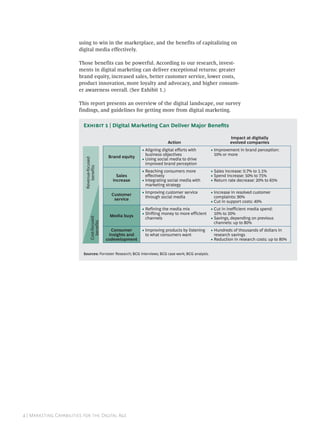
                        Those benefits can be powerful. According to our research, invest-
                        ments in digital marketing can deliver exceptional returns: greater
                        brand equity, increased sales, better customer service, lower costs,
                        product innovation, more loyalty and advocacy, and higher consum-
                        er awareness overall. (See Exhibit 1.)

                        This report presents an overview of the digital landscape, our survey
                        findings, and guidelines for getting more from digital marketing.


                          E  | Digital Marketing Can Deliver Major Benefits

                                                                                                                Impact at digitally
                                                                              Action                            evolved companies
                                                                • Aligning digital efforts with       • Improvement in brand perception:
                                                                  business objectives                   10% or more
                                                 Brand equity
                                                                • Using social media to drive
                           Revenue-focused


                                                                  improved brand perception
                               benefits


                                                                • Reaching consumers more             • Sales increase: 0.7% to 1.1%
                                                     Sales        effectively                         • Spend increase: 50% to 75%
                                                   increase     • Integrating social media with       • Return rate decrease: 20% to 65%
                                                                  marketing strategy
                                                                • Improving customer service          • Increase in resolved customer
                                                  Customer
                                                                  through social media                  complaints: 90%
                                                   service
                                                                                                      • Cut in support costs: 40%
                                                                • Refining the media mix              • Cut in inefficient media spend:
                                                                • Shifting money to more efficient      10% to 20%
                                                 Media buys
                                                                  channels                            • Savings, depending on previous
                                 Cost-focused
                                   benefits


                                                                                                        channels: up to 80%
                                                  Consumer      • Improving products by listening     • Hundreds of thousands of dollars in
                                                 insights and     to what consumers want                research savings
                                                codevelopment                                         • Reduction in research costs: up to 80%


                          Sources: Forrester Research; BCG interviews; BCG case work; BCG analysis.


 | M C   D A
THE DIGITAL LANDSCAPE


C    ’    mobile
     devices has led to greater use of digital
media, changing consumers’ behavior in
                                                 pact digital-marketing campaigns that cut
                                                 through the clutter. We define digital market-
                                                 ing as the use of digital channels to reach
profound ways. With access to the Internet at    consumers and build stronger relationships.
work, at home, and on the go, people are         These channels include corporate websites,
constantly connected—and overwhelmed by          online communities, Internet search-and-dis-
a deluge of marketing messages and informa-      play advertising, mobile technologies, online
tion. They’re locating stores, researching       videos, and social media such as Facebook
products, comparing prices and reviews, and      and Twitter. Advertising can be delivered by
making purchases online. Increasingly, they      both “push” and “pull” mechanisms.
rely on the recommendations of friends and
colleagues to inform their buying decisions.     Because of this explosion of new marketing
Impervious to marketing hype, they seek          channels, digital campaigns are more labor-
authenticity and honest answers. Today’s         intensive and complex than traditional adver-
consumers have more control. They’re more        tising campaigns in which ad agencies simply
powerful, influential, and discriminating than    send tapes to TV networks and radio stations.
ever before.                                     Today’s marketers must create, coordinate,
                                                 measure, and refine a range of campaigns for
                                                 different channels—traditional and digital—

Today’s marketers must                           with the goal of driving consumer engage-
                                                 ment and advocacy. They typically buy key-
create, coordinate, meas-                        words to facilitate online searches and create
                                                 individual Web addresses, or URLs, to moni-
ure, and refine a range of                       tor traffic generated at sites such as Google
                                                 and Facebook. The many different devices
campaigns for different                          and marketing channels have fragmented au-

channels.                                        dience attention and overloaded consumers
                                                 with information.


In this digital world, traditional marketing
techniques are less effective than they once
were. To get consumers to engage with your
brand, your company must develop high-im-


                                                                                      T B C G | 
VARYING DEGREES
OF INVESTMENTAND
EXPERTISE


                        I     that marketing
                          organizations evolve as they increase their
                        spending on digital channels or that the
                                                                        mining and technology that allow them to
                                                                        monitor consumer usage and behaviors.

                        companies that invest the most have the         When they are in the building stage, compa-
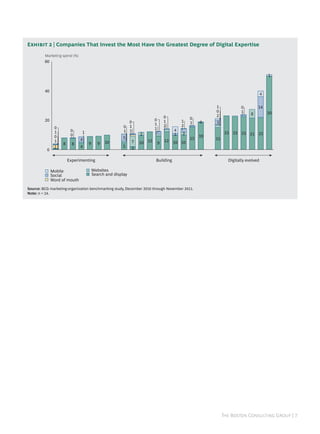
                        greatest degree of expertise. Our survey        nies spend more than 10 percent of their an-
                        revealed three distinct stages of maturity:     nual marketing budget on digital marketing
                        experimenting, building, and digitally          and begin to up their game. They identify and
                        evolved. (See Exhibit 2.)                       seek to engage brand influencers, consider
                                                                        launching their own online communities, and
                                                                        hire dedicated resources to track consumer ac-

                        Companies at the digitally                      tivity. They begin to explore monitoring ser-
                                                                        vices to manage their growing Web traffic.
                        evolved state spend more                        By the time companies reach the digitally
                        than 20 percent of their                        evolved stage, they are spending more than
                                                                        20 percent of their marketing budget (in
                        marketing budget on digi-                       some cases, more than 50 percent) on digital

                        tal channels.                                   channels. They’re actively launching advoca-
                                                                        cy programs for brand influencers, refining
                                                                        their use of multiple online channels and
                                                                        tools, empowering employees to respond to
                        Companies at the experimenting stage            customers, and using specialty agencies to
                        dabble in digital media, but their efforts      strengthen their digital campaigns. With an
                        are largely uncoordinated, and they allocate    ongoing focus on strategic objectives, they’re
                        less than 10 percent of their annual market-    building an infrastructure to deliver data
                        ing budget to digital media. Most choose        from social media to relevant internal busi-
                        someone internal to lead their efforts and      ness groups such as sales, product develop-
                        begin to develop marketing campaigns with       ment, and customer service.
                        outside media agencies. They invest in data


 | M C   D A
E  | Companies That Invest the Most Have the Greatest Degree of Digital Expertise
         Marketing spend (%)
         60


                                                                                                                                      1


         40
                                                                                                                                  4

                                                                                                       1             0        14
                                                                                                       0             1                50
                                                                                                       2                  6
                                                                                0            0
         20                                                             0       1        1
                                                         0                                   1    0    3
                                                                        1       2        2
               0                                       0 1              1
               1        0                              1 1                           4
                               1                                2                    1   2                   23 23 23 21 22
               0        0                                                                         19
                               4                      5                                      15        15
               1
                   8     8         9      9   10            7   10 12       9   12   10 10
               2               4                      5     2
          0

                       Experimenting                                    Building                              Digitally evolved

              Mobile                   Websites
              Social                   Search and display
              Word of mouth

Source: BCG marketing-organization benchmarking study, December 2010 through November 2011.
Note: n = 24.


                                                                                                            T B C G | 
MEETING THE NEW
CHALLENGES


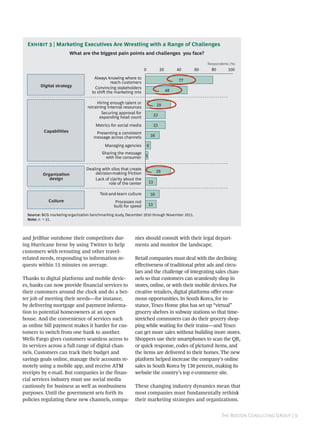
                        A     E  , the marketing
                             executives that BCG surveyed are
                        wrestling with a range of challenges related
                                                                             said, “The only way to master digital is to ex-
                                                                             periment and learn. You can’t think or strate-
                                                                             gize to perfection.” Another noted, “We need
                        to digital strategy, capabilities, organization      a very entrepreneurial, very innovative cul-
                        design, and culture. Major strategy concerns         ture that allows risk.”
                        include always knowing where to reach
                        customers, cited by 77 percent of respon-            Our research also revealed industry-specific
                        dents, and convincing internal decision              challenges and opportunities. For instance,
                        makers to shi the marketing mix, cited by 48        consumer products companies, which rarely
                        percent. Another challenge is creating a             interacted directly with consumers in the past,
                        consistent marketing strategy across a wide          now have new ways to test new products, dis-
                        range of digital and traditional channels.           tribute coupons, share product information
                                                                             and user reviews, and engage influential buy-
                        Regarding capabilities, finding the needed           ers with advocacy marketing. But successfully
                        talent—developing it internally or hiring            integrating multiple brands and product lines
                        from outside the organization—is an ongoing          under a single umbrella is hard to do well.
                        challenge cited by 29 percent of respondents.        One company that has successfully met this
                        Securing approval for expanding head count           challenge is Diageo, a leading alcoholic-bever-
                        was also noted as difficult by 23 percent.           age business, whose well-known brands in-
                        Many companies are struggling to adapt their         clude Guinness, Crown Royal, and Jose Cuervo.
                        metrics, particularly with respect to social         Diageo launched an iPhone app, thebar.com,
                        media. One executive asked, “What is the val-        in 2010 to increase customer engagement. The
                        ue of a Facebook ‘like?’”                            app helps users find nearby bars and liquor
                                                                             stores, provides a wide range of drink recipes,
                        Where organization design is concerned, the          and integrates with Facebook and other social
                        critical pain points are organizational silos that   media to allow sharing and reviews.
                        create decision-making friction (cited by 29
                        percent of respondents) and a lack of clarity        For airlines and other service companies, dig-
                        regarding the role of the corporate center (13       ital platforms are ushering in a customer ser-
                        percent).                                            vice revolution. Companies can respond to
                                                                             problems or complaints in real time, when
                        Respondents also mentioned cultural chal-            customers most need support. Airlines can
                        lenges. Chief among these is the need to             keep travelers informed with travel updates,
                        build a test-and-learn culture. One executive        gate changes, and weather advisories. Delta


 | M C   D A
E  | Marketing Executives Are Wrestling with a Range of Challenges
                          What are the biggest pain points and challenges you face?

                                                                                                     Respondents (%)
                                                                   0             20        40   60     80       100
                                      Always knowing where to
                                               reach customers                             77
         Digital strategy              Convincing stakeholders
                                     to shi the marketing mix                        48

                                       Hiring enough talent or                  29
                                  retraining internal resources
                                          Securing approval for
                                         expanding head count               23

                                       Metrics for social media             23
           Capabilities                Presenting a consistent
                                      message across channels              16

                                            Managing agencies          6
                                          Sharing the message
                                            with the consumer 3

                                  Dealing with silos that create
                                      decision-making friction                  29
          Organization
             design                   Lack of clarity about the
                                              role of the center       13

                                         Test-and-learn culture            16
             Culture                              Processes not
                                                 built for speed       13

  Source: BCG marketing-organization benchmarking study, December 2010 through November 2011.
  Note: n = 31.


and JetBlue outshone their competitors dur-                  nies should consult with their legal depart-
ing Hurricane Irene by using Twitter to help                 ments and monitor the landscape.
customers with rerouting and other travel-
related needs, responding to information re-                 Retail companies must deal with the declining
quests within 15 minutes on average.                         effectiveness of traditional print ads and circu-
                                                             lars and the challenge of integrating sales chan-
Thanks to digital platforms and mobile devic-                nels so that customers can seamlessly shop in
es, banks can now provide financial services to              stores, online, or with their mobile devices. For
their customers around the clock and do a bet-               creative retailers, digital platforms offer enor-
ter job of meeting their needs—for instance,                 mous opportunities. In South Korea, for in-
by delivering mortgage and payment informa-                  stance, Tesco Home plus has set up “virtual”
tion to potential homeowners at an open                      grocery shelves in subway stations so that time-
house. And the convenience of services such                  stretched commuters can do their grocery shop-
as online bill payment makes it harder for cus-              ping while waiting for their trains—and Tesco
tomers to switch from one bank to another.                   can get more sales without building more stores.
Wells Fargo gives customers seamless access to               Shoppers use their smartphones to scan the QR,
its services across a full range of digital chan-            or quick response, codes of pictured items, and
nels. Customers can track their budget and                   the items are delivered to their homes. The new
savings goals online, manage their accounts re-              platform helped increase the company’s online
motely using a mobile app, and receive ATM                   sales in South Korea by 130 percent, making its
receipts by e-mail. But companies in the finan-              website the country’s top e-commerce site.
cial services industry must use social media
cautiously for business as well as nonbusiness               These changing industry dynamics mean that
purposes. Until the government sets forth its                most companies must fundamentally rethink
policies regulating these new channels, compa-               their marketing strategies and organizations.


                                                                                                            T B C G | 
GETTING IT RIGHT
DIGITAL BEST PRACTICES


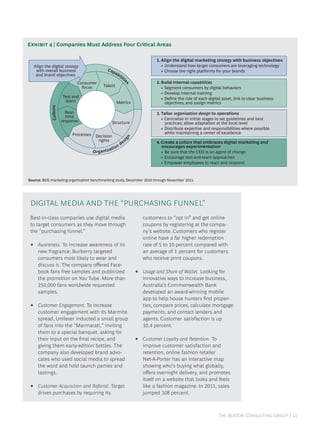
                       B     --   
                             major changes across the marketing
                        organization to capitalize on the new digital
                                                                            “purchasing funnel”—and assign metrics to
                                                                            measure impact. (See the sidebar “Digital Me-
                                                                            dia and the ‘Purchasing Funnel.’”) Because
                        opportunities. According to our survey              different platforms can yield very different
                        respondents, marketers must address four            results, companies must experiment to learn
                        critical areas: strategy, capabilities, organiza-   what works for their brands. For instance, al-
                        tion design, and culture. (See Exhibit 4.)          though Facebook can attract lots of fans, a
                                                                            company’s own website can deliver a richer
                                                                            experience and greater engagement. Best-in-
                        Strategy                                            class companies use social media to drive
                        Companies must consider all of their marketing      traffic to their own websites, where they can
                        activities when developing a digital strategy and   collect more data, conduct better analyses,
                        an organization model. Best-in-class companies      and deepen the customer relationship.
                        use digital media to achieve core business and
                        marketing objectives, such as greater consumer
                        awareness, better information to improve deci-      Capabilities
                        sion making, deeper consumer engagement, a          To fully capitalize on digital opportunities,
                        higher rate of conversion and sales, and greater    marketing organizations must develop capa-
                        customer satisfaction and usage. These objec-       bilities in the areas of consumer segmenta-
                        tives should shape companies’ use of digital        tion, training, and metrics.
                        platforms to engage with consumers.
                                                                            Best-practice companies segment consumers
                        Digital platforms provide an inexpensive,           on the basis of how they use different digital
                        scalable way to gather real-time feedback and       platforms. This segmentation allows for more
                        consumer insights. Best-in-class companies          tailored communications with greater impact.
                        dedicate resources to analyzing, interpreting,      For instance, U.K.-based Tesco serves two
                        and categorizing feedback by type and senti-        main types of consumers: those who shop in
                        ment (such as positive, negative, or neutral),      their grocery stores and those who buy online
                        and they forward the results to the appropri-       at tesco.com (the world’s second-largest on-
                        ate department, such as customer support,           line retailer after Amazon.com), although the
                        product development, or sales.                      two types certainly overlap. For each group of
                                                                            shoppers, the company mines loyalty card
                        For each digital platform, leading companies        data to create highly targeted offers that cus-
                        define a role—linked to key aspects of the          tomers welcome and value. To reach its store


 | M C   D A
E  | Companies Must Address Four Critical Areas

                                                                                    1. Align the digital marketing strategy with business objectives
     Align the digital strategy                                                        • Understand how target consumers are leveraging technology
      with overall business                         Cap                                • Choose the right platforms for your brands
      and brand objectives                              ab
                                                          ili
                                                             tie
                                Consumer                                            2. Build internal capabilities


                                                                      s
                                  focus           Talent                               • Segment consumers by digital behaviors
                                                                                       • Develop internal training
                         Test and                                                      • Define the role of each digital asset, link to clear business
                          learn                             Metrics                      objectives, and assign metrics
               Culture


                           Real-                                                    3. Tailor organization design to operations
                           time
                         response                                                      • Centralize in initial stages to set guidelines and best
                                                         Structure                       practices; allow adaptation at the local level
                                                                                       • Distribute expertise and responsibilities where possible
                              Processes                                                  while maintaining a center of excellence
                                           Decision
                                                                      n
                                                                     ig


                                            rights                   es             4. Create a culture that embraces digital marketing and
                                                                nd                     encourages experimentation
                                                          tio
                                          Or   ga n i z a                              • Be sure that the CEO is an agent of change
                                                                                       • Encourage test-and-learn approaches
                                                                                       • Empower employees to react and respond


Source: BCG marketing-organization benchmarking study, December 2010 through November 2011.


 DIGITAL MEDIA AND THE “PURCHASING FUNNEL”
 Best-in-class companies use digital media                                    customers to “opt in” and get online
 to target consumers as they move through                                     coupons by registering at the compa-
 the “purchasing funnel.”                                                     ny’s website. Customers who register
                                                                              online have a far higher redemption
 •     Awareness. To increase awareness of its                                rate of 5 to 10 percent compared with
       new fragrance, Burberry targeted                                       an average of 1 percent for customers
       consumers most likely to wear and                                      who receive print coupons.
       discuss it. The company offered Face-
       book fans free samples and publicized                              •   Usage and Share of Wallet. Looking for
       the promotion on You Tube. More than                                   innovative ways to increase business,
       250,000 fans worldwide requested                                       Australia’s Commonwealth Bank
       samples.                                                               developed an award-winning mobile
                                                                              app to help house hunters find proper-
 •     Customer Engagement. To increase                                       ties, compare prices, calculate mortgage
       customer engagement with its Marmite                                   payments, and contact lenders and
       spread, Unilever inducted a small group                                agents. Customer satisfaction is up
       of fans into the “Marmarati,” inviting                                 10.4 percent.
       them to a special banquet, asking for
       their input on the final recipe, and                                •   Customer Loyalty and Retention. To
       giving them early-edition bottles. The                                 improve customer satisfaction and
       company also developed brand advo-                                     retention, online fashion retailer
       cates who used social media to spread                                  Net-A-Porter has an interactive map
       the word and hold launch parties and                                   showing who’s buying what globally,
       tastings.                                                              offers overnight delivery, and promotes
                                                                              itself on a website that looks and feels
 •     Customer Acquisition and Referral. Target                              like a fashion magazine. In 2011, sales
       drives purchases by requiring its                                      jumped 108 percent.


                                                                                                                      T B C G | 
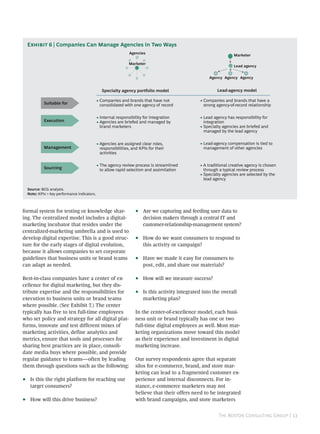
shoppers, Tesco sends direct-mail coupons                      proached with either a portfolio model or a
                        and vouchers—and achieves an impressive                        lead-agency model. (See Exhibit 6.)
                        redemption rate of 20 to 40 percent. To reach
                        its online customers, Tesco sends targeted of-                 But given the growing strategic importance of
                        fers and electronic bar codes through e-mail                   social media, outsourcing the management of
                        and to mobile phones using location-based                      these platforms may not be the best option in
                        technologies. Sixty percent of the company’s                   the long term—especially for companies that
                        customers say that they welcome those mar-                     want to project an integrated brand message.
                        keting e-mails.                                                Bringing these capabilities in house should
                                                                                       be the end goal, although most companies
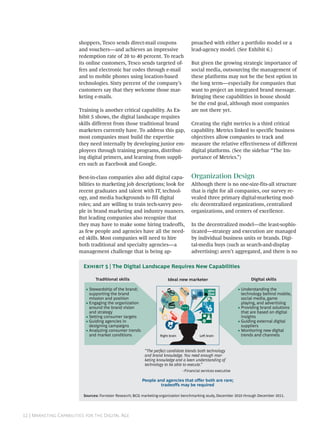
                        Training is another critical capability. As Ex-                are not there yet.
                        hibit 5 shows, the digital landscape requires
                        skills different from those traditional brand                  Creating the right metrics is a third critical
                        marketers currently have. To address this gap,                 capability. Metrics linked to specific business
                        most companies must build the expertise                        objectives allow companies to track and
                        they need internally by developing junior em-                  measure the relative effectiveness of different
                        ployees through training programs, distribut-                  digital platforms. (See the sidebar “The Im-
                        ing digital primers, and learning from suppli-                 portance of Metrics.”)
                        ers such as Facebook and Google.

                        Best-in-class companies also add digital capa-                 Organization Design
                        bilities to marketing job descriptions; look for               Although there is no one-size-fits-all structure
                        recent graduates and talent with IT, technol-                  that is right for all companies, our survey re-
                        ogy, and media backgrounds to fill digital                     vealed three primary digital-marketing mod-
                        roles; and are willing to train tech-savvy peo-                els: decentralized organizations, centralized
                        ple in brand marketing and industry nuances.                   organizations, and centers of excellence.
                        But leading companies also recognize that
                        they may have to make some hiring tradeoffs,                   In the decentralized model—the least-sophis-
                        as few people and agencies have all the need-                  ticated—strategy and execution are managed
                        ed skills. Most companies will need to hire                    by individual business units or brands. Digi-
                        both traditional and specialty agencies—a                      tal-media buys (such as search-and-display
                        management challenge that is being ap-                         advertising) aren’t aggregated, and there is no

                          E  | The Digital Landscape Requires New Capabilities

                                Traditional skills                       Ideal new marketer                             Digital skills

                           • Stewardship of the brand;                                                            • Understanding the
                             supporting the brand                                                                   technology behind mobile,
                             mission and position                                                                   social media, game
                           • Engaging the organization                                                              playing, and advertising
                             around the brand vision                                                              • Providing brand solutions
                             and strategy                                                                           that are based on digital
                           • Setting consumer targets                                                               insights
                           • Guiding agencies in                                                                  • Guiding external digital
                             designing campaigns                                                                    suppliers
                           • Analyzing consumer trends                                                            • Monitoring new digital
                             and market conditions                  Right brain                                     trends and channels


                                                            “The perfect candidate blends both technology
                                                            and brand knowledge. You need enough mar-
                                                            keting knowledge and a keen understanding of
                                                            technology to be able to execute.”
                                                                                  –Financial services executive

                                                          People and agencies that offer both are rare;
                                                                   tradeoffs may be required

                          Sources: Forrester Research; BCG marketing-organization benchmarking study, December 2010 through December 2011.


 | M C   D A
E  | Companies Can Manage Agencies in Two Ways
                                                                 Agencies
                                                                                                                     Marketer

                                                                 Marketer
                                                                                                                     Lead agency


                                                                                                        Agency Agency Agency


                                                 Specialty agency portfolio model                           Lead-agency model

                                               • Companies and brands that have not                • Companies and brands that have a
             Suitable for                        consolidated with one agency of record              strong agency-of-record relationship

                                               • Internal responsibility for integration           • Lead agency has responsibility for
             Execution                         • Agencies are briefed and managed by                 integration
                                                 brand marketers                                   • Specialty agencies are briefed and
                                                                                                     managed by the lead agency

                                               • Agencies are assigned clear roles,                • Lead-agency compensation is tied to
             Management                          responsibilities, and KPIs for their                management of other agencies
                                                 activities

                                               • The agency review process is streamlined          • A traditional creative agency is chosen
             Sourcing                            to allow rapid selection and assimilation           through a typical review process
                                                                                                   • Specialty agencies are selected by the
                                                                                                     lead agency

    Source: BCG analysis.
    Note: KPIs = key performance indicators.


formal system for testing or knowledge shar-                        •    Are we capturing and feeding user data to
ing. The centralized model includes a digital-                           decision makers through a central IT and
marketing incubator that resides under the                               customer-relationship-management system?
centralized-marketing umbrella and is used to
develop digital expertise. This is a good struc-                    •    How do we want consumers to respond to
ture for the early stages of digital evolution,                          this activity or campaign?
because it allows companies to set corporate
guidelines that business units or brand teams                       •    Have we made it easy for consumers to
can adapt as needed.                                                     post, edit, and share our materials?

Best-in-class companies have a center of ex-                        •    How will we measure success?
cellence for digital marketing, but they dis-
tribute expertise and the responsibilities for                      •    Is this activity integrated into the overall
execution to business units or brand teams                               marketing plan?
where possible. (See Exhibit 7.) The center
typically has five to ten full-time employees                       In the center-of-excellence model, each busi-
who set policy and strategy for all digital plat-                   ness unit or brand typically has one or two
forms, innovate and test different mixes of                         full-time digital employees as well. Most mar-
marketing activities, define analytics and                          keting organizations move toward this model
metrics, ensure that tools and processes for                        as their experience and investment in digital
sharing best practices are in place, consoli-                       marketing increase.
date media buys where possible, and provide
regular guidance to teams—often by leading                          Our survey respondents agree that separate
them through questions such as the following:                       silos for e-commerce, brand, and store mar-
                                                                    keting can lead to a fragmented customer ex-
•    Is this the right platform for reaching our                    perience and internal disconnects. For in-
     target consumers?                                              stance, e-commerce marketers may not
                                                                    believe that their offers need to be integrated
•    How will this drive business?                                  with brand campaigns, and store marketers


                                                                                                            T B C G | 
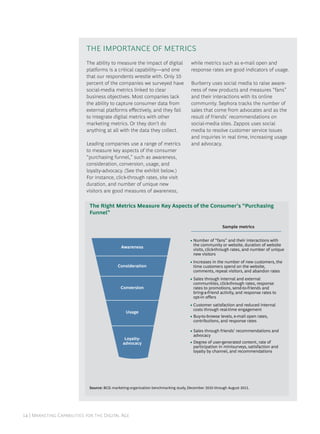
THE IMPORTANCE OF METRICS
                            The ability to measure the impact of digital             while metrics such as e-mail open and
                            platforms is a critical capability—and one               response rates are good indicators of usage.
                            that our respondents wrestle with. Only 10
                            percent of the companies we surveyed have                Burberry uses social media to raise aware-
                            social-media metrics linked to clear                     ness of new products and measures “fans”
                            business objectives. Most companies lack                 and their interactions with its online
                            the ability to capture consumer data from                community. Sephora tracks the number of
                            external platforms effectively, and they fail             sales that come from advocates and as the
                            to integrate digital metrics with other                  result of friends’ recommendations on
                            marketing metrics. Or they don’t do                      social-media sites. Zappos uses social
                            anything at all with the data they collect.              media to resolve customer service issues
                                                                                     and inquiries in real time, increasing usage
                            Leading companies use a range of metrics                 and advocacy.
                            to measure key aspects of the consumer
                            “purchasing funnel,” such as awareness,
                            consideration, conversion, usage, and
                            loyalty-advocacy. (See the exhibit below.)
                            For instance, click-through rates, site visit
                            duration, and number of unique new
                            visitors are good measures of awareness,

                             The Right Metrics Measure Key Aspects of the Consumer’s “Purchasing
                             Funnel”

                                                                                                       Sample metrics


                                                                                     • Number of “fans” and their interactions with
                                              Awareness                                the community or website, duration of website
                                                                                       visits, click-through rates, and number of unique
                                                                                       new visitors
                                                                                     • Increases in the number of new customers, the
                                            Consideration                              time customers spend on the website,
                                                                                       comments, repeat visitors, and abandon rates
                                                                                     • Sales through internal and external
                                                                                       communities, click-through rates, response
                                              Conversion                               rates to promotions, send-to-friends and
                                                                                       bring-a-friend activity, and response rates to
                                                                                       opt-in offers
                                                                                     • Customer satisfaction and reduced internal
                                                                                       costs through real-time engagement
                                                 Usage
                                                                                     • Buy-to-browse levels, e-mail open rates,
                                                                                       contributions, and response rates

                                                                                     • Sales through friends’ recommendations and
                                                                                       advocacy
                                                Loyalty-
                                               advocacy                              • Degree of user-generated content, rate of
                                                                                       participation in minisurveys, satisfaction and
                                                                                       loyalty by channel, and recommendations


                             Source: BCG marketing-organization benchmarking study, December 2010 through August 2011.


 | M C   D A
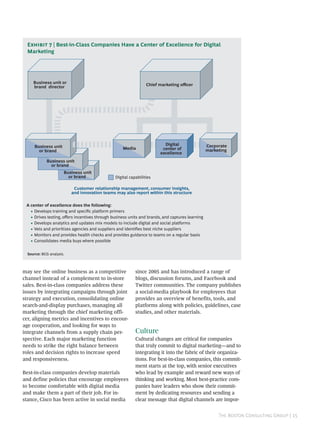
E  | Best-in-Class Companies Have a Center of Excellence for Digital
  Marketing


     Business unit or                                           Chief marketing officer
     brand director


      Business unit                                                      Digital                 Corporate
                                                   Media                center of                marketing
        or brand
                                                                       excellence
            Business unit
              or brand
                      Business unit
                        or brand               Digital capabilities

                           Customer relationship management, consumer insights,
                          and innovation teams may also report within this structure

 A center of excellence does the following:
   • Develops training and specific platform primers
   • Drives testing, offers incentives through business units and brands, and captures learning
   • Develops analytics and updates mix models to include digital and social platforms
   • Vets and prioritizes agencies and suppliers and identifies best niche suppliers
   • Monitors and provides health checks and provides guidance to teams on a regular basis
   • Consolidates media buys where possible


  Source: BCG analysis.


may see the online business as a competitive              since 2005 and has introduced a range of
channel instead of a complement to in-store               blogs, discussion forums, and Facebook and
sales. Best-in-class companies address these              Twitter communities. The company publishes
issues by integrating campaigns through joint             a social-media playbook for employees that
strategy and execution, consolidating online              provides an overview of benefits, tools, and
search-and-display purchases, managing all                platforms along with policies, guidelines, case
marketing through the chief marketing offi-               studies, and other materials.
cer, aligning metrics and incentives to encour-
age cooperation, and looking for ways to
integrate channels from a supply chain per-               Culture
spective. Each major marketing function                   Cultural changes are critical for companies
needs to strike the right balance between                 that truly commit to digital marketing—and to
roles and decision rights to increase speed               integrating it into the fabric of their organiza-
and responsiveness.                                       tions. For best-in-class companies, this commit-
                                                          ment starts at the top, with senior executives
Best-in-class companies develop materials                 who lead by example and reward new ways of
and define policies that encourage employees              thinking and working. Most best-practice com-
to become comfortable with digital media                  panies have leaders who show their commit-
and make them a part of their job. For in-                ment by dedicating resources and sending a
stance, Cisco has been active in social media             clear message that digital channels are impor-


                                                                                                      T B C G | 
tant. For instance, JetBlue’s chief marketing    place and by encouraging experimentation—
                        officer posts Tweets regularly, and the compa-   even setting aside a portion of the marketing
                        ny encourages bloggers to share their travel     budget for innovation efforts. Google’s Inno-
                        stories online. Cisco expects employees to       vation Time Off encourages employees to
                        make social media part of their jobs and pro-    spend 20 percent of their work time on proj-
                        vides links to training and resources.           ects that interest them. Gmail, Google News,
                                                                         and other products are results of this policy.
                                                                         By rewarding noble failures and setting up

                        Cisco expects employees                          systems that capture learning, companies can
                                                                         create a culture in which taking calculated
                        to make social media part                        risks is applauded.

                        of their jobs and provides
                        links to training and re-
                        sources.

                        CEOs at leading companies push their organi-
                        zations forward by empowering employees to
                        respond quickly to changes in the market-


 | M C   D A
GETTING STARTED


C        most busi-
     nesses when it comes to using—and
feeling comfortable with—social media and
                                                             mine your company’s strengths and weak-
                                                             nesses in the areas of strategy, capabilities,
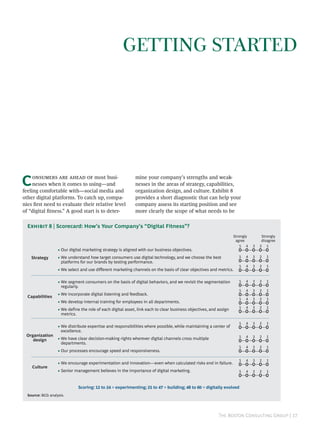
                                                             organization design, and culture. Exhibit 8
other digital platforms. To catch up, compa-                 provides a short diagnostic that can help your
nies first need to evaluate their relative level              company assess its starting position and see
of “digital fitness.” A good start is to deter-               more clearly the scope of what needs to be

  E  | Scorecard: How’s Your Company’s “Digital Fitness”?
                                                                                                                    Strongly        Strongly
                                                                                                                     agree          disagree
                                                                                                                        5 4    3   2 1
                   • Our digital marketing strategy is aligned with our business objectives.                          O O O O O
    Strategy       • We understand how target consumers use digital technology, and we choose the best                 5   4   3   2   1
                     platforms for our brands by testing performance.                                                 O O O O O
                                                                                                                       5   4   3   2   1
                   • We select and use different marketing channels on the basis of clear objectives and metrics.     O O O O O

                   • We segment consumers on the basis of digital behaviors, and we revisit the segmentation           5   4   3   2   1
                     regularly.                                                                                       O O O O O
                                                                                                                       5   4   3   2   1
                   • We incorporate digital listening and feedback.                                                   O O O O O
  Capabilities
                                                                                                                       5   4   3   2   1
                   • We develop internal training for employees in all departments.                                   O O O O O
                                                                                                                       5   4   3   2   1
                   • We define the role of each digital asset, link each to clear business objectives, and assign     O O O O O
                     metrics.

                                                                                                                       5   4   3   2   1
                   • We distribute expertise and responsibilities where possible, while maintaining a center of       O O O O O
                     excellence.
 Organization                                                                                                          5   4   3   2   1
    design         • We have clear decision-making rights wherever digital channels cross multiple
                     departments.
                                                                                                                      O O O O O
                                                                                                                       5   4   3   2   1
                   • Our processes encourage speed and responsiveness.                                                O O O O O
                                                                                                                       5   4   3   2   1
                   • We encourage experimentation and innovation—even when calculated risks end in failure.           O O O O O
    Culture
                   • Senior management believes in the importance of digital marketing.                                5   4   3   2   1
                                                                                                                      O O O O O

                              Scoring: 12 to 24 = experimenting; 25 to 47 = building; 48 to 60 = digitally evolved
  Source: BCG analysis.


                                                                                                           T B C G | 
done to better capitalize on the opportunities     can help fill this gap. Creating a center of ex-
                        that digital marketing presents.                   cellence for digital expertise can be an effec-
                                                                           tive way to share knowledge and further
                        By setting specific business objectives, testing   build capabilities while giving business units
                        different digital platforms, and using the right   and brand teams the freedom to execute.
                        metrics to determine their relative impact,
                        your company will begin to see which ap-           Finally, committed leaders who see the im-
                        proaches work best with your target custom-        portance of digital media and encourage a
                        ers and your industry.                             test-and-learn culture are critical to long-term
                                                                           success—especially when the inevitable
                        If your company is like most of those we sur-      bumps in the road appear.
                        veyed, it may lack many of the necessary ca-
                        pabilities. A focused training and hiring effort


 | M C   D A
FOR FURTHER READING

The Boston Consulting Group pub-          Getting More from Social Media            The CMO’s Imperative: Tackling
lishes extensively on topics related to   BCG Perspectives, October 2011            New Digital Realities
marketing in the digital economy.                                                   A report by The Boston Consulting Group,
Recent examples include those list-       Winning in the Digital Economy            November 2010
ed here:                                  BCG Perspectives, July 2011
                                                                                    No Shortcuts: The Road Map to
                                          Can Local Media Capture a Digital         Smarter Marketing
                                          Future?                                   A report by The Boston Consulting Group,
                                          BCG Perspectives, June 2011               September 2010

                                          Harnessing the Power of Advocacy
                                          Marketing
                                          A Focus by The Boston Consulting Group,
                                          March 2011


                                                                                       T B C G | 
NOTE TO THE READER

About the Authors                         For Further Contact                         Jody Visser
Katharine Sayre is a partner and          If you would like to discuss this report,   Principal
managing director in the New York of-     please contact one of the authors.          BCG New York
fice of the Boston Consulting Group.
                                                                                      +1 212 446 2800
Vaishali Rastogi is a partner and         Katharine Sayre
managing director in the firm’s Singa-                                                 visser.jody@bcg.com
                                          Partner and Managing Director
pore office. Paul Zwillenberg is a
partner and managing director in          BCG New York
                                                                                      Alannah Sheerin
BCG’s London office. Jody Visser is a       +1 212 446 2800
                                                                                      Project Leader
principal and Alannah Sheerin a           sayre.katharine@bcg.com
                                                                                      BCG New York
project leader in the firm’s New York
office.                                                                                 +1 212 446 2800
                                          Vaishali Rastogi
                                                                                      sheerin.alannah@bcg.com
                                          Partner and Managing Director
Acknowledgments                           BCG Singapore
The authors would like to thank Kath-
erine Andrews, Gary Callahan, Martha      +65 6429 2500
Craumer, Angela DiBattista, Elyse         rastogi.vaishali@bcg.com
Friedman, and Sara Strassenreiter for
their contributions to the editing, de-   Paul Zwillenberg
sign, and production of this report.      Partner and Managing Director
                                          BCG London
                                          +020 7753 5353
                                          zwillenberg.paul@bcg.com


 | M C   D A
© The Boston Consulting Group, Inc. 2012. All rights reserved.

For information or permission to reprint, please contact BCG at:
E-mail: bcg-info@bcg.com
Fax:      +1 617 850 3901, attention BCG/Permissions
Mail:     BCG/Permissions
          The Boston Consulting Group, Inc.
          One Beacon Street
          Boston, MA 02108
          USA

To find the latest BCG content and register to receive e-alerts on this topic or others, please visit bcgperspectives.com.

Follow bcg.perspectives on Facebook and Twitter.

1/12                                                                                                 T B C G | 
Abu Dhabi      Cologne        Kuala Lumpur   New Jersey       Stuttgart
Amsterdam      Copenhagen     Lisbon         New York         Sydney
Athens         Dallas         London         Oslo             Taipei
Atlanta        Detroit        Los Angeles    Paris            Tel Aviv
Auckland       Dubai          Madrid         Perth            Tokyo
Bangkok        Düsseldorf     Melbourne      Philadelphia     Toronto
Barcelona      Frankfurt      Mexico City    Prague           Vienna
Beijing        Geneva         Miami          Rio de Janeiro   Warsaw
Berlin         Hamburg        Milan          Rome             Washington
Boston         Helsinki       Minneapolis    San Francisco    Zurich
Brussels       Hong Kong      Monterrey      Santiago
Budapest       Houston        Moscow         São Paulo
Buenos Aires   Istanbul       Mumbai         Seoul
Canberra       Jakarta        Munich         Shanghai
Casablanca     Johannesburg   Nagoya         Singapore
Chicago        Kiev           New Delhi      Stockholm        bcg.com

BCG Report On Digital Shopping Trends

  • 1.
  • 2.
    The Boston ConsultingGroup (BCG) is a global management consulting firm and the world’s leading advisor on business strategy. We partner with clients from the private, public, and not-for-profit sectors in all regions to identify their highest-value opportunities, address their most critical challenges, and transform their enterprises. Our customized approach combines deep insight into the dynamics of companies and markets with close collaboration at all levels of the client organization. This ensures that our clients achieve sustainable competitive advantage, build more capable organizations, and secure lasting results. Founded in 1963, BCG is a private company with 74 offices in 42 countries. For more information, please visit bcg.com.
  • 3.
    MARKETING CAPABILITIES FOR THEDIGITAL AGE KATHARINE SAYRE VAISHALI RASTOGI PAUL ZWILLENBERG JODY VISSER ALANNAH SHEERIN J  | T B C G
  • 4.
    CONTENTS  INTRODUCTION  THE DIGITAL LANDSCAPE  VARYING DEGREES OF INVESTMENTAND EXPERTISE  MEETING THE NEW CHALLENGES  GETTING IT RIGHT: DIGITAL BEST PRACTICES Strategy Capabilities Organization Design Culture  GETTING STARTED  FOR FURTHER READING  NOTE TO THE READER  | M C   D A
  • 5.
    INTRODUCTION W     revolution. The Internet, social media, and mobile technologies have transformed how consumers interact with brands and how companies market their products and services. Besides having an effective strategy that integrates tradition- al and digital media, companies need to restructure their marketing organizations to fully capitalize on today’s opportunities—a far harder and more time-consuming task. But too many companies are jumping onto the digital bandwagon without thinking through this critical step. Success requires a fundamentally different mindset. Unlike traditional media—purchased airtime or ad space—social media such as Face- book pages and Twitter “handles” are free. But they do require a com- mitment of resources: people, training, new-content creation, tracking, and follow-through. Just as important, these new platforms mean that for the first time, companies can easily engage with consumers direct- ly, but the learning curve for doing this effectively can be steep. All of this means rethinking traditional approaches to marketing. As we note later in this report, the specific challenges and opportunities vary from industry to industry, and companies must understand those differences as they craft their strategies and restructure their organi- zations. To gain a better understanding of how marketing organizations are dealing with these profound changes, The Boston Consulting Group recently surveyed marketing executives at more than 30 major cor- porations, approximately two-thirds of which were Fortune 500 mul- tinationals based throughout Asia, Europe, Latin America, and the U.S. The companies represented a range of industries, including con- sumer products, retail, financial services, media, technology, and travel. Each participant completed an online survey and took part in a one-hour interview. Our goal was to identify the key challenges that companies are wrestling with, the best practices that leaders are T B C G | 
  • 6.
    using to winin the marketplace, and the benefits of capitalizing on digital media effectively. Those benefits can be powerful. According to our research, invest- ments in digital marketing can deliver exceptional returns: greater brand equity, increased sales, better customer service, lower costs, product innovation, more loyalty and advocacy, and higher consum- er awareness overall. (See Exhibit 1.) This report presents an overview of the digital landscape, our survey findings, and guidelines for getting more from digital marketing. E  | Digital Marketing Can Deliver Major Benefits Impact at digitally Action evolved companies • Aligning digital efforts with • Improvement in brand perception: business objectives 10% or more Brand equity • Using social media to drive Revenue-focused improved brand perception benefits • Reaching consumers more • Sales increase: 0.7% to 1.1% Sales effectively • Spend increase: 50% to 75% increase • Integrating social media with • Return rate decrease: 20% to 65% marketing strategy • Improving customer service • Increase in resolved customer Customer through social media complaints: 90% service • Cut in support costs: 40% • Refining the media mix • Cut in inefficient media spend: • Shifting money to more efficient 10% to 20% Media buys channels • Savings, depending on previous Cost-focused benefits channels: up to 80% Consumer • Improving products by listening • Hundreds of thousands of dollars in insights and to what consumers want research savings codevelopment • Reduction in research costs: up to 80% Sources: Forrester Research; BCG interviews; BCG case work; BCG analysis.  | M C   D A
  • 7.
    THE DIGITAL LANDSCAPE C ’    mobile devices has led to greater use of digital media, changing consumers’ behavior in pact digital-marketing campaigns that cut through the clutter. We define digital market- ing as the use of digital channels to reach profound ways. With access to the Internet at consumers and build stronger relationships. work, at home, and on the go, people are These channels include corporate websites, constantly connected—and overwhelmed by online communities, Internet search-and-dis- a deluge of marketing messages and informa- play advertising, mobile technologies, online tion. They’re locating stores, researching videos, and social media such as Facebook products, comparing prices and reviews, and and Twitter. Advertising can be delivered by making purchases online. Increasingly, they both “push” and “pull” mechanisms. rely on the recommendations of friends and colleagues to inform their buying decisions. Because of this explosion of new marketing Impervious to marketing hype, they seek channels, digital campaigns are more labor- authenticity and honest answers. Today’s intensive and complex than traditional adver- consumers have more control. They’re more tising campaigns in which ad agencies simply powerful, influential, and discriminating than send tapes to TV networks and radio stations. ever before. Today’s marketers must create, coordinate, measure, and refine a range of campaigns for different channels—traditional and digital— Today’s marketers must with the goal of driving consumer engage- ment and advocacy. They typically buy key- create, coordinate, meas- words to facilitate online searches and create individual Web addresses, or URLs, to moni- ure, and refine a range of tor traffic generated at sites such as Google and Facebook. The many different devices campaigns for different and marketing channels have fragmented au- channels. dience attention and overloaded consumers with information. In this digital world, traditional marketing techniques are less effective than they once were. To get consumers to engage with your brand, your company must develop high-im- T B C G | 
  • 8.
    VARYING DEGREES OF INVESTMENTAND EXPERTISE I     that marketing organizations evolve as they increase their spending on digital channels or that the mining and technology that allow them to monitor consumer usage and behaviors. companies that invest the most have the When they are in the building stage, compa- greatest degree of expertise. Our survey nies spend more than 10 percent of their an- revealed three distinct stages of maturity: nual marketing budget on digital marketing experimenting, building, and digitally and begin to up their game. They identify and evolved. (See Exhibit 2.) seek to engage brand influencers, consider launching their own online communities, and hire dedicated resources to track consumer ac- Companies at the digitally tivity. They begin to explore monitoring ser- vices to manage their growing Web traffic. evolved state spend more By the time companies reach the digitally than 20 percent of their evolved stage, they are spending more than 20 percent of their marketing budget (in marketing budget on digi- some cases, more than 50 percent) on digital tal channels. channels. They’re actively launching advoca- cy programs for brand influencers, refining their use of multiple online channels and tools, empowering employees to respond to Companies at the experimenting stage customers, and using specialty agencies to dabble in digital media, but their efforts strengthen their digital campaigns. With an are largely uncoordinated, and they allocate ongoing focus on strategic objectives, they’re less than 10 percent of their annual market- building an infrastructure to deliver data ing budget to digital media. Most choose from social media to relevant internal busi- someone internal to lead their efforts and ness groups such as sales, product develop- begin to develop marketing campaigns with ment, and customer service. outside media agencies. They invest in data  | M C   D A
  • 9.
    E  |Companies That Invest the Most Have the Greatest Degree of Digital Expertise Marketing spend (%) 60 1 40 4 1 0 14 0 1 50 2 6 0 0 20 0 1 1 0 1 0 3 1 2 2 0 0 1 1 1 0 1 1 4 1 2 1 2 23 23 23 21 22 0 0 19 4 5 15 15 1 8 8 9 9 10 7 10 12 9 12 10 10 2 4 5 2 0 Experimenting Building Digitally evolved Mobile Websites Social Search and display Word of mouth Source: BCG marketing-organization benchmarking study, December 2010 through November 2011. Note: n = 24. T B C G | 
  • 10.
    MEETING THE NEW CHALLENGES A  E  , the marketing executives that BCG surveyed are wrestling with a range of challenges related said, “The only way to master digital is to ex- periment and learn. You can’t think or strate- gize to perfection.” Another noted, “We need to digital strategy, capabilities, organization a very entrepreneurial, very innovative cul- design, and culture. Major strategy concerns ture that allows risk.” include always knowing where to reach customers, cited by 77 percent of respon- Our research also revealed industry-specific dents, and convincing internal decision challenges and opportunities. For instance, makers to shi the marketing mix, cited by 48 consumer products companies, which rarely percent. Another challenge is creating a interacted directly with consumers in the past, consistent marketing strategy across a wide now have new ways to test new products, dis- range of digital and traditional channels. tribute coupons, share product information and user reviews, and engage influential buy- Regarding capabilities, finding the needed ers with advocacy marketing. But successfully talent—developing it internally or hiring integrating multiple brands and product lines from outside the organization—is an ongoing under a single umbrella is hard to do well. challenge cited by 29 percent of respondents. One company that has successfully met this Securing approval for expanding head count challenge is Diageo, a leading alcoholic-bever- was also noted as difficult by 23 percent. age business, whose well-known brands in- Many companies are struggling to adapt their clude Guinness, Crown Royal, and Jose Cuervo. metrics, particularly with respect to social Diageo launched an iPhone app, thebar.com, media. One executive asked, “What is the val- in 2010 to increase customer engagement. The ue of a Facebook ‘like?’” app helps users find nearby bars and liquor stores, provides a wide range of drink recipes, Where organization design is concerned, the and integrates with Facebook and other social critical pain points are organizational silos that media to allow sharing and reviews. create decision-making friction (cited by 29 percent of respondents) and a lack of clarity For airlines and other service companies, dig- regarding the role of the corporate center (13 ital platforms are ushering in a customer ser- percent). vice revolution. Companies can respond to problems or complaints in real time, when Respondents also mentioned cultural chal- customers most need support. Airlines can lenges. Chief among these is the need to keep travelers informed with travel updates, build a test-and-learn culture. One executive gate changes, and weather advisories. Delta  | M C   D A
  • 11.
    E  |Marketing Executives Are Wrestling with a Range of Challenges What are the biggest pain points and challenges you face? Respondents (%) 0 20 40 60 80 100 Always knowing where to reach customers 77 Digital strategy Convincing stakeholders to shi the marketing mix 48 Hiring enough talent or 29 retraining internal resources Securing approval for expanding head count 23 Metrics for social media 23 Capabilities Presenting a consistent message across channels 16 Managing agencies 6 Sharing the message with the consumer 3 Dealing with silos that create decision-making friction 29 Organization design Lack of clarity about the role of the center 13 Test-and-learn culture 16 Culture Processes not built for speed 13 Source: BCG marketing-organization benchmarking study, December 2010 through November 2011. Note: n = 31. and JetBlue outshone their competitors dur- nies should consult with their legal depart- ing Hurricane Irene by using Twitter to help ments and monitor the landscape. customers with rerouting and other travel- related needs, responding to information re- Retail companies must deal with the declining quests within 15 minutes on average. effectiveness of traditional print ads and circu- lars and the challenge of integrating sales chan- Thanks to digital platforms and mobile devic- nels so that customers can seamlessly shop in es, banks can now provide financial services to stores, online, or with their mobile devices. For their customers around the clock and do a bet- creative retailers, digital platforms offer enor- ter job of meeting their needs—for instance, mous opportunities. In South Korea, for in- by delivering mortgage and payment informa- stance, Tesco Home plus has set up “virtual” tion to potential homeowners at an open grocery shelves in subway stations so that time- house. And the convenience of services such stretched commuters can do their grocery shop- as online bill payment makes it harder for cus- ping while waiting for their trains—and Tesco tomers to switch from one bank to another. can get more sales without building more stores. Wells Fargo gives customers seamless access to Shoppers use their smartphones to scan the QR, its services across a full range of digital chan- or quick response, codes of pictured items, and nels. Customers can track their budget and the items are delivered to their homes. The new savings goals online, manage their accounts re- platform helped increase the company’s online motely using a mobile app, and receive ATM sales in South Korea by 130 percent, making its receipts by e-mail. But companies in the finan- website the country’s top e-commerce site. cial services industry must use social media cautiously for business as well as nonbusiness These changing industry dynamics mean that purposes. Until the government sets forth its most companies must fundamentally rethink policies regulating these new channels, compa- their marketing strategies and organizations. T B C G | 
  • 12.
    GETTING IT RIGHT DIGITALBEST PRACTICES B --    major changes across the marketing organization to capitalize on the new digital “purchasing funnel”—and assign metrics to measure impact. (See the sidebar “Digital Me- dia and the ‘Purchasing Funnel.’”) Because opportunities. According to our survey different platforms can yield very different respondents, marketers must address four results, companies must experiment to learn critical areas: strategy, capabilities, organiza- what works for their brands. For instance, al- tion design, and culture. (See Exhibit 4.) though Facebook can attract lots of fans, a company’s own website can deliver a richer experience and greater engagement. Best-in- Strategy class companies use social media to drive Companies must consider all of their marketing traffic to their own websites, where they can activities when developing a digital strategy and collect more data, conduct better analyses, an organization model. Best-in-class companies and deepen the customer relationship. use digital media to achieve core business and marketing objectives, such as greater consumer awareness, better information to improve deci- Capabilities sion making, deeper consumer engagement, a To fully capitalize on digital opportunities, higher rate of conversion and sales, and greater marketing organizations must develop capa- customer satisfaction and usage. These objec- bilities in the areas of consumer segmenta- tives should shape companies’ use of digital tion, training, and metrics. platforms to engage with consumers. Best-practice companies segment consumers Digital platforms provide an inexpensive, on the basis of how they use different digital scalable way to gather real-time feedback and platforms. This segmentation allows for more consumer insights. Best-in-class companies tailored communications with greater impact. dedicate resources to analyzing, interpreting, For instance, U.K.-based Tesco serves two and categorizing feedback by type and senti- main types of consumers: those who shop in ment (such as positive, negative, or neutral), their grocery stores and those who buy online and they forward the results to the appropri- at tesco.com (the world’s second-largest on- ate department, such as customer support, line retailer after Amazon.com), although the product development, or sales. two types certainly overlap. For each group of shoppers, the company mines loyalty card For each digital platform, leading companies data to create highly targeted offers that cus- define a role—linked to key aspects of the tomers welcome and value. To reach its store  | M C   D A
  • 13.
    E  |Companies Must Address Four Critical Areas 1. Align the digital marketing strategy with business objectives Align the digital strategy • Understand how target consumers are leveraging technology with overall business Cap • Choose the right platforms for your brands and brand objectives ab ili tie Consumer 2. Build internal capabilities s focus Talent • Segment consumers by digital behaviors • Develop internal training Test and • Define the role of each digital asset, link to clear business learn Metrics objectives, and assign metrics Culture Real- 3. Tailor organization design to operations time response • Centralize in initial stages to set guidelines and best Structure practices; allow adaptation at the local level • Distribute expertise and responsibilities where possible Processes while maintaining a center of excellence Decision n ig rights es 4. Create a culture that embraces digital marketing and nd encourages experimentation tio Or ga n i z a • Be sure that the CEO is an agent of change • Encourage test-and-learn approaches • Empower employees to react and respond Source: BCG marketing-organization benchmarking study, December 2010 through November 2011. DIGITAL MEDIA AND THE “PURCHASING FUNNEL” Best-in-class companies use digital media customers to “opt in” and get online to target consumers as they move through coupons by registering at the compa- the “purchasing funnel.” ny’s website. Customers who register online have a far higher redemption • Awareness. To increase awareness of its rate of 5 to 10 percent compared with new fragrance, Burberry targeted an average of 1 percent for customers consumers most likely to wear and who receive print coupons. discuss it. The company offered Face- book fans free samples and publicized • Usage and Share of Wallet. Looking for the promotion on You Tube. More than innovative ways to increase business, 250,000 fans worldwide requested Australia’s Commonwealth Bank samples. developed an award-winning mobile app to help house hunters find proper- • Customer Engagement. To increase ties, compare prices, calculate mortgage customer engagement with its Marmite payments, and contact lenders and spread, Unilever inducted a small group agents. Customer satisfaction is up of fans into the “Marmarati,” inviting 10.4 percent. them to a special banquet, asking for their input on the final recipe, and • Customer Loyalty and Retention. To giving them early-edition bottles. The improve customer satisfaction and company also developed brand advo- retention, online fashion retailer cates who used social media to spread Net-A-Porter has an interactive map the word and hold launch parties and showing who’s buying what globally, tastings. offers overnight delivery, and promotes itself on a website that looks and feels • Customer Acquisition and Referral. Target like a fashion magazine. In 2011, sales drives purchases by requiring its jumped 108 percent. T B C G | 
  • 14.
    shoppers, Tesco sendsdirect-mail coupons proached with either a portfolio model or a and vouchers—and achieves an impressive lead-agency model. (See Exhibit 6.) redemption rate of 20 to 40 percent. To reach its online customers, Tesco sends targeted of- But given the growing strategic importance of fers and electronic bar codes through e-mail social media, outsourcing the management of and to mobile phones using location-based these platforms may not be the best option in technologies. Sixty percent of the company’s the long term—especially for companies that customers say that they welcome those mar- want to project an integrated brand message. keting e-mails. Bringing these capabilities in house should be the end goal, although most companies Training is another critical capability. As Ex- are not there yet. hibit 5 shows, the digital landscape requires skills different from those traditional brand Creating the right metrics is a third critical marketers currently have. To address this gap, capability. Metrics linked to specific business most companies must build the expertise objectives allow companies to track and they need internally by developing junior em- measure the relative effectiveness of different ployees through training programs, distribut- digital platforms. (See the sidebar “The Im- ing digital primers, and learning from suppli- portance of Metrics.”) ers such as Facebook and Google. Best-in-class companies also add digital capa- Organization Design bilities to marketing job descriptions; look for Although there is no one-size-fits-all structure recent graduates and talent with IT, technol- that is right for all companies, our survey re- ogy, and media backgrounds to fill digital vealed three primary digital-marketing mod- roles; and are willing to train tech-savvy peo- els: decentralized organizations, centralized ple in brand marketing and industry nuances. organizations, and centers of excellence. But leading companies also recognize that they may have to make some hiring tradeoffs, In the decentralized model—the least-sophis- as few people and agencies have all the need- ticated—strategy and execution are managed ed skills. Most companies will need to hire by individual business units or brands. Digi- both traditional and specialty agencies—a tal-media buys (such as search-and-display management challenge that is being ap- advertising) aren’t aggregated, and there is no E  | The Digital Landscape Requires New Capabilities Traditional skills Ideal new marketer Digital skills • Stewardship of the brand; • Understanding the supporting the brand technology behind mobile, mission and position social media, game • Engaging the organization playing, and advertising around the brand vision • Providing brand solutions and strategy that are based on digital • Setting consumer targets insights • Guiding agencies in • Guiding external digital designing campaigns suppliers • Analyzing consumer trends • Monitoring new digital and market conditions Right brain trends and channels “The perfect candidate blends both technology and brand knowledge. You need enough mar- keting knowledge and a keen understanding of technology to be able to execute.” –Financial services executive People and agencies that offer both are rare; tradeoffs may be required Sources: Forrester Research; BCG marketing-organization benchmarking study, December 2010 through December 2011.  | M C   D A
  • 15.
    E  |Companies Can Manage Agencies in Two Ways Agencies Marketer Marketer Lead agency Agency Agency Agency Specialty agency portfolio model Lead-agency model • Companies and brands that have not • Companies and brands that have a Suitable for consolidated with one agency of record strong agency-of-record relationship • Internal responsibility for integration • Lead agency has responsibility for Execution • Agencies are briefed and managed by integration brand marketers • Specialty agencies are briefed and managed by the lead agency • Agencies are assigned clear roles, • Lead-agency compensation is tied to Management responsibilities, and KPIs for their management of other agencies activities • The agency review process is streamlined • A traditional creative agency is chosen Sourcing to allow rapid selection and assimilation through a typical review process • Specialty agencies are selected by the lead agency Source: BCG analysis. Note: KPIs = key performance indicators. formal system for testing or knowledge shar- • Are we capturing and feeding user data to ing. The centralized model includes a digital- decision makers through a central IT and marketing incubator that resides under the customer-relationship-management system? centralized-marketing umbrella and is used to develop digital expertise. This is a good struc- • How do we want consumers to respond to ture for the early stages of digital evolution, this activity or campaign? because it allows companies to set corporate guidelines that business units or brand teams • Have we made it easy for consumers to can adapt as needed. post, edit, and share our materials? Best-in-class companies have a center of ex- • How will we measure success? cellence for digital marketing, but they dis- tribute expertise and the responsibilities for • Is this activity integrated into the overall execution to business units or brand teams marketing plan? where possible. (See Exhibit 7.) The center typically has five to ten full-time employees In the center-of-excellence model, each busi- who set policy and strategy for all digital plat- ness unit or brand typically has one or two forms, innovate and test different mixes of full-time digital employees as well. Most mar- marketing activities, define analytics and keting organizations move toward this model metrics, ensure that tools and processes for as their experience and investment in digital sharing best practices are in place, consoli- marketing increase. date media buys where possible, and provide regular guidance to teams—often by leading Our survey respondents agree that separate them through questions such as the following: silos for e-commerce, brand, and store mar- keting can lead to a fragmented customer ex- • Is this the right platform for reaching our perience and internal disconnects. For in- target consumers? stance, e-commerce marketers may not believe that their offers need to be integrated • How will this drive business? with brand campaigns, and store marketers T B C G | 
  • 16.
    THE IMPORTANCE OFMETRICS The ability to measure the impact of digital while metrics such as e-mail open and platforms is a critical capability—and one response rates are good indicators of usage. that our respondents wrestle with. Only 10 percent of the companies we surveyed have Burberry uses social media to raise aware- social-media metrics linked to clear ness of new products and measures “fans” business objectives. Most companies lack and their interactions with its online the ability to capture consumer data from community. Sephora tracks the number of external platforms effectively, and they fail sales that come from advocates and as the to integrate digital metrics with other result of friends’ recommendations on marketing metrics. Or they don’t do social-media sites. Zappos uses social anything at all with the data they collect. media to resolve customer service issues and inquiries in real time, increasing usage Leading companies use a range of metrics and advocacy. to measure key aspects of the consumer “purchasing funnel,” such as awareness, consideration, conversion, usage, and loyalty-advocacy. (See the exhibit below.) For instance, click-through rates, site visit duration, and number of unique new visitors are good measures of awareness, The Right Metrics Measure Key Aspects of the Consumer’s “Purchasing Funnel” Sample metrics • Number of “fans” and their interactions with Awareness the community or website, duration of website visits, click-through rates, and number of unique new visitors • Increases in the number of new customers, the Consideration time customers spend on the website, comments, repeat visitors, and abandon rates • Sales through internal and external communities, click-through rates, response Conversion rates to promotions, send-to-friends and bring-a-friend activity, and response rates to opt-in offers • Customer satisfaction and reduced internal costs through real-time engagement Usage • Buy-to-browse levels, e-mail open rates, contributions, and response rates • Sales through friends’ recommendations and advocacy Loyalty- advocacy • Degree of user-generated content, rate of participation in minisurveys, satisfaction and loyalty by channel, and recommendations Source: BCG marketing-organization benchmarking study, December 2010 through August 2011.  | M C   D A
  • 17.
    E  |Best-in-Class Companies Have a Center of Excellence for Digital Marketing Business unit or Chief marketing officer brand director Business unit Digital Corporate Media center of marketing or brand excellence Business unit or brand Business unit or brand Digital capabilities Customer relationship management, consumer insights, and innovation teams may also report within this structure A center of excellence does the following: • Develops training and specific platform primers • Drives testing, offers incentives through business units and brands, and captures learning • Develops analytics and updates mix models to include digital and social platforms • Vets and prioritizes agencies and suppliers and identifies best niche suppliers • Monitors and provides health checks and provides guidance to teams on a regular basis • Consolidates media buys where possible Source: BCG analysis. may see the online business as a competitive since 2005 and has introduced a range of channel instead of a complement to in-store blogs, discussion forums, and Facebook and sales. Best-in-class companies address these Twitter communities. The company publishes issues by integrating campaigns through joint a social-media playbook for employees that strategy and execution, consolidating online provides an overview of benefits, tools, and search-and-display purchases, managing all platforms along with policies, guidelines, case marketing through the chief marketing offi- studies, and other materials. cer, aligning metrics and incentives to encour- age cooperation, and looking for ways to integrate channels from a supply chain per- Culture spective. Each major marketing function Cultural changes are critical for companies needs to strike the right balance between that truly commit to digital marketing—and to roles and decision rights to increase speed integrating it into the fabric of their organiza- and responsiveness. tions. For best-in-class companies, this commit- ment starts at the top, with senior executives Best-in-class companies develop materials who lead by example and reward new ways of and define policies that encourage employees thinking and working. Most best-practice com- to become comfortable with digital media panies have leaders who show their commit- and make them a part of their job. For in- ment by dedicating resources and sending a stance, Cisco has been active in social media clear message that digital channels are impor- T B C G | 
  • 18.
    tant. For instance,JetBlue’s chief marketing place and by encouraging experimentation— officer posts Tweets regularly, and the compa- even setting aside a portion of the marketing ny encourages bloggers to share their travel budget for innovation efforts. Google’s Inno- stories online. Cisco expects employees to vation Time Off encourages employees to make social media part of their jobs and pro- spend 20 percent of their work time on proj- vides links to training and resources. ects that interest them. Gmail, Google News, and other products are results of this policy. By rewarding noble failures and setting up Cisco expects employees systems that capture learning, companies can create a culture in which taking calculated to make social media part risks is applauded. of their jobs and provides links to training and re- sources. CEOs at leading companies push their organi- zations forward by empowering employees to respond quickly to changes in the market-  | M C   D A
  • 19.
    GETTING STARTED C     most busi- nesses when it comes to using—and feeling comfortable with—social media and mine your company’s strengths and weak- nesses in the areas of strategy, capabilities, organization design, and culture. Exhibit 8 other digital platforms. To catch up, compa- provides a short diagnostic that can help your nies first need to evaluate their relative level company assess its starting position and see of “digital fitness.” A good start is to deter- more clearly the scope of what needs to be E  | Scorecard: How’s Your Company’s “Digital Fitness”? Strongly Strongly agree disagree 5 4 3 2 1 • Our digital marketing strategy is aligned with our business objectives. O O O O O Strategy • We understand how target consumers use digital technology, and we choose the best 5 4 3 2 1 platforms for our brands by testing performance. O O O O O 5 4 3 2 1 • We select and use different marketing channels on the basis of clear objectives and metrics. O O O O O • We segment consumers on the basis of digital behaviors, and we revisit the segmentation 5 4 3 2 1 regularly. O O O O O 5 4 3 2 1 • We incorporate digital listening and feedback. O O O O O Capabilities 5 4 3 2 1 • We develop internal training for employees in all departments. O O O O O 5 4 3 2 1 • We define the role of each digital asset, link each to clear business objectives, and assign O O O O O metrics. 5 4 3 2 1 • We distribute expertise and responsibilities where possible, while maintaining a center of O O O O O excellence. Organization 5 4 3 2 1 design • We have clear decision-making rights wherever digital channels cross multiple departments. O O O O O 5 4 3 2 1 • Our processes encourage speed and responsiveness. O O O O O 5 4 3 2 1 • We encourage experimentation and innovation—even when calculated risks end in failure. O O O O O Culture • Senior management believes in the importance of digital marketing. 5 4 3 2 1 O O O O O Scoring: 12 to 24 = experimenting; 25 to 47 = building; 48 to 60 = digitally evolved Source: BCG analysis. T B C G | 
  • 20.
    done to bettercapitalize on the opportunities can help fill this gap. Creating a center of ex- that digital marketing presents. cellence for digital expertise can be an effec- tive way to share knowledge and further By setting specific business objectives, testing build capabilities while giving business units different digital platforms, and using the right and brand teams the freedom to execute. metrics to determine their relative impact, your company will begin to see which ap- Finally, committed leaders who see the im- proaches work best with your target custom- portance of digital media and encourage a ers and your industry. test-and-learn culture are critical to long-term success—especially when the inevitable If your company is like most of those we sur- bumps in the road appear. veyed, it may lack many of the necessary ca- pabilities. A focused training and hiring effort  | M C   D A
  • 21.
    FOR FURTHER READING TheBoston Consulting Group pub- Getting More from Social Media The CMO’s Imperative: Tackling lishes extensively on topics related to BCG Perspectives, October 2011 New Digital Realities marketing in the digital economy. A report by The Boston Consulting Group, Recent examples include those list- Winning in the Digital Economy November 2010 ed here: BCG Perspectives, July 2011 No Shortcuts: The Road Map to Can Local Media Capture a Digital Smarter Marketing Future? A report by The Boston Consulting Group, BCG Perspectives, June 2011 September 2010 Harnessing the Power of Advocacy Marketing A Focus by The Boston Consulting Group, March 2011 T B C G | 
  • 22.
    NOTE TO THEREADER About the Authors For Further Contact Jody Visser Katharine Sayre is a partner and If you would like to discuss this report, Principal managing director in the New York of- please contact one of the authors. BCG New York fice of the Boston Consulting Group. +1 212 446 2800 Vaishali Rastogi is a partner and Katharine Sayre managing director in the firm’s Singa- visser.jody@bcg.com Partner and Managing Director pore office. Paul Zwillenberg is a partner and managing director in BCG New York Alannah Sheerin BCG’s London office. Jody Visser is a +1 212 446 2800 Project Leader principal and Alannah Sheerin a sayre.katharine@bcg.com BCG New York project leader in the firm’s New York office. +1 212 446 2800 Vaishali Rastogi sheerin.alannah@bcg.com Partner and Managing Director Acknowledgments BCG Singapore The authors would like to thank Kath- erine Andrews, Gary Callahan, Martha +65 6429 2500 Craumer, Angela DiBattista, Elyse rastogi.vaishali@bcg.com Friedman, and Sara Strassenreiter for their contributions to the editing, de- Paul Zwillenberg sign, and production of this report. Partner and Managing Director BCG London +020 7753 5353 zwillenberg.paul@bcg.com  | M C   D A
  • 23.
    © The BostonConsulting Group, Inc. 2012. All rights reserved. For information or permission to reprint, please contact BCG at: E-mail: bcg-info@bcg.com Fax: +1 617 850 3901, attention BCG/Permissions Mail: BCG/Permissions The Boston Consulting Group, Inc. One Beacon Street Boston, MA 02108 USA To find the latest BCG content and register to receive e-alerts on this topic or others, please visit bcgperspectives.com. Follow bcg.perspectives on Facebook and Twitter. 1/12 T B C G | 
  • 24.
    Abu Dhabi Cologne Kuala Lumpur New Jersey Stuttgart Amsterdam Copenhagen Lisbon New York Sydney Athens Dallas London Oslo Taipei Atlanta Detroit Los Angeles Paris Tel Aviv Auckland Dubai Madrid Perth Tokyo Bangkok Düsseldorf Melbourne Philadelphia Toronto Barcelona Frankfurt Mexico City Prague Vienna Beijing Geneva Miami Rio de Janeiro Warsaw Berlin Hamburg Milan Rome Washington Boston Helsinki Minneapolis San Francisco Zurich Brussels Hong Kong Monterrey Santiago Budapest Houston Moscow São Paulo Buenos Aires Istanbul Mumbai Seoul Canberra Jakarta Munich Shanghai Casablanca Johannesburg Nagoya Singapore Chicago Kiev New Delhi Stockholm bcg.com