 When conducting research for the appropriate viewing age
for our thriller, BBFC is an important factor to take into
account as we do not want the age classification to be too
high for our thriller. One of the reasons for our decision is
that the film will be aimed at teenagers to young adults,
therefore the age classification will most likely be classed as
a 12 or 15. The majority of thrillers are rated at 15 or over
due to contents of sustained threat, strong violence and the
use of nudity and drug references. Therefore to have the
appropriate viewing age is vital for when targeting a group
of people that like a particular genre.

 For our thriller, our rating will be a 15 due to
references of threat and violence sustained in
the video. Therefore this is the appropriate
viewing age as this link with category code (E)
from our demographic table.
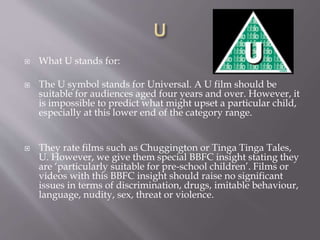
 What U stands for:
 The U symbol stands for Universal. A U film should be
suitable for audiences aged four years and over. However, it
is impossible to predict what might upset a particular child,
especially at this lower end of the category range.
 They rate films such as Chuggington or Tinga Tinga Tales,
U. However, we give them special BBFC insight stating they
are ‘particularly suitable for pre-school children’. Films or
videos with this BBFC insight should raise no significant
issues in terms of discrimination, drugs, imitable behaviour,
language, nudity, sex, threat or violence.
 What PG stands for:
 PG stands for Parental Guidance. This means a film is
suitable for general viewing, but some scenes may be
unsuitable for young children. A PG film should not
unsettle a child aged around eight or older. Parents
should consider whether the content may upset
younger, or more sensitive, children.
 A PG film will not contain any theme which is
inappropriate for a child. PG works can explore
challenging issues such as bullying, bereavement or
racism.
 12 and 12A:
 Films classified 12A and video works classified 12 contain
material that is not generally suitable for children aged under 12.
No one younger than 12 may see a 12A film in a cinema unless
accompanied by an adult. Adults planning to take a child under
12 to view a 12A film should consider whether the film is suitable
for that child. To help them decide, we recommend that they
check the BBFC insight for that film in advance.
 12A films normally contains moderate violence and threat that is
not explored fully in much detail, from sexual behaviour and drug
use are all shown briefly which makes the film classification a 12
and 12A.
 What does the 15 symbol mean?
 No-one under 15 is allowed to see a 15 film at the cinema or buy/rent a 15 rated video. 15 rated
works are not suitable for children under 15 years of age.
 Are there any limits on what sort of theme a work can have at 15?
 No theme is prohibited, provided the treatment is appropriate for 15 year olds.
 What might I see in a 15 rated film or video?
 Any of the following:
 strong violence
 frequent strong language (e.g. 'f***').
 portrayals of sexual activity
 strong verbal references to sex
 sexual nudity
 brief scenes of sexual violence or verbal references to sexual violence
 discriminatory language or behaviour
 drug taking
 What does the 18 symbol mean?
 Films rated 18 are for adults. No-one under 18 is allowed to see an 18 film at the cinema or buy / rent
an 18 rated video. No 18 rated works are suitable for children.
 Are there any limits on what sort of theme a work can have at 18?
 No theme is prohibited at 18. Adults are free to choose their own entertainment provided the material
is not illegal or potentially harmful, so it is possible some themes tackled at 18 may be offensive even
to some adult viewers.
 What sort of issues might I find in an 18 film or video?
 18 works are for adults and can contain strong issues such as:
 very strong violence
 frequent strong language (e.g. 'f***') and / or very strong language (e.g. ‘c***’)
 strong portrayals of sexual activity
 scenes of sexual violence
 strong horror
 strong blood and gore
 real sex (in some circumstances)
 discriminatory language and behaviour

Bbfc research

  • 2.
     When conductingresearch for the appropriate viewing age for our thriller, BBFC is an important factor to take into account as we do not want the age classification to be too high for our thriller. One of the reasons for our decision is that the film will be aimed at teenagers to young adults, therefore the age classification will most likely be classed as a 12 or 15. The majority of thrillers are rated at 15 or over due to contents of sustained threat, strong violence and the use of nudity and drug references. Therefore to have the appropriate viewing age is vital for when targeting a group of people that like a particular genre. 
  • 3.
     For ourthriller, our rating will be a 15 due to references of threat and violence sustained in the video. Therefore this is the appropriate viewing age as this link with category code (E) from our demographic table.
  • 4.
     What Ustands for:  The U symbol stands for Universal. A U film should be suitable for audiences aged four years and over. However, it is impossible to predict what might upset a particular child, especially at this lower end of the category range.  They rate films such as Chuggington or Tinga Tinga Tales, U. However, we give them special BBFC insight stating they are ‘particularly suitable for pre-school children’. Films or videos with this BBFC insight should raise no significant issues in terms of discrimination, drugs, imitable behaviour, language, nudity, sex, threat or violence.
  • 5.
     What PGstands for:  PG stands for Parental Guidance. This means a film is suitable for general viewing, but some scenes may be unsuitable for young children. A PG film should not unsettle a child aged around eight or older. Parents should consider whether the content may upset younger, or more sensitive, children.  A PG film will not contain any theme which is inappropriate for a child. PG works can explore challenging issues such as bullying, bereavement or racism.
  • 6.
     12 and12A:  Films classified 12A and video works classified 12 contain material that is not generally suitable for children aged under 12. No one younger than 12 may see a 12A film in a cinema unless accompanied by an adult. Adults planning to take a child under 12 to view a 12A film should consider whether the film is suitable for that child. To help them decide, we recommend that they check the BBFC insight for that film in advance.  12A films normally contains moderate violence and threat that is not explored fully in much detail, from sexual behaviour and drug use are all shown briefly which makes the film classification a 12 and 12A.
  • 7.
     What doesthe 15 symbol mean?  No-one under 15 is allowed to see a 15 film at the cinema or buy/rent a 15 rated video. 15 rated works are not suitable for children under 15 years of age.  Are there any limits on what sort of theme a work can have at 15?  No theme is prohibited, provided the treatment is appropriate for 15 year olds.  What might I see in a 15 rated film or video?  Any of the following:  strong violence  frequent strong language (e.g. 'f***').  portrayals of sexual activity  strong verbal references to sex  sexual nudity  brief scenes of sexual violence or verbal references to sexual violence  discriminatory language or behaviour  drug taking
  • 8.
     What doesthe 18 symbol mean?  Films rated 18 are for adults. No-one under 18 is allowed to see an 18 film at the cinema or buy / rent an 18 rated video. No 18 rated works are suitable for children.  Are there any limits on what sort of theme a work can have at 18?  No theme is prohibited at 18. Adults are free to choose their own entertainment provided the material is not illegal or potentially harmful, so it is possible some themes tackled at 18 may be offensive even to some adult viewers.  What sort of issues might I find in an 18 film or video?  18 works are for adults and can contain strong issues such as:  very strong violence  frequent strong language (e.g. 'f***') and / or very strong language (e.g. ‘c***’)  strong portrayals of sexual activity  scenes of sexual violence  strong horror  strong blood and gore  real sex (in some circumstances)  discriminatory language and behaviour