What are the arguments for and against its form of regulation?
For Against
Inspects all film content before classification and release Films are easy to access on the internet. Banned/ cut films
Help parents and guardians with age classification certificate
to help decide what content is suitable for the children
Influenced by desensitisation making them more flexible with
extreme content
It can be re-active as well as pro-active because it receives
complaints and it responds to the complaints
BBFC can do nothing if a parent or older friend purchases the
DVD, and allows a younger audience member to watch the film
that is not age appropriate
They can adjust film classifications over a period of time to
adapt to the society demands
BBFC don’t consider the public as individuals so they don’t think
about how some 12 year olds are more mature than others for
example.
Protects children from seeing inappropriate film content for
their age such as swearing, violence, adult themes.
Prevents parents making their own decisions based on their
own knowledge of their children
BBFC introduced “Parent Port” as an online website used to
educate parents about the film content that their children may
be consuming
Restricts freedom of expression for the directors
How effective is the body? (Pros and Cons
plus conclusion)
Pros Cons
Effective how they have age ratings to protect the audience
from offensive material reducing the chance of influencing the
vulnerable
Most banned/cut films can be easily found on the internet and
there are no age restrictions when watching films online
Introduced 12A so the parents can decide what is suitable Could be fake ID’s shown at cinemas and at shops from
underage children
They help the film makers by making sure they don’t break any
laws when making a film
They have to be more flexible with extreme content, some
parents might not agree as they are traditional
They protect the audience by looking at the context and the
time of the film
It is self-regulated and can prevent people from taking
individual responsibility for their actions
They test desensitisation by asking the audience their attitudes
towards violence, strong language and sex being shown in films
The age certificates are for everyone not for individuals-
different maturity levels
They respond to complaints
They can cut or ban film releases
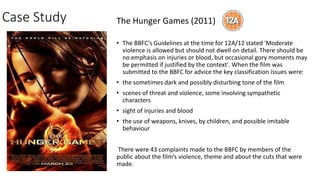
• The BBFC's Guidelines at the time for 12A/12 stated 'Moderate
violence is allowed but should not dwell on detail. There should be
no emphasis on injuries or blood, but occasional gory moments may
be permitted if justified by the context'. When the film was
submitted to the BBFC for advice the key classification issues were:
• the sometimes dark and possibly disturbing tone of the film
• scenes of threat and violence, some involving sympathetic
characters
• sight of injuries and blood
• the use of weapons, knives, by children, and possible imitable
behaviour
There were 43 complaints made to the BBFC by members of the
public about the film’s violence, theme and about the cuts that were
made.
The Hunger Games (2011)
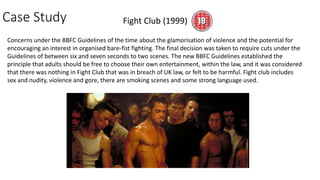
Case Study Fight Club (1999)
Concerns under the BBFC Guidelines of the time about the glamorisation of violence and the potential for
encouraging an interest in organised bare-fist fighting. The final decision was taken to require cuts under the
Guidelines of between six and seven seconds to two scenes. The new BBFC Guidelines established the
principle that adults should be free to choose their own entertainment, within the law, and it was considered
that there was nothing in Fight Club that was in breach of UK law, or felt to be harmful. Fight club includes
sex and nudity, violence and gore, there are smoking scenes and some strong language used.
Case Study
Juno is a comedy drama about a streetwise 16 year old girl who gets
pregnant and decides to give the baby up for adoption.
It was submitted to the BBFC with a PG request. The key classification
issues in the work are infrequent strong language, moderate sex
references and brief sight of a gory scene from an old horror movie The
Wizard Of Gore (rated 18). When making their recommendations
examiners also discussed the film’s tone, likely appeal and audience, and
the treatment of the theme of teenage pregnancy.
Some criticism of the film had suggested it might advertise teen
pregnancy, but the BBFC took the view that the film’s treatment of an
important theme was ‘suitable for young teenagers’ as it presented Juno’s
pregnancy and its effects on her relationships realistically.
Juno (2008)

BBFC

  • 2.
    What are thearguments for and against its form of regulation? For Against Inspects all film content before classification and release Films are easy to access on the internet. Banned/ cut films Help parents and guardians with age classification certificate to help decide what content is suitable for the children Influenced by desensitisation making them more flexible with extreme content It can be re-active as well as pro-active because it receives complaints and it responds to the complaints BBFC can do nothing if a parent or older friend purchases the DVD, and allows a younger audience member to watch the film that is not age appropriate They can adjust film classifications over a period of time to adapt to the society demands BBFC don’t consider the public as individuals so they don’t think about how some 12 year olds are more mature than others for example. Protects children from seeing inappropriate film content for their age such as swearing, violence, adult themes. Prevents parents making their own decisions based on their own knowledge of their children BBFC introduced “Parent Port” as an online website used to educate parents about the film content that their children may be consuming Restricts freedom of expression for the directors
  • 3.
    How effective isthe body? (Pros and Cons plus conclusion) Pros Cons Effective how they have age ratings to protect the audience from offensive material reducing the chance of influencing the vulnerable Most banned/cut films can be easily found on the internet and there are no age restrictions when watching films online Introduced 12A so the parents can decide what is suitable Could be fake ID’s shown at cinemas and at shops from underage children They help the film makers by making sure they don’t break any laws when making a film They have to be more flexible with extreme content, some parents might not agree as they are traditional They protect the audience by looking at the context and the time of the film It is self-regulated and can prevent people from taking individual responsibility for their actions They test desensitisation by asking the audience their attitudes towards violence, strong language and sex being shown in films The age certificates are for everyone not for individuals- different maturity levels They respond to complaints They can cut or ban film releases
  • 4.
    • The BBFC'sGuidelines at the time for 12A/12 stated 'Moderate violence is allowed but should not dwell on detail. There should be no emphasis on injuries or blood, but occasional gory moments may be permitted if justified by the context'. When the film was submitted to the BBFC for advice the key classification issues were: • the sometimes dark and possibly disturbing tone of the film • scenes of threat and violence, some involving sympathetic characters • sight of injuries and blood • the use of weapons, knives, by children, and possible imitable behaviour There were 43 complaints made to the BBFC by members of the public about the film’s violence, theme and about the cuts that were made. The Hunger Games (2011)
  • 5.
    Case Study FightClub (1999) Concerns under the BBFC Guidelines of the time about the glamorisation of violence and the potential for encouraging an interest in organised bare-fist fighting. The final decision was taken to require cuts under the Guidelines of between six and seven seconds to two scenes. The new BBFC Guidelines established the principle that adults should be free to choose their own entertainment, within the law, and it was considered that there was nothing in Fight Club that was in breach of UK law, or felt to be harmful. Fight club includes sex and nudity, violence and gore, there are smoking scenes and some strong language used.
  • 6.
    Case Study Juno isa comedy drama about a streetwise 16 year old girl who gets pregnant and decides to give the baby up for adoption. It was submitted to the BBFC with a PG request. The key classification issues in the work are infrequent strong language, moderate sex references and brief sight of a gory scene from an old horror movie The Wizard Of Gore (rated 18). When making their recommendations examiners also discussed the film’s tone, likely appeal and audience, and the treatment of the theme of teenage pregnancy. Some criticism of the film had suggested it might advertise teen pregnancy, but the BBFC took the view that the film’s treatment of an important theme was ‘suitable for young teenagers’ as it presented Juno’s pregnancy and its effects on her relationships realistically. Juno (2008)