LEAP as a Process Overview of key steps and main institutions to be involved Irina Basiliya Belgrade, 16 February, 2004
What is a LEAP? The Local Environmental Action Programme (LEAP) is a  participatory  process  for a regional or local community that leads to concrete environmental  investments.
REAL MEANING OF LEAP NOT A CONCEPT OR POLICY DOCUMENT  BUT  AN ACTION PLAN AT A  LOWER COST WITH AVAILABLE RESOURCES ( PRIMARY FROM LOCAL OR NATIONAL SOURCES ) TO BE IMPLEMENTED BY THE COMMUNITY,  NOT  BY THE LOCAL  GOVERNMENT ITSELF FOCUS ON SHORT-TERM PRIORITIES
LEAP MAIN OBSTACALS PEOPLE CONCERN MORE ABOUT ECONOMIC & SOCIAL PROBLEMS (unemployment, living standard, security) MOST MUNICIPALITIES FACE A LACK OF FINANCE /DEVELOPMENT LACK OF COMMUNITY INVOLVMENT WEAK INSTITUTIONS & LEGAL BASE
LEAP History : we are not alone In some CEE countries from 1990s Mainly with foreign assistance  Not all of them have reached implementation Difficulties with translating strategy papers into actions (with funds allocation, etc) Poor setting of concrete aims or targets Lack of realistic actions within a given time and with available resources
LEAP History : we are not alone BULGARIA – Troyan, Stara Zagora. CZECH Republic – Kolin HUNGARY – Mosonmagyarovar, Satoraljauhely, RSD Ecorgion POLAND – Radom, Elk SLOVAK Republic – Upper Nitra SERBIA – presentation of Slavica A šković
LEAP FACILITATOR =  Velimir Mitrovic Miroslav Jocic Aleksandra Culic Milos Katic Toplica Marjanovic Nevdjivan Kaljesi Suzana Simic Zorka Milic motor pusher
LEAP = PROCESS TIME FRAME – 2 – 4 years COMPOSITION Preparation  –  LEAP document Implementation  – Implementation plan Monitoring  –  Monitoring plan INVOLVEMENT of General public/community Local authorities Industries NGOs, etc.
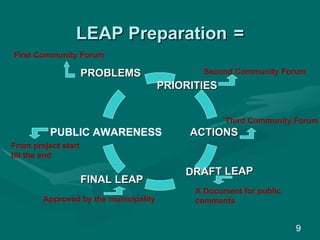
LEAP Preparation   = PROBLEMS FINAL LEAP First Community Forum Second Community Forum Third Community Forum A Document for public comments Approved by the municipality From project start till the end PRIORITIES ACTIONS PUBLIC AWARENESS DRAFT LEAP
LEAP as a Document =  CONCLUSION and ANNEXES. Chapter 5 :  KEY ASPECT OF IMPLEMENTATION.  I mplementing institutes. Resources needed. Policy instruments. Potential funds: local, national, international Chapter 4 :  DESCRIPTION of  RECOMMENDED ACTIONS for EACH PRIORITY  PROBLEM.  Actions and resources required, including review of the technical and economic (cost estimation) feasibility. Schedule of actions in terms of short-term, medium term and long-term Chapter 3 :  DESCRIPTION OF EACH PRIORITY PROBLEM.   P resent regulatory situation, responsible agencies and authorities, and current practice.  W hy the problem causes a concern to the community. Objective, target and indicators   Chapter 2 :  ENVIRONMENTAL PRIORITIES.  Describes the criterions for setting priorities, summary of recommended priority problems  Chapter 1 :  SUMMARY of  ENVIRONMENTAL   PROBLEMS.  Short description of all environmental problems identified  INTRODUCTION.   Includes description of the municipality (key figures and information), LEAP process, its objective and phases, people  involved
IDENTIFICATION OF ENVIRONMENTAL PROBLEMS LONG  LIST  OF  PROBLEMS DIFFERENT MAJOR PROBLEMS 1
GROUPING OF PROBLEMS STRUCTURE THE PROBLEMS ESTABLISH THE RELATIONS BETWEEN THE PROBLEMS (‘PROBLEM TREE’) GROUP CLOSELY RELATED PROBLEMS 2 PROBLEM TREE = CAUSE AND RELATIONS
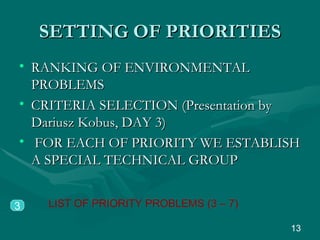
SETTING OF PRIORITIES RANKING OF ENVIRONMENTAL PROBLEMS CRITERIA SELECTION (Presentation by Dariusz Kobus, DAY 3) FOR EACH OF PRIORITY WE ESTABLISH A SPECIAL TECHNICAL GROUP 3 LIST OF PRIORITY PROBLEMS (3 – 7)
DEVELOPING ACTIONS For EACH PRIORITY PROBLEM SPECIAL PRESENTATION DAY 4, 19 FEB. 4 LIST OF ACTIONS = SOLUTIONS ACTIVITY 4 ACTIVITY 3 ACTIVITY 2 ACTIVITY 1  TIME FRAME SOURCE OF FINANCE BUDGET ESTIMATE WHO IS RESPONSIBLE RESOURCES NEEDED TARGET/ INDICATOR ACTION
Main INSTITUTIONS CENTRAL GOVERNMENT  Policy, legislation, allocation of recourses LOCAL GOVERNMENT Overall municipal development INTEREST GROUPS (NGOs) Have a great effect on the environment LOCAL BUSINESS & INDUSTRY Create the economic base of a community
Main INSTITUTIONS SCIENTIFIC COMMUNITY Source of reliable data and expertise EDUCATIONAL SYSTEM Help with educational activities and PA PEOPLE LIVING IN THE AREA Future owners of the LEAP FINANCIAL INSTITUTIONS & ENVIRONMENTAL FUNDS  Source of financial resources
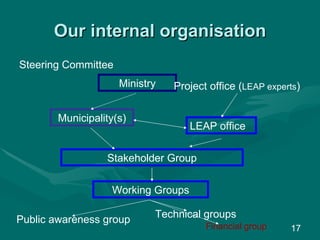
Our internal organisation Steering Committee Ministry Municipality(s) Project office ( LEAP experts ) LEAP office Stakeholder Group Working Groups Technical groups Public awareness group Financial group
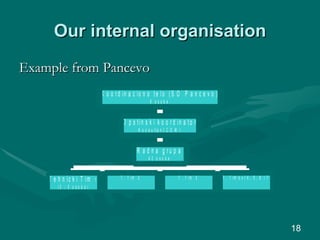
Our internal organisation Example from Pancevo
Role of the Project Support and facilitate the LEAP process Constantly monitor and guide the planning process (from start till implementation) Involve the international experts for various studies (if required)  Assess available resources to finance the LEAP
Resources allocated by Project   LEAP FACILITATORS (8) LOCAL EXPERTS (limited) LOCAL OFFICES  WORKSHOPS (FORUMS)  Public Awareness activities  TRAVEL  TRANSLATION (LEAP doc.)  PUBLISHING
Role of the municipality Help form the Stakeholder Group and provide a formal planning mandate Nominate the representative/counterpart Provide office space  Provide data and information Review and comments main documents Integrate LEAP planning decisions  with formal municipal/district planning
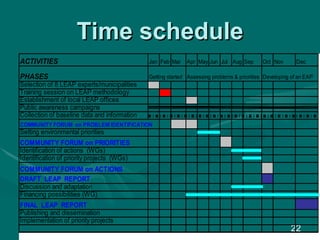
Time schedule

Basiliya Draft Final Local Environmental Action Plans

  • 1.
    LEAP as aProcess Overview of key steps and main institutions to be involved Irina Basiliya Belgrade, 16 February, 2004
  • 2.
    What is aLEAP? The Local Environmental Action Programme (LEAP) is a participatory process for a regional or local community that leads to concrete environmental investments.
  • 3.
    REAL MEANING OFLEAP NOT A CONCEPT OR POLICY DOCUMENT BUT AN ACTION PLAN AT A LOWER COST WITH AVAILABLE RESOURCES ( PRIMARY FROM LOCAL OR NATIONAL SOURCES ) TO BE IMPLEMENTED BY THE COMMUNITY, NOT BY THE LOCAL GOVERNMENT ITSELF FOCUS ON SHORT-TERM PRIORITIES
  • 4.
    LEAP MAIN OBSTACALSPEOPLE CONCERN MORE ABOUT ECONOMIC & SOCIAL PROBLEMS (unemployment, living standard, security) MOST MUNICIPALITIES FACE A LACK OF FINANCE /DEVELOPMENT LACK OF COMMUNITY INVOLVMENT WEAK INSTITUTIONS & LEGAL BASE
  • 5.
    LEAP History :we are not alone In some CEE countries from 1990s Mainly with foreign assistance Not all of them have reached implementation Difficulties with translating strategy papers into actions (with funds allocation, etc) Poor setting of concrete aims or targets Lack of realistic actions within a given time and with available resources
  • 6.
    LEAP History :we are not alone BULGARIA – Troyan, Stara Zagora. CZECH Republic – Kolin HUNGARY – Mosonmagyarovar, Satoraljauhely, RSD Ecorgion POLAND – Radom, Elk SLOVAK Republic – Upper Nitra SERBIA – presentation of Slavica A šković
  • 7.
    LEAP FACILITATOR = Velimir Mitrovic Miroslav Jocic Aleksandra Culic Milos Katic Toplica Marjanovic Nevdjivan Kaljesi Suzana Simic Zorka Milic motor pusher
  • 8.
    LEAP = PROCESSTIME FRAME – 2 – 4 years COMPOSITION Preparation – LEAP document Implementation – Implementation plan Monitoring – Monitoring plan INVOLVEMENT of General public/community Local authorities Industries NGOs, etc.
  • 9.
    LEAP Preparation = PROBLEMS FINAL LEAP First Community Forum Second Community Forum Third Community Forum A Document for public comments Approved by the municipality From project start till the end PRIORITIES ACTIONS PUBLIC AWARENESS DRAFT LEAP
  • 10.
    LEAP as aDocument = CONCLUSION and ANNEXES. Chapter 5 : KEY ASPECT OF IMPLEMENTATION. I mplementing institutes. Resources needed. Policy instruments. Potential funds: local, national, international Chapter 4 : DESCRIPTION of RECOMMENDED ACTIONS for EACH PRIORITY PROBLEM. Actions and resources required, including review of the technical and economic (cost estimation) feasibility. Schedule of actions in terms of short-term, medium term and long-term Chapter 3 : DESCRIPTION OF EACH PRIORITY PROBLEM. P resent regulatory situation, responsible agencies and authorities, and current practice. W hy the problem causes a concern to the community. Objective, target and indicators Chapter 2 : ENVIRONMENTAL PRIORITIES. Describes the criterions for setting priorities, summary of recommended priority problems Chapter 1 : SUMMARY of ENVIRONMENTAL PROBLEMS. Short description of all environmental problems identified INTRODUCTION. Includes description of the municipality (key figures and information), LEAP process, its objective and phases, people involved
  • 11.
    IDENTIFICATION OF ENVIRONMENTALPROBLEMS LONG LIST OF PROBLEMS DIFFERENT MAJOR PROBLEMS 1
  • 12.
    GROUPING OF PROBLEMSSTRUCTURE THE PROBLEMS ESTABLISH THE RELATIONS BETWEEN THE PROBLEMS (‘PROBLEM TREE’) GROUP CLOSELY RELATED PROBLEMS 2 PROBLEM TREE = CAUSE AND RELATIONS
  • 13.
    SETTING OF PRIORITIESRANKING OF ENVIRONMENTAL PROBLEMS CRITERIA SELECTION (Presentation by Dariusz Kobus, DAY 3) FOR EACH OF PRIORITY WE ESTABLISH A SPECIAL TECHNICAL GROUP 3 LIST OF PRIORITY PROBLEMS (3 – 7)
  • 14.
    DEVELOPING ACTIONS ForEACH PRIORITY PROBLEM SPECIAL PRESENTATION DAY 4, 19 FEB. 4 LIST OF ACTIONS = SOLUTIONS ACTIVITY 4 ACTIVITY 3 ACTIVITY 2 ACTIVITY 1 TIME FRAME SOURCE OF FINANCE BUDGET ESTIMATE WHO IS RESPONSIBLE RESOURCES NEEDED TARGET/ INDICATOR ACTION
  • 15.
    Main INSTITUTIONS CENTRALGOVERNMENT Policy, legislation, allocation of recourses LOCAL GOVERNMENT Overall municipal development INTEREST GROUPS (NGOs) Have a great effect on the environment LOCAL BUSINESS & INDUSTRY Create the economic base of a community
  • 16.
    Main INSTITUTIONS SCIENTIFICCOMMUNITY Source of reliable data and expertise EDUCATIONAL SYSTEM Help with educational activities and PA PEOPLE LIVING IN THE AREA Future owners of the LEAP FINANCIAL INSTITUTIONS & ENVIRONMENTAL FUNDS Source of financial resources
  • 17.
    Our internal organisationSteering Committee Ministry Municipality(s) Project office ( LEAP experts ) LEAP office Stakeholder Group Working Groups Technical groups Public awareness group Financial group
  • 18.
    Our internal organisationExample from Pancevo
  • 19.
    Role of theProject Support and facilitate the LEAP process Constantly monitor and guide the planning process (from start till implementation) Involve the international experts for various studies (if required) Assess available resources to finance the LEAP
  • 20.
    Resources allocated byProject LEAP FACILITATORS (8) LOCAL EXPERTS (limited) LOCAL OFFICES WORKSHOPS (FORUMS) Public Awareness activities TRAVEL TRANSLATION (LEAP doc.) PUBLISHING
  • 21.
    Role of themunicipality Help form the Stakeholder Group and provide a formal planning mandate Nominate the representative/counterpart Provide office space Provide data and information Review and comments main documents Integrate LEAP planning decisions with formal municipal/district planning
  • 22.