BASICS OF
LINUX
Abhishek Ranaut
AGENDA
Introduction​
What is linux
​Advantages of linux
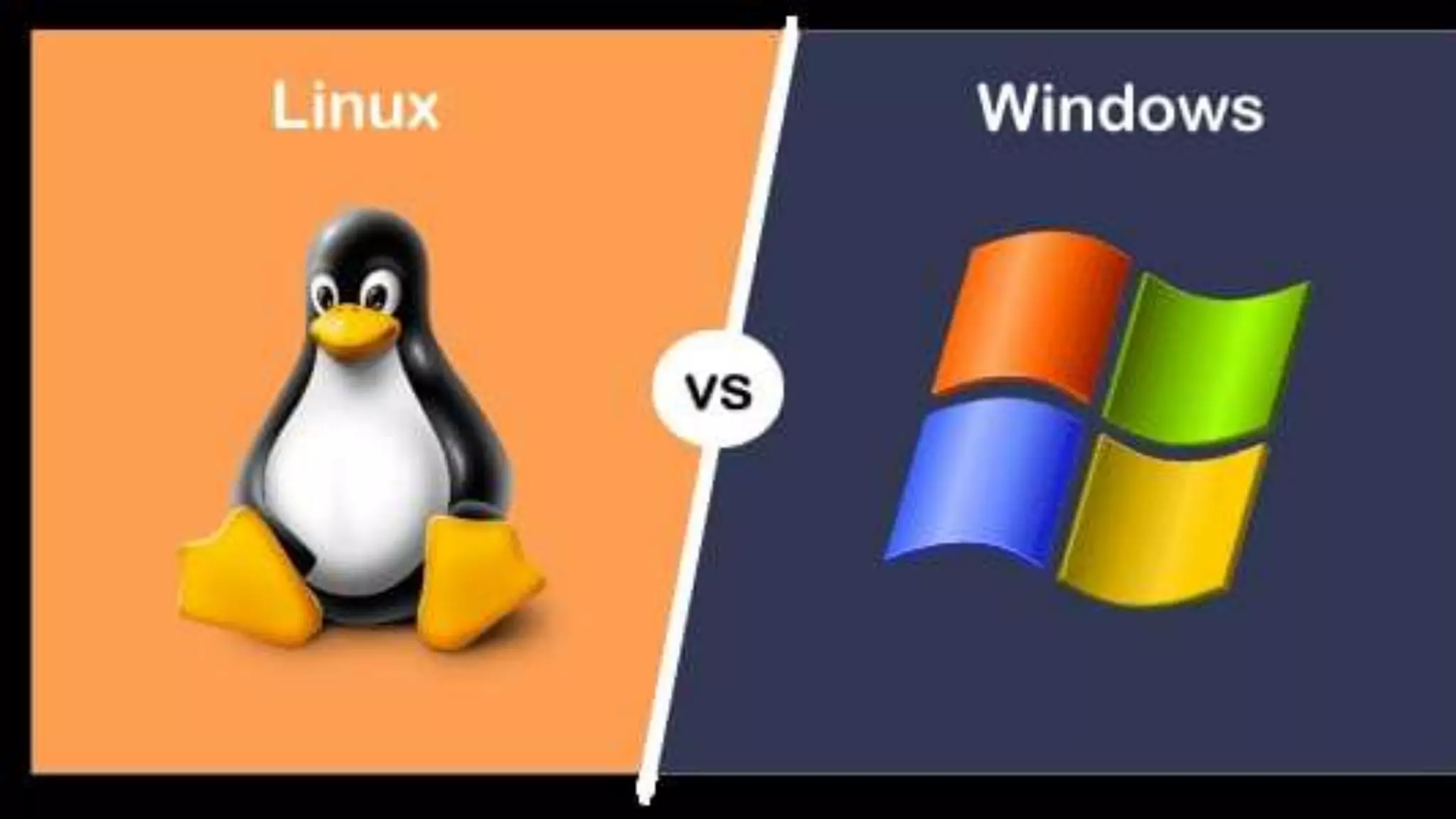
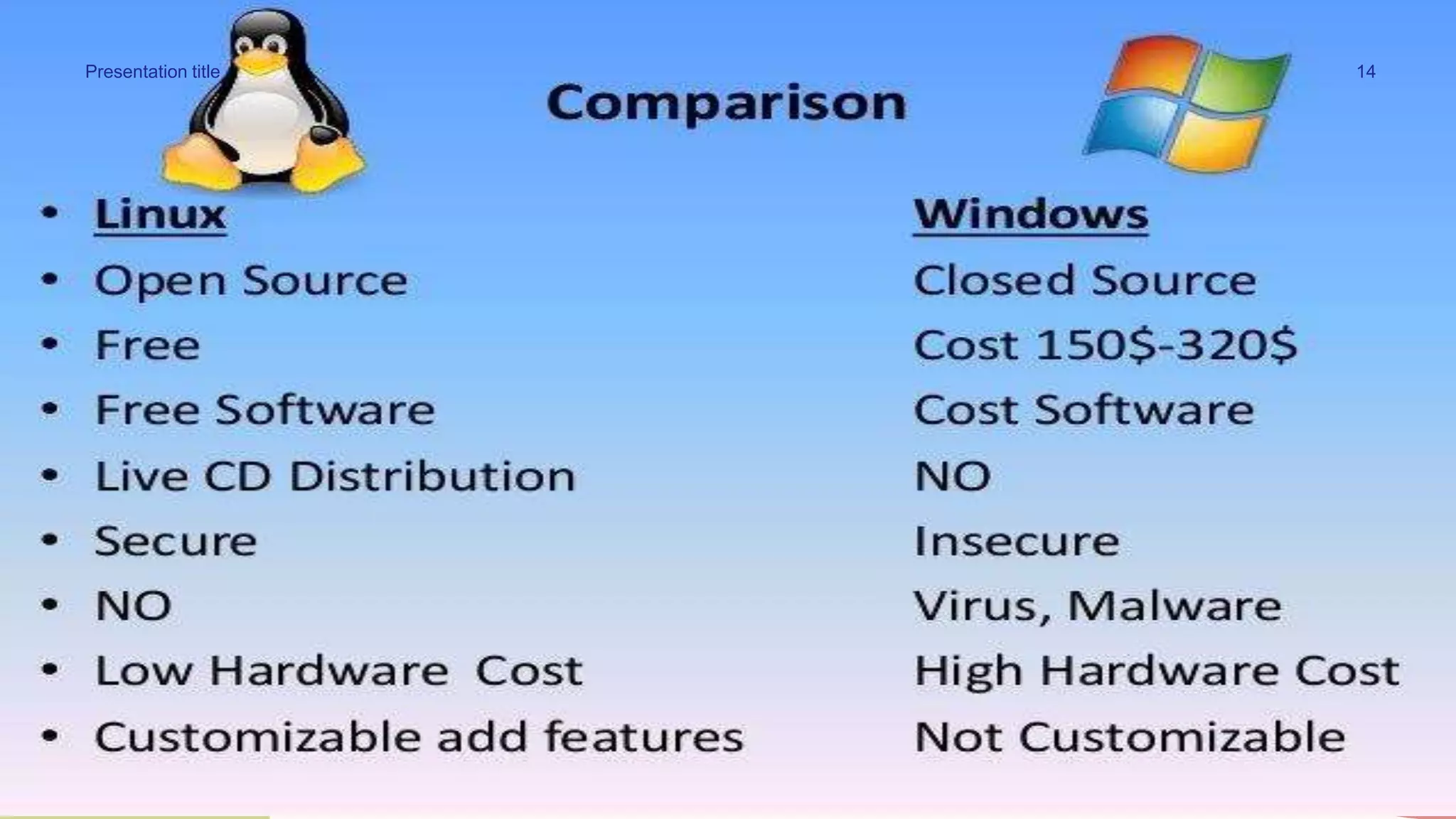
Windows vs linux
INTRODUCTION
Linux® is an open source operating system
(OS). An operating system is the software that
directly manages a system's hardware and
resources, like CPU, memory, and storage. The
OS sits between applications and hardware and
makes the connections between all of your
software and the physical resources
that do the work .
Presentation title 3
WHAT DOES LINUX
MEAN?
Linux is a free open source operating
system (OS) based on UNIX that was
created in 1991 by Linus Torvalds. Users
can modify and create variations of the
source code, known as distributions, for
computers and other devices.
4
Presentation title
ADVANTAGES OF
LINUX
PEN SOURCE
Presentation title 6
As it is open-source, its source code is
easily available. Anyone having
programming knowledge can customize
the operating system. One can contribute,
modify, distribute, and enhance the code
for any purpose.
SECURITY
The Linux security feature is the main
reason that it is the most favorable option
for developers. It is not completely safe,
but it is less vulnerable than others. Each
application needs to authorize by the
admin user. The virus is not executed until
the administrator provides the access
password. Linux systems do not require
any antivirus program.
7
Presentation title
FREE
Certainly, the biggest advantage of the
Linux system is that it is free to use. We
can easily download it, and there is no
need to buy the license for it. It is
distributed under GNU GPL (General
Public License). Comparatively, we have
to pay a huge amount for the license of
the other operating systems.
8
Presentation title
LIGHTWEIGHT
Linux is lightweight. The requirements for
running Linux are much less than other
operating systems. In Linux, the memory
footprint and disk space are also lower.
Generally, most of the Linux distributions
required as little as 128MB of RAM
around the same amount for disk space.
9
Presentation title
STABILITY
Linux is more stable than other operating
systems. Linux does not require to reboot
the system to maintain performance
levels. It rarely hangs up or slow down. It
has big up-times.
10
Presentation title
PERFORMANCE
Linux system provides high performance
over different networks. It is capable of
handling a large number of users
simultaneously.
11
Presentation title
SOFTWARE UPDATES
In Linux, the software updates are in user
control. We can select the required
updates. There a large number of system
updates are available. These updates are
much faster than other operating systems.
So, the system updates can be installed
easily without facing any issue.
12
Presentation title
14
Presentation title
THANK YOU

Basics of linux.pptx

  • 1.
  • 2.
  • 3.
    INTRODUCTION Linux® is anopen source operating system (OS). An operating system is the software that directly manages a system's hardware and resources, like CPU, memory, and storage. The OS sits between applications and hardware and makes the connections between all of your software and the physical resources that do the work . Presentation title 3
  • 4.
    WHAT DOES LINUX MEAN? Linuxis a free open source operating system (OS) based on UNIX that was created in 1991 by Linus Torvalds. Users can modify and create variations of the source code, known as distributions, for computers and other devices. 4 Presentation title
  • 5.
  • 6.
    PEN SOURCE Presentation title6 As it is open-source, its source code is easily available. Anyone having programming knowledge can customize the operating system. One can contribute, modify, distribute, and enhance the code for any purpose.
  • 7.
    SECURITY The Linux securityfeature is the main reason that it is the most favorable option for developers. It is not completely safe, but it is less vulnerable than others. Each application needs to authorize by the admin user. The virus is not executed until the administrator provides the access password. Linux systems do not require any antivirus program. 7 Presentation title
  • 8.
    FREE Certainly, the biggestadvantage of the Linux system is that it is free to use. We can easily download it, and there is no need to buy the license for it. It is distributed under GNU GPL (General Public License). Comparatively, we have to pay a huge amount for the license of the other operating systems. 8 Presentation title
  • 9.
    LIGHTWEIGHT Linux is lightweight.The requirements for running Linux are much less than other operating systems. In Linux, the memory footprint and disk space are also lower. Generally, most of the Linux distributions required as little as 128MB of RAM around the same amount for disk space. 9 Presentation title
  • 10.
    STABILITY Linux is morestable than other operating systems. Linux does not require to reboot the system to maintain performance levels. It rarely hangs up or slow down. It has big up-times. 10 Presentation title
  • 11.
    PERFORMANCE Linux system provideshigh performance over different networks. It is capable of handling a large number of users simultaneously. 11 Presentation title
  • 12.
    SOFTWARE UPDATES In Linux,the software updates are in user control. We can select the required updates. There a large number of system updates are available. These updates are much faster than other operating systems. So, the system updates can be installed easily without facing any issue. 12 Presentation title
  • 14.
  • 15.