Basics of Indian
Constitution
SPPU-SOL
Asst. Professor Anish Tore
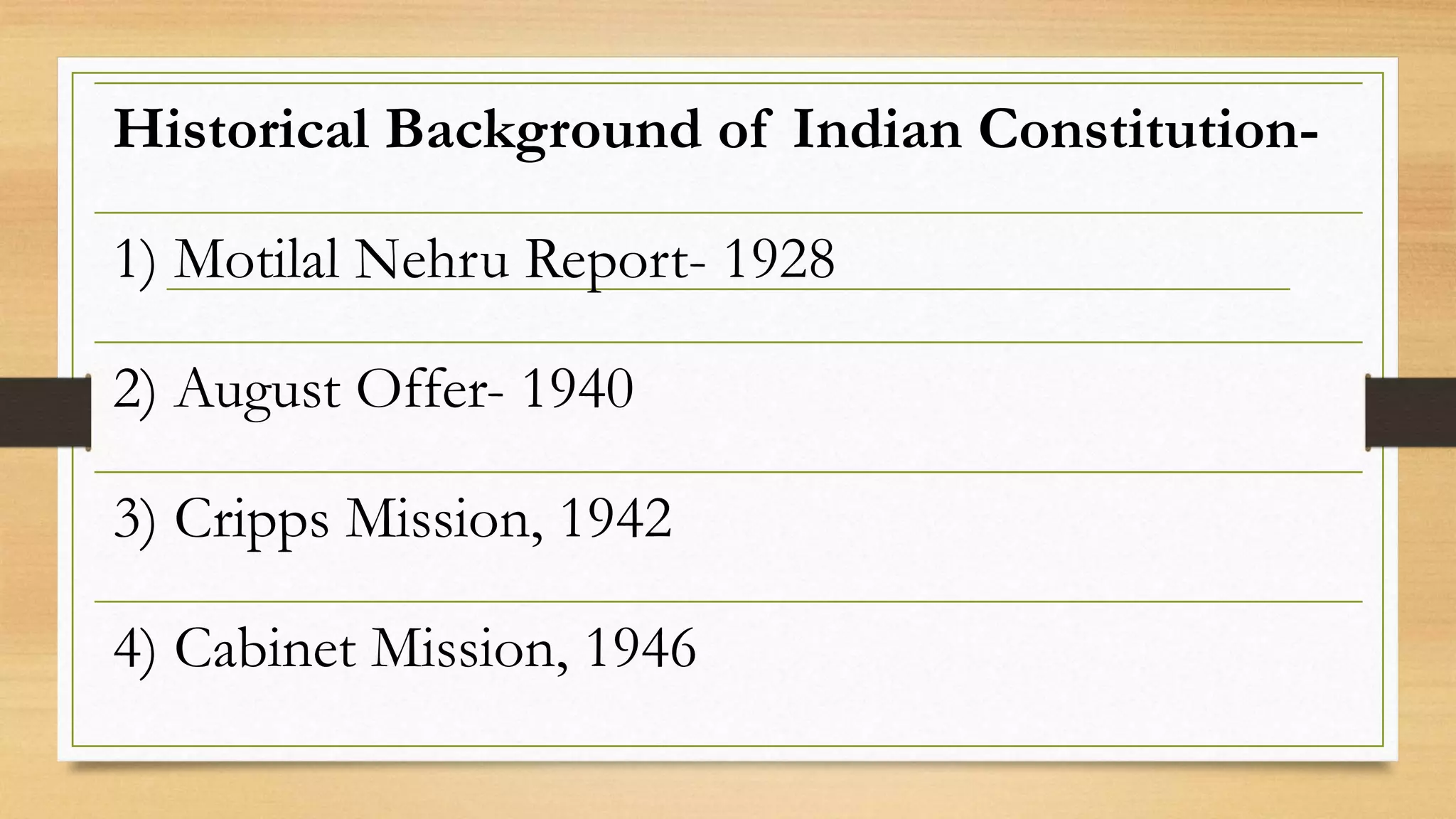
Historical Background of Indian Constitution-
1) Motilal Nehru Report- 1928
2) August Offer- 1940
3) Cripps Mission, 1942
4) Cabinet Mission, 1946
BirkenHead Challenge Motilal Nehru Report, 1928
INDIA’s CONSTITUENT ASSEMBLY-
1) Created in 1946 under Cabinet Mission Plan.
2) Of the total 296 members from British India Provinces- 208 belonged to Congress Party, 73 to
Muslim League & 15 from other political parties.
3) After the creation of Pakistan, the total strength of the Constituent assembly was reduced from 389
to 299- 229 from British India & 70 from Princely States.
4) There were many committees, which worked on different aspects of the Constitution. But amongst
all the Committees, the Drafting Committee was considered to be the most important. Dr. B.R.
Ambedkar was appointed as the Chairperson of the Drafting Committee.
5) Till the first Lok Sabha Election in 1952, the Constituent Assembly functioned as both- the
Constitution-making body & the Legislative Body.
“Preamble is the ID card of our Constitution”-
Nani Palkhiwala
Dispute Regarding the status of the Preamble-
1) Can it be amended?
2) Does it confer any Powers or responsibilities?
• India, along with Japan, are the only 2 Democratic
Countries in the world, whose Constitution contains a
chapter on Fundamental Duties.
• ‘Asian Values’
• During the era of the Indira Gandhi as Prime Minister,
the Congress Party appointed the Swaran Singh
Committee to suggest FD’s that could be added.
• Swaran Singh Committee suggested a total of 8 FD’s. Of
which 3 suggestions were dropped.
• As part of the 42nd Constitution Amendment,
Fundamental Duties were added to the Constitution.
DPSP included in Part 4
of Indian Constitution.
Aim is to establish
‘Welfare State’.
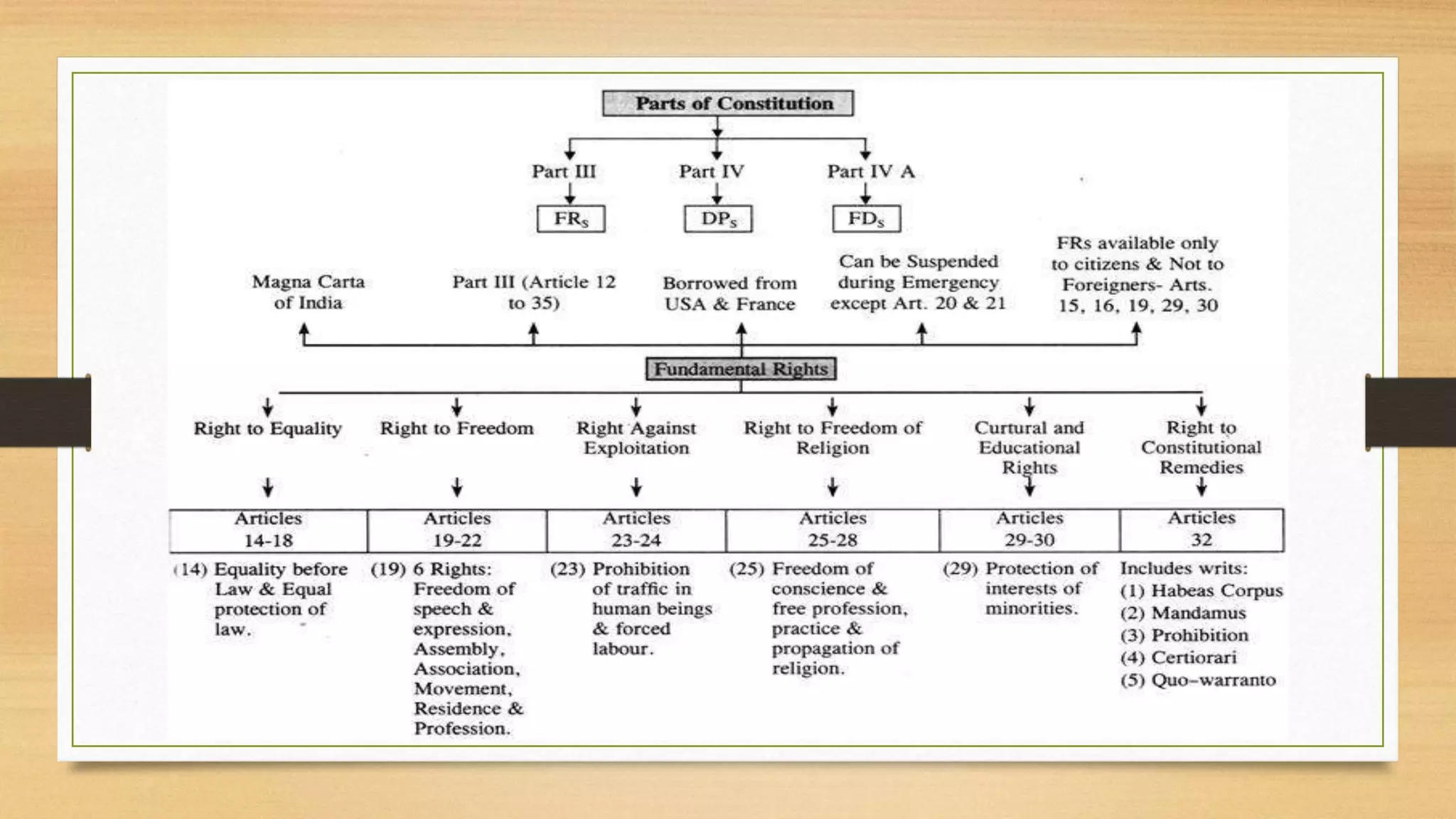
Fundamental Rights are
aimed at Civil Rights of
Indian Citizens…
Whereas DPSP aim at
‘Socio-Economic
Rights’ of Indians
FR are justiciable
DPSP are Non-
Justiciable.
Basics of Indian Constitution.pptx

Basics of Indian Constitution.pptx

  • 1.
  • 3.
    Historical Background ofIndian Constitution- 1) Motilal Nehru Report- 1928 2) August Offer- 1940 3) Cripps Mission, 1942 4) Cabinet Mission, 1946
  • 4.
    BirkenHead Challenge MotilalNehru Report, 1928
  • 8.
    INDIA’s CONSTITUENT ASSEMBLY- 1)Created in 1946 under Cabinet Mission Plan. 2) Of the total 296 members from British India Provinces- 208 belonged to Congress Party, 73 to Muslim League & 15 from other political parties. 3) After the creation of Pakistan, the total strength of the Constituent assembly was reduced from 389 to 299- 229 from British India & 70 from Princely States. 4) There were many committees, which worked on different aspects of the Constitution. But amongst all the Committees, the Drafting Committee was considered to be the most important. Dr. B.R. Ambedkar was appointed as the Chairperson of the Drafting Committee. 5) Till the first Lok Sabha Election in 1952, the Constituent Assembly functioned as both- the Constitution-making body & the Legislative Body.
  • 10.
    “Preamble is theID card of our Constitution”- Nani Palkhiwala Dispute Regarding the status of the Preamble- 1) Can it be amended? 2) Does it confer any Powers or responsibilities?
  • 11.
    • India, alongwith Japan, are the only 2 Democratic Countries in the world, whose Constitution contains a chapter on Fundamental Duties. • ‘Asian Values’ • During the era of the Indira Gandhi as Prime Minister, the Congress Party appointed the Swaran Singh Committee to suggest FD’s that could be added. • Swaran Singh Committee suggested a total of 8 FD’s. Of which 3 suggestions were dropped. • As part of the 42nd Constitution Amendment, Fundamental Duties were added to the Constitution.
  • 13.
    DPSP included inPart 4 of Indian Constitution. Aim is to establish ‘Welfare State’. Fundamental Rights are aimed at Civil Rights of Indian Citizens… Whereas DPSP aim at ‘Socio-Economic Rights’ of Indians FR are justiciable DPSP are Non- Justiciable.