Introduction to C
Programming
C is a high-level language developed by Dennis M. Ritchie in 1972. The first
public description was produced by Kernighan and Ritchie in 1978.
CP
by TCCI institute
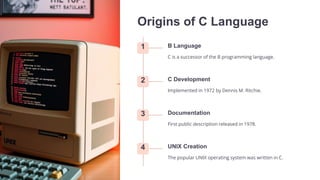
Origins of C Language
1 B Language
C is a successor of the B programming language.
2 C Development
Implemented in 1972 by Dennis M. Ritchie.
3 Documentation
First public description released in 1978.
4 UNIX Creation
The popular UNIX operating system was written in C.
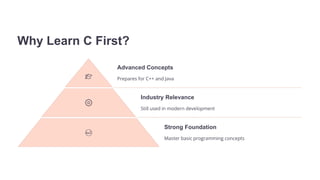
Why Learn C First?
Advanced Concepts
Prepares for C++ and Java
Industry Relevance
Still used in modern development
Strong Foundation
Master basic programming concepts
C Applications Today
Data Science Libraries
Many Python libraries like NumPy are written in C.
Operating Systems
Windows and Mac are written in C and C++.
Linux
Developed by Linus Torvalds, written in C.
Development Tools
Visual Studio Code is partially written in C.
Key Features of C
Structured Language
Can be split into multiple blocks of
execution called functions. Makes
code easier to understand.
Fast Execution
Efficient and fast execution makes it
a top choice for programmers.
Compilation and execution are quite
fast.
Built-in Functions
Help in writing complex programs
with ease. Provides essential tools
for developers.
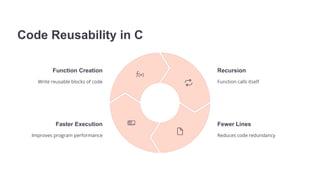
Code Reusability in C
Function Creation
Write reusable blocks of code
Recursion
Function calls itself
Fewer Lines
Reduces code redundancy
Faster Execution
Improves program performance
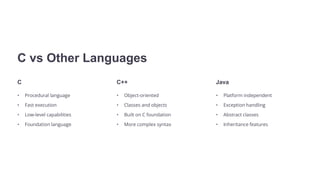
C vs Other Languages
C
• Procedural language
• Fast execution
• Low-level capabilities
• Foundation language
C++
• Object-oriented
• Classes and objects
• Built on C foundation
• More complex syntax
Java
• Platform independent
• Exception handling
• Abstract classes
• Inheritance features
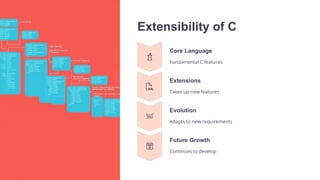
Extensibility of C
Core Language
Fundamental C features
Extensions
Takes up new features
Evolution
Adapts to new requirements
Future Growth
Continues to develop
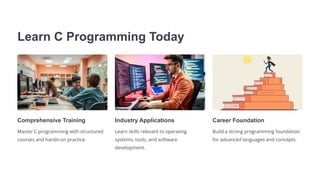
Learn C Programming Today
Comprehensive Training
Master C programming with structured
courses and hands-on practice.
Industry Applications
Learn skills relevant to operating
systems, tools, and software
development.
Career Foundation
Build a strong programming foundation
for advanced languages and concepts.
Locations & Contact Information
Locations
• Bopal, Ahmedabad
• Iskcon-Ambli, Ahmedabad
Contact
Call: +91 9825618292
Website: http://tccicomputercoaching.com/

Introduction-to-C-Programming - TCCI.pdf

  • 1.
    Introduction to C Programming Cis a high-level language developed by Dennis M. Ritchie in 1972. The first public description was produced by Kernighan and Ritchie in 1978. CP by TCCI institute
  • 2.
    Origins of CLanguage 1 B Language C is a successor of the B programming language. 2 C Development Implemented in 1972 by Dennis M. Ritchie. 3 Documentation First public description released in 1978. 4 UNIX Creation The popular UNIX operating system was written in C.
  • 3.
    Why Learn CFirst? Advanced Concepts Prepares for C++ and Java Industry Relevance Still used in modern development Strong Foundation Master basic programming concepts
  • 4.
    C Applications Today DataScience Libraries Many Python libraries like NumPy are written in C. Operating Systems Windows and Mac are written in C and C++. Linux Developed by Linus Torvalds, written in C. Development Tools Visual Studio Code is partially written in C.
  • 5.
    Key Features ofC Structured Language Can be split into multiple blocks of execution called functions. Makes code easier to understand. Fast Execution Efficient and fast execution makes it a top choice for programmers. Compilation and execution are quite fast. Built-in Functions Help in writing complex programs with ease. Provides essential tools for developers.
  • 6.
    Code Reusability inC Function Creation Write reusable blocks of code Recursion Function calls itself Fewer Lines Reduces code redundancy Faster Execution Improves program performance
  • 7.
    C vs OtherLanguages C • Procedural language • Fast execution • Low-level capabilities • Foundation language C++ • Object-oriented • Classes and objects • Built on C foundation • More complex syntax Java • Platform independent • Exception handling • Abstract classes • Inheritance features
  • 8.
    Extensibility of C CoreLanguage Fundamental C features Extensions Takes up new features Evolution Adapts to new requirements Future Growth Continues to develop
  • 9.
    Learn C ProgrammingToday Comprehensive Training Master C programming with structured courses and hands-on practice. Industry Applications Learn skills relevant to operating systems, tools, and software development. Career Foundation Build a strong programming foundation for advanced languages and concepts.
  • 10.
    Locations & ContactInformation Locations • Bopal, Ahmedabad • Iskcon-Ambli, Ahmedabad Contact Call: +91 9825618292 Website: http://tccicomputercoaching.com/