C_Programming_Presentation power point presentations
1.
Introduction to CProgramming
• Basics of C Language, Syntax, and Applications
• Presented by: Nistha Pandey
• Date: [Insert Date]
2.
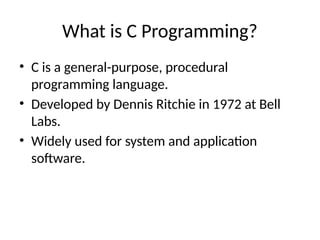
What is CProgramming?
• C is a general-purpose, procedural
programming language.
• Developed by Dennis Ritchie in 1972 at Bell
Labs.
• Widely used for system and application
software.
3.
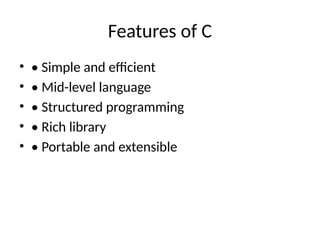
Features of C
•• Simple and efficient
• • Mid-level language
• • Structured programming
• • Rich library
• • Portable and extensible
4.
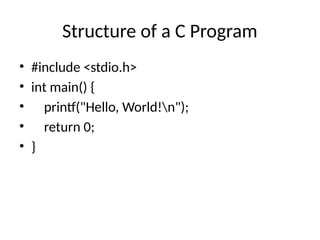
Structure of aC Program
• #include <stdio.h>
• int main() {
• printf("Hello, World!n");
• return 0;
• }
5.
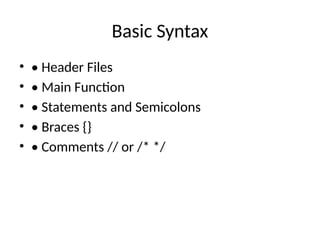
Basic Syntax
• •Header Files
• • Main Function
• • Statements and Semicolons
• • Braces {}
• • Comments // or /* */
6.
Data Types inC
• • int - Integer
• • float - Floating point
• • char - Character
• • double - Double precision floating point
7.
Variables and Constants
•• Variable: Stores data during program
execution
• • Constant: Fixed value that does not change
• Example:
• int a = 10;
• const float pi = 3.14;
Control Statements
• •if, if-else
• • switch
• • for loop
• • while loop
• • do-while loop
10.
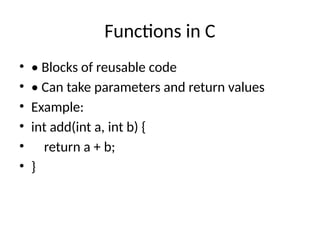
Functions in C
•• Blocks of reusable code
• • Can take parameters and return values
• Example:
• int add(int a, int b) {
• return a + b;
• }
11.
Conclusion
• C isa foundational language in programming.
• Understanding C helps in learning other
languages and system-level programming.
• It remains relevant in many software and
embedded systems.
![Introduction to C Programming
• Basics of C Language, Syntax, and Applications
• Presented by: Nistha Pandey
• Date: [Insert Date]](https://image.slidesharecdn.com/cprogrammingpresentation-250530180757-6cb38470/85/C_Programming_Presentation-power-point-presentations-1-320.jpg)
![Introduction to C Programming
• Basics of C Language, Syntax, and Applications
• Presented by: Nistha Pandey
• Date: [Insert Date]](https://image.slidesharecdn.com/cprogrammingpresentation-250530180757-6cb38470/75/C_Programming_Presentation-power-point-presentations-1-2048.jpg)