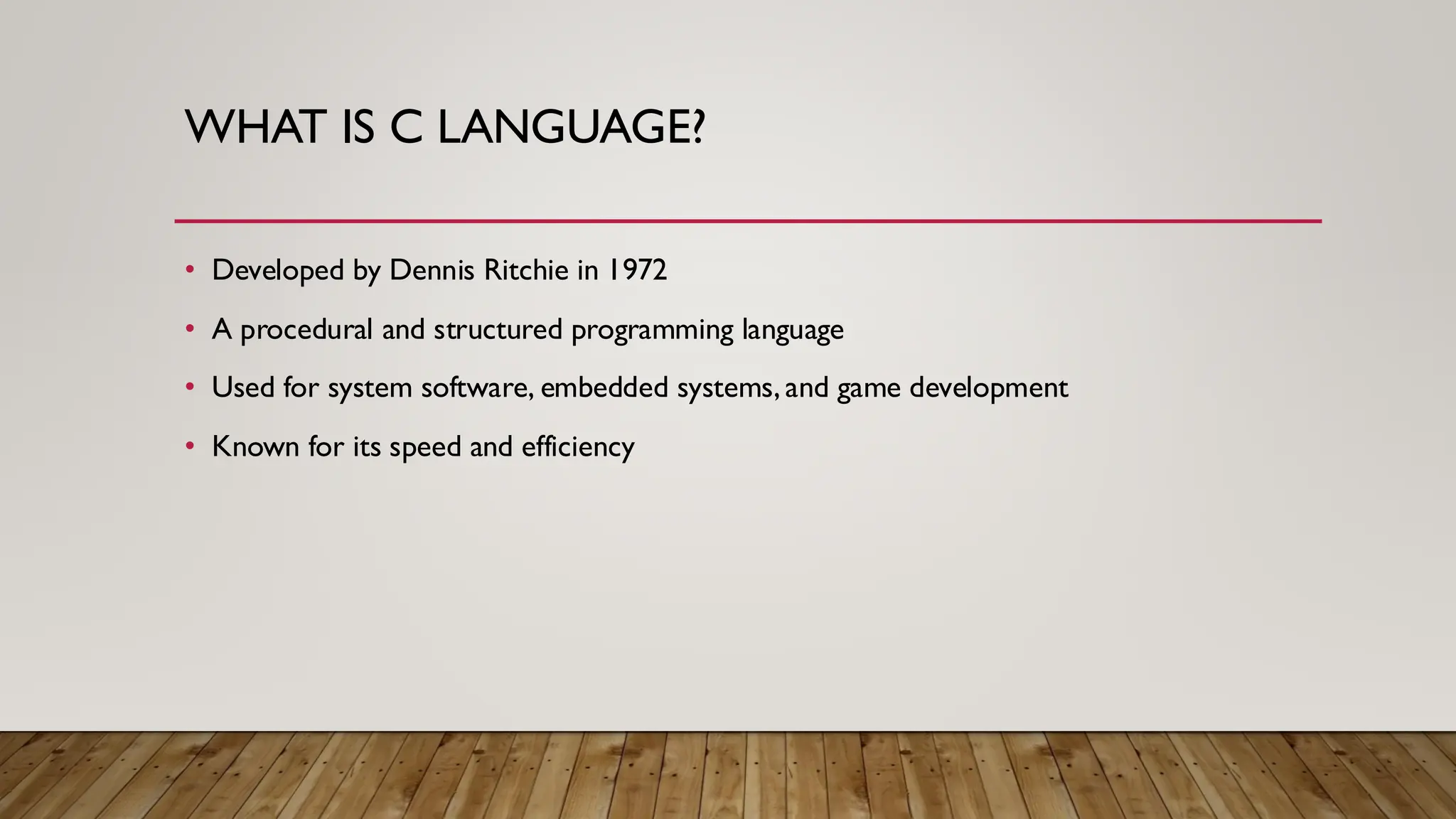
WHAT IS CLANGUAGE?
• Developed by Dennis Ritchie in 1972
• A procedural and structured programming language
• Used for system software, embedded systems, and game development
• Known for its speed and efficiency
3.
FEATURES OF C
•Simple & easy to learn
• Portable across platforms
• Rich library of functions
• Low-level memory access
• Fast execution
4.
STRUCTURE OF AC PROGRAM
• #include – Preprocessor directive
• main() – Entry point
• printf() – Function to display output
• return 0; – Program ends successfully
5.
DATATYPES &VARIABLES
• DataTypes: int, float, char, double
• Variables: Named storage (e.g., int age = 20;)
• Constants: Fixed values (const float pi = 3.14;)
FUNCTIONS,ARRAYS & POINTERS
•Functions: Block of reusable code
• int add(int a, int b) { return a + b; }
• Arrays: Group of elements: int a[5];
• Pointers: Stores address of a variable: int *ptr;
8.
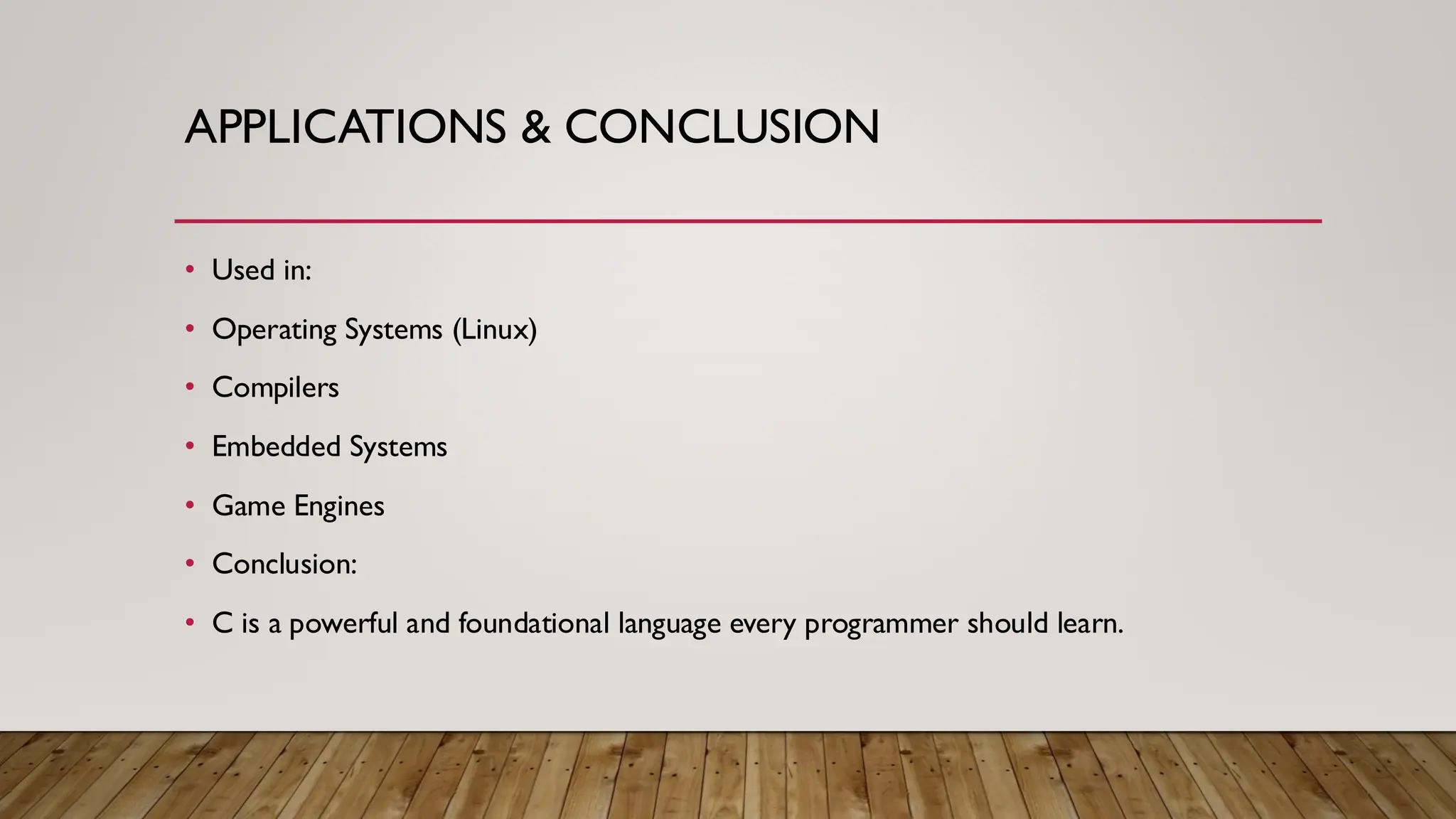
APPLICATIONS & CONCLUSION
•Used in:
• Operating Systems (Linux)
• Compilers
• Embedded Systems
• Game Engines
• Conclusion:
• C is a powerful and foundational language every programmer should learn.
![FUNCTIONS,ARRAYS & POINTERS
• Functions: Block of reusable code
• int add(int a, int b) { return a + b; }
• Arrays: Group of elements: int a[5];
• Pointers: Stores address of a variable: int *ptr;](https://image.slidesharecdn.com/presentation1-250726152727-249e024e/75/introduction-to-c-programming-basic-of-the-c-laanguage-pptx-7-2048.jpg)