



Career
Talk
MANIK
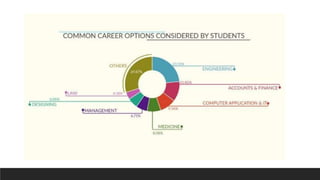
How SURVEY helps you to choose
your career plans
HOW DO YOU FEEL when people ask you about your career
plans? Do you feel confident, worried, ready for the future, or
not-so-ready? DID YOU KNOW that many successful adults did
not know when they were in high school that they would be in
their current careers? Of course, many people chose a career
path early on, studied for a particular career, and have enjoyed
that career path all along. But for many people, careers evolve
over time, as one career opportunity leads to another, and as
they continually learn new skills and build their careers.
What is Mathematics?
Mathematics is a vital academic discipline that forms an indispensable tool in different fields
such as natural science, engineering, psychology and medicine, and economics. The
mathematics courses make the aspirants capable enough to associate with the
administrators such that they not only provide efficient leadership, but also create a vision for
the dynamic program of mathematics.
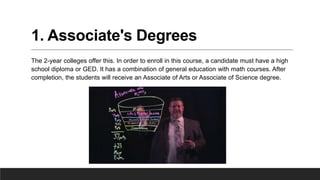
1. Associate's Degrees
The 2-year colleges offer this. In order to enroll in this course, a candidate must have a high
school diploma or GED. It has a combination of general education with math courses. After
completion, the students will receive an Associate of Arts or Associate of Science degree.
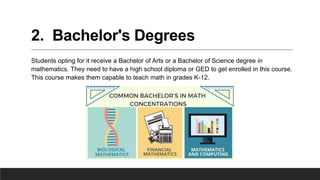
2. Bachelor's Degrees
Students opting for it receive a Bachelor of Arts or a Bachelor of Science degree in
mathematics. They need to have a high school diploma or GED to get enrolled in this course.
This course makes them capable to teach math in grades K-12.
3. Master's Degrees
This program is suitable for those
candidates who want to teach the subject in
a 2-year or 4-year college/university. Even
high school maths teachers can opt for it to
enhance their credentials and expertise in
the subject. They need a bachelor's degree
for admission to this course.
Candidates who intend for advanced
training in the subject or wish to have a
Ph.D. later, can opt for a Master of Science
degree in Mathematics, which requires 2
years for completion.
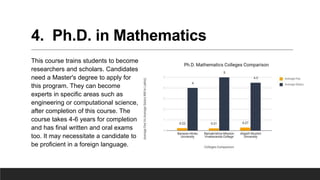
4. Ph.D. in Mathematics
This course trains students to become
researchers and scholars. Candidates
need a Master's degree to apply for
this program. They can become
experts in specific areas such as
engineering or computational science,
after completion of this course. The
course takes 4-6 years for completion
and has final written and oral exams
too. It may necessitate a candidate to
be proficient in a foreign language.
Depending on their educational goals, aspirants can
choose any of the available specializations, which have
been enlisted below:
•Pure Mathematics
•Applied Mathematics
•Computational
Mathematics
•Algebra and Number
Theory
•Topology and Foundations
•Geometric Analysis
•Analysis
•Probability and Statistics
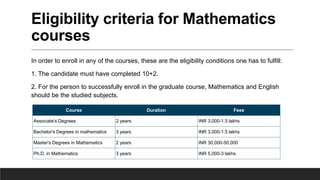
Eligibility criteria for Mathematics
courses
In order to enroll in any of the courses, these are the eligibility conditions one has to fulfill:
1. The candidate must have completed 10+2.
2. For the person to successfully enroll in the graduate course, Mathematics and English
should be the studied subjects.
Course Duration Fees
Associate's Degrees 2 years INR 3,000-1.5 lakhs
Bachelor's Degrees in mathematics 3 years INR 3,000-1.5 lakhs
Master's Degrees in Mathematics 2 years INR 30,000-50,000
Ph.D. in Mathematics 3 years INR 5,000-3 lakhs
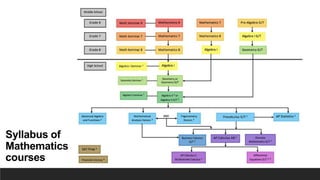
Syllabus of
Mathematics
courses
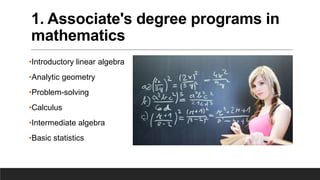
1. Associate's degree programs in
mathematics
•Introductory linear algebra
•Analytic geometry
•Problem-solving
•Calculus
•Intermediate algebra
•Basic statistics
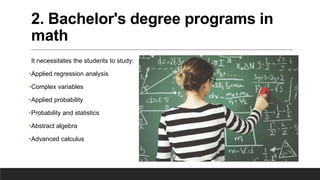
2. Bachelor's degree programs in
math
It necessitates the students to study:
•Applied regression analysis
•Complex variables
•Applied probability
•Probability and statistics
•Abstract algebra
•Advanced calculus
3. Master degree program in
mathematics
•Categorical data analysis
•Coding theories
•Graph theory
•Symbolic algebra
•Algorithms
•Real and complex analysis
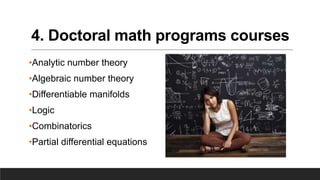
4. Doctoral math programs courses
•Analytic number theory
•Algebraic number theory
•Differentiable manifolds
•Logic
•Combinatorics
•Partial differential equations
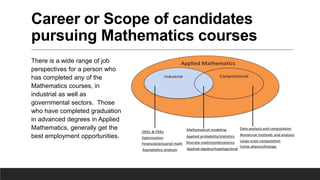
Career or Scope of candidates
pursuing Mathematics courses
There is a wide range of job
perspectives for a person who
has completed any of the
Mathematics courses, in
industrial as well as
governmental sectors. Those
who have completed graduation
in advanced degrees in Applied
Mathematics, generally get the
best employment opportunities.
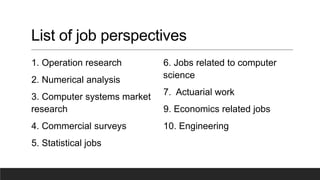
List of job perspectives
1. Operation research
2. Numerical analysis
3. Computer systems market
research
4. Commercial surveys
5. Statistical jobs
6. Jobs related to computer
science
7. Actuarial work
9. Economics related jobs
10. Engineering
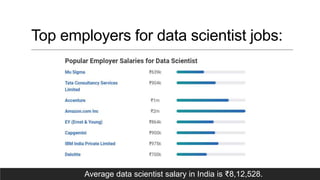
Top employers for data scientist jobs:
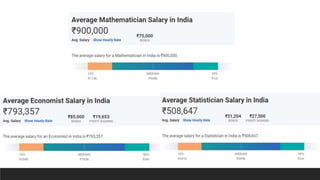
Average data scientist salary in India is ₹8,12,528.
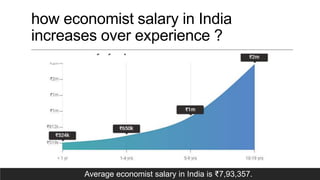
how economist salary in India
increases over experience ?
Average economist salary in India is ₹7,93,357.
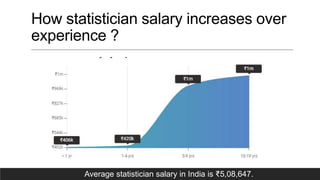
How statistician salary increases over
experience ?
Average statistician salary in India is ₹5,08,647.
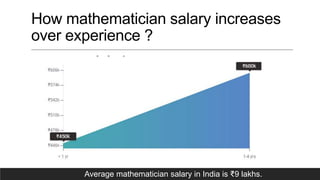
How mathematician salary increases
over experience ?
Average mathematician salary in India is ₹9 lakhs.
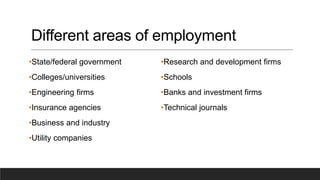
Different areas of employment
•State/federal government
•Colleges/universities
•Engineering firms
•Insurance agencies
•Business and industry
•Utility companies
•Research and development firms
•Schools
•Banks and investment firms
•Technical journals
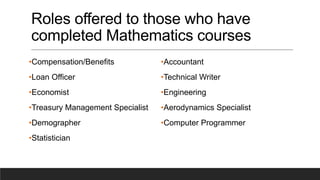
Roles offered to those who have
completed Mathematics courses
•Compensation/Benefits
•Loan Officer
•Economist
•Treasury Management Specialist
•Demographer
•Statistician
•Accountant
•Technical Writer
•Engineering
•Aerodynamics Specialist
•Computer Programmer
Considering the roles based on the specific degree of
mathematics, the classification is stated below:
1. Those in the associate's degree programs opt for basic and intermediate mathematics courses. They
get to work as bookkeepers, surveyors or research assistants.
2. Those opting for Bachelor's degree courses in mathematics become math teachers. They are
generally employed in teaching fields.
3. Those in a graduate-level degree in the subject can start their careers as actuaries, financial analysts
or researchers.
4. Candidates who intend to conduct research or teach students, opt for the master's as well as the
Ph.D. programs in mathematics. For example, those pursuing the master's programs opt for the
advanced courses to become mathematics teachers in schools or community college among various
other positions in industry and research.
5. For independent research work in advanced mathematical theory, Ph.D. programs in mathematics
with computer science specialization is the best option.
Career talk in Mathematics

Career talk in Mathematics

  • 1.
  • 3.
    How SURVEY helpsyou to choose your career plans HOW DO YOU FEEL when people ask you about your career plans? Do you feel confident, worried, ready for the future, or not-so-ready? DID YOU KNOW that many successful adults did not know when they were in high school that they would be in their current careers? Of course, many people chose a career path early on, studied for a particular career, and have enjoyed that career path all along. But for many people, careers evolve over time, as one career opportunity leads to another, and as they continually learn new skills and build their careers.
  • 4.
    What is Mathematics? Mathematicsis a vital academic discipline that forms an indispensable tool in different fields such as natural science, engineering, psychology and medicine, and economics. The mathematics courses make the aspirants capable enough to associate with the administrators such that they not only provide efficient leadership, but also create a vision for the dynamic program of mathematics.
  • 5.
    1. Associate's Degrees The2-year colleges offer this. In order to enroll in this course, a candidate must have a high school diploma or GED. It has a combination of general education with math courses. After completion, the students will receive an Associate of Arts or Associate of Science degree.
  • 6.
    2. Bachelor's Degrees Studentsopting for it receive a Bachelor of Arts or a Bachelor of Science degree in mathematics. They need to have a high school diploma or GED to get enrolled in this course. This course makes them capable to teach math in grades K-12.
  • 7.
    3. Master's Degrees Thisprogram is suitable for those candidates who want to teach the subject in a 2-year or 4-year college/university. Even high school maths teachers can opt for it to enhance their credentials and expertise in the subject. They need a bachelor's degree for admission to this course. Candidates who intend for advanced training in the subject or wish to have a Ph.D. later, can opt for a Master of Science degree in Mathematics, which requires 2 years for completion.
  • 8.
    4. Ph.D. inMathematics This course trains students to become researchers and scholars. Candidates need a Master's degree to apply for this program. They can become experts in specific areas such as engineering or computational science, after completion of this course. The course takes 4-6 years for completion and has final written and oral exams too. It may necessitate a candidate to be proficient in a foreign language.
  • 9.
    Depending on theireducational goals, aspirants can choose any of the available specializations, which have been enlisted below: •Pure Mathematics •Applied Mathematics •Computational Mathematics •Algebra and Number Theory •Topology and Foundations •Geometric Analysis •Analysis •Probability and Statistics
  • 10.
    Eligibility criteria forMathematics courses In order to enroll in any of the courses, these are the eligibility conditions one has to fulfill: 1. The candidate must have completed 10+2. 2. For the person to successfully enroll in the graduate course, Mathematics and English should be the studied subjects. Course Duration Fees Associate's Degrees 2 years INR 3,000-1.5 lakhs Bachelor's Degrees in mathematics 3 years INR 3,000-1.5 lakhs Master's Degrees in Mathematics 2 years INR 30,000-50,000 Ph.D. in Mathematics 3 years INR 5,000-3 lakhs
  • 11.
  • 12.
    1. Associate's degreeprograms in mathematics •Introductory linear algebra •Analytic geometry •Problem-solving •Calculus •Intermediate algebra •Basic statistics
  • 13.
    2. Bachelor's degreeprograms in math It necessitates the students to study: •Applied regression analysis •Complex variables •Applied probability •Probability and statistics •Abstract algebra •Advanced calculus
  • 14.
    3. Master degreeprogram in mathematics •Categorical data analysis •Coding theories •Graph theory •Symbolic algebra •Algorithms •Real and complex analysis
  • 15.
    4. Doctoral mathprograms courses •Analytic number theory •Algebraic number theory •Differentiable manifolds •Logic •Combinatorics •Partial differential equations
  • 16.
    Career or Scopeof candidates pursuing Mathematics courses There is a wide range of job perspectives for a person who has completed any of the Mathematics courses, in industrial as well as governmental sectors. Those who have completed graduation in advanced degrees in Applied Mathematics, generally get the best employment opportunities.
  • 17.
    List of jobperspectives 1. Operation research 2. Numerical analysis 3. Computer systems market research 4. Commercial surveys 5. Statistical jobs 6. Jobs related to computer science 7. Actuarial work 9. Economics related jobs 10. Engineering
  • 18.
    Top employers fordata scientist jobs: Average data scientist salary in India is ₹8,12,528.
  • 19.
    how economist salaryin India increases over experience ? Average economist salary in India is ₹7,93,357.
  • 20.
    How statistician salaryincreases over experience ? Average statistician salary in India is ₹5,08,647.
  • 21.
    How mathematician salaryincreases over experience ? Average mathematician salary in India is ₹9 lakhs.
  • 23.
    Different areas ofemployment •State/federal government •Colleges/universities •Engineering firms •Insurance agencies •Business and industry •Utility companies •Research and development firms •Schools •Banks and investment firms •Technical journals
  • 24.
    Roles offered tothose who have completed Mathematics courses •Compensation/Benefits •Loan Officer •Economist •Treasury Management Specialist •Demographer •Statistician •Accountant •Technical Writer •Engineering •Aerodynamics Specialist •Computer Programmer
  • 25.
    Considering the rolesbased on the specific degree of mathematics, the classification is stated below: 1. Those in the associate's degree programs opt for basic and intermediate mathematics courses. They get to work as bookkeepers, surveyors or research assistants. 2. Those opting for Bachelor's degree courses in mathematics become math teachers. They are generally employed in teaching fields. 3. Those in a graduate-level degree in the subject can start their careers as actuaries, financial analysts or researchers. 4. Candidates who intend to conduct research or teach students, opt for the master's as well as the Ph.D. programs in mathematics. For example, those pursuing the master's programs opt for the advanced courses to become mathematics teachers in schools or community college among various other positions in industry and research. 5. For independent research work in advanced mathematical theory, Ph.D. programs in mathematics with computer science specialization is the best option.