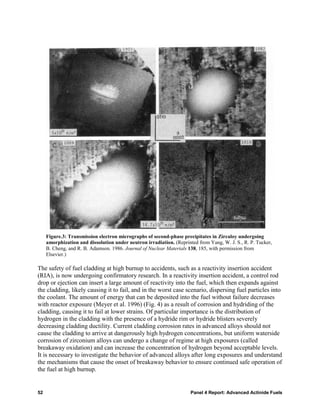
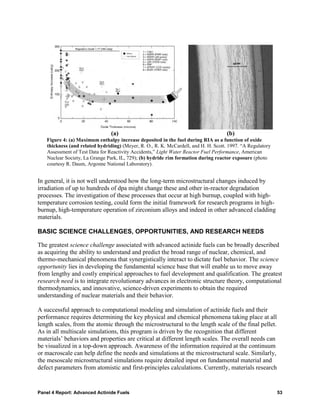
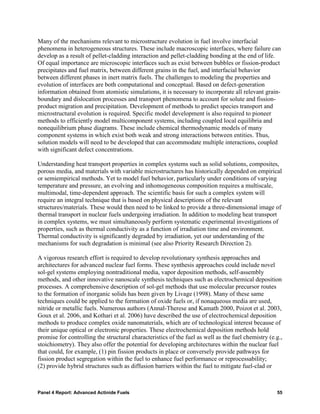
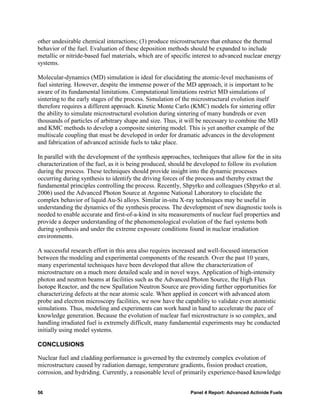
On the cover:

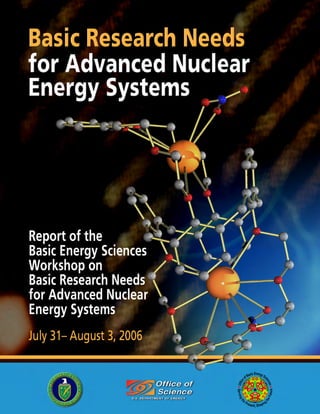
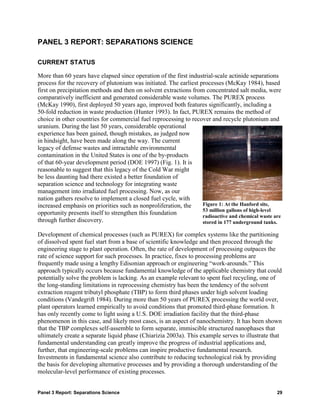
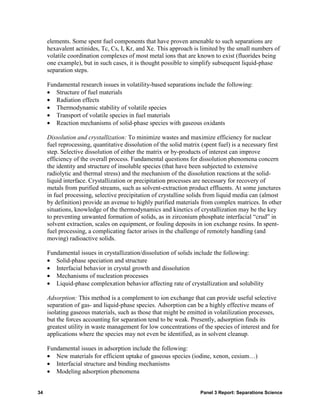
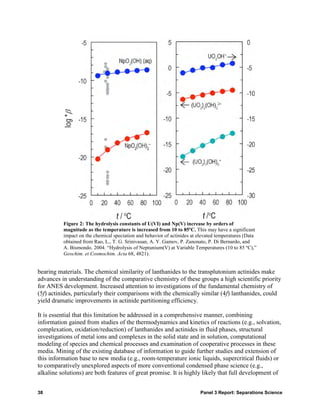
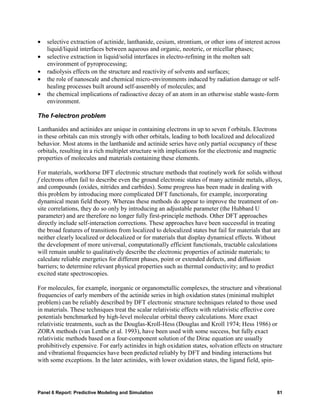
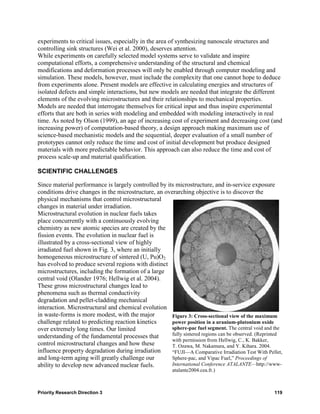
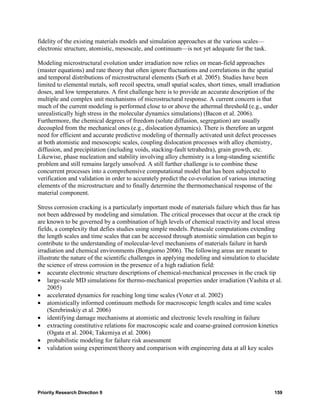
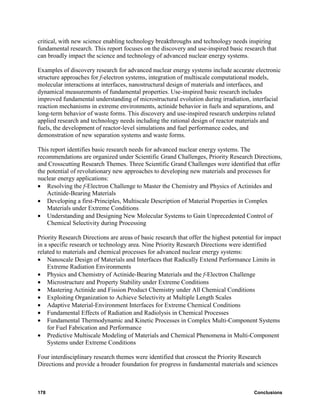
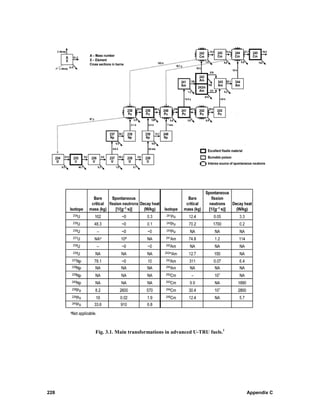
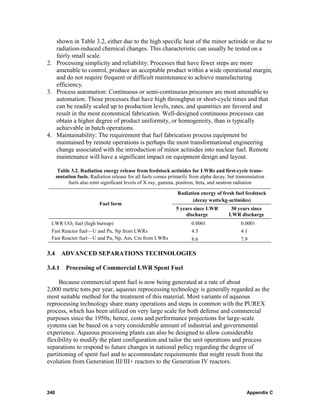
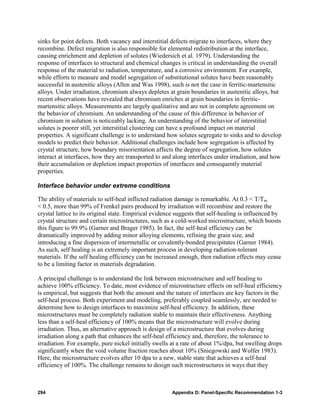
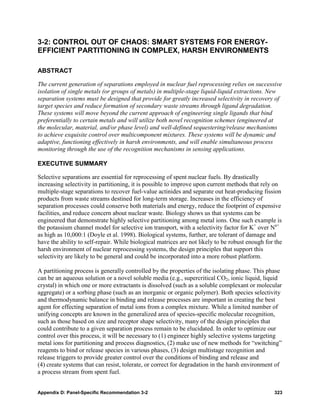
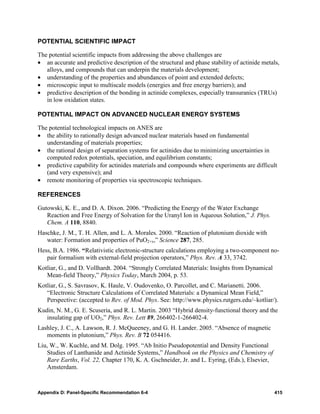
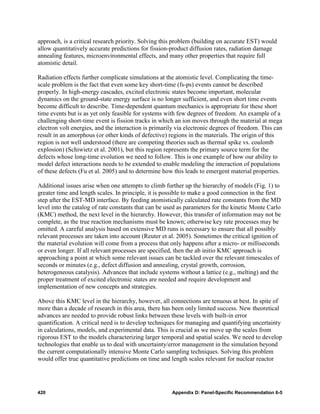
The cover depicts two cesium ions (orange) bound inside a molecule that belongs to the
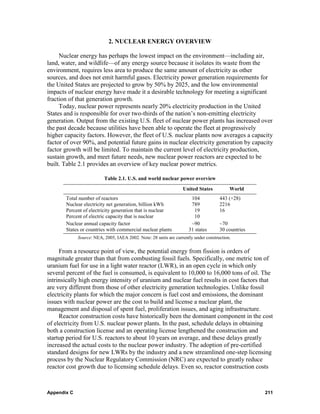
calixarene-crown ethers family. These calixarenes are capable of selectively separating more
than 99.9975% of the cesium ions from million-fold-higher concentrations of other ions. By
studying how such molecules function as extractants, scientists have developed a process*
employing a derivative of the cover molecule that is the basis of the Salt Waste Processing
Facility being built at the Savannah River Site to remove trace amounts of cesium and other
radionuclides from waste left over from reprocessing spent fuel.

The graphic is based on an experimentally determined structure† and shows nitrogen atoms in
blue, oxygen atoms in red, and carbon ions in gray. The hydrogen atoms bound to each carbon
are not shown.
_______________
    *
      Moyer, B. A., J. F. Birdwell, Jr., P. V. Bonnesen, and L. H. Delmau. 2005. “Use of Macrocycles in Nuclear-
Waste Cleanup: A Real-World Application of a Calixcrown in Technology for the Separation of Cesium,” pp. 383–
405 in Macrocyclic Chemistry—Current Trends and Future, ed. K. Gloe, Springer, Dordrecht.
    †
    Thuery, P., M. Nierlich, C. Bressot, V. Lamare, J.-F. Dozol, Z. Asfari, and J. Vicens. 1995. “Crystal and
molecular structures of binuclear cesium complexes with 1,3-calix[4]-bis-crown-6 and 1,3-calix[4]-bis-benzo-
crown-6,” Journal of Inclusion Phenomena and Molecular Recognition in Chemistry 23(4), 305–312.
BASIC RESEARCH NEEDS FOR ADVANCED NUCLEAR ENERGY SYSTEMS

    Report of the Basic Energy Sciences Workshop on Basic Research Needs
                    for Advanced Nuclear Energy Systems

                                           Cochairs
                          Jim Roberto, Oak Ridge National Laboratory
                 Tomas Diaz de la Rubia, Lawrence Livermore National Laboratory

                                            Panel leads
                               Materials under Extreme Conditions
                                Ron Gibala, University of Michigan
                           Steve Zinkle, Oak Ridge National Laboratory
                               Chemistry under Extreme Conditions
                         John R. Miller, Brookhaven National Laboratory
                            Simon Pimblott, University of Notre Dame
                                        Separations Science
                           Carol Burns, Los Alamos National Laboratory
                         Ken Raymond, University of California, Berkeley
                                     Advanced Actinide Fuels
                                Robin Grimes, Imperial College, UK
                        Kemal Pasamehmetoglu, Idaho National Laboratory
                                      Advanced Waste Forms
                              Sue Clark, Washington State University
                              Rodney Ewing, University of Michigan
                                Predictive Modeling and Simulation
                             Al Wagner, Argonne National Laboratory
                        Sidney Yip, Massachusetts Institute of Technology
                                  Crosscutting Research Themes
                        Michelle Buchanan, Oak Ridge National Laboratory
                          George Crabtree, Argonne National Laboratory
                         John Hemminger, University of California, Irvine
                               John Poate, Colorado School of Mines

                                             BES lead
                               John C. Miller, Basic Energy Sciences
                                    U.S. Department of Energy

                                            Technical
                      Norm Edelstein, Lawrence Berkeley National Laboratory
                             Tim Fitzsimmons, Department of Energy
                          Greg Gruzalski, Oak Ridge National Laboratory
                         Gordon Michaels, Oak Ridge National Laboratory
                               Lester Morss, Department of Energy
                            Mark Peters, Argonne National Laboratory

                                        Administrative
                Karen Talamini, Basic Energy Sciences, U.S. Department of Energy

  Note: This report is available on the web at http://www.sc.doe.gov/bes/reports/files/ANES_rpt.pdf

                                 Office of Basic Energy Sciences
                                  U.S. Department of Energy
                                          October 2006
CONTENTS

ACRONYMS.........................................................................................................................     v

EXECUTIVE SUMMARY ...................................................................................................               vii

I.    INTRODUCTION ..........................................................................................................         1

II. SCIENTIFIC GRAND CHALLENGES ........................................................................                              3

III. REPORTS OF THE PANELS
     Panel 1—Materials under Extreme Conditions ..............................................................                        9
     Panel 2—Chemistry under Extreme Conditions.............................................................                         19
     Panel 3—Separations Science ........................................................................................            29
     Panel 4—Advanced Actinide Fuels................................................................................                 45
     Panel 5—Advanced Waste Forms ..................................................................................                 59
     Panel 6—Predictive Modeling and Simulation ..............................................................                       75

IV. PRIORITY RESEARCH DIRECTIONS
    PRD 1— Nanoscale Design of Materials and Interfaces that Radically
       Extend Performance Limits in Extreme Radiation Environments ...........................                                       97
    PRD 2—Physics and Chemistry of Actinide-Bearing Materials and the
       f-Electron Challenge .................................................................................................       105
    PRD 3—Microstructure and Property Stability under Extreme Conditions ..................                                         113
    PRD 4—Mastering Actinide and Fission Product Chemistry under
       All Chemical Conditions ..........................................................................................           123
    PRD 5—Exploiting Organization to Achieve Selectivity at Multiple
       Length Scales............................................................................................................    129
    PRD 6—Adaptive Material-Environment Interfaces for Extreme
       Chemical Conditions ................................................................................................         139
    PRD 7—Fundamental Effects of Radiation and Radiolysis in Chemical Processes......                                               145
    PRD 8—Fundamental Thermodynamic and Kinetic Processes in Complex
       Multi-Component Systems for Fuel Fabrication and Performance..........................                                       151
    PRD 9—Predictive Multiscale Modeling of Materials and Chemical
       Phenomena in Multi-Component Systems under Extreme Conditions ....................                                           157

V. CROSSCUTTING RESEARCH THEMES ...................................................................                                 167

VI. CONCLUSIONS ............................................................................................................        175

APPENDIX A: WORKSHOP PROGRAM ..........................................................................                             181

APPENDIX B: LIST OF ATTENDEES ...............................................................................                       187

APPENDIX C: TECHNOLOGY PERSPECTIVES RESOURCE DOCUMENT................                                                               199


                                                                    iii
APPENDIX D: PANEL-SPECIFIC RESEARCH RECOMMENDATIONS.......................                                                     277
   Panel 1—Materials under Extreme Conditions
     1-1—Unlocking the Physical Mechanisms That Control Material Performance
         Limits in Extreme Temperature and Irradiation Environments...........................                                 279
     1-2—Changing the Paradigm for Materials Discovery by Seamless
         Integration of Experiments and Modeling ...........................................................                   285
     1-3—Interface Design for Enhanced Materials Performance....................................                               293
   Panel 2—Chemistry under Extreme Conditions
     2-1—Adaptive Material-Environment Interfaces for Extreme
         Chemical Conditions............................................................................................       301
     2-2—Nuclear Fuel Reprocessing under Extreme Conditions....................................                                307
     2-3—Trace Impurities in Radiation Environments....................................................                        313
   Panel 3—Separations Science
     3-1—Mastering Actinide and Fission Product Chemistry.........................................                             317
     3-2—Control Out of Chaos: Smart Systems for Energy-Efficient
         Partitioning in Complex, Harsh Environments....................................................                       323
     3-3—Exploiting Organization at Multiple Length Scales .........................................                           329
     3-4—Out of the Aqueous Box: Separations for 2040................................................                          335
   Panel 4—Advanced Actinide Fuels
     4-1—Towards a Fundamental Understanding of the Properties of
         Actinide-Bearing Materials..................................................................................          341
     4-2—Outstanding Fuel Performance Through a Fundamental
         Understanding of Microstructure Evolution ........................................................                    345
     4-3—Fundamental Thermodynamic and Kinetic Processes
         in Complex Multi-Component Systems for Fuel Fabrication .............................                                 351
     4-4—Revolutionary Synthesis Approaches and Architectures for
         Advanced Fuel Forms ..........................................................................................        357
     4-5—Sharpening our Scalpel—Innovative In Situ Experimental
         Methodologies to Measure Critical Properties in Fuel ........................................                         361
   Panel 5—Advanced Waste Forms
     5-1—Envisioning and Designing New Materials for Specific
         Waste Streams......................................................................................................   365
     5-2—Long-Term Behavior in the Near-Field Environment......................................                                371
     5-3—Interfacial Phenomena in Waste Form Systems: In Situ Studies
         of Dynamic Behavior...........................................................................................        377
     5-4—Radiation and Radiolysis Effects......................................................................                381
   Panel 6—Predictive Modeling and Simulation
     6-1—Modeling Microstructure Evolution and Materials Properties in
         Severe Environments ...........................................................................................       391
     6-2—Predictive Simulations of Material Failure in Harsh Chemical
         and Radiation Environments................................................................................            397
     6-3—The Challenge of Solutions and Interfaces.......................................................                      403
     6-4—The f-Electron Challenge..................................................................................            411
     6-5—Critical Theoretical and Algorithmic Developments for
         Advanced Nuclear Energy Systems Processes and Materials .............................                                 417


                                                                  iv
ACRONYMS

AES        Auger electron spectroscopy
AFCI       Advanced Fuel Cycle Initiative
AFM        atomic force microscopy
ANES       advanced nuclear energy systems
ASME       American Society of Mechanical Engineers
BES        Basic Energy Sciences
BCC        body centered cubic
BWR        boiling water reactor
CRIEPI     Central Research Institute of Electric Power Industry
CSSX       caustic side solvent extraction
DBTT       ductile-brittle transition temperature
DFT        density functional theory
DMFT       dynamic mean field theory
DOE        U.S. Department of Energy
DOE-EM     Office of Environmental Management
dpa        displacements per atom
EBR        experimental breeder reactor
ECP        electrochemical corrosion potential
ESEM       environmental scanning electron microscopy
ESR        electron spin resonance
EST        electronic structure theory
EXAFS      extended X-ray absorption fine structure
FCC        face centered cubic
FEG-ESEM   field emission gun-environmental scanning electron microscopy
FLEX       fluctuation exchange
GCM        glass composite materials
GEN-IV     Generation-IV
GGA        generalized gradient approximation
GNEP       Global Nuclear Energy Partnership
HEU        highly enriched uranium
HEXS       high-energy X-ray scattering
HLW        high-level waste
IFR        Integral Fast Reactor
IGSCC      intergranular stress corrosion cracking
IMF        inert matrix fuels
IR         infrared
JAERI      Japan Atomic Energy Research Institute
KMC        kinetic Monte Carlo
LDA        local-density approximation
LEED       low-energy electron diffraction
LET        linear energy transfer
LSD        local spin density
LWR        light water reactor
LSW        Lifshitz-Sloyozov-Wagner
MEMS       microelectromechanical systems


                                       v
MA       minor actinides
MD       molecular dynamics
MO       molecular orbital
MOX      mixed oxide
NFA      nanostructured ferritic alloy
NMR      nuclear magnetic resonance
ODS      oxide dispersion strengthened
PCS      power conversion system
PIEs     post-irradiation examinations
PIRTs    Phenomena Identification and Ranking Tables
QM       quantum mechanical
QMC      quantum Monte Carlo
R&D      research and development
RBS      Rutherford backscattering
RIA      reactivity insertion accident
RTILs    room-temperature ionic liquids
SANS     small-angle neutron scattering
SCC      stress corrosion cracking
SEXAFS   surface-extended X-ray absorption fine-structure spectroscopy
SIC      self-interaction corrected
SIMS     secondary ion mass spectroscopy
SNF      spent nuclear fuel
SRIM     stopping and range of ions in matter
STEM     scanning transmission electron microscope
STM      scanning tunneling microscopy
TBP      tri-n-butyl phosphate
TD-DFT   time dependent-density functional theory
TEM      transmission electron microscopy
TRU      transuranic
UV       ultraviolet
VHTR     Very High Temperature Reactor
VLS      vapor-liquid-solid
XPS      X-ray photoelectron spectroscopy


                                      vi
EXECUTIVE SUMMARY

INTRODUCTION

The global utilization of nuclear energy has come a long way from its humble beginnings in the
first sustained nuclear reaction at the University of Chicago in 1942. Today, there are over
440 nuclear reactors in 31 countries producing approximately 16% of the electrical energy used
worldwide. In the United States, 104 nuclear reactors currently provide 19% of electrical energy
used nationally. The International Atomic Energy Agency projects significant growth in the
utilization of nuclear power over the next several decades due to increasing demand for energy
and environmental concerns related to emissions from fossil plants. There are 28 new nuclear
plants currently under construction including 10 in China, 8 in India, and 4 in Russia. In the
United States, there have been notifications to the Nuclear Regulatory Commission of intentions
to apply for combined construction and operating licenses for 27 new units over the next decade.

The projected growth in nuclear power has focused increasing attention on issues related to the
permanent disposal of nuclear waste, the proliferation of nuclear weapons technologies and
materials, and the sustainability of a once-through nuclear fuel cycle. In addition, the effective
utilization of nuclear power will require continued improvements in nuclear technology,
particularly related to safety and efficiency. In all of these areas, the performance of materials
and chemical processes under extreme conditions is a limiting factor. The related basic research
challenges represent some of the most demanding tests of our fundamental understanding of
materials science and chemistry, and they provide significant opportunities for advancing basic
science with broad impacts for nuclear reactor materials, fuels, waste forms, and separations
techniques. Of particular importance is the role that new nanoscale characterization and
computational tools can play in addressing these challenges. These tools, which include DOE
synchrotron X-ray sources, neutron sources, nanoscale science research centers, and
supercomputers, offer the opportunity to transform and accelerate the fundamental materials and
chemical sciences that underpin technology development for advanced nuclear energy systems.

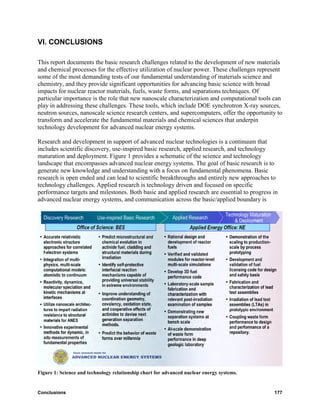
The fundamental challenge is to understand and control chemical and physical phenomena in
multi-component systems from femto-seconds to millennia, at temperatures to 1000ºC, and for
radiation doses to hundreds of displacements per atom (dpa). This is a scientific challenge of
enormous proportions, with broad implications in the materials science and chemistry of
complex systems. New understanding is required for microstructural evolution and phase
stability under relevant chemical and physical conditions, chemistry and structural evolution at
interfaces, chemical behavior of actinide and fission-product solutions, and nuclear and thermo-
mechanical phenomena in fuels and waste forms. First-principles approaches are needed to
describe f-electron systems, design molecules for separations, and explain materials failure
mechanisms. Nanoscale synthesis and characterization methods are needed to understand and
design materials and interfaces with radiation, temperature, and corrosion resistance. Dynamical
measurements are required to understand fundamental physical and chemical phenomena. New
multiscale approaches are needed to integrate this knowledge into accurate models of relevant
phenomena and complex systems across multiple length and time scales.


Executive Summary                                                                               vii
WORKSHOP

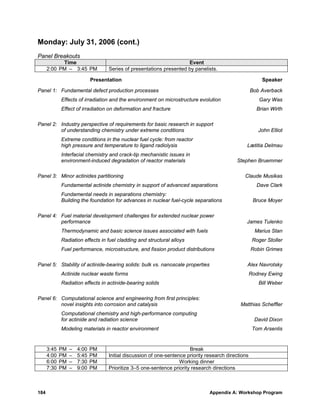
The Department of Energy (DOE) Workshop on Basic Research Needs for Advanced Nuclear
Energy Systems was convened in July 2006 to identify new, emerging, and scientifically
challenging areas in materials and chemical sciences that have the potential for significant
impact on advanced nuclear energy systems. Sponsored by the DOE Office of Basic Energy
Sciences (BES), the workshop provided recommendations for priority research directions and
crosscutting research themes that underpin the development of advanced materials, fuels, waste
forms, and separations technologies for the effective utilization of nuclear power. A total of
235 invited experts from 31 universities, 11 national laboratories, 6 industries, 3 government
agencies, and 11 foreign countries attended the workshop.

The workshop was the sixth in a series of BES workshops focused on identifying basic research
needs to overcome short-term showstoppers and to formulate long-term grand challenges related
to energy technologies. These workshops have followed a common format that includes the
development of a technology perspectives resource document prior to the workshop, a plenary
session including invited presentations from technology and research experts, and topical panels
to determine basic research needs and recommended research directions. Reports from the
workshops are available on the BES website at http://www.sc.doe.gov/bes/reports/list.html.

The workshop began with a plenary session of invited presentations from national and
international experts on science and technology related to nuclear energy. The presentations
included nuclear technology, industry, and international perspectives, and an overview of the
Global Nuclear Energy Partnership. Frontier research presentations were given on relevant topics
in materials science, chemistry, and computer simulation. Following the plenary session, the
workshop divided into six panels: Materials under Extreme Conditions, Chemistry under
Extreme Conditions, Separations Science, Advanced Actinide Fuels, Advanced Waste Forms,
and Predictive Modeling and Simulation. In addition, there was a crosscut panel that looked for
areas of synergy across the six topical panels. The panels were composed of basic research
leaders in the relevant fields from universities, national laboratories, and other institutions. In
advance of the workshop, panelists were provided with a technology perspectives resource
document that described the technology and applied R&D needs for advanced nuclear energy
systems. In addition, technology experts were assigned to each of the panels to ensure that the
basic research discussions were informed by a current understanding of technology issues.

The panels were charged with defining the state of the art in their topical research area,
describing the related basic research challenges that must be overcome to provide breakthrough
technology opportunities, and recommending basic research directions to address these
challenges. These basic research challenges and recommended research directions were
consolidated into Scientific Grand Challenges, Priority Research Directions, and Crosscutting
Research Themes. These results are summarized below and described in detail in the full report.

SCIENTIFIC GRAND CHALLENGES

Scientific Grand Challenges represent barriers to fundamental understanding that, if overcome,
could transform the related scientific field. Historical examples of scientific grand challenges


viii                                                                             Executive Summary
with far-reaching scientific and technological impacts include the structure of DNA, the
understanding of quantum behavior, and the explanation of nuclear fission. Theoretical
breakthroughs and new experimental capabilities are often key to addressing these challenges. In
advanced nuclear energy systems, scientific grand challenges focus on the fundamental materials
and chemical sciences that underpin the performance of materials and processes under extreme
conditions of radiation, temperature, and corrosive environments. Addressing these challenges
offers the potential of revolutionary new approaches to developing improved materials and
processes for nuclear applications. The workshop identified the following three Scientific Grand
Challenges.

Resolving the f-electron challenge to master the chemistry and physics of actinides and actinide-
bearing materials. The introduction of new actinide-based fuels for advanced nuclear energy
systems requires new chemical separations strategies and predictive understanding of fuel and
waste-form fabrication and performance. However, current computational electronic-structure
approaches are inadequate to describe the electronic behavior of actinide materials, and the
multiplicity of chemical forms and oxidation states for these elements complicates their behavior
in fuels, solutions, and waste forms. Advances in density functional theory as well as in the
treatment of relativistic effects are needed in order to understand and predict the behavior of
these strongly correlated electron systems.

Developing a first-principles, multiscale description of material properties in complex materials
under extreme conditions. The long-term stability and mechanical integrity of structural
materials, fuels, claddings, and waste forms are governed by the kinetics of microstructure and
interface evolution under the combined influence of radiation, high temperature, and stress.
Controlling the mechanical and chemical properties of materials under these extreme conditions
will require the ability to relate phase stability and mechanical behavior to a first-principles
understanding of defect production, diffusion, trapping, and interaction. New synthesis
techniques based on the nanoscale design of materials offer opportunities for mitigating the
effects of radiation damage through the development and control of nanostructured defect sinks.
However, a unified, predictive multiscale theory that couples all relevant time and length scales
in microstructure evolution and phase stability must be developed. In addition, fundamental
advances are needed in nanoscale characterization, diffusion, thermodynamics, and in situ
studies of fracture and deformation.

Understanding and designing new molecular systems to gain unprecedented control of chemical
selectivity during processing. Advanced separations technologies for nuclear fuel reprocessing
will require unprecedented control of chemical selectivity in complex environments. This control
requires the ability to design, synthesize, characterize, and simulate molecular systems that
selectively trap and release target molecules and ions with high efficiency under extreme
conditions and to understand how mesoscale phenomena such as nanophase behavior and
energetics in macromolecular systems impact partitioning. New capabilities in molecular
spectroscopy, imaging, and computational modeling offer opportunities for breakthroughs in this
area.


Executive Summary                                                                               ix
PRIORITY RESEARCH DIRECTIONS

Priority Research Directions are areas of basic research that have the highest potential for impact
in a specific research or technology area. They represent opportunities that align with scientific
grand challenges, emerging research opportunities, and related technology priorities. The
workshop identified nine Priority Research Directions for basic research related to advanced
nuclear energy systems.

Nanoscale design of materials and interfaces that radically extend performance limits in extreme
radiation environments. The fundamental understanding of the interaction of defects with
nanostructures offers the potential for the design of materials and interfaces that mitigate
radiation damage by controlling defect behavior. New research is needed in the design, synthesis,
nanoscale characterization, and time-resolved study of nanostructured materials and interfaces
that offer the potential to control defect production, trapping, and interaction under extreme
conditions.

Physics and chemistry of actinide-bearing materials and the f-electron challenge. A robust
theory of the electronic structure of actinides will provide an improved understanding of their
physical and chemical properties and behavior, leading to opportunities for advances in fuels and
waste forms. New advances in exchange and correlation functionals in density functional theory
as well as in the treatment of relativistic effects and in software implementation on advanced
computer architectures are needed to overcome the challenges of adequately treating the
behavior of 4f and 5f electrons, namely, strong correlation, spin-orbit coupling, and multiplet
complexity, as well as additional relativistic effects. Advances are needed in the application of
these new electronic structure methods for f-element-containing molecules and solids to calculate
the properties of defects in multi-component systems, and in the fundamental understanding of
related chemical and physical properties at high temperature.

Microstructure and property stability under extreme conditions. The predictive understanding of
microstructural evolution and property changes under extreme conditions is essential for the
rational design of materials for structural, fuels, and waste-form applications. Advances are
needed to develop a first-principles understanding of the relationship of defect properties and
microstructural evolution to mechanical behavior and phase stability. This will require a closely
coupled approach of in situ studies of nanoscale and mechanical behavior with multiscale theory.

Mastering actinide and fission product chemistry under all chemical conditions. A more accurate
understanding of the electronic structure of the complexes of actinide and fission products will
expand our ability to predict their behavior quantitatively under conditions relevant to all stages
in fuel reprocessing (separations, dissolution, and stabilization of waste forms) and in new media
that are proposed for advanced processing systems. This knowledge must be supplemented by
accurate prediction and manipulation of solvent properties and chemical reactivities in non-
traditional separation systems such as modern “tunable” solvent systems. This will require
quantitative, fundamental understanding of the mechanisms of solvent tunability, the factors
limiting control over solvent properties, the forces driving chemical speciation, and modes of
controlling reactions. Basic research needs include f-element electronic structure and bonding,
speciation and reactivity, thermodynamics, and solution behavior.


x                                                                                Executive Summary
Exploiting organization to achieve selectivity at multiple length scales. Harnessing the
complexity of organization that occurs at the mesoscale in solution or at interfaces will lead to
new separation systems that provide for greatly increased selectivity in the recovery of target
species and reduced formation of secondary waste streams through ligand degradation. Research
directions include design of ligands and other selectivity agents, expanding the range of
selection/release mechanisms, fundamental understanding of phase phenomena and self-
assembly in separations, and separations systems employing aqueous solvents.

Adaptive material-environment interfaces for extreme chemical conditions. Chemistry at
interfaces will play a crucial role in the fabrication, performance, and stability of materials in
almost every aspect of Advanced Nuclear Energy Systems, from fuel, claddings, and pressure
vessels in reactors to fuel reprocessing and separations, and ultimately to long-term waste
storage. Revolutionary advances in the understanding of interfacial chemistry of materials
through developments in new modeling and in situ experimental techniques offer the ability to
design material interfaces capable of providing dynamic, universal stability over a wide range of
conditions and with much greater “self-healing” capabilities. Achieving the necessary scientific
advances will require moving beyond interfacial chemistry in ultra-high-vacuum environments to
the development of in situ techniques for monitoring the chemistry at fluid/solid and solid/solid
interfaces under conditions of high pressure and temperature and harsh chemical environments.

Fundamental effects of radiation and radiolysis in chemical processes. The reprocessing of
nuclear fuel and the storage of nuclear waste present environments that include substantial
radiation fields. A predictive understanding of the chemical processes resulting from intense
radiation, high temperatures, and extremes of acidity and redox potential on chemical speciation
is required to enhance efficient, targeted separations processes and effective storage of nuclear
waste. In particular, the effect of radiation on the chemistries of ligands, ionic liquids, polymers,
and molten salts is poorly understood. There is a need for an improved understanding of the
fundamental processes that affect the formation of radicals and ultimately control the
accumulation of radiation-induced damage to separation systems and waste forms.

Fundamental thermodynamics and kinetic processes in multi-component systems for fuel
fabrication and performance. The fabrication and performance of advanced nuclear fuels,
particularly those containing the minor actinides, is a significant challenge that requires a
fundamental understanding of the thermodynamics, transport, and chemical behavior of complex
materials during processing and irradiation. Global thermochemical models of complex phases
that are informed by ab initio calculations of materials properties and high-throughput predictive
models of complex transport and phase segregation will be required for full fuel fabrication and
performance calculations. These models, when coupled with appropriate experimental efforts,
will lead to significantly improved fuel performance by creating novel tailored fuel forms.

Predictive multiscale modeling of materials and chemical phenomena in multi-component
systems under extreme conditions. The advent of large-scale (petaflop) simulations will
significantly enhance the prospect of probing important molecular-level mechanisms underlying
the macroscopic phenomena of solution and interfacial chemistry in actinide-bearing systems
and of materials and fuels fabrication, performance, and failure under extreme conditions. There
is an urgent need to develop multiscale algorithms capable of efficiently treating systems whose


Executive Summary                                                                                   xi
time evolution is controlled by activated processes and rare events. Although satisfactory
solutions are lacking, there are promising directions, including accelerated molecular dynamics
(MD) and adaptive kinetic Monte Carlo methods, which should be pursued. Many fundamental
problems in advanced nuclear energy systems will benefit from multi-physics, multiscale
simulation methods that can span time scales from picoseconds to seconds and longer, including
fission product transport in nuclear fuels, the evolution of microstructure of irradiated materials,
the migration of radionuclides in nuclear waste forms, and the behavior of complex separations
media.

CROSSCUTTING RESEARCH THEMES

Crosscutting Research Themes are research directions that transcend a specific research area or
discipline, providing a foundation for progress in fundamental science on a broad front. These
themes are typically interdisciplinary, leveraging results from multiple fields and approaches to
provide new insights and underpinning understanding. Many of the fundamental science issues
related to materials, fuels, waste forms, and separations technologies have crosscutting themes
and synergies. The workshop identified four crosscutting basic research themes related to
materials and chemical processes for advanced nuclear energy systems:

Tailored nanostructures for radiation-resistant functional and structural materials. There is
evidence that the design and control of specialized nanostructures and defect complexes can
create sinks for radiation-induced defects and impurities, enabling the development of highly
radiation-resistant materials. New capabilities in the synthesis and characterization of materials
with controlled nanoscale structure offer opportunities for the development of tailored
nanostructures for structural applications, fuels, and waste forms. This approach crosscuts
advanced materials synthesis and processing, radiation effects, nanoscale characterization, and
simulation.

Solution and solid-state chemistry of 4f and 5f electron systems. Advances in the basic science of
4f and 5f electron systems in materials and solutions offer the opportunity to extend condensed
matter physics and reaction chemistry on a broad front, including applications that impact the
development of nuclear fuels, waste forms, and separations technologies. This is a key enabling
science for the fundamental understanding of actinide-bearing materials and solutions.

Physics and chemistry at interfaces and in confined environments. Controlling the structure and
composition of interfaces is essential to ensuring the long-term stability of reactor materials,
fuels, and waste forms. The fundamental understanding of interface science and related transport
and chemical phenomena in extreme environments crosscuts many science and technology areas.
New computational and nanoscale structure and dynamics measurement tools offer significant
opportunities for advancing interface science with broad impacts on the predictive design of
advanced materials and processes for nuclear energy applications.

Physical and chemical complexity in multi-component systems. Advanced fuels, waste forms,
and separations technologies are highly interactive, multi-component systems. A fundamental
understanding of these complex systems and related structural and phase stability and chemical
reactivity under extreme conditions is needed to develop and predict the performance of


xii                                                                               Executive Summary
materials and separations processes in advanced nuclear energy systems. This is a challenging
problem in complexity with broad implications across science and technology.

Taken together, these Scientific Grand Challenges, Priority Research Directions, and
Crosscutting Research Themes define the landscape for a science-based approach to the
development of materials and chemical processes for advanced nuclear energy systems. Building
upon new experimental tools and computational capabilities, they presage a renaissance in
fundamental science that underpins the development of materials, fuels, waste forms, and
separations technologies for nuclear energy applications. Addressing these basic research needs
offers the potential to revolutionize the science and technology of advanced nuclear energy
systems by enabling new materials, processes, and predictive modeling, with resulting
improvements in performance and reduction in development times. The fundamental research
outlined in this report offers an outstanding opportunity to advance the materials, chemical, and
computational science of complex systems at multiple length and time scales, furthering both
fundamental understanding and the technology of advanced nuclear energy systems.


Executive Summary                                                                               xiii
I. INTRODUCTION

The successful deployment of advanced nuclear energy systems depends critically on the
development of new materials and chemical processes that can meet the demanding performance
requirements of these systems under extreme conditions of radiation, temperature, and corrosive
environments, often operating under nonequilibrium thermodynamic conditions. Significant
improvements are needed in the rational design of advanced structural materials, fuels, waste
forms, and separations technologies for nuclear energy applications. Materials and chemical
process development for nuclear applications have been treated primarily as empirical endeavors,
with limited understanding of the underlying physical and chemical phenomena and limited
predictive capability. As a result, the development of new technology has been costly and time-
consuming, usually requiring decades and often restricted to extrapolation from known systems.

Modern materials and chemical sciences tools offer the opportunity to transform the
development of new materials and chemical processes for nuclear energy applications. These
tools, including powerful X-ray and neutron sources, nanoscale synthesis and characterization
capabilities, ultrafast spectroscopy, and sophisticated computational modeling, have the potential
to probe physical and chemical mechanisms at the molecular scale and develop fundamental
understanding with predictive capability. This new understanding and predictive capability will
enable a science-based approach to the development of new materials and processes, providing
breakthrough opportunities and broadening and accelerating the development cycle. This report
details the basic research needs for implementing this science-based approach for the design and
development of materials and chemical processes for advanced nuclear energy systems.

The current understanding of fundamental materials and chemical phenomena is inadequate to
support the development of the structural materials, fuels, waste forms, and separations
technologies needed for advanced nuclear energy systems. There is limited knowledge of
microstructural evolution, kinetics, thermodynamics, and chemistry under extreme radiation and
high-temperature conditions. Theory and simulation are inadequate to address complex multi-
component systems, and most models are semiempirical with little predictive capability. There is
limited understanding of the behavior of actinides in fuels, and current electronic structure
methods fail for actinide materials. There is also limited understanding of radiolysis and
radiation chemistry in separations, and inadequate understanding of actinides and their
complexes in solutions. The role of interfaces in controlling reactions, transport, and phase
stability is poorly understood, particularly in extreme radiation, temperature, and corrosive
environments. Finally, there is limited capability to connect chemical and physical properties to
the nanoscale where these properties are actually determined, and no robust way to link single-
scale methods into multiscale simulations, or to perform long-term dynamics calculations.

This report summarizes the results and conclusions of the Department of Energy (DOE)
Workshop on Basic Research Needs for Advanced Nuclear Energy Systems, held in Bethesda,
Maryland, July 31–August 3, 2006. The purpose of the workshop was to identify basic research
needs and opportunities with a focus on new, emerging, and scientifically challenging areas that
have the potential for significant impact in science and technology related to advanced nuclear
energy systems. Highlighted basic research areas included the materials, chemical, and
theoretical and computational sciences that underpin the development of advanced materials,


Introduction                                                                                       1
separations technologies, fuels, and waste forms that support the nuclear fuel cycle.
Recommendations were developed for priority research directions targeted at overcoming short-
term showstoppers and long-term grand challenges for the effective utilization of nuclear power.

The workshop was sponsored by the DOE Office of Basic Energy Sciences (BES) and follows
the format of earlier BES workshops, including the overarching “Basic Research Needs to
Ensure a Secure Energy Future” (October 2002) and topical basic research needs workshops on
the hydrogen economy (May 2003), solar energy utilization (April 2005), superconductivity
(May 2006), and solid-state lighting (May 2006). Reports from these and related workshops are
available on the BES Web site at http://www.sc.doe.gov/bes/reports/list.html.

The workshop included 235 invited attendees from 31 universities, 11 national laboratories,
3 government agencies, 6 industries, and 11 foreign countries. The workshop program and
attendee list are provided in Appendices A and B, respectively.

Following a plenary session on technology needs and basic research challenges for advanced
nuclear energy systems, the workshop was divided into the following six topical panels:
Materials under Extreme Conditions, Chemistry under Extreme Conditions, Separations Science,
Advanced Actinide Fuels, Advanced Waste Forms, and Predictive Modeling and Simulation. In
addition, a crosscut panel identified areas of synergy across the six topical panels. Each panel
was composed of research leaders in the relevant field from universities, national laboratories,
and other institutions. One or more technology experts were assigned to each panel to ensure that
the discussions were informed by a current understanding of technology issues. The remaining
participants, including government agency representatives, rotated freely among the panel
sessions as observers. Participants were provided with a technology perspectives resource
document in advance of the workshop describing the technology and applied R&D needs for
advanced nuclear systems. This document is included in Appendix C. The panels were charged
with defining the state of the art in their topical research areas, describing the related basic
research challenges that must be overcome to create breakthrough technology opportunities, and
recommending basic research directions to address these challenges. Each panel presented a
summary of its results in a plenary discussion session at the end of the workshop.

This report was prepared by core writing teams from the seven panels. Consistent with prior BES
basic research needs workshops, the report includes a discussion of science grand challenges
(Section II), detailed reports from each topical panel (Section III), recommended priority
research directions (Section IV), and a discussion of crosscutting research themes (Section V).
The priority research directions were consolidated from 24 panel-specific research
recommendations. These recommendations are provided in Appendix D. The conclusions of the
workshop are summarized in Section VI.


2                                                                                     Introduction
II. SCIENTIFIC GRAND CHALLENGES

The development of future advanced nuclear energy systems will require new materials and
chemical processing techniques that provide structural integrity, phase stability, and process
efficiency under extreme conditions of radiation, temperature, and corrosive environments for
time scales that in some cases extend to many thousands of years. The effective development of
these new materials, fuels, and processes will require revolutionary advances in our fundamental
understanding of the underlying physics and chemistry of materials performance and process
optimization. Specific scientific grand challenges include the following:
• Resolving the f-electron challenge to master the chemistry and physics of actinides and
    actinide-bearing materials.
• Developing a first-principles, multiscale description of material properties in complex
    materials under extreme conditions.
• Understanding and designing new molecular systems to gain unprecedented control of
    chemical selectivity during processing.

Over the last two decades, there have been significant advances in materials and chemical
sciences, particularly related to capabilities for molecular-scale design, synthesis and
characterization, and in first-principles and predictive multiscale modeling of complex systems.
These new capabilities include powerful leading X-ray and neutron facilities, high-resolution
electron microscopes and microcharacterization facilities, ultrafast spectroscopy, nanoscale
synthesis and processing, and access to high- performance computing systems and multi-physics,
multiscale algorithms. Taken together and applied in a synergistic manner, they offer
revolutionary new approaches to the scientific grand challenges that limit the development of
advanced materials and processes for nuclear energy applications. Most importantly, they
provide, for the first time, the opportunity to address these challenges at the molecular scale,
where properties and phenomena are actually determined. This presents an extraordinary
opportunity to accelerate and transform the science-based development of structural materials,
fuels, separations processes, and waste forms for advanced nuclear energy systems.

Resolving the f-Electron Challenge to Master the Chemistry and Physics of
Actinides and Actinide-Bearing Materials

The introduction of new actinide-based fuels for advanced nuclear energy systems requires new
chemical separations strategies and predictive understanding of fuel and waste-form fabrication
and performance. However, the chemistry and physics of 4f and 5f electronic systems are not
well understood. The scientific grand challenge is to develop a robust theoretical foundation for
the treatment of actinides and actinide-containing systems. Current computational electronic-
structure approaches are inadequate to describe the electronic behavior of actinide materials, and
the multiplicity of chemical forms and oxidation states for these elements complicate the
behavior of these materials in fuels, solutions, and waste forms. New advances in exchange and
correlation functionals in density functional theory as well as in the treatment of relativistic
effects and in software implementation on advanced computer architectures are needed to
overcome the challenges of adequately treating the behavior of 5f electrons, namely, strong
correlation, spin-orbit coupling, and multiplet complexity, as well as additional relativistic


Scientific Grand Challenges                                                                      3
effects. Small-scale physics experiments to elucidate the electronic structure and the fundamental
properties of actinides will be required to guide and validate the theory.

Key questions were formulated during the workshop.
• What theoretical developments are required to address strong correlations, spin-orbit
   corrections, and relativistic effects and thereby obtain a sound, first-principles description of
   the electronic structure of actinide elements?
• What theoretical developments are needed in order to predict the thermodynamics, phase
   equilibria, and kinetics of complex actinide mixtures as a function of temperature during
   processing and of irradiation fluence during reactor operation?
• What are the key experimental breakthroughs required to underpin our theoretical
   understanding of these f-electron materials and their compounds?

Developing a first-principles, multiscale description of material properties in
complex materials under extreme conditions

The long-term stability and mechanical integrity of structural materials, fuels, claddings, and
waste forms are governed by the kinetics of microstructure and interface evolution under the
combined influence of radiation, high temperature, and stress. New synthesis techniques based
on the nanoscale design of materials offer new approaches to mitigating the effects of radiation
damage on mechanical properties by development and control of nanostructural defect sinks.
However, achieving the ultimate goal of controlling the mechanical properties of materials under
these extreme conditions will require an ability to relate defect properties and microstructure
evolution to phase stability and mechanical behavior through a first-principles understanding of
the chemistry and physics of defect production, diffusion, trapping and interaction, and of the
thermodynamics and kinetics of phase stability. Recent advances in computational power and
improved multiscale algorithms offer the promise of realistic simulation of the physics and
chemistry of large numbers of interacting atoms and molecules over realistic length and time
scales. However, a unified, predictive multiscale theory that couples all relevant time and length
scales in microstructure evolution and phase stability does not exist today and must be
developed. In addition, fundamental advances are also needed in nanoscale characterization,
diffusion, thermodynamics, and in situ studies of fracture and deformation.

Key questions include the following:
• What phenomena and mechanisms limit the performance of structural materials at high
   temperature during irradiation?
• How can the deleterious effects of high-dose irradiation on mechanical properties be
   mitigated in structural materials?
• What further understanding and development are required to apply current first-principles
   and atomistic and phase field models to fully describe irradiation-induced microstructural
   evolution in metallic alloys and complex interfaces?
• What algorithm developments are required to obtain a truly integrated multi-physics,
   multiscale model of relevant materials behavior?
• How can we understand the radiation-induced phenomena, interfacial phenomena, and
   effects of chemical composition changes evolving from radioactive decay processes to


4                                                                          Scientific Grand Challenges
predict the long-term stability and chemical behavior of complexes of fission products and
    actinides in waste-form matrices?

Understanding and Designing New Molecular Systems to Gain Unprecedented
Control of Chemical Selectivity during Processing

Advanced separations technologies for nuclear fuel reprocessing will require unprecedented
control of chemical selectivity in complex environments. Advanced separations chemistries must
be developed that utilize new and novel (neoteric) chemistry agents, including advanced
chelating agents, ionic liquids, supercritical fluids, and functional polymers. The grand challenge
is to create new separation agents that are endowed not only with unprecedented capabilities to
perform separations but also with the abilities to survive and even thrive under intense radiation
and other extreme conditions. Meeting this grand challenge requires revolutionary scientific
advances in our ability to design, synthesize, characterize, and simulate new ligand molecules
that selectively trap and release target molecules with high efficiency under extreme conditions
and to understand how mesoscale phenomena (energetics in macromolecular systems, nanophase
behavior) impact partitioning. Moreover, while present knowledge includes a substantial
understanding of the radiation chemistry of water and aqueous solutions, there is much less
mechanistic understanding of the effects of radiation on the chemistry of these neoteric agents.
New capabilities in molecular spectroscopy, imaging, and computational modeling offer
opportunities for breakthroughs in this area.

Key questions include the following:
• What are the underlying principles that control the design and control of selectivity at the
   molecular scale?
• How can first-principles, predictive models be developed to design high-affinity ligand
   molecules and to understand and predict extraction processes?
• How do we extend our fundamental understanding of reaction and separations chemistry to
   account for the influence of high-dose-rate and high-dose ionizing radiation environments?
• Can alternate solvents, such as ionic liquids and supercritical fluids, yield improved
   selectivity and separations factors?


Scientific Grand Challenges                                                                       5
III. REPORTS OF THE PANELS
PANEL 1 REPORT: MATERIALS UNDER EXTREME CONDITIONS

CURRENT STATUS

Research on materials for nuclear energy systems emerged following the World War II
Manhattan Project, spearheaded by Eugene Wigner’s comments that accumulation of radiation
defects in graphite may produce an increase in stored energy which could lead to uncontrolled
temperature excursions (Wigner 1946). Widespread research on radiation effects on materials
was further stimulated by President Eisenhower’s Atoms for Peace program in the latter half of
the 1950s. During the late 1960s, the unpredicted discovery of void swelling in structural
materials irradiated to doses corresponding to a few displacements per atom (Cawthorne and
Fulton 1967) presented a formidable challenge to the development of fast fission reactor systems
that were intended to usher a new generation of nuclear power that would provide virtually
unlimited future power based on existing uranium supplies. The 10 to 15-year delay associated
with solving issues of dimensional instability (void swelling and irradiation creep) in structural
materials, along with a variety of socio-economic considerations including weapons proliferation
concerns, effectively led to the termination of U.S. research on fast fission reactor systems in the
early 1980s. For the past 20 years, only a modest activity on radiation effects studies on
structural materials has been performed in the United States, primarily for magnetic fusion
energy applications.

In response to broad demand for structural materials capable of operation at ever-increasing
temperatures, primarily for transportation and energy applications, fundamental research and
development (R&D) on thermal creep mechanisms was initiated in the 1950s. The initial
research yielded practical rudimentary metrics such as the Larson-Miller parameter (Larson and
Miller 1952). Research in the 1960s and later years focused on identifying the vast number of
individual thermal creep deformation mechanisms that may occur in materials, which are
dependent on applied stress, temperature, material, and various other extrinsic variables such as
grain size, dislocation density, and size and density of second-phase inclusions. Deformation
mechanism maps (Ashby 1972) provide a useful framework for isolating individual thermal
creep mechanisms, but there continues to be considerable uncertainty in the predictive
capabilities of state-of-the-art thermal creep models even for relatively simple alloy systems.

The pioneering early research resulted in a rudimentary working knowledge of controlling
mechanisms involved in radiation damage and thermal creep of structural materials. Existing
commercial nuclear power systems are largely based on technologies and materials (e.g.,
zircaloy) developed during the 1950s–1960s, before the advent of modern materials science
methods. The lack of a broad-based research program on materials for advanced nuclear energy
systems during the past 20 years suggests that there are many emerging opportunities to apply
modern materials science tools and modeling to enable transformational changes. The recent
availability of a host of unparalleled experimental tools and computational resources provides an
exciting opportunity to probe the detailed physical mechanisms that control the thermal creep
and radiation stability of materials. This may enable substantially more rapid commercial
deployment of new structural materials compared to the 10–20 years typically required for
conventional alloy development, with a greater confidence in the safe stress-temperature
operating limits.


Panel 1 Report: Materials under Extreme Conditions                                                  9
Many existing thermal creep (Nabarro and de Villiers 1995) and radiation effects models are
semiempirical, with little predictive capability beyond that offered by interpolation of current
experimental knowledge. Current thermal creep models do not realistically capture the physics
associated with rate-controlling deformation mechanisms, due to a lack of understanding of
fundamental deformation mechanisms such as dislocation attachment and detachment from
second-phase particles. Most existing high-temperature deformation models contain adjustable
constants that are used to fit a given set of experimental data. However, these “constants”
generally do not provide a good fit to experimental data obtained on other materials, suggesting
that important physical phenomena are not being incorporated. These existing thermal creep
models provide a good basis for development of improved models. However, many examples
exist where current thermal creep models do not correctly predict deformation behavior. An
example is the impressive thermal creep resistance of new nanocomposited ferritic steels.

As another example where fundamental knowledge is lacking, the current American Society of
Mechanical Engineers (ASME) superposition methodology for creep-fatigue interactions is
based not on firm fundamental principles but instead on empirical observations for individual
alloys. These ASME empirical “rules” are used to establish the allowable operating limits for
structural materials in applications where public safety issues are important, such as bridges,
public buildings, and chemical and power plants. Large variations in the creep-fatigue damage
envelope exist for various materials, and there is a clear need to develop improved fundamental
understanding of the controlling physical processes. Similarly, although computational
thermodynamics has made substantial progress in recent years, the current method for
determining the long-term phase stability of materials at extreme temperatures involves
performing numerous expensive long-term aging experiments. Development of predictive phase
stability models would minimize the number of empirical tests at long aging times.

Advanced nuclear energy systems impose harsh radiation damage conditions on structural
materials. Radiation damage is measured in units of displacements per atom (dpa), where 1 dpa
corresponds to stable displacement from their lattice site of all atoms in the material during
irradiation near absolute zero, hence with no thermally activated point defect diffusion and
recombination. The initial number of atoms knocked off their lattice site during fast-reactor
neutron irradiation is actually even larger than this, ~100 times the dpa value (Zinkle and Singh
1993). Most of these originally displaced atoms simply hop onto another lattice site during the
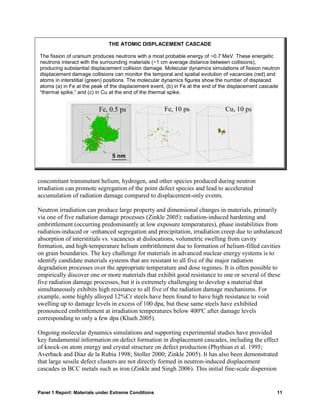
~1 ps “thermal spike” phase of the displacement cascade, as the kinetic energy transferred to the
cascade atoms by the impinging neutron is dissipated to the surrounding lattice atoms (see
sidebar). This intense atomic mixing can cause undesirable mixing or destabilization of
nanoscale features in the irradiated material. In practice, molecular dynamics simulations and
experiments have found that the number of defects produced during energetic neutron irradiation
near absolute zero is approximately one-third the dpa value, due to kinetic energy–stimulated
recombination events during the cascade cooling. The requirement for structural materials in
advanced nuclear energy systems (~100-dpa exposure) is daunting, considering that the net
accumulation of point defects in the form of voids or preferential absorption at dislocations
should result in dimension changes of less than ~5%. Therefore, ~99.95% of “stable”
displacement damage and ~99.9995% of initially dislodged atoms must recombine. The


10                                                 Panel 1 Report: Materials under Extreme Conditions
THE ATOMIC DISPLACEMENT CASCADE

The fission of uranium produces neutrons with a most probable energy of ~0.7 MeV. These energetic
neutrons interact with the surrounding materials (~1 cm average distance between collisions),
producing substantial displacement collision damage. Molecular dynamics simulations of fission neutron
displacement damage collisions can monitor the temporal and spatial evolution of vacancies (red) and
atoms in interstitial (green) positions. The molecular dynamics figures show the number of displaced
atoms (a) in Fe at the peak of the displacement event, (b) in Fe at the end of the displacement cascade
“thermal spike,” and (c) in Cu at the end of the thermal spike.


concomitant transmutant helium, hydrogen, and other species produced during neutron
irradiation can promote segregation of the point defect species and lead to accelerated
accumulation of radiation damage compared to displacement-only events.

Neutron irradiation can produce large property and dimensional changes in materials, primarily
via one of five radiation damage processes (Zinkle 2005): radiation-induced hardening and
embrittlement (occurring predominantly at low exposure temperatures), phase instabilities from
radiation-induced or -enhanced segregation and precipitation, irradiation creep due to unbalanced
absorption of interstitials vs. vacancies at dislocations, volumetric swelling from cavity
formation, and high-temperature helium embrittlement due to formation of helium-filled cavities
on grain boundaries. The key challenge for materials in advanced nuclear energy systems is to
identify candidate materials systems that are resistant to all five of the major radiation
degradation processes over the appropriate temperature and dose regimes. It is often possible to
empirically discover one or more materials that exhibit good resistance to one or several of these
five radiation damage processes, but it is extremely challenging to develop a material that
simultaneously exhibits high resistance to all five of the radiation damage mechanisms. For
example, some highly alloyed 12%Cr steels have been found to have high resistance to void
swelling up to damage levels in excess of 100 dpa, but these same steels have exhibited
pronounced embrittlement at irradiation temperatures below 400ºC after damage levels
corresponding to only a few dpa (Klueh 2005).

Ongoing molecular dynamics simulations and supporting experimental studies have provided
key fundamental information on defect formation in displacement cascades, including the effect
of knock-on atom energy and crystal structure on defect production (Phythian et al. 1995;
Averback and Diaz de la Rubia 1998; Stoller 2000; Zinkle 2005). It has also been demonstrated
that large sessile defect clusters are not directly formed in neutron-induced displacement
cascades in BCC metals such as iron (Zinkle and Singh 2006). This initial fine-scale dispersion


Panel 1 Report: Materials under Extreme Conditions                                                   11
of the radiation defects is potentially a major contributor to the observed superior resistance of
BCC alloy systems to radiation-induced void swelling compared to FCC materials. Additional
mechanisms such as BCC-vs-FCC differences in the strain field-induced preferential absorption
of interstitial vs. vacancy point defects at dislocations (“dislocation bias”) and differences in the
interactions between glissile clusters and point defects may also be important.

Although an extensive experimental database has documented the conditions where radiation
hardening and embrittlement occur, the physical mechanism(s) responsible for the flow
localization during plastic deformation of irradiated materials is unclear. Mechanisms based on
formation of defect-free dislocation channels (Wechsler 1972) as well as hypotheses that the
plastic instability stress is invariant for unirradiated and irradiated metals (Byun and Farrell
2004) have been proposed. Achieving an understanding of the responsible mechanism(s) is key
for development of higher-strength engineering materials for both unirradiated and irradiated
service. In particular, if the transition to localized necking deformation is associated with a
phenomenon that is initiated when the stress exceeds a critical value, research is needed to
discover the physical basis for the variation in critical stress for different materials. Regarding
radiation hardening and dislocation channel formation, recent molecular dynamics and in situ
transmission electron microscopy (TEM) deformation studies have provided significant new
insight on the interaction and annihilation mechanisms for gliding dislocations impinging on
sessile radiation defect clusters such as dislocations loops and stacking fault tetrahedra (Robach
et al. 2003; Osetsky et al. 2006; Bacon et al. 2006). However, in general, modeling and
experimental investigations have not been adequately integrated in a manner that more
efficiently identifies operative mechanisms.

Radiation hardening induces an increase in the ductile-brittle transition temperature (DBTT) in
body-centered cubic metals (Odette et al. 2003). Significant improvements in the resistance to
low-temperature radiation embrittlement have been experimentally observed by selective
alloying, such as reducing copper content in reactor pressure vessel steels. The general aspects of
embrittlement due to radiation hardening can be quantitatively modeled with good accuracy
using semiempirical models based on crack extension induced by exceeding a threshold stress
level within a critical volume near the crack tip. However, several fundamental physical factors
that control brittle cleavage and ductile fracture toughness are not well established, such as the
physical phenomena that define the magnitude of the threshold fracture stress and critical
stressed volume in the vicinity of a lattice flaw. For example, it is not understood why different
neutron-irradiated steels exhibit variations up to a factor-of-two in the rate of increase in DBTT
per unit of yield strength increase.

A substantial experimental database and supporting semiempirical models on radiation-induced
solute segregation to grain boundaries have been established for several technologically
important materials such as stainless steels (Was and Busby 2005). This solute segregation can
lead to localized corrosion as well as precipitation of new particulate phases that may cause
degradation in mechanical properties. The existing models have been fitted to experimental data
for austenitic stainless steels. However, the models fail to provide even the correct magnitudes
for chromium solute segregation in irradiated ferritic steels and therefore are not predictive
models. The mechanisms controlling stress-assisted corrosion phenomena at interfaces, such as
fuel-cladding interaction and irradiation-assisted stress corrosion cracking, are not understood.


12                                                   Panel 1 Report: Materials under Extreme Conditions
Limited experimental data suggest that suitable void swelling resistance up to 200 dpa may be
possible under some conditions (Garner et al. 2000), but these data provide mainly empirical
guidelines for development of new radiation-resistant materials. In general, it has been observed
that BCC alloys typically exhibit lower levels of void swelling compared to FCC alloys, but
there are many exceptions to this general trend. A variety of hypotheses have been proposed to
explain the variability in swelling resistance, many of which are centered around the relative
efficiency of interstitial vs. vacancy point defect absorption at dislocations. However, these
hypotheses have not been sufficiently tested to determine their validity. There are also numerous
experimental studies (Lee et al. 1981) and supporting kinetic rate theory models (Mansur 1994)
that suggest finely dispersed nanoscale phases impart radically improved resistance to radiation
swelling and thermal creep. However, a comprehensive predictive model that incorporates all
key aspects of void nucleation and growth is not yet available.

Further fundamental research is needed to evaluate the effectiveness of various lattice
discontinuities on point defect recombination and high-temperature strength. There is evidence
from experimental studies (Singh and Foreman 1974; Yamada et al. 1994) and molecular
dynamics simulations (Sugio et al. 1998; Samaras et al. 2006) that nanoscale grain boundaries
are very effective point defect recombination centers. In addition, some studies suggest that the
magnitude of high-temperature helium embrittlement of grain boundaries can be mitigated by
modifying the type of grain boundary (Thorsen et al. 2004), but the detailed roles of grain
boundary–free volume and the specific type of boundary are not understood. An accurate
physical model of point defect absorption at dislocations and nanoscale precipitates with
coherent or incoherent boundaries is also not available.

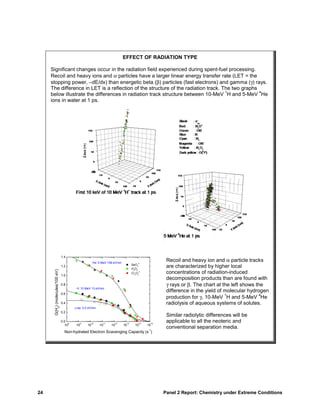
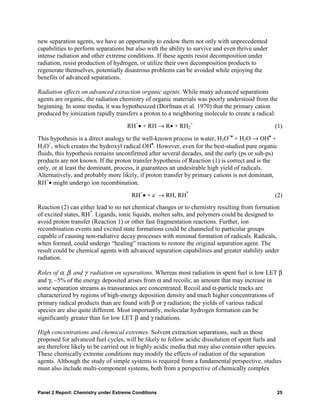
                             ATOMISTIC PROCESSES AT INTERFACES

Interfaces are a rich source of processes that can alter the structure and composition of a solid and, as
a result, its properties. This schematic shows (1) a grain boundary, (2) a surface, and (3) an internal
interface. The following processes are shown: (a) migration of vacancies and interstitials to a grain
boundary acting as a point-defect sink, (b) solute segregation enrichment, (c) precipitation,
(d) dislocation emission, absorption, and trapping, (e) crack propagation, (f) transport to, from, and
along interfaces, (g) solute trapping, (h) defect trapping, and (i) defect recombination.


Panel 1 Report: Materials under Extreme Conditions                                                      13
Considerable changes have occurred over the past 20 years regarding potential experimental and
computational tools for investigating materials for advanced nuclear energy systems. It is
encouraging to note the available menu of advanced experimental and computational techniques
has significantly expanded over the past two decades, including dedicated large-scale
experimental user facilities such as the Advanced Photon Source and the Spallation Neutron
Source. These unique facilities represent an important opportunity that should be fully exploited
for nuclear systems materials R&D. Conversely, there has been an overall decrease in the
number of available experimental facilities dedicated to nuclear energy materials R&D over the
past 20 years, such as materials test reactors and ion beam and radiological hot-cell test facilities.

BASIC SCIENCE CHALLENGES, OPPORTUNITIES, AND RESEARCH NEEDS

The Current Status given above demonstrates that there are many challenges, opportunities, and
research needs in the area of the basic science of materials under extreme conditions in nuclear
energy systems. Central to this theme is the fact that there is a critical need for long-term basic
scientific research in several key areas and that there are notable opportunities to capitalize on
recent progress in experimental and computational methodologies developed over the past two
decades if the research infrastructure is appropriately enhanced. These opportunities can provide
the scientific underpinnings that will enable implementation of transformational advances in
technical capabilities of materials in advanced nuclear energy systems. It is critical that these
investigations fully utilize the knowledge gained from prior radiation effects and mechanical
deformation mechanism studies.

More specifically, we must discover the key mechanisms that render materials resistant to
degradation in extreme conditions of radiation, temperature, stress, and environment. As part of
the discovery process, we must identify the physical and chemical means to kinetically restrain
microstructural features, at many different length scales, that are inherently far from equilibrium.
We must then integrate this knowledge into novel designs of materials that are radiation resistant
at heretofore unprecedented exposures. We should imagine development of materials systems
that are not limited by radiation dose and are capable of allowing substantial increases in
operating temperature (e.g., 50% or more) relative to existing systems. And while the goal must
always be to extend the high-temperature operating regime of materials by mechanistic
approaches, we must also do the same for lower, near-ambient temperatures for which possible
ductile-to-brittle fracture transitions must be accounted for.

Such efforts will require that we capture the complexities of multiscale microstructure-defect
interactions by new experimental and modeling approaches that are seamlessly integrated at each
step of the discovery process. In the domain of theoretical modeling, we must be able to predict
the nonlinear trajectories of microstructural and phase evolution, not only at multiple length
scales but at multiple time scales as well. This knowledge will enable the connecting of materials
properties, especially mechanical and chemical, to fundamental processes occurring at the
nanoscale and thereby determine the mechanisms controlling the microstructure, phase, and
dimensional stability of nanostructured materials that are certain to find application in the next
generation of nuclear energy systems. The models developed must be able to suggest, explain,
and extrapolate experimental findings at different radiation fluxes, temperatures, and
environments at the level of petascale computational end stations on the research horizon.


14                                                   Panel 1 Report: Materials under Extreme Conditions
Experimentally, we must fully exploit neutron, X-ray and electron beam facilities for a new
generation of experiments that are informed by science-based models and include in situ
mesoscale characterization of mechanical and chemical behavior of materials in complex
environments. Such an approach must champion the development of new experimental
techniques and allow reconfiguration (and in some cases the rebirth) of existing systems that will
make possible such a paradigm shift in the scientific discovery process for new materials based
on the tight coupling of experiments and modeling.

The focus on development of knowledge in new physics regimes for atomic-scale manipulation
of nanostructured structural materials cannot be overemphasized. New understanding of the
nanostructural basis for the properties of materials and their stability when exposed to irradiation,
temperature, stress, and aggressive environments is critically needed. This need is especially
important with regard to all types of interfaces in materials, given that engineered interfaces and
their potential defect-trapping capacities currently appear to offer an exciting direction on which
to base future fundamental alloy development approaches for nuclear energy systems. Thus, we
must understand the controlling mechanisms of mass transport and chemical interactions at
interfaces and the roles of irradiation, temperature, stress, and environment. The factors that
determine interface stability under these complex extreme conditions must also be understood,
while we also determine the extent to which interface evolution can be controlled by nanometer-
scale design. The research approach will necessarily require coupled modeling and experiments
for proper characterization of interface-defect interactions and their effects on materials
properties. The scientific protocol must incorporate the very complex issue of environmental
interactions and reactions at crack tips and the role that functionalized interfaces have on the
degradation processes under stress. The goal of research on interfaces should include obtaining a
science-based predictive understanding of environmental attack at high radiation fluxes,
temperatures, and stresses and development of functionalized interfaces that will lead to
revolutionary advances such as elimination of lifetime-limiting degradation of materials in
nuclear energy systems.

The complexity of nuclear energy systems suggests many specific research questions that must
be answered under the rubric of fundamental understanding of materials under extreme
conditions. The following listing is only a partial one involving some examples of the topics
discussed by our panel.
• What are the fundamental limits, in terms of propagation of dislocations and their interaction
    with matrix obstacles, in strength and toughness for structural materials?
• What are the fundamental phenomena that control the plastic flow and fracture properties,
    both at low and elevated temperatures, of structural materials under extreme conditions of
    radiation, stress and environment?
• In what ways are the principles of macroscopic equilibrium materials science altered at the
    nanoscale and under non-equilibrium thermodynamic conditions, and how do we simulate
    such processes?
• What are the steps in developing a fundamental understanding of microstructural evolution
    and phase stability under non-equilibrium conditions in extreme environments that are
    needed to enable advances in materials design beyond the current experimental observation-
    based approach?


Panel 1 Report: Materials under Extreme Conditions                                                15
•    What new understanding and research developments are required to apply first-principles
     calculations and atomistic models to fully describe irradiation-induced defects and
     microstructural evolution in materials for nuclear energy systems?
•    What are the mechanisms by which ionizing radiation enhances or suppresses point defect
     accumulation in materials?
•    What are the effects of various lattice discontinuities on point-defect recombination
     processes, and how can this knowledge be used to design materials with greatly improved
     radiation tolerance? Can we modify the preferential interstitial point defect absorption bias of
     dislocations?
•    What is the correct physical description of electron and phonon transport and scattering in
     materials that will enable understanding of degradation of thermal and electrical conductivity
     due to point, line, and planar defects?
•    What is the effect of crystal structure and atomic order, disorder or noncrystallinity on the
     properties of matter as they pertain to applications in nuclear energy systems?
•    What is the effect of joining methods (welding, etc.) on the strength and radiation stability of
     materials? What controls the maximum dose (radiation damage, helium accumulation, etc.)
     that irradiated materials can be successfully joined without introduction of catastrophic
     cracking?
•    Why are BCC metallic materials intrinsically more resistant than FCC metallic materials to
     radiation-induced swelling, creep, and helium embrittlement of gram boundaries? What are
     the model systems, metallic and non-metallic, that must be investigated to understand the
     intrinsic differences in radiation tolerance among materials classes? Can the efficiency of
     retained displacement damage defects in neutron-induced collision cascades be altered?
•    Given that radiation damage is inherently a multiscale phenomenon, with interacting
     phenomena ranging from lengths of nanometers to meters and times of sub-picoseconds to
     decades, how can we accurately model the nonlinear trajectories of microstructural and phase
     evolution at multiple length and time scales and how can these models be strongly coupled to
     nanoscale and mesoscale experiments?
•    How do we effectively link existing single-scale computational methods, which have varying
     degrees of physical robustness, into a truly predictive multiscale, multi-physics suite of tools?
•    What are the elements of understanding mass transport, chemical processes, and structural
     evolution at interfaces in aggressive environments, and how will this knowledge provide a
     foundation for determining the controlling environmental degradation phenomena at
     interfaces under extreme conditions? What is the potential role of functionalized interfaces
     on mitigation of degradation mechanisms in materials at extreme conditions of irradiation,
     temperature, and environment?
•    How can the aggressive attack of cladding boundaries by fuel materials, including minor
     actinides and other fission products, be suppressed?
•    How can we most effectively utilize the large BES investment in world-class characterization
     and computational facilities to design materials for nuclear energy systems, and how can we
     best couple them seamlessly in attacking major materials issues? What new materials science
     phenomena can be discovered by utilizing probes involving femtosecond laser and X-ray
     pulses, or picosecond electron pulses?
•    What are the new and emerging in situ capabilities that will provide new fundamental
     physical insight by characterizing materials phenomena at the nanoscale and mesoscale under
     extreme conditions of radiation, temperature, stress, and environment?


16                                                    Panel 1 Report: Materials under Extreme Conditions
CONCLUSIONS

A major goal in research on materials under extreme conditions must be to discover how the
deleterious effects of neutron irradiation can be mitigated or even eliminated in structural
materials. More broadly, we will need to discover the mechanisms that render materials
impervious to the interacting extreme conditions of irradiation, temperature, stress, and
environmental surroundings. A key component will involve successful seamless integration of
novel experimental techniques with advances in the methodology of computational materials
science. The elements of fundamental design of materials must be brought to a revolutionary
new level of accomplishment in a manner that includes the expanded development of
functionalized interfaces for optimization of materials properties.

REFERENCES

Ashby, M. F. 1972. “A First Report on Deformation-mechanism Maps,” Acta Metallurgica
   20, 887.
Averback, R. S., and T. Diaz de la Rubia. 1998. “Displacement Damage in Irradiated Metals and
   Semiconductors,” Solid State Physics 51, 281.
Bacon, D. J., Yu. N. Osetsky, R. E. Stoller, and R. E. Voskoboinikov. 2003. “MD Description of
   Damage Production in Displacement Cascades in Copper and Alpha-Iron,” Journal of
   Nuclear Materials 323, 152.
Bacon, D. J., Yu. N. Osetsky, and Z. Rong. 2006. “Computer Simulation of Reactions Between
   an Edge Dislocation and Glissile Self-Interstitial Clusters in Iron,” Philosophical Magazine
   86, 3921.
Byun, T. S., and K. Farrell. 2004. “Plastic Instability in Polycrystalline Metals after Low
   Temperature Irradiation,” Acta Materialia 52, 1597.
Cawthorne, C., and E. J. Fulton. 1967. “Voids in Irradiated Stainless Steel,” Nature 216, 575.
Garner, F. A., M. B. Toloczko, and B. H. Sencer. 2000. “Comparison of Swelling and Irradiation
   Creep Behavior of FCC-Austenitic and BCC-Ferritic/Martensitic Alloys at High Neutron
   Exposure,” Journal of Nuclear Materials 276, 123.
Klueh, R. L. 2005. “Elevated-Temperature Ferritic and Martensitic Steels and their Application
   to Future Nuclear Reactors,” International Materials Reviews 50, 287.
Larson, F. R., and J. Miller.1952. “A Time-Temperature Relationship for Rupture and Creep
   Stresses,” Transactions of the. American Society of Mechanical Engineers 74, 765.
Lee, E. H., A. F. Rowcliffe, and L. K. Mansur. 1981. “Precipitation and Cavity Formation in
   Stainless Steels during Irradiation,” Journal of Nuclear Materials 103&104, 1475.
Mansur, L. K. 1994. “Theory and Experimental Background on Dimensional Changes in
  Irradiated Alloys,” Journal of Nuclear Materials 216, 97.
Nabarro, F. R. N., and H. L. de Villiers. 1995. The Physics of Creep. (Taylor and Francis,
   London.
Odette, G. R., T. Yamamoto, H. J. Rathbun et al. 2003. “Cleavage Fracture and Irradiation
   Embrittlement of Fusion Reactor Alloys: Mechanisms, Multiscale Models, Toughness


Panel 1 Report: Materials under Extreme Conditions                                                17
Measurements and Implications to Structural Integrity Assessment,” Journal of Nuclear
     Materials 323, 313.
Osetsky, Y. N., Y. Matsukawa, R. E. Stoller, and S. J. Zinkle. 2006. “On the Features of
   Dislocation-Obstacle Interactions in Thin Films: Large Scale Atomistic Simulation,”
   Philosophical Magazine Letters 86, 511.
Phythian, W. J., R. E. Stoller, A. J. E. Foreman et al. 1995. “A Comparison of Displacement
   Cascades in Copper and Iron by Molecular Dynamics and its Application to Microstructural
   Evolution,” Journal of Nuclear Materials 223, 245.
Robach, J. S., I. M. Robertson, B. D. Wirth et al. 2003. “In-situ Transmission Electron
   Microscopy Observations and Molecular Dynamics Simulations of Dislocation-Defect
   Interactions in Ion-Irradiated Copper,” Philosophical Magazine 83, 955.
Samaras, M., P. M. Derlet, H. Van Swygenhoven, and M. Victoria. 2006. “Atomic Scale
   Modelling of the Primary Damage State of Irradiated FCC and BCC Nanocrystalline
   Metals,” Journal of Nuclear Materials 351, 47.
Singh, B. N., and A. J. E. Foreman. 1974. “Calculated Grain Size-dependent Vacancy
   Supersaturation and its Effect on Void Formation,” Philosophical Magazine 29, 847.
Stoller, R. E. 2000. “The Role of Cascade Energy and Temperature in Primary Defect Formation
    in Iron,” Journal of Nuclear Materials 276, 22.
Sugio, K., Y. Shimomura, and T. Diaz de la Rubia. 1998. “Computer Simulation of Displacment
   Damage Cascade Formation near Sigma 5 Twist Boundary in Silver,” Journal of the Physical
   Society of Japan 27, 882.
Thorsen, P. A, J. B. Bilde-Sorensen, and B. N. Singh. 2004. “Bubble Formation at Grain
   Boundaries in Helium Implanted Copper,” Scripta Materialia 51, 557.
Was, G. S., and J. T. Busby. 2005. “Role of Microstructure and Microchemistry in Irradiation-
  Assisted Stress Corrosion Cracking,” Philosophical Magazine 85, 443.
Wechsler, M. S. 1972. In The Inhomogeneity of Plastic Deformation, ed. R. E. Reed-Hill (Am.
  Society for Metals, Metals Park, OH, 1972), 19–54.
Wigner, E. P. 1946. “Theoretical Physics in the Metallurgical Laboratory of Chicago,” Journal
   of Applied Physics 17, 857.
Yamada, R., S. J. Zinkle, and G. P. Pells. 1994. “Microstructure of Al2O3 and MgAl2O4
  Preimplanted with H, He, C and Irradiated with Ar Ions,” Journal of Nuclear Materials
  209, 191.
Zinkle, S. J. 2005. “Fusion Materials Science: Overview of Challenges and Recent Progress,”
   Physics of Plasmas 12, 058101.
Zinkle, S. J., and B. N. Singh. 1993. “Analysis of Displacement Damage and Defect Production
   under Cascade Damage Conditions,” Journal of Nuclear Materials 199, 173.
Zinkle, S. J., and B. N. Singh. 2006. “Microstructure of Neutron-Irradiated Iron Before and After
   Tensile Deformation,” Journal of Nuclear Materials 351, 269.


18                                                Panel 1 Report: Materials under Extreme Conditions
PANEL 2 REPORT: CHEMISTRY UNDER EXTREME CONDITIONS

CURRENT STATUS

The new generation of advanced reactors will supersede the present generation of light water
reactors (LWRs). While the LWRs have a good operating record, if a number of factors had been
addressed earlier and operations had been “designed-in” before construction, those reactors could
have been more reliable, safer, and operated at lower costs. Like existing LWRs, the new
generation of reactors will depend on chemical processes operating under extreme conditions of
radiation fields and variables, such as pH, temperature, and pressure. These extreme conditions
will occur in the reactors themselves and in the fuel reprocessing cycles for those reactors.

Surfaces under extreme chemical conditions

A critical factor for performance of material interfaces in advanced nuclear energy systems is the
chemical environment in which the surfaces must function. For LWRs, we have considerable
knowledge about the critical fuel-coolant surfaces and heat exchangers. Closure of the fuel cycle
will lead to new types of surfaces and new types of chemical changes, some of which will occur
over years or decades, not just days or months. These surfaces will face molten sodium, lead, or
other metals, or a gas, always at high temperature and in the presence of radiation. This surface
chemistry is likely to lead to unexpected transport of radioactive species (see sidebar on
radioactive transport). An important goal should be to understand the pertinent surface chemistry
and its effects on the materials involved from a fundamental point of view.

Corrosion of structural materials. Lessons learned in the development of LWRs include the need
to pay considerable attention to the corrosion of structural materials in contact with coolants
under extreme conditions. Thus, in the initial development of boiling water reactors (BWRs), it
was apparently assumed that the plant would simply be conventional with a different “burner”
(nuclear instead of coal, oil, or natural gas) and, hence, that conventional materials could be used
in the heat transport circuits. The result was disastrous. Thus, the role that the electrochemical
corrosion potential (ECP) plays in the cracking of structural materials, like stainless steels (see
sidebar on corrosion), was not anticipated, nor was the role of the radiolysis of water in
establishing the ECP appreciated. The resulting stress corrosion cracking of sensitized stainless
steels has plagued the fleet of BWRs for 30 years and has cost the utilities and consumers tens of
billions of dollars. It is the opinion of many that this, and similar, problems could have been
avoided by an appropriate up-front investment in characterizing materials behavior, and this
lesson must be heeded in the development of the Generation-IV reactors.

In the past, materials have been selected based on whether the chemical environment they will
operate in is oxidizing or reducing. Knowledge about surface chemistry has been captured in
semiempirical models of limited applicability, although considerable advances have been made
in recent years in deterministically predicting corrosion damage in the coolant circuits of LWRs.
While surface chemistry is, in fact, a large and vigorous field, many of the available studies are
performed in high vacuum or at low temperatures, and the effects of high radiation fields on the
chemistry, and therefore, on the surfaces, are not understood in a fundamental way. If surface


Panel 2 Report: Chemistry under Extreme Conditions                                                19
TRANSPORT OF RADIOACTIVE SPECIES

     One area of significant radiological and economic concerns at nuclear facilities is the transport
     of radioactive species from the reactor core. The transported materials can take many forms:
     activated corrosion products (e.g., Co –n,γ → Co); activated coolant material (e.g., O–n,p
                                          59           60                                     16

     → N); fission products from fuel failures, etc. The transported radioactive species can deposit
        16

     on system surfaces or can continue to circulate in the coolant. The transported activity can also
                                                41   3   14
     appear as an airborne or liquid release ( Ar, H, C) from the plant. The figure below
     demonstrates the buildup and decrease of high radiation fields in a nuclear plant’s heat
     transport circuit. These high fields required the development of expensive decontamination
     technologies that produce large amounts of waste.
                                                               (from Montford (1973) - AECL-4435)
                                              4000

                                              3500

                                                                                                        Improved
                                              3000                                                   Purification Flow
                    Radiation Fields (mR/h)


                                                                                                            plus
                                                                                                      Redox Cycling
                                              2500
                                                                                                     Decontamination

                                              2000
                                                       Radiation Field Growth
                                              1500

                                              1000

                                              500

                                                0
                                                 0.0           0.5              1.0       1.5            2.0             2.5
                                                                     Time (Effective Full Power Years)

     The initial growth and subsequent decrease (as a result of decontamination) of the
     radiation fields measured near the steam generators of the prototype CANDU reactor at
     Douglas Point (Montford 1973). This reactor operated from 1969 to 1984.

     For an atom to be activated, it has to be deposited in-core for a period of time or be present in
     materials in-core (e.g., in fuel cladding, fuel channels, grid spacers). Following activation, the
     release of the radioactive species by dissolution (corrosion) or wear causes the operational
     problem. Mitigation of radioactivity transport for advanced nuclear energy systems (ANES)
     concept reactors will require a systematic assessment of the potential sources of isotopes that
     can be activated in-core, including trace impurities in the materials of construction and in the
     coolant, as well as an understanding of the chemistry involved in the transport and
     nonequilibrium behavior of trace species. The chemistry research required will be entirely
     reactor specific.

     ____________
     Montford, B. 1973. Decontamination of the Douglas Point Generating Station by Cycling
     Techniques, Atomic Energy of Canada Report, AECL-4435.


20                                                                                    Panel 2 Report: Chemistry under Extreme Conditions
CORROSION

  All practical metals and alloys in nuclear reactors corrode as metals return to their oxidized states.
  The concordant loss of desirable mechanical properties (toughness, tensile strength, etc.) threaten
  the integrity of the pressure boundaries, with the result that corrosion is the principal cause of
  unscheduled downtime in current nuclear power reactors and is likely to remain the principal cause in
  ANES. Corrosion in nuclear plants comes in many forms, including (1) general corrosion, in which
  metal is lost more or less uniformly across a
  macroscopic surface; (2) pitting corrosion,
  resulting in rapid penetration in microscopic
  regions; (3) stress corrosion cracking, due to the
  co-joint action of a susceptible material, a
  corrosive environment, and a tensile stress;
  (4) corrosion fatigue, in which the stress varies
  with time; (5) and hydrogen-induced cracking,
  resulting from the ingress of hydrogen from the
  interface into the bulk metal and the subsequent
  degradation of mechanical properties. All of
  these processes are well documented as having
  occurred in current water-cooled reactors, with
  stress corrosion cracking being dominant in
  boiling water reactors (BWRs) (Fig. 1)
  (Macdonald et al. 1999; Macdonald 2004). Other          Figure 1: Intergranular stress corrosion
  principal mechanisms of failure are likely in           cracking (IGSCC) in the sensitized heat-
  ANES, such as liquid-metal embrittlement and            affected zone adjacent to a weld in Type
  grain-boundary penetration in alloys in contact         304 SS piping in a BWR (Source: Structural
  with high-temperature gaseous coolants. A               Integrity Associates, Inc., www.structint.com/
  particularly important issue is that all localized      tekbrefs/sib96154/).
  corrosion processes are characterized by
  induction times that may be very long (years to decades, in some cases), which makes the detection
  of localized corrosion in laboratory experiments problematic, unless accelerated tests are employed.
  ____________
       Macdonald, D. D, I. Balachov, and G. Engelhardt. 1999. “Deterministic Prediction of Localized Corrosion
  Damage in Power Plant Coolant Circuits,” Power Plant Chemistry 1, 9.
       Macdonald, D. D. 2004. “Stress Corrosion Cracking in Reactor Coolant Circuits—An Electrochemist’s
  Viewpoint,” Power Plant Chemistry 12, 731–747.


chemistries can be adaptive to the challenges presented to them, based on a fundamental
understanding of that chemistry, future reactors can follow a superior track.

Chemistry of separations agents under extreme conditions

Another crucial area for closing the fuel cycle will be the chemistry of radionuclide separations.
The history of defense and civilian programs has included steps to separate valuable materials
from dangerous wastes, including transuranics and isotopes of cesium and strontium. The
chemistry to accomplish the separations has included a variety of separation agents. Sometimes
these were organic chelating agents of high value and specificity in promoting separations.
Unfortunately, these agents were prone to decompose in ways not well anticipated or understood.
One outcome has been the gradual production of flammable and explosive hydrogen gas in high-
level radioactive waste tanks at Hanford and Savanna River. This hydrogen was the result of


Panel 2 Report: Chemistry under Extreme Conditions                                                               21
THE RADIOLYSIS OF WATER

Because early reactors were water cooled, the radiation chemistry of water has been of primary
importance. Radiation chemistry of aqueous media was of critical importance in reactor accidents such
as that at Three Mile Island concerns for storage of wastes such as flammable gas evolution in the
Hanford waste storage tanks. It is also important because humans and other living things are mainly
composed of water, so this chemistry has a role in how living cells respond to radiation, both in
inadvertent exposures and intentional ones, including X-rays and cancer therapy. The decomposition of
water induced by the passage of ionizing radiation leads to the production of transient radical species
(the hydrated electron, eaq , H• atom, and OH• radical) and stable molecular species (molecular
                           –

hydrogen, H2, and hydrogen peroxide, H2O2) as indicated in the following equation:
                               –
       H2O –– radiation → eaq (2.6), H• (0.5), OH• (2.5), H2 (0.45), H2O2 (0.75)

Steady-state radiolysis would result in the production of each species with the yields given in
parentheses in units of radicals or molecules/100 eV of total energy absorption. These yields are
applicable to fast electron or gamma radiolysis and can vary significantly in heavy ion radiolysis
because the geometry of the local energy deposition affects intratrack reactions. For instance, alpha
particle radiolysis would lead to lower radical yields and higher molecular product yields than found in
gamma radiolysis.
                                                                                     –
Regardless of the type of radiation, the sum of the equivalent reducing species eaq + H• + 2(H2) will
always equal the sum of oxidizing species OH• + 2(H2O2) in neat water. The hydrated electron is a
strong reducing species, while the OH• radical is a strong oxidant. Most of the effects due to the
radiolysis of water are initiated by one of these transient species. Radical species may be
interconverted in selective systems. For example, acidic solutions will convert hydrated electrons to H•
atoms, which are slightly less powerful reducing agents. This ability to change radicals is a useful tool in
controlling the desired effects of water radiolysis.

The transient radical species allow energy deposited in one location to cause radiation damage in
another. For instance, OH• radicals produced in a cell may initiate damage to DNA, while the hydrated
electron may react with a nearby solid interface to initiate or propagate corrosion in reactor
components. Understanding the production, reactivity, and transport of transient species, especially
across liquid – solid interfaces, remains a significant challenge in the radiation chemistry of water.


both thermal and radiation-induced chemistry, but the source of the hydrogen has generally been
organic material introduced as agents of separation.

BASIC RESEARCH NEEDS, OPPORTUNITIES, AND CHALLENGES

Advanced separation chemistries in radiation fields

Closing the fuel cycle will create new needs for advanced separation techniques. One possibility
is electrochemical separation in (inorganic) molten salts (“pyroprocessing”), a highly capable
technique available for batch processing. A second possibility is the development of a variety of
neoteric agents that have the potential to confer unprecedented capabilities for separation of
spent fuels in continuous processes, which meet the competing demands of utilizing nuclides
formerly considered waste, while providing a composition radioactive enough to deter theft and
proliferation. The Panel 3 report describes plans to obtain exquisite control with advanced
agents, of utilizing complex organic molecules capable of highly tuned separations.


22                                                     Panel 2 Report: Chemistry under Extreme Conditions
Our present knowledge includes a substantial understanding of the radiation chemistry of water
(Buxton 2004; Garrett 2005) and aqueous solutions (see sidebar), but much less is known about
the chemistry of the new and novel (neoteric) chemistry agents, including advanced chelating
agents, ionic liquids (Wishart 2003), supercritical fluids, and functional polymers that advanced
separation chemistries, discussed in the Panel 3 Report, will potentially utilize. Advanced agents
can utilize the potential of complex organic molecules capable of highly turned separations and
may include templated synthesis.

With the development of powerful new separation agents, complementary efforts are needed to
understand, at a mechanistic level, the consequence on the separation processes of the substantial
radiation fields from radioactive decay. A major consideration is the type of radiation (see
sidebar on α, β, γ, and recoil radiation) the agents will need to operate in. The major
radionuclides in a typical aged spent fuel and their contributions are summarized in Table 1.

             Table 1. Radionuclides in spent fuel aged for 10 years in descending order of activity
            Low LET emitters (β and γ): blue shading; high LET emitters (α and recoil): brown shading
                                       (all quantities are per kg of spent fuel)
                            Activity,       Content,       Specific dose      Heat load, Radiolysis rate,
          Radionuclide
                             Bq/kg          mole/kg       rate, eV/(kg⋅s)        W/kg    moles/(kg⋅hour)
       137
           Cs              3 × 10¹²       6.8 × 10⁻³         3.5 × 10¹⁸      5.6 × 10⁻¹    2.1 × 10⁻⁴
       90                         12               –3                 18              –1
          Sr               2 × 10         4.4 × 10           5.6 × 10        8.9 × 10      3.3 × 10⁻⁴
       241
           Am              7 × 10¹⁰       2.3 × 10⁻³         4.0 × 10¹⁷      6.3 × 10⁻²    2.4 × 10⁻⁵
       243                        +9               –4                 15              –4
           Am              1 × 10         5.6 × 10           5.4 × 10        8.7 × 10      3.3 × 10⁻⁷
       99
          Tc               8 × 10⁸        1.3 × 10⁻²         2.4 × 10¹⁴      3.8 × 10⁻⁵    1.4 × 10⁻⁸
       240                        8                –5                 14              –5
           Pu              1 × 10         4.9 × 10           1.0 × 10        1.6 × 10      6.0 × 10⁻⁹
       239
           Pu              8 × 10⁷        1.5 × 10⁻⁴         4.2 × 10¹⁴      6.7 × 10⁻⁵    2.5 × 10⁻⁸
       237                           7             –3                 14              –5
           Np              1.5 × 10       2.4 × 10           2.4 × 10        3.7 × 10      1.4 × 10⁻⁸
       135                        7                –3                 12              –7
           Cs              1 × 10         1.7 × 10           2.7 × 10        4.3 × 10      1.6 × 10⁻¹⁰

       All low LET         5 × 10¹²     2.6 × 10⁻²       9.1 × 10¹⁸     1.45               5.4 × 10⁻⁴
       All high LET        7.1 × 10¹⁰   5.4 × 10⁻³       4.01 × 10¹⁷    6.41 × 10⁻²        2.4 × 10⁻⁵
       Grand total         5.1 × 10¹²   3.1 × 10⁻²       9.5 × 10¹⁸     1.52               5.7 × 10⁻⁴

Table 1 indicates that over 95% of the radiation in spent fuels presented for separation arises
from low linear energy transfer (LET) (see sidebar on radiation quality) β and γ emitters,
principally 137Cs and 90Sr, and the balance is mainly due to americium isotopes, which are α
emitters. Similarly, the bulk of some 1.5-W/kg heat load from radioactivity is due to 137Cs and
90
  Sr, while neutron radiation should be practically inconsequential for separation. From the last
column in Table 1, calculated by assuming a fairly high yield of one product molecule per
100 eV of absorbed radiation energy, it is seen that radiolysis is unlikely to drive a deep chemical
modification of the separation media. However, the radiolysis is probably sufficient to distress
the selectivity and depth of separation in at least two ways. One is the radiation-induced
modification of the extracting agents, especially when they are recycled and thereby are exposed
to radiation for extended periods of time. This modification may reduce specificity and result in
co-extraction of undesired metal species. The other is the alteration of the redox speciation of
radionuclides, which may occur through their reactions with highly oxidizing or reducing
radiation-driven radicals and may lead to an incomplete extraction or stripping. In developing


Panel 2 Report: Chemistry under Extreme Conditions                                                          23
EFFECT OF RADIATION TYPE

     Significant changes occur in the radiation field experienced during spent-fuel processing.
     Recoil and heavy ions and α particles have a larger linear energy transfer rate (LET = the
     stopping power, –dE/dx) than energetic beta (β) particles (fast electrons) and gamma (γ) rays.
     The difference in LET is a reflection of the structure of the radiation track. The two graphs
                                                                                     1             4
     below illustrate the differences in radiation track structure between 10-MeV H and 5-MeV He
     ions in water at 1 ps.


                                 1.4
                                                         He: 5 MeV 156 eV/nm                 2-
                                                                                                                 Recoil and heavy ion and α particle tracks
                                                                                         SeO4
                                 1.2
                                                                                         H2O2
                                                                                                                 are characterized by higher local
      G(H2) (molecules/100 eV)


                                                                                         Cr2O7
                                                                                                 2-
                                                                                                                 concentrations of radiation-induced
                                 1.0
                                                                                                                 decomposition products than are found with
                                 0.8                                                                             γ rays or β. The chart at the left shows the
                                          H: 10 MeV 13 eV/nm
                                                                                                                 difference in the yield of molecular hydrogen
                                 0.6
                                                                                                                 production for γ, 10-MeV H and 5-MeV He
                                                                                                                                            1              4

                                 0.4                                                                             radiolysis of aqueous systems of solutes.
                                         γ-ray: 0.2 eV/nm
                                 0.2
                                                                                                                 Similar radiolytic differences will be
                                 0.0
                                     8         9        10     11      12           13           14        15
                                                                                                                 applicable to all the neoteric and
                                   10     10       10        10      10        10          10         10
                                                                                                      -1
                                                                                                                 conventional separation media.
                                   Non-hydrated Electron Scavenging Capacity (s )


24                                                                                                              Panel 2 Report: Chemistry under Extreme Conditions
new separation agents, we have an opportunity to endow them not only with unprecedented
capabilities to perform separations but also with the ability to survive and even thrive under
intense radiation and other extreme conditions. If these agents resist decomposition under
radiation, resist production of hydrogen, or utilize their own decomposition products to
regenerate themselves, potentially disastrous problems can be avoided while enjoying the
benefits of advanced separations.

Radiation effects on advanced extraction organic agents. While many advanced separations
agents are organic, the radiation chemistry of organic materials was poorly understood from the
beginning. In some media, it was hypothesized (Dorfman et al. 1970) that the primary cation
produced by ionization rapidly transfers a proton to a neighboring molecule to create a radical:

                                     RH+• + RH → R• + RH2+                                       (1)
This hypothesis is a direct analogy to the well-known process in water, H2O+• + H2O → OH• +
H3O+, which creates the hydroxyl radical OH•. However, even for the best-studied pure organic
fluids, this hypothesis remains unconfirmed after several decades, and the early (ps or sub-ps)
products are not known. If the proton transfer hypothesis of Reaction (1) is correct and is the
only, or at least the dominant, process, it guarantees an undesirable high yield of radicals.
Alternatively, and probably more likely, if proton transfer by primary cations is not dominant,
RH+• might undergo ion recombination.
                                       RH+• + e- → RH, RH*                                       (2)
Reaction (2) can either lead to no net chemical changes or to chemistry resulting from formation
of excited states, RH*. Ligands, ionic liquids, molten salts, and polymers could be designed to
avoid proton transfer (Reaction 1) or other fast fragmentation reactions. Further, ion
recombination events and excited state formations could be channeled to particular groups
capable of causing non-radiative decay processes with minimal formation of radicals. Radicals,
when formed, could undergo “healing” reactions to restore the original separation agent. The
result could be chemical agents with advanced separation capabilities and greater stability under
radiation.

Roles of α, β, and γ radiation on separations. Whereas most radiation in spent fuel is low LET β
and γ, ~5% of the energy deposited arises from α and recoils; an amount that may increase in
some separation streams as transuranics are concentrated. Recoil and α-particle tracks are
characterized by regions of high-energy deposition density and much higher concentrations of
primary radical products than are found with β or γ radiation; the yields of various radical
species are also quite different. Most importantly, molecular hydrogen formation can be
significantly greater than for low LET β and γ radiations.

High concentrations and chemical extremes. Solvent extraction separations, such as those
proposed for advanced fuel cycles, will be likely to follow acidic dissolution of spent fuels and
are therefore likely to be carried out in highly acidic media that may also contain other species.
These chemically extreme conditions may modify the effects of radiation of the separation
agents. Although the study of simple systems is required from a fundamental perspective, studies
must also include multi-component systems, both from a perspective of chemically complex


Panel 2 Report: Chemistry under Extreme Conditions                                               25
scenarios, such as the aqueous/organic phases encountered in current solvent extractions
processes.

Radionuclide speciation in high radiation fields. An understanding of the changes in the
complexant and redox chemistry of target species under higher radiation fields is critical to
designing effective separations. Changes in radionuclide ligation can influence solubility,
whereas changes in redox states can vitiate complexation with separation agents. These changes
must be predictable, and their results must be included in the development of efficient
separations. Ultimately, it could be possible to design separations that utilize radiolysis to affect
separations, such as precipitation reactions, or use redox-active agents that change properties
with changes in solution rest potentials resulting from high radiation fields.

For example, slight changes in redox chemistry can have a large impact on conventional group
separations, which are accomplished using small differences in redox potentials exhibited by
target species. Separation processes lose efficiency or even fail if the elements to be separated
are distributed over multiple oxidation states and/or coordination environments, and thus
partition into multiple process streams. Uranium, neptunium, plutonium, americium, iodine and
technetium are among the radionuclides with important redox state issues.

From a different perspective, in aqueous-based separations, the radiolysis of water produces
hydrogen peroxide. Dissolved H2O2 can result in the formation of insoluble actinide peroxides
that themselves have been considered as a method for metal separation (Cleveland 1970). Recent
work has also shown that uranyl ions can form the mineral Studite in acidic solutions containing
peroxide (Kubatko 2003). From a different perspective, slight changes in redox chemistry can
have a large impact on conventional group separations, which are accomplished using small
differences in redox potentials exhibited by target species. Separation processes lose efficiency
or even fail if the elements to be separated are distributed over multiple oxidation states and/or
coordination environments, and thus partition into multiple process streams.

Exoentropic approaches to radionuclide separations. Traditional separation approaches are
generally designed to operate at room temperature and typically involve negative entropy
changes. As the temperature is raised, their efficiencies decrease. New separation approaches
with positive entropy changes, designed to increase in efficiency with increased temperature,
could be used during initial separation steps before the heat-generating isotopes are separated.
For example, the design of an agent which complexes, or otherwise alters, the physical properties
of a target species at high temperature and is recovered from it at ambient temperature would add
a new degree of performance by utilizing the radiation-generated heat.

Trace impurities in radiation fields

It is essential to detect, anticipate, and control which trace impurities would be created under the
chemically extreme conditions encountered in fuels and heat exchange systems. Trace impurities
are present in the primary fluid by the erosion-corrosion action of the fluid flowing inside the
pipes. In the presence of radiation, the impurities may undergo chemical transformations and
create local environments with large impact on interfaces. For example, metals used in the
primary circuit piping system may contain trace amounts of non-radioactive elements that, once
irradiated, become radioactive, like 58Ni, 59Co. Understanding the nature of the film formed on


26                                                  Panel 2 Report: Chemistry under Extreme Conditions
the metal surface due to the presence of the electrolyte will be of prime importance. In general,
there is a great need to measure concentration of trace impurities in situ, characterize
transformations they may undergo in the high-radiation and high-temperature fields, and
understand the overall impact that activated trace elements may have on degradation of coolant
piping and heat exchange system materials. Fundamental research will require the development
of new analytical tools providing high spatial and temporal resolution. New diagnostic tools
should be capable for detection of trace elements of mostly unique properties. They should be
also operative in harsh radiation environments. New reliable chemical probes and sensors able to
control trace impurities will improve passive and active safety of advanced nuclear energy
systems in the GEN IV reactors.

Knowledge repository. A great deal of knowledge has been generated in the past in laboratories
around the world regarding metals and environments similar to the ones used for the reactors of
choice. Due to the cost of producing data, it is of fundamental importance to develop Fuzzy
Expert Systems and Predicting Pattern Recognition tools to explore “If … Then …” scenarios for
the new generation of experiments or designs. Such tools can also be used to avoid repeating
expensive experimentation.

CONCLUSIONS

The realization of the present opportunity for safe, abundant, efficient, and proliferation-resistant
nuclear power will rely on mechanical and chemical systems that will require revolutionary
breakthroughs in advanced chemistry. These are needed to endow a new generation of reactors
with smart surfaces, the chemistry of which is adaptive to their dangerous environment.
Advanced fuel cycles will confront new demands for highly effective separations. These
demands can be met by new separations agents and media that may be complex, highly tuned,
and therefore potentially vulnerable to chemical extremes, such as intense radiation fields, unless
the principles of radiation chemistry can be applied to protect them by design. Breakthroughs in
chemistry can enable advanced agents to be effective is these harsh environments. These harsh
environments will also introduce many detrimental impurities. Their detection, even at trace
levels, and their management will be essential. Sophisticated techniques will be needed to
analyze and respond to these impurities.

REFERENCES

Buxton, G. V. 2004. Charged Particle and Photon Interactions with Matter, ed. A. Mozumder,
   Y. Hatano. Marcel-Dekker, New York pp. 331–363.
Cleveland, J. 1970. The Chemistry of Plutonium, Gordon and Breach Science Publishers: New
   York, p. 653.
Dorfman, L. M. 1970. ”Electron and proton transfer reactions of aromatic molecule ions in
   solution,” Accounts of Chemical Research 3, 224–230.
Garrett, B. C., et al. 2005. Chemical Reviews 105, 355–389.
Kubatko, K. A. H., K. B. Helean, A. Navrotsky, and P. C. Burns. 2003. “Stability of peroxide-
   containing uranyl minerals,” Science 302, 1191–1193.
Wishart, J. F., and P. Neta. 2003. J. Phys. Chem B 107, 7261–7267.


Panel 2 Report: Chemistry under Extreme Conditions                                                 27
PANEL 3 REPORT: SEPARATIONS SCIENCE

CURRENT STATUS

More than 60 years have elapsed since operation of the first industrial-scale actinide separations
process for the recovery of plutonium was initiated. The earliest processes (McKay 1984), based
first on precipitation methods and then on solvent extractions from concentrated salt media, were
comparatively inefficient and generated considerable waste volumes. The PUREX process
(McKay 1990), first deployed 50 years ago, improved both features significantly, including a
50-fold reduction in waste production (Hunter 1993). In fact, PUREX remains the method of
choice in other countries for commercial fuel reprocessing to recover and recycle plutonium and
uranium. During the last 50 years, considerable operational
experience has been gained, though mistakes, as judged now
in hindsight, have been made along the way. The current
legacy of defense wastes and intractable environmental
contamination in the United States is one of the by-products
of that 60-year development period (DOE 1997) (Fig. 1). It is
reasonable to suggest that this legacy of the Cold War might
be less daunting had there existed a better foundation of
separation science and technology for integrating waste
management into irradiated fuel processing. Now, as our
nation gathers resolve to implement a closed fuel cycle, with
increased emphasis on priorities such as nonproliferation, the     Figure 1: At the Hanford site,
                                                                   53 million gallons of high-level
opportunity presents itself to strengthen this foundation          radioactive and chemical waste are
through further discovery.                                         stored in 177 underground tanks.

Development of chemical processes (such as PUREX) for complex systems like the partitioning
of dissolved spent fuel start from a base of scientific knowledge and then proceed through the
engineering stage to plant operation. Often, the rate of development of processing outpaces the
rate of science support for such processes. In practice, fixes to processing problems are
frequently made using a lengthy Edisonian approach or engineering “work-arounds.” This
approach typically occurs because fundamental knowledge of the applicable chemistry that could
potentially solve the problem is lacking. As an example relevant to spent fuel recycling, one of
the long-standing limitations in reprocessing chemistry has been the tendency of the solvent
extraction reagent tributyl phosphate (TBP) to form third phases under high solvent loading
conditions (Vandegrift 1984). During more than 50 years of PUREX processing the world over,
plant operators learned empirically to avoid conditions that promoted third-phase formation. It
has only recently come to light using a U.S. DOE irradiation facility that the third-phase
phenomenon in this case, and likely most cases, is an aspect of nanochemistry. It has been shown
that the TBP complexes self-assemble to form separate, immiscible structured nanophases that
ultimately create a separate liquid phase (Chiarizia 2003a). This example serves to illustrate that
fundamental understanding can greatly improve the progress of industrial applications and,
further, that engineering-scale problems can inspire productive fundamental research.
Investments in fundamental science also contribute to reducing technological risk by providing
the basis for developing alternative processes and by providing a thorough understanding of the
molecular-level performance of existing processes.


Panel 3 Report: Separations Science                                                                29
Diversity of separations research

Separations science is a broad discipline, based on fundamental physical, inorganic, organic,
polymer, and coordination chemistry. It has specific applications in many industries (e.g.,
petroleum, mining, chemical, pharmaceutical) and a significant role in process control and
analysis. Several options are being evaluated in current planning for advanced nuclear energy
systems (ANES); these take advantage of one or more known processes from the separations
science toolbox. Development of these tools has often paralleled the pursuit of actinide research
in the service of the nuclear industry.

The significant connections between progress in separations science, actinide chemistry, and the
nuclear fuel cycle are discussed in a recent book chapter (Nash et al. 2006):

     Both the science and technology of the actinides as we know them today owe much to
     separation science. Conversely, the field of metal ion separations, solvent extraction, and ion
     exchange in particular, would not be as important as it is today were it not for the discovery
     and exploitation of the actinides. Indeed, the synthesis of the actinides and the elucidation of
     their chemical and physical features required continuous development and improvement of
     chemical separation techniques. Furthermore, the diverse applications of solvent extraction
     and ion exchange for metal ion separations as we know them today received significant
     impetus from Cold War tensions (and the production of metric tons of plutonium) and the
     development of nuclear power for peaceful uses.

     Solvent extraction, precipitation/coprecipitation, and ion exchange procedures have played a
     central role in the discovery and characterization of the 5f elements. Each of these
     separations techniques likewise has shaped progress in technological applications of actinides
     for electricity production and for nuclear weapons. Recent decades have seen the rise of
     pyroelectrometallurgical separations, wherein the long-term future of actinide separations
     may lie.

     Efficient chemical separations are an essential feature of actinide science and technology
     because (1) aside from U and Th there are no primordial transuranic actinides and so no
     natural mineral deposits (though in this sense, spent nuclear fuel is the equivalent of an
     actinide-bearing ore) from which to isolate them and (2) the nuclear techniques employed to
     create actinides also induce fission in the heavy metal target atoms producing mixtures that
     can include up to one third of the periodic table. Whether for scientific purposes or
     technological applications, high degrees of purification of actinides from diverse solid
     solutions containing small amounts of the desired material in a complex solid matrix are
     required.

The nuclear fuel cycle has been both the catalyst for the development of new metal-ion
separations systems and at the same time one of the most demanding test beds for the viability of
separations processes. Complex mixtures and harsh conditions are the hallmark of the chemical
processing of nuclear fuels. These factors impact the processing of dissolved spent fuel, no
matter how the separations are carried out. Significant opportunities for new separations to have
an impact on this technology are clearly evident. A reinvigoration of scientific inquiry in this
subject area could enable completely new approaches that improve efficiency while minimizing


30                                                                  Panel 3 Report: Separations Science
THE DESIGN OF SELECTIVITY IN SEPARATIONS

      The current generation of separation systems most often employ liquid-liquid extraction
      methods. Through careful design of the extractant (generally small molecule “ligands” with an
      affinity for the metal to be separated), it is possible to achieve high decontamination factors in
      multiple sequential stages of extraction into an organic solvent and “stripping” or back-
      extraction into aqueous media. Control over selectivity is primarily achieved through choice of
      the arrangement and identify of donor atoms in the ligand; molecular mechanics is beginning
      to guide ligand design. Precedent for sophisticated new extractants making a significant
      impact on separations technology is the application of a family of crown ether extractants for
      removal of cesium from complex high-level waste (HLW) generated by plutonium production
      processes:
                                +
      Host cavity containing Cs ion (see cover)


      In 2001, the Office of Environmental Management (DOE-EM) selected the Caustic Side
      Solvent Extraction (CSSX) process (based upon these ligands) for cesium removal from
      34 million gallons of HLW at the Savannah River site (SRS). In tests on both the saltcake in
      the tanks and the supernatant solution, decontamination factors in excess of 350,000 have
      been demonstrated.


                                                      Test line setup in the Savannah River National
                                                      Laboratory Shielded Cell


Panel 3 Report: Separations Science                                                                        31
the generation of wastes. It can be further noted that failure to improve our information base will
limit future opportunities to utilize this important resource more efficiently.

SCIENCE GRAND CHALLENGES, OPPORTUNITIES, AND RESEARCH NEEDS

Separation science fundamental research needs

From the general point of view of the unified theory of separation science and technology
(Giddings 1991), a separation occurs when a driving force acts on the species in a mixture,
causing them to be displaced to different extents in space. Driving forces are described by
chemical potentials. Chemical potentials are manipulated by the thermodynamic variables of
temperature, pressure, volume, and component activities and as these chemical potentials are
possibly influenced by imposition of external electrical, magnetic, gravitational, or radiation
fields. One is primarily interested in controlling the differences in relative spatial displacements.
Fundamentally, selectivity is the primary focus of scientific inquiry in separations. To control
selectivity, one draws from many branches of chemistry to understand the origin of differences
in the properties of species in mixtures and learns how to manipulate the driving forces that act
upon these properties. Thus, separation science is a broad, cross-cutting area of science in which
attention is given to properties of species, matrix interactions, and the nature of useful chemical
transformations. Science needs identified in this report fall into these categories.

Chemical transformations of importance that involve spatial displacement mainly include phase
changes and partitioning processes. Hence, the science needs of ANES naturally involve the
thermodynamics and kinetics relating to these phenomena. Because mass generally transfers to
and across phase boundaries in a separation, interfacial phenomena play an integral role. By
browsing standard reference sources (e.g., Ruthven 1997), one may appreciate the breadth of
named separation techniques that have evolved over the years. To simplify our approach to such
breadth and to recognize their common underlying fundamental issues, we may categorize the
techniques according to the types of phases that are involved. Hence, a way of identifying
science needs breaks down into understanding the nature of the phases present and the principles
of interactions within and between these phases. Techniques that have found primary use in
nuclear fuel cycle separations include solvent extraction (liquid-liquid), ion exchange (solid-
liquid), volatilization (gas-solid), crystallization (solid-liquid), dissolution (solid-liquid),
adsorption (gas-solid or liquid-solid), and electrorefining (solid-liquid or liquid-liquid). They
have historically found use because they provide good selectivity and throughput while being
friendly to the special needs of radioactive feeds, including remote operation. Although other
less demonstrated techniques (such as those involving membranes or even advanced methods
such as affinity separations) have not been much used, scientific breakthroughs could support the
development of new processes competitive with current baselines. It is also important to evaluate
the suitability of these methods in the context of reprocessing needs associated with new fuel
types or higher burn-up fuels associated with fast reactor systems.

Each method has inherent virtues and limitations:

     Solvent extraction: Separation is accomplished by selective partitioning of the target ion or
     molecule between mutually immiscible liquid phases, usually water and an organic solvent.
     Solute species, typically complexing or redox-active agents, in either phase can be


32                                                                 Panel 3 Report: Separations Science
responsible for the separation. Mutually immiscible solutions can be used in a
    chromatographic mode or as a membrane if one of the partitioning reagents can be
    immobilized in a solid support (an example is extraction chromatography). Improvements
    could address goals of reducing waste generation due to degradation and limited recycle of
    extractants and reducing the number of extraction stages required by increasing selectivity.

    Fundamental research issues in solvent extraction include the following:
    • Molecular design for recognition of actinides and selected fission products
       — High intrinsic specificity, such as for uranium vs plutonium or americium vs curium
       — Group separations, such as 4f–5f elements, cationic fission products and anionic
           fission products
    • Synthetic routes for the high-yield preparation of tailor-made recognition agents
    • Solvation phenomena and predictability of corresponding thermodynamics
    • Interfacial phenomena, coalescence, and mass-transport rate
    • Complexation phenomena in aqueous and organic phases
    • Efficient switching mechanisms (turning a separations reaction on and off)
    • Exploration of variants such as extraction chromatography, ionic liquids, supercritical
       fluid extraction, aqueous biphasic systems, supported liquid membranes, polymer-
       supported extraction, membrane-assisted solvent extraction, and centrifugal-partition
       chromatography
    • Radiation effects and chemical stability
    • Molecular and dynamics modeling to understand and predict extraction
    • Prediction of fluid dynamics and coupled mass-transfer processes

    Ion exchange: Separation is accomplished by selective exchange of a cationic or anionic
    species of interest from a liquid phase onto an organic polymeric or inorganic solid material
    containing exchangeable ions. The mobile phase is usually aqueous, but other possibilities
    exist, such as molten salts. The technique excels for low-concentration (<100 ppm) ions,
    where the simplicity of column operation has an economic advantage. However, achieving
    fast kinetics and high selectivity remain challenges where breakthroughs could have a large
    impact on fuel-cycle separations. An issue for radionuclide separations has been self-
    irradiation of loaded columns and attendant gas generation and degradation.

    Fundamental research issues in ion exchange include the following:
    • Structure and hydrophobicity/hydrophilicity of ion-exchange materials
    • Design and synthesis of tailor-made materials with built-in recognition, controlled
       porosity, and facile kinetics
    • Radiation effects and chemical stability
    • Efficient elution or switching mechanisms
    • Diffusion and transport rate
    • Complexation and speciation in both mobile and solid phases

    Volatilization/voloxidation: Separation is accomplished based on the existence or creation of
    a volatile species that is able to leave the condensed (solid or liquid) matrix. Changes in the
    oxidation state of the target species (voloxidation) can enhance the range of applicable


Panel 3 Report: Separations Science                                                                33
elements. Some spent fuel components that have proven amenable to such separations are
     hexavalent actinides, Tc, Cs, I, Kr, and Xe. This approach is limited by the small numbers of
     volatile coordination complexes of most metal ions that are known to exist (fluorides being
     one example), but in such cases, it is thought possible to simplify subsequent liquid-phase
     separation steps.

     Fundamental research issues in volatility-based separations include the following:
     • Structure of fuel materials
     • Radiation effects
     • Thermodynamic stability of volatile species
     • Transport of volatile species in fuel materials
     • Reaction mechanisms of solid-phase species with gaseous oxidants

     Dissolution and crystallization: To minimize wastes and maximize efficiency for nuclear
     fuel reprocessing, quantitative dissolution of the solid matrix (spent fuel) is a necessary first
     step. Selective dissolution of either the matrix or by-products of interest can improve
     efficiency of the overall process. Fundamental questions for dissolution phenomena concern
     the identity and structure of insoluble species (that have been subjected to extensive
     radiolytic and thermal stress) and the mechanism of the dissolution reactions at the solid-
     liquid interface. Crystallization or precipitation processes are necessary for recovery of
     metals from purified streams, such as solvent-extraction product effluents. At some junctures
     in fuel processing, selective precipitation of crystalline solids from liquid media can (almost
     by definition) provide an avenue to highly purified materials from complex matrices. In other
     situations, knowledge of the thermodynamics and kinetics of crystallization may be the key
     to preventing unwanted formation of solids, as in zirconium phosphate interfacial “crud” in
     solvent extraction, scales on equipment, or fouling deposits in ion exchange resins. In spent-
     fuel processing, a complicating factor arises in the challenge of remotely handling (and
     moving) radioactive solids.
     Fundamental issues in crystallization/dissolution of solids include the following:
     • Solid-phase speciation and structure
     • Interfacial behavior in crystal growth and dissolution
     • Mechanisms of nucleation processes
     • Liquid-phase complexation behavior affecting rate of crystallization and solubility

     Adsorption: This method is a complement to ion exchange that can provide useful selective
     separation of gas- and liquid-phase species. Adsorption can be a highly effective means of
     isolating gaseous materials, such as those that might be emitted in volatilization processes,
     but the forces accounting for separation tend to be weak. Presently, adsorption finds its
     greatest utility in waste management for low concentrations of the species of interest and for
     applications where the species may not even be identified, as in solvent cleanup.

     Fundamental issues in adsorption include the following:
     • New materials for efficient uptake of gaseous species (iodine, xenon, cesium…)
     • Interfacial structure and binding mechanisms
     • Modeling adsorption phenomena


34                                                                  Panel 3 Report: Separations Science
Electorefining: For redox-active substances, changing the oxidation state is often the most
    profitable pathway to an efficient separation of the target from a complex matrix. This
    method is the primary means of partitioning in pyrometallurgical processing of spent fuel,
    currently thought to be a promising approach to the recycle of spent fast-burner fuels. The
    inherent limitation of electrorefining is its fundamental batch-wise progress that can limit
    throughput.

    Fundamental issues in electrorefining/pyrometallurgy include the following:
    • Thermodynamic and electrochemical data on actinides and fission products in molten
       salt/liquid metal systems
    • Material compatibility issues for pyrochemical systems
    • Radiation effects
    • Interfacial phenomena at electrode surfaces
    • Separation of non-redox active species, especially certain fission products, from molten
       salts

    Emerging Techniques: Less-well-developed materials and approaches to selective
    separations include the use of novel fluid media (supercritical fluids, room-temperature ionic
    liquids), aqueous biphasic or other systems that rely upon changing or controlling liquid
    miscibilities, membranes, and magnetic materials. Although these methods may seem more
    exotic, they share common principles of physical behavior and research needs with the above
    categories.

Due to the comparative experience base of current separations methods for spent fuel processing,
it is likely that the first stage of fuel recycling for the very large quantities of spent commercial
reactor oxide fuel that have been accumulating since the 1960s will rely on aqueous solvent
extraction processes. As advanced nuclear energy systems develop, current methods will almost
certainly be displaced in favor of alternative methods, at least in part, as the goals of increased
material and energy efficiency and reduced processing footprints become more significant. This
will be particularly true of Gen IV reactor concepts and the actinide-burner reactors that are at
the core of proposed nuclear energy approaches. This drives the need to invest in science which
will address understanding the underlying physical phenomena central to many of these methods.

Grand challenges and opportunities

The broad list of separations issues listed above share several common threads that when taken
together describe a concise list of fundamental science issues relevant to spent fuel processing.
Studies in these topical areas provide potential broad impact for advancing diverse separations
methods relevant to spent fuel processing and more generally. The potential for wide-ranging
improvements in separations systems lifts these concepts to the level of “Grand Scientific
Challenges.”

Design and synthesis of molecular and materials architectures with predetermined properties.
Although many researchers freely use the word “design” to describe the way they approach
developing novel materials or reagents, it is undeniably true that, even when we succeed in
making the target structures, our ability to predict their hitherto uncharacterized functional


Panel 3 Report: Separations Science                                                                 35
NEW TOOLS TO PROBE STRUCTURE, ELECTRONIC STRUCTURE
                         Answering questions of complexity

     The Office of Basic Energy Sciences (OBES) has invested in new scientific tools that
     make it possible to probe the behavior of increasingly complex multiphase systems,
     such as those that may be pertinent to advanced separation systems.

     Evaluation of the physical processes underlying third-phase formation
     An unwanted phenomenon in liquid-liquid extraction processes can be the formation
     of a dense “third-phase” organic layer under certain conditions, concentrating
     actinides and leading to concerns about criticality and chemical reactivity of nitrate
     anions. Small-angle neutron scattering (SANS) has been employed to examine the
     mesoscale behavior of these systems. SANS of uranyl or plutonium nitrate solutions
     in contact with tributylphosphate/dodecane reveal that supramolecular structures
     such as micelles and pseudo-lamellar phases play an important role in the formation
     of distinct phases (Chiarizia R. et al. 2003b. Langmuir 19, 9592; Plaue et al. 2006.
     Solvent Extraction and Ion Exchange 24, 283).


     Longer-range order in solutions
     Third-generation OBES synchrotron sources provide flux at high enough energies to
     determine inner- and outer-sphere structure of metal complexes with extractants in
     various solutions. PDF analysis of scattering data reveals short range order in
     solutions, and can effectively yield powder patterns from solution data. This allows
     definition of the second coordination sphere of molecules in solution (Soderholm.
     2005. Anal. Bioanal. Chem. 383, 48).


36                                                                Panel 3 Report: Separations Science
properties is poor. It must therefore be said that the connection between “structure” and
“function” in the reagent/materials design process is tenuous at best when we rely on current
state-of-the-art predictive, characterization, synthesis and design tools. Given the complexity of
highly organized molecular structures and materials, true design of advanced architectures with
predetermined properties easily stands as a grand challenge. Such properties must encompass
selectivity, kinetics, capacity, etc., but also allow for efficient regeneration while resisting the
traditional pitfalls of current techniques (e.g., fouling and degradation). Materials of interest
range from molecular frameworks now the focus of inquiry in coordination chemistry to solid-
phase materials. We may go a step further in defining this grand challenge, noting that the
synthesis of new molecules and materials still entails such a degree of empiricism that it can be
called an “art.” Indeed, although synthesis relies on a foundation of known chemical reactions
and mechanisms, its success still derives from judicious trial-and-error use of such principles and
essentially intuitive selection of reagents, conditions, solvents, temperature, etc. Clearly, the
second part of this grand challenge lies in elevating synthesis to a more predictable science. The
challenge lies in our inability to predict and ideally control the outcome of chemical reactions.
The development of a complementary set of experimental and computational tools that would
enable the design and preparation of new materials and reagents (including more complex
materials with more specifically designed function) would shorten process development time,
reduce waste by-product creation, improve the efficiency of separation reactions, and enable
completely new approaches to spent fuel partitioning. Expanding this knowledge base has
potential broad applicability in the chemical sciences.

Predictive knowledge of the chemical behavior of actinides and important fission products.
Dissolved spent fuel is a complex mixture, predominantly composed of uranium and
transuranium elements but also containing a diverse mixture of fission products representing
approximately the middle third of the periodic table at different relative concentrations. Some
components of this system have rather predictable chemistries; others display chemistries that are
far more “interesting,” and often problematic (Fig. 2). Because they are of primary importance in
spent fuel processing and represent more than 96% of the total mass of spent fuel under standard
fuel burn-up operations, the actinides are considered to be the most fruitful target for
fundamental investigations of bonding characteristics. After more than 50 years of fundamental
studies of actinide bonding in a variety of settings, we have learned that the bonding of these ions
(i.e., interactions occurring at the primary points of contact between the metal ion and donor
atoms, the inner coordination sphere) with most donor atoms tends to be largely ionic in nature,
though we are coming to appreciate the role of covalency in actinide bonding. A particularly
important feature of actinide interactions with donor atoms is the slight difference of interaction
strength of trivalent actinides relative to lanthanides with ligand donor atoms that are “softer”
(i.e., more polarizable or having a lower electronegativity) than oxygen. This particular feature
has been long recognized but not fully explained. It is tempting to characterize this feature as
evidence for covalency in the bonding, but definitive demonstration of metal-ligand electron
exchange remains elusive. As understanding of the bonding characteristics lags, the progress of
developing new materials or reagents to assist with this all-important separation is hindered.
Furthermore, because they are radioactive, the properties of actinide elements typically require
special facilities for their handling. This undeniable limitation further slows the rate of progress.
In some connections, the study of nonradioactive analogs can provide useful guidance. However,
for studies of the fundamental bonding interactions, one must conduct investigations of actinide-


Panel 3 Report: Separations Science                                                               37
Figure 2: The hydrolysis constants of U(VI) and Np(V) increase by orders of
          magnitude as the temperature is increased from 10 to 85ºC. This may have a significant
          impact on the chemical speciation and behavior of actinides at elevated temperatures (Data
          obtained from Rao, L., T. G. Srinivasan, A. Y. Gamov, P. Zanonato, P. Di Bernardo, and
          A. Bismondo. 2004. “Hydrolysis of Neptunium(V) at Variable Temperatures (10 to 85 ºC),”
          Geochim. et Cosmochim. Acta 68, 4821).


bearing materials. The chemical similarity of lanthanides to the transplutonium actinides make
advances in understanding of the comparative chemistry of these groups a high scientific priority
for ANES development. Increased attention to investigations of the fundamental chemistry of
(5f) actinides, particularly their comparisons with the chemically similar (4f) lanthanides, could
yield dramatic improvements in actinide partitioning efficiency.

It is essential that this limitation be addressed in a comprehensive manner, combining
information gained from studies of the thermodynamics and kinetics of reactions (e.g., solvation,
complexation, oxidation/reduction) of lanthanides and actinides in fluid phases, structural
investigations of metal ions and complexes in the solid state and in solution, computational
modeling of species and chemical processes and examination of cooperative processes in these
media. Mining of the existing database of information to guide further studies and extension of
this information base to new media (e.g., room-temperature ionic liquids, supercritical fluids) or
to comparatively unexplored aspects of more conventional condensed phase science (e.g.,
alkaline solutions) are both features of great promise. It is highly likely that full development of


38                                                                       Panel 3 Report: Separations Science
these concepts could lead to the creation of radical new separations or analysis techniques or to
the institution of more efficient separation “switching mechanisms” for more conventional
separations.

Control of solvation phenomena (aqueous or other media). Success in many separation systems
is often derived from the amplification (or exploitation) of comparatively small energy
differences. For example, the thermodynamic driving force for 235U/238U isotope separation using
volatile fluorides is 10.6 Joules/mole. The separation is achieved by amplifying this energy
through many repetitions of the separations-inducing reaction. Clearly, viable separations can be
developed from quite small difference in chemical potential, though the total energies involved
may be very large. In condensed media (aqueous, conventional organic, supercritical fluids,
molten salts, liquid metal, ionic liquids), the interactions between the actinide/fission product (or
its coordination complex) and the surrounding medium (the “solvent”) is typically governed by
low-energy processes. In aqueous media, interactions have been extensively studied and
modeled, enabling some predictive capability. For less polar media or more complex multi-
component systems, the present status of knowledge is considerably less well developed. For
emerging unconventional media, virtually nothing is known about the energetics of these
interactions. In the design of viable conventional solvent extraction systems, the compatibility of
solute components, for example, lipophilic complexes of cations in the organic phase, is
necessary for a viable separation, particularly at high concentrations of the species of interest.
The selection of an appropriate medium for the separation is still governed by semiempirical
relationships and experience. This question of phase compatibility of separation reagents and
coordination complexes is also impacted by the manipulation of the lipophilic groups that cause
the compounds to preferably partition to the less polar phase. These choices are likewise driven
predominantly by semiempirical relationships or random selection. Increased understanding of
the nature of these “second-sphere” interactions, both with solvent molecules and ions, would
enable more rapid and efficient development of new separation processes. As new separation
systems that rely on condensed-phase interactions are developed (molten salts, room-temperature
ionic liquids (RTILs), supercritical fluids, etc.), completely new interactions become increasingly
important. Development of a fundamental framework for predicting and controlling these
interactions will also speed development of new separations methods based on these
unconventional media. Progress in this thrust area will also rely significantly on the synergistic
application of experimental and computational resources. In the broader sphere of scientific
discovery and exploitation of new science for technological advances, impacts in environmental
science, living systems, and natural resource exploitation (e.g., enhanced oil recovery from
conventional sources or oil shale mobilization) can be readily envisioned as important potential
spin-offs of advances in understanding these interactions.

Manipulation of weak interactions to organize novel separation media. The forces accounting
for the existence of chelating agents and solvent molecules are quite strong covalent-bonding
interactions. The strength and often the progress of interactions between ionic species and
chelating agents or solvent molecules are governed by typically weaker forces like ion-ion or
ion-dipole interactions. Interactions of solute species with solvent molecules in organic solutions
are controlled by far weaker van der Waals forces. However, it must be noted that the cumulative
effect of many weak interactions can be a strong interaction—witness the high boiling nature of
long-chained aliphatic hydrocarbons or the existence of waxes. In solvent extraction systems,


Panel 3 Report: Separations Science                                                                 39
cumulative effects of this type tend to promote the interactions of solute species. A clear example
of such a phenomenon that impacts directly spent fuel partitioning is the formation of “third
phases.” In solvent extraction systems, the splitting of a biphasic system into a triphasic system
(the third phase may be either solid or liquid) is known to occur when high concentrations of
solute molecules are present in the organic phase. The fundamental chemistry of the self-
organization processes that govern phenomena of this type has not been seriously investigated
until very recently. Small-angle neutron scattering studies have revealed that spontaneous
agglomeration of mini-micelles probably accounts for at least some of these phenomena.
Descriptive models have been developed to describe some of these features. Beyond providing
more effective descriptions of known behavior, it may be possible to design systems in which
such mesoscale organization can direct phase behavior or metal partitioning. Systems of this type
have also found utility in the creation of nanomaterials. In the end, studies of the spontaneous
organization of solvents and solute species promise to greatly improve the controllability of
separations. Because coagulation of solute particles in solution phases impacts a wide variety of
systems beyond separations, there is again significant potential for large-scale application of the
methods, techniques, and models that might develop from a concentrated study of these
phenomena.

Descriptions of solid-solution and solution-solution interfaces. Recognizing that some form of
phase transfer is a central component of most (if not all) separations, it is not surprising that
reactions occurring at interfaces are important determinants of the rate of progress of separations
reactions. In the case of solid-liquid or solid-gas phases, one of the two components of the
interface (the solid) is well organized and immobile in space. Characterization of a solid-liquid
or solid-gas interface thus demands experimental observations and model development
principally of the fluid phase. For liquid-liquid or liquid-vapor separations, both sides of the
interface are composed of ions, atoms, and molecules in flux. Characterizing such a dynamic
junction when only a few components are present is challenging. In spent fuel processing, the
complexity of the interface will be greater first due to the diversity of species present and
secondly because of the steady input of ionizing radiation and radiolytic degradation products,
most of which are quite reactive. The movement of matter into and out from diffusion layers in
such system govern the kinetics of the phase transfer process, and so the rate of progress of the
separation. Macroscopic features of some interfaces have been investigated previously, in some
cases in substantial detail. Microscopic features of such interfaces are far more difficult to study;
hence, their features remain obscure. Significant increases in process efficiency could be
achieved with improved understanding of these interactions. A true fundamental understanding
of interfaces, particularly interfaces in rapid flux, could impact a variety of problems beyond the
nuclear-fuels-processing focus area: environmental systems (solid-liquid interfaces), biological
systems (all types of interfaces are relevant), and improved efficiency of separations in the
chemical processing industries.

Understanding radiolysis effects. Spent fuel is by its nature highly radioactive, even after long
cooling times for the spent fuel. Radioactive decay results in the deposition of thousands to
millions of electron volts of energy, sufficient to disrupt a considerable number of chemical
bonds. Dissipation of such large quantities of kinetic energy cause both thermal effects and
chemical bond breaking, largely through the creation of reactive radical species. These radical
species cause secondary chemical reactions and lead ultimately to the degradation of separations


40                                                                 Panel 3 Report: Separations Science
media and so to impaired performance of the separation system. Though radiation chemistry of
species in solid, liquid, and gaseous phases has been studied for at least 50 years, there does not
exist today a unifying theory that will allow the prediction of the radiation stability of new
separations reagents and other materials. The development of such a framework could enable the
design of new materials and reagents more resistant to radiation damage, the institution of
procedures to protect critical components from radiation-induced change (e.g., oxidation state
alteration of metal ions and chemical decomposition of separations reagents), or perhaps the
creation of self-healing materials capable of repairing the effects of radiation damage. Mitigating
these effects by means of improved understanding of reactivity patterns can be expected to
support significant strides in separations performance. As new materials (and separations
systems) are developed, for example, systems based on RTILs, the existence of a framework for
predicting radiation effects will greatly speed the development of new separation processes based
on their use.

Integration of theory and modeling with advances in experiments. In an ideal world, one might
hope to design new separation systems from first principles of atomic and molecular interactions.
And for greatly simplified systems, it is perhaps possible to imagine accomplishing such a feat
given the current state of the art of computational chemistry. However, the complexity that
defines the entire process of partitioning spent nuclear fuel demands either significant
compartmentalization of the overall problem into manageable pieces or orders-of-magnitude
advances from the current state of the art in computational modeling. Several examples of the
complexity of the problems and opportunities for computational chemistry to have an impact
have been cited previously in this report. Each of these approaches is relevant to advancing the
state of the separations art, though they must march forward in lock-step with experimental
progress. The approach most likely to lead to major advances is to develop both computational
resources and experimental capabilities in parallel and with substantial feedback between the
two. A few examples of fertile targets for study include quantum chemical approaches to
describing the interactions of f-electrons with ligand donor atoms, molecular mechanics
modeling of metal-ligand coordination geometries, molecular dynamics modeling of the
organization of multi-component systems, hybrid systems combining these techniques to address
multiple lengthscales, and the development of process modeling capabilities based on
conventional thermodynamic and kinetic data for molecular interactions. For true utility in
describing separation systems, computational models that can accurately describe phase transfer
processes and organization of atoms and molecules at interfaces are particularly important
challenges. At present, computational capabilities (hardware, software, and information
management) lag behind experimental information; hence, a significant thrust in theory and
modeling is needed to improve the synergy between these components. Advances in
sophistication of modeling and theory have the promise of significant payoff and, hence, merit
attention as we seek to advance new options for separations of spent nuclear fuel. There is also
clear broad spectrum payoff to be derived from advances in computational chemistry in the wide
range of complex systems that represent real-world problems other than nuclear fuels separation.
There is little doubt that the development of complex computational architectures capable of
dealing with multifaceted problems can assist in the solution of a wide range of issues in the
environment, in resource recovery, and in industrial-scale process development and control.


Panel 3 Report: Separations Science                                                             41
CONCLUSIONS

Successful research leading to high selectivity and throughput in separations of actinides and
fission products, either in the context of aqueous, pyrochemical, or some alternative approach to
separations, will not only make possible altogether new processes, perhaps with new
proliferation-resistant features, but it will also lead to better economics through reduced footprint
and waste production. This is an enormous challenge. Although nature has given us examples of
the ability to attain this level of selectivity in an energy-efficient manner, they do not function
under the rigors of conditions associated with the nuclear fuel cycle. There are a number of
current promising directions in research, however, which will improve our prospects for success.
For thermal techniques such as volatilization, basic understanding of the thermodynamics of
materials at high temperatures under various atmospheres is needed. Breakthroughs in ionic
recognition by designed host molecules will provide completely new possibilities for achieving
extractive selectivity in solvent extraction and ion exchange. Nanostructuring of solid-phase ion-
exchange materials, membranes, and adsorbents will make possible more selective materials,
while greatly enhancing kinetics of mass transfer. Understanding the phenomenon of self-
assembly can impact crystallization technology, adsorption, and extractive methods, where the
self-assembly of individual molecular units about an actinide or fission product could enhance its
separation into a solid or liquid phase. As throughput strongly affects the competitiveness of any
separation technique, kinetics and diffusion represent key aspects of fundamental investigation,
where interfacial phenomena play a critical role. Engineering sciences have a valuable role to
play in contributing to mass-transfer rate and energy efficiency, and the rate of progress will
depend on good computational models. Many technological advances in both nuclear fuels
processing and related technologies could be enabled by advances in these outlined scientific
areas. The crosscutting impact potential of these scientific advances in other unrelated
technologies is enormous.

REFERENCES

Chiarizia, R., M. P. Jensen et al. 2003a. “Third phase formation revisited: The U(VI), HNO3-
   TBP, n-dodecane system,” Solvent Extr. Ion Exch 21(1), 1.
Chiarizia R. et al. 2003b. Langmuir 19, 9592.
DOE. 1997. Linking Legacies: Connecting the Cold War Nuclear Weapons Production
  Processes to Their Environmental Consequences, Report DOE/EM-0319, U.S. Department
  of Energy, Office of Environmental Management, Washington, D.C.
Giddings, J. C. 1991. Unified Separation Science, New York, Wiley-Interscience.
Hunter, J. R. 1993. “Hanford Site ER and WM Needs,” Proceedings of the First Hanford
   Separation Science Workshop, Richland WA, July 23–25, 1991, Report PNL-SA-21775,
   Pacific Northwest National Laboratory, Richland, WA.
Madic, C. 2006. Madic, CEA France, private communication with D. Clark, Los Alamos
  National Laboratory.
McKay, H. A. C. 1984. Science and Technology of Tributyl Phosphate, Vol I, ed. W. W. Schulz
  and J. D. Navratil, CRC Press, Boca Raton, Chapter 1, 1.


42                                                                 Panel 3 Report: Separations Science
McKay, H. A. C., J. H. Miles, and J. L. Swanson. 1990. Science and Technology of Tributyl
  Phosphate, Vol III, ed. W. W. Schulz and J. D. Navratil, CRC Press, Boca Raton,
  Chapter 1, 1.
Nash, K. L., C. Madic, J. N. Mathur, and J. Lacquemont. 2006. Chapter 24 in The Chemistry of
   the Actinide and Transactinide Elements, ed. L. R. Morss, N. Edelstein, and J. Fuger,
   Springer Publishing, Dordrecht, The Netherlands, 2622.
Plaue et al. 2006. Solvent Extraction and Ion Exchange 24, 283.
Rao, L., T. G. Srinivasan, A. Y. Gamov, P. Zanonato, P. Di Bernardo, and A. Bismondo. 2004.
   “Hydrolysis of Neptunium(V) at Variable Temperatures (10 to 85 ºC),” Geochim. et
   Cosmochim. Acta 68, 4821.
Ruthven, D. M., ed. 1997. Encyclopedia of Separation Technology, Kirk-Othmer Encyclopedia.
   New York, John Wiley.
Soderholm. 2005. Anal. Bioanal. Chem. 383, 48.
Vandegrift, G. F. 1984. Science and Technology of Tributyl Phosphate, Vol I, ed. W. W. Schulz
   and J. D. Navratil, CRC Press, Boca Raton, Chapter 4, 69.
Zanonato, P., P. Di Bernardo, A. Bismondo, G. Liu, X. Chen, and L. Rao. 2004. “Hydrolysis of
   Uranium(VI) at Variable Temperatures (10 to 85ºC),” J. Am. Chem. Soc. 126, 5515.


Panel 3 Report: Separations Science                                                            43
PANEL 4 REPORT: ADVANCED ACTINIDE FUELS

CURRENT STATUS

The development of advanced actinide fuels started at the end of the 1980s when the concept of
transmutation of actinides received worldwide attention among the nuclear research community.
It is difficult, however, to incorporate the minor actinides (neptunium, americium, curium) into
fuel or into targets for re-irradiation simply because of the increased radiation dose and heat
generation. This has significant implications for the way fuels are fabricated and requires
shielded and remotely operated installations and novel fabrication routes. Not surprisingly, the
first efforts focused on traditional materials such as mixed oxides and metal fuels for fast reactor
applications. For example, in Europe, it was demonstrated in the SUPERFACT experiment
(Prunier et al. 1993) that neptunium and americium can be added to mixed oxide fast-reactor fuel
without affecting the fuel behavior substantially. The concept of incorporating minor actinides
(MAs) in metal fuel was explored in the U.S. Integral Fast Reactor (IFR) program and by Central
Research Institute of Electric Power Industry (CRIEPI) in Japan, and mixed nitride actinide fuel
was investigated by Japan Atomic Energy Research Institute (JAERI) in Japan.

                                          METALLIC FUEL TYPES

      Metal alloy fuels have a long history in fast-reactor applications dating back to the earliest
      days of reactor development at the Metallurgical Laboratory of the University of Chicago
      and are associated with such notable names as Enrico Fermi, Glenn Seaborg, Eugene
      Wigner, and Walter Zinn. The Na-K eutectic-cooled Experimental Breeder Reactor I
      (EBR-I), the world’s first experimental fast neutron breeder reactor, employed a number of
      metallic fuel cores between 1951 and 1963. Its successor, the Na-cooled Experimental
      Breeder Reactor II (EBR-II), likewise was powered by a number of metallic fuel cores during
      its operation from 1964 until 1992. The EBR-II was used to study the performance of a
      variety of experimental metal alloy fuels in addition to a myriad of other fuel types, including
      oxides and nitrides. Other fast reactors that have utilized metallic fuel cores include the
      Fermi reactor in the United States and the Dounreay reactor in the United Kingdom. Some
      of the metallic fuel types used or tested in fast spectrum reactors were high-enriched
      uranium (HEU), Pu-Al alloys, U-Mo alloys, U-Pu-Zr alloys, and U-fissium and U-Pu-fissium
      alloys (fissium is a mixture of Zr, Nb, Mo, Ru, Rh, and Pd). In addition, many small thermal
      spectrum research and test reactors employ metallic fuel such as U-Mo alloys in Al cladding
      or dispersion fuel of U-Mo alloy in Al matrix. Recent efforts to develop metal alloy fuels for
      actinide transmutation in either fast-flux reactors or accelerator-driven systems of a closed
      nuclear fuel cycle have included studies on U-Pu-MA-Zr and Pu-MA-Zr (MA = minor
      actinides = Np, Am, Cm) alloys. Metal alloy fuels have demonstrated superior performance
      in that they (1) behave in a benign manner during core off-normal events, (2) maintain
      integrity to high burnup, and (3) lend themselves to low-loss recycling processes as well as
      ease of operation and low MA fabrication loss under remote-handling conditions. However,
      most of the fundamental properties and behavior of these materials have not been
      measured and are not well understood.


In the next decade, the number of reactor concepts for transmuting actinides will substantially
increase to include thermal reactors and subcritical systems, each requiring its own specific fuel
design. As a result, other fuel concepts have been proposed, such as inert matrix fuel, in which


Panel 4 Report: Advanced Actinide Fuels                                                                  45
INERT MATRIX FUELS

     Inert matrix fuels (IMFs) are nuclear fuels that can be burned in a reactor without producing
     additional plutonium or higher actinides. By contrast, a conventional uranium dioxide (UO2) fuel
     breeds (produces) the isotope Pu-239 during burnup, because the isotope U-238 (a major
     constituent of UO2 fuel) transmutes (converts) via neutron capture to Pu-239. Since this
     additional plutonium represents a substantial nuclear proliferation risk, IMFs are being
     developed to reduce or circumvent this risk.

     Although now known as IMF, such materials were originally designated non-fertile fuels (i.e.,
     did not breed plutonium during service). Also, recently, in the Advanced Fuel Cycle Initiative
     (AFCI) program in the United States, new appellations have surfaced, such as dispersion fuels
     (fuels in which actinide-bearing particles are dissolved in an inert or benign matrix) and
     transmutation fuels (fuels in which higher actinides are incorporated in a more conventional
     fuel form for actinide destruction during fuel burnup).


                                                        Inert Matrix Fuel (IMF):
                                                        (Zr0.58Pu0.21Am0.21)N


     The host matrix for the fuel pictured above is zirconium nitride (ZrN). This host was selected
     because it possesses high thermal conductivity (prior to irradiation) and because the zirconium
     and nitrogen constituents do not transmute during service to form radiotoxic isotopes (Note
     that this statement assumes that the nitrogen isotope used in the fuel pellet is nitrogen N-15,
     not N-14, in order to avoid formation of the long-lived isotope, carbon C-14, by transmutation.)
     The fuel constituents are the actinides plutonium and americium, which were incorporated into
     the fuel pellet.

     Finally, there has been substantial recent interest in the development of fuels as waste forms.
     The idea is to burn an IMF fuel, in order to destroy unwanted actinides (while simultaneously
     producing energy), and then to dispose of the spent (used) fuel (without need for further
     reprocessing) in a permanent geological repository. This is known as a burn-and-bury

     approach to actinide disposition (Sickafus et al. 1999. Ceram. Bull. 78, 69).


plutonium and or minor actinides are dissolved in an inert diluent, and composite fuels, in which
the actinide phase is dispersed, in a ceramic or metal matrix at the microstructural scales. The
role of the diluent or matrix is not necessarily restricted to that of a fuel carrier; it can be used to
improve the properties of the fuel, for example, increasing the thermal conductivity or fission gas
retention. New fuel concepts are not limited to only the traditional packing of fuel pellets in
metallic pins; for example, sphere-pac fuels or coated-particle fuels in advanced packings have
also been proposed. Currently, many of these developments are linked with the Generation IV
(GEN-IV) reactors, which incorporate the need for recycling of the actinides through the

“Minimize Waste and Optimize Natural Resource Utilization” objective. They are generally


46                                                                Panel 4 Report: Advanced Actinide Fuels
TRISO-Coated Particle Fuels

   There are other nuclear fuel configurations besides traditional fuel pellets in a cladding. Coated-
   particle fuel has been developed and used successfully in high-temperature gas-cooled reactors
   around the world over the past three decades. TRISO-coated particles are the fuel of choice for
   the Generation-IV Very High Temperature Reactor (VHTR). A variety of fissile and fertile kernels
   have been used in particles, including ThC2, ThO2, PuO2, (Th,U)O2, UC2, UO2, and UCO.
   Nominal fuel kernel diameters range between 70 and 500 microns. The fuel kernel is surrounded
   by a porous graphite buffer layer that absorbs radiation damage, allows space for fission gases
   produced during irradiation, and resists kernel migration at high temperature. The buffer layer is
   generally about 100 μm thick. Surrounding this buffer layer is a layer of dense pyrolytic carbon, a
   SiC layer, and a dense outer pyrolytic carbon layer. The pyrolytic carbon layers act to protect the
   SiC layer, which is the pressure boundary for the microsphere; the inner pyrolytic carbon layer
   also protects the kernel from corrosive gases that are present during the deposition of the SiC
   layer. The pyrolytic carbon layers are typically 40 μm; the SiC layer is usually 35 μm thick. This
   layer arrangement is known as the TRISO coating system, and the coated fuel particle is termed
   a microsphere. The microspheres are then overcoated and pressed into a sphere for a pebble-
   bed version of the VHTR or into a right circular cylindrical compact for the prismatic version of the
   VHTR. Each microsphere acts as a mini pressure vessel. This feature is designed to impart
   robustness to the gas reactor fuel system. Experiments have demonstrated that significant fission
   product release from this fuel is not anticipated if temperatures remain below 1600°C.

         PRISMATIC VHTR FUEL                             PEBBLE-BED VHTR FUEL
     TRISO-coated particles and the associated fuel elements for prismatic and pebble-bed VHTRs.


                              PARTICLES


        COMPACTS           FUEL ELEMENTS


called advanced actinide fuels because they are designed for the more demanding conditions in
new (advanced) reactor types or new fuel cycles.

Fuel design and fabrication

Fuel development and qualification is traditionally spread over decades, and the process is
costly. The basis for fuel development has long been empirical and experience based since the
underlying physical mechanisms are not fully understood. This is especially true for fuel
fabrication where the experienced-based approach is used to establish a basic “recipe” that
provides a consistent and reproducible product. Parametric studies then lead to a limited
understanding of the effects of process variables.


Panel 4 Report: Advanced Actinide Fuels                                                                    47
The current industrial fabrication process for conventional oxide fuels is based on a dry powder
route. For example, mixed oxide powders of uranium and plutonium (MOX) for light water
reactors (LWRs) is made by blending and milling the two powders in several stages to obtain a
material that can be compacted and that will give the required homogeneity and microstructure
after sintering at high temperature. This process is very compatible with hydrochemical
separation processes as they yield the separated products in oxide form, the most stable chemical
form of the actinides under atmospheric conditions. Liquid fabrication routes such as SOL-GEL
have been studied as alternatives, but the increased criticality risk is potentially a serious
drawback. The existing fabrication experience with nitride and carbide fuel is also primarily
based on powder processes, with the oxide being converted into the required product by a high-
temperature carbothermic reduction. To prepare metal fuel, the starting oxide must be reduced to
metal, which is then processed by casting of the liquid alloy. When metal fuel is combined with
pyrochemical separation, the metal form can be maintained.

A common issue in these high-temperature reduction processes is the volatility of americium that
could lead to process losses that need to be captured and recycled in an efficient way. This needs
to be addressed by reducing process temperatures, and possibly by novel fabrication processes. A
common issue to all fabrication processes is the control of the microstructure of the fuel and,
more specifically, the choice of microstructure. Again, in the context of americium in fuel, this
will lead to significant production of helium as a result of its transmutation during irradiation
(see below). This helium may be contained in the fuel material, but it is likely to be released
from the fuel in-service. One of the key challenges is to optimize the fuel microstructure to deal
with helium, which will require an engineering approach based on fundamental scientific
understanding.

Fuel behavior

In situ reactor experiments and out-of-pile studies have shown that exposure conditions during
irradiation lead to an extremely complex evolution of the fuel and cladding microstructure. These
conditions include radiation damage, temperature gradients, fission product creation, corrosion,
and hydriding. Grain restructuring and fuel swelling can cause pellet-cladding interaction and
thermal conductivity degradation.

An empirical database on the transport kinetics and fate of fission products is currently available.
This data, combined with fundamental material properties, has been used for mechanistic models
in fuel performance codes, which can be employed for predicting behavior beyond existing
experimental data. Since such data are primarily available for conventional UO2 fuel only, fuel
performance codes cannot predict the behavior of advanced actinide fuel. As mentioned above,
particular problems occur, for example, when americium is present in fuel due to significant
production of helium. Experience in Europe has shown that this can lead to substantial swelling
of the fuel at low operating temperatures.

Significantly, there is a substantial lack of knowledge on fundamental materials properties even
for conventional unirradiated fuel materials, and essentially no information exists for most of the
advanced actinide fuels. This situation persists for three reasons. First, the experimental basis for
the properties of most simple compounds of the minor actinides is small, principally because the
engineering needs did not exist in the past. Second, many of the required experiments are


48                                                             Panel 4 Report: Advanced Actinide Fuels
THE DISTRIBUTION OF FISSION PRODUCTS IN HIGH BURNUP UO2

    The majority of periodic table elements are created within the conventional uranium dioxide fuel
    matrix during its time in pile. These elements are accommodated in quite different ways within
    the fuel assembly. A seminal paper (Kleykamp. 1985. J. Nucl. Mater. 131, 221) organized the
    fission products into four categories depending on the state within which they had been
    observed in post-irradiation examination (PIEs) experiments. These are as follows:

       •   Dissolved within the uranium dioxide matrix (i.e., in solid solution) including: Ba, Zr, Y and
           the lanthanides,
       •   Precipitated as a separate oxide phase (the so-called gray phase) including: Ba, Sr, Sn,
           Zr, Mo, Cs, Rb
       •   Precipitated within small metal particles (the so-called five metal particles) including: Mo,
           Ru, Rh, Pd, Tc
       •   Volatile elements either released from the UO2 matrix or held within small bubbles,
           including Kr, Xe, Te, I, Br, Cs

    Some elements are clearly partitioned between more than one category. For example, Ba has
    (limited) solubility in the uranium dioxide lattice but is also observed as part of the gray phase.
    This latter oxide is often described as a substituted BaZrO3 perovskite; that is, the large 12-fold
    coordinated Ba site is also occupied by elements such as Sr and the smaller 6-fold Zr site also
    accommodates species such as Mo and Sn. Another example of a peripatetic element is Mo,
    which is found both in the five metal particles and in the grey phase. The five metal particles are
    also known as ε-Ru particles because they usually exhibit the structure of this phase. The extent
    to which Mo is metallic or part of an oxide depends on the fuel stoichiometry, and, as such, Mo
    acts as an oxygen buffer (Nicoll et al. 1997. J. Nucl. Mater. 240, 185).

    At high burnup, the number of phases that form and the differences between them can result in
    the development of highly complex microstructures. An example is shown in the figure below. In
    this case, the majority of volatile gas species have migrated to the grain boundaries and reside
    within lenticular bubbles. The five metal particles bubbles are also usually associated with the
    gas-filled bubbles. It is not known if the metal particles move to the gas-filled bubbles or if the
    gas becomes associated with metal particle precipitates and subsequently forms bubbles.


    The figure shows an electron microscope image of UO2 intergranular fracture surfaces showing
    grain boundaries with five metal particles located at bubbles. (Reprinted from Nicoll et al. 1997.
    J. Nucl. Mater. 240, 185, with permission from Elsevier.)


Panel 4 Report: Advanced Actinide Fuels                                                                     49
complicated: Not only are the materials radioactive, but inherent difficulties exist due to the fact
that the properties of these systems can change sharply with composition, have high vapor
pressures, are highly reactive, and experience internal decay heating. Third, reliable fundamental
thermochemical and thermophysical information cannot yet be generated using computational
techniques due to the lack of an adequate underlying theory of electronic structure in actinides.

Of course, the problem of understanding and developing a predictive capability for fuel
microstructural evolution is immensely challenging, even for phenomena that appear simple. For
example, Fig. 1, which shows the microstructure and chemical element distribution at the edge of
an as-cast U-Pu-MA-Zr alloy fuel slug produced from a high-temperature electric discharge
plasma arc-casting process, highlights many of the Fuels Directive Priority Research Direction
research needs and challenges. It is not clear why this complicated structure formed during this
particular fabrication process since the fundamental understanding of such properties/phenomena
as elemental migration, phase stability, cooling/freezing behavior, viscosity, mold/fuel material
interaction, thermal transport, etc., is not established for these actinide-bearing alloys.


         Figure 1: Microstructure and element distribution near the edge of an as-cast U-Pu-
         MA-Zr alloy fuel slug produced by a high-temperature electric discharge plasma arc-
         casting process.

Cladding behavior

Much of the previous discussion focused on the actinide-bearing component of the fuel.
However, in the reactor environment, the fuel cladding is exposed not only to radiation damage
but to corrosion and hydriding from the coolant. In light-water reactors, considerable experience
and a large knowledge base exists on the behavior of zirconium alloy nuclear fuel cladding, up to


50                                                               Panel 4 Report: Advanced Actinide Fuels
burnup levels of 30–35 GWd/ton. The average discharge fuel burnup in LWRs has been steadily
increasing as a result of longer fuel cycles, which take the fuel into a region of operation in
which there is considerably less knowledge of fuel behavior. In particular, the rates of in-reactor
degradation processes, which are acceptable in advanced alloys up to the lower burnup levels,
can increase at high burnup due to new mechanisms becoming operative. These mechanisms
need to be fundamentally understood so that safe and economical fuel operation can be ensured.
Two examples of processes that can occur at high burnup are the acceleration of irradiation
growth and the higher susceptibility to reactivity-initiated accidents.

Irradiation-induced growth is the anisotropic deformation of zirconium alloys caused by the
anisotropic partition of vacancies and interstitials to crystallographically oriented defect sinks. In
the early microstructure development under irradiation, the dislocation sink structure consists of
only a-type dislocation loops (interstitials and vacancy type) which form on the prism planes.
This results in relatively low growth rates from small biases in point-defect absorption into the
same sinks. The situation changes after fluences of about 1025 n/m2, when c-component vacancy
loops start to nucleate on the basal planes. Because of the much improved partition of point
defects in this situation, the growth rate increases substantially, changing from a saturating
growth regime to one that is linear with fluence. In turn, it is believed that the nucleation of c-
component loops may be enhanced by the increased presence of iron (Carlan et al. 1996), as
shown in Fig. 2, resulting from intermetallic precipitate amorphization and dissolution during


                            (a)                                                   (b)
   Figure 2: (a) Loop density versus fluence for iron-containing and non-iron-containing zirconium
   (irradiated, respectively, with iron and zirconium ions) showing the influence of iron in nucleating <c>
   loops (b) EDS measurements at and in-between loops showing the association of iron with the loops.
   (Carlan, T., C. Regnard, M. Griffiths, D. Gilbon, and C. Lemaignan. 1996. “Influence of Iron in the
   Nucleation of <c> Component Dislocation Loops in Irradiated Zircaloy-4,” Zirconium in the Nuclear
   Industry, ASTM STP 1295, E. R. Bradley and G. P. Sabol, eds., ASTM International, West Conshohocken,
   PA, 638. Reprinted with permission from STP 1295, Zirconium in the Nuclear Industry: Eleventh
   International Symposium, copyright ASTM International, 100 Barr Harbor Drive, West Conshohocken, PA
   19428.)

neutron irradiation, as shown in Fig. 3 (Gilbert et al. 1985; Motta and Lemaignan 1992; Yang
et al. 1986). Thus, two irradiation-induced processes (phase destabilization by irradiation and
iron enhancement of loop nucleation) synergistically combine to change the rate of a third
process, irradiation growth. This illustrates the challenge of predicting the behavior of materials
subjected to the reactor environment.


Panel 4 Report: Advanced Actinide Fuels                                                                       51
Figure.3: Transmission electron micrographs of second-phase precipitates in Zircaloy undergoing
     amorphization and dissolution under neutron irradiation. (Reprinted from Yang, W. J. S., R. P. Tucker,
     B. Cheng, and R. B. Adamson. 1986. Journal of Nuclear Materials 138, 185, with permission from
     Elsevier.)

The safety of fuel cladding at high burnup to accidents, such as a reactivity insertion accident
(RIA), is now undergoing confirmatory research. In a reactivity insertion accident, a control rod
drop or ejection can insert a large amount of reactivity into the fuel, which then expands against
the cladding, likely causing it to fail, and in the worst case scenario, dispersing fuel particles into
the coolant. The amount of energy that can be deposited into the fuel without failure decreases
with reactor exposure (Meyer et al. 1996) (Fig. 4) as a result of corrosion and hydriding of the
cladding, causing it to fail at lower strains. Of particular importance is the distribution of
hydrogen in the cladding with the presence of a hydride rim or hydride blisters severely
decreasing cladding ductility. Current cladding corrosion rates in advanced alloys should not
cause the cladding to arrive at dangerously high hydrogen concentrations, but uniform waterside
corrosion of zirconium alloys can undergo a change of regime at high exposures (called
breakaway oxidation) and can increase the concentration of hydrogen beyond acceptable levels.
It is necessary to investigate the behavior of advanced alloys after long exposures and understand
the mechanisms that cause the onset of breakaway behavior to ensure continued safe operation of
the fuel at high burnup.


52                                                                    Panel 4 Report: Advanced Actinide Fuels
(a)                                                  (b)
   Figure 4: (a) Maximum enthalpy increase deposited in the fuel during RIA as a function of oxide
   thickness (and related hydriding) (Meyer, R. O., R. K. McCardell, and H. H. Scott. 1997. “A Regulatory
   Assessment of Test Data for Reactivity Accidents,” Light Water Reactor Fuel Performance, American
   Nuclear Society, La Grange Park, IL, 729); (b) hydride rim formation during reactor exposure (photo
   courtesy R. Daum, Argonne National Laboratory).


In general, it is not well understood how the long-term microstructural changes induced by
irradiation of up to hundreds of dpa might change these and other in-reactor degradation
processes. The investigation of these processes that occur at high burnup, coupled with high-
temperature corrosion testing, could form the initial framework for research programs in high-
burnup, high-temperature operation of zirconium alloys and indeed in other advanced cladding
materials.

BASIC SCIENCE CHALLENGES, OPPORTUNITIES, AND RESEARCH NEEDS

The greatest science challenge associated with advanced actinide fuels can be broadly described
as acquiring the ability to understand and predict the broad range of nuclear, chemical, and
thermo-mechanical phenomena that synergistically interact to dictate fuel behavior. The science
opportunity lies in developing the fundamental science base that will enable us to move away
from lengthy and costly empirical approaches to fuel development and qualification. The greatest
research need is to integrate revolutionary advances in electronic structure theory, computational
thermodynamics, and innovative, science-driven experiments to obtain the required
understanding of nuclear materials and their behavior.

A successful approach to computational modeling and simulation of actinide fuels and their
performance requires determining the key physical and chemical phenomena taking place at all
length scales, from the atomic through the microstructural to the length scale of the final pellet.
As in all multiscale simulations, this program is driven by the recognition that different
materials’ behaviors and properties are critical at different length scales. The overall needs can
be visualized in a top-down approach. Awareness of the information required at the continuum
or macroscale can help define the needs and simulations at the microstructural scale. Similarly,
the mesoscale microstructural simulations require detailed input on fundamental material and
defect parameters from atomistic and first-principles calculations. Currently, materials research


Panel 4 Report: Advanced Actinide Fuels                                                                     53
is needed at each scale in the problem, and specific research is needed to determine the best
approach to integrating the various components of the multiscale modeling effort.

The most pressing need is at the bottom of the top-down description just given. Currently, an
adequate description does not exist of the thermochemical and thermophysical properties of
relevant actinide compounds, alloys and mixtures (e.g., oxides, nitrides, carbides, metals) or
solutions containing these materials. Accurate modeling of actinide-bearing materials has been
unsuccessful to date because of the complicated electronic structure associated with these
materials. The now standard density functional theory employing the local density approximation
or generalized gradient approximation which has been successfully applied to many other
materials fails to describe the behavior of the actinides. A new underlying theory needs to be
developed for the actinides in which the behavior of 5f-electron is controlling. New and robust
electronic structure methods are required. These methods must account for major challenges
associated with the 5f electrons, including relativistic effects, spin-orbit interactions, and electron
pair correlations, in order to compute fundamental properties such as defect formation and
migration energies in both the pure metals and compounds (oxides, nitrides, carbides) involving
these metals.

The mechanisms of radiation damage formation in ceramic fuels from elastic collisions with
high-energy neutrons and from fission product recoils, and in particular the electronic stopping
of high-energy ions by these ceramics, are not well understood. This is shown by the distinct
effects of fission track damage formation in different materials, such that the primary damage
state, damage superposition, and evolution is not well described by current models. The
mechanisms of damage storage, disordering, and amorphization along fission product tracks
depend on electronic excitation, electron-phonon coupling, and the formation of other electronic
defects. Considerable work is needed to improve our understanding and ability to model such
processes.

Specific model development is required at the mesoscale for simulation of fuel microstructural
evolution and its effects on the thermomechanical response of fuel. It is now possible to envisage
that the individual processes relevant to fuel performance can be studied using realistic models
that account for the range of processes occurring in an irradiation field, including (1) the
atomistic behavior of point defects and their clusters; (2) fission gas bubble nucleation,
migration, coalescence, and growth; and (3) precipitate formation and evolution driven by in situ
generation of impurities (solid fission products). A principal requirement for this modeling is
further developments in electronic structure theory mentioned previously. This would enable the
development of interatomic potentials that would permit atomistic simulations of primary
damage formation, and extended defect formation and evolution. The information obtained from
these simulations will provide essential input to the mesoscale models. The increased computing
power available today permits the relevant processes to be simulated at much finer time and
spatial scales so that the overall microstructure evolution can be understood at a fundamental
level. Because no single model can span the full range of required length and time scales, it is
necessary to use appropriate methods at different scales. A key to realizing the potential benefit
of computational materials science would be a revolutionary advance in the state of the art of
linking of the atomistic, mesoscale, and continuum models.


54                                                              Panel 4 Report: Advanced Actinide Fuels
Many of the mechanisms relevant to microstructure evolution in fuel involve interfacial
phenomena in heterogeneous structures. These include macroscopic interfaces, where failure can
develop as a result of pellet-cladding interaction and pellet-cladding bonding at the end of life.
Of equal importance are microscopic interfaces such as exist between bubbles or fission-product
precipitates and fuel matrix, between different grains in the fuel, and interfacial behavior
between different phases in inert matrix fuels. The challenges to modeling the properties and
evolution of interfaces are both computational and conceptual. Based on defect-generation
information obtained from atomistic simulations, it is necessary to incorporate all relevant grain-
boundary and dislocation processes and transport phenomena to account for solute and fission-
product migration and precipitation. Development of methods to predict species transport and
microstructural evolution is required. Specific model development is also required to pioneer
methods to efficiently model multicomponent systems, including coupled local equilibria and
nonequilibrium phase diagrams. These include chemical thermodynamic models of many
component systems in which exist both weak and strong interactions between entities. Thus,
solution models will need to be developed that can accommodate multiple interactions, coupled
with significant defect concentrations.

Understanding heat transport properties in complex systems such as solid solutions, composites,
porous media, and materials with variable microstructures has historically depended on empirical
or semiempirical methods. Yet to model fuel behavior, particularly under conditions of varying
temperature and pressure, an evolving and inhomogeneous composition requires a multiscale,
multimodal, time-dependent approach. The scientific basis for such a complex system will
require an integral technique that is based on physical descriptions of the relevant
structures/materials. These would then need to be linked to provide a three-dimensional image of
thermal transport in nuclear fuels undergoing irradiation. In addition to modeling heat transport
in complex systems, we must simultaneously perform systematic experimental investigations of
properties, such as thermal conductivity as a function of irradiation time and environment.
Thermal conductivity is significantly degraded by irradiation, yet our understanding of the
mechanisms for such degradation is minimal (see also Priority Research Direction 2).

A vigorous research effort is required to develop revolutionary synthesis approaches and
architectures for advanced nuclear fuel forms. These synthesis approaches could include novel
sol-gel systems employing nontraditional media, vapor deposition methods, self-assembly
methods, and other innovative nanoscale synthesis techniques such as electrochemical deposition
processes. A comprehensive description of sol-gel methods that use molecular precursor routes
to the formation of inorganic solids has been given by Livage (1998). Many of these same
techniques could be applied to the formation of oxide fuels or, if nonaqueous media are used,
nitride or metallic fuels. Numerous authors (Annal-Therese and Kamath 2000, Poizot et al. 2003,
Goux et al. 2006, and Kothari et al. 2006) have described the use of electrochemical deposition
methods to produce complex oxide nanomaterials, which are of technological interest because of
their unique optical or electronic properties. These electrochemical deposition methods hold
promise for controlling the structural characteristics of the fuel as well as the fuel chemistry (e.g.,
stoichiometry). They also offer the potential for developing architectures within the nuclear fuel
that could, for example, (1) pin fission products in place or conversely provide pathways for
fission product segregation within the fuel to enhance fuel performance or reprocessability;
(2) provide hybrid structures such as diffusion barriers within the fuel to mitigate fuel-clad or


Panel 4 Report: Advanced Actinide Fuels                                                             55
other undesirable chemical interactions; (3) produce microstructures that enhance the thermal
behavior of the fuel. Evaluation of these deposition methods should be expanded to include
metallic or nitride-based fuel materials, which are of specific interest to advanced nuclear energy
systems.

Molecular-dynamics (MD) simulation is ideal for elucidating the atomic-level mechanisms of
fuel sintering. However, despite the immense power of the MD approach, it is important to be
aware of its fundamental limitations. Computational limitations restrict MD simulations of
sintering to the early stages of the process. Simulation of the microstructural evolution itself
therefore requires a different approach. Kinetic Monte Carlo (KMC) models for sintering offer
the ability to simulate microstructural evolution during sintering of many hundreds or even
thousands of particles of arbitrary shape and size. Thus, it will be necessary to combine the MD
and KMC methods to develop a composite sintering model. This is yet another example of the
multiscale coupling that must be developed in order for dramatic advances in the development
and fabrication of advanced actinide fuels to take place.

In parallel with the development of the synthesis approaches, techniques that allow for the in situ
characterization of the fuel, as it is being produced, should be developed to follow its evolution
during the process. These techniques should provide insight into the dynamic processes
occurring during synthesis to identify the driving forces of the process and thereby extract the
fundamental principles controlling the process. Recently, Shpyrko and colleagues (Shpyrko et al.
2006) used the Advanced Photon Source at Argonne National Laboratory to elucidate the
complex behavior of liquid Au-Si alloys. Similar in-situ X-ray techniques may be useful in
understanding the dynamics of the synthesis process. The development of new diagnostic tools is
needed to enable accurate and first-of-a-kind in situ measurements of nuclear fuel properties and
provide a deeper understanding of the phenomenological evolution of the fuel systems both
during synthesis and under the extreme exposure conditions found in nuclear irradiation
environments.

A successful research effort in this area also requires increased and well-focused interaction
between the modeling and experimental components of the research. Over the past 10 years,
many experimental techniques have been developed that allow the characterization of
microstructure on a much more detailed scale and in novel ways. Application of high-intensity
photon and neutron beams at facilities such as the Advanced Photon Source, the High Flux
Isotope Reactor, and the new Spallation Neutron Source are providing further opportunities for
characterizing defects at the near atomic scale. When applied in concert with advanced atom
probe and electron microscopy facilities, we now have the capability to validate even atomistic
simulations. Thus, modeling and experiments can work hand in hand to accelerate the pace of
knowledge generation. Because the evolution of nuclear fuel microstructure is so complex, and
handling irradiated fuel is extremely difficult, many fundamental experiments may be conducted
initially using model systems.

CONCLUSIONS

Nuclear fuel and cladding performance is governed by the extremely complex evolution of
microstructure caused by radiation damage, temperature gradients, fission product creation,
corrosion, and hydriding. Currently, a reasonable level of primarily experience-based knowledge


56                                                            Panel 4 Report: Advanced Actinide Fuels
exists on the thermal, mechanical, chemical, and physical properties of unirradiated conventional
nuclear fuels. Our theoretical understanding of these properties and of the processes required to
fabricate them is largely phenomenological. Even this limited degree of understanding is absent
for most advanced actinide fuel forms. No real predictive capability exists to guide the fuel-
development engineer because the underpinning science has not been adequately developed.
Moreover, we know that essentially all of the relevant properties change dramatically under
irradiation.

The challenge facing the materials scientist is to develop a fundamental understanding of a
complex multicomponent, multiphase materials system which irradiation is driving far from
equilibrium. This may be the greatest materials challenge posed by any known technology.
Meeting this challenge will require the development and use of revolutionary computational and
experimental techniques to change the current paradigm for nuclear fuel development. In
addition to creative application of the multiscale modeling scheme, a well-integrated and focused
experimental program must be designed and carried out to obtain critical materials parameters
for use in model verification and validation.

REFERENCES

Annal-Therese, G. H., and P. V. Kamath. 2000. Chemistry of Materials 12, 1195.
Carlan, T., C. Regnard, M. Griffiths, D. Gilbon, and C. Lemaignan. 1996. “Influence of Iron in
   the Nucleation of <c> Component Dislocation Loops in Irradiated Zircaloy-4,” Zirconium in
   the Nuclear Industry, ASTM STP 1295, eds. E. R. Bradley and G. P. Sabol, ASTM
   International, West Conshohocken, PA, 638.
Gilbert, R. W., M. Griffiths, and G. J. C. Carpenter. 1985. Journal of Nuclear Materials
   135, 265.
Goux. A., T. Pauporte, and D. Lincot. 2006. Journal of Electroanalytical Chemistry 587, 193.
Kothari, H. M., E. A. Kulp, S. J. Limmer, P. Poizot, E. W. Bohannan, and J. S. Switzer. 2006.
   Journal of Materials Research 21, 293.
Livage J., C. Sanchez, and F. Babonneau. 1998. Chemistry of Advanced Materials, eds. L. V.
   Interrante and M. J. Hampden-Smith, Wiley-VCH, New York, p. 389.
Meyer, R. O., R. K. McCardell, H. M. Chung, D. J. Diamond, and H. H. Scott. 1996. “A
  Regulatory Assessment of Test data for Reactivity Initiated Accidents,” Nuclear Safety
  37, 872.
Meyer, R. O., R. K. McCardell, and H. H. Scott. 1997. “A Regulatory Assessment of Test Data
  for Reactivity Accidents,” Light Water Reactor Fuel Performance, American Nuclear
  Society, La Grange Park, IL, p. 729.
Motta, A. T., and C. Lemaignan. 1992. “A Ballistic Mixing Model for the Amorphization of
  Precipitates in Zircaloy,” Journal of Nuclear Materials 195, 277.
Poizot, P., C. J. Hung, M. P. Nikiforov, E. W. Bohannan, and J. A. Switzer. 2003.
   Electrochemical and Solid-State Letters 6, C21.


Panel 4 Report: Advanced Actinide Fuels                                                         57
Prunier, C., L. Koch, and M. Coquerelle. 1993. “Some Specific Aspects of Homogeneous Am
   and Np Based Fuel Transmutation Through the Outcomes of the Superfact Experiment in
   Phenix Fast Reactor,” Proc Int. Conference GLOBAL’93, September 12–13, Seattle, WA,
   Vol. 1, p.158.
Shpyrko, O. G., R. Streitel, V. S. K. Balagurusamy, A. Y. Grigoriev, M. Deutsch, B. M. Ocko,
   M. Meron, B. Lin, and P. S. Pershan. 2006. Science 313, 77.
Yang, W. J. S., R. P. Tucker, B. Cheng, and R. B. Adamson. 1986. Journal of Nuclear Materials
   138, 185.


58                                                         Panel 4 Report: Advanced Actinide Fuels
PANEL 5 REPORT: ADVANCED WASTE FORMS

CURRENT STATUS

The world stands at the threshold of a “nuclear energy renaissance” with the expanded use of
nuclear power, a source of energy that does not emit CO2 or other greenhouse gases. However, in
order for nuclear power to have a significant impact on energy production and at the same time
reduce greenhouse gas emissions, the scale of this expansion must be substantial. Estimated
needs for nuclear power production are as high as 300 EJ/year by the year 2050, which is
equivalent to 3300 GW-year/year and would require over 3000 new nuclear power reactors
(Sailor et al. 2000). This represents nearly an order-of-magnitude increase over the ~440 nuclear
reactors that are presently in operation. Expansion on this scale will place a heavy demand on
uranium resources at the front end of the nuclear fuel cycle and generate enormous volumes of
spent nuclear fuel, some 100,000 metric tonnes/year, at the back end of the fuel cycle. Hence,
one of the fundamental strategies of programs to develop Generation IV reactors, advanced
nuclear fuel cycles, and the President’s recently announced Global Nuclear Energy Partnership
program is the processing of spent nuclear fuel in order to reclaim fissile nuclides, 235U and
239
    Pu. An important goal of this processing technology is to develop waste streams that are
proliferation resistant and to devise new strategies for the immobilization and safe disposal of the
remaining nuclear waste over long periods. The development of advanced waste forms is a
necessary component of this new processing strategy. New and novel materials capable of
matching waste stream compositions to durable solids must be developed to in order to safely
immobilize the materials for near-term storage or long-term disposal. These new materials must
be designed not only to match the composition of the waste stream, which may be simple or
complex, but also to match the performance criteria in a geologic repository in terms of thermal
stability, chemical durability, and radiation resistance.

The concept of nuclear waste forms is over 50 years old. In the early 1950s, Hatch (1953)
proposed using clays for the immobilization of fission product elements. At present, borosilicate
glass and, to a much lesser degree, phosphate glass in Russia have been used to vitrify the high-
level waste (HLW) that result from the reprocessing of spent nuclear fuel. The principal
advantages of using glass are the following:
1. It is a demonstrated technology with over 40 years of experience that can be done remotely.
2. Glass can generally accommodate a wide range in waste stream compositions.
3. Glass is stable in the expected thermal/radiation fields and under the anticipated
    geochemical-hydrologic conditions of geologic repositories.

In the United States, nearly 2000 canisters of borosilicate glass contain vitrified HLW from the
Savannah River Site (Defense Waste Processing Facility). Another 300 canisters are located at
West Valley, New York. In France, approximately 10,000 canisters of HLW glass have been
produced at the La Hague facility. As a result of research programs conducted over the past
several decades, there is now an extensive database and substantial understanding of the behavior
of nuclear waste glasses in a disposal environment. The present challenge is to model glass
behavior in the near field of specific geologic repository environments.


Panel 5 Report: Advanced Waste Forms                                                              59
Major research efforts on alternative or advanced waste forms date from the 1980s when there
was a vigorous effort to develop new waste forms for HLW (Lutze and Ewing 1988; Ojovan and
Lee 2005). A wide variety of materials were considered, including single-phase and polyphase
assemblages consisting of complex oxides, silicates, and phosphates. Two basic approaches were
employed: (1) encapsulation in durable materials, such as TiO2, and (2) atomic-scale
incorporation of specific radionuclides at specific crystallographic sites of particular phases, such
as Synroc, a titanium-based polyphase ceramic. Many of these waste form phases were selected
based on studies of actinide-bearing minerals (Ewing 1999, 2001; Lumpkin 2001; Stefanovsky
et al. 2004). The state of knowledge of specific phases varies widely, but substantial research has
been done on zircon, ZrSiO4, and pyrochlore (A2B2O7) structure types. The most recent work,
conducted in the 1990s, was associated with international efforts to identify phases suitable for
the immobilization of “excess” plutonium from dismantled nuclear weapons, as well as the
“minor” actinides separated during reprocessing (Lumpkin 2001; Muller et al. 2002; Ewing
2004). One of the most important discoveries has been that there are certain compositions of the
isometric pyrochlore (A2B2O7) structure type that are resistant to radiation damage (e.g., when
B = zirconium or hafnium) even at very high doses (Wang et al. 1999, Sickafus 2000).
Subsequent systematic studies (Lian et al. 2003, 2006) have provided the fundamental
understanding necessary to design waste forms for particular thermal and radiation
environments. Thus, the first steps have been taken to demonstrate that one can design nuclear
materials for particular applications—and these principles can also be extended to the design of
nuclear fuels, particularly inert matrix fuels that are used to incorporate and “burn” actinides in
fast reactors. Many of the basic science challenges for advanced waste forms are the same as
those for the development of advanced nuclear fuels.

The fundamental challenges in the design, development, and evaluation of advanced nuclear
waste forms are as follows:
• Design to the waste stream composition in a way that utilizes all of the components in the
   waste stream, radioactive and nonradioactive, so as to reduce volume.
• Develop a fundamental understanding of the atomic-scale to meso-scale mechanisms of
   radionuclide incorporation, chemical corrosion, and alteration mechanisms/rates, and the
   response of the waste form to different types of radiation fields.
• Evaluate the long-term performance of advanced waste forms in the complex, highly coupled
   natural environment of the near field in a geologic repository.

BASIC SCIENCE CHALLENGES, OPPORTUNITIES, AND RESEARCH NEEDS

Advanced nuclear energy systems (ANES) will require the development of new advanced
nuclear waste forms that are suitable for transportation, storage, and disposal. In addition, some
waste forms may find applications as inert matrix fuels or as target materials for transmutation,
either in reactors or for use in linear accelerators. A number of specific needs can already be
identified:
• Waste forms for short-lived fission products (e.g., 137Cs and 90Sr) that generate substantial
    amounts of heat, as well as a strong field of ionizing radiation. Ideally, these waste forms
    would be capable of high waste loadings and would remain stable at high temperatures and in
    intense radiation fields.


60                                                              Panel 5 Report: Advanced Waste Forms
WHY ARE ADVANCED WASTE FORMS IMPORTANT?

            Immobilization into durable waste forms increases the safety of geologic
            disposal systems. These systems consist of multiple barriers, the first being
            the waste form itself. Waste forms facilitate handling, transportation, storage,
            and disposal of radioactive wastes. Immobilization of HLW is achieved by its
            chemical incorporation into the structure of a suitable matrix (typically glass or
            a crystalline ceramic) so that it is “captured” and unable to reach the
            biosphere. The general requirements for waste forms that incorporate HLW
            include the following:
                •   High waste loading: The system must be able to accommodate a
                    significant amount of waste (typically 20–35%) to minimize volume,
                    thus saving space in a potential repository.
                •   Easy processing: Fabrication should be accomplished under
                    reasonable conditions, including low temperatures and, ideally, in an
                    air atmosphere, using well-established methods to minimize worker
                    dose and the capital cost of plant.
                •   High radiation stability: The waste form should show a high
                    tolerance to radiation effects from decay products. Depending on the
                    types of radionuclide being immobilized, radiation effects may be the
                    result of transmutation to new elements, ballistic effects of the alpha-
                    decay event, or ionizing radiation from fission product elements.
                •   Chemical flexibility: As required, the system should be able to
                    accommodate a mixture of radionuclides and other contaminant
                    species, with minimum formation of secondary phases which may
                    compromise waste form performance.
                •   Durability: The waste form should be resistant to aqueous dissolution
                    under conditions relevant to eventual repository disposal in order to
                    minimize release of radiotoxic species. For example, since the half-life
                      239
                    of Pu is 24,100 years, a minimum safe containment period of
                    10 half-lives (i.e., 241,000 years) is required.
                •   Natural analogues: The availability of natural mineral analogues of
                    the waste form may give important clues as to the long-term
                    performance of the material in the natural environment, thereby
                    building confidence in the predicted behavior of the waste form after
                    geologic disposal.
            The use of predominantly crystalline ceramic waste forms has been proposed,
            including single-phase ceramics such as zircon to accommodate a limited
            range of active species such as plutonium and multiphase systems such as
            Synroc to accommodate a broader range of active species. To date these
            systems have not been extensively used to immobilize radioactive waste.
            Recently, however, there has been a trend to systems intermediate between
            the “completely” glass or crystalline materials. These glass composite
            materials (GCM) include glass ceramics where a glassy waste form is
            crystallized in a separate heat treatment and other GCMs in which a refractory
            waste is encapsulated in glass. Some difficult wastes such as the French
            uranium/molybdenum-containing materials formed by cold crucible melting
            (which partly crystallize on cooling) and the alkali-rich wastes at the Hanford
            site can also be immobilized in GCM waste forms containing high crystal
            contents (Ojovan and Lee 2005).


Panel 5 Report: Advanced Waste Forms                                                             61
•    Waste forms that can accommodate and safely contain long-lived fission products (e.g., 99Tc
     and 129I) that are especially difficult to contain by geologic barriers. In such cases,
     containment periods may be as long as many hundreds of thousands of years.
•    Waste forms for actinides (e.g., 237Np and other minor actinides). The ceramic might also
     serve as an inert matrix fuel (e.g., ZrO2) that could be used for direct disposal after “burning”
     the actinides.
•    Waste forms that can use all of the components of the waste stream in the formation of
     durable ceramics. Some waste streams may have complex compositions (e.g., high in iron,
     phosphorus, or halogens).

                  “TROUBLESOME” WASTE STREAMS AND POSSIBLE SOLUTIONS
                                                                  99               36   129       14
Radionuclides that are inherently difficult to immobilize include Tc, halogens ( Cl, I), and C. In the
                     99
United Kingdom, Tc has for many years been discharged into the sea, but a new processing strategy
                                                             99                                              –
using tetraphenylphosphonium bromide separates the Tc from liquid wastes as pertechnetate, TcO4 .
                                                     –
No waste form is currently available for the TcO4 . Halogens are ubiquitous in nuclear wastes; for
example, chlorides arise from HCl dissolution of defence wastes, from use of HCl in decontamination
operations during decommissioning, and in molten salts used in electrometallurgical processing of spent
fuel. Iodine-129 is a fission product in fuel with a half-life of 16 million years. Both chlorine and iodine are
not amenable to conventional vitrification and cementation routes, as they have low solubility in vitreous
waste forms and are volatile at typical glass and cement processing temperatures. Also, halide anions are
highly soluble in cement pore water. Furthermore, halide species are biologically active, with iodine being
selectively absorbed by the thyroid gland, and they are highly soluble and mobile in groundwater.
Massive volumes of irradiated graphite have been accumulated worldwide. Significant issues related to
this waste are the stored “Wigner” energy from radiation damage, as well as potential flammability and
instability. Irradiated waste graphite contains various radioactive isotopes, the most problematic being
14   36         3
  C, Cl and H. There is presently no internationally accepted method for dealing with irradiated graphite
waste, although options include packaging and direct disposal, or incineration and ash immobilisation.
Finally, wastes may have a difficult morphology, for example, as ill-defined corrosion product sludges
[such as Mg(OH)2] or as highly active flocs (such as iron hydroxide) used on an industrial scale to
                                                                                                   14
scavenge for actinides. Wastes may also have elements of both of these problems, as with C in large
volume blocks of graphite or crushed powders. Many of the legacy, and potential future, wastes from
proposed Generation IV Reactors have no satisfactory current immobilization scheme. In some cases,
schemes have been proposed for separating and concentrating the difficult species, but suitable hosts for
them once separated are still needed. The images below show micrographs of garnet, a potential waste
form for actinides and some nonradioactive components in waste streams.


Scanning electron microscope images of the garnet ceramics, a potential waste form for actinides: Left—
basic composition: (Ca1,5GdTh0,5)(ZrFe)Fe3O12; Middle (with addition of Al): gray—garnet, dark—hibonite
(CaFe12O19), white—ThO2, inset—SAED pattern from plane (111)* in the garnet structure; Right (with
addition of Na, Al, and Si): gray—garnet, light—ZrO2, white—ThO2, dark—Fe2O3, black—pores. Scale
bars for all images are equal to 50 μm.


62                                                                     Panel 5 Report: Advanced Waste Forms
APATITE

A number of unusual waste streams will be generated by ANES, with new immobilization routes and
solids required for each. Some waste streams will contain both actinide and halide species; for example,
wastes generated during the pyrochemical reprocessing of fast breeder reactor fuels will contain not only
fission products and actinides but also chloride and fluoride species that will require immobilization.

Novel hosts will be required to deal with these “intractable” products in order to provide safe waste forms
suitable for storage and ultimate disposal. Potential candidates for immobilizing chloride and fluoride
species include chlorapatite, Ca5(PO4)3Cl, and spodiosite, Ca2(PO4)Cl. Apatite can accommodate many
                                                                             –        –
different cationic species of various valences in the calcium sites. Both Cl and F can substitute in the
apatite structure. In addition, apatite is notoriously non-stoichiometric, making it a remarkably composition
tolerant and ideal for immobilizing complex waste streams containing many different cationic species,
including actinides and fission products. Still, many issues remain related to chemical durability of these
apatite compositions and their radiation response. Also, of possible importance is the influence of
biologically enhanced corrosion on phosphate-based systems.

Apatite is one of many potential host phases, including zeolites and framework silico-titanates, that should
be considered for these difficult-to-handle waste streams.


                                   Apatite: A10(BxC1–xO4)6(OH, F, Cl)2
                    A=Ca, Na, rare earths, and actinides; B/C=Si, P, V, or Cr, 0 ≤ x ≤ 1


The panel on advanced waste forms developed its recommendations for basic research directions
based on user-inspired needs and more broadly based fundamental themes that cut across all
requirements for the design, development, and evaluation of advanced nuclear waste forms.

Novel materials for advanced waste forms

During the past decade, considerable effort has been devoted to the development of advanced
waste forms for specific applications, particularly as inert matrices for “burning” the minor
actinides or as very durable waste forms, such as pyrochlore for disposal of “excess” plutonium
from dismantled nuclear weapons (Ewing et al. 2004). The basic approach to developing these


Panel 5 Report: Advanced Waste Forms                                                                       63
waste forms has not changed over the past two decades; that is, phases are selected that allow
radionuclides to be incorporated into specific structural sites. The crystal chemistry of the solid
determines which elemental substitutions are most likely, and much of the research is devoted to
confirming that the substitution occurs and to determining the limits of solubility of the
radionuclide in the solid. A number of materials have already been identified as potential waste
forms, particularly for actinides, but at present, there are no obvious materials for 99Tc and 129I
incorporation. Once appropriate materials are selected, research is focused on determining their
chemical durability over a range of conditions, as well as other relevant properties (Weber et al.
1998; Lumpkin 2001).

Another important type of waste form will be needed for separated 137Cs and 90Sr. These short-
lived fission products account for most of the heat in spent nuclear fuel and HLW. For high
waste loadings, temperatures well in excess of 800ºC have been discussed. Although a number of
potential waste forms for 137Cs and 90Sr do exist (e.g., borosilicate glass, CsCl, SrF2, SrTiO3,
hollandite, pollucite, framework silicates/titanate and apatite), the issue of thermal stability in a
high radiation field has yet not been adequately studied. Cesium-137 will contain a substantial
fraction of 135Cs, which has a half-life of several million years; hence, long-term durability of the
waste form will be required and must also be taken into consideration.

A considerable amount of research remains to be done on these ceramics in the following areas:
• crystallo-chemical constraints on radionuclide incorporation;
• corrosion mechanisms and rates;
• radiation response as a function of type of radiation, dose, and temperature; and
• studies of analogous natural phases to confirm long-term behavior.

                                       ACTINIDE WASTE FORMS

There are already a wide variety of phases that have been studied as potential host phases for
actinides. These materials can serve as the basis for an expanded effort to develop advanced
nuclear waste forms.

simple oxides:           zirconia          ZrO2

complex oxides:          pyrochlore        (Na,Ca,U)2(Nb,Ti,Ta)2O6
                         murataite         (Na,Y)4(Zn,Fe)3(Ti,Nb)6O18(F,OH)4
                         zirconolite       CaZrTi2O7

silicates:               zircon*           ZrSiO4
                         thorite*          ThSiO4
                                                     2+       3+ 3+
                         garnet*           (Ca,Mg,Fe )3(Al,Fe ,Cr )2(SiO4)
                         britholite        (Ca,Ce)5(SiO4)3(OH,F)
                         titanite          CaTiSiO5

phosphates:              monazite*         LnPO4
                         apatite*          Ca4–xLn6+x(PO4)y(O,F)2
                         xenotime*         YPO4

      *long-term durability can be confirmed by studies of naturally occurring heavy minerals


64                                                              Panel 5 Report: Advanced Waste Forms
Over the past two decades, tremendous advances in materials design and development have
taken place that will aid in the development of novel waste forms. In particular, the development
of nanoscale composites and mesoporous materials (Davis 1992) provides a number of
possibilities for encapsulating nuclear wastes. Such tailored materials are attractive for the
immobilization of nuclear wastes. Mesoporous silicates and aluminosilicates (Davis 1992) are
typically synthesized under mild hydrothermal conditions using a structure-directing agent or
template that can be removed subsequently, leaving a material with large void spaces similar to,
but larger than, those in zeolites. These pore spaces are typically on the order of twenty to
several hundred angstroms, the sizes of which are controlled by judicious selection of the
templating agent. Material such as this holds promise as a waste form and may be designed with
voids that match the size of certain chemical species, such as TcO4, or their surfaces may be
functionalized to sorb specific radionuclide species. The large pore spaces, as well as the huge
surface areas, present the possibility of incorporation of a wide range of chemical species. Rather
than incorporating selected radionuclides at specific structural sites, it is possible to deposit
nanoscale crystallites or aggregates of multiple radionuclides within their porous structure. The
subsequent collapse of the structure, either by thermal or chemical treatments, can then
encapsulate the radionuclides. Such nanocomposites may be contrasted with conventional
actinide waste forms that rely on crystallographic incorporation of specific radionuclides (often a
single target radionuclide) into structural sites within a ceramic. Although many of these
conventional waste forms are highly durable, the range of radionuclides that may be incorporated
and immobilized is often limited, and their synthesis often involves high temperatures that may
be incompatible with volatile radionuclides. In contrast, the nanostructured materials potentially
offer more chemical flexibility, lower temperature processing, and the ability to later calcine the
materials to make more durable waste forms.

An important goal is to tailor these materials such that they can accept a wide range of
radionuclides having vastly different chemistries (e.g., technetium, iodine, and plutonium). The
recent discovery of different nano-structured uranium materials (Krivovichev et al. 2005a,b)
indicates that such materials could be synthesized using, for example, uranium and phosphate or
selenium materials, thus making it possible to use waste streams with depleted uranium and/or
transuranic contaminants for generating an advanced waste form that can then capture additional
radionuclides. The collapse of such a structure loaded with radionuclides could result in a nano-
composite with a desirable chemical durability for specific repository environments.

Long-term predictions of advanced-waste-form performance in the natural
environment

Depending on the half-life, chemical mobility, and the radiotoxicity of the specific radionuclide,
advanced waste forms will have to be designed to ensure safe performance for periods ranging
from hundreds to hundreds of thousands of years. The performance of a waste form depends not
only on the properties of the material but also on environmental factors to a critical extent:
(1) solution composition and pH, (2) flow rate, (3) redox conditions, (4) speciation in solution,
(5) radiolysis of the groundwater, (6) flow rate, (7) interactions with corroded canisters and the
near-field geology, and (8) formation and mobility of colloids. These individual processes are
highly coupled. The dissolution of a waste form glass changes the solution pH. The corrosion of
the waste package creates sorption sites on iron oxyhydroxides. The formation of secondary
phases changes the solution composition and may reduce the porosity and flow rate. Radiolysis


Panel 5 Report: Advanced Waste Forms                                                             65
can change the redox conditions near the surface of the waste form. All of these coupled
processes occur against a backdrop of changing environmental conditions. Initially hot wastes
cool over periods of hundreds of years. The radiation field drops dramatically as the short-lived
fission products decay until finally it is the ionization from the alpha decay that is most
responsible for the radiolytic effects. The composition of the radionuclides changes due to
radioactive decay, and the formation of daughter products may affect the stability of the waste
form. Each of these processes is driven by the thermodynamic stability of the solid phases and
the solution complexes, but slow kinetics can lead to the formation of metastable phases that can
persist for very long periods. Nanoscale effects come into play for the small clusters of atoms
within the solids or that exist segregated along grain boundary interfaces.

The challenge in making predictions as to the long-term performance of a waste form is to isolate
the key aspects of the particular near-field system. Critical research directions should include the
following:
• Rate-limiting steps in partial reactions must be identified. These may be steps in the
    dissolution mechanism of the waste form; the nucleation of secondary phases and surface
    sorption/desorption reactions; and the formation/decomposition of radiolytically produced
    species in solution.
• Even when rate-limiting steps have been identified, reaction mechanisms can change in
    response to variations in environmental conditions (e.g., lower temperatures or changing
    solution composition). One must determine the full range of possible mechanisms and the
    conditions under which these mechanisms will dominate the reactions.
• Radiolysis at the waste form/solution interface can have an important effect on the
    dissolution process, particularly for redox-sensitive elements, such as uranium and
    plutonium. The long-term effects of radiolysis (e.g., the formation of H2O2) have barely been
    explored, although U(VI) phases in nature that contain peroxyl groups have recently been
    discovered (Kubatko et al. 2003).

Finally, having understood and even successfully modeled the individual components of the
near-field system, there is a great need for advances in reactive transport modeling of the near-
field environment (Steefel et al. 2005). Important areas of research include the following:
• the effects of chemical microenviroments and surface reactions on waste form solubility,
• coupled thermal-mechanical-chemical processes,
• controls on solid-liquid reaction rates, and
• scaling of atomic-scale processes to some tens of meters.

The ability to develop integrated models rests not only on our fundamental understanding of the
critical processes but also on our intellectual and computational ability to link these processes to
each other.

Thermodynamics for complex systems

Thermodynamics has traditionally provided a solid foundation for evaluating the stability of
waste forms in a variety of environments and serves as the basis for the geochemical models
used to evaluate the long-term performance of nuclear waste forms. Measurement of the thermo-
chemical parameters of relevant, well-characterized solids continues to be needed. Such


66                                                              Panel 5 Report: Advanced Waste Forms
measurement is critical to understanding of phase relations that are essential for the synthesis of
waste forms, as well as understanding of reaction progress and products during corrosion. Only
in the last few years have good thermochemical parameters, such as enthalphies of formation,
become available for the corrosion products of the UO2 in spent nuclear fuel. Thermodynamic
data for the solids and their corrosion products that are developed as advanced nuclear waste
forms will similarly be needed. This type of research also extends to the development of advance
fuels (e.g., ZrO2 and HfO2) in inert matrix fuels. Issues such as ionic and electronic conductivity,
oxygen vacancy migration and clustering, and the disordering of ordered phases may dominate
the physical and chemical properties of these solids. At the moment only limited data are
available on the relationship of chemistry, structure, and thermodynamic parameters for these
fluorite derivative structures. Continuing research in this area is essential to ANES. These new
inert matrix fuels are somewhat similar in composition and properties to refractory ceramics
being developed for other applications, such as solid oxide fuel cells and thermal barrier
coatings. There are also opportunities for synergy among these different fields.

The thermodynamic basis for understanding advanced waste form performance must be extended
to include a wider range of phenomena:
• The role of surface energy in controlling synthesis, structure, and stability of advanced waste
    forms and their corrosion in the near-field environment.
• The effects of cluster and nano-scale particles on the stability of the waste form. We now
    understand that radionuclides may cluster, that is, in the cascades of recoil nuclei, or form as
    nanoparticles segregated at grain boundaries. The thermodynamic stability and reactivity of
    these radionuclide-bearing clusters and domains may be dramatically different from the bulk
    properties of the material.
• Measurement of thermodynamic parameters and the development of theories for their
    application must be extended to consider complex multicomponent/multiphase systems that
    exhibit non-ideal behavior. There is also a need to develop a formalism for handling
    nanoscale phenomena, including surface energies, new polymorphs at the nanoscale, cascade
    effects or electronic excitations caused by radiation, and interfacial processes.

Radiation and radiolysis effects

One of the unique challenges for nuclear materials, whether they be nuclear fuels or waste forms,
is the effect of radiation. The self-radiation effects from radionuclides incorporated into glasses
and ceramics have been reviewed and summarized in previously sponsored Basic Energy
Sciences (BES) workshops (Weber et al. 1997; Weber et al. 1998). The principal sources of
radiation in HLW are beta decay of the fission products (e.g., 137Cs and 90Sr) and alpha decay of
the actinides (e.g., 235U, 237Pu). Beta decay produces energetic beta particles, very-low-energy
recoil nuclei, and gamma rays, whereas alpha decay produces energetic alpha particles (4.5 to
5.5 MeV), energetic recoil nuclei (70 to 100 keV), and some gamma rays. Depending on the type
of radiation, the energy is absorbed mainly by ionization and electronic excitations or by direct
atomic displacements. The two effects are closely related, as the electronic excitations may affect
the damage accumulation and annealing kinetics of the ballistic interactions. The final damage
state of a material depends on the type of irradiation, total dose, dose rate, and temperature.


Panel 5 Report: Advanced Waste Forms                                                              67
Significant doses may be reached for
either the HLW or ceramics that contain
actinides, such as 239Pu (Fig. 1). Radiation
effects can be manifested in a number of
ways:
• phase instability due to transmutation;
• helium accumulation and bubble
    formation;
• volume expansion from a few percent
    to up to 18%;
• an increase in chemical reactivity and
    a decrease in durability;
• phase separation and the formation of
    nano-sized inclusions associated with
    recoil cascades;                           Figure 1: Cumulative number of beta-decay and alpha-
• increased diffusivity and transport of       decay events per gram of a multiphase ceramic or glass
    minority species and precipitates;         ceramic containing DOE high-level tank waste. Also shown
• accumulation of stored energy; and,          is the cumulative number of alpha-decay events per gram for a
                                               ceramic containing 10 wt % 239Pu. (Reprinted with permission
    finally,                                   from Weber, W. J., R. C. Ewing, C. R. A. Catlow, T. Diaz de la
• radiation-induced amorphization.             Rubia, L. W. Hobbs, C. Kinoshita, H. J. Matzke, A. T. Motta,
                                               M. Nasatasi, E. K. H. Salje, E. R. Vance, and S. J. Zinkle.
Most previous research has focused on          1998. “Radiation Effects in Crystalline Ceramics for the
                                               Immobilization of High-Level Nuclear Waste and Plutonium,”
ballistic interactions caused by alpha-        Journal of Materials Research 13, 1434.)
decay events. These have been studied
using a combination of three approaches:
1. systematic studies of uranium- and thorium-bearing minerals of great age that have
    accumulated significant doses over geologic periods;
2. actinide-doping experiments using short-lived 238Pu and 244Cm in experiments that may take
    1 to 10 years to reach doses of interest; and
3. heavy ion irradiations using a variety of combinations of ion mass and energy to simulate
    ballistic interactions in experiments that require fractions of an hour.

The data from all three types of experiments can be used to infer the long-term damage state of
radiation-damaged materials, as illustrated in Fig. 2 (Ewing et al. 2004). Over the past few years,
there has been a dedicated effort to use atomistic models to simulate radiation damage effects in
ceramics and to understand the radiation resistance of certain ceramic materials (Trachenko et al.
2005; Crocombette et al. 2006; Gao et al. 2006).

As new ceramic materials are developed, these types of experimental studies will certainly need
to continue, particularly ion beam irradiations that combine ballistic and ionization effects by
using dual-beam irradiations at carefully controlled temperatures. These types of studies can be
used very efficiently to study a wide range of materials in the quest to find those that are
radiation resistant.

An area of great importance that has generally been neglected in studies of ceramics is the effects
of ionizing radiation. At present, most of the studies have been conducted at very high dose rates


68                                                                 Panel 5 Report: Advanced Waste Forms
(e.g., in an electron microscope), so only
                                                                   limited relevant data on the behavior of
                                                                   ceramics in an ionizing radiation field are
                                                                   available. Interest in these phenomena
                                                                   extends not only nuclear waste forms but
                                                                   also to the ionizing radiation effects on
                                                                   ion-exchange materials used in
                                                                   processing, such as zeolites, “getters” used
                                                                   to absorb and retain radionuclides in the
                                                                   backfill of a geologic repository, and the
                                                                   alteration products of spent nuclear fuel,
                                                                   such as the uranyl oxyhydroxides (Wang
                                                                   et al. 2004).
Figure 2: Predicted temperature dependence of
amorphization in pyrochlore-related phases containing
239                                                      The critical scientific issues are as
    Pu. The range of repository temperatures is indicated by the
horizontal line. The Gd2Ti2O7 (10 wt % 239Pu) will not   follows:
                                                         • To understand and model the coupling
experience annealing because of its high critical temperature,
and damage accumulation will lead to a fully amorphous
                                                             of electronic and atomic dynamics
material in less than 1000 years. In contrast, the Gd2ZrTiO7
will not begin to accumulate damage until the repository     under different irradiation conditions
temperature has decreased to approximately 320°C, thus       so as to develop predictive models as a
delaying the onset of radiation-induced amorphization.       function of low dose rates, long-term
                                                             irradiations, and a variety of
    materials. Current theoretical and semiempirical models of electronic stopping in even
    simple binary compounds are insufficient to provide quantitative values of the local energy
    transferred to electrons by ions and electrons. Quantitative models of electronic energy
    deposition must be developed. New theories, models, or computational approaches (first
    principles) are needed to provide accurate predictions of electronic stopping power over a
    broad range of energies for compositionally complex materials.
•   Of equal importance is to understand the effect of ionizing radiation on solutions in contact
    with the waste form. Radiolysis creates reactive free radicals, ionic species, and chemical
    species, such as H2O2, that can have a profound effect on solution chemistry and the
    corrosion rate of waste forms, particularly for semiconductor oxides such as UO2. In the very
    long term, oxidizing conditions can be maintained at the surface of a waste due to radiolysis
    from alpha decay of actinides. New techniques and theories must be developed that provide
    insight into the radiolytic processes and species that form near the solution–waste form
    interface.

Interfaces: nano-scale dynamic behavior

As in all materials, the action is at the interface. Interfacial processes control the results of many
of the synthesis technologies that are used to produce nuclear waste forms. In the environment,
the long-term chemical durability of a waste form is controlled by surface reactions. “Passive”
layers, even “protective” layers, can control the release of radionuclides from a waste form into
the environment. The dramatic decrease in elemental release rates observed in materials is often
attributed to the formation of chemically durable layers, such as TiO2, that can form as layers just
a few microns thick on complex titanate waste forms, such as zirconolite or pyrochlore. These


Panel 5 Report: Advanced Waste Forms                                                                        69
interfacial processes are dynamic and very affected by the formation of atomic clusters at surface
defects, the segregation of nanoscale phases along grain boundaries, and the change in the
chemical reactivity of nanoparticles sorbed onto surfaces. Many of these processes can lead to
the formation of colloids that become an additional means of transport for radionuclides that
otherwise have low solubilities in groundwater (e.g., the actinides). In the near field, the mobility
of actinides and technetium may be much reduced by surface sorption reactions onto the U(VI)-
alteration phases that form on spent fuel or the iron-oxyhydroxides that form due to the corrosion
of waste packages. Clay backfills or specially designed “getters” may be used to reduce
radionuclide mobility. Nearly all of the coupled processes in the near field are dominated by
surface or interfacial reactions.

The scientific challenge is to develop a fundamental understanding of interactions at vapor-
liquid-solid (VLS) interfaces during processing of complex multiphase assemblages and during
the corrosion of waste forms in the geologic environment. There are two immediate research
needs:
• To develop in situ techniques that allow real-time observations of these surface processes.
    Fortunately, there have been broad advances in the development of appropriate techniques,
    such as X-ray photoelectron spectroscopy (XPS), Auger electron spectroscopy (AES),
    secondary ion mass spectroscopy (SIMS), Rutherford backscattering (RBS), scanning
    tunneling microscopy (STM), transmission electron microscopy (TEM), atomic force
    microscopy (AFM), surface-extended X-ray absorption fine-structure spectroscopy
    (SEXAFS), and low-energy electron diffraction (LEED), to name a few (Hochella 1990;
    Brown 1990). The goal should be to develop the technical capability to make real-time
    observations under relevant conditions (e.g., in an environmental cell, with atomic-scale
    resolution).
• To develop a theoretical understanding and models with computational simulations (e.g.,
    molecular dynamics, Monte Carlo, molecular mechanics) of surface processes. This will
    provide the tools required to understand hydrated and hydroxylated surfaces and solvated
    interfaces, among other processes (Rustad 2000). This will serve as a basis for understanding
    the reactivity of surfaces as a function of the band structure of the substrate (Rosso 2001).
    Recent investigations have shown that for any particular material or mineral there is a range
    of possible surface structures that may be thermodynamically stable, depending on the
    relative chemical potentials of surface atoms and complexes. Relaxation of the surface can
    change the energetics of the surface substantially by the redistribution of charge and changes
    in the bond character. These types of processes must be understood in order to predict the
    behavior of radionuclides in the environment. Of special interest are computational methods
    that can be applied to the heavy elements.

Fortunately, there are active and talented practioners of surface science in related fields of
physics, chemistry, and the geosciences; thus, studies of waste form materials should be
immediately realized. Of special interest will be the effects of radiation fields on the VLS
interfaces. This line of research will be unique to nuclear materials.

Finally, the research must be focused on methods that allow one to correlate and extend our
knowledge of nanoscale phenomena at interfaces to the meso- and macro-scale properties and
performance of nuclear materials.


70                                                              Panel 5 Report: Advanced Waste Forms
CONCLUSIONS

The fundamental challenges in the design, development, and evaluation of nuclear waste forms
are as follows:
• Design to the waste stream composition in a way that utilizes all of the components in the
    waste stream, radioactive and nonradioactive, so as to reduce volume.
• Develop a fundamental understanding of the atomic-scale to meso-scale mechanisms of
    radionuclide incorporation, chemical corrosion, and alteration mechanisms/rates, and the
    response of the waste form to the radiation fields of incorporated radionuclides.
• Evaluate the long-term performance of waste forms in the complex, highly coupled natural
    environment of the near field in a geologic repository.

These challenges will require basic science research programs in the following areas:
• The structure and crystal chemistry of radionuclide-bearing phases.
• The corrosion and alteration of nuclear materials, some of which are so durable as to require
   new techniques in order to study the corrosion mechanisms and measure the extremely low
   release rates.
• The measurement of thermo-chemical parameters for nuclear materials and an extended
   thermodynamic and kinetic basis for modeling the long-term behavior of nuclear waste forms
   in the environment. Such models must consider property changes that occur at the nanoscale
   and the thermodynamics of surface and interface reactions.
• The development of theories, models, and in situ experimental techniques in order to
   understand the atomic-scale behavior of VLS interfaces, particularly as interfaces control the
   synthesis and long-term corrosion behavior of nuclear waste forms.
• The development of theory, models, and data in order to understand the effect of radiation
   and radiolysis on the properties of materials and their long-term behavior in the disposal
   environment.

The success of these research programs, and indeed the success of efforts to develop and bring
online advanced nuclear energy systems, depends critically on people and facilities. Research in
nuclear materials requires a type of education and training that is less available at U.S.
universities than it was even 5 years ago. Studies of nuclear materials must be conducted with
the actual radioactive samples, and this requires very special facilities with modern equipment
that are becoming increasingly rare. Access to radionuclides for research is also increasingly
restricted.

The success of the research program proposed in this chapter requires a thoughtful and concerted
effort to rebuild the infrastructure in nuclear science required to pursue this research agenda.

REFERENCES

Brown, G. E., Jr. 1990. “Spectroscopic Studies of Chemisorption Reaction Mechanisms at oxide-
   Water Interface,” Reviews in Mineralogy 23, 309.
Crocombette, J. P., A. Chartier, and W. J. Weber. 2006. “Atomistic simulation of amorphization
   thermokinetics in lanthanum pyrozirconate,” Applied Physics Letters 88, 051912.


Panel 5 Report: Advanced Waste Forms                                                           71
Davis, M. E. 1992. “Ordered porous materials for emerging applications,” Nature 417, 813.
Ewing, R. C. 1999. “Nuclear Waste Forms for Actinides,” Proceedings of the National Academy
   of Science 96, 3432.
Ewing , R. C. 2001. “The Design and Evaluation of Nuclear-Waste Forms: Clues from
   Mineralogy,” Canadian Mineralogist 39, 697.
Ewing, R. C. 2004. “Nuclear waste disposal – pyrochlore (A2B2O7): Nuclear waste form for the
   immobilization of plutonium and ‘minor’ actinides,” Journal of Applied Physics 95, 5949.
Gao, F., R. Devanathan, Y. Zhang, M. Posselt, and W. J. Weber. 2006. “Atomic-level simulation
   of epitaxial recystrallization and phase transformation in SiC,” Journal of Materials
   Research 21, 1420.
Hatch, L. P. 1953. “Ultimate Disposal of Radioactive Wastes,” American Scientist 41, 410.
Hochella, M. F., Jr. 1990. “Atomic Structure, Microtopography, Composition, and Reactivity of
   Mineral Surfaces,” Reviews in Mineralogy 23, 87.
Kubatko, K. A. H., K. B. Helean, A. Navrotsky, and P. C. Burns. 2003. “Stability of peroxide-
   containing uranyl minerals,” Science 302, 5648.
Krivovichev, S. V., V. Kahlenberg, I. G. Tananaev et al. 2005a. “Highly porous uranyl selenate
   nanotubules,” Journal of the American Chemical Society 127, 1072.
Krivovichev, S. V., V. Kahlenberg, R. Kaindl et al. 2005b. “Nanoscale tubules in uranyl
   selenates,” Angewandte Chemie-International Edition 44, 1134.
Lian, J., J. Chen, L. M. Wang, R. C. Ewing, J. M. Farmer, and L. A. Boatner. 2003. “Radiation-
   induced Amorphization of Rare-earth Titanate Pyrochlores,” Physical Review B 68, 134107.
Lian, J., K. B. Helean, B. J. Kennedy, L. M. Wang, A. Navrotsky, and R. C. Ewing. 2006.
   “Effect of Structure and Thermodynamic Stability on the Response of Lanthanide Stannate
   Pyrochlores to Ion-beam Irradiation,” The Journal of Physical Chemistry B 110, 2343.
Lumpkin, G. R. 2001. “Alpha-decay Damage and Aqueous Durability of Actinide Host Phases in
   Natural Systems,” Journal of Nuclear Materials 289, 136.
Lutze, W. and R. C. Ewing. 1988. Radioactive Waste Forms for the Future, North-Holland,
   Amsterdam, 778 pages.
Muller, I., W. J. Weber, E. R. Vance, G. Wicks, G., and D. Karraker. 2002. “Glass, Ceramics,
  and Composites,” pp. 260–307 in Advances in Plutonium Chemistry 1967–2000, ed.
  D. Hoffman, American Nuclear Society, La Grange Park, Illinois.
Ojovan, M. I. and W. E. Lee. 2005. An Introduction to Nuclear Waste Immobilisation, Elsevier,
   Amsterdam, 315 pages.
Rosso, K. M. 2001. “Structure and Reactivity of Semiconducting Minerals Surfaces:
   Convergence of Molecular Modeling and Experiment,” Reviews in Mineralogy 42, 199.
Rustad, J. R. 2001. “Molecular Models of Surface Relaxation, Hydroxylation, and Surface
   Charging at Oxide-Water Interfaces,” Reviews in Mineralogy 42, 169.
Sailor, W. C., D. Bodansky, C. Braun, S. Fetter, and B. van der Zwann. 2000. “A Nuclear
    Solution to Climate Change?” Science 288, 1177.


72                                                           Panel 5 Report: Advanced Waste Forms
Sickafus, K. E., L. Minervini, R. W. Grimes, J. A. Valdez, M. Ishimaru, F. Li, K. J. McClellan,
   and T. Hartmann. 2000. “Radiation Tolerance of Complex Oxides,” Science 289, 748.
Steefel, C. I., D. J. DePaolo, and P. C. Lichtner. 2005. “Reactive transport modeling: an essential
   tool and a new research approach for the earth sciences,” Earth and Planetary Science
   Letters 240, 539.
Stefanovsky S. V., S. V. Yudintsev, R. Gieré, and G. R. Lumpkin. 2004. “Nuclear Waste
    Forms,” in Energy, Waste, and the Environment: a Geochemical Perspective, ed. R. Gieré
    and P. Stille, Geological Society, London, Special Publications 236: 36.
Trachenko, K., J. M. Pruneda, E. Artachio, and M. T. Dove. 2005. “How the nature of the
   chemical bond governs resistance to amorphization by radiation damage,” Physical Review B
   71, 184104.
Wang, L. M., J. Chen, and R. C. Ewing. 2004. “Radiation and thermal effects on porous and
  layer structured materials as getters of radionuclides,” Current Opinion in Solid State &
  Materials Science 8, 405.
Wang, S. X., B. D. Begg, L. M. Wang, R. C. Ewing, W. J. Weber, and K. V. G. Kutty. 1999.
  “Radiation Stability of Gadolinium Zirconate: A Waste Form for Plutonium Disposition,”
  Journal of Materials Research 14, 4470.
Weber, W. J. , R. C. Ewing, C. A. Angell, G. W. Arnold, A. N. Cormack, J. M. Delaye, D. L.
  Griscom, L. W. Hobbs, A. Navrotsky, D. L. Price, A. M. Stoneham, and M. C. Weinberg.
  1997. “Radiation Effects in Glasses Used for Immobilization of High-Level Waste and
  Plutonium Disposition,” J. Materials Research 12, 1946.
Weber, W. J., R. C. Ewing, C. R. A. Catlow, T. Diaz de la Rubia, L. W. Hobbs, C. Kinoshita,
  H. J. Matzke, A. T. Motta, M. Nasatasi, E. K. H. Salje, E. R. Vance, and S. J. Zinkle. 1998.
  “Radiation Effects in Crystalline Ceramics for the Immobilization of High-Level Nuclear
  Waste and Plutonium,” Journal of Materials Research 13, 1434.


Panel 5 Report: Advanced Waste Forms                                                              73
PANEL 6 REPORT: PREDICTIVE MODELING AND SIMULATION

Computational science, the use of advanced computational capabilities to study complex
systems, is a critical crosscutting field in science and technology (President’s Information
Technology Assessment Committee 2005). Across the disciplines of physical science, biology,
and engineering, multiscale modeling and simulation is driven by theoretical and computational
advances in describing complex phenomena. Recent summaries (Yip 2005; McCurdy 2005;
Colella et al. 2003) all indicate this approach can provide quantitative understanding of
molecular-level mechanisms underlying macroscopic phenomena in materials and chemical
processing. In fact, the steady increase in computer power, the increasing sophistication of
simulations, and the impact computational science has had on other technologies argues that
advanced nuclear energy systems (ANES) will substantially benefit from predictive modeling
and simulations.

Modeling and simulation is now considered to be the third branch of science, bridging
experiment and analytical theory. Through modeling one incorporates the most relevant theories
and concepts developed by the full range of scientific and engineering disciplines. Through
simulation one exploits leading-edge computational methods, algorithms, and platforms to obtain
results unattainable by any other means. Together modeling and simulation enhance
understanding of known systems, provide qualitative/quantitative insights and guidance for
experimental work, and produce quantitative results that replace difficult, dangerous, or
expensive experiments. These advantages are well suited to basic research for ANES because of
the experimental difficulties posed by radioactive materials and harsh environments.

CURRENT STATUS

Microstructural characterization in aggressive environments

Radiation damage, and its attendant effects on a wide spectrum of materials properties, is a
central issue in the science and technology of materials for ANES. Although the various aspects
of irradiation effects are too numerous to discuss, a capstone statement of the fundamental
challenge and current status may be phrased as predicting the generation, transport, and
evolution of all the defect species produced by irradiation and their consequences on the physical
behavior of the system. This is a logical decomposition: (1) understanding radiation effects on
materials that depend on the driving force (microstructure evolution under irradiation) and
(2) understanding the effects on the system without regard to the specific details of the radiation
field. Nuclear technologists are focused on the former, and a separate and large community of
materials researchers is interested in the latter.

In multiscale modeling a general goal is to predict the performance and behavior of complex
materials across all the relevant length scales and time scales starting from fundamental physical
principles and experimental data. At the atomic scale, electrons govern the interactions among
atoms in the solid, so quantum mechanical descriptions are needed to characterize the collective
behavior of atoms in a material. At the engineering scale, forces between macroscopic bodies are
the controlling elements for the materials performance. In between, defects such as dislocations
control mechanical behavior on the microscale, while grain boundaries and precipitates govern


Panel 6 Report: Predictive Modeling and Simulation                                               75
DISCOVERY BY COMPUTATION: HOW TO MAKE A STRONG METAL STRONGER

 Microstructure refers to the atomistic-to-submicron scale of materials. Only at this scale can defects,
 dislocations, grain boundaries, and other deviations from perfect crystallinity be described reliably.
 This description is essential if the macroscopic properties of materials are to be understood. For
 example, consider metal hardening.

 Since ancient times, blacksmiths knew to heat-and-beat on
 metal made it stronger. For more than 70 years, there has been
 a general understanding that metal hardening is due to the
 existence of line defects—dislocations—that multiply when the
 metal is hammered.

 Within the last year, simulations are showing exactly how this
 hardening takes place. When it comes to metal hardening, four is
 magic: dislocation lines tie each other into very strong knots—four
 lines per knot. These knots make the metal stronger.


 This prediction has subsequently been verified by experiment. Together,
 simulation and experiment have filled in a persistent gap in understanding the
 nature of metal hardening. These thoughts lead to new strategies for making
 strong metals even stronger.

 The simulations were computer intensive and were carried out one of the
 world’s most powerful computer at Lawrence Livermore National Laboratory.
 This computer is massively parallel with over 10,000 individual processors
 running simultaneously to carry out the calculations.


76                                                      Panel 6 Report: Predictive Modeling and Simulation
MULTISCALE SIMULATION METHODS

  The basic idea underlying multiscale modeling and simulation is to describe the system of interest at
  several length scales and time scales. We illustrate schematically the simulation of a crack tip
  embedded in a material at three characteristic scales (panels from left to right), the continuum, atomic
  scale, and electronic scale, where different methods of simulation have been developed.


  Continuum mechanics: A displacement vector is associated with each point in a deformed medium.
  In the finite-element method, space is subdivided into a mesh, and the displacement field is
  discretized on the mesh points (nodes), while its values within the mesh cells (elements) are
  interpolated from its nodal values. The nodal forces are derived from a potential energy, which
  encodes how the system responds mechanically in the framework of elasticity theory.
  Molecular dynamics: One tracks the constituent atoms in phase space (positions and velocities) as
  they respond to the interatomic forces from their neighbors by solving numerically the Newton’s
  equations of motion (classical molecular dynamics). Through this method, one obtains detailed
  information about the system response and thereby deduces the atomic-level mechanisms underlying
  the relevant thermo-mechanical and chemo-mechanical processes occurring in the system.
  Quantum mechanics: density functional theory and molecular orbital theory: This simulation
  method, based on solving the Schrödinger equation, treats explicitly the electronic degrees of
  freedom. Thus every atom in a molecular dynamics simulation becomes a nucleus surrounded by
  electrons, not just a mass connected by a spring. The density functional theory (DFT) version of this
  approach reduces the complex quantum N-body problem to a self-consistent eigenvalue problem that
                          3
  can be solved with O(N ) operations for local-density-approximation (LDA) and generalized-gradient-
  approximation (GGA) functionals, which makes the calculations for bulk systems computationally
  tractable on high-performance computers. Methods based on molecular-orbital theory also have been
  developed, which form the basis of systematic first-principles simulation of molecular phenomena and
  chemical processes with high accuracy but substantially higher computational cost.
  A natural trade-off exists between the accuracy of a simulation method and the system size (in effect
  the number of atomic and electronic degrees of freedom), with accuracy meaning fidelity to physical
  principles such as classical and quantum mechanics, thermodynamics, and statistical mechanics.
  Continuum mechanics simulation generally requires the most physical input at the macroscopic level,
  whereas quantum mechanical simulations require essentially no physical parameters other than the
  charge and mass of the nucleus. Because of this, quantum simulations are the most rigorous, and at
  the same time they are the most computationally intensive. Molecular dynamics is intermediate
  between quantum and continuum methods; it is able to reveal microscopic details that experiments
  cannot provide, provided one stays within the limitations of interatomic potentials used to specify the
  forces between the atoms.


Panel 6 Report: Predictive Modeling and Simulation                                                          77
the mesoscale. Conceptually one can link the various scales in two ways: information passing or
sequential linkage and domain decomposition or concurrent linkage. Both types of methods are
adopted in recent nuclear applications such as embrittlement of pressure-vessel steels and non-
nuclear studies such as thin-film deposition, crystal plasticity, phase transformations, polymers,
and fracture mechanics (MRS Bulletin Special Issue 2001).

The current status of microstructure simulation methodology is that models of materials behavior
used for design, certification, and licensing of structural and fuel components ignore the
microstructure entirely and rely instead on phenomenological description with parameters
adjusted to interpolate between available experimental data points. The current interest in nuclear
energy materials and the expected availability of massively parallel computing make it feasible
to eliminate this disconnect between the microstructure and physical behavior.

Modeling of microstructural evolution under irradiation now relies on mean-field approaches
(master equations) and rate theory that largely ignore fluctuations and correlations in the spatial
and temporal distributions of microstructural elements (Surh et al. 2005). Attempts are being
made to replace these approaches with detailed atomistic descriptions using kinetic Monte Carlo
(KMC) methods. So far, however, such attempts are limited to elemental pure metals, soft recoil
spectra, small spatial scales, short times, embarrassingly small irradiation doses, and low
temperatures. The first challenge is to provide an accurate description of the multiple and
complex unit mechanisms of microstructural response. For example, microstructural evolution in
irradiated materials results from numerous thermally activated events, for example, dislocation
interaction with radiation defects and precipitates or dislocation climb in high-temperature creep.
However, much current modeling is performed close to or above the thermal threshold, for
example, under unrealistically high stress in the molecular dynamics simulations (Bacon et al.
2006). Furthermore, the chemical degrees of freedom (e.g., solute diffusion, segregation) are
usually decoupled from the mechanical ones (e.g., dislocation dynamics).

Degradation and failure in aggressive environments

Materials degradation and failure is an area of critical importance in all forms of nuclear energy
systems. One can distinguish between two research perspectives, those dealing with the
fundamentals of defect interactions and mechanisms of unit processes in plasticity and fracture
and those dealing with damage accumulation and the prediction of failure criteria. The former
studies usually emphasize the generic features of deformation mechanics without concern of the
radiation field. For example, a current issue is to probe the fracture toughness of materials as a
function of composition, microstructure, temperature, environment, and loading conditions
through molecular dynamics simulations (Farkas et al. 2005). Another issue is to link simulation
techniques spanning several length scales and time scales to understand and predict materials
strength in metals (Chandler et al. 2002). Still a third issue is the use of large-scale simulation to
study the nonlinear dynamics and instabilities of crack propagation (Abraham et al. 2002).

The very concept of degradation and failure suggests that detailed studies are possible only when
dealing with a very specific problem. This is even more the case when the main concern is
radiation damage. Given the natural complexity of these problems and the requirement of
sustained interest, it is perhaps understandable that there have not been many comprehensive
multiscale simulations in the nuclear arena. A notable exception is the investigation of


78                                                    Panel 6 Report: Predictive Modeling and Simulation
embrittlement of reactor pressure-vessel steels, which integrates molecular dynamics and kinetic
Monte Carlo with neutron and positron experimental techniques (Odette et al. 2001).

Solvation and interfacial effects on chemistry in aggressive environments

For solvation and interfacial chemistry, there is a broad array of available electronic structure
methods: density functional theory (DFT) (Parr and Yang 1989; Koch and Holthausen 2001),
molecular orbital theory (Cramer 2002; Yarkony 1995) including many body perturbation
theory, configuration interaction, couple cluster theory, and quantum Monte Carlo approaches
(Hammond et al. 1994; Nightingale and Umrigar 1999). Generally more accurate methods have
time-to-solutions that scale to relatively high powers in the number of active electrons (and
orbital representations), leading to computationally intense methods that typically are efficiently
programmed for parallel computers (Kendall et al. 2000; Lischka et al. 2001).

For application to heavy elements, all electronic structure methods must include relativistic
effects, both scalar and spin-orbit splitting (Wilson 1988; Liu et al. 1995). Rigorous four-
component solutions are available (Jensen et al. 2004; Visscher et al. 1994) but are typically
intractable except for benchmarking on quite simple systems. Approximations to relativistic
effects (Douglas and Kroll 1974; Hess 1986; van Lenthe et al. 1993) as well as the development
of relativistic effective core potentials do lead to computationally feasible and reliable
calculations for modestly complex systems. However, the accuracy of these approaches is not
uniformly robust and degrades markedly for actinides in lower oxidation states with multiple
f electrons.

For systems without lanthanides or actinides, all of the above approaches have been applied to
obtain relatively accurate properties of complex species in isolation or model species in complex
environments. On gas/solid interfaces, the adsorption of relatively simple species on specific
sites in perfect crystals or defect sites in otherwise well-characterized surfaces can be predicted.
For actinide-containing systems, there have been successful applications, especially for
structures, binding energies, and vibrational spectra but mostly for early actinides in high
oxidation states (0 or 1f electron). Very little has been done to examine the exchange or
absorption characteristics of actinide-containing complexes at liquid/liquid or liquid/solid
interfaces or the solvation behavior of actinides in neoteric solvents. A critical reason for this is
the difficulty in treating the large spatial size of the system and the need to appropriately sample
the critical phase space.

The radioactive decay of actinides introduces radiation damage in environments that has
chemical and materials implications. Radiation chemistry in water and associated research
challenges have recently been reviewed (Garrett et al. 2005). Simulations of major radiolysis
processes in homogeneous aqueous solutions based on simple models with experimental rate
data can reliably reproduce experimental observations. However, even the free energies of
simple ions are difficult to predict for aqueous solutions, and little has been done on the ab initio
prediction of reaction rates in aqueous or neoteric solutions.


Panel 6 Report: Predictive Modeling and Simulation                                                 79
EXPERIMENT/THEORY INTERACTION

Modern experimental and theoretical studies often interact to provide the highest level of insight into the
phenomena being investigated. Here is an example in actinide solution chemistry.

High-energy X-ray scattering (HEXS) has been used
                                                     2+
to measure the coordination environment of UO2
uranyl ion in an aqueous perchlorate solution
(Soderholm, L., S. Skanthakumar, and J. Neuefeind.
2005. Anal. Bioanal. Chem. 383, 48). Integration of the
blue HEXS peak in the spectrum in the upper right
of the figure shows that between four and five
H2O molecules are closely coordinated with the
uranyl ion. The authors hypothesize that an
equilibrium exists in solution between
            2+                       2+
UO2(H2O)4 + H2O → UO2(H2O)5 and predicted
that the five-coordinate ion is the more stable ion by
1.2 ± 0.4 kcal/mol. In the figure, this equilibrium is
                                                        2+
indicated where uranium is pink, the oxygen in UO2
is green, the oxygen in water is blue, and the hydrogen
atoms are red.

High-level electronic structure theory has been used to calculate the free energy of the reaction
                  2+                        2+
UO2(H2O)4(H2O)11 → UO2(H2O)5(H2O)10 (Gutowski, K. E., and D. A. Dixon. 2006. J. Phys. Chem. A
110, 8840.). This system explicitly includes the closely coordinated waters and a second solvation shell
of 10 to 11 water molecules. Without the second solvation shell, calculations show the four-coordinate
uranyl ion is more stable. Inclusion in the calculation of the more distant coordinated waters plus a
model of the continuum result in the five-coordinate ion being more stable by 2.0 kcal/mol, which is in
excellent agreement with experimental studies.


By comparison between experiment and theory, we now know the dominant coordination environment
of the uranyl ion in aqueous solution and that a second solvation sphere is necessary to capture the
subtle effects of the solution on the coordination.


Chemically accurate predictions of the properties and energetics of relatively complicated
species including multiple active f electrons in complex heterogeneous environments are at the
frontier of characterization. Areas of importance to ANES that cannot today be predicted with
chemical accuracy are as follows:
• actinide and lanthanide complexation with multifunctional ligands in conventional or
    neoteric solvents and as a function of pressure, temperature, pH, ionic strength, and
    concentration;


80                                                           Panel 6 Report: Predictive Modeling and Simulation
•   selective extraction of actinide, lanthanide, cesium, strontium, or other ions of interest across
    liquid/liquid interfaces between aqueous and organic, neoteric, or micellar phases;
•   selective extraction in liquid/solid interfaces in electro-refining in the molten salt
    environment of pyroprocessing;
•   radiolysis effects on the structure and reactivity of solvents and surfaces;
•   the role of nanoscale and chemical micro-environments induced by radiation damage or self-
    healing processes built around self-assembly of molecules; and
•   the chemical implications of radioactive decay of an atom in an otherwise stable waste-form
    environment.

The f-electron problem

Lanthanides and actinides are unique in containing electrons in up to seven f orbitals. Electrons
in these orbitals can mix strongly with other orbitals, leading to both localized and delocalized
behavior. Most atoms in the lanthanide and actinide series have only partial occupancy of these
orbitals, resulting in a rich multiplet structure with implications for the electronic and magnetic
properties of molecules and materials containing these elements.

For materials, workhorse DFT electronic structure methods that routinely work for solids without
f electrons often fail to describe even the ground electronic states of many actinide metals, alloys,
and compounds (oxides, nitrides and carbides). Some progress has been made in dealing with
this problem by introducing more complicated DFT functionals, for example, incorporating
dynamical mean field theory. Whereas these methods do appear to improve the treatment of on-
site correlations, they do so only by introducing an adjustable parameter (the Hubbard U
parameter) and are therefore no longer fully first-principle methods. Other DFT approaches
directly include self-interaction corrections. These approaches have been successful in treating
the broad features of transitions from localized to delocalized states but fail for materials that are
neither clearly localized or delocalized or for materials that display dynamical effects. Without
the development of more universal, computationally efficient functionals, tractable calculations
will remain unable to qualitatively describe the electronic properties of actinide materials; to
calculate reliable energetics for different phases, point or extended defects, and diffusion
barriers; to determine relevant physical properties such as thermal conductivity; and to predict
excited state spectroscopies.

For molecules, for example, inorganic or organometallic complexes, the structure and vibrational
frequencies of early members of the actinide series in high oxidation states (minimal multiplet
problem) can be reliably described by DFT electronic structure techniques related to those used
in materials. These techniques treat the scalar relativistic effects with relativistic effective core
potentials benchmarked by high-level molecular orbital theory calculations. More exact
relativistic treatments, such as the Douglas-Kroll-Hess (Douglas and Kroll 1974; Hess 1986) or
ZORA methods (van Lenthe et al. 1993), have been used with some success, but fully exact
relativistic methods based on a four-component solution of the Dirac equation are usually
prohibitively expensive. For early actinides in high oxidation states, solvation effects on structure
and vibrational frequencies have been predicted reliably by DFT and binding interactions but
with some exceptions. In the later actinides, with lower oxidation states, the ligand field, spin-


Panel 6 Report: Predictive Modeling and Simulation                                                    81
CHEMICAL SEPARATIONS OF LANTHANIDES AND ACTINIDES

     Spent fuel rod reprocessing often results in a solution containing mixtures of
     recyclable actinide ions and lanthanide ions that poison nuclear energy generation.
     Actinide and lanthanide ions can be very similar but can be distinguished by their
     binding affinity to other molecules introduced into the solution. These molecules,
     called ligands, have active binding sites whose location is influenced by the skeletal
     backbone of the molecule.

     A combined theoretical/computational/experimental study was used to design
     improved ligands for the separation of lanthanide and actinide ions (Lumetta, G. J.,
     B. M. Rapko, P. A. Garza, B. P. Hay, R. D. Gilbertson, T. J. Weakley, and J. E.
     Hutchison. 2002. J. Am. Chem. Soc., 124, 5644–5645). Modeling and simulation of
     malonamides determined the optimum structure for lanthanide binding. In the
     “conventional” structure shown below, a typical ligand for binding europium ions is
     indicated where red atoms are oxygen, blue are nitrogen, black are carbon, and gray
     are hydrogen. In the conventional form, two oxygen atoms do the binding but need to
     be realigned, which requires energy. In the optimized structure, the skeletal
     backbone has been chemically changed, resulting in more coordinated binding of the
     two oxygen sites.


     This theoretical information was used as input into the design of a bicyclic molecular
     architecture that locks in the optimal orientation of the carbonyl groups, and the
     designed molecule was subsequently synthesized. Measurement of the
     organic/aqueous solvent distribution coefficient of the bicyclic compounds for
                  3+
     chelating Eu showed improvement by seven orders of magnitude over the best
     acyclic malonamide.


     This demonstrates the importance of modeling in the design of optimal ligand binding
     sites for new separation systems.


82                                                 Panel 6 Report: Predictive Modeling and Simulation
orbit, and on-site multiplet interactions are often comparable in size. For these strongly
correlated systems, conventional molecular orbital or DFT approaches based on a single
determinant are inadequate. The modeling of redox reactions (critical for speciation) requires the
ability to treat different numbers of f electrons at the same level of accuracy, but this cannot yet
be done with sufficient accuracy. Consequently, computed redox potentials, speciation, and
equilibrium constants that describe separation phenomena have unacceptable errors.

Whether for materials or molecules, the fundamental limitations in current techniques are
ultimately all related to the inability of current tractable electronic structure methods to capture
the multiple ways f electrons can interact with each other, with electrons in other shells, and with
their surrounding environment. This results in calculations with limited reliability in energetic
properties, materials properties, and spectroscopic properties involving electronically excited
states.

Multi-scale approaches

Many methodologies have been
developed and successfully applied
for simulation at a single scale.
These include: electronic structure
methods, conventional and
accelerated molecular dynamics,
kinetic Monte Carlo, dislocation
dynamics, phase field
theory/modeling, rate equations,
finite element, and computational
fluid dynamics. These methods span
different regions of time and space
illustrated schematically in Fig. 1. To
span length and temporal scales
these methods can be linked into a      Figure 1: The length and time spanned by different simulation
multi-scale simulation. However,        methods.
there is currently no robust way to link these single-scale methods into a multi-scale simulation
with error control across scales. Current multi-scale simulations are of great value but generally
do not have the error control that leads to results of predictive quality.

With or without error control, multi-scale simulations are computationally intensive. Massively
parallel computers frequently offer a way out of most length-scale constraints as simulations
focused on different spatial regions can often be done in parallel. The same cannot be said for
time scale constraints, which with some exception (Voter 1998) involve sequential time
interations. Typically molecular dynamics simulations with realistic forces calculated by
electronic structure theory (Car et al. 1985) can be feasibly calculated to ~10 picosecond, while
simple empirical force fields can be carried out to tens of nanoseconds but cannot describe bond
breaking or charge transfer. Recently developed accelerated molecular dynamics (Uberuaga et al.
2005) or adaptive kinetic Monte Carlo (Henkelman et al. 2001) methods can extend time scales
out to microseconds and beyond. However, these methods typically require two or more orders
of magnitude more force calculations to achieve significant time propagation if-electronic-


Panel 6 Report: Predictive Modeling and Simulation                                                  83
structure forces are used. New more flexible interatomic potentials are emerging (Voter 1996),
but their promise in long time calculations has not been tested. Because of current limitations of
long time simulations, there is a restricted ability to describe slow processes (e.g., phase
transitions) or rare events, both of which can play important role in the harsh environments of
ANES.

                  INFREQUENT EVENTS AND LONG-TIME DYNAMICS METHODS

On time scales accessible to molecular dynamics (ps-ns), atoms in a material typically just vibrate, with
no net motion. On longer time scales (e.g., μs), activated processes occur, such as the vacancy jump
shown in A for a crystal with a vacancy and an interstitial. These occur suddenly, after a long wait
(perhaps millions of vibrational periods) during which apparently nothing is happening. These infrequent
events, combined with the defect-producing action of collision cascades and fission-track events, are
responsible for virtually every long-time process in a nuclear material: cascade annealing, interface and
dislocation motion, diffusive transport, void and bubble formation, fission gas release, creep, swelling,
etc. Often, the individual events are unexpectedly complex, involving many atoms (B). This makes it
difficult or impossible to capture the proper behavior in a coarse-grained model in which mechanisms
must be pre-specified. Successive infrequent events take the system on a journey through the often-
complex state space, illustrated in C, by states connected via transition states (red dots). Omission of
complex events means pathways in this state space are missing, corrupting the predicted system
evolution. For example, if the transition between states 1 and 6 in C is unknown, a whole branch of
states would be missed that may be crucial for describing some important process like defect clustering.


Long-time dynamics methods restore fidelity to simulations by choosing the transition out of each state
in an appropriate way, without prior assumptions about the mechanisms. These methods can reach
much longer times than regular molecular dynamics. The adaptive kinetic Monte Carlo approach seeks
to find all relevant escape pathways by performing a large number of randomly initialized searches for
each visited state (D). A rate constant is calculated for each discovered pathway, and one pathway is
randomly chosen. In the accelerated molecular dynamics approach, a molecular dynamics trajectory is
used to find the escape pathway from each state, but the trajectory is stimulated in some fashion to find
it more quickly. For example, in hyperdynamics, the trajectory is run on a specially biased potential
surface (E). In parallel replica dynamics, time is parallelized by running replicas of the entire system on
many processors (F). In temperature-accelerated dynamics (G), the trajectory is carried out a higher
temperature, with filtering to allow only those events which would have occurred at the normal
temperature.


84                                                       Panel 6 Report: Predictive Modeling and Simulation
BASIC SCIENCE CHALLENGES, OPPORTUNITIES, AND RESEARCH NEEDS

Microstructural characterization in aggressive environments

Challenges. The scientific challenge is to develop a predictive capability for modeling
concentrated alloys with complex, realistic microstructures under irradiation. This includes
predictive theories of kinetics, nucleation and coarsening, dislocation motion/plasticity, fracture,
and thermomechanical properties.

This level of predictive capability implies multiscale models that inform macroscale properties
with resolved microstructure evolution. Predictive capability implies that key coarse-grained
order parameters (or collective variables) emerge from the lower scale that can be incorporated
into engineering calculations, for example, continuum finite-element-type models.

This is an opportune time to address this challenge. In the arena of materials effects in a radiation
environment, a number of problems that have been studied in previous years now appear to be
ripe for multiscale modeling and simulation. The studies of radiation damage in different
materials—metals, ceramics, graphite and carbon-based, plastics—are each a considerable area
of research (MRS Bulletin Special Issue 1997). Together they represent opportunities for
multiscale modeling and simulation.

Needs. There is an urgent need for efficient and accurate predictive modeling of thermally
activated unit mechanisms at both atomistic and mesoscopic scales, coupling dislocation
processes with alloy chemistry, diffusion and precipitation and including voids, stacking-fault
tetrahedra, grain growth, and other relevant phenomena. Likewise, while there has been progress
modeling phase nucleation and stability involving alloy chemistry under irradiation (Martin and
Bellon 1996), this is a long-standing scientific problem and much remains to be done. A still
further challenge is to combine the multiple concurrent processes into a comprehensive
computational model to provide an accurate description of the co-evolution of various interacting
elements of microstructure—dislocations, grain boundaries, radiation defects, and alloy phases—
to yield the required net thermomechanical response. For a hierarchical multiscale simulation
approach to become a useful and reliable tool for material design, insertion, and certification, the
models at every single-scale level will have to be computationally efficient to allow, on one
hand, for error propagation and quantification-margin-uncertainty analysis and, on the other
hand, for a thorough exploration of the relevant parameter space in order to identify most the
informative validation experiments.

Degradation and failure in aggressive environments

Challenges. The scientific challenge overall is to develop a predictive multiscale capability for
modeling material failure under the combined effects of high temperature, local stress, chemical
corrosion, and radiation-induced damage. Associated with this is the challenge of integrating
collaborative investigators with complementary expertise and endowing such groups with
sufficient resources to ensure a sustained effort of several years. Still another challenge is to
leverage the petascale computing capabilities that are expected to become accessible.


Panel 6 Report: Predictive Modeling and Simulation                                                 85
Needs. Besides petascale computer resources and hybrid simulation methods capable of linking
different levels of physics, a list of the essential developments would include the following:
• accurate electronic structure descriptions of chemo-mechanical processes at the crack tip,
• large-scale MD simulations of thermo-mechanical properties under irradiation,
• methods for accelerated dynamics to reach long time scales,
• techniques for informing mesoscale and continuum methods input from atomistic scale,
• identification of damage mechanisms at the atomistic scale that would eventually result in
    failure at the macroscopic level,
• extracting macroscopic constitutive relations and coarse-grained corrosion kinetics,
• probabilistic modeling of failure risk assessment, and
• integrated experiment/theory validation at all key scales.

To illustrate the needs in another way, we show in Fig. 2 a stress corrosion cracking scenario
(Ballinger 2006). Region I is the material interface with the environment; it is also the location of
the growing crack or an entry point for an aggressive species along a grain boundary. This region
needs to be treated with electronic structure and atomic-level accuracy because a crack could be
growing into the material, exposing fresh surface on which an adsorbed layer of species from the
environment is formed. Also, at the tip of the crack there will be significant stress to cause
plastic deformation, which in turn may enhance the entry of aggressive species such as hydrogen
or oxygen.


     Figure 2: Schematic of interactions between material and environment for a nuclear system.


86                                                     Panel 6 Report: Predictive Modeling and Simulation
Region II represents the material that is not connected with the external environment. Here
neutron radiation will induce hardening, swelling, segregation, phase instability, and
embrittlement. The damage can be described at all levels—nano, micro, and macro. In the case
where the temperature is high enough, the microstructure can continuously evolve over the life
of the component, in which radiation-induced creep becomes important.

Region III represents the external environment which is in contact with the bulk system.
Transport of species into and out of the crack enclave can be restricted, which can result in an
isolation of the crack environment. If the environment is aqueous or an inert gas containing
contaminants, radiolysis and the transport of corroding species will determine the chemistry of
the crack region. In a liquid-metal environment, the transport of oxygen into and of dissolved
corrosion products out of the crack will determine performance.

For the class of corrosion problems, one may consider spatially uniform processes, such as boric
acid and flow accelerated corrosion, or localized processes including crevice corrosion, pitting,
galvanic attack, microbiologically influenced corrosion, and various modes of stress corrosion,
or related phenomena such as corrosion fatigue and embrittlement due to fast neutron exposure,
thermal aging, and hydrogen (Staehle 2005).

Solvation and interfacial effects on chemistry

Challenge. The scientific challenge is to develop a predictive capability for modeling solutions
and interfacial phenomena for actinide-containing systems under broad conditions of pressure,
temperature, pH, ionic strength, concentration, and radiation exposure.

Predictive capability means the ability to calculate reliable spectroscopies, equilibrium constants,
linear energy transfer (LET), etc., that interpret or replace experimental measurements or suggest
new experiments as part of a rational design process. Of critical importance to ANES is that this
predictive capability be able to balance enthalpy and entropy in complex systems with weakly
interacting components. Solutions and interfaces encompass conventional aqueous and organic
solvents, neoteric solvents, and liquid/liquid, liquid/solid, and solid/solid interfaces. These media
may contain nano-confined regions (e.g., solution micelles or chemical microenvironments in
porous solids) that have unique chemistries. These media must be characterized in pristine and
radiation-damaged forms. Characterizing radiation damage requires the calculation of highly
excited electronic states almost never accessed in chemical transformations.

Now is an opportune time to address this challenge. As described previously, many individual
components of the solution are just now being studied. With focused effort, we can synthesize
these different components into synergistic multiscale simulations. Many of these different
components use software already efficiently parallelized and poised to ride the technology curve
of computer performance. User facilities are expanding to provide unparalleled experimental
opportunities to validate simulations at all key scales. Furthermore each of these user facilities,
including the emerging nanoscience research centers, is emphasizing a theory/simulation effort
to assist users that can be drafted into addressing the validation component of our effort.


Panel 6 Report: Predictive Modeling and Simulation                                                 87
Needs. To address this challenge, we will need increased computer resources and an integrated
experimental verification effort. This challenge will also require the development of new
theoretical techniques that affect both the feasibility and the accuracy of the calculations:
• We must solve f electron challenge described elsewhere is this report.
• We need new phase space sampling methods to correctly predict entropy in complex,
    coupled systems with non-additive weak interactions for equilibrium and non-equilibrium
    situations.
• We need more reliable ways of linking scales to produce solvent models and interfacial
    models that properly blend into the continuum. Multiscale issues are a separate challenge
    discussed elsewhere in this report.
• Current methods have to become computationally faster by physically motivated novel
    approximations, by new insights into the underlying mathematics, and by better software
    adapted to modern computer platforms.

Successfully addressing this challenge will provide a predictive capability for solutions and
interfaces under “real” irradiated conditions, assist in the design of novel separation systems, and
contribute to the development of durable waste management systems. These are all key
components in ANES.

The f-electron problem

Challenges. The scientific challenge is to develop a well-formulated and predictive first-
principles theory for relativistic correlated f-electron materials and complexes.

A predictive first-principles theory means that, without any adjustable parameters, energies
(phases, defects, redox potentials, etc.), materials properties (thermal conductivity, magnetism,
etc.), and excited states (spectroscopies, photoemission, etc.) can be calculated to an accuracy
that can interpret or replace experimental measures of these same quantities. A well-formulated
theory is one that is both tractable and broadly applicable (from molecules to materials).

This is a key challenge for basic research for ANES because most other challenges require
reliable predictions of actinide and lanthanide behavior as a starting point. This is an opportune
time to tackle this challenge. At the DFT level, new functionals have been able to address part of
the problem. In addition, because DFT molecular descriptions are often more accurate than
corresponding materials applications, molecular-based functionals may be useful in materials
studies. Such hybrid functionals are being developed, and initial results are promising. At the
molecular level, high-level molecular orbital theory for relatively simple systems provides a
testing ground for advanced functionals or approximate relativistic treatments that lend
themselves to more complicated approximations in both molecules and materials. It is also
possible that revolutionary ways of implementing high-level electronic structure theory using
advanced mathematics (Yanai 2005; Shepard 2006) might make these approaches more
competitive with current DFT approaches in handling f electrons.

Needs. To address this challenge, materials scientists and theoretical chemists have to combine to
develop new mathematical models and efficient algorithms that can appropriately describe the
interactions of f electrons. The commonality of the f-electron problem suggests that a multi-


88                                                   Panel 6 Report: Predictive Modeling and Simulation
disciplinary approach would be fruitful. This is not a challenge that can be addressed solely by
access to larger computers. The primary problem is that we do not have the right theoretical
models to describe the open-shell multiplet effects of f electrons. Such models precede
discussion of computer requirements. Appropriate new models cannot be validated by
measurements alone because of the ambiguities in experimental interpretation. Comparison to
more rigorous models embodied in benchmark calculations will also be needed. Developing
feasible benchmark calculations will be an important component of this effort.

Multiscale approaches

Challenges. The scientific challenge is to develop and apply predictive-quality general
methodologies for multiscale simulations accommodating disparate time scales, length scales,
and/or physical descriptions. This challenge extends to the very long-time evolution of complex
systems in harsh environments.

Predictive quality means the ability to calculate reliable thermomechanical properties,
equilibrium constants, linear energy transfers, etc., that can interpret or replace experimental
measures of these same quantities. Key to predictive-quality multiscale simulations are robust
links between scales with uncertainty quantification and control. At each scale, simulations have
approximations that introduce uncertainty. Bridging from one scale to another introduces
additional uncertainty. Control of how these multiple sources of uncertainty propagate to the
final multiscale results is critical to assigning a predictive quality to the simulation. Developing
robust scale-linking strategies with mathematical or physical underpinnings provides the
framework for uncertainty quantification and allows experiment/theory iteration to refine models
and input data.

Because the performance of reactor materials over a century or waste forms over multi-millennia
is important to ANES, simulations of very long-time behavior are highlighted by this challenge.
Simulations over these time scale using information from molecular or microscopic scales
require new ways of following the dynamics of the system.

This is an opportune time to address the challenge of predictive-quality multiscale simulations.
Parallelization is now a key strategy for spanning length scales. Consequently many multiscale
methods are well positioned to ride the technological curve of computer performance. Because
time integration is sequential, parallelization is less apt at spanning time scales, but nonetheless
recent methods have exploited parallelism for certain long time studies. There are new methods
to accelerate dynamics to long times on sequential processors. There is also the promise of new
interatomic potentials with bond-breaking and charge-transfer capabilities (Voter 1996) that may
extend the time scale of conventional molecular dynamics studies.

Needs. To address the challenge of predictive-quality multiscale simulations, current strategies
exploiting parallelism need to be extended to new petascale computing architectures. Initial steps
in improving long-time dynamics have to be fully exploited. Hybrid approaches, for example,
molecular-dynamics/Monte Carlo approaches (Violi 2004), have to be generalized. However
more central to this challenge is the need to quantify and control uncertainty across scales. This
will involve new mathematics/physics transformational algorithms that allow the systematic
calibration or replacement of scale changes. It could involve self-consistent reproduction at


Panel 6 Report: Predictive Modeling and Simulation                                                 89
higher scales of key features in lower scales within a known uncertainty. It could involve
propagation of error distribution in each scale and across scales. This is discovery research
leading to the conversion of current ad hoc multiscale approaches to more systematic robust
methodologies with assignable uncertainty in simulation results.

Needs for computer resources

The grand challenges discussed above cannot be successfully addressed without significantly
increased access to computer resources up to the petaflop class with software that is efficient and
scalable. Large multiscale simulations dominate these challenges, and their efficient mapping
onto massively parallel computers itself is a challenge. This argues for an ANES end-station
concept for several leadership-class computers: the end station would have a certain level of
access dedicated to the entire ANES research community (much broader than the
materials/chemistry focus of our panel) and would have software and system expertise to assist
in an efficient port of ANES-centric codes that arise out the community. The end station concept
should include front and back ends for data input and analysis coupled with user-friendly
graphical user interfaces and large databases with data mining tools.

CONCLUSIONS

The steady increase in computer power, the increasing sophistication of simulations, and the
impact computational science has had on other technologies argues that ANES will substantially
benefit from predictive modeling and simulations. We have highlighted five challenges in
modeling and simulation ripe for basic research and of significant impact for ANES. Success in
addressing these challenges will require an integrated experimental/theory effort, access to
capacity and capability computing systems, and new models that better capture the unique
physics and chemistry of heavy elements across all scales where they have an effect. This is an
opportune time to address these challenges because critical components of the solution are
already being pursued by a pool of experts with often already parallelized code ready to ride the
technological curve of computer performance.

Success in addressing these challenges will at the highest level establish a role for predictive
modeling and simulation in ANES and will validate scientific modules for overall simulation of
system performance. However, beyond nuclear energy concerns, the challenges address broad
and continuing basic research interests in the behavior of highly correlated systems, chemical
bonding in novel environments, materials performance over long times, the ultrafast conversion
of electronic energy into kinetic and chemical energy, and the chemistry and material science of
interfaces down to the nanoscale.

REFERENCES

Abraham, F. F., R. Walkup, H. Gao, M. Duchaineau, T. Diaz de la Rubia, and M. Seager. 2002.
   Proc. Na. Acad. Sci. 99, 5777.
Bacon, D. J., Y. N. Osetsky, and Z. Rong. 2006. “Computer simulation of reactions between an
   edge dislocation and glissile self-interstitial clusters in iron,” Phil. Mag. 86, 3921–3936.


90                                                  Panel 6 Report: Predictive Modeling and Simulation
Ballinger, R. G. 2006. Private communication with S. Yip, Massachusetts Institute of
   Technology.
Car, R., and M. Parrinello. 1985. “Unified Approach for Molecular Dynamics and Density-
   Functional Theory,” Physical Review Letter 55, (22–25), 2471–2474.
Chandler, E. A., S. Yip, and T. D. de la Rubia. 2002. “International workshop on multiscale
   modeling of material strength and failure at Bodega Bay, California, October 7–10, 2001—
   Introduction,” Journal of Computer-Aided Materials Design 9, 93–97.
Colella, P., T. H. Dunning, Jr., W. D. Gropp, and D. E. Keyes. 2003. A Science-Based Case for
   Large-Scale Simulation, Volumes 1 and 2, Office of Science, U.S. Department of Energy.
   See http://www.pnl.gov/scales/docs/volume1_72dpi.pdf and http://www.pnl.gov/scales/
   docs/SCaLeS_v2_draft_toc.pdf.
Cramer, C. J. 2002. Essentials of Computational Chemistry: Theories and Models. eds. C. J.
   Cramer, John Wiley & Sons, Chichester, England.
Douglas, M., and N. M. Kroll. 1974. “Quantum electrodynamical corrections to the fine structure
   of helium,” Ann. Phys. 82, 89.
Farkas, D., and R. L. B. Selinger. 2005. “Atomistics of Fracture,” in Handbook of Materials
   Modeling, ed. S. Yip, Springer, New York, p. 839.
Garrett, B.C. et al. 2005. “The Role of Water on Electron-Initiated Processes and Radical
   Chemistry: Issues and Scientific Advances,” Chem. Rev. 105, 355–389.
Gutowski, K. E., and D. A. Dixon. 2006. J. Phys. Chem. A 110, 8840.
Hammond, J. A., W. A. Lester, Jr., and P. J. Reynolds. 1994. Monte Carlo Methods in Ab Initio
  Quantum Chemistry, World Scientific.
Henkelman, G., and H. Jonsson. 2001. “Long Time Scale Kinetic Monte Carlo Simulations
   without Lattice Table,” Journal of Chemical Physics 115, 9657.
Hess, B. A. 1986. “Relativistic electronic-structure calculations employing a two-component no-
   pair formalism with external-field projection operators,” Phys. Rev. A 33, 3742.
Jensen, H. J., et al. 2004. “Dirac, a relativistic ab initio electronic structure program,” Release
   DIRAC04.0 (2004), http://dirac.chem.sdu.dk.
Kendall, R. A., E. Apra, D. E. Bernholdt, E. J. Bylaska, M. Dupuis, G. I. Fann, R. J. Harrison,
   J. Ju, J. A. Nichols, J. Nieplocha, T. P. Straatsma, T. L. Windus, and A. T. Wong. 2000.
   Computer Phys. Comm. 128, 260–283.
Koch, W., and M. C. Holthausen. 2001. A Chemists Guide to Density Functional Theory, 2nd
   Edition, Wiley-VCH, Weinheim.
Lischka, H., R. Shepard, R. M. Pitzer, I. Shavitt, M. Dallos, T. Muller, P. G. Szalay, M. Seth,
    G. S. Kedziora, S. Vabushita, and Z. Y. Zhang. 2001. “High-level multireference methods in
    the quantum-chemistry program system COLUMBUS: Analytic MR-CISD and MR-AQCC
    gradients and MR-AQCC-LRT for excited states, GUGA spin-orbit CI and parallel CI
    density,” Phys. Chem. Chem. Phys. 3, 664–673.
Liu, W., W. Kuchle, and M. Dolg. 1995. “Ab Initio Pseudopotential and Density Functional
   Studies of Lanthanide and Actinide Systems,” Handbook on the Physics and Chemistry of


Panel 6 Report: Predictive Modeling and Simulation                                                    91
Rare Earths, eds. K. A. Gschneider Jr. and L. Eyring, Elsevier, Amsterdam, Vol. 22,
     Chapter 170.
Lumetta, G. J., B. M. Rapko, P. A. Garza, B. P. Hay, R. D. Gilbertson, T. J. Weakley, and J. E.
   Hutchison. 2002. J. Am. Chem. Soc. 124, 5644–5645.
Martin, G., and P. Bellon. 1996. “Driven Alloys,” Solid State Physics 50, 189–319.
McCurdy, W. 2005. Opportunities for Discovery: Theory and Computation in Basic Energy
  Sciences, Department of Energy.
MRS Bulletin Special Issue. 1997. “Materials Performance in a Radiation Environment,” 22 (4).
MRS Bulletin Special Issue. 2001. “Materials Research by Means of Multiscale Computer
  Simulation,” 26 (3).
Nightingale, M. P., and C. J. Umrigar. 1999. Quantum Monte Carlo Methods in Physics and
   Chemistry. eds. M. P. Nightingale and C. J. Umrigar, Kluwer Academic, Dordrecht.
Odette, G. R., B. D. Wirth, D. J. Bacon, and N. M. Ghoniem. 2001. MRS Bulletin 26, 176.
Parr, R. G., and W. Yang. 1989. Density Functional Theory of Atoms and Molecules, Oxford
    University Press, New York.
President’s Information Technology Advisory Committee. 2005. Computational Science:
   Ensuring America’s Competitiveness.
Shepard, R. 2006. “Hamiltonian Matrix and Reduced Density Matrix Construction with
   Nonlinear Wave Functions,” J. Phys. Chem. A 110, 8880–8892.
Soderholm, L., S. Skanthakumar, and J. Neuefeind. 2005. Anal. Bioanal. Chem. 383, 48.
Staehle, R. 2005. “Proactive Material Degradation Assessment,” NRC-PMDA-PIRT Report,
    App. A.
Surh, M. P., J. B. Sturgeon, and W. G. Wolfer. 2005. “Master equation and Fokker-Planck
   methods for void nucleation and growth in irradiation swelling,” J. Nucl. Mater. 341,
   235–236.
Uberuaga, B. P., F. Montalenti, T. C. Germann, and A. F. Voter. 2005. “Accelerated Molecular
   Dynamics Methods,” p. 629 in Handbook of Materials Modeling, Part A—Methods, ed.
   S. Yip, Springer.
van Lenthe, E., E. J. Baerends, and J. G. Snijders. 1993. “Relativistic regular two-component
   Hamiltonians,” J. Chem. Phys. 99, 4597.
Violi, A. 2004. “Modeling of soot particle inception in aromatic and aliphatic premixed flames,”
   Combust. Flame 139, 279–287.
Visscher, L., O. Visser, P. J. C. Aerts, H. Merenga, and W. C. Nieuwpoort. 1994. “Relativistic
   Quantum Chemistry: The MOLFDIR program package,” Computer Physics Communications
   81, 120, http://theochem.chem.rug.nl/~broer/Molfdir/Molfdir.html.
Voter, A. F. 1996. “Interatomic Potentials for Atomistic Simulations,” MRS Bulletin, February
   1996, pp. 17–48.


92                                                 Panel 6 Report: Predictive Modeling and Simulation
Voter, A. F. 1998. “Parallel Replica Method for Dynamics of Infrequent Events,” Physical
   Review B 57, 13985.
Wilson, S. 1988. “Relativistic Effects in Atoms and Molecules,” Methods in Computational
   Chemistry, Vol. 2, ed. S. Wilson, Plenum Press, New York.
Yanai, T., R. J. Harrison, and N. C. Handy. 2005. “Multiresolution quantum chemistry in
   multiwavelet bases: time-dependent density functional theory with asymptotically corrected
   potentials in local density and generalized gradient approximations,” Mol. Phys. 103,
   413–424.
Yarkony, D. R. 1995. Modern Electronic Structure Theory-Part I and II. ed. D. R. Yarkony,
   World Scientific, Singapore.
Yip, S. 2005. Handbook of Materials Modeling, ed. S. Yip, Springer, New York.


Panel 6 Report: Predictive Modeling and Simulation                                          93
IV. PRIORITY RESEARCH DIRECTIONS
PRD 1: NANOSCALE DESIGN OF MATERIALS AND INTERFACES
THAT RADICALLY EXTEND PERFORMANCE LIMITS IN EXTREME
RADIATION ENVIRONMENTS

ABSTRACT

Revolutionary research is called for that enables and utilizes an integrated approach of
experimental and modeling efforts in designing radiation-resistant materials and predicting the
response of materials in extreme environments characteristic of advanced nuclear energy
systems. Scientific approaches such as self-organized nanostructured materials, grain boundary
engineering, and nonequilibrium processing offer unprecedented opportunities to apply these
integrated experimental and modeling methods. Interfaces will play a critical role in the
survivability of these materials. New models are needed to treat the complexities of real poly-
crystalline, multiphase, multi-component materials and interfaces exposed to extreme conditions.
Similarly, new experimental understanding is needed to validate models at the appropriate time
and length scales.

EXECUTIVE SUMMARY

The goal of designing radiation-resistant materials for extreme environments will require the
development of advanced computational models that are valid over time and length scales that
vary from less than nanometers and picoseconds to over millimeters and years. This is a daunting
challenge since these materials must also display outstanding thermo-mechanical and chemical
properties, which means they will be multi-component, multiphase, polycrystalline alloys with
highly developed internal interfaces. The scientific challenges span a great variety of specific
phenomena, effects, and mechanisms and can be tackled only within a multiscale approach. This
must involve closely linked experimental, theoretical, and simulation techniques that are
mutually validated and tested on particular phenomena and then integrated with coarser-grained
approaches/models having predictive capabilities for materials design. Achieving this goal will
represent a transformational advance in materials science and significantly contribute to
developing a vigorous, economically viable nuclear energy program. The success of this
methodology will require development of new experimental capabilities that can test model
predictions and provide input to the models at all relevant time and length scales. At the same
time, new models must be developed that can treat the complexities and nonlinearities of
complex alloys in arbitrary irradiation environments. This new paradigm offers abundant
opportunities for designing new nanostructured materials that are both radiation resistant and
microstructurally stable.

SUMMARY OF RESEARCH DIRECTIONS

Design of radiation resistant materials: exploiting interfaces and nanostructured
materials

It has long been believed that nanostructured or other materials with highly developed internal
interfaces should be resistant to radiation damage because the large supersaturations of radiation-
induced point defects cannot develop in the presence of the high-defect sink density that these


Priority Research Direction 1                                                                    97
interfaces represent. They should act as extremely effective recombination sites, and the lower
radiation-enhanced diffusion rates should also reduce solute migration (Wiedersich et al. 1979).
At the same time, it has been thought that such a far-from-equilibrium microstructure would
surely coarsen with time when exposed to high temperatures and particle irradiation. Recent
work has suggested that this latter conclusion may not have general validity. For example, the
interfaces in multilayered composites, in which the layers are only a few to a few tens of
nanometers thick, exhibit remarkable stability under intense irradiation. At temperatures up to
0.8 the melting point of Cu, the microstructure of a Cu-Nb nano-laminate remains nearly
unchanged following bombardment with 150-keV He ions up to 7 displacements per atom (dpa)
(Hochbauer et al. 2005), showing essentially no signs of damage (Fig. 1a). An MD simulation of
the perturbation of the interface due to a displacement cascade is shown in Fig. 1b (Demkowicz
2006). The most notable feature is that mixing has not occurred across the interface; instead, the
individual layers of Cu and Nb layers remain distinctly visible. Voids, gas bubbles, and other
defect aggregates such as dislocation loops or stacking fault tetrahedra are not evident.


        Figure 1: (a) High resolution TEM image of an interface in a Cu-Nb nanolayered composite
        following irradiation with 150-keV He ions to 7 dpa show no sign of damage despite
        (b) significant disruption of the interface by displacement cascades, as shown in this MD
        simulation. (Figures provided courtesy of Richard Hoagland, Los Alamos National Laboratory.)

The challenge is to discover the fundamental physical mechanisms that determine the response
of ultra-high-density interface structures to extreme radiation, temperature, and environmental
conditions and to generalize the understanding to other materials systems. Key questions to be
answered include the following:
• How important to stability is the sink character of the interface?
• What is the role of foreign elements on its stability?
• How important is the geometry of the interface?
• How important is the chemical nature of the interface?
• What is the role of the atomistic structure of the interface?
• How tolerant is the interface to irradiation, temperature, and the environment, individually
    and in combination?
• What are the processes that are responsible for degradation of the interface and how long can
    it be maintained?


98                                                                              Priority Research Direction 1
Discovery of nanophase self-organization mechanisms

Theory, modeling, and experiments have demonstrated that alloys can undergo self-organization
on a mesoscopic length scale when subjected to irradiation (Enrique et al. 2000;
Krasnochtchekov et al. 2005). The resulting microstructure is in a steady state such that radiation
resistance can be maintained indefinitely. The critical feature disclosed by these models is a
competition between internal and external dynamics. The internal dynamics are controlled by
thermally activated and radiation-enhanced diffusion that operates on the atomic scale, while the
external dynamics involves the athermal “ballistic” transport/mixing of atoms in energetic
displacement events. Self-organization within a given alloy system thus occurs only in a narrow
space of irradiation flux, recoil spectrum, and temperature. Presently only simplified models are
available; they ignore the effects of incoherent phases, grain boundaries/interfaces, defect and
impurity segregation to sinks, the role of interstitial atoms and their clusters, and the details of
defect production and ballistic mixing. Experiments, meanwhile, have been limited to a few
model binary eutectic alloys. Efforts are required to determine more broadly the conditions for
self-organization, the distribution of length scales in the systems, and the compositions of the co-
existing phases and their stabilities. To guide experiments, computations are necessary to
determine the coupling of defect fluxes to solute fluxes. Models of homogeneous and
heterogeneous nucleation in driven systems must also be developed. Particular attention should
focus on the effects of the primary recoil spectrum.

Stability limits of grain boundaries under extreme conditions

Grain boundaries and some other interfaces are typically considered as excellent sinks for point
defects and defect clusters, and therefore ultrafine grained materials are excellent candidates for
radiation-resistant materials. At elevated temperatures, however, grain boundaries migrate and
coarsening results; usually this process is enhanced by radiation (Zinkle et al. 1986). By creating
larger fractions of low-energy boundaries through grain boundary engineering or solute
additions, it should be possible to stabilize the grain size, as recently demonstrated for the case of
pure metals (Schwartz et al. 2006), while maintaining a high density of highly sink-efficient
grain boundaries. A combined modeling and experimental effort is required to explore this area.
Microstructural models must be developed that include grain boundary crystallography and that
can evaluate their efficiency as sinks. Since engineering alloys are multi-component, these
models must also treat solute segregation to the boundaries and the effect on the boundary
structure, mobility, energy, and volume. Carefully designed experiments that examine the effects
of grain boundary orientation on sink efficiency, nucleation of second phases, and grain
boundary width will be necessary for critical validation of such atomistic models, and input into
higher level models employing coarse-graining procedures.

Solute segregation at complex interfaces

Under radiation, coupling of solute atoms to vacancy and interstitial defect migration to
interfaces can lead to substantial nanoscale enrichment and depletion of solutes (Wiedersich
et al. 1979). Understanding the response of interfaces to structural and chemical changes is
critical in understanding the overall response of the material to radiation, temperature, and a
corrosive environment. For example, while efforts to measure and model segregation of
substitutional solutes have been reasonably successful in austenitic alloys (Allen and Was 1998),


Priority Research Direction 1                                                                       99
such is not the case in ferritic-martensitic alloys. Under irradiation, chromium always depletes at
grain boundaries in austenitic alloys, but recent observations have revealed that chromium
enriches at grain boundaries in ferritic-martensitic alloys. Measurements are largely qualitative
and are not in complete agreement on the behavior of chromium. An understanding of the cause
of this difference in behavior of chromium in solution is noticeably lacking. An understanding of
the behavior of interstitial solutes is poorer still, yet interstitial clustering can have a profound
impact on material properties. A significant challenge is to understand how solutes segregate to
sinks and to develop models to predict their behavior. Additional challenges include how
segregation is affected by crystal structure, how boundary misorientation affects the degree of
segregation, how solutes interact at interfaces, how they are transported to and along interfaces
under irradiation, and how their accumulation or depletion impact properties of interfaces and
consequently material properties.

Phase stability in precipitation-hardened and oxide-dispersion-strengthened
alloys

Engineering alloys are normally thermo-mechanically treated to impart strength, toughness, and
ductility. Presently, attention is focused on refining the microstructure of these alloys to impart
radiation resistance. Particularly promising alloys are 8 to 14% chromium steels which are
mechanically alloyed with small amounts of yttria to produce oxide-dispersion-strengthened
(ODS) alloys. The oxide clusters in these alloys, owing to their highly nonequilibrium
processing, are approximately 2 to 4 nm in size, they are not stoichiometric, and their boundaries
are diffuse. While the alloys designated 12YWT and 14YWT show excellent thermal stability at
elevated temperatures (Miller et al. 2005), their stability under very long-term irradiation remains
less certain. Nevertheless, the concept of preparing highly nonequilibrium alloys that remain
stable under extreme conditions of temperature, stress, radiation, and corrosion represents a
promising new direction in designing radiation-resistant alloys, but this will require a
fundamental understanding of the underlying science.

Theoretical models describing atomic interactions across interfaces of dissimilar materials are
needed but are presently unavailable. Similarly, models are required to explain why these alloys
do not coarsen by Lifshitz-Slyozov-Wagner (LSW) or particle aggregation mechanisms, to
calculate the energies of diffuse interface and to determine whether their stability is
thermodynamically based or a consequence of retarded kinetics. If kinetic processes dominate,
we must understand why ballistic recoils do not eventually dissolve this microstructure. In order
to efficiently advance such research, models at both the atomic scale and mesoscale are needed.
For the former, new interatomic potentials describing interactions across dissimilar, but diffuse,
interfaces are needed. Validation experiments are needed that provide definitive information on
structure of the nano-precipitates, their ability to trap defects, their stability, and the nature of
atomic diffusion/transport under irradiation. Similarly, models at atomic and more macroscopic
levels are needed to study interaction of these precipitates with dislocations and to parameterize
it within an appropriate continuum approach. In situ experiments are necessary to guide and
validate these models.


100                                                                        Priority Research Direction 1
Fundamental understanding of chemical and mechanical phenomena at
interfaces in heterogeneous structures under irradiation

Many of the mechanisms relevant to microstructure evolution in irradiated fuel involve
interfacial phenomena in heterogeneous structures. These range from macroscopic interfaces,
where failure can develop as a result of pellet-cladding interaction and pellet-cladding bonding at
the end of life, to microscopic interfaces such as exist between bubbles or fission-product
precipitates and fuel matrix, between different grains in the fuel, and interfacial behavior
between different phases in inert matrix fuels. The performance of inert matrix fuels depends
critically on the ability of the spent fuel matrix to immobilize the fission products. Atomistic
behavior at the interfaces between fuel and matrix is critical to understanding phenomena such as
micro-cracking, fission-product damage, and second-phase precipitation. The study of
microstructure development at interfaces in inert fuel matrices will be essential to understanding
their performance.

Discovery of materials that are impervious to irradiation

Nature has provided several intriguing hints that it may ultimately be possible to scientifically
tailor materials to be extremely resistant to accumulation of radiation damage. Two general
strategies can be envisioned. The first approach involves improving the inherent resistance of
single-phase materials to radiation damage accumulation. For example, numerous ceramics
including spinel (MgAl2O4) (Ibarra et al. 2006; Neeft et al. 1999; Clinard et al. 1982) and silicon
carbide (SiC) (Katoh et al. 2006; Yano et al. 1998) have been shown to have very high resistance
to neutron radiation-induced void swelling over a wide temperature range. A variety of possible
mechanisms have been postulated, but there is no fundamental understanding of the reason for
their radiation resistance. The second approach involves utilization of nanoscale features to
attract migrating point defects and force their recombination. Support for this approach is based
on observations and fledgling modeling studies showing that materials containing a high
concentration of nanoscale interfaces and second-phase features may offer very high resistance
to radiation damage accumulation. For example, Fig. 2 illustrates how fine dispersions of carbide
and phosphide precipitates in advanced austenitic stainless steel were found to substantially
increase in the incubation dose for swelling (Maziasz 1993; Lee et al. 1981).

In both cases, new scientific breakthroughs are needed to understand the fundamental physical
processes that control point-defect interactions within single-phase matrices and at engineered
interfaces. The grand challenge involves discovering whether it is possible to design materials
with a practically unlimited radiation dose capability using these or other strategies. Answering
this challenge will require new fundamental knowledge developed through a close connection of
advanced computational materials modeling capability with creative experiments, including
characterization with a wide range of state-of-the-art techniques.

SCIENTIFIC CHALLENGES

Structural alloys designed for high-temperature application are generally multicomponent
materials with several major and minor alloying elements, and they exhibit a complex
microstructure, including dislocation structures, precipitates, grain boundaries, and other internal
interfaces. Point defects produced during neutron irradiation promote enhanced diffusion, solute


Priority Research Direction 1                                                                    101
Figure 2: Comparison of the irradiation-induced cavity microstructure in
               ternary Fe-Cr-Ni stainless steel at 0.4 dpa (left) and 70 dpa (inset) at 675°C
               versus at 109 dpa at 675°C in a steel with microstructural design to limit
               swelling. The more numerous, but much smaller, cavities in the advanced steel
               exhibit significantly less swelling. (Lee, E. H., A. F. Rowcliffe, and L. K.
               Mansur. 1981. “Precipitation and cavity formation in stainless steels during
               irradiation,” Journal of Nuclear Materials 103&104, 1475.)

segregation, phase instabilities, and a highly complex defect microstructure. The scientific
challenge in designing alloys that are resistant to irradiation (self-healing) derives from the
difficulty in treating the multitude of interactions between defects and alloy constituents and the
non-linear manner in which they influence the microstructural evolution and materials properties.
The potential exists to exploit interfaces in developing radiation- and environment-resistant
materials, such as by designing interfaces that impart specific properties to the material through
retention of stability or through predetermined evolution of stability. The route to such interface
stability control is through improved understanding of interface character and mass transport
processes.

The complexity of these materials cannot be treated in the near future by computational models
alone, despite many recent theoretical advances and the arriving age of teraflop computers. Even
the response of a simple metal over the first few picoseconds following a single energetic
collision with a fast neutron cannot yet be accurately calculated from first principles. At the same
time, the hope of testing materials for their radiation resistance over the decades in which they
will be in service is equally formidable, since material changes are very sensitive to the exposure
temperature, neutron flux and fluence, the details of the primary recoil spectrum, and mechanical
loading conditions.

One approach is to take information derived from accelerated irradiation experiments on specific
alloys and accurately scale it by embedding the experiments with high-level computing to predict
materials response under the conditions of a reactor environment. This same paradigm can be
employed for designing new radiation-resistant materials for applications not yet envisaged. The
scientific challenge, therefore, is to fully integrate computational capabilities with experimental
observations. This will require critical experiments for validation of models at many different


102                                                                              Priority Research Direction 1
time and length scales as well as quantitative information for input into the models. This
challenge will require models that accept experimental input for parameters yet too difficult to
calculate, and at the same time define the critical experiments and then help in their
interpretation.

POTENTIAL SCIENTIFIC IMPACT

An understanding of radiation effects and thermo-mechanical properties of multi-component,
multiphase and poly-crystalline materials, in which properties may be primarily governed by
interface properties and processes that occur at interfaces, provides a basis for the development
of new materials and microstructures with properties tailored to resist degradation by thermal,
radiation, and environmental effects. New combinations of integrated theoretical, experimental,
and modeling techniques that overlap in time and length scales for their mutual validation will
permit understanding of new phenomena occurring at the atomic scale, while having a predictive
capability for effects at the meso- and macro-scales. A more complete understanding of grain
boundary/interface behavior will provide the underlying support for developing materials that
exhibit reduced variability in performance, and to a predictive understanding of environmental
attack phenomena at high temperatures.

POTENTIAL IMPACT ON ADVANCED NUCLEAR ENERGY SYSTEMS

The seamless integration of advanced computational methods with an incisive and interactive
experimental program will accelerate development, validation, and qualification of materials that
can withstand extreme environments. This will occur by the discovery of new materials, tailored
to be radiation tolerant while retaining the chemical and mechanical integrity required of
structural materials in otherwise harsh conditions. Materials with interfaces designed for
enhanced performance will impact advanced nuclear energy systems through increased
resistance to degradation such as fuel-clad interaction, stress corrosion cracking, and surface
oxidation. The increased degradation resistance leads to increased component performance and
lifetime, which translates into increased reliability, safety, and economics.

REFERENCES

Allen, T. R., and G. S. Was. 1998. “Modeling Radiation-Induced Segregation in Austenitic
   Fe Cr-Ni Alloys.” Acta Metallurgica 46 (10), 3679.
Clinard, F. W., G. F. Hurley, and L. W. Hobbs. 1982. “Neuron Irradiation Damage in MgO,
    Al2O3 and MgAl2O4 Ceramics,” Journal of Nuclear Materials 108&109, 655.
Demkowicz, M. 2006. Los Alamos National Laboratory, private communication.
Enrique, R. A., and P. Bellon. 2000. “Compositional Patterning in Systems Driven by Competing
   Dynamics of Different length Scale,” Physical Review Letters 84, 2885.
Hochbauer, T., A. Misra, K. Hattar, and R. G. Hoagland. 2005. “Influence of Interfaces on the
   Storage of Ion-implanted He in Multilayered Metallic Composites,” Journal of Applied
   Physics, 98, 123516.


Priority Research Direction 1                                                                      103
Ibarra, A., D. Bravo, F. J. Lopez, and F. A. Garner. 2006. “High-dose neutron irradiation of
    MgAl2O4 spinel: effects of post-irradiation thermal annealing on EPR and optical
    absorption,” Journal of Nuclear Materials 336, 156.
Katoh, Y., N. Hashimoto, S. Kondo, L. L. Snead, and A. Koyhama. 2006. “Microstructural
   Development in Cubic Silicon Carbide during Irradiation At Elevated Temperatures,”
   Journal of Nuclear Materials 351, 228.
Krasnochtchekov, P., R. S. Averback, and P. Bellon. 2005. “Phase Separation and Dynamic
   Patterning in Cu1-xCox Films under Ion Irradiation,” Physical Review B72, 174102.
Lee, E. H., A. F. Rowcliffe, and L. K. Mansur. 1981. “Precipitation and cavity formation in
   stainless steels during irradiation,” Journal of Nuclear Materials 103&104, 1475.
Maziasz, P. J. 1993. “Void Swelling Resistance for PCA Austenitic Stainless Steel under HFIR
  Irradiation Through Microstructural Control,” Journal of Nuclear Materials 200, 90.
Miller, M. K., D. T. Hoelzer, E. A. Kenik, and K. F. Russell. 2005. “Stability of Ferritic
   MA/ODS Alloys at High Temperatures,” Intermetallics, 13, 387.
Neeft, E. A. C. , R. J. M. Konings, K. Bakker, J. G. Boshoven, H. Hein, R. P. C. Shram, A. van
   Veen, and R. Conrad. 1999. “Neutron Irradiation of Polycrystalline Yttrium Aluminate
   Garnet, Magnesium Aluminate Spinel and α-alumina,” Journal of Nuclear Materials
   274, 78.
Schwartz, A. J., W. E. King, and M. Kumar. 2006. “Influence of Processing Method on the
   Network of Grain Boundaries,” Scripta Materialia 54, 963.
Wiedersich, H., P. R. Okamoto, and N. Q. Lam. 1979. “A Theory of Radiation-Induced
   Segregation in Concentrated Alloys,” Journal of Nuclear Materials, 83, 98.
Yano, T., H. Miyazaki, M. Akiyoshi, and T. Iseki. 1998. “X-ray Diffractometry and High-
   Resolution Electron Microscopy of Neutron-Irradiated SiC to a Fluence of 1.9 × 1027 n/m2,”
   Journal of Nuclear Materials 253, 78.
Zinkle, S. J., G. L. Kulcinski, and L.K. Mansur. 1986. “Radiation-enhanced Recrystallization in
   Copper Alloys,” Journal of Nuclear Materials, 141-143, 188.


104                                                                      Priority Research Direction 1
PRD 2: PHYSICS AND CHEMISTRY OF ACTINIDE-BEARING
MATERIALS AND THE f-ELECTRON CHALLENGE

ABSTRACT

An unsolved problem in the fundamental theory of actinide-bearing nuclear materials is the
description of the electrons partially occupying the f orbitals in these systems. As a result, there
are no generally accepted and applicable methods that can reliably predict the properties of
nuclear fuel and waste forms in the solid state or separation systems in the liquid state. New
advances in exchange and correlation functionals in density functional theory as well as in the
treatment of relativistic effects and in software implementation on advanced computer
architectures are needed to overcome the challenges of adequately treating the behavior of 4f
and 5f electrons, namely, strong correlation, spin-orbit coupling, and multiplet complexity, as
well as additional relativistic effects.

EXECUTIVE SUMMARY

Nuclear fuel systems typically require decades to optimize, and even today light water reactor
(LWR) fuels are not understood well enough to make significantly extended burnup a viable
technology option. Efforts since the late 1980s to develop transuranic (TRU)-based fuels have
had limited success because of a lack of basic understanding of materials properties, thereby
forcing the design and performance analysis to rely on empirical data and irradiation testing. For
the same reason, any effort to develop new fuels for the advanced nuclear energy systems of the
future, systems containing minor actinides subject to requirements of higher burnups and fast-
fluence environments, faces a similar or perhaps even more daunting challenge (Konings and
Haas 2002; Pillon et al. 2003).

To rectify this situation, a more fundamental approach to the development of nuclear fuels
should be undertaken. A first step would be to significantly improve our understanding of the
electronic structure and the ensuing physical properties of fuel materials and associated
separation agents and processes needed in treating spent fuels. Materials composed of atoms and
molecules with open 4f and 5f shells exhibit strongly correlated electron behavior, which thus far
has prevented reliable predictions of how the physical properties of the material systems change
in response to external conditions, such as temperature, pressure, and impurities. In fact, at
present, it is often not possible to predict the correct ground state of a solid actinide or oxide, or
to get the wave function for a complex open-shell molecule to converge. The standard methods,
which work well for many other metals, can totally fail for strongly correlated f-electron
materials. Therefore a clear need exists to develop new approaches that build upon existing
many-body or correlated band theory yet are able to address strong correlations, spin-orbit
corrections, and relativistic effects. New approaches that show promise include improved density
functional theory (DFT) functionals, dynamical mean field theory, quantum Monte Carlo
methods, and new molecular orbital approaches. The criteria should focus on accuracy in
physical property prediction without empirical parameters and uncontrolled approximations. The
theoretical development needs to incorporate results from innovations in measurement
techniques which provide data for benchmarking the calculations.


Priority Research Direction 2                                                                     105
SUMMARY OF RESEACH DIRECTIONS

The performance of nuclear fuel during operation and its behavior after service are governed by
the chemical, physical, and mechanical properties of the components, especially the actinide-
bearing materials. For example, high thermal conductivity is a concern for heat removal: the
liquidus (melting) temperature of the fuel sets a limit for safe operation, and the complex melting
and vaporization behavior of fuel must be known to assess fuel stability during transient
conditions. Over the temperature range of 500 to 3000oC, reliable databases exist for UO2 but not
for other actinide compounds. For the materials of interest, it is known that they exhibit
increasingly complex defect behavior with increasing temperature, which in turn strongly affects
their chemical and physical properties. Over 50 years of effort to understand these phenomena
have met with limited success; even for UO2±x there is difficulty in modeling its structure near
O/U = 2 (Baichi et al. 2006).

Appropriate research directions to achieve a better fundamental understanding of the properties
of complex, advanced actinide fuels, especially at high temperature and associated separation
processes, are as follows:
• Development of electronic structure methods (molecular orbital theory and DFT based) to
    address the f-electron challenge. For DFT, these methods must not introduce parameters that
    are poorly characterized, uncontrolled approximations; also, ad hoc prescriptions for the
    construction of energy exchange–correlation functionals and for molecular orbital (MO)
    theory must substantially reduce the computational cost. These approaches must improve the
    accuracy of property predictions for f-element-containing molecules and solids (energetic,
    physical, magnetic, and spectroscopic) and must be capable of addressing the defect
    properties of multicomponent actinide fuel/fission product systems (including conventional
    fuel compositions and advanced fuel forms such as inert matrix fuels). The defect models
    must also capture the unconventional phase behavior/stoichiometry of these systems, going
    beyond the current qualitative descriptions.
• Development of electronic structure methods that can be used as benchmarks for dealing
    with the f-electron challenge, for example, those for first- and second-row compounds that
    provide essentially exact answers, even if only for model systems.
• Development of nonconventional experimental techniques to measure the thermal
    dependence of the properties of complex actinide materials, despite the difficulties of
    extreme temperatures. These techniques include containerless high-temperature property
    measurements and new spectroscopic methods. Such techniques will allow for the study of
    high-temperature phase equilibria and associated fundamental chemical and physical
    properties, which are not currently possible using conventional techniques. Additional
    experimental measurements are needed to obtain high-accuracy thermodynamic, kinetic, and
    spectroscopic data for benchmark purposes, especially for radioactive elements.
• Development of DFT and relativistic core potentials for structure and energetics of
    complexes with actinides in low oxidation state and with more than one 5f electron.

SCIENTIFIC CHALLENGES

The calculation of the structural, electronic, and magnetic properties of actinide materials is
complicated by the fact that the 5f electrons exhibit aspects of both localized and delocalized or


106                                                                      Priority Research Direction 2
strongly correlated electron behavior. In addition, the fact that there are 7f orbitals with partial
occupancy leads to the multiplet problem. This is especially true for later actinides with lower
oxidation states. As a result, standard DFT-based methods, such as the local density
approximation (LDA) and generalized gradient approximation (GGA) approaches, which work
so well in normal materials, fail in fundamental ways for many actinide metals, alloys, and
compounds. Similarly, while considerable progress has been made for actinide molecular
complexes containing early members of the actinide series in high oxidation states (minimal
multiplet problem), these same strong correlation effects result in unacceptable inaccuracies in
the computation of redox potentials, speciation, and equilibrium constants for separation
phenomena. These issues are further complicated by the fact that the actinides are heavy
elements and must therefore be treated within a relativistic formalism, in the best case, with a
four-component solution of the Dirac equation, which is computationally very expensive and
currently intractable computationally except for the smallest systems.

Solids

For materials where strong electron correlations are not a major issue (many metals, alloys,
semiconductors, and compounds), the impact of electronic structure theory calculations at the
LDA* level on materials design and discovery has been profound. Major reasons for this are the
ready availability of robust and flexible implementation of LDA methods in solid state codes and
the ever-increasing availability of computational power to apply them. One is able to describe
the ground-state energies with sufficient accuracy to model the essential aspects of real materials
and complex phenomena, as well as to interpret and guide experimental materials design and
discovery. Thus, ground-state structures, cohesive energies, energy differences between
polymorphs, point and extended defect energies (stacking fault, antiphase boundary, grain
boundary, dislocation core, and surfaces) are readily obtained from LDA calculations and
provide a fundamental electronic structure basis for understanding the properties of materials.
With the addition of approaches to deal with excited state effects [GW, time dependent-density
functional theory (TD-DFT) etc.] and the development of scalable [O(N) or near O(N)] DFT
methods, these techniques are now the workhorse of condensed matter physics and materials
science theory.

For materials where strong correlations are an issue, prime examples being transition metal
oxides and the f-electron metals, alloys, and compounds, no such robust theory exists. Modern
electronic structure theory fails to give the qualitatively correct ground states of many actinide
systems (oxides, nitrides, and carbides). For example, relativistic LDA or GGA calculations
predict metallic behavior for solid UO2 when it is actually an insulator with a gap of the order of
2 eV. In this sense, UO2 shares the challenges of strong correlation so familiar in transition metal
oxides. A candidate for a next-generation fuel, UN, is metallic and predicted to be so by the
LDA. However, it appears to be a strongly correlated itinerant antiferromagnet, reminiscent of
certain phases of other strongly correlated systems such as elemental plutonium and cerium. In
the case of metallic plutonium, LDA predicts a magnetic ground state which is in sharp
contradiction to experimental observation (Lashley et al. 2005).


*
 From here on, we will use “LDA” will represent the general class of DFT methods that use simple local and
gradient approximations to the exchange correlation energy density, including LDA and GGA.


Priority Research Direction 2                                                                                107
While approaches exist that go beyond standard LDA/GGA, such as LDA+U, LDA-dynamical
mean field theory (DMFT) (Kotliar et al. 2006; Savrasov et al. 2006; McMahan 2005; Kotliar et
al. 2004; Savrasov et al. 2001), self-interaction correction-local spin density (SIC-LSD) (Petit et
al. 2002, 2003), and hybrid functionals (Prodan et al. 2005; Kudin et al. 2003), that partially
address these issues, a comprehensive and generally accepted predictive theory with the quality
of LDA for normal metal, alloys, and compounds is still lacking for materials containing the
actinides. The consequences of this inadequate understanding of the strong correlation effects
means that we are unable to understand the electronic properties of many actinide materials even
in a qualitative sense, much less calculate reliable energetics and other properties for different
phases, point or extended defects, and diffusion barriers. Predictions of physical properties
relevant to nuclear fuels such as thermal conductivity, spin and orbital magnetism, and lattice
dynamics are rendered inaccessible, and calculations of excited-state response functions and
interpretations of optical and photoemission spectroscopies are suspect. Formulating and
implementing first-principles electronic structure methods of sufficient accuracy (at a minimum
in terms of energetics), therefore, constitute a major challenge in condensed matter physics and
materials science.

Although the f-electron challenge remains an open issue, substantial progress has been made
over the past few years which offers pointers to the essential elements of a comprehensive
theory. The LDA–DMFT approach combines DMFT with DFT and allows a high-level treatment
of on-site correlation effects while keeping a full description of the electronic structure (Kotliar
and Vollhardt 2004). Typically, correlations are introduced through the addition of an on-site
Coulomb interaction (Hubbard-U), and they are then handled to varying degrees of
completeness, depending on the approach used (e.g., fluctuation exchange, quantum Monte
Carlo). Because DMFT is a single-site theory, the effects of correlations at other sites on the
central site are treated through a frequency-dependent self-energy Σ, which is determined self-
consistently. In self-interaction-corrected (SIC) LDA, the known self-interaction error present in
LDA for electronic states that are well localized is properly treated. The SIC-LDA approach
gives a good description of many of the localization-delocalization transitions that are endemic
to actinide physics and gives a first-principles definition of valence. While LDA-DMFT methods
appear to do a good job of treating on-site correlations, to date, they do so at the cost of
introducing an adjustable parameter and are no longer fully first principles. In addition, the
degree to which correlations effects are included, over and above those already inherent in LDA
methods, is uncertain. Although the SIC-LDA approach is parameter free and treats the broad
features of the transition between localized and delocalized states, it does not treat dynamical
effects and the Kondo resonance; this is problematic in materials that are neither clearly localized
or delocalized. Recently, exact exchange and hybrid DFT approaches developed for molecules
have been implemented for solids, and the limited experience obtained thus far suggests they are
very promising. Lattice constants, band gaps, magnetic behavior, and the density of states in
many Mott insulators are all significantly improved over LDA. With the development of
screened hybrid functionals, applications to correlated metals are now possible. Although they
perform well for conventional metals, experience with the correlated metals of interest here is
limited.


108                                                                      Priority Research Direction 2
Complexes

It is currently possible to make reliable predictions of the structures of early actinide complexes
in high-oxidation states. Substantial success has been achieved in predicting the structure and
vibrational spectra of inorganic complexes and organometallic complexes of early members of
the actinide series where the spin orbit and multiplet structure are minimized. Solvation effects
on structure, vibrational frequencies, and energetics have been predicted reliably (Gutowski and
Dixon 2006). Most of these calculations have been done with DFT and relativistic effective core
potentials to treat the scalar relativistic effects; these methods have been benchmarked by high-
level molecular orbital theory calculations (Liu et al. 1995; Wilson 1988). DFT has proved to be
an excellent technique for structural and vibrational spectra calculations but is not as good for
certain types of binding interactions. In fact, the accurate prediction of solvation effects requires
the use of molecular-orbital theory methods such as MP2 to deal with the nonbonded
interactions. A number of approximate methods exist for treating scalar relativistic effects, such
as the Douglas-Kroll-Hess (Hess 1986) or ZORA methods (Van Lenthe et al. 1993). Although
the calculations have provided insights into actinide binding, the accurate treatment of the
electronic properties of actinide-containing complexes poses severe challenges for electronic
structure theory. This is particularly true when more than a single f electron is present as found in
the typical oxidation states of the higher actinides. For example, the quantitative modeling of
redox reactions, which are critical for the interpretation of speciation, requires improved
energetic accuracy and the ability to treat different numbers of f electrons at the same level of
accuracy. Here, problems associated with multiplet interactions arise, which cannot be reliably
captured with conventional molecular orbital or DFT approaches based on a single determinant.
Similar problems associated with multiplet structure also arise in the localized regime for solids.

POTENTIAL SCIENTIFIC IMPACT

Extending the understanding of chemical bonding and electronic structure to materials
incorporating actinide elements will be a significant scientific achievement. This is one of the
most challenging problems in the electronic structure theory of matter, combining fundamental
interest and practical applications at the cutting edge. The implications of a successful resolution
of the f-electron challenge are as follows:
• A robust theory of f-electron metals, alloys, compounds, and transition metal oxides
• An accurate and predictive description of the structural and phase stability of actinide metals,
    alloys, and compounds that can underpin future materials development
• Understanding of the properties and concentrations of point and extended defects in actinides
    and actinide-bearing materials
• Input from the atomic and microscale levels to multiscale models (energies and free energy
    barriers)
• Predictive description of the bonding in and energetics of actinide complexes in different
    environments, especially for TRUs in low oxidation states

POTENTIAL IMPACT ON ADVANCED NUCLEAR ENERGY SYSTEMS

The availability of data on fundamental properties of actinide (5f electron) elements and their
compounds will have a direct impact on the development of innovative fuels and associated
separations processes for advanced nuclear energy systems. First, it will provide a scientific basis


Priority Research Direction 2                                                                    109
for pre-selection of candidate materials. This will allow a significant reduction in the need for in-
pile experiments to examine fuel behavior and, thus, substantially reduce the time and cost for
the development of advanced fuel systems, an historically critical issue. Second, it will lead to a
“tailored-design” approach to complex irradiation tests and interpretation far beyond the current
empirical approaches. Third, it will reduce uncertainty in operational/safety margins, which will
allow for optimization in terms of actinide loading and reactor operation.

REFERENCES

Baichi, M, C. Chatillon, G. Ducros, and K. Froment. 2006. “Thermodynamics of the O–U
   system. IV—Critical assessment of chemical potentials in the U–UO2.01 composition range,”
   Journal of Nuclear Materials 349, 17.
Gutowski, K. E., and D. A Dixon. 2006. “Predicting the Energy of the Water Exchange Reaction
   and Free Energy of Solvation for the Uranyl Ion in Aqueous Solution,” J. Phys. Chem. A
   110, 8840.
Haschke, J. M., T. H. Allen, and L. A. Morales. 2000. “Reaction of plutonium dioxide with
   water: Formation and properties of PuO2+x,” Science 287, 285.
Hess, B. A. 1986. “Relativistic electronic-structure calculations employing a two-component no-
   pair formalism with external-field projection operators,” Phys. Rev. A 33, 3742.
Konings, R. J. M., and D. Haas. 2002. “Fuels and targets for transmutation,” Comptes Rendus
   Physique 3, 1013.
Kotliar, G., and D. Vollhardt. 2004. “Strongly correlated materials: insights from dynamical
   mean-field theory,” Physics Today, March 2004, p. 53.
Kotliar, G., S. Savrasov, K. Haule, V. Oudovenko, O. Parcollet, and C. Marianetti. 2006.
   “Electronic Structure Calculations of Correlated Materials: a Dynamical Mean Field,”
   accepted to Rev. of Mod. Phys. See: http://www.physics.rutgers.edu/~kotliar/.
Kudin, N. M., G. E. Scuseria, and R. L. Martin. 2003. “Hybrid density-functional theory and the
   insulating gap of UO2,” Phys. Rev. Lett 89, 266402-1–266402-4.
Liu, W., W. Kuchle, and M. Dolg. 1995. “Ab Initio Pseudopotential and Density Functional
   Studies of Lanthanide and Actinide Systems,” Handbook on the Physics and Chemistry of
   Rare Earths, Vol. 22, Chapter 170, eds. K. A. Gschneider, Jr. and L. Eyring, Elsevier,
   Amsterdam.
Lashley, J. C., A. Lawson, R. J. McQueeney, and G. H. Lander. 2005. “Absence of magnetic
   moments in plutonium,” Phys. Rev. B 72 054416.
McMahan, K. 2005. “Combined local density and dynamical mean field theory calculations for
  compressed lanthanides Ce, Pr, and Nd,” Phys. Rev. B 72, 115125.
Petit, L., A. Svane, Z. Szotek, and W. M. Temmerman. 2003. “First-principles calculations of
    PuO2±x,” Science 301, 498.
Petit, L., A. Svane, W. M. Temmerman, and Z. Szotek. 2002. “Electronic structure of Pu
    monochalcogenides and monopnictides,” Eur. Phys. J. B 25, 139–146.


110                                                                       Priority Research Direction 2
Pillon, S., J. Somers, S. Grandjean, and J. Lacquement. 2003. “Aspects of fabrication of curium-
    based fuels and targets,” Journal of Nuclear Materials 320, 36.
Prodan, I. D., G. E. Scuseria, and R. L. Martin. 2005. “Lattice defects and magnetic ordering in
   plutonium oxides: A hybrid density-functional-theory study of strongly correlated materials,”
   Chem. Phys. 3, 225.
Savrasov, S. Y., K. Haule, and G. Kotliar. 2006. “Many-body electronic structure of americium
   metal.” Phys. Rev. Lett. 96, 036404.
Savrasov, S. Y., G. Kotliar, and E. Abrahams. 2001. “Correlated electrons in d-plutonium within
   a dynamical mean-field picture,” Nature 410, 793.
Van Lenthe, E., E. J. Baerends, and J. G. Snijders. 1993. “Relativistic regular two-component
   Hamiltonians,” J. Chem. Phys. 99, 4597.
Wilson, S. 1988. “Relativistic effects in atoms and molecules,” Methods in Computational
Chemistry, Vol. 2, S. Wilson (ed.), Plenum Press, New York.


Priority Research Direction 2                                                                   111
PRD 3: MICROSTRUCTURE AND PROPERTY STABILITY UNDER
EXTREME CONDITIONS

ABSTRACT

A fundamental understanding of how materials respond when exposed to the extreme conditions
characteristic of advanced nuclear energy systems is essential to the development of nuclear
fuels, structural materials, and waste forms. These include high radiation damage rates, high
temperatures, complex mechanical loadings, aggressive chemical environments, and very long
times. To successfully meet these challenges, developments in the underlying theory of electronic
structure, the discovery of new methods of linking complex computer models, novel experiments,
and detailed microstructural characterization are all required. The result will be fundamental
new knowledge with the potential for dramatic improvements in nuclear fuel performance, the
design of new structural materials with enhanced radiation resistance, and the development of
waste forms with the desired stability over geologic time frames.

EXECUTIVE SUMMARY

Materials of interest to advanced nuclear energy systems include the fuel itself, the cladding that
structurally isolates the fuel from the reactor coolant, and materials used to fabricate the other
structural components of the reactor. In addition, long-lived radioactive isotopes must be
extracted from the spent fuel and incorporated into a stable waste form. The common thread
among these many materials and applications is the relationship between materials
microstructure and the physical and mechanical properties of the material. Despite the vast
differences in properties and functionality of these disparate materials systems, they share a
common link of microstructural evolution in response to displacement and ionizing radiation
damage. The microstructural evolution that takes place in a single nuclear-reactor fuel pin (fuel
plus cladding) illustrates some of the challenges that must be successfully resolved to implement
advanced nuclear energy systems. For oxide fuels, the initial, nearly homogeneous sintered pellet
evolves into a multiphase, multicomponent material as new chemical species are produced by
fission in an environment of high neutron fluxes, high temperature, and high-temperature
gradients. Solid fission products lead to the formation of new phases and fission gases lead to
bubble formation while the grain structure of the host oxide is dramatically altered. These
microstructural and microchemical changes lead to substantial changes in physical properties
such as thermal conductivity and mechanical instabilities such as cracking which influence
temperature and fission product retention. Simultaneously, the microstructure of the fuel
cladding is driven far from equilibrium by neutron irradiation. Radiation-induced production,
migration, and coalescence of point defects lead to the formation of new microstructural features
such as dislocation loops and voids, while the pre-existing dislocation microstructure may break
down as these dislocations climb and glide in response to point defect fluxes and applied stress.
Persistent point defect fluxes also lead to phase instabilities and the formation of non-equilibrium
phases. The helium and hydrogen produced by transmutation act to promote the stability and
growth of defects such as bubbles and voids. Finally, the fuel cladding is simultaneously subject
to chemical attack by the reactor coolant on the outside surface and by solid fission products on
the inside surface. Microstructural evolution in the other in-core structural components is similar
to that of the fuel cladding. The scientific challenge for waste forms is to develop predictive


Priority Research Direction 3                                                                   113
models to understand the behavior of container materials during exposures to aggressive
radiation and chemical environments of 1012 s or greater.

The rapid developments in computational materials science in recent years over a broad range of
length and time scales, coupled with continuing advances in microstructural characterization
facilities and techniques, make this an opportune time to initiate a fundamental research effort
aimed at understanding microstructural evolution and predicting microstructural stability in
materials systems for advanced nuclear energy. The individual processes can be studied using
realistic models that account for the range of processes occurring in an irradiation field. A
principal requirement for modeling fuels and actinide-containing waste forms is further
developments in electronic structure theory to permit the calculation of material and defect
properties in actinides from first principles. This would enable the development of interatomic
potentials that would permit atomistic simulations of primary damage formation, and extended
defect formation and evolution. When the theory and modeling work is applied in concert with
an experimental effort to characterize the microstructure of irradiated materials using advanced
tools such as atom probe, neutron scattering, photon spectroscopy and aberration corrected
electron microscopy facilities, we have the capability to validate even atomistic simulations.
Thus, modeling and experiments can work hand in hand to accelerate the pace of knowledge
generation. A more complete and mechanistically based understanding of microstructural
evolution under irradiation would provide a fundamental basis for developing and predicting the
behavior of advanced fuels, structural materials, and radioactive waste forms.

SUMMARY OF RESEARCH DIRECTIONS

Multiscale modeling of the radiation-induced microstructural and microchemical
evolution of the fuel and their validation by targeted experiments

A major scientific challenge is the need to develop robust electronic structure methods for
actinides in which the behavior of 5f electrons is strongly correlated and requires the
consideration of relativistic effects. The now standard density functional theory employing the
local density or generalized gradient approximation, which has been successfully applied to
many other materials, fails to describe the behavior of the actinides. A new underlying theory
needs to be developed in order to compute fundamental properties such as defect formation and
migration energies in both the pure metals and compounds (oxides, nitrides, carbides) involving
these metals. This would enable the development of interatomic potentials that would permit
atomistic simulations of primary damage formation and extended defect formation and evolution.
The increased computing power available today permits the relevant processes to be simulated at
much finer time and spatial scales so that the overall microstructure evolution can be understood
at a fundamental level. Because no single model can span the full range of required length and
time scales, it is necessary to use appropriate methods at different scales. A key to realizing the
potential benefit of computational materials science would be a revolutionary advance in the
state of the art of linking of the atomistic, mesoscale, and continuum models.

The interaction between the modeling and experimental research is important. Over the last
10 years, many experimental techniques have been developed that allow the characterization of
microstructure on a much more detailed scale and in novel ways. Application of high-intensity
photon and neutron beams at facilities such as the Advanced Photon Source, the High Flux


114                                                                     Priority Research Direction 3
Isotope Reactor, and the new Spallation Neutron Source are providing further opportunities for
characterizing defects at the near atomic scale. When applied in concert with advanced atom
probe and electron microscopy facilities, we now have the capability to validate even atomistic
simulations. Thus, modeling and experiments can work hand in hand to accelerate the pace of
knowledge generation. Because the evolution of nuclear fuel microstructure is so complex, and
because of the difficulties associated with handling irradiated fuel, many fundamental
experiments may be conducted initially using model systems.

Unlocking the mechanisms to enable operation of materials at extreme
temperatures and environments

The operation of structural materials in high-temperature environments is nearly as daunting as
the irradiation environment itself. High temperatures typically destabilize materials by dissolving
and coarsening microstructural features introduced for strength and accelerate time-dependent
deformation and stress relaxation processes, as well as oxidation and corrosive degradation. The
goal for some advanced nuclear energy systems involves coolant temperatures above 1000°C,
which is a 700°C increase over current technology.

The strategy of nanoscale materials design provides one approach to developing materials
impervious to extreme temperatures and nuclear environments. Recent research on ferritic
stainless steels demonstrates the potential for engineered microstructures which incorporate an
ultrahigh density of ≈2- to 6-nm-diam-scale Y-Ti-O solute aggregates and larger complex oxide
nanoclusters, in conjunction with approximately 20- to 30-nm grain sizes. These steels exhibit
improved creep strengths relative to conventional steels, as shown in Fig. 1, and appear to have


                          (a)                                         (b)
             Figure 1: Atom map of a nanosized Y-Ti-O feature in an advanced
             nanostructured ferritic alloy (NFA) and demonstration of the improved creep
             performance of a representative NFA at 650°C, as compared to a conventional
             ferritic-martensitic alloy (Miller, M. K., E. A. Kenik, K. F. Russell, L. Heatherly,
             D. T. Hoelzer, and P. J. Maziasz. 2003. “Atom Probe Tomography of Nanoscale
             Particles in ODS Ferritic Alloys,” Materials Science and Engineering A 353, 140;
             Alinger, M. J., G. R. Odette, and D. T. Hoelzer. 2004. “The Development and Stability
             of Y-Ti-O Nanoclusters in Mechanically Alloyed Fe-Cr Based Ferritic Alloys,” Journal
             of Nuclear Materials 329–333, 382).


Priority Research Direction 3                                                                        115
remarkable high temperature stability with very limited nanocluster growth and coarsening
following relatively short-term thermal aging studies (Miller et al. 2003; Alinger et al. 2004).
However, neither the mechanisms responsible for improved high-temperature strength and creep
deformation nor for the apparent thermal stability of the nanoclusters are understood.

The grand challenge is to discover the fundamental physical processes required to stabilize
inherently non-equilibrium microstructures, to understand the physical mechanisms that control
deformation, and to discover the fundamental chemical mechanisms for corrosive environmental
degradation that limit the practical use of structural materials in extreme temperature
environments. Addressing these issues will require new basic knowledge developed through a
close connection of advanced computational materials modeling capability with creative
experiments, including characterization with a wide range of state of the art and in situ
transmission electron macroscopic (TEM) studies at elevated temperatures. The knowledge will
enable the design of creep- and environmental degradation-resistant microstructures that remain
stable, or better yet, evolve towards even more resistant states in extreme high temperature-
environments.

Discovery of high-strength materials impervious to fast fracture

The design of high-strength microstructures that are highly resistant to localized deformation and
fast fracture is another challenge to the realization of materials with radically extended
performance limits in extreme nuclear environments. Even if radiation damage and extreme
temperature environments are not an issue, many fundamental scientific questions exist
regarding the inherent trade-off between high strength and low toughness that leads to reduced
resistance to fracture, especially at low temperatures. Furthermore, the observation of localized
deformation in a wide range of materials and its apparent correlation with plastic instability and
environmentally assisted cracking raises basic questions about the relationship between matrix
stress, localized deformation, and fracture toughness.

A related challenge involves developing a fundamental understanding of the brittle to ductile
transition in body-centered cubic materials. Figure 2 illustrates how a combination of
computational materials modeling and innovative experiments could be used to address this
question. This multiscale interpretation of the mesoscale and macro-continuum aspects of the
brittle-to-ductile transition in ferritic alloys (Odette et al. 2003) has been successful in
understanding phenomena such as specimen size effects and moderate levels of irradiation
embrittlement on fracture toughness. However, current understanding of the atomic-level
processes that govern microcrack arrest toughness and local crack-tip dislocation processes is
insufficient to unlock the secrets of the brittle-to-ductile transition.

Statistical characterization of defect reactions and microstructural evolution

Quantitative experimental and theoretical models that effectively handle the wide variety of
microstructure features in an irradiated material are extremely challenging. Electronic structure
calculations have become a highly reliable means for obtaining point defect energies and their
interactions with solutes in metals. However, the difficulty that arises in most irradiated
materials, and particularly concentrated alloys, is the multitude of possible defect interactions
(Ghoniem et al. 2000). It becomes, therefore, a formidable task to calculate and categorize all of


116                                                                      Priority Research Direction 3
nano-blunting-arrest
                  shielding
                 dislocations                 T, Km
                                                                           delivered to tip for g
                                                       Kμ
                                                                  ε’              kt = KI
                                                                                       Kg
                                                                           kt

                                                                                        T ε’
             σ22 σ*
             V = V*                                                               kl local applied
                                     brittle cleavage                  T


               KJc                        Kµ                                                   Kg

               200 MPa m                        Valving                         2 MPa m
      Figure 2: Schematic illustration of the mechanisms controlling brittle failure and the
      microstructural processes by which local cleavage fracture toughness is amplified. (Odette, G.
      R., T. Yamamoto, H. J. Rathbun, M. Y. He, M. L. Hribernik, and J. W. Rensman. 2003. “Cleavage
      Fracture and Irradiation Embrittlement of Fusion Reactor Alloys: Mechanisms, Multiscale Models,
      Toughness Measurements and Implications to Structural Integrity Assessment,” Journal of Nuclear
      Materials 323, 313.)

these interactions. The specificity of interactions between defects, moreover, often renders such
specific calculations of limited macroscopic predictive significance. Coarse graining methods
will therefore be necessary. Phase field models can contribute in this area, but new methods must
be developed to define field variables within each cell. This can possibly be achieved by current
calculation methods, such as object-based kinetic Monte Carlo, but this has not yet been
demonstrated for any systems other than electron-irradiated pure metals (Fu et al. 2005). While
these efforts are important, totally new procedures are needed that utilize the results of
experiments designed to provide validation of atomic-scale mechanisms and quantitative
information at the mesoscopic length scale, especially for materials undergoing simultaneous
irradiation and deformation.

On a larger length scale, theoretical and experimental methods have traditionally been based on
mean field and relatively simple averaging methods. Yet, critical material properties (e.g.,
plasticity and fracture) are determined by spatial heterogeneities and fluctuations, as has been
demonstrated in irradiated copper and pure iron (Ghoniem et al. 2001). Determinations of
densities and size distributions of microstructure features through experiment or calculation,
while indeed difficult tasks in themselves, are often not of critical importance, especially for
topologically complex defects and microstructure interfaces. There is an urgent need to develop
statistical methods, beyond current state of the art, to describe the vast topological configurations
of the microstructure and its evolution, and which enable precise direct spatial and temporal
correlations between computer simulations and experiments.


Priority Research Direction 3                                                                           117
Microstructure and phase evolution involves a wide range of non-linear interactions and
processes that render a priori prediction of the kinetic evolution trajectories highly uncertain. In
simple physical systems that can be characterized by a few evolving and interacting parameters,
the theory of non-linear dynamics has proved very useful. However, in real alloys and material
systems that contain a multitude of microstructures, phases, and compositional variations, precise
determination of kinetic pathways is beyond the state of the art. Experimental and computational
methods for description of the rich kinetic trajectories for phase and microstructure evolution are
required.

Development of new methods enabling integration of experimental and
computational efforts

The seamless integration of experimental and modeling efforts will require several advances in
both experimental and computational sciences. Presently, a number of major advances are being
made in instrumentation and in the development of techniques that hold promise for achieving
fundamental breakthroughs in imaging reaction processes and measuring kinetics at high spatial
and temporal resolutions. Furthermore, progress and availability of microelectro mechanical
systems (MEMS) devices and micro-fabrication processes permit miniaturization of multi-
functional experimental laboratories to provide unprecedented opportunities for observation of
processes governing the evolution of microstructure and concurrent measurement of the
macroscopic properties.

A variety of emerging experimental tools can be applied to probe materials phenomena of
interest for advanced nuclear energy systems. For example, diffraction techniques are now
becoming available to reveal microstructural evolution three-dimensionally as a function of
strain, allowing the complex dislocation patterning rearrangements during fatigue to be
interrogated. The development of aberration-corrected (scanning) transmission electron
microscopes integrated with miniaturized laboratories for operation in the microscope will
provide new opportunities to investigate dynamic reactions and processes at unprecedented
spatial and chemical resolution. Probing the interaction of dislocations and mobile interfaces
with nanoscale diffuse chemical clusters during deformation at elevated temperature offers the
possibility of identifying the atomistic structure and chemistry responsible for the thermal creep-
and radiation-stability of the clusters. In situ deformation, irradiation and nanoindentation
experiments can now be developed and performed for a wide range of materials and complex
microstructures.

These and other experiments should be coupled with corresponding modeling techniques,
providing direct comparison between observed and simulated phenomena, for example, static
and mobile dislocation (interface)-defect interactions and thermal and radiation stability of
microstructure. Synchrotron radiation offers statistical information on defects in the bulk.
Advances in developing X-ray microbeams and grazing incidence techniques enable the use of
polycrystalline specimens or thin films, and intense sub-nanosecond pulses provide new
opportunities in shrinking time and length scales. The new “LEAP” atom-probe microscope
offers chemistry at the atomic level. These new experimental capabilities can provide
quantitative and highly specific atomic-level information on the phase evolution, defect
microstructure, and interactions of defects with microstructural features to both validate and
guide modeling efforts. Developments in crystal growth and thin film technologies for tailoring


118                                                                      Priority Research Direction 3
experiments to critical issues, especially in the area of synthesizing nanoscale structures and
controlling sink structures (Wei et al. 2000), deserves attention.
While experiments on carefully selected model systems serve to validate and inspire
computational efforts, a comprehensive understanding of the structural and chemical
modifications and deformation processes will only be enabled through computer modeling and
simulation. These models, however, must include the complexity that one cannot hope to deduce
from experiments alone. Present models are effective in calculating energies and structures of
isolated defects and simple interactions, but new models are needed that integrate the different
elements of the evolving microstructures and their relationships to mechanical properties.
Models are needed that interrogate themselves for critical input and thus inspire experimental
efforts that are both in series with modeling and embedded with modeling interactively in real
time. As noted by Olson (1999), an age of increasing cost of experiment and decreasing cost (and
increasing power) of computation-based theory, a design approach making maximum use of
science-based mechanistic models and the sequential, deeper evaluation of a small number of
prototypes cannot only reduce the time and cost of initial development but produce designed
materials with more predictable behavior. This approach can also reduce the time and cost of
process scale-up and material qualification.

SCIENTIFIC CHALLENGES

Since material performance is largely controlled by its microstructure, and in-service exposure
conditions drive changes in the microstructure, an overarching objective is to discover the
physical mechanisms that control microstructural
changes in material under irradiation.
Microstructural evolution in nuclear fuels takes
place concurrently with a continuously evolving
chemistry as new atomic species are created by the
fission events. The evolution in nuclear fuel is
illustrated by a cross-sectional view of highly
irradiated fuel shown in Fig. 3, where an initially
homogeneous microstructure of sintered (U, Pu)O2
has evolved to produce several regions with distinct
microstructures, including the formation of a large
central void (Olander 1976; Hellwig et al. 2004).
These gross microstructural changes lead to
phenomena such as thermal conductivity
degradation and pellet-cladding mechanical
interaction. Microstructural and chemical evolution
in waste-forms is more modest, with the major         Figure 3: Cross-sectional view of the maximum
challenge related to predicting reaction kinetics     power position in a uranium-plutonium oxide
over extremely long times. Our limited                sphere-pac fuel segment. The central void and the
understanding of the fundamental processes that       fully sintered regions can be observed. (Reprinted
                                                      with permission from Hellwig, C., K. Bakker,
control microstructural changes and how these         T. Ozawa, M. Nakamura, and Y. Kihara. 2004.
influence property degradation during irradiation     “FUJI—A Comparative Irradiation Test With Pellet,
and long-term aging will greatly challenge our        Sphere-pac, and Vipac Fuel,” Proceedings of
ability to develop new advanced nuclear fuels.        International Conference ATALANTE—http://www-
                                                         atalante2004.cea.fr.)


Priority Research Direction 3                                                                       119
In the case of structural materials, radiation-induced microstructural evolution is somewhat less
dramatic and fission-induced chemical changes are absent. However, the radiation damage
challenge in advanced nuclear energy systems is daunting, since high dimensional and
mechanical stability is desired for structural materials for irradiation doses that may exceed
100 displacements per atom (dpa). Considering that 1 dpa corresponds to the displacement of
every atom in the lattice, and that approximately 100 times more atoms are violently mixed and
redistributed onto different lattice sites during the sub-picosecond portion of an energetic
neutron-induced displacement cascade, an extremely efficient mechanism is needed to promote
“self-healing” (recombination) of the point defects produced by the irradiation.

The fundamental processes that give rise to microstructural evolution must be understood and
rendered predictable to facilitate the development of new materials with dramatically improved
performance. In addition to conventional uranium or uranium-plutonium oxide fuels, advanced
forms including inert matrix fuels, metal alloy, nitride, carbide and hydride fuels are of interest.
Radiation-induced microstructural evolution in fuel cladding materials will generally mimic the
response of the same alloys when irradiated in a non-fueled environment. Nevertheless, the
presence of the fuel has been shown to influence the response of the cladding. In stainless steel
cladding, void swelling has been shown to increase and fracture strength to decrease in fueled
pins relative to unfueled pins (Cannon et al. 1986; Uwaba et al. 2002). Some of the differences
can be explained by the more complex stress and temperature histories experienced by fueled
pins, and in addition, to the effect of solid fission products that react with the interior surface of
the cladding. Ultimately, the specific challenges that need to be overcome will be determined by
the fuel and clad material choices, the particular reactor type, and fuel assembly design.

With the advent of more advanced computational and microstructural characterization facilities,
new opportunities exist to perform basic research on nuclear materials relevant to the overall
goals of Global Nuclear Energy Partnership. This research includes investigating the broad range
of complex physical and chemical processes that take place in irradiated materials, deformation
behavior of irradiated materials, and potential differences between material mechanical
properties as they exist during irradiation and those observed in post-irradiation testing (Singh
et al. 2004).

POTENTIAL SCIENTIFIC IMPACT

Accurate electronic structure calculations of actinides would permit the development of new
knowledge about these novel materials, including the prediction of fundamental material
properties that determine their behavior. This would permit the development of realistic
interatomic potentials for these metals and their oxides and enable large-scale atomistic
simulations to provide the underpinning for mesoscale models of microstructural evolution. The
linkage of models at different scales will enable the integrated modeling of the full range of time-
and length-scale phenomena relevant to the phenomenon. The new computational materials
science methods that must be developed to obtain a fundamental understanding of the behavior
of these complex, heterogeneous materials under irradiation will by necessity advance the state
of the art.

A thorough understanding of the physical mechanisms controlling radiation damage
accumulation, microstructure stability, and deformation at high temperatures and the


120                                                                        Priority Research Direction 3
relationships between matrix strength, deformation, and fracture will enable a new regime for
atomic-scale manipulation of nanostructures and interfaces in structural materials. This will
revolutionize materials performance, not only for nuclear environments, but also for a wide
range of energy technologies that require high-performance structural materials for high-
temperature service.

POTENTIAL IMPACT ON ADVANCED NUCLEAR ENERGY SYSTEMS

A more complete and mechanistically based understanding of microstructural and microchemical
evolution in fuels and structural materials under irradiation would provide a fundamental basis
for developing and predicting the behavior of advanced fuels with the potential for outstanding
fuel performance, and structural alloys capable of performing to high doses at high temperatures.
This would in turn enable the design of advanced nuclear energy systems that can operate with
increased reliability and safety, and with improved economics.

REFERENCES

Alinger, M. J., G. R. Odette, and D. T. Hoelzer. 2004. “The Development and Stability of Y-Ti-
   O Nanoclusters in Mechanically Alloyed Fe-Cr Based Ferritic Alloys,” Journal of Nuclear
   Materials 329–333, 382.
Boyack, B. E., A. T. Motta et al. 2001. Phenomena Identification and Ranking Tables (PIRTs)
   for Reactivity Initiated Accidents in Pressurized Water Reactors Containing High Burnup
   Fuel, Nuclear Regulatory Commission Report. NUREG/CR-6742.
Cannon, N. S., C. W. Hunter, K. L. Kear, and M. H. Wood. 1986. “PFR Fuel Cladding Transient
   Test Results and Analysis,” Journal of Nuclear Materials 139, 60.
Daum, R. S., S. Majumdar et al. 2002. “Mechanical Property Testing of Irradiated Zircaloy
   Cladding Under Reactor Transient Conditions,” pp. 195–210 in Proc. 4th International
   Symp. on Small Specimen Test Techniques, ASTM. STP 1480.
Fu, C. C., J. Dalla Torre, F. Willaime, J. L. Bocquet, and A. Barbu. 2005. ”Multiscale Modeling
    of Defect Kinetics in Irradiated Iron,” Nature Materials 4, 68.
Ghoniem, N. M., B. N. Singh, L. Z. Sun, and T. Diaz de la Rubia. 2000. “Interaction and
   Accumulation of Glissile Defect Clusters Near Dislocations,” Journal of Nuclear Materials
   276, 166.
Ghoniem, N. M., S. H. Tong, B. N. Singh, and L. Z. Sun. 2001. “On Dislocation Interaction with
   Radiation-induced Defect Clusters and Plastic Flow Localization in FCC Metals,”
   Philosophical Magazine A81, 2743.
Hellwig, C., K. Bakker, T. Ozawa, M. Nakamura, and Y. Kihara. 2004. “FUJI—A Comparative
   Irradiation Test With Pellet, Sphere-pac, and Vipac Fuel,” Proceedings of International
   Conference ATALANTE—http://www-atalante2004.cea.fr.
Miller, M. K., E. A. Kenik, K. F. Russell, L. Heatherly, D. T. Hoelzer, and P. J. Maziasz. 2003.
   “Atom Probe Tomography of Nanoscale Particles in ODS Ferritic Alloys,” Materials Science
   and Engineering A 353, 140.


Priority Research Direction 3                                                                   121
Odette, G. R., T. Yamamoto, H. J. Rathbun, M. Y. He, M. L. Hribernik, and J. W. Rensman.
   2003. “Cleavage Fracture and Irradiation Embrittlement of Fusion Reactor Alloys:
   Mechanisms, Multiscale Models, Toughness Measurements and Implications to Structural
   Integrity Assessment,” Journal of Nuclear Materials 323, 313.
Olander, D. R. 1976. Fundamental Aspects of Nuclear Reactor Fuel Elements, TIC-26711-P1,
   U.S. ERDA, Washington, D.C.
Olson, G. 1999. “Computational Design of Hierarchically Structured Materials,” Science
   277, 1237.
Singh, B. N., D. J. Edwards, S. Tähtinen, P. Moilanen, P. Jacquet, and J. Dekeyser. Final Report
   on In-Reactor Tensile Tests on OFHC-Copper and CuCrZr Alloy, Risø-R-1481(EN), Risø
   National Laboratory, Roskilde, Denmark, 2004.
Uberuaga, B. P., R. Smith, A. R. Cleave, G. Henkelman, R. W. Grimes, A. F. Voter, and K. E.
   Sickafus. 2005, “Dynamical simulations of radiation damage and defect mobility in MgO,”
   Phys. Rev. B 71, 104102.
Une, K., M. Hirai, K. Nogita, T. Hosokawa, Y. Suzawa, S. Shimizu, and Y. Etoh. 2000. “Rim
   Structure Formation and High Burnup Fuel Behavior of Large-grained UO2 Fuels,” Journal
   of Nuclear Materials 278, 54.
Uwaba, T., and S. Ukai. 2002. “The Secondary Stress Analyses In the Fuel Pin Cladding Due To
  the Swelling Gradient Across the Wall Thickness,” Journal of Nuclear Materials 305, 21.
Wei, L. C., Y. S. Lee, R. S. Averback, and C. P. Flynn. 2000. “Antistructure and Point Defect
  Response in the Recovery of Ion-irradiated Cu3Au,” Physical Review Letters 84, 6046.


122                                                                    Priority Research Direction 3
PRD 4: MASTERING ACTINIDE AND FISSION PRODUCT CHEMISTRY
UNDER ALL CHEMICAL CONDITIONS

ABSTRACT

The present modest state of knowledge regarding chemical bonding of actinide and fission
product–containing complexes limits our ability to predict their behavior quantitatively under
conditions relevant to stages in fuel reprocessing (separations, dissolution, and stabilization of
waste forms) and in new media that are proposed for advanced processing systems. The
complexity of the reprocessing system and harshness of the environment amplifies this challenge.
Given the difficulty of experimental work associated with radioactive elements (and the attendant
impracticality of entirely empirical process development), it is vital that we develop stronger
scientific foundations to predict, analyze, and control the chemistry of these systems. These
studies will take advantage of significant advances in characterization methodologies (e.g.,
probing unique types of bonding available to f-electron systems) and in theory (developing
methods suited to accurate handling of the heavy metals incorporating treatments for relativistic
effects and strong electron correlation).

EXECUTIVE SUMMARY

Innovative new approaches are needed to render separations of spent nuclear fuel (SNF) less
expensive and reduce the proliferation risk, but we lack the predictive capability to design
innovative approaches and evaluate them efficiently. A number of factors may impact the
efficacy and economy of separations processes, but certainly a central element has to be the
behavior of the dominant constituents of spent fuel, namely, actinides and certain major fission
products (including technetium and the lanthanides). Separation of the complex mixture of
elements in SNF requires the capability to control a number of properties of those elements
during processing, including oxidation state, coordination environment, and reactions that
change the chemical form of an element during the separations process. These properties are
controlled in part by the innate characteristics of the metals, and in part by the features of the
process such as temperature, solvent characteristics and behavior, and nature of the counter ions
for charged species. The chemical complexity of the mixture of actinide and fission product
elements and the harshness of the radiation environment exacerbate the difficulty of the problem.

Aqueous-based (hydrometallurgical) processes conducted at or near ambient pressure and
temperature, especially liquid-liquid extraction, have dominated nuclear separations from the
laboratory benchtop to the plant scale for more than 50 years. The current state of our chemical
knowledge is therefore based largely on aqueous process chemistry in relatively acidic media.
Although they can be flexible and selective, aqueous separation systems suffer from a number of
limitations, including radiation sensitivity, the potential for ligand or solvent losses, secondary
waste generation, the ability to produce only oxide products and limited electrochemical
windows. Alternative processes (including those based upon pyrochemical systems or neoteric
media such as room-temperature ionic liquids or supercritical solvents) have been proposed, but
the chemical environments in these non-aqueous media are distinctly different from those
encountered in traditional hydrometallurgy, and the unique characteristics of the media (such as
tunability) render empirical approaches to the selection and/or design of separation systems


Priority Research Direction 4                                                                   123
unfruitful. The combination of constituents and solvent may produce a final level of complexity.
Many process models are based upon the assumption that metal ions in complex mixtures behave
as they would in isolation; this is clearly not an accurate assumption, and we must develop the
ability to evaluate the role of cooperative chemical effects.

All of this argues we must strengthen our knowledge of the chemical behavior of the actinides
and fission products, broaden our ability to understand and control solvent behavior, and be able
to challenge the complexity of “real systems” with complex mixtures and harsh conditions. More
complex elements and more complex chemical conditions require more complex tools; new
scientific probes and new theoretical methods are on the horizon that will translate this
understanding into powerful predictive tools from which to design processes in the future.

SUMMARY OF RESEARCH DIRECTIONS

The promise of employing new media in a designed way in separations is a dream that we may
soon realize by developing models that enable scientists to focus on the most promising
separation systems. The ability to tailor a separations solvent to achieve a desired set of
properties, for instance the solubility of a particularly effective ligand, or access to an
electrochemical window wide enough to dissolve, fully separate, and refabricate advanced
nuclear fuels at low temperatures, is conceptually within reach. Any empirical approach to
specifying the properties of such separations systems, however, is a daunting task. As examples,
it is estimated that there are 1018 possible room-temperature ionic liquids (Holbrey and Seddon
1999), and the properties of supercritical fluids can be continuously varied over large ranges of
temperatures or pressures. Consequently, accurate and predictive fundamental models of the
chemistry across all possible media must be developed. Such models must be based on
quantitative understandings of metal behavior but also encompass the interplay between solvent
and solutes in complicated multicomponent systems.

f -Element electronic structure and bonding

Subtleties in the strengths of chemical bonds continue to have a dominant role in determining the
efficacy of separation methods. For example, the separation of americium and curium from the
fission product lanthanides has always been a challenge. These ions are found in the trivalent
oxidation state in acid solution and are difficult to distinguish owing to the similarity in their
ligand affinities and ionic radii. The trivalent actinides exhibit a slightly stronger bonding to
“soft” donor ligands (e.g., sulfur or nitrogen based, aromatic) than the lanthanides; this has been
used as an empirical basis for separating these groups of elements. Although it has been
speculated that this difference in ligand affinities is due to enhanced covalency in the chemical
bonding associated with the greater energetic and spatial availability of 5f and 6d metal valence
orbitals, the relative extent of the contribution of covalency in the actinide and lanthanide
complexes of these ions has been difficult to validate and quantify. Methods of characterization
and approaches in theory and modeling are beginning to yield new predictive insight into the
nature of chemical behavior in these most complex of elements. As an example, new tools such
as ligand K-edge X-ray absorption spectroscopy may finally provide a direct method to measure
the extent of covalency in molecular complexes (Solomon et al. 2005).


124                                                                      Priority Research Direction 4
Controlling speciation and reactivity in new media

Novel (e.g., non-aqueous) separation systems will be of little use if the chemical processes that
undergird partitioning cannot be predicted and controlled. The chemical environments
encountered in non-aqueous media are distinctly different from those of familiar aqueous
solutions, and consequently, the solute species encountered will likely be considerably different
(Mamantov and Popov 1994). As most separations are greatly influenced by the chemical form
of the species to be separated, knowledge of speciation of the solutes in non-aqueous media is
critical to control of the overall behavior of the separation system. Important issues to be
investigated include the nature of metal-containing complexes in entirely new media, solvation
phenomena beyond the first sphere, and solute-solute interactions such as ligand aggregation,
and the structure and stoichiometry of those product species. Thermodynamic stability may be
complex; some neoteric solvents appear to be capable of supporting a much larger variety of
chemical equilibria and complex speciation than traditional molecular solvents (Dietz et al.
2005). Oxidation state control is likely critical in defining partitioning and stability (including
precipitation and other phase transitions). The kinetics of oxidation state adjustment and control
are particularly challenging in the high radiation field of dissolved spent fuel, and detailed
kinetic and mechanistic studies of the actinide and fission product species are required in the new
media of choice.

Thermodynamics, kinetics, and mechanisms of separation processes in
multicomponent systems

Studies of the thermodynamics and kinetics of actinide and fission
products are important to development of separation strategies.
Nearly all separation methods use at least two phases to accomplish
the partitioning of the components of a mixture, for example,
liquid/liquid in solvent extraction and liquid/solid in ion exchange or
crystallization. This adds considerable complexity to the quantitative
assessment of a process; we understand little about the kinetic and
thermodynamic factors associated with interfacial processes. In
addition to the use of multiple phases, the separation of dissolved       Figure 1: Nonaqueous
spent fuel involves understanding the aggregate behavior of about         solvents may derive many of
30 actinide and fission product elements, often in a high-ionic-          their interesting properties
strength environment. It is beginning to be appreciated that              from organization of the
                                                                          solvent molecules, as
cooperative effects can exist in multicomponent mixtures; mixtures        suggested by computational
of metals will not necessarily behave as the “overlap” of the             studies of the ionic liquid 1-
individuals metals. Redox chemistry can be complicated, or                butyl-3-methylimidazolium
reactivity may be strongly influenced by factors such as the bulk or      hexafluorophosphate. Polar
interfacial transport properties of the media, which in turn will be      regions of the solvent are
                                                                          shown in red, while nonpolar
strongly influenced by the degree of long-range order of the solvent      regions are shown in green.
(Fig. 1). A combination of a variety of technical approaches will be      (Reprinted with permission
needed to study the thermodynamics and kinetics of these                  from Canongia Lopes, J. N. A.,
multicomponent, multiphase systems under conditions relevant to           and A. A. H. Pádua. 2006.
separation systems.                                                       “Nanostructural Organization in
                                                                          Ionic Liquids,” J. Phys. Chem.
                                                                          B 110, 3330.)


Priority Research Direction 4                                                                        125
Solvent “tunability”

The chemical and physical properties
of the various non-aqueous separations
media can vary widely, and they can
be tuned in a variety of ways
depending on the type of solvent being
considered. Non-aqueous solvents
could potentially display extremely
wide electrochemical windows, wide
solubility ranges, tunable selectivity
for specific metal ions (Fig. 2), and
                                          Figure 2: Designing a non-aqueous solvent for strontium
high-radiation stability. However,        separation. By changing the anion of the room-temperature ionic
understanding how to achieve specific liquid used as the solvent, strontium extraction by a crown ether can
combinations of properties in a given be made almost 200 times more selective (Data obtained from Luo,
solvent will require a quantitative       H., S. Dai, P. V. Bonnesen, T. J. Haverlock, B. A. Moyer, and A. C.
understanding of the structure-           Buchanan. 2006. “A Striking Effect of Ionic-Liquid Anions in the
                                          Extraction of Sr2+ and Cs+ by Dicycohexano-18-crown-6,” Solvent
property relationships of new media       Extr. Ion Exch., 24, 19).
and their limits within categories of
tunable solvents; the ultimate goal is the ability to accurately predict properties for new solvents
or conditions. Accurate prediction of properties will require the development of new models of
solution behavior informed by experiment.

SCIENTIFIC CHALLENGES

The major scientific challenges in the design of novel nuclear separations lie in understanding
and purposefully manipulating complex, multicomponent systems where the physico-chemical
environment may lie outside our base of experience with traditional aqueous separation systems.
The inherent challenges in dealing with actinides (the “f-electron problem”) and range of
possible media (including those that may display significant tunability) impede comprehensive
understanding. Advances in both theory and experiment will be required to achieve our goals in
the design of new separation systems.

New theory and modeling approaches

The development of new extractants for the actinide elements has largely consisted of systematic
synthesis and testing of derivatives of useful functional groups or combinations of these groups
driven by the intuition, or a few broad principles of coordination chemistry. Theory and
modeling have sometimes been useful in making improvements but to date have rarely led to
dramatic improvements or new insights. Theory and modeling are on the verge of becoming
more useful tools in designing new separation systems. Methods have become powerful enough
to give relatively accurate values for bond dissociation energies and chemical reaction energies
of actinide complexes in aqueous solutions that agree well with experimental values. For
example, the combination of hybrid functionals with relativistic effective core potentials was
used in density functional theory (DFT) studies of uranyl acetate, carbonate, and malonate
complexes in aqueous solution that showed very good agreement with the structures determined


126                                                                             Priority Research Direction 4
by X-ray and X-ray Absorption Fine Structure
(EXAFS) methods (de Jong et al. 2005; Batista et al.
2006) (Fig. 3).

Computational modeling and simulation must also be
able to address the challenge of complex solutions;
efficient and effective computational methods are
needed for dealing with large and complex systems
characterized by multiscale coulombic forces and the
corresponding interplay of solvent and solutes
encountered in all possible media. Research must
target a true predictive modeling capability with the
potential to aid the design of separation strategies
under realistic solution environments.
                                                          Figure 3: More accurate structural and
Advanced synthetic methodologies                          spectroscopic fits are achieved by including
                                                          the effects of successive “shells” of solvation.
Theory can guide synthetic strategies yielding
specific coordination environments or specific process conditions expected to direct chemical
behavior. To complement this design, however, we need a set of synthetic approaches suited to
producing the complexes and media of interest. Modern synthetic methods are beginning to give
us a more diverse set of ligand environments for use in designing complexes with controlled
chemical stabilities, and solubilities, but these methods must be extended to address the full
range of process conditions that may be employed in advanced separation systems. Is it possible
to create a set of “ligands” that will support predictable coordination and redox chemistry in
unconventional or higher temperature media? If it becomes possible to virtually “design” the
desired coordination environment for a metal ion (in solution or solid state) and select a simple
synthetic strategy to generate it, the implications could extend beyond improvements in
separations efficiencies to allow for designer waste forms or fuel types. Similarly, synthetic
expertise must be brought to bear if we are to define a set of ideal process conditions and
synthetically generate the “solvent” medium that will support them. To exceed the performance
of the present generation of separations, the creation of robust ligands or sorbants able to
withstand the radiation fields, temperatures, or electrical potentials likely to be encountered in
the applied separations will likely be necessary.

POTENTIAL SCIENTIFIC IMPACT

The design and synthesis of structures to achieve specific coordination environments for actinide
and fission product elements (such as lanthanides and technetium) that yield new separation
capabilities will also find application in a wide range of other areas including nuclear medicine,
general industrial separations, catalysis (where the 4f metals find increasing importance), and
environmental behavior. More broadly, the utility and scientific implications of predictive
knowledge across a broader range of separations media extends well beyond the domain of
novel, selective, and efficient nuclear separations. By mastering non-aqueous media with
variable properties, we will have extended our understanding and control of solution chemistry
into new chemical regimes far from the ambient temperatures, pressures, or solutions commonly
encountered. New synthetic or electrochemical routes to important or novel classes of chemicals


Priority Research Direction 4                                                                          127
or materials are likely to arise, and the temperature and/or pressure regimes encountered in
media such as molten salts or supercritical fluids suggest the basic knowledge acquired in this
research could be relevant to processes encountered in some geological systems.

POTENTIAL IMPACT ON ADVANCED NUCLEAR ENERGY SYSTEMS

Revolutionary separation processes to partition actinides from lanthanides and other fission
products could result from the fundamental knowledge developed through this work. This will
lead to improved safety, economics, and proliferation resistance of future plants for partitioning
spent nuclear fuel. Novel media and/or ligands rationally designed for the conditions
(constituents, phase, etc.) will support entirely new classes of separation processes (low-
temperature “pyrochemistry,” high-temperature liquid-liquid extraction or ion exchange, etc.)
with greater selectivity and minimal secondary waste generation. The increased control of
actinide coordination chemistry is also be expected to provide new synthetic approaches to
prepare more challenging fuel types, such as the transmutation fuels for fast reactors.

REFERENCES

Batista, E. N. 2006. Private communication with Carl Burns, Los Alamos National Laboratory,
   July 28, 2006.
Canongia Lopes, J. N. A., and A. A. H. Pádua. 2006. “Nanostructural Organization in Ionic
   Liquids,” J. Phys. Chem. B 110, 3330.
de Jong, W. A., E. Aprà, T. L. Windus, J. A. Nichols, R. J. Harrison, K. E. Gutowski, and D. A.
    Dixon. 2005. “Complexation of the Anions Carbonate, Nitrate, and Acetate with the Uranyl
    Dication: Density Functional Studies with Relativistic Effective Core Potentials,” J. Phys.
    Chem. A 109, 11568.
Dietz, M. L., J. A. Dzielawa, M. P. Jensen, J. V. Beitz, and M. Borkowski. 2005. “The Road to
   Partition: Mechanisms of Metal Ion Transfer into Ionic Liquids and Their Implications for
   the Application of Ionic Liquids as Extraction Solvents,” Ionic Liquids IIIB: Fundamentals,
   Progress, Challenges, and Opportunities, eds. R. D. Rogers and K. R. Seddon, American
   Chemical Society, Washington, D.C.
Holbrey, J. D., and K. R. Seddon. 1999. “Ionic Liquids,” Clean Products and Processes 1, 223.
Luo, H., S. Dai, P. V. Bonnesen, T. J. Haverlock, B. A. Moyer, and A. C. Buchanan. 2006. “A
   Striking Effect of Ionic-Liquid Anions in the Extraction of Sr2+ and Cs+ by Dicycohexano-
   18-crown-6,” Solvent Extr. Ion Exch., 24, 19.
Mamantov, G., and A. I. Popov, eds. 1994. Chemistry of Nonaqueous Solutions: Current
  Progress, VCH Publishers, New York.
Solomon, E. I., B. Hedman, K. O. Hodgson, A. Dey, and R. K. Szilagyi. 2005. “Ligand K-edge
   X-ray absorption spectroscopy: covalency of ligand–metal bonds” Coord. Chem. Rev.
   249, 97.


128                                                                      Priority Research Direction 4
PRD 5: EXPLOITING ORGANIZATION TO ACHIEVE SELECTIVITY AT
MULTIPLE LENGTH SCALES

ABSTRACT

The current generation of separations employed in nuclear fuel reprocessing relies on successive
isolation of single metals (or groups of metals) in multiple-stage liquid-liquid extractions. The
design of these systems has historically relied upon knowledge of molecular chemistry and
largely ignored larger questions of mesoscale organization and phase behavior. New separation
systems must be designed that provide for greatly increased selectivity in recovery of target
species and reduced formation of secondary waste streams through ligand degradation. These
systems will move beyond the current approach of engineering single ligands which
preferentially bind to specific metals and utilize both novel recognition schemes (engineered at
the molecular, material, and/or phase level) and well-defined sequestering/release mechanisms
to achieve exquisite control over multicomponent mixtures. Characterization of nanoscale and
mesoscale species in these systems will lead to better control and predictability of separation
processes through fundamental understanding of mass transfer, kinetics, and self-assembly.

EXECUTIVE SUMMARY

Selective separations are essential for reprocessing of spent nuclear fuels. Increases in the
efficiency of these separation processes could conserve both materials and energy, reduce the
footprint of expensive facilities, and lessen concern about nuclear waste. Biology shows us that
systems can be engineered that demonstrate highly effective partitioning among metal ions; for
example, the potassium channel model for selective ion transport demonstrates a selectivity
factor for K+ over Na+ as high as 10,000:1 (Doyle et al. 1998). Biological systems are further
tolerant of damage and have the ability to self-repair. While biological matrices are not likely to
be robust enough for the harsh environment of nuclear reprocessing systems, the design
principles that support this selectivity are likely to be generally applicable and could be
incorporated into a more robust platform. Both binding behavior and partitioning by phase are
vital to the overall effectiveness of a separation system, and both must be addressed in future
separations approaches.

Both species selectivity and thermodynamic balance in binding and release processes are
important in creating the best agent for effecting separation of metal ions from a complex
mixture. While a limited number of unifying concepts are known in the generalized area of
species-specific molecular recognition, such as those based on size and receptor shape
selectivity, many of the design principles that could contribute to a given separation process
remain to be elucidated. In order to optimize our control over this process, it will be necessary to
(1) engineer highly selective systems targeting metal ions for partitioning and process
diagnostics; (2) make use of new methods for “switching” reagents to bind or release species in
various phases, design multistage recognition, and design release triggers to provide greater
control over the conditions of binding and release; and (3) create systems which can resist,
tolerate, or correct for degradation in the harsh environment of a process stream from spent fuel.


Priority Research Direction 5                                                                    129
Partitioning is controlled by the properties of the isolating phase. This phase can be an aqueous
solution or a novel soluble media in which one or more extractants are dissolved or a sorbing
phase (such as an inorganic or organic
polymer). While the nature of this
isolating phase is often assumed to be
“ideal,” under realistic conditions the
behavior of both “media” and solutes
are much more complex and not well
known. For example, metal ions can
form clusters, metal-ligand complexes
can be polynuclear, hybrid
inorganic/organic complexes may
collect at the interface, and organic-
phase ligands may self-assemble into
organized structures at various length
scales. This collective behavior may
lead to detrimental phase phenomena
[e.g., the separation of the organic
phase of a solvent extraction system
                                         Figure 1: Third-phase formation in a solvent extraction system
into two different organic phases        upon changes in solute concentration or temperature is shown at
(Fig. 1)] but could also lead to         right; the original biphasic system from which the middle,
significant progress in the design and brown phase forms is shown at left.
deployment of separation systems.
For this, a description and knowledge of supramolecular chemistry in both bulk phases and at the
interfaces are needed. Through an understanding of such weak interaction forces and their role in
such organization at multiple length scales, it will be possible to exploit new “phase phenomena”
to achieve more efficient, predictable, and controllable separation processes.

SUMMARY OF RESEARCH DIRECTIONS

Near-term technology challenges currently point to the need for improved specificity in
separations processes, including the need for better means of recovering transplutonium elements
destined for recycle from lanthanide fission products, and control over the speciation and
partitioning of neptunium. In the longer term, new process flowsheets would benefit from
complete control over the mass balance, delivering improved separation factors for the
constituents of interest in fewer steps. Addressing this generalized problem will require more
than the optimization of current methods; it will drive the development of fundamentally new
approaches to both selectivity and partitioning.

Engineering highly selective systems targeting metal ions for partitioning and
process diagnostics

The demands of such a complex mixture will require the production of exceedingly selective
“receptor” systems that will support species- and class-specific extraction and separation. These
receptors should function within an overall system that allows for facile separation of the target
from the bulk (e.g., by phase separation). Another key need is the development of dual-function
receptors that function as species- and class-specific sensors. Such systems, used individually or


130                                                                         Priority Research Direction 5
as components in array-based analysis methods, will allow various analytes, including specific
actinides, to be monitored in real time and hence accounted for during all phases of the
separation and purification process (Fig. 2). Engineering this level of selectivity has long been a
goal in molecular separation; approaches have generally focused on engineering the intimate
environment of the metal through selection of donor atoms and preorganization of the geometry
of ligands. We can now begin to propose schemes that move beyond these limitations to take
advantage of more variables in shaping the energy landscape of analyte-receptor interactions.


                   (a) Structure; (b) Acid salt of isoamethyrin (right), free base
                   (center), addition of 2 equivalents of plutonyl chloride to a solution
                   of the free base (left); and (c) Colors of solutions of an expanded
                   porphyrin actinide sensor system known as isoamethyrin (1.02 ×
                      –4
                   10 M) containing 4 equiv. of Et3N. Far left: The acid salt of
                   isoamethyrin and then from left to right after the addition of two
                   equivalents of, respectively, uranyl(VI) acetate, copper(II) nitrate,
                   gadolinium(III) acetate, zinc(II) acetate, nickel(II) acetate, lead(IV)
                   tetraactetate, manganese(II) acetylacetate, and cadmium(II) nitrate.
                   The vial on the far right contains the free-base form of isoamethyrin.
                   All solutions are in a 1:1 (v./v.) mixture of MeOH:CH2Cl2.
                   Figure 2: A ligand-based optical-sensing system shows high selectivity
                   for high-valent early actinides (uranyl, neptunyl, plutonyl) relative to
                   the high-valent lanthanides and most other potential interferants. It
                   allows naked-eye detection of the targeted analytes at the 20 ppm level.
                   (Reprinted from Sessler, J. L., P. J. Melfi, D. Seidel, A. V. Gorden, D. K.
                   Ford, P. D. Palmer, and C. D. Tait. 2004. “Hexaphyrin (1.0.1.0.0.0): A
                   new colorimetric actinides sensor,” Tetrahedron 60, 11089, with
                   permission from Elsevier.)

Expand the range of selection/release mechanisms to effect separations

As important as it is to design specificity in a receptor for the analyte, it is just as important to
provide for rapid reversibility in binding, both for partitioning and sensing applications. The
conventional “switching” mechanism for the current generation of separation processes in


Priority Research Direction 5                                                                           131
nuclear fuel reprocessing largely employs pH or anion (especially nitrate) concentration as the
variable driving binding and unbinding. Sequential processes involving loading and stripping
steps at different acidities necessitate extra steps and reagents. It will be attractive to design
binding and release steps that allow for the on/off sequestering of targeted species based on
external stimuli, such as redox potential, temperature, pH, and irradiation at a variety of energies,
including visible UV, near infrared, or radiolysis, as well as those that involve the specific
assembly and reassembly of the generalized receptor system under conditions of substrate- or
environment-induced binding and release.

Controlling self-assembly in separation media

Fundamental separation processes occurring in separation media are profoundly influenced by
the chemistry at different length scales and the hierarchical nature of the corresponding
structures (binding sites, secondary environment and macrostructures, interfaces). To study such
species and processes, recent breakthroughs in soft matter science must be exploited and brought
to bear on the rational development of complex separation media, such as self-assembled
structures, and controlled surface functionalization, or the direct separation of kinetically stable
self-assembled clusters. Fundamentally, the phenomena behind self-assembly in various
organized separation media need to be understood as they represent the basis for the
development of novel separation media and concepts.

Employing phase phenomena in organized media

The control of phase phenomena in organized (e.g., micellar) systems for novel separations is
directly related to the incorporation of ion recognition through solubilization and tethering of
selective ligands in self-organized, complex structures (e.g., micellar pseudophases, mesoporous
materials, etc.). A better understanding of self-assembly and transfer of species through the
various phases would allow modeling of the phenomena and therefore lead to improvements in
the extraction system through a better selection of the initial monomers. Taking advantage of the
effect of temperature on micelle formation or dissociation (Hinze and Pramauro 1993) will allow
the design of processes based on temperature shifts as micelles typically increase the distribution
coefficient of metal ions. This research should lead to more accurate, realistic, and predictive
modeling of separation processes including kinetics.

Separation systems without organic phases

The possibility that organic phases can be eliminated and replaced by aqueous systems that have
the potential of forming aqueous micellar pseudophases via a change in physical conditions
should also be investigated (Tondre et al. 1993; Simmons et al. 1992). The elimination of the
organic phase should increase predictability, safety, security, and economics of nuclear
separation processes.

Create systems that resist, tolerate, and/or correct for degradation

Current generations of liquid-liquid extraction systems suffer from limited recycle of the
complexants due to degradation of the organic ligands. Although progress has been made in
empirically identifying extraction agents that are more resistant to radiolysis and hydrolysis,


132                                                                       Priority Research Direction 5
these processes still generate undesirable secondary waste streams. Future research should
support the goal of devising more robust or fault-tolerant separation systems, including ones that
can undergo “self-repair” via pre-programmed synthesis following partial or complete radiolytic
or chemical-based decomposition. Mechanisms that could allow for this repair could include, but
are not limited to, those based on self-assembly and degradant-induced polymerization.

SCIENTIFIC CHALLENGES

To attain this comprehensive degree of control, many daunting challenges remain to be
overcome, associated both with the design of selectivity and the direction of partitioning and
phase behavior. We must first understand the nature, behavior, composition, and structure of the
complex species (i.e., beyond the molecular level) present in multiphase, multicomponent
separation systems from the molecular to the supramolecular scale and then learn to control both
the selection for certain chemical species and the resulting separation among phases. Ultimately,
we aim to move beyond the current generation of separation systems to those designed for more
robust, simple operation.

Developing the ability to design exceedingly selective receptor systems
(molecule, material, or phase based) for species- or class-specific sensing and
separation

Approaches to designing receptors in
selective metal partitioning systems
must extend beyond the range currently
considered and should include not only
soluble metal-ligand complexes but also
self-assembled receptors, polymer-based
systems, and engineered materials
(Fig. 3). Similarly, the overall separation
of a target species from the bulk
material cannot be limited to traditional
approaches of controlling solubility of
metal-ligand complexes or phase
separation through volatility or
precipitation. For instance, selectivity     Figure 3: Hierarchical synthesis of nanostructured sorbents:
could be enhanced by temperature or          enhanced mass transport, increased selectivities, and multiple
                                             functionalities. (Data obtained from Dai, S. 2001. Chem. Eruo.
pressure-driven self-assembly. Critical 7, 755; Zhang, Z. T., and S. Dai. 2001. J. Am. Chem. Soc. 123,
scientific goals within the controlled       9204; Dai, S. et al. 2000. J. Am. Chem. Soc. 122, 992.)
separation area include developing the
knowledge base that will allow for better understanding of the determinants of inter-species
selectivity as applied to recognition, sensing, and extraction under a range of conditions,
including ambient and non-ambient temperatures, as well as aqueous and nonaqueous media.
This will require inter alia a fundamental understanding of the relative effects of metal-substrate
interactions (bonds or electrostatic interactions), solvation, electronic factors, receptor pre-
organization and entropy effects, and the interplay of kinetic and thermodynamic factors in
recognition phenomenon. While overall selectivity of a receptor for one metal over another may


Priority Research Direction 5                                                                          133
determine final thermodynamic states, kinetic control over mass transfer effects may affect (or in
fact be harnessed to direct) the net functioning of a separation system.

To achieve the requisite specificity, multiple control factors can be exploited, including
optimization of receptor electronics, size, shape, structure, redox potential, and temperature, as
well as variations in the medium and separation phases. Controlling aggregation of solution
components, pre-organization or macromolecules or separation platforms (such as polymers),
solvation of a metal, or ion-pairing effects can yield a more subtle level of energetic control to
supplement more conventional approaches; in this way control beyond the direct ligand sphere
can be exercised.

Designing multi-stage recognition/release triggers

A particularly exciting opportunity centers around the use of mechanisms that involve direct
switching for binding and release of process constituents, such as temperature changes driving
the organization or dissolution of self-assembled molecular aggregates (which could be selective
for a type of metal ion), irradiation with specific wavelengths of light driving reorganization of a
ligand or binding platform, application of electrochemical potentials to change the affinity of a
system for an analyte via redox characteristics, or recognition of chemically switched complex
species. The more significant the change in receptor site as a function of changing the “switch
position,” the more dramatic the change in binding affinity is likely to be. These and other goals
will require the development of new preparative methods that will allow syntheses of receptors,
extractants, and sensors to be carried out efficiently. Towards this end, combinatorial methods,
new catalyst systems, templated syntheses, controlled polymerization, biomimetic approaches,
and self-assembly should all be explored.

Complex behavior in multicomponent systems

Multiphase separation systems are typically designed by separation scientists assuming for
simplicity that the solutes behave ideally, that is, as single ions, monomeric ligands, and
mononuclear complexes. Under the conditions met in practice, however, solutions are not dilute,
and the behavior of the species involved in the chemical reactions is much more complex and
generally little known or even unpredictable. For example, metal ions can form clusters, metal-
ligand complexes can be polynuclear, hybrid inorganic/organic complexes may collect at the
interface, and organic-phase ligands may self-assemble into organized structures at various
length scales, from molecular to supramolecular. The result of this complex behavior is that the
nature, composition, and structure of these species are often unknown. The characterization of
mixed organic/inorganic hybrid species that may form and collect at the interfaces is critical as
these species constitute a major disturbance in a liquid-liquid extraction system. Such interfacial
species can impair complete recovery, hinder phase transfer kinetics, and in the worst case, cause
separations systems to cease functioning altogether. Self-organized metal-containing complex
structures, an example of which is shown in Fig. 4 (Burns et al. 2005), could be separated from
bulk phases through nanostructured membrane systems and colloid chemistry phenomena.


134                                                                       Priority Research Direction 5
Figure 4: Polyhedral representations of the (a) Np-24 and (b) U-28 clusters.
           [NpO2(O2)2(OH)2] polyhedra are green, and [UO2(O2)3] polyhedra are yellow. (Reprinted
           with permission from Burns, P. C., K.-A. Kubatko, G. Sigmon, B. L. Fryer, J. E. Gagnon,
           M. R. Antonio, and L. Soderholm. 2005. “Actinyl Peroxide Nanospheres,” Angew. Chem.
           44, 2135.)

Understanding and control weak forces in organization

A further complication is that metal-containing supramolecular aggregates in the organic phase
can interact through van der Waals forces, which, in turn, may lead to unwanted and unexpected
phase separation phenomena that can be very dangerous because of criticality concerns (Nave
et al. 2004; Chiarizia et al. 2004). An example of such interactions is shown in Fig. 5, where two

                                                   Interaction Energy
                                (+) repulsion      U(r)


                                     O                                 O
                                 O       O                         O       O
                                     P                                 P
                                H2O O HNO                        H2O O HNO3
                                        3
                                          O                                    O
                          O    O   O                          O    O    O
                            P UO (NO ) P O                      P UO (NO ) P O
                          O      2  3 2                       O      2   3 2
                            O           O                                    O
                                                                O


                    0
                                             dhs           δ                               r
                                (-) attraction             attractive
                                                              well
                   Figure 5: Schematic representation of the interaction between two
                   TBP reverse micelles loaded with nitric acid and uranyl nitrate. The
                   interaction is illustrated according to the Baxter model approximation of
                   sticky hard spheres: dhs is the diameter of the hard sphere, and δ is the
                   width of the square attraction well. (Data obtained from Baxter, R. J. 1968.
                   “Percus-Yevick Equation for Hard Spheres with Surface Adhesion,”
                   J. Chem. Phys. 49, 2770.)


Priority Research Direction 5                                                                        135
metal-loaded small reverse micelles formed by the extractant tri-n-butyl phosphate (TBP)
interact through van der Waals attraction between their polar cores (Chiarizia et al. 2004; Baxter
1968). The manipulation of weak interactions to organize novel separation media is still a great
challenge. Knowledge concerning the synergism and interrelation among multicomponent,
multiphase, and multiscale phenomena is still lacking. In multiphase, multicomponent separation
systems, the self-organization of solutes, whether organic, inorganic, or hybrid, represents a
significant challenge to performance, control, and predictability of the separation schemes.
Understanding the fundamental chemistry underlying the formation of hierarchically organized
separation media offers a unique opportunity to exploit supramolecular chemistry in bulk phases
and at interfaces for novel separations. For this understanding, a quantitative and general
description of mechanism, kinetics, and energetics of multiscale, multiphase phenomena is
needed.

Kinetics of mass transfer across interfaces

The kinetics of mass transfer across interfaces has a direct impact on the viability of a separation
process. The physicochemical properties of interfaces need to be understood so that processes
can be readily designed to have an increased throughput based on the knowledge of liquid phases
and of receptor design. The properties of the interface between phases control mass transfer in
most if not all of the separation systems but are extremely challenging to study in part because of
the difficulty of studying the interface and the lack of good tools for doing so, particularly where
one of the phases is a liquid. Interfaces and precipitation or dissolution rates can be followed by a
variety of techniques such as small-angle neutron scattering (SANS) or nuclear magnetic
resonance (NMR) where NMR-active labels can be added to a system and monitored as they go
into or come out of the solid phase. It may be pointed out that the functional interface in a
separation process is a dynamic one undergoing mass transfer, which may look quite different
from the static or slow equilibrium interface that is almost exclusively studied. Hence, new tools
and methods are needed for probing interfaces applicable to separations in nuclear fuel cycles.
Such tools would include computational modeling of the interface undergoing mass transfer.

New approaches to “phase separation”

Diluents (both traditional and neoteric) are the source of many problems in separation processes
because of flammability, volatility, toxicity, solvent entrainment, etc. A considerable scientific
challenge consists in devising separation processes that use complex systems organized at
multiple length scales in place of diluents. This includes aqueous biphasic systems obtained for
example through cloud-point extraction micelle-based extractions (Tondre et al. 1993; Simmons
et al. 1992). It is also related to the use of physical methods (such as temperature, magnetic field,
electric field, light) to switch an extraction system on and off. Understanding the phenomena
occurring in the bulk phase leads naturally to the challenge of a deeper knowledge of those
occurring at the interface. Insights into interfacial phenomena can lead to major breakthroughs in
designing separations materials in which the binding site lies at an interface.

Generating dynamic and adaptive systems

Systems that are resistant to radiation effects or are designed to decompose under conditions of
radiolysis in such a way that self-(re)assembly and repair will occur spontaneously are of special


136                                                                       Priority Research Direction 5
interest. As an example, macromolecules may depolymerize under the influence of ionizing
radiation; this phenomenon may be suppressed, however, in the presence of excess monomer,
yielding a “self-healing” substrate. Similarly, receptor systems that undergo chemical or
radiolytic cleavage under conditions of use to “give back” the constituent precursors from which
they were constructed could be caused to reassemble via appropriate changes in the application
conditions (e.g., pH switching, dehydration, reduction, oxidation, and the like).

POTENTIAL SCIENTIFIC IMPACT

Understanding derived from the development of more selective separation systems would
contribute important insights into design principles for recognition and sensing. This would have
impacts in a number of fields, including design of recognition elements relevant to drug design,
more efficient separations in any number of process industries, and the development of species-
specific receptors in a host of sensing applications. Organized media are at the heart of soft
matter and macromolecular research activities. Improved understanding of solute-solvent
interactions in liquid media will have a profound scientific impact on soft matter science; the
knowledge of the composition and structure of the self-assembled species that form in complex
media can lead to tremendous improvements in a number of applications, from separations to
materials synthesis. The knowledge of phenomena occurring at the interface will also have a
tremendous impact on all forms of separation systems. Developments in the field of adaptive
systems to withstand (or recover from) harsh environments could lead to advances in our
understanding of molecular self-assembly and/or repair. Such an understanding would have a
broad impact in the areas of biotechnology and medicine since it is the hallmark of living
processes as critical as drug resistance in the case of DNA-targeting therapeutics and nerve
regeneration.

POTENTIAL IMPACT ON ADVANCED NUCLEAR ENERGY SYSTEMS

Design of more selective and elegant separation systems will have the most direct impact on the
efficiency of primary separations within a reprocessing scheme, saving both capital (reducing the
footprint of a phase separation process that would otherwise have to be multi-stage) and
operating costs (less energy expended in concentrating solutes and reduced demand for reagents
and materials). Additional benefits could come from reduction of secondary waste streams
created by degradation of extractants, or from the development of ultraselective recovery
systems for waste stream polishing. In the most ideal situation, the process system will be
“intelligent” and employ a rationally designed sensing and recognition scheme (or some other
concentration detection mechanism) to quantify analytes, yielding the information necessary to
implement real-time process monitoring and control. This may provide direct benefit in
enhancing the proliferation resistance of reprocessing within the nuclear fuel cycle by providing
the means for enhanced nuclear material accountability.

Better modeling of solute organization at different length scales should lead to improved
separations, more predictable spent fuel dissolution, and better material accountancy. Among the
impacts on advanced nuclear energy systems (ANES) is the possibility to control and avoid
third-phase formation in solvent extraction, and thereby to load more completely the organic
phases and possibly reduce the footprint of solvent extraction facilities. Fouling effects, which
occur primarily at the interface and significantly complicate process implementation, could also


Priority Research Direction 5                                                                 137
be mitigated. Understanding interfacial phenomena will lead to improvements in separation
systems, especially with centrifugal contactors, the preferred equipment for solvent extraction
systems involving highly radioactive streams. This high-performance equipment can only be
used for solvent extraction systems that possess very rapid mass-transfer characteristics.

REFERENCES

Baxter, R. J. 1968. “Percus-Yevick Equation for Hard Spheres with Surface Adhesion,” J. Chem.
   Phys. 49, 2770.
Burns, P. C., K.-A. Kubatko, G. Sigmon, B. L. Fryer, J. E. Gagnon, M. R. Antonio, and
   L. Soderholm. 2005. “Actinyl Peroxide Nanospheres,” Angew. Chem. 44, 2135.
Chiarizia, R., M. P. Jensen, P. G. Rickert, Z. Kolarik, M. Borkowski, and P. Thiyagarajan. 2004.
   “Extraction of Zirconium Nitrate by TBP in n-Octane: Influence of Cation Type on Third
   Phase Formation According to the ‘Sticky Sphere’ Model,” Langmuir 20, 10798.
Dai, S., et al. 2000. J. Am. Chem. Soc. 122, 992.
Dai, S. 2001. Chem. Euro. 7, 755.
Doyle, D. E., J. M. Cabral, R. A. Pfuetzner, A. Kuo, J. M. Gulbis, S. L. Cohen, B. T. Chait, and
   R. MacKinnon. 1998. “The Structure of the Potassium Channel: Molecular Basis of K+
   Conduction and Selectivity,” Science 280, 69.
Hinze, W. L., and E. Pramauro. 1993. “A Critical Review of Surfactant-Mediated Phase
   Separations (Cloud-Point Extractions): Theory and Applications,” Critical Reviews in Anal.
   Chem. 24, 133.
Nave, S., C. Mandin, L. Martinet, L. Berthon, F. Testard, C. Madic, and T. Zemb. 2004.
   “Supramolecular Organization of Tri-n-butyl Phosphate in Organic Diluent on Approaching
   Third Phase Transition,” Phys. Chem. Chem. Phys. 6, 799.
Sessler, J. L., P. J. Melfi, D. Seidel, A. V. Gorden, D. K. Ford, P. D. Palmer, and C. D. Tait.
   2004. “Hexaphyrin(1.0.1.0.0.0): A new colorimetric actinides sensor,” Tetrahedron 60,
   11089.
Simmons, D. L., A. L. Schovanec, J. F. Scamehorn, S. D. Christian, and R. W. Taylor. 1992.
   “Ligand-Modified Micellar-Enhanced Ultrafiltration for Metal Ion Separations,” in
   Environmental Remediation. Removing Organic and Metal Ion Pollutants, eds. G. F.
   Vandegrift, D.T. Reed, and I. R. Tasker, ACS Symp. Ser. 509, 180.
Tondre, C., S.-G. Son, M. Hebrant, P. Scrimin, and P. Tecilla. 1993. “Micellar Extraction:
   Removal of Copper(II) by Micelle-Solubilized Complexing Agents of Varying HLB Using
   Ultrafiltration,” Langmuir 9, 950.
Zhang, Z. T., and S. Dai. 2001. J. Am. Chem Soc. 123, 9204.


138                                                                       Priority Research Direction 5
PRD 6: ADAPTIVE MATERIAL-ENVIRONMENT INTERFACES FOR
EXTREME CHEMICAL CONDITIONS

ABSTRACT

The design of material interfaces conferring dynamic, universal stability over a wide range of
conditions represent a major challenge in achieving advanced nuclear energy systems. This goal
will require revolutionary advances in the understanding of interfacial chemistry of materials
through developments in new modeling and in situ experimental techniques. Relevant interfaces
include solid-solid and solid-fluid systems under extreme conditions of radiation, composition,
temperature, pH, and atmosphere, over time scales from femtoseconds to millions of years, and
over spatial dimensions from atomic to the scale of a geologic repository. Understanding
reactions at interfaces will provide the key to solving critical problems such as fuel cladding
failure, stress corrosion cracking, and degradation of separations systems and waste forms.

EXECUTIVE SUMMARY

Chemistry at interfaces will play a crucial role in the fabrication, performance, and stability of
materials in almost every aspect of advanced nuclear energy systems (ANES), from fuel,
claddings, and pressure vessels in reactors to fuel reprocessing and separations, and ultimately to
long-term waste storage. Currently, scientific knowledge of the interfacial characteristics of
materials is captured in semiempirical models applicable only to specific systems, and more
rigorously based models with potentially more generality cannot begin to cope with systems of
the complexity and scales expected in ANES. The ability to design material interfaces capable of
providing dynamic, universal stability over a wide range of conditions is required. Ideally, such
material interfaces would also possess much greater “self-healing” capabilities.

Achieving smart materials possessing dynamic, universal stability will require revolutionary
advances in the fundamental understanding of how material interfaces behave under widely
varying, often extreme, environments. For example, the intense radiation fields typical of ANES
deposit large amounts of energy. This energy cascades down from high-energy, physical events
(~MeV scale) to lower energy physicochemical (~eV and below) and chemical processes
(thermal). The high-energy events and the associated physical phenomena are inherently
ultrafast, while the lower energy events and subsequent chemistry span many orders of time from
ultrafast (~10–15 s) to geological (~106 years). Such processes encompass the size scale from
molecular dimensions to grain boundaries in a waste form to the entire surface area of a reactor
component or even a waste repository. Understanding interfacial chemistry in a radiation field
requires the ability to follow events with site, species, and even electronic-state specificity. This
need is a significant scientific undertaking for even simple “model” gas-surface interactions in
well-characterized, ultrahigh-vacuum experiments. To obtain a similar level of sophistication
with, for example, liquid/solid interfaces at high temperatures and pressures is a monumental
scientific challenge. Achieving the necessary scientific advances will require significant
development of “in situ” techniques for monitoring the chemistry at fluid/solid and solid/solid
interfaces under conditions of high pressure and temperature and harsh chemical environments.
This will facilitate the holistic design, processing, and testing of new materials and waste forms
of all types within the context of ANES.


Priority Research Direction 6                                                                    139
SUMMARY OF RESEARCH DIRECTIONS

This research direction focuses on developing a transformational understanding of material-
phase interfaces through coordinated efforts to develop and use both new modeling capabilities
and techniques for in situ investigation of interfacial behavior. The scope includes solid-solid
grain or phase boundaries within materials as may be encountered in future reactor fuels,
cladding, structural materials, solid separations agents, engineered waste forms, and repository
materials. It includes interfaces where gases and liquids contact such materials. It includes
interfaces that occur in the synthesis or fabrication of materials, as well as the interfaces that
occur in the functional life of the materials. A recurring theme will be the dynamic nature of the
interfaces and their ability to adapt to, and maintain their stability in, changing conditions over
extremes of temperature, pressure, composition, radiation, and spatial (atomic to kilometer) and
temporal scales (10–15 s to 106 years). A tremendous variety of materials will be used in ANES.
These materials will often involve actinides and fission products, either as constituents (e.g.,
fuels or waste forms) or as species interacting with the material interface (e.g., cladding or
adsorbent). They could include pure metals, alloys, refractory materials, glasses, composites,
minerals, or engineered adsorbents. Questions fall within the following emphasis areas:
phenomena occurring at the solid-solid interface; energy deposition and transport at or near
interfaces; fast and ultrafast dynamics of species, electronically excited molecules, and radicals
at interfaces; radiation-induced chemistry at interfaces; and molecule-to-micron
stability/corrosion mechanisms. Fundamental scientific investigations will require
interdisciplinary cooperation involving experiment, theory, and simulation that in turn depend on
the realization of new characterization techniques and predictive theoretical tools. Challenges
within the emphasis areas will be described in detail below.

SCIENTIFIC CHALLENGES

Phenomena occurring at solid-solid interfaces

In the case of solid-solid interfaces, development of multi-scale modeling of complex phase
systems must consider transport properties and radiation effects. In nuclear-waste glasses or
glass composite materials, or GCMs (Lee et al. 2006), the interface between crystalline phases
and the glass matrix is of interest. In glass systems, for example, the precipitation of metallic
particles may have a dramatic influence on the linked properties of electron transport and ionic
conductivity at the metal-glass interface. In the area of radiation damage, the aim is to establish a
fundamental understanding of the effects of grain boundaries and extended defects due to
transmutation reactions and gas generation on the ability of materials to accommodate strain due
to volume expansion. This is especially important for GCMs or polyphase ceramics, as shown in
Fig. 1, in which the actinides partition strongly between the various phases (Lumpkin et al.
1995). Solid-solid along with solid-liquid interfaces control the final microstructure of the waste
forms in polyphase ceramics, through the grain size distribution arising from the ceramic
processing, in particular the evolution of the microstructure during sintering, which controls the
confinement properties (leaching, gas migration, and release at the grain boundaries).


140                                                                       Priority Research Direction 6
Figure 1: High-resolution transmission electron microscope image of
                   reduced rutile (Magneli phase) in a ceramic waste form. Extended
                   planar defects may facilitate elemental transport during crystallization and
                   cooling, once the buffering capacity of oxygen is exceeded. In this case, re-
                   oxidation of Ti3+ to Ti4+ is compensated by uptake of Ca2+ and Al3+. The Ca
                   may reside on large sites located on the planar defects. (Courtesy of G. R.
                   Lumpkin, Australian Nuclear Science and Technology Organization.)

Energy deposition and transport at or near interfaces

Interfaces under the harsh environmental conditions in ANES will experience extremes of
radiation, temperature, pressure, and stress not normally encountered in other engineering and
technological endeavors. Of these conditions, radiation is the most challenging with regard to the
resulting physical and chemical transformations. The mean inelastic energy transfer by ionizing
radiation in molecular systems is ~60 eV, sufficient to break chemical bonds leading to
molecular decomposition or morphological change. High temperature, pressure, or stress can
also induce chemical transformations at interfaces, leading to synergistic effects that are difficult
to predict, especially in a radiation field. The pattern of energy disposition, and how this energy
ultimately drives reactions at or near interfaces, is affected by the presence of interfaces in ways
that are not understood. For example, thermal and hyperthermal electrons, holes, and excitons
produced in a solid/liquid mixture often become trapped at the interface, where they can induce
reactions. The migration of these relatively low-energy, secondary species to or through
interfaces is relatively unexplored, and the processes responsible for the transfer of this energy to
absorbed, adsorbed, or near-surface species must be examined.

Fast and ultrafast dynamics of species, electronically excited molecules, and
radicals at interfaces

Understanding how electronically excited states evolve toward products will necessitate
determining the initial mechanistic evolution of electronically excited species, molecular
fragments, and radicals. A challenge is to extend optical pump-probe experiments measurements
to liquid/solid and gas/solid interfaces employing UV through X-ray and even higher excitation
energies at high pressures and temperatures. Since the reactivity of surfaces is often laterally site


Priority Research Direction 6                                                                      141
specific (e.g., step edges, vacancies, etc.), the ultimate mechanistic goal is site-specific resolution
of molecular dimensions.

Radiation-induced chemistry at interfaces

Understanding the chemistry of radical and molecular species that evolve by transport-limited
processes on longer time scales (t ≥ 100 ps) is a central challenge to understanding radiation-
induced interfacial phenomena such as oxidation and stress corrosion cracking. Relatively little
is known about the chemistry of transient reactants for even “simple” liquid/solid and gas/solid
interfaces at ambient conditions, and almost nothing involving complex solutions, high
pressures, etc. Environmental scanning electron microscopy now in use represents progress in
investigating the properties of gas/solid interfaces at moderate pressures with modest time
resolution. New experimental, theoretical, and simulation approaches are needed to gain
comparable information for liquid/solid interfaces at higher pressures with reasonably fast time
resolution.

Molecule-to-micron stability/corrosion mechanisms

Ultimately, the major challenge lies in relating the
above underlying processes to material stability and
corrosion. Experience has illustrated that many
corrosion-resistant materials are susceptible to stress-
corrosion cracking, and unexpected failures often occur
on long time scales (decades). Special problems include
the synergistic interaction of factors such as stress, high
temperatures, and confined geometries. Fundamental
research on the mechanisms of degradation processes
like internal oxidation and dynamic embrittlement in
aggressive chemical environments is critical to ensure
the stability and reliability of fluids and materials for   Figure 2: Growth of interface layer on
ANES. Our understanding of the nature of the                borosilicate glass waste form (left) in contact
processes occurring at the solid-liquid interfaces, as      with water (Courtesy T. Advocat, CEA
                                                            France).
illustrated in Fig. 2, is currently based on microscopic
observations and empirically driven research in simplified systems. To understand the
fundamental origins and mechanisms of corrosion, the current phenomenological approach must
be replaced or complemented by a more fundamental approach involving the in situ time-
resolved investigation of the properties of the surface films formed on materials in contact with
extreme environments. To achieve this goal, new in situ techniques are required that interrogate
dynamic processes at interfaces with high resolution for chemical and phase evolution. Equally
important is the complementary development of dynamic chemical, molecular, and atomistic
models for material-environment interactions. Sub-monolayer atomistic reactions must be
addressed along with structured film formation and growth to micron thicknesses. Focus areas
may range from critical monolayer liquid/gas/solid reactions to development of protective films
with tailored chemical/structural/electronic properties, to the reactions and species transport in
confined, nanoscale geometries that are typical of crack tips.


142                                                                            Priority Research Direction 6
POTENTIAL SCIENTIFIC IMPACT

Since solid-solid and solid-fluid interactions are ubiquitous in natural and man-made systems,
achieving a comprehensive, fundamental understanding of the chemical reactions at material
interfaces over a range of extreme conditions will have a revolutionary impact on a wide variety
of scientific, medical, and technological fields in addition to ANES. For example, catalysis
research, geochemistry, waste remediation, and atmospheric chemistry would all benefit, as
would applied areas such as cements, bone growth, and metal corrosion. Interfacial phenomena
of materials strongly cross-cut major BES initiatives in catalysis, the hydrogen economy, solar
energy, and national security, as may be seen in recent BES workshop reports.

POTENTIAL IMPACT ON ADVANCED NUCLEAR ENERGY SYSTEMS

The ultimate goal of this research is the development of adaptive material-environment interfaces
or so-called designer interfaces. These interfaces will behave in a predictable, controllable
manner, even under extreme conditions, as a consequence of their inherent stability or their
recognition and response to the presence of extreme environmental conditions. An adaptive
response might be the triggering of reactions that induce, for example, the formation of
protective films or the development of protective electro-chemical potentials. These responses
enable the interface to better respond to the harsh environmental conditions experienced in
ANES. Possible benefits to ANES from the realization of this goal include dramatically
improved materials chemistry and performance, yielding enhanced reliability for advanced
reactors, spent fuel reprocessing, and waste storage. For example, fuels could be taken to higher
burn-up levels, and new reactor designs requiring higher temperatures could be realized. New
separation methods will become feasible, because new material interfaces will withstand
aggressive conditions encountered in corrosive aqueous solutions or molten salts. Waste forms
will be designed to accommodate higher loading, higher waste complexity, thermal stresses, as
well as radiation-induced processes, resulting in improved waste retention over longer times.
Materials synthesis reactions at low temperatures (such as in sol gel for production of waste form
powders) and at high temperatures (such as in liquid-phase sintered ceramics) will rely on
controlled reactivity at interfaces. Properties will be predicted and understood without the need
for time-consuming and expensive empirical studies. Ultimately, repository performance could
be predicted with greater confidence.

REFERENCES

Lee, W. E., M. I. Ojovan, M. C. Stennett, and N. C. Hyatt. 2006. “Immobilisation of Radioactive
   Wastes in Glasses, Glass Composite Materials and Ceramics,” Adv. Applied Ceramics 105, 3.
Lumpkin, G. R., K. L. Smith, and M. G. Blackford. 1995. “Partitioning of uranium and rare earth
   elements in Synroc: effect of impurities, metal additive, and waste loading,” Journal of
   Nuclear Materials 224, 31.


Priority Research Direction 6                                                                 143
PRD 7: FUNDAMENTAL EFFECTS OF RADIATION AND RADIOLYSIS
IN CHEMICAL PROCESSES

ABSTRACT

Fundamental new knowledge about radiolysis can have a large impact on the effectiveness of
separations, the disposition of trace impurities, and the storage of wastes for advanced reactors
and their fuel cycles. The effects of aqueous radiolysis in the near-field repository environment,
as well as in water that contacts waste forms during interim storage, will play key roles on the
coupled processes associated with near-field interactions between the waste form and the
repository environment.

EXECUTIVE SUMMARY

Advanced reactors, their fuel cycles, and waste disposition demand advanced separations agents
and benign waste streams. Highly tuned, advanced separations agents will be developed, often
relying on complex molecular structures, many of which will be organic. The very complexity
that can build in powerful specificity will make these agents especially vulnerable to
decomposition by radiation-induced damage. Burt advanced separations agents do not have to be
exquisitely vulnerable to radiation. We create advanced agents with the ability to operate and
even thrive in intensely radioactive environments designed in, through a revolutionary approach
based in a new body of fundamental knowledge of the chemistry of ionization, radical formation,
and radical reactions. Similar advanced knowledge is requisite for characterization of trace
impurities produced in the chemically extreme environments of fuel cycles and waste streams.
Chemical events occurring on timescales from one picosecond to many years must be probed,
modeled, and understood so that they may be directed and controlled in unprecedented ways.
Such fundamental understanding can come from existing and powerful new experimental probes
in combination with advanced computation and modeling.

SUMMARY OF RESEARCH DIRECTIONS

New research should seek fundamental understanding of the following:
• Primary chemistry following ionization events in new, particularly poorly understood organic
  extraction media
• Identities and character of radicals that are formed through new and enhanced spectroscopies
  in concert with computational modeling
• Effects of α, β, γ, neutron, and recoil radiation on chemistry, particularly in waste forms
• Rates and mechanisms for transformation of radicals to other species

While requirements for advanced separations drive needs for new knowledge of organics and
molten salts in radiation fields, chemistry of near-field storage drives needs to understand
interfaces of aqueous media interacting with heterogeneous solid materials, where a variety of
reactive free radicals, ionic species, and molecular species, such as the H and OH radicals,
solvated electrons, nitric acid, hydrogen peroxide, and hydrogen gas (Rai et al. 1980; McVay and
Pederson 1981; Neta et al. 1988) will be formed. Research is needed toward (a) knowledge to
underpin accelerated test methods for studying dissolution processes, (b) the effects of radiation


Priority Research Direction 7                                                                   145
on the stability of hydrated secondary alteration phases, and (c) the effects of aqueous radiolysis
on the interactions of the waste form with the near-field repository environment at multiple
temporal and spatial scales.

SCIENTIFIC CHALLENGES

Advanced nuclear energy fuel cycles will require shorter spent-fuel cooling times, greater
burnup, and mixed actinide fuel and separation streams, all of which translate into much higher
heat loads and radiation fields in the fuel at the time of reprocessing. The grand challenge is to
develop a predictive understanding of the chemical processes resulting from intense radiation,
high temperatures, and extremes of acidity and redox potential on chemical speciation and
ultimately to use this knowledge to enhance efficient, targeted separations and effective storage
following separation. Fundamental knowledge is needed in several areas detailed below.

Understanding the chemistry of ionization

While the chemistry of water is known from primary processes occurring in a few picoseconds
or sub-picoseconds, such knowledge does not exist for the chemistries of ligands, ionic liquids,
polymers, and molten salts. This unknown chemistry, beginning with initial formation of
electrons and holes, is likely to be rich and exciting, exhibiting a vast range of behaviors and
calling on a huge range of chemical and physical knowledge. The focus should be on
fundamental processes that affect the formation of radicals and ultimately control the
accumulation of radiation-induced damage to separation systems.

Two important and poorly understood phenomena appear in the radiolysis of concentrated
solutions typical of fuel reprocessing systems: scavenging of precursors of solvated electrons
(“dry” electrons), found to be highly efficient in selected ionic media (Wishart 2003), and direct
deposition of radiation energy into a solute (the so-called “direct effect”). Both processes result
in meaningfully different product distributions than those found in dilute solutions.

For example, a broad class of room-temperature ionic liquids (RTILs) may have potential as new
diluents. If they are to be optimized for separations in the high radiation fields found in
reprocessing, it is necessary to understand the basic mechanisms behind their radiolytic
degradation. Although some early studies have shown that certain ionic liquids darken with
moderate radiation doses, they also indicate that some RTILs can absorb large radiation doses
with relatively little damage (Allen 2002; Berthon 2006). Systematic mechanistic studies of the
early steps of ionic liquid radiolysis on the picosecond and nanosecond time scales are needed to
identify which factors control the yields of solvent and extractant degradation products on longer
time scales. Preliminary work on fast time scales indicates that “dry” electron reactivity is a more
significant factor in selected ionic liquids than in conventional organic solvents (Wishart 2003).

The previous two paragraphs describe fundamental aspects of reactions of electrons following
ionization in a particular neoteric medium, an ionic liquid. In some neoteric media, reactions of
the electron may lead to radiation-induced decomposition, but more often, radical formation
from holes [reaction (1) described in Panel 2 Report] is thought to be the primary mechanism of
damage in many organic media, as it is in water. In each medium considered, a key question to


146                                                                      Priority Research Direction 7
be asked is: Do radicals form from reactions of electrons, holes, or both? The answers will vary
greatly depending on the composition of the material.

From the range of expected behaviors in neoteric media comes the opportunity to exert control
and to design chemical outcomes; much of this control can come in the prevention of high yields
of radical formation at the earliest stages. Measurements will be needed at picosecond time
scales and earlier. Beginning with pure organic liquids and extending to complex organic
materials and to molten salts, the fast primary chemistry following ionization should be
catalogued, understood, and predicted. As different functional groups will have different
chemistries, the challenge will include understanding the features common to all, and those
features that make each different from the others.

Identifying the radicals formed by radiolysis

Identification of the transient radical species produced by radiolysis is key to understanding the
mechanisms of their formation and reactivity. New research should characterize them with joint
experimental and computational techniques that can unambiguously determine structural
identities. Transient investigations usually employ UV-vis spectroscopy; however, many radicals
cannot be identified that way. Structure-specific detection methods should be emphasized, such
as transient electron spin resonance (ESR), vibrational spectroscopies, spin trapping, spin
labeling, spin clocking, and chemically induced dynamic nuclear polarization. Structures and
energies (thermodynamics) should be computed and measured.

For those radicals that are formed, their transformations to produce products that sometimes lead
to loss of separation agent effectiveness should be understood via prediction of the likely
reactions from advanced computational techniques, and measurements to determine the actual
reactions and their rates.

α, β, and γ radiation. The ~5% of radiation in spent fuel from α radiation and recoils (see
Panel 2 Report) may increase in some separation streams as transuranics are concentrated. Their
chemical consequences are significant for some separations; they become very significant for
storage of wastes in the near field. New research should enhance understanding of how α and
recoil radiation changes the natures and yields of radical from those created by low linear energy
transfer (LET) radiation in new media.

Chemical extremes, high concentrations, and speciation

Separations schemes rely on controlling the chemical speciation of targeted ions. The radiations
emitted from the actinides and their fission products under advanced reprocessing conditions are
expected to have a significant effect on the chemical speciation of both the waste products and
the separations media. Ionizing radiation interacts with condensed matter, resulting in the
formation of clusters of excited and ionized molecules. Knowledge of the fundamental processes
involved such as thermalization, solvation, and reactions of short-lived energetic species (excited
states, radicals, and ions) is critical to developing an understanding of the mechanism(s) involved
in radiation damage. Quite often these reactions involve exotic excited states and cross-reactions
between ionized/excited molecules.


Priority Research Direction 7                                                                  147
Chemical extremes in repository environments

Fundamental understanding and models of the time-dependent yields of radiolytic species in
aqueous near-field environments, as well as the reaction network of these molecular and radical
species at solid/aqueous interfaces, are needed. These include
• understanding the heterogeneous production of radiolytic species and their diffusion into the
   homogeneous aqueous phase,
• the effects of dose gradients and spatially variable mixing of radiation types (alpha, beta, and
   gamma),
• transport to surfaces, and
• subsequent effects on the coupled processes that affect waste-form interaction with the near-
   field environment.

These effects are not easily studied or simulated. For example, changes in solution chemistry
from radiolysis near the solid-solution interface, where radiation fields are quite intense, can alter
the chemistry of dissolved species, especially for multi-valent elements such as plutonium and
technetium. Since many radiolytic species have extremely short lifetimes, pulsed techniques and
fast spectroscopic techniques are required. The experimental simulation of alpha radiolysis
presents some challenges: pulsed alpha beams or sources are generally not available, and the
alpha-affected volumes extend only a few microns from the surface. One possible technique is to
use the waste-form material as a window for an irradiation cell; in which case, alpha particles
first pass through the solid before they enter the solution at a selected energy. Important
observable parameters include surface oxidation states, waste-form dissolution or oxidation rates,
consumption of radiolytic species by the presence of materials surfaces, and the evolution of
solution pH and redox states.

Understanding redox chemistry and speciation

It is necessary to discover how the redox and coordination speciation of spent-fuel components
and extraction media is influenced by extreme environments of high radiation flux and/or high
temperature. Not only will this information lead to the design of separations processes that are
durable and effective under extreme conditions, but it could also provide opportunities to harness
extreme environments to improve the performance of nuclear fuels separations. As examples, the
intentional production of specific reducing or oxidizing radiolysis products in neoteric or
conventional process media could be used to buffer redox potentials in extraction systems, or
ligands and extractants could be designed to use a redox reaction as a binding switch.

The complexity of the chemistry involved necessitates modeling complex reprocessing streams
with idealized conditions in order to reach a molecular-level understanding. However, actinide
chemistry is very complicated, in large part because of complex redox chemistry and its impact
on coordination environments, as exemplified by neptunium, which exhibits eight- or nine-fold,
as well as dioxo and tetraoxo coordination, depending on its oxidation state. This complex
chemistry requires that meaningful studies of actinide speciation and chemical behavior be
carried out on the actinides themselves and not on surrogate systems.


148                                                                        Priority Research Direction 7
An understanding of the changes in
the complexant and redox chemistry
of target species under higher
radiation fields is critical to designing
effective separations (Fig. 1).
Changes in radionuclide solution
ligation can influence solubility,
whereas changes in redox states can
vitiate complexation with advanced
separations agents. These changes
must be predictable, and their results
must be included in the development
of efficient separations. Ultimately it
could be possible to design                 Figure 1: Complex molecular separations agents may be
separations that utilize radiolysis to      sensitive to chemical damage due to radiation, especially if they
                                            form cations (holes) which transfer protons to other molecules.
effect separations, such as                 They could be protected if (a) the holes are transferred to a
precipitation reactions, or to use          protective side group, not essential for function, (b) if they
redox-active agents that change             inherently resist proton transfer, or (c) if the radical created is
properties with changes in solution         “healed” by transfer to another molecule or a protective side group.
rest potentials that result from high
radiation fields.

POTENTIAL SCIENTIFIC IMPACT

The reprocessing of nuclear fuel presents an environment that includes substantial radiation
fields. A predictive understanding of ionization processes, regulation of radical formation, and
channeling of their final outcomes can be an exciting chapter in science. The knowledge gained
from basic science studies on the role of radiation fields in reprocessing nuclear fuel will be
equally applicable to radiation damage in unrelated technologies. A basic understanding of the
mechanistic role of these fields, including the differing role played by the type of radiation
involved, is important to a much broader community. As organic materials find wider
applications, such as solar panels, components in nanoelectronics, and plastic packages in
avionics, the impact of radiation damage and hardening will play a bigger commercial role. The
fundamental knowledge of how neoteric solvents influence chemical and physical processes
gained from ANES-related studies will propel their development for many device and process
applications.

POTENTIAL IMPACT ON ADVANCED NUCLEAR ENERGY SYSTEMS

A molecular-level understanding of the effects of high radiation fields on reprocessing of nuclear
fuels should lead to the design of more effective and cost- and materials-efficient separations
schemes with durable agents that can be reused with minimal losses. The formation of radicals
could be drastically reduced, and when they are formed, their reactions could be altered to
minimize degradation of separations agents, and to direct that degradation to unimportant groups
appended to “absorb” the damage. The result will be significant cost savings, reduced
environmental impact, and better materials accountancy.


Priority Research Direction 7                                                                               149
REFERENCES

Allen, D., G. Baston, A. Bradley, T. Gorman, A. Haile, I. Hamblett, J. E. Hatter, M. J. F. Healey,
    B. Hodgson, R. Lewin, K. V. Lovell, B. Newton, W. R. Pitner, D. W. Rooney, D. Sanders,
    K. R. Seddon, H. E. Sims, and R. C. Thied. 2002. “An investigation of the radiochemical
    stability of ionic liquids,” Green Chem. 4, 152–158.
Berthon, L., S. I. Nikitenko, I. Bisel, C. Berthon, M. Faucon, B. Saucerotte, N. Zorza, and
   P. Moisy. 2006. “Influence of gamma irradiation on hydrophobic room-temperature ionic
   liquids [BuMeIm]PF6 and [BuMeIm](CF3SO2)2N,” Dalton Trans. 2526–2534.
Cleveland, J. 1970. The Chemistry of Plutonium, Gordon and Breach Science Publishers: New
   York, pp. 653.
Kubatko, K. A. H., K. B. Helean, A. Navrotsky, and P. C. Burns. 2003. “Stability of peroxide-
   containing uranyl minerals,” Science 302, 1191–1193.
McVay, G. L., and L. R. Pederson. 1981. “Effect of Gamma Radiation on Glass Leaching,”
  J. American Ceramic Society 64, 154.
Rai, D., R. G. Strickert, and J. L. Ryan. 1980. “Alpha-Radiation Induced Production of HNO3
   during Dissolution of Pu Compounds,” Inorganic & Nuclear Chemistry Letters 16, 551.
Wishart, J. F., and P. Neta. 2003. “Spectrum and Reactivity of the Solvated Electron in the Ionic
   Liquid Methyltributylammonium Bis(trifluoromethylsulfonyl)imide,” J. Phys. Chem B 107,
   7261–7267.


150                                                                     Priority Research Direction 7
PRD 8: FUNDAMENTAL THERMODYNAMIC AND KINETIC
PROCESSES IN COMPLEX MULTI-COMPONENT SYSTEMS FOR FUEL
FABRICATION AND PERFORMANCE

ABSTRACT

The fabrication and performance of advanced nuclear fuels, particularly those containing the
minor actinides, is a significant challenge that requires a fundamental understanding of the
transport and chemical behavior of complex materials. Multiscale models that couple atomistic
prediction of phase behavior and defect structures to transport and grain growth and ultimately
to materials performance can enhance our understanding and augment our ability to design
better fuels. These will need to be coupled with experimental efforts that provide unique means
for measuring species transport, energetics of grain growth, and fundamental phase equilibria.
The payoff will be significantly improved fuel performance by creating novel tailored fuel forms,
by better controlling existing fuel fabrication, and by providing the necessary information
required to understand the fundamental aspects of the interaction between the complex nuclear
fuels and their containment materials.

EXECUTIVE SUMMARY

Understanding the fabrication and performance of multiphase materials assemblies such as
nuclear fuels is a complex undertaking, for which the fundamental processes are not sufficiently
well understood. It is widely recognized that the effects of fission produce extremely complex
chemical and physical changes in fuel. These include chemical phase instability due to
transmutation, nucleation and formation of bubbles due to helium production and fission product
gases, volume expansion under irradiation, phase separation, and increased diffusivity. However,
complex transformations in materials also take place during fuel processing and fabrication
(Williams et al. 2001). Progress in developing a predictive capability with regard to fuel
processing, chemistry, and performance demands a much better grasp of fundamental
thermodynamic and kinetic factors that govern phase stability and compatibility and their impact
on microstructural evolution, properties, and ultimately fuel performance.

Although the understanding of fuel consolidation processes is complex, the technologist seeks to
discover a fuel-making process that is relatively simple and that can be conducted in a practical
manner to give a high performance and a highly reproducible fuel material (Nuclear Energy
Agency 2005). Basic requirements for fuels include some degree of homogeneity in the spatial
distribution of fissile elements, dimensional stability, chemical stability, and acceptable physical
properties including thermal and mechanical integrity and optimum behavior under extreme
conditions.

To achieve these goals and assist the technologist in the development of new fuels, the scientist
conducting basic research must understand the phenomena that occur during the transformation
of actinides from a species dissolved in liquid solution into a material suitable for use as a
nuclear fuel. Tools are needed that allow a much more complete understanding of the phase
relationships between constituent actinide phases in metal-, oxide-, nitride-, or carbide-based


Priority Research Direction 8                                                                    151
fuels. This can only be realized by better access to advanced thermodynamic modeling tools that
are able to employ data provided by both atomic-scale computer simulation and detailed
experimental work. The opportunity to use heterogeneous dispersion-fuel materials is an exciting
possibility that may provide the best fuel option. In this case the compatibility and interaction of
the actinide phase with the non-actinide phase must be taken into account.

We must also be concerned with transport phenomena in single phases and across phases, as well
as unique interfacial effects (Coblenz et al. 1981). Understanding mechanisms that control
species transport must be combined with a relatively complete knowledge of fuel chemistry and
phase behavior. During fabrication and irradiation, species undergo bulk diffusion mediated by
point defects or along dislocations, diffusion along grain boundaries, and transport via liquid-
and gas-phase mechanisms. The development of a flexible process model (e.g., densification by
“sintering”) requires an improved understanding of how these different mechanisms interact as a
function of processing conditions and the microstructural state of the material.

SUMMARY OF RESEARCH DIRECTIONS

Fundamental thermochemical models of complex systems of fuels that contain the minor
actinides will be needed. This will require both experimental efforts to obtain basic information
on these systems as well as ab initio calculations (when possible) for base system
thermochemical information that is currently insufficiently known. This fundamental knowledge
regarding individual phases and small assemblages (binary through quaternaries) must be
integrated into global models than can accommodate many components. Existing modeling
approaches will need to be extended to include both more complex systems as well as the unique
characteristics of the 5f electron elements. The models will need to account for the processing
conditions expected and thus, for example, large ranges in oxygen potential. Hence also required
will be sophisticated models of defect chemistry in complex systems, which for actinides has
largely eluded all efforts. Research will be needed into the defect structure of these systems,
using experimental tools such as diffraction with neutron and synchrotron radiation. Modeling
tools that extend current defect approaches will likely need to be developed for these unusual
systems. Not only will it be necessary to determine phase equilibria for these complex systems,
there may also be a need to provide an easier and quicker interpretation of the results by seeking
advanced graphical tools that express these relationships in multiple dimensions, challenging
current visualization capabilities.

Fuel processing and performance is by definition dynamic, and thus models will be necessary
that track behavior as fuel evolves during processing and irradiation. Thus the ability to model
behavior at the atomistic level during chemical evolution and to understand transport phenomena
that will occur simultaneously is needed. Research on models for microstructural evolution
during processing and service under specific external conditions of temperature, pressure, and
irradiation will also be needed. While a good start has been made in this area, existing
approaches are still too simplistic and may not provide for adequate three-dimensional
descriptions. There will inevitably need to be experimental efforts to support the modeling and
quantitatively understand the mechanisms at work. Thus new techniques will be needed to track
diffusion in materials, particularly oxides, and to understand grain boundary segregation and
movement.


152                                                                      Priority Research Direction 8
SCIENTIFIC CHALLENGES

Fuel fabrication has been treated as a learned art where the practitioners have utilized an
Edisonian trial-and-error approach until they were able to fabricate fuel that met specifications.
This approach has meant that a very long and costly development period is required for
generating a new fuel. In the current economic and historical environment, there is an increasing
demand for new fuel materials with improved performance that optimize generation efficiency,
safety, and security and at the same time minimize waste. The challenge is therefore to accelerate
the fuel development program by using an efficient knowledge-based process built on advances
in understanding of fundamental processes and mechanisms in multi-component systems and by
using the guidance of advanced physics-based theoretical modeling and simulation tools.

To facilitate the computer modeling and simulation of fuel processing parameters, it is necessary
to determine the key physical and chemical phenomena taking place at all length scales from the
atomic through the microstructural to the length scale of the pellet during processing and
irradiation. As in all multiscale simulations, this program is driven by the recognition that there
are materials behaviors and properties that indeed emerge at different length scales. Thus, in
designing the simulation program, there is a need to emphasize a top-down approach. Thus, the
needs of a continuum, macroscale approach will guide the design of microstructural processing
simulations. Similarly the microstructural processing simulations need mechanistic input from
the atomic-level codes. Essentially, there is needed research that will determine microstructurally
informed continuum simulations driven by atomically informed microstructural simulations,
which are in turn driven by the atomic-level simulations. Such a holistic approach requires
significant advances in physical understanding as well as in modeling and simulation techniques
for local equilibrium and nonequilibrium thermodynamics in multi-component systems that
contain actinides. Any fuel processing codes developed must be able to utilize such models to
understand/predict kinetic effects on processing.

The particular scientific challenges for modeling and simulating the processing of actinide-
bearing fuels are as follows:
• There is a need to develop robust electronic structure methods for actinides in which the
   behavior of 5f electrons is strongly correlated and requires the consideration of relativistic
   effects. The local density approximation or the generalized gradient approximation of density
   functional theory that is successfully applied to many unary and binary systems shows
   limitations when it comes to describing strongly correlated materials such as those based on
   the late actinides plutonium, americium, and curium. These limitations need to be better
   quantified, and possibly new models of correlated electrons need to be proposed to compute
   fundamental properties such as energetics of formation and transformation, defect formation,
   and migration energies in pure metals and compounds (e.g., oxide-, nitride-, and carbide-
   based actinides).
• Specific model development is required at the mesoscale for simulation of fuel
   microstructural evolution and its effects on the thermomechanical response of fuel. The
   challenges are both computational and conceptual. Based on defect properties information
   obtained from atomistic simulations, it is necessary to incorporate all relevant grain-boundary
   and dislocation processes and transport phenomena to account for migration and
   precipitation. Development of methods to predict species transport and microstructural


Priority Research Direction 8                                                                  153
development and evolution is required. If progress has been made in predicting accurately the
      energetics of alloy formation and transformation, very little has been done to efficiently and
      accurately estimate with quantum-mechanical approach kinetic parameters, such as
      mobilities and energy barriers, and other quantities, such as interfacial and grain boundary
      energies. This knowledge becomes of paramount importance to predict microstructure
      evolution and its impact on properties and performance.
•     Improved methodologies are also required to model multi-component systems, by efficiently
      coupling quantum-mechanical-based experimental and phenomenological information, and to
      describe in a user-friendly environment coupled local equilibria and non-equilibrium phase
      diagrams. This will necessitate the support of efficient software tools to develop consistent
      and validated thermochemical databases that do not presently exist.
•     Molecular-dynamics (MD) simulation is ideal for elucidating the atomic-level mechanisms of
      sintering, although as usually applied it can only predict processes over a few nanoseconds of
      time (Schonfelder et al. 1997). For some systems, temperature-accelerated molecular
      dynamics can extend this to much longer times scales (Uberuaga et al. 2005), although the
      number of atomic species is still limited to a few tens of thousands. Simulation of the
      microstructural evolution itself therefore requires a different approach. Kinetic Monte Carlo
      (KMC) models for sintering offer the ability to simulate microstructural evolution during
      sintering of many hundreds or even thousands of particles of arbitrary shape and size
      (Braginsky et al. 2005). Thus, it is necessary to combine the MD and KMC methods to
      develop a model. This coupling is an example of the multi-time and length-scale coupling
      that must be developed. Other promising approaches based on phase-field modeling need to
      be developed to realistically predict microstructure evolution in complex materials under
      specific conditions of temperature, pressure, applied stress, and irradiation within a single
      framework.
•     Improved understanding is needed of the fundamental mechanisms of energy deposition,
      disordering, and amorphization in irradiated fuels. Chemical and thermodynamic models are
      needed that describe many-component heterogeneous systems under extreme conditions of
      irradiation, temperature, and corrosive environments.

The answers to the challenges mentioned above should be broad enough to allow for the
possibility of investigating the interaction of the complex nuclear fuel with its environment, and
in particular with cladding.

POTENTIAL SCIENTIFIC IMPACT

The development of electronic structure models that account for a variable extent of electron
correlations (from weak to strong correlations) through the entire series of 5f electrons systems
would be a very significant scientific breakthrough, allowing some of these unusual elemental
systems to be accurately described for the first time.

Similarly MD simulations that can predict processes over longer time scales coupled with KMC
approaches that allow multi-scale phenomena to be predicted would be applicable to an
exceptionally broad range of systems. The use of the derived fundamental property values for the
5f electron systems would allow the development of very complex solution models for some of
these highly defected systems. It would be a substantial scientific advance if the scale of


154                                                                       Priority Research Direction 8
complexity in nuclear fuel can be accurately represented. An understanding of transport
phenomena coupled with phase information as it applies to fabrication and performance would
be a substantial step forward in describing materials behavior. This would extend to many fields,
including geochemistry and materials science. The basic understanding of species transport and
aggregation into phases/grains is tremendously complex. To describe that complexity on a
molecular-through-mesoscale level would significantly advance the understanding of how
materials develop and their resulting properties.

Ultimately, any effort geared towards the integration of computational tools that span from
atomistic to continuum scale would significantly contribute to the creation of virtual laboratories,
which are the holy grail of materials design.

POTENTIAL IMPACT ON ADVANCED NUCLEAR ENERGY SYSTEMS

A R&D investment in basic science and technology addressing fabrication of materials is
extremely relevant to the efficiency and cost goals of DOE in the nuclear area. Currently, fuel
development is done on a trial-and-error basis, and the development of multi-physics-based
methodology and models to accurately simulate fuel fabrications and performance will result in
improved fuel performance and reduced development, time, cost, and radioactive waste
generation. Multi-component modeling will advance the whole field of material processing. The
proposed development will produce a more efficient, more cost-effective, and less time-
consuming path to developing fuel with tailored properties.

REFERENCES

Braginsky, M. B., V. Tikare, and E. A. Olevsky. 2005. “Numerical Simulation of Solid State
   Sintering,” Int. J. Sol. Struc. 42, 621.
Coblenz, W. S., J. M. Dynys, R. L. Coble, and R. M. Cannon. 1981. “Role of Surface and Lattice
   Diffusion in Initial-Stage Sintering,” Am. Ceram. Soc. Bull. 60, 385.
Nuclear Energy Agency (NEA) Report No.5419. 2005. Fuels and Materials for Transmutation –
   A Status Report, sponsored by the Organization of Economic Co-operation and Development
   (OECD).
Schonfelder, D., D. Wolf, S. R. Phillpot, and M. Furtkamp. 1997. “Molecular-Dynamics Method
   for the Simulation of Grain Boundary Migration,” Interface Science 5, 245.
Uberuaga, B. P., R. Smith, G. Henkelman, A. F. Voter, K. E. Sickafus, A. R. Cleave, and R. W.
   Grimes. 2005. “Dynamical simulations of radiation damage and defect mobility in MgO,”
   Phys. Rev. B. 71, 104102.
Williams, D. F., E. D. Collins, K. L. Felker, D. E. Benker, and L. M. Toth. 2001. “Review of
   refrabrication methods for ATW fuels and targets,” AccApp/ADTTA’01 Proceedings of the
   4th International Conference on ADTT and Applications, Reno, NV, Nov. 11–15, 2001.
   (Also in Transactions of the American Nuclear Society.)


Priority Research Direction 8                                                                    155
PRD 9: PREDICTIVE MULTISCALE MODELING OF MATERIALS AND
CHEMICAL PHENOMENA IN MULTI-COMPONENT SYSTEMS UNDER
EXTREME CONDITIONS

ABSTRACT

Recent theoretical advances and novel multiscale algorithms, coupled with exponential growth
over the last decade in the performance of massively parallel computing systems, provide
tremendous opportunities for modeling and simulation to have a major impact on the
development of advanced nuclear energy systems. However, the basic scientific challenges are
enormous and will require new advances in fundamental theory and multiscale methods as well
as a new paradigm for coupling these methods with experimental developments. Actinides
contain strongly correlated 5f shell electrons that are very difficult to treat from a theoretical
and computational perspective. Designing new fuels and materials and predicting their behavior
and performance across all relevant time and length scales (from picosecods to decades and
from nanometers to meters) will require advances in multiphysics, multiscale algorithms and
methods that go far beyond the tool kit available today. Modeling the kinetics and
thermodynamics of solutions and interfacial phenomena in actinide-bearing systems will require
unprecedented chemical accuracy. Recent successes in the application of multiscale theoretical
and computational methods to problems in materials science and chemistry suggest that
predictive modeling and simulation will become a powerful complement to experiments in the
advancement of nuclear energy systems

EXECUTIVE SUMMARY

Modeling and simulation is a crosscutting capability that can address many of the basic research
issues discussed at this workshop. The major issue of treating f electrons in actinide materials is
so important it has been represented in an earlier priority research direction. Here we focus on
additional topics that are certain to be important for the development of advanced nuclear energy
systems (ANES). Substantial progress in all of these topics will require continued expansion of
the capacity and capability of the nation’s computer resources.

The challenge of understanding the microstructural evolution in irradiated materials and relating
the microstructure to all the physical properties of interest is extremely broad. Considerable
efforts will be required to connect the existing technological developments with the basic science
approach offered by modeling and simulation across various length scales and time scales.
Thermomechanical behavior, such as swelling and creep, are likely to benefit from this approach
before the more complex problems of materials failure, such as stress corrosion cracking,
involving the combined effects of chemical reactions and mechanical stresses. On the other hand,
the advent of large-scale (petaflop) simulations will significantly enhance the prospect of probing
important molecular-level mechanisms underlying the macroscopic phenomena of materials
failure.

The challenge of modeling solutions and interfacial phenomena in actinide-bearing systems will
require extending chemical accuracy to complex problems of kinetics and thermodynamics.


Priority Research Direction 9                                                                   157
Weak forces such as hydrogen bonds and van der Waals interactions need to be treated properly
because of their importance in separation processes; this is difficult for density functional theory
(DFT) methods, which are used widely in the materials community. Additionally, understanding
of electron-driven radiation effects, particularly those involving water, would clearly benefit
from further fundamental modeling studies.

The challenge of developing effective multiscale methods for the above problems involves
controlling error propagation across scales and treating activated processes that are rare events.
Although satisfactory solutions are lacking, there are promising directions, such as accelerated
molecular dynamics (MD) and adaptive kinetic Monte Carlo (KMC) methods, that can be
pursued.

SUMMARY OF RESEARCH DIRECTIONS

•     Development and application of innovative multiscale multi-physics simulations that can
      trace at the microstructure level the evolution and failure of irradiated materials and yield
      input for engineering design, analysis, licensing, and certification simulations of materials
      performance in nuclear energy environments.
•     Development and application of practical methods that can extend chemical accuracy to
      multi-component actinide complexes in solvated and/or interfacial environments and to
      separations-relevant multi-component chemical systems under irradiation.
•     Development and application of theoretical methods that reconcile simulation methods across
      disparate time scales, length scales, and physical and chemical descriptions with appropriate
      propagation of quantified uncertainties and that provide a predictive capability for long-time
      evolution of processes under the harsh irradiation environments relevant to ANES.

SCIENTIFIC CHALLENGES

Modeling and simulation is now considered to be the third branch of science, bridging
experiment and analytical theory. Because of its ubiquitous role in ANES-centric basic research,
modeling and simulation is relevant to all the Priority Research Directions discussed above.
Rather than delineate the myriad research opportunities that could be envisioned, we concentrate
here on three key areas where modeling and simulation should have a major presence in the
Basic Energy Sciences (BES) research portfolio.

Microstructural evolution and failure mechanisms in aggressive environments

The performance of all systems in nuclear energy applications can be traced back to the
microstructure of the specific components of the material. A grand challenge in predictive
modeling and simulation of materials performance is to understand the evolution of this
microstructure in realistic service environments and to use this information to quantitatively
determine the many physical properties of interest of the material. At present the models of
material behavior in use for design, certification, and licensing of structural and fuel components
ignore the microstructure entirely, relying instead on phenomenological descriptions with
parameters adjusted to interpolate between measurement data points (Robertson et al. 2005). An
integrative multiscale multi-physics approach should play a role in connecting the current
nuclear materials technology with basic science (Chandler et al. 2002). At the same time, the


158                                                                       Priority Research Direction 9
fidelity of the existing materials models and simulation approaches at the various scales—
electronic structure, atomistic, mesoscale, and continuum—is not yet adequate for the task.

Modeling microstructural evolution under irradiation now relies on mean-field approaches
(master equations) and rate theory that often ignore fluctuations and correlations in the spatial
and temporal distributions of microstructural elements (Surh et al. 2005). Studies have been
limited to elemental metals, soft recoil spectra, small spatial scales, short times, small irradiation
doses, and low temperatures. A first challenge here is to provide an accurate description of the
multiple and complex unit mechanisms of microstructural response. A current concern is that
much of the current modeling is performed close to or above the athermal threshold (e.g., under
unrealistically high stress in the molecular dynamics simulations) (Bacon et al. 2006).
Furthermore, the chemical degrees of freedom (solute diffusion, segregation) are usually
decoupled from the mechanical ones (e.g., dislocation dynamics). There is therefore an urgent
need for efficient and accurate predictive modeling of thermally activated unit defect processes
at both atomistic and mesoscopic scales, coupling dislocation processes with alloy chemistry,
diffusion, and precipitation (including voids, stacking-fault tetrahedra), grain growth, etc.
Likewise, phase nucleation and stability involving alloy chemistry is a long-standing scientific
problem and still remains largely unsolved. A still further challenge is to combine these
concurrent processes into a comprehensive computational model that has been subjected to
verification and validation in order to accurately predict the co-evolution of various interacting
elements of the microstructure and to finally determine the thermomechanical response of the
material component.

Stress corrosion cracking is a particularly important mode of materials failure which thus far has
not been addressed by modeling and simulation. The critical processes that occur at the crack tip
are known to be governed by a combination of high levels of chemical reactivity and local stress
fields, a complexity that defies studies using simple models. Petascale computations extending
the length scales and time scales that can be accessed through atomistic simulation can begin to
contribute to the understanding of molecular-level mechanisms of materials failure in harsh
irradiation and chemical environments (Bongiorno 2006). The following areas are meant to
illustrate the nature of the scientific challenges in applying modeling and simulation to elucidate
the science of stress corrosion in the presence of a high radiation field:
• accurate electronic structure descriptions of chemical-mechanical processes in the crack tip
• large-scale MD simulations for thermo-mechanical properties under irradiation (Vashita et al.
    2005)
• accelerated dynamics for reaching long time scales (Voter et al. 2002)
• atomistically informed continuum methods for macroscopic length scales and time scales
    (Serebrinskiy et al. 2006)
• identifying damage mechanisms at atomistic and electronic levels resulting in failure
• extracting constitutive relations for macroscopic scale and coarse-grained corrosion kinetics
    (Ogata et al. 2004; Takemiya et al. 2006)
• probabilistic modeling for failure risk assessment
• validation using experiment/theory and comparison with engineering data at all key scales


Priority Research Direction 9                                                                      159
The Challenge of Solutions and Interfaces

The scientific challenge is to develop a predictive capability (e.g., chemical accuracy for
equilibrium constants and rate constants) for modeling solutions and interfacial phenomena for
actinide-containing systems under extreme conditions of temperatures, pH, and high radiation
fields for aqueous media as well as other solvents and other media, such as molten salts and ionic
liquids. How do we predict the properties of ensembles of weakly coupled complex systems (a
solution) which may contain actinides? How do we predict dynamics and kinetics in condensed
media and at interfaces under irradiation? How do we predict, manage, and control entropic
processes?

Currently it is possible to make reliable predictions to chemical accuracy (within an order of
magnitude) for rate constants and equilibrium constants (kinetics and thermodynamics) in the gas
phase for light elements using modern electronic-structure-theory methods. However, accurate
calculations of heavy elements are very difficult and require the use of large basis sets and
appropriate correlation treatments. In addition, there are issues with the treatment of relativistic
effects, both spin orbit and scalar, and the potentially multireference character of electronic states
due to the multiplet problem. The reliable prediction of such processes in solution lags far behind
due to the large numbers of degrees of freedom that are present and the lack of suitable theories
(Garrett et al. 2005) (Fig. 1). The following topics are of special concern:
• Weak interactions: Hydrogen bonds and van der Waals interactions, and stronger
    interactions, such as ion-ion interactions and bonds between ligands and metal atoms, play
    crucial roles in solution processes such as separations (Bond et al. 1999; Liddell et al. 1999;
    Mathur et al. 2001) or radiolytic processes (Jonah 1995; McCracken et al. 1998; Spinks et al.
    1990; DOE 1998 and 2000). These types of host-guest interactions are central to separations
    systems, in which the competition between ion-solvent, ion-ligand, and ligand-solvent
    interactions controls the selectivity and efficiency of separations systems used to extract
    specific species from mixed wastes (Choppin 2005; Cocalia et al. 2006). Processes regulated
    by host-guest interactions involve more complicated reaction coordinates than simple bond
    breaking or formation and display collective effects where large numbers of non-additive
    weak interactions must be treated properly. Density Functional Theory (DFT), the current
    most popular computational method, does not treat these weak interactions properly.
• Radiation effects: Because of the complexity inherent in treating electron-driven processes in
    water, important questions regarding the primary chemical events in irradiated liquids remain
    after decades of inquiry. The excitation, relaxation, and reaction processes driven by
    electrons in aqueous systems span a wide range of energies and time scales: from thermal
    energies up to tens of eV and from femtoseconds to microseconds or longer. In all of these
    processes, the role of water radiolysis is insufficiently understood, considering that
    understanding such processes is critical to understanding radiation effects.

In order to address the above questions, we need the following:
• Techniques for predicting anharmonic behavior in weak complexes beyond just using higher
    order derivatives
• Improved solvation models for thermodynamics beyond parameterized self-consistent
    reaction field approaches, for example, to treat different temperatures, pH, and ionic strength


160                                                                        Priority Research Direction 9
H2 + OH -> H2O + H


                     Figure 1: Thermal rate constants for the reaction of OH with H2 in
                     aqueous solution (squares) (data obtained from Martin, T. W., C. D.
                     Jonah, and D. M. Bartels. 2003. “Reaction of OH* radicals with H2 in
                     sub-critical water,” Chem. Phys. Lett. 371, 144–149) and in the gas
                     phase (circles) (data obtained from Ravishankara, A. R., J. M.
                     Nicovich, R. L. Thompson, and F. P. Tully. 1981. “Kinetic study of the
                     reaction of hydroxyl with hydrogen and deuterium from 250 to
                     1050 K,” J. Phys. Chem. 85, 2498–2503). The solid curve is an
                     Arrhenius fit for the gas-phase rate constants.

•   Improved sampling methods of the appropriate phase space for chemical reactions in and at
    interfaces and approaches for the quantitative prediction of reaction rates in solution at
    temperatures, pressures, pH, etc.
•   Computational techniques for long-time dynamic events which are needed for diffusion, self-
    assembly, self-healing/repair, kinetics
•   Methods to predict the properties of alternate media, for example, molten salts, ionic liquids,
    or supercritical fluids, for reactor coolants and separation systems
•   Methods for electronic excitations due to electron impact

Multiscale method development for error control and long-time dynamics

As discussed above, we are currently unable to make accurate predictions for a wide variety of
processes that play key roles in advanced nuclear energy systems. We need the following:
1. predictive-quality methodology for simulating activated processes on long time scales (e.g.,
   seconds to years).


Priority Research Direction 9                                                                   161
2. multiscale simulation capability based on robust, error-controlled links between the various
      simulation methodologies with disparate scales and/or physical descriptions.

Electronic structure theory (EST) is the base (finest scale) in a hierarchical set of models. In
principle, if EST can be developed to the point of giving quantitative predictions, then this
accuracy can be propagated up the chain of methods (a key challenge in itself, as discussed
below) to successively increasing spatial and temporal scales (Fig. 2). Electronic structure
calculations provide structural and energetic information which is essentially time independent.
With the introduction of time-dependent equations (e.g., MD), the second critical issue becomes
extending the time scale while maintaining the quantitative electronic structure accuracy. The


             Figure 2: Illustration of the hierarchy of simulation and modeling methods. (The
             exact time and length scale covered by each method depends strongly on the system
             under study.) In principle, if better links between the methods can be developed, the
             accuracy of electronic structure calculations (at the finest scale) can be passed up the
             chain of methods to achieve high-quality predictions, with error bars, at any time scale
             and length scale.

atomic forces can be calculated using EST as in the ab initio MD or Car-Parinello approaches.
However, due to the expense of the EST force evaluation, this type of simulation is typically
limited to thousands of MD time steps corresponding to tens of picoseconds of real time.
Reaching longer macroscopic time scales in MD simulations cannot be solved solely by
increases in parallelized hardware capability because time integration is sequential. On the other
hand, MD simulations using empirically based force fields, not those from EST, routinely
simulate for periods of tens of nanoseconds. Unfortunately there are few if any force field
approaches that accurately describe complex charge transfer and chemical reactions occurring
during time evolution of a realistic nuclear system. Furthermore, far longer time scales
(microseconds, milliseconds, and beyond) are needed to simulate processes such as phase
transitions, irradiation damage accumulation, and other rare events which are critical to the


162                                                                                   Priority Research Direction 9
ANES mission. Novel dynamics methods, such as accelerated MD (Uberuaga et al. 2005), or
adaptive KMC (Henkelman et al. 2001) methods must be developed along with improved
interatomic potentials that capture the complex nature of the chemical bonds in these complex
systems. Radiation effects further complicate simulations at the atomistic level because key
short-time (fs-ps) events in high-energy cascades cannot be described properly. Excited
electronic states become important, MD on the ground-state energy surface is inadequate, and
even short time events become difficult to describe.

Climbing further up the hierarchy of models (Fig. 2), it is possible to make a good connection by
feeding atomistically calculated rate constants from the MD level into the catalog of rate
constants that can be used as parameters for the KMC method, the next level in the hierarchy. A
careful analysis based on extensive MD runs is necessary to ensure that all possibly relevant
processes are discovered (Reuter et al. 2005), even those from processes that only happen after
microseconds or milliseconds or even longer. If all relevant processes are specified, then the ab
initio KMC approach can tackle problems on the time scales of seconds or minutes (e.g., defect
diffusion and annealing, crystal growth, corrosion, heterogeneous catalysis). Above this KMC
level as simulation methods transition from discrete to continuum descriptions, connections
across the transition are tenuous at best. New theoretical advances are needed that provide robust
links between these levels with built-in error quantification. We need to develop technologies
that enable us to deal with uncertainty/error management in the simulation beyond the current
computationally intensive Monte Carlo sampling techniques. Solving this problem would allow
error bars to be assigned to model predictions, so that engineers and designers have some idea of
how trustworthy those predictions are.

POTENTIAL SCIENTIFIC IMPACT

The potential scientific impacts from addressing the above challenges are as follows:
• Accurate and predictive descriptions of
   — the structural and phase stability of actinide metals, alloys, and compounds
   — chemical processes in solution or at interfaces under high radiation fields
• Reliable long time simulations across multiple spatial scales with uncertainty quantification
   (i.e., predictions with error bars)
• Significant implications for other fields including catalysis, geochemistry, biophysics, and
   materials science which employ similar approaches
• Predictive models of multi-component concentrated polycrystalline alloys efficient for
   simulations of hard recoils and large doses (~200 dpa) over sufficiently long length scales
   and time scales (10 μm and years) and including the effects of interstitial impurities (C,N),
   transmutation products (He), and high temperature (T ≥ 0.8Tm and T ≥ 0.8Tc)
• A petascale simulation framework that provides an atomistic- to continuum-level description
   from which basic mechanisms of materials failure in irradiation environments can be
   extracted


Priority Research Direction 9                                                                   163
POTENTIAL IMPACT ON ADVANCED NUCLEAR ENERGY SYSTEMS

The potential technological impacts on ANES are as follows:
• The rational design of advanced nuclear materials based on fundamental understanding of
   materials properties under irradiated conditions
• The rational design of actinide separation systems under irradiated conditions based on
   minimizing uncertainties in computed redox potentials, speciation, and equilibrium constants
• Predictive capability for actinides materials and compounds where experiments are difficult,
   expensive, or impossible (e.g., modeling long time behavior)
• Improved detector technology and actinide management for nonproliferation

REFERENCES

Bond, A. H., M. L. Dietz, and R. D. Rogers. 1999. “Metal-Ion Separation and Preconcentration,”
   ed. A. H. Bond, M. L. Dietz, and R. D. Rogers, ACS Symposium Series 716, American
   Chemical Society, Washington, D.C.
Choppin, G. R. 2005. “Solvent Extraction Processes in the Nuclear Fuel Cycle,” Solvent
   Extraction Research and Development-Japan 12, 1–10.
Cocalia, V. A., K. E. Gutowski, and R. D. Rogers. 2006. “The Coordination Chemistry of
   Actinides in Ionic Liquids: A Review of Experiment and Simulation,” Coordination
   Chemistry Reviews 250, 755–764.
DOE. 1998. Research Needs and Opportunities in Radiation Chemistry Workshops Final Report,
  http://www.science.doe.gov/production/bes/chm/Publications/ RadRprt.pdf, U.S. Department
  of Energy, Office of Basic Energy Sciences, Division of Chemical Sciences, Washington,
  D.C.
DOE. 2000. “Electron-Driven Processes: Scientific Challenges and Technological
  Opportunities,” Proceedings of AMOP-sponsored workshops, Oct 9–10, 1998, and March
  16–18, 2000, http://www.science.doe.gov/production/bes/chm/Publications/EDP-
  FinalReport.pdf, U.S. Department of Energy, Office of Basic Energy Sciences, Division of
  Chemical Sciences, Washington, D.C.
Garrett, B. C., et al. 2005. “The Role of Water on Electron-Initiated Processes and Radical
   Chemistry: Issues and Scientific Advances,” Chem. Rev.105, 355–389.
Henkelman, G., and H. Jonsson. 2001. “Long Time Scale Kinetic Monte Carlo Simulations
   without Lattice Table,” Journal of Chemical Physics 115, 9657.
Jonah, C. D. 1995. “A short history of the radiation chemistry of water,” Radiat. Res. 144,
   141–147.
Liddell, K. C., and D. J. Chaiko. 1999. Metal Separation Technologies Beyond 2000: Integrating
   Novel Chemistry with Processing, ed. K. C. Liddell and D. J. Chaiko, Minerals, Metals &
   Materials Society, Warrendale, PA.
Mathur, J. N., M. S. Murali, and K. L. Nash. 2001. “Actinide Partitioning—A Review,” Solvent
   Extraction and Ion Exchange 19, 357–390.


164                                                                     Priority Research Direction 9
Martin, T. W., C. D. Jonah, and D. M. Bartels. 2003. “Reaction of OH* radicals with H2 in sub-
   critical water,” Chem. Phys. Lett. 371, 144–149.
McCracken, D. R, K. T. Tsang, and P. J. Laughton. 1998. “Aspects of the Physics and Chemistry
  of Water Radiolysis by Fast Neutrons and Fast Electrons in Nuclear Reactors,” AECL-
  11895, Atomic Energy of Canada Ltd., Mississauga, ON, Canada.
Ravishankara, A. R., J. M. Nicovich, R. L. Thompson, and F. P. Tully. 1981. “Kinetic study of
   the reaction of hydroxyl with hydrogen and deuterium from 250 to 1050 K,” J. Phys. Chem.
   85, 2498–2503).
Reuter, K., C. Stampfl, and M. Scheffler. 2005. “Ab initio atomistic thermodynamics and
   statistical mechanics of surface properties and functions,” pp. 149–194 in Handbook of
   Materials Modeling, Vol. 1. Edited by Sidney Yip (Springer Berlin Heidelberg), ISBN 1-
   4020-3287-0. http://www.fhi-berlin.mpg.de/th/publications/handbook_reprint.pdf.
Spinks, J. W. T., and R. J. Woods. 1990. An Introduction to Radiation Chemistry, 3rd ed., Wiley,
   New York. NDRL Radiation Chemistry Data Center; http://www.rcdc.nd.edu/, Notre Dame
   Radiation Laboratory.
Uberuaga, B. P., F. Montalenti, T. C. Germann, and A. F. Voter. 2005. “Accelerated Molecular
   Dynamics Methods,” p. 629 in Handbook of Materials Modeling, Part A—Methods, ed.
   S. Yip, Springer.


Priority Research Direction 9                                                                165
V. CROSSCUTTING RESEARCH THEMES

OVERVIEW

This workshop presented a daunting challenge facing this nation and many others—the
development and implementation of next-generation nuclear fission energy systems. From a
scientific perspective, this challenge represents a very complex undertaking. To put it simply, it
will require the understanding and control of chemical and physical phenomena in highly
interactive, multicomponent systems over a time regime of 10–15 to 1015 seconds, temperatures
up to 1000ºC, and under high radiation exposures [up to hundreds of displacements per atom
(dpa)]. The workshop has focused on identifying key fundamental areas of materials science and
chemical sciences research that will provide the crucial breakthroughs necessary to develop
future generations of nuclear reactor systems.

The workshop identified a number of Priority Research Directions, which are described in the
previous chapters. Four crosscutting science issues emerged as important themes: Tailored
Nanostructures for Radiation-Resistant Functional and Structural Materials; Solution and Solid
State Chemistry of 4f- and 5f-Electron Systems; Physics and Chemistry at Interfaces and in
Confined Environments; and Physical and Chemical Complexity in Multi-Component Systems.
These themes are described in the following sections.

TAILORED NANOSTRUCTURES FOR RADIATION-RESISTANT FUNCTIONAL AND
STRUCTURAL MATERIALS

A common goal for reactor structural elements, from containment vessels to fuel cladding
materials, is to produce materials with the highest radiation resistance. Moreover, nuclear waste
forms also demand stability with regard to both radiation and corrosion. The emergence of new
concepts in the design of bulk structural materials, particularly those with roots in nanoscience,
shows particular promise for providing the breakthroughs needed for future nuclear energy
systems. There is evidence that the design and control of nanostructures and complex defect
structures can create sinks for radiation-induced defects and impurities that can enable radiation-
impervious materials. This concept has the potential to take radiation damage “out of the
equation” if complete sinking and self-healing can be achieved. Realization of this concept
presents enormous scientific and technical challenges in designing and fabricating bulk alloys
using concepts developed for manipulating materials at the nanoscale. In reality, this entails
expanding emerging capabilities for the synthesis of nanoscaled materials at low dimensions
(thin films and three-dimensional assemblies of precipitate phases) to true bulk alloys with the
requisite thermo-mechanical properties required for reactor operation.

The emerging capabilities of nanoscience can offer advances in other areas of nuclear energy
systems as well. These capabilities can be pursued, for example, to construct nanostructured fuel
elements that self-separate targeted fission products and actinides. In this case, nanopores could
be tailored physically and chemically to selectively sequester undesired species and minimize the
need for additional treatment.


Crosscutting Research Themes                                                                    169
The following will be required to achieve these remarkable goals:
• A full physical and chemical understanding of defect production, diffusion, and trapping
   under extreme conditions of temperature and radiation fluence
• Radiation facilities to conduct and monitor true in situ experiments under realistic operating
   conditions
• Novel synthesis techniques spanning the full range from the nanoscale to bulk structures
• Analytical tools to characterize defect structures at the atomic level
• Theory, modeling, and simulation to understand and subsequently predict new
   nanostructured structural and functional materials for nuclear energy systems

SOLUTION AND SOLID STATE CHEMISTRY OF 4f- AND 5f-ELECTRON SYSTEMS

The actinides present a frontier challenge for chemistry and condensed matter physics given the
complexity of 5f-electron behavior, which produces a diverse range of oxidation states and
physical phenomena. This diversity in chemical forms and oxidation states makes conventional
approaches to separation chemistry incredibly difficult. Moreover, the chemistry is often made
even more complex by the presence of intense radiation fields and high temperatures. If one
could understand and control these valence states, the complex behavior of their mixtures could
be reduced, thus enabling improved strategies for efficient separations. This knowledge would
also enable the design of specific ligands (receptors) to be used in new separation strategies.

The solid state properties of plutonium and the actinides are not properly described by current
first-principles calculations of electronic structure. Therefore our ability to predict the energetics
of point and more complex defects, impurities, and phase stability is limited. Critical to our
understanding is the use of state-of-the-art computational tools. However, current band structure
methods fail to describe ground electronic states of open 4- and 5-f shell actinide materials.

To achieve these chemical and computational grand challenges, the following will be required:
• Improved dynamic measurements of kinetic chemical behavior of actinide and fission
   products, including determination of valence states, in realistic environments
• Determination of the defect properties of actinides, including but not limited to formation
   enthalpies, migration energies, impurity solubility, and segregation coefficients
• New first-principles electronic structure calculations that effectively predict ground
   electronic states of open shell actinides, allowing successful predictions of phases, energies,
   and chemical properties of solutions and interfacial phenomena for separations and of
   materials for next-generation fuels
• Selective alteration of actinide chemistry to enhance fuel and separation technologies,
   including rational design of ligands and receptors for efficiency separation media
• Control of the chemistry of actinide and fission products to improve stability of wastes

PHYSICS AND CHEMISTRY AT INTERFACES AND IN CONFINED ENVIRONMENTS

The landscape of nuclear science and engineering in support of advanced energy systems
presents a whole new paradigm of interface science. In particular, the multiplicity of interfaces in
extreme (hostile) environments gives rise to a range of complex, dynamic, and interactive
phenomena that must be understood and controlled. Understanding the interactions at the


170                                                                      Crosscutting Research Themes
interfaces presents perhaps the most difficult challenge, as we are delving into unexplored
territory involving the combination of high temperature, pressure, and radiation flux. Even under
ambient conditions, the liquid/solid interface is not well understood. Compounding this
challenge is the presence of diverse chemical species and dynamic conditions. In addition to
liquid/solid interfaces, the solid/solid, solid/vapor, and liquid/liquid interfaces pose similar
challenges. An additional level of complexity is introduced by the presence of
microenvironments within fuel and waste materials that give rise to unusual interfacial
phenomena due to reduced volume-to-surface area conditions and localized atomic segregation.
Thus, it is critical to understand and control the composition and structure of these interfaces and
microenvironments to ensure the long-term stability of reactor materials, fuels, and waste forms.
To achieve these goals will require the following:
• New approaches for studying interfacial phenomena in real time, including ultrafast
    phenomena. These would investigate reactions and dynamics at the liquid/solid interface, the
    structure of the liquid at the interface, the structure of the surface at the interface, and
    physical phenomena, such as cavitation.
• Measurement of defect fluxes across the solid/solid interface
• Measurement of the electronic structure of the solid/vapor and solid/liquid interface
• Computational approaches for modeling multi-parameter interfacial phenomena

PHYSICAL AND CHEMICAL COMPLEXITY IN MULTI-COMPONENT SYSTEMS

The principal challenge involved in the fabrication of advanced fuels and waste forms and in
design of efficient separation techniques is the basic understanding of highly interactive complex
multi-component systems. Perhaps most important is the phase and structural stability of these
systems under radiation and thermal fields in the short and very long term. Properties of such
systems will depend, for example, on defect generation and mobility. Understanding of other key
physical properties, such as thermal conductivity, is also important here. Chemical reactivity is
particularly critical when considering the long-term stability of wastes and the potential release
of materials into the environment. Understanding complexity is also critical to the design of
advanced separation systems that are required to create simple streams from complex solutions
containing nearly all of the periodic table of elements through curium at bulk concentrations
down to a few atoms.

Experimentally and theoretically addressing these complex multi-component systems is probably
one of the most difficult challenges facing future nuclear energy systems. This arises from the
fact that many of the phenomena involved are dynamic and tightly coupled, making them
particularly difficult to model experimentally and theoretically. Nevertheless, we must
understand these systems holistically to enable the control and predictability of fuel and waste
forms. To achieve this goal will require "breakthrough thinking." Systems of equivalent dynamic
complexity are amply demonstrated in nature; for example, biological cells change in response to
the environment. Similar complex system dynamics occur in nuclear energy systems, and all
must be understood and controlled. To ultimately control these complex phenomena requires an
understanding of the properties and coupling of the individual components that yield the
requisite systems behavior. To achieve this requires the following:
• Spectroscopic probes of the individual and reacting elements under realistic conditions
• Coupling computer simulations with experimental data to predict system behavior


Crosscutting Research Themes                                                                     171
•     Design processes to synthesize materials with desired properties and functionality, including
      systems that self-assemble and self-repair

Underpinning themes

Throughout the workshop it was apparent that there were common experimental and
computational themes that pervaded all of the scientific areas. It is of interest to compare this era
with the pioneering days of radiation science in the 1960s and 1970s. The intense effort then to
elucidate defect phenomena in metals, semiconductors, and insulators gave rise to suites of
experimental tools and computation protocols that have subsequently impacted broad areas of
science. The chemical and physical phenomena described in this report and in the crosscutting
research areas described above will demand a new paradigm for measurement and computational
science. Two themes dominated this workshop:

Strongly coupled experimental and computational studies. While exceedingly powerful
computational tools have been developed by the chemical, physical, and material science
communities, understanding and controlling the complex phenomena outlined above represent an
incredible challenge for the computational community. To achieve success, a new paradigm is
needed. This will require seamless connections between the theory/modeling/simulation
community and the experimental community in order to address the scientific grand challenges
coupling complex structure and dynamics in nuclear energy systems.

Real-time experiments and enabling analytical tools. Challenges of studying multi-component,
non-equilibrium systems require new in situ techniques. Many tools developed over the past
decade have not yet been applied to these issues. For example, powerful new spectroscopic tools
for elucidating time-dependent phenomena in solids now exist. Similarly tools for following
chemical reactions at interfaces have the potential for elucidating chemical and defect
phenomena at the precursor stage. Ultra-fast experiments probing the creation of defect clusters
by ionizing radiation and their chemical transformation at the moment of creation can probe the
dynamics of radiation damage. Reinvigoration of the nuclear community will require the
development of structural probes with resolutions that are far superior to existing capabilities.
Powerful new tools exist for probing reactions and solids in the femtosecond regime that should
be utilized by the nuclear science community.

This workshop focused on developing priority fundamental research areas that will be required
to provide breakthroughs needed to support advanced nuclear energy systems. While not
formally a part of this workshop, three additional issues were identified that were deemed to be
of critical importance to the future of advanced nuclear energy systems: reinvigoration of the
nuclear science and technology culture in the United States; establishing new paradigms for
handling radioactive materials in research; and maintaining an eye to non-proliferation.

Reinvigoration of the nuclear science and technology expertise in the United States. A common
thread of the discussions throughout the meeting was the seriousness of the loss of U.S. expertise
in the whole nuclear science enterprise. The United States has clearly lost its preeminence in
nuclear science at a time when it is critical to national and energy security. Other countries face a
similar loss of expertise, as evidenced by the letter to the London Financial Times on May 2,
2006, from the Chief Executive of the Royal Society of Chemistry (London), Dr. Richard Pike,


172                                                                     Crosscutting Research Themes
who noted that “We may be able to bury waste from nuclear power facilities but we cannot bury
the fact that as the skills erosion continues unabated there will not be enough specialist scientists
and engineers to handle the waste properly.” We offer the following observations that were
provided at the meeting:
• There is a significant decline in the number of academic institutions that offer degrees in any
    aspect of nuclear science
• Research expertise is aging and there is no pipeline; as scientists retire, they are not replaced

There is an urgent need for a comprehensive assessment of the future scientific workforce in
nuclear-related materials and chemical research. This should be an activity overseen by multiple
agencies that direct activities in research and education. It is critical that close cooperation be
established between academia and DOE’s national laboratories to train the next generation of
students who will underpin the science and technology required for realizing the future of
nuclear science energy systems in the United States. While reinvigoration of the nuclear culture
in the United States is essential, the workshop participants acknowledged that the desired
renaissance in nuclear science can only be achieved through fully committed international
collaboration.

Establishing new paradigms for handling radioactive materials in research. Vigorous
discussions were held throughout the workshop regarding the many barriers, sometimes
insurmountable, to performing research using radioactive materials. Nuclear science and industry
cannot progress without such research. Many tools are not generally available to the nuclear
science community because of limitations posed by issues related to radioactive contamination.
Furthermore, the few instruments at national laboratories dedicated to examination of radioactive
materials are typically far from the current state of the art; it is very difficult to perform world-
leading science on outdated instruments. Therefore, the following suggestions were made.
• Special sample environments at major facilities (e.g., light and neutron sources, microscopy,
    and nanoscience centers) need to be made available to the nuclear science community.
• Equipment, such as NMR, mass spectrometry, electron microscopes, and other equipment
    used to analyze radioactive materials should also be made available to the nuclear science
    community.
• Capabilities and suites of experimental tools to facilitate materials and chemical research in
    nuclear science need to be established across academic and national laboratories.
• New protocols to enable forefront experimental research involving radioactive materials
    while ensuring safety and regulatory compliance need to be developed.

Maintaining an eye to non-proliferation. Serious discussions were held regarding the whole
safety and non-proliferation issue. While it is implicit that all of the discussions of new materials
development demand the highest degrees of safety, we note that our scientific advances can have
a profound impact on the issue of non-proliferation. For example, studies of chemical tags for
attribution and advanced analytical tools will be at the forefront of the science needed for non-
proliferation.


Crosscutting Research Themes                                                                      173
VI. CONCLUSIONS
VI. CONCLUSIONS

This report documents the basic research challenges related to the development of new materials
and chemical processes for the effective utilization of nuclear power. These challenges represent
some of the most demanding tests of our fundamental understanding of materials science and
chemistry, and they provide significant opportunities for advancing basic science with broad
impacts for nuclear reactor materials, fuels, waste forms, and separations techniques. Of
particular importance is the role that new nanoscale characterization and computational tools can
play in addressing these challenges. These tools, which include DOE synchrotron X-ray sources,
neutron sources, nanoscale science research centers, and supercomputers, offer the opportunity to
transform and accelerate the fundamental materials and chemical sciences that underpin
technology development for advanced nuclear energy systems.

Research and development in support of advanced nuclear technologies is a continuum that
includes scientific discovery, use-inspired basic research, applied research, and technology
maturation and deployment. Figure 1 provides a schematic of the science and technology
landscape that encompasses advanced nuclear energy systems. The goal of basic research is to
generate new knowledge and understanding with a focus on fundamental phenomena. Basic
research is open ended and can lead to scientific breakthroughs and entirely new approaches to
technology challenges. Applied research is technology driven and focused on specific
performance targets and milestones. Both basic and applied research are essential to progress in
advanced nuclear energy systems, and communication across the basic/applied boundary is


Figure 1: Science and technology relationship chart for advanced nuclear energy systems.


Conclusions                                                                                   177
critical, with new science enabling technology breakthroughs and technology needs inspiring
fundamental research. This report focuses on the discovery and use-inspired basic research that
can broadly impact the science and technology of advanced nuclear energy systems.

Examples of discovery research for advanced nuclear energy systems include accurate electronic
structure approaches for f-electron systems, integration of multiscale computational models,
molecular interactions at interfaces, nanostructural design of materials and interfaces, and
dynamical measurements of fundamental properties. Use-inspired basic research includes
improved fundamental understanding of microstructural evolution during irradiation, interfacial
reaction mechanisms in extreme environments, actinide behavior in fuels and separations, and
long-term behavior of waste forms. This discovery and use-inspired research underpins related
applied research and technology needs including the rational design of reactor materials and
fuels, the development of reactor-level simulations and fuel performance codes, and
demonstration of new separation systems and waste forms.

This report identifies basic research needs for advanced nuclear energy systems. The
recommendations are organized under Scientific Grand Challenges, Priority Research Directions,
and Crosscutting Research Themes. Three Scientific Grand Challenges were identified that offer
the potential of revolutionary new approaches to developing new materials and processes for
nuclear energy applications:
• Resolving the f-Electron Challenge to Master the Chemistry and Physics of Actinides and
    Actinide-Bearing Materials
• Developing a first-Principles, Multiscale Description of Material Properties in Complex
    Materials under Extreme Conditions
• Understanding and Designing New Molecular Systems to Gain Unprecedented Control of
    Chemical Selectivity during Processing

Priority Research Directions are areas of basic research that offer the highest potential for impact
in a specific research or technology area. Nine Priority Research Directions were identified
related to materials and chemical processes for advanced nuclear energy systems:
• Nanoscale Design of Materials and Interfaces that Radically Extend Performance Limits in
    Extreme Radiation Environments
• Physics and Chemistry of Actinide-Bearing Materials and the f-Electron Challenge
• Microstructure and Property Stability under Extreme Conditions
• Mastering Actinide and Fission Product Chemistry under All Chemical Conditions
• Exploiting Organization to Achieve Selectivity at Multiple Length Scales
• Adaptive Material-Environment Interfaces for Extreme Chemical Conditions
• Fundamental Effects of Radiation and Radiolysis in Chemical Processes
• Fundamental Thermodynamic and Kinetic Processes in Complex Multi-Component Systems
    for Fuel Fabrication and Performance
• Predictive Multiscale Modeling of Materials and Chemical Phenomena in Multi-Component
    Systems under Extreme Conditions

Four interdisciplinary research themes were identified that crosscut the Priority Research
Directions and provide a broader foundation for progress in fundamental materials and sciences


178                                                                                     Conclusions
related to advanced nuclear energy systems. These Crosscutting Research Themes transcend the
basic research issues related to materials, fuels, waste forms, and separations:
• Tailored Nanostructures for Radiation-Resistant Functional and Structural Materials
• Solution and Solid State Chemistry of 4f and 5f Electron Systems
• Physics and Chemistry at Interfaces and in Confined Environments
• Physical and Chemical Complexity in Multi-Component Systems

Finally, there are several common experimental and computational themes that crosscut all of the
scientific areas. First, there is a need for strongly coupled experimental and computational
studies in order to advance the fundamental understanding of the complex materials and
chemical systems that underpin nuclear energy technologies. New in situ techniques are needed
to study structure and dynamics in multi-component, non-equilibrium systems under extreme
conditions. Powerful new experimental and computational tools developed over the past decade
provide opportunities to simulate and monitor time-dependent phenomena at the molecular scale,
follow chemical reactions at interfaces, and study the atomic-scale structure and dynamics of
defects in materials. These tools have broad application across the spectrum of Priority Research
Directions. They offer the potential to revolutionize the practice and fundamental understanding
of materials science and chemistry in complex environments, providing transformational
opportunities for the development of materials and processes for advanced nuclear energy
systems.


Conclusions                                                                                   179
APPENDIX A: WORKSHOP PROGRAM
Workshop on
                        Basic Research Needs for
                    Advanced Nuclear Energy Systems
                                    July 31–August 3, 2006

Monday: July 31, 2006
         Time                                                 Event
   7:30 AM – 8:30 AM       Registration and continental breakfast

Plenary Opening Session
         Time                                Topic                                 Speaker
   8:30 AM – 8:45 AM       Introductory remarks                       Pat Dehmer / Jim Roberto
   8:45 AM – 9:30 AM       A technology perspective                   David Hill (INL)
                           Nuclear energy R&D: the industry
   9:30 AM – 10:00 AM                                                 Tom Mulford (EPRI)
                           perspective
  10:00 AM – 10:30 AM      International perspectives                 Sue Ion (BNES)
  10:30 AM – 11:00 AM                                         Break
                           Frontiers in materials research for
  11:00 AM – 11:30 AM                                                 Steve Zinkle (ORNL)
                           advanced nuclear energy systems
                           Frontiers in chemical research for
  11:30 AM – 12:00 PM                                                 Carol Burns (LANL)
                           advanced nuclear energy systems
                           Frontiers in predictive modeling and
  12:00 AM – 12:30 PM                                                 Thom Dunning (U of I)
                           simulation
                                         Global Nuclear Energy
  12:30 PM – 1:15 PM                     Partnership (GNEP)           Vic Reis (DOE)
                               Working   & basic science research
                                lunch
                                         Charge to breakout
   1:30 PM – 1:45 PM                                                  Tomas Diaz de la Rubia
                                         sessions


Appendix A: Workshop Program                                                                     183
Monday: July 31, 2006 (cont.)
Panel Breakouts
            Time                                                      Event
      2:00 PM – 3:45 PM             Series of presentations presented by panelists.

                             Presentation                                                                  Speaker

Panel 1: Fundamental defect production processes                                                      Bob Averback
             Effects of irradiation and the environment on microstructure evolution                       Gary Was
             Effect of irradiation on deformation and fracture                                          Brian Wirth

Panel 2: Industry perspective of requirements for basic research in support
         of understanding chemistry under extreme conditions                                             John Elliot
             Extreme conditions in the nuclear fuel cycle: from reactor
             high pressure and temperature to ligand radiolysis                                   Lætitia Delmau
             Interfacial chemistry and crack-tip mechanistic issues in
             environment-induced degradation of reactor materials                            Stephen Bruemmer

Panel 3: Minor actinides partitioning                                                            Claude Musikas
             Fundamental actinide chemistry in support of advanced separations                          Dave Clark
             Fundamental needs in separations chemistry:
             Building the foundation for advances in nuclear fuel-cycle separations                    Bruce Moyer

Panel 4: Fuel material development challenges for extended nuclear power
         performance                                                                              James Tulenko
             Thermodynamic and basic science issues associated with fuels                               Marius Stan
             Radiation effects in fuel cladding and structural alloys                                  Roger Stoller
             Fuel performance, microstructure, and fission product distributions                      Robin Grimes

Panel 5: Stability of actinide-bearing solids: bulk vs. nanoscale properties                      Alex Navrotsky
             Actinide nuclear waste forms                                                             Rodney Ewing
             Radiation effects in actinide-bearing solids                                                Bill Weber

Panel 6: Computational science and engineering from first principles:
         novel insights into corrosion and catalysis                                           Matthias Scheffler
             Computational chemistry and high-performance computing
             for actinide and radiation science                                                         David Dixon
             Modeling materials in reactor environment                                                 Tom Arsenlis


      3:45   PM   –   4:00   PM                                         Break
      4:00   PM   –   5:45   PM     Initial discussion of one-sentence priority research directions
      6:00   PM   –   7:30   PM                                     Working dinner
      7:30   PM   –   9:00   PM     Prioritize 3–5 one-sentence priority research directions


184                                                                              Appendix A: Workshop Program
Tuesday: August 1, 2006
         Time                                                   Event
   7:30 AM – 8:00 AM       Continental breakfast

Panel Breakouts
          Time                                                Event
                           Draft 3–5 one-sentence priority research directions (PRDs) and one
   8:00 AM – 10:00 AM      viewgraph for each PRD using the appropriate PowerPoint template found
                           on the workshop’s website.
  10:00 AM – 10:30 AM                                         Break

Plenary Midpoint Session
          Time                                                  Event
                           Presentations of draft priority research directions . . . six 20-min. blocks of
  10:30 AM – 12:30 PM
                           time (for presentations and discussion).
  12:30 PM – 1:45 PM                                        Working Lunch

Panel Breakouts
          Time                                                  Event
                               1. Draft plenary-closing-session PowerPoint presentation using the
                                   appropriate template found on the website.
                               2. Draft executive summary paragraph
                               3. Begin creating a 1000–1500 word draft of each priority research
   1:45 PM – 6:00 PM
                                   direction. Detailed instructions and templates are on the workshop
                                   website.
                               4. Begin drafting the panel report (3000–5000 word). Detailed
                                   instructions and templates are on the workshop website.
   6:00 PM – 7:00 PM       Reception
   7:00 PM – 9:00 PM       Dinner on your own


Appendix A: Workshop Program                                                                           185
Wednesday: August 2, 2006
            Time                                                            Topic
      7:30 AM – 8:00 AM             Continental breakfast

Panel Breakouts
           Time                                                             Topic
     8:00 AM – 10:30 AM             Continue to work on tasks
    10:30 AM – 11:00 AM                                                      Break

Plenary Closing Session
             Time                                                     Topic
    11:00   AM – 11:05       AM     Opening remarks
    11:05   AM – 11:35       AM     Materials under extreme conditions
    11:35   AM – 12:05       PM     Chemistry under extreme conditions
    12:05   PM – 12:35       PM     Separations science
    12:35   PM – 1:30        PM                                  Working Lunch
     1:30   PM – 2:00        PM     Advanced actinide fuels
     2:00   PM – 2:30        PM     Advanced waste forms
     2:30   PM – 3:00        PM                                        Break
     3:00   PM – 3:30        PM     Predictive modeling and simulation
     3:30   PM – 4:00        PM     Crosscutting and grand challenge science themes
     4:00   PM – 4:30        PM     Final Closing Remarks
      6:30 PM – 7:30 PM             Working Dinner for writing groups


Thursday: August 3, 2006
Writing groups and workshop organizers only
            Time                                                            Topic
      7:30 AM – 8:00 AM             Continental breakfast

Final Writing of Panel Reports
              Time                                                       Topic
                                    Selected writers, panel co-leads, and workshop co-chairs continue to work
      8:00 AM – 10:00 AM            on the panel reports, priority research directions, and crosscutting research
                                    themes
    10:00   AM   –   10:15   PM     Break
    10:15   AM   –   12:30   PM     Continue with tasks1
    12:30   PM   –    1:45   PM     Working Lunch
     1:45   PM   –    3:45   PM     Finish up
1
    The report-preparation timeline is posted on the workshop website. Note that the first drafts of all sections are due
    Monday, August 14, 2006.


186                                                                                   Appendix A: Workshop Program
APPENDIX B: LIST OF ATTENDEES
Name                           Organization                       Workshop role
                                Pacific Northwest National        Panelist–Panel 4: Advanced Actinide
Abrefah, John
                                Laboratory                        Fuels
                                                                  Panelist–Panel 5: Advanced Waste
Advocat, Thierry                CEA, Marcoule, France
                                                                  Forms
Albrecht-Schmitt, Thomas        Auburn University                 Panelist–Panel 3: Separations Science
Alexandratos, Spiro             City University of New York       Panelist–Panel 3: Separations Science
                                                                  Panelist–Panel 1: Materials under
Allen, Todd                     University of Wisconsin
                                                                  Extreme Conditions
                                Lawrence Livermore National       Panelist–Panel 6: Predictive
Arsenlis, Tom
                                Laboratory                        Modeling and Simulation
                                University of Illinois, Urbana-   Panelist–Panel 1: Materials under
Averback, Robert S.
                                Champaign                         Extreme Conditions
                                                                  Panelist–Panel 2: Chemistry under
Balachov, Iouri                 SRI International
                                                                  Extreme Conditions
                                U.S. Nuclear Regulatory
Barr, Jonathan                                                    Invited observer
                                Commission
                                                                  Panelist–Panel 2: Chemistry under
Bartels, David                  University of Notre Dame
                                                                  Extreme Conditions
                                                                  Panelist–Panel 1: Materials under
Baskes, Michael                 Los Alamos National Laboratory
                                                                  Extreme Conditions
                                University of Illinois, Urbana-   Panelist–Panel 6: Predictive
Bellon, Pascal
                                Champaign                         Modeling and Simulation
Benka, Stephen                  Physics Today                     Invited observer
                                                                  Panelist–Panel 4: Advanced Actinide
Bennett, Deborah                Los Alamos National Laboratory
                                                                  Fuels
Bennett, Kristin                U.S. Department of Energy         Invited observer
Bertrand, Fred                  U.S. Department of Energy         Invited observer
                                                                  Panelist–Panel 4: Advanced Actinide
Besmann, Ted                    Oak Ridge National Laboratory
                                                                  Fuels
Blevins, Linda G.               U.S. Department of Energy         Invited observer
Boger, John T.                  U.S. Department of Energy         Invited observer
Bolton, Curt                    U.S. Department of Energy         Invited observer
Bresee, James                   U.S. Department of Energy         Invited observer
                                Pacific Northwest National        Panelist–Panel 2: Chemistry under
Bruemmer, Stephen
                                Laboratory                        Extreme Conditions
                                                                  Panelist–Panel 5: Advanced Waste
Bruno, Jordi                    Environs, Spain
                                                                  Forms
                                                                  Panelist–Panel 7: Crosscutting and
Buchanan, Michelle              Oak Ridge National Laboratory
                                                                  Grand-Challenge Science Themes


Appendix B: List of Attendees                                                                          189
Name              Organization                         Workshop role
                      Lawrence Livermore National       Panelist–Panel 6: Predictive
Bulatov, Vasily
                      Laboratory                        Modeling and Simulation
Burns, Carol          Los Alamos National Laboratory    Co-lead–Panel 3: Separations Science
                                                        Panelist–Panel 5: Advanced Waste
Burns, Peter          University of Notre Dame
                                                        Forms
                                                        Panelist–Panel 6: Predictive
Bursten, Bruce        University of Tennessee
                                                        Modeling and Simulation
Cacuci, Dan Gabriel   University of Karlsruhe/CEA       Invited observer
Carelli, Mario        Westinghouse                      Invited observer
                      U.S. Nuclear Regulatory
Carlson, Donald E.                                      Invited observer
                      Commission
                                                        Panelist–Panel 6: Predictive
Carmichael, Ian       University of Notre Dame
                                                        Modeling and Simulation
                      U.S. Nuclear Regulatory
Carpenter, Gene                                         Invited observer
                      Commission
Carruthers, Julie     U.S. Department of Energy         Invited observer
Chen, Yok             U.S. Department of Energy         Invited observer
Chiarizia, Renato     Argonne National Laboratory       Panelist–Panel 3: Separations Science
Choppin, Greg         Florida State                     Panelist–Panel 3: Separations Science
Christensen, Dana     Oak Ridge National Laboratory     Invited observer
Cinotti, Luciano      Del Fungo Giera Energia, Italy    Invited observer
                                                        Panelist–Panel 6: Predictive
Clark, Aurora         Washington State University
                                                        Modeling and Simulation
Clark, Dave           Los Alamos National Laboratory    Panelist–Panel 3: Separations Science
                                                        Co-lead–Panel 5: Advanced Waste
Clark, Sue            Washington State University
                                                        Forms
                      U.S. Nuclear Regulatory
Cochran, Peter                                          Invited observer
                      Commission
                                                        Panelist–Panel 7: Crosscutting and
Crabtree, George      Argonne National Laboratory
                                                        Grand-Challenge Science Themes
                      National Nuclear Security
Crandall, Dave                                          Invited observer
                      Administration
Czerwinski, Ken       University of Nevada, Los Vegas   Panelist–Panel 3: Separations Science
Dai, Sheng            Oak Ridge National Laboratory     Panelist–Panel 3: Separations Science
                      U.S. Nuclear Regulatory
Danna, James G.                                         Invited observer
                      Commission
Dehmer, Pat           U.S. Department of Energy         Organizer


190                                                              Appendix B: List of Attendees
Name                           Organization                         Workshop role
                                                                   Panelist–Panel 2: Chemistry under
Delmau, Lætitia                 Oak Ridge National Laboratory
                                                                   Extreme Conditions
                                University of California,
DePaolo, Don                                                       Invited observer
                                Berkeley
                                Lawrence Livermore National
Diaz de la Rubia, Tomas                                            Co-chair
                                Laboratory
                                U.S. Office of Science
Dimeo, Rob                                                         Invited observer
                                Technology Policy
                                                                   Panelist–Panel 6: Predictive
Dixon, David                    University of Alabama
                                                                   Modeling and Simulation
                                Atomic Weapons Establishment,      Panelist–Panel 5: Advanced Waste
Donald, I. W.
                                UK                                 Forms
                                University of Illinois, Urbana-
Dunning, Thom                                                      Speaker–Plenary Opening Session
                                Champaign
                                Lawrence Livermore National        Panelist–Panel 5: Advanced Waste
Ebbinghaus, Bart
                                Laboratory                         Forms
Ecker, Lynne E.                 Brookhaven National Laboratory     Invited observer
                                Lawrence Berkeley National
Edelstein, Norman M.                                               Invited observer
                                Laboratory
                                U.S. Nuclear Regulatory
Einziger, Robert                                                   Invited observer
                                Commission
                                Atomic Energy of Canada            Panelist–Panel 2: Chemistry under
Elliot, John
                                Limited                            Extreme Conditions
Evans, Bill                     University of California, Irvine   Panelist–Panel 3: Separations Science
                                                                   Co-lead–Panel 5: Advanced Waste
Ewing, Rodney                   University of Michigan
                                                                   Forms
                                Lawrence Livermore National        Panelist–Panel 2: Chemistry under
Farmer, Joe
                                Laboratory                         Extreme Conditions
Fiechtner, Greg                 U.S. Department of Energy          Invited observer
                                                                   Panelist–Panel 4: Advanced Actinide
Finch, Robert                   Argonne National Laboratory
                                                                   Fuels
                                                                   Technology Resource–Panel 4:
Finck, Phillip                  Argonne National Laboratory
                                                                   Advanced Actinide Fuels
Fitzsimmons, Tim                U.S. Department of Energy          Organizer
Francesconi, Lynn               Hunter College                     Panelist–Panel 3: Separations Science
Freeburn, Don                   U.S. Department of Energy          Invited observer
                                Pacific Northwest National
Garrett, Bruce                                                     Invited observer
                                Laboratory
                                University of California, Los      Panelist–Panel 1: Materials under
Ghoniem, Nasr
                                Angeles                            Extreme Conditions


Appendix B: List of Attendees                                                                          191
Name                         Organization                        Workshop role
                                                                 Co-lead–Panel 1: Materials under
Gibala, Ron                   University of Michigan
                                                                 Extreme Conditions
Goldner, Frank                U.S. Department of Energy          Invited observer
Goodwin, Dave                 U.S. Department of Energy          Invited observer
                              Subatech, Ecole d'Mine in Nante,   Panelist–Panel 5: Advanced Waste
Grambow, Bernd
                              France                             Forms
Greene, Sherrell              Oak Ridge National Laboratory      Invited observer
Gress, Mary                   U.S. Department of Energy          Invited observer
                                                                 Co-lead–Panel 4: Advanced Actinide
Grimes, Robin                 Imperial College, UK
                                                                 Fuels
Gruzalski, Greg               Oak Ridge National Laboratory      Organizer/technical
                                                                 Panelist–Panel 1: Materials under
Guttmann, Michel              CEA, Saclay, France
                                                                 Extreme Conditions
                                                                 Panelist–Panel 5: Advanced Waste
Haire, Richard                Oak Ridge National Laboratory
                                                                 Forms
Hanrahan, Robert              Los Alamos National Laboratory     Invited observer
                              Lawrence Livermore National
Hartmann Siantar, Christine                                      Invited observer
                              Laboratory
                              Pacific Northwest National         Panelist–Panel 6: Predictive
Hay, Ben
                              Laboratory                         Modeling and Simulation
                                                                 Panelist–Panel 7: Crosscutting and
Hemminger, John               University of California, Irvine
                                                                 Grand-Challenge Science Themes
Henry, Gene                   U.S. Department of Energy          Invited observer
Herczeg, John                 U.S. Department of Energy          Invited observer
Hill, David                   Idaho National Laboratory          Speaker–Plenary Opening Session
Hirata, Masaru                Japan Atomic Energy Agency         Invited observer
                                                                 Panelist–Panel 1: Materials under
Hoagland, Richard             Los Alamos National Laboratory
                                                                 Extreme Conditions
Hoffman, Jay                  U.S. Department of Energy          Invited observer
                              Massachusetts Institute of
Hu, Lin-wen                                                      Invited observer
                              Technology
                                                                 Panelist–Panel 1: Materials under
Huang, Hanchen                Rensselaer Polytechnic Institute
                                                                 Extreme Conditions
                              British Nuclear Energy Society
Ion, Sue                                                         Speaker–Plenary Opening Session
                              (past president)
                              Savannah River National
Iyer, Natraj                                                     Invited observer
                              Laboratory
Jacoby, Mitch                 C&E News, Chicago                  Invited observer


192                                                                       Appendix B: List of Attendees
Name                        Organization                        Workshop role
Jarvinen, Gordon                Los Alamos National Laboratory   Panelist–Panel 3: Separations Science
Jensen, Mark                    Argonne National Laboratory      Panelist–Panel 3: Separations Science
Johnson, Gary                   U.S. Department of Energy        Invited observer
Kahn, Ehsan                     U.S. Department of Energy        Invited observer
                                                                 Panelist–Panel 4: Advanced Actinide
Kennedy, Rory                   Idaho National Laboratory
                                                                 Fuels
                                Pacific Northwest National       Panelist–Panel 2: Chemistry under
Kimmel, Greg
                                Laboratory                       Extreme Conditions
                                Lawrence Livermore National      Panelist–Panel 1: Materials under
King, Wayne
                                Laboratory                       Extreme Conditions
                                Central Research Institute of    Panelist–Panel 4: Advanced Actinide
Kinoshita, Motoyasu
                                Electric Power Industry          Fuels
Knebel, Joachim                 Forschungszentrum Karlsruhe      Invited observer
Koelling, Dale                  U.S. Department of Energy        Invited observer
                                BESAC/University of California
Kohn, Walter                                                     Invited observer
                                at Santa Barbara
Koma, Yoshikazu                 Japan Atomic Energy Agency       Invited observer
                                European Commission, JRC,        Panelist–Panel 4: Advanced Actinide
Konings, Rudy
                                Karlsruhe, Germany               Fuels
Kovar, Dennis                   U.S. Department of Energy        Invited observer
Kung, Harriet                   U.S. Department of Energy        Organizer
Kuperberg, Mike                 U.S. Department of Energy        Invited observer
                                Pacific Northwest National       Panelist–Panel 1: Materials under
Kurtz, Rick
                                Laboratory                       Extreme Conditions
Kusnezov, Dimitri               U.S. Department of Energy        Invited observer
                                                                 Technology Resource–Panel 3:
Laidler, Jim                    Argonne National Laboratory
                                                                 Separations Science
                                Massachusetts Institute of       Panelist–Panel 2: Chemistry under
Latanision, Ronald M.
                                Technology                       Extreme Conditions
                                                                 Panelist–Panel 2: Chemistry under
LaVerne, Jay                    University of Notre Dame
                                                                 Extreme Conditions
                                                                 Panelist–Panel 5: Advanced Waste
Lee, W. E.                      Imperial College, UK
                                                                 Forms
Lesica, Sue                     U.S. Department of Energy        Invited observer
Levedahl, Kirk                  U.S. Department of Energy        Invited observer
                                                                 Panelist–Panel 6: Predictive
Li, Ju                          Ohio State
                                                                 Modeling and Simulation


Appendix B: List of Attendees                                                                        193
Name               Organization                       Workshop role
                                                        Panelist–Panel 1: Materials under
Liu, C. T.             University of Tennessee
                                                        Extreme Conditions
Loewen, Eric           General Electric                 Invited observer
Lombardi, Carlo        Politecnico di Milano, Italy     Invited observer
                       Australian Nuclear Science and   Panelist–Panel 5: Advanced Waste
Lumpkin, Greg
                       Technology Organization          Forms
                                                        Panelist–Panel 2: Chemistry under
Lymar, Sergei          Brookhaven National Laboratory
                                                        Extreme Conditions
                                                        Panelist–Panel 2: Chemistry under
MacDonald, Digby       Pennsylvania State University
                                                        Extreme Conditions
Machara, Nicholas P.   U.S. Department of Energy        Invited observer
                       Lawrence Livermore National
Mailhiot, Christian                                     Invited observer
                       Laboratory
                       Israel Atomic Energy
Makov, Guy                                              Invited observer
                       Commission
                                                        Technology Resource–Panel 1:
Maloy, Stuart A.       Los Alamos National Laboratory
                                                        Materials under Extreme Conditions
                       Savannah River National
Marra, John                                             Invited observer
                       Laboratory
                                                        Panelist–Panel 6: Predictive
Martin, Rich           Los Alamos National Laboratory
                                                        Modeling and Simulation
                       Massachusetts Institute of       Panelist–Panel 6: Predictive
Marzari, Nicola
                       Technology                       Modeling and Simulation
                       Lawrence Livermore National      Technology Resource–Panel 5:
McCallen, David B.
                       Laboratory                       Advanced Waste Forms
McClellan, Gordon R.   U.S. Department of Energy        Invited observer
                                                        Panelist–Panel 4: Advanced Actinide
McClellan, Ken         Los Alamos National Laboratory
                                                        Fuels
Meakin, Paul           Argonne National Laboratory      Invited observer
                                                        Technology Resource–Panel 2:
Michaels, Gordon       Oak Ridge National Laboratory
                                                        Chemistry under Extreme Conditions
Miller, David L.       Idaho National Laboratory        Invited observer
Miller, John C.        U.S. Department of Energy        BES Lead
                                                        Co-lead–Panel 2: Chemistry under
Miller, John R.        Brookhaven National Laboratory
                                                        Extreme Conditions
                       Israel Atomic Energy
Mintz, Moshe                                            Invited observer
                       Commission
Miranda, Raul          U.S. Department of Energy        Invited observer


194                                                              Appendix B: List of Attendees
Name                       Organization                           Workshop role
                                Italian National Agency for New
Monti, Stefano                                                      Invited observer
                                Technologies
Morss, Lester                   U.S. Department of Energy           Organizer
                                                                    Panelist–Panel 4: Advanced Actinide
Motta, Art                      Pennsylvania State University
                                                                    Fuels
Moyer, Bruce                    Oak Ridge National Laboratory       Panelist–Panel 3: Separations Science
                                Electric Power Research Institute
Mulford, Tom J.                                                     Speaker–Plenary Opening Session
                                (EPRI)
Musikas, Claude                 CEA, retired                        Panelist–Panel 3: Separations Science
Nalamasu, Omkaram               Rensselaer Polytechnic Institute    Invited observer
Nardella, Gene                  U.S. Department of Energy           Invited observer
Nash, Ken                       Washington State University         Panelist–Panel 3: Separations Science
                                                                    Panelist–Panel 1: Materials under
Nastasi, Mike                   Los Alamos National Laboratory
                                                                    Extreme Conditions
                                                                    Panelist–Panel 5: Advanced Waste
Navrotsky, Alex                 University of California, Davis
                                                                    Forms
                                                                    Panelist–Panel 2: Chemistry under
Neu, Mary                       Los Alamos National Laboratory
                                                                    Extreme Conditions
                                University of California,           Panelist–Panel 5: Advanced Waste
Nitsche, Heino
                                Berkeley                            Forms
                                                                    Technology Resource–Panel 6:
Nowak, David                    Argonne National Laboratory
                                                                    Predictive Modeling and Simulation
                                University of California, Santa     Panelist–Panel 1: Materials under
Odette, G. Robert
                                Barbara                             Extreme Conditions
                                                                    Panelist–Panel 1: Materials under
Osetskiy, Yuri                  Oak Ridge National Laboratory
                                                                    Extreme Conditions
                                                                    Co-lead–Panel 4: Advanced Actinide
Pasamehmetoglu, Kemal           Idaho National Laboratory
                                                                    Fuels
Paul, Jerry                     U.S. Department of Energy           Invited observer
                                                                    Technology Resource–Panel 5:
Peters, Mark                    Argonne National Laboratory
                                                                    Advanced Waste Forms
Peters, Max                     GE Global Research Center           Invited observer
                                                                    Panelist–Panel 4: Advanced Actinide
Petti, David                    Idaho National Laboratory
                                                                    Fuels
                                Massachusetts Institute of
Pierpoint, Lara                                                     Invited observer
                                Technology
                                                                    Co-lead–Panel 2: Chemistry under
Pimblott, Simon                 University of Notre Dame
                                                                    Extreme Conditions


Appendix B: List of Attendees                                                                           195
Name                   Organization                       Workshop role
                                                           Panelist–Panel 7: Crosscutting and
Poate, John              Colorado School of Mines
                                                           Grand-Challenge Science Themes
                                                           Panelist–Panel 5: Advanced Waste
Poinssot, Christophe     CEA, Saclay, France
                                                           Forms
Polansky, Walt           U.S. Department of Energy         Invited observer
                         Lawrence Livermore National
Pruneda, Cesar O.                                          Invited observer
                         Laboratory
                         Lawrence Berkeley National
Rao, Linfeng                                               Panelist–Panel 3: Separations Science
                         Laboratory
                         University of California,
Raymond, Ken                                               Co-lead–Panel 3: Separations Science
                         Berkeley
                         U.S. Nuclear Regulatory
Reed, Phil                                                 Invited observer
                         Commission
Reis, Vic                U.S. Department of Energy         Speaker–Plenary Opening Session
                                                           Panelist–Panel 6: Predictive
Renault, Jean Philippe   CEA, Saclay, France
                                                           Modeling and Simulation
Reynolds, Roger          AREVA                             Invited observer
Richards, J. H.          Cal Tech                          Invited observer
Roberto, Jim             Oak Ridge National Laboratory     Co-chair
                         University of Illinois, Urbana-   Panelist–Panel 1: Materials under
Robertson, Ian
                         Champaign                         Extreme Conditions
Rogers, J. W.            Idaho National Laboratory         Invited observer
Rohlfing, Eric           U.S. Department of Energy         Organizer
                                                           Panelist–Panel 4: Advanced Actinide
Salvatores, Massimo      CEA, France
                                                           Fuels
Sattelberger, Al         Argonne National Laboratory       Invited observer
Savage, Buzz             U.S. Department of Energy         Invited observer
                                                           Panelist–Panel 2: Chemistry under
Savage, Phillip E.       University of Michigan
                                                           Extreme Conditions
                                                           Panelist–Panel 6: Predictive
Scheffler, Matthias      Fritz Harber, Germany
                                                           Modeling and Simulation
Scott, Mike              U.S. Department of Energy         Invited observer
Sessler, Jon             University of Texas               Panelist–Panel 3: Separations Science
                                                           Panelist–Panel 5: Advanced Waste
Sickafus, Kurt           Los Alamos National Laboratory
                                                           Forms
Singh, B. P.             U.S. Department of Energy         Invited observer
                                                           Panelist–Panel 1: Materials under
Snead, Lance             Oak Ridge National Laboratory
                                                           Extreme Conditions


196                                                                   Appendix B: List of Attendees
Name                        Organization                           Workshop role
                                                                    Panelist–Panel 2: Chemistry under
Soderholm, Lynda                Argonne National Laboratory
                                                                    Extreme Conditions
                                                                    Panelist–Panel 4: Advanced Actinide
Stan, Marius                    Los Alamos National Laboratory
                                                                    Fuels
Stevens, Rick                   Argonne National Laboratory         Invited observer
                                                                    Panelist–Panel 6: Predictive
Stocks, G. Malcolm              Oak Ridge National Laboratory
                                                                    Modeling and Simulation
                                                                    Panelist–Panel 4: Advanced Actinide
Stoller, Roger                  Oak Ridge National Laboratory
                                                                    Fuels
                                Pacific Northwest National          Panelist–Panel 5: Advanced Waste
Strachan, Denis
                                Laboratory                          Forms
Strayer, Michael                U.S. Department of Energy           Invited observer
                                                                    Panelist–Panel 2: Chemistry under
Swiatla-Wojik, Dorota           Lodz, Poland
                                                                    Extreme Conditions
Talamini, Karen                 U.S. Department of Energy           Organizer
                                                                    Panelist–Panel 2: Chemistry under
Tandon, Lav                     Los Alamos National Laboratory
                                                                    Extreme Conditions
Teresinski, Michael             U.S. Department of Energy           Invited observer
Thomassen, Dave                 U.S. Department of Energy           Invited observer
Tikare, Veena                   Sandia National Laboratory          Invited observer
                                U.S. Nuclear Regulatory
Troskosky, William                                                  Invited observer
                                Commission
                                                                    Panelist–Panel 4: Advanced Actinide
Tulenko, James                  University of Florida
                                                                    Fuels
                                                                    Panelist–Panel 2: Chemistry under
Urquidi-Macdonald, Mirna        Pennsylvania State University
                                                                    Extreme Conditions
                                Universite des Science and          Panelist–Panel 6: Predictive
Vallet, Valerie
                                Technologies de Lille, France       Modeling and Simulation
                                                                    Technology Resource–Panel 2:
Vandegrift, George              Argonne National Laboratory
                                                                    Chemistry under Extreme Conditions
                                                                    Panelist–Panel 6: Predictive
Vashishta, Priya                University of Southern California
                                                                    Modeling and Simulation
                                Pacific Northwest National
Vetrano, John                                                       Invited observer
                                Laboratory
                                Lawrence Livermore National         Panelist–Panel 1: Materials under
Victoria, Max
                                Laboratory                          Extreme Conditions
                                                                    Panelist–Panel 6: Predictive
Voter, Art                      Los Alamos National Laboratory
                                                                    Modeling and Simulation
                                                                    Co-lead–Panel 6: Predictive
Wagner, Al                      Argonne National Laboratory
                                                                    Modeling and Simulation


Appendix B: List of Attendees                                                                           197
Name              Organization                       Workshop role
                                                      Panelist–Panel 6: Predictive
Wang, Cai-Zhuang     Ames Laboratory
                                                      Modeling and Simulation
                                                      Panelist–Panel 5: Advanced Waste
Wang, Lumin          University of Michigan
                                                      Forms
                                                      Panelist–Panel 1: Materials under
Was, Gary            University of Michigan
                                                      Extreme Conditions
                     Pacific Northwest National       Panelist–Panel 5: Advanced Waste
Weber, Bill
                     Laboratory                       Forms
                                                      Panelist–Panel 6: Predictive
Willaime, Francois   CEA, Saclay, France
                                                      Modeling and Simulation
                                                      Panelist–Panel 4: Advanced Actinide
Williams, Dave       Oak Ridge National Laboratory
                                                      Fuels
                                                      Panelist–Panel 4: Advanced Actinide
Williamson, Mark     Argonne National Laboratory
                                                      Fuels
                     University of California,        Panelist–Panel 1: Materials under
Wirth, Brian
                     Berkeley                         Extreme Conditions
                                                      Panelist–Panel 2: Chemistry under
Wishart, James       Brookhaven National Laboratory
                                                      Extreme Conditions
                                                      Panelist–Panel 6: Predictive
Wolf, Dieter         Idaho National Laboratory
                                                      Modeling and Simulation
                     Lawrence Livermore National      Panelist–Panel 1: Materials under
Wolfer, Bill
                     Laboratory                       Extreme Conditions
Woodward, Nick       U.S. Department of Energy        Invited observer
                                                      Panelist–Panel 2: Chemistry under
Wren, J. Clara       Western Ontario, CA
                                                      Extreme Conditions
Wright, Richard      U.S. Department of Energy        Invited observer
Yankeelov, John A.   U.S. Department of Energy        Invited observer
                     Massachusetts Institute of       Co-lead–Panel 6: Predictive
Yip, Sidney
                     Technology                       Modeling and Simulation
                                                      Panelist–Panel 5: Advanced Waste
Yudintsev, Sergey    IGEM, Russia
                                                      Forms
Zhu, Jane            U.S. Department of Energy        Invited observer
                                                      Co-lead–Panel 1: Materials under
Zinkle, Steve        Oak Ridge National Laboratory
                                                      Extreme Conditions


198                                                            Appendix B: List of Attendees
APPENDIX C: TECHNOLOGY PERSECTIVES
       RESOURCE DOCUMENT
+*
TECHNOLOGY AND APPLIED R&D NEEDS FOR
  ADVANCED NUCLEAR ENERGY SYSTEMS


  Technology Perspectives Resource Document for the
       Workshop on Basic Research Needs for
          Advanced Nuclear Energy Systems


                     June 2006
CONTENTS

                                                                                                                        Page

ACRONYMS...................................................................................................................207
1. INTRODUCTION .....................................................................................................209
2. NUCLEAR ENERGY OVERVIEW .........................................................................211
   2.1 URANIUM RESOURCE FOR NUCLEAR POWER.....................................212
   2.2 NUCLEAR FUEL CYCLE..............................................................................214
   2.3 REACTOR TECHNOLOGIES .......................................................................220
   2.4 COMMERCIAL REACTOR DEVELOPMENTS ..........................................221
   2.5 COMMERCIAL REACTOR SAFETY...........................................................223
3. CLOSING THE NUCLEAR FUEL CYCLE ............................................................225
   3.1 ADVANCED FUEL CYCLES........................................................................225
       3.1.1 Transmutation Basics.........................................................................225
       3.1.2 System Architecture...........................................................................229
   3.2 ADVANCED REACTOR OPTIONS..............................................................231
       3.2.1 Fast Reactor Technology Options......................................................231
               3.2.1.1 Sodium-cooled fast reactor (SFR).....................................232
               3.2.1.2 Lead-cooled fast reactor (LFR) .........................................233
               3.2.1.3 Gas-cooled fast reactor (GFR) ..........................................234
       3.2.2 Thermal-Reactor Technology Options ..............................................235
   3.3 ADVANCED FUELS......................................................................................237
       3.3.1 Engineering Research, Development, and Testing ............................237
       3.3.2 Technology Issues for Transmutation Fuels ......................................239
   3.4 ADVANCED SEPARATIONS TECHNOLOGIES .......................................240
       3.4.1 Processing of Commercial LWR Spent Fuel .....................................240
       3.4.2 Processing of Fast Reactor Spent Fuel...............................................242
   3.5 WASTE DISPOSITION ..................................................................................244
       3.5.1 Potential for Expanded Repository Capacity.....................................245
       3.5.2 Improvement in Long-Term Repository Performance ......................246
       3.5.3 Cesium and Strontium Fission Product Disposition ..........................248
   3.6 SAFEGUARDS AND PROLIFERATION RESISTANCE ............................249
       3.6.1 Designed-In Safeguards .....................................................................250
       3.6.2 Integrated Fuel Cycles .......................................................................250
       3.6.3 Institutional Approaches ....................................................................251
       3.6.4 International Engagement ..................................................................251
4. TECHNOLOGY AND APPLIED R&D NEEDS .....................................................253
   INTRODUCTION .....................................................................................................253
   4.1 SHORTER-TERM NEEDS FOR SINGLE- OR DUAL-TIER SYSTEMS....253
       4.1.1 Commercial Light-Water-Reactor (LWR) Fuel Processing ..............253
       4.1.2 Fuels for Selected TRU Recycle in LWRs under a Dual-Tier
               System Strategy .................................................................................255
       4.1.3 Fast Reactor Systems—Reactors, Processing, Fuels .........................256
               4.1.3.1 The sodium-cooled fast reactor (SFR) ..............................256
               4.1.3.2 Fast reactor fuel development ...........................................258


Appendix C                                                                                                               205
4.1.3.3
                             Fast reactor separations and fuel treatment
                             technologies—general .......................................................261
             4.1.3.4 Fast reactor separations and fuel treatment
                             technologies—specific fuel types......................................262
             4.1.3.5 Fast reactor separations and fuel treatment technologies ..264
   4.2 LONGER-TERM NEEDS FOR ADVANCED DEVELOPMENT OF
       TECHNOLOGIES APPLICABLE TO SINGLE- OR DUAL-TIER
       SYSTEMS .......................................................................................................264
       4.2.1 Modeling and Simulation...................................................................265
       4.2.2 Fuels and Reactor Materials...............................................................265
       4.2.3 Separations.........................................................................................266
       4.2.4 Proliferation Resistance of the Fuel Cycle.........................................267
       4.2.5 Waste Forms ......................................................................................268
       4.2.6 Advanced Fast Reactor Design..........................................................270
             4.2.6.1 Heavy metal (usually a lead alloy)–cooled fast reactor
                             (LFR) .................................................................................270
             4.2.6.2 Gas (usually helium)–cooled fast reactor (GFR) ..............271
   4.3 TOPICAL SUMMARY OF TECHNOLOGY NEEDS...................................271
       4.3.1 Materials ............................................................................................271
       4.3.2 Chemical Technology ........................................................................272
       4.3.3 Separations.........................................................................................272
       4.3.4 Actinide-Containing Fuels .................................................................272
       4.3.5 Advanced Waste Forms .....................................................................272
       4.3.6 Computational Modeling and Simulation..........................................273
5. REFERENCES ..........................................................................................................275


206                                                                                                         Appendix C
ACRONYMS

ABWR         advanced boiling-water reactor
AECL         Atomic Energy of Canada, Ltd.
AFCI         Advanced Fuel Cycle Initiative
ALWR         advanced light-water reactor
ATR          advanced test reactor
BES          Basic Energy Sciences
BNFL         British Nuclear Fuels
BWR          boiling water reactor
COL          construction and operating license
DOE          Department of Energy
DOE/NE       DOE Office of Nuclear Energy
EBR-I        Experimental Breeder Reactor I
EBR-II       Experimental Breeder Reactor II
ESBWR        Economic and simplified boiling-water reactor
FFTF         Fast Flux Test Facility
GFR          gas-cooled fast reactor
GT-MHR       gas turbine–modular helium reactor
HEU          highly enriched uranium
HFIR         High Flux Isotope Reactor
HTGR         high-temperature gas-cooled reactor
HWR          heavy water reactor
IAEA         International Atomic Energy Agency
IMF          Inert matrix fuel
INL          Idaho National Laboratory
LANL         Los Alamos National Laboratory
LFR          lead-cooled fast reactor
LTA          lead test assemblies
LUA          lead use assemblies
LWR          light water reactor
MOX          mixed oxide
MTHM         metric tons of heavy metal
NPP          nuclear power plant
NRC          Nuclear Regulatory Commission
O&M          operations and maintenance
ORNL         Oak Ridge National Laboratory
PBMR         Pebble-Bed Modular Reactor
PWR          pressurized water reactor
R&D          research and development
REDC         Radiochemical Engineering Development Center
SFR          sodium-cooled fast reactor
SNF          spent nuclear fuel
TRU          transuranic
UREX+        Uranium Extraction Plus
VHTR         very high-temperature reactor


Appendix C                                                   207
1. INTRODUCTION

     The Department of Energy (DOE) Office of Basic Energy Sciences (BES) is
sponsoring a Workshop on Basic Research Needs for Advanced Nuclear Energy Systems,
July 31–August 3, 2006. This workshop is intended to identify basic research needs and
opportunities with a focus on new, emerging, and scientifically challenging areas that
have the potential for significant impact in science and technology related to advanced
nuclear energy systems.
     Highlighted areas will include materials under extreme conditions, chemistry under
extreme conditions, separations science, advanced actinide fuels, advanced waste forms,
and predictive modeling and simulation.
     The workshop will develop and recommend priority research directions to overcome
short-term showstoppers and long-term grand challenges for the effective utilization of
nuclear energy.
     This report has been developed as a resource document for the workshop. The report
was prepared by Argonne National Laboratory, Idaho National Laboratory, Los Alamos
National Laboratory, Lawrence Berkeley National Laboratory, and Oak Ridge National
Laboratory in consultation with subject matter experts from universities and industry. It
provides an overview of the nuclear energy industry and describes near- and long-term
technology and applied research and development needs for advanced nuclear energy
systems including fuels, reactor design, separations, waste disposition, and proliferation
resistance. It is written from the point of view of closing the nuclear fuel cycle. This
perspective spans the range of relevant technical issues and is consistent with current
programmatic directions at DOE.


Appendix C                                                                            209
2. NUCLEAR ENERGY OVERVIEW

     Nuclear energy has perhaps the lowest impact on the environment—including air,
land, water, and wildlife—of any energy source because it isolates its waste from the
environment, requires less area to produce the same amount of electricity as other
sources, and does not emit harmful gases. Electricity power generation requirements for
the United States are projected to grow by 50% by 2025, and the low environmental
impacts of nuclear energy have made it a desirable technology for meeting a significant
fraction of that generation growth.
     Today, nuclear power represents nearly 20% electricity production in the United
States and is responsible for over two-thirds of the nation’s non-emitting electricity
generation. Output from the existing U.S. fleet of nuclear power plants has increased over
the past decade because utilities have been able to operate the fleet at progressively
higher capacity factors. However, the fleet of U.S. nuclear plants now averages a capacity
factor of over 90%, and potential future gains in nuclear electricity generation by capacity
factor growth will be limited. To maintain the current level of electricity production,
sustain growth, and meet future needs, new nuclear power reactors are expected to be
built. Table 2.1 provides an overview of key nuclear power metrics.

                          Table 2.1. U.S. and world nuclear power overview
                                                                  United States           World
       Total number of reactors                                       104            443 (+28)
       Nuclear electricity net generation, billion kWh                789            2216
       Percent of electricity generation that is nuclear               19            16
       Percent of electric capacity that is nuclear                    10
       Nuclear annual capacity factor                                 ~90            ~70
       States or countries with commercial nuclear plants            31 states       30 countries
             Source: NEA, 2005, IAEA 2002. Note: 28 units are currently under construction.

     From a resource point of view, the potential energy from fission is orders of
magnitude greater than that from combusting fossil fuels. Specifically, one metric ton of
uranium fuel for use in a light water reactor (LWR), in an open cycle in which only
several percent of the fuel is consumed, is equivalent to 10,000 to 16,000 tons of oil. The
intrinsically high energy intensity of uranium and nuclear fuel results in cost factors that
are very different from those of other electricity generation technologies. Unlike fossil
electricity plants for which the major concern is fuel cost and emissions, the dominant
issues with nuclear power are the cost to build and license a nuclear plant, the
management and disposal of spent fuel, proliferation issues, and aging infrastructure.
     Reactor construction costs have historically been the dominant component in the cost
of electricity from U.S. nuclear power plants. In the past, schedule delays in obtaining
both a construction license and an operating license lengthened the construction and
startup period for U.S. reactors to about 10 years on average, and these delays greatly
increased the actual costs to the nuclear power industry. The adoption of pre-certified
standard designs for new LWRs by the industry and a new streamlined one-step licensing
process by the Nuclear Regulatory Commission (NRC) are expected to greatly reduce
reactor cost growth due to licensing schedule delays. Even so, reactor construction costs


Appendix C                                                                                          211
are expected to comprise roughly two-thirds of nuclear electricity costs in the future
(Table 2.2).

                                  Table 2.2. U.S. nuclear power costs
                                                                            U.S. expenditures for
            Nuclear power plant (NPP)                Electricity cost
                                                                                  104 NPPs
                  cost category                       (mills/kwH)
                                                                               ($ billion/year)
        Uranium ore (imported)                            1.5                           1.1
        Conversion, enrichment, fuel fab                  2.3                           1.8

        NPP construction, annualized                     23.2                          17.7
        NPP operations and maintenance                    8.9                           6.8
        Reactor decommissioning fund                      0.2                           0.1

        Interim on-site storage of spent fuel             0.5                           0.4
        Spent fuel repository fund                        1.0                           0.8

           Total                                     37.6 mills/kwH           $28.7 billion/year
              Source: Private communication from K. A. Williams, ORNL. Costs are calculated for a
        scenario in which purchase of Russian HEU blend-down services is not occurring. Assumptions:
        uranium ore cost = $25/kgU3O8, enrichment cost = $100/SWU, reactor construction time =
        5 years, plant lifetime for write-off of construction costs = 40 years.

      Management and disposal of spent fuel is an issue for the United States as well as for
the rest of the world. Research on closing the fuel cycle can help to greatly reduce the
volume and heat of waste requiring deep geologic disposal and extend the useful lifetime
of the Yucca Mountain Repository.
      Aging nuclear infrastructure is also an issue. Most nuclear power plants started
operation in the 1970s and 1980s, and the average age of U.S. nuclear power plants is a
concern. Approximately 70% of the existing reactor fleet is expected to apply for reactor
life extensions (from 40 to 60 years), and the NRC has been notified that 27 license
applications for new reactor construction and operation are planned to be submitted.
However, even more new reactors will be needed over the next 10 years to simply
maintain U.S. nuclear power production at its current level. An aging U.S. nuclear
workforce in combination with an erosion of test reactor, nuclear hot cell facility, and
nuclear data capabilities are additional concerns that the nation will need to address.

2.1 URANIUM RESOURCE FOR NUCLEAR POWER

     Uranium is an abundant, naturally radioactive metal. Ore bodies with very high
concentrations of uranium exist predominately in Canada as well as in other places
outside the United States; thus, all uranium for U.S. nuclear power is currently imported.
However, domestic U.S. uranium mines do exist and could be put into operation in the
event of a disruption in foreign supply with relatively minor impact on the overall cost of
electricity.
     World resources of uranium that are relevant to nuclear power are difficult to
estimate. First, information about uranium ore bodes is often proprietary to commercial
entities within the exploration and excavation industry and thus is difficult to collect. The
opening of Russia and China to commerce during the past 15 years has created access to


212                                                                                                Appendix C
new reserves of uranium that are not yet completely understood. In addition, whether the
subject be oil or uranium, the exploration industry has a practice of exploring and
identifying reserves for a 40-year horizon—a time horizon that satisfies requirements for
commercial investment but not necessarily the information needs of energy analysts and
policy makers. For example, the firm economic oil and uranium reserves were defined in
the 1970s as a 40-year supply and since that time have continuously been re-defined as a
40-year supply. This market-driven limitation on industry forecasts of energy resources is
sometimes a source of confusion.
     Despite these uncertainties, the reserves of economically available uranium are
projected to be reasonably large. Current estimates of firm and unfirm economically
extractable uranium reserves range from 40 to 300 years of supply for world reactors. In
addition, several options are available to extending the nuclear fuel resource base, as
summarized in Table 2.3.

             Table 2.3. Approaches to extending the long-term nuclear energy resource
                                      obtained from uranium

     Approach to nuclear      Potential increase in   Potential impact on
                                                                             Time frame for
       energy resource          uranium energy          cost of nuclear
                                                                              deployment
          extension                resource                 energy
   Closing the fuel cycle         10 to 100X              TBD               Near- to mid-term
   Lean uranium ores              5 to 10X                1.2X to 1.5X      Mid-term
   Tails stripping                1.5X                    1.2X              Mid-term
   Seawater uranium               >1000X                  2X to 3X          Long-term

     Closing the fuel cycle. Both major isotopes of natural uranium have potential for
creating energy within a nuclear reactor—U-235 can be used directly for fission, and
U-238 can be used to breed the fissile isotope Pu-239, which can also be used to sustain a
fission chain reaction and to supply fission energy. Current LWRs use only about 4% of
the total energy content of its fuel and about 1% of the total energy content of the original
uranium resource used to make the fuel. By reprocessing spent LWR fuel and recycling
the recovered uranium and plutonium to fast spectrum reactors, the nuclear energy
resource of uranium can be potentially expanded by as a much as a factor of 25.
Additionally, by recycling depleted uranium (the waste stream from uranium enrichment
plants that is depleted in the U-235 isotope) in reactors to enhance plutonium production,
closed fuel cycles have the long-term potential to extend the uranium energy resource by
as much as a factor of 100.
     Components of spent fuel are also capable of being recycled as fresh LWR fuel.
Uranium/plutonium mixed oxide (MOX) fuel is made up of natural uranium (or uranium
depleted in U-235) mixed with plutonium that has been recovered either from
reprocessed spent reactor fuel or from decommissioning of nuclear weapons. For uranium
and plutonium oxide materials to be usable as MOX nuclear fuel, they must have similar
physical morphology and be thoroughly and homogeneously mixed. The mixed uranium
and plutonium oxides are then fabricated into pelletized form and used as fuel in
pressurized water reactors as a direct replacement for enriched uranium fuel. LWR MOX
fuel is currently used in France and is planned for limited use in the U.S. as part of the
program to disposition surplus weapons plutonium.


Appendix C                                                                                      213
Lean uranium ores. Substantial amounts of uranium are available in ore bodies that
contain less than 0.1% uranium and not included in most estimates of uranium resources
on the basis of extraction cost. Because large increases in uranium extraction costs may
result in only modest increases nuclear electricity costs, lean uranium ores have the
potential to extend world uranium resources by a factor of 5 or more.
     Tails stripping. Uranium enrichment plants are operated in a mode that concentrates
40 to 70% of the U-235 isotope in the product stream that is turned into nuclear fuel. The
remaining 30 to 60% of the U-235 is in the “tails” stream (i.e., the depleted uranium
waste stream). The large inventories of depleted uranium could in the future be re-fed to
enrichment plants for the purpose of recovering a fraction of the remaining U-235, but at
some penalty to the resulting price of enriched uranium.
     Seawater uranium. Researchers in Japan are continuing to pursue technology
development for extraction of uranium from seawater—a resource not included in the
above estimates. The concentration of dissolved uranium in seawater is very low at
3.3 mg of uranium per cubic meter of seawater (equivalent to 3.3 ppb), and cost
projections for uranium from seawater are about 40 times higher than current uranium
prices. However, the total quantity of uranium available from seawater is estimated to be
4.5 billion tons, representing over 500,000 years of supply for 440 large LWRs.
Advances in technologies and methods may eventually allow seawater uranium to be part
of a long-term future for nuclear power that is unconstrained by the availability of fuel
resources

2.2   NUCLEAR FUEL CYCLE

     The current U.S. nuclear fuel cycle consists of steps at the front end that lead to the
preparation of uranium for use as fuel for reactor operation and back-end steps that are
necessary to manage, prepare, and dispose of the radioactive spent nuclear fuel. The
nuclear fuel cycle begins when the uranium is mined, converted to the uranium
hexafluoride chemical form, enriched in the U-235 isotope, and manufactured as nuclear
fuel, which then is delivered to a nuclear power plant (Fig. 2.1).
     After usage in the power plant, the spent fuel is stored at the power plant site for a
period of time to allow its most radioactive isotopes to decay away and then is delivered
to a final repository for geologic disposition. In some countries, spent fuel is delivered to
a reprocessing plant. In reprocessing, almost all of the uranium and plutonium, that is,
96% of the spent fuel, can be recycled and eventually reused as fuel in a power plant.
     Mining, milling, and conversion. Uranium ore can be extracted through
conventional mining in an open pit and underground methods similar to those used for
mining other metals. Mined uranium ores normally are processed, or “milled,” and
treated chemically to extract the uranium. After uranium is extracted, the ore body
material still contains the radioactive decay products of uranium that have built up over
time. The resulting “mill tailings pile” must be managed so as to isolate the decay
products from the environment. The milling process yields dry powder material that
consists of natural uranium yellowcake that is sold on the uranium market as U3O8. The
U3O8 must be converted to uranium hexafluoride (UF6), which is the form that most
commercial uranium enrichment facilities require.


214                                                                                Appendix C
Fig. 2.1. The existing U.S. nuclear fuel cycle. Also shown are the proposed modifications to the
back end of the fuel cycle, involving fuel reprocessing.


Appendix C                                                                                              215
The United States has one remaining commercial UF6 conversion facility at
Metropolis, Illinois.

      Enrichment. Naturally occurring uranium consists of three isotopes:
•     U-235, at a mass concentration of 0.711% is the fissile component of uranium
•     U-238, at a concentration 99.288% is said to be fertile because it can absorb neutrons
      within a reactor and be converted to the fissile Pu-239 isotope
•     U-234, at a concentration of 0.0055%

     The natural concentration of the fissile U-235 isotope is too low to sustain a nuclear
chain reaction for most reactor designs. For almost all commercial nuclear fuels, U-235 is
enriched in the form of UF6 from its natural abundance in uranium of 0.71% to a
concentration of 2.5–5.0% U-235. The gas centrifuge method is the principal technology
in use today for uranium enrichment, but several gaseous diffusion plants are still in
operation. All technologies for large-scale uranium enrichment remain classified by their
host nations and are highly controlled. Currently, gas centrifuge plants are operating in
Europe and Russia, while gaseous diffusion plants remain in operation in the United
States (one plant in Paducah, Kentucky), Europe, and Argentina. Two private companies
have announced plans to build gas centrifuge uranium enrichment plants in the United
States: USEC, Inc. plans to construct and operate a plant in Ohio based on the American
gas centrifuge and Louisiana Enrichment Services plans an enrichment plant in New
Mexico based on the European (URENCO) gas centrifuge design. Japan and Iran have
                                                   also announced programs to develop and/or
                                                   deploy uranium gas centrifuges to enrich
                                                   uranium to reactor-grade levels of U-235.
                                                        Fabrication. Enriched UF6 is converted
                                                   into uranium dioxide (UO2) that then is
                                                   processed into ceramic pellet form in a
                                                   furnace. The pellets are stacked, according to
                                                   the design specifications of each nuclear
                                                   core, into tubes of corrosion-resistant
                                                   zirconium metal alloy, called fuel rods. The
                                                   finished fuel rods are grouped into special
                                                   fuel assemblies that then are arrayed in the
                                                   nuclear fuel core of a power reactor
                                                   (Fig. 2.2).
                                                        Uranium/plutonium MOX is produced
                                                   in countries that reprocess spent fuel and
                                                   recover plutonium and is typically fabricated
                                                   in the form of pellets that can be substituted
                                                   for uranium fuel pellets in LWRs. MOX fuel
                                                   is more expensive to fabricate than uranium
                                                   due to the additional safety hazards
     Fig. 2.2. Fabricated fuel rods are            associated with plutonium, the additional
bundled into a fuel assembly, which becomes        operations and controls arising from the use
the basic unit for handling fuel. Shown here is
a nuclear fuel assembly for a light water reactor.
                                                   of two intermixed elements, and the need to


216                                                                                  Appendix C
accommodate variability in plutonium isotopic concentration in different batches of
discharged fuel.
      There are three vendors of uranium LWR fuel in the United States: General Electric
for boiling water reactor fuel and Westinghouse and AREVA for pressurized-water-
reactor fuel. Commercial MOX fuel is currently fabricated in France by AREVA and in
the United Kingdom (Sellafield). DOE is constructing a commercial-scale MOX fuel
fabrication plant at the Savannah River Site as part of the federal program to disposition
the U.S. inventory of surplus weapons plutonium.
      Spent fuel interim storage. Spent fuel is stored either at the reactor site or in a
common facility away from reactor sites. The spent fuel rods usually are stored in water,
which provides both cooling of decay heat and shielding from radiation. Some nuclear
power plant operators have chosen to store fuel that has been aged in water for a number
of years in modular dry storage casks facilities.
      Reprocessing. Spent fuel discharged from LWRs contains appreciable quantities of
fissile (U-235, Pu-239) and fertile (U-238) materials, which can be recovered from the
spent fuel in a reprocessing plant and recycled for use as nuclear fuel. About 96% of the
material (actinides) can potentially be recycled in this fashion, which could greatly
reduce the volumes of waste requiring deep geological disposal.
      Virtually all reprocessing facilities built and operated in the world to date have had
governmental missions associated with nuclear weapons, nuclear navy propulsion, waste
management, or research, in addition to any commercial mission associated with
recycling of nuclear power plant fuel. Major reprocessing facilities exist in France,
Russia, Great Britain, and Japan. All these plants use aqueous technology and various
modifications of the PUREX process, which was developed at DOE’s Oak Ridge
National Laboratory.
      The United States has operated several major reprocessing facilities all using
PUREX technology. In 1977, President Carter instituted a policy to indefinitely delay
reprocessing of spent commercial-reactor nuclear fuel in the United States due to
concerns about the potential of reprocessing technology to proliferate weapons-usable
materials. Thus all large-scale reprocessing operations in the United States since 1977
have been on non-commercial fuels discharged from non-civilian reactors. The large
processing canyons at the Savannah River Site have processed production reactor and
research reactor fuel for decades. Reprocessing facilities of a similar scale with a similar
mission were operated at the Hanford site in Washington State but are now shut down.
Other reprocessing facilities, now shutdown, were at Idaho (the Idaho Chemical
Processing Plant operated for the Naval Propulsion Program) and at West Valley, New
York (a demonstration facility for processing of spent fuel from the Shippingport
Reactor).
      In addition to the Savannah River Site Canyon Facilities, the United States currently
operates two multipurpose facilities capable of processing pilot plant quantities of spent
reactor fuel. The Idaho National Laboratory (INL) Fuel Cycle Facility operates an
electrometallurgical process within inert-atmosphere hot cells capable of processing up to
1 MT or more of metallic alloy fuel per year. The ORNL Radiochemical Engineering
Development Center (REDC) Facility operates an aqueous process line with a capacity
for processing tens of kilograms of commercial spent LWR fuel per year.


Appendix C                                                                               217
Spent fuel storage and disposal. A key issue in the nuclear power field is the safe
disposal and isolation of either spent fuel from reactors or highly radioactive long-lived
wastes from reprocessing plants. These materials must be isolated from the biosphere
until the radioactivity contained in them is diminished to a safe level. Deep geologic
disposal is widely regarded as the best and safest means of isolation.
     Under the Nuclear Waste Policy Act of 1982, as amended, DOE has responsibility
for the development of the waste disposal system for spent nuclear fuel and high-level
radioactive waste. Currently, nuclear waste is temporarily stored aboveground in storage
pools at some 130 locations in 39 states, including every nuclear reactor site in the
country. Since 1986, more than a dozen U.S. nuclear power plants have supplemented
their storage capacity by building aboveground, dry storage facilities at their plant site.
     Although other long-term waste disposal options have been investigated, scientific
consensus is that storage in stable, deep geologic structures is the most promising option
for spent fuel disposal. Congress amended the Nuclear Waste Policy Act in 1987 and
directed DOE to focus all research efforts toward characterizing Yucca Mountain, a
location in Nevada designated by the Act as the most appropriate repository site for spent
nuclear wastes. In July 2002, Congress passed legislation giving DOE the authority to
take the appropriate actions to establish the Yucca Mountain site as the U.S. nuclear spent
fuel repository. DOE is working toward a license submittal to the NRC for the
construction and operation of the Yucca Mountain repository. The Yucca Mountain
facility is expected to be one of the world’s first geologic repository for long-term
disposal of spent fuel.
     The nuclear power industry pays $1.00 per MWh generated by the operating nuclear
plants into the federal Nuclear Waste Fund. This fund is designed to support the
development and operation of the National Nuclear Waste Management System,
including the design, licensing, and construction of the U.S. nuclear waste repository at
Yucca Mountain and associated transportation and program management expenses. This
industry payment now amounts to approximately $800 million per year. Thus, the
implementation of facilities such as the Yucca Mountain Repository to manage
commercial spent fuel is the responsibility of the federal government, and not of U.S.
industry.
     The long-term capacity of the Yucca Mountain repository is a potential issue for
U.S. nuclear power. As of 2005, the United States has accumulated about 53,000 metric
tons of spent nuclear fuel and is currently generating an additional 2200 metric tons per
year. The Nuclear Waste Policy Act, as amended in 1987, places a limit of 70,000 metric
tons of spent nuclear fuel and solid high-level radioactive waste on the amount to be
emplaced in Yucca Mountain. Legislation was proposed on April 5, 2006, by DOE to
remove the 70,000-metric ton limit from the Nuclear Waste Policy Act. Should Congress
act to remove this legal constraint, the Yucca Mountain site would have the capacity to
store about 120,000 metric tons of spent fuel in its reference geologic formation.
Scenarios involving Yucca Mountain Repository waste loadings approaching
120,000 metric tons were analyzed as part of the repository project’s Environmental
Impact Statement.
     There is a further potential to increase the Yucca Mountain repository capacity to a
total of 250,000 metric tons of spent fuel or more by use of an adjacent geologic
formation in the mountain. A recent EPRI study states that use of large fans to assist with


218                                                                             Appendix C
heat removal through repository tunnels could extend the eventual capacity of Yucca
Mountain Repository capacity to 600,000 MT of spent fuel. However, the feasibility of
options involving use of the adjacent geologic area in Yucca Mountain for spent fuel
storage cannot be established until the characteristics and projected performance of that
area are more completely understood.
      A major benefit of closing the fuel cycle is expected to be a large expansion of the
ability of Yucca Mountain to store spent fuel. A closed fuel cycle accomplishes this
objective by removing radionuclides from spent fuel that do not require deep geologic
isolation repository, thereby greatly decreasing the volume and heat load of radionuclides
that do report to Yucca Mountain. Using this strategy alone might expand the Yucca
Mountain, repository capacity to as much as 750,000 MT of spent fuel.
      Proliferation. Nonproliferation concerns in the civilian nuclear power sector involve
potential for theft or diversion of plutonium and other nuclear materials, the spread of
uranium enrichment technology, undeclared fuel cycle facilities, and the withdrawal of
nations from the Nuclear Non-Proliferation Treaty.
      The International Atomic Energy Agency (IAEA), established in 1957 and involving
90 member states, verifies through its inspection system that states comply with their
commitments, under the Nuclear Non-Proliferation Treaty and other non-proliferation
agreements, to use nuclear material and facilities only for peaceful purposes. These IAEA
activities intersect the civilian nuclear fuel cycle in several ways, including by defining
the requirements within each civilian facility for verifying and reporting the inventories
of sensitive materials to specified levels of accuracy and at specified intervals. The IAEA
requirements for material accountancy and reporting are strongly dependent upon the
chemical and physical forms of the sensitive nuclear material.
      For almost all commercial power production reactors, U-235 is enriched in uranium
from its natural abundance of 0.71% to a reactor-grade concentration of 2.5–5.0% U-235
by use of gas centrifuge or gaseous diffusion technology. In contrast, weapons-grade
uranium is defined to be uranium at a U-235 enrichment of 20% or higher, and most
weapons designs are based on the use of highly enriched uranium (HEU) with U-235 at a
concentration of 90% or more. Thus, the central proliferation concern for nuclear energy
is not associated with the uranium materials that are used in fueling the reactors; rather, it
is the spread of uranium enrichment technology and its capability to enrich uranium to
weapons-grade levels of U-235 isotopic concentration.
      Fuel reprocessing and the production of separated plutonium is the other major
proliferation concern for the nuclear energy closed cycle. Plutonium is usable both as a
fissile fuel component for nuclear reactors and as a nuclear weapons material. Thus the
primary proliferation danger associated with plutonium in the nuclear fuel cycle is the
theft or diversion of the material itself. LWR spent fuel contains plutonium but, from a
nonproliferation perspective, is “self-protecting” because spent fuel has sufficient
radioactivity (defined by the IAEA to be a minimum of 100 R/hr at a distance of 1 m
from the surface of the spent fuel) to make it very difficult to be used and processed by
sub-national groups. After reactor fuel has been cooled for several years, most of the self-
protecting radiation in spent fuel is provided by the highly penetrating 0.67-MeV gamma
radiation that is emitted from decay of the Cs-137 fission product.


Appendix C                                                                                219
2.3   REACTOR TECHNOLOGIES

      In the 1990s, in order to help describe and categorize R&D efforts, the U.S.
government created a simple classification system for nuclear reactors: Generation I
(Gen-I) reactors were developed in the 1950s and 1960s; Generation II (Gen-II) reactors
are the present fleets in the United States and elsewhere; Generation III (Gen-III) reactors
are the advanced reactors that were developed under the U.S. Advanced Light-Water-
Reactor (ALWR) program in the late 1980s and 1990s and that were first deployed in
1996 in Japan. Other Gen-III reactors and Gen-III+ reactors (evolutionary concepts with
enhanced passive safety) are under construction or ready to be ordered. Generation IV
(Gen-IV) designs are a few years past the concept stage but will not be operational before
2020.
      Light water reactors (LWRs). The nuclear reactors used in the United States are
LWRs. LWRs also account for about 85% of the world’s nuclear electricity. Ordinary
water is used as the moderator (to slow down neutrons), the cooling agent, and the
working fluid for power production. The two varieties of LWRs are the pressurized water
reactor (PWR) and boiling water reactor (BWR). Water reactors are also often referred to
as thermal-spectrum or thermal reactors because neutrons are slowed down to thermal
energy levels in order to efficiently fission U-235 in the uranium oxide fuel. Commercial
LWRs operate at thermal-to-electricity conversion efficiencies of 32 to 36%.
      Heavy water reactors (HWR). The Canadian CANDU reactor design is an example
of a heavy water reactor. The moderator and coolant is deuterium oxide and is called
heavy because about half the hydrogen atoms are replaced with the heavier deuterium
atoms. In this type of reactor, criticality is achieved using natural uranium as a fuel
instead of enriched uranium. However, these types of reactors have the potential to be
designed to turn uranium into weapons-grade plutonium without requiring access to
controlled materials such as enriched uranium and, therefore, are typically judged to pose
a significant proliferation concern.
      Fast reactors (FRs). The fast reactor uses no moderator, relying instead on fast
neutrons to sustain its chain reaction. This type of reactor can be designed to produce
more fissile material than it consumes, thus operating as a breeder, or it can be designed
to operate as a burner and to consume most of the actinides in the fuel. The coolant in
these reactors is typically liquid sodium. The high-temperature requirements and hazards
of dealing with liquid sodium, together with other aspects of breeder reactors, have made
this technology uncompetitive.
      About 20 liquid metal–cooled fast reactors have been in operation. Japan’s power
program includes plutonium breeding in one experimental fast reactor. Russia’s BN-600
fast breeder reactor has supplied electricity to the grid since 1981 and has accumulated an
excellent operating record. A fast-spectrum test reactor, the BOR-60, is also operated in
Russia. France has operated several experimental fast reactors, but the only currently
operating reactor, the Phenix, will be permanently shut down in the near future. All fast-
spectrum test and demonstration reactors in the United States, such as the Fast Flux Test
Facility (FFTF) and the Experimental Breeder Reactor II (EBR-II) reactors, have been
shut down for over 10 years.
      In addition, India is pursuing a thorium-based thermal breeder reactor due to the
large existing resources of thorium in that country.


220                                                                              Appendix C
High-temperature gas-cooled reactors. These thermal spectrum reactors are
typically cooled by highly pressurized helium gas and use a novel coated microparticle
fuel that is designed to withstand, without failing, the temperatures associated with a loss-
of-coolant event. The reactor structural material is a high-density graphite which also
serves as a moderator. The Pebble-Bed Modular Reactor (PBMR) is a high-temperature
gas-cooled reactor by Eskom in which the coated microparticle fuel is compacted into
pebbles (sphere diameters of several inches). The pebble-bed reactors involve the slow
movement of pebbles through the reactor core region, allowing continual refueling. The
Eskom reactor will be small (165 MWe), with a thermal efficiency of about 42%. A
PBMR demonstration plant for commercial operation is projected to be operational in
South Africa by 2011.
     The gas turbine–modular helium reactor (GT-MHR), under development by General
Atomics in the United States, is a larger design, with 285-MWe modules with a target
thermal efficiency of 48%. In this reactor system, the microparticles are compacted as
conventional right cylinders and loaded within a hexagonal graphite fuel block.
     Gen-IV reactors. The DOE Office of Nuclear Energy (DOE/NE), as part of a ten-
nation international group, coordinated the planning of the next-generation nuclear plants.
The Gen-IV Technology Roadmap was issued in 2003, and six concepts were selected by
the Generation IV International Forum for further development and deployment in the
time frame 2010 to 2030. These concept are focused on improvements in sustainability,
economics, safety, reliability, proliferation resistance, and resistance to attacks. Four are
designated for the possible production of hydrogen. Most employ a closed fuel cycle
minimizing high-level wastes. U.S. emphasis has been on the gas-cooled very high-
temperature reactor, with recent interest in a liquid salt-cooled advanced high temperature
reactor.

2.4   COMMERCIAL REACTOR DEVELOPMENTS

     United States. The U.S. has 104 commercial nuclear power plants today, with 103
in operation and one unit in restart. About two-thirds (69) of these are PWRs, which
generate 65,100 MW. The remaining 35 units are BWRs, producing 32,300 MW. About
half of these U.S. commercial power plants (53) came online from 1969 to 1979, with
most of the rest (45) in the 1980s. Only five plants have come on line since 1990, with
the last in 1996. The last application for a new reactor (that was not subsequently
cancelled) was submitted in 1973. Despite the lack of new construction, commercial
nuclear capacity has increased in recent years as a result of license extensions and up-
rating (power upgrading) of existing reactors.
     The two primary vendors of nuclear reactors in the United States are General
Electric and Westinghouse, who have provided the majority of U.S. BWRs and PWRs,
respectively. Westinghouse has recently been sold by British Nuclear Fuels (BNFL) to
Toshiba, a Japanese company. The nationalized French company AREVA is a major
nuclear manufacturer seeking to sell reactor power systems in the United States, as is
Japan’s Mitsubishi.
     The commercial nuclear industry, with some cost-shared assistance from DOE/NE,
has developed a number of types of advanced reactors, most of which build upon the
LWR experience in the United States, Europe, and Japan. The nuclear industry selected


Appendix C                                                                               221
one standardized design for both a large advanced boiling water reactor (ABWR) and a
medium-sized PWR (pressurized water reactor), called the AP-600, for detailed, first-of-
a-kind engineering. The NRC has given final design certification to the AP-600 and has
recently granted the same to a larger version called the AP-1000. Several ABWR reactors
have been built and are operating in Asia.
     Also under development or submitted to NRC design certification are two different
versions of the Economic and Simplified BWR (ESBWR). The AREVA USEPR, a U.S.
version of a 1600-MWe PWR, is currently under construction in Finland.
     NRC design approvals or certifications are valid for 15 years. Safety issues within
the scope of the certified designs undergo an extensive public process and are not
expected to be open to legal challenge during licensing for particular plants. Utilities can
obtain a single combined construction and operating license (COL) from the NRC before
construction begins. This recently enacted streamlined licensing process is expected to
reduce licensing delays and associated reactor construction cost and schedule
uncertainties.
     As part of a DOE/NE cost-share program, three large utilities, Exelon, Dominion,
and Entergy, have applied to the NRC for early site permits for reactors with the goal of
testing the NRC’s streamlined licensing process, and to preserve the option of building a
nuclear plant. More recently a number of utilities have informed the NRC of their
intention to prepare and submit a total of 27 combined COL applications for construction
of new U.S. nuclear power plants.
     The United States has lost some national capability associated with commercial
reactor construction. A notable example is that there is no longer an existing U.S.
supplier of large reactor pressure vessels. Future U.S. construction will need to rely on
foreign reactor pressure vessel vendors, such as France’s AREVA.
     Asia. In Japan, the first four ABWRs are operational, and several 1350-MWe units
are under construction in Japan and Taiwan. Hitachi has completed systems design for
three sizes of this reactor design all with standardized features and shorter construction
times. A 1500-MWe advanced PWR is under development by Westinghouse and
Mitsubishi and four utilities. It will combine active and passive cooling systems and have
a fuel burnup that exceeds 55 GWd/t. Mitsubishi is also participating in the development
of Westinghouse’s AP-1000 reactor.
     The Korean Next-Generation Reactor (APR-1400) is an advanced PWR design. This
reactor is sized at 1400 MWe, with a very low initial capital cost ($1400/kW, dropping to
$1200/kW for later units) and a construction time of 48 months.
     Europe. The first unit of AREVA’s 1600-MWe European PWR is under
construction in Finland, and a second unit is scheduled to begin construction in France
next year. AREVA has also announced that it is developing a 1000- to 1290-MWe BWR
(SWR 1000). Westinghouse is developing a 1500-MWe BWR 90+ unit in Sweden.
     Russia. Modernized designs of the Russian VVER LWR have also been successfully
commercialized. Russian-designed Gidropress 1000-MWe V-392 units and two
1000-MWe VVER-91 units are being built in India and China, respectively.
     A larger reactor, the VVER-1500 V-448 design by Gidopress is expected to be
completed and available in 2007.
     Canada. Based on its CANDU-6 reactors, Atomic Energy of Canada, Ltd. (AECL)
is developing the 925- to 1300-MWe CANDU-9 reactor. This reactor is designed to burn


222                                                                              Appendix C
a range of fuels including natural uranium, slightly enriched uranium, and U/Pu MOX.
AECL is also developing a smaller 750-MWe (ACR-700) reactor, with higher fuel
performance targets. Capital costs are estimated at $1000/kWe, with operating costs of
30 mills/kWh. Construction time is projected to be as low as 3 years. In Ontario, AECL is
developing the 1100-MWe ACR-1000, with initial operations expected in 2014.

2.5   COMMERCIAL REACTOR SAFETY

     The primary safety concern regarding nuclear power is the possibility of an
uncontrolled release of radioactive material, leading to radiation exposure beyond the
boundaries of a nuclear power plant site. In regulatory practice, this translates into an
emphasis on the ability of the reactor to maintain core coolability during all operational
phases (normal, off-normal, and shutdown) so as to avoid temperature-induced failure of
the nuclear fuel, such as fuel clad failure or fuel melting.
     The NRC uses a combination of performance indicators and inspection findings to
evaluate the performance of operating plants and to ensure that loss of core coolability is
very unlikely. Further, regulations require that any release of radioactive materials from
any core-melt accident must be confined to the plant itself, without the need to evacuate
nearby residents. To achieve optimum safety, U.S. nuclear plants operate using a defense-
in-depth approach, one that uses redundant and diverse systems to detect problems,
control damage to the fuel, prevent significant radioactive releases, and confine the
effects of severe fuel damage to the plant itself. The safety systems include a series of
physical barriers between the radioactive reactor core and the environment and the
provision for multiple safety systems, each with backup and designed to accommodate
human error. The fuel is in the form of ceramic pellets, and most radioactive products
remain bound inside these pellets as the fuel is burned. The pellets are enclosed within
sealed zirconium alloy tubes to form fuel rods, which are, in turn, confined inside a large
steel pressure vessel with walls about 20 cm thick. The pressure vessel is enclosed inside
a steel and/or concrete containment structure with walls at least 1 m thick. Safety systems
account for about one-quarter of the capital cost of such reactors.
     Some advanced Gen-III reactors are designed to be inherently safer based on passive
safety features. Passive safety depends on physical phenomena such as convection,
gravity, or resistance to high temperatures instead of operator intervention or the
functioning of engineered electrical or mechanical components. Most designs incorporate
a “negative void coefficient” which means that if the coolant is lost and a void is created
with the reactor’s coolant channels, then the efficiency of the fission chain reaction
decreases and the reactor power level goes down automatically. Most designs also
employ a “negative temperature coefficient,” which means that if the reactor core
temperature increases beyond its design level, the efficiency of the fission capture
reaction decreases and the chain reaction slows down automatically.
     Operational features to protect on-site personnel include controlling doses of
radiation by the use of remote-handling equipment and physical shielding, limiting the
amount of time that workers can spend in certain areas, and continuous monitoring of
individual doses and the work environment.


Appendix C                                                                             223
3. CLOSING THE NUCLEAR FUEL CYCLE

     The broad set of national objectives for nuclear energy is best expressed by the
phrase “Closing the Nuclear Fuel Cycle.” Among the benefits envisioned for closing the
fuel cycle are
•     Minimization of volumes, quantities, and heat loads of high-level radioactive wastes
      that require deep geological disposal
•     Increasing the intrinsic and extrinsic proliferation resistance of the nuclear fuel cycle
•     Maintenance of attractive nuclear power economics for electricity production
•     Extension of the future energy resource base available to nuclear plants
•     Reinvigoration of the U.S. nuclear infrastructure and a refocusing of the nuclear
      research community on a set of advanced nuclear energy systems

The path forward to meeting these objectives involves the following six areas of
technology:
•     Advanced Fuel Cycles designed to optimize transmutation of transuranic nuclides
•     Advanced Reactors for transmutation and electricity production
•     Advanced Fuels for transmutation of plutonium and minor actinide elements
•     Advanced Separations systems for partitioning spent fuel
•     Waste Disposition systems for managing the reduced quantities of high-level
      radioactive waste and by-product streams
•     Safeguards and proliferation resistance systems that reduce the proliferation dangers
      posed by future fuel cycles

3.1     ADVANCED FUEL CYCLES

3.1.1    Transmutation Basics

     Neutronic transmutation refers to the conversion of an isotope, or nuclide, into a
different isotope or isotopes as the result of either a fission or neutron capture event.
Neutron capture by a long-lived isotope will usually result in an isotope that is further
from the “line of stability” and thus is shorter lived. The shorter-lived isotope may often
decay fairly rapidly into an isotope of a different chemical element. Illustrative examples
of important neutron capture and decay sequences in nuclear reactors are
                              238
                                    U + 1n = 239U   239
                                                          Np    239
                                                                      Pu ,

which is the production of a fissile isotope Pu-239 from the fertile isotope U-238, and
                            241
                                  Am + 1n = 242Am    242
                                                           Cm     238
                                                                        Pu .

Clearly nuclear fission is also a transmutation event, as it converts a fissionable actinide
element into two (or occasionally three) fission fragments that decay into the well-known
set of fission products.


Appendix C                                                                                   225
Actinide transmutation has been the focus of recent advanced fuel cycle studies and
involves the following major actinide elements:
     Uranium. An abundant, naturally occurring metal that is the basis for nuclear
energy, uranium contains the isotope U-235, which can be readily fissioned and that has
high value as nuclear fuel. A second isotope, U-238, is not as readily fissioned but can
have high value as a fuel because it can be converted into Pu-239 with a single neutron
capture event.
     Neptunium. This actinide element has one long-lived isotope, Np-237, that has
moderate value as nuclear fuel but has historically been managed as nuclear waste.
Neptunium exhibits well-characterized oxidation states between III to VII and, in fact,
moves readily between oxidation states. Also, Np V is rather stable and soluble in
aqueous solution. These properties make it one of the most difficult radionuclides to
stabilize in chemical waste forms or to isolate in geological formations. Its tendency to
form many diverse chemical compounds makes it difficult to ensure that 100% of the
neptunium waste inventory will always be insoluble and/or immobile.
     Plutonium. Plutonium also exhibits well-characterized oxidation states between III
and VII. Plutonium-239 and Pu-241 are readily fissioned and have high value as nuclear
fuel. In spent fuel, any unfissioned Pu-241 will decay, with a 14-year half-life, into the
more troublesome Am-241 radionuclide. The isotopes Pu-238, 240, and 242 are less
readily fissioned. The Pu-238 radionuclide has a relatively high thermal heat load such
that, when present in significant quantities, it can pose engineering challenges for both
waste disposal and to fuel fabrication process systems.
     Americium. Americium-241 also has a high specific heat of decay (about a factor of
three lower than Pu-238), and as a component in spent fuel, its thermal decay heat is
recognized to play a role in limiting the spent fuel capacity of the Yucca Mountain
Repository. Americium-243 is difficult to transmute in thermal reactors, and as a result of
neutron capture events, it has the undesirable property of breeding troublesome curium
isotopes.
     Curium. This element is very difficult to chemically separate from americium with
high selectivity and yield and has very high specific decay heat (a factor of 3 to 4 times
higher than Pu-238) and intense gamma radiation fields. It is also the source of
radiologically significant levels of neutron radiation arising from spontaneous fission and
from the (alpha, n) interaction of its energetic alpha-decay particles with surrounding
materials. Macroscopic quantities of curium can only be handled and processed in
heavily shielded hot cell facilities.
     In this report, the phrase “transuranic elements” or TRUs refers to neptunium,
plutonium, americium, and curium. The phrase “minor actinides” refers to neptunium,
americium, and curium because these elements are present in relatively low quantities in
spent fuel relative to uranium and plutonium. The phrase “transplutonium elements”
refers to americium and curium.
     Stated broadly and simply, the goals of actinide transmutation are as follows:
•     To fission actinide isotopes, thus creating usable energy, as opposed to simply adding
      neutrons by neutron capture events
•     To avoid the buildup of Am-243, curium, and heavy transuranium elements via
      multiple neutron capture events


226                                                                               Appendix C
•   To convert fertile isotopes like U-238 and Pu-240 into the fissile isotopes Pu-239 and
    Pu-241
•   To recycle the Pu-241 nuclide rapidly so as to minimize its undesirable decay into
    Am-241

      Neutrons are readily available for transmutation from two sources—thermal reactors,
such as a pressurized water reactor (PWR), and fast reactors, such as a sodium-cooled
fast reactor (SFR). Figure 3.1 illustrates the transmutation process for the TRUs in a
thermal neutron spectrum.
      In the thermalized neutron spectrum, capture is the dominant reaction for a large
fraction of the neutrons, except for a few isotopes, most notably Pu-239, Pu-241, and
Np-237. This implies that during neutron irradiation, the TRUs move up the chain
illustrated in Fig. 3.1 and create a product heavily loaded with the transplutonium
isotopes (americium, curium, and heavier elements) before eventually fissioning. Fuel
cycle studies indicate that these products would be very difficult to handle in practical
fuel cycle installations due to the significant neutron and gamma doses emitted. In
addition, the typical TRU mixture is not neutronically self-sustaining but requires an
external source of neutrons. This can be achieved by increasing the percentage of U-235
in the reactor fuel.
      In contrast, transmutation in fast reactors results in a much more limited buildup of
higher actinides, as fission is favored over capture. The TRUs are neutronically self-
sustaining in the fast spectrum and can support a chain reaction in the reactor. The
transmutation performance of these two reactor systems is represented in Fig. 3.2, which
shows the ratio of the fission probability to the capture probability in each type of reactor.
      Thermal reactors are adequate for transmuting certain fissile isotopes but are
generally not considered adequate for completing the entire transmutation process, for
which fast reactors are needed in the mid term.
      Another aspect of actinide neutron cross sections—absolute size of the cross
section—does tend to favor thermal reactors. In general, the absolute size of fission cross
sections and capture cross sections for a thermal neutron spectrum are larger by a factor
of 100 than the size of the cross sections in a fast neutron spectrum. Fast-spectrum
reactors are designed to produce the same amount of power as thermal-spectrum reactors
by two design features:
•   The neutron flux in a fast reactor is typically 20 to 25 times higher than that in a
    thermal reactor. Light water reactors (LWRs) have nominal neutron fluxes of
    4 × 10¹³ n/cm2-s, while fast reactors typically have fluxes of around 1 × 10¹⁵ n/cm2-s.
•   Fast reactor fuels typically contain 4 to 5 times higher concentrations of U-235 or
    fissionable transuranic elements. LWR fuel is 4 to 7% U-235 or plutonium, whereas
    fast reactor fuel is typically designed to be 20–35% plutonium.

     These features pose some additional engineering challenges for fast reactors relative
to thermal reactors. Structural materials in fast reactors have shorter useful lifetimes due
to the much higher neutron flux and the larger irradiation effects that are known to be
associated with fast neutrons. Fast reactor fuels may also be more difficult and more
expensive to fabricate than LWR fuels and are subject to greater chemical and
mechanical changes during their in-core irradiation.


Appendix C                                                                                227
Fig. 3.1. Main transformations in advanced U-TRU fuels.1


228                                                              Appendix C
Fig. 3.2. Fission-to-capture ratio for dominant actinides in PWR and SFR spectra.2

3.1.2 System Architecture

     As previously discussed, thermal reactors are able to fission a few isotopes of
interest, and fast reactors are needed to fission all remaining TRUs. It is also recognized
that thermal LWRs are a more mature technology and cost less than fast reactors. These
considerations have led to the development of two generic system architectures for
closing the fuel cycle (Fig. 3.3).
•   The “single-tier” systems, where all TRUs are extracted from the commercial LWR
    spent fuel and are refabricated as fuel for a closed-cycle fast reactor.
•   The “dual-tier” systems, where the two major TRU elements by mass (plutonium and
    neptunium) are partitioned separately and partially transmuted in existing and Gen-III
    LWRs for a single irradiation cycle, while all resulting second cycle actinides and all
    transplutonium elements are irradiated in a closed-cycle fast reactor.

    Both of these systems conceptually meet the following critical objectives:
•   They minimize waste volume and radiotoxicity, as only the small fraction of actinide
    elements that are lost in the separations and fuel fabrication processes will end up to
    the geologic repository as waste.
•   They increase energy production (normalized to initial natural resources) by
    fissioning the TRU elements present in the irradiated fuel. This results in a minimum
    of 30% increase in energy production. A much more significant increase (up to a
    factor of 100) can be obtained by designing fast reactors so that they convert a large
    fraction of the original U-238 into Pu-239 that can then be fissioned. This latter goal
    could be achieved by modifying the composition of fast reactor fuel toward a higher
    U-238 content, and by introducing more fast reactors in the system.


Appendix C                                                                                   229
Fig. 3.3. Transmutation system architectures.


     At present, both economics and schedule considerations favor dual-tier system. In
principle, existing LWRs could be pressed into service to transmute plutonium and
neptunium more quickly and cheaply than a fleet of fast reactors that have not yet been
built. Even in the longer term, LWRs are projected to be less costly than fast reactors, but
aggressive R&D programs aimed at lowering the costs of fast reactors are proposed.
     On the other hand, proliferation issues are more severe for dual-tier transmutation
systems, which would employ weapons-usable elements (plutonium and neptunium) with
less intrinsic proliferation resistance than the single-tier system.
     Leading technology options for near-term transmutation fuel cycle systems are
shown in Table 3.1 together with more advanced technology options that, if successfully
developed, would be of potential interest in the longer term.


230                                                                              Appendix C
Table 3.1. Leading technology options for advanced fuel cycles3, 4

                             Single-tier system         Dual-tier system         Long-term options
Front-end fuels              Aqueous separations        Aqueous separations      Advanced Processes
  separations                  that partition Pu, Np,    that partition Pu and
                               Am, and Cm for fast       Np for LWR fuel and
                               reactor fuel              Am and Cm for fast
                               (UREX+1a)                 reactor fuel
                                                         (UREX + 3)
Thermal reactor for                                     LWR                      Very high-temperature
  recycle                                               Advanced light water      (gas-cooled) reactor
                                                         reactor (ALWR)
Fuel for thermal reactor                                U/Pu/Np MOX              Inert matrix fuel (IMF),
                                                                                   TRISO-coated
                                                                                   microparticles
Separations for fast         Pyroprocessing or          Pyroprocessing or        Advanced processes
  reactor fuel                 advanced aqueous           advanced aqueous
Fast reactor fuel            Metal or MOX               Metal or MOX             Nitrides, carbides,
                                                                                   composites
Fast reactor                 Sodium cooled              Sodium cooled            Lead-cooled or gas-cooled
                                                                                   fast reactor; advanced
                                                                                   systems (fusion-fission;
                                                                                   accelerator-driven
                                                                                   systems; liquid salt
                                                                                   reactors)

3.2 ADVANCED REACTOR OPTIONS

3.2.1 Fast Reactor Technology Options

      The transmutation performance in fast- and thermal-spectrum reactor systems is
fundamentally different. Fast systems are more “efficient” in destroying actinides
because fewer neutrons are lost to capture reactions. Thus, a fast spectrum system can be
utilized for repeated recycle without concern for the buildup of higher actinides. In
addition, the superior neutron balance can be exploited to extend uranium resources by
converting depleted uranium into plutonium (“breeding”) for subsequent use as reactor
fuel. For both thermal and fast concepts, recent design studies have pursued the
development of dedicated burner designs. Practical controls related to higher actinide
buildup and safety impacts limit the extent of TRU burning in thermal reactors. Thus, fast
reactors are the preferred option for “continuous-recycle” fuel cycle strategies designed
to improve waste management and/or resource utilization.
      The wide range of conversion characteristics achievable in a fast spectrum system
provides for flexibility in TRU management strategy. The traditional fuel cycle approach
exploits this behavior by employing excess fertile material (blankets) to breed additional
TRUs. These fast breeder reactor configurations were envisioned for a rapidly expanding


Appendix C                                                                                               231
nuclear power economy where fissile material was scarce and expensive. Conversely, the
fast reactor can readily be configured to achieve a net destruction (burning) of TRUs.
Given the current status of the nuclear fuel cycle, with stockpiles of excess weapons
material, separated civilian plutonium, and TRU-containing spent fuel, fast-burner reactor
configurations have been targeted in recent studies to reduce the global TRU
inventory.3–6
      In a stand-alone mode, a fast burner reactor can reduce existing stockpiles of TRU
material. Alternately, fast burner systems can be utilized to complement a sustained
nuclear power capability using once-through (enriched-uranium) systems that inherently
produce TRUs. As shown in multiple strata studies, a limited capacity of fast burner
systems can be utilized to stabilize or reduce the total TRU inventory. 3–6 This approach
may be advantageous as it allows exploitation of current enriched uranium resources in
existing and near-term LWRs without continued buildup of once-through actinide fuel
cycle wastes.
      Regarding fast-reactor technology options, three different options have been under
development in the DOE Office of Nuclear Energy (NE) Generation-IV advanced reactor
program: the sodium-cooled fast reactor (SFR), lead-alloy-cooled fast reactor (LFR), and
the gas-cooled fast reactor (GFR). There are advantages and disadvantages associated
with each system. First, with regard to transmutation performance, the neutron energy
spectra of the three reactor types are fairly similar. Spectral differences lead to some
variations in the neutron balance between the fast reactor concepts. In general, a harder
neutron spectrum leads to a more favorable neutron balance. However, all of the fast
reactor systems exhibit a much more favorable neutron balance compared with a standard
PWR, as virtually all fissions are caused by fast neutrons as opposed to thermal neutrons.
Thus, the three fast reactor options will have similar transmutation performance in a
closed fuel cycle. The fuel cycle behavior and burner design constraints for the SFR,
LFR, and GFR are similar. Detailed transmutation studies conducted for the SFR should
be indicative of general fast-reactor closed-fuel-cycle performance.

3.2.1.1 Sodium-cooled fast reactor (SFR)

     The primary advantage of the SFR is technical maturity. The SFR relies primarily on
technologies already developed and demonstrated for sodium-cooled reactors and
associated fuel cycles that have successfully been built and operated in worldwide fast
reactor programs. In the United States, SFR technology was employed in the 20-MWe
EBR-II that operated from 1963 to 1994. EBR-II research and development (R&D)
included development and testing of metal fuel, demonstration of a closed fuel cycle, and
passive safety tests. The 400-MWt Fast Flux Test Facility (FFTF) was completed in
1980. The FFTF operated successfully for 10 years with a full core of mixed oxide
(MOX) fuel and performed SFR materials, fuels, and component testing. The U.S. SFR
development program stalled with cancellation of the Clinch River demonstration reactor
in 1983, although DOE research for advanced SFR technology continued until 1994.
     Significant SFR R&D programs have also been conducted in Russia, Japan, France,
India, and the United Kingdom. The only current fast power reactor is the BN-600, which
has reliably operated since 1980 with a 75% capacity factor. Currently operating test
reactors include PHENIX (France), JOYO (France), and the BOR-60 (Russia). The most


232                                                                            Appendix C
recent fast-reactor construction project was the 280-MWe MONJU, which was completed
in Japan in 1990 but is not currently operating. In addition, SFR technology programs
have recently been started in both South Korea and China, with the Chinese Experimental
Fast Reactor scheduled for startup in 2008.
     As a benefit of these previous investments in SFR technology, R&D needs that
remain for the SFR are related to performance rather than viability of the system.
Therefore, no technical “show-stoppers” are anticipated for SFR reactor technology. The
primary issues that may inhibit SFR introduction are
1. higher capital costs, as compared with conventional LWR technology
2. unique concerns related to liquid-metal sodium as a coolant (in particular, sodium is
   highly reactive with air and water), such as component maintenance and access and
   inspection of the internal parts of the reactor while under liquid sodium and at
   elevated temperatures

     Thus, the required technology and development activities focus on improved SFR
economics, in-service inspection and repair, and verification of inherent safety behavior.
A comprehensive international engineering R&D program for SFR technology has been
created as part of the Generation IV International Forum. The detailed engineering
research plan includes the relevant reactor and fuels technology.
     For improved operability and reduced cost of SFR systems, a variety of innovative
design features are being considered, including configuration simplifications, improved
operations and maintenance (O&M) technology, advanced reactor materials, and
advanced energy conversion systems. The advanced SFR designs exploit passive safety
measures as demonstrated in EBR-II and FFTF to improve transient behavior and
increase reliability. R&D efforts should also be directed toward achieving reductions in
the amount of waste generated from the O&M and the decommissioning of system
facilities. To reduce the high-level waste, high fuel burnups and superior structural
materials are desirable. Furthermore, low recycling losses can improve the performance
of a closed-fuel-cycle, waste-management mission. While these advanced features are
intended to improve performance (economics, efficiency, waste), they are not required
for implementation of the SFR technology.

3.2.1.2 Lead-cooled fast reactor (LFR)

     The LFR technology offers several advantages as an alternate fast-reactor option.
Unlike sodium, the lead alloys do not react with water and air, which should allow some
simplification of the reactor safety systems and may facilitate elimination of the
intermediate coolant loop. The very high boiling point of the coolant may allow operation
at higher temperatures to improve thermal efficiency; however, this would require the
development of appropriate corrosion-resistant structural materials. In addition, the lead
alloys behave as a superior neutron reflector; this improves the neutron balance and
reduces the coolant void worth. The combination of low void worth and high boiling
temperature should improve safety margins for loss of flow events, as compared with
conventional SFR designs.
     The major challenge for the LFR is structural material corrosion associated with the
lead alloy coolant. This challenge has been the major focus of LFR R&D. Russia has


Appendix C                                                                              233
80 reactor-years of experience in the development of corrosion-resistance techniques for
its submarines. Corrosion-resistant alloys and corrosion control have been demonstrated
recently in the DELTA loop at Los Alamos National Laboratory (LANL). LFR corrosion
issues are now well understood and the means to generate and maintain a protective oxide
coating have been demonstrated at the laboratory level. However, the performance of an
effective and robust oxygen control system for power reactor utilization must still be
demonstrated at the engineering scale over extended cycle lengths.
      The high coolant density of lead alloys (roughly a factor of 15 greater than sodium)
requires significantly more pumping power than sodium for a given flow rate. Therefore,
LFRs are typically designed to a lower power density, reducing the coolant flow rate. At
low power density, natural circulation cooling can be exploited, possibly to eliminate the
need for primary coolant pumps. Low power density also results in extended fuel lifetime
to reach a fuel burnup limit; this is exploited in many LFR designs to limit fuel handling
and on-site storage with associated proliferation advantages. On the other hand, low
power density implies larger core volumes with associated economic penalties. Possible
solutions being investigated (in Europe) to increase the LFR power density include the
use of gas injection above the core to enhance the circulation rate without the use of
costly centrifugal pumps. Both the LFR and SFR designs have the same in-service-
inspection issues associated with opaque liquid-metal coolants.
      Regarding fuel forms for lead reactors, nitride or oxide fuel are preferred because of
their compatibility with the coolant and high-temperature potential. A significant R&D
program would be required for development and demonstration of the fabrication
processes and irradiation performance of nitride fuels. Alternate designs with metal fuel
appear to be possible at somewhat reduced reactor operating temperatures and might
offer performance advantages, but significant development would be required.
      In summary, the LFR offers some potential safety advantages (chemically
nonreactive coolant, high boiling point) as compared with SFR, and these features may
translate into design simplifications and efficiency improvements (such as higher-
temperature potential). However, LFR technology lacks the engineering maturity of SFR,
which has been demonstrated at the power reactor scale. Upon successful completion of
thermal and corrosion control testing at engineering scale, a demo lead-cooled fast
reactor project could be initiated in as little as 10 years.

3.2.1.3 Gas-cooled fast reactor (GFR)

     The GFR technology offers several advantages as an alternate fast-reactor option.
The primary approach for the GFR is to target high-temperature applications to improve
the thermal efficiency of the system and enable high-temperature chemical cycles for
hydrogen production. In Gen-IV, the intent was to exploit very high-temperature reactor
(VHTR) technology for a fast reactor application. As in the LFR, the inert coolant
(pressurized helium gas) does not react with water and air, which may facilitate
elimination of the intermediate coolant loop. Furthermore, because the coolant is
transparent, in-service inspection will be much easier than in the SFR and LFR systems.
Ease of inspection was a primary motive for the extensive French program on GFR
technology.


234                                                                              Appendix C
The main concern with the GFR technology is safety issues related to decay heat
removal. The high-pressure gas coolant only allows passive decay heat removal at low
power densities as employed in the thermal VHTR designs. However, the material
loading and economics of the fast system requires a high power density. Innovative
designs to improve decay heat removal are being explored; however, it will be difficult if
not impossible to employ a passive approach similar to that of the SFR and LFR systems.
      Because of the high-temperature application, the GFR also requires the development
of new fuel forms and structural materials. For fast reactor applications, a variety of
dispersion and high-packing-fraction particle fuels are being considered to achieve the
desired heavy-metal densities. In some cases, this development can be conducted in
parallel with VHTR (e.g., for structures); however, in the French GFR program, very
different fuel forms are being pursued.
      In summary, the GFR offers some potential advantages for high-temperature
applications as compared with SFR, primarily with regard to hydrogen production and/or
improved thermal efficiency. The gas coolant is inert and transparent with some resulting
design simplifications. However, decay heat removal from a high-power-density gas-
cooled reactor is a difficult safety challenge. In addition, new high-temperature fuel
forms and structural materials will be required, and it is estimated that one could not
initiate a demo reactor for at least another 20 years.
      For all three fast reactor technology options (SFR, LFR, and GFR), transmutation
fuels need to be developed and proven. Some commercial experience does exist in France
and Japan with recycle of plutonium MOX in LWRs and in Russia with recycle of
enriched uranium in RBMK reactors. However, a truly closed fuel for waste management
purposes also requires recovery and recycle of the higher actinides. Thus, all three
options will require the development of transmutation fuels.
      In conclusion, for advanced nuclear energy systems where the pace of deployment of
fast reactor technology has high leverage, the only option with viable technical maturity
is the SFR. A demonstration reactor could be pursued today with SFR technology, in
roughly 10 years with LFR, and in roughly 20 years with GFR. The challenges for SFR
technology are well understood, and ongoing international R&D activities may help
improve performance for both energy and fuel cycle applications. The alternate LFR and
GFR technologies offer some advantages, particularly for high-temperature applications,
and it is prudent to retain a backup fast reactor technology option.

3.2.2 Thermal Reactor Technology Options

     Generically speaking, thermal reactor strategies take advantage of the very large
fission cross sections that actinides naturally possess in thermal neutron spectra, thus
enabling thermal reactors to operate at lower neutron flux and with fuel that has a lower
concentration of fissile material.
     Light water reactor technology has the additional advantage that 104 reactors exist at
U.S. nuclear power plants, thus offering the opportunity for more quickly closing the fuel
cycle and at lower cost. Additionally, a mature commercial basis exists in France for use
of uranium-plutonium MOX fuels in LWRs. Several commercial Gen-III+ reactors are
now designed specifically to accommodate uranium-plutonium MOX fuel.


Appendix C                                                                              235
Most of the commercial experience with uranium-plutonium MOX fuel is for LWRs
cores that are fueled one-third with MOX and the other two-thirds with conventional
enriched UO2 LWR fuel. The use of 100% MOX fuel in LWRs would be desirable, but it
alters the neutron spectrum sufficiently to require modifications to the reactor control
systems. Design strategies exist within the commercial industry for the conversion of
existing LWRs to full MOX cores, but implementation and experience with these
alterations is limited.
     For closing the U.S. fuel cycle, it would be desirable to develop multicomponent
MOX fuel, that is, fuel that is based on a mixture of uranium, neptunium, and plutonium
oxides. Additional technology challenges associated with the addition of neptunium to
uranium-plutonium MOX fuel include
•     the behavior of neptunium during fuel fabrication processing steps, and control of
      homogeneity in the fabricated pellet
•     the effect of neptunium on irradiated fuel performance, particularly the evolution of
      the metal-to-oxide ratio within the fuel and the potential transport of neptunium to the
      edge of the fuel
•     creation of higher concentrations of Pu-238 in the spent fuel, arising from neutron
      activation of Np-237 during reactor burnup, and the need for spent fuel systems to
      accommodate the higher heat load of the spent fuel

In general, these challenges are believed to be relatively manageable.
     Strategies involving the use of americium and cesium as fuel in LWRs represent a
more significant departure from established technology. The major challenges associated
with the use of these heavier transuranics elements arise from the need to perform the
pellet fabrication and fuel assembly operations remotely within a heavily shielded
facility. In particular, fabricated nuclear fuel has a large number of physical and chemical
specifications, and the remote inspection and quality assurance of the fabricated fuel can
be expected to introduce additional cost and complexity.
     An alternative fuel form for advanced LWRs is the Spherepac technology, in which
fuel is fabricated as ceramic spheres in multiple sizes and densely packed within a fuel
rod. Developed in the United States and more recently in Russia, Spherepac technology
has the advantage of operations and inspection that are easier to handle by remote
methods. Greater understanding of the performance attributes and fuel specifications
would be needed to implement Spherepac in a commercial system.
     Other than LWRs, the leading thermal reactor technology is advanced high-
temperature gas reactors. Consideration of actinide burning (other than uranium and
plutonium) in a gas reactor is only at an early research stage. Principal issues to be
addressed would be fabrication and coating of the TRU microspheres, the effects of TRU
elements on coated microparticle fuel performance, and the effects of americium
volatility on particle fuel integrity during design basis accident scenarios for which the
fuel must operate at 1600°C.
     One favorable aspect of using TRU fuels in thermal gas reactors is that there is
considerable past work on development and design of uranium-plutonium coated particle
fuel, and that engineering designs already exist for remotely operated particle fuel
fabrication systems. Still, this option is far less mature than the application of existing
and future LWRs for closing the fuel cycle.


236                                                                                Appendix C
3.3 ADVANCED FUELS

     The development of advanced nuclear power systems and nuclear fuel cycles will
require nuclear fuels capable of higher burnup and with higher transuranic compositions
than those previously developed and tested. Fuel utilization to burnups as high as
200 GWd/MT are being proposed, although some fast reactor fuels have thus far only
been qualified to roughly 150-GWd/MTHM burnup. Fuels with transuranic-to-uranium
ratios as high as 50:50 may be needed, even though that ratio historically has rarely been
higher than 25:75. In general, fuel performance challenges increase with increasing
plutonium and minor actinide content, regardless of the fuel chemical form. Successful
implementation of such strategies will require the development and qualification of
plutonium and minor-actinide-bearing (americium and curium) nuclear fuel and/or
actinide targets (both transition and equilibrium forms), and the associated fuel/target
fabrication processes and facilities.
     The evaluation of the leading fuel forms (e.g., ceramic oxide and metal) must
consider fuel fabrication ability and fuel irradiation performance. The volatility of
americium and its compounds and the unusual nature of neptunium’s chemical oxidation
states may all be expected to have important implications for separation processes that
produce the minor-actinide fuel feedstock and the fabrication processes used to
manufacture the fuel itself. There is little irradiation performance data for fuels
containing substantial levels of neptunium, americium, and curium. The high specific
decay heat and radiation fields of curium, americium, and any “tramp” fission product
impurities in the fuel feedstock resulting from non-ideal separations will necessitate that
transmutation fuels be fabricated remotely within heavily shielded nuclear-hot-cell
enclosures. New fuels, fabrication technologies and processes, and fuel fabrication
facilities and infrastructure will be required to achieve minor-actinide transmutation.
     The development of nuclear fuels and nuclear fuel fabrication infrastructure is a
long-term process (typically a decade or more even for relatively “minor” changes in fuel
forms) and would be the most significant consideration in setting an implementation
schedule for transition to a closed fuel cycle. Additionally, new minor-actinide fuel
fabrication facilities will represent a major investment for the United States. Within this
context, constraints associated with engineering R&D of transmutation fuels are
discussed further.

3.3.1 Engineering Research, Development, and Testing

     Certain basic engineering development and testing activities are necessary to support
the development, qualification, and licensing of any nuclear fuel and its associated
fabrication process systems, regardless of the fuel form/type being studied. The early
stages of engineering research on a nuclear fuel involve
•   down-screening and selection of reference fuel concepts and parameters,
•   laboratory-scale fabrication process development,
•   out-of-reactor testing and characterization of as-fabricated fuel and cladding
    materials,


Appendix C                                                                              237
•     irradiated fuel performance testing on small quantities (tens of grams to a few
      kilograms in the form of pellets and short rods) of fabricated fuel for test irradiations,
•     post-irradiation examination (PIE) and testing of the irradiated fuels, and
•     redesign and re-testing of fuels, as appropriate, to address new information gained
      during testing.

      The irradiations are typically conducted in test reactors. Fuel fabrication R&D
focuses on developing the fabrication process and linking the fabrication process
parameters and feed materials characteristics to the as-fabricated fuel characteristics. A
wide spectrum of in-reactor and out-of-reactor separate-effects tests is performed on the
fuel and cladding materials to characterize their fundamental physical properties,
irradiation behavior, and neutronic behavior. (In the case of minor-actinide-bearing fuels,
this requires facilities with remote fabrication capabilities.)
      The product of the engineering-research phase is a selection of a very limited
number of coupled feed material/fabrication process/fuels for integrated testing in Lead
Test Assemblies (LTAs) in the next development phase. The second stage of nuclear fuel
development focuses on development of final fuel-fabrication-process parameters and
fuel-product specifications through demonstration of the candidate fabrication processes
and fuel performance in prototype fuel fabrication facilities. Fuel fabrication research is
focused on refinement and finalization of feed materials and fabrication process
parameters. This phase involves the fabrication of larger quantities (a few kilograms to a
few tens of kilograms) of fuels. The design of the prototype fuel fabrication facilities is
based on the knowledge gained in the first phase of the development program. Irradiation
tests of LTAs (segmented rods or full-length rods inserted in fuel bundles in prototypical
geometries) are conducted in either test reactors or the intended mission reactors to define
fuel performance limits and margins. Extensive inspection, and PIE of the LTAs, is
conducted to provide a link between as-fabricated fuel characteristics, fuel operating
conditions, and the in-reactor fuel irradiation performance.
      At this point, a series of expensive qualification tests are performed to validate the
thermal and mechanical performance of the irradiated fuel during normal and accident-
scenario operations. Irradiated fuel from the LTA is subjected to testing in specially
designed transient reactors that subject the fuel to the most severe heat load and neutron
flux transients, called ramps, which are envisioned for reactor operations. Irradiated fuel
is also subjected to a series of tests at very elevated temperatures for long periods to
simulate possible conditions associated with the most severe reactor accident scenarios
and to test the ability of the fuel and fuel-clad material to contain volatile radionuclides.
      In the last stage of the fuel development program, fabrication feed-material
specifications, fabrication process specifications, and fuel-product specifications are
finalized, and confirmatory fabrication and irradiation testing of fully prototypic Lead
Use Assemblies (LUAs) are performed in the intended mission reactor. Fuel fabrication
and production capability is scaled up from the levels required to produce the LUAs to
the production level required to support the intended applications. Another complete
spectrum of transient ramp testing and safety testing that may be required to license the
fuel assembly product is conducted. Confirmatory post-irradiation examinations of the
LUAs are completed. The product of this phase of activities is a licensed fuel fabrication
process and fuel product, prerequisites to fabrication and use of the new fuel.


238                                                                                  Appendix C
3.3.2   Technology Issues for Transmutation Fuels

     Fuel fabrication of LWR oxide and uranium/plutonium MOX fuels is a well-
understood commercial technology, but the introduction of neptunium, americium, and
curium into reactor fuel will require additional engineering research to adapt current fuel
fabrication technology or develop new advanced-fabrication techniques. The primary
challenge for TRU fuel fabrication is the retention of americium and its compounds,
which are significantly more volatile at lower temperatures than the analogous forms of
uranium, plutonium, neptunium, and curium. Fabrication of both ceramic oxide pellets
and metallic alloy fuel forms requires process operations at elevated temperatures, which
can lead to volatilization loss of americium. Such losses are very undesirable for a system
intended to recycle transuranic elements with high yields.
     High-transuranic-bearing metal fuels and ceramic oxide fuels have been successfully
fabricated in small amounts using adaptations of proven techniques. For example, arc
casting rather than injection casting is used in metal fuel fabrication to reduce durations at
elevated temperatures. Consideration of these fuel forms also entails establishing a better
understanding of the relationship of fabrication process parameters to as-fabricated fuel
properties, as well as engineering development aimed at improving the efficiency and
operability of the fabrication process. Nitride-based nuclear fuel forms do not appear to
be promising; the volatilization and retention issues associated with americium appear to
be more intractable for nitride fuels than for oxide and metal fuels, and there are
additional issues related to the mechanical integrity of the nitride fuel pellet.
     An additional goal for all fuel types is to greatly reduce process losses of actinide
materials (uranium and transuranics). Mechanisms that can cause small losses of these
materials are
•  Adherence to surfaces of equipment (such as dies or casting molds, or separations
   resins)
• transport of very fine particles due to buoyancy in the process atmosphere or due to
   alpha-recoil-driven motion
• reactions with feed impurities or volatile organics leading to precipitation or
   volatilization
Therefore, processes such as powder metallurgy appear to be undesirable when used in
TRU fuel fabrication processes.
    The physical, mechanical, and chemical properties (e.g., thermal conductivity, heat
capacity, heterogeneity, and phase equilibriums) of new transmutation fuel materials
must be determined with greater precision. Although estimates can be used early in a
program to support core design work and irradiation testing, the uncertainties inherent in
such estimates create unmanageable uncertainties and safety concerns regarding the
operation of a practical reactor system. Such characterization is best performed in
conjunction with a program to develop fabrication techniques and parameters and to
provide samples for irradiation testing.
    Based on our knowledge to date, other key considerations regarding fuel fabrication
process technology for minor-actinide-bearing fuels are as follows:
1. Tolerance to high-radiation fields: Certain chemical and materials processes are not
   tolerant of the high-radiation fields that will be present with minor actinides, as


Appendix C                                                                                239
shown in Table 3.2, either due to the high specific heat of the minor actinide or due to
   radiation-induced chemical changes. This characteristic can usually be tested on a
   fairly small scale.
2. Processing simplicity and reliability: Processes that have fewer steps are more
   amenable to control, produce an acceptable product within a wide operational margin,
   and do not require frequent or difficult maintenance to achieve manufacturing
   efficiency.
3. Process automation: Continuous or semi-continuous processes are most amenable to
   automation. Those processes that have high throughput or short-cycle times and that
   can be readily scaled up to production levels, rates, and quantities are favored and
   result in the most economical fabrication. Well-designed continuous processes can
   obtain a higher degree of product uniformity, or homogeneity, than is typically
   achievable in batch operations.
4. Maintainability: The requirement that fuel fabrication process equipment be
   maintained by remote operations is perhaps the most transformational engineering
   change associated with the introduction of minor actinides into nuclear fuel. Remote
   maintenance will have a significant impact on equipment design and layout.

      Table 3.2. Radiation energy release from feedstock actinides for LWRs and first-cycle trans-
      mutation fuels. Radiation release for all fuels comes primarily from alpha decay, but transmutation
           fuels also emit significant levels of X-ray, gamma, positron, beta, and neutron radiation

                                                               Radiation energy of fresh fuel feedstock
                                                                     (decay watts/kg-actinides)
                          Fuel form
                                                               5 years since LWR         30 years since
                                                                    discharge           LWR discharge
 LWR UO2 fuel (high burnup)                                           0.0001                 0.0001
 Fast Reactor fuel—U and Pu, Np from LWRs                             4.5                    4.1
 Fast Reactor fuel—U and Pu, Np, Am, Cm from LWRs                     8.6                    7.9

3.4     ADVANCED SEPARATIONS TECHNOLOGIES

3.4.1 Processing of Commercial LWR Spent Fuel

     Because commercial spent fuel is now being generated at a rate of about
2,000 metric tons per year, aqueous reprocessing technology is generally regarded as the
most suitable method for the treatment of this material. Most variants of aqueous
reprocessing technology share many operations and steps in common with the PUREX
process, which has been utilized on very large scale for both defense and commercial
purposes since the 1950s; hence, costs and performance projections for large-scale
systems can be based on a very considerable amount of industrial and governmental
experience. Aqueous processing plants can also be designed to allow considerable
flexibility to modify the plant configuration and tailor the unit operations and process
separations to respond to future changes in national policy regarding the degree of
partitioning of spent fuel and to accommodate requirements that might result from the
evolution from Generation III/III+ reactors to the Generation IV reactors.


240                                                                                             Appendix C
The PUREX process ranks low in intrinsic proliferation resistance because it
separates and produces pure plutonium as a product; hence, modifications to the basic
PUREX process that avoid the production of pure plutonium have been recently
explored. This is done by designing the separations systems so that the extraction of
plutonium occurs in combination with other transuranic elements. In this first fuel
processing step, the only actinide extracted is uranium; thus, the process step was named
UREX. With additional process steps for extracting transuranic elements,
cesium/strontium, and so forth, the total aqueous process is called UREX+. A number of
variants of the UREX+ process that have been developed for potential future applications
are described in Table 3.3. Common to all the UREX+ processes is the up-front removal
of uranium at a very high level of purity, enabling it to be disposed at low cost or to be
stored in non-shielded facilities for eventual reuse as a fuel or blanket material. During
the head-end processing, the long-lived fission products iodine and technetium, both
highly mobile in the Yucca Mountain hydrogeologic environment, are recovered at high
yield and efficiency and immobilized in durable waste forms. Next, cesium and strontium
are extracted, again at high levels of purity and yield, so that they can be stored in secure,
shielded facilities (possibly in a remote area of the geologic repository) for the relatively
short period (200 to 300 years) required for these fission products to decay to stable
isotopes. Because of the very large decay heat load associated with cesium and strontium
fission products, the cesium and strontium storage facility will require either active
cooling or pool storage, similar to spent fuel.

                                     Table 3.3. Suite of UREX+ processes7–12
                                                              Product
 Process
                  1             2              3              4             5                    7       7
UREX+1            U             Tc           Cs/Sr        TRU + Ln         FP
UREX+1a           U             Tc           Cs/Sr          TRU          All FP
UREX+2            U             Tc           Cs/Sr         Pu + Np    Am + Cm + Ln             FP
UREX+3            U             Tc           Cs/Sr         Pu + Np     Am + Cm                All FP
UREX+4            U             Tc           Cs/Sr         Pu + Np        Am                   Cm      All FP
Notes:   (1) In all cases, iodine is removed as an off-gas from the dissolution process.
         (2) Processes are designed for the generation of no liquid high-level wastes.


U: Uranium (removed in order to reduce the mass and volume of high-level waste)
Tc: Technetium (long-lived fission product, prime contributor to long-term dose at Yucca Mountain)
Cs/Sr: Cesium and strontium (primary short-term heat generators; repository impact)
TRU: Transuranic elements (Pu: plutonium; Np: neptunium; Am: americium; Cm: curium)
Ln: Lanthanide (rare earth) fission products
FP: Fission products other than cesium, strontium, technetium, iodine, and the lanthanides.


     The UREX+1 and UREX+1a processes were originally intended for application in
the recycling of transuranic elements as a group to fast spectrum reactors. There is no
separation or partitioning of individual transuranics in these processes. Uranium and the
technetium fission products are co-extracted, and then the technetium is separated from
the uranium. Cesium and strontium are extracted for interim decay storage, and then the
transuranic elements are recovered as a group. The UREX+1a process includes a step to
remove the lanthanide fission products from the transuranics so that the transuranic
product can be sent directly to the fast-reactor fuel fabrication process. The radiation


Appendix C                                                                                                241
levels of the recycled transuranic elements from these processes will require remote
handling and refabrication into the fast-reactor fuel form.
      The UREX+2, UREX+3, and UREX+4 processes were initially conceived primarily
for thermal reactor recycle of plutonium and neptunium, although they could find
application as a source of fissile material for fast reactor fuel if it becomes desirable to
incorporate americium (or Am+Cm) into separate target assemblies. In the UREX+2 and
UREX+3 processes, the final separation of americium and curium is done with the
expectation that these elements will be sent to fast reactors for fissioning. These
processes make it possible to use industrially proven glove-box operations technologies
for fabrication of the less-radioactive Pu+Np fuel, a feature that may be desirable in the
future. The UREX+4 process includes a step to separate americium from curium, for the
possibility of preparing transmutation targets containing americium, perhaps in the form
of an inert matrix fuel that could be irradiated in either thermal or fast spectrum systems.
Achieving a high separation factor and yield in the americium-curium separation process
is a technological challenge, and more development will be needed before a cost-benefit
analysis can be performed.
      The UREX+1a, UREX+2, and UREX+3 separations processes have been
successfully demonstrated with actual commercial spent fuel at a laboratory scale.
Additional development of the process flow sheets and chemical process technologies is
needed to address methods and performance for key steps such as
⎯     spent fuel disassembly and/or chopping
⎯     spent fuel dissolution
⎯     product conversion
⎯     waste form production
⎯     the TRU-lanthanide separation

Advanced computer modeling of the UREX+ process will be used to optimize plant
layout for best economics performance and for maximum safeguarding of special nuclear
materials in the process.

3.4.2 Processing of Fast Reactor Spent Fuel

     Fuel systems for Generation IV fast reactors represent a significant departure from
the commercial LWR oxide fuel. The fuel types foreseen for these reactors include inert
matrix fuels (ceramic-ceramic and ceramic-metal), metal alloy fuels, mixed nitride fuels
(e.g., AnN/ZrN, where An is actinide), and carbide fuels. The general class of
pyrochemical processes offers some potential advantages in treating the wide variety of
Generation IV fast reactor fuels presently being considered. However, there is prior
experience in the United States, United Kingdom, France, and Japan on aqueous
processing of fast-reactor oxide spent fuels, and process concepts for aqueous processing
of other fuels have been developed.
     Electrorefining has been used for several years for the conditioning of spent fuel
from the Experimental Breeder Reactor II (EBR-II). However, EBR-II fuel was primarily
highly enriched uranium (HEU), and the HEU spent fuel processed by the electrorefiner
has levels of plutonium and other TRU elements that are more than a factor of 10 below
the levels expected for fast reactor fuels. It should be possible in future tests to make the


242                                                                               Appendix C
EBR-II fuel more representative by the addition of transuranic elements from inventory
stocks. Such a test of simulated fuels with significant levels of transuranics is a desirable
future step.
     In the electrorefining process, the irradiated metallic fuel is chopped and anodically
dissolved in molten LiCl-KCl salt. Uranium is electrotransported to a metallic cathode,
and the transuranics are left in the salt together with the active metal fission products for
eventual incorporation in a ceramic waste form. Noble metal fission products (including
technetium) are melted together with the stainless steel cladding hulls to produce a
durable metallic waste form. The addition of a transuranic recovery step to this process
would make it applicable to the processing of metallic and nitride fuels in a closed fast-
reactor fuel cycle. Tests of TRU recovery methods are currently in progress, and two
different approaches are being evaluated; in three recent tests, transuranics were
recovered from irradiated EBR-II blanket material by use of a liquid cadmium cathode
device.
     Addition of an electrochemical reduction head-end step would make the process
applicable to oxide fuels, both dispersion type and inert matrix fuels, as well as the
standard fast reactor oxide fuels used in France, Japan, and Russia. This electrochemical
reduction step has been tested at the laboratory scale with spent oxide fuel, but additional
development work is required. Pyrochemical processing may prove to be the optimum
method for treating advanced fuels having a significant inert material content, because
process flowsheets can be designed to easily accommodate materials that might be
difficult to dissolve or that interfere with extraction steps in an aqueous processing
scenario.
     In comparison with the UREX+ technologies, pyrochemical processing is at a lower
level of technological maturity. Much of the underlying science is understood, although
certain information on the thermodynamics of the minor actinide halides and fission
products is needed. The principal focus over the past decade has been in the development
of electrorefining technology and waste form production, as the main elements of EBR-II
spent fuel conditioning. That experience has provided important insights into equipment
design and facility layouts. In the near future, greater emphasis will be placed on
developing and demonstrating design concepts for advanced process equipment, with the
intent of eliminating process bottlenecks and progressing toward a semi-continuous
integrated process rather than the current batch process. Comprehensive tests of the
complete process flowsheet with actual spent fuel are needed, to provide a definitive
indication of the recovery efficiencies and decontamination levels achievable with the
process and to point out areas in which process modifications are necessary. Rigorous
testing of this sort may identify the potential for use of hybrid processes that combine the
best of aqueous and pyrochemical technologies.
     If the United States moves decisively toward deployment of metal-fueled fast
reactors, it is imperative that an engineering-scale demonstration of an optimized
pyrochemical process for the treatment of metallic spent fuel be initiated soon. The only
fuel available for such demonstration is the EBR-II driver fuel, which does not have a
composition representative of the recycle fuel that would be discharged from an advanced
fast burner reactor. If a policy decision is made to focus on a different fuel type for U.S.
advanced fast reactors, such as nitride or oxide, the foundation has been laid for the
development of pyrochemical or aqueous processing methods for these fuel types.


Appendix C                                                                               243
3.5   WASTE DISPOSITION

     An important factor in consideration of advanced nuclear energy technology is the
waste management implications. With the projected increased use of nuclear energy,
more spent fuel will need to be managed. However, with closure of the fuel cycle through
reprocessing and reuse of spent fuel, there is tremendous potential to minimize nuclear
waste and optimize the use of geologic disposal capacity. Analysis indicates that for a
closed nuclear fuel cycle, with efficient fuel reprocessing, use of fast spectrum reactors,
and optimized management of the different waste streams, it is possible that one geologic
repository could manage the high-level waste generated from a growing U.S. nuclear
energy enterprise for the rest of this century.13 Hence, the value of a repository to society
becomes increasingly important.
     From a disposal perspective, a sustainable closed nuclear fuel cycle produces wastes
from those of our current open cycle. While a closed cycle still requires geologic
disposal, the nature of the waste management challenge is much different. There is much
less long-term heat output due to the burn up of actinides as recycled fuel in reactors and
short-term heat output can be managed separately, and long-lived fission products and
residual actinides can be disposed of in waste forms optimized for long-term isolation in
specific geologic settings.
     The current Yucca Mountain repository is designed for effective disposal of both
spent nuclear fuel and high-level radioactive waste. It is important for the anticipated
growth of nuclear power in the United States that the repository be licensed, built, and
operated as aggressively as possible. Fortunately, the repository site and design appear to
have flexibility to efficiently accommodate the wastes from a closed cycle — if and when
these technologies are deployed. With the continued growth of nuclear energy use
through 2100, there could be a tenfold increase in the generation of spent fuel over the
current legally defined capacity for the repository. With an efficient closed fuel cycle, it
appears the technical capacity of the repository, as measured by repository thermal design
goals, long-term performance projections, and design volume, could easily be increased
by tenfold, and probably much more.13 Therefore, it is compelling to pursue parallel but
complementary paths to (a) follow through on the current Yucca Mountain baseline and
(b) develop and deploy advanced nuclear technology, including a sustainable closed fuel
cycle.
     The transition from an open to a closed fuel cycle offers potential benefits in
repository capacity, design options, and long-term performance. It is expected that
disposal of closed-cycle waste will be within the same, or similar, regulatory envelope as
direct disposal of open-cycle waste. Closed-cycle waste offers the opportunity to expand
the repository design envelope, to increase the repository capacity, and to improve the
repository performance by reducing the radioactive dose rate at the accessible
environment. However, some of these opportunities are mutually exclusive, including
some design flexibility options and repository capacity expansions. The extent of this
trade-off is complex and has not yet been evaluated.


244                                                                               Appendix C
3.5.1   Potential for Expanded Repository Capacity

     Recycle of most of the actinides from spent fuel dramatically reduces the long-term
integrated heat output from the waste. Furthermore, if it is decided to remove and
separately manage the cesium and strontium, then the majority of the short-term heat
output is also eliminated. The decrease in both the short-term and long-term thermal
loads of closed-cycle waste greatly reduces the intensity of the repository thermal
transient and creates the potential for dramatic increases in the capacity of the repository
in a given area or volume without exceeding thermal goals of the repository design.
     Due to the complex nature of a repository, there is no single simple measure of
technical capacity. However, with reasonable working assumptions, the capacity potential
can be estimated for waste streams characteristic of closed fuel cycles. The DOE
Advanced Fuel Cycle Initiative (AFCI) program has conducted and published the results
of a number of such analyses in recent years. The important conclusions are summarized
here and illustrated graphically in Fig. 3.4. The drift-wall temperature limit is dominated
by early-time heat from cesium and strontium, and the center-pillar (mid-way between
drifts or panels) temperature limit is dominated by long-term heat from actinides. With
removal of only plutonium and minor actinides, capacity increases (per unit of repository
area) of a few times are possible, while the decay heat from cesium and strontium
continues to require extended ventilation and creates a significant early-time thermal
transient. With removal of plutonium, americium, and curium, and separate management
of cesium and strontium, capacity increases of tens of times are possible. With high-
efficiency removal of all actinides and of cesium and strontium, capacity increases of
over 100 times are conceivable.
     It is important to note that such capacity increases are theoretical and require further
work to fully understand. However, considering a geologic repository as a valuable
national asset, such increases represent a tremendous potential increase in repository
value to society.


Appendix C                                                                               245
Fig. 3.4. Sample calculation of the potential increase in repository drift
         loading as a function of the efficiency of removal in reprocessing of the actinides
         (plutonium, americium, curium) and short-lived heat-producing fission products
         (cesium and strontium). 13

     It appears plausible that a closed fuel cycle can readily accommodate the waste from
a growing nuclear energy program (perhaps 750,000 tons of fuel throughput) until the
end of this century in a single geologic repository. However, it should be noted that direct
disposal of even limited amounts of intact spent fuel on an ongoing basis within future
fuel cycles can reduce the capacity increase significantly. Fast reactor fuel and recycled
LWR fuel (MOX if used) have a large actinide content and would be the most limiting if
disposed without reprocessing. Older LWR once-through fuel, likely to be initially
emplaced at Yucca Mountain, would be the least limiting.

3.5.2   Improvement in Long-Term Repository Performance

     A closed fuel cycle removes most of the uranium and fissions most of the actinides
normally present in spent fuel. This dramatically reduces the repository source term and
offers potential improvement in long-term repository performance. As with capacity,
there is no single simple metric to fully describe the performance impacts from changes
in waste stream. The regulatory requirements and the licensing safety case are based on


246                                                                                       Appendix C
estimates of future potential doses to a population about 18 km from the repository. This
estimate is radionuclide specific and is developed from complex performance assessment
calculations involving mechanistic and stochastic representations of the features, events,
and processes envisioned for the future evolution of the repository following permanent
closure. For screening purposes and general guidance, a simpler set of metrics and
analyses may be used to bound the potential performance benefits, as discussed below.
     Technetium-99, followed closely by iodine-129, dominates dose up to about 50,000
years, with the onset and shape of the initial dose rise determined primarily by waste
package lifetimes of well over 10,000 years and by the relatively fast rate of mobilization
of the waste after waste package failure. By contrast, the transport times of these
radionuclides through the natural barriers between the repository and the downstream
accessible environment will probably be relatively short (on the order of 1,000 to 10,000
years). Therefore, a key to improved long-term performance is to reduce the mobility and
potential transport speeds of these radionuclides and to minimize their escape from the
engineered barrier system. To reduce mobilization rates in the context of a closed fuel
cycle, these two separated fission products could be placed into an optimized, robust
engineered waste form tailored to the Yucca Mountain environment. If the degradation
rate of this waste form is significantly slower than that for intact spent fuel, a significant
performance benefit would result. Reducing the degradation rate of the technetium and
iodine packages would provide a one-for-one reduction in the predicted dose contribution
of these radionuclides. Similarly, the use of specialized engineered backfill materials
focused on these fission products could also retard their motion, once released, and
beneficially impact repository performance.
     The peak dose, which is predicted to occur more than 100,000 years after
emplacement for the current waste stream and repository design, is dominated by Np-237
(followed by Pu-242 about a factor of 5 to 10 lower). A closed fuel cycle eliminates
much of the Np-237, including its precursors Am-241 and Pu-241. Use of the majority of
these actinides as fast reactor fuel enables a potential reduction in the long-term peak
dose. Upon near-complete elimination of these actinides, the peak dose will be controlled
by the fission products Tc-99 and I-129, which dominate the early dose, and the steps
discussed above to mitigate the releases of these radionuclides will also reduce the peak
dose. At longer times and lower doses than those from neptunium, decay chain daughters
such as U-234, Th-230, and Ra-226 become significant dose contributors. In the closed
fuel cycle, these are reduced in the repository along with their precursors, primarily
U-238 and to some extent Pu-238. It should be noted that the separate management of
separated uranium will have to consider these radionuclides to the extent that uranium is
disposed rather than utilized. With reduction of many of the problematic radionuclides
with long half-lives, the resultant simplification of the prediction problem may also
enhance the credibility of the result, which is a critical benefit, given the unprecedented
time frame under consideration, particularly with respect to the new proposed peak dose
standard. Rather than having to project models of environmental transport of actinides
such as Np-237 and Pu-242 over periods of a million years, the modeling problem
becomes one of ensuring that the mobilization rates for the long-lived, relatively mobile
fission products are reduced at the source. This development would alleviate one of the
program’s most vexing problems, namely, the development of credible predictive models
for extraordinarily long time scales.


Appendix C                                                                                 247
There are a number of other potential benefits from a closed fuel cycle that could
influence long-term isolation performance. These include optimization of waste forms,
heat management, waste package design optimization, the number of waste packages
needed, criticality control, and density of repository emplacement (influences the total
water flux contaminated). Specific performance-based metrics have not yet been defined
for these issues.

3.5.3    Cesium and Strontium Fission Product Disposition

     The strategies and technologies associated with the management and storage of the
separated Cs-137 and Sr-90 fission products represent significant engineering challenges.
     Cesium-137 has a penetrating 662-keV gamma ray and is highly soluble and volatile.
Indeed, releases of Cs-137 are the principal public health concern associated with a
radiological terrorism attack on spent fuel pools at reactor plants. Another cesium
isotope, Cs-135, has a 2.3 million-year half-life and will eventually require disposal in the
Yucca Mountain repository.
     Strontium-90 has two beta particles of 0.58 and 2.2 MeV in its decay chain, is
                                                         mobile in the environment, and is
                                                         retained in bones when inhaled or
                                                         ingested. These characteristics
                                                         combine to make Sr-90 extremely
                                                         radiotoxic. Cesium-137 and Sr-90
                                                         together comprise about 80% of all
                                                         the radiation from spent fuel that is
                                                         less than 100 years old (Fig. 3.5).
                                                              A closed fuel cycle will need to
                                                         address the storage and disposition of
                                                         these two fission products elements.
                                                         The processing of 2000 MT of spent
                                                         fuel/year will produce a separated
                                                         stream of cesium and strontium
                                                         fission products with about 2 MW of
                                                         thermal power (approaching 3 MW
                                                         for spent LWR fuel cooled only
                                                         5 years). These two isotopes are an
      Fig. 3.5. Activity of spent fuel through time.14   important component of the spent
                                                         fuel heat that is projected to elevate
the entire Yucca Mountain Repository to temperatures approaching 200°F.
     Management of nuclides like Cs-137 and Sr-90 is usually accomplished by diluting
and distributing the cesium and strontium into an inert matrix (such as large vitrification
waste forms) or by encapsulating the fission products and placing the storage capsules
into a pool facility (similar to a spent-fuel pool at a reactor site). Cooling systems for
stored forms of cesium and strontium will need to be safety-grade systems because an
interruption in cooling would create the possibility of a thermally induced failure in
whatever structural material or fluid is enclosing the cesium and strontium storage form.


248                                                                                Appendix C
The monitored storage facility for cesium and strontium fission products can be expected
to have an engineering design with features that resemble a spent-fuel storage facility.
     Both Cs-137 and Sr-90 have decay half-lives of about 30 years, so they will remain
highly radioactive and retain significant thermal power for over 200 years. Each year of
operating a UREX-based closed nuclear fuel cycle in the United States on 2000 MT/year
of spent fuel will add another 2 MW of thermal power to the cesium/strontium storage
facility, eventually resulting in a long-term and persisting cesium and strontium inventory
with about 100 MW of thermal decay power. Technical challenges include developing
stable chemical and physical forms of cesium and strontium that are not water soluble,
allowing storage at high temperature, and maintaining desirable properties as the cesium
and strontium radionuclides decay.

3.6   SAFEGUARDS AND PROLIFERATION RESISTANCE

     Current nuclear fuel management practices, both open cycle and closed cycle,
present proliferation risks. Although the theft or diversion of highly radioactive fresh
spent fuel in a “once-through” model is dangerous and difficult, decay of the fission
products over time increases the accessibility and retrievability of plutonium after 50 to
100 years. The United States has become increasingly concerned about the continued
global accumulation of plutonium in spent fuel and as separated plutonium, which
presents a growing proliferation risk worldwide. (The accumulated civilian quantities of
separated plutonium in storage may soon surpass military stockpiles.) In seeking to
minimize the environmental impact of nuclear energy, other nations have implemented
reprocessing of spent fuel (both to minimize waste storage requirements and to recover
the economic value of uranium and plutonium). The most common reprocessing scheme
employed in Europe and planned in Asia (employing the PUREX process) generates
quantities of separated plutonium that have accumulated because the use of plutonium in
MOX fuel has not kept pace with the plutonium production and the limited number of
MOX recycles. This fissile material may be susceptible to theft and diversion.
     To support the technical development of the future nuclear fuel cycle, an integrated
approach must be applied that brings together all aspects of proliferation resistance to the
safeguards and governance of fuel cycle technologies. Currently, various communities
are independently striving toward these goals, and each plays an integral role in
preventing non-nuclear weapon states and non-state actors from acquiring nuclear
weapons or other nuclear explosive devices. Controlling the spread of nuclear weapons is
achieved by making it more difficult to develop weapon capability because it will take
longer, raising the detection risk, increasing the cost, requiring a higher technical
capability to accomplish, and making it difficult to complete once detected. The degree of
proliferation resistance results from a combination of technical design features,
operational modalities, institutional arrangements, and nonproliferation (especially
safeguards) measures.
     An integrated approach spanning the various communities must be initiated. It
should account for present-day needs and future R&D of new technologies and systems
that can integrate solutions before implementation begins. In the nonproliferation
community, the most challenging proliferation prevention issues are improving
safeguards throughout the fuel cycle, improving safeguards via new technologies,


Appendix C                                                                              249
implementing overall state-level verification assessments to better enforce compliance,
and increasing the support and enforcement of export controls over nuclear and dual-use
technologies and materials.
     Specific approaches for integrating proliferation resistant measures include the
following:

3.6.1   Designed-In Safeguards

     The protection, control, and accountancy of fissile materials in commercial chemical
processing plants is presently done by (1) determining by neutron activation analysis and
calculation the amount of plutonium in the spent fuel feed to the plant; (2) analyzing the
solution after dissolution of the spent fuel in nitric acid, to determine the concentration of
plutonium in the solution; (3) measuring the volume of the solution being analyzed; and
(4) analyzing the plutonium content of the final plutonium oxide product, by weighing.
Careful control is made of plutonium-bearing container identity, and tamper-proof video
cameras are utilized to verify that there has been no unauthorized access to the plutonium
containers. There have been no instances of plutonium diversion in any of the IAEA-
safeguarded commercial reprocessing plants in over 30 years of operation.
     Because of the complex nature of bulk-handling facilities that change the form of
nuclear material (enrichment, fuel fabrication, and reprocessing), it is imperative that
safeguards and security systems be designed into such facilities. Besides the obvious
cost-effectiveness of such a designed-in approach, failure to do so can create an
impossible retrofit situation. This is particularly true for a reprocessing facility. Once
spent fuel is introduced, the radiation levels in such a facility either eliminate or severely
limit the possibility of human access.

3.6.2 Integrated Fuel Cycles

     This approach examines, and redesigns, the nuclear fuel cycle to increase its overall
proliferation resistance, particularly with respect to attempts by states to obtain nuclear
materials or sensitive technology. It can include institutional components (supplier-user
fuel services networks, internationally or multi-nationally owned or controlled
enrichment, reprocessing and fuel fabrication centers) as well as new technology
concepts. Of the latter category, small exportable, secure reactors are of particular
interest. These reactors, typically having generating capacities around 100 MWe, would
be factory produced, sealed, and shipped to their operational destination where they could
operate for as long as 30 years without the need for refueling. Such a scenario could
represent an ultimate implementation of the supplier-user paradigm in which the energy-
producing component of nuclear energy is completely decoupled from fuel cycle
operations. In addition, such systems could be fueled with the actinide “lump”
(plutonium, neptunium, americium, and curium) recovered from (simplified)
reprocessing of LWR used fuel.
     Typically one exportable reactor could encapsulate actinides recovered from 15 to
20 tons of LWR fuel in a high-radiation field for its fuel operational lifetime (up to
30 years). At the end of life of its fuel charge, the discharged fuel radiation level would


250                                                                                Appendix C
be several times that associated with LWR spent fuel, which presently defines the “spent
fuel standard” as a measure for intrinsic proliferation resistance.

3.6.3   Institutional Approaches

     These extrinsic factors include domestic and international measures to address
compliance gaps by striving to enhance safeguards, control exports of dual-use and
sensitive technologies, interdict “illegal” material, and enforce noncompliance with
existing agreements and treaties. They also address functional aspects for the nuclear fuel
cycle, considering such domestic concepts as fuel cycle centers that minimize the
transport of fissionable materials in their most vulnerable bulk form. In this case, spent
fuel assemblies would arrive at the site, and only fresh fuel assemblies would leave. This
approach would keep the fissionable material of interest in integral form, which is far
easier to safeguard outside the fuel cycle center. Another example, a user-services
supplier paradigm, is an international concept. In the case of proliferation resistance, such
a paradigm that includes spent fuel taken back in exchange for assurance of a supply of
fresh fuel providing a critical incentive that could reduce the spread of the most
vulnerable portions of the nuclear fuel cycle.
     Multinational/multilateral efforts can also be potentially useful. The IAEA Director
General has highlighted these challenges to the international nonproliferation regime and
proposed the introduction of measures to meet them, including “limiting the processing
of weapon-usable nuclear material in civilian nuclear programs—as well as the
production of new weapon-usable nuclear material through reprocessing and
enrichment—by agreeing to restrict these operations exclusively to facilities under
multinational control,” and consideration of “multinational approaches to the
management and disposal of spent fuel and radioactive waste.”15

3.6.4   International Engagement

      To prevent or reduce proliferation threats, whether through proliferation resistance,
safeguards, or other institutional measures, the international community must be engaged.
A successful integrated global approach can be pursued via different avenues of bilateral
or multilateral cooperation. Cooperation adds value and increases the resources available
to solve a problem. It can also provide a means for gaining influence in those areas that
have not been receptive to the U.S. government. In a changing global environment, the
United States is already active in this arena. For example, U.S.-Russian cooperative
programs are unprecedented. Moreover, the United States funds an IAEA support
program, along with several other countries. The United States is also involved in
domestic/international safeguards and security implementation and technological
development. International cooperation and coordination across programs will continue
to strengthen the network of like-minded nations and disseminate safeguards to
developing countries.


Appendix C                                                                               251
4. TECHNOLOGY AND APPLIED R&D NEEDS

INTRODUCTION

    This section describes the technology and applied R&D needs of advanced nuclear
energy systems in two broad categories:
⎯ In the shorter-term, lower-risk conventional technologies, with minimal R&D needs;
⎯ In the longer-term, more-advanced technologies, with substantial R&D needs that
  offer the possibility of enhanced performance.

     By successfully addressing the technology needs of advanced nuclear energy
systems, the desired performance levels for any variant of a closed-cycle transmutation
system (single or dual tier) can be achieved. Additionally, upon implementation,
significant gains in nuclear waste management strategies and overall control of nuclear
materials, particularly within the context of “Assured Supply/Takeback” regimes, can be
realized by the resulting system. Finally, addressing R&D needs would reposition the
United States as a technical leader in advanced nuclear fuel cycle systems, thus
enhancing the nation’s ability to lead the global expansion of nuclear energy in a positive
direction.

4.1    SHORTER-TERM NEEDS FOR SINGLE- OR DUAL-TIER SYSTEMS

4.1.1 Commercial Light Water Reactor (LWR) Fuel Processing

     Industrial-scale aqueous-based chemical reprocessing of commercial LWR spent
nuclear fuel (SNF) is well understood and has been used in many plants to recover
uranium and plutonium for the production of mixed oxide (MOX) fuel. Currently, the
U.S. effort is directed towards development of the Uranium Extraction Plus (UREX+)
suite of aqueous-based processes. These processes allow separation and recovery of
uranium, plutonium, the minor actinides (neptunium, americium, curium), and specific
fission products (such as cesium and strontium), all of which account for high initial
radioactivity levels and heat loads that must be managed in nuclear waste.
     Applied R&D activities are directed towards achieving required performance levels
and at addressing challenges such as the following.
•     UREX+ and PUREX processes, like all separation processes, do not achieve
      complete separation and result in certain amounts of waste and effluents that must be
      treated, thereby raising costs, which can lessen public acceptance; the cost of these
      processes is often cited as an impediment to their deployment.
•     The current dissolution step used at the front end of the UREX+ and PUREX
      schemes leaves about 0.1% of the transuranic content of spent fuel undissolved,
      requiring the addition of cladding hull cleanup and waste stream processing steps in
      order to limit the transuranic (TRU) content of final wastes.
•     If all TRUs need to be recycled directly to a thermal reactor, highly efficient TRU
      decontamination from fission-product lanthanides becomes important. It may be
      necessary to restrict thermal recycle to fuels that have cooled for very long periods to


Appendix C                                                                                 253
reduce the Pu-241 and Cm-242 content; thus, reliable and durable aqueous-based
      methods are required. For the direct recycle to fast reactors (the single-tier approach),
      it is acceptable to carry a fraction of the lanthanides to the fuel, but partial cleanup of
      the TRU stream will still be required.
•     Proliferation risk is also cited as an impediment to the industrial deployment of the
      UREX+ and PUREX processes—particularly in relation to the precision limitations
      associated with present materials accounting systems in large industrial-scale plants.

     The PUREX process has been employed on an industrial scale for decades. Although
the UREX+ processes are well beyond the proof-of-principle stage and into the
demonstration/engineering phase, there is still much work to be done before we have an
industrial process and much work that will be needed in support of such an industrial
process. The following are critical areas where R&D needs exist.

•     Flowsheets for the process segments must be fully optimized for a full-scale
      production plant. This must be done by developing a deep understanding of the
      chemistry of the processes through laboratory experimentation, limited small-scale
      countercurrent, multistage tests with actual solutions, and using the AMUSE code to
      develop optimized, robust flowsheets.
•     Engineering and plant-scale centrifugal contactors, specifically their hydraulic
      performance, mass-transfer efficiency, phase disengagement, and solids-handling
      capability, must be understood in large-scale contactors (>4-cm-diameter rotor), with
      simulated solutions traced with radioactive materials for each of the separation
      processes. Demonstration of the remote operation and maintenance (O&M) of the
      contactors is required. Understanding of other separation equipment, such as pulse
      columns, may be needed if process kinetics requires long residence times.
•     Inter-process operations and equipment must be fully designed, including feed
      adjustments, means to process (recycle) off-spec aqueous and solid product and waste
      streams, and product and stream sampling.
•     Spent-fuel dissolution methods must (1) maximize the amount of fuel that can be
      dissolved in the primary dissolver and meet non-TRU specifications for spent
      cladding and (2) include the use of advanced pre-dissolution methods, such as
      voloxidation, that facilitate dissolution and allow for recovery of noble gases and
      some fission products upstream. Development and testing of pilot-scale voloxidation
      and dissolution equipment are required.
•     Separation of transuranium actinides from lanthanides must be optimized in order to
      meet fast-reactor fuel specifications.
•     Means to solidify all primary and secondary streams must be defined, including
      process specifics, equipment, and certification of waste and storage forms.
      Concentration and solidification processes must be demonstrated at both the
      laboratory and pilot scale, first with simulants and then with actual feeds.
•     Process points for detection of diversion must be defined, and instrumentation and
      advanced sampling methods must be defined or developed. A material control and
      accountability plan must be developed based on feasible diversion scenarios and
      appropriate operator responses.


254                                                                                   Appendix C
•   Integrated engineering-scale testing of separation and solidification processes with
    simulated, and eventually actual, spent nuclear fuel is needed.
•   Selection and testing of solid-liquid separation methods and equipment must be
    completed using simulated and actual spent nuclear fuel, after dissolution.

4.1.2   Fuels for Selected TRU Recycle in LWRs under a Dual-Tier System Strategy

     Fuel development (for both LWR and fast reactors) dominates the critical path for
advanced-fuel-cycle nuclear research, as the usual cycle length (from the launch of a
program to final licensing) lasts from 15 to 20 years. The current empirical approach to
fuels development is the root cause of this lengthy time frame and is attributed to the fact
that basic phenomena that govern fuel behavior during irradiation are poorly understood.
These phenomena have been under-investigated because they are so complex and pose
daunting challenges to gaining an understanding of their cumulative effects. To shorten
development, testing, and certification of fuels employed in advanced-fuel-cycle systems,
the empirical approach must be enhanced through understanding and modeling of fuel
properties and performance on the microscopic scale.
     Two types of fuel approaches are being investigated for the recycle of plutonium and
neptunium in existing or advanced thermal reactors:
1. A modification of current-technology MOX fuel, which would be used to partially
   transmute plutonium and neptunium in existing LWRs. This is low-risk R&D but
   would require a considerable amount of time to be finalized because of the lack of
   understanding of the materials science underpinning fuels behavior.
2. Advanced inert matrix fuels, which would not rely on a uranium matrix (and thus
   would significantly reduce the production of TRUs during irradiation). This class of
   fuels would include coated particles that are used in high-temperature gas-cooled
   reactors. Such fuels are being developed using a conventional R&D approach
   involving successive irradiation tests and will probably not be ready for at least
   20 years.

     Development of one or both of these fuel approaches requires significant research in
the areas of fuel fabrication, performance, qualification, and licensing. Needs in these
areas are discussed in the sections that follow.
     Fuel fabrication. Fuel fabrication methodology has been well established
worldwide, where a profitable industry supplies fuel for over 400 nuclear reactors.
Principles from that industry would be incorporated into TRU fuel production, but
technical aspects of TRU-bearing fuel require R&D in fuel fabrication technology. The
primary challenge to the fabrication of thermal reactor fuels containing plutonium and
neptunium (and perhaps americium and curium) is minimization of losses and therefore
waste streams.
     The properties of fuel materials (e.g., thermal conductivity, heat capacity, and phase
equilibria) must be determined. Although estimates can be used early in a program to
support core design work and irradiation testing, the uncertainties inherent in such
estimates as they are incorporated into safety analyses will be too large to allow practical
operation of a reactor system. Such characterization is best performed in conjunction with


Appendix C                                                                                 255
a program to develop fabrication techniques and parameters and to provide samples for
irradiation testing.
     Fuel performance. R&D and experience to date with advanced fuels have identified
performance-limiting factors. Additional R&D is necessary to assess the impact of high-
TRU compositions (e.g., determining whether fuel-cladding chemical interactions or
interdiffusion is exacerbated by higher amounts of TRUs and other phenomena).
     Much less is known about the irradiation performance of nitride fuels than is known
about either metallic or oxide fuels. Irradiation testing of nitride fuels is necessary to
determine life-limiting phenomena and to understand the limits to operation those
phenomena impose.
     Safety-related performance. Safety-related testing is usually comprised of out-of-
pile testing, to determine inherent properties or to address low-power upset conditions,
and in-pile testing, to determine transient overpower behavior and failure thresholds and
consequences. The test conditions are typically specific to the reactor and core design
being developed, with metal fuel cores and oxide fuels inducing different conditions for
similar failures of hardware (e.g., a control rod runout event). A program to develop a
reactor and fuel cycle system will entail some amount of similar testing, even if only to
verify that there has been no change to assumptions from previous safety cases. The
testing is usually performed using fuel that has been irradiated to intermediate and
terminal burnup values because the as-irradiated structures of those fuels play an
important role in behavior under upset conditions.
     Fuel qualification and licensing. The ultimate objective is technology that is ready
for large-scale implementation. Therefore, the fuel development program must provide
the data necessary to write a safety case to support licensing. Providing such data will
entail test irradiations over a range of anticipated operating conditions, safety testing
under specified off-normal conditions, and a database of fuel and cladding properties that
meet specified quality assurance criteria.
     Verification and validation of a predictive fuel performance code are typically
necessary to demonstrate to licensing bodies that fuel performance is sufficiently
understood, or at least reliably predicted, to allow confidence in the safety cases.
Qualification irradiations using production fuel in the subject reactor are typically
necessary to establish that the assumptions made in the safety case are valid and relevant
to the actual hardware deployed.

4.1.3 Fast Reactor Systems—Reactors, Processing, Fuels

      All advanced approaches that “close” the fuel cycle must employ fast reactors, either
in the mode of accepting TRUs directly from reprocessed commercial reactor fuel (single
tier) or after initial burning of some TRUs in thermal reactors (dual tier). This section
discusses the technology and applied R&D needs for fast reactor technologies.

4.1.3.1 The sodium-cooled fast reactor (SFR)

    The SFR relies primarily on technologies already developed and demonstrated for
SFRs and associated fuel cycles that have successfully been built and operated in
worldwide fast reactor programs. The first usable nuclear electricity was generated by a


256                                                                             Appendix C
fast reactor, the Experimental Breeder Reactor I (EBR-I), in 1951. In the United States,
SFR technology was employed in the 20-MWe EBR-II that operated from 1963 to 1994.
EBR-II R&D included development and testing of metal fuel, demonstration of a closed
fuel cycle, and passive safety tests. The 400-MWt Fast Flux Test Facility (FFTF) was
completed in 1980. FFTF operated with a full core of MOX fuel and performed SFR
materials and component testing. The U.S. SFR development program stalled with
cancellation of the Clinch River demonstration reactor in 1983, although DOE research
for advanced SFR technology continued until 1994.
      Significant SFR R&D programs have also been conducted in Russia, Japan, France,
India, and the United Kingdom. The only fast power reactor currently in operation is
BN-600, which has reliably operated since 1980 with a 75% capacity factor. Operating
test reactors currently include PHENIX (France), JOYO (France), and BOR-60 (Russia).
The most modern fast reactor construction project was the 280-MWe MONJU that was
completed in 1990. In addition, SFR technology programs have recently been started in
both Korea and China, with the Chinese Experimental Fast Reactor scheduled for startup
in 2008.
      As a benefit of these previous investments in SFR technology, the majority of the
R&D needs that remain for the SFR are related to performance rather than viability of
the system. The primary issues that may inhibit SFR introduction are
•   a perception of higher capital costs, as compared with conventional LWR technology,
    and
•   unique concerns related to liquid-metal sodium as a coolant (in particular, coolant
    reactions with air/water and component access under sodium).

     Research and development needs focus on the items addressed above, with an
emphasis on improved SFR economics, in-service inspection and repair, and verification
of inherent safety behavior. A comprehensive international R&D program for SFR
technology has been created as part of the Generation IV International Forum. The
Generation IV SFR R&D Plan provides the following: (1) a reference concept and an
outline of its technical objectives and performance goals; (2) an identification of the
technology gaps that exist to achieve and demonstrate these objectives and goals; and
(3) a proposed R&D path to close the technology gaps to demonstrate the viability and
performance of the reference concepts. The two Generation IV SFR reference systems
(JSFR and KALIMER) are the result of previous developments in SFR technology, in
particular the recent European Fast Reactor, Japanese Demonstration Reactor, and
Integral Fast Reactor programs.
     For the commercialization of SFR systems, it is important to achieve a level of
economic competitiveness that enables system installation in accordance with market
principles. For this purpose, an important goal is to ensure competitive energy cost (per
unit power generation) compared with other energy sources. To this end, a variety of
R&D needs exist.
     Configuration simplifications. These could include a reduced number of coolant
loops by improving the individual loop power rating, improved containment design,
refined (and potentially integrated) component design, and possibly elimination of the
intermediate coolant loop. In addition, the flexibility of the core configuration must be


Appendix C                                                                             257
considered for diverse fuel cycle missions (burner or breeding) and its potential impact
on capital and fuel cycle costs.
     Improved O&M technology in-service inspection and repair. Remote-handling
and sensor technologies for use under sodium need to be developed, including ultrasonic
techniques. In addition, increased reliability for sodium-water steam generators should be
pursued by advanced detection and diagnostic techniques.
     Advanced reactor materials. The development of advanced structural materials
may allow further design simplification and/or improved reliability. These new structural
materials need to be qualified, and the potential for higher-temperature operation
evaluated.
     Advanced energy conversion systems. The use of a supercritical CO2 Brayton
cycle power-generating system offers the potential for surpassing 40% efficiency; a more
compact design may also be possible. Cost and safety implications must be compared
with a conventional Rankine-steam-cycle balance-of-plant design.
     With regard to reactor safety, technology gaps center around two general areas:
assurance of passive safety response and techniques for evaluation of bounding events.
The advanced SFR designs exploit passive safety measures to increase reliability.
Research and development for passive safety should investigate phenomena such as axial
fuel expansion and radial core expansion, and design features such as self-actuated
shutdown systems and passive decay heat removal systems. The ability to measure and
verify these passive features must be demonstrated. The system behavior will vary
depending on system size, design features, and fuel type. Associated R&D is required to
identify bounding events for specific designs and investigate the fundamental phenomena
to mitigate severe accidents.
     Reductions in the amount of waste generated from the operations and maintenance
and the decommissioning of system facilities must also be achieved. To reduce the high-
level waste, high fuel burnups are desirable, and superior structural materials must be
developed for SFR application. Furthermore, low recycling losses are required to achieve
the fuel cycle and sustainability goals. Thus, an integrated R&D program with
consideration of the fuels, reactor, and recycle technologies is required for the primary
SFR mission.

4.1.3.2 Fast reactor fuel development

     The proposed implementation of fast-spectrum reactors will require fuels capable of
higher burnup and with higher TRU compositions than those that have been developed
and tested historically. Fuel utilization to burnup as high as 200 GWd/MTHM is being
proposed, whereas fast reactor fuel has thus far been qualified (or nearly qualified) for
150-GWd/MTHM burnup. Fuels with TRU-to-uranium ratios as high as 50:50 may be
needed, whereas that ratio historically has rarely been higher than 25:75.
     In general, fuel performance challenges increase with increasing plutonium content,
regardless of the fuel chemical form. Minor actinides (principally americium and curium)
exhibit a host of distinctive radioactive and chemical properties that impact fuel
fabrication technology options and fuel performance. Distinguishing characteristics of the
actinides are their extremely high levels of radioactivity, decay heating, and radiotoxicity.
Among the chemical characteristics of note are elemental volatility (particularly of


258                                                                               Appendix C
americium), a reduction in fuel thermal conductivity of minor-actinide-bearing fuels, and
a very significant increase in helium production in the fuel. Development of successful
TRU-bearing fuels, targets, and their associated fabrication processes will revolve around
accommodation of these unique characteristics and properties.
     Fuels including substantial levels of neptunium, americium, and curium have little
irradiation performance data. The substantial levels of americium (and perhaps curium)
and fission product carry-over that will be present in the fuel feedstock coming from fast-
reactor fuel reprocessing will necessitate remote hot cell fabrication of these
transmutation fuels. Finally, effects of higher TRU compositions on safety-related fuel
behavior must be confirmed.
     Metallic, nitride, and oxide fuels are all leading candidates for a fast-spectrum
reactor fuel form. However, metallic and oxide fuels are clearly much closer to
implementation and actual use than nitride fuels. All three fuel types will require the
same type of information to support qualification and licensing. Different R&D needs
arise due to the varying levels of maturity and to additional emphasis that might be
necessary to address technical issues particular to specific fuel types.
     Fuel fabrication. The primary challenge to fast-reactor fuel fabrication is the
retention of highly volatile americium and its compounds. Fabrication of fuel forms is
performed at elevated temperatures, which can lead to volatilization loss of americium.
Such losses are unacceptable for a system intended to recycle TRUs at high recovery
efficiency. High-TRU-bearing metal fuels and oxide fuels have been successfully
fabricated in small amounts using adaptations of techniques (e.g., application of arc
casting rather than injection casting in metal fuel fabrication to reduce durations at
elevated temperatures). Research and development with those fuel forms requires
establishing a better understanding of the relationship of fabrication parameters and fuel
properties and engineering of the fabrication process for efficiency. No acceptable nitride
fuels have been fabricated to date; both retention of the volatile americium component
and fuel pellet mechanical integrity remain unsolved, and potentially unsolvable, issues.
Hence, development of nitride fuels will require additional preliminary work to establish
a suitable process.
     An additional concern for all three fuel types is the loss of actinide materials
(uranium and TRUs) through holdup in process equipment, such as dies or casting molds.
Therefore, additional R&D is necessary to develop fabrication equipment with reduced
holdup characteristics. Finally, the carryover of fission products in recycled fuel feed
materials will require remote fabrication. Adaptation of the fuel fabrication processes to
the remote environment and the techniques used for quality inspection will require R&D
and perhaps will necessitate modification of process parameters.
     Fuel performance. Experience and R&D to date with metal and oxide fuels have
identified the life-limiting phenomena and performance limitations for those fuel forms.
Additional R&D is needed to assess the impact of high-TRU compositions on those
phenomena and limitations (e.g., determining whether fuel-cladding chemical
interactions or interdiffusion is exacerbated by higher amounts of TRUs and whether
lower temperature limits are necessary). The objective of increasing burnup limits to
allow longer in-core residence time, with higher energy production per fuel batch, will
place further challenges on fuel design. The bulk of fast reactor experience in the United
States is with fuel qualified to 100 GWd/MTHM; burnup limits were just being


Appendix C                                                                              259
established at 150 GWd/MTHM in the early 1990s. Extending burnup limits to the
current goal of 200 GWd/MTHM will require testing to ascertain the nature of
degradation phenomena at the higher burnup, and possible changes or enhancements to
fuel design. Achieving burnups near 200 GWd/MTHM will require a cladding material
with swelling resistance similar to the most recent U.S. reference material (a ferritic-
martenstic stainless steel) but with improved high-temperature strength and creep
resistance. Programs in Japan and France have emphasized oxide-dispersioned ferritic
stainless steel as the next-generation cladding material, and that is likely the best
candidate. The irradiation properties and performance of such materials, and their
compatibility with fuel and fission products, must be established.
     Much less is known about the irradiation performance of nitride fuels than is known
about either metallic or oxide fuels. Irradiation testing of nitride fuels is necessary to
determine life-limiting phenomena and to understand the limits to operation those
phenomena impose.
     The most significant issue facing the development and qualification of new fast-
reactor fuels is the lack of a domestic fast flux irradiation testing facility. The Phenix fast
reactor will be shut down in 2008, and already the time has past to propose any new
irradiations in that reactor. JOYO and MONJU in Japan are options, but the costs are
very high, the lead times for new fuel irradiations are long (3–4 years), and international
shipping of either fresh or irradiated fuels containing plutonium presents considerable
logistical problems. While some initial scoping testing can be done in thermal test
reactors, such as the Advanced Test Reactor (ATR) and the High Flux Isotope Reactor
(HFIR), and could be helped somewhat by the ATR Gas Test Loop facility (with fast-flux
booster fuel) at the Idaho National Laboratory (INL) and by the Materials Test Station at
the Los Alamos National Laboratory (LANL), a domestic fast test reactor is essential for
qualification of new fast-reactor fuels in the United States. Additionally, a domestic
transient testing capability (e.g., the TREAT reactor at INL) will eventually be needed to
complete the fuel qualification program.
     Safety-related performance. Successful safety cases have been written for
operation of fast reactors with oxide and with metal fuel cores. These cases were based
on known and inferred properties and behavior of those fuels under various upset
conditions. Fuel behavior and phenomena, fuel failure thresholds (e.g., amount of energy
injection into fuel during a transient overpower event that can be tolerated before
cladding breach), and consequences of fuel failure (e.g., the amount of radionuclides
released into primary coolant and whether fuel channels are blocked to further exacerbate
the event) were all determined in past test programs and intended to reduce uncertainty
related to the safety of reactor operation. These properties and behavior, failure
thresholds, and failure consequences must be investigated to determine how higher TRU
contents and longer exposure times (higher burnup) impact safety. For the case of metal
fuel, fission-gas-driven axial expansion of the fuel column was observed with an
associated decrease in core reactivity, which added robustness to the safety margin
associated with metal-fueled cores; this phenomenon is an example of safety-related
behavior that must be further investigated for fuel with higher TRU content.
     Safety-related testing is usually comprised of out-of-pile testing, to determine
inherent properties or to address low-power upset conditions, and in-pile testing, to
determine transient overpower behavior and failure thresholds and consequences. The


260                                                                                 Appendix C
test conditions are typically specific to the reactor and core design being developed, with
metal fuel cores and oxide fuels inducing different conditions for similar failures of
hardware (e.g., a control-rod runout event). A program to develop the proposed fast-
reactor and fuel-cycle system will entail some amount of similar testing, even if only to
verify that assumptions from previous safety cases have not changed. The testing is
usually performed using fuel that has been irradiated to intermediate and terminal burnup
values because the as-irradiated structures of those fuels play an important role in
behavior under upset conditions.
      Fuel qualification and licensing. The ultimate objective of any technology
development effort is large-scale implementation. Therefore, the fuel development
program must provide the data necessary to write a safety case to support licensing.
Providing such data will entail test irradiations over a range of anticipated operating
conditions, safety testing under specified off-normal conditions, and a database of fuel
and cladding properties that meet specified quality assurance criteria. Qualification
irradiations using production fuel in the subject reactor are typically necessary to
establish that the assumptions made in the safety case are valid and relevant to the actual
hardware deployed.

4.1.3.3   Fast reactor separations and fuel treatment technologies—general

     Spent fast-reactor fuel can be treated in aqueous or pyroprocesses to separate the
fission products from the actinides that will be recycled into new fast-reactor fuel.
Although both systems are tenable for this application, pyroprocessing may be preferred
because it is more amenable to treating hotter spent fuel, there is potentially less waste,
and there is less need for the separation efficiency that comes with aqueous methods.
     Aqueous-based methods. Spent fast-reactor fuel has been treated by aqueous
processing using both the UREX+ and PUREX processes. A significant number of
demonstration tests were successfully conducted on MOX spent fuels (~25% plutonium:
75% uranium) from the FFTF reactor, including full burnup (~100 GWd/MT) spent fuel.
The FFTF fuels were mixed oxides and chemically similar to LWR spent fuel, but other
chemical forms, such as metals, carbides, or nitrides, are under consideration for future
reactors. Metal fuels can be dissolved directly in nitric acid with a small addition of
fluoride ion and then processed through the UREX+ separations, or the metal can be
converted to oxide by dry treatment with oxygen (or air), followed by dissolution of the
oxide and processing. An experience base exists for either approach. Direct dissolution of
carbides and nitrides in nitric acid is not likely to be suitable. The dissolution of carbide
fuels in nitric acid results in the formation of soluble organic compounds that interact
with the actinides and interfere with the solvent extraction chemistry. Nitride fuels are too
reactive for direct dissolution. Therefore, a dry pre-treatment of carbide or nitride fuels to
convert them to oxide prior to dissolutions will be necessary. Then, these fuels can be
processed using the UREX+ separations process.
     Pyroprocessing-based methods. Pyrochemical processing offers a simple, compact,
and effective means to recycle fuel discharged from fast neutron spectrum reactors for
nuclear fuel cycle closure. These processes are usually electrochemical or
oxidation/reduction unit operations conducted using molten salts and sometimes liquid
metals to effect the desired separations. They provide the fission product decontamination


Appendix C                                                                                261
required for recycle of fissionable materials to a fast spectrum reactor without the need to
produce high-purity fissile materials. The compact nature of the pyroprocesses and their
ability to treat short-cooled spent fuel, which eliminates the requirement of extensive
spent-fuel storage facilities, make them ideally suited for use in a fuel cycle facility that is
collocated with the reactors. Locating a fuel treatment facility designed to treat
~10 MTIHM/year at the reactor park offers the potential for significant reduction in fuel
cycle costs.
     Pyroprocesses have been developed to treat a number of fuel types (metal, oxide, and
nitride), with the most extensive experience being available for metal fuel treatment.
Considerable international interest in metal fuel has grown not only as a result of the
inherent safety features of the fuel but also from the ease of treating it. Chemical
engineering data is available for treating metal fuel from U.S. R&D programs. Treatment
of oxide fuel requires one additional unit operation compared with metal fuel processing;
oxide reduction is needed for the conversion of the fuel from its oxide to metal form.
Although less developed, conceptual processes have been designed for the treatment of
nitride fuels and small-scale tests have been conducted to evaluate the feasibility of the
main unit operations. Discussion of each treatment option, and its R&D needs, is
described.
     One overarching R&D need that must be addressed regardless of fuel type chosen is
the lack of facilities to carry out the required process development with spent nuclear fuel
and a facility in which integrated process demonstrations can be conducted. Some
facilities may be available at the INL, ANL, and ORNL, but they require substantial
modification to accommodate research needs and the integrated demonstration.

4.1.3.4    Fast reactor separations and fuel treatment technologies—specific fuel
           types

    Metal fuel treatment. A detailed conceptual mass-balance process flowsheet has
been developed for the treatment of metal fuel. In general, metal fuel treatment consists
of
•     chopping the fuel pins into segments;
•     transferring the segments to an electrorefiner, where the bulk of the uranium is
      electrochemically separated from the fission products and TRU elements;
•     consolidating the recovered uranium into ingots, while also removing any residual
      salt from the uranium product;
•     recovering the residual uranium and TRU elements by electrolysis from the salt
      removed from the consolidated uranium product; and
•     consolidating the uranium and TRU elements into an ingot.

     The metal ingots are then recycled to the fuel fabrication facility. Cladding and
fission products are encapsulated in waste forms designed for geologic storage.
     Most of the process for treating spent metal fuel has been demonstrated, including
the production of stable waste forms. However, an integrated demonstration of the
process is needed to provide optimization of process parameters and guidance for the
design of a commercial facility. This integrated demonstration needs to be conducted at a


262                                                                                 Appendix C
scale that provides substantive data for product quality, process efficiency, and process
scalability at manufacturing scales.
     Oxide fuel treatment. A detailed conceptual mass-balance process flowsheet has
been developed for the treatment of oxide fast-reactor fuel. The difference between this
flowsheet and that for metal fuel treatment is the need for the oxide conversion process.
This operation converts the spent fuel oxide to its metallic form and is similar to the
technology needed for the conversion of UREX+1A product oxides to metal. An
electrochemical method was chosen for the conversion process instead of a chemical
means, thus eliminating secondary waste associated with regenerating the reductant
metal. After the oxide conversion step, the actinide materials are separated from the
fission products by the methods described for metal fuel treatment.
     The chemistry for most of the process flowsheet has been demonstrated with spent
fuel because of its similarity to metal fuel treatment. However, experience with the oxide
conversion step at large scale is primarily with uranium oxide. Beyond the R&D
requirements described for the treatment of metal fuel, efforts must continue in the
development of the oxide reduction process. These efforts must also include
experimentation with simulant and spent fast-reactor oxide fuel to evaluate the effects of
fission products on the conversion process.
     Nitride fuel treatment. Three approaches have been identified for processing nitride
fuels by pyrochemical means: (1) direct electrorefining; (2) chlorination using a reagent
such as chlorine gas or cadmium chloride, followed by actinide recovery via electrolysis
or reductive extraction from the molten chloride electrolyte; and (3) conversion of the
nitride to oxide and subsequent treatment of the oxide material as spent oxide fuel. An
essential component of each of the process flowsheets is the capture of the N-15 during
fuel treatment so that it can be recycled. To date, most of the experimental work has
addressed the feasibility of the first two approaches. The direct electrorefining approach
has several variants, depending on the type of cathode and the electrolyte used. This
option is, in principle, a simple direct method and has shown some early promise, but
chemistry and process design issues remain unresolved.
     The second option is more complex than direct electrorefining because it involves
two distinct steps for fuel processing (chlorination and actinide recovery) and several
additional steps to regenerate the chlorinating reagent process media. However, this
approach has the potential to be implemented as a continuous process. Thermodynamic
calculations suggest that the process is feasible, but little experimental work has been
conducted beyond fundamental chemistry studies.
     The third option relies on a relatively simple head-end oxidation step and further
development of a spent-oxide-fuel treatment process. This option is very attractive
because it separates the nitrogen extraction step from the molten-salt processing steps,
simplifying nitrogen recovery and fuel treatment. It is the preferred option for treating
nitride fuel. The main R&D requirement beyond those already described for the treatment
of metal and oxide fuel is the head-end oxidation process and nitrogen recovery.


Appendix C                                                                            263
4.1.3.5 Fast reactor separations and fuel treatment technologies

      The main R&D needs leading up to integrated demonstrations are the following:
•     TRU Recovery—Development of an efficient, commercially viable method for TRU
      element recovery. Electrochemical methods are currently under investigation but are
      at the early stages of development. This effort consists of equipment design,
      fabrication, and experimentation to optimize product recovery and separation of TRU
      from lanthanide elements.
•     Product Processing—Design, fabrication, and evaluation of processing equipment for
      removal of residual salt and consolidation of metallic uranium and TRU elements.
      The method should avoid the use of crucibles (i.e., it should be a container-less
      consolidation method), or if this is not achievable, robust process crucibles should be
      developed that can be reused.
•     Equipment Design—Detailed design of process equipment with due consideration
      given to thermal management, electrical requirements, and materials compatibility.
      The design data should be used to build equipment for the integrated process
      demonstration.
•     Facility Design—Building from existing concepts, conceptual design of a commercial
      processing facility to treat ~10 MTHM/year should be initiated, with the plant located
      within the reactor park and adjacent to the fuel fabrication facility. This task should
      look carefully at facility and equipment requirements such as heat management,
      electrical load management, materials movement, and remote handling. A virtual
      plant should be developed early in the process to facilitate equipment and facility
      design optimization.
•     MC&A Instrumentation—Define instrumentation needs for materials control and
      accountability (MC&A), as well as for process control, and develop and demonstrate
      analytical methods.
•     Optimize Waste Form Loading—Evaluate current ceramic waste form technology
      and optimize design to allow for higher fission-product loading.
•     Cesium and strontium Immobilization—Continue developing methods to isolate
      cesium and strontium from the other fission products in waste salt and encapsulate
      them in a high-level waste form.
•     R&D efforts should be focused in two critical areas for the conversion of UREX+1A
      oxide product to metal: (1) Oxide reduction—continue development of the
      electrolytic oxide reduction technology to convert the TRU elements and uranium
      from their oxide form to metallic form for use in metal fuel fabrication. (2) Product
      consolidation—design, fabricate, and evaluate processing equipment for removal of
      residual salt and consolidation of metallic uranium and TRU elements.

4.2    LONGER-TERM NEEDS FOR ADVANCED DEVELOPMENT OF
       TECHNOLOGIES APPLICABLE TO SINGLE- OR DUAL-TIER SYSTEMS

     The broad, interrelated areas of longer-term R&D needs that impact the
implementation of advanced nuclear fuel cycles are fuels, separations, waste forms,
proliferation resistance, and modeling and simulation of the overall fuel cycle, with
modeling and simulation underpinning all of them.


264                                                                               Appendix C
4.2.1   Modeling and Simulation

     The analytical demands of next-generation reactors are unique and severe, requiring
advanced transport methods for radiation, heat, and fluid flow. These demands are
complicated by rapidly changing hardware and software development environments,
making it difficult to develop robust, modern transport codes that efficiently utilize the
available computational resources. These efforts entail modeling over a large range of
scales, from the subatomic to the macroscopic. Devising methods and models that can
accurately describe the physics over these disparate scales is a significant challenge that
is currently unmet. Visualizing, interpreting, and displaying the results of multiscale
analyses also present great difficulties, not only because of the multiscale nature of the
data but also because of the massive volume of data to be analyzed. An additional
challenge is data sharing and inter-code communication, as well as dealing with the
human interface factor, real-time monitoring, sensing, and control based on advanced
simulations. The analysis of nuclear-energy generation plants entails coupling codes that
operate at different scales and are likely to not share common data definitions or common
physical models. The integration of these codes is essential to enable these analyses to be
performed smoothly and efficiently.
     Ongoing modeling and theoretical work on nuclear data, materials modeling, and
separations science, especially if efforts are expanded, are expected to have a significant
impact in the short term (5 to 10 years), while new developments in modeling and
simulation will have the greatest impact on fast reactors over a long-range time scale
(>20 years).
     The critical needs of modeling at present are methods to deal with multiscale physics
in terms of different models and widely varying temporal and spatial scales, and methods
to deal with uncertainties, including propagation of errors in data and in models.
     Critical needs in the broad area of modeling and simulation fall into four primary
categories:
•   Nuclear data—improve nuclear data covariance matrices and determine precise
    actinide cross sections
•   Materials design and behavior—model materials in extreme environments, including
    high radiation fields and elevated temperatures
•   Modeling for design of new separation systems—advanced separations associated
    with minimizing waste from spent fuel
•   Multiscale modeling with uncertainties—model entire fuel cycle with propagation of
    uncertainties in the data and the models

4.2.2 Fuels and Reactor Materials

     Maximizing the efficiency of nuclear fuel use, minimizing the effects of disposed
wastes, and limiting the proliferation risks associated with the fuel cycles are challenges
related to materials science. To provide optimum fuels, structural materials, waste forms,
and materials systems for separations and safeguards, the behavior of materials must be
understood at a level of fundamental knowledge and predictability that allows for
reduction in margins and costs. Materials—crystalline, amorphous, organic, inorganic,
and/or metallic—are required in all stages of the nuclear cycle. These materials form


Appendix C                                                                              265
complex multi-component dynamic systems that evolve in time under a wide range of
conditions including high-radiation fields, high temperatures, and harsh chemical
environments. Fundamental understanding of the properties of structural and nuclear
materials is essential to predicting their long-term behavior and can only come about
through closely coupled theory, modeling, and experimentation.
     The R&D needs in the area of materials development for advanced nuclear fuel
cycles fall into the following primary areas.
•     Thermodynamic and thermophysical properties, particularly the following:
      ⎯ Multiscale models to predict thermodynamic equilibrium phases of complex
          alloys and compounds at reactor-relevant temperatures, in fuel fabrication
          processes, and in separation plants. In particular, the behavior of elements
          present in trace concentrations (e.g., impurities, fission products) must be
          described accurately using physically meaningful formalisms
      ⎯ Models based on first-principles physics and statistical mechanics, accompanied
          by accurate measurements of key parameters
      ⎯ Solid/solid, liquid/liquid, and solid/liquid interface interactions, in particular
          o models to predict phases formed and growth kinetics for complex oxides,
              dissolution from ceramic phases, and formation of eutectics;
          o models from first principles for electrochemical phenomena, accompanied by
              accurate measurements of key parameters; and
          o multiscale models of the response of materials and materials systems to
              environmental and chemical conditions used in separations and on-line
              sensing
•     Radiation effects in complex materials
      ⎯ Multiscale thermokinetic theoretical frameworks for the co-evolution of all
          components of microstructure under radiation, especially at high temperature.
          These models must include reactor-relevant temperatures and dose rates, for
          prototypical reactor damage mechanisms
      ⎯ Multiscale models of materials response to individual radiation interaction events
          (radiation detector physics) from the level of electrons and atoms to the response
          of coupled materials systems
      ⎯ Establishment, validation, and verification of these models through accurate
          measurement of key parameters

4.2.3    Separations

     The initial technical approach for the separation of uranium from the other actinides
and fission products has been defined and will be demonstrated through the suite of
solvent extraction processes collectively referred to as the Uranium Extraction Plus
process (UREX+).
     There are a number of R&D needs that, if addressed, could have substantial impact
both on the intermediate-term development of the current generation of separations
processes and on the creation of revolutionary new approaches to more efficient, cleaner
processes for the next generation. These fundamental topics for investigation cross-cut
broad areas of the nuclear fuel cycle, from fuel dissolution, through separation, to waste
disposal and geologic repository performance. It is expected that full development of


266                                                                              Appendix C
these scientific areas will create the opportunity for comprehensive science-based design
of a reprocessing plant that includes a completely integrated waste management system to
partition actinides, lanthanides, fission products, cladding materials, etc.
     Addressing these applied R&D needs has the potential to minimize environmental
impacts—that is, a minimal amount of TRU elements would be sent to the repository;
long-lived fission products would be separated for incorporation into robust waste forms;
minimal secondary waste would be created; and only proliferation-resistant streams
containing nuclear materials would be produced. The overall process would be energy
efficient, economical, safe, and leave as small a footprint as is possible. Partitioning of
wastes would also allow the waste form to be tailored to the specific species targeted for
disposal and the particular geologic setting, thus increasing probability of retention of
wastes within the boundaries of a geologic repository for the required length of time.
     In the long term, completely new approaches involving novel materials may be
identified. Among the long-term applied research topics being investigated are
supercritical CO2, room-temperature ionic liquids, aqueous biphases, membranes, and
systems with advanced functionality for separations. Magnetic/electrostatic external
fields applied to fluids and hybrid systems (e.g., mixing hydro- and pyro-metallurgical
methods) also show great potential. Design and synthesis of chemical reagents that can
encapsulate selected radionuclides, or be “switched on,” and then after the separation can
be “switched off” by external means (e.g., light pulse) to release the radionuclide would
effect the separation and generate no additional chemical waste.
     One common problem associated with each of these methods is the relatively
primitive understanding of solvation and solubility phenomena that must be overcome,
including
•   Molecular and supramolecular behavior of multicomponent fluids
•   Design of specific receptors for selective separations
•   Interfacial phenomena and their impact on mass transfer between phases
•   Controlling radiation effects in separations processes

4.2.4 Proliferation Resistance of the Fuel Cycle

     Current nuclear fuel management practices, both open cycle and closed cycle,
present inherent proliferation risks. While the theft or diversion of highly radioactive
fresh spent fuel in a “once-through” model is dangerous and difficult, decay of the fission
products over time increases the accessibility and retrievability of the plutonium after
50 to 100 years. The United States has become increasingly concerned about the
continued global accumulation of plutonium in spent fuel and as separated plutonium,
which presents a growing proliferation risk worldwide (the accumulated civilian
quantities of separated plutonium in storage may soon surpass military stockpiles). In
seeking to minimize the environmental impact of nuclear energy, other nations have
begun to implement reprocessing of spent fuel (both to minimize waste storage
requirements and to recover the economic value of uranium and plutonium). The most
common reprocessing scheme employed in Europe and planned in Asia (employing the
PUREX process) generates quantities of separated plutonium that have accumulated
because the use of plutonium in MOX fuel has not kept pace with the plutonium


Appendix C                                                                              267
production operation and the limited number of MOX recycles. This fissile material may
be susceptible to theft and diversion.
     New capabilities are needed in the global management of nuclear materials.
Unfortunately, there is no universal metric of responsible materials management against
which to measure improvements, but a number of factors can be cited as targets for
improvement. One could argue that there are several “top-level” goals that could benefit
from application of new science and technology:
•     Strengthening safeguards technology (improving means of evaluating and quantifying
      materials throughput to reduce risk of diversion through advanced radiation
      monitoring detection systems and specific sensors to monitor chemical process
      conditions and chemical effluents)
•     Decreasing the attractiveness of nuclear materials in fuels and bulk materials
      (reducing the purity of fissile material in isotopic and chemical composition)
•     Controlling and optimizing management of total inventories of nuclear materials
      (limiting total quantities/availability of fissile materials, perhaps by optimizing the
      composition of fuels to balance performance with proliferation resistance)

    Specific needs exist for advanced materials accountancy technology for chemical
separations systems involving fissile materials.
•     Materials accountancy, sampling, and analysis technologies are currently less mature
      in electrometallurgical systems. Samples for analytical analysis must necessarily be
      taken from solids (metallic ingots or solid halide compounds) or at other points where
      the process stream consists of molten halide salt. Methods of accurately and quickly
      determining the quantity and isotopic composition of heterogeneous macroscopic
      forms of metallic and halide transuranics would be desirable.
•     In aqueous process plants, process streams are generally well mixed but involve large
      volumes of solvent that are dilute in the isotopes to be tracked and inventoried.
      Technology for real-time, on-line monitoring of process inventories and flows
      (including resolution of isotopics) would be helpful in quickly closing materials
      balances and reducing proliferation risk.

4.2.5 Waste Forms

     A closed fuel cycle requires a geologic repository to dispose of long-lived fission
products and trace actinides from separations process losses. The potential waste form
materials—oxides, glasses, and/or metals—containing the radionuclides are a key
component of the repository system. The potentially significant doses from the encased
radionuclides require long-term isolation in durable waste forms. Additional R&D is
required to identify candidate waste-form materials. Once candidate waste-form materials
are further developed, focused work to further understanding of waste-form performance
in complex geologic settings is needed. Finally, demonstration of geologic repository
performance to 10,000 years (and even 1,000,000 years), and the role of waste forms in
long-term safety, represents an unprecedented scientific challenge.
     To provide durable waste forms and demonstrate their long-term performance, the
behavior of materials must be understood at a level of fundamental knowledge and
predictability that allows for a reduction in long-term safety margins and repository costs.


268                                                                               Appendix C
The waste-form materials form complex multi-component dynamic systems that evolve
in time under a wide range of conditions including high-radiation fields, high
temperatures, and potentially harsh chemical environments. Fundamental understanding
of the properties of waste forms is essential to predicting their long-term behavior and
can only come about through closely coupled theory, modeling, and experimentation.
     The R&D needs facing waste-form development and demonstration of long-term
performance fall into the following primary areas of need:
•   Thermodynamic and thermophysical properties of waste forms, particularly in the
    following:
    ⎯ multiscale models to predict thermodynamic equilibrium phases of complex
        phases. In particular, the behavior of elements present in trace concentrations
        (e.g., actinides, fission products, and activation products) must be described
        accurately using physically meaningful formalisms
    ⎯ models based on first-principles physics and statistical mechanics, accompanied
        by accurate measurements of key parameters
•   Radiation effects in complex waste forms, particularly in the following:
    ⎯ multiscale thermokinetic models for the co-evolution of all components of
        microstructure under radiation, especially at high temperature. These models must
        include repository-relevant temperatures and dose rates
    ⎯ establishment, validation, and verification of these models through accurate
        measurement of key parameters
•   Solid/liquid interface interactions, particularly in the following:
    ⎯ models to predict phases formed and growth kinetics for complex oxides, glasses,
        and metals
    ⎯ models from first principles for electrochemical phenomena, accompanied by
        accurate measurements of key parameters
    ⎯ multiscale models of the response of waste forms to hydrologic and geochemical
        conditions in geologic repositories
    ⎯ in all cases, establishment, validation, and verification of these models through
        accurate measurement of key parameters are needed

     High-heat fission product waste forms. Closing the fuel cycle will involve the
separation of cesium and strontium fission products from the spent fuel and their storage
for a period of hundreds of years. The separated fission products will have high levels of
specific heat due to the energetic decay of Cs-137, Sr-90, and their decay daughters. Most
of thermal power is due to short-range beta radiation. However, Cs-137 has a penetrating
gamma radiation and Sr-90 emits significant X-rays from beta particle bremsstrahlung.
     The half-lives of Cs-137 and Sr-90 are 29–30 years, implying that storage for about
300 years or more will be required.
     Cesium-137 fission products are currently used by industry and researchers as a
gamma source. The fission product cesium is encapsulated in the form of cesium
chloride, a compound that is highly soluble and quite volatile.
     There is a need for physical and chemical forms of cesium and strontium that
⎯ are radiation resistant and less soluble
⎯ less volatile and capable of storage at higher temperatures


Appendix C                                                                            269
⎯ maintain physical and chemical integrity as large fractions of the radionuclide decay
  into the decay daughter element

     Long-lived fission product storage. Two long-lived radionuclides, technetium and
iodine, with half-lives ranging from 200,000 to 17 million years, are envisioned to be
separated, managed, and stored in dedicated facilities. During UREX-type chemical
processes, the fission product iodine is volatile and is isolated by the gas management
system. The technetium component of spent fuel tends to travel with the extracted
uranium. Neither fission product poses unusual heat load or radiation load problems, but
the long half-lives of their major isotopes imply that storage/wastes forms must have high
stability for very long periods of time.
     Thus, the technology needs are
⎯ high-purity, high-yield methods of separating technetium from uranium
⎯ chemical and physical forms for immobilizing technetium and iodine fission
  products that are highly stable and will maintain their chemical and physical
  integrity for periods of millions of years.

4.2.6 Advanced Fast Reactor Design

4.2.6.1   Heavy metal (usually a lead alloy)–cooled fast reactor (LFR)

     The LFR technology offers several advantages as an alternate fast reactor option.
Unlike sodium, the lead alloys do not react with water and air, which should allow some
simplification of the reactor safety systems and may facilitate elimination of the
intermediate coolant loop. The very high boiling point of the coolant may allow operation
at higher temperatures to improve thermal efficiency; this would require the development
of appropriate structural materials. In addition, the lead alloys behave as a superior
neutron reflector; this improves the neutron balance and reduces the coolant void worth.
The combination of low void worth and high boiling temperature should improve safety
margins for loss of flow events, as compared with conventional SFR designs.
     The major challenge for the LFR technology is structural material corrosion due to
interaction with the lead alloy coolant. This topic has been the major focus of LFR R&D.
Russia has 80 reactor-years of experience in submarines with development of corrosion
resistance techniques. In the DELTA loop at LANL, corrosion-resistant alloys and
corrosion control have been demonstrated recently. The LFR corrosion issues are now
well understood, and the means to generate and maintain a protective oxide coating have
been demonstrated at the laboratory level. However, the design of an effective oxygen
control system for power reactor utilization must still be demonstrated for large coolant
mass flows over extended cycle lengths.
     Another disadvantage is that heavy-metal coolant requires significant pumping
power for forced convection. In typical LFR designs, the power density is much lower
than in the SFR to allow reliance on natural circulation to the maximum extent possible.
The larger core volume must be compensated by other system simplifications (i.e.,
elimination of the intermediate loop) to avoid an adverse cost impact. In addition, the
LFR designs typically use a pool configuration and will have the same in-service
inspection issues encountered as those associated with the SFR technology.


270                                                                            Appendix C
Regarding fuel forms, nitride fuel is preferred because of its compatibility with the
coolant and high-temperature potential. A significant R&D program is still required for
demonstration of the fabrication and irradiation of this fuel type. However, alternate
designs with oxide and/or metal fuel are possible at lower temperatures.

4.2.6.2   Gas (usually helium)–cooled fast reactor (GFR)

     The GFR technology offers several advantages as an alternate fast-reactor option.
The primary approach for the GFR is to target high-temperature applications to improve
the thermal efficiency of the system and enable high-temperature chemical cycles for
hydrogen production. In Generation IV, the intent was to exploit very high-temperature
reactor (VHTR) technology for a fast-reactor application. Similar to the LFR, the inert
coolant does not react with water and air, and this may facilitate elimination of the
intermediate coolant loop. Furthermore, because the coolant is transparent, in-service
inspection of the GFR will be much easier than that of SFRs and LFRs; this was a
primary motive for the extensive French program on GFR technology.
     The main concern with the GFR technology is safety issues related to decay
removal. The high-pressure gas coolant only allows passive decay heat removal at low
power densities as employed in the thermal VHTR designs. However, the material
loading and economics of the fast system require a high power density. Innovative
designs to improve decay heat removal are being explored; however, it will be difficult, if
not impossible, to employ a passive approach similar to the SFR and LFR systems.
     Because of the high-temperature application, the GFR also requires the development
of new fuel forms and structural materials. For fast-reactor applications, a variety of
dispersion and high-packing-fraction particle fuels are being considered to achieve the
desired heavy-metal densities. In some cases, this development can be conducted in
parallel with VHTR (e.g., for structures); however, in the French GFR program, very
different fuel forms are being pursued.

4.3   TOPICAL SUMMARY OF TECHNOLOGY NEEDS

     As described above, significant technical challenges exist for the development of
advanced nuclear energy systems, including technologies for closing the nuclear fuel
cycle. These challenges range from improving current materials, processing technologies,
fuels, and waste forms to developing new materials and processes that enable significant
advances in reactor-related systems. The details of these technology challenges are
described above. In the summary below, these technology needs are organized by topical
R&D area.

4.3.1 Materials
     Materials performance limits virtually all reactor technologies. Materials suitable for
applications at higher temperatures, in corrosive environments, and in higher neutron
irradiation fields are needed. This includes in-reactor components, liquid salt systems,
reprocessing plants, higher fuel burnup, actinide fuel fabrication, and actinide-containing
waste forms. Technical challenges include


Appendix C                                                                               271
•     Advanced structural materials that can withstand higher temperatures, higher
      radiation fields, and harsher chemical environments
•     Materials with improved high-temperature strength and creep resistance
•     Materials for high burnup fuels and cladding

4.3.2    Chemical Technology
     Chemistry in high-radiation environments, in corrosive environments, at interfaces,
and in complex solutions controls many limiting processes in the performance of reactor
materials, fuels, waste forms, and reprocessing plants. Technical challenges include
•     Controlling chemical separations processes in production plants
•     Controlling solvation and soluability phenomena in extreme environments
•     Controlling interfacial chemistry in waste forms, fuels, and liquid salt systems
•     Sensor technologies for use in liquid salts

4.3.3    Separations
     Separations technologies must be deployed at a level of precision and efficiency that
greatly exceeds current capabilities in order to realize many of the advantages of closing
the nuclear fuel cycle. Technical challenges include
•     Improved yield and separation factors in PUREX and UREX+ processes
•     Improved precision in materials accountancy for industrial-scale separations plants,
      including sampling methods and detectors
•     Improved front-end processes (such as fuel decladding) and waste management
      processes for production separations plants
•     Improved separations of lanthanides from transplutonium actinides in process
      technologies
•     Improved plant-scale contactors and remote operations equipment


4.3.4    Actinide-Containing Fuels
    The development of actinide-containing fuels is essential to closing the nuclear fuel
cycle. This requires significant advances in fuel technology, including
•     Understanding of multicomponent MOX fuel behavior in LWRs
•     Fabrication and properties of TRU-containing fuel materials, including inert matrix
      fuels
•     Controlling the loss of actinides in fuel fabrication processes
•     Impact of TRU composition on fuel and cladding performance
•     Performance testing of fuels, including integrated demonstration of fuel technologies
      at high burnup
•     Remote fabrication and inspection of fuels

4.3.5 Advanced Waste Forms
    Closing the fuel cycle will generate a new class of spent fuel with a different
chemical composition, different thermal and radiation profiles and time evolutions, and


272                                                                                Appendix C
different requirements for waste packaging, interim storage, and long-term disposition.
Technical challenges include
•   Immobilization of high-heat fission products (cesium, strontium) and long-lived
    fission products (iodine, technetium) in tailored storage/waste forms
•   Higher fission-product loadings for ceramic waste-form technologies
•   Thermodynamic and thermophysical properties of actinide-containing waste forms,
    including radiation effects, transport, and interfacial interactions
•   New geologic waste-form materials tailored for reduced actinides and increased
    fission products

4.3.6   Computational Modeling and Simulation
     The cost and timescale of deploying advanced nuclear energy technologies including
new reactors, fuels, waste forms, and reprocessing facilities is driven by extensive testing
required to develop and qualify these technologies. Computational modeling and
simulation offer the opportunity to accelerate development by simulating complex
systems to evaluate options and predict performance, thus narrowing the technology path
and optimizing testing requirements. High-performance computational systems now have
the potential to model with fidelity complete reactor systems and related technologies.
Technical challenges include
•   Predictive modeling of the performance of complex engineered systems, including
    fuel cycle modeling, reactor systems, and chemical separation and conversion
    technologies
•   Predictive modeling of mechanical, thermal, and chemical properties of nuclear fuels
    and waste-form materials in high-radiation, high-temperature, and harsh chemical
    environments
•   Improved higher-fidelity methods for evaluation and use of nuclear data, particularly
    actinide cross sections


Appendix C                                                                               273
5. REFERENCES

   1. Nuclides and Isotopes, General Electric Nuclear Energy, 15th edition, 64 pp,
(1996).

   2. R. N. Hill and T. A. Taiwo, “Transmutation Impacts of Generation-IV Nuclear
Energy Systems,” Proc. PHYSOR 2006—Advances in Nuclear Analysis and Simulation,
Vancouver, British Columbia, Canada, September 10–14, on CD-ROM, American
Nuclear Society, Lagrange Park, IL, 2006.

  3. Report to Congress, Advanced Fuel Cycle Initiative: Status Report for FY 2005,
DOE Office of Nuclear Energy, Science, and Technology, 26 pp., February 2006.

    4. U.S. Department of Energy, Office of Nuclear Energy, Science, and
Technology, Advanced Fuel Cycle Initiative (AFCI) Comparison Report, FY 2005, 41
pp., May 2005.

   5. OECD/NEA, “Accelerator-driven Systems (ADS) and Fast Reactors (FR) in
Advanced Nuclear Fuel Cycles: A Comparative Study,” 350 pp., May 2005.

   6. R. N. Hill, T. A. Taiwo, J. A. Stillman, D. J. Graziano, D. R. Bennett, H.
Trellue, M. Todosow, W. G. Halsey, and A. Baxter, “Multiple tier fuel cycle studies for
waste transmutation,” Proceedings of ICONE 10: 10th International Conference on
Nuclear Engineering, Arlington, VA, April 14–18, 2002.

    7. James J. Laidler and James C. Bresee, “The U.S. Advanced Fuel Cycle
Initiative: Development of Separations Technologies,” Proceedings of ATALANTE
2004, Nimes, France, June 21–25, 2004.

    8. George F. Vandegrift, Monica C. Regalbuto, Scott Aase, Allen Bakel, Terry J.
Battisti, Delbert Bowers, James P. Byrnes, Mark A. Clark, Jeff W. Emery, John R.
Falkenberg, Artem V. Gelis, Candido Pereira, Lohman Hafenrichter, Yifen Tsai, Kevin J.
Quigley, and Mark H. Vander Pol, “Designing and Demonstration of the UREX+ Process
Using Spent Nuclear Fuel,” Proceedings of ATALANTE 2004, Nimes, France, June 21–
25, 2004.

   9. George F. Vandegrift, Monica C. Regalbuto, Scott Aase, Hassan Arafat, Allen
Bakel, Delbert Bowers, James P. Byrnes, Mark A. Clark, Jeff W. Emery, John R.
Falkenberg, Artem V. Gelis, Lohman Hafenrichter, Ralph Leonard, Candido Pereira,
Kevin J. Quigley, Yifen Tsai, Mark H. Vander Pol, and James J. Laidler, “Lab-scale
Demonstration of the UREX+ Process Using Spent Fuel,” Proceedings of the Waste
Management 2005 Symposium, Tucson, AZ, February 27–March 3, 2005.

   10. Candido Pereira, George F. Vandegrift, Monica C. Regalbuto, Scott Aase, Allen
Bakel, Delbert Bowers, James P. Byrnes, Mark A. Clark, Jeff W. Emery, John R.
Falkenberg, Artem V. Gelis, Lohman Hafenrichter, Ralph Leonard, Kevin J. Quigley,


Appendix C                                                                            275
Yifen Tsai, Mark H. Vander Pol, and James J. Laidler, “Lab-scale Demonstration of the
UREX+2 Process Using Spent Fuel,” Proceedings of the Waste Management 2005
Symposium, Tucson, AZ, February 27–March 3, 2005.

    11. Candido Pereira, George F. Vandegrift, Monica C. Regalbuto, Allen Bakel,
Delbert Bowers, James P. Byrnes, Mark A. Clark, Jeff W. Emery, John R. Falkenberg,
Lohman Hafenrichter, Ralph Leonard, Kevin J. Quigley, Mark H. Vander Pol, and James
J. Laidler, “Design and Demonstration of the UREX+2 and UREX+3 Processes,”
Presented at the 2005 AIChE Spring National Meeting, Atlanta, GA, April 10–14, 2005.

    12. Candido Pereira, George F. Vandegrift, Monica C. Regalbuto, Allen Bakel,
Delbert Bowers, James P. Byrnes, Mark A. Clark, Jeff W. Emery, John R. Falkenberg,
Lohman Hafenrichter, Ralph Leonard, Kevin J. Quigley, Mark H. Vander Pol, and James
J. Laidler, “Preliminary Results of the Lab-Scale Demonstration of the UREX+1a
Process Using Spent Nuclear Fuel,” Presented at the 2005 AIChE National Meeting,
Cincinnati, OH, November 2–5, 2005.

   13. R. A. Wigeland, T. H. Bauer, T. H. Fanning, and E. E. Morris, “Separations and
Transmutation Criteria to Improve Utilization of a Geologic Repository,” Nuclear
Technology, 154, 95–106, 2006.

   14. National Research Council, “Nuclear Waste Technologies for Separations and
Transmutation, “Committee on Separations Technology and Transmutation Systems,
National Academy Press, Washington DC, 1996.

   15. Mohamed ElBaradei, “Towards A Safer World,” The Economist Magazine,
October 16, 2003.


276                                                                         Appendix C
APPENDIX D: PANEL-SPECIFIC RESEARCH
        RECOMMENDATIONS
1-1: UNLOCKING THE PHYSICAL MECHANISMS THAT CONTROL
MATERIAL PERFORMANCE LIMITS IN EXTREME TEMPERATURE
AND IRRADIATION ENVIRONMENTS

ABSTRACT

Several grand challenges must be solved to unlock the physical mechanisms controlling the
resistance of materials to irradiation effects in high-temperature nuclear applications. These
include discovering extremely efficient mechanisms to promote the self-healing of radiation-
produced defects, to kinetically constrain microstructures that are inherently far from
equilibrium in extreme temperature and irradiation environments, and to determine the physical
mechanisms that control flow localization, plastic instability, and fast fracture. Fundamental
scientific discoveries will enable design of new materials with radically extended performance
limits in extreme nuclear environments.

EXECUTIVE SUMMARY

The radiation damage challenge for structural materials in advanced nuclear energy systems is
daunting, considering that high dimensional and mechanical stability is desired for structural
materials for irradiation doses that may exceed several hundred displacements per atom (dpa),
while exposed to extreme temperatures and corrosive environments. New understanding of the
fundamental processes responsible for the evolution of microstructure and material properties
and the mechanisms controlling localized deformation and fast fracture will enable the synthesis
of novel materials with radically improved performance limits in extreme temperature and
irradiation environments. Achieving the goal of materials impervious to irradiation requires
fundamental discovery of (1) the mechanisms by which radiation defects and their clusters
migrate and interact with extended microstructural features to radically enhance self-healing by
recombination; (2) the mechanisms to stabilize inherently nonequilibrium microstructures and
control deformation processes at high temperature; (3) the processes that relate the local matrix
stress to localized deformation and fast fracture processes; and (4) an understanding of the
brittle-to-ductile transition and the scientific basis for the universal toughness-temperature master
curve, if such a “master curve” does exist. The development of basic knowledge will require a
close connection of creative experiments with advanced computational materials modeling
capability, including detailed characterization to determine the controlling mechanisms across a
range of length and time scales.

SUMMARY OF RESEARCH DIRECTIONS

Discovery of materials that are impervious to irradiation

Discovery of ways to control radiation damage for structural materials in advanced nuclear
energy systems is necessary to achieve high dimensional and mechanical stability to withstand
irradiation doses up to several hundred dpa. One dpa corresponds to the displacement of every
atom in the lattice and approximately 100 times more atoms than the dpa value are violently
mixed and redistributed onto different lattice sites during the sub-picosecond “displacement
cascade” portion of an energetic neutron-induced displacement event. Thus, an extremely


Appendix D: Panel-Specific Recommendation 1-1                                                    279
efficient mechanism is needed to promote “self-healing” (recombination) of the point defects
produced by the irradiation.

Nature has provided several intriguing hints that it may ultimately be possible to scientifically
tailor materials to be extremely resistant to an accumulation of radiation damage. Two general
strategies are envisioned. The first approach involves improving the inherent resistance of single-
phase materials to radiation damage accumulation. The second approach involves utilization of
precisely organized nanoscale features to attract migrating point defects so that the probability of
their recombination approaches 100%. In both cases, new scientific breakthroughs are needed to
understand the fundamental physical processes that control point defect interactions within
single-phase matrices and at engineered interfaces. A few examples of the first approach show
numerous ceramics, including spinel (MgAl2O4) (Ibarra et al. 2006; Neeft et al. 1999; Clinard
et al. 1982) and silicon carbide (SiC) (Katoh et al. 2006; Yano et al. 1998) to have very high
resistance to neutron-radiation-induced void swelling over a wide temperature range. A variety
of mechanisms have been postulated to be responsible for this swelling resistance, including
nucleation barriers for the creation of dislocation loop embryos and insufficient vacancy
mobility, but the validity of these and other potential mechanisms remains unresolved.

The strategy for the second approach is
based on observations and fledgling
modeling studies that indicate materials
containing a high concentration of
nanoscale interfaces and second-phase
features may offer very high resistance to
radiation damage accumulation. For
example, as shown in Fig. 1, nanoscale
carbide and phosphide precipitates in
austenitic stainless steel have been found
to produce a substantial increase in the
incubation dose for steady-state swelling
(Maziasz 1993; Lee et al.1981). The grand
challenge involves discovering whether it
is possible to design materials with
practically unlimited maximum radiation       Figure 1: Comparison of the irradiation-induced cavity
dose capability using these or other          microstructure in a ternary Fe-Cr-Ni stainless steel at
strategies. Answering this challenge will     0.4 dpa (left) and 70 dpa (inset) at 675°C versus in an
                                              advanced steel at 109 dpa at 675°C to limit swelling.
require new fundamental knowledge
developed through a close connection of advanced computational materials modeling capability
with creative experiments, including characterization with a wide range of state-of-the art
techniques.

Discovery of materials impervious to operation at extreme temperatures and
environments

The operation of structural materials in high-temperature nuclear environments is nearly as
daunting as the irradiation environment itself. High temperatures typically destabilize materials
by dissolving and coarsening microstructural features that are introduced for strength. These high


280                                                     Appendix D: Panel-Specific Recommendation 1-1
temperatures also accelerate time-dependent deformation and stress relaxation processes, as well
as oxidation and corrosive degradation. The goal in advanced nuclear energy systems is for
coolant temperatures above 1000°C, which is a 700°C increase over current technology. To put
this challenge in perspective, consider that turbine rotor inlet temperatures in jet engines have
improved nearly 750°C in 60 years from about 700°C in the von Ohain He S3B engine in 1939
to 1450°C in today’s Pratt and Whitney engines engines (Dimiduk and Perepezko 2003; Clark
and Levi 2003; Schlachter and Gessinger 1990).

While many approaches can be envisioned to
develop materials impervious to extreme
temperatures and nuclear environments, one
possible approach could be similar to the strategy
of nanoscale materials design. The recent
emergence of experimental ferritic stainless steels
demonstrates the potential for engineered
microstructures that incorporate an ultrahigh
density of ≈2- to 6-nm-diam-scale Y-Ti-O solute                                                n            n
aggregates and larger complex oxide                       c                  NC
                                                                                          He
nanoclusters, in conjunction with approximately           )
                                                                                  B


20- to 30-nm grain sizes (Ukai et al. 1998; Miller                                                                  v
                                                                                                   L

et al. 2003). These steels exhibit improved creep                                                  GB           i

strengths relative to more conventional steels, as                                                 bubble
                                                                                                   He
                                                                                                   s
shown in Fig. 2, and they appear to have              n                               v
                                                                                                        GB
remarkable high-temperature stability with very                                            Voids

limited nanocluster growth and coarsening                      Dislocation
following relatively short-term thermal aging
studies (Alinger et al. 2004). Presently, the         Figure 2: Atom map of a nanometer-sized Y-Ti-
mechanisms responsible for improved high-             O feature in an advanced nanostructured
temperature strength and creep deformation and        ferritic alloy (NFA) (Reprinted from Alinger,
for the apparent thermal stability of the             M. J., G. R. Odette, and D. T. Hoelzer. 2004.
                                                      “The Development and Stability of Y-Ti-O
nanoclusters are not understood.                      Nanoclusters in Mechanically Alloyed Fe-Cr
                                                      Based Ferritic Alloys,” Journal of Nuclear
The grand challenge is to discover the                Materials 329–333, 382–386, with permission
fundamental physical processes required to            from Elsevier), and demonstration of the
stabilize inherently nonequilibrium                   improved creep performance of a
                                                      representative NFA at 650°C, as compared to a
microstructures, to control deformation processes,    conventional ferritic-martensitic alloy.
and to minimize corrosive environmental
degradation that limit the practical use of structural materials in extreme temperature
environments. Addressing these issues will require new basic knowledge developed through a
close connection of advanced computational materials modeling capability with creative
experiments, including characterization with a wide range of state-of-the-art and in situ
transmission electron microscope studies at elevated temperatures. The knowledge will enable
the design of creep and environmental degradation–resistant microstructures that remain stable,
or better yet, evolve toward even more resistant states in extreme high-temperature
environments.


Appendix D: Panel-Specific Recommendation 1-1                                                                   281
Discovery of high-strength materials impervious to localized deformation

The design of high-strength microstructures that are immune to localized deformation and
exhibit radically improved resistance to fast fracture is another difficult task toward the
realization of materials with extended performance limits in extreme nuclear environments. Even
if radiation damage and extreme temperature environments are not an issue, many fundamental
scientific questions exist regarding the inherent trade-off between high strength and low
toughness that leads to reduced resistance to fracture, especially at low temperatures. Further, the
observation of localized deformation in a wide range of materials and its apparent correlation to
plastic instability and environmentally assisted cracking raises basic questions about the
relationship among matrix stress, localized deformation, and fracture toughness. Fundamental
understanding of the brittle-to-ductile transition in BCC materials represents another grand
challenge, with specific questions related to whether this behavior can be treated with a universal
toughness-temperature-master curve relation, and if so, what is the scientific basis for such a
master curve.

One example of how a combination of computational materials modeling and innovative
experiments across a range of scales provides the opportunity to address these questions is shown
in Fig. 3. This figure illustrates a multiscale interpretation of the mesoscale and macro-
continuum aspects of the brittle-to-ductile transition in ferritic alloys. This approach has
rationalized phenomena, such as the effect of specimen size and moderate levels of irradiation
embrittlement on fracture toughness, in addition to the shape of the master curve at low
temperature (Odette et al. 2003; Sokolov and Nanstad 2004).
                                      nano-blunting-arrest
                    shielding
                   dislocations               T, Km                       delivered to tip for g
                                                       Kμ
                                                                 ε’              kt = KI
                                                                                      Kg
                                                                          kt

                                                                                       T ε’
               σ22 σ*
               V = V*                                                            kl local applied
                                      brittle cleavage                T


                 KJc                       Kµ                                                 Kg

                200 MPa m                       Valving                        2 MPa m
         Figure 3: Schematic illustration of the mechanisms controlling brittle failure and the
         microstructural processes by which local cleavage fracture toughness is amplified
         (Odette, G. R., T. Yamamoto, H. J. Rathbun, M. Y. He, M. L. Hribernik, and J. W. Rensman.
         2003. “Cleavage Fracture and Irradiation Embrittlement of Fusion Reactor Alloys:
         Mechanisms, Multiscale Models, Toughness Measurements and Implications to Structural
         Integrity Assessment,” Journal of Nuclear Materials 323, 313).


282                                                         Appendix D: Panel-Specific Recommendation 1-1
Insufficient understanding of atomic-level processes that govern microcrack arrest toughness and
local crack-tip dislocation processes, however, are open fundamental questions that must be
understood to unlock the secrets of the brittle-to-ductile transition.

Thus, several grand challenges exist in understanding the fundamental mechanisms controlling
localized deformation and fast fracture processes that will enable the design of high-strength
materials that also possess good fracture toughness properties across a wide temperature range
required for extreme nuclear environments. Basic understanding of the controlling
microstructural evolution and degradation phenomena will make accessible the ability to
synthesize material microstructures at the atomic and nanometer length scale for radically
improved performance.

SCIENTIFIC CHALLENGES

Multiple scientific challenges exist to unlock the physical mechanisms that control material
performance limits in extreme temperature and irradiation environments and to discover the
means to synthesize material microstructures at the atomic and nanometer length scale to
produce revolutionary high-strength materials impervious to irradiation, extreme temperatures,
and localized deformation. For example, fundamental scientific understanding is required to
discover (1) the mechanisms by which radiation defects and their clusters migrate and interact
with other defect clusters and extended microstructural features to radically enhance self-healing;
(2) the means to kinetically restrain the high-temperature evolution of micro- and nanostructural
features that are inherently far from equilibrium; (3) the mechanisms controlling time-dependent
deformation processes at high temperatures; and (4) the mechanisms controlling the relationships
between matrix stress, localized deformation, and fracture toughness.

POTENTIAL SCIENTIFIC IMPACT

A thorough understanding of the physical mechanisms controlling radiation damage
accumulation, microstructure stability, deformation at high temperatures, and the relationships
between matrix strength, deformation, and fracture will enable a new regime for atomic-scale
manipulation of nanostructures and interfaces in structural materials. This new knowledge will
revolutionize materials performance, not only for nuclear environments but also for a wide range
of energy technologies that require high-performance structural materials for high-temperature
service.

POTENTIAL IMPACT ON ADVANCED NUCLEAR ENERGY SYSTEMS

Fundamental scientific discoveries will enable design of new materials with radically extended
performance limits in extreme nuclear environments and will result in materials not limited by
radiation effects and capable of safely operating with coolant temperatures above 1000°C. This
capability will remove the irradiation-based design constraint of materials performance on
advanced nuclear energy systems, which can operate with increased reliability, safety, and
economy.


Appendix D: Panel-Specific Recommendation 1-1                                                  283
REFERENCES

Alinger, M. J., G. R. Odette, and D. T. Hoelzer. 2004. “The Development and Stability of Y-Ti-
   O Nanoclusters in Mechanically Alloyed Fe-Cr Based Ferritic Alloys,” Journal of Nuclear
   Materials 329–333, 382–386.
Clark, D. R., and C. G. Levi. 2003. “Materials design for the next generation thermal barrier
   coatings,” Annual Review of Materials Research 33, 383–420.
Clinard, F. W., G. F. Hurley, and L. W. Hobbs. 1982. “Neuron irradiation damage in MgO,
   Al2O3 and MgAl2O4 ceramics,” Journal of Nuclear Materials 108&109, 655–670.
Dimiduk, D. M., and J. H. Perepezko. 2003. “Mo-Si-B alloys: developing a revolutionary
  turbine-engine material,” MRS Bulletin 28, 639–645.
Ibarra, A., D. Bravo, F. J. Lopez, and F. A. Garner. 2006. “High-dose neutron irradiation of
   MgAl2O4 spinel: effects of post-irradiation thermal annealing on EPR and optical absorption,”
   Journal of Nuclear Materials 336, 156–162.
Katoh, Y., N. Hashimoto, S. Kondo, L. L. Snead, and A. Koyhama. 2006. “Microstructural
  development in cubic silicon carbide during irradiation at elevated temperatures,” Journal of
  Nuclear Materials 351, 228–240.
Lee, E. H., A. F. Rowcliffe, and L. K. Mansur. 1981. “Precipitation and cavity formation in
  stainless steels during irradiation,” Journal of Nuclear Materials 103&104, 1475.
Maziasz, P. J. 1993. “Void swelling resistance for PCA austenitic stainless steel under HFIR
  irradiation through microstructural control,” Journal of Nuclear Materials 200, 90–107.
Miller, M. K., E. A. Kenik, K. F. Russell, L. Heatherly, D. T. Hoelzer, and P. J. Maziasz. 2003.
  “Atom Probe Tomography of Nanoscale Particles in ODS Ferritic Alloys,” Materials Science
  and Engineering A 353, 140–145.
Neeft, E. A. C., R. J. M. Konings, K. Bakker, J. G. Boshoven, H. Hein, R. P. C. Shram, A. van
  Veen, and R. Conrad. 1999. “Neutron irradiation of polycrystalline yttrium aluminate garnet,
  magnesium aluminate spinel and α-alumina,” Journal of Nuclear Materials 274, 78–83.
Odette, G. R., T. Yamamoto, H. J. Rathbun, M. Y. He, M. L. Hribernik, and J. W. Rensman.
  2003. “Cleavage fracture and irradiation embrittlement of fusion reactor alloys: mechanisms,
  multiscale models, toughness measurements and implications to structural integrity
  assessment,” Journal of Nuclear Materials 323, 313–340.
Schlachter, W., G. H. Gessinger, and E. Bachelet, et al. (eds.). 1990. “High-temperature
  Materials for Power Engineering” (Kluwer Academic Publishers, Dordrecht, 1).
Sokolov, M.A., and R.K. Nanstad. 2004. “On Bias in T0 Values Derived with Compact and
  PCVN Specimens,” ASME Pressure Vessels and Piping Proceedings 474, 115.
Ukai, S., T. Nishida, T. Okuda, and T. Yoshitake. 1998. “R&D of Oxide Dispersion
  Strengthened Ferritic Martensitic Steels for FBR,” Journal of Nuclear Materials 258–263,
  1745–1749.
Yano, T., H. Miyazaki, M. Akiyoshi, and T. Iseki. 1998. “X-ray diffractometry and high-
  resolution electron microscopy of neutron-irradiated SiC to a fluence of 1.9 × 1027 n/m2,”
  Journal of Nuclear Materials 253, 78–86.


284                                                   Appendix D: Panel-Specific Recommendation 1-1
1-2: CHANGING THE PARADIGM FOR MATERIALS DISCOVERY BY
SEAMLESS INTEGRATION OF EXPERIMENTS AND MODELING

ABSTRACT

Revolutionary research is called for that enables and utilizes an integrated approach of
experimental and modeling efforts in designing radiation-resistant materials and predicting the
response of materials in extreme environments. Areas of nanostructuring materials by self-
organization, grain boundary engineering, and nonequilibrium processing offer promising
opportunities to apply these methods. New models are needed to treat the complexities of real
alloys in extreme conditions. Similarly, new experimental developments in validating models at
the appropriate time and length scales and for providing critical data model input are needed.

EXECUTIVE SUMMARY

The goal of designing radiation-resistant materials for extreme environments will require the
development of advanced computational models that are valid over length and time scales that
vary from less than nanometers and picoseconds to over millimeters and years. This is a daunting
challenge since these materials must also display outstanding thermo-mechanical and chemical
properties, which means they will be multicomponent, multiphase, polycrystalline alloys. It is
unlikely that modeling capabilities will advance over the next several years sufficiently to meet
this challenge from computation alone, even using teraflops computing systems. A better goal is
to develop multiscale models that can accurately extrapolate experimental data acquired on
model alloys in convenient radiation sources over short times to model long-term behavior of
engineering alloys for an arbitrary primary recoil spectrum, temperature, and irradiation flux.
This goal will represent a huge success in developing a vigorous, economically viable nuclear
energy program. To achieve this goal, modeling and experimental efforts will need to operate
seamlessly, wherein experiments validate computer models and provide critical input.
Computations, on the other hand, must also define the critical experiments as well as assist in
their interpretation. The success of this methodology will require development of new
experimental capabilities that can test model predictions and provide input to the models at all
relevant length and time scales. At the same time, new models must be developed that can treat
the complexities and nonlinearities of complicated alloys in arbitrary irradiation environments.
This new paradigm offers abundant opportunities for designing new nanostructured materials
that are both irradiation resistant and microstructurally stable.

SUMMARY OF RESEARCH DIRECTIONS

Design of radiation-resistant materials: nanostructured materials

It has long been believed that nanostructured materials should be resistant to radiation damage
because large supersaturations of point defects cannot develop in the presence of a huge
concentration of defect sinks. At the same time, it was believed that such a far-from-equilibrium
microstructure would surely coarsen with time when exposed to high temperatures and particle
irradiation. Recent work has suggested that this latter conclusion may not have general validity.
New research should focus on the following areas.


Appendix D: Panel-Specific Recommendation 1-2                                                  285
Design of radiation-resistant materials by nanophase self organization. Theory, modeling, and
experiments have demonstrated that alloys can undergo self-organization on a mesoscopic length
scale when subjected to irradiation (Enrique and Bellon 2000; Krasnochtchekov et al. 2005), as
portrayed in Fig. 1. The resulting microstructure is in a steady state such that radiation resistance
can be maintained indefinitely. The critical feature disclosed by these models is a competition
between internal and external dynamics. The internal dynamics are controlled by thermally
activated diffusion that operates on the atomic length scale, while the external dynamics involves
the athermal “ballistic” transport of atoms in energetic displacement events. Self-organization
within a given alloy system thus occurs only in a narrow space of irradiation flux, recoil
spectrum, and temperature. Presently, only simplified models are available; they ignore the
effects of incoherent phases, grain boundaries, segregation to sinks, the role of interstitial atoms,
and the details of defect production and ballistic mixing. Experiments, meanwhile, have been
limited to a few model binary eutectic alloys. Efforts are required to determine more broadly the
conditions for self-organization, the distribution of length scales in the systems, and the
compositions of the co-existing phases. To guide experiments, computations are necessary to


      As in other dissipative dynamical systems,
      self-organization (here compositional
      patterning) may take place under irradiation.
      γ represents a dimensionless rate of                                                 R(Kr)
      replacement per atoms, and R represents
      the average atomic relocation distance in
      displacement cascades (R for 1 MeV Kr
      irradiation is indicated).


                                                            Magnetic measurements of Cu90Co10 alloys
                                                            irradiated with 1-Mev Kr at various temperatures
                                                            yields a sequence of steady states that is in
                                                            agreement with predictions: (i) at low temperature,
                                                            the immiscible alloy system is forced into a solid
                                                            solution; (ii) at intermediate temperature, self-
                                                            organization leads to the formation of finite size Co
                                                            clusters; (iii) at high temperature, the Co
                                                            precipitates display continuous coarsening.


      Figure 1. Steady-state phase diagrams and self-organization of materials driven by irradiation.
      Materials under continuous irradiation often evolve toward steady states. A map of these irradiation
      stabilized steady states provides a similar utility as equilibrium phase diagrams to materials scientists and
      engineers. Steady-state phase diagrams can be determined experimentally, but it requires prohibitively long
      and costly experiments for each alloy composition considered. Modeling and simulations can provide
      generic steady-state phase diagrams. A few selected experiments can then be carried out to validate the
      nature of steady states and to locate the boundaries separating these various steady states in systems of
      interest. Structures with a high density of nanoscale precipitates that are stable under irradiation can provide
      an essentially inexhaustible capacity for local trapping and recombination of point defects. As a
      consequence, supersaturations of point defects are diminished and such adverse effects as solute
      segregation, void swelling, and irradiation-assisted creep can be dramatically suppressed or even eliminated.


286                                                                 Appendix D: Panel-Specific Recommendation 1-2
determine the coupling of defect fluxes to solute fluxes. Models of homogeneous and
heterogeneous nucleation in driven systems must also be developed. Particular attention should
focus on the effects of the primary recoil spectrum.

Design of radiation-resistant materials by grain boundary engineering. Grain boundaries are
typically considered excellent sinks for point defects and defect clusters, and therefore ultrafine
grained materials are excellent candidates for radiation-resistant materials. At elevated
temperatures, however, grain boundaries migrate and coarsening results; usually this process is
enhanced by radiation. By creating larger fractions of low-energy boundaries through grain
boundary engineering or solute additions, it should be possible to stabilize the grain size, as
recently demonstrated for the case of pure metals (Schwartz et al. 2006), while maintaining a
high density of highly sink-efficient grain boundaries. An extensive combined modeling and
experimental effort is required to explore this area. Microstructural models must be developed
that include grain boundary crystallography and that can evaluate their efficiency as sinks. Since
engineering alloys are multicomponent, these models must also treat solute segregation to the
boundaries and the effect on the boundary structure, mobility, energy, and volume. Carefully
designed experiments that examine dependence of grain boundary orientation on sink efficiency,
nucleation of second phases, and grain boundary width will be necessary for critical validation of
such atomistic models and input into higher-level models employing coarse-graining procedures.

Phase stability in precipitation-hardened and oxide-dispersion-strengthened (ODS) alloys.
Engineering alloys are typically thermally and mechanically treated to impart strength,
toughness, and ductility. Presently, attention is being focused on refining the microstructure of
these alloys to impart radiation resistance. Particularly promising alloys are 14YWT and 12YWT
steels, which are mechanically alloyed ODS ferritic alloys. The oxide inclusions in these
alloys—owing to their highly non-equilibrium processing—are approximately 4 nm in size, are
not stoichiometric, and have diffuse boundaries. While these alloys show excellent thermal
stability at elevated temperatures (Hoelzer and Zinkle 2006), their stability under very-long-term
irradiation remains less certain. Nevertheless, the concept of preparing highly nonequilibrium
alloys that remain stable under extreme conditions of temperature, stress, radiation, and
corrosion represents a promising new direction in designing radiation-resistant alloys, but this
will require a fundamental understanding of the underlying science.

Theoretical models describing atomic interactions across interfaces of dissimilar materials are
needed but presently unavailable. Similarly, models are needed to explain why these alloys do
not coarsen by Lifshitz-Slyozov-Wagner (LSW) or particle aggregation mechanisms, to calculate
the energies of diffuse interface, and to determine whether their stability is thermodynamically
based or a consequence of retarded kinetics. If kinetic processes dominate, we must understand
why ballistic recoils do not eventually dissolve this microstructure. In order to efficiently
advance such research, models at both the atomic scale and mesoscale are needed. For the
former, new interatomic potentials describing interactions across dissimilar, but diffuse,
interfaces are needed. Validation experiments are needed that provide definitive information on
structure of the nanoprecipitates, their ability to trap defects, and the nature of atomic diffusion
under irradiation. Similarly, models at more macroscopic levels are needed to treat the
interaction of these precipitates with dislocations. In situ experiments are necessary to guide and
validate these models.


Appendix D: Panel-Specific Recommendation 1-2                                                    287
Statistical characterization of defect reactions and microstructural evolution

Quantitative experiments and theoretical models that effectively handle the wide variety of
microstructure features in an irradiated material are extremely challenging. Electronic structure
calculations have become a highly reliable means for obtaining point defect energies and their
interactions with solutes in metals. However, the difficulty that arises in most irradiated
materials, and particularly concentrated alloys, is the multitude of possible defect interactions
(Ghoniem et al. 2000). It becomes, therefore, a formidable task to calculate and categorize all of
these interactions. The specificity of interactions between defects, moreover, often renders such
specific calculations of limited macroscopic predictive significance. Coarse-graining methods
will therefore be necessary. Phase field models can contribute in this area, but new methods must
be developed to define field variables within each cell. This can possibly be achieved by current
calculation methods, such as object-based kinetic Monte Carlo, but this has not yet been
demonstrated for any systems other than electron-irradiated pure metals (Fu et al. 2005). While
these efforts are important, totally new procedures are needed that will utilize the results of
experiments designed to provide quantitative information at the mesoscopic length scale,
especially for materials undergoing simultaneous irradiation and deformation, and including
exposure to elevated temperatures and corrosive environments.

On a larger length scale, theoretical and experimental methods have traditionally been based on
mean-field and crude-averaging methods. Yet, critical material properties (e.g., plasticity and
fracture) are determined by spatial heterogeneities and fluctuations, as has been demonstrated in
irradiated copper and pure iron (Ghoniem et al. 2001). Determinations of densities and size
distributions of microstructure features through experiment or calculation, while indeed difficult
tasks in themselves, are often not of critical importance, especially for topologically complex
defects and microstructure interfaces. An urgent need exists to develop statistical methods,
beyond those of the current state of the art, to describe the vast topological configurations of the
microstructure and its evolution, and which enable precise direct spatial and temporal
correlations between computer simulations and experiments.

Microstructure and phase evolution involve a wide range of nonlinear interactions and processes
that render a priori prediction of the kinetic evolution trajectories highly uncertain. In simple
physical systems that can be characterized by a few evolving and interacting parameters, the
theory of nonlinear dynamics has proved very useful. However, in real alloys and material
systems that contain a multitude of microstructures, phases, and compositional variations, precise
determination of kinetic pathways is beyond the state of the art. Experimental and computational
methods to describe the rich kinetic trajectories for phase and microstructure evolution are
required.

Development of new methods enabling integration of experimental and
computational efforts

The seamless integration of experimental and modeling efforts will require several advances in
both experimental and computational sciences. Presently, a number of major advances are being
made in instrumentation and in the development of techniques that hold promise for achieving
fundamental breakthroughs in imaging reaction processes and measuring kinetics at high spatial
and temporal resolutions. Furthermore, progress and availability of microelectromechanical


288                                                    Appendix D: Panel-Specific Recommendation 1-2
devices and microfabrication processes permit miniaturization of multifunctional experimental
laboratories to provide unprecedented opportunities for observation of processes governing the
evolution of microstructure and concurrent measurement of the macroscopic properties.

Diffraction techniques are now becoming available to reveal microstructural evolution three-
dimensionally as a function of strain, allowing scientists to interrogate the complex dislocation
patterning rearrangements during fatigue. The development of aberration-corrected (scanning)
transmission electron microscopes integrated with miniaturized laboratories for operation in the
microscope will provide new opportunities to investigate dynamic reactions and processes at
unprecedented spatial and chemical resolution. Probing the interaction of dislocations and mobile
interfaces with nanoscale diffuse chemical clusters during deformation at elevated temperature
offers the possibility of identifying the atomistic structure and chemistry responsible for the
thermal creep and radiation stability of the clusters. In situ deformation, irradiation, and
nanoindentation experiments can now be developed and performed for a wide range of materials
and complex microstructures.

These and other experiments should be coupled with corresponding modeling techniques,
providing direct comparison between observed and simulated phenomena [e.g., static and mobile
dislocation (interface)-defect interactions and thermal and radiation stability of microstructure].
Synchrotron radiation offers statistical information on defects in the bulk. Advances in
developing X-ray microbeams and grazing incidence techniques enable the use of polycrystalline
specimens or thin films, and intense sub-nanosecond pulses provide new opportunities in
shrinking length and time scales.

The new “LEAP” atom-probe microscope offers chemistry at the atomic level. These new
experimental capabilities can provide quantitative and highly specific atomic-level information
on the phase evolution, defect microstructure, and interactions of defects with microstructural
features to both validate and guide modeling efforts. Developments in crystal growth and thin-
film technologies for tailoring experiments to critical issues, especially in the area of
synthesizing nanoscale structures and controlling sink structures (Wei et al. 2000), also deserve
attention.

While experiments on carefully selected model systems serve to validate and inspire
computational efforts, a comprehensive understanding of the structural and chemical
modifications and deformation processes will only be enabled through computer modeling and
simulation. These models, however, must include the complexity that one cannot hope to deduce
from experiments alone. Present models are effective in calculating energies and structures of
isolated defects and simple interactions, but new models are needed that integrate the different
elements of the evolving microstructures and their relationships to mechanical properties.
Models are needed that interrogate themselves for critical input and thus inspire experimental
efforts that are both in series with modeling and embedded with modeling interactively in real
time. As noted by Olson (1999), in an age of increasing cost of experiment and decreasing cost
(and increasing power) of computation-based theory, a design approach making maximum use of
science-based mechanistic models and the sequential, deeper evaluation of a small number of
prototypes cannot only reduce the time and cost of initial development but also produce designed


Appendix D: Panel-Specific Recommendation 1-2                                                   289
materials with more predictable behavior. This approach can also reduce the time and cost of
process scale-up and material qualification.

SCIENTIFIC CHALLENGES

Structural alloys designed for high-temperature application generally contain a complex
microstructure, including a large number of minor alloying additions, precipitates, and grain
boundaries. The problem of using such alloys in an irradiation environment results from the large
supersaturations of point defects that are created by energetic recoil events. These defects lead to
enhanced diffusion, solute segregation, phase instabilities, and a highly complex defect
microstructure. The scientific challenge is to design alloys that are resistant to irradiation and
that can predict the response of alloys now in service. This is a challenge because of the
difficulty in treating the multitude of interactions between defects and alloy constituents and the
nonlinear manner in which they influence the microstructural evolution and materials properties.

This complexity will not be treated in the near future by computational models alone, despite
many recent theoretical advances and the arriving age of teraflops computers. Even the response
of a simple metal over the first few picoseconds following a single energetic collision with a fast
neutron cannot yet be accurately calculated. At the same time, the hope of testing materials for
their radiation resistance over the decades in which they will be in service is equally formidable,
because material changes are very sensitive to precise temperatures, neutron fluences, and the
details of the primary recoil spectra.

The best approach is to take information derived from irradiation experiments on specific alloys
in accelerated experiments in the laboratory and accurately scale it by embedding the
experiments with high-level computing to predict materials response under the conditions of a
reactor environment. This same paradigm can be equally employed for designing new radiation-
resistant materials for applications not yet envisaged. The scientific challenge, therefore, is to
fully integrate computational capabilities with experimental observations. This will require
critical experiments for validation of models at many different time and length scales, as well as
quantitative information for input into the models. This challenge will require models that accept
experimental input for parameters that are yet too difficult to calculate, and at the same time,
define the critical experiments and then help in their interpretation.

POTENTIAL SCIENTIFIC IMPACT

The seamless integration of experimental and computational efforts represents a potentially
revolutionizing step forward in our ability to treat the complex phenomena in materials subjected
to harsh environments. In turn, it will greatly facilitate the design of new radiation-resistant
materials, as well as provide a fundamentally new understanding of phase stability and
mechanical behavior in irradiated systems.

POTENTIAL IMPACT ON ADVANCED NUCLEAR ENERGY SYSTEMS

The seamless integration of advanced computational methods with an incisive and interactive
experimental program will accelerate development, validation, and qualification of materials that
can withstand extreme environments. This will occur as scientists discover new materials


290                                                    Appendix D: Panel-Specific Recommendation 1-2
tailored to be radiation tolerant while retaining the chemical and mechanical integrity required of
structural materials in otherwise harsh conditions.

REFERENCES

Enrique, R. A., and P. Bellon. 2000. “Compositional Patterning in Systems Driven by Competing
   Dynamics of Different Length Scale,” Physical Review Letters 84, 2885.
Fu, C.-C., J. Dalla Torre, F. Willaime, J.-L. Bocquet, and A. Barbu. 2005. “Multiscale Modeling
    of Defeca Clusters in Irradiated Iron,” Nature Materials 4, 68.
Ghoniem, N. M., B. N. Singh, L. Z. Sun, and T. Diaz de la Rubia. 2000. “Interaction and
   Accumulation of Glissile Defect Clusters Near Dislocations,” Journal of Nuclear Materials
   276, 166.
Ghoniem, N. M., S. H. Tong, B. N. Singh, and L. Z. Sun. 2001. “On Dislocation Interaction with
   Radiation-induced Defect Clusters and Plastic Flow Localization in FCC Metals,”
   Philosophical Magazine A81, 2743.
Hoelzer, D., and S. J. Zinkle. 2006. Oak Ridge National Laboratory, private communication.
Krasnochtchekov, P., R. S. Averback, and P. Bellon. 2005. “Phase Separation and Dynamic
   Patterning in Cu1–xCox Films under Ion Irradiation,” Physical Review B72, 174102.
Olson, G. B. 1999. “Computational Design of Hierarchically Structured Materials,” Science 277,
   1237.
Schwartz, A. J., W. E. King, and M. Kumar. 2006. “Influence of Processing Method on the
   Network of Grain Boundaries,” Scripta Materialia 54, 963.
Wei, L., Y. S. Lee, R. S. Averback, and C. P. Flynn. 2000. “Antistructure and Point Defect
  Response in the Recovery of Ion-irradiated Cu3Au,” Physical Review Letters 84, 6046.


Appendix D: Panel-Specific Recommendation 1-2                                                   291
1-3: INTERFACE DESIGN FOR ENHANCED MATERIALS
PERFORMANCE

ABSTRACT

Materials in advanced nuclear power systems will be exposed to aggressive environments of
unprecedented magnitude, consisting of irradiation, high temperatures, and corrosive fluids.
Interfaces will play a critical role in the survivability of these materials. While often the weak
link in component integrity, interfaces can be exploited to impart resistance to aggressive
conditions and to extend the life of components. The transformation of interfaces from liability to
asset demands a substantially better understanding of their character, the fundamental processes
governing their constitution and behavior, and how they can be designed to function in their
intended role.

EXECUTIVE SUMMARY

The exploitation of interfaces in the development of materials with increased tolerance to
radiation, high temperature, and the environment will require a deeper understanding of their
character and behavior. Elements of interface character include crystal structure, defect structure,
electronic structure, and structure-energy relationships. Fundamental processes include mass
transport, solute attraction, impurity incorporation, defect trapping, intrinsic strength, and
mobility. The varied nature of solid-solid interfaces (e.g., amorphous-crystalline, grain boundary,
oxide-metal, metal-metal), including grain and phase boundaries and interfaces between
dissimilar metals, presents a major challenge in itself. While many of these baseline processes
and characteristics are understood reasonably well, there is little understanding of their response
to irradiation, stress, temperature, and aggressive environments, especially when considered
interactively. The challenge is to develop a fundamental understanding of the character and
processes occurring at the interfaces and to use this knowledge as the basis for designing
materials with interfaces that enhance the survivability/tolerance of the material in aggressive
environments. Achieving the goal of designing environmentally tolerant materials requires the
following: (1) understanding of mass transport and chemistry at interfaces and how they impact
the stability and integrity of the interfaces, (2) using this knowledge to control the properties of
interfaces, and then (3) designing materials using interface control to dictate the response of the
material to the environment. Such an understanding will require the development of new
diagnostic tools and techniques, especially ones that enable visualization and interrogation of
processes in real time. Similar advances in modeling and simulation capabilities are needed as
well as coupling between experiment and modeling.

SUMMARY OF RESEARCH DIRECTIONS

Solute segregation at complex interfaces

Interfaces represent one of the most important microstructural components for determining the
properties of a material. They serve as sources and sinks for dislocations, recombination sites for
vacancies and interstitials produced by irradiation, sinks for solute atoms, paths of fast diffusion,
sites for crack initiation and propagation, and more. Under radiation, they also serve as dominant


Appendix D: Panel-Specific Recommendation 1-3                                                     293
sinks for point defects. Both vacancy and interstitial defects migrate to interfaces, where they
recombine. Defect migration is also responsible for elemental redistribution at the interface,
causing enrichment and depletion of solutes (Wiedersich et al. 1979). Understanding the
response of interfaces to structural and chemical changes is critical in understanding the overall
response of the material to radiation, temperature, and a corrosive environment. For example,
while efforts to measure and model segregation of substitutional solutes have been reasonably
successful in austenitic alloys (Allen and Was 1998), such is not the case in ferritic-martensitic
alloys. Under irradiation, chromium always depletes at grain boundaries in austenitic alloys, but
recent observations have revealed that chromium enriches at grain boundaries in ferritic-
martensitic alloys. Measurements are largely qualitative and are not in complete agreement on
the behavior of chromium. An understanding of the cause of this difference in behavior of
chromium in solution is noticeably lacking. An understanding of the behavior of interstitial
solutes is poorer still, yet interstitial clustering can have a profound impact on material
properties. A significant challenge is to understand how solutes segregate to sinks and to develop
models to predict their behavior. Additional challenges include how segregation is affected by
crystal structure, how boundary misorientation affects the degree of segregation, how solutes
interact at interfaces, how they are transported to and along interfaces under irradiation, and how
their accumulation or depletion impact properties of interfaces and consequently material
properties.

Interface behavior under extreme conditions

The ability of materials to self-heal inflicted radiation damage is remarkable. At 0.3 < T/Tm
< 0.5, more than 99% of Frenkel pairs produced by irradiation will recombine and restore the
crystal lattice to its original state. Empirical evidence suggests that self-healing is influenced by
crystal structure and certain microstructures, such as a cold-worked microstructure, which boosts
this figure to 99.9% (Garner and Brager 1985). In fact, the self-heal efficiency can be
dramatically improved by adding minor alloying elements, refining the grain size, and
introducing a fine dispersion of intermetallic or covalently-bonded precipitates (Garner 1984).
As such, self healing is an extremely important process in developing radiation-tolerant
materials. If the self healing efficiency can be increased enough, then radiation effects may cease
to be a limiting factor in materials degradation.

A principal challenge is to understand the link between microstructure and self healing to
achieve 100% efficiency. To date, most evidence of microstructure effects on self-heal efficiency
is empirical, but suggests that both the amount and the nature of interfaces are key factors in the
self-heal process. Both experiment and modeling, preferably coupled seamlessly, are needed to
determine how to design interfaces to maximize self-heal efficiency. In addition, these
microstructures must be completely radiation stable to maintain their effectiveness. Anything
less than a self-heal efficiency of 100% means that the microstructure will evolve during
irradiation. Thus, an alternative approach is design of a microstructure that evolves during
irradiation along a path that enhances the self-heal efficiency and, therefore, the tolerance to
irradiation. For example, pure nickel initially swells at a rate of about 1%/dpa, but swelling drops
significantly when the void volume fraction reaches about 10% (Sniegowski and Wolfer 1983).
Here, the microstructure evolves after 10 dpa to a new, stable state that achieves a self-heal
efficiency of 100%. The challenge remains to design such microstructures in ways that they


294                                                    Appendix D: Panel-Specific Recommendation 1-3
either remain stable, or better yet, evolve under irradiation toward even more efficient states. The
challenges are to determine the following:
• the linkage between microstructure and self-heal efficiency;
• the characteristics (e.g., quantity and nature) of interfaces that are most effective in the self-
    heal process;
• how to design stable microstructures with 100% self-heal efficiency;
• how to design microstructures that maintain their self-heal efficiency by evolution under
    irradiation;
• the stability, structure, and composition of grain structures that maximize self-heal
    efficiency; and
• the nature of the interface between the matrix and intermetallic and covalently bonded
    precipitates and how it affects self-heal efficiency.

Control of interface stability

Multilayered composites, in which the layers are only a few to a few tens of nanometers thick,
can exhibit remarkable stability under intense irradiation. For example, at temperatures up to
0.8Tm of copper, the microstructure of a Cu-Nb nano-laminate remains nearly unchanged
following bombardment with 150-keV He ions up to 7 dpa (Misra et al. 2004; Hochbauer et al.
2005), showing essentially no signs of damage (Fig. 1a). A molecular dynamics (MD) simulation
of the perturbation of the interface due to a displacement cascade is shown in Fig. 1b
(Demkowicz 2006). The most notable feature is that mixing has not occurred across the
interface; rather, the individual layers of copper and niobium layers remain distinctly visible.
Neither voids, gas bubbles, dislocation loops, stacking fault tetrahedral, or other defect
aggregates are evident. It is clear that nanolayered structures can possess remarkable properties
under irradiation.


                                                                                        Cu


                                                                 Knock-on
                                                                 direction             Nb
                                   (a)                                           (b)
        Figure 1: (a) High-resolution TEM image of an interface in a Cu-Nb nanolayered
        composite following irradiation with 150-keV He ions to 7 dpa shows no sign of damage
        despite (b) significant disruption of the interface by displacement cascades, as shown in
        this MD simulation. (Figures provided courtesy of Richard Hoagland, Los Alamos National
        Laboratory.)


Appendix D: Panel-Specific Recommendation 1-3                                                       295
The challenge is to understand the properties of these ultra-high density interface structures that
provide the stability to radiation, temperature, and environment and to generalize the
understanding to other materials systems. The following are key questions to be answered:
• How important to stability is the sink character of the interface?
• What is the role of foreign elements on its stability?
• How important is the geometry of the interface?
• How important is the chemical nature of the interface?
• What is the role of the atomistic structure of the interface?
• How tolerant is the interface to irradiation, temperature, and environment, individually and in
   combination?
• What are the processes that are responsible for degradation of the interface, and how long can
   it be maintained?

Interface design using nanoscale methods

Materials degradation is often caused by undesired atomic-level changes at interfaces in response
to irradiation, temperature, or corrosive environments. Empirical evidence indicates that
interfaces can be tuned at the nanoscale via structure, phase, or composition modification to
enhance the overall properties. As examples, grain boundaries optimized through structural
modifications and precipitate placement have been shown to mitigate grain boundary–driven
creep and fracture (Gupta et al. 2004; Watanabe and Tsurekawa 1999; Buban et al. 2006), to
eliminate oxide spallation by altering atomic transport (Tan et al. 2006), and to resist changes in
grain-boundary segregation due to radiation (Sakaguchi et al. 2005). Additionally optimized
surfaces have proven resistant to oxidation (Was and Allen 2005). New fundamental knowledge
of the dynamic mechanisms controlling grain boundary structure, phase, and composition can
afford the possibility of designer interfaces that not only mitigate damage, but also adapt to their
environment. Significant questions exist relative to the creation of tailored interfaces, to
obtaining optimized distributions of tailored interfaces, and to the response of these interfaces
and distributions of interfaces to irradiation, temperature, or corrosive environments. Some
specific questions include the following:
• What are the fundamental relationships between processing conditions and the size, structure,
     and composition of distributions of interfaces?
• How important is interface area in nanograin microstructures (i.e., does the impact of the
     interface simply scale with its area)?
• What is the stability of nanograin structures to irradiation damage and irradiation enhanced
     diffusion?
• How is the structure and composition of a nanometer-scale interface influenced by high
     temperature, displacement cascades, or both?
• Can interfaces be designed that produce radically different interaction with point defects?
• Does the point-defect interaction physics become altered as grain sizes approach the
     nanoscale?
• How do nanometer-scale changes in composition (e.g., segregation) develop in complex
     chemical environments, and how do these changes in composition affect the nucleation and
     growth of microstructural features such as precipitates, dislocation loops, and voids?


296                                                    Appendix D: Panel-Specific Recommendation 1-3
•   How do distributions of interfaces, with a range of sizes, structures, compositions, and phases
    control the percolation of atomic transport through a material, and how does this transport
    affect creep and oxidation?
•   What determines the stability of distributions of tailored interfaces in high temperature, under
    radiation, or in response to oxidizing or reducing conditions?

Dynamic processes at interfaces

Predicting the response of interfaces to aggressive environments requires understanding the
singular and combined effects irradiation, high temperatures, and aggressive fluids have on the
structural and chemical integrity of the material. Although static macroscopic studies can provide
insight to the effects, fully comprehending the complexity of the problem requires dynamic
observation. The problem is made more complex because the required information must be
obtained at the nanoscale level in real time from interfaces that are buried within a material. The
challenge is to devise methods and techniques that enable direct visualization and identification
of structural and chemical processes that occur at the interfaces in response to these stimuli
acting independently and in concert, as shown in Fig. 2. For example, the advances in aberration-
corrected, monochromated electron microscopes (Hetherington 2005) can be coupled with a
laser-driven pulsed electron source in order to conduct ultrafast electron microscopy with
nanosecond time resolution and atomic-scale length resolution (Bleloch and Lupine 2004). Also,
innovative stage designs that utilize microlithography and microelectro-mechanical systems
(MEMS) devices can enable chemical and structural reactions at crack tips and interfaces to be
visualized dynamically and interrogated (Olson et al. 2005; Han et al. 2005).


Figure 2: Dynamic processes occurring at the tip of a crack subjected to stress, high temperature, and an
aggressive environment that may be interrogated in a custom sample stage in a transmission electron
microscope.

The approach would combine modeling and experiment, with each using the other to aid
interpretation and to guide future studies. For example, first-principles calculations would be
used to determine the transport parameters for each element in a multicomponent material, and
the calculations would be compared to parameters measured by atomic-resolution methods. The
combined database may then become the foundation for transport simulations in multicomponent
materials subjected to a simulated radiation environment. Specific challenges include
• designing the enabling instrumentation and techniques for conducting dynamic experiments
    in aggressive environments,
• improving spatial and temporal resolution, and


Appendix D: Panel-Specific Recommendation 1-3                                                               297
•     interpreting the results from the dynamic tests and correlating them with macroscopic
      property changes.

Coupled experimental and modeling studies

Advances in embedded (coupled) experimental techniques and modeling are required to enable
one to probe and describe interfaces and distributions of interfaces to provide the knowledge
needed to design them. Examples include new techniques with atomic-scale resolution (e.g.,
atom probe and abberation-corrected transmission electron microscope (TEM) and scanning
transmission electron microscope (STEM) instruments, which are now available or are
envisioned for the future. Such techniques will enable us to understand segregation (to fractions
of a monolayer) and other interface structure-related characteristics through coupling with
science-based predictive models. These fine-scale measurements can then be related to more
statistical datasets of grain boundaries necessary for constitutive relationships that enter into
design constructs.

Another challenge is to extend our fundamental knowledge of isolated well-controlled interfaces
to the case of a polycrystalline material, where interfaces appear as a network of
crystallographically related defects. Currently, properties of boundaries in networks can be
treated only in the most rudimentary way (i.e., “good” boundaries or “bad” boundaries). What is
needed is a better understanding of how the geometry (structure) of boundaries impacts point-
defect behavior. Thus, we need to know whether symmetries exist that enhance the sink strength,
or trapping characteristics of a boundary. In the future, it should be possible to understand the
spectrum of properties exhibited by boundaries of different misorientations and the influence of
interconnected networks of these interfaces on properties.

The design of interfaces will require full use of first-principles calculations of the transport
parameters for each element in a multicomponent material. Some parameters will be measured
by atomic-resolution methods such as extended X-ray absorption fine structure analysis
(EXAFS). These fundamental parameters will serve as a database for transport simulations in
multicomponent materials subjected to simulated radiation environments. Specific irradiation
experiments will be designed and then executed in appropriate facilities and subsequently
analyzed.

SCIENTIFIC CHALLENGES

Key scientific challenges must be met in order to exploit interfaces in developing radiation- and
environment-resistant materials. For example, the potential exists to design interfaces that impart
specific properties to the material through retention of stability or through predetermined
evolution of stability. The route to interface stability control is through improved understanding
of interface character and mass transport processes. An additional challenge that will arise in the
quest for designed materials is the integration of simulation underpinned by experiments and
experiments guided by simulation. The extension of simulation to encompass a widening variety
of physical and chemical processes will necessitate grounding or benchmarking by critical
experiments. The interactive interplay between simulation and experiment in the development of
new materials will be critical in achieving this ultimate goal.


298                                                    Appendix D: Panel-Specific Recommendation 1-3
POTENTIAL SCIENTIFIC IMPACT

An understanding of interface properties and the processes that occur at interfaces provides a
basis for the development of new materials and microstructures with properties tailored to resist
degradation by thermal, radiation, and environmental effects. It will also lead to a predictive
understanding of environmental attack phenomena at high temperatures. A more complete
understanding of interface behavior will also lead to development of materials that exhibit
reduced variability in properties and performance.

POTENTIAL IMPACT ON ADVANCED NUCLEAR ENERGY SYSTEMS

Materials with interfaces designed for enhanced performance will impact advanced nuclear
energy systems through increased resistance to degradation such as fuel-clad interaction, stress
corrosion cracking, and surface oxidation. For example, fission fragments from the fuel become
imbedded into the clad, introducing foreign elements that may lead to oxidation or grain
boundary attack. Cladding with functional interfaces will accommodate and neutralize such
processes to extend the life of the fuel. The increased degradation resistance will lead to
increased component performance and lifetime, which translates into increased reliability, safety,
and economy.

REFERENCES

Allen, T. R., and G. S. Was. 1998. “Modeling Radiation-Induced Segregation in Austenitic
   Fe Cr-Ni Alloys.” Acta Metallurgica 46 (10), 3679.
Bleloch, A., and A. Lupini. 2004. “Imaging at the Picoscale.” Materials Today 7 (12), 42.
Buban, J. P., K. Matsunaga, J. Chen, N. Shibata, W. Y. Ching, T. Yamamoto, and Y. Ikuahara.
   2006. “Grain Boundary Strengthening in Alumina by Rare Earth Impurities.” Science
   311, 212.
Demkowicz, M. 2006. Los Alamos National Laboratory, private communication.
Garner, F. A. 1984. “Irradiation Performance of Cladding and Structural Steels in Liquid Metal
   Reactors.” Chapter 6 in Materials Science and Technology. Vol. 10A, ed. R. W. Cahn,
   P. Haasen, and E. J. Kramer, VCH Verlagsgesellschaft, Weinheim, Germany.
Garner, F. A., and H. R. Brager. 1985. “The Role of Phosphorus in the Swelling and Creep of
   Irradiated Austenitic Alloys.” Journal of Nuclear Materials 133–134, 511.
Gupta, G., G. S. Was, and B. Alexandreanu. 2004. “Grain Boundary Engineering of Ferritic-
   Martensitic alloy T91.” Journal of Metallurgical and Materials Transactions A 35A (2), 717.
Han, J., M. T. A. Saif, and I. M. Robertson. 2005. “In situ Transmission Electron Microscopy
   Observations of Toughening Mechanisms in Ultra-Fine Grained Columnar Aluminum Thin
   Films.” Journal of Materials Research 20 (7), 1869.
Hetherington, C. 2004. “Aberration Correction for TEM.” Materials Today 7 (12), 50.
Hochbauer, T., A. Misra, K. Hattar, and R. G. Hoagland. 2005. “Influence of Interfaces on the
   Storage of Ion-implanted He in Multilayered Metallic Composites.” Journal of Applied
   Physics 98, 123516.


Appendix D: Panel-Specific Recommendation 1-3                                                   299
Misra, A., R. G. Hoagland, and H. Kung. 2004. “Thermal Stability of Self-Supported
   Nanolayered Cu/Nb Films.” Philosophical Magazine A 84, 1021.
Olson, E. A., R. D. Twesten, J. G Wen, L. H. Allen, I. M. Robertson, and I Petrov. 2005. “In situ
   Transmission Electron Microscopy Studies Enabled by Microelectromechanical System
   Technology.” Journal of Materials Research 20 (7), 1802.
Sakaguchi, N., S. Watanabe, and H. Takahashi. 2005. “A New Model for Radiation-Induced
   Grain Boundary Segregation with Grain Boundary Movement in Concentrated Alloy
   Systems.” Journal of Materials Science 40, 889.
Sniegowski, J., and W. G. Wolfer. 1983. “On the Physical Basis for the Swelling Resistance of
   Ferritic Steels,” AIME Conference on Ferritic Alloys for Use in Nuclear Energy
   Technologies, Snowbird, Utah.
Tan, L., K. Sridharan, and T. R. Allen. 2006. “The Effect of Grain Boundary Engineering on the
   Oxidation Behavior of INCOLOY Alloy 800H in Supercritical Water.” Journal of Nuclear
   Materials 348, 263.
Was, G. S., and T. R. Allen. 2005. “Time, Temperature, and Dissolved Oxygen Dependence of
  Oxidation of Austenitic and Ferritic-Martensitic Alloys in Supercritical Water.” Proceedings
  of the International Congress on Advances in Nuclear Power Plants, paper 5690.
Watanabe, T., and S. Tsurekawa. 1999. “The Control of Brittleness and Development of
  Desirable Mechanical Properties in Polycrystalline Systems by Grain Boundary
  Engineering.” Acta Materiala 47, 4171.
Wiedersich, H., P. R. Okamoto, and N. Q. Lam. 1979. “A Theory of Radiation-Induced
   Segregation in Concentrated Alloys.” Journal of Nuclear Materials 83, 98.


300                                                  Appendix D: Panel-Specific Recommendation 1-3
2-1: ADAPTIVE MATERIAL-ENVIRONMENT INTERFACES FOR
EXTREME CHEMICAL CONDITIONS

ABSTRACT

Interfacial chemistry is a significant component of the technical challenges to be encountered
under the extreme physical and radiation conditions of advanced nuclear energy systems
(ANES). Reactions at interfaces produce the precursors to the initiation of fuel cladding failure,
stress corrosion cracking, and degradation of separations systems and waste forms. In the
future, adaptable material interfaces capable of providing dynamic, universal stability over a
wide range of anticipated (and unanticipated) conditions are desirable. This goal will require
revolutionary advances in the understanding of and techniques for investigating interfacial
chemistry in extreme environments.

EXECUTIVE SUMMARY

Chemistry at interfaces will play a crucial role in the stability and performance of almost every
aspect of ANES, from fuel claddings and pressure vessels in reactors, to fuel reprocessing and
separations, and ultimately to long-term waste storage. Engineering materials are selected based
upon a wide variety of criteria, including the expected performance of the material-environment
interface. Often, scientific knowledge of the interfacial characteristics of the material is captured
in semiempirical models of limited applicability. Current state-of-the-art capabilities put serious
limitations on predicting the chemical performance of materials in future ANES. The ability to
design adaptable material interfaces capable of providing dynamic, universal stability over a
wide range of anticipated (and unexpected) conditions is required. Ideally, such material
interfaces would also possess much greater “self-healing” capabilities.

Achieving smart interfacial chemistry for dynamic, universal stability will require revolutionary
advances in the fundamental understanding of interfacial science in extreme environments. For
example, the intense radiation fields typical of ANES deposit large amounts of energy
(McCracken et al. 1998). This energy cascades down from high-energy, physical events (~MeV
scale) to lower-energy physicochemical (~eV and below) and chemical processes (thermal). The
high-energy events and the associated physical phenomena are inherently ultrafast, while the
lower-energy events and subsequent chemistry span many orders of time from ultrafast (~10–
15 s) to ultraslow (~105 years) (Toburen 2004). These processes range in size from molecular
dimensions to the entire surface area of a reactor component. Understanding interfacial
chemistry in a radiation field requires the ability to follow events with site-, species-, and even
electronic-state specificity over many orders of magnitude in time. Achieving this understanding
requires a huge scientific undertaking even for simple “model” gas-surface interactions in well-
characterized, ultrahigh-vacuum experiments (Soriaga 1992). To obtain a similar level of
sophistication with, for example, liquid/solid interfaces at high temperatures and pressures is a
grand challenge. Achieving the necessary scientific advances will require significant
development of in situ techniques for monitoring the chemistry at (liquid/solid and gas/solid)
interfaces under conditions of high pressure and temperature and harsh chemical environments.


Appendix D: Panel-Specific Recommendation 2-1                                                     301
SUMMARY OF RESEARCH DIRECTIONS

Energy deposition and transport at or near interfaces

Interfaces under the harsh environmental conditions in ANES will experience extremes of
radiation, temperature, pressure, and stress not normally encountered in other engineering and
technological endeavors. Of these conditions, radiation is the most challenging because of the
resulting physical and chemical transformations. The mean inelastic energy transfer by ionizing
radiation in molecular systems is ~ 60 eV (Pimblott and Siebbeles 2002), which is sufficient to
break chemical bonds leading to molecular decomposition or morphological change. High
temperature, pressure, or stress can also induce chemical transformations at interfaces, leading to
synergistic effects that are difficult to predict, especially in a radiation field.

The deposition of energy by radiation, and its relationship to the subsequent chemistry, is
relatively well characterized in many elements and simple molecular compounds. For example,
semi-empirical stopping power relationships can be incorporated into Monte Carlo transport
codes to predict primary energy deposition and the subsequent chemistry in homogeneous liquid
media (Paretzke 1987; Pimblott and LaVerne 2002). In contrast, the pattern of energy
disposition, and how this energy ultimately drives reactions at or near interfaces, is affected by
the presence of interfaces in ways that are not understood. For example, thermal and
hyperthermal electrons, holes, and excitons produced in a solid/liquid mixture often are trapped
at the interface where they can induce reactions. The migration of these relatively low-energy
secondary species to or through interfaces is relatively unexplored, and the processes responsible
for the transfer of this energy to absorbed, adsorbed, or near-surface species must be examined.

Fast and ultrafast dynamics of species, electronically excited molecules, and
radicals at interfaces

Elucidation of the nonthermal chemistry occurring at interfaces in extreme environments first
requires an understanding of how materials in electronically excited states evolve toward
products. This knowledge will necessitate determining the initial mechanistic evolution of
electronically excited species, molecular fragments, and radicals. Tremendous progress has been
made using fast and ultrafast optical pump-probe experiments to investigate relatively simple
reactions in the gas phase, and sometimes on surfaces, in ultrahigh vacuum. The grand challenge
is to extend these measurements to (liquid/solid and gas/solid) interfaces employing ultraviolet
(UV) through X-ray excitation energies at high pressures and at high temperatures. Use of higher
excitation energies will require the development of ultrafast sources that go well beyond the laser
systems typically used now. For example, ultrafast X-ray sources currently being developed—or
proposed—might be used for pump-probe experiments that use techniques typically associated
with optical excitations. Since the reactivity of surfaces is often laterally site specific (e.g., step
edges, vacancies), the ultimate mechanistic goal is site-specific resolution of molecular
dimensions and ultrafast chemistry at condensed-phase interfaces. This challenge is daunting and
is well beyond current capabilities; however, recent advances in ultrafast science suggest that
rapid progress towards this goal is possible.


302                                                     Appendix D: Panel-Specific Recommendation 2-1
Radiation-enhanced chemistry at interfaces

The use of ultrafast processes immediately following irradiation produces moderately stable
radical and molecular species that evolve by transport-limited processes on longer timescales
(t ≥ 100 ps). The chemistry of these species is central to interfacial phenomena such as oxidation
and stress corrosion cracking in extreme environments. A considerable body of knowledge exists
about radical chemistry in simple bulk liquids under near ambient conditions. For example, the
radiolysis of water has been extensively investigated experimentally and theoretically, and
predictive simulation models for the chemistry induced by γ, β, and heavy ions are available.
Relatively little is known about the chemistry of transient reactants for “simple” liquid/solid and
gas/solid interfaces at ambient conditions. Practically no information exists for systems such as
those involving complex solutions or high pressures.

Chemical species on or near an interface do not have the same properties as when they are in
solution or in bulk. Many studies have shown that product yields from the radiolysis of adsorbed
molecules are very different from the yields of molecules in bulk (LaVerne and Tonnies 2003;
LaVerne 2005). Radiation-induced catalytic, steric, or other effects will affect molecular
degradation and reactivity. Physical and chemical processes occurring on longer timescales such
as diffusion, dissolution, and precipitation also affect the reactivity and stability of interfaces.
The main challenge to understanding radiation-induced and enhanced chemistry at interfaces is
the elucidation of the decomposition and reaction of molecules at or near interfaces under
complex environmental conditions. For example, environmental scanning electron microscopy
(ESEM) is now being used to investigate the properties of gas/solid interfaces at moderate
pressures with modest time resolution (Gai 1999). New experimental, theoretical, and simulation
approaches are needed to gain comparable information for liquid/solid interfaces at higher
pressures with reasonably fast time resolution.

Molecule to Micron Stability/Corrosion Mechanisms

To achieve a fundamental understanding of the processes that underlie phenomena such as
intergranular stress corrosion cracking, the basic experimental and theoretical studies of
interfacial dynamics discussed in the previous sections need to be extended to incorporate
material stability and corrosion. Special problems include the synergistic interaction of factors
such as stress, high temperatures, and confined geometries. Experience has illustrated that
corrosion-resistant materials are inherently susceptible to stress-corrosion cracking and
unexpected failures often occur on long timescales (decades). Fundamental research on the
mechanisms of degradation processes, such as internal oxidation and dynamic embrittlement in
aggressive chemical environments, is critical to ensure the stability and reliability of fluids and
materials for ANES.

The susceptibility of alloys to corrosion and stress-corrosion cracking is closely connected with
the transport and reactions of chemical species on and in interfacial films. To identify the rate-
limiting steps for general and localized corrosion processes, the transport of chemical species and
related reactions on and in interfacial films needs to be explored experimentally and
theoretically, and incorporated into models. The traditional method of studying corrosion
phenomena is to expose samples to the aggressive environment of interest for a certain period
and then analyze the samples for typical surface markings produced by corrosion using different


Appendix D: Panel-Specific Recommendation 2-1                                                     303
ex situ techniques (Craig 1991). To understand the fundamental origins and mechanisms of
corrosion, this phenomenological approach must be replaced or complemented by a more
fundamental approach involving the in situ time-resolved investigation of the properties of the
surface films formed on materials in contact with extreme environments. To achieve this goal,
new in situ techniques are required that interrogate dynamic processes at interfaces with high
resolution for chemical and phase evolution. Equally important is the complementary
development of dynamic chemical, molecular, and atomistic models for material-environment
interactions. Sub-monolayer atomistic reactions must be addressed along with structured film
formation and growth to micron thicknesses. Focus areas may range from critical monolayer
liquid/gas/solid reactions to development of protective films with tailored
chemical/structural/electronic properties, to the reactions and species transport in confined,
nanoscale geometries that are typical of crack tips.

SCIENTIFIC CHALLENGES

The scientific challenges in the understanding of interfacial chemical phenomena under extreme
conditions are formidable. The experimental and theoretical methodologies for interrogating the
physical and chemical processes that take place at interfaces in the hostile environments
encountered in advanced nuclear energy systems are not available. Significant advances are
needed in the development of in situ methods suitable for extreme conditions.

The hostile ANES environments include high temperatures and pressures, stress, and intense
radiation fields. These conditions span time scales from the femptosecond to years and
dimensions from molecular to the entire physical plant. Fundamental scientific investigations
will require an advanced level of interdisciplinary cooperation to give a focused, chemistry-
based direction of research. The efforts must include theory, experiment, and simulation to make
significant progress. A major need exists for new characterization techniques and predictive
theoretical models for describing the species and chemistry occurring at interfaces in radiation
fields under extremes of temperature and pressure.

POTENTIAL SCIENTIFIC IMPACT

Since the interactions of surfaces with their environments are ubiquitous in natural and man-
made systems, achieving a comprehensive, fundamental understanding of the chemical reactions
at interfaces in extreme environments will have a revolutionary impact on a wide variety of
scientific, medical, and technological fields in addition to ANES. For example, catalysis
research, geochemistry, waste remediation (non-nuclear), and atmospheric chemistry would all
benefit from advances in the elucidation of chemistry at (liquid/solid and gas/solid) interfaces.
Advances in these fields are all limited by the experimental and theoretical techniques available.
Significant developments of in situ surface techniques suitable for ANES studies will greatly aid
the research in these other technologically important fields. Equally important will be the
development of models for predicting surface chemistry and diffusion of reactive species from
the interface.


304                                                   Appendix D: Panel-Specific Recommendation 2-1
POTENTIAL IMPACT ON ADVANCED NUCLEAR ENERGY SYSTEMS

The ultimate goal of this research is the development of adaptive material-environment interfaces
or so called designer interfaces. These interfaces behave in a predictable, controllable manner
under extreme conditions as a consequence of their inherent stability or their recognition and
response to the presence of extreme environmental conditions. An adaptive response might be
the triggering of reactions that induce, for example, the formation of protective films or the
development of protective electro-chemical potentials. These responses enable the interface to
better respond to the harsh environmental conditions experienced in ANES. Possible benefits to
ANES from the realization of this goal include dramatically improved materials chemistry and
performance yielding enhanced reliability for advanced reactors, spent fuel reprocessing, and
waste storage.

REFERENCES

Craig, B.D. 1991. Fundamental aspects of corrosion films in corrosion science, Plenum Press,
   New York.
Gai, P.F. 1999. “Environmental high resolution electron miscroscopy of gas-catalyst reactions,”
   Topics in Catalysis 8, 97–113.
LaVerne, J.A. and S. E. Tonnies. 2003. “H2 production in the radiolysis of aqueous SiO2
   suspensions and slurries,” J. Phys. Chem B 107, 7277–7280.
LaVerne, J. A. 2005. “H2 formation from the radiolysis of liquid water with zirconia,” J. Phys.
   Chem B 109, 5395–5397.
McCracken, D. R., K. T. Tsang, and P. J. Laughton. 1998. Aspects of the physics and chemistry
  of water radiolysis by fast neutrons and fast electrons in nuclear reactors, AECL Report,
  AECL-11895.
Paretzke, H. G. 1987. “Radiation Track Structure Theory,” in Kinetics of Nonhomogenious
   Processes: A Practical Introduction for Chemists, Biologists, Physicists, and Materials
   Scientists, G. R. Freeman (Ed.) Wiley-Interscience, New York.
Pimblott, S. M. and L. D. A. Siebbeles. 2002. “Energy loss by non-relativistic electrons and
   positrons in liquid water,” Nucl. Inst. Meth. B 194, 237–50.
Pimblott, S. M. and J. A. LaVerne. 2002. “Effects of track structure on the ion radiolysis of the
   Fricke dosimeter,” J. Phys. Chem A 106, 9420–9427.
Soriaga, M. P. 1992. “Ultra-high vacuum techniques in the study of single-crystal electrode
   surfaces,” Progress in Surface Science, 39, 325–443.
Toburen, L. H. 2004. “Ionization and secondary electron production by fast charged particles,” in
   Charged Particle and Photon Interactions with Matter, eds. A. Mozumder and Y. Hatano,
   Marcel Dekker, New York.


Appendix D: Panel-Specific Recommendation 2-1                                                   305
2-2: NUCLEAR FUEL REPROCESSING UNDER EXTREME
CONDITIONS

ABSTRACT

The role that substantial radiation fields will play in nuclear reprocessing chemistry is not
currently well understood. A detailed, mechanistic understanding of the impact of differing levels
of α, β, and γ radiation produced by the various radionuclides in nuclear fuel or its fission
products is lacking. The chemistries of the targeted radionuclides as well as the separations
agents and solvents are expected to be influenced by the energy deposited into the system as the
result of radiolysis.

EXECUTIVE SUMMARY

The development of chemical schemes to efficiently and effectively separate actinides and their
fission products often begins with basic studies that focus on small differences in bonding
energetics. In currently used solvent extraction schemes, ligands are designed to create complex
targeted metal ions to draw them out of an aqueous phase and into an organic phase, the two of
which can then be mechanically separated. Often, these systems are not tested for robustness in a
radiation field until after the ligand design is near completion. New approaches under
consideration for reprocessing will result in potentially much higher radiation fields. Therefore
the effects of radiation on separation efficacy will have to be considered at a much earlier stage
of development than is current practice. Ultimately, this can be accomplished by a predictive
modeling approach based on a new level of understanding.

This new level of understanding is fundamental and necessary to predict the specific roles of α,
β, and γ radiation in the chemistry of both target species and separations molecules. This
understanding should be useful in mitigating undesirable speciation and redox changes in the
metal ions and in minimizing the degradation of extractants and solvents, specifically with
respect to the formation of interfering breakdown products. Ultimately, it may even be possible
to design overall separations schemes that harness the radiation energy to effect more efficient
separations. The goal of this effort will be more efficient, cost-effective nuclear reprocessing.

SUMMARY OF RESEARCH DIRECTIONS

Identifying radiolysis effects on new extractants

It is important to understand the nature of the radicals that are initially created in neoteric media
and their subsequent reactions with separation agents. The research would begin with an outline
of plausible early processes, and the results could be used to assist in the development of
separation processes tailored to a specific input feeds and waste streams. The chemistry of low
linear energy transfer (LET) radiation is principally the chemistry of ionization. Radical creation
may follow the well-known pattern from the radiation chemistry of water, which reflects the
dominant influence of ultrafast (subpicosecond) proton transfer:

                                   H2O+• + H2O → OH• + H3O+                                       (1)


Appendix D: Panel-Specific Recommendation 2-2                                                     307
Similar proton transfer reactions undoubtedly occur in many organic media, and, as in water,
lead to immediate production of high yields of radicals. But such ultrafast proton transfer need
not be dominant, and, in some cases, may be unimportant, changing the subsequent chemistry
drastically. The absence of fast proton transfer by primary cations, R+•, could lead to ion
recombination,

                                        R+• + e- → R, R* ,                                              (2)

yielding no net chemistry, or to chemistry resulting from formation of excited states, R*. This
recombination is promoted when the dielectric constant of the medium is low. Ligands, ionic
liquids, molten salts, and polymers could be designed to avoid proton transfer (reaction 1), to
maximize ion recombination (reaction 2), and to channel excited states to particular functional
groups capable of thermalizing excitation with minimal formation of radicals and attendant
radiation damage.

When radicals are formed in reactions 1, 2, or others, pulse radiolysis techniques can identify
them, which can help to control their transformations to products by design of the chemistry. The
types of radical that may be formed in neoteric media are much more numerous and diverse than
those formed in water. Consequently, it is
difficult to identify these radicals. New                102
research should (1) definitively identify radical
species, (2) characterize their structures and
energies via computations and measurement,
and (3) observe, predict, and control their              101
transformations and rates of transformation, to
other species.                                       DAm

Radiolytic degradation of the extractant can
have a significant impact on the separation if              100

the decomposition results in an extracting
acidic compound or an inactive compound, as
depicted in Fig. 1. A mechanistic
understanding of radiolytic degradation of                 10-1
complexants under separations conditions is
crucial to developing radiation-resistant
separations schemes through more robust
ligands or through directed decomposition
                                                           10-2
products. Systematic mechanistic studies of                   10-2           10-1          100
radioloysis, notably those probing picosecond                                 [HNO3], M
timescales, will provide critical insight into
                                                    Figure 1: An example of schematic distribution ratios
degradation pathways. These studies, in             that shows the effect of an extractant degradation on
combination with studies that determine the         the form of the distribution ratio (D) vs acid
changes in the effectiveness of a separation that   concentrations curves. The theoretical curve (black) is
uses irradiated samples, will provide a direct      compared with those expected if a model extractant
                                                    degrades to a water-insoluble extracting acidic compound
link between the molecular changes and the          (red) or an inactive water-soluble compound (blue) in a
bulk effect. This information is essential to the   nitric acid solution.


308                                                      Appendix D: Panel-Specific Recommendation 2-2
efficient design of new ligands in which the effects of radiolysis are either mitigated or used to
advantage. Schemes can be envisioned in which a radiation field is used to selectively turn on a
separations process through tailored radiolytic decomposition of selected separations reagents.

Quantifying the different roles of α, β, and γ radiation on radiolysis

While most radiation in spent fuel is low LET β and γ (see Panel 2 Report), ~5% is from α and
recoils, and this amount may increase in some separation streams as transuranics are
concentrated. Recoil and α-particle tracks are characterized by regions of high-energy-deposition
density and, thereby, by much higher concentrations of primary radical products than are found
with β- or γ-radiation; the yields of various radical species are also quite different. Experiments
must be conducted on simple systems to measure the time-dependent yields of species formed by
various radiation types and to understand their origin from a mechanistic perspective. Such
information will provide the basis upon which to correctly predict radiation-chemical kinetics,
information that is currently lacking when assessing potential radiation effects on a new
separations component or scheme. Although the study of simple systems is required from a
fundamental perspective, studies must also include multicomponent systems, both from a
perspective of chemically complex scenarios, such as the aqueous organic solvent and diluent
systems encountered in current solvent extractions processes. Complex radiation fields designed
to probe the synergistic effects of mixed radiation types are necessary to accurately model
radiation effects in reprocessing environments.

Understanding effects of high radiation fields on radionuclide speciation

An understanding of the changes in the complexant and redox chemistry of target species under
higher radiation fields is critical to designing effective separations. Changes in radionuclide
solution ligation can influence solubility, whereas changes in redox states can vitiate
complexation with advanced separations agents. These changes must be predictable, and their
results must be included in the development of efficient separations. Ultimately, it could be
possible to design separations that utilize radiolysis to effect precipitation for separation, or use
redox-active agents that change properties with changes in solution rest potentials that result
from high radiation fields.

Exoentropic approaches to radionuclide separations

Traditional separations approaches are generally designed to operate at room temperature and
typically involve negative entropy changes. As the temperature is raised, their efficiencies
decrease. New separations approaches with positive entropy changes, designed to increase in
efficiency with increased temperature, could be used during initial separations steps before the
heat-generating isotopes are separated. For example, the design of an agent that complexes or
otherwise alters the physical properties of a target species at high temperature and is recovered
from it at ambient temperature would add a new degree of performance by utilizing the
radiation-generated heat.


Appendix D: Panel-Specific Recommendation 2-2                                                      309
SCIENTIFIC CHALLENGES

Advanced nuclear energy fuel cycles will require shorter spent fuel cooling times, greater
burnup, mixed actinide fuel, and separation streams, all of which will create much higher heat
loads and radiation fields in the fuel at the time of reprocessing. The grand challenge is to
develop a predictive understanding of the chemical processes resulting from intense radiation,
high temperatures, and extremes of acidity and redox potential on chemical speciation and
ultimately to use this knowledge to enhance efficient, targeted separations.

While the chemistry of water is known from primary processes occurring in a few picoseconds
to, in many cases, the development of final products, such knowledge does not exist for the
chemistries of ligands, ionic liquids, polymers, and molten salts. This unknown chemistry is
likely to be rich and exciting, exhibiting a vast range of behaviors, and calling on a huge range of
chemical and physical knowledge. From this vast range of behaviors comes the opportunity to
exert great control to design outcomes.

The challenge is to control radiation effects on the chemistry from an unprecedented
fundamental knowledge of how radiation creates, or does not create, radicals, and through
control of the fates of the radicals through the most basic kind of knowledge of their natures and
reactions. For the organic separation agents (ligands, ionic liquids, and polymers) this should be
built from a complete knowledge of the radiation chemistries of organic media, including pure
liquids, that have chemical natures similar to those of the separation agents. As different
functional groups have different chemistries, the challenge will be to understand the features
common to all as well as features which make each group different from the others.

In each case, research should proceed from studying the ultrafast chemistries of ionization,
through the slower radical transformation reactions, and then to the products. At each
progressive step, this research will help scientists understand structures, energies, and
reactivities.

Separations schemes rely on controlling the chemical speciation of targeted ions. The radiation
emitted from the actinides and their fission products under advanced reprocessing conditions are
expected to have a significant effect on the chemical speciation of both the waste products and
the separations media. Ionizing radiation interacts with condensed matter resulting in the
formation of clusters of excited and ionized molecules. Knowledge of the fundamental processes
involved, such as thermalization, solvation, and reactions of short-lived energetic species
(excited states, radicals, and ions), is critical to develop an understanding of the mechanism(s)
for radiation damage. Quite often these reactions involve exotic excited states and cross-
reactions between ionized/excited molecules. Two important and poorly understood phenomena
appear in radiolysis in concentrated solutions typical for fuel reprocessing systems: scavenging a
precursor of the solvated electron, the so-called “dry electron,” and direct deposition of radiation
energy into the solute rather than into the solvent, the so-called “direct effect.” In general, the
nascent products of the direct effects are unknown because only a very few comparatively simple
systems have been investigated. The complexity of radiation effects in separations media is
compounded by the simultaneous presence of varying doses from α, β, and γ decays, as well as
recoil nucleus radiation.


310                                                    Appendix D: Panel-Specific Recommendation 2-2
High radiation fields affect the chemistry of both the targeted species and the separations media.
For example, in aqueous-based separations, the radiolysis of water produces hydrogen peroxide.
Dissolved H2O2 can result in the formation of insoluble actinide peroxides, the use of which has
been considered to be a method for metal separation (Cleveland 1970). Recent work has also
shown that uranyl ions can form the mineral-phase studtite in acidic solutions containing
peroxide (Kubatko 2003). From a different perspective, slight changes in redox chemistry can
have a large impact on conventional group separations, which are accomplished using small
differences in redox potentials exhibited by target species. Separations processes lose efficiency
or even fail if the elements to be separated are distributed over multiple oxidation states and/or
coordination environments, and thus partition into multiple process streams. Uranium,
neptunium, plutonium, americium, curium, iodine and technetium are among the radionuclides
with important redox state issues. It is necessary to discover how the redox and coordination
speciation of spent fuel components and extraction media is influenced by extreme environments
of high radiation flux and/or high temperature. Not only will this information lead to the design
of separations processes that are durable and effective under extreme conditions, but it could also
provide opportunities to harness extreme environments to improve the performance of nuclear
fuels separations. As examples, the intentional production of specific reducing or oxidizing
radiolysis products in neoteric or conventional process media could be used to buffer redox
potentials in extraction systems, or ligands and extractants could be designed to use a redox
reaction as a binding switch.

The complexity of the chemistry involved necessitates modeling complex waste streams with
idealized conditions in order to reach a molecular-level understanding. However, actinide
chemistry is very complex, in large part because of complex redox chemistry and its impact on
coordination environments, as exemplified by neptunium, which exhibits eight- or nine-fold, as
well as dioxo and tetraoxo coordination, depending on its oxidation state. This complex
chemistry requires that meaningful studies of actinide speciation and chemical behavior be
carried out on the actinides themselves and not on surrogate systems.

In addition to radiolysis effects on the targeted actinides and fission products, the extractants and
separation media can be significantly impacted by radiolysis. Numerous published studies
examine the effects of radiation in conventional separations schemes, which provide the database
for predicting the effects of increasing radiation fields. However, this basic information is not
available for some of the newer systems under consideration for separations, including new
multicomponent organic solvents, ionic liquids, and molten salts. An understanding of the
mechanisms by which α, β, and γ radiation impact molecular speciation would provide a
predictive basis for directing separation studies. For example, a broad class of room-temperature
ionic liquids (RTILs) may have potential as a new diluent. If they are to be optimized for
separations in the high-radiation fields found in reprocessing, it is necessary to understand the
basic mechanisms behind their radiolytic degradation. Although some early studies have shown
that certain ionic liquids darken with moderate radiation doses, they also indicate that some
RTILs can absorb large radiation doses with relatively little damage (Allen 2002; Berthon 2006).
Systematic mechanistic studies of the early steps of ionic liquid radiolysis on the picosecond and
nanosecond timescales are needed to identify which factors control the yields of solvent and
extractant degradation products on longer timescales. Preliminary work on fast timescales


Appendix D: Panel-Specific Recommendation 2-2                                                     311
indicates that presolvated electron reactivity is a more significant factor in selected ionic liquids
than in conventional organic solvents (Wishart 2003).

POTENTIAL SCIENTIFIC IMPACT

The reprocessing of nuclear fuel presents an environment that includes substantial radiation
fields. The knowledge gained from basic science studies on the role of radiation fields in
reprocessing nuclear fuel will be equally applicable to radiation damage in unrelated
technologies. A basic understanding of the mechanistic role of these fields, including the
differing role played by the type of radiation involved, is important to a much broader
community. As organic materials find wider applications, such as solar panels, components in
nanoelectronics, and plastic packages in avionics, the impact of radiation damage and hardening
will play a bigger commercial role. The fundamental knowledge of how neoteric solvents
influence chemical and physical processes gained from ANES-related studies will propel their
development for many device and process applications.

POTENTIAL IMPACT ON ADVANCED NUCLEAR ENERGY SYSTEMS

A molecular-level understanding of the effects of high radiation fields on reprocessing of nuclear
fuels should lead to the design of more effective and cost- and materials-efficient separations
schemes with durable agents that can be reused with minimal losses. The result will be
significant cost savings, reduced environmental impact, and better materials accountancy.

REFERENCES

Allen, D., G. Baston, A. Bradley, T. Gorman, A. Haile, I. Hamblett, J. E. Hatter, M. J. F. Healey,
    B. Hodgson, R. Lewin, K. V. Lovell, B. Newton, W. R. Pitner, D. W. Rooney, D. Sanders,
    K. R. Seddon, H. E. Sims, and R. C. Thied. 2002. “An investigation of the radiochemical
    stability of ionic liquids,” Green Chem. 4, 152–158.
Berthon, L.; S. I. Nikitenko, Bisel, C. Berthon, M. Faucon, B. Saucerotte, N. Zorza, and
   P. Moisy. 2006. “Influence of gamma irradiation on hydrophobic room-temperature ionic
   liquids [BuMeIm]PF6 and [BuMeIm](CF3SO2)2N,” Dalton Trans 2526–2534.
Cleveland, J. 1970. The Chemistry of Plutonium, Gordon and Breach Science Publishers: New
   York. pp. 653.
Kubatko, K. A. H., K. B. Helean, A. Navrotsky, and P. C. Burns. 2003. “Stability of peroxide-
   containing uranyl minerals,” Science. 302, 1191–1193.
Wishart, J. F., and P. Neta. 2003. “Spectrum and Reactivity of the Solvated Electron in the Ionic
   Liquid Methyltributylammonium Bis(trifluoromethylsulfonyl)imide,” J. Phys. Chem B. 107,
   7261–7267.


312                                                     Appendix D: Panel-Specific Recommendation 2-2
2-3: TRACE IMPURITIES IN RADIATION ENVIRONMENTS

ABSTRACT

A predictive capability for the behavior of trace concentrations of transient species in radiation
environments and for the effects of chemical additives on the speciation and the concentrations
of the transient species is a fundamental scientific challenge of central concern to the
development of advanced nuclear energy systems (ANES). Impurities in the coolant in a nuclear
energy system (resulting from defective fuel, corrosion or erosion of fuel clad, steam or cover
gas ingress, and corrosion) undergo direct radiolysis and/or radiation-induced decomposition to
form chemical species whose reactivity and solubility in the coolant are orders of magnitude
different from those of the impurities originally introduced. Revolutionary advances in
experimental and theoretical methods are necessary to understand the behavior of trace species
and to mitigate their adverse effects in ANES.

EXECUTIVE SUMMARY

Materials in nuclear systems (reactors, reprocessing plants, fuel fabrication plants) experience
intense radiation fields under extremes of temperature and pressure. The principal example in a
nuclear power plant is the coolant fluid within the reactor. The coolant has two major functions:
it transports heat away from the fuel rods to prevent melting or temperature-related degradation
of the fuel, and it transports heat to the power conversion system (PCS) which produces usable
energy. Corrosion/erosion of the piping materials and the transport of corrosion products in the
PCS are determined by the chemical environments (pH, impurities and their chemical
reactivates, etc). Impurities in the coolant can result from defective fuel, corrosion, or erosion of
fuel clad, steam or cover gas ingress, and corrosion products of the high-temperature coolant
system itself. The direct radiolysis or radiation-induced decomposition of these impurities forms
chemical species whose reactivities and solubility in the coolant are orders of magnitude
different from those of the impurities originally introduced. Corrosion of structural materials
may be driven by these transient species. Central for enhancing material performance is a
predictive capability for the concentrations of these transient species in extreme radiation
environments and the effects of chemical additives on the speciation and the concentrations of
the transient species.

In order to characterize the chemistry occurring in a fluid (coolant)/material surface under
radioactive environments over long periods, it is necessary to use a global approach, covering the
nano- to the macro-scale and a time span of femto-seconds to several years. A large variety of
trace species phenomena take place over this range of time and distance, requiring theoretical
and experimental elucidation. Proven experimental techniques and well-established models for
conventional systems are incapable of dealing with the daunting challenge; these models must
undergo revolutionary change to provide information about the behavior of trace species under
extreme conditions.


Appendix D: Panel-Specific Recommendation 2-3                                                     313
SUMMARY OF RESEARCH DIRECTION

Revolutionary advances in in situ experimentation and theoretical modeling are needed to detail
the interplay between the physical and chemical processes underlying the behavior of trace
species in complex heterogeneous systems. Studying the non-equilibrium behavior of trace
species will facilitate a mechanistic understanding of a variety of chemical and materials
problems found in complex systems under extreme conditions of temperature, pressure, and
irradiation. Frequently, trace transients
• initiate detrimental chemical phenomena, such as corrosion, erosion, oxidation, and reduction
    between a material and its chemical environment, or
• are spatially inhomogeneously distributed in a dynamic, flowing system because of physical
    (e.g., temperature) or chemical gradients.

Understanding the non-equilibrium details of the physical transport and chemistry of transient
trace species in complex flowing systems will require a combination of experimental observation
and theoretical modeling and enable the development of methodologies to lower the (potential)
impact of trace contaminants in ANES.

Micro- and macro-modeling of trace species in fluids and materials

In order to understand the impact of the trace species on the integrity and life of a complex
chemical system, it is necessary to develop and establish models capable of a mechanistic
description of trace species in bulk and at interfaces, specifically
• the non-equilibrium behavior of trace species in the presence of radiation-produced oxidants
    and reductants,
• the role of trace species in initiating corrosion/erosion processes, and
• the transport of trace species across sub-nanometer-thickness passive films,

It is important to include the cooperative of aggressive physical and chemical environments, such
as intense radiation fields. Differential dissolution of trace impurities contained in the substrates
will need to be investigated. Impact on the film formation and film growth of those trace
impurities contained in the fluid and acting as inhibitors or catalysts needs to be researched, and
the kinetic parameters need to be estimated.

Spectroscopy of trace species under extremes of radiation, temperature, and
pressure

Fundamental experimental knowledge about the behavior of trace species under extremes of
radiation, pressure, and temperature is limited. Extensive in situ characterization is necessary.
Recently, tremendous advances have taken place in sensitive and specific spectroscopy and
microscopy; however, these studies have only been performed in relatively benign environments.
Extending the methods for use in a radiation field and under high-temperature and pressure
environments is a significant challenge.

In order to obtain information on specific trace species, it will be necessary to adapt various
techniques with a large degree of specificity. Absorption spectroscopy is a traditional technique
that has found general application in radiation chemistry because the probe light is not attenuated


314                                                    Appendix D: Panel-Specific Recommendation 2-3
in air. Fiber optics have been used to separate the detector from the radiation environment in
more complex situations. Infrared (IR) and Raman spectroscopy have also been employed in
radiation chemistry. Generally, these methods provide a higher degree of specificity than visible
or ultraviolet (UV) absorption spectroscopy, but at a cost in sensitivity. Both IR and Raman
spectroscopy can be enhanced at surfaces to facilitate “single-molecule” observation. To
characterize and investigate trace species at interfaces, these spectroscopic techniques must be
adapted to perform in a high-radiation environment. X-ray techniques offer a natural extension of
current physical methods for probing trace species in condensed media and at condensed
interfaces.

Ultimately, every trace species of interest is unique, and no single spectroscopic approach will be
capable of specific detection. A combination of multiple techniques will be necessary for a given
problem. The challenge is to develop a suite of techniques that are “radiation resistant,” have
remote/in situ capability, or separate the detector signal from the background radiation noise.

SCIENTIFIC CHALLENGES

When a liquid, solid, or interface is exposed to aggressive conditions in a radiation environment,
detrimental physical phenomena may occur. The presence of trace impurities can have a large
impact on the system and may initiate processes that lead to damage; for instance, a surface may
erode, corrode, fracture, pit, crack, or oxidize. Trace impurities may
• become incorporated into a surface,
• undergo chemical and nuclear transformations,
• travel away from where they originated and become deposited in other regions of a dynamic
    system, and/or
• create synergistic nano- and micro-environments that change the local conditions and disrupt
    the local equilibrium of the system.

To understand these processes in relation to the development of ANES, the following scientific
areas have to be addressed:
• In situ experiments to identify chemical species and measure the production of trace
    impurities for given solid-fluids interfaces of interest. Those experiments have to be carried
    out under the extreme conditions, including high temperatures and high radiation fields, as
    necessary.
• Characterization of the physical transformation of trace species in a dynamic fluid. Once the
    species are identified and their concentrations calculated, determination of their cross
    sections for neutron capture and activation will allow their rates of transformation to be
    estimated.
• Experimental and theoretical characterization of the interaction between surfaces and
    transformed trace species to ascertain the tendency for incorporation (and activation).
• Investigation of the impact of (activated) trace elements on corrosion mechanisms,
    particularly if the activated elements result in significant radiolysis of the (local)
    environment.
• Development of models based on physicochemical principles and data mining that throw
    light on complex synergistic issues. Models will be of two types: those aimed at enhancing


Appendix D: Panel-Specific Recommendation 2-3                                                   315
the understanding of the local environments and those aimed at increasing the understanding
      of the overall impact that activated trace elements can have in the overall system.

Addressing these challenges will require new experimental and theoretical technologies.
Furthermore, it is expected that new in situ and ex situ measurements will give rise to a new
generation of sensors, and the global-modeling approach needed to understand the overall
problem will lead to the development of a new generation of simulation models.

POTENTIAL SCIENTIFIC IMPACT

Understanding highly dynamic and energetic environments require a great deal of research to
assess the processes underlying their intrinsic chemical behavior. New knowledge will be created
for
• elucidation of mechanisms of chemical reactions, and
• prediction of synergetic effect of temperature, pressure, and radiation fields on the chemical
    kinetics, chemical equilibrium, and mass transport in complex systems.

Fundamental research will require new analytical tools providing high spatial and temporal
resolution to gain control over the multiple chemical and physical processes occurring in
materials and at their interfaces. Results of measurements, together with molecular modeling and
simulations, are expected to predict the full range of chemical, physical, and engineering data
required for
• the development of new reliable chemical probes that are urgently needed to control
    processes under extreme conditions, including high pressure, high temperature, and high-
    radiation fields and
• improvement of passive and active safety in advanced high-temperature systems of all types.

POTENTIAL IMPACT ON ADVANCED NUCLEAR ENERGY SYSTEMS

This research direction would provide essential chemical data for
• design and control of chemical environments, such as coolant chemistry, to minimize
   corrosion of structural materials in ANES facilities and
• development of chemical phenomenology relevant to understanding and responding to
   energetic releases of radioactive materials in severe accident scenarios at reactors or nuclear
   fuel cycle facilities.


316                                                   Appendix D: Panel-Specific Recommendation 2-3
3-1: MASTERING ACTINIDE AND FISSION PRODUCT CHEMISTRY

ABSTRACT

The present modest state of knowledge regarding chemical bonding of actinide and fission-
product–containing complexes limits our ability to predict their behavior quantitatively under
conditions relevant to stages in fuel reprocessing (separation, dissolution, and stabilization of
waste forms). The complexity of the reprocessing system and harshness of the environment
amplifies this challenge. Given the difficulty of experimental work associated with radioactive
elements (and the attendant impracticality of entirely empirical process development), it is vital
that we develop stronger scientific foundations to predict, analyze, and control the chemistry of
these systems. This knowledge must be based upon a much more accurate understanding of the
electronic structure of the complexes of these metals suited to prediction of their redox and
chemical stability under the broadest possible range of conditions (e.g., phase, molecular
environment, process conditions). These studies will take advantage of significant advances in
characterization methodologies (e.g., probing unique types of bonding available to f-electron
systems) and in theory (developing methods suited to accurate handling of the heavy metals
incorporating treatments for relativistic effects and strong electron correlation). This
understanding will be validated by directed synthetic investigations aimed at challenging the
boundaries of known behavior.

EXECUTIVE SUMMARY

The huge investment required for present-generation plants to recycle spent nuclear fuel (SNF) is
indicated by the more than $20B capital cost for a new Japanese facility at Rakasho. Innovative
new approaches are needed to render separation of SNF less expensive and reduce the
proliferation risk. However, we lack the predictive capability to design innovative approaches
and evaluate them efficiently. A number of factors (including those outlined elsewhere in this
report) may impact the efficacy and economy of separation processes, but certainly a central
element has to be the behavior of the dominant constituents of spent fuel, namely, actinides and
certain major fission products (including technetium and the lanthanides).

Separation of the complex mixture of elements in SNF requires the capability to control a
number of properties of the element during processing, including the oxidation state, the
coordination environment, and the reactions that change the chemical form of the element during
the separations process. These properties are impacted by the ambient conditions of the process
such as temperature, solvent, ionic strength, pH, and nature of the counter ions for charged
species. The chemical complexity of the mixture of actinide and fission product elements in
spent fuel and the harshness of the radiation environment make the separation of the components
of SNF a difficult challenge.

The current state of our knowledge is based largely on aqueous process chemistry in relatively
acidic media. Extension of this knowledge to new environments (e.g., novel process media) is
not straightforward; it will be necessary to evaluate chemical behavior in this wider set of
chemical conditions. Similarly, many process models are based upon the assumption that metal
ions in complex mixtures behave as they would in isolation; this is likely not an accurate


Appendix D: Panel-Specific Recommendation 3-1                                                   317
assumption, and we must evaluate the role of cooperative chemical effects. The more complex
metals will require more complex tools; new scientific probes and new theoretical methods are
on the horizon that will translate this understanding into powerful predictive tools from which to
design processes in the future.

SUMMARY OF RESEARCH DIRECTION

f -Element electronic structure and bonding

Subtleties in the strengths of chemical bonds can have a significant impact on the efficacy of
separation methods. For example, the separation of americium and curium from the fission
product lanthanides has always been a challenge. These ions are found in the trivalent oxidation
state in acid solution and are difficult to distinguish owing to the similarity in their ligand
affinities and ionic radii. The trivalent actinides exhibit a slightly stronger bonding to “soft”
donor ligands (e.g., sulfur- or nitrogen-based, aromatic) than the lanthanides; this can be used as
a basis for separating these groups of elements. Although it has been speculated that this
difference in ligand affinities is due to enhanced covalency in the chemical bonding associated
with the greater energetic and spatial availability of 5f and 6d metal valence orbitals, the relative
extent of the contribution of covalency in the actinide and lanthanide complexes of these ions has
been difficult to validate and quantify. New tools such as ligand K-edge X-ray absorption
spectroscopy may finally provide a direct method for measuring the extent of covalency in
molecular complexes (Solomon et al. 2005); this knowledge is needed to improve models that
can predict subtle energy differences in bonding.

Control of metal oxidation state and
coordination in variety of media

There is a broad need for molecular
structure and speciation studies of actinide
and fission products species in process-
relevant systems (e.g., neoteric medial or
“solventless” systems). Nearly all of the
separation methods for actinides take
advantage of the multiple oxidation states
that the early actinides U–Am can adopt in
their various chemical forms, and a number
of oxidation states may be accessible in
solution (Fig. 1). The coordination
chemistry and solubility of the actinide
metal ions (as well as fission product metal
ions) change depending on the oxidation
state. If conditions can be adjusted to        Figure 1: Solution absorption spectra of Am(VI), Am(V),
                                               Am (IV), and Am(III) in [NaHCO3 + Na2CO3] = 2M at
establish the different metal ions in a        pH 10. (Data obtained from Bourges, J. Y., B. Guillaume,
complex mixture in different oxidation         G. Koehly, D. E. Hobart, and J. R. Peterson, 1983.
states, the separation of these metals is      “Coexistence of Americium in Four Oxidation States in
often straightforward. In the case of SNF,     Sodium Carbonate-Sodium Bicarbonate Medium,” Inorg.
                                               Chem. 22, 1179.)
if the chemical behavior of a fission


318                                                     Appendix D: Panel-Specific Recommendation 3-1
product resembles that of plutonium or another actinide in one oxidation state, it can be quite
different when the actinide oxidation state (or the fission product element oxidation state) is
changed. Similarly, oxidation state control is often critical in stabilizing these metals in waste
forms or precipitates. The kinetics of oxidation state adjustment and control are particularly
challenging in the high-radiation field of dissolved spent fuel, and detailed kinetic and
mechanistic studies of the actinide and fission product species are required in various media. The
redox kinetics of the actinides, for example, have not been much investigated since the early
decades of the nuclear age. Modern spectroscopic methods useful for measuring fast reaction
kinetics will be of great value in extending the fundamental knowledge base for redox reactions.

Thermodynamics, kinetics, and mechanisms of separation processes in
multicomponent systems

Studies of the thermodynamics and kinetics of actinide and fission products are important to
development of separation strategies. Nearly all separation methods use at least two phases to
accomplish the partitioning of the components of a mixture (e.g., liquid/liquid in solvent
extraction, liquid/solid in ion exchange or crystallization). This adds considerable complexity to
the quantitative assessment of a process; we understand little about the kinetic and
thermodynamic factors associated with interfacial processes. In addition to the use of multiple
phases, the separation of dissolved spent fuel involves understanding the aggregate behavior of
about 30 actinide and fission product elements, often in a high ionic strength environment. It is
beginning to be appreciated that cooperative effects can exist in multicomponent mixtures;
mixtures of metals will not necessarily behave as the “overlap” of the individual metals. The
combination of a variety of technical approaches will be needed to study the thermodynamics
and kinetics of these multicomponent, multiphase systems under conditions relevant to
separation systems. For example, calorimetry combined with spectroscopic monitoring of the
important species in a multicomponent system can be a powerful technique that yields more
information than the use of either technique alone. Creative experiments and methods for these
basic studies are required because of the complexity of the systems.

SCIENTIFIC CHALLENGES

New theory and modeling approaches

The development of new extractants for the actinide elements has largely consisted of systematic
synthesis and testing of derivatives of useful functional groups, or combinations of these groups
driven by the intuition, or a few broad principles of coordination chemistry. Theory and
modeling have sometimes been useful in making improvements, but to date they have rarely led
to dramatic improvements or new insights. However, theory and modeling are on the verge of
becoming more useful tools in designing new separation systems. Methods have become
powerful enough to give relatively accurate values for bond dissociation energies and chemical
reaction energies of actinide complexes in aqueous solutions that agree well with experimental
values. For example, the combination of hybrid functionals with relativistic effective core
potentials was used in density functional theory (DFT) studies of uranyl acetate, carbonate, and
malonate complexes in aqueous solution that showed very good agreement with the structures


Appendix D: Panel-Specific Recommendation 3-1                                                   319
determined by X-ray and extended X-ray absorption
fine structure methods (Batista et al. 2006) (Fig. 2).
New methods allow, for the first time, a true
predictive modeling capability with the potential to
aid the design of separation strategies under realistic
solution environments.

Advanced synthetic methodologies

Ideally, theory will guide synthetic strategies yielding
specific coordination environments expected to direct
chemical behavior. To complement this design, we
need a set of “building blocks” to achieve the target
metal ion complexation. Modern synthetic methods
are beginning to give us a more diverse set of ligand         Figure 2: More accurate structural and
environments for use in designing complexes with              spectroscopic fits are achieved by including
defined oxidation states, chemical stabilities, and           the effects of successive “shells” of solvation.
solubilities (Fig. 3), but these
methods must be extended to
address the full range of process
conditions that may be employed in
advanced separation systems. Is it
possible to create a set of “ligands”
that will support predictable
coordination and redox chemistry in
unconventional or higher-
temperature media? If it becomes
possible to virtually “design” the
desired coordination environment
for a metal ion (in solution or solid
state) and select a simple synthetic
strategy to generate it, the
implications could extend beyond          Figure 3: Organoimido ligands stabilize higher oxidation states
improvements in separation                in uranium chemistry. (Reprinted with permission from Hayton,
efficiencies to allow for designer        T. W., J. M. Boncella, B. L. Scott, P. D. Palmer, E. R. Batista, and
waste forms or fuel types.                P. J. Hay. 2005. “Synthesis of Imido Analogs of the Uranyl Ion,”
                                             Science, 310, 1941.)

POTENTIAL SCIENTIFIC IMPACT

The design and synthesis of structures to achieve specific coordination environments for actinide
and fission product elements (such as lanthanides and technetium) that yield new separation
capabilities will also find application in a wide range of other areas, including nuclear medicine,
general industrial separations, catalysis (where the 4f metals find increasing importance), and
environmental behavior. New experimental tools that are developed for the study of these
multicomponent, multiphase systems could also have broad application in unraveling the
mystery of other complex environments, both natural and man-made.


320                                                          Appendix D: Panel-Specific Recommendation 3-1
POTENTIAL IMPACT ON ADVANCED NUCLEAR ENERGY SYSTEMS

Revolutionary separation processes to partition actinides from lanthanides and other fission
products could result from the fundamental knowledge developed through this work. They would
lead to improved safety, economics, and proliferation resistance of future plants for partitioning
SNF. This includes separation processes for the spent fuel produced by the fast reactor systems
that are designed to fission the actinide inventory more effectively than the light water reactors.
The increased control of actinide coordination chemistry would also be expected to provide new
synthetic approaches to prepare more challenging fuel types, such as the transmutation fuels for
fast reactors.

REFERENCES

Batista, E. N., 2006. Private communication with Carol Burns (Los Alamos National
   Laboratoary).
Bourges, J. Y., B. Guillaume, G. Koehly, D. E. Hobart, and J. R. Peterson. 1983. “Coexistence of
   Americium in Four Oxidation States in Sodium Carbonate-Sodium Bicarbonate Medium,”
   Inorg. Chem. 22, 1179.
Hayton, T. W., J. M. Boncella, B. L. Scott, P. D. Palmer, E. R. Batista, and P. J. Hay. 2005.
   “Synthesis of Imido Analogs of the Uranyl Ion,” Science, 310, 1941.
Solomon, E. I.; B. Hedman, K. O. Hodgson, A. Dey, and R. K. Szilagyi. 2005. “Ligand K-edge
   X-ray absorption spectroscopy: covalency of ligand–metal bonds” Coord. Chem. Rev.
   249, 97.


Appendix D: Panel-Specific Recommendation 3-1                                                   321
3-2: CONTROL OUT OF CHAOS: SMART SYSTEMS FOR ENERGY-
EFFICIENT PARTITIONING IN COMPLEX, HARSH ENVIRONMENTS

ABSTRACT

The current generation of separations employed in nuclear fuel reprocessing relies on successive
isolation of single metals (or groups of metals) in multiple-stage liquid-liquid extractions. New
separation systems must be designed that provide for greatly increased selectivity in recovery of
target species and reduce formation of secondary waste streams through ligand degradation.
These systems will move beyond the current approach of engineering single ligands that bind
preferentially to certain metals and will utilize both novel recognition schemes (engineered at
the molecular, material, and/or phase level) and well-defined sequestering/release mechanisms
to achieve exquisite control over multicomponent mixtures. These systems will be dynamic and
adaptive, functioning effectively in harsh environments, and will enable simultaneous process
monitoring through the use of the recognition mechanisms in sensing applications.

EXECUTIVE SUMMARY

Selective separations are essential for reprocessing of spent nuclear fuels. By drastically
increasing selectivity in partitioning, it is possible to improve upon current methods that rely on
multiple-stage separations to recover fuel-value actinides and separate out heat-producing fission
products from waste streams destined for long-term storage. Increases in the efficiency of
separation processes could conserve both materials and energy, reduce the footprint of expensive
facilities, and reduce concern about nuclear waste. Biology shows us that systems can be
engineered that demonstrate highly selective partitioning among metal ions. One such example is
the potassium channel model for selective ion transport, with a selectivity factor for K+ over Na+
as high as 10,000:1 (Doyle et al. 1998). Biological systems, further, are tolerant of damage and
have the ability to self-repair. While biological matrices are not likely to be robust enough for the
harsh environment of nuclear reprocessing systems, the design principles that support this
selectivity are likely to be general and could be incorporated into a more robust platform.

A partitioning process is generally controlled by the properties of the isolating phase. This phase
can be an aqueous solution or a novel soluble media (e.g., supercritical CO2, ionic liquid, liquid
crystal) in which one or more extractants is dissolved (such as a soluble complexant or molecular
aggregate) or a sorbing phase (such as an inorganic or organic polymer). Both species selectivity
and thermodynamic balance in binding and release processes are important in creating the best
agent for effecting separation of metal ions from a complex mixture. While a limited number of
unifying concepts are known in the generalized area of species-specific molecular recognition,
such as those based on size and receptor shape selectivity, many of the design principles that
could contribute to a given separation process remain to be elucidated. In order to optimize our
control over this process, it will be necessary to (1) engineer highly selective systems targeting
metal ions for partitioning and process diagnostics, (2) make use of new methods for “switching”
reagents to bind or release species in various phases, (3) design multistage recognition and
release triggers to provide greater control over the conditions of binding and release and
(4) create systems that can resist, tolerate, or correct for degradation in the harsh environment of
a process stream from spent fuel.


Appendix D: Panel-Specific Recommendation 3-2                                                    323
SUMMARY OF RESEARCH DIRECTION

Near-term technology challenges currently point to the need for improved specificity in
separations processes, including the need for better means of recovering transplutonium elements
destined for recycle from lanthanide fission products, and control over the speciation and
partitioning of neptunium. In the longer term, new process flowsheets would benefit from
complete control over the mass balance, delivering improved separation factors for the
constituents of interest in fewer steps. Addressing this generalized problem will require more
than the optimization of current methods; it will drive the development of fundamentally new
technologies.

Engineering highly selective
systems targeting metal ions for
partitioning and process
diagnostics

The demands of such a complex mixture
will require the production of
exceedingly selective “receptor”
systems that will support species- and
class-specific extraction and separation.
These receptors should function within
an overall system that allows for facile
separation of the target from the bulk
(e.g., by phase separation). Another key
need is the development of dual-
function receptors that function as
species- and class-specific sensors. Such (a) Structure; (b) Acid equivalents of plutonyl chloride to a
                                            (center), addition of 2
                                                                       salt of isoamethyrin (right), free base
systems, used individually or as            solution of the free base (left); and (c) Colors of solutions of
components in array-based analysis          an expanded porphyrin actinide sensor system known as
                                                                        –4
methods, will allow various analytes,       isoamethyrin (1.02 × 10 M) containing 4 equiv. of Et3N.
including specific actinides, to be         Far left: The acid salt of isoamethyrin and then from left to
                                            right after the addition of two equivalents of, respectively,
monitored in real time and hence            uranyl(VI) acetate, copper(II) nitrate, gadolinium(III)
accounted for during all phases of the      acetate, zinc(II) acetate, nickel(II) acetate, lead(IV)
separation and purification process         tetraactetate, manganese(II) acetylacetate, and
(Fig. 1). Engineering this level of         cadmium(II) nitrate. The vial on the far right contains the
selectivity has long been a goal in         free-base form of isoamethyrin. All solutions are in a 1:1
molecular separation; approaches have (v./v.) mixture of MeOH:CH2Cl2.
                                            Figure 1: A ligand-based optical-sensing system shows high
generally focused on engineering the        selectivity for high-valent early actinides (uranyl, neptunyl,
intimate environment of the metal           plutonyl) relative to the high-valent lanthanides and most
through selection of donor atoms and        other potential interferants. It allows naked-eye detection of the
preorganization of the geometry of          targeted analytes at the 20-ppm level. (Reprinted from Sessler,
ligands. We can now begin to propose        J. L., P. J. Melfi, D. Seidel, A. V. Gorden, D. K. Ford, P. D.
                                            Palmer, and C. D. Tait. 2004. “Hexaphyrin (1.0.1.0.0.0): A New
schemes that move beyond these              Colorimetric Actinides Sensor,” Tetrahedron 60, 11089, with
limitations to take advantage of more       permission from Elsevier.)
variables in shaping the energy
landscape of analyte-receptor interactions.


324                                                         Appendix D: Panel-Specific Recommendation 3-2
Expanding the range of selection/release mechanisms to effect separations

As important as it is to design specificity in a receptor for the analyte, it is just as important to
provide for rapid reversibility in binding, for both partitioning and sensing applications. The
conventional “switching” mechanism for the current generation of separation processes in
nuclear fuel reprocessing largely employs pH or anion (especially nitrate) concentration as the
variable driving binding and unbinding. Sequential processes involving loading and stripping
steps at different acidities necessitate extra steps and reagents. It will be attractive to design
binding and release steps that allow for the on/off sequestering of targeted species based on
external stimuli—such as redox potential, temperature, pH—and irradiation at a variety of
energies—including visible ultraviolet, near-infrared, or radiolysis—as well as those that involve
the specific assembly and reassembly of the generalized receptor system under conditions of
substrate- or environment-induced binding and release.

Creating systems that resist, tolerate, and/or correct for degradation

Current generations of liquid-liquid extraction systems enjoy limited recycle of the complexants
because of degradation of the organic ligands. Although progress has been made in empirically
identifying extraction agents that are more resistant to radiolysis and hydrolysis, these processes
still generate undesirable secondary waste streams. Future research should support the goal of
devising more robust or fault-tolerant separation systems, including ones that can undergo “self-
repair” via pre-programmed synthesis following partial or complete radiolytic or chemical-based
decomposition. Mechanisms that could allow for this repair could include, but are not limited to,
those based on self-assembly and degradant-induced polymerization.

SCIENTIFIC CHALLENGES

Developing the ability to design
exceedingly selective receptor
systems (molecule, material, or
phase based) for species- or class-
specific sensing and separation

Approaches to designing receptors in
selective metal partitioning systems must
extend beyond the range currently
considered and should include, in a
conceptual sense, not only soluble metal-
ligand complexes but also self-assembled
receptors, polymer-based systems, and
engineered materials (Fig. 2). Similarly,    Figure 2: Hierarchical synthesis of nanostructured
                                             sorbents: enhanced mass transport, increased selectivities,
the overall separation of a target species   and multiple functionalities. (Data obtained from Dai, S.
from the bulk material cannot be limited     2001. Chem. Eruo. 7, 755; Zhang, Z. T., and S. Dai. 2001.
to traditional approaches of controlling     J. Am. Chem. Soc. 123, 9204; Dai, S. et al. 2000. J. Am. Chem.
solubility of metal-ligand complexes or      Soc. 122, 992.)
phase separation through volatility or precipitation. For instance, selectivity could be enhanced
by temperature- or pressure-driven self-assembly. A particularly important goal would be to


Appendix D: Panel-Specific Recommendation 3-2                                                           325
develop a better understanding of the determinants of interspecies selectivities. This could be
useful in a range of applications, such as recognition, sensing, and extraction, under a range of
conditions, including ambient and nonambient temperatures, and in aqueous and nonaqueous
media. This will require, inter alia, a fundamental understanding of the relative effects of metal-
substrate interactions (bonds or electrostatic interactions), solvation, electronic factors, receptor
pre-organization and entropy effects, and the interplay of kinetic and thermodynamic factors in
recognition phenomenon. While overall selectivity of a receptor for one metal over another may
determine final thermodynamic states, kinetic control over mass transfer effects may affect (or in
fact be harnessed to direct) the net functioning of a separation system.

To achieve the requisite specificity, multiple control factors can be exploited, including
optimization of receptor electronics, size, shape, structure, redox potential, and temperature, as
well as variations in the medium and separation phases. Controlling aggregation of solution
components; pre-organization, macromolecules, or separation platforms (such as polymers);
solvation of a metal; or ion-pairing effects can yield a more subtle level of energetic control to
supplement more conventional approaches. In this way, control beyond the direct ligand sphere
can be exercised. State-of-the-art analysis methods addressing increasingly complex
assemblies—including extended X-ray absorption fine structure, nuclear magnetic resonance,
and near-infrared spectroscopy—combined with improved theoretical methods, should be used
to identify key trends and engineer rationally designed separation systems, including ones based
on engineered materials and functionalized polymers.

Designing multi-stage recognition/release triggers

A particularly exciting opportunity centers around the use of mechanisms that involve direct
switching for binding and release of process constituents, such as temperature changes driving
the organization or dissolution of self-assembled molecular aggregates (which could be selective
for a type of metal ion), irradiation with specific wavelengths of light driving reorganization of a
ligand or binding platform, application of electrochemical potentials to change the affinity of a
system for an analyte via redox characteristics, or recognition of chemically switched complex
species. The more significant the change in receptor site as a function of changing the “switch
position,” the more dramatic the change in binding affinity is likely to be. These and other goals
will require the development of new preparative methods that will allow syntheses of receptors,
extractants, and sensors to be carried out efficiently. Toward this end, combinatorial methods,
new catalyst systems, templated syntheses, controlled polymerization, biomimetic approaches,
and self-assembly should all be explored.

Generating dynamic and adaptive systems

Systems that are resistant to radiation effects or are designed to decompose under conditions of
radiolysis in such a way that self-(re)assembly and repair will occur spontaneously are of special
interest. As an example, macromolecules may depolymerize under the influence of ionizing
radiation; this phenomenon may be suppressed, however, in the presence of excess monomer,
yield a “self-healing” substrate. Similarly, receptor systems that undergo chemical or radiolytic
cleavage under conditions of use, “giving back” the constituent precursors from which they were
constructed, could be caused to reassemble via appropriate changes in the application conditions
(e.g., pH switching, dehydration, reduction, oxidation, and the like).


326                                                    Appendix D: Panel-Specific Recommendation 3-2
POTENTIAL SCIENTIFIC IMPACT

Understanding derived from the development of more selective separation systems would
contribute important insights into the overall area of understanding design principles for
recognition and sensing. This would have impacts in a number of fields, including design of
recognition elements relevant to drug design, more efficient separations in any number of
process industries, and the development of species-specific receptors in a host of sensing
applications. Similarly, developments in the field of adaptive systems to withstand (or recover
from) harsh environments could lead to advances in our understanding of molecular self-
assembly and/or repair. Such an understanding would have a broad impact in the areas of
biotechnology and medicine. Such an understanding would have a broad impact in the areas of
biotechnology and medicine; this type of molecular-level adaptation is the hallmark of living
processes as critical as drug resistance (encountered in DNA-targeting therapeutics) and nerve
regeneration. Thus the inspiration taken from biological systems may not only provide for new
and useful mechanisms for separations-related science but also may help us understand and
manipulate the biological systems from which the inspiration was originally drawn.

POTENTIAL IMPACT ON ADVANCED NUCLEAR ENERGY SYSTEMS

Design of more selective and elegant separation systems will have the most direct impact on the
efficiency of primary separations within a reprocessing scheme. As previously discussed, it can
result in savings in both capital (reducing the footprint of a phase separation process that would
otherwise have to be multi-stage) and operating costs (reducing the energy expended in
concentrating solutes, reducing demand for reagents and materials). Additional benefits could
come from reduction of secondary waste streams created by degradation of extractants or from
the development of ultraselective recovery systems for waste stream polishing. In the most ideal
situation, the process system would be “intelligent” and employ a rationally designed sensing
and recognition scheme (or some other concentration detection mechanism) to quantify analytes,
yielding the information necessary to implement real-time process monitoring and control. This
might provide a direct benefit in enhancing the proliferation resistance of reprocessing within the
nuclear fuel cycle by providing the means for enhanced nuclear material accountability.

REFERENCES

Doyle, D. E., J. M. Cabral, R. A. Pfuetzner, A. Kuo, J. M. Gulbis, S. L. Cohen, B. T. Chait, and
   R. MacKinnon. 1998. “The Structure of the Potassium Channel: Molecular Basis of K+
   Conduction and Selectivity,” Science 280, 69.
Sessler, J. L., P. J. Melfi, D. Seidel, A. V. Gorden, D. K. Ford, P. D. Palmer, and C. D. Tait.
   2004. “Hexaphyrin(1.0.1.0.0.0): A New Colorimetric Actinides Sensor,” Tetrahedron 60,
   11089.


Appendix D: Panel-Specific Recommendation 3-2                                                     327
3-3: EXPLOITING ORGANIZATION AT MULTIPLE LENGTH SCALES

ABSTRACT

Supramolecular chemistry in bulk phases and at the interfaces is an important, but poorly
understood aspect of many separation systems. Characterization of nano- and mesoscale species
in the systems can lead to a better control and predictability of separation processes. Interface
characterization is the keystone for improvement of separation systems through a thorough
understanding of mass transfer, kinetics, self-assembly, and, ultimately, through modeling.
Eventually, a better understanding of the role of self-assembly and mass transfer in separation
systems will yield realistic and predictive modeling.

EXECUTIVE SUMMARY

The fundamental chemistry of multiphase separation systems is typically investigated by
separation and coordination chemists under conditions close to ideal. Under the conditions met in
practice, however, the behavior of the species involved in the chemical reactions is much more
complex and not well known. For
example, metal ions can form
clusters, metal-ligand complexes can
be polynuclear, hybrid
inorganic/organic complexes may
collect at the interface, and organic
phase ligands may self-assemble into
organized structures at various length
scales, from molecular to
supramolecular. The result of this
complex behavior is that the nature,
composition, and structure of these
species are often unknown.
Furthermore, interaction among
highly organized species may lead to
detrimental phase phenomena, such
as, the separation of the organic phase
of a solvent extraction system into     Figure 1: Third-phase formation in a solvent extraction system
                                        upon changes in solute concentration or temperature is shown at
two different organic phases, as        right; the original biphasic system from which the middle, brown
illustrated in Fig. 1.                  phase forms is shown at left.

It is envisioned that a better understanding of the phenomena underlying organization in fluids at
multiple length scales can lead to significant progresses in the design and deployment of
separation systems. For this, a description and knowledge of supramolecular chemistry in both
bulk phases and at the interfaces is needed. Through understanding and discovery, organization
of solutes at multiple length scales can be exploited to achieve more efficient, predictable, and
controllable separation processes.


Appendix D: Panel-Specific Recommendation 3-3                                                       329
Challenges associated with this objective include the following: (1) understanding the nature,
behavior, composition, and structure of the complex species present in multiphase,
multicomponent separation systems from the molecular to the supramolecular scale;
(2) investigating and manipulating the phase phenomena resulting from weak interaction forces
among self-assembled entities present in organized separation media; (3) learning how to
maximize mass transfer across macroscopic interfaces through control of the microscopic
physico-chemical properties of dynamic interfaces; and (4) developing separation media that do
not use organic phases by using instead aqueous micellar pseudophases.

SUMMARY OF RESEARCH DIRECTIONS

Self-assembly in separation media

Fundamental separation processes occurring in separation media are profoundly influenced by
the chemistry at different length scale and the hierarchical nature of the corresponding structures
(binding sites, secondary environment and macrostructures, interfaces). To study such species
and processes, recent breakthroughs in soft matter science must be exploited and brought to bear
on the rational development of complex separation media, such as self-assembled structures, and
controlled surface functionalization, or the direct separation of kinetically stable self-assembled
clusters. Fundamentally, the phenomena behind self-assembly in various organized separation
media need to be understood as they represent the basis for the development of novel separation
media and concepts. Several other important research directions need to be followed in
multiphase organized media, as listed below.

Mixed organic/inorganic hybrid species

The characterization of mixed organic/inorganic hybrid species that may form and collect at the
interfaces is critical as these species constitute a major disturbance in a liquid-liquid extraction
system. Such interfacial species can impair complete recovery, hinder phase transfer kinetics,
and in the worst case, cause separations systems to cease functioning altogether. Self-organized
metal-containing complex structures, an example of which is shown in Fig. 2 (Burns et al. 2005),
could be separated from bulk phases through nanostructured membrane systems and colloid
chemistry phenomena.

Phase phenomena in organized media

The control of phase phenomena in organized (e.g., micellar) systems for novel separations is
directly related to the incorporation of ion recognition through solubilization and tethering of
selective ligands in self-organized complex structures (e.g., micellar pseudophases, mesoporous
materials, etc.). A better understanding of self-assembly and transfer of species through the
various phases would allow modeling of the phenomena and therefore lead to improvements in
the extraction system through a better selection of the initial monomers.

Effect of temperature on phase organization

Taking advantage of the effect of temperature on micelle formation or dissociation (Hinze and
Pramauro 1993) will allow the design of processes based on temperature shifts as micelles


330                                                    Appendix D: Panel-Specific Recommendation 3-3
Figure 2: Polyhedral representations of the (a) Np-24 and (b) U-28 clusters.
          [NpO2(O2)2(OH)2] polyhedra are green, and [UO2(O2)3] polyhedra are yellow. (Reprinted
          with permission from Burns, P. C., K.-A. Kubatko, G. Sigmon, B. L. Fryer, J. E. Gagnon,
          M. R. Antonio, and L. Soderholm. 2005. “Actinyl Peroxide Nanospheres,” Angew. Chem.
          44, 2135.)

typically increase the distribution coefficient of metal ions. This research should lead to more
accurate, realistic, and predictive modeling of separation processes including kinetics.

Kinetics of mass transfer across interfaces

The kinetics of mass transfer across interfaces has a direct impact on the viability of a separation
process. The physicochemical properties of interfaces need to be understood so that processes
could be readily designed to have an increased throughput based on the knowledge of liquid
phases and of receptor design. The properties of the interface between phases control mass
transfer in most, if not all, of the separation systems, but they are extremely challenging to study
in part because of the difficulty of studying the interface and the lack of good tools for doing so,
particularly where one of the phases is a liquid. Interfaces and precipitation or dissolution rates
can be followed by a variety of techniques such as small-angle neutron scattering (SANS) or
nuclear magnetic resonance (NMR) where NMR-active labels can be added to a system and
monitored as they go into or come out of the solid phase. It may be pointed out that the
functional interface in a separation process is a dynamic one undergoing mass transfer, which
may look quite different from the static or slow equilibrium interface that is almost exclusively
studied. Hence, new tools and methods are needed for probing interfaces applicable to
separations in nuclear fuel cycles. Such tools would include computational modeling of the
interface undergoing mass transfer.

Separation systems without organic phases

It should also be envisioned that organic phases can be eliminated and be replaced by aqueous
systems that have the potential of forming aqueous micellar pseudophases via a change in
physical conditions (Tondre et al. 1993; Simmons et al. 1992). The elimination of the organic
phase should increase predictability, safety, security, and economics of nuclear separation
processes.


Appendix D: Panel-Specific Recommendation 3-3                                                       331
SCIENTIFIC CHALLENGES

Multiphase separation systems are typically designed by separation scientists, who assume for
simplicity that the solutes behave ideally (i.e., as single ions, monomeric ligands, and
mononuclear complexes). Under ideal conditions, representative of dilute solutions, it is
generally much simpler to study the fundamental chemistry underlying the separation scheme,
such as metal coordination and separation factors. Under the conditions met in practice, however,
solutions are not dilute. The behaviors of the species involved in the chemical reactions are much
more complex, and they are generally little known or even unpredictable. For example, metal
ions can form clusters, metal-ligand complexes can be polynuclear, hybrid inorganic/organic
complexes may collect at the interface, and organic-phase ligands may self-assemble into
organized structures at various length scales, from molecular to supramolecular. The result of
this complex behavior is that the nature, composition, and structure of these species are often
unknown.

A further complication is that
                                                                   Interaction Energy
metal-containing supramolecular                (+) repulsion       U(r)
aggregates in the organic phase
can interact through van der
Waals forces, which, in turn,
                                                    O                                   O
may lead to unwanted and                        O
                                                    P
                                                        O                           O
                                                                                        P
                                                                                            O
unexpected phase separation                    H2O O HNO                          H2O O HNO3
                                                         3
phenomena that can be very                 O    O   O P
                                                           O
                                                                               O    O    O
                                                                                                O
                                             P UO (NO )     O                    P UO (NO ) P O
dangerous because of criticality           O      2  3 2
                                                         O                     O      2   3 2
                                                                                              O
                                             O                                   O
concerns (Nave et al. 2004;
Chiarizia et al. 2004). An
example of such interactions is
shown in Fig. 3, where two          0
                                                            dhs             δ                               r
metal-loaded small reverse                     (-) attraction               attractive
micelles formed by the extractant                                              well
tri-n-butyl phosphate (TBP)         Figure 3: Schematic representation of the interaction between two
interact through van der Waals      TBP reverse micelles loaded with nitric acid and uranyl nitrate. The
attraction between their polar      interaction is illustrated according to the Baxter model approximation of
                                    sticky hard spheres: dhs is the diameter of the hard sphere, and δ is the
cores (Chiarizia et al. 2004;       width of the square attraction well. (Data obtained from Baxter, R. J. 1968.
Baxter 1968).                       “Percus-Yevick Equation for Hard Spheres with Surface Adhesion,”
                                    J. Chem. Phys. 49, 2770.)
The manipulation of weak
interactions to organize novel separation media is still a great challenge. The knowledge
concerning the synergism and interrelation among multicomponent, multiphase, and multiscale
phenomena is still lacking. In multiphase, multicomponent separation systems, the self-
organization of solutes, whether organic, inorganic, or hybrid, represents a significant challenge
to performance, control, and predictability of the separation schemes. Understanding the
fundamental chemistry underlying the formation of hierarchically organized separation media
offers a unique opportunity to exploit supramolecular chemistry in bulk phases and at interfaces
for novel separations. For this understanding, a quantitative and general description of
mechanism, kinetics, and energetics of multiscale, multiphase phenomena is needed.


332                                                         Appendix D: Panel-Specific Recommendation 3-3
Diluents (both traditional and neoteric) are the source of many problems in separation processes
because of flammability, volatility, toxicity, solvent entrainment, etc. A considerable scientific
challenge consists in devising separation processes that use complex systems organized at
multiple length scales in place of diluents. This includes aqueous biphasic systems obtained, for
example, through cloud-point extraction micelle-based extractions (Tondre et al. 1993; Simmons
et al. 1992). It is also related to the use of physical methods (e.g., temperature, magnetic field,
electric field, light) to switch on and off an extraction system. Understanding the phenomena
occurring in the bulk phase leads naturally to the challenge of a deeper knowledge of those
occurring at the interface. Insights into interfacial phenomena can lead to major breakthroughs in
designing separations materials in which the binding site lies at an interface.

POTENTIAL SCIENTIFIC IMPACT

Organized media are at the heart of soft matter research activities. Improved understanding of
two aspects of solute-solvent interactions in liquid media will have a profound scientific impact
on soft-matter science. First, the knowledge of the composition and structure of the self-
assembled species that form in complex separation media can lead to tremendous improvements
in the solvent extraction system. Second, better-tailored ligands can be developed based on the
properties of the molecules. In addition, the weak interactions (e.g., van der Waals) between the
aggregates are known to be the leading cause of unwanted phase behaviors, are difficult to
model, and are ubiquitous in nature and technology. The understanding of complex and
synergistic behaviors concerning self-assembled systems opens up new dimensions in separation
science and molecular recognition. Self-assembled systems can also give a better insight into the
formation of third-phases at the interface and, most importantly, the cause of their formation.
The extension of the large body of existing literature on self-assembly to metal ion recognition
has a large potential scientific impact on separation science and biosystems. The knowledge of
phenomena occurring at the interface will also have a tremendous impact on separation systems.
Interfacial chemistry is directly related to mass transfer and kinetics. A slow mass transfer rate
can prevent the implementation of a thermodynamically sound separation process.

POTENTIAL IMPACT ON ADVANCED NUCLEAR ENERGY SYSTEMS

Better modeling of solute organization at different length scales should lead to improved
separations, more predictable spent fuel dissolution, and better material accountancy. Among the
impacts on ANES is the possibility to control and avoid third-phase formation in solvent
extraction, and thereby to load more completely the organic phases and possibly reduce the
footprint of solvent extraction facilities. Fouling effects, which occur primarily at the interface
and significantly complicate process implementation, could also be better understood.
Understanding interfacial phenomena will lead to improvements in separation systems,
especially with centrifugal contactors, the preferred equipment for solvent extraction systems
involving highly radioactive streams. This high-performance equipment can be used only for
solvent extraction systems that possess very rapid mass-transfer characteristics.


Appendix D: Panel-Specific Recommendation 3-3                                                   333
REFERENCES

Baxter, R. J. 1968. “Percus-Yevick Equation for Hard Spheres with Surface Adhesion,” J. Chem.
   Phys., 49, 2770.
Burns, P. C., K.-A. Kubatko, G. Sigmon, B. L. Fryer, J. E. Gagnon, M. R. Antonio, and
   L. Soderholm. 2005. “Actinyl Peroxide Nanospheres,” Angew. Chem. 44, 2135.
Chiarizia, R., M. P. Jensen, P. G. Rickert, Z. Kolarik, M. Borkowski, and P. Thiyagarajan. 2004.
   “Extraction of Zirconium Nitrate by TBP in n-Octane: Influence of Cation Type on Third
   Phase Formation According to the “Sticky Sphere” Model,” Langmuir, 20, 10798.
Hinze, W. L., and E. Pramauro. 1993. “A Critical Review of Surfactant-Mediated Phase
   Separations (Cloud-Point Extractions): Theory and Applications,” Critical Reviews in Anal.
   Chem., 24, 133.
Nave, S., C. Mandin, L. Martinet, L. Berthon, F. Testard, C. Madic, and Th. Zemb. 2004.
   “Supramolecular Organization of Tri-n-butyl Phosphate in Organic Diluent on Approaching
   Third Phase Transition,” Phys. Chem. Chem. Phys., 6, 799.
Simmons, D. L., A. L. Schovanec, J. F. Scamehorn, S. D. Christian, and R. W. Taylor. 1992.
   “Ligand-Modified Micellar-Enhanced Ultrafiltration for Metal Ion Separations,” in
   Environmental Remediation. Removing Organic and Metal Ion Pollutants, G. F. Vandegrift,
   D. T. Reed and I. R. Tasker, Eds., ACS Symp. Ser. 509, 180.
Tondre, C., S.-G. Son, M. Hebrant, P. Scrimin, and P. Tecilla. 1993. “Micellar Extraction:
   Removal of Copper(II) by Micelle-Solubilized Complexing Agents of Varying HLB Using
   Ultrafiltration,” Langmuir, 9, 950.


334                                                  Appendix D: Panel-Specific Recommendation 3-3
3-4: OUT OF THE AQUEOUS BOX: SEPARATIONS FOR 2040

ABSTRACT

Purpose-tailored, tunable nonaqueous separation systems could enable classes of element- or
group-specific separations inaccessible with the aqueous separations currently used in nuclear
applications. Realizing this goal will require the accurate prediction and manipulation of solvent
properties and chemical reactivities in these nontraditional separation systems. To do so, a
quantitative, fundamental understanding of the mechanisms of solvent tunability, the factors
limiting control over solvent properties, the forces driving chemical speciation, and modes of
controlling reactions is needed for nonaqueous systems.

EXECUTIVE SUMMARY

Aqueous-based (hydrometallurgical) processes conducted at or near-ambient pressure and
temperature, especially liquid-liquid extraction, have dominated nuclear separations from the
laboratory benchtop to the plant scale for more than 50 years. The fundamental factors that
govern separations in these systems are well characterized, and a variety of selective, aqueous-
based separations of many species of nuclear interest have been developed and deployed
worldwide. Although they can be flexible and selective, aqueous separation systems suffer from
a number of limitations, including radiation sensitivity, the potential for ligand or solvent losses,
secondary waste generation, the ability to produce only oxide products, and limited
electrochemical windows. In principle, many of these limitations could be overcome using non-
aqueous processes to separate the constituents of spent nuclear fuel. Tunable nonaqueous
solvents (e.g., pyrochemical systems and neoteric media, such as room-temperature ionic liquids
or supercritical solvents) appear particularly promising in this respect. However, the chemical
environments in these nonaqueous media are distinctly different from those encountered in
traditional hydrometallurgy, and their inherent tunability is likely to render empirical approaches
to the selection and design of solvents with the desired properties unfruitful.

To exploit tunable nonaqueous solvents as designer media for advanced nuclear separations,
their fundamental separations chemistry must be understood, modeled, and controlled, yet this
remains a substantial scientific challenge due to the nature of many of the tunable systems and
their inherent differences vis-à-vis aqueous chemistry. Neither the mechanisms nor the limits of
tunability have been defined, the chemical species encountered in these media and the
thermodynamic and kinetic origins of their chemical and electrochemical behavior are virtually
unknown, and the principles underlying the design of effective, robust separations in these
systems are unexplored.

Securing the level of understanding necessary to deftly manipulate separations in tunable
systems where the physico-chemical environment is distinctly different from conventional
aqueous-based nuclear separations would contribute directly toward the development and
eventual deployment of separations that exhibit enhanced proliferation resistance, minimize the
generation of secondary waste streams, and enable reprocessing of fuels for fast reactors that
may be orders of magnitude more radioactive than current low burnup spent nuclear fuels.


Appendix D: Panel-Specific Recommendation 3-4                                                     335
SUMMARY OF RESEARCH DIRECTIONS

The promise of employing tunable nonaqueous media, such as room-temperature ionic liquids,
supercritical fluids, or high-temperature molten salts, as designer solvents in separations is both a
dream that we may soon realize and a nightmare. The ability to tailor a separations solvent to
achieve a desired set of properties, for instance the solubility of a particularly effective ligand, or
access to an electrochemical window wide enough to dissolve, fully separate, and refabricate
advanced nuclear fuels at low temperatures, is conceptually within reach. Any empirical
approach to elucidating and tuning the properties of such separations systems, however, is a
daunting task. As examples, it is estimated that there are 1018 possible room-temperature ionic
liquids (Holbrey and Seddon 1999), and the properties of supercritical fluids can be continuously
varied over large ranges of temperatures or pressures. Consequently, accurate and predictive
fundamental models of the chemistry that occur in these media will be crucial to the eventual
development and deployment of future generations of tunable nuclear separations. Such models
must be based on quantitative understandings of both the nature of the properties that can be
modified and the interplay between solvent and solute. They also must provide techniques to
control reactivity and phase behavior. Fundamental issues considered as other research priorities,
such as understanding and controlling radiation effects in separation systems, the importance of
organization on multiple length scales, and the purposeful design of ligands with particular
properties, selectivities, or behaviors, remain important in the context of separations based on
tunable nonaqueous solvents.

Structure-property relationships and range of tunability

The chemical and physical properties of the various nonaqueous separations media can vary
widely, and they can be tuned in a variety of ways depending on the type of solvent being
considered. Nonaqueous solvents could potentially display extremely wide electrochemical
windows, wide solubility ranges, tunable selectivity for specific metal ions, and high radiation
stability. However, understanding how to achieve specific combinations of properties in a given
solvent will require a quantitative understanding of the structure-property relationships and the
limits of tunability within
categories of tunable solvents,
as well as the ability to
accurately predict properties
for new solvents or conditions.
Accurate prediction of
properties will require the
development of new models of
solution behavior informed by
experiment. With the ability to
predict properties of tunable
solvents, the selective creation Figure 1: Designing a nonaqueous solvent for strontium separation. By
                                   changing the anion of the room-temperature ionic liquid used as the solvent,
of new solvent systems
                                   strontium extraction by a crown there can be made almost 200 times more
possessing both chemical           selective. (Data obtained from Luo, H., S. Dai, P. V. Bonnesen, T. J.
tunability and radiolytic          Haverlock, B. A. Moyer, and A. C. Buchanan. 2006. “A Striking Effect of
stability will become possible     Ionic-Liquid Anions in the Extraction of Sr2+ and Cs+ by Dicycohexano-18-
(Fig. 1).                          crown-6,” Solvent Extr. Ion Exch., 24, 19.)


336                                                          Appendix D: Panel-Specific Recommendation 3-4
Chemical speciation and controlling reactivity

The chemical environments encountered in nonaqueous media are distinctly different from those
of familiar aqueous solutions, and, consequently, the solute species encountered will likely be
considerably different (Mamantov and Popov 1994). As most separations are greatly influenced
by the chemical form of the species to be separated, knowledge of speciation of the solutes in
nonaqueous media is critical to control the overall behavior of the separation system. Important
issues to be investigated are determination of the nature of metal-containing complexes in the
media, solute-solute interactions such as ligand aggregation, and the structure and stoichiometry
of those product species. The identity, composition, and fundamental chemical behavior of
species specially relevant to the nuclear fuel cycle, particularly the transuranium elements and
problematic fission products, is poorly developed in most nonaqueous media.

Novel nonaqueous solvent systems will be of little use if the chemical
processes that undergird separations cannot be predicted and
controlled. For instance, some neoteric solvents appear to be capable
of supporting a much larger variety of chemical equilibria and
complex speciation than traditional molecular solvents (Dietz et al.
2005). The fundamental factors that govern the partitioning,
solubility, or speciation of complexes, ligands, or other solutes in
media such as room-temperature ionic liquids must be elucidated and
quantified in order to exercise rational and selective control over the   Figure 2: Nonaqueous
separations chemistry. The kinetic and thermodynamic forces that          solvents may derive many of
drive chemical reactions and speciation in novel nonaqueous media         their interesting properties
are unexplored. In addition, reactivity may be strongly influenced by     from organization of the
                                                                          solvent molecules, as
factors such as the bulk or interfacial transport properties of the       suggested by computational
media, which in turn will be strongly influenced by the degree of         studies of the ionic liquid 1-
long-range order of the solvent (Fig. 2).                                 butyl-3-methylimidazolium
                                                                          hexafluorophosphate. Polar
Robust Separation Systems                                                 regions of the solvent are
                                                                          shown in red, while nonpolar
                                                                          regions are shown in green.
The chemistries of tunable nonaqueous solvent systems are distinctly      (Reprinted with permission
different from those of aqueous systems, and the conditions               from Canongia Lopes, J. N.
encountered in the processing of advanced nuclear fuels for actinide      A., and A. A. H. Pádua. 2006.
transmutation are anticipated to be considerably harsher than those       “Nanostructural Organization
encountered in the current generation of aqueous-based nuclear            in Ionic Liquids,” J. Phys.
                                                                          Chem. B 110, 3330.)
separations. As a consequence, the materials employed under these
conditions will necessarily need to be more robust than those currently used in typical
applications. Understanding and incorporating radiation resistance or self-repair mechanisms into
the separation systems will therefore be important in all but the simplest systems. Combining
selective ligands with novel, nonaqueous solvents would enhance the utility of these systems.
Thus, fundamental research in making ligands compatible with new nonaqueous systems also
will be required. As an example, the discovery of ligands that are both thermally stable and that
stably and reversibly bind specific metal ions at high temperatures represent a significant
scientific challenge due to the temperatures encountered and the positive complexation entropies
encountered in many metal-ligand reactions.


Appendix D: Panel-Specific Recommendation 3-4                                                       337
SCIENTIFIC CHALLENGES

The principal scientific challenges in exploiting tunable nonaqueous media in novel nuclear
separations systems lie in understanding and purposefully manipulating these complex,
multicomponent systems where the physico-chemical environment is distinctly different from
that encountered in aqueous separation systems. The inherent complexity of neoteric media
(which provides for their remarkable tunability) impedes comprehensive understanding because
relatively modest changes in conditions (e.g., temperature, chemical potential, the presence of a
particular solute) can trigger large changes in properties or behavior. To truly understand and
control these tunable systems requires the study of ranges of conditions and/or compositions and
consideration of both the behavior in the bulk phases and at relevant interfaces between phases
(Sieffert and Wipff 2006). Moreover, many of the structure-property relationships needed to
describe and understand the fundamental design principles of various tunable solvents are likely
to extend over multiple length scales (Canongia Lopes, and Pádua 2006). Changes in the
molecular structure of the solvents or solutes are likely to alter the degree and spatial range of
order in these nonaqueous media (Antonietti et al. 2004; Firestone et al. 2004).

With a sufficient base of experimental work, computational modeling and simulation may be
able to address these challenges and guide the selection of conditions that optimize a particular
property or reaction or accentuate our control of the system. However, we need efficient and
effective computational methods for dealing with large and complex systems characterized by
the extensive, long-range coulombic forces and the corresponding polarization of solvent and
solutes encountered in media like molten salts or room-temperature ionic liquids. Finally, to
exceed the performance of the present generation of separations, the creation of robust ligands or
sorbants able to withstand the radiation fields, temperatures, or electrical potentials likely to be
encountered in the applied separations will likely be necessary.

POTENTIAL SCIENTIFIC IMPACT

The utility and scientific implications of the ability to accurately and rationally predict,
manipulate, and control tunable nonaqueous separations media extend well beyond the domain
of novel, selective, and efficient nuclear separations. Mastering nonaqueous media with variable
properties, we will have extended our understanding and control of solution chemistry into new
chemical regimes far from the ambient temperatures, pressures, or solutions commonly
encountered. New synthetic or electrochemical routes to important or novel classes of chemicals
or materials are likely to arise, and the temperature and/or pressure regimes encountered in
media such as molten salts or supercritical fluids suggest that the basic knowledge acquired in
this research could be relevant to processes encountered in some geological systems, for
example, magmas or metamorphic rock formation processes.

POTENTIAL IMPACT ON ADVANCED NUCLEAR ENERGY SYSTEMS

Novel, tunable solvents and ligands tailored for the unique conditions likely to be encountered in
such media and process conditions will enable new classes of separations and allow access to
new plant-scale separation processes, such as low-temperature “pyrochemistry,” high-
temperature liquid-liquid extraction or ion exchange, with greater selectivity, or minimal
secondary waste generation. For example, a single system allowing for direct dissolution,


338                                                    Appendix D: Panel-Specific Recommendation 3-4
separation, and refabrication of high burnup, short-cooled metallic fast reactor fuels based on
tunable nonaqueous media is readily conceivable. Tailored nonaqueous separation media might
also be used to create advanced hybrid separation schemes, which combine and exploit the best
features of low-temperature aqueous separations and the high-temperature pyrochemical
separations.

REFERENCES

Antonietti, M., D. Kuang, B. Smarsly, and Y. Zhou. 2004. “Ionic Liquids for the Convenient
   Synthesis of Functional Nanoparticles and Other Inorganic Nanostructures,” Angewandte
   Chemie International Edition 43, 4988.
Canongia Lopes, J. N. A., and A. A. H. Pádua. 2006. “Nanostructural Organization in Ionic
   Liquids,” J. Phys. Chem. B 110, 3330.
Dietz, M. L., J. A. Dzielawa, M. P. Jensen, J. V. Beitz, and M. Borkowski. 2005. “The Road to
   Partition: Mechanisms of Metal Ion Transfer into Ionic Liquids and Their Implications for
   the Application of Ionic Liquids as Extraction Solvents,” Ionic Liquids IIIB: Fundamentals,
   Progress, Challenges, and Opportunities. R. D. Rogers and K. R. Seddon, Eds., American
   Chemical Society, Washington, D.C.
Firestone, M. A., P. G. Rickert, S. Seifert, and M. L. Dietz. 2004. “Anion effects on ionogel
    formation in N,N’-dialkylimidazolium-based ionic liquids,” Inorg. Chim. Acta 357, 3991.
Holbrey, J. D., and K. R. Seddon. 1999. “Ionic Liquids,” Clean Products and Processes 1, 223.
Luo, H., S. Dai, P. V. Bonnesen, T. J. Haverlock, B. A. Moyer, and A. C. Buchanan. 2006. “A
   Striking Effect of Ionic-Liquid Anions in the Extraction of Sr2+ and Cs+ by Dicycohexano-
   18-crown-6,” Solvent Extr. Ion Exch., 24, 19.
Mamantov, G., and A. I. Popov, Eds. 1994. Chemistry of Nonaqueous Solutions: Current
  Progress, VCH Publishers, New York.
Sieffert, N., and G. Wipff. 2006. “The [BMI][Tf2N] Ionic Liquid/Water Binary System: A
    Molecular Dynamics Study of Phase Separation and of the Liquid–Liquid Interface,” J. Phys.
    Chem. B 110, 13076.


Appendix D: Panel-Specific Recommendation 3-4                                                   339
4-1: TOWARD A FUNDAMENTAL UNDERSTANDING OF THE
PROPERTIES OF ACTINIDE-BEARING MATERIALS

ABSTRACT

Critical to optimizing the performance of a nuclear fuel is a good knowledge of its chemical,
physical, and mechanical properties and temperature dependence. An adequate
phenomenological understanding exists for conventional fuels before irradiation, but this is
lacking for the complex advanced actinide fuels that contain multiple 5f-electron elements and
unique compounds. A predictive capability is hindered considerably by the lack of understanding
of the underpinning science of 5f-electron compounds and mixtures and their defect structures.
New theoretical and experimental approaches are needed to develop the required understanding
of these materials, which to date has eluded our conventional approaches.

EXECUTIVE SUMMARY

Nuclear fuel systems typically require decades to optimize, and even today light water reactor
(LWR) fuels have known difficulties associated with extended burnup and load following. The
effort to develop new fuels designed for liquid metal–cooled reactors that will contain minor
actinides, and may experience higher burnup and operate in fast fluence environments, is a
significant challenge (Konings and Haas 2003; Pillon et al. 2003). Efforts since the late 1980s to
develop transuranic (TRU)-based fuels have yielded limited positive results because they depend
solely on empirical data and irradiation testing in the absence of a critical understanding of the
materials.

A prerequisite to meeting these challenges and thereby efficiently developing these new fuels is a
significant increase in our understanding of the fundamental properties of fuel materials.
Achieving this understanding will require revolutionary new approaches in modeling of 5f-
electron elements and their compounds, which currently are inadequately represented by
traditional approaches. The unique electron structures of these materials, coupled with the
complex nature of multiple element compounds, represent significant scientific challenges. There
is a need to develop computational methods that can accurately predict chemical, physical, and
mechanical properties of these systems as a function of temperature.

Models of complex 5f-electron systems must be accompanied by novel measurement techniques.
Inherent difficulties in measuring chemical, physical, and mechanical properties of these
materials at the relevant temperatures will require completely new approaches. At high
temperatures, container interactions and excessive vapor pressures (among other things), in
combination with high radioactivity, make thermal measurements particularly challenging.
Under irradiation, a number of these phenomena interact to yield complex phase formation
involving fission and fuel pin corrosion products. Approaches that include containerless
techniques, remote interrogation of properties, and similar methods will need to be generated.

One of the major characteristics of 5f-electron compounds is their exceptionally complex defect
structure. After their near stoichiometry is understood, extending that understanding to their
defective, non-stoichiometric structures (typical of fuel materials) is essential. Innovative


Appendix D: Panel-Specific Recommendation 4-1                                                  341
approaches are needed to represent the structures of these materials, as well as to predict actinide
solution mechanisms (see, e.g., Cleave et al. 2005) and to assess the resulting influence on
chemical, physical, and mechanical properties. Again, these extend to fission product phases and
fuel pin corrosion products (Note: thermodynamic models for actinide solution are included in
Priority Research Direction 3.)

SUMMARY OF RESEARCH DIRECTION

The performance of nuclear fuel during normal and off-normal conditions is dictated by the
chemical, physical, and mechanical properties of the fuel components, specifically the actinide-
bearing fuel materials. For example, fuel thermal conductivity is a critical parameter for heat
removal. The margin between the fuel operating temperature and its liquidus (melting)
temperature is also a key issue for safe operation. In addition, the complex melting and
vaporization behavior of fuel must be known to assess fuel stability during transient conditions.
The temperature range of interest is from 500 to 3000°C. Over this range, properties such as
thermal conductivity, elastic moduli, and specific heat can change greatly. Whereas we have a
reliable database for UO2 (including the liquid state), data for other relevant compounds in this
temperature range are of limited reliability or are not available. Additionally, it should be
realized that actinide-bearing compounds exhibit increasingly complex defect behavior with
increasing temperature that strongly affects their chemical and physical properties. Efforts over
50 years to understand these phenomena have met very limited success; and even for UO2±x, it is
difficult to model its structure near O/U = 2 (Baichi et al. 2006a and b).

To achieve a better fundamental understanding of the high-temperature properties of complex
advanced actinide fuels, the following research directions are considered critical:
• New theoretical approaches must be developed that can accommodate the additional
   complexity of 5f-electron elements. These will involve innovative approaches to
   computational techniques such as density functional theory, atomistic modeling, molecular
   dynamics, and higher-order methods that incorporate the unique electronic characteristics of
   the actinides and are applicable at high temperatures.
• Unconventional experimental techniques must be developed to measure the thermal
   dependence of the properties of complex actinide materials and overcome the problems
   associated with measurements at extreme temperatures using current techniques. These
   include containerless high-temperature property measurements and new spectroscopic
   methods. Such techniques will allow for the study of high-temperature phase equilibria and
   associated fundamental chemical and physical properties, which is not currently possible
   using conventional techniques.
• Innovative defect models for multi-component actinide fuel/fission product systems
   (including conventional fuel compositions and advanced fuel forms such as inert matrix
   fuels) are needed. These models must capture the unconventional phase
   behavior/stoichiometry of these systems, going beyond current descriptive defect models.

SCIENTIFIC CHALLENGES

Currently, there is not an adequate description of the chemical properties (including chemical
activity/potential, diffusion coefficients) and physical/mechanical properties (including elastic


342                                                    Appendix D: Panel-Specific Recommendation 4-1
moduli, specific heat, thermal conductivity, thermal expansion) of relevant actinide compounds,
alloys, and mixtures (e.g., oxides, nitrides, carbides, metals). This is due to a lack of such
thermodynamic information for a number of critical systems and for regions of other systems.
An example is the oxygen potential-composition-temperature relationship for the fundamental
uranium-oxygen system in UO2+x and for even greater regions in the plutonium-oxygen system.
Information on systems involving other 5f-electron elements of interest (curium, neptunium, and
americium) is extremely limited. The problem is compounded by the fact that the properties of
these systems can change abruptly with composition. Also, these systems are often characterized
by high vapor pressures, and they are highly reactive and experience internal heating because of
their radioactivity.

Accurate modeling of actinide-bearing materials such as oxides and metal alloys has been
unsuccessful to date because of the complicated electronic structures associated with these
materials. Models must account for relativistic effects, spin-orbit interactions, electron-pair
correlations, etc., which present a major challenge. Thus reliable fundamental chemical and
physical information cannot yet be generated using computational techniques. It is necessary to
develop innovative approaches that include the complicating effects inherent in 5f-electron
systems. This will require, in some cases, entirely new paradigms to handle these properties and
may require state-of-the-art computational resources. Areas that will need attention range from
density functional theory, to molecular dynamics and atomistic calculations, to defect chemistry.

Understanding heat transport and related properties in complex systems such as solid solutions,
composites, porous materials, and variable microstructure materials has historically depended on
empirical or semiempirical methods. Yet to model fuel behavior, particularly under conditions of
varying temperature and pressure, and evolving and inhomogeneous composition requires a
multi-scale, multi-modal, time-dependent approach. The scientific basis for such a complex
system will require an integral technique that is based on physical descriptions of the relevant
structures/materials. These would then need to be linked to provide a three-dimensional image of
thermal transport in nuclear fuels undergoing irradiation. In addition to modeling heat transport
in complex systems, we must simultaneously perform systematic experimental investigations of
properties such as thermal conductivity as a function of irradiation time and environment.
Thermal conductivity is significantly degraded by irradiation, yet our understanding of the
mechanisms for such degradation is minimal. That is, we need to develop the scientific basis that
governs how such physical properties change in the complex irradiation environment of a
nuclear fuel. Clearly, this is linked to the microstructure evolution described elsewhere in this
report.

POTENTIAL SCIENTIFIC IMPACT

Extending the understanding of chemical bonding and electronic structure to materials
incorporating actinide elements will be a significant scientific achievement. Historically,
quantum chemical methodologies were successfully applied to much of the periodic table,
including simple to complex compounds of the lighter elements. If we succeed in similarly
understanding/modeling the heaviest of the elements, we will help to complete this task. This
understanding will allow determination of micro-macro relationships in phase equilibria,
chemical activities, compound formation, partial pressures, phase changes, and thermal transport
in these important systems. Additionally, the knowledge of these properties in the series of the


Appendix D: Panel-Specific Recommendation 4-1                                                 343
5f-electron elements will enable understanding of the systematics in electron bonding (localized
vs. de-localized, ionic vs. covalent) that are currently not clear and will help to predict the
properties of the more poorly characterized 5f-electron elements.

Thermal transport across multiple, diverse interfaces is not currently understood. This involves
understanding phonon transport as a collective phenomenon that includes multiple effects of
impurities, grain boundaries, phase boundaries, electronic and structural defects, and texturing
(see Schelling et al. 2004). The scientific impact of this knowledge will be the ability to
differentiate the relative importance of these mechanisms and then integrate them into a
functional description of a real, complex material.

POTENTIAL IMPACT ON ADVANCED NUCLEAR ENERGY SYSTEMS

The availability of data on fundamental properties of actinide (5f-electron) elements and their
compounds will have a direct impact on the development of innovative fuels for advanced
nuclear energy systems. First, it will provide a scientific basis for pre-selection of candidate
materials. This will allow a significant reduction in the need for in-pile experiments to examine
fuel behavior and thus substantially reduce the time and cost for development of advanced fuel
systems, an historically critical issue. Second, it will lead to a “tailored-design” approach to
complex irradiation tests and interpretation far beyond the current empirical approaches. Third, it
will reduce uncertainty in operational/safety margins, which will allow for optimization in terms
of actinide loading and reactor operation.

REFERENCES

Baichi, M., C. Chatillon, G. Ducros, and K. Froment. 2006a. “Thermodynamics of the O–U
   System: IV—Critical Assessment of Chemical Potentials in the U–UO2.01 Composition
   Range,” Journal of Nuclear Materials 349, 17.
Baichi, M., C. Chatillon, G. Ducros, and K. Froment. 2006b. “Thermodynamics of the O–U
   System: III–Critical Assessment of Phase Diagram Data in the U–UO2+x Composition
   Range,” Journal of Nuclear Materials 349, 57.
Cleave, A. R., R. W. Grimes, and K. E. Sickafus. 2005. “Plutonium and Uranium
   Accommodation in Pyrochlore Oxides,” Philos. Mag. 85, 967.
Konings, R. J. M., and D. Haas. 2002. “Fuels and Targets for Transmutation,” Comptes Rendus
   Physique 3, 1013.
Pillon, S., J. Somers, S. Grandjean, and J. Lacquement. 2003. “Aspects of Fabrication of
    Curium-Based Fuels and Targets,” Journal of Nuclear Materials 320, 36.
Schelling P. K., S. R. Phillpot, and P. Keblinski. 2004. “Kapitza Conductance and Phonon
   Scattering at Grain Boundaries by Simulation,” Journal of Applied Physics 95, 6082.


344                                                   Appendix D: Panel-Specific Recommendation 4-1
4-2: OUTSTANDING FUEL PERFORMANCE THROUGH A
FUNDAMENTAL UNDERSTANDING OF MICROSTRUCTURE EVOLUTION

ABSTRACT

Developing a fundamental understanding of the behavior of nuclear reactor fuel pins, which
comprise the fuel itself and the cladding that structurally isolates the fuel from the reactor
coolant, is a scientific challenge of the first order. A successful effort will require developments
in the underlying theory of electronic structure, the discovery of new methods of linking complex
computer models, novel experiments, and detailed microstructural characterization. The payoff
includes fundamental new knowledge about a complex class of materials and the potential for
dramatic improvements in nuclear fuel performance.

EXECUTIVE SUMMARY

The microstructural evolution that takes place in a nuclear reactor fuel pin (fuel plus cladding)
while it is in service is enormously complex, but it must be understood in any successful attempt
to develop and predict the performance of advanced fuels. In the case of conventional UO2 or
(U, Pu)O2 fuels, the initial nearly homogeneous sintered oxide evolves into a multiphase,
multicomponent material as new chemical species are produced by fission in an environment of
high temperatures and high-temperature gradients. Solid fission products lead to the formation of
new phases, and fission gases lead to bubble formation, while the grain structure of the host
oxide can alter dramatically. These microstructural and microchemical changes lead to
substantial changes in physical properties, such as thermal conductivity, and mechanical
instabilities, such as cracking, that influence fission product retention. Ultimately, the
combination of fuel swelling and cladding creep can bring the fuel and cladding into direct
contact, leading to stresses that can cause the cladding to be breached, thus releasing fission
products into the primary coolant.

The rapid developments in computational materials science in recent years, coupled with
continuing advances in microstructural characterization facilities and techniques, create an
opportune situation to initiate a fundamental research effort to develop the required
understanding of nuclear fuels. It is possible to envisage that the individual processes relevant to
fuel performance can be studied using realistic models that account for the range of processes
occurring in an irradiation field. A principal requirement for this modeling is further
developments in electronic structure theory to permit the calculation of material and defect
properties in actinides from first principles. This would enable the development of interatomic
potentials that would permit atomistic simulations of primary damage formation and extended
defect formation and evolution. When the theory and modeling work is applied in concert with
an experimental effort to characterize the microstructure of irradiated materials using advanced
atom probe and electron microscopy facilities, we have the capability to validate even atomistic
simulations. Thus modeling and experiments can work hand in hand to accelerate the pace of
knowledge generation. A more complete and mechanistically based understanding of fuel
microstructural evolution under irradiation would provide a fundamental basis for developing
and predicting the behavior of advanced fuels with the potential for outstanding fuel
performance.


Appendix D: Panel-Specific Recommendation 4-2                                                    345
SUMMARY OF RESEARCH DIRECTION

A fuel of outstanding performance promotes efficient
heat removal, is stable in the irradiation and reactor
environment, and contributes effectively to reactor
safety. The performance of the fuel is controlled by
its microstructure and the evolution of this
microstructure in service. As irradiation damage
accumulates and fission products are generated, both
the fuel chemistry and the microstructure
continuously evolve. Processes such as fuel
restructuring, swelling, fission gas release, and solid
fission product formation produce the complex
microstructures observed at high burnup (Olander
1976; Hellwig et al. 2004) as shown in Fig. 1, where
a cross-sectional view of irradiated fuel is shown.
The initially homogeneous microstructure of sintered
uranium-plutonium oxide has evolved to produce
several distinct regions, each one of which displays a Figure 1: Cross section view of the maximum
unique microstructure, including the formation of a     power position in a U-Pu oxide sphere-pac fuel
                                                        segment. The central void and the fully sintered
large central void. These gross microstructural         regions can be observed. (Reprinted with
changes lead to phenomena such as thermal               permission from Hellwig, C., K. Bakker,
conductivity degradation and pellet-cladding            T. Ozawa, M. Nakamura, and Y. Kihara. 2004.
mechanical interaction. There is a great desire for     “FUJI – A Comparative Irradiation Test With
advanced fuels with higher thermal efficiencies that Pellet, Sphere-pac, and Vipac Fuel,” Proceedings
                                                        of International Conference ATALANTE–2004:
will lead to higher linear power ratings for advanced Advances for Future Nuclear Fuel Cycles,
reactors. However, our limited understanding of the http://www-atalante2004.cea.fr.)
fundamental processes that control microstructural
changes and how these influence property degradation during irradiation will greatly challenge
our ability to develop these new advanced nuclear fuels.

If fuel microstructure evolution and all its attendant processes can be well understood and
predicted, then the fuel can be optimized for better performance. In addition to conventional
uranium or uranium-plutonium oxide fuels, advanced forms including inert matrix, metal alloy,
nitride, carbide, and hydride fuels are of interest. Because the fuel and cladding must often be
treated as almost a single unit, the impact of different types of fuel cladding and techniques for
fuel-cladding bonding must be considered simultaneously. Radiation-induced microstructural
evolution in the cladding material will generally mimic the response of the cladding alloys when
irradiated in a non-fueled environment. Nevertheless, the presence of the fuel has been shown to
influence the response of the cladding. In stainless steel cladding, void swelling has been shown
to increase, and fracture strength to decrease, in fueled pins relative to unfueled pins (Cannon et
al. 1986; Uwaba et al. 2002). Some of the differences can be explained by the more complex
stress and temperature histories experienced by fueled pins and by the effect of solid fission
products that react with the interior surface of the cladding. Ultimately, the specific challenges
that need to be overcome will be determined by the fuel and clad material choices, the particular
reactor type, and fuel assembly design.


346                                                      Appendix D: Panel-Specific Recommendation 4-2
With the advent of more advanced computational and microstructural characterization facilities,
new opportunities exist to perform basic research on nuclear fuels relevant to the overall goals of
the Global Nuclear Energy Partnership (GNEP). This research includes investigating the broad
range of complex physical and chemical processes that take place in irradiated fuel and that have
been only semiempirically modeled over the last 40 years.

SCIENTIFIC CHALLENGES

Multiscale modeling of the radiation-induced microstructure and microchemical
evolution of the fuel and their validation by targeted experiments

What is meant by radiation-induced microstructure and microchemical evolution is the creation
of point defects and point defect clusters from collision cascades and the creation of new
chemical species from nuclear reactions, including fission and the interaction (including
clustering, agglomeration, transport, migration, absorption or release) of these new species with
one another and with the existing microstructure of the material. It is now possible to envisage
that the individual processes relevant to fuel performance can be studied using realistic models
that account for the range of processes occurring in an irradiation field, including the atomistic
behavior of point defects and their clusters (Uberuaga et al. 2005); fission gas bubble nucleation,
migration, coalescence and growth; and precipitate formation and evolution driven by in situ
generation of impurities (solid fission products). A principal requirement for this modeling is
further developments in electronic structure theory to calculate material and defect properties in
actinides. These would enable the development of interatomic potentials that would permit
atomistic simulations of primary damage formation and of extended defect formation and
evolution. The increased computing power available today permits the relevant processes to be
simulated at much finer time and spatial scales, so that the overall microstructure evolution can
be understood at a fundamental level. Because no single model can span the full range of
required length and time scales, it is necessary to use appropriate methods at different scales. A
key to realizing the potential benefit of computational materials science would be a revolutionary
advance in the state-of-the-art of linking of the atomistic, mesoscale, and continuum models.

In addition, the interaction between the modeling and experimental research is important. Over
the last 10 years, many experimental techniques have been developed that allow the
characterization of microstructure on a much more detailed scale and in novel ways. Application
of high-intensity photon and neutron beams at facilities such as the Advanced Photon Source, the
High Flux Isotope Reactor, and the new Spallation Neutron Source are providing further
opportunities for characterizing defects at the near-atomic scale. When these techniques are
applied in concert with advanced atom probe and electron microscopy facilities, we now have
the capability to validate even atomistic simulations. Thus modeling and experiments can work
hand in hand to accelerate the pace of knowledge generation. Because the evolution of nuclear
fuel microstructure is so complex, and because of the difficulties associated with handling
irradiated fuel, many fundamental experiments may be conducted initially using model systems.

Although the considerations just discussed are true for most materials under irradiation, there are
processes that are specific to nuclear fuel that should be investigated in a basic research program.
In particular, there are specific characteristics of microstructure evolution in actinide-bearing
materials that must be taken into account. These include processes that are increasingly


Appendix D: Panel-Specific Recommendation 4-2                                                    347
recognized as important areas of work in actinide fuels, such as very local damage formation in
fission product “tracks” that are superimposed on conventional radiation damage formation
generated by high-energy neutrons, and the increased generation of helium from the decay of
Am-241.

The modeling and experiments should be extended to the very high dose rates and doses
proposed for the different reactor systems. Although a quasi-steady state may be reached at
intermediate doses, the rates of in-reactor degradation processes can change after large doses,
with the onset of breakaway phenomena (Boyack et al. 2001; Daum et al. 2002). These high-
exposure conditions (>30 GWd/t) have been little investigated, even for light water reactor
materials, and will be even more important for the exposure conditions anticipated for GNEP. A
concerted scientific effort should also be made to relate, on a mechanistic basis, the observed
microstructural evolution in the fuel with the macroscopic properties that determine fuel
performance.

Fundamental understanding of chemical and mechanical phenomena at
interfaces in heterogeneous structures under irradiation

Many of the mechanisms relevant to microstructure evolution in fuel involve interfacial
phenomena in heterogeneous structures. These range from macroscopic interfaces, where failure
can develop as a result of pellet-cladding interaction and pellet-cladding bonding at the end of
life, to microscopic interfaces such as exist between bubbles or fission product precipitates and
fuel matrix, between different grains in the fuel, and between different phases in inert matrix
fuels. The performance of inert matrix fuels depends critically on the ability of the spent fuel
matrix to immobilize the fission products, and the behavior of interfaces between fuel and matrix
in terms of micro-cracking, fission product damage, second phase precipitation, etc., will
determine the overall material behavior. Therefore, the study of microstructure development at
interfaces in inert fuel matrices would be essential to the understanding of their performance.
Another example is the development of a “rim” structure in UO2 fuel pellets, which involves the
formation of a narrow band of material transformed into fine subgrains (Une et al. 2000).

The mechanisms of damage formation in ceramic, metal, and metal alloy fuels by fission product
recoils, and in particular the electronic stopping of high-energy ions by these ceramics, is not
well understood. This is shown by the distinct effects of fission track damage formation in
different materials, so that the primary damage state, damage superposition, and evolution are
not well described by current models. The mechanisms of damage storage, disordering, and
amorphization along fission product tracks depend on electronic excitation, electron-phonon
coupling, and the formation of other electronic defects. Considerable work is needed to improve
our understanding and our ability to model such processes.

POTENTIAL SCIENTIFIC IMPACT

Accurate electronic structure calculations of actinides have not been possible to date, so
achieving this task would permit the development of new knowledge about these novel materials,
including the prediction of fundamental material properties that determine their behavior. This
knowledge would permit the development of realistic interatomic potentials for these metals and
their oxides and enable large-scale atomistic simulations to provide the underpinning for


348                                                  Appendix D: Panel-Specific Recommendation 4-2
mesoscale models of microstructural evolution. The linking of models at different scales will
enable the integrated modeling of the processes and phenomena that drive microstructural
evolution over their full range of time and length scales. Most of the models that predict the
behavior of fuel and other materials under irradiation are mean-field models, and it would be a
significant step to obtain a fundamental understanding of the behavior of these complex,
heterogeneous materials under irradiation.

POTENTIAL IMPACT ON ADVANCED NUCLEAR ENERGY SYSTEMS

A more complete and mechanistically based understanding of fuel microstructural and
microchemical evolution under irradiation would provide a fundamental basis for developing and
predicting the behavior of advanced fuels with the potential for outstanding fuel performance.
This would in turn enable the design of safer and more efficient nuclear energy systems.

REFERENCES

Boyack, B. E., A. T. Motta, et al. 2001. Phenomena Identification and Ranking Tables (PIRTs)
   for Reactivity Initiated Accidents in Pressurized Water Reactors Containing High Burnup
   Fuel, NUREG/CR-6742, Nuclear Regulatory Commission.
Cannon, N. S., C. W. Hunter, K. L. Kear, and M. H. Wood. 1986. “PFR Fuel Cladding Transient
   Test Results and Analysis,” Journal of Nuclear Materials 139, 60.
Daum, R. S., S. Majumdar, et al. 2002. “Mechanical Property Testing of Irradiated Zircaloy
   Cladding Under Reactor Transient Conditions,” Proceedings of 4th International Symposium
   on Small Specimen Test Techniques, ASTM. STP 1480, 195–210.
Hellwig, C., K. Bakker, T. Ozawa, M. Nakamura, and Y. Kihara. 2004. “FUJI – A Comparative
   Irradiation Test With Pellet, Sphere-pac, and Vipac Fuel,” Proceedings of International
   Conference ATALANTE–2004: Advances for Future Nuclear Fuel Cycles, http://www-
   atalante2004.cea.fr.
Olander, D. R. 1976. Fundamental Aspects of Nuclear Reactor Fuel Elements, TIC-26711-P1,
   U.S. Energy Research and Development Agency, Washington, D.C.
Uberuaga, B. P., R. Smith, A. R. Cleave, G. Henkelman, R. W. Grimes, A. F Voter, and K. E.
   Sickafus. 2005. “Dynamical Simulations of Radiation Damage and Defect Mobility in
   MgO,” Phys. Rev. B 71 104102.
Une, K., M. Hirai, K. Nogita, T. Hosokawa, Y. Suzawa, S. Shimizu, and Y. Etoh. 2000. “Rim
   Structure Formation and High Burnup Fuel Behavior of Large-grained UO2 Fuels,” Journal
   of Nuclear Materials 278, 54.
Uwaba, T., and S. Ukai. 2002. “The Secondary Stress Analyses in the Fuel Pin Cladding Due to
  the Swelling Gradient across the Wall Thickness,” Journal of Nuclear Materials 305, 21.


Appendix D: Panel-Specific Recommendation 4-2                                                 349
4-3: FUNDAMENTAL THERMODYNAMIC AND KINETIC PROCESSES
IN COMPLEX MULTI-COMPONENT SYSTEMS FOR FUEL
FABRICATION

ABSTRACT

The fabrication of advanced nuclear fuels, particularly those containing the minor actinides, is a
significant challenge. Not only do minor actinides have a unique chemical behavior that is not
fully understood, but also the introduction of the minor actinides adds a dimension of radiation
chemistry that must be effectively addressed during fuel fabrication. The combined effect of all
these phenomena upon the fabrication process is that we require an understanding of the
transport and chemical behavior of the materials during processing that supports prediction of
stoichiometry, segregation, and material microstructure. Multiscale models of phenomena from
atomistic prediction of phase behavior and defect structures through transport and grain growth
can provide such an understanding. Such efforts will need to include ab initio calculations of
materials properties and predictive models of complex transport and phase segregation. The
results of such calculations can be used in global thermochemical models of complex phases to
allow prediction of chemical activities. These will all need to be coupled with experimental
efforts that provide unique means for measuring species transport, energetics of grain growth,
and fundamental phase equilibria. The payoff would be significantly improved fuel performance
through the creation of novel tailored fuel forms and better control of existing fuel fabrication.
These goals will be achieved through a greater fundamental understanding of microstructure
evolution and control during fabrication.

EXECUTIVE SUMMARY

Understanding the fabrication of materials (including fuels) that are multiphase assemblies is a
complex undertaking for which the fundamental processes are not sufficiently well understood. It
is widely recognized that the effects of fission produce extremely complex chemical and physical
changes in fuel. However, complex transformations in materials also take place during fuel
processing and fabrication (Williams et al. 2001). Progress in developing a predictive capability
with regard to fuel processing and chemistry demands a much better grasp of fundamental
thermodynamic and kinetic factors that govern phase stability, phase compatibility, and
microstructural evolution.

Whereas the understanding of fuel consolidation processes is complex, the technologist seeks to
discover a relatively simple fuel-making process that can be conducted in a practical manner to
give high performance and a highly reproducible fuel material (Nuclear Energy Agency 2005).
To achieve this goal, scientists must understand the phenomena that occur during the
transformation of actinides from a species dissolved in liquid solution into a material suitable for
use as a nuclear fuel. Basic requirements for fuels include some degree of uniformity in the
spatial distribution of fissile elements, dimensional stability, chemical stability, and acceptable
physical properties. The technologist seeks a process that can most simply meet all of these
requirements while producing a fuel with the most favorable irradiation performance metrics.


Appendix D: Panel-Specific Recommendation 4-3                                                    351
The need for feedback based upon in-reactor performance metrics (or predictions) is a crosscut
between this panel-specific research recommendation and a number of others in this report.

Scientists must first understand the basic behavior of the phase that contains the actinides. They
need tools that allow a much more complete understanding of the phase relationships between
constituent actinide phases in metal, oxide, nitride, or carbide-based fuels. Thus it is necessary to
be able to populate the appropriate phase diagrams and larger scale/dimension systems phase
equilibria. This need can be met only through better access to advanced thermodynamic
modeling tools that are able to employ data provided by both atomic-scale computer simulation
and detailed experimental work. The opportunity to use heterogeneous dispersion-fuel materials
is an exciting possibility that may provide the best fuel option. In this case, the compatibility and
interaction of the actinide phase with the non-actinide phase must be taken into account.

Scientists must also be concerned with transport phenomena in single phases and across phases,
as well as unique interfacial effects (Coblenz et al. 1981). Understanding of mechanisms that
control species transport must be combined with a relatively complete knowledge of fuel
chemistry and phase behavior. During fabrication, species undergo bulk diffusion mediated by
point defects or along dislocations, diffusion along grain boundaries, and transport via liquid-
and gas-phase mechanisms. The development of a flexible process model (e.g., densification by
“sintering”) requires an improved understanding of how these different mechanisms interact as a
function of processing conditions and the microstructural state of the material.

SUMMARY OF RESEARCH DIRECTION

Fundamental thermochemical models of complex systems of fuels that contain the minor
actinides will be needed. Developing these models will require both experimental efforts to
obtain basic information on these systems and ab initio calculations (when possible) for base
system thermochemical values that are currently insufficiently known. This fundamental
information regarding individual phases and small assemblages (binary through quaternaries)
must be integrated into global models than can accommodate many components. Existing
modeling approaches will need to be extended to include both more complex systems and the
unique characteristics of the 5f-electron elements. The models will need to span the processing
conditions expected and thus, for example, large ranges in oxygen potential. Therefore, also
required will be sophisticated models of defect chemistry in complex systems, which for
actinides have largely eluded all efforts. Research will be needed into the defect structures of
these systems, using experimental tools such as diffraction with neutron and synchrotron
radiation. Modeling tools that extend current defect approaches likely will be needed for these
unusual systems. Not only will it be necessary to determine phase equilibria for these complex
systems, but there may also be a need to find ways to graphically express these relationships in
multiple dimensions, challenging current visualization capabilities.

Fuel processing is by definition dynamic, so models will be necessary that track behavior as fuel
evolves to its final, desired state. Thus the ability to model behavior at the atomistic level during
chemical evolution and to understand transport phenomena that will occur simultaneously is
needed. Research on models for microstructural evolution during processing will also be needed.
Although a good start has been made in this area, existing approaches are still too simplistic and
may not provide for adequate three-dimensional descriptions. There will inevitably need to be


352                                                    Appendix D: Panel-Specific Recommendation 4-3
experimental efforts to support the modeling and quantitatively understand the mechanisms at
work. Thus new techniques will be needed to track diffusion in materials, particularly oxides,
and to understand grain boundary segregation and movement.

SCIENTIFIC CHALLENGES

Fuel fabrication has been treated as a learned art where the practitioners have utilized an
Edisonian trial-and-error approach until they were able to fabricate fuel that met specifications.
This approach has meant that, for generating a new fuel, a very long and costly development
period is required. The challenge is therefore to accelerate the fuel development program by
using an efficient, knowledge-based process built on advances in understanding of fundamental
processes and mechanisms in multi-component systems, coupled with advancements in modeling
and simulation.

To facilitate the computer modeling and simulation of fuel processing parameters, it is necessary
to determine the key physical and chemical phenomena taking place at all length scales from the
atomic through the microstructural to the length scale of the pellet. As in all multi-scale
simulations, this program is driven by the recognition that there are materials behaviors and
properties that emerge at different length scales. In designing the simulation program, therefore,
there is a need to emphasize a top-down approach. Thus the needs of a continuum, macroscale
approach will guide the design of microstructural processing simulations. Similarly, the
microstructural processing simulations need mechanistic input from the atomic-level codes.
Essentially, research is needed to determine microstructurally informed continuum simulations
driven by atomically informed microstructural simulations, which are in turn driven by the
atomic-level simulations. Such a holistic approach requires significant advances in physical
understanding, as well as in modeling and simulation techniques for local equilibrium and non-
equilibrium thermodynamics in multi-component systems that contain actinides. Any fuel
processing codes developed must be able to use such models to understand/predict kinetic effects
on processing.

The particular scientific challenges for modeling and simulating the processing of actinide
bearing fuels are the following:
1. There is a need to develop robust electronic structure methods for actinides in which the
   behavior of 5f-electrons is strongly correlated and requires the consideration of relativistic
   effects. The now standard density functional theory employing the local density
   approximation or generalized gradient approximation, which has been successfully applied to
   many other materials, fails to describe the behavior of the actinides. A new underlying theory
   needs to be developed to compute fundamental properties such as defect formation and
   migration energies in both the pure metals and compounds (oxides, nitrides, carbides)
   involving these metals.
2. Specific model development is required at the mesoscale for simulation of fuel
   microstructural evolution and its effects on the thermomechanical response of fuel. The
   challenges are both computational and conceptual. Based on defect properties information
   obtained from atomistic simulations, it is necessary to incorporate all relevant grain-boundary
   and dislocation processes and transport phenomena to account for migration and
   precipitation. Development of methods to predict species transport and microstructural
   development and evolution is required.


Appendix D: Panel-Specific Recommendation 4-3                                                    353
3. Specific model development is also required to develop methods to efficiently model multi-
   component systems, including coupled local equilibria and non-equilibrium phase diagrams.
4. Molecular-dynamics (MD) simulation is ideal for elucidating the atomic-level mechanisms of
   sintering, although, as usually applied, it can only predict processes over a few ns of time
   (Schonfelder et al. 1997). For some systems, temperature-accelerated MD can extend
   prediction to much longer times scales (Uberuaga et al. 2005), although the number of atomic
   species is still limited to a few tens of thousands. Simulation of the microstructural evolution
   itself, therefore, requires a different approach. Kinetic Monte Carlo (KMC) models for
   sintering offer the ability to simulate microstructural evolution during sintering of many
   hundreds or even thousands of particles of arbitrary shape and size (Braginsky et al.). Thus it
   is necessary to combine the MD and KMC methods to develop a model, an example of the
   multiple time- and length-scale coupling that must be developed.

POTENTIAL SCIENTIFIC IMPACT

The development of electronic structure models for 5f-electron systems would be a significant
scientific breakthrough, allowing these unusual elemental systems to be accurately described for
the first time. Similarly, MD simulations that can predict processes over longer time scales,
coupled with KMC approaches that allow multi-scale phenomena to be predicted, would be
applicable to an exceptionally broad range of systems. The use of the derived fundamental
property values for the 5f-electron systems will allow development of the very complex solution
models for these highly defected systems. It will be a substantial scientific advance if the scale of
complexity in nuclear fuel can be accurately represented.

An understanding of transport phenomena coupled with phase information as it applies to
fabrication processes would be a substantial step forward in describing materials behavior. It
would extend to many fields, including geochemistry and materials science. The basic
understanding of species transport and aggregation into phases/grains is tremendously complex.
To describe that complexity on the molecular through mesoscale levels would significantly
advance the understanding of how materials develop and their resulting properties.

POTENTIAL IMPACT ON ADVANCED NUCLEAR ENERGY SYSTEMS

A research and development investment in basic science and technology addressing fabrication
of materials is extremely relevant to the efficiency and cost goals of the Department of Energy in
the nuclear area. Currently, fuel development is conducted on a trial-and-error basis, and the
development of the methodology and models to accurately simulate the fabrications will provide
great savings in improved fuel performance, time, cost, and radioactive waste generation. Multi-
component modeling will advance the whole field of material processing. Finally, the proposed
development will produce a more efficient, more cost-effective, and less time-consuming path to
develop fuel with tailored properties.


354                                                    Appendix D: Panel-Specific Recommendation 4-3
REFERENCES

Braginsky, M. B., V. Tikare, and E. A. Olevsky. 2005. “Numerical Simulation of Solid State
   Sintering,” Int. J. Sol. Struct. 42, 621.
Coblenz W. S., J. M. Dynys, R. L. Coble, and R. M. Cannon. 1981. “Role of Surface and Lattice
   Diffusion in Initial-Stage Sintering,” Am Ceram Soc Bull 60, 385.
Nuclear Energy Agency. 2005. Fuels and Materials for Transmutation–A Status Report, report
   no. 5419, sponsored by the Organization of Economic Co-operation and Development.
Schonfelder, D., D. Wolf, S. R. Phillpot, and M. Furtkamp. 1997. “Molecular-Dynamics Method
   for the Simulation of Grain Boundary Migration,” Interface Science 5, 245.
Uberuaga, B. P., R. Smith, G. Henkelman, A. F. Voter, K. E. Sickafus, A. R. Cleave, and R. W.
   Grimes. 2005. “Dynamical Simulations of Radiation Damage and Defect Mobility in MgO,”
   Phys. Rev. B. 71, 104102.
Williams, D. F., E. D. Collins, L. K. Felker, D. E. Benker, and L. M. Toth. 2001. “Review of
   Refabrication Methods for ATW Fuels and Targets,” AccApp/ADTTA’01 Proceedings of the
   4th International Conference on ADTT and Applications, Reno, NV, Nov. 11–15, 2001 (also
   in Transactions of the American Nuclear Society).


Appendix D: Panel-Specific Recommendation 4-3                                                355
4-4: REVOLUTIONARY SYNTHESIS APPROACHES AND
ARCHITECTURES FOR ADVANCED FUEL FORMS

ABSTRACT

A vigorous research effort is required to develop revolutionary synthesis approaches and
architectures for advanced nuclear fuel forms in order to meet the objective of minimizing the
amount of material that must be disposed of as long-term waste. The presence of radioactive
minor actinide isotopes in the fuels significantly complicates the fabrication chemistry and
increases the need for remote handling. The technological goal is to develop fabrication
processes that yield stable nuclear fuels capable of reaching high burnup of active fuel and other
actinide elements.

EXECUTIVE SUMMARY

Revolutionary synthesis approaches and architectures must be developed in order to fabricate the
advanced nuclear fuel forms required for ANES. The ANES objective to minimize long-term
waste disposal requires that these fuels contain considerable quantities of minor actinides (e.g.,
neptunium, americium, curium), which add significant complexity to the fabrication process
because of their unique physical and chemical properties. In addition, the incorporation of
radioactive isotopes in the fresh fuel increases the need for remote handling. These advanced
synthesis techniques should control fuel chemistry and yield the desired microstructure to meet
reactor-specific performance requirements (e.g., thermal properties) while providing the ability
to tailor the fuel properties or structure to limit or eliminate deleterious effects that occur during
irradiation. These synthesis approaches may include novel sol-gel systems employing non-
traditional media, vapor deposition methods, self-assembly methods, and other innovative
nanoscale synthesis techniques (e.g., electrochemical deposition processes). Such methods hold
promise for controlling the structural characteristics of the fuel as well as the fuel chemistry (e.g.,
stoichiometry).

The technological impact for the ANES will be the development of fabrication processes that
yield stable, high-burnup nuclear fuels that are produced by qualified processes with low
material loss during fabrication, are designed for remote operations, and produce the desired
performance in the reactor environment.

SUMMARY OF RESEARCH DIRECTION

Pioneering synthesis approaches should be developed for fabricating nuclear fuels for advanced
reactor systems. These advanced fuels will contain considerable quantities of minor actinides
(e.g., neptunium, americium, curium), which add significant complexity to the fabrication
process because of their unique physical and chemical properties. Additionally, the need to
synthesize the fuel by remote methods, because of the high radioactivity of the minor actinides,
and the desire to limit material loss or rework during the fabrication process suggest that
innovative synthesis approaches should be developed. Moreover, these approaches should be
used to design architectures that control the chemistry and perhaps even limit structural
degradation within the fuel throughout its lifetime. Synthesis of ceramic nuclear fuels has


Appendix D: Panel-Specific Recommendation 4-4                                                      357
traditionally followed an experience-based approach in which components of the fuel are
mechanically mixed, compacted into pellets, and sintered at high temperature to allow the solid
state synthesis reaction to occur. Frequently, considerable pre-processing is required for the fuel
components to produce a preferred particle size to enhance the kinetics of the solid state reaction,
yield desired microstructural properties within the fuel, or both. Metallic fuel synthesis has also
been developed by a similar methodology in which the fuel components are melted at high
temperature, the solution homogenized, and rodlets formed by injection casting. Over many
years, so-called recipes have been developed to control the synthesis of these fuel forms.
However, these recipes are specific to uranium- and plutonium-bearing fuels, not the advanced
fuels that will contain the minor actinides.

SCIENTIFIC CHALLENGES

A vigorous research effort is required to develop revolutionary synthesis approaches and
architectures for advanced nuclear fuel forms. These synthesis approaches could include novel
sol-gel systems employing non-traditional media, vapor deposition methods, self-assembly
methods, and other innovative nanoscale synthesis techniques such as electrochemical deposition
processes. Livage et al. (1998) provide a comprehensive description of sol-gel methods that use
molecular precursor routes to the formation of inorganic solids. Many of these same techniques
could be applied to the formation of oxide fuels or, if non-aqueous media are used, nitride or
metallic fuels. Numerous authors (Annal Therese and Kamath 2000; Poizot et al. 2003; Goux et
al. 2006; and Kothari et al. 2006) have described using electrochemical deposition methods to
produce complex oxide nanomaterials, which are of technological interest because of their
unique optical or electronic properties. These electrochemical deposition methods hold promise
for controlling the structural characteristics of the fuel as well as the fuel chemistry (e.g.
stoichiometry). They also offer the potential for developing architectures within the nuclear fuel
that could, for example, pin fission products in place or conversely provide pathways for the
segregation of other fission products within the fuel to enhance fuel performance or
reprocessability; provide hybrid structures, such as diffusion barriers within the fuel to mitigate
interactions of fission products with fuel cladding; or produce microstructures that enhance the
thermal behavior of the fuel. Evaluation of these deposition methods should be expanded to
include metallic or nitride-based fuel materials, which are of specific interest to ANES. Template
synthesis methods may be useful in providing precise control of the distribution of the fissile
materials within the fuel structure during the fabrication process, or providing pathways for
fission product segregation during irradiation. Researchers (Allred et al. 2005) have shown the
feasibility of using masks or templates to produce complex two-dimensional structures that
contain significant long-range order. In parallel with the development of the synthesis
approaches, techniques should be developed that allow for the in-situ characterization of the fuel
as it is being produced to follow its evolution during the process. These techniques should
provide insight into the dynamic processes occurring during synthesis to identify the driving
forces of the process and therefore elucidate the fundamental principles controlling the process.
Recently Shpyrko and colleagues (Shpyrko et al. 2006) used the Advanced Photon Source at
Argonne National Laboratory to elucidate the complex behavior of liquid Au-Si alloys. Similar
in-situ X-ray techniques may be useful in understanding the dynamics of the synthesis process.


358                                                    Appendix D: Panel-Specific Recommendation 4-4
POTENTIAL SCIENTIFIC IMPACT

Development of revolutionary synthesis processes will necessarily require and lead to the
simultaneous development of a fundamental understanding of the underlying physical and
chemical principles controlling the process. Controlling factors may include thermodynamic or
kinetic barriers to the formation of desired chemical species and/or important structural
characteristics of the material. Developing techniques to manipulate or overcome these barriers
will be important not only to this application but also to other materials of interest. For example,
dynamic control of materials properties during fabrication is relevant to numerous key energy
technologies such as high-temperature superconductors and photovoltaic cells. Control of
interfacial chemistry is, of course, paramount to formation of the desired materials. Beyond
control of the material properties, the knowledge of how to produce beneficial hybrid structures
(e.g., microstructures) within a material requires extensive insight into the driving forces behind
the synthesis reaction as well as a thorough understanding of complex chemistry associated with
the system. As it relates to synthesis of nuclear fuel, this work will also lead to advancements in
our understanding of the fundamental behavior of 5f-electron elements in complex chemical
systems.

POTENTIAL IMPACT ON ADVANCED NUCLEAR ENERGY SYSTEMS

The technological impact on ANES is the development of fabrication processes that yield stable,
high-burnup nuclear fuels that are produced by qualified processes with low material loss during
fabrication, are designed for remote operations, and produce the desired performance in the
reactor environment. These advanced synthesis techniques should control fuel chemistry and
yield the desired microstructure to meet reactor-specific performance requirements (e.g., thermal
properties). They should also provide the ability to tailor the fuel properties or structure to limit
or eliminate deleterious effects that occur during irradiation.

REFERENCES

Allred, D. B., M. Sarikaya, F. Baneyx, and D. T. Schwartz. 2005. “Electrochemical
    nanofabrication using crystalline protein masks,” Nanoletters, 5, 609.
Annal Therese, G. H., and P. V. Kamath. 2000. “Electrochemical synthesis of metal oxides and
   hydroxides,” Chemistry of Materials 12, 1195.
Goux, A., T. Pauporte, and D. Lincot. 2006. “Metal speciation dynamics in colloidal ligand
   dispersions, Part 2: Electrochemical lability,” Journal of Electroanalytical Chemistry
   587, 193.
Kothari, H. M., E., A. Kulp, S. J. Limmer, P. Poizot, E. W. Bohannan, and J. S. Switzer. 2006.
   “Electrochemical deposition and characterization of Fe3O4 films produced by reduction of
   Fe(III)-triethanolamino,” Journal of Materials Research 21, 293.
Livage, J., C. Sanchez, and F. Babonneau. 1998. “Molecular precursor routes to inorganic
   solids,” Chemistry of Advanced Materials, L. V. Interrante, M. J. Hampden-Smith (Eds.),
   Wiley-VCH, New York, 389.


Appendix D: Panel-Specific Recommendation 4-4                                                     359
Poizot, P., C. J. Hung, M. P. Nikiforov, E. W. Bohannan, and J. A. Switzer. 2003. “An
   electrochemical method of CnO thin-film deposition from aqueous solution,”
   Electrochemical and Solid-State Letters, 6, C21.
Shpyrko, O. G., R. Streitel, V. S. K. Balagurusamy, A. Y. Grigoriev, M. Deutsch, B. M. Ocko,
   M. Meron, B. Lin, and P. S. Pershan. 2006. “Surface crystallization in a liquid AuSi alloy,”
   Science, 313, 77.


360                                                  Appendix D: Panel-Specific Recommendation 4-4
4-5: SHARPENING OUR SCALPEL—INNOVATIVE IN SITU
EXPERIMENTAL METHODOLOGIES TO MEASURE CRITICAL
PROPERTIES IN FUEL

ABSTRACT

The goal of this research is to adapt current and new-generation diagnostic tools from the broad
field of measurement science to diagnose, probe, interrogate, and/or perform measurements at
the proper length and time scales in the extreme temperature and radiation environments
necessary to understand fundamental aspects of actinide fuel systems. Development of these new
advanced diagnostic tools will (1) likely impact the nature and conduct of irradiation
experiments and post-irradiation examinations, (2) lead to a deeper understanding of the
phenomenological evolution of the fuel system, and (3) significantly accelerate the development
process by reducing feedback loops in the overall fuel qualification process. This should
drastically shorten the time required to produce an optimized actinide fuel form at a reduced
cost.

EXECUTIVE SUMMARY

Our ability to understand critical aspects of fuel systems is limited by our inability to diagnose,
probe, interrogate, and/or perform measurements at the proper length and time scales in the
extreme temperature and radiation environments associated with actinide fuel development.
Furthermore, our current set of tools has not kept pace with scientific and technological
breakthroughs (Allen et al. 1987; Banet et al. 1998; and Crimmins, Maznev, and Nelson 1998)
that have occurred in the broad field of measurement science. The goal of this research is to
adapt these current and new-generation diagnostic tools to our fuel development needs. Doing so
will lead to a deeper understanding of the phenomenological evolution of the fuel systems under
the extreme conditions found in nuclear irradiation environments.

The development and final qualification of nuclear fuel can take up to 20 years; much of this
time is associated with long-duration irradiation tests and with obtaining final data from post-
irradiation examinations (PIEs). The ability to perform in situ, real-time reactor measurements
and expanded PIE measurement capabilities will significantly accelerate the development
process by reducing feedback loops in the overall fuel qualification process that occur as a result
of inadequate understanding. The development of these advanced diagnostic tools (Nelson and
Fayer 1980; Rogers and Bogart 2001) will provide first-of-a-kind data that will lead to new
understandings of critical fuel performance phenomena. This should drastically shorten the time
required to produce an optimized fuel form at a reduced cost. Furthermore, these new tools will
likely impact the nature and conduct of irradiation experiments and PIEs.


Appendix D: Panel-Specific Recommendation 4-5                                                   361
SUMMARY OF RESEARCH DIRECTION

Our inability to diagnose, probe, interrogate, and/or perform measurements at the proper length
and time scales in the extreme temperature and radiation environments limits our fundamental
understanding of the actinide fuel system. Furthermore, our current set of tools has not kept pace
with scientific and technological breakthroughs that have occurred in the broad field of
measurement science. The availability of powerful neutron sources, coupled with detectors that
are able to record diffraction experiments in few seconds (Convert et al. 1997), would enable
researchers to probe the chemical and physical processes that occur in fuel materials. Such
techniques will open up studies of chemical reactions by the identification of intermediate
crystalline phases (Fig. 1). The goal of this research is to adapt these current and new-generation
diagnostic tools to our fuel development needs. Specifically, novel advanced tools and
techniques are needed to (1) diagnose and enhance control of fuel fabrication processes and
(2) measure and characterize time-dependent changes in the fuel system in extreme temperature
and irradiation environments. Three major research thrusts have been identified:
• In situ diagnostic measurement techniques and robust systems (e.g., design, materials)
    configured to survive the extreme environment.
• Transmission systems (microwave, optical, ultrasound, radiofrequency) that can operate in
    extreme environments.
• Highly radioactive characterization systems ranging from small-scale machinery, such as
    scanning electron microscopes and electron probe microanalysis, to large diagnostic tools,
    such as the Advanced Photon Source and the Spallation Neutron Source.


      Figure 1: Analytical electron miscroscope image showing the plutonium-rich region between
      precipitated phases and the fuel.


362                                                       Appendix D: Panel-Specific Recommendation 4-5
SCIENTIFIC CHALLENGES

In order to develop these tools, it is anticipated that a more fundamental understanding of the
behavior of the sensor/probe, its associated components, and the integrated configuration needed
to meet the intended use will be necessary, as they differ greatly from standard measurement
methods in traditional configurations.

Specific types of measurements that need to be made are
• Fuel temperature distribution under irradiation.
• Neutron (and gamma) flux and dose.
• Macrostructure and microstructure (to include porosity, void distribution, cracking, and
   dislocation structure).
• Chemical potential of fuel under irradiation.
• Dimensional change.
• Thermomechanical, thermophysical, and physiochemical properties.
• Elemental composition and phase identification.

To meet this goal will require overcoming a number of scientific challenges, including
• Ability to resolve measurements at the micron or lower scale.
• Rapid in situ, noncontact, and nondestructive measurements of key fuel attributes during
   actinide fuel fabrication:
   o Densification (void and pore structure)
   o Microcracks (nano-features)
   o Grain size determination without sieving
• Development of radiation-resistant and elevated-temperature materials to be used in sensor
   materials, insulation, shielding, and transmission/signal media.
• Establishment of the viability of different modes of transmission in the nuclear environment
   (e.g., radio frequency, microwave, optical, ultrasonic).
• Discovery and development of innovative designs and materials for signal transmission.
• Adaptation of novel material science, surface science, and condensed matter physical
   characterization techniques to nuclear fuel. When applied to nuclear fuel, the major
   limitations of these techniques are that they cannot be used in highly radioactive systems and
   the lack of quantitative information obtained.

POTENTIAL SCIENTIFIC IMPACT

The development of new diagnostic tools to enable accurate and first-of-a-kind in situ
measurements of nuclear fuel properties will lead to a deeper understanding of the
phenomenological evolution of the fuel systems under the extreme conditions found in nuclear
irradiation environments. It will also lead to the development of robust, high-temperature,
radiation-resistant in situ measurement and transmission systems and advanced characterization
systems. It is anticipated that this research will also enable
• Measurement and signal transmission in other extreme environments.
• Monitoring in real-time kinetic processes for material characterization.
• A greater fundamental understanding of device and transmission materials with respect to
    irradiation and high temperatures.


Appendix D: Panel-Specific Recommendation 4-5                                                 363
The techniques and results developed from this research will have an impact in other fields with
similar extreme environmental conditions such as geologic monitoring, oil well logging, plasma
processing, and space exploration.

POTENTIAL IMPACT ON ADVANCED NUCLEAR ENERGY SYSTEMS

The development and final qualification of nuclear fuel can take up to 20 years; much of this
time is associated with long-duration irradiation tests and with obtaining final data from PIEs.
The ability to perform in situ, real-time reactor measurements and expanded PIE measurement
capabilities will significantly accelerate the development process by reducing feedback loops in
the overall fuel qualification process that occur as a result of inadequate understanding. The
development of these advanced diagnostic tools will provide first-of-a-kind data that will lead to
new understandings of critical fuel performance phenomena. This should drastically shorten the
time required to produce an optimized fuel form at a reduced cost. Furthermore, these new tools
will likely impact the nature and conduct of irradiation experiments and PIEs.

REFERENCES

Allen, M. G., M. Mehregany, R. T. Howe, and S. D. Senturia. 1987. “Microfabrication
    Structures for In-Situ Measurements of Residual Stress, Young’s Modulus and Ultimate
    Strain of Thin Films,” Applied Phys. Lett. 51, 241–243.
Banet, M. J., M. Fuchs, J. A. Rogers, J. H. Reinold, J. M. Knecht, M. Rothschild, R. Logan,
   A. A. Maznev, and K. A. Nelson. 1998. “High-Precision Film Thickness Determination
   Using Laser-Based Ultrasonic Technique,” Applied Phys Lett. 73, 169–171.
Convert, P., M. Berneron, R. Gandelli, T. Hansen, A. Oed, A. Rambaud, J. Ratel, and
   J. Torregrossa. 1997. “A High Counting Rate One-Dimensional Position Sensitive Detector:
   The D20 Banana,” Physica B 234–236, 1082–83.
Crimmins, T. F., A. A. Maznev, and K. A. Nelson. 1998. “Transient Grating Measurements of
   Picosecond Acoustic Pulses in Metal Films,” Applied Phys. Lett. 74, 1344–1346.
Nelson, K. A., and M. D. Fayer. 1980. “Laser Induced Phonons: A Probe of Intermolecular
   Solids,” J. Chem. Phys. 72, 5202–18.
Rogers, J. A., and G. R. Bogart. 2001. “Optical Evaluation of the Flexural Rigidity and Residual
   Stress in Thin Membranes: Picosecond Transient Grating Measurements of the Dispersion of
   Lowest Order Lamb Acoustics Waveguide Mode,” J. Mater. Res. 16, 217–225.


364                                                   Appendix D: Panel-Specific Recommendation 4-5
5-1: ENVISIONING AND DESIGNING NEW MATERIALS FOR SPECIFIC
WASTE STREAMS

ABSTRACT

The design of novel materials for specific waste streams arises from a critical need to address
waste issues for multiple advanced nuclear energy concepts. This need involves not only critical
evaluations of present concepts for waste forms, but also the need to envision new “designer”
materials for specific waste streams using computational modeling developments.

EXECUTIVE SUMMARY

Multiple, complex challenges exist in the area of developing novel waste forms for advanced
nuclear energy systems. Envisioning and designing new materials for specific waste streams will
be essential for the success of future energy systems. These new materials must be compatible
with both simple and complex waste streams that will be encountered. An important facet will be
modeling and predicting multiple-phase assemblies having variable properties for the actinides
and fission products, as well as for other products.

Success in meeting this challenge will require new synthetic approaches using computational
evaluations of complex materials. These synthetic approaches may involve mesoporous materials
and nanoscale composites, and they need to account for both specific and diverse waste streams.

An important goal is to expand knowledge of the crystal chemistry of various radionuclides
based upon model compounds and to understand the impact of incorporating these radionuclides
into the hosts. An important aspect is the design of advanced fuel forms that may eventually also
serve as suitable waste forms. An important overarching facet is the development of structure-
property relationships for a broad class of waste forms and for materials that are potentially both
a fuel and a final waste form.

SUMMARY OF RESEARCH DIRECTION

Over the past two decades there have been tremendous advances in understanding materials
chemistry and structure that present the possibility for the design and synthesis of novel waste
forms. In particular, the development of nanoscale composites and mesoporous materials (Davis
1992) provide a myriad of possibilities for encapsulating nuclear wastes. Utilization of such
materials for immobilization of nuclear wastes is attractive as they may be able to incorporate a
vast range of chemical species within their porosity. These revolutionary materials may be
contrasted with more conventional approaches employing ceramic and multiphase ceramic waste
forms that rely upon atomic-scale incorporation of specific radionuclides into specific
crystallographic sites within a ceramic. Whereas many of these ceramic waste forms are highly
durable, the range of radionuclides that may be incorporated and immobilized is often limited,
and their synthesis often involves high temperatures that may be incompatible with volatile
radionuclides. Nonetheless, advances in synthesis and improved understanding of crystal
chemistry for actinides and fission products could lead to new classes of materials that provide
atomic-scale incorporation and can be synthesized at lower temperatures.


Appendix D: Panel-Specific Recommendation 5-1                                                   365
An example of a class of materials that offers considerable potential for nuclear waste
immobilization is mesoporous materials, which were first reported in 1992 (initially for silicates
and aluminosilicates (Davis 1992), and later for germinates and other systems (Armatas and
Kanatzidis 2006; Huo et al. 1994; Sun and Ying 1997). These materials, typically synthesized
under mild hydrothermal conditions, usually are formed using a structure-directing agent or
template that can be removed subsequently, leaving a material with large pores similar to, but
larger than, those in zeolites. These pore spaces are on the order of two to several tens of
nanometers, which are controlled by judicious selection of the templating agent. The larger pore
spaces and the huge surface areas provided present the possibility of incorporation of a
wide range of chemical species into their pores,
often by adsorption. Rather than incorporation
of selected radionuclides at specific structural
sites, it is possible to deposit nanoscale
crystallites or aggregates of a multiple
radionuclides within their porous structure. The
subsequent collapse of the structure, either by
thermal or chemical treatments, encapsulates
the radionuclides.

An important goal is tailored materials that can
accept a wide range of radionuclides having
vastly different chemistries (e.g., Tc, I, and Pu).
The recent discovery of different nano-
structured uranium materials (Krivovichev et al.
2005a, b) indicates that such materials could be
synthesized using, for example, uranium and
phosphate or selenium materials, as illustrated
in Fig. 1, making it possible to use waste            Figure 1: Uranyl selenite nanotubules synthesized by
streams with depleted uranium and/or                  mild hydrothermal techniques. (Data obtained from
transuranic contaminants for generating a waste       Krivovichev, S. V., V. Kahlenberg, and I. G. Tananaev
                                                      et al. 2005a. “Highly porous uranyl selenate
form that can then capture additional                 nanotubules,” Journal of the American Chemical Society
radionuclides. The collapse of such a structure       127, 1072 and Krivovichev, S. V., V. Kahlenberg, and
loaded with radionuclides could result in a           R. Kaindl et al. 2005b. “Nanoscale tubules in uranyl
nano-composite with desirable chemical                selenates,” Angewandte Chemie-International Edition
durability for specific environments.                 44, 1134.)


SCIENTIFIC CHALLENGES

Development of new materials for specific waste streams will require renewed efforts in
syntheses, coupled with robust computational evaluations. To achieve the desired “tunability” of
new materials, considerable advances in understanding structural-property relationships with
model materials are needed. This will require systematic approaches for syntheses that are
heavily guided by computation modeling with a focus on fundamental structural features that
impact properties. Insights and understanding are needed on how the structure of a material can
be adjusted to improve its features, such as chemical durability, resistance to radiation, solubility,
and cation mobility, for radiation resistance in pyrochlore structures (Fig. 2.).


366                                                       Appendix D: Panel-Specific Recommendation 5-1
Surprisingly little is known about the
                                                           crystal chemistry of some of the most
                                                           important radionuclide solids, including
                                                           the transuranic elements, fission products,
                                                           and activation products. Fundamental
                                                           research into the structures is needed, both
                                                           in macroscopic and nanoscale levels. For
                                                           many of these, such as Np and Pu, no
                                                           suitable chemical or natural analogues
                                                           exist. As an example, it has long been
                                                           assumed that Np in its higher oxidation
                                                           states will mirror the crystal chemistry of
                                                           hexavalent uranium. However, recent
                                                           studies have shown that pentavalent
                                                           neptunium, a common oxidation state for
                                                           neptunium, forms neptunyl ions that are
Figure 2: Critical temperature for radiation-induced
amorphization prediction, based on ion-beam irradiation    often involved in cation-cation
studies, for the Gd2(ZrxTi1–x)2O7 system containing        interactions, which lead to substantial
10 wt % 239Pu as a function of Zr content. (Reprinted with departures from the crystal chemistry of
permission from Ewing, R. C., W. J. Weber, and J. Lian.    uranium (Forbes and Burns 2005; Forbes
2004. “Nuclear Waste Disposal—Pyrochlore (A2B2O7): A       et al. 20006). The extent to which such
Nuclear Waste Form for the Immobilization of Plutonium
and the “Minor” Actinides,” J. Applied Physics 95, 5949.)  crystal-chemical factors will impact the
                                                           immobilization of radionuclides in
complex waste forms is largely unexplored, and this area will require considerable advances in
understanding the crystal chemistry of transuranic elements and expansion of knowledge on
model compounds.

Development of waste forms that will incorporate radionuclides by nanoscale processes (such as
mesoporous materials, nanocomposites, and/or other multiphase aggregates), rather than by
atomic-scale substitution in a ceramic waste form, will require a better understanding of how
transuranic elements, fission products, and activation products behave at the nanoscale.

Processes involving aggregation of radionuclides, in solution, in the solid state, and in the
porosity of a waste form, must also be understood. Also requiring study are the structures of
nanoscale aggregates of radionuclides and the factors that stabilize such aggregates. Few
techniques provide a method to probe this scale, which is on the order of tens of Angstroms, and
it will be essential to develop novel experimental approaches to address these issues.

POTENTIAL SCIENTIFIC IMPACT

A goal of focused research with regard to advanced waste forms will be the ability to tune the
design of materials for optimum compatibility with a wide range of waste stream characteristics.
This will entail further developments in materials syntheses, computation approaches, and solid
state chemistry. A holistic approach should be established to understanding structure-property
relationships and directed synthesis approaches.


Appendix D: Panel-Specific Recommendation 5-1                                                       367
Focused research on advanced waste forms will provide numerous advances in materials science
that will transcend nuclear waste management. These include a better understanding of nanoscale
processes, chemical complexities, heterogeneous systems, and computational modeling.

POTENTIAL IMPACT ON ADVANCED NUCLEAR ENERGY SYSTEMS

Novel materials are essential that are tailored for specific waste streams and for ultimate disposal
environments because advanced nuclear energy systems (ANES) are expected to result in a range
of waste streams with significantly different characteristics. Properly tailored materials present
the potential for immobilizing a significant range of radionuclides with complex chemistries into
a single matrix that can be synthesized under relatively mild conditions. Because the waste
streams are still not well defined, the greatest impact of the scientific accomplishments and
advances will be the ability to quickly develop qualified waste forms for new or changing waste
streams.

New waste forms, such as mesoporous ceramics, that are based upon a selected waste stream and
that are then used to capture another waste stream will significantly reduce the volume of waste
for ultimate disposal. The most promising possibility in this regard currently appears to be
utilization of a uranium-rich waste stream as chemical components for a mesoporous ceramic.

The next generation of waste forms may be initially designed to serve as fuels and targets for
transmutation, but these could eventually represent an ultimate waste form, thereby streamlining
processing and reducing costs and hazards.

REFERENCES

Armatas, G. S., and M. G. Kanatzidis. 2006. “Mesostructured germanium with cubic pore
   symmetry,” Nature 441, 1122.
Davis, M. E. 1992. “Ordered porous materials for emerging applications,” Nature 417, 813.
Ewing, R. C., W. J. Weber, and J. Lian. 2004. “Nuclear Waste Disposal—Pyrochlore (A2B2O7):
   A Nuclear Waste Form for the Immobilization of Plutonium and the “Minor” Actinides,”
   J. Applied Physics 95, 5949.
Forbes, T. Z., P. C. Burns, L. Soderholm, and S. Skanthakumar. 2006. “Crystal structures and
   magnetic properties of NaK3(NpO2)4(SO4)4(H2O)2 and NaNpO2SO4H2O: Cation-cation
   interactions in a neptunyl sulfate framework,” Chemistry of Materials 18, 1643.
Forbes, T. Z., and P.C. Burns. 2005. “Structures and synthesis of four Np5+ sulfate chain
   structures: Divergence from U6+ crystal chemistry,” Journal of Solid State Chemistry
   178, 3445.
Huo, Q. S., D. I. Margolese, and U. Ciesla et al. 1994. “Generalized synthesis of periodic
   surfactant inorganic composite-materials,” Nature 368, 317.
Krivovichev, S. V., V. Kahlenberg, and I. G. Tananaev et al. 2005a. “Highly porous uranyl
   selenate nanotubules,” Journal of the American Chemical Society 127, 1072.


368                                                    Appendix D: Panel-Specific Recommendation 5-1
Krivovichev, S. V., V. Kahlenberg, and R. Kaindl et al. 2005b. “Nanoscale tubules in uranyl
   selenates,” Angewandte Chemie-International Edition 44, 1134.
Sun, T., and J. Y. Ying. 1997. “Synthesis of microporous transition-metal-oxide molecular sieves
   by a supramolecular templating mechanism,” Nature 389, 704.


Appendix D: Panel-Specific Recommendation 5-1                                                 369
5-2: LONG-TERM BEHAVIOR IN THE NEAR-FIELD ENVIRONMENT

ABSTRACT

The long-term behavior of waste forms in the near-field of a geological repository depends
strongly on highly coupled processes that result in nonlinear behavior, involving chemical
dissolution, precipitation of secondary phases, and mass transfer in porous materials. These
processes are influenced by temperature, solution chemistry, hydrodynamic conditions, and
radiolysis effects. Thermodynamic and kinetic understanding of coupled-interface processes
is required to reliably predict long-term behavior.

EXECUTIVE SUMMARY

The long-term behavior of waste forms in the near-field of geological disposal configuration
depends strongly on highly coupled processes that behave nonlinearly. The near-field
environment of a geologic repository is a classically complex system in that the relations are
nonlinear; there are chemical and physical feedback loops, it is an open system; it is generally
far from thermodynamic equilibrium; boundary conditions are difficult to define and change
with time; and unexpected, emergent behavior is difficult to predict. In such a system, small
perturbations can lead to major changes in outcome. As an example, the chemical dissolution
of the waste matrix is coupled to (1) mass transfer of chemical species, (2) the chemical
speciation in the adjacent aqueous solution, and (3) to solid/solution interface processes, such
as the formation of surface complexes, build-up of surface charges, and the precipitation of
secondary phases. The different materials formed at the waste-form surface have varying
degrees of porosity on the nanometer scale, which strongly influences mass transfer by
diffusivity and chemical reactions. Temperature, solution chemistry, hydrodynamic
properties, and radiolysis effects (radiation-induced water decomposition and formation of
aggressive species) influence these coupled processes. Thermodynamic and kinetic
understanding of coupled interface processes is required to reliably predict long-term
behavior. The timescales of concern, which can be up to millions of years, are beyond the
realm of most scientific research and planning, and a detailed mechanistic understanding of
the underlying phenomena and their couplings are required to achieve any measure of
predictability. Major research directions are (1) short- and long-term physical chemical
mechanisms of waste-form degradation and (2) mechanisms and modeling of reactive
transport in nanoporous near-field materials and environments.

SUMMARY OF RESEARCH DIRECTIONS

Short- and long-term physical chemical mechanisms of waste-form
degradation

The reaction scheme of waste-form materials with groundwater and the associated reaction
rates are strongly dependent on environmental constraints, such as temperature,
hydrodynamic conditions, and water chemistry. Systematic experimental and computational
studies of reactions rates, radiolysis, and solubility are needed as functions of temperature,
water/solid ratio, and aqueous solution chemistry (including pH, carbonate partial pressure,
and redox potential). Some of the processes are shown in Fig. 1, which illustrates the
corrosion of spent nuclear fuel (an actinide waste form).


Appendix D: Panel-Specific Recommendation 5-2                                               371
Figure 1: Effect of various near-field materials on glass dissolution rates. (Reprinted with permission
  from Mitsui, S., and R. Aoki. 2001. “Effect of a siliceous additive on aqueous alteration of waste glass with
  engineered barrier materials,” J. Nuclear Materials 298, 184.)

Identification of rate-limiting steps in sequence of partial reactions. The rate-limiting step in
reactions may change as a function of the environmental variables and as a function of the
progress of the reaction. Potential rate-limiting steps that need to be studied for both materials
degradation and radionuclide release are (1) surface detachment rates of matrix formers,
(2) creation of mass transfer barriers (“protective surface layers”) for water molecules or for
dissolved materials components, (3) diffusion in waste-form material, in grain-boundaries,
and other media.

Radiolysis at the waste-form/solution interface. Fundamental understanding and predictive
modeling of the effects of radiolysis at the waste-form/solution interface, or porous medium
interface, in relevant conditions (e.g., complex solutions and long timeframes) are required.
Radiolytic species may strongly affect the dissolution rate of the waste form, in particular if
the waste material contains redox sensitive elements, such as U and Pu (Poinssot et al. 2005).
Good models do exist for reaction schemes of radiolytic species in water in the timeframe of
picoseconds, but very little information exists on their long-term effects in complex porous
media.

Waste-form solubility. For some waste forms, there may be a change with time between the
initial kinetically controlled dissolution and the long-term solubility controls. If solubility
control could be assured, this would strongly simplify predictive modeling. A fertile area of
research is to develop waste forms whose corrosion mechanisms lend themselves to confident
predictions of long-term behavior.


372                                                         Appendix D: Panel-Specific Recommendation 5-2
Mechanisms and modeling of reactive transport in nanoporous near-field
materials

The actual performance of waste forms in a repository environment depends not only on the
intrinsic waste form properties in the pure waste-form/water system, but it also depends on
the actual interactions with the nanoporous near-field materials. These near-field materials
include container corrosion products, waste-form secondary phases, and engineered barrier
materials, as shown in Fig. 2. It is, therefore, of critical importance to have fundamental
understanding and predictive models of the whole near-field chemistry that encompasses all


             Figure 2: Coupling of waste form behavior to near field chemistry and
             transport processes. (Reprinted from Mitsui, S., and R. Aoki. 2001. “Effect of a
             siliceous additive on aqueous alteration of waste glass with engineered barrier
             materials,” J. Nuclear Materials 298, 184, with permission from Elsevier.)

the potential couplings, including the formation of chemical gradients along the transport
path of chemical reactants and the dissolved waste components. Several significant
mechanisms are simultaneously involved and have to be accounted for and modeled as a
function of temperature and aqueous chemistry, as illustrated in Fig. 3. These mechanisms are
as follows:
• Coordination chemistry of radionuclides in a complex aqueous systems determines the
    radionuclides speciation and the nature of the solid secondary phase. In fact, chemical
    reactivity and mobility depends on the actual chemical species, as well as on the
    solubility. Although the main radionuclide complexes and solid phases are partially
    known, nonideal phases do occur for which very little is known. These include
    amorphous or poorly crystallized secondary phases and thermodynamically unstable
    phases due to strong kinetic control. Developing a sound description of the actual


Appendix D: Panel-Specific Recommendation 5-2                                                   373
Figure 3: Coupling of various environmental waste-form interactions in the case of UO2 in spent nuclear
fuel.

      complexity of aqueous complexes and secondary phase formation in an evolving medium
      is a challenging issue that must be addressed.
•     The sorption at the solid/solution interfaces involves several different processes ranging
      from adsorption to coprecipitation (Munier et al. 2004). Sorption of waste-form
      constituents on these interfaces may in some cases even increase waste-form dissolution
      rates. These processes directly govern the mobility of the radionuclides and, therefore, the
      waste-form performance, but they are strongly dependent on the environment. However,
      these interfacial processes are still poorly understood, and available models are either
      completely macroscopic (ionic exchange based) without any mechanistic insights or lack
      of the robustness and consistency developed from a physical basis (e.g., surface
      complexation). Recent spectroscopic advances [e.g., extended X-ray adsorption fine
      structure (EXAFS) measurements] are leading to better insights into the actual molecular
      processes, but most models are still entirely empirical by nature. It is a tremendous
      challenge to develop the necessary fundamental understanding and models of interfacial
      processes at the molecular level, as well as the characterization capabilities that will
      enable this development. However, such understanding and models are needed to enable
      the development of the macroscopic predictive models of actual performance.
•     Transport processes will occur simultaneously within the porosity of the near-field
      materials, either under the influence of chemical gradients (diffusion), thermal gradients,
      or hydraulic gradients (advection). Due to the small pore sizes (nanometer scale),
      transport processes are strongly influenced by interfaces where surface charges and
      electrical double layers affect the spatial distribution of chemical species. In extreme
      cases, overlapping of double layers can prevent charged ions from entering the pore
      space. As an example, anions are partially excluded in the nanoporosity of clays due to
      the occurrence of a repulsive positive surface charge. The coupling between surface
      chemistry and transport processes is not sufficiently understood nor accounted for by
      theory, other than through a simple retardation factor. All these processes are even more
      crucial in the case of unsaturated medium, where transport is mainly localized on the
      material surfaces, and this enhances the coupling with the interfacial reactions.


374                                                    Appendix D: Panel-Specific Recommendation 5-2
SCIENTIFIC CHALLENGES

Materials for nuclear waste have to be sufficiently durable to be able to immobilize and
isolate radionuclides in an aqueous natural geological environment for time periods of
thousands to hundreds of thousands of years. These interactions are governed by highly non-
linear coupled processes between the waste form and the environment. Durability testing for
the requested long time periods is impossible, and long-term performance predictions will
rely heavily on detailed mechanistic understanding and on quantitative modeling of the
physical-chemical processes governing waste form dissolution in groundwater, the release of
radionuclides, and secondary phase formation. Because the only viable method by which
radionuclides can reach the accessible environment is through water, the interactions between
the waste form and water must be understood. This understanding is realized through
determining the kinetic mechanisms by which the waste form reacts with water.

The materials need to be well characterized relative to their microstructure, which includes
granularity, radionuclide segregation in various phases in multiphase assemblages or at grain
boundaries, and porosity. The materials produced in the laboratory may evolve during long-
term interim storage under dry conditions, so methods must be developed to understand and
model the evolution of structural changes due to high temperatures in storage, radiation
effects, transmutations, and the accumulation of helium gas from alpha decay.

POTENTIAL SCIENTIFIC IMPACT

The research work done under this topic will enhance the predictive abilities across temporal
and spatial scales in complex systems (e.g., corrosion rates and radiation effects) in coupled,
complex, natural systems. The methods developed to understand long-term material behavior
over multiple spatial scales (nanoscale to microscale to mesoscale) over hundreds of
thousands of years will be valuable to many other fields of research. The understanding of the
thermodynamics and kinetics of complex systems will be enhanced, along with that of
transport properties of dissolved species in nanoporous medium. These advancements will
allow better understanding and modeling of materials performance in complex environments.

POTENTIAL IMPACT ON ADVANCED NUCLEAR ENERGY SYSTEMS

All the industrial processes currently envisioned for the advanced nuclear fuel cycle will have
some associated waste stream that must be considered. In the past, vitrious waste forms were
deemed acceptable for the high-level wastes that came from the defense programs; however,
future waste streams may require the development of waste forms tailored to specific
radionuclides, such as actinides, Cs, I, and Tc. In addition, some waste forms may need to be
stable at high temperatures during interim storage, as in the case for Cs and Sr. Even in the
case of interim storage of waste forms during the decay of 137Cs and 90Sr, long-term disposal
in a repository may be required for the remaining 135Cs, I, and Tc. In either case, safety
assessments of these interim storage sites and final repositories are required.

The understanding and quantification of waste form behavior and interaction in the
environment allows researchers to calculate the release of the contained radionuclide under
any credible condition that might exist at the storage or repository site. This understanding
allowed the development of a deterministic performance assessment at Hanford (Mann et al.).
This deterministic approach to performance assessment has guided and focused the testing
program at Hanford, and it allowed critical decisions to be made concerning the design of the


Appendix D: Panel-Specific Recommendation 5-2                                              375
Integrated Disposal Facility and the waste forms that could potentially be placed in the
facility (McGrail et al. 2000). Furthermore, the understanding gained of individual
component couplings will allow optimization of waste forms, engineered barrier systems,
waste emplacement strategies (e.g., maximum temperature criteria), and it will reduce the
volume needed for geological disposal.

REFERENCES

Mann, F. M., B. P. McGrail, D. H. Bacon, R. J. Serne, K. M. Krupka, R. J. Puigh, R. Khaleel,
  and S. Finfock. 2003. Risk Assessment Supporting the Decision on the Initial Selection of
  Supplemental ILAW Technologies. RPP-17675, Rev. 0, CH2MHILL Hanford Group, Inc.,
  Richland, WA.
McGrail, B. P., D. H. Bacon, W. L. Ebert, and K. P. Saripalli. 2000. A Strategy to Conduct an
  Analysis of the Long-Term Performance of Low-Activity Waste Glass in a Shallow
  Subsurface Disposal System at Hanford. PNNL-11834 Rev.1, Pacific Northwest National
  Laboratory, Richland, WA.
Mitsui, S., and R. Aoki. 2001. “Effect of a siliceous additive on aqueous alteration of waste
   glass with engineered barrier materials,” J. Nuclear Materials 298, 184.
Munier, I., J.-L. Crovisier, B. Grambow, B. Fritz, and A. Clément. 2004. “Modeling the
  alteration gel composition of simplified borosilicate glasses by precipitation of an ideal
  solid solution in equilibrium with the leachant,” Journal of Nuclear Materials, 324, 97.
Poinssot, C., C. Ferry, M. Kelm, B. Grambow, A. Martinez-Esparza, L. Johnson,
   Z. Andriambololona, J. Bruno, C. Cachoir, J. M. Cavedon, H. Christensen, C. Corbel,
   C. Jegou, K. Lemmens, A. Loida, P. Lovera, F. Miserque, J. de Pablo, A. Poulesquen,
   K. Spahiu, and D. Wegen. 2005. Final report of the European project – spent fuel
   stability under repository conditions, CEA Rapport R 6093.


376                                               Appendix D: Panel-Specific Recommendation 5-2
5-3: INTERFACIAL PHENOMENA IN WASTE FORM SYSTEMS: IN SITU
STUDIES OF DYNAMIC BEHAVIOR

ABSTRACT

The current understanding of vapor-liquid-solid interactions in complex waste-form systems
containing troublesome radionuclides is very limited. Fundamental understanding of coupled
effects of radiation, composition, temperature, pH, and atmosphere over long timescales
requires parallel modeling and in situ examination of interface phenomena.

EXECUTIVE SUMMARY

Interface phenomena are key aspects of waste-form fabrication and long-term stability. As a
result, fundamental understanding of interfacial phenomena is needed that is applicable to all
current waste forms (predominantly cements, glasses, and spent fuel) and advanced future waste
forms (ceramics, nanocomposite, and glass composite materials). The planned Global Nuclear
Energy Partnership (GNEP) program, involving separation of difficult radionuclides into
separate waste streams, introduces additional complexity into already complicated systems. Even
in simple systems, such as single crystals and simple glasses in contact with pure water, the level
of knowledge about interactions at the atomic (and larger) scales is limited, with little predictive
modeling ability. A program of synergistic development of modeling and dynamic in situ
examination techniques is proposed to enable a step change in our understanding of vapor-solid-
liquid interactions. This will facilitate holistic design, processing, and property testing of new
waste forms capable of hosting these difficult radionuclides.

SUMMARY OF RESEARCH DIRECTION

This work aims to develop existing and new approaches for the in situ observation of physical
and chemical processes occurring at interfaces in waste form relevant systems. A key aspect is
the combination of multiscale experimental and modeling studies in an iterative fashion.
Successful application of this approach is necessary to develop the detailed understanding of
transport properties, chemical behavior, radiation damage effects, and other properties of
materials in the development of advanced nuclear waste forms.

A specific area to be addressed is phenomena occurring at the solid-solid interface. In this case,
development of multiscale modeling of complex phase systems may include, but is not limited
to, the study of transport properties and radiation effects. In nuclear waste glasses or glass-
composite materials (GCMs) (Lee et al. 2006), the interface between crystalline phases and the
glass matrix is of interest. In glass systems, for example, the precipitation of metallic particles
may have a dramatic influence on the linked properties of electron transport and ionic
conductivity at the metal-glass interface. In the area of radiation damage, the aim is to establish a
fundamental understanding of the effects of grain boundaries and extended defects on the ability
of materials to accommodate strain due to volume expansion. This is especially important for
GCMs or polyphase ceramics, as shown in Fig. 1, in which the actinides partition strongly


Appendix D: Panel-Specific Recommendation 5-3                                                     377
between the various phases (Lumpkin et al.
1995). The ultimate goal for the latter will
be to predict the grain size limits required to
avoid cracking in a given waste form.

Parallel modeling and in situ examination of
interface phenomena using advanced
methods will also be applied to the study of
solid-liquid interfaces. Such interfaces are
dynamic in the sense that they may undergo
dissolution, ion exchange, and re-
precipitation in the presence of an aqueous
fluid. Radioactivity of the solid phase may
                                                  Figure 1: High-resolution transmission electron
also lead to radiolysis at the solid-liquid       microscope image of reduced rutile (Magneli phase) in a
interface, thus adding another level of           ceramic waste form. Extended planar defects may facilitate
complexity to the system. This can be a           elemental transport during crystallization and cooling, once
local phenomenon in porous materials, for         the buffering capacity of oxygen is exceeded. In this case, re-
                                                  oxidation of Ti3+ to Ti4+ is compensated by uptake of Ca2+
example, refractory oxides prepared by
                                                  and Al3+. The Ca may reside on large sites located on the
sintering at temperatures well below their        planar defects. (Courtesy of G. R. Lumpkin, Australian
melting point.                                    Nuclear Science and Technology Organization.)

SCIENTIFIC CHALLENGES

Fundamental understanding of interactions at vapor-liquid-solid (VLS) interfaces during
processing and in complex multiphase, active environments requires that a number of difficult
scientific issues be addressed. First, atomistic modeling must be developed so it can examine
interfaces other than crystalline solids, as is the current state of the art. Researchers are just
beginning to be able to model interactions of relevance to waste form studies, such as those
between relevant but simple solids (amorphous pure silica) and pure water (Du and Cormack
2005) and interactions between glasses and crystals. Additional complexity introduced by
varying the solid composition (crystalline, polycrystalline, and/or multiphase) is at an early
stage, as is varying the solution pH, temperature, and composition. Challenges are also presented
by radiation effects from minor actinides on both solids and liquids, and their subsequent
evolution with time over large timescales.

Concomitant with developing the atomistic modeling capabilities is a need for developing
empirical analysis at atomic resolution using a range of techniques, some of which are available
and some of which are far from achieving atomic resolution. These techniques include the use of
various microscopes, including the field emission gun-environmental scanning electron
microscope (FEG-ESEM), the wet atomic force microscope (AFM), and the environmental stage
transmission electron microscope (TEM). Clearly, to examine radioactive samples, dedicated
active and shielded facilities (possibly using remote technology) are needed. Atomic-level
processes observed at interfaces from such experiments can then be correlated with the
modeling, which can guide and limit the need for expensive active work.

However, while atomic-scale information is important from a scientific perspective, its impact on
technologically significant macroscopic behavior cannot be ascertained without examination and


378                                                        Appendix D: Panel-Specific Recommendation 5-3
modeling over multiple spatial scales. A significant scientific challenge will be to correlate the
atomic-scale, nanoscale, and mesoscale with macroscopic modeling and characterization data in
such systems that include the dynamic effects of radiation and other interactions. Ideally, the
impact on mechanical, thermal, electrical, chemical, and other properties could then be
discerned.

POTENTIAL SCIENTIFIC IMPACT

Successful implementation of the research outlined here involving development of new atomic-
scale capabilities for examining in situ VLS interfaces and multiscale modeling would generate a
step change in understanding not only in the field of advanced waste forms, but also within
crosscutting applications over a range of engineering topics, including cement setting, bone
growth, metal corrosion, and rheology. A particularly interesting opportunity is to understand
processing in radionuclide-containing, solid-liquid systems both at low temperatures (such as in
sol gel methods for production of waste-form powders) and at high temperature (such as in liquid
phase sintering) regimes.

POTENTIAL IMPACT ON ADVANCED NUCLEAR ENERGY SYSTEMS

The physical, thermal, chemical, and radiochemical characteristics of the high-level waste
(HLW) streams to be generated in the GNEP program will depend on the spent fuel
characteristics (oxide/metal, initial fissile element enrichment factor, burn-up), the cladding
materials, and the solvent properties of the reprocessing operations (hydrometallurgical or
pyrochemical). Several options should be considered in the areas of reprocessing and fuel
definitions, within the framework of GNEP. Two main strategies should be considered to
develop new waste forms:
• Conditioning specific waste streams (e.g., separated fission products, Tc, I, or minor
    actinides, and metal cladding with insoluble noble metals) in tailored waste forms (e.g.,
    oxide-based matrices, metallic alloys).
• Concentrating the FPs and minor actinides in a single flux so they can be conditioned in a
    unique waste form (e.g., new glass, GCM or polyphase ceramic waste forms, alloys for
    reducible FPs). Such waste forms would combine the thermal constraints, the radiation-
    induced processes on the physical structure, and the need to accommodate the chemical
    complexity of the waste flux.

Irrespective of the option to immobilize the waste streams, interface processes are involved at
several steps, from the design of the waste form up to its long-term behavior. The following are a
few examples of areas in which improved fundamental understanding of interfaces would have
significant impact, particularly interfaces with difficult radionuclides present.
1. Solid-liquid interfaces control waste-form synthesis reactions at low temperatures (such as in
    sol gel for production of waste-form powders) and at high temperatures (such as in liquid-
    phase sintered ceramic waste forms) regimes. The reactivity between radionuclide
    compounds and waste-form additives (such as glass/ceramic/metal solid network formers) is
    a key step toward obtaining a structurally controlled solid-waste form. Two key areas of
    investigations are used to illustrate this.
    • First, the theoretical framework of thermodynamic equilibrium is able to describe and
        predict crystal formation in molten oxides (glasses) at high temperature. However, it fails


Appendix D: Panel-Specific Recommendation 5-3                                                     379
to predict the low-temperature phase transformation (i.e., devitrification) in complex
       oxide-based glasses (near Tg) because of decoupling of ion diffusion from viscous flow.
       The long-term thermal stability of glass waste forms is directly dependant on these
       interfacial phenomena (a combination of kinetic, transport, and thermodynamic factors)
       between the nuclei/clusters distributed in a vitreous phase.
   • Second, optimizing the waste loading in a waste form is constrained by the radionuclide
       solubility limits in the crystalline or glass matrix. To be able to predict suitable loadings
       without difficult active empirical studies would require modeling at several scales
       (atomistic to microscopic level) of clustering phenomena (phase separation, demixing in
       molten glass, crystallization, and volatilization) induced by radionuclides acting as
       nucleating agents (Mo, Ru, Pd, Zr) or their physical integration within the solid network
       formers. Free energy of surfaces and structural constraints at the interface between
       separated phases are involved at the microscopic/nanoscopic scale.
2. Solid-liquid and solid-solid interfaces control the final microstructure of the waste forms in
   polyphase ceramics, through the grain size distribution arising from the ceramic processing,
   in particular the evolution of the microstructure during sintering. The microstructure controls
   the confinement properties (leaching, gas migration, and release at the grain boundaries). The
   long-term physical integrity of any waste form is strongly affected by transmutation reactions
   (e.g., 129I Xe, Cs Ba, Actinides He + recoil nucleus) and gas migration. Gas generation
   followed by transport of the atoms in the solid structure impacts on macroscopic properties
   such as swelling. An understanding of ability of interfaces (both grain boundaries and planar
   defects) to accommodate radionuclides and the impact of these on the interface (and thus
   macroscopic) properties with time due to
   radiation effects is crucial.
3. The contact of aqueous-liquid with solid-waste
   forms and the resulting interactions control waste-
   form durability in a potential near-field repository
   environment. Our understanding of the nature of
   the processes occurring at the solid-liquid
   interfaces, as illustrated in Fig. 2, is currently
   based on microscopic observations and
   empirically driven research in simplified systems.
   A need exists to improve the predictive modeling
   of the complex and coupled nature of the                  Figure 2: Growth of interface layer on
   processes occurring.                                      borosilicate glass waste form (left) in contact
                                                               with water (Courtesy T. Advocat, CEA
                                                               France).
REFERENCES

Du, J. C., and A. N. Cormack. 2005. “Molecular Dynamics Simulation of the Structure and
   Hydroxylation of Silica Glass Surfaces,” J. American Ceramic Society 88, 2532.
Lee ,W. E., M. I. Ojovan, M. C. Stennett, and N. C. Hyatt. 2006. “Immobilization of Radioactive
   Wastes in Glasses, Glass Composite Materials and Ceramics,” Adv. Applied Ceramics 105, 3.
Lumpkin, G. R., K. L. Smith, and M. G. Blackford. 1995. “Partitioning of uranium and rare earth
   elements in Synroc: effect of impurities, metal additive, and waste loading,” Journal of
   Nuclear Materials 224, 31.


380                                                        Appendix D: Panel-Specific Recommendation 5-3
5-4: RADIATION AND RADIOLYSIS EFFECTS

ABSTRACT

Radiation in waste forms, in aqueous radiolysis in the near-field repository environment, and in
water that contacts waste forms during interim storage has far-reaching effects. It will play a key
role both in the evolution of microstructure, phase changes, and thermodynamic properties in
waste forms and on the coupled processes associated with near-field interactions between the
waste form and the repository environment. New computational and experimental approaches
are needed to develop predictive models of the effect of the high-radiation environment on waste-
form behavior in order to assist in the development and qualification of robust new materials to
contain these waste forms.

EXECUTIVE SUMMARY

Self-radiation from radionuclide decay in waste forms creates radiation effects in waste-form
materials, and the resulting gamma radiation field and the beta and alpha radiation from the
surface and secondary alteration phases produce a high-radiation environment in the near field.
The radiation affects the evolution of microstructure, phase changes, and thermodynamic
properties in the waste form and influences the complex interaction of the waste form with the
near-field repository environment. New computational and experimental approaches are needed
to develop models to predict the effect of the high-radiation environment on waste-form behavior
in order to assist in the development and qualification of new waste form materials. Priority
research is needed on (1) self-radiation damage in advanced host materials for actinide and
fission product immobilization, (2) understanding and modeling the effects of ionization effects
through the coupling of electronic and atomic dynamics, (3) improved models of electronic
stopping for electrons and ions in solids, (4) accelerated test methods for studying radiation
effects and dissolution processes, (5) the effects of radionuclide transmutation on materials
chemistry and structural stability, (6) the effects of radiation on the stability of hydrated
secondary alteration phases, and (7) the effects of aqueous radiolysis on the interactions of the
waste form with the near-field repository environment at multiple temporal and spatial scales.

SUMMARY OF RESEARCH DIRECTION

Radiation effects in nuclear waste form materials

Research on radiation effects in materials relevant to nuclear waste forms has six priority goals:
(1) develop fundamental understanding and models for predicting self-radiation damage behavior
in materials used for the immobilization of actinides and short-lived fission products; (2) develop
fundamental understanding and models, which span multiple temporal and spatial scales, on the
effects of electronic excitations from ionizing radiation on materials and on the response of
materials to simultaneous ionizing and ballistic radiation damage processes; (3) develop
computational approaches to simulate the coupling of excitation dynamics in the electronic
structure with atomic and molecular dynamics in the atomic structure; (4) develop improved
models of energy deposition from electrons and ions into excitations in the electronic structure;
(5) begin systematic studies of radiation effects over a large range of dose rates and temperatures


Appendix D: Panel-Specific Recommendation 5-4                                                  381
to fully validate accelerated test methods for beta-decay and alpha-decay effects; and (6) develop
an understanding of effects of incorporated radionuclide transmutation on materials behavior.
Promising research directions to support these six goals are discussed in the following sections.

Self-radiation damage in advanced materials for actinide immobilization. Great international
interest exists in the development of materials for the immobilization of surplus plutonium and
higher actinides. Self-radiation damage in glass and ceramic waste forms doped with short-lived
actinides such as 238Pu and 244Cm was an area of significant scientific research two to three
decades ago (Weber et al. 1997, 1998). Since then, only limited research employing this
approach has been carried out. In the meantime, new advanced materials have been proposed for
actinide immobilization, particularly in the area of radiation-tolerant ceramic oxides (Sickafus
et al. 2000). Accelerated ion-beam studies, integrated with computer simulation models, have
begun to advance our understanding of radiation damage processes in some of these materials,
and continued studies using these approaches will advance fundamental understanding and the
development of validated predictive models. However, data obtained at much lower dose rates
using actinide-doping methods are needed over a range of temperatures that encompass both
slow and fast recovery kinetics to benchmark and validate models that are scalable over broad
ranges of time, temperature, and dose rates.. In conjunction with these experiments, new
computational methods and models are needed that account for mixed covalent and ionic
bonding in these materials, span multiple temporal and spatial scales, and accurately predict
damage evolution. These studies will not only benefit the fundamental understanding of radiation
damage in actinide-bearing solids, but will also benefit other important issues, such as phase
stability, crystal chemistry, atomic mobility, and the nature of extended defect formation.

Role of ionization on radiation effects. Beta decay of fission products and alpha decay of the
actinides produce energetic particles and gamma radiation that interact with both the electronic
and atomic structure of materials (Weber et al. 1997, 1998). Kinetic energy transfers to the
atomic structure can result in the displacement of atoms from their original sites; thereby forming
atomic-scale defects in the structure. Energy transfers in the electronic structure produce a large
number of electron-hole pairs that can result in charging of pre-existing defects, localized
electronic excitations, rupture of covalent and ionic bonds, formation of atomic-scale defects,
and enhanced defect and atomic diffusion (Clinard and Hobbs 1986; Chen et al. 1984). It is also
often observed that these electronic excitations can have a first-order effect on the kinetics of
atomic processes in many materials, such as damage recovery, microstructural evolution, phase
transformations, and thermodynamic properties, as illustrated in Fig. 1. As a result, any
accelerated testing must be understood not only in terms of thermal effects on kinetics, but also
in terms of the effects of the ionizing radiation conditions. This is particularly important when
using high dose-rate electron or ion fluxes to simulate low dose-rate radiation effects in
materials. Thus, studies that systematically vary the relative amount of energy deposition into the
electronic and atomic structure will provide important data for understanding the effects of
ionization on the kinetics of atomic processes, as well as critical data for validation of
computational models that must be developed. By understanding and modeling the coupling of
electronic and atomic dynamics over a range of irradiation conditions, it should be possible to
predict coupled behavior under the low dose-rate, long-term irradiation conditions relevant to
waste forms for both fission products and actinides.


382                                                   Appendix D: Panel-Specific Recommendation 5-4
Figure 1: Electron-beam annealing of amorphous domain in Ca2La8(SiO4)6O2: (a) 1 minute, (b) 3 minutes,
and (c) 5 minutes. (Wang 1999.)

Simulation and modeling of coupling of electronic and atomic dynamics. Currently, simulation
and modeling of radiation effects in ceramics and glasses are focused only on processes
occurring in the atomic structure. Revolutionary computational approaches are needed to
simulate and model the effects of electronic excitations in the electronic structure. Such studies
would reveal how atomic-scale defects are produced and would help scientists understand how
these defects affect the kinetics of atomic processes, such as defect and atomic migration and
clustering, microstructural evolution, phase transformations, and thermodynamic properties. The
methods need to be multiscale in both time and length, including time-dependent electronic
structure calculations, that range from ab initio and molecular dynamics approaches to kinetic
Monte Carlo calculations; such methods should provide the bridge to macroscopic observations
and systems-level materials performance models. When probing long-time atomic dynamics,
unexpected phenomena can be observed (Uberuaga et al. 2004).

Electronic stopping power. Limited experimental data are available on electronic stopping
powers in materials of practical importance, such as metal oxides, compound semiconductors,
and complex ceramics (ICRU Reports 37, 49, and 73). Current theoretical and semiempirical
models of electronic stopping in simple binary compounds are insufficient to provide
quantitative values of the local energy transferred to the electronic structure by ions and
electrons. Quantitative models of the local energy deposition into the electronic structure are
needed to predict and model the formation and density of electronic excitations, which are
needed to understand and model the effects on atomic dynamics. New theories, models, or
computational approaches (first principles) are needed to provide accurate predictions of the
electron stopping power from electrons and ions over broad ranges of energies, not only for
binary compounds, but also for the more complex materials relevant for nuclear waste forms.
Accurate experimental measurements of electronic stopping powers in relevant glasses and


Appendix D: Panel-Specific Recommendation 5-4                                                            383
ceramics over a wide range of energies are needed to test and validate the predictions of new
theories or models.

Accelerated radiation effects test methods.
Accelerated test methods for alpha decay using
short-lived actinides, such as 244Cm or 238Pu,
and ion-beam irradiation are consistent with
natural mineral data, as shown in Fig. 2, and
validated over a range of dose rates in
temperature regimes where recovery kinetics
are negligible (Weber and Ewing 2000, 2002;
Ewing at al. 2004). These methods and dose-
rate dependent models are only semivalidated
under conditions where recovery kinetics are
non-negligible, and additional systematic
studies are needed to fully validate the methods
and applicable models. While electron beam
interactions with solids are similar to those of    Figure 2: Radiation-induced amorphization in zircon
beta particles and the fast electrons produced by showing similar dose-dependent behavior over a
gamma interactions, their dose rates (1011 to       large range of temporal scales: minutes for heavy
1013 Gy/h for electron microscopes and 107 to       ions, decades for Pu-doping, and 5.5 × 10⁸ years for
   8
10 Gy/h for electron accelerators) are              natural minerals. (Reprinted with permission from
                                                    Weber, W. J., R. C. Ewing, C. R. A. Catlow, T. Diaz de
significantly higher than those expected in         la Rubia, L. W. Hobbs, C. Kinoshita, Hj. Matzke, A. T.
waste forms tailored for high loadings of the       Motta, M. Nastasi, E. K. H. Salje, E. R. Vance, and S. J.
fission products Cs and Sr (104 to 105 Gy/h),       Zinkle. 1998. “Radiation Effects in Crystalline Ceramics
where temperatures during interim dry storage for the Immobilization of High-Level Nuclear Waste and
are projected to reach 1000°C in some designs. Plutonium,” J. Materials Research 13, 1434.)
Available high-dose gamma sources have dose rates of the order of 3 × 10⁴ Gy/h, which are
comparable to that in fission product waste forms; consequently, it is not feasible to use these
sources to simulate or study radiation effects over the several hundreds years needed for primary
fission product decay. Unfortunately, there are limited data that span these dose rates regimes,
and fewer systematic studies have been carried out on the effects of laboratory-scale dose rates
from electrons on radiation damage processes in waste forms at much lower dose rates.
Systematic studies with different electron sources, including sealed beta sources, should be
performed over a wide range of dose rates (107 to 1013 Gy/h) and temperatures (up to 1000°C) to
provide data, fundamental understanding, and models on the kinetics of radiation damage
processes that bridge the dose-rate gap. These studies would also identify the conditions under
which high dose-rate electron beam irradiations provide a valid method for simulating beta decay
damage in waste forms. Incorporating short-lived Cs isotopes as a simulation approach has also
been attempted, but the high radioactivity requires all work to be performed in hot cells or
samples be contained in sealed capsules, which seriously hinders the types and quality of
characterization that can performed. In all cases, irradiation facilities need to be closely
integrated with analytical instrumentation (e.g., electron microscopes, Raman spectroscopy,
X-ray absorption spectroscopy) for in situ characterization and studies of the kinetics of radiation
damage accumulation and recovery processes.


384                                                        Appendix D: Panel-Specific Recommendation 5-4
Radiation damage results in structural changes in both glasses and ceramics that can affect their
dissolution rates in aqueous solutions (Weber et al. 1997, 1998; Strachan et al. 2005). The
kinetics of the dissolution mechanisms in radiation-damaged ceramics have not been
investigated. A fundamental understanding and models of dissolution mechanisms and
corresponding kinetics in radiation-damaged materials, which cover laboratory to geologic time
scales, are needed to accurately predict or model dissolution behavior under actual repository
conditions. Such models should complement models on the effects of solution radiolysis on
dissolution.

Transmutations. The transmutation (via beta decay) of large concentrations of 137Cs+ to 137Ba2+
and 90Sr2+ to 90Zr4+ in waste forms is expected to significantly affect materials chemistry and
structural stability (Gray 1982), which may have substantial impact on performance and safety.
While these effects may be amenable to investigation by computer simulation methods,
experimental validation is challenging, since the chemistry and valence changes occur within a
pre-existing structure, and cannot be readily introduced by post-fabrication methods.
Incorporation of Cs and Sr radionuclides presents a significant radiation hazard that challenges
experimental characterization, and once incorporated, a half-life or longer time is needed for
sufficient ingrowth of transmutation products and observable effects. Special characterization
facilities or alternative experimental simulation methods are needed to understand and model the
effects of transmutation.

Radiolysis in solution

The interaction of ionizing radiation (alpha, beta, and gamma) with aqueous solutions can result
in the formation of a variety of reactive free radicals, ionic species, and molecular species, such
as the H and OH radicals, solvated electrons, nitric acid, hydrogen peroxide, and hydrogen gas
(Rai et al. 1980; McVay and Pederson 1981; Neta et al. 1988). The relative types and amounts of
reactive species depends dramatically on the linear energy transfer by excitation and ionization
in solution, so the primary yields in radiolytic species resulting from beta and gamma radiation
are significantly different than for alpha particles. The spatial extension of the radiation fields in
the aqueous near-field also depends on the type of radiation. Alpha and beta radiation extends
with decreasing dose to a few tens of microns and a few millimeters, respectively, from the
surface, while gamma radiation extends a much greater distances. Radiolytic yields are strongly
influenced by the presence of dissolved near-field components, such as Fe2+ or Ni2+, and reaction
rates of waste matrices may depend on the concentrations of oxidizing radicals and molecular
species. All these factors affect how waste forms interact with the near-field environment in a
repository. Therefore, a priority research direction is to develop fundamental understanding and
models for radiolytic processes at solid/liquid phase boundaries with strong radiation field
gradients that span multiple temporal and spatial scales. These models need to include the effects
of electronic excitations from ionizing radiation on chemical speciation in aqueous solutions and
the resulting impact on the strongly nonlinearly coupled processes that affect how the waste form
interacts with the near-field environment.

SCIENTIFIC CHALLENGES

Development of predictive models of radiation effects in glass or ceramic waste forms over
multiple temporal and spatial scales requires a fundamental understanding of the effects of


Appendix D: Panel-Specific Recommendation 5-4                                                     385
energy deposition into both the electronic and atomic structure on defect production, defect
migration, microstructural evolution, phase transformations, and thermodynamic properties. In
addition, transmutation from radioactive decay can cause significant changes in materials
chemistry and structural stability. Once a waste form is placed in a repository, the interaction of
the waste form with the environment involves complex coupled processes through an aqueous
environment; consequently, the chemical speciation in aqueous environments due to radiolysis is
critically important.

Interaction of radiation with solids

Electronic excitations induced by ionization energy losses in materials can cause trapping of
charge at defects and redox sensitive elements, as well as local changes in bonding and energy;
these can lead to permanent bond breakage and the formation of defects in the atomic structure
(solid state radiolysis), local changes in barriers to atomic diffusion, and phase instabilities.
Energy deposition into the atomic structure occurs by kinetic energy transfer that leads directly
to defect production through atomic displacements. While the basic processes of defect
production by ballistic collisions on the atomic structure are fairly well understood and modeled
by simulations, very little is known about residual defect migration and aggregation processes
after the ballistic phase of cascade formation and quench has ceased. Furthermore, the effects of
mixed covalent and ionic bonding in many ceramic materials on the dynamics of these atomic
processes are not understood. New interatomic potential models and improved codes are required
to simulation atomic dynamics in these mixed bonding systems. Moreover, even less is
understood about the effects of simultaneous ionization-induced electronic excitations on
ballistic defect production, defect migration, and damage accumulation processes. Little is
understood of how ionizing radiation creates defects directly or affects the kinetics of atomic
processes through enhanced defect diffusion or atomic mobility. Consequently, a great need
exists for revolutionary advances in understanding and modeling of radiation effects that address
the role of largely ionizing radiation (beta particles, alpha particles, and gamma rays), as well as
the simultaneous ionization and ballistic processes from alphas, heavy-atom recoil nuclei, or ion
beams used in simulation experiments. To achieve these, new experimental methods and
computational approaches need to be developed to study and model the coupling of electronic
excitations with atomic and molecular dynamics.

Energy transfer processes between atoms involve elastic collisions that are reasonably well
described by a screened interatomic potential, and the entire energy cascade (temporal and
spatial characteristics) can be simulated by computational approaches, such as empirical
potential molecular dynamics. However, the atomic dynamics of defect evolution between
cascade events and from cascade accumulation cannot be accurately simulated using current
methods. Worse yet, comparable computational methods that describe the entire energy transfer
cascade on the electronic structure do not currently exist, and methods to describe how local
electronic excitations affect atomic dynamics are unavailable. One of the barriers to developing a


386                                                    Appendix D: Panel-Specific Recommendation 5-4
fundamental understanding of ionization
effects is the lack of adequate theories
and models that describe the rate of
energy deposition through ionization
processes (i.e., the electronic stopping
power) in compounds. Recent
experimental studies have revealed
significant differences between predicted
and measured stopping powers in simple
metal oxides, as shown in Fig. 3. Without
adequate theories or models for the
partitioning of energy deposition into
ionization (electronic) and nuclear
(atomic) processes, the density of local
excited states cannot be accurately
quantified. As a result, improved theory
and models of electronic stopping in
compounds are needed, which are           Figure 3: Electronic stopping power measured in ZrO2 for
                                          4       12
validated by experimental measurements. and and Cof Ions in Matter the predictions of the Stopping
                                           He
                                              Range
                                                      ions, along with
                                                                       (SRIM) code. (Reprinted with
                                              permission from Zhang, Y., J. Jensen, G. Possnert, D. A. Grove,
The use of ion beams as an accelerated       D. E. McCready, B. W. Arey, and W. J. Weber. 2006.
test method to simulate alpha decay          “Electronic Stopping Forces of Heavy Ions in Metal Oxides,”
effects has been shown to provide            Nucl. Instrum. and Methods in Physics Res. B 249, 18.)
reasonably accurate predictions for times ranging from minutes to 109 years under conditions
where kinetics of recovery processes are negligible (Weber and Ewing 2000, 2002; Ewing at al.
2004). However, models and further validation are needed where the atomic kinetics are affected
by temperature and/or ionization. In the case of beta decay, where the beta particle and gamma
radiation primarily interact only with the electronic structure, accelerated test methods have
included gamma sources (104 Gy/h), electron accelerators (107 to 108 Gy/h), and electron
microscopes (1011 to 1013 Gy/h). These techniques span many orders of magnitude in dose rate,
but only electron accelerators and electron microscopes can achieve the ultimate doses (~1011
Gy) expected in highly loaded waste forms for Cs and Sr. However, systematic studies have not
been carried out to fully understand or model ionization effects in either glasses or ceramics over
the span of dose rates from 107 to 1013 Gy/h using different electron beam sources. Such studies
are urgently needed.

Radiolysis in solution

Fundamental understanding and models of the time-dependent yields of radiolytic species in
aqueous near-field environments, as well as the reaction network of these molecular and radical
species at solid/aqueous interfaces, are needed. This includes understanding (1) the
heterogeneous production of radiolytic species and their diffusion into the homogeneous aqueous
phase, (2) the effects of dose gradients and spatially variable mixing of radiation types (alpha,
beta, and gamma), (3) transport to surfaces, and (4) subsequent effects on the coupled processes
that affect waste-form interaction with the near-field environment. These effects are not easily
studied or simulated. For example, changes in solution chemistry from radiolysis near the solid-
solution interface, where radiation fields are quite intense, can alter the chemistry of dissolved


Appendix D: Panel-Specific Recommendation 5-4                                                             387
species, especially for multivalent elements such as Pu and Tc. Since many radiolytic species
have extremely short lifetimes, pulsed techniques and fast spectroscopic techniques are required.
The experimental simulation of alpha radiolysis presents some challenges: pulsed alpha beams or
sources are generally not available, and the alpha affected volumes extend only a few microns
from the surface. One possible technique is to use the waste-form material as a window for an
irradiation cell; in which case, alpha particles first pass through the solid before they enter the
solution at a selected energy. Important observable parameters include surface oxidation states,
waste form dissolution or oxidation rates, consumption of radiolytic species by the presence of
materials surfaces, and the evolution of solution pH and redox states.

POTENTIAL SCIENTIFIC IMPACT

The development of revolutionary computational methods to simulate the coupling of electronic
and atomic dynamics will provide a realistic and comprehensive understanding and models of
radiation effects due to electrons and ions (beta and alpha decay) in materials. In addition, this
could lead to an improved understanding of the primary defect states produced due to the
extremely high ionization occurring within a fission track in advanced fuels. These
computational methods will also provide the capability to better model the physics of electron-
hole pair production and the interaction of these charge carriers with defects and dopants in
radiation detector materials. Improved understanding of the coupling of electronic dynamics with
atomic and molecular dynamics could have broader impacts in solar-energy research, fuel cells,
hydrogen production and utilization, high-current degradation in materials, and the local stability
of interfaces under electronic and ionic transport.

POTENTIAL IMPACT ON ADVANCED NUCLEAR ENERGY SYSTEMS

Improvements in our understanding and modeling of radiation effect in general and the coupling
of electronic and atomic dynamics in particular, over multiple length and time scales, will allow
the benchmarking of radiation effects in waste forms with accelerated electron and ion-beam
irradiation methods over broad temperature ranges. Improvements in predictive modeling of
radiation and transmutation effects over relevant timescales will shorten the time for
development of qualified waste forms for the disposition of the short-lived fission products, Cs
and Sr, waste forms for the disposition of actinides, and advanced nuclear fuels and targets.

The improved understanding and modeling of the coupling of electronic and atomic dynamics
from interaction of radiation with materials, along with improved models of electronic stopping
power, have the potential to contribute to understanding and modeling the role of fission tracks
on microstructural evolution in fuels. Furthermore, this has the potential to contribute to the
development of improved radiation detector materials.

The improved understanding and computational modeling of radiolysis on waste form
interactions with the near-term field in a repository will lead to improved safety margins in the
performance assessment. These scientific advances in understanding and modeling of radiolysis
will have potential impact in the area of advanced separations in the processing of spent nuclear
fuel.


388                                                   Appendix D: Panel-Specific Recommendation 5-4
REFERENCES

Chen, Y., R. Gonzalez, and K. L. Tang. 1984. “Diffusion of Deuterium and Hydrogen in Rutile
   TiO2 Crystals,” Physical Review Letters 53, 1077.
Clinard, F. W., Jr., and L. W. Hobbs. 1986. “Radiation Effects in Non-Metals,” in Physics of
    Radiation Effects in Crystals, ed. R. A. Johnson and A. N. Orlov (Elsevier, Amsterdam),
    p. 387.
Ewing, R. C., W. J. Weber, and J. Lian. 2004. “Nuclear Waste Disposal—Pyrochlore (A2B2O7):
   A Nuclear Waste Form for the Immobilization of Plutonium and the “Minor” Actinides,”
   J. Applied Physics 95, 5949.
Gray, W. 1982. “Fission Product Transmutation Effects on High-Level Radioactive Waste
   Forms,” Nature 296, 547.
International Commission on Radiation Units and Measurements (ICRU). 1984. Report 37,
    Stopping Powers for Electrons and Positrons. 1993. Report 49, Stopping Powers and Ranges
    for Protons and Alpha Particles. 2005. Report 73, Stopping of Ions Heavier than Helium.
McVay, G. L., and L. R. Pederson. 1981. “Effect of Gamma Radiation on Glass Leaching,”
  J. American Ceramic Society 64, 154.
Neta, P, R. E. Huie, and A. B. Ross. 1988. “Rate Constants for Reactions of Inorganic Radicals
   in Aqueous Solution,” J. Physical and Chemical Reference Data 17, 1027.
Rai, D., R. G. Strickert, and J. L. Ryan. 1980. “Alpha-Radiation Induced Production of HNO3
   during Dissolution of Pu Compounds,” Inorganic & Nuclear Chemistry Letters 16, 551.
Sickafus, K. E., L. Minervini, R. W. Grimes, J. A. Valdez, M. Ishimaru, F. Li, K. J. McClellan,
   and T. Hartmann. 2000. “Radiation Tolerance of Complex Oxides,” Science 289, 748.
Strachan, D. M., R. D. Scheele, E. C. Buck, J. P. Icenhower, A. E. Kozelisky, R. L. Sell, R. J.
    Elovich, and W. C. Buchmiller. 2005. “Radiation Damage Effects in Candidate Titanates for
    Pu Disposition: Pyrochlore,” J. Nuclear Materials 345, 109.
Uberuaga, B. P., R. Smith, A. R. Cleave, F. Montalenti, G. Henkelman, R. W. Grimes, A. F.
   Voter, and K. E. Sickafus. 2004. “Structure and Mobility of Defects formed from Collision
   Cascades in MgO,” Physical Review Letters 92, 5505.
Wang, L. M., and W.J. Weber. 1999. “Transmission electron microscopy study of ion-beam-
  induced amorphization of Ca2 La8 (SiO4)6 O2,” Philosophical Magazine A 79, pp. 237–253.
Weber, W. J., R. C. Ewing, C. A. Angell, G. W. Arnold, A. N. Cormack, J. M. Delaye, D. L.
  Griscom, L. W. Hobbs, A. Navrotsky, D. L. Price, A. M. Stoneham, and M. C. Weinberg.
  1997. “Radiation Effects in Glasses Used for Immobilization of High-Level Waste and
  Plutonium Disposition,” J. Materials Research 12, 1946.
Weber, W. J., R. C. Ewing, C. R. A. Catlow, T. Diaz de la Rubia, L. W. Hobbs, C. Kinoshita, Hj.
  Matzke, A. T. Motta, M. Nastasi, E. K. H. Salje, E. R. Vance, and S. J. Zinkle. 1998.
  “Radiation Effects in Crystalline Ceramics for the Immobilization of High-Level Nuclear
  Waste and Plutonium,” J. Materials Research 13, 1434.
Weber, W. J., R. Devanathan, A. Meldrum, L. A. Boatner, R. C. Ewing, and L. M. Wang. 1999.
  “The Effect of Temperature and Recoil Spectra Damage Energy on Amorphization in


Appendix D: Panel-Specific Recommendation 5-4                                                  389
Zircon,” in Microstructural Processes in Irradiated Materials, ed. S. J. Zinkle, G. E. Lucas,
      R. C. Ewing, and J. S. Williams (Mater. Res. Soc. Symp. Proc. 540, Warrendale, PA), p. 367.
Weber, W. J., and R. C. Ewing. 2000. “Plutonium Immobilization and Radiation Effects,”
  Science 289, 2051.
Weber, W. J., and R. C. Ewing. 2002. “Radiation Effects in Crystalline Oxide Host Phases for
  the Immobilization of Actinides,” in Scientific Basis for Nuclear Waste Management XXV,
  ed. B. P. McGrail and G. A. Cragnolino (Mater. Res. Soc. Symp. Proc. 713, Warrendale,
  PA), p. 443.
Zhang, Y., J. Jensen, G. Possnert, D. A. Grove, D. E. McCready, B. W. Arey, and W. J. Weber.
   2006. “Electronic Stopping Forces of Heavy Ions in Metal Oxides,” Nucl. Instrum. and
   Methods in Physics Res. B 249, 18.


390                                                    Appendix D: Panel-Specific Recommendation 5-4
6-1: MODELING MICROSTRUCTURE EVOLUTION AND MATERIALS
PROPERTIES IN SEVERE ENVIRONMENTS

ABSTRACT

Evolution and degradation of integrity and thermo-mechanical properties of materials used in
nuclear energy applications has been a source of great concern for reactor designers. To
account for the complexity of material issues at hand, computer models have been developed and
used to aid in evaluation of performance limits and design parameters of reactor components.
The same complexity has been the reason that materials models remained largely
phenomenological, of the parameter-fitting kind. Outside the realm of materials for nuclear
energy applications, recent progress in methods, algorithms, and computer hardware for
materials simulations is breaking this notorious and all too familiar mold of phenomenology and
is bringing to existence new accurate models that directly connect material microstructure to its
performance. Given an urgent need to understand and accurately model material performance in
even harsher environments relevant for advanced nuclear energy systems (ANES), this panel-
specific research direction (PSRD) seeks to apply and further develop emerging theoretical and
computational approaches to predictive modeling of microstructural evolution and associated
thermo-mechanical properties in materials subjected to severe environments.

EXECUTIVE SUMMARY

The first challenge in simulating microstructure evolution and materials properties in severe
environments is to obtain an accurate understanding and quantitative description of unit
mechanisms of microstructure evolution operating in binary and multicomponent alloys under
prolonged particle irradiation under stress. This issue calls for a focused development effort
involving electronic-structure and atomic-level simulations validated against high-resolution
experiments. The second challenge is to synthesize the new knowledge about the unit
mechanisms into extended-scale (mesoscale) models that can potentially reveal how collective
behavior of multiple unit mechanisms results in the overall evolution of the material
microstructure. Recent advances in dislocation dynamics and phase-field methodology provide
two promising starting points for these new developments. The anticipated complexity warrants
that computational predictions are validated against appropriate microscale experiments. The
third challenge is to compute the thermo-mechanical response of materials with evolving
microstructure and to validate the results against experimental data. Finally, for the new models
to be useful in engineering practice, they should be used to develop accurate and computationally
expedient constitutive material models with microstructural content usable in the continuum-
level engineering application codes. The success of this PSRD depends, in equal measure, on the
on-going development of new methods for material simulations and on the availability of new
petascale simulation platforms. The vastly increased computational throughput in combination
with physically accurate and computationally expedient models will allow for systematic error
propagation and quantification-margin-uncertainty analysis of the performance of materials for
future ANES applications.


Appendix D: Panel-Specific Recommendation 6-1                                                391
SUMMARY OF RESEARCH DIRECTION

Accurate microstructure-property simulations in irradiation environments are becoming tractable
with the progress in massively parallel computer architectures and advanced mathematical
algorithms and software tools. Future research in this area includes the following two themes:
(1) simulations of microstructure development and evolution and (2) simulations of the
thermomechanical behavior and properties of the material with known microstructure. Given the
inherently multiscale, multiphysics character of microstructural evolution in irradiated materials,
the proposed work will focus on improving fidelity and efficiency of models and computational
methods currently applied to simulations of various specific aspects of microstructure at the
atomistic, mesoscopic, and continuum scales. At the same time, tight links will be developed to
combine the models in a comprehensive multiscale computational framework for simulations of
microstructure and properties of advanced materials for nuclear energy applications. In addition
to the standard approach to multiscale simulations through parameter passing, it is proposed to
develop innovative new approaches that can potentially combine all the necessary elements and
scales into a unified computational engine (e.g., continuum multiresolution, multiphase, phase-
field models geared for simulations of nuclear energy materials).

SCIENTIFIC CHALLENGES

Performance (creep resistance, ductility, or brittleness) and lifetime of structural, fuel, and waste
form materials are defined, to a great extent, by the material microstructure. A grand challenge
has been to understand the evolution of this microstructure in such environments and to connect
it directly to material properties. The current status finds that the models of material behavior
used for design, certification, and licensing of structural and fuel components ignore the
microstructure entirely and rely instead on phenomenological descriptions with parameters
adjusted to interpolate between measurement data points. At present, modeling of
thermomechanical properties relies on phenomenological models that have, at most, inspirational
or motivational connections to the underlying microstructure (Robertson et al. 2005). To
faithfully account for realistic complexity of mechanisms and processes defining microstructural
evolution and thermomechanical response, it is necessary to develop a synthetic multiscale,
multiphysics approach to modeling and simulations (Chandler et al. 2002). Thus, the major
challenge is that of synthesis. At the same time, fidelity of the existing materials models and
simulation approaches at the various scales—electronic structure, atomistic, mesoscale and
continuum—is not yet adequate.

Modeling of microstructural evolution under irradiation now relies on mean-field approaches
(master equations) and rate theory that ignore fluctuations and correlations in the spatial and
temporal distributions of microstructural elements (Surh et al. 2005). Attempts are being made to
replace these approaches with detailed atomistic descriptions using kinetic Monte Carlo (KMC).
So far, however, such attempts are limited to elemental pure metals, soft recoil spectra, small
spatial scales, short times, small irradiation doses, and low temperatures. The first challenge here
is to provide an accurate description of the multiple and complex unit mechanisms of
microstructural response. For example, microstructural evolution in irradiated materials results
from numerous thermally activated events (e.g., dislocation interaction with radiation defects and
precipitates or dislocation climb in high-temperature creep). However, much current modeling is
performed close to or above the thermal threshold (e.g., under unrealistically high stress in the


392                                                    Appendix D: Panel-Specific Recommendation 6-1
molecular dynamics simulations) (Bacon et al. 2006). Furthermore, the chemical degrees of
freedom (e.g., solute diffusion, segregation) are usually decoupled from the mechanical ones
(e.g., dislocation dynamics). An urgent need exists for efficient and accurate predictive modeling
of thermally activated unit mechanisms at both atomistic and mesoscopic scales, coupling
dislocation processes with alloy chemistry, diffusion, and precipitation and including voids,
stacking-fault tetrahedra, grain growth, and other relevant phenomena. Likewise, phase
nucleation and stability involving alloy chemistry is a long-standing scientific problem and still
remains largely unsolved. Still further challenges are to combine the multiple concurrent
processes into a comprehensive computational model to provide an accurate description of the
co-evolution of various interacting elements of microstructure—dislocations, grain boundaries,
radiation defects and alloy phases—to yield the required net thermomechanical response.

For the new microstructural models to be useful for practical materials engineering, it is
necessary to identify key coarse-grained order parameters (or collective variables) that can be
incorporated into engineering calculations (e.g., continuum finite-element type models). Efficient
representation of microstructure and its coarse-grained governing dynamics need to be extracted
and validated against the detailed microstructural models and selected critical experiments. For a
hierarchical multiscale simulation approach to become a useful and reliable tool for material
design, insertion, and certification, the models at every single scale level will have to be
computationally efficient to allow both for error propagation and quantification-margin-
uncertainty analysis and for a thorough exploration of the relevant parameter space in order to
identify most informative validation experiments.

POTENTIAL SCIENTIFIC IMPACT

This PSRD will advance physics-based predictive models of multicomponent concentrated
polycrystalline alloys efficient for simulations of hard recoils and large doses (~200 dpa) over
sufficiently long length and time scales (10 μm and years) and including the effects of interstitial
impurities (C,N), fission products (He), and high temperature (T 0.8Tm and T 0.8Tc). As an
example of the issues that will be addressed, one particular topic is the so-far-hypothetical
possibility of materials with unlimited lifetimes in terms of their radiation resistance. The
appropriate computational research on this exciting possibility demands fully atomistic KMC
simulations that are free of the standard mean-field assumptions since the latter fail under
conditions relevant for irradiated materials (e.g., diffusion-controlled, two-species annihilation.)1
The new simulation methods should be computationally efficient enough to simulate
microstructure evolution directly from the underlying atomistic mechanisms and through the
stages of nucleation, growth, and coarsening of defect clusters and alloy phases. The critical
issue to be addressed is whether the alloy microstructure coarsens indefinitely (as the mean-field
theory predicts) or whether it can reach a nonequilibrium radiation-driven steady state (plateau).
Additionally and concurrently, KMC simulations should be used to develop a consistent
multifield theoretical description of the microstructure that, unlike the existing mean-field

1
  In diffusion-controlled, two-species annihilation reactions A + B → 0, the initial fluctuations in the species
distribution become amplified through the gradual extinction of the species that are locally in minority. This results
in anomalous growth of alternating A-rich and B-rich domains, thus limiting the reaction to the domain boundaries.
This reaction is a good model for microstructure evolution driven by the injection of the vacancy-interstitial pairs.
Needless to say, the mean-field approximation cannot account for this and other relevant behaviors.


Appendix D: Panel-Specific Recommendation 6-1                                                                      393
methods, will account for field cross-correlations defining thermodynamics and kinetics in
driven non-equilibrium systems (Enrique and Bellon 2004). Such a continuum theory will be cast
in the language of phase-field models and solved numerically for accurate simulations of
microstructure evolution in irradiated alloys (Chen 2002).

The second subarea in which revolutionary advances are needed and expected is microstructure-
based simulations of thermomechanical properties, including strength, hardening, radiation-
induced embrittlement, high-temperature creep, void swelling. As stated, the current approaches
are phenomenological and rely on parameter fitting and interpolation. Novel physics-based
simulation methods are being advanced but so far have focused on idealized model materials
(e.g., the so-called “computonium”), which have not included the crucial dislocation-defect
interactions and have been limited to small strains. Methodological advances required here
include extension of the new methods to multicomponent concentrated polycrystalline alloys,
larger strains (>5%), interaction between dislocations and defects and alloy microstructures
leading eventually to microstructure-based predictions of the performance limits (creep, ductile-
to-brittle transition) and microstructure-informed constitutive models. One of the fundamental
issues to be addressed here is the mechanism of dislocation motion, plasticity, and fracture in
irradiated alloys (de la Rubia et al. 2000). Technical developments will include extension of the
dislocation dynamics methodology required for quantitative description of collective interactions
of dislocation and irradiation-induced defects and/or novel computationally efficient phase-field
simulation methods. This dislocation dynamics methodology will yield a comprehensive
computational approach for coevolution of various components of material microstructure—
dislocations, grain boundaries, radiation defects, and alloy phases. The desired result of this work
is a computational theory of creep and embrittlement derived from the fundamental atomistic
unit mechanisms.

POTENTIAL IMPACT ON ADVANCED NUCLEAR ENERGY SYSTEMS

Practical contribution to the ANES technology base will be science-based computational tools
for design and certification of new radiation-resistant fuel, structural and waste form materials.
These new tools will contribute to the development of accurate quantitative methods for lifetime
assessment based on experimental diagnostics and a knowledge base for microstructure design
and processing (GB engineering, nanoscaling, multilayers) for enhanced temperature and
radiation tolerance and resistance.

REFERENCES

Bacon, D. J., Y. N. Osetsky, and Z. Rong. 2006. “Computer simulation of reactions between an
   edge dislocation and glissile self-interstitial clusters in iron,” Phil. Mag. 86, 3921–3936.
Chandler, E. A., S. Yip, and T. D. de la Rubia. 2002. “International workshop on multiscale
   modeling of material strength and failure at Bodega Bay, California, October 7–10, 2001,
   Introduction,” Journal of Computer-Aided Materials Design 9, 93–97.
Chen, L. Q. 2002. “Phase-field models of microstructure evolution,” Annual Review of Materials
   Research 32, 113.


394                                                    Appendix D: Panel-Specific Recommendation 6-1
de la Rubia, T. D., H. M. Zbib, T. A. Khraishi et al. 2000. “Multiscale modeling of plastic flow
    localization in irradiated materials,” Nature 406, 871–874.
Enrique, R. A,. and P. Bellon. 2004. “Nonequilibrium fluctuations, effective temperature, and
   effective interactions driven by irradiation of alloys,” Phys. Rev. B 70, Art. No. 224106.
Robertson, I. M., A. Beaudoin, K. Al-Fadhalah et al. 2005. “Dislocation-obstacle interactions:
   Dynamic experiments to continuum modeling,” Mater. Sci. Eng. A 400,
   245–250.
Surh, M.P., J. B. Sturgeon, and W. G. Wolfer. 2005. “Master equation and Fokker-Planck
   methods for void nucleation and growth in irradiation swelling,” J. Nucl. Mater. 341,
   235–236.


Appendix D: Panel-Specific Recommendation 6-1                                                    395
6-2: PREDICTIVE SIMULATIONS OF MATERIAL FAILURE IN HARSH
CHEMICAL AND RADIATION ENVIRONMENTS

ABSTRACT

Material failure in harsh temperature, stress, chemical, and radiation environments resulting in
stress corrosion cracking is an enormously complex technical problem. The performance and
lifetime of materials widely used in advanced nuclear energy systems (ANES) are often severely
limited by corrosion under stress loads and radiation flux, endangering safe and reliable
operation. Decades of experimental and theoretical research have resulted in engineering
models mired in uncertainty because they do not provide the atomistic-level understanding of
material failure mechanisms under harsh chemical and radiation environments needed to design
improved failure-resistant materials. Predictive models combined with petascale simulations
offer a means to address these challenging problems. Hierarchical simulations will be required
that involve billions of atom molecular dynamics embedded with quantum-level accuracy
methods in the crack tip region, with the atomistic region enveloped in an atomistically informed
quasicontinuum. Accelerated dynamics coupled with quasicontinuum will be needed to reach
macroscopic time scales relevant to material failure. The atomistic understanding gained in
these studies also will be useful in a variety of scientific and technical problems, such as nuclear
waste storage (e.g., corrosion, materials failure, and stress corrosion cracking) of critical
interest to the U.S. Department of Energy (DOE). The petascale simulation framework and each
simulation methodology will be made available to DOE’s supercomputing centers.

EXECUTIVE SUMMARY

Materials failure that occurs in harsh chemical and radiation environments at high temperature,
high stress, and high radiation flux is a complex technological problem. These conditions result
in stress corrosion cracking and premature materials failure and catastrophic failure. Safe and
reliable operation of structural systems is endangered by uncertainties in materials failure.
Reducing these failures could have an enormous impact on the functionality of critical
components in ANES. Atomistic-level understanding of material failure mechanisms is needed
to design improved failure-resistant materials that prevent stress corrosion cracking. This is
possible through the development of models capable of describing crack tip behavior in an
environment of high temperature, chemical attack, and concentrated stress loading. Such models
will have to be significantly more comprehensive than current crack propagation models. In
studying stress corrosion cracking, computational methods have the distinct advantage of
allowing the application of exactly defined stress loads and chemical and radiation environments
on fully characterized materials. Atomistic simulations of stress corrosion cracking that result in
material failure require multiple size domains, and each of these domains requires a different
computational approach. The domains need to be nested because regions far from process zones
do not require a detailed description necessary for accurate prediction near the crack tip. These
simulations will be used to extract atomistic-level understanding of the basic mechanisms
underlying stress corrosion cracking. Preventing corrosion cracking can be accomplished
through simulations on petascale computing platforms.


Appendix D: Panel-Specific Recommendation 6-2                                                    397
SUMMARY OF RESEARCH DIRECTIONS

A hierarchical multiscale computational framework is needed to study materials failure and
stress corrosion cracking (SCC) of metals and alloys in gaseous and aqueous environments.
These materials are used widely, and their performance and lifetime are often severely limited by
stress corrosion in environments containing oxygen and water (Cramer et al. 2003; Jones 1992;
Jones 1995; Lawn 1993). Predictive modeling and simulations are needed to extract atomistic-
level understanding of the basic mechanisms underlying materials failure and SCC. The
simulation framework on petascale computers will involve quantum mechanical, atomistic,
mesoscale, and continuum simulations needed to enable significant advances in this vital area of
science and engineering (Bongiorno 2006). Two goals for achieving this result are described
below.

Develop hierarchical multiscale simulation methods. These methods will include (1) a highly
accurate quantum mechanical (QM) description; (2) reactive force fields to describe chemical
reactions; (3) multibillion atom molecular dynamics (MD) simulations (Vashishta et al. 2005) to
extract atomistic mechanisms of materials failure and SCC; (4) accelerated dynamics (Voter et
                                                                                       8


al. 2002) for long-time behavior to obtain parameters directly comparable to experiments; and
(5) atomistically informed continuum models (Serebrinsky et al. 2004) to reach macroscopic
                                              9


length and time scales. Automated model transitioning will be needed to embed higher-fidelity
simulations inside coarser simulations only when and where they are required (Ogata et al. 2004;
Takemiya et al. 2006), and controlled error propagation will be needed to ensure the overall
accuracy of the results.

Extract atomistic-level understanding using petascale simulations. To prevent materials failure
and SCC and to predict the lifetime beyond which SCC may cause failure requires that we
understand the atomistic mechanisms underlying SCC, i.e., the conditions influencing initiation
of SCC and the dynamics and growth rates. For instance, SCC may include SCC that is alkaline,
low-potential, acidic, high-potential, lead, low-valence, organic, and doped steam.

SCIENTIFIC CHALLENGES

Stress corrosion cracking is conventionally viewed as a three-stage process (Cramer et al. 2003;
Jones 1992; Jones 1995; Lawn 1993). Stage 1 involves chemical reactions under stress leading to
crack initiation; stage 2 consists of a plateau region where the crack speed is weakly dependent
on the stress-intensity factor; and stage 3 in which the crack grows rapidly to cause material
failure. Many chemical and mechanical processes play an important role in material failure:
chemical reactions in the fluid near the crack tip, defects and microstructures, and adsorption into
the bulk and diffusion ahead of the crack tip. Any one of these processes can become rate
limiting. The presence of high radiation flux further complicates and accelerates the materials
failure.

The petascale simulations spanning vast lengths and time scales will be needed to investigate
fundamental electronic and atomistic mechanisms of materials failure in metallic alloys for
ANES, and for ceramics and glasses to be used for nuclear waste storage. Atomistic-level
understanding of failure mechanisms in a stressed, chemical and radiation environment is a long-
standing problem (Michalske et al. 1982), which remains incompletely understood from the


398                                                   Appendix D: Panel-Specific Recommendation 6-2
chemical and mechanistic points of view. As a result, the accurate prediction of the lifetime of
engineering components undergoing failure remains elusive.

The following research topics are identified: (1) chemical reactions on smooth and precracked
samples under statically applied loads and wetting and oxidation in aqueous and gaseous
environments in the presence of high radiation flux; (2) the effect on chemical activity due to the
applied load, the solution pH and viscosity, temperature and radiation flux; (3) the effect of
surface asperities, voids and dislocation cores; (4) models of atom dissolution and pitting
corrosion; (5) the effect of microstructure, grain boundary solute depletion zones, grain size and
shape anisotropies; and (6) the development of coarse-grained corrosion kinetic models at the
mesoscopic scales and at the continuum level.

To meet this challenge, we need petascale resources and hybrid simulation methods with
multiscale approaches involving different levels of physics and materials science at each length
and time scale. This will require the following:
• accurate electronic structure descriptions of chemical-mechanical processes in the crack tip
• multibillion-atom MD simulations for thermo-mechanical properties under irradiation
• accelerated dynamics for reaching long time scales
• atomistically informed continuum methods for macroscopic length and time scales
• identified damage mechanisms at atomistic and electronic levels that result in failure
• capability to extract constitutive relations for macroscopic scale and coarse-grained corrosion
   kinetics
• probabilistic modeling for failure and risk assessment
• validation using experiment/theory and comparison with engineering data at all key scales

POTENTIAL SCIENTIFIC IMPACT

Predictive petascale simulations will address various modes of materials failure and SCC. A
petascale simulation framework consisting of multiscale methods and simulation tools will have
a very wide impact in physics, chemistry and materials science for solving challenging scientific
and technological problems. This simulation framework can be applied to materials failure and
SCC in metals, alloys, ceramics and glasses under extreme conditions. Petascale simulations will
provide an atomistic-level description from which we will extract the basic mechanisms of
failure. This understanding will feed into atomistically informed continuum models that will be
used to make contact with engineering data for validation. Inhibition and prevention of SCC by
ceramic coatings can also be investigated using these powerful simulation methods.

The petascale simulation framework, as well as each simulation methodology, will be made
available to the DOE supercomputing centers. Recent progresses in simulation methods,
algorithms, and parallel and distributed computing techniques have enabled chemically reactive
and nonreactive atomistic simulations. These simulations involve millions of atoms on multi-
teraflop computing platforms to study materials failure and SCC by interdisciplinary teams of
physicists, chemists, materials scientists, and computer scientists (Nakano et al. 2006), and such
“collaboratories” promise to achieve the goals outlined in this panel-specific research direction
on petaflop computing platforms.


Appendix D: Panel-Specific Recommendation 6-2                                                      399
POTENTIAL IMPACT ON ADVANCED NUCLEAR ENERGY SYSTEMS

Materials performance limits virtually all reactor technologies. Predictive petascale simulation
will be a powerful tool to investigate material failure that depends on mechanical, thermal, and
chemical properties of nuclear fuels and structural materials in high-radiation, high-temperature,
and harsh chemical environments (Wright et al. 2002; Natesan et al. 2005; Jacobs et al. 1988;
Licina 1989). We need “designed materials” suitable for applications at higher temperatures, in
corrosive environments, and in higher neutron irradiation fields. This includes in-reactor
components, liquid salt systems, reprocessing plants, higher fuel burnup, actinide fuel
fabrication, and actinide-containing waste forms.

Nuclear waste. The potential waste form materials—oxides, glasses, and metals—containing
radionuclides are a key component of the repository system. These materials form complex
multi-component dynamic systems that evolve in time under a wide range of conditions,
including high-radiation fields, high temperatures, and potentially harsh chemical environments.
Predictive petascale simulation can be used to study atomistic mechanisms of damage generation
and failure in nuclear waste storage materials and predict their long-term behavior.

Nitride Fuels. Metallic, nitride, and oxide fuels are all leading candidates for a fast-spectrum
reactor fuel form. Much less is known about the irradiation performance of nitride fuels than is
known about either metallic or oxide fuels. Metallic and oxide fuels are clearly much closer to
implementation and actual use than nitride fuels. Irradiation testing and simulation of nitride
fuels is necessary to determine life-limiting phenomena and to understand atomistic mechanisms
of materials damage and failure. Although less developed, conceptual processes have been
designed for the treatment of nitride fuels, and small-scale tests have been conducted to evaluate
the feasibility of the main unit operations. Their thermo-mechanical behavior and life-limiting
phenomena under extreme conditions can be understood at an atomistic level using predictive
petascale simulations.

REFERENCES

Bongiorno, A., C. Foerst, R. K. Kalia, J. Li, J. Marschall, A. Nakano, M. M. Opeka, I. G. Talmy,
   P. Vashishta, and S. Yip. 2006. “A perspective on modeling materials in extreme
   environments: Oxidation of ultra-high temperature ceramics,” Materials Research Society
   Bulletin 31, 410.
Cramer, S. D., and B. S. Covino. 2003. Corrosion: Fundamentals, Testing, and Protection, ASM
   International, Materials Park, OH.
Jacobs, A. J., and G. P. Wozadlo. 1988. “Irradiation-assisted stress-corrosion cracking as a factor
   in nuclear-power plant aging,” Journal of Materials Engineering 9, 345.
Jones, D. A. 1995. Principles and Prevention of Corrosion, Prentice Hall, Upper Saddle
   River, NJ.
Jones, R. H. 1992. Stress-Corrosion Cracking, ASM International, Materials Park, OH.
Lawn, B. 1993. Fracture of Brittle Solids, Cambridge University Press, Cambridge, UK.


400                                                   Appendix D: Panel-Specific Recommendation 6-2
Licina, G. J. 1989. “An overview of microbiologically influenced corrosion in nuclear-power
    plant-systems,” Materials Performance 28, 55.
Michalske, T. A., and S. W. Freiman. 1982. “A molecular interpretation of stress corrosion in
   silica,” Nature 295, 511.
Nakano, A., R. K. Kalia, K. Nomura, A. Sharma, P. Vashishta, F. Shimojo, A. C. T. van Duin,
   W. A. Goddard, R. Biswas, and D. Srivastava. 2006. “A divide-and-conquer/cellular-
   decomposition framework for million-to-billion atom simulations of chemical reactions,”
   Computational Materials Science, in press.
Natesan, K., J. H. Park, and D. L. Rink. 2005. “Fireside corrosion of alloys for USC plants,”
   Argonne National Laboratory.
Ogata, S., F. Shimojo, R. K. Kalia, A. Nakano, and P. Vashishta. 2004. “Environmental effects
   of H2O on fracture initiation in silicon: A hybrid electronic-density-functional/molecular-
   dynamics study,” Journal of Applied Physics 95, 5316.
Serebrinsky, S., E. A. Carter, and M. Ortiz. 2004. “A quantum-mechanically informed
   continuum model of hydrogen embrittlement,” Journal of the Mechanics and Physics of
   Solids 52, 2403.
Takemiya, H., Y. Tanaka, S. Sekiguchi, S. Ogata, R. K. Kalia, A. Nakano, and P. Vashishta.
   2006. “Sustainable adaptive Grid supercomputing: Multiscale simulation of semiconductor
   processing across the Pacific,” Proceedings of Supercomputing 2006 (IEEE/ACM).
Vashishta, P., R. K. Kalia, and A. Nakano. 2005. Handbook on Materials Modeling, Ed. S. Yip,
   Springer, Berlin, Germany.
Voter, A. F., F. Montalenti, and T. C. Germann. 2002. “Extending the time scale in atomistic
   simulation of materials,” Annual Review of Materials Research 32, 321.
Wright, I. G., and B. A. Pint. 2002. “An assessment of the high-temperature oxidation behavior
   of Fe-Cr steels in water vapor and steam,” NACE Corrosion, Denver, Co.


Appendix D: Panel-Specific Recommendation 6-2                                                   401
6-3: THE CHALLENGE OF SOLUTIONS AND INTERFACES

ABSTRACT

A substantial need exists for predicting the behavior of solutions and interfaces containing
actinides and other species in harsh environments at a level of chemical accuracy. Research is
needed to predict (1) the properties of ensembles of weakly coupled complex systems (a solution)
which may contain actinides, (2) dynamics and kinetics in condensed media and at interfaces,
(3) entropic processes in order to manage and control them. Research proposed in this panel-
specific research direction will provide a predictive capability for nuclear materials under
“real” irradiated conditions and enable the design of separation systems for current and future
fuel cycles and materials for waste management.

EXECUTIVE SUMMARY

It is now possible to make reliable predictions to chemical accuracy (within an order of
magnitude) for rate constants and equilibrium constants (kinetics and thermodynamics) in the gas
phase for light elements using modern electronic structure theory and dynamics methods. Such
capabilities are needed for predicting the behavior of solutions and interfaces that may contain
actinides under irradiation conditions. Such capabilities can be coupled with significant computer
access to bring about a substantial impact in predicting these characteristics. This combined
method would address a broad range of needs for the development of advanced nuclear energy
system (ANES), including the design of fuels, separations systems for current and future fuel
cycles, and waste systems. Given the need to predict with chemical accuracy the
thermodynamics and kinetics of processes in solution and at interfaces, substantial research
needs exist in electronic structure theory, computational kinetics, and statistical mechanics.
Examples include the need for
• new electronic structure methods for the prediction of f electrons, especially at the density
     functional theory level;
• techniques to treat the weak, anharmonic, coupled interactions that dominate solution
     behavior;
• improved solution models for thermodynamics beyond parameterized, self-consistent
     reaction field approaches to enable the prediction of the properties dependent on temperature,
     pressure, pH, and ionic strength;
• improved, general electronic structure methods for excited states and dynamics methods to
     predict electronic excitations due to electron impact;
• methods to predict the properties of alternate media (e.g., molten salts, ionic liquids, or
     supercritical fluids); and
• computational techniques for long-time dynamic events that are needed for processes like
     diffusion, self assembly, self healing/repair, and rare-event kinetics.


Appendix D: Panel-Specific Recommendation 6-3                                                  403
SUMMARY OF RESEARCH DIRECTION

Research is needed to extend chemical accuracy from small isolated actinide complexes through
multicomponent actinide complexes in solvated and/or interfacial environments. Chemical
accuracy must also extend to relevant chemical systems, including multi-component separation
systems under irradiation.

SCIENTIFIC CHALLENGES

Currently, it is possible to make reliable predictions to chemical accuracy (within an order of
magnitude) for rate constants and equilibrium constants (kinetics and thermodynamics) in the gas
phase for light elements using modern electronic structure theory methods. However, accurate
calculations of heavy elements are very difficult and require the use of large basis sets and
appropriate correlation treatments. In addition, issues exist in the treatment of relativistic effects,
both spin orbit and scalar, and in the potentially multi-reference character of electronic states due
to the multiplet problem. The reliable prediction of such processes in solution lags far behind due
to the large numbers of degrees of freedom that are present and the lack of suitable theories to
deal with the sampling problem (Garrett et al. 2005). See for example Fig. 1. Because of the
difficulty and expense involved in conducting experiments with radioactive materials, it is
important to employ computational methodologies that include relativistic effects for accurate
calculations on molecular systems containing the actinides and lanthanides in order to guide the
choice of experiments, to reliably extend the available experimental data into all of the regimes
of interest and to minimize the need for experimental work on radioactive materials. Calculations
are needed to provide insights into molecular structures and speciation to help interpret
experimental data; for example, X-ray absorption fine structure (EXAFS) data is generated from
light sources or thermodynamic data for complex solutions.

Weak interactions, such as hydrogen bonds and van der Waals interactions, and stronger
interactions, such as ion-ion interactions and bonds between ligands and metal atoms, play
crucial roles in solution processes such as separations (Bond et al. 1999; Liddell and Chaiko
1999; Mathur et al. 2001) or radiolytic processes (Jonah 1995; McCracken et al. 1998; Spinks
and Woods 1990; Division of Chemical Sciences 1998 and 2000). These types of host-guest
interactions are responsible for the formation of molecular complexes without creating a
“chemical” bond (e.g., the amount of electron sharing between the interacting species is small
compared to covalent bonds). Because these interactions are relatively weak, except in the case
of cation/anion interactions, the processes of making and breaking these bonds are usually more
facile and reversible than chemical bonds. Processes regulated by host-guest interactions
generally involve multiple interactions between the guest (e.g., a metal ion) and the host (e.g., an
interaction site on a macromolecule). Therefore, the dynamics of the process involve collective
effects and more complicated reaction coordinates than simple bond breaking or formation.
Host-guest interactions are central to separations systems, in which the competition between ion-
solvent, ion-ligand, and ligand-solvent interactions controls the selectivity and efficiency of
separations systems used to extract specific species from mixed wastes (Choppin 2005; Cocalia
et al. 2006). An important aspect of these types of interactions is that one does not often have to
deal with breaking chemical bonds but the large number of weak interactions that are often not
additive in their effects must be treated properly. This is an important consideration as one of the
most


404                                                     Appendix D: Panel-Specific Recommendation 6-3
H2 + OH -> H2O + H


                   Figure 1: Thermal rate constants for the reaction of OH with H2 in
                   aqueous solution (squares) (Data obtained from Martin, T. W., C.
                   D. Jonah, and D. M. Bartels. 2003. “Reaction of OH* radicals with
                   H2 in sub-critical water,” Chem. Phys. Lett. 371, 144–149) and in the
                   gas phase (circles) (Data obtained from Ravishankara, A. R., J. M.
                   Nicovich, R. L. Thompson, and F. P. Tully. 1981. “Kinetic study of
                   the reaction of hydroxyl with hydrogen and deuterium from 250 to
                   1050 K,” J. Phys. Chem. 85, 2498–2503). The solid curve is an
                   Arrhenius fit for the gas-phase rate constants.

popular computational methods in molecular simulations, density functional theory, does not
treat these weak interactions properly.

Because of the complexity inherent in treating electron-driven processes in water, important
questions regarding the primary chemical events remain even after decades of inquiry. The
excitation, relaxation, and reaction processes driven by electrons in aqueous systems span a wide
range of energies and timescales: from thermal energies up to tens of electron volts and from
femtoseconds to microseconds or longer. These processes include scattering of electrons from
molecules with relative translational energies up to tens of electron volts, the dynamics of highly
excited (electronic, vibrational, and rotational) states, the relaxation of energy in the condensed-
phase environment, chemical reactions under highly nonequilibrium conditions, and the reactions
of thermalized, but highly reactive, radical species. In all of these processes, the role of water is
poorly understood, if at all, yet understanding such processes is critical.


Appendix D: Panel-Specific Recommendation 6-3                                                    405
The scientific challenge is to develop a predictive capability (e.g., chemical accuracy for
equilibrium constants and rate constants) for modeling solutions and interfacial phenomena for
actinide-containing systems under extreme conditions of pressure, temperatures, pH, and high
radiation fields for aqueous media as well as other solvents and other media such as molten salts
and ionic liquids. A critical area where this will have a large impact is the design of new
separation systems.

Currently, we can predict the properties of actinide-containing and nonactinide molecules using
various levels of relativistic electronic structure theory. Research is needed to understand how to
maintain this level of accuracy for calculations on a solvated molecule or a solvated molecule at
an interface in the presence of a radiation field. To interpret experimental data, it is important to
be able to study a range of structures and to study such structures in different environments such
as solutions, at interfaces, and the solid state.

Below we describe what we can do today and highlight some areas needing further research.
• Today, we can predict microscopic solvation environments for single ions and obtain
   reasonable structural, thermodynamic and ground state spectroscopic properties (Gutowski
   and Dixon 2006; Szabo et al. 2006; Vallet et al. 2006). Research is needed to predict solvent
   effects reliably at different concentrations, temperature, pressure, pH, ionic strength, and
   different media.
• Today, we can predict the rates of simple reactions in the gas phase using electronic structure
   theory to evaluate the potential energy surface and a kinetic theory such as transition state
   theory. (Garrett and Schenter 1994; Cramer and Truhlar 1994) Research is needed to predict
   the rate of the reaction in solution.
• Today, it is possible to design ligands in the gas phase for separation systems with a
   107 improvement in binding constant (Hay et al. 2005; Lumetta et al. 2002). Research is
   needed to be able to predict absolute free energies of binding in solution, kinetics of ion
   binding, and solvation of the ligand in solution and its stability in radiation fields.
• Today, we can predict the energetics of excited electronic states for reasonable size
   molecules with different electronic structure methods, but it is very difficult to obtain 0.1-eV
   accuracy. Even so, the common time-dependent density functional theory (DFT) methods
   cannot treat two-electron excitations or long-range charge transfer. Research is needed to
   reliably predict excited electronic states and properties in solution. This information is
   needed for response to strong radiation fields, photochemistry, and optical spectroscopy.

The priority research needs are in gaining the capability to predict (1) the properties of
ensembles of weakly-coupled complex systems (a solution) that may contain actinides;
(2) dynamics and kinetics in condensed media and at interfaces; (3) the entropic processes, then
manage and control it.

In order to address the above issues, a number of basic scientific advances have to be made. We
need to make strategic advances in the fundamentals of electronic structure theory, kinetics, and
statistical mechanics. We need research that will result in the following:
• New DFT functionals that can be used for the reliable prediction of weak interactions and
    relativistic effects, including multiplet splittings and excited states for actinides and
    lanthanides


406                                                     Appendix D: Panel-Specific Recommendation 6-3
•   Improved spin-orbit treatments in electronic structure methods for treating the excited states
    of actinides and lanthanides
•   Improved implementations of advanced electronic-structure methods based on molecular
    orbital theory
•   Techniques for predicting anharmonic behavior in weak complexes beyond just using higher-
    order derivatives
•   Improved solvation models for thermodynamics beyond parameterized self-consistent
    reaction field approaches, for example, to treat different temperatures, pressure, pH, and
    ionic strength
•   Improved sampling methods of the appropriate phase space for chemical reactions in and at
    interfaces and approaches for the quantitative prediction of reaction rates in solution at
    temperatures, pressures, pH, etc.
•   General electronic structure methods for excited states
•   Computational techniques for long-time dynamic events, which are needed for diffusion, self
    assembly, self healing/repair, kinetics
•   Methods to predict the properties of alternate media (e.g., molten salts, ionic liquids, or
    supercritical fluids) for reactor coolants and separation systems
•   Electronic excitations due to electron impact

POTENTIAL SCIENTIFIC IMPACT

Given critical advances in theory, algorithms, and software implementations, we will be able to
reliably predict chemical and material processes under high radiation fields. The results will
enable fundamental insights into the structure and dynamics of actinide coordination chemistry.
These advances will broadly enable us to predict kinetics in solution and at interfaces.

POTENTIAL IMPACT ON ADVANCED NUCLEAR ENERGY SYSTEMS

These scientific advances will provide a predictive capability for nuclear materials under “real”
irradiated conditions and enable the design of separation systems for current and future fuel
cycles and materials for waste management. The development of computational end stations for
capacity and capability computers will allow these advances to be more broadly used. Such a
computational capability is needed to help maintain the nation’s expertise and capability in the
area of actinide chemistry that is so critical to the multiple missions of the DOE, especially for
the development of next-generation nuclear reactors.

REFERENCES

Bond, A. H., M. L. Dietz, and R. D. Rogers. 1999. “Metal-Ion Separation and Preconcentration,”
   A. H. Bond, M. L. Dietz, and R. D. Rogers, Eds., ACS Symposium Series 716, American
   Chemical Society, Washington, DC.
Choppin, G. R. 2005. “Solvent Extraction Processes in the Nuclear Fuel Cycle,” Solvent
   Extraction Research and Development—Japan 12, 1–10.


Appendix D: Panel-Specific Recommendation 6-3                                                   407
Cocalia, V. A., K. E. Gutowski, and R. D. Rogers. 2006. “The Coordination Chemistry of
   Actinides in Ionic Liquids: A Review of Experiment and Simulation,” Coordination
   Chemistry Reviews 250, 755–764.
Cramer, C. J., and D. G. Truhlar. 1994. Structure and Reactivity in Aqueous Solution. C. J.
   Cramer and D. G. Truhlar, Eds., American Chemical Society, Washington, DC, Vol. 568.
Division of Chemical Sciences. 1998. Research Needs and Opportunities in Radiation Chemistry
   Workshops Final Report. http://www.science.doe.gov/production/bes/chm/Publications/
   RadRprt.pdf, U.S. Department of Energy, Office of Basic Energy Sciences, Washington, DC.
Division of Chemical Sciences. 2000. “Electron-Driven Processes: Scientific Challenges and
   Technological Opportunities,” Proceedings of AMOP-sponsored workshops, Oct. 9–10,
   1998, and March 16–18, 2000, http://www.science.doe.gov/production/bes/chm/
   Publications/EDP-FinalReport.pdf, U.S. Department of Energy, Office of Basic Energy
   Sciences, Washington, DC.
Garrett, B. C., and G. K. Schenter. 1994. “Variational Transition-State Theory for Activated
   Chemical-Reactions in Solution,” International Reviews in Physical Chemistry 13, 263–289.
Garrett, B. C., D. A. Dixon, D. M. Camaioni, D. M. Chipman, M. A. Johnson, C. D. Jonah, G. A.
   Kimmel, J. H. Miller, T. N. Rescigno, P. J. Rossky, S. S. Xantheas, S. D. Colson, A. H.
   Laufer, D. Ray, P. F. Barbara, D. M. Bartels, K. H. Becker, Kit H. Bowen, Jr., Stephen E.
   Bradforth, Ian Carmichael, James V. Coe, L. Rene Corrales, J. P. Cowin, M. Dupuis, K. B.
   Eisenthal, J. A. Franz, M. S. Gutowski, K. D. Jordan, B. D. Kay, J. A. LaVerne, S. V. Lymar,
   T. E. Madey, C. W. McCurdy, D. Meisel, S. Mukamel, A. R. Nilsson, T. M. Orlando, N. G.
   Petrik, S. M. Pimblott, J. R. Rustad, G. K. Schenter, S. J. Singer, A. Tokmakoff, L.-S. Wang,
   C. Wittig, and T. S. Zwier. 2005. “The Role of Water on Electron-Initiated Processes and
   Radical Chemistry: Issues and Scientific Advances,” Chem. Rev. 105, 355–389.
Gutowski, K. E., and D. A Dixon. 2006. “Predicting the Energy of the Water Exchange Reaction
   and Free Energy of Solvation for the Uranyl Ion in Aqueous Solution,” J. Phys. Chem. A
   110, 8840.
Hay, B. P., A. A. Oliferenko, J. Uddin, C. Zhang, and T. K. Firman. 2005. “Search for Improved
   Host Architectures: Application of de Novo Structure-Based Design and High-Throughput
   Screening Methods to Identify Optimal Building Blocks for Multidentate Ethers,” Journal of
   the American Chemical Society 127 (48), 17043–17053.
Jonah, C. D. 1995. “A short history of the radiation chemistry of water,” Radiat. Res. 144,
   141–147.
Liddell, K. C., and D. J. Chaiko. 1999. Metal Separation Technologies Beyond 2000: Integrating
   Novel Chemistry with Processing. K. C. Liddell and D. J. Chaiko, Eds., Minerals, Metals &
   Materials Society, Warrendale, PA.
Lumetta, G. J., B. M. Rapko, P. A. Garza, B. P. Hay, R. D. Gilbertson, T. J. Weakley, and J. E,
   Hutchison. 2002. “Deliberate Design of Ligand Architecture Yields Dramatic Enhancement
   of Metal Ion Affinity,” Journal of the American Chemical Society 124, 5644–5645.
Mathur, J. N., M. S. Murali, and K. L. Nash. 2001. “Actinide Partitioning—A Review,” Solvent
   Extraction and Ion Exchange 19, 357–390.


408                                                   Appendix D: Panel-Specific Recommendation 6-3
McCracken, D. R, K. T. Tsang, and P. J. Laughton. 1998. “Aspects of the Physics and Chemistry
  of Water Radiolysis by Fast Neutrons and Fast Electrons in Nuclear Reactors,” AECL-11895,
  Atomic Energy of Canada Ltd., Mississauga, ON, Canada.
Spinks, J. W. T., and R. J. Woods. 1990. An Introduction to Radiation Chemistry, 3rd ed., Wiley,
   New York. NDRL Radiation Chemistry Data Center; http://www.rcdc.nd.edu/, Notre Dame
   Radiation Laboratory.
Szabo, Z., T. Toraishi, V. Vallet, and I. Grenthe. 2006. “Solution coordination chemistry of
   actinides: thermodynamics, structure, and reaction mechanisms,” Coord. Chem. Rev. 250,
   784–815.
Vallet, V., P. Macak, U. Wahlgren, and I. Grenthe. 2006. “Actinide Chemistry in Solution,
   Quantum Chemical Methods and Models,” Theor. Chem. Acc. 115, 145–160.


Appendix D: Panel-Specific Recommendation 6-3                                                  409
6-4: THE f-ELECTRON CHALLENGE

ABSTRACT

The issue of predicting the behavior of molecules and materials containing atoms with active
f-electrons is at the core of the technologies for ANES. Currently, no generally accepted and
generally applicable electronic structure methods exist that can be used to reliably predict the
properties of molecules and materials with active f-electrons because they exhibit strongly
correlated electron behavior. New advances in theory and its implementation in software are
required to address this issue. Needed advances include the development of new density
functional theory (DFT) functionals, techniques to deal with the multiplet problem, and new
methods to predict all of the materials and chemical properties of interest with prescribed error
bounds.

EXECUTIVE SUMMARY

Molecules and materials with active f-electrons exhibit aspects of both localized and delocalized
or strongly correlated electron behavior. So far, this has prevented reliable prediction of the
structural, vibrational, electronic, and magnetic properties of these systems. In fact, it is often not
even possible to predict the correct ground state of an actinide solid or oxide or to get the
wavefunction for a molecule to converge because the standard methods which work so well for
many other metallic systems completely fail. A need exists to develop new approaches that build
upon existing many-body or correlated-band theory treatments; these approaches are expected
lead to new methods that will be capable of addressing both strong correlations and relativistic
effects simultaneously with high accuracy. Because the seven f orbitals that are usually only
partially occupied in the actinides and lanthanides of interest to ANES, it is necessary to develop
new approaches to deal with multiplet effects, including spin-orbit corrections for both density
functional theory and molecular orbital based methods. New approaches, such as improved DFT
functionals and dynamical mean field theory, quantum Monte Carlo approaches, improved
molecular orbital convergence techniques, are needed. These approaches will improve the
accuracy of property predictions for f-element containing molecules and solids (energetic,
physical, chemical, magnetic, and spectroscopic) without the need to introduce poorly
characterized parameters, uncontrolled approximations and ad hoc prescriptions for the
construction of energy functionals. A critical need exists for methods that can be used to
benchmark other, more approximate methods, in order to comfortably extend them to more
complex systems and realistic experimental conditions. These new methods are necessary
because experimental measurements, the ultimate arbiter, are difficult to perform, often
controversial, and open to multiple interpretations. A theoretical approach providing essentially
exact answers, even for model systems, would be an invaluable tool in the development of
reliable methods for dealing with the f-electron challenge.


Appendix D: Panel-Specific Recommendation 6-4                                                       411
SUMMARY OF RESEACH DIRECTION

Research is necessary that will develop theoretically sound and computationally predictive
electronic structure methods for addressing the f-electron challenge. These methods would not
need to introduce poorly characterized parameters, uncontrolled approximations, and ad hoc
prescriptions for the construction of energy functionals.

The development and application of approaches compatible with this need include the following:
• Approaches that build upon existing or proposed new many-body or correlated band theory
   treatments, capable of addressing both strong correlations and relativistic effects
• Approaches to address multiplet effects including spin-orbit in DFT or molecular orbital
   based methods
• Approaches that enable the development of or improvement in the accuracy of property
   predictions for f-element–containing molecules and solids (energetic, physical, magnetic, and
   spectroscopic)

Research is needed to develop methods that will provide essentially exact answers, even for
model systems, that can be used as benchmarks in the development of generally applicable and
reliable methods for dealing with the f-electron challenge.

SCIENTIFIC CHALLENGES

The calculation of the structural, electronic, and magnetic properties of actinide materials is
complicated by the fact that the five f-electrons exhibit aspects of both localized and delocalized
or strongly correlated electron behavior. In addition, the fact that there are seven f-orbitals with
partial occupancy leads to the multiplet problem. As a result, standard DFT-based methods, such
as the local-density approximation (LDA) and generalized gradient approximation (GGA)
approaches, which work so well in normal materials, fail in fundamental ways for many actinide
metals, alloys, defects, and compounds. Similarly, while considerable progress has been made
for actinide molecular complexes containing early members of the actinide series in high
oxidation states (minimal multiplet problem), these same strong correlation effects result in
unacceptable inaccuracies in the computation of redox potentials, speciation, and equilibrium
constants for separation phenomena. In later actinides with lower oxidation states, fundamental
problems arise due to the multiplet problem. These issues are further complicated by the fact that
the actinides are heavy elements and must therefore be treated within a relativistic formalism, in
the best case, a four-component solution of the Dirac equation, which is computationally
expensive.

Solids

For materials where strong electron correlations are not a major issue (many metals, alloys,
semiconductors, and compounds), the impact of electronic structure theory calculations at the
LDA1 level on materials design and discovery has been profound. Major reasons for this are the
ready availability of robust and flexible implementation of LDA methods in solid state codes and

1
 “LDA” is used as shorthand for the general class of DFT methods that uses simple, local, and gradient
approximations for the exchange correlation energy density including LDA and GGA.


412                                                            Appendix D: Panel-Specific Recommendation 6-4
the ever increasing availability of computational power to apply them. However, the most
important reason for their impact is their ability to return a description of the ground state
energies of sufficient accuracy to model essential aspects of real materials and complex
phenomena as well as to interpret, and now guide, experimental materials design and discovery.
Thus, ground state structures, cohesive energies, energy differences between polymorphs, point
and extended defect energies (stacking fault, antiphase boundary, grain boundary, dislocation
core, and surfaces) are readily obtained from LDA calculations and provide a fundamental
electronic structure basis for understanding the properties of materials. With the addition of
approaches to deal with excited state effects (GW, TD-DFT, etc.) and the development of
scalable [O(N) or near O(N)] DFT methods, these techniques are now the workhorses of
condensed matter physics and materials science theory.

For materials where strong correlations are an issue, no such robust theory exists. Prime
examples of these materials include transition metal oxides and, most importantly for the present
discussion, f-electron metals, alloys and compounds. Modern electronic structure theory fails to
give the qualitatively correct ground states of many actinide metals, alloys and compounds
(oxides, nitrides, and carbides). For example, for solid UO2, relativistic LDA or GGA
calculations predict metallic behavior, when actually, it is an insulator with a gap of the order of
2 eV. In this sense, UO2 shares the challenges of a strong correlation that is present in transition
metal oxides. A candidate for a next-generation fuel, UN is metallic and is predicted to be so by
the LDA. However, it appears to be a strongly correlated itinerant antiferromagnet, reminiscent
of certain phases of other strongly correlated systems such as elemental Pu and Ce. In the case of
metallic Pu, LDA predicts a magnetic ground state that is in sharp contradiction to experimental
observation (Lashley et al. 2005).

While approaches that go beyond standard LDA/GGA such as LDA+U, LDA–dynamical mean
field theory (DMFT) (Kotliar et al. 2006; Savrasov et al. 2006; McMahan 2005; Kottliar and
Vollhardt 2004; Savrasov et al. 2001), SIC-LSD (Petit et al. 2002, 2003), and hybrid functionals
(Prodan et al. 2005; Kudin et al. 2003) partially address these issues, a comprehensive and
generally accepted predictive theory of the quality of LDA for normal metal, alloys, and
compounds is still lacking. The consequences of this inadequate understanding of the strong
correlation effects means that we are unable to understand the electronic properties of many
actinide materials even in a qualitative sense, much less calculate reliable energetics for different
phases, point or extended defects, and diffusion barriers. Predictions of physical properties
relevant to nuclear fuels such as thermal conductivity, spin and orbital magnetism, and lattice
dynamics are rendered inaccessible. Finally, predictions of important response functions
associated with excited states, and the interpretation of optical and photoemission spectroscopies
are suspect. Simply stated, formulating and implementing first principles electronic structure
methods of sufficient accuracy (at a minimum in terms of energetics) poses a major challenge of
condensed matter physics and materials science.

Although the f-electron challenge is unsolved, substantial progress has been made over the past
few years that offer pointers to the essential elements of a comprehensive theory. The LDA-
DMFT approach combines DMFT with DFT and allows a high-level treatment of on-site
correlation effects while keeping a full description of the electronic structure. Typically,
correlations are introduced through the addition of an on-site Coulomb interaction (Hubbard-U)


Appendix D: Panel-Specific Recommendation 6-4                                                     413
and are then handled to varying degrees of completeness, depending on the approach used [e.g.,
fluctuation exchange (FLEX), quantum Monte Carlo (QMC)]. Because DMFT is a mean-field,
or single-site, theory, the effects of correlations at other sites on the central site are treated
through a frequency-dependent self-energy Σ, which is determined self-consistently. In self-
interaction corrected (SIC) LDA, the known self-interaction error present in LDA for electronic
states that are well localized is properly treated. The SIC-LDA approach gives a good description
of many of the localization-delocalization transitions that are endemic to actinide physics and
gives a first principles definition of valence. While LDA-DMFT methods appear to do a good
job of treating on-site correlations, in general they do so at the cost of introducing an adjustable
parameter and are therefore no longer fully first principles. In addition, the degree to which
correlations effects, over and above those already inherent in DLA methods, are included is
uncertain. Although the SIC-LDA approach is parameter free and treats the broad features of the
transition between localized and delocalized states, it does not treat dynamic effects and the
Kondo resonance and is problematic in materials that are neither clearly localized or delocalized.
Recently, exact exchange and hybrid DFT approaches developed for molecules have been
implemented for solids, and the limited experience obtained thus far suggests they are very
promising. Lattice constants, band gaps, magnetic behavior, and the density of states in many
Mott insulators are all significantly improved over LDA. With the development of screened
hybrid functionals, applications to correlated metals are now possible. Although they perform
well for conventional metals, experience with the correlated metals of interest is limited.

Complexes

It is currently possible to make reliable predictions of the structures of early actinide complexes
in high oxidation states. Substantial success has been achieved in predicting the structure and
vibrational spectra of inorganic complexes and organo-metallic complexes of early members of
the actinide-series where the spin orbit and multiplet structure are minimized. In addition,
solvation effects on structure, vibrational frequencies, and energetics have been predicted
reliably (Gutowski and Dixon 2006; Haschke et al. 2000). Most of these calculations have been
done with DFT and relativistic effective core potentials to treat the scalar relativistic effects, and
methods have been benchmarked by high-level molecular orbital theory calculations (Liu et al.
1995; Wilson 1988). DFT has proven to be an excellent technique for structural and vibrational
spectra calculations, but it is not as good for use with certain types of binding interactions. There
are a number of approximate methods for treating scalar relativistic effects such as the Douglas-
Kroll-Hess (Hess 1986) or ZORA methods (van Lenthe et al. 1993). Although there have been
real successes and the calculations have provided insights into actinide binding, the accurate
treatment of the electronic properties of actinide-containing complexes poses severe challenges
for electronic structure theory as the ligand field, spin-orbit, and onsite multiplet interactions are
often comparable in size. This is particularly true when more than a single f-electron is present as
found in the typical oxidation states of the higher actinides. For example, the quantitative
modeling of redox reactions, which are critical for the interpretation of speciation, requires
improved energetic accuracy and the ability to treat different numbers of f-electrons at the same
level of accuracy. Here, problems associated with multiplet interactions arise which cannot be
reliably captured with conventional molecular orbital or DFT approaches based on a single
determinant. Similar problems associated with multiplet structure also arise in the localized
regime for solids.


414                                                     Appendix D: Panel-Specific Recommendation 6-4
POTENTIAL SCIENTIFIC IMPACT

The potential scientific impacts from addressing the above challenges are
• an accurate and predictive description of the structural and phase stability of actinide metals,
   alloys, and compounds that can underpin the materials development;
• understanding of the properties and abundances of point and extended defects;
• microscopic input to multiscale models (energies and free energy barriers); and
• predictive description of the bonding in actinide complexes, especially transuranics (TRUs)
   in low oxidation states.

POTENTIAL IMPACT ON ADVANCED NUCLEAR ENERGY SYSTEMS

The potential technological impacts on ANES are
• the ability to rationally design advanced nuclear materials based on fundamental
   understanding of materials properties;
• the rational design of separation systems for actinides due to minimizing uncertainties in
   computed redox potentials, speciation, and equilibrium constants;
• predictive capability for actinides materials and compounds where experiments are difficult
   (and very expensive); and
• remote monitoring of properties via spectroscopic techniques.

REFERENCES

Gutowski, K. E., and D. A. Dixon. 2006. “Predicting the Energy of the Water Exchange
   Reaction and Free Energy of Solvation for the Uranyl Ion in Aqueous Solution,” J. Phys.
   Chem. A 110, 8840.
Haschke, J. M., T. H. Allen, and L. A. Morales. 2000. “Reaction of plutonium dioxide with
   water: Formation and properties of PuO2+x,” Science 287, 285.
Hess, B.A. 1986. “Relativistic electronic-structure calculations employing a two-component no-
   pair formalism with external-field projection operators,” Phys. Rev. A 33, 3742.
Kotliar, G., and D. Vollhardt. 2004. “Strongly Correlated Materials: Insights from Dynamical
   Mean-field Theory,” Physics Today, March 2004, p. 53.
Kotliar, G., S. Savrasov, K. Haule, V. Oudovenko, O. Parcollet, and C. Marianetti. 2006.
   “Electronic Structure Calculations of Correlated Materials: a Dynamical Mean Field,”
   Perspective: (accepted to Rev. of Mod. Phys. See: http://www.physics.rutgers.edu/~kotliar/).
Kudin, N. M., G. E. Scuseria, and R. L. Martin. 2003 “Hybrid density-functional theory and the
   insulating gap of UO2,” Phys. Rev. Lett 89, 266402-1-266402-4.
Lashley, J. C., A. Lawson, R. J. McQueeney, and G. H. Lander. 2005. “Absence of magnetic
   moments in plutonium,” Phys. Rev. B 72 054416.
Liu, W., W. Kuchle, and M. Dolg. 1995. “Ab Initio Pseudopotential and Density Functional
   Studies of Lanthanide and Actinide Systems,” Handbook on the Physics and Chemistry of
   Rare Earths, Vol. 22, Chapter 170, K. A. Gschneider, Jr. and L. Eyring, (Eds.), Elsevier,
   Amsterdam.


Appendix D: Panel-Specific Recommendation 6-4                                                   415
McMahan, K. 2005. “Combined local density and dynamical mean field theory calculations for
  compressed lanthanides Ce, Pr, and Nd,” Phys. Rev. B 72, 115125.
Petit, L., A. Svane, W. M. Temmerman, and Z. Szotek. 2002. “Electronic structure of Pu
    monochalcogenides and monopnictides,” Eur. Phys. J. B 25, 139–146.
Petit, L., A. Svane, Z. Szotek, and W.M. Temmerman. 2003. “First-Principles Calculations of
    PuO2±x,” Science 301 498.
Prodan, I. D., G. E. Scuseria, and R. L. Martin. 2005. “Lattice defects and magnetic ordering in
   plutonium oxides: A hybrid density-functional-theory study of strongly correlated materials,”
   Chem. Phys. 3, 225.
Savrasov, S. Y., G. Kotliar, and E. Abrahams. 2001. “Correlated electrons in d-plutonium within
   a dynamical mean-field picture,” Nature 410, 793.
Savrasov, S. Y., K. Haule, and G. Kotliar. 2006. “Many-Body Electronic Structure of Americium
   Metal,” Phys. Rev. Lett. 96, 036404.
Van Lenthe, E., E. J. Baerends, and J. G. Snijders. 1993. “Relativistic regular two-component
   Hamiltonians,” J. Chem. Phys. 99, 4597.
Wilson, S. 1988. “Relativistic Effects in Atoms and Molecules,” Methods in Computational
   Chemistry, Vol. 2, Wilson, S., Ed., Plenum Press, New York.


416                                                  Appendix D: Panel-Specific Recommendation 6-4
6-5: CRITICAL THEORETICAL AND ALGORITHMIC DEVELOPMENTS
FOR ADVANCED NUCLEAR ENERGY SYSTEMS PROCESSES AND
MATERIALS

ABSTRACT

Reliable predictions of the key properties across the temporal and spatial scales relevant for
advanced materials and processes critical to the advanced nuclear energy system (ANES)
mission will require substantial advances in theory and subsequent implementation in state-of-
the art simulation and modeling methods. The critical advances required for this to occur are
(1) a predictive high-quality methodology for simulating activated processes (e.g., radiation
damage annealing) on long timescales (e.g., seconds to years) and (2) a multiscale simulation
capability based on robust, error-controlled links with knowledge of uncertainty between the
various simulation methodologies for disparate timescales, length scales, physical descriptions,
and models.

EXECUTIVE SUMMARY

Multiscale simulations in computational science represent the future of simulation and modeling.
Advances in experimental technologies have enabled us to obtain data at many scales, but
experimental measurements often are confined to rather narrow boundaries of time and space. In
contrast, current theoretical and computational approaches can cross scales, but their reliability is
limited by their control of uncertainty and errors across scales. This is especially true for the
temporal scale for which scale-up usually depends on individual processor speed. New theories
and simulation methodologies are needed to enable scientists and engineers to cross the scales
while maintaining the accuracy available in smaller temporal and spatial regimes. This is the
opposite of reductionist science in that we need to transfer data and error/uncertainty from the
smallest accessible scale where we have the most reliable predictions (that of atoms and
molecules) to successively longer timescales and to larger spatial scales that form the system that
is of interest to the design and engineering community. The development of new multiscale
computational methodologies will have a profound impact on science and on the design process
for new nuclear reactors in terms of materials and chemical processing. Substantial advances are
required in terms of the basic theory because we currently do not know how to cross all of the
scales in both forward and reverse directions and at the same time carry along the inherent
uncertainties in the models and the inherent errors from the simulation. This will require new
theoretical methods in materials science, chemistry, and physics, and it will require new
mathematical and computational approaches to deal with scale-crossing, inherent inclusion of
uncertainty in the equations, and issues with linear temporal scaling.

SUMMARY OF RESEARCH DIRECTION

Developing predictive modeling and simulation will require the capability to
• predict long-time evolution of processes relevant to ANES under harsh environments and
• reconcile simulation methods across disparate timescales, length scales, and physical and
   chemical descriptions with appropriate propagation of quantified uncertainties.


Appendix D: Panel-Specific Recommendation 6-5                                                     417
SCIENTIFIC CHALLENGES

We are currently unable to make accurate predictions for a wide variety of processes that play
key roles in ANES. For example, scientists cannot predict the following: the evolution of defects
and microstructure for materials (fuel, structural, or waste) in the presence of radiation; diffusion,
coalescence and/or release of fission products; radiation resistance; thermal transport; creep; or
chemistry in complex multiphase media. To enable a predictive capability for actinide chemistry
and materials for ANES that includes true uncertainty estimates, we need to make scientific
advances in the following three interrelated areas:
1. Electronic structure theory to allow accurate calculations of energies and forces for
   molecules and materials containing f-electron elements (i.e., lanthanides and actinides) and
   other strongly correlated systems.
2. Predictive-quality methodology for simulating activated processes (e.g., radiation damage
   annealing) on long timescales (e.g., seconds to years).
3. A true multiscale simulation capability based on robust, error-controlled links between the
   various simulation methodologies with disparate timescales, length scales and/or physical
   descriptions.

Electronic structure theory (EST) is the base (finest scale) in a hierarchical set of models. In
principle, if EST can be developed to the point of giving quantitative predictions (i.e., chemical
accuracy of ~1 kcal/mol), then this accuracy can be propagated up the chain of methods (a key
challenge in itself, as discussed below) to successively increasing spatial and temporal scales
(Fig. 1). Then, each level of modeling would yield predictions that can be used in the rational
design of nuclear materials and processes. Conversely, if the accuracy is lacking at the electronic
structure level, there is little hope that quantitatively accurate predictions can be made at any
level of modeling unless the necessary parameters are available from experimental results with
appropriate error bars. For actinide materials, this is the present situation. As discussed
elsewhere, the 5f electrons continue to represent a serious challenge to the very best electronic
structure treatments, and quantitative accuracy is simply not possible at the present time. This 5f
electron issue, then, represents the first broken link in the multiscale hierarchy, and it is a major
research priority.

Electronic structure calculations provide structural and energetic information, which is
essentially time independent. With the introduction of time-dependent equations, the second
critical issue becomes extending the timescale while maintaining the quantitative electronic
structure reliability. Thus, the next level in the hierarchy is atom-based [e.g., molecular dynamics
(MD)] simulation methods. In principle, this should be a straightforward transfer of information
across scales. The atomic forces for a particular configuration can be calculated using electronic
structure theory and are provided to the MD integrator at each time step, as in the ab initio MD
approach or the Car-Parinello approach. This procedure does work, and has been exploited
effectively for studies of short time processes in solids and solution. However, due to the
expense of the EST force evaluation, this type of simulation is typically limited to thousands of
MD time steps corresponding to tens of picoseconds of real time. On the other hand, the most
common way to employ MD is to use empirically based force fields, either those derived from
molecular mechanics used so successfully in organic and biological systems or embedded atom
model force fields, which are used successfully in solid state simulations of materials. A problem
with these approaches is that universal force fields with guaranteed levels of accuracy exist only


418                                                     Appendix D: Panel-Specific Recommendation 6-5
Figure 1: Illustration of the hierarchy of simulation and modeling methods.
               The exact time and length scale covered by each method depends strongly on
               the system under study. In principle, if better links between the methods can be
               developed, the accuracy of electronic structure calculations (at the finest scale)
               can be passed up the chain of methods to achieve high-quality predictions, with
               error bars, at any time and length scale.

for a few elements in the periodic table, and not at all for oxides, lanthanides, actinides, and their
compounds. In addition, there are few if any force field approaches dealing with complex charge
transfer and chemical reactions occurring during time evolution of a realistic nuclear system.
Thus, a real need exists to develop improved interatomic potentials that capture the complex
nature of the chemical bonds in these complex systems.

Although more massively parallel computers offer a way out of most length scale problems as
well as many accuracy issues, they are not necessarily helpful for timescale problems, since time
integration is sequential. Reaching macroscopic timescales in MD simulations will not be solved
solely by increases in hardware capability, since there are fundamental limitations on how many
time steps can be executed per second on a computer, whether parallel or serial, although some
recent timescale method developments are parallelizable. At present, it is routinely possible to
simulate atomistic systems for periods of the order of tens of nanoseconds with empirical
potentials. However, far longer timescales (microseconds, milliseconds, and beyond) are needed
to simulate processes such as phase transitions and other rare events which are critical to the
ANES mission. To reach the longer timescales on which activated processes take place, it is
possible to exploit recently developed accelerated molecular dynamics (Uberuaga et al. 2005), or
adaptive kinetic Monte Carlo (Henkelman and Jonsson 2001) methods. Further development is
needed to treat systems with strong barrier heterogeneity, and these methods typically require
two or more orders of magnitude more force calculations than are currently possible with EST
methods to achieve significant time propagation. Finding a way around this issue, either through
new approximate electronic structure methods, a new generation of ultra-accurate or fit-on-the-
fly interatomic potentials, clever use of advanced computer architectures, or some other novel


Appendix D: Panel-Specific Recommendation 6-5                                                       419
approach, is a critical research priority. Solving this problem (building on accurate EST) would
allow quantitatively accurate predictions for fission-product diffusion rates, radiation damage
annealing features, microenvironmental effects, and many other properties that require full
atomistic detail.

Radiation effects further complicate simulations at the atomistic level. Complicating the time-
scale problem is the fact that even some key short-time (fs-ps) events cannot be described
properly. In high-energy cascades, excited electronic states become important, molecular
dynamics on the ground-state energy surface is no longer sufficient, and even short time events
become difficult to describe. Time-dependent quantum mechanics is appropriate for these short
time events but is as yet only feasible for systems with few degrees of freedom. An example of a
challenging short-time event is fission tracks in which an ion moves through the material at mega
electron volt energies, and the interaction is primarily via electronic degrees of freedom. This can
result in an amorphous (or other kinds of defective) regions in the materials. The origin of this
region is not well understood (there are competing theories such as thermal spike vs. coulomb
explosion) (Schiwietz et al. 2001), but this region represents the primary source term for the
defects whose long-time evolution we need to follow. This is one example of how our ability to
model defect interactions needs to be extended to enable modeling the interaction of populations
of these defects (Fu et al. 2005) and to determine how this leads to emergent material properties.

Additional issues arise when one attempts to climb further up the hierarchy of models (Fig. 1) to
greater time and length scales. In principle, it is possible to make a good connection in the first
step after the EST-MD interface. By feeding atomistically calculated rate constants from the MD
level into the catalog of rate constants that can be used as parameters for the kinetic Monte Carlo
(KMC) method, the next level in the hierarchy. However, this transfer of information may not be
complete, as the true reaction mechanisms must be known; otherwise key rate processes may be
omitted. A careful analysis based on extensive MD runs is necessary to ensure that all possibly
relevant processes are taken into account (Reuter et al. 2005). Sometimes the critical ignition of
the material evolution will come from a process that only happens after a micro- or milliseconds
or even longer. If all relevant processes are specified, then the ab initio KMC approach is
approaching a point at which some relevant issues can be tackled over the relevant timescales of
seconds or minutes (e.g., defect diffusion and annealing, crystal growth, corrosion,
heterogeneous catalysis). Advances that include systems without a lattice (e.g., melting) and the
proper treatment of excited electronic states are needed and require development and
implementation of new concepts and strategies.

Above this KMC level in the hierarchy, however, all connections are tenuous at best. In spite of
more than a decade of research in this area, there has been only limited success. New theoretical
advances are needed to provide robust links between these levels with built-in error
quantification. A critical need is to develop techniques for managing and quantifying uncertainty
in calculations, models, and experimental data. This is crucial as we move up the scales from
rigorous EST to the models characterizing larger temporal and spatial scales. We need to develop
technologies that enable us to deal with uncertainty/error management in the simulation beyond
the current computationally intensive Monte Carlo sampling techniques. Solving this problem
would offer true quantitative predictions on time and length scales relevant for nuclear reactor


420                                                   Appendix D: Panel-Specific Recommendation 6-5
materials. Most importantly, there would be error bars on those predictions, so that engineers and
designers would have some idea of the trustworthiness of those predictions.

This panel-specific research direction is a crosscutting set of research thrusts, whose importance
is hard to overstate. While the goals are ambitious, the potential payoff would be tremendous,
offering an unprecedented simulation and modeling capability for ANES. Perhaps more
importantly, failure means we will still be lacking predictive capability for virtually all of the
important ANES processes.

POTENTIAL SCIENTIFIC IMPACT

The critical advances in theory, algorithms, and software implementations will enable:
• The ability to reliably perform long time simulations across multiple spatial scales;
• New techniques for managing uncertainty in simulations across scales;
• Next-generation materials design capability;
• Reaction engineering with kinetic/thermodynamic control; and
• Significant implications for other fields, including catalysis, geochemistry, biophysics, and
   materials science that employ similar approaches.

POTENTIAL IMPACT ON ADVANCED NUCLEAR ENERGY SYSTEMS

These advances will enable:
• Fundamental understanding and predictive capability in a regime where experiments are
   difficult or impossible;
• Predictions of thermomechanical response of structural and fuel materials in harsh
   environments (e.g., corrosion, creep, swelling);
• Prediction of nuclear waste behavior on a long timescale (e.g., dissolution; H2, He
   accumulation); and
• Improved detector technology for nonproliferation.

REFERENCES

Fu, C. C., J. Dalla Torre, F. Willaime, J. L. Bocquet, and A. Barbu. 2005. “Multiscale modelling
    of defect kinetics in irradiated iron,” Nature Materials 4.
Henkelman, G., and H. Jonsson. 2001. “Long Time Scale Kinetic Monte Carlo Simulations
   without Lattice Table,” Journal of Chemical Physics 115, 9657.
Reuter, K., C. Stampfl, and M. Scheffler. 2005. “Ab initio atomistic thermodynamics and
   statistical mechanics of surface properties and functions,” Handbook of Materials Modeling,
   Vol. 1. Edited by Sidney Yip (Springer Berlin Heidelberg) pp. 149–194. ISBN 1-4020-
   3287-0. http://www.fhi-berlin.mpg.de/th/publications/handbook_reprint.pdf.
Schiwietz, G., E. Luderer, G. Xiao, and P. L. Grande. 2001. “Energy Dissipation of Fast Heavy
   Ions in Matter,” Nuclear Instruments and Methods in Physics Research B 1, 175–177.
Uberuaga, B. P., F. Montalenti, T. C. Germann, and A. F. Voter. 2005. “Accelerated Molecular
   Dynamics Methods,” Handbook of Materials Modeling, Part A—Methods, Edited by S. Yip
   (Springer), p. 629.


Appendix D: Panel-Specific Recommendation 6-5                                                   421
DISCLAIMER

This report was prepared as an account of work sponsored by an agency of the United
States Government. Neither the United States Government nor any agency thereof, nor
any of their employees or officers, makes any warranty, express or implied, or assumes
any legal liability or responsibility for the accuracy, completeness, or usefulness of any
information, apparatus, product, or process disclosed, or represents that its use would
not infringe privately owned rights. Reference herein to any specific commercial product,
process, or service by trade name, trademark, manufacturer, or otherwise, does not
necessarily constitute or imply its endorsement, recommendation, or favoring by the
United States Government or any agency thereof. The views and opinions of document
authors expressed herein do not necessarily state or reflect those of the United States
Government or any agency thereof.


                Publishing services were provided by Oak Ridge National Laboratory. The cochairs
                would like to thank Debbie Stevens, Sandra Lyttle, Jeanne Dole, Walter Koncinski,
                and Earnestine Sloan for their support in editing and producing this report.
BASIC RESEARCH NEEDS FOR ADVANCED NUCLEAR ENERGY SYSTEMS 2006

BASIC RESEARCH NEEDS FOR ADVANCED NUCLEAR ENERGY SYSTEMS 2006

  • 2.
    On the cover: Thecover depicts two cesium ions (orange) bound inside a molecule that belongs to the calixarene-crown ethers family. These calixarenes are capable of selectively separating more than 99.9975% of the cesium ions from million-fold-higher concentrations of other ions. By studying how such molecules function as extractants, scientists have developed a process* employing a derivative of the cover molecule that is the basis of the Salt Waste Processing Facility being built at the Savannah River Site to remove trace amounts of cesium and other radionuclides from waste left over from reprocessing spent fuel. The graphic is based on an experimentally determined structure† and shows nitrogen atoms in blue, oxygen atoms in red, and carbon ions in gray. The hydrogen atoms bound to each carbon are not shown. _______________ * Moyer, B. A., J. F. Birdwell, Jr., P. V. Bonnesen, and L. H. Delmau. 2005. “Use of Macrocycles in Nuclear- Waste Cleanup: A Real-World Application of a Calixcrown in Technology for the Separation of Cesium,” pp. 383– 405 in Macrocyclic Chemistry—Current Trends and Future, ed. K. Gloe, Springer, Dordrecht. † Thuery, P., M. Nierlich, C. Bressot, V. Lamare, J.-F. Dozol, Z. Asfari, and J. Vicens. 1995. “Crystal and molecular structures of binuclear cesium complexes with 1,3-calix[4]-bis-crown-6 and 1,3-calix[4]-bis-benzo- crown-6,” Journal of Inclusion Phenomena and Molecular Recognition in Chemistry 23(4), 305–312.
  • 3.
    BASIC RESEARCH NEEDSFOR ADVANCED NUCLEAR ENERGY SYSTEMS Report of the Basic Energy Sciences Workshop on Basic Research Needs for Advanced Nuclear Energy Systems Cochairs Jim Roberto, Oak Ridge National Laboratory Tomas Diaz de la Rubia, Lawrence Livermore National Laboratory Panel leads Materials under Extreme Conditions Ron Gibala, University of Michigan Steve Zinkle, Oak Ridge National Laboratory Chemistry under Extreme Conditions John R. Miller, Brookhaven National Laboratory Simon Pimblott, University of Notre Dame Separations Science Carol Burns, Los Alamos National Laboratory Ken Raymond, University of California, Berkeley Advanced Actinide Fuels Robin Grimes, Imperial College, UK Kemal Pasamehmetoglu, Idaho National Laboratory Advanced Waste Forms Sue Clark, Washington State University Rodney Ewing, University of Michigan Predictive Modeling and Simulation Al Wagner, Argonne National Laboratory Sidney Yip, Massachusetts Institute of Technology Crosscutting Research Themes Michelle Buchanan, Oak Ridge National Laboratory George Crabtree, Argonne National Laboratory John Hemminger, University of California, Irvine John Poate, Colorado School of Mines BES lead John C. Miller, Basic Energy Sciences U.S. Department of Energy Technical Norm Edelstein, Lawrence Berkeley National Laboratory Tim Fitzsimmons, Department of Energy Greg Gruzalski, Oak Ridge National Laboratory Gordon Michaels, Oak Ridge National Laboratory Lester Morss, Department of Energy Mark Peters, Argonne National Laboratory Administrative Karen Talamini, Basic Energy Sciences, U.S. Department of Energy Note: This report is available on the web at http://www.sc.doe.gov/bes/reports/files/ANES_rpt.pdf Office of Basic Energy Sciences U.S. Department of Energy October 2006
  • 5.
    CONTENTS ACRONYMS......................................................................................................................... v EXECUTIVE SUMMARY ................................................................................................... vii I. INTRODUCTION .......................................................................................................... 1 II. SCIENTIFIC GRAND CHALLENGES ........................................................................ 3 III. REPORTS OF THE PANELS Panel 1—Materials under Extreme Conditions .............................................................. 9 Panel 2—Chemistry under Extreme Conditions............................................................. 19 Panel 3—Separations Science ........................................................................................ 29 Panel 4—Advanced Actinide Fuels................................................................................ 45 Panel 5—Advanced Waste Forms .................................................................................. 59 Panel 6—Predictive Modeling and Simulation .............................................................. 75 IV. PRIORITY RESEARCH DIRECTIONS PRD 1— Nanoscale Design of Materials and Interfaces that Radically Extend Performance Limits in Extreme Radiation Environments ........................... 97 PRD 2—Physics and Chemistry of Actinide-Bearing Materials and the f-Electron Challenge ................................................................................................. 105 PRD 3—Microstructure and Property Stability under Extreme Conditions .................. 113 PRD 4—Mastering Actinide and Fission Product Chemistry under All Chemical Conditions .......................................................................................... 123 PRD 5—Exploiting Organization to Achieve Selectivity at Multiple Length Scales............................................................................................................ 129 PRD 6—Adaptive Material-Environment Interfaces for Extreme Chemical Conditions ................................................................................................ 139 PRD 7—Fundamental Effects of Radiation and Radiolysis in Chemical Processes...... 145 PRD 8—Fundamental Thermodynamic and Kinetic Processes in Complex Multi-Component Systems for Fuel Fabrication and Performance.......................... 151 PRD 9—Predictive Multiscale Modeling of Materials and Chemical Phenomena in Multi-Component Systems under Extreme Conditions .................... 157 V. CROSSCUTTING RESEARCH THEMES ................................................................... 167 VI. CONCLUSIONS ............................................................................................................ 175 APPENDIX A: WORKSHOP PROGRAM .......................................................................... 181 APPENDIX B: LIST OF ATTENDEES ............................................................................... 187 APPENDIX C: TECHNOLOGY PERSPECTIVES RESOURCE DOCUMENT................ 199 iii
  • 6.
    APPENDIX D: PANEL-SPECIFICRESEARCH RECOMMENDATIONS....................... 277 Panel 1—Materials under Extreme Conditions 1-1—Unlocking the Physical Mechanisms That Control Material Performance Limits in Extreme Temperature and Irradiation Environments........................... 279 1-2—Changing the Paradigm for Materials Discovery by Seamless Integration of Experiments and Modeling ........................................................... 285 1-3—Interface Design for Enhanced Materials Performance.................................... 293 Panel 2—Chemistry under Extreme Conditions 2-1—Adaptive Material-Environment Interfaces for Extreme Chemical Conditions............................................................................................ 301 2-2—Nuclear Fuel Reprocessing under Extreme Conditions.................................... 307 2-3—Trace Impurities in Radiation Environments.................................................... 313 Panel 3—Separations Science 3-1—Mastering Actinide and Fission Product Chemistry......................................... 317 3-2—Control Out of Chaos: Smart Systems for Energy-Efficient Partitioning in Complex, Harsh Environments.................................................... 323 3-3—Exploiting Organization at Multiple Length Scales ......................................... 329 3-4—Out of the Aqueous Box: Separations for 2040................................................ 335 Panel 4—Advanced Actinide Fuels 4-1—Towards a Fundamental Understanding of the Properties of Actinide-Bearing Materials.................................................................................. 341 4-2—Outstanding Fuel Performance Through a Fundamental Understanding of Microstructure Evolution ........................................................ 345 4-3—Fundamental Thermodynamic and Kinetic Processes in Complex Multi-Component Systems for Fuel Fabrication ............................. 351 4-4—Revolutionary Synthesis Approaches and Architectures for Advanced Fuel Forms .......................................................................................... 357 4-5—Sharpening our Scalpel—Innovative In Situ Experimental Methodologies to Measure Critical Properties in Fuel ........................................ 361 Panel 5—Advanced Waste Forms 5-1—Envisioning and Designing New Materials for Specific Waste Streams...................................................................................................... 365 5-2—Long-Term Behavior in the Near-Field Environment...................................... 371 5-3—Interfacial Phenomena in Waste Form Systems: In Situ Studies of Dynamic Behavior........................................................................................... 377 5-4—Radiation and Radiolysis Effects...................................................................... 381 Panel 6—Predictive Modeling and Simulation 6-1—Modeling Microstructure Evolution and Materials Properties in Severe Environments ........................................................................................... 391 6-2—Predictive Simulations of Material Failure in Harsh Chemical and Radiation Environments................................................................................ 397 6-3—The Challenge of Solutions and Interfaces....................................................... 403 6-4—The f-Electron Challenge.................................................................................. 411 6-5—Critical Theoretical and Algorithmic Developments for Advanced Nuclear Energy Systems Processes and Materials ............................. 417 iv
  • 7.
    ACRONYMS AES Auger electron spectroscopy AFCI Advanced Fuel Cycle Initiative AFM atomic force microscopy ANES advanced nuclear energy systems ASME American Society of Mechanical Engineers BES Basic Energy Sciences BCC body centered cubic BWR boiling water reactor CRIEPI Central Research Institute of Electric Power Industry CSSX caustic side solvent extraction DBTT ductile-brittle transition temperature DFT density functional theory DMFT dynamic mean field theory DOE U.S. Department of Energy DOE-EM Office of Environmental Management dpa displacements per atom EBR experimental breeder reactor ECP electrochemical corrosion potential ESEM environmental scanning electron microscopy ESR electron spin resonance EST electronic structure theory EXAFS extended X-ray absorption fine structure FCC face centered cubic FEG-ESEM field emission gun-environmental scanning electron microscopy FLEX fluctuation exchange GCM glass composite materials GEN-IV Generation-IV GGA generalized gradient approximation GNEP Global Nuclear Energy Partnership HEU highly enriched uranium HEXS high-energy X-ray scattering HLW high-level waste IFR Integral Fast Reactor IGSCC intergranular stress corrosion cracking IMF inert matrix fuels IR infrared JAERI Japan Atomic Energy Research Institute KMC kinetic Monte Carlo LDA local-density approximation LEED low-energy electron diffraction LET linear energy transfer LSD local spin density LWR light water reactor LSW Lifshitz-Sloyozov-Wagner MEMS microelectromechanical systems v
  • 8.
    MA minor actinides MD molecular dynamics MO molecular orbital MOX mixed oxide NFA nanostructured ferritic alloy NMR nuclear magnetic resonance ODS oxide dispersion strengthened PCS power conversion system PIEs post-irradiation examinations PIRTs Phenomena Identification and Ranking Tables QM quantum mechanical QMC quantum Monte Carlo R&D research and development RBS Rutherford backscattering RIA reactivity insertion accident RTILs room-temperature ionic liquids SANS small-angle neutron scattering SCC stress corrosion cracking SEXAFS surface-extended X-ray absorption fine-structure spectroscopy SIC self-interaction corrected SIMS secondary ion mass spectroscopy SNF spent nuclear fuel SRIM stopping and range of ions in matter STEM scanning transmission electron microscope STM scanning tunneling microscopy TBP tri-n-butyl phosphate TD-DFT time dependent-density functional theory TEM transmission electron microscopy TRU transuranic UV ultraviolet VHTR Very High Temperature Reactor VLS vapor-liquid-solid XPS X-ray photoelectron spectroscopy vi
  • 9.
    EXECUTIVE SUMMARY INTRODUCTION The globalutilization of nuclear energy has come a long way from its humble beginnings in the first sustained nuclear reaction at the University of Chicago in 1942. Today, there are over 440 nuclear reactors in 31 countries producing approximately 16% of the electrical energy used worldwide. In the United States, 104 nuclear reactors currently provide 19% of electrical energy used nationally. The International Atomic Energy Agency projects significant growth in the utilization of nuclear power over the next several decades due to increasing demand for energy and environmental concerns related to emissions from fossil plants. There are 28 new nuclear plants currently under construction including 10 in China, 8 in India, and 4 in Russia. In the United States, there have been notifications to the Nuclear Regulatory Commission of intentions to apply for combined construction and operating licenses for 27 new units over the next decade. The projected growth in nuclear power has focused increasing attention on issues related to the permanent disposal of nuclear waste, the proliferation of nuclear weapons technologies and materials, and the sustainability of a once-through nuclear fuel cycle. In addition, the effective utilization of nuclear power will require continued improvements in nuclear technology, particularly related to safety and efficiency. In all of these areas, the performance of materials and chemical processes under extreme conditions is a limiting factor. The related basic research challenges represent some of the most demanding tests of our fundamental understanding of materials science and chemistry, and they provide significant opportunities for advancing basic science with broad impacts for nuclear reactor materials, fuels, waste forms, and separations techniques. Of particular importance is the role that new nanoscale characterization and computational tools can play in addressing these challenges. These tools, which include DOE synchrotron X-ray sources, neutron sources, nanoscale science research centers, and supercomputers, offer the opportunity to transform and accelerate the fundamental materials and chemical sciences that underpin technology development for advanced nuclear energy systems. The fundamental challenge is to understand and control chemical and physical phenomena in multi-component systems from femto-seconds to millennia, at temperatures to 1000ºC, and for radiation doses to hundreds of displacements per atom (dpa). This is a scientific challenge of enormous proportions, with broad implications in the materials science and chemistry of complex systems. New understanding is required for microstructural evolution and phase stability under relevant chemical and physical conditions, chemistry and structural evolution at interfaces, chemical behavior of actinide and fission-product solutions, and nuclear and thermo- mechanical phenomena in fuels and waste forms. First-principles approaches are needed to describe f-electron systems, design molecules for separations, and explain materials failure mechanisms. Nanoscale synthesis and characterization methods are needed to understand and design materials and interfaces with radiation, temperature, and corrosion resistance. Dynamical measurements are required to understand fundamental physical and chemical phenomena. New multiscale approaches are needed to integrate this knowledge into accurate models of relevant phenomena and complex systems across multiple length and time scales. Executive Summary vii
  • 10.
    WORKSHOP The Department ofEnergy (DOE) Workshop on Basic Research Needs for Advanced Nuclear Energy Systems was convened in July 2006 to identify new, emerging, and scientifically challenging areas in materials and chemical sciences that have the potential for significant impact on advanced nuclear energy systems. Sponsored by the DOE Office of Basic Energy Sciences (BES), the workshop provided recommendations for priority research directions and crosscutting research themes that underpin the development of advanced materials, fuels, waste forms, and separations technologies for the effective utilization of nuclear power. A total of 235 invited experts from 31 universities, 11 national laboratories, 6 industries, 3 government agencies, and 11 foreign countries attended the workshop. The workshop was the sixth in a series of BES workshops focused on identifying basic research needs to overcome short-term showstoppers and to formulate long-term grand challenges related to energy technologies. These workshops have followed a common format that includes the development of a technology perspectives resource document prior to the workshop, a plenary session including invited presentations from technology and research experts, and topical panels to determine basic research needs and recommended research directions. Reports from the workshops are available on the BES website at http://www.sc.doe.gov/bes/reports/list.html. The workshop began with a plenary session of invited presentations from national and international experts on science and technology related to nuclear energy. The presentations included nuclear technology, industry, and international perspectives, and an overview of the Global Nuclear Energy Partnership. Frontier research presentations were given on relevant topics in materials science, chemistry, and computer simulation. Following the plenary session, the workshop divided into six panels: Materials under Extreme Conditions, Chemistry under Extreme Conditions, Separations Science, Advanced Actinide Fuels, Advanced Waste Forms, and Predictive Modeling and Simulation. In addition, there was a crosscut panel that looked for areas of synergy across the six topical panels. The panels were composed of basic research leaders in the relevant fields from universities, national laboratories, and other institutions. In advance of the workshop, panelists were provided with a technology perspectives resource document that described the technology and applied R&D needs for advanced nuclear energy systems. In addition, technology experts were assigned to each of the panels to ensure that the basic research discussions were informed by a current understanding of technology issues. The panels were charged with defining the state of the art in their topical research area, describing the related basic research challenges that must be overcome to provide breakthrough technology opportunities, and recommending basic research directions to address these challenges. These basic research challenges and recommended research directions were consolidated into Scientific Grand Challenges, Priority Research Directions, and Crosscutting Research Themes. These results are summarized below and described in detail in the full report. SCIENTIFIC GRAND CHALLENGES Scientific Grand Challenges represent barriers to fundamental understanding that, if overcome, could transform the related scientific field. Historical examples of scientific grand challenges viii Executive Summary
  • 11.
    with far-reaching scientificand technological impacts include the structure of DNA, the understanding of quantum behavior, and the explanation of nuclear fission. Theoretical breakthroughs and new experimental capabilities are often key to addressing these challenges. In advanced nuclear energy systems, scientific grand challenges focus on the fundamental materials and chemical sciences that underpin the performance of materials and processes under extreme conditions of radiation, temperature, and corrosive environments. Addressing these challenges offers the potential of revolutionary new approaches to developing improved materials and processes for nuclear applications. The workshop identified the following three Scientific Grand Challenges. Resolving the f-electron challenge to master the chemistry and physics of actinides and actinide- bearing materials. The introduction of new actinide-based fuels for advanced nuclear energy systems requires new chemical separations strategies and predictive understanding of fuel and waste-form fabrication and performance. However, current computational electronic-structure approaches are inadequate to describe the electronic behavior of actinide materials, and the multiplicity of chemical forms and oxidation states for these elements complicates their behavior in fuels, solutions, and waste forms. Advances in density functional theory as well as in the treatment of relativistic effects are needed in order to understand and predict the behavior of these strongly correlated electron systems. Developing a first-principles, multiscale description of material properties in complex materials under extreme conditions. The long-term stability and mechanical integrity of structural materials, fuels, claddings, and waste forms are governed by the kinetics of microstructure and interface evolution under the combined influence of radiation, high temperature, and stress. Controlling the mechanical and chemical properties of materials under these extreme conditions will require the ability to relate phase stability and mechanical behavior to a first-principles understanding of defect production, diffusion, trapping, and interaction. New synthesis techniques based on the nanoscale design of materials offer opportunities for mitigating the effects of radiation damage through the development and control of nanostructured defect sinks. However, a unified, predictive multiscale theory that couples all relevant time and length scales in microstructure evolution and phase stability must be developed. In addition, fundamental advances are needed in nanoscale characterization, diffusion, thermodynamics, and in situ studies of fracture and deformation. Understanding and designing new molecular systems to gain unprecedented control of chemical selectivity during processing. Advanced separations technologies for nuclear fuel reprocessing will require unprecedented control of chemical selectivity in complex environments. This control requires the ability to design, synthesize, characterize, and simulate molecular systems that selectively trap and release target molecules and ions with high efficiency under extreme conditions and to understand how mesoscale phenomena such as nanophase behavior and energetics in macromolecular systems impact partitioning. New capabilities in molecular spectroscopy, imaging, and computational modeling offer opportunities for breakthroughs in this area. Executive Summary ix
  • 12.
    PRIORITY RESEARCH DIRECTIONS PriorityResearch Directions are areas of basic research that have the highest potential for impact in a specific research or technology area. They represent opportunities that align with scientific grand challenges, emerging research opportunities, and related technology priorities. The workshop identified nine Priority Research Directions for basic research related to advanced nuclear energy systems. Nanoscale design of materials and interfaces that radically extend performance limits in extreme radiation environments. The fundamental understanding of the interaction of defects with nanostructures offers the potential for the design of materials and interfaces that mitigate radiation damage by controlling defect behavior. New research is needed in the design, synthesis, nanoscale characterization, and time-resolved study of nanostructured materials and interfaces that offer the potential to control defect production, trapping, and interaction under extreme conditions. Physics and chemistry of actinide-bearing materials and the f-electron challenge. A robust theory of the electronic structure of actinides will provide an improved understanding of their physical and chemical properties and behavior, leading to opportunities for advances in fuels and waste forms. New advances in exchange and correlation functionals in density functional theory as well as in the treatment of relativistic effects and in software implementation on advanced computer architectures are needed to overcome the challenges of adequately treating the behavior of 4f and 5f electrons, namely, strong correlation, spin-orbit coupling, and multiplet complexity, as well as additional relativistic effects. Advances are needed in the application of these new electronic structure methods for f-element-containing molecules and solids to calculate the properties of defects in multi-component systems, and in the fundamental understanding of related chemical and physical properties at high temperature. Microstructure and property stability under extreme conditions. The predictive understanding of microstructural evolution and property changes under extreme conditions is essential for the rational design of materials for structural, fuels, and waste-form applications. Advances are needed to develop a first-principles understanding of the relationship of defect properties and microstructural evolution to mechanical behavior and phase stability. This will require a closely coupled approach of in situ studies of nanoscale and mechanical behavior with multiscale theory. Mastering actinide and fission product chemistry under all chemical conditions. A more accurate understanding of the electronic structure of the complexes of actinide and fission products will expand our ability to predict their behavior quantitatively under conditions relevant to all stages in fuel reprocessing (separations, dissolution, and stabilization of waste forms) and in new media that are proposed for advanced processing systems. This knowledge must be supplemented by accurate prediction and manipulation of solvent properties and chemical reactivities in non- traditional separation systems such as modern “tunable” solvent systems. This will require quantitative, fundamental understanding of the mechanisms of solvent tunability, the factors limiting control over solvent properties, the forces driving chemical speciation, and modes of controlling reactions. Basic research needs include f-element electronic structure and bonding, speciation and reactivity, thermodynamics, and solution behavior. x Executive Summary
  • 13.
    Exploiting organization toachieve selectivity at multiple length scales. Harnessing the complexity of organization that occurs at the mesoscale in solution or at interfaces will lead to new separation systems that provide for greatly increased selectivity in the recovery of target species and reduced formation of secondary waste streams through ligand degradation. Research directions include design of ligands and other selectivity agents, expanding the range of selection/release mechanisms, fundamental understanding of phase phenomena and self- assembly in separations, and separations systems employing aqueous solvents. Adaptive material-environment interfaces for extreme chemical conditions. Chemistry at interfaces will play a crucial role in the fabrication, performance, and stability of materials in almost every aspect of Advanced Nuclear Energy Systems, from fuel, claddings, and pressure vessels in reactors to fuel reprocessing and separations, and ultimately to long-term waste storage. Revolutionary advances in the understanding of interfacial chemistry of materials through developments in new modeling and in situ experimental techniques offer the ability to design material interfaces capable of providing dynamic, universal stability over a wide range of conditions and with much greater “self-healing” capabilities. Achieving the necessary scientific advances will require moving beyond interfacial chemistry in ultra-high-vacuum environments to the development of in situ techniques for monitoring the chemistry at fluid/solid and solid/solid interfaces under conditions of high pressure and temperature and harsh chemical environments. Fundamental effects of radiation and radiolysis in chemical processes. The reprocessing of nuclear fuel and the storage of nuclear waste present environments that include substantial radiation fields. A predictive understanding of the chemical processes resulting from intense radiation, high temperatures, and extremes of acidity and redox potential on chemical speciation is required to enhance efficient, targeted separations processes and effective storage of nuclear waste. In particular, the effect of radiation on the chemistries of ligands, ionic liquids, polymers, and molten salts is poorly understood. There is a need for an improved understanding of the fundamental processes that affect the formation of radicals and ultimately control the accumulation of radiation-induced damage to separation systems and waste forms. Fundamental thermodynamics and kinetic processes in multi-component systems for fuel fabrication and performance. The fabrication and performance of advanced nuclear fuels, particularly those containing the minor actinides, is a significant challenge that requires a fundamental understanding of the thermodynamics, transport, and chemical behavior of complex materials during processing and irradiation. Global thermochemical models of complex phases that are informed by ab initio calculations of materials properties and high-throughput predictive models of complex transport and phase segregation will be required for full fuel fabrication and performance calculations. These models, when coupled with appropriate experimental efforts, will lead to significantly improved fuel performance by creating novel tailored fuel forms. Predictive multiscale modeling of materials and chemical phenomena in multi-component systems under extreme conditions. The advent of large-scale (petaflop) simulations will significantly enhance the prospect of probing important molecular-level mechanisms underlying the macroscopic phenomena of solution and interfacial chemistry in actinide-bearing systems and of materials and fuels fabrication, performance, and failure under extreme conditions. There is an urgent need to develop multiscale algorithms capable of efficiently treating systems whose Executive Summary xi
  • 14.
    time evolution iscontrolled by activated processes and rare events. Although satisfactory solutions are lacking, there are promising directions, including accelerated molecular dynamics (MD) and adaptive kinetic Monte Carlo methods, which should be pursued. Many fundamental problems in advanced nuclear energy systems will benefit from multi-physics, multiscale simulation methods that can span time scales from picoseconds to seconds and longer, including fission product transport in nuclear fuels, the evolution of microstructure of irradiated materials, the migration of radionuclides in nuclear waste forms, and the behavior of complex separations media. CROSSCUTTING RESEARCH THEMES Crosscutting Research Themes are research directions that transcend a specific research area or discipline, providing a foundation for progress in fundamental science on a broad front. These themes are typically interdisciplinary, leveraging results from multiple fields and approaches to provide new insights and underpinning understanding. Many of the fundamental science issues related to materials, fuels, waste forms, and separations technologies have crosscutting themes and synergies. The workshop identified four crosscutting basic research themes related to materials and chemical processes for advanced nuclear energy systems: Tailored nanostructures for radiation-resistant functional and structural materials. There is evidence that the design and control of specialized nanostructures and defect complexes can create sinks for radiation-induced defects and impurities, enabling the development of highly radiation-resistant materials. New capabilities in the synthesis and characterization of materials with controlled nanoscale structure offer opportunities for the development of tailored nanostructures for structural applications, fuels, and waste forms. This approach crosscuts advanced materials synthesis and processing, radiation effects, nanoscale characterization, and simulation. Solution and solid-state chemistry of 4f and 5f electron systems. Advances in the basic science of 4f and 5f electron systems in materials and solutions offer the opportunity to extend condensed matter physics and reaction chemistry on a broad front, including applications that impact the development of nuclear fuels, waste forms, and separations technologies. This is a key enabling science for the fundamental understanding of actinide-bearing materials and solutions. Physics and chemistry at interfaces and in confined environments. Controlling the structure and composition of interfaces is essential to ensuring the long-term stability of reactor materials, fuels, and waste forms. The fundamental understanding of interface science and related transport and chemical phenomena in extreme environments crosscuts many science and technology areas. New computational and nanoscale structure and dynamics measurement tools offer significant opportunities for advancing interface science with broad impacts on the predictive design of advanced materials and processes for nuclear energy applications. Physical and chemical complexity in multi-component systems. Advanced fuels, waste forms, and separations technologies are highly interactive, multi-component systems. A fundamental understanding of these complex systems and related structural and phase stability and chemical reactivity under extreme conditions is needed to develop and predict the performance of xii Executive Summary
  • 15.
    materials and separationsprocesses in advanced nuclear energy systems. This is a challenging problem in complexity with broad implications across science and technology. Taken together, these Scientific Grand Challenges, Priority Research Directions, and Crosscutting Research Themes define the landscape for a science-based approach to the development of materials and chemical processes for advanced nuclear energy systems. Building upon new experimental tools and computational capabilities, they presage a renaissance in fundamental science that underpins the development of materials, fuels, waste forms, and separations technologies for nuclear energy applications. Addressing these basic research needs offers the potential to revolutionize the science and technology of advanced nuclear energy systems by enabling new materials, processes, and predictive modeling, with resulting improvements in performance and reduction in development times. The fundamental research outlined in this report offers an outstanding opportunity to advance the materials, chemical, and computational science of complex systems at multiple length and time scales, furthering both fundamental understanding and the technology of advanced nuclear energy systems. Executive Summary xiii
  • 17.
    I. INTRODUCTION The successfuldeployment of advanced nuclear energy systems depends critically on the development of new materials and chemical processes that can meet the demanding performance requirements of these systems under extreme conditions of radiation, temperature, and corrosive environments, often operating under nonequilibrium thermodynamic conditions. Significant improvements are needed in the rational design of advanced structural materials, fuels, waste forms, and separations technologies for nuclear energy applications. Materials and chemical process development for nuclear applications have been treated primarily as empirical endeavors, with limited understanding of the underlying physical and chemical phenomena and limited predictive capability. As a result, the development of new technology has been costly and time- consuming, usually requiring decades and often restricted to extrapolation from known systems. Modern materials and chemical sciences tools offer the opportunity to transform the development of new materials and chemical processes for nuclear energy applications. These tools, including powerful X-ray and neutron sources, nanoscale synthesis and characterization capabilities, ultrafast spectroscopy, and sophisticated computational modeling, have the potential to probe physical and chemical mechanisms at the molecular scale and develop fundamental understanding with predictive capability. This new understanding and predictive capability will enable a science-based approach to the development of new materials and processes, providing breakthrough opportunities and broadening and accelerating the development cycle. This report details the basic research needs for implementing this science-based approach for the design and development of materials and chemical processes for advanced nuclear energy systems. The current understanding of fundamental materials and chemical phenomena is inadequate to support the development of the structural materials, fuels, waste forms, and separations technologies needed for advanced nuclear energy systems. There is limited knowledge of microstructural evolution, kinetics, thermodynamics, and chemistry under extreme radiation and high-temperature conditions. Theory and simulation are inadequate to address complex multi- component systems, and most models are semiempirical with little predictive capability. There is limited understanding of the behavior of actinides in fuels, and current electronic structure methods fail for actinide materials. There is also limited understanding of radiolysis and radiation chemistry in separations, and inadequate understanding of actinides and their complexes in solutions. The role of interfaces in controlling reactions, transport, and phase stability is poorly understood, particularly in extreme radiation, temperature, and corrosive environments. Finally, there is limited capability to connect chemical and physical properties to the nanoscale where these properties are actually determined, and no robust way to link single- scale methods into multiscale simulations, or to perform long-term dynamics calculations. This report summarizes the results and conclusions of the Department of Energy (DOE) Workshop on Basic Research Needs for Advanced Nuclear Energy Systems, held in Bethesda, Maryland, July 31–August 3, 2006. The purpose of the workshop was to identify basic research needs and opportunities with a focus on new, emerging, and scientifically challenging areas that have the potential for significant impact in science and technology related to advanced nuclear energy systems. Highlighted basic research areas included the materials, chemical, and theoretical and computational sciences that underpin the development of advanced materials, Introduction 1
  • 18.
    separations technologies, fuels,and waste forms that support the nuclear fuel cycle. Recommendations were developed for priority research directions targeted at overcoming short- term showstoppers and long-term grand challenges for the effective utilization of nuclear power. The workshop was sponsored by the DOE Office of Basic Energy Sciences (BES) and follows the format of earlier BES workshops, including the overarching “Basic Research Needs to Ensure a Secure Energy Future” (October 2002) and topical basic research needs workshops on the hydrogen economy (May 2003), solar energy utilization (April 2005), superconductivity (May 2006), and solid-state lighting (May 2006). Reports from these and related workshops are available on the BES Web site at http://www.sc.doe.gov/bes/reports/list.html. The workshop included 235 invited attendees from 31 universities, 11 national laboratories, 3 government agencies, 6 industries, and 11 foreign countries. The workshop program and attendee list are provided in Appendices A and B, respectively. Following a plenary session on technology needs and basic research challenges for advanced nuclear energy systems, the workshop was divided into the following six topical panels: Materials under Extreme Conditions, Chemistry under Extreme Conditions, Separations Science, Advanced Actinide Fuels, Advanced Waste Forms, and Predictive Modeling and Simulation. In addition, a crosscut panel identified areas of synergy across the six topical panels. Each panel was composed of research leaders in the relevant field from universities, national laboratories, and other institutions. One or more technology experts were assigned to each panel to ensure that the discussions were informed by a current understanding of technology issues. The remaining participants, including government agency representatives, rotated freely among the panel sessions as observers. Participants were provided with a technology perspectives resource document in advance of the workshop describing the technology and applied R&D needs for advanced nuclear systems. This document is included in Appendix C. The panels were charged with defining the state of the art in their topical research areas, describing the related basic research challenges that must be overcome to create breakthrough technology opportunities, and recommending basic research directions to address these challenges. Each panel presented a summary of its results in a plenary discussion session at the end of the workshop. This report was prepared by core writing teams from the seven panels. Consistent with prior BES basic research needs workshops, the report includes a discussion of science grand challenges (Section II), detailed reports from each topical panel (Section III), recommended priority research directions (Section IV), and a discussion of crosscutting research themes (Section V). The priority research directions were consolidated from 24 panel-specific research recommendations. These recommendations are provided in Appendix D. The conclusions of the workshop are summarized in Section VI. 2 Introduction
  • 19.
    II. SCIENTIFIC GRANDCHALLENGES The development of future advanced nuclear energy systems will require new materials and chemical processing techniques that provide structural integrity, phase stability, and process efficiency under extreme conditions of radiation, temperature, and corrosive environments for time scales that in some cases extend to many thousands of years. The effective development of these new materials, fuels, and processes will require revolutionary advances in our fundamental understanding of the underlying physics and chemistry of materials performance and process optimization. Specific scientific grand challenges include the following: • Resolving the f-electron challenge to master the chemistry and physics of actinides and actinide-bearing materials. • Developing a first-principles, multiscale description of material properties in complex materials under extreme conditions. • Understanding and designing new molecular systems to gain unprecedented control of chemical selectivity during processing. Over the last two decades, there have been significant advances in materials and chemical sciences, particularly related to capabilities for molecular-scale design, synthesis and characterization, and in first-principles and predictive multiscale modeling of complex systems. These new capabilities include powerful leading X-ray and neutron facilities, high-resolution electron microscopes and microcharacterization facilities, ultrafast spectroscopy, nanoscale synthesis and processing, and access to high- performance computing systems and multi-physics, multiscale algorithms. Taken together and applied in a synergistic manner, they offer revolutionary new approaches to the scientific grand challenges that limit the development of advanced materials and processes for nuclear energy applications. Most importantly, they provide, for the first time, the opportunity to address these challenges at the molecular scale, where properties and phenomena are actually determined. This presents an extraordinary opportunity to accelerate and transform the science-based development of structural materials, fuels, separations processes, and waste forms for advanced nuclear energy systems. Resolving the f-Electron Challenge to Master the Chemistry and Physics of Actinides and Actinide-Bearing Materials The introduction of new actinide-based fuels for advanced nuclear energy systems requires new chemical separations strategies and predictive understanding of fuel and waste-form fabrication and performance. However, the chemistry and physics of 4f and 5f electronic systems are not well understood. The scientific grand challenge is to develop a robust theoretical foundation for the treatment of actinides and actinide-containing systems. Current computational electronic- structure approaches are inadequate to describe the electronic behavior of actinide materials, and the multiplicity of chemical forms and oxidation states for these elements complicate the behavior of these materials in fuels, solutions, and waste forms. New advances in exchange and correlation functionals in density functional theory as well as in the treatment of relativistic effects and in software implementation on advanced computer architectures are needed to overcome the challenges of adequately treating the behavior of 5f electrons, namely, strong correlation, spin-orbit coupling, and multiplet complexity, as well as additional relativistic Scientific Grand Challenges 3
  • 20.
    effects. Small-scale physicsexperiments to elucidate the electronic structure and the fundamental properties of actinides will be required to guide and validate the theory. Key questions were formulated during the workshop. • What theoretical developments are required to address strong correlations, spin-orbit corrections, and relativistic effects and thereby obtain a sound, first-principles description of the electronic structure of actinide elements? • What theoretical developments are needed in order to predict the thermodynamics, phase equilibria, and kinetics of complex actinide mixtures as a function of temperature during processing and of irradiation fluence during reactor operation? • What are the key experimental breakthroughs required to underpin our theoretical understanding of these f-electron materials and their compounds? Developing a first-principles, multiscale description of material properties in complex materials under extreme conditions The long-term stability and mechanical integrity of structural materials, fuels, claddings, and waste forms are governed by the kinetics of microstructure and interface evolution under the combined influence of radiation, high temperature, and stress. New synthesis techniques based on the nanoscale design of materials offer new approaches to mitigating the effects of radiation damage on mechanical properties by development and control of nanostructural defect sinks. However, achieving the ultimate goal of controlling the mechanical properties of materials under these extreme conditions will require an ability to relate defect properties and microstructure evolution to phase stability and mechanical behavior through a first-principles understanding of the chemistry and physics of defect production, diffusion, trapping and interaction, and of the thermodynamics and kinetics of phase stability. Recent advances in computational power and improved multiscale algorithms offer the promise of realistic simulation of the physics and chemistry of large numbers of interacting atoms and molecules over realistic length and time scales. However, a unified, predictive multiscale theory that couples all relevant time and length scales in microstructure evolution and phase stability does not exist today and must be developed. In addition, fundamental advances are also needed in nanoscale characterization, diffusion, thermodynamics, and in situ studies of fracture and deformation. Key questions include the following: • What phenomena and mechanisms limit the performance of structural materials at high temperature during irradiation? • How can the deleterious effects of high-dose irradiation on mechanical properties be mitigated in structural materials? • What further understanding and development are required to apply current first-principles and atomistic and phase field models to fully describe irradiation-induced microstructural evolution in metallic alloys and complex interfaces? • What algorithm developments are required to obtain a truly integrated multi-physics, multiscale model of relevant materials behavior? • How can we understand the radiation-induced phenomena, interfacial phenomena, and effects of chemical composition changes evolving from radioactive decay processes to 4 Scientific Grand Challenges
  • 21.
    predict the long-termstability and chemical behavior of complexes of fission products and actinides in waste-form matrices? Understanding and Designing New Molecular Systems to Gain Unprecedented Control of Chemical Selectivity during Processing Advanced separations technologies for nuclear fuel reprocessing will require unprecedented control of chemical selectivity in complex environments. Advanced separations chemistries must be developed that utilize new and novel (neoteric) chemistry agents, including advanced chelating agents, ionic liquids, supercritical fluids, and functional polymers. The grand challenge is to create new separation agents that are endowed not only with unprecedented capabilities to perform separations but also with the abilities to survive and even thrive under intense radiation and other extreme conditions. Meeting this grand challenge requires revolutionary scientific advances in our ability to design, synthesize, characterize, and simulate new ligand molecules that selectively trap and release target molecules with high efficiency under extreme conditions and to understand how mesoscale phenomena (energetics in macromolecular systems, nanophase behavior) impact partitioning. Moreover, while present knowledge includes a substantial understanding of the radiation chemistry of water and aqueous solutions, there is much less mechanistic understanding of the effects of radiation on the chemistry of these neoteric agents. New capabilities in molecular spectroscopy, imaging, and computational modeling offer opportunities for breakthroughs in this area. Key questions include the following: • What are the underlying principles that control the design and control of selectivity at the molecular scale? • How can first-principles, predictive models be developed to design high-affinity ligand molecules and to understand and predict extraction processes? • How do we extend our fundamental understanding of reaction and separations chemistry to account for the influence of high-dose-rate and high-dose ionizing radiation environments? • Can alternate solvents, such as ionic liquids and supercritical fluids, yield improved selectivity and separations factors? Scientific Grand Challenges 5
  • 23.
    III. REPORTS OFTHE PANELS
  • 25.
    PANEL 1 REPORT:MATERIALS UNDER EXTREME CONDITIONS CURRENT STATUS Research on materials for nuclear energy systems emerged following the World War II Manhattan Project, spearheaded by Eugene Wigner’s comments that accumulation of radiation defects in graphite may produce an increase in stored energy which could lead to uncontrolled temperature excursions (Wigner 1946). Widespread research on radiation effects on materials was further stimulated by President Eisenhower’s Atoms for Peace program in the latter half of the 1950s. During the late 1960s, the unpredicted discovery of void swelling in structural materials irradiated to doses corresponding to a few displacements per atom (Cawthorne and Fulton 1967) presented a formidable challenge to the development of fast fission reactor systems that were intended to usher a new generation of nuclear power that would provide virtually unlimited future power based on existing uranium supplies. The 10 to 15-year delay associated with solving issues of dimensional instability (void swelling and irradiation creep) in structural materials, along with a variety of socio-economic considerations including weapons proliferation concerns, effectively led to the termination of U.S. research on fast fission reactor systems in the early 1980s. For the past 20 years, only a modest activity on radiation effects studies on structural materials has been performed in the United States, primarily for magnetic fusion energy applications. In response to broad demand for structural materials capable of operation at ever-increasing temperatures, primarily for transportation and energy applications, fundamental research and development (R&D) on thermal creep mechanisms was initiated in the 1950s. The initial research yielded practical rudimentary metrics such as the Larson-Miller parameter (Larson and Miller 1952). Research in the 1960s and later years focused on identifying the vast number of individual thermal creep deformation mechanisms that may occur in materials, which are dependent on applied stress, temperature, material, and various other extrinsic variables such as grain size, dislocation density, and size and density of second-phase inclusions. Deformation mechanism maps (Ashby 1972) provide a useful framework for isolating individual thermal creep mechanisms, but there continues to be considerable uncertainty in the predictive capabilities of state-of-the-art thermal creep models even for relatively simple alloy systems. The pioneering early research resulted in a rudimentary working knowledge of controlling mechanisms involved in radiation damage and thermal creep of structural materials. Existing commercial nuclear power systems are largely based on technologies and materials (e.g., zircaloy) developed during the 1950s–1960s, before the advent of modern materials science methods. The lack of a broad-based research program on materials for advanced nuclear energy systems during the past 20 years suggests that there are many emerging opportunities to apply modern materials science tools and modeling to enable transformational changes. The recent availability of a host of unparalleled experimental tools and computational resources provides an exciting opportunity to probe the detailed physical mechanisms that control the thermal creep and radiation stability of materials. This may enable substantially more rapid commercial deployment of new structural materials compared to the 10–20 years typically required for conventional alloy development, with a greater confidence in the safe stress-temperature operating limits. Panel 1 Report: Materials under Extreme Conditions 9
  • 26.
    Many existing thermalcreep (Nabarro and de Villiers 1995) and radiation effects models are semiempirical, with little predictive capability beyond that offered by interpolation of current experimental knowledge. Current thermal creep models do not realistically capture the physics associated with rate-controlling deformation mechanisms, due to a lack of understanding of fundamental deformation mechanisms such as dislocation attachment and detachment from second-phase particles. Most existing high-temperature deformation models contain adjustable constants that are used to fit a given set of experimental data. However, these “constants” generally do not provide a good fit to experimental data obtained on other materials, suggesting that important physical phenomena are not being incorporated. These existing thermal creep models provide a good basis for development of improved models. However, many examples exist where current thermal creep models do not correctly predict deformation behavior. An example is the impressive thermal creep resistance of new nanocomposited ferritic steels. As another example where fundamental knowledge is lacking, the current American Society of Mechanical Engineers (ASME) superposition methodology for creep-fatigue interactions is based not on firm fundamental principles but instead on empirical observations for individual alloys. These ASME empirical “rules” are used to establish the allowable operating limits for structural materials in applications where public safety issues are important, such as bridges, public buildings, and chemical and power plants. Large variations in the creep-fatigue damage envelope exist for various materials, and there is a clear need to develop improved fundamental understanding of the controlling physical processes. Similarly, although computational thermodynamics has made substantial progress in recent years, the current method for determining the long-term phase stability of materials at extreme temperatures involves performing numerous expensive long-term aging experiments. Development of predictive phase stability models would minimize the number of empirical tests at long aging times. Advanced nuclear energy systems impose harsh radiation damage conditions on structural materials. Radiation damage is measured in units of displacements per atom (dpa), where 1 dpa corresponds to stable displacement from their lattice site of all atoms in the material during irradiation near absolute zero, hence with no thermally activated point defect diffusion and recombination. The initial number of atoms knocked off their lattice site during fast-reactor neutron irradiation is actually even larger than this, ~100 times the dpa value (Zinkle and Singh 1993). Most of these originally displaced atoms simply hop onto another lattice site during the ~1 ps “thermal spike” phase of the displacement cascade, as the kinetic energy transferred to the cascade atoms by the impinging neutron is dissipated to the surrounding lattice atoms (see sidebar). This intense atomic mixing can cause undesirable mixing or destabilization of nanoscale features in the irradiated material. In practice, molecular dynamics simulations and experiments have found that the number of defects produced during energetic neutron irradiation near absolute zero is approximately one-third the dpa value, due to kinetic energy–stimulated recombination events during the cascade cooling. The requirement for structural materials in advanced nuclear energy systems (~100-dpa exposure) is daunting, considering that the net accumulation of point defects in the form of voids or preferential absorption at dislocations should result in dimension changes of less than ~5%. Therefore, ~99.95% of “stable” displacement damage and ~99.9995% of initially dislodged atoms must recombine. The 10 Panel 1 Report: Materials under Extreme Conditions
  • 27.
    THE ATOMIC DISPLACEMENTCASCADE The fission of uranium produces neutrons with a most probable energy of ~0.7 MeV. These energetic neutrons interact with the surrounding materials (~1 cm average distance between collisions), producing substantial displacement collision damage. Molecular dynamics simulations of fission neutron displacement damage collisions can monitor the temporal and spatial evolution of vacancies (red) and atoms in interstitial (green) positions. The molecular dynamics figures show the number of displaced atoms (a) in Fe at the peak of the displacement event, (b) in Fe at the end of the displacement cascade “thermal spike,” and (c) in Cu at the end of the thermal spike. concomitant transmutant helium, hydrogen, and other species produced during neutron irradiation can promote segregation of the point defect species and lead to accelerated accumulation of radiation damage compared to displacement-only events. Neutron irradiation can produce large property and dimensional changes in materials, primarily via one of five radiation damage processes (Zinkle 2005): radiation-induced hardening and embrittlement (occurring predominantly at low exposure temperatures), phase instabilities from radiation-induced or -enhanced segregation and precipitation, irradiation creep due to unbalanced absorption of interstitials vs. vacancies at dislocations, volumetric swelling from cavity formation, and high-temperature helium embrittlement due to formation of helium-filled cavities on grain boundaries. The key challenge for materials in advanced nuclear energy systems is to identify candidate materials systems that are resistant to all five of the major radiation degradation processes over the appropriate temperature and dose regimes. It is often possible to empirically discover one or more materials that exhibit good resistance to one or several of these five radiation damage processes, but it is extremely challenging to develop a material that simultaneously exhibits high resistance to all five of the radiation damage mechanisms. For example, some highly alloyed 12%Cr steels have been found to have high resistance to void swelling up to damage levels in excess of 100 dpa, but these same steels have exhibited pronounced embrittlement at irradiation temperatures below 400ºC after damage levels corresponding to only a few dpa (Klueh 2005). Ongoing molecular dynamics simulations and supporting experimental studies have provided key fundamental information on defect formation in displacement cascades, including the effect of knock-on atom energy and crystal structure on defect production (Phythian et al. 1995; Averback and Diaz de la Rubia 1998; Stoller 2000; Zinkle 2005). It has also been demonstrated that large sessile defect clusters are not directly formed in neutron-induced displacement cascades in BCC metals such as iron (Zinkle and Singh 2006). This initial fine-scale dispersion Panel 1 Report: Materials under Extreme Conditions 11
  • 28.
    of the radiationdefects is potentially a major contributor to the observed superior resistance of BCC alloy systems to radiation-induced void swelling compared to FCC materials. Additional mechanisms such as BCC-vs-FCC differences in the strain field-induced preferential absorption of interstitial vs. vacancy point defects at dislocations (“dislocation bias”) and differences in the interactions between glissile clusters and point defects may also be important. Although an extensive experimental database has documented the conditions where radiation hardening and embrittlement occur, the physical mechanism(s) responsible for the flow localization during plastic deformation of irradiated materials is unclear. Mechanisms based on formation of defect-free dislocation channels (Wechsler 1972) as well as hypotheses that the plastic instability stress is invariant for unirradiated and irradiated metals (Byun and Farrell 2004) have been proposed. Achieving an understanding of the responsible mechanism(s) is key for development of higher-strength engineering materials for both unirradiated and irradiated service. In particular, if the transition to localized necking deformation is associated with a phenomenon that is initiated when the stress exceeds a critical value, research is needed to discover the physical basis for the variation in critical stress for different materials. Regarding radiation hardening and dislocation channel formation, recent molecular dynamics and in situ transmission electron microscopy (TEM) deformation studies have provided significant new insight on the interaction and annihilation mechanisms for gliding dislocations impinging on sessile radiation defect clusters such as dislocations loops and stacking fault tetrahedra (Robach et al. 2003; Osetsky et al. 2006; Bacon et al. 2006). However, in general, modeling and experimental investigations have not been adequately integrated in a manner that more efficiently identifies operative mechanisms. Radiation hardening induces an increase in the ductile-brittle transition temperature (DBTT) in body-centered cubic metals (Odette et al. 2003). Significant improvements in the resistance to low-temperature radiation embrittlement have been experimentally observed by selective alloying, such as reducing copper content in reactor pressure vessel steels. The general aspects of embrittlement due to radiation hardening can be quantitatively modeled with good accuracy using semiempirical models based on crack extension induced by exceeding a threshold stress level within a critical volume near the crack tip. However, several fundamental physical factors that control brittle cleavage and ductile fracture toughness are not well established, such as the physical phenomena that define the magnitude of the threshold fracture stress and critical stressed volume in the vicinity of a lattice flaw. For example, it is not understood why different neutron-irradiated steels exhibit variations up to a factor-of-two in the rate of increase in DBTT per unit of yield strength increase. A substantial experimental database and supporting semiempirical models on radiation-induced solute segregation to grain boundaries have been established for several technologically important materials such as stainless steels (Was and Busby 2005). This solute segregation can lead to localized corrosion as well as precipitation of new particulate phases that may cause degradation in mechanical properties. The existing models have been fitted to experimental data for austenitic stainless steels. However, the models fail to provide even the correct magnitudes for chromium solute segregation in irradiated ferritic steels and therefore are not predictive models. The mechanisms controlling stress-assisted corrosion phenomena at interfaces, such as fuel-cladding interaction and irradiation-assisted stress corrosion cracking, are not understood. 12 Panel 1 Report: Materials under Extreme Conditions
  • 29.
    Limited experimental datasuggest that suitable void swelling resistance up to 200 dpa may be possible under some conditions (Garner et al. 2000), but these data provide mainly empirical guidelines for development of new radiation-resistant materials. In general, it has been observed that BCC alloys typically exhibit lower levels of void swelling compared to FCC alloys, but there are many exceptions to this general trend. A variety of hypotheses have been proposed to explain the variability in swelling resistance, many of which are centered around the relative efficiency of interstitial vs. vacancy point defect absorption at dislocations. However, these hypotheses have not been sufficiently tested to determine their validity. There are also numerous experimental studies (Lee et al. 1981) and supporting kinetic rate theory models (Mansur 1994) that suggest finely dispersed nanoscale phases impart radically improved resistance to radiation swelling and thermal creep. However, a comprehensive predictive model that incorporates all key aspects of void nucleation and growth is not yet available. Further fundamental research is needed to evaluate the effectiveness of various lattice discontinuities on point defect recombination and high-temperature strength. There is evidence from experimental studies (Singh and Foreman 1974; Yamada et al. 1994) and molecular dynamics simulations (Sugio et al. 1998; Samaras et al. 2006) that nanoscale grain boundaries are very effective point defect recombination centers. In addition, some studies suggest that the magnitude of high-temperature helium embrittlement of grain boundaries can be mitigated by modifying the type of grain boundary (Thorsen et al. 2004), but the detailed roles of grain boundary–free volume and the specific type of boundary are not understood. An accurate physical model of point defect absorption at dislocations and nanoscale precipitates with coherent or incoherent boundaries is also not available. ATOMISTIC PROCESSES AT INTERFACES Interfaces are a rich source of processes that can alter the structure and composition of a solid and, as a result, its properties. This schematic shows (1) a grain boundary, (2) a surface, and (3) an internal interface. The following processes are shown: (a) migration of vacancies and interstitials to a grain boundary acting as a point-defect sink, (b) solute segregation enrichment, (c) precipitation, (d) dislocation emission, absorption, and trapping, (e) crack propagation, (f) transport to, from, and along interfaces, (g) solute trapping, (h) defect trapping, and (i) defect recombination. Panel 1 Report: Materials under Extreme Conditions 13
  • 30.
    Considerable changes haveoccurred over the past 20 years regarding potential experimental and computational tools for investigating materials for advanced nuclear energy systems. It is encouraging to note the available menu of advanced experimental and computational techniques has significantly expanded over the past two decades, including dedicated large-scale experimental user facilities such as the Advanced Photon Source and the Spallation Neutron Source. These unique facilities represent an important opportunity that should be fully exploited for nuclear systems materials R&D. Conversely, there has been an overall decrease in the number of available experimental facilities dedicated to nuclear energy materials R&D over the past 20 years, such as materials test reactors and ion beam and radiological hot-cell test facilities. BASIC SCIENCE CHALLENGES, OPPORTUNITIES, AND RESEARCH NEEDS The Current Status given above demonstrates that there are many challenges, opportunities, and research needs in the area of the basic science of materials under extreme conditions in nuclear energy systems. Central to this theme is the fact that there is a critical need for long-term basic scientific research in several key areas and that there are notable opportunities to capitalize on recent progress in experimental and computational methodologies developed over the past two decades if the research infrastructure is appropriately enhanced. These opportunities can provide the scientific underpinnings that will enable implementation of transformational advances in technical capabilities of materials in advanced nuclear energy systems. It is critical that these investigations fully utilize the knowledge gained from prior radiation effects and mechanical deformation mechanism studies. More specifically, we must discover the key mechanisms that render materials resistant to degradation in extreme conditions of radiation, temperature, stress, and environment. As part of the discovery process, we must identify the physical and chemical means to kinetically restrain microstructural features, at many different length scales, that are inherently far from equilibrium. We must then integrate this knowledge into novel designs of materials that are radiation resistant at heretofore unprecedented exposures. We should imagine development of materials systems that are not limited by radiation dose and are capable of allowing substantial increases in operating temperature (e.g., 50% or more) relative to existing systems. And while the goal must always be to extend the high-temperature operating regime of materials by mechanistic approaches, we must also do the same for lower, near-ambient temperatures for which possible ductile-to-brittle fracture transitions must be accounted for. Such efforts will require that we capture the complexities of multiscale microstructure-defect interactions by new experimental and modeling approaches that are seamlessly integrated at each step of the discovery process. In the domain of theoretical modeling, we must be able to predict the nonlinear trajectories of microstructural and phase evolution, not only at multiple length scales but at multiple time scales as well. This knowledge will enable the connecting of materials properties, especially mechanical and chemical, to fundamental processes occurring at the nanoscale and thereby determine the mechanisms controlling the microstructure, phase, and dimensional stability of nanostructured materials that are certain to find application in the next generation of nuclear energy systems. The models developed must be able to suggest, explain, and extrapolate experimental findings at different radiation fluxes, temperatures, and environments at the level of petascale computational end stations on the research horizon. 14 Panel 1 Report: Materials under Extreme Conditions
  • 31.
    Experimentally, we mustfully exploit neutron, X-ray and electron beam facilities for a new generation of experiments that are informed by science-based models and include in situ mesoscale characterization of mechanical and chemical behavior of materials in complex environments. Such an approach must champion the development of new experimental techniques and allow reconfiguration (and in some cases the rebirth) of existing systems that will make possible such a paradigm shift in the scientific discovery process for new materials based on the tight coupling of experiments and modeling. The focus on development of knowledge in new physics regimes for atomic-scale manipulation of nanostructured structural materials cannot be overemphasized. New understanding of the nanostructural basis for the properties of materials and their stability when exposed to irradiation, temperature, stress, and aggressive environments is critically needed. This need is especially important with regard to all types of interfaces in materials, given that engineered interfaces and their potential defect-trapping capacities currently appear to offer an exciting direction on which to base future fundamental alloy development approaches for nuclear energy systems. Thus, we must understand the controlling mechanisms of mass transport and chemical interactions at interfaces and the roles of irradiation, temperature, stress, and environment. The factors that determine interface stability under these complex extreme conditions must also be understood, while we also determine the extent to which interface evolution can be controlled by nanometer- scale design. The research approach will necessarily require coupled modeling and experiments for proper characterization of interface-defect interactions and their effects on materials properties. The scientific protocol must incorporate the very complex issue of environmental interactions and reactions at crack tips and the role that functionalized interfaces have on the degradation processes under stress. The goal of research on interfaces should include obtaining a science-based predictive understanding of environmental attack at high radiation fluxes, temperatures, and stresses and development of functionalized interfaces that will lead to revolutionary advances such as elimination of lifetime-limiting degradation of materials in nuclear energy systems. The complexity of nuclear energy systems suggests many specific research questions that must be answered under the rubric of fundamental understanding of materials under extreme conditions. The following listing is only a partial one involving some examples of the topics discussed by our panel. • What are the fundamental limits, in terms of propagation of dislocations and their interaction with matrix obstacles, in strength and toughness for structural materials? • What are the fundamental phenomena that control the plastic flow and fracture properties, both at low and elevated temperatures, of structural materials under extreme conditions of radiation, stress and environment? • In what ways are the principles of macroscopic equilibrium materials science altered at the nanoscale and under non-equilibrium thermodynamic conditions, and how do we simulate such processes? • What are the steps in developing a fundamental understanding of microstructural evolution and phase stability under non-equilibrium conditions in extreme environments that are needed to enable advances in materials design beyond the current experimental observation- based approach? Panel 1 Report: Materials under Extreme Conditions 15
  • 32.
    What new understanding and research developments are required to apply first-principles calculations and atomistic models to fully describe irradiation-induced defects and microstructural evolution in materials for nuclear energy systems? • What are the mechanisms by which ionizing radiation enhances or suppresses point defect accumulation in materials? • What are the effects of various lattice discontinuities on point-defect recombination processes, and how can this knowledge be used to design materials with greatly improved radiation tolerance? Can we modify the preferential interstitial point defect absorption bias of dislocations? • What is the correct physical description of electron and phonon transport and scattering in materials that will enable understanding of degradation of thermal and electrical conductivity due to point, line, and planar defects? • What is the effect of crystal structure and atomic order, disorder or noncrystallinity on the properties of matter as they pertain to applications in nuclear energy systems? • What is the effect of joining methods (welding, etc.) on the strength and radiation stability of materials? What controls the maximum dose (radiation damage, helium accumulation, etc.) that irradiated materials can be successfully joined without introduction of catastrophic cracking? • Why are BCC metallic materials intrinsically more resistant than FCC metallic materials to radiation-induced swelling, creep, and helium embrittlement of gram boundaries? What are the model systems, metallic and non-metallic, that must be investigated to understand the intrinsic differences in radiation tolerance among materials classes? Can the efficiency of retained displacement damage defects in neutron-induced collision cascades be altered? • Given that radiation damage is inherently a multiscale phenomenon, with interacting phenomena ranging from lengths of nanometers to meters and times of sub-picoseconds to decades, how can we accurately model the nonlinear trajectories of microstructural and phase evolution at multiple length and time scales and how can these models be strongly coupled to nanoscale and mesoscale experiments? • How do we effectively link existing single-scale computational methods, which have varying degrees of physical robustness, into a truly predictive multiscale, multi-physics suite of tools? • What are the elements of understanding mass transport, chemical processes, and structural evolution at interfaces in aggressive environments, and how will this knowledge provide a foundation for determining the controlling environmental degradation phenomena at interfaces under extreme conditions? What is the potential role of functionalized interfaces on mitigation of degradation mechanisms in materials at extreme conditions of irradiation, temperature, and environment? • How can the aggressive attack of cladding boundaries by fuel materials, including minor actinides and other fission products, be suppressed? • How can we most effectively utilize the large BES investment in world-class characterization and computational facilities to design materials for nuclear energy systems, and how can we best couple them seamlessly in attacking major materials issues? What new materials science phenomena can be discovered by utilizing probes involving femtosecond laser and X-ray pulses, or picosecond electron pulses? • What are the new and emerging in situ capabilities that will provide new fundamental physical insight by characterizing materials phenomena at the nanoscale and mesoscale under extreme conditions of radiation, temperature, stress, and environment? 16 Panel 1 Report: Materials under Extreme Conditions
  • 33.
    CONCLUSIONS A major goalin research on materials under extreme conditions must be to discover how the deleterious effects of neutron irradiation can be mitigated or even eliminated in structural materials. More broadly, we will need to discover the mechanisms that render materials impervious to the interacting extreme conditions of irradiation, temperature, stress, and environmental surroundings. A key component will involve successful seamless integration of novel experimental techniques with advances in the methodology of computational materials science. The elements of fundamental design of materials must be brought to a revolutionary new level of accomplishment in a manner that includes the expanded development of functionalized interfaces for optimization of materials properties. REFERENCES Ashby, M. F. 1972. “A First Report on Deformation-mechanism Maps,” Acta Metallurgica 20, 887. Averback, R. S., and T. Diaz de la Rubia. 1998. “Displacement Damage in Irradiated Metals and Semiconductors,” Solid State Physics 51, 281. Bacon, D. J., Yu. N. Osetsky, R. E. Stoller, and R. E. Voskoboinikov. 2003. “MD Description of Damage Production in Displacement Cascades in Copper and Alpha-Iron,” Journal of Nuclear Materials 323, 152. Bacon, D. J., Yu. N. Osetsky, and Z. Rong. 2006. “Computer Simulation of Reactions Between an Edge Dislocation and Glissile Self-Interstitial Clusters in Iron,” Philosophical Magazine 86, 3921. Byun, T. S., and K. Farrell. 2004. “Plastic Instability in Polycrystalline Metals after Low Temperature Irradiation,” Acta Materialia 52, 1597. Cawthorne, C., and E. J. Fulton. 1967. “Voids in Irradiated Stainless Steel,” Nature 216, 575. Garner, F. A., M. B. Toloczko, and B. H. Sencer. 2000. “Comparison of Swelling and Irradiation Creep Behavior of FCC-Austenitic and BCC-Ferritic/Martensitic Alloys at High Neutron Exposure,” Journal of Nuclear Materials 276, 123. Klueh, R. L. 2005. “Elevated-Temperature Ferritic and Martensitic Steels and their Application to Future Nuclear Reactors,” International Materials Reviews 50, 287. Larson, F. R., and J. Miller.1952. “A Time-Temperature Relationship for Rupture and Creep Stresses,” Transactions of the. American Society of Mechanical Engineers 74, 765. Lee, E. H., A. F. Rowcliffe, and L. K. Mansur. 1981. “Precipitation and Cavity Formation in Stainless Steels during Irradiation,” Journal of Nuclear Materials 103&104, 1475. Mansur, L. K. 1994. “Theory and Experimental Background on Dimensional Changes in Irradiated Alloys,” Journal of Nuclear Materials 216, 97. Nabarro, F. R. N., and H. L. de Villiers. 1995. The Physics of Creep. (Taylor and Francis, London. Odette, G. R., T. Yamamoto, H. J. Rathbun et al. 2003. “Cleavage Fracture and Irradiation Embrittlement of Fusion Reactor Alloys: Mechanisms, Multiscale Models, Toughness Panel 1 Report: Materials under Extreme Conditions 17
  • 34.
    Measurements and Implicationsto Structural Integrity Assessment,” Journal of Nuclear Materials 323, 313. Osetsky, Y. N., Y. Matsukawa, R. E. Stoller, and S. J. Zinkle. 2006. “On the Features of Dislocation-Obstacle Interactions in Thin Films: Large Scale Atomistic Simulation,” Philosophical Magazine Letters 86, 511. Phythian, W. J., R. E. Stoller, A. J. E. Foreman et al. 1995. “A Comparison of Displacement Cascades in Copper and Iron by Molecular Dynamics and its Application to Microstructural Evolution,” Journal of Nuclear Materials 223, 245. Robach, J. S., I. M. Robertson, B. D. Wirth et al. 2003. “In-situ Transmission Electron Microscopy Observations and Molecular Dynamics Simulations of Dislocation-Defect Interactions in Ion-Irradiated Copper,” Philosophical Magazine 83, 955. Samaras, M., P. M. Derlet, H. Van Swygenhoven, and M. Victoria. 2006. “Atomic Scale Modelling of the Primary Damage State of Irradiated FCC and BCC Nanocrystalline Metals,” Journal of Nuclear Materials 351, 47. Singh, B. N., and A. J. E. Foreman. 1974. “Calculated Grain Size-dependent Vacancy Supersaturation and its Effect on Void Formation,” Philosophical Magazine 29, 847. Stoller, R. E. 2000. “The Role of Cascade Energy and Temperature in Primary Defect Formation in Iron,” Journal of Nuclear Materials 276, 22. Sugio, K., Y. Shimomura, and T. Diaz de la Rubia. 1998. “Computer Simulation of Displacment Damage Cascade Formation near Sigma 5 Twist Boundary in Silver,” Journal of the Physical Society of Japan 27, 882. Thorsen, P. A, J. B. Bilde-Sorensen, and B. N. Singh. 2004. “Bubble Formation at Grain Boundaries in Helium Implanted Copper,” Scripta Materialia 51, 557. Was, G. S., and J. T. Busby. 2005. “Role of Microstructure and Microchemistry in Irradiation- Assisted Stress Corrosion Cracking,” Philosophical Magazine 85, 443. Wechsler, M. S. 1972. In The Inhomogeneity of Plastic Deformation, ed. R. E. Reed-Hill (Am. Society for Metals, Metals Park, OH, 1972), 19–54. Wigner, E. P. 1946. “Theoretical Physics in the Metallurgical Laboratory of Chicago,” Journal of Applied Physics 17, 857. Yamada, R., S. J. Zinkle, and G. P. Pells. 1994. “Microstructure of Al2O3 and MgAl2O4 Preimplanted with H, He, C and Irradiated with Ar Ions,” Journal of Nuclear Materials 209, 191. Zinkle, S. J. 2005. “Fusion Materials Science: Overview of Challenges and Recent Progress,” Physics of Plasmas 12, 058101. Zinkle, S. J., and B. N. Singh. 1993. “Analysis of Displacement Damage and Defect Production under Cascade Damage Conditions,” Journal of Nuclear Materials 199, 173. Zinkle, S. J., and B. N. Singh. 2006. “Microstructure of Neutron-Irradiated Iron Before and After Tensile Deformation,” Journal of Nuclear Materials 351, 269. 18 Panel 1 Report: Materials under Extreme Conditions
  • 35.
    PANEL 2 REPORT:CHEMISTRY UNDER EXTREME CONDITIONS CURRENT STATUS The new generation of advanced reactors will supersede the present generation of light water reactors (LWRs). While the LWRs have a good operating record, if a number of factors had been addressed earlier and operations had been “designed-in” before construction, those reactors could have been more reliable, safer, and operated at lower costs. Like existing LWRs, the new generation of reactors will depend on chemical processes operating under extreme conditions of radiation fields and variables, such as pH, temperature, and pressure. These extreme conditions will occur in the reactors themselves and in the fuel reprocessing cycles for those reactors. Surfaces under extreme chemical conditions A critical factor for performance of material interfaces in advanced nuclear energy systems is the chemical environment in which the surfaces must function. For LWRs, we have considerable knowledge about the critical fuel-coolant surfaces and heat exchangers. Closure of the fuel cycle will lead to new types of surfaces and new types of chemical changes, some of which will occur over years or decades, not just days or months. These surfaces will face molten sodium, lead, or other metals, or a gas, always at high temperature and in the presence of radiation. This surface chemistry is likely to lead to unexpected transport of radioactive species (see sidebar on radioactive transport). An important goal should be to understand the pertinent surface chemistry and its effects on the materials involved from a fundamental point of view. Corrosion of structural materials. Lessons learned in the development of LWRs include the need to pay considerable attention to the corrosion of structural materials in contact with coolants under extreme conditions. Thus, in the initial development of boiling water reactors (BWRs), it was apparently assumed that the plant would simply be conventional with a different “burner” (nuclear instead of coal, oil, or natural gas) and, hence, that conventional materials could be used in the heat transport circuits. The result was disastrous. Thus, the role that the electrochemical corrosion potential (ECP) plays in the cracking of structural materials, like stainless steels (see sidebar on corrosion), was not anticipated, nor was the role of the radiolysis of water in establishing the ECP appreciated. The resulting stress corrosion cracking of sensitized stainless steels has plagued the fleet of BWRs for 30 years and has cost the utilities and consumers tens of billions of dollars. It is the opinion of many that this, and similar, problems could have been avoided by an appropriate up-front investment in characterizing materials behavior, and this lesson must be heeded in the development of the Generation-IV reactors. In the past, materials have been selected based on whether the chemical environment they will operate in is oxidizing or reducing. Knowledge about surface chemistry has been captured in semiempirical models of limited applicability, although considerable advances have been made in recent years in deterministically predicting corrosion damage in the coolant circuits of LWRs. While surface chemistry is, in fact, a large and vigorous field, many of the available studies are performed in high vacuum or at low temperatures, and the effects of high radiation fields on the chemistry, and therefore, on the surfaces, are not understood in a fundamental way. If surface Panel 2 Report: Chemistry under Extreme Conditions 19
  • 36.
    TRANSPORT OF RADIOACTIVESPECIES One area of significant radiological and economic concerns at nuclear facilities is the transport of radioactive species from the reactor core. The transported materials can take many forms: activated corrosion products (e.g., Co –n,γ → Co); activated coolant material (e.g., O–n,p 59 60 16 → N); fission products from fuel failures, etc. The transported radioactive species can deposit 16 on system surfaces or can continue to circulate in the coolant. The transported activity can also 41 3 14 appear as an airborne or liquid release ( Ar, H, C) from the plant. The figure below demonstrates the buildup and decrease of high radiation fields in a nuclear plant’s heat transport circuit. These high fields required the development of expensive decontamination technologies that produce large amounts of waste. (from Montford (1973) - AECL-4435) 4000 3500 Improved 3000 Purification Flow Radiation Fields (mR/h) plus Redox Cycling 2500 Decontamination 2000 Radiation Field Growth 1500 1000 500 0 0.0 0.5 1.0 1.5 2.0 2.5 Time (Effective Full Power Years) The initial growth and subsequent decrease (as a result of decontamination) of the radiation fields measured near the steam generators of the prototype CANDU reactor at Douglas Point (Montford 1973). This reactor operated from 1969 to 1984. For an atom to be activated, it has to be deposited in-core for a period of time or be present in materials in-core (e.g., in fuel cladding, fuel channels, grid spacers). Following activation, the release of the radioactive species by dissolution (corrosion) or wear causes the operational problem. Mitigation of radioactivity transport for advanced nuclear energy systems (ANES) concept reactors will require a systematic assessment of the potential sources of isotopes that can be activated in-core, including trace impurities in the materials of construction and in the coolant, as well as an understanding of the chemistry involved in the transport and nonequilibrium behavior of trace species. The chemistry research required will be entirely reactor specific. ____________ Montford, B. 1973. Decontamination of the Douglas Point Generating Station by Cycling Techniques, Atomic Energy of Canada Report, AECL-4435. 20 Panel 2 Report: Chemistry under Extreme Conditions
  • 37.
    CORROSION Allpractical metals and alloys in nuclear reactors corrode as metals return to their oxidized states. The concordant loss of desirable mechanical properties (toughness, tensile strength, etc.) threaten the integrity of the pressure boundaries, with the result that corrosion is the principal cause of unscheduled downtime in current nuclear power reactors and is likely to remain the principal cause in ANES. Corrosion in nuclear plants comes in many forms, including (1) general corrosion, in which metal is lost more or less uniformly across a macroscopic surface; (2) pitting corrosion, resulting in rapid penetration in microscopic regions; (3) stress corrosion cracking, due to the co-joint action of a susceptible material, a corrosive environment, and a tensile stress; (4) corrosion fatigue, in which the stress varies with time; (5) and hydrogen-induced cracking, resulting from the ingress of hydrogen from the interface into the bulk metal and the subsequent degradation of mechanical properties. All of these processes are well documented as having occurred in current water-cooled reactors, with stress corrosion cracking being dominant in boiling water reactors (BWRs) (Fig. 1) (Macdonald et al. 1999; Macdonald 2004). Other Figure 1: Intergranular stress corrosion principal mechanisms of failure are likely in cracking (IGSCC) in the sensitized heat- ANES, such as liquid-metal embrittlement and affected zone adjacent to a weld in Type grain-boundary penetration in alloys in contact 304 SS piping in a BWR (Source: Structural with high-temperature gaseous coolants. A Integrity Associates, Inc., www.structint.com/ particularly important issue is that all localized tekbrefs/sib96154/). corrosion processes are characterized by induction times that may be very long (years to decades, in some cases), which makes the detection of localized corrosion in laboratory experiments problematic, unless accelerated tests are employed. ____________ Macdonald, D. D, I. Balachov, and G. Engelhardt. 1999. “Deterministic Prediction of Localized Corrosion Damage in Power Plant Coolant Circuits,” Power Plant Chemistry 1, 9. Macdonald, D. D. 2004. “Stress Corrosion Cracking in Reactor Coolant Circuits—An Electrochemist’s Viewpoint,” Power Plant Chemistry 12, 731–747. chemistries can be adaptive to the challenges presented to them, based on a fundamental understanding of that chemistry, future reactors can follow a superior track. Chemistry of separations agents under extreme conditions Another crucial area for closing the fuel cycle will be the chemistry of radionuclide separations. The history of defense and civilian programs has included steps to separate valuable materials from dangerous wastes, including transuranics and isotopes of cesium and strontium. The chemistry to accomplish the separations has included a variety of separation agents. Sometimes these were organic chelating agents of high value and specificity in promoting separations. Unfortunately, these agents were prone to decompose in ways not well anticipated or understood. One outcome has been the gradual production of flammable and explosive hydrogen gas in high- level radioactive waste tanks at Hanford and Savanna River. This hydrogen was the result of Panel 2 Report: Chemistry under Extreme Conditions 21
  • 38.
    THE RADIOLYSIS OFWATER Because early reactors were water cooled, the radiation chemistry of water has been of primary importance. Radiation chemistry of aqueous media was of critical importance in reactor accidents such as that at Three Mile Island concerns for storage of wastes such as flammable gas evolution in the Hanford waste storage tanks. It is also important because humans and other living things are mainly composed of water, so this chemistry has a role in how living cells respond to radiation, both in inadvertent exposures and intentional ones, including X-rays and cancer therapy. The decomposition of water induced by the passage of ionizing radiation leads to the production of transient radical species (the hydrated electron, eaq , H• atom, and OH• radical) and stable molecular species (molecular – hydrogen, H2, and hydrogen peroxide, H2O2) as indicated in the following equation: – H2O –– radiation → eaq (2.6), H• (0.5), OH• (2.5), H2 (0.45), H2O2 (0.75) Steady-state radiolysis would result in the production of each species with the yields given in parentheses in units of radicals or molecules/100 eV of total energy absorption. These yields are applicable to fast electron or gamma radiolysis and can vary significantly in heavy ion radiolysis because the geometry of the local energy deposition affects intratrack reactions. For instance, alpha particle radiolysis would lead to lower radical yields and higher molecular product yields than found in gamma radiolysis. – Regardless of the type of radiation, the sum of the equivalent reducing species eaq + H• + 2(H2) will always equal the sum of oxidizing species OH• + 2(H2O2) in neat water. The hydrated electron is a strong reducing species, while the OH• radical is a strong oxidant. Most of the effects due to the radiolysis of water are initiated by one of these transient species. Radical species may be interconverted in selective systems. For example, acidic solutions will convert hydrated electrons to H• atoms, which are slightly less powerful reducing agents. This ability to change radicals is a useful tool in controlling the desired effects of water radiolysis. The transient radical species allow energy deposited in one location to cause radiation damage in another. For instance, OH• radicals produced in a cell may initiate damage to DNA, while the hydrated electron may react with a nearby solid interface to initiate or propagate corrosion in reactor components. Understanding the production, reactivity, and transport of transient species, especially across liquid – solid interfaces, remains a significant challenge in the radiation chemistry of water. both thermal and radiation-induced chemistry, but the source of the hydrogen has generally been organic material introduced as agents of separation. BASIC RESEARCH NEEDS, OPPORTUNITIES, AND CHALLENGES Advanced separation chemistries in radiation fields Closing the fuel cycle will create new needs for advanced separation techniques. One possibility is electrochemical separation in (inorganic) molten salts (“pyroprocessing”), a highly capable technique available for batch processing. A second possibility is the development of a variety of neoteric agents that have the potential to confer unprecedented capabilities for separation of spent fuels in continuous processes, which meet the competing demands of utilizing nuclides formerly considered waste, while providing a composition radioactive enough to deter theft and proliferation. The Panel 3 report describes plans to obtain exquisite control with advanced agents, of utilizing complex organic molecules capable of highly tuned separations. 22 Panel 2 Report: Chemistry under Extreme Conditions
  • 39.
    Our present knowledgeincludes a substantial understanding of the radiation chemistry of water (Buxton 2004; Garrett 2005) and aqueous solutions (see sidebar), but much less is known about the chemistry of the new and novel (neoteric) chemistry agents, including advanced chelating agents, ionic liquids (Wishart 2003), supercritical fluids, and functional polymers that advanced separation chemistries, discussed in the Panel 3 Report, will potentially utilize. Advanced agents can utilize the potential of complex organic molecules capable of highly turned separations and may include templated synthesis. With the development of powerful new separation agents, complementary efforts are needed to understand, at a mechanistic level, the consequence on the separation processes of the substantial radiation fields from radioactive decay. A major consideration is the type of radiation (see sidebar on α, β, γ, and recoil radiation) the agents will need to operate in. The major radionuclides in a typical aged spent fuel and their contributions are summarized in Table 1. Table 1. Radionuclides in spent fuel aged for 10 years in descending order of activity Low LET emitters (β and γ): blue shading; high LET emitters (α and recoil): brown shading (all quantities are per kg of spent fuel) Activity, Content, Specific dose Heat load, Radiolysis rate, Radionuclide Bq/kg mole/kg rate, eV/(kg⋅s) W/kg moles/(kg⋅hour) 137 Cs 3 × 10¹² 6.8 × 10⁻³ 3.5 × 10¹⁸ 5.6 × 10⁻¹ 2.1 × 10⁻⁴ 90 12 –3 18 –1 Sr 2 × 10 4.4 × 10 5.6 × 10 8.9 × 10 3.3 × 10⁻⁴ 241 Am 7 × 10¹⁰ 2.3 × 10⁻³ 4.0 × 10¹⁷ 6.3 × 10⁻² 2.4 × 10⁻⁵ 243 +9 –4 15 –4 Am 1 × 10 5.6 × 10 5.4 × 10 8.7 × 10 3.3 × 10⁻⁷ 99 Tc 8 × 10⁸ 1.3 × 10⁻² 2.4 × 10¹⁴ 3.8 × 10⁻⁵ 1.4 × 10⁻⁸ 240 8 –5 14 –5 Pu 1 × 10 4.9 × 10 1.0 × 10 1.6 × 10 6.0 × 10⁻⁹ 239 Pu 8 × 10⁷ 1.5 × 10⁻⁴ 4.2 × 10¹⁴ 6.7 × 10⁻⁵ 2.5 × 10⁻⁸ 237 7 –3 14 –5 Np 1.5 × 10 2.4 × 10 2.4 × 10 3.7 × 10 1.4 × 10⁻⁸ 135 7 –3 12 –7 Cs 1 × 10 1.7 × 10 2.7 × 10 4.3 × 10 1.6 × 10⁻¹⁰ All low LET 5 × 10¹² 2.6 × 10⁻² 9.1 × 10¹⁸ 1.45 5.4 × 10⁻⁴ All high LET 7.1 × 10¹⁰ 5.4 × 10⁻³ 4.01 × 10¹⁷ 6.41 × 10⁻² 2.4 × 10⁻⁵ Grand total 5.1 × 10¹² 3.1 × 10⁻² 9.5 × 10¹⁸ 1.52 5.7 × 10⁻⁴ Table 1 indicates that over 95% of the radiation in spent fuels presented for separation arises from low linear energy transfer (LET) (see sidebar on radiation quality) β and γ emitters, principally 137Cs and 90Sr, and the balance is mainly due to americium isotopes, which are α emitters. Similarly, the bulk of some 1.5-W/kg heat load from radioactivity is due to 137Cs and 90 Sr, while neutron radiation should be practically inconsequential for separation. From the last column in Table 1, calculated by assuming a fairly high yield of one product molecule per 100 eV of absorbed radiation energy, it is seen that radiolysis is unlikely to drive a deep chemical modification of the separation media. However, the radiolysis is probably sufficient to distress the selectivity and depth of separation in at least two ways. One is the radiation-induced modification of the extracting agents, especially when they are recycled and thereby are exposed to radiation for extended periods of time. This modification may reduce specificity and result in co-extraction of undesired metal species. The other is the alteration of the redox speciation of radionuclides, which may occur through their reactions with highly oxidizing or reducing radiation-driven radicals and may lead to an incomplete extraction or stripping. In developing Panel 2 Report: Chemistry under Extreme Conditions 23
  • 40.
    EFFECT OF RADIATIONTYPE Significant changes occur in the radiation field experienced during spent-fuel processing. Recoil and heavy ions and α particles have a larger linear energy transfer rate (LET = the stopping power, –dE/dx) than energetic beta (β) particles (fast electrons) and gamma (γ) rays. The difference in LET is a reflection of the structure of the radiation track. The two graphs 1 4 below illustrate the differences in radiation track structure between 10-MeV H and 5-MeV He ions in water at 1 ps. 1.4 He: 5 MeV 156 eV/nm 2- Recoil and heavy ion and α particle tracks SeO4 1.2 H2O2 are characterized by higher local G(H2) (molecules/100 eV) Cr2O7 2- concentrations of radiation-induced 1.0 decomposition products than are found with 0.8 γ rays or β. The chart at the left shows the H: 10 MeV 13 eV/nm difference in the yield of molecular hydrogen 0.6 production for γ, 10-MeV H and 5-MeV He 1 4 0.4 radiolysis of aqueous systems of solutes. γ-ray: 0.2 eV/nm 0.2 Similar radiolytic differences will be 0.0 8 9 10 11 12 13 14 15 applicable to all the neoteric and 10 10 10 10 10 10 10 10 -1 conventional separation media. Non-hydrated Electron Scavenging Capacity (s ) 24 Panel 2 Report: Chemistry under Extreme Conditions
  • 41.
    new separation agents,we have an opportunity to endow them not only with unprecedented capabilities to perform separations but also with the ability to survive and even thrive under intense radiation and other extreme conditions. If these agents resist decomposition under radiation, resist production of hydrogen, or utilize their own decomposition products to regenerate themselves, potentially disastrous problems can be avoided while enjoying the benefits of advanced separations. Radiation effects on advanced extraction organic agents. While many advanced separations agents are organic, the radiation chemistry of organic materials was poorly understood from the beginning. In some media, it was hypothesized (Dorfman et al. 1970) that the primary cation produced by ionization rapidly transfers a proton to a neighboring molecule to create a radical: RH+• + RH → R• + RH2+ (1) This hypothesis is a direct analogy to the well-known process in water, H2O+• + H2O → OH• + H3O+, which creates the hydroxyl radical OH•. However, even for the best-studied pure organic fluids, this hypothesis remains unconfirmed after several decades, and the early (ps or sub-ps) products are not known. If the proton transfer hypothesis of Reaction (1) is correct and is the only, or at least the dominant, process, it guarantees an undesirable high yield of radicals. Alternatively, and probably more likely, if proton transfer by primary cations is not dominant, RH+• might undergo ion recombination. RH+• + e- → RH, RH* (2) Reaction (2) can either lead to no net chemical changes or to chemistry resulting from formation of excited states, RH*. Ligands, ionic liquids, molten salts, and polymers could be designed to avoid proton transfer (Reaction 1) or other fast fragmentation reactions. Further, ion recombination events and excited state formations could be channeled to particular groups capable of causing non-radiative decay processes with minimal formation of radicals. Radicals, when formed, could undergo “healing” reactions to restore the original separation agent. The result could be chemical agents with advanced separation capabilities and greater stability under radiation. Roles of α, β, and γ radiation on separations. Whereas most radiation in spent fuel is low LET β and γ, ~5% of the energy deposited arises from α and recoils; an amount that may increase in some separation streams as transuranics are concentrated. Recoil and α-particle tracks are characterized by regions of high-energy deposition density and much higher concentrations of primary radical products than are found with β or γ radiation; the yields of various radical species are also quite different. Most importantly, molecular hydrogen formation can be significantly greater than for low LET β and γ radiations. High concentrations and chemical extremes. Solvent extraction separations, such as those proposed for advanced fuel cycles, will be likely to follow acidic dissolution of spent fuels and are therefore likely to be carried out in highly acidic media that may also contain other species. These chemically extreme conditions may modify the effects of radiation of the separation agents. Although the study of simple systems is required from a fundamental perspective, studies must also include multi-component systems, both from a perspective of chemically complex Panel 2 Report: Chemistry under Extreme Conditions 25
  • 42.
    scenarios, such asthe aqueous/organic phases encountered in current solvent extractions processes. Radionuclide speciation in high radiation fields. An understanding of the changes in the complexant and redox chemistry of target species under higher radiation fields is critical to designing effective separations. Changes in radionuclide ligation can influence solubility, whereas changes in redox states can vitiate complexation with separation agents. These changes must be predictable, and their results must be included in the development of efficient separations. Ultimately, it could be possible to design separations that utilize radiolysis to affect separations, such as precipitation reactions, or use redox-active agents that change properties with changes in solution rest potentials resulting from high radiation fields. For example, slight changes in redox chemistry can have a large impact on conventional group separations, which are accomplished using small differences in redox potentials exhibited by target species. Separation processes lose efficiency or even fail if the elements to be separated are distributed over multiple oxidation states and/or coordination environments, and thus partition into multiple process streams. Uranium, neptunium, plutonium, americium, iodine and technetium are among the radionuclides with important redox state issues. From a different perspective, in aqueous-based separations, the radiolysis of water produces hydrogen peroxide. Dissolved H2O2 can result in the formation of insoluble actinide peroxides that themselves have been considered as a method for metal separation (Cleveland 1970). Recent work has also shown that uranyl ions can form the mineral Studite in acidic solutions containing peroxide (Kubatko 2003). From a different perspective, slight changes in redox chemistry can have a large impact on conventional group separations, which are accomplished using small differences in redox potentials exhibited by target species. Separation processes lose efficiency or even fail if the elements to be separated are distributed over multiple oxidation states and/or coordination environments, and thus partition into multiple process streams. Exoentropic approaches to radionuclide separations. Traditional separation approaches are generally designed to operate at room temperature and typically involve negative entropy changes. As the temperature is raised, their efficiencies decrease. New separation approaches with positive entropy changes, designed to increase in efficiency with increased temperature, could be used during initial separation steps before the heat-generating isotopes are separated. For example, the design of an agent which complexes, or otherwise alters, the physical properties of a target species at high temperature and is recovered from it at ambient temperature would add a new degree of performance by utilizing the radiation-generated heat. Trace impurities in radiation fields It is essential to detect, anticipate, and control which trace impurities would be created under the chemically extreme conditions encountered in fuels and heat exchange systems. Trace impurities are present in the primary fluid by the erosion-corrosion action of the fluid flowing inside the pipes. In the presence of radiation, the impurities may undergo chemical transformations and create local environments with large impact on interfaces. For example, metals used in the primary circuit piping system may contain trace amounts of non-radioactive elements that, once irradiated, become radioactive, like 58Ni, 59Co. Understanding the nature of the film formed on 26 Panel 2 Report: Chemistry under Extreme Conditions
  • 43.
    the metal surfacedue to the presence of the electrolyte will be of prime importance. In general, there is a great need to measure concentration of trace impurities in situ, characterize transformations they may undergo in the high-radiation and high-temperature fields, and understand the overall impact that activated trace elements may have on degradation of coolant piping and heat exchange system materials. Fundamental research will require the development of new analytical tools providing high spatial and temporal resolution. New diagnostic tools should be capable for detection of trace elements of mostly unique properties. They should be also operative in harsh radiation environments. New reliable chemical probes and sensors able to control trace impurities will improve passive and active safety of advanced nuclear energy systems in the GEN IV reactors. Knowledge repository. A great deal of knowledge has been generated in the past in laboratories around the world regarding metals and environments similar to the ones used for the reactors of choice. Due to the cost of producing data, it is of fundamental importance to develop Fuzzy Expert Systems and Predicting Pattern Recognition tools to explore “If … Then …” scenarios for the new generation of experiments or designs. Such tools can also be used to avoid repeating expensive experimentation. CONCLUSIONS The realization of the present opportunity for safe, abundant, efficient, and proliferation-resistant nuclear power will rely on mechanical and chemical systems that will require revolutionary breakthroughs in advanced chemistry. These are needed to endow a new generation of reactors with smart surfaces, the chemistry of which is adaptive to their dangerous environment. Advanced fuel cycles will confront new demands for highly effective separations. These demands can be met by new separations agents and media that may be complex, highly tuned, and therefore potentially vulnerable to chemical extremes, such as intense radiation fields, unless the principles of radiation chemistry can be applied to protect them by design. Breakthroughs in chemistry can enable advanced agents to be effective is these harsh environments. These harsh environments will also introduce many detrimental impurities. Their detection, even at trace levels, and their management will be essential. Sophisticated techniques will be needed to analyze and respond to these impurities. REFERENCES Buxton, G. V. 2004. Charged Particle and Photon Interactions with Matter, ed. A. Mozumder, Y. Hatano. Marcel-Dekker, New York pp. 331–363. Cleveland, J. 1970. The Chemistry of Plutonium, Gordon and Breach Science Publishers: New York, p. 653. Dorfman, L. M. 1970. ”Electron and proton transfer reactions of aromatic molecule ions in solution,” Accounts of Chemical Research 3, 224–230. Garrett, B. C., et al. 2005. Chemical Reviews 105, 355–389. Kubatko, K. A. H., K. B. Helean, A. Navrotsky, and P. C. Burns. 2003. “Stability of peroxide- containing uranyl minerals,” Science 302, 1191–1193. Wishart, J. F., and P. Neta. 2003. J. Phys. Chem B 107, 7261–7267. Panel 2 Report: Chemistry under Extreme Conditions 27
  • 45.
    PANEL 3 REPORT:SEPARATIONS SCIENCE CURRENT STATUS More than 60 years have elapsed since operation of the first industrial-scale actinide separations process for the recovery of plutonium was initiated. The earliest processes (McKay 1984), based first on precipitation methods and then on solvent extractions from concentrated salt media, were comparatively inefficient and generated considerable waste volumes. The PUREX process (McKay 1990), first deployed 50 years ago, improved both features significantly, including a 50-fold reduction in waste production (Hunter 1993). In fact, PUREX remains the method of choice in other countries for commercial fuel reprocessing to recover and recycle plutonium and uranium. During the last 50 years, considerable operational experience has been gained, though mistakes, as judged now in hindsight, have been made along the way. The current legacy of defense wastes and intractable environmental contamination in the United States is one of the by-products of that 60-year development period (DOE 1997) (Fig. 1). It is reasonable to suggest that this legacy of the Cold War might be less daunting had there existed a better foundation of separation science and technology for integrating waste management into irradiated fuel processing. Now, as our nation gathers resolve to implement a closed fuel cycle, with increased emphasis on priorities such as nonproliferation, the Figure 1: At the Hanford site, 53 million gallons of high-level opportunity presents itself to strengthen this foundation radioactive and chemical waste are through further discovery. stored in 177 underground tanks. Development of chemical processes (such as PUREX) for complex systems like the partitioning of dissolved spent fuel start from a base of scientific knowledge and then proceed through the engineering stage to plant operation. Often, the rate of development of processing outpaces the rate of science support for such processes. In practice, fixes to processing problems are frequently made using a lengthy Edisonian approach or engineering “work-arounds.” This approach typically occurs because fundamental knowledge of the applicable chemistry that could potentially solve the problem is lacking. As an example relevant to spent fuel recycling, one of the long-standing limitations in reprocessing chemistry has been the tendency of the solvent extraction reagent tributyl phosphate (TBP) to form third phases under high solvent loading conditions (Vandegrift 1984). During more than 50 years of PUREX processing the world over, plant operators learned empirically to avoid conditions that promoted third-phase formation. It has only recently come to light using a U.S. DOE irradiation facility that the third-phase phenomenon in this case, and likely most cases, is an aspect of nanochemistry. It has been shown that the TBP complexes self-assemble to form separate, immiscible structured nanophases that ultimately create a separate liquid phase (Chiarizia 2003a). This example serves to illustrate that fundamental understanding can greatly improve the progress of industrial applications and, further, that engineering-scale problems can inspire productive fundamental research. Investments in fundamental science also contribute to reducing technological risk by providing the basis for developing alternative processes and by providing a thorough understanding of the molecular-level performance of existing processes. Panel 3 Report: Separations Science 29
  • 46.
    Diversity of separationsresearch Separations science is a broad discipline, based on fundamental physical, inorganic, organic, polymer, and coordination chemistry. It has specific applications in many industries (e.g., petroleum, mining, chemical, pharmaceutical) and a significant role in process control and analysis. Several options are being evaluated in current planning for advanced nuclear energy systems (ANES); these take advantage of one or more known processes from the separations science toolbox. Development of these tools has often paralleled the pursuit of actinide research in the service of the nuclear industry. The significant connections between progress in separations science, actinide chemistry, and the nuclear fuel cycle are discussed in a recent book chapter (Nash et al. 2006): Both the science and technology of the actinides as we know them today owe much to separation science. Conversely, the field of metal ion separations, solvent extraction, and ion exchange in particular, would not be as important as it is today were it not for the discovery and exploitation of the actinides. Indeed, the synthesis of the actinides and the elucidation of their chemical and physical features required continuous development and improvement of chemical separation techniques. Furthermore, the diverse applications of solvent extraction and ion exchange for metal ion separations as we know them today received significant impetus from Cold War tensions (and the production of metric tons of plutonium) and the development of nuclear power for peaceful uses. Solvent extraction, precipitation/coprecipitation, and ion exchange procedures have played a central role in the discovery and characterization of the 5f elements. Each of these separations techniques likewise has shaped progress in technological applications of actinides for electricity production and for nuclear weapons. Recent decades have seen the rise of pyroelectrometallurgical separations, wherein the long-term future of actinide separations may lie. Efficient chemical separations are an essential feature of actinide science and technology because (1) aside from U and Th there are no primordial transuranic actinides and so no natural mineral deposits (though in this sense, spent nuclear fuel is the equivalent of an actinide-bearing ore) from which to isolate them and (2) the nuclear techniques employed to create actinides also induce fission in the heavy metal target atoms producing mixtures that can include up to one third of the periodic table. Whether for scientific purposes or technological applications, high degrees of purification of actinides from diverse solid solutions containing small amounts of the desired material in a complex solid matrix are required. The nuclear fuel cycle has been both the catalyst for the development of new metal-ion separations systems and at the same time one of the most demanding test beds for the viability of separations processes. Complex mixtures and harsh conditions are the hallmark of the chemical processing of nuclear fuels. These factors impact the processing of dissolved spent fuel, no matter how the separations are carried out. Significant opportunities for new separations to have an impact on this technology are clearly evident. A reinvigoration of scientific inquiry in this subject area could enable completely new approaches that improve efficiency while minimizing 30 Panel 3 Report: Separations Science
  • 47.
    THE DESIGN OFSELECTIVITY IN SEPARATIONS The current generation of separation systems most often employ liquid-liquid extraction methods. Through careful design of the extractant (generally small molecule “ligands” with an affinity for the metal to be separated), it is possible to achieve high decontamination factors in multiple sequential stages of extraction into an organic solvent and “stripping” or back- extraction into aqueous media. Control over selectivity is primarily achieved through choice of the arrangement and identify of donor atoms in the ligand; molecular mechanics is beginning to guide ligand design. Precedent for sophisticated new extractants making a significant impact on separations technology is the application of a family of crown ether extractants for removal of cesium from complex high-level waste (HLW) generated by plutonium production processes: + Host cavity containing Cs ion (see cover) In 2001, the Office of Environmental Management (DOE-EM) selected the Caustic Side Solvent Extraction (CSSX) process (based upon these ligands) for cesium removal from 34 million gallons of HLW at the Savannah River site (SRS). In tests on both the saltcake in the tanks and the supernatant solution, decontamination factors in excess of 350,000 have been demonstrated. Test line setup in the Savannah River National Laboratory Shielded Cell Panel 3 Report: Separations Science 31
  • 48.
    the generation ofwastes. It can be further noted that failure to improve our information base will limit future opportunities to utilize this important resource more efficiently. SCIENCE GRAND CHALLENGES, OPPORTUNITIES, AND RESEARCH NEEDS Separation science fundamental research needs From the general point of view of the unified theory of separation science and technology (Giddings 1991), a separation occurs when a driving force acts on the species in a mixture, causing them to be displaced to different extents in space. Driving forces are described by chemical potentials. Chemical potentials are manipulated by the thermodynamic variables of temperature, pressure, volume, and component activities and as these chemical potentials are possibly influenced by imposition of external electrical, magnetic, gravitational, or radiation fields. One is primarily interested in controlling the differences in relative spatial displacements. Fundamentally, selectivity is the primary focus of scientific inquiry in separations. To control selectivity, one draws from many branches of chemistry to understand the origin of differences in the properties of species in mixtures and learns how to manipulate the driving forces that act upon these properties. Thus, separation science is a broad, cross-cutting area of science in which attention is given to properties of species, matrix interactions, and the nature of useful chemical transformations. Science needs identified in this report fall into these categories. Chemical transformations of importance that involve spatial displacement mainly include phase changes and partitioning processes. Hence, the science needs of ANES naturally involve the thermodynamics and kinetics relating to these phenomena. Because mass generally transfers to and across phase boundaries in a separation, interfacial phenomena play an integral role. By browsing standard reference sources (e.g., Ruthven 1997), one may appreciate the breadth of named separation techniques that have evolved over the years. To simplify our approach to such breadth and to recognize their common underlying fundamental issues, we may categorize the techniques according to the types of phases that are involved. Hence, a way of identifying science needs breaks down into understanding the nature of the phases present and the principles of interactions within and between these phases. Techniques that have found primary use in nuclear fuel cycle separations include solvent extraction (liquid-liquid), ion exchange (solid- liquid), volatilization (gas-solid), crystallization (solid-liquid), dissolution (solid-liquid), adsorption (gas-solid or liquid-solid), and electrorefining (solid-liquid or liquid-liquid). They have historically found use because they provide good selectivity and throughput while being friendly to the special needs of radioactive feeds, including remote operation. Although other less demonstrated techniques (such as those involving membranes or even advanced methods such as affinity separations) have not been much used, scientific breakthroughs could support the development of new processes competitive with current baselines. It is also important to evaluate the suitability of these methods in the context of reprocessing needs associated with new fuel types or higher burn-up fuels associated with fast reactor systems. Each method has inherent virtues and limitations: Solvent extraction: Separation is accomplished by selective partitioning of the target ion or molecule between mutually immiscible liquid phases, usually water and an organic solvent. Solute species, typically complexing or redox-active agents, in either phase can be 32 Panel 3 Report: Separations Science
  • 49.
    responsible for theseparation. Mutually immiscible solutions can be used in a chromatographic mode or as a membrane if one of the partitioning reagents can be immobilized in a solid support (an example is extraction chromatography). Improvements could address goals of reducing waste generation due to degradation and limited recycle of extractants and reducing the number of extraction stages required by increasing selectivity. Fundamental research issues in solvent extraction include the following: • Molecular design for recognition of actinides and selected fission products — High intrinsic specificity, such as for uranium vs plutonium or americium vs curium — Group separations, such as 4f–5f elements, cationic fission products and anionic fission products • Synthetic routes for the high-yield preparation of tailor-made recognition agents • Solvation phenomena and predictability of corresponding thermodynamics • Interfacial phenomena, coalescence, and mass-transport rate • Complexation phenomena in aqueous and organic phases • Efficient switching mechanisms (turning a separations reaction on and off) • Exploration of variants such as extraction chromatography, ionic liquids, supercritical fluid extraction, aqueous biphasic systems, supported liquid membranes, polymer- supported extraction, membrane-assisted solvent extraction, and centrifugal-partition chromatography • Radiation effects and chemical stability • Molecular and dynamics modeling to understand and predict extraction • Prediction of fluid dynamics and coupled mass-transfer processes Ion exchange: Separation is accomplished by selective exchange of a cationic or anionic species of interest from a liquid phase onto an organic polymeric or inorganic solid material containing exchangeable ions. The mobile phase is usually aqueous, but other possibilities exist, such as molten salts. The technique excels for low-concentration (<100 ppm) ions, where the simplicity of column operation has an economic advantage. However, achieving fast kinetics and high selectivity remain challenges where breakthroughs could have a large impact on fuel-cycle separations. An issue for radionuclide separations has been self- irradiation of loaded columns and attendant gas generation and degradation. Fundamental research issues in ion exchange include the following: • Structure and hydrophobicity/hydrophilicity of ion-exchange materials • Design and synthesis of tailor-made materials with built-in recognition, controlled porosity, and facile kinetics • Radiation effects and chemical stability • Efficient elution or switching mechanisms • Diffusion and transport rate • Complexation and speciation in both mobile and solid phases Volatilization/voloxidation: Separation is accomplished based on the existence or creation of a volatile species that is able to leave the condensed (solid or liquid) matrix. Changes in the oxidation state of the target species (voloxidation) can enhance the range of applicable Panel 3 Report: Separations Science 33
  • 50.
    elements. Some spentfuel components that have proven amenable to such separations are hexavalent actinides, Tc, Cs, I, Kr, and Xe. This approach is limited by the small numbers of volatile coordination complexes of most metal ions that are known to exist (fluorides being one example), but in such cases, it is thought possible to simplify subsequent liquid-phase separation steps. Fundamental research issues in volatility-based separations include the following: • Structure of fuel materials • Radiation effects • Thermodynamic stability of volatile species • Transport of volatile species in fuel materials • Reaction mechanisms of solid-phase species with gaseous oxidants Dissolution and crystallization: To minimize wastes and maximize efficiency for nuclear fuel reprocessing, quantitative dissolution of the solid matrix (spent fuel) is a necessary first step. Selective dissolution of either the matrix or by-products of interest can improve efficiency of the overall process. Fundamental questions for dissolution phenomena concern the identity and structure of insoluble species (that have been subjected to extensive radiolytic and thermal stress) and the mechanism of the dissolution reactions at the solid- liquid interface. Crystallization or precipitation processes are necessary for recovery of metals from purified streams, such as solvent-extraction product effluents. At some junctures in fuel processing, selective precipitation of crystalline solids from liquid media can (almost by definition) provide an avenue to highly purified materials from complex matrices. In other situations, knowledge of the thermodynamics and kinetics of crystallization may be the key to preventing unwanted formation of solids, as in zirconium phosphate interfacial “crud” in solvent extraction, scales on equipment, or fouling deposits in ion exchange resins. In spent- fuel processing, a complicating factor arises in the challenge of remotely handling (and moving) radioactive solids. Fundamental issues in crystallization/dissolution of solids include the following: • Solid-phase speciation and structure • Interfacial behavior in crystal growth and dissolution • Mechanisms of nucleation processes • Liquid-phase complexation behavior affecting rate of crystallization and solubility Adsorption: This method is a complement to ion exchange that can provide useful selective separation of gas- and liquid-phase species. Adsorption can be a highly effective means of isolating gaseous materials, such as those that might be emitted in volatilization processes, but the forces accounting for separation tend to be weak. Presently, adsorption finds its greatest utility in waste management for low concentrations of the species of interest and for applications where the species may not even be identified, as in solvent cleanup. Fundamental issues in adsorption include the following: • New materials for efficient uptake of gaseous species (iodine, xenon, cesium…) • Interfacial structure and binding mechanisms • Modeling adsorption phenomena 34 Panel 3 Report: Separations Science
  • 51.
    Electorefining: For redox-activesubstances, changing the oxidation state is often the most profitable pathway to an efficient separation of the target from a complex matrix. This method is the primary means of partitioning in pyrometallurgical processing of spent fuel, currently thought to be a promising approach to the recycle of spent fast-burner fuels. The inherent limitation of electrorefining is its fundamental batch-wise progress that can limit throughput. Fundamental issues in electrorefining/pyrometallurgy include the following: • Thermodynamic and electrochemical data on actinides and fission products in molten salt/liquid metal systems • Material compatibility issues for pyrochemical systems • Radiation effects • Interfacial phenomena at electrode surfaces • Separation of non-redox active species, especially certain fission products, from molten salts Emerging Techniques: Less-well-developed materials and approaches to selective separations include the use of novel fluid media (supercritical fluids, room-temperature ionic liquids), aqueous biphasic or other systems that rely upon changing or controlling liquid miscibilities, membranes, and magnetic materials. Although these methods may seem more exotic, they share common principles of physical behavior and research needs with the above categories. Due to the comparative experience base of current separations methods for spent fuel processing, it is likely that the first stage of fuel recycling for the very large quantities of spent commercial reactor oxide fuel that have been accumulating since the 1960s will rely on aqueous solvent extraction processes. As advanced nuclear energy systems develop, current methods will almost certainly be displaced in favor of alternative methods, at least in part, as the goals of increased material and energy efficiency and reduced processing footprints become more significant. This will be particularly true of Gen IV reactor concepts and the actinide-burner reactors that are at the core of proposed nuclear energy approaches. This drives the need to invest in science which will address understanding the underlying physical phenomena central to many of these methods. Grand challenges and opportunities The broad list of separations issues listed above share several common threads that when taken together describe a concise list of fundamental science issues relevant to spent fuel processing. Studies in these topical areas provide potential broad impact for advancing diverse separations methods relevant to spent fuel processing and more generally. The potential for wide-ranging improvements in separations systems lifts these concepts to the level of “Grand Scientific Challenges.” Design and synthesis of molecular and materials architectures with predetermined properties. Although many researchers freely use the word “design” to describe the way they approach developing novel materials or reagents, it is undeniably true that, even when we succeed in making the target structures, our ability to predict their hitherto uncharacterized functional Panel 3 Report: Separations Science 35
  • 52.
    NEW TOOLS TOPROBE STRUCTURE, ELECTRONIC STRUCTURE Answering questions of complexity The Office of Basic Energy Sciences (OBES) has invested in new scientific tools that make it possible to probe the behavior of increasingly complex multiphase systems, such as those that may be pertinent to advanced separation systems. Evaluation of the physical processes underlying third-phase formation An unwanted phenomenon in liquid-liquid extraction processes can be the formation of a dense “third-phase” organic layer under certain conditions, concentrating actinides and leading to concerns about criticality and chemical reactivity of nitrate anions. Small-angle neutron scattering (SANS) has been employed to examine the mesoscale behavior of these systems. SANS of uranyl or plutonium nitrate solutions in contact with tributylphosphate/dodecane reveal that supramolecular structures such as micelles and pseudo-lamellar phases play an important role in the formation of distinct phases (Chiarizia R. et al. 2003b. Langmuir 19, 9592; Plaue et al. 2006. Solvent Extraction and Ion Exchange 24, 283). Longer-range order in solutions Third-generation OBES synchrotron sources provide flux at high enough energies to determine inner- and outer-sphere structure of metal complexes with extractants in various solutions. PDF analysis of scattering data reveals short range order in solutions, and can effectively yield powder patterns from solution data. This allows definition of the second coordination sphere of molecules in solution (Soderholm. 2005. Anal. Bioanal. Chem. 383, 48). 36 Panel 3 Report: Separations Science
  • 53.
    properties is poor.It must therefore be said that the connection between “structure” and “function” in the reagent/materials design process is tenuous at best when we rely on current state-of-the-art predictive, characterization, synthesis and design tools. Given the complexity of highly organized molecular structures and materials, true design of advanced architectures with predetermined properties easily stands as a grand challenge. Such properties must encompass selectivity, kinetics, capacity, etc., but also allow for efficient regeneration while resisting the traditional pitfalls of current techniques (e.g., fouling and degradation). Materials of interest range from molecular frameworks now the focus of inquiry in coordination chemistry to solid- phase materials. We may go a step further in defining this grand challenge, noting that the synthesis of new molecules and materials still entails such a degree of empiricism that it can be called an “art.” Indeed, although synthesis relies on a foundation of known chemical reactions and mechanisms, its success still derives from judicious trial-and-error use of such principles and essentially intuitive selection of reagents, conditions, solvents, temperature, etc. Clearly, the second part of this grand challenge lies in elevating synthesis to a more predictable science. The challenge lies in our inability to predict and ideally control the outcome of chemical reactions. The development of a complementary set of experimental and computational tools that would enable the design and preparation of new materials and reagents (including more complex materials with more specifically designed function) would shorten process development time, reduce waste by-product creation, improve the efficiency of separation reactions, and enable completely new approaches to spent fuel partitioning. Expanding this knowledge base has potential broad applicability in the chemical sciences. Predictive knowledge of the chemical behavior of actinides and important fission products. Dissolved spent fuel is a complex mixture, predominantly composed of uranium and transuranium elements but also containing a diverse mixture of fission products representing approximately the middle third of the periodic table at different relative concentrations. Some components of this system have rather predictable chemistries; others display chemistries that are far more “interesting,” and often problematic (Fig. 2). Because they are of primary importance in spent fuel processing and represent more than 96% of the total mass of spent fuel under standard fuel burn-up operations, the actinides are considered to be the most fruitful target for fundamental investigations of bonding characteristics. After more than 50 years of fundamental studies of actinide bonding in a variety of settings, we have learned that the bonding of these ions (i.e., interactions occurring at the primary points of contact between the metal ion and donor atoms, the inner coordination sphere) with most donor atoms tends to be largely ionic in nature, though we are coming to appreciate the role of covalency in actinide bonding. A particularly important feature of actinide interactions with donor atoms is the slight difference of interaction strength of trivalent actinides relative to lanthanides with ligand donor atoms that are “softer” (i.e., more polarizable or having a lower electronegativity) than oxygen. This particular feature has been long recognized but not fully explained. It is tempting to characterize this feature as evidence for covalency in the bonding, but definitive demonstration of metal-ligand electron exchange remains elusive. As understanding of the bonding characteristics lags, the progress of developing new materials or reagents to assist with this all-important separation is hindered. Furthermore, because they are radioactive, the properties of actinide elements typically require special facilities for their handling. This undeniable limitation further slows the rate of progress. In some connections, the study of nonradioactive analogs can provide useful guidance. However, for studies of the fundamental bonding interactions, one must conduct investigations of actinide- Panel 3 Report: Separations Science 37
  • 54.
    Figure 2: Thehydrolysis constants of U(VI) and Np(V) increase by orders of magnitude as the temperature is increased from 10 to 85ºC. This may have a significant impact on the chemical speciation and behavior of actinides at elevated temperatures (Data obtained from Rao, L., T. G. Srinivasan, A. Y. Gamov, P. Zanonato, P. Di Bernardo, and A. Bismondo. 2004. “Hydrolysis of Neptunium(V) at Variable Temperatures (10 to 85 ºC),” Geochim. et Cosmochim. Acta 68, 4821). bearing materials. The chemical similarity of lanthanides to the transplutonium actinides make advances in understanding of the comparative chemistry of these groups a high scientific priority for ANES development. Increased attention to investigations of the fundamental chemistry of (5f) actinides, particularly their comparisons with the chemically similar (4f) lanthanides, could yield dramatic improvements in actinide partitioning efficiency. It is essential that this limitation be addressed in a comprehensive manner, combining information gained from studies of the thermodynamics and kinetics of reactions (e.g., solvation, complexation, oxidation/reduction) of lanthanides and actinides in fluid phases, structural investigations of metal ions and complexes in the solid state and in solution, computational modeling of species and chemical processes and examination of cooperative processes in these media. Mining of the existing database of information to guide further studies and extension of this information base to new media (e.g., room-temperature ionic liquids, supercritical fluids) or to comparatively unexplored aspects of more conventional condensed phase science (e.g., alkaline solutions) are both features of great promise. It is highly likely that full development of 38 Panel 3 Report: Separations Science
  • 55.
    these concepts couldlead to the creation of radical new separations or analysis techniques or to the institution of more efficient separation “switching mechanisms” for more conventional separations. Control of solvation phenomena (aqueous or other media). Success in many separation systems is often derived from the amplification (or exploitation) of comparatively small energy differences. For example, the thermodynamic driving force for 235U/238U isotope separation using volatile fluorides is 10.6 Joules/mole. The separation is achieved by amplifying this energy through many repetitions of the separations-inducing reaction. Clearly, viable separations can be developed from quite small difference in chemical potential, though the total energies involved may be very large. In condensed media (aqueous, conventional organic, supercritical fluids, molten salts, liquid metal, ionic liquids), the interactions between the actinide/fission product (or its coordination complex) and the surrounding medium (the “solvent”) is typically governed by low-energy processes. In aqueous media, interactions have been extensively studied and modeled, enabling some predictive capability. For less polar media or more complex multi- component systems, the present status of knowledge is considerably less well developed. For emerging unconventional media, virtually nothing is known about the energetics of these interactions. In the design of viable conventional solvent extraction systems, the compatibility of solute components, for example, lipophilic complexes of cations in the organic phase, is necessary for a viable separation, particularly at high concentrations of the species of interest. The selection of an appropriate medium for the separation is still governed by semiempirical relationships and experience. This question of phase compatibility of separation reagents and coordination complexes is also impacted by the manipulation of the lipophilic groups that cause the compounds to preferably partition to the less polar phase. These choices are likewise driven predominantly by semiempirical relationships or random selection. Increased understanding of the nature of these “second-sphere” interactions, both with solvent molecules and ions, would enable more rapid and efficient development of new separation processes. As new separation systems that rely on condensed-phase interactions are developed (molten salts, room-temperature ionic liquids (RTILs), supercritical fluids, etc.), completely new interactions become increasingly important. Development of a fundamental framework for predicting and controlling these interactions will also speed development of new separations methods based on these unconventional media. Progress in this thrust area will also rely significantly on the synergistic application of experimental and computational resources. In the broader sphere of scientific discovery and exploitation of new science for technological advances, impacts in environmental science, living systems, and natural resource exploitation (e.g., enhanced oil recovery from conventional sources or oil shale mobilization) can be readily envisioned as important potential spin-offs of advances in understanding these interactions. Manipulation of weak interactions to organize novel separation media. The forces accounting for the existence of chelating agents and solvent molecules are quite strong covalent-bonding interactions. The strength and often the progress of interactions between ionic species and chelating agents or solvent molecules are governed by typically weaker forces like ion-ion or ion-dipole interactions. Interactions of solute species with solvent molecules in organic solutions are controlled by far weaker van der Waals forces. However, it must be noted that the cumulative effect of many weak interactions can be a strong interaction—witness the high boiling nature of long-chained aliphatic hydrocarbons or the existence of waxes. In solvent extraction systems, Panel 3 Report: Separations Science 39
  • 56.
    cumulative effects ofthis type tend to promote the interactions of solute species. A clear example of such a phenomenon that impacts directly spent fuel partitioning is the formation of “third phases.” In solvent extraction systems, the splitting of a biphasic system into a triphasic system (the third phase may be either solid or liquid) is known to occur when high concentrations of solute molecules are present in the organic phase. The fundamental chemistry of the self- organization processes that govern phenomena of this type has not been seriously investigated until very recently. Small-angle neutron scattering studies have revealed that spontaneous agglomeration of mini-micelles probably accounts for at least some of these phenomena. Descriptive models have been developed to describe some of these features. Beyond providing more effective descriptions of known behavior, it may be possible to design systems in which such mesoscale organization can direct phase behavior or metal partitioning. Systems of this type have also found utility in the creation of nanomaterials. In the end, studies of the spontaneous organization of solvents and solute species promise to greatly improve the controllability of separations. Because coagulation of solute particles in solution phases impacts a wide variety of systems beyond separations, there is again significant potential for large-scale application of the methods, techniques, and models that might develop from a concentrated study of these phenomena. Descriptions of solid-solution and solution-solution interfaces. Recognizing that some form of phase transfer is a central component of most (if not all) separations, it is not surprising that reactions occurring at interfaces are important determinants of the rate of progress of separations reactions. In the case of solid-liquid or solid-gas phases, one of the two components of the interface (the solid) is well organized and immobile in space. Characterization of a solid-liquid or solid-gas interface thus demands experimental observations and model development principally of the fluid phase. For liquid-liquid or liquid-vapor separations, both sides of the interface are composed of ions, atoms, and molecules in flux. Characterizing such a dynamic junction when only a few components are present is challenging. In spent fuel processing, the complexity of the interface will be greater first due to the diversity of species present and secondly because of the steady input of ionizing radiation and radiolytic degradation products, most of which are quite reactive. The movement of matter into and out from diffusion layers in such system govern the kinetics of the phase transfer process, and so the rate of progress of the separation. Macroscopic features of some interfaces have been investigated previously, in some cases in substantial detail. Microscopic features of such interfaces are far more difficult to study; hence, their features remain obscure. Significant increases in process efficiency could be achieved with improved understanding of these interactions. A true fundamental understanding of interfaces, particularly interfaces in rapid flux, could impact a variety of problems beyond the nuclear-fuels-processing focus area: environmental systems (solid-liquid interfaces), biological systems (all types of interfaces are relevant), and improved efficiency of separations in the chemical processing industries. Understanding radiolysis effects. Spent fuel is by its nature highly radioactive, even after long cooling times for the spent fuel. Radioactive decay results in the deposition of thousands to millions of electron volts of energy, sufficient to disrupt a considerable number of chemical bonds. Dissipation of such large quantities of kinetic energy cause both thermal effects and chemical bond breaking, largely through the creation of reactive radical species. These radical species cause secondary chemical reactions and lead ultimately to the degradation of separations 40 Panel 3 Report: Separations Science
  • 57.
    media and soto impaired performance of the separation system. Though radiation chemistry of species in solid, liquid, and gaseous phases has been studied for at least 50 years, there does not exist today a unifying theory that will allow the prediction of the radiation stability of new separations reagents and other materials. The development of such a framework could enable the design of new materials and reagents more resistant to radiation damage, the institution of procedures to protect critical components from radiation-induced change (e.g., oxidation state alteration of metal ions and chemical decomposition of separations reagents), or perhaps the creation of self-healing materials capable of repairing the effects of radiation damage. Mitigating these effects by means of improved understanding of reactivity patterns can be expected to support significant strides in separations performance. As new materials (and separations systems) are developed, for example, systems based on RTILs, the existence of a framework for predicting radiation effects will greatly speed the development of new separation processes based on their use. Integration of theory and modeling with advances in experiments. In an ideal world, one might hope to design new separation systems from first principles of atomic and molecular interactions. And for greatly simplified systems, it is perhaps possible to imagine accomplishing such a feat given the current state of the art of computational chemistry. However, the complexity that defines the entire process of partitioning spent nuclear fuel demands either significant compartmentalization of the overall problem into manageable pieces or orders-of-magnitude advances from the current state of the art in computational modeling. Several examples of the complexity of the problems and opportunities for computational chemistry to have an impact have been cited previously in this report. Each of these approaches is relevant to advancing the state of the separations art, though they must march forward in lock-step with experimental progress. The approach most likely to lead to major advances is to develop both computational resources and experimental capabilities in parallel and with substantial feedback between the two. A few examples of fertile targets for study include quantum chemical approaches to describing the interactions of f-electrons with ligand donor atoms, molecular mechanics modeling of metal-ligand coordination geometries, molecular dynamics modeling of the organization of multi-component systems, hybrid systems combining these techniques to address multiple lengthscales, and the development of process modeling capabilities based on conventional thermodynamic and kinetic data for molecular interactions. For true utility in describing separation systems, computational models that can accurately describe phase transfer processes and organization of atoms and molecules at interfaces are particularly important challenges. At present, computational capabilities (hardware, software, and information management) lag behind experimental information; hence, a significant thrust in theory and modeling is needed to improve the synergy between these components. Advances in sophistication of modeling and theory have the promise of significant payoff and, hence, merit attention as we seek to advance new options for separations of spent nuclear fuel. There is also clear broad spectrum payoff to be derived from advances in computational chemistry in the wide range of complex systems that represent real-world problems other than nuclear fuels separation. There is little doubt that the development of complex computational architectures capable of dealing with multifaceted problems can assist in the solution of a wide range of issues in the environment, in resource recovery, and in industrial-scale process development and control. Panel 3 Report: Separations Science 41
  • 58.
    CONCLUSIONS Successful research leadingto high selectivity and throughput in separations of actinides and fission products, either in the context of aqueous, pyrochemical, or some alternative approach to separations, will not only make possible altogether new processes, perhaps with new proliferation-resistant features, but it will also lead to better economics through reduced footprint and waste production. This is an enormous challenge. Although nature has given us examples of the ability to attain this level of selectivity in an energy-efficient manner, they do not function under the rigors of conditions associated with the nuclear fuel cycle. There are a number of current promising directions in research, however, which will improve our prospects for success. For thermal techniques such as volatilization, basic understanding of the thermodynamics of materials at high temperatures under various atmospheres is needed. Breakthroughs in ionic recognition by designed host molecules will provide completely new possibilities for achieving extractive selectivity in solvent extraction and ion exchange. Nanostructuring of solid-phase ion- exchange materials, membranes, and adsorbents will make possible more selective materials, while greatly enhancing kinetics of mass transfer. Understanding the phenomenon of self- assembly can impact crystallization technology, adsorption, and extractive methods, where the self-assembly of individual molecular units about an actinide or fission product could enhance its separation into a solid or liquid phase. As throughput strongly affects the competitiveness of any separation technique, kinetics and diffusion represent key aspects of fundamental investigation, where interfacial phenomena play a critical role. Engineering sciences have a valuable role to play in contributing to mass-transfer rate and energy efficiency, and the rate of progress will depend on good computational models. Many technological advances in both nuclear fuels processing and related technologies could be enabled by advances in these outlined scientific areas. The crosscutting impact potential of these scientific advances in other unrelated technologies is enormous. REFERENCES Chiarizia, R., M. P. Jensen et al. 2003a. “Third phase formation revisited: The U(VI), HNO3- TBP, n-dodecane system,” Solvent Extr. Ion Exch 21(1), 1. Chiarizia R. et al. 2003b. Langmuir 19, 9592. DOE. 1997. Linking Legacies: Connecting the Cold War Nuclear Weapons Production Processes to Their Environmental Consequences, Report DOE/EM-0319, U.S. Department of Energy, Office of Environmental Management, Washington, D.C. Giddings, J. C. 1991. Unified Separation Science, New York, Wiley-Interscience. Hunter, J. R. 1993. “Hanford Site ER and WM Needs,” Proceedings of the First Hanford Separation Science Workshop, Richland WA, July 23–25, 1991, Report PNL-SA-21775, Pacific Northwest National Laboratory, Richland, WA. Madic, C. 2006. Madic, CEA France, private communication with D. Clark, Los Alamos National Laboratory. McKay, H. A. C. 1984. Science and Technology of Tributyl Phosphate, Vol I, ed. W. W. Schulz and J. D. Navratil, CRC Press, Boca Raton, Chapter 1, 1. 42 Panel 3 Report: Separations Science
  • 59.
    McKay, H. A.C., J. H. Miles, and J. L. Swanson. 1990. Science and Technology of Tributyl Phosphate, Vol III, ed. W. W. Schulz and J. D. Navratil, CRC Press, Boca Raton, Chapter 1, 1. Nash, K. L., C. Madic, J. N. Mathur, and J. Lacquemont. 2006. Chapter 24 in The Chemistry of the Actinide and Transactinide Elements, ed. L. R. Morss, N. Edelstein, and J. Fuger, Springer Publishing, Dordrecht, The Netherlands, 2622. Plaue et al. 2006. Solvent Extraction and Ion Exchange 24, 283. Rao, L., T. G. Srinivasan, A. Y. Gamov, P. Zanonato, P. Di Bernardo, and A. Bismondo. 2004. “Hydrolysis of Neptunium(V) at Variable Temperatures (10 to 85 ºC),” Geochim. et Cosmochim. Acta 68, 4821. Ruthven, D. M., ed. 1997. Encyclopedia of Separation Technology, Kirk-Othmer Encyclopedia. New York, John Wiley. Soderholm. 2005. Anal. Bioanal. Chem. 383, 48. Vandegrift, G. F. 1984. Science and Technology of Tributyl Phosphate, Vol I, ed. W. W. Schulz and J. D. Navratil, CRC Press, Boca Raton, Chapter 4, 69. Zanonato, P., P. Di Bernardo, A. Bismondo, G. Liu, X. Chen, and L. Rao. 2004. “Hydrolysis of Uranium(VI) at Variable Temperatures (10 to 85ºC),” J. Am. Chem. Soc. 126, 5515. Panel 3 Report: Separations Science 43
  • 61.
    PANEL 4 REPORT:ADVANCED ACTINIDE FUELS CURRENT STATUS The development of advanced actinide fuels started at the end of the 1980s when the concept of transmutation of actinides received worldwide attention among the nuclear research community. It is difficult, however, to incorporate the minor actinides (neptunium, americium, curium) into fuel or into targets for re-irradiation simply because of the increased radiation dose and heat generation. This has significant implications for the way fuels are fabricated and requires shielded and remotely operated installations and novel fabrication routes. Not surprisingly, the first efforts focused on traditional materials such as mixed oxides and metal fuels for fast reactor applications. For example, in Europe, it was demonstrated in the SUPERFACT experiment (Prunier et al. 1993) that neptunium and americium can be added to mixed oxide fast-reactor fuel without affecting the fuel behavior substantially. The concept of incorporating minor actinides (MAs) in metal fuel was explored in the U.S. Integral Fast Reactor (IFR) program and by Central Research Institute of Electric Power Industry (CRIEPI) in Japan, and mixed nitride actinide fuel was investigated by Japan Atomic Energy Research Institute (JAERI) in Japan. METALLIC FUEL TYPES Metal alloy fuels have a long history in fast-reactor applications dating back to the earliest days of reactor development at the Metallurgical Laboratory of the University of Chicago and are associated with such notable names as Enrico Fermi, Glenn Seaborg, Eugene Wigner, and Walter Zinn. The Na-K eutectic-cooled Experimental Breeder Reactor I (EBR-I), the world’s first experimental fast neutron breeder reactor, employed a number of metallic fuel cores between 1951 and 1963. Its successor, the Na-cooled Experimental Breeder Reactor II (EBR-II), likewise was powered by a number of metallic fuel cores during its operation from 1964 until 1992. The EBR-II was used to study the performance of a variety of experimental metal alloy fuels in addition to a myriad of other fuel types, including oxides and nitrides. Other fast reactors that have utilized metallic fuel cores include the Fermi reactor in the United States and the Dounreay reactor in the United Kingdom. Some of the metallic fuel types used or tested in fast spectrum reactors were high-enriched uranium (HEU), Pu-Al alloys, U-Mo alloys, U-Pu-Zr alloys, and U-fissium and U-Pu-fissium alloys (fissium is a mixture of Zr, Nb, Mo, Ru, Rh, and Pd). In addition, many small thermal spectrum research and test reactors employ metallic fuel such as U-Mo alloys in Al cladding or dispersion fuel of U-Mo alloy in Al matrix. Recent efforts to develop metal alloy fuels for actinide transmutation in either fast-flux reactors or accelerator-driven systems of a closed nuclear fuel cycle have included studies on U-Pu-MA-Zr and Pu-MA-Zr (MA = minor actinides = Np, Am, Cm) alloys. Metal alloy fuels have demonstrated superior performance in that they (1) behave in a benign manner during core off-normal events, (2) maintain integrity to high burnup, and (3) lend themselves to low-loss recycling processes as well as ease of operation and low MA fabrication loss under remote-handling conditions. However, most of the fundamental properties and behavior of these materials have not been measured and are not well understood. In the next decade, the number of reactor concepts for transmuting actinides will substantially increase to include thermal reactors and subcritical systems, each requiring its own specific fuel design. As a result, other fuel concepts have been proposed, such as inert matrix fuel, in which Panel 4 Report: Advanced Actinide Fuels 45
  • 62.
    INERT MATRIX FUELS Inert matrix fuels (IMFs) are nuclear fuels that can be burned in a reactor without producing additional plutonium or higher actinides. By contrast, a conventional uranium dioxide (UO2) fuel breeds (produces) the isotope Pu-239 during burnup, because the isotope U-238 (a major constituent of UO2 fuel) transmutes (converts) via neutron capture to Pu-239. Since this additional plutonium represents a substantial nuclear proliferation risk, IMFs are being developed to reduce or circumvent this risk. Although now known as IMF, such materials were originally designated non-fertile fuels (i.e., did not breed plutonium during service). Also, recently, in the Advanced Fuel Cycle Initiative (AFCI) program in the United States, new appellations have surfaced, such as dispersion fuels (fuels in which actinide-bearing particles are dissolved in an inert or benign matrix) and transmutation fuels (fuels in which higher actinides are incorporated in a more conventional fuel form for actinide destruction during fuel burnup). Inert Matrix Fuel (IMF): (Zr0.58Pu0.21Am0.21)N The host matrix for the fuel pictured above is zirconium nitride (ZrN). This host was selected because it possesses high thermal conductivity (prior to irradiation) and because the zirconium and nitrogen constituents do not transmute during service to form radiotoxic isotopes (Note that this statement assumes that the nitrogen isotope used in the fuel pellet is nitrogen N-15, not N-14, in order to avoid formation of the long-lived isotope, carbon C-14, by transmutation.) The fuel constituents are the actinides plutonium and americium, which were incorporated into the fuel pellet. Finally, there has been substantial recent interest in the development of fuels as waste forms. The idea is to burn an IMF fuel, in order to destroy unwanted actinides (while simultaneously producing energy), and then to dispose of the spent (used) fuel (without need for further reprocessing) in a permanent geological repository. This is known as a burn-and-bury approach to actinide disposition (Sickafus et al. 1999. Ceram. Bull. 78, 69). plutonium and or minor actinides are dissolved in an inert diluent, and composite fuels, in which the actinide phase is dispersed, in a ceramic or metal matrix at the microstructural scales. The role of the diluent or matrix is not necessarily restricted to that of a fuel carrier; it can be used to improve the properties of the fuel, for example, increasing the thermal conductivity or fission gas retention. New fuel concepts are not limited to only the traditional packing of fuel pellets in metallic pins; for example, sphere-pac fuels or coated-particle fuels in advanced packings have also been proposed. Currently, many of these developments are linked with the Generation IV (GEN-IV) reactors, which incorporate the need for recycling of the actinides through the “Minimize Waste and Optimize Natural Resource Utilization” objective. They are generally 46 Panel 4 Report: Advanced Actinide Fuels
  • 63.
    TRISO-Coated Particle Fuels There are other nuclear fuel configurations besides traditional fuel pellets in a cladding. Coated- particle fuel has been developed and used successfully in high-temperature gas-cooled reactors around the world over the past three decades. TRISO-coated particles are the fuel of choice for the Generation-IV Very High Temperature Reactor (VHTR). A variety of fissile and fertile kernels have been used in particles, including ThC2, ThO2, PuO2, (Th,U)O2, UC2, UO2, and UCO. Nominal fuel kernel diameters range between 70 and 500 microns. The fuel kernel is surrounded by a porous graphite buffer layer that absorbs radiation damage, allows space for fission gases produced during irradiation, and resists kernel migration at high temperature. The buffer layer is generally about 100 μm thick. Surrounding this buffer layer is a layer of dense pyrolytic carbon, a SiC layer, and a dense outer pyrolytic carbon layer. The pyrolytic carbon layers act to protect the SiC layer, which is the pressure boundary for the microsphere; the inner pyrolytic carbon layer also protects the kernel from corrosive gases that are present during the deposition of the SiC layer. The pyrolytic carbon layers are typically 40 μm; the SiC layer is usually 35 μm thick. This layer arrangement is known as the TRISO coating system, and the coated fuel particle is termed a microsphere. The microspheres are then overcoated and pressed into a sphere for a pebble- bed version of the VHTR or into a right circular cylindrical compact for the prismatic version of the VHTR. Each microsphere acts as a mini pressure vessel. This feature is designed to impart robustness to the gas reactor fuel system. Experiments have demonstrated that significant fission product release from this fuel is not anticipated if temperatures remain below 1600°C. PRISMATIC VHTR FUEL PEBBLE-BED VHTR FUEL TRISO-coated particles and the associated fuel elements for prismatic and pebble-bed VHTRs. PARTICLES COMPACTS FUEL ELEMENTS called advanced actinide fuels because they are designed for the more demanding conditions in new (advanced) reactor types or new fuel cycles. Fuel design and fabrication Fuel development and qualification is traditionally spread over decades, and the process is costly. The basis for fuel development has long been empirical and experience based since the underlying physical mechanisms are not fully understood. This is especially true for fuel fabrication where the experienced-based approach is used to establish a basic “recipe” that provides a consistent and reproducible product. Parametric studies then lead to a limited understanding of the effects of process variables. Panel 4 Report: Advanced Actinide Fuels 47
  • 64.
    The current industrialfabrication process for conventional oxide fuels is based on a dry powder route. For example, mixed oxide powders of uranium and plutonium (MOX) for light water reactors (LWRs) is made by blending and milling the two powders in several stages to obtain a material that can be compacted and that will give the required homogeneity and microstructure after sintering at high temperature. This process is very compatible with hydrochemical separation processes as they yield the separated products in oxide form, the most stable chemical form of the actinides under atmospheric conditions. Liquid fabrication routes such as SOL-GEL have been studied as alternatives, but the increased criticality risk is potentially a serious drawback. The existing fabrication experience with nitride and carbide fuel is also primarily based on powder processes, with the oxide being converted into the required product by a high- temperature carbothermic reduction. To prepare metal fuel, the starting oxide must be reduced to metal, which is then processed by casting of the liquid alloy. When metal fuel is combined with pyrochemical separation, the metal form can be maintained. A common issue in these high-temperature reduction processes is the volatility of americium that could lead to process losses that need to be captured and recycled in an efficient way. This needs to be addressed by reducing process temperatures, and possibly by novel fabrication processes. A common issue to all fabrication processes is the control of the microstructure of the fuel and, more specifically, the choice of microstructure. Again, in the context of americium in fuel, this will lead to significant production of helium as a result of its transmutation during irradiation (see below). This helium may be contained in the fuel material, but it is likely to be released from the fuel in-service. One of the key challenges is to optimize the fuel microstructure to deal with helium, which will require an engineering approach based on fundamental scientific understanding. Fuel behavior In situ reactor experiments and out-of-pile studies have shown that exposure conditions during irradiation lead to an extremely complex evolution of the fuel and cladding microstructure. These conditions include radiation damage, temperature gradients, fission product creation, corrosion, and hydriding. Grain restructuring and fuel swelling can cause pellet-cladding interaction and thermal conductivity degradation. An empirical database on the transport kinetics and fate of fission products is currently available. This data, combined with fundamental material properties, has been used for mechanistic models in fuel performance codes, which can be employed for predicting behavior beyond existing experimental data. Since such data are primarily available for conventional UO2 fuel only, fuel performance codes cannot predict the behavior of advanced actinide fuel. As mentioned above, particular problems occur, for example, when americium is present in fuel due to significant production of helium. Experience in Europe has shown that this can lead to substantial swelling of the fuel at low operating temperatures. Significantly, there is a substantial lack of knowledge on fundamental materials properties even for conventional unirradiated fuel materials, and essentially no information exists for most of the advanced actinide fuels. This situation persists for three reasons. First, the experimental basis for the properties of most simple compounds of the minor actinides is small, principally because the engineering needs did not exist in the past. Second, many of the required experiments are 48 Panel 4 Report: Advanced Actinide Fuels
  • 65.
    THE DISTRIBUTION OFFISSION PRODUCTS IN HIGH BURNUP UO2 The majority of periodic table elements are created within the conventional uranium dioxide fuel matrix during its time in pile. These elements are accommodated in quite different ways within the fuel assembly. A seminal paper (Kleykamp. 1985. J. Nucl. Mater. 131, 221) organized the fission products into four categories depending on the state within which they had been observed in post-irradiation examination (PIEs) experiments. These are as follows: • Dissolved within the uranium dioxide matrix (i.e., in solid solution) including: Ba, Zr, Y and the lanthanides, • Precipitated as a separate oxide phase (the so-called gray phase) including: Ba, Sr, Sn, Zr, Mo, Cs, Rb • Precipitated within small metal particles (the so-called five metal particles) including: Mo, Ru, Rh, Pd, Tc • Volatile elements either released from the UO2 matrix or held within small bubbles, including Kr, Xe, Te, I, Br, Cs Some elements are clearly partitioned between more than one category. For example, Ba has (limited) solubility in the uranium dioxide lattice but is also observed as part of the gray phase. This latter oxide is often described as a substituted BaZrO3 perovskite; that is, the large 12-fold coordinated Ba site is also occupied by elements such as Sr and the smaller 6-fold Zr site also accommodates species such as Mo and Sn. Another example of a peripatetic element is Mo, which is found both in the five metal particles and in the grey phase. The five metal particles are also known as ε-Ru particles because they usually exhibit the structure of this phase. The extent to which Mo is metallic or part of an oxide depends on the fuel stoichiometry, and, as such, Mo acts as an oxygen buffer (Nicoll et al. 1997. J. Nucl. Mater. 240, 185). At high burnup, the number of phases that form and the differences between them can result in the development of highly complex microstructures. An example is shown in the figure below. In this case, the majority of volatile gas species have migrated to the grain boundaries and reside within lenticular bubbles. The five metal particles bubbles are also usually associated with the gas-filled bubbles. It is not known if the metal particles move to the gas-filled bubbles or if the gas becomes associated with metal particle precipitates and subsequently forms bubbles. The figure shows an electron microscope image of UO2 intergranular fracture surfaces showing grain boundaries with five metal particles located at bubbles. (Reprinted from Nicoll et al. 1997. J. Nucl. Mater. 240, 185, with permission from Elsevier.) Panel 4 Report: Advanced Actinide Fuels 49
  • 66.
    complicated: Not onlyare the materials radioactive, but inherent difficulties exist due to the fact that the properties of these systems can change sharply with composition, have high vapor pressures, are highly reactive, and experience internal decay heating. Third, reliable fundamental thermochemical and thermophysical information cannot yet be generated using computational techniques due to the lack of an adequate underlying theory of electronic structure in actinides. Of course, the problem of understanding and developing a predictive capability for fuel microstructural evolution is immensely challenging, even for phenomena that appear simple. For example, Fig. 1, which shows the microstructure and chemical element distribution at the edge of an as-cast U-Pu-MA-Zr alloy fuel slug produced from a high-temperature electric discharge plasma arc-casting process, highlights many of the Fuels Directive Priority Research Direction research needs and challenges. It is not clear why this complicated structure formed during this particular fabrication process since the fundamental understanding of such properties/phenomena as elemental migration, phase stability, cooling/freezing behavior, viscosity, mold/fuel material interaction, thermal transport, etc., is not established for these actinide-bearing alloys. Figure 1: Microstructure and element distribution near the edge of an as-cast U-Pu- MA-Zr alloy fuel slug produced by a high-temperature electric discharge plasma arc- casting process. Cladding behavior Much of the previous discussion focused on the actinide-bearing component of the fuel. However, in the reactor environment, the fuel cladding is exposed not only to radiation damage but to corrosion and hydriding from the coolant. In light-water reactors, considerable experience and a large knowledge base exists on the behavior of zirconium alloy nuclear fuel cladding, up to 50 Panel 4 Report: Advanced Actinide Fuels
  • 67.
    burnup levels of30–35 GWd/ton. The average discharge fuel burnup in LWRs has been steadily increasing as a result of longer fuel cycles, which take the fuel into a region of operation in which there is considerably less knowledge of fuel behavior. In particular, the rates of in-reactor degradation processes, which are acceptable in advanced alloys up to the lower burnup levels, can increase at high burnup due to new mechanisms becoming operative. These mechanisms need to be fundamentally understood so that safe and economical fuel operation can be ensured. Two examples of processes that can occur at high burnup are the acceleration of irradiation growth and the higher susceptibility to reactivity-initiated accidents. Irradiation-induced growth is the anisotropic deformation of zirconium alloys caused by the anisotropic partition of vacancies and interstitials to crystallographically oriented defect sinks. In the early microstructure development under irradiation, the dislocation sink structure consists of only a-type dislocation loops (interstitials and vacancy type) which form on the prism planes. This results in relatively low growth rates from small biases in point-defect absorption into the same sinks. The situation changes after fluences of about 1025 n/m2, when c-component vacancy loops start to nucleate on the basal planes. Because of the much improved partition of point defects in this situation, the growth rate increases substantially, changing from a saturating growth regime to one that is linear with fluence. In turn, it is believed that the nucleation of c- component loops may be enhanced by the increased presence of iron (Carlan et al. 1996), as shown in Fig. 2, resulting from intermetallic precipitate amorphization and dissolution during (a) (b) Figure 2: (a) Loop density versus fluence for iron-containing and non-iron-containing zirconium (irradiated, respectively, with iron and zirconium ions) showing the influence of iron in nucleating <c> loops (b) EDS measurements at and in-between loops showing the association of iron with the loops. (Carlan, T., C. Regnard, M. Griffiths, D. Gilbon, and C. Lemaignan. 1996. “Influence of Iron in the Nucleation of <c> Component Dislocation Loops in Irradiated Zircaloy-4,” Zirconium in the Nuclear Industry, ASTM STP 1295, E. R. Bradley and G. P. Sabol, eds., ASTM International, West Conshohocken, PA, 638. Reprinted with permission from STP 1295, Zirconium in the Nuclear Industry: Eleventh International Symposium, copyright ASTM International, 100 Barr Harbor Drive, West Conshohocken, PA 19428.) neutron irradiation, as shown in Fig. 3 (Gilbert et al. 1985; Motta and Lemaignan 1992; Yang et al. 1986). Thus, two irradiation-induced processes (phase destabilization by irradiation and iron enhancement of loop nucleation) synergistically combine to change the rate of a third process, irradiation growth. This illustrates the challenge of predicting the behavior of materials subjected to the reactor environment. Panel 4 Report: Advanced Actinide Fuels 51
  • 68.
    Figure.3: Transmission electronmicrographs of second-phase precipitates in Zircaloy undergoing amorphization and dissolution under neutron irradiation. (Reprinted from Yang, W. J. S., R. P. Tucker, B. Cheng, and R. B. Adamson. 1986. Journal of Nuclear Materials 138, 185, with permission from Elsevier.) The safety of fuel cladding at high burnup to accidents, such as a reactivity insertion accident (RIA), is now undergoing confirmatory research. In a reactivity insertion accident, a control rod drop or ejection can insert a large amount of reactivity into the fuel, which then expands against the cladding, likely causing it to fail, and in the worst case scenario, dispersing fuel particles into the coolant. The amount of energy that can be deposited into the fuel without failure decreases with reactor exposure (Meyer et al. 1996) (Fig. 4) as a result of corrosion and hydriding of the cladding, causing it to fail at lower strains. Of particular importance is the distribution of hydrogen in the cladding with the presence of a hydride rim or hydride blisters severely decreasing cladding ductility. Current cladding corrosion rates in advanced alloys should not cause the cladding to arrive at dangerously high hydrogen concentrations, but uniform waterside corrosion of zirconium alloys can undergo a change of regime at high exposures (called breakaway oxidation) and can increase the concentration of hydrogen beyond acceptable levels. It is necessary to investigate the behavior of advanced alloys after long exposures and understand the mechanisms that cause the onset of breakaway behavior to ensure continued safe operation of the fuel at high burnup. 52 Panel 4 Report: Advanced Actinide Fuels
  • 69.
    (a) (b) Figure 4: (a) Maximum enthalpy increase deposited in the fuel during RIA as a function of oxide thickness (and related hydriding) (Meyer, R. O., R. K. McCardell, and H. H. Scott. 1997. “A Regulatory Assessment of Test Data for Reactivity Accidents,” Light Water Reactor Fuel Performance, American Nuclear Society, La Grange Park, IL, 729); (b) hydride rim formation during reactor exposure (photo courtesy R. Daum, Argonne National Laboratory). In general, it is not well understood how the long-term microstructural changes induced by irradiation of up to hundreds of dpa might change these and other in-reactor degradation processes. The investigation of these processes that occur at high burnup, coupled with high- temperature corrosion testing, could form the initial framework for research programs in high- burnup, high-temperature operation of zirconium alloys and indeed in other advanced cladding materials. BASIC SCIENCE CHALLENGES, OPPORTUNITIES, AND RESEARCH NEEDS The greatest science challenge associated with advanced actinide fuels can be broadly described as acquiring the ability to understand and predict the broad range of nuclear, chemical, and thermo-mechanical phenomena that synergistically interact to dictate fuel behavior. The science opportunity lies in developing the fundamental science base that will enable us to move away from lengthy and costly empirical approaches to fuel development and qualification. The greatest research need is to integrate revolutionary advances in electronic structure theory, computational thermodynamics, and innovative, science-driven experiments to obtain the required understanding of nuclear materials and their behavior. A successful approach to computational modeling and simulation of actinide fuels and their performance requires determining the key physical and chemical phenomena taking place at all length scales, from the atomic through the microstructural to the length scale of the final pellet. As in all multiscale simulations, this program is driven by the recognition that different materials’ behaviors and properties are critical at different length scales. The overall needs can be visualized in a top-down approach. Awareness of the information required at the continuum or macroscale can help define the needs and simulations at the microstructural scale. Similarly, the mesoscale microstructural simulations require detailed input on fundamental material and defect parameters from atomistic and first-principles calculations. Currently, materials research Panel 4 Report: Advanced Actinide Fuels 53
  • 70.
    is needed ateach scale in the problem, and specific research is needed to determine the best approach to integrating the various components of the multiscale modeling effort. The most pressing need is at the bottom of the top-down description just given. Currently, an adequate description does not exist of the thermochemical and thermophysical properties of relevant actinide compounds, alloys and mixtures (e.g., oxides, nitrides, carbides, metals) or solutions containing these materials. Accurate modeling of actinide-bearing materials has been unsuccessful to date because of the complicated electronic structure associated with these materials. The now standard density functional theory employing the local density approximation or generalized gradient approximation which has been successfully applied to many other materials fails to describe the behavior of the actinides. A new underlying theory needs to be developed for the actinides in which the behavior of 5f-electron is controlling. New and robust electronic structure methods are required. These methods must account for major challenges associated with the 5f electrons, including relativistic effects, spin-orbit interactions, and electron pair correlations, in order to compute fundamental properties such as defect formation and migration energies in both the pure metals and compounds (oxides, nitrides, carbides) involving these metals. The mechanisms of radiation damage formation in ceramic fuels from elastic collisions with high-energy neutrons and from fission product recoils, and in particular the electronic stopping of high-energy ions by these ceramics, are not well understood. This is shown by the distinct effects of fission track damage formation in different materials, such that the primary damage state, damage superposition, and evolution is not well described by current models. The mechanisms of damage storage, disordering, and amorphization along fission product tracks depend on electronic excitation, electron-phonon coupling, and the formation of other electronic defects. Considerable work is needed to improve our understanding and ability to model such processes. Specific model development is required at the mesoscale for simulation of fuel microstructural evolution and its effects on the thermomechanical response of fuel. It is now possible to envisage that the individual processes relevant to fuel performance can be studied using realistic models that account for the range of processes occurring in an irradiation field, including (1) the atomistic behavior of point defects and their clusters; (2) fission gas bubble nucleation, migration, coalescence, and growth; and (3) precipitate formation and evolution driven by in situ generation of impurities (solid fission products). A principal requirement for this modeling is further developments in electronic structure theory mentioned previously. This would enable the development of interatomic potentials that would permit atomistic simulations of primary damage formation, and extended defect formation and evolution. The information obtained from these simulations will provide essential input to the mesoscale models. The increased computing power available today permits the relevant processes to be simulated at much finer time and spatial scales so that the overall microstructure evolution can be understood at a fundamental level. Because no single model can span the full range of required length and time scales, it is necessary to use appropriate methods at different scales. A key to realizing the potential benefit of computational materials science would be a revolutionary advance in the state of the art of linking of the atomistic, mesoscale, and continuum models. 54 Panel 4 Report: Advanced Actinide Fuels
  • 71.
    Many of themechanisms relevant to microstructure evolution in fuel involve interfacial phenomena in heterogeneous structures. These include macroscopic interfaces, where failure can develop as a result of pellet-cladding interaction and pellet-cladding bonding at the end of life. Of equal importance are microscopic interfaces such as exist between bubbles or fission-product precipitates and fuel matrix, between different grains in the fuel, and interfacial behavior between different phases in inert matrix fuels. The challenges to modeling the properties and evolution of interfaces are both computational and conceptual. Based on defect-generation information obtained from atomistic simulations, it is necessary to incorporate all relevant grain- boundary and dislocation processes and transport phenomena to account for solute and fission- product migration and precipitation. Development of methods to predict species transport and microstructural evolution is required. Specific model development is also required to pioneer methods to efficiently model multicomponent systems, including coupled local equilibria and nonequilibrium phase diagrams. These include chemical thermodynamic models of many component systems in which exist both weak and strong interactions between entities. Thus, solution models will need to be developed that can accommodate multiple interactions, coupled with significant defect concentrations. Understanding heat transport properties in complex systems such as solid solutions, composites, porous media, and materials with variable microstructures has historically depended on empirical or semiempirical methods. Yet to model fuel behavior, particularly under conditions of varying temperature and pressure, an evolving and inhomogeneous composition requires a multiscale, multimodal, time-dependent approach. The scientific basis for such a complex system will require an integral technique that is based on physical descriptions of the relevant structures/materials. These would then need to be linked to provide a three-dimensional image of thermal transport in nuclear fuels undergoing irradiation. In addition to modeling heat transport in complex systems, we must simultaneously perform systematic experimental investigations of properties, such as thermal conductivity as a function of irradiation time and environment. Thermal conductivity is significantly degraded by irradiation, yet our understanding of the mechanisms for such degradation is minimal (see also Priority Research Direction 2). A vigorous research effort is required to develop revolutionary synthesis approaches and architectures for advanced nuclear fuel forms. These synthesis approaches could include novel sol-gel systems employing nontraditional media, vapor deposition methods, self-assembly methods, and other innovative nanoscale synthesis techniques such as electrochemical deposition processes. A comprehensive description of sol-gel methods that use molecular precursor routes to the formation of inorganic solids has been given by Livage (1998). Many of these same techniques could be applied to the formation of oxide fuels or, if nonaqueous media are used, nitride or metallic fuels. Numerous authors (Annal-Therese and Kamath 2000, Poizot et al. 2003, Goux et al. 2006, and Kothari et al. 2006) have described the use of electrochemical deposition methods to produce complex oxide nanomaterials, which are of technological interest because of their unique optical or electronic properties. These electrochemical deposition methods hold promise for controlling the structural characteristics of the fuel as well as the fuel chemistry (e.g., stoichiometry). They also offer the potential for developing architectures within the nuclear fuel that could, for example, (1) pin fission products in place or conversely provide pathways for fission product segregation within the fuel to enhance fuel performance or reprocessability; (2) provide hybrid structures such as diffusion barriers within the fuel to mitigate fuel-clad or Panel 4 Report: Advanced Actinide Fuels 55
  • 72.
    other undesirable chemicalinteractions; (3) produce microstructures that enhance the thermal behavior of the fuel. Evaluation of these deposition methods should be expanded to include metallic or nitride-based fuel materials, which are of specific interest to advanced nuclear energy systems. Molecular-dynamics (MD) simulation is ideal for elucidating the atomic-level mechanisms of fuel sintering. However, despite the immense power of the MD approach, it is important to be aware of its fundamental limitations. Computational limitations restrict MD simulations of sintering to the early stages of the process. Simulation of the microstructural evolution itself therefore requires a different approach. Kinetic Monte Carlo (KMC) models for sintering offer the ability to simulate microstructural evolution during sintering of many hundreds or even thousands of particles of arbitrary shape and size. Thus, it will be necessary to combine the MD and KMC methods to develop a composite sintering model. This is yet another example of the multiscale coupling that must be developed in order for dramatic advances in the development and fabrication of advanced actinide fuels to take place. In parallel with the development of the synthesis approaches, techniques that allow for the in situ characterization of the fuel, as it is being produced, should be developed to follow its evolution during the process. These techniques should provide insight into the dynamic processes occurring during synthesis to identify the driving forces of the process and thereby extract the fundamental principles controlling the process. Recently, Shpyrko and colleagues (Shpyrko et al. 2006) used the Advanced Photon Source at Argonne National Laboratory to elucidate the complex behavior of liquid Au-Si alloys. Similar in-situ X-ray techniques may be useful in understanding the dynamics of the synthesis process. The development of new diagnostic tools is needed to enable accurate and first-of-a-kind in situ measurements of nuclear fuel properties and provide a deeper understanding of the phenomenological evolution of the fuel systems both during synthesis and under the extreme exposure conditions found in nuclear irradiation environments. A successful research effort in this area also requires increased and well-focused interaction between the modeling and experimental components of the research. Over the past 10 years, many experimental techniques have been developed that allow the characterization of microstructure on a much more detailed scale and in novel ways. Application of high-intensity photon and neutron beams at facilities such as the Advanced Photon Source, the High Flux Isotope Reactor, and the new Spallation Neutron Source are providing further opportunities for characterizing defects at the near atomic scale. When applied in concert with advanced atom probe and electron microscopy facilities, we now have the capability to validate even atomistic simulations. Thus, modeling and experiments can work hand in hand to accelerate the pace of knowledge generation. Because the evolution of nuclear fuel microstructure is so complex, and handling irradiated fuel is extremely difficult, many fundamental experiments may be conducted initially using model systems. CONCLUSIONS Nuclear fuel and cladding performance is governed by the extremely complex evolution of microstructure caused by radiation damage, temperature gradients, fission product creation, corrosion, and hydriding. Currently, a reasonable level of primarily experience-based knowledge 56 Panel 4 Report: Advanced Actinide Fuels
  • 73.
    exists on thethermal, mechanical, chemical, and physical properties of unirradiated conventional nuclear fuels. Our theoretical understanding of these properties and of the processes required to fabricate them is largely phenomenological. Even this limited degree of understanding is absent for most advanced actinide fuel forms. No real predictive capability exists to guide the fuel- development engineer because the underpinning science has not been adequately developed. Moreover, we know that essentially all of the relevant properties change dramatically under irradiation. The challenge facing the materials scientist is to develop a fundamental understanding of a complex multicomponent, multiphase materials system which irradiation is driving far from equilibrium. This may be the greatest materials challenge posed by any known technology. Meeting this challenge will require the development and use of revolutionary computational and experimental techniques to change the current paradigm for nuclear fuel development. In addition to creative application of the multiscale modeling scheme, a well-integrated and focused experimental program must be designed and carried out to obtain critical materials parameters for use in model verification and validation. REFERENCES Annal-Therese, G. H., and P. V. Kamath. 2000. Chemistry of Materials 12, 1195. Carlan, T., C. Regnard, M. Griffiths, D. Gilbon, and C. Lemaignan. 1996. “Influence of Iron in the Nucleation of <c> Component Dislocation Loops in Irradiated Zircaloy-4,” Zirconium in the Nuclear Industry, ASTM STP 1295, eds. E. R. Bradley and G. P. Sabol, ASTM International, West Conshohocken, PA, 638. Gilbert, R. W., M. Griffiths, and G. J. C. Carpenter. 1985. Journal of Nuclear Materials 135, 265. Goux. A., T. Pauporte, and D. Lincot. 2006. Journal of Electroanalytical Chemistry 587, 193. Kothari, H. M., E. A. Kulp, S. J. Limmer, P. Poizot, E. W. Bohannan, and J. S. Switzer. 2006. Journal of Materials Research 21, 293. Livage J., C. Sanchez, and F. Babonneau. 1998. Chemistry of Advanced Materials, eds. L. V. Interrante and M. J. Hampden-Smith, Wiley-VCH, New York, p. 389. Meyer, R. O., R. K. McCardell, H. M. Chung, D. J. Diamond, and H. H. Scott. 1996. “A Regulatory Assessment of Test data for Reactivity Initiated Accidents,” Nuclear Safety 37, 872. Meyer, R. O., R. K. McCardell, and H. H. Scott. 1997. “A Regulatory Assessment of Test Data for Reactivity Accidents,” Light Water Reactor Fuel Performance, American Nuclear Society, La Grange Park, IL, p. 729. Motta, A. T., and C. Lemaignan. 1992. “A Ballistic Mixing Model for the Amorphization of Precipitates in Zircaloy,” Journal of Nuclear Materials 195, 277. Poizot, P., C. J. Hung, M. P. Nikiforov, E. W. Bohannan, and J. A. Switzer. 2003. Electrochemical and Solid-State Letters 6, C21. Panel 4 Report: Advanced Actinide Fuels 57
  • 74.
    Prunier, C., L.Koch, and M. Coquerelle. 1993. “Some Specific Aspects of Homogeneous Am and Np Based Fuel Transmutation Through the Outcomes of the Superfact Experiment in Phenix Fast Reactor,” Proc Int. Conference GLOBAL’93, September 12–13, Seattle, WA, Vol. 1, p.158. Shpyrko, O. G., R. Streitel, V. S. K. Balagurusamy, A. Y. Grigoriev, M. Deutsch, B. M. Ocko, M. Meron, B. Lin, and P. S. Pershan. 2006. Science 313, 77. Yang, W. J. S., R. P. Tucker, B. Cheng, and R. B. Adamson. 1986. Journal of Nuclear Materials 138, 185. 58 Panel 4 Report: Advanced Actinide Fuels
  • 75.
    PANEL 5 REPORT:ADVANCED WASTE FORMS CURRENT STATUS The world stands at the threshold of a “nuclear energy renaissance” with the expanded use of nuclear power, a source of energy that does not emit CO2 or other greenhouse gases. However, in order for nuclear power to have a significant impact on energy production and at the same time reduce greenhouse gas emissions, the scale of this expansion must be substantial. Estimated needs for nuclear power production are as high as 300 EJ/year by the year 2050, which is equivalent to 3300 GW-year/year and would require over 3000 new nuclear power reactors (Sailor et al. 2000). This represents nearly an order-of-magnitude increase over the ~440 nuclear reactors that are presently in operation. Expansion on this scale will place a heavy demand on uranium resources at the front end of the nuclear fuel cycle and generate enormous volumes of spent nuclear fuel, some 100,000 metric tonnes/year, at the back end of the fuel cycle. Hence, one of the fundamental strategies of programs to develop Generation IV reactors, advanced nuclear fuel cycles, and the President’s recently announced Global Nuclear Energy Partnership program is the processing of spent nuclear fuel in order to reclaim fissile nuclides, 235U and 239 Pu. An important goal of this processing technology is to develop waste streams that are proliferation resistant and to devise new strategies for the immobilization and safe disposal of the remaining nuclear waste over long periods. The development of advanced waste forms is a necessary component of this new processing strategy. New and novel materials capable of matching waste stream compositions to durable solids must be developed to in order to safely immobilize the materials for near-term storage or long-term disposal. These new materials must be designed not only to match the composition of the waste stream, which may be simple or complex, but also to match the performance criteria in a geologic repository in terms of thermal stability, chemical durability, and radiation resistance. The concept of nuclear waste forms is over 50 years old. In the early 1950s, Hatch (1953) proposed using clays for the immobilization of fission product elements. At present, borosilicate glass and, to a much lesser degree, phosphate glass in Russia have been used to vitrify the high- level waste (HLW) that result from the reprocessing of spent nuclear fuel. The principal advantages of using glass are the following: 1. It is a demonstrated technology with over 40 years of experience that can be done remotely. 2. Glass can generally accommodate a wide range in waste stream compositions. 3. Glass is stable in the expected thermal/radiation fields and under the anticipated geochemical-hydrologic conditions of geologic repositories. In the United States, nearly 2000 canisters of borosilicate glass contain vitrified HLW from the Savannah River Site (Defense Waste Processing Facility). Another 300 canisters are located at West Valley, New York. In France, approximately 10,000 canisters of HLW glass have been produced at the La Hague facility. As a result of research programs conducted over the past several decades, there is now an extensive database and substantial understanding of the behavior of nuclear waste glasses in a disposal environment. The present challenge is to model glass behavior in the near field of specific geologic repository environments. Panel 5 Report: Advanced Waste Forms 59
  • 76.
    Major research effortson alternative or advanced waste forms date from the 1980s when there was a vigorous effort to develop new waste forms for HLW (Lutze and Ewing 1988; Ojovan and Lee 2005). A wide variety of materials were considered, including single-phase and polyphase assemblages consisting of complex oxides, silicates, and phosphates. Two basic approaches were employed: (1) encapsulation in durable materials, such as TiO2, and (2) atomic-scale incorporation of specific radionuclides at specific crystallographic sites of particular phases, such as Synroc, a titanium-based polyphase ceramic. Many of these waste form phases were selected based on studies of actinide-bearing minerals (Ewing 1999, 2001; Lumpkin 2001; Stefanovsky et al. 2004). The state of knowledge of specific phases varies widely, but substantial research has been done on zircon, ZrSiO4, and pyrochlore (A2B2O7) structure types. The most recent work, conducted in the 1990s, was associated with international efforts to identify phases suitable for the immobilization of “excess” plutonium from dismantled nuclear weapons, as well as the “minor” actinides separated during reprocessing (Lumpkin 2001; Muller et al. 2002; Ewing 2004). One of the most important discoveries has been that there are certain compositions of the isometric pyrochlore (A2B2O7) structure type that are resistant to radiation damage (e.g., when B = zirconium or hafnium) even at very high doses (Wang et al. 1999, Sickafus 2000). Subsequent systematic studies (Lian et al. 2003, 2006) have provided the fundamental understanding necessary to design waste forms for particular thermal and radiation environments. Thus, the first steps have been taken to demonstrate that one can design nuclear materials for particular applications—and these principles can also be extended to the design of nuclear fuels, particularly inert matrix fuels that are used to incorporate and “burn” actinides in fast reactors. Many of the basic science challenges for advanced waste forms are the same as those for the development of advanced nuclear fuels. The fundamental challenges in the design, development, and evaluation of advanced nuclear waste forms are as follows: • Design to the waste stream composition in a way that utilizes all of the components in the waste stream, radioactive and nonradioactive, so as to reduce volume. • Develop a fundamental understanding of the atomic-scale to meso-scale mechanisms of radionuclide incorporation, chemical corrosion, and alteration mechanisms/rates, and the response of the waste form to different types of radiation fields. • Evaluate the long-term performance of advanced waste forms in the complex, highly coupled natural environment of the near field in a geologic repository. BASIC SCIENCE CHALLENGES, OPPORTUNITIES, AND RESEARCH NEEDS Advanced nuclear energy systems (ANES) will require the development of new advanced nuclear waste forms that are suitable for transportation, storage, and disposal. In addition, some waste forms may find applications as inert matrix fuels or as target materials for transmutation, either in reactors or for use in linear accelerators. A number of specific needs can already be identified: • Waste forms for short-lived fission products (e.g., 137Cs and 90Sr) that generate substantial amounts of heat, as well as a strong field of ionizing radiation. Ideally, these waste forms would be capable of high waste loadings and would remain stable at high temperatures and in intense radiation fields. 60 Panel 5 Report: Advanced Waste Forms
  • 77.
    WHY ARE ADVANCEDWASTE FORMS IMPORTANT? Immobilization into durable waste forms increases the safety of geologic disposal systems. These systems consist of multiple barriers, the first being the waste form itself. Waste forms facilitate handling, transportation, storage, and disposal of radioactive wastes. Immobilization of HLW is achieved by its chemical incorporation into the structure of a suitable matrix (typically glass or a crystalline ceramic) so that it is “captured” and unable to reach the biosphere. The general requirements for waste forms that incorporate HLW include the following: • High waste loading: The system must be able to accommodate a significant amount of waste (typically 20–35%) to minimize volume, thus saving space in a potential repository. • Easy processing: Fabrication should be accomplished under reasonable conditions, including low temperatures and, ideally, in an air atmosphere, using well-established methods to minimize worker dose and the capital cost of plant. • High radiation stability: The waste form should show a high tolerance to radiation effects from decay products. Depending on the types of radionuclide being immobilized, radiation effects may be the result of transmutation to new elements, ballistic effects of the alpha- decay event, or ionizing radiation from fission product elements. • Chemical flexibility: As required, the system should be able to accommodate a mixture of radionuclides and other contaminant species, with minimum formation of secondary phases which may compromise waste form performance. • Durability: The waste form should be resistant to aqueous dissolution under conditions relevant to eventual repository disposal in order to minimize release of radiotoxic species. For example, since the half-life 239 of Pu is 24,100 years, a minimum safe containment period of 10 half-lives (i.e., 241,000 years) is required. • Natural analogues: The availability of natural mineral analogues of the waste form may give important clues as to the long-term performance of the material in the natural environment, thereby building confidence in the predicted behavior of the waste form after geologic disposal. The use of predominantly crystalline ceramic waste forms has been proposed, including single-phase ceramics such as zircon to accommodate a limited range of active species such as plutonium and multiphase systems such as Synroc to accommodate a broader range of active species. To date these systems have not been extensively used to immobilize radioactive waste. Recently, however, there has been a trend to systems intermediate between the “completely” glass or crystalline materials. These glass composite materials (GCM) include glass ceramics where a glassy waste form is crystallized in a separate heat treatment and other GCMs in which a refractory waste is encapsulated in glass. Some difficult wastes such as the French uranium/molybdenum-containing materials formed by cold crucible melting (which partly crystallize on cooling) and the alkali-rich wastes at the Hanford site can also be immobilized in GCM waste forms containing high crystal contents (Ojovan and Lee 2005). Panel 5 Report: Advanced Waste Forms 61
  • 78.
    Waste forms that can accommodate and safely contain long-lived fission products (e.g., 99Tc and 129I) that are especially difficult to contain by geologic barriers. In such cases, containment periods may be as long as many hundreds of thousands of years. • Waste forms for actinides (e.g., 237Np and other minor actinides). The ceramic might also serve as an inert matrix fuel (e.g., ZrO2) that could be used for direct disposal after “burning” the actinides. • Waste forms that can use all of the components of the waste stream in the formation of durable ceramics. Some waste streams may have complex compositions (e.g., high in iron, phosphorus, or halogens). “TROUBLESOME” WASTE STREAMS AND POSSIBLE SOLUTIONS 99 36 129 14 Radionuclides that are inherently difficult to immobilize include Tc, halogens ( Cl, I), and C. In the 99 United Kingdom, Tc has for many years been discharged into the sea, but a new processing strategy 99 – using tetraphenylphosphonium bromide separates the Tc from liquid wastes as pertechnetate, TcO4 . – No waste form is currently available for the TcO4 . Halogens are ubiquitous in nuclear wastes; for example, chlorides arise from HCl dissolution of defence wastes, from use of HCl in decontamination operations during decommissioning, and in molten salts used in electrometallurgical processing of spent fuel. Iodine-129 is a fission product in fuel with a half-life of 16 million years. Both chlorine and iodine are not amenable to conventional vitrification and cementation routes, as they have low solubility in vitreous waste forms and are volatile at typical glass and cement processing temperatures. Also, halide anions are highly soluble in cement pore water. Furthermore, halide species are biologically active, with iodine being selectively absorbed by the thyroid gland, and they are highly soluble and mobile in groundwater. Massive volumes of irradiated graphite have been accumulated worldwide. Significant issues related to this waste are the stored “Wigner” energy from radiation damage, as well as potential flammability and instability. Irradiated waste graphite contains various radioactive isotopes, the most problematic being 14 36 3 C, Cl and H. There is presently no internationally accepted method for dealing with irradiated graphite waste, although options include packaging and direct disposal, or incineration and ash immobilisation. Finally, wastes may have a difficult morphology, for example, as ill-defined corrosion product sludges [such as Mg(OH)2] or as highly active flocs (such as iron hydroxide) used on an industrial scale to 14 scavenge for actinides. Wastes may also have elements of both of these problems, as with C in large volume blocks of graphite or crushed powders. Many of the legacy, and potential future, wastes from proposed Generation IV Reactors have no satisfactory current immobilization scheme. In some cases, schemes have been proposed for separating and concentrating the difficult species, but suitable hosts for them once separated are still needed. The images below show micrographs of garnet, a potential waste form for actinides and some nonradioactive components in waste streams. Scanning electron microscope images of the garnet ceramics, a potential waste form for actinides: Left— basic composition: (Ca1,5GdTh0,5)(ZrFe)Fe3O12; Middle (with addition of Al): gray—garnet, dark—hibonite (CaFe12O19), white—ThO2, inset—SAED pattern from plane (111)* in the garnet structure; Right (with addition of Na, Al, and Si): gray—garnet, light—ZrO2, white—ThO2, dark—Fe2O3, black—pores. Scale bars for all images are equal to 50 μm. 62 Panel 5 Report: Advanced Waste Forms
  • 79.
    APATITE A number ofunusual waste streams will be generated by ANES, with new immobilization routes and solids required for each. Some waste streams will contain both actinide and halide species; for example, wastes generated during the pyrochemical reprocessing of fast breeder reactor fuels will contain not only fission products and actinides but also chloride and fluoride species that will require immobilization. Novel hosts will be required to deal with these “intractable” products in order to provide safe waste forms suitable for storage and ultimate disposal. Potential candidates for immobilizing chloride and fluoride species include chlorapatite, Ca5(PO4)3Cl, and spodiosite, Ca2(PO4)Cl. Apatite can accommodate many – – different cationic species of various valences in the calcium sites. Both Cl and F can substitute in the apatite structure. In addition, apatite is notoriously non-stoichiometric, making it a remarkably composition tolerant and ideal for immobilizing complex waste streams containing many different cationic species, including actinides and fission products. Still, many issues remain related to chemical durability of these apatite compositions and their radiation response. Also, of possible importance is the influence of biologically enhanced corrosion on phosphate-based systems. Apatite is one of many potential host phases, including zeolites and framework silico-titanates, that should be considered for these difficult-to-handle waste streams. Apatite: A10(BxC1–xO4)6(OH, F, Cl)2 A=Ca, Na, rare earths, and actinides; B/C=Si, P, V, or Cr, 0 ≤ x ≤ 1 The panel on advanced waste forms developed its recommendations for basic research directions based on user-inspired needs and more broadly based fundamental themes that cut across all requirements for the design, development, and evaluation of advanced nuclear waste forms. Novel materials for advanced waste forms During the past decade, considerable effort has been devoted to the development of advanced waste forms for specific applications, particularly as inert matrices for “burning” the minor actinides or as very durable waste forms, such as pyrochlore for disposal of “excess” plutonium from dismantled nuclear weapons (Ewing et al. 2004). The basic approach to developing these Panel 5 Report: Advanced Waste Forms 63
  • 80.
    waste forms hasnot changed over the past two decades; that is, phases are selected that allow radionuclides to be incorporated into specific structural sites. The crystal chemistry of the solid determines which elemental substitutions are most likely, and much of the research is devoted to confirming that the substitution occurs and to determining the limits of solubility of the radionuclide in the solid. A number of materials have already been identified as potential waste forms, particularly for actinides, but at present, there are no obvious materials for 99Tc and 129I incorporation. Once appropriate materials are selected, research is focused on determining their chemical durability over a range of conditions, as well as other relevant properties (Weber et al. 1998; Lumpkin 2001). Another important type of waste form will be needed for separated 137Cs and 90Sr. These short- lived fission products account for most of the heat in spent nuclear fuel and HLW. For high waste loadings, temperatures well in excess of 800ºC have been discussed. Although a number of potential waste forms for 137Cs and 90Sr do exist (e.g., borosilicate glass, CsCl, SrF2, SrTiO3, hollandite, pollucite, framework silicates/titanate and apatite), the issue of thermal stability in a high radiation field has yet not been adequately studied. Cesium-137 will contain a substantial fraction of 135Cs, which has a half-life of several million years; hence, long-term durability of the waste form will be required and must also be taken into consideration. A considerable amount of research remains to be done on these ceramics in the following areas: • crystallo-chemical constraints on radionuclide incorporation; • corrosion mechanisms and rates; • radiation response as a function of type of radiation, dose, and temperature; and • studies of analogous natural phases to confirm long-term behavior. ACTINIDE WASTE FORMS There are already a wide variety of phases that have been studied as potential host phases for actinides. These materials can serve as the basis for an expanded effort to develop advanced nuclear waste forms. simple oxides: zirconia ZrO2 complex oxides: pyrochlore (Na,Ca,U)2(Nb,Ti,Ta)2O6 murataite (Na,Y)4(Zn,Fe)3(Ti,Nb)6O18(F,OH)4 zirconolite CaZrTi2O7 silicates: zircon* ZrSiO4 thorite* ThSiO4 2+ 3+ 3+ garnet* (Ca,Mg,Fe )3(Al,Fe ,Cr )2(SiO4) britholite (Ca,Ce)5(SiO4)3(OH,F) titanite CaTiSiO5 phosphates: monazite* LnPO4 apatite* Ca4–xLn6+x(PO4)y(O,F)2 xenotime* YPO4 *long-term durability can be confirmed by studies of naturally occurring heavy minerals 64 Panel 5 Report: Advanced Waste Forms
  • 81.
    Over the pasttwo decades, tremendous advances in materials design and development have taken place that will aid in the development of novel waste forms. In particular, the development of nanoscale composites and mesoporous materials (Davis 1992) provides a number of possibilities for encapsulating nuclear wastes. Such tailored materials are attractive for the immobilization of nuclear wastes. Mesoporous silicates and aluminosilicates (Davis 1992) are typically synthesized under mild hydrothermal conditions using a structure-directing agent or template that can be removed subsequently, leaving a material with large void spaces similar to, but larger than, those in zeolites. These pore spaces are typically on the order of twenty to several hundred angstroms, the sizes of which are controlled by judicious selection of the templating agent. Material such as this holds promise as a waste form and may be designed with voids that match the size of certain chemical species, such as TcO4, or their surfaces may be functionalized to sorb specific radionuclide species. The large pore spaces, as well as the huge surface areas, present the possibility of incorporation of a wide range of chemical species. Rather than incorporating selected radionuclides at specific structural sites, it is possible to deposit nanoscale crystallites or aggregates of multiple radionuclides within their porous structure. The subsequent collapse of the structure, either by thermal or chemical treatments, can then encapsulate the radionuclides. Such nanocomposites may be contrasted with conventional actinide waste forms that rely on crystallographic incorporation of specific radionuclides (often a single target radionuclide) into structural sites within a ceramic. Although many of these conventional waste forms are highly durable, the range of radionuclides that may be incorporated and immobilized is often limited, and their synthesis often involves high temperatures that may be incompatible with volatile radionuclides. In contrast, the nanostructured materials potentially offer more chemical flexibility, lower temperature processing, and the ability to later calcine the materials to make more durable waste forms. An important goal is to tailor these materials such that they can accept a wide range of radionuclides having vastly different chemistries (e.g., technetium, iodine, and plutonium). The recent discovery of different nano-structured uranium materials (Krivovichev et al. 2005a,b) indicates that such materials could be synthesized using, for example, uranium and phosphate or selenium materials, thus making it possible to use waste streams with depleted uranium and/or transuranic contaminants for generating an advanced waste form that can then capture additional radionuclides. The collapse of such a structure loaded with radionuclides could result in a nano- composite with a desirable chemical durability for specific repository environments. Long-term predictions of advanced-waste-form performance in the natural environment Depending on the half-life, chemical mobility, and the radiotoxicity of the specific radionuclide, advanced waste forms will have to be designed to ensure safe performance for periods ranging from hundreds to hundreds of thousands of years. The performance of a waste form depends not only on the properties of the material but also on environmental factors to a critical extent: (1) solution composition and pH, (2) flow rate, (3) redox conditions, (4) speciation in solution, (5) radiolysis of the groundwater, (6) flow rate, (7) interactions with corroded canisters and the near-field geology, and (8) formation and mobility of colloids. These individual processes are highly coupled. The dissolution of a waste form glass changes the solution pH. The corrosion of the waste package creates sorption sites on iron oxyhydroxides. The formation of secondary phases changes the solution composition and may reduce the porosity and flow rate. Radiolysis Panel 5 Report: Advanced Waste Forms 65
  • 82.
    can change theredox conditions near the surface of the waste form. All of these coupled processes occur against a backdrop of changing environmental conditions. Initially hot wastes cool over periods of hundreds of years. The radiation field drops dramatically as the short-lived fission products decay until finally it is the ionization from the alpha decay that is most responsible for the radiolytic effects. The composition of the radionuclides changes due to radioactive decay, and the formation of daughter products may affect the stability of the waste form. Each of these processes is driven by the thermodynamic stability of the solid phases and the solution complexes, but slow kinetics can lead to the formation of metastable phases that can persist for very long periods. Nanoscale effects come into play for the small clusters of atoms within the solids or that exist segregated along grain boundary interfaces. The challenge in making predictions as to the long-term performance of a waste form is to isolate the key aspects of the particular near-field system. Critical research directions should include the following: • Rate-limiting steps in partial reactions must be identified. These may be steps in the dissolution mechanism of the waste form; the nucleation of secondary phases and surface sorption/desorption reactions; and the formation/decomposition of radiolytically produced species in solution. • Even when rate-limiting steps have been identified, reaction mechanisms can change in response to variations in environmental conditions (e.g., lower temperatures or changing solution composition). One must determine the full range of possible mechanisms and the conditions under which these mechanisms will dominate the reactions. • Radiolysis at the waste form/solution interface can have an important effect on the dissolution process, particularly for redox-sensitive elements, such as uranium and plutonium. The long-term effects of radiolysis (e.g., the formation of H2O2) have barely been explored, although U(VI) phases in nature that contain peroxyl groups have recently been discovered (Kubatko et al. 2003). Finally, having understood and even successfully modeled the individual components of the near-field system, there is a great need for advances in reactive transport modeling of the near- field environment (Steefel et al. 2005). Important areas of research include the following: • the effects of chemical microenviroments and surface reactions on waste form solubility, • coupled thermal-mechanical-chemical processes, • controls on solid-liquid reaction rates, and • scaling of atomic-scale processes to some tens of meters. The ability to develop integrated models rests not only on our fundamental understanding of the critical processes but also on our intellectual and computational ability to link these processes to each other. Thermodynamics for complex systems Thermodynamics has traditionally provided a solid foundation for evaluating the stability of waste forms in a variety of environments and serves as the basis for the geochemical models used to evaluate the long-term performance of nuclear waste forms. Measurement of the thermo- chemical parameters of relevant, well-characterized solids continues to be needed. Such 66 Panel 5 Report: Advanced Waste Forms
  • 83.
    measurement is criticalto understanding of phase relations that are essential for the synthesis of waste forms, as well as understanding of reaction progress and products during corrosion. Only in the last few years have good thermochemical parameters, such as enthalphies of formation, become available for the corrosion products of the UO2 in spent nuclear fuel. Thermodynamic data for the solids and their corrosion products that are developed as advanced nuclear waste forms will similarly be needed. This type of research also extends to the development of advance fuels (e.g., ZrO2 and HfO2) in inert matrix fuels. Issues such as ionic and electronic conductivity, oxygen vacancy migration and clustering, and the disordering of ordered phases may dominate the physical and chemical properties of these solids. At the moment only limited data are available on the relationship of chemistry, structure, and thermodynamic parameters for these fluorite derivative structures. Continuing research in this area is essential to ANES. These new inert matrix fuels are somewhat similar in composition and properties to refractory ceramics being developed for other applications, such as solid oxide fuel cells and thermal barrier coatings. There are also opportunities for synergy among these different fields. The thermodynamic basis for understanding advanced waste form performance must be extended to include a wider range of phenomena: • The role of surface energy in controlling synthesis, structure, and stability of advanced waste forms and their corrosion in the near-field environment. • The effects of cluster and nano-scale particles on the stability of the waste form. We now understand that radionuclides may cluster, that is, in the cascades of recoil nuclei, or form as nanoparticles segregated at grain boundaries. The thermodynamic stability and reactivity of these radionuclide-bearing clusters and domains may be dramatically different from the bulk properties of the material. • Measurement of thermodynamic parameters and the development of theories for their application must be extended to consider complex multicomponent/multiphase systems that exhibit non-ideal behavior. There is also a need to develop a formalism for handling nanoscale phenomena, including surface energies, new polymorphs at the nanoscale, cascade effects or electronic excitations caused by radiation, and interfacial processes. Radiation and radiolysis effects One of the unique challenges for nuclear materials, whether they be nuclear fuels or waste forms, is the effect of radiation. The self-radiation effects from radionuclides incorporated into glasses and ceramics have been reviewed and summarized in previously sponsored Basic Energy Sciences (BES) workshops (Weber et al. 1997; Weber et al. 1998). The principal sources of radiation in HLW are beta decay of the fission products (e.g., 137Cs and 90Sr) and alpha decay of the actinides (e.g., 235U, 237Pu). Beta decay produces energetic beta particles, very-low-energy recoil nuclei, and gamma rays, whereas alpha decay produces energetic alpha particles (4.5 to 5.5 MeV), energetic recoil nuclei (70 to 100 keV), and some gamma rays. Depending on the type of radiation, the energy is absorbed mainly by ionization and electronic excitations or by direct atomic displacements. The two effects are closely related, as the electronic excitations may affect the damage accumulation and annealing kinetics of the ballistic interactions. The final damage state of a material depends on the type of irradiation, total dose, dose rate, and temperature. Panel 5 Report: Advanced Waste Forms 67
  • 84.
    Significant doses maybe reached for either the HLW or ceramics that contain actinides, such as 239Pu (Fig. 1). Radiation effects can be manifested in a number of ways: • phase instability due to transmutation; • helium accumulation and bubble formation; • volume expansion from a few percent to up to 18%; • an increase in chemical reactivity and a decrease in durability; • phase separation and the formation of nano-sized inclusions associated with recoil cascades; Figure 1: Cumulative number of beta-decay and alpha- • increased diffusivity and transport of decay events per gram of a multiphase ceramic or glass minority species and precipitates; ceramic containing DOE high-level tank waste. Also shown • accumulation of stored energy; and, is the cumulative number of alpha-decay events per gram for a ceramic containing 10 wt % 239Pu. (Reprinted with permission finally, from Weber, W. J., R. C. Ewing, C. R. A. Catlow, T. Diaz de la • radiation-induced amorphization. Rubia, L. W. Hobbs, C. Kinoshita, H. J. Matzke, A. T. Motta, M. Nasatasi, E. K. H. Salje, E. R. Vance, and S. J. Zinkle. Most previous research has focused on 1998. “Radiation Effects in Crystalline Ceramics for the Immobilization of High-Level Nuclear Waste and Plutonium,” ballistic interactions caused by alpha- Journal of Materials Research 13, 1434.) decay events. These have been studied using a combination of three approaches: 1. systematic studies of uranium- and thorium-bearing minerals of great age that have accumulated significant doses over geologic periods; 2. actinide-doping experiments using short-lived 238Pu and 244Cm in experiments that may take 1 to 10 years to reach doses of interest; and 3. heavy ion irradiations using a variety of combinations of ion mass and energy to simulate ballistic interactions in experiments that require fractions of an hour. The data from all three types of experiments can be used to infer the long-term damage state of radiation-damaged materials, as illustrated in Fig. 2 (Ewing et al. 2004). Over the past few years, there has been a dedicated effort to use atomistic models to simulate radiation damage effects in ceramics and to understand the radiation resistance of certain ceramic materials (Trachenko et al. 2005; Crocombette et al. 2006; Gao et al. 2006). As new ceramic materials are developed, these types of experimental studies will certainly need to continue, particularly ion beam irradiations that combine ballistic and ionization effects by using dual-beam irradiations at carefully controlled temperatures. These types of studies can be used very efficiently to study a wide range of materials in the quest to find those that are radiation resistant. An area of great importance that has generally been neglected in studies of ceramics is the effects of ionizing radiation. At present, most of the studies have been conducted at very high dose rates 68 Panel 5 Report: Advanced Waste Forms
  • 85.
    (e.g., in anelectron microscope), so only limited relevant data on the behavior of ceramics in an ionizing radiation field are available. Interest in these phenomena extends not only nuclear waste forms but also to the ionizing radiation effects on ion-exchange materials used in processing, such as zeolites, “getters” used to absorb and retain radionuclides in the backfill of a geologic repository, and the alteration products of spent nuclear fuel, such as the uranyl oxyhydroxides (Wang et al. 2004). Figure 2: Predicted temperature dependence of amorphization in pyrochlore-related phases containing 239 The critical scientific issues are as Pu. The range of repository temperatures is indicated by the horizontal line. The Gd2Ti2O7 (10 wt % 239Pu) will not follows: • To understand and model the coupling experience annealing because of its high critical temperature, and damage accumulation will lead to a fully amorphous of electronic and atomic dynamics material in less than 1000 years. In contrast, the Gd2ZrTiO7 will not begin to accumulate damage until the repository under different irradiation conditions temperature has decreased to approximately 320°C, thus so as to develop predictive models as a delaying the onset of radiation-induced amorphization. function of low dose rates, long-term irradiations, and a variety of materials. Current theoretical and semiempirical models of electronic stopping in even simple binary compounds are insufficient to provide quantitative values of the local energy transferred to electrons by ions and electrons. Quantitative models of electronic energy deposition must be developed. New theories, models, or computational approaches (first principles) are needed to provide accurate predictions of electronic stopping power over a broad range of energies for compositionally complex materials. • Of equal importance is to understand the effect of ionizing radiation on solutions in contact with the waste form. Radiolysis creates reactive free radicals, ionic species, and chemical species, such as H2O2, that can have a profound effect on solution chemistry and the corrosion rate of waste forms, particularly for semiconductor oxides such as UO2. In the very long term, oxidizing conditions can be maintained at the surface of a waste due to radiolysis from alpha decay of actinides. New techniques and theories must be developed that provide insight into the radiolytic processes and species that form near the solution–waste form interface. Interfaces: nano-scale dynamic behavior As in all materials, the action is at the interface. Interfacial processes control the results of many of the synthesis technologies that are used to produce nuclear waste forms. In the environment, the long-term chemical durability of a waste form is controlled by surface reactions. “Passive” layers, even “protective” layers, can control the release of radionuclides from a waste form into the environment. The dramatic decrease in elemental release rates observed in materials is often attributed to the formation of chemically durable layers, such as TiO2, that can form as layers just a few microns thick on complex titanate waste forms, such as zirconolite or pyrochlore. These Panel 5 Report: Advanced Waste Forms 69
  • 86.
    interfacial processes aredynamic and very affected by the formation of atomic clusters at surface defects, the segregation of nanoscale phases along grain boundaries, and the change in the chemical reactivity of nanoparticles sorbed onto surfaces. Many of these processes can lead to the formation of colloids that become an additional means of transport for radionuclides that otherwise have low solubilities in groundwater (e.g., the actinides). In the near field, the mobility of actinides and technetium may be much reduced by surface sorption reactions onto the U(VI)- alteration phases that form on spent fuel or the iron-oxyhydroxides that form due to the corrosion of waste packages. Clay backfills or specially designed “getters” may be used to reduce radionuclide mobility. Nearly all of the coupled processes in the near field are dominated by surface or interfacial reactions. The scientific challenge is to develop a fundamental understanding of interactions at vapor- liquid-solid (VLS) interfaces during processing of complex multiphase assemblages and during the corrosion of waste forms in the geologic environment. There are two immediate research needs: • To develop in situ techniques that allow real-time observations of these surface processes. Fortunately, there have been broad advances in the development of appropriate techniques, such as X-ray photoelectron spectroscopy (XPS), Auger electron spectroscopy (AES), secondary ion mass spectroscopy (SIMS), Rutherford backscattering (RBS), scanning tunneling microscopy (STM), transmission electron microscopy (TEM), atomic force microscopy (AFM), surface-extended X-ray absorption fine-structure spectroscopy (SEXAFS), and low-energy electron diffraction (LEED), to name a few (Hochella 1990; Brown 1990). The goal should be to develop the technical capability to make real-time observations under relevant conditions (e.g., in an environmental cell, with atomic-scale resolution). • To develop a theoretical understanding and models with computational simulations (e.g., molecular dynamics, Monte Carlo, molecular mechanics) of surface processes. This will provide the tools required to understand hydrated and hydroxylated surfaces and solvated interfaces, among other processes (Rustad 2000). This will serve as a basis for understanding the reactivity of surfaces as a function of the band structure of the substrate (Rosso 2001). Recent investigations have shown that for any particular material or mineral there is a range of possible surface structures that may be thermodynamically stable, depending on the relative chemical potentials of surface atoms and complexes. Relaxation of the surface can change the energetics of the surface substantially by the redistribution of charge and changes in the bond character. These types of processes must be understood in order to predict the behavior of radionuclides in the environment. Of special interest are computational methods that can be applied to the heavy elements. Fortunately, there are active and talented practioners of surface science in related fields of physics, chemistry, and the geosciences; thus, studies of waste form materials should be immediately realized. Of special interest will be the effects of radiation fields on the VLS interfaces. This line of research will be unique to nuclear materials. Finally, the research must be focused on methods that allow one to correlate and extend our knowledge of nanoscale phenomena at interfaces to the meso- and macro-scale properties and performance of nuclear materials. 70 Panel 5 Report: Advanced Waste Forms
  • 87.
    CONCLUSIONS The fundamental challengesin the design, development, and evaluation of nuclear waste forms are as follows: • Design to the waste stream composition in a way that utilizes all of the components in the waste stream, radioactive and nonradioactive, so as to reduce volume. • Develop a fundamental understanding of the atomic-scale to meso-scale mechanisms of radionuclide incorporation, chemical corrosion, and alteration mechanisms/rates, and the response of the waste form to the radiation fields of incorporated radionuclides. • Evaluate the long-term performance of waste forms in the complex, highly coupled natural environment of the near field in a geologic repository. These challenges will require basic science research programs in the following areas: • The structure and crystal chemistry of radionuclide-bearing phases. • The corrosion and alteration of nuclear materials, some of which are so durable as to require new techniques in order to study the corrosion mechanisms and measure the extremely low release rates. • The measurement of thermo-chemical parameters for nuclear materials and an extended thermodynamic and kinetic basis for modeling the long-term behavior of nuclear waste forms in the environment. Such models must consider property changes that occur at the nanoscale and the thermodynamics of surface and interface reactions. • The development of theories, models, and in situ experimental techniques in order to understand the atomic-scale behavior of VLS interfaces, particularly as interfaces control the synthesis and long-term corrosion behavior of nuclear waste forms. • The development of theory, models, and data in order to understand the effect of radiation and radiolysis on the properties of materials and their long-term behavior in the disposal environment. The success of these research programs, and indeed the success of efforts to develop and bring online advanced nuclear energy systems, depends critically on people and facilities. Research in nuclear materials requires a type of education and training that is less available at U.S. universities than it was even 5 years ago. Studies of nuclear materials must be conducted with the actual radioactive samples, and this requires very special facilities with modern equipment that are becoming increasingly rare. Access to radionuclides for research is also increasingly restricted. The success of the research program proposed in this chapter requires a thoughtful and concerted effort to rebuild the infrastructure in nuclear science required to pursue this research agenda. REFERENCES Brown, G. E., Jr. 1990. “Spectroscopic Studies of Chemisorption Reaction Mechanisms at oxide- Water Interface,” Reviews in Mineralogy 23, 309. Crocombette, J. P., A. Chartier, and W. J. Weber. 2006. “Atomistic simulation of amorphization thermokinetics in lanthanum pyrozirconate,” Applied Physics Letters 88, 051912. Panel 5 Report: Advanced Waste Forms 71
  • 88.
    Davis, M. E.1992. “Ordered porous materials for emerging applications,” Nature 417, 813. Ewing, R. C. 1999. “Nuclear Waste Forms for Actinides,” Proceedings of the National Academy of Science 96, 3432. Ewing , R. C. 2001. “The Design and Evaluation of Nuclear-Waste Forms: Clues from Mineralogy,” Canadian Mineralogist 39, 697. Ewing, R. C. 2004. “Nuclear waste disposal – pyrochlore (A2B2O7): Nuclear waste form for the immobilization of plutonium and ‘minor’ actinides,” Journal of Applied Physics 95, 5949. Gao, F., R. Devanathan, Y. Zhang, M. Posselt, and W. J. Weber. 2006. “Atomic-level simulation of epitaxial recystrallization and phase transformation in SiC,” Journal of Materials Research 21, 1420. Hatch, L. P. 1953. “Ultimate Disposal of Radioactive Wastes,” American Scientist 41, 410. Hochella, M. F., Jr. 1990. “Atomic Structure, Microtopography, Composition, and Reactivity of Mineral Surfaces,” Reviews in Mineralogy 23, 87. Kubatko, K. A. H., K. B. Helean, A. Navrotsky, and P. C. Burns. 2003. “Stability of peroxide- containing uranyl minerals,” Science 302, 5648. Krivovichev, S. V., V. Kahlenberg, I. G. Tananaev et al. 2005a. “Highly porous uranyl selenate nanotubules,” Journal of the American Chemical Society 127, 1072. Krivovichev, S. V., V. Kahlenberg, R. Kaindl et al. 2005b. “Nanoscale tubules in uranyl selenates,” Angewandte Chemie-International Edition 44, 1134. Lian, J., J. Chen, L. M. Wang, R. C. Ewing, J. M. Farmer, and L. A. Boatner. 2003. “Radiation- induced Amorphization of Rare-earth Titanate Pyrochlores,” Physical Review B 68, 134107. Lian, J., K. B. Helean, B. J. Kennedy, L. M. Wang, A. Navrotsky, and R. C. Ewing. 2006. “Effect of Structure and Thermodynamic Stability on the Response of Lanthanide Stannate Pyrochlores to Ion-beam Irradiation,” The Journal of Physical Chemistry B 110, 2343. Lumpkin, G. R. 2001. “Alpha-decay Damage and Aqueous Durability of Actinide Host Phases in Natural Systems,” Journal of Nuclear Materials 289, 136. Lutze, W. and R. C. Ewing. 1988. Radioactive Waste Forms for the Future, North-Holland, Amsterdam, 778 pages. Muller, I., W. J. Weber, E. R. Vance, G. Wicks, G., and D. Karraker. 2002. “Glass, Ceramics, and Composites,” pp. 260–307 in Advances in Plutonium Chemistry 1967–2000, ed. D. Hoffman, American Nuclear Society, La Grange Park, Illinois. Ojovan, M. I. and W. E. Lee. 2005. An Introduction to Nuclear Waste Immobilisation, Elsevier, Amsterdam, 315 pages. Rosso, K. M. 2001. “Structure and Reactivity of Semiconducting Minerals Surfaces: Convergence of Molecular Modeling and Experiment,” Reviews in Mineralogy 42, 199. Rustad, J. R. 2001. “Molecular Models of Surface Relaxation, Hydroxylation, and Surface Charging at Oxide-Water Interfaces,” Reviews in Mineralogy 42, 169. Sailor, W. C., D. Bodansky, C. Braun, S. Fetter, and B. van der Zwann. 2000. “A Nuclear Solution to Climate Change?” Science 288, 1177. 72 Panel 5 Report: Advanced Waste Forms
  • 89.
    Sickafus, K. E.,L. Minervini, R. W. Grimes, J. A. Valdez, M. Ishimaru, F. Li, K. J. McClellan, and T. Hartmann. 2000. “Radiation Tolerance of Complex Oxides,” Science 289, 748. Steefel, C. I., D. J. DePaolo, and P. C. Lichtner. 2005. “Reactive transport modeling: an essential tool and a new research approach for the earth sciences,” Earth and Planetary Science Letters 240, 539. Stefanovsky S. V., S. V. Yudintsev, R. Gieré, and G. R. Lumpkin. 2004. “Nuclear Waste Forms,” in Energy, Waste, and the Environment: a Geochemical Perspective, ed. R. Gieré and P. Stille, Geological Society, London, Special Publications 236: 36. Trachenko, K., J. M. Pruneda, E. Artachio, and M. T. Dove. 2005. “How the nature of the chemical bond governs resistance to amorphization by radiation damage,” Physical Review B 71, 184104. Wang, L. M., J. Chen, and R. C. Ewing. 2004. “Radiation and thermal effects on porous and layer structured materials as getters of radionuclides,” Current Opinion in Solid State & Materials Science 8, 405. Wang, S. X., B. D. Begg, L. M. Wang, R. C. Ewing, W. J. Weber, and K. V. G. Kutty. 1999. “Radiation Stability of Gadolinium Zirconate: A Waste Form for Plutonium Disposition,” Journal of Materials Research 14, 4470. Weber, W. J. , R. C. Ewing, C. A. Angell, G. W. Arnold, A. N. Cormack, J. M. Delaye, D. L. Griscom, L. W. Hobbs, A. Navrotsky, D. L. Price, A. M. Stoneham, and M. C. Weinberg. 1997. “Radiation Effects in Glasses Used for Immobilization of High-Level Waste and Plutonium Disposition,” J. Materials Research 12, 1946. Weber, W. J., R. C. Ewing, C. R. A. Catlow, T. Diaz de la Rubia, L. W. Hobbs, C. Kinoshita, H. J. Matzke, A. T. Motta, M. Nasatasi, E. K. H. Salje, E. R. Vance, and S. J. Zinkle. 1998. “Radiation Effects in Crystalline Ceramics for the Immobilization of High-Level Nuclear Waste and Plutonium,” Journal of Materials Research 13, 1434. Panel 5 Report: Advanced Waste Forms 73
  • 91.
    PANEL 6 REPORT:PREDICTIVE MODELING AND SIMULATION Computational science, the use of advanced computational capabilities to study complex systems, is a critical crosscutting field in science and technology (President’s Information Technology Assessment Committee 2005). Across the disciplines of physical science, biology, and engineering, multiscale modeling and simulation is driven by theoretical and computational advances in describing complex phenomena. Recent summaries (Yip 2005; McCurdy 2005; Colella et al. 2003) all indicate this approach can provide quantitative understanding of molecular-level mechanisms underlying macroscopic phenomena in materials and chemical processing. In fact, the steady increase in computer power, the increasing sophistication of simulations, and the impact computational science has had on other technologies argues that advanced nuclear energy systems (ANES) will substantially benefit from predictive modeling and simulations. Modeling and simulation is now considered to be the third branch of science, bridging experiment and analytical theory. Through modeling one incorporates the most relevant theories and concepts developed by the full range of scientific and engineering disciplines. Through simulation one exploits leading-edge computational methods, algorithms, and platforms to obtain results unattainable by any other means. Together modeling and simulation enhance understanding of known systems, provide qualitative/quantitative insights and guidance for experimental work, and produce quantitative results that replace difficult, dangerous, or expensive experiments. These advantages are well suited to basic research for ANES because of the experimental difficulties posed by radioactive materials and harsh environments. CURRENT STATUS Microstructural characterization in aggressive environments Radiation damage, and its attendant effects on a wide spectrum of materials properties, is a central issue in the science and technology of materials for ANES. Although the various aspects of irradiation effects are too numerous to discuss, a capstone statement of the fundamental challenge and current status may be phrased as predicting the generation, transport, and evolution of all the defect species produced by irradiation and their consequences on the physical behavior of the system. This is a logical decomposition: (1) understanding radiation effects on materials that depend on the driving force (microstructure evolution under irradiation) and (2) understanding the effects on the system without regard to the specific details of the radiation field. Nuclear technologists are focused on the former, and a separate and large community of materials researchers is interested in the latter. In multiscale modeling a general goal is to predict the performance and behavior of complex materials across all the relevant length scales and time scales starting from fundamental physical principles and experimental data. At the atomic scale, electrons govern the interactions among atoms in the solid, so quantum mechanical descriptions are needed to characterize the collective behavior of atoms in a material. At the engineering scale, forces between macroscopic bodies are the controlling elements for the materials performance. In between, defects such as dislocations control mechanical behavior on the microscale, while grain boundaries and precipitates govern Panel 6 Report: Predictive Modeling and Simulation 75
  • 92.
    DISCOVERY BY COMPUTATION:HOW TO MAKE A STRONG METAL STRONGER Microstructure refers to the atomistic-to-submicron scale of materials. Only at this scale can defects, dislocations, grain boundaries, and other deviations from perfect crystallinity be described reliably. This description is essential if the macroscopic properties of materials are to be understood. For example, consider metal hardening. Since ancient times, blacksmiths knew to heat-and-beat on metal made it stronger. For more than 70 years, there has been a general understanding that metal hardening is due to the existence of line defects—dislocations—that multiply when the metal is hammered. Within the last year, simulations are showing exactly how this hardening takes place. When it comes to metal hardening, four is magic: dislocation lines tie each other into very strong knots—four lines per knot. These knots make the metal stronger. This prediction has subsequently been verified by experiment. Together, simulation and experiment have filled in a persistent gap in understanding the nature of metal hardening. These thoughts lead to new strategies for making strong metals even stronger. The simulations were computer intensive and were carried out one of the world’s most powerful computer at Lawrence Livermore National Laboratory. This computer is massively parallel with over 10,000 individual processors running simultaneously to carry out the calculations. 76 Panel 6 Report: Predictive Modeling and Simulation
  • 93.
    MULTISCALE SIMULATION METHODS The basic idea underlying multiscale modeling and simulation is to describe the system of interest at several length scales and time scales. We illustrate schematically the simulation of a crack tip embedded in a material at three characteristic scales (panels from left to right), the continuum, atomic scale, and electronic scale, where different methods of simulation have been developed. Continuum mechanics: A displacement vector is associated with each point in a deformed medium. In the finite-element method, space is subdivided into a mesh, and the displacement field is discretized on the mesh points (nodes), while its values within the mesh cells (elements) are interpolated from its nodal values. The nodal forces are derived from a potential energy, which encodes how the system responds mechanically in the framework of elasticity theory. Molecular dynamics: One tracks the constituent atoms in phase space (positions and velocities) as they respond to the interatomic forces from their neighbors by solving numerically the Newton’s equations of motion (classical molecular dynamics). Through this method, one obtains detailed information about the system response and thereby deduces the atomic-level mechanisms underlying the relevant thermo-mechanical and chemo-mechanical processes occurring in the system. Quantum mechanics: density functional theory and molecular orbital theory: This simulation method, based on solving the Schrödinger equation, treats explicitly the electronic degrees of freedom. Thus every atom in a molecular dynamics simulation becomes a nucleus surrounded by electrons, not just a mass connected by a spring. The density functional theory (DFT) version of this approach reduces the complex quantum N-body problem to a self-consistent eigenvalue problem that 3 can be solved with O(N ) operations for local-density-approximation (LDA) and generalized-gradient- approximation (GGA) functionals, which makes the calculations for bulk systems computationally tractable on high-performance computers. Methods based on molecular-orbital theory also have been developed, which form the basis of systematic first-principles simulation of molecular phenomena and chemical processes with high accuracy but substantially higher computational cost. A natural trade-off exists between the accuracy of a simulation method and the system size (in effect the number of atomic and electronic degrees of freedom), with accuracy meaning fidelity to physical principles such as classical and quantum mechanics, thermodynamics, and statistical mechanics. Continuum mechanics simulation generally requires the most physical input at the macroscopic level, whereas quantum mechanical simulations require essentially no physical parameters other than the charge and mass of the nucleus. Because of this, quantum simulations are the most rigorous, and at the same time they are the most computationally intensive. Molecular dynamics is intermediate between quantum and continuum methods; it is able to reveal microscopic details that experiments cannot provide, provided one stays within the limitations of interatomic potentials used to specify the forces between the atoms. Panel 6 Report: Predictive Modeling and Simulation 77
  • 94.
    the mesoscale. Conceptuallyone can link the various scales in two ways: information passing or sequential linkage and domain decomposition or concurrent linkage. Both types of methods are adopted in recent nuclear applications such as embrittlement of pressure-vessel steels and non- nuclear studies such as thin-film deposition, crystal plasticity, phase transformations, polymers, and fracture mechanics (MRS Bulletin Special Issue 2001). The current status of microstructure simulation methodology is that models of materials behavior used for design, certification, and licensing of structural and fuel components ignore the microstructure entirely and rely instead on phenomenological description with parameters adjusted to interpolate between available experimental data points. The current interest in nuclear energy materials and the expected availability of massively parallel computing make it feasible to eliminate this disconnect between the microstructure and physical behavior. Modeling of microstructural evolution under irradiation now relies on mean-field approaches (master equations) and rate theory that largely ignore fluctuations and correlations in the spatial and temporal distributions of microstructural elements (Surh et al. 2005). Attempts are being made to replace these approaches with detailed atomistic descriptions using kinetic Monte Carlo (KMC) methods. So far, however, such attempts are limited to elemental pure metals, soft recoil spectra, small spatial scales, short times, embarrassingly small irradiation doses, and low temperatures. The first challenge is to provide an accurate description of the multiple and complex unit mechanisms of microstructural response. For example, microstructural evolution in irradiated materials results from numerous thermally activated events, for example, dislocation interaction with radiation defects and precipitates or dislocation climb in high-temperature creep. However, much current modeling is performed close to or above the thermal threshold, for example, under unrealistically high stress in the molecular dynamics simulations (Bacon et al. 2006). Furthermore, the chemical degrees of freedom (e.g., solute diffusion, segregation) are usually decoupled from the mechanical ones (e.g., dislocation dynamics). Degradation and failure in aggressive environments Materials degradation and failure is an area of critical importance in all forms of nuclear energy systems. One can distinguish between two research perspectives, those dealing with the fundamentals of defect interactions and mechanisms of unit processes in plasticity and fracture and those dealing with damage accumulation and the prediction of failure criteria. The former studies usually emphasize the generic features of deformation mechanics without concern of the radiation field. For example, a current issue is to probe the fracture toughness of materials as a function of composition, microstructure, temperature, environment, and loading conditions through molecular dynamics simulations (Farkas et al. 2005). Another issue is to link simulation techniques spanning several length scales and time scales to understand and predict materials strength in metals (Chandler et al. 2002). Still a third issue is the use of large-scale simulation to study the nonlinear dynamics and instabilities of crack propagation (Abraham et al. 2002). The very concept of degradation and failure suggests that detailed studies are possible only when dealing with a very specific problem. This is even more the case when the main concern is radiation damage. Given the natural complexity of these problems and the requirement of sustained interest, it is perhaps understandable that there have not been many comprehensive multiscale simulations in the nuclear arena. A notable exception is the investigation of 78 Panel 6 Report: Predictive Modeling and Simulation
  • 95.
    embrittlement of reactorpressure-vessel steels, which integrates molecular dynamics and kinetic Monte Carlo with neutron and positron experimental techniques (Odette et al. 2001). Solvation and interfacial effects on chemistry in aggressive environments For solvation and interfacial chemistry, there is a broad array of available electronic structure methods: density functional theory (DFT) (Parr and Yang 1989; Koch and Holthausen 2001), molecular orbital theory (Cramer 2002; Yarkony 1995) including many body perturbation theory, configuration interaction, couple cluster theory, and quantum Monte Carlo approaches (Hammond et al. 1994; Nightingale and Umrigar 1999). Generally more accurate methods have time-to-solutions that scale to relatively high powers in the number of active electrons (and orbital representations), leading to computationally intense methods that typically are efficiently programmed for parallel computers (Kendall et al. 2000; Lischka et al. 2001). For application to heavy elements, all electronic structure methods must include relativistic effects, both scalar and spin-orbit splitting (Wilson 1988; Liu et al. 1995). Rigorous four- component solutions are available (Jensen et al. 2004; Visscher et al. 1994) but are typically intractable except for benchmarking on quite simple systems. Approximations to relativistic effects (Douglas and Kroll 1974; Hess 1986; van Lenthe et al. 1993) as well as the development of relativistic effective core potentials do lead to computationally feasible and reliable calculations for modestly complex systems. However, the accuracy of these approaches is not uniformly robust and degrades markedly for actinides in lower oxidation states with multiple f electrons. For systems without lanthanides or actinides, all of the above approaches have been applied to obtain relatively accurate properties of complex species in isolation or model species in complex environments. On gas/solid interfaces, the adsorption of relatively simple species on specific sites in perfect crystals or defect sites in otherwise well-characterized surfaces can be predicted. For actinide-containing systems, there have been successful applications, especially for structures, binding energies, and vibrational spectra but mostly for early actinides in high oxidation states (0 or 1f electron). Very little has been done to examine the exchange or absorption characteristics of actinide-containing complexes at liquid/liquid or liquid/solid interfaces or the solvation behavior of actinides in neoteric solvents. A critical reason for this is the difficulty in treating the large spatial size of the system and the need to appropriately sample the critical phase space. The radioactive decay of actinides introduces radiation damage in environments that has chemical and materials implications. Radiation chemistry in water and associated research challenges have recently been reviewed (Garrett et al. 2005). Simulations of major radiolysis processes in homogeneous aqueous solutions based on simple models with experimental rate data can reliably reproduce experimental observations. However, even the free energies of simple ions are difficult to predict for aqueous solutions, and little has been done on the ab initio prediction of reaction rates in aqueous or neoteric solutions. Panel 6 Report: Predictive Modeling and Simulation 79
  • 96.
    EXPERIMENT/THEORY INTERACTION Modern experimentaland theoretical studies often interact to provide the highest level of insight into the phenomena being investigated. Here is an example in actinide solution chemistry. High-energy X-ray scattering (HEXS) has been used 2+ to measure the coordination environment of UO2 uranyl ion in an aqueous perchlorate solution (Soderholm, L., S. Skanthakumar, and J. Neuefeind. 2005. Anal. Bioanal. Chem. 383, 48). Integration of the blue HEXS peak in the spectrum in the upper right of the figure shows that between four and five H2O molecules are closely coordinated with the uranyl ion. The authors hypothesize that an equilibrium exists in solution between 2+ 2+ UO2(H2O)4 + H2O → UO2(H2O)5 and predicted that the five-coordinate ion is the more stable ion by 1.2 ± 0.4 kcal/mol. In the figure, this equilibrium is 2+ indicated where uranium is pink, the oxygen in UO2 is green, the oxygen in water is blue, and the hydrogen atoms are red. High-level electronic structure theory has been used to calculate the free energy of the reaction 2+ 2+ UO2(H2O)4(H2O)11 → UO2(H2O)5(H2O)10 (Gutowski, K. E., and D. A. Dixon. 2006. J. Phys. Chem. A 110, 8840.). This system explicitly includes the closely coordinated waters and a second solvation shell of 10 to 11 water molecules. Without the second solvation shell, calculations show the four-coordinate uranyl ion is more stable. Inclusion in the calculation of the more distant coordinated waters plus a model of the continuum result in the five-coordinate ion being more stable by 2.0 kcal/mol, which is in excellent agreement with experimental studies. By comparison between experiment and theory, we now know the dominant coordination environment of the uranyl ion in aqueous solution and that a second solvation sphere is necessary to capture the subtle effects of the solution on the coordination. Chemically accurate predictions of the properties and energetics of relatively complicated species including multiple active f electrons in complex heterogeneous environments are at the frontier of characterization. Areas of importance to ANES that cannot today be predicted with chemical accuracy are as follows: • actinide and lanthanide complexation with multifunctional ligands in conventional or neoteric solvents and as a function of pressure, temperature, pH, ionic strength, and concentration; 80 Panel 6 Report: Predictive Modeling and Simulation
  • 97.
    selective extraction of actinide, lanthanide, cesium, strontium, or other ions of interest across liquid/liquid interfaces between aqueous and organic, neoteric, or micellar phases; • selective extraction in liquid/solid interfaces in electro-refining in the molten salt environment of pyroprocessing; • radiolysis effects on the structure and reactivity of solvents and surfaces; • the role of nanoscale and chemical micro-environments induced by radiation damage or self- healing processes built around self-assembly of molecules; and • the chemical implications of radioactive decay of an atom in an otherwise stable waste-form environment. The f-electron problem Lanthanides and actinides are unique in containing electrons in up to seven f orbitals. Electrons in these orbitals can mix strongly with other orbitals, leading to both localized and delocalized behavior. Most atoms in the lanthanide and actinide series have only partial occupancy of these orbitals, resulting in a rich multiplet structure with implications for the electronic and magnetic properties of molecules and materials containing these elements. For materials, workhorse DFT electronic structure methods that routinely work for solids without f electrons often fail to describe even the ground electronic states of many actinide metals, alloys, and compounds (oxides, nitrides and carbides). Some progress has been made in dealing with this problem by introducing more complicated DFT functionals, for example, incorporating dynamical mean field theory. Whereas these methods do appear to improve the treatment of on- site correlations, they do so only by introducing an adjustable parameter (the Hubbard U parameter) and are therefore no longer fully first-principle methods. Other DFT approaches directly include self-interaction corrections. These approaches have been successful in treating the broad features of transitions from localized to delocalized states but fail for materials that are neither clearly localized or delocalized or for materials that display dynamical effects. Without the development of more universal, computationally efficient functionals, tractable calculations will remain unable to qualitatively describe the electronic properties of actinide materials; to calculate reliable energetics for different phases, point or extended defects, and diffusion barriers; to determine relevant physical properties such as thermal conductivity; and to predict excited state spectroscopies. For molecules, for example, inorganic or organometallic complexes, the structure and vibrational frequencies of early members of the actinide series in high oxidation states (minimal multiplet problem) can be reliably described by DFT electronic structure techniques related to those used in materials. These techniques treat the scalar relativistic effects with relativistic effective core potentials benchmarked by high-level molecular orbital theory calculations. More exact relativistic treatments, such as the Douglas-Kroll-Hess (Douglas and Kroll 1974; Hess 1986) or ZORA methods (van Lenthe et al. 1993), have been used with some success, but fully exact relativistic methods based on a four-component solution of the Dirac equation are usually prohibitively expensive. For early actinides in high oxidation states, solvation effects on structure and vibrational frequencies have been predicted reliably by DFT and binding interactions but with some exceptions. In the later actinides, with lower oxidation states, the ligand field, spin- Panel 6 Report: Predictive Modeling and Simulation 81
  • 98.
    CHEMICAL SEPARATIONS OFLANTHANIDES AND ACTINIDES Spent fuel rod reprocessing often results in a solution containing mixtures of recyclable actinide ions and lanthanide ions that poison nuclear energy generation. Actinide and lanthanide ions can be very similar but can be distinguished by their binding affinity to other molecules introduced into the solution. These molecules, called ligands, have active binding sites whose location is influenced by the skeletal backbone of the molecule. A combined theoretical/computational/experimental study was used to design improved ligands for the separation of lanthanide and actinide ions (Lumetta, G. J., B. M. Rapko, P. A. Garza, B. P. Hay, R. D. Gilbertson, T. J. Weakley, and J. E. Hutchison. 2002. J. Am. Chem. Soc., 124, 5644–5645). Modeling and simulation of malonamides determined the optimum structure for lanthanide binding. In the “conventional” structure shown below, a typical ligand for binding europium ions is indicated where red atoms are oxygen, blue are nitrogen, black are carbon, and gray are hydrogen. In the conventional form, two oxygen atoms do the binding but need to be realigned, which requires energy. In the optimized structure, the skeletal backbone has been chemically changed, resulting in more coordinated binding of the two oxygen sites. This theoretical information was used as input into the design of a bicyclic molecular architecture that locks in the optimal orientation of the carbonyl groups, and the designed molecule was subsequently synthesized. Measurement of the organic/aqueous solvent distribution coefficient of the bicyclic compounds for 3+ chelating Eu showed improvement by seven orders of magnitude over the best acyclic malonamide. This demonstrates the importance of modeling in the design of optimal ligand binding sites for new separation systems. 82 Panel 6 Report: Predictive Modeling and Simulation
  • 99.
    orbit, and on-sitemultiplet interactions are often comparable in size. For these strongly correlated systems, conventional molecular orbital or DFT approaches based on a single determinant are inadequate. The modeling of redox reactions (critical for speciation) requires the ability to treat different numbers of f electrons at the same level of accuracy, but this cannot yet be done with sufficient accuracy. Consequently, computed redox potentials, speciation, and equilibrium constants that describe separation phenomena have unacceptable errors. Whether for materials or molecules, the fundamental limitations in current techniques are ultimately all related to the inability of current tractable electronic structure methods to capture the multiple ways f electrons can interact with each other, with electrons in other shells, and with their surrounding environment. This results in calculations with limited reliability in energetic properties, materials properties, and spectroscopic properties involving electronically excited states. Multi-scale approaches Many methodologies have been developed and successfully applied for simulation at a single scale. These include: electronic structure methods, conventional and accelerated molecular dynamics, kinetic Monte Carlo, dislocation dynamics, phase field theory/modeling, rate equations, finite element, and computational fluid dynamics. These methods span different regions of time and space illustrated schematically in Fig. 1. To span length and temporal scales these methods can be linked into a Figure 1: The length and time spanned by different simulation multi-scale simulation. However, methods. there is currently no robust way to link these single-scale methods into a multi-scale simulation with error control across scales. Current multi-scale simulations are of great value but generally do not have the error control that leads to results of predictive quality. With or without error control, multi-scale simulations are computationally intensive. Massively parallel computers frequently offer a way out of most length-scale constraints as simulations focused on different spatial regions can often be done in parallel. The same cannot be said for time scale constraints, which with some exception (Voter 1998) involve sequential time interations. Typically molecular dynamics simulations with realistic forces calculated by electronic structure theory (Car et al. 1985) can be feasibly calculated to ~10 picosecond, while simple empirical force fields can be carried out to tens of nanoseconds but cannot describe bond breaking or charge transfer. Recently developed accelerated molecular dynamics (Uberuaga et al. 2005) or adaptive kinetic Monte Carlo (Henkelman et al. 2001) methods can extend time scales out to microseconds and beyond. However, these methods typically require two or more orders of magnitude more force calculations to achieve significant time propagation if-electronic- Panel 6 Report: Predictive Modeling and Simulation 83
  • 100.
    structure forces areused. New more flexible interatomic potentials are emerging (Voter 1996), but their promise in long time calculations has not been tested. Because of current limitations of long time simulations, there is a restricted ability to describe slow processes (e.g., phase transitions) or rare events, both of which can play important role in the harsh environments of ANES. INFREQUENT EVENTS AND LONG-TIME DYNAMICS METHODS On time scales accessible to molecular dynamics (ps-ns), atoms in a material typically just vibrate, with no net motion. On longer time scales (e.g., μs), activated processes occur, such as the vacancy jump shown in A for a crystal with a vacancy and an interstitial. These occur suddenly, after a long wait (perhaps millions of vibrational periods) during which apparently nothing is happening. These infrequent events, combined with the defect-producing action of collision cascades and fission-track events, are responsible for virtually every long-time process in a nuclear material: cascade annealing, interface and dislocation motion, diffusive transport, void and bubble formation, fission gas release, creep, swelling, etc. Often, the individual events are unexpectedly complex, involving many atoms (B). This makes it difficult or impossible to capture the proper behavior in a coarse-grained model in which mechanisms must be pre-specified. Successive infrequent events take the system on a journey through the often- complex state space, illustrated in C, by states connected via transition states (red dots). Omission of complex events means pathways in this state space are missing, corrupting the predicted system evolution. For example, if the transition between states 1 and 6 in C is unknown, a whole branch of states would be missed that may be crucial for describing some important process like defect clustering. Long-time dynamics methods restore fidelity to simulations by choosing the transition out of each state in an appropriate way, without prior assumptions about the mechanisms. These methods can reach much longer times than regular molecular dynamics. The adaptive kinetic Monte Carlo approach seeks to find all relevant escape pathways by performing a large number of randomly initialized searches for each visited state (D). A rate constant is calculated for each discovered pathway, and one pathway is randomly chosen. In the accelerated molecular dynamics approach, a molecular dynamics trajectory is used to find the escape pathway from each state, but the trajectory is stimulated in some fashion to find it more quickly. For example, in hyperdynamics, the trajectory is run on a specially biased potential surface (E). In parallel replica dynamics, time is parallelized by running replicas of the entire system on many processors (F). In temperature-accelerated dynamics (G), the trajectory is carried out a higher temperature, with filtering to allow only those events which would have occurred at the normal temperature. 84 Panel 6 Report: Predictive Modeling and Simulation
  • 101.
    BASIC SCIENCE CHALLENGES,OPPORTUNITIES, AND RESEARCH NEEDS Microstructural characterization in aggressive environments Challenges. The scientific challenge is to develop a predictive capability for modeling concentrated alloys with complex, realistic microstructures under irradiation. This includes predictive theories of kinetics, nucleation and coarsening, dislocation motion/plasticity, fracture, and thermomechanical properties. This level of predictive capability implies multiscale models that inform macroscale properties with resolved microstructure evolution. Predictive capability implies that key coarse-grained order parameters (or collective variables) emerge from the lower scale that can be incorporated into engineering calculations, for example, continuum finite-element-type models. This is an opportune time to address this challenge. In the arena of materials effects in a radiation environment, a number of problems that have been studied in previous years now appear to be ripe for multiscale modeling and simulation. The studies of radiation damage in different materials—metals, ceramics, graphite and carbon-based, plastics—are each a considerable area of research (MRS Bulletin Special Issue 1997). Together they represent opportunities for multiscale modeling and simulation. Needs. There is an urgent need for efficient and accurate predictive modeling of thermally activated unit mechanisms at both atomistic and mesoscopic scales, coupling dislocation processes with alloy chemistry, diffusion and precipitation and including voids, stacking-fault tetrahedra, grain growth, and other relevant phenomena. Likewise, while there has been progress modeling phase nucleation and stability involving alloy chemistry under irradiation (Martin and Bellon 1996), this is a long-standing scientific problem and much remains to be done. A still further challenge is to combine the multiple concurrent processes into a comprehensive computational model to provide an accurate description of the co-evolution of various interacting elements of microstructure—dislocations, grain boundaries, radiation defects, and alloy phases— to yield the required net thermomechanical response. For a hierarchical multiscale simulation approach to become a useful and reliable tool for material design, insertion, and certification, the models at every single-scale level will have to be computationally efficient to allow, on one hand, for error propagation and quantification-margin-uncertainty analysis and, on the other hand, for a thorough exploration of the relevant parameter space in order to identify most the informative validation experiments. Degradation and failure in aggressive environments Challenges. The scientific challenge overall is to develop a predictive multiscale capability for modeling material failure under the combined effects of high temperature, local stress, chemical corrosion, and radiation-induced damage. Associated with this is the challenge of integrating collaborative investigators with complementary expertise and endowing such groups with sufficient resources to ensure a sustained effort of several years. Still another challenge is to leverage the petascale computing capabilities that are expected to become accessible. Panel 6 Report: Predictive Modeling and Simulation 85
  • 102.
    Needs. Besides petascalecomputer resources and hybrid simulation methods capable of linking different levels of physics, a list of the essential developments would include the following: • accurate electronic structure descriptions of chemo-mechanical processes at the crack tip, • large-scale MD simulations of thermo-mechanical properties under irradiation, • methods for accelerated dynamics to reach long time scales, • techniques for informing mesoscale and continuum methods input from atomistic scale, • identification of damage mechanisms at the atomistic scale that would eventually result in failure at the macroscopic level, • extracting macroscopic constitutive relations and coarse-grained corrosion kinetics, • probabilistic modeling of failure risk assessment, and • integrated experiment/theory validation at all key scales. To illustrate the needs in another way, we show in Fig. 2 a stress corrosion cracking scenario (Ballinger 2006). Region I is the material interface with the environment; it is also the location of the growing crack or an entry point for an aggressive species along a grain boundary. This region needs to be treated with electronic structure and atomic-level accuracy because a crack could be growing into the material, exposing fresh surface on which an adsorbed layer of species from the environment is formed. Also, at the tip of the crack there will be significant stress to cause plastic deformation, which in turn may enhance the entry of aggressive species such as hydrogen or oxygen. Figure 2: Schematic of interactions between material and environment for a nuclear system. 86 Panel 6 Report: Predictive Modeling and Simulation
  • 103.
    Region II representsthe material that is not connected with the external environment. Here neutron radiation will induce hardening, swelling, segregation, phase instability, and embrittlement. The damage can be described at all levels—nano, micro, and macro. In the case where the temperature is high enough, the microstructure can continuously evolve over the life of the component, in which radiation-induced creep becomes important. Region III represents the external environment which is in contact with the bulk system. Transport of species into and out of the crack enclave can be restricted, which can result in an isolation of the crack environment. If the environment is aqueous or an inert gas containing contaminants, radiolysis and the transport of corroding species will determine the chemistry of the crack region. In a liquid-metal environment, the transport of oxygen into and of dissolved corrosion products out of the crack will determine performance. For the class of corrosion problems, one may consider spatially uniform processes, such as boric acid and flow accelerated corrosion, or localized processes including crevice corrosion, pitting, galvanic attack, microbiologically influenced corrosion, and various modes of stress corrosion, or related phenomena such as corrosion fatigue and embrittlement due to fast neutron exposure, thermal aging, and hydrogen (Staehle 2005). Solvation and interfacial effects on chemistry Challenge. The scientific challenge is to develop a predictive capability for modeling solutions and interfacial phenomena for actinide-containing systems under broad conditions of pressure, temperature, pH, ionic strength, concentration, and radiation exposure. Predictive capability means the ability to calculate reliable spectroscopies, equilibrium constants, linear energy transfer (LET), etc., that interpret or replace experimental measurements or suggest new experiments as part of a rational design process. Of critical importance to ANES is that this predictive capability be able to balance enthalpy and entropy in complex systems with weakly interacting components. Solutions and interfaces encompass conventional aqueous and organic solvents, neoteric solvents, and liquid/liquid, liquid/solid, and solid/solid interfaces. These media may contain nano-confined regions (e.g., solution micelles or chemical microenvironments in porous solids) that have unique chemistries. These media must be characterized in pristine and radiation-damaged forms. Characterizing radiation damage requires the calculation of highly excited electronic states almost never accessed in chemical transformations. Now is an opportune time to address this challenge. As described previously, many individual components of the solution are just now being studied. With focused effort, we can synthesize these different components into synergistic multiscale simulations. Many of these different components use software already efficiently parallelized and poised to ride the technology curve of computer performance. User facilities are expanding to provide unparalleled experimental opportunities to validate simulations at all key scales. Furthermore each of these user facilities, including the emerging nanoscience research centers, is emphasizing a theory/simulation effort to assist users that can be drafted into addressing the validation component of our effort. Panel 6 Report: Predictive Modeling and Simulation 87
  • 104.
    Needs. To addressthis challenge, we will need increased computer resources and an integrated experimental verification effort. This challenge will also require the development of new theoretical techniques that affect both the feasibility and the accuracy of the calculations: • We must solve f electron challenge described elsewhere is this report. • We need new phase space sampling methods to correctly predict entropy in complex, coupled systems with non-additive weak interactions for equilibrium and non-equilibrium situations. • We need more reliable ways of linking scales to produce solvent models and interfacial models that properly blend into the continuum. Multiscale issues are a separate challenge discussed elsewhere in this report. • Current methods have to become computationally faster by physically motivated novel approximations, by new insights into the underlying mathematics, and by better software adapted to modern computer platforms. Successfully addressing this challenge will provide a predictive capability for solutions and interfaces under “real” irradiated conditions, assist in the design of novel separation systems, and contribute to the development of durable waste management systems. These are all key components in ANES. The f-electron problem Challenges. The scientific challenge is to develop a well-formulated and predictive first- principles theory for relativistic correlated f-electron materials and complexes. A predictive first-principles theory means that, without any adjustable parameters, energies (phases, defects, redox potentials, etc.), materials properties (thermal conductivity, magnetism, etc.), and excited states (spectroscopies, photoemission, etc.) can be calculated to an accuracy that can interpret or replace experimental measures of these same quantities. A well-formulated theory is one that is both tractable and broadly applicable (from molecules to materials). This is a key challenge for basic research for ANES because most other challenges require reliable predictions of actinide and lanthanide behavior as a starting point. This is an opportune time to tackle this challenge. At the DFT level, new functionals have been able to address part of the problem. In addition, because DFT molecular descriptions are often more accurate than corresponding materials applications, molecular-based functionals may be useful in materials studies. Such hybrid functionals are being developed, and initial results are promising. At the molecular level, high-level molecular orbital theory for relatively simple systems provides a testing ground for advanced functionals or approximate relativistic treatments that lend themselves to more complicated approximations in both molecules and materials. It is also possible that revolutionary ways of implementing high-level electronic structure theory using advanced mathematics (Yanai 2005; Shepard 2006) might make these approaches more competitive with current DFT approaches in handling f electrons. Needs. To address this challenge, materials scientists and theoretical chemists have to combine to develop new mathematical models and efficient algorithms that can appropriately describe the interactions of f electrons. The commonality of the f-electron problem suggests that a multi- 88 Panel 6 Report: Predictive Modeling and Simulation
  • 105.
    disciplinary approach wouldbe fruitful. This is not a challenge that can be addressed solely by access to larger computers. The primary problem is that we do not have the right theoretical models to describe the open-shell multiplet effects of f electrons. Such models precede discussion of computer requirements. Appropriate new models cannot be validated by measurements alone because of the ambiguities in experimental interpretation. Comparison to more rigorous models embodied in benchmark calculations will also be needed. Developing feasible benchmark calculations will be an important component of this effort. Multiscale approaches Challenges. The scientific challenge is to develop and apply predictive-quality general methodologies for multiscale simulations accommodating disparate time scales, length scales, and/or physical descriptions. This challenge extends to the very long-time evolution of complex systems in harsh environments. Predictive quality means the ability to calculate reliable thermomechanical properties, equilibrium constants, linear energy transfers, etc., that can interpret or replace experimental measures of these same quantities. Key to predictive-quality multiscale simulations are robust links between scales with uncertainty quantification and control. At each scale, simulations have approximations that introduce uncertainty. Bridging from one scale to another introduces additional uncertainty. Control of how these multiple sources of uncertainty propagate to the final multiscale results is critical to assigning a predictive quality to the simulation. Developing robust scale-linking strategies with mathematical or physical underpinnings provides the framework for uncertainty quantification and allows experiment/theory iteration to refine models and input data. Because the performance of reactor materials over a century or waste forms over multi-millennia is important to ANES, simulations of very long-time behavior are highlighted by this challenge. Simulations over these time scale using information from molecular or microscopic scales require new ways of following the dynamics of the system. This is an opportune time to address the challenge of predictive-quality multiscale simulations. Parallelization is now a key strategy for spanning length scales. Consequently many multiscale methods are well positioned to ride the technological curve of computer performance. Because time integration is sequential, parallelization is less apt at spanning time scales, but nonetheless recent methods have exploited parallelism for certain long time studies. There are new methods to accelerate dynamics to long times on sequential processors. There is also the promise of new interatomic potentials with bond-breaking and charge-transfer capabilities (Voter 1996) that may extend the time scale of conventional molecular dynamics studies. Needs. To address the challenge of predictive-quality multiscale simulations, current strategies exploiting parallelism need to be extended to new petascale computing architectures. Initial steps in improving long-time dynamics have to be fully exploited. Hybrid approaches, for example, molecular-dynamics/Monte Carlo approaches (Violi 2004), have to be generalized. However more central to this challenge is the need to quantify and control uncertainty across scales. This will involve new mathematics/physics transformational algorithms that allow the systematic calibration or replacement of scale changes. It could involve self-consistent reproduction at Panel 6 Report: Predictive Modeling and Simulation 89
  • 106.
    higher scales ofkey features in lower scales within a known uncertainty. It could involve propagation of error distribution in each scale and across scales. This is discovery research leading to the conversion of current ad hoc multiscale approaches to more systematic robust methodologies with assignable uncertainty in simulation results. Needs for computer resources The grand challenges discussed above cannot be successfully addressed without significantly increased access to computer resources up to the petaflop class with software that is efficient and scalable. Large multiscale simulations dominate these challenges, and their efficient mapping onto massively parallel computers itself is a challenge. This argues for an ANES end-station concept for several leadership-class computers: the end station would have a certain level of access dedicated to the entire ANES research community (much broader than the materials/chemistry focus of our panel) and would have software and system expertise to assist in an efficient port of ANES-centric codes that arise out the community. The end station concept should include front and back ends for data input and analysis coupled with user-friendly graphical user interfaces and large databases with data mining tools. CONCLUSIONS The steady increase in computer power, the increasing sophistication of simulations, and the impact computational science has had on other technologies argues that ANES will substantially benefit from predictive modeling and simulations. We have highlighted five challenges in modeling and simulation ripe for basic research and of significant impact for ANES. Success in addressing these challenges will require an integrated experimental/theory effort, access to capacity and capability computing systems, and new models that better capture the unique physics and chemistry of heavy elements across all scales where they have an effect. This is an opportune time to address these challenges because critical components of the solution are already being pursued by a pool of experts with often already parallelized code ready to ride the technological curve of computer performance. Success in addressing these challenges will at the highest level establish a role for predictive modeling and simulation in ANES and will validate scientific modules for overall simulation of system performance. However, beyond nuclear energy concerns, the challenges address broad and continuing basic research interests in the behavior of highly correlated systems, chemical bonding in novel environments, materials performance over long times, the ultrafast conversion of electronic energy into kinetic and chemical energy, and the chemistry and material science of interfaces down to the nanoscale. REFERENCES Abraham, F. F., R. Walkup, H. Gao, M. Duchaineau, T. Diaz de la Rubia, and M. Seager. 2002. Proc. Na. Acad. Sci. 99, 5777. Bacon, D. J., Y. N. Osetsky, and Z. Rong. 2006. “Computer simulation of reactions between an edge dislocation and glissile self-interstitial clusters in iron,” Phil. Mag. 86, 3921–3936. 90 Panel 6 Report: Predictive Modeling and Simulation
  • 107.
    Ballinger, R. G.2006. Private communication with S. Yip, Massachusetts Institute of Technology. Car, R., and M. Parrinello. 1985. “Unified Approach for Molecular Dynamics and Density- Functional Theory,” Physical Review Letter 55, (22–25), 2471–2474. Chandler, E. A., S. Yip, and T. D. de la Rubia. 2002. “International workshop on multiscale modeling of material strength and failure at Bodega Bay, California, October 7–10, 2001— Introduction,” Journal of Computer-Aided Materials Design 9, 93–97. Colella, P., T. H. Dunning, Jr., W. D. Gropp, and D. E. Keyes. 2003. A Science-Based Case for Large-Scale Simulation, Volumes 1 and 2, Office of Science, U.S. Department of Energy. See http://www.pnl.gov/scales/docs/volume1_72dpi.pdf and http://www.pnl.gov/scales/ docs/SCaLeS_v2_draft_toc.pdf. Cramer, C. J. 2002. Essentials of Computational Chemistry: Theories and Models. eds. C. J. Cramer, John Wiley & Sons, Chichester, England. Douglas, M., and N. M. Kroll. 1974. “Quantum electrodynamical corrections to the fine structure of helium,” Ann. Phys. 82, 89. Farkas, D., and R. L. B. Selinger. 2005. “Atomistics of Fracture,” in Handbook of Materials Modeling, ed. S. Yip, Springer, New York, p. 839. Garrett, B.C. et al. 2005. “The Role of Water on Electron-Initiated Processes and Radical Chemistry: Issues and Scientific Advances,” Chem. Rev. 105, 355–389. Gutowski, K. E., and D. A. Dixon. 2006. J. Phys. Chem. A 110, 8840. Hammond, J. A., W. A. Lester, Jr., and P. J. Reynolds. 1994. Monte Carlo Methods in Ab Initio Quantum Chemistry, World Scientific. Henkelman, G., and H. Jonsson. 2001. “Long Time Scale Kinetic Monte Carlo Simulations without Lattice Table,” Journal of Chemical Physics 115, 9657. Hess, B. A. 1986. “Relativistic electronic-structure calculations employing a two-component no- pair formalism with external-field projection operators,” Phys. Rev. A 33, 3742. Jensen, H. J., et al. 2004. “Dirac, a relativistic ab initio electronic structure program,” Release DIRAC04.0 (2004), http://dirac.chem.sdu.dk. Kendall, R. A., E. Apra, D. E. Bernholdt, E. J. Bylaska, M. Dupuis, G. I. Fann, R. J. Harrison, J. Ju, J. A. Nichols, J. Nieplocha, T. P. Straatsma, T. L. Windus, and A. T. Wong. 2000. Computer Phys. Comm. 128, 260–283. Koch, W., and M. C. Holthausen. 2001. A Chemists Guide to Density Functional Theory, 2nd Edition, Wiley-VCH, Weinheim. Lischka, H., R. Shepard, R. M. Pitzer, I. Shavitt, M. Dallos, T. Muller, P. G. Szalay, M. Seth, G. S. Kedziora, S. Vabushita, and Z. Y. Zhang. 2001. “High-level multireference methods in the quantum-chemistry program system COLUMBUS: Analytic MR-CISD and MR-AQCC gradients and MR-AQCC-LRT for excited states, GUGA spin-orbit CI and parallel CI density,” Phys. Chem. Chem. Phys. 3, 664–673. Liu, W., W. Kuchle, and M. Dolg. 1995. “Ab Initio Pseudopotential and Density Functional Studies of Lanthanide and Actinide Systems,” Handbook on the Physics and Chemistry of Panel 6 Report: Predictive Modeling and Simulation 91
  • 108.
    Rare Earths, eds.K. A. Gschneider Jr. and L. Eyring, Elsevier, Amsterdam, Vol. 22, Chapter 170. Lumetta, G. J., B. M. Rapko, P. A. Garza, B. P. Hay, R. D. Gilbertson, T. J. Weakley, and J. E. Hutchison. 2002. J. Am. Chem. Soc. 124, 5644–5645. Martin, G., and P. Bellon. 1996. “Driven Alloys,” Solid State Physics 50, 189–319. McCurdy, W. 2005. Opportunities for Discovery: Theory and Computation in Basic Energy Sciences, Department of Energy. MRS Bulletin Special Issue. 1997. “Materials Performance in a Radiation Environment,” 22 (4). MRS Bulletin Special Issue. 2001. “Materials Research by Means of Multiscale Computer Simulation,” 26 (3). Nightingale, M. P., and C. J. Umrigar. 1999. Quantum Monte Carlo Methods in Physics and Chemistry. eds. M. P. Nightingale and C. J. Umrigar, Kluwer Academic, Dordrecht. Odette, G. R., B. D. Wirth, D. J. Bacon, and N. M. Ghoniem. 2001. MRS Bulletin 26, 176. Parr, R. G., and W. Yang. 1989. Density Functional Theory of Atoms and Molecules, Oxford University Press, New York. President’s Information Technology Advisory Committee. 2005. Computational Science: Ensuring America’s Competitiveness. Shepard, R. 2006. “Hamiltonian Matrix and Reduced Density Matrix Construction with Nonlinear Wave Functions,” J. Phys. Chem. A 110, 8880–8892. Soderholm, L., S. Skanthakumar, and J. Neuefeind. 2005. Anal. Bioanal. Chem. 383, 48. Staehle, R. 2005. “Proactive Material Degradation Assessment,” NRC-PMDA-PIRT Report, App. A. Surh, M. P., J. B. Sturgeon, and W. G. Wolfer. 2005. “Master equation and Fokker-Planck methods for void nucleation and growth in irradiation swelling,” J. Nucl. Mater. 341, 235–236. Uberuaga, B. P., F. Montalenti, T. C. Germann, and A. F. Voter. 2005. “Accelerated Molecular Dynamics Methods,” p. 629 in Handbook of Materials Modeling, Part A—Methods, ed. S. Yip, Springer. van Lenthe, E., E. J. Baerends, and J. G. Snijders. 1993. “Relativistic regular two-component Hamiltonians,” J. Chem. Phys. 99, 4597. Violi, A. 2004. “Modeling of soot particle inception in aromatic and aliphatic premixed flames,” Combust. Flame 139, 279–287. Visscher, L., O. Visser, P. J. C. Aerts, H. Merenga, and W. C. Nieuwpoort. 1994. “Relativistic Quantum Chemistry: The MOLFDIR program package,” Computer Physics Communications 81, 120, http://theochem.chem.rug.nl/~broer/Molfdir/Molfdir.html. Voter, A. F. 1996. “Interatomic Potentials for Atomistic Simulations,” MRS Bulletin, February 1996, pp. 17–48. 92 Panel 6 Report: Predictive Modeling and Simulation
  • 109.
    Voter, A. F.1998. “Parallel Replica Method for Dynamics of Infrequent Events,” Physical Review B 57, 13985. Wilson, S. 1988. “Relativistic Effects in Atoms and Molecules,” Methods in Computational Chemistry, Vol. 2, ed. S. Wilson, Plenum Press, New York. Yanai, T., R. J. Harrison, and N. C. Handy. 2005. “Multiresolution quantum chemistry in multiwavelet bases: time-dependent density functional theory with asymptotically corrected potentials in local density and generalized gradient approximations,” Mol. Phys. 103, 413–424. Yarkony, D. R. 1995. Modern Electronic Structure Theory-Part I and II. ed. D. R. Yarkony, World Scientific, Singapore. Yip, S. 2005. Handbook of Materials Modeling, ed. S. Yip, Springer, New York. Panel 6 Report: Predictive Modeling and Simulation 93
  • 111.
  • 113.
    PRD 1: NANOSCALEDESIGN OF MATERIALS AND INTERFACES THAT RADICALLY EXTEND PERFORMANCE LIMITS IN EXTREME RADIATION ENVIRONMENTS ABSTRACT Revolutionary research is called for that enables and utilizes an integrated approach of experimental and modeling efforts in designing radiation-resistant materials and predicting the response of materials in extreme environments characteristic of advanced nuclear energy systems. Scientific approaches such as self-organized nanostructured materials, grain boundary engineering, and nonequilibrium processing offer unprecedented opportunities to apply these integrated experimental and modeling methods. Interfaces will play a critical role in the survivability of these materials. New models are needed to treat the complexities of real poly- crystalline, multiphase, multi-component materials and interfaces exposed to extreme conditions. Similarly, new experimental understanding is needed to validate models at the appropriate time and length scales. EXECUTIVE SUMMARY The goal of designing radiation-resistant materials for extreme environments will require the development of advanced computational models that are valid over time and length scales that vary from less than nanometers and picoseconds to over millimeters and years. This is a daunting challenge since these materials must also display outstanding thermo-mechanical and chemical properties, which means they will be multi-component, multiphase, polycrystalline alloys with highly developed internal interfaces. The scientific challenges span a great variety of specific phenomena, effects, and mechanisms and can be tackled only within a multiscale approach. This must involve closely linked experimental, theoretical, and simulation techniques that are mutually validated and tested on particular phenomena and then integrated with coarser-grained approaches/models having predictive capabilities for materials design. Achieving this goal will represent a transformational advance in materials science and significantly contribute to developing a vigorous, economically viable nuclear energy program. The success of this methodology will require development of new experimental capabilities that can test model predictions and provide input to the models at all relevant time and length scales. At the same time, new models must be developed that can treat the complexities and nonlinearities of complex alloys in arbitrary irradiation environments. This new paradigm offers abundant opportunities for designing new nanostructured materials that are both radiation resistant and microstructurally stable. SUMMARY OF RESEARCH DIRECTIONS Design of radiation resistant materials: exploiting interfaces and nanostructured materials It has long been believed that nanostructured or other materials with highly developed internal interfaces should be resistant to radiation damage because the large supersaturations of radiation- induced point defects cannot develop in the presence of the high-defect sink density that these Priority Research Direction 1 97
  • 114.
    interfaces represent. Theyshould act as extremely effective recombination sites, and the lower radiation-enhanced diffusion rates should also reduce solute migration (Wiedersich et al. 1979). At the same time, it has been thought that such a far-from-equilibrium microstructure would surely coarsen with time when exposed to high temperatures and particle irradiation. Recent work has suggested that this latter conclusion may not have general validity. For example, the interfaces in multilayered composites, in which the layers are only a few to a few tens of nanometers thick, exhibit remarkable stability under intense irradiation. At temperatures up to 0.8 the melting point of Cu, the microstructure of a Cu-Nb nano-laminate remains nearly unchanged following bombardment with 150-keV He ions up to 7 displacements per atom (dpa) (Hochbauer et al. 2005), showing essentially no signs of damage (Fig. 1a). An MD simulation of the perturbation of the interface due to a displacement cascade is shown in Fig. 1b (Demkowicz 2006). The most notable feature is that mixing has not occurred across the interface; instead, the individual layers of Cu and Nb layers remain distinctly visible. Voids, gas bubbles, and other defect aggregates such as dislocation loops or stacking fault tetrahedra are not evident. Figure 1: (a) High resolution TEM image of an interface in a Cu-Nb nanolayered composite following irradiation with 150-keV He ions to 7 dpa show no sign of damage despite (b) significant disruption of the interface by displacement cascades, as shown in this MD simulation. (Figures provided courtesy of Richard Hoagland, Los Alamos National Laboratory.) The challenge is to discover the fundamental physical mechanisms that determine the response of ultra-high-density interface structures to extreme radiation, temperature, and environmental conditions and to generalize the understanding to other materials systems. Key questions to be answered include the following: • How important to stability is the sink character of the interface? • What is the role of foreign elements on its stability? • How important is the geometry of the interface? • How important is the chemical nature of the interface? • What is the role of the atomistic structure of the interface? • How tolerant is the interface to irradiation, temperature, and the environment, individually and in combination? • What are the processes that are responsible for degradation of the interface and how long can it be maintained? 98 Priority Research Direction 1
  • 115.
    Discovery of nanophaseself-organization mechanisms Theory, modeling, and experiments have demonstrated that alloys can undergo self-organization on a mesoscopic length scale when subjected to irradiation (Enrique et al. 2000; Krasnochtchekov et al. 2005). The resulting microstructure is in a steady state such that radiation resistance can be maintained indefinitely. The critical feature disclosed by these models is a competition between internal and external dynamics. The internal dynamics are controlled by thermally activated and radiation-enhanced diffusion that operates on the atomic scale, while the external dynamics involves the athermal “ballistic” transport/mixing of atoms in energetic displacement events. Self-organization within a given alloy system thus occurs only in a narrow space of irradiation flux, recoil spectrum, and temperature. Presently only simplified models are available; they ignore the effects of incoherent phases, grain boundaries/interfaces, defect and impurity segregation to sinks, the role of interstitial atoms and their clusters, and the details of defect production and ballistic mixing. Experiments, meanwhile, have been limited to a few model binary eutectic alloys. Efforts are required to determine more broadly the conditions for self-organization, the distribution of length scales in the systems, and the compositions of the co- existing phases and their stabilities. To guide experiments, computations are necessary to determine the coupling of defect fluxes to solute fluxes. Models of homogeneous and heterogeneous nucleation in driven systems must also be developed. Particular attention should focus on the effects of the primary recoil spectrum. Stability limits of grain boundaries under extreme conditions Grain boundaries and some other interfaces are typically considered as excellent sinks for point defects and defect clusters, and therefore ultrafine grained materials are excellent candidates for radiation-resistant materials. At elevated temperatures, however, grain boundaries migrate and coarsening results; usually this process is enhanced by radiation (Zinkle et al. 1986). By creating larger fractions of low-energy boundaries through grain boundary engineering or solute additions, it should be possible to stabilize the grain size, as recently demonstrated for the case of pure metals (Schwartz et al. 2006), while maintaining a high density of highly sink-efficient grain boundaries. A combined modeling and experimental effort is required to explore this area. Microstructural models must be developed that include grain boundary crystallography and that can evaluate their efficiency as sinks. Since engineering alloys are multi-component, these models must also treat solute segregation to the boundaries and the effect on the boundary structure, mobility, energy, and volume. Carefully designed experiments that examine the effects of grain boundary orientation on sink efficiency, nucleation of second phases, and grain boundary width will be necessary for critical validation of such atomistic models, and input into higher level models employing coarse-graining procedures. Solute segregation at complex interfaces Under radiation, coupling of solute atoms to vacancy and interstitial defect migration to interfaces can lead to substantial nanoscale enrichment and depletion of solutes (Wiedersich et al. 1979). Understanding the response of interfaces to structural and chemical changes is critical in understanding the overall response of the material to radiation, temperature, and a corrosive environment. For example, while efforts to measure and model segregation of substitutional solutes have been reasonably successful in austenitic alloys (Allen and Was 1998), Priority Research Direction 1 99
  • 116.
    such is notthe case in ferritic-martensitic alloys. Under irradiation, chromium always depletes at grain boundaries in austenitic alloys, but recent observations have revealed that chromium enriches at grain boundaries in ferritic-martensitic alloys. Measurements are largely qualitative and are not in complete agreement on the behavior of chromium. An understanding of the cause of this difference in behavior of chromium in solution is noticeably lacking. An understanding of the behavior of interstitial solutes is poorer still, yet interstitial clustering can have a profound impact on material properties. A significant challenge is to understand how solutes segregate to sinks and to develop models to predict their behavior. Additional challenges include how segregation is affected by crystal structure, how boundary misorientation affects the degree of segregation, how solutes interact at interfaces, how they are transported to and along interfaces under irradiation, and how their accumulation or depletion impact properties of interfaces and consequently material properties. Phase stability in precipitation-hardened and oxide-dispersion-strengthened alloys Engineering alloys are normally thermo-mechanically treated to impart strength, toughness, and ductility. Presently, attention is focused on refining the microstructure of these alloys to impart radiation resistance. Particularly promising alloys are 8 to 14% chromium steels which are mechanically alloyed with small amounts of yttria to produce oxide-dispersion-strengthened (ODS) alloys. The oxide clusters in these alloys, owing to their highly nonequilibrium processing, are approximately 2 to 4 nm in size, they are not stoichiometric, and their boundaries are diffuse. While the alloys designated 12YWT and 14YWT show excellent thermal stability at elevated temperatures (Miller et al. 2005), their stability under very long-term irradiation remains less certain. Nevertheless, the concept of preparing highly nonequilibrium alloys that remain stable under extreme conditions of temperature, stress, radiation, and corrosion represents a promising new direction in designing radiation-resistant alloys, but this will require a fundamental understanding of the underlying science. Theoretical models describing atomic interactions across interfaces of dissimilar materials are needed but are presently unavailable. Similarly, models are required to explain why these alloys do not coarsen by Lifshitz-Slyozov-Wagner (LSW) or particle aggregation mechanisms, to calculate the energies of diffuse interface and to determine whether their stability is thermodynamically based or a consequence of retarded kinetics. If kinetic processes dominate, we must understand why ballistic recoils do not eventually dissolve this microstructure. In order to efficiently advance such research, models at both the atomic scale and mesoscale are needed. For the former, new interatomic potentials describing interactions across dissimilar, but diffuse, interfaces are needed. Validation experiments are needed that provide definitive information on structure of the nano-precipitates, their ability to trap defects, their stability, and the nature of atomic diffusion/transport under irradiation. Similarly, models at atomic and more macroscopic levels are needed to study interaction of these precipitates with dislocations and to parameterize it within an appropriate continuum approach. In situ experiments are necessary to guide and validate these models. 100 Priority Research Direction 1
  • 117.
    Fundamental understanding ofchemical and mechanical phenomena at interfaces in heterogeneous structures under irradiation Many of the mechanisms relevant to microstructure evolution in irradiated fuel involve interfacial phenomena in heterogeneous structures. These range from macroscopic interfaces, where failure can develop as a result of pellet-cladding interaction and pellet-cladding bonding at the end of life, to microscopic interfaces such as exist between bubbles or fission-product precipitates and fuel matrix, between different grains in the fuel, and interfacial behavior between different phases in inert matrix fuels. The performance of inert matrix fuels depends critically on the ability of the spent fuel matrix to immobilize the fission products. Atomistic behavior at the interfaces between fuel and matrix is critical to understanding phenomena such as micro-cracking, fission-product damage, and second-phase precipitation. The study of microstructure development at interfaces in inert fuel matrices will be essential to understanding their performance. Discovery of materials that are impervious to irradiation Nature has provided several intriguing hints that it may ultimately be possible to scientifically tailor materials to be extremely resistant to accumulation of radiation damage. Two general strategies can be envisioned. The first approach involves improving the inherent resistance of single-phase materials to radiation damage accumulation. For example, numerous ceramics including spinel (MgAl2O4) (Ibarra et al. 2006; Neeft et al. 1999; Clinard et al. 1982) and silicon carbide (SiC) (Katoh et al. 2006; Yano et al. 1998) have been shown to have very high resistance to neutron radiation-induced void swelling over a wide temperature range. A variety of possible mechanisms have been postulated, but there is no fundamental understanding of the reason for their radiation resistance. The second approach involves utilization of nanoscale features to attract migrating point defects and force their recombination. Support for this approach is based on observations and fledgling modeling studies showing that materials containing a high concentration of nanoscale interfaces and second-phase features may offer very high resistance to radiation damage accumulation. For example, Fig. 2 illustrates how fine dispersions of carbide and phosphide precipitates in advanced austenitic stainless steel were found to substantially increase in the incubation dose for swelling (Maziasz 1993; Lee et al. 1981). In both cases, new scientific breakthroughs are needed to understand the fundamental physical processes that control point-defect interactions within single-phase matrices and at engineered interfaces. The grand challenge involves discovering whether it is possible to design materials with a practically unlimited radiation dose capability using these or other strategies. Answering this challenge will require new fundamental knowledge developed through a close connection of advanced computational materials modeling capability with creative experiments, including characterization with a wide range of state-of-the-art techniques. SCIENTIFIC CHALLENGES Structural alloys designed for high-temperature application are generally multicomponent materials with several major and minor alloying elements, and they exhibit a complex microstructure, including dislocation structures, precipitates, grain boundaries, and other internal interfaces. Point defects produced during neutron irradiation promote enhanced diffusion, solute Priority Research Direction 1 101
  • 118.
    Figure 2: Comparisonof the irradiation-induced cavity microstructure in ternary Fe-Cr-Ni stainless steel at 0.4 dpa (left) and 70 dpa (inset) at 675°C versus at 109 dpa at 675°C in a steel with microstructural design to limit swelling. The more numerous, but much smaller, cavities in the advanced steel exhibit significantly less swelling. (Lee, E. H., A. F. Rowcliffe, and L. K. Mansur. 1981. “Precipitation and cavity formation in stainless steels during irradiation,” Journal of Nuclear Materials 103&104, 1475.) segregation, phase instabilities, and a highly complex defect microstructure. The scientific challenge in designing alloys that are resistant to irradiation (self-healing) derives from the difficulty in treating the multitude of interactions between defects and alloy constituents and the non-linear manner in which they influence the microstructural evolution and materials properties. The potential exists to exploit interfaces in developing radiation- and environment-resistant materials, such as by designing interfaces that impart specific properties to the material through retention of stability or through predetermined evolution of stability. The route to such interface stability control is through improved understanding of interface character and mass transport processes. The complexity of these materials cannot be treated in the near future by computational models alone, despite many recent theoretical advances and the arriving age of teraflop computers. Even the response of a simple metal over the first few picoseconds following a single energetic collision with a fast neutron cannot yet be accurately calculated from first principles. At the same time, the hope of testing materials for their radiation resistance over the decades in which they will be in service is equally formidable, since material changes are very sensitive to the exposure temperature, neutron flux and fluence, the details of the primary recoil spectrum, and mechanical loading conditions. One approach is to take information derived from accelerated irradiation experiments on specific alloys and accurately scale it by embedding the experiments with high-level computing to predict materials response under the conditions of a reactor environment. This same paradigm can be employed for designing new radiation-resistant materials for applications not yet envisaged. The scientific challenge, therefore, is to fully integrate computational capabilities with experimental observations. This will require critical experiments for validation of models at many different 102 Priority Research Direction 1
  • 119.
    time and lengthscales as well as quantitative information for input into the models. This challenge will require models that accept experimental input for parameters yet too difficult to calculate, and at the same time define the critical experiments and then help in their interpretation. POTENTIAL SCIENTIFIC IMPACT An understanding of radiation effects and thermo-mechanical properties of multi-component, multiphase and poly-crystalline materials, in which properties may be primarily governed by interface properties and processes that occur at interfaces, provides a basis for the development of new materials and microstructures with properties tailored to resist degradation by thermal, radiation, and environmental effects. New combinations of integrated theoretical, experimental, and modeling techniques that overlap in time and length scales for their mutual validation will permit understanding of new phenomena occurring at the atomic scale, while having a predictive capability for effects at the meso- and macro-scales. A more complete understanding of grain boundary/interface behavior will provide the underlying support for developing materials that exhibit reduced variability in performance, and to a predictive understanding of environmental attack phenomena at high temperatures. POTENTIAL IMPACT ON ADVANCED NUCLEAR ENERGY SYSTEMS The seamless integration of advanced computational methods with an incisive and interactive experimental program will accelerate development, validation, and qualification of materials that can withstand extreme environments. This will occur by the discovery of new materials, tailored to be radiation tolerant while retaining the chemical and mechanical integrity required of structural materials in otherwise harsh conditions. Materials with interfaces designed for enhanced performance will impact advanced nuclear energy systems through increased resistance to degradation such as fuel-clad interaction, stress corrosion cracking, and surface oxidation. The increased degradation resistance leads to increased component performance and lifetime, which translates into increased reliability, safety, and economics. REFERENCES Allen, T. R., and G. S. Was. 1998. “Modeling Radiation-Induced Segregation in Austenitic Fe Cr-Ni Alloys.” Acta Metallurgica 46 (10), 3679. Clinard, F. W., G. F. Hurley, and L. W. Hobbs. 1982. “Neuron Irradiation Damage in MgO, Al2O3 and MgAl2O4 Ceramics,” Journal of Nuclear Materials 108&109, 655. Demkowicz, M. 2006. Los Alamos National Laboratory, private communication. Enrique, R. A., and P. Bellon. 2000. “Compositional Patterning in Systems Driven by Competing Dynamics of Different length Scale,” Physical Review Letters 84, 2885. Hochbauer, T., A. Misra, K. Hattar, and R. G. Hoagland. 2005. “Influence of Interfaces on the Storage of Ion-implanted He in Multilayered Metallic Composites,” Journal of Applied Physics, 98, 123516. Priority Research Direction 1 103
  • 120.
    Ibarra, A., D.Bravo, F. J. Lopez, and F. A. Garner. 2006. “High-dose neutron irradiation of MgAl2O4 spinel: effects of post-irradiation thermal annealing on EPR and optical absorption,” Journal of Nuclear Materials 336, 156. Katoh, Y., N. Hashimoto, S. Kondo, L. L. Snead, and A. Koyhama. 2006. “Microstructural Development in Cubic Silicon Carbide during Irradiation At Elevated Temperatures,” Journal of Nuclear Materials 351, 228. Krasnochtchekov, P., R. S. Averback, and P. Bellon. 2005. “Phase Separation and Dynamic Patterning in Cu1-xCox Films under Ion Irradiation,” Physical Review B72, 174102. Lee, E. H., A. F. Rowcliffe, and L. K. Mansur. 1981. “Precipitation and cavity formation in stainless steels during irradiation,” Journal of Nuclear Materials 103&104, 1475. Maziasz, P. J. 1993. “Void Swelling Resistance for PCA Austenitic Stainless Steel under HFIR Irradiation Through Microstructural Control,” Journal of Nuclear Materials 200, 90. Miller, M. K., D. T. Hoelzer, E. A. Kenik, and K. F. Russell. 2005. “Stability of Ferritic MA/ODS Alloys at High Temperatures,” Intermetallics, 13, 387. Neeft, E. A. C. , R. J. M. Konings, K. Bakker, J. G. Boshoven, H. Hein, R. P. C. Shram, A. van Veen, and R. Conrad. 1999. “Neutron Irradiation of Polycrystalline Yttrium Aluminate Garnet, Magnesium Aluminate Spinel and α-alumina,” Journal of Nuclear Materials 274, 78. Schwartz, A. J., W. E. King, and M. Kumar. 2006. “Influence of Processing Method on the Network of Grain Boundaries,” Scripta Materialia 54, 963. Wiedersich, H., P. R. Okamoto, and N. Q. Lam. 1979. “A Theory of Radiation-Induced Segregation in Concentrated Alloys,” Journal of Nuclear Materials, 83, 98. Yano, T., H. Miyazaki, M. Akiyoshi, and T. Iseki. 1998. “X-ray Diffractometry and High- Resolution Electron Microscopy of Neutron-Irradiated SiC to a Fluence of 1.9 × 1027 n/m2,” Journal of Nuclear Materials 253, 78. Zinkle, S. J., G. L. Kulcinski, and L.K. Mansur. 1986. “Radiation-enhanced Recrystallization in Copper Alloys,” Journal of Nuclear Materials, 141-143, 188. 104 Priority Research Direction 1
  • 121.
    PRD 2: PHYSICSAND CHEMISTRY OF ACTINIDE-BEARING MATERIALS AND THE f-ELECTRON CHALLENGE ABSTRACT An unsolved problem in the fundamental theory of actinide-bearing nuclear materials is the description of the electrons partially occupying the f orbitals in these systems. As a result, there are no generally accepted and applicable methods that can reliably predict the properties of nuclear fuel and waste forms in the solid state or separation systems in the liquid state. New advances in exchange and correlation functionals in density functional theory as well as in the treatment of relativistic effects and in software implementation on advanced computer architectures are needed to overcome the challenges of adequately treating the behavior of 4f and 5f electrons, namely, strong correlation, spin-orbit coupling, and multiplet complexity, as well as additional relativistic effects. EXECUTIVE SUMMARY Nuclear fuel systems typically require decades to optimize, and even today light water reactor (LWR) fuels are not understood well enough to make significantly extended burnup a viable technology option. Efforts since the late 1980s to develop transuranic (TRU)-based fuels have had limited success because of a lack of basic understanding of materials properties, thereby forcing the design and performance analysis to rely on empirical data and irradiation testing. For the same reason, any effort to develop new fuels for the advanced nuclear energy systems of the future, systems containing minor actinides subject to requirements of higher burnups and fast- fluence environments, faces a similar or perhaps even more daunting challenge (Konings and Haas 2002; Pillon et al. 2003). To rectify this situation, a more fundamental approach to the development of nuclear fuels should be undertaken. A first step would be to significantly improve our understanding of the electronic structure and the ensuing physical properties of fuel materials and associated separation agents and processes needed in treating spent fuels. Materials composed of atoms and molecules with open 4f and 5f shells exhibit strongly correlated electron behavior, which thus far has prevented reliable predictions of how the physical properties of the material systems change in response to external conditions, such as temperature, pressure, and impurities. In fact, at present, it is often not possible to predict the correct ground state of a solid actinide or oxide, or to get the wave function for a complex open-shell molecule to converge. The standard methods, which work well for many other metals, can totally fail for strongly correlated f-electron materials. Therefore a clear need exists to develop new approaches that build upon existing many-body or correlated band theory yet are able to address strong correlations, spin-orbit corrections, and relativistic effects. New approaches that show promise include improved density functional theory (DFT) functionals, dynamical mean field theory, quantum Monte Carlo methods, and new molecular orbital approaches. The criteria should focus on accuracy in physical property prediction without empirical parameters and uncontrolled approximations. The theoretical development needs to incorporate results from innovations in measurement techniques which provide data for benchmarking the calculations. Priority Research Direction 2 105
  • 122.
    SUMMARY OF RESEACHDIRECTIONS The performance of nuclear fuel during operation and its behavior after service are governed by the chemical, physical, and mechanical properties of the components, especially the actinide- bearing materials. For example, high thermal conductivity is a concern for heat removal: the liquidus (melting) temperature of the fuel sets a limit for safe operation, and the complex melting and vaporization behavior of fuel must be known to assess fuel stability during transient conditions. Over the temperature range of 500 to 3000oC, reliable databases exist for UO2 but not for other actinide compounds. For the materials of interest, it is known that they exhibit increasingly complex defect behavior with increasing temperature, which in turn strongly affects their chemical and physical properties. Over 50 years of effort to understand these phenomena have met with limited success; even for UO2±x there is difficulty in modeling its structure near O/U = 2 (Baichi et al. 2006). Appropriate research directions to achieve a better fundamental understanding of the properties of complex, advanced actinide fuels, especially at high temperature and associated separation processes, are as follows: • Development of electronic structure methods (molecular orbital theory and DFT based) to address the f-electron challenge. For DFT, these methods must not introduce parameters that are poorly characterized, uncontrolled approximations; also, ad hoc prescriptions for the construction of energy exchange–correlation functionals and for molecular orbital (MO) theory must substantially reduce the computational cost. These approaches must improve the accuracy of property predictions for f-element-containing molecules and solids (energetic, physical, magnetic, and spectroscopic) and must be capable of addressing the defect properties of multicomponent actinide fuel/fission product systems (including conventional fuel compositions and advanced fuel forms such as inert matrix fuels). The defect models must also capture the unconventional phase behavior/stoichiometry of these systems, going beyond the current qualitative descriptions. • Development of electronic structure methods that can be used as benchmarks for dealing with the f-electron challenge, for example, those for first- and second-row compounds that provide essentially exact answers, even if only for model systems. • Development of nonconventional experimental techniques to measure the thermal dependence of the properties of complex actinide materials, despite the difficulties of extreme temperatures. These techniques include containerless high-temperature property measurements and new spectroscopic methods. Such techniques will allow for the study of high-temperature phase equilibria and associated fundamental chemical and physical properties, which are not currently possible using conventional techniques. Additional experimental measurements are needed to obtain high-accuracy thermodynamic, kinetic, and spectroscopic data for benchmark purposes, especially for radioactive elements. • Development of DFT and relativistic core potentials for structure and energetics of complexes with actinides in low oxidation state and with more than one 5f electron. SCIENTIFIC CHALLENGES The calculation of the structural, electronic, and magnetic properties of actinide materials is complicated by the fact that the 5f electrons exhibit aspects of both localized and delocalized or 106 Priority Research Direction 2
  • 123.
    strongly correlated electronbehavior. In addition, the fact that there are 7f orbitals with partial occupancy leads to the multiplet problem. This is especially true for later actinides with lower oxidation states. As a result, standard DFT-based methods, such as the local density approximation (LDA) and generalized gradient approximation (GGA) approaches, which work so well in normal materials, fail in fundamental ways for many actinide metals, alloys, and compounds. Similarly, while considerable progress has been made for actinide molecular complexes containing early members of the actinide series in high oxidation states (minimal multiplet problem), these same strong correlation effects result in unacceptable inaccuracies in the computation of redox potentials, speciation, and equilibrium constants for separation phenomena. These issues are further complicated by the fact that the actinides are heavy elements and must therefore be treated within a relativistic formalism, in the best case, with a four-component solution of the Dirac equation, which is computationally very expensive and currently intractable computationally except for the smallest systems. Solids For materials where strong electron correlations are not a major issue (many metals, alloys, semiconductors, and compounds), the impact of electronic structure theory calculations at the LDA* level on materials design and discovery has been profound. Major reasons for this are the ready availability of robust and flexible implementation of LDA methods in solid state codes and the ever-increasing availability of computational power to apply them. One is able to describe the ground-state energies with sufficient accuracy to model the essential aspects of real materials and complex phenomena, as well as to interpret and guide experimental materials design and discovery. Thus, ground-state structures, cohesive energies, energy differences between polymorphs, point and extended defect energies (stacking fault, antiphase boundary, grain boundary, dislocation core, and surfaces) are readily obtained from LDA calculations and provide a fundamental electronic structure basis for understanding the properties of materials. With the addition of approaches to deal with excited state effects [GW, time dependent-density functional theory (TD-DFT) etc.] and the development of scalable [O(N) or near O(N)] DFT methods, these techniques are now the workhorse of condensed matter physics and materials science theory. For materials where strong correlations are an issue, prime examples being transition metal oxides and the f-electron metals, alloys, and compounds, no such robust theory exists. Modern electronic structure theory fails to give the qualitatively correct ground states of many actinide systems (oxides, nitrides, and carbides). For example, relativistic LDA or GGA calculations predict metallic behavior for solid UO2 when it is actually an insulator with a gap of the order of 2 eV. In this sense, UO2 shares the challenges of strong correlation so familiar in transition metal oxides. A candidate for a next-generation fuel, UN, is metallic and predicted to be so by the LDA. However, it appears to be a strongly correlated itinerant antiferromagnet, reminiscent of certain phases of other strongly correlated systems such as elemental plutonium and cerium. In the case of metallic plutonium, LDA predicts a magnetic ground state which is in sharp contradiction to experimental observation (Lashley et al. 2005). * From here on, we will use “LDA” will represent the general class of DFT methods that use simple local and gradient approximations to the exchange correlation energy density, including LDA and GGA. Priority Research Direction 2 107
  • 124.
    While approaches existthat go beyond standard LDA/GGA, such as LDA+U, LDA-dynamical mean field theory (DMFT) (Kotliar et al. 2006; Savrasov et al. 2006; McMahan 2005; Kotliar et al. 2004; Savrasov et al. 2001), self-interaction correction-local spin density (SIC-LSD) (Petit et al. 2002, 2003), and hybrid functionals (Prodan et al. 2005; Kudin et al. 2003), that partially address these issues, a comprehensive and generally accepted predictive theory with the quality of LDA for normal metal, alloys, and compounds is still lacking for materials containing the actinides. The consequences of this inadequate understanding of the strong correlation effects means that we are unable to understand the electronic properties of many actinide materials even in a qualitative sense, much less calculate reliable energetics and other properties for different phases, point or extended defects, and diffusion barriers. Predictions of physical properties relevant to nuclear fuels such as thermal conductivity, spin and orbital magnetism, and lattice dynamics are rendered inaccessible, and calculations of excited-state response functions and interpretations of optical and photoemission spectroscopies are suspect. Formulating and implementing first-principles electronic structure methods of sufficient accuracy (at a minimum in terms of energetics), therefore, constitute a major challenge in condensed matter physics and materials science. Although the f-electron challenge remains an open issue, substantial progress has been made over the past few years which offers pointers to the essential elements of a comprehensive theory. The LDA–DMFT approach combines DMFT with DFT and allows a high-level treatment of on-site correlation effects while keeping a full description of the electronic structure (Kotliar and Vollhardt 2004). Typically, correlations are introduced through the addition of an on-site Coulomb interaction (Hubbard-U), and they are then handled to varying degrees of completeness, depending on the approach used (e.g., fluctuation exchange, quantum Monte Carlo). Because DMFT is a single-site theory, the effects of correlations at other sites on the central site are treated through a frequency-dependent self-energy Σ, which is determined self- consistently. In self-interaction-corrected (SIC) LDA, the known self-interaction error present in LDA for electronic states that are well localized is properly treated. The SIC-LDA approach gives a good description of many of the localization-delocalization transitions that are endemic to actinide physics and gives a first-principles definition of valence. While LDA-DMFT methods appear to do a good job of treating on-site correlations, to date, they do so at the cost of introducing an adjustable parameter and are no longer fully first principles. In addition, the degree to which correlations effects are included, over and above those already inherent in LDA methods, is uncertain. Although the SIC-LDA approach is parameter free and treats the broad features of the transition between localized and delocalized states, it does not treat dynamical effects and the Kondo resonance; this is problematic in materials that are neither clearly localized or delocalized. Recently, exact exchange and hybrid DFT approaches developed for molecules have been implemented for solids, and the limited experience obtained thus far suggests they are very promising. Lattice constants, band gaps, magnetic behavior, and the density of states in many Mott insulators are all significantly improved over LDA. With the development of screened hybrid functionals, applications to correlated metals are now possible. Although they perform well for conventional metals, experience with the correlated metals of interest here is limited. 108 Priority Research Direction 2
  • 125.
    Complexes It is currentlypossible to make reliable predictions of the structures of early actinide complexes in high-oxidation states. Substantial success has been achieved in predicting the structure and vibrational spectra of inorganic complexes and organometallic complexes of early members of the actinide series where the spin orbit and multiplet structure are minimized. Solvation effects on structure, vibrational frequencies, and energetics have been predicted reliably (Gutowski and Dixon 2006). Most of these calculations have been done with DFT and relativistic effective core potentials to treat the scalar relativistic effects; these methods have been benchmarked by high- level molecular orbital theory calculations (Liu et al. 1995; Wilson 1988). DFT has proved to be an excellent technique for structural and vibrational spectra calculations but is not as good for certain types of binding interactions. In fact, the accurate prediction of solvation effects requires the use of molecular-orbital theory methods such as MP2 to deal with the nonbonded interactions. A number of approximate methods exist for treating scalar relativistic effects, such as the Douglas-Kroll-Hess (Hess 1986) or ZORA methods (Van Lenthe et al. 1993). Although the calculations have provided insights into actinide binding, the accurate treatment of the electronic properties of actinide-containing complexes poses severe challenges for electronic structure theory. This is particularly true when more than a single f electron is present as found in the typical oxidation states of the higher actinides. For example, the quantitative modeling of redox reactions, which are critical for the interpretation of speciation, requires improved energetic accuracy and the ability to treat different numbers of f electrons at the same level of accuracy. Here, problems associated with multiplet interactions arise, which cannot be reliably captured with conventional molecular orbital or DFT approaches based on a single determinant. Similar problems associated with multiplet structure also arise in the localized regime for solids. POTENTIAL SCIENTIFIC IMPACT Extending the understanding of chemical bonding and electronic structure to materials incorporating actinide elements will be a significant scientific achievement. This is one of the most challenging problems in the electronic structure theory of matter, combining fundamental interest and practical applications at the cutting edge. The implications of a successful resolution of the f-electron challenge are as follows: • A robust theory of f-electron metals, alloys, compounds, and transition metal oxides • An accurate and predictive description of the structural and phase stability of actinide metals, alloys, and compounds that can underpin future materials development • Understanding of the properties and concentrations of point and extended defects in actinides and actinide-bearing materials • Input from the atomic and microscale levels to multiscale models (energies and free energy barriers) • Predictive description of the bonding in and energetics of actinide complexes in different environments, especially for TRUs in low oxidation states POTENTIAL IMPACT ON ADVANCED NUCLEAR ENERGY SYSTEMS The availability of data on fundamental properties of actinide (5f electron) elements and their compounds will have a direct impact on the development of innovative fuels and associated separations processes for advanced nuclear energy systems. First, it will provide a scientific basis Priority Research Direction 2 109
  • 126.
    for pre-selection ofcandidate materials. This will allow a significant reduction in the need for in- pile experiments to examine fuel behavior and, thus, substantially reduce the time and cost for the development of advanced fuel systems, an historically critical issue. Second, it will lead to a “tailored-design” approach to complex irradiation tests and interpretation far beyond the current empirical approaches. Third, it will reduce uncertainty in operational/safety margins, which will allow for optimization in terms of actinide loading and reactor operation. REFERENCES Baichi, M, C. Chatillon, G. Ducros, and K. Froment. 2006. “Thermodynamics of the O–U system. IV—Critical assessment of chemical potentials in the U–UO2.01 composition range,” Journal of Nuclear Materials 349, 17. Gutowski, K. E., and D. A Dixon. 2006. “Predicting the Energy of the Water Exchange Reaction and Free Energy of Solvation for the Uranyl Ion in Aqueous Solution,” J. Phys. Chem. A 110, 8840. Haschke, J. M., T. H. Allen, and L. A. Morales. 2000. “Reaction of plutonium dioxide with water: Formation and properties of PuO2+x,” Science 287, 285. Hess, B. A. 1986. “Relativistic electronic-structure calculations employing a two-component no- pair formalism with external-field projection operators,” Phys. Rev. A 33, 3742. Konings, R. J. M., and D. Haas. 2002. “Fuels and targets for transmutation,” Comptes Rendus Physique 3, 1013. Kotliar, G., and D. Vollhardt. 2004. “Strongly correlated materials: insights from dynamical mean-field theory,” Physics Today, March 2004, p. 53. Kotliar, G., S. Savrasov, K. Haule, V. Oudovenko, O. Parcollet, and C. Marianetti. 2006. “Electronic Structure Calculations of Correlated Materials: a Dynamical Mean Field,” accepted to Rev. of Mod. Phys. See: http://www.physics.rutgers.edu/~kotliar/. Kudin, N. M., G. E. Scuseria, and R. L. Martin. 2003. “Hybrid density-functional theory and the insulating gap of UO2,” Phys. Rev. Lett 89, 266402-1–266402-4. Liu, W., W. Kuchle, and M. Dolg. 1995. “Ab Initio Pseudopotential and Density Functional Studies of Lanthanide and Actinide Systems,” Handbook on the Physics and Chemistry of Rare Earths, Vol. 22, Chapter 170, eds. K. A. Gschneider, Jr. and L. Eyring, Elsevier, Amsterdam. Lashley, J. C., A. Lawson, R. J. McQueeney, and G. H. Lander. 2005. “Absence of magnetic moments in plutonium,” Phys. Rev. B 72 054416. McMahan, K. 2005. “Combined local density and dynamical mean field theory calculations for compressed lanthanides Ce, Pr, and Nd,” Phys. Rev. B 72, 115125. Petit, L., A. Svane, Z. Szotek, and W. M. Temmerman. 2003. “First-principles calculations of PuO2±x,” Science 301, 498. Petit, L., A. Svane, W. M. Temmerman, and Z. Szotek. 2002. “Electronic structure of Pu monochalcogenides and monopnictides,” Eur. Phys. J. B 25, 139–146. 110 Priority Research Direction 2
  • 127.
    Pillon, S., J.Somers, S. Grandjean, and J. Lacquement. 2003. “Aspects of fabrication of curium- based fuels and targets,” Journal of Nuclear Materials 320, 36. Prodan, I. D., G. E. Scuseria, and R. L. Martin. 2005. “Lattice defects and magnetic ordering in plutonium oxides: A hybrid density-functional-theory study of strongly correlated materials,” Chem. Phys. 3, 225. Savrasov, S. Y., K. Haule, and G. Kotliar. 2006. “Many-body electronic structure of americium metal.” Phys. Rev. Lett. 96, 036404. Savrasov, S. Y., G. Kotliar, and E. Abrahams. 2001. “Correlated electrons in d-plutonium within a dynamical mean-field picture,” Nature 410, 793. Van Lenthe, E., E. J. Baerends, and J. G. Snijders. 1993. “Relativistic regular two-component Hamiltonians,” J. Chem. Phys. 99, 4597. Wilson, S. 1988. “Relativistic effects in atoms and molecules,” Methods in Computational Chemistry, Vol. 2, S. Wilson (ed.), Plenum Press, New York. Priority Research Direction 2 111
  • 129.
    PRD 3: MICROSTRUCTUREAND PROPERTY STABILITY UNDER EXTREME CONDITIONS ABSTRACT A fundamental understanding of how materials respond when exposed to the extreme conditions characteristic of advanced nuclear energy systems is essential to the development of nuclear fuels, structural materials, and waste forms. These include high radiation damage rates, high temperatures, complex mechanical loadings, aggressive chemical environments, and very long times. To successfully meet these challenges, developments in the underlying theory of electronic structure, the discovery of new methods of linking complex computer models, novel experiments, and detailed microstructural characterization are all required. The result will be fundamental new knowledge with the potential for dramatic improvements in nuclear fuel performance, the design of new structural materials with enhanced radiation resistance, and the development of waste forms with the desired stability over geologic time frames. EXECUTIVE SUMMARY Materials of interest to advanced nuclear energy systems include the fuel itself, the cladding that structurally isolates the fuel from the reactor coolant, and materials used to fabricate the other structural components of the reactor. In addition, long-lived radioactive isotopes must be extracted from the spent fuel and incorporated into a stable waste form. The common thread among these many materials and applications is the relationship between materials microstructure and the physical and mechanical properties of the material. Despite the vast differences in properties and functionality of these disparate materials systems, they share a common link of microstructural evolution in response to displacement and ionizing radiation damage. The microstructural evolution that takes place in a single nuclear-reactor fuel pin (fuel plus cladding) illustrates some of the challenges that must be successfully resolved to implement advanced nuclear energy systems. For oxide fuels, the initial, nearly homogeneous sintered pellet evolves into a multiphase, multicomponent material as new chemical species are produced by fission in an environment of high neutron fluxes, high temperature, and high-temperature gradients. Solid fission products lead to the formation of new phases and fission gases lead to bubble formation while the grain structure of the host oxide is dramatically altered. These microstructural and microchemical changes lead to substantial changes in physical properties such as thermal conductivity and mechanical instabilities such as cracking which influence temperature and fission product retention. Simultaneously, the microstructure of the fuel cladding is driven far from equilibrium by neutron irradiation. Radiation-induced production, migration, and coalescence of point defects lead to the formation of new microstructural features such as dislocation loops and voids, while the pre-existing dislocation microstructure may break down as these dislocations climb and glide in response to point defect fluxes and applied stress. Persistent point defect fluxes also lead to phase instabilities and the formation of non-equilibrium phases. The helium and hydrogen produced by transmutation act to promote the stability and growth of defects such as bubbles and voids. Finally, the fuel cladding is simultaneously subject to chemical attack by the reactor coolant on the outside surface and by solid fission products on the inside surface. Microstructural evolution in the other in-core structural components is similar to that of the fuel cladding. The scientific challenge for waste forms is to develop predictive Priority Research Direction 3 113
  • 130.
    models to understandthe behavior of container materials during exposures to aggressive radiation and chemical environments of 1012 s or greater. The rapid developments in computational materials science in recent years over a broad range of length and time scales, coupled with continuing advances in microstructural characterization facilities and techniques, make this an opportune time to initiate a fundamental research effort aimed at understanding microstructural evolution and predicting microstructural stability in materials systems for advanced nuclear energy. The individual processes can be studied using realistic models that account for the range of processes occurring in an irradiation field. A principal requirement for modeling fuels and actinide-containing waste forms is further developments in electronic structure theory to permit the calculation of material and defect properties in actinides from first principles. This would enable the development of interatomic potentials that would permit atomistic simulations of primary damage formation, and extended defect formation and evolution. When the theory and modeling work is applied in concert with an experimental effort to characterize the microstructure of irradiated materials using advanced tools such as atom probe, neutron scattering, photon spectroscopy and aberration corrected electron microscopy facilities, we have the capability to validate even atomistic simulations. Thus, modeling and experiments can work hand in hand to accelerate the pace of knowledge generation. A more complete and mechanistically based understanding of microstructural evolution under irradiation would provide a fundamental basis for developing and predicting the behavior of advanced fuels, structural materials, and radioactive waste forms. SUMMARY OF RESEARCH DIRECTIONS Multiscale modeling of the radiation-induced microstructural and microchemical evolution of the fuel and their validation by targeted experiments A major scientific challenge is the need to develop robust electronic structure methods for actinides in which the behavior of 5f electrons is strongly correlated and requires the consideration of relativistic effects. The now standard density functional theory employing the local density or generalized gradient approximation, which has been successfully applied to many other materials, fails to describe the behavior of the actinides. A new underlying theory needs to be developed in order to compute fundamental properties such as defect formation and migration energies in both the pure metals and compounds (oxides, nitrides, carbides) involving these metals. This would enable the development of interatomic potentials that would permit atomistic simulations of primary damage formation and extended defect formation and evolution. The increased computing power available today permits the relevant processes to be simulated at much finer time and spatial scales so that the overall microstructure evolution can be understood at a fundamental level. Because no single model can span the full range of required length and time scales, it is necessary to use appropriate methods at different scales. A key to realizing the potential benefit of computational materials science would be a revolutionary advance in the state of the art of linking of the atomistic, mesoscale, and continuum models. The interaction between the modeling and experimental research is important. Over the last 10 years, many experimental techniques have been developed that allow the characterization of microstructure on a much more detailed scale and in novel ways. Application of high-intensity photon and neutron beams at facilities such as the Advanced Photon Source, the High Flux 114 Priority Research Direction 3
  • 131.
    Isotope Reactor, andthe new Spallation Neutron Source are providing further opportunities for characterizing defects at the near atomic scale. When applied in concert with advanced atom probe and electron microscopy facilities, we now have the capability to validate even atomistic simulations. Thus, modeling and experiments can work hand in hand to accelerate the pace of knowledge generation. Because the evolution of nuclear fuel microstructure is so complex, and because of the difficulties associated with handling irradiated fuel, many fundamental experiments may be conducted initially using model systems. Unlocking the mechanisms to enable operation of materials at extreme temperatures and environments The operation of structural materials in high-temperature environments is nearly as daunting as the irradiation environment itself. High temperatures typically destabilize materials by dissolving and coarsening microstructural features introduced for strength and accelerate time-dependent deformation and stress relaxation processes, as well as oxidation and corrosive degradation. The goal for some advanced nuclear energy systems involves coolant temperatures above 1000°C, which is a 700°C increase over current technology. The strategy of nanoscale materials design provides one approach to developing materials impervious to extreme temperatures and nuclear environments. Recent research on ferritic stainless steels demonstrates the potential for engineered microstructures which incorporate an ultrahigh density of ≈2- to 6-nm-diam-scale Y-Ti-O solute aggregates and larger complex oxide nanoclusters, in conjunction with approximately 20- to 30-nm grain sizes. These steels exhibit improved creep strengths relative to conventional steels, as shown in Fig. 1, and appear to have (a) (b) Figure 1: Atom map of a nanosized Y-Ti-O feature in an advanced nanostructured ferritic alloy (NFA) and demonstration of the improved creep performance of a representative NFA at 650°C, as compared to a conventional ferritic-martensitic alloy (Miller, M. K., E. A. Kenik, K. F. Russell, L. Heatherly, D. T. Hoelzer, and P. J. Maziasz. 2003. “Atom Probe Tomography of Nanoscale Particles in ODS Ferritic Alloys,” Materials Science and Engineering A 353, 140; Alinger, M. J., G. R. Odette, and D. T. Hoelzer. 2004. “The Development and Stability of Y-Ti-O Nanoclusters in Mechanically Alloyed Fe-Cr Based Ferritic Alloys,” Journal of Nuclear Materials 329–333, 382). Priority Research Direction 3 115
  • 132.
    remarkable high temperaturestability with very limited nanocluster growth and coarsening following relatively short-term thermal aging studies (Miller et al. 2003; Alinger et al. 2004). However, neither the mechanisms responsible for improved high-temperature strength and creep deformation nor for the apparent thermal stability of the nanoclusters are understood. The grand challenge is to discover the fundamental physical processes required to stabilize inherently non-equilibrium microstructures, to understand the physical mechanisms that control deformation, and to discover the fundamental chemical mechanisms for corrosive environmental degradation that limit the practical use of structural materials in extreme temperature environments. Addressing these issues will require new basic knowledge developed through a close connection of advanced computational materials modeling capability with creative experiments, including characterization with a wide range of state of the art and in situ transmission electron macroscopic (TEM) studies at elevated temperatures. The knowledge will enable the design of creep- and environmental degradation-resistant microstructures that remain stable, or better yet, evolve towards even more resistant states in extreme high temperature- environments. Discovery of high-strength materials impervious to fast fracture The design of high-strength microstructures that are highly resistant to localized deformation and fast fracture is another challenge to the realization of materials with radically extended performance limits in extreme nuclear environments. Even if radiation damage and extreme temperature environments are not an issue, many fundamental scientific questions exist regarding the inherent trade-off between high strength and low toughness that leads to reduced resistance to fracture, especially at low temperatures. Furthermore, the observation of localized deformation in a wide range of materials and its apparent correlation with plastic instability and environmentally assisted cracking raises basic questions about the relationship between matrix stress, localized deformation, and fracture toughness. A related challenge involves developing a fundamental understanding of the brittle to ductile transition in body-centered cubic materials. Figure 2 illustrates how a combination of computational materials modeling and innovative experiments could be used to address this question. This multiscale interpretation of the mesoscale and macro-continuum aspects of the brittle-to-ductile transition in ferritic alloys (Odette et al. 2003) has been successful in understanding phenomena such as specimen size effects and moderate levels of irradiation embrittlement on fracture toughness. However, current understanding of the atomic-level processes that govern microcrack arrest toughness and local crack-tip dislocation processes is insufficient to unlock the secrets of the brittle-to-ductile transition. Statistical characterization of defect reactions and microstructural evolution Quantitative experimental and theoretical models that effectively handle the wide variety of microstructure features in an irradiated material are extremely challenging. Electronic structure calculations have become a highly reliable means for obtaining point defect energies and their interactions with solutes in metals. However, the difficulty that arises in most irradiated materials, and particularly concentrated alloys, is the multitude of possible defect interactions (Ghoniem et al. 2000). It becomes, therefore, a formidable task to calculate and categorize all of 116 Priority Research Direction 3
  • 133.
    nano-blunting-arrest shielding dislocations T, Km delivered to tip for g Kμ ε’ kt = KI Kg kt T ε’ σ22 σ* V = V* kl local applied brittle cleavage T KJc Kµ Kg 200 MPa m Valving 2 MPa m Figure 2: Schematic illustration of the mechanisms controlling brittle failure and the microstructural processes by which local cleavage fracture toughness is amplified. (Odette, G. R., T. Yamamoto, H. J. Rathbun, M. Y. He, M. L. Hribernik, and J. W. Rensman. 2003. “Cleavage Fracture and Irradiation Embrittlement of Fusion Reactor Alloys: Mechanisms, Multiscale Models, Toughness Measurements and Implications to Structural Integrity Assessment,” Journal of Nuclear Materials 323, 313.) these interactions. The specificity of interactions between defects, moreover, often renders such specific calculations of limited macroscopic predictive significance. Coarse graining methods will therefore be necessary. Phase field models can contribute in this area, but new methods must be developed to define field variables within each cell. This can possibly be achieved by current calculation methods, such as object-based kinetic Monte Carlo, but this has not yet been demonstrated for any systems other than electron-irradiated pure metals (Fu et al. 2005). While these efforts are important, totally new procedures are needed that utilize the results of experiments designed to provide validation of atomic-scale mechanisms and quantitative information at the mesoscopic length scale, especially for materials undergoing simultaneous irradiation and deformation. On a larger length scale, theoretical and experimental methods have traditionally been based on mean field and relatively simple averaging methods. Yet, critical material properties (e.g., plasticity and fracture) are determined by spatial heterogeneities and fluctuations, as has been demonstrated in irradiated copper and pure iron (Ghoniem et al. 2001). Determinations of densities and size distributions of microstructure features through experiment or calculation, while indeed difficult tasks in themselves, are often not of critical importance, especially for topologically complex defects and microstructure interfaces. There is an urgent need to develop statistical methods, beyond current state of the art, to describe the vast topological configurations of the microstructure and its evolution, and which enable precise direct spatial and temporal correlations between computer simulations and experiments. Priority Research Direction 3 117
  • 134.
    Microstructure and phaseevolution involves a wide range of non-linear interactions and processes that render a priori prediction of the kinetic evolution trajectories highly uncertain. In simple physical systems that can be characterized by a few evolving and interacting parameters, the theory of non-linear dynamics has proved very useful. However, in real alloys and material systems that contain a multitude of microstructures, phases, and compositional variations, precise determination of kinetic pathways is beyond the state of the art. Experimental and computational methods for description of the rich kinetic trajectories for phase and microstructure evolution are required. Development of new methods enabling integration of experimental and computational efforts The seamless integration of experimental and modeling efforts will require several advances in both experimental and computational sciences. Presently, a number of major advances are being made in instrumentation and in the development of techniques that hold promise for achieving fundamental breakthroughs in imaging reaction processes and measuring kinetics at high spatial and temporal resolutions. Furthermore, progress and availability of microelectro mechanical systems (MEMS) devices and micro-fabrication processes permit miniaturization of multi- functional experimental laboratories to provide unprecedented opportunities for observation of processes governing the evolution of microstructure and concurrent measurement of the macroscopic properties. A variety of emerging experimental tools can be applied to probe materials phenomena of interest for advanced nuclear energy systems. For example, diffraction techniques are now becoming available to reveal microstructural evolution three-dimensionally as a function of strain, allowing the complex dislocation patterning rearrangements during fatigue to be interrogated. The development of aberration-corrected (scanning) transmission electron microscopes integrated with miniaturized laboratories for operation in the microscope will provide new opportunities to investigate dynamic reactions and processes at unprecedented spatial and chemical resolution. Probing the interaction of dislocations and mobile interfaces with nanoscale diffuse chemical clusters during deformation at elevated temperature offers the possibility of identifying the atomistic structure and chemistry responsible for the thermal creep- and radiation-stability of the clusters. In situ deformation, irradiation and nanoindentation experiments can now be developed and performed for a wide range of materials and complex microstructures. These and other experiments should be coupled with corresponding modeling techniques, providing direct comparison between observed and simulated phenomena, for example, static and mobile dislocation (interface)-defect interactions and thermal and radiation stability of microstructure. Synchrotron radiation offers statistical information on defects in the bulk. Advances in developing X-ray microbeams and grazing incidence techniques enable the use of polycrystalline specimens or thin films, and intense sub-nanosecond pulses provide new opportunities in shrinking time and length scales. The new “LEAP” atom-probe microscope offers chemistry at the atomic level. These new experimental capabilities can provide quantitative and highly specific atomic-level information on the phase evolution, defect microstructure, and interactions of defects with microstructural features to both validate and guide modeling efforts. Developments in crystal growth and thin film technologies for tailoring 118 Priority Research Direction 3
  • 135.
    experiments to criticalissues, especially in the area of synthesizing nanoscale structures and controlling sink structures (Wei et al. 2000), deserves attention. While experiments on carefully selected model systems serve to validate and inspire computational efforts, a comprehensive understanding of the structural and chemical modifications and deformation processes will only be enabled through computer modeling and simulation. These models, however, must include the complexity that one cannot hope to deduce from experiments alone. Present models are effective in calculating energies and structures of isolated defects and simple interactions, but new models are needed that integrate the different elements of the evolving microstructures and their relationships to mechanical properties. Models are needed that interrogate themselves for critical input and thus inspire experimental efforts that are both in series with modeling and embedded with modeling interactively in real time. As noted by Olson (1999), an age of increasing cost of experiment and decreasing cost (and increasing power) of computation-based theory, a design approach making maximum use of science-based mechanistic models and the sequential, deeper evaluation of a small number of prototypes cannot only reduce the time and cost of initial development but produce designed materials with more predictable behavior. This approach can also reduce the time and cost of process scale-up and material qualification. SCIENTIFIC CHALLENGES Since material performance is largely controlled by its microstructure, and in-service exposure conditions drive changes in the microstructure, an overarching objective is to discover the physical mechanisms that control microstructural changes in material under irradiation. Microstructural evolution in nuclear fuels takes place concurrently with a continuously evolving chemistry as new atomic species are created by the fission events. The evolution in nuclear fuel is illustrated by a cross-sectional view of highly irradiated fuel shown in Fig. 3, where an initially homogeneous microstructure of sintered (U, Pu)O2 has evolved to produce several regions with distinct microstructures, including the formation of a large central void (Olander 1976; Hellwig et al. 2004). These gross microstructural changes lead to phenomena such as thermal conductivity degradation and pellet-cladding mechanical interaction. Microstructural and chemical evolution in waste-forms is more modest, with the major Figure 3: Cross-sectional view of the maximum challenge related to predicting reaction kinetics power position in a uranium-plutonium oxide over extremely long times. Our limited sphere-pac fuel segment. The central void and the understanding of the fundamental processes that fully sintered regions can be observed. (Reprinted with permission from Hellwig, C., K. Bakker, control microstructural changes and how these T. Ozawa, M. Nakamura, and Y. Kihara. 2004. influence property degradation during irradiation “FUJI—A Comparative Irradiation Test With Pellet, and long-term aging will greatly challenge our Sphere-pac, and Vipac Fuel,” Proceedings of ability to develop new advanced nuclear fuels. International Conference ATALANTE—http://www- atalante2004.cea.fr.) Priority Research Direction 3 119
  • 136.
    In the caseof structural materials, radiation-induced microstructural evolution is somewhat less dramatic and fission-induced chemical changes are absent. However, the radiation damage challenge in advanced nuclear energy systems is daunting, since high dimensional and mechanical stability is desired for structural materials for irradiation doses that may exceed 100 displacements per atom (dpa). Considering that 1 dpa corresponds to the displacement of every atom in the lattice, and that approximately 100 times more atoms are violently mixed and redistributed onto different lattice sites during the sub-picosecond portion of an energetic neutron-induced displacement cascade, an extremely efficient mechanism is needed to promote “self-healing” (recombination) of the point defects produced by the irradiation. The fundamental processes that give rise to microstructural evolution must be understood and rendered predictable to facilitate the development of new materials with dramatically improved performance. In addition to conventional uranium or uranium-plutonium oxide fuels, advanced forms including inert matrix fuels, metal alloy, nitride, carbide and hydride fuels are of interest. Radiation-induced microstructural evolution in fuel cladding materials will generally mimic the response of the same alloys when irradiated in a non-fueled environment. Nevertheless, the presence of the fuel has been shown to influence the response of the cladding. In stainless steel cladding, void swelling has been shown to increase and fracture strength to decrease in fueled pins relative to unfueled pins (Cannon et al. 1986; Uwaba et al. 2002). Some of the differences can be explained by the more complex stress and temperature histories experienced by fueled pins, and in addition, to the effect of solid fission products that react with the interior surface of the cladding. Ultimately, the specific challenges that need to be overcome will be determined by the fuel and clad material choices, the particular reactor type, and fuel assembly design. With the advent of more advanced computational and microstructural characterization facilities, new opportunities exist to perform basic research on nuclear materials relevant to the overall goals of Global Nuclear Energy Partnership. This research includes investigating the broad range of complex physical and chemical processes that take place in irradiated materials, deformation behavior of irradiated materials, and potential differences between material mechanical properties as they exist during irradiation and those observed in post-irradiation testing (Singh et al. 2004). POTENTIAL SCIENTIFIC IMPACT Accurate electronic structure calculations of actinides would permit the development of new knowledge about these novel materials, including the prediction of fundamental material properties that determine their behavior. This would permit the development of realistic interatomic potentials for these metals and their oxides and enable large-scale atomistic simulations to provide the underpinning for mesoscale models of microstructural evolution. The linkage of models at different scales will enable the integrated modeling of the full range of time- and length-scale phenomena relevant to the phenomenon. The new computational materials science methods that must be developed to obtain a fundamental understanding of the behavior of these complex, heterogeneous materials under irradiation will by necessity advance the state of the art. A thorough understanding of the physical mechanisms controlling radiation damage accumulation, microstructure stability, and deformation at high temperatures and the 120 Priority Research Direction 3
  • 137.
    relationships between matrixstrength, deformation, and fracture will enable a new regime for atomic-scale manipulation of nanostructures and interfaces in structural materials. This will revolutionize materials performance, not only for nuclear environments, but also for a wide range of energy technologies that require high-performance structural materials for high- temperature service. POTENTIAL IMPACT ON ADVANCED NUCLEAR ENERGY SYSTEMS A more complete and mechanistically based understanding of microstructural and microchemical evolution in fuels and structural materials under irradiation would provide a fundamental basis for developing and predicting the behavior of advanced fuels with the potential for outstanding fuel performance, and structural alloys capable of performing to high doses at high temperatures. This would in turn enable the design of advanced nuclear energy systems that can operate with increased reliability and safety, and with improved economics. REFERENCES Alinger, M. J., G. R. Odette, and D. T. Hoelzer. 2004. “The Development and Stability of Y-Ti- O Nanoclusters in Mechanically Alloyed Fe-Cr Based Ferritic Alloys,” Journal of Nuclear Materials 329–333, 382. Boyack, B. E., A. T. Motta et al. 2001. Phenomena Identification and Ranking Tables (PIRTs) for Reactivity Initiated Accidents in Pressurized Water Reactors Containing High Burnup Fuel, Nuclear Regulatory Commission Report. NUREG/CR-6742. Cannon, N. S., C. W. Hunter, K. L. Kear, and M. H. Wood. 1986. “PFR Fuel Cladding Transient Test Results and Analysis,” Journal of Nuclear Materials 139, 60. Daum, R. S., S. Majumdar et al. 2002. “Mechanical Property Testing of Irradiated Zircaloy Cladding Under Reactor Transient Conditions,” pp. 195–210 in Proc. 4th International Symp. on Small Specimen Test Techniques, ASTM. STP 1480. Fu, C. C., J. Dalla Torre, F. Willaime, J. L. Bocquet, and A. Barbu. 2005. ”Multiscale Modeling of Defect Kinetics in Irradiated Iron,” Nature Materials 4, 68. Ghoniem, N. M., B. N. Singh, L. Z. Sun, and T. Diaz de la Rubia. 2000. “Interaction and Accumulation of Glissile Defect Clusters Near Dislocations,” Journal of Nuclear Materials 276, 166. Ghoniem, N. M., S. H. Tong, B. N. Singh, and L. Z. Sun. 2001. “On Dislocation Interaction with Radiation-induced Defect Clusters and Plastic Flow Localization in FCC Metals,” Philosophical Magazine A81, 2743. Hellwig, C., K. Bakker, T. Ozawa, M. Nakamura, and Y. Kihara. 2004. “FUJI—A Comparative Irradiation Test With Pellet, Sphere-pac, and Vipac Fuel,” Proceedings of International Conference ATALANTE—http://www-atalante2004.cea.fr. Miller, M. K., E. A. Kenik, K. F. Russell, L. Heatherly, D. T. Hoelzer, and P. J. Maziasz. 2003. “Atom Probe Tomography of Nanoscale Particles in ODS Ferritic Alloys,” Materials Science and Engineering A 353, 140. Priority Research Direction 3 121
  • 138.
    Odette, G. R.,T. Yamamoto, H. J. Rathbun, M. Y. He, M. L. Hribernik, and J. W. Rensman. 2003. “Cleavage Fracture and Irradiation Embrittlement of Fusion Reactor Alloys: Mechanisms, Multiscale Models, Toughness Measurements and Implications to Structural Integrity Assessment,” Journal of Nuclear Materials 323, 313. Olander, D. R. 1976. Fundamental Aspects of Nuclear Reactor Fuel Elements, TIC-26711-P1, U.S. ERDA, Washington, D.C. Olson, G. 1999. “Computational Design of Hierarchically Structured Materials,” Science 277, 1237. Singh, B. N., D. J. Edwards, S. Tähtinen, P. Moilanen, P. Jacquet, and J. Dekeyser. Final Report on In-Reactor Tensile Tests on OFHC-Copper and CuCrZr Alloy, Risø-R-1481(EN), Risø National Laboratory, Roskilde, Denmark, 2004. Uberuaga, B. P., R. Smith, A. R. Cleave, G. Henkelman, R. W. Grimes, A. F. Voter, and K. E. Sickafus. 2005, “Dynamical simulations of radiation damage and defect mobility in MgO,” Phys. Rev. B 71, 104102. Une, K., M. Hirai, K. Nogita, T. Hosokawa, Y. Suzawa, S. Shimizu, and Y. Etoh. 2000. “Rim Structure Formation and High Burnup Fuel Behavior of Large-grained UO2 Fuels,” Journal of Nuclear Materials 278, 54. Uwaba, T., and S. Ukai. 2002. “The Secondary Stress Analyses In the Fuel Pin Cladding Due To the Swelling Gradient Across the Wall Thickness,” Journal of Nuclear Materials 305, 21. Wei, L. C., Y. S. Lee, R. S. Averback, and C. P. Flynn. 2000. “Antistructure and Point Defect Response in the Recovery of Ion-irradiated Cu3Au,” Physical Review Letters 84, 6046. 122 Priority Research Direction 3
  • 139.
    PRD 4: MASTERINGACTINIDE AND FISSION PRODUCT CHEMISTRY UNDER ALL CHEMICAL CONDITIONS ABSTRACT The present modest state of knowledge regarding chemical bonding of actinide and fission product–containing complexes limits our ability to predict their behavior quantitatively under conditions relevant to stages in fuel reprocessing (separations, dissolution, and stabilization of waste forms) and in new media that are proposed for advanced processing systems. The complexity of the reprocessing system and harshness of the environment amplifies this challenge. Given the difficulty of experimental work associated with radioactive elements (and the attendant impracticality of entirely empirical process development), it is vital that we develop stronger scientific foundations to predict, analyze, and control the chemistry of these systems. These studies will take advantage of significant advances in characterization methodologies (e.g., probing unique types of bonding available to f-electron systems) and in theory (developing methods suited to accurate handling of the heavy metals incorporating treatments for relativistic effects and strong electron correlation). EXECUTIVE SUMMARY Innovative new approaches are needed to render separations of spent nuclear fuel (SNF) less expensive and reduce the proliferation risk, but we lack the predictive capability to design innovative approaches and evaluate them efficiently. A number of factors may impact the efficacy and economy of separations processes, but certainly a central element has to be the behavior of the dominant constituents of spent fuel, namely, actinides and certain major fission products (including technetium and the lanthanides). Separation of the complex mixture of elements in SNF requires the capability to control a number of properties of those elements during processing, including oxidation state, coordination environment, and reactions that change the chemical form of an element during the separations process. These properties are controlled in part by the innate characteristics of the metals, and in part by the features of the process such as temperature, solvent characteristics and behavior, and nature of the counter ions for charged species. The chemical complexity of the mixture of actinide and fission product elements and the harshness of the radiation environment exacerbate the difficulty of the problem. Aqueous-based (hydrometallurgical) processes conducted at or near ambient pressure and temperature, especially liquid-liquid extraction, have dominated nuclear separations from the laboratory benchtop to the plant scale for more than 50 years. The current state of our chemical knowledge is therefore based largely on aqueous process chemistry in relatively acidic media. Although they can be flexible and selective, aqueous separation systems suffer from a number of limitations, including radiation sensitivity, the potential for ligand or solvent losses, secondary waste generation, the ability to produce only oxide products and limited electrochemical windows. Alternative processes (including those based upon pyrochemical systems or neoteric media such as room-temperature ionic liquids or supercritical solvents) have been proposed, but the chemical environments in these non-aqueous media are distinctly different from those encountered in traditional hydrometallurgy, and the unique characteristics of the media (such as tunability) render empirical approaches to the selection and/or design of separation systems Priority Research Direction 4 123
  • 140.
    unfruitful. The combinationof constituents and solvent may produce a final level of complexity. Many process models are based upon the assumption that metal ions in complex mixtures behave as they would in isolation; this is clearly not an accurate assumption, and we must develop the ability to evaluate the role of cooperative chemical effects. All of this argues we must strengthen our knowledge of the chemical behavior of the actinides and fission products, broaden our ability to understand and control solvent behavior, and be able to challenge the complexity of “real systems” with complex mixtures and harsh conditions. More complex elements and more complex chemical conditions require more complex tools; new scientific probes and new theoretical methods are on the horizon that will translate this understanding into powerful predictive tools from which to design processes in the future. SUMMARY OF RESEARCH DIRECTIONS The promise of employing new media in a designed way in separations is a dream that we may soon realize by developing models that enable scientists to focus on the most promising separation systems. The ability to tailor a separations solvent to achieve a desired set of properties, for instance the solubility of a particularly effective ligand, or access to an electrochemical window wide enough to dissolve, fully separate, and refabricate advanced nuclear fuels at low temperatures, is conceptually within reach. Any empirical approach to specifying the properties of such separations systems, however, is a daunting task. As examples, it is estimated that there are 1018 possible room-temperature ionic liquids (Holbrey and Seddon 1999), and the properties of supercritical fluids can be continuously varied over large ranges of temperatures or pressures. Consequently, accurate and predictive fundamental models of the chemistry across all possible media must be developed. Such models must be based on quantitative understandings of metal behavior but also encompass the interplay between solvent and solutes in complicated multicomponent systems. f -Element electronic structure and bonding Subtleties in the strengths of chemical bonds continue to have a dominant role in determining the efficacy of separation methods. For example, the separation of americium and curium from the fission product lanthanides has always been a challenge. These ions are found in the trivalent oxidation state in acid solution and are difficult to distinguish owing to the similarity in their ligand affinities and ionic radii. The trivalent actinides exhibit a slightly stronger bonding to “soft” donor ligands (e.g., sulfur or nitrogen based, aromatic) than the lanthanides; this has been used as an empirical basis for separating these groups of elements. Although it has been speculated that this difference in ligand affinities is due to enhanced covalency in the chemical bonding associated with the greater energetic and spatial availability of 5f and 6d metal valence orbitals, the relative extent of the contribution of covalency in the actinide and lanthanide complexes of these ions has been difficult to validate and quantify. Methods of characterization and approaches in theory and modeling are beginning to yield new predictive insight into the nature of chemical behavior in these most complex of elements. As an example, new tools such as ligand K-edge X-ray absorption spectroscopy may finally provide a direct method to measure the extent of covalency in molecular complexes (Solomon et al. 2005). 124 Priority Research Direction 4
  • 141.
    Controlling speciation andreactivity in new media Novel (e.g., non-aqueous) separation systems will be of little use if the chemical processes that undergird partitioning cannot be predicted and controlled. The chemical environments encountered in non-aqueous media are distinctly different from those of familiar aqueous solutions, and consequently, the solute species encountered will likely be considerably different (Mamantov and Popov 1994). As most separations are greatly influenced by the chemical form of the species to be separated, knowledge of speciation of the solutes in non-aqueous media is critical to control of the overall behavior of the separation system. Important issues to be investigated include the nature of metal-containing complexes in entirely new media, solvation phenomena beyond the first sphere, and solute-solute interactions such as ligand aggregation, and the structure and stoichiometry of those product species. Thermodynamic stability may be complex; some neoteric solvents appear to be capable of supporting a much larger variety of chemical equilibria and complex speciation than traditional molecular solvents (Dietz et al. 2005). Oxidation state control is likely critical in defining partitioning and stability (including precipitation and other phase transitions). The kinetics of oxidation state adjustment and control are particularly challenging in the high radiation field of dissolved spent fuel, and detailed kinetic and mechanistic studies of the actinide and fission product species are required in the new media of choice. Thermodynamics, kinetics, and mechanisms of separation processes in multicomponent systems Studies of the thermodynamics and kinetics of actinide and fission products are important to development of separation strategies. Nearly all separation methods use at least two phases to accomplish the partitioning of the components of a mixture, for example, liquid/liquid in solvent extraction and liquid/solid in ion exchange or crystallization. This adds considerable complexity to the quantitative assessment of a process; we understand little about the kinetic and thermodynamic factors associated with interfacial processes. In addition to the use of multiple phases, the separation of dissolved Figure 1: Nonaqueous spent fuel involves understanding the aggregate behavior of about solvents may derive many of 30 actinide and fission product elements, often in a high-ionic- their interesting properties strength environment. It is beginning to be appreciated that from organization of the solvent molecules, as cooperative effects can exist in multicomponent mixtures; mixtures suggested by computational of metals will not necessarily behave as the “overlap” of the studies of the ionic liquid 1- individuals metals. Redox chemistry can be complicated, or butyl-3-methylimidazolium reactivity may be strongly influenced by factors such as the bulk or hexafluorophosphate. Polar interfacial transport properties of the media, which in turn will be regions of the solvent are shown in red, while nonpolar strongly influenced by the degree of long-range order of the solvent regions are shown in green. (Fig. 1). A combination of a variety of technical approaches will be (Reprinted with permission needed to study the thermodynamics and kinetics of these from Canongia Lopes, J. N. A., multicomponent, multiphase systems under conditions relevant to and A. A. H. Pádua. 2006. separation systems. “Nanostructural Organization in Ionic Liquids,” J. Phys. Chem. B 110, 3330.) Priority Research Direction 4 125
  • 142.
    Solvent “tunability” The chemicaland physical properties of the various non-aqueous separations media can vary widely, and they can be tuned in a variety of ways depending on the type of solvent being considered. Non-aqueous solvents could potentially display extremely wide electrochemical windows, wide solubility ranges, tunable selectivity for specific metal ions (Fig. 2), and Figure 2: Designing a non-aqueous solvent for strontium high-radiation stability. However, separation. By changing the anion of the room-temperature ionic understanding how to achieve specific liquid used as the solvent, strontium extraction by a crown ether can combinations of properties in a given be made almost 200 times more selective (Data obtained from Luo, solvent will require a quantitative H., S. Dai, P. V. Bonnesen, T. J. Haverlock, B. A. Moyer, and A. C. understanding of the structure- Buchanan. 2006. “A Striking Effect of Ionic-Liquid Anions in the Extraction of Sr2+ and Cs+ by Dicycohexano-18-crown-6,” Solvent property relationships of new media Extr. Ion Exch., 24, 19). and their limits within categories of tunable solvents; the ultimate goal is the ability to accurately predict properties for new solvents or conditions. Accurate prediction of properties will require the development of new models of solution behavior informed by experiment. SCIENTIFIC CHALLENGES The major scientific challenges in the design of novel nuclear separations lie in understanding and purposefully manipulating complex, multicomponent systems where the physico-chemical environment may lie outside our base of experience with traditional aqueous separation systems. The inherent challenges in dealing with actinides (the “f-electron problem”) and range of possible media (including those that may display significant tunability) impede comprehensive understanding. Advances in both theory and experiment will be required to achieve our goals in the design of new separation systems. New theory and modeling approaches The development of new extractants for the actinide elements has largely consisted of systematic synthesis and testing of derivatives of useful functional groups or combinations of these groups driven by the intuition, or a few broad principles of coordination chemistry. Theory and modeling have sometimes been useful in making improvements but to date have rarely led to dramatic improvements or new insights. Theory and modeling are on the verge of becoming more useful tools in designing new separation systems. Methods have become powerful enough to give relatively accurate values for bond dissociation energies and chemical reaction energies of actinide complexes in aqueous solutions that agree well with experimental values. For example, the combination of hybrid functionals with relativistic effective core potentials was used in density functional theory (DFT) studies of uranyl acetate, carbonate, and malonate complexes in aqueous solution that showed very good agreement with the structures determined 126 Priority Research Direction 4
  • 143.
    by X-ray andX-ray Absorption Fine Structure (EXAFS) methods (de Jong et al. 2005; Batista et al. 2006) (Fig. 3). Computational modeling and simulation must also be able to address the challenge of complex solutions; efficient and effective computational methods are needed for dealing with large and complex systems characterized by multiscale coulombic forces and the corresponding interplay of solvent and solutes encountered in all possible media. Research must target a true predictive modeling capability with the potential to aid the design of separation strategies under realistic solution environments. Figure 3: More accurate structural and Advanced synthetic methodologies spectroscopic fits are achieved by including the effects of successive “shells” of solvation. Theory can guide synthetic strategies yielding specific coordination environments or specific process conditions expected to direct chemical behavior. To complement this design, however, we need a set of synthetic approaches suited to producing the complexes and media of interest. Modern synthetic methods are beginning to give us a more diverse set of ligand environments for use in designing complexes with controlled chemical stabilities, and solubilities, but these methods must be extended to address the full range of process conditions that may be employed in advanced separation systems. Is it possible to create a set of “ligands” that will support predictable coordination and redox chemistry in unconventional or higher temperature media? If it becomes possible to virtually “design” the desired coordination environment for a metal ion (in solution or solid state) and select a simple synthetic strategy to generate it, the implications could extend beyond improvements in separations efficiencies to allow for designer waste forms or fuel types. Similarly, synthetic expertise must be brought to bear if we are to define a set of ideal process conditions and synthetically generate the “solvent” medium that will support them. To exceed the performance of the present generation of separations, the creation of robust ligands or sorbants able to withstand the radiation fields, temperatures, or electrical potentials likely to be encountered in the applied separations will likely be necessary. POTENTIAL SCIENTIFIC IMPACT The design and synthesis of structures to achieve specific coordination environments for actinide and fission product elements (such as lanthanides and technetium) that yield new separation capabilities will also find application in a wide range of other areas including nuclear medicine, general industrial separations, catalysis (where the 4f metals find increasing importance), and environmental behavior. More broadly, the utility and scientific implications of predictive knowledge across a broader range of separations media extends well beyond the domain of novel, selective, and efficient nuclear separations. By mastering non-aqueous media with variable properties, we will have extended our understanding and control of solution chemistry into new chemical regimes far from the ambient temperatures, pressures, or solutions commonly encountered. New synthetic or electrochemical routes to important or novel classes of chemicals Priority Research Direction 4 127
  • 144.
    or materials arelikely to arise, and the temperature and/or pressure regimes encountered in media such as molten salts or supercritical fluids suggest the basic knowledge acquired in this research could be relevant to processes encountered in some geological systems. POTENTIAL IMPACT ON ADVANCED NUCLEAR ENERGY SYSTEMS Revolutionary separation processes to partition actinides from lanthanides and other fission products could result from the fundamental knowledge developed through this work. This will lead to improved safety, economics, and proliferation resistance of future plants for partitioning spent nuclear fuel. Novel media and/or ligands rationally designed for the conditions (constituents, phase, etc.) will support entirely new classes of separation processes (low- temperature “pyrochemistry,” high-temperature liquid-liquid extraction or ion exchange, etc.) with greater selectivity and minimal secondary waste generation. The increased control of actinide coordination chemistry is also be expected to provide new synthetic approaches to prepare more challenging fuel types, such as the transmutation fuels for fast reactors. REFERENCES Batista, E. N. 2006. Private communication with Carl Burns, Los Alamos National Laboratory, July 28, 2006. Canongia Lopes, J. N. A., and A. A. H. Pádua. 2006. “Nanostructural Organization in Ionic Liquids,” J. Phys. Chem. B 110, 3330. de Jong, W. A., E. Aprà, T. L. Windus, J. A. Nichols, R. J. Harrison, K. E. Gutowski, and D. A. Dixon. 2005. “Complexation of the Anions Carbonate, Nitrate, and Acetate with the Uranyl Dication: Density Functional Studies with Relativistic Effective Core Potentials,” J. Phys. Chem. A 109, 11568. Dietz, M. L., J. A. Dzielawa, M. P. Jensen, J. V. Beitz, and M. Borkowski. 2005. “The Road to Partition: Mechanisms of Metal Ion Transfer into Ionic Liquids and Their Implications for the Application of Ionic Liquids as Extraction Solvents,” Ionic Liquids IIIB: Fundamentals, Progress, Challenges, and Opportunities, eds. R. D. Rogers and K. R. Seddon, American Chemical Society, Washington, D.C. Holbrey, J. D., and K. R. Seddon. 1999. “Ionic Liquids,” Clean Products and Processes 1, 223. Luo, H., S. Dai, P. V. Bonnesen, T. J. Haverlock, B. A. Moyer, and A. C. Buchanan. 2006. “A Striking Effect of Ionic-Liquid Anions in the Extraction of Sr2+ and Cs+ by Dicycohexano- 18-crown-6,” Solvent Extr. Ion Exch., 24, 19. Mamantov, G., and A. I. Popov, eds. 1994. Chemistry of Nonaqueous Solutions: Current Progress, VCH Publishers, New York. Solomon, E. I., B. Hedman, K. O. Hodgson, A. Dey, and R. K. Szilagyi. 2005. “Ligand K-edge X-ray absorption spectroscopy: covalency of ligand–metal bonds” Coord. Chem. Rev. 249, 97. 128 Priority Research Direction 4
  • 145.
    PRD 5: EXPLOITINGORGANIZATION TO ACHIEVE SELECTIVITY AT MULTIPLE LENGTH SCALES ABSTRACT The current generation of separations employed in nuclear fuel reprocessing relies on successive isolation of single metals (or groups of metals) in multiple-stage liquid-liquid extractions. The design of these systems has historically relied upon knowledge of molecular chemistry and largely ignored larger questions of mesoscale organization and phase behavior. New separation systems must be designed that provide for greatly increased selectivity in recovery of target species and reduced formation of secondary waste streams through ligand degradation. These systems will move beyond the current approach of engineering single ligands which preferentially bind to specific metals and utilize both novel recognition schemes (engineered at the molecular, material, and/or phase level) and well-defined sequestering/release mechanisms to achieve exquisite control over multicomponent mixtures. Characterization of nanoscale and mesoscale species in these systems will lead to better control and predictability of separation processes through fundamental understanding of mass transfer, kinetics, and self-assembly. EXECUTIVE SUMMARY Selective separations are essential for reprocessing of spent nuclear fuels. Increases in the efficiency of these separation processes could conserve both materials and energy, reduce the footprint of expensive facilities, and lessen concern about nuclear waste. Biology shows us that systems can be engineered that demonstrate highly effective partitioning among metal ions; for example, the potassium channel model for selective ion transport demonstrates a selectivity factor for K+ over Na+ as high as 10,000:1 (Doyle et al. 1998). Biological systems are further tolerant of damage and have the ability to self-repair. While biological matrices are not likely to be robust enough for the harsh environment of nuclear reprocessing systems, the design principles that support this selectivity are likely to be generally applicable and could be incorporated into a more robust platform. Both binding behavior and partitioning by phase are vital to the overall effectiveness of a separation system, and both must be addressed in future separations approaches. Both species selectivity and thermodynamic balance in binding and release processes are important in creating the best agent for effecting separation of metal ions from a complex mixture. While a limited number of unifying concepts are known in the generalized area of species-specific molecular recognition, such as those based on size and receptor shape selectivity, many of the design principles that could contribute to a given separation process remain to be elucidated. In order to optimize our control over this process, it will be necessary to (1) engineer highly selective systems targeting metal ions for partitioning and process diagnostics; (2) make use of new methods for “switching” reagents to bind or release species in various phases, design multistage recognition, and design release triggers to provide greater control over the conditions of binding and release; and (3) create systems which can resist, tolerate, or correct for degradation in the harsh environment of a process stream from spent fuel. Priority Research Direction 5 129
  • 146.
    Partitioning is controlledby the properties of the isolating phase. This phase can be an aqueous solution or a novel soluble media in which one or more extractants are dissolved or a sorbing phase (such as an inorganic or organic polymer). While the nature of this isolating phase is often assumed to be “ideal,” under realistic conditions the behavior of both “media” and solutes are much more complex and not well known. For example, metal ions can form clusters, metal-ligand complexes can be polynuclear, hybrid inorganic/organic complexes may collect at the interface, and organic- phase ligands may self-assemble into organized structures at various length scales. This collective behavior may lead to detrimental phase phenomena [e.g., the separation of the organic phase of a solvent extraction system Figure 1: Third-phase formation in a solvent extraction system into two different organic phases upon changes in solute concentration or temperature is shown at (Fig. 1)] but could also lead to right; the original biphasic system from which the middle, significant progress in the design and brown phase forms is shown at left. deployment of separation systems. For this, a description and knowledge of supramolecular chemistry in both bulk phases and at the interfaces are needed. Through an understanding of such weak interaction forces and their role in such organization at multiple length scales, it will be possible to exploit new “phase phenomena” to achieve more efficient, predictable, and controllable separation processes. SUMMARY OF RESEARCH DIRECTIONS Near-term technology challenges currently point to the need for improved specificity in separations processes, including the need for better means of recovering transplutonium elements destined for recycle from lanthanide fission products, and control over the speciation and partitioning of neptunium. In the longer term, new process flowsheets would benefit from complete control over the mass balance, delivering improved separation factors for the constituents of interest in fewer steps. Addressing this generalized problem will require more than the optimization of current methods; it will drive the development of fundamentally new approaches to both selectivity and partitioning. Engineering highly selective systems targeting metal ions for partitioning and process diagnostics The demands of such a complex mixture will require the production of exceedingly selective “receptor” systems that will support species- and class-specific extraction and separation. These receptors should function within an overall system that allows for facile separation of the target from the bulk (e.g., by phase separation). Another key need is the development of dual-function receptors that function as species- and class-specific sensors. Such systems, used individually or 130 Priority Research Direction 5
  • 147.
    as components inarray-based analysis methods, will allow various analytes, including specific actinides, to be monitored in real time and hence accounted for during all phases of the separation and purification process (Fig. 2). Engineering this level of selectivity has long been a goal in molecular separation; approaches have generally focused on engineering the intimate environment of the metal through selection of donor atoms and preorganization of the geometry of ligands. We can now begin to propose schemes that move beyond these limitations to take advantage of more variables in shaping the energy landscape of analyte-receptor interactions. (a) Structure; (b) Acid salt of isoamethyrin (right), free base (center), addition of 2 equivalents of plutonyl chloride to a solution of the free base (left); and (c) Colors of solutions of an expanded porphyrin actinide sensor system known as isoamethyrin (1.02 × –4 10 M) containing 4 equiv. of Et3N. Far left: The acid salt of isoamethyrin and then from left to right after the addition of two equivalents of, respectively, uranyl(VI) acetate, copper(II) nitrate, gadolinium(III) acetate, zinc(II) acetate, nickel(II) acetate, lead(IV) tetraactetate, manganese(II) acetylacetate, and cadmium(II) nitrate. The vial on the far right contains the free-base form of isoamethyrin. All solutions are in a 1:1 (v./v.) mixture of MeOH:CH2Cl2. Figure 2: A ligand-based optical-sensing system shows high selectivity for high-valent early actinides (uranyl, neptunyl, plutonyl) relative to the high-valent lanthanides and most other potential interferants. It allows naked-eye detection of the targeted analytes at the 20 ppm level. (Reprinted from Sessler, J. L., P. J. Melfi, D. Seidel, A. V. Gorden, D. K. Ford, P. D. Palmer, and C. D. Tait. 2004. “Hexaphyrin (1.0.1.0.0.0): A new colorimetric actinides sensor,” Tetrahedron 60, 11089, with permission from Elsevier.) Expand the range of selection/release mechanisms to effect separations As important as it is to design specificity in a receptor for the analyte, it is just as important to provide for rapid reversibility in binding, both for partitioning and sensing applications. The conventional “switching” mechanism for the current generation of separation processes in Priority Research Direction 5 131
  • 148.
    nuclear fuel reprocessinglargely employs pH or anion (especially nitrate) concentration as the variable driving binding and unbinding. Sequential processes involving loading and stripping steps at different acidities necessitate extra steps and reagents. It will be attractive to design binding and release steps that allow for the on/off sequestering of targeted species based on external stimuli, such as redox potential, temperature, pH, and irradiation at a variety of energies, including visible UV, near infrared, or radiolysis, as well as those that involve the specific assembly and reassembly of the generalized receptor system under conditions of substrate- or environment-induced binding and release. Controlling self-assembly in separation media Fundamental separation processes occurring in separation media are profoundly influenced by the chemistry at different length scales and the hierarchical nature of the corresponding structures (binding sites, secondary environment and macrostructures, interfaces). To study such species and processes, recent breakthroughs in soft matter science must be exploited and brought to bear on the rational development of complex separation media, such as self-assembled structures, and controlled surface functionalization, or the direct separation of kinetically stable self-assembled clusters. Fundamentally, the phenomena behind self-assembly in various organized separation media need to be understood as they represent the basis for the development of novel separation media and concepts. Employing phase phenomena in organized media The control of phase phenomena in organized (e.g., micellar) systems for novel separations is directly related to the incorporation of ion recognition through solubilization and tethering of selective ligands in self-organized, complex structures (e.g., micellar pseudophases, mesoporous materials, etc.). A better understanding of self-assembly and transfer of species through the various phases would allow modeling of the phenomena and therefore lead to improvements in the extraction system through a better selection of the initial monomers. Taking advantage of the effect of temperature on micelle formation or dissociation (Hinze and Pramauro 1993) will allow the design of processes based on temperature shifts as micelles typically increase the distribution coefficient of metal ions. This research should lead to more accurate, realistic, and predictive modeling of separation processes including kinetics. Separation systems without organic phases The possibility that organic phases can be eliminated and replaced by aqueous systems that have the potential of forming aqueous micellar pseudophases via a change in physical conditions should also be investigated (Tondre et al. 1993; Simmons et al. 1992). The elimination of the organic phase should increase predictability, safety, security, and economics of nuclear separation processes. Create systems that resist, tolerate, and/or correct for degradation Current generations of liquid-liquid extraction systems suffer from limited recycle of the complexants due to degradation of the organic ligands. Although progress has been made in empirically identifying extraction agents that are more resistant to radiolysis and hydrolysis, 132 Priority Research Direction 5
  • 149.
    these processes stillgenerate undesirable secondary waste streams. Future research should support the goal of devising more robust or fault-tolerant separation systems, including ones that can undergo “self-repair” via pre-programmed synthesis following partial or complete radiolytic or chemical-based decomposition. Mechanisms that could allow for this repair could include, but are not limited to, those based on self-assembly and degradant-induced polymerization. SCIENTIFIC CHALLENGES To attain this comprehensive degree of control, many daunting challenges remain to be overcome, associated both with the design of selectivity and the direction of partitioning and phase behavior. We must first understand the nature, behavior, composition, and structure of the complex species (i.e., beyond the molecular level) present in multiphase, multicomponent separation systems from the molecular to the supramolecular scale and then learn to control both the selection for certain chemical species and the resulting separation among phases. Ultimately, we aim to move beyond the current generation of separation systems to those designed for more robust, simple operation. Developing the ability to design exceedingly selective receptor systems (molecule, material, or phase based) for species- or class-specific sensing and separation Approaches to designing receptors in selective metal partitioning systems must extend beyond the range currently considered and should include not only soluble metal-ligand complexes but also self-assembled receptors, polymer-based systems, and engineered materials (Fig. 3). Similarly, the overall separation of a target species from the bulk material cannot be limited to traditional approaches of controlling solubility of metal-ligand complexes or phase separation through volatility or precipitation. For instance, selectivity Figure 3: Hierarchical synthesis of nanostructured sorbents: could be enhanced by temperature or enhanced mass transport, increased selectivities, and multiple functionalities. (Data obtained from Dai, S. 2001. Chem. Eruo. pressure-driven self-assembly. Critical 7, 755; Zhang, Z. T., and S. Dai. 2001. J. Am. Chem. Soc. 123, scientific goals within the controlled 9204; Dai, S. et al. 2000. J. Am. Chem. Soc. 122, 992.) separation area include developing the knowledge base that will allow for better understanding of the determinants of inter-species selectivity as applied to recognition, sensing, and extraction under a range of conditions, including ambient and non-ambient temperatures, as well as aqueous and nonaqueous media. This will require inter alia a fundamental understanding of the relative effects of metal-substrate interactions (bonds or electrostatic interactions), solvation, electronic factors, receptor pre- organization and entropy effects, and the interplay of kinetic and thermodynamic factors in recognition phenomenon. While overall selectivity of a receptor for one metal over another may Priority Research Direction 5 133
  • 150.
    determine final thermodynamicstates, kinetic control over mass transfer effects may affect (or in fact be harnessed to direct) the net functioning of a separation system. To achieve the requisite specificity, multiple control factors can be exploited, including optimization of receptor electronics, size, shape, structure, redox potential, and temperature, as well as variations in the medium and separation phases. Controlling aggregation of solution components, pre-organization or macromolecules or separation platforms (such as polymers), solvation of a metal, or ion-pairing effects can yield a more subtle level of energetic control to supplement more conventional approaches; in this way control beyond the direct ligand sphere can be exercised. Designing multi-stage recognition/release triggers A particularly exciting opportunity centers around the use of mechanisms that involve direct switching for binding and release of process constituents, such as temperature changes driving the organization or dissolution of self-assembled molecular aggregates (which could be selective for a type of metal ion), irradiation with specific wavelengths of light driving reorganization of a ligand or binding platform, application of electrochemical potentials to change the affinity of a system for an analyte via redox characteristics, or recognition of chemically switched complex species. The more significant the change in receptor site as a function of changing the “switch position,” the more dramatic the change in binding affinity is likely to be. These and other goals will require the development of new preparative methods that will allow syntheses of receptors, extractants, and sensors to be carried out efficiently. Towards this end, combinatorial methods, new catalyst systems, templated syntheses, controlled polymerization, biomimetic approaches, and self-assembly should all be explored. Complex behavior in multicomponent systems Multiphase separation systems are typically designed by separation scientists assuming for simplicity that the solutes behave ideally, that is, as single ions, monomeric ligands, and mononuclear complexes. Under the conditions met in practice, however, solutions are not dilute, and the behavior of the species involved in the chemical reactions is much more complex and generally little known or even unpredictable. For example, metal ions can form clusters, metal- ligand complexes can be polynuclear, hybrid inorganic/organic complexes may collect at the interface, and organic-phase ligands may self-assemble into organized structures at various length scales, from molecular to supramolecular. The result of this complex behavior is that the nature, composition, and structure of these species are often unknown. The characterization of mixed organic/inorganic hybrid species that may form and collect at the interfaces is critical as these species constitute a major disturbance in a liquid-liquid extraction system. Such interfacial species can impair complete recovery, hinder phase transfer kinetics, and in the worst case, cause separations systems to cease functioning altogether. Self-organized metal-containing complex structures, an example of which is shown in Fig. 4 (Burns et al. 2005), could be separated from bulk phases through nanostructured membrane systems and colloid chemistry phenomena. 134 Priority Research Direction 5
  • 151.
    Figure 4: Polyhedralrepresentations of the (a) Np-24 and (b) U-28 clusters. [NpO2(O2)2(OH)2] polyhedra are green, and [UO2(O2)3] polyhedra are yellow. (Reprinted with permission from Burns, P. C., K.-A. Kubatko, G. Sigmon, B. L. Fryer, J. E. Gagnon, M. R. Antonio, and L. Soderholm. 2005. “Actinyl Peroxide Nanospheres,” Angew. Chem. 44, 2135.) Understanding and control weak forces in organization A further complication is that metal-containing supramolecular aggregates in the organic phase can interact through van der Waals forces, which, in turn, may lead to unwanted and unexpected phase separation phenomena that can be very dangerous because of criticality concerns (Nave et al. 2004; Chiarizia et al. 2004). An example of such interactions is shown in Fig. 5, where two Interaction Energy (+) repulsion U(r) O O O O O O P P H2O O HNO H2O O HNO3 3 O O O O O O O O P UO (NO ) P O P UO (NO ) P O O 2 3 2 O 2 3 2 O O O O 0 dhs δ r (-) attraction attractive well Figure 5: Schematic representation of the interaction between two TBP reverse micelles loaded with nitric acid and uranyl nitrate. The interaction is illustrated according to the Baxter model approximation of sticky hard spheres: dhs is the diameter of the hard sphere, and δ is the width of the square attraction well. (Data obtained from Baxter, R. J. 1968. “Percus-Yevick Equation for Hard Spheres with Surface Adhesion,” J. Chem. Phys. 49, 2770.) Priority Research Direction 5 135
  • 152.
    metal-loaded small reversemicelles formed by the extractant tri-n-butyl phosphate (TBP) interact through van der Waals attraction between their polar cores (Chiarizia et al. 2004; Baxter 1968). The manipulation of weak interactions to organize novel separation media is still a great challenge. Knowledge concerning the synergism and interrelation among multicomponent, multiphase, and multiscale phenomena is still lacking. In multiphase, multicomponent separation systems, the self-organization of solutes, whether organic, inorganic, or hybrid, represents a significant challenge to performance, control, and predictability of the separation schemes. Understanding the fundamental chemistry underlying the formation of hierarchically organized separation media offers a unique opportunity to exploit supramolecular chemistry in bulk phases and at interfaces for novel separations. For this understanding, a quantitative and general description of mechanism, kinetics, and energetics of multiscale, multiphase phenomena is needed. Kinetics of mass transfer across interfaces The kinetics of mass transfer across interfaces has a direct impact on the viability of a separation process. The physicochemical properties of interfaces need to be understood so that processes can be readily designed to have an increased throughput based on the knowledge of liquid phases and of receptor design. The properties of the interface between phases control mass transfer in most if not all of the separation systems but are extremely challenging to study in part because of the difficulty of studying the interface and the lack of good tools for doing so, particularly where one of the phases is a liquid. Interfaces and precipitation or dissolution rates can be followed by a variety of techniques such as small-angle neutron scattering (SANS) or nuclear magnetic resonance (NMR) where NMR-active labels can be added to a system and monitored as they go into or come out of the solid phase. It may be pointed out that the functional interface in a separation process is a dynamic one undergoing mass transfer, which may look quite different from the static or slow equilibrium interface that is almost exclusively studied. Hence, new tools and methods are needed for probing interfaces applicable to separations in nuclear fuel cycles. Such tools would include computational modeling of the interface undergoing mass transfer. New approaches to “phase separation” Diluents (both traditional and neoteric) are the source of many problems in separation processes because of flammability, volatility, toxicity, solvent entrainment, etc. A considerable scientific challenge consists in devising separation processes that use complex systems organized at multiple length scales in place of diluents. This includes aqueous biphasic systems obtained for example through cloud-point extraction micelle-based extractions (Tondre et al. 1993; Simmons et al. 1992). It is also related to the use of physical methods (such as temperature, magnetic field, electric field, light) to switch an extraction system on and off. Understanding the phenomena occurring in the bulk phase leads naturally to the challenge of a deeper knowledge of those occurring at the interface. Insights into interfacial phenomena can lead to major breakthroughs in designing separations materials in which the binding site lies at an interface. Generating dynamic and adaptive systems Systems that are resistant to radiation effects or are designed to decompose under conditions of radiolysis in such a way that self-(re)assembly and repair will occur spontaneously are of special 136 Priority Research Direction 5
  • 153.
    interest. As anexample, macromolecules may depolymerize under the influence of ionizing radiation; this phenomenon may be suppressed, however, in the presence of excess monomer, yielding a “self-healing” substrate. Similarly, receptor systems that undergo chemical or radiolytic cleavage under conditions of use to “give back” the constituent precursors from which they were constructed could be caused to reassemble via appropriate changes in the application conditions (e.g., pH switching, dehydration, reduction, oxidation, and the like). POTENTIAL SCIENTIFIC IMPACT Understanding derived from the development of more selective separation systems would contribute important insights into design principles for recognition and sensing. This would have impacts in a number of fields, including design of recognition elements relevant to drug design, more efficient separations in any number of process industries, and the development of species- specific receptors in a host of sensing applications. Organized media are at the heart of soft matter and macromolecular research activities. Improved understanding of solute-solvent interactions in liquid media will have a profound scientific impact on soft matter science; the knowledge of the composition and structure of the self-assembled species that form in complex media can lead to tremendous improvements in a number of applications, from separations to materials synthesis. The knowledge of phenomena occurring at the interface will also have a tremendous impact on all forms of separation systems. Developments in the field of adaptive systems to withstand (or recover from) harsh environments could lead to advances in our understanding of molecular self-assembly and/or repair. Such an understanding would have a broad impact in the areas of biotechnology and medicine since it is the hallmark of living processes as critical as drug resistance in the case of DNA-targeting therapeutics and nerve regeneration. POTENTIAL IMPACT ON ADVANCED NUCLEAR ENERGY SYSTEMS Design of more selective and elegant separation systems will have the most direct impact on the efficiency of primary separations within a reprocessing scheme, saving both capital (reducing the footprint of a phase separation process that would otherwise have to be multi-stage) and operating costs (less energy expended in concentrating solutes and reduced demand for reagents and materials). Additional benefits could come from reduction of secondary waste streams created by degradation of extractants, or from the development of ultraselective recovery systems for waste stream polishing. In the most ideal situation, the process system will be “intelligent” and employ a rationally designed sensing and recognition scheme (or some other concentration detection mechanism) to quantify analytes, yielding the information necessary to implement real-time process monitoring and control. This may provide direct benefit in enhancing the proliferation resistance of reprocessing within the nuclear fuel cycle by providing the means for enhanced nuclear material accountability. Better modeling of solute organization at different length scales should lead to improved separations, more predictable spent fuel dissolution, and better material accountancy. Among the impacts on advanced nuclear energy systems (ANES) is the possibility to control and avoid third-phase formation in solvent extraction, and thereby to load more completely the organic phases and possibly reduce the footprint of solvent extraction facilities. Fouling effects, which occur primarily at the interface and significantly complicate process implementation, could also Priority Research Direction 5 137
  • 154.
    be mitigated. Understandinginterfacial phenomena will lead to improvements in separation systems, especially with centrifugal contactors, the preferred equipment for solvent extraction systems involving highly radioactive streams. This high-performance equipment can only be used for solvent extraction systems that possess very rapid mass-transfer characteristics. REFERENCES Baxter, R. J. 1968. “Percus-Yevick Equation for Hard Spheres with Surface Adhesion,” J. Chem. Phys. 49, 2770. Burns, P. C., K.-A. Kubatko, G. Sigmon, B. L. Fryer, J. E. Gagnon, M. R. Antonio, and L. Soderholm. 2005. “Actinyl Peroxide Nanospheres,” Angew. Chem. 44, 2135. Chiarizia, R., M. P. Jensen, P. G. Rickert, Z. Kolarik, M. Borkowski, and P. Thiyagarajan. 2004. “Extraction of Zirconium Nitrate by TBP in n-Octane: Influence of Cation Type on Third Phase Formation According to the ‘Sticky Sphere’ Model,” Langmuir 20, 10798. Dai, S., et al. 2000. J. Am. Chem. Soc. 122, 992. Dai, S. 2001. Chem. Euro. 7, 755. Doyle, D. E., J. M. Cabral, R. A. Pfuetzner, A. Kuo, J. M. Gulbis, S. L. Cohen, B. T. Chait, and R. MacKinnon. 1998. “The Structure of the Potassium Channel: Molecular Basis of K+ Conduction and Selectivity,” Science 280, 69. Hinze, W. L., and E. Pramauro. 1993. “A Critical Review of Surfactant-Mediated Phase Separations (Cloud-Point Extractions): Theory and Applications,” Critical Reviews in Anal. Chem. 24, 133. Nave, S., C. Mandin, L. Martinet, L. Berthon, F. Testard, C. Madic, and T. Zemb. 2004. “Supramolecular Organization of Tri-n-butyl Phosphate in Organic Diluent on Approaching Third Phase Transition,” Phys. Chem. Chem. Phys. 6, 799. Sessler, J. L., P. J. Melfi, D. Seidel, A. V. Gorden, D. K. Ford, P. D. Palmer, and C. D. Tait. 2004. “Hexaphyrin(1.0.1.0.0.0): A new colorimetric actinides sensor,” Tetrahedron 60, 11089. Simmons, D. L., A. L. Schovanec, J. F. Scamehorn, S. D. Christian, and R. W. Taylor. 1992. “Ligand-Modified Micellar-Enhanced Ultrafiltration for Metal Ion Separations,” in Environmental Remediation. Removing Organic and Metal Ion Pollutants, eds. G. F. Vandegrift, D.T. Reed, and I. R. Tasker, ACS Symp. Ser. 509, 180. Tondre, C., S.-G. Son, M. Hebrant, P. Scrimin, and P. Tecilla. 1993. “Micellar Extraction: Removal of Copper(II) by Micelle-Solubilized Complexing Agents of Varying HLB Using Ultrafiltration,” Langmuir 9, 950. Zhang, Z. T., and S. Dai. 2001. J. Am. Chem Soc. 123, 9204. 138 Priority Research Direction 5
  • 155.
    PRD 6: ADAPTIVEMATERIAL-ENVIRONMENT INTERFACES FOR EXTREME CHEMICAL CONDITIONS ABSTRACT The design of material interfaces conferring dynamic, universal stability over a wide range of conditions represent a major challenge in achieving advanced nuclear energy systems. This goal will require revolutionary advances in the understanding of interfacial chemistry of materials through developments in new modeling and in situ experimental techniques. Relevant interfaces include solid-solid and solid-fluid systems under extreme conditions of radiation, composition, temperature, pH, and atmosphere, over time scales from femtoseconds to millions of years, and over spatial dimensions from atomic to the scale of a geologic repository. Understanding reactions at interfaces will provide the key to solving critical problems such as fuel cladding failure, stress corrosion cracking, and degradation of separations systems and waste forms. EXECUTIVE SUMMARY Chemistry at interfaces will play a crucial role in the fabrication, performance, and stability of materials in almost every aspect of advanced nuclear energy systems (ANES), from fuel, claddings, and pressure vessels in reactors to fuel reprocessing and separations, and ultimately to long-term waste storage. Currently, scientific knowledge of the interfacial characteristics of materials is captured in semiempirical models applicable only to specific systems, and more rigorously based models with potentially more generality cannot begin to cope with systems of the complexity and scales expected in ANES. The ability to design material interfaces capable of providing dynamic, universal stability over a wide range of conditions is required. Ideally, such material interfaces would also possess much greater “self-healing” capabilities. Achieving smart materials possessing dynamic, universal stability will require revolutionary advances in the fundamental understanding of how material interfaces behave under widely varying, often extreme, environments. For example, the intense radiation fields typical of ANES deposit large amounts of energy. This energy cascades down from high-energy, physical events (~MeV scale) to lower energy physicochemical (~eV and below) and chemical processes (thermal). The high-energy events and the associated physical phenomena are inherently ultrafast, while the lower energy events and subsequent chemistry span many orders of time from ultrafast (~10–15 s) to geological (~106 years). Such processes encompass the size scale from molecular dimensions to grain boundaries in a waste form to the entire surface area of a reactor component or even a waste repository. Understanding interfacial chemistry in a radiation field requires the ability to follow events with site, species, and even electronic-state specificity. This need is a significant scientific undertaking for even simple “model” gas-surface interactions in well-characterized, ultrahigh-vacuum experiments. To obtain a similar level of sophistication with, for example, liquid/solid interfaces at high temperatures and pressures is a monumental scientific challenge. Achieving the necessary scientific advances will require significant development of “in situ” techniques for monitoring the chemistry at fluid/solid and solid/solid interfaces under conditions of high pressure and temperature and harsh chemical environments. This will facilitate the holistic design, processing, and testing of new materials and waste forms of all types within the context of ANES. Priority Research Direction 6 139
  • 156.
    SUMMARY OF RESEARCHDIRECTIONS This research direction focuses on developing a transformational understanding of material- phase interfaces through coordinated efforts to develop and use both new modeling capabilities and techniques for in situ investigation of interfacial behavior. The scope includes solid-solid grain or phase boundaries within materials as may be encountered in future reactor fuels, cladding, structural materials, solid separations agents, engineered waste forms, and repository materials. It includes interfaces where gases and liquids contact such materials. It includes interfaces that occur in the synthesis or fabrication of materials, as well as the interfaces that occur in the functional life of the materials. A recurring theme will be the dynamic nature of the interfaces and their ability to adapt to, and maintain their stability in, changing conditions over extremes of temperature, pressure, composition, radiation, and spatial (atomic to kilometer) and temporal scales (10–15 s to 106 years). A tremendous variety of materials will be used in ANES. These materials will often involve actinides and fission products, either as constituents (e.g., fuels or waste forms) or as species interacting with the material interface (e.g., cladding or adsorbent). They could include pure metals, alloys, refractory materials, glasses, composites, minerals, or engineered adsorbents. Questions fall within the following emphasis areas: phenomena occurring at the solid-solid interface; energy deposition and transport at or near interfaces; fast and ultrafast dynamics of species, electronically excited molecules, and radicals at interfaces; radiation-induced chemistry at interfaces; and molecule-to-micron stability/corrosion mechanisms. Fundamental scientific investigations will require interdisciplinary cooperation involving experiment, theory, and simulation that in turn depend on the realization of new characterization techniques and predictive theoretical tools. Challenges within the emphasis areas will be described in detail below. SCIENTIFIC CHALLENGES Phenomena occurring at solid-solid interfaces In the case of solid-solid interfaces, development of multi-scale modeling of complex phase systems must consider transport properties and radiation effects. In nuclear-waste glasses or glass composite materials, or GCMs (Lee et al. 2006), the interface between crystalline phases and the glass matrix is of interest. In glass systems, for example, the precipitation of metallic particles may have a dramatic influence on the linked properties of electron transport and ionic conductivity at the metal-glass interface. In the area of radiation damage, the aim is to establish a fundamental understanding of the effects of grain boundaries and extended defects due to transmutation reactions and gas generation on the ability of materials to accommodate strain due to volume expansion. This is especially important for GCMs or polyphase ceramics, as shown in Fig. 1, in which the actinides partition strongly between the various phases (Lumpkin et al. 1995). Solid-solid along with solid-liquid interfaces control the final microstructure of the waste forms in polyphase ceramics, through the grain size distribution arising from the ceramic processing, in particular the evolution of the microstructure during sintering, which controls the confinement properties (leaching, gas migration, and release at the grain boundaries). 140 Priority Research Direction 6
  • 157.
    Figure 1: High-resolutiontransmission electron microscope image of reduced rutile (Magneli phase) in a ceramic waste form. Extended planar defects may facilitate elemental transport during crystallization and cooling, once the buffering capacity of oxygen is exceeded. In this case, re- oxidation of Ti3+ to Ti4+ is compensated by uptake of Ca2+ and Al3+. The Ca may reside on large sites located on the planar defects. (Courtesy of G. R. Lumpkin, Australian Nuclear Science and Technology Organization.) Energy deposition and transport at or near interfaces Interfaces under the harsh environmental conditions in ANES will experience extremes of radiation, temperature, pressure, and stress not normally encountered in other engineering and technological endeavors. Of these conditions, radiation is the most challenging with regard to the resulting physical and chemical transformations. The mean inelastic energy transfer by ionizing radiation in molecular systems is ~60 eV, sufficient to break chemical bonds leading to molecular decomposition or morphological change. High temperature, pressure, or stress can also induce chemical transformations at interfaces, leading to synergistic effects that are difficult to predict, especially in a radiation field. The pattern of energy disposition, and how this energy ultimately drives reactions at or near interfaces, is affected by the presence of interfaces in ways that are not understood. For example, thermal and hyperthermal electrons, holes, and excitons produced in a solid/liquid mixture often become trapped at the interface, where they can induce reactions. The migration of these relatively low-energy, secondary species to or through interfaces is relatively unexplored, and the processes responsible for the transfer of this energy to absorbed, adsorbed, or near-surface species must be examined. Fast and ultrafast dynamics of species, electronically excited molecules, and radicals at interfaces Understanding how electronically excited states evolve toward products will necessitate determining the initial mechanistic evolution of electronically excited species, molecular fragments, and radicals. A challenge is to extend optical pump-probe experiments measurements to liquid/solid and gas/solid interfaces employing UV through X-ray and even higher excitation energies at high pressures and temperatures. Since the reactivity of surfaces is often laterally site Priority Research Direction 6 141
  • 158.
    specific (e.g., stepedges, vacancies, etc.), the ultimate mechanistic goal is site-specific resolution of molecular dimensions. Radiation-induced chemistry at interfaces Understanding the chemistry of radical and molecular species that evolve by transport-limited processes on longer time scales (t ≥ 100 ps) is a central challenge to understanding radiation- induced interfacial phenomena such as oxidation and stress corrosion cracking. Relatively little is known about the chemistry of transient reactants for even “simple” liquid/solid and gas/solid interfaces at ambient conditions, and almost nothing involving complex solutions, high pressures, etc. Environmental scanning electron microscopy now in use represents progress in investigating the properties of gas/solid interfaces at moderate pressures with modest time resolution. New experimental, theoretical, and simulation approaches are needed to gain comparable information for liquid/solid interfaces at higher pressures with reasonably fast time resolution. Molecule-to-micron stability/corrosion mechanisms Ultimately, the major challenge lies in relating the above underlying processes to material stability and corrosion. Experience has illustrated that many corrosion-resistant materials are susceptible to stress- corrosion cracking, and unexpected failures often occur on long time scales (decades). Special problems include the synergistic interaction of factors such as stress, high temperatures, and confined geometries. Fundamental research on the mechanisms of degradation processes like internal oxidation and dynamic embrittlement in aggressive chemical environments is critical to ensure the stability and reliability of fluids and materials for Figure 2: Growth of interface layer on ANES. Our understanding of the nature of the borosilicate glass waste form (left) in contact processes occurring at the solid-liquid interfaces, as with water (Courtesy T. Advocat, CEA France). illustrated in Fig. 2, is currently based on microscopic observations and empirically driven research in simplified systems. To understand the fundamental origins and mechanisms of corrosion, the current phenomenological approach must be replaced or complemented by a more fundamental approach involving the in situ time- resolved investigation of the properties of the surface films formed on materials in contact with extreme environments. To achieve this goal, new in situ techniques are required that interrogate dynamic processes at interfaces with high resolution for chemical and phase evolution. Equally important is the complementary development of dynamic chemical, molecular, and atomistic models for material-environment interactions. Sub-monolayer atomistic reactions must be addressed along with structured film formation and growth to micron thicknesses. Focus areas may range from critical monolayer liquid/gas/solid reactions to development of protective films with tailored chemical/structural/electronic properties, to the reactions and species transport in confined, nanoscale geometries that are typical of crack tips. 142 Priority Research Direction 6
  • 159.
    POTENTIAL SCIENTIFIC IMPACT Sincesolid-solid and solid-fluid interactions are ubiquitous in natural and man-made systems, achieving a comprehensive, fundamental understanding of the chemical reactions at material interfaces over a range of extreme conditions will have a revolutionary impact on a wide variety of scientific, medical, and technological fields in addition to ANES. For example, catalysis research, geochemistry, waste remediation, and atmospheric chemistry would all benefit, as would applied areas such as cements, bone growth, and metal corrosion. Interfacial phenomena of materials strongly cross-cut major BES initiatives in catalysis, the hydrogen economy, solar energy, and national security, as may be seen in recent BES workshop reports. POTENTIAL IMPACT ON ADVANCED NUCLEAR ENERGY SYSTEMS The ultimate goal of this research is the development of adaptive material-environment interfaces or so-called designer interfaces. These interfaces will behave in a predictable, controllable manner, even under extreme conditions, as a consequence of their inherent stability or their recognition and response to the presence of extreme environmental conditions. An adaptive response might be the triggering of reactions that induce, for example, the formation of protective films or the development of protective electro-chemical potentials. These responses enable the interface to better respond to the harsh environmental conditions experienced in ANES. Possible benefits to ANES from the realization of this goal include dramatically improved materials chemistry and performance, yielding enhanced reliability for advanced reactors, spent fuel reprocessing, and waste storage. For example, fuels could be taken to higher burn-up levels, and new reactor designs requiring higher temperatures could be realized. New separation methods will become feasible, because new material interfaces will withstand aggressive conditions encountered in corrosive aqueous solutions or molten salts. Waste forms will be designed to accommodate higher loading, higher waste complexity, thermal stresses, as well as radiation-induced processes, resulting in improved waste retention over longer times. Materials synthesis reactions at low temperatures (such as in sol gel for production of waste form powders) and at high temperatures (such as in liquid-phase sintered ceramics) will rely on controlled reactivity at interfaces. Properties will be predicted and understood without the need for time-consuming and expensive empirical studies. Ultimately, repository performance could be predicted with greater confidence. REFERENCES Lee, W. E., M. I. Ojovan, M. C. Stennett, and N. C. Hyatt. 2006. “Immobilisation of Radioactive Wastes in Glasses, Glass Composite Materials and Ceramics,” Adv. Applied Ceramics 105, 3. Lumpkin, G. R., K. L. Smith, and M. G. Blackford. 1995. “Partitioning of uranium and rare earth elements in Synroc: effect of impurities, metal additive, and waste loading,” Journal of Nuclear Materials 224, 31. Priority Research Direction 6 143
  • 161.
    PRD 7: FUNDAMENTALEFFECTS OF RADIATION AND RADIOLYSIS IN CHEMICAL PROCESSES ABSTRACT Fundamental new knowledge about radiolysis can have a large impact on the effectiveness of separations, the disposition of trace impurities, and the storage of wastes for advanced reactors and their fuel cycles. The effects of aqueous radiolysis in the near-field repository environment, as well as in water that contacts waste forms during interim storage, will play key roles on the coupled processes associated with near-field interactions between the waste form and the repository environment. EXECUTIVE SUMMARY Advanced reactors, their fuel cycles, and waste disposition demand advanced separations agents and benign waste streams. Highly tuned, advanced separations agents will be developed, often relying on complex molecular structures, many of which will be organic. The very complexity that can build in powerful specificity will make these agents especially vulnerable to decomposition by radiation-induced damage. Burt advanced separations agents do not have to be exquisitely vulnerable to radiation. We create advanced agents with the ability to operate and even thrive in intensely radioactive environments designed in, through a revolutionary approach based in a new body of fundamental knowledge of the chemistry of ionization, radical formation, and radical reactions. Similar advanced knowledge is requisite for characterization of trace impurities produced in the chemically extreme environments of fuel cycles and waste streams. Chemical events occurring on timescales from one picosecond to many years must be probed, modeled, and understood so that they may be directed and controlled in unprecedented ways. Such fundamental understanding can come from existing and powerful new experimental probes in combination with advanced computation and modeling. SUMMARY OF RESEARCH DIRECTIONS New research should seek fundamental understanding of the following: • Primary chemistry following ionization events in new, particularly poorly understood organic extraction media • Identities and character of radicals that are formed through new and enhanced spectroscopies in concert with computational modeling • Effects of α, β, γ, neutron, and recoil radiation on chemistry, particularly in waste forms • Rates and mechanisms for transformation of radicals to other species While requirements for advanced separations drive needs for new knowledge of organics and molten salts in radiation fields, chemistry of near-field storage drives needs to understand interfaces of aqueous media interacting with heterogeneous solid materials, where a variety of reactive free radicals, ionic species, and molecular species, such as the H and OH radicals, solvated electrons, nitric acid, hydrogen peroxide, and hydrogen gas (Rai et al. 1980; McVay and Pederson 1981; Neta et al. 1988) will be formed. Research is needed toward (a) knowledge to underpin accelerated test methods for studying dissolution processes, (b) the effects of radiation Priority Research Direction 7 145
  • 162.
    on the stabilityof hydrated secondary alteration phases, and (c) the effects of aqueous radiolysis on the interactions of the waste form with the near-field repository environment at multiple temporal and spatial scales. SCIENTIFIC CHALLENGES Advanced nuclear energy fuel cycles will require shorter spent-fuel cooling times, greater burnup, and mixed actinide fuel and separation streams, all of which translate into much higher heat loads and radiation fields in the fuel at the time of reprocessing. The grand challenge is to develop a predictive understanding of the chemical processes resulting from intense radiation, high temperatures, and extremes of acidity and redox potential on chemical speciation and ultimately to use this knowledge to enhance efficient, targeted separations and effective storage following separation. Fundamental knowledge is needed in several areas detailed below. Understanding the chemistry of ionization While the chemistry of water is known from primary processes occurring in a few picoseconds or sub-picoseconds, such knowledge does not exist for the chemistries of ligands, ionic liquids, polymers, and molten salts. This unknown chemistry, beginning with initial formation of electrons and holes, is likely to be rich and exciting, exhibiting a vast range of behaviors and calling on a huge range of chemical and physical knowledge. The focus should be on fundamental processes that affect the formation of radicals and ultimately control the accumulation of radiation-induced damage to separation systems. Two important and poorly understood phenomena appear in the radiolysis of concentrated solutions typical of fuel reprocessing systems: scavenging of precursors of solvated electrons (“dry” electrons), found to be highly efficient in selected ionic media (Wishart 2003), and direct deposition of radiation energy into a solute (the so-called “direct effect”). Both processes result in meaningfully different product distributions than those found in dilute solutions. For example, a broad class of room-temperature ionic liquids (RTILs) may have potential as new diluents. If they are to be optimized for separations in the high radiation fields found in reprocessing, it is necessary to understand the basic mechanisms behind their radiolytic degradation. Although some early studies have shown that certain ionic liquids darken with moderate radiation doses, they also indicate that some RTILs can absorb large radiation doses with relatively little damage (Allen 2002; Berthon 2006). Systematic mechanistic studies of the early steps of ionic liquid radiolysis on the picosecond and nanosecond time scales are needed to identify which factors control the yields of solvent and extractant degradation products on longer time scales. Preliminary work on fast time scales indicates that “dry” electron reactivity is a more significant factor in selected ionic liquids than in conventional organic solvents (Wishart 2003). The previous two paragraphs describe fundamental aspects of reactions of electrons following ionization in a particular neoteric medium, an ionic liquid. In some neoteric media, reactions of the electron may lead to radiation-induced decomposition, but more often, radical formation from holes [reaction (1) described in Panel 2 Report] is thought to be the primary mechanism of damage in many organic media, as it is in water. In each medium considered, a key question to 146 Priority Research Direction 7
  • 163.
    be asked is:Do radicals form from reactions of electrons, holes, or both? The answers will vary greatly depending on the composition of the material. From the range of expected behaviors in neoteric media comes the opportunity to exert control and to design chemical outcomes; much of this control can come in the prevention of high yields of radical formation at the earliest stages. Measurements will be needed at picosecond time scales and earlier. Beginning with pure organic liquids and extending to complex organic materials and to molten salts, the fast primary chemistry following ionization should be catalogued, understood, and predicted. As different functional groups will have different chemistries, the challenge will include understanding the features common to all, and those features that make each different from the others. Identifying the radicals formed by radiolysis Identification of the transient radical species produced by radiolysis is key to understanding the mechanisms of their formation and reactivity. New research should characterize them with joint experimental and computational techniques that can unambiguously determine structural identities. Transient investigations usually employ UV-vis spectroscopy; however, many radicals cannot be identified that way. Structure-specific detection methods should be emphasized, such as transient electron spin resonance (ESR), vibrational spectroscopies, spin trapping, spin labeling, spin clocking, and chemically induced dynamic nuclear polarization. Structures and energies (thermodynamics) should be computed and measured. For those radicals that are formed, their transformations to produce products that sometimes lead to loss of separation agent effectiveness should be understood via prediction of the likely reactions from advanced computational techniques, and measurements to determine the actual reactions and their rates. α, β, and γ radiation. The ~5% of radiation in spent fuel from α radiation and recoils (see Panel 2 Report) may increase in some separation streams as transuranics are concentrated. Their chemical consequences are significant for some separations; they become very significant for storage of wastes in the near field. New research should enhance understanding of how α and recoil radiation changes the natures and yields of radical from those created by low linear energy transfer (LET) radiation in new media. Chemical extremes, high concentrations, and speciation Separations schemes rely on controlling the chemical speciation of targeted ions. The radiations emitted from the actinides and their fission products under advanced reprocessing conditions are expected to have a significant effect on the chemical speciation of both the waste products and the separations media. Ionizing radiation interacts with condensed matter, resulting in the formation of clusters of excited and ionized molecules. Knowledge of the fundamental processes involved such as thermalization, solvation, and reactions of short-lived energetic species (excited states, radicals, and ions) is critical to developing an understanding of the mechanism(s) involved in radiation damage. Quite often these reactions involve exotic excited states and cross-reactions between ionized/excited molecules. Priority Research Direction 7 147
  • 164.
    Chemical extremes inrepository environments Fundamental understanding and models of the time-dependent yields of radiolytic species in aqueous near-field environments, as well as the reaction network of these molecular and radical species at solid/aqueous interfaces, are needed. These include • understanding the heterogeneous production of radiolytic species and their diffusion into the homogeneous aqueous phase, • the effects of dose gradients and spatially variable mixing of radiation types (alpha, beta, and gamma), • transport to surfaces, and • subsequent effects on the coupled processes that affect waste-form interaction with the near- field environment. These effects are not easily studied or simulated. For example, changes in solution chemistry from radiolysis near the solid-solution interface, where radiation fields are quite intense, can alter the chemistry of dissolved species, especially for multi-valent elements such as plutonium and technetium. Since many radiolytic species have extremely short lifetimes, pulsed techniques and fast spectroscopic techniques are required. The experimental simulation of alpha radiolysis presents some challenges: pulsed alpha beams or sources are generally not available, and the alpha-affected volumes extend only a few microns from the surface. One possible technique is to use the waste-form material as a window for an irradiation cell; in which case, alpha particles first pass through the solid before they enter the solution at a selected energy. Important observable parameters include surface oxidation states, waste-form dissolution or oxidation rates, consumption of radiolytic species by the presence of materials surfaces, and the evolution of solution pH and redox states. Understanding redox chemistry and speciation It is necessary to discover how the redox and coordination speciation of spent-fuel components and extraction media is influenced by extreme environments of high radiation flux and/or high temperature. Not only will this information lead to the design of separations processes that are durable and effective under extreme conditions, but it could also provide opportunities to harness extreme environments to improve the performance of nuclear fuels separations. As examples, the intentional production of specific reducing or oxidizing radiolysis products in neoteric or conventional process media could be used to buffer redox potentials in extraction systems, or ligands and extractants could be designed to use a redox reaction as a binding switch. The complexity of the chemistry involved necessitates modeling complex reprocessing streams with idealized conditions in order to reach a molecular-level understanding. However, actinide chemistry is very complicated, in large part because of complex redox chemistry and its impact on coordination environments, as exemplified by neptunium, which exhibits eight- or nine-fold, as well as dioxo and tetraoxo coordination, depending on its oxidation state. This complex chemistry requires that meaningful studies of actinide speciation and chemical behavior be carried out on the actinides themselves and not on surrogate systems. 148 Priority Research Direction 7
  • 165.
    An understanding ofthe changes in the complexant and redox chemistry of target species under higher radiation fields is critical to designing effective separations (Fig. 1). Changes in radionuclide solution ligation can influence solubility, whereas changes in redox states can vitiate complexation with advanced separations agents. These changes must be predictable, and their results must be included in the development of efficient separations. Ultimately it could be possible to design Figure 1: Complex molecular separations agents may be separations that utilize radiolysis to sensitive to chemical damage due to radiation, especially if they form cations (holes) which transfer protons to other molecules. effect separations, such as They could be protected if (a) the holes are transferred to a precipitation reactions, or to use protective side group, not essential for function, (b) if they redox-active agents that change inherently resist proton transfer, or (c) if the radical created is properties with changes in solution “healed” by transfer to another molecule or a protective side group. rest potentials that result from high radiation fields. POTENTIAL SCIENTIFIC IMPACT The reprocessing of nuclear fuel presents an environment that includes substantial radiation fields. A predictive understanding of ionization processes, regulation of radical formation, and channeling of their final outcomes can be an exciting chapter in science. The knowledge gained from basic science studies on the role of radiation fields in reprocessing nuclear fuel will be equally applicable to radiation damage in unrelated technologies. A basic understanding of the mechanistic role of these fields, including the differing role played by the type of radiation involved, is important to a much broader community. As organic materials find wider applications, such as solar panels, components in nanoelectronics, and plastic packages in avionics, the impact of radiation damage and hardening will play a bigger commercial role. The fundamental knowledge of how neoteric solvents influence chemical and physical processes gained from ANES-related studies will propel their development for many device and process applications. POTENTIAL IMPACT ON ADVANCED NUCLEAR ENERGY SYSTEMS A molecular-level understanding of the effects of high radiation fields on reprocessing of nuclear fuels should lead to the design of more effective and cost- and materials-efficient separations schemes with durable agents that can be reused with minimal losses. The formation of radicals could be drastically reduced, and when they are formed, their reactions could be altered to minimize degradation of separations agents, and to direct that degradation to unimportant groups appended to “absorb” the damage. The result will be significant cost savings, reduced environmental impact, and better materials accountancy. Priority Research Direction 7 149
  • 166.
    REFERENCES Allen, D., G.Baston, A. Bradley, T. Gorman, A. Haile, I. Hamblett, J. E. Hatter, M. J. F. Healey, B. Hodgson, R. Lewin, K. V. Lovell, B. Newton, W. R. Pitner, D. W. Rooney, D. Sanders, K. R. Seddon, H. E. Sims, and R. C. Thied. 2002. “An investigation of the radiochemical stability of ionic liquids,” Green Chem. 4, 152–158. Berthon, L., S. I. Nikitenko, I. Bisel, C. Berthon, M. Faucon, B. Saucerotte, N. Zorza, and P. Moisy. 2006. “Influence of gamma irradiation on hydrophobic room-temperature ionic liquids [BuMeIm]PF6 and [BuMeIm](CF3SO2)2N,” Dalton Trans. 2526–2534. Cleveland, J. 1970. The Chemistry of Plutonium, Gordon and Breach Science Publishers: New York, pp. 653. Kubatko, K. A. H., K. B. Helean, A. Navrotsky, and P. C. Burns. 2003. “Stability of peroxide- containing uranyl minerals,” Science 302, 1191–1193. McVay, G. L., and L. R. Pederson. 1981. “Effect of Gamma Radiation on Glass Leaching,” J. American Ceramic Society 64, 154. Rai, D., R. G. Strickert, and J. L. Ryan. 1980. “Alpha-Radiation Induced Production of HNO3 during Dissolution of Pu Compounds,” Inorganic & Nuclear Chemistry Letters 16, 551. Wishart, J. F., and P. Neta. 2003. “Spectrum and Reactivity of the Solvated Electron in the Ionic Liquid Methyltributylammonium Bis(trifluoromethylsulfonyl)imide,” J. Phys. Chem B 107, 7261–7267. 150 Priority Research Direction 7
  • 167.
    PRD 8: FUNDAMENTALTHERMODYNAMIC AND KINETIC PROCESSES IN COMPLEX MULTI-COMPONENT SYSTEMS FOR FUEL FABRICATION AND PERFORMANCE ABSTRACT The fabrication and performance of advanced nuclear fuels, particularly those containing the minor actinides, is a significant challenge that requires a fundamental understanding of the transport and chemical behavior of complex materials. Multiscale models that couple atomistic prediction of phase behavior and defect structures to transport and grain growth and ultimately to materials performance can enhance our understanding and augment our ability to design better fuels. These will need to be coupled with experimental efforts that provide unique means for measuring species transport, energetics of grain growth, and fundamental phase equilibria. The payoff will be significantly improved fuel performance by creating novel tailored fuel forms, by better controlling existing fuel fabrication, and by providing the necessary information required to understand the fundamental aspects of the interaction between the complex nuclear fuels and their containment materials. EXECUTIVE SUMMARY Understanding the fabrication and performance of multiphase materials assemblies such as nuclear fuels is a complex undertaking, for which the fundamental processes are not sufficiently well understood. It is widely recognized that the effects of fission produce extremely complex chemical and physical changes in fuel. These include chemical phase instability due to transmutation, nucleation and formation of bubbles due to helium production and fission product gases, volume expansion under irradiation, phase separation, and increased diffusivity. However, complex transformations in materials also take place during fuel processing and fabrication (Williams et al. 2001). Progress in developing a predictive capability with regard to fuel processing, chemistry, and performance demands a much better grasp of fundamental thermodynamic and kinetic factors that govern phase stability and compatibility and their impact on microstructural evolution, properties, and ultimately fuel performance. Although the understanding of fuel consolidation processes is complex, the technologist seeks to discover a fuel-making process that is relatively simple and that can be conducted in a practical manner to give a high performance and a highly reproducible fuel material (Nuclear Energy Agency 2005). Basic requirements for fuels include some degree of homogeneity in the spatial distribution of fissile elements, dimensional stability, chemical stability, and acceptable physical properties including thermal and mechanical integrity and optimum behavior under extreme conditions. To achieve these goals and assist the technologist in the development of new fuels, the scientist conducting basic research must understand the phenomena that occur during the transformation of actinides from a species dissolved in liquid solution into a material suitable for use as a nuclear fuel. Tools are needed that allow a much more complete understanding of the phase relationships between constituent actinide phases in metal-, oxide-, nitride-, or carbide-based Priority Research Direction 8 151
  • 168.
    fuels. This canonly be realized by better access to advanced thermodynamic modeling tools that are able to employ data provided by both atomic-scale computer simulation and detailed experimental work. The opportunity to use heterogeneous dispersion-fuel materials is an exciting possibility that may provide the best fuel option. In this case the compatibility and interaction of the actinide phase with the non-actinide phase must be taken into account. We must also be concerned with transport phenomena in single phases and across phases, as well as unique interfacial effects (Coblenz et al. 1981). Understanding mechanisms that control species transport must be combined with a relatively complete knowledge of fuel chemistry and phase behavior. During fabrication and irradiation, species undergo bulk diffusion mediated by point defects or along dislocations, diffusion along grain boundaries, and transport via liquid- and gas-phase mechanisms. The development of a flexible process model (e.g., densification by “sintering”) requires an improved understanding of how these different mechanisms interact as a function of processing conditions and the microstructural state of the material. SUMMARY OF RESEARCH DIRECTIONS Fundamental thermochemical models of complex systems of fuels that contain the minor actinides will be needed. This will require both experimental efforts to obtain basic information on these systems as well as ab initio calculations (when possible) for base system thermochemical information that is currently insufficiently known. This fundamental knowledge regarding individual phases and small assemblages (binary through quaternaries) must be integrated into global models than can accommodate many components. Existing modeling approaches will need to be extended to include both more complex systems as well as the unique characteristics of the 5f electron elements. The models will need to account for the processing conditions expected and thus, for example, large ranges in oxygen potential. Hence also required will be sophisticated models of defect chemistry in complex systems, which for actinides has largely eluded all efforts. Research will be needed into the defect structure of these systems, using experimental tools such as diffraction with neutron and synchrotron radiation. Modeling tools that extend current defect approaches will likely need to be developed for these unusual systems. Not only will it be necessary to determine phase equilibria for these complex systems, there may also be a need to provide an easier and quicker interpretation of the results by seeking advanced graphical tools that express these relationships in multiple dimensions, challenging current visualization capabilities. Fuel processing and performance is by definition dynamic, and thus models will be necessary that track behavior as fuel evolves during processing and irradiation. Thus the ability to model behavior at the atomistic level during chemical evolution and to understand transport phenomena that will occur simultaneously is needed. Research on models for microstructural evolution during processing and service under specific external conditions of temperature, pressure, and irradiation will also be needed. While a good start has been made in this area, existing approaches are still too simplistic and may not provide for adequate three-dimensional descriptions. There will inevitably need to be experimental efforts to support the modeling and quantitatively understand the mechanisms at work. Thus new techniques will be needed to track diffusion in materials, particularly oxides, and to understand grain boundary segregation and movement. 152 Priority Research Direction 8
  • 169.
    SCIENTIFIC CHALLENGES Fuel fabricationhas been treated as a learned art where the practitioners have utilized an Edisonian trial-and-error approach until they were able to fabricate fuel that met specifications. This approach has meant that a very long and costly development period is required for generating a new fuel. In the current economic and historical environment, there is an increasing demand for new fuel materials with improved performance that optimize generation efficiency, safety, and security and at the same time minimize waste. The challenge is therefore to accelerate the fuel development program by using an efficient knowledge-based process built on advances in understanding of fundamental processes and mechanisms in multi-component systems and by using the guidance of advanced physics-based theoretical modeling and simulation tools. To facilitate the computer modeling and simulation of fuel processing parameters, it is necessary to determine the key physical and chemical phenomena taking place at all length scales from the atomic through the microstructural to the length scale of the pellet during processing and irradiation. As in all multiscale simulations, this program is driven by the recognition that there are materials behaviors and properties that indeed emerge at different length scales. Thus, in designing the simulation program, there is a need to emphasize a top-down approach. Thus, the needs of a continuum, macroscale approach will guide the design of microstructural processing simulations. Similarly the microstructural processing simulations need mechanistic input from the atomic-level codes. Essentially, there is needed research that will determine microstructurally informed continuum simulations driven by atomically informed microstructural simulations, which are in turn driven by the atomic-level simulations. Such a holistic approach requires significant advances in physical understanding as well as in modeling and simulation techniques for local equilibrium and nonequilibrium thermodynamics in multi-component systems that contain actinides. Any fuel processing codes developed must be able to utilize such models to understand/predict kinetic effects on processing. The particular scientific challenges for modeling and simulating the processing of actinide- bearing fuels are as follows: • There is a need to develop robust electronic structure methods for actinides in which the behavior of 5f electrons is strongly correlated and requires the consideration of relativistic effects. The local density approximation or the generalized gradient approximation of density functional theory that is successfully applied to many unary and binary systems shows limitations when it comes to describing strongly correlated materials such as those based on the late actinides plutonium, americium, and curium. These limitations need to be better quantified, and possibly new models of correlated electrons need to be proposed to compute fundamental properties such as energetics of formation and transformation, defect formation, and migration energies in pure metals and compounds (e.g., oxide-, nitride-, and carbide- based actinides). • Specific model development is required at the mesoscale for simulation of fuel microstructural evolution and its effects on the thermomechanical response of fuel. The challenges are both computational and conceptual. Based on defect properties information obtained from atomistic simulations, it is necessary to incorporate all relevant grain-boundary and dislocation processes and transport phenomena to account for migration and precipitation. Development of methods to predict species transport and microstructural Priority Research Direction 8 153
  • 170.
    development and evolutionis required. If progress has been made in predicting accurately the energetics of alloy formation and transformation, very little has been done to efficiently and accurately estimate with quantum-mechanical approach kinetic parameters, such as mobilities and energy barriers, and other quantities, such as interfacial and grain boundary energies. This knowledge becomes of paramount importance to predict microstructure evolution and its impact on properties and performance. • Improved methodologies are also required to model multi-component systems, by efficiently coupling quantum-mechanical-based experimental and phenomenological information, and to describe in a user-friendly environment coupled local equilibria and non-equilibrium phase diagrams. This will necessitate the support of efficient software tools to develop consistent and validated thermochemical databases that do not presently exist. • Molecular-dynamics (MD) simulation is ideal for elucidating the atomic-level mechanisms of sintering, although as usually applied it can only predict processes over a few nanoseconds of time (Schonfelder et al. 1997). For some systems, temperature-accelerated molecular dynamics can extend this to much longer times scales (Uberuaga et al. 2005), although the number of atomic species is still limited to a few tens of thousands. Simulation of the microstructural evolution itself therefore requires a different approach. Kinetic Monte Carlo (KMC) models for sintering offer the ability to simulate microstructural evolution during sintering of many hundreds or even thousands of particles of arbitrary shape and size (Braginsky et al. 2005). Thus, it is necessary to combine the MD and KMC methods to develop a model. This coupling is an example of the multi-time and length-scale coupling that must be developed. Other promising approaches based on phase-field modeling need to be developed to realistically predict microstructure evolution in complex materials under specific conditions of temperature, pressure, applied stress, and irradiation within a single framework. • Improved understanding is needed of the fundamental mechanisms of energy deposition, disordering, and amorphization in irradiated fuels. Chemical and thermodynamic models are needed that describe many-component heterogeneous systems under extreme conditions of irradiation, temperature, and corrosive environments. The answers to the challenges mentioned above should be broad enough to allow for the possibility of investigating the interaction of the complex nuclear fuel with its environment, and in particular with cladding. POTENTIAL SCIENTIFIC IMPACT The development of electronic structure models that account for a variable extent of electron correlations (from weak to strong correlations) through the entire series of 5f electrons systems would be a very significant scientific breakthrough, allowing some of these unusual elemental systems to be accurately described for the first time. Similarly MD simulations that can predict processes over longer time scales coupled with KMC approaches that allow multi-scale phenomena to be predicted would be applicable to an exceptionally broad range of systems. The use of the derived fundamental property values for the 5f electron systems would allow the development of very complex solution models for some of these highly defected systems. It would be a substantial scientific advance if the scale of 154 Priority Research Direction 8
  • 171.
    complexity in nuclearfuel can be accurately represented. An understanding of transport phenomena coupled with phase information as it applies to fabrication and performance would be a substantial step forward in describing materials behavior. This would extend to many fields, including geochemistry and materials science. The basic understanding of species transport and aggregation into phases/grains is tremendously complex. To describe that complexity on a molecular-through-mesoscale level would significantly advance the understanding of how materials develop and their resulting properties. Ultimately, any effort geared towards the integration of computational tools that span from atomistic to continuum scale would significantly contribute to the creation of virtual laboratories, which are the holy grail of materials design. POTENTIAL IMPACT ON ADVANCED NUCLEAR ENERGY SYSTEMS A R&D investment in basic science and technology addressing fabrication of materials is extremely relevant to the efficiency and cost goals of DOE in the nuclear area. Currently, fuel development is done on a trial-and-error basis, and the development of multi-physics-based methodology and models to accurately simulate fuel fabrications and performance will result in improved fuel performance and reduced development, time, cost, and radioactive waste generation. Multi-component modeling will advance the whole field of material processing. The proposed development will produce a more efficient, more cost-effective, and less time- consuming path to developing fuel with tailored properties. REFERENCES Braginsky, M. B., V. Tikare, and E. A. Olevsky. 2005. “Numerical Simulation of Solid State Sintering,” Int. J. Sol. Struc. 42, 621. Coblenz, W. S., J. M. Dynys, R. L. Coble, and R. M. Cannon. 1981. “Role of Surface and Lattice Diffusion in Initial-Stage Sintering,” Am. Ceram. Soc. Bull. 60, 385. Nuclear Energy Agency (NEA) Report No.5419. 2005. Fuels and Materials for Transmutation – A Status Report, sponsored by the Organization of Economic Co-operation and Development (OECD). Schonfelder, D., D. Wolf, S. R. Phillpot, and M. Furtkamp. 1997. “Molecular-Dynamics Method for the Simulation of Grain Boundary Migration,” Interface Science 5, 245. Uberuaga, B. P., R. Smith, G. Henkelman, A. F. Voter, K. E. Sickafus, A. R. Cleave, and R. W. Grimes. 2005. “Dynamical simulations of radiation damage and defect mobility in MgO,” Phys. Rev. B. 71, 104102. Williams, D. F., E. D. Collins, K. L. Felker, D. E. Benker, and L. M. Toth. 2001. “Review of refrabrication methods for ATW fuels and targets,” AccApp/ADTTA’01 Proceedings of the 4th International Conference on ADTT and Applications, Reno, NV, Nov. 11–15, 2001. (Also in Transactions of the American Nuclear Society.) Priority Research Direction 8 155
  • 173.
    PRD 9: PREDICTIVEMULTISCALE MODELING OF MATERIALS AND CHEMICAL PHENOMENA IN MULTI-COMPONENT SYSTEMS UNDER EXTREME CONDITIONS ABSTRACT Recent theoretical advances and novel multiscale algorithms, coupled with exponential growth over the last decade in the performance of massively parallel computing systems, provide tremendous opportunities for modeling and simulation to have a major impact on the development of advanced nuclear energy systems. However, the basic scientific challenges are enormous and will require new advances in fundamental theory and multiscale methods as well as a new paradigm for coupling these methods with experimental developments. Actinides contain strongly correlated 5f shell electrons that are very difficult to treat from a theoretical and computational perspective. Designing new fuels and materials and predicting their behavior and performance across all relevant time and length scales (from picosecods to decades and from nanometers to meters) will require advances in multiphysics, multiscale algorithms and methods that go far beyond the tool kit available today. Modeling the kinetics and thermodynamics of solutions and interfacial phenomena in actinide-bearing systems will require unprecedented chemical accuracy. Recent successes in the application of multiscale theoretical and computational methods to problems in materials science and chemistry suggest that predictive modeling and simulation will become a powerful complement to experiments in the advancement of nuclear energy systems EXECUTIVE SUMMARY Modeling and simulation is a crosscutting capability that can address many of the basic research issues discussed at this workshop. The major issue of treating f electrons in actinide materials is so important it has been represented in an earlier priority research direction. Here we focus on additional topics that are certain to be important for the development of advanced nuclear energy systems (ANES). Substantial progress in all of these topics will require continued expansion of the capacity and capability of the nation’s computer resources. The challenge of understanding the microstructural evolution in irradiated materials and relating the microstructure to all the physical properties of interest is extremely broad. Considerable efforts will be required to connect the existing technological developments with the basic science approach offered by modeling and simulation across various length scales and time scales. Thermomechanical behavior, such as swelling and creep, are likely to benefit from this approach before the more complex problems of materials failure, such as stress corrosion cracking, involving the combined effects of chemical reactions and mechanical stresses. On the other hand, the advent of large-scale (petaflop) simulations will significantly enhance the prospect of probing important molecular-level mechanisms underlying the macroscopic phenomena of materials failure. The challenge of modeling solutions and interfacial phenomena in actinide-bearing systems will require extending chemical accuracy to complex problems of kinetics and thermodynamics. Priority Research Direction 9 157
  • 174.
    Weak forces suchas hydrogen bonds and van der Waals interactions need to be treated properly because of their importance in separation processes; this is difficult for density functional theory (DFT) methods, which are used widely in the materials community. Additionally, understanding of electron-driven radiation effects, particularly those involving water, would clearly benefit from further fundamental modeling studies. The challenge of developing effective multiscale methods for the above problems involves controlling error propagation across scales and treating activated processes that are rare events. Although satisfactory solutions are lacking, there are promising directions, such as accelerated molecular dynamics (MD) and adaptive kinetic Monte Carlo (KMC) methods, that can be pursued. SUMMARY OF RESEARCH DIRECTIONS • Development and application of innovative multiscale multi-physics simulations that can trace at the microstructure level the evolution and failure of irradiated materials and yield input for engineering design, analysis, licensing, and certification simulations of materials performance in nuclear energy environments. • Development and application of practical methods that can extend chemical accuracy to multi-component actinide complexes in solvated and/or interfacial environments and to separations-relevant multi-component chemical systems under irradiation. • Development and application of theoretical methods that reconcile simulation methods across disparate time scales, length scales, and physical and chemical descriptions with appropriate propagation of quantified uncertainties and that provide a predictive capability for long-time evolution of processes under the harsh irradiation environments relevant to ANES. SCIENTIFIC CHALLENGES Modeling and simulation is now considered to be the third branch of science, bridging experiment and analytical theory. Because of its ubiquitous role in ANES-centric basic research, modeling and simulation is relevant to all the Priority Research Directions discussed above. Rather than delineate the myriad research opportunities that could be envisioned, we concentrate here on three key areas where modeling and simulation should have a major presence in the Basic Energy Sciences (BES) research portfolio. Microstructural evolution and failure mechanisms in aggressive environments The performance of all systems in nuclear energy applications can be traced back to the microstructure of the specific components of the material. A grand challenge in predictive modeling and simulation of materials performance is to understand the evolution of this microstructure in realistic service environments and to use this information to quantitatively determine the many physical properties of interest of the material. At present the models of material behavior in use for design, certification, and licensing of structural and fuel components ignore the microstructure entirely, relying instead on phenomenological descriptions with parameters adjusted to interpolate between measurement data points (Robertson et al. 2005). An integrative multiscale multi-physics approach should play a role in connecting the current nuclear materials technology with basic science (Chandler et al. 2002). At the same time, the 158 Priority Research Direction 9
  • 175.
    fidelity of theexisting materials models and simulation approaches at the various scales— electronic structure, atomistic, mesoscale, and continuum—is not yet adequate for the task. Modeling microstructural evolution under irradiation now relies on mean-field approaches (master equations) and rate theory that often ignore fluctuations and correlations in the spatial and temporal distributions of microstructural elements (Surh et al. 2005). Studies have been limited to elemental metals, soft recoil spectra, small spatial scales, short times, small irradiation doses, and low temperatures. A first challenge here is to provide an accurate description of the multiple and complex unit mechanisms of microstructural response. A current concern is that much of the current modeling is performed close to or above the athermal threshold (e.g., under unrealistically high stress in the molecular dynamics simulations) (Bacon et al. 2006). Furthermore, the chemical degrees of freedom (solute diffusion, segregation) are usually decoupled from the mechanical ones (e.g., dislocation dynamics). There is therefore an urgent need for efficient and accurate predictive modeling of thermally activated unit defect processes at both atomistic and mesoscopic scales, coupling dislocation processes with alloy chemistry, diffusion, and precipitation (including voids, stacking-fault tetrahedra), grain growth, etc. Likewise, phase nucleation and stability involving alloy chemistry is a long-standing scientific problem and still remains largely unsolved. A still further challenge is to combine these concurrent processes into a comprehensive computational model that has been subjected to verification and validation in order to accurately predict the co-evolution of various interacting elements of the microstructure and to finally determine the thermomechanical response of the material component. Stress corrosion cracking is a particularly important mode of materials failure which thus far has not been addressed by modeling and simulation. The critical processes that occur at the crack tip are known to be governed by a combination of high levels of chemical reactivity and local stress fields, a complexity that defies studies using simple models. Petascale computations extending the length scales and time scales that can be accessed through atomistic simulation can begin to contribute to the understanding of molecular-level mechanisms of materials failure in harsh irradiation and chemical environments (Bongiorno 2006). The following areas are meant to illustrate the nature of the scientific challenges in applying modeling and simulation to elucidate the science of stress corrosion in the presence of a high radiation field: • accurate electronic structure descriptions of chemical-mechanical processes in the crack tip • large-scale MD simulations for thermo-mechanical properties under irradiation (Vashita et al. 2005) • accelerated dynamics for reaching long time scales (Voter et al. 2002) • atomistically informed continuum methods for macroscopic length scales and time scales (Serebrinskiy et al. 2006) • identifying damage mechanisms at atomistic and electronic levels resulting in failure • extracting constitutive relations for macroscopic scale and coarse-grained corrosion kinetics (Ogata et al. 2004; Takemiya et al. 2006) • probabilistic modeling for failure risk assessment • validation using experiment/theory and comparison with engineering data at all key scales Priority Research Direction 9 159
  • 176.
    The Challenge ofSolutions and Interfaces The scientific challenge is to develop a predictive capability (e.g., chemical accuracy for equilibrium constants and rate constants) for modeling solutions and interfacial phenomena for actinide-containing systems under extreme conditions of temperatures, pH, and high radiation fields for aqueous media as well as other solvents and other media, such as molten salts and ionic liquids. How do we predict the properties of ensembles of weakly coupled complex systems (a solution) which may contain actinides? How do we predict dynamics and kinetics in condensed media and at interfaces under irradiation? How do we predict, manage, and control entropic processes? Currently it is possible to make reliable predictions to chemical accuracy (within an order of magnitude) for rate constants and equilibrium constants (kinetics and thermodynamics) in the gas phase for light elements using modern electronic-structure-theory methods. However, accurate calculations of heavy elements are very difficult and require the use of large basis sets and appropriate correlation treatments. In addition, there are issues with the treatment of relativistic effects, both spin orbit and scalar, and the potentially multireference character of electronic states due to the multiplet problem. The reliable prediction of such processes in solution lags far behind due to the large numbers of degrees of freedom that are present and the lack of suitable theories (Garrett et al. 2005) (Fig. 1). The following topics are of special concern: • Weak interactions: Hydrogen bonds and van der Waals interactions, and stronger interactions, such as ion-ion interactions and bonds between ligands and metal atoms, play crucial roles in solution processes such as separations (Bond et al. 1999; Liddell et al. 1999; Mathur et al. 2001) or radiolytic processes (Jonah 1995; McCracken et al. 1998; Spinks et al. 1990; DOE 1998 and 2000). These types of host-guest interactions are central to separations systems, in which the competition between ion-solvent, ion-ligand, and ligand-solvent interactions controls the selectivity and efficiency of separations systems used to extract specific species from mixed wastes (Choppin 2005; Cocalia et al. 2006). Processes regulated by host-guest interactions involve more complicated reaction coordinates than simple bond breaking or formation and display collective effects where large numbers of non-additive weak interactions must be treated properly. Density Functional Theory (DFT), the current most popular computational method, does not treat these weak interactions properly. • Radiation effects: Because of the complexity inherent in treating electron-driven processes in water, important questions regarding the primary chemical events in irradiated liquids remain after decades of inquiry. The excitation, relaxation, and reaction processes driven by electrons in aqueous systems span a wide range of energies and time scales: from thermal energies up to tens of eV and from femtoseconds to microseconds or longer. In all of these processes, the role of water radiolysis is insufficiently understood, considering that understanding such processes is critical to understanding radiation effects. In order to address the above questions, we need the following: • Techniques for predicting anharmonic behavior in weak complexes beyond just using higher order derivatives • Improved solvation models for thermodynamics beyond parameterized self-consistent reaction field approaches, for example, to treat different temperatures, pH, and ionic strength 160 Priority Research Direction 9
  • 177.
    H2 + OH-> H2O + H Figure 1: Thermal rate constants for the reaction of OH with H2 in aqueous solution (squares) (data obtained from Martin, T. W., C. D. Jonah, and D. M. Bartels. 2003. “Reaction of OH* radicals with H2 in sub-critical water,” Chem. Phys. Lett. 371, 144–149) and in the gas phase (circles) (data obtained from Ravishankara, A. R., J. M. Nicovich, R. L. Thompson, and F. P. Tully. 1981. “Kinetic study of the reaction of hydroxyl with hydrogen and deuterium from 250 to 1050 K,” J. Phys. Chem. 85, 2498–2503). The solid curve is an Arrhenius fit for the gas-phase rate constants. • Improved sampling methods of the appropriate phase space for chemical reactions in and at interfaces and approaches for the quantitative prediction of reaction rates in solution at temperatures, pressures, pH, etc. • Computational techniques for long-time dynamic events which are needed for diffusion, self- assembly, self-healing/repair, kinetics • Methods to predict the properties of alternate media, for example, molten salts, ionic liquids, or supercritical fluids, for reactor coolants and separation systems • Methods for electronic excitations due to electron impact Multiscale method development for error control and long-time dynamics As discussed above, we are currently unable to make accurate predictions for a wide variety of processes that play key roles in advanced nuclear energy systems. We need the following: 1. predictive-quality methodology for simulating activated processes on long time scales (e.g., seconds to years). Priority Research Direction 9 161
  • 178.
    2. multiscale simulationcapability based on robust, error-controlled links between the various simulation methodologies with disparate scales and/or physical descriptions. Electronic structure theory (EST) is the base (finest scale) in a hierarchical set of models. In principle, if EST can be developed to the point of giving quantitative predictions, then this accuracy can be propagated up the chain of methods (a key challenge in itself, as discussed below) to successively increasing spatial and temporal scales (Fig. 2). Electronic structure calculations provide structural and energetic information which is essentially time independent. With the introduction of time-dependent equations (e.g., MD), the second critical issue becomes extending the time scale while maintaining the quantitative electronic structure accuracy. The Figure 2: Illustration of the hierarchy of simulation and modeling methods. (The exact time and length scale covered by each method depends strongly on the system under study.) In principle, if better links between the methods can be developed, the accuracy of electronic structure calculations (at the finest scale) can be passed up the chain of methods to achieve high-quality predictions, with error bars, at any time scale and length scale. atomic forces can be calculated using EST as in the ab initio MD or Car-Parinello approaches. However, due to the expense of the EST force evaluation, this type of simulation is typically limited to thousands of MD time steps corresponding to tens of picoseconds of real time. Reaching longer macroscopic time scales in MD simulations cannot be solved solely by increases in parallelized hardware capability because time integration is sequential. On the other hand, MD simulations using empirically based force fields, not those from EST, routinely simulate for periods of tens of nanoseconds. Unfortunately there are few if any force field approaches that accurately describe complex charge transfer and chemical reactions occurring during time evolution of a realistic nuclear system. Furthermore, far longer time scales (microseconds, milliseconds, and beyond) are needed to simulate processes such as phase transitions, irradiation damage accumulation, and other rare events which are critical to the 162 Priority Research Direction 9
  • 179.
    ANES mission. Noveldynamics methods, such as accelerated MD (Uberuaga et al. 2005), or adaptive KMC (Henkelman et al. 2001) methods must be developed along with improved interatomic potentials that capture the complex nature of the chemical bonds in these complex systems. Radiation effects further complicate simulations at the atomistic level because key short-time (fs-ps) events in high-energy cascades cannot be described properly. Excited electronic states become important, MD on the ground-state energy surface is inadequate, and even short time events become difficult to describe. Climbing further up the hierarchy of models (Fig. 2), it is possible to make a good connection by feeding atomistically calculated rate constants from the MD level into the catalog of rate constants that can be used as parameters for the KMC method, the next level in the hierarchy. A careful analysis based on extensive MD runs is necessary to ensure that all possibly relevant processes are discovered (Reuter et al. 2005), even those from processes that only happen after microseconds or milliseconds or even longer. If all relevant processes are specified, then the ab initio KMC approach can tackle problems on the time scales of seconds or minutes (e.g., defect diffusion and annealing, crystal growth, corrosion, heterogeneous catalysis). Above this KMC level as simulation methods transition from discrete to continuum descriptions, connections across the transition are tenuous at best. New theoretical advances are needed that provide robust links between these levels with built-in error quantification. We need to develop technologies that enable us to deal with uncertainty/error management in the simulation beyond the current computationally intensive Monte Carlo sampling techniques. Solving this problem would allow error bars to be assigned to model predictions, so that engineers and designers have some idea of how trustworthy those predictions are. POTENTIAL SCIENTIFIC IMPACT The potential scientific impacts from addressing the above challenges are as follows: • Accurate and predictive descriptions of — the structural and phase stability of actinide metals, alloys, and compounds — chemical processes in solution or at interfaces under high radiation fields • Reliable long time simulations across multiple spatial scales with uncertainty quantification (i.e., predictions with error bars) • Significant implications for other fields including catalysis, geochemistry, biophysics, and materials science which employ similar approaches • Predictive models of multi-component concentrated polycrystalline alloys efficient for simulations of hard recoils and large doses (~200 dpa) over sufficiently long length scales and time scales (10 μm and years) and including the effects of interstitial impurities (C,N), transmutation products (He), and high temperature (T ≥ 0.8Tm and T ≥ 0.8Tc) • A petascale simulation framework that provides an atomistic- to continuum-level description from which basic mechanisms of materials failure in irradiation environments can be extracted Priority Research Direction 9 163
  • 180.
    POTENTIAL IMPACT ONADVANCED NUCLEAR ENERGY SYSTEMS The potential technological impacts on ANES are as follows: • The rational design of advanced nuclear materials based on fundamental understanding of materials properties under irradiated conditions • The rational design of actinide separation systems under irradiated conditions based on minimizing uncertainties in computed redox potentials, speciation, and equilibrium constants • Predictive capability for actinides materials and compounds where experiments are difficult, expensive, or impossible (e.g., modeling long time behavior) • Improved detector technology and actinide management for nonproliferation REFERENCES Bond, A. H., M. L. Dietz, and R. D. Rogers. 1999. “Metal-Ion Separation and Preconcentration,” ed. A. H. Bond, M. L. Dietz, and R. D. Rogers, ACS Symposium Series 716, American Chemical Society, Washington, D.C. Choppin, G. R. 2005. “Solvent Extraction Processes in the Nuclear Fuel Cycle,” Solvent Extraction Research and Development-Japan 12, 1–10. Cocalia, V. A., K. E. Gutowski, and R. D. Rogers. 2006. “The Coordination Chemistry of Actinides in Ionic Liquids: A Review of Experiment and Simulation,” Coordination Chemistry Reviews 250, 755–764. DOE. 1998. Research Needs and Opportunities in Radiation Chemistry Workshops Final Report, http://www.science.doe.gov/production/bes/chm/Publications/ RadRprt.pdf, U.S. Department of Energy, Office of Basic Energy Sciences, Division of Chemical Sciences, Washington, D.C. DOE. 2000. “Electron-Driven Processes: Scientific Challenges and Technological Opportunities,” Proceedings of AMOP-sponsored workshops, Oct 9–10, 1998, and March 16–18, 2000, http://www.science.doe.gov/production/bes/chm/Publications/EDP- FinalReport.pdf, U.S. Department of Energy, Office of Basic Energy Sciences, Division of Chemical Sciences, Washington, D.C. Garrett, B. C., et al. 2005. “The Role of Water on Electron-Initiated Processes and Radical Chemistry: Issues and Scientific Advances,” Chem. Rev.105, 355–389. Henkelman, G., and H. Jonsson. 2001. “Long Time Scale Kinetic Monte Carlo Simulations without Lattice Table,” Journal of Chemical Physics 115, 9657. Jonah, C. D. 1995. “A short history of the radiation chemistry of water,” Radiat. Res. 144, 141–147. Liddell, K. C., and D. J. Chaiko. 1999. Metal Separation Technologies Beyond 2000: Integrating Novel Chemistry with Processing, ed. K. C. Liddell and D. J. Chaiko, Minerals, Metals & Materials Society, Warrendale, PA. Mathur, J. N., M. S. Murali, and K. L. Nash. 2001. “Actinide Partitioning—A Review,” Solvent Extraction and Ion Exchange 19, 357–390. 164 Priority Research Direction 9
  • 181.
    Martin, T. W.,C. D. Jonah, and D. M. Bartels. 2003. “Reaction of OH* radicals with H2 in sub- critical water,” Chem. Phys. Lett. 371, 144–149. McCracken, D. R, K. T. Tsang, and P. J. Laughton. 1998. “Aspects of the Physics and Chemistry of Water Radiolysis by Fast Neutrons and Fast Electrons in Nuclear Reactors,” AECL- 11895, Atomic Energy of Canada Ltd., Mississauga, ON, Canada. Ravishankara, A. R., J. M. Nicovich, R. L. Thompson, and F. P. Tully. 1981. “Kinetic study of the reaction of hydroxyl with hydrogen and deuterium from 250 to 1050 K,” J. Phys. Chem. 85, 2498–2503). Reuter, K., C. Stampfl, and M. Scheffler. 2005. “Ab initio atomistic thermodynamics and statistical mechanics of surface properties and functions,” pp. 149–194 in Handbook of Materials Modeling, Vol. 1. Edited by Sidney Yip (Springer Berlin Heidelberg), ISBN 1- 4020-3287-0. http://www.fhi-berlin.mpg.de/th/publications/handbook_reprint.pdf. Spinks, J. W. T., and R. J. Woods. 1990. An Introduction to Radiation Chemistry, 3rd ed., Wiley, New York. NDRL Radiation Chemistry Data Center; http://www.rcdc.nd.edu/, Notre Dame Radiation Laboratory. Uberuaga, B. P., F. Montalenti, T. C. Germann, and A. F. Voter. 2005. “Accelerated Molecular Dynamics Methods,” p. 629 in Handbook of Materials Modeling, Part A—Methods, ed. S. Yip, Springer. Priority Research Direction 9 165
  • 183.
  • 185.
    V. CROSSCUTTING RESEARCHTHEMES OVERVIEW This workshop presented a daunting challenge facing this nation and many others—the development and implementation of next-generation nuclear fission energy systems. From a scientific perspective, this challenge represents a very complex undertaking. To put it simply, it will require the understanding and control of chemical and physical phenomena in highly interactive, multicomponent systems over a time regime of 10–15 to 1015 seconds, temperatures up to 1000ºC, and under high radiation exposures [up to hundreds of displacements per atom (dpa)]. The workshop has focused on identifying key fundamental areas of materials science and chemical sciences research that will provide the crucial breakthroughs necessary to develop future generations of nuclear reactor systems. The workshop identified a number of Priority Research Directions, which are described in the previous chapters. Four crosscutting science issues emerged as important themes: Tailored Nanostructures for Radiation-Resistant Functional and Structural Materials; Solution and Solid State Chemistry of 4f- and 5f-Electron Systems; Physics and Chemistry at Interfaces and in Confined Environments; and Physical and Chemical Complexity in Multi-Component Systems. These themes are described in the following sections. TAILORED NANOSTRUCTURES FOR RADIATION-RESISTANT FUNCTIONAL AND STRUCTURAL MATERIALS A common goal for reactor structural elements, from containment vessels to fuel cladding materials, is to produce materials with the highest radiation resistance. Moreover, nuclear waste forms also demand stability with regard to both radiation and corrosion. The emergence of new concepts in the design of bulk structural materials, particularly those with roots in nanoscience, shows particular promise for providing the breakthroughs needed for future nuclear energy systems. There is evidence that the design and control of nanostructures and complex defect structures can create sinks for radiation-induced defects and impurities that can enable radiation- impervious materials. This concept has the potential to take radiation damage “out of the equation” if complete sinking and self-healing can be achieved. Realization of this concept presents enormous scientific and technical challenges in designing and fabricating bulk alloys using concepts developed for manipulating materials at the nanoscale. In reality, this entails expanding emerging capabilities for the synthesis of nanoscaled materials at low dimensions (thin films and three-dimensional assemblies of precipitate phases) to true bulk alloys with the requisite thermo-mechanical properties required for reactor operation. The emerging capabilities of nanoscience can offer advances in other areas of nuclear energy systems as well. These capabilities can be pursued, for example, to construct nanostructured fuel elements that self-separate targeted fission products and actinides. In this case, nanopores could be tailored physically and chemically to selectively sequester undesired species and minimize the need for additional treatment. Crosscutting Research Themes 169
  • 186.
    The following willbe required to achieve these remarkable goals: • A full physical and chemical understanding of defect production, diffusion, and trapping under extreme conditions of temperature and radiation fluence • Radiation facilities to conduct and monitor true in situ experiments under realistic operating conditions • Novel synthesis techniques spanning the full range from the nanoscale to bulk structures • Analytical tools to characterize defect structures at the atomic level • Theory, modeling, and simulation to understand and subsequently predict new nanostructured structural and functional materials for nuclear energy systems SOLUTION AND SOLID STATE CHEMISTRY OF 4f- AND 5f-ELECTRON SYSTEMS The actinides present a frontier challenge for chemistry and condensed matter physics given the complexity of 5f-electron behavior, which produces a diverse range of oxidation states and physical phenomena. This diversity in chemical forms and oxidation states makes conventional approaches to separation chemistry incredibly difficult. Moreover, the chemistry is often made even more complex by the presence of intense radiation fields and high temperatures. If one could understand and control these valence states, the complex behavior of their mixtures could be reduced, thus enabling improved strategies for efficient separations. This knowledge would also enable the design of specific ligands (receptors) to be used in new separation strategies. The solid state properties of plutonium and the actinides are not properly described by current first-principles calculations of electronic structure. Therefore our ability to predict the energetics of point and more complex defects, impurities, and phase stability is limited. Critical to our understanding is the use of state-of-the-art computational tools. However, current band structure methods fail to describe ground electronic states of open 4- and 5-f shell actinide materials. To achieve these chemical and computational grand challenges, the following will be required: • Improved dynamic measurements of kinetic chemical behavior of actinide and fission products, including determination of valence states, in realistic environments • Determination of the defect properties of actinides, including but not limited to formation enthalpies, migration energies, impurity solubility, and segregation coefficients • New first-principles electronic structure calculations that effectively predict ground electronic states of open shell actinides, allowing successful predictions of phases, energies, and chemical properties of solutions and interfacial phenomena for separations and of materials for next-generation fuels • Selective alteration of actinide chemistry to enhance fuel and separation technologies, including rational design of ligands and receptors for efficiency separation media • Control of the chemistry of actinide and fission products to improve stability of wastes PHYSICS AND CHEMISTRY AT INTERFACES AND IN CONFINED ENVIRONMENTS The landscape of nuclear science and engineering in support of advanced energy systems presents a whole new paradigm of interface science. In particular, the multiplicity of interfaces in extreme (hostile) environments gives rise to a range of complex, dynamic, and interactive phenomena that must be understood and controlled. Understanding the interactions at the 170 Crosscutting Research Themes
  • 187.
    interfaces presents perhapsthe most difficult challenge, as we are delving into unexplored territory involving the combination of high temperature, pressure, and radiation flux. Even under ambient conditions, the liquid/solid interface is not well understood. Compounding this challenge is the presence of diverse chemical species and dynamic conditions. In addition to liquid/solid interfaces, the solid/solid, solid/vapor, and liquid/liquid interfaces pose similar challenges. An additional level of complexity is introduced by the presence of microenvironments within fuel and waste materials that give rise to unusual interfacial phenomena due to reduced volume-to-surface area conditions and localized atomic segregation. Thus, it is critical to understand and control the composition and structure of these interfaces and microenvironments to ensure the long-term stability of reactor materials, fuels, and waste forms. To achieve these goals will require the following: • New approaches for studying interfacial phenomena in real time, including ultrafast phenomena. These would investigate reactions and dynamics at the liquid/solid interface, the structure of the liquid at the interface, the structure of the surface at the interface, and physical phenomena, such as cavitation. • Measurement of defect fluxes across the solid/solid interface • Measurement of the electronic structure of the solid/vapor and solid/liquid interface • Computational approaches for modeling multi-parameter interfacial phenomena PHYSICAL AND CHEMICAL COMPLEXITY IN MULTI-COMPONENT SYSTEMS The principal challenge involved in the fabrication of advanced fuels and waste forms and in design of efficient separation techniques is the basic understanding of highly interactive complex multi-component systems. Perhaps most important is the phase and structural stability of these systems under radiation and thermal fields in the short and very long term. Properties of such systems will depend, for example, on defect generation and mobility. Understanding of other key physical properties, such as thermal conductivity, is also important here. Chemical reactivity is particularly critical when considering the long-term stability of wastes and the potential release of materials into the environment. Understanding complexity is also critical to the design of advanced separation systems that are required to create simple streams from complex solutions containing nearly all of the periodic table of elements through curium at bulk concentrations down to a few atoms. Experimentally and theoretically addressing these complex multi-component systems is probably one of the most difficult challenges facing future nuclear energy systems. This arises from the fact that many of the phenomena involved are dynamic and tightly coupled, making them particularly difficult to model experimentally and theoretically. Nevertheless, we must understand these systems holistically to enable the control and predictability of fuel and waste forms. To achieve this goal will require "breakthrough thinking." Systems of equivalent dynamic complexity are amply demonstrated in nature; for example, biological cells change in response to the environment. Similar complex system dynamics occur in nuclear energy systems, and all must be understood and controlled. To ultimately control these complex phenomena requires an understanding of the properties and coupling of the individual components that yield the requisite systems behavior. To achieve this requires the following: • Spectroscopic probes of the individual and reacting elements under realistic conditions • Coupling computer simulations with experimental data to predict system behavior Crosscutting Research Themes 171
  • 188.
    Design processes to synthesize materials with desired properties and functionality, including systems that self-assemble and self-repair Underpinning themes Throughout the workshop it was apparent that there were common experimental and computational themes that pervaded all of the scientific areas. It is of interest to compare this era with the pioneering days of radiation science in the 1960s and 1970s. The intense effort then to elucidate defect phenomena in metals, semiconductors, and insulators gave rise to suites of experimental tools and computation protocols that have subsequently impacted broad areas of science. The chemical and physical phenomena described in this report and in the crosscutting research areas described above will demand a new paradigm for measurement and computational science. Two themes dominated this workshop: Strongly coupled experimental and computational studies. While exceedingly powerful computational tools have been developed by the chemical, physical, and material science communities, understanding and controlling the complex phenomena outlined above represent an incredible challenge for the computational community. To achieve success, a new paradigm is needed. This will require seamless connections between the theory/modeling/simulation community and the experimental community in order to address the scientific grand challenges coupling complex structure and dynamics in nuclear energy systems. Real-time experiments and enabling analytical tools. Challenges of studying multi-component, non-equilibrium systems require new in situ techniques. Many tools developed over the past decade have not yet been applied to these issues. For example, powerful new spectroscopic tools for elucidating time-dependent phenomena in solids now exist. Similarly tools for following chemical reactions at interfaces have the potential for elucidating chemical and defect phenomena at the precursor stage. Ultra-fast experiments probing the creation of defect clusters by ionizing radiation and their chemical transformation at the moment of creation can probe the dynamics of radiation damage. Reinvigoration of the nuclear community will require the development of structural probes with resolutions that are far superior to existing capabilities. Powerful new tools exist for probing reactions and solids in the femtosecond regime that should be utilized by the nuclear science community. This workshop focused on developing priority fundamental research areas that will be required to provide breakthroughs needed to support advanced nuclear energy systems. While not formally a part of this workshop, three additional issues were identified that were deemed to be of critical importance to the future of advanced nuclear energy systems: reinvigoration of the nuclear science and technology culture in the United States; establishing new paradigms for handling radioactive materials in research; and maintaining an eye to non-proliferation. Reinvigoration of the nuclear science and technology expertise in the United States. A common thread of the discussions throughout the meeting was the seriousness of the loss of U.S. expertise in the whole nuclear science enterprise. The United States has clearly lost its preeminence in nuclear science at a time when it is critical to national and energy security. Other countries face a similar loss of expertise, as evidenced by the letter to the London Financial Times on May 2, 2006, from the Chief Executive of the Royal Society of Chemistry (London), Dr. Richard Pike, 172 Crosscutting Research Themes
  • 189.
    who noted that“We may be able to bury waste from nuclear power facilities but we cannot bury the fact that as the skills erosion continues unabated there will not be enough specialist scientists and engineers to handle the waste properly.” We offer the following observations that were provided at the meeting: • There is a significant decline in the number of academic institutions that offer degrees in any aspect of nuclear science • Research expertise is aging and there is no pipeline; as scientists retire, they are not replaced There is an urgent need for a comprehensive assessment of the future scientific workforce in nuclear-related materials and chemical research. This should be an activity overseen by multiple agencies that direct activities in research and education. It is critical that close cooperation be established between academia and DOE’s national laboratories to train the next generation of students who will underpin the science and technology required for realizing the future of nuclear science energy systems in the United States. While reinvigoration of the nuclear culture in the United States is essential, the workshop participants acknowledged that the desired renaissance in nuclear science can only be achieved through fully committed international collaboration. Establishing new paradigms for handling radioactive materials in research. Vigorous discussions were held throughout the workshop regarding the many barriers, sometimes insurmountable, to performing research using radioactive materials. Nuclear science and industry cannot progress without such research. Many tools are not generally available to the nuclear science community because of limitations posed by issues related to radioactive contamination. Furthermore, the few instruments at national laboratories dedicated to examination of radioactive materials are typically far from the current state of the art; it is very difficult to perform world- leading science on outdated instruments. Therefore, the following suggestions were made. • Special sample environments at major facilities (e.g., light and neutron sources, microscopy, and nanoscience centers) need to be made available to the nuclear science community. • Equipment, such as NMR, mass spectrometry, electron microscopes, and other equipment used to analyze radioactive materials should also be made available to the nuclear science community. • Capabilities and suites of experimental tools to facilitate materials and chemical research in nuclear science need to be established across academic and national laboratories. • New protocols to enable forefront experimental research involving radioactive materials while ensuring safety and regulatory compliance need to be developed. Maintaining an eye to non-proliferation. Serious discussions were held regarding the whole safety and non-proliferation issue. While it is implicit that all of the discussions of new materials development demand the highest degrees of safety, we note that our scientific advances can have a profound impact on the issue of non-proliferation. For example, studies of chemical tags for attribution and advanced analytical tools will be at the forefront of the science needed for non- proliferation. Crosscutting Research Themes 173
  • 191.
  • 193.
    VI. CONCLUSIONS This reportdocuments the basic research challenges related to the development of new materials and chemical processes for the effective utilization of nuclear power. These challenges represent some of the most demanding tests of our fundamental understanding of materials science and chemistry, and they provide significant opportunities for advancing basic science with broad impacts for nuclear reactor materials, fuels, waste forms, and separations techniques. Of particular importance is the role that new nanoscale characterization and computational tools can play in addressing these challenges. These tools, which include DOE synchrotron X-ray sources, neutron sources, nanoscale science research centers, and supercomputers, offer the opportunity to transform and accelerate the fundamental materials and chemical sciences that underpin technology development for advanced nuclear energy systems. Research and development in support of advanced nuclear technologies is a continuum that includes scientific discovery, use-inspired basic research, applied research, and technology maturation and deployment. Figure 1 provides a schematic of the science and technology landscape that encompasses advanced nuclear energy systems. The goal of basic research is to generate new knowledge and understanding with a focus on fundamental phenomena. Basic research is open ended and can lead to scientific breakthroughs and entirely new approaches to technology challenges. Applied research is technology driven and focused on specific performance targets and milestones. Both basic and applied research are essential to progress in advanced nuclear energy systems, and communication across the basic/applied boundary is Figure 1: Science and technology relationship chart for advanced nuclear energy systems. Conclusions 177
  • 194.
    critical, with newscience enabling technology breakthroughs and technology needs inspiring fundamental research. This report focuses on the discovery and use-inspired basic research that can broadly impact the science and technology of advanced nuclear energy systems. Examples of discovery research for advanced nuclear energy systems include accurate electronic structure approaches for f-electron systems, integration of multiscale computational models, molecular interactions at interfaces, nanostructural design of materials and interfaces, and dynamical measurements of fundamental properties. Use-inspired basic research includes improved fundamental understanding of microstructural evolution during irradiation, interfacial reaction mechanisms in extreme environments, actinide behavior in fuels and separations, and long-term behavior of waste forms. This discovery and use-inspired research underpins related applied research and technology needs including the rational design of reactor materials and fuels, the development of reactor-level simulations and fuel performance codes, and demonstration of new separation systems and waste forms. This report identifies basic research needs for advanced nuclear energy systems. The recommendations are organized under Scientific Grand Challenges, Priority Research Directions, and Crosscutting Research Themes. Three Scientific Grand Challenges were identified that offer the potential of revolutionary new approaches to developing new materials and processes for nuclear energy applications: • Resolving the f-Electron Challenge to Master the Chemistry and Physics of Actinides and Actinide-Bearing Materials • Developing a first-Principles, Multiscale Description of Material Properties in Complex Materials under Extreme Conditions • Understanding and Designing New Molecular Systems to Gain Unprecedented Control of Chemical Selectivity during Processing Priority Research Directions are areas of basic research that offer the highest potential for impact in a specific research or technology area. Nine Priority Research Directions were identified related to materials and chemical processes for advanced nuclear energy systems: • Nanoscale Design of Materials and Interfaces that Radically Extend Performance Limits in Extreme Radiation Environments • Physics and Chemistry of Actinide-Bearing Materials and the f-Electron Challenge • Microstructure and Property Stability under Extreme Conditions • Mastering Actinide and Fission Product Chemistry under All Chemical Conditions • Exploiting Organization to Achieve Selectivity at Multiple Length Scales • Adaptive Material-Environment Interfaces for Extreme Chemical Conditions • Fundamental Effects of Radiation and Radiolysis in Chemical Processes • Fundamental Thermodynamic and Kinetic Processes in Complex Multi-Component Systems for Fuel Fabrication and Performance • Predictive Multiscale Modeling of Materials and Chemical Phenomena in Multi-Component Systems under Extreme Conditions Four interdisciplinary research themes were identified that crosscut the Priority Research Directions and provide a broader foundation for progress in fundamental materials and sciences 178 Conclusions
  • 195.
    related to advancednuclear energy systems. These Crosscutting Research Themes transcend the basic research issues related to materials, fuels, waste forms, and separations: • Tailored Nanostructures for Radiation-Resistant Functional and Structural Materials • Solution and Solid State Chemistry of 4f and 5f Electron Systems • Physics and Chemistry at Interfaces and in Confined Environments • Physical and Chemical Complexity in Multi-Component Systems Finally, there are several common experimental and computational themes that crosscut all of the scientific areas. First, there is a need for strongly coupled experimental and computational studies in order to advance the fundamental understanding of the complex materials and chemical systems that underpin nuclear energy technologies. New in situ techniques are needed to study structure and dynamics in multi-component, non-equilibrium systems under extreme conditions. Powerful new experimental and computational tools developed over the past decade provide opportunities to simulate and monitor time-dependent phenomena at the molecular scale, follow chemical reactions at interfaces, and study the atomic-scale structure and dynamics of defects in materials. These tools have broad application across the spectrum of Priority Research Directions. They offer the potential to revolutionize the practice and fundamental understanding of materials science and chemistry in complex environments, providing transformational opportunities for the development of materials and processes for advanced nuclear energy systems. Conclusions 179
  • 197.
  • 199.
    Workshop on Basic Research Needs for Advanced Nuclear Energy Systems July 31–August 3, 2006 Monday: July 31, 2006 Time Event 7:30 AM – 8:30 AM Registration and continental breakfast Plenary Opening Session Time Topic Speaker 8:30 AM – 8:45 AM Introductory remarks Pat Dehmer / Jim Roberto 8:45 AM – 9:30 AM A technology perspective David Hill (INL) Nuclear energy R&D: the industry 9:30 AM – 10:00 AM Tom Mulford (EPRI) perspective 10:00 AM – 10:30 AM International perspectives Sue Ion (BNES) 10:30 AM – 11:00 AM Break Frontiers in materials research for 11:00 AM – 11:30 AM Steve Zinkle (ORNL) advanced nuclear energy systems Frontiers in chemical research for 11:30 AM – 12:00 PM Carol Burns (LANL) advanced nuclear energy systems Frontiers in predictive modeling and 12:00 AM – 12:30 PM Thom Dunning (U of I) simulation Global Nuclear Energy 12:30 PM – 1:15 PM Partnership (GNEP) Vic Reis (DOE) Working & basic science research lunch Charge to breakout 1:30 PM – 1:45 PM Tomas Diaz de la Rubia sessions Appendix A: Workshop Program 183
  • 200.
    Monday: July 31,2006 (cont.) Panel Breakouts Time Event 2:00 PM – 3:45 PM Series of presentations presented by panelists. Presentation Speaker Panel 1: Fundamental defect production processes Bob Averback Effects of irradiation and the environment on microstructure evolution Gary Was Effect of irradiation on deformation and fracture Brian Wirth Panel 2: Industry perspective of requirements for basic research in support of understanding chemistry under extreme conditions John Elliot Extreme conditions in the nuclear fuel cycle: from reactor high pressure and temperature to ligand radiolysis Lætitia Delmau Interfacial chemistry and crack-tip mechanistic issues in environment-induced degradation of reactor materials Stephen Bruemmer Panel 3: Minor actinides partitioning Claude Musikas Fundamental actinide chemistry in support of advanced separations Dave Clark Fundamental needs in separations chemistry: Building the foundation for advances in nuclear fuel-cycle separations Bruce Moyer Panel 4: Fuel material development challenges for extended nuclear power performance James Tulenko Thermodynamic and basic science issues associated with fuels Marius Stan Radiation effects in fuel cladding and structural alloys Roger Stoller Fuel performance, microstructure, and fission product distributions Robin Grimes Panel 5: Stability of actinide-bearing solids: bulk vs. nanoscale properties Alex Navrotsky Actinide nuclear waste forms Rodney Ewing Radiation effects in actinide-bearing solids Bill Weber Panel 6: Computational science and engineering from first principles: novel insights into corrosion and catalysis Matthias Scheffler Computational chemistry and high-performance computing for actinide and radiation science David Dixon Modeling materials in reactor environment Tom Arsenlis 3:45 PM – 4:00 PM Break 4:00 PM – 5:45 PM Initial discussion of one-sentence priority research directions 6:00 PM – 7:30 PM Working dinner 7:30 PM – 9:00 PM Prioritize 3–5 one-sentence priority research directions 184 Appendix A: Workshop Program
  • 201.
    Tuesday: August 1,2006 Time Event 7:30 AM – 8:00 AM Continental breakfast Panel Breakouts Time Event Draft 3–5 one-sentence priority research directions (PRDs) and one 8:00 AM – 10:00 AM viewgraph for each PRD using the appropriate PowerPoint template found on the workshop’s website. 10:00 AM – 10:30 AM Break Plenary Midpoint Session Time Event Presentations of draft priority research directions . . . six 20-min. blocks of 10:30 AM – 12:30 PM time (for presentations and discussion). 12:30 PM – 1:45 PM Working Lunch Panel Breakouts Time Event 1. Draft plenary-closing-session PowerPoint presentation using the appropriate template found on the website. 2. Draft executive summary paragraph 3. Begin creating a 1000–1500 word draft of each priority research 1:45 PM – 6:00 PM direction. Detailed instructions and templates are on the workshop website. 4. Begin drafting the panel report (3000–5000 word). Detailed instructions and templates are on the workshop website. 6:00 PM – 7:00 PM Reception 7:00 PM – 9:00 PM Dinner on your own Appendix A: Workshop Program 185
  • 202.
    Wednesday: August 2,2006 Time Topic 7:30 AM – 8:00 AM Continental breakfast Panel Breakouts Time Topic 8:00 AM – 10:30 AM Continue to work on tasks 10:30 AM – 11:00 AM Break Plenary Closing Session Time Topic 11:00 AM – 11:05 AM Opening remarks 11:05 AM – 11:35 AM Materials under extreme conditions 11:35 AM – 12:05 PM Chemistry under extreme conditions 12:05 PM – 12:35 PM Separations science 12:35 PM – 1:30 PM Working Lunch 1:30 PM – 2:00 PM Advanced actinide fuels 2:00 PM – 2:30 PM Advanced waste forms 2:30 PM – 3:00 PM Break 3:00 PM – 3:30 PM Predictive modeling and simulation 3:30 PM – 4:00 PM Crosscutting and grand challenge science themes 4:00 PM – 4:30 PM Final Closing Remarks 6:30 PM – 7:30 PM Working Dinner for writing groups Thursday: August 3, 2006 Writing groups and workshop organizers only Time Topic 7:30 AM – 8:00 AM Continental breakfast Final Writing of Panel Reports Time Topic Selected writers, panel co-leads, and workshop co-chairs continue to work 8:00 AM – 10:00 AM on the panel reports, priority research directions, and crosscutting research themes 10:00 AM – 10:15 PM Break 10:15 AM – 12:30 PM Continue with tasks1 12:30 PM – 1:45 PM Working Lunch 1:45 PM – 3:45 PM Finish up 1 The report-preparation timeline is posted on the workshop website. Note that the first drafts of all sections are due Monday, August 14, 2006. 186 Appendix A: Workshop Program
  • 203.
    APPENDIX B: LISTOF ATTENDEES
  • 205.
    Name Organization Workshop role Pacific Northwest National Panelist–Panel 4: Advanced Actinide Abrefah, John Laboratory Fuels Panelist–Panel 5: Advanced Waste Advocat, Thierry CEA, Marcoule, France Forms Albrecht-Schmitt, Thomas Auburn University Panelist–Panel 3: Separations Science Alexandratos, Spiro City University of New York Panelist–Panel 3: Separations Science Panelist–Panel 1: Materials under Allen, Todd University of Wisconsin Extreme Conditions Lawrence Livermore National Panelist–Panel 6: Predictive Arsenlis, Tom Laboratory Modeling and Simulation University of Illinois, Urbana- Panelist–Panel 1: Materials under Averback, Robert S. Champaign Extreme Conditions Panelist–Panel 2: Chemistry under Balachov, Iouri SRI International Extreme Conditions U.S. Nuclear Regulatory Barr, Jonathan Invited observer Commission Panelist–Panel 2: Chemistry under Bartels, David University of Notre Dame Extreme Conditions Panelist–Panel 1: Materials under Baskes, Michael Los Alamos National Laboratory Extreme Conditions University of Illinois, Urbana- Panelist–Panel 6: Predictive Bellon, Pascal Champaign Modeling and Simulation Benka, Stephen Physics Today Invited observer Panelist–Panel 4: Advanced Actinide Bennett, Deborah Los Alamos National Laboratory Fuels Bennett, Kristin U.S. Department of Energy Invited observer Bertrand, Fred U.S. Department of Energy Invited observer Panelist–Panel 4: Advanced Actinide Besmann, Ted Oak Ridge National Laboratory Fuels Blevins, Linda G. U.S. Department of Energy Invited observer Boger, John T. U.S. Department of Energy Invited observer Bolton, Curt U.S. Department of Energy Invited observer Bresee, James U.S. Department of Energy Invited observer Pacific Northwest National Panelist–Panel 2: Chemistry under Bruemmer, Stephen Laboratory Extreme Conditions Panelist–Panel 5: Advanced Waste Bruno, Jordi Environs, Spain Forms Panelist–Panel 7: Crosscutting and Buchanan, Michelle Oak Ridge National Laboratory Grand-Challenge Science Themes Appendix B: List of Attendees 189
  • 206.
    Name Organization Workshop role Lawrence Livermore National Panelist–Panel 6: Predictive Bulatov, Vasily Laboratory Modeling and Simulation Burns, Carol Los Alamos National Laboratory Co-lead–Panel 3: Separations Science Panelist–Panel 5: Advanced Waste Burns, Peter University of Notre Dame Forms Panelist–Panel 6: Predictive Bursten, Bruce University of Tennessee Modeling and Simulation Cacuci, Dan Gabriel University of Karlsruhe/CEA Invited observer Carelli, Mario Westinghouse Invited observer U.S. Nuclear Regulatory Carlson, Donald E. Invited observer Commission Panelist–Panel 6: Predictive Carmichael, Ian University of Notre Dame Modeling and Simulation U.S. Nuclear Regulatory Carpenter, Gene Invited observer Commission Carruthers, Julie U.S. Department of Energy Invited observer Chen, Yok U.S. Department of Energy Invited observer Chiarizia, Renato Argonne National Laboratory Panelist–Panel 3: Separations Science Choppin, Greg Florida State Panelist–Panel 3: Separations Science Christensen, Dana Oak Ridge National Laboratory Invited observer Cinotti, Luciano Del Fungo Giera Energia, Italy Invited observer Panelist–Panel 6: Predictive Clark, Aurora Washington State University Modeling and Simulation Clark, Dave Los Alamos National Laboratory Panelist–Panel 3: Separations Science Co-lead–Panel 5: Advanced Waste Clark, Sue Washington State University Forms U.S. Nuclear Regulatory Cochran, Peter Invited observer Commission Panelist–Panel 7: Crosscutting and Crabtree, George Argonne National Laboratory Grand-Challenge Science Themes National Nuclear Security Crandall, Dave Invited observer Administration Czerwinski, Ken University of Nevada, Los Vegas Panelist–Panel 3: Separations Science Dai, Sheng Oak Ridge National Laboratory Panelist–Panel 3: Separations Science U.S. Nuclear Regulatory Danna, James G. Invited observer Commission Dehmer, Pat U.S. Department of Energy Organizer 190 Appendix B: List of Attendees
  • 207.
    Name Organization Workshop role Panelist–Panel 2: Chemistry under Delmau, Lætitia Oak Ridge National Laboratory Extreme Conditions University of California, DePaolo, Don Invited observer Berkeley Lawrence Livermore National Diaz de la Rubia, Tomas Co-chair Laboratory U.S. Office of Science Dimeo, Rob Invited observer Technology Policy Panelist–Panel 6: Predictive Dixon, David University of Alabama Modeling and Simulation Atomic Weapons Establishment, Panelist–Panel 5: Advanced Waste Donald, I. W. UK Forms University of Illinois, Urbana- Dunning, Thom Speaker–Plenary Opening Session Champaign Lawrence Livermore National Panelist–Panel 5: Advanced Waste Ebbinghaus, Bart Laboratory Forms Ecker, Lynne E. Brookhaven National Laboratory Invited observer Lawrence Berkeley National Edelstein, Norman M. Invited observer Laboratory U.S. Nuclear Regulatory Einziger, Robert Invited observer Commission Atomic Energy of Canada Panelist–Panel 2: Chemistry under Elliot, John Limited Extreme Conditions Evans, Bill University of California, Irvine Panelist–Panel 3: Separations Science Co-lead–Panel 5: Advanced Waste Ewing, Rodney University of Michigan Forms Lawrence Livermore National Panelist–Panel 2: Chemistry under Farmer, Joe Laboratory Extreme Conditions Fiechtner, Greg U.S. Department of Energy Invited observer Panelist–Panel 4: Advanced Actinide Finch, Robert Argonne National Laboratory Fuels Technology Resource–Panel 4: Finck, Phillip Argonne National Laboratory Advanced Actinide Fuels Fitzsimmons, Tim U.S. Department of Energy Organizer Francesconi, Lynn Hunter College Panelist–Panel 3: Separations Science Freeburn, Don U.S. Department of Energy Invited observer Pacific Northwest National Garrett, Bruce Invited observer Laboratory University of California, Los Panelist–Panel 1: Materials under Ghoniem, Nasr Angeles Extreme Conditions Appendix B: List of Attendees 191
  • 208.
    Name Organization Workshop role Co-lead–Panel 1: Materials under Gibala, Ron University of Michigan Extreme Conditions Goldner, Frank U.S. Department of Energy Invited observer Goodwin, Dave U.S. Department of Energy Invited observer Subatech, Ecole d'Mine in Nante, Panelist–Panel 5: Advanced Waste Grambow, Bernd France Forms Greene, Sherrell Oak Ridge National Laboratory Invited observer Gress, Mary U.S. Department of Energy Invited observer Co-lead–Panel 4: Advanced Actinide Grimes, Robin Imperial College, UK Fuels Gruzalski, Greg Oak Ridge National Laboratory Organizer/technical Panelist–Panel 1: Materials under Guttmann, Michel CEA, Saclay, France Extreme Conditions Panelist–Panel 5: Advanced Waste Haire, Richard Oak Ridge National Laboratory Forms Hanrahan, Robert Los Alamos National Laboratory Invited observer Lawrence Livermore National Hartmann Siantar, Christine Invited observer Laboratory Pacific Northwest National Panelist–Panel 6: Predictive Hay, Ben Laboratory Modeling and Simulation Panelist–Panel 7: Crosscutting and Hemminger, John University of California, Irvine Grand-Challenge Science Themes Henry, Gene U.S. Department of Energy Invited observer Herczeg, John U.S. Department of Energy Invited observer Hill, David Idaho National Laboratory Speaker–Plenary Opening Session Hirata, Masaru Japan Atomic Energy Agency Invited observer Panelist–Panel 1: Materials under Hoagland, Richard Los Alamos National Laboratory Extreme Conditions Hoffman, Jay U.S. Department of Energy Invited observer Massachusetts Institute of Hu, Lin-wen Invited observer Technology Panelist–Panel 1: Materials under Huang, Hanchen Rensselaer Polytechnic Institute Extreme Conditions British Nuclear Energy Society Ion, Sue Speaker–Plenary Opening Session (past president) Savannah River National Iyer, Natraj Invited observer Laboratory Jacoby, Mitch C&E News, Chicago Invited observer 192 Appendix B: List of Attendees
  • 209.
    Name Organization Workshop role Jarvinen, Gordon Los Alamos National Laboratory Panelist–Panel 3: Separations Science Jensen, Mark Argonne National Laboratory Panelist–Panel 3: Separations Science Johnson, Gary U.S. Department of Energy Invited observer Kahn, Ehsan U.S. Department of Energy Invited observer Panelist–Panel 4: Advanced Actinide Kennedy, Rory Idaho National Laboratory Fuels Pacific Northwest National Panelist–Panel 2: Chemistry under Kimmel, Greg Laboratory Extreme Conditions Lawrence Livermore National Panelist–Panel 1: Materials under King, Wayne Laboratory Extreme Conditions Central Research Institute of Panelist–Panel 4: Advanced Actinide Kinoshita, Motoyasu Electric Power Industry Fuels Knebel, Joachim Forschungszentrum Karlsruhe Invited observer Koelling, Dale U.S. Department of Energy Invited observer BESAC/University of California Kohn, Walter Invited observer at Santa Barbara Koma, Yoshikazu Japan Atomic Energy Agency Invited observer European Commission, JRC, Panelist–Panel 4: Advanced Actinide Konings, Rudy Karlsruhe, Germany Fuels Kovar, Dennis U.S. Department of Energy Invited observer Kung, Harriet U.S. Department of Energy Organizer Kuperberg, Mike U.S. Department of Energy Invited observer Pacific Northwest National Panelist–Panel 1: Materials under Kurtz, Rick Laboratory Extreme Conditions Kusnezov, Dimitri U.S. Department of Energy Invited observer Technology Resource–Panel 3: Laidler, Jim Argonne National Laboratory Separations Science Massachusetts Institute of Panelist–Panel 2: Chemistry under Latanision, Ronald M. Technology Extreme Conditions Panelist–Panel 2: Chemistry under LaVerne, Jay University of Notre Dame Extreme Conditions Panelist–Panel 5: Advanced Waste Lee, W. E. Imperial College, UK Forms Lesica, Sue U.S. Department of Energy Invited observer Levedahl, Kirk U.S. Department of Energy Invited observer Panelist–Panel 6: Predictive Li, Ju Ohio State Modeling and Simulation Appendix B: List of Attendees 193
  • 210.
    Name Organization Workshop role Panelist–Panel 1: Materials under Liu, C. T. University of Tennessee Extreme Conditions Loewen, Eric General Electric Invited observer Lombardi, Carlo Politecnico di Milano, Italy Invited observer Australian Nuclear Science and Panelist–Panel 5: Advanced Waste Lumpkin, Greg Technology Organization Forms Panelist–Panel 2: Chemistry under Lymar, Sergei Brookhaven National Laboratory Extreme Conditions Panelist–Panel 2: Chemistry under MacDonald, Digby Pennsylvania State University Extreme Conditions Machara, Nicholas P. U.S. Department of Energy Invited observer Lawrence Livermore National Mailhiot, Christian Invited observer Laboratory Israel Atomic Energy Makov, Guy Invited observer Commission Technology Resource–Panel 1: Maloy, Stuart A. Los Alamos National Laboratory Materials under Extreme Conditions Savannah River National Marra, John Invited observer Laboratory Panelist–Panel 6: Predictive Martin, Rich Los Alamos National Laboratory Modeling and Simulation Massachusetts Institute of Panelist–Panel 6: Predictive Marzari, Nicola Technology Modeling and Simulation Lawrence Livermore National Technology Resource–Panel 5: McCallen, David B. Laboratory Advanced Waste Forms McClellan, Gordon R. U.S. Department of Energy Invited observer Panelist–Panel 4: Advanced Actinide McClellan, Ken Los Alamos National Laboratory Fuels Meakin, Paul Argonne National Laboratory Invited observer Technology Resource–Panel 2: Michaels, Gordon Oak Ridge National Laboratory Chemistry under Extreme Conditions Miller, David L. Idaho National Laboratory Invited observer Miller, John C. U.S. Department of Energy BES Lead Co-lead–Panel 2: Chemistry under Miller, John R. Brookhaven National Laboratory Extreme Conditions Israel Atomic Energy Mintz, Moshe Invited observer Commission Miranda, Raul U.S. Department of Energy Invited observer 194 Appendix B: List of Attendees
  • 211.
    Name Organization Workshop role Italian National Agency for New Monti, Stefano Invited observer Technologies Morss, Lester U.S. Department of Energy Organizer Panelist–Panel 4: Advanced Actinide Motta, Art Pennsylvania State University Fuels Moyer, Bruce Oak Ridge National Laboratory Panelist–Panel 3: Separations Science Electric Power Research Institute Mulford, Tom J. Speaker–Plenary Opening Session (EPRI) Musikas, Claude CEA, retired Panelist–Panel 3: Separations Science Nalamasu, Omkaram Rensselaer Polytechnic Institute Invited observer Nardella, Gene U.S. Department of Energy Invited observer Nash, Ken Washington State University Panelist–Panel 3: Separations Science Panelist–Panel 1: Materials under Nastasi, Mike Los Alamos National Laboratory Extreme Conditions Panelist–Panel 5: Advanced Waste Navrotsky, Alex University of California, Davis Forms Panelist–Panel 2: Chemistry under Neu, Mary Los Alamos National Laboratory Extreme Conditions University of California, Panelist–Panel 5: Advanced Waste Nitsche, Heino Berkeley Forms Technology Resource–Panel 6: Nowak, David Argonne National Laboratory Predictive Modeling and Simulation University of California, Santa Panelist–Panel 1: Materials under Odette, G. Robert Barbara Extreme Conditions Panelist–Panel 1: Materials under Osetskiy, Yuri Oak Ridge National Laboratory Extreme Conditions Co-lead–Panel 4: Advanced Actinide Pasamehmetoglu, Kemal Idaho National Laboratory Fuels Paul, Jerry U.S. Department of Energy Invited observer Technology Resource–Panel 5: Peters, Mark Argonne National Laboratory Advanced Waste Forms Peters, Max GE Global Research Center Invited observer Panelist–Panel 4: Advanced Actinide Petti, David Idaho National Laboratory Fuels Massachusetts Institute of Pierpoint, Lara Invited observer Technology Co-lead–Panel 2: Chemistry under Pimblott, Simon University of Notre Dame Extreme Conditions Appendix B: List of Attendees 195
  • 212.
    Name Organization Workshop role Panelist–Panel 7: Crosscutting and Poate, John Colorado School of Mines Grand-Challenge Science Themes Panelist–Panel 5: Advanced Waste Poinssot, Christophe CEA, Saclay, France Forms Polansky, Walt U.S. Department of Energy Invited observer Lawrence Livermore National Pruneda, Cesar O. Invited observer Laboratory Lawrence Berkeley National Rao, Linfeng Panelist–Panel 3: Separations Science Laboratory University of California, Raymond, Ken Co-lead–Panel 3: Separations Science Berkeley U.S. Nuclear Regulatory Reed, Phil Invited observer Commission Reis, Vic U.S. Department of Energy Speaker–Plenary Opening Session Panelist–Panel 6: Predictive Renault, Jean Philippe CEA, Saclay, France Modeling and Simulation Reynolds, Roger AREVA Invited observer Richards, J. H. Cal Tech Invited observer Roberto, Jim Oak Ridge National Laboratory Co-chair University of Illinois, Urbana- Panelist–Panel 1: Materials under Robertson, Ian Champaign Extreme Conditions Rogers, J. W. Idaho National Laboratory Invited observer Rohlfing, Eric U.S. Department of Energy Organizer Panelist–Panel 4: Advanced Actinide Salvatores, Massimo CEA, France Fuels Sattelberger, Al Argonne National Laboratory Invited observer Savage, Buzz U.S. Department of Energy Invited observer Panelist–Panel 2: Chemistry under Savage, Phillip E. University of Michigan Extreme Conditions Panelist–Panel 6: Predictive Scheffler, Matthias Fritz Harber, Germany Modeling and Simulation Scott, Mike U.S. Department of Energy Invited observer Sessler, Jon University of Texas Panelist–Panel 3: Separations Science Panelist–Panel 5: Advanced Waste Sickafus, Kurt Los Alamos National Laboratory Forms Singh, B. P. U.S. Department of Energy Invited observer Panelist–Panel 1: Materials under Snead, Lance Oak Ridge National Laboratory Extreme Conditions 196 Appendix B: List of Attendees
  • 213.
    Name Organization Workshop role Panelist–Panel 2: Chemistry under Soderholm, Lynda Argonne National Laboratory Extreme Conditions Panelist–Panel 4: Advanced Actinide Stan, Marius Los Alamos National Laboratory Fuels Stevens, Rick Argonne National Laboratory Invited observer Panelist–Panel 6: Predictive Stocks, G. Malcolm Oak Ridge National Laboratory Modeling and Simulation Panelist–Panel 4: Advanced Actinide Stoller, Roger Oak Ridge National Laboratory Fuels Pacific Northwest National Panelist–Panel 5: Advanced Waste Strachan, Denis Laboratory Forms Strayer, Michael U.S. Department of Energy Invited observer Panelist–Panel 2: Chemistry under Swiatla-Wojik, Dorota Lodz, Poland Extreme Conditions Talamini, Karen U.S. Department of Energy Organizer Panelist–Panel 2: Chemistry under Tandon, Lav Los Alamos National Laboratory Extreme Conditions Teresinski, Michael U.S. Department of Energy Invited observer Thomassen, Dave U.S. Department of Energy Invited observer Tikare, Veena Sandia National Laboratory Invited observer U.S. Nuclear Regulatory Troskosky, William Invited observer Commission Panelist–Panel 4: Advanced Actinide Tulenko, James University of Florida Fuels Panelist–Panel 2: Chemistry under Urquidi-Macdonald, Mirna Pennsylvania State University Extreme Conditions Universite des Science and Panelist–Panel 6: Predictive Vallet, Valerie Technologies de Lille, France Modeling and Simulation Technology Resource–Panel 2: Vandegrift, George Argonne National Laboratory Chemistry under Extreme Conditions Panelist–Panel 6: Predictive Vashishta, Priya University of Southern California Modeling and Simulation Pacific Northwest National Vetrano, John Invited observer Laboratory Lawrence Livermore National Panelist–Panel 1: Materials under Victoria, Max Laboratory Extreme Conditions Panelist–Panel 6: Predictive Voter, Art Los Alamos National Laboratory Modeling and Simulation Co-lead–Panel 6: Predictive Wagner, Al Argonne National Laboratory Modeling and Simulation Appendix B: List of Attendees 197
  • 214.
    Name Organization Workshop role Panelist–Panel 6: Predictive Wang, Cai-Zhuang Ames Laboratory Modeling and Simulation Panelist–Panel 5: Advanced Waste Wang, Lumin University of Michigan Forms Panelist–Panel 1: Materials under Was, Gary University of Michigan Extreme Conditions Pacific Northwest National Panelist–Panel 5: Advanced Waste Weber, Bill Laboratory Forms Panelist–Panel 6: Predictive Willaime, Francois CEA, Saclay, France Modeling and Simulation Panelist–Panel 4: Advanced Actinide Williams, Dave Oak Ridge National Laboratory Fuels Panelist–Panel 4: Advanced Actinide Williamson, Mark Argonne National Laboratory Fuels University of California, Panelist–Panel 1: Materials under Wirth, Brian Berkeley Extreme Conditions Panelist–Panel 2: Chemistry under Wishart, James Brookhaven National Laboratory Extreme Conditions Panelist–Panel 6: Predictive Wolf, Dieter Idaho National Laboratory Modeling and Simulation Lawrence Livermore National Panelist–Panel 1: Materials under Wolfer, Bill Laboratory Extreme Conditions Woodward, Nick U.S. Department of Energy Invited observer Panelist–Panel 2: Chemistry under Wren, J. Clara Western Ontario, CA Extreme Conditions Wright, Richard U.S. Department of Energy Invited observer Yankeelov, John A. U.S. Department of Energy Invited observer Massachusetts Institute of Co-lead–Panel 6: Predictive Yip, Sidney Technology Modeling and Simulation Panelist–Panel 5: Advanced Waste Yudintsev, Sergey IGEM, Russia Forms Zhu, Jane U.S. Department of Energy Invited observer Co-lead–Panel 1: Materials under Zinkle, Steve Oak Ridge National Laboratory Extreme Conditions 198 Appendix B: List of Attendees
  • 215.
    APPENDIX C: TECHNOLOGYPERSECTIVES RESOURCE DOCUMENT
  • 217.
  • 219.
    TECHNOLOGY AND APPLIEDR&D NEEDS FOR ADVANCED NUCLEAR ENERGY SYSTEMS Technology Perspectives Resource Document for the Workshop on Basic Research Needs for Advanced Nuclear Energy Systems June 2006
  • 221.
    CONTENTS Page ACRONYMS...................................................................................................................207 1. INTRODUCTION .....................................................................................................209 2. NUCLEAR ENERGY OVERVIEW .........................................................................211 2.1 URANIUM RESOURCE FOR NUCLEAR POWER.....................................212 2.2 NUCLEAR FUEL CYCLE..............................................................................214 2.3 REACTOR TECHNOLOGIES .......................................................................220 2.4 COMMERCIAL REACTOR DEVELOPMENTS ..........................................221 2.5 COMMERCIAL REACTOR SAFETY...........................................................223 3. CLOSING THE NUCLEAR FUEL CYCLE ............................................................225 3.1 ADVANCED FUEL CYCLES........................................................................225 3.1.1 Transmutation Basics.........................................................................225 3.1.2 System Architecture...........................................................................229 3.2 ADVANCED REACTOR OPTIONS..............................................................231 3.2.1 Fast Reactor Technology Options......................................................231 3.2.1.1 Sodium-cooled fast reactor (SFR).....................................232 3.2.1.2 Lead-cooled fast reactor (LFR) .........................................233 3.2.1.3 Gas-cooled fast reactor (GFR) ..........................................234 3.2.2 Thermal-Reactor Technology Options ..............................................235 3.3 ADVANCED FUELS......................................................................................237 3.3.1 Engineering Research, Development, and Testing ............................237 3.3.2 Technology Issues for Transmutation Fuels ......................................239 3.4 ADVANCED SEPARATIONS TECHNOLOGIES .......................................240 3.4.1 Processing of Commercial LWR Spent Fuel .....................................240 3.4.2 Processing of Fast Reactor Spent Fuel...............................................242 3.5 WASTE DISPOSITION ..................................................................................244 3.5.1 Potential for Expanded Repository Capacity.....................................245 3.5.2 Improvement in Long-Term Repository Performance ......................246 3.5.3 Cesium and Strontium Fission Product Disposition ..........................248 3.6 SAFEGUARDS AND PROLIFERATION RESISTANCE ............................249 3.6.1 Designed-In Safeguards .....................................................................250 3.6.2 Integrated Fuel Cycles .......................................................................250 3.6.3 Institutional Approaches ....................................................................251 3.6.4 International Engagement ..................................................................251 4. TECHNOLOGY AND APPLIED R&D NEEDS .....................................................253 INTRODUCTION .....................................................................................................253 4.1 SHORTER-TERM NEEDS FOR SINGLE- OR DUAL-TIER SYSTEMS....253 4.1.1 Commercial Light-Water-Reactor (LWR) Fuel Processing ..............253 4.1.2 Fuels for Selected TRU Recycle in LWRs under a Dual-Tier System Strategy .................................................................................255 4.1.3 Fast Reactor Systems—Reactors, Processing, Fuels .........................256 4.1.3.1 The sodium-cooled fast reactor (SFR) ..............................256 4.1.3.2 Fast reactor fuel development ...........................................258 Appendix C 205
  • 222.
    4.1.3.3 Fast reactor separations and fuel treatment technologies—general .......................................................261 4.1.3.4 Fast reactor separations and fuel treatment technologies—specific fuel types......................................262 4.1.3.5 Fast reactor separations and fuel treatment technologies ..264 4.2 LONGER-TERM NEEDS FOR ADVANCED DEVELOPMENT OF TECHNOLOGIES APPLICABLE TO SINGLE- OR DUAL-TIER SYSTEMS .......................................................................................................264 4.2.1 Modeling and Simulation...................................................................265 4.2.2 Fuels and Reactor Materials...............................................................265 4.2.3 Separations.........................................................................................266 4.2.4 Proliferation Resistance of the Fuel Cycle.........................................267 4.2.5 Waste Forms ......................................................................................268 4.2.6 Advanced Fast Reactor Design..........................................................270 4.2.6.1 Heavy metal (usually a lead alloy)–cooled fast reactor (LFR) .................................................................................270 4.2.6.2 Gas (usually helium)–cooled fast reactor (GFR) ..............271 4.3 TOPICAL SUMMARY OF TECHNOLOGY NEEDS...................................271 4.3.1 Materials ............................................................................................271 4.3.2 Chemical Technology ........................................................................272 4.3.3 Separations.........................................................................................272 4.3.4 Actinide-Containing Fuels .................................................................272 4.3.5 Advanced Waste Forms .....................................................................272 4.3.6 Computational Modeling and Simulation..........................................273 5. REFERENCES ..........................................................................................................275 206 Appendix C
  • 223.
    ACRONYMS ABWR advanced boiling-water reactor AECL Atomic Energy of Canada, Ltd. AFCI Advanced Fuel Cycle Initiative ALWR advanced light-water reactor ATR advanced test reactor BES Basic Energy Sciences BNFL British Nuclear Fuels BWR boiling water reactor COL construction and operating license DOE Department of Energy DOE/NE DOE Office of Nuclear Energy EBR-I Experimental Breeder Reactor I EBR-II Experimental Breeder Reactor II ESBWR Economic and simplified boiling-water reactor FFTF Fast Flux Test Facility GFR gas-cooled fast reactor GT-MHR gas turbine–modular helium reactor HEU highly enriched uranium HFIR High Flux Isotope Reactor HTGR high-temperature gas-cooled reactor HWR heavy water reactor IAEA International Atomic Energy Agency IMF Inert matrix fuel INL Idaho National Laboratory LANL Los Alamos National Laboratory LFR lead-cooled fast reactor LTA lead test assemblies LUA lead use assemblies LWR light water reactor MOX mixed oxide MTHM metric tons of heavy metal NPP nuclear power plant NRC Nuclear Regulatory Commission O&M operations and maintenance ORNL Oak Ridge National Laboratory PBMR Pebble-Bed Modular Reactor PWR pressurized water reactor R&D research and development REDC Radiochemical Engineering Development Center SFR sodium-cooled fast reactor SNF spent nuclear fuel TRU transuranic UREX+ Uranium Extraction Plus VHTR very high-temperature reactor Appendix C 207
  • 225.
    1. INTRODUCTION The Department of Energy (DOE) Office of Basic Energy Sciences (BES) is sponsoring a Workshop on Basic Research Needs for Advanced Nuclear Energy Systems, July 31–August 3, 2006. This workshop is intended to identify basic research needs and opportunities with a focus on new, emerging, and scientifically challenging areas that have the potential for significant impact in science and technology related to advanced nuclear energy systems. Highlighted areas will include materials under extreme conditions, chemistry under extreme conditions, separations science, advanced actinide fuels, advanced waste forms, and predictive modeling and simulation. The workshop will develop and recommend priority research directions to overcome short-term showstoppers and long-term grand challenges for the effective utilization of nuclear energy. This report has been developed as a resource document for the workshop. The report was prepared by Argonne National Laboratory, Idaho National Laboratory, Los Alamos National Laboratory, Lawrence Berkeley National Laboratory, and Oak Ridge National Laboratory in consultation with subject matter experts from universities and industry. It provides an overview of the nuclear energy industry and describes near- and long-term technology and applied research and development needs for advanced nuclear energy systems including fuels, reactor design, separations, waste disposition, and proliferation resistance. It is written from the point of view of closing the nuclear fuel cycle. This perspective spans the range of relevant technical issues and is consistent with current programmatic directions at DOE. Appendix C 209
  • 227.
    2. NUCLEAR ENERGYOVERVIEW Nuclear energy has perhaps the lowest impact on the environment—including air, land, water, and wildlife—of any energy source because it isolates its waste from the environment, requires less area to produce the same amount of electricity as other sources, and does not emit harmful gases. Electricity power generation requirements for the United States are projected to grow by 50% by 2025, and the low environmental impacts of nuclear energy have made it a desirable technology for meeting a significant fraction of that generation growth. Today, nuclear power represents nearly 20% electricity production in the United States and is responsible for over two-thirds of the nation’s non-emitting electricity generation. Output from the existing U.S. fleet of nuclear power plants has increased over the past decade because utilities have been able to operate the fleet at progressively higher capacity factors. However, the fleet of U.S. nuclear plants now averages a capacity factor of over 90%, and potential future gains in nuclear electricity generation by capacity factor growth will be limited. To maintain the current level of electricity production, sustain growth, and meet future needs, new nuclear power reactors are expected to be built. Table 2.1 provides an overview of key nuclear power metrics. Table 2.1. U.S. and world nuclear power overview United States World Total number of reactors 104 443 (+28) Nuclear electricity net generation, billion kWh 789 2216 Percent of electricity generation that is nuclear 19 16 Percent of electric capacity that is nuclear 10 Nuclear annual capacity factor ~90 ~70 States or countries with commercial nuclear plants 31 states 30 countries Source: NEA, 2005, IAEA 2002. Note: 28 units are currently under construction. From a resource point of view, the potential energy from fission is orders of magnitude greater than that from combusting fossil fuels. Specifically, one metric ton of uranium fuel for use in a light water reactor (LWR), in an open cycle in which only several percent of the fuel is consumed, is equivalent to 10,000 to 16,000 tons of oil. The intrinsically high energy intensity of uranium and nuclear fuel results in cost factors that are very different from those of other electricity generation technologies. Unlike fossil electricity plants for which the major concern is fuel cost and emissions, the dominant issues with nuclear power are the cost to build and license a nuclear plant, the management and disposal of spent fuel, proliferation issues, and aging infrastructure. Reactor construction costs have historically been the dominant component in the cost of electricity from U.S. nuclear power plants. In the past, schedule delays in obtaining both a construction license and an operating license lengthened the construction and startup period for U.S. reactors to about 10 years on average, and these delays greatly increased the actual costs to the nuclear power industry. The adoption of pre-certified standard designs for new LWRs by the industry and a new streamlined one-step licensing process by the Nuclear Regulatory Commission (NRC) are expected to greatly reduce reactor cost growth due to licensing schedule delays. Even so, reactor construction costs Appendix C 211
  • 228.
    are expected tocomprise roughly two-thirds of nuclear electricity costs in the future (Table 2.2). Table 2.2. U.S. nuclear power costs U.S. expenditures for Nuclear power plant (NPP) Electricity cost 104 NPPs cost category (mills/kwH) ($ billion/year) Uranium ore (imported) 1.5 1.1 Conversion, enrichment, fuel fab 2.3 1.8 NPP construction, annualized 23.2 17.7 NPP operations and maintenance 8.9 6.8 Reactor decommissioning fund 0.2 0.1 Interim on-site storage of spent fuel 0.5 0.4 Spent fuel repository fund 1.0 0.8 Total 37.6 mills/kwH $28.7 billion/year Source: Private communication from K. A. Williams, ORNL. Costs are calculated for a scenario in which purchase of Russian HEU blend-down services is not occurring. Assumptions: uranium ore cost = $25/kgU3O8, enrichment cost = $100/SWU, reactor construction time = 5 years, plant lifetime for write-off of construction costs = 40 years. Management and disposal of spent fuel is an issue for the United States as well as for the rest of the world. Research on closing the fuel cycle can help to greatly reduce the volume and heat of waste requiring deep geologic disposal and extend the useful lifetime of the Yucca Mountain Repository. Aging nuclear infrastructure is also an issue. Most nuclear power plants started operation in the 1970s and 1980s, and the average age of U.S. nuclear power plants is a concern. Approximately 70% of the existing reactor fleet is expected to apply for reactor life extensions (from 40 to 60 years), and the NRC has been notified that 27 license applications for new reactor construction and operation are planned to be submitted. However, even more new reactors will be needed over the next 10 years to simply maintain U.S. nuclear power production at its current level. An aging U.S. nuclear workforce in combination with an erosion of test reactor, nuclear hot cell facility, and nuclear data capabilities are additional concerns that the nation will need to address. 2.1 URANIUM RESOURCE FOR NUCLEAR POWER Uranium is an abundant, naturally radioactive metal. Ore bodies with very high concentrations of uranium exist predominately in Canada as well as in other places outside the United States; thus, all uranium for U.S. nuclear power is currently imported. However, domestic U.S. uranium mines do exist and could be put into operation in the event of a disruption in foreign supply with relatively minor impact on the overall cost of electricity. World resources of uranium that are relevant to nuclear power are difficult to estimate. First, information about uranium ore bodes is often proprietary to commercial entities within the exploration and excavation industry and thus is difficult to collect. The opening of Russia and China to commerce during the past 15 years has created access to 212 Appendix C
  • 229.
    new reserves ofuranium that are not yet completely understood. In addition, whether the subject be oil or uranium, the exploration industry has a practice of exploring and identifying reserves for a 40-year horizon—a time horizon that satisfies requirements for commercial investment but not necessarily the information needs of energy analysts and policy makers. For example, the firm economic oil and uranium reserves were defined in the 1970s as a 40-year supply and since that time have continuously been re-defined as a 40-year supply. This market-driven limitation on industry forecasts of energy resources is sometimes a source of confusion. Despite these uncertainties, the reserves of economically available uranium are projected to be reasonably large. Current estimates of firm and unfirm economically extractable uranium reserves range from 40 to 300 years of supply for world reactors. In addition, several options are available to extending the nuclear fuel resource base, as summarized in Table 2.3. Table 2.3. Approaches to extending the long-term nuclear energy resource obtained from uranium Approach to nuclear Potential increase in Potential impact on Time frame for energy resource uranium energy cost of nuclear deployment extension resource energy Closing the fuel cycle 10 to 100X TBD Near- to mid-term Lean uranium ores 5 to 10X 1.2X to 1.5X Mid-term Tails stripping 1.5X 1.2X Mid-term Seawater uranium >1000X 2X to 3X Long-term Closing the fuel cycle. Both major isotopes of natural uranium have potential for creating energy within a nuclear reactor—U-235 can be used directly for fission, and U-238 can be used to breed the fissile isotope Pu-239, which can also be used to sustain a fission chain reaction and to supply fission energy. Current LWRs use only about 4% of the total energy content of its fuel and about 1% of the total energy content of the original uranium resource used to make the fuel. By reprocessing spent LWR fuel and recycling the recovered uranium and plutonium to fast spectrum reactors, the nuclear energy resource of uranium can be potentially expanded by as a much as a factor of 25. Additionally, by recycling depleted uranium (the waste stream from uranium enrichment plants that is depleted in the U-235 isotope) in reactors to enhance plutonium production, closed fuel cycles have the long-term potential to extend the uranium energy resource by as much as a factor of 100. Components of spent fuel are also capable of being recycled as fresh LWR fuel. Uranium/plutonium mixed oxide (MOX) fuel is made up of natural uranium (or uranium depleted in U-235) mixed with plutonium that has been recovered either from reprocessed spent reactor fuel or from decommissioning of nuclear weapons. For uranium and plutonium oxide materials to be usable as MOX nuclear fuel, they must have similar physical morphology and be thoroughly and homogeneously mixed. The mixed uranium and plutonium oxides are then fabricated into pelletized form and used as fuel in pressurized water reactors as a direct replacement for enriched uranium fuel. LWR MOX fuel is currently used in France and is planned for limited use in the U.S. as part of the program to disposition surplus weapons plutonium. Appendix C 213
  • 230.
    Lean uranium ores.Substantial amounts of uranium are available in ore bodies that contain less than 0.1% uranium and not included in most estimates of uranium resources on the basis of extraction cost. Because large increases in uranium extraction costs may result in only modest increases nuclear electricity costs, lean uranium ores have the potential to extend world uranium resources by a factor of 5 or more. Tails stripping. Uranium enrichment plants are operated in a mode that concentrates 40 to 70% of the U-235 isotope in the product stream that is turned into nuclear fuel. The remaining 30 to 60% of the U-235 is in the “tails” stream (i.e., the depleted uranium waste stream). The large inventories of depleted uranium could in the future be re-fed to enrichment plants for the purpose of recovering a fraction of the remaining U-235, but at some penalty to the resulting price of enriched uranium. Seawater uranium. Researchers in Japan are continuing to pursue technology development for extraction of uranium from seawater—a resource not included in the above estimates. The concentration of dissolved uranium in seawater is very low at 3.3 mg of uranium per cubic meter of seawater (equivalent to 3.3 ppb), and cost projections for uranium from seawater are about 40 times higher than current uranium prices. However, the total quantity of uranium available from seawater is estimated to be 4.5 billion tons, representing over 500,000 years of supply for 440 large LWRs. Advances in technologies and methods may eventually allow seawater uranium to be part of a long-term future for nuclear power that is unconstrained by the availability of fuel resources 2.2 NUCLEAR FUEL CYCLE The current U.S. nuclear fuel cycle consists of steps at the front end that lead to the preparation of uranium for use as fuel for reactor operation and back-end steps that are necessary to manage, prepare, and dispose of the radioactive spent nuclear fuel. The nuclear fuel cycle begins when the uranium is mined, converted to the uranium hexafluoride chemical form, enriched in the U-235 isotope, and manufactured as nuclear fuel, which then is delivered to a nuclear power plant (Fig. 2.1). After usage in the power plant, the spent fuel is stored at the power plant site for a period of time to allow its most radioactive isotopes to decay away and then is delivered to a final repository for geologic disposition. In some countries, spent fuel is delivered to a reprocessing plant. In reprocessing, almost all of the uranium and plutonium, that is, 96% of the spent fuel, can be recycled and eventually reused as fuel in a power plant. Mining, milling, and conversion. Uranium ore can be extracted through conventional mining in an open pit and underground methods similar to those used for mining other metals. Mined uranium ores normally are processed, or “milled,” and treated chemically to extract the uranium. After uranium is extracted, the ore body material still contains the radioactive decay products of uranium that have built up over time. The resulting “mill tailings pile” must be managed so as to isolate the decay products from the environment. The milling process yields dry powder material that consists of natural uranium yellowcake that is sold on the uranium market as U3O8. The U3O8 must be converted to uranium hexafluoride (UF6), which is the form that most commercial uranium enrichment facilities require. 214 Appendix C
  • 231.
    Fig. 2.1. Theexisting U.S. nuclear fuel cycle. Also shown are the proposed modifications to the back end of the fuel cycle, involving fuel reprocessing. Appendix C 215
  • 232.
    The United Stateshas one remaining commercial UF6 conversion facility at Metropolis, Illinois. Enrichment. Naturally occurring uranium consists of three isotopes: • U-235, at a mass concentration of 0.711% is the fissile component of uranium • U-238, at a concentration 99.288% is said to be fertile because it can absorb neutrons within a reactor and be converted to the fissile Pu-239 isotope • U-234, at a concentration of 0.0055% The natural concentration of the fissile U-235 isotope is too low to sustain a nuclear chain reaction for most reactor designs. For almost all commercial nuclear fuels, U-235 is enriched in the form of UF6 from its natural abundance in uranium of 0.71% to a concentration of 2.5–5.0% U-235. The gas centrifuge method is the principal technology in use today for uranium enrichment, but several gaseous diffusion plants are still in operation. All technologies for large-scale uranium enrichment remain classified by their host nations and are highly controlled. Currently, gas centrifuge plants are operating in Europe and Russia, while gaseous diffusion plants remain in operation in the United States (one plant in Paducah, Kentucky), Europe, and Argentina. Two private companies have announced plans to build gas centrifuge uranium enrichment plants in the United States: USEC, Inc. plans to construct and operate a plant in Ohio based on the American gas centrifuge and Louisiana Enrichment Services plans an enrichment plant in New Mexico based on the European (URENCO) gas centrifuge design. Japan and Iran have also announced programs to develop and/or deploy uranium gas centrifuges to enrich uranium to reactor-grade levels of U-235. Fabrication. Enriched UF6 is converted into uranium dioxide (UO2) that then is processed into ceramic pellet form in a furnace. The pellets are stacked, according to the design specifications of each nuclear core, into tubes of corrosion-resistant zirconium metal alloy, called fuel rods. The finished fuel rods are grouped into special fuel assemblies that then are arrayed in the nuclear fuel core of a power reactor (Fig. 2.2). Uranium/plutonium MOX is produced in countries that reprocess spent fuel and recover plutonium and is typically fabricated in the form of pellets that can be substituted for uranium fuel pellets in LWRs. MOX fuel is more expensive to fabricate than uranium due to the additional safety hazards Fig. 2.2. Fabricated fuel rods are associated with plutonium, the additional bundled into a fuel assembly, which becomes operations and controls arising from the use the basic unit for handling fuel. Shown here is a nuclear fuel assembly for a light water reactor. of two intermixed elements, and the need to 216 Appendix C
  • 233.
    accommodate variability inplutonium isotopic concentration in different batches of discharged fuel. There are three vendors of uranium LWR fuel in the United States: General Electric for boiling water reactor fuel and Westinghouse and AREVA for pressurized-water- reactor fuel. Commercial MOX fuel is currently fabricated in France by AREVA and in the United Kingdom (Sellafield). DOE is constructing a commercial-scale MOX fuel fabrication plant at the Savannah River Site as part of the federal program to disposition the U.S. inventory of surplus weapons plutonium. Spent fuel interim storage. Spent fuel is stored either at the reactor site or in a common facility away from reactor sites. The spent fuel rods usually are stored in water, which provides both cooling of decay heat and shielding from radiation. Some nuclear power plant operators have chosen to store fuel that has been aged in water for a number of years in modular dry storage casks facilities. Reprocessing. Spent fuel discharged from LWRs contains appreciable quantities of fissile (U-235, Pu-239) and fertile (U-238) materials, which can be recovered from the spent fuel in a reprocessing plant and recycled for use as nuclear fuel. About 96% of the material (actinides) can potentially be recycled in this fashion, which could greatly reduce the volumes of waste requiring deep geological disposal. Virtually all reprocessing facilities built and operated in the world to date have had governmental missions associated with nuclear weapons, nuclear navy propulsion, waste management, or research, in addition to any commercial mission associated with recycling of nuclear power plant fuel. Major reprocessing facilities exist in France, Russia, Great Britain, and Japan. All these plants use aqueous technology and various modifications of the PUREX process, which was developed at DOE’s Oak Ridge National Laboratory. The United States has operated several major reprocessing facilities all using PUREX technology. In 1977, President Carter instituted a policy to indefinitely delay reprocessing of spent commercial-reactor nuclear fuel in the United States due to concerns about the potential of reprocessing technology to proliferate weapons-usable materials. Thus all large-scale reprocessing operations in the United States since 1977 have been on non-commercial fuels discharged from non-civilian reactors. The large processing canyons at the Savannah River Site have processed production reactor and research reactor fuel for decades. Reprocessing facilities of a similar scale with a similar mission were operated at the Hanford site in Washington State but are now shut down. Other reprocessing facilities, now shutdown, were at Idaho (the Idaho Chemical Processing Plant operated for the Naval Propulsion Program) and at West Valley, New York (a demonstration facility for processing of spent fuel from the Shippingport Reactor). In addition to the Savannah River Site Canyon Facilities, the United States currently operates two multipurpose facilities capable of processing pilot plant quantities of spent reactor fuel. The Idaho National Laboratory (INL) Fuel Cycle Facility operates an electrometallurgical process within inert-atmosphere hot cells capable of processing up to 1 MT or more of metallic alloy fuel per year. The ORNL Radiochemical Engineering Development Center (REDC) Facility operates an aqueous process line with a capacity for processing tens of kilograms of commercial spent LWR fuel per year. Appendix C 217
  • 234.
    Spent fuel storageand disposal. A key issue in the nuclear power field is the safe disposal and isolation of either spent fuel from reactors or highly radioactive long-lived wastes from reprocessing plants. These materials must be isolated from the biosphere until the radioactivity contained in them is diminished to a safe level. Deep geologic disposal is widely regarded as the best and safest means of isolation. Under the Nuclear Waste Policy Act of 1982, as amended, DOE has responsibility for the development of the waste disposal system for spent nuclear fuel and high-level radioactive waste. Currently, nuclear waste is temporarily stored aboveground in storage pools at some 130 locations in 39 states, including every nuclear reactor site in the country. Since 1986, more than a dozen U.S. nuclear power plants have supplemented their storage capacity by building aboveground, dry storage facilities at their plant site. Although other long-term waste disposal options have been investigated, scientific consensus is that storage in stable, deep geologic structures is the most promising option for spent fuel disposal. Congress amended the Nuclear Waste Policy Act in 1987 and directed DOE to focus all research efforts toward characterizing Yucca Mountain, a location in Nevada designated by the Act as the most appropriate repository site for spent nuclear wastes. In July 2002, Congress passed legislation giving DOE the authority to take the appropriate actions to establish the Yucca Mountain site as the U.S. nuclear spent fuel repository. DOE is working toward a license submittal to the NRC for the construction and operation of the Yucca Mountain repository. The Yucca Mountain facility is expected to be one of the world’s first geologic repository for long-term disposal of spent fuel. The nuclear power industry pays $1.00 per MWh generated by the operating nuclear plants into the federal Nuclear Waste Fund. This fund is designed to support the development and operation of the National Nuclear Waste Management System, including the design, licensing, and construction of the U.S. nuclear waste repository at Yucca Mountain and associated transportation and program management expenses. This industry payment now amounts to approximately $800 million per year. Thus, the implementation of facilities such as the Yucca Mountain Repository to manage commercial spent fuel is the responsibility of the federal government, and not of U.S. industry. The long-term capacity of the Yucca Mountain repository is a potential issue for U.S. nuclear power. As of 2005, the United States has accumulated about 53,000 metric tons of spent nuclear fuel and is currently generating an additional 2200 metric tons per year. The Nuclear Waste Policy Act, as amended in 1987, places a limit of 70,000 metric tons of spent nuclear fuel and solid high-level radioactive waste on the amount to be emplaced in Yucca Mountain. Legislation was proposed on April 5, 2006, by DOE to remove the 70,000-metric ton limit from the Nuclear Waste Policy Act. Should Congress act to remove this legal constraint, the Yucca Mountain site would have the capacity to store about 120,000 metric tons of spent fuel in its reference geologic formation. Scenarios involving Yucca Mountain Repository waste loadings approaching 120,000 metric tons were analyzed as part of the repository project’s Environmental Impact Statement. There is a further potential to increase the Yucca Mountain repository capacity to a total of 250,000 metric tons of spent fuel or more by use of an adjacent geologic formation in the mountain. A recent EPRI study states that use of large fans to assist with 218 Appendix C
  • 235.
    heat removal throughrepository tunnels could extend the eventual capacity of Yucca Mountain Repository capacity to 600,000 MT of spent fuel. However, the feasibility of options involving use of the adjacent geologic area in Yucca Mountain for spent fuel storage cannot be established until the characteristics and projected performance of that area are more completely understood. A major benefit of closing the fuel cycle is expected to be a large expansion of the ability of Yucca Mountain to store spent fuel. A closed fuel cycle accomplishes this objective by removing radionuclides from spent fuel that do not require deep geologic isolation repository, thereby greatly decreasing the volume and heat load of radionuclides that do report to Yucca Mountain. Using this strategy alone might expand the Yucca Mountain, repository capacity to as much as 750,000 MT of spent fuel. Proliferation. Nonproliferation concerns in the civilian nuclear power sector involve potential for theft or diversion of plutonium and other nuclear materials, the spread of uranium enrichment technology, undeclared fuel cycle facilities, and the withdrawal of nations from the Nuclear Non-Proliferation Treaty. The International Atomic Energy Agency (IAEA), established in 1957 and involving 90 member states, verifies through its inspection system that states comply with their commitments, under the Nuclear Non-Proliferation Treaty and other non-proliferation agreements, to use nuclear material and facilities only for peaceful purposes. These IAEA activities intersect the civilian nuclear fuel cycle in several ways, including by defining the requirements within each civilian facility for verifying and reporting the inventories of sensitive materials to specified levels of accuracy and at specified intervals. The IAEA requirements for material accountancy and reporting are strongly dependent upon the chemical and physical forms of the sensitive nuclear material. For almost all commercial power production reactors, U-235 is enriched in uranium from its natural abundance of 0.71% to a reactor-grade concentration of 2.5–5.0% U-235 by use of gas centrifuge or gaseous diffusion technology. In contrast, weapons-grade uranium is defined to be uranium at a U-235 enrichment of 20% or higher, and most weapons designs are based on the use of highly enriched uranium (HEU) with U-235 at a concentration of 90% or more. Thus, the central proliferation concern for nuclear energy is not associated with the uranium materials that are used in fueling the reactors; rather, it is the spread of uranium enrichment technology and its capability to enrich uranium to weapons-grade levels of U-235 isotopic concentration. Fuel reprocessing and the production of separated plutonium is the other major proliferation concern for the nuclear energy closed cycle. Plutonium is usable both as a fissile fuel component for nuclear reactors and as a nuclear weapons material. Thus the primary proliferation danger associated with plutonium in the nuclear fuel cycle is the theft or diversion of the material itself. LWR spent fuel contains plutonium but, from a nonproliferation perspective, is “self-protecting” because spent fuel has sufficient radioactivity (defined by the IAEA to be a minimum of 100 R/hr at a distance of 1 m from the surface of the spent fuel) to make it very difficult to be used and processed by sub-national groups. After reactor fuel has been cooled for several years, most of the self- protecting radiation in spent fuel is provided by the highly penetrating 0.67-MeV gamma radiation that is emitted from decay of the Cs-137 fission product. Appendix C 219
  • 236.
    2.3 REACTOR TECHNOLOGIES In the 1990s, in order to help describe and categorize R&D efforts, the U.S. government created a simple classification system for nuclear reactors: Generation I (Gen-I) reactors were developed in the 1950s and 1960s; Generation II (Gen-II) reactors are the present fleets in the United States and elsewhere; Generation III (Gen-III) reactors are the advanced reactors that were developed under the U.S. Advanced Light-Water- Reactor (ALWR) program in the late 1980s and 1990s and that were first deployed in 1996 in Japan. Other Gen-III reactors and Gen-III+ reactors (evolutionary concepts with enhanced passive safety) are under construction or ready to be ordered. Generation IV (Gen-IV) designs are a few years past the concept stage but will not be operational before 2020. Light water reactors (LWRs). The nuclear reactors used in the United States are LWRs. LWRs also account for about 85% of the world’s nuclear electricity. Ordinary water is used as the moderator (to slow down neutrons), the cooling agent, and the working fluid for power production. The two varieties of LWRs are the pressurized water reactor (PWR) and boiling water reactor (BWR). Water reactors are also often referred to as thermal-spectrum or thermal reactors because neutrons are slowed down to thermal energy levels in order to efficiently fission U-235 in the uranium oxide fuel. Commercial LWRs operate at thermal-to-electricity conversion efficiencies of 32 to 36%. Heavy water reactors (HWR). The Canadian CANDU reactor design is an example of a heavy water reactor. The moderator and coolant is deuterium oxide and is called heavy because about half the hydrogen atoms are replaced with the heavier deuterium atoms. In this type of reactor, criticality is achieved using natural uranium as a fuel instead of enriched uranium. However, these types of reactors have the potential to be designed to turn uranium into weapons-grade plutonium without requiring access to controlled materials such as enriched uranium and, therefore, are typically judged to pose a significant proliferation concern. Fast reactors (FRs). The fast reactor uses no moderator, relying instead on fast neutrons to sustain its chain reaction. This type of reactor can be designed to produce more fissile material than it consumes, thus operating as a breeder, or it can be designed to operate as a burner and to consume most of the actinides in the fuel. The coolant in these reactors is typically liquid sodium. The high-temperature requirements and hazards of dealing with liquid sodium, together with other aspects of breeder reactors, have made this technology uncompetitive. About 20 liquid metal–cooled fast reactors have been in operation. Japan’s power program includes plutonium breeding in one experimental fast reactor. Russia’s BN-600 fast breeder reactor has supplied electricity to the grid since 1981 and has accumulated an excellent operating record. A fast-spectrum test reactor, the BOR-60, is also operated in Russia. France has operated several experimental fast reactors, but the only currently operating reactor, the Phenix, will be permanently shut down in the near future. All fast- spectrum test and demonstration reactors in the United States, such as the Fast Flux Test Facility (FFTF) and the Experimental Breeder Reactor II (EBR-II) reactors, have been shut down for over 10 years. In addition, India is pursuing a thorium-based thermal breeder reactor due to the large existing resources of thorium in that country. 220 Appendix C
  • 237.
    High-temperature gas-cooled reactors.These thermal spectrum reactors are typically cooled by highly pressurized helium gas and use a novel coated microparticle fuel that is designed to withstand, without failing, the temperatures associated with a loss- of-coolant event. The reactor structural material is a high-density graphite which also serves as a moderator. The Pebble-Bed Modular Reactor (PBMR) is a high-temperature gas-cooled reactor by Eskom in which the coated microparticle fuel is compacted into pebbles (sphere diameters of several inches). The pebble-bed reactors involve the slow movement of pebbles through the reactor core region, allowing continual refueling. The Eskom reactor will be small (165 MWe), with a thermal efficiency of about 42%. A PBMR demonstration plant for commercial operation is projected to be operational in South Africa by 2011. The gas turbine–modular helium reactor (GT-MHR), under development by General Atomics in the United States, is a larger design, with 285-MWe modules with a target thermal efficiency of 48%. In this reactor system, the microparticles are compacted as conventional right cylinders and loaded within a hexagonal graphite fuel block. Gen-IV reactors. The DOE Office of Nuclear Energy (DOE/NE), as part of a ten- nation international group, coordinated the planning of the next-generation nuclear plants. The Gen-IV Technology Roadmap was issued in 2003, and six concepts were selected by the Generation IV International Forum for further development and deployment in the time frame 2010 to 2030. These concept are focused on improvements in sustainability, economics, safety, reliability, proliferation resistance, and resistance to attacks. Four are designated for the possible production of hydrogen. Most employ a closed fuel cycle minimizing high-level wastes. U.S. emphasis has been on the gas-cooled very high- temperature reactor, with recent interest in a liquid salt-cooled advanced high temperature reactor. 2.4 COMMERCIAL REACTOR DEVELOPMENTS United States. The U.S. has 104 commercial nuclear power plants today, with 103 in operation and one unit in restart. About two-thirds (69) of these are PWRs, which generate 65,100 MW. The remaining 35 units are BWRs, producing 32,300 MW. About half of these U.S. commercial power plants (53) came online from 1969 to 1979, with most of the rest (45) in the 1980s. Only five plants have come on line since 1990, with the last in 1996. The last application for a new reactor (that was not subsequently cancelled) was submitted in 1973. Despite the lack of new construction, commercial nuclear capacity has increased in recent years as a result of license extensions and up- rating (power upgrading) of existing reactors. The two primary vendors of nuclear reactors in the United States are General Electric and Westinghouse, who have provided the majority of U.S. BWRs and PWRs, respectively. Westinghouse has recently been sold by British Nuclear Fuels (BNFL) to Toshiba, a Japanese company. The nationalized French company AREVA is a major nuclear manufacturer seeking to sell reactor power systems in the United States, as is Japan’s Mitsubishi. The commercial nuclear industry, with some cost-shared assistance from DOE/NE, has developed a number of types of advanced reactors, most of which build upon the LWR experience in the United States, Europe, and Japan. The nuclear industry selected Appendix C 221
  • 238.
    one standardized designfor both a large advanced boiling water reactor (ABWR) and a medium-sized PWR (pressurized water reactor), called the AP-600, for detailed, first-of- a-kind engineering. The NRC has given final design certification to the AP-600 and has recently granted the same to a larger version called the AP-1000. Several ABWR reactors have been built and are operating in Asia. Also under development or submitted to NRC design certification are two different versions of the Economic and Simplified BWR (ESBWR). The AREVA USEPR, a U.S. version of a 1600-MWe PWR, is currently under construction in Finland. NRC design approvals or certifications are valid for 15 years. Safety issues within the scope of the certified designs undergo an extensive public process and are not expected to be open to legal challenge during licensing for particular plants. Utilities can obtain a single combined construction and operating license (COL) from the NRC before construction begins. This recently enacted streamlined licensing process is expected to reduce licensing delays and associated reactor construction cost and schedule uncertainties. As part of a DOE/NE cost-share program, three large utilities, Exelon, Dominion, and Entergy, have applied to the NRC for early site permits for reactors with the goal of testing the NRC’s streamlined licensing process, and to preserve the option of building a nuclear plant. More recently a number of utilities have informed the NRC of their intention to prepare and submit a total of 27 combined COL applications for construction of new U.S. nuclear power plants. The United States has lost some national capability associated with commercial reactor construction. A notable example is that there is no longer an existing U.S. supplier of large reactor pressure vessels. Future U.S. construction will need to rely on foreign reactor pressure vessel vendors, such as France’s AREVA. Asia. In Japan, the first four ABWRs are operational, and several 1350-MWe units are under construction in Japan and Taiwan. Hitachi has completed systems design for three sizes of this reactor design all with standardized features and shorter construction times. A 1500-MWe advanced PWR is under development by Westinghouse and Mitsubishi and four utilities. It will combine active and passive cooling systems and have a fuel burnup that exceeds 55 GWd/t. Mitsubishi is also participating in the development of Westinghouse’s AP-1000 reactor. The Korean Next-Generation Reactor (APR-1400) is an advanced PWR design. This reactor is sized at 1400 MWe, with a very low initial capital cost ($1400/kW, dropping to $1200/kW for later units) and a construction time of 48 months. Europe. The first unit of AREVA’s 1600-MWe European PWR is under construction in Finland, and a second unit is scheduled to begin construction in France next year. AREVA has also announced that it is developing a 1000- to 1290-MWe BWR (SWR 1000). Westinghouse is developing a 1500-MWe BWR 90+ unit in Sweden. Russia. Modernized designs of the Russian VVER LWR have also been successfully commercialized. Russian-designed Gidropress 1000-MWe V-392 units and two 1000-MWe VVER-91 units are being built in India and China, respectively. A larger reactor, the VVER-1500 V-448 design by Gidopress is expected to be completed and available in 2007. Canada. Based on its CANDU-6 reactors, Atomic Energy of Canada, Ltd. (AECL) is developing the 925- to 1300-MWe CANDU-9 reactor. This reactor is designed to burn 222 Appendix C
  • 239.
    a range offuels including natural uranium, slightly enriched uranium, and U/Pu MOX. AECL is also developing a smaller 750-MWe (ACR-700) reactor, with higher fuel performance targets. Capital costs are estimated at $1000/kWe, with operating costs of 30 mills/kWh. Construction time is projected to be as low as 3 years. In Ontario, AECL is developing the 1100-MWe ACR-1000, with initial operations expected in 2014. 2.5 COMMERCIAL REACTOR SAFETY The primary safety concern regarding nuclear power is the possibility of an uncontrolled release of radioactive material, leading to radiation exposure beyond the boundaries of a nuclear power plant site. In regulatory practice, this translates into an emphasis on the ability of the reactor to maintain core coolability during all operational phases (normal, off-normal, and shutdown) so as to avoid temperature-induced failure of the nuclear fuel, such as fuel clad failure or fuel melting. The NRC uses a combination of performance indicators and inspection findings to evaluate the performance of operating plants and to ensure that loss of core coolability is very unlikely. Further, regulations require that any release of radioactive materials from any core-melt accident must be confined to the plant itself, without the need to evacuate nearby residents. To achieve optimum safety, U.S. nuclear plants operate using a defense- in-depth approach, one that uses redundant and diverse systems to detect problems, control damage to the fuel, prevent significant radioactive releases, and confine the effects of severe fuel damage to the plant itself. The safety systems include a series of physical barriers between the radioactive reactor core and the environment and the provision for multiple safety systems, each with backup and designed to accommodate human error. The fuel is in the form of ceramic pellets, and most radioactive products remain bound inside these pellets as the fuel is burned. The pellets are enclosed within sealed zirconium alloy tubes to form fuel rods, which are, in turn, confined inside a large steel pressure vessel with walls about 20 cm thick. The pressure vessel is enclosed inside a steel and/or concrete containment structure with walls at least 1 m thick. Safety systems account for about one-quarter of the capital cost of such reactors. Some advanced Gen-III reactors are designed to be inherently safer based on passive safety features. Passive safety depends on physical phenomena such as convection, gravity, or resistance to high temperatures instead of operator intervention or the functioning of engineered electrical or mechanical components. Most designs incorporate a “negative void coefficient” which means that if the coolant is lost and a void is created with the reactor’s coolant channels, then the efficiency of the fission chain reaction decreases and the reactor power level goes down automatically. Most designs also employ a “negative temperature coefficient,” which means that if the reactor core temperature increases beyond its design level, the efficiency of the fission capture reaction decreases and the chain reaction slows down automatically. Operational features to protect on-site personnel include controlling doses of radiation by the use of remote-handling equipment and physical shielding, limiting the amount of time that workers can spend in certain areas, and continuous monitoring of individual doses and the work environment. Appendix C 223
  • 241.
    3. CLOSING THENUCLEAR FUEL CYCLE The broad set of national objectives for nuclear energy is best expressed by the phrase “Closing the Nuclear Fuel Cycle.” Among the benefits envisioned for closing the fuel cycle are • Minimization of volumes, quantities, and heat loads of high-level radioactive wastes that require deep geological disposal • Increasing the intrinsic and extrinsic proliferation resistance of the nuclear fuel cycle • Maintenance of attractive nuclear power economics for electricity production • Extension of the future energy resource base available to nuclear plants • Reinvigoration of the U.S. nuclear infrastructure and a refocusing of the nuclear research community on a set of advanced nuclear energy systems The path forward to meeting these objectives involves the following six areas of technology: • Advanced Fuel Cycles designed to optimize transmutation of transuranic nuclides • Advanced Reactors for transmutation and electricity production • Advanced Fuels for transmutation of plutonium and minor actinide elements • Advanced Separations systems for partitioning spent fuel • Waste Disposition systems for managing the reduced quantities of high-level radioactive waste and by-product streams • Safeguards and proliferation resistance systems that reduce the proliferation dangers posed by future fuel cycles 3.1 ADVANCED FUEL CYCLES 3.1.1 Transmutation Basics Neutronic transmutation refers to the conversion of an isotope, or nuclide, into a different isotope or isotopes as the result of either a fission or neutron capture event. Neutron capture by a long-lived isotope will usually result in an isotope that is further from the “line of stability” and thus is shorter lived. The shorter-lived isotope may often decay fairly rapidly into an isotope of a different chemical element. Illustrative examples of important neutron capture and decay sequences in nuclear reactors are 238 U + 1n = 239U 239 Np 239 Pu , which is the production of a fissile isotope Pu-239 from the fertile isotope U-238, and 241 Am + 1n = 242Am 242 Cm 238 Pu . Clearly nuclear fission is also a transmutation event, as it converts a fissionable actinide element into two (or occasionally three) fission fragments that decay into the well-known set of fission products. Appendix C 225
  • 242.
    Actinide transmutation hasbeen the focus of recent advanced fuel cycle studies and involves the following major actinide elements: Uranium. An abundant, naturally occurring metal that is the basis for nuclear energy, uranium contains the isotope U-235, which can be readily fissioned and that has high value as nuclear fuel. A second isotope, U-238, is not as readily fissioned but can have high value as a fuel because it can be converted into Pu-239 with a single neutron capture event. Neptunium. This actinide element has one long-lived isotope, Np-237, that has moderate value as nuclear fuel but has historically been managed as nuclear waste. Neptunium exhibits well-characterized oxidation states between III to VII and, in fact, moves readily between oxidation states. Also, Np V is rather stable and soluble in aqueous solution. These properties make it one of the most difficult radionuclides to stabilize in chemical waste forms or to isolate in geological formations. Its tendency to form many diverse chemical compounds makes it difficult to ensure that 100% of the neptunium waste inventory will always be insoluble and/or immobile. Plutonium. Plutonium also exhibits well-characterized oxidation states between III and VII. Plutonium-239 and Pu-241 are readily fissioned and have high value as nuclear fuel. In spent fuel, any unfissioned Pu-241 will decay, with a 14-year half-life, into the more troublesome Am-241 radionuclide. The isotopes Pu-238, 240, and 242 are less readily fissioned. The Pu-238 radionuclide has a relatively high thermal heat load such that, when present in significant quantities, it can pose engineering challenges for both waste disposal and to fuel fabrication process systems. Americium. Americium-241 also has a high specific heat of decay (about a factor of three lower than Pu-238), and as a component in spent fuel, its thermal decay heat is recognized to play a role in limiting the spent fuel capacity of the Yucca Mountain Repository. Americium-243 is difficult to transmute in thermal reactors, and as a result of neutron capture events, it has the undesirable property of breeding troublesome curium isotopes. Curium. This element is very difficult to chemically separate from americium with high selectivity and yield and has very high specific decay heat (a factor of 3 to 4 times higher than Pu-238) and intense gamma radiation fields. It is also the source of radiologically significant levels of neutron radiation arising from spontaneous fission and from the (alpha, n) interaction of its energetic alpha-decay particles with surrounding materials. Macroscopic quantities of curium can only be handled and processed in heavily shielded hot cell facilities. In this report, the phrase “transuranic elements” or TRUs refers to neptunium, plutonium, americium, and curium. The phrase “minor actinides” refers to neptunium, americium, and curium because these elements are present in relatively low quantities in spent fuel relative to uranium and plutonium. The phrase “transplutonium elements” refers to americium and curium. Stated broadly and simply, the goals of actinide transmutation are as follows: • To fission actinide isotopes, thus creating usable energy, as opposed to simply adding neutrons by neutron capture events • To avoid the buildup of Am-243, curium, and heavy transuranium elements via multiple neutron capture events 226 Appendix C
  • 243.
    To convert fertile isotopes like U-238 and Pu-240 into the fissile isotopes Pu-239 and Pu-241 • To recycle the Pu-241 nuclide rapidly so as to minimize its undesirable decay into Am-241 Neutrons are readily available for transmutation from two sources—thermal reactors, such as a pressurized water reactor (PWR), and fast reactors, such as a sodium-cooled fast reactor (SFR). Figure 3.1 illustrates the transmutation process for the TRUs in a thermal neutron spectrum. In the thermalized neutron spectrum, capture is the dominant reaction for a large fraction of the neutrons, except for a few isotopes, most notably Pu-239, Pu-241, and Np-237. This implies that during neutron irradiation, the TRUs move up the chain illustrated in Fig. 3.1 and create a product heavily loaded with the transplutonium isotopes (americium, curium, and heavier elements) before eventually fissioning. Fuel cycle studies indicate that these products would be very difficult to handle in practical fuel cycle installations due to the significant neutron and gamma doses emitted. In addition, the typical TRU mixture is not neutronically self-sustaining but requires an external source of neutrons. This can be achieved by increasing the percentage of U-235 in the reactor fuel. In contrast, transmutation in fast reactors results in a much more limited buildup of higher actinides, as fission is favored over capture. The TRUs are neutronically self- sustaining in the fast spectrum and can support a chain reaction in the reactor. The transmutation performance of these two reactor systems is represented in Fig. 3.2, which shows the ratio of the fission probability to the capture probability in each type of reactor. Thermal reactors are adequate for transmuting certain fissile isotopes but are generally not considered adequate for completing the entire transmutation process, for which fast reactors are needed in the mid term. Another aspect of actinide neutron cross sections—absolute size of the cross section—does tend to favor thermal reactors. In general, the absolute size of fission cross sections and capture cross sections for a thermal neutron spectrum are larger by a factor of 100 than the size of the cross sections in a fast neutron spectrum. Fast-spectrum reactors are designed to produce the same amount of power as thermal-spectrum reactors by two design features: • The neutron flux in a fast reactor is typically 20 to 25 times higher than that in a thermal reactor. Light water reactors (LWRs) have nominal neutron fluxes of 4 × 10¹³ n/cm2-s, while fast reactors typically have fluxes of around 1 × 10¹⁵ n/cm2-s. • Fast reactor fuels typically contain 4 to 5 times higher concentrations of U-235 or fissionable transuranic elements. LWR fuel is 4 to 7% U-235 or plutonium, whereas fast reactor fuel is typically designed to be 20–35% plutonium. These features pose some additional engineering challenges for fast reactors relative to thermal reactors. Structural materials in fast reactors have shorter useful lifetimes due to the much higher neutron flux and the larger irradiation effects that are known to be associated with fast neutrons. Fast reactor fuels may also be more difficult and more expensive to fabricate than LWR fuels and are subject to greater chemical and mechanical changes during their in-core irradiation. Appendix C 227
  • 244.
    Fig. 3.1. Maintransformations in advanced U-TRU fuels.1 228 Appendix C
  • 245.
    Fig. 3.2. Fission-to-captureratio for dominant actinides in PWR and SFR spectra.2 3.1.2 System Architecture As previously discussed, thermal reactors are able to fission a few isotopes of interest, and fast reactors are needed to fission all remaining TRUs. It is also recognized that thermal LWRs are a more mature technology and cost less than fast reactors. These considerations have led to the development of two generic system architectures for closing the fuel cycle (Fig. 3.3). • The “single-tier” systems, where all TRUs are extracted from the commercial LWR spent fuel and are refabricated as fuel for a closed-cycle fast reactor. • The “dual-tier” systems, where the two major TRU elements by mass (plutonium and neptunium) are partitioned separately and partially transmuted in existing and Gen-III LWRs for a single irradiation cycle, while all resulting second cycle actinides and all transplutonium elements are irradiated in a closed-cycle fast reactor. Both of these systems conceptually meet the following critical objectives: • They minimize waste volume and radiotoxicity, as only the small fraction of actinide elements that are lost in the separations and fuel fabrication processes will end up to the geologic repository as waste. • They increase energy production (normalized to initial natural resources) by fissioning the TRU elements present in the irradiated fuel. This results in a minimum of 30% increase in energy production. A much more significant increase (up to a factor of 100) can be obtained by designing fast reactors so that they convert a large fraction of the original U-238 into Pu-239 that can then be fissioned. This latter goal could be achieved by modifying the composition of fast reactor fuel toward a higher U-238 content, and by introducing more fast reactors in the system. Appendix C 229
  • 246.
    Fig. 3.3. Transmutationsystem architectures. At present, both economics and schedule considerations favor dual-tier system. In principle, existing LWRs could be pressed into service to transmute plutonium and neptunium more quickly and cheaply than a fleet of fast reactors that have not yet been built. Even in the longer term, LWRs are projected to be less costly than fast reactors, but aggressive R&D programs aimed at lowering the costs of fast reactors are proposed. On the other hand, proliferation issues are more severe for dual-tier transmutation systems, which would employ weapons-usable elements (plutonium and neptunium) with less intrinsic proliferation resistance than the single-tier system. Leading technology options for near-term transmutation fuel cycle systems are shown in Table 3.1 together with more advanced technology options that, if successfully developed, would be of potential interest in the longer term. 230 Appendix C
  • 247.
    Table 3.1. Leadingtechnology options for advanced fuel cycles3, 4 Single-tier system Dual-tier system Long-term options Front-end fuels Aqueous separations Aqueous separations Advanced Processes separations that partition Pu, Np, that partition Pu and Am, and Cm for fast Np for LWR fuel and reactor fuel Am and Cm for fast (UREX+1a) reactor fuel (UREX + 3) Thermal reactor for LWR Very high-temperature recycle Advanced light water (gas-cooled) reactor reactor (ALWR) Fuel for thermal reactor U/Pu/Np MOX Inert matrix fuel (IMF), TRISO-coated microparticles Separations for fast Pyroprocessing or Pyroprocessing or Advanced processes reactor fuel advanced aqueous advanced aqueous Fast reactor fuel Metal or MOX Metal or MOX Nitrides, carbides, composites Fast reactor Sodium cooled Sodium cooled Lead-cooled or gas-cooled fast reactor; advanced systems (fusion-fission; accelerator-driven systems; liquid salt reactors) 3.2 ADVANCED REACTOR OPTIONS 3.2.1 Fast Reactor Technology Options The transmutation performance in fast- and thermal-spectrum reactor systems is fundamentally different. Fast systems are more “efficient” in destroying actinides because fewer neutrons are lost to capture reactions. Thus, a fast spectrum system can be utilized for repeated recycle without concern for the buildup of higher actinides. In addition, the superior neutron balance can be exploited to extend uranium resources by converting depleted uranium into plutonium (“breeding”) for subsequent use as reactor fuel. For both thermal and fast concepts, recent design studies have pursued the development of dedicated burner designs. Practical controls related to higher actinide buildup and safety impacts limit the extent of TRU burning in thermal reactors. Thus, fast reactors are the preferred option for “continuous-recycle” fuel cycle strategies designed to improve waste management and/or resource utilization. The wide range of conversion characteristics achievable in a fast spectrum system provides for flexibility in TRU management strategy. The traditional fuel cycle approach exploits this behavior by employing excess fertile material (blankets) to breed additional TRUs. These fast breeder reactor configurations were envisioned for a rapidly expanding Appendix C 231
  • 248.
    nuclear power economywhere fissile material was scarce and expensive. Conversely, the fast reactor can readily be configured to achieve a net destruction (burning) of TRUs. Given the current status of the nuclear fuel cycle, with stockpiles of excess weapons material, separated civilian plutonium, and TRU-containing spent fuel, fast-burner reactor configurations have been targeted in recent studies to reduce the global TRU inventory.3–6 In a stand-alone mode, a fast burner reactor can reduce existing stockpiles of TRU material. Alternately, fast burner systems can be utilized to complement a sustained nuclear power capability using once-through (enriched-uranium) systems that inherently produce TRUs. As shown in multiple strata studies, a limited capacity of fast burner systems can be utilized to stabilize or reduce the total TRU inventory. 3–6 This approach may be advantageous as it allows exploitation of current enriched uranium resources in existing and near-term LWRs without continued buildup of once-through actinide fuel cycle wastes. Regarding fast-reactor technology options, three different options have been under development in the DOE Office of Nuclear Energy (NE) Generation-IV advanced reactor program: the sodium-cooled fast reactor (SFR), lead-alloy-cooled fast reactor (LFR), and the gas-cooled fast reactor (GFR). There are advantages and disadvantages associated with each system. First, with regard to transmutation performance, the neutron energy spectra of the three reactor types are fairly similar. Spectral differences lead to some variations in the neutron balance between the fast reactor concepts. In general, a harder neutron spectrum leads to a more favorable neutron balance. However, all of the fast reactor systems exhibit a much more favorable neutron balance compared with a standard PWR, as virtually all fissions are caused by fast neutrons as opposed to thermal neutrons. Thus, the three fast reactor options will have similar transmutation performance in a closed fuel cycle. The fuel cycle behavior and burner design constraints for the SFR, LFR, and GFR are similar. Detailed transmutation studies conducted for the SFR should be indicative of general fast-reactor closed-fuel-cycle performance. 3.2.1.1 Sodium-cooled fast reactor (SFR) The primary advantage of the SFR is technical maturity. The SFR relies primarily on technologies already developed and demonstrated for sodium-cooled reactors and associated fuel cycles that have successfully been built and operated in worldwide fast reactor programs. In the United States, SFR technology was employed in the 20-MWe EBR-II that operated from 1963 to 1994. EBR-II research and development (R&D) included development and testing of metal fuel, demonstration of a closed fuel cycle, and passive safety tests. The 400-MWt Fast Flux Test Facility (FFTF) was completed in 1980. The FFTF operated successfully for 10 years with a full core of mixed oxide (MOX) fuel and performed SFR materials, fuels, and component testing. The U.S. SFR development program stalled with cancellation of the Clinch River demonstration reactor in 1983, although DOE research for advanced SFR technology continued until 1994. Significant SFR R&D programs have also been conducted in Russia, Japan, France, India, and the United Kingdom. The only current fast power reactor is the BN-600, which has reliably operated since 1980 with a 75% capacity factor. Currently operating test reactors include PHENIX (France), JOYO (France), and the BOR-60 (Russia). The most 232 Appendix C
  • 249.
    recent fast-reactor constructionproject was the 280-MWe MONJU, which was completed in Japan in 1990 but is not currently operating. In addition, SFR technology programs have recently been started in both South Korea and China, with the Chinese Experimental Fast Reactor scheduled for startup in 2008. As a benefit of these previous investments in SFR technology, R&D needs that remain for the SFR are related to performance rather than viability of the system. Therefore, no technical “show-stoppers” are anticipated for SFR reactor technology. The primary issues that may inhibit SFR introduction are 1. higher capital costs, as compared with conventional LWR technology 2. unique concerns related to liquid-metal sodium as a coolant (in particular, sodium is highly reactive with air and water), such as component maintenance and access and inspection of the internal parts of the reactor while under liquid sodium and at elevated temperatures Thus, the required technology and development activities focus on improved SFR economics, in-service inspection and repair, and verification of inherent safety behavior. A comprehensive international engineering R&D program for SFR technology has been created as part of the Generation IV International Forum. The detailed engineering research plan includes the relevant reactor and fuels technology. For improved operability and reduced cost of SFR systems, a variety of innovative design features are being considered, including configuration simplifications, improved operations and maintenance (O&M) technology, advanced reactor materials, and advanced energy conversion systems. The advanced SFR designs exploit passive safety measures as demonstrated in EBR-II and FFTF to improve transient behavior and increase reliability. R&D efforts should also be directed toward achieving reductions in the amount of waste generated from the O&M and the decommissioning of system facilities. To reduce the high-level waste, high fuel burnups and superior structural materials are desirable. Furthermore, low recycling losses can improve the performance of a closed-fuel-cycle, waste-management mission. While these advanced features are intended to improve performance (economics, efficiency, waste), they are not required for implementation of the SFR technology. 3.2.1.2 Lead-cooled fast reactor (LFR) The LFR technology offers several advantages as an alternate fast-reactor option. Unlike sodium, the lead alloys do not react with water and air, which should allow some simplification of the reactor safety systems and may facilitate elimination of the intermediate coolant loop. The very high boiling point of the coolant may allow operation at higher temperatures to improve thermal efficiency; however, this would require the development of appropriate corrosion-resistant structural materials. In addition, the lead alloys behave as a superior neutron reflector; this improves the neutron balance and reduces the coolant void worth. The combination of low void worth and high boiling temperature should improve safety margins for loss of flow events, as compared with conventional SFR designs. The major challenge for the LFR is structural material corrosion associated with the lead alloy coolant. This challenge has been the major focus of LFR R&D. Russia has Appendix C 233
  • 250.
    80 reactor-years ofexperience in the development of corrosion-resistance techniques for its submarines. Corrosion-resistant alloys and corrosion control have been demonstrated recently in the DELTA loop at Los Alamos National Laboratory (LANL). LFR corrosion issues are now well understood and the means to generate and maintain a protective oxide coating have been demonstrated at the laboratory level. However, the performance of an effective and robust oxygen control system for power reactor utilization must still be demonstrated at the engineering scale over extended cycle lengths. The high coolant density of lead alloys (roughly a factor of 15 greater than sodium) requires significantly more pumping power than sodium for a given flow rate. Therefore, LFRs are typically designed to a lower power density, reducing the coolant flow rate. At low power density, natural circulation cooling can be exploited, possibly to eliminate the need for primary coolant pumps. Low power density also results in extended fuel lifetime to reach a fuel burnup limit; this is exploited in many LFR designs to limit fuel handling and on-site storage with associated proliferation advantages. On the other hand, low power density implies larger core volumes with associated economic penalties. Possible solutions being investigated (in Europe) to increase the LFR power density include the use of gas injection above the core to enhance the circulation rate without the use of costly centrifugal pumps. Both the LFR and SFR designs have the same in-service- inspection issues associated with opaque liquid-metal coolants. Regarding fuel forms for lead reactors, nitride or oxide fuel are preferred because of their compatibility with the coolant and high-temperature potential. A significant R&D program would be required for development and demonstration of the fabrication processes and irradiation performance of nitride fuels. Alternate designs with metal fuel appear to be possible at somewhat reduced reactor operating temperatures and might offer performance advantages, but significant development would be required. In summary, the LFR offers some potential safety advantages (chemically nonreactive coolant, high boiling point) as compared with SFR, and these features may translate into design simplifications and efficiency improvements (such as higher- temperature potential). However, LFR technology lacks the engineering maturity of SFR, which has been demonstrated at the power reactor scale. Upon successful completion of thermal and corrosion control testing at engineering scale, a demo lead-cooled fast reactor project could be initiated in as little as 10 years. 3.2.1.3 Gas-cooled fast reactor (GFR) The GFR technology offers several advantages as an alternate fast-reactor option. The primary approach for the GFR is to target high-temperature applications to improve the thermal efficiency of the system and enable high-temperature chemical cycles for hydrogen production. In Gen-IV, the intent was to exploit very high-temperature reactor (VHTR) technology for a fast reactor application. As in the LFR, the inert coolant (pressurized helium gas) does not react with water and air, which may facilitate elimination of the intermediate coolant loop. Furthermore, because the coolant is transparent, in-service inspection will be much easier than in the SFR and LFR systems. Ease of inspection was a primary motive for the extensive French program on GFR technology. 234 Appendix C
  • 251.
    The main concernwith the GFR technology is safety issues related to decay heat removal. The high-pressure gas coolant only allows passive decay heat removal at low power densities as employed in the thermal VHTR designs. However, the material loading and economics of the fast system requires a high power density. Innovative designs to improve decay heat removal are being explored; however, it will be difficult if not impossible to employ a passive approach similar to that of the SFR and LFR systems. Because of the high-temperature application, the GFR also requires the development of new fuel forms and structural materials. For fast reactor applications, a variety of dispersion and high-packing-fraction particle fuels are being considered to achieve the desired heavy-metal densities. In some cases, this development can be conducted in parallel with VHTR (e.g., for structures); however, in the French GFR program, very different fuel forms are being pursued. In summary, the GFR offers some potential advantages for high-temperature applications as compared with SFR, primarily with regard to hydrogen production and/or improved thermal efficiency. The gas coolant is inert and transparent with some resulting design simplifications. However, decay heat removal from a high-power-density gas- cooled reactor is a difficult safety challenge. In addition, new high-temperature fuel forms and structural materials will be required, and it is estimated that one could not initiate a demo reactor for at least another 20 years. For all three fast reactor technology options (SFR, LFR, and GFR), transmutation fuels need to be developed and proven. Some commercial experience does exist in France and Japan with recycle of plutonium MOX in LWRs and in Russia with recycle of enriched uranium in RBMK reactors. However, a truly closed fuel for waste management purposes also requires recovery and recycle of the higher actinides. Thus, all three options will require the development of transmutation fuels. In conclusion, for advanced nuclear energy systems where the pace of deployment of fast reactor technology has high leverage, the only option with viable technical maturity is the SFR. A demonstration reactor could be pursued today with SFR technology, in roughly 10 years with LFR, and in roughly 20 years with GFR. The challenges for SFR technology are well understood, and ongoing international R&D activities may help improve performance for both energy and fuel cycle applications. The alternate LFR and GFR technologies offer some advantages, particularly for high-temperature applications, and it is prudent to retain a backup fast reactor technology option. 3.2.2 Thermal Reactor Technology Options Generically speaking, thermal reactor strategies take advantage of the very large fission cross sections that actinides naturally possess in thermal neutron spectra, thus enabling thermal reactors to operate at lower neutron flux and with fuel that has a lower concentration of fissile material. Light water reactor technology has the additional advantage that 104 reactors exist at U.S. nuclear power plants, thus offering the opportunity for more quickly closing the fuel cycle and at lower cost. Additionally, a mature commercial basis exists in France for use of uranium-plutonium MOX fuels in LWRs. Several commercial Gen-III+ reactors are now designed specifically to accommodate uranium-plutonium MOX fuel. Appendix C 235
  • 252.
    Most of thecommercial experience with uranium-plutonium MOX fuel is for LWRs cores that are fueled one-third with MOX and the other two-thirds with conventional enriched UO2 LWR fuel. The use of 100% MOX fuel in LWRs would be desirable, but it alters the neutron spectrum sufficiently to require modifications to the reactor control systems. Design strategies exist within the commercial industry for the conversion of existing LWRs to full MOX cores, but implementation and experience with these alterations is limited. For closing the U.S. fuel cycle, it would be desirable to develop multicomponent MOX fuel, that is, fuel that is based on a mixture of uranium, neptunium, and plutonium oxides. Additional technology challenges associated with the addition of neptunium to uranium-plutonium MOX fuel include • the behavior of neptunium during fuel fabrication processing steps, and control of homogeneity in the fabricated pellet • the effect of neptunium on irradiated fuel performance, particularly the evolution of the metal-to-oxide ratio within the fuel and the potential transport of neptunium to the edge of the fuel • creation of higher concentrations of Pu-238 in the spent fuel, arising from neutron activation of Np-237 during reactor burnup, and the need for spent fuel systems to accommodate the higher heat load of the spent fuel In general, these challenges are believed to be relatively manageable. Strategies involving the use of americium and cesium as fuel in LWRs represent a more significant departure from established technology. The major challenges associated with the use of these heavier transuranics elements arise from the need to perform the pellet fabrication and fuel assembly operations remotely within a heavily shielded facility. In particular, fabricated nuclear fuel has a large number of physical and chemical specifications, and the remote inspection and quality assurance of the fabricated fuel can be expected to introduce additional cost and complexity. An alternative fuel form for advanced LWRs is the Spherepac technology, in which fuel is fabricated as ceramic spheres in multiple sizes and densely packed within a fuel rod. Developed in the United States and more recently in Russia, Spherepac technology has the advantage of operations and inspection that are easier to handle by remote methods. Greater understanding of the performance attributes and fuel specifications would be needed to implement Spherepac in a commercial system. Other than LWRs, the leading thermal reactor technology is advanced high- temperature gas reactors. Consideration of actinide burning (other than uranium and plutonium) in a gas reactor is only at an early research stage. Principal issues to be addressed would be fabrication and coating of the TRU microspheres, the effects of TRU elements on coated microparticle fuel performance, and the effects of americium volatility on particle fuel integrity during design basis accident scenarios for which the fuel must operate at 1600°C. One favorable aspect of using TRU fuels in thermal gas reactors is that there is considerable past work on development and design of uranium-plutonium coated particle fuel, and that engineering designs already exist for remotely operated particle fuel fabrication systems. Still, this option is far less mature than the application of existing and future LWRs for closing the fuel cycle. 236 Appendix C
  • 253.
    3.3 ADVANCED FUELS The development of advanced nuclear power systems and nuclear fuel cycles will require nuclear fuels capable of higher burnup and with higher transuranic compositions than those previously developed and tested. Fuel utilization to burnups as high as 200 GWd/MT are being proposed, although some fast reactor fuels have thus far only been qualified to roughly 150-GWd/MTHM burnup. Fuels with transuranic-to-uranium ratios as high as 50:50 may be needed, even though that ratio historically has rarely been higher than 25:75. In general, fuel performance challenges increase with increasing plutonium and minor actinide content, regardless of the fuel chemical form. Successful implementation of such strategies will require the development and qualification of plutonium and minor-actinide-bearing (americium and curium) nuclear fuel and/or actinide targets (both transition and equilibrium forms), and the associated fuel/target fabrication processes and facilities. The evaluation of the leading fuel forms (e.g., ceramic oxide and metal) must consider fuel fabrication ability and fuel irradiation performance. The volatility of americium and its compounds and the unusual nature of neptunium’s chemical oxidation states may all be expected to have important implications for separation processes that produce the minor-actinide fuel feedstock and the fabrication processes used to manufacture the fuel itself. There is little irradiation performance data for fuels containing substantial levels of neptunium, americium, and curium. The high specific decay heat and radiation fields of curium, americium, and any “tramp” fission product impurities in the fuel feedstock resulting from non-ideal separations will necessitate that transmutation fuels be fabricated remotely within heavily shielded nuclear-hot-cell enclosures. New fuels, fabrication technologies and processes, and fuel fabrication facilities and infrastructure will be required to achieve minor-actinide transmutation. The development of nuclear fuels and nuclear fuel fabrication infrastructure is a long-term process (typically a decade or more even for relatively “minor” changes in fuel forms) and would be the most significant consideration in setting an implementation schedule for transition to a closed fuel cycle. Additionally, new minor-actinide fuel fabrication facilities will represent a major investment for the United States. Within this context, constraints associated with engineering R&D of transmutation fuels are discussed further. 3.3.1 Engineering Research, Development, and Testing Certain basic engineering development and testing activities are necessary to support the development, qualification, and licensing of any nuclear fuel and its associated fabrication process systems, regardless of the fuel form/type being studied. The early stages of engineering research on a nuclear fuel involve • down-screening and selection of reference fuel concepts and parameters, • laboratory-scale fabrication process development, • out-of-reactor testing and characterization of as-fabricated fuel and cladding materials, Appendix C 237
  • 254.
    irradiated fuel performance testing on small quantities (tens of grams to a few kilograms in the form of pellets and short rods) of fabricated fuel for test irradiations, • post-irradiation examination (PIE) and testing of the irradiated fuels, and • redesign and re-testing of fuels, as appropriate, to address new information gained during testing. The irradiations are typically conducted in test reactors. Fuel fabrication R&D focuses on developing the fabrication process and linking the fabrication process parameters and feed materials characteristics to the as-fabricated fuel characteristics. A wide spectrum of in-reactor and out-of-reactor separate-effects tests is performed on the fuel and cladding materials to characterize their fundamental physical properties, irradiation behavior, and neutronic behavior. (In the case of minor-actinide-bearing fuels, this requires facilities with remote fabrication capabilities.) The product of the engineering-research phase is a selection of a very limited number of coupled feed material/fabrication process/fuels for integrated testing in Lead Test Assemblies (LTAs) in the next development phase. The second stage of nuclear fuel development focuses on development of final fuel-fabrication-process parameters and fuel-product specifications through demonstration of the candidate fabrication processes and fuel performance in prototype fuel fabrication facilities. Fuel fabrication research is focused on refinement and finalization of feed materials and fabrication process parameters. This phase involves the fabrication of larger quantities (a few kilograms to a few tens of kilograms) of fuels. The design of the prototype fuel fabrication facilities is based on the knowledge gained in the first phase of the development program. Irradiation tests of LTAs (segmented rods or full-length rods inserted in fuel bundles in prototypical geometries) are conducted in either test reactors or the intended mission reactors to define fuel performance limits and margins. Extensive inspection, and PIE of the LTAs, is conducted to provide a link between as-fabricated fuel characteristics, fuel operating conditions, and the in-reactor fuel irradiation performance. At this point, a series of expensive qualification tests are performed to validate the thermal and mechanical performance of the irradiated fuel during normal and accident- scenario operations. Irradiated fuel from the LTA is subjected to testing in specially designed transient reactors that subject the fuel to the most severe heat load and neutron flux transients, called ramps, which are envisioned for reactor operations. Irradiated fuel is also subjected to a series of tests at very elevated temperatures for long periods to simulate possible conditions associated with the most severe reactor accident scenarios and to test the ability of the fuel and fuel-clad material to contain volatile radionuclides. In the last stage of the fuel development program, fabrication feed-material specifications, fabrication process specifications, and fuel-product specifications are finalized, and confirmatory fabrication and irradiation testing of fully prototypic Lead Use Assemblies (LUAs) are performed in the intended mission reactor. Fuel fabrication and production capability is scaled up from the levels required to produce the LUAs to the production level required to support the intended applications. Another complete spectrum of transient ramp testing and safety testing that may be required to license the fuel assembly product is conducted. Confirmatory post-irradiation examinations of the LUAs are completed. The product of this phase of activities is a licensed fuel fabrication process and fuel product, prerequisites to fabrication and use of the new fuel. 238 Appendix C
  • 255.
    3.3.2 Technology Issues for Transmutation Fuels Fuel fabrication of LWR oxide and uranium/plutonium MOX fuels is a well- understood commercial technology, but the introduction of neptunium, americium, and curium into reactor fuel will require additional engineering research to adapt current fuel fabrication technology or develop new advanced-fabrication techniques. The primary challenge for TRU fuel fabrication is the retention of americium and its compounds, which are significantly more volatile at lower temperatures than the analogous forms of uranium, plutonium, neptunium, and curium. Fabrication of both ceramic oxide pellets and metallic alloy fuel forms requires process operations at elevated temperatures, which can lead to volatilization loss of americium. Such losses are very undesirable for a system intended to recycle transuranic elements with high yields. High-transuranic-bearing metal fuels and ceramic oxide fuels have been successfully fabricated in small amounts using adaptations of proven techniques. For example, arc casting rather than injection casting is used in metal fuel fabrication to reduce durations at elevated temperatures. Consideration of these fuel forms also entails establishing a better understanding of the relationship of fabrication process parameters to as-fabricated fuel properties, as well as engineering development aimed at improving the efficiency and operability of the fabrication process. Nitride-based nuclear fuel forms do not appear to be promising; the volatilization and retention issues associated with americium appear to be more intractable for nitride fuels than for oxide and metal fuels, and there are additional issues related to the mechanical integrity of the nitride fuel pellet. An additional goal for all fuel types is to greatly reduce process losses of actinide materials (uranium and transuranics). Mechanisms that can cause small losses of these materials are • Adherence to surfaces of equipment (such as dies or casting molds, or separations resins) • transport of very fine particles due to buoyancy in the process atmosphere or due to alpha-recoil-driven motion • reactions with feed impurities or volatile organics leading to precipitation or volatilization Therefore, processes such as powder metallurgy appear to be undesirable when used in TRU fuel fabrication processes. The physical, mechanical, and chemical properties (e.g., thermal conductivity, heat capacity, heterogeneity, and phase equilibriums) of new transmutation fuel materials must be determined with greater precision. Although estimates can be used early in a program to support core design work and irradiation testing, the uncertainties inherent in such estimates create unmanageable uncertainties and safety concerns regarding the operation of a practical reactor system. Such characterization is best performed in conjunction with a program to develop fabrication techniques and parameters and to provide samples for irradiation testing. Based on our knowledge to date, other key considerations regarding fuel fabrication process technology for minor-actinide-bearing fuels are as follows: 1. Tolerance to high-radiation fields: Certain chemical and materials processes are not tolerant of the high-radiation fields that will be present with minor actinides, as Appendix C 239
  • 256.
    shown in Table3.2, either due to the high specific heat of the minor actinide or due to radiation-induced chemical changes. This characteristic can usually be tested on a fairly small scale. 2. Processing simplicity and reliability: Processes that have fewer steps are more amenable to control, produce an acceptable product within a wide operational margin, and do not require frequent or difficult maintenance to achieve manufacturing efficiency. 3. Process automation: Continuous or semi-continuous processes are most amenable to automation. Those processes that have high throughput or short-cycle times and that can be readily scaled up to production levels, rates, and quantities are favored and result in the most economical fabrication. Well-designed continuous processes can obtain a higher degree of product uniformity, or homogeneity, than is typically achievable in batch operations. 4. Maintainability: The requirement that fuel fabrication process equipment be maintained by remote operations is perhaps the most transformational engineering change associated with the introduction of minor actinides into nuclear fuel. Remote maintenance will have a significant impact on equipment design and layout. Table 3.2. Radiation energy release from feedstock actinides for LWRs and first-cycle trans- mutation fuels. Radiation release for all fuels comes primarily from alpha decay, but transmutation fuels also emit significant levels of X-ray, gamma, positron, beta, and neutron radiation Radiation energy of fresh fuel feedstock (decay watts/kg-actinides) Fuel form 5 years since LWR 30 years since discharge LWR discharge LWR UO2 fuel (high burnup) 0.0001 0.0001 Fast Reactor fuel—U and Pu, Np from LWRs 4.5 4.1 Fast Reactor fuel—U and Pu, Np, Am, Cm from LWRs 8.6 7.9 3.4 ADVANCED SEPARATIONS TECHNOLOGIES 3.4.1 Processing of Commercial LWR Spent Fuel Because commercial spent fuel is now being generated at a rate of about 2,000 metric tons per year, aqueous reprocessing technology is generally regarded as the most suitable method for the treatment of this material. Most variants of aqueous reprocessing technology share many operations and steps in common with the PUREX process, which has been utilized on very large scale for both defense and commercial purposes since the 1950s; hence, costs and performance projections for large-scale systems can be based on a very considerable amount of industrial and governmental experience. Aqueous processing plants can also be designed to allow considerable flexibility to modify the plant configuration and tailor the unit operations and process separations to respond to future changes in national policy regarding the degree of partitioning of spent fuel and to accommodate requirements that might result from the evolution from Generation III/III+ reactors to the Generation IV reactors. 240 Appendix C
  • 257.
    The PUREX processranks low in intrinsic proliferation resistance because it separates and produces pure plutonium as a product; hence, modifications to the basic PUREX process that avoid the production of pure plutonium have been recently explored. This is done by designing the separations systems so that the extraction of plutonium occurs in combination with other transuranic elements. In this first fuel processing step, the only actinide extracted is uranium; thus, the process step was named UREX. With additional process steps for extracting transuranic elements, cesium/strontium, and so forth, the total aqueous process is called UREX+. A number of variants of the UREX+ process that have been developed for potential future applications are described in Table 3.3. Common to all the UREX+ processes is the up-front removal of uranium at a very high level of purity, enabling it to be disposed at low cost or to be stored in non-shielded facilities for eventual reuse as a fuel or blanket material. During the head-end processing, the long-lived fission products iodine and technetium, both highly mobile in the Yucca Mountain hydrogeologic environment, are recovered at high yield and efficiency and immobilized in durable waste forms. Next, cesium and strontium are extracted, again at high levels of purity and yield, so that they can be stored in secure, shielded facilities (possibly in a remote area of the geologic repository) for the relatively short period (200 to 300 years) required for these fission products to decay to stable isotopes. Because of the very large decay heat load associated with cesium and strontium fission products, the cesium and strontium storage facility will require either active cooling or pool storage, similar to spent fuel. Table 3.3. Suite of UREX+ processes7–12 Product Process 1 2 3 4 5 7 7 UREX+1 U Tc Cs/Sr TRU + Ln FP UREX+1a U Tc Cs/Sr TRU All FP UREX+2 U Tc Cs/Sr Pu + Np Am + Cm + Ln FP UREX+3 U Tc Cs/Sr Pu + Np Am + Cm All FP UREX+4 U Tc Cs/Sr Pu + Np Am Cm All FP Notes: (1) In all cases, iodine is removed as an off-gas from the dissolution process. (2) Processes are designed for the generation of no liquid high-level wastes. U: Uranium (removed in order to reduce the mass and volume of high-level waste) Tc: Technetium (long-lived fission product, prime contributor to long-term dose at Yucca Mountain) Cs/Sr: Cesium and strontium (primary short-term heat generators; repository impact) TRU: Transuranic elements (Pu: plutonium; Np: neptunium; Am: americium; Cm: curium) Ln: Lanthanide (rare earth) fission products FP: Fission products other than cesium, strontium, technetium, iodine, and the lanthanides. The UREX+1 and UREX+1a processes were originally intended for application in the recycling of transuranic elements as a group to fast spectrum reactors. There is no separation or partitioning of individual transuranics in these processes. Uranium and the technetium fission products are co-extracted, and then the technetium is separated from the uranium. Cesium and strontium are extracted for interim decay storage, and then the transuranic elements are recovered as a group. The UREX+1a process includes a step to remove the lanthanide fission products from the transuranics so that the transuranic product can be sent directly to the fast-reactor fuel fabrication process. The radiation Appendix C 241
  • 258.
    levels of therecycled transuranic elements from these processes will require remote handling and refabrication into the fast-reactor fuel form. The UREX+2, UREX+3, and UREX+4 processes were initially conceived primarily for thermal reactor recycle of plutonium and neptunium, although they could find application as a source of fissile material for fast reactor fuel if it becomes desirable to incorporate americium (or Am+Cm) into separate target assemblies. In the UREX+2 and UREX+3 processes, the final separation of americium and curium is done with the expectation that these elements will be sent to fast reactors for fissioning. These processes make it possible to use industrially proven glove-box operations technologies for fabrication of the less-radioactive Pu+Np fuel, a feature that may be desirable in the future. The UREX+4 process includes a step to separate americium from curium, for the possibility of preparing transmutation targets containing americium, perhaps in the form of an inert matrix fuel that could be irradiated in either thermal or fast spectrum systems. Achieving a high separation factor and yield in the americium-curium separation process is a technological challenge, and more development will be needed before a cost-benefit analysis can be performed. The UREX+1a, UREX+2, and UREX+3 separations processes have been successfully demonstrated with actual commercial spent fuel at a laboratory scale. Additional development of the process flow sheets and chemical process technologies is needed to address methods and performance for key steps such as ⎯ spent fuel disassembly and/or chopping ⎯ spent fuel dissolution ⎯ product conversion ⎯ waste form production ⎯ the TRU-lanthanide separation Advanced computer modeling of the UREX+ process will be used to optimize plant layout for best economics performance and for maximum safeguarding of special nuclear materials in the process. 3.4.2 Processing of Fast Reactor Spent Fuel Fuel systems for Generation IV fast reactors represent a significant departure from the commercial LWR oxide fuel. The fuel types foreseen for these reactors include inert matrix fuels (ceramic-ceramic and ceramic-metal), metal alloy fuels, mixed nitride fuels (e.g., AnN/ZrN, where An is actinide), and carbide fuels. The general class of pyrochemical processes offers some potential advantages in treating the wide variety of Generation IV fast reactor fuels presently being considered. However, there is prior experience in the United States, United Kingdom, France, and Japan on aqueous processing of fast-reactor oxide spent fuels, and process concepts for aqueous processing of other fuels have been developed. Electrorefining has been used for several years for the conditioning of spent fuel from the Experimental Breeder Reactor II (EBR-II). However, EBR-II fuel was primarily highly enriched uranium (HEU), and the HEU spent fuel processed by the electrorefiner has levels of plutonium and other TRU elements that are more than a factor of 10 below the levels expected for fast reactor fuels. It should be possible in future tests to make the 242 Appendix C
  • 259.
    EBR-II fuel morerepresentative by the addition of transuranic elements from inventory stocks. Such a test of simulated fuels with significant levels of transuranics is a desirable future step. In the electrorefining process, the irradiated metallic fuel is chopped and anodically dissolved in molten LiCl-KCl salt. Uranium is electrotransported to a metallic cathode, and the transuranics are left in the salt together with the active metal fission products for eventual incorporation in a ceramic waste form. Noble metal fission products (including technetium) are melted together with the stainless steel cladding hulls to produce a durable metallic waste form. The addition of a transuranic recovery step to this process would make it applicable to the processing of metallic and nitride fuels in a closed fast- reactor fuel cycle. Tests of TRU recovery methods are currently in progress, and two different approaches are being evaluated; in three recent tests, transuranics were recovered from irradiated EBR-II blanket material by use of a liquid cadmium cathode device. Addition of an electrochemical reduction head-end step would make the process applicable to oxide fuels, both dispersion type and inert matrix fuels, as well as the standard fast reactor oxide fuels used in France, Japan, and Russia. This electrochemical reduction step has been tested at the laboratory scale with spent oxide fuel, but additional development work is required. Pyrochemical processing may prove to be the optimum method for treating advanced fuels having a significant inert material content, because process flowsheets can be designed to easily accommodate materials that might be difficult to dissolve or that interfere with extraction steps in an aqueous processing scenario. In comparison with the UREX+ technologies, pyrochemical processing is at a lower level of technological maturity. Much of the underlying science is understood, although certain information on the thermodynamics of the minor actinide halides and fission products is needed. The principal focus over the past decade has been in the development of electrorefining technology and waste form production, as the main elements of EBR-II spent fuel conditioning. That experience has provided important insights into equipment design and facility layouts. In the near future, greater emphasis will be placed on developing and demonstrating design concepts for advanced process equipment, with the intent of eliminating process bottlenecks and progressing toward a semi-continuous integrated process rather than the current batch process. Comprehensive tests of the complete process flowsheet with actual spent fuel are needed, to provide a definitive indication of the recovery efficiencies and decontamination levels achievable with the process and to point out areas in which process modifications are necessary. Rigorous testing of this sort may identify the potential for use of hybrid processes that combine the best of aqueous and pyrochemical technologies. If the United States moves decisively toward deployment of metal-fueled fast reactors, it is imperative that an engineering-scale demonstration of an optimized pyrochemical process for the treatment of metallic spent fuel be initiated soon. The only fuel available for such demonstration is the EBR-II driver fuel, which does not have a composition representative of the recycle fuel that would be discharged from an advanced fast burner reactor. If a policy decision is made to focus on a different fuel type for U.S. advanced fast reactors, such as nitride or oxide, the foundation has been laid for the development of pyrochemical or aqueous processing methods for these fuel types. Appendix C 243
  • 260.
    3.5 WASTE DISPOSITION An important factor in consideration of advanced nuclear energy technology is the waste management implications. With the projected increased use of nuclear energy, more spent fuel will need to be managed. However, with closure of the fuel cycle through reprocessing and reuse of spent fuel, there is tremendous potential to minimize nuclear waste and optimize the use of geologic disposal capacity. Analysis indicates that for a closed nuclear fuel cycle, with efficient fuel reprocessing, use of fast spectrum reactors, and optimized management of the different waste streams, it is possible that one geologic repository could manage the high-level waste generated from a growing U.S. nuclear energy enterprise for the rest of this century.13 Hence, the value of a repository to society becomes increasingly important. From a disposal perspective, a sustainable closed nuclear fuel cycle produces wastes from those of our current open cycle. While a closed cycle still requires geologic disposal, the nature of the waste management challenge is much different. There is much less long-term heat output due to the burn up of actinides as recycled fuel in reactors and short-term heat output can be managed separately, and long-lived fission products and residual actinides can be disposed of in waste forms optimized for long-term isolation in specific geologic settings. The current Yucca Mountain repository is designed for effective disposal of both spent nuclear fuel and high-level radioactive waste. It is important for the anticipated growth of nuclear power in the United States that the repository be licensed, built, and operated as aggressively as possible. Fortunately, the repository site and design appear to have flexibility to efficiently accommodate the wastes from a closed cycle — if and when these technologies are deployed. With the continued growth of nuclear energy use through 2100, there could be a tenfold increase in the generation of spent fuel over the current legally defined capacity for the repository. With an efficient closed fuel cycle, it appears the technical capacity of the repository, as measured by repository thermal design goals, long-term performance projections, and design volume, could easily be increased by tenfold, and probably much more.13 Therefore, it is compelling to pursue parallel but complementary paths to (a) follow through on the current Yucca Mountain baseline and (b) develop and deploy advanced nuclear technology, including a sustainable closed fuel cycle. The transition from an open to a closed fuel cycle offers potential benefits in repository capacity, design options, and long-term performance. It is expected that disposal of closed-cycle waste will be within the same, or similar, regulatory envelope as direct disposal of open-cycle waste. Closed-cycle waste offers the opportunity to expand the repository design envelope, to increase the repository capacity, and to improve the repository performance by reducing the radioactive dose rate at the accessible environment. However, some of these opportunities are mutually exclusive, including some design flexibility options and repository capacity expansions. The extent of this trade-off is complex and has not yet been evaluated. 244 Appendix C
  • 261.
    3.5.1 Potential for Expanded Repository Capacity Recycle of most of the actinides from spent fuel dramatically reduces the long-term integrated heat output from the waste. Furthermore, if it is decided to remove and separately manage the cesium and strontium, then the majority of the short-term heat output is also eliminated. The decrease in both the short-term and long-term thermal loads of closed-cycle waste greatly reduces the intensity of the repository thermal transient and creates the potential for dramatic increases in the capacity of the repository in a given area or volume without exceeding thermal goals of the repository design. Due to the complex nature of a repository, there is no single simple measure of technical capacity. However, with reasonable working assumptions, the capacity potential can be estimated for waste streams characteristic of closed fuel cycles. The DOE Advanced Fuel Cycle Initiative (AFCI) program has conducted and published the results of a number of such analyses in recent years. The important conclusions are summarized here and illustrated graphically in Fig. 3.4. The drift-wall temperature limit is dominated by early-time heat from cesium and strontium, and the center-pillar (mid-way between drifts or panels) temperature limit is dominated by long-term heat from actinides. With removal of only plutonium and minor actinides, capacity increases (per unit of repository area) of a few times are possible, while the decay heat from cesium and strontium continues to require extended ventilation and creates a significant early-time thermal transient. With removal of plutonium, americium, and curium, and separate management of cesium and strontium, capacity increases of tens of times are possible. With high- efficiency removal of all actinides and of cesium and strontium, capacity increases of over 100 times are conceivable. It is important to note that such capacity increases are theoretical and require further work to fully understand. However, considering a geologic repository as a valuable national asset, such increases represent a tremendous potential increase in repository value to society. Appendix C 245
  • 262.
    Fig. 3.4. Samplecalculation of the potential increase in repository drift loading as a function of the efficiency of removal in reprocessing of the actinides (plutonium, americium, curium) and short-lived heat-producing fission products (cesium and strontium). 13 It appears plausible that a closed fuel cycle can readily accommodate the waste from a growing nuclear energy program (perhaps 750,000 tons of fuel throughput) until the end of this century in a single geologic repository. However, it should be noted that direct disposal of even limited amounts of intact spent fuel on an ongoing basis within future fuel cycles can reduce the capacity increase significantly. Fast reactor fuel and recycled LWR fuel (MOX if used) have a large actinide content and would be the most limiting if disposed without reprocessing. Older LWR once-through fuel, likely to be initially emplaced at Yucca Mountain, would be the least limiting. 3.5.2 Improvement in Long-Term Repository Performance A closed fuel cycle removes most of the uranium and fissions most of the actinides normally present in spent fuel. This dramatically reduces the repository source term and offers potential improvement in long-term repository performance. As with capacity, there is no single simple metric to fully describe the performance impacts from changes in waste stream. The regulatory requirements and the licensing safety case are based on 246 Appendix C
  • 263.
    estimates of futurepotential doses to a population about 18 km from the repository. This estimate is radionuclide specific and is developed from complex performance assessment calculations involving mechanistic and stochastic representations of the features, events, and processes envisioned for the future evolution of the repository following permanent closure. For screening purposes and general guidance, a simpler set of metrics and analyses may be used to bound the potential performance benefits, as discussed below. Technetium-99, followed closely by iodine-129, dominates dose up to about 50,000 years, with the onset and shape of the initial dose rise determined primarily by waste package lifetimes of well over 10,000 years and by the relatively fast rate of mobilization of the waste after waste package failure. By contrast, the transport times of these radionuclides through the natural barriers between the repository and the downstream accessible environment will probably be relatively short (on the order of 1,000 to 10,000 years). Therefore, a key to improved long-term performance is to reduce the mobility and potential transport speeds of these radionuclides and to minimize their escape from the engineered barrier system. To reduce mobilization rates in the context of a closed fuel cycle, these two separated fission products could be placed into an optimized, robust engineered waste form tailored to the Yucca Mountain environment. If the degradation rate of this waste form is significantly slower than that for intact spent fuel, a significant performance benefit would result. Reducing the degradation rate of the technetium and iodine packages would provide a one-for-one reduction in the predicted dose contribution of these radionuclides. Similarly, the use of specialized engineered backfill materials focused on these fission products could also retard their motion, once released, and beneficially impact repository performance. The peak dose, which is predicted to occur more than 100,000 years after emplacement for the current waste stream and repository design, is dominated by Np-237 (followed by Pu-242 about a factor of 5 to 10 lower). A closed fuel cycle eliminates much of the Np-237, including its precursors Am-241 and Pu-241. Use of the majority of these actinides as fast reactor fuel enables a potential reduction in the long-term peak dose. Upon near-complete elimination of these actinides, the peak dose will be controlled by the fission products Tc-99 and I-129, which dominate the early dose, and the steps discussed above to mitigate the releases of these radionuclides will also reduce the peak dose. At longer times and lower doses than those from neptunium, decay chain daughters such as U-234, Th-230, and Ra-226 become significant dose contributors. In the closed fuel cycle, these are reduced in the repository along with their precursors, primarily U-238 and to some extent Pu-238. It should be noted that the separate management of separated uranium will have to consider these radionuclides to the extent that uranium is disposed rather than utilized. With reduction of many of the problematic radionuclides with long half-lives, the resultant simplification of the prediction problem may also enhance the credibility of the result, which is a critical benefit, given the unprecedented time frame under consideration, particularly with respect to the new proposed peak dose standard. Rather than having to project models of environmental transport of actinides such as Np-237 and Pu-242 over periods of a million years, the modeling problem becomes one of ensuring that the mobilization rates for the long-lived, relatively mobile fission products are reduced at the source. This development would alleviate one of the program’s most vexing problems, namely, the development of credible predictive models for extraordinarily long time scales. Appendix C 247
  • 264.
    There are anumber of other potential benefits from a closed fuel cycle that could influence long-term isolation performance. These include optimization of waste forms, heat management, waste package design optimization, the number of waste packages needed, criticality control, and density of repository emplacement (influences the total water flux contaminated). Specific performance-based metrics have not yet been defined for these issues. 3.5.3 Cesium and Strontium Fission Product Disposition The strategies and technologies associated with the management and storage of the separated Cs-137 and Sr-90 fission products represent significant engineering challenges. Cesium-137 has a penetrating 662-keV gamma ray and is highly soluble and volatile. Indeed, releases of Cs-137 are the principal public health concern associated with a radiological terrorism attack on spent fuel pools at reactor plants. Another cesium isotope, Cs-135, has a 2.3 million-year half-life and will eventually require disposal in the Yucca Mountain repository. Strontium-90 has two beta particles of 0.58 and 2.2 MeV in its decay chain, is mobile in the environment, and is retained in bones when inhaled or ingested. These characteristics combine to make Sr-90 extremely radiotoxic. Cesium-137 and Sr-90 together comprise about 80% of all the radiation from spent fuel that is less than 100 years old (Fig. 3.5). A closed fuel cycle will need to address the storage and disposition of these two fission products elements. The processing of 2000 MT of spent fuel/year will produce a separated stream of cesium and strontium fission products with about 2 MW of thermal power (approaching 3 MW for spent LWR fuel cooled only 5 years). These two isotopes are an Fig. 3.5. Activity of spent fuel through time.14 important component of the spent fuel heat that is projected to elevate the entire Yucca Mountain Repository to temperatures approaching 200°F. Management of nuclides like Cs-137 and Sr-90 is usually accomplished by diluting and distributing the cesium and strontium into an inert matrix (such as large vitrification waste forms) or by encapsulating the fission products and placing the storage capsules into a pool facility (similar to a spent-fuel pool at a reactor site). Cooling systems for stored forms of cesium and strontium will need to be safety-grade systems because an interruption in cooling would create the possibility of a thermally induced failure in whatever structural material or fluid is enclosing the cesium and strontium storage form. 248 Appendix C
  • 265.
    The monitored storagefacility for cesium and strontium fission products can be expected to have an engineering design with features that resemble a spent-fuel storage facility. Both Cs-137 and Sr-90 have decay half-lives of about 30 years, so they will remain highly radioactive and retain significant thermal power for over 200 years. Each year of operating a UREX-based closed nuclear fuel cycle in the United States on 2000 MT/year of spent fuel will add another 2 MW of thermal power to the cesium/strontium storage facility, eventually resulting in a long-term and persisting cesium and strontium inventory with about 100 MW of thermal decay power. Technical challenges include developing stable chemical and physical forms of cesium and strontium that are not water soluble, allowing storage at high temperature, and maintaining desirable properties as the cesium and strontium radionuclides decay. 3.6 SAFEGUARDS AND PROLIFERATION RESISTANCE Current nuclear fuel management practices, both open cycle and closed cycle, present proliferation risks. Although the theft or diversion of highly radioactive fresh spent fuel in a “once-through” model is dangerous and difficult, decay of the fission products over time increases the accessibility and retrievability of plutonium after 50 to 100 years. The United States has become increasingly concerned about the continued global accumulation of plutonium in spent fuel and as separated plutonium, which presents a growing proliferation risk worldwide. (The accumulated civilian quantities of separated plutonium in storage may soon surpass military stockpiles.) In seeking to minimize the environmental impact of nuclear energy, other nations have implemented reprocessing of spent fuel (both to minimize waste storage requirements and to recover the economic value of uranium and plutonium). The most common reprocessing scheme employed in Europe and planned in Asia (employing the PUREX process) generates quantities of separated plutonium that have accumulated because the use of plutonium in MOX fuel has not kept pace with the plutonium production and the limited number of MOX recycles. This fissile material may be susceptible to theft and diversion. To support the technical development of the future nuclear fuel cycle, an integrated approach must be applied that brings together all aspects of proliferation resistance to the safeguards and governance of fuel cycle technologies. Currently, various communities are independently striving toward these goals, and each plays an integral role in preventing non-nuclear weapon states and non-state actors from acquiring nuclear weapons or other nuclear explosive devices. Controlling the spread of nuclear weapons is achieved by making it more difficult to develop weapon capability because it will take longer, raising the detection risk, increasing the cost, requiring a higher technical capability to accomplish, and making it difficult to complete once detected. The degree of proliferation resistance results from a combination of technical design features, operational modalities, institutional arrangements, and nonproliferation (especially safeguards) measures. An integrated approach spanning the various communities must be initiated. It should account for present-day needs and future R&D of new technologies and systems that can integrate solutions before implementation begins. In the nonproliferation community, the most challenging proliferation prevention issues are improving safeguards throughout the fuel cycle, improving safeguards via new technologies, Appendix C 249
  • 266.
    implementing overall state-levelverification assessments to better enforce compliance, and increasing the support and enforcement of export controls over nuclear and dual-use technologies and materials. Specific approaches for integrating proliferation resistant measures include the following: 3.6.1 Designed-In Safeguards The protection, control, and accountancy of fissile materials in commercial chemical processing plants is presently done by (1) determining by neutron activation analysis and calculation the amount of plutonium in the spent fuel feed to the plant; (2) analyzing the solution after dissolution of the spent fuel in nitric acid, to determine the concentration of plutonium in the solution; (3) measuring the volume of the solution being analyzed; and (4) analyzing the plutonium content of the final plutonium oxide product, by weighing. Careful control is made of plutonium-bearing container identity, and tamper-proof video cameras are utilized to verify that there has been no unauthorized access to the plutonium containers. There have been no instances of plutonium diversion in any of the IAEA- safeguarded commercial reprocessing plants in over 30 years of operation. Because of the complex nature of bulk-handling facilities that change the form of nuclear material (enrichment, fuel fabrication, and reprocessing), it is imperative that safeguards and security systems be designed into such facilities. Besides the obvious cost-effectiveness of such a designed-in approach, failure to do so can create an impossible retrofit situation. This is particularly true for a reprocessing facility. Once spent fuel is introduced, the radiation levels in such a facility either eliminate or severely limit the possibility of human access. 3.6.2 Integrated Fuel Cycles This approach examines, and redesigns, the nuclear fuel cycle to increase its overall proliferation resistance, particularly with respect to attempts by states to obtain nuclear materials or sensitive technology. It can include institutional components (supplier-user fuel services networks, internationally or multi-nationally owned or controlled enrichment, reprocessing and fuel fabrication centers) as well as new technology concepts. Of the latter category, small exportable, secure reactors are of particular interest. These reactors, typically having generating capacities around 100 MWe, would be factory produced, sealed, and shipped to their operational destination where they could operate for as long as 30 years without the need for refueling. Such a scenario could represent an ultimate implementation of the supplier-user paradigm in which the energy- producing component of nuclear energy is completely decoupled from fuel cycle operations. In addition, such systems could be fueled with the actinide “lump” (plutonium, neptunium, americium, and curium) recovered from (simplified) reprocessing of LWR used fuel. Typically one exportable reactor could encapsulate actinides recovered from 15 to 20 tons of LWR fuel in a high-radiation field for its fuel operational lifetime (up to 30 years). At the end of life of its fuel charge, the discharged fuel radiation level would 250 Appendix C
  • 267.
    be several timesthat associated with LWR spent fuel, which presently defines the “spent fuel standard” as a measure for intrinsic proliferation resistance. 3.6.3 Institutional Approaches These extrinsic factors include domestic and international measures to address compliance gaps by striving to enhance safeguards, control exports of dual-use and sensitive technologies, interdict “illegal” material, and enforce noncompliance with existing agreements and treaties. They also address functional aspects for the nuclear fuel cycle, considering such domestic concepts as fuel cycle centers that minimize the transport of fissionable materials in their most vulnerable bulk form. In this case, spent fuel assemblies would arrive at the site, and only fresh fuel assemblies would leave. This approach would keep the fissionable material of interest in integral form, which is far easier to safeguard outside the fuel cycle center. Another example, a user-services supplier paradigm, is an international concept. In the case of proliferation resistance, such a paradigm that includes spent fuel taken back in exchange for assurance of a supply of fresh fuel providing a critical incentive that could reduce the spread of the most vulnerable portions of the nuclear fuel cycle. Multinational/multilateral efforts can also be potentially useful. The IAEA Director General has highlighted these challenges to the international nonproliferation regime and proposed the introduction of measures to meet them, including “limiting the processing of weapon-usable nuclear material in civilian nuclear programs—as well as the production of new weapon-usable nuclear material through reprocessing and enrichment—by agreeing to restrict these operations exclusively to facilities under multinational control,” and consideration of “multinational approaches to the management and disposal of spent fuel and radioactive waste.”15 3.6.4 International Engagement To prevent or reduce proliferation threats, whether through proliferation resistance, safeguards, or other institutional measures, the international community must be engaged. A successful integrated global approach can be pursued via different avenues of bilateral or multilateral cooperation. Cooperation adds value and increases the resources available to solve a problem. It can also provide a means for gaining influence in those areas that have not been receptive to the U.S. government. In a changing global environment, the United States is already active in this arena. For example, U.S.-Russian cooperative programs are unprecedented. Moreover, the United States funds an IAEA support program, along with several other countries. The United States is also involved in domestic/international safeguards and security implementation and technological development. International cooperation and coordination across programs will continue to strengthen the network of like-minded nations and disseminate safeguards to developing countries. Appendix C 251
  • 269.
    4. TECHNOLOGY ANDAPPLIED R&D NEEDS INTRODUCTION This section describes the technology and applied R&D needs of advanced nuclear energy systems in two broad categories: ⎯ In the shorter-term, lower-risk conventional technologies, with minimal R&D needs; ⎯ In the longer-term, more-advanced technologies, with substantial R&D needs that offer the possibility of enhanced performance. By successfully addressing the technology needs of advanced nuclear energy systems, the desired performance levels for any variant of a closed-cycle transmutation system (single or dual tier) can be achieved. Additionally, upon implementation, significant gains in nuclear waste management strategies and overall control of nuclear materials, particularly within the context of “Assured Supply/Takeback” regimes, can be realized by the resulting system. Finally, addressing R&D needs would reposition the United States as a technical leader in advanced nuclear fuel cycle systems, thus enhancing the nation’s ability to lead the global expansion of nuclear energy in a positive direction. 4.1 SHORTER-TERM NEEDS FOR SINGLE- OR DUAL-TIER SYSTEMS 4.1.1 Commercial Light Water Reactor (LWR) Fuel Processing Industrial-scale aqueous-based chemical reprocessing of commercial LWR spent nuclear fuel (SNF) is well understood and has been used in many plants to recover uranium and plutonium for the production of mixed oxide (MOX) fuel. Currently, the U.S. effort is directed towards development of the Uranium Extraction Plus (UREX+) suite of aqueous-based processes. These processes allow separation and recovery of uranium, plutonium, the minor actinides (neptunium, americium, curium), and specific fission products (such as cesium and strontium), all of which account for high initial radioactivity levels and heat loads that must be managed in nuclear waste. Applied R&D activities are directed towards achieving required performance levels and at addressing challenges such as the following. • UREX+ and PUREX processes, like all separation processes, do not achieve complete separation and result in certain amounts of waste and effluents that must be treated, thereby raising costs, which can lessen public acceptance; the cost of these processes is often cited as an impediment to their deployment. • The current dissolution step used at the front end of the UREX+ and PUREX schemes leaves about 0.1% of the transuranic content of spent fuel undissolved, requiring the addition of cladding hull cleanup and waste stream processing steps in order to limit the transuranic (TRU) content of final wastes. • If all TRUs need to be recycled directly to a thermal reactor, highly efficient TRU decontamination from fission-product lanthanides becomes important. It may be necessary to restrict thermal recycle to fuels that have cooled for very long periods to Appendix C 253
  • 270.
    reduce the Pu-241and Cm-242 content; thus, reliable and durable aqueous-based methods are required. For the direct recycle to fast reactors (the single-tier approach), it is acceptable to carry a fraction of the lanthanides to the fuel, but partial cleanup of the TRU stream will still be required. • Proliferation risk is also cited as an impediment to the industrial deployment of the UREX+ and PUREX processes—particularly in relation to the precision limitations associated with present materials accounting systems in large industrial-scale plants. The PUREX process has been employed on an industrial scale for decades. Although the UREX+ processes are well beyond the proof-of-principle stage and into the demonstration/engineering phase, there is still much work to be done before we have an industrial process and much work that will be needed in support of such an industrial process. The following are critical areas where R&D needs exist. • Flowsheets for the process segments must be fully optimized for a full-scale production plant. This must be done by developing a deep understanding of the chemistry of the processes through laboratory experimentation, limited small-scale countercurrent, multistage tests with actual solutions, and using the AMUSE code to develop optimized, robust flowsheets. • Engineering and plant-scale centrifugal contactors, specifically their hydraulic performance, mass-transfer efficiency, phase disengagement, and solids-handling capability, must be understood in large-scale contactors (>4-cm-diameter rotor), with simulated solutions traced with radioactive materials for each of the separation processes. Demonstration of the remote operation and maintenance (O&M) of the contactors is required. Understanding of other separation equipment, such as pulse columns, may be needed if process kinetics requires long residence times. • Inter-process operations and equipment must be fully designed, including feed adjustments, means to process (recycle) off-spec aqueous and solid product and waste streams, and product and stream sampling. • Spent-fuel dissolution methods must (1) maximize the amount of fuel that can be dissolved in the primary dissolver and meet non-TRU specifications for spent cladding and (2) include the use of advanced pre-dissolution methods, such as voloxidation, that facilitate dissolution and allow for recovery of noble gases and some fission products upstream. Development and testing of pilot-scale voloxidation and dissolution equipment are required. • Separation of transuranium actinides from lanthanides must be optimized in order to meet fast-reactor fuel specifications. • Means to solidify all primary and secondary streams must be defined, including process specifics, equipment, and certification of waste and storage forms. Concentration and solidification processes must be demonstrated at both the laboratory and pilot scale, first with simulants and then with actual feeds. • Process points for detection of diversion must be defined, and instrumentation and advanced sampling methods must be defined or developed. A material control and accountability plan must be developed based on feasible diversion scenarios and appropriate operator responses. 254 Appendix C
  • 271.
    Integrated engineering-scale testing of separation and solidification processes with simulated, and eventually actual, spent nuclear fuel is needed. • Selection and testing of solid-liquid separation methods and equipment must be completed using simulated and actual spent nuclear fuel, after dissolution. 4.1.2 Fuels for Selected TRU Recycle in LWRs under a Dual-Tier System Strategy Fuel development (for both LWR and fast reactors) dominates the critical path for advanced-fuel-cycle nuclear research, as the usual cycle length (from the launch of a program to final licensing) lasts from 15 to 20 years. The current empirical approach to fuels development is the root cause of this lengthy time frame and is attributed to the fact that basic phenomena that govern fuel behavior during irradiation are poorly understood. These phenomena have been under-investigated because they are so complex and pose daunting challenges to gaining an understanding of their cumulative effects. To shorten development, testing, and certification of fuels employed in advanced-fuel-cycle systems, the empirical approach must be enhanced through understanding and modeling of fuel properties and performance on the microscopic scale. Two types of fuel approaches are being investigated for the recycle of plutonium and neptunium in existing or advanced thermal reactors: 1. A modification of current-technology MOX fuel, which would be used to partially transmute plutonium and neptunium in existing LWRs. This is low-risk R&D but would require a considerable amount of time to be finalized because of the lack of understanding of the materials science underpinning fuels behavior. 2. Advanced inert matrix fuels, which would not rely on a uranium matrix (and thus would significantly reduce the production of TRUs during irradiation). This class of fuels would include coated particles that are used in high-temperature gas-cooled reactors. Such fuels are being developed using a conventional R&D approach involving successive irradiation tests and will probably not be ready for at least 20 years. Development of one or both of these fuel approaches requires significant research in the areas of fuel fabrication, performance, qualification, and licensing. Needs in these areas are discussed in the sections that follow. Fuel fabrication. Fuel fabrication methodology has been well established worldwide, where a profitable industry supplies fuel for over 400 nuclear reactors. Principles from that industry would be incorporated into TRU fuel production, but technical aspects of TRU-bearing fuel require R&D in fuel fabrication technology. The primary challenge to the fabrication of thermal reactor fuels containing plutonium and neptunium (and perhaps americium and curium) is minimization of losses and therefore waste streams. The properties of fuel materials (e.g., thermal conductivity, heat capacity, and phase equilibria) must be determined. Although estimates can be used early in a program to support core design work and irradiation testing, the uncertainties inherent in such estimates as they are incorporated into safety analyses will be too large to allow practical operation of a reactor system. Such characterization is best performed in conjunction with Appendix C 255
  • 272.
    a program todevelop fabrication techniques and parameters and to provide samples for irradiation testing. Fuel performance. R&D and experience to date with advanced fuels have identified performance-limiting factors. Additional R&D is necessary to assess the impact of high- TRU compositions (e.g., determining whether fuel-cladding chemical interactions or interdiffusion is exacerbated by higher amounts of TRUs and other phenomena). Much less is known about the irradiation performance of nitride fuels than is known about either metallic or oxide fuels. Irradiation testing of nitride fuels is necessary to determine life-limiting phenomena and to understand the limits to operation those phenomena impose. Safety-related performance. Safety-related testing is usually comprised of out-of- pile testing, to determine inherent properties or to address low-power upset conditions, and in-pile testing, to determine transient overpower behavior and failure thresholds and consequences. The test conditions are typically specific to the reactor and core design being developed, with metal fuel cores and oxide fuels inducing different conditions for similar failures of hardware (e.g., a control rod runout event). A program to develop a reactor and fuel cycle system will entail some amount of similar testing, even if only to verify that there has been no change to assumptions from previous safety cases. The testing is usually performed using fuel that has been irradiated to intermediate and terminal burnup values because the as-irradiated structures of those fuels play an important role in behavior under upset conditions. Fuel qualification and licensing. The ultimate objective is technology that is ready for large-scale implementation. Therefore, the fuel development program must provide the data necessary to write a safety case to support licensing. Providing such data will entail test irradiations over a range of anticipated operating conditions, safety testing under specified off-normal conditions, and a database of fuel and cladding properties that meet specified quality assurance criteria. Verification and validation of a predictive fuel performance code are typically necessary to demonstrate to licensing bodies that fuel performance is sufficiently understood, or at least reliably predicted, to allow confidence in the safety cases. Qualification irradiations using production fuel in the subject reactor are typically necessary to establish that the assumptions made in the safety case are valid and relevant to the actual hardware deployed. 4.1.3 Fast Reactor Systems—Reactors, Processing, Fuels All advanced approaches that “close” the fuel cycle must employ fast reactors, either in the mode of accepting TRUs directly from reprocessed commercial reactor fuel (single tier) or after initial burning of some TRUs in thermal reactors (dual tier). This section discusses the technology and applied R&D needs for fast reactor technologies. 4.1.3.1 The sodium-cooled fast reactor (SFR) The SFR relies primarily on technologies already developed and demonstrated for SFRs and associated fuel cycles that have successfully been built and operated in worldwide fast reactor programs. The first usable nuclear electricity was generated by a 256 Appendix C
  • 273.
    fast reactor, theExperimental Breeder Reactor I (EBR-I), in 1951. In the United States, SFR technology was employed in the 20-MWe EBR-II that operated from 1963 to 1994. EBR-II R&D included development and testing of metal fuel, demonstration of a closed fuel cycle, and passive safety tests. The 400-MWt Fast Flux Test Facility (FFTF) was completed in 1980. FFTF operated with a full core of MOX fuel and performed SFR materials and component testing. The U.S. SFR development program stalled with cancellation of the Clinch River demonstration reactor in 1983, although DOE research for advanced SFR technology continued until 1994. Significant SFR R&D programs have also been conducted in Russia, Japan, France, India, and the United Kingdom. The only fast power reactor currently in operation is BN-600, which has reliably operated since 1980 with a 75% capacity factor. Operating test reactors currently include PHENIX (France), JOYO (France), and BOR-60 (Russia). The most modern fast reactor construction project was the 280-MWe MONJU that was completed in 1990. In addition, SFR technology programs have recently been started in both Korea and China, with the Chinese Experimental Fast Reactor scheduled for startup in 2008. As a benefit of these previous investments in SFR technology, the majority of the R&D needs that remain for the SFR are related to performance rather than viability of the system. The primary issues that may inhibit SFR introduction are • a perception of higher capital costs, as compared with conventional LWR technology, and • unique concerns related to liquid-metal sodium as a coolant (in particular, coolant reactions with air/water and component access under sodium). Research and development needs focus on the items addressed above, with an emphasis on improved SFR economics, in-service inspection and repair, and verification of inherent safety behavior. A comprehensive international R&D program for SFR technology has been created as part of the Generation IV International Forum. The Generation IV SFR R&D Plan provides the following: (1) a reference concept and an outline of its technical objectives and performance goals; (2) an identification of the technology gaps that exist to achieve and demonstrate these objectives and goals; and (3) a proposed R&D path to close the technology gaps to demonstrate the viability and performance of the reference concepts. The two Generation IV SFR reference systems (JSFR and KALIMER) are the result of previous developments in SFR technology, in particular the recent European Fast Reactor, Japanese Demonstration Reactor, and Integral Fast Reactor programs. For the commercialization of SFR systems, it is important to achieve a level of economic competitiveness that enables system installation in accordance with market principles. For this purpose, an important goal is to ensure competitive energy cost (per unit power generation) compared with other energy sources. To this end, a variety of R&D needs exist. Configuration simplifications. These could include a reduced number of coolant loops by improving the individual loop power rating, improved containment design, refined (and potentially integrated) component design, and possibly elimination of the intermediate coolant loop. In addition, the flexibility of the core configuration must be Appendix C 257
  • 274.
    considered for diversefuel cycle missions (burner or breeding) and its potential impact on capital and fuel cycle costs. Improved O&M technology in-service inspection and repair. Remote-handling and sensor technologies for use under sodium need to be developed, including ultrasonic techniques. In addition, increased reliability for sodium-water steam generators should be pursued by advanced detection and diagnostic techniques. Advanced reactor materials. The development of advanced structural materials may allow further design simplification and/or improved reliability. These new structural materials need to be qualified, and the potential for higher-temperature operation evaluated. Advanced energy conversion systems. The use of a supercritical CO2 Brayton cycle power-generating system offers the potential for surpassing 40% efficiency; a more compact design may also be possible. Cost and safety implications must be compared with a conventional Rankine-steam-cycle balance-of-plant design. With regard to reactor safety, technology gaps center around two general areas: assurance of passive safety response and techniques for evaluation of bounding events. The advanced SFR designs exploit passive safety measures to increase reliability. Research and development for passive safety should investigate phenomena such as axial fuel expansion and radial core expansion, and design features such as self-actuated shutdown systems and passive decay heat removal systems. The ability to measure and verify these passive features must be demonstrated. The system behavior will vary depending on system size, design features, and fuel type. Associated R&D is required to identify bounding events for specific designs and investigate the fundamental phenomena to mitigate severe accidents. Reductions in the amount of waste generated from the operations and maintenance and the decommissioning of system facilities must also be achieved. To reduce the high- level waste, high fuel burnups are desirable, and superior structural materials must be developed for SFR application. Furthermore, low recycling losses are required to achieve the fuel cycle and sustainability goals. Thus, an integrated R&D program with consideration of the fuels, reactor, and recycle technologies is required for the primary SFR mission. 4.1.3.2 Fast reactor fuel development The proposed implementation of fast-spectrum reactors will require fuels capable of higher burnup and with higher TRU compositions than those that have been developed and tested historically. Fuel utilization to burnup as high as 200 GWd/MTHM is being proposed, whereas fast reactor fuel has thus far been qualified (or nearly qualified) for 150-GWd/MTHM burnup. Fuels with TRU-to-uranium ratios as high as 50:50 may be needed, whereas that ratio historically has rarely been higher than 25:75. In general, fuel performance challenges increase with increasing plutonium content, regardless of the fuel chemical form. Minor actinides (principally americium and curium) exhibit a host of distinctive radioactive and chemical properties that impact fuel fabrication technology options and fuel performance. Distinguishing characteristics of the actinides are their extremely high levels of radioactivity, decay heating, and radiotoxicity. Among the chemical characteristics of note are elemental volatility (particularly of 258 Appendix C
  • 275.
    americium), a reductionin fuel thermal conductivity of minor-actinide-bearing fuels, and a very significant increase in helium production in the fuel. Development of successful TRU-bearing fuels, targets, and their associated fabrication processes will revolve around accommodation of these unique characteristics and properties. Fuels including substantial levels of neptunium, americium, and curium have little irradiation performance data. The substantial levels of americium (and perhaps curium) and fission product carry-over that will be present in the fuel feedstock coming from fast- reactor fuel reprocessing will necessitate remote hot cell fabrication of these transmutation fuels. Finally, effects of higher TRU compositions on safety-related fuel behavior must be confirmed. Metallic, nitride, and oxide fuels are all leading candidates for a fast-spectrum reactor fuel form. However, metallic and oxide fuels are clearly much closer to implementation and actual use than nitride fuels. All three fuel types will require the same type of information to support qualification and licensing. Different R&D needs arise due to the varying levels of maturity and to additional emphasis that might be necessary to address technical issues particular to specific fuel types. Fuel fabrication. The primary challenge to fast-reactor fuel fabrication is the retention of highly volatile americium and its compounds. Fabrication of fuel forms is performed at elevated temperatures, which can lead to volatilization loss of americium. Such losses are unacceptable for a system intended to recycle TRUs at high recovery efficiency. High-TRU-bearing metal fuels and oxide fuels have been successfully fabricated in small amounts using adaptations of techniques (e.g., application of arc casting rather than injection casting in metal fuel fabrication to reduce durations at elevated temperatures). Research and development with those fuel forms requires establishing a better understanding of the relationship of fabrication parameters and fuel properties and engineering of the fabrication process for efficiency. No acceptable nitride fuels have been fabricated to date; both retention of the volatile americium component and fuel pellet mechanical integrity remain unsolved, and potentially unsolvable, issues. Hence, development of nitride fuels will require additional preliminary work to establish a suitable process. An additional concern for all three fuel types is the loss of actinide materials (uranium and TRUs) through holdup in process equipment, such as dies or casting molds. Therefore, additional R&D is necessary to develop fabrication equipment with reduced holdup characteristics. Finally, the carryover of fission products in recycled fuel feed materials will require remote fabrication. Adaptation of the fuel fabrication processes to the remote environment and the techniques used for quality inspection will require R&D and perhaps will necessitate modification of process parameters. Fuel performance. Experience and R&D to date with metal and oxide fuels have identified the life-limiting phenomena and performance limitations for those fuel forms. Additional R&D is needed to assess the impact of high-TRU compositions on those phenomena and limitations (e.g., determining whether fuel-cladding chemical interactions or interdiffusion is exacerbated by higher amounts of TRUs and whether lower temperature limits are necessary). The objective of increasing burnup limits to allow longer in-core residence time, with higher energy production per fuel batch, will place further challenges on fuel design. The bulk of fast reactor experience in the United States is with fuel qualified to 100 GWd/MTHM; burnup limits were just being Appendix C 259
  • 276.
    established at 150GWd/MTHM in the early 1990s. Extending burnup limits to the current goal of 200 GWd/MTHM will require testing to ascertain the nature of degradation phenomena at the higher burnup, and possible changes or enhancements to fuel design. Achieving burnups near 200 GWd/MTHM will require a cladding material with swelling resistance similar to the most recent U.S. reference material (a ferritic- martenstic stainless steel) but with improved high-temperature strength and creep resistance. Programs in Japan and France have emphasized oxide-dispersioned ferritic stainless steel as the next-generation cladding material, and that is likely the best candidate. The irradiation properties and performance of such materials, and their compatibility with fuel and fission products, must be established. Much less is known about the irradiation performance of nitride fuels than is known about either metallic or oxide fuels. Irradiation testing of nitride fuels is necessary to determine life-limiting phenomena and to understand the limits to operation those phenomena impose. The most significant issue facing the development and qualification of new fast- reactor fuels is the lack of a domestic fast flux irradiation testing facility. The Phenix fast reactor will be shut down in 2008, and already the time has past to propose any new irradiations in that reactor. JOYO and MONJU in Japan are options, but the costs are very high, the lead times for new fuel irradiations are long (3–4 years), and international shipping of either fresh or irradiated fuels containing plutonium presents considerable logistical problems. While some initial scoping testing can be done in thermal test reactors, such as the Advanced Test Reactor (ATR) and the High Flux Isotope Reactor (HFIR), and could be helped somewhat by the ATR Gas Test Loop facility (with fast-flux booster fuel) at the Idaho National Laboratory (INL) and by the Materials Test Station at the Los Alamos National Laboratory (LANL), a domestic fast test reactor is essential for qualification of new fast-reactor fuels in the United States. Additionally, a domestic transient testing capability (e.g., the TREAT reactor at INL) will eventually be needed to complete the fuel qualification program. Safety-related performance. Successful safety cases have been written for operation of fast reactors with oxide and with metal fuel cores. These cases were based on known and inferred properties and behavior of those fuels under various upset conditions. Fuel behavior and phenomena, fuel failure thresholds (e.g., amount of energy injection into fuel during a transient overpower event that can be tolerated before cladding breach), and consequences of fuel failure (e.g., the amount of radionuclides released into primary coolant and whether fuel channels are blocked to further exacerbate the event) were all determined in past test programs and intended to reduce uncertainty related to the safety of reactor operation. These properties and behavior, failure thresholds, and failure consequences must be investigated to determine how higher TRU contents and longer exposure times (higher burnup) impact safety. For the case of metal fuel, fission-gas-driven axial expansion of the fuel column was observed with an associated decrease in core reactivity, which added robustness to the safety margin associated with metal-fueled cores; this phenomenon is an example of safety-related behavior that must be further investigated for fuel with higher TRU content. Safety-related testing is usually comprised of out-of-pile testing, to determine inherent properties or to address low-power upset conditions, and in-pile testing, to determine transient overpower behavior and failure thresholds and consequences. The 260 Appendix C
  • 277.
    test conditions aretypically specific to the reactor and core design being developed, with metal fuel cores and oxide fuels inducing different conditions for similar failures of hardware (e.g., a control-rod runout event). A program to develop the proposed fast- reactor and fuel-cycle system will entail some amount of similar testing, even if only to verify that assumptions from previous safety cases have not changed. The testing is usually performed using fuel that has been irradiated to intermediate and terminal burnup values because the as-irradiated structures of those fuels play an important role in behavior under upset conditions. Fuel qualification and licensing. The ultimate objective of any technology development effort is large-scale implementation. Therefore, the fuel development program must provide the data necessary to write a safety case to support licensing. Providing such data will entail test irradiations over a range of anticipated operating conditions, safety testing under specified off-normal conditions, and a database of fuel and cladding properties that meet specified quality assurance criteria. Qualification irradiations using production fuel in the subject reactor are typically necessary to establish that the assumptions made in the safety case are valid and relevant to the actual hardware deployed. 4.1.3.3 Fast reactor separations and fuel treatment technologies—general Spent fast-reactor fuel can be treated in aqueous or pyroprocesses to separate the fission products from the actinides that will be recycled into new fast-reactor fuel. Although both systems are tenable for this application, pyroprocessing may be preferred because it is more amenable to treating hotter spent fuel, there is potentially less waste, and there is less need for the separation efficiency that comes with aqueous methods. Aqueous-based methods. Spent fast-reactor fuel has been treated by aqueous processing using both the UREX+ and PUREX processes. A significant number of demonstration tests were successfully conducted on MOX spent fuels (~25% plutonium: 75% uranium) from the FFTF reactor, including full burnup (~100 GWd/MT) spent fuel. The FFTF fuels were mixed oxides and chemically similar to LWR spent fuel, but other chemical forms, such as metals, carbides, or nitrides, are under consideration for future reactors. Metal fuels can be dissolved directly in nitric acid with a small addition of fluoride ion and then processed through the UREX+ separations, or the metal can be converted to oxide by dry treatment with oxygen (or air), followed by dissolution of the oxide and processing. An experience base exists for either approach. Direct dissolution of carbides and nitrides in nitric acid is not likely to be suitable. The dissolution of carbide fuels in nitric acid results in the formation of soluble organic compounds that interact with the actinides and interfere with the solvent extraction chemistry. Nitride fuels are too reactive for direct dissolution. Therefore, a dry pre-treatment of carbide or nitride fuels to convert them to oxide prior to dissolutions will be necessary. Then, these fuels can be processed using the UREX+ separations process. Pyroprocessing-based methods. Pyrochemical processing offers a simple, compact, and effective means to recycle fuel discharged from fast neutron spectrum reactors for nuclear fuel cycle closure. These processes are usually electrochemical or oxidation/reduction unit operations conducted using molten salts and sometimes liquid metals to effect the desired separations. They provide the fission product decontamination Appendix C 261
  • 278.
    required for recycleof fissionable materials to a fast spectrum reactor without the need to produce high-purity fissile materials. The compact nature of the pyroprocesses and their ability to treat short-cooled spent fuel, which eliminates the requirement of extensive spent-fuel storage facilities, make them ideally suited for use in a fuel cycle facility that is collocated with the reactors. Locating a fuel treatment facility designed to treat ~10 MTIHM/year at the reactor park offers the potential for significant reduction in fuel cycle costs. Pyroprocesses have been developed to treat a number of fuel types (metal, oxide, and nitride), with the most extensive experience being available for metal fuel treatment. Considerable international interest in metal fuel has grown not only as a result of the inherent safety features of the fuel but also from the ease of treating it. Chemical engineering data is available for treating metal fuel from U.S. R&D programs. Treatment of oxide fuel requires one additional unit operation compared with metal fuel processing; oxide reduction is needed for the conversion of the fuel from its oxide to metal form. Although less developed, conceptual processes have been designed for the treatment of nitride fuels and small-scale tests have been conducted to evaluate the feasibility of the main unit operations. Discussion of each treatment option, and its R&D needs, is described. One overarching R&D need that must be addressed regardless of fuel type chosen is the lack of facilities to carry out the required process development with spent nuclear fuel and a facility in which integrated process demonstrations can be conducted. Some facilities may be available at the INL, ANL, and ORNL, but they require substantial modification to accommodate research needs and the integrated demonstration. 4.1.3.4 Fast reactor separations and fuel treatment technologies—specific fuel types Metal fuel treatment. A detailed conceptual mass-balance process flowsheet has been developed for the treatment of metal fuel. In general, metal fuel treatment consists of • chopping the fuel pins into segments; • transferring the segments to an electrorefiner, where the bulk of the uranium is electrochemically separated from the fission products and TRU elements; • consolidating the recovered uranium into ingots, while also removing any residual salt from the uranium product; • recovering the residual uranium and TRU elements by electrolysis from the salt removed from the consolidated uranium product; and • consolidating the uranium and TRU elements into an ingot. The metal ingots are then recycled to the fuel fabrication facility. Cladding and fission products are encapsulated in waste forms designed for geologic storage. Most of the process for treating spent metal fuel has been demonstrated, including the production of stable waste forms. However, an integrated demonstration of the process is needed to provide optimization of process parameters and guidance for the design of a commercial facility. This integrated demonstration needs to be conducted at a 262 Appendix C
  • 279.
    scale that providessubstantive data for product quality, process efficiency, and process scalability at manufacturing scales. Oxide fuel treatment. A detailed conceptual mass-balance process flowsheet has been developed for the treatment of oxide fast-reactor fuel. The difference between this flowsheet and that for metal fuel treatment is the need for the oxide conversion process. This operation converts the spent fuel oxide to its metallic form and is similar to the technology needed for the conversion of UREX+1A product oxides to metal. An electrochemical method was chosen for the conversion process instead of a chemical means, thus eliminating secondary waste associated with regenerating the reductant metal. After the oxide conversion step, the actinide materials are separated from the fission products by the methods described for metal fuel treatment. The chemistry for most of the process flowsheet has been demonstrated with spent fuel because of its similarity to metal fuel treatment. However, experience with the oxide conversion step at large scale is primarily with uranium oxide. Beyond the R&D requirements described for the treatment of metal fuel, efforts must continue in the development of the oxide reduction process. These efforts must also include experimentation with simulant and spent fast-reactor oxide fuel to evaluate the effects of fission products on the conversion process. Nitride fuel treatment. Three approaches have been identified for processing nitride fuels by pyrochemical means: (1) direct electrorefining; (2) chlorination using a reagent such as chlorine gas or cadmium chloride, followed by actinide recovery via electrolysis or reductive extraction from the molten chloride electrolyte; and (3) conversion of the nitride to oxide and subsequent treatment of the oxide material as spent oxide fuel. An essential component of each of the process flowsheets is the capture of the N-15 during fuel treatment so that it can be recycled. To date, most of the experimental work has addressed the feasibility of the first two approaches. The direct electrorefining approach has several variants, depending on the type of cathode and the electrolyte used. This option is, in principle, a simple direct method and has shown some early promise, but chemistry and process design issues remain unresolved. The second option is more complex than direct electrorefining because it involves two distinct steps for fuel processing (chlorination and actinide recovery) and several additional steps to regenerate the chlorinating reagent process media. However, this approach has the potential to be implemented as a continuous process. Thermodynamic calculations suggest that the process is feasible, but little experimental work has been conducted beyond fundamental chemistry studies. The third option relies on a relatively simple head-end oxidation step and further development of a spent-oxide-fuel treatment process. This option is very attractive because it separates the nitrogen extraction step from the molten-salt processing steps, simplifying nitrogen recovery and fuel treatment. It is the preferred option for treating nitride fuel. The main R&D requirement beyond those already described for the treatment of metal and oxide fuel is the head-end oxidation process and nitrogen recovery. Appendix C 263
  • 280.
    4.1.3.5 Fast reactorseparations and fuel treatment technologies The main R&D needs leading up to integrated demonstrations are the following: • TRU Recovery—Development of an efficient, commercially viable method for TRU element recovery. Electrochemical methods are currently under investigation but are at the early stages of development. This effort consists of equipment design, fabrication, and experimentation to optimize product recovery and separation of TRU from lanthanide elements. • Product Processing—Design, fabrication, and evaluation of processing equipment for removal of residual salt and consolidation of metallic uranium and TRU elements. The method should avoid the use of crucibles (i.e., it should be a container-less consolidation method), or if this is not achievable, robust process crucibles should be developed that can be reused. • Equipment Design—Detailed design of process equipment with due consideration given to thermal management, electrical requirements, and materials compatibility. The design data should be used to build equipment for the integrated process demonstration. • Facility Design—Building from existing concepts, conceptual design of a commercial processing facility to treat ~10 MTHM/year should be initiated, with the plant located within the reactor park and adjacent to the fuel fabrication facility. This task should look carefully at facility and equipment requirements such as heat management, electrical load management, materials movement, and remote handling. A virtual plant should be developed early in the process to facilitate equipment and facility design optimization. • MC&A Instrumentation—Define instrumentation needs for materials control and accountability (MC&A), as well as for process control, and develop and demonstrate analytical methods. • Optimize Waste Form Loading—Evaluate current ceramic waste form technology and optimize design to allow for higher fission-product loading. • Cesium and strontium Immobilization—Continue developing methods to isolate cesium and strontium from the other fission products in waste salt and encapsulate them in a high-level waste form. • R&D efforts should be focused in two critical areas for the conversion of UREX+1A oxide product to metal: (1) Oxide reduction—continue development of the electrolytic oxide reduction technology to convert the TRU elements and uranium from their oxide form to metallic form for use in metal fuel fabrication. (2) Product consolidation—design, fabricate, and evaluate processing equipment for removal of residual salt and consolidation of metallic uranium and TRU elements. 4.2 LONGER-TERM NEEDS FOR ADVANCED DEVELOPMENT OF TECHNOLOGIES APPLICABLE TO SINGLE- OR DUAL-TIER SYSTEMS The broad, interrelated areas of longer-term R&D needs that impact the implementation of advanced nuclear fuel cycles are fuels, separations, waste forms, proliferation resistance, and modeling and simulation of the overall fuel cycle, with modeling and simulation underpinning all of them. 264 Appendix C
  • 281.
    4.2.1 Modeling and Simulation The analytical demands of next-generation reactors are unique and severe, requiring advanced transport methods for radiation, heat, and fluid flow. These demands are complicated by rapidly changing hardware and software development environments, making it difficult to develop robust, modern transport codes that efficiently utilize the available computational resources. These efforts entail modeling over a large range of scales, from the subatomic to the macroscopic. Devising methods and models that can accurately describe the physics over these disparate scales is a significant challenge that is currently unmet. Visualizing, interpreting, and displaying the results of multiscale analyses also present great difficulties, not only because of the multiscale nature of the data but also because of the massive volume of data to be analyzed. An additional challenge is data sharing and inter-code communication, as well as dealing with the human interface factor, real-time monitoring, sensing, and control based on advanced simulations. The analysis of nuclear-energy generation plants entails coupling codes that operate at different scales and are likely to not share common data definitions or common physical models. The integration of these codes is essential to enable these analyses to be performed smoothly and efficiently. Ongoing modeling and theoretical work on nuclear data, materials modeling, and separations science, especially if efforts are expanded, are expected to have a significant impact in the short term (5 to 10 years), while new developments in modeling and simulation will have the greatest impact on fast reactors over a long-range time scale (>20 years). The critical needs of modeling at present are methods to deal with multiscale physics in terms of different models and widely varying temporal and spatial scales, and methods to deal with uncertainties, including propagation of errors in data and in models. Critical needs in the broad area of modeling and simulation fall into four primary categories: • Nuclear data—improve nuclear data covariance matrices and determine precise actinide cross sections • Materials design and behavior—model materials in extreme environments, including high radiation fields and elevated temperatures • Modeling for design of new separation systems—advanced separations associated with minimizing waste from spent fuel • Multiscale modeling with uncertainties—model entire fuel cycle with propagation of uncertainties in the data and the models 4.2.2 Fuels and Reactor Materials Maximizing the efficiency of nuclear fuel use, minimizing the effects of disposed wastes, and limiting the proliferation risks associated with the fuel cycles are challenges related to materials science. To provide optimum fuels, structural materials, waste forms, and materials systems for separations and safeguards, the behavior of materials must be understood at a level of fundamental knowledge and predictability that allows for reduction in margins and costs. Materials—crystalline, amorphous, organic, inorganic, and/or metallic—are required in all stages of the nuclear cycle. These materials form Appendix C 265
  • 282.
    complex multi-component dynamicsystems that evolve in time under a wide range of conditions including high-radiation fields, high temperatures, and harsh chemical environments. Fundamental understanding of the properties of structural and nuclear materials is essential to predicting their long-term behavior and can only come about through closely coupled theory, modeling, and experimentation. The R&D needs in the area of materials development for advanced nuclear fuel cycles fall into the following primary areas. • Thermodynamic and thermophysical properties, particularly the following: ⎯ Multiscale models to predict thermodynamic equilibrium phases of complex alloys and compounds at reactor-relevant temperatures, in fuel fabrication processes, and in separation plants. In particular, the behavior of elements present in trace concentrations (e.g., impurities, fission products) must be described accurately using physically meaningful formalisms ⎯ Models based on first-principles physics and statistical mechanics, accompanied by accurate measurements of key parameters ⎯ Solid/solid, liquid/liquid, and solid/liquid interface interactions, in particular o models to predict phases formed and growth kinetics for complex oxides, dissolution from ceramic phases, and formation of eutectics; o models from first principles for electrochemical phenomena, accompanied by accurate measurements of key parameters; and o multiscale models of the response of materials and materials systems to environmental and chemical conditions used in separations and on-line sensing • Radiation effects in complex materials ⎯ Multiscale thermokinetic theoretical frameworks for the co-evolution of all components of microstructure under radiation, especially at high temperature. These models must include reactor-relevant temperatures and dose rates, for prototypical reactor damage mechanisms ⎯ Multiscale models of materials response to individual radiation interaction events (radiation detector physics) from the level of electrons and atoms to the response of coupled materials systems ⎯ Establishment, validation, and verification of these models through accurate measurement of key parameters 4.2.3 Separations The initial technical approach for the separation of uranium from the other actinides and fission products has been defined and will be demonstrated through the suite of solvent extraction processes collectively referred to as the Uranium Extraction Plus process (UREX+). There are a number of R&D needs that, if addressed, could have substantial impact both on the intermediate-term development of the current generation of separations processes and on the creation of revolutionary new approaches to more efficient, cleaner processes for the next generation. These fundamental topics for investigation cross-cut broad areas of the nuclear fuel cycle, from fuel dissolution, through separation, to waste disposal and geologic repository performance. It is expected that full development of 266 Appendix C
  • 283.
    these scientific areaswill create the opportunity for comprehensive science-based design of a reprocessing plant that includes a completely integrated waste management system to partition actinides, lanthanides, fission products, cladding materials, etc. Addressing these applied R&D needs has the potential to minimize environmental impacts—that is, a minimal amount of TRU elements would be sent to the repository; long-lived fission products would be separated for incorporation into robust waste forms; minimal secondary waste would be created; and only proliferation-resistant streams containing nuclear materials would be produced. The overall process would be energy efficient, economical, safe, and leave as small a footprint as is possible. Partitioning of wastes would also allow the waste form to be tailored to the specific species targeted for disposal and the particular geologic setting, thus increasing probability of retention of wastes within the boundaries of a geologic repository for the required length of time. In the long term, completely new approaches involving novel materials may be identified. Among the long-term applied research topics being investigated are supercritical CO2, room-temperature ionic liquids, aqueous biphases, membranes, and systems with advanced functionality for separations. Magnetic/electrostatic external fields applied to fluids and hybrid systems (e.g., mixing hydro- and pyro-metallurgical methods) also show great potential. Design and synthesis of chemical reagents that can encapsulate selected radionuclides, or be “switched on,” and then after the separation can be “switched off” by external means (e.g., light pulse) to release the radionuclide would effect the separation and generate no additional chemical waste. One common problem associated with each of these methods is the relatively primitive understanding of solvation and solubility phenomena that must be overcome, including • Molecular and supramolecular behavior of multicomponent fluids • Design of specific receptors for selective separations • Interfacial phenomena and their impact on mass transfer between phases • Controlling radiation effects in separations processes 4.2.4 Proliferation Resistance of the Fuel Cycle Current nuclear fuel management practices, both open cycle and closed cycle, present inherent proliferation risks. While the theft or diversion of highly radioactive fresh spent fuel in a “once-through” model is dangerous and difficult, decay of the fission products over time increases the accessibility and retrievability of the plutonium after 50 to 100 years. The United States has become increasingly concerned about the continued global accumulation of plutonium in spent fuel and as separated plutonium, which presents a growing proliferation risk worldwide (the accumulated civilian quantities of separated plutonium in storage may soon surpass military stockpiles). In seeking to minimize the environmental impact of nuclear energy, other nations have begun to implement reprocessing of spent fuel (both to minimize waste storage requirements and to recover the economic value of uranium and plutonium). The most common reprocessing scheme employed in Europe and planned in Asia (employing the PUREX process) generates quantities of separated plutonium that have accumulated because the use of plutonium in MOX fuel has not kept pace with the plutonium Appendix C 267
  • 284.
    production operation andthe limited number of MOX recycles. This fissile material may be susceptible to theft and diversion. New capabilities are needed in the global management of nuclear materials. Unfortunately, there is no universal metric of responsible materials management against which to measure improvements, but a number of factors can be cited as targets for improvement. One could argue that there are several “top-level” goals that could benefit from application of new science and technology: • Strengthening safeguards technology (improving means of evaluating and quantifying materials throughput to reduce risk of diversion through advanced radiation monitoring detection systems and specific sensors to monitor chemical process conditions and chemical effluents) • Decreasing the attractiveness of nuclear materials in fuels and bulk materials (reducing the purity of fissile material in isotopic and chemical composition) • Controlling and optimizing management of total inventories of nuclear materials (limiting total quantities/availability of fissile materials, perhaps by optimizing the composition of fuels to balance performance with proliferation resistance) Specific needs exist for advanced materials accountancy technology for chemical separations systems involving fissile materials. • Materials accountancy, sampling, and analysis technologies are currently less mature in electrometallurgical systems. Samples for analytical analysis must necessarily be taken from solids (metallic ingots or solid halide compounds) or at other points where the process stream consists of molten halide salt. Methods of accurately and quickly determining the quantity and isotopic composition of heterogeneous macroscopic forms of metallic and halide transuranics would be desirable. • In aqueous process plants, process streams are generally well mixed but involve large volumes of solvent that are dilute in the isotopes to be tracked and inventoried. Technology for real-time, on-line monitoring of process inventories and flows (including resolution of isotopics) would be helpful in quickly closing materials balances and reducing proliferation risk. 4.2.5 Waste Forms A closed fuel cycle requires a geologic repository to dispose of long-lived fission products and trace actinides from separations process losses. The potential waste form materials—oxides, glasses, and/or metals—containing the radionuclides are a key component of the repository system. The potentially significant doses from the encased radionuclides require long-term isolation in durable waste forms. Additional R&D is required to identify candidate waste-form materials. Once candidate waste-form materials are further developed, focused work to further understanding of waste-form performance in complex geologic settings is needed. Finally, demonstration of geologic repository performance to 10,000 years (and even 1,000,000 years), and the role of waste forms in long-term safety, represents an unprecedented scientific challenge. To provide durable waste forms and demonstrate their long-term performance, the behavior of materials must be understood at a level of fundamental knowledge and predictability that allows for a reduction in long-term safety margins and repository costs. 268 Appendix C
  • 285.
    The waste-form materialsform complex multi-component dynamic systems that evolve in time under a wide range of conditions including high-radiation fields, high temperatures, and potentially harsh chemical environments. Fundamental understanding of the properties of waste forms is essential to predicting their long-term behavior and can only come about through closely coupled theory, modeling, and experimentation. The R&D needs facing waste-form development and demonstration of long-term performance fall into the following primary areas of need: • Thermodynamic and thermophysical properties of waste forms, particularly in the following: ⎯ multiscale models to predict thermodynamic equilibrium phases of complex phases. In particular, the behavior of elements present in trace concentrations (e.g., actinides, fission products, and activation products) must be described accurately using physically meaningful formalisms ⎯ models based on first-principles physics and statistical mechanics, accompanied by accurate measurements of key parameters • Radiation effects in complex waste forms, particularly in the following: ⎯ multiscale thermokinetic models for the co-evolution of all components of microstructure under radiation, especially at high temperature. These models must include repository-relevant temperatures and dose rates ⎯ establishment, validation, and verification of these models through accurate measurement of key parameters • Solid/liquid interface interactions, particularly in the following: ⎯ models to predict phases formed and growth kinetics for complex oxides, glasses, and metals ⎯ models from first principles for electrochemical phenomena, accompanied by accurate measurements of key parameters ⎯ multiscale models of the response of waste forms to hydrologic and geochemical conditions in geologic repositories ⎯ in all cases, establishment, validation, and verification of these models through accurate measurement of key parameters are needed High-heat fission product waste forms. Closing the fuel cycle will involve the separation of cesium and strontium fission products from the spent fuel and their storage for a period of hundreds of years. The separated fission products will have high levels of specific heat due to the energetic decay of Cs-137, Sr-90, and their decay daughters. Most of thermal power is due to short-range beta radiation. However, Cs-137 has a penetrating gamma radiation and Sr-90 emits significant X-rays from beta particle bremsstrahlung. The half-lives of Cs-137 and Sr-90 are 29–30 years, implying that storage for about 300 years or more will be required. Cesium-137 fission products are currently used by industry and researchers as a gamma source. The fission product cesium is encapsulated in the form of cesium chloride, a compound that is highly soluble and quite volatile. There is a need for physical and chemical forms of cesium and strontium that ⎯ are radiation resistant and less soluble ⎯ less volatile and capable of storage at higher temperatures Appendix C 269
  • 286.
    ⎯ maintain physicaland chemical integrity as large fractions of the radionuclide decay into the decay daughter element Long-lived fission product storage. Two long-lived radionuclides, technetium and iodine, with half-lives ranging from 200,000 to 17 million years, are envisioned to be separated, managed, and stored in dedicated facilities. During UREX-type chemical processes, the fission product iodine is volatile and is isolated by the gas management system. The technetium component of spent fuel tends to travel with the extracted uranium. Neither fission product poses unusual heat load or radiation load problems, but the long half-lives of their major isotopes imply that storage/wastes forms must have high stability for very long periods of time. Thus, the technology needs are ⎯ high-purity, high-yield methods of separating technetium from uranium ⎯ chemical and physical forms for immobilizing technetium and iodine fission products that are highly stable and will maintain their chemical and physical integrity for periods of millions of years. 4.2.6 Advanced Fast Reactor Design 4.2.6.1 Heavy metal (usually a lead alloy)–cooled fast reactor (LFR) The LFR technology offers several advantages as an alternate fast reactor option. Unlike sodium, the lead alloys do not react with water and air, which should allow some simplification of the reactor safety systems and may facilitate elimination of the intermediate coolant loop. The very high boiling point of the coolant may allow operation at higher temperatures to improve thermal efficiency; this would require the development of appropriate structural materials. In addition, the lead alloys behave as a superior neutron reflector; this improves the neutron balance and reduces the coolant void worth. The combination of low void worth and high boiling temperature should improve safety margins for loss of flow events, as compared with conventional SFR designs. The major challenge for the LFR technology is structural material corrosion due to interaction with the lead alloy coolant. This topic has been the major focus of LFR R&D. Russia has 80 reactor-years of experience in submarines with development of corrosion resistance techniques. In the DELTA loop at LANL, corrosion-resistant alloys and corrosion control have been demonstrated recently. The LFR corrosion issues are now well understood, and the means to generate and maintain a protective oxide coating have been demonstrated at the laboratory level. However, the design of an effective oxygen control system for power reactor utilization must still be demonstrated for large coolant mass flows over extended cycle lengths. Another disadvantage is that heavy-metal coolant requires significant pumping power for forced convection. In typical LFR designs, the power density is much lower than in the SFR to allow reliance on natural circulation to the maximum extent possible. The larger core volume must be compensated by other system simplifications (i.e., elimination of the intermediate loop) to avoid an adverse cost impact. In addition, the LFR designs typically use a pool configuration and will have the same in-service inspection issues encountered as those associated with the SFR technology. 270 Appendix C
  • 287.
    Regarding fuel forms,nitride fuel is preferred because of its compatibility with the coolant and high-temperature potential. A significant R&D program is still required for demonstration of the fabrication and irradiation of this fuel type. However, alternate designs with oxide and/or metal fuel are possible at lower temperatures. 4.2.6.2 Gas (usually helium)–cooled fast reactor (GFR) The GFR technology offers several advantages as an alternate fast-reactor option. The primary approach for the GFR is to target high-temperature applications to improve the thermal efficiency of the system and enable high-temperature chemical cycles for hydrogen production. In Generation IV, the intent was to exploit very high-temperature reactor (VHTR) technology for a fast-reactor application. Similar to the LFR, the inert coolant does not react with water and air, and this may facilitate elimination of the intermediate coolant loop. Furthermore, because the coolant is transparent, in-service inspection of the GFR will be much easier than that of SFRs and LFRs; this was a primary motive for the extensive French program on GFR technology. The main concern with the GFR technology is safety issues related to decay removal. The high-pressure gas coolant only allows passive decay heat removal at low power densities as employed in the thermal VHTR designs. However, the material loading and economics of the fast system require a high power density. Innovative designs to improve decay heat removal are being explored; however, it will be difficult, if not impossible, to employ a passive approach similar to the SFR and LFR systems. Because of the high-temperature application, the GFR also requires the development of new fuel forms and structural materials. For fast-reactor applications, a variety of dispersion and high-packing-fraction particle fuels are being considered to achieve the desired heavy-metal densities. In some cases, this development can be conducted in parallel with VHTR (e.g., for structures); however, in the French GFR program, very different fuel forms are being pursued. 4.3 TOPICAL SUMMARY OF TECHNOLOGY NEEDS As described above, significant technical challenges exist for the development of advanced nuclear energy systems, including technologies for closing the nuclear fuel cycle. These challenges range from improving current materials, processing technologies, fuels, and waste forms to developing new materials and processes that enable significant advances in reactor-related systems. The details of these technology challenges are described above. In the summary below, these technology needs are organized by topical R&D area. 4.3.1 Materials Materials performance limits virtually all reactor technologies. Materials suitable for applications at higher temperatures, in corrosive environments, and in higher neutron irradiation fields are needed. This includes in-reactor components, liquid salt systems, reprocessing plants, higher fuel burnup, actinide fuel fabrication, and actinide-containing waste forms. Technical challenges include Appendix C 271
  • 288.
    Advanced structural materials that can withstand higher temperatures, higher radiation fields, and harsher chemical environments • Materials with improved high-temperature strength and creep resistance • Materials for high burnup fuels and cladding 4.3.2 Chemical Technology Chemistry in high-radiation environments, in corrosive environments, at interfaces, and in complex solutions controls many limiting processes in the performance of reactor materials, fuels, waste forms, and reprocessing plants. Technical challenges include • Controlling chemical separations processes in production plants • Controlling solvation and soluability phenomena in extreme environments • Controlling interfacial chemistry in waste forms, fuels, and liquid salt systems • Sensor technologies for use in liquid salts 4.3.3 Separations Separations technologies must be deployed at a level of precision and efficiency that greatly exceeds current capabilities in order to realize many of the advantages of closing the nuclear fuel cycle. Technical challenges include • Improved yield and separation factors in PUREX and UREX+ processes • Improved precision in materials accountancy for industrial-scale separations plants, including sampling methods and detectors • Improved front-end processes (such as fuel decladding) and waste management processes for production separations plants • Improved separations of lanthanides from transplutonium actinides in process technologies • Improved plant-scale contactors and remote operations equipment 4.3.4 Actinide-Containing Fuels The development of actinide-containing fuels is essential to closing the nuclear fuel cycle. This requires significant advances in fuel technology, including • Understanding of multicomponent MOX fuel behavior in LWRs • Fabrication and properties of TRU-containing fuel materials, including inert matrix fuels • Controlling the loss of actinides in fuel fabrication processes • Impact of TRU composition on fuel and cladding performance • Performance testing of fuels, including integrated demonstration of fuel technologies at high burnup • Remote fabrication and inspection of fuels 4.3.5 Advanced Waste Forms Closing the fuel cycle will generate a new class of spent fuel with a different chemical composition, different thermal and radiation profiles and time evolutions, and 272 Appendix C
  • 289.
    different requirements forwaste packaging, interim storage, and long-term disposition. Technical challenges include • Immobilization of high-heat fission products (cesium, strontium) and long-lived fission products (iodine, technetium) in tailored storage/waste forms • Higher fission-product loadings for ceramic waste-form technologies • Thermodynamic and thermophysical properties of actinide-containing waste forms, including radiation effects, transport, and interfacial interactions • New geologic waste-form materials tailored for reduced actinides and increased fission products 4.3.6 Computational Modeling and Simulation The cost and timescale of deploying advanced nuclear energy technologies including new reactors, fuels, waste forms, and reprocessing facilities is driven by extensive testing required to develop and qualify these technologies. Computational modeling and simulation offer the opportunity to accelerate development by simulating complex systems to evaluate options and predict performance, thus narrowing the technology path and optimizing testing requirements. High-performance computational systems now have the potential to model with fidelity complete reactor systems and related technologies. Technical challenges include • Predictive modeling of the performance of complex engineered systems, including fuel cycle modeling, reactor systems, and chemical separation and conversion technologies • Predictive modeling of mechanical, thermal, and chemical properties of nuclear fuels and waste-form materials in high-radiation, high-temperature, and harsh chemical environments • Improved higher-fidelity methods for evaluation and use of nuclear data, particularly actinide cross sections Appendix C 273
  • 291.
    5. REFERENCES 1. Nuclides and Isotopes, General Electric Nuclear Energy, 15th edition, 64 pp, (1996). 2. R. N. Hill and T. A. Taiwo, “Transmutation Impacts of Generation-IV Nuclear Energy Systems,” Proc. PHYSOR 2006—Advances in Nuclear Analysis and Simulation, Vancouver, British Columbia, Canada, September 10–14, on CD-ROM, American Nuclear Society, Lagrange Park, IL, 2006. 3. Report to Congress, Advanced Fuel Cycle Initiative: Status Report for FY 2005, DOE Office of Nuclear Energy, Science, and Technology, 26 pp., February 2006. 4. U.S. Department of Energy, Office of Nuclear Energy, Science, and Technology, Advanced Fuel Cycle Initiative (AFCI) Comparison Report, FY 2005, 41 pp., May 2005. 5. OECD/NEA, “Accelerator-driven Systems (ADS) and Fast Reactors (FR) in Advanced Nuclear Fuel Cycles: A Comparative Study,” 350 pp., May 2005. 6. R. N. Hill, T. A. Taiwo, J. A. Stillman, D. J. Graziano, D. R. Bennett, H. Trellue, M. Todosow, W. G. Halsey, and A. Baxter, “Multiple tier fuel cycle studies for waste transmutation,” Proceedings of ICONE 10: 10th International Conference on Nuclear Engineering, Arlington, VA, April 14–18, 2002. 7. James J. Laidler and James C. Bresee, “The U.S. Advanced Fuel Cycle Initiative: Development of Separations Technologies,” Proceedings of ATALANTE 2004, Nimes, France, June 21–25, 2004. 8. George F. Vandegrift, Monica C. Regalbuto, Scott Aase, Allen Bakel, Terry J. Battisti, Delbert Bowers, James P. Byrnes, Mark A. Clark, Jeff W. Emery, John R. Falkenberg, Artem V. Gelis, Candido Pereira, Lohman Hafenrichter, Yifen Tsai, Kevin J. Quigley, and Mark H. Vander Pol, “Designing and Demonstration of the UREX+ Process Using Spent Nuclear Fuel,” Proceedings of ATALANTE 2004, Nimes, France, June 21– 25, 2004. 9. George F. Vandegrift, Monica C. Regalbuto, Scott Aase, Hassan Arafat, Allen Bakel, Delbert Bowers, James P. Byrnes, Mark A. Clark, Jeff W. Emery, John R. Falkenberg, Artem V. Gelis, Lohman Hafenrichter, Ralph Leonard, Candido Pereira, Kevin J. Quigley, Yifen Tsai, Mark H. Vander Pol, and James J. Laidler, “Lab-scale Demonstration of the UREX+ Process Using Spent Fuel,” Proceedings of the Waste Management 2005 Symposium, Tucson, AZ, February 27–March 3, 2005. 10. Candido Pereira, George F. Vandegrift, Monica C. Regalbuto, Scott Aase, Allen Bakel, Delbert Bowers, James P. Byrnes, Mark A. Clark, Jeff W. Emery, John R. Falkenberg, Artem V. Gelis, Lohman Hafenrichter, Ralph Leonard, Kevin J. Quigley, Appendix C 275
  • 292.
    Yifen Tsai, MarkH. Vander Pol, and James J. Laidler, “Lab-scale Demonstration of the UREX+2 Process Using Spent Fuel,” Proceedings of the Waste Management 2005 Symposium, Tucson, AZ, February 27–March 3, 2005. 11. Candido Pereira, George F. Vandegrift, Monica C. Regalbuto, Allen Bakel, Delbert Bowers, James P. Byrnes, Mark A. Clark, Jeff W. Emery, John R. Falkenberg, Lohman Hafenrichter, Ralph Leonard, Kevin J. Quigley, Mark H. Vander Pol, and James J. Laidler, “Design and Demonstration of the UREX+2 and UREX+3 Processes,” Presented at the 2005 AIChE Spring National Meeting, Atlanta, GA, April 10–14, 2005. 12. Candido Pereira, George F. Vandegrift, Monica C. Regalbuto, Allen Bakel, Delbert Bowers, James P. Byrnes, Mark A. Clark, Jeff W. Emery, John R. Falkenberg, Lohman Hafenrichter, Ralph Leonard, Kevin J. Quigley, Mark H. Vander Pol, and James J. Laidler, “Preliminary Results of the Lab-Scale Demonstration of the UREX+1a Process Using Spent Nuclear Fuel,” Presented at the 2005 AIChE National Meeting, Cincinnati, OH, November 2–5, 2005. 13. R. A. Wigeland, T. H. Bauer, T. H. Fanning, and E. E. Morris, “Separations and Transmutation Criteria to Improve Utilization of a Geologic Repository,” Nuclear Technology, 154, 95–106, 2006. 14. National Research Council, “Nuclear Waste Technologies for Separations and Transmutation, “Committee on Separations Technology and Transmutation Systems, National Academy Press, Washington DC, 1996. 15. Mohamed ElBaradei, “Towards A Safer World,” The Economist Magazine, October 16, 2003. 276 Appendix C
  • 293.
    APPENDIX D: PANEL-SPECIFICRESEARCH RECOMMENDATIONS
  • 295.
    1-1: UNLOCKING THEPHYSICAL MECHANISMS THAT CONTROL MATERIAL PERFORMANCE LIMITS IN EXTREME TEMPERATURE AND IRRADIATION ENVIRONMENTS ABSTRACT Several grand challenges must be solved to unlock the physical mechanisms controlling the resistance of materials to irradiation effects in high-temperature nuclear applications. These include discovering extremely efficient mechanisms to promote the self-healing of radiation- produced defects, to kinetically constrain microstructures that are inherently far from equilibrium in extreme temperature and irradiation environments, and to determine the physical mechanisms that control flow localization, plastic instability, and fast fracture. Fundamental scientific discoveries will enable design of new materials with radically extended performance limits in extreme nuclear environments. EXECUTIVE SUMMARY The radiation damage challenge for structural materials in advanced nuclear energy systems is daunting, considering that high dimensional and mechanical stability is desired for structural materials for irradiation doses that may exceed several hundred displacements per atom (dpa), while exposed to extreme temperatures and corrosive environments. New understanding of the fundamental processes responsible for the evolution of microstructure and material properties and the mechanisms controlling localized deformation and fast fracture will enable the synthesis of novel materials with radically improved performance limits in extreme temperature and irradiation environments. Achieving the goal of materials impervious to irradiation requires fundamental discovery of (1) the mechanisms by which radiation defects and their clusters migrate and interact with extended microstructural features to radically enhance self-healing by recombination; (2) the mechanisms to stabilize inherently nonequilibrium microstructures and control deformation processes at high temperature; (3) the processes that relate the local matrix stress to localized deformation and fast fracture processes; and (4) an understanding of the brittle-to-ductile transition and the scientific basis for the universal toughness-temperature master curve, if such a “master curve” does exist. The development of basic knowledge will require a close connection of creative experiments with advanced computational materials modeling capability, including detailed characterization to determine the controlling mechanisms across a range of length and time scales. SUMMARY OF RESEARCH DIRECTIONS Discovery of materials that are impervious to irradiation Discovery of ways to control radiation damage for structural materials in advanced nuclear energy systems is necessary to achieve high dimensional and mechanical stability to withstand irradiation doses up to several hundred dpa. One dpa corresponds to the displacement of every atom in the lattice and approximately 100 times more atoms than the dpa value are violently mixed and redistributed onto different lattice sites during the sub-picosecond “displacement cascade” portion of an energetic neutron-induced displacement event. Thus, an extremely Appendix D: Panel-Specific Recommendation 1-1 279
  • 296.
    efficient mechanism isneeded to promote “self-healing” (recombination) of the point defects produced by the irradiation. Nature has provided several intriguing hints that it may ultimately be possible to scientifically tailor materials to be extremely resistant to an accumulation of radiation damage. Two general strategies are envisioned. The first approach involves improving the inherent resistance of single- phase materials to radiation damage accumulation. The second approach involves utilization of precisely organized nanoscale features to attract migrating point defects so that the probability of their recombination approaches 100%. In both cases, new scientific breakthroughs are needed to understand the fundamental physical processes that control point defect interactions within single-phase matrices and at engineered interfaces. A few examples of the first approach show numerous ceramics, including spinel (MgAl2O4) (Ibarra et al. 2006; Neeft et al. 1999; Clinard et al. 1982) and silicon carbide (SiC) (Katoh et al. 2006; Yano et al. 1998) to have very high resistance to neutron-radiation-induced void swelling over a wide temperature range. A variety of mechanisms have been postulated to be responsible for this swelling resistance, including nucleation barriers for the creation of dislocation loop embryos and insufficient vacancy mobility, but the validity of these and other potential mechanisms remains unresolved. The strategy for the second approach is based on observations and fledgling modeling studies that indicate materials containing a high concentration of nanoscale interfaces and second-phase features may offer very high resistance to radiation damage accumulation. For example, as shown in Fig. 1, nanoscale carbide and phosphide precipitates in austenitic stainless steel have been found to produce a substantial increase in the incubation dose for steady-state swelling (Maziasz 1993; Lee et al.1981). The grand challenge involves discovering whether it is possible to design materials with practically unlimited maximum radiation Figure 1: Comparison of the irradiation-induced cavity dose capability using these or other microstructure in a ternary Fe-Cr-Ni stainless steel at strategies. Answering this challenge will 0.4 dpa (left) and 70 dpa (inset) at 675°C versus in an advanced steel at 109 dpa at 675°C to limit swelling. require new fundamental knowledge developed through a close connection of advanced computational materials modeling capability with creative experiments, including characterization with a wide range of state-of-the art techniques. Discovery of materials impervious to operation at extreme temperatures and environments The operation of structural materials in high-temperature nuclear environments is nearly as daunting as the irradiation environment itself. High temperatures typically destabilize materials by dissolving and coarsening microstructural features that are introduced for strength. These high 280 Appendix D: Panel-Specific Recommendation 1-1
  • 297.
    temperatures also acceleratetime-dependent deformation and stress relaxation processes, as well as oxidation and corrosive degradation. The goal in advanced nuclear energy systems is for coolant temperatures above 1000°C, which is a 700°C increase over current technology. To put this challenge in perspective, consider that turbine rotor inlet temperatures in jet engines have improved nearly 750°C in 60 years from about 700°C in the von Ohain He S3B engine in 1939 to 1450°C in today’s Pratt and Whitney engines engines (Dimiduk and Perepezko 2003; Clark and Levi 2003; Schlachter and Gessinger 1990). While many approaches can be envisioned to develop materials impervious to extreme temperatures and nuclear environments, one possible approach could be similar to the strategy of nanoscale materials design. The recent emergence of experimental ferritic stainless steels demonstrates the potential for engineered microstructures that incorporate an ultrahigh density of ≈2- to 6-nm-diam-scale Y-Ti-O solute n n aggregates and larger complex oxide c NC He nanoclusters, in conjunction with approximately ) B 20- to 30-nm grain sizes (Ukai et al. 1998; Miller v L et al. 2003). These steels exhibit improved creep GB i strengths relative to more conventional steels, as bubble He s shown in Fig. 2, and they appear to have n v GB remarkable high-temperature stability with very Voids limited nanocluster growth and coarsening Dislocation following relatively short-term thermal aging studies (Alinger et al. 2004). Presently, the Figure 2: Atom map of a nanometer-sized Y-Ti- mechanisms responsible for improved high- O feature in an advanced nanostructured temperature strength and creep deformation and ferritic alloy (NFA) (Reprinted from Alinger, for the apparent thermal stability of the M. J., G. R. Odette, and D. T. Hoelzer. 2004. “The Development and Stability of Y-Ti-O nanoclusters are not understood. Nanoclusters in Mechanically Alloyed Fe-Cr Based Ferritic Alloys,” Journal of Nuclear The grand challenge is to discover the Materials 329–333, 382–386, with permission fundamental physical processes required to from Elsevier), and demonstration of the stabilize inherently nonequilibrium improved creep performance of a representative NFA at 650°C, as compared to a microstructures, to control deformation processes, conventional ferritic-martensitic alloy. and to minimize corrosive environmental degradation that limit the practical use of structural materials in extreme temperature environments. Addressing these issues will require new basic knowledge developed through a close connection of advanced computational materials modeling capability with creative experiments, including characterization with a wide range of state-of-the-art and in situ transmission electron microscope studies at elevated temperatures. The knowledge will enable the design of creep and environmental degradation–resistant microstructures that remain stable, or better yet, evolve toward even more resistant states in extreme high-temperature environments. Appendix D: Panel-Specific Recommendation 1-1 281
  • 298.
    Discovery of high-strengthmaterials impervious to localized deformation The design of high-strength microstructures that are immune to localized deformation and exhibit radically improved resistance to fast fracture is another difficult task toward the realization of materials with extended performance limits in extreme nuclear environments. Even if radiation damage and extreme temperature environments are not an issue, many fundamental scientific questions exist regarding the inherent trade-off between high strength and low toughness that leads to reduced resistance to fracture, especially at low temperatures. Further, the observation of localized deformation in a wide range of materials and its apparent correlation to plastic instability and environmentally assisted cracking raises basic questions about the relationship among matrix stress, localized deformation, and fracture toughness. Fundamental understanding of the brittle-to-ductile transition in BCC materials represents another grand challenge, with specific questions related to whether this behavior can be treated with a universal toughness-temperature-master curve relation, and if so, what is the scientific basis for such a master curve. One example of how a combination of computational materials modeling and innovative experiments across a range of scales provides the opportunity to address these questions is shown in Fig. 3. This figure illustrates a multiscale interpretation of the mesoscale and macro- continuum aspects of the brittle-to-ductile transition in ferritic alloys. This approach has rationalized phenomena, such as the effect of specimen size and moderate levels of irradiation embrittlement on fracture toughness, in addition to the shape of the master curve at low temperature (Odette et al. 2003; Sokolov and Nanstad 2004). nano-blunting-arrest shielding dislocations T, Km delivered to tip for g Kμ ε’ kt = KI Kg kt T ε’ σ22 σ* V = V* kl local applied brittle cleavage T KJc Kµ Kg 200 MPa m Valving 2 MPa m Figure 3: Schematic illustration of the mechanisms controlling brittle failure and the microstructural processes by which local cleavage fracture toughness is amplified (Odette, G. R., T. Yamamoto, H. J. Rathbun, M. Y. He, M. L. Hribernik, and J. W. Rensman. 2003. “Cleavage Fracture and Irradiation Embrittlement of Fusion Reactor Alloys: Mechanisms, Multiscale Models, Toughness Measurements and Implications to Structural Integrity Assessment,” Journal of Nuclear Materials 323, 313). 282 Appendix D: Panel-Specific Recommendation 1-1
  • 299.
    Insufficient understanding ofatomic-level processes that govern microcrack arrest toughness and local crack-tip dislocation processes, however, are open fundamental questions that must be understood to unlock the secrets of the brittle-to-ductile transition. Thus, several grand challenges exist in understanding the fundamental mechanisms controlling localized deformation and fast fracture processes that will enable the design of high-strength materials that also possess good fracture toughness properties across a wide temperature range required for extreme nuclear environments. Basic understanding of the controlling microstructural evolution and degradation phenomena will make accessible the ability to synthesize material microstructures at the atomic and nanometer length scale for radically improved performance. SCIENTIFIC CHALLENGES Multiple scientific challenges exist to unlock the physical mechanisms that control material performance limits in extreme temperature and irradiation environments and to discover the means to synthesize material microstructures at the atomic and nanometer length scale to produce revolutionary high-strength materials impervious to irradiation, extreme temperatures, and localized deformation. For example, fundamental scientific understanding is required to discover (1) the mechanisms by which radiation defects and their clusters migrate and interact with other defect clusters and extended microstructural features to radically enhance self-healing; (2) the means to kinetically restrain the high-temperature evolution of micro- and nanostructural features that are inherently far from equilibrium; (3) the mechanisms controlling time-dependent deformation processes at high temperatures; and (4) the mechanisms controlling the relationships between matrix stress, localized deformation, and fracture toughness. POTENTIAL SCIENTIFIC IMPACT A thorough understanding of the physical mechanisms controlling radiation damage accumulation, microstructure stability, deformation at high temperatures, and the relationships between matrix strength, deformation, and fracture will enable a new regime for atomic-scale manipulation of nanostructures and interfaces in structural materials. This new knowledge will revolutionize materials performance, not only for nuclear environments but also for a wide range of energy technologies that require high-performance structural materials for high-temperature service. POTENTIAL IMPACT ON ADVANCED NUCLEAR ENERGY SYSTEMS Fundamental scientific discoveries will enable design of new materials with radically extended performance limits in extreme nuclear environments and will result in materials not limited by radiation effects and capable of safely operating with coolant temperatures above 1000°C. This capability will remove the irradiation-based design constraint of materials performance on advanced nuclear energy systems, which can operate with increased reliability, safety, and economy. Appendix D: Panel-Specific Recommendation 1-1 283
  • 300.
    REFERENCES Alinger, M. J.,G. R. Odette, and D. T. Hoelzer. 2004. “The Development and Stability of Y-Ti- O Nanoclusters in Mechanically Alloyed Fe-Cr Based Ferritic Alloys,” Journal of Nuclear Materials 329–333, 382–386. Clark, D. R., and C. G. Levi. 2003. “Materials design for the next generation thermal barrier coatings,” Annual Review of Materials Research 33, 383–420. Clinard, F. W., G. F. Hurley, and L. W. Hobbs. 1982. “Neuron irradiation damage in MgO, Al2O3 and MgAl2O4 ceramics,” Journal of Nuclear Materials 108&109, 655–670. Dimiduk, D. M., and J. H. Perepezko. 2003. “Mo-Si-B alloys: developing a revolutionary turbine-engine material,” MRS Bulletin 28, 639–645. Ibarra, A., D. Bravo, F. J. Lopez, and F. A. Garner. 2006. “High-dose neutron irradiation of MgAl2O4 spinel: effects of post-irradiation thermal annealing on EPR and optical absorption,” Journal of Nuclear Materials 336, 156–162. Katoh, Y., N. Hashimoto, S. Kondo, L. L. Snead, and A. Koyhama. 2006. “Microstructural development in cubic silicon carbide during irradiation at elevated temperatures,” Journal of Nuclear Materials 351, 228–240. Lee, E. H., A. F. Rowcliffe, and L. K. Mansur. 1981. “Precipitation and cavity formation in stainless steels during irradiation,” Journal of Nuclear Materials 103&104, 1475. Maziasz, P. J. 1993. “Void swelling resistance for PCA austenitic stainless steel under HFIR irradiation through microstructural control,” Journal of Nuclear Materials 200, 90–107. Miller, M. K., E. A. Kenik, K. F. Russell, L. Heatherly, D. T. Hoelzer, and P. J. Maziasz. 2003. “Atom Probe Tomography of Nanoscale Particles in ODS Ferritic Alloys,” Materials Science and Engineering A 353, 140–145. Neeft, E. A. C., R. J. M. Konings, K. Bakker, J. G. Boshoven, H. Hein, R. P. C. Shram, A. van Veen, and R. Conrad. 1999. “Neutron irradiation of polycrystalline yttrium aluminate garnet, magnesium aluminate spinel and α-alumina,” Journal of Nuclear Materials 274, 78–83. Odette, G. R., T. Yamamoto, H. J. Rathbun, M. Y. He, M. L. Hribernik, and J. W. Rensman. 2003. “Cleavage fracture and irradiation embrittlement of fusion reactor alloys: mechanisms, multiscale models, toughness measurements and implications to structural integrity assessment,” Journal of Nuclear Materials 323, 313–340. Schlachter, W., G. H. Gessinger, and E. Bachelet, et al. (eds.). 1990. “High-temperature Materials for Power Engineering” (Kluwer Academic Publishers, Dordrecht, 1). Sokolov, M.A., and R.K. Nanstad. 2004. “On Bias in T0 Values Derived with Compact and PCVN Specimens,” ASME Pressure Vessels and Piping Proceedings 474, 115. Ukai, S., T. Nishida, T. Okuda, and T. Yoshitake. 1998. “R&D of Oxide Dispersion Strengthened Ferritic Martensitic Steels for FBR,” Journal of Nuclear Materials 258–263, 1745–1749. Yano, T., H. Miyazaki, M. Akiyoshi, and T. Iseki. 1998. “X-ray diffractometry and high- resolution electron microscopy of neutron-irradiated SiC to a fluence of 1.9 × 1027 n/m2,” Journal of Nuclear Materials 253, 78–86. 284 Appendix D: Panel-Specific Recommendation 1-1
  • 301.
    1-2: CHANGING THEPARADIGM FOR MATERIALS DISCOVERY BY SEAMLESS INTEGRATION OF EXPERIMENTS AND MODELING ABSTRACT Revolutionary research is called for that enables and utilizes an integrated approach of experimental and modeling efforts in designing radiation-resistant materials and predicting the response of materials in extreme environments. Areas of nanostructuring materials by self- organization, grain boundary engineering, and nonequilibrium processing offer promising opportunities to apply these methods. New models are needed to treat the complexities of real alloys in extreme conditions. Similarly, new experimental developments in validating models at the appropriate time and length scales and for providing critical data model input are needed. EXECUTIVE SUMMARY The goal of designing radiation-resistant materials for extreme environments will require the development of advanced computational models that are valid over length and time scales that vary from less than nanometers and picoseconds to over millimeters and years. This is a daunting challenge since these materials must also display outstanding thermo-mechanical and chemical properties, which means they will be multicomponent, multiphase, polycrystalline alloys. It is unlikely that modeling capabilities will advance over the next several years sufficiently to meet this challenge from computation alone, even using teraflops computing systems. A better goal is to develop multiscale models that can accurately extrapolate experimental data acquired on model alloys in convenient radiation sources over short times to model long-term behavior of engineering alloys for an arbitrary primary recoil spectrum, temperature, and irradiation flux. This goal will represent a huge success in developing a vigorous, economically viable nuclear energy program. To achieve this goal, modeling and experimental efforts will need to operate seamlessly, wherein experiments validate computer models and provide critical input. Computations, on the other hand, must also define the critical experiments as well as assist in their interpretation. The success of this methodology will require development of new experimental capabilities that can test model predictions and provide input to the models at all relevant length and time scales. At the same time, new models must be developed that can treat the complexities and nonlinearities of complicated alloys in arbitrary irradiation environments. This new paradigm offers abundant opportunities for designing new nanostructured materials that are both irradiation resistant and microstructurally stable. SUMMARY OF RESEARCH DIRECTIONS Design of radiation-resistant materials: nanostructured materials It has long been believed that nanostructured materials should be resistant to radiation damage because large supersaturations of point defects cannot develop in the presence of a huge concentration of defect sinks. At the same time, it was believed that such a far-from-equilibrium microstructure would surely coarsen with time when exposed to high temperatures and particle irradiation. Recent work has suggested that this latter conclusion may not have general validity. New research should focus on the following areas. Appendix D: Panel-Specific Recommendation 1-2 285
  • 302.
    Design of radiation-resistantmaterials by nanophase self organization. Theory, modeling, and experiments have demonstrated that alloys can undergo self-organization on a mesoscopic length scale when subjected to irradiation (Enrique and Bellon 2000; Krasnochtchekov et al. 2005), as portrayed in Fig. 1. The resulting microstructure is in a steady state such that radiation resistance can be maintained indefinitely. The critical feature disclosed by these models is a competition between internal and external dynamics. The internal dynamics are controlled by thermally activated diffusion that operates on the atomic length scale, while the external dynamics involves the athermal “ballistic” transport of atoms in energetic displacement events. Self-organization within a given alloy system thus occurs only in a narrow space of irradiation flux, recoil spectrum, and temperature. Presently, only simplified models are available; they ignore the effects of incoherent phases, grain boundaries, segregation to sinks, the role of interstitial atoms, and the details of defect production and ballistic mixing. Experiments, meanwhile, have been limited to a few model binary eutectic alloys. Efforts are required to determine more broadly the conditions for self-organization, the distribution of length scales in the systems, and the compositions of the co-existing phases. To guide experiments, computations are necessary to As in other dissipative dynamical systems, self-organization (here compositional patterning) may take place under irradiation. γ represents a dimensionless rate of R(Kr) replacement per atoms, and R represents the average atomic relocation distance in displacement cascades (R for 1 MeV Kr irradiation is indicated). Magnetic measurements of Cu90Co10 alloys irradiated with 1-Mev Kr at various temperatures yields a sequence of steady states that is in agreement with predictions: (i) at low temperature, the immiscible alloy system is forced into a solid solution; (ii) at intermediate temperature, self- organization leads to the formation of finite size Co clusters; (iii) at high temperature, the Co precipitates display continuous coarsening. Figure 1. Steady-state phase diagrams and self-organization of materials driven by irradiation. Materials under continuous irradiation often evolve toward steady states. A map of these irradiation stabilized steady states provides a similar utility as equilibrium phase diagrams to materials scientists and engineers. Steady-state phase diagrams can be determined experimentally, but it requires prohibitively long and costly experiments for each alloy composition considered. Modeling and simulations can provide generic steady-state phase diagrams. A few selected experiments can then be carried out to validate the nature of steady states and to locate the boundaries separating these various steady states in systems of interest. Structures with a high density of nanoscale precipitates that are stable under irradiation can provide an essentially inexhaustible capacity for local trapping and recombination of point defects. As a consequence, supersaturations of point defects are diminished and such adverse effects as solute segregation, void swelling, and irradiation-assisted creep can be dramatically suppressed or even eliminated. 286 Appendix D: Panel-Specific Recommendation 1-2
  • 303.
    determine the couplingof defect fluxes to solute fluxes. Models of homogeneous and heterogeneous nucleation in driven systems must also be developed. Particular attention should focus on the effects of the primary recoil spectrum. Design of radiation-resistant materials by grain boundary engineering. Grain boundaries are typically considered excellent sinks for point defects and defect clusters, and therefore ultrafine grained materials are excellent candidates for radiation-resistant materials. At elevated temperatures, however, grain boundaries migrate and coarsening results; usually this process is enhanced by radiation. By creating larger fractions of low-energy boundaries through grain boundary engineering or solute additions, it should be possible to stabilize the grain size, as recently demonstrated for the case of pure metals (Schwartz et al. 2006), while maintaining a high density of highly sink-efficient grain boundaries. An extensive combined modeling and experimental effort is required to explore this area. Microstructural models must be developed that include grain boundary crystallography and that can evaluate their efficiency as sinks. Since engineering alloys are multicomponent, these models must also treat solute segregation to the boundaries and the effect on the boundary structure, mobility, energy, and volume. Carefully designed experiments that examine dependence of grain boundary orientation on sink efficiency, nucleation of second phases, and grain boundary width will be necessary for critical validation of such atomistic models and input into higher-level models employing coarse-graining procedures. Phase stability in precipitation-hardened and oxide-dispersion-strengthened (ODS) alloys. Engineering alloys are typically thermally and mechanically treated to impart strength, toughness, and ductility. Presently, attention is being focused on refining the microstructure of these alloys to impart radiation resistance. Particularly promising alloys are 14YWT and 12YWT steels, which are mechanically alloyed ODS ferritic alloys. The oxide inclusions in these alloys—owing to their highly non-equilibrium processing—are approximately 4 nm in size, are not stoichiometric, and have diffuse boundaries. While these alloys show excellent thermal stability at elevated temperatures (Hoelzer and Zinkle 2006), their stability under very-long-term irradiation remains less certain. Nevertheless, the concept of preparing highly nonequilibrium alloys that remain stable under extreme conditions of temperature, stress, radiation, and corrosion represents a promising new direction in designing radiation-resistant alloys, but this will require a fundamental understanding of the underlying science. Theoretical models describing atomic interactions across interfaces of dissimilar materials are needed but presently unavailable. Similarly, models are needed to explain why these alloys do not coarsen by Lifshitz-Slyozov-Wagner (LSW) or particle aggregation mechanisms, to calculate the energies of diffuse interface, and to determine whether their stability is thermodynamically based or a consequence of retarded kinetics. If kinetic processes dominate, we must understand why ballistic recoils do not eventually dissolve this microstructure. In order to efficiently advance such research, models at both the atomic scale and mesoscale are needed. For the former, new interatomic potentials describing interactions across dissimilar, but diffuse, interfaces are needed. Validation experiments are needed that provide definitive information on structure of the nanoprecipitates, their ability to trap defects, and the nature of atomic diffusion under irradiation. Similarly, models at more macroscopic levels are needed to treat the interaction of these precipitates with dislocations. In situ experiments are necessary to guide and validate these models. Appendix D: Panel-Specific Recommendation 1-2 287
  • 304.
    Statistical characterization ofdefect reactions and microstructural evolution Quantitative experiments and theoretical models that effectively handle the wide variety of microstructure features in an irradiated material are extremely challenging. Electronic structure calculations have become a highly reliable means for obtaining point defect energies and their interactions with solutes in metals. However, the difficulty that arises in most irradiated materials, and particularly concentrated alloys, is the multitude of possible defect interactions (Ghoniem et al. 2000). It becomes, therefore, a formidable task to calculate and categorize all of these interactions. The specificity of interactions between defects, moreover, often renders such specific calculations of limited macroscopic predictive significance. Coarse-graining methods will therefore be necessary. Phase field models can contribute in this area, but new methods must be developed to define field variables within each cell. This can possibly be achieved by current calculation methods, such as object-based kinetic Monte Carlo, but this has not yet been demonstrated for any systems other than electron-irradiated pure metals (Fu et al. 2005). While these efforts are important, totally new procedures are needed that will utilize the results of experiments designed to provide quantitative information at the mesoscopic length scale, especially for materials undergoing simultaneous irradiation and deformation, and including exposure to elevated temperatures and corrosive environments. On a larger length scale, theoretical and experimental methods have traditionally been based on mean-field and crude-averaging methods. Yet, critical material properties (e.g., plasticity and fracture) are determined by spatial heterogeneities and fluctuations, as has been demonstrated in irradiated copper and pure iron (Ghoniem et al. 2001). Determinations of densities and size distributions of microstructure features through experiment or calculation, while indeed difficult tasks in themselves, are often not of critical importance, especially for topologically complex defects and microstructure interfaces. An urgent need exists to develop statistical methods, beyond those of the current state of the art, to describe the vast topological configurations of the microstructure and its evolution, and which enable precise direct spatial and temporal correlations between computer simulations and experiments. Microstructure and phase evolution involve a wide range of nonlinear interactions and processes that render a priori prediction of the kinetic evolution trajectories highly uncertain. In simple physical systems that can be characterized by a few evolving and interacting parameters, the theory of nonlinear dynamics has proved very useful. However, in real alloys and material systems that contain a multitude of microstructures, phases, and compositional variations, precise determination of kinetic pathways is beyond the state of the art. Experimental and computational methods to describe the rich kinetic trajectories for phase and microstructure evolution are required. Development of new methods enabling integration of experimental and computational efforts The seamless integration of experimental and modeling efforts will require several advances in both experimental and computational sciences. Presently, a number of major advances are being made in instrumentation and in the development of techniques that hold promise for achieving fundamental breakthroughs in imaging reaction processes and measuring kinetics at high spatial and temporal resolutions. Furthermore, progress and availability of microelectromechanical 288 Appendix D: Panel-Specific Recommendation 1-2
  • 305.
    devices and microfabricationprocesses permit miniaturization of multifunctional experimental laboratories to provide unprecedented opportunities for observation of processes governing the evolution of microstructure and concurrent measurement of the macroscopic properties. Diffraction techniques are now becoming available to reveal microstructural evolution three- dimensionally as a function of strain, allowing scientists to interrogate the complex dislocation patterning rearrangements during fatigue. The development of aberration-corrected (scanning) transmission electron microscopes integrated with miniaturized laboratories for operation in the microscope will provide new opportunities to investigate dynamic reactions and processes at unprecedented spatial and chemical resolution. Probing the interaction of dislocations and mobile interfaces with nanoscale diffuse chemical clusters during deformation at elevated temperature offers the possibility of identifying the atomistic structure and chemistry responsible for the thermal creep and radiation stability of the clusters. In situ deformation, irradiation, and nanoindentation experiments can now be developed and performed for a wide range of materials and complex microstructures. These and other experiments should be coupled with corresponding modeling techniques, providing direct comparison between observed and simulated phenomena [e.g., static and mobile dislocation (interface)-defect interactions and thermal and radiation stability of microstructure]. Synchrotron radiation offers statistical information on defects in the bulk. Advances in developing X-ray microbeams and grazing incidence techniques enable the use of polycrystalline specimens or thin films, and intense sub-nanosecond pulses provide new opportunities in shrinking length and time scales. The new “LEAP” atom-probe microscope offers chemistry at the atomic level. These new experimental capabilities can provide quantitative and highly specific atomic-level information on the phase evolution, defect microstructure, and interactions of defects with microstructural features to both validate and guide modeling efforts. Developments in crystal growth and thin- film technologies for tailoring experiments to critical issues, especially in the area of synthesizing nanoscale structures and controlling sink structures (Wei et al. 2000), also deserve attention. While experiments on carefully selected model systems serve to validate and inspire computational efforts, a comprehensive understanding of the structural and chemical modifications and deformation processes will only be enabled through computer modeling and simulation. These models, however, must include the complexity that one cannot hope to deduce from experiments alone. Present models are effective in calculating energies and structures of isolated defects and simple interactions, but new models are needed that integrate the different elements of the evolving microstructures and their relationships to mechanical properties. Models are needed that interrogate themselves for critical input and thus inspire experimental efforts that are both in series with modeling and embedded with modeling interactively in real time. As noted by Olson (1999), in an age of increasing cost of experiment and decreasing cost (and increasing power) of computation-based theory, a design approach making maximum use of science-based mechanistic models and the sequential, deeper evaluation of a small number of prototypes cannot only reduce the time and cost of initial development but also produce designed Appendix D: Panel-Specific Recommendation 1-2 289
  • 306.
    materials with morepredictable behavior. This approach can also reduce the time and cost of process scale-up and material qualification. SCIENTIFIC CHALLENGES Structural alloys designed for high-temperature application generally contain a complex microstructure, including a large number of minor alloying additions, precipitates, and grain boundaries. The problem of using such alloys in an irradiation environment results from the large supersaturations of point defects that are created by energetic recoil events. These defects lead to enhanced diffusion, solute segregation, phase instabilities, and a highly complex defect microstructure. The scientific challenge is to design alloys that are resistant to irradiation and that can predict the response of alloys now in service. This is a challenge because of the difficulty in treating the multitude of interactions between defects and alloy constituents and the nonlinear manner in which they influence the microstructural evolution and materials properties. This complexity will not be treated in the near future by computational models alone, despite many recent theoretical advances and the arriving age of teraflops computers. Even the response of a simple metal over the first few picoseconds following a single energetic collision with a fast neutron cannot yet be accurately calculated. At the same time, the hope of testing materials for their radiation resistance over the decades in which they will be in service is equally formidable, because material changes are very sensitive to precise temperatures, neutron fluences, and the details of the primary recoil spectra. The best approach is to take information derived from irradiation experiments on specific alloys in accelerated experiments in the laboratory and accurately scale it by embedding the experiments with high-level computing to predict materials response under the conditions of a reactor environment. This same paradigm can be equally employed for designing new radiation- resistant materials for applications not yet envisaged. The scientific challenge, therefore, is to fully integrate computational capabilities with experimental observations. This will require critical experiments for validation of models at many different time and length scales, as well as quantitative information for input into the models. This challenge will require models that accept experimental input for parameters that are yet too difficult to calculate, and at the same time, define the critical experiments and then help in their interpretation. POTENTIAL SCIENTIFIC IMPACT The seamless integration of experimental and computational efforts represents a potentially revolutionizing step forward in our ability to treat the complex phenomena in materials subjected to harsh environments. In turn, it will greatly facilitate the design of new radiation-resistant materials, as well as provide a fundamentally new understanding of phase stability and mechanical behavior in irradiated systems. POTENTIAL IMPACT ON ADVANCED NUCLEAR ENERGY SYSTEMS The seamless integration of advanced computational methods with an incisive and interactive experimental program will accelerate development, validation, and qualification of materials that can withstand extreme environments. This will occur as scientists discover new materials 290 Appendix D: Panel-Specific Recommendation 1-2
  • 307.
    tailored to beradiation tolerant while retaining the chemical and mechanical integrity required of structural materials in otherwise harsh conditions. REFERENCES Enrique, R. A., and P. Bellon. 2000. “Compositional Patterning in Systems Driven by Competing Dynamics of Different Length Scale,” Physical Review Letters 84, 2885. Fu, C.-C., J. Dalla Torre, F. Willaime, J.-L. Bocquet, and A. Barbu. 2005. “Multiscale Modeling of Defeca Clusters in Irradiated Iron,” Nature Materials 4, 68. Ghoniem, N. M., B. N. Singh, L. Z. Sun, and T. Diaz de la Rubia. 2000. “Interaction and Accumulation of Glissile Defect Clusters Near Dislocations,” Journal of Nuclear Materials 276, 166. Ghoniem, N. M., S. H. Tong, B. N. Singh, and L. Z. Sun. 2001. “On Dislocation Interaction with Radiation-induced Defect Clusters and Plastic Flow Localization in FCC Metals,” Philosophical Magazine A81, 2743. Hoelzer, D., and S. J. Zinkle. 2006. Oak Ridge National Laboratory, private communication. Krasnochtchekov, P., R. S. Averback, and P. Bellon. 2005. “Phase Separation and Dynamic Patterning in Cu1–xCox Films under Ion Irradiation,” Physical Review B72, 174102. Olson, G. B. 1999. “Computational Design of Hierarchically Structured Materials,” Science 277, 1237. Schwartz, A. J., W. E. King, and M. Kumar. 2006. “Influence of Processing Method on the Network of Grain Boundaries,” Scripta Materialia 54, 963. Wei, L., Y. S. Lee, R. S. Averback, and C. P. Flynn. 2000. “Antistructure and Point Defect Response in the Recovery of Ion-irradiated Cu3Au,” Physical Review Letters 84, 6046. Appendix D: Panel-Specific Recommendation 1-2 291
  • 309.
    1-3: INTERFACE DESIGNFOR ENHANCED MATERIALS PERFORMANCE ABSTRACT Materials in advanced nuclear power systems will be exposed to aggressive environments of unprecedented magnitude, consisting of irradiation, high temperatures, and corrosive fluids. Interfaces will play a critical role in the survivability of these materials. While often the weak link in component integrity, interfaces can be exploited to impart resistance to aggressive conditions and to extend the life of components. The transformation of interfaces from liability to asset demands a substantially better understanding of their character, the fundamental processes governing their constitution and behavior, and how they can be designed to function in their intended role. EXECUTIVE SUMMARY The exploitation of interfaces in the development of materials with increased tolerance to radiation, high temperature, and the environment will require a deeper understanding of their character and behavior. Elements of interface character include crystal structure, defect structure, electronic structure, and structure-energy relationships. Fundamental processes include mass transport, solute attraction, impurity incorporation, defect trapping, intrinsic strength, and mobility. The varied nature of solid-solid interfaces (e.g., amorphous-crystalline, grain boundary, oxide-metal, metal-metal), including grain and phase boundaries and interfaces between dissimilar metals, presents a major challenge in itself. While many of these baseline processes and characteristics are understood reasonably well, there is little understanding of their response to irradiation, stress, temperature, and aggressive environments, especially when considered interactively. The challenge is to develop a fundamental understanding of the character and processes occurring at the interfaces and to use this knowledge as the basis for designing materials with interfaces that enhance the survivability/tolerance of the material in aggressive environments. Achieving the goal of designing environmentally tolerant materials requires the following: (1) understanding of mass transport and chemistry at interfaces and how they impact the stability and integrity of the interfaces, (2) using this knowledge to control the properties of interfaces, and then (3) designing materials using interface control to dictate the response of the material to the environment. Such an understanding will require the development of new diagnostic tools and techniques, especially ones that enable visualization and interrogation of processes in real time. Similar advances in modeling and simulation capabilities are needed as well as coupling between experiment and modeling. SUMMARY OF RESEARCH DIRECTIONS Solute segregation at complex interfaces Interfaces represent one of the most important microstructural components for determining the properties of a material. They serve as sources and sinks for dislocations, recombination sites for vacancies and interstitials produced by irradiation, sinks for solute atoms, paths of fast diffusion, sites for crack initiation and propagation, and more. Under radiation, they also serve as dominant Appendix D: Panel-Specific Recommendation 1-3 293
  • 310.
    sinks for pointdefects. Both vacancy and interstitial defects migrate to interfaces, where they recombine. Defect migration is also responsible for elemental redistribution at the interface, causing enrichment and depletion of solutes (Wiedersich et al. 1979). Understanding the response of interfaces to structural and chemical changes is critical in understanding the overall response of the material to radiation, temperature, and a corrosive environment. For example, while efforts to measure and model segregation of substitutional solutes have been reasonably successful in austenitic alloys (Allen and Was 1998), such is not the case in ferritic-martensitic alloys. Under irradiation, chromium always depletes at grain boundaries in austenitic alloys, but recent observations have revealed that chromium enriches at grain boundaries in ferritic- martensitic alloys. Measurements are largely qualitative and are not in complete agreement on the behavior of chromium. An understanding of the cause of this difference in behavior of chromium in solution is noticeably lacking. An understanding of the behavior of interstitial solutes is poorer still, yet interstitial clustering can have a profound impact on material properties. A significant challenge is to understand how solutes segregate to sinks and to develop models to predict their behavior. Additional challenges include how segregation is affected by crystal structure, how boundary misorientation affects the degree of segregation, how solutes interact at interfaces, how they are transported to and along interfaces under irradiation, and how their accumulation or depletion impact properties of interfaces and consequently material properties. Interface behavior under extreme conditions The ability of materials to self-heal inflicted radiation damage is remarkable. At 0.3 < T/Tm < 0.5, more than 99% of Frenkel pairs produced by irradiation will recombine and restore the crystal lattice to its original state. Empirical evidence suggests that self-healing is influenced by crystal structure and certain microstructures, such as a cold-worked microstructure, which boosts this figure to 99.9% (Garner and Brager 1985). In fact, the self-heal efficiency can be dramatically improved by adding minor alloying elements, refining the grain size, and introducing a fine dispersion of intermetallic or covalently-bonded precipitates (Garner 1984). As such, self healing is an extremely important process in developing radiation-tolerant materials. If the self healing efficiency can be increased enough, then radiation effects may cease to be a limiting factor in materials degradation. A principal challenge is to understand the link between microstructure and self healing to achieve 100% efficiency. To date, most evidence of microstructure effects on self-heal efficiency is empirical, but suggests that both the amount and the nature of interfaces are key factors in the self-heal process. Both experiment and modeling, preferably coupled seamlessly, are needed to determine how to design interfaces to maximize self-heal efficiency. In addition, these microstructures must be completely radiation stable to maintain their effectiveness. Anything less than a self-heal efficiency of 100% means that the microstructure will evolve during irradiation. Thus, an alternative approach is design of a microstructure that evolves during irradiation along a path that enhances the self-heal efficiency and, therefore, the tolerance to irradiation. For example, pure nickel initially swells at a rate of about 1%/dpa, but swelling drops significantly when the void volume fraction reaches about 10% (Sniegowski and Wolfer 1983). Here, the microstructure evolves after 10 dpa to a new, stable state that achieves a self-heal efficiency of 100%. The challenge remains to design such microstructures in ways that they 294 Appendix D: Panel-Specific Recommendation 1-3
  • 311.
    either remain stable,or better yet, evolve under irradiation toward even more efficient states. The challenges are to determine the following: • the linkage between microstructure and self-heal efficiency; • the characteristics (e.g., quantity and nature) of interfaces that are most effective in the self- heal process; • how to design stable microstructures with 100% self-heal efficiency; • how to design microstructures that maintain their self-heal efficiency by evolution under irradiation; • the stability, structure, and composition of grain structures that maximize self-heal efficiency; and • the nature of the interface between the matrix and intermetallic and covalently bonded precipitates and how it affects self-heal efficiency. Control of interface stability Multilayered composites, in which the layers are only a few to a few tens of nanometers thick, can exhibit remarkable stability under intense irradiation. For example, at temperatures up to 0.8Tm of copper, the microstructure of a Cu-Nb nano-laminate remains nearly unchanged following bombardment with 150-keV He ions up to 7 dpa (Misra et al. 2004; Hochbauer et al. 2005), showing essentially no signs of damage (Fig. 1a). A molecular dynamics (MD) simulation of the perturbation of the interface due to a displacement cascade is shown in Fig. 1b (Demkowicz 2006). The most notable feature is that mixing has not occurred across the interface; rather, the individual layers of copper and niobium layers remain distinctly visible. Neither voids, gas bubbles, dislocation loops, stacking fault tetrahedral, or other defect aggregates are evident. It is clear that nanolayered structures can possess remarkable properties under irradiation. Cu Knock-on direction Nb (a) (b) Figure 1: (a) High-resolution TEM image of an interface in a Cu-Nb nanolayered composite following irradiation with 150-keV He ions to 7 dpa shows no sign of damage despite (b) significant disruption of the interface by displacement cascades, as shown in this MD simulation. (Figures provided courtesy of Richard Hoagland, Los Alamos National Laboratory.) Appendix D: Panel-Specific Recommendation 1-3 295
  • 312.
    The challenge isto understand the properties of these ultra-high density interface structures that provide the stability to radiation, temperature, and environment and to generalize the understanding to other materials systems. The following are key questions to be answered: • How important to stability is the sink character of the interface? • What is the role of foreign elements on its stability? • How important is the geometry of the interface? • How important is the chemical nature of the interface? • What is the role of the atomistic structure of the interface? • How tolerant is the interface to irradiation, temperature, and environment, individually and in combination? • What are the processes that are responsible for degradation of the interface, and how long can it be maintained? Interface design using nanoscale methods Materials degradation is often caused by undesired atomic-level changes at interfaces in response to irradiation, temperature, or corrosive environments. Empirical evidence indicates that interfaces can be tuned at the nanoscale via structure, phase, or composition modification to enhance the overall properties. As examples, grain boundaries optimized through structural modifications and precipitate placement have been shown to mitigate grain boundary–driven creep and fracture (Gupta et al. 2004; Watanabe and Tsurekawa 1999; Buban et al. 2006), to eliminate oxide spallation by altering atomic transport (Tan et al. 2006), and to resist changes in grain-boundary segregation due to radiation (Sakaguchi et al. 2005). Additionally optimized surfaces have proven resistant to oxidation (Was and Allen 2005). New fundamental knowledge of the dynamic mechanisms controlling grain boundary structure, phase, and composition can afford the possibility of designer interfaces that not only mitigate damage, but also adapt to their environment. Significant questions exist relative to the creation of tailored interfaces, to obtaining optimized distributions of tailored interfaces, and to the response of these interfaces and distributions of interfaces to irradiation, temperature, or corrosive environments. Some specific questions include the following: • What are the fundamental relationships between processing conditions and the size, structure, and composition of distributions of interfaces? • How important is interface area in nanograin microstructures (i.e., does the impact of the interface simply scale with its area)? • What is the stability of nanograin structures to irradiation damage and irradiation enhanced diffusion? • How is the structure and composition of a nanometer-scale interface influenced by high temperature, displacement cascades, or both? • Can interfaces be designed that produce radically different interaction with point defects? • Does the point-defect interaction physics become altered as grain sizes approach the nanoscale? • How do nanometer-scale changes in composition (e.g., segregation) develop in complex chemical environments, and how do these changes in composition affect the nucleation and growth of microstructural features such as precipitates, dislocation loops, and voids? 296 Appendix D: Panel-Specific Recommendation 1-3
  • 313.
    How do distributions of interfaces, with a range of sizes, structures, compositions, and phases control the percolation of atomic transport through a material, and how does this transport affect creep and oxidation? • What determines the stability of distributions of tailored interfaces in high temperature, under radiation, or in response to oxidizing or reducing conditions? Dynamic processes at interfaces Predicting the response of interfaces to aggressive environments requires understanding the singular and combined effects irradiation, high temperatures, and aggressive fluids have on the structural and chemical integrity of the material. Although static macroscopic studies can provide insight to the effects, fully comprehending the complexity of the problem requires dynamic observation. The problem is made more complex because the required information must be obtained at the nanoscale level in real time from interfaces that are buried within a material. The challenge is to devise methods and techniques that enable direct visualization and identification of structural and chemical processes that occur at the interfaces in response to these stimuli acting independently and in concert, as shown in Fig. 2. For example, the advances in aberration- corrected, monochromated electron microscopes (Hetherington 2005) can be coupled with a laser-driven pulsed electron source in order to conduct ultrafast electron microscopy with nanosecond time resolution and atomic-scale length resolution (Bleloch and Lupine 2004). Also, innovative stage designs that utilize microlithography and microelectro-mechanical systems (MEMS) devices can enable chemical and structural reactions at crack tips and interfaces to be visualized dynamically and interrogated (Olson et al. 2005; Han et al. 2005). Figure 2: Dynamic processes occurring at the tip of a crack subjected to stress, high temperature, and an aggressive environment that may be interrogated in a custom sample stage in a transmission electron microscope. The approach would combine modeling and experiment, with each using the other to aid interpretation and to guide future studies. For example, first-principles calculations would be used to determine the transport parameters for each element in a multicomponent material, and the calculations would be compared to parameters measured by atomic-resolution methods. The combined database may then become the foundation for transport simulations in multicomponent materials subjected to a simulated radiation environment. Specific challenges include • designing the enabling instrumentation and techniques for conducting dynamic experiments in aggressive environments, • improving spatial and temporal resolution, and Appendix D: Panel-Specific Recommendation 1-3 297
  • 314.
    interpreting the results from the dynamic tests and correlating them with macroscopic property changes. Coupled experimental and modeling studies Advances in embedded (coupled) experimental techniques and modeling are required to enable one to probe and describe interfaces and distributions of interfaces to provide the knowledge needed to design them. Examples include new techniques with atomic-scale resolution (e.g., atom probe and abberation-corrected transmission electron microscope (TEM) and scanning transmission electron microscope (STEM) instruments, which are now available or are envisioned for the future. Such techniques will enable us to understand segregation (to fractions of a monolayer) and other interface structure-related characteristics through coupling with science-based predictive models. These fine-scale measurements can then be related to more statistical datasets of grain boundaries necessary for constitutive relationships that enter into design constructs. Another challenge is to extend our fundamental knowledge of isolated well-controlled interfaces to the case of a polycrystalline material, where interfaces appear as a network of crystallographically related defects. Currently, properties of boundaries in networks can be treated only in the most rudimentary way (i.e., “good” boundaries or “bad” boundaries). What is needed is a better understanding of how the geometry (structure) of boundaries impacts point- defect behavior. Thus, we need to know whether symmetries exist that enhance the sink strength, or trapping characteristics of a boundary. In the future, it should be possible to understand the spectrum of properties exhibited by boundaries of different misorientations and the influence of interconnected networks of these interfaces on properties. The design of interfaces will require full use of first-principles calculations of the transport parameters for each element in a multicomponent material. Some parameters will be measured by atomic-resolution methods such as extended X-ray absorption fine structure analysis (EXAFS). These fundamental parameters will serve as a database for transport simulations in multicomponent materials subjected to simulated radiation environments. Specific irradiation experiments will be designed and then executed in appropriate facilities and subsequently analyzed. SCIENTIFIC CHALLENGES Key scientific challenges must be met in order to exploit interfaces in developing radiation- and environment-resistant materials. For example, the potential exists to design interfaces that impart specific properties to the material through retention of stability or through predetermined evolution of stability. The route to interface stability control is through improved understanding of interface character and mass transport processes. An additional challenge that will arise in the quest for designed materials is the integration of simulation underpinned by experiments and experiments guided by simulation. The extension of simulation to encompass a widening variety of physical and chemical processes will necessitate grounding or benchmarking by critical experiments. The interactive interplay between simulation and experiment in the development of new materials will be critical in achieving this ultimate goal. 298 Appendix D: Panel-Specific Recommendation 1-3
  • 315.
    POTENTIAL SCIENTIFIC IMPACT Anunderstanding of interface properties and the processes that occur at interfaces provides a basis for the development of new materials and microstructures with properties tailored to resist degradation by thermal, radiation, and environmental effects. It will also lead to a predictive understanding of environmental attack phenomena at high temperatures. A more complete understanding of interface behavior will also lead to development of materials that exhibit reduced variability in properties and performance. POTENTIAL IMPACT ON ADVANCED NUCLEAR ENERGY SYSTEMS Materials with interfaces designed for enhanced performance will impact advanced nuclear energy systems through increased resistance to degradation such as fuel-clad interaction, stress corrosion cracking, and surface oxidation. For example, fission fragments from the fuel become imbedded into the clad, introducing foreign elements that may lead to oxidation or grain boundary attack. Cladding with functional interfaces will accommodate and neutralize such processes to extend the life of the fuel. The increased degradation resistance will lead to increased component performance and lifetime, which translates into increased reliability, safety, and economy. REFERENCES Allen, T. R., and G. S. Was. 1998. “Modeling Radiation-Induced Segregation in Austenitic Fe Cr-Ni Alloys.” Acta Metallurgica 46 (10), 3679. Bleloch, A., and A. Lupini. 2004. “Imaging at the Picoscale.” Materials Today 7 (12), 42. Buban, J. P., K. Matsunaga, J. Chen, N. Shibata, W. Y. Ching, T. Yamamoto, and Y. Ikuahara. 2006. “Grain Boundary Strengthening in Alumina by Rare Earth Impurities.” Science 311, 212. Demkowicz, M. 2006. Los Alamos National Laboratory, private communication. Garner, F. A. 1984. “Irradiation Performance of Cladding and Structural Steels in Liquid Metal Reactors.” Chapter 6 in Materials Science and Technology. Vol. 10A, ed. R. W. Cahn, P. Haasen, and E. J. Kramer, VCH Verlagsgesellschaft, Weinheim, Germany. Garner, F. A., and H. R. Brager. 1985. “The Role of Phosphorus in the Swelling and Creep of Irradiated Austenitic Alloys.” Journal of Nuclear Materials 133–134, 511. Gupta, G., G. S. Was, and B. Alexandreanu. 2004. “Grain Boundary Engineering of Ferritic- Martensitic alloy T91.” Journal of Metallurgical and Materials Transactions A 35A (2), 717. Han, J., M. T. A. Saif, and I. M. Robertson. 2005. “In situ Transmission Electron Microscopy Observations of Toughening Mechanisms in Ultra-Fine Grained Columnar Aluminum Thin Films.” Journal of Materials Research 20 (7), 1869. Hetherington, C. 2004. “Aberration Correction for TEM.” Materials Today 7 (12), 50. Hochbauer, T., A. Misra, K. Hattar, and R. G. Hoagland. 2005. “Influence of Interfaces on the Storage of Ion-implanted He in Multilayered Metallic Composites.” Journal of Applied Physics 98, 123516. Appendix D: Panel-Specific Recommendation 1-3 299
  • 316.
    Misra, A., R.G. Hoagland, and H. Kung. 2004. “Thermal Stability of Self-Supported Nanolayered Cu/Nb Films.” Philosophical Magazine A 84, 1021. Olson, E. A., R. D. Twesten, J. G Wen, L. H. Allen, I. M. Robertson, and I Petrov. 2005. “In situ Transmission Electron Microscopy Studies Enabled by Microelectromechanical System Technology.” Journal of Materials Research 20 (7), 1802. Sakaguchi, N., S. Watanabe, and H. Takahashi. 2005. “A New Model for Radiation-Induced Grain Boundary Segregation with Grain Boundary Movement in Concentrated Alloy Systems.” Journal of Materials Science 40, 889. Sniegowski, J., and W. G. Wolfer. 1983. “On the Physical Basis for the Swelling Resistance of Ferritic Steels,” AIME Conference on Ferritic Alloys for Use in Nuclear Energy Technologies, Snowbird, Utah. Tan, L., K. Sridharan, and T. R. Allen. 2006. “The Effect of Grain Boundary Engineering on the Oxidation Behavior of INCOLOY Alloy 800H in Supercritical Water.” Journal of Nuclear Materials 348, 263. Was, G. S., and T. R. Allen. 2005. “Time, Temperature, and Dissolved Oxygen Dependence of Oxidation of Austenitic and Ferritic-Martensitic Alloys in Supercritical Water.” Proceedings of the International Congress on Advances in Nuclear Power Plants, paper 5690. Watanabe, T., and S. Tsurekawa. 1999. “The Control of Brittleness and Development of Desirable Mechanical Properties in Polycrystalline Systems by Grain Boundary Engineering.” Acta Materiala 47, 4171. Wiedersich, H., P. R. Okamoto, and N. Q. Lam. 1979. “A Theory of Radiation-Induced Segregation in Concentrated Alloys.” Journal of Nuclear Materials 83, 98. 300 Appendix D: Panel-Specific Recommendation 1-3
  • 317.
    2-1: ADAPTIVE MATERIAL-ENVIRONMENTINTERFACES FOR EXTREME CHEMICAL CONDITIONS ABSTRACT Interfacial chemistry is a significant component of the technical challenges to be encountered under the extreme physical and radiation conditions of advanced nuclear energy systems (ANES). Reactions at interfaces produce the precursors to the initiation of fuel cladding failure, stress corrosion cracking, and degradation of separations systems and waste forms. In the future, adaptable material interfaces capable of providing dynamic, universal stability over a wide range of anticipated (and unanticipated) conditions are desirable. This goal will require revolutionary advances in the understanding of and techniques for investigating interfacial chemistry in extreme environments. EXECUTIVE SUMMARY Chemistry at interfaces will play a crucial role in the stability and performance of almost every aspect of ANES, from fuel claddings and pressure vessels in reactors, to fuel reprocessing and separations, and ultimately to long-term waste storage. Engineering materials are selected based upon a wide variety of criteria, including the expected performance of the material-environment interface. Often, scientific knowledge of the interfacial characteristics of the material is captured in semiempirical models of limited applicability. Current state-of-the-art capabilities put serious limitations on predicting the chemical performance of materials in future ANES. The ability to design adaptable material interfaces capable of providing dynamic, universal stability over a wide range of anticipated (and unexpected) conditions is required. Ideally, such material interfaces would also possess much greater “self-healing” capabilities. Achieving smart interfacial chemistry for dynamic, universal stability will require revolutionary advances in the fundamental understanding of interfacial science in extreme environments. For example, the intense radiation fields typical of ANES deposit large amounts of energy (McCracken et al. 1998). This energy cascades down from high-energy, physical events (~MeV scale) to lower-energy physicochemical (~eV and below) and chemical processes (thermal). The high-energy events and the associated physical phenomena are inherently ultrafast, while the lower-energy events and subsequent chemistry span many orders of time from ultrafast (~10– 15 s) to ultraslow (~105 years) (Toburen 2004). These processes range in size from molecular dimensions to the entire surface area of a reactor component. Understanding interfacial chemistry in a radiation field requires the ability to follow events with site-, species-, and even electronic-state specificity over many orders of magnitude in time. Achieving this understanding requires a huge scientific undertaking even for simple “model” gas-surface interactions in well- characterized, ultrahigh-vacuum experiments (Soriaga 1992). To obtain a similar level of sophistication with, for example, liquid/solid interfaces at high temperatures and pressures is a grand challenge. Achieving the necessary scientific advances will require significant development of in situ techniques for monitoring the chemistry at (liquid/solid and gas/solid) interfaces under conditions of high pressure and temperature and harsh chemical environments. Appendix D: Panel-Specific Recommendation 2-1 301
  • 318.
    SUMMARY OF RESEARCHDIRECTIONS Energy deposition and transport at or near interfaces Interfaces under the harsh environmental conditions in ANES will experience extremes of radiation, temperature, pressure, and stress not normally encountered in other engineering and technological endeavors. Of these conditions, radiation is the most challenging because of the resulting physical and chemical transformations. The mean inelastic energy transfer by ionizing radiation in molecular systems is ~ 60 eV (Pimblott and Siebbeles 2002), which is sufficient to break chemical bonds leading to molecular decomposition or morphological change. High temperature, pressure, or stress can also induce chemical transformations at interfaces, leading to synergistic effects that are difficult to predict, especially in a radiation field. The deposition of energy by radiation, and its relationship to the subsequent chemistry, is relatively well characterized in many elements and simple molecular compounds. For example, semi-empirical stopping power relationships can be incorporated into Monte Carlo transport codes to predict primary energy deposition and the subsequent chemistry in homogeneous liquid media (Paretzke 1987; Pimblott and LaVerne 2002). In contrast, the pattern of energy disposition, and how this energy ultimately drives reactions at or near interfaces, is affected by the presence of interfaces in ways that are not understood. For example, thermal and hyperthermal electrons, holes, and excitons produced in a solid/liquid mixture often are trapped at the interface where they can induce reactions. The migration of these relatively low-energy secondary species to or through interfaces is relatively unexplored, and the processes responsible for the transfer of this energy to absorbed, adsorbed, or near-surface species must be examined. Fast and ultrafast dynamics of species, electronically excited molecules, and radicals at interfaces Elucidation of the nonthermal chemistry occurring at interfaces in extreme environments first requires an understanding of how materials in electronically excited states evolve toward products. This knowledge will necessitate determining the initial mechanistic evolution of electronically excited species, molecular fragments, and radicals. Tremendous progress has been made using fast and ultrafast optical pump-probe experiments to investigate relatively simple reactions in the gas phase, and sometimes on surfaces, in ultrahigh vacuum. The grand challenge is to extend these measurements to (liquid/solid and gas/solid) interfaces employing ultraviolet (UV) through X-ray excitation energies at high pressures and at high temperatures. Use of higher excitation energies will require the development of ultrafast sources that go well beyond the laser systems typically used now. For example, ultrafast X-ray sources currently being developed—or proposed—might be used for pump-probe experiments that use techniques typically associated with optical excitations. Since the reactivity of surfaces is often laterally site specific (e.g., step edges, vacancies), the ultimate mechanistic goal is site-specific resolution of molecular dimensions and ultrafast chemistry at condensed-phase interfaces. This challenge is daunting and is well beyond current capabilities; however, recent advances in ultrafast science suggest that rapid progress towards this goal is possible. 302 Appendix D: Panel-Specific Recommendation 2-1
  • 319.
    Radiation-enhanced chemistry atinterfaces The use of ultrafast processes immediately following irradiation produces moderately stable radical and molecular species that evolve by transport-limited processes on longer timescales (t ≥ 100 ps). The chemistry of these species is central to interfacial phenomena such as oxidation and stress corrosion cracking in extreme environments. A considerable body of knowledge exists about radical chemistry in simple bulk liquids under near ambient conditions. For example, the radiolysis of water has been extensively investigated experimentally and theoretically, and predictive simulation models for the chemistry induced by γ, β, and heavy ions are available. Relatively little is known about the chemistry of transient reactants for “simple” liquid/solid and gas/solid interfaces at ambient conditions. Practically no information exists for systems such as those involving complex solutions or high pressures. Chemical species on or near an interface do not have the same properties as when they are in solution or in bulk. Many studies have shown that product yields from the radiolysis of adsorbed molecules are very different from the yields of molecules in bulk (LaVerne and Tonnies 2003; LaVerne 2005). Radiation-induced catalytic, steric, or other effects will affect molecular degradation and reactivity. Physical and chemical processes occurring on longer timescales such as diffusion, dissolution, and precipitation also affect the reactivity and stability of interfaces. The main challenge to understanding radiation-induced and enhanced chemistry at interfaces is the elucidation of the decomposition and reaction of molecules at or near interfaces under complex environmental conditions. For example, environmental scanning electron microscopy (ESEM) is now being used to investigate the properties of gas/solid interfaces at moderate pressures with modest time resolution (Gai 1999). New experimental, theoretical, and simulation approaches are needed to gain comparable information for liquid/solid interfaces at higher pressures with reasonably fast time resolution. Molecule to Micron Stability/Corrosion Mechanisms To achieve a fundamental understanding of the processes that underlie phenomena such as intergranular stress corrosion cracking, the basic experimental and theoretical studies of interfacial dynamics discussed in the previous sections need to be extended to incorporate material stability and corrosion. Special problems include the synergistic interaction of factors such as stress, high temperatures, and confined geometries. Experience has illustrated that corrosion-resistant materials are inherently susceptible to stress-corrosion cracking and unexpected failures often occur on long timescales (decades). Fundamental research on the mechanisms of degradation processes, such as internal oxidation and dynamic embrittlement in aggressive chemical environments, is critical to ensure the stability and reliability of fluids and materials for ANES. The susceptibility of alloys to corrosion and stress-corrosion cracking is closely connected with the transport and reactions of chemical species on and in interfacial films. To identify the rate- limiting steps for general and localized corrosion processes, the transport of chemical species and related reactions on and in interfacial films needs to be explored experimentally and theoretically, and incorporated into models. The traditional method of studying corrosion phenomena is to expose samples to the aggressive environment of interest for a certain period and then analyze the samples for typical surface markings produced by corrosion using different Appendix D: Panel-Specific Recommendation 2-1 303
  • 320.
    ex situ techniques(Craig 1991). To understand the fundamental origins and mechanisms of corrosion, this phenomenological approach must be replaced or complemented by a more fundamental approach involving the in situ time-resolved investigation of the properties of the surface films formed on materials in contact with extreme environments. To achieve this goal, new in situ techniques are required that interrogate dynamic processes at interfaces with high resolution for chemical and phase evolution. Equally important is the complementary development of dynamic chemical, molecular, and atomistic models for material-environment interactions. Sub-monolayer atomistic reactions must be addressed along with structured film formation and growth to micron thicknesses. Focus areas may range from critical monolayer liquid/gas/solid reactions to development of protective films with tailored chemical/structural/electronic properties, to the reactions and species transport in confined, nanoscale geometries that are typical of crack tips. SCIENTIFIC CHALLENGES The scientific challenges in the understanding of interfacial chemical phenomena under extreme conditions are formidable. The experimental and theoretical methodologies for interrogating the physical and chemical processes that take place at interfaces in the hostile environments encountered in advanced nuclear energy systems are not available. Significant advances are needed in the development of in situ methods suitable for extreme conditions. The hostile ANES environments include high temperatures and pressures, stress, and intense radiation fields. These conditions span time scales from the femptosecond to years and dimensions from molecular to the entire physical plant. Fundamental scientific investigations will require an advanced level of interdisciplinary cooperation to give a focused, chemistry- based direction of research. The efforts must include theory, experiment, and simulation to make significant progress. A major need exists for new characterization techniques and predictive theoretical models for describing the species and chemistry occurring at interfaces in radiation fields under extremes of temperature and pressure. POTENTIAL SCIENTIFIC IMPACT Since the interactions of surfaces with their environments are ubiquitous in natural and man- made systems, achieving a comprehensive, fundamental understanding of the chemical reactions at interfaces in extreme environments will have a revolutionary impact on a wide variety of scientific, medical, and technological fields in addition to ANES. For example, catalysis research, geochemistry, waste remediation (non-nuclear), and atmospheric chemistry would all benefit from advances in the elucidation of chemistry at (liquid/solid and gas/solid) interfaces. Advances in these fields are all limited by the experimental and theoretical techniques available. Significant developments of in situ surface techniques suitable for ANES studies will greatly aid the research in these other technologically important fields. Equally important will be the development of models for predicting surface chemistry and diffusion of reactive species from the interface. 304 Appendix D: Panel-Specific Recommendation 2-1
  • 321.
    POTENTIAL IMPACT ONADVANCED NUCLEAR ENERGY SYSTEMS The ultimate goal of this research is the development of adaptive material-environment interfaces or so called designer interfaces. These interfaces behave in a predictable, controllable manner under extreme conditions as a consequence of their inherent stability or their recognition and response to the presence of extreme environmental conditions. An adaptive response might be the triggering of reactions that induce, for example, the formation of protective films or the development of protective electro-chemical potentials. These responses enable the interface to better respond to the harsh environmental conditions experienced in ANES. Possible benefits to ANES from the realization of this goal include dramatically improved materials chemistry and performance yielding enhanced reliability for advanced reactors, spent fuel reprocessing, and waste storage. REFERENCES Craig, B.D. 1991. Fundamental aspects of corrosion films in corrosion science, Plenum Press, New York. Gai, P.F. 1999. “Environmental high resolution electron miscroscopy of gas-catalyst reactions,” Topics in Catalysis 8, 97–113. LaVerne, J.A. and S. E. Tonnies. 2003. “H2 production in the radiolysis of aqueous SiO2 suspensions and slurries,” J. Phys. Chem B 107, 7277–7280. LaVerne, J. A. 2005. “H2 formation from the radiolysis of liquid water with zirconia,” J. Phys. Chem B 109, 5395–5397. McCracken, D. R., K. T. Tsang, and P. J. Laughton. 1998. Aspects of the physics and chemistry of water radiolysis by fast neutrons and fast electrons in nuclear reactors, AECL Report, AECL-11895. Paretzke, H. G. 1987. “Radiation Track Structure Theory,” in Kinetics of Nonhomogenious Processes: A Practical Introduction for Chemists, Biologists, Physicists, and Materials Scientists, G. R. Freeman (Ed.) Wiley-Interscience, New York. Pimblott, S. M. and L. D. A. Siebbeles. 2002. “Energy loss by non-relativistic electrons and positrons in liquid water,” Nucl. Inst. Meth. B 194, 237–50. Pimblott, S. M. and J. A. LaVerne. 2002. “Effects of track structure on the ion radiolysis of the Fricke dosimeter,” J. Phys. Chem A 106, 9420–9427. Soriaga, M. P. 1992. “Ultra-high vacuum techniques in the study of single-crystal electrode surfaces,” Progress in Surface Science, 39, 325–443. Toburen, L. H. 2004. “Ionization and secondary electron production by fast charged particles,” in Charged Particle and Photon Interactions with Matter, eds. A. Mozumder and Y. Hatano, Marcel Dekker, New York. Appendix D: Panel-Specific Recommendation 2-1 305
  • 323.
    2-2: NUCLEAR FUELREPROCESSING UNDER EXTREME CONDITIONS ABSTRACT The role that substantial radiation fields will play in nuclear reprocessing chemistry is not currently well understood. A detailed, mechanistic understanding of the impact of differing levels of α, β, and γ radiation produced by the various radionuclides in nuclear fuel or its fission products is lacking. The chemistries of the targeted radionuclides as well as the separations agents and solvents are expected to be influenced by the energy deposited into the system as the result of radiolysis. EXECUTIVE SUMMARY The development of chemical schemes to efficiently and effectively separate actinides and their fission products often begins with basic studies that focus on small differences in bonding energetics. In currently used solvent extraction schemes, ligands are designed to create complex targeted metal ions to draw them out of an aqueous phase and into an organic phase, the two of which can then be mechanically separated. Often, these systems are not tested for robustness in a radiation field until after the ligand design is near completion. New approaches under consideration for reprocessing will result in potentially much higher radiation fields. Therefore the effects of radiation on separation efficacy will have to be considered at a much earlier stage of development than is current practice. Ultimately, this can be accomplished by a predictive modeling approach based on a new level of understanding. This new level of understanding is fundamental and necessary to predict the specific roles of α, β, and γ radiation in the chemistry of both target species and separations molecules. This understanding should be useful in mitigating undesirable speciation and redox changes in the metal ions and in minimizing the degradation of extractants and solvents, specifically with respect to the formation of interfering breakdown products. Ultimately, it may even be possible to design overall separations schemes that harness the radiation energy to effect more efficient separations. The goal of this effort will be more efficient, cost-effective nuclear reprocessing. SUMMARY OF RESEARCH DIRECTIONS Identifying radiolysis effects on new extractants It is important to understand the nature of the radicals that are initially created in neoteric media and their subsequent reactions with separation agents. The research would begin with an outline of plausible early processes, and the results could be used to assist in the development of separation processes tailored to a specific input feeds and waste streams. The chemistry of low linear energy transfer (LET) radiation is principally the chemistry of ionization. Radical creation may follow the well-known pattern from the radiation chemistry of water, which reflects the dominant influence of ultrafast (subpicosecond) proton transfer: H2O+• + H2O → OH• + H3O+ (1) Appendix D: Panel-Specific Recommendation 2-2 307
  • 324.
    Similar proton transferreactions undoubtedly occur in many organic media, and, as in water, lead to immediate production of high yields of radicals. But such ultrafast proton transfer need not be dominant, and, in some cases, may be unimportant, changing the subsequent chemistry drastically. The absence of fast proton transfer by primary cations, R+•, could lead to ion recombination, R+• + e- → R, R* , (2) yielding no net chemistry, or to chemistry resulting from formation of excited states, R*. This recombination is promoted when the dielectric constant of the medium is low. Ligands, ionic liquids, molten salts, and polymers could be designed to avoid proton transfer (reaction 1), to maximize ion recombination (reaction 2), and to channel excited states to particular functional groups capable of thermalizing excitation with minimal formation of radicals and attendant radiation damage. When radicals are formed in reactions 1, 2, or others, pulse radiolysis techniques can identify them, which can help to control their transformations to products by design of the chemistry. The types of radical that may be formed in neoteric media are much more numerous and diverse than those formed in water. Consequently, it is difficult to identify these radicals. New 102 research should (1) definitively identify radical species, (2) characterize their structures and energies via computations and measurement, and (3) observe, predict, and control their 101 transformations and rates of transformation, to other species. DAm Radiolytic degradation of the extractant can have a significant impact on the separation if 100 the decomposition results in an extracting acidic compound or an inactive compound, as depicted in Fig. 1. A mechanistic understanding of radiolytic degradation of 10-1 complexants under separations conditions is crucial to developing radiation-resistant separations schemes through more robust ligands or through directed decomposition 10-2 products. Systematic mechanistic studies of 10-2 10-1 100 radioloysis, notably those probing picosecond [HNO3], M timescales, will provide critical insight into Figure 1: An example of schematic distribution ratios degradation pathways. These studies, in that shows the effect of an extractant degradation on combination with studies that determine the the form of the distribution ratio (D) vs acid changes in the effectiveness of a separation that concentrations curves. The theoretical curve (black) is uses irradiated samples, will provide a direct compared with those expected if a model extractant degrades to a water-insoluble extracting acidic compound link between the molecular changes and the (red) or an inactive water-soluble compound (blue) in a bulk effect. This information is essential to the nitric acid solution. 308 Appendix D: Panel-Specific Recommendation 2-2
  • 325.
    efficient design ofnew ligands in which the effects of radiolysis are either mitigated or used to advantage. Schemes can be envisioned in which a radiation field is used to selectively turn on a separations process through tailored radiolytic decomposition of selected separations reagents. Quantifying the different roles of α, β, and γ radiation on radiolysis While most radiation in spent fuel is low LET β and γ (see Panel 2 Report), ~5% is from α and recoils, and this amount may increase in some separation streams as transuranics are concentrated. Recoil and α-particle tracks are characterized by regions of high-energy-deposition density and, thereby, by much higher concentrations of primary radical products than are found with β- or γ-radiation; the yields of various radical species are also quite different. Experiments must be conducted on simple systems to measure the time-dependent yields of species formed by various radiation types and to understand their origin from a mechanistic perspective. Such information will provide the basis upon which to correctly predict radiation-chemical kinetics, information that is currently lacking when assessing potential radiation effects on a new separations component or scheme. Although the study of simple systems is required from a fundamental perspective, studies must also include multicomponent systems, both from a perspective of chemically complex scenarios, such as the aqueous organic solvent and diluent systems encountered in current solvent extractions processes. Complex radiation fields designed to probe the synergistic effects of mixed radiation types are necessary to accurately model radiation effects in reprocessing environments. Understanding effects of high radiation fields on radionuclide speciation An understanding of the changes in the complexant and redox chemistry of target species under higher radiation fields is critical to designing effective separations. Changes in radionuclide solution ligation can influence solubility, whereas changes in redox states can vitiate complexation with advanced separations agents. These changes must be predictable, and their results must be included in the development of efficient separations. Ultimately, it could be possible to design separations that utilize radiolysis to effect precipitation for separation, or use redox-active agents that change properties with changes in solution rest potentials that result from high radiation fields. Exoentropic approaches to radionuclide separations Traditional separations approaches are generally designed to operate at room temperature and typically involve negative entropy changes. As the temperature is raised, their efficiencies decrease. New separations approaches with positive entropy changes, designed to increase in efficiency with increased temperature, could be used during initial separations steps before the heat-generating isotopes are separated. For example, the design of an agent that complexes or otherwise alters the physical properties of a target species at high temperature and is recovered from it at ambient temperature would add a new degree of performance by utilizing the radiation-generated heat. Appendix D: Panel-Specific Recommendation 2-2 309
  • 326.
    SCIENTIFIC CHALLENGES Advanced nuclearenergy fuel cycles will require shorter spent fuel cooling times, greater burnup, mixed actinide fuel, and separation streams, all of which will create much higher heat loads and radiation fields in the fuel at the time of reprocessing. The grand challenge is to develop a predictive understanding of the chemical processes resulting from intense radiation, high temperatures, and extremes of acidity and redox potential on chemical speciation and ultimately to use this knowledge to enhance efficient, targeted separations. While the chemistry of water is known from primary processes occurring in a few picoseconds to, in many cases, the development of final products, such knowledge does not exist for the chemistries of ligands, ionic liquids, polymers, and molten salts. This unknown chemistry is likely to be rich and exciting, exhibiting a vast range of behaviors, and calling on a huge range of chemical and physical knowledge. From this vast range of behaviors comes the opportunity to exert great control to design outcomes. The challenge is to control radiation effects on the chemistry from an unprecedented fundamental knowledge of how radiation creates, or does not create, radicals, and through control of the fates of the radicals through the most basic kind of knowledge of their natures and reactions. For the organic separation agents (ligands, ionic liquids, and polymers) this should be built from a complete knowledge of the radiation chemistries of organic media, including pure liquids, that have chemical natures similar to those of the separation agents. As different functional groups have different chemistries, the challenge will be to understand the features common to all as well as features which make each group different from the others. In each case, research should proceed from studying the ultrafast chemistries of ionization, through the slower radical transformation reactions, and then to the products. At each progressive step, this research will help scientists understand structures, energies, and reactivities. Separations schemes rely on controlling the chemical speciation of targeted ions. The radiation emitted from the actinides and their fission products under advanced reprocessing conditions are expected to have a significant effect on the chemical speciation of both the waste products and the separations media. Ionizing radiation interacts with condensed matter resulting in the formation of clusters of excited and ionized molecules. Knowledge of the fundamental processes involved, such as thermalization, solvation, and reactions of short-lived energetic species (excited states, radicals, and ions), is critical to develop an understanding of the mechanism(s) for radiation damage. Quite often these reactions involve exotic excited states and cross- reactions between ionized/excited molecules. Two important and poorly understood phenomena appear in radiolysis in concentrated solutions typical for fuel reprocessing systems: scavenging a precursor of the solvated electron, the so-called “dry electron,” and direct deposition of radiation energy into the solute rather than into the solvent, the so-called “direct effect.” In general, the nascent products of the direct effects are unknown because only a very few comparatively simple systems have been investigated. The complexity of radiation effects in separations media is compounded by the simultaneous presence of varying doses from α, β, and γ decays, as well as recoil nucleus radiation. 310 Appendix D: Panel-Specific Recommendation 2-2
  • 327.
    High radiation fieldsaffect the chemistry of both the targeted species and the separations media. For example, in aqueous-based separations, the radiolysis of water produces hydrogen peroxide. Dissolved H2O2 can result in the formation of insoluble actinide peroxides, the use of which has been considered to be a method for metal separation (Cleveland 1970). Recent work has also shown that uranyl ions can form the mineral-phase studtite in acidic solutions containing peroxide (Kubatko 2003). From a different perspective, slight changes in redox chemistry can have a large impact on conventional group separations, which are accomplished using small differences in redox potentials exhibited by target species. Separations processes lose efficiency or even fail if the elements to be separated are distributed over multiple oxidation states and/or coordination environments, and thus partition into multiple process streams. Uranium, neptunium, plutonium, americium, curium, iodine and technetium are among the radionuclides with important redox state issues. It is necessary to discover how the redox and coordination speciation of spent fuel components and extraction media is influenced by extreme environments of high radiation flux and/or high temperature. Not only will this information lead to the design of separations processes that are durable and effective under extreme conditions, but it could also provide opportunities to harness extreme environments to improve the performance of nuclear fuels separations. As examples, the intentional production of specific reducing or oxidizing radiolysis products in neoteric or conventional process media could be used to buffer redox potentials in extraction systems, or ligands and extractants could be designed to use a redox reaction as a binding switch. The complexity of the chemistry involved necessitates modeling complex waste streams with idealized conditions in order to reach a molecular-level understanding. However, actinide chemistry is very complex, in large part because of complex redox chemistry and its impact on coordination environments, as exemplified by neptunium, which exhibits eight- or nine-fold, as well as dioxo and tetraoxo coordination, depending on its oxidation state. This complex chemistry requires that meaningful studies of actinide speciation and chemical behavior be carried out on the actinides themselves and not on surrogate systems. In addition to radiolysis effects on the targeted actinides and fission products, the extractants and separation media can be significantly impacted by radiolysis. Numerous published studies examine the effects of radiation in conventional separations schemes, which provide the database for predicting the effects of increasing radiation fields. However, this basic information is not available for some of the newer systems under consideration for separations, including new multicomponent organic solvents, ionic liquids, and molten salts. An understanding of the mechanisms by which α, β, and γ radiation impact molecular speciation would provide a predictive basis for directing separation studies. For example, a broad class of room-temperature ionic liquids (RTILs) may have potential as a new diluent. If they are to be optimized for separations in the high-radiation fields found in reprocessing, it is necessary to understand the basic mechanisms behind their radiolytic degradation. Although some early studies have shown that certain ionic liquids darken with moderate radiation doses, they also indicate that some RTILs can absorb large radiation doses with relatively little damage (Allen 2002; Berthon 2006). Systematic mechanistic studies of the early steps of ionic liquid radiolysis on the picosecond and nanosecond timescales are needed to identify which factors control the yields of solvent and extractant degradation products on longer timescales. Preliminary work on fast timescales Appendix D: Panel-Specific Recommendation 2-2 311
  • 328.
    indicates that presolvatedelectron reactivity is a more significant factor in selected ionic liquids than in conventional organic solvents (Wishart 2003). POTENTIAL SCIENTIFIC IMPACT The reprocessing of nuclear fuel presents an environment that includes substantial radiation fields. The knowledge gained from basic science studies on the role of radiation fields in reprocessing nuclear fuel will be equally applicable to radiation damage in unrelated technologies. A basic understanding of the mechanistic role of these fields, including the differing role played by the type of radiation involved, is important to a much broader community. As organic materials find wider applications, such as solar panels, components in nanoelectronics, and plastic packages in avionics, the impact of radiation damage and hardening will play a bigger commercial role. The fundamental knowledge of how neoteric solvents influence chemical and physical processes gained from ANES-related studies will propel their development for many device and process applications. POTENTIAL IMPACT ON ADVANCED NUCLEAR ENERGY SYSTEMS A molecular-level understanding of the effects of high radiation fields on reprocessing of nuclear fuels should lead to the design of more effective and cost- and materials-efficient separations schemes with durable agents that can be reused with minimal losses. The result will be significant cost savings, reduced environmental impact, and better materials accountancy. REFERENCES Allen, D., G. Baston, A. Bradley, T. Gorman, A. Haile, I. Hamblett, J. E. Hatter, M. J. F. Healey, B. Hodgson, R. Lewin, K. V. Lovell, B. Newton, W. R. Pitner, D. W. Rooney, D. Sanders, K. R. Seddon, H. E. Sims, and R. C. Thied. 2002. “An investigation of the radiochemical stability of ionic liquids,” Green Chem. 4, 152–158. Berthon, L.; S. I. Nikitenko, Bisel, C. Berthon, M. Faucon, B. Saucerotte, N. Zorza, and P. Moisy. 2006. “Influence of gamma irradiation on hydrophobic room-temperature ionic liquids [BuMeIm]PF6 and [BuMeIm](CF3SO2)2N,” Dalton Trans 2526–2534. Cleveland, J. 1970. The Chemistry of Plutonium, Gordon and Breach Science Publishers: New York. pp. 653. Kubatko, K. A. H., K. B. Helean, A. Navrotsky, and P. C. Burns. 2003. “Stability of peroxide- containing uranyl minerals,” Science. 302, 1191–1193. Wishart, J. F., and P. Neta. 2003. “Spectrum and Reactivity of the Solvated Electron in the Ionic Liquid Methyltributylammonium Bis(trifluoromethylsulfonyl)imide,” J. Phys. Chem B. 107, 7261–7267. 312 Appendix D: Panel-Specific Recommendation 2-2
  • 329.
    2-3: TRACE IMPURITIESIN RADIATION ENVIRONMENTS ABSTRACT A predictive capability for the behavior of trace concentrations of transient species in radiation environments and for the effects of chemical additives on the speciation and the concentrations of the transient species is a fundamental scientific challenge of central concern to the development of advanced nuclear energy systems (ANES). Impurities in the coolant in a nuclear energy system (resulting from defective fuel, corrosion or erosion of fuel clad, steam or cover gas ingress, and corrosion) undergo direct radiolysis and/or radiation-induced decomposition to form chemical species whose reactivity and solubility in the coolant are orders of magnitude different from those of the impurities originally introduced. Revolutionary advances in experimental and theoretical methods are necessary to understand the behavior of trace species and to mitigate their adverse effects in ANES. EXECUTIVE SUMMARY Materials in nuclear systems (reactors, reprocessing plants, fuel fabrication plants) experience intense radiation fields under extremes of temperature and pressure. The principal example in a nuclear power plant is the coolant fluid within the reactor. The coolant has two major functions: it transports heat away from the fuel rods to prevent melting or temperature-related degradation of the fuel, and it transports heat to the power conversion system (PCS) which produces usable energy. Corrosion/erosion of the piping materials and the transport of corrosion products in the PCS are determined by the chemical environments (pH, impurities and their chemical reactivates, etc). Impurities in the coolant can result from defective fuel, corrosion, or erosion of fuel clad, steam or cover gas ingress, and corrosion products of the high-temperature coolant system itself. The direct radiolysis or radiation-induced decomposition of these impurities forms chemical species whose reactivities and solubility in the coolant are orders of magnitude different from those of the impurities originally introduced. Corrosion of structural materials may be driven by these transient species. Central for enhancing material performance is a predictive capability for the concentrations of these transient species in extreme radiation environments and the effects of chemical additives on the speciation and the concentrations of the transient species. In order to characterize the chemistry occurring in a fluid (coolant)/material surface under radioactive environments over long periods, it is necessary to use a global approach, covering the nano- to the macro-scale and a time span of femto-seconds to several years. A large variety of trace species phenomena take place over this range of time and distance, requiring theoretical and experimental elucidation. Proven experimental techniques and well-established models for conventional systems are incapable of dealing with the daunting challenge; these models must undergo revolutionary change to provide information about the behavior of trace species under extreme conditions. Appendix D: Panel-Specific Recommendation 2-3 313
  • 330.
    SUMMARY OF RESEARCHDIRECTION Revolutionary advances in in situ experimentation and theoretical modeling are needed to detail the interplay between the physical and chemical processes underlying the behavior of trace species in complex heterogeneous systems. Studying the non-equilibrium behavior of trace species will facilitate a mechanistic understanding of a variety of chemical and materials problems found in complex systems under extreme conditions of temperature, pressure, and irradiation. Frequently, trace transients • initiate detrimental chemical phenomena, such as corrosion, erosion, oxidation, and reduction between a material and its chemical environment, or • are spatially inhomogeneously distributed in a dynamic, flowing system because of physical (e.g., temperature) or chemical gradients. Understanding the non-equilibrium details of the physical transport and chemistry of transient trace species in complex flowing systems will require a combination of experimental observation and theoretical modeling and enable the development of methodologies to lower the (potential) impact of trace contaminants in ANES. Micro- and macro-modeling of trace species in fluids and materials In order to understand the impact of the trace species on the integrity and life of a complex chemical system, it is necessary to develop and establish models capable of a mechanistic description of trace species in bulk and at interfaces, specifically • the non-equilibrium behavior of trace species in the presence of radiation-produced oxidants and reductants, • the role of trace species in initiating corrosion/erosion processes, and • the transport of trace species across sub-nanometer-thickness passive films, It is important to include the cooperative of aggressive physical and chemical environments, such as intense radiation fields. Differential dissolution of trace impurities contained in the substrates will need to be investigated. Impact on the film formation and film growth of those trace impurities contained in the fluid and acting as inhibitors or catalysts needs to be researched, and the kinetic parameters need to be estimated. Spectroscopy of trace species under extremes of radiation, temperature, and pressure Fundamental experimental knowledge about the behavior of trace species under extremes of radiation, pressure, and temperature is limited. Extensive in situ characterization is necessary. Recently, tremendous advances have taken place in sensitive and specific spectroscopy and microscopy; however, these studies have only been performed in relatively benign environments. Extending the methods for use in a radiation field and under high-temperature and pressure environments is a significant challenge. In order to obtain information on specific trace species, it will be necessary to adapt various techniques with a large degree of specificity. Absorption spectroscopy is a traditional technique that has found general application in radiation chemistry because the probe light is not attenuated 314 Appendix D: Panel-Specific Recommendation 2-3
  • 331.
    in air. Fiberoptics have been used to separate the detector from the radiation environment in more complex situations. Infrared (IR) and Raman spectroscopy have also been employed in radiation chemistry. Generally, these methods provide a higher degree of specificity than visible or ultraviolet (UV) absorption spectroscopy, but at a cost in sensitivity. Both IR and Raman spectroscopy can be enhanced at surfaces to facilitate “single-molecule” observation. To characterize and investigate trace species at interfaces, these spectroscopic techniques must be adapted to perform in a high-radiation environment. X-ray techniques offer a natural extension of current physical methods for probing trace species in condensed media and at condensed interfaces. Ultimately, every trace species of interest is unique, and no single spectroscopic approach will be capable of specific detection. A combination of multiple techniques will be necessary for a given problem. The challenge is to develop a suite of techniques that are “radiation resistant,” have remote/in situ capability, or separate the detector signal from the background radiation noise. SCIENTIFIC CHALLENGES When a liquid, solid, or interface is exposed to aggressive conditions in a radiation environment, detrimental physical phenomena may occur. The presence of trace impurities can have a large impact on the system and may initiate processes that lead to damage; for instance, a surface may erode, corrode, fracture, pit, crack, or oxidize. Trace impurities may • become incorporated into a surface, • undergo chemical and nuclear transformations, • travel away from where they originated and become deposited in other regions of a dynamic system, and/or • create synergistic nano- and micro-environments that change the local conditions and disrupt the local equilibrium of the system. To understand these processes in relation to the development of ANES, the following scientific areas have to be addressed: • In situ experiments to identify chemical species and measure the production of trace impurities for given solid-fluids interfaces of interest. Those experiments have to be carried out under the extreme conditions, including high temperatures and high radiation fields, as necessary. • Characterization of the physical transformation of trace species in a dynamic fluid. Once the species are identified and their concentrations calculated, determination of their cross sections for neutron capture and activation will allow their rates of transformation to be estimated. • Experimental and theoretical characterization of the interaction between surfaces and transformed trace species to ascertain the tendency for incorporation (and activation). • Investigation of the impact of (activated) trace elements on corrosion mechanisms, particularly if the activated elements result in significant radiolysis of the (local) environment. • Development of models based on physicochemical principles and data mining that throw light on complex synergistic issues. Models will be of two types: those aimed at enhancing Appendix D: Panel-Specific Recommendation 2-3 315
  • 332.
    the understanding ofthe local environments and those aimed at increasing the understanding of the overall impact that activated trace elements can have in the overall system. Addressing these challenges will require new experimental and theoretical technologies. Furthermore, it is expected that new in situ and ex situ measurements will give rise to a new generation of sensors, and the global-modeling approach needed to understand the overall problem will lead to the development of a new generation of simulation models. POTENTIAL SCIENTIFIC IMPACT Understanding highly dynamic and energetic environments require a great deal of research to assess the processes underlying their intrinsic chemical behavior. New knowledge will be created for • elucidation of mechanisms of chemical reactions, and • prediction of synergetic effect of temperature, pressure, and radiation fields on the chemical kinetics, chemical equilibrium, and mass transport in complex systems. Fundamental research will require new analytical tools providing high spatial and temporal resolution to gain control over the multiple chemical and physical processes occurring in materials and at their interfaces. Results of measurements, together with molecular modeling and simulations, are expected to predict the full range of chemical, physical, and engineering data required for • the development of new reliable chemical probes that are urgently needed to control processes under extreme conditions, including high pressure, high temperature, and high- radiation fields and • improvement of passive and active safety in advanced high-temperature systems of all types. POTENTIAL IMPACT ON ADVANCED NUCLEAR ENERGY SYSTEMS This research direction would provide essential chemical data for • design and control of chemical environments, such as coolant chemistry, to minimize corrosion of structural materials in ANES facilities and • development of chemical phenomenology relevant to understanding and responding to energetic releases of radioactive materials in severe accident scenarios at reactors or nuclear fuel cycle facilities. 316 Appendix D: Panel-Specific Recommendation 2-3
  • 333.
    3-1: MASTERING ACTINIDEAND FISSION PRODUCT CHEMISTRY ABSTRACT The present modest state of knowledge regarding chemical bonding of actinide and fission- product–containing complexes limits our ability to predict their behavior quantitatively under conditions relevant to stages in fuel reprocessing (separation, dissolution, and stabilization of waste forms). The complexity of the reprocessing system and harshness of the environment amplifies this challenge. Given the difficulty of experimental work associated with radioactive elements (and the attendant impracticality of entirely empirical process development), it is vital that we develop stronger scientific foundations to predict, analyze, and control the chemistry of these systems. This knowledge must be based upon a much more accurate understanding of the electronic structure of the complexes of these metals suited to prediction of their redox and chemical stability under the broadest possible range of conditions (e.g., phase, molecular environment, process conditions). These studies will take advantage of significant advances in characterization methodologies (e.g., probing unique types of bonding available to f-electron systems) and in theory (developing methods suited to accurate handling of the heavy metals incorporating treatments for relativistic effects and strong electron correlation). This understanding will be validated by directed synthetic investigations aimed at challenging the boundaries of known behavior. EXECUTIVE SUMMARY The huge investment required for present-generation plants to recycle spent nuclear fuel (SNF) is indicated by the more than $20B capital cost for a new Japanese facility at Rakasho. Innovative new approaches are needed to render separation of SNF less expensive and reduce the proliferation risk. However, we lack the predictive capability to design innovative approaches and evaluate them efficiently. A number of factors (including those outlined elsewhere in this report) may impact the efficacy and economy of separation processes, but certainly a central element has to be the behavior of the dominant constituents of spent fuel, namely, actinides and certain major fission products (including technetium and the lanthanides). Separation of the complex mixture of elements in SNF requires the capability to control a number of properties of the element during processing, including the oxidation state, the coordination environment, and the reactions that change the chemical form of the element during the separations process. These properties are impacted by the ambient conditions of the process such as temperature, solvent, ionic strength, pH, and nature of the counter ions for charged species. The chemical complexity of the mixture of actinide and fission product elements in spent fuel and the harshness of the radiation environment make the separation of the components of SNF a difficult challenge. The current state of our knowledge is based largely on aqueous process chemistry in relatively acidic media. Extension of this knowledge to new environments (e.g., novel process media) is not straightforward; it will be necessary to evaluate chemical behavior in this wider set of chemical conditions. Similarly, many process models are based upon the assumption that metal ions in complex mixtures behave as they would in isolation; this is likely not an accurate Appendix D: Panel-Specific Recommendation 3-1 317
  • 334.
    assumption, and wemust evaluate the role of cooperative chemical effects. The more complex metals will require more complex tools; new scientific probes and new theoretical methods are on the horizon that will translate this understanding into powerful predictive tools from which to design processes in the future. SUMMARY OF RESEARCH DIRECTION f -Element electronic structure and bonding Subtleties in the strengths of chemical bonds can have a significant impact on the efficacy of separation methods. For example, the separation of americium and curium from the fission product lanthanides has always been a challenge. These ions are found in the trivalent oxidation state in acid solution and are difficult to distinguish owing to the similarity in their ligand affinities and ionic radii. The trivalent actinides exhibit a slightly stronger bonding to “soft” donor ligands (e.g., sulfur- or nitrogen-based, aromatic) than the lanthanides; this can be used as a basis for separating these groups of elements. Although it has been speculated that this difference in ligand affinities is due to enhanced covalency in the chemical bonding associated with the greater energetic and spatial availability of 5f and 6d metal valence orbitals, the relative extent of the contribution of covalency in the actinide and lanthanide complexes of these ions has been difficult to validate and quantify. New tools such as ligand K-edge X-ray absorption spectroscopy may finally provide a direct method for measuring the extent of covalency in molecular complexes (Solomon et al. 2005); this knowledge is needed to improve models that can predict subtle energy differences in bonding. Control of metal oxidation state and coordination in variety of media There is a broad need for molecular structure and speciation studies of actinide and fission products species in process- relevant systems (e.g., neoteric medial or “solventless” systems). Nearly all of the separation methods for actinides take advantage of the multiple oxidation states that the early actinides U–Am can adopt in their various chemical forms, and a number of oxidation states may be accessible in solution (Fig. 1). The coordination chemistry and solubility of the actinide metal ions (as well as fission product metal ions) change depending on the oxidation state. If conditions can be adjusted to Figure 1: Solution absorption spectra of Am(VI), Am(V), Am (IV), and Am(III) in [NaHCO3 + Na2CO3] = 2M at establish the different metal ions in a pH 10. (Data obtained from Bourges, J. Y., B. Guillaume, complex mixture in different oxidation G. Koehly, D. E. Hobart, and J. R. Peterson, 1983. states, the separation of these metals is “Coexistence of Americium in Four Oxidation States in often straightforward. In the case of SNF, Sodium Carbonate-Sodium Bicarbonate Medium,” Inorg. Chem. 22, 1179.) if the chemical behavior of a fission 318 Appendix D: Panel-Specific Recommendation 3-1
  • 335.
    product resembles thatof plutonium or another actinide in one oxidation state, it can be quite different when the actinide oxidation state (or the fission product element oxidation state) is changed. Similarly, oxidation state control is often critical in stabilizing these metals in waste forms or precipitates. The kinetics of oxidation state adjustment and control are particularly challenging in the high-radiation field of dissolved spent fuel, and detailed kinetic and mechanistic studies of the actinide and fission product species are required in various media. The redox kinetics of the actinides, for example, have not been much investigated since the early decades of the nuclear age. Modern spectroscopic methods useful for measuring fast reaction kinetics will be of great value in extending the fundamental knowledge base for redox reactions. Thermodynamics, kinetics, and mechanisms of separation processes in multicomponent systems Studies of the thermodynamics and kinetics of actinide and fission products are important to development of separation strategies. Nearly all separation methods use at least two phases to accomplish the partitioning of the components of a mixture (e.g., liquid/liquid in solvent extraction, liquid/solid in ion exchange or crystallization). This adds considerable complexity to the quantitative assessment of a process; we understand little about the kinetic and thermodynamic factors associated with interfacial processes. In addition to the use of multiple phases, the separation of dissolved spent fuel involves understanding the aggregate behavior of about 30 actinide and fission product elements, often in a high ionic strength environment. It is beginning to be appreciated that cooperative effects can exist in multicomponent mixtures; mixtures of metals will not necessarily behave as the “overlap” of the individual metals. The combination of a variety of technical approaches will be needed to study the thermodynamics and kinetics of these multicomponent, multiphase systems under conditions relevant to separation systems. For example, calorimetry combined with spectroscopic monitoring of the important species in a multicomponent system can be a powerful technique that yields more information than the use of either technique alone. Creative experiments and methods for these basic studies are required because of the complexity of the systems. SCIENTIFIC CHALLENGES New theory and modeling approaches The development of new extractants for the actinide elements has largely consisted of systematic synthesis and testing of derivatives of useful functional groups, or combinations of these groups driven by the intuition, or a few broad principles of coordination chemistry. Theory and modeling have sometimes been useful in making improvements, but to date they have rarely led to dramatic improvements or new insights. However, theory and modeling are on the verge of becoming more useful tools in designing new separation systems. Methods have become powerful enough to give relatively accurate values for bond dissociation energies and chemical reaction energies of actinide complexes in aqueous solutions that agree well with experimental values. For example, the combination of hybrid functionals with relativistic effective core potentials was used in density functional theory (DFT) studies of uranyl acetate, carbonate, and malonate complexes in aqueous solution that showed very good agreement with the structures Appendix D: Panel-Specific Recommendation 3-1 319
  • 336.
    determined by X-rayand extended X-ray absorption fine structure methods (Batista et al. 2006) (Fig. 2). New methods allow, for the first time, a true predictive modeling capability with the potential to aid the design of separation strategies under realistic solution environments. Advanced synthetic methodologies Ideally, theory will guide synthetic strategies yielding specific coordination environments expected to direct chemical behavior. To complement this design, we need a set of “building blocks” to achieve the target metal ion complexation. Modern synthetic methods are beginning to give us a more diverse set of ligand Figure 2: More accurate structural and environments for use in designing complexes with spectroscopic fits are achieved by including defined oxidation states, chemical stabilities, and the effects of successive “shells” of solvation. solubilities (Fig. 3), but these methods must be extended to address the full range of process conditions that may be employed in advanced separation systems. Is it possible to create a set of “ligands” that will support predictable coordination and redox chemistry in unconventional or higher- temperature media? If it becomes possible to virtually “design” the desired coordination environment for a metal ion (in solution or solid state) and select a simple synthetic strategy to generate it, the implications could extend beyond Figure 3: Organoimido ligands stabilize higher oxidation states improvements in separation in uranium chemistry. (Reprinted with permission from Hayton, efficiencies to allow for designer T. W., J. M. Boncella, B. L. Scott, P. D. Palmer, E. R. Batista, and waste forms or fuel types. P. J. Hay. 2005. “Synthesis of Imido Analogs of the Uranyl Ion,” Science, 310, 1941.) POTENTIAL SCIENTIFIC IMPACT The design and synthesis of structures to achieve specific coordination environments for actinide and fission product elements (such as lanthanides and technetium) that yield new separation capabilities will also find application in a wide range of other areas, including nuclear medicine, general industrial separations, catalysis (where the 4f metals find increasing importance), and environmental behavior. New experimental tools that are developed for the study of these multicomponent, multiphase systems could also have broad application in unraveling the mystery of other complex environments, both natural and man-made. 320 Appendix D: Panel-Specific Recommendation 3-1
  • 337.
    POTENTIAL IMPACT ONADVANCED NUCLEAR ENERGY SYSTEMS Revolutionary separation processes to partition actinides from lanthanides and other fission products could result from the fundamental knowledge developed through this work. They would lead to improved safety, economics, and proliferation resistance of future plants for partitioning SNF. This includes separation processes for the spent fuel produced by the fast reactor systems that are designed to fission the actinide inventory more effectively than the light water reactors. The increased control of actinide coordination chemistry would also be expected to provide new synthetic approaches to prepare more challenging fuel types, such as the transmutation fuels for fast reactors. REFERENCES Batista, E. N., 2006. Private communication with Carol Burns (Los Alamos National Laboratoary). Bourges, J. Y., B. Guillaume, G. Koehly, D. E. Hobart, and J. R. Peterson. 1983. “Coexistence of Americium in Four Oxidation States in Sodium Carbonate-Sodium Bicarbonate Medium,” Inorg. Chem. 22, 1179. Hayton, T. W., J. M. Boncella, B. L. Scott, P. D. Palmer, E. R. Batista, and P. J. Hay. 2005. “Synthesis of Imido Analogs of the Uranyl Ion,” Science, 310, 1941. Solomon, E. I.; B. Hedman, K. O. Hodgson, A. Dey, and R. K. Szilagyi. 2005. “Ligand K-edge X-ray absorption spectroscopy: covalency of ligand–metal bonds” Coord. Chem. Rev. 249, 97. Appendix D: Panel-Specific Recommendation 3-1 321
  • 339.
    3-2: CONTROL OUTOF CHAOS: SMART SYSTEMS FOR ENERGY- EFFICIENT PARTITIONING IN COMPLEX, HARSH ENVIRONMENTS ABSTRACT The current generation of separations employed in nuclear fuel reprocessing relies on successive isolation of single metals (or groups of metals) in multiple-stage liquid-liquid extractions. New separation systems must be designed that provide for greatly increased selectivity in recovery of target species and reduce formation of secondary waste streams through ligand degradation. These systems will move beyond the current approach of engineering single ligands that bind preferentially to certain metals and will utilize both novel recognition schemes (engineered at the molecular, material, and/or phase level) and well-defined sequestering/release mechanisms to achieve exquisite control over multicomponent mixtures. These systems will be dynamic and adaptive, functioning effectively in harsh environments, and will enable simultaneous process monitoring through the use of the recognition mechanisms in sensing applications. EXECUTIVE SUMMARY Selective separations are essential for reprocessing of spent nuclear fuels. By drastically increasing selectivity in partitioning, it is possible to improve upon current methods that rely on multiple-stage separations to recover fuel-value actinides and separate out heat-producing fission products from waste streams destined for long-term storage. Increases in the efficiency of separation processes could conserve both materials and energy, reduce the footprint of expensive facilities, and reduce concern about nuclear waste. Biology shows us that systems can be engineered that demonstrate highly selective partitioning among metal ions. One such example is the potassium channel model for selective ion transport, with a selectivity factor for K+ over Na+ as high as 10,000:1 (Doyle et al. 1998). Biological systems, further, are tolerant of damage and have the ability to self-repair. While biological matrices are not likely to be robust enough for the harsh environment of nuclear reprocessing systems, the design principles that support this selectivity are likely to be general and could be incorporated into a more robust platform. A partitioning process is generally controlled by the properties of the isolating phase. This phase can be an aqueous solution or a novel soluble media (e.g., supercritical CO2, ionic liquid, liquid crystal) in which one or more extractants is dissolved (such as a soluble complexant or molecular aggregate) or a sorbing phase (such as an inorganic or organic polymer). Both species selectivity and thermodynamic balance in binding and release processes are important in creating the best agent for effecting separation of metal ions from a complex mixture. While a limited number of unifying concepts are known in the generalized area of species-specific molecular recognition, such as those based on size and receptor shape selectivity, many of the design principles that could contribute to a given separation process remain to be elucidated. In order to optimize our control over this process, it will be necessary to (1) engineer highly selective systems targeting metal ions for partitioning and process diagnostics, (2) make use of new methods for “switching” reagents to bind or release species in various phases, (3) design multistage recognition and release triggers to provide greater control over the conditions of binding and release and (4) create systems that can resist, tolerate, or correct for degradation in the harsh environment of a process stream from spent fuel. Appendix D: Panel-Specific Recommendation 3-2 323
  • 340.
    SUMMARY OF RESEARCHDIRECTION Near-term technology challenges currently point to the need for improved specificity in separations processes, including the need for better means of recovering transplutonium elements destined for recycle from lanthanide fission products, and control over the speciation and partitioning of neptunium. In the longer term, new process flowsheets would benefit from complete control over the mass balance, delivering improved separation factors for the constituents of interest in fewer steps. Addressing this generalized problem will require more than the optimization of current methods; it will drive the development of fundamentally new technologies. Engineering highly selective systems targeting metal ions for partitioning and process diagnostics The demands of such a complex mixture will require the production of exceedingly selective “receptor” systems that will support species- and class-specific extraction and separation. These receptors should function within an overall system that allows for facile separation of the target from the bulk (e.g., by phase separation). Another key need is the development of dual- function receptors that function as species- and class-specific sensors. Such (a) Structure; (b) Acid equivalents of plutonyl chloride to a (center), addition of 2 salt of isoamethyrin (right), free base systems, used individually or as solution of the free base (left); and (c) Colors of solutions of components in array-based analysis an expanded porphyrin actinide sensor system known as –4 methods, will allow various analytes, isoamethyrin (1.02 × 10 M) containing 4 equiv. of Et3N. including specific actinides, to be Far left: The acid salt of isoamethyrin and then from left to right after the addition of two equivalents of, respectively, monitored in real time and hence uranyl(VI) acetate, copper(II) nitrate, gadolinium(III) accounted for during all phases of the acetate, zinc(II) acetate, nickel(II) acetate, lead(IV) separation and purification process tetraactetate, manganese(II) acetylacetate, and (Fig. 1). Engineering this level of cadmium(II) nitrate. The vial on the far right contains the selectivity has long been a goal in free-base form of isoamethyrin. All solutions are in a 1:1 molecular separation; approaches have (v./v.) mixture of MeOH:CH2Cl2. Figure 1: A ligand-based optical-sensing system shows high generally focused on engineering the selectivity for high-valent early actinides (uranyl, neptunyl, intimate environment of the metal plutonyl) relative to the high-valent lanthanides and most through selection of donor atoms and other potential interferants. It allows naked-eye detection of the preorganization of the geometry of targeted analytes at the 20-ppm level. (Reprinted from Sessler, ligands. We can now begin to propose J. L., P. J. Melfi, D. Seidel, A. V. Gorden, D. K. Ford, P. D. Palmer, and C. D. Tait. 2004. “Hexaphyrin (1.0.1.0.0.0): A New schemes that move beyond these Colorimetric Actinides Sensor,” Tetrahedron 60, 11089, with limitations to take advantage of more permission from Elsevier.) variables in shaping the energy landscape of analyte-receptor interactions. 324 Appendix D: Panel-Specific Recommendation 3-2
  • 341.
    Expanding the rangeof selection/release mechanisms to effect separations As important as it is to design specificity in a receptor for the analyte, it is just as important to provide for rapid reversibility in binding, for both partitioning and sensing applications. The conventional “switching” mechanism for the current generation of separation processes in nuclear fuel reprocessing largely employs pH or anion (especially nitrate) concentration as the variable driving binding and unbinding. Sequential processes involving loading and stripping steps at different acidities necessitate extra steps and reagents. It will be attractive to design binding and release steps that allow for the on/off sequestering of targeted species based on external stimuli—such as redox potential, temperature, pH—and irradiation at a variety of energies—including visible ultraviolet, near-infrared, or radiolysis—as well as those that involve the specific assembly and reassembly of the generalized receptor system under conditions of substrate- or environment-induced binding and release. Creating systems that resist, tolerate, and/or correct for degradation Current generations of liquid-liquid extraction systems enjoy limited recycle of the complexants because of degradation of the organic ligands. Although progress has been made in empirically identifying extraction agents that are more resistant to radiolysis and hydrolysis, these processes still generate undesirable secondary waste streams. Future research should support the goal of devising more robust or fault-tolerant separation systems, including ones that can undergo “self- repair” via pre-programmed synthesis following partial or complete radiolytic or chemical-based decomposition. Mechanisms that could allow for this repair could include, but are not limited to, those based on self-assembly and degradant-induced polymerization. SCIENTIFIC CHALLENGES Developing the ability to design exceedingly selective receptor systems (molecule, material, or phase based) for species- or class- specific sensing and separation Approaches to designing receptors in selective metal partitioning systems must extend beyond the range currently considered and should include, in a conceptual sense, not only soluble metal- ligand complexes but also self-assembled receptors, polymer-based systems, and engineered materials (Fig. 2). Similarly, Figure 2: Hierarchical synthesis of nanostructured sorbents: enhanced mass transport, increased selectivities, the overall separation of a target species and multiple functionalities. (Data obtained from Dai, S. from the bulk material cannot be limited 2001. Chem. Eruo. 7, 755; Zhang, Z. T., and S. Dai. 2001. to traditional approaches of controlling J. Am. Chem. Soc. 123, 9204; Dai, S. et al. 2000. J. Am. Chem. solubility of metal-ligand complexes or Soc. 122, 992.) phase separation through volatility or precipitation. For instance, selectivity could be enhanced by temperature- or pressure-driven self-assembly. A particularly important goal would be to Appendix D: Panel-Specific Recommendation 3-2 325
  • 342.
    develop a betterunderstanding of the determinants of interspecies selectivities. This could be useful in a range of applications, such as recognition, sensing, and extraction, under a range of conditions, including ambient and nonambient temperatures, and in aqueous and nonaqueous media. This will require, inter alia, a fundamental understanding of the relative effects of metal- substrate interactions (bonds or electrostatic interactions), solvation, electronic factors, receptor pre-organization and entropy effects, and the interplay of kinetic and thermodynamic factors in recognition phenomenon. While overall selectivity of a receptor for one metal over another may determine final thermodynamic states, kinetic control over mass transfer effects may affect (or in fact be harnessed to direct) the net functioning of a separation system. To achieve the requisite specificity, multiple control factors can be exploited, including optimization of receptor electronics, size, shape, structure, redox potential, and temperature, as well as variations in the medium and separation phases. Controlling aggregation of solution components; pre-organization, macromolecules, or separation platforms (such as polymers); solvation of a metal; or ion-pairing effects can yield a more subtle level of energetic control to supplement more conventional approaches. In this way, control beyond the direct ligand sphere can be exercised. State-of-the-art analysis methods addressing increasingly complex assemblies—including extended X-ray absorption fine structure, nuclear magnetic resonance, and near-infrared spectroscopy—combined with improved theoretical methods, should be used to identify key trends and engineer rationally designed separation systems, including ones based on engineered materials and functionalized polymers. Designing multi-stage recognition/release triggers A particularly exciting opportunity centers around the use of mechanisms that involve direct switching for binding and release of process constituents, such as temperature changes driving the organization or dissolution of self-assembled molecular aggregates (which could be selective for a type of metal ion), irradiation with specific wavelengths of light driving reorganization of a ligand or binding platform, application of electrochemical potentials to change the affinity of a system for an analyte via redox characteristics, or recognition of chemically switched complex species. The more significant the change in receptor site as a function of changing the “switch position,” the more dramatic the change in binding affinity is likely to be. These and other goals will require the development of new preparative methods that will allow syntheses of receptors, extractants, and sensors to be carried out efficiently. Toward this end, combinatorial methods, new catalyst systems, templated syntheses, controlled polymerization, biomimetic approaches, and self-assembly should all be explored. Generating dynamic and adaptive systems Systems that are resistant to radiation effects or are designed to decompose under conditions of radiolysis in such a way that self-(re)assembly and repair will occur spontaneously are of special interest. As an example, macromolecules may depolymerize under the influence of ionizing radiation; this phenomenon may be suppressed, however, in the presence of excess monomer, yield a “self-healing” substrate. Similarly, receptor systems that undergo chemical or radiolytic cleavage under conditions of use, “giving back” the constituent precursors from which they were constructed, could be caused to reassemble via appropriate changes in the application conditions (e.g., pH switching, dehydration, reduction, oxidation, and the like). 326 Appendix D: Panel-Specific Recommendation 3-2
  • 343.
    POTENTIAL SCIENTIFIC IMPACT Understandingderived from the development of more selective separation systems would contribute important insights into the overall area of understanding design principles for recognition and sensing. This would have impacts in a number of fields, including design of recognition elements relevant to drug design, more efficient separations in any number of process industries, and the development of species-specific receptors in a host of sensing applications. Similarly, developments in the field of adaptive systems to withstand (or recover from) harsh environments could lead to advances in our understanding of molecular self- assembly and/or repair. Such an understanding would have a broad impact in the areas of biotechnology and medicine. Such an understanding would have a broad impact in the areas of biotechnology and medicine; this type of molecular-level adaptation is the hallmark of living processes as critical as drug resistance (encountered in DNA-targeting therapeutics) and nerve regeneration. Thus the inspiration taken from biological systems may not only provide for new and useful mechanisms for separations-related science but also may help us understand and manipulate the biological systems from which the inspiration was originally drawn. POTENTIAL IMPACT ON ADVANCED NUCLEAR ENERGY SYSTEMS Design of more selective and elegant separation systems will have the most direct impact on the efficiency of primary separations within a reprocessing scheme. As previously discussed, it can result in savings in both capital (reducing the footprint of a phase separation process that would otherwise have to be multi-stage) and operating costs (reducing the energy expended in concentrating solutes, reducing demand for reagents and materials). Additional benefits could come from reduction of secondary waste streams created by degradation of extractants or from the development of ultraselective recovery systems for waste stream polishing. In the most ideal situation, the process system would be “intelligent” and employ a rationally designed sensing and recognition scheme (or some other concentration detection mechanism) to quantify analytes, yielding the information necessary to implement real-time process monitoring and control. This might provide a direct benefit in enhancing the proliferation resistance of reprocessing within the nuclear fuel cycle by providing the means for enhanced nuclear material accountability. REFERENCES Doyle, D. E., J. M. Cabral, R. A. Pfuetzner, A. Kuo, J. M. Gulbis, S. L. Cohen, B. T. Chait, and R. MacKinnon. 1998. “The Structure of the Potassium Channel: Molecular Basis of K+ Conduction and Selectivity,” Science 280, 69. Sessler, J. L., P. J. Melfi, D. Seidel, A. V. Gorden, D. K. Ford, P. D. Palmer, and C. D. Tait. 2004. “Hexaphyrin(1.0.1.0.0.0): A New Colorimetric Actinides Sensor,” Tetrahedron 60, 11089. Appendix D: Panel-Specific Recommendation 3-2 327
  • 345.
    3-3: EXPLOITING ORGANIZATIONAT MULTIPLE LENGTH SCALES ABSTRACT Supramolecular chemistry in bulk phases and at the interfaces is an important, but poorly understood aspect of many separation systems. Characterization of nano- and mesoscale species in the systems can lead to a better control and predictability of separation processes. Interface characterization is the keystone for improvement of separation systems through a thorough understanding of mass transfer, kinetics, self-assembly, and, ultimately, through modeling. Eventually, a better understanding of the role of self-assembly and mass transfer in separation systems will yield realistic and predictive modeling. EXECUTIVE SUMMARY The fundamental chemistry of multiphase separation systems is typically investigated by separation and coordination chemists under conditions close to ideal. Under the conditions met in practice, however, the behavior of the species involved in the chemical reactions is much more complex and not well known. For example, metal ions can form clusters, metal-ligand complexes can be polynuclear, hybrid inorganic/organic complexes may collect at the interface, and organic phase ligands may self-assemble into organized structures at various length scales, from molecular to supramolecular. The result of this complex behavior is that the nature, composition, and structure of these species are often unknown. Furthermore, interaction among highly organized species may lead to detrimental phase phenomena, such as, the separation of the organic phase of a solvent extraction system into Figure 1: Third-phase formation in a solvent extraction system upon changes in solute concentration or temperature is shown at two different organic phases, as right; the original biphasic system from which the middle, brown illustrated in Fig. 1. phase forms is shown at left. It is envisioned that a better understanding of the phenomena underlying organization in fluids at multiple length scales can lead to significant progresses in the design and deployment of separation systems. For this, a description and knowledge of supramolecular chemistry in both bulk phases and at the interfaces is needed. Through understanding and discovery, organization of solutes at multiple length scales can be exploited to achieve more efficient, predictable, and controllable separation processes. Appendix D: Panel-Specific Recommendation 3-3 329
  • 346.
    Challenges associated withthis objective include the following: (1) understanding the nature, behavior, composition, and structure of the complex species present in multiphase, multicomponent separation systems from the molecular to the supramolecular scale; (2) investigating and manipulating the phase phenomena resulting from weak interaction forces among self-assembled entities present in organized separation media; (3) learning how to maximize mass transfer across macroscopic interfaces through control of the microscopic physico-chemical properties of dynamic interfaces; and (4) developing separation media that do not use organic phases by using instead aqueous micellar pseudophases. SUMMARY OF RESEARCH DIRECTIONS Self-assembly in separation media Fundamental separation processes occurring in separation media are profoundly influenced by the chemistry at different length scale and the hierarchical nature of the corresponding structures (binding sites, secondary environment and macrostructures, interfaces). To study such species and processes, recent breakthroughs in soft matter science must be exploited and brought to bear on the rational development of complex separation media, such as self-assembled structures, and controlled surface functionalization, or the direct separation of kinetically stable self-assembled clusters. Fundamentally, the phenomena behind self-assembly in various organized separation media need to be understood as they represent the basis for the development of novel separation media and concepts. Several other important research directions need to be followed in multiphase organized media, as listed below. Mixed organic/inorganic hybrid species The characterization of mixed organic/inorganic hybrid species that may form and collect at the interfaces is critical as these species constitute a major disturbance in a liquid-liquid extraction system. Such interfacial species can impair complete recovery, hinder phase transfer kinetics, and in the worst case, cause separations systems to cease functioning altogether. Self-organized metal-containing complex structures, an example of which is shown in Fig. 2 (Burns et al. 2005), could be separated from bulk phases through nanostructured membrane systems and colloid chemistry phenomena. Phase phenomena in organized media The control of phase phenomena in organized (e.g., micellar) systems for novel separations is directly related to the incorporation of ion recognition through solubilization and tethering of selective ligands in self-organized complex structures (e.g., micellar pseudophases, mesoporous materials, etc.). A better understanding of self-assembly and transfer of species through the various phases would allow modeling of the phenomena and therefore lead to improvements in the extraction system through a better selection of the initial monomers. Effect of temperature on phase organization Taking advantage of the effect of temperature on micelle formation or dissociation (Hinze and Pramauro 1993) will allow the design of processes based on temperature shifts as micelles 330 Appendix D: Panel-Specific Recommendation 3-3
  • 347.
    Figure 2: Polyhedralrepresentations of the (a) Np-24 and (b) U-28 clusters. [NpO2(O2)2(OH)2] polyhedra are green, and [UO2(O2)3] polyhedra are yellow. (Reprinted with permission from Burns, P. C., K.-A. Kubatko, G. Sigmon, B. L. Fryer, J. E. Gagnon, M. R. Antonio, and L. Soderholm. 2005. “Actinyl Peroxide Nanospheres,” Angew. Chem. 44, 2135.) typically increase the distribution coefficient of metal ions. This research should lead to more accurate, realistic, and predictive modeling of separation processes including kinetics. Kinetics of mass transfer across interfaces The kinetics of mass transfer across interfaces has a direct impact on the viability of a separation process. The physicochemical properties of interfaces need to be understood so that processes could be readily designed to have an increased throughput based on the knowledge of liquid phases and of receptor design. The properties of the interface between phases control mass transfer in most, if not all, of the separation systems, but they are extremely challenging to study in part because of the difficulty of studying the interface and the lack of good tools for doing so, particularly where one of the phases is a liquid. Interfaces and precipitation or dissolution rates can be followed by a variety of techniques such as small-angle neutron scattering (SANS) or nuclear magnetic resonance (NMR) where NMR-active labels can be added to a system and monitored as they go into or come out of the solid phase. It may be pointed out that the functional interface in a separation process is a dynamic one undergoing mass transfer, which may look quite different from the static or slow equilibrium interface that is almost exclusively studied. Hence, new tools and methods are needed for probing interfaces applicable to separations in nuclear fuel cycles. Such tools would include computational modeling of the interface undergoing mass transfer. Separation systems without organic phases It should also be envisioned that organic phases can be eliminated and be replaced by aqueous systems that have the potential of forming aqueous micellar pseudophases via a change in physical conditions (Tondre et al. 1993; Simmons et al. 1992). The elimination of the organic phase should increase predictability, safety, security, and economics of nuclear separation processes. Appendix D: Panel-Specific Recommendation 3-3 331
  • 348.
    SCIENTIFIC CHALLENGES Multiphase separationsystems are typically designed by separation scientists, who assume for simplicity that the solutes behave ideally (i.e., as single ions, monomeric ligands, and mononuclear complexes). Under ideal conditions, representative of dilute solutions, it is generally much simpler to study the fundamental chemistry underlying the separation scheme, such as metal coordination and separation factors. Under the conditions met in practice, however, solutions are not dilute. The behaviors of the species involved in the chemical reactions are much more complex, and they are generally little known or even unpredictable. For example, metal ions can form clusters, metal-ligand complexes can be polynuclear, hybrid inorganic/organic complexes may collect at the interface, and organic-phase ligands may self-assemble into organized structures at various length scales, from molecular to supramolecular. The result of this complex behavior is that the nature, composition, and structure of these species are often unknown. A further complication is that Interaction Energy metal-containing supramolecular (+) repulsion U(r) aggregates in the organic phase can interact through van der Waals forces, which, in turn, O O may lead to unwanted and O P O O P O unexpected phase separation H2O O HNO H2O O HNO3 3 phenomena that can be very O O O P O O O O O P UO (NO ) O P UO (NO ) P O dangerous because of criticality O 2 3 2 O O 2 3 2 O O O concerns (Nave et al. 2004; Chiarizia et al. 2004). An example of such interactions is shown in Fig. 3, where two 0 dhs δ r metal-loaded small reverse (-) attraction attractive micelles formed by the extractant well tri-n-butyl phosphate (TBP) Figure 3: Schematic representation of the interaction between two interact through van der Waals TBP reverse micelles loaded with nitric acid and uranyl nitrate. The attraction between their polar interaction is illustrated according to the Baxter model approximation of sticky hard spheres: dhs is the diameter of the hard sphere, and δ is the cores (Chiarizia et al. 2004; width of the square attraction well. (Data obtained from Baxter, R. J. 1968. Baxter 1968). “Percus-Yevick Equation for Hard Spheres with Surface Adhesion,” J. Chem. Phys. 49, 2770.) The manipulation of weak interactions to organize novel separation media is still a great challenge. The knowledge concerning the synergism and interrelation among multicomponent, multiphase, and multiscale phenomena is still lacking. In multiphase, multicomponent separation systems, the self- organization of solutes, whether organic, inorganic, or hybrid, represents a significant challenge to performance, control, and predictability of the separation schemes. Understanding the fundamental chemistry underlying the formation of hierarchically organized separation media offers a unique opportunity to exploit supramolecular chemistry in bulk phases and at interfaces for novel separations. For this understanding, a quantitative and general description of mechanism, kinetics, and energetics of multiscale, multiphase phenomena is needed. 332 Appendix D: Panel-Specific Recommendation 3-3
  • 349.
    Diluents (both traditionaland neoteric) are the source of many problems in separation processes because of flammability, volatility, toxicity, solvent entrainment, etc. A considerable scientific challenge consists in devising separation processes that use complex systems organized at multiple length scales in place of diluents. This includes aqueous biphasic systems obtained, for example, through cloud-point extraction micelle-based extractions (Tondre et al. 1993; Simmons et al. 1992). It is also related to the use of physical methods (e.g., temperature, magnetic field, electric field, light) to switch on and off an extraction system. Understanding the phenomena occurring in the bulk phase leads naturally to the challenge of a deeper knowledge of those occurring at the interface. Insights into interfacial phenomena can lead to major breakthroughs in designing separations materials in which the binding site lies at an interface. POTENTIAL SCIENTIFIC IMPACT Organized media are at the heart of soft matter research activities. Improved understanding of two aspects of solute-solvent interactions in liquid media will have a profound scientific impact on soft-matter science. First, the knowledge of the composition and structure of the self- assembled species that form in complex separation media can lead to tremendous improvements in the solvent extraction system. Second, better-tailored ligands can be developed based on the properties of the molecules. In addition, the weak interactions (e.g., van der Waals) between the aggregates are known to be the leading cause of unwanted phase behaviors, are difficult to model, and are ubiquitous in nature and technology. The understanding of complex and synergistic behaviors concerning self-assembled systems opens up new dimensions in separation science and molecular recognition. Self-assembled systems can also give a better insight into the formation of third-phases at the interface and, most importantly, the cause of their formation. The extension of the large body of existing literature on self-assembly to metal ion recognition has a large potential scientific impact on separation science and biosystems. The knowledge of phenomena occurring at the interface will also have a tremendous impact on separation systems. Interfacial chemistry is directly related to mass transfer and kinetics. A slow mass transfer rate can prevent the implementation of a thermodynamically sound separation process. POTENTIAL IMPACT ON ADVANCED NUCLEAR ENERGY SYSTEMS Better modeling of solute organization at different length scales should lead to improved separations, more predictable spent fuel dissolution, and better material accountancy. Among the impacts on ANES is the possibility to control and avoid third-phase formation in solvent extraction, and thereby to load more completely the organic phases and possibly reduce the footprint of solvent extraction facilities. Fouling effects, which occur primarily at the interface and significantly complicate process implementation, could also be better understood. Understanding interfacial phenomena will lead to improvements in separation systems, especially with centrifugal contactors, the preferred equipment for solvent extraction systems involving highly radioactive streams. This high-performance equipment can be used only for solvent extraction systems that possess very rapid mass-transfer characteristics. Appendix D: Panel-Specific Recommendation 3-3 333
  • 350.
    REFERENCES Baxter, R. J.1968. “Percus-Yevick Equation for Hard Spheres with Surface Adhesion,” J. Chem. Phys., 49, 2770. Burns, P. C., K.-A. Kubatko, G. Sigmon, B. L. Fryer, J. E. Gagnon, M. R. Antonio, and L. Soderholm. 2005. “Actinyl Peroxide Nanospheres,” Angew. Chem. 44, 2135. Chiarizia, R., M. P. Jensen, P. G. Rickert, Z. Kolarik, M. Borkowski, and P. Thiyagarajan. 2004. “Extraction of Zirconium Nitrate by TBP in n-Octane: Influence of Cation Type on Third Phase Formation According to the “Sticky Sphere” Model,” Langmuir, 20, 10798. Hinze, W. L., and E. Pramauro. 1993. “A Critical Review of Surfactant-Mediated Phase Separations (Cloud-Point Extractions): Theory and Applications,” Critical Reviews in Anal. Chem., 24, 133. Nave, S., C. Mandin, L. Martinet, L. Berthon, F. Testard, C. Madic, and Th. Zemb. 2004. “Supramolecular Organization of Tri-n-butyl Phosphate in Organic Diluent on Approaching Third Phase Transition,” Phys. Chem. Chem. Phys., 6, 799. Simmons, D. L., A. L. Schovanec, J. F. Scamehorn, S. D. Christian, and R. W. Taylor. 1992. “Ligand-Modified Micellar-Enhanced Ultrafiltration for Metal Ion Separations,” in Environmental Remediation. Removing Organic and Metal Ion Pollutants, G. F. Vandegrift, D. T. Reed and I. R. Tasker, Eds., ACS Symp. Ser. 509, 180. Tondre, C., S.-G. Son, M. Hebrant, P. Scrimin, and P. Tecilla. 1993. “Micellar Extraction: Removal of Copper(II) by Micelle-Solubilized Complexing Agents of Varying HLB Using Ultrafiltration,” Langmuir, 9, 950. 334 Appendix D: Panel-Specific Recommendation 3-3
  • 351.
    3-4: OUT OFTHE AQUEOUS BOX: SEPARATIONS FOR 2040 ABSTRACT Purpose-tailored, tunable nonaqueous separation systems could enable classes of element- or group-specific separations inaccessible with the aqueous separations currently used in nuclear applications. Realizing this goal will require the accurate prediction and manipulation of solvent properties and chemical reactivities in these nontraditional separation systems. To do so, a quantitative, fundamental understanding of the mechanisms of solvent tunability, the factors limiting control over solvent properties, the forces driving chemical speciation, and modes of controlling reactions is needed for nonaqueous systems. EXECUTIVE SUMMARY Aqueous-based (hydrometallurgical) processes conducted at or near-ambient pressure and temperature, especially liquid-liquid extraction, have dominated nuclear separations from the laboratory benchtop to the plant scale for more than 50 years. The fundamental factors that govern separations in these systems are well characterized, and a variety of selective, aqueous- based separations of many species of nuclear interest have been developed and deployed worldwide. Although they can be flexible and selective, aqueous separation systems suffer from a number of limitations, including radiation sensitivity, the potential for ligand or solvent losses, secondary waste generation, the ability to produce only oxide products, and limited electrochemical windows. In principle, many of these limitations could be overcome using non- aqueous processes to separate the constituents of spent nuclear fuel. Tunable nonaqueous solvents (e.g., pyrochemical systems and neoteric media, such as room-temperature ionic liquids or supercritical solvents) appear particularly promising in this respect. However, the chemical environments in these nonaqueous media are distinctly different from those encountered in traditional hydrometallurgy, and their inherent tunability is likely to render empirical approaches to the selection and design of solvents with the desired properties unfruitful. To exploit tunable nonaqueous solvents as designer media for advanced nuclear separations, their fundamental separations chemistry must be understood, modeled, and controlled, yet this remains a substantial scientific challenge due to the nature of many of the tunable systems and their inherent differences vis-à-vis aqueous chemistry. Neither the mechanisms nor the limits of tunability have been defined, the chemical species encountered in these media and the thermodynamic and kinetic origins of their chemical and electrochemical behavior are virtually unknown, and the principles underlying the design of effective, robust separations in these systems are unexplored. Securing the level of understanding necessary to deftly manipulate separations in tunable systems where the physico-chemical environment is distinctly different from conventional aqueous-based nuclear separations would contribute directly toward the development and eventual deployment of separations that exhibit enhanced proliferation resistance, minimize the generation of secondary waste streams, and enable reprocessing of fuels for fast reactors that may be orders of magnitude more radioactive than current low burnup spent nuclear fuels. Appendix D: Panel-Specific Recommendation 3-4 335
  • 352.
    SUMMARY OF RESEARCHDIRECTIONS The promise of employing tunable nonaqueous media, such as room-temperature ionic liquids, supercritical fluids, or high-temperature molten salts, as designer solvents in separations is both a dream that we may soon realize and a nightmare. The ability to tailor a separations solvent to achieve a desired set of properties, for instance the solubility of a particularly effective ligand, or access to an electrochemical window wide enough to dissolve, fully separate, and refabricate advanced nuclear fuels at low temperatures, is conceptually within reach. Any empirical approach to elucidating and tuning the properties of such separations systems, however, is a daunting task. As examples, it is estimated that there are 1018 possible room-temperature ionic liquids (Holbrey and Seddon 1999), and the properties of supercritical fluids can be continuously varied over large ranges of temperatures or pressures. Consequently, accurate and predictive fundamental models of the chemistry that occur in these media will be crucial to the eventual development and deployment of future generations of tunable nuclear separations. Such models must be based on quantitative understandings of both the nature of the properties that can be modified and the interplay between solvent and solute. They also must provide techniques to control reactivity and phase behavior. Fundamental issues considered as other research priorities, such as understanding and controlling radiation effects in separation systems, the importance of organization on multiple length scales, and the purposeful design of ligands with particular properties, selectivities, or behaviors, remain important in the context of separations based on tunable nonaqueous solvents. Structure-property relationships and range of tunability The chemical and physical properties of the various nonaqueous separations media can vary widely, and they can be tuned in a variety of ways depending on the type of solvent being considered. Nonaqueous solvents could potentially display extremely wide electrochemical windows, wide solubility ranges, tunable selectivity for specific metal ions, and high radiation stability. However, understanding how to achieve specific combinations of properties in a given solvent will require a quantitative understanding of the structure-property relationships and the limits of tunability within categories of tunable solvents, as well as the ability to accurately predict properties for new solvents or conditions. Accurate prediction of properties will require the development of new models of solution behavior informed by experiment. With the ability to predict properties of tunable solvents, the selective creation Figure 1: Designing a nonaqueous solvent for strontium separation. By changing the anion of the room-temperature ionic liquid used as the solvent, of new solvent systems strontium extraction by a crown there can be made almost 200 times more possessing both chemical selective. (Data obtained from Luo, H., S. Dai, P. V. Bonnesen, T. J. tunability and radiolytic Haverlock, B. A. Moyer, and A. C. Buchanan. 2006. “A Striking Effect of stability will become possible Ionic-Liquid Anions in the Extraction of Sr2+ and Cs+ by Dicycohexano-18- (Fig. 1). crown-6,” Solvent Extr. Ion Exch., 24, 19.) 336 Appendix D: Panel-Specific Recommendation 3-4
  • 353.
    Chemical speciation andcontrolling reactivity The chemical environments encountered in nonaqueous media are distinctly different from those of familiar aqueous solutions, and, consequently, the solute species encountered will likely be considerably different (Mamantov and Popov 1994). As most separations are greatly influenced by the chemical form of the species to be separated, knowledge of speciation of the solutes in nonaqueous media is critical to control the overall behavior of the separation system. Important issues to be investigated are determination of the nature of metal-containing complexes in the media, solute-solute interactions such as ligand aggregation, and the structure and stoichiometry of those product species. The identity, composition, and fundamental chemical behavior of species specially relevant to the nuclear fuel cycle, particularly the transuranium elements and problematic fission products, is poorly developed in most nonaqueous media. Novel nonaqueous solvent systems will be of little use if the chemical processes that undergird separations cannot be predicted and controlled. For instance, some neoteric solvents appear to be capable of supporting a much larger variety of chemical equilibria and complex speciation than traditional molecular solvents (Dietz et al. 2005). The fundamental factors that govern the partitioning, solubility, or speciation of complexes, ligands, or other solutes in media such as room-temperature ionic liquids must be elucidated and quantified in order to exercise rational and selective control over the Figure 2: Nonaqueous separations chemistry. The kinetic and thermodynamic forces that solvents may derive many of drive chemical reactions and speciation in novel nonaqueous media their interesting properties are unexplored. In addition, reactivity may be strongly influenced by from organization of the solvent molecules, as factors such as the bulk or interfacial transport properties of the suggested by computational media, which in turn will be strongly influenced by the degree of studies of the ionic liquid 1- long-range order of the solvent (Fig. 2). butyl-3-methylimidazolium hexafluorophosphate. Polar Robust Separation Systems regions of the solvent are shown in red, while nonpolar regions are shown in green. The chemistries of tunable nonaqueous solvent systems are distinctly (Reprinted with permission different from those of aqueous systems, and the conditions from Canongia Lopes, J. N. encountered in the processing of advanced nuclear fuels for actinide A., and A. A. H. Pádua. 2006. transmutation are anticipated to be considerably harsher than those “Nanostructural Organization encountered in the current generation of aqueous-based nuclear in Ionic Liquids,” J. Phys. Chem. B 110, 3330.) separations. As a consequence, the materials employed under these conditions will necessarily need to be more robust than those currently used in typical applications. Understanding and incorporating radiation resistance or self-repair mechanisms into the separation systems will therefore be important in all but the simplest systems. Combining selective ligands with novel, nonaqueous solvents would enhance the utility of these systems. Thus, fundamental research in making ligands compatible with new nonaqueous systems also will be required. As an example, the discovery of ligands that are both thermally stable and that stably and reversibly bind specific metal ions at high temperatures represent a significant scientific challenge due to the temperatures encountered and the positive complexation entropies encountered in many metal-ligand reactions. Appendix D: Panel-Specific Recommendation 3-4 337
  • 354.
    SCIENTIFIC CHALLENGES The principalscientific challenges in exploiting tunable nonaqueous media in novel nuclear separations systems lie in understanding and purposefully manipulating these complex, multicomponent systems where the physico-chemical environment is distinctly different from that encountered in aqueous separation systems. The inherent complexity of neoteric media (which provides for their remarkable tunability) impedes comprehensive understanding because relatively modest changes in conditions (e.g., temperature, chemical potential, the presence of a particular solute) can trigger large changes in properties or behavior. To truly understand and control these tunable systems requires the study of ranges of conditions and/or compositions and consideration of both the behavior in the bulk phases and at relevant interfaces between phases (Sieffert and Wipff 2006). Moreover, many of the structure-property relationships needed to describe and understand the fundamental design principles of various tunable solvents are likely to extend over multiple length scales (Canongia Lopes, and Pádua 2006). Changes in the molecular structure of the solvents or solutes are likely to alter the degree and spatial range of order in these nonaqueous media (Antonietti et al. 2004; Firestone et al. 2004). With a sufficient base of experimental work, computational modeling and simulation may be able to address these challenges and guide the selection of conditions that optimize a particular property or reaction or accentuate our control of the system. However, we need efficient and effective computational methods for dealing with large and complex systems characterized by the extensive, long-range coulombic forces and the corresponding polarization of solvent and solutes encountered in media like molten salts or room-temperature ionic liquids. Finally, to exceed the performance of the present generation of separations, the creation of robust ligands or sorbants able to withstand the radiation fields, temperatures, or electrical potentials likely to be encountered in the applied separations will likely be necessary. POTENTIAL SCIENTIFIC IMPACT The utility and scientific implications of the ability to accurately and rationally predict, manipulate, and control tunable nonaqueous separations media extend well beyond the domain of novel, selective, and efficient nuclear separations. Mastering nonaqueous media with variable properties, we will have extended our understanding and control of solution chemistry into new chemical regimes far from the ambient temperatures, pressures, or solutions commonly encountered. New synthetic or electrochemical routes to important or novel classes of chemicals or materials are likely to arise, and the temperature and/or pressure regimes encountered in media such as molten salts or supercritical fluids suggest that the basic knowledge acquired in this research could be relevant to processes encountered in some geological systems, for example, magmas or metamorphic rock formation processes. POTENTIAL IMPACT ON ADVANCED NUCLEAR ENERGY SYSTEMS Novel, tunable solvents and ligands tailored for the unique conditions likely to be encountered in such media and process conditions will enable new classes of separations and allow access to new plant-scale separation processes, such as low-temperature “pyrochemistry,” high- temperature liquid-liquid extraction or ion exchange, with greater selectivity, or minimal secondary waste generation. For example, a single system allowing for direct dissolution, 338 Appendix D: Panel-Specific Recommendation 3-4
  • 355.
    separation, and refabricationof high burnup, short-cooled metallic fast reactor fuels based on tunable nonaqueous media is readily conceivable. Tailored nonaqueous separation media might also be used to create advanced hybrid separation schemes, which combine and exploit the best features of low-temperature aqueous separations and the high-temperature pyrochemical separations. REFERENCES Antonietti, M., D. Kuang, B. Smarsly, and Y. Zhou. 2004. “Ionic Liquids for the Convenient Synthesis of Functional Nanoparticles and Other Inorganic Nanostructures,” Angewandte Chemie International Edition 43, 4988. Canongia Lopes, J. N. A., and A. A. H. Pádua. 2006. “Nanostructural Organization in Ionic Liquids,” J. Phys. Chem. B 110, 3330. Dietz, M. L., J. A. Dzielawa, M. P. Jensen, J. V. Beitz, and M. Borkowski. 2005. “The Road to Partition: Mechanisms of Metal Ion Transfer into Ionic Liquids and Their Implications for the Application of Ionic Liquids as Extraction Solvents,” Ionic Liquids IIIB: Fundamentals, Progress, Challenges, and Opportunities. R. D. Rogers and K. R. Seddon, Eds., American Chemical Society, Washington, D.C. Firestone, M. A., P. G. Rickert, S. Seifert, and M. L. Dietz. 2004. “Anion effects on ionogel formation in N,N’-dialkylimidazolium-based ionic liquids,” Inorg. Chim. Acta 357, 3991. Holbrey, J. D., and K. R. Seddon. 1999. “Ionic Liquids,” Clean Products and Processes 1, 223. Luo, H., S. Dai, P. V. Bonnesen, T. J. Haverlock, B. A. Moyer, and A. C. Buchanan. 2006. “A Striking Effect of Ionic-Liquid Anions in the Extraction of Sr2+ and Cs+ by Dicycohexano- 18-crown-6,” Solvent Extr. Ion Exch., 24, 19. Mamantov, G., and A. I. Popov, Eds. 1994. Chemistry of Nonaqueous Solutions: Current Progress, VCH Publishers, New York. Sieffert, N., and G. Wipff. 2006. “The [BMI][Tf2N] Ionic Liquid/Water Binary System: A Molecular Dynamics Study of Phase Separation and of the Liquid–Liquid Interface,” J. Phys. Chem. B 110, 13076. Appendix D: Panel-Specific Recommendation 3-4 339
  • 357.
    4-1: TOWARD AFUNDAMENTAL UNDERSTANDING OF THE PROPERTIES OF ACTINIDE-BEARING MATERIALS ABSTRACT Critical to optimizing the performance of a nuclear fuel is a good knowledge of its chemical, physical, and mechanical properties and temperature dependence. An adequate phenomenological understanding exists for conventional fuels before irradiation, but this is lacking for the complex advanced actinide fuels that contain multiple 5f-electron elements and unique compounds. A predictive capability is hindered considerably by the lack of understanding of the underpinning science of 5f-electron compounds and mixtures and their defect structures. New theoretical and experimental approaches are needed to develop the required understanding of these materials, which to date has eluded our conventional approaches. EXECUTIVE SUMMARY Nuclear fuel systems typically require decades to optimize, and even today light water reactor (LWR) fuels have known difficulties associated with extended burnup and load following. The effort to develop new fuels designed for liquid metal–cooled reactors that will contain minor actinides, and may experience higher burnup and operate in fast fluence environments, is a significant challenge (Konings and Haas 2003; Pillon et al. 2003). Efforts since the late 1980s to develop transuranic (TRU)-based fuels have yielded limited positive results because they depend solely on empirical data and irradiation testing in the absence of a critical understanding of the materials. A prerequisite to meeting these challenges and thereby efficiently developing these new fuels is a significant increase in our understanding of the fundamental properties of fuel materials. Achieving this understanding will require revolutionary new approaches in modeling of 5f- electron elements and their compounds, which currently are inadequately represented by traditional approaches. The unique electron structures of these materials, coupled with the complex nature of multiple element compounds, represent significant scientific challenges. There is a need to develop computational methods that can accurately predict chemical, physical, and mechanical properties of these systems as a function of temperature. Models of complex 5f-electron systems must be accompanied by novel measurement techniques. Inherent difficulties in measuring chemical, physical, and mechanical properties of these materials at the relevant temperatures will require completely new approaches. At high temperatures, container interactions and excessive vapor pressures (among other things), in combination with high radioactivity, make thermal measurements particularly challenging. Under irradiation, a number of these phenomena interact to yield complex phase formation involving fission and fuel pin corrosion products. Approaches that include containerless techniques, remote interrogation of properties, and similar methods will need to be generated. One of the major characteristics of 5f-electron compounds is their exceptionally complex defect structure. After their near stoichiometry is understood, extending that understanding to their defective, non-stoichiometric structures (typical of fuel materials) is essential. Innovative Appendix D: Panel-Specific Recommendation 4-1 341
  • 358.
    approaches are neededto represent the structures of these materials, as well as to predict actinide solution mechanisms (see, e.g., Cleave et al. 2005) and to assess the resulting influence on chemical, physical, and mechanical properties. Again, these extend to fission product phases and fuel pin corrosion products (Note: thermodynamic models for actinide solution are included in Priority Research Direction 3.) SUMMARY OF RESEARCH DIRECTION The performance of nuclear fuel during normal and off-normal conditions is dictated by the chemical, physical, and mechanical properties of the fuel components, specifically the actinide- bearing fuel materials. For example, fuel thermal conductivity is a critical parameter for heat removal. The margin between the fuel operating temperature and its liquidus (melting) temperature is also a key issue for safe operation. In addition, the complex melting and vaporization behavior of fuel must be known to assess fuel stability during transient conditions. The temperature range of interest is from 500 to 3000°C. Over this range, properties such as thermal conductivity, elastic moduli, and specific heat can change greatly. Whereas we have a reliable database for UO2 (including the liquid state), data for other relevant compounds in this temperature range are of limited reliability or are not available. Additionally, it should be realized that actinide-bearing compounds exhibit increasingly complex defect behavior with increasing temperature that strongly affects their chemical and physical properties. Efforts over 50 years to understand these phenomena have met very limited success; and even for UO2±x, it is difficult to model its structure near O/U = 2 (Baichi et al. 2006a and b). To achieve a better fundamental understanding of the high-temperature properties of complex advanced actinide fuels, the following research directions are considered critical: • New theoretical approaches must be developed that can accommodate the additional complexity of 5f-electron elements. These will involve innovative approaches to computational techniques such as density functional theory, atomistic modeling, molecular dynamics, and higher-order methods that incorporate the unique electronic characteristics of the actinides and are applicable at high temperatures. • Unconventional experimental techniques must be developed to measure the thermal dependence of the properties of complex actinide materials and overcome the problems associated with measurements at extreme temperatures using current techniques. These include containerless high-temperature property measurements and new spectroscopic methods. Such techniques will allow for the study of high-temperature phase equilibria and associated fundamental chemical and physical properties, which is not currently possible using conventional techniques. • Innovative defect models for multi-component actinide fuel/fission product systems (including conventional fuel compositions and advanced fuel forms such as inert matrix fuels) are needed. These models must capture the unconventional phase behavior/stoichiometry of these systems, going beyond current descriptive defect models. SCIENTIFIC CHALLENGES Currently, there is not an adequate description of the chemical properties (including chemical activity/potential, diffusion coefficients) and physical/mechanical properties (including elastic 342 Appendix D: Panel-Specific Recommendation 4-1
  • 359.
    moduli, specific heat,thermal conductivity, thermal expansion) of relevant actinide compounds, alloys, and mixtures (e.g., oxides, nitrides, carbides, metals). This is due to a lack of such thermodynamic information for a number of critical systems and for regions of other systems. An example is the oxygen potential-composition-temperature relationship for the fundamental uranium-oxygen system in UO2+x and for even greater regions in the plutonium-oxygen system. Information on systems involving other 5f-electron elements of interest (curium, neptunium, and americium) is extremely limited. The problem is compounded by the fact that the properties of these systems can change abruptly with composition. Also, these systems are often characterized by high vapor pressures, and they are highly reactive and experience internal heating because of their radioactivity. Accurate modeling of actinide-bearing materials such as oxides and metal alloys has been unsuccessful to date because of the complicated electronic structures associated with these materials. Models must account for relativistic effects, spin-orbit interactions, electron-pair correlations, etc., which present a major challenge. Thus reliable fundamental chemical and physical information cannot yet be generated using computational techniques. It is necessary to develop innovative approaches that include the complicating effects inherent in 5f-electron systems. This will require, in some cases, entirely new paradigms to handle these properties and may require state-of-the-art computational resources. Areas that will need attention range from density functional theory, to molecular dynamics and atomistic calculations, to defect chemistry. Understanding heat transport and related properties in complex systems such as solid solutions, composites, porous materials, and variable microstructure materials has historically depended on empirical or semiempirical methods. Yet to model fuel behavior, particularly under conditions of varying temperature and pressure, and evolving and inhomogeneous composition requires a multi-scale, multi-modal, time-dependent approach. The scientific basis for such a complex system will require an integral technique that is based on physical descriptions of the relevant structures/materials. These would then need to be linked to provide a three-dimensional image of thermal transport in nuclear fuels undergoing irradiation. In addition to modeling heat transport in complex systems, we must simultaneously perform systematic experimental investigations of properties such as thermal conductivity as a function of irradiation time and environment. Thermal conductivity is significantly degraded by irradiation, yet our understanding of the mechanisms for such degradation is minimal. That is, we need to develop the scientific basis that governs how such physical properties change in the complex irradiation environment of a nuclear fuel. Clearly, this is linked to the microstructure evolution described elsewhere in this report. POTENTIAL SCIENTIFIC IMPACT Extending the understanding of chemical bonding and electronic structure to materials incorporating actinide elements will be a significant scientific achievement. Historically, quantum chemical methodologies were successfully applied to much of the periodic table, including simple to complex compounds of the lighter elements. If we succeed in similarly understanding/modeling the heaviest of the elements, we will help to complete this task. This understanding will allow determination of micro-macro relationships in phase equilibria, chemical activities, compound formation, partial pressures, phase changes, and thermal transport in these important systems. Additionally, the knowledge of these properties in the series of the Appendix D: Panel-Specific Recommendation 4-1 343
  • 360.
    5f-electron elements willenable understanding of the systematics in electron bonding (localized vs. de-localized, ionic vs. covalent) that are currently not clear and will help to predict the properties of the more poorly characterized 5f-electron elements. Thermal transport across multiple, diverse interfaces is not currently understood. This involves understanding phonon transport as a collective phenomenon that includes multiple effects of impurities, grain boundaries, phase boundaries, electronic and structural defects, and texturing (see Schelling et al. 2004). The scientific impact of this knowledge will be the ability to differentiate the relative importance of these mechanisms and then integrate them into a functional description of a real, complex material. POTENTIAL IMPACT ON ADVANCED NUCLEAR ENERGY SYSTEMS The availability of data on fundamental properties of actinide (5f-electron) elements and their compounds will have a direct impact on the development of innovative fuels for advanced nuclear energy systems. First, it will provide a scientific basis for pre-selection of candidate materials. This will allow a significant reduction in the need for in-pile experiments to examine fuel behavior and thus substantially reduce the time and cost for development of advanced fuel systems, an historically critical issue. Second, it will lead to a “tailored-design” approach to complex irradiation tests and interpretation far beyond the current empirical approaches. Third, it will reduce uncertainty in operational/safety margins, which will allow for optimization in terms of actinide loading and reactor operation. REFERENCES Baichi, M., C. Chatillon, G. Ducros, and K. Froment. 2006a. “Thermodynamics of the O–U System: IV—Critical Assessment of Chemical Potentials in the U–UO2.01 Composition Range,” Journal of Nuclear Materials 349, 17. Baichi, M., C. Chatillon, G. Ducros, and K. Froment. 2006b. “Thermodynamics of the O–U System: III–Critical Assessment of Phase Diagram Data in the U–UO2+x Composition Range,” Journal of Nuclear Materials 349, 57. Cleave, A. R., R. W. Grimes, and K. E. Sickafus. 2005. “Plutonium and Uranium Accommodation in Pyrochlore Oxides,” Philos. Mag. 85, 967. Konings, R. J. M., and D. Haas. 2002. “Fuels and Targets for Transmutation,” Comptes Rendus Physique 3, 1013. Pillon, S., J. Somers, S. Grandjean, and J. Lacquement. 2003. “Aspects of Fabrication of Curium-Based Fuels and Targets,” Journal of Nuclear Materials 320, 36. Schelling P. K., S. R. Phillpot, and P. Keblinski. 2004. “Kapitza Conductance and Phonon Scattering at Grain Boundaries by Simulation,” Journal of Applied Physics 95, 6082. 344 Appendix D: Panel-Specific Recommendation 4-1
  • 361.
    4-2: OUTSTANDING FUELPERFORMANCE THROUGH A FUNDAMENTAL UNDERSTANDING OF MICROSTRUCTURE EVOLUTION ABSTRACT Developing a fundamental understanding of the behavior of nuclear reactor fuel pins, which comprise the fuel itself and the cladding that structurally isolates the fuel from the reactor coolant, is a scientific challenge of the first order. A successful effort will require developments in the underlying theory of electronic structure, the discovery of new methods of linking complex computer models, novel experiments, and detailed microstructural characterization. The payoff includes fundamental new knowledge about a complex class of materials and the potential for dramatic improvements in nuclear fuel performance. EXECUTIVE SUMMARY The microstructural evolution that takes place in a nuclear reactor fuel pin (fuel plus cladding) while it is in service is enormously complex, but it must be understood in any successful attempt to develop and predict the performance of advanced fuels. In the case of conventional UO2 or (U, Pu)O2 fuels, the initial nearly homogeneous sintered oxide evolves into a multiphase, multicomponent material as new chemical species are produced by fission in an environment of high temperatures and high-temperature gradients. Solid fission products lead to the formation of new phases, and fission gases lead to bubble formation, while the grain structure of the host oxide can alter dramatically. These microstructural and microchemical changes lead to substantial changes in physical properties, such as thermal conductivity, and mechanical instabilities, such as cracking, that influence fission product retention. Ultimately, the combination of fuel swelling and cladding creep can bring the fuel and cladding into direct contact, leading to stresses that can cause the cladding to be breached, thus releasing fission products into the primary coolant. The rapid developments in computational materials science in recent years, coupled with continuing advances in microstructural characterization facilities and techniques, create an opportune situation to initiate a fundamental research effort to develop the required understanding of nuclear fuels. It is possible to envisage that the individual processes relevant to fuel performance can be studied using realistic models that account for the range of processes occurring in an irradiation field. A principal requirement for this modeling is further developments in electronic structure theory to permit the calculation of material and defect properties in actinides from first principles. This would enable the development of interatomic potentials that would permit atomistic simulations of primary damage formation and extended defect formation and evolution. When the theory and modeling work is applied in concert with an experimental effort to characterize the microstructure of irradiated materials using advanced atom probe and electron microscopy facilities, we have the capability to validate even atomistic simulations. Thus modeling and experiments can work hand in hand to accelerate the pace of knowledge generation. A more complete and mechanistically based understanding of fuel microstructural evolution under irradiation would provide a fundamental basis for developing and predicting the behavior of advanced fuels with the potential for outstanding fuel performance. Appendix D: Panel-Specific Recommendation 4-2 345
  • 362.
    SUMMARY OF RESEARCHDIRECTION A fuel of outstanding performance promotes efficient heat removal, is stable in the irradiation and reactor environment, and contributes effectively to reactor safety. The performance of the fuel is controlled by its microstructure and the evolution of this microstructure in service. As irradiation damage accumulates and fission products are generated, both the fuel chemistry and the microstructure continuously evolve. Processes such as fuel restructuring, swelling, fission gas release, and solid fission product formation produce the complex microstructures observed at high burnup (Olander 1976; Hellwig et al. 2004) as shown in Fig. 1, where a cross-sectional view of irradiated fuel is shown. The initially homogeneous microstructure of sintered uranium-plutonium oxide has evolved to produce several distinct regions, each one of which displays a Figure 1: Cross section view of the maximum unique microstructure, including the formation of a power position in a U-Pu oxide sphere-pac fuel segment. The central void and the fully sintered large central void. These gross microstructural regions can be observed. (Reprinted with changes lead to phenomena such as thermal permission from Hellwig, C., K. Bakker, conductivity degradation and pellet-cladding T. Ozawa, M. Nakamura, and Y. Kihara. 2004. mechanical interaction. There is a great desire for “FUJI – A Comparative Irradiation Test With advanced fuels with higher thermal efficiencies that Pellet, Sphere-pac, and Vipac Fuel,” Proceedings of International Conference ATALANTE–2004: will lead to higher linear power ratings for advanced Advances for Future Nuclear Fuel Cycles, reactors. However, our limited understanding of the http://www-atalante2004.cea.fr.) fundamental processes that control microstructural changes and how these influence property degradation during irradiation will greatly challenge our ability to develop these new advanced nuclear fuels. If fuel microstructure evolution and all its attendant processes can be well understood and predicted, then the fuel can be optimized for better performance. In addition to conventional uranium or uranium-plutonium oxide fuels, advanced forms including inert matrix, metal alloy, nitride, carbide, and hydride fuels are of interest. Because the fuel and cladding must often be treated as almost a single unit, the impact of different types of fuel cladding and techniques for fuel-cladding bonding must be considered simultaneously. Radiation-induced microstructural evolution in the cladding material will generally mimic the response of the cladding alloys when irradiated in a non-fueled environment. Nevertheless, the presence of the fuel has been shown to influence the response of the cladding. In stainless steel cladding, void swelling has been shown to increase, and fracture strength to decrease, in fueled pins relative to unfueled pins (Cannon et al. 1986; Uwaba et al. 2002). Some of the differences can be explained by the more complex stress and temperature histories experienced by fueled pins and by the effect of solid fission products that react with the interior surface of the cladding. Ultimately, the specific challenges that need to be overcome will be determined by the fuel and clad material choices, the particular reactor type, and fuel assembly design. 346 Appendix D: Panel-Specific Recommendation 4-2
  • 363.
    With the adventof more advanced computational and microstructural characterization facilities, new opportunities exist to perform basic research on nuclear fuels relevant to the overall goals of the Global Nuclear Energy Partnership (GNEP). This research includes investigating the broad range of complex physical and chemical processes that take place in irradiated fuel and that have been only semiempirically modeled over the last 40 years. SCIENTIFIC CHALLENGES Multiscale modeling of the radiation-induced microstructure and microchemical evolution of the fuel and their validation by targeted experiments What is meant by radiation-induced microstructure and microchemical evolution is the creation of point defects and point defect clusters from collision cascades and the creation of new chemical species from nuclear reactions, including fission and the interaction (including clustering, agglomeration, transport, migration, absorption or release) of these new species with one another and with the existing microstructure of the material. It is now possible to envisage that the individual processes relevant to fuel performance can be studied using realistic models that account for the range of processes occurring in an irradiation field, including the atomistic behavior of point defects and their clusters (Uberuaga et al. 2005); fission gas bubble nucleation, migration, coalescence and growth; and precipitate formation and evolution driven by in situ generation of impurities (solid fission products). A principal requirement for this modeling is further developments in electronic structure theory to calculate material and defect properties in actinides. These would enable the development of interatomic potentials that would permit atomistic simulations of primary damage formation and of extended defect formation and evolution. The increased computing power available today permits the relevant processes to be simulated at much finer time and spatial scales, so that the overall microstructure evolution can be understood at a fundamental level. Because no single model can span the full range of required length and time scales, it is necessary to use appropriate methods at different scales. A key to realizing the potential benefit of computational materials science would be a revolutionary advance in the state-of-the-art of linking of the atomistic, mesoscale, and continuum models. In addition, the interaction between the modeling and experimental research is important. Over the last 10 years, many experimental techniques have been developed that allow the characterization of microstructure on a much more detailed scale and in novel ways. Application of high-intensity photon and neutron beams at facilities such as the Advanced Photon Source, the High Flux Isotope Reactor, and the new Spallation Neutron Source are providing further opportunities for characterizing defects at the near-atomic scale. When these techniques are applied in concert with advanced atom probe and electron microscopy facilities, we now have the capability to validate even atomistic simulations. Thus modeling and experiments can work hand in hand to accelerate the pace of knowledge generation. Because the evolution of nuclear fuel microstructure is so complex, and because of the difficulties associated with handling irradiated fuel, many fundamental experiments may be conducted initially using model systems. Although the considerations just discussed are true for most materials under irradiation, there are processes that are specific to nuclear fuel that should be investigated in a basic research program. In particular, there are specific characteristics of microstructure evolution in actinide-bearing materials that must be taken into account. These include processes that are increasingly Appendix D: Panel-Specific Recommendation 4-2 347
  • 364.
    recognized as importantareas of work in actinide fuels, such as very local damage formation in fission product “tracks” that are superimposed on conventional radiation damage formation generated by high-energy neutrons, and the increased generation of helium from the decay of Am-241. The modeling and experiments should be extended to the very high dose rates and doses proposed for the different reactor systems. Although a quasi-steady state may be reached at intermediate doses, the rates of in-reactor degradation processes can change after large doses, with the onset of breakaway phenomena (Boyack et al. 2001; Daum et al. 2002). These high- exposure conditions (>30 GWd/t) have been little investigated, even for light water reactor materials, and will be even more important for the exposure conditions anticipated for GNEP. A concerted scientific effort should also be made to relate, on a mechanistic basis, the observed microstructural evolution in the fuel with the macroscopic properties that determine fuel performance. Fundamental understanding of chemical and mechanical phenomena at interfaces in heterogeneous structures under irradiation Many of the mechanisms relevant to microstructure evolution in fuel involve interfacial phenomena in heterogeneous structures. These range from macroscopic interfaces, where failure can develop as a result of pellet-cladding interaction and pellet-cladding bonding at the end of life, to microscopic interfaces such as exist between bubbles or fission product precipitates and fuel matrix, between different grains in the fuel, and between different phases in inert matrix fuels. The performance of inert matrix fuels depends critically on the ability of the spent fuel matrix to immobilize the fission products, and the behavior of interfaces between fuel and matrix in terms of micro-cracking, fission product damage, second phase precipitation, etc., will determine the overall material behavior. Therefore, the study of microstructure development at interfaces in inert fuel matrices would be essential to the understanding of their performance. Another example is the development of a “rim” structure in UO2 fuel pellets, which involves the formation of a narrow band of material transformed into fine subgrains (Une et al. 2000). The mechanisms of damage formation in ceramic, metal, and metal alloy fuels by fission product recoils, and in particular the electronic stopping of high-energy ions by these ceramics, is not well understood. This is shown by the distinct effects of fission track damage formation in different materials, so that the primary damage state, damage superposition, and evolution are not well described by current models. The mechanisms of damage storage, disordering, and amorphization along fission product tracks depend on electronic excitation, electron-phonon coupling, and the formation of other electronic defects. Considerable work is needed to improve our understanding and our ability to model such processes. POTENTIAL SCIENTIFIC IMPACT Accurate electronic structure calculations of actinides have not been possible to date, so achieving this task would permit the development of new knowledge about these novel materials, including the prediction of fundamental material properties that determine their behavior. This knowledge would permit the development of realistic interatomic potentials for these metals and their oxides and enable large-scale atomistic simulations to provide the underpinning for 348 Appendix D: Panel-Specific Recommendation 4-2
  • 365.
    mesoscale models ofmicrostructural evolution. The linking of models at different scales will enable the integrated modeling of the processes and phenomena that drive microstructural evolution over their full range of time and length scales. Most of the models that predict the behavior of fuel and other materials under irradiation are mean-field models, and it would be a significant step to obtain a fundamental understanding of the behavior of these complex, heterogeneous materials under irradiation. POTENTIAL IMPACT ON ADVANCED NUCLEAR ENERGY SYSTEMS A more complete and mechanistically based understanding of fuel microstructural and microchemical evolution under irradiation would provide a fundamental basis for developing and predicting the behavior of advanced fuels with the potential for outstanding fuel performance. This would in turn enable the design of safer and more efficient nuclear energy systems. REFERENCES Boyack, B. E., A. T. Motta, et al. 2001. Phenomena Identification and Ranking Tables (PIRTs) for Reactivity Initiated Accidents in Pressurized Water Reactors Containing High Burnup Fuel, NUREG/CR-6742, Nuclear Regulatory Commission. Cannon, N. S., C. W. Hunter, K. L. Kear, and M. H. Wood. 1986. “PFR Fuel Cladding Transient Test Results and Analysis,” Journal of Nuclear Materials 139, 60. Daum, R. S., S. Majumdar, et al. 2002. “Mechanical Property Testing of Irradiated Zircaloy Cladding Under Reactor Transient Conditions,” Proceedings of 4th International Symposium on Small Specimen Test Techniques, ASTM. STP 1480, 195–210. Hellwig, C., K. Bakker, T. Ozawa, M. Nakamura, and Y. Kihara. 2004. “FUJI – A Comparative Irradiation Test With Pellet, Sphere-pac, and Vipac Fuel,” Proceedings of International Conference ATALANTE–2004: Advances for Future Nuclear Fuel Cycles, http://www- atalante2004.cea.fr. Olander, D. R. 1976. Fundamental Aspects of Nuclear Reactor Fuel Elements, TIC-26711-P1, U.S. Energy Research and Development Agency, Washington, D.C. Uberuaga, B. P., R. Smith, A. R. Cleave, G. Henkelman, R. W. Grimes, A. F Voter, and K. E. Sickafus. 2005. “Dynamical Simulations of Radiation Damage and Defect Mobility in MgO,” Phys. Rev. B 71 104102. Une, K., M. Hirai, K. Nogita, T. Hosokawa, Y. Suzawa, S. Shimizu, and Y. Etoh. 2000. “Rim Structure Formation and High Burnup Fuel Behavior of Large-grained UO2 Fuels,” Journal of Nuclear Materials 278, 54. Uwaba, T., and S. Ukai. 2002. “The Secondary Stress Analyses in the Fuel Pin Cladding Due to the Swelling Gradient across the Wall Thickness,” Journal of Nuclear Materials 305, 21. Appendix D: Panel-Specific Recommendation 4-2 349
  • 367.
    4-3: FUNDAMENTAL THERMODYNAMICAND KINETIC PROCESSES IN COMPLEX MULTI-COMPONENT SYSTEMS FOR FUEL FABRICATION ABSTRACT The fabrication of advanced nuclear fuels, particularly those containing the minor actinides, is a significant challenge. Not only do minor actinides have a unique chemical behavior that is not fully understood, but also the introduction of the minor actinides adds a dimension of radiation chemistry that must be effectively addressed during fuel fabrication. The combined effect of all these phenomena upon the fabrication process is that we require an understanding of the transport and chemical behavior of the materials during processing that supports prediction of stoichiometry, segregation, and material microstructure. Multiscale models of phenomena from atomistic prediction of phase behavior and defect structures through transport and grain growth can provide such an understanding. Such efforts will need to include ab initio calculations of materials properties and predictive models of complex transport and phase segregation. The results of such calculations can be used in global thermochemical models of complex phases to allow prediction of chemical activities. These will all need to be coupled with experimental efforts that provide unique means for measuring species transport, energetics of grain growth, and fundamental phase equilibria. The payoff would be significantly improved fuel performance through the creation of novel tailored fuel forms and better control of existing fuel fabrication. These goals will be achieved through a greater fundamental understanding of microstructure evolution and control during fabrication. EXECUTIVE SUMMARY Understanding the fabrication of materials (including fuels) that are multiphase assemblies is a complex undertaking for which the fundamental processes are not sufficiently well understood. It is widely recognized that the effects of fission produce extremely complex chemical and physical changes in fuel. However, complex transformations in materials also take place during fuel processing and fabrication (Williams et al. 2001). Progress in developing a predictive capability with regard to fuel processing and chemistry demands a much better grasp of fundamental thermodynamic and kinetic factors that govern phase stability, phase compatibility, and microstructural evolution. Whereas the understanding of fuel consolidation processes is complex, the technologist seeks to discover a relatively simple fuel-making process that can be conducted in a practical manner to give high performance and a highly reproducible fuel material (Nuclear Energy Agency 2005). To achieve this goal, scientists must understand the phenomena that occur during the transformation of actinides from a species dissolved in liquid solution into a material suitable for use as a nuclear fuel. Basic requirements for fuels include some degree of uniformity in the spatial distribution of fissile elements, dimensional stability, chemical stability, and acceptable physical properties. The technologist seeks a process that can most simply meet all of these requirements while producing a fuel with the most favorable irradiation performance metrics. Appendix D: Panel-Specific Recommendation 4-3 351
  • 368.
    The need forfeedback based upon in-reactor performance metrics (or predictions) is a crosscut between this panel-specific research recommendation and a number of others in this report. Scientists must first understand the basic behavior of the phase that contains the actinides. They need tools that allow a much more complete understanding of the phase relationships between constituent actinide phases in metal, oxide, nitride, or carbide-based fuels. Thus it is necessary to be able to populate the appropriate phase diagrams and larger scale/dimension systems phase equilibria. This need can be met only through better access to advanced thermodynamic modeling tools that are able to employ data provided by both atomic-scale computer simulation and detailed experimental work. The opportunity to use heterogeneous dispersion-fuel materials is an exciting possibility that may provide the best fuel option. In this case, the compatibility and interaction of the actinide phase with the non-actinide phase must be taken into account. Scientists must also be concerned with transport phenomena in single phases and across phases, as well as unique interfacial effects (Coblenz et al. 1981). Understanding of mechanisms that control species transport must be combined with a relatively complete knowledge of fuel chemistry and phase behavior. During fabrication, species undergo bulk diffusion mediated by point defects or along dislocations, diffusion along grain boundaries, and transport via liquid- and gas-phase mechanisms. The development of a flexible process model (e.g., densification by “sintering”) requires an improved understanding of how these different mechanisms interact as a function of processing conditions and the microstructural state of the material. SUMMARY OF RESEARCH DIRECTION Fundamental thermochemical models of complex systems of fuels that contain the minor actinides will be needed. Developing these models will require both experimental efforts to obtain basic information on these systems and ab initio calculations (when possible) for base system thermochemical values that are currently insufficiently known. This fundamental information regarding individual phases and small assemblages (binary through quaternaries) must be integrated into global models than can accommodate many components. Existing modeling approaches will need to be extended to include both more complex systems and the unique characteristics of the 5f-electron elements. The models will need to span the processing conditions expected and thus, for example, large ranges in oxygen potential. Therefore, also required will be sophisticated models of defect chemistry in complex systems, which for actinides have largely eluded all efforts. Research will be needed into the defect structures of these systems, using experimental tools such as diffraction with neutron and synchrotron radiation. Modeling tools that extend current defect approaches likely will be needed for these unusual systems. Not only will it be necessary to determine phase equilibria for these complex systems, but there may also be a need to find ways to graphically express these relationships in multiple dimensions, challenging current visualization capabilities. Fuel processing is by definition dynamic, so models will be necessary that track behavior as fuel evolves to its final, desired state. Thus the ability to model behavior at the atomistic level during chemical evolution and to understand transport phenomena that will occur simultaneously is needed. Research on models for microstructural evolution during processing will also be needed. Although a good start has been made in this area, existing approaches are still too simplistic and may not provide for adequate three-dimensional descriptions. There will inevitably need to be 352 Appendix D: Panel-Specific Recommendation 4-3
  • 369.
    experimental efforts tosupport the modeling and quantitatively understand the mechanisms at work. Thus new techniques will be needed to track diffusion in materials, particularly oxides, and to understand grain boundary segregation and movement. SCIENTIFIC CHALLENGES Fuel fabrication has been treated as a learned art where the practitioners have utilized an Edisonian trial-and-error approach until they were able to fabricate fuel that met specifications. This approach has meant that, for generating a new fuel, a very long and costly development period is required. The challenge is therefore to accelerate the fuel development program by using an efficient, knowledge-based process built on advances in understanding of fundamental processes and mechanisms in multi-component systems, coupled with advancements in modeling and simulation. To facilitate the computer modeling and simulation of fuel processing parameters, it is necessary to determine the key physical and chemical phenomena taking place at all length scales from the atomic through the microstructural to the length scale of the pellet. As in all multi-scale simulations, this program is driven by the recognition that there are materials behaviors and properties that emerge at different length scales. In designing the simulation program, therefore, there is a need to emphasize a top-down approach. Thus the needs of a continuum, macroscale approach will guide the design of microstructural processing simulations. Similarly, the microstructural processing simulations need mechanistic input from the atomic-level codes. Essentially, research is needed to determine microstructurally informed continuum simulations driven by atomically informed microstructural simulations, which are in turn driven by the atomic-level simulations. Such a holistic approach requires significant advances in physical understanding, as well as in modeling and simulation techniques for local equilibrium and non- equilibrium thermodynamics in multi-component systems that contain actinides. Any fuel processing codes developed must be able to use such models to understand/predict kinetic effects on processing. The particular scientific challenges for modeling and simulating the processing of actinide bearing fuels are the following: 1. There is a need to develop robust electronic structure methods for actinides in which the behavior of 5f-electrons is strongly correlated and requires the consideration of relativistic effects. The now standard density functional theory employing the local density approximation or generalized gradient approximation, which has been successfully applied to many other materials, fails to describe the behavior of the actinides. A new underlying theory needs to be developed to compute fundamental properties such as defect formation and migration energies in both the pure metals and compounds (oxides, nitrides, carbides) involving these metals. 2. Specific model development is required at the mesoscale for simulation of fuel microstructural evolution and its effects on the thermomechanical response of fuel. The challenges are both computational and conceptual. Based on defect properties information obtained from atomistic simulations, it is necessary to incorporate all relevant grain-boundary and dislocation processes and transport phenomena to account for migration and precipitation. Development of methods to predict species transport and microstructural development and evolution is required. Appendix D: Panel-Specific Recommendation 4-3 353
  • 370.
    3. Specific modeldevelopment is also required to develop methods to efficiently model multi- component systems, including coupled local equilibria and non-equilibrium phase diagrams. 4. Molecular-dynamics (MD) simulation is ideal for elucidating the atomic-level mechanisms of sintering, although, as usually applied, it can only predict processes over a few ns of time (Schonfelder et al. 1997). For some systems, temperature-accelerated MD can extend prediction to much longer times scales (Uberuaga et al. 2005), although the number of atomic species is still limited to a few tens of thousands. Simulation of the microstructural evolution itself, therefore, requires a different approach. Kinetic Monte Carlo (KMC) models for sintering offer the ability to simulate microstructural evolution during sintering of many hundreds or even thousands of particles of arbitrary shape and size (Braginsky et al.). Thus it is necessary to combine the MD and KMC methods to develop a model, an example of the multiple time- and length-scale coupling that must be developed. POTENTIAL SCIENTIFIC IMPACT The development of electronic structure models for 5f-electron systems would be a significant scientific breakthrough, allowing these unusual elemental systems to be accurately described for the first time. Similarly, MD simulations that can predict processes over longer time scales, coupled with KMC approaches that allow multi-scale phenomena to be predicted, would be applicable to an exceptionally broad range of systems. The use of the derived fundamental property values for the 5f-electron systems will allow development of the very complex solution models for these highly defected systems. It will be a substantial scientific advance if the scale of complexity in nuclear fuel can be accurately represented. An understanding of transport phenomena coupled with phase information as it applies to fabrication processes would be a substantial step forward in describing materials behavior. It would extend to many fields, including geochemistry and materials science. The basic understanding of species transport and aggregation into phases/grains is tremendously complex. To describe that complexity on the molecular through mesoscale levels would significantly advance the understanding of how materials develop and their resulting properties. POTENTIAL IMPACT ON ADVANCED NUCLEAR ENERGY SYSTEMS A research and development investment in basic science and technology addressing fabrication of materials is extremely relevant to the efficiency and cost goals of the Department of Energy in the nuclear area. Currently, fuel development is conducted on a trial-and-error basis, and the development of the methodology and models to accurately simulate the fabrications will provide great savings in improved fuel performance, time, cost, and radioactive waste generation. Multi- component modeling will advance the whole field of material processing. Finally, the proposed development will produce a more efficient, more cost-effective, and less time-consuming path to develop fuel with tailored properties. 354 Appendix D: Panel-Specific Recommendation 4-3
  • 371.
    REFERENCES Braginsky, M. B.,V. Tikare, and E. A. Olevsky. 2005. “Numerical Simulation of Solid State Sintering,” Int. J. Sol. Struct. 42, 621. Coblenz W. S., J. M. Dynys, R. L. Coble, and R. M. Cannon. 1981. “Role of Surface and Lattice Diffusion in Initial-Stage Sintering,” Am Ceram Soc Bull 60, 385. Nuclear Energy Agency. 2005. Fuels and Materials for Transmutation–A Status Report, report no. 5419, sponsored by the Organization of Economic Co-operation and Development. Schonfelder, D., D. Wolf, S. R. Phillpot, and M. Furtkamp. 1997. “Molecular-Dynamics Method for the Simulation of Grain Boundary Migration,” Interface Science 5, 245. Uberuaga, B. P., R. Smith, G. Henkelman, A. F. Voter, K. E. Sickafus, A. R. Cleave, and R. W. Grimes. 2005. “Dynamical Simulations of Radiation Damage and Defect Mobility in MgO,” Phys. Rev. B. 71, 104102. Williams, D. F., E. D. Collins, L. K. Felker, D. E. Benker, and L. M. Toth. 2001. “Review of Refabrication Methods for ATW Fuels and Targets,” AccApp/ADTTA’01 Proceedings of the 4th International Conference on ADTT and Applications, Reno, NV, Nov. 11–15, 2001 (also in Transactions of the American Nuclear Society). Appendix D: Panel-Specific Recommendation 4-3 355
  • 373.
    4-4: REVOLUTIONARY SYNTHESISAPPROACHES AND ARCHITECTURES FOR ADVANCED FUEL FORMS ABSTRACT A vigorous research effort is required to develop revolutionary synthesis approaches and architectures for advanced nuclear fuel forms in order to meet the objective of minimizing the amount of material that must be disposed of as long-term waste. The presence of radioactive minor actinide isotopes in the fuels significantly complicates the fabrication chemistry and increases the need for remote handling. The technological goal is to develop fabrication processes that yield stable nuclear fuels capable of reaching high burnup of active fuel and other actinide elements. EXECUTIVE SUMMARY Revolutionary synthesis approaches and architectures must be developed in order to fabricate the advanced nuclear fuel forms required for ANES. The ANES objective to minimize long-term waste disposal requires that these fuels contain considerable quantities of minor actinides (e.g., neptunium, americium, curium), which add significant complexity to the fabrication process because of their unique physical and chemical properties. In addition, the incorporation of radioactive isotopes in the fresh fuel increases the need for remote handling. These advanced synthesis techniques should control fuel chemistry and yield the desired microstructure to meet reactor-specific performance requirements (e.g., thermal properties) while providing the ability to tailor the fuel properties or structure to limit or eliminate deleterious effects that occur during irradiation. These synthesis approaches may include novel sol-gel systems employing non- traditional media, vapor deposition methods, self-assembly methods, and other innovative nanoscale synthesis techniques (e.g., electrochemical deposition processes). Such methods hold promise for controlling the structural characteristics of the fuel as well as the fuel chemistry (e.g., stoichiometry). The technological impact for the ANES will be the development of fabrication processes that yield stable, high-burnup nuclear fuels that are produced by qualified processes with low material loss during fabrication, are designed for remote operations, and produce the desired performance in the reactor environment. SUMMARY OF RESEARCH DIRECTION Pioneering synthesis approaches should be developed for fabricating nuclear fuels for advanced reactor systems. These advanced fuels will contain considerable quantities of minor actinides (e.g., neptunium, americium, curium), which add significant complexity to the fabrication process because of their unique physical and chemical properties. Additionally, the need to synthesize the fuel by remote methods, because of the high radioactivity of the minor actinides, and the desire to limit material loss or rework during the fabrication process suggest that innovative synthesis approaches should be developed. Moreover, these approaches should be used to design architectures that control the chemistry and perhaps even limit structural degradation within the fuel throughout its lifetime. Synthesis of ceramic nuclear fuels has Appendix D: Panel-Specific Recommendation 4-4 357
  • 374.
    traditionally followed anexperience-based approach in which components of the fuel are mechanically mixed, compacted into pellets, and sintered at high temperature to allow the solid state synthesis reaction to occur. Frequently, considerable pre-processing is required for the fuel components to produce a preferred particle size to enhance the kinetics of the solid state reaction, yield desired microstructural properties within the fuel, or both. Metallic fuel synthesis has also been developed by a similar methodology in which the fuel components are melted at high temperature, the solution homogenized, and rodlets formed by injection casting. Over many years, so-called recipes have been developed to control the synthesis of these fuel forms. However, these recipes are specific to uranium- and plutonium-bearing fuels, not the advanced fuels that will contain the minor actinides. SCIENTIFIC CHALLENGES A vigorous research effort is required to develop revolutionary synthesis approaches and architectures for advanced nuclear fuel forms. These synthesis approaches could include novel sol-gel systems employing non-traditional media, vapor deposition methods, self-assembly methods, and other innovative nanoscale synthesis techniques such as electrochemical deposition processes. Livage et al. (1998) provide a comprehensive description of sol-gel methods that use molecular precursor routes to the formation of inorganic solids. Many of these same techniques could be applied to the formation of oxide fuels or, if non-aqueous media are used, nitride or metallic fuels. Numerous authors (Annal Therese and Kamath 2000; Poizot et al. 2003; Goux et al. 2006; and Kothari et al. 2006) have described using electrochemical deposition methods to produce complex oxide nanomaterials, which are of technological interest because of their unique optical or electronic properties. These electrochemical deposition methods hold promise for controlling the structural characteristics of the fuel as well as the fuel chemistry (e.g. stoichiometry). They also offer the potential for developing architectures within the nuclear fuel that could, for example, pin fission products in place or conversely provide pathways for the segregation of other fission products within the fuel to enhance fuel performance or reprocessability; provide hybrid structures, such as diffusion barriers within the fuel to mitigate interactions of fission products with fuel cladding; or produce microstructures that enhance the thermal behavior of the fuel. Evaluation of these deposition methods should be expanded to include metallic or nitride-based fuel materials, which are of specific interest to ANES. Template synthesis methods may be useful in providing precise control of the distribution of the fissile materials within the fuel structure during the fabrication process, or providing pathways for fission product segregation during irradiation. Researchers (Allred et al. 2005) have shown the feasibility of using masks or templates to produce complex two-dimensional structures that contain significant long-range order. In parallel with the development of the synthesis approaches, techniques should be developed that allow for the in-situ characterization of the fuel as it is being produced to follow its evolution during the process. These techniques should provide insight into the dynamic processes occurring during synthesis to identify the driving forces of the process and therefore elucidate the fundamental principles controlling the process. Recently Shpyrko and colleagues (Shpyrko et al. 2006) used the Advanced Photon Source at Argonne National Laboratory to elucidate the complex behavior of liquid Au-Si alloys. Similar in-situ X-ray techniques may be useful in understanding the dynamics of the synthesis process. 358 Appendix D: Panel-Specific Recommendation 4-4
  • 375.
    POTENTIAL SCIENTIFIC IMPACT Developmentof revolutionary synthesis processes will necessarily require and lead to the simultaneous development of a fundamental understanding of the underlying physical and chemical principles controlling the process. Controlling factors may include thermodynamic or kinetic barriers to the formation of desired chemical species and/or important structural characteristics of the material. Developing techniques to manipulate or overcome these barriers will be important not only to this application but also to other materials of interest. For example, dynamic control of materials properties during fabrication is relevant to numerous key energy technologies such as high-temperature superconductors and photovoltaic cells. Control of interfacial chemistry is, of course, paramount to formation of the desired materials. Beyond control of the material properties, the knowledge of how to produce beneficial hybrid structures (e.g., microstructures) within a material requires extensive insight into the driving forces behind the synthesis reaction as well as a thorough understanding of complex chemistry associated with the system. As it relates to synthesis of nuclear fuel, this work will also lead to advancements in our understanding of the fundamental behavior of 5f-electron elements in complex chemical systems. POTENTIAL IMPACT ON ADVANCED NUCLEAR ENERGY SYSTEMS The technological impact on ANES is the development of fabrication processes that yield stable, high-burnup nuclear fuels that are produced by qualified processes with low material loss during fabrication, are designed for remote operations, and produce the desired performance in the reactor environment. These advanced synthesis techniques should control fuel chemistry and yield the desired microstructure to meet reactor-specific performance requirements (e.g., thermal properties). They should also provide the ability to tailor the fuel properties or structure to limit or eliminate deleterious effects that occur during irradiation. REFERENCES Allred, D. B., M. Sarikaya, F. Baneyx, and D. T. Schwartz. 2005. “Electrochemical nanofabrication using crystalline protein masks,” Nanoletters, 5, 609. Annal Therese, G. H., and P. V. Kamath. 2000. “Electrochemical synthesis of metal oxides and hydroxides,” Chemistry of Materials 12, 1195. Goux, A., T. Pauporte, and D. Lincot. 2006. “Metal speciation dynamics in colloidal ligand dispersions, Part 2: Electrochemical lability,” Journal of Electroanalytical Chemistry 587, 193. Kothari, H. M., E., A. Kulp, S. J. Limmer, P. Poizot, E. W. Bohannan, and J. S. Switzer. 2006. “Electrochemical deposition and characterization of Fe3O4 films produced by reduction of Fe(III)-triethanolamino,” Journal of Materials Research 21, 293. Livage, J., C. Sanchez, and F. Babonneau. 1998. “Molecular precursor routes to inorganic solids,” Chemistry of Advanced Materials, L. V. Interrante, M. J. Hampden-Smith (Eds.), Wiley-VCH, New York, 389. Appendix D: Panel-Specific Recommendation 4-4 359
  • 376.
    Poizot, P., C.J. Hung, M. P. Nikiforov, E. W. Bohannan, and J. A. Switzer. 2003. “An electrochemical method of CnO thin-film deposition from aqueous solution,” Electrochemical and Solid-State Letters, 6, C21. Shpyrko, O. G., R. Streitel, V. S. K. Balagurusamy, A. Y. Grigoriev, M. Deutsch, B. M. Ocko, M. Meron, B. Lin, and P. S. Pershan. 2006. “Surface crystallization in a liquid AuSi alloy,” Science, 313, 77. 360 Appendix D: Panel-Specific Recommendation 4-4
  • 377.
    4-5: SHARPENING OURSCALPEL—INNOVATIVE IN SITU EXPERIMENTAL METHODOLOGIES TO MEASURE CRITICAL PROPERTIES IN FUEL ABSTRACT The goal of this research is to adapt current and new-generation diagnostic tools from the broad field of measurement science to diagnose, probe, interrogate, and/or perform measurements at the proper length and time scales in the extreme temperature and radiation environments necessary to understand fundamental aspects of actinide fuel systems. Development of these new advanced diagnostic tools will (1) likely impact the nature and conduct of irradiation experiments and post-irradiation examinations, (2) lead to a deeper understanding of the phenomenological evolution of the fuel system, and (3) significantly accelerate the development process by reducing feedback loops in the overall fuel qualification process. This should drastically shorten the time required to produce an optimized actinide fuel form at a reduced cost. EXECUTIVE SUMMARY Our ability to understand critical aspects of fuel systems is limited by our inability to diagnose, probe, interrogate, and/or perform measurements at the proper length and time scales in the extreme temperature and radiation environments associated with actinide fuel development. Furthermore, our current set of tools has not kept pace with scientific and technological breakthroughs (Allen et al. 1987; Banet et al. 1998; and Crimmins, Maznev, and Nelson 1998) that have occurred in the broad field of measurement science. The goal of this research is to adapt these current and new-generation diagnostic tools to our fuel development needs. Doing so will lead to a deeper understanding of the phenomenological evolution of the fuel systems under the extreme conditions found in nuclear irradiation environments. The development and final qualification of nuclear fuel can take up to 20 years; much of this time is associated with long-duration irradiation tests and with obtaining final data from post- irradiation examinations (PIEs). The ability to perform in situ, real-time reactor measurements and expanded PIE measurement capabilities will significantly accelerate the development process by reducing feedback loops in the overall fuel qualification process that occur as a result of inadequate understanding. The development of these advanced diagnostic tools (Nelson and Fayer 1980; Rogers and Bogart 2001) will provide first-of-a-kind data that will lead to new understandings of critical fuel performance phenomena. This should drastically shorten the time required to produce an optimized fuel form at a reduced cost. Furthermore, these new tools will likely impact the nature and conduct of irradiation experiments and PIEs. Appendix D: Panel-Specific Recommendation 4-5 361
  • 378.
    SUMMARY OF RESEARCHDIRECTION Our inability to diagnose, probe, interrogate, and/or perform measurements at the proper length and time scales in the extreme temperature and radiation environments limits our fundamental understanding of the actinide fuel system. Furthermore, our current set of tools has not kept pace with scientific and technological breakthroughs that have occurred in the broad field of measurement science. The availability of powerful neutron sources, coupled with detectors that are able to record diffraction experiments in few seconds (Convert et al. 1997), would enable researchers to probe the chemical and physical processes that occur in fuel materials. Such techniques will open up studies of chemical reactions by the identification of intermediate crystalline phases (Fig. 1). The goal of this research is to adapt these current and new-generation diagnostic tools to our fuel development needs. Specifically, novel advanced tools and techniques are needed to (1) diagnose and enhance control of fuel fabrication processes and (2) measure and characterize time-dependent changes in the fuel system in extreme temperature and irradiation environments. Three major research thrusts have been identified: • In situ diagnostic measurement techniques and robust systems (e.g., design, materials) configured to survive the extreme environment. • Transmission systems (microwave, optical, ultrasound, radiofrequency) that can operate in extreme environments. • Highly radioactive characterization systems ranging from small-scale machinery, such as scanning electron microscopes and electron probe microanalysis, to large diagnostic tools, such as the Advanced Photon Source and the Spallation Neutron Source. Figure 1: Analytical electron miscroscope image showing the plutonium-rich region between precipitated phases and the fuel. 362 Appendix D: Panel-Specific Recommendation 4-5
  • 379.
    SCIENTIFIC CHALLENGES In orderto develop these tools, it is anticipated that a more fundamental understanding of the behavior of the sensor/probe, its associated components, and the integrated configuration needed to meet the intended use will be necessary, as they differ greatly from standard measurement methods in traditional configurations. Specific types of measurements that need to be made are • Fuel temperature distribution under irradiation. • Neutron (and gamma) flux and dose. • Macrostructure and microstructure (to include porosity, void distribution, cracking, and dislocation structure). • Chemical potential of fuel under irradiation. • Dimensional change. • Thermomechanical, thermophysical, and physiochemical properties. • Elemental composition and phase identification. To meet this goal will require overcoming a number of scientific challenges, including • Ability to resolve measurements at the micron or lower scale. • Rapid in situ, noncontact, and nondestructive measurements of key fuel attributes during actinide fuel fabrication: o Densification (void and pore structure) o Microcracks (nano-features) o Grain size determination without sieving • Development of radiation-resistant and elevated-temperature materials to be used in sensor materials, insulation, shielding, and transmission/signal media. • Establishment of the viability of different modes of transmission in the nuclear environment (e.g., radio frequency, microwave, optical, ultrasonic). • Discovery and development of innovative designs and materials for signal transmission. • Adaptation of novel material science, surface science, and condensed matter physical characterization techniques to nuclear fuel. When applied to nuclear fuel, the major limitations of these techniques are that they cannot be used in highly radioactive systems and the lack of quantitative information obtained. POTENTIAL SCIENTIFIC IMPACT The development of new diagnostic tools to enable accurate and first-of-a-kind in situ measurements of nuclear fuel properties will lead to a deeper understanding of the phenomenological evolution of the fuel systems under the extreme conditions found in nuclear irradiation environments. It will also lead to the development of robust, high-temperature, radiation-resistant in situ measurement and transmission systems and advanced characterization systems. It is anticipated that this research will also enable • Measurement and signal transmission in other extreme environments. • Monitoring in real-time kinetic processes for material characterization. • A greater fundamental understanding of device and transmission materials with respect to irradiation and high temperatures. Appendix D: Panel-Specific Recommendation 4-5 363
  • 380.
    The techniques andresults developed from this research will have an impact in other fields with similar extreme environmental conditions such as geologic monitoring, oil well logging, plasma processing, and space exploration. POTENTIAL IMPACT ON ADVANCED NUCLEAR ENERGY SYSTEMS The development and final qualification of nuclear fuel can take up to 20 years; much of this time is associated with long-duration irradiation tests and with obtaining final data from PIEs. The ability to perform in situ, real-time reactor measurements and expanded PIE measurement capabilities will significantly accelerate the development process by reducing feedback loops in the overall fuel qualification process that occur as a result of inadequate understanding. The development of these advanced diagnostic tools will provide first-of-a-kind data that will lead to new understandings of critical fuel performance phenomena. This should drastically shorten the time required to produce an optimized fuel form at a reduced cost. Furthermore, these new tools will likely impact the nature and conduct of irradiation experiments and PIEs. REFERENCES Allen, M. G., M. Mehregany, R. T. Howe, and S. D. Senturia. 1987. “Microfabrication Structures for In-Situ Measurements of Residual Stress, Young’s Modulus and Ultimate Strain of Thin Films,” Applied Phys. Lett. 51, 241–243. Banet, M. J., M. Fuchs, J. A. Rogers, J. H. Reinold, J. M. Knecht, M. Rothschild, R. Logan, A. A. Maznev, and K. A. Nelson. 1998. “High-Precision Film Thickness Determination Using Laser-Based Ultrasonic Technique,” Applied Phys Lett. 73, 169–171. Convert, P., M. Berneron, R. Gandelli, T. Hansen, A. Oed, A. Rambaud, J. Ratel, and J. Torregrossa. 1997. “A High Counting Rate One-Dimensional Position Sensitive Detector: The D20 Banana,” Physica B 234–236, 1082–83. Crimmins, T. F., A. A. Maznev, and K. A. Nelson. 1998. “Transient Grating Measurements of Picosecond Acoustic Pulses in Metal Films,” Applied Phys. Lett. 74, 1344–1346. Nelson, K. A., and M. D. Fayer. 1980. “Laser Induced Phonons: A Probe of Intermolecular Solids,” J. Chem. Phys. 72, 5202–18. Rogers, J. A., and G. R. Bogart. 2001. “Optical Evaluation of the Flexural Rigidity and Residual Stress in Thin Membranes: Picosecond Transient Grating Measurements of the Dispersion of Lowest Order Lamb Acoustics Waveguide Mode,” J. Mater. Res. 16, 217–225. 364 Appendix D: Panel-Specific Recommendation 4-5
  • 381.
    5-1: ENVISIONING ANDDESIGNING NEW MATERIALS FOR SPECIFIC WASTE STREAMS ABSTRACT The design of novel materials for specific waste streams arises from a critical need to address waste issues for multiple advanced nuclear energy concepts. This need involves not only critical evaluations of present concepts for waste forms, but also the need to envision new “designer” materials for specific waste streams using computational modeling developments. EXECUTIVE SUMMARY Multiple, complex challenges exist in the area of developing novel waste forms for advanced nuclear energy systems. Envisioning and designing new materials for specific waste streams will be essential for the success of future energy systems. These new materials must be compatible with both simple and complex waste streams that will be encountered. An important facet will be modeling and predicting multiple-phase assemblies having variable properties for the actinides and fission products, as well as for other products. Success in meeting this challenge will require new synthetic approaches using computational evaluations of complex materials. These synthetic approaches may involve mesoporous materials and nanoscale composites, and they need to account for both specific and diverse waste streams. An important goal is to expand knowledge of the crystal chemistry of various radionuclides based upon model compounds and to understand the impact of incorporating these radionuclides into the hosts. An important aspect is the design of advanced fuel forms that may eventually also serve as suitable waste forms. An important overarching facet is the development of structure- property relationships for a broad class of waste forms and for materials that are potentially both a fuel and a final waste form. SUMMARY OF RESEARCH DIRECTION Over the past two decades there have been tremendous advances in understanding materials chemistry and structure that present the possibility for the design and synthesis of novel waste forms. In particular, the development of nanoscale composites and mesoporous materials (Davis 1992) provide a myriad of possibilities for encapsulating nuclear wastes. Utilization of such materials for immobilization of nuclear wastes is attractive as they may be able to incorporate a vast range of chemical species within their porosity. These revolutionary materials may be contrasted with more conventional approaches employing ceramic and multiphase ceramic waste forms that rely upon atomic-scale incorporation of specific radionuclides into specific crystallographic sites within a ceramic. Whereas many of these ceramic waste forms are highly durable, the range of radionuclides that may be incorporated and immobilized is often limited, and their synthesis often involves high temperatures that may be incompatible with volatile radionuclides. Nonetheless, advances in synthesis and improved understanding of crystal chemistry for actinides and fission products could lead to new classes of materials that provide atomic-scale incorporation and can be synthesized at lower temperatures. Appendix D: Panel-Specific Recommendation 5-1 365
  • 382.
    An example ofa class of materials that offers considerable potential for nuclear waste immobilization is mesoporous materials, which were first reported in 1992 (initially for silicates and aluminosilicates (Davis 1992), and later for germinates and other systems (Armatas and Kanatzidis 2006; Huo et al. 1994; Sun and Ying 1997). These materials, typically synthesized under mild hydrothermal conditions, usually are formed using a structure-directing agent or template that can be removed subsequently, leaving a material with large pores similar to, but larger than, those in zeolites. These pore spaces are on the order of two to several tens of nanometers, which are controlled by judicious selection of the templating agent. The larger pore spaces and the huge surface areas provided present the possibility of incorporation of a wide range of chemical species into their pores, often by adsorption. Rather than incorporation of selected radionuclides at specific structural sites, it is possible to deposit nanoscale crystallites or aggregates of a multiple radionuclides within their porous structure. The subsequent collapse of the structure, either by thermal or chemical treatments, encapsulates the radionuclides. An important goal is tailored materials that can accept a wide range of radionuclides having vastly different chemistries (e.g., Tc, I, and Pu). The recent discovery of different nano- structured uranium materials (Krivovichev et al. 2005a, b) indicates that such materials could be synthesized using, for example, uranium and phosphate or selenium materials, as illustrated in Fig. 1, making it possible to use waste Figure 1: Uranyl selenite nanotubules synthesized by streams with depleted uranium and/or mild hydrothermal techniques. (Data obtained from transuranic contaminants for generating a waste Krivovichev, S. V., V. Kahlenberg, and I. G. Tananaev et al. 2005a. “Highly porous uranyl selenate form that can then capture additional nanotubules,” Journal of the American Chemical Society radionuclides. The collapse of such a structure 127, 1072 and Krivovichev, S. V., V. Kahlenberg, and loaded with radionuclides could result in a R. Kaindl et al. 2005b. “Nanoscale tubules in uranyl nano-composite with desirable chemical selenates,” Angewandte Chemie-International Edition durability for specific environments. 44, 1134.) SCIENTIFIC CHALLENGES Development of new materials for specific waste streams will require renewed efforts in syntheses, coupled with robust computational evaluations. To achieve the desired “tunability” of new materials, considerable advances in understanding structural-property relationships with model materials are needed. This will require systematic approaches for syntheses that are heavily guided by computation modeling with a focus on fundamental structural features that impact properties. Insights and understanding are needed on how the structure of a material can be adjusted to improve its features, such as chemical durability, resistance to radiation, solubility, and cation mobility, for radiation resistance in pyrochlore structures (Fig. 2.). 366 Appendix D: Panel-Specific Recommendation 5-1
  • 383.
    Surprisingly little isknown about the crystal chemistry of some of the most important radionuclide solids, including the transuranic elements, fission products, and activation products. Fundamental research into the structures is needed, both in macroscopic and nanoscale levels. For many of these, such as Np and Pu, no suitable chemical or natural analogues exist. As an example, it has long been assumed that Np in its higher oxidation states will mirror the crystal chemistry of hexavalent uranium. However, recent studies have shown that pentavalent neptunium, a common oxidation state for neptunium, forms neptunyl ions that are Figure 2: Critical temperature for radiation-induced amorphization prediction, based on ion-beam irradiation often involved in cation-cation studies, for the Gd2(ZrxTi1–x)2O7 system containing interactions, which lead to substantial 10 wt % 239Pu as a function of Zr content. (Reprinted with departures from the crystal chemistry of permission from Ewing, R. C., W. J. Weber, and J. Lian. uranium (Forbes and Burns 2005; Forbes 2004. “Nuclear Waste Disposal—Pyrochlore (A2B2O7): A et al. 20006). The extent to which such Nuclear Waste Form for the Immobilization of Plutonium and the “Minor” Actinides,” J. Applied Physics 95, 5949.) crystal-chemical factors will impact the immobilization of radionuclides in complex waste forms is largely unexplored, and this area will require considerable advances in understanding the crystal chemistry of transuranic elements and expansion of knowledge on model compounds. Development of waste forms that will incorporate radionuclides by nanoscale processes (such as mesoporous materials, nanocomposites, and/or other multiphase aggregates), rather than by atomic-scale substitution in a ceramic waste form, will require a better understanding of how transuranic elements, fission products, and activation products behave at the nanoscale. Processes involving aggregation of radionuclides, in solution, in the solid state, and in the porosity of a waste form, must also be understood. Also requiring study are the structures of nanoscale aggregates of radionuclides and the factors that stabilize such aggregates. Few techniques provide a method to probe this scale, which is on the order of tens of Angstroms, and it will be essential to develop novel experimental approaches to address these issues. POTENTIAL SCIENTIFIC IMPACT A goal of focused research with regard to advanced waste forms will be the ability to tune the design of materials for optimum compatibility with a wide range of waste stream characteristics. This will entail further developments in materials syntheses, computation approaches, and solid state chemistry. A holistic approach should be established to understanding structure-property relationships and directed synthesis approaches. Appendix D: Panel-Specific Recommendation 5-1 367
  • 384.
    Focused research onadvanced waste forms will provide numerous advances in materials science that will transcend nuclear waste management. These include a better understanding of nanoscale processes, chemical complexities, heterogeneous systems, and computational modeling. POTENTIAL IMPACT ON ADVANCED NUCLEAR ENERGY SYSTEMS Novel materials are essential that are tailored for specific waste streams and for ultimate disposal environments because advanced nuclear energy systems (ANES) are expected to result in a range of waste streams with significantly different characteristics. Properly tailored materials present the potential for immobilizing a significant range of radionuclides with complex chemistries into a single matrix that can be synthesized under relatively mild conditions. Because the waste streams are still not well defined, the greatest impact of the scientific accomplishments and advances will be the ability to quickly develop qualified waste forms for new or changing waste streams. New waste forms, such as mesoporous ceramics, that are based upon a selected waste stream and that are then used to capture another waste stream will significantly reduce the volume of waste for ultimate disposal. The most promising possibility in this regard currently appears to be utilization of a uranium-rich waste stream as chemical components for a mesoporous ceramic. The next generation of waste forms may be initially designed to serve as fuels and targets for transmutation, but these could eventually represent an ultimate waste form, thereby streamlining processing and reducing costs and hazards. REFERENCES Armatas, G. S., and M. G. Kanatzidis. 2006. “Mesostructured germanium with cubic pore symmetry,” Nature 441, 1122. Davis, M. E. 1992. “Ordered porous materials for emerging applications,” Nature 417, 813. Ewing, R. C., W. J. Weber, and J. Lian. 2004. “Nuclear Waste Disposal—Pyrochlore (A2B2O7): A Nuclear Waste Form for the Immobilization of Plutonium and the “Minor” Actinides,” J. Applied Physics 95, 5949. Forbes, T. Z., P. C. Burns, L. Soderholm, and S. Skanthakumar. 2006. “Crystal structures and magnetic properties of NaK3(NpO2)4(SO4)4(H2O)2 and NaNpO2SO4H2O: Cation-cation interactions in a neptunyl sulfate framework,” Chemistry of Materials 18, 1643. Forbes, T. Z., and P.C. Burns. 2005. “Structures and synthesis of four Np5+ sulfate chain structures: Divergence from U6+ crystal chemistry,” Journal of Solid State Chemistry 178, 3445. Huo, Q. S., D. I. Margolese, and U. Ciesla et al. 1994. “Generalized synthesis of periodic surfactant inorganic composite-materials,” Nature 368, 317. Krivovichev, S. V., V. Kahlenberg, and I. G. Tananaev et al. 2005a. “Highly porous uranyl selenate nanotubules,” Journal of the American Chemical Society 127, 1072. 368 Appendix D: Panel-Specific Recommendation 5-1
  • 385.
    Krivovichev, S. V.,V. Kahlenberg, and R. Kaindl et al. 2005b. “Nanoscale tubules in uranyl selenates,” Angewandte Chemie-International Edition 44, 1134. Sun, T., and J. Y. Ying. 1997. “Synthesis of microporous transition-metal-oxide molecular sieves by a supramolecular templating mechanism,” Nature 389, 704. Appendix D: Panel-Specific Recommendation 5-1 369
  • 387.
    5-2: LONG-TERM BEHAVIORIN THE NEAR-FIELD ENVIRONMENT ABSTRACT The long-term behavior of waste forms in the near-field of a geological repository depends strongly on highly coupled processes that result in nonlinear behavior, involving chemical dissolution, precipitation of secondary phases, and mass transfer in porous materials. These processes are influenced by temperature, solution chemistry, hydrodynamic conditions, and radiolysis effects. Thermodynamic and kinetic understanding of coupled-interface processes is required to reliably predict long-term behavior. EXECUTIVE SUMMARY The long-term behavior of waste forms in the near-field of geological disposal configuration depends strongly on highly coupled processes that behave nonlinearly. The near-field environment of a geologic repository is a classically complex system in that the relations are nonlinear; there are chemical and physical feedback loops, it is an open system; it is generally far from thermodynamic equilibrium; boundary conditions are difficult to define and change with time; and unexpected, emergent behavior is difficult to predict. In such a system, small perturbations can lead to major changes in outcome. As an example, the chemical dissolution of the waste matrix is coupled to (1) mass transfer of chemical species, (2) the chemical speciation in the adjacent aqueous solution, and (3) to solid/solution interface processes, such as the formation of surface complexes, build-up of surface charges, and the precipitation of secondary phases. The different materials formed at the waste-form surface have varying degrees of porosity on the nanometer scale, which strongly influences mass transfer by diffusivity and chemical reactions. Temperature, solution chemistry, hydrodynamic properties, and radiolysis effects (radiation-induced water decomposition and formation of aggressive species) influence these coupled processes. Thermodynamic and kinetic understanding of coupled interface processes is required to reliably predict long-term behavior. The timescales of concern, which can be up to millions of years, are beyond the realm of most scientific research and planning, and a detailed mechanistic understanding of the underlying phenomena and their couplings are required to achieve any measure of predictability. Major research directions are (1) short- and long-term physical chemical mechanisms of waste-form degradation and (2) mechanisms and modeling of reactive transport in nanoporous near-field materials and environments. SUMMARY OF RESEARCH DIRECTIONS Short- and long-term physical chemical mechanisms of waste-form degradation The reaction scheme of waste-form materials with groundwater and the associated reaction rates are strongly dependent on environmental constraints, such as temperature, hydrodynamic conditions, and water chemistry. Systematic experimental and computational studies of reactions rates, radiolysis, and solubility are needed as functions of temperature, water/solid ratio, and aqueous solution chemistry (including pH, carbonate partial pressure, and redox potential). Some of the processes are shown in Fig. 1, which illustrates the corrosion of spent nuclear fuel (an actinide waste form). Appendix D: Panel-Specific Recommendation 5-2 371
  • 388.
    Figure 1: Effectof various near-field materials on glass dissolution rates. (Reprinted with permission from Mitsui, S., and R. Aoki. 2001. “Effect of a siliceous additive on aqueous alteration of waste glass with engineered barrier materials,” J. Nuclear Materials 298, 184.) Identification of rate-limiting steps in sequence of partial reactions. The rate-limiting step in reactions may change as a function of the environmental variables and as a function of the progress of the reaction. Potential rate-limiting steps that need to be studied for both materials degradation and radionuclide release are (1) surface detachment rates of matrix formers, (2) creation of mass transfer barriers (“protective surface layers”) for water molecules or for dissolved materials components, (3) diffusion in waste-form material, in grain-boundaries, and other media. Radiolysis at the waste-form/solution interface. Fundamental understanding and predictive modeling of the effects of radiolysis at the waste-form/solution interface, or porous medium interface, in relevant conditions (e.g., complex solutions and long timeframes) are required. Radiolytic species may strongly affect the dissolution rate of the waste form, in particular if the waste material contains redox sensitive elements, such as U and Pu (Poinssot et al. 2005). Good models do exist for reaction schemes of radiolytic species in water in the timeframe of picoseconds, but very little information exists on their long-term effects in complex porous media. Waste-form solubility. For some waste forms, there may be a change with time between the initial kinetically controlled dissolution and the long-term solubility controls. If solubility control could be assured, this would strongly simplify predictive modeling. A fertile area of research is to develop waste forms whose corrosion mechanisms lend themselves to confident predictions of long-term behavior. 372 Appendix D: Panel-Specific Recommendation 5-2
  • 389.
    Mechanisms and modelingof reactive transport in nanoporous near-field materials The actual performance of waste forms in a repository environment depends not only on the intrinsic waste form properties in the pure waste-form/water system, but it also depends on the actual interactions with the nanoporous near-field materials. These near-field materials include container corrosion products, waste-form secondary phases, and engineered barrier materials, as shown in Fig. 2. It is, therefore, of critical importance to have fundamental understanding and predictive models of the whole near-field chemistry that encompasses all Figure 2: Coupling of waste form behavior to near field chemistry and transport processes. (Reprinted from Mitsui, S., and R. Aoki. 2001. “Effect of a siliceous additive on aqueous alteration of waste glass with engineered barrier materials,” J. Nuclear Materials 298, 184, with permission from Elsevier.) the potential couplings, including the formation of chemical gradients along the transport path of chemical reactants and the dissolved waste components. Several significant mechanisms are simultaneously involved and have to be accounted for and modeled as a function of temperature and aqueous chemistry, as illustrated in Fig. 3. These mechanisms are as follows: • Coordination chemistry of radionuclides in a complex aqueous systems determines the radionuclides speciation and the nature of the solid secondary phase. In fact, chemical reactivity and mobility depends on the actual chemical species, as well as on the solubility. Although the main radionuclide complexes and solid phases are partially known, nonideal phases do occur for which very little is known. These include amorphous or poorly crystallized secondary phases and thermodynamically unstable phases due to strong kinetic control. Developing a sound description of the actual Appendix D: Panel-Specific Recommendation 5-2 373
  • 390.
    Figure 3: Couplingof various environmental waste-form interactions in the case of UO2 in spent nuclear fuel. complexity of aqueous complexes and secondary phase formation in an evolving medium is a challenging issue that must be addressed. • The sorption at the solid/solution interfaces involves several different processes ranging from adsorption to coprecipitation (Munier et al. 2004). Sorption of waste-form constituents on these interfaces may in some cases even increase waste-form dissolution rates. These processes directly govern the mobility of the radionuclides and, therefore, the waste-form performance, but they are strongly dependent on the environment. However, these interfacial processes are still poorly understood, and available models are either completely macroscopic (ionic exchange based) without any mechanistic insights or lack of the robustness and consistency developed from a physical basis (e.g., surface complexation). Recent spectroscopic advances [e.g., extended X-ray adsorption fine structure (EXAFS) measurements] are leading to better insights into the actual molecular processes, but most models are still entirely empirical by nature. It is a tremendous challenge to develop the necessary fundamental understanding and models of interfacial processes at the molecular level, as well as the characterization capabilities that will enable this development. However, such understanding and models are needed to enable the development of the macroscopic predictive models of actual performance. • Transport processes will occur simultaneously within the porosity of the near-field materials, either under the influence of chemical gradients (diffusion), thermal gradients, or hydraulic gradients (advection). Due to the small pore sizes (nanometer scale), transport processes are strongly influenced by interfaces where surface charges and electrical double layers affect the spatial distribution of chemical species. In extreme cases, overlapping of double layers can prevent charged ions from entering the pore space. As an example, anions are partially excluded in the nanoporosity of clays due to the occurrence of a repulsive positive surface charge. The coupling between surface chemistry and transport processes is not sufficiently understood nor accounted for by theory, other than through a simple retardation factor. All these processes are even more crucial in the case of unsaturated medium, where transport is mainly localized on the material surfaces, and this enhances the coupling with the interfacial reactions. 374 Appendix D: Panel-Specific Recommendation 5-2
  • 391.
    SCIENTIFIC CHALLENGES Materials fornuclear waste have to be sufficiently durable to be able to immobilize and isolate radionuclides in an aqueous natural geological environment for time periods of thousands to hundreds of thousands of years. These interactions are governed by highly non- linear coupled processes between the waste form and the environment. Durability testing for the requested long time periods is impossible, and long-term performance predictions will rely heavily on detailed mechanistic understanding and on quantitative modeling of the physical-chemical processes governing waste form dissolution in groundwater, the release of radionuclides, and secondary phase formation. Because the only viable method by which radionuclides can reach the accessible environment is through water, the interactions between the waste form and water must be understood. This understanding is realized through determining the kinetic mechanisms by which the waste form reacts with water. The materials need to be well characterized relative to their microstructure, which includes granularity, radionuclide segregation in various phases in multiphase assemblages or at grain boundaries, and porosity. The materials produced in the laboratory may evolve during long- term interim storage under dry conditions, so methods must be developed to understand and model the evolution of structural changes due to high temperatures in storage, radiation effects, transmutations, and the accumulation of helium gas from alpha decay. POTENTIAL SCIENTIFIC IMPACT The research work done under this topic will enhance the predictive abilities across temporal and spatial scales in complex systems (e.g., corrosion rates and radiation effects) in coupled, complex, natural systems. The methods developed to understand long-term material behavior over multiple spatial scales (nanoscale to microscale to mesoscale) over hundreds of thousands of years will be valuable to many other fields of research. The understanding of the thermodynamics and kinetics of complex systems will be enhanced, along with that of transport properties of dissolved species in nanoporous medium. These advancements will allow better understanding and modeling of materials performance in complex environments. POTENTIAL IMPACT ON ADVANCED NUCLEAR ENERGY SYSTEMS All the industrial processes currently envisioned for the advanced nuclear fuel cycle will have some associated waste stream that must be considered. In the past, vitrious waste forms were deemed acceptable for the high-level wastes that came from the defense programs; however, future waste streams may require the development of waste forms tailored to specific radionuclides, such as actinides, Cs, I, and Tc. In addition, some waste forms may need to be stable at high temperatures during interim storage, as in the case for Cs and Sr. Even in the case of interim storage of waste forms during the decay of 137Cs and 90Sr, long-term disposal in a repository may be required for the remaining 135Cs, I, and Tc. In either case, safety assessments of these interim storage sites and final repositories are required. The understanding and quantification of waste form behavior and interaction in the environment allows researchers to calculate the release of the contained radionuclide under any credible condition that might exist at the storage or repository site. This understanding allowed the development of a deterministic performance assessment at Hanford (Mann et al.). This deterministic approach to performance assessment has guided and focused the testing program at Hanford, and it allowed critical decisions to be made concerning the design of the Appendix D: Panel-Specific Recommendation 5-2 375
  • 392.
    Integrated Disposal Facilityand the waste forms that could potentially be placed in the facility (McGrail et al. 2000). Furthermore, the understanding gained of individual component couplings will allow optimization of waste forms, engineered barrier systems, waste emplacement strategies (e.g., maximum temperature criteria), and it will reduce the volume needed for geological disposal. REFERENCES Mann, F. M., B. P. McGrail, D. H. Bacon, R. J. Serne, K. M. Krupka, R. J. Puigh, R. Khaleel, and S. Finfock. 2003. Risk Assessment Supporting the Decision on the Initial Selection of Supplemental ILAW Technologies. RPP-17675, Rev. 0, CH2MHILL Hanford Group, Inc., Richland, WA. McGrail, B. P., D. H. Bacon, W. L. Ebert, and K. P. Saripalli. 2000. A Strategy to Conduct an Analysis of the Long-Term Performance of Low-Activity Waste Glass in a Shallow Subsurface Disposal System at Hanford. PNNL-11834 Rev.1, Pacific Northwest National Laboratory, Richland, WA. Mitsui, S., and R. Aoki. 2001. “Effect of a siliceous additive on aqueous alteration of waste glass with engineered barrier materials,” J. Nuclear Materials 298, 184. Munier, I., J.-L. Crovisier, B. Grambow, B. Fritz, and A. Clément. 2004. “Modeling the alteration gel composition of simplified borosilicate glasses by precipitation of an ideal solid solution in equilibrium with the leachant,” Journal of Nuclear Materials, 324, 97. Poinssot, C., C. Ferry, M. Kelm, B. Grambow, A. Martinez-Esparza, L. Johnson, Z. Andriambololona, J. Bruno, C. Cachoir, J. M. Cavedon, H. Christensen, C. Corbel, C. Jegou, K. Lemmens, A. Loida, P. Lovera, F. Miserque, J. de Pablo, A. Poulesquen, K. Spahiu, and D. Wegen. 2005. Final report of the European project – spent fuel stability under repository conditions, CEA Rapport R 6093. 376 Appendix D: Panel-Specific Recommendation 5-2
  • 393.
    5-3: INTERFACIAL PHENOMENAIN WASTE FORM SYSTEMS: IN SITU STUDIES OF DYNAMIC BEHAVIOR ABSTRACT The current understanding of vapor-liquid-solid interactions in complex waste-form systems containing troublesome radionuclides is very limited. Fundamental understanding of coupled effects of radiation, composition, temperature, pH, and atmosphere over long timescales requires parallel modeling and in situ examination of interface phenomena. EXECUTIVE SUMMARY Interface phenomena are key aspects of waste-form fabrication and long-term stability. As a result, fundamental understanding of interfacial phenomena is needed that is applicable to all current waste forms (predominantly cements, glasses, and spent fuel) and advanced future waste forms (ceramics, nanocomposite, and glass composite materials). The planned Global Nuclear Energy Partnership (GNEP) program, involving separation of difficult radionuclides into separate waste streams, introduces additional complexity into already complicated systems. Even in simple systems, such as single crystals and simple glasses in contact with pure water, the level of knowledge about interactions at the atomic (and larger) scales is limited, with little predictive modeling ability. A program of synergistic development of modeling and dynamic in situ examination techniques is proposed to enable a step change in our understanding of vapor-solid- liquid interactions. This will facilitate holistic design, processing, and property testing of new waste forms capable of hosting these difficult radionuclides. SUMMARY OF RESEARCH DIRECTION This work aims to develop existing and new approaches for the in situ observation of physical and chemical processes occurring at interfaces in waste form relevant systems. A key aspect is the combination of multiscale experimental and modeling studies in an iterative fashion. Successful application of this approach is necessary to develop the detailed understanding of transport properties, chemical behavior, radiation damage effects, and other properties of materials in the development of advanced nuclear waste forms. A specific area to be addressed is phenomena occurring at the solid-solid interface. In this case, development of multiscale modeling of complex phase systems may include, but is not limited to, the study of transport properties and radiation effects. In nuclear waste glasses or glass- composite materials (GCMs) (Lee et al. 2006), the interface between crystalline phases and the glass matrix is of interest. In glass systems, for example, the precipitation of metallic particles may have a dramatic influence on the linked properties of electron transport and ionic conductivity at the metal-glass interface. In the area of radiation damage, the aim is to establish a fundamental understanding of the effects of grain boundaries and extended defects on the ability of materials to accommodate strain due to volume expansion. This is especially important for GCMs or polyphase ceramics, as shown in Fig. 1, in which the actinides partition strongly Appendix D: Panel-Specific Recommendation 5-3 377
  • 394.
    between the variousphases (Lumpkin et al. 1995). The ultimate goal for the latter will be to predict the grain size limits required to avoid cracking in a given waste form. Parallel modeling and in situ examination of interface phenomena using advanced methods will also be applied to the study of solid-liquid interfaces. Such interfaces are dynamic in the sense that they may undergo dissolution, ion exchange, and re- precipitation in the presence of an aqueous fluid. Radioactivity of the solid phase may Figure 1: High-resolution transmission electron also lead to radiolysis at the solid-liquid microscope image of reduced rutile (Magneli phase) in a interface, thus adding another level of ceramic waste form. Extended planar defects may facilitate complexity to the system. This can be a elemental transport during crystallization and cooling, once local phenomenon in porous materials, for the buffering capacity of oxygen is exceeded. In this case, re- oxidation of Ti3+ to Ti4+ is compensated by uptake of Ca2+ example, refractory oxides prepared by and Al3+. The Ca may reside on large sites located on the sintering at temperatures well below their planar defects. (Courtesy of G. R. Lumpkin, Australian melting point. Nuclear Science and Technology Organization.) SCIENTIFIC CHALLENGES Fundamental understanding of interactions at vapor-liquid-solid (VLS) interfaces during processing and in complex multiphase, active environments requires that a number of difficult scientific issues be addressed. First, atomistic modeling must be developed so it can examine interfaces other than crystalline solids, as is the current state of the art. Researchers are just beginning to be able to model interactions of relevance to waste form studies, such as those between relevant but simple solids (amorphous pure silica) and pure water (Du and Cormack 2005) and interactions between glasses and crystals. Additional complexity introduced by varying the solid composition (crystalline, polycrystalline, and/or multiphase) is at an early stage, as is varying the solution pH, temperature, and composition. Challenges are also presented by radiation effects from minor actinides on both solids and liquids, and their subsequent evolution with time over large timescales. Concomitant with developing the atomistic modeling capabilities is a need for developing empirical analysis at atomic resolution using a range of techniques, some of which are available and some of which are far from achieving atomic resolution. These techniques include the use of various microscopes, including the field emission gun-environmental scanning electron microscope (FEG-ESEM), the wet atomic force microscope (AFM), and the environmental stage transmission electron microscope (TEM). Clearly, to examine radioactive samples, dedicated active and shielded facilities (possibly using remote technology) are needed. Atomic-level processes observed at interfaces from such experiments can then be correlated with the modeling, which can guide and limit the need for expensive active work. However, while atomic-scale information is important from a scientific perspective, its impact on technologically significant macroscopic behavior cannot be ascertained without examination and 378 Appendix D: Panel-Specific Recommendation 5-3
  • 395.
    modeling over multiplespatial scales. A significant scientific challenge will be to correlate the atomic-scale, nanoscale, and mesoscale with macroscopic modeling and characterization data in such systems that include the dynamic effects of radiation and other interactions. Ideally, the impact on mechanical, thermal, electrical, chemical, and other properties could then be discerned. POTENTIAL SCIENTIFIC IMPACT Successful implementation of the research outlined here involving development of new atomic- scale capabilities for examining in situ VLS interfaces and multiscale modeling would generate a step change in understanding not only in the field of advanced waste forms, but also within crosscutting applications over a range of engineering topics, including cement setting, bone growth, metal corrosion, and rheology. A particularly interesting opportunity is to understand processing in radionuclide-containing, solid-liquid systems both at low temperatures (such as in sol gel methods for production of waste-form powders) and at high temperature (such as in liquid phase sintering) regimes. POTENTIAL IMPACT ON ADVANCED NUCLEAR ENERGY SYSTEMS The physical, thermal, chemical, and radiochemical characteristics of the high-level waste (HLW) streams to be generated in the GNEP program will depend on the spent fuel characteristics (oxide/metal, initial fissile element enrichment factor, burn-up), the cladding materials, and the solvent properties of the reprocessing operations (hydrometallurgical or pyrochemical). Several options should be considered in the areas of reprocessing and fuel definitions, within the framework of GNEP. Two main strategies should be considered to develop new waste forms: • Conditioning specific waste streams (e.g., separated fission products, Tc, I, or minor actinides, and metal cladding with insoluble noble metals) in tailored waste forms (e.g., oxide-based matrices, metallic alloys). • Concentrating the FPs and minor actinides in a single flux so they can be conditioned in a unique waste form (e.g., new glass, GCM or polyphase ceramic waste forms, alloys for reducible FPs). Such waste forms would combine the thermal constraints, the radiation- induced processes on the physical structure, and the need to accommodate the chemical complexity of the waste flux. Irrespective of the option to immobilize the waste streams, interface processes are involved at several steps, from the design of the waste form up to its long-term behavior. The following are a few examples of areas in which improved fundamental understanding of interfaces would have significant impact, particularly interfaces with difficult radionuclides present. 1. Solid-liquid interfaces control waste-form synthesis reactions at low temperatures (such as in sol gel for production of waste-form powders) and at high temperatures (such as in liquid- phase sintered ceramic waste forms) regimes. The reactivity between radionuclide compounds and waste-form additives (such as glass/ceramic/metal solid network formers) is a key step toward obtaining a structurally controlled solid-waste form. Two key areas of investigations are used to illustrate this. • First, the theoretical framework of thermodynamic equilibrium is able to describe and predict crystal formation in molten oxides (glasses) at high temperature. However, it fails Appendix D: Panel-Specific Recommendation 5-3 379
  • 396.
    to predict thelow-temperature phase transformation (i.e., devitrification) in complex oxide-based glasses (near Tg) because of decoupling of ion diffusion from viscous flow. The long-term thermal stability of glass waste forms is directly dependant on these interfacial phenomena (a combination of kinetic, transport, and thermodynamic factors) between the nuclei/clusters distributed in a vitreous phase. • Second, optimizing the waste loading in a waste form is constrained by the radionuclide solubility limits in the crystalline or glass matrix. To be able to predict suitable loadings without difficult active empirical studies would require modeling at several scales (atomistic to microscopic level) of clustering phenomena (phase separation, demixing in molten glass, crystallization, and volatilization) induced by radionuclides acting as nucleating agents (Mo, Ru, Pd, Zr) or their physical integration within the solid network formers. Free energy of surfaces and structural constraints at the interface between separated phases are involved at the microscopic/nanoscopic scale. 2. Solid-liquid and solid-solid interfaces control the final microstructure of the waste forms in polyphase ceramics, through the grain size distribution arising from the ceramic processing, in particular the evolution of the microstructure during sintering. The microstructure controls the confinement properties (leaching, gas migration, and release at the grain boundaries). The long-term physical integrity of any waste form is strongly affected by transmutation reactions (e.g., 129I Xe, Cs Ba, Actinides He + recoil nucleus) and gas migration. Gas generation followed by transport of the atoms in the solid structure impacts on macroscopic properties such as swelling. An understanding of ability of interfaces (both grain boundaries and planar defects) to accommodate radionuclides and the impact of these on the interface (and thus macroscopic) properties with time due to radiation effects is crucial. 3. The contact of aqueous-liquid with solid-waste forms and the resulting interactions control waste- form durability in a potential near-field repository environment. Our understanding of the nature of the processes occurring at the solid-liquid interfaces, as illustrated in Fig. 2, is currently based on microscopic observations and empirically driven research in simplified systems. A need exists to improve the predictive modeling of the complex and coupled nature of the Figure 2: Growth of interface layer on processes occurring. borosilicate glass waste form (left) in contact with water (Courtesy T. Advocat, CEA France). REFERENCES Du, J. C., and A. N. Cormack. 2005. “Molecular Dynamics Simulation of the Structure and Hydroxylation of Silica Glass Surfaces,” J. American Ceramic Society 88, 2532. Lee ,W. E., M. I. Ojovan, M. C. Stennett, and N. C. Hyatt. 2006. “Immobilization of Radioactive Wastes in Glasses, Glass Composite Materials and Ceramics,” Adv. Applied Ceramics 105, 3. Lumpkin, G. R., K. L. Smith, and M. G. Blackford. 1995. “Partitioning of uranium and rare earth elements in Synroc: effect of impurities, metal additive, and waste loading,” Journal of Nuclear Materials 224, 31. 380 Appendix D: Panel-Specific Recommendation 5-3
  • 397.
    5-4: RADIATION ANDRADIOLYSIS EFFECTS ABSTRACT Radiation in waste forms, in aqueous radiolysis in the near-field repository environment, and in water that contacts waste forms during interim storage has far-reaching effects. It will play a key role both in the evolution of microstructure, phase changes, and thermodynamic properties in waste forms and on the coupled processes associated with near-field interactions between the waste form and the repository environment. New computational and experimental approaches are needed to develop predictive models of the effect of the high-radiation environment on waste- form behavior in order to assist in the development and qualification of robust new materials to contain these waste forms. EXECUTIVE SUMMARY Self-radiation from radionuclide decay in waste forms creates radiation effects in waste-form materials, and the resulting gamma radiation field and the beta and alpha radiation from the surface and secondary alteration phases produce a high-radiation environment in the near field. The radiation affects the evolution of microstructure, phase changes, and thermodynamic properties in the waste form and influences the complex interaction of the waste form with the near-field repository environment. New computational and experimental approaches are needed to develop models to predict the effect of the high-radiation environment on waste-form behavior in order to assist in the development and qualification of new waste form materials. Priority research is needed on (1) self-radiation damage in advanced host materials for actinide and fission product immobilization, (2) understanding and modeling the effects of ionization effects through the coupling of electronic and atomic dynamics, (3) improved models of electronic stopping for electrons and ions in solids, (4) accelerated test methods for studying radiation effects and dissolution processes, (5) the effects of radionuclide transmutation on materials chemistry and structural stability, (6) the effects of radiation on the stability of hydrated secondary alteration phases, and (7) the effects of aqueous radiolysis on the interactions of the waste form with the near-field repository environment at multiple temporal and spatial scales. SUMMARY OF RESEARCH DIRECTION Radiation effects in nuclear waste form materials Research on radiation effects in materials relevant to nuclear waste forms has six priority goals: (1) develop fundamental understanding and models for predicting self-radiation damage behavior in materials used for the immobilization of actinides and short-lived fission products; (2) develop fundamental understanding and models, which span multiple temporal and spatial scales, on the effects of electronic excitations from ionizing radiation on materials and on the response of materials to simultaneous ionizing and ballistic radiation damage processes; (3) develop computational approaches to simulate the coupling of excitation dynamics in the electronic structure with atomic and molecular dynamics in the atomic structure; (4) develop improved models of energy deposition from electrons and ions into excitations in the electronic structure; (5) begin systematic studies of radiation effects over a large range of dose rates and temperatures Appendix D: Panel-Specific Recommendation 5-4 381
  • 398.
    to fully validateaccelerated test methods for beta-decay and alpha-decay effects; and (6) develop an understanding of effects of incorporated radionuclide transmutation on materials behavior. Promising research directions to support these six goals are discussed in the following sections. Self-radiation damage in advanced materials for actinide immobilization. Great international interest exists in the development of materials for the immobilization of surplus plutonium and higher actinides. Self-radiation damage in glass and ceramic waste forms doped with short-lived actinides such as 238Pu and 244Cm was an area of significant scientific research two to three decades ago (Weber et al. 1997, 1998). Since then, only limited research employing this approach has been carried out. In the meantime, new advanced materials have been proposed for actinide immobilization, particularly in the area of radiation-tolerant ceramic oxides (Sickafus et al. 2000). Accelerated ion-beam studies, integrated with computer simulation models, have begun to advance our understanding of radiation damage processes in some of these materials, and continued studies using these approaches will advance fundamental understanding and the development of validated predictive models. However, data obtained at much lower dose rates using actinide-doping methods are needed over a range of temperatures that encompass both slow and fast recovery kinetics to benchmark and validate models that are scalable over broad ranges of time, temperature, and dose rates.. In conjunction with these experiments, new computational methods and models are needed that account for mixed covalent and ionic bonding in these materials, span multiple temporal and spatial scales, and accurately predict damage evolution. These studies will not only benefit the fundamental understanding of radiation damage in actinide-bearing solids, but will also benefit other important issues, such as phase stability, crystal chemistry, atomic mobility, and the nature of extended defect formation. Role of ionization on radiation effects. Beta decay of fission products and alpha decay of the actinides produce energetic particles and gamma radiation that interact with both the electronic and atomic structure of materials (Weber et al. 1997, 1998). Kinetic energy transfers to the atomic structure can result in the displacement of atoms from their original sites; thereby forming atomic-scale defects in the structure. Energy transfers in the electronic structure produce a large number of electron-hole pairs that can result in charging of pre-existing defects, localized electronic excitations, rupture of covalent and ionic bonds, formation of atomic-scale defects, and enhanced defect and atomic diffusion (Clinard and Hobbs 1986; Chen et al. 1984). It is also often observed that these electronic excitations can have a first-order effect on the kinetics of atomic processes in many materials, such as damage recovery, microstructural evolution, phase transformations, and thermodynamic properties, as illustrated in Fig. 1. As a result, any accelerated testing must be understood not only in terms of thermal effects on kinetics, but also in terms of the effects of the ionizing radiation conditions. This is particularly important when using high dose-rate electron or ion fluxes to simulate low dose-rate radiation effects in materials. Thus, studies that systematically vary the relative amount of energy deposition into the electronic and atomic structure will provide important data for understanding the effects of ionization on the kinetics of atomic processes, as well as critical data for validation of computational models that must be developed. By understanding and modeling the coupling of electronic and atomic dynamics over a range of irradiation conditions, it should be possible to predict coupled behavior under the low dose-rate, long-term irradiation conditions relevant to waste forms for both fission products and actinides. 382 Appendix D: Panel-Specific Recommendation 5-4
  • 399.
    Figure 1: Electron-beamannealing of amorphous domain in Ca2La8(SiO4)6O2: (a) 1 minute, (b) 3 minutes, and (c) 5 minutes. (Wang 1999.) Simulation and modeling of coupling of electronic and atomic dynamics. Currently, simulation and modeling of radiation effects in ceramics and glasses are focused only on processes occurring in the atomic structure. Revolutionary computational approaches are needed to simulate and model the effects of electronic excitations in the electronic structure. Such studies would reveal how atomic-scale defects are produced and would help scientists understand how these defects affect the kinetics of atomic processes, such as defect and atomic migration and clustering, microstructural evolution, phase transformations, and thermodynamic properties. The methods need to be multiscale in both time and length, including time-dependent electronic structure calculations, that range from ab initio and molecular dynamics approaches to kinetic Monte Carlo calculations; such methods should provide the bridge to macroscopic observations and systems-level materials performance models. When probing long-time atomic dynamics, unexpected phenomena can be observed (Uberuaga et al. 2004). Electronic stopping power. Limited experimental data are available on electronic stopping powers in materials of practical importance, such as metal oxides, compound semiconductors, and complex ceramics (ICRU Reports 37, 49, and 73). Current theoretical and semiempirical models of electronic stopping in simple binary compounds are insufficient to provide quantitative values of the local energy transferred to the electronic structure by ions and electrons. Quantitative models of the local energy deposition into the electronic structure are needed to predict and model the formation and density of electronic excitations, which are needed to understand and model the effects on atomic dynamics. New theories, models, or computational approaches (first principles) are needed to provide accurate predictions of the electron stopping power from electrons and ions over broad ranges of energies, not only for binary compounds, but also for the more complex materials relevant for nuclear waste forms. Accurate experimental measurements of electronic stopping powers in relevant glasses and Appendix D: Panel-Specific Recommendation 5-4 383
  • 400.
    ceramics over awide range of energies are needed to test and validate the predictions of new theories or models. Accelerated radiation effects test methods. Accelerated test methods for alpha decay using short-lived actinides, such as 244Cm or 238Pu, and ion-beam irradiation are consistent with natural mineral data, as shown in Fig. 2, and validated over a range of dose rates in temperature regimes where recovery kinetics are negligible (Weber and Ewing 2000, 2002; Ewing at al. 2004). These methods and dose- rate dependent models are only semivalidated under conditions where recovery kinetics are non-negligible, and additional systematic studies are needed to fully validate the methods and applicable models. While electron beam interactions with solids are similar to those of Figure 2: Radiation-induced amorphization in zircon beta particles and the fast electrons produced by showing similar dose-dependent behavior over a gamma interactions, their dose rates (1011 to large range of temporal scales: minutes for heavy 1013 Gy/h for electron microscopes and 107 to ions, decades for Pu-doping, and 5.5 × 10⁸ years for 8 10 Gy/h for electron accelerators) are natural minerals. (Reprinted with permission from Weber, W. J., R. C. Ewing, C. R. A. Catlow, T. Diaz de significantly higher than those expected in la Rubia, L. W. Hobbs, C. Kinoshita, Hj. Matzke, A. T. waste forms tailored for high loadings of the Motta, M. Nastasi, E. K. H. Salje, E. R. Vance, and S. J. fission products Cs and Sr (104 to 105 Gy/h), Zinkle. 1998. “Radiation Effects in Crystalline Ceramics where temperatures during interim dry storage for the Immobilization of High-Level Nuclear Waste and are projected to reach 1000°C in some designs. Plutonium,” J. Materials Research 13, 1434.) Available high-dose gamma sources have dose rates of the order of 3 × 10⁴ Gy/h, which are comparable to that in fission product waste forms; consequently, it is not feasible to use these sources to simulate or study radiation effects over the several hundreds years needed for primary fission product decay. Unfortunately, there are limited data that span these dose rates regimes, and fewer systematic studies have been carried out on the effects of laboratory-scale dose rates from electrons on radiation damage processes in waste forms at much lower dose rates. Systematic studies with different electron sources, including sealed beta sources, should be performed over a wide range of dose rates (107 to 1013 Gy/h) and temperatures (up to 1000°C) to provide data, fundamental understanding, and models on the kinetics of radiation damage processes that bridge the dose-rate gap. These studies would also identify the conditions under which high dose-rate electron beam irradiations provide a valid method for simulating beta decay damage in waste forms. Incorporating short-lived Cs isotopes as a simulation approach has also been attempted, but the high radioactivity requires all work to be performed in hot cells or samples be contained in sealed capsules, which seriously hinders the types and quality of characterization that can performed. In all cases, irradiation facilities need to be closely integrated with analytical instrumentation (e.g., electron microscopes, Raman spectroscopy, X-ray absorption spectroscopy) for in situ characterization and studies of the kinetics of radiation damage accumulation and recovery processes. 384 Appendix D: Panel-Specific Recommendation 5-4
  • 401.
    Radiation damage resultsin structural changes in both glasses and ceramics that can affect their dissolution rates in aqueous solutions (Weber et al. 1997, 1998; Strachan et al. 2005). The kinetics of the dissolution mechanisms in radiation-damaged ceramics have not been investigated. A fundamental understanding and models of dissolution mechanisms and corresponding kinetics in radiation-damaged materials, which cover laboratory to geologic time scales, are needed to accurately predict or model dissolution behavior under actual repository conditions. Such models should complement models on the effects of solution radiolysis on dissolution. Transmutations. The transmutation (via beta decay) of large concentrations of 137Cs+ to 137Ba2+ and 90Sr2+ to 90Zr4+ in waste forms is expected to significantly affect materials chemistry and structural stability (Gray 1982), which may have substantial impact on performance and safety. While these effects may be amenable to investigation by computer simulation methods, experimental validation is challenging, since the chemistry and valence changes occur within a pre-existing structure, and cannot be readily introduced by post-fabrication methods. Incorporation of Cs and Sr radionuclides presents a significant radiation hazard that challenges experimental characterization, and once incorporated, a half-life or longer time is needed for sufficient ingrowth of transmutation products and observable effects. Special characterization facilities or alternative experimental simulation methods are needed to understand and model the effects of transmutation. Radiolysis in solution The interaction of ionizing radiation (alpha, beta, and gamma) with aqueous solutions can result in the formation of a variety of reactive free radicals, ionic species, and molecular species, such as the H and OH radicals, solvated electrons, nitric acid, hydrogen peroxide, and hydrogen gas (Rai et al. 1980; McVay and Pederson 1981; Neta et al. 1988). The relative types and amounts of reactive species depends dramatically on the linear energy transfer by excitation and ionization in solution, so the primary yields in radiolytic species resulting from beta and gamma radiation are significantly different than for alpha particles. The spatial extension of the radiation fields in the aqueous near-field also depends on the type of radiation. Alpha and beta radiation extends with decreasing dose to a few tens of microns and a few millimeters, respectively, from the surface, while gamma radiation extends a much greater distances. Radiolytic yields are strongly influenced by the presence of dissolved near-field components, such as Fe2+ or Ni2+, and reaction rates of waste matrices may depend on the concentrations of oxidizing radicals and molecular species. All these factors affect how waste forms interact with the near-field environment in a repository. Therefore, a priority research direction is to develop fundamental understanding and models for radiolytic processes at solid/liquid phase boundaries with strong radiation field gradients that span multiple temporal and spatial scales. These models need to include the effects of electronic excitations from ionizing radiation on chemical speciation in aqueous solutions and the resulting impact on the strongly nonlinearly coupled processes that affect how the waste form interacts with the near-field environment. SCIENTIFIC CHALLENGES Development of predictive models of radiation effects in glass or ceramic waste forms over multiple temporal and spatial scales requires a fundamental understanding of the effects of Appendix D: Panel-Specific Recommendation 5-4 385
  • 402.
    energy deposition intoboth the electronic and atomic structure on defect production, defect migration, microstructural evolution, phase transformations, and thermodynamic properties. In addition, transmutation from radioactive decay can cause significant changes in materials chemistry and structural stability. Once a waste form is placed in a repository, the interaction of the waste form with the environment involves complex coupled processes through an aqueous environment; consequently, the chemical speciation in aqueous environments due to radiolysis is critically important. Interaction of radiation with solids Electronic excitations induced by ionization energy losses in materials can cause trapping of charge at defects and redox sensitive elements, as well as local changes in bonding and energy; these can lead to permanent bond breakage and the formation of defects in the atomic structure (solid state radiolysis), local changes in barriers to atomic diffusion, and phase instabilities. Energy deposition into the atomic structure occurs by kinetic energy transfer that leads directly to defect production through atomic displacements. While the basic processes of defect production by ballistic collisions on the atomic structure are fairly well understood and modeled by simulations, very little is known about residual defect migration and aggregation processes after the ballistic phase of cascade formation and quench has ceased. Furthermore, the effects of mixed covalent and ionic bonding in many ceramic materials on the dynamics of these atomic processes are not understood. New interatomic potential models and improved codes are required to simulation atomic dynamics in these mixed bonding systems. Moreover, even less is understood about the effects of simultaneous ionization-induced electronic excitations on ballistic defect production, defect migration, and damage accumulation processes. Little is understood of how ionizing radiation creates defects directly or affects the kinetics of atomic processes through enhanced defect diffusion or atomic mobility. Consequently, a great need exists for revolutionary advances in understanding and modeling of radiation effects that address the role of largely ionizing radiation (beta particles, alpha particles, and gamma rays), as well as the simultaneous ionization and ballistic processes from alphas, heavy-atom recoil nuclei, or ion beams used in simulation experiments. To achieve these, new experimental methods and computational approaches need to be developed to study and model the coupling of electronic excitations with atomic and molecular dynamics. Energy transfer processes between atoms involve elastic collisions that are reasonably well described by a screened interatomic potential, and the entire energy cascade (temporal and spatial characteristics) can be simulated by computational approaches, such as empirical potential molecular dynamics. However, the atomic dynamics of defect evolution between cascade events and from cascade accumulation cannot be accurately simulated using current methods. Worse yet, comparable computational methods that describe the entire energy transfer cascade on the electronic structure do not currently exist, and methods to describe how local electronic excitations affect atomic dynamics are unavailable. One of the barriers to developing a 386 Appendix D: Panel-Specific Recommendation 5-4
  • 403.
    fundamental understanding ofionization effects is the lack of adequate theories and models that describe the rate of energy deposition through ionization processes (i.e., the electronic stopping power) in compounds. Recent experimental studies have revealed significant differences between predicted and measured stopping powers in simple metal oxides, as shown in Fig. 3. Without adequate theories or models for the partitioning of energy deposition into ionization (electronic) and nuclear (atomic) processes, the density of local excited states cannot be accurately quantified. As a result, improved theory and models of electronic stopping in compounds are needed, which are Figure 3: Electronic stopping power measured in ZrO2 for 4 12 validated by experimental measurements. and and Cof Ions in Matter the predictions of the Stopping He Range ions, along with (SRIM) code. (Reprinted with permission from Zhang, Y., J. Jensen, G. Possnert, D. A. Grove, The use of ion beams as an accelerated D. E. McCready, B. W. Arey, and W. J. Weber. 2006. test method to simulate alpha decay “Electronic Stopping Forces of Heavy Ions in Metal Oxides,” effects has been shown to provide Nucl. Instrum. and Methods in Physics Res. B 249, 18.) reasonably accurate predictions for times ranging from minutes to 109 years under conditions where kinetics of recovery processes are negligible (Weber and Ewing 2000, 2002; Ewing at al. 2004). However, models and further validation are needed where the atomic kinetics are affected by temperature and/or ionization. In the case of beta decay, where the beta particle and gamma radiation primarily interact only with the electronic structure, accelerated test methods have included gamma sources (104 Gy/h), electron accelerators (107 to 108 Gy/h), and electron microscopes (1011 to 1013 Gy/h). These techniques span many orders of magnitude in dose rate, but only electron accelerators and electron microscopes can achieve the ultimate doses (~1011 Gy) expected in highly loaded waste forms for Cs and Sr. However, systematic studies have not been carried out to fully understand or model ionization effects in either glasses or ceramics over the span of dose rates from 107 to 1013 Gy/h using different electron beam sources. Such studies are urgently needed. Radiolysis in solution Fundamental understanding and models of the time-dependent yields of radiolytic species in aqueous near-field environments, as well as the reaction network of these molecular and radical species at solid/aqueous interfaces, are needed. This includes understanding (1) the heterogeneous production of radiolytic species and their diffusion into the homogeneous aqueous phase, (2) the effects of dose gradients and spatially variable mixing of radiation types (alpha, beta, and gamma), (3) transport to surfaces, and (4) subsequent effects on the coupled processes that affect waste-form interaction with the near-field environment. These effects are not easily studied or simulated. For example, changes in solution chemistry from radiolysis near the solid- solution interface, where radiation fields are quite intense, can alter the chemistry of dissolved Appendix D: Panel-Specific Recommendation 5-4 387
  • 404.
    species, especially formultivalent elements such as Pu and Tc. Since many radiolytic species have extremely short lifetimes, pulsed techniques and fast spectroscopic techniques are required. The experimental simulation of alpha radiolysis presents some challenges: pulsed alpha beams or sources are generally not available, and the alpha affected volumes extend only a few microns from the surface. One possible technique is to use the waste-form material as a window for an irradiation cell; in which case, alpha particles first pass through the solid before they enter the solution at a selected energy. Important observable parameters include surface oxidation states, waste form dissolution or oxidation rates, consumption of radiolytic species by the presence of materials surfaces, and the evolution of solution pH and redox states. POTENTIAL SCIENTIFIC IMPACT The development of revolutionary computational methods to simulate the coupling of electronic and atomic dynamics will provide a realistic and comprehensive understanding and models of radiation effects due to electrons and ions (beta and alpha decay) in materials. In addition, this could lead to an improved understanding of the primary defect states produced due to the extremely high ionization occurring within a fission track in advanced fuels. These computational methods will also provide the capability to better model the physics of electron- hole pair production and the interaction of these charge carriers with defects and dopants in radiation detector materials. Improved understanding of the coupling of electronic dynamics with atomic and molecular dynamics could have broader impacts in solar-energy research, fuel cells, hydrogen production and utilization, high-current degradation in materials, and the local stability of interfaces under electronic and ionic transport. POTENTIAL IMPACT ON ADVANCED NUCLEAR ENERGY SYSTEMS Improvements in our understanding and modeling of radiation effect in general and the coupling of electronic and atomic dynamics in particular, over multiple length and time scales, will allow the benchmarking of radiation effects in waste forms with accelerated electron and ion-beam irradiation methods over broad temperature ranges. Improvements in predictive modeling of radiation and transmutation effects over relevant timescales will shorten the time for development of qualified waste forms for the disposition of the short-lived fission products, Cs and Sr, waste forms for the disposition of actinides, and advanced nuclear fuels and targets. The improved understanding and modeling of the coupling of electronic and atomic dynamics from interaction of radiation with materials, along with improved models of electronic stopping power, have the potential to contribute to understanding and modeling the role of fission tracks on microstructural evolution in fuels. Furthermore, this has the potential to contribute to the development of improved radiation detector materials. The improved understanding and computational modeling of radiolysis on waste form interactions with the near-term field in a repository will lead to improved safety margins in the performance assessment. These scientific advances in understanding and modeling of radiolysis will have potential impact in the area of advanced separations in the processing of spent nuclear fuel. 388 Appendix D: Panel-Specific Recommendation 5-4
  • 405.
    REFERENCES Chen, Y., R.Gonzalez, and K. L. Tang. 1984. “Diffusion of Deuterium and Hydrogen in Rutile TiO2 Crystals,” Physical Review Letters 53, 1077. Clinard, F. W., Jr., and L. W. Hobbs. 1986. “Radiation Effects in Non-Metals,” in Physics of Radiation Effects in Crystals, ed. R. A. Johnson and A. N. Orlov (Elsevier, Amsterdam), p. 387. Ewing, R. C., W. J. Weber, and J. Lian. 2004. “Nuclear Waste Disposal—Pyrochlore (A2B2O7): A Nuclear Waste Form for the Immobilization of Plutonium and the “Minor” Actinides,” J. Applied Physics 95, 5949. Gray, W. 1982. “Fission Product Transmutation Effects on High-Level Radioactive Waste Forms,” Nature 296, 547. International Commission on Radiation Units and Measurements (ICRU). 1984. Report 37, Stopping Powers for Electrons and Positrons. 1993. Report 49, Stopping Powers and Ranges for Protons and Alpha Particles. 2005. Report 73, Stopping of Ions Heavier than Helium. McVay, G. L., and L. R. Pederson. 1981. “Effect of Gamma Radiation on Glass Leaching,” J. American Ceramic Society 64, 154. Neta, P, R. E. Huie, and A. B. Ross. 1988. “Rate Constants for Reactions of Inorganic Radicals in Aqueous Solution,” J. Physical and Chemical Reference Data 17, 1027. Rai, D., R. G. Strickert, and J. L. Ryan. 1980. “Alpha-Radiation Induced Production of HNO3 during Dissolution of Pu Compounds,” Inorganic & Nuclear Chemistry Letters 16, 551. Sickafus, K. E., L. Minervini, R. W. Grimes, J. A. Valdez, M. Ishimaru, F. Li, K. J. McClellan, and T. Hartmann. 2000. “Radiation Tolerance of Complex Oxides,” Science 289, 748. Strachan, D. M., R. D. Scheele, E. C. Buck, J. P. Icenhower, A. E. Kozelisky, R. L. Sell, R. J. Elovich, and W. C. Buchmiller. 2005. “Radiation Damage Effects in Candidate Titanates for Pu Disposition: Pyrochlore,” J. Nuclear Materials 345, 109. Uberuaga, B. P., R. Smith, A. R. Cleave, F. Montalenti, G. Henkelman, R. W. Grimes, A. F. Voter, and K. E. Sickafus. 2004. “Structure and Mobility of Defects formed from Collision Cascades in MgO,” Physical Review Letters 92, 5505. Wang, L. M., and W.J. Weber. 1999. “Transmission electron microscopy study of ion-beam- induced amorphization of Ca2 La8 (SiO4)6 O2,” Philosophical Magazine A 79, pp. 237–253. Weber, W. J., R. C. Ewing, C. A. Angell, G. W. Arnold, A. N. Cormack, J. M. Delaye, D. L. Griscom, L. W. Hobbs, A. Navrotsky, D. L. Price, A. M. Stoneham, and M. C. Weinberg. 1997. “Radiation Effects in Glasses Used for Immobilization of High-Level Waste and Plutonium Disposition,” J. Materials Research 12, 1946. Weber, W. J., R. C. Ewing, C. R. A. Catlow, T. Diaz de la Rubia, L. W. Hobbs, C. Kinoshita, Hj. Matzke, A. T. Motta, M. Nastasi, E. K. H. Salje, E. R. Vance, and S. J. Zinkle. 1998. “Radiation Effects in Crystalline Ceramics for the Immobilization of High-Level Nuclear Waste and Plutonium,” J. Materials Research 13, 1434. Weber, W. J., R. Devanathan, A. Meldrum, L. A. Boatner, R. C. Ewing, and L. M. Wang. 1999. “The Effect of Temperature and Recoil Spectra Damage Energy on Amorphization in Appendix D: Panel-Specific Recommendation 5-4 389
  • 406.
    Zircon,” in MicrostructuralProcesses in Irradiated Materials, ed. S. J. Zinkle, G. E. Lucas, R. C. Ewing, and J. S. Williams (Mater. Res. Soc. Symp. Proc. 540, Warrendale, PA), p. 367. Weber, W. J., and R. C. Ewing. 2000. “Plutonium Immobilization and Radiation Effects,” Science 289, 2051. Weber, W. J., and R. C. Ewing. 2002. “Radiation Effects in Crystalline Oxide Host Phases for the Immobilization of Actinides,” in Scientific Basis for Nuclear Waste Management XXV, ed. B. P. McGrail and G. A. Cragnolino (Mater. Res. Soc. Symp. Proc. 713, Warrendale, PA), p. 443. Zhang, Y., J. Jensen, G. Possnert, D. A. Grove, D. E. McCready, B. W. Arey, and W. J. Weber. 2006. “Electronic Stopping Forces of Heavy Ions in Metal Oxides,” Nucl. Instrum. and Methods in Physics Res. B 249, 18. 390 Appendix D: Panel-Specific Recommendation 5-4
  • 407.
    6-1: MODELING MICROSTRUCTUREEVOLUTION AND MATERIALS PROPERTIES IN SEVERE ENVIRONMENTS ABSTRACT Evolution and degradation of integrity and thermo-mechanical properties of materials used in nuclear energy applications has been a source of great concern for reactor designers. To account for the complexity of material issues at hand, computer models have been developed and used to aid in evaluation of performance limits and design parameters of reactor components. The same complexity has been the reason that materials models remained largely phenomenological, of the parameter-fitting kind. Outside the realm of materials for nuclear energy applications, recent progress in methods, algorithms, and computer hardware for materials simulations is breaking this notorious and all too familiar mold of phenomenology and is bringing to existence new accurate models that directly connect material microstructure to its performance. Given an urgent need to understand and accurately model material performance in even harsher environments relevant for advanced nuclear energy systems (ANES), this panel- specific research direction (PSRD) seeks to apply and further develop emerging theoretical and computational approaches to predictive modeling of microstructural evolution and associated thermo-mechanical properties in materials subjected to severe environments. EXECUTIVE SUMMARY The first challenge in simulating microstructure evolution and materials properties in severe environments is to obtain an accurate understanding and quantitative description of unit mechanisms of microstructure evolution operating in binary and multicomponent alloys under prolonged particle irradiation under stress. This issue calls for a focused development effort involving electronic-structure and atomic-level simulations validated against high-resolution experiments. The second challenge is to synthesize the new knowledge about the unit mechanisms into extended-scale (mesoscale) models that can potentially reveal how collective behavior of multiple unit mechanisms results in the overall evolution of the material microstructure. Recent advances in dislocation dynamics and phase-field methodology provide two promising starting points for these new developments. The anticipated complexity warrants that computational predictions are validated against appropriate microscale experiments. The third challenge is to compute the thermo-mechanical response of materials with evolving microstructure and to validate the results against experimental data. Finally, for the new models to be useful in engineering practice, they should be used to develop accurate and computationally expedient constitutive material models with microstructural content usable in the continuum- level engineering application codes. The success of this PSRD depends, in equal measure, on the on-going development of new methods for material simulations and on the availability of new petascale simulation platforms. The vastly increased computational throughput in combination with physically accurate and computationally expedient models will allow for systematic error propagation and quantification-margin-uncertainty analysis of the performance of materials for future ANES applications. Appendix D: Panel-Specific Recommendation 6-1 391
  • 408.
    SUMMARY OF RESEARCHDIRECTION Accurate microstructure-property simulations in irradiation environments are becoming tractable with the progress in massively parallel computer architectures and advanced mathematical algorithms and software tools. Future research in this area includes the following two themes: (1) simulations of microstructure development and evolution and (2) simulations of the thermomechanical behavior and properties of the material with known microstructure. Given the inherently multiscale, multiphysics character of microstructural evolution in irradiated materials, the proposed work will focus on improving fidelity and efficiency of models and computational methods currently applied to simulations of various specific aspects of microstructure at the atomistic, mesoscopic, and continuum scales. At the same time, tight links will be developed to combine the models in a comprehensive multiscale computational framework for simulations of microstructure and properties of advanced materials for nuclear energy applications. In addition to the standard approach to multiscale simulations through parameter passing, it is proposed to develop innovative new approaches that can potentially combine all the necessary elements and scales into a unified computational engine (e.g., continuum multiresolution, multiphase, phase- field models geared for simulations of nuclear energy materials). SCIENTIFIC CHALLENGES Performance (creep resistance, ductility, or brittleness) and lifetime of structural, fuel, and waste form materials are defined, to a great extent, by the material microstructure. A grand challenge has been to understand the evolution of this microstructure in such environments and to connect it directly to material properties. The current status finds that the models of material behavior used for design, certification, and licensing of structural and fuel components ignore the microstructure entirely and rely instead on phenomenological descriptions with parameters adjusted to interpolate between measurement data points. At present, modeling of thermomechanical properties relies on phenomenological models that have, at most, inspirational or motivational connections to the underlying microstructure (Robertson et al. 2005). To faithfully account for realistic complexity of mechanisms and processes defining microstructural evolution and thermomechanical response, it is necessary to develop a synthetic multiscale, multiphysics approach to modeling and simulations (Chandler et al. 2002). Thus, the major challenge is that of synthesis. At the same time, fidelity of the existing materials models and simulation approaches at the various scales—electronic structure, atomistic, mesoscale and continuum—is not yet adequate. Modeling of microstructural evolution under irradiation now relies on mean-field approaches (master equations) and rate theory that ignore fluctuations and correlations in the spatial and temporal distributions of microstructural elements (Surh et al. 2005). Attempts are being made to replace these approaches with detailed atomistic descriptions using kinetic Monte Carlo (KMC). So far, however, such attempts are limited to elemental pure metals, soft recoil spectra, small spatial scales, short times, small irradiation doses, and low temperatures. The first challenge here is to provide an accurate description of the multiple and complex unit mechanisms of microstructural response. For example, microstructural evolution in irradiated materials results from numerous thermally activated events (e.g., dislocation interaction with radiation defects and precipitates or dislocation climb in high-temperature creep). However, much current modeling is performed close to or above the thermal threshold (e.g., under unrealistically high stress in the 392 Appendix D: Panel-Specific Recommendation 6-1
  • 409.
    molecular dynamics simulations)(Bacon et al. 2006). Furthermore, the chemical degrees of freedom (e.g., solute diffusion, segregation) are usually decoupled from the mechanical ones (e.g., dislocation dynamics). An urgent need exists for efficient and accurate predictive modeling of thermally activated unit mechanisms at both atomistic and mesoscopic scales, coupling dislocation processes with alloy chemistry, diffusion, and precipitation and including voids, stacking-fault tetrahedra, grain growth, and other relevant phenomena. Likewise, phase nucleation and stability involving alloy chemistry is a long-standing scientific problem and still remains largely unsolved. Still further challenges are to combine the multiple concurrent processes into a comprehensive computational model to provide an accurate description of the co-evolution of various interacting elements of microstructure—dislocations, grain boundaries, radiation defects and alloy phases—to yield the required net thermomechanical response. For the new microstructural models to be useful for practical materials engineering, it is necessary to identify key coarse-grained order parameters (or collective variables) that can be incorporated into engineering calculations (e.g., continuum finite-element type models). Efficient representation of microstructure and its coarse-grained governing dynamics need to be extracted and validated against the detailed microstructural models and selected critical experiments. For a hierarchical multiscale simulation approach to become a useful and reliable tool for material design, insertion, and certification, the models at every single scale level will have to be computationally efficient to allow both for error propagation and quantification-margin- uncertainty analysis and for a thorough exploration of the relevant parameter space in order to identify most informative validation experiments. POTENTIAL SCIENTIFIC IMPACT This PSRD will advance physics-based predictive models of multicomponent concentrated polycrystalline alloys efficient for simulations of hard recoils and large doses (~200 dpa) over sufficiently long length and time scales (10 μm and years) and including the effects of interstitial impurities (C,N), fission products (He), and high temperature (T 0.8Tm and T 0.8Tc). As an example of the issues that will be addressed, one particular topic is the so-far-hypothetical possibility of materials with unlimited lifetimes in terms of their radiation resistance. The appropriate computational research on this exciting possibility demands fully atomistic KMC simulations that are free of the standard mean-field assumptions since the latter fail under conditions relevant for irradiated materials (e.g., diffusion-controlled, two-species annihilation.)1 The new simulation methods should be computationally efficient enough to simulate microstructure evolution directly from the underlying atomistic mechanisms and through the stages of nucleation, growth, and coarsening of defect clusters and alloy phases. The critical issue to be addressed is whether the alloy microstructure coarsens indefinitely (as the mean-field theory predicts) or whether it can reach a nonequilibrium radiation-driven steady state (plateau). Additionally and concurrently, KMC simulations should be used to develop a consistent multifield theoretical description of the microstructure that, unlike the existing mean-field 1 In diffusion-controlled, two-species annihilation reactions A + B → 0, the initial fluctuations in the species distribution become amplified through the gradual extinction of the species that are locally in minority. This results in anomalous growth of alternating A-rich and B-rich domains, thus limiting the reaction to the domain boundaries. This reaction is a good model for microstructure evolution driven by the injection of the vacancy-interstitial pairs. Needless to say, the mean-field approximation cannot account for this and other relevant behaviors. Appendix D: Panel-Specific Recommendation 6-1 393
  • 410.
    methods, will accountfor field cross-correlations defining thermodynamics and kinetics in driven non-equilibrium systems (Enrique and Bellon 2004). Such a continuum theory will be cast in the language of phase-field models and solved numerically for accurate simulations of microstructure evolution in irradiated alloys (Chen 2002). The second subarea in which revolutionary advances are needed and expected is microstructure- based simulations of thermomechanical properties, including strength, hardening, radiation- induced embrittlement, high-temperature creep, void swelling. As stated, the current approaches are phenomenological and rely on parameter fitting and interpolation. Novel physics-based simulation methods are being advanced but so far have focused on idealized model materials (e.g., the so-called “computonium”), which have not included the crucial dislocation-defect interactions and have been limited to small strains. Methodological advances required here include extension of the new methods to multicomponent concentrated polycrystalline alloys, larger strains (>5%), interaction between dislocations and defects and alloy microstructures leading eventually to microstructure-based predictions of the performance limits (creep, ductile- to-brittle transition) and microstructure-informed constitutive models. One of the fundamental issues to be addressed here is the mechanism of dislocation motion, plasticity, and fracture in irradiated alloys (de la Rubia et al. 2000). Technical developments will include extension of the dislocation dynamics methodology required for quantitative description of collective interactions of dislocation and irradiation-induced defects and/or novel computationally efficient phase-field simulation methods. This dislocation dynamics methodology will yield a comprehensive computational approach for coevolution of various components of material microstructure— dislocations, grain boundaries, radiation defects, and alloy phases. The desired result of this work is a computational theory of creep and embrittlement derived from the fundamental atomistic unit mechanisms. POTENTIAL IMPACT ON ADVANCED NUCLEAR ENERGY SYSTEMS Practical contribution to the ANES technology base will be science-based computational tools for design and certification of new radiation-resistant fuel, structural and waste form materials. These new tools will contribute to the development of accurate quantitative methods for lifetime assessment based on experimental diagnostics and a knowledge base for microstructure design and processing (GB engineering, nanoscaling, multilayers) for enhanced temperature and radiation tolerance and resistance. REFERENCES Bacon, D. J., Y. N. Osetsky, and Z. Rong. 2006. “Computer simulation of reactions between an edge dislocation and glissile self-interstitial clusters in iron,” Phil. Mag. 86, 3921–3936. Chandler, E. A., S. Yip, and T. D. de la Rubia. 2002. “International workshop on multiscale modeling of material strength and failure at Bodega Bay, California, October 7–10, 2001, Introduction,” Journal of Computer-Aided Materials Design 9, 93–97. Chen, L. Q. 2002. “Phase-field models of microstructure evolution,” Annual Review of Materials Research 32, 113. 394 Appendix D: Panel-Specific Recommendation 6-1
  • 411.
    de la Rubia,T. D., H. M. Zbib, T. A. Khraishi et al. 2000. “Multiscale modeling of plastic flow localization in irradiated materials,” Nature 406, 871–874. Enrique, R. A,. and P. Bellon. 2004. “Nonequilibrium fluctuations, effective temperature, and effective interactions driven by irradiation of alloys,” Phys. Rev. B 70, Art. No. 224106. Robertson, I. M., A. Beaudoin, K. Al-Fadhalah et al. 2005. “Dislocation-obstacle interactions: Dynamic experiments to continuum modeling,” Mater. Sci. Eng. A 400, 245–250. Surh, M.P., J. B. Sturgeon, and W. G. Wolfer. 2005. “Master equation and Fokker-Planck methods for void nucleation and growth in irradiation swelling,” J. Nucl. Mater. 341, 235–236. Appendix D: Panel-Specific Recommendation 6-1 395
  • 413.
    6-2: PREDICTIVE SIMULATIONSOF MATERIAL FAILURE IN HARSH CHEMICAL AND RADIATION ENVIRONMENTS ABSTRACT Material failure in harsh temperature, stress, chemical, and radiation environments resulting in stress corrosion cracking is an enormously complex technical problem. The performance and lifetime of materials widely used in advanced nuclear energy systems (ANES) are often severely limited by corrosion under stress loads and radiation flux, endangering safe and reliable operation. Decades of experimental and theoretical research have resulted in engineering models mired in uncertainty because they do not provide the atomistic-level understanding of material failure mechanisms under harsh chemical and radiation environments needed to design improved failure-resistant materials. Predictive models combined with petascale simulations offer a means to address these challenging problems. Hierarchical simulations will be required that involve billions of atom molecular dynamics embedded with quantum-level accuracy methods in the crack tip region, with the atomistic region enveloped in an atomistically informed quasicontinuum. Accelerated dynamics coupled with quasicontinuum will be needed to reach macroscopic time scales relevant to material failure. The atomistic understanding gained in these studies also will be useful in a variety of scientific and technical problems, such as nuclear waste storage (e.g., corrosion, materials failure, and stress corrosion cracking) of critical interest to the U.S. Department of Energy (DOE). The petascale simulation framework and each simulation methodology will be made available to DOE’s supercomputing centers. EXECUTIVE SUMMARY Materials failure that occurs in harsh chemical and radiation environments at high temperature, high stress, and high radiation flux is a complex technological problem. These conditions result in stress corrosion cracking and premature materials failure and catastrophic failure. Safe and reliable operation of structural systems is endangered by uncertainties in materials failure. Reducing these failures could have an enormous impact on the functionality of critical components in ANES. Atomistic-level understanding of material failure mechanisms is needed to design improved failure-resistant materials that prevent stress corrosion cracking. This is possible through the development of models capable of describing crack tip behavior in an environment of high temperature, chemical attack, and concentrated stress loading. Such models will have to be significantly more comprehensive than current crack propagation models. In studying stress corrosion cracking, computational methods have the distinct advantage of allowing the application of exactly defined stress loads and chemical and radiation environments on fully characterized materials. Atomistic simulations of stress corrosion cracking that result in material failure require multiple size domains, and each of these domains requires a different computational approach. The domains need to be nested because regions far from process zones do not require a detailed description necessary for accurate prediction near the crack tip. These simulations will be used to extract atomistic-level understanding of the basic mechanisms underlying stress corrosion cracking. Preventing corrosion cracking can be accomplished through simulations on petascale computing platforms. Appendix D: Panel-Specific Recommendation 6-2 397
  • 414.
    SUMMARY OF RESEARCHDIRECTIONS A hierarchical multiscale computational framework is needed to study materials failure and stress corrosion cracking (SCC) of metals and alloys in gaseous and aqueous environments. These materials are used widely, and their performance and lifetime are often severely limited by stress corrosion in environments containing oxygen and water (Cramer et al. 2003; Jones 1992; Jones 1995; Lawn 1993). Predictive modeling and simulations are needed to extract atomistic- level understanding of the basic mechanisms underlying materials failure and SCC. The simulation framework on petascale computers will involve quantum mechanical, atomistic, mesoscale, and continuum simulations needed to enable significant advances in this vital area of science and engineering (Bongiorno 2006). Two goals for achieving this result are described below. Develop hierarchical multiscale simulation methods. These methods will include (1) a highly accurate quantum mechanical (QM) description; (2) reactive force fields to describe chemical reactions; (3) multibillion atom molecular dynamics (MD) simulations (Vashishta et al. 2005) to extract atomistic mechanisms of materials failure and SCC; (4) accelerated dynamics (Voter et 8 al. 2002) for long-time behavior to obtain parameters directly comparable to experiments; and (5) atomistically informed continuum models (Serebrinsky et al. 2004) to reach macroscopic 9 length and time scales. Automated model transitioning will be needed to embed higher-fidelity simulations inside coarser simulations only when and where they are required (Ogata et al. 2004; Takemiya et al. 2006), and controlled error propagation will be needed to ensure the overall accuracy of the results. Extract atomistic-level understanding using petascale simulations. To prevent materials failure and SCC and to predict the lifetime beyond which SCC may cause failure requires that we understand the atomistic mechanisms underlying SCC, i.e., the conditions influencing initiation of SCC and the dynamics and growth rates. For instance, SCC may include SCC that is alkaline, low-potential, acidic, high-potential, lead, low-valence, organic, and doped steam. SCIENTIFIC CHALLENGES Stress corrosion cracking is conventionally viewed as a three-stage process (Cramer et al. 2003; Jones 1992; Jones 1995; Lawn 1993). Stage 1 involves chemical reactions under stress leading to crack initiation; stage 2 consists of a plateau region where the crack speed is weakly dependent on the stress-intensity factor; and stage 3 in which the crack grows rapidly to cause material failure. Many chemical and mechanical processes play an important role in material failure: chemical reactions in the fluid near the crack tip, defects and microstructures, and adsorption into the bulk and diffusion ahead of the crack tip. Any one of these processes can become rate limiting. The presence of high radiation flux further complicates and accelerates the materials failure. The petascale simulations spanning vast lengths and time scales will be needed to investigate fundamental electronic and atomistic mechanisms of materials failure in metallic alloys for ANES, and for ceramics and glasses to be used for nuclear waste storage. Atomistic-level understanding of failure mechanisms in a stressed, chemical and radiation environment is a long- standing problem (Michalske et al. 1982), which remains incompletely understood from the 398 Appendix D: Panel-Specific Recommendation 6-2
  • 415.
    chemical and mechanisticpoints of view. As a result, the accurate prediction of the lifetime of engineering components undergoing failure remains elusive. The following research topics are identified: (1) chemical reactions on smooth and precracked samples under statically applied loads and wetting and oxidation in aqueous and gaseous environments in the presence of high radiation flux; (2) the effect on chemical activity due to the applied load, the solution pH and viscosity, temperature and radiation flux; (3) the effect of surface asperities, voids and dislocation cores; (4) models of atom dissolution and pitting corrosion; (5) the effect of microstructure, grain boundary solute depletion zones, grain size and shape anisotropies; and (6) the development of coarse-grained corrosion kinetic models at the mesoscopic scales and at the continuum level. To meet this challenge, we need petascale resources and hybrid simulation methods with multiscale approaches involving different levels of physics and materials science at each length and time scale. This will require the following: • accurate electronic structure descriptions of chemical-mechanical processes in the crack tip • multibillion-atom MD simulations for thermo-mechanical properties under irradiation • accelerated dynamics for reaching long time scales • atomistically informed continuum methods for macroscopic length and time scales • identified damage mechanisms at atomistic and electronic levels that result in failure • capability to extract constitutive relations for macroscopic scale and coarse-grained corrosion kinetics • probabilistic modeling for failure and risk assessment • validation using experiment/theory and comparison with engineering data at all key scales POTENTIAL SCIENTIFIC IMPACT Predictive petascale simulations will address various modes of materials failure and SCC. A petascale simulation framework consisting of multiscale methods and simulation tools will have a very wide impact in physics, chemistry and materials science for solving challenging scientific and technological problems. This simulation framework can be applied to materials failure and SCC in metals, alloys, ceramics and glasses under extreme conditions. Petascale simulations will provide an atomistic-level description from which we will extract the basic mechanisms of failure. This understanding will feed into atomistically informed continuum models that will be used to make contact with engineering data for validation. Inhibition and prevention of SCC by ceramic coatings can also be investigated using these powerful simulation methods. The petascale simulation framework, as well as each simulation methodology, will be made available to the DOE supercomputing centers. Recent progresses in simulation methods, algorithms, and parallel and distributed computing techniques have enabled chemically reactive and nonreactive atomistic simulations. These simulations involve millions of atoms on multi- teraflop computing platforms to study materials failure and SCC by interdisciplinary teams of physicists, chemists, materials scientists, and computer scientists (Nakano et al. 2006), and such “collaboratories” promise to achieve the goals outlined in this panel-specific research direction on petaflop computing platforms. Appendix D: Panel-Specific Recommendation 6-2 399
  • 416.
    POTENTIAL IMPACT ONADVANCED NUCLEAR ENERGY SYSTEMS Materials performance limits virtually all reactor technologies. Predictive petascale simulation will be a powerful tool to investigate material failure that depends on mechanical, thermal, and chemical properties of nuclear fuels and structural materials in high-radiation, high-temperature, and harsh chemical environments (Wright et al. 2002; Natesan et al. 2005; Jacobs et al. 1988; Licina 1989). We need “designed materials” suitable for applications at higher temperatures, in corrosive environments, and in higher neutron irradiation fields. This includes in-reactor components, liquid salt systems, reprocessing plants, higher fuel burnup, actinide fuel fabrication, and actinide-containing waste forms. Nuclear waste. The potential waste form materials—oxides, glasses, and metals—containing radionuclides are a key component of the repository system. These materials form complex multi-component dynamic systems that evolve in time under a wide range of conditions, including high-radiation fields, high temperatures, and potentially harsh chemical environments. Predictive petascale simulation can be used to study atomistic mechanisms of damage generation and failure in nuclear waste storage materials and predict their long-term behavior. Nitride Fuels. Metallic, nitride, and oxide fuels are all leading candidates for a fast-spectrum reactor fuel form. Much less is known about the irradiation performance of nitride fuels than is known about either metallic or oxide fuels. Metallic and oxide fuels are clearly much closer to implementation and actual use than nitride fuels. Irradiation testing and simulation of nitride fuels is necessary to determine life-limiting phenomena and to understand atomistic mechanisms of materials damage and failure. Although less developed, conceptual processes have been designed for the treatment of nitride fuels, and small-scale tests have been conducted to evaluate the feasibility of the main unit operations. Their thermo-mechanical behavior and life-limiting phenomena under extreme conditions can be understood at an atomistic level using predictive petascale simulations. REFERENCES Bongiorno, A., C. Foerst, R. K. Kalia, J. Li, J. Marschall, A. Nakano, M. M. Opeka, I. G. Talmy, P. Vashishta, and S. Yip. 2006. “A perspective on modeling materials in extreme environments: Oxidation of ultra-high temperature ceramics,” Materials Research Society Bulletin 31, 410. Cramer, S. D., and B. S. Covino. 2003. Corrosion: Fundamentals, Testing, and Protection, ASM International, Materials Park, OH. Jacobs, A. J., and G. P. Wozadlo. 1988. “Irradiation-assisted stress-corrosion cracking as a factor in nuclear-power plant aging,” Journal of Materials Engineering 9, 345. Jones, D. A. 1995. Principles and Prevention of Corrosion, Prentice Hall, Upper Saddle River, NJ. Jones, R. H. 1992. Stress-Corrosion Cracking, ASM International, Materials Park, OH. Lawn, B. 1993. Fracture of Brittle Solids, Cambridge University Press, Cambridge, UK. 400 Appendix D: Panel-Specific Recommendation 6-2
  • 417.
    Licina, G. J.1989. “An overview of microbiologically influenced corrosion in nuclear-power plant-systems,” Materials Performance 28, 55. Michalske, T. A., and S. W. Freiman. 1982. “A molecular interpretation of stress corrosion in silica,” Nature 295, 511. Nakano, A., R. K. Kalia, K. Nomura, A. Sharma, P. Vashishta, F. Shimojo, A. C. T. van Duin, W. A. Goddard, R. Biswas, and D. Srivastava. 2006. “A divide-and-conquer/cellular- decomposition framework for million-to-billion atom simulations of chemical reactions,” Computational Materials Science, in press. Natesan, K., J. H. Park, and D. L. Rink. 2005. “Fireside corrosion of alloys for USC plants,” Argonne National Laboratory. Ogata, S., F. Shimojo, R. K. Kalia, A. Nakano, and P. Vashishta. 2004. “Environmental effects of H2O on fracture initiation in silicon: A hybrid electronic-density-functional/molecular- dynamics study,” Journal of Applied Physics 95, 5316. Serebrinsky, S., E. A. Carter, and M. Ortiz. 2004. “A quantum-mechanically informed continuum model of hydrogen embrittlement,” Journal of the Mechanics and Physics of Solids 52, 2403. Takemiya, H., Y. Tanaka, S. Sekiguchi, S. Ogata, R. K. Kalia, A. Nakano, and P. Vashishta. 2006. “Sustainable adaptive Grid supercomputing: Multiscale simulation of semiconductor processing across the Pacific,” Proceedings of Supercomputing 2006 (IEEE/ACM). Vashishta, P., R. K. Kalia, and A. Nakano. 2005. Handbook on Materials Modeling, Ed. S. Yip, Springer, Berlin, Germany. Voter, A. F., F. Montalenti, and T. C. Germann. 2002. “Extending the time scale in atomistic simulation of materials,” Annual Review of Materials Research 32, 321. Wright, I. G., and B. A. Pint. 2002. “An assessment of the high-temperature oxidation behavior of Fe-Cr steels in water vapor and steam,” NACE Corrosion, Denver, Co. Appendix D: Panel-Specific Recommendation 6-2 401
  • 419.
    6-3: THE CHALLENGEOF SOLUTIONS AND INTERFACES ABSTRACT A substantial need exists for predicting the behavior of solutions and interfaces containing actinides and other species in harsh environments at a level of chemical accuracy. Research is needed to predict (1) the properties of ensembles of weakly coupled complex systems (a solution) which may contain actinides, (2) dynamics and kinetics in condensed media and at interfaces, (3) entropic processes in order to manage and control them. Research proposed in this panel- specific research direction will provide a predictive capability for nuclear materials under “real” irradiated conditions and enable the design of separation systems for current and future fuel cycles and materials for waste management. EXECUTIVE SUMMARY It is now possible to make reliable predictions to chemical accuracy (within an order of magnitude) for rate constants and equilibrium constants (kinetics and thermodynamics) in the gas phase for light elements using modern electronic structure theory and dynamics methods. Such capabilities are needed for predicting the behavior of solutions and interfaces that may contain actinides under irradiation conditions. Such capabilities can be coupled with significant computer access to bring about a substantial impact in predicting these characteristics. This combined method would address a broad range of needs for the development of advanced nuclear energy system (ANES), including the design of fuels, separations systems for current and future fuel cycles, and waste systems. Given the need to predict with chemical accuracy the thermodynamics and kinetics of processes in solution and at interfaces, substantial research needs exist in electronic structure theory, computational kinetics, and statistical mechanics. Examples include the need for • new electronic structure methods for the prediction of f electrons, especially at the density functional theory level; • techniques to treat the weak, anharmonic, coupled interactions that dominate solution behavior; • improved solution models for thermodynamics beyond parameterized, self-consistent reaction field approaches to enable the prediction of the properties dependent on temperature, pressure, pH, and ionic strength; • improved, general electronic structure methods for excited states and dynamics methods to predict electronic excitations due to electron impact; • methods to predict the properties of alternate media (e.g., molten salts, ionic liquids, or supercritical fluids); and • computational techniques for long-time dynamic events that are needed for processes like diffusion, self assembly, self healing/repair, and rare-event kinetics. Appendix D: Panel-Specific Recommendation 6-3 403
  • 420.
    SUMMARY OF RESEARCHDIRECTION Research is needed to extend chemical accuracy from small isolated actinide complexes through multicomponent actinide complexes in solvated and/or interfacial environments. Chemical accuracy must also extend to relevant chemical systems, including multi-component separation systems under irradiation. SCIENTIFIC CHALLENGES Currently, it is possible to make reliable predictions to chemical accuracy (within an order of magnitude) for rate constants and equilibrium constants (kinetics and thermodynamics) in the gas phase for light elements using modern electronic structure theory methods. However, accurate calculations of heavy elements are very difficult and require the use of large basis sets and appropriate correlation treatments. In addition, issues exist in the treatment of relativistic effects, both spin orbit and scalar, and in the potentially multi-reference character of electronic states due to the multiplet problem. The reliable prediction of such processes in solution lags far behind due to the large numbers of degrees of freedom that are present and the lack of suitable theories to deal with the sampling problem (Garrett et al. 2005). See for example Fig. 1. Because of the difficulty and expense involved in conducting experiments with radioactive materials, it is important to employ computational methodologies that include relativistic effects for accurate calculations on molecular systems containing the actinides and lanthanides in order to guide the choice of experiments, to reliably extend the available experimental data into all of the regimes of interest and to minimize the need for experimental work on radioactive materials. Calculations are needed to provide insights into molecular structures and speciation to help interpret experimental data; for example, X-ray absorption fine structure (EXAFS) data is generated from light sources or thermodynamic data for complex solutions. Weak interactions, such as hydrogen bonds and van der Waals interactions, and stronger interactions, such as ion-ion interactions and bonds between ligands and metal atoms, play crucial roles in solution processes such as separations (Bond et al. 1999; Liddell and Chaiko 1999; Mathur et al. 2001) or radiolytic processes (Jonah 1995; McCracken et al. 1998; Spinks and Woods 1990; Division of Chemical Sciences 1998 and 2000). These types of host-guest interactions are responsible for the formation of molecular complexes without creating a “chemical” bond (e.g., the amount of electron sharing between the interacting species is small compared to covalent bonds). Because these interactions are relatively weak, except in the case of cation/anion interactions, the processes of making and breaking these bonds are usually more facile and reversible than chemical bonds. Processes regulated by host-guest interactions generally involve multiple interactions between the guest (e.g., a metal ion) and the host (e.g., an interaction site on a macromolecule). Therefore, the dynamics of the process involve collective effects and more complicated reaction coordinates than simple bond breaking or formation. Host-guest interactions are central to separations systems, in which the competition between ion- solvent, ion-ligand, and ligand-solvent interactions controls the selectivity and efficiency of separations systems used to extract specific species from mixed wastes (Choppin 2005; Cocalia et al. 2006). An important aspect of these types of interactions is that one does not often have to deal with breaking chemical bonds but the large number of weak interactions that are often not additive in their effects must be treated properly. This is an important consideration as one of the most 404 Appendix D: Panel-Specific Recommendation 6-3
  • 421.
    H2 + OH-> H2O + H Figure 1: Thermal rate constants for the reaction of OH with H2 in aqueous solution (squares) (Data obtained from Martin, T. W., C. D. Jonah, and D. M. Bartels. 2003. “Reaction of OH* radicals with H2 in sub-critical water,” Chem. Phys. Lett. 371, 144–149) and in the gas phase (circles) (Data obtained from Ravishankara, A. R., J. M. Nicovich, R. L. Thompson, and F. P. Tully. 1981. “Kinetic study of the reaction of hydroxyl with hydrogen and deuterium from 250 to 1050 K,” J. Phys. Chem. 85, 2498–2503). The solid curve is an Arrhenius fit for the gas-phase rate constants. popular computational methods in molecular simulations, density functional theory, does not treat these weak interactions properly. Because of the complexity inherent in treating electron-driven processes in water, important questions regarding the primary chemical events remain even after decades of inquiry. The excitation, relaxation, and reaction processes driven by electrons in aqueous systems span a wide range of energies and timescales: from thermal energies up to tens of electron volts and from femtoseconds to microseconds or longer. These processes include scattering of electrons from molecules with relative translational energies up to tens of electron volts, the dynamics of highly excited (electronic, vibrational, and rotational) states, the relaxation of energy in the condensed- phase environment, chemical reactions under highly nonequilibrium conditions, and the reactions of thermalized, but highly reactive, radical species. In all of these processes, the role of water is poorly understood, if at all, yet understanding such processes is critical. Appendix D: Panel-Specific Recommendation 6-3 405
  • 422.
    The scientific challengeis to develop a predictive capability (e.g., chemical accuracy for equilibrium constants and rate constants) for modeling solutions and interfacial phenomena for actinide-containing systems under extreme conditions of pressure, temperatures, pH, and high radiation fields for aqueous media as well as other solvents and other media such as molten salts and ionic liquids. A critical area where this will have a large impact is the design of new separation systems. Currently, we can predict the properties of actinide-containing and nonactinide molecules using various levels of relativistic electronic structure theory. Research is needed to understand how to maintain this level of accuracy for calculations on a solvated molecule or a solvated molecule at an interface in the presence of a radiation field. To interpret experimental data, it is important to be able to study a range of structures and to study such structures in different environments such as solutions, at interfaces, and the solid state. Below we describe what we can do today and highlight some areas needing further research. • Today, we can predict microscopic solvation environments for single ions and obtain reasonable structural, thermodynamic and ground state spectroscopic properties (Gutowski and Dixon 2006; Szabo et al. 2006; Vallet et al. 2006). Research is needed to predict solvent effects reliably at different concentrations, temperature, pressure, pH, ionic strength, and different media. • Today, we can predict the rates of simple reactions in the gas phase using electronic structure theory to evaluate the potential energy surface and a kinetic theory such as transition state theory. (Garrett and Schenter 1994; Cramer and Truhlar 1994) Research is needed to predict the rate of the reaction in solution. • Today, it is possible to design ligands in the gas phase for separation systems with a 107 improvement in binding constant (Hay et al. 2005; Lumetta et al. 2002). Research is needed to be able to predict absolute free energies of binding in solution, kinetics of ion binding, and solvation of the ligand in solution and its stability in radiation fields. • Today, we can predict the energetics of excited electronic states for reasonable size molecules with different electronic structure methods, but it is very difficult to obtain 0.1-eV accuracy. Even so, the common time-dependent density functional theory (DFT) methods cannot treat two-electron excitations or long-range charge transfer. Research is needed to reliably predict excited electronic states and properties in solution. This information is needed for response to strong radiation fields, photochemistry, and optical spectroscopy. The priority research needs are in gaining the capability to predict (1) the properties of ensembles of weakly-coupled complex systems (a solution) that may contain actinides; (2) dynamics and kinetics in condensed media and at interfaces; (3) the entropic processes, then manage and control it. In order to address the above issues, a number of basic scientific advances have to be made. We need to make strategic advances in the fundamentals of electronic structure theory, kinetics, and statistical mechanics. We need research that will result in the following: • New DFT functionals that can be used for the reliable prediction of weak interactions and relativistic effects, including multiplet splittings and excited states for actinides and lanthanides 406 Appendix D: Panel-Specific Recommendation 6-3
  • 423.
    Improved spin-orbit treatments in electronic structure methods for treating the excited states of actinides and lanthanides • Improved implementations of advanced electronic-structure methods based on molecular orbital theory • Techniques for predicting anharmonic behavior in weak complexes beyond just using higher- order derivatives • Improved solvation models for thermodynamics beyond parameterized self-consistent reaction field approaches, for example, to treat different temperatures, pressure, pH, and ionic strength • Improved sampling methods of the appropriate phase space for chemical reactions in and at interfaces and approaches for the quantitative prediction of reaction rates in solution at temperatures, pressures, pH, etc. • General electronic structure methods for excited states • Computational techniques for long-time dynamic events, which are needed for diffusion, self assembly, self healing/repair, kinetics • Methods to predict the properties of alternate media (e.g., molten salts, ionic liquids, or supercritical fluids) for reactor coolants and separation systems • Electronic excitations due to electron impact POTENTIAL SCIENTIFIC IMPACT Given critical advances in theory, algorithms, and software implementations, we will be able to reliably predict chemical and material processes under high radiation fields. The results will enable fundamental insights into the structure and dynamics of actinide coordination chemistry. These advances will broadly enable us to predict kinetics in solution and at interfaces. POTENTIAL IMPACT ON ADVANCED NUCLEAR ENERGY SYSTEMS These scientific advances will provide a predictive capability for nuclear materials under “real” irradiated conditions and enable the design of separation systems for current and future fuel cycles and materials for waste management. The development of computational end stations for capacity and capability computers will allow these advances to be more broadly used. Such a computational capability is needed to help maintain the nation’s expertise and capability in the area of actinide chemistry that is so critical to the multiple missions of the DOE, especially for the development of next-generation nuclear reactors. REFERENCES Bond, A. H., M. L. Dietz, and R. D. Rogers. 1999. “Metal-Ion Separation and Preconcentration,” A. H. Bond, M. L. Dietz, and R. D. Rogers, Eds., ACS Symposium Series 716, American Chemical Society, Washington, DC. Choppin, G. R. 2005. “Solvent Extraction Processes in the Nuclear Fuel Cycle,” Solvent Extraction Research and Development—Japan 12, 1–10. Appendix D: Panel-Specific Recommendation 6-3 407
  • 424.
    Cocalia, V. A.,K. E. Gutowski, and R. D. Rogers. 2006. “The Coordination Chemistry of Actinides in Ionic Liquids: A Review of Experiment and Simulation,” Coordination Chemistry Reviews 250, 755–764. Cramer, C. J., and D. G. Truhlar. 1994. Structure and Reactivity in Aqueous Solution. C. J. Cramer and D. G. Truhlar, Eds., American Chemical Society, Washington, DC, Vol. 568. Division of Chemical Sciences. 1998. Research Needs and Opportunities in Radiation Chemistry Workshops Final Report. http://www.science.doe.gov/production/bes/chm/Publications/ RadRprt.pdf, U.S. Department of Energy, Office of Basic Energy Sciences, Washington, DC. Division of Chemical Sciences. 2000. “Electron-Driven Processes: Scientific Challenges and Technological Opportunities,” Proceedings of AMOP-sponsored workshops, Oct. 9–10, 1998, and March 16–18, 2000, http://www.science.doe.gov/production/bes/chm/ Publications/EDP-FinalReport.pdf, U.S. Department of Energy, Office of Basic Energy Sciences, Washington, DC. Garrett, B. C., and G. K. Schenter. 1994. “Variational Transition-State Theory for Activated Chemical-Reactions in Solution,” International Reviews in Physical Chemistry 13, 263–289. Garrett, B. C., D. A. Dixon, D. M. Camaioni, D. M. Chipman, M. A. Johnson, C. D. Jonah, G. A. Kimmel, J. H. Miller, T. N. Rescigno, P. J. Rossky, S. S. Xantheas, S. D. Colson, A. H. Laufer, D. Ray, P. F. Barbara, D. M. Bartels, K. H. Becker, Kit H. Bowen, Jr., Stephen E. Bradforth, Ian Carmichael, James V. Coe, L. Rene Corrales, J. P. Cowin, M. Dupuis, K. B. Eisenthal, J. A. Franz, M. S. Gutowski, K. D. Jordan, B. D. Kay, J. A. LaVerne, S. V. Lymar, T. E. Madey, C. W. McCurdy, D. Meisel, S. Mukamel, A. R. Nilsson, T. M. Orlando, N. G. Petrik, S. M. Pimblott, J. R. Rustad, G. K. Schenter, S. J. Singer, A. Tokmakoff, L.-S. Wang, C. Wittig, and T. S. Zwier. 2005. “The Role of Water on Electron-Initiated Processes and Radical Chemistry: Issues and Scientific Advances,” Chem. Rev. 105, 355–389. Gutowski, K. E., and D. A Dixon. 2006. “Predicting the Energy of the Water Exchange Reaction and Free Energy of Solvation for the Uranyl Ion in Aqueous Solution,” J. Phys. Chem. A 110, 8840. Hay, B. P., A. A. Oliferenko, J. Uddin, C. Zhang, and T. K. Firman. 2005. “Search for Improved Host Architectures: Application of de Novo Structure-Based Design and High-Throughput Screening Methods to Identify Optimal Building Blocks for Multidentate Ethers,” Journal of the American Chemical Society 127 (48), 17043–17053. Jonah, C. D. 1995. “A short history of the radiation chemistry of water,” Radiat. Res. 144, 141–147. Liddell, K. C., and D. J. Chaiko. 1999. Metal Separation Technologies Beyond 2000: Integrating Novel Chemistry with Processing. K. C. Liddell and D. J. Chaiko, Eds., Minerals, Metals & Materials Society, Warrendale, PA. Lumetta, G. J., B. M. Rapko, P. A. Garza, B. P. Hay, R. D. Gilbertson, T. J. Weakley, and J. E, Hutchison. 2002. “Deliberate Design of Ligand Architecture Yields Dramatic Enhancement of Metal Ion Affinity,” Journal of the American Chemical Society 124, 5644–5645. Mathur, J. N., M. S. Murali, and K. L. Nash. 2001. “Actinide Partitioning—A Review,” Solvent Extraction and Ion Exchange 19, 357–390. 408 Appendix D: Panel-Specific Recommendation 6-3
  • 425.
    McCracken, D. R,K. T. Tsang, and P. J. Laughton. 1998. “Aspects of the Physics and Chemistry of Water Radiolysis by Fast Neutrons and Fast Electrons in Nuclear Reactors,” AECL-11895, Atomic Energy of Canada Ltd., Mississauga, ON, Canada. Spinks, J. W. T., and R. J. Woods. 1990. An Introduction to Radiation Chemistry, 3rd ed., Wiley, New York. NDRL Radiation Chemistry Data Center; http://www.rcdc.nd.edu/, Notre Dame Radiation Laboratory. Szabo, Z., T. Toraishi, V. Vallet, and I. Grenthe. 2006. “Solution coordination chemistry of actinides: thermodynamics, structure, and reaction mechanisms,” Coord. Chem. Rev. 250, 784–815. Vallet, V., P. Macak, U. Wahlgren, and I. Grenthe. 2006. “Actinide Chemistry in Solution, Quantum Chemical Methods and Models,” Theor. Chem. Acc. 115, 145–160. Appendix D: Panel-Specific Recommendation 6-3 409
  • 427.
    6-4: THE f-ELECTRONCHALLENGE ABSTRACT The issue of predicting the behavior of molecules and materials containing atoms with active f-electrons is at the core of the technologies for ANES. Currently, no generally accepted and generally applicable electronic structure methods exist that can be used to reliably predict the properties of molecules and materials with active f-electrons because they exhibit strongly correlated electron behavior. New advances in theory and its implementation in software are required to address this issue. Needed advances include the development of new density functional theory (DFT) functionals, techniques to deal with the multiplet problem, and new methods to predict all of the materials and chemical properties of interest with prescribed error bounds. EXECUTIVE SUMMARY Molecules and materials with active f-electrons exhibit aspects of both localized and delocalized or strongly correlated electron behavior. So far, this has prevented reliable prediction of the structural, vibrational, electronic, and magnetic properties of these systems. In fact, it is often not even possible to predict the correct ground state of an actinide solid or oxide or to get the wavefunction for a molecule to converge because the standard methods which work so well for many other metallic systems completely fail. A need exists to develop new approaches that build upon existing many-body or correlated-band theory treatments; these approaches are expected lead to new methods that will be capable of addressing both strong correlations and relativistic effects simultaneously with high accuracy. Because the seven f orbitals that are usually only partially occupied in the actinides and lanthanides of interest to ANES, it is necessary to develop new approaches to deal with multiplet effects, including spin-orbit corrections for both density functional theory and molecular orbital based methods. New approaches, such as improved DFT functionals and dynamical mean field theory, quantum Monte Carlo approaches, improved molecular orbital convergence techniques, are needed. These approaches will improve the accuracy of property predictions for f-element containing molecules and solids (energetic, physical, chemical, magnetic, and spectroscopic) without the need to introduce poorly characterized parameters, uncontrolled approximations and ad hoc prescriptions for the construction of energy functionals. A critical need exists for methods that can be used to benchmark other, more approximate methods, in order to comfortably extend them to more complex systems and realistic experimental conditions. These new methods are necessary because experimental measurements, the ultimate arbiter, are difficult to perform, often controversial, and open to multiple interpretations. A theoretical approach providing essentially exact answers, even for model systems, would be an invaluable tool in the development of reliable methods for dealing with the f-electron challenge. Appendix D: Panel-Specific Recommendation 6-4 411
  • 428.
    SUMMARY OF RESEACHDIRECTION Research is necessary that will develop theoretically sound and computationally predictive electronic structure methods for addressing the f-electron challenge. These methods would not need to introduce poorly characterized parameters, uncontrolled approximations, and ad hoc prescriptions for the construction of energy functionals. The development and application of approaches compatible with this need include the following: • Approaches that build upon existing or proposed new many-body or correlated band theory treatments, capable of addressing both strong correlations and relativistic effects • Approaches to address multiplet effects including spin-orbit in DFT or molecular orbital based methods • Approaches that enable the development of or improvement in the accuracy of property predictions for f-element–containing molecules and solids (energetic, physical, magnetic, and spectroscopic) Research is needed to develop methods that will provide essentially exact answers, even for model systems, that can be used as benchmarks in the development of generally applicable and reliable methods for dealing with the f-electron challenge. SCIENTIFIC CHALLENGES The calculation of the structural, electronic, and magnetic properties of actinide materials is complicated by the fact that the five f-electrons exhibit aspects of both localized and delocalized or strongly correlated electron behavior. In addition, the fact that there are seven f-orbitals with partial occupancy leads to the multiplet problem. As a result, standard DFT-based methods, such as the local-density approximation (LDA) and generalized gradient approximation (GGA) approaches, which work so well in normal materials, fail in fundamental ways for many actinide metals, alloys, defects, and compounds. Similarly, while considerable progress has been made for actinide molecular complexes containing early members of the actinide series in high oxidation states (minimal multiplet problem), these same strong correlation effects result in unacceptable inaccuracies in the computation of redox potentials, speciation, and equilibrium constants for separation phenomena. In later actinides with lower oxidation states, fundamental problems arise due to the multiplet problem. These issues are further complicated by the fact that the actinides are heavy elements and must therefore be treated within a relativistic formalism, in the best case, a four-component solution of the Dirac equation, which is computationally expensive. Solids For materials where strong electron correlations are not a major issue (many metals, alloys, semiconductors, and compounds), the impact of electronic structure theory calculations at the LDA1 level on materials design and discovery has been profound. Major reasons for this are the ready availability of robust and flexible implementation of LDA methods in solid state codes and 1 “LDA” is used as shorthand for the general class of DFT methods that uses simple, local, and gradient approximations for the exchange correlation energy density including LDA and GGA. 412 Appendix D: Panel-Specific Recommendation 6-4
  • 429.
    the ever increasingavailability of computational power to apply them. However, the most important reason for their impact is their ability to return a description of the ground state energies of sufficient accuracy to model essential aspects of real materials and complex phenomena as well as to interpret, and now guide, experimental materials design and discovery. Thus, ground state structures, cohesive energies, energy differences between polymorphs, point and extended defect energies (stacking fault, antiphase boundary, grain boundary, dislocation core, and surfaces) are readily obtained from LDA calculations and provide a fundamental electronic structure basis for understanding the properties of materials. With the addition of approaches to deal with excited state effects (GW, TD-DFT, etc.) and the development of scalable [O(N) or near O(N)] DFT methods, these techniques are now the workhorses of condensed matter physics and materials science theory. For materials where strong correlations are an issue, no such robust theory exists. Prime examples of these materials include transition metal oxides and, most importantly for the present discussion, f-electron metals, alloys and compounds. Modern electronic structure theory fails to give the qualitatively correct ground states of many actinide metals, alloys and compounds (oxides, nitrides, and carbides). For example, for solid UO2, relativistic LDA or GGA calculations predict metallic behavior, when actually, it is an insulator with a gap of the order of 2 eV. In this sense, UO2 shares the challenges of a strong correlation that is present in transition metal oxides. A candidate for a next-generation fuel, UN is metallic and is predicted to be so by the LDA. However, it appears to be a strongly correlated itinerant antiferromagnet, reminiscent of certain phases of other strongly correlated systems such as elemental Pu and Ce. In the case of metallic Pu, LDA predicts a magnetic ground state that is in sharp contradiction to experimental observation (Lashley et al. 2005). While approaches that go beyond standard LDA/GGA such as LDA+U, LDA–dynamical mean field theory (DMFT) (Kotliar et al. 2006; Savrasov et al. 2006; McMahan 2005; Kottliar and Vollhardt 2004; Savrasov et al. 2001), SIC-LSD (Petit et al. 2002, 2003), and hybrid functionals (Prodan et al. 2005; Kudin et al. 2003) partially address these issues, a comprehensive and generally accepted predictive theory of the quality of LDA for normal metal, alloys, and compounds is still lacking. The consequences of this inadequate understanding of the strong correlation effects means that we are unable to understand the electronic properties of many actinide materials even in a qualitative sense, much less calculate reliable energetics for different phases, point or extended defects, and diffusion barriers. Predictions of physical properties relevant to nuclear fuels such as thermal conductivity, spin and orbital magnetism, and lattice dynamics are rendered inaccessible. Finally, predictions of important response functions associated with excited states, and the interpretation of optical and photoemission spectroscopies are suspect. Simply stated, formulating and implementing first principles electronic structure methods of sufficient accuracy (at a minimum in terms of energetics) poses a major challenge of condensed matter physics and materials science. Although the f-electron challenge is unsolved, substantial progress has been made over the past few years that offer pointers to the essential elements of a comprehensive theory. The LDA- DMFT approach combines DMFT with DFT and allows a high-level treatment of on-site correlation effects while keeping a full description of the electronic structure. Typically, correlations are introduced through the addition of an on-site Coulomb interaction (Hubbard-U) Appendix D: Panel-Specific Recommendation 6-4 413
  • 430.
    and are thenhandled to varying degrees of completeness, depending on the approach used [e.g., fluctuation exchange (FLEX), quantum Monte Carlo (QMC)]. Because DMFT is a mean-field, or single-site, theory, the effects of correlations at other sites on the central site are treated through a frequency-dependent self-energy Σ, which is determined self-consistently. In self- interaction corrected (SIC) LDA, the known self-interaction error present in LDA for electronic states that are well localized is properly treated. The SIC-LDA approach gives a good description of many of the localization-delocalization transitions that are endemic to actinide physics and gives a first principles definition of valence. While LDA-DMFT methods appear to do a good job of treating on-site correlations, in general they do so at the cost of introducing an adjustable parameter and are therefore no longer fully first principles. In addition, the degree to which correlations effects, over and above those already inherent in DLA methods, are included is uncertain. Although the SIC-LDA approach is parameter free and treats the broad features of the transition between localized and delocalized states, it does not treat dynamic effects and the Kondo resonance and is problematic in materials that are neither clearly localized or delocalized. Recently, exact exchange and hybrid DFT approaches developed for molecules have been implemented for solids, and the limited experience obtained thus far suggests they are very promising. Lattice constants, band gaps, magnetic behavior, and the density of states in many Mott insulators are all significantly improved over LDA. With the development of screened hybrid functionals, applications to correlated metals are now possible. Although they perform well for conventional metals, experience with the correlated metals of interest is limited. Complexes It is currently possible to make reliable predictions of the structures of early actinide complexes in high oxidation states. Substantial success has been achieved in predicting the structure and vibrational spectra of inorganic complexes and organo-metallic complexes of early members of the actinide-series where the spin orbit and multiplet structure are minimized. In addition, solvation effects on structure, vibrational frequencies, and energetics have been predicted reliably (Gutowski and Dixon 2006; Haschke et al. 2000). Most of these calculations have been done with DFT and relativistic effective core potentials to treat the scalar relativistic effects, and methods have been benchmarked by high-level molecular orbital theory calculations (Liu et al. 1995; Wilson 1988). DFT has proven to be an excellent technique for structural and vibrational spectra calculations, but it is not as good for use with certain types of binding interactions. There are a number of approximate methods for treating scalar relativistic effects such as the Douglas- Kroll-Hess (Hess 1986) or ZORA methods (van Lenthe et al. 1993). Although there have been real successes and the calculations have provided insights into actinide binding, the accurate treatment of the electronic properties of actinide-containing complexes poses severe challenges for electronic structure theory as the ligand field, spin-orbit, and onsite multiplet interactions are often comparable in size. This is particularly true when more than a single f-electron is present as found in the typical oxidation states of the higher actinides. For example, the quantitative modeling of redox reactions, which are critical for the interpretation of speciation, requires improved energetic accuracy and the ability to treat different numbers of f-electrons at the same level of accuracy. Here, problems associated with multiplet interactions arise which cannot be reliably captured with conventional molecular orbital or DFT approaches based on a single determinant. Similar problems associated with multiplet structure also arise in the localized regime for solids. 414 Appendix D: Panel-Specific Recommendation 6-4
  • 431.
    POTENTIAL SCIENTIFIC IMPACT Thepotential scientific impacts from addressing the above challenges are • an accurate and predictive description of the structural and phase stability of actinide metals, alloys, and compounds that can underpin the materials development; • understanding of the properties and abundances of point and extended defects; • microscopic input to multiscale models (energies and free energy barriers); and • predictive description of the bonding in actinide complexes, especially transuranics (TRUs) in low oxidation states. POTENTIAL IMPACT ON ADVANCED NUCLEAR ENERGY SYSTEMS The potential technological impacts on ANES are • the ability to rationally design advanced nuclear materials based on fundamental understanding of materials properties; • the rational design of separation systems for actinides due to minimizing uncertainties in computed redox potentials, speciation, and equilibrium constants; • predictive capability for actinides materials and compounds where experiments are difficult (and very expensive); and • remote monitoring of properties via spectroscopic techniques. REFERENCES Gutowski, K. E., and D. A. Dixon. 2006. “Predicting the Energy of the Water Exchange Reaction and Free Energy of Solvation for the Uranyl Ion in Aqueous Solution,” J. Phys. Chem. A 110, 8840. Haschke, J. M., T. H. Allen, and L. A. Morales. 2000. “Reaction of plutonium dioxide with water: Formation and properties of PuO2+x,” Science 287, 285. Hess, B.A. 1986. “Relativistic electronic-structure calculations employing a two-component no- pair formalism with external-field projection operators,” Phys. Rev. A 33, 3742. Kotliar, G., and D. Vollhardt. 2004. “Strongly Correlated Materials: Insights from Dynamical Mean-field Theory,” Physics Today, March 2004, p. 53. Kotliar, G., S. Savrasov, K. Haule, V. Oudovenko, O. Parcollet, and C. Marianetti. 2006. “Electronic Structure Calculations of Correlated Materials: a Dynamical Mean Field,” Perspective: (accepted to Rev. of Mod. Phys. See: http://www.physics.rutgers.edu/~kotliar/). Kudin, N. M., G. E. Scuseria, and R. L. Martin. 2003 “Hybrid density-functional theory and the insulating gap of UO2,” Phys. Rev. Lett 89, 266402-1-266402-4. Lashley, J. C., A. Lawson, R. J. McQueeney, and G. H. Lander. 2005. “Absence of magnetic moments in plutonium,” Phys. Rev. B 72 054416. Liu, W., W. Kuchle, and M. Dolg. 1995. “Ab Initio Pseudopotential and Density Functional Studies of Lanthanide and Actinide Systems,” Handbook on the Physics and Chemistry of Rare Earths, Vol. 22, Chapter 170, K. A. Gschneider, Jr. and L. Eyring, (Eds.), Elsevier, Amsterdam. Appendix D: Panel-Specific Recommendation 6-4 415
  • 432.
    McMahan, K. 2005.“Combined local density and dynamical mean field theory calculations for compressed lanthanides Ce, Pr, and Nd,” Phys. Rev. B 72, 115125. Petit, L., A. Svane, W. M. Temmerman, and Z. Szotek. 2002. “Electronic structure of Pu monochalcogenides and monopnictides,” Eur. Phys. J. B 25, 139–146. Petit, L., A. Svane, Z. Szotek, and W.M. Temmerman. 2003. “First-Principles Calculations of PuO2±x,” Science 301 498. Prodan, I. D., G. E. Scuseria, and R. L. Martin. 2005. “Lattice defects and magnetic ordering in plutonium oxides: A hybrid density-functional-theory study of strongly correlated materials,” Chem. Phys. 3, 225. Savrasov, S. Y., G. Kotliar, and E. Abrahams. 2001. “Correlated electrons in d-plutonium within a dynamical mean-field picture,” Nature 410, 793. Savrasov, S. Y., K. Haule, and G. Kotliar. 2006. “Many-Body Electronic Structure of Americium Metal,” Phys. Rev. Lett. 96, 036404. Van Lenthe, E., E. J. Baerends, and J. G. Snijders. 1993. “Relativistic regular two-component Hamiltonians,” J. Chem. Phys. 99, 4597. Wilson, S. 1988. “Relativistic Effects in Atoms and Molecules,” Methods in Computational Chemistry, Vol. 2, Wilson, S., Ed., Plenum Press, New York. 416 Appendix D: Panel-Specific Recommendation 6-4
  • 433.
    6-5: CRITICAL THEORETICALAND ALGORITHMIC DEVELOPMENTS FOR ADVANCED NUCLEAR ENERGY SYSTEMS PROCESSES AND MATERIALS ABSTRACT Reliable predictions of the key properties across the temporal and spatial scales relevant for advanced materials and processes critical to the advanced nuclear energy system (ANES) mission will require substantial advances in theory and subsequent implementation in state-of- the art simulation and modeling methods. The critical advances required for this to occur are (1) a predictive high-quality methodology for simulating activated processes (e.g., radiation damage annealing) on long timescales (e.g., seconds to years) and (2) a multiscale simulation capability based on robust, error-controlled links with knowledge of uncertainty between the various simulation methodologies for disparate timescales, length scales, physical descriptions, and models. EXECUTIVE SUMMARY Multiscale simulations in computational science represent the future of simulation and modeling. Advances in experimental technologies have enabled us to obtain data at many scales, but experimental measurements often are confined to rather narrow boundaries of time and space. In contrast, current theoretical and computational approaches can cross scales, but their reliability is limited by their control of uncertainty and errors across scales. This is especially true for the temporal scale for which scale-up usually depends on individual processor speed. New theories and simulation methodologies are needed to enable scientists and engineers to cross the scales while maintaining the accuracy available in smaller temporal and spatial regimes. This is the opposite of reductionist science in that we need to transfer data and error/uncertainty from the smallest accessible scale where we have the most reliable predictions (that of atoms and molecules) to successively longer timescales and to larger spatial scales that form the system that is of interest to the design and engineering community. The development of new multiscale computational methodologies will have a profound impact on science and on the design process for new nuclear reactors in terms of materials and chemical processing. Substantial advances are required in terms of the basic theory because we currently do not know how to cross all of the scales in both forward and reverse directions and at the same time carry along the inherent uncertainties in the models and the inherent errors from the simulation. This will require new theoretical methods in materials science, chemistry, and physics, and it will require new mathematical and computational approaches to deal with scale-crossing, inherent inclusion of uncertainty in the equations, and issues with linear temporal scaling. SUMMARY OF RESEARCH DIRECTION Developing predictive modeling and simulation will require the capability to • predict long-time evolution of processes relevant to ANES under harsh environments and • reconcile simulation methods across disparate timescales, length scales, and physical and chemical descriptions with appropriate propagation of quantified uncertainties. Appendix D: Panel-Specific Recommendation 6-5 417
  • 434.
    SCIENTIFIC CHALLENGES We arecurrently unable to make accurate predictions for a wide variety of processes that play key roles in ANES. For example, scientists cannot predict the following: the evolution of defects and microstructure for materials (fuel, structural, or waste) in the presence of radiation; diffusion, coalescence and/or release of fission products; radiation resistance; thermal transport; creep; or chemistry in complex multiphase media. To enable a predictive capability for actinide chemistry and materials for ANES that includes true uncertainty estimates, we need to make scientific advances in the following three interrelated areas: 1. Electronic structure theory to allow accurate calculations of energies and forces for molecules and materials containing f-electron elements (i.e., lanthanides and actinides) and other strongly correlated systems. 2. Predictive-quality methodology for simulating activated processes (e.g., radiation damage annealing) on long timescales (e.g., seconds to years). 3. A true multiscale simulation capability based on robust, error-controlled links between the various simulation methodologies with disparate timescales, length scales and/or physical descriptions. Electronic structure theory (EST) is the base (finest scale) in a hierarchical set of models. In principle, if EST can be developed to the point of giving quantitative predictions (i.e., chemical accuracy of ~1 kcal/mol), then this accuracy can be propagated up the chain of methods (a key challenge in itself, as discussed below) to successively increasing spatial and temporal scales (Fig. 1). Then, each level of modeling would yield predictions that can be used in the rational design of nuclear materials and processes. Conversely, if the accuracy is lacking at the electronic structure level, there is little hope that quantitatively accurate predictions can be made at any level of modeling unless the necessary parameters are available from experimental results with appropriate error bars. For actinide materials, this is the present situation. As discussed elsewhere, the 5f electrons continue to represent a serious challenge to the very best electronic structure treatments, and quantitative accuracy is simply not possible at the present time. This 5f electron issue, then, represents the first broken link in the multiscale hierarchy, and it is a major research priority. Electronic structure calculations provide structural and energetic information, which is essentially time independent. With the introduction of time-dependent equations, the second critical issue becomes extending the timescale while maintaining the quantitative electronic structure reliability. Thus, the next level in the hierarchy is atom-based [e.g., molecular dynamics (MD)] simulation methods. In principle, this should be a straightforward transfer of information across scales. The atomic forces for a particular configuration can be calculated using electronic structure theory and are provided to the MD integrator at each time step, as in the ab initio MD approach or the Car-Parinello approach. This procedure does work, and has been exploited effectively for studies of short time processes in solids and solution. However, due to the expense of the EST force evaluation, this type of simulation is typically limited to thousands of MD time steps corresponding to tens of picoseconds of real time. On the other hand, the most common way to employ MD is to use empirically based force fields, either those derived from molecular mechanics used so successfully in organic and biological systems or embedded atom model force fields, which are used successfully in solid state simulations of materials. A problem with these approaches is that universal force fields with guaranteed levels of accuracy exist only 418 Appendix D: Panel-Specific Recommendation 6-5
  • 435.
    Figure 1: Illustrationof the hierarchy of simulation and modeling methods. The exact time and length scale covered by each method depends strongly on the system under study. In principle, if better links between the methods can be developed, the accuracy of electronic structure calculations (at the finest scale) can be passed up the chain of methods to achieve high-quality predictions, with error bars, at any time and length scale. for a few elements in the periodic table, and not at all for oxides, lanthanides, actinides, and their compounds. In addition, there are few if any force field approaches dealing with complex charge transfer and chemical reactions occurring during time evolution of a realistic nuclear system. Thus, a real need exists to develop improved interatomic potentials that capture the complex nature of the chemical bonds in these complex systems. Although more massively parallel computers offer a way out of most length scale problems as well as many accuracy issues, they are not necessarily helpful for timescale problems, since time integration is sequential. Reaching macroscopic timescales in MD simulations will not be solved solely by increases in hardware capability, since there are fundamental limitations on how many time steps can be executed per second on a computer, whether parallel or serial, although some recent timescale method developments are parallelizable. At present, it is routinely possible to simulate atomistic systems for periods of the order of tens of nanoseconds with empirical potentials. However, far longer timescales (microseconds, milliseconds, and beyond) are needed to simulate processes such as phase transitions and other rare events which are critical to the ANES mission. To reach the longer timescales on which activated processes take place, it is possible to exploit recently developed accelerated molecular dynamics (Uberuaga et al. 2005), or adaptive kinetic Monte Carlo (Henkelman and Jonsson 2001) methods. Further development is needed to treat systems with strong barrier heterogeneity, and these methods typically require two or more orders of magnitude more force calculations than are currently possible with EST methods to achieve significant time propagation. Finding a way around this issue, either through new approximate electronic structure methods, a new generation of ultra-accurate or fit-on-the- fly interatomic potentials, clever use of advanced computer architectures, or some other novel Appendix D: Panel-Specific Recommendation 6-5 419
  • 436.
    approach, is acritical research priority. Solving this problem (building on accurate EST) would allow quantitatively accurate predictions for fission-product diffusion rates, radiation damage annealing features, microenvironmental effects, and many other properties that require full atomistic detail. Radiation effects further complicate simulations at the atomistic level. Complicating the time- scale problem is the fact that even some key short-time (fs-ps) events cannot be described properly. In high-energy cascades, excited electronic states become important, molecular dynamics on the ground-state energy surface is no longer sufficient, and even short time events become difficult to describe. Time-dependent quantum mechanics is appropriate for these short time events but is as yet only feasible for systems with few degrees of freedom. An example of a challenging short-time event is fission tracks in which an ion moves through the material at mega electron volt energies, and the interaction is primarily via electronic degrees of freedom. This can result in an amorphous (or other kinds of defective) regions in the materials. The origin of this region is not well understood (there are competing theories such as thermal spike vs. coulomb explosion) (Schiwietz et al. 2001), but this region represents the primary source term for the defects whose long-time evolution we need to follow. This is one example of how our ability to model defect interactions needs to be extended to enable modeling the interaction of populations of these defects (Fu et al. 2005) and to determine how this leads to emergent material properties. Additional issues arise when one attempts to climb further up the hierarchy of models (Fig. 1) to greater time and length scales. In principle, it is possible to make a good connection in the first step after the EST-MD interface. By feeding atomistically calculated rate constants from the MD level into the catalog of rate constants that can be used as parameters for the kinetic Monte Carlo (KMC) method, the next level in the hierarchy. However, this transfer of information may not be complete, as the true reaction mechanisms must be known; otherwise key rate processes may be omitted. A careful analysis based on extensive MD runs is necessary to ensure that all possibly relevant processes are taken into account (Reuter et al. 2005). Sometimes the critical ignition of the material evolution will come from a process that only happens after a micro- or milliseconds or even longer. If all relevant processes are specified, then the ab initio KMC approach is approaching a point at which some relevant issues can be tackled over the relevant timescales of seconds or minutes (e.g., defect diffusion and annealing, crystal growth, corrosion, heterogeneous catalysis). Advances that include systems without a lattice (e.g., melting) and the proper treatment of excited electronic states are needed and require development and implementation of new concepts and strategies. Above this KMC level in the hierarchy, however, all connections are tenuous at best. In spite of more than a decade of research in this area, there has been only limited success. New theoretical advances are needed to provide robust links between these levels with built-in error quantification. A critical need is to develop techniques for managing and quantifying uncertainty in calculations, models, and experimental data. This is crucial as we move up the scales from rigorous EST to the models characterizing larger temporal and spatial scales. We need to develop technologies that enable us to deal with uncertainty/error management in the simulation beyond the current computationally intensive Monte Carlo sampling techniques. Solving this problem would offer true quantitative predictions on time and length scales relevant for nuclear reactor 420 Appendix D: Panel-Specific Recommendation 6-5
  • 437.
    materials. Most importantly,there would be error bars on those predictions, so that engineers and designers would have some idea of the trustworthiness of those predictions. This panel-specific research direction is a crosscutting set of research thrusts, whose importance is hard to overstate. While the goals are ambitious, the potential payoff would be tremendous, offering an unprecedented simulation and modeling capability for ANES. Perhaps more importantly, failure means we will still be lacking predictive capability for virtually all of the important ANES processes. POTENTIAL SCIENTIFIC IMPACT The critical advances in theory, algorithms, and software implementations will enable: • The ability to reliably perform long time simulations across multiple spatial scales; • New techniques for managing uncertainty in simulations across scales; • Next-generation materials design capability; • Reaction engineering with kinetic/thermodynamic control; and • Significant implications for other fields, including catalysis, geochemistry, biophysics, and materials science that employ similar approaches. POTENTIAL IMPACT ON ADVANCED NUCLEAR ENERGY SYSTEMS These advances will enable: • Fundamental understanding and predictive capability in a regime where experiments are difficult or impossible; • Predictions of thermomechanical response of structural and fuel materials in harsh environments (e.g., corrosion, creep, swelling); • Prediction of nuclear waste behavior on a long timescale (e.g., dissolution; H2, He accumulation); and • Improved detector technology for nonproliferation. REFERENCES Fu, C. C., J. Dalla Torre, F. Willaime, J. L. Bocquet, and A. Barbu. 2005. “Multiscale modelling of defect kinetics in irradiated iron,” Nature Materials 4. Henkelman, G., and H. Jonsson. 2001. “Long Time Scale Kinetic Monte Carlo Simulations without Lattice Table,” Journal of Chemical Physics 115, 9657. Reuter, K., C. Stampfl, and M. Scheffler. 2005. “Ab initio atomistic thermodynamics and statistical mechanics of surface properties and functions,” Handbook of Materials Modeling, Vol. 1. Edited by Sidney Yip (Springer Berlin Heidelberg) pp. 149–194. ISBN 1-4020- 3287-0. http://www.fhi-berlin.mpg.de/th/publications/handbook_reprint.pdf. Schiwietz, G., E. Luderer, G. Xiao, and P. L. Grande. 2001. “Energy Dissipation of Fast Heavy Ions in Matter,” Nuclear Instruments and Methods in Physics Research B 1, 175–177. Uberuaga, B. P., F. Montalenti, T. C. Germann, and A. F. Voter. 2005. “Accelerated Molecular Dynamics Methods,” Handbook of Materials Modeling, Part A—Methods, Edited by S. Yip (Springer), p. 629. Appendix D: Panel-Specific Recommendation 6-5 421
  • 439.
    DISCLAIMER This report wasprepared as an account of work sponsored by an agency of the United States Government. Neither the United States Government nor any agency thereof, nor any of their employees or officers, makes any warranty, express or implied, or assumes any legal liability or responsibility for the accuracy, completeness, or usefulness of any information, apparatus, product, or process disclosed, or represents that its use would not infringe privately owned rights. Reference herein to any specific commercial product, process, or service by trade name, trademark, manufacturer, or otherwise, does not necessarily constitute or imply its endorsement, recommendation, or favoring by the United States Government or any agency thereof. The views and opinions of document authors expressed herein do not necessarily state or reflect those of the United States Government or any agency thereof. Publishing services were provided by Oak Ridge National Laboratory. The cochairs would like to thank Debbie Stevens, Sandra Lyttle, Jeanne Dole, Walter Koncinski, and Earnestine Sloan for their support in editing and producing this report.