Basic Research Methodology , Stats, Tools and Analysis
VFP001
Jaya Upraity
Masters of Vocational Studies
in
Food Preservation and Processing
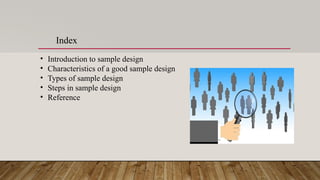
Index
• Introduction to sample design
• Characteristics of a good sample design
• Types of sample design
• Steps in sample design
• Reference
DETERMINING SAMPLE DESIGN
What is Sample Design…..?
• A sample design is a definite plan for obtaining a sample from a given
population. It refers to the technique or the procedure the researcher
would adopt in selecting items for the sample.
• According to Croach and Houdsen , sample is a limited number taken from a
large group for testing and analysis , sample can be taken as representative for
thewholegroup.
Characteristics Of A Good Sample Design
• Sample design must result in a truly representative sample
• Sample design must be such which results in a small sampling error
• Sample design must be viable in the context of funds available for the research study
• Sampledesign should be such that the results of the sample study can be applied, in general, for
the universe with a reasonable level of confidence.
Types of sample design
On the basis of element selection :-
• Restricted
It occurs when elements are chosen using a specific methodology
as in probability using specific methodology as in probability
sampling.
• Unrestricted
It occurs when elements are selected individually and directly
from population .
Types of Sample Design
On the basis of representation :-
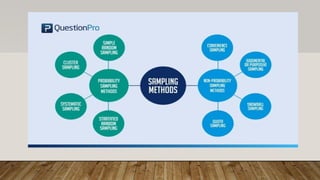
• Probability Sampling Design
• Each element/respondent has a known probability of being included
in the sample.
• Non-probability Sampling Design
• Each element/respondent in the population is not given equal chance
of selection.
Probability Sampling Designs:
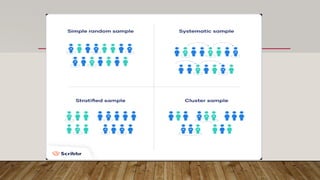
• Simple Random Sampling
• Each and every element/respondent in the population is given equal chance of selection.
I. Draw a lottery :- In this method name / number assigned to each member of population
is written in a slip and mixed in a lottery box. Now the researcher has to draw the
desired number of slips from the box.
II. Random number table :- In this method each element of population is assigned with a
number and all the numbers are arranged in a table. Now the researcher can start from
any point in the table and select the desired number of sample.
• Systematic Sampling
• The selection of sample starts by picking some random point in the list
and then every nth element is selected until the desired number is secured.
• Stratified Sampling
The population is stratified into a number of non-overlapping subpopulations or
strata and sample items are selected from each stratum.
Continue…
I. Proportionate Stratified Sampling :-
• Selects the number of elements from each stratum so that the stratum sample
size ( n1, n2, n3…………….n) is proportional to their respective stratum
population size (N1, N2, N3………….N).
ii. Disproportionate Stratified Sampling:-
• Selects the number of elements from each stratum so that stratum sample
size is not proportional to stratum population size.
• Cluster Sampling and Area Sampling
• It involves grouping the population and then selecting the groups or the
clusters rather than individual elements for inclusion in the same.
• Area Sampling : Total geographical area is divided into a number of smaller
non-overlapping areas, generally called geographical clusters, then a number
of these smaller areas randomly selected and all elements in these small
areas are included in the sample.
Non Probability Sampling Designs: (Deliberate or Purposive Sampling)
• Convenience Sampling
• When elements/respondents in the population/universe are selected for inclusion in
the sample based on the ease of the access.It is called Convenience sampling.
• Snowball Sampling
• In this type of sampling,the investigator encourages therespondents togive names of
other acquaintances andit continues growinginsize andchains until the research
purpose isachieved.
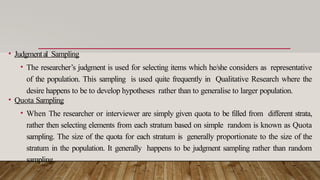
• Judgmental Sampling
• The researcher’s judgment is used for selecting items which he/she considers as representative
of the population. This sampling is used quite frequently in Qualitative Research where the
desire happens to be to develop hypotheses rather than to generalise to larger population.
• Quota Sampling
• When The researcher or interviewer are simply given quota to be filled from different strata,
rather then selecting elements from each stratum based on simple random is known as Quota
sampling. The size of the quota for each stratum is generally proportionate to the size of the
stratum in the population. It generally happens to be judgment sampling rather than random
sampling.
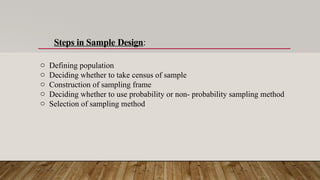
Steps in Sample Design:
o Defining population
o Deciding whether to take census of sample
o Construction of sampling frame
o Deciding whether to use probability or non- probability sampling method
o Selection of sampling method
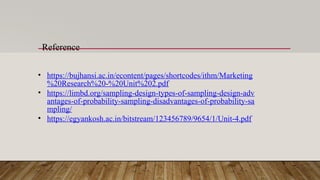
Reference
• https://bujhansi.ac.in/econtent/pages/shortcodes/ithm/Marketing
%20Research%20-%20Unit%202.pdf
• https://limbd.org/sampling-design-types-of-sampling-design-adv
antages-of-probability-sampling-disadvantages-of-probability-sa
mpling/
• https://egyankosh.ac.in/bitstream/123456789/9654/1/Unit-4.pdf
Basic Research Methodology, Stats, Tools and Analysis

Basic Research Methodology, Stats, Tools and Analysis

  • 1.
    Basic Research Methodology, Stats, Tools and Analysis VFP001 Jaya Upraity Masters of Vocational Studies in Food Preservation and Processing
  • 2.
    Index • Introduction tosample design • Characteristics of a good sample design • Types of sample design • Steps in sample design • Reference
  • 3.
    DETERMINING SAMPLE DESIGN Whatis Sample Design…..? • A sample design is a definite plan for obtaining a sample from a given population. It refers to the technique or the procedure the researcher would adopt in selecting items for the sample. • According to Croach and Houdsen , sample is a limited number taken from a large group for testing and analysis , sample can be taken as representative for thewholegroup.
  • 4.
    Characteristics Of AGood Sample Design • Sample design must result in a truly representative sample • Sample design must be such which results in a small sampling error • Sample design must be viable in the context of funds available for the research study • Sampledesign should be such that the results of the sample study can be applied, in general, for the universe with a reasonable level of confidence.
  • 5.
    Types of sampledesign On the basis of element selection :- • Restricted It occurs when elements are chosen using a specific methodology as in probability using specific methodology as in probability sampling. • Unrestricted It occurs when elements are selected individually and directly from population .
  • 7.
    Types of SampleDesign On the basis of representation :- • Probability Sampling Design • Each element/respondent has a known probability of being included in the sample. • Non-probability Sampling Design • Each element/respondent in the population is not given equal chance of selection.
  • 9.
    Probability Sampling Designs: •Simple Random Sampling • Each and every element/respondent in the population is given equal chance of selection. I. Draw a lottery :- In this method name / number assigned to each member of population is written in a slip and mixed in a lottery box. Now the researcher has to draw the desired number of slips from the box. II. Random number table :- In this method each element of population is assigned with a number and all the numbers are arranged in a table. Now the researcher can start from any point in the table and select the desired number of sample.
  • 10.
    • Systematic Sampling •The selection of sample starts by picking some random point in the list and then every nth element is selected until the desired number is secured. • Stratified Sampling The population is stratified into a number of non-overlapping subpopulations or strata and sample items are selected from each stratum.
  • 11.
    Continue… I. Proportionate StratifiedSampling :- • Selects the number of elements from each stratum so that the stratum sample size ( n1, n2, n3…………….n) is proportional to their respective stratum population size (N1, N2, N3………….N). ii. Disproportionate Stratified Sampling:- • Selects the number of elements from each stratum so that stratum sample size is not proportional to stratum population size.
  • 12.
    • Cluster Samplingand Area Sampling • It involves grouping the population and then selecting the groups or the clusters rather than individual elements for inclusion in the same. • Area Sampling : Total geographical area is divided into a number of smaller non-overlapping areas, generally called geographical clusters, then a number of these smaller areas randomly selected and all elements in these small areas are included in the sample.
  • 14.
    Non Probability SamplingDesigns: (Deliberate or Purposive Sampling) • Convenience Sampling • When elements/respondents in the population/universe are selected for inclusion in the sample based on the ease of the access.It is called Convenience sampling. • Snowball Sampling • In this type of sampling,the investigator encourages therespondents togive names of other acquaintances andit continues growinginsize andchains until the research purpose isachieved.
  • 15.
    • Judgmental Sampling •The researcher’s judgment is used for selecting items which he/she considers as representative of the population. This sampling is used quite frequently in Qualitative Research where the desire happens to be to develop hypotheses rather than to generalise to larger population. • Quota Sampling • When The researcher or interviewer are simply given quota to be filled from different strata, rather then selecting elements from each stratum based on simple random is known as Quota sampling. The size of the quota for each stratum is generally proportionate to the size of the stratum in the population. It generally happens to be judgment sampling rather than random sampling.
  • 16.
    Steps in SampleDesign: o Defining population o Deciding whether to take census of sample o Construction of sampling frame o Deciding whether to use probability or non- probability sampling method o Selection of sampling method
  • 17.