Principles of Sociology
Unit 1:
a. Nature, Definition and Scope of Sociology.
b. Sociology and law
c. Sociology and economics
d. Sociology and political science
e. Sociology and history
Definition of Sociology.
Sociology is a social science i.e. a man made science.
The word sociology is derived from the latin word societus i.e. “society” and Greek word logos
i.e. “study”.
1. Auguste Comte:
“Sociology is a science of social phenomenon subject to natural and invariable laws, the
discovery of which is the object of investigation”.
2. Prof. Ginsberg:
“Sociology is the study of man’s behavior in groups or of the interaction among human
beings, of social relationships and the processes by which human group activity takes place.
3. H.M. Johnson:
“Sociology is the science that deals with social groups; their internal forms or modes or
organization, the processes that tend to maintain or change these forms of organization and
relations between groups.”
Nature of Sociology.
1. Sociology is a social science and not a natural Science.
2. Sociology is a positive science and not a normative science.
3. Sociology is a rational empirical science. ( human experience)
4. Sociology is an abstract science and not a concrete science.
5. Sociology is a science of Generalization.
6. Sociology is a general Science
Scope of Sociology:
There are a few schools of thought regarding scope of sociology:
1. Specialistic School:
Max weber, George Simmel, Vier Kandt and Von Wiese belong to this school. The
main view of the school is that sociology is specific, pure and independent science and
studies various types of relationships. This scope is very narrow and limited.
• George Simmel: Sociology is concerned with different forms of social relationship
formed by various groups.
• Max Weber: Sociology means to interpret or understand social behavior of humans
and analyze relations.
• Vier Kandt: It is a branch of knowledge concerned with mental or physical
relationships of people.
• Von Wiese: To study forms of social relationships and behavior.
2. Synthetic School:
It views that sociology should deal with the entire human race. It tries to cover the entire society as a
whole. Thinkers like Ginsberg, Durkhein , Sorokin and hobhouse’s ideologies match to this school.
• Ginsberg: divided subject matter into 4 parts i.e.
Social Morphology: Study of population and social structure.
Social Control: Study of law, religion etc.
Social process: study of cooperation and conflicts of the society.
Social Pathology: Cause and effect of the social disorganizations.
• Emile Durkheim:
Special Morphology: territorial basis of life of people and their problems
Special Psychology: divided in religion and laws etc.
General: Social Fact.
3. Feminist School:
Feminist theory in sociology focuses on understanding and challenging the social
inequalities and social injustices that arise from gender biased and patriarchy.
4. Marxist School:
It analyses the critiques and development of class society and especially of capitalism as well as rate of
class struggles in systematic, social and political change.
3. Feminist School:
Feminist theory in sociology focuses on understanding and challenging the social
inequalities and social injustices that arise from gender biased and patriarchy.
4. Marxist School:
It analyses the critiques and development of class society and especially of capitalism as well as rate of
class struggles in systematic, social and political change.
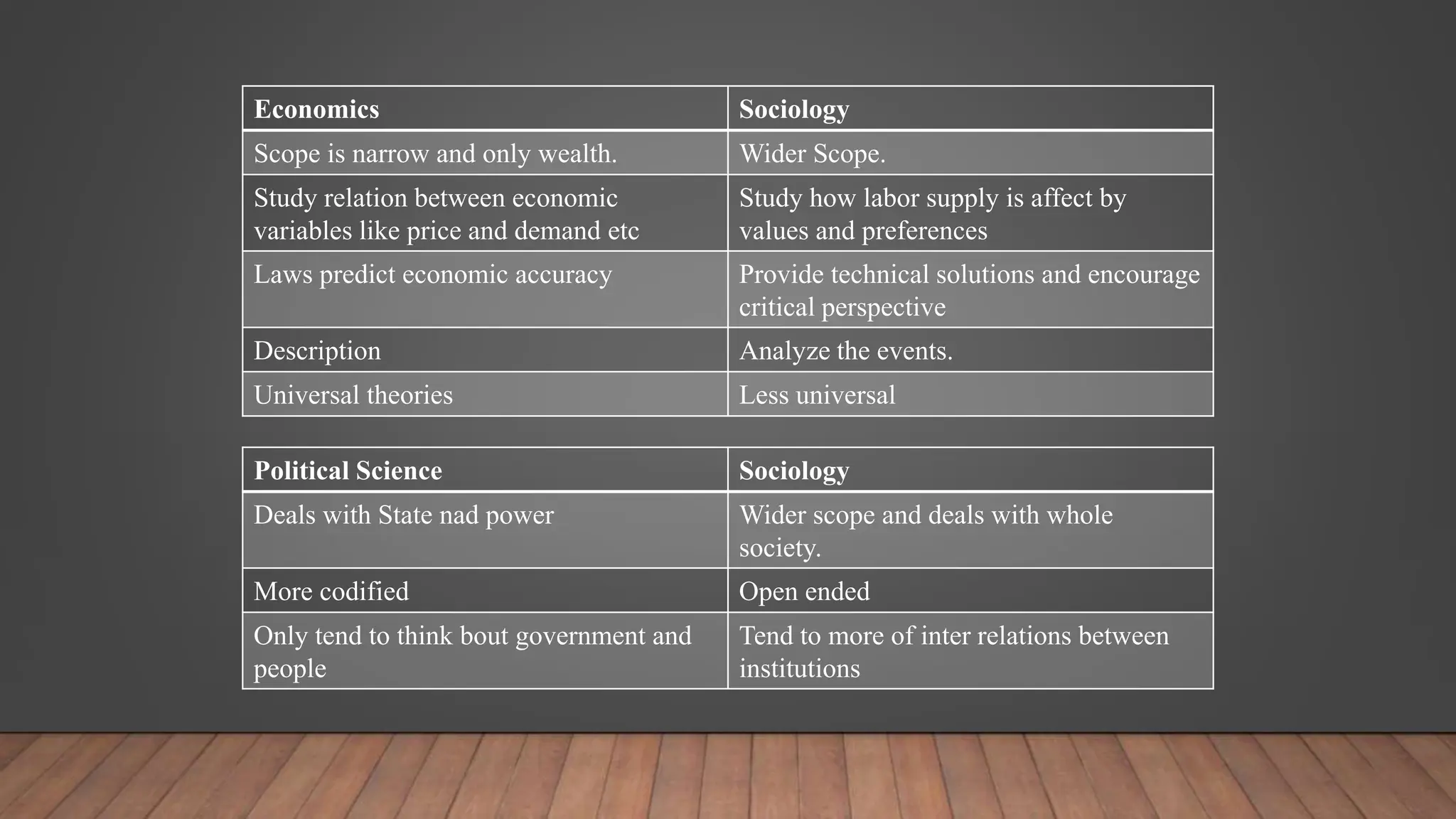
Economics Sociology
Scope is narrow and only wealth. Wider Scope.
Study relation between economic
variables like price and demand etc
Study how labor supply is affect by
values and preferences
Laws predict economic accuracy Provide technical solutions and encourage
critical perspective
Description Analyze the events.
Universal theories Less universal
Political Science Sociology
Deals with State nad power Wider scope and deals with whole
society.
More codified Open ended
Only tend to think bout government and
people
Tend to more of inter relations between
institutions
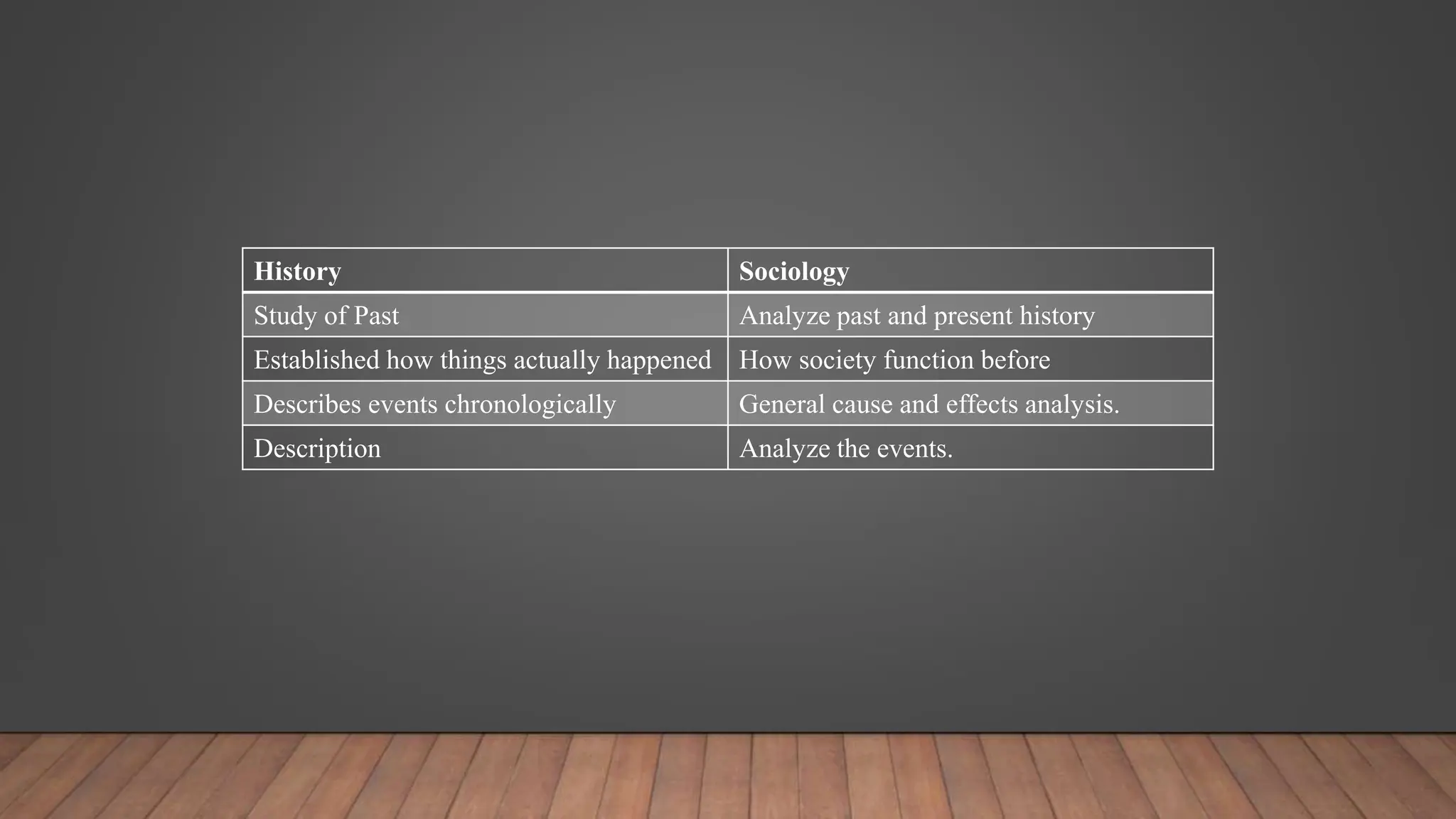
History Sociology
Study of Past Analyze past and present history
Established how things actually happened How society function before
Describes events chronologically General cause and effects analysis.
Description Analyze the events.
Sociology and Law.
Legal Principles:
Commonly accepted standards that are applied to understanding and interpreting and applying on
cases. Law is concerned with the study of entire body of legal principles and it is regulated by citizen.
Functions of Law:
1. Law is to control natural tendencies and certain hhuman instinct.
2. Law ensure cooperation.
3. Law acts as a social rule.
4. Law is to reduce the disharmony of society.
Thank You

Basic Principles of Sociology (Nature and Scope)

  • 1.
    Principles of Sociology Unit1: a. Nature, Definition and Scope of Sociology. b. Sociology and law c. Sociology and economics d. Sociology and political science e. Sociology and history
  • 2.
    Definition of Sociology. Sociologyis a social science i.e. a man made science. The word sociology is derived from the latin word societus i.e. “society” and Greek word logos i.e. “study”. 1. Auguste Comte: “Sociology is a science of social phenomenon subject to natural and invariable laws, the discovery of which is the object of investigation”. 2. Prof. Ginsberg: “Sociology is the study of man’s behavior in groups or of the interaction among human beings, of social relationships and the processes by which human group activity takes place. 3. H.M. Johnson: “Sociology is the science that deals with social groups; their internal forms or modes or organization, the processes that tend to maintain or change these forms of organization and relations between groups.”
  • 3.
    Nature of Sociology. 1.Sociology is a social science and not a natural Science. 2. Sociology is a positive science and not a normative science. 3. Sociology is a rational empirical science. ( human experience) 4. Sociology is an abstract science and not a concrete science. 5. Sociology is a science of Generalization. 6. Sociology is a general Science
  • 4.
    Scope of Sociology: Thereare a few schools of thought regarding scope of sociology: 1. Specialistic School: Max weber, George Simmel, Vier Kandt and Von Wiese belong to this school. The main view of the school is that sociology is specific, pure and independent science and studies various types of relationships. This scope is very narrow and limited. • George Simmel: Sociology is concerned with different forms of social relationship formed by various groups. • Max Weber: Sociology means to interpret or understand social behavior of humans and analyze relations. • Vier Kandt: It is a branch of knowledge concerned with mental or physical relationships of people. • Von Wiese: To study forms of social relationships and behavior.
  • 5.
    2. Synthetic School: Itviews that sociology should deal with the entire human race. It tries to cover the entire society as a whole. Thinkers like Ginsberg, Durkhein , Sorokin and hobhouse’s ideologies match to this school. • Ginsberg: divided subject matter into 4 parts i.e. Social Morphology: Study of population and social structure. Social Control: Study of law, religion etc. Social process: study of cooperation and conflicts of the society. Social Pathology: Cause and effect of the social disorganizations. • Emile Durkheim: Special Morphology: territorial basis of life of people and their problems Special Psychology: divided in religion and laws etc. General: Social Fact.
  • 6.
    3. Feminist School: Feministtheory in sociology focuses on understanding and challenging the social inequalities and social injustices that arise from gender biased and patriarchy. 4. Marxist School: It analyses the critiques and development of class society and especially of capitalism as well as rate of class struggles in systematic, social and political change.
  • 7.
    3. Feminist School: Feministtheory in sociology focuses on understanding and challenging the social inequalities and social injustices that arise from gender biased and patriarchy. 4. Marxist School: It analyses the critiques and development of class society and especially of capitalism as well as rate of class struggles in systematic, social and political change.
  • 8.
    Economics Sociology Scope isnarrow and only wealth. Wider Scope. Study relation between economic variables like price and demand etc Study how labor supply is affect by values and preferences Laws predict economic accuracy Provide technical solutions and encourage critical perspective Description Analyze the events. Universal theories Less universal Political Science Sociology Deals with State nad power Wider scope and deals with whole society. More codified Open ended Only tend to think bout government and people Tend to more of inter relations between institutions
  • 9.
    History Sociology Study ofPast Analyze past and present history Established how things actually happened How society function before Describes events chronologically General cause and effects analysis. Description Analyze the events.
  • 10.
    Sociology and Law. LegalPrinciples: Commonly accepted standards that are applied to understanding and interpreting and applying on cases. Law is concerned with the study of entire body of legal principles and it is regulated by citizen. Functions of Law: 1. Law is to control natural tendencies and certain hhuman instinct. 2. Law ensure cooperation. 3. Law acts as a social rule. 4. Law is to reduce the disharmony of society.
  • 11.