Basic Estate Planning Determine if Your  Estate Plan is in Order By:   Roccy DeFrancesco, JD, CWPP, CAPP, MMB Founder:  The Wealth Preservation Institute Co-Founder:  The Asset Protection Society
The 5 Basic Estate Planning Tools 1)  Wills 2)  Living Trusts 3)  Legal and Medical Powers 4)  Family Limited Partners  (FLPs). 5)  Irrevocable Life Insurance Trusts  (ILITs)
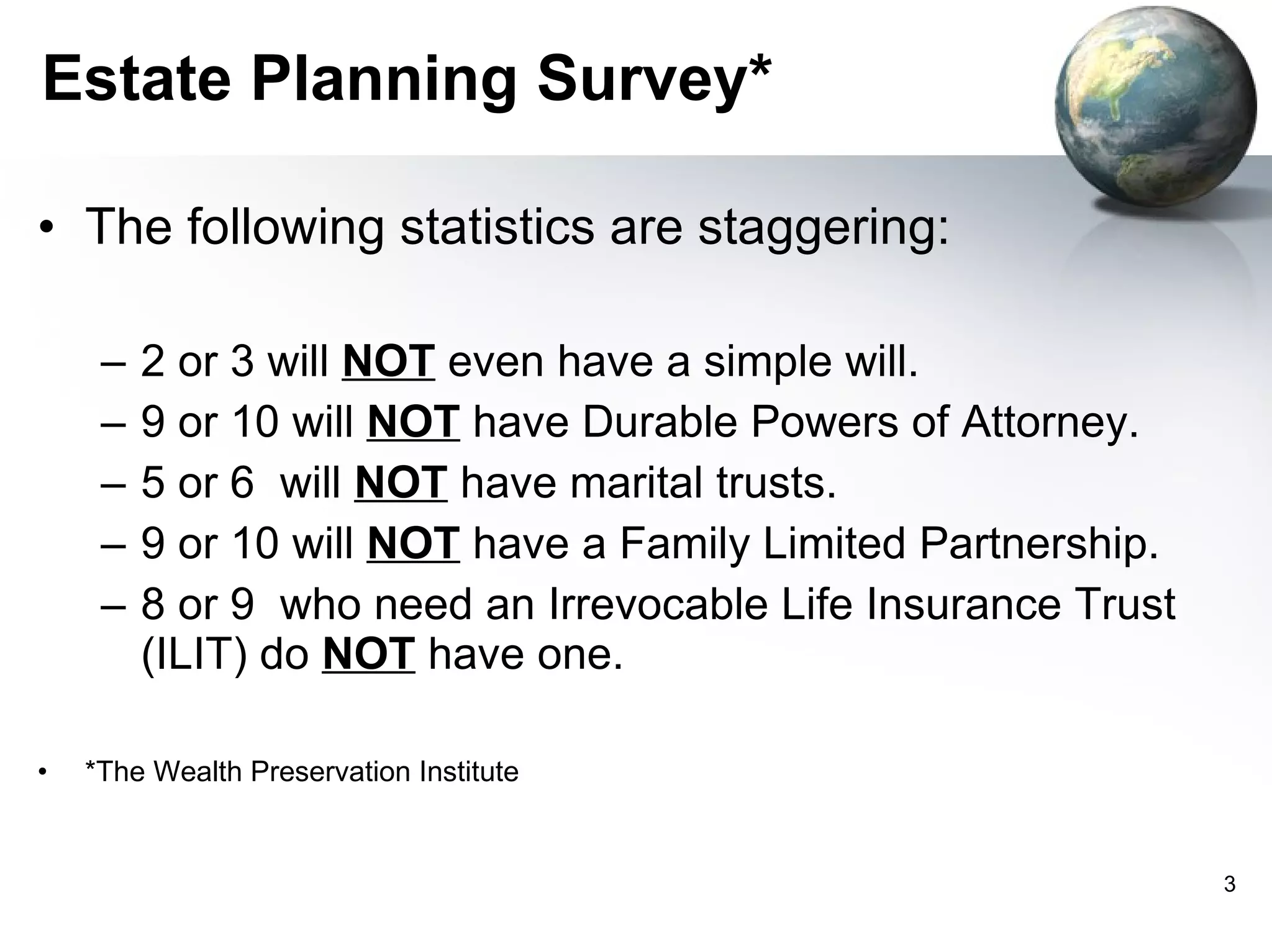
Estate Planning Survey* The following statistics are staggering: 2 or 3 will  NOT  even have a simple will.  9 or 10 will  NOT  have Durable Powers of Attorney.  5 or 6  will  NOT  have marital trusts.  9 or 10 will  NOT  have a Family Limited Partnership.  8 or 9  who need an Irrevocable Life Insurance Trust (ILIT) do  NOT  have one. *The Wealth Preservation Institute
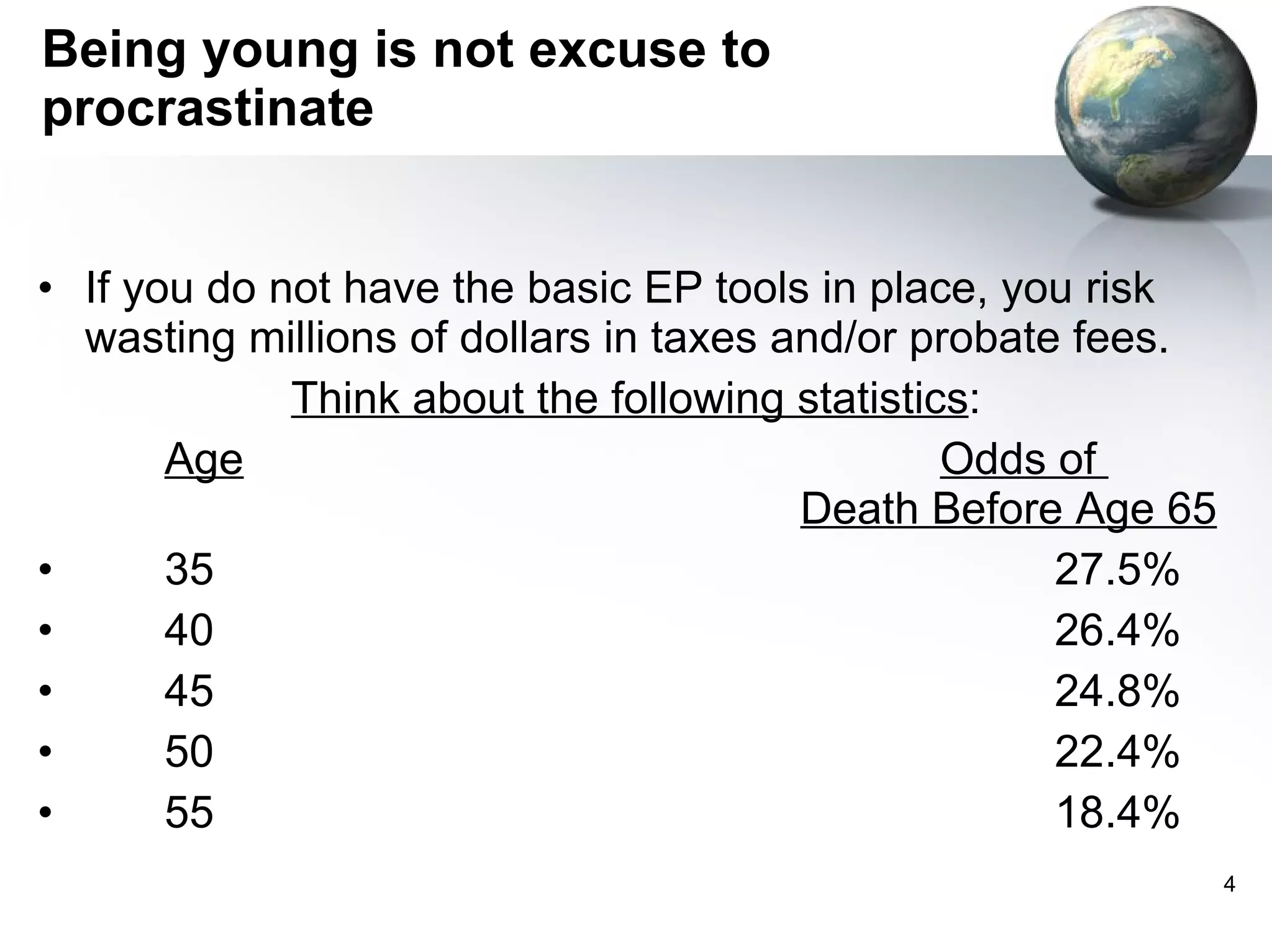
Being young is not excuse to procrastinate If you do not have the basic EP tools in place, you risk wasting millions of dollars in taxes and/or probate fees.  Think about the following statistics : Age   Odds of  Death Before Age 65 35 27.5% 40 26.4% 45 24.8% 50 22.4% 55 18.4%
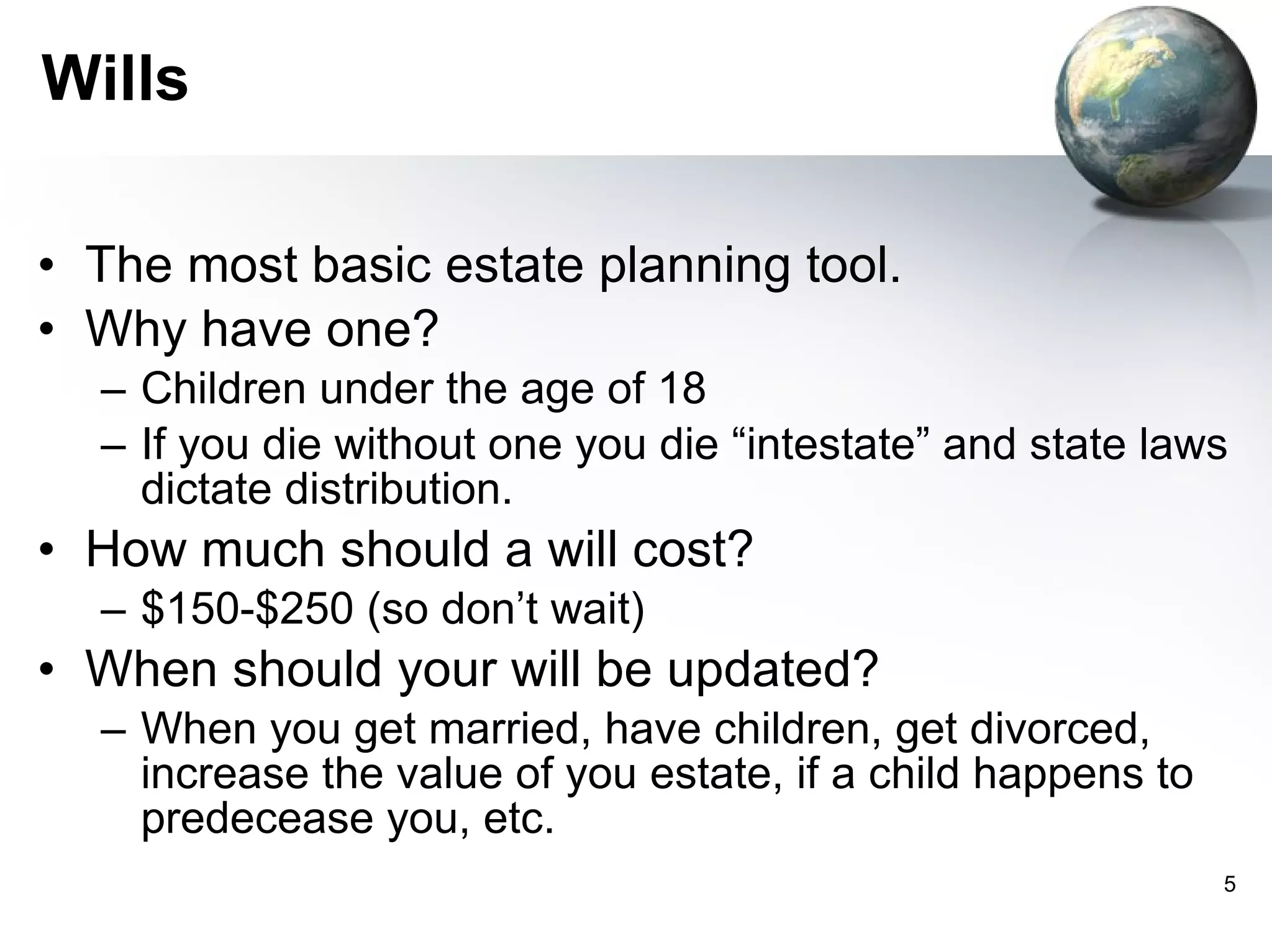
Wills The most basic estate planning tool.  Why have one? Children under the age of 18 If you die without one you die “intestate” and state laws dictate distribution. How much should a will cost? $150-$250 (so don’t wait) When should your will be updated? When you get married, have children, get divorced, increase the value of you estate, if a child happens to predecease you, etc.
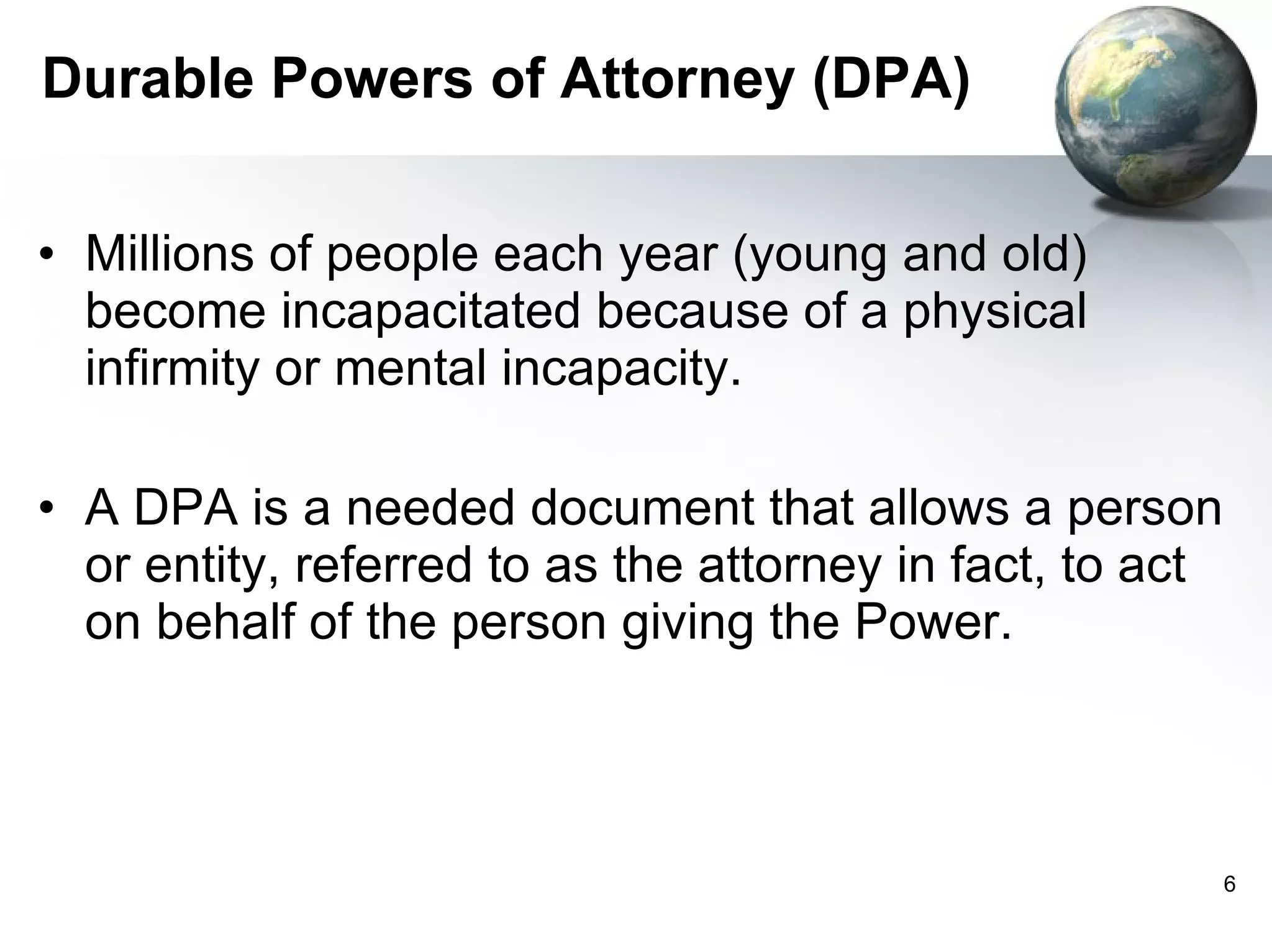
Durable Powers of Attorney (DPA) Millions of people each year (young and old) become incapacitated because of a physical infirmity or mental incapacity.  A DPA is a needed document that allows a person or entity, referred to as the attorney in fact, to act on behalf of the person giving the Power.
Types of DPAs Medical  Allows agent to make medical treatment decisions if the individual is at least 18 years of age.  The Terri Schiavo case with removing the feeding tube.  Legal Allows agent to sign all necessary legal documents to carry on the business of the client. DPAs are time and money savers  Without a DPA the family typically ends up going to court to have someone appointed.
A&B, Marital, or Living Trusts A&B Trusts* are “revocable” living trusts Not an irrevocable trust  You can move assets in and out of the trust with no gift tax issues. These provide NO ASSET PROTECTION. *This assumes that the client is married.  If not, the client would simply have an A or single trust.
Benefits of revocable Trusts 1) Assets in the trust will not be “probated.”  Your will is still probated.  Avoiding probate will save (depending on the state) between  1-8%  ( 4-6%  is average) of the  entire value of the estate  in  probate fees .  2) Another benefits of having assets pass through a trust vs. through probate is the added privacy. * In most states, assets not owned by the trust will  still be probated .
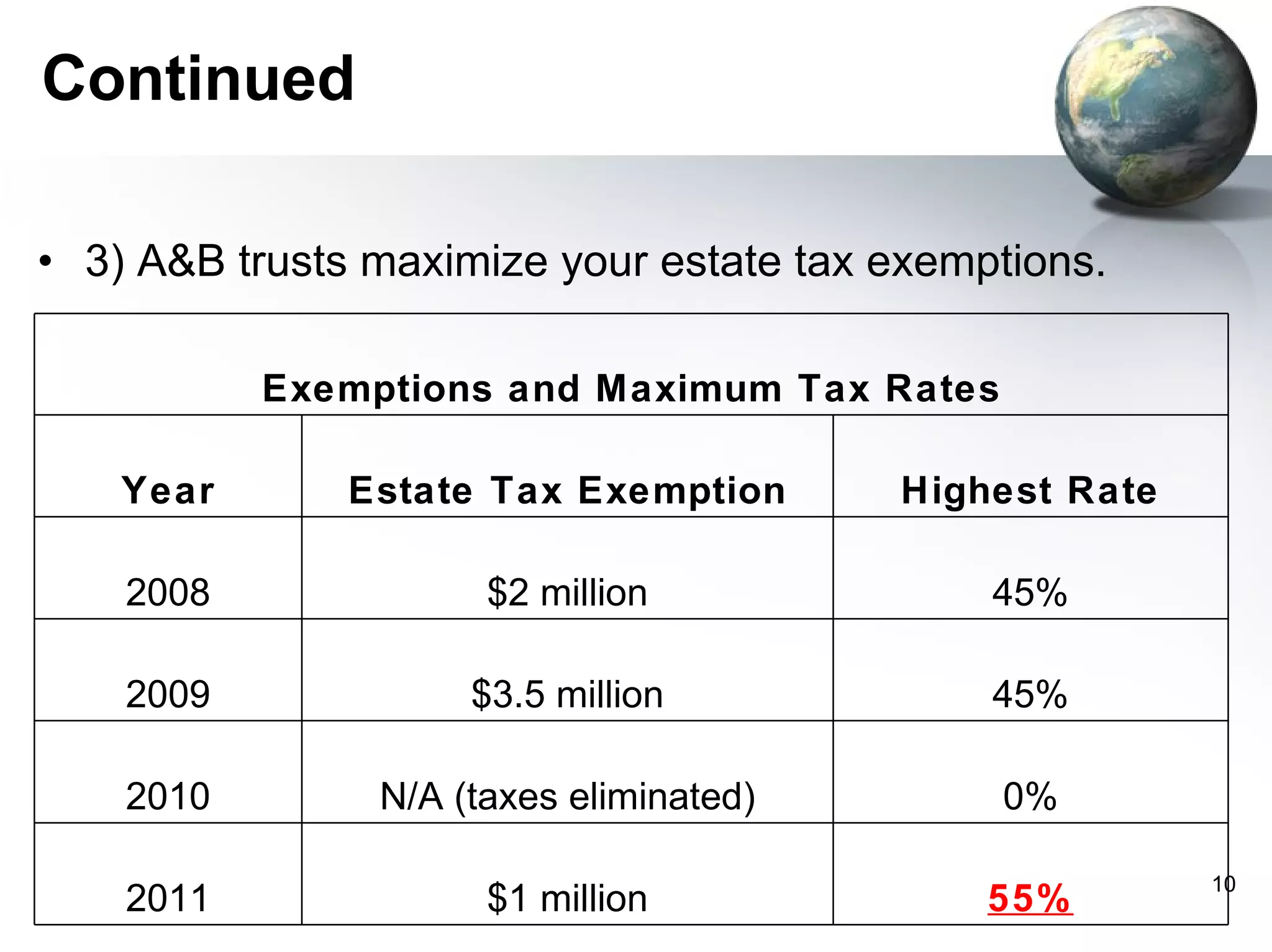
Continued 3) A&B trusts maximize your estate tax exemptions.  Exemptions and Maximum Tax Rates Year Estate Tax Exemption Highest Rate 2008 $2 million 45% 2009 $3.5 million 45% 2010 N/A (taxes eliminated) 0% 2011 $1 million 55%
Example part 1 Mr. Smith and spouse are 50 years old with a $4,000,000 estate.  What happens at  Mr.  Smith’s death in 2011 if he has a will but  NO  living trust? Nothing. What if  Mrs . Smith dies the  next week  with no  Trust? Estate taxes $3,000,000 at  55%  will be due. Why? When Mrs. Smith died she had a $4,000,000* estate and a $1,000,000 estate tax exemption.  After applying her exemption she still has a $3,000,000 taxable estate.
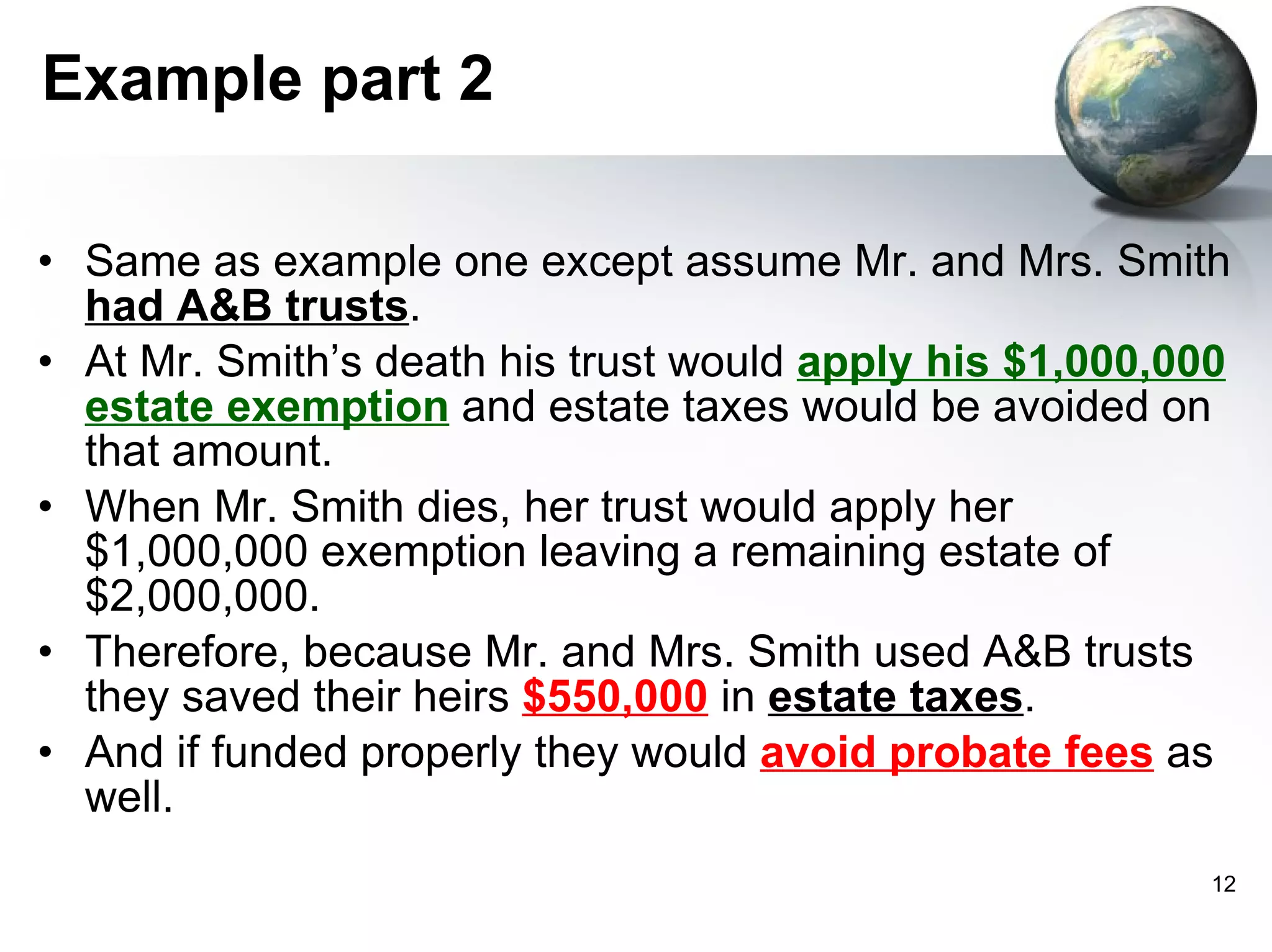
Example part 2 Same as example one except assume Mr. and Mrs. Smith  had A&B trusts . At Mr. Smith’s death his trust would  apply his $1,000,000 estate exemption  and estate taxes would be avoided on that amount. When Mr. Smith dies, her trust would apply her $1,000,000 exemption leaving a remaining estate of $2,000,000.  Therefore, because Mr. and Mrs. Smith used A&B trusts they saved their heirs  $550,000  in  estate taxes . And if funded properly they would  avoid probate fees  as well.
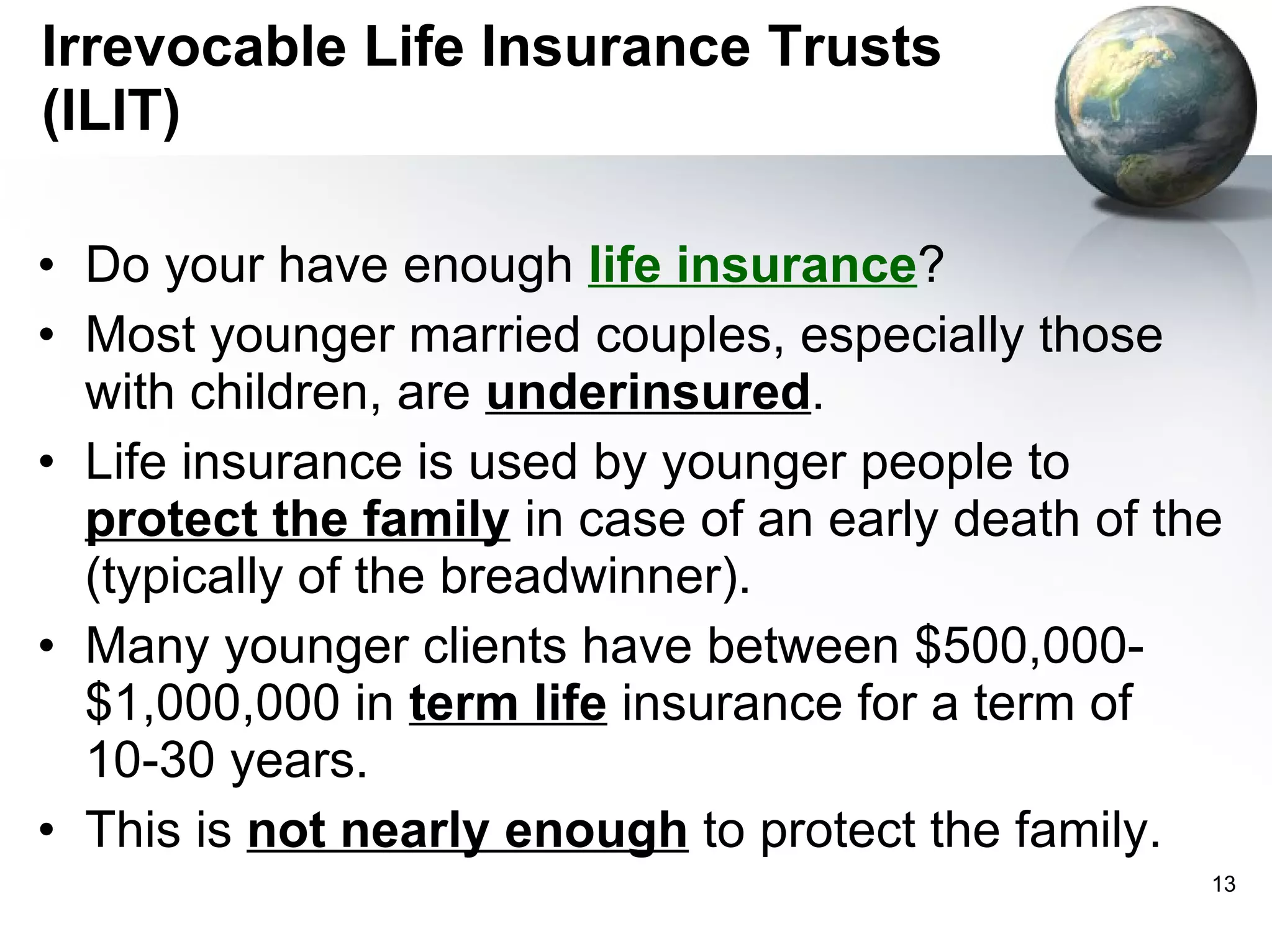
Irrevocable Life Insurance Trusts (ILIT) Do your have enough  life insurance ?  Most younger married couples, especially those with children, are  underinsured .  Life insurance is used by younger people to  protect the family  in case of an early death of the (typically of the breadwinner).  Many younger clients have between $500,000-$1,000,000 in  term life  insurance for a term of 10-30 years.  This is  not nearly enough  to protect the family.
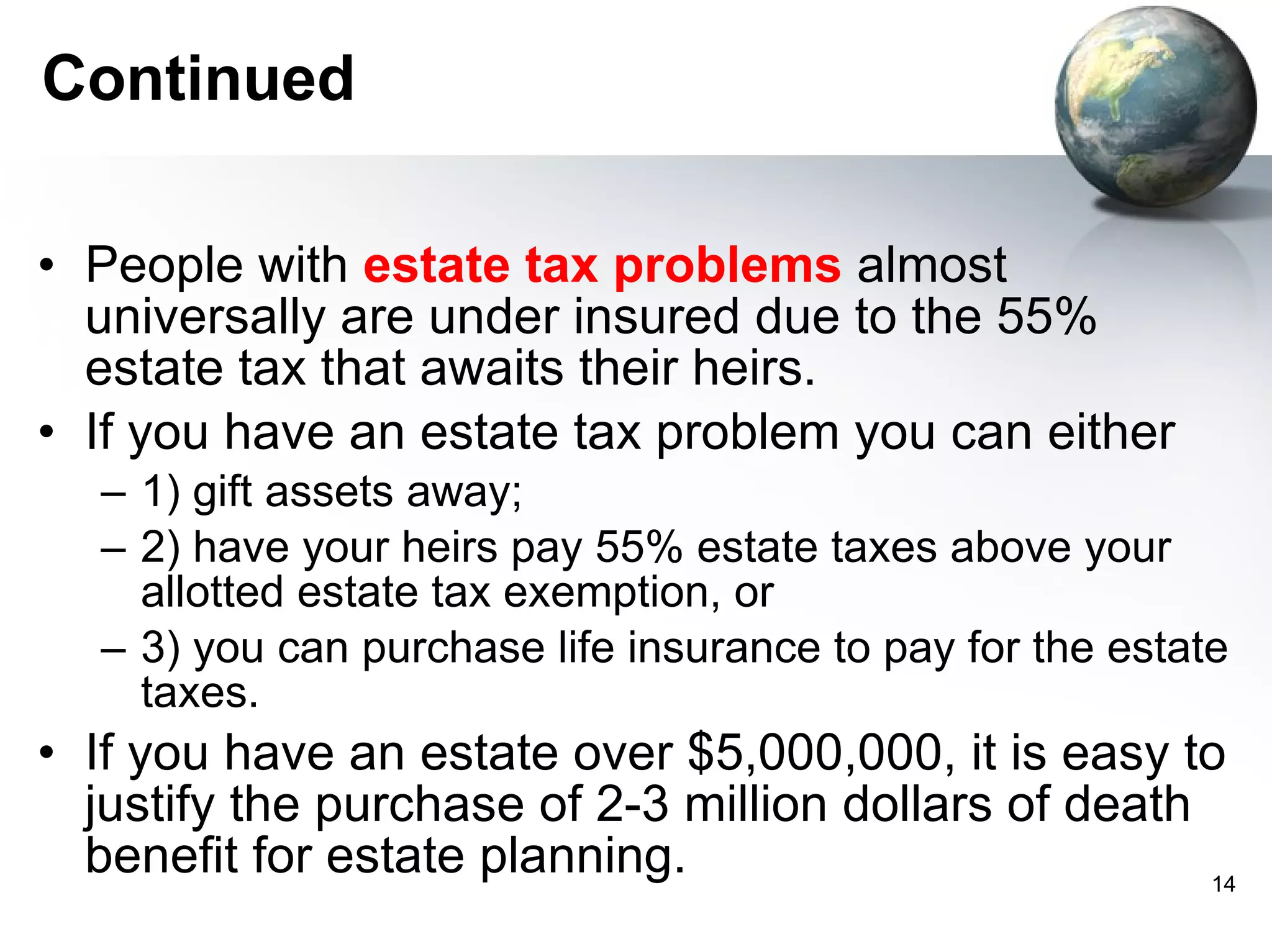
Continued People with  estate tax problems  almost universally are under insured due to the 55% estate tax that awaits their heirs.  If you have an estate tax problem you can either  1) gift assets away;  2) have your heirs pay 55% estate taxes above your allotted estate tax exemption, or  3) you can purchase life insurance to pay for the estate taxes. If you have an estate over $5,000,000, it is easy to justify the purchase of 2-3 million dollars of death benefit for estate planning.
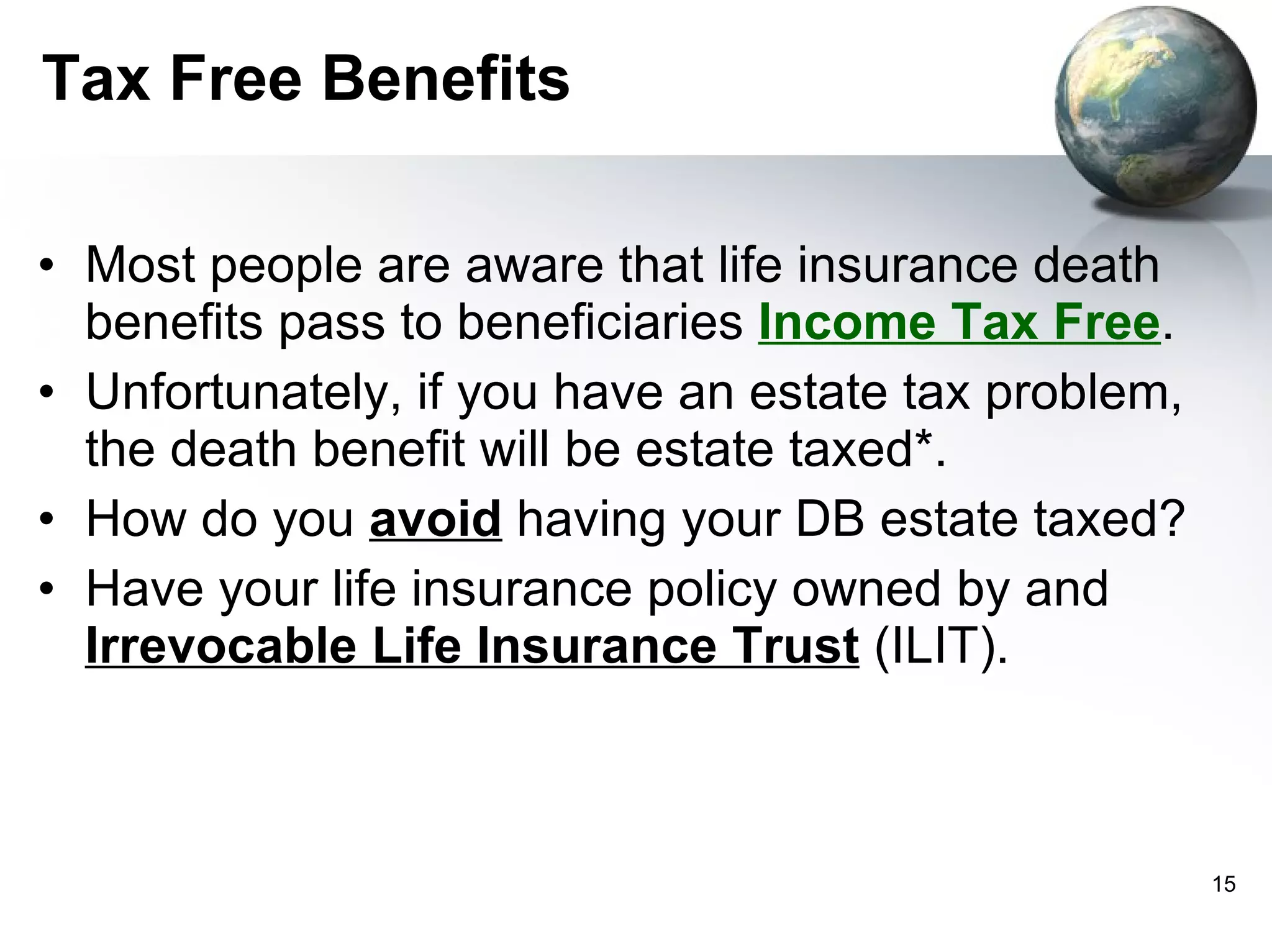
Tax Free Benefits Most people are aware that life insurance death benefits pass to beneficiaries  Income Tax Free .  Unfortunately, if you have an estate tax problem, the death benefit will be estate taxed*. How do you  avoid  having your DB estate taxed? Have your life insurance policy owned by and  Irrevocable Life Insurance Trust  (ILIT).
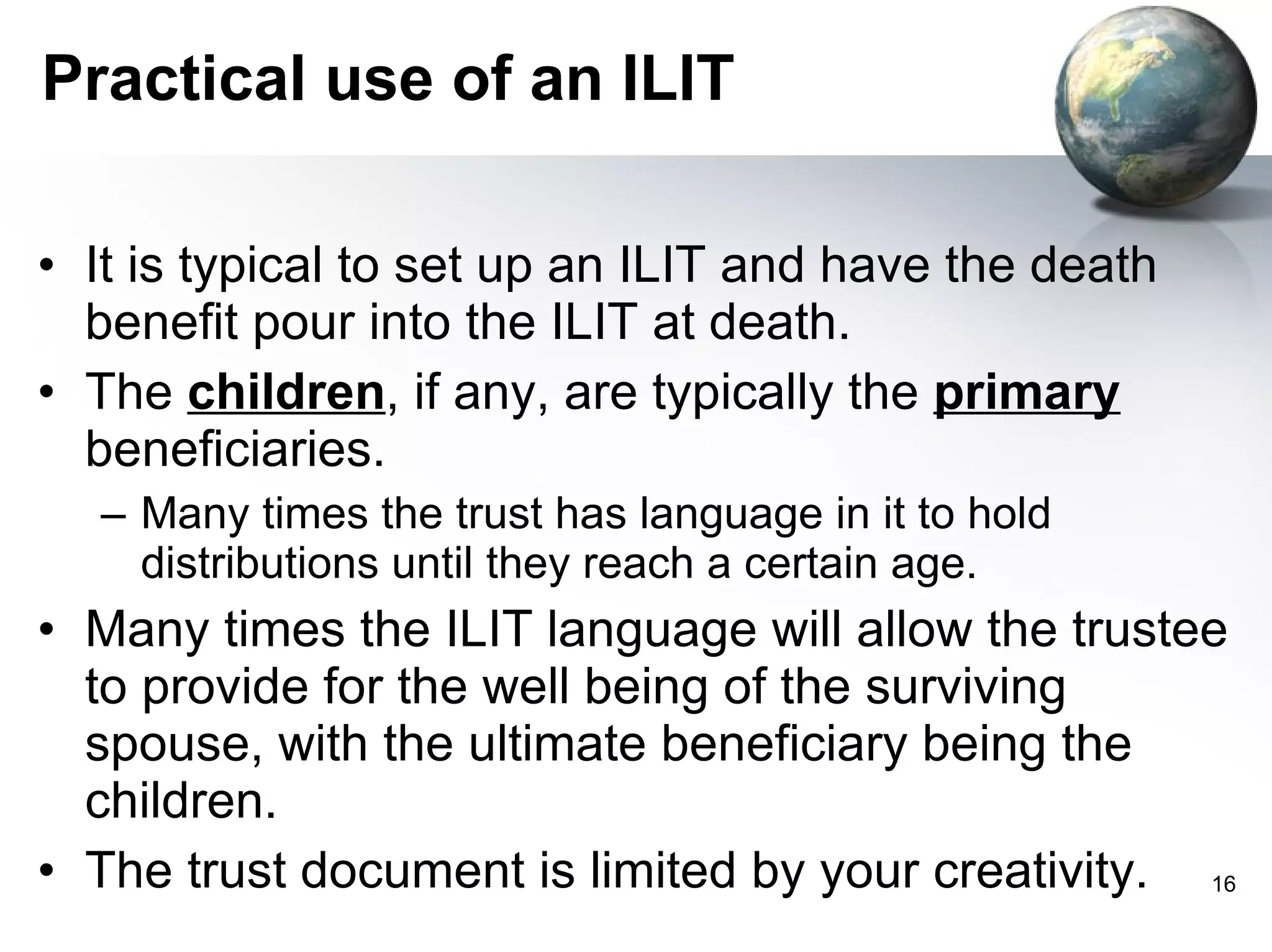
Practical use of an ILIT It is typical to set up an ILIT and have the death benefit pour into the ILIT at death.  The  children , if any, are typically the  primary  beneficiaries. Many times the trust has language in it to hold distributions until they reach a certain age. Many times the ILIT language will allow the trustee to provide for the well being of the surviving spouse, with the ultimate beneficiary being the children.  The trust document is limited by your creativity.
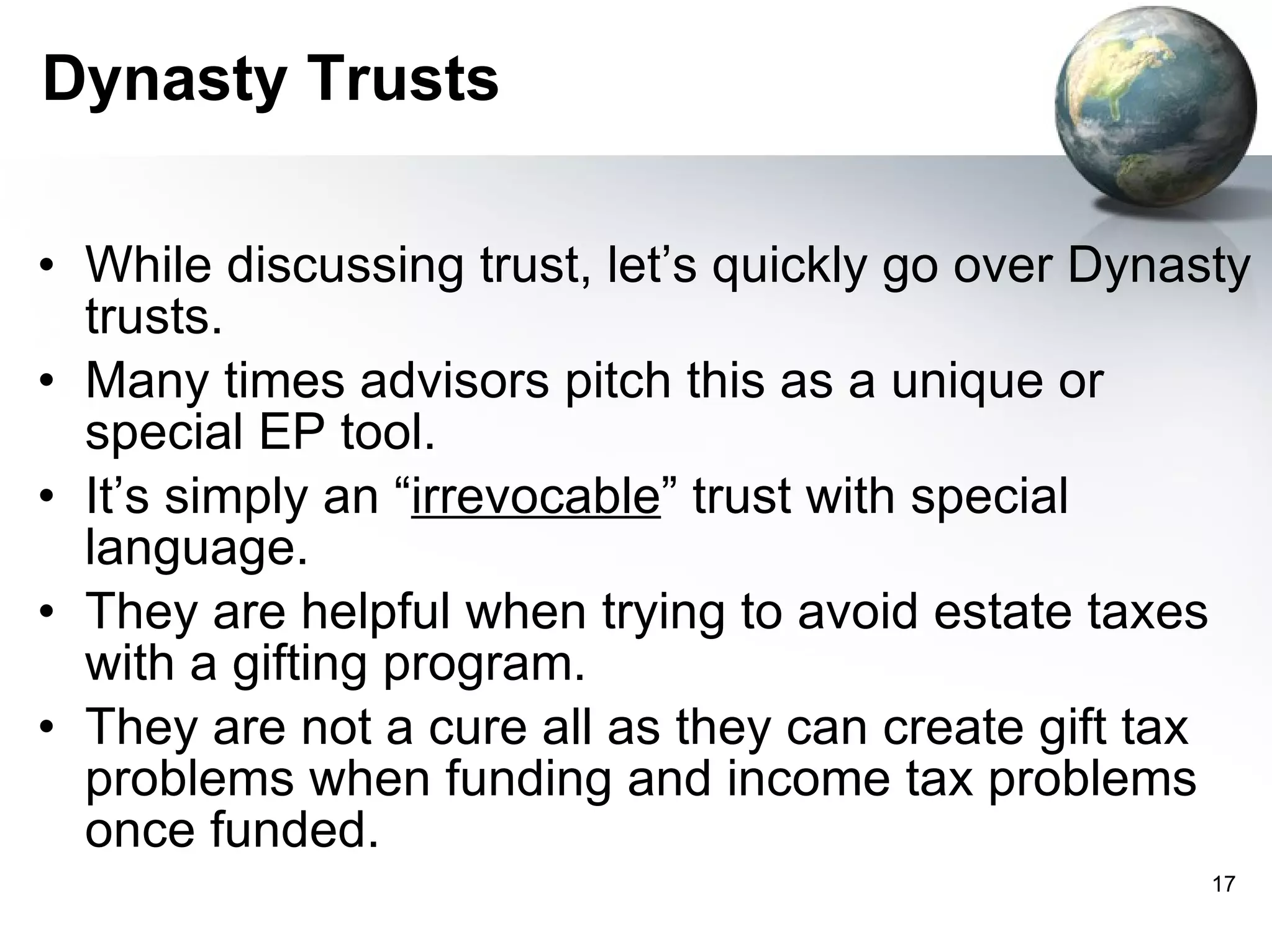
Dynasty Trusts While discussing trust, let’s quickly go over Dynasty trusts. Many times advisors pitch this as a unique or special EP tool.  It’s simply an “ irrevocable ” trust with special language.  They are helpful when trying to avoid estate taxes with a gifting program.  They are not a cure all as they can create gift tax problems when funding and income tax problems once funded.
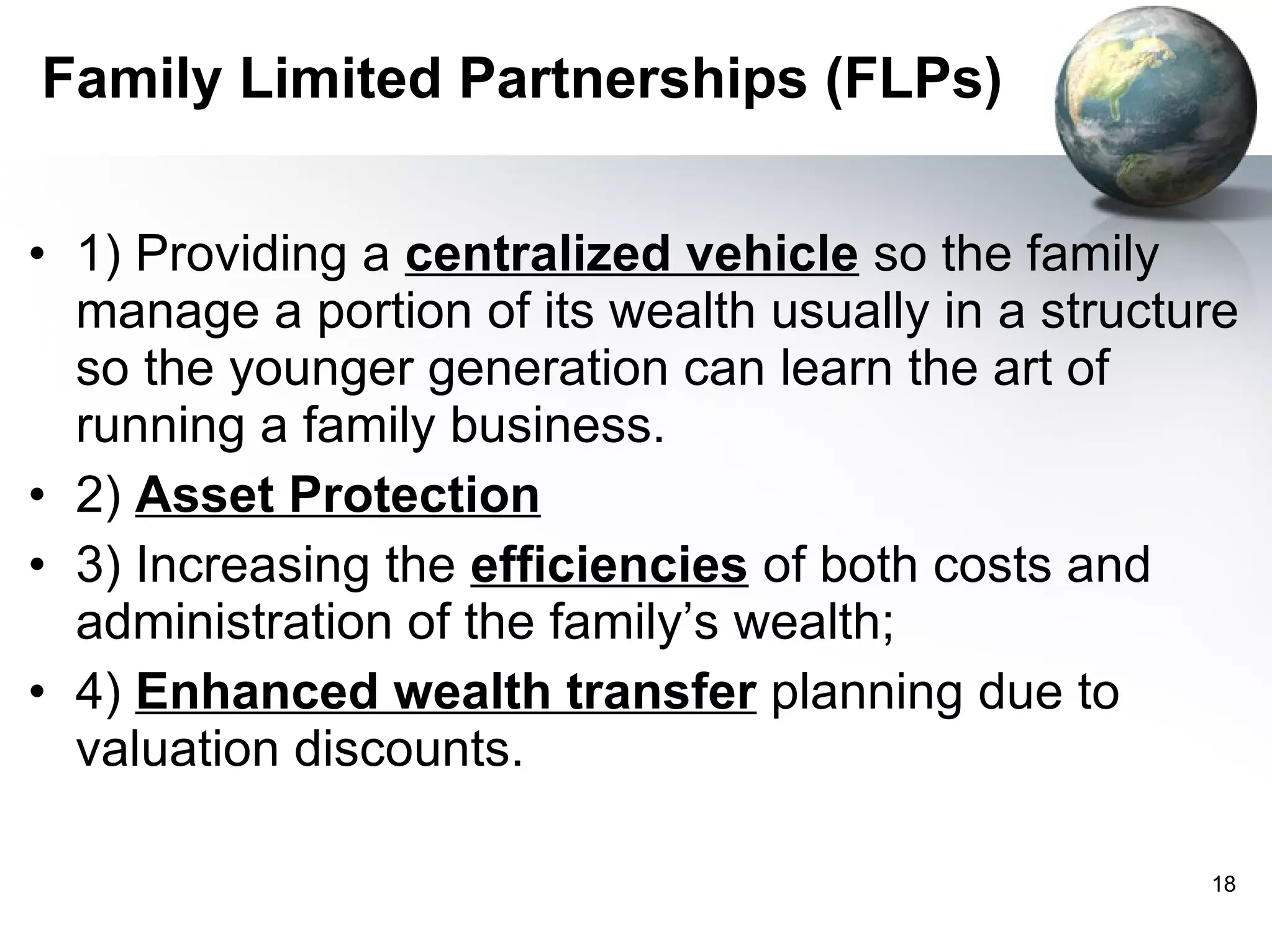
Family Limited Partnerships (FLPs) 1) Providing a  centralized vehicle  so the family manage a portion of its wealth usually in a structure so the younger generation can learn the art of running a family business. 2)  Asset Protection 3) Increasing the  efficiencies  of both costs and administration of the family’s wealth; 4)  Enhanced wealth transfer  planning due to valuation discounts.
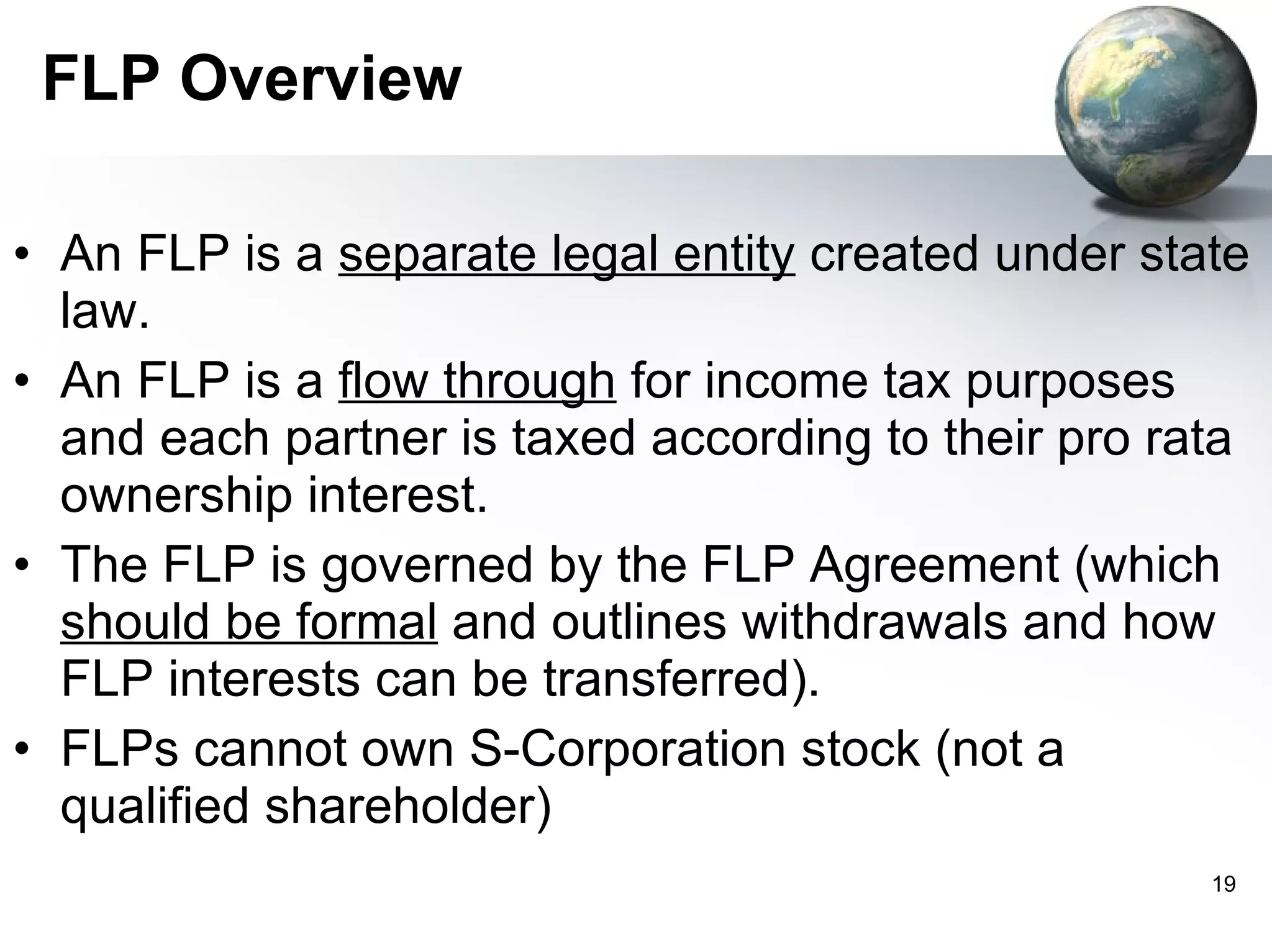
FLP Overview An FLP is a  separate legal entity  created under state law.  An FLP is a  flow through  for income tax purposes and each partner is taxed according to their pro rata ownership interest. The FLP is governed by the FLP Agreement (which  should be formal  and outlines withdrawals and how FLP interests can be transferred).  FLPs cannot own S-Corporation stock (not a qualified shareholder)
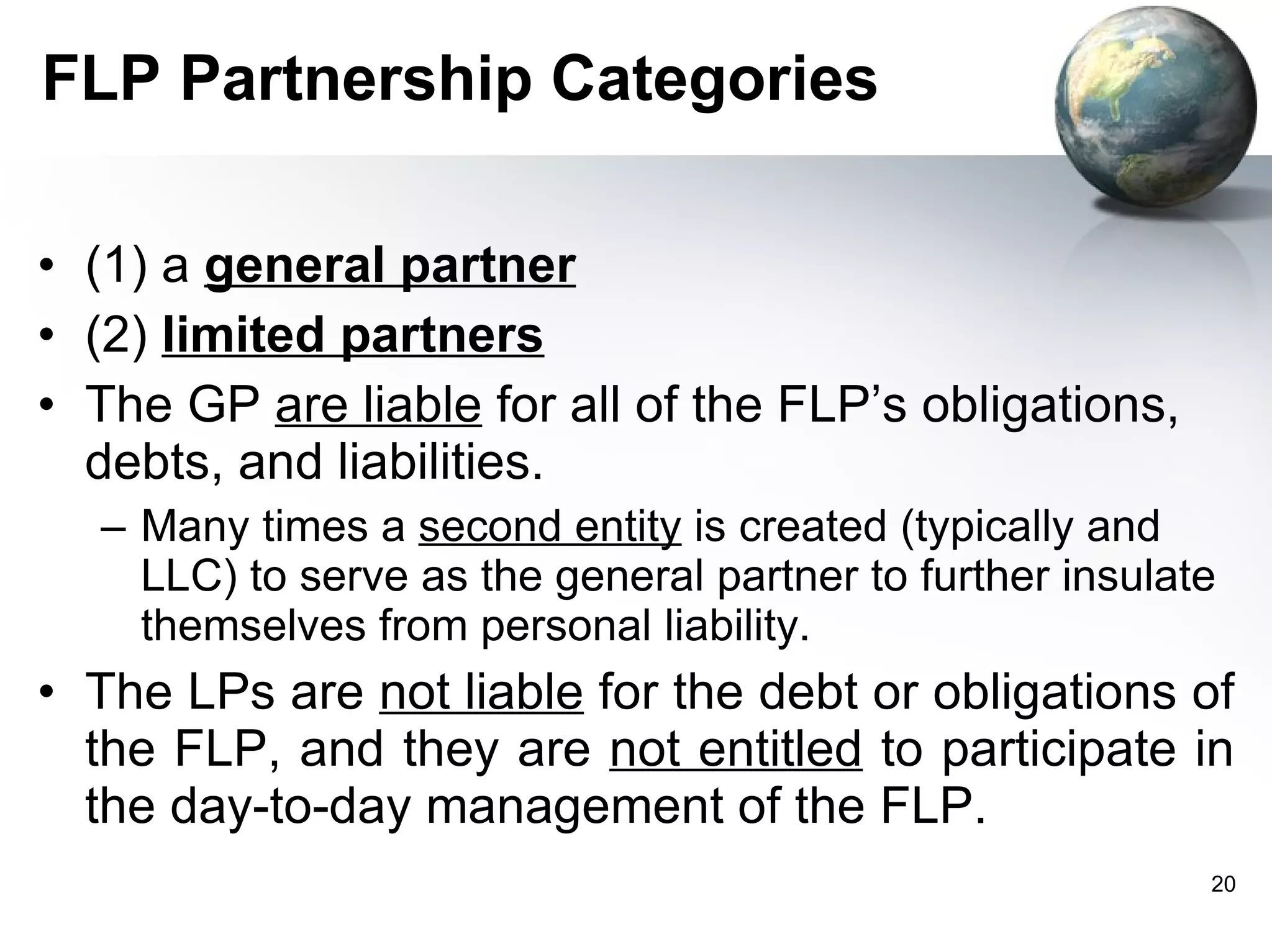
FLP Partnership Categories (1) a  general partner   (2)  limited partners   The GP  are liable  for all of the FLP’s obligations, debts, and liabilities. Many times a  second entity  is created (typically and LLC) to serve as the general partner to further insulate themselves from personal liability.  The LPs are  not liable  for the debt or obligations of the FLP, and they are  not entitled  to participate in the day-to-day management of the FLP.
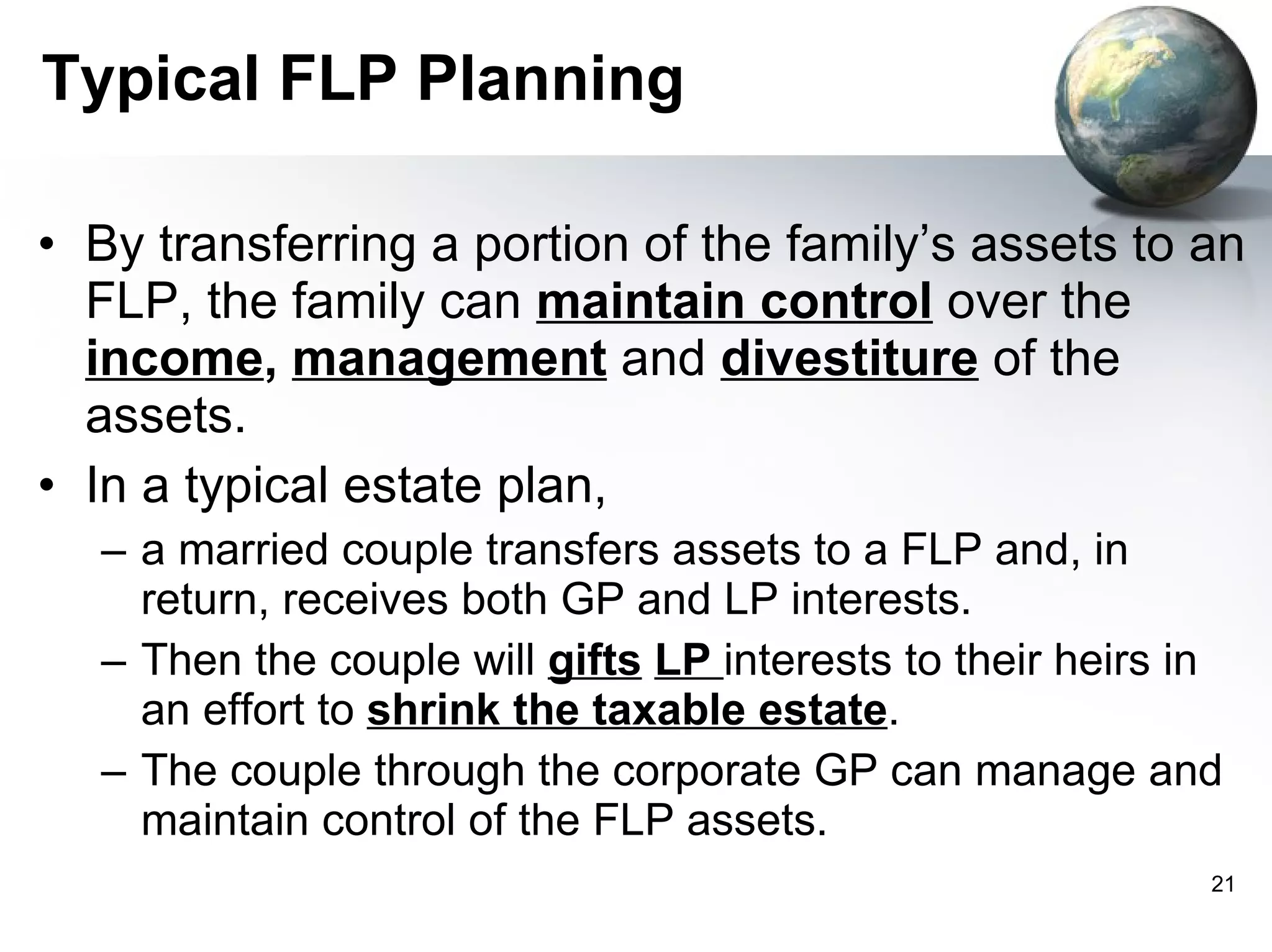
Typical FLP Planning By transferring a portion of the family’s assets to an FLP, the family can   maintain control   over the   income ,  management   and  divestiture   of the assets.  In a typical estate plan,  a married couple transfers assets to a FLP and, in return, receives both GP and LP interests.  Then the couple will  gifts   LP  interests to their heirs in an effort to  shrink the taxable estate . The couple through the corporate GP can manage and maintain control of the FLP assets.
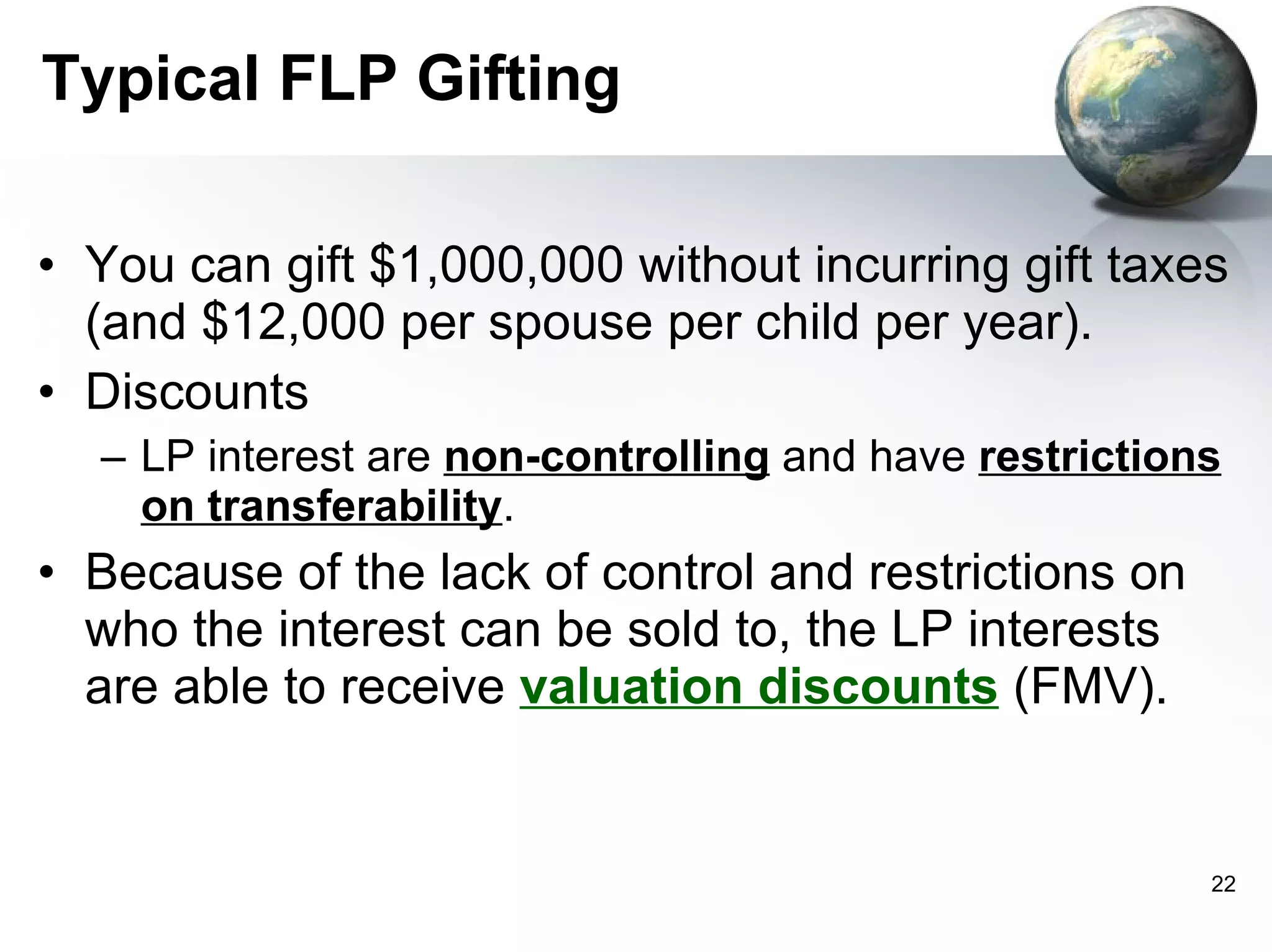
Typical FLP Gifting You can gift $1,000,000 without incurring gift taxes (and $12,000 per spouse per child per year). Discounts LP interest are  non-controlling  and have  restrictions on transferability .  Because of the lack of control and restrictions on who the interest can be sold to, the LP interests are able to receive  valuation discounts  (FMV).
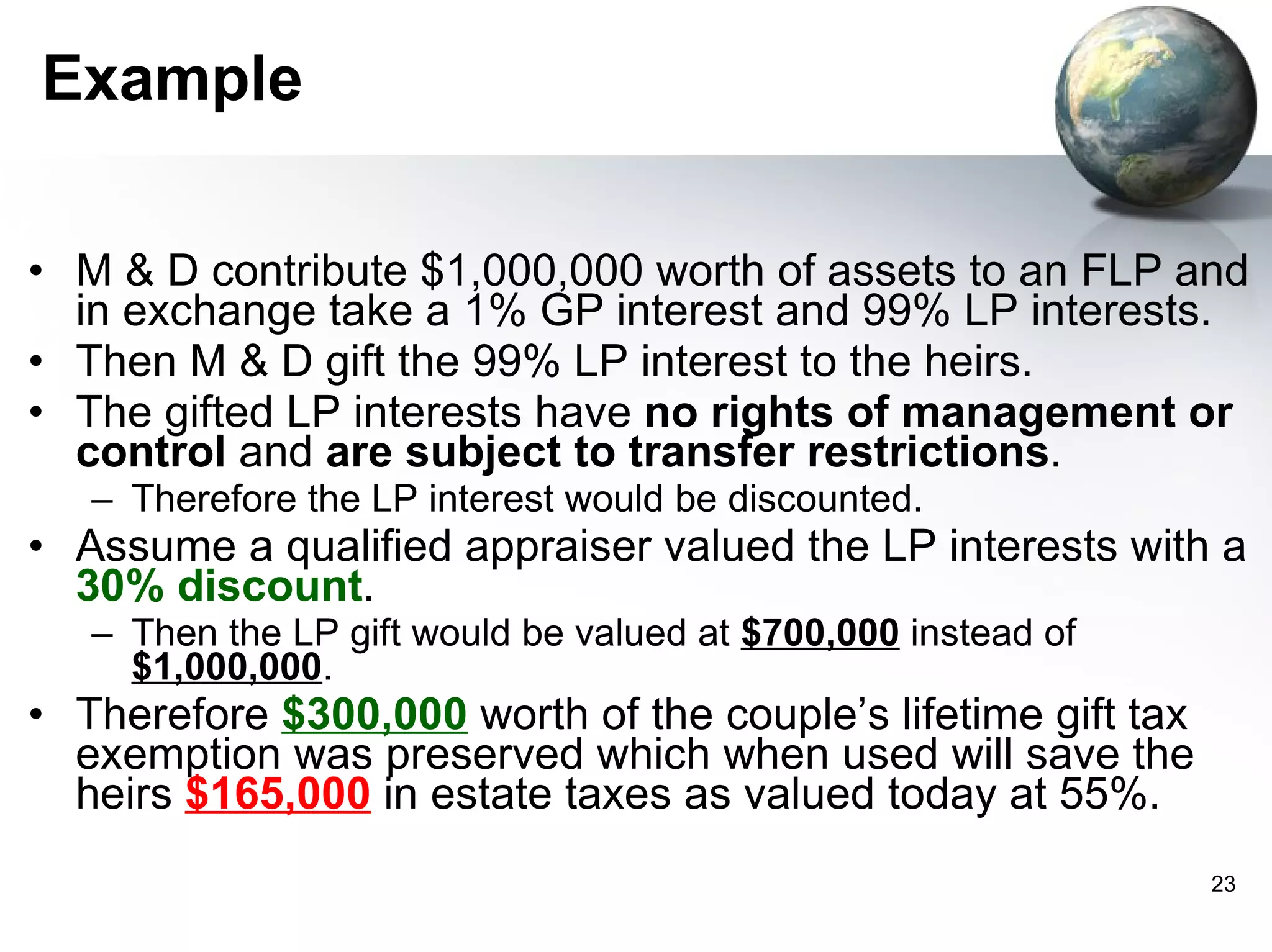
Example M & D contribute $1,000,000 worth of assets to an FLP and in exchange take a 1% GP interest and 99% LP interests.  Then M & D gift the 99% LP interest to the heirs.  The gifted LP interests have  no rights of management or control  and  are subject to transfer restrictions .  Therefore the LP interest would be discounted.  Assume a qualified appraiser valued the LP interests with a  30% discount . Then the LP gift would be valued at  $700,000  instead of  $1,000,000 . Therefore  $300,000  worth of the couple’s lifetime gift tax exemption was preserved which when used will save the heirs  $165,000  in estate taxes as valued today at 55%.
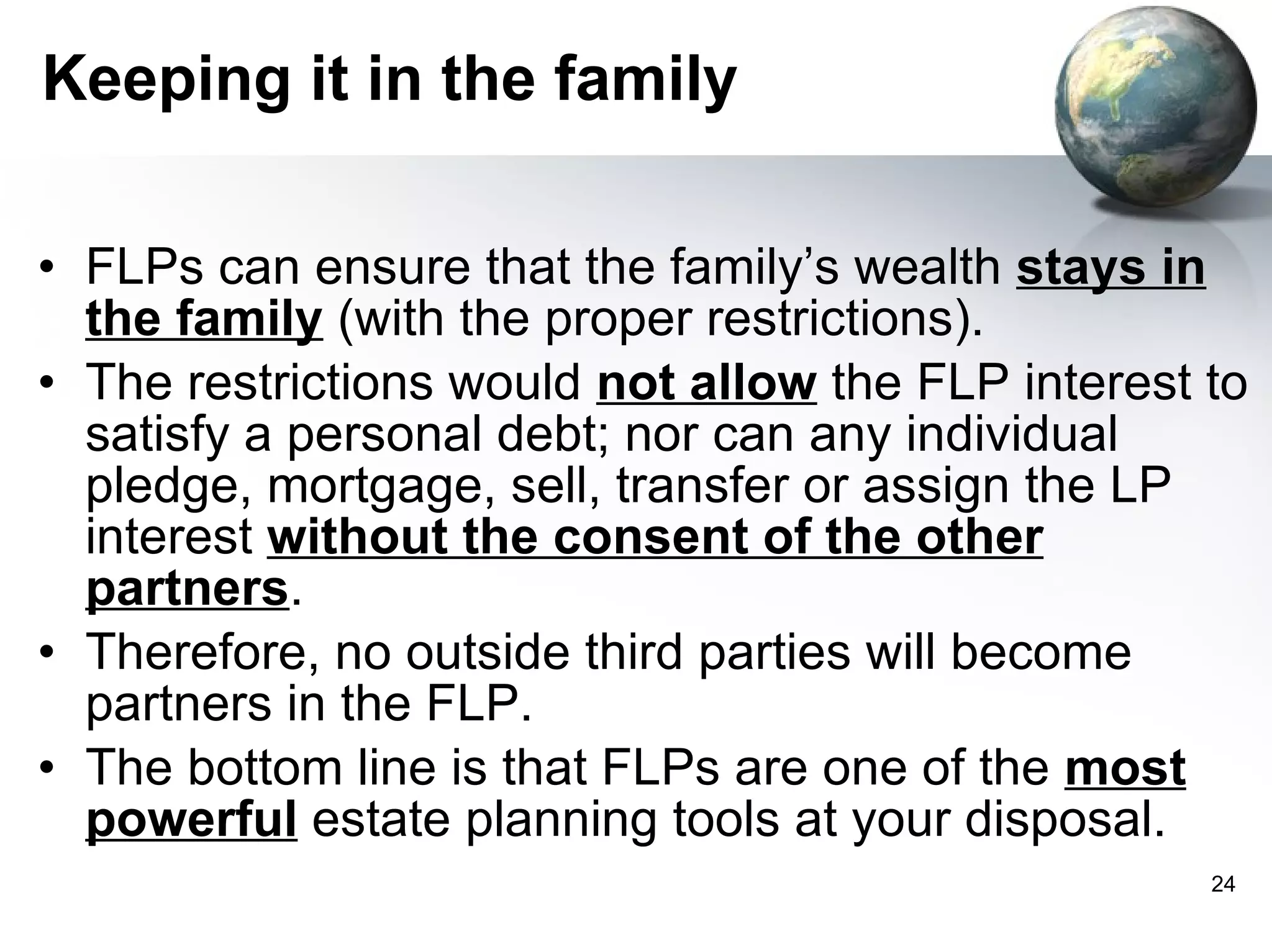
Keeping it in the family FLPs can ensure that the family’s wealth  stays in the family  (with the proper restrictions). The restrictions would  not allow  the FLP interest to satisfy a personal debt; nor can any individual pledge, mortgage, sell, transfer or assign the LP interest  without the consent of the other partners . Therefore, no outside third parties will become partners in the FLP. The bottom line is that FLPs are one of the  most powerful  estate planning tools at your disposal.
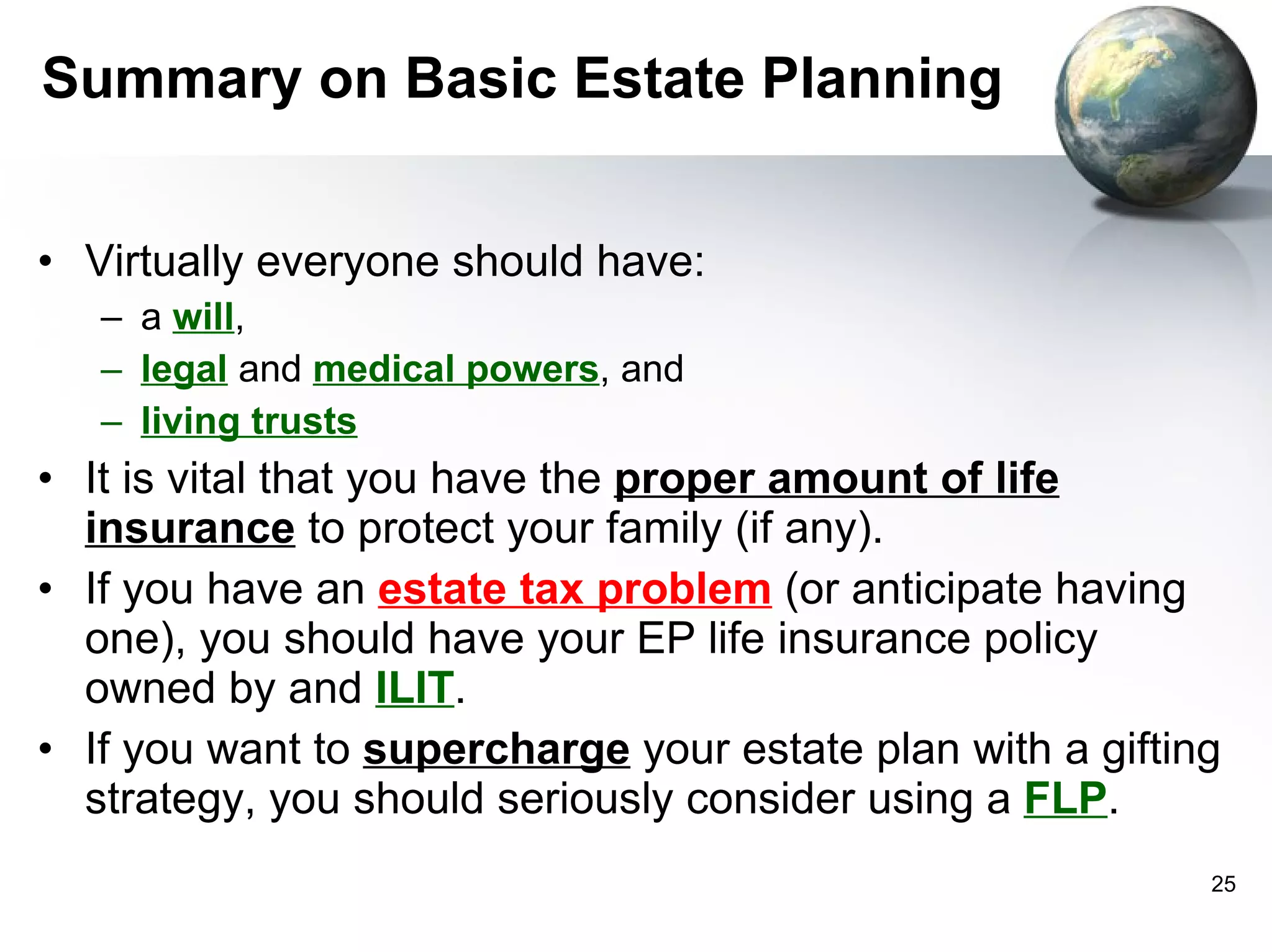
Summary on Basic Estate Planning Virtually everyone should have: a  will , legal   and   medical powers , and living trusts It is vital that you have the  proper amount of life insurance  to protect your family (if any). If you have an  estate tax problem  (or anticipate having one), you should have your EP life insurance policy owned by and  ILIT .  If you want to  supercharge  your estate plan with a gifting strategy, you should seriously consider using a  FLP .

Basic ep

  • 1.
    Basic Estate PlanningDetermine if Your Estate Plan is in Order By: Roccy DeFrancesco, JD, CWPP, CAPP, MMB Founder: The Wealth Preservation Institute Co-Founder: The Asset Protection Society
  • 2.
    The 5 BasicEstate Planning Tools 1) Wills 2) Living Trusts 3) Legal and Medical Powers 4) Family Limited Partners (FLPs). 5) Irrevocable Life Insurance Trusts (ILITs)
  • 3.
    Estate Planning Survey*The following statistics are staggering: 2 or 3 will NOT even have a simple will. 9 or 10 will NOT have Durable Powers of Attorney. 5 or 6 will NOT have marital trusts. 9 or 10 will NOT have a Family Limited Partnership. 8 or 9 who need an Irrevocable Life Insurance Trust (ILIT) do NOT have one. *The Wealth Preservation Institute
  • 4.
    Being young isnot excuse to procrastinate If you do not have the basic EP tools in place, you risk wasting millions of dollars in taxes and/or probate fees. Think about the following statistics : Age Odds of Death Before Age 65 35 27.5% 40 26.4% 45 24.8% 50 22.4% 55 18.4%
  • 5.
    Wills The mostbasic estate planning tool. Why have one? Children under the age of 18 If you die without one you die “intestate” and state laws dictate distribution. How much should a will cost? $150-$250 (so don’t wait) When should your will be updated? When you get married, have children, get divorced, increase the value of you estate, if a child happens to predecease you, etc.
  • 6.
    Durable Powers ofAttorney (DPA) Millions of people each year (young and old) become incapacitated because of a physical infirmity or mental incapacity. A DPA is a needed document that allows a person or entity, referred to as the attorney in fact, to act on behalf of the person giving the Power.
  • 7.
    Types of DPAsMedical Allows agent to make medical treatment decisions if the individual is at least 18 years of age. The Terri Schiavo case with removing the feeding tube. Legal Allows agent to sign all necessary legal documents to carry on the business of the client. DPAs are time and money savers Without a DPA the family typically ends up going to court to have someone appointed.
  • 8.
    A&B, Marital, orLiving Trusts A&B Trusts* are “revocable” living trusts Not an irrevocable trust You can move assets in and out of the trust with no gift tax issues. These provide NO ASSET PROTECTION. *This assumes that the client is married. If not, the client would simply have an A or single trust.
  • 9.
    Benefits of revocableTrusts 1) Assets in the trust will not be “probated.” Your will is still probated. Avoiding probate will save (depending on the state) between 1-8% ( 4-6% is average) of the entire value of the estate in probate fees . 2) Another benefits of having assets pass through a trust vs. through probate is the added privacy. * In most states, assets not owned by the trust will still be probated .
  • 10.
    Continued 3) A&Btrusts maximize your estate tax exemptions. Exemptions and Maximum Tax Rates Year Estate Tax Exemption Highest Rate 2008 $2 million 45% 2009 $3.5 million 45% 2010 N/A (taxes eliminated) 0% 2011 $1 million 55%
  • 11.
    Example part 1Mr. Smith and spouse are 50 years old with a $4,000,000 estate. What happens at Mr. Smith’s death in 2011 if he has a will but NO living trust? Nothing. What if Mrs . Smith dies the next week with no Trust? Estate taxes $3,000,000 at 55% will be due. Why? When Mrs. Smith died she had a $4,000,000* estate and a $1,000,000 estate tax exemption. After applying her exemption she still has a $3,000,000 taxable estate.
  • 12.
    Example part 2Same as example one except assume Mr. and Mrs. Smith had A&B trusts . At Mr. Smith’s death his trust would apply his $1,000,000 estate exemption and estate taxes would be avoided on that amount. When Mr. Smith dies, her trust would apply her $1,000,000 exemption leaving a remaining estate of $2,000,000. Therefore, because Mr. and Mrs. Smith used A&B trusts they saved their heirs $550,000 in estate taxes . And if funded properly they would avoid probate fees as well.
  • 13.
    Irrevocable Life InsuranceTrusts (ILIT) Do your have enough life insurance ? Most younger married couples, especially those with children, are underinsured . Life insurance is used by younger people to protect the family in case of an early death of the (typically of the breadwinner). Many younger clients have between $500,000-$1,000,000 in term life insurance for a term of 10-30 years. This is not nearly enough to protect the family.
  • 14.
    Continued People with estate tax problems almost universally are under insured due to the 55% estate tax that awaits their heirs. If you have an estate tax problem you can either 1) gift assets away; 2) have your heirs pay 55% estate taxes above your allotted estate tax exemption, or 3) you can purchase life insurance to pay for the estate taxes. If you have an estate over $5,000,000, it is easy to justify the purchase of 2-3 million dollars of death benefit for estate planning.
  • 15.
    Tax Free BenefitsMost people are aware that life insurance death benefits pass to beneficiaries Income Tax Free . Unfortunately, if you have an estate tax problem, the death benefit will be estate taxed*. How do you avoid having your DB estate taxed? Have your life insurance policy owned by and Irrevocable Life Insurance Trust (ILIT).
  • 16.
    Practical use ofan ILIT It is typical to set up an ILIT and have the death benefit pour into the ILIT at death. The children , if any, are typically the primary beneficiaries. Many times the trust has language in it to hold distributions until they reach a certain age. Many times the ILIT language will allow the trustee to provide for the well being of the surviving spouse, with the ultimate beneficiary being the children. The trust document is limited by your creativity.
  • 17.
    Dynasty Trusts Whilediscussing trust, let’s quickly go over Dynasty trusts. Many times advisors pitch this as a unique or special EP tool. It’s simply an “ irrevocable ” trust with special language. They are helpful when trying to avoid estate taxes with a gifting program. They are not a cure all as they can create gift tax problems when funding and income tax problems once funded.
  • 18.
    Family Limited Partnerships(FLPs) 1) Providing a centralized vehicle so the family manage a portion of its wealth usually in a structure so the younger generation can learn the art of running a family business. 2) Asset Protection 3) Increasing the efficiencies of both costs and administration of the family’s wealth; 4) Enhanced wealth transfer planning due to valuation discounts.
  • 19.
    FLP Overview AnFLP is a separate legal entity created under state law. An FLP is a flow through for income tax purposes and each partner is taxed according to their pro rata ownership interest. The FLP is governed by the FLP Agreement (which should be formal and outlines withdrawals and how FLP interests can be transferred). FLPs cannot own S-Corporation stock (not a qualified shareholder)
  • 20.
    FLP Partnership Categories(1) a general partner (2)  limited partners The GP are liable for all of the FLP’s obligations, debts, and liabilities. Many times a second entity is created (typically and LLC) to serve as the general partner to further insulate themselves from personal liability. The LPs are not liable for the debt or obligations of the FLP, and they are not entitled to participate in the day-to-day management of the FLP.
  • 21.
    Typical FLP PlanningBy transferring a portion of the family’s assets to an FLP, the family can maintain control over the income , management and divestiture of the assets. In a typical estate plan, a married couple transfers assets to a FLP and, in return, receives both GP and LP interests. Then the couple will gifts LP interests to their heirs in an effort to shrink the taxable estate . The couple through the corporate GP can manage and maintain control of the FLP assets.
  • 22.
    Typical FLP GiftingYou can gift $1,000,000 without incurring gift taxes (and $12,000 per spouse per child per year). Discounts LP interest are non-controlling and have restrictions on transferability . Because of the lack of control and restrictions on who the interest can be sold to, the LP interests are able to receive valuation discounts (FMV).
  • 23.
    Example M &D contribute $1,000,000 worth of assets to an FLP and in exchange take a 1% GP interest and 99% LP interests. Then M & D gift the 99% LP interest to the heirs. The gifted LP interests have no rights of management or control and are subject to transfer restrictions . Therefore the LP interest would be discounted. Assume a qualified appraiser valued the LP interests with a 30% discount . Then the LP gift would be valued at $700,000 instead of $1,000,000 . Therefore $300,000 worth of the couple’s lifetime gift tax exemption was preserved which when used will save the heirs $165,000 in estate taxes as valued today at 55%.
  • 24.
    Keeping it inthe family FLPs can ensure that the family’s wealth stays in the family (with the proper restrictions). The restrictions would not allow the FLP interest to satisfy a personal debt; nor can any individual pledge, mortgage, sell, transfer or assign the LP interest without the consent of the other partners . Therefore, no outside third parties will become partners in the FLP. The bottom line is that FLPs are one of the most powerful estate planning tools at your disposal.
  • 25.
    Summary on BasicEstate Planning Virtually everyone should have: a will , legal and medical powers , and living trusts It is vital that you have the proper amount of life insurance to protect your family (if any). If you have an estate tax problem (or anticipate having one), you should have your EP life insurance policy owned by and ILIT . If you want to supercharge your estate plan with a gifting strategy, you should seriously consider using a FLP .

Editor's Notes

  • #2 Copyright 2005 Copyright 2005
  • #3 Copyright 2005 Copyright 2005
  • #4 Copyright 2005 Copyright 2005
  • #5 Copyright 2005 Copyright 2005
  • #6 Copyright 2005 Copyright 2005
  • #7 Copyright 2005 Copyright 2005
  • #8 Copyright 2005 Copyright 2005
  • #9 Copyright 2005 Copyright 2005
  • #10 Copyright 2005 Copyright 2005
  • #11 Copyright 2005 Copyright 2005
  • #12 Copyright 2005 Copyright 2005
  • #13 Copyright 2005 Copyright 2005
  • #14 Copyright 2005 Copyright 2005
  • #15 Copyright 2005 Copyright 2005
  • #16 Copyright 2005 Copyright 2005
  • #17 Copyright 2005 Copyright 2005
  • #18 Copyright 2005 Copyright 2005
  • #19 Copyright 2005 Copyright 2005
  • #20 Copyright 2005 Copyright 2005
  • #21 Copyright 2005 Copyright 2005
  • #22 Copyright 2005 Copyright 2005
  • #23 Copyright 2005 Copyright 2005
  • #24 Copyright 2005 Copyright 2005
  • #25 Copyright 2005 Copyright 2005
  • #26 Copyright 2005 Copyright 2005