Basic structural dynamics I
Wind loading and structural response - Lecture 10
Dr. J.D. Holmes
Basic structural dynamics I
• Topics :
• Revision of single degree-of freedom vibration theory
• Response to sinusoidal excitation
Refs. : R.W. Clough and J. Penzien ‘Dynamics of Structures’ 1975
R.R. Craig ‘Structural Dynamics’ 1981
J.D. Holmes ‘Wind Loading of Structures’ 2001
• Multi-degree of freedom structures – Lect. 11
• Response to random excitation
Basic structural dynamics I
x
c

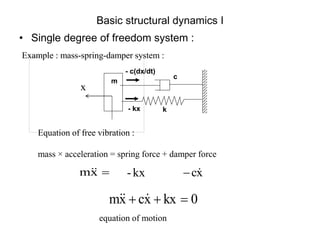
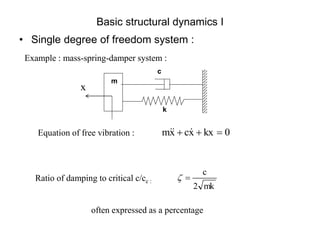
Equation of free vibration :
Example : mass-spring-damper system :
k
c
m
x
0
kx
x
c
x
m 

 


mass × acceleration = spring force + damper force
- kx
- c(dx/dt)

x
m 
 kx
-
equation of motion
• Single degree of freedom system :
Basic structural dynamics I
• Single degree of freedom system :
Equation of free vibration :
Example : mass-spring-damper system :
Ratio of damping to critical c/cc :
k
c
m
x
0
kx
x
c
x
m 

 


mk
2
c


often expressed as a percentage
Basic structural dynamics I
• Single degree of freedom system :
Damper removed :
k
m
x(t)
Equation of motion : 0
kx
x
m 



x
m
kx 



is an equivalent static force (‘inertial’ force)
x
m


Undamped natural frequency :


2
m
k
2π
1
n 1
1 

Period of vibration, T :
1
1
1
2
T
n




Basic structural dynamics I
• Single degree of freedom system :
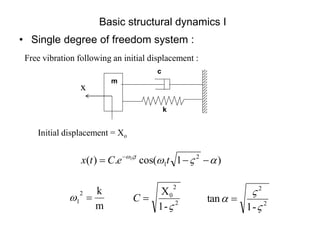
Initial displacement = Xo
Free vibration following an initial displacement :
k
c
m
x
m
k
2
1 

)
1
cos(
.
)
( 2
1
1







 
t
e
C
t
x t
2
2
0
-
1
X


C 2
2
-
1
tan


 
Basic structural dynamics I
• Single degree of freedom system :
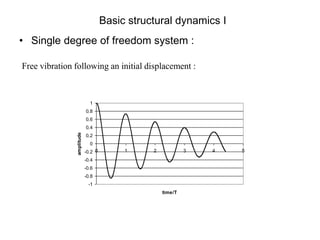
Free vibration following an initial displacement :
-1
-0.8
-0.6
-0.4
-0.2
0
0.2
0.4
0.6
0.8
1
0 1 2 3 4 5
time/T
amplitude
Basic structural dynamics I
• Single degree of freedom system :
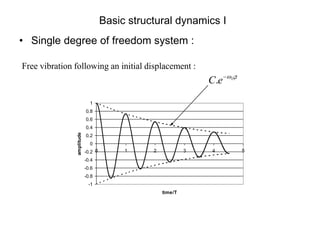
Free vibration following an initial displacement :
-1
-0.8
-0.6
-0.4
-0.2
0
0.2
0.4
0.6
0.8
1
0 1 2 3 4 5
time/T
amplitude t
e
C 
1
. 
Basic structural dynamics I
• Single degree of freedom system :
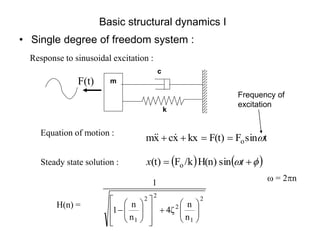
Response to sinusoidal excitation :
Equation of motion :
t
sin
F
F(t)
kx
x
c
x
m o 



 


Steady state solution :    

 
 t
x sin
H(n)
/k
F
(t) o
k
c
m
F(t)
 = 2n
H(n) =
2
1
2
2
2
1 n
n
4ζ
n
n
1
1


























Frequency of
excitation
Basic structural dynamics I
• Single degree of freedom system :
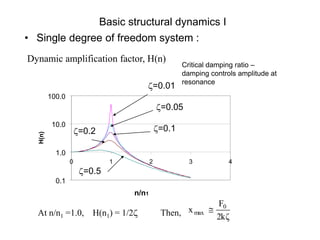
Critical damping ratio –
damping controls amplitude at
resonance
0.1
1.0
10.0
100.0
0 1 2 3 4
n/n1
H(n)
=0.01
=0.05
=0.1
=0.2
=0.5
At n/n1 =1.0, H(n1) = 1/2 Then, 2kζ
F
x 0
max 
Dynamic amplification factor, H(n)
Basic structural dynamics II
• Response to random excitation :
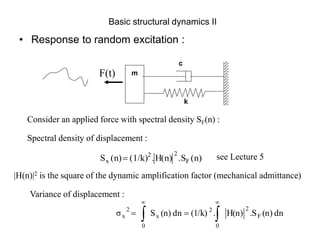
Consider an applied force with spectral density SF(n) :
dn
(n)
.S
H(n)
.
(1/k)
dn
(n)
S
σ F
2
0
2
x
0
2
x 





k
c
m
F(t)
Spectral density of displacement :
|H(n)|2 is the square of the dynamic amplification factor (mechanical admittance)
(n)
.S
H(n)
.
(1/k)
(n)
S F
2
2
x 
Variance of displacement :
see Lecture 5
Basic structural dynamics II
• Response to random excitation :
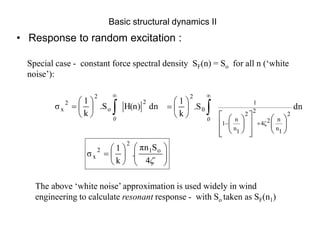
Special case - constant force spectral density SF(n) = So for all n (‘white
noise’):
dn
H(n)
.S
k
1
σ
2
o
2
2
x 








0
The above ‘white noise’ approximation is used widely in wind
engineering to calculate resonant response - with So taken as SF(n1)
dn
.S
k
1
2
1
n
n
2
4ζ
2
2
1
n
n
1
1
0
2































0
















4
S
πn
.
k
1
σ o
1
2
2
x
End of Lecture
John Holmes
225-405-3789 JHolmes@lsu.edu

Basic dynamics of structures in Civil Engineering

  • 1.
    Basic structural dynamicsI Wind loading and structural response - Lecture 10 Dr. J.D. Holmes
  • 2.
    Basic structural dynamicsI • Topics : • Revision of single degree-of freedom vibration theory • Response to sinusoidal excitation Refs. : R.W. Clough and J. Penzien ‘Dynamics of Structures’ 1975 R.R. Craig ‘Structural Dynamics’ 1981 J.D. Holmes ‘Wind Loading of Structures’ 2001 • Multi-degree of freedom structures – Lect. 11 • Response to random excitation
  • 3.
    Basic structural dynamicsI x c  Equation of free vibration : Example : mass-spring-damper system : k c m x 0 kx x c x m       mass × acceleration = spring force + damper force - kx - c(dx/dt)  x m   kx - equation of motion • Single degree of freedom system :
  • 4.
    Basic structural dynamicsI • Single degree of freedom system : Equation of free vibration : Example : mass-spring-damper system : Ratio of damping to critical c/cc : k c m x 0 kx x c x m       mk 2 c   often expressed as a percentage
  • 5.
    Basic structural dynamicsI • Single degree of freedom system : Damper removed : k m x(t) Equation of motion : 0 kx x m     x m kx     is an equivalent static force (‘inertial’ force) x m   Undamped natural frequency :   2 m k 2π 1 n 1 1   Period of vibration, T : 1 1 1 2 T n    
  • 6.
    Basic structural dynamicsI • Single degree of freedom system : Initial displacement = Xo Free vibration following an initial displacement : k c m x m k 2 1   ) 1 cos( . ) ( 2 1 1          t e C t x t 2 2 0 - 1 X   C 2 2 - 1 tan    
  • 7.
    Basic structural dynamicsI • Single degree of freedom system : Free vibration following an initial displacement : -1 -0.8 -0.6 -0.4 -0.2 0 0.2 0.4 0.6 0.8 1 0 1 2 3 4 5 time/T amplitude
  • 8.
    Basic structural dynamicsI • Single degree of freedom system : Free vibration following an initial displacement : -1 -0.8 -0.6 -0.4 -0.2 0 0.2 0.4 0.6 0.8 1 0 1 2 3 4 5 time/T amplitude t e C  1 . 
  • 9.
    Basic structural dynamicsI • Single degree of freedom system : Response to sinusoidal excitation : Equation of motion : t sin F F(t) kx x c x m o         Steady state solution :         t x sin H(n) /k F (t) o k c m F(t)  = 2n H(n) = 2 1 2 2 2 1 n n 4ζ n n 1 1                           Frequency of excitation
  • 10.
    Basic structural dynamicsI • Single degree of freedom system : Critical damping ratio – damping controls amplitude at resonance 0.1 1.0 10.0 100.0 0 1 2 3 4 n/n1 H(n) =0.01 =0.05 =0.1 =0.2 =0.5 At n/n1 =1.0, H(n1) = 1/2 Then, 2kζ F x 0 max  Dynamic amplification factor, H(n)
  • 11.
    Basic structural dynamicsII • Response to random excitation : Consider an applied force with spectral density SF(n) : dn (n) .S H(n) . (1/k) dn (n) S σ F 2 0 2 x 0 2 x       k c m F(t) Spectral density of displacement : |H(n)|2 is the square of the dynamic amplification factor (mechanical admittance) (n) .S H(n) . (1/k) (n) S F 2 2 x  Variance of displacement : see Lecture 5
  • 12.
    Basic structural dynamicsII • Response to random excitation : Special case - constant force spectral density SF(n) = So for all n (‘white noise’): dn H(n) .S k 1 σ 2 o 2 2 x          0 The above ‘white noise’ approximation is used widely in wind engineering to calculate resonant response - with So taken as SF(n1) dn .S k 1 2 1 n n 2 4ζ 2 2 1 n n 1 1 0 2                                0                 4 S πn . k 1 σ o 1 2 2 x
  • 13.
    End of Lecture JohnHolmes 225-405-3789 JHolmes@lsu.edu