Illuminating
Words
NPFCWorkShop
Instructor: Nick Patterson
•Author: Birmingham Foot Soldiers: Voices from the Civil Rights Movement
•Birmingham Post-Herald
•University of Alabama at Birmingham Media Relations
•University of Alabama at Birmingham, Dept. of Communication Studies
(adjunct)
•Southern Living magazine
•Birmingham Museum of Art
•Freelance writer, including Weld for Birmingham
So many examples, so little time...
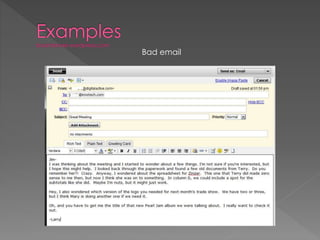
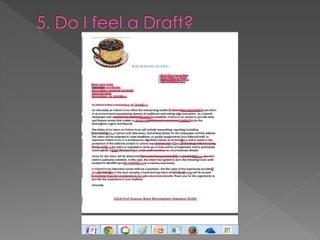
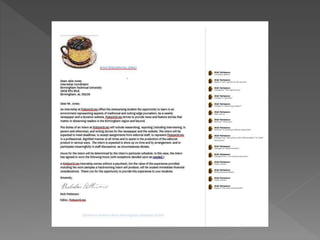
Bad email
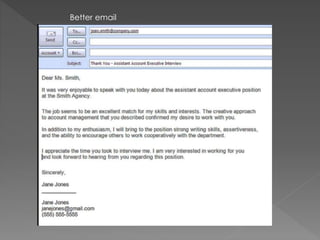
Better email
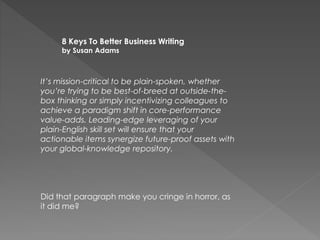
It’s mission-critical to be plain-spoken, whether
you’re trying to be best-of-breed at outside-the-
box thinking or simply incentivizing colleagues to
achieve a paradigm shift in core-performance
value-adds. Leading-edge leveraging of your
plain-English skill set will ensure that your
actionable items synergize future-proof assets with
your global-knowledge repository.
Did that paragraph make you cringe in horror, as
it did me?
8 Keys To Better Business Writing
by Susan Adams
1. Know why you’re writing. Be clear about your objectives, including the audience
you’re addressing and the goal you want to achieve. State the goal convincingly in each
sentence of your prose. Example: Your firm wants to break its lease in an office building
that violates the Americans with Disabilities Act by failing to install wheelchair ramps
and automatic doors, but you want to stay on good terms with the landlord. Garner
offers an elegant sample that includes this sentence. “Although we have no doubt that
your oversight was a good-faith error, we hope that you understand why we can’t stay in
the building.” He captures three goals at once: to explain that you’re breaking your
lease, to spell out why you’re justified in doing so, and to preserve a good relationship
with the landlord.
2. Understand your readers. Know that no one has time to waste. Get to the point
quickly, focus on what’s relevant and use a tone that fits your audience. Imagine you’re
writing to someone who is smart but not a specialist in your field. When Warren
Buffett pens his annual report, he pretends he’s writing it for his sisters who are smart but
not experts in finance. “To succeed, I don’t need to be Shakespeare; I must, though, have a
sincere desire to inform,” Buffett writes in his preface to the SEC’s Plain English Handbook.
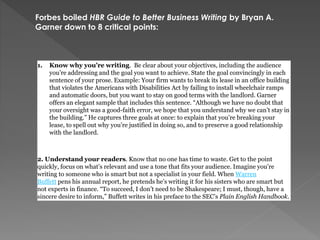
Forbes boiled HBR Guide to Better Business Writing by Bryan A.
Garner down to 8 critical points:
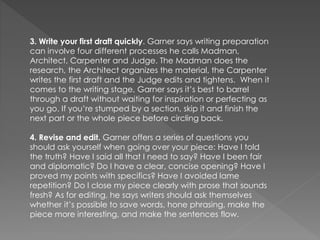
3. Write your first draft quickly. Garner says writing preparation
can involve four different processes he calls Madman,
Architect, Carpenter and Judge. The Madman does the
research, the Architect organizes the material, the Carpenter
writes the first draft and the Judge edits and tightens. When it
comes to the writing stage, Garner says it’s best to barrel
through a draft without waiting for inspiration or perfecting as
you go. If you’re stumped by a section, skip it and finish the
next part or the whole piece before circling back.
4. Revise and edit. Garner offers a series of questions you
should ask yourself when going over your piece: Have I told
the truth? Have I said all that I need to say? Have I been fair
and diplomatic? Do I have a clear, concise opening? Have I
proved my points with specifics? Have I avoided lame
repetition? Do I close my piece clearly with prose that sounds
fresh? As for editing, he says writers should ask themselves
whether it’s possible to save words, hone phrasing, make the
piece more interesting, and make the sentences flow.
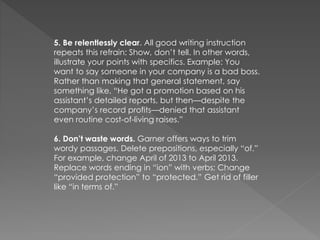
5. Be relentlessly clear. All good writing instruction
repeats this refrain: Show, don’t tell. In other words,
illustrate your points with specifics. Example: You
want to say someone in your company is a bad boss.
Rather than making that general statement, say
something like, “He got a promotion based on his
assistant’s detailed reports, but then—despite the
company’s record profits—denied that assistant
even routine cost-of-living raises.”
6. Don’t waste words. Garner offers ways to trim
wordy passages. Delete prepositions, especially “of.”
For example, change April of 2013 to April 2013.
Replace words ending in “ion” with verbs; Change
“provided protection” to “protected.” Get rid of filler
like “in terms of.”
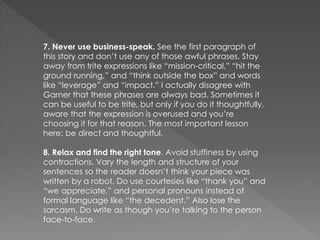
7. Never use business-speak. See the first paragraph of
this story and don’t use any of those awful phrases. Stay
away from trite expressions like “mission-critical,” “hit the
ground running,” and “think outside the box” and words
like “leverage” and “impact.” I actually disagree with
Garner that these phrases are always bad. Sometimes it
can be useful to be trite, but only if you do it thoughtfully,
aware that the expression is overused and you’re
choosing it for that reason. The most important lesson
here: be direct and thoughtful.
8. Relax and find the right tone. Avoid stuffiness by using
contractions. Vary the length and structure of your
sentences so the reader doesn’t think your piece was
written by a robot. Do use courtesies like “thank you” and
“we appreciate,” and personal pronouns instead of
formal language like “the decedent.” Also lose the
sarcasm. Do write as though you’re talking to the person
face-to-face.
› Grammar
› Syntax
› Subject-Verb Agreement
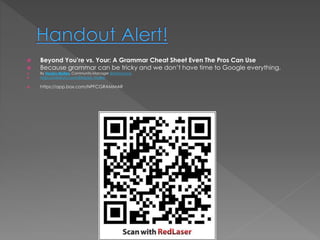
 Beyond You’re vs. Your: A Grammar Cheat Sheet Even The Pros Can Use
 Because grammar can be tricky and we don’t have time to Google everything.
 By Hayley Mullen, Community Manager @Unbounce.
 https://medium.com/@hayley_mullen
 https://app.box.com/NPFCGRAMMAR
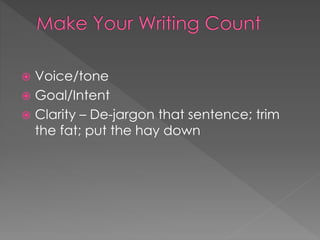
 Voice/tone
 Goal/Intent
 Clarity – De-jargon that sentence; trim
the fat; put the hay down
• Don’t procrastinate
• Don’t rush
• Think it through
• Do you know what you need to know before
you start?
• Who’s got your info?
• Are you using the intel-gathering tools at your
disposal?
• What goes first, middle and last?
• Do you need an outline?
 1. Intro
 2.Body
 3. Conclusion
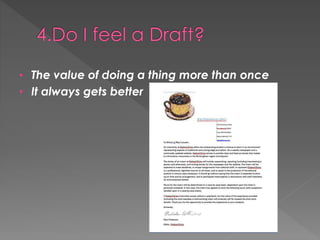
• The value of doing a thing more than once
• It always gets better
• Four eyes are better than two
 When you have the time
 When the information is not too sensitive
 When the information IS too sensitive
Borrow the perspective of a second reader who will
give you an honest assessment
6. Don’t Fear the Re– (apologies to BOC)
 Remember reference
 Repeat key ideas – if needed
 Read the last draft again
› Does it do what you set out to do?
 If not, rethink. If necessary, rewrite, again.
 Regard for your reader
 on these suggestions and
 with the end users of your
communications
 to make sure you hit the mark.
Basic Better Business Communications

Basic Better Business Communications

  • 1.
  • 2.
    Instructor: Nick Patterson •Author:Birmingham Foot Soldiers: Voices from the Civil Rights Movement •Birmingham Post-Herald •University of Alabama at Birmingham Media Relations •University of Alabama at Birmingham, Dept. of Communication Studies (adjunct) •Southern Living magazine •Birmingham Museum of Art •Freelance writer, including Weld for Birmingham
  • 3.
    So many examples,so little time...
  • 4.
  • 5.
  • 7.
    It’s mission-critical tobe plain-spoken, whether you’re trying to be best-of-breed at outside-the- box thinking or simply incentivizing colleagues to achieve a paradigm shift in core-performance value-adds. Leading-edge leveraging of your plain-English skill set will ensure that your actionable items synergize future-proof assets with your global-knowledge repository. Did that paragraph make you cringe in horror, as it did me? 8 Keys To Better Business Writing by Susan Adams
  • 8.
    1. Know whyyou’re writing. Be clear about your objectives, including the audience you’re addressing and the goal you want to achieve. State the goal convincingly in each sentence of your prose. Example: Your firm wants to break its lease in an office building that violates the Americans with Disabilities Act by failing to install wheelchair ramps and automatic doors, but you want to stay on good terms with the landlord. Garner offers an elegant sample that includes this sentence. “Although we have no doubt that your oversight was a good-faith error, we hope that you understand why we can’t stay in the building.” He captures three goals at once: to explain that you’re breaking your lease, to spell out why you’re justified in doing so, and to preserve a good relationship with the landlord. 2. Understand your readers. Know that no one has time to waste. Get to the point quickly, focus on what’s relevant and use a tone that fits your audience. Imagine you’re writing to someone who is smart but not a specialist in your field. When Warren Buffett pens his annual report, he pretends he’s writing it for his sisters who are smart but not experts in finance. “To succeed, I don’t need to be Shakespeare; I must, though, have a sincere desire to inform,” Buffett writes in his preface to the SEC’s Plain English Handbook. Forbes boiled HBR Guide to Better Business Writing by Bryan A. Garner down to 8 critical points:
  • 9.
    3. Write yourfirst draft quickly. Garner says writing preparation can involve four different processes he calls Madman, Architect, Carpenter and Judge. The Madman does the research, the Architect organizes the material, the Carpenter writes the first draft and the Judge edits and tightens. When it comes to the writing stage, Garner says it’s best to barrel through a draft without waiting for inspiration or perfecting as you go. If you’re stumped by a section, skip it and finish the next part or the whole piece before circling back. 4. Revise and edit. Garner offers a series of questions you should ask yourself when going over your piece: Have I told the truth? Have I said all that I need to say? Have I been fair and diplomatic? Do I have a clear, concise opening? Have I proved my points with specifics? Have I avoided lame repetition? Do I close my piece clearly with prose that sounds fresh? As for editing, he says writers should ask themselves whether it’s possible to save words, hone phrasing, make the piece more interesting, and make the sentences flow.
  • 10.
    5. Be relentlesslyclear. All good writing instruction repeats this refrain: Show, don’t tell. In other words, illustrate your points with specifics. Example: You want to say someone in your company is a bad boss. Rather than making that general statement, say something like, “He got a promotion based on his assistant’s detailed reports, but then—despite the company’s record profits—denied that assistant even routine cost-of-living raises.” 6. Don’t waste words. Garner offers ways to trim wordy passages. Delete prepositions, especially “of.” For example, change April of 2013 to April 2013. Replace words ending in “ion” with verbs; Change “provided protection” to “protected.” Get rid of filler like “in terms of.”
  • 11.
    7. Never usebusiness-speak. See the first paragraph of this story and don’t use any of those awful phrases. Stay away from trite expressions like “mission-critical,” “hit the ground running,” and “think outside the box” and words like “leverage” and “impact.” I actually disagree with Garner that these phrases are always bad. Sometimes it can be useful to be trite, but only if you do it thoughtfully, aware that the expression is overused and you’re choosing it for that reason. The most important lesson here: be direct and thoughtful. 8. Relax and find the right tone. Avoid stuffiness by using contractions. Vary the length and structure of your sentences so the reader doesn’t think your piece was written by a robot. Do use courtesies like “thank you” and “we appreciate,” and personal pronouns instead of formal language like “the decedent.” Also lose the sarcasm. Do write as though you’re talking to the person face-to-face.
  • 12.
    › Grammar › Syntax ›Subject-Verb Agreement
  • 13.
     Beyond You’revs. Your: A Grammar Cheat Sheet Even The Pros Can Use  Because grammar can be tricky and we don’t have time to Google everything.  By Hayley Mullen, Community Manager @Unbounce.  https://medium.com/@hayley_mullen  https://app.box.com/NPFCGRAMMAR
  • 14.
     Voice/tone  Goal/Intent Clarity – De-jargon that sentence; trim the fat; put the hay down
  • 17.
    • Don’t procrastinate •Don’t rush • Think it through
  • 18.
    • Do youknow what you need to know before you start? • Who’s got your info? • Are you using the intel-gathering tools at your disposal?
  • 19.
    • What goesfirst, middle and last? • Do you need an outline?  1. Intro  2.Body  3. Conclusion
  • 20.
    • The valueof doing a thing more than once • It always gets better
  • 23.
    • Four eyesare better than two  When you have the time  When the information is not too sensitive  When the information IS too sensitive Borrow the perspective of a second reader who will give you an honest assessment
  • 24.
    6. Don’t Fearthe Re– (apologies to BOC)  Remember reference  Repeat key ideas – if needed  Read the last draft again › Does it do what you set out to do?  If not, rethink. If necessary, rewrite, again.  Regard for your reader
  • 25.
     on thesesuggestions and  with the end users of your communications  to make sure you hit the mark.

Editor's Notes

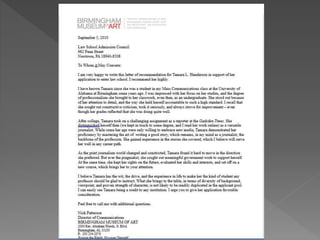
  • #23 Note the detail in the changes. This actually did make the letter better!