Aeronautical Engineering                    Sathyabama   4/16/2011

INVESTIGATION OF MECHANICAL PROPERTIES AND FAILURE ANALYSIS
  OF BASALT FIBER LAMINATE COMPOSITE IN AIR TRANSPORTATION
                        APPLICATIONS

                               UNDER THE GUIDANCE OF


                            DR.BSM.AUGUSTINE
                            PROFESSOR &HEAD
                 DEPARTMENT OF AERONAUTICAL ENGINEERING
                         SATHYABAMA UNIVERSIT Y
                                                                         1
INTRODUCTION

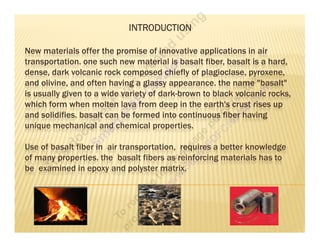
New materials offer the promise of innovative applications in air
transportation. one such new material is basalt fiber, basalt is a hard,
dense, dark volcanic rock composed chiefly of plagioclase, pyroxene,
and olivine, and often having a glassy appearance. the name "basalt"
is usually given to a wide variety of dark-brown to black volcanic rocks,
which form when molten lava from deep in the earth's crust rises up
and solidifies. basalt can be formed into continuous fiber having
unique mechanical and chemical properties.

Use of basalt fiber in air transportation, requires a better knowledge
of many properties. the basalt fibers as reinforcing materials has to
be examined in epoxy and polyster matrix.
OVERVIEW OF WORK ON BASALT FIBERS
   For many years, basalt has been used in casting processes to
    make tiles and slabs for architectural applications. additionally,
    cast basalt liners for steel tubing exhibit ver y high abrasion
    resistance in industrial applications. in crushed form, basalt also
    finds use as aggregate in concrete.
                                    
    More recently, continuous fibers extruded from naturally fire-
    resistant basalt have been investigated as a replacement for
    asbestos fibers, in almost all of its applications. in the last decade,
    basalt has emerged as a contender in the fiber reinforcement of
    composites. proponents of this late-comer claim their products
    offer per formance similar to s-2 glass fibers at a price point
    between s-2 glass and e-glass, and may offer manufacturers a
    less-expensive alternative to carbon fiber for products in which the
    latter represents over-engineering.
FABRICATION PROCESS OF BFRP
OBJECTIVES
1.Fabrication of basalt composite s.

2. Conduct of experimental tests to determine unidirectional and
bidirectional properties.


3. .Finite element analysisi of composites..
4..Development of numerical solutions

5..Determination of failure criteria
6.Damage criterian for BFRP
7.Tuning BFRP for aeroelastic applications.

8.Study of BFRP for other engineering applications.
PROPERTIES OF BASALT FIBER
Basalt fibers possess several good properties which make it possible to use them as a
reinforcement in composites.
•corrosion resistant,
•strength, elasticity properties of basalt fibers considerably exceed mineral and glass
fibers.
•Due the elasticity of micro- and macrostructure, basalt fibers are vibration-resistant
compared to similar products
•Environmentally and ecologically harmless
•free of carcinogens and other health hazards.
•heat and sound isolation,
•vibration damping,
•High strength
• High modulus
•Corrosion resistance
•High temperature resistance
•Extended operating temperature range
COMPARISON OF PROPERTIES BET WEEN DIFFERENT FIBERS
COMOPSITES IN AEROSPACE APPLICATION
The primary field of application for fibre reinforcedpolymer composites is the
aerospace industry.
The main requirement of aircraft structures is high strength to weight ratio
BAiSrAcLnTlogFIInBER MANUFACTURERS
      aglass F be Te h o y, c.
    Sudaglass Fiber Technology, Inc.
    1 Kommunisticheskaya
    Sudogda
    601240 Vladimir Region
    Russian Federation
    Tel: (7) 09235 22763Sudaglass Fiber Technology, Inc.
    PO Box 2478

   37A Chipstead Valley Road
    Coulsdon
    Surrey CR5 2WE ,UK
    Tel: (44) 20 8763 9438
    Fax: (44) 20 8660 6021Sudaglass Fiber Technology, Inc.

   P.O. Box 440481
    Houston, TX 77244

   ALF HOLLAND B.V.
   Gedempte Zalmhaven 469
   3011 BT Rotterdam
   Netherlands
   Tel 31 104140475
   fax +31 104142923
   Mob +31 619844611
REFERENCES
1. Development of long-basaltfiber-reinforced thermoplastic matrix composites society of plastics engineers 2010

2. T. wittek, t. tanimoto mechanical properties and fire retardancy of bidirectional reinforced composite based on biodegradable
starch resin and basalt fibres express polymer letters vol.2, no.11 (2008) 810–822

3. Park j-m., shin w-g., yoon d-j.: a study of interfacial aspects of epoxy-based composites reinforced with dual basalt and sic
fibres by means of the fragmentation and acoustic emission techniques. composites science and technology, 59, 355–370
(1999).

4 . Reissner e. (1945) "the effect of transverse shear deformation on the bending of elastic plates”journal of applied mechanics,
vol. 12,69-76.

5. D.R. Meyer, H.E.N. Bersee, A. Beukers ,Temperature effect on reinforced thermoplastic composite properties for primary
aircraft structure applications49th AIAA/ASME/ASCE/AHS/ASC Structures, Structural Dynamics, and Materials Conference

6. Basalt fiber as a reinforcement of polymer composites Tibor czigány János vad�� and kornél pölöskei periodica polytechnica
A I A A 2 0 08

ser. mech. eng. vol. 49, no. 1, pp. 3–14 (2005)
7. K. G. Satish1, B. Siddeswarappa, K. Mohamed Kaleemulla characterization of in-plane mechanical properties of laminated
hybrid composites Journal of minerals & materials characterization & engineering, Vol. 9, No.2, pp.105-114, 2010

8. Baozhong Sun, Zhilin Niu,Lvtao Zhu, and Bohong Gu ,Mechanical behaviors of 2D and 3D basalt fiber woven composites
under various strain rates Journal of Composite Materials, July 2010; vol. 44, 14: pp. 1779-1795.,

9. M. Černý,P. Glogar, and Z. Sucharda,Mechanical Properties of Basalt Fiber Reinforced Composites Prepared by Partial
Pyrolysis of a Polymer PrecursorJournal of Composite Materials, May 2009; vol. 43, 9: pp. 1109-1120., first published
on February 24, 2009
THANK YOU

basalt abstract

  • 1.
    Aeronautical Engineering Sathyabama 4/16/2011 INVESTIGATION OF MECHANICAL PROPERTIES AND FAILURE ANALYSIS OF BASALT FIBER LAMINATE COMPOSITE IN AIR TRANSPORTATION APPLICATIONS UNDER THE GUIDANCE OF DR.BSM.AUGUSTINE PROFESSOR &HEAD DEPARTMENT OF AERONAUTICAL ENGINEERING SATHYABAMA UNIVERSIT Y 1
  • 2.
    INTRODUCTION New materials offerthe promise of innovative applications in air transportation. one such new material is basalt fiber, basalt is a hard, dense, dark volcanic rock composed chiefly of plagioclase, pyroxene, and olivine, and often having a glassy appearance. the name "basalt" is usually given to a wide variety of dark-brown to black volcanic rocks, which form when molten lava from deep in the earth's crust rises up and solidifies. basalt can be formed into continuous fiber having unique mechanical and chemical properties. Use of basalt fiber in air transportation, requires a better knowledge of many properties. the basalt fibers as reinforcing materials has to be examined in epoxy and polyster matrix.
  • 3.
    OVERVIEW OF WORKON BASALT FIBERS  For many years, basalt has been used in casting processes to make tiles and slabs for architectural applications. additionally, cast basalt liners for steel tubing exhibit ver y high abrasion resistance in industrial applications. in crushed form, basalt also finds use as aggregate in concrete.  More recently, continuous fibers extruded from naturally fire- resistant basalt have been investigated as a replacement for asbestos fibers, in almost all of its applications. in the last decade, basalt has emerged as a contender in the fiber reinforcement of composites. proponents of this late-comer claim their products offer per formance similar to s-2 glass fibers at a price point between s-2 glass and e-glass, and may offer manufacturers a less-expensive alternative to carbon fiber for products in which the latter represents over-engineering.
  • 4.
  • 5.
    OBJECTIVES 1.Fabrication of basaltcomposite s. 2. Conduct of experimental tests to determine unidirectional and bidirectional properties. 3. .Finite element analysisi of composites.. 4..Development of numerical solutions 5..Determination of failure criteria 6.Damage criterian for BFRP 7.Tuning BFRP for aeroelastic applications. 8.Study of BFRP for other engineering applications.
  • 6.
    PROPERTIES OF BASALTFIBER Basalt fibers possess several good properties which make it possible to use them as a reinforcement in composites. •corrosion resistant, •strength, elasticity properties of basalt fibers considerably exceed mineral and glass fibers. •Due the elasticity of micro- and macrostructure, basalt fibers are vibration-resistant compared to similar products •Environmentally and ecologically harmless •free of carcinogens and other health hazards. •heat and sound isolation, •vibration damping, •High strength • High modulus •Corrosion resistance •High temperature resistance •Extended operating temperature range
  • 7.
    COMPARISON OF PROPERTIESBET WEEN DIFFERENT FIBERS
  • 8.
    COMOPSITES IN AEROSPACEAPPLICATION The primary field of application for fibre reinforcedpolymer composites is the aerospace industry. The main requirement of aircraft structures is high strength to weight ratio
  • 10.
    BAiSrAcLnTlogFIInBER MANUFACTURERS  aglass F be Te h o y, c. Sudaglass Fiber Technology, Inc. 1 Kommunisticheskaya Sudogda 601240 Vladimir Region Russian Federation Tel: (7) 09235 22763Sudaglass Fiber Technology, Inc. PO Box 2478  37A Chipstead Valley Road Coulsdon Surrey CR5 2WE ,UK Tel: (44) 20 8763 9438 Fax: (44) 20 8660 6021Sudaglass Fiber Technology, Inc.  P.O. Box 440481 Houston, TX 77244  ALF HOLLAND B.V.  Gedempte Zalmhaven 469  3011 BT Rotterdam  Netherlands  Tel 31 104140475  fax +31 104142923  Mob +31 619844611
  • 11.
    REFERENCES 1. Development oflong-basaltfiber-reinforced thermoplastic matrix composites society of plastics engineers 2010 2. T. wittek, t. tanimoto mechanical properties and fire retardancy of bidirectional reinforced composite based on biodegradable starch resin and basalt fibres express polymer letters vol.2, no.11 (2008) 810–822 3. Park j-m., shin w-g., yoon d-j.: a study of interfacial aspects of epoxy-based composites reinforced with dual basalt and sic fibres by means of the fragmentation and acoustic emission techniques. composites science and technology, 59, 355–370 (1999). 4 . Reissner e. (1945) "the effect of transverse shear deformation on the bending of elastic plates”journal of applied mechanics, vol. 12,69-76. 5. D.R. Meyer, H.E.N. Bersee, A. Beukers ,Temperature effect on reinforced thermoplastic composite properties for primary aircraft structure applications49th AIAA/ASME/ASCE/AHS/ASC Structures, Structural Dynamics, and Materials Conference 6. Basalt fiber as a reinforcement of polymer composites Tibor czigány János vad�� and kornél pölöskei periodica polytechnica A I A A 2 0 08 ser. mech. eng. vol. 49, no. 1, pp. 3–14 (2005) 7. K. G. Satish1, B. Siddeswarappa, K. Mohamed Kaleemulla characterization of in-plane mechanical properties of laminated hybrid composites Journal of minerals & materials characterization & engineering, Vol. 9, No.2, pp.105-114, 2010 8. Baozhong Sun, Zhilin Niu,Lvtao Zhu, and Bohong Gu ,Mechanical behaviors of 2D and 3D basalt fiber woven composites under various strain rates Journal of Composite Materials, July 2010; vol. 44, 14: pp. 1779-1795., 9. M. Černý,P. Glogar, and Z. Sucharda,Mechanical Properties of Basalt Fiber Reinforced Composites Prepared by Partial Pyrolysis of a Polymer PrecursorJournal of Composite Materials, May 2009; vol. 43, 9: pp. 1109-1120., first published on February 24, 2009
  • 12.