Chapter 9
Barry C. Field
Policy Criteria
 In evaluating the effectiveness and appropriateness of
a policy for addressing a given problem in
environmental pollution control, it is important to
have clearly in mind a set of policy evaluation criteria.
2
List
 Efficiency.
 Cost-effectiveness.
 Fairness.
 Enforceability.
 Flexibility.
 Incentives for technological innovations
 Moral considerations
3
EFFICIENCY
 Should produce maximum of net benefit considering
everybody of the society.
 An efficient policy is where marginal abatement costs
and marginal damages are equal.
 To achieve efficiency in a centralized policy, the
regulatory agency in charge must have knowledge of
the relevant marginal abatement cost and marginal
damage functions, then take steps to move the
situation to the point where they are equal.
4
EFFICIENCY
 It is often the case that environmental damages
cannot be measured accurately.
 A decentralized policy gets results from the
interaction of many individual decision makers.
 They serve to reveal the relevant information about
MAC and MD and to adjust the situation toward
the point where they are equal.
5
Cost Effectiveness
 Measurement issues makes it useful to employ cost-
effectiveness as a primary policy criterion.
 A policy is cost-effective if it produces the
maximum environmental improvement possible for
the resources being expended or, equivalently, it
achieves a given amount of environmental
improvement at the least possible cost.
6
Cost Effectiveness
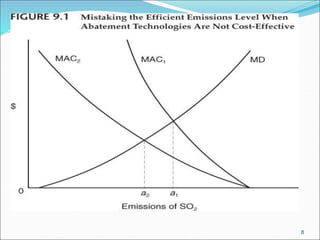
 If programs are not cost-effective, administrators will
tend to set less restrictive targets in terms of desired
amounts of emission reductions.
 The real problem with having costs higher than they
need to be is that society will be inclined to set its
objectives too low in terms of the amount of emission
reduction sought.
7
8
Cost Effectiveness
 In less developed economies people have fewer
resources to put in environmental programs.
 So the resources ought to be spent in ways that will
have the greatest impact.
 Cost effectiveness is also important for even more
developed industrialized countries during times of
recession or economic stagnation.
9
FAIRNESS
 Equity is, first and foremost, a matter of morality and
the concerns about how the benefits and costs of
environmental improvements ought to be distributed
among members of society.
 The two objectives of fairness are- efficiency and
distribution.
10
11
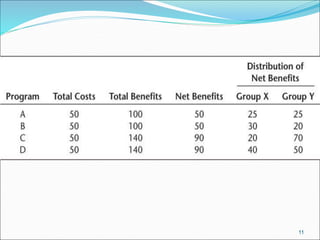
 In consideration of income groups option D might be
preferred.
 In terms of interregional equity D might not be
preferred.
12
Environmental Justice
 The concern is that racial minorities and low-income
people are disproportionately exposed to
environmental contaminants, both those outside the
home such as air and water pollution and those within
the home and workplace such as lead.
13
ENFORCEABILITY
 There perhaps is a natural tendency among people to
think that enacting a law automatically leads to the
rectification of the problem to which it is addressed.
 But regulations have to be enforced and enforcement
requires time, energy and resources.
14
Enforcement
There are two main steps in enforcement:
Monitoring and
Sanctioning
 Monitoring refers to measuring the performance of polluters in
comparison to whatever requirements are set out in the relevant
law.
 The objective of enforcement is to get people to comply with
an applicable law, thus some amount of monitoring is normally
essential.
15
 Sanctioning refers to the task of bringing to justice
those whom monitoring has shown to be in
violation of the law.
16
Paradox
 One might think that the greater the sanctions—higher fines,
long jail terms for violators, and so on—the more the law
would deter violators.
 But court cases take time, energy and resources. The higher the
penalties, the more reluctant courts may be to apply them.
 The threat to close down violators, or even to levy stiff
financial penalties, can in turn threaten the economic
livelihoods of large numbers of people.
17
Flexibility
 Policies should be sufficiently flexible to be adapted
to changing circumstances.
 A flexible policy contains an array of provisions that
permit its frequent adjustment and adaptation to new
circumstances.
18
 Command and control –may be efficient in long run
 Cap and trade– may be inefficient if required
adjustment is not adopted.
19
Incentives for technological innovations
Do environmental policies provide strong incentives for
individuals and groups to find new, innovative ways of
reducing their impacts on the environment?
Does it provide incentives for private parties to devote their
energies and creativities to finding new way of reducing
environmental impacts ?
20
Incentives for technological innovations
Public good: inventions and ideas are in the nature of
public goods.
 Private sector normally undersupply public goods.
 Rate of technological change in pollution control may be too
slow in the absence of the public policy to promote it.
 Technology forcing regulations requiring polluters to find
innovative technology.
 Envirotech industry consist of a wide variety of firms that
produce new technology to reduce emission more cost
effectively
21
MORAL CONSIDERATIONS
 The innate feelings that people have about what is right
and wrong affect the way they look at different
environmental policies.
 Take, for example, the question of choosing between
effluent taxes and effluent subsidies.
 Subsidies may be more effective.
 Some people regard polluting behavior as essentially
immoral.
 Those who cause a problem ought to bear the major
burden of alleviating it.
22
GOVERNMENT FAILURE
 Government failure means that it cannot simply be
assumed that each and every attempt at public
environmental policy will make the situation better.
 Government failure refers to systematic tendencies
and incentives within legislatures and regulating
agencies that work against the attainment of efficient
and equitable public policy.
 Outcomes also affected by the vagaries of the
political struggle, wield influence, political theatrics
etc.
23
Thank you
24

Barry chapter 9,Criteria for policy evaluation.ppt

  • 1.
  • 2.
    Policy Criteria  Inevaluating the effectiveness and appropriateness of a policy for addressing a given problem in environmental pollution control, it is important to have clearly in mind a set of policy evaluation criteria. 2
  • 3.
    List  Efficiency.  Cost-effectiveness. Fairness.  Enforceability.  Flexibility.  Incentives for technological innovations  Moral considerations 3
  • 4.
    EFFICIENCY  Should producemaximum of net benefit considering everybody of the society.  An efficient policy is where marginal abatement costs and marginal damages are equal.  To achieve efficiency in a centralized policy, the regulatory agency in charge must have knowledge of the relevant marginal abatement cost and marginal damage functions, then take steps to move the situation to the point where they are equal. 4
  • 5.
    EFFICIENCY  It isoften the case that environmental damages cannot be measured accurately.  A decentralized policy gets results from the interaction of many individual decision makers.  They serve to reveal the relevant information about MAC and MD and to adjust the situation toward the point where they are equal. 5
  • 6.
    Cost Effectiveness  Measurementissues makes it useful to employ cost- effectiveness as a primary policy criterion.  A policy is cost-effective if it produces the maximum environmental improvement possible for the resources being expended or, equivalently, it achieves a given amount of environmental improvement at the least possible cost. 6
  • 7.
    Cost Effectiveness  Ifprograms are not cost-effective, administrators will tend to set less restrictive targets in terms of desired amounts of emission reductions.  The real problem with having costs higher than they need to be is that society will be inclined to set its objectives too low in terms of the amount of emission reduction sought. 7
  • 8.
  • 9.
    Cost Effectiveness  Inless developed economies people have fewer resources to put in environmental programs.  So the resources ought to be spent in ways that will have the greatest impact.  Cost effectiveness is also important for even more developed industrialized countries during times of recession or economic stagnation. 9
  • 10.
    FAIRNESS  Equity is,first and foremost, a matter of morality and the concerns about how the benefits and costs of environmental improvements ought to be distributed among members of society.  The two objectives of fairness are- efficiency and distribution. 10
  • 11.
  • 12.
     In considerationof income groups option D might be preferred.  In terms of interregional equity D might not be preferred. 12
  • 13.
    Environmental Justice  Theconcern is that racial minorities and low-income people are disproportionately exposed to environmental contaminants, both those outside the home such as air and water pollution and those within the home and workplace such as lead. 13
  • 14.
    ENFORCEABILITY  There perhapsis a natural tendency among people to think that enacting a law automatically leads to the rectification of the problem to which it is addressed.  But regulations have to be enforced and enforcement requires time, energy and resources. 14
  • 15.
    Enforcement There are twomain steps in enforcement: Monitoring and Sanctioning  Monitoring refers to measuring the performance of polluters in comparison to whatever requirements are set out in the relevant law.  The objective of enforcement is to get people to comply with an applicable law, thus some amount of monitoring is normally essential. 15
  • 16.
     Sanctioning refersto the task of bringing to justice those whom monitoring has shown to be in violation of the law. 16
  • 17.
    Paradox  One mightthink that the greater the sanctions—higher fines, long jail terms for violators, and so on—the more the law would deter violators.  But court cases take time, energy and resources. The higher the penalties, the more reluctant courts may be to apply them.  The threat to close down violators, or even to levy stiff financial penalties, can in turn threaten the economic livelihoods of large numbers of people. 17
  • 18.
    Flexibility  Policies shouldbe sufficiently flexible to be adapted to changing circumstances.  A flexible policy contains an array of provisions that permit its frequent adjustment and adaptation to new circumstances. 18
  • 19.
     Command andcontrol –may be efficient in long run  Cap and trade– may be inefficient if required adjustment is not adopted. 19
  • 20.
    Incentives for technologicalinnovations Do environmental policies provide strong incentives for individuals and groups to find new, innovative ways of reducing their impacts on the environment? Does it provide incentives for private parties to devote their energies and creativities to finding new way of reducing environmental impacts ? 20
  • 21.
    Incentives for technologicalinnovations Public good: inventions and ideas are in the nature of public goods.  Private sector normally undersupply public goods.  Rate of technological change in pollution control may be too slow in the absence of the public policy to promote it.  Technology forcing regulations requiring polluters to find innovative technology.  Envirotech industry consist of a wide variety of firms that produce new technology to reduce emission more cost effectively 21
  • 22.
    MORAL CONSIDERATIONS  Theinnate feelings that people have about what is right and wrong affect the way they look at different environmental policies.  Take, for example, the question of choosing between effluent taxes and effluent subsidies.  Subsidies may be more effective.  Some people regard polluting behavior as essentially immoral.  Those who cause a problem ought to bear the major burden of alleviating it. 22
  • 23.
    GOVERNMENT FAILURE  Governmentfailure means that it cannot simply be assumed that each and every attempt at public environmental policy will make the situation better.  Government failure refers to systematic tendencies and incentives within legislatures and regulating agencies that work against the attainment of efficient and equitable public policy.  Outcomes also affected by the vagaries of the political struggle, wield influence, political theatrics etc. 23
  • 24.