Food Needs, Yields, and
Microclimate
By Nicholas Barrett-Miller
Dietary Assessment
 4 Adult Household
 2,000 calories per person per day
 Currently we eat way more meat and grains than would
ever be possible to produce on our land or even the
surrounding land. I believe this is neither sustainable nor
healthy. (Bane, 106 – 107)
 Much of our diet could be replaced with more nutritious
fruits and vegetables. (Conner, 32)
 The space calculations assume low end average yields
and also adding them together would assume everything
is being grown at once which is not the case.
Fruits and Vegetables
From
Conner
32 – 33.
Crop Servings/ yr. lbs. / yr. # 100ft2 beds
Apples 1456 520 10
Blackberries 416 101.5 7
Strawberries 208 34.7 0.3
Watermelon 104 38.5 0.7
Cherries 208 61.2 4
Crop Servings/ yr. lbs. / yr. # 100ft2 beds
Beans 624 141.8 10
Beets 208 74.3 2
Carrots 624 222.9 3
Tomato 364 158.3 2.5
Peppers 416 71.7 1
Peas 832 489.4 70
Spinach 1456 124.4 3.5
Lettuce 780 118.2 2.5
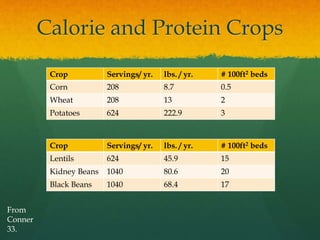
Calorie and Protein Crops
From
Conner
33.
Crop Servings/ yr. lbs. / yr. # 100ft2 beds
Corn 208 8.7 0.5
Wheat 208 13 2
Potatoes 624 222.9 3
Crop Servings/ yr. lbs. / yr. # 100ft2 beds
Lentils 624 45.9 15
Kidney Beans 1040 80.6 20
Black Beans 1040 68.4 17
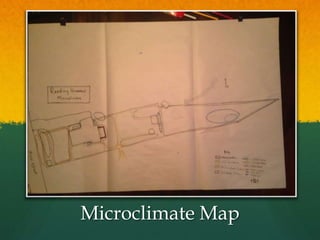
Microclimate Map
Microclimate Map
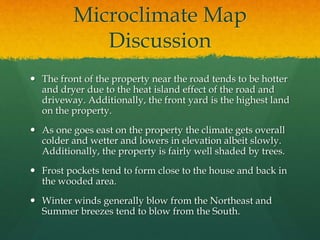
Discussion
 The front of the property near the road tends to be hotter
and dryer due to the heat island effect of the road and
driveway. Additionally, the front yard is the highest land
on the property.
 As one goes east on the property the climate gets overall
colder and wetter and lowers in elevation albeit slowly.
Additionally, the property is fairly well shaded by trees.
 Frost pockets tend to form close to the house and back in
the wooded area.
 Winter winds generally blow from the Northeast and
Summer breezes tend to blow from the South.
Microclimate Map
Discussion (cont.)
 The one area of our yard that gets 8 hours of sun is the middle. This area
is really the only suitable place (as-is) to grow fruit bearing plants like
tomatoes, peppers, and watermelon. It is likewise the only suitable place
for grains like corn and wheat due to their high light requirements.
 The shady areas closer to the house could be used to grow shade tolerant
plants such as beets, lettuce, carrots, and peas. Potatoes would also likely
tolerate some shade, but could be grown in buckets and placed on
impermeable surfaces. Tomatoes could likewise be bucketed.
 The truly shady areas could be used for spinach, and herb gardens, but
could also be used to produce strawberries in some quantity.
 Legumes would be intercropped essentially everywhere I could fit them,
though would probably do fine in orange areas detailed on the map.

BarrettMiller_Food_and_Microclimate

  • 1.
    Food Needs, Yields,and Microclimate By Nicholas Barrett-Miller
  • 2.
    Dietary Assessment  4Adult Household  2,000 calories per person per day  Currently we eat way more meat and grains than would ever be possible to produce on our land or even the surrounding land. I believe this is neither sustainable nor healthy. (Bane, 106 – 107)  Much of our diet could be replaced with more nutritious fruits and vegetables. (Conner, 32)  The space calculations assume low end average yields and also adding them together would assume everything is being grown at once which is not the case.
  • 3.
    Fruits and Vegetables From Conner 32– 33. Crop Servings/ yr. lbs. / yr. # 100ft2 beds Apples 1456 520 10 Blackberries 416 101.5 7 Strawberries 208 34.7 0.3 Watermelon 104 38.5 0.7 Cherries 208 61.2 4 Crop Servings/ yr. lbs. / yr. # 100ft2 beds Beans 624 141.8 10 Beets 208 74.3 2 Carrots 624 222.9 3 Tomato 364 158.3 2.5 Peppers 416 71.7 1 Peas 832 489.4 70 Spinach 1456 124.4 3.5 Lettuce 780 118.2 2.5
  • 4.
    Calorie and ProteinCrops From Conner 33. Crop Servings/ yr. lbs. / yr. # 100ft2 beds Corn 208 8.7 0.5 Wheat 208 13 2 Potatoes 624 222.9 3 Crop Servings/ yr. lbs. / yr. # 100ft2 beds Lentils 624 45.9 15 Kidney Beans 1040 80.6 20 Black Beans 1040 68.4 17
  • 5.
  • 6.
    Microclimate Map Discussion  Thefront of the property near the road tends to be hotter and dryer due to the heat island effect of the road and driveway. Additionally, the front yard is the highest land on the property.  As one goes east on the property the climate gets overall colder and wetter and lowers in elevation albeit slowly. Additionally, the property is fairly well shaded by trees.  Frost pockets tend to form close to the house and back in the wooded area.  Winter winds generally blow from the Northeast and Summer breezes tend to blow from the South.
  • 7.
    Microclimate Map Discussion (cont.) The one area of our yard that gets 8 hours of sun is the middle. This area is really the only suitable place (as-is) to grow fruit bearing plants like tomatoes, peppers, and watermelon. It is likewise the only suitable place for grains like corn and wheat due to their high light requirements.  The shady areas closer to the house could be used to grow shade tolerant plants such as beets, lettuce, carrots, and peas. Potatoes would also likely tolerate some shade, but could be grown in buckets and placed on impermeable surfaces. Tomatoes could likewise be bucketed.  The truly shady areas could be used for spinach, and herb gardens, but could also be used to produce strawberries in some quantity.  Legumes would be intercropped essentially everywhere I could fit them, though would probably do fine in orange areas detailed on the map.