




Hamstring injuries 
Prevention and risk factors 
Anders Hauge Engebretsen MD PhD Oslo Sports Trauma Research Center
Oslo Sports Trauma Research Center Background Hamstring injuries Prevention Risk factors Discussion Take Home message 
Hamstring injuries
Oslo Sports Trauma Research Center 
Background 
Hamstring injuries 
Prevention 
Risk factors 
Discussion 
Take Home message 
Hamstring injuries
”Intellectuals solve problems; geniuses prevent them” 
Albert Einstein 
(1879 – 1955)
www.ostrc.no – www.klokeavskade.no 
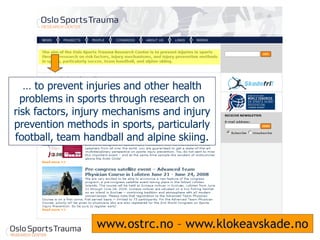
… to prevent injuries and other health problems in sports through research on risk factors, injury mechanisms and injury prevention methods in sports, particularly football, team handball and alpine skiing.
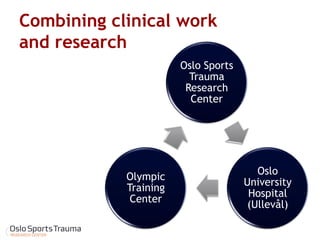
Combining clinical work and research 
Oslo Sports Trauma Research Center 
Oslo University Hospital (Ullevål) 
Olympic Training Center
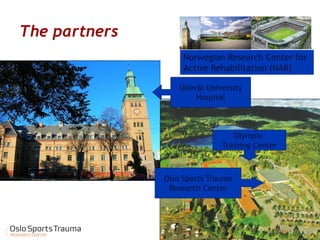
The partners 
Olympic 
Training Center 
Ullevål University 
Hospital 
Oslo Sports Trauma 
Research Center 
Norwegian Research Center for Active Rehabilitation (NAR)
Growing…
And growing…
Oslo Sports Trauma Research Center 
Background 
Hamstring injuries 
Prevention 
Risk factors 
Discussion 
Take Home message 
Hamstring injuries
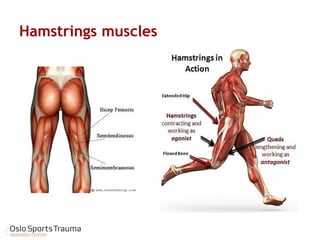
Hamstrings muscles
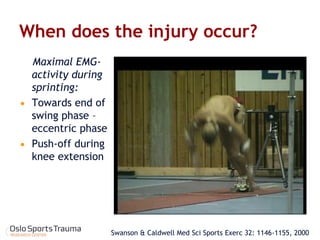
Swanson & Caldwell Med Sci Sports Exerc 32: 1146-1155, 2000 
When does the injury occur? 
Maximal EMG- activity during sprinting: 
Towards end of swing phase – eccentric phase 
Push-off during knee extension
Junge&Dvorak -00; Andersen -04; Ekstrand -10; Ekstrand -13 
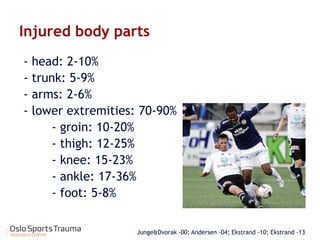
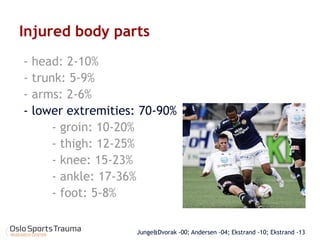
Injured body parts 
- head: 2-10% 
- trunk: 5-9% 
- arms: 2-6% 
- lower extremities: 70-90% 
- groin: 10-20% 
- thigh: 12-25% 
- knee: 15-23% 
- ankle: 17-36% 
- foot: 5-8%
Junge&Dvorak -00; Andersen -04; Ekstrand -10; Ekstrand -13 
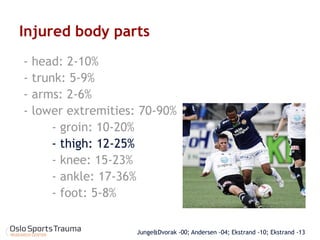
Injured body parts 
- head: 2-10% 
- trunk: 5-9% 
- arms: 2-6% 
- lower extremities: 70-90% 
- groin: 10-20% 
- thigh: 12-25% 
- knee: 15-23% 
- ankle: 17-36% 
- foot: 5-8%
Junge&Dvorak -00; Andersen -04; Ekstrand -10; Ekstrand -13 
Injured body parts 
- head: 2-10% 
- trunk: 5-9% 
- arms: 2-6% 
- lower extremities: 70-90% 
- groin: 10-20% 
- thigh: 12-25% 
- knee: 15-23% 
- ankle: 17-36% 
- foot: 5-8%
Drawer and Fuller -01; Andersen et. al -04; Ekstrand et al.-10; Ekstrand et al-13 
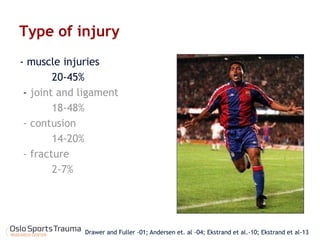
Type of injury 
- muscle injuries 
20-45% 
- joint and ligament 
18-48% 
- contusion 
14-20% 
- fracture 
2-7%
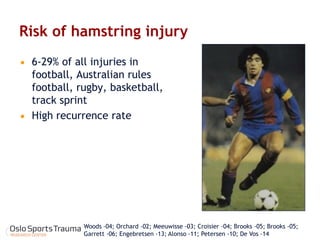
Risk of hamstring injury 
6-29% of all injuries in football, Australian rules football, rugby, basketball, track sprint 
High recurrence rate 
Woods -04; Orchard -02; Meeuwisse -03; Croisier -04; Brooks -05; Brooks -05; Garrett -06; Engebretsen -13; Alonso -11; Petersen -10; De Vos -14
Risk of hamstring injury 
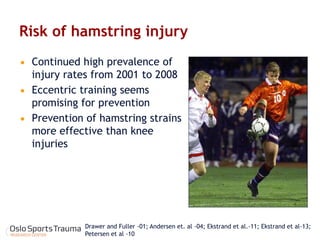
Continued high prevalence of injury rates from 2001 to 2008 
Eccentric training seems promising for prevention 
Prevention of hamstring strains more effective than knee injuries 
Drawer and Fuller -01; Andersen et. al -04; Ekstrand et al.-11; Ekstrand et al-13; Petersen et al -10
Risk factors 
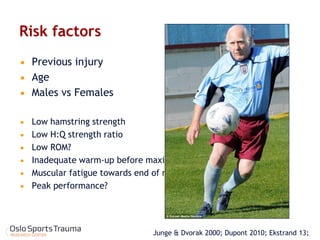
Previous injury 
Age 
Males vs Females 
Low hamstring strength 
Low H:Q strength ratio 
Low ROM? 
Inadequate warm-up before maximal activity? 
Muscular fatigue towards end of match or training? 
Peak performance? 
Junge & Dvorak 2000; Dupont 2010; Ekstrand 13;
Mechanisms of injury 
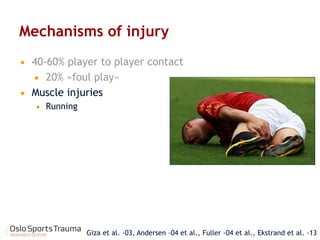
40-60% player to player contact 
20% «foul play» 
Muscle injuries 
Running 
Giza et al. -03, Andersen -04 et al., Fuller -04 et al., Ekstrand et al. -13
Oslo Sports Trauma Research Center 
Background 
Hamstring injuries 
Prevention 
Risk factors 
Discussion 
Take Home message 
Hamstring injuries
Football and injuries Screening, risk factors and prevention 
Anders Hauge Engebretsen 
Oslo Sports Trauma Research Center, Norwegian School of Sport Sciences 
& 
Orthopaedic Center, Division of Neuroscience and Musculoskeletal Medicine 
Ullevaal University Hospital
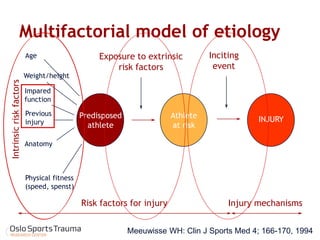
Age 
Physical fitness (speed, spenst) 
Previous injury 
Weight/height 
Impared function 
Anatomy 
Multifactorial model of etiology 
Exposure to extrinsic 
risk factors 
Inciting event 
Predisposed 
athlete 
Athlete 
at risk 
INJURY 
Intrinsic risk factors 
Risk factors for injury 
Injury mechanisms 
Meeuwisse WH: Clin J Sports Med 4; 166-170, 1994
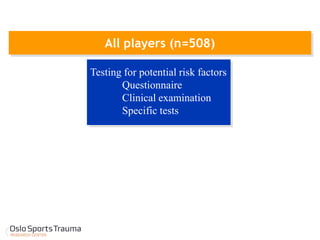
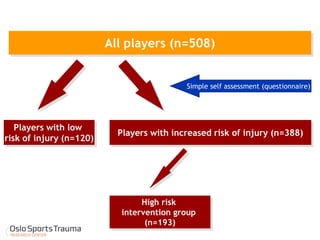
All players (n=508) 
Testing for potential risk factors 
Questionnaire 
Clinical examination 
Specific tests
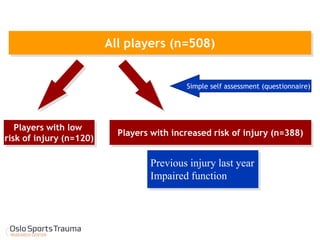
All players (n=508) 
Players with increased risk of injury (n=388) 
Players with low 
risk of injury (n=120) 
Simple self assessment (questionnaire) 
Previous injury last year 
Impaired function
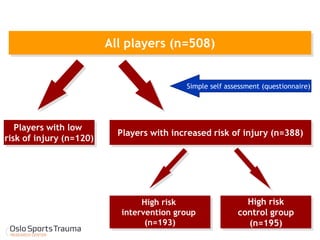
All players (n=508) 
Players with increased risk of injury (n=388) 
Players with low risk of injury (n=120) 
Simple self assessment (questionnaire) 
High risk 
intervention group 
(n=193)
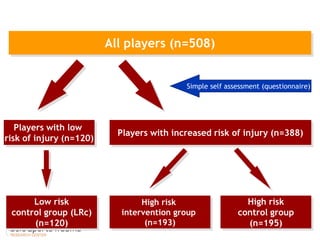
All players (n=508) 
Players with increased risk of injury (n=388) 
Players with low 
risk of injury (n=120) 
Simple self assessment (questionnaire) 
High risk 
control group 
(n=195) 
High risk intervention group (n=193)
All players (n=508) 
Players with increased risk of injury (n=388) 
Players with low 
risk of injury (n=120) 
Simple self assessment (questionnaire) 
High risk control group (n=195) 
High risk intervention group (n=193) 
Low risk 
control group (LRc) 
(n=120)
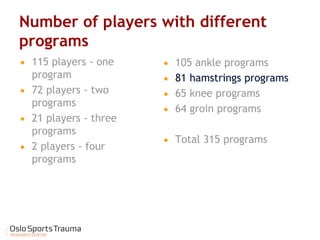
Number of players with different programs 
115 players - one program 
72 players - two programs 
21 players - three programs 
2 players - four programs 
105 ankle programs 
81 hamstrings programs 
65 knee programs 
64 groin programs 
Total 315 programs
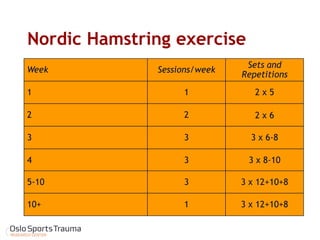
Nordic Hamstring exercise 
Week 
1 
2 
3 
4 
Sessions/week 
1 
2 
3 
3 
Sets and Repetitions 
2 x 5 
2 x 6 
3 x 6-8 
3 x 8-10 
5-10 
3 
3 x 12+10+8 
10+ 
1 
3 x 12+10+8
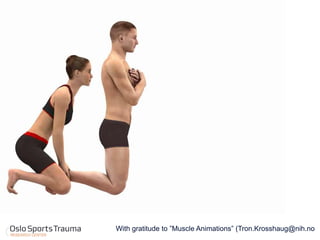
With gratitude to ”Muscle Animations” (Tron.Krosshaug@nih.no
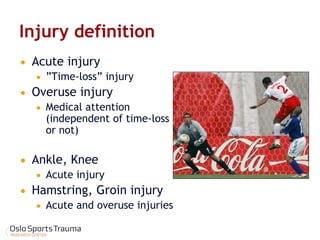
Injury definition 
Acute injury 
”Time-loss” injury 
Overuse injury 
Medical attention (independent of time-loss or not) 
Ankle, Knee 
Acute injury 
Hamstring, Groin injury 
Acute and overuse injuries
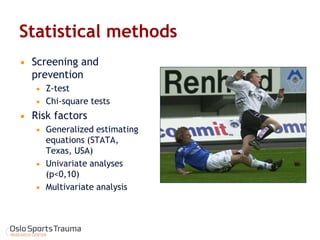
Statistical methods 
Screening and prevention 
Z-test 
Chi-square tests 
Risk factors 
Generalized estimating equations (STATA, Texas, USA) 
Univariate analyses (p<0,10) 
Multivariate analysis
Oslo Sports Trauma Research Center 
Background 
Hamstring injuries 
Prevention 
Risk factors 
Discussion 
Take Home message 
Hamstring injuries
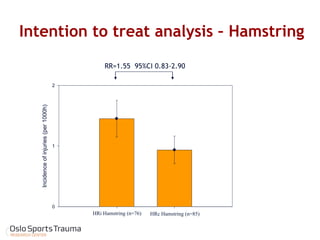
Incidence of injuries (per 1000h) 
0 
1 
2 
Intention to treat analysis – Hamstring 
RR=1.55 95%CI 0.83-2.90 
HRi Hamstring (n=76) HRc Hamstring (n=85)
Oslo Sports Trauma Research Center 
Background 
Hamstring injuries 
Prevention 
Risk factors 
Discussion 
Take Home message 
Hamstring injuries
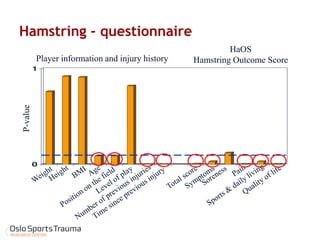
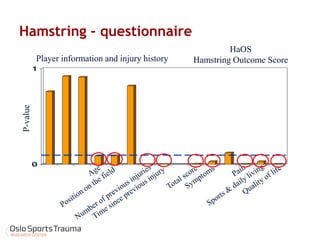
Hamstring - questionnaire 
0 
1 
HaOS 
Player information and injury history Hamstring Outcome Score 
P-value
Hamstring - questionnaire 
0 
1 
HaOS 
Player information and injury history Hamstring Outcome Score 
P-value
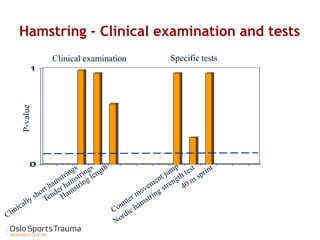
Hamstring - Clinical examination and tests 
0 
1 
P-value 
Clinical examination Specific tests
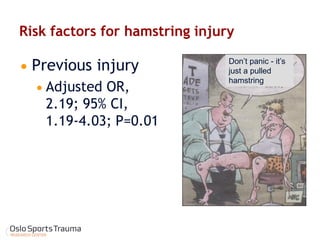
Risk factors for hamstring injury 
Previous injury 
Adjusted OR, 2.19; 95% CI, 1.19-4.03; P=0.01 
Don’t panic - it’s just a pulled hamstring
Oslo Sports Trauma Research Center 
Background 
Hamstring injuries 
Prevention 
Risk factors 
Discussion 
Take Home message 
Hamstring injuries
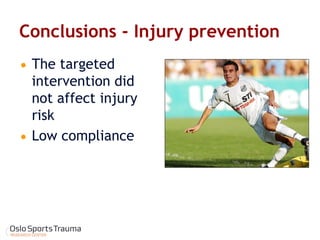
Conclusions - Injury prevention 
The targeted intervention did not affect injury risk 
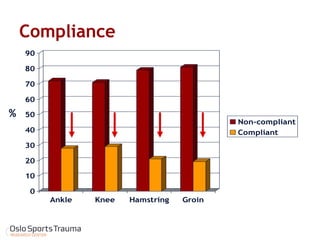
Low compliance
Compliance 
0 
10 
20 
30 
40 
50 
60 
70 
80 
90 
Ankle Knee Hamstring Groin 
Non-compliant 
Compliant 
%
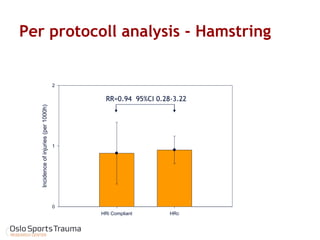
Per protocoll analysis - Hamstring 
HRi Compliant HRc 
Incidence of injuries (per 1000h) 
0 
1 
2 
RR=0.94 95%CI 0.28-3.22
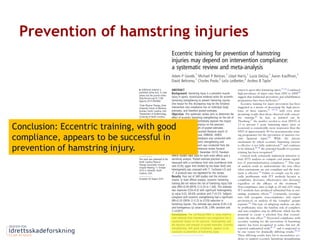
Prevention of hamstring injuries 
Conclusion: Eccentric training, with good compliance, appears to be successful in prevention of hamstring injury.
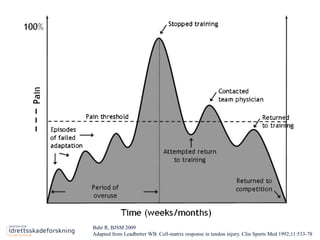
Bahr R, BJSM 2009 Adapted from Leadbetter WB. Cell-matrix response in tendon injury. Clin Sports Med 1992;11:533-78
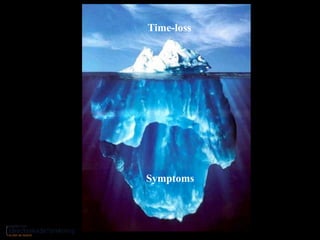
Time-loss 
Symptoms
Oslo Sports Trauma Research Center 
Background 
Hamstring injuries 
Prevention 
Risk factors 
Discussion 
Take Home message 
Hamstring injuries
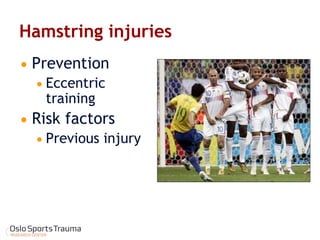
Hamstring injuries 
Prevention 
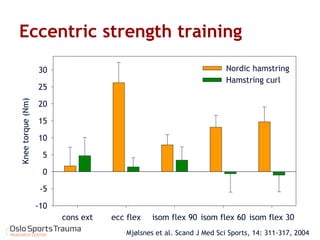
Eccentric training 
Risk factors 
Previous injury
Mjølsnes et al. Scand J Med Sci Sports, 14: 311-317, 2004 
cons ext ecc flex isom flex 90 isom flex 60 isom flex 30 
Knee torque (Nm) 
-10 
-5 
0 
5 
10 
15 
20 
25 
30 
Nordic hamstring 
Hamstring curl 
Eccentric strength training
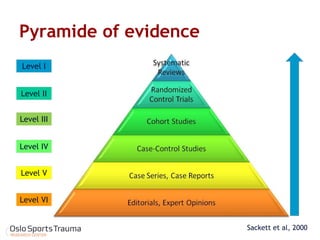
Pyramide of evidence 
Level VI 
Level V 
Level IV 
Level III 
Level II 
Level I 
Sackett et al, 2000
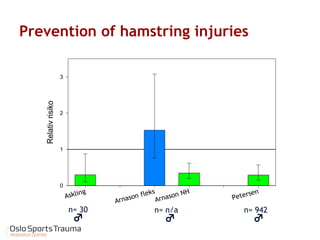
Prevention of hamstring injuries 
Askling 
Arnason fleks 
Arnason NH 
Petersen 
Relativ risiko 
0 
1 
2 
3 
♂ ♂ ♂ 
n= 30 n= n/a n= 942
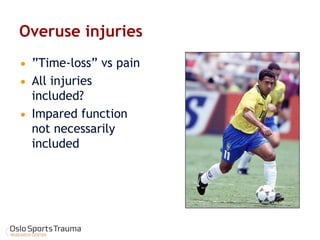
Overuse injuries 
”Time-loss” vs pain 
All injuries included? 
Impared function not necessarily included
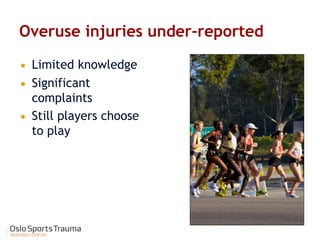
Overuse injuries under-reported 
Limited knowledge 
Significant complaints 
Still players choose to play

Anders Hauge Engebretsen - Hamstring Injuries

  • 1.
    Hamstring injuries Preventionand risk factors Anders Hauge Engebretsen MD PhD Oslo Sports Trauma Research Center
  • 2.
    Oslo Sports TraumaResearch Center Background Hamstring injuries Prevention Risk factors Discussion Take Home message Hamstring injuries
  • 3.
    Oslo Sports TraumaResearch Center Background Hamstring injuries Prevention Risk factors Discussion Take Home message Hamstring injuries
  • 4.
    ”Intellectuals solve problems;geniuses prevent them” Albert Einstein (1879 – 1955)
  • 5.
    www.ostrc.no – www.klokeavskade.no … to prevent injuries and other health problems in sports through research on risk factors, injury mechanisms and injury prevention methods in sports, particularly football, team handball and alpine skiing.
  • 6.
    Combining clinical workand research Oslo Sports Trauma Research Center Oslo University Hospital (Ullevål) Olympic Training Center
  • 7.
    The partners Olympic Training Center Ullevål University Hospital Oslo Sports Trauma Research Center Norwegian Research Center for Active Rehabilitation (NAR)
  • 9.
  • 10.
  • 11.
    Oslo Sports TraumaResearch Center Background Hamstring injuries Prevention Risk factors Discussion Take Home message Hamstring injuries
  • 12.
  • 13.
    Swanson & CaldwellMed Sci Sports Exerc 32: 1146-1155, 2000 When does the injury occur? Maximal EMG- activity during sprinting: Towards end of swing phase – eccentric phase Push-off during knee extension
  • 14.
    Junge&Dvorak -00; Andersen-04; Ekstrand -10; Ekstrand -13 Injured body parts - head: 2-10% - trunk: 5-9% - arms: 2-6% - lower extremities: 70-90% - groin: 10-20% - thigh: 12-25% - knee: 15-23% - ankle: 17-36% - foot: 5-8%
  • 15.
    Junge&Dvorak -00; Andersen-04; Ekstrand -10; Ekstrand -13 Injured body parts - head: 2-10% - trunk: 5-9% - arms: 2-6% - lower extremities: 70-90% - groin: 10-20% - thigh: 12-25% - knee: 15-23% - ankle: 17-36% - foot: 5-8%
  • 16.
    Junge&Dvorak -00; Andersen-04; Ekstrand -10; Ekstrand -13 Injured body parts - head: 2-10% - trunk: 5-9% - arms: 2-6% - lower extremities: 70-90% - groin: 10-20% - thigh: 12-25% - knee: 15-23% - ankle: 17-36% - foot: 5-8%
  • 17.
    Drawer and Fuller-01; Andersen et. al -04; Ekstrand et al.-10; Ekstrand et al-13 Type of injury - muscle injuries 20-45% - joint and ligament 18-48% - contusion 14-20% - fracture 2-7%
  • 18.
    Risk of hamstringinjury 6-29% of all injuries in football, Australian rules football, rugby, basketball, track sprint High recurrence rate Woods -04; Orchard -02; Meeuwisse -03; Croisier -04; Brooks -05; Brooks -05; Garrett -06; Engebretsen -13; Alonso -11; Petersen -10; De Vos -14
  • 19.
    Risk of hamstringinjury Continued high prevalence of injury rates from 2001 to 2008 Eccentric training seems promising for prevention Prevention of hamstring strains more effective than knee injuries Drawer and Fuller -01; Andersen et. al -04; Ekstrand et al.-11; Ekstrand et al-13; Petersen et al -10
  • 20.
    Risk factors Previousinjury Age Males vs Females Low hamstring strength Low H:Q strength ratio Low ROM? Inadequate warm-up before maximal activity? Muscular fatigue towards end of match or training? Peak performance? Junge & Dvorak 2000; Dupont 2010; Ekstrand 13;
  • 21.
    Mechanisms of injury 40-60% player to player contact 20% «foul play» Muscle injuries Running Giza et al. -03, Andersen -04 et al., Fuller -04 et al., Ekstrand et al. -13
  • 22.
    Oslo Sports TraumaResearch Center Background Hamstring injuries Prevention Risk factors Discussion Take Home message Hamstring injuries
  • 23.
    Football and injuriesScreening, risk factors and prevention Anders Hauge Engebretsen Oslo Sports Trauma Research Center, Norwegian School of Sport Sciences & Orthopaedic Center, Division of Neuroscience and Musculoskeletal Medicine Ullevaal University Hospital
  • 24.
    Age Physical fitness(speed, spenst) Previous injury Weight/height Impared function Anatomy Multifactorial model of etiology Exposure to extrinsic risk factors Inciting event Predisposed athlete Athlete at risk INJURY Intrinsic risk factors Risk factors for injury Injury mechanisms Meeuwisse WH: Clin J Sports Med 4; 166-170, 1994
  • 25.
    All players (n=508) Testing for potential risk factors Questionnaire Clinical examination Specific tests
  • 26.
    All players (n=508) Players with increased risk of injury (n=388) Players with low risk of injury (n=120) Simple self assessment (questionnaire) Previous injury last year Impaired function
  • 27.
    All players (n=508) Players with increased risk of injury (n=388) Players with low risk of injury (n=120) Simple self assessment (questionnaire) High risk intervention group (n=193)
  • 28.
    All players (n=508) Players with increased risk of injury (n=388) Players with low risk of injury (n=120) Simple self assessment (questionnaire) High risk control group (n=195) High risk intervention group (n=193)
  • 29.
    All players (n=508) Players with increased risk of injury (n=388) Players with low risk of injury (n=120) Simple self assessment (questionnaire) High risk control group (n=195) High risk intervention group (n=193) Low risk control group (LRc) (n=120)
  • 30.
    Number of playerswith different programs 115 players - one program 72 players - two programs 21 players - three programs 2 players - four programs 105 ankle programs 81 hamstrings programs 65 knee programs 64 groin programs Total 315 programs
  • 31.
    Nordic Hamstring exercise Week 1 2 3 4 Sessions/week 1 2 3 3 Sets and Repetitions 2 x 5 2 x 6 3 x 6-8 3 x 8-10 5-10 3 3 x 12+10+8 10+ 1 3 x 12+10+8
  • 32.
    With gratitude to”Muscle Animations” (Tron.Krosshaug@nih.no
  • 33.
    Injury definition Acuteinjury ”Time-loss” injury Overuse injury Medical attention (independent of time-loss or not) Ankle, Knee Acute injury Hamstring, Groin injury Acute and overuse injuries
  • 34.
    Statistical methods Screeningand prevention Z-test Chi-square tests Risk factors Generalized estimating equations (STATA, Texas, USA) Univariate analyses (p<0,10) Multivariate analysis
  • 35.
    Oslo Sports TraumaResearch Center Background Hamstring injuries Prevention Risk factors Discussion Take Home message Hamstring injuries
  • 36.
    Incidence of injuries(per 1000h) 0 1 2 Intention to treat analysis – Hamstring RR=1.55 95%CI 0.83-2.90 HRi Hamstring (n=76) HRc Hamstring (n=85)
  • 37.
    Oslo Sports TraumaResearch Center Background Hamstring injuries Prevention Risk factors Discussion Take Home message Hamstring injuries
  • 38.
    Hamstring - questionnaire 0 1 HaOS Player information and injury history Hamstring Outcome Score P-value
  • 39.
    Hamstring - questionnaire 0 1 HaOS Player information and injury history Hamstring Outcome Score P-value
  • 40.
    Hamstring - Clinicalexamination and tests 0 1 P-value Clinical examination Specific tests
  • 41.
    Risk factors forhamstring injury Previous injury Adjusted OR, 2.19; 95% CI, 1.19-4.03; P=0.01 Don’t panic - it’s just a pulled hamstring
  • 42.
    Oslo Sports TraumaResearch Center Background Hamstring injuries Prevention Risk factors Discussion Take Home message Hamstring injuries
  • 43.
    Conclusions - Injuryprevention The targeted intervention did not affect injury risk Low compliance
  • 44.
    Compliance 0 10 20 30 40 50 60 70 80 90 Ankle Knee Hamstring Groin Non-compliant Compliant %
  • 45.
    Per protocoll analysis- Hamstring HRi Compliant HRc Incidence of injuries (per 1000h) 0 1 2 RR=0.94 95%CI 0.28-3.22
  • 46.
    Prevention of hamstringinjuries Conclusion: Eccentric training, with good compliance, appears to be successful in prevention of hamstring injury.
  • 47.
    Bahr R, BJSM2009 Adapted from Leadbetter WB. Cell-matrix response in tendon injury. Clin Sports Med 1992;11:533-78
  • 48.
  • 49.
    Oslo Sports TraumaResearch Center Background Hamstring injuries Prevention Risk factors Discussion Take Home message Hamstring injuries
  • 50.
    Hamstring injuries Prevention Eccentric training Risk factors Previous injury
  • 53.
    Mjølsnes et al.Scand J Med Sci Sports, 14: 311-317, 2004 cons ext ecc flex isom flex 90 isom flex 60 isom flex 30 Knee torque (Nm) -10 -5 0 5 10 15 20 25 30 Nordic hamstring Hamstring curl Eccentric strength training
  • 54.
    Pyramide of evidence Level VI Level V Level IV Level III Level II Level I Sackett et al, 2000
  • 55.
    Prevention of hamstringinjuries Askling Arnason fleks Arnason NH Petersen Relativ risiko 0 1 2 3 ♂ ♂ ♂ n= 30 n= n/a n= 942
  • 56.
    Overuse injuries ”Time-loss”vs pain All injuries included? Impared function not necessarily included
  • 57.
    Overuse injuries under-reported Limited knowledge Significant complaints Still players choose to play