28-01-2018
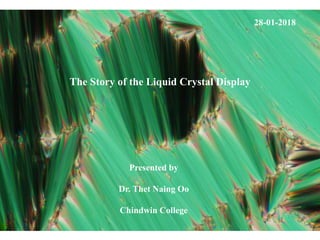
The Story of the Liquid Crystal Display
Presented by
Dr. Thet Naing Oo
Chindwin College
Outlines
1. Starting from carrots
2. The light dawns in the West!
3. Fourth state of matter
4. 130 years of LCD R & D
5. The sun rises in the East!
6. Japanese Perseverance in R & D
7. Development of Liquid Crystal Displays
8. Mobile Information Gateways
9. Flexible Displays
2
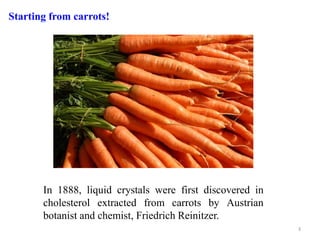
In 1888, liquid crystals were first discovered in
cholesterol extracted from carrots by Austrian
botanist and chemist, Friedrich Reinitzer.
Starting from carrots!
3
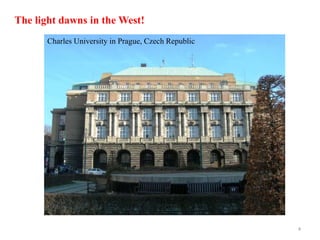
The light dawns in the West!
Charles University in Prague, Czech Republic
4
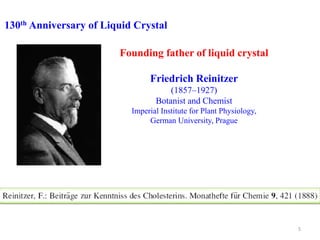
130th Anniversary of Liquid Crystal
Founding father of liquid crystal
Friedrich Reinitzer
(1857–1927)
Botanist and Chemist
Imperial Institute for Plant Physiology,
German University, Prague
5
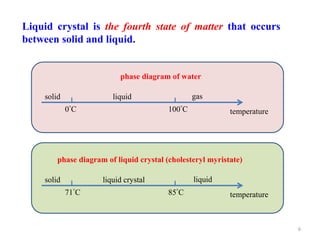
Liquid crystal is the fourth state of matter that occurs
between solid and liquid.
phase diagram of water
solid liquid gas
temperature0C 100C
phase diagram of liquid crystal (cholesteryl myristate)
solid liquid crystal liquid
temperature71C 85C
6
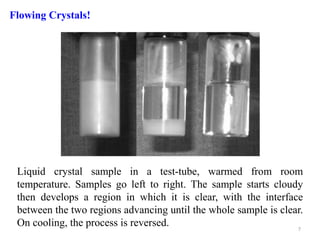
Liquid crystal sample in a test-tube, warmed from room
temperature. Samples go left to right. The sample starts cloudy
then develops a region in which it is clear, with the interface
between the two regions advancing until the whole sample is clear.
On cooling, the process is reversed.
Flowing Crystals!
7
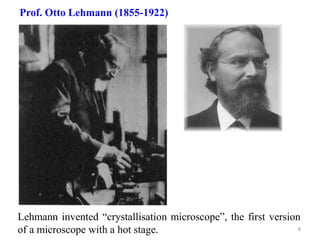
Prof. Otto Lehmann (1855-1922)
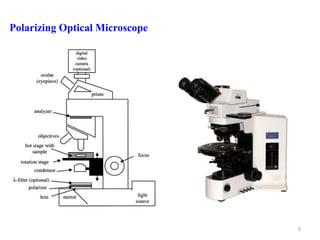
Lehmann invented “crystallisation microscope”, the first version
of a microscope with a hot stage. 8
Polarizing Optical Microscope
9
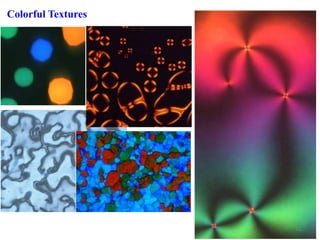
Colorful Textures
10
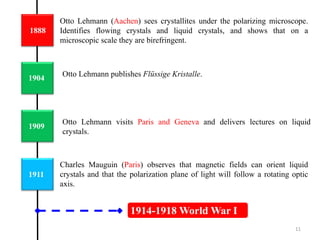
1888
1904
1909
Otto Lehmann (Aachen) sees crystallites under the polarizing microscope.
Identifies flowing crystals and liquid crystals, and shows that on a
microscopic scale they are birefringent.
Otto Lehmann visits Paris and Geneva and delivers lectures on liquid
crystals.
1911
Otto Lehmann publishes Flüssige Kristalle.
Charles Mauguin (Paris) observes that magnetic fields can orient liquid
crystals and that the polarization plane of light will follow a rotating optic
axis.
1914-1918 World War I
11
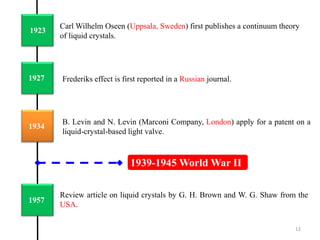
1923
1927
1934
Carl Wilhelm Oseen (Uppsala, Sweden) first publishes a continuum theory
of liquid crystals.
B. Levin and N. Levin (Marconi Company, London) apply for a patent on a
liquid-crystal-based light valve.
1957
Frederiks effect is first reported in a Russian journal.
Review article on liquid crystals by G. H. Brown and W. G. Shaw from the
USA.
1939-1945 World War II
12
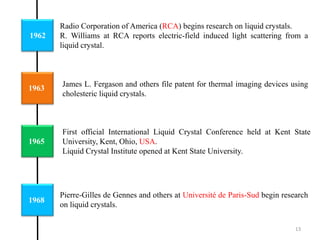
1962
1963
1965
Radio Corporation of America (RCA) begins research on liquid crystals.
R. Williams at RCA reports electric-field induced light scattering from a
liquid crystal.
First official International Liquid Crystal Conference held at Kent State
University, Kent, Ohio, USA.
Liquid Crystal Institute opened at Kent State University.
1968
James L. Fergason and others file patent for thermal imaging devices using
cholesteric liquid crystals.
Pierre-Gilles de Gennes and others at Université de Paris-Sud begin research
on liquid crystals.
13
14
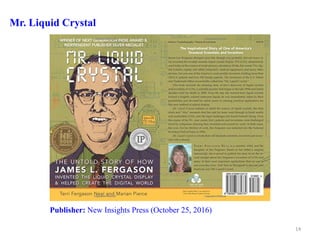
Mr. Liquid Crystal
Publisher: New Insights Press (October 25, 2016)
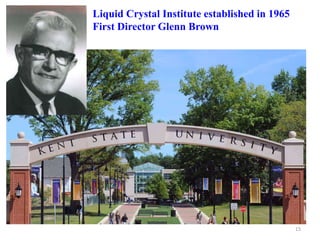
Liquid Crystal Institute established in 1965
First Director Glenn Brown
15
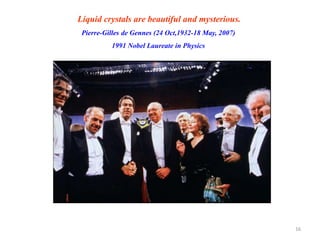
Liquid crystals are beautiful and mysterious.
Pierre-Gilles de Gennes (24 Oct,1932-18 May, 2007)
1991 Nobel Laureate in Physics
16
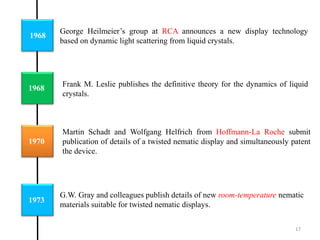
1968
1968
1970
George Heilmeier’s group at RCA announces a new display technology
based on dynamic light scattering from liquid crystals.
Martin Schadt and Wolfgang Helfrich from Hoffmann-La Roche submit
publication of details of a twisted nematic display and simultaneously patent
the device.
1973
Frank M. Leslie publishes the definitive theory for the dynamics of liquid
crystals.
G.W. Gray and colleagues publish details of new room-temperature nematic
materials suitable for twisted nematic displays.
17
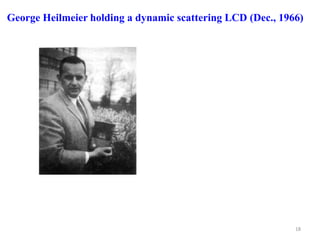
George Heilmeier holding a dynamic scattering LCD (Dec., 1966)
18
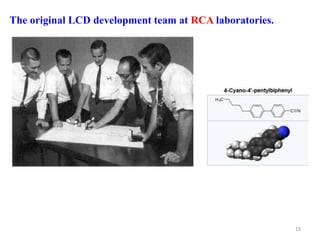
The original LCD development team at RCA laboratories.
19
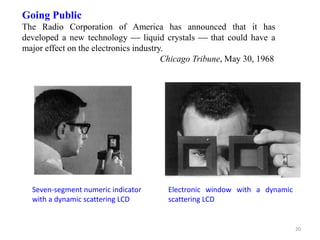
Going Public
The Radio Corporation of America has announced that it has
developed a new technology  liquid crystals  that could have a
major effect on the electronics industry.
Chicago Tribune, May 30, 1968
Seven-segment numeric indicator
with a dynamic scattering LCD
Electronic window with a dynamic
scattering LCD
20
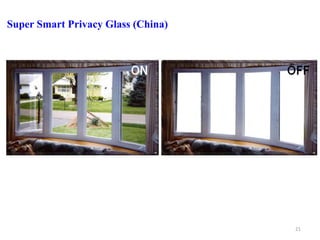
Super Smart Privacy Glass (China)
21
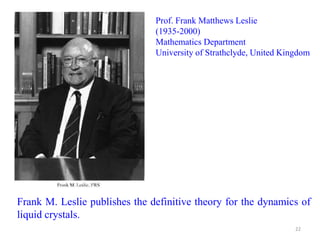
Frank M. Leslie publishes the definitive theory for the dynamics of
liquid crystals.
Prof. Frank Matthews Leslie
(1935-2000)
Mathematics Department
University of Strathclyde, United Kingdom
22
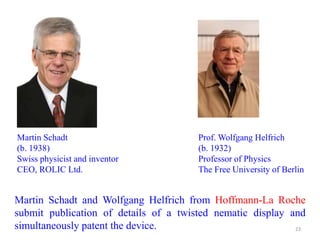
Martin Schadt and Wolfgang Helfrich from Hoffmann-La Roche
submit publication of details of a twisted nematic display and
simultaneously patent the device.
Martin Schadt
(b. 1938)
Swiss physicist and inventor
CEO, ROLIC Ltd.
Prof. Wolfgang Helfrich
(b. 1932)
Professor of Physics
The Free University of Berlin
23
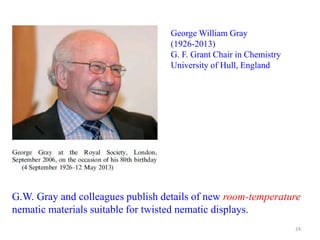
George William Gray
(1926-2013)
G. F. Grant Chair in Chemistry
University of Hull, England
G.W. Gray and colleagues publish details of new room-temperature
nematic materials suitable for twisted nematic displays.
24
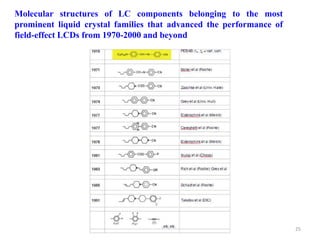
Molecular structures of LC components belonging to the most
prominent liquid crystal families that advanced the performance of
field-effect LCDs from 1970-2000 and beyond
25
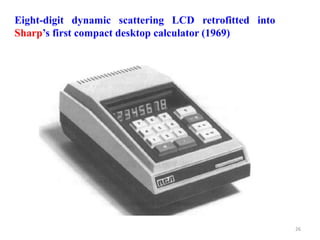
Eight-digit dynamic scattering LCD retrofitted into
Sharp’s first compact desktop calculator (1969)
26
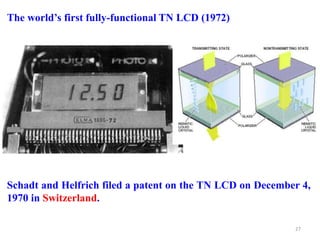
The world’s first fully-functional TN LCD (1972)
Schadt and Helfrich filed a patent on the TN LCD on December 4,
1970 in Switzerland.
27
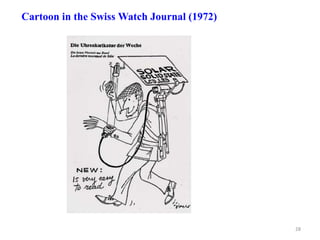
Cartoon in the Swiss Watch Journal (1972)
28
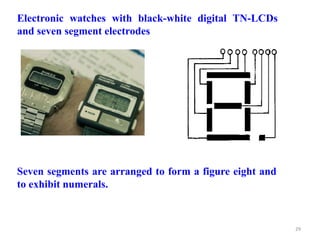
Electronic watches with black-white digital TN-LCDs
and seven segment electrodes
Seven segments are arranged to form a figure eight and
to exhibit numerals.
29
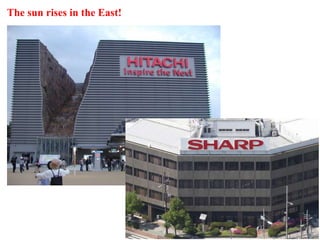
The sun rises in the East!
30
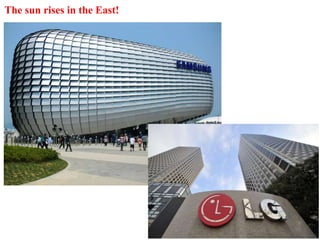
The sun rises in the East!
31
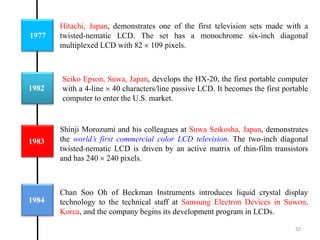
1977
1982
1983
Hitachi, Japan, demonstrates one of the first television sets made with a
twisted-nematic LCD. The set has a monochrome six-inch diagonal
multiplexed LCD with 82  109 pixels.
Shinji Morozumi and his colleagues at Suwa Seikosha, Japan, demonstrates
the world’s first commercial color LCD television. The two-inch diagonal
twisted-nematic LCD is driven by an active matrix of thin-film transistors
and has 240  240 pixels.
1984
Seiko Epson, Suwa, Japan, develops the HX-20, the first portable computer
with a 4-line  40 characters/line passive LCD. It becomes the first portable
computer to enter the U.S. market.
Chan Soo Oh of Beckman Instruments introduces liquid crystal display
technology to the technical staff at Samsung Electron Devices in Suwon,
Korea, and the company begins its development program in LCDs.
32
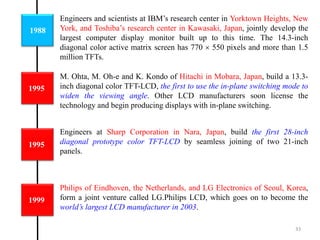
1988
1995
Engineers and scientists at IBM’s research center in Yorktown Heights, New
York, and Toshiba’s research center in Kawasaki, Japan, jointly develop the
largest computer display monitor built up to this time. The 14.3-inch
diagonal color active matrix screen has 770  550 pixels and more than 1.5
million TFTs.
M. Ohta, M. Oh-e and K. Kondo of Hitachi in Mobara, Japan, build a 13.3-
inch diagonal color TFT-LCD, the first to use the in-plane switching mode to
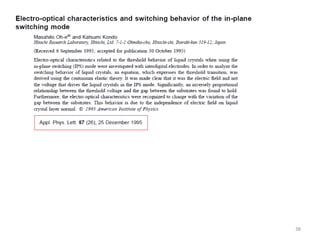
widen the viewing angle. Other LCD manufacturers soon license the
technology and begin producing displays with in-plane switching.
1995
Engineers at Sharp Corporation in Nara, Japan, build the first 28-inch
diagonal prototype color TFT-LCD by seamless joining of two 21-inch
panels.
1999
Philips of Eindhoven, the Netherlands, and LG Electronics of Seoul, Korea,
form a joint venture called LG.Philips LCD, which goes on to become the
world’s largest LCD manufacturer in 2003.
33
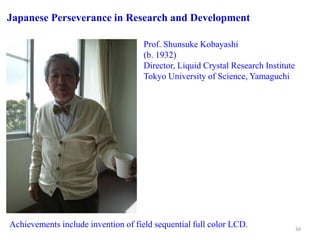
Prof. Shunsuke Kobayashi
(b. 1932)
Director, Liquid Crystal Research Institute
Tokyo University of Science, Yamaguchi
Achievements include invention of field sequential full color LCD.
Japanese Perseverance in Research and Development
34
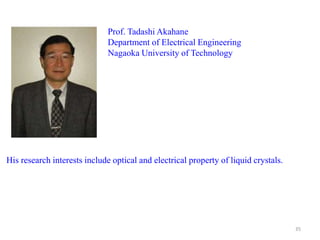
Prof. Tadashi Akahane
Department of Electrical Engineering
Nagaoka University of Technology
His research interests include optical and electrical property of liquid crystals.
35
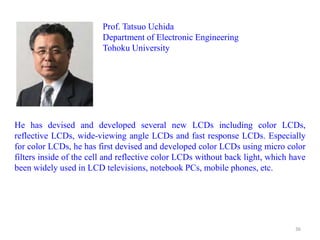
Prof. Tatsuo Uchida
Department of Electronic Engineering
Tohoku University
He has devised and developed several new LCDs including color LCDs,
reflective LCDs, wide-viewing angle LCDs and fast response LCDs. Especially
for color LCDs, he has first devised and developed color LCDs using micro color
filters inside of the cell and reflective color LCDs without back light, which have
been widely used in LCD televisions, notebook PCs, mobile phones, etc.
36
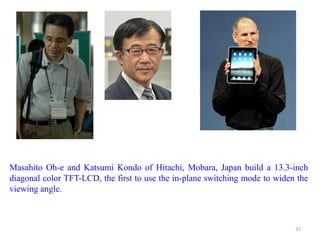
Masahito Oh-e and Katsumi Kondo of Hitachi, Mobara, Japan build a 13.3-inch
diagonal color TFT-LCD, the first to use the in-plane switching mode to widen the
viewing angle.
37
38
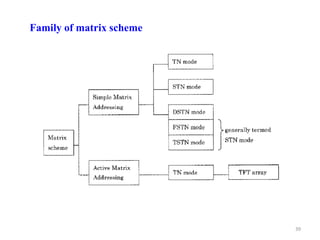
Family of matrix scheme
39
40
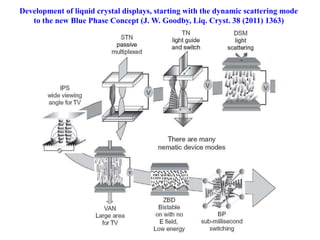
Development of liquid crystal displays, starting with the dynamic scattering mode
to the new Blue Phase Concept (J. W. Goodby, Liq. Cryst. 38 (2011) 1363)
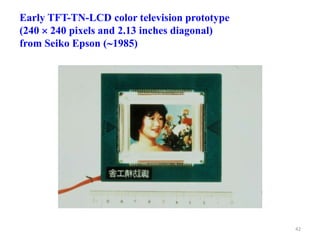
Early TFT-TN-LCD color television prototype
(240  240 pixels and 2.13 inches diagonal)
from Seiko Epson (1985)
42
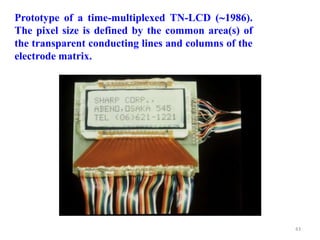
Prototype of a time-multiplexed TN-LCD (1986).
The pixel size is defined by the common area(s) of
the transparent conducting lines and columns of the
electrode matrix.
43
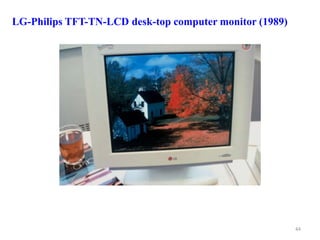
LG-Philips TFT-TN-LCD desk-top computer monitor (1989)
44
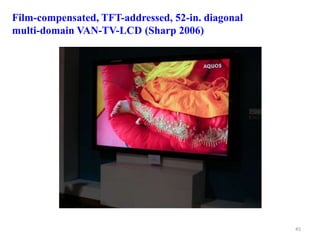
Film-compensated, TFT-addressed, 52-in. diagonal
multi-domain VAN-TV-LCD (Sharp 2006)
45
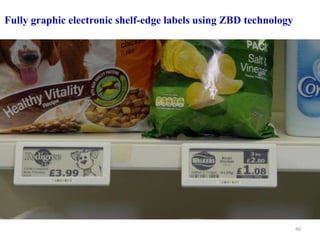
Fully graphic electronic shelf-edge labels using ZBD technology
46
47
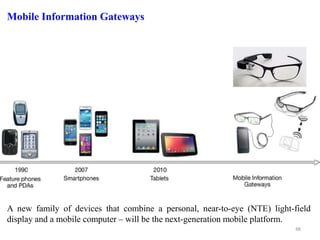
Mobile Information Gateways
A new family of devices that combine a personal, near-to-eye (NTE) light-field
display and a mobile computer – will be the next-generation mobile platform.
48
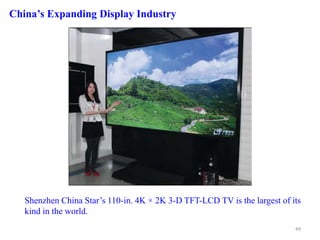
Shenzhen China Star’s 110-in. 4K × 2K 3-D TFT-LCD TV is the largest of its
kind in the world.
China’s Expanding Display Industry
49
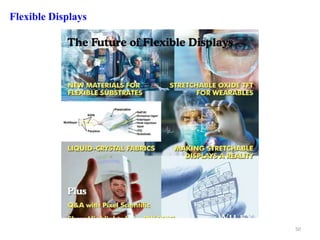
Flexible Displays
50
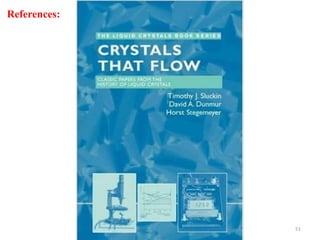
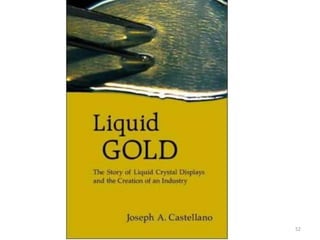
References:
51
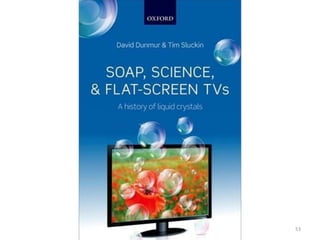
52
53
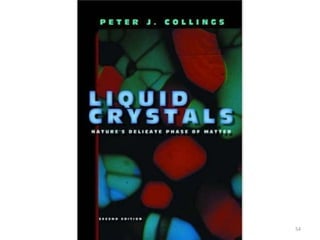
54
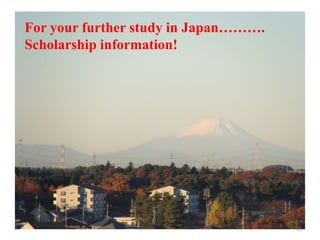
For your further study in Japan……….
Scholarship information!
55
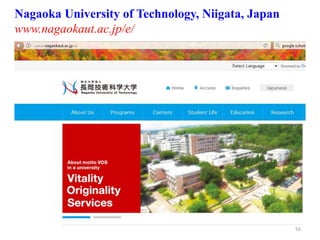
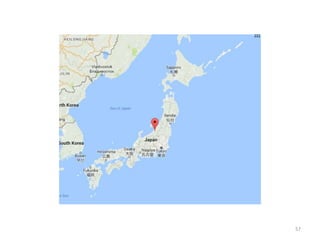
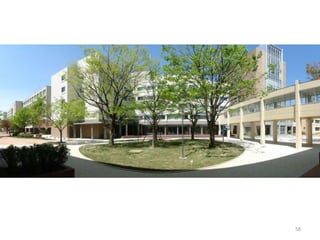
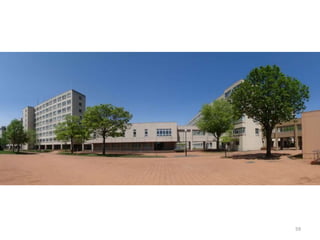
Nagaoka University of Technology, Niigata, Japan
www.nagaokaut.ac.jp/e/
56
57
58
59
60
61
62
63
64
Thank you for your kind attendance.
65

barcamp ygn lcd story

  • 1.
    28-01-2018 The Story ofthe Liquid Crystal Display Presented by Dr. Thet Naing Oo Chindwin College
  • 2.
    Outlines 1. Starting fromcarrots 2. The light dawns in the West! 3. Fourth state of matter 4. 130 years of LCD R & D 5. The sun rises in the East! 6. Japanese Perseverance in R & D 7. Development of Liquid Crystal Displays 8. Mobile Information Gateways 9. Flexible Displays 2
  • 3.
    In 1888, liquidcrystals were first discovered in cholesterol extracted from carrots by Austrian botanist and chemist, Friedrich Reinitzer. Starting from carrots! 3
  • 4.
    The light dawnsin the West! Charles University in Prague, Czech Republic 4
  • 5.
    130th Anniversary ofLiquid Crystal Founding father of liquid crystal Friedrich Reinitzer (1857–1927) Botanist and Chemist Imperial Institute for Plant Physiology, German University, Prague 5
  • 6.
    Liquid crystal isthe fourth state of matter that occurs between solid and liquid. phase diagram of water solid liquid gas temperature0C 100C phase diagram of liquid crystal (cholesteryl myristate) solid liquid crystal liquid temperature71C 85C 6
  • 7.
    Liquid crystal samplein a test-tube, warmed from room temperature. Samples go left to right. The sample starts cloudy then develops a region in which it is clear, with the interface between the two regions advancing until the whole sample is clear. On cooling, the process is reversed. Flowing Crystals! 7
  • 8.
    Prof. Otto Lehmann(1855-1922) Lehmann invented “crystallisation microscope”, the first version of a microscope with a hot stage. 8
  • 9.
  • 10.
  • 11.
    1888 1904 1909 Otto Lehmann (Aachen)sees crystallites under the polarizing microscope. Identifies flowing crystals and liquid crystals, and shows that on a microscopic scale they are birefringent. Otto Lehmann visits Paris and Geneva and delivers lectures on liquid crystals. 1911 Otto Lehmann publishes Flüssige Kristalle. Charles Mauguin (Paris) observes that magnetic fields can orient liquid crystals and that the polarization plane of light will follow a rotating optic axis. 1914-1918 World War I 11
  • 12.
    1923 1927 1934 Carl Wilhelm Oseen(Uppsala, Sweden) first publishes a continuum theory of liquid crystals. B. Levin and N. Levin (Marconi Company, London) apply for a patent on a liquid-crystal-based light valve. 1957 Frederiks effect is first reported in a Russian journal. Review article on liquid crystals by G. H. Brown and W. G. Shaw from the USA. 1939-1945 World War II 12
  • 13.
    1962 1963 1965 Radio Corporation ofAmerica (RCA) begins research on liquid crystals. R. Williams at RCA reports electric-field induced light scattering from a liquid crystal. First official International Liquid Crystal Conference held at Kent State University, Kent, Ohio, USA. Liquid Crystal Institute opened at Kent State University. 1968 James L. Fergason and others file patent for thermal imaging devices using cholesteric liquid crystals. Pierre-Gilles de Gennes and others at Université de Paris-Sud begin research on liquid crystals. 13
  • 14.
    14 Mr. Liquid Crystal Publisher:New Insights Press (October 25, 2016)
  • 15.
    Liquid Crystal Instituteestablished in 1965 First Director Glenn Brown 15
  • 16.
    Liquid crystals arebeautiful and mysterious. Pierre-Gilles de Gennes (24 Oct,1932-18 May, 2007) 1991 Nobel Laureate in Physics 16
  • 17.
    1968 1968 1970 George Heilmeier’s groupat RCA announces a new display technology based on dynamic light scattering from liquid crystals. Martin Schadt and Wolfgang Helfrich from Hoffmann-La Roche submit publication of details of a twisted nematic display and simultaneously patent the device. 1973 Frank M. Leslie publishes the definitive theory for the dynamics of liquid crystals. G.W. Gray and colleagues publish details of new room-temperature nematic materials suitable for twisted nematic displays. 17
  • 18.
    George Heilmeier holdinga dynamic scattering LCD (Dec., 1966) 18
  • 19.
    The original LCDdevelopment team at RCA laboratories. 19
  • 20.
    Going Public The RadioCorporation of America has announced that it has developed a new technology  liquid crystals  that could have a major effect on the electronics industry. Chicago Tribune, May 30, 1968 Seven-segment numeric indicator with a dynamic scattering LCD Electronic window with a dynamic scattering LCD 20
  • 21.
    Super Smart PrivacyGlass (China) 21
  • 22.
    Frank M. Lesliepublishes the definitive theory for the dynamics of liquid crystals. Prof. Frank Matthews Leslie (1935-2000) Mathematics Department University of Strathclyde, United Kingdom 22
  • 23.
    Martin Schadt andWolfgang Helfrich from Hoffmann-La Roche submit publication of details of a twisted nematic display and simultaneously patent the device. Martin Schadt (b. 1938) Swiss physicist and inventor CEO, ROLIC Ltd. Prof. Wolfgang Helfrich (b. 1932) Professor of Physics The Free University of Berlin 23
  • 24.
    George William Gray (1926-2013) G.F. Grant Chair in Chemistry University of Hull, England G.W. Gray and colleagues publish details of new room-temperature nematic materials suitable for twisted nematic displays. 24
  • 25.
    Molecular structures ofLC components belonging to the most prominent liquid crystal families that advanced the performance of field-effect LCDs from 1970-2000 and beyond 25
  • 26.
    Eight-digit dynamic scatteringLCD retrofitted into Sharp’s first compact desktop calculator (1969) 26
  • 27.
    The world’s firstfully-functional TN LCD (1972) Schadt and Helfrich filed a patent on the TN LCD on December 4, 1970 in Switzerland. 27
  • 28.
    Cartoon in theSwiss Watch Journal (1972) 28
  • 29.
    Electronic watches withblack-white digital TN-LCDs and seven segment electrodes Seven segments are arranged to form a figure eight and to exhibit numerals. 29
  • 30.
    The sun risesin the East! 30
  • 31.
    The sun risesin the East! 31
  • 32.
    1977 1982 1983 Hitachi, Japan, demonstratesone of the first television sets made with a twisted-nematic LCD. The set has a monochrome six-inch diagonal multiplexed LCD with 82  109 pixels. Shinji Morozumi and his colleagues at Suwa Seikosha, Japan, demonstrates the world’s first commercial color LCD television. The two-inch diagonal twisted-nematic LCD is driven by an active matrix of thin-film transistors and has 240  240 pixels. 1984 Seiko Epson, Suwa, Japan, develops the HX-20, the first portable computer with a 4-line  40 characters/line passive LCD. It becomes the first portable computer to enter the U.S. market. Chan Soo Oh of Beckman Instruments introduces liquid crystal display technology to the technical staff at Samsung Electron Devices in Suwon, Korea, and the company begins its development program in LCDs. 32
  • 33.
    1988 1995 Engineers and scientistsat IBM’s research center in Yorktown Heights, New York, and Toshiba’s research center in Kawasaki, Japan, jointly develop the largest computer display monitor built up to this time. The 14.3-inch diagonal color active matrix screen has 770  550 pixels and more than 1.5 million TFTs. M. Ohta, M. Oh-e and K. Kondo of Hitachi in Mobara, Japan, build a 13.3- inch diagonal color TFT-LCD, the first to use the in-plane switching mode to widen the viewing angle. Other LCD manufacturers soon license the technology and begin producing displays with in-plane switching. 1995 Engineers at Sharp Corporation in Nara, Japan, build the first 28-inch diagonal prototype color TFT-LCD by seamless joining of two 21-inch panels. 1999 Philips of Eindhoven, the Netherlands, and LG Electronics of Seoul, Korea, form a joint venture called LG.Philips LCD, which goes on to become the world’s largest LCD manufacturer in 2003. 33
  • 34.
    Prof. Shunsuke Kobayashi (b.1932) Director, Liquid Crystal Research Institute Tokyo University of Science, Yamaguchi Achievements include invention of field sequential full color LCD. Japanese Perseverance in Research and Development 34
  • 35.
    Prof. Tadashi Akahane Departmentof Electrical Engineering Nagaoka University of Technology His research interests include optical and electrical property of liquid crystals. 35
  • 36.
    Prof. Tatsuo Uchida Departmentof Electronic Engineering Tohoku University He has devised and developed several new LCDs including color LCDs, reflective LCDs, wide-viewing angle LCDs and fast response LCDs. Especially for color LCDs, he has first devised and developed color LCDs using micro color filters inside of the cell and reflective color LCDs without back light, which have been widely used in LCD televisions, notebook PCs, mobile phones, etc. 36
  • 37.
    Masahito Oh-e andKatsumi Kondo of Hitachi, Mobara, Japan build a 13.3-inch diagonal color TFT-LCD, the first to use the in-plane switching mode to widen the viewing angle. 37
  • 38.
  • 39.
  • 40.
  • 41.
    Development of liquidcrystal displays, starting with the dynamic scattering mode to the new Blue Phase Concept (J. W. Goodby, Liq. Cryst. 38 (2011) 1363)
  • 42.
    Early TFT-TN-LCD colortelevision prototype (240  240 pixels and 2.13 inches diagonal) from Seiko Epson (1985) 42
  • 43.
    Prototype of atime-multiplexed TN-LCD (1986). The pixel size is defined by the common area(s) of the transparent conducting lines and columns of the electrode matrix. 43
  • 44.
    LG-Philips TFT-TN-LCD desk-topcomputer monitor (1989) 44
  • 45.
    Film-compensated, TFT-addressed, 52-in.diagonal multi-domain VAN-TV-LCD (Sharp 2006) 45
  • 46.
    Fully graphic electronicshelf-edge labels using ZBD technology 46
  • 47.
  • 48.
    Mobile Information Gateways Anew family of devices that combine a personal, near-to-eye (NTE) light-field display and a mobile computer – will be the next-generation mobile platform. 48
  • 49.
    Shenzhen China Star’s110-in. 4K × 2K 3-D TFT-LCD TV is the largest of its kind in the world. China’s Expanding Display Industry 49
  • 50.
  • 51.
  • 52.
  • 53.
  • 54.
  • 55.
    For your furtherstudy in Japan………. Scholarship information! 55
  • 56.
    Nagaoka University ofTechnology, Niigata, Japan www.nagaokaut.ac.jp/e/ 56
  • 57.
  • 58.
  • 59.
  • 60.
  • 61.
  • 62.
  • 63.
  • 64.
  • 65.
    Thank you foryour kind attendance. 65