Dealing with Open Data at ISTAT
First Steps Towards a Perfect Data Portal:
a Cutting-edge Approach for Dealing with Open Data
Giovanni A. Barbieri
Stefano De Francisci
Italian National Statistical Institute (Istat)
The Open Data Movement
• Our proposal is simple: […] the federal
government […] is to provide data that is easy
for others to reuse, rather than to help citizens
use the data in one particular way or another
• Open infrastructures that enable citizens to
make their own uses of the data
• Reverse the current policy, which is to regard
government websites themselves as the primary
vehicle for the distribution of public data, and
open infrastructures for sharing the data as a
laudable but secondary objective [Robinson,Yu,
Zeller and Felten 2008]
Crowdsourcing Government Transparency
• Government information that is nominally
publicly available is in fact difficult to
access either because it is not online or, if
it is online, because it is not available in
useful and flexible formats [Brito 2008]
• “Structured data”
– Associated structured XML file would allow a
user to sort the data by ascending or
descending date, alphabetically by headline
or author, by number of words, and in many
other ways
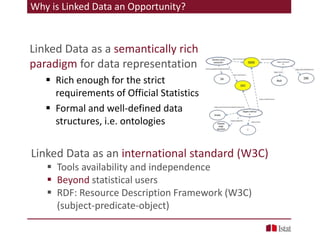
Why is Linked Data an Opportunity?
Linked Data as a semantically rich
paradigm for data representation
 Rich enough for the strict
requirements of Official Statistics
 Formal and well-defined data
structures, i.e. ontologies
Linked Data as an international standard (W3C)
 Tools availability and independence
 Beyond statistical users
 RDF: Resource Description Framework (W3C)
(subject-predicate-object)
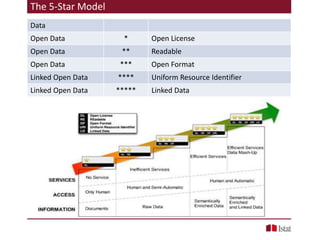
The 5-Star Model
Data
Open Data * Open License
Open Data ** Readable
Open Data *** Open Format
Linked Open Data **** Uniform Resource Identifier
Linked Open Data ***** Linked Data
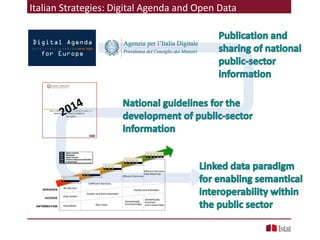
Italian Strategies: Digital Agenda and Open Data
Government strategies
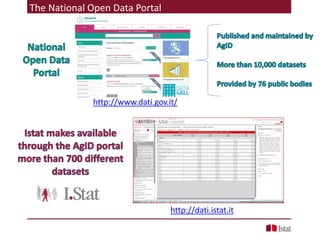
The National Open Data Portal
http://dati.istat.it
http://www.dati.gov.it/
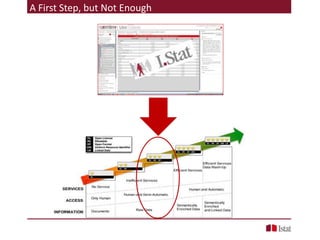
A First Step, but Not Enough
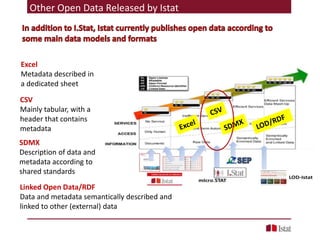
CSV
Mainly tabular, with a
header that contains
metadata
Excel
Metadata described in
a dedicated sheet
SDMX
Description of data and
metadata according to
shared standards
Linked Open Data/RDF
Data and metadata semantically described and
linked to other (external) data
Other Open Data Released by Istat
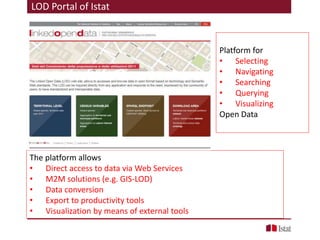
Platform for
• Selecting
• Navigating
• Searching
• Querying
• Visualizing
Open Data
The platform allows
• Direct access to data via Web Services
• M2M solutions (e.g. GIS-LOD)
• Data conversion
• Export to productivity tools
• Visualization by means of external tools
LOD Portal of Istat
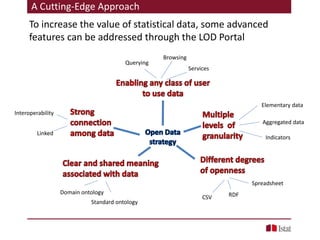
To increase the value of statistical data, some advanced
features can be addressed through the LOD Portal
CSV RDF
Spreadsheet
Domain ontology
Standard ontology
Elementary data
Aggregated data
Indicators
Linked
Interoperability
Browsing
Querying
Services
A Cutting-Edge Approach
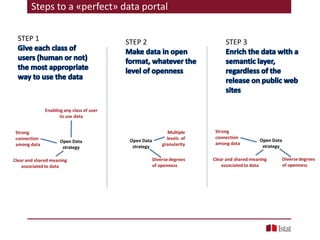
STEP 1 STEP 3STEP 2
Steps to a «perfect» data portal
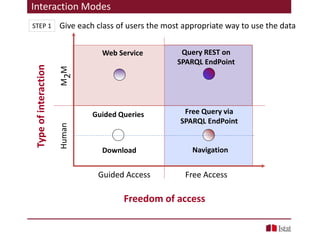
Give each class of users the most appropriate way to use the dataSTEP 1
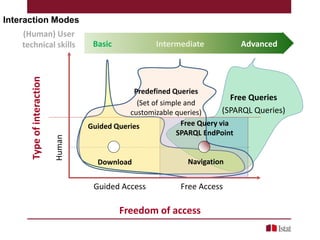
Interaction Modes
Guided Access
Freedom of access
Typeofinteraction
Free Access
HumanM2M
Navigation
Guided Queries
Query REST on
SPARQL EndPoint
Free Query via
SPARQL EndPoint
Web Service
Download
Predefined Queries
(Set of simple and
customizable queries)
Free Queries
(SPARQL Queries)
Navigation
Guided Queries
Download
Typeofinteraction
Human
Guided Access Free Access
Interaction Modes
Freedom of access
Basic Advanced
(Human) User
technical skills Intermediate
Free Query via
SPARQL EndPoint
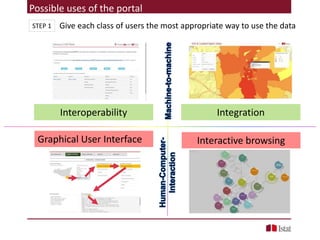
Possible uses of the portal
Graphical User Interface
Interoperability
Interactive browsing
Integration
Give each class of users the most appropriate way to use the dataSTEP 1
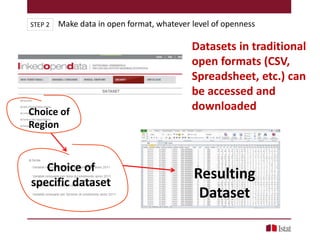
Choice of
Region
Choice of
specific dataset
Resulting
Dataset
Datasets in traditional
open formats (CSV,
Spreadsheet, etc.) can
be accessed and
downloaded
Make data in open format, whatever level of opennessSTEP 2
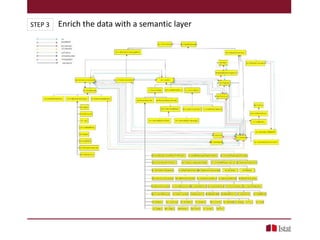
Enrich the data with a semantic layerSTEP 3
Describes the measures
and dimensions of the
indicators w/r/t
households
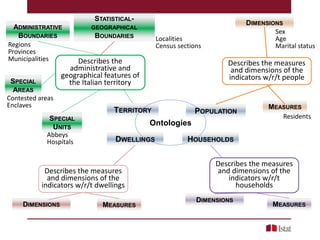
Ontologies
DWELLINGS
TERRITORY POPULATION
Describes the measures
and dimensions of the
indicators w/r/t people
Describes the
administrative and
geographical features of
the Italian territory
Describes the measures
and dimensions of the
indicators w/r/t dwellings
HOUSEHOLDS
SPECIAL
AREAS
ADMINISTRATIVE
BOUNDARIES
STATISTICAL-
GEOGRAPHICAL
BOUNDARIES
SPECIAL
UNITS
Regions
Provinces
Municipalities
Localities
Census sections
Contested areas
Enclaves
Abbeys
Hospitals
DIMENSIONS
MEASURES
Sex
Age
Marital status
Residents
DIMENSIONS MEASURES
DIMENSIONS
MEASURES
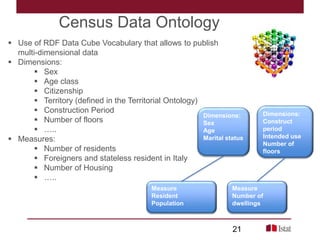
Census Data Ontology
 Use of RDF Data Cube Vocabulary that allows to publish
multi-dimensional data
 Dimensions:
 Sex
 Age class
 Citizenship
 Territory (defined in the Territorial Ontology)
 Construction Period
 Number of floors
 …..
 Measures:
 Number of residents
 Foreigners and stateless resident in Italy
 Number of Housing
 …..
21
Dimensions:
Construct
period
Intended use
Number of
floors
Measure
Number of
dwellings
Dimensions:
Sex
Age
Marital status
Measure
Resident
Population
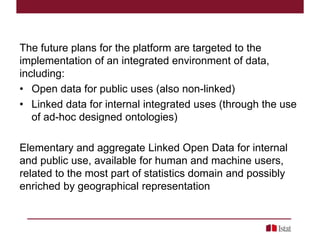
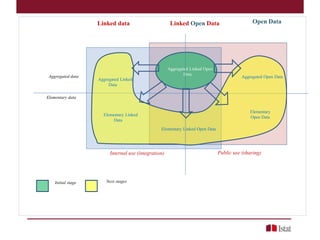
The future plans for the platform are targeted to the
implementation of an integrated environment of data,
including:
• Open data for public uses (also non-linked)
• Linked data for internal integrated uses (through the use
of ad-hoc designed ontologies)
Elementary and aggregate Linked Open Data for internal
and public use, available for human and machine users,
related to the most part of statistics domain and possibly
enriched by geographical representation
Elementary data
Aggregated data
Linked Open DataLinked data Open Data
Internal use (integration) Public use (sharing)
Initial stage Next stages
Aggregated Linked
Data
Aggregated Linked Open
Data
Elementary
Open Data
Elementary Linked Open Data
Elementary Linked
Data
Aggregated Open Data
• Macroscale vs microscale modeling
– Pseudo-Einstein (as simple as possible but not simpler)
– Von Neumann (agent-based modeling)
• Techological constraint  enabling technology
• It widens the space of what is feasible:
– In production: our experience with SBS.Frame
– In analysis and research…
• A paradigm shift?
– Statistical mechanics vs Agent-based modeling
– Just because you can doesn’t mean you should
• Back to open data
– From dissemination to release (“data liberation” at StatCan)
– The regulators have need to new rules in line with the new
scenarios
One More Thing

Barbieri De Francisci_Dealing with Open Data at ISTAT

  • 1.
    Dealing with OpenData at ISTAT First Steps Towards a Perfect Data Portal: a Cutting-edge Approach for Dealing with Open Data Giovanni A. Barbieri Stefano De Francisci Italian National Statistical Institute (Istat)
  • 2.
    The Open DataMovement • Our proposal is simple: […] the federal government […] is to provide data that is easy for others to reuse, rather than to help citizens use the data in one particular way or another • Open infrastructures that enable citizens to make their own uses of the data • Reverse the current policy, which is to regard government websites themselves as the primary vehicle for the distribution of public data, and open infrastructures for sharing the data as a laudable but secondary objective [Robinson,Yu, Zeller and Felten 2008]
  • 3.
    Crowdsourcing Government Transparency •Government information that is nominally publicly available is in fact difficult to access either because it is not online or, if it is online, because it is not available in useful and flexible formats [Brito 2008] • “Structured data” – Associated structured XML file would allow a user to sort the data by ascending or descending date, alphabetically by headline or author, by number of words, and in many other ways
  • 4.
    Why is LinkedData an Opportunity? Linked Data as a semantically rich paradigm for data representation  Rich enough for the strict requirements of Official Statistics  Formal and well-defined data structures, i.e. ontologies Linked Data as an international standard (W3C)  Tools availability and independence  Beyond statistical users  RDF: Resource Description Framework (W3C) (subject-predicate-object)
  • 5.
    The 5-Star Model Data OpenData * Open License Open Data ** Readable Open Data *** Open Format Linked Open Data **** Uniform Resource Identifier Linked Open Data ***** Linked Data
  • 6.
    Italian Strategies: DigitalAgenda and Open Data Government strategies
  • 7.
    The National OpenData Portal http://dati.istat.it http://www.dati.gov.it/
  • 8.
    A First Step,but Not Enough
  • 9.
    CSV Mainly tabular, witha header that contains metadata Excel Metadata described in a dedicated sheet SDMX Description of data and metadata according to shared standards Linked Open Data/RDF Data and metadata semantically described and linked to other (external) data Other Open Data Released by Istat
  • 10.
    Platform for • Selecting •Navigating • Searching • Querying • Visualizing Open Data The platform allows • Direct access to data via Web Services • M2M solutions (e.g. GIS-LOD) • Data conversion • Export to productivity tools • Visualization by means of external tools LOD Portal of Istat
  • 11.
    To increase thevalue of statistical data, some advanced features can be addressed through the LOD Portal CSV RDF Spreadsheet Domain ontology Standard ontology Elementary data Aggregated data Indicators Linked Interoperability Browsing Querying Services A Cutting-Edge Approach
  • 12.
    STEP 1 STEP3STEP 2 Steps to a «perfect» data portal
  • 13.
    Give each classof users the most appropriate way to use the dataSTEP 1 Interaction Modes Guided Access Freedom of access Typeofinteraction Free Access HumanM2M Navigation Guided Queries Query REST on SPARQL EndPoint Free Query via SPARQL EndPoint Web Service Download
  • 14.
    Predefined Queries (Set ofsimple and customizable queries) Free Queries (SPARQL Queries) Navigation Guided Queries Download Typeofinteraction Human Guided Access Free Access Interaction Modes Freedom of access Basic Advanced (Human) User technical skills Intermediate Free Query via SPARQL EndPoint
  • 15.
    Possible uses ofthe portal Graphical User Interface Interoperability Interactive browsing Integration Give each class of users the most appropriate way to use the dataSTEP 1
  • 16.
    Choice of Region Choice of specificdataset Resulting Dataset Datasets in traditional open formats (CSV, Spreadsheet, etc.) can be accessed and downloaded Make data in open format, whatever level of opennessSTEP 2
  • 17.
    Enrich the datawith a semantic layerSTEP 3
  • 18.
    Describes the measures anddimensions of the indicators w/r/t households Ontologies DWELLINGS TERRITORY POPULATION Describes the measures and dimensions of the indicators w/r/t people Describes the administrative and geographical features of the Italian territory Describes the measures and dimensions of the indicators w/r/t dwellings HOUSEHOLDS SPECIAL AREAS ADMINISTRATIVE BOUNDARIES STATISTICAL- GEOGRAPHICAL BOUNDARIES SPECIAL UNITS Regions Provinces Municipalities Localities Census sections Contested areas Enclaves Abbeys Hospitals DIMENSIONS MEASURES Sex Age Marital status Residents DIMENSIONS MEASURES DIMENSIONS MEASURES
  • 19.
    Census Data Ontology Use of RDF Data Cube Vocabulary that allows to publish multi-dimensional data  Dimensions:  Sex  Age class  Citizenship  Territory (defined in the Territorial Ontology)  Construction Period  Number of floors  …..  Measures:  Number of residents  Foreigners and stateless resident in Italy  Number of Housing  ….. 21 Dimensions: Construct period Intended use Number of floors Measure Number of dwellings Dimensions: Sex Age Marital status Measure Resident Population
  • 20.
    The future plansfor the platform are targeted to the implementation of an integrated environment of data, including: • Open data for public uses (also non-linked) • Linked data for internal integrated uses (through the use of ad-hoc designed ontologies) Elementary and aggregate Linked Open Data for internal and public use, available for human and machine users, related to the most part of statistics domain and possibly enriched by geographical representation
  • 21.
    Elementary data Aggregated data LinkedOpen DataLinked data Open Data Internal use (integration) Public use (sharing) Initial stage Next stages Aggregated Linked Data Aggregated Linked Open Data Elementary Open Data Elementary Linked Open Data Elementary Linked Data Aggregated Open Data
  • 22.
    • Macroscale vsmicroscale modeling – Pseudo-Einstein (as simple as possible but not simpler) – Von Neumann (agent-based modeling) • Techological constraint  enabling technology • It widens the space of what is feasible: – In production: our experience with SBS.Frame – In analysis and research… • A paradigm shift? – Statistical mechanics vs Agent-based modeling – Just because you can doesn’t mean you should • Back to open data – From dissemination to release (“data liberation” at StatCan) – The regulators have need to new rules in line with the new scenarios One More Thing