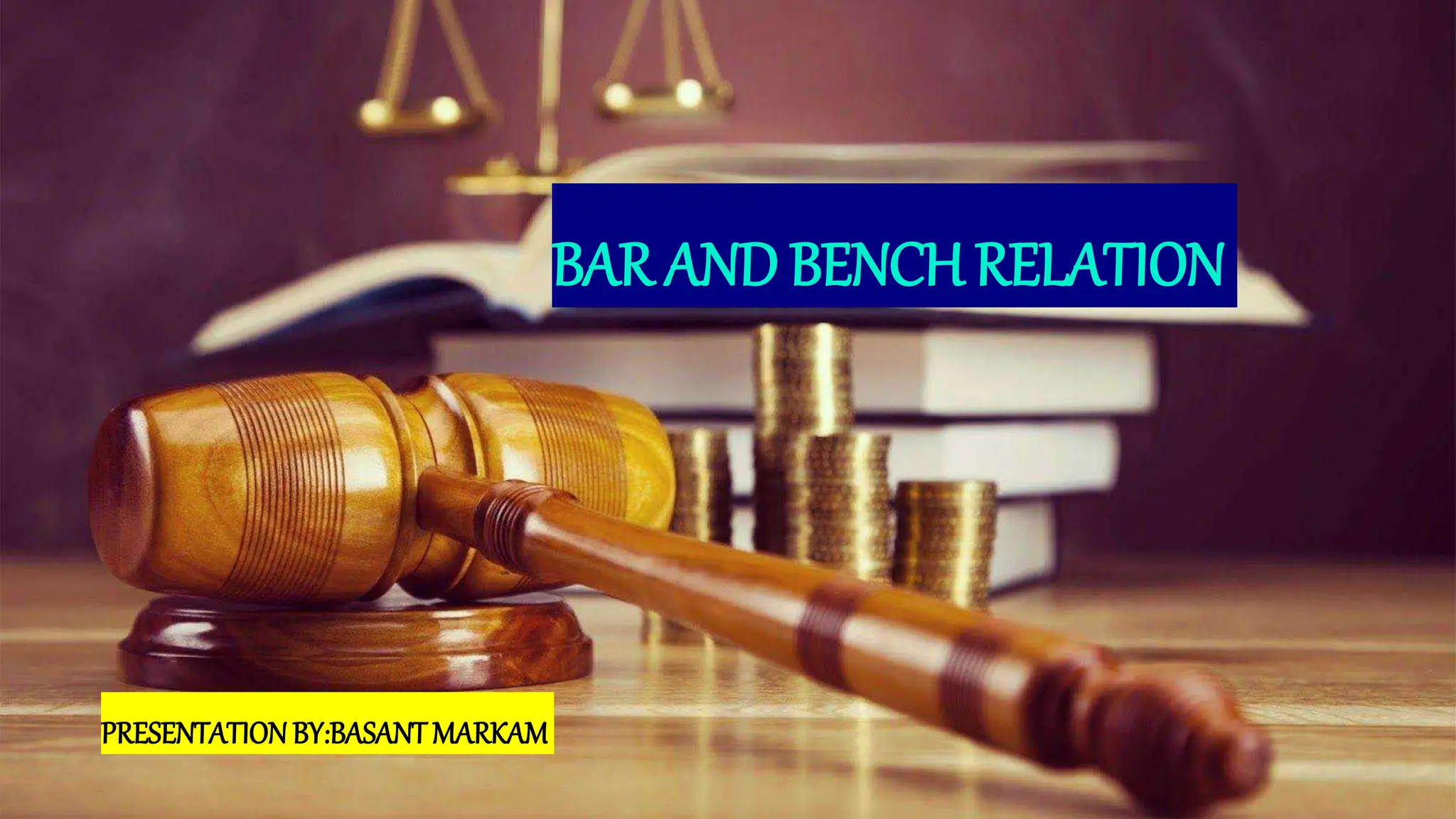
BAR AND BENCH RELATION
PRESENTATIONBY:BASANTMARKAM
TABLE OF
CONTENTS
• BAR&BENCHRELATION
• MEANINGOFBAR
• MEANINGOFBENCH
• MEANINGOFCOURT&KINDS
• THEBARANDBENCHRELATIONANDTHEROLEOFBAR&
BENCH
• ROLEOFJUDGES
• DUTIESOFJUDGES
• DUTTIESOFADVOCATES
• CONCLUSION
BAR-BENCHRELATION
• BarandBencharetwodifferent elementswitha
commonobjectiveofadministeringjusticeinsociety.
Bar,thetermfindsits origininEngland,wasusedto
differentiate agroupoflawyersfromagroupof
courtofficers.Itisagroupof lawyersenrolledwith
thestatebarcouncilwhohavepermission to
practicetheprofession incourt.Insimpleterms,Bar
isaplacewherelawyerstaketheirplaceina
courtroom.TheBenchisaplacewherejudgestake
theirseatsinthecourtroom.Itisappliedto
differentiate between judgesandattorneys.
MEANINGOFBAR
• Bar is a collective term for the attorneys who are
licensed to practice in the Courts, or a particular court,
of any state. The term 'Bar' was originated in England
with the partition of Bar fixed for dividing the court hall
into two parts for the purpose of separating lawyers and
officers of the court from suitors and other general
public. The same dictionary has also defined the ‘Bar’ as
thewholebody oflawyersqualifiedtopracticein agiven
courtorjurisdiction; thelegal profession oran organized
sub-set of i.e.. the judge, the attorneys, the court officer
and members of the jury. At present Bar means a
particularpartofcourtroomwherelawyerssit.
MEANINGOFBENCH
• Bench means all the Judges taken together as
distinguished from the 'Bar' the name for all the
members of the legal profession Bench is that part of
Courtconsideredinitsofficial capacity,whiletheJudges
aresitting. The earliermeaning ofBarcontainedthe part
of Bench also and at present the term 'Bar' is applied for
the attorney part of Court and the term Bench is used for
thejudicialpartof theCourt.
• As stated above, the term "Bar' has been coined to the
legal practitioners ie. advocates collectively, while the
term"Bench'hasbeencoinedtotheJudgescollectively.
MEANINGOFCOURT
• Court is a place where legal cases are heard by those persons
(Judges, Magistrates or other Officers) while the lawyers
participate as officers of the Court to assist the Court in an
appropriate manner intheadministration of Justice.
• A court is any person or institution, often as a government
institution, with the authority to adjudicate legal disputes
between parties and carry out the administration of justice in
civil, criminal, and administrative matters in accordance with
the rule of law.[1] In both common law and civil law legal
systems, courts are the central means for dispute resolution,
and it is generally understood that all people have an ability to
bring their claims before a court. Similarly, the rights of those
accused of a crime include the right to present a defense
before acourt.
KINDSOFCOURT
• (1) Courts of inquiry - A Court which makes preliminary
investigations of charges. In military or naval, these Courts
dealwithcasesofindisciplineetc.
• (2) Court of record - A Court whose proceedings are
recorded permanently and which has the power of
punishingfor contemptofCourt.
• (3) Court not of record - A Court of limited and inferior
jurisdiction.
BAR&BENCHRELATIONS?
• Bar Bench relations refer to the dynamic interaction and
cooperation between lawyers (the Bar) and judges (the Bench)
within the legal system. This relationship is fundamental to the
administration of justice. Lawyers represent their clients’
interests in court, whilejudges make impartial decisions based
on the law. Maintaining a respectful and collaborative
partnership between the Bar and the Bench is crucial for the
effective functioningof thelegalsystem.
• It ensures that cases are heard fairly, legal principles are
upheld and justice is served. Communication, professionalism
and mutual respect are key elements in fostering a strong Bar
Bench relationship, which ultimately benefits the legal
profession andtheindividuals seeking justice.
ROLEOFJUDGE
• As per Justice C.L. Anand, there is no office in the State of
suchpowerasthat of the Judge. Judgesholdpowerwhich is
immensely greater than that of any other functionary. The
citizen's life and liberty, reputation and property, personal
and domestic happiness are all subject to the wisdom of the
Judges and hang on their decisions. Where judicial power
becomes corrupt, liberty expires, no security is left of life,
reputation and property and no guarantee is left of personal
or domestic happiness. A strong impartial and capable
judiciaryisthegreatestneedofaState.
DUTIESOFJUDGES
• 1. A Judge must discharge his duties without fear or favour,
affection orillwill.
• 2. A Judge must be impartial and must do everything for justice
andnothingfor himself orhisfriend orhissovereign.
• 3. A Judge should have patience and gravity of hearing. He
should allow the advocate orparty fullest opportunity to present
hiscase.
• 4. A Judge should sit with a receptive mind. No Judge should
form opinion regarding merit of the case till he has heard the
parties.
• 5. A Judge should avoid controversial manner or tone in
addressing counsel litigantor witnesses.
• 6.No Judgeshould desire thattheBar should beservile.
DUTIESOFADVOCATES
• 1. As the advocates are officers of the Court, they are required to maintain
towards the court respectful attitude bearing in mind that the dignity of the
judicialoffice isessential for thesurvival of thesociety.
• 2. An advocate is required to conduct himself with dignity and self-respect
duringthepresentation of thecase.
• 3.Anadvocateshould notinfluencethe decisionofthe Court byanyillegalor
improper means.
• 4. An advocate should not communicate with a Judge relating to a pending
case.
• 5. An advocate should make his best efforts to restrain and prevent his
clientfrom resorting tounfair practicesinrelation totheCourt.
• 6. an advocate should make accurate statements of facts and should not
twistthem.
CONCLUSION
• An ordinary citizen has faith and confidence in the country's
judicial system. It is the responsibility of both the Bench and
theBartoupholdandstrengthentheruleoflawthroughtheir
dedication and behavior. To ensure the independence of the
bar, an independent judiciary must be in place, which can be
used to defend that independence if required. In the end, the
mutual adjustment of behavior by the Bench and the Bar is
the cornerstone of the polished operation of courts in the
overallinterestofsociety.
Online store and market swap
13

BAR BENCH RELATION UNDER ADVOCATE ACT 1961.pptx

  • 1.
    BAR AND BENCHRELATION PRESENTATIONBY:BASANTMARKAM
  • 2.
    TABLE OF CONTENTS • BAR&BENCHRELATION •MEANINGOFBAR • MEANINGOFBENCH • MEANINGOFCOURT&KINDS • THEBARANDBENCHRELATIONANDTHEROLEOFBAR& BENCH • ROLEOFJUDGES • DUTIESOFJUDGES • DUTTIESOFADVOCATES • CONCLUSION
  • 3.
    BAR-BENCHRELATION • BarandBencharetwodifferent elementswitha commonobjectiveofadministeringjusticeinsociety. Bar,thetermfindsitsorigininEngland,wasusedto differentiate agroupoflawyersfromagroupof courtofficers.Itisagroupof lawyersenrolledwith thestatebarcouncilwhohavepermission to practicetheprofession incourt.Insimpleterms,Bar isaplacewherelawyerstaketheirplaceina courtroom.TheBenchisaplacewherejudgestake theirseatsinthecourtroom.Itisappliedto differentiate between judgesandattorneys.
  • 4.
    MEANINGOFBAR • Bar isa collective term for the attorneys who are licensed to practice in the Courts, or a particular court, of any state. The term 'Bar' was originated in England with the partition of Bar fixed for dividing the court hall into two parts for the purpose of separating lawyers and officers of the court from suitors and other general public. The same dictionary has also defined the ‘Bar’ as thewholebody oflawyersqualifiedtopracticein agiven courtorjurisdiction; thelegal profession oran organized sub-set of i.e.. the judge, the attorneys, the court officer and members of the jury. At present Bar means a particularpartofcourtroomwherelawyerssit.
  • 5.
    MEANINGOFBENCH • Bench meansall the Judges taken together as distinguished from the 'Bar' the name for all the members of the legal profession Bench is that part of Courtconsideredinitsofficial capacity,whiletheJudges aresitting. The earliermeaning ofBarcontainedthe part of Bench also and at present the term 'Bar' is applied for the attorney part of Court and the term Bench is used for thejudicialpartof theCourt. • As stated above, the term "Bar' has been coined to the legal practitioners ie. advocates collectively, while the term"Bench'hasbeencoinedtotheJudgescollectively.
  • 6.
    MEANINGOFCOURT • Court isa place where legal cases are heard by those persons (Judges, Magistrates or other Officers) while the lawyers participate as officers of the Court to assist the Court in an appropriate manner intheadministration of Justice. • A court is any person or institution, often as a government institution, with the authority to adjudicate legal disputes between parties and carry out the administration of justice in civil, criminal, and administrative matters in accordance with the rule of law.[1] In both common law and civil law legal systems, courts are the central means for dispute resolution, and it is generally understood that all people have an ability to bring their claims before a court. Similarly, the rights of those accused of a crime include the right to present a defense before acourt.
  • 7.
    KINDSOFCOURT • (1) Courtsof inquiry - A Court which makes preliminary investigations of charges. In military or naval, these Courts dealwithcasesofindisciplineetc. • (2) Court of record - A Court whose proceedings are recorded permanently and which has the power of punishingfor contemptofCourt. • (3) Court not of record - A Court of limited and inferior jurisdiction.
  • 8.
    BAR&BENCHRELATIONS? • Bar Benchrelations refer to the dynamic interaction and cooperation between lawyers (the Bar) and judges (the Bench) within the legal system. This relationship is fundamental to the administration of justice. Lawyers represent their clients’ interests in court, whilejudges make impartial decisions based on the law. Maintaining a respectful and collaborative partnership between the Bar and the Bench is crucial for the effective functioningof thelegalsystem. • It ensures that cases are heard fairly, legal principles are upheld and justice is served. Communication, professionalism and mutual respect are key elements in fostering a strong Bar Bench relationship, which ultimately benefits the legal profession andtheindividuals seeking justice.
  • 9.
    ROLEOFJUDGE • As perJustice C.L. Anand, there is no office in the State of suchpowerasthat of the Judge. Judgesholdpowerwhich is immensely greater than that of any other functionary. The citizen's life and liberty, reputation and property, personal and domestic happiness are all subject to the wisdom of the Judges and hang on their decisions. Where judicial power becomes corrupt, liberty expires, no security is left of life, reputation and property and no guarantee is left of personal or domestic happiness. A strong impartial and capable judiciaryisthegreatestneedofaState.
  • 10.
    DUTIESOFJUDGES • 1. AJudge must discharge his duties without fear or favour, affection orillwill. • 2. A Judge must be impartial and must do everything for justice andnothingfor himself orhisfriend orhissovereign. • 3. A Judge should have patience and gravity of hearing. He should allow the advocate orparty fullest opportunity to present hiscase. • 4. A Judge should sit with a receptive mind. No Judge should form opinion regarding merit of the case till he has heard the parties. • 5. A Judge should avoid controversial manner or tone in addressing counsel litigantor witnesses. • 6.No Judgeshould desire thattheBar should beservile.
  • 11.
    DUTIESOFADVOCATES • 1. Asthe advocates are officers of the Court, they are required to maintain towards the court respectful attitude bearing in mind that the dignity of the judicialoffice isessential for thesurvival of thesociety. • 2. An advocate is required to conduct himself with dignity and self-respect duringthepresentation of thecase. • 3.Anadvocateshould notinfluencethe decisionofthe Court byanyillegalor improper means. • 4. An advocate should not communicate with a Judge relating to a pending case. • 5. An advocate should make his best efforts to restrain and prevent his clientfrom resorting tounfair practicesinrelation totheCourt. • 6. an advocate should make accurate statements of facts and should not twistthem.
  • 12.
    CONCLUSION • An ordinarycitizen has faith and confidence in the country's judicial system. It is the responsibility of both the Bench and theBartoupholdandstrengthentheruleoflawthroughtheir dedication and behavior. To ensure the independence of the bar, an independent judiciary must be in place, which can be used to defend that independence if required. In the end, the mutual adjustment of behavior by the Bench and the Bar is the cornerstone of the polished operation of courts in the overallinterestofsociety.
  • 13.
    Online store andmarket swap 13