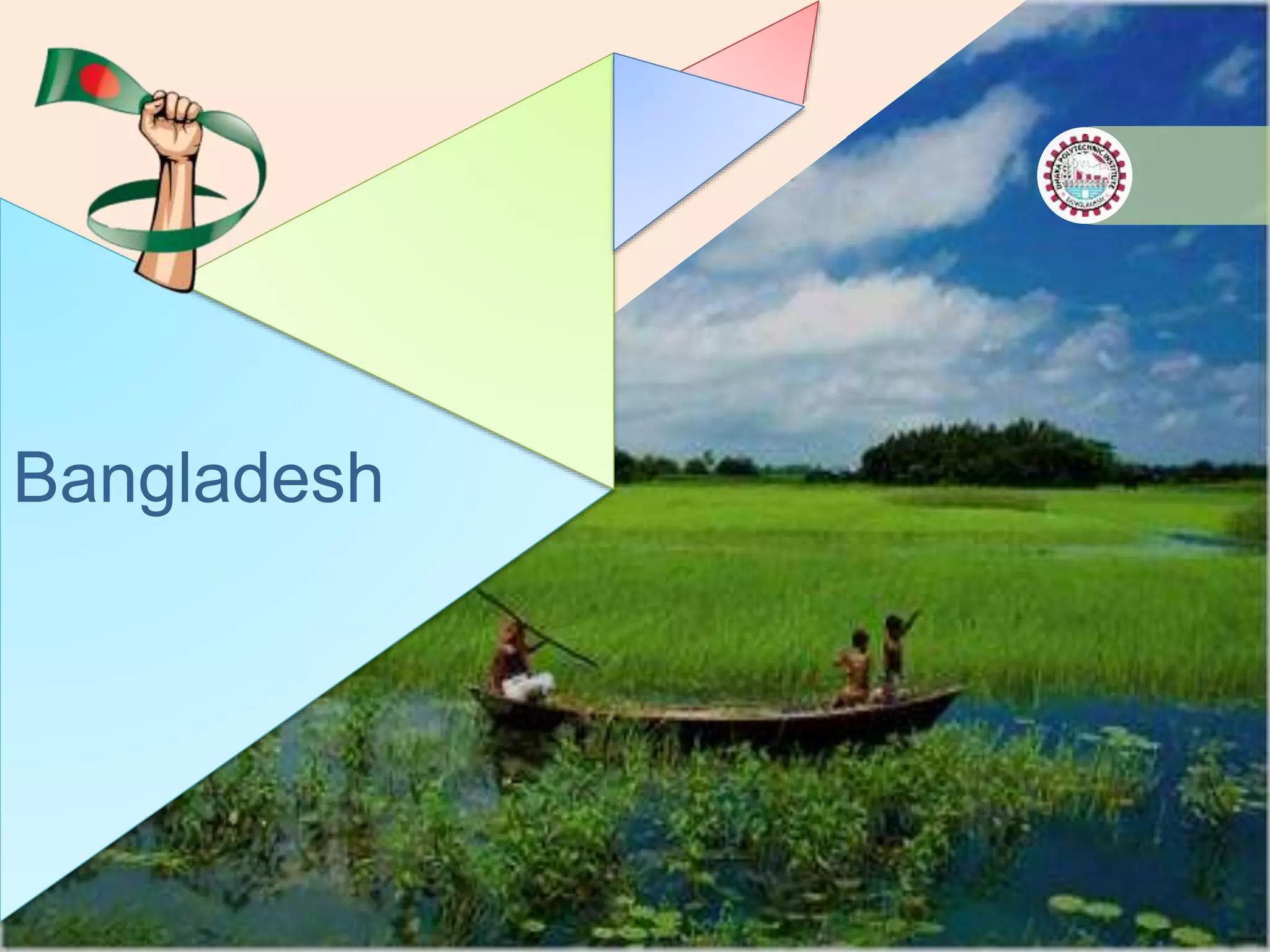
Bangladesh
S.M. Faisal Mahmud
Sanima Islam
Khadiza Akter
Md. Sohan Sarker
MST. Farjana Akter
Sadia Sultana
Din Islam
Md. Shabbir Hossain
S.M. Faisal Mahmud
Sanima Islam
Khadiza Akter
Md. Sohan Sarker
MST. Farjana Akter
Sadia Sultana
Din Islam
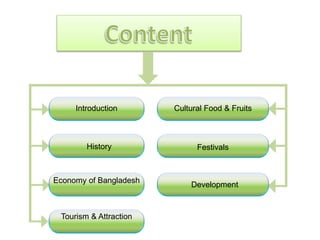
Introduction
History
Economy of Bangladesh
Tourism & Attraction
Cultural Food & Fruits
Festivals
Development
Introduction
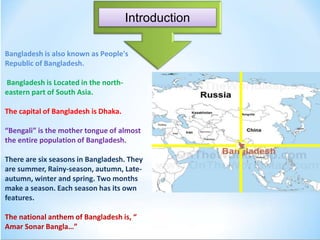
Bangladesh is also known as People's
Republic of Bangladesh.
Bangladesh is Located in the north-
eastern part of South Asia.
The capital of Bangladesh is Dhaka.
“Bengali” is the mother tongue of almost
the entire population of Bangladesh.
There are six seasons in Bangladesh. They
are summer, Rainy-season, autumn, Late-
autumn, winter and spring. Two months
make a season. Each season has its own
features.
The national anthem of Bangladesh is, “
Amar Sonar Bangla…”
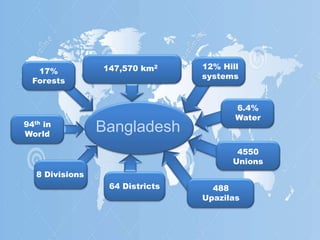
Bangladesh
147,570 km2 12% Hill
systems
64 Districts
17%
Forests
94th in
World
8 Divisions
488
Upazilas
6.4%
Water
4550
Unions
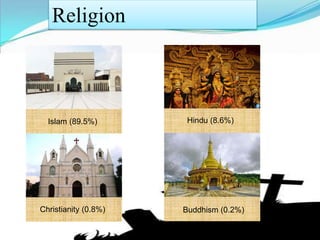
Religion
Islam (89.5%) Hindu (8.6%)
Christianity (0.8%) Buddhism (0.2%)
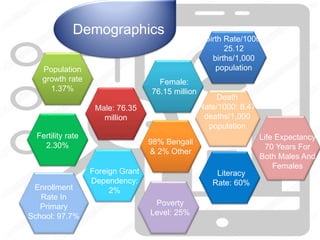
Population
growth rate
1.37%
Male: 76.35
million
Birth Rate/1000:
25.12
births/1,000
population
Fertility rate
2.30%
Female:
76.15 million
98% Bengali
& 2% Other
Death
Rate/1000: 8.47
deaths/1,000
population
Enrollment
Rate In
Primary
School: 97.7%
Life Expectancy
70 Years For
Both Males And
Females
Literacy
Rate: 60%
Foreign Grant
Dependency:
2%
Poverty
Level: 25%
Demographics
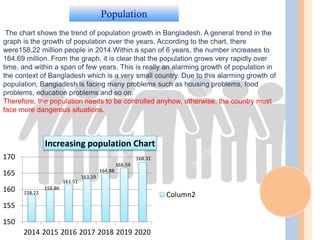
158.22
159.86
161.51
163.19
164.88
166.59
168.31
150
155
160
165
170
2014 2015 2016 2017 2018 2019 2020
Increasing population Chart
Column2
The chart shows the trend of population growth in Bangladesh. A general trend in the
graph is the growth of population over the years. According to the chart, there
were158.22 million people in 2014.Within a span of 6 years, the number increases to
164.69 million. From the graph, it is clear that the population grows very rapidly over
time, and within a span of few years. This is really an alarming growth of population in
the context of Bangladesh which is a very small country. Due to this alarming growth of
population, Bangladesh is facing many problems such as housing problems, food
problems, education problems and so on.
Therefore, the population needs to be controlled anyhow, otherwise, the country must
face more dangerous situations.
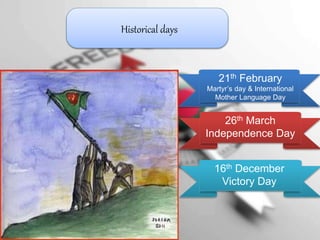
Historical days
26th March
Independence Day
21th February
Martyr’s day & International
Mother Language Day
16th December
Victory Day
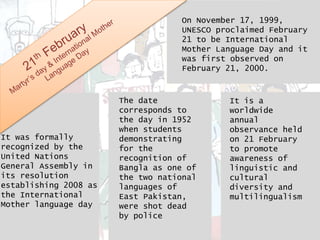
On November 17, 1999,
UNESCO proclaimed February
21 to be International
Mother Language Day and it
was first observed on
February 21, 2000.
It was formally
recognized by the
United Nations
General Assembly in
its resolution
establishing 2008 as
the International
Mother language day
The date
corresponds to
the day in 1952
when students
demonstrating
for the
recognition of
Bangla as one of
the two national
languages of
East Pakistan,
were shot dead
by police
It is a
worldwide
annual
observance held
on 21 February
to promote
awareness of
linguistic and
cultural
diversity and
multilingualism
26th March
Independence
Day
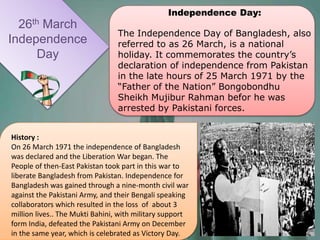
Independence Day:
The Independence Day of Bangladesh, also
referred to as 26 March, is a national
holiday. It commemorates the country’s
declaration of independence from Pakistan
in the late hours of 25 March 1971 by the
“Father of the Nation” Bongobondhu
Sheikh Mujibur Rahman befor he was
arrested by Pakistani forces.
History :
On 26 March 1971 the independence of Bangladesh
was declared and the Liberation War began. The
People of then-East Pakistan took part in this war to
liberate Bangladesh from Pakistan. Independence for
Bangladesh was gained through a nine-month civil war
against the Pakistani Army, and their Bengali speaking
collaborators which resulted in the loss of about 3
million lives.. The Mukti Bahini, with military support
form India, defeated the Pakistani Army on December
in the same year, which is celebrated as Victory Day.
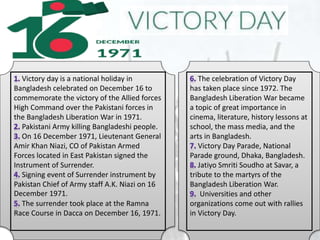
Victory day is a national holiday in
Bangladesh celebrated on December 16 to
commemorate the victory of the Allied forces
High Command over the Pakistani forces in
the Bangladesh Liberation War in 1971.
Pakistani Army killing Bangladeshi people.
On 16 December 1971, Lieutenant General
Amir Khan Niazi, CO of Pakistan Armed
Forces located in East Pakistan signed the
Instrument of Surrender.
Signing event of Surrender instrument by
Pakistan Chief of Army staff A.K. Niazi on 16
December 1971.
The surrender took place at the Ramna
Race Course in Dacca on December 16, 1971.
The celebration of Victory Day
has taken place since 1972. The
Bangladesh Liberation War became
a topic of great importance in
cinema, literature, history lessons at
school, the mass media, and the
arts in Bangladesh.
Victory Day Parade, National
Parade ground, Dhaka, Bangladesh.
Jatiyo Smriti Soudho at Savar, a
tribute to the martyrs of the
Bangladesh Liberation War.
Universities and other
organizations come out with rallies
in Victory Day.
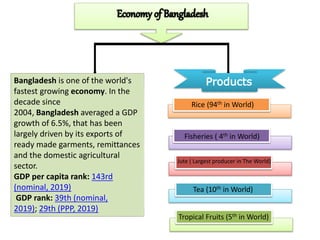
Bangladesh is one of the world's
fastest growing economy. In the
decade since
2004, Bangladesh averaged a GDP
growth of 6.5%, that has been
largely driven by its exports of
ready made garments, remittances
and the domestic agricultural
sector.
GDP per capita rank: 143rd
(nominal, 2019)
GDP rank: 39th (nominal,
2019); 29th (PPP, 2019)
Rice (94th in World)
Fisheries ( 4th in World)
Jute ( Largest producer in The World)
Tea (10th in World)
Tropical Fruits (5th in World)
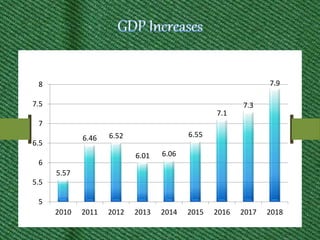
5.57
6.46 6.52
6.01 6.06
6.55
7.1
7.3
7.9
5
5.5
6
6.5
7
7.5
8
2010 2011 2012 2013 2014 2015 2016 2017 2018
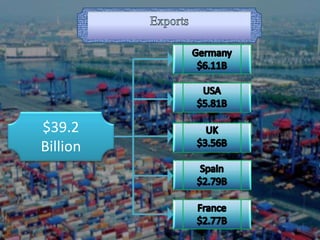
$39.2
Billion
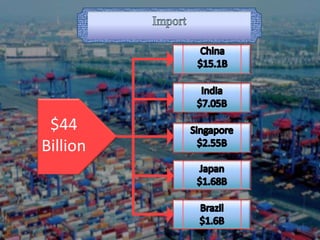
$44
Billion
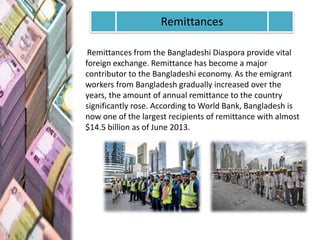
Remittances from the Bangladeshi Diaspora provide vital
foreign exchange. Remittance has become a major
contributor to the Bangladeshi economy. As the emigrant
workers from Bangladesh gradually increased over the
years, the amount of annual remittance to the country
significantly rose. According to World Bank, Bangladesh is
now one of the largest recipients of remittance with almost
$14.5 billion as of June 2013.
Remittances
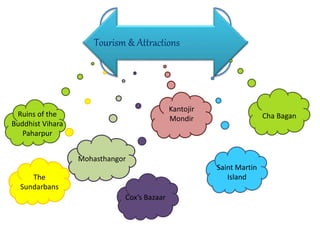
Tourism & Attractions
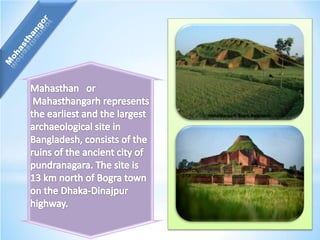
Ruins of the
Buddhist Vihara
Paharpur
The
Sundarbans
Mohasthangor
Kantojir
Mondir
Saint Martin
Island
Cox’s Bazaar
Cha Bagan
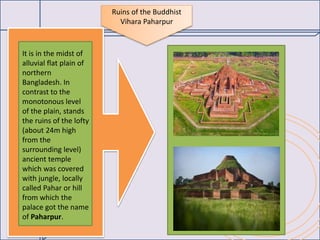
Ruins of the Buddhist
Vihara Paharpur
It is in the midst of
alluvial flat plain of
northern
Bangladesh. In
contrast to the
monotonous level
of the plain, stands
the ruins of the lofty
(about 24m high
from the
surrounding level)
ancient temple
which was covered
with jungle, locally
called Pahar or hill
from which the
palace got the name
of Paharpur.
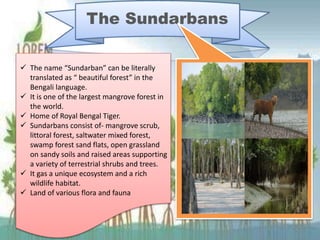
The Sundarbans
 The name “Sundarban” can be literally
translated as “ beautiful forest” in the
Bengali language.
 It is one of the largest mangrove forest in
the world.
 Home of Royal Bengal Tiger.
 Sundarbans consist of- mangrove scrub,
littoral forest, saltwater mixed forest,
swamp forest sand flats, open grassland
on sandy soils and raised areas supporting
a variety of terrestrial shrubs and trees.
 It gas a unique ecosystem and a rich
wildlife habitat.

 Land of various flora and fauna
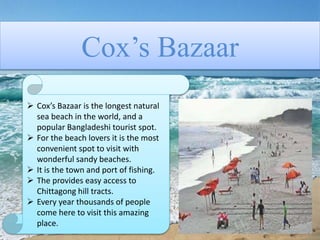
Cox’s Bazaar
 Cox’s Bazaar is the longest natural
sea beach in the world, and a
popular Bangladeshi tourist spot.
 For the beach lovers it is the most
convenient spot to visit with
wonderful sandy beaches.
 It is the town and port of fishing.
 The provides easy access to
Chittagong hill tracts.
 Every year thousands of people
come here to visit this amazing
place.
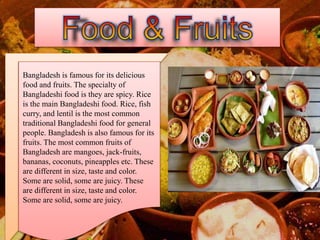
Bangladesh is famous for its delicious
food and fruits. The specialty of
Bangladeshi food is they are spicy. Rice
is the main Bangladeshi food. Rice, fish
curry, and lentil is the most common
traditional Bangladeshi food for general
people. Bangladesh is also famous for its
fruits. The most common fruits of
Bangladesh are mangoes, jack-fruits,
bananas, coconuts, pineapples etc. These
are different in size, taste and color.
Some are solid, some are juicy. These
are different in size, taste and color.
Some are solid, some are juicy.
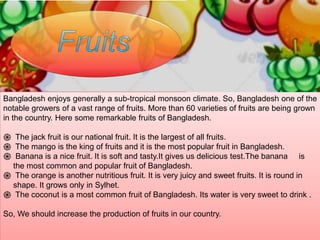
Bangladesh enjoys generally a sub-tropical monsoon climate. So, Bangladesh one of the
notable growers of a vast range of fruits. More than 60 varieties of fruits are being grown
in the country. Here some remarkable fruits of Bangladesh.
֍ The jack fruit is our national fruit. It is the largest of all fruits.
֍ The mango is the king of fruits and it is the most popular fruit in Bangladesh.
֍ Banana is a nice fruit. It is soft and tasty.It gives us delicious test.The banana is
the most common and popular fruit of Bangladesh.
֍ The orange is another nutritious fruit. It is very juicy and sweet fruits. It is round in
shape. It grows only in Sylhet.
֍ The coconut is a most common fruit of Bangladesh. Its water is very sweet to drink .
So, We should increase the production of fruits in our country.
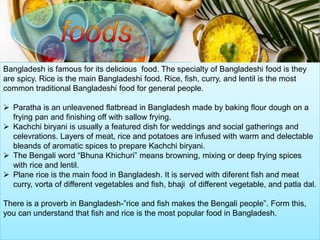
Bangladesh is famous for its delicious food. The specialty of Bangladeshi food is they
are spicy. Rice is the main Bangladeshi food. Rice, fish, curry, and lentil is the most
common traditional Bangladeshi food for general people.
 Paratha is an unleavened flatbread in Bangladesh made by baking flour dough on a
frying pan and finishing off with sallow frying.
 Kachchi biryani is usually a featured dish for weddings and social gatherings and
celevrations. Layers of meat, rice and potatoes are infused with warm and delectable
bleands of aromatic spices to prepare Kachchi biryani.
 The Bengali word “Bhuna Khichuri” means browning, mixing or deep frying spices
with rice and lentil.
 Plane rice is the main food in Bangladesh. It is served with diferent fish and meat
curry, vorta of different vegetables and fish, bhaji of different vegetable, and patla dal.
There is a proverb in Bangladesh-”rice and fish makes the Bengali people”. Form this,
you can understand that fish and rice is the most popular food in Bangladesh.
Bangladeshi Culture and
Festivals
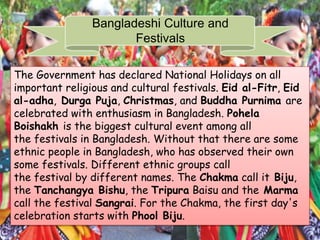
The Government has declared National Holidays on all
important religious and cultural festivals. Eid al-Fitr, Eid
al-adha, Durga Puja, Christmas, and Buddha Purnima are
celebrated with enthusiasm in Bangladesh. Pohela
Boishakh is the biggest cultural event among all
the festivals in Bangladesh. Without that there are some
ethnic people in Bangladesh, who has observed their own
some festivals. Different ethnic groups call
the festival by different names. The Chakma call it Biju,
the Tanchangya Bishu, the Tripura Baisu and the Marma
call the festival Sangrai. For the Chakma, the first day's
celebration starts with Phool Biju.
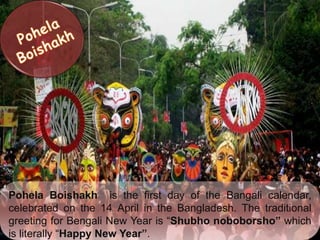
Pohela Boishakh is the first day of the Bangali calendar,
celebrated on the 14 April in the Bangladesh. The traditional
greeting for Bengali New Year is “Shubho noboborsho” which
is literally “Happy New Year”.
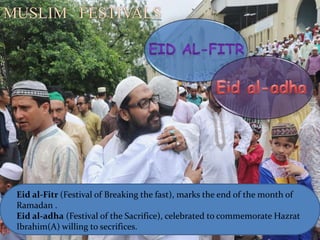
Eid al-Fitr (Festival of Breaking the fast), marks the end of the month of
Ramadan .
Eid al-adha (Festival of the Sacrifice), celebrated to commemorate Hazrat
Ibrahim(A) willing to secrifices.
MUSLIM FESTIVALS
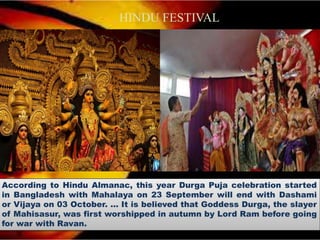
According to Hindu Almanac, this year Durga Puja celebration started
in Bangladesh with Mahalaya on 23 September will end with Dashami
or Vijaya on 03 October. ... It is believed that Goddess Durga, the slayer
of Mahisasur, was first worshipped in autumn by Lord Ram before going
for war with Ravan.
HINDU FESTIVAL
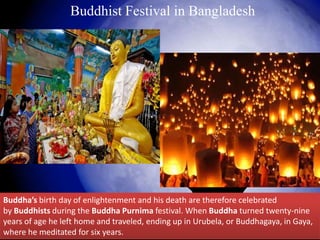
Buddha’s birth day of enlightenment and his death are therefore celebrated
by Buddhists during the Buddha Purnima festival. When Buddha turned twenty-nine
years of age he left home and traveled, ending up in Urubela, or Buddhagaya, in Gaya,
where he meditated for six years.
Buddhist Festival in Bangladesh
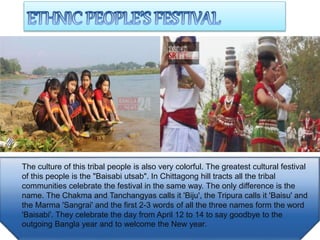
The culture of this tribal people is also very colorful. The greatest cultural festival
of this people is the "Baisabi utsab". In Chittagong hill tracts all the tribal
communities celebrate the festival in the same way. The only difference is the
name. The Chakma and Tanchangyas calls it 'Biju', the Tripura calls it 'Baisu' and
the Marma 'Sangrai' and the first 2-3 words of all the three names form the word
'Baisabi'. They celebrate the day from April 12 to 14 to say goodbye to the
outgoing Bangla year and to welcome the New year.
Development of Bangladesh
 In order to prioritize large scale infrastructure,
communications and power projects, right after
formation of government in January 2014, six projects
were identified as ‘fast-track’ , supervised directly by a
committee headed by the Prime Minister herself,
earmarked for speedy implementation. They are:
 Padma Multipurpose Bridge
2000 Meter Tunnel Underneath the Karnaphuli River in
Chittagong
Dhaka Mass Rapid Transit Development Project (Metro
Rail Project)
Infrastructural activities on Power Energy
Recently, two important projects have been added to
the lost, namely, country’s third seaport at Payra
Matabari energy hub in Cox’s Bazar.
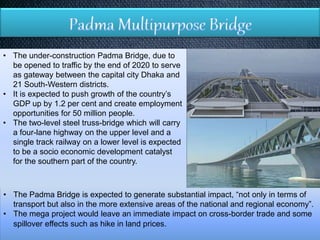
• The under-construction Padma Bridge, due to
be opened to traffic by the end of 2020 to serve
as gateway between the capital city Dhaka and
21 South-Western districts.
• It is expected to push growth of the country’s
GDP up by 1.2 per cent and create employment
opportunities for 50 million people.
• The two-level steel truss-bridge which will carry
a four-lane highway on the upper level and a
single track railway on a lower level is expected
to be a socio economic development catalyst
for the southern part of the country.
• The Padma Bridge is expected to generate substantial impact, “not only in terms of
transport but also in the more extensive areas of the national and regional economy”.
• The mega project would leave an immediate impact on cross-border trade and some
spillover effects such as hike in land prices.
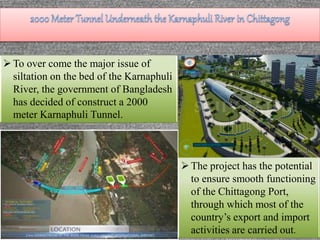
The project has the potential
to ensure smooth functioning
of the Chittagong Port,
through which most of the
country’s export and import
activities are carried out.
To over come the major issue of
siltation on the bed of the Karnaphuli
River, the government of Bangladesh
has decided of construct a 2000
meter Karnaphuli Tunnel.
 Process for constructing Bangladesh’s
first mass rapid transit (MRT) system,
commonly known as metro rail, started
officially in April 2014 with Cabinet’s
approval of the Metro Rail Act 2014.
 The detailed designs are expected to be
finalized by July of this year.
 Eight tenders would be floated in six
package in 2015 for the 21 km network.
 The project is expected to be complete
within four years.
Thank
you

Bangladesh for slideshare

  • 1.
  • 2.
    S.M. Faisal Mahmud SanimaIslam Khadiza Akter Md. Sohan Sarker MST. Farjana Akter Sadia Sultana Din Islam Md. Shabbir Hossain
  • 3.
    S.M. Faisal Mahmud SanimaIslam Khadiza Akter Md. Sohan Sarker MST. Farjana Akter Sadia Sultana Din Islam
  • 4.
    Introduction History Economy of Bangladesh Tourism& Attraction Cultural Food & Fruits Festivals Development
  • 5.
    Introduction Bangladesh is alsoknown as People's Republic of Bangladesh. Bangladesh is Located in the north- eastern part of South Asia. The capital of Bangladesh is Dhaka. “Bengali” is the mother tongue of almost the entire population of Bangladesh. There are six seasons in Bangladesh. They are summer, Rainy-season, autumn, Late- autumn, winter and spring. Two months make a season. Each season has its own features. The national anthem of Bangladesh is, “ Amar Sonar Bangla…”
  • 6.
    Bangladesh 147,570 km2 12%Hill systems 64 Districts 17% Forests 94th in World 8 Divisions 488 Upazilas 6.4% Water 4550 Unions
  • 7.
    Religion Islam (89.5%) Hindu(8.6%) Christianity (0.8%) Buddhism (0.2%)
  • 8.
    Population growth rate 1.37% Male: 76.35 million BirthRate/1000: 25.12 births/1,000 population Fertility rate 2.30% Female: 76.15 million 98% Bengali & 2% Other Death Rate/1000: 8.47 deaths/1,000 population Enrollment Rate In Primary School: 97.7% Life Expectancy 70 Years For Both Males And Females Literacy Rate: 60% Foreign Grant Dependency: 2% Poverty Level: 25% Demographics
  • 9.
    158.22 159.86 161.51 163.19 164.88 166.59 168.31 150 155 160 165 170 2014 2015 20162017 2018 2019 2020 Increasing population Chart Column2 The chart shows the trend of population growth in Bangladesh. A general trend in the graph is the growth of population over the years. According to the chart, there were158.22 million people in 2014.Within a span of 6 years, the number increases to 164.69 million. From the graph, it is clear that the population grows very rapidly over time, and within a span of few years. This is really an alarming growth of population in the context of Bangladesh which is a very small country. Due to this alarming growth of population, Bangladesh is facing many problems such as housing problems, food problems, education problems and so on. Therefore, the population needs to be controlled anyhow, otherwise, the country must face more dangerous situations.
  • 10.
    Historical days 26th March IndependenceDay 21th February Martyr’s day & International Mother Language Day 16th December Victory Day
  • 11.
    On November 17,1999, UNESCO proclaimed February 21 to be International Mother Language Day and it was first observed on February 21, 2000. It was formally recognized by the United Nations General Assembly in its resolution establishing 2008 as the International Mother language day The date corresponds to the day in 1952 when students demonstrating for the recognition of Bangla as one of the two national languages of East Pakistan, were shot dead by police It is a worldwide annual observance held on 21 February to promote awareness of linguistic and cultural diversity and multilingualism
  • 12.
    26th March Independence Day Independence Day: TheIndependence Day of Bangladesh, also referred to as 26 March, is a national holiday. It commemorates the country’s declaration of independence from Pakistan in the late hours of 25 March 1971 by the “Father of the Nation” Bongobondhu Sheikh Mujibur Rahman befor he was arrested by Pakistani forces. History : On 26 March 1971 the independence of Bangladesh was declared and the Liberation War began. The People of then-East Pakistan took part in this war to liberate Bangladesh from Pakistan. Independence for Bangladesh was gained through a nine-month civil war against the Pakistani Army, and their Bengali speaking collaborators which resulted in the loss of about 3 million lives.. The Mukti Bahini, with military support form India, defeated the Pakistani Army on December in the same year, which is celebrated as Victory Day.
  • 13.
    Victory day isa national holiday in Bangladesh celebrated on December 16 to commemorate the victory of the Allied forces High Command over the Pakistani forces in the Bangladesh Liberation War in 1971. Pakistani Army killing Bangladeshi people. On 16 December 1971, Lieutenant General Amir Khan Niazi, CO of Pakistan Armed Forces located in East Pakistan signed the Instrument of Surrender. Signing event of Surrender instrument by Pakistan Chief of Army staff A.K. Niazi on 16 December 1971. The surrender took place at the Ramna Race Course in Dacca on December 16, 1971. The celebration of Victory Day has taken place since 1972. The Bangladesh Liberation War became a topic of great importance in cinema, literature, history lessons at school, the mass media, and the arts in Bangladesh. Victory Day Parade, National Parade ground, Dhaka, Bangladesh. Jatiyo Smriti Soudho at Savar, a tribute to the martyrs of the Bangladesh Liberation War. Universities and other organizations come out with rallies in Victory Day.
  • 14.
    Bangladesh is oneof the world's fastest growing economy. In the decade since 2004, Bangladesh averaged a GDP growth of 6.5%, that has been largely driven by its exports of ready made garments, remittances and the domestic agricultural sector. GDP per capita rank: 143rd (nominal, 2019) GDP rank: 39th (nominal, 2019); 29th (PPP, 2019) Rice (94th in World) Fisheries ( 4th in World) Jute ( Largest producer in The World) Tea (10th in World) Tropical Fruits (5th in World)
  • 15.
  • 16.
  • 17.
  • 18.
    Remittances from theBangladeshi Diaspora provide vital foreign exchange. Remittance has become a major contributor to the Bangladeshi economy. As the emigrant workers from Bangladesh gradually increased over the years, the amount of annual remittance to the country significantly rose. According to World Bank, Bangladesh is now one of the largest recipients of remittance with almost $14.5 billion as of June 2013. Remittances
  • 19.
    Tourism & Attractions Ruinsof the Buddhist Vihara Paharpur The Sundarbans Mohasthangor Kantojir Mondir Saint Martin Island Cox’s Bazaar Cha Bagan
  • 20.
    Ruins of theBuddhist Vihara Paharpur It is in the midst of alluvial flat plain of northern Bangladesh. In contrast to the monotonous level of the plain, stands the ruins of the lofty (about 24m high from the surrounding level) ancient temple which was covered with jungle, locally called Pahar or hill from which the palace got the name of Paharpur.
  • 22.
    The Sundarbans  Thename “Sundarban” can be literally translated as “ beautiful forest” in the Bengali language.  It is one of the largest mangrove forest in the world.  Home of Royal Bengal Tiger.  Sundarbans consist of- mangrove scrub, littoral forest, saltwater mixed forest, swamp forest sand flats, open grassland on sandy soils and raised areas supporting a variety of terrestrial shrubs and trees.  It gas a unique ecosystem and a rich wildlife habitat.  Land of various flora and fauna
  • 23.
    Cox’s Bazaar  Cox’sBazaar is the longest natural sea beach in the world, and a popular Bangladeshi tourist spot.  For the beach lovers it is the most convenient spot to visit with wonderful sandy beaches.  It is the town and port of fishing.  The provides easy access to Chittagong hill tracts.  Every year thousands of people come here to visit this amazing place.
  • 24.
    Bangladesh is famousfor its delicious food and fruits. The specialty of Bangladeshi food is they are spicy. Rice is the main Bangladeshi food. Rice, fish curry, and lentil is the most common traditional Bangladeshi food for general people. Bangladesh is also famous for its fruits. The most common fruits of Bangladesh are mangoes, jack-fruits, bananas, coconuts, pineapples etc. These are different in size, taste and color. Some are solid, some are juicy. These are different in size, taste and color. Some are solid, some are juicy.
  • 25.
    Bangladesh enjoys generallya sub-tropical monsoon climate. So, Bangladesh one of the notable growers of a vast range of fruits. More than 60 varieties of fruits are being grown in the country. Here some remarkable fruits of Bangladesh. ֍ The jack fruit is our national fruit. It is the largest of all fruits. ֍ The mango is the king of fruits and it is the most popular fruit in Bangladesh. ֍ Banana is a nice fruit. It is soft and tasty.It gives us delicious test.The banana is the most common and popular fruit of Bangladesh. ֍ The orange is another nutritious fruit. It is very juicy and sweet fruits. It is round in shape. It grows only in Sylhet. ֍ The coconut is a most common fruit of Bangladesh. Its water is very sweet to drink . So, We should increase the production of fruits in our country.
  • 26.
    Bangladesh is famousfor its delicious food. The specialty of Bangladeshi food is they are spicy. Rice is the main Bangladeshi food. Rice, fish, curry, and lentil is the most common traditional Bangladeshi food for general people.  Paratha is an unleavened flatbread in Bangladesh made by baking flour dough on a frying pan and finishing off with sallow frying.  Kachchi biryani is usually a featured dish for weddings and social gatherings and celevrations. Layers of meat, rice and potatoes are infused with warm and delectable bleands of aromatic spices to prepare Kachchi biryani.  The Bengali word “Bhuna Khichuri” means browning, mixing or deep frying spices with rice and lentil.  Plane rice is the main food in Bangladesh. It is served with diferent fish and meat curry, vorta of different vegetables and fish, bhaji of different vegetable, and patla dal. There is a proverb in Bangladesh-”rice and fish makes the Bengali people”. Form this, you can understand that fish and rice is the most popular food in Bangladesh.
  • 27.
    Bangladeshi Culture and Festivals TheGovernment has declared National Holidays on all important religious and cultural festivals. Eid al-Fitr, Eid al-adha, Durga Puja, Christmas, and Buddha Purnima are celebrated with enthusiasm in Bangladesh. Pohela Boishakh is the biggest cultural event among all the festivals in Bangladesh. Without that there are some ethnic people in Bangladesh, who has observed their own some festivals. Different ethnic groups call the festival by different names. The Chakma call it Biju, the Tanchangya Bishu, the Tripura Baisu and the Marma call the festival Sangrai. For the Chakma, the first day's celebration starts with Phool Biju.
  • 28.
    Pohela Boishakh isthe first day of the Bangali calendar, celebrated on the 14 April in the Bangladesh. The traditional greeting for Bengali New Year is “Shubho noboborsho” which is literally “Happy New Year”.
  • 29.
    Eid al-Fitr (Festivalof Breaking the fast), marks the end of the month of Ramadan . Eid al-adha (Festival of the Sacrifice), celebrated to commemorate Hazrat Ibrahim(A) willing to secrifices. MUSLIM FESTIVALS
  • 30.
    According to HinduAlmanac, this year Durga Puja celebration started in Bangladesh with Mahalaya on 23 September will end with Dashami or Vijaya on 03 October. ... It is believed that Goddess Durga, the slayer of Mahisasur, was first worshipped in autumn by Lord Ram before going for war with Ravan. HINDU FESTIVAL
  • 31.
    Buddha’s birth dayof enlightenment and his death are therefore celebrated by Buddhists during the Buddha Purnima festival. When Buddha turned twenty-nine years of age he left home and traveled, ending up in Urubela, or Buddhagaya, in Gaya, where he meditated for six years. Buddhist Festival in Bangladesh
  • 32.
    The culture ofthis tribal people is also very colorful. The greatest cultural festival of this people is the "Baisabi utsab". In Chittagong hill tracts all the tribal communities celebrate the festival in the same way. The only difference is the name. The Chakma and Tanchangyas calls it 'Biju', the Tripura calls it 'Baisu' and the Marma 'Sangrai' and the first 2-3 words of all the three names form the word 'Baisabi'. They celebrate the day from April 12 to 14 to say goodbye to the outgoing Bangla year and to welcome the New year.
  • 33.
    Development of Bangladesh In order to prioritize large scale infrastructure, communications and power projects, right after formation of government in January 2014, six projects were identified as ‘fast-track’ , supervised directly by a committee headed by the Prime Minister herself, earmarked for speedy implementation. They are:  Padma Multipurpose Bridge 2000 Meter Tunnel Underneath the Karnaphuli River in Chittagong Dhaka Mass Rapid Transit Development Project (Metro Rail Project) Infrastructural activities on Power Energy Recently, two important projects have been added to the lost, namely, country’s third seaport at Payra Matabari energy hub in Cox’s Bazar.
  • 34.
    • The under-constructionPadma Bridge, due to be opened to traffic by the end of 2020 to serve as gateway between the capital city Dhaka and 21 South-Western districts. • It is expected to push growth of the country’s GDP up by 1.2 per cent and create employment opportunities for 50 million people. • The two-level steel truss-bridge which will carry a four-lane highway on the upper level and a single track railway on a lower level is expected to be a socio economic development catalyst for the southern part of the country. • The Padma Bridge is expected to generate substantial impact, “not only in terms of transport but also in the more extensive areas of the national and regional economy”. • The mega project would leave an immediate impact on cross-border trade and some spillover effects such as hike in land prices.
  • 35.
    The project hasthe potential to ensure smooth functioning of the Chittagong Port, through which most of the country’s export and import activities are carried out. To over come the major issue of siltation on the bed of the Karnaphuli River, the government of Bangladesh has decided of construct a 2000 meter Karnaphuli Tunnel.
  • 36.
     Process forconstructing Bangladesh’s first mass rapid transit (MRT) system, commonly known as metro rail, started officially in April 2014 with Cabinet’s approval of the Metro Rail Act 2014.  The detailed designs are expected to be finalized by July of this year.  Eight tenders would be floated in six package in 2015 for the 21 km network.  The project is expected to be complete within four years.
  • 37.