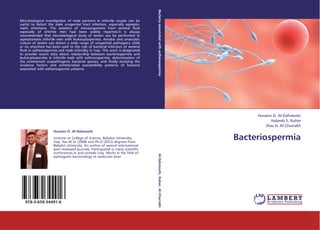



Bacteriospermia: Bacteria associated with
asthenospermia
By
Hussein O. Al-Dahmoshi
Ph.D Microiology
Habeeb S. Naher Alaa H. Al-Charrakh
Ph.D Bacteriology Ph.D Microbial Biotechnology
Dedication
To….
All martyrs and Iraqi peoples who died or vanished during
violence waves that devastated Iraq in the last few years
We dedicate this work
Authors
Acknowledgements
Praise to the Almighty Allah, the glorious creator of the universe, for
his kindness and mercy, and blessing upon Mohammad the prophet and
upon his family and followers. The authors would like to thank Department of
Microbiology, College of Medicine, Babylon University for providing all the
needed facilities, which were Essential for successful completion of the present
work. Our thanks are also extended to all members of the Department of
Microbiology for their generous help and co-operation. We would like to thank
Mr. Hatem Abdel Lateef (College of Medicine) for his help in statistical analysis
of this work. for their advice and help. Authors are deeply indebted to Dr. Ali
Abdil Hussein Al-Jubory, Andrologist in Babylon Maternity and Children
Hospital-infertility center, Hilla, Iraq, for their scientific support and assistance
in samples collection.
Authors
I
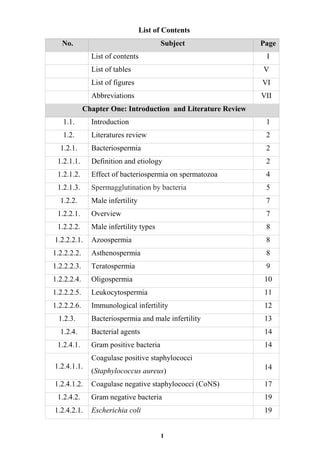
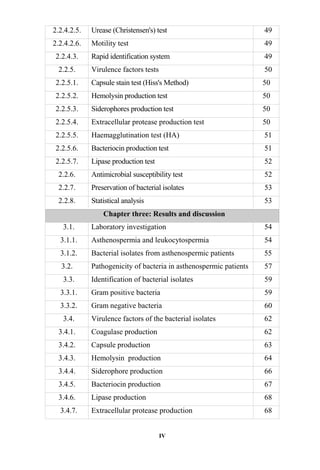
List of Contents
No. Subject Page
List of contents I
List of tables V
List of figures VI
Abbreviations VII
Chapter One: Introduction and Literature Review
1.1. Introduction 1
1.2. Literatures review 2
1.2.1. Bacteriospermia 2
1.2.1.1. Definition and etiology 2
1.2.1.2. Effect of bacteriospermia on spermatozoa 4
1.2.1.3. Spermagglutination by bacteria 5
1.2.2. Male infertility 7
1.2.2.1. Overview 7
1.2.2.2. Male infertility types 8
1.2.2.2.1. Azoospermia 8
1.2.2.2.2. Asthenospermia 8
1.2.2.2.3. Teratospermia 9
1.2.2.2.4. Oligospermia 10
1.2.2.2.5. Leukocytospermia 11
1.2.2.2.6. Immunological infertility 12
1.2.3. Bacteriospermia and male infertility 13
1.2.4. Bacterial agents 14
1.2.4.1. Gram positive bacteria 14
1.2.4.1.1.
Coagulase positive staphylococci
(Staphylococcus aureus) 14
1.2.4.1.2. Coagulase negative staphylococci (CoNS) 17
1.2.4.2. Gram negative bacteria 19
1.2.4.2.1. Escherichia coli 19
II
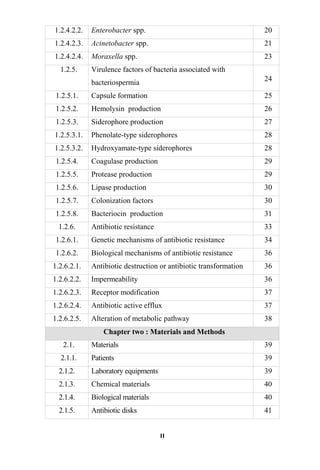
1.2.4.2.2. Enterobacter spp. 20
1.2.4.2.3. Acinetobacter spp. 21
1.2.4.2.4. Moraxella spp. 23
1.2.5. Virulence factors of bacteria associated with
bacteriospermia 24
1.2.5.1. Capsule formation 25
1.2.5.2. Hemolysin production 26
1.2.5.3. Siderophore production 27
1.2.5.3.1. Phenolate-type siderophores 28
1.2.5.3.2. Hydroxyamate-type siderophores 28
1.2.5.4. Coagulase production 29
1.2.5.5. Protease production 29
1.2.5.6. Lipase production 30
1.2.5.7. Colonization factors 30
1.2.5.8. Bacteriocin production 31
1.2.6. Antibiotic resistance 33
1.2.6.1. Genetic mechanisms of antibiotic resistance 34
1.2.6.2. Biological mechanisms of antibiotic resistance 36
1.2.6.2.1. Antibiotic destruction or antibiotic transformation 36
1.2.6.2.2. Impermeability 36
1.2.6.2.3. Receptor modification 37
1.2.6.2.4. Antibiotic active efflux 37
1.2.6.2.5. Alteration of metabolic pathway 38
Chapter two : Materials and Methods
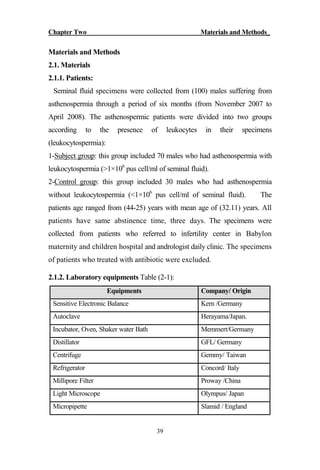
2.1. Materials 39
2.1.1. Patients 39
2.1.2. Laboratory equipments 39
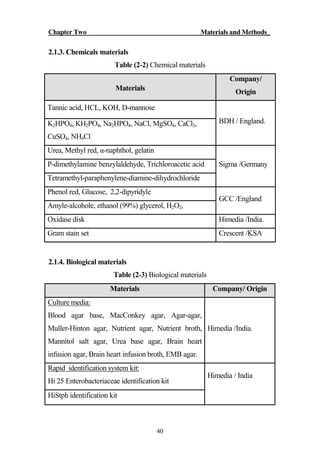
2.1.3. Chemical materials 40
2.1.4. Biological materials 40
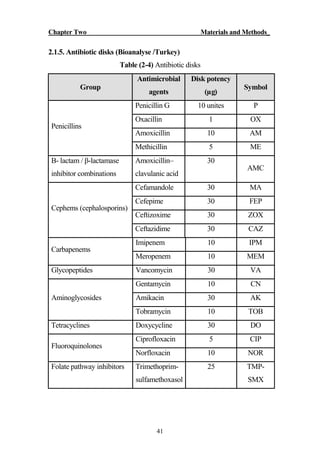
2.1.5. Antibiotic disks 41
III
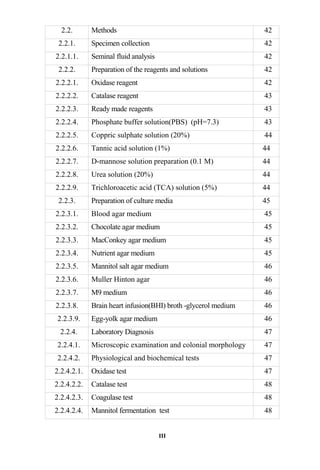
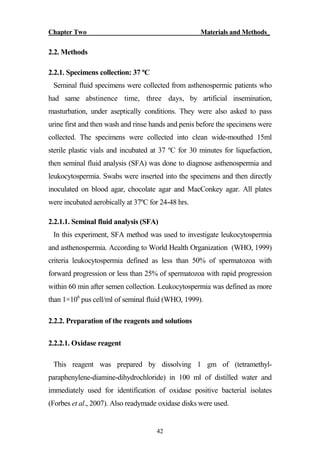
2.2. Methods 42
2.2.1. Specimen collection 42
2.2.1.1. Seminal fluid analysis 42
2.2.2. Preparation of the reagents and solutions 42
2.2.2.1. Oxidase reagent 42
2.2.2.2. Catalase reagent 43
2.2.2.3. Ready made reagents 43
2.2.2.4. Phosphate buffer solution(PBS) (pH=7.3) 43
2.2.2.5. Coppric sulphate solution (20%) 44
2.2.2.6. Tannic acid solution (1%) 44
2.2.2.7. D-mannose solution preparation (0.1 M) 44
2.2.2.8. Urea solution (20%) 44
2.2.2.9. Trichloroacetic acid (TCA) solution (5%) 44
2.2.3. Preparation of culture media 45
2.2.3.1. Blood agar medium 45
2.2.3.2. Chocolate agar medium 45
2.2.3.3. MacConkey agar medium 45
2.2.3.4. Nutrient agar medium 45
2.2.3.5. Mannitol salt agar medium 46
2.2.3.6. Muller Hinton agar 46
2.2.3.7. M9 medium 46
2.2.3.8. Brain heart infusion(BHI) broth -glycerol medium 46
2.2.3.9. Egg-yolk agar medium 46
2.2.4. Laboratory Diagnosis 47
2.2.4.1. Microscopic examination and colonial morphology 47
2.2.4.2. Physiological and biochemical tests 47
2.2.4.2.1. Oxidase test 47
2.2.4.2.2. Catalase test 48
2.2.4.2.3. Coagulase test 48
2.2.4.2.4. Mannitol fermentation test 48
IV
2.2.4.2.5. Urease (Christensen's) test 49
2.2.4.2.6. Motility test 49
2.2.4.3. Rapid identification system 49
2.2.5. Virulence factors tests 50
2.2.5.1. Capsule stain test (Hiss's Method) 50
2.2.5.2. Hemolysin production test 50
2.2.5.3. Siderophores production test 50
2.2.5.4. Extracellular protease production test 50
2.2.5.5. Haemagglutination test (HA) 51
2.2.5.6. Bacteriocin production test 51
2.2.5.7. Lipase production test 52
2.2.6. Antimicrobial susceptibility test 52
2.2.7. Preservation of bacterial isolates 53
2.2.8. Statistical analysis 53
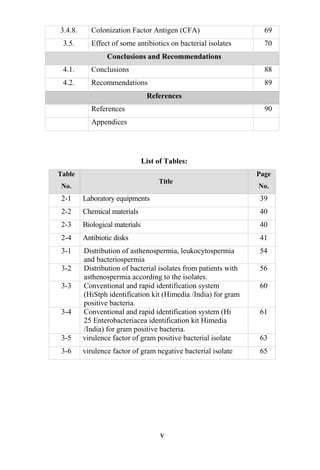
Chapter three: Results and discussion
3.1. Laboratory investigation 54
3.1.1. Asthenospermia and leukocytospermia 54
3.1.2. Bacterial isolates from asthenospermic patients 55
3.2. Pathogenicity of bacteria in asthenospermic patients 57
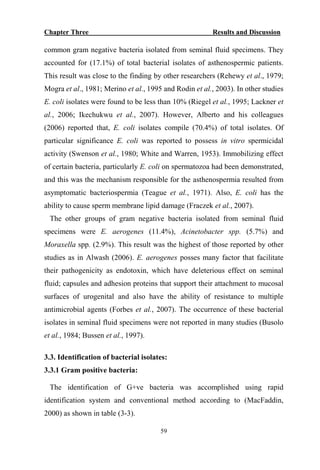
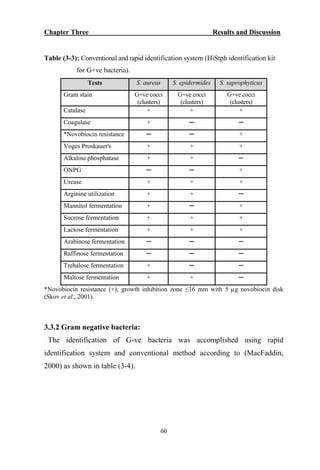
3.3. Identification of bacterial isolates 59
3.3.1. Gram positive bacteria 59
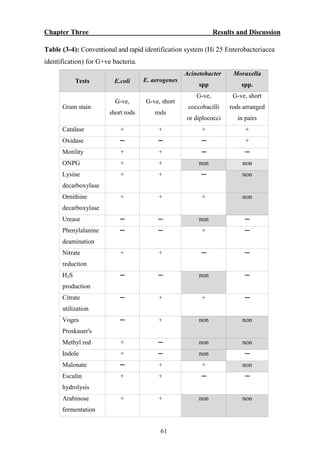
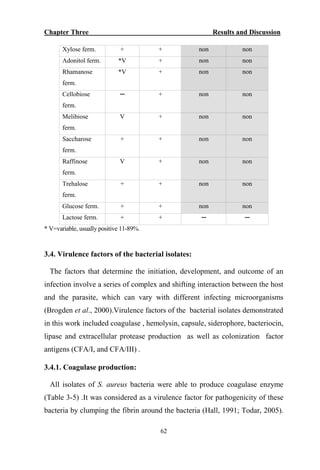
3.3.2. Gram negative bacteria 60
3.4. Virulence factors of the bacterial isolates 62
3.4.1. Coagulase production 62
3.4.2. Capsule production 63
3.4.3. Hemolysin production 64
3.4.4. Siderophore production 66
3.4.5. Bacteriocin production 67
3.4.6. Lipase production 68
3.4.7. Extracellular protease production 68
V
3.4.8. Colonization Factor Antigen (CFA) 69
3.5. Effect of some antibiotics on bacterial isolates 70
Conclusions and Recommendations
4.1. Conclusions 88
4.2. Recommendations 89
References
References 90
Appendices
List of Tables:
Table
No.
Title
Page
No.
2-1 Laboratory equipments 39
2-2 Chemical materials 40
2-3 Biological materials 40
2-4 Antibiotic disks 41
3-1 Distribution of asthenospermia, leukocytospermia
and bacteriospermia
54
3-2 Distribution of bacterial isolates from patients with
asthenospermia according to the isolates.
56
3-3 Conventional and rapid identification system
(HiStph identification kit (Himedia /India) for gram
positive bacteria.
60
3-4 Conventional and rapid identification system (Hi
25 Enterobacteriacea identification kit Himedia
/India) for gram positive bacteria.
61
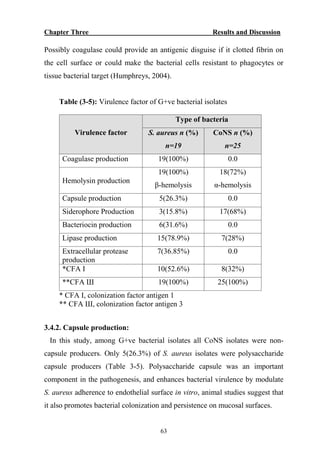
3-5 virulence factor of gram positive bacterial isolate 63
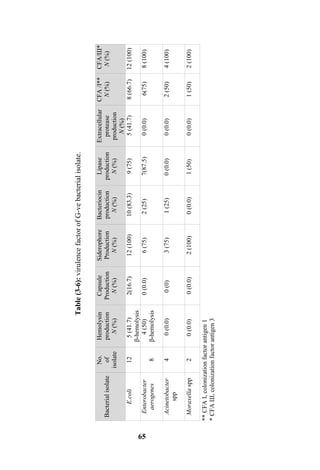
3-6 virulence factor of gram negative bacterial isolate 65
VI
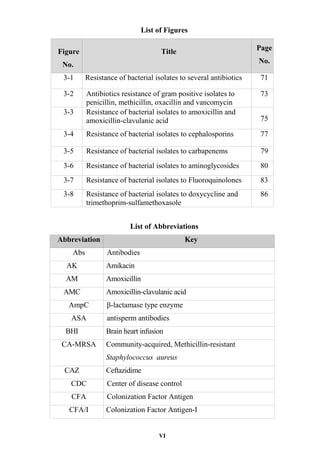
List of Figures
Figure
No.
Title Page
No.
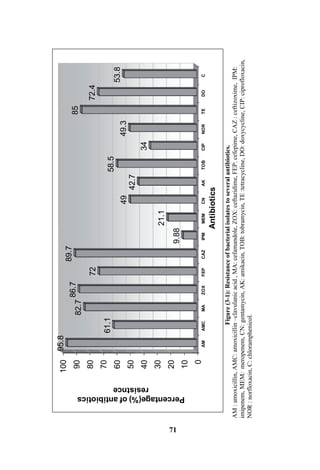
3-1 Resistance of bacterial isolates to several antibiotics 71
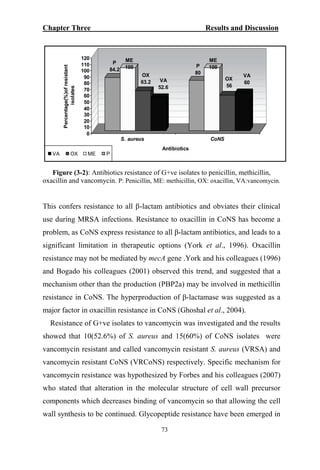
3-2 Antibiotics resistance of gram positive isolates to
penicillin, methicillin, oxacillin and vancomycin
73
3-3 Resistance of bacterial isolates to amoxicillin and
amoxicillin-clavulanic acid 75
3-4 Resistance of bacterial isolates to cephalosporins 77
3-5 Resistance of bacterial isolates to carbapenems 79
3-6 Resistance of bacterial isolates to aminoglycosides 80
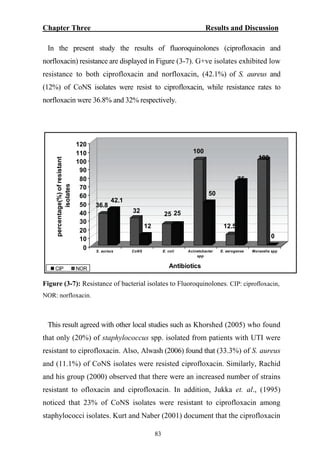
3-7 Resistance of bacterial isolates to Fluoroquinolones 83
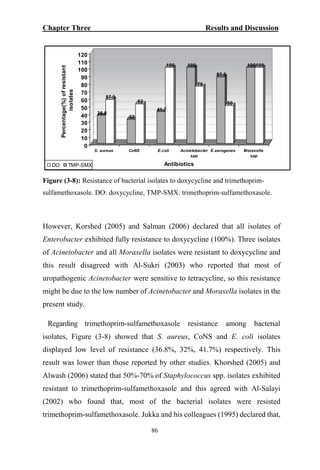
3-8 Resistance of bacterial isolates to doxycycline and
trimethoprim-sulfamethoxasole
86
List of Abbreviations
Abbreviation Key
Abs Antibodies
AK Amikacin
AM Amoxicillin
AMC Amoxicillin-clavulanic acid
AmpC β-lactamase type enzyme
ASA antisperm antibodies
BHI Brain heart infusion
CA-MRSA Community-acquired, Methicillin-resistant
Staphylococcus aureus
CAZ Ceftazidime
CDC Center of disease control
CFA Colonization Factor Antigen
CFA/I Colonization Factor Antigen-I
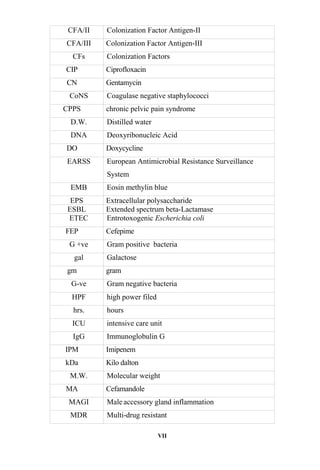
VII
CFA/II Colonization Factor Antigen-II
CFA/III Colonization Factor Antigen-III
CFs Colonization Factors
CIP Ciprofloxacin
CN Gentamycin
CoNS Coagulase negative staphylococci
CPPS chronic pelvic pain syndrome
D.W. Distilled water
DNA Deoxyribonucleic Acid
DO Doxycycline
EARSS European Antimicrobial Resistance Surveillance
System
EMB Eosin methylin blue
EPS Extracellular polysaccharide
ESBL Extended spectrum beta-Lactamase
ETEC Entrotoxogenic Escherichia coli
FEP Cefepime
G +ve Gram positive bacteria
gal Galactose
gm gram
G-ve Gram negative bacteria
HPF high power filed
hrs. hours
ICU intensive care unit
IgG Immunoglobulin G
IPM Imipenem
kDa Kilo dalton
M.W. Molecular weight
MA Cefamandole
MAGI Male accessory gland inflammation
MDR Multi-drug resistant
VIII
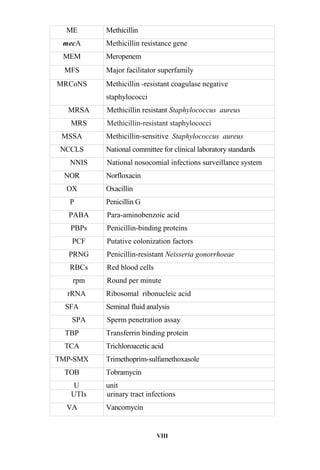
ME Methicillin
mecA Methicillin resistance gene
MEM Meropenem
MFS Major facilitator superfamily
MRCoNS Methicillin -resistant coagulase negative
staphylococci
MRSA Methicillin resistant Staphylococcus aureus
MRS Methicillin-resistant staphylococci
MSSA Methicillin-sensitive Staphylococcus aureus
NCCLS National committee for clinical laboratory standards
NNIS National nosocomial infections surveillance system
NOR Norfloxacin
OX Oxacillin
P Penicillin G
PABA Para-aminobenzoic acid
PBPs Penicillin-binding proteins
PCF Putative colonization factors
PRNG Penicillin-resistant Neisseria gonorrhoeae
RBCs Red blood cells
rpm Round per minute
rRNA Ribosomal ribonucleic acid
SFA Seminal fluid analysis
SPA Sperm penetration assay
TBP Transferrin binding protein
TCA Trichloroacetic acid
TMP-SMX Trimethoprim-sulfamethoxasole
TOB Tobramycin
U unit
UTIs urinary tract infections
VA Vancomycin
IX
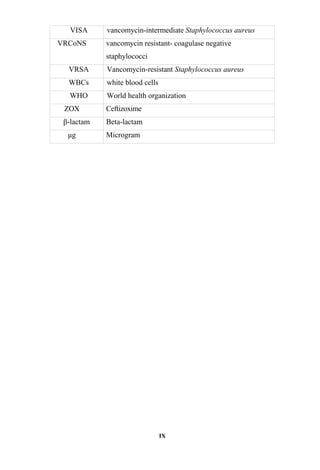
VISA vancomycin-intermediate Staphylococcus aureus
VRCoNS vancomycin resistant- coagulase negative
staphylococci
VRSA Vancomycin-resistant Staphylococcus aureus
WBCs white blood cells
WHO World health organization
ZOX Ceftizoxime
β-lactam Beta-lactam
μg Microgram
Chapter One Introduction and Literature Review
1
Introduction and Literature Review
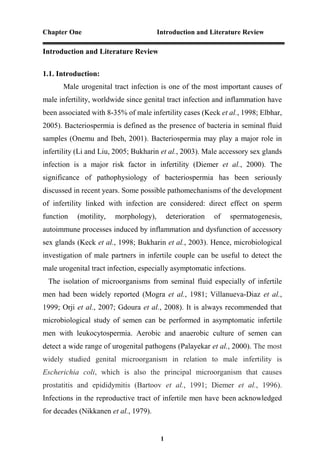
1.1. Introduction:
Male urogenital tract infection is one of the most important causes of
male infertility, worldwide since genital tract infection and inflammation have
been associated with 8-35% of male infertility cases (Keck et al., 1998; Elbhar,
2005). Bacteriospermia is defined as the presence of bacteria in seminal fluid
samples (Onemu and Ibeh, 2001). Bacteriospermia may play a major role in
infertility (Li and Liu, 2005; Bukharin et al., 2003). Male accessory sex glands
infection is a major risk factor in infertility (Diemer et al., 2000). The
significance of pathophysiology of bacteriospermia has been seriously
discussed in recent years. Some possible pathomechanisms of the development
of infertility linked with infection are considered: direct effect on sperm
function (motility, morphology), deterioration of spermatogenesis,
autoimmune processes induced by inflammation and dysfunction of accessory
sex glands (Keck et al., 1998; Bukharin et al., 2003). Hence, microbiological
investigation of male partners in infertile couple can be useful to detect the
male urogenital tract infection, especially asymptomatic infections.
The isolation of microorganisms from seminal fluid especially of infertile
men had been widely reported (Mogra et al., 1981; Villanueva-Diaz et al.,
1999; Orji et al., 2007; Gdoura et al., 2008). It is always recommended that
microbiological study of semen can be performed in asymptomatic infertile
men with leukocytospermia. Aerobic and anaerobic culture of semen can
detect a wide range of urogenital pathogens (Palayekar et al., 2000). The most
widely studied genital microorganism in relation to male infertility is
Escherichia coli, which is also the principal microorganism that causes
prostatitis and epididymitis (Bartoov et al., 1991; Diemer et al., 1996).
Infections in the reproductive tract of infertile men have been acknowledged
for decades (Nikkanen et al., 1979).
Chapter One Introduction and Literature Review
2
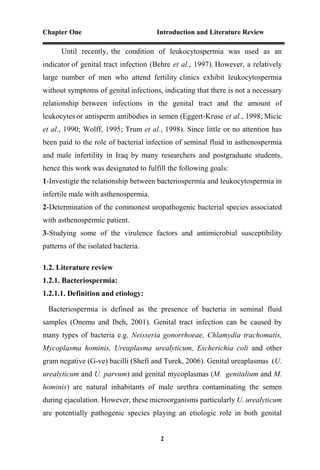
Until recently, the condition of leukocytospermia was used as an
indicator of genital tract infection (Behre et al., 1997). However, a relatively
large number of men who attend fertility clinics exhibit leukocytospermia
without symptoms of genital infections, indicating that there is not a necessary
relationship between infections in the genital tract and the amount of
leukocytes or antisperm antibodies in semen (Eggert-Kruse et al., 1998; Micic
et al., 1990; Wolff, 1995; Trum et al., 1998). Since little or no attention has
been paid to the role of bacterial infection of seminal fluid in asthenospermia
and male infertility in Iraq by many researchers and postgraduate students,
hence this work was designated to fulfill the following goals:
1-Investigte the relationship between bacteriospermia and leukocytospermia in
infertile male with asthenospermia.
2-Determination of the commonest uropathogenic bacterial species associated
with asthenospermic patient.
3-Studying some of the virulence factors and antimicrobial susceptibility
patterns of the isolated bacteria.
1.2. Literature review
1.2.1. Bacteriospermia:
1.2.1.1. Definition and etiology:
Bacteriospermia is defined as the presence of bacteria in seminal fluid
samples (Onemu and Ibeh, 2001). Genital tract infection can be caused by
many types of bacteria e.g. Neisseria gonorrhoeae, Chlamydia trachomatis,
Mycoplasma hominis, Ureaplasma urealyticum, Escherichia coli and other
gram negative (G-ve) bacilli (Shefi and Turek, 2006). Genital ureaplasmas (U.
urealyticum and U. parvum) and genital mycoplasmas (M. genitalium and M.
hominis) are natural inhabitants of male urethra contaminating the semen
during ejaculation. However, these microorganisms particularly U. urealyticum
are potentially pathogenic species playing an etiologic role in both genital
Chapter One Introduction and Literature Review
3
infections and male infertility (Andrade-Rocha, 2003; Wang et al., 2006).
During the past decade, evidences for damage caused by U. urealyticum to the
development and vitality of human embryos had accumulated. In human in
vitro fertilization systems, the presence of U. urealyticum in either semen or
female genital tract resulted in a decline in pregnancy rate per embryo transfer
(Montagut et al., 1991; Reichart et al., 2000).
Bacteriospermia was caused by both gram positive (G+ve) bacteria and
G-ve bacteria as well as by Chlamydia spp. and Mycoplasma spp. (Chimura
and Saito, 1990; Villanueva-Diaz et al., 1999; Lackner et al., 2006). Chimura
and Saito (1990) stated that the rate of detection of G+ve bacteria in semen
was high (40/51), while the rate of G-ve bacteria accounted for (11/51). Rodin
and his colleagues (2003) found that staphylococci were the most common
bacteria detected in semen of infected patients followed by Streptococcus
viridans and Enterococcus faecalis. Lackner and his colleagues (2006) found
that the most bacterial pathogens that caused bacteriospermia were U.
urealyticum, E. faecalis and E. coli which constituted 23.8%, 16.8%, and 7.0%
of respectively. Other study revealed that, the most common bacterial types
isolated from patients with asymptomatic bacteriospermia were C. trachomatis
(41.4%), U. urealyticum (15.5%) and M. hominis (10.3%) (Gdoura et al.,
2008). The Presence of pathogenic microorganisms in semen, which may be
related to a breach in the integrity of the blood-testes barrier, may provide
early warning signals of impairment of male fertility(Onemu and Ibeh,
2001).Also asymptomatic bacteriospermia may be resulted from recent
seminal tract infection such as orchitis ,epididymitis and prostatitis(Keck et al.,
1998; Weinder et al., 1999).Swenson and his colleagues (1980) affirmed that
the presence of organisms in the semen may also be related to gynecologic
infections.
Chapter One Introduction and Literature Review
4
1.2.1.2. Effect of bacteriospermia on spermatozoa:
The harmful effect of bacteria on spermatozoa depends on the type and
species of microorganisms invading, colonizing, or infecting the male genital
tract and is associated with the accompanying oxidative stress (Fraczek et al.,
2007). Genital infections may affect the secretory function in seminal vesicles
and prostate. Male accessory gland inflammation (MAGI) may also lead to
decreased epididymal secretion of alpha-glucosidase (Depuydt et al., 1998),
which has been shown to have a positive effect on spermatozoa binding
capacity and intrauterine insemination (Ben Ali et al., 1994; Milingos et al.,
1996). Microbial infection has been linked with infertility problem in a number
of studies (Swenson et al., 1980; Osegbe and Amaku, 1985; Rodin et al.,
2003). While the exact role of microbial infection in the aetiology of infertility
is not very certain owing to the limitations in diagnostic criteria and
asymptomatic nature of infection (Purvis and Christiansen, 1993). Some
possible effect on the properties of seminal fluid associated with fertility had
been suggested (Bukharin et al., 2003; Rodin et al., 2003).
Bacterial inhibitory effect on sperm motility parameter had been
documented. E. coli had been shown to have a significant negative effect on
sperm motility (Diemer et al., 1996; Huwe et al., 1998; Philip and Folstad,
2003). Golshani and his colleagues (2006) noted that the rate of non-motile
and morphologically abnormal sperms was higher in positive cases of
bacteriospermia, especially in E. coli and enterococci positive samples.
S. aureus had an inhibitory effect on human sperm motility in vitro (Ji-Hong et
al., 2002). In fact, such inhibitory effects on sperm motility were not found
with other pathogens such as S. saprophyticus, Pseudomonas aeruginosa, and
Enterococcus (Huwe et al., 1998; Kohn et al., 1998).
Chapter One Introduction and Literature Review
5
Another effect of pathogenic bacterium on spermatozoa was the
impairment of spermatozoal membrane. The functional and structural integrity
of sperm membrane are crucial for the viability of spermatozoa. The Effect on
spermatozoal membrane was studied in vitro by Qiang and his colleagues
(2007), the results revealed that, when sperm treated with β-hemolytic strains,
the membranes of their heads were swollen, deformed, obscured and even
broken off. The acrosomal membrane and nuclear membrane could be seen
injured too, which was curled, distorted and broken off. The membrane in the
neck and the middle piece of the tail was defective. Mitochondria were
disorderly arranged, and some components were released from the cytoplasm,
but the membrane in the end piece of the tail was less damaged and its
membranes were comparatively intact. This indicated that hemolytic bacterium
impaired significantly spermatozoa membrane.
U. urealyticum affected sperm quality, but the mechanism had not been yet
elucidated. Some investigators did not find any correlation between the
presence of U. urealyticum and semen alteration (Bornman et al., 1990; Wang
et al., 2006), other workers reported that the presence of U. urealyticum in
semen was related to a decrease in sperm concentration (Wang et al., 2006),
motility (De Jong et al., 1990), and/or morphology (Xu et al., 1997). The dual
effect of U. urealyticum on the sperm activity (inhibition of sperm motility at
low pH and increase of sperm velocity at higher pH, depending on sperm
metabolism) has been recently demonstrated (Reichart et al., 2001).
1.2.1.3. Spermagglutination by bacteria:
The importance of the receptor-ligand interaction in the pathogenesis of
urinary tract infection was well documented (Roberts, 1992). Certain E. coli
strains are pathogenic in the urinary tract because they possess fimbriae (pili),
rigid filamentous proteinaceous appendages that are attached to specific
uroepithelial receptors. These receptors may be glycoproteins as with type 1
Chapter One Introduction and Literature Review
6
fImbriae or glycolipids as with P-fimbriae. The essential receptor component
in glycoproteins for type 1 fimbriae is an mannose group (mannose). The
essential minimal active moiety in glycolipids for P-fimbriae is a-D-galp-l-4-9-
D-galp (gal gal). Fimbriae-dependent interactions can be confirmed if they are
competitively inhibited by addition of the specific receptor component.
Because the surface of spermatozoa is rich in glycoproteins, even
asymptomatic colonization of the male or female genitalia with
Enterobacteriaceae may result in similar interactions. Isolation and
characterization of the receptors may allow therapy aimed for prevention of
colonization with spermagglutinating microorganisms, or directed for
inhibiting the receptor-ligand interaction. The corollary would be development
of monoclonally derived receptor clones capable of spermagglutination as a
biological contraceptive (Monga and Roberts, 1994).
Del Porto and his colleagues (1975) reported the decreased motility with
concentrations of 106
and agglutination with l07
E. coli/ml. Paulson and
Polakoski (1977) isolated a heat- and cold-resistant dialyzable spermatozoal
immobilization factor from the filtrate of E. coli suspensions. These effects
were partially inhibited by the addition of the bactericidal agent, streptomycin.
Random adherence of C. trachomatis to spermatozoa has been demonstrated
by immunofluorescence and transmission electron microscopy. Adherence
was favored with increasing chlamydial concentrations and acidic pH, similar
to that in the posterior vaginal vault (Wolner- Hanssen and Mardh, 1984).
Mycoplasma species have been described to adhere to and agglutinate
sperms(Taylor-Robinson and Manchee, 1967; Busolo et al., 1984a). One
investigation reported the adherence of N. gonorrhoeae to spermatozoa that
was enhanced with fimbriated strains and inhibited by antifimbrial antibodies;
however, adherence was not exclusive to fimbriated strains (James-Holmquest
et al., 1974).
Chapter One Introduction and Literature Review
7
1.2.2. Male infertility
1.2.2.1. Overview:
Infertility is defined as the lack of conception after 12 months of unprotected
intercourse. On evaluation, roughly 50% of affected couples have causal or
associated male factors as a cause of infertility (Greenspan and Gardener,
2001; Shefi and Turek, 2006). Evaluation of the infertile men requires a
complete medical history, physical examination and laboratory investigation.
Usually 80% of couples are able to conceive within the first year of marriage
(McClure, 1992). Male infertility has several different possible causes which
are primary or secondary testicular failure, infection and obstruction, but the
most common diagnosis is idiopathic infertility, which accounts for about 60-
70% of the patients (Nieschlag and Behre, 1997).
Primary infertility is a term used for those couples who have never conceived
while; secondary infertility is a term that refers to those couples who have at
least one conception but currently unable to achieve pregnancy (Wentz, 1988).
It had been estimated that infertility affects 15% of couples (Hull et al., 1985).
The contribution of male and female infertility causes to couple infertility was
shown as follows: Male factor forms about 24% of couples, female factor
forms about 41% of the cases and 24% for male and female causes while 11%
of them did not show any demonstratable cause in either partners (WHO,
1984). Greenspan and Gardner (2001) reported that male factors were
responsible for about 40% of cases, female factors for about 40% and couple
factors for 20%. The male needs normal spermatogenesis, normal reproductive
system anatomy and normal sexual function to deposit an adequate number of
morphologically normal, motile spermatozoa in the upper part of vagina (Jaffe
and Jewelewicz, 1991).
Chapter One Introduction and Literature Review
8
1.2.2.2. Male infertility types:
1.2.2.2.1. Azoospermia:
Azoospermia means the absence of sperms in the seminal fluid and this is
either due to testicular dysfunction or due to bilateral obstruction in ducts
system of male reproductive tract (Freund and Peterson, 1976). Defect in
spermatogenesis can be classified into maturation arrest, hypoplasia involving
germ cells and disorganization and sloughing of the germinal epithelium
(Paulsen, 1974). Maturation arrest may be resulted from trauma or torsion of
testis associated with a damage to the spermatogenic epithelium including
sertoli cells, while leydig cells are resistant and remain functionally normal
(Steinberger and Steinberger, 1972).
1.2.2.2.2. Asthenospermia:
Asthenospermia is a term that indicates a significant reduction in sperm
motility. It is an important parameter for evaluating the fertility potential of
sperm, so sperm count is meaningless unless sperm motility is also taken into
account (Macleod and Wang, 1979). The ejaculate may be considered
abnormal if more than 50% of spermatozoa showed a decrease in motility
within one hour after ejaculation (Al-barazanchi et al., 1992). Blandow and
Rumery (1964) stated that at least 75% of spermatozoa should have normal
forward progressive motility. If less than 50% of the spermatozoa showed
forward progressive motility there may be a serious abnormality (Zaneveld and
Polakoski, 1977). Asthenospermia can be either moderate asthenospermia
when motility 20% - 40% or severe asthenospermia when motility < 20%
(Pardo et al., 1988).
The increase of abnormalities in the asthenospermia was of testicular origin
during spermatogensis, and the spermatozoa of asthenospermic patients were
characterized not only by their defective concentration, morphology and
Chapter One Introduction and Literature Review
9
motility but also by their relative nuclear immaturity (Pardo et al., 1988).
Sometimes drug therapy may result in decreased sperm motility and this can be
improved by the removal of the drug, e.g. cimitidine, or introduction of
specific culture media to the sperm washing procedures (Ng et al., 1990).
High viscosity of semen impaired spermatozoal motility and this was due
to seminal fluid infection and agglutination. The improvement of spermatozoal
motility occurred after treatment of patients with antibiotics or after washing
the spermatozoa and in vitro activation (Fakhrildin, 2000). Fakhouri (1980)
reported that the chronic infection of prostate and seminal vesicles caused the
immotility and death of the sperms, which means that the semen may contain a
normal number of spermatozoa but these spermatozoa were immotile and
inactive. Some studies reported that the abnormalities in the seminal fluid
osmolality had an adverse effect on sperm viability and motility, also its affect
in vitro fertilization rate (Al-Anssari et al., 1997; Al-Anssari, 2000).
A large number of trace elements were recognized as essential sperm
micronutrients, they act independently or together in human sperm
metabolism. Some of them interchange between spermatozoa and seminal fluid
after ejaculation (Umeyama et al., 1986; Alexander, 1989). Magnesium (Mg),
calcium (Ca), zinc ion (Zn) could exert stimulatory or inhibitory effects on the
sperm progressive motility depending on the concentration of each divalent
cations (Stegmayer and Ronquist, 1982) Calcium ion and bicarbonate ion were
physiological modulators of sperm motility and function in humans (Rojas et
al., 1991). A high zinc concentration had been observed to correlate with
reduced sperm motility (Umeyama et al., 1986; Carrera and Mendoza, 1990).
1.2.2.2.3. Teratospermia:
Teratospermia is defined as the presence of more than 40% of abnormal
sperm morphology (WHO, 1999). These abnormal sperms were unable to
fertilize the ovum in vitro and the fertilization rate was markedly diminished
Chapter One Introduction and Literature Review
10
(Oehninger and Alexander, 1991). It had been shown that sperm morphology
was the most significant seminal parameter which correlated with sperm
fertilizing ability in vitro (Kruger et al., 1988).Morphologically normal
spermatozoa were more likely to be motile and had significantly higher
velocity than abnormal ones, and they were more advantaged in transport
through female reproductive tract (Morales et al., 1988).
1.2.2.2.4. Oligospermia:
Oligospermia is defined as a reduction in the sperm count as well as the
seminal plasma volume of the ejaculate. The normal sperm count for fertile
males ranges from 60 to 120 million /ml of semen (Dana and Alan, 1996), this
value does not represent the minimum number of sperms which are necessary
to achieve fertility, Amelar (1966) stated that the margin should be at 40
million/ml, other authors reduced it to 20 million/ml and considered it as a
threshold limit which had been confirmative for male fertility (Sherins et al.,
1977).
Fauser and his colleagues (1990) classified oligospermia into three main
groups: mild oligospermia in which the sperms count ranges from 10 to 20
million /ml, moderate oligospermia, in this group the sperm count ranges from
5 to 10 million/ml and severe oligospermia when the sperm count ranges from
1 to 5 million/ml. In general, there are two types of oligospermia according to
sperm count/ml and the standard values of other measured parameters and
these were: permanent oligospermia, in this case the average sperm count
never rises above 10 million/ml, motility percentage remained below 50%, the
rate of forward progression remains below 2.5, normal cell morphology stays
below 60% and semen volume varies between 2-6 ml. The other is periodic
oligospermia, in this case the sperm count remains below 10 million/ml,
although sperm count showed fluctuation at intervals of time as it rises above
this margin and also the other measured parameters will be improved, even to
normal limits.
Chapter One Introduction and Literature Review
11
1.2.2.2.5. Leukocytospermia:
Leukocytospermia or pyospermia, an increase in leukocytes in the ejaculate,
is defined as > 1 million leukocytes/ml semen and is a significant cause of
male infertility (Shefi and Turek , 2006). The prevalence of pyospermia ranges
from 3% to 23% of infertile men.Seminal fluid infection is regarded as one of
the semen abnormalities which affect male fertility due to urogenital tract
infections. This case is manifested by the presence of leukocytes in semen.
Semen parameters including sperm count, sperm motility, sperm velocity and
total number of motile sperm were significantly reduced in the presence of
leukocytes (Wolff et al., 1990).
In addition to the impairment of sperm motility by the presence of
seminal fluid leukocytes, leukocytes reduce sperm fertilizing capacity as
determined through the sperm penetration assay (SPA) by using zona free
hamster oocytes (Berger et al., 1982; Hill et al., 1987). Therefore, abnormal
fertility may result from defective sperm function caused by lymphokines and
monokines elaborated by activated lymphocytes and macrophages located in
the reproductive tract of infertile men and women (Hill et al., 1987).
Leukocytospermic men are consequently of interest as they may show
symptoms of heightened systemic immune activity that is not caused by genital
tract infections (Purvis and Christiansen, 1993; Anderson, 1995). Infections
outside the genital tract may be asymptomatic but could still contribute to an
increase in somatic immune activity and increased influx of leukocytes to the
genital tract.
Males with high intensities of parasites should display an increased level
of systemic immune activity and consequently have a heightened level of
testicular immunity. Thus, high parasite intensities could result in a reduction
of ejaculate quality and fertility (Folstad and Skarstein, 1997).Various
mechanisms had been proposed on how various inflammatory conditions of the
Chapter One Introduction and Literature Review
12
genital tract may lead to male infertility. Many of these notions, however, are
still under debate (Eggert-Kruse et al., 1998; Michelmann, 1998; Wolff, 1998;
Hales et al., 1999). Leukocyte products such as lymphokines, monokines, and
reactive oxygen species had been shown to reduce sperm fertilizing ability
(Hill et al., 1989; Henkel and Schill, 1998). Leukospermia had been associated
with abnormal spermatozoal morphology, including elongated and small
heads, tail and neck abnormalities, retention of cytoplasmic droplets, and
abnormal acrosomal morphology (Menkveld and Kruger, 1998).
Leukocytospermia might also affect hyperactivation of spermatozoa during
capacitation (Chan et al., 1994).Elevated leukocytes and granulocytes were
believed to release various proinflammatory/bioactive cytokines, hydrogen
peroxide, and other reactive oxygen species (ROS) (Aitken et al., 1994;
Rajasekaran et al., 1995). Lamirande and Gagnon (1992) declared that lipid
peroxidation of sperm membrane is considered to be the key mechanism of this
ROS-induced sperm damage leading to infertility.
1.2.2.2.6. Immunological infertility:
Serological studies found that spermatozoa had a considerable number of
autoantigens, sperm specific proteins, subsurface antigen in the acrosome,
which is the major antigen in the spermatozoa; other antigens were found on
the head and tail (Rose, 1978). It had been suggested that antibodies were
present in the accessory fluid bound to sperm at the time of ejaculation (Kay et
al., 1993). Other researchers had shown that antibodies on the female genital
tract can interfere with sperm motility and potentially, with sperm- ovum
interaction by interfering with the dispersion of cumulus mass and sperm
binding, penetration of the sperm into the zona pellucida, and sperm- ovum
fusion (Marshburn, 1997; Zavos et al., 1998).
Antisperm antibodies may be detected in 8%-21% of infertile males.
Autoimmunity was firstly enhanced after the initiation of spermatogenesis and
sperm-specific antigens first appear at the time of puberty. Since such antigens
Chapter One Introduction and Literature Review
13
were not present during the development of immunological tolerance, these
proteins are potential targets for an immune response and therefore generation
of antisperm antibodies (ASA) (Dana & Alan, 1996).
The roles of most of these antigens in sperm function are currently unknown,
some suggested that antibodies to sperm antigens may inactivate their
functions and therefore lead to infertility, others suggested that agglutination of
sperm leads to their inability to move through the female reproductive tract and
sperm cytotoxicity may result. Sperm with bound antibodies may be unable to
penetrate through cervical mucus (Mazumdar and Levine, 1998). Antisperm
antibodies on the sperm head might impair the development of the acrosome
reaction and this will decrease in vitro fertilization rate (Al-barazanchi et al.,
1992; Ford et al., 1996).
1.2.3. Bacteriospermia and male infertility:
Elbhar (2005) reported that the male fertility was greatly reduced by
infections of the urogenital tract. These include gonorrhea, syphilis,
tuberculosis and infections caused by Mycoplasma and Trichomonas.
Gonorrhea causes abscess leading to testicular dysfunction. Prostatitis and
bacterial infections resulted in reduction in sperm motility (Hafez, 1977).
Therefore, infection, which is regarded as one of the abnormalities in the
semen because it can contribute to infertility, was manifested by the presence
of leucocytes, so it is called leukocytospermia or leukospermia (Gonzales et
al., 1992; Shimoya et al., 1993).
Wolff and associates (1990) suggested that the identification and
quantification of leukocytes in the semen should be an integral part of every
male infertility workup since leukocyte can adversely affect sperm quality in
vitro or in vivo. Munoz and Witkin (1995) declared that the mechanism that
results in infertility through C. trachomatis infection is not clear. It was
assumed that bacterial infections of the genital tract, in particular with C.
Chapter One Introduction and Literature Review
14
trachomatis, may stimulate the immune system, perhaps via vasoepididymitis
with unilateral obstruction or exposure of the spermatozoa to immunologically
competent cells in inflammatory conditions.
Berger and his colleagues (1982) identified that the leukocytospermia is
associated with the concentration of more than one million white blood cells
(WBCs)/ml of semen. Wentz (1988) reported that more than the normal 2-5
leukocytes per high power filed (HPF) may suggest prostatitis or another
significant infection, and also reported that greater than one million WBCs/ml
of semen was considered abnormal. Donovan and Lipshultz (1988) presumed
mechanism of infection causing infertility as follows (1) bacterial attachment
to sperm, (2) an immobilizing factor produced by bacteria, especially E. coli,
(3) immune system recruitment, and (4) alterations of glandular function.
1.2.4. Bacterial agents:
1.2.4.1. Gram positive bacteria:
Gram positive bacteria represent a large constituent of bacteriospermia
(Golshani et al., 2006). The most important G+ve bacterial types associated
with bacteriospermia are described below:
1.2.4.1.1. Coagulase positive staphylococci (Staphylococcus aureus):
The pathogenicity of S. aureus contributes to hemolysis of the blood,
coagulation of the plasma and production of extracellular enzymes and toxins
which act on host cell membrane and mediate the cell destruction (Mims et al.,
2004). S. aureus is often β-hemolytic on blood agar (Murray et al., 2003).
S. aureus is considered as one of the probable seminal tract pathogens and their
pathogenesis is attributed to combined effects of extracellular factors and toxins
together with invasive properties such as adherence and biofilm formation that
substantiate their resistant to most available antimicrobial agents and
phagocytosis (Goran, 2001; Eiichi et al., 2004).
Chapter One Introduction and Literature Review
15
Other virulence factors of S. aureus include colonization factor antigen
CFA/I , CFA/III, protein A which binds IgG molecules by the Fc region, in
serum, bacteria will bind IgG molecules the wrong way round by non immune
mechanism; in principle this will disrupt opsonization and phagocytosis
(Todar, 1998) indicated that they are important virulence factors,
polysaccharide capsule and cell wall that protect it from lysis by osmotic
condition and aid the bacteria to attach to mucosal surfaces (Al-Saigh, 2005).
Also S. aureus possesses both siderophore-mediated and non siderophore iron
uptake systems. Each system plays a role during pathogenesis. Several S.
aureus strains produce siderophores, two of these siderophores, staphyloferrin
A and staphyloferrin B are of the polycarboxylate class, while the third is
aureochelin which is chemically uncharacterized (Dale et al., 2004).
S. aureus may be able to scavenge different various sources of host iron (e.g.
heme and hemoglobin) during the establishment of an infection, and indeed, S.
aureus does possess the ability to bind heme and hemoglobin involved in the
transport of staphylobactin (Mazmanian et al., 2003).
Methicillin resistant S. aureus (MRSA) developed resistance to the antibiotic
methicillin and other penicillins (Elshafie and Bernardo, 2001). Staphylococci
are carried by healthy people in a variety of body sites without disease being
present. Most people do not get sick from staphylococcal bacteria, even MRSA
(Infectious Diseases and Immunization Committee, 1999). MRSA become
increasing singly problematic due to the emergence of resistant strain (Murray
et al., 2003). MRSA generally remained an uncommon finding even in hospital
settings until the 1990s when there was an explosion in MRSA prevalence in
hospitals where it is now endemic (Johnson et al., 2001).
Since first described in 1961 (Jevons, 1961), MRSA has become an
increasingly common cause of nosocomial infection and thus a problem of
increasing importance. These organisms are frequently associated with
infections at the sites of indwelling catheters or in patients who are
Chapter One Introduction and Literature Review
16
hospitalized for prolonged periods of time (Romero-Vivas et al., 1995). MRSA
infections have become increasingly common over the last several decades and
are now present or endemic world wide, more recently, an increasing
proportion of MRSA isolates were from hospitalized patients admitted from
the community (Morine and Hadler, 2001). MRSA infections in both the
hospital and community setting are commonly treated with non-β-lactam
antibiotics such as clindamycin (a lincosamine) and co-trimoxazole (also
commonly known as trimethoprim/sulfamethoxasole).
Resistance to these antibiotics has also lead to the use of new, broad-spectrum
anti-gram positive antibiotics such as linezolid because of its availability as an
oral drug. First-line treatment for serious invasive infections due to MRSA is
currently glycopeptide antibiotics (vancomycin and teicoplanin). There are
some problems with these antibiotics, mainly centered on the need for
intravenous administration (there is no oral preparation available), toxicity and
the need to monitor drug levels regularly by means of blood tests.
Glycopeptides must not be used to treat methicillin-sensitive S. aureus as
outcomes are inferior (Blot et al., 2002).
Community-acquired, Methicillin-resistant S. aureus (CA-MRSA) is an
established pathogen in several areas of the United States (Aguilar et al.,
2003), and they are considered as an emerging problem (Cosgrove et al.,
2003). The national nosocomial infections surveillance system (NNIS) of the
centers for disease control and prevention estimated that the prevalence of
MRSA strains causing nosocomial infections in patients in the intensive care
unit (ICU) reached up to 57% in 2002, an absolute increase of 13% over the
44% prevalence in the previous 5-year period (NNIS, 2003). An important and
previously unrecognized means of community-associated methicillin-resistant
S. aureus colonization and transmission is during sexual contact (Cook et al.,
2007)
Chapter One Introduction and Literature Review
17
Community-acquired infections (MRSA) appear to be increased (Lu et al.,
2005) in both adults and children in various regions and countries, including
Australia (Maguire et al., 1998), the United Kingdom (Stacey et al., 1998),
New Zealand (Rings et al., 1998), Taiwan (Ito et al., 2001), Saudi Arabia
(Madani et al., 2001), North America (Jones et al., 2002), Finland
(Salmenlinna et al., 2002), and Iraq (Al-Sahllawi, 2002).
Vancomycin-resistant S. aureus (VRSA) is a strain of S. aureus that has
become resistant to the glycopeptides. The first case of vancomycin-
intermediate S. aureus (VISA) was reported in Japan in 1996 (Hiramatsu et al.,
1997) but the first case of S. aureus was truly resistant to glycopeptide
antibiotics was only reported in 2002 (Chang et al., 2003). Three cases of
VRSA infection had been reported in the United States in 2005 (Menichetti,
2005).
1.2.4.1.2. Coagulase negative staphylococci (CoNS):
Coagulase-negative staphylococci (CoNS) are ubiquitous microorganisms
and predominant in the normal bacterial flora of the skin (Meskin, 1998). They
are commonly detected in clinical specimens and several species are
recognized as important agents of nosocomial infections, especially in
neonates, immunocompromised individuals and patients with internal
prosthetic devices (Jarlov, 1999). The origin of these infections can be
endogenous or exogenous, coming from the hospital environment or from
personnel hands. One critical factor for transmission of microorganisms from a
person (patients or health care workers) to the environment and then to another
person is the ability of these agents to survive on environmental surfaces
(Neely and Maley, 2000). At the present time, CoNS, especially S. epidermidis
strains, represent the most frequent cause of nosocomial sepsis and they are the
most common agents of infections associated with implanted medical devices
(Mack et al., 2000).
Chapter One Introduction and Literature Review
18
The most important CoNS members to human are S. epidermidis and S.
saprophyticus. They constitute major component of the normal flora of
humans, causing nosocomial infection that cause infection in debilitated or
compromised patients (Kloss and Bannerman, 1994; Brook et al., 2004). The
main focus on mechanisms of pathogenesis has been with foreign body
infections and the role of specific adhesions and slime produced by S.
epidermidis. Slime can reduce the immune response and opsonophagocytosis (
Kloos and Bannerman, 1994), and it needs to be pointed out that S. epidermidis
and other CoNS can cause sepsis, particularly in preterm infants,
immunosuppressed patients and patients with intravascular devices (Raad,
2000; Haimi et al., 2002).
Typically CoNS may colonize the anterior urethra (Adam et al., 2002). The
predisposing factors for primary staphylococcal bacteriuria include nosocomial
(indwelling catheters, surgery and instrumentation) and obstructive disease such as
prostatic hyperplasia (Arpi and Rennerg, 1984; Tenover et al., 2005). Nickel and
Costeron, (1992) suggested that CoNS were involved in the pathogenesis of
chronic prostatitis, but did not conclusively demonstrate that these bacteria were
actually causing the inflammation and symptom complex rather than simply
colonizing the prostate.
The role of S. epidermidis and S. saprophyticus in chronic prostatitis is still
controversial and a matter of dispute (Lee, 2000). S. saprophyticus, after E. coli,
it is the second most common cause of uncomplicated urinary tract infections
in women younger than 40 years. S. saprophyticus also causes urinary tract
infections in men. Complications include kidney stones and pylonephritis, and
in men, prostatitis, urethritis, and epididymitis (Raz et al., 2005). S.
saprophyticus colonizes the skin and the mucosa of the genitourinary tract.
Unlike other organisms commonly implicated in urinary tract infections, S.
saprophyticus is not associated with hospital-acquired infections. Instead,
Chapter One Introduction and Literature Review
19
colonization is community acquired, and infection occurs when the bacteria are
introduced into the sterile urinary tract. Epidemiological studies have shown
that urinary tract infections caused by S. saprophyticus are more prevalent
during the late summer and fall. Although the mechanisms by which S.
saprophyticus causes disease are not yet well understood, researchers have
identified three virulence factors (1) adherence to uroepithelial cells (2)
production of a hemagglutinin (3) production of extracellular slime (Raz et al.,
2005).
The virulence factors of CoNS following initial colonization, a copious amount of
extracellular polysaccharide or slime which may correlate with pathogenicity and
bacterial adherence and can be the reservoir for antibiotic resistant genes which can
be transferred to other bacteria (Eiff et al., 2002 ; Novick, 2003 ; Heikens el al.,
2005).
1.2.4.2. Gram negative bacteria:
1.2.4.2.1. Escherichia coli:
One of the most important Enterobacteriaceae species and it is the most
common cause of urinary tract infections (UTIs), predominantly, strains of E.
coli that have been identified in 65% to 80% of chronic bacterial prostatitis as
the cause of cultural prostatitis (Lipsky, 2003). It is G-ve rods, usually motile,
produce polysaccharide capsule, positive tests for indole, lysine decarboxylase
and mannitol fermentation and produces gas from glucose. Typical
morphology with a metallic sheen on differential media such as EMB agar
(Smith and Scotland, 1993; Brook et al., 2004). The majority of community
acquired urinary tract infections are caused by uropathogenic E. coli and which
caused recurrent infection (Ad Dhhan et al., 2005; Joel et al., 2002; Al-Amedi,
2003).
Many strains of E. coli uropathogens belong to limited number of O, K, and
H serogroups mainly O2, O4, O6, O7, O8 and O75, also production of CFA/I,
Chapter One Introduction and Literature Review
20
CFA/II and CFA/III, they increased adherence properties to uroepithelial cells
(Blance et al., 1996). Uro-virulence factors play a significant role in the
pathogenesis of bacterial prostatitis, for instance, bacterial P-fimbriae binds to
the uroepithelial receptors, and this subsequently facilitates ascent into the
urinary tract as well as establishing deep infections in the prostate gland itself
(Roberry et al., 1997). These are observed in 90% of E. coli strains causing
pylonephritis but less than 20% of the strains causing lower urinary tract
infection (Svenson et al., 1983).
Colonization of the lower urinary tract by E. coli is also facilitated by the
presence of the type 1 fimbriae, also known as mannose-sensitive fimbriae
which bind to glycolipids or glycoproteins receptors on the surface membrane
of uroepithelial cells, help bacteria to adhere to bladder and prostatic mucosa
and to be important in the development of cystitis and prostatitis in humans,
and its presence in prostatitis has also been documented (Marty et al., 2000).
Most uropathogenic E. coli strains produce hemolysin, which initiates tissue
invasion and makes iron available for infecting pathogens (Huges, 1996). The
presence of K antigen on the invading bacteria protects them from
phagocytosis by neutrophil. These factors allow the infecting pathogens to
escape the various host defenses (Svanborg et al., 1996). Some strains are
urease-producing E. coli and they are commonly present in the complicated
UTI (Falkow and Collinins, 1990).
1.2.4.2.2. Enterobacter aerogenes:
It is a member of Enterobacteriaceae, mucoid on sheep blood agar, some of
which are encapsulated, they also possess flagella. In contrast to Klebsiella,
organisms are motile. E. aerogenes is important nosocomial pathogen
responsible for a variety of UTIs especially in patients having anatomical
defects or indwelling catheters also isolated from patients with chronic
prostatitis (Lipsky, 2003). It has been recognized as a nosocomial pathogen
Chapter One Introduction and Literature Review
21
, and sometimes as a primary pathogen mainly due to its ability to
develop resistance to antibiotics ( Neto et al., 2003 ). It rarely causes
disease in a healthy individual (Alhambra et al., 2004). Patients most
susceptible to acquire infections with this opportunistic pathogen are those
who stay in the hospital, especially the intensive care units for prolonged
periods, those using foreign devices such as intravenous catheter and those
with serious underlying conditions including burns and immunosuppressant
(Clark et al., 2003). Most isolates involved in nosocomial infections are
resistant to multiple antibiotics (Arpin et al., 1996). The important virulence
factors seem to be largely due to an endotoxin that it produces community-
acquired infections which are sometimes observed. The Enterobacter species
are resistant to cephalothin due to β-lactamase enzymes production, so, strains
that cause hospital-acquired infection are more frequently antibiotic resistant
than other strains due to β-lactamase enzymes production (Pitout et al., 1998).
1.2.4.2.3. Acinetobacter spp:
This genus often capsulated, oxidase negative, nonmotile G-ve bacilli or
coccobacilli (often diplococco-bacilli), some strains have gelatin liquefaction
(Brooks et al., 2001). Acinetobacter species are generally considered
nonpathogenic to healthy individuals. However, several species persist in
hospital environments and cause severe, life-threatening infections in
compromised patients. The spectrum of antibiotic resistances of these
organisms together with their survival capabilities make them a threat to
hospitals as documented by recurring outbreaks both in highly developed
countries and elsewhere (Gerischer, 2008). They are one of acknowledged
prostate pathogens with other gram-negative uropathogens (Goran, 2001).
A. baumannii causes 2-10% of all G-ve infections in the U.S. and Europe,
poses little risk to healthy individuals, but generally causes infections to those
with weakened immune systems (Fournier et al., 2006). Specifically, the
Chapter One Introduction and Literature Review
22
intensive care unit (ICU) in hospitals houses patients with susceptible immune
systems and is normally equipped with ventilators and invasive equipment
such as catheters, the factors that contribute in A. baumannii infections such as
pneumonia, meningitis, septicemia, and urinary and respiratory tract infections
(Choi et al., 2005). The virulence factors of it include production of hemolysin
or siderophore, some species produced lipase, and they have no adhesive
agents like that of E. coli (Bonnet, 2004).
In addition, Al-shukri (2003) mentioned that Acinetobacter spp. produced
CFA/III, siderophore and extracellular protease enzymes but did not produce
CFA/I, CFA/II and hemolysin. A. baumannii is capable of forming biofilm on
glass and plastic surfaces via pili formation (Tomaras et al., 2003). The
production of biofilm may explain how A. baumannii can survive in different
types of conditions in the hospitals, including static conditions such as bed
sheets and furniture, while also capable of living in harsh conditions such as
catheters and respiratory tubes. A. baumannii also produces exopoly-
saccharides which strengthens the biofilm (Tomaras et al., 2003).
Acinetobacter species are innately resistant to many classes of antibiotics,
including penicillin, chloramphenicole, and often aminoglycosides. Resistance
to fluoroquinolones has been reported during therapy and this has also resulted
in increased resistance to other drug classes mediated through active drug
efflux. Efflux pumps located in the cell membrane are used to pump chemicals
and antibiotics out of the cell. Efflux pumps in A. baumannii include resistance
to tetracycline called Tet (A) and Tet (B), part of the major facilitator
superfamily (MFS) and functions in the exchange of protons and tetracycline
(Vila et al., 2007). Reduced outer-membrane permeability and increased
AmpC beta-lactamase production are known as important factors leading to
carbapenems resistance in Acinetobacter (Quale et al., 2003; Urban et al.,
2003). Some strains of A. baumannii have become resistant to almost all
Chapter One Introduction and Literature Review
23
currently available antibacterial agents (Van Looveren and Goossens, 2004)
mostly through the acquisition of plasmids (Seifert et al., 1994), transposons
(Devaud et al., 1982), or integrons (Segal et al., 2003; Poirel et al.,
2003)carrying clusters of genes encoding resistance to several antibiotic
families (Devaud et al., 1982 ; Poirel et al., 2003) at once.
A dramatic increase in antibiotic resistance in Acinetobacter strains has been
reported by the center of disease control and prevention (CDC) and the
carbapenems are recognized as the gold-standard and/or treatment of last
resort. Rather worryingly is an increase in resistance to the carbapenems which
leaves very little treatment option although there some success reported with
polymyxin B as well as the use of novel combinations of antibiotics (Rahal,
2006). Acinetobacter species are unusual in that they are sensitive to
sulbactam; sulbactam is most commonly used to inhibit bacterial beta-
lactamase, but this is an example of the antibacterial property of sulbactam
itself (Wood et al., 2002). As summarized by Go and Cunha (1999),
medications to which Acinetobacter is usually sensitive include Meropenem,
Colistin, Polymyxin B, Amikacin, Rifampin, Minocycline and Tigecycline.
1.2.4.2.4. Moraxella spp:
The genus Moraxella is a member of the family Nisseriaceae M. catarrhalis
was previously named Branhamella catarrhalis and before that Neisseria
catarrhalis (Brook et al., 2004). The organism is characterized as G-ve,
aerobic, oxidase positive, catalase positive, diplococci. They are commensals
of mucosal surfaces of upper respiratory tract and occasionally give rise to
opportunistic infection. Moraxella spp. have loose capsule, relatively
unstructured network of polymers that covers the surface of an organism. The
capsular polysaccharides are essential virulence factors (Rubens and Wessels,
1987). They inhibit phagocytosis and causes complement inactivation in the
absence of specific antibody (Bliss and Silver, 1996). Some pyogenic
Chapter One Introduction and Literature Review
24
intracellular cocci have the capacity to kill phagocytosis (Gray et al., 1999).
Ahmed and his coworkers (1991) stated that the M. catarrhalis strains contain
capsular polysaccharide but this capsule can not be differentiated. Other
researchers declared that the M. catarrhalis strains don't have capsule
(Mellenkvist et al., 2003). Many studies (Compagnari et al., 1994) had
mentioned that M. catarrhalis have high affinity to lactoferrin, transferrin and
hemoglobin receptors as a source of iron in the body. The bacterial hemolysin
is one of virulence factors but M. catarrhalis strains do not produce the
hemolysin (Catlin, 1990). Many strains of M. catarrhalis can produce amino
peptidase (Proteases) (Perez et al., 1990).
1.2.5. Virulence factors of bacteria associated with bacteriospermia:
Bacterial pathogens have developed many strategies for survival in higher
organisms, which during their evolution have formed very sophisticated
defense mechanisms. This defense system includes nonspecific reactions such
as mechanical clearing of the mucosa, control of iron transfer, phagocytosis,
elimination of bacteria by enzyme attack (e.g. by lysozyme), and activation of
complement, as well as specific reactions involving antibodies and cells of the
immune system. Pathogenic bacteria have worked out many different ways to
overcome the host defense system. A number of biological features known as
virulence factors are common to many bacterial species, although some of
these are characteristic only for certain bacteria (Finlay and Falkow, 1989).
Common bacterial properties involved in the infection process include
adhesion to epithelial surfaces, invasion (penetration) of host cells,
intracellular multiplication of the pathogen, colonization of the cell tissue or
transmission to a new susceptible host, production of enzymes which damage
the host defense system, and synthesis of toxins (Hacker and Goebel, 1987;
Johnson, 1991).
Chapter One Introduction and Literature Review
25
Virulence is the measure of pathogenicity of an organism. The degree of
virulence is related directly to the ability of the organism to cause disease
despite host resistance mechanisms; it is affected by numerous variables such
as the number of infecting bacteria, route of entry into the body, specific and
non specific host defense mechanisms and virulence factors of pathogenic
bacteria employ the means by which they cause disease (Todar, 2006):
A-Invasiveness, the ability to invade tissue, ability to bypass or overcome host
defense mechanisms and the production of extracellular substances (invasions)
which facilitate the actual invasive process.
B-Toxigenesis is the ability to produce toxins, both soluble and cell associated,
which may be transported by blood and lymph.
The most common virulence factors of bacteria are:
1.2.5.1. Capsule formation:
Capsule is a discrete detectable layer of polysaccharide deposited out side the
cell wall of bacteria. The production of extracellular polysaccharide molecules
is a common feature of many bacteria (Whitfield and Valvano, 1993; Roberts,
1996). These molecules may be linked to the cell surface and organized into a
discrete structure termed the capsule or, alternatively, may comprise an
amorphous slime layer that is easily sloughed from the cell surface. It is known
to protect bacteria from engulfment by phagocytes and from attack by
antimicrobial agents. Since capsular substances are antigenic they can
stimulate B-cells and produce antibodies (Abs) that can neutralize the effect of
capsular substances and make the bacteria susceptible to phagocytic cells, this
phenomenon does not found in immunocompromised patient because of
decrease activity of B-cell to produce Abs required for the opsonization
(Rajesh and Rutten, 2004).
In the absence of specific antibody, a capsule offers protection against the
nonspecific arm of the host’s immune system by conferring increased
Chapter One Introduction and Literature Review
26
resistance to complement-mediated killing and complement-mediated
opsonophagocytosis (Michalek et al., 1988; Moxon and Kroll, 1990). In
addition to mediating interactions with the host, it has been suggested that the
expression of a hydrated capsule around the cell surface may protect the
bacteria from the harmful effects of desiccation and aid in the transmission of
encapsulated pathogens from one host to the next (Ophir and Gutnick, 1994).
This may be particularly important in highly host adapted pathogens for which
there are no alternative hosts and which are unable to survive in the
environment. Encapsulated strains of many bacteria are more virulent and
more resistant to phagocytosis and intracellular killing than are non
encapsulated strains (Oksuz et al., 2005). S. aureus isolates can produce one of
11 different capsular serotypes. Serotypes 5 and 8 are the predominant which
account for about 80% of isolates (Arbeit et al., 1984).
E. coli synthesize at least 80 distinct capsular polysaccharides on the cell
surface (Orskov and Orskov, 1992). These capsules have been classified into
three groups based on biochemical and genetic criteria (Jann and Jann, 1990;
Pearce and Roberts, 1995). Group I capsules are heat-stable, high-molecular
weight polysaccharides with a low charge density. Group II capsules are heat
labile, have a high charge density, and have a lower molecular weight than
those of group I (Jann and Jann, 1990). Group III capsules (formerly group
I/II) are also located on the E. coli chromosome and have the same general
characteristics as those of group II.
1.2.5.2. Hemolysin production:
Many bacteria produce substances that dissolve red blood cells (RBCs) and
called hemolysins. There are three types of hemolysis, alpha (α) hemolysis that
is characterized by incomplete hemolysis and appears as greenish-darkening of
the agar that contain RBCs, beta (β) hemolysis, that is a complete lyses of
RBCs in the media, the area around and under the colonies are lightened and
Chapter One Introduction and Literature Review
27
transparent, and gamma (γ) hemolysis, the RBCs in the media is unchanged
and this called non-hemolysis (Forbes et al., 2007; Ryan and Ray, 2004). In
addition to destroyed RBCs, hemolysins destroy other cells (phagocytes) to
protect bacteria from phagocytosis and facilitate the spreading in blood stream
(Rajesh and Rutten, 2004).
1.2.5.3. Siderophore production:
Iron is an absolute requirement for the growth of most microorganisms, with
the possible exceptions of lactobacilli and Borrelia burgdorferi (Archibald,
1983; Posey and Gherardini, 2000). Despite being the fourth most abundant
element in the Earth's crust, iron is frequently a growth-limiting nutrient. In
aerobic environments and at physiological pH, iron is present in the ferric
(Fe3+
) state and forms insoluble hydroxide and oxyhydroxide precipitates.
Mammals overcome iron restriction by possessing high-affinity iron-binding
glycoproteins such as transferrin and lactoferrin that serve to solubilize and
deliver iron to host cells (Weinberg, 1999). These results in a further restriction
of free extracellular iron and, accordingly, the concentration of free iron in the
human body is estimated to be 10−18
M, a concentration that is several orders
lower than that is required to support a productive bacterial infection (Braun et
al., 1998).
To overcome iron restriction, bacteria have evolved several different
mechanisms to acquire this essential nutrient. One of the most common iron
acquisition mechanisms, though, is the use of low molecular weight, high
affinity iron chelators, termed siderophores, and cognate cell envelope
receptors that serve to actively internalize ferric-siderophore complexes. Many
siderophores are able to successfully compete with transferrin and lactoferrin
for host iron. Indeed, the ferric-siderophore uptake systems are critical
virulence factors in bacteria such as septicemic E. coli (Williams, 1979),
Vibrio anguillarum (Crosa et al., 1980), Erwinia chrysanthemi (Enard et al.,
Chapter One Introduction and Literature Review
28
1988), and P. aeruginosa (Meyer et al., 1996). The ability of the bacteria to
acquire iron during in vivo growth is also likely important to its pathogenesis,
and several research groups have characterized several different genes whose
products are involved in the binding and/or transport of host iron compounds
(Mazmanian et al., 2003 ; Modun et al., 1998; Taylor and Heinrichs, 2002).
Several members of the staphylococci, including numerous CoNS and S.
aureus strains produce siderophores. Two of these siderophores, staphyloferrin
A (Konetschny-Rapp et al., 1990; Meiwes et al., 1990) and staphyloferrin B
(Dreschel et al., 1993; Haag et al., 1994), are of the polycarboxylate class,
while the third, aureochelin (Courcol et al., 1997), is chemically
uncharacterized. Iron starvation is one of the major barriers that virulent
bacteria which must be overcome in order to proliferate in the host. Virtually
all microorganisms possess high affinity iron Fe3+
transport systems mediated
by iron specific chelators (siderophores), the synthesis of which is iron-
limiting condition (De Lorenzo and Martinez, 1988). There are two types of
siderophores:
1.2.5.3.1. Phenolate-type siderophores:
The most common group and their best known enterobactin representative,
(also known as enterochelin), is a cyclic trimmer of 2, 3-dilydroxy-benzoyl-
serine. This siderophore appears to comprise the main iron uptake systems of
Enterobacteriaceae and is synthesized by almost all clinical isolates of E. coli
and Salmonella spp. (Griffiths et al., 1988).
1.2.5.3.2. Hydroxyamate-type siderophores:
The ferrichromes; which are synthesized only by fungi, the ferrioxamines,
and aerobactin are most important. In contrast to enterobactin, the contribution
of aerobactin to bacterial virulence has been clearly demonstracted (De
Lorenzo and Martinez, 1988). The observations of Martinze and his coworkers
Chapter One Introduction and Literature Review
29
(1987) indicate that the enterobacterial genera can be divided into two groups
according to their incidence of aerobactin synthesis. The group with a low rate
of aerobactin producing strains (<20%) comprises genera such as Serratia,
Proteus and Salmonella, the second group which includes the genus E. coli
shows a high incidence of aerobactin synthesis (>40%). Recently, it was found
that their are three types of siderophore systems for Enterobacteriaceae. Their
most prevalent are: enterobactin, aerobactin, and yersiniabactin (Raymond et
al., 2003; Mokracka et al., 2004). Phenolate siderophore (yersiniabactin) is
a siderophore system which is first described in Yersinia species, but it
can be found among some isolates of other enterobacterial species and is
believed to be acquired via horizontal gene transfer (Bach et al., 2000).
1.2.5.4. Coagulase production:
Coagulase is a cell-associated and diffusible enzyme that convert
fibrinogen to fibrin which causes clotting around bacteria lesions, which helps
them persist in tissues (Green wood et al., 2002). Coagulase also causes
deposition of fibrin on the surfaces of individual staphylococci, which may
protect them from phagocytosis (Brooks et al., 2004, Ryan and Ray, 2004).
1.2.5.5. Protease production:
Proteases are enzymes that break down protein to primary elements (amino
acids); gelatin is a protein derivative of animal collagen. Protease is a
proteolytic enzyme which is often important in the invasiveness of
microorganisms into the host tissues and considers as virulence factor as a
result of ability to break down immunoglobulins and complement components
(Barrett et al., 2003; Al-Rassam, 2004).
Proteases play a role in the transition of S. aureus cells from an adhesive to an
invasive phenotype by degrading bacterial cell surface proteins, such as
fibronectin binding protein and protein A (Karlsson et al., 2001). S. aureus
Chapter One Introduction and Literature Review
30
produces four major extracellular proteases: serine protease, a cysteine
protease, metalloprotease and a second cysteine protease (also named
staphopain) (Karlsson and Arvidson, 2002).
1.2.5.6. Lipase production:
Lipases are enzymes that catalysis the hydrolysis of triglycerides and
diglycerides to fatty acids and glycerol. Epithelial cells surface in human
contain lipids, which hydrolyzed by lipase from many organisms that help in
spreading of organisms through coetaneous and subcutaneous tissues and
enhance colonization of the skin (MacFaddin, 2000).
1.2.5.7. Colonization factors:
The first stage of microbial infection is the colonization that is the mean
establishment of pathogen at the appropriate portal of entry (Maria et al.,
2007). Colonization factors include: the first type is the type-I fimbriae enables
the bacteria to bind to D- mannose residues on eukaryotic cell surfaces. Type
1- fimbriae are said to be mannose -sensitive since exogenous mannose blocks
binding to receptors on red blood cells (Hagberg et al., 1981). The second type
is the type III fimbriae, which are mannose-resistant fimbriae. This type of
fimbriae is associated with their ability to hemagglutinate at presence of tannic
acid-treated erythrocytes from several animal species (Old and Adegbola,
1985). Colonization factors (CFs) and putative colonization factors (PCF) are
proteins exposed on the surface of bacteria and are fimbrial (or fibrillar if they
are especially thin). They promote attachment of the Entrotoxogenic E. coli
(ETEC) to epithelial cells of the small intestine and therefore serve as
virulence factors (Cassels and Wolf, 1995). Both epidemiological and
challenge experiments in humans suggest that CFA are protective antigens
such that immunity to a colonization factor antigen (CFA) protects against
challenge by other ETEC strains expressing the same CFA (Cravioto et al.,
1990).
Chapter One Introduction and Literature Review
31
S. aureus expresses fibronectin-binding adhesions. Two genes encoding for
fibronectin-binding proteins have been identified in S. aureus-fnbA and fnbB.
Fibronectin binding activity is critical in pathogenesis because it allows the
bacteria to adhere to extracellular matrix components including fibronectin and
collagen. This can result in cutaneous infections and in life-threatening
bacteremia and endocarditis (Schennings et al., 1993).
1.2.5.8. Bacteriocin production:
Bacteriocins are antibacterial proteins produced by bacteria. They differ from
traditional antibiotics in having a relatively narrow spectrum of action and
being lethal only for bacteria which are closely related to the producing strains
(Riley and Gordon, 1992). Based on their chemical structures, stability, and
mode of action, bacteriocins have been classified as: (i) lantibiotics; (ii) small
heat-stable peptides; (iii) large heat-labile proteins; and (iv) complex proteins
that require carbohydrate or lipid moieties for activity (Klaenhammer, 1993).
The mechanisms of action of peptide antibiotics are diverse, but the bacterial
membrane is the target for most bacteriocins (Klaenhammer, 1993). Many
different bacteriocin groups have been described since and named after a
species or genus of bacteria.
The bacteriocin family includes a diversity of proteins in terms of size,
microbial targets, mode of action, and immunity mechanism. The most
extensively studied the colicins produced by E. coli (Braun et al., 1994;
Cramer et al., 1995; Gouaux, 1997). E. coli is known to produce two types of
bacteriocins. One class, colicins, is diverse. This diversity and the evolutionary
forces creating it are well known, as are the molecular and biochemical
characteristics of these compounds (Riley and Wertz, 2002). Colicin proteins
are produced in a cell following stress (SOS response). The colicin gene
cluster is plasmid-encoded and always consists of two tightly linked genes: a
Chapter One Introduction and Literature Review
32
gene that encodes the toxin, and a constitutively expressed immunity gene,
whose product protects the cell from the colicin. Many colicin determinants
also encode a stress-induced lysis protein. This protein ruptures the cell,
releasing the colicin into the environment. If a lysis protein is not produced,
the colicin is actively transported across the cell membrane into the external
environment. Once released, colicin molecules bind to specific cell surface
receptors on target bacteria, from which they are transported into the cell.
Colicins typically exploit receptors involved in nutrient uptake, such as
vitamin B12. Once the colicin has entered the target cell it will, depending on
the type of colicin, kill the cell in one of three ways: by forming channels in
the cytoplasmic membrane, by non-specific DNA degradation, or by inhibiting
protein synthesis (David and Claire, 2006).
Colicin M is unique among these toxins in that it acts in the periplasm
and specifically inhibits murein biosynthesis by hydrolyzing the pyrophosphate
linkage between bactoprenol and the murein precursor (Kornelius et al., 2008).
The second class of bacteriocins produced by E. coli, the microcins, is less
well understood (Braun et al., 2002). The gene cluster may be chromosomally
or plasmid encoded and comprises two genes: the microcin gene, which
encodes the bactericidal protein, and the immunity gene. Cells are induced to
produce the microcin protein under specific conditions, such as iron limitation.
Most microcin are thought to bind to surface receptors on target cells involved
in iron uptake. The manner in which microcins kill cells is not generally
known, but some disrupt the target cell’s membrane potential (David and
Claire, 2006).
Although colicins are representatives of gram-negative bacteriocins, there are
differences found within this subgroup of bacteriocin family. E. coli encodes
its colicins exclusively on plasmid replicons (Pugsley, 1984; James et al.,
1996). The bacteriocins (klebocins) of Klebsiella pneumoniae are found
Chapter One Introduction and Literature Review
33
exclusively on plasmids (Al-Charrakh, 2005). The nuclease pyocins of
Pseudomonas aeruginosa are found exclusively on chromosomes (Sano et al.,
1990).
Bacteriocins of G-ve bacteria are abundant and even more diverse as those
found in Gram-negative bacteria (Tagg et al., 1976; Jack et al., 1995).They
differ from G-ve bacteriocins in two fundamental ways. First, the range of
killing in G-ve bacteriocins can vary from relatively narrow as in the case of
Lactococcin, which kills only Lactococcus, to extraordinarily broad as in Nisin
A, which have been shown to kill a wide range of organisms (Mota-Meira et
al., 2000). Secondly, the G+ve bacteria have evolved bacteriocin-specific
regulation, whereas bacteriocins of G-ve bacteria rely only on host regulatory
networks (Riley and Wertz, 2002).
Epidemiological investigations on bacterial colonization and disease
have relied on bacteria marker systems. One of these important systems is
bacteriocin typing (Edmondson and Cooke, 1979; Pal et al., 1997).
1.2.6. Resistance of bacteria to antibiotics:
Resistance to antibiotic is considered as a virulence factor for the pathogenic
microorganisms to cause the infections. The first cases of antimicrobial
resistance occurred in the late 1930s and in the 1940s, soon after the
introduction of the first antibiotic classes, sulfonamides and penicillin.
Common bacteria such as strains of S. aureus became resistant to these classes
of antibiotics at record speed. For the most part, during the first 25 years after
the introduction of the initial antibiotics, resistance was a problem of
hospitalized patients (Kollef and Fraser, 2001; Nser et al., 2005), since these
resistant bacteria were not only capable of developing resistance to these
antibacterial drugs but they also could remain a live and viable in the hospital
environment, thus affecting mostly vulnerable patients (especially critically ill
patients in the intensive care unit, those receiving steroids, the
Chapter One Introduction and Literature Review
34
immunosuppressed, the debilitated, the chronically ill and the neutropenic)
who were at a higher risk and in whom eventually they caused serious
nosocomial infections(Picazo, 2004; Oppenheim, 1998; Sipsas et al., 2005).
The list of bacteria developing resistance is impressive, from sulfonamide and
penicillin-resistant S. aureus in the 1930s and 1940s (Levy, 2002) to penicillin-
resistant N. gonorrhoeae (PPNG), and β-lactamase-producing Haemophilus
influenzae in the 1970s (Lind , 1990) methicillin resistant S. aureus (MRSA)
and the resurgence of multi-drug resistant (MDR) Mycobacterium tuberculosis
in the late 1970s and 1980s, (Deresinski, 2005; Lowy, 2003; Foster, 2004) and
several resistant strains of common enteric and non-enteric gram-negative
bacteria such as Shigella spp., Salmonella spp.., V. cholerae, E. coli, K.
pneumoniae, A. baumanii, P. aeruginosa some of these associated with the
use of antimicrobials in animals grown for human food consumption in the
1980s and 1990s (Waterer and Wunderink, 2001; Rupp and Fey, 2003; White
et al., 2001).
Recently, the spread of resistant bacteria outside the hospital causing
community-acquired infections. Streptococcus pneumoniae developing
resistance to different antibiotic classes, including penicillin, and causing
serious infections (Amsden, 2004; Vanderkooi et al., 2005; File, 2004; Jacobs,
2004), as well as S. aureus and Enterococci becoming resistant to vancomycin
(De Lisle and Perl, 2003). Generally there are two major mechanisms of
antibiotic resistance, genetic and biological mechanisms of antibiotic
resistance (Alanis, 2005).
1.2.6.1. Genetic mechanisms of antibiotic resistance:
The development of antibiotic resistance tends to be related to the degree of
simplicity of the DNA present in the microorganism becoming resistant and to
the ease with which it can acquire DNA from other microorganisms. For
Chapter One Introduction and Literature Review
35
antibiotic resistance to develop, it is necessary that two key elements combine:
the presence of an antibiotic capable of inhibiting the majority of bacteria
present in a colony and a heterogeneous colony of bacteria where at least one
of these bacterium carries the genetic determinant capable of expressing
resistance to the antibiotic (Levy and Marshall, 2004). Once this happens,
susceptible bacteria in the colony will die whereas the resistant strains will
survive. These surviving bacteria possess the genetic determinants that codify
the type and intensity of resistance to be expressed by the bacterial cell.
Selection of these bacteria results in the selection of these genes that can now
spread and propagate to other bacteria (Levy and Marshall, 2004).
Resistance to antibiotics can be natural (intrinsic) or acquired and can be
transmitted horizontally or vertically. Whereas the natural form of antibiotic
resistance is caused by a spontaneous gene mutation in the lack of selective
pressure due to the presence of antibiotics and is far much less common than
the acquired one, it can also play a role in the development of resistance. For
the most part, however, the micro-ecological pressure exerted by the presence
of an antibiotic is a potent stimulus to elicit a bacterial adaptation response and
is the most common cause of bacterial resistance to antibiotics (Sefton, 2002).
Susceptible bacteria can acquire resistance to antimicrobial agents by either
genetic mutation or by accepting antimicrobial resistance genes from other
bacteria. The genes that codify this resistance (the ‘‘resistant genes’’) are
normally located in specialized fragments of DNA known as transposons
(sections of DNA containing ‘‘sticky endings’’), which allow the resistance
genes to easily move from one plasmid to another (Sefton, 2002). Some
transposons may contain a special, more complex DNA fragment called
‘‘integron’’, a site capable of integrating different antibiotic resistance genes
and thus able to confer multiple antibiotic resistance to a bacteria.
Chapter One Introduction and Literature Review
36
Integrons have been identified in both gram-negative and gram-positive
bacteria, and they seem to confer high-level multiple drug resistance to the
bacteria that carry and express them (Levy and Marshall, 2004).
1.2.6.2. Biological mechanisms of antibiotic resistance:
Whichever way a gene is transferred to a bacterium, the development of
antibiotic resistance occurs when the gene is able to express itself and produce
a tangible biological effect resulting in the loss of activity of the antibiotic.
These biological mechanisms are many and varied but they can be summarized
as follows.
1.2.6.2.1. Antibiotic destruction or antibiotic transformation:
This destruction or transformation occurs when the bacteria produces one or
more enzymes that chemically degrade or modify the antimicrobial making
them inactive against the bacteria. This is a common mechanism of resistance
and probably one of the oldest ones affecting several antibiotics but especially
β-lactam antibiotics via the bacterial production of β -lactamases (Jacoby and
Munoz-Price, 2005).
1.2.6.2.2. Impermeability:
In order for antibiotics to exert their bacteriostatic or bactericidal actions on
bacteria they must access intracellular targets. This necessitates, in G-ve
bacteria, that they cross the outer membrane, a substantial permeability barrier
and thus, a major determinant of antimicrobial resistance in these bacteria.
Indeed, the outer membrane barrier explains, at least in part, the enhanced
resistance of G-ve and G+ve organisms to many antimicrobials. The intrinsic
resistance of many G-ve organisms to macrolides, for example, is probably
explained by the limited permeability of this membrane to macrolides
(Dowson and Coffey, 2000).
Chapter One Introduction and Literature Review
37
1.2.6.2.3. Receptor modification:
Receptor modification occurs when the intracellular target or receptor of the
antibiotic drug is altered by the bacteria, resulting in the lack of binding and
consequently the lack of antibacterial effect. Examples of this mechanism
include modifications in the structural conformation of penicillin-binding
proteins (PBPs) observed in certain types of penicillin resistance, ribosomal
alterations that can render aminoglycosides, macrolides or tetracyclines
inactive, and DNA-gyrase modifications resulting in resistance to
fluoroquinolones (Levy and Marshall, 2004; Sefton, 2002). It is likely that
more and newer biological mechanisms of resistance will develop in the future.
One can only hope that as these appear, we will be able to use these new
mechanisms as new targets for the development of newer, effective antibiotics
(Alanis, 2005).
1.2.6.2.4. Antibiotic active efflux:
Antibiotic active efflux is relevant for antibiotics that act inside the bacteria
and takes place when the microorganism is capable of developing an active
transport mechanism that pumps the antibiotic molecules that penetrated into
the cell to the outside milieu until it reaches a concentration below that
necessary for the antibiotic to have antibacterial activity. This means that the
efflux transport mechanism must be stronger than the influx mechanism in
order to be effective (Hooper, 2005). Efflux was first described for tetracycline
(e.g. TetA, TetB, TetK pumps) and the fluoroquinolones in both Gram-positive
and G-ve bacteria ( Jarlier et al., 1996; Roberts, 1996a; Leclercq, 2002) but is
now common for many other antibiotics such as fluoroquinolones (Sefton,
2002; Hooper, 2005). These pumps contribute to both intrinsic and acquired
resistance, the latter arising from mutational hyperexpression of these
chromosomally encoded efflux systems. Many of these and related efflux
systems also provide for efflux of and thus, resistance to macrolides, β-
Chapter One Introduction and Literature Review
38
lactams, aminoglycosides and tetracycline. Efflux-mediated resistance to
macrolides has also been described in G+ve bacteria. Chloramphenicol
resistance can also be afforded by efflux (Brooks et al., 2004).
1.2.6.2.5. Alteration of metabolic pathway:
Some sulfonamide-resistant bacteria do not require para-aminobenzoic acid
(PABA) an important precursor for the synthesis of folic acid and nucleic acids
in bacteria inhibited by sulfonamides. Instead, like mammalian cells, they turn
to utilizing preformed folic acid (Hall, 1997; Murry et al., 2003).
Chapter Two Materials and Methods_
39
Materials and Methods
2.1. Materials
2.1.1. Patients:
Seminal fluid specimens were collected from (100) males suffering from
asthenospermia through a period of six months (from November 2007 to
April 2008). The asthenospermic patients were divided into two groups
according to the presence of leukocytes in their specimens
(leukocytospermia):
1-Subject group: this group included 70 males who had asthenospermia with
leukocytospermia (>1×10⁶
pus cell/ml of seminal fluid).
2-Control group: this group included 30 males who had asthenospermia
without leukocytospermia (<1×10⁶
pus cell/ml of seminal fluid). The
patients age ranged from (44-25) years with mean age of (32.11) years. All
patients have same abstinence time, three days. The specimens were
collected from patients who referred to infertility center in Babylon
maternity and children hospital and andrologist daily clinic. The specimens
of patients who treated with antibiotic were excluded.
2.1.2. Laboratory equipments Table (2-1):
Company/ OriginEquipments
Kern /GermanySensitive Electronic Balance
Herayama/Japan.Autoclave
Memmert/GermanyIncubator, Oven, Shaker water Bath
GFL/ GermanyDistillator
Gemmy/ TaiwanCentrifuge
Concord/ ItalyRefrigerator
Proway /ChinaMillipore Filter
Olympus/ JapanLight Microscope
Slamid / EnglandMicropipette
Chapter Two Materials and Methods_
40
2.1.3. Chemicals materials
Table (2-2) Chemical materials
Company/
OriginMaterials
BDH / England.
Tannic acid, HCL, KOH, D-mannose
K2HPO4, KH2PO4, Na2HPO4, NaCl, MgSO4, CaCl2,
CuSO4, NH4Cl
Sigma /Germany
Urea, Methyl red, α-naphthol, gelatin
P-dimethylamine benzylaldehyde, Trichloroacetic acid
Tetramethyl-paraphenylene-diamine-dihydrochloride
GCC /England
Phenol red, Glucose, 2,2-dipyridyle
Amyle-alcohole, ethanol (99%) glycerol, H2O2,
Himedia /India.Oxidase disk
Crescent /KSAGram stain set
2.1.4. Biological materials
Table (2-3) Biological materials
Company/ OriginMaterials
Himedia /India.
Culture media:
Blood agar base, MacConkey agar, Agar-agar,
Muller-Hinton agar, Nutrient agar, Nutrient broth,
Mannitol salt agar, Urea base agar, Brain heart
infusion agar, Brain heart infusion broth, EMB agar.
Himedia / India
Rapid identification system kit:
Hi 25 Enterobacteriaceae identification kit
HiStph identification kit
Chapter Two Materials and Methods_
41
2.1.5. Antibiotic disks (Bioanalyse /Turkey)
Table (2-4) Antibiotic disks
Group
Antimicrobial
agents
Disk potency
(µg)
Symbol
Penicillins
Penicillin G 10 unites P
Oxacillin 1 OX
Amoxicillin 10 AM
Methicillin 5 ME
Β- lactam / β-lactamase
inhibitor combinations
Amoxicillin–
clavulanic acid
30
AMC
Cephems (cephalosporins)
Cefamandole 30 MA
Cefepime 30 FEP
Ceftizoxime 30 ZOX
Ceftazidime 30 CAZ
Carbapenems
Imipenem 10 IPM
Meropenem 10 MEM
Glycopeptides Vancomycin 30 VA
Aminoglycosides
Gentamycin 10 CN
Amikacin 30 AK
Tobramycin 10 TOB
Tetracyclines Doxycycline 30 DO
Fluoroquinolones
Ciprofloxacin 5 CIP
Norfloxacin 10 NOR
Folate pathway inhibitors Trimethoprim-
sulfamethoxasol
25 TMP-
SMX
Chapter Two Materials and Methods_
42
2.2. Methods
2.2.1. Specimens collection: 37 ºC
Seminal fluid specimens were collected from asthenospermic patients who
had same abstinence time, three days, by artificial insemination,
masturbation, under aseptically conditions. They were also asked to pass
urine first and then wash and rinse hands and penis before the specimens were
collected. The specimens were collected into clean wide-mouthed 15ml
sterile plastic vials and incubated at 37 ºC for 30 minutes for liquefaction,
then seminal fluid analysis (SFA) was done to diagnose asthenospermia and
leukocytospermia. Swabs were inserted into the specimens and then directly
inoculated on blood agar, chocolate agar and MacConkey agar. All plates
were incubated aerobically at 37ºC for 24-48 hrs.
2.2.1.1. Seminal fluid analysis (SFA)
In this experiment, SFA method was used to investigate leukocytospermia
and asthenospermia. According to World Health Organization (WHO, 1999)
criteria leukocytospermia defined as less than 50% of spermatozoa with
forward progression or less than 25% of spermatozoa with rapid progression
within 60 min after semen collection. Leukocytospermia was defined as more
than 1×10⁶
pus cell/ml of seminal fluid (WHO, 1999).
2.2.2. Preparation of the reagents and solutions
2.2.2.1. Oxidase reagent
This reagent was prepared by dissolving 1 gm of (tetramethyl-
paraphenylene-diamine-dihydrochloride) in 100 ml of distilled water and
immediately used for identification of oxidase positive bacterial isolates
(Forbes et al., 2007). Also readymade oxidase disks were used.
Chapter Two Materials and Methods_
43
2.2.2.2. Catalase reagent
This reagent was used at a concentration (3%) using H2O2 in D.W and
stored in a dark container. It was used for identification of catalase producing
bacteria (Forbes et al., 2007).
2.2.2.3. Readymade reagents (Himedia /India)
These reagents were brought with the rapid identification system kits:
1-NaOH (40%): it was used in alkaline phosphatase production test to detect
the ability of organism to produce sufficient phosphatase enzyme.
2-TDA reagent: it was used in phenylalanine deamination test to detect
phenylalanine deamination activity by bacteria.
3-Nitrate reduction reagent: it was used to detect nitrate reduction. This
reagent composed of two reagents, A and B as follows:
Reagent A: Sulphanilic acid.
Reagent B: N-dimethyl-napthylamine.
4-Vogus-Proskauer‫׳‬s reagent: it was used in Vogus-Proskauer‫׳‬s test to
detect acetoin production. This reagent was composed of two reagents, Baritt
reagent A and Baritt reagent B.
5- Methyl red reagent: it was used in methyl red test to detect acid
production.
6- Kovac's reagent: it was used in indole test to detect deamination of
tryptophan.
7- Oxidase disk: it was used in oxidase test to detect oxidase positive
bacteria.
2.2.2.4. Phosphate buffer solution (PBS) (pH=7.3)
Eighteen gm of NaCl, 0.34 gm of KH2 PO4 and 1.12 gm of K2 HPO4 were
all dissolved in 1000 ml of D.W. The pH was adjusted at 7.3, then the
Chapter Two Materials and Methods_
44
solution was autoclaved .It was used in washing and preserving human and
chicken RBCs used in the haemagglutination test (Forbes et al., 2007).
2.2.2.5. Coppric sulphate solution (20%)
It was prepared by dissolving 20 gm of CuSo4 in small volume of D.W.
and completed up to 100 ml. It was used in capsule staining (Forbes et al.,
2007).
2.2.2.6. Tannic acid solution (1%)
It was prepared by dissolving 1gm of tannic acid in small volume of D.W.
and completed up to 100 ml D.W. and then sterilized by Millipore filter
paper . It was used in haemagglutination test for detection colonization factor
antigen-III (Sambrook and Rusell, 2001).
2.2.2.7. D- mannose solution preparation (0.1 M)
It was prepared by dissolving 1.8 gm of D-mannose in 100 ml D.W. and
then sterilized by Millipore filter paper. It was used in haemagglutination test
for detection colonization factor antigen-I (Sambrook and Rusell, 2001).
2.2.2.8. Urea solution (20%)
It was prepared by dissolving 20 gm of urea in small volume of D.W. and
completed up to 100 ml D.W. and then sterilized by Millipore filter paper .It
was used in urease test for detection of urease positive bacteria (MacFaddin,
2000).
2.2.2.9. Trichloroacetic acid (TCA) solution (5%)
It was prepared by dissolving 5 gm of TCA in small volume of D.W. and
completed up to 100 ml D.W. It was used in the extracellular protease
production test for precipitation of unlysed protein (Piret et al, 1983).
Chapter Two Materials and Methods_
45
2.2.3. Preparation of culture media
The general culture media described below were prepared using the routine
methods and used in appropriate experiments:
2.2.3.1. Blood agar medium
Blood agar medium was prepared according to manufacturer by dissolving
40 gm blood agar base in 1000 ml D.W. The medium was autoclaved at
121ºC for 15 min, cold to 50 Cº and 5% of fresh human blood was added.
This medium was used as enrichment medium for cultivation of the bacterial
isolates and to determine their ability of blood hemolysis.
2.2.3.2. Chocolate agar medium
Chocolate agar medium was prepared by dissolving 40 gm of blood agar
base in 1000 ml D.W. and sterilized by autoclaving, and then 8% of human
blood was added to the medium after cooling to 80ºC. This medium was
especially used for isolation and cultivation of bacterial isolates that need 5-
10% CO2 tension (Forbes et al, 2007).
2.2.3.3. MacConkey agar medium
MacConkey agar medium was prepared according to the method
recommended by the manufacturing company and it was used for the primary
isolation of G-ve bacteria and differentiation of lactose fermentative from the
non lactose fermentative bacteria (Collee et al, 1996).
2.2.3.4. Nutrient agar medium
Nutrient agar medium was prepared according to the manufacturing
company. It used for general experiments , cultivation and activation of
bacterial isolates when it is necessary (MacFaddin, 2000).
Chapter Two Materials and Methods_
46
2.2.3.5. Mannitol salt agar medium
This medium was prepared according to the manufacturing company .It was
used as a selective medium for the isolation and differentiation of
staphylococci (MacFaddin, 2000).
2.2.3.6. Muller- Hinton agar
Muller- Hinton agar was prepared according to the manufacturing
company. It was used in anti-bacterial susceptibility testing (MacFaddin,
2000).
2.2.3.7. M9 medium
Six gm of Na2HPO4, 3 gm of KH2PO4, 0.5 gm of NaCl, and 1 gm of NH4Cl
were dissolved in 950 ml of D.W. with 2% agar, and then sterilized by
autoclave. After cooling, 2 ml of 1M of MgSO4, 10 ml of 20% glucose and
0.1 ml of 1M of CaCl2 (sterilized separately by filtration) were added, then
the volume was completed to 1000 ml. This media was used for the detection
of the siderophore and extracellular proteases production (Sambrook and
Rusell, 2001).
2.2.3.8. Brain heart infusion (BHI) broth–glycerol medium
This medium was prepared by mixing 5 ml of glycerol with 95 ml of BHI
broth (sterilized by autoclave) .It was used for preservation of bacterial
isolates as stock for long time (Forbes et al., 2007).
2.2.3.9. Egg- yolk agar medium:
This medium was used to detect the ability of bacteria to produce lipase
enzyme. It was prepared by suspending 7.4 gm of blood agar base in 200 ml
D.W heating and sterilizing by autoclave and then supplemented with 20 ml
of yolk-normal saline mixture after cooling to 45o
C (Collee et al,1996).
Chapter Two Materials and Methods_
47
2.2.3.10. Urea agar medium:
It was prepared by adding 10 ml of urea solution (20% sterilized by
Millipore filter paper) in volume of autoclaved urea agar base and
completed up to 100 ml and cooling to 50ºC, the pH was adjusted to 7.1
and the medium was distributed into sterilized test tubes and allowed to
solidify in a slant form. It was used to test the ability of bacteria to
produce urease enzyme (MacFaddin, 2000).
2.2.4. Laboratory diagnosis
According to the diagnostic procedures recommended by Collee and his
colleagues (1996), MacFaddin (2000), and Forbes and his colleagues (2007),
the isolation and identification of G+ve and G-ve bacteria associated with
bacteriospermia in asthenospermic patients were performed as follows:
2.2.4.1. Microscopic examination and colonial morphology
A single colony was taken from each primary positive culture and its
identification was depending on the morphology properties (colony size,
shape, color and natural of pigments, translucency, edge, and elevation, and
texture). Colonies suspected to be pathogens were selected and further
investigated by gram stain to observe the specific shape, the gram reaction
staining, the cells arrangement and the specific intracellular compounds.
Bacterial isolates were identified to the level of species using traditional
biochemical tests and then confirmed using the rapid identification systems as
recommended by (Himedia/India).
2.2.4.2. Physiological and biochemical tests
2.2.4.2.1. Oxidase Test
A piece of filter paper was impregnated with oxidase reagent (prepared
soon) and a small portion of the colony of bacteria was spread on the
Chapter Two Materials and Methods_
48
filter paper by wooden stick. When the color around the smear turned to
purple, this means that the oxidase test was positive. Also oxidase disks
(included in Hi 25 Enterobacteriaceae identification kit) were used to detect
oxidase production using small portion of the colony to be tested .It was
removed and rubbed on the oxidase disk changing in the color to blue or
purple within 10 seconds indicated for a positive result (Forbes et al, 2007).
2.2.4.2.2. Catalase test
Nutrient agar medium was streaked with the selected bacterial colonies and
incubated at 37ºC for 24 hrs then transfer the growth by the wooden steak and
put it on the surface of a clean slide and add a drop of (3% H2O2). Formation
of gas bubbles indicates for positive results (Forbes et al., 2007).
2.2.4.2.3. Coagulase test
This test was used to differentiate coagulase producing pathogenic
staphylococci (S. aureus) from other CoNS. In this test the tube method was
used as it is reliable method as follow:
Half ml of human plasma was placed in a glass tube and equal volume of
the bacterial suspension or bacterial filtrate was added to the glass tube
contained human plasma, then the suspension was incubated for 1-4 hrs at
37ºC and observed each 30 minutes; the presence of clot that cannot be
resuspended by gentile shaking was recorded as a positive result. The
organism that fails to clot the plasma within 24 hrs is considered as coagulase
negative (Forbes et al, 2007).
2.2.4.2.4. Mannitol fermentation test
The colony of staphylococci under test was cultivated mannitol salt agar
and incubated at 37ºC for 24 hrs. Colonies surrounded by a yellow halo
indicated mannitol fermentation, a character closely related with S. aureus
(MacFaddin, 2000).
Chapter Two Materials and Methods_
49
2.2.4.2.5. Urease (Christensen's) test
This test was used to detect the ability of an organism to split urea into two
molecules of ammonia by the action of the urease enzyme. Urea agar tube
was inoculated with single colony of tested bacteria and incubated at 37 ºC
for 24 hrs. Conversion of the medium to pink color indicated a positive result
(MacFaddin, 2000).
2.2.4.2.6. Motility test
The tubes that contained semisolid motility medium stabbed with the
specific bacterial culture which was incubated at 37o
C for 24hrs. The
distribution of growth outer of stabbing region means positive result
(MacFaddin, 2000).
2.2.4.3. Rapid identification system
The present study used two types of rapid identification systems:
1-Hi 25 Enterobacteriaceae identification kit (Himedia/India):
This kit consists of 24 wells containing dehydrated substrates. It is a
standardized colorimetric identification system utilizing 13 biochemical test
and 11 carbohydrate utilization tests. On incubation, organisms undergo
metabolic changes which were indicated by a color change in the media that
was either visible spontaneously or after addition of a reagent . Oxidase test
was performed separately using oxidase disk. The results were read according
to the reading result interpretation chart (Index 1) and the final identification
was reordered according to the identification index (Index 2).
2- HiStaph identification kit (Himedia /India)
This system consists of 12 wells containing dehydrated substrates .The
results were read according to the reading result interpretation chart (Index 3)
and the final identification was reordered according to the identification index
(Index4).
Chapter Two Materials and Methods_
50
2.2.5. Virulence factors tests
2.2.5.1. Capsule stain test (Hiss's Method)
This test was performed as mentioned in Forbes and his colleagues (2007),
as follows:
a- A smear was prepared from bacterial suspension on glass slide without
fixing and allowed to dry.
b- Slide was flooded gently with 1% solution of crystal violet and left for
about 4 minutes.
c- The smear was washed with a solution of 20% copper sulfate and allowed
to dry in air, and then examined under the microscope.
The organism should be appeared as deep purple color while the capsule
appeared in a faint blue against a light purple background.
2.2.5.2. Hemolysin production test
Blood agar medium was streaked with a pure culture of bacterial isolate to
be tested and incubated at 37ºC for 24-48 hrs. The appearance of a clear zone
surrounding the colony is an indicator of β- hemolysis while the greenish
zone is an indicator of α- hemolysis (Forbes et al., 2007).
2.2.5.3. Siderophores production test
The medium required for this test was prepared by addition of 200 mol/L
of 2,2-dipyridyl (M.W.=156.2) to M9 medium and incubated at 37o
C for 24
hrs.Growth in the presence of 2,2,-dipyridil indicated a positive result
(Sambrook and Rusell, 2001).
2.2.5.4. Extracellular protease production test
This test was carried out by using M9 medium supported by 1% gelatin.
After the inoculation of this medium with bacterial isolates and incubation for
24 – 48 hours at 37o
C, 3 ml of trichloroacetic acid (5%) was added to
Chapter Two Materials and Methods_
51
precipitate the protein. The positive result was read by observing a transparent
area around the colony (Piret et al, 1983).
2.2.5.5. Haemagglutination test (HA)
It was performed to show the ability of bacterial isolates to produce
colonization factors antigen (CFA). Colonization factor antigen I (CFA-I)
production can be detected as follows:
a- RBCs suspension was prepared by placing blood specimens of human
(group A) in phosphate buffer solution in proportion 1:1 and centrifuged at
3000 rpm for 15 minutes. The supernatant was discarded and the sediment of
RBCs was washed three times with PBS and then RBCs were resuspended up
to 3%.
b- One volume of bacterial growth was placed on glass slide and mix with
same volume of D-mannose solution (0.1 M), and same volume of the above
RBCs suspension was added and allowed two minutes to observe the
agglutination. Absence of agglutination indicates positive result and vice
versa.
Colonization factor antigen III (CFA/ III) production was detected using
same procedure as described above ,except using tannic acid solution (1%)
instead of D- mannose solution (Sambrook and Rusell, 2001).
2.2.5.6. Bacteriocin production test
This test was performed using cup assay method as described by (Al-
Qassab and Al-Khafaji, 1992) as follows:
a- All isolates were grown in BHI broth with 5% glycerol at 37ºC for 18-24
hrs.
b- The growing bacterial isolates were heavily streaked on BHI agar with 5%
glycerol and then incubated at 37ºC for 18 hrs.
Chapter Two Materials and Methods_
52
c- An E. coli isolates (obtained from department of microbiology–collage of
medicine/Babylon University) was used as an indicator (sensitive isolates) for
detection of bacteriocin production by G-ve bacterial isolates.
d- S. aureus isolates (obtained from department of microbiology–collage of
medicine/Babylon university) was used as an indicator (sensitive isolates )
for detection of bacteriocin production by G+ve bacterial isolates .
e- Sterile cork borer (5 mm diameter) was used to cut agar disks from the
cultured agar layer of tested bacteria (bacteriocin producers).
f- The indicator isolates was allowed to grow in nutrient broth for 2-3 hrs. in a
shaker water bath at 37ºC (to obtain cell density up to 1×10⁶
-1×10⁷
cells/
ml).
g- A volume of 0.1 ml of indicator growth was spread on nutrient agar plates
and left to dry, and then transfer agar disks of tested bacteria to the agar
surface seeded with indicator isolates and incubated for overnight at 37 ºC.
h- Presence of inhibition zone around the agar disk of tested bacteria indicates
a positive result.
2.2.5.7. Lipase production test
Lipase test was carried out in egg-yolk agar medium to determine the ability
of microorganisms to produce lipase enzyme. After inoculation of the
medium agar, plates were incubated for overnight at 37ºC. The appearance of
opaque pearly layer around the colonies indicated for a positive result (Collee
et al., 1996).
2.2.6. Antimicrobial susceptibility test
It was performed by using a pure culture of previously identified bacterial
isolate. The inoculum to be used in this test was prepared by adding growth
from 5 isolated colonies grown on blood agar plate to 5 ml of Nutrient broth
and incubated at 37 o
C for 18 hrs. A sterile swab was used to obtain an
Chapter Two Materials and Methods_
53
inoculum from the bacterial suspension. This inoculum was streaked on a
Muller-Hinton agar plate and left to dry.
The antibiotic discs were placed on the surface of the medium at evenly
spaced intervals with flamed forceps or a disc applicator and incubated for 24
hrs. at 37Co
(NCCLS ,2002). Inhibition zones were measured using a ruler
and compared with the zones of inhibition determined by the National
Committee for Clinical Laboratory Standards (NCCLS) .The most effective
antibiotic for each bacterial isolate was determined as recommended by
NCCLS (2002).
2.2.7. Preservation of bacterial isolates
The bacterial isolates were preserved in BHI broth supplemented with 5%
glycerol at -20ºC for 6-8 months (Collee et al, 1996).
2.2.8. Statistical analysis:
The 2
(Chi-square) test was used for statistical analysis. P <0.01 was
considered to be statistically significant.
Chapter Three Results and Discussion
54
Results and Discussion
3.1. Laboratory investigation:
3.1.1. Asthenospermia and leukocytospermia:
One hundred asthenospermic patients were diagnosed using seminal fluid
analysis (SFA). Motile spermatozoa in all specimens were ranged 10-40% with
mean motile spermatozoa (25%) and this result revealed asthenospermia
according to world health organization criteria (WHO, 1999). Asthenospermic
patients were divided into two groups according to leukocytospermia, 70
males, subject group, who had leukocytospermia and 30 males, control group,
who had no leukocytospermia. White blood cells (WBCs) in seminal fluid
specimens were counted and the results showed that, all patients of subject
group had more than 1×10⁶
pus cell/ml of seminal fluid revealed to
leukocytospermia which indicates an infection (WHO, 1999), while all control
group had no leukocytospermia as shown in table (3-1).
Table (3-1): Distribution of asthenospermia, leukocytospermia, and bacteriospermia
PatientsTest
Control group
n (%) n=30
Subject group
n (%) n=70
30 (100%)70 (100%)
Asthenospermia
0.0
70 (100%)
Positive
Leukocytospermia
30 (100%)
0.0
Negative
0.0
61 (87.1%)
Positive
Bacteriospermia
30 (100%)
9 (12.9%)
Negative
Chapter Three Results and Discussion
55
3.1.2. Bacterial isolates from asthenospermic patients:
The results of this experiment showed that 61(87.1%) specimens of subject
group revealed positive bacterial culture as shown in table (3-1), whereas
9(12.9%) specimens of subject group showed no bacterial growth even after 48
hours, which may be due to the presence of another type of causative agents
that might seek special technique for their detection such as viruses,
Chlamydia or Mycoplasma. These results were corresponding to those results
being reported by Mogra and his colleagues (1981) and Shefi and Turek
(2006). However, the results were higher than those reported by Jiao and his
colleagues (2002), who found that (5-15%) of samples, gave positive culture.
All specimens of control group gave negative bacterial culture.
The results in table (3-1) were statistically analyzed by using 2
test showed
that there was a strong relationship between the bacteriospermia and
asthenospermia (P<0.01). This result agreed with that result being reported by
Golshani and his colleagues (2006) who declared that semen specimens of
infertile men, especially those contain high number of E. coli and Enterococci
isolates, had high rate of non-motile and morphologically abnormal sperms.
Philip and Folstad (2003) confirmed that there was a significant positive effect
of antibiotic treatment for the following sperm parameters: sperm volume,
sperm concentration, sperm motility, and sperm morphology.
Antibiotic treatment also significantly reduced the number of leukocytes in
ejaculates of male infertility patients. Thus, in general, males treated with
antibiotics were relieved from leukocytospermia and produced ejaculates of
high quality. Also there was a strong relationship between bacteriospermia and
leukocytospermia (P<0.01).
This result was in accordance with Jedrzejczak and his colleagues (1996) who
found that seminal white blood cells counts (>1x 10⁵
/ml) correlated well with
bacteriospermia (more than 1000 cells/ml). A significant correlation was found
Chapter Three Results and Discussion
56
between bacteriospermia and leukocytospermia at the cut-off level of
≥0.275 × 10⁶
leukocytes per ml of semen specimens (Gdoura et al., 2008).
A total of (70) bacterial isolates were obtained from the (61) seminal fluid
specimens in which gram positive bacteria constituted 44 (62.9%) of the total
isolates and were considered as the largest etiological agent of asymptomatic
bacteriospermia compared with gram negative bacteria which constituted
26(37.1%) as indicated in table (3-2) and this might be due to the fact that
grams positive bacteria are commensals of mucosal surfaces of urogenital
tract and these results were similar to those results being reported by Chimura
and Saito (1990) who found that G+ve bacterial strains constituted (78.4%),
while G-ve bacterial strains constituted (21.6%). Also these results were in line
with those declared by Riegel and his colleagues (1995).
Table (3-2): Distribution of bacterial isolates from patients with asthenospermia
according to the isolates.
*Four isolates of S. saprophyticus were mixed with Four isolated of S. aureus
**Three isolates of E. coli were mixed with one isolate of S. aureus and 2 isolates of E.
aerogenes
Total
N (%)
Total isolates
N (%)
Mixed
isolates
N
Single
isolates
N
Bacterial species
44 (62.9)
25 (35.7)
*414S. saprophyticus
CoNS
-7S. epidermides
19 (27.2)514S. aureus
26 (37.1)
12 (17.1)**39Escherichia coli
8 (11.4)26Enterobacter aerogenes
4 (5.7)4Acinetobacter spp.
2 (2.9)-2
Moraxella spp.
100%70 (100)1456Total
Chapter Three Results and Discussion
57
3.2. Pathogenicity of bacteria in asthenospermic patients:
The present study showed that asthenospermia were caused by 70 bacterial
isolates (Table 3-2).Coagulase negative staphylococci (CoNS) represented by
S. epidermides and S. saprophyticus which constituted 25 (35.7%), S. aureus
constituted 19 (27.2%) were predominant in causative microorganism of
asymptomatic bacteriospermia followed by E. coli 12(17.1%). However, each
of the following bacteria E. aerogenes, Acinetobacter spp. and Moraxella spp.
constituted 8(11.4) ; 4(5.7) and 2(2.9) respectively.
CoNS organisms were the most common bacterial group isolated from
seminal fluid infections (35.7%); CoNS infections in the present study were
less than those reported by other researchers (Sharon et al., 1990 ; Riegel et al.,
1995) who found that these infections constituted (50-89%), but they were
more than those reported by Virecoulon and his colleagues (2005), who
reported that seminal fluid infections caused by CoNS were constituted
(15.7%).
The high percentage of CoNS infections may be due to that they are common
contaminant of skin and urethral meatus, and also their ability to resist
antibiotics commonly used in medical therapy (Mogra et al., 1981). These
commensals bacteria may have a role as opportunistic pathogens in the
presence of weakened local tissue defence when immunosuppressive agents
were used, and also the antibiotics had been associated with emergence of
opportunistic infection by microorganisms not previously regarded as
pathogenic bacteria (El-Shamy, 1993).
S. aureus was the second in occurrence in seminal fluid specimens which
constituted 19(27.2%). This was in line with reports from other studies
(Merino et al., 1995; Rodin et al., 2003 and Ikechukwu et al., 2007). However,
the percentage of S. aureus was more than those reported in similar studies
(Mogra et al., 1981) it compile (14.3%) and (Alwash, 2006) reported (12.2%).
S. aureus had detrimental effect of spermatozoa resulted from damage of
Chapter Three Results and Discussion
58
sperm membrane lipids (Fraczek et al., 2007). The pathogenesis of S. aureus
was attributed to the combined effects of extracellular factors and toxins,
together with invasive properties such as adherence, biofilm formation, and
resistance to phagocytosis (Eiichi et al., 2004). S. aureus may inherent nature
of developing resistant strains for antibiotics. S. aureus also contains teichoic
acid and lipoteichoic acid, capsular material which facilitated the adherence of
these bacteria to epithelium of urogenital tract. This agreed with result
mentioned by Yassin (1990) and Brook and his colleagues (1998).
The vivid yellow pigmentation of S. aureus may be a factor in its virulence.
When comparing a normal strain of S. aureus with a strain modified to lack the
yellow coloration, the pigmented strain was more likely to survive dousing
with an oxidizing chemical such as hydrogen peroxide than the mutant strain
was. Colonies of the two strains were also exposed to human neutrophil. The
mutant colonies quickly succumbed while many of the pigmented colonies
survived. Wounds on mice were swiped with the two strains. The pigmented
strains created enduring abscesses, while wounds with the unpigmented strains
healed quickly. Those tests suggested that the yellow pigment may be the key
to the ability of S. aureus to survive immune system attacks. Drugs that inhibit
the bacterium's production of the carotenoids responsible for the yellow
coloration may weaken it and renew its susceptibility to antibiotics (Liu et al.,
2005).
The detection of gram positive staphylococci from seminal fluid specimens
was documented. It was found that gram positive staphylococci involved in the
pathogenesis of chronic pelvic pain syndrome (CPPS) (Stimac et al., 2001).
They were identified in focal colonies adherent to the prostatic duct walls (Lee,
2000). Bergman (1994) demonstrated that gram positive staphylococci were
found in significant numbers in 43% of patients with symptoms of prostatitis.
Results of this study also found that (37.1%) of asymptomatic bacterio-
spermia were caused by gram negative bacteria. E. coli represented the
Chapter Three Results and Discussion
59
common gram negative bacteria isolated from seminal fluid specimens. They
accounted for (17.1%) of total bacterial isolates of asthenospermic patients.
This result was close to the finding by other researchers (Rehewy et al., 1979;
Mogra et al., 1981; Merino et al., 1995 and Rodin et al., 2003). In other studies
E. coli isolates were found to be less than 10% (Riegel et al., 1995; Lackner et
al., 2006; Ikechukwu et al., 2007). However, Alberto and his colleagues
(2006) reported that, E. coli isolates compile (70.4%) of total isolates. Of
particular significance E. coli was reported to possess in vitro spermicidal
activity (Swenson et al., 1980; White and Warren, 1953). Immobilizing effect
of certain bacteria, particularly E. coli on spermatozoa had been demonstrated,
and this was the mechanism responsible for the asthenospermia resulted from
asymptomatic bacteriospermia (Teague et al., 1971). Also, E. coli has the
ability to cause sperm membrane lipid damage (Fraczek et al., 2007).
The other groups of gram negative bacteria isolated from seminal fluid
specimens were E. aerogenes (11.4%), Acinetobacter spp. (5.7%) and
Moraxella spp. (2.9%). This result was the highest of those reported by other
studies as in Alwash (2006). E. aerogenes posses many factor that facilitate
their pathogenicity as endotoxin, which have deleterious effect on seminal
fluid; capsules and adhesion proteins that support their attachment to mucosal
surfaces of urogenital and also have the ability of resistance to multiple
antimicrobial agents (Forbes et al., 2007). The occurrence of these bacterial
isolates in seminal fluid specimens were not reported in many studies (Busolo
et al., 1984; Bussen et al., 1997).
3.3. Identification of bacterial isolates:
3.3.1 Gram positive bacteria:
The identification of G+ve bacteria was accomplished using rapid
identification system and conventional method according to (MacFaddin,
2000) as shown in table (3-3).
Chapter Three Results and Discussion
60
Table (3-3): Conventional and rapid identification system (HiStph identification kit
for G+ve bacteria).
Tests S. aureus S. epidermides S. saprophyticus
Gram stain G+ve cocci
(clusters)
G+ve cocci
(clusters)
G+ve cocci
(clusters)
Catalase + + +
Coagulase + ─ ─
*Novobiocin resistance ─ ─ +
Voges Proskauer's + + +
Alkaline phosphatase + + ─
ONPG ─ ─ +
Urease + + +
Arginine utilization + + ─
Mannitol fermentation + ─ +
Sucrose fermentation + + +
Lactose fermentation + + +
Arabinose fermentation ─ ─ ─
Raffinose fermentation ─ ─ ─
Trehalose fermentation + ─ ─
Maltose fermentation + + ─
*Novobiocin resistance (+); growth inhibition zone ≤16 mm with 5 µg novobiocin disk
(Skov et al., 2001).
3.3.2 Gram negative bacteria:
The identification of G-ve bacteria was accomplished using rapid
identification system and conventional method according to (MacFaddin,
2000) as shown in table (3-4).
Chapter Three Results and Discussion
61
Table (3-4): Conventional and rapid identification system (Hi 25 Enterobacteriacea
identification) for G+ve bacteria.
Tests E.coli E. aerogenes
Acinetobacter
spp
Moraxella
spp.
Gram stain
G-ve,
short rods
G-ve, short
rods
G-ve,
coccobacilli
or diplococci
G-ve, short
rods arranged
in pairs
Catalase + + + +
Oxidase ─ ─ ─ +
Motility + + ─ ─
ONPG + + non non
Lysine
decarboxylase
+ + ─ non
Ornithine
decarboxylase
+ + + non
Urease ─ ─ non ─
Phenylalanine
deamination
─ ─ + ─
Nitrate
reduction
+ + ─ ─
H2S
production
─ ─ non ─
Citrate
utilization
─ + + ─
Voges
Proskauer's
─ + non non
Methyl red + ─ non non
Indole + ─ non ─
Malonate ─ + + non
Esculin
hydrolysis
+ + ─ ─
Arabinose
fermentation
+ + non non
Chapter Three Results and Discussion
62
Xylose ferm. + + non non
Adonitol ferm. *V + non non
Rhamanose
ferm.
*V + non non
Cellobiose
ferm.
─ + non non
Melibiose
ferm.
V + non non
Saccharose
ferm.
+ + non non
Raffinose
ferm.
V + non non
Trehalose
ferm.
+ + non non
Glucose ferm. + + non non
Lactose ferm. + + ─ ─
* V=variable, usually positive 11-89%.
3.4. Virulence factors of the bacterial isolates:
The factors that determine the initiation, development, and outcome of an
infection involve a series of complex and shifting interaction between the host
and the parasite, which can vary with different infecting microorganisms
(Brogden et al., 2000).Virulence factors of the bacterial isolates demonstrated
in this work included coagulase , hemolysin, capsule, siderophore, bacteriocin,
lipase and extracellular protease production as well as colonization factor
antigens (CFA/I, and CFA/III) .
3.4.1. Coagulase production:
All isolates of S. aureus bacteria were able to produce coagulase enzyme
(Table 3-5) .It was considered as a virulence factor for pathogenicity of these
bacteria by clumping the fibrin around the bacteria (Hall, 1991; Todar, 2005).
Chapter Three Results and Discussion
63
Possibly coagulase could provide an antigenic disguise if it clotted fibrin on
the cell surface or could make the bacterial cells resistant to phagocytes or
tissue bacterial target (Humphreys, 2004).
Table (3-5): Virulence factor of G+ve bacterial isolates
Virulence factor
Type of bacteria
S. aureus n (%)
n=19
CoNS n (%)
n=25
Coagulase production 19(100%) 0.0
Hemolysin production
19(100%)
β-hemolysis
18(72%)
α-hemolysis
Capsule production 5(26.3%) 0.0
Siderophore Production 3(15.8%) 17(68%)
Bacteriocin production 6(31.6%) 0.0
Lipase production 15(78.9%) 7(28%)
Extracellular protease
production
7(36.85%) 0.0
*CFA Ι 10(52.6%) 8(32%)
**CFA Ш 19(100%) 25(100%)
* CFA Ι, colonization factor antigen 1
** CFA Ш, colonization factor antigen 3
3.4.2. Capsule production:
In this study, among G+ve bacterial isolates all CoNS isolates were non-
capsule producers. Only 5(26.3%) of S. aureus isolates were polysaccharide
capsule producers (Table 3-5). Polysaccharide capsule was an important
component in the pathogenesis, and enhances bacterial virulence by modulate
S. aureus adherence to endothelial surface in vitro, animal studies suggest that
it also promotes bacterial colonization and persistence on mucosal surfaces.
Chapter Three Results and Discussion
64
This agrees with the result mentioned by Nair and his colleagues (2000).
Also all G-ve bacterial isolates were non-capsule producers except E. coli in
which only two isolates were exhibited clear capsule when examined by Hiss's
method (Table 3-6). Capsules are known to mediate specific or nonspecific
adherence of bacteria to particular surfaces (Tamura et al., 1994; Hyde, 2000;
Tyrrell et al., 2000; Brooks et al., 2004). The role of capsules in microbial
virulence is to protect the organism from complement activation and
phagocyte-mediated destruction. Although the host will normally make
antibodies directed against the bacterial capsule, some bacteria are able to
weaken this response by having capsules that resemble host polysaccharide
(Brogden, et al. 2000).
3.4.3. Hemolysin production:
Microorganisms evolve a number of mechanisms for the acquisition of iron
from their environments (Litwin and Calderwood, 1993). One of them is the
production of hemolysins, which acts to release iron complexed to intracellular
heme and hemoglobin. Another mechanism for iron acquisition is to produce
siderophores which chelate iron with a very high affinity and which compete
effectively with transferrin and lactoferrin to mobilize iron for microbial use
(Neilands, 1995).
The results of this study revealed that all isolates of S. aureus were able to
expressed β-hemolytic mode (complete lyses lead to clear hallo zone around
bacterial colonies) on blood agar. Among CoNS isolates only 18 (72%)
exhibited α-hemolytic pattern (partial lyses resulting in greenish line around
the bacterial colonies), while the rest CoNS isolates were γ-hemolytic (non
hemolytic) pattern, which no color change around the bacterial colonies (Table
3-5). This agreed with the result mentioned by Dinges and his colleagues
(2000). The production of hemolysin by S. aureus is well known and
considered as a main virulence factor for these bacteria and it associated with
increased severity of infections (Vergis et al., 2002).
Table(3-6):virulencefactorofG-vebacterialisolate.
**CFAΙ,colonizationfactorantigen1
*CFAШ,colonizationfactorantigen3
CFA/Ш*
N(%)
CFA/Ι**
N(%)
Extracellular
protease
production
N(%)
Lipase
production
N(%)
Bacteriocin
production
N(%)
Siderophore
Production
N(%)
Capsule
Production
N(%)
Hemolysin
production
N(%)
No.
of
isolate
Bacterialisolate
12(100)8(66.7)5(41.7)9(75)10(83.3)12(100)2(16.7)5(41.7)
β-hemolysis
12E.coli
8(100)75(6)0(0.0)7(87.5)2(25)6(75)0(0.0)4(50)
β-hemolysis8
Enterobacter
aerogenes
4(100)2(50)0(0.0)0(0.0)1(25)3(75)0(0)0(0.0)4Acinetobacter
spp
2(100)1(50)0(0.0)1(50)0(0.0)2(100)0(0.0)0(0.0)2Moraxellaspp
65
Chapter Three Results and Discussion
In G-ve bacterial isolates five isolates of E. coli and four isolates of E.
aerogenes displayed β-hemolytic pattern. The other G-ve isolates
demonstrated γ-hemolytic pattern (Table 3-6). Iron can increase disease risk
by functioning as a readily available essential nutrient for invading microbial
and neoplastic cell. To survive and replicate in hosts, microbial pathogens
must acquire host iron. Highly virulent strains possess exceptionally powerful
mechanisms for obtaining host iron from health hosts (Weinberg, 1998).
3.4.4. Siderophore production:
One of the most common iron acquisition mechanisms, though, is the use of
low molecular weight, high affinity iron chelators, termed siderophores, and
cognate cell envelope receptors that serve to actively internalize ferric-
siderophore complexes. Many siderophores are able to successfully compete
with transferrin and lactoferrin for host iron (Suzanne et al., 2004). In the
present study the siderophore synthesis was investigated among bacterial
isolates and the results showed that 3(15.8%) of S. aureus isolates were able to
produce siderophore. Among CoNS isolates only 17(68%) of isolates were
siderophore producers. S. aureus and S. epidermidis transferring receptors
exhibited significant transferrin species specificity (Modun et al., 1994).
These results were in accordance with other observations (Modun et al., 1994)
that staphylococci grown in vitro express the 42 kDa transferrin binding
proteins (TBP) and were coated with surface-associated transferrin. Given that
these TBPs were involved in iron-scavenging (Williams and Griffiths, 1992),
their expression in vivo was likely to confer a significant survival advantage in
the severely iron-restricted environment. Among G-ve bacterial isolates all E.
coli and Moraxella spp. and (6/8) of E. aerogenes and (3/4) of Acinetobacter
spp. isolates were able to synthesis siderophore. The ferric-siderophore uptake
systems were critical virulence factors in bacteria such as E. coli (Williams,
1979), Furthermore, it was known that bacteria which were able to produce
siderophores have no ability to produce hemolysin, so bacteria need only one
66
Chapter Three Results and Discussion
mechanism for obtaining iron. Iron can increase disease risk by functioning as
a readily viable essential nutrient for invading microbial and neoplastic cell, to
survive and replicate in hosts, microbial pathogens must acquired host iron
(Goel and Kapil, 2001).
3.4.5. Bacteriocin production:
Cup assay method was used for detection of bacteriocin production. Among
G+ve bacterial isolates only 6(31.6%) S. aureus isolates were able to produce
bacteriocin and form a clear inhibition zones (9-15mm) on solid medium
(Table 3-5). All CoNS isolates were unable to produce bacteriocin. In G-ve
isolates the production of bacteriocin among bacterial isolates was variable
according to bacterial species. Except Moraxella spp., 10 (83.3%) of E. coli,
2(25%) of E. aerogenes, 1(25%) of Acinetobacter spp. isolates were capable
of bacteriocin production. These findings are in agreement with the results
obtained by many researchers (Al-Qassab and Al-Khafaji, 1992; Al-Dulami,
1999; Al-Charrakh, 2005) who found that cup assay method was the best
method used for detection of bacteriocin-producers Lactobacilli, E. coli, and
K. pneumoniae strains, respectively. The importance of bacteriocin for
virulence and pathogenicity of bacteria was controversial. Bacteriocin is
essential for virulence and pathogenicity of the of Enterococcus in septicemia
(Hancock and Gilmore, 2000; Al-barazanchi, 2001), because it was found that
cytolysin of E. faecalis (possess both hemolysin and bacteriocin activities)
promotes the appearance of this bacteria in blood indicating that the
bacteriocin is essential for virulence of these bacteria in blood stream
infections. By contrast several researches revealed that the bacteriocin activity
is not essential for virulence and pathogenicity of the producing isolates (Opal
et al., 1988; Vidotto et al., 1991). It was found that bacteriocin activity of E.
coli isolates is not essential for virulence and pathogenicity of the producing
isolates, but it aids them in their competition (Vidotto et al., 1991). Moreover,
the ability of bacteriocin production in E. coli strains, isolated from urine of
67
Chapter Three Results and Discussion
patients suffering of UTIs and from stool of healthy individuals, was tested. It
was found that there was non significant difference in ability of these strains to
produce bacteriocin, between those isolated from urine or stool samples,
which indicates that the bacteriocin is not a virulence factor (Opal et al.,
1988). It was also found that in a mixed fermentation environment,
production of bacteriocin may prove advantageous for a producer organism
to dominate the microbial population (Graciela et al., 1995).
3.4.6. Lipase production:
Production of lipase were detected among bacterial isolates and the results
showed that 15 (78.9%) of S. aureus and 7 (28%) of CoNS isolates were
capable of lipase production (Table 3-5). Results of lipase production test in
G-ve bacterial isolates revealed that 9 (75%) of E. coli, 7 (87.5%) of E.
aerogenes and 1 (50%) isolate of Moraxella spp. were lipase producer (Table
3-6). Host cell membranes contain lipids in their components; lipase enzyme
will destroy these elements and aids the pathogen to penetrate the host tissue
to develop the infections (Lisa et al., 1994; Bartels et al., 2007).
3.4.7. Extracellular protease production:
The ability of the bacterial isolates to produce extracellular protease by
using M9 media supported by 1% gelatin was investigated and it was found
that 7(36.8%) of S. aureus isolates were able to produce extracellular protease
after 24 hrs. of incubation and gave transparent area around the colony after
the addition of 3ml (5%) of trichloroacetic acid (TCA). All CoNS isolates
were unable to produce extracellular protease enzyme (Table 3-5).
Extracellular protease production results among G-ve isolates revealed that all
isolates were not capable of extracellular protease production except E. coli
isolates in which 5 (41.7%) of isolates were protease producers (Table 3-6).
Extracellular protease was one potential virulence factors of many
microorganisms because of its ability to breakdown immunoglobulins and
68
Chapter Three Results and Discussion
complement components that make up the host defenses against microbial
infections, and therefore enable the pathogen to invade the host tissues (Travis
et al., 1995; Poeta et al., 2006). Extracellular protease enzymes were able to
realize many functions such as inactivates the human phagocyte chemotaxin
C5a and in the evasion of opsonophagocytosis (Cheng et al., 2002; Harris et
al., 2003). Also this enzyme may associate with bacterial nutrition or
metabolism (Brooks et al., 2004).
3.4.8. Colonization factor antigen (CFA):
All isolates were tested for their ability to produce colonization factor
antigens type (CFA/I) and (CFA/III). The results revealed that all G+ve
isolates were able to produce (CFA/III) and 10 (52.6%) of S. aureus, 8 (32%)
of CoNS isolates were capable to produce (CFA/I) as shown in table (3-5).
These factors are considered primary factors which cause adhesion of bacteria
to the target host cell, and their presence indicates that the bacteria contain cell
surface fimbrial antigens. Detection of CFA in G-ve bacterial isolates were
done and the results indicated presence of (CFA/III) in all G-ve isolates, while
(CFA/I) were found in 8 (66.7%) of E. coli, 6(75%) of E. aerogenes, 2(50%)
of Acinetobacter spp. and 1(50%) of Moraxella spp. isolates (Table 3-6).
The (CFA/I) contributed and aided the bacteria to adhere and multiply
within eukaryotic cells. Bacterial adherence to host tissues is a complex
process that, in many cases, involves the participation of several distinct
adhesions, all of which may act at the same time or at different stages during
infection (Ofek et al., 2002). Many pathogenic bacteria displayed polymeric
adhesive fibers termed "pili" or "fimbriae" that facilitated the initial
attachment to epithelial cells and subsequent successful colonization of the
host (Ofek et al., 2002). Pili are virulence factors that mediate interbacterial
aggregation and biofilm formation, or mediate specific recognition of host-cell
receptors (Jonson et al., 2005). It is clear that pili play similar biological roles
69
Chapter Three Results and Discussion
for commensal bacteria because they also have to colonize specific niches and
overcome the host's natural clearing mechanisms. It is thought that commensal
and some pathogenic Escherichia coli strains use type I pili or curli to colonize
human and animal tissues (Maria et al., 2007).
3.5. Effect of some antibiotics on bacterial isolates:
The effect of some antibiotics on isolated bacteria assessed using Kirby-
Bauer disk diffusion method (Bauer et al., 1966) is shown in Figure (3-1).
Resistance of S. aureus and CoNS to penicillin and methicillin, oxacillin and
vancomycin was presented in Figure (3-2). The results revealed that
16(84.2%) of S. aureus and 20 (80%) of CoNS isolates were resistant to
penicillin. Staphylococcal resistance to penicillin is mediated by penicillinase
(a form of β-lactamase) production: an enzyme which broke down the β-
lactam ring of the penicillin and its derivatives giving rise to inactivate
products ,can not bind to penicillin binding proteins (PBPs) on cell wall
(Humphreys, 2004; Forbes et al., 2007). This result was in agreement with
those displayed by other studies (Bayram and Balci, 2006; Joseph and
Alexander, 2007).
Also, Amyes (1983) expressed that S. epidermidis exhibited resistance to
many types of antibiotics and this resistance was attributed to the R-plasmid
acquired from pathogenic bacteria present in the site of infection. Results also
showed that S. epidermidis bacteria had the highest number of multiresistant
isolates and these findings are in agreement with those isolated from clinical
specimens (Davies and Stone, 1986; Brooks et al., 2004). S. epidermidis may
acts as a reservoir for resistance which can be transferred to S. aureus.
The transfer of resistance among different genera of Gram-positive and Gram-
negative bacteria was reported by many researchers (Schaberg and Zervos,
1986; Mazodier and Davies, 1991; Courvalin, 1994).
70
0
10
20
30
40
50
60
70
80
90
100
AMAMCMAZOXFEPCAZIPMMEMCNAKTOBCIPNORTEDOC
95.8
61.1
82.7
86.7
72
89.7
9.88
21.1
49
42.7
58.5
34
49.3
85
72.4
53.8
Percentage(%)ofantibiotics
resistnce
Antibiotics
Figure(3-1):Resistanceofbacterialisolatestoseveralantibiotics.
AM:amoxicillin,AMC:amoxicillin–clavulanicacid,MA:cefamandole,ZOX:ceftazidime,FEP:cefepime,CAZ:ceftizoxime,IPM:
imipenem,MEM:meropenem,CN:gentamycin,AK:amikacin,TOB:tobramycin,TE:tetracycline,DO:doxycycline,CIP:ciprofloxacin,
NOR:norfloxacin,C:chloramphenicol.
71
Chapter Three Results and Discussion
Penicillinase-resistant penicillins such as methicillin, oxacillin, cloxacillin,
dicloxacillin and flucloxacillin were able to resist degradation by
staphylococcal penicillinase (Blot et al., 2002; Cook et al., 2007). All isolates
of S. aureus and CoNS were (100%) resistant to methicillin and this isolates
defined as methicillin resistant S. aureus (MRSA) and methicillin resistant
coagulase negative staphylococci (MRCoNS) as shown in Figure (3-2).
Methicillin sensitive S. aureus (MSSA) and methicillin sensitive coagulase
negative (MSCoNS) were not isolated in this study. MRSA was able to resist
certain antibiotics which include methicillin, oxacillin, penicillin, and
amoxicillin. It is defined as an S. aureus possessing the mecA gene that
confers methicillin resistance (Araki et al., 2002; Mongkolrattanothai et al.,
2003).
In the present study resistance to oxacillin was reported in 12 (63.2%) of S.
aureus and 14(56%) of CoNS isolates. This result was like those reported by
Lucia and here group (2003). There are two mechanisms of resistance in
methicillin resistant staphylococci (MRS) organisms: the first one is
concerned with penicillin-binding proteins. All penicillins and cephalosporins
require binding to a penicillin-binding protein (PBP) located in the bacterial
cell wall to initiate their activity. MRS produced a defective low-affinity PBP
(PBP2a) due to the presence and activation of the mecA gene which was borne
on plasmid DNA.
Penicillins and cephalosporins binding affinity to PBP2a is very low
disabling its ability to disrupt cell wall synthesis and rendering the drug
ineffective. Expression of PBP2a on a Staphylococcus organism confers
resistance to all penicillins and cephalosporins (Gillespie et al., 1985). Other
mechanisms were regarded to cell wall thickening. MRS also possessed a
thick cell wall that makes penetration by antibiotics difficult, conferring
resistance to multiple antibiotics not just β-lactams (Mongkolrattanothai et al.,
2004; Noto and Archer, 2006; Prakash et al., 2007; Shorman et al., 2008).
72
Chapter Three Results and Discussion
VA
52.6
OX
63.2
ME
100
P
84.2
VA
60
OX
56
ME
100P
80
0
10
20
30
40
50
60
70
80
90
100
110
120
Percentage(%)ofresistant
isolates
S. aureus CoNS
Antibiotics
VA OX ME P
Figure (3-2): Antibiotics resistance of G+ve isolates to penicillin, methicillin,
oxacillin and vancomycin. P: Penicillin, ME: methicillin, OX: oxacillin, VA:vancomycin.
This confers resistance to all β-lactam antibiotics and obviates their clinical
use during MRSA infections. Resistance to oxacillin in CoNS has become a
problem, as CoNS express resistance to all β-lactam antibiotics, and leads to a
significant limitation in therapeutic options (York et al., 1996). Oxacillin
resistance may not be mediated by mecA gene .York and his colleagues (1996)
and Bogado his colleagues (2001) observed this trend, and suggested that a
mechanism other than the production (PBP2a) may be involved in methicillin
resistance in CoNS. The hyperproduction of β-lactamase was suggested as a
major factor in oxacillin resistance in CoNS (Ghoshal et al., 2004).
Resistance of G+ve isolates to vancomycin was investigated and the results
showed that 10(52.6%) of S. aureus and 15(60%) of CoNS isolates were
vancomycin resistant and called vancomycin resistant S. aureus (VRSA) and
vancomycin resistant CoNS (VRCoNS) respectively. Specific mechanism for
vancomycin resistance was hypothesized by Forbes and his colleagues (2007)
who stated that alteration in the molecular structure of cell wall precursor
components which decreases binding of vancomycin so that allowing the cell
wall synthesis to be continued. Glycopeptide resistance have been emerged in
73
Chapter Three Results and Discussion
S. aureus either by interspecies transfer of resistance genes or by selection of
resistant mutants as a result of prolonged antimicrobial therapy (Forbes et al.,
2007).The ability of G+ve bacteria to acquire glycopeptide-resistance genes
became a matter of concern with the emergence of vancomycin-resistant
enterococci, and vancomycin- resistance genes have been transferred from
vancomycin-resistant enterococci to S. aureus in vitro (Noble et al., 1992).
This result was in line with those proved by Theresa and her group (1999).
Other studies found that , none of the S. aureus isolates with glycopeptide
resistance have had vanA, vanB, vanC1, vanC2, or vanC3 genes (Tenover et
al., 1998), suggesting that interspecies transfer of resistant genes from
vancomycin-resistant enterococci is not the mechanism by which glycopeptide
resistance developed in the S. aureus isolates (Clark et al., 1993). Other
researchers noted that S. aureus isolates with vancomycin resistance had
increased extracellular material associated with the cell wall a finding similar
to that observed in S. aureus organisms with intermediate glycopeptide
resistance induced in vitro (Daum et al., 1992; Shlaes et al., 1993; Sieradzki
and Tomasz, 1997).
Figure (3-3) displays the resistance of all G+ve and G-ve bacterial isolates to
amoxicillin and amoxicillin- clavulanic acid .The results revealed that all
bacterial isolates showed high resistance (75% -100%) to amoxicillin , but
less resistance to amoxicillin-clavulanic acid (47.4% -75%).Among G+ve
bacterial isolates the resistance of S. aureus and CoNS isolates to amoxicillin were
(100%) for both. These results are agreeable with results obtained by Dan, (2005)
and Humphreys and his colleagues (2004) who confirmed that the resistance
of CoNS isolates to β-lactams was mediated by β-lactamase enzymes
production under chromosomal control. Both S. aureus and CoNS isolates
exhibited low level of resistance toward amoxicillin-clavulanic acid 9 (47.4%),
13(52%) respectively. Addition of clavulanic acid can inhibit the action of β-
lactamase enzyme (Dulawa et al., 2003; Aggarwal et al., 2003).
74
AMC
47.4
AM
100
AMC
52
AM
100
AMC
66.7
AM
100
AMC
75
AM
100
AMC
50
AM
75
AMC
50
AM
100
0
20
40
60
80
100
120
Percentage(%)ofresistant
isolates
S.aureusCoNSE.coliAcinetobacter
spp
E.aerogenesMoraxellaspp
Antibiotics
AMCAM
Figure(3-3):Resistanceofbacterialisolatestoamoxicillinandamoxicillin–clavulanicacid.
AM:amoxillin,AMC:amoxicillin–clavulanicacid
75
Chapter Three Results and Discussion
Generally resistance to beta-lactam antibiotics in G-ve bacteria can be due to
four mechanisms: Decreased permeability of the drug into the cell, hydrolysis
of the drug by ß-lactamase, decreased affinity of the target penicillin-binding
proteins (PBPs), or by pump-mediated resistance (Piddock et al., 1997; Forbes
et al., 2007).
The resistance of Acinetobacter to amoxicillin was (100%) and this result
was higher than those reported by Al-Shukri (2003) and Alwash (2006) who
clarified that the resistance rate of uropathogenic Acinetobacter to amoxicillin was
(63.6%) and (80%) respectively .Enzyme resistance was resulted from the
ability of Acinetobacter to produce β-lactamase (Al-Shukri, 2003; Forbes et al.,
2007). Charrel and his colleagues (1996) and Dumarche and his colleagues
(2002) pointed that most of E. aerogenes isolates were able to produce extend
spectrum ß-lactamase (ESBL). Only three isolates of E. aerogenes were
resisted to amoxicillin and this results in agreement with those results being
reported by other researcher (Jalaluddin et al., 1998; Mallea et al., 1998;
Tzelepi et al., 2000) but it was disagreed with those obtained by Conceicao
and his colleagues (2000) who pointed that all isolates of E. aerogenes were
fully resistance to amoxicillin. Also Dumarche and his colleagues (2002)
reported that all E. aerogenes isolates which produce (ESBL) had one or more
of plasmids which carry multiresistance genes. Two isolates of Moraxella spp.
were resistant to amoxicillin and amoxicillin-clavulanic acid. Mechanism of
resistance exhibited by Moraxella was similar to those of Acinetobacter.
Varon and his researchers (2000) found that M. catarrhalis were fully
sensitive to amoxillin.
Resistance of bacterial isolates to the cephalosporins was studied. Figure (3-
4) reveals variable levels of resistance to different generations of
cephalosporins. S. aureus resistance to cefamandole (2nd
generation),
ceftizoxime, ceftazidime (3rd
generation) and cefepime (4th
generation) were
73.7%, 84.2%, 100% and 68.4% respectively.
76
73.7
84.2
68.4
100
56
80
72
80
91.7
83.3
66.7
83.3
100100100100
75757575
100100
50
100
0
20
40
60
80
100
120
Percentage(%)ofresistant
isolates
S.aureusCoNSE.coliAcinetobactersppE.aerogenesMoraxellaspp
AntibioticsMAZOXFEPCAZ
Figure(3-4):Resistanceofbacterialisolates(G+ve&G-ve)tocephalosporins.
MA:cefamandole,ZOX:ceftizoxime,FEP:cefepime,CAZ:ceftazidime
77
Chapter Three Results and Discussion
This result revealed that S. aureus exhibited low level of resistance to 4th
generation cephalosporin than other cephalosporins. This result agreed with
Brooks and his colleagues (2004). It was in line with reports of Pankuch and
Applebaum (2006). CoNS isolates displayed low level of resistance to
cephalosporins (56%-80%) than those exhibited by S. aureus. Resistance to
cephalosporins mediated by cephalosporinase production (Forbes et al., 2007)
All G-ve bacterial isolates were fully (100%) resistance to Cefamandole
(second-generation cephalosporin) except E. coli and E. aerogenes (91.7%,
75%) respectively. S. aureus and CoNS isolates exhibited less level of
resistance to cefamandole than G-ve isolates. All isolates of G-ve bacteria
exhibited nearly similar levels of resistance to cephalosporins. Acinetobacter
spp. isolates were fully resistance to cephalosporins, also six isolates of
E. aerogenes were resistant to all cephalosporins. This resistance may be
resulted from combination of unusually restricted outer membrane
permeability and chromosomally encoded β-lactamase. This agreed with results
mentioned by Hankok and Speert (2000) and Bisiklis and his workers (2005).
Figure (3-5) showed that all bacterial isolates exhibited high sensitivity to
imipenem and meropenem (carbapenems) except in Moraxella spp. which
displayed resistance to both of these antibiotics which might be due to the low
number of Moraxella isolates in the present study. However, the result was in
accordance with those reported by Tsuji and his colleagues (1998); Yamaguchi
and his group (1998); Watanabe and his colleagues (2000) and Nomura and
Nagayama (2002). Imipenem and meropenem are broad-spectrum carbapenems
antibiotics. Beta-lactam rings of these antibiotics are resistant to hydrolysis by
most beta-lactamases (Kropp et al., 1985; Barry et al., 1985) and the activity of
meropenem against most clinical isolates was comparable with imipenem (Murray
et al., 1990). These antibiotics pass through the outer membrane of G-ve bacteria
via the water filled porin channels to reach their targets, penicillin binding proteins
(Cornaglia et al., 1995; Forbes et al., 2007).
78
Chapter Three Results and Discussion
Deletion or diminished production of these outer membrane proteins (porins)
decreases outer membrane permeability of some G-ve bacteria for diffusion of
these antibiotics and decreases susceptibility to imipenem and meropenem
(Cornaglia et al., 1995; Brooks et al., 2004; Forbes et al., 2007). Generally a
distinct difference was present between β-lactamase production by G+ve and G-
ve bacterial isolates, for example β-lactamase produced by staphylococci were
excreted into the surrounding environment where the hydrolysis of β-lactams takes
place before the drug can bind to PBPs in the cell membrane . In contrast, β-
lactamase produced by G-ve bacteria remained intracellular in the periplasmic
space where they were strategically positioned to hydrolyze β-lactams as they
transverse the outer membrane through water filled, protein lined porin channels
(Forbes et al., 2007).
10.5
5.3 8
4
8.3
0 00 00
100
50
0
10
20
30
40
50
60
70
80
90
100
110
120
Percentage(%)ofresistant
isolates
S. aureus CoNS E. coli Acinetobacter
spp
E. aerogenes Moraxella spp
Antibiotics
MEM IPM
Figure (3-5) Resistance of bacterial isolates to carbapenems. MEM: meropenem , IPM:
imipenem.
79
Chapter Three Results and Discussion
Resistance of the bacterial isolates to aminoglycosides was established in
Figure (3-6). The results revealed that S. aureus and CoNS isolates showed
similar status of resistance to gentamycin (84.2%, 88%) respectively. The
mechanism of aminoglycosides resistance by staphylococcal isolates is
enzymatic modification ,in which modifying enzymes alter various sites on the
aminoglycosides molecule so that the ability of drug to bind the ribosome and
halt protein synthesis was greatly diminished or lost (Hogg, 2005; Forbes et
al., 2007). This result was agreed with Al-Nuaimi (2002) and Alwash (2006),
who found that (80%) of Staphylococcus spp. isolates were exhibited
resistance to gentamycin. However, Khorshed (2005) reported that
Staphylococcus spp. isolated from UTI were very sensitive to gentamycin (low
level of resistance 15%). S. aureus and CoNS gave low level of resistance to
amikacin, (36.3%, 32% respectively) and also to tobramycin (57.9%, 36%
respectively) when compared with their resistance to gentamycin.
84.2
36.8
57.9
88
32
36
91.7
7575
0
25
50
37.5
87.6
75
50
000
10
20
30
40
50
60
70
80
90
100
Percentage(%)ofresistant
isolates
S. aureus CoNS E. coli Acinetobacter
spp
E. aerogenes Moraxella spp
AntibioticsTOB AK CN
Figure (3-6): Resistance of bacterial isolates to aminoglycosides. TOB: tobramycin,
AK: amikacin , CN: gentamycin.
80
Chapter Three Results and Discussion
These results were high in relative with those of Jukka and his workers (1995)
who pointed that uropathogens S. epidermidis resistance to gentamycin were 46%
also they noticed that multiresistant in Staphylococcus species in bacterial
prostatitis was due to the distribution of the mecA gene among the S. epidermidis.
Similarly, Konino and his group (1995) showed that the endemic
aminoglycoside-resistant MRSA strain persisted while new clones became
endemic in hospitals, perhaps after changes in the use of aminoglycosides
(decrease of gentamycin and increase of amikacin consumption).
The antibiotic resistance in MRS was due to the presence of plasmid
DNA and those separate plasmids encode resistance to gentamycin and
chloramphenicole (Gillespie et al., 1985). Resistance to gentamycin had been
identified in CoNS isolates (Archer and Johnston, 1983). Moreover, CoNS
may function as a reservoir for antibiotic resistant genes to S. aureus (Archer
and Climo, 1994). Among G-ve bacterial isolates, 91.7% of E. coli isolates
were resistant to tobramycin. Only (75%) of E. coli isolates were resistant to
amikacin and gentamycin. These results agreed with those reported with Al-
Muhanna (2001) and Al-Nuaimi (2002), who found that E. coli was fully
resistant to amikacin. However, this result disagreed with other local studies
such as Khorshed (2005) and Alwash (2006) who found that E. coli isolated
from patients with urinary tract infections (UTI) and from those with
prostatitis exhibited low level of resistance to amikacin (7.7%-25%).
This resistance could be interpreted depending on the fact that many strains of
E. coli have acquired plasmids conferring resistance to one or more than one
type of antibiotics, therefore antimicrobial therapy should be guided by
laboratory result test of sensitivity (Chart, 2004; Al-Hamawandi, 2005).
Acinetobacter spp. isolates were fully sensitive to tobramycin, but they
showed low resistance to amikacin (1/4) and (2/2) of them were resist
gentamycin. This result was in line with those documented by Khorshed
81
Chapter Three Results and Discussion
(2005) and Al-Shukri, (2003) who observed that Acinetobacter was resistant
to gentamycin and this resistance was produced through alteration of the
ribosomal target site, and production of aminoglyside-modifying enzyme.
Moreover, Hpa (2003) established that resistance of uropathogenic Acinetobacter
to gentamycin and amikacin were 43% and 5% respectively. Concerning E.
aerogenes resistance of aminoglycosides, the results revealed that (6/8) of E.
aerogenes isolates were resistant to gentamycin (7/8) were resistant to amikacin
and (3/8) of them were resisted tobramycin .This results agreed with Alwash
(2006).
Enterobacter spp. resistance to gentamycin was (75%). These results agreed
with Zahac and his colleagues (2003) who revealed that Enterobacter was
resistant to gentamycin. This result was in contrast in relative with other
studies such as Carapeti and his colleagues (1996) who found that E. aerogenes
isolates showed partial resistance to gentamycin (58%) while they were
completely sensitive to amikacin (100%). Park and his colleagues (2003) had
stated that the resistance rate of Enterobacter spp. to gentamycin was (33.3%)
while it was (54%) for amikacin and that differ from the results in the present
study. Moreover, Al-Mashriky (2003) found that (20%, 40%, 50%) of E.
aerogenes isolates were resistant to tobramycin, amikacin and gentamycin
respectively.
The mechanism of E. aerogenes resistance to aminoglycosides was mediated by
the production of more than one type of aminoglycosidases located on the R
plasmid (Maes and Vanhoof, 1992) .Other mechanism was post transcriptional
modification of 16S rRNA which can confer high level resistance to all
aminoglycosides except streptomycin in G-ve human pathogens including E.
aerogenes (Galimand et al., 2005). Moraxella spp. isolates were fully sensitive to
gentamycin and amikacin .Only (1/2) of Moraxella spp. isolates were resist to
tobramycin.
82
Chapter Three Results and Discussion
In the present study the results of fluoroquinolones (ciprofloxacin and
norfloxacin) resistance are displayed in Figure (3-7). G+ve isolates exhibited low
resistance to both ciprofloxacin and norfloxacin, (42.1%) of S. aureus and
(12%) of CoNS isolates were resist to ciprofloxacin, while resistance rates to
norfloxacin were 36.8% and 32% respectively.
42.1
36.8
12
32 2525
50
100
75
12.5
0
100
0
10
20
30
40
50
60
70
80
90
100
110
120
percentage(%)ofresistant
isolates
S. aureus CoNS E. coli Acinetobacter
spp
E. aerogenes Moraxella spp
AntibioticsCIP NOR
Figure (3-7): Resistance of bacterial isolates to Fluoroquinolones. CIP: ciprofloxacin,
NOR: norfloxacin.
This result agreed with other local studies such as Khorshed (2005) who found
that only (20%) of staphylococcus spp. isolated from patients with UTI were
resistant to ciprofloxacin. Also, Alwash (2006) found that (33.3%) of S. aureus
and (11.1%) of CoNS isolates were resisted ciprofloxacin. Similarly, Rachid
and his group (2000) observed that there were an increased number of strains
resistant to ofloxacin and ciprofloxacin. In addition, Jukka et. al., (1995)
noticed that 23% of CoNS isolates were resistant to ciprofloxacin among
staphylococci isolates. Kurt and Naber (2001) document that the ciprofloxacin
83
Chapter Three Results and Discussion
was the first choice for seminal fluid tract infection. Bach and his colleagues
(1995) establish that, ciprofloxacin had the ability to cure most uropathogens
that cause UTI with very low side effects. Moroever, Donnell and Gelone,
(2000) reported that the resistance to flouroquinolones was through
chromosomal mutations or alterations affecting the ability of fluoroquinolones
to permeate the bacterial cell wall. Fortunately, separate isomerases were
required to produce this form of resistance (Romolo et al., 2004). Forbes and
his colleagues (2007) stated that staphylococci had two mechanisms to resist
flouroquinolones, the first one was efflux mechanism in which an activation of
efflux pump that removes flouroquinolones before intracellular concentration
sufficient for inhibiting DNA metabolism can be achieved (Mallea et al., 1998).
The other mechanism (target alteration) included changes in DNA gyrase subunits
decrease ability of flouroquinolones to bind this enzyme and interfere with DNA
processes.
Flouroquinolones resistance among G-ve bacterial isolates were also studied .
(25%) of E. coli isolates were resistant to both ciprofloxacin and norfloxacin
.This result was in line with results obtained by Khorshed (2005) and Alwash
(2006) who found that, the resistance rate of E. coli to ciprofloxacin was (36.4%),
and differed from Donnell and his group (2000) and Klligore and his
colleagues (2004) who demonstrated that the resistance rate of uropathogenic
E. coli to ciprofloxacin was (0.4%, 13%) respectively. (4/4) and (2/4) of
Acinetobacter spp. isolates were resistant to norfloxacin respectively. This
result was agreed with those documented by some local studies such as Al-
Nuaimi (2002) and Alwash (2006) who found that some of Acinetobacter isolate
exhibited resistance to ciprofloxacin, while other studies, Khorshed (2005)
and Al-Shukri (2003) stated that, all uropathogenic Acinetobacter isolates
were fully sensitive to ciprofloxacin. Among E. aerogenes isolates, only one
isolate was resistant to norfloxacin, while (6/8) of it was resisted
ciprofloxacin. This result disagreed with other studies (Brisse et al., 1999;
84
Chapter Three Results and Discussion
Bornet et al., 2000; Karlowsky et al., 2003; Al-Mashriky, 2003; Al-Shukri,
2003; Khorshed, 2005) who stated that, E. aerogenes isolates were fully
sensitive to ciprofloxacin. Resistance of G-ve isolates to flouroquinolones
occurred by one of the two strategies, either by alteration in the outer
membrane led to diminishes uptake of drug, or by changes in DNA gyrase
subunits which decreases ability of flouroquinolones to bind this enzyme and
interfere with DNA processes (Hogg, 2005; Forbes et al., 2007). In addition to
that, Jacoby and his collageus (2006) stated that Enterobacter had plasmid-
mediated quinolones resistance gene which confer their resistance to the
flouroquinolones.
Resistance of the bacterial isolates to doxycycline and trimethoprim-
sulfamethoxasole were also studied (Figure 3-8). Regarding doxycycline
resistance the results revealed that, S. aureus and CoNS isolates exhibited
similar level of resistance to doxycycline (57.9%, 52%) respectively. This
result was in line with Kolar and his colleagues (2002) who expressed that, in
Staphylococci there were increased in number of strains resistant to
tetracyclines.
E. coli isolates were fully resistance to doxycycline. These results were in
contrast with those reported by Alwash (2006) who found that (40%) of E.
coli isolates were resist doxycycline. The last five-year period demonstrated
significant increases in the resistance of E. coli to tetracycline from 29-40%
(Romolo et al., 2004). Only (4/8) of E. aerogenes isolates were doxycycline
resistant. This result was correlated to those recorded by some local studies
such as Alwash (2006) who expressed that resistance of Enterobacter to
doxycycline was (50%). This result was correlated with Marco and Parker
(1997) result who declared that bacteria became resistant to tetracyclines by
transferring of DNA from a resistant cell to another.
85
Chapter Three Results and Discussion
57.9
36.8
52
32
100
41.7
75
100
50
87.5
100100
0
10
20
30
40
50
60
70
80
90
100
110
120
Percentage(%)ofresistant
isolates
S. aureus CoNS E.coli Acinetobacter
spp
E.aerogenes Moraxella
spp
AntibioticsDO TMP-SMX
Figure (3-8): Resistance of bacterial isolates to doxycycline and trimethoprim-
sulfamethoxasole. DO: doxycycline, TMP-SMX: trimethoprim-sulfamethoxasole.
However, Korshed (2005) and Salman (2006) declared that all isolates of
Enterobacter exhibited fully resistance to doxycycline (100%). Three isolates
of Acinetobacter and all Moraxella isolates were resistant to doxycycline and
this result disagreed with Al-Sukri (2003) who reported that most of
uropathogenic Acinetobacter were sensitive to tetracycline, so this resistance
might be due to the low number of Acinetobacter and Moraxella isolates in the
present study.
Regarding trimethoprim-sulfamethoxasole resistance among bacterial
isolates, Figure (3-8) showed that S. aureus, CoNS and E. coli isolates
displayed low level of resistance (36.8%, 32%, 41.7%) respectively. This
result was lower than those reported by other studies. Khorshed (2005) and
Alwash (2006) stated that 50%-70% of Staphylococcus spp. isolates exhibited
resistant to trimethoprim-sulfamethoxasole and this agreed with Al-Salayi
(2002) who found that, most of the bacterial isolates were resisted
trimethoprim-sulfamethoxasole. Jukka and his colleagues (1995) declared that,
86
Chapter Three Results and Discussion
half of S. epidermidis isolates were resistant to TMP-SMX. S. epidermidis
exhibit resistance to many types of antibiotics attributed to R-plasmid acquired
from pathogenic bacteria present at the site of infection (Rachid et al., 2000).
E. coli isolates resistance to trimethoprim-sulfamethoxasole was (41.7%). This
result was similar to those reported by Alwash (2006) who stated that, E. coli
isolates resistance rate to trimethoprim-sulfamethoxasole was (40.9%). This
result was agreed with those declared by Huda and his colleagues (2001) and
disagreed with Khorshed (2005). Also results in the present study revealed
that, Acinetobacter and Moraxella isolates were fully resisted trimethoprim-
sulfamethoxasole. This result was higher than those obtained by other studies,
Khorshed (2005) and Alwash (2006) who stated that resistance of
Acinetobacter isolates to trimethoprim-sulfamethoxasole was (75%, 67%)
respectively. This result might be due to low number of Acinetobacter and
Moraxella isolates in the present study. Concerning E. aerogenes resistance to
trimethoprim-sulfamethoxasole, the results revealed that (87.5%) of
E. aerogenes isolates were resistant to trimethoprim-sulfamethoxasole. This
result was similar to those documented by Salman (2006) who found that,
resistance rate of Enterobacter spp. to trimethoprim-sulfamethoxasole was
(85.7%) and this was in agreeable with those of Bell and his colleagues (2003)
who had pointed that the percentage of Enterobacter spp. resistance strains in
Singapore was (83%) while in the same survey the resistance rate to
Enterobacter it was (100%) in Hong Kong and (28%) in Japan. Also Bonnet,
(2004) asserted that Enterobacter was completely resistant to trimethoprim-
sulfamethoxasole. The mechanism of trimethoprim-sulfamethoxasole
resistance was either by changing the target site of this antibiotic (in both G
+ve and G-ve bacterial isolates) or changing its permeability through the outer
membrane (Cohen et al., 1993).
87
Conclusions & Recommendations
88
4.1. Conclusions:
1. There is a significant relationship between asthenospermia and
asymptomatic bacteriospermia and bacterial infection can cause
asthenospermia.
2. Staphylococcus aureus, (CoNS) represented by Staphylococcus epidermidis
and Staphylococcus saprophyticus, Escherichia coli, Enterobacter
aerogenes, Acinetobacter spp. and Moraxella spp. seem to be the most
common bacteria associated with asymptomatic bacteriospermia .
3. MRSA-strains isolated from hospital environment were strongly resistant to
traditional antibiotics compared with other strains.
4. There is a significant relationship between leukocytospermia and
asymptomatic bacteriospermia and leukocytospermia can be used as
predictor of bacteriospermia.
5. The bacterial isolates associated with asymptomatic bacteriospermia showed
multi drug resistance to many antibiotics but they were highly susceptible to
imipenem, meropenem, and ciprofloxacin.
6. All bacterial isolates in this study have the ability to possess more than one
virulence factors such as coagulase, capsule, siderophore, hemolysin,
extracellular protease, lipase and adherence factors to produce
asthenospermia.
Conclusions & Recommendations
89
4.2. Recommendations:
1. It is necessary to perform seminal fluid culture in all infertile men to
investigate presence of bacteria and prescribe the reliable antimicrobial
agent.
2. Current studies must be performed depending on the polymerase chain
reaction (PCR) which helps to detect microorganisms that are not diagnosed
by standard means.
3. The use of new antibiotic should be highly selective and not used for long
time to decrease the chance of emergence of bacterial drug resistance.
4. It is necessary to perform flow up study of bacteriospermic patients to asses
their treatment status.
5. Study the effect of bacteria on other semen parameters.
6. Using of imipenem and meropenem as a drug of choice for treatment of
seminal fluid infections.
References
90
References:
Adam, F. H., Morici R. J. and Wynn J. L. (2002). A study of coagulase
negative staphylococci, adherence, slime product and resistance
patterns. J. Clin. Hospt., 22:217-227.
Ad Dahhan, H. A., Naher H. S. and Shubber E.K. (2005). Isolation and
identification of bacterial chronic suppurative otitis media. Kufa
governorate. J. College of medicine, Al-Qadisia University, Iraq,
1(2):62-67.
Aggarwal, A., Kanna S. and Arova U. (2003). Characterization biotyping
antibiogram and klebocin typing of Klebsiella. Indian J. Med.,
57(2): 68-70.
Aguilar, G. M., Hammerman W. A., Mason E. O. and Kaplan S. L. (2003).
Clindamycin treatment of invasive infections caused by
community acquired methicillin resistant and methicillin
susceptible Staphylococcus aureus in children. Pediatr. Infect.
Dis. J., 22(7):593-598.
Ahmed, K., Rikitomi N., Ichinose A. and Mastsumoto K. (1991).
Possible presence of capsule in Branhamella catarrhalis.
Microbiol. Immunol., 35:361-366.
Aitken, R. J., West K. M. and Buckingham D. W. (1994). Leukocyte
infiltration into the human ejaculate and its association with
semen quality, oxidative stress, and sperm function. J. Androl.,
15:343-352.
Al-Amedi, B. H. (2003). Comparative study of mucosal immune responses for
the persistent pyuria patients. Ph.D thesis, College of Science,
Babylon University. Iraq.
Alanis, A. J. (2005). Resistance to antibiotics: are we in the post-antibiotic era?
Archives of Medical Research, 36:697–705.
References
91
AL-Anssari, S. A. M. (2000). Seminal fluid osmotic pressure measurement and
sperm function tests and in vitro fertilization rate of human eggs.
Kufa med. J., 4: 66- 69.
Al-Anssari, S. A. M., Albarzanchi R. M. T. and Khunda S. S. (1997). Seminal
fluid osmolarity and in vitro fertilization of human eggs. 3rd
Asian
symposium on animal biotechnology. Seoul, Korea, pp. 232-236.
Al-barazanchi, S. I. (2001). A genetic study on bacteriocin producer
Enterococcus faecalis. M.Sc thesis. College of Science, Baghdad
University, Iraq.
Al-barazanchi, R., Khunda M. T., Al-Fayad R. S. F., Al-Anssari S. A. M. and
Jassim M. M. (1992). Human pregnancy following sperm
antibody separation technique and sperm intrauterine transfer. J.
comm. Med. Baghdad., 80: 1-10.
Al-barzanchi, R., Al-Naeib Z. T. H., Al- Anssari S. A. M., Khunda S. S.,
Zakria M. R., Al-Fayad R. S. F., and Azat L. N. (1991).
Successful live birth following human ovarian stimulation and in
vitro sperm cell hyperactivation and application of sperm
intrauterine transfer technique. J. Fac. Med. Baghdad, 33: 327-
336.
Alberto, B., Palmero J. L., Broseta E., Tejadillos S., Benedicto A., Queipo J.
A., Gobernado M. and Cruz J. F. ( 2006). Value of semen culture
in the diagnosis of chronic bacterial prostatitis: A simplified
method. J. Medic. Microbiol., 40(4):326-331.
Al-Charrakh, A. H. (2005). Bacteriological and genetic study on extended-
spectrum beta lactamases and bacteriocins of Klebsiella isolated
from Hilla city. Ph.D thesis. College of Science. Baghdad
University, Iraq.
References
92
Al-Dulami, H. H. (1999). Effect of crude colicin extracted from Escherichia
coli on immune cells. M.Sc. thesis. College of Science. Al-
Mustansiriya University, Iraq.
Alexander, N. J. (1989). Natural and induced immunological infertility. Curr.
Opin. Immunol., 1: 1125-1130.
Al-Hamawandi, J. A. (2005). Bacteriological and immunological study on
infants pneumonia at Babylon governorate. M.Sc. thesis. College
of Science. Al-Mustansiriya University, Iraq.
Alhambra, A., Cuadros J. A. and Cacho J. (2004). In vitro susceptibility of
recent antibiotic resistant urinary pathogens to ertapenem and 12
other antibiotics. J. Antimicrob. Chemother., 53(6):1090-1094.
Al-Mashriky, J. H. (2003). A study of identification and pathogenicity on
Enterobacter aerogenes isolated from infantile diarrhoeal cases in
Mosul. Msc. thesis. College of science. Al-Mosul university, Iraq.
Al-Muhanna, A. S. (2001). Identification of bacteria causing pneumonia in
three medical centers in Najaf. M.Sc thesis. Kufa University,
Iraq.
Al-Nuaimi, E. M.(2002). Urinary tract infection in pregnant women .M.Sc
thesis. College of science. Al-Mustansiriya university, Iraq.
Al-Qassab, A. O. and Al-Khafaji Z. M. (1992). Effect of different conditions
on inhibition activity of enteric lactobacilli against diarrhea
causing enteric bacteria. J. Agric. Sci., 3(1):18-20.
Al-Rassam, Z. T. D. (2004). Urinary tract infections caused by Alcaligenes
spp.. and its relation to immune suppression in diabetic patients.
M.Sc thesis. College of Science. Al-Mosul University, Iraq.
Al-Sahllawi, Z. S. (2002). A comparative study on local isolates of methicillin
resistant and methicillin sensitive Staphylococcus aureus. M.Sc
thesis. College of science. kufa university, Iraq. (In Arabic)
References
93
Al-Saigh, R. J. (2005). A study of some clinical and bacteriological aspects of
patients with chronic pylonephritis in Hilla-teaching Hospital.
M.Sc thesis. College of medicine. Babylon University, Iraq.
Al-Salayi, T. S. (2002). Common bacterial causes of urinary tract infections in
children below five years of age in maternity and pediatrics
Hospital-Erbil . MSc thesis. University of Salahaddin, Iraq.
Al-Shukri, M. S. (2003). A study of some bacteriological and genital aspects of
Acinetobacter isolated from patients in Hilla-city. M.Sc thesis.
College of Science. Babylon University, Iraq.
Alwash, B. H. (2006). A bacteriological and clinical study of patients with
benign prostatic hyperplasia and or chronic prostatitis. M.Sc
thesis. College of medicine. Babylon University, Iraq.
Amelar, D.A., Dubin L. and Schoenfeld C. (1980). Sperm motility. Fertil.
Steril., 34:197-215.
Amelar, R. D. (1966). Infertility in: Infertility of men. Amelar R. D. (ed.),
Davis comp., Philadelphia., PP: 1-17.
Amsden, G. W. (2004). Pneumococcal resistance in perspective: how well are
we combating it? Pediatr. Infect. Dis. J., 23:125-128.
Amyes, S. (1983). The detection and incidence and transferable trimethoprim
resistance. Health Bull, 41:100-107.
Anderson, D. J. (1995). Should male infertility patients be tested for
leukocytospermia? Fertil. Steril.; 63:246-248.
Andrade-Rocha, F. T. (2003). Ureaplasma urealyticum and Mycoplasma
hominis in men attending for routine semen analysis. Prevalence,
incidence by age and clinical settings, influence on sperm
characteristics, relationship with the leukocyte count and clinical
value. Urol. Int., 71:377-381.
Ang, J. Y., Ezike E. and Asmar B. (2004). Antibacterial resistant. Indian. J.
pediatrics., 71(3):229-239.
References
94
Araki, M., Kariyama R., Monden K., Tsugawa M. and Kumon. H. (2002).
Molecular epidemiological studies of staphylococcus aureus in
urinary tract infection .J. infect. Chemother., 8:167-174
Arbeit, R. D., Karakawa W. W., Vann W. F. and Robbins J. B. (1984).
Predominance of two newly described capsular polysaccharide
types among clinical isolates of Staphylococcus aureus. Diag.
Microbiol. Infect. Dis. 2:85-91.
Archer, G. L. and Johnston L. J. (1983). Self-transmissible plasmids in
staphylococci that encode resistance to aminoglycosides.
Antimicrob. Agents Chemother., 24:70-77.
Archer, G. L., and Climo M. W. (1994). Antimicrobial susceptibility of
coagulase negative staphylococci. Antimicrob. Agents
Chemother., 38:2231-2237.
Archibald, F. (1983). Lactobacillus plantarum, an organism not requiring iron.
FEMS Microbiol. Lett., 19:29-32.
Arpi, B. M. and Rennerg D. S. (1984). Staphylococcus bacteriuria. J. FMC.
Clin. Micorbiol., 50: 879-880.
Arpin, C., Coze C., Rogues A. M., Gachie J.P., Babear C. and Quentin C.
(1996). Epidemiological study of an outbreak due to multidrug
resistant Enterobacter aerogenes in a medical intensive care unit.
J.Clin. Microbiol. 34: 2163-2169.
Bach , D., Annelis B., Andrease H., Gerard B., Marina C. and Yannick P.
(1995). Rufloxacin once daily versus Ciprofloxacin twice daily in
the treatment of patients with acute uncomplicated pylonephritis,
J. Urol ., 154 : 19-24 .
Bach, S., De Almeida A. and Carniel E. (2000). The Yersinia high-
pathogenicity island is present in different members of the family
Enterobacteriaceae. FEMS Microbiol. Lett., 1:83-28
References
95
Barrett, A. J., Rowling N. D. and Woessner J. F. (2003). The Handbook of
proteolytic enzymes. 2nd
ed. Academic press.
Barry, A. L., Jones R. N., Thornsberry C., Ayers L. W. and Kundargi R.
(1985).Imipenem (N. forimidoly thienamycin): in vitro
antimicrobial activity on β-lactamase stability. Diagno.
Microbiolo. and Infect. Dis., 3:93-104,
Bartels, E. D., Nielsen J. E., Lindgaard M. L. and Hulten L. M. (2007).
Endothelial lipase is highly expressed in macrophages in
advanced human atherosclerotic lesions Atherosclerosis. J. Appl.
Microbiol., 12:65-73.
Bartoov, B., Ozbonfil D., Maayan M. C., Ohad E. and Nitzan Y. (1991).
Virulence characteristics of male genital tract Escherichia coli
isolated from semen of suspected infertile men. Andrologia, 23:
387-394.
Bauer, A.W.; Kirby W.M.; Sherris, J.C. and Turck, M. (1966). Antibiotic
susceptibility testing by a standardized single dick method. Am. J. Clin.
Pathol., 45:493-496.
Bayram, A. and Balci I. (2006). Patterns of antimicrobial resistance in a
surgical intensive care unit of a university hospital in Turkey.
BMC Infect. Dis., 6:155.
Behre, H. M., Yeung C. H. and Nieschlag E. (1997). Diagnosis of male
infertility and hypogonadism. In: Andrology: male reproductive
health and dysfunction (Nieschlag E., Behre H. M., eds.). Berlin:
Springer-Verlag, 87:110.
Bell, J. M., Turniding J. D., Jones R. N. and Sentry Asia-Pacific Participant.
(2003). Prevalence of extended –spectrum β-lactamases producing
Enterobacter cloacae in the Asia-Pasific region: results from the
Sentry. Antimicrob. Agent. Chemother., 47(12):3989-3993.
References
96
Ben Ali, H., Guerin J. F., Pinatel M. C., Mathieu C., Boulieu D. and Tritar B.
(1994). Relationship between semen characteristics, alpha-
glucosidase and the capacity of spermatozoa to bind to the human
zona pellucida. Int. J. Androl., 17:121-126.
Berger, R. E., Karp L. E., Williamson R. A., Koehler J., Moore D. E. and
Holmes K. K. (1982). The relationship of pyospermia and seminal
fluid bacteriology to sperm function as reflected in the sperm
penetration assay. Fertil. Steril., 37: 557-564.
Bergman, B. (1994). On the prevalence of gram positive bacteria in prostatitis.
J. Infect. Urol., 22:22-30.
Bisiklis, A., Tsiakiri E. and Alexiou-Danieel S. (2005). Phenotypic
detection of Pseudomonas aeruginosa producing metallo-β-
lactamases. European Society of clinical microbiology and
infectious disease, 15th
European congress of clinical
microbiology and infectious diseases, 1134:1-11.
Blance, S. K., Andro M. B. and Jone L. V. (1996). Virulence factors and O
groups of Escherichia coli isolates in patients with UTIs. J. Eur.
Epidemiol., 12(2):191.
Blandow, R. J. and Rumery R. E.(1964). The relationship of swimming
movement of epididymal spermatozoa to their fertilizing capacity.
Fertil. Steril., 15: 571-573.
Bliss, J. M. and Silver R. P. (1996). Coating the surface: a model for
expression of capsular polysialic acid in Escherichia coli K1.
Microbiology, 21:221-231.
Blot, S. I., Vandewoude K. H., Hoste E. A. and Colardyn F. A. (2002).
Outcome and attributable mortality in critically Ill patients with
bacteremia involving methicillin susceptible and methicillin
resistant Staphylococcus aureus. Arch. Intern. Med., 162(19):
2229-2235.
References
97
Bogado, I., Sutich E., Krapp A., Marchiaro P., Marzi M., Putero J. and
Carrillo N. (2001). Methicillin resistance study in clinical isolates
of coagulase negative staphylococci and determination of their
susceptibility to alternative antimicrobial agents. J. Appl.
Microbiol 91:344-350.
Bonnet, R. K. (2004). Enterobacter infections. J. Mind. Med., 48:142.
Bornet, C., David R., Bosi C., Pages J. and Bollet C. (2000). Imipenem
resistance of Enterobacter aerogenes mediated by outer
membrane permeability, J. Clin. Microbiol., 38(3): 1048-1052.
Bornman, M. S., Mohamed M. F., Boomker D., Schulenburg G. W., Reif S.
and Crewe-Brown H. H. (1990). Microbial flora in semen of
infertile African men at Garankuwa hospital. Andrologia., 22:118-
121.
Braun, V., Pilsl H. and Grob P. (1994). Colicins: structures, mode of action,
transfer through membranes, and evolution. Arch. Microbiol.,
161: 199-206.
Braun, V., Hantke K. and Köster W. (1998). Bacterial iron transport:
mechanisms, genetics, and regulation. Metal Ions Biol. Syst.
35:67-145.
Braun, V., Patzer S. I. and Hantke K. (2002). Ton-dependent colicins and
microcins: modular design and evolution. Biochimie, 84:365-380.
Brisse, S., Milatovic D., Fluit A. C., Verhoff J., Martin N., Scheuring S.,
kohrer K. and Schemitz F. J. (1999). Comparative in vitro
activities of ciprofloxacin, clinfloxacin gatifloxacin against
Klebsiella pneumoniae, Klebsiella oxytoca and Enterobacter
aerogenes. clinical isolates with alteration in Gyr A and Par C
proteins, Antimicrob. Agent. Chemother., 43(8): 2051-2055.
References
98
Brogden, K. A., Roth J. A., Stanton T. B., Bolin C. A., Minion C. F. and
Wannemuehler M. J. (2000). Virulence mechanism of Bacterial
Pathogens. ASM Press, Washingston, D.C.
Brook, I., Yocum P. and Shah K. (1998). Aerobic and anaerobic
bacteriology of otorrhea associated with tympanostomy tubes in
children. Acta. Otolaryngol., 118:206-210.
Brooks, G. F., Butel J. S. and Morse S. A. (2001). Jawetz, Melnick and
Aldelberg’s Medical Microbiology. 22nd
edi. McGraw-McGraw-
Hill.PP:156-170.
Brooks, G. F., Butel J. S. and Morse S. A. (2004). Medical microbiology. 23rd
ed. Lange Medical books. McGraw-Hill Companies.USA.
Bukharin, O. V., Kuzimin M. D. and Ivanov I. B. (2003). The role of the
microbial factor in the pathogenesis of male in fertility. Zh.
Microbial. Epidemiol. Immunobiol., 2:106-110.
Busolo, F., Zanchetta R., Lanzone E. and Cusinato R. (1984). Microbial flora
in semen of asymptomatic infertile men. Androlgia , 16:269-275.
Busolo, F., Zanchetta R. and Bertoloni G. (1984a). Mycoplasmic localization
patterns on spermatozoa from infertile men. Fertil. Steril, 42:412-
417.
Bussen, S., Zimmermann M., Schlever M. and Steck T. (1997). Relationship
of bacteriological characteristics to semen indices and its
influence on fertilization and pregnancy rates after IVF. Acta
Obst. Gynecol. Scand., 76(10):964-968.
Carapeti, E. A., Andrews S. M. and Bentley P. G. (1996). Randomized study
of sterile versus non sterile urethral catheterization. Ann. R. Coll.
Surg. Engl., 78:59-60.
Carrera, A. and Mendosa C.(1990). Zinc levels in seminal plasma of fertile and
infertile men. Andrologia., 22:279-283.
References
99
Cassels, F. J. and Wolf M. K. (1995). Colonization factors of diarrheagenic
E. coli and their intestinal receptors. J. Ind. Microbiol., 15:214-
226.
Catlin, B. W. (1990). Branhamella catarrhalis An organism gaining respect as
a pathogen. Clin. Microbiol. Rev., 3:293-320.
Chan, P., Su B. C., Tredway D. R., Whitney E. A., Pang S. C., Corselli J. and
Jacobson J. D. (1994). White blood cells in semen affect
hyperactivation but not sperm membrane integrity in the head and
tail regions. Fertil. Steril., 61:986-989.
Chang, S., Sievert D. M., Hageman J. C., Boulton M. L., Tenover F. C.,
Downes F. P., Shah S., Rudrik J. T., Pupp G. R., Brown W. J.,
Cardo D. and Fridkin S. K. (2003). Infection with vancomycin-
resistant Staphylococcus aureus containing the vanA resistance
gene. N. Engl. J. Med., 348 (14):1342-1347.
Charrel, N. R., Pages J. M., Demicco P. and Mallea M. (1996). Prevalence of
outer membrane porin alteration in β–lactam antibiotic resistant
Enterobacter aerogenes. Antimicrobiol. Agent Chemother., 40
(12):2854-2858.
Chart, H. (2004). Escherichia coli In Greenwood, D., Slack, R. and Penethrer,
J. Medical microbiology a guide to microbial infections:
pathogenesis, immunity, laboratory diagnosis and control. PP:
265-274.
Cheng, Q., Stafslien D., Purushoth S. S. and Cleary P. (2002). The
Group B Streptococcal C5a peptidase IS Both a specific
protease and an Invasive. J. Infect. Immun., 70(5):2408-2413.
Chimura, T. and Saito H. (1990). A clinical study of asymptomatic
bacteriospermia. Jpn. J. Antibiot., 43(1):139-146.
References
100
Choi, C. H., Lee E., Lee Y. C., Park T. I., Kim H. J., Hyun S. H., Kim S. A.,
Lee S. K. and Lee J. C. (2005). Outer membrane protein 38 of
Acinetobacter baumannii localizes to the mitochondria and
induces apoptosis of epithelial cells. Cellular. Microbiol., 7
(8):1127-1138.
Clark, N. C., Cooksey R. C., Hill B. C., Swenson J. M. and Tenover F. C.
(1993). Characterization of glycopeptide-resistant enterococci
from U.S. hospitals. Antimicrob Agents Chemother., 37:2311-
2317.
Clark, N. M., Patterson J. and Lynch J. P. (2003). Antimicrobial resistance
among Gram negative organisms in the intensive care unit. Curr.
Opin. Crit. Care., 9(5):413-423.
Cohen, S. P., Yan W. and Levy S. B. (1993). A multidrug resistance regulatory
chromosomal locus is widespread among enteric bacteria. J.
Infect. Dis., 168:484-488.
Collee, J. G., Fraser A. G., Marmino B. P. and Simons A.
(1996). Mackin and McCartney Practical Medical
Microbiology. 14th
ed., The Churchill Livingstone, Inc. USA.
Compagnari, A. A., Shanks K. L. and Dyer D. W. E. (1994). Growth of
Moraxella catarrhalis with human transferring and
lactoferrin expression of iron repressible proteins
without. siderophore. production. Infect. Immun., 62: 4906-4914.
Conceicao, T., Faria N., Pimentel M., Soveral G. and Duarte A. (2004). New
chromosomal AmpC ß-lactamase in Enterobacter cloacae.
Antimicrob. Agents Chemother., 48(4):1437-1445.
Cook, H., Furuya E., Larson E., Vasquez G. and Lowy F. (2007). Heterosexual
transmission of community-associated methicillin-resistant
Staphylococcus aureus. J. Infect. Dis., 44 (3):410-413.
References
101
Cornaglia, G., Russell K., Satta G., and Fontana R. (1995). Relative
importances of outer membrane permeability and group 1 β-
lactamase as determinants of meropenem and imipenem activities
against Enterobacter cloacae. Antimicrob. Agents Chemother.,
39(2):350-355.
Cosgrove, S. E., Sakoulas G., Perencevich E. N., Schwaber M. J., Karchmer A.
W. and Carmeli Y. (2003). Comparison of mortality associated
with methicillin resistant and methicillin susceptible
Staphylococcus aureus bacteremia: A meta-analysis. J. Clin.
Infect. Dis., 36:53-59
Courvalin, P. (1994). Transfer of antibiotic resistance between Gram positive
and Gram negative bacteria. Antimicrob. Agents Chemother., 38:
1447-1451.
Courcol, R. J., Trivier D., Bissinger M. C., Martin G. R. and Brown M. R. W.
(1997). Siderophore production by Staphylococcus aureus and
identification of iron-regulated proteins. Infect. Immun. 65:1944-
1948.
Cramer, W. A. , Heymann J. B. , Schendel S. L., Deriy B. N., Cohen F. S.,
Elkins P. A. and Stauffacher C. V. (1995). Structure-function of
the channel forming colicin. Ann. Rev. Biophys. Biomol. Struct.,
24 :611-641.
Cravioto, A. R., Reyes F., Trujillo F., Uribe A., Navarro J. M. and Vazques V.
(1990). Risk of diarrhea during the first year of life associated
with initial and subsequent colonization by specific
enteropathogens. Am. J. Epidemiol. , 131: 886-904.
Crosa, J. H., Hodges L. L. and Schiewe M. H. (1980). Curing of a plasmid is
correlated with an attenuation of virulence in the marine fish
pathogen Vibrio anguillarum. Infect. Immun., 27:897-902.
References
102
Dale, S. E., Doherty-Kirby A., Lajoie G. and Heinrichs D. E. (2004). Role of
siderophore biosynthesis in virulence of Staphylococcus aureus:
Identification and characterization of genes involved in
production of a siderophore. Infect. Immun., 72 (1):29-37.
Dan, P. N. (2005). Treatment of acute and chronic bacterial prostatitis caused
by Staphylococcus epidermidis. J. Clin. Infect. Dis. 43:147.
Dana, A. and Alan C. M. (1996). Assessment of sperm function and clinical
aspects of impaired sperm function. Fertil. Steril., 60:33-36.
Daum, R. S., Gupta S., Sabbagh R. and Milewski W. M. (1992).
Characterization of Staphylococcus aureus isolates with decreased
susceptibility to vancomycin and teicoplanin: isolation and
purification of a constitutively produced protein associated with
decreased susceptibility. J. Infect. Dis., 166:1066-1072.
David, M. G. and Claire L. O. (2006). Bacteriocin diversity and the frequency
of multiple bacteriocin production in Escherichia coli.
Microbiology, 152:3239-3244
Davies, A. L. and Stone J. W. (1986). Current problems of chemotherapy of
infections with coagulase negative staphylococci. Europ. J. Clin.
Microbiol., 5:277-281.
De Jong, Z., Pontonnier F., Plante P., Perie N., Talazac N., Mansat A. and
Chabanon G. (1990). Comparison of the incidence of Ureaplasma
urealyticum infertile men and in donors of semen. Eur. Urol.,
18:127-131.
De Lisle, S. and Perl T. M. (2003).Vancomycin resistant enterococci. A road
map on how to prevent the emergence and transmission of
antimicrobial resistance. Chest, 123:504-518.
Del Porto, G. B., Derrick F. C. and Bannister E. R. (1975). Bacterial effect on
sperm motility. Urology, 5:638-639.
References
103
De Lorenzo, V. and Martinez J. L. (1988). Aerobactin production as a
virulence factor:A re-evaluation. Eur. J. Clin. Microbiol. Infect.
Dis., 7:621-629.
Depuydt, C., Zalata A., Christophe A., Mahmoud A. and Comhaire F.(1998).
Mechanisms of sperm deficiency in male accessory gland
infection. Andrologia.; 30(1):29-33.
Deresinski, S. (2005). Methicillin resistant Staphylococcus aureus: an
evolutionary, epidemiologic and therapeutic odyssey.Clin. Infect.
Dis., 40:562-573.
Devaud , M., Kayser F.H. and Bachi B. (1982).Transposon-mediated multiple
antibiotic resistance in Acinetobacter strains. J. Antimicrob.
Agents Chemother., 22:323-329
Diemer, T., Weidner W., Michelmann H. W., Schiefer H. G., Rovan E. and
Mayer F. (1996). Influence of Escherichia coli on motility
parameters of human spermatozoa in vitro. Int. J. Androl., 19:271-
277.
Diemer, T., Ludwig M., Huwe P., Haler D. B. and Weidner W. (2000).
Influence of genital urogenital infection on sperm function. Curr.
Opin. Urol., 1(1):39-44.
Dinges, M. M., Orwin P. M. and Schlievert P. M. (2000). Exotoxins of
Staphylococcus aureus. J. Clin. Microbiol., 13(1):16-34.
Donnell, J. A. and Gelone S. P. (2000). Antimicrobial therapy:
fluoroquinolones. J. Clin. Infect. Dis., 4:488-513.
Donovan, J. F. and Lipshultz L. I. (1988). Infection and infertility. In:
Contemporary management of importance and infertility. Tanago
EA ,Lue TF and McClure RD. (eds.). Williams and Wilkins,
Baltimore, USA, 268-276.
Dowson, C. G. and Coffey T. J. (2000). β-lactam resistance mediated by
changes in penicillin-binding proteins. In: Woodford, N. and
References
104
Johnson A.P.(ed.). Molecular bacteriology: protocols and clinical
applications. Humana press. Inc., Totowa, N. J. USA., 15:537-553
Dreschel, H., Freund S., Nicholson G., Haag H., Jung O., Zähner H., and Jung
G. (1993). Purification and chemical characterization of
staphyloferrin B, a hydrophilic siderophore from staphylococci.
BioMetals, 6:185-192.
Dulawa, J., Poland K. and Katowice J. (2003). Urinary tract infection and
metabolic diseases. Ann. Academia Medicae Bialotocensis.,
10(3):45-50.
Dumarche, P., Dechamps C., Sirot D., Chanal C., Bonnet R. and Sirot J.
(2002). TEM derivative–producing Enterobacter aerogenes
Strains: dissemination of a prevalent clone. Antimicro. Agent
Chemother., 46(4):1128-1131.
Edmondson, A. S. and Cooke E. M. (1979). The development and assessment
of a bacteriocin typing method for Klebsiella. J. Hyg. Camb.,82
:207-233.
Eggert-Kruse, W., Rohr G. and Probst S. (1998). Antisperm antibodies and
microorganisms in genital secretions a clinically significant
relationship. Andrologia., 30(1):61-71.
Eiff, A., Peters G. and Heilmanng C. (2002). Pathogenesis due Coagulase-
negative Staphylococci. J. Infect. Dis., 2:677-685.
Eiichi, A., Monden K., Mitsuhata R., Kariyama R. and Kumon H. (2004).
Biofilm formation among methicillin resistant staphylococcus
aureus isolates from patients with urinary tract infection .Acta.
Medica. Okayama., 58(4):207-214.
Elbhar, A. (2005). Male genital tract infection: the point of view of the
bacteriologist. Gynecol. Obstet. Fertil., 33(9):691-697.
El-Shamy, H. A. (1993). Bacteriology of chronic secretory otitis media in
children. J. Egypt public health association, Lxv III, 495-505.
References
105
Elshafie, S. S. and Bernardo A. R. (2001). An outbreak of methicillin resistant
Staphylococcus aureus. Saudi Med. J., 22(9):815-816.
Enard, C., Diolez A. and Expert D. (1988). Systemic virulence of Erwinia
chrysanthemi 3937 requires a functional iron assimilation system.
J. Bacteriol., 170:2419-2426.
Fakhouri, S. (1980) .Semen characters of infertile patients. In: Infertility of
Men and Women its causes and Treatment. Fakhouri , S. (eds.).
Beirut, Lebanon, pp. 117- 124.
Fakhrildin, M. B. (2000). Fertilization potential of fertile and infertile human
spermatozoa in vitro by application of sperm penetration assay
and seminal fluid analysis. PhD thesis. College of science. AL-
Mustansiriya University, pp.154-163.
Falkow, S. A. and Collinins C. M. (1990). Genetic analysis of Escherichia coli
urease genes. J. Bact., 127(12): 7138-7144.
Fauser, B. C., Bogers J. W., Hop W. C. and De Jong F. H. (1990). Bioactive
and immunoreactive FSH in serum of normal and oligospermic
men. Clin. Endocrin., 32:433-442.
File, T. M. (2004). Streptococcus pneumoniae and community acquired
pneumonia: a cause for concern. Am. J. Med., 117(3):39-50.
Finlay, B. B. and Falkow S. (1989). Common themes in microbial
pathogenicity. Microbiol. Rev., 53:210-230.
Folstad, I. and Skarstein F. (1997). Is male germ line control creating avenues
for female choice? Behav. Ecol., 8:109-112.
Forbes, B. A., Daniel F. S. and Alice S. W. (2007). Bailey and Scott's
Diagnostic microbiology. 12th ed., Mosby Elsevier company,
USA .
Ford, W. C. L., Williams K. M., Mclaughlin E. A., Harrison S., Ray B. and
Hull M. G. R. (1996). The indirect immuno bead test for seminal
References
106
antisperm antibodies and fertilization rates at in vitro fertilization.
Hum. Reprod., 11: 1418-1422.
Foster, T. J. (2004).The Staphylococcus aureus ‘‘superbug’’. J. Clin. Invest.,
114:1693-1696.
Fournier, P. E., Vallenet D., Barbe V., Audic S., Ogata H., Poirel L., Richet H.,
Robert C., Mangenot S., Abergel C., Nordmann P., Weissenbach
J., Raoult D. and Claverie J. M. (2006). Comparative genomics of
multidrug resistance in Acinetobacter baumannii. PLOS Genet.,
2:7.
Fraczek, M., Szumala A. K., Jedrzejczak P., Kamieniczna M. and Kurpisz M.
(2007). Bacteria trigger oxygen radical release and sperm lipid
peroxidation in vitro model of semen inflammation. Fertil. Steril.,
88 (40):1076-1085.
Freund, M. J. and Peterson R. N. (1976).Semen evaluation and fertility. In:
Human Semen and Fertility Regulation in Men. Hafez, E. S. E.
(ed.), The C. V. Mosby company, Saint Louis., pp.344- 354.
Galimand, M., Lambert T. and Courvalin P. (2005). Emergence and
dissemination of a new mechanism of resistance to
aminoglycosides in gram- negative bacteria: 16s rRNA
methylation. J. Biol. Chem., 10(1):243-331.
Gdoura, R., Kchaou W., Znazen A., Chakroun N., Fourati M., Ammar-
Keskes L. and Hammami A. (2008). Screening for bacterial
pathogens in semen samples from infertile men with and without
leukocytospermia., 40(4):209-218.
Gerischer, U. (2008). Acinetobacter Molecular Biology, 1st
edi., Caister
Academic Press.
Ghoshal, U., Prasad K. N., Singh M., Tiwari D. P. and Ayyagari A. (2004). A
comparative evaluation of phenotypic and molecular methods for
References
107
the detection of oxacillin resistance in coagulase negative
staphylococci. J. Infect. Chemother., 10:86-89.
Gillespie, M. T., May J. W. and Skurray R. A. (1985). Antibiotic
susceptibilities and plasmid profiles of nosocomial MRSA. A
retrospective study. J. Med. Microbiol., 17: 295-310.
Go, J. and Cunha B. A. (1999). Acinetobacter baumannii: Infection control
implications. Infect. Dis. Pract., 23:65-68.
Goel, U. K. and Kapil A. (2001). Monoclonal antibodies against the iron
regulated outer membrane proteins of Acinetobacter baumannii
are bactericidal. B.M.C. Microbiol, 1:16.
Golshani, M., Taheri S., Eslami G., Suleimani A. A., Fallah F. and Goudarzi
H. (2006). Genital tract infection in asymptomatic infertile men
and its effect on semen quality. Iran. J. Publ. Health, 35(3):81-84.
Gonsales G. F., Kortebani G. and Mazzoli A. B. (1992). Leukocytospermia
and function of the seminal vesicles on seminal quality. Fertile.
Sterile., 57:1058-1065.
Goran, S. D. (2001). New prospect for chronic prostatitis. J. Acta. Clin. Croat.
Chinese., 40:109-16.
Gouaux, E. (1997). The long and short of colicin action; the molecular basis
for the biological activity of channel-forming colicins. Structure,
5:13-77.
Graciela, M., Vignolo M., Kairuz M., Aida A. P., Ruiz H., and Oliver G.
.(1995). Influence of growth conditions on the production of
lactocin 705, a bacteriocin produced by L. casei CRL 705, J.
Appl. Bacteriol., 78:5-10.
Gray, G. L., Smith D. H., Baldridge J. S., Harkins R. N., Vasil M. L., Chen E.
Y. and Heyneker H. L. (1999). Cloning, nucleotide sequence, and
expression in Escherichia coli of the exotoxin A structural gene of
References
108
Pseudomonas aeruginosa. Proc. Nat. Acad. Sci. USA 81:2635-
2649.
Greenspan, F. S. and Gardner D. G. (2001). Pancreatic Hormones and Diabetes
Mellitus by Masharani, U., and Karam, J. H. In: Basic and
Clinical Endocrinology. 6th edition., pp.692.
Greenwood, D., Slack R. C. and Pentherer J. F. (2002). Medical
Microbiology, A guide to microbial infections, pathogenesis,
immunity, laboratory diagnosis and control 16th edi. Churchill
Livingstone.
Griffiths, E., Chart M. and Stevenson P. (1988). High affinity iron uptake
systems and bacterial virulence. p. 121-137. In. Roth, J.A. (ed.).
Virulence mechanisms of bacterial pathogens. American Society
for Microbiology, Washington, D. C.
Gupta, K., Hooton M. and Stamm W. (2001). Increasing antimicrobial
resistance and the management of community acquired urinary
tract infections. J. Ann. Int. Med., 135:41-50.
Hacker, J. and Goebel W. (1987). Mechanism and methods for analyzing
pathogenicity. Swiss Biotechnol., 5:21-31.
Hafez, E. S. E. (1977). Introduction to andrology .physico-anatomical
parameters of andrology .In: Techniques of human andrology.
Hafez E.S.E. (eds.).Elsevier North-Holland Biochemical Press
,USA, pp.3-79.
Haag, H., Fiedler H. P., Meiwes J., Drechsel H., Jung G., and Zähner H.
(1994). Isolation and biological characterization of staphyloferrin
B, a compound with siderophore activity from staphylococci.
FEMS Microbiol. Lett., 115:125-130.
Hagberg, L., Jodal U., Korhonen T., Lidin G., Lindberg U. and Eden C.
(1981). Adhesion haemagglutination and virulence of Escherichia
References
109
coli causing urinary tract infections. J. Infect. Immuno.,
31(2):564-570.
Haimi, Y., Vellozzi E. M. and Rubin L. G. (2002). Initial concentration of
Staphylococcus epidermidis in simulated pediatric blood cultures
correlates with time to positive results with the automated,
continuously monitored BACTEC blood culture system. J. Clin.
Microbiol., 40:898-901.
Hales, D. B., Diemer T. and Hales K. H. (1999). Role of cytokines in testicular
function. Endocrine., 10:201-217.
Hall, S. L. (1991). Coagulase-negative staphylococcal infections in neonates. J.
Infect. Dis., 10:50-67.
Hall, R. M. (1997). Mobile gene cassettes and integrons: moving antibiotic
resistance genes in gram-negative bacteria. Ciba. Found. Symp.
207:192-202.
Hancock, I. E. and Gilmore M. S. (2000). Pathogenicity of enterococci. In :
Fischetti, V., Novick R., Ferretti J., Poruoy D. and Rood J. gram
positive pathogens. ASM publications, Washington, pp.751-758.
Hankock, R. E. and Spreet D. P. (2000). Antibiotic resistance in
Pseudomonas aeruginosa: mechanism and impact on treatment.
Drug Resistance updataes. Antimicrob Agents Chemother., 3:247-
255.
Harris, O., Shelver D. W., Bohnsack J. F. and Rubens C. E. (2003). A
novel Streptococcal protease promotes virulence, resistance to
opsonophagocytosis, and cleavage of human fibrinogen. J.Clin.
Invest., 111(1):1061-1071.
Heikens, E. A., Fleer A. H., Flor D. A. and Pavw N. B. (2005). Comparson of
genotypic and phenotypi methods for identification of Coagulase
negative Staphylococci. J. Clin. Microbiol., 43:2286-2290.
References
110
Henkel, R. and Schill W-B. (1998). Sperm separation in patients with
urogenital infections. Andrologia, 30(1):91-97.
Hill, J.A., Haimovici F., Politch J. A. and Anderson D. J. (1987). Effects of
soluble Products of activated lymphocytes and macrophages
Lymphokines and monokines on human sperm motion
parameters. Fertil. Steril., 47:460-465.
Hill, J. A., Cohen J. and Anderson D. J. (1989). The effects of lymphokines
and monokines on sperm fertilizing ability in the zona-free
hamster egg penetration test. Am. J. Obstet. Gynecol., 160:1154-
1159.
Hiramatsu, K., Hanaki H., Ino T., Yabuta K., Oguri T. and Tenover F. C.
(1997). Methicillin resistant Staphylococcus aureus clinical strain
with reduced vancomycin susceptibility. J. Antimicrob.
Chemother., 40 (1):135-136.
Hogg, H. (2005). Essential microbiology John Wiley and Sons Ltd, 1st
ed.,
England, pp.353-364.
Hooper, D. C. (2005). Efflux pumps and nosocomial antibiotic resistance: a
primer for hospital epidemiologists.Clin. Infect. Dis., 40:1811-
1817.
Hpa, S. V. (2003). Acinetobacter species in bacteremia in North Ireland. J.
Infect. Dis. 23: 456-60.
Huda, A. R., Burkarie M. D. and Ibrahiem M. S. (2001). Antimicrobial
resistance among pathogens causing complicated UTIs. Saudi
Arabia . J. Infect. Med., 18(7):358-362.
Huges, C. F. (1996). Maturation and export of E.coli hemolysin. J. Med.
Microbiol. Immun., 185(6):1165.
Hull, M. G. R., Glazener C. M. A., Kelly N. J., Coway D. I., Faster P. A.,
Hinton R. A., Coulson C., Lambert P. A., Watt E. M. and Desai
References
111
K. M. (1985). Population study of causes, treatment and outcome
of infertility. Br. Med. J., 291:1693-1697.
Humphreys, H. (2004). Staphylococcus. In Greenwood, D. ,Slack, R. and
Penethrer, J. (eds.)(2004). Medical Microbiology, a guide to
microbial infections: pathogenesis, immunity, laboratory
diagnosis and control. 6th ed. , Churchill Livingstone , London.
pp.174-188.
Huwe, P., Diemer T., Ludwig M., Lui J., Schiefer H.G. and Weidner
W.(1998).Influence of different uropathogenic microorganisms on
human sperm motility parameters in an in vitro experiment.
Andrologia., 30(1):55-59.
Hyde, R. M. (2000). Immunology. 4th
ed. Lippincott-Williams and Wilkins,
Awltersklumer company, USA.
Ikechukwu, O., E. George, A. E. Sabinus and Florence O. (2007). Role of
enriched media in bacterial isolation from semen and effect of
microbial infection on semen quality. Pak. J. Medic. Sci., 23(
6):885-888 .
Infectious Diseases and Immunization Committee, Canadian Pediatric Society
(CPS).(1999). Pediatrics &Child Health, 4(5):337-341.
Ito, T., Katayama Y., Asada K., Mori N., Tsutsumimoto K., Tiensasitorn C.
and Hiramatsu K. (2001). Structural comparison of three types of
Staphylococcal cassette chromosome mec integrated in the
chromosome in methicillin resistant Staphylococcus aureus. J.
Antimicrob. Agents Chemother., 45:1323-1336.
Jack, R. W., Tagg J. R. and Ray B. (1995). Bacteriocins of gram positive
bacteria. Microbiol. Rev., 59:171-200.
Jacobs, M. R. (2004). Streptococcus pneumoniae: epidemiology and patterns
of resistance. Am. J. Med., 117(3):3-15.
References
112
Jacoby, G. A., Walsh K. E., Mills D. M., Walker J., Oh H., Robicsek A. and
Hooper D. C. (2006). A qnrB, another plasmid mediated gene for
quinolone resistance. Antimicrob. Agents Chemother., 50 (4):
1178-1182.
Jacoby, G. A. and Munoz-Price L. S. (2005). The new b-lactamases. N. Engl.
J. Med., 352:380-391.
Jaffe, S. B. and Jewelewicz R. (1991). The basic infertility investigation.
Fertil. Steril., 56: 599-613.
Jalaluddin, S., Devaster J. M., Scheen R., Gerard M. and Butzler J. (1998).
Molecular epidemiological study of nosocomial Enterobacter
aerogenes isolation a Belgian Hospital. J. Clin. Microbiol., 36 (7):
1846-1852.
James, R., Kleanthous C. and Moor G. R. (1996). The biology of Escherichia
coli colicins : paradigms and paradoxes. J. Microbiol., 142:1569-
1580.
James-Holmquest, A.N. , Swanson J., Buchanan T.M. , Wend R.D. and
Williams R.P.(1974).Differential attachment by piliated and
nonpiliated Neisseria gonorrhoeae to human sperm. Infect.
Immun., 9:897-902.
Jann B., and Jann K. (1990). Structure and biosynthesis of the capsular
antigens of Escherichia coli. Curr. Top. Microbiol. Immunol.,
150:19-42.
Jarlier, V., Fosse T. and Philipon A. (1996). Antibiotic susceptibility in aerobic
gram negative bacilli isolated in intensive care units in 39 French
teaching hospitals (ICU study). Intensive Care Med., 22:1057-
1065.
Jarlov, J. O. (1999). Phenotypic characteristics of CoNS typing and antibiotic
susceptibility. APMIS, 91:1842.
References
113
Jedrzejczak, P., Szumata A., Dydowicz P. and Pisarski T. (1996). Usefulness
of counting leukocytes and round cells in determination of
bacterial infection of semen in infertile men. Ginekol. Pol.,
67(11):569-573.
Jevons, M. P. (1961). Celbenin resistant Staphylococci. Br. Med. J., 14(1):124-
125.
Jiao, Y., Long S. D. and Grange W. X. (2002). The observation of chronic
prostatitis using national institutes of health. J. Hosp. Chin. Acad.
Trad. Med., 8(2):127-129.
Ji-Hong, L., Hao-Yong L., Zheng-Guo C., Yong-Fang D. , Yang L. and
Zhang-Qun Y. (2002). Influence of several uropathogenic
microorganisms on human sperm motility parameters in vitro.
Asian J. Androl., 4: 179-182.
Joel, D., Schilling A. E., Scott F. G. and Hutgren S. N.(2002).Recent advances
into the pathogenesis of recurrent urinary tract infection caused by
uropathogenic Escherichia coli. J. Coligi. Int. Antimicrob.
Agents., 19: 454-60.
Johnson, J. R. (1991).Virulence factors in Escherichia coli urinary tract
infection. Clin. Microbiol. Rev., 4:80-121.
Johnson, A. P., Aucken H. M., Cavendish S., Ganner M., Wale M. C., Warner
M., Livermore D. M. and Cookson B. D. (2001). "Dominance of
EMRSA-15 and -16 among MRSA causing nosocomial
bacteraemia in the UK: analysis of isolates from the European
Antimicrobial Resistance Surveillance System (EARSS)". J.
Antimicrob. Chemother., 48 (1):143-144.
Jones, T. F., Kellum M. E., Porter S. S., Bell M. and Schaffner W. (2002).
An outbreak of community acquired food borne illness caused by
methicillin resistant Staphylococcus aureus. Emerg. Infect. Dis.,
8:82-84.
References
114
Jonson , A. B., Normak S. and Rhen M. (2005).Concepts in bacterial virulence.
J. Karger Basel, 12:67-89.
Joseph, F. J. and Alexander M. H. (2007). History and evolution of antibiotic
resistance in coagulase negative staphylococci: Susceptibility
profiles of new anti staphylococcal agents. Ther. Clin. Risk.
Manag., 3(6): 1143-1152.
Jukka, A., Flower S. and Susan J.(1995). Multiresistant in Staphylococcus
species in bacterial prostatitis. J. Drugs., 30:123-128.
Karlowsky, A. J., Dragh D. C. and Jones M. E. (2003). Antimicrobial
susceptibility among clinical isolates Pseudomonas aeruginosa
and Acinetobacter baumannii from hospitalized patients in the
United States. J. Antimicrob. Agents Chemother., 47:1681-88.
Karlsson, A. and Arvidson S. (2002).Variation in extracellular protease
production among clinical isolates of Staphylococcus aureus due
to different levels of expression of the protease repressor SarA.
Infect. Immun., 70 (8): 4239-4246.
Karlsson, A., Saravia-Otten P., Tegmark K., Morfeldt E. and
Arvidson S. (2001). Decreased amounts of cell wall-
associated protein A and fibronectin-binding proteins in
Staphylococcus aureus SarA mutants due to up-regulation of
extracellularprotease. Infect. Immun., 69: 4742-4748.
Kay, D. J., Clifton V. and. Taylor J. S. (1993). Anti sperm antibodies and
semen profiles in reanastomosed men. Reprod. Fertil. Dev., 5:
135-139.
Keck, C., Gerber-Schafer C., Clad A., Wilhelm C. and Breckwoldf M. (1998).
Seminal tract infections: impact on male fertility and treatment
options. Hum. Reprod. Update., 4(6): 891-903.
Klaenhammer, T. (1993). Genetics of bacteriocins produce by lactic acid
bacteria. FEMS Microbiol. Rev., 12:39-85.
References
115
Klligore, D., March K. L. and Blance B. J. (2004). Risk factors for community
acquired ciprofloxacin resistant Escherichia coli urinary tract
infection. J. Ann. Pharmacol., 38(7): 1148-1152.
Kloss, W. E. and Bannerman T. L. (1994). Up date on clinical significance of
coagulase negative Staphylococci. Clin. Microbiol. Rev.,
7(11):117-120
Kohn , F-M., Erdmann I., Oeda T. , El-Mulla K. F., Schiefer H. G. and Schill
W-B. (1998). Influence of urogenital infections on sperm
functions. Andrologia., 30(1): 73-80.
Kollef, M. H. and Fraser V. J. (2001). Antibiotic resistance in the intensive
care unit. Ann. Intern. Med., 134:298-314.
Konetschny-Rapp, S., Jung G., Meiwes J. and Zähner H.(1990). Staphyloferrin
A: a structurally new siderophore from staphylococci. Eur. J.
Biochem., 191:65-74
Konino, M. H. (1995). Nosocomial infections caused by MRSA in Japan. J.
Infect. Dis., 1:30-39.
Kornelius, Z., Christin R., Silke I. P. and Volkmar B. (2008). Crystal
structure of colicin M, a novel phosphatase specifically imported
by Escherichia coli. J. Biol. Chem., 10:1074.
Khorshed, P. A. (2005). Bacteriological study of some pathogens causing
urinary tract infection in pateints attending Azadi general hospital
in Kirkuk city.Msc thesis ,College of Education – Tikret
Univercity.Iraq.
Kropp, H., Gerckens L., Sundelof J. G., Kahan F. M. ( 1985). Antibacterial
activity of imipenem; the first thienamycin antibiotic. Rev. Infect.
Dis., 7(3): 389-410.
Kruger, T. F., Acosta A. A., Simmons K. F., Swanson R. J., Matta J. F. and
Oehninger S. (1988). Predictive value of abnormal sperm
morphology in vitro fertilization. Fertil. Steril., 49:112-116.
References
116
Kurt , G. and Naber I. (2001). Which fluoroquinolones are suitable for the
treatment of urinary tract infection. Intern. J. Antimicrob. Agent.,
17: 331-341.
Lackner, J., Schatzl G., Horvath S., Kratzik C. and Marberger M. (2006).
Value of counting white blood cells in semen samples to predict
the presence of bacteria. Eur Urol., 49(1):148-152.
Lamirande, E. and Gagnon C. (1992). Reactive oxygen species and human
spermatozoa. In Effects on the motility of intact spermatozoa and
on sperm axonemes; and II. Depletion of adenosine triphosphate
plays an important role in the inhibition of sperm motility. J.
Androl., 13:368-386.
Leclercq, R. (2002). Mechanisms of resistance to macrolides and lincosamides:
nature of the resistance elements and their clinical implications.
Clin. Infect. Dis., 34:482-492.
Lee, J. C. (2000). Microbiology of prostate. J. Clin. Dis., 1:159-163.
Levy, S. B. (2002). From tragedy the antibiotic era is born. In: Levy, S. B.,
(ed.) The Antibiotic Paradox: How the Misuse of Antibiotics
Destroys Their Curative Powers, 2nd edi. Cambridge, MA:
Perseus Publishing, pp.1-14.
Levy, S. B. and Marshall B. (2004). Antibacterial resistance worldwide:
causes, challenges and responses. Nat. Med., 10:122-129.
Li, H. Y. and Liu J. H. (2005). Influence of male genital bacterial infection on
sperm function. Zhonghoa. Nan. Ke. Xue., 8(6):442-444.
Lind, I. (1990). Epidemiology of antibiotic resistant Neisseria gonorrhoeae in
industrialized and developing countries. Scand. J. Infect. Dis.,
69:77-82.
Lipsky, B. X. (2003). Prostatitis and urinary tract infection in men. J. Am.
Med. Urol., 106(3):327-34.
References
117
Lisa, T. A., Lucchesi G. I. and Domenech C. E. (1994). Pathogenicity of
Pseudomonas aeruginosa and its relationship to the cholin
metabolism through the action of cholinesterase, acid phosphatase
and phospholipase. J. Curr. Microbiol., 29:193-199.
Litwin, C. M. and Calderwood S. B. (1993). Role of iron in regulation of
virulence genes. Clin. Microbiol. Rev., 6:137-149.
Liu, G. Y., Essex A. , Buchanan J. T., Datta V., Hoffman H. M., Bastian J. F.,
Fierer J. and Nizet V. (2005). Staphylococcus aureus golden
pigment impairs neutrophil killing and promotes virulence
through its antioxidant activity. J. Exp. Med., 202(2):209-215.
Lowy, F. D. (2003). Antimicrobial resistance: the example of Staphylococcus
aureus. J. Clin. Invest., 111:1265-1273.
Lu, P. L., Chin L. C., Peng C. F., Chiang Y. H., Chen T. P., Ma L. and Siu L.
K. (2005). Risk factors and molecular analysis of community
methicillin resistant Staphylococcus aureus Carriage. J. Clini.
Microbiol., 43(1):132-139.
Lucia, E., Satorres S., Lucero M. and Olga N. (2003). Species identification,
slim production, slim production and oxacillin susceptibility in
CoNS isolated from nosocomial specimens. Braz. J. Microbiol.,
34:45-51.
MacFaddin, J. F. (2000). Biochemical tests for the identification of medical
bacteria. 3rd ed., The Williams. and Wilkins-Baltimor,USA.
Macleod, J., and Wang Y.(1979). Male fertility potential in term of semen
quality; A review of the past, a study of the present. Fertil. Steril.,
31:103-116.
Mack, D., Rohde H., Dobinsky S., Riedewald J., Nedelmann M., Knobloch J.
K. M., Elsner H. A. and Feuchet H. H. (2000). Identification of
three essential regulatory gene loci governing expression of
References
118
Staphylococcus epidermidis polysaccharides intercellular
adhesion and biofilm formation. Infect. Immun., 8:3799-3807.
Madani, T. A., Al Abdullah N. A. , Al Sanous A. A., Ghabrah T. M.,
Afandi S. Z. and Bajunid H. A. (2001). Methicillin resistant
Staphylococcus aureus in two tertiary-care centers in Jeddah,
Saudi Arabia. Infect. Control Hosp. Epidemiol., 22:211-216.
Maes, P. and Vanhoof R. (1992). A 56-month prospective surveillance study
on the epidemiology of aminoglycosides resistance in a Belgian
general hospital. Scand. J. Infect. Dis., 24: 495-501.
Maguire, G. P., Arthur A. D. , Boustead P. J., Dwyer B. and Currie B. J.
(1998). Clinical experience and outcomes of community acquired
and nosocomial methicillin resistant Staphylococcus aureus in a
northern Australian hospital. J. Hosp. Infect., 38:273-281.
Mallea, M. , Chevalier J., Bornet C., Eyraud A., Davin A., Bollet C., and Pages
J. M. (1998). Porin alteration and active efflux: two in-vivo drug
resistance strategies used by Enterobacter aerogenes. J.
Microbial., 144:3003-3004.
Marco, C. A. and Parker K. G. (1997). Antimicrobial resistance among
organisms causing urinary tract infections. Acad. Emerg. Med., 4:
154-160.
Maria, A. R., Zeus S., Aysen L. E., and Valerio M. N. (2007). Commensal and
pathogenic Escherichia coli use a common pilus adherence factor
for epithelial cell colonization. Proc. National Acad. Sci. U S A.
Marshburn, P. B. (1997). Antisperm antibodies and infertility. Infer.& Reprod.
Medicine. Clin of North America., 8:243-286.
Martinz, J. K., Cercenado E., Baquero F., Perez J. C., Diaz and Delgaro-
Iribarnen A. (1987). Incidence of aerobactin production in gram-
negative hospital isolates. FEMS Microbiol. Lett., 43:351-353.
References
119
Marty, J. J, Robert R. S. and Jone F. A. (2000). Type 1pilus-mediated bacterial
invasion of bladder cells. J. Embo. Bact., 19(3):2803.
Mazmanian, S. K., Skaar E. P., Gaspar A. H., Humayun M., Gornicki P.,
Jelenska J., Joachmiak A., Missiakas D. M., and Schneewind O.
(2003). Passage of heme iron across the envelope of
Staphylococcus aureus. Science, 299:906-909
Mazodier, P. and Davies J.(1991). Gene transfer between distantly related
bacteria. Ann. Rev. Genet., 25:147-171.
Mazumdar, S. and Levine A. S. (1998). Antisperm antibodies: Etiology
pathogenesis, diagnosis and treatment. Fertil. Steril., 70:799-810.
McClure, R. D. (1992). Male infertility. In: Smith’s General Urology.
Tanagho, E.A., and Mc Aninch, J.W. (eds.) Lange Medical Book,
California, pp. 669-695.
Meiwes, J., Fiedler H. P., Haag H., Zähner H., Konetschny-Rapp S. and Jung
G.(1990). Isolation and characterization of staphyloferrin A, a
compound with siderophore activity from Staphylococcus DSM
20459. FEMS Microbiol. Lett., 67:201-206.
Mellenkvist, A., Nordst T., Hallden C. and Christenses J. J. (2003). The
Moraxella catarrhalis Immunoglobulin D-Binding protein MID
has conserved sequences and is regulated by a mechanism
corresponding to phase variation. J. Bacteriol., 185(7):2285-2295.
Menichetti, F. (2005). Current and emerging serious gram positive infections".
Clin. Microbiol. Infect., 11(3):22-28.
Menkveld, R. and Kruger T. F. (1998). Sperm morphology and male
urogenital infection. Andrologia., 30(1):49 -53.
Merino, G., Carranza L. S., Murrieta S., Rodriguez L., Cnevas E., and
Moran C. (1995). Bacterial infection and semen characteristics in
infertile men. Arch. Androl., 35(1):43-47.
References
120
Meskin, I. (1998). Staphylococcus epidermidis. Pediatrics in Review.
American Academy of Pediatrics, 19(3):12-15.
Meyer, J. M., Neely A., Stintzi A., Georges C. and Holder I. A. (1996).
Pyoverdin is essential for virulence of Pseudomonas aeruginosa.
Infect. Immun., 64:518-523
Michalek, M., Mold C. and Brenner E. (1988). Inhibition of the alternative
pathway of human complement by structural analogues of sialic
acid. J. Immun., 140:1588-1599.
Michelmann, H. W. (1998). Influence of bacteria and leukocytes on the
outcome of in vitro fertilization (IVF) or intracytoplasmic sperm
injection (ICSI). Andrologia., 30(1):99-101.
Micic, S., Petrovic S. and Dotlic R. (1990). Seminal antisperm antibodies and
genitourinary infection. Urology, 35:54-56.
Milingos, S., Comhaire F. H., Liapi A. and Aravantinos D. (1996). The value
of semen characteristics and tests of sperm function in selecting
couples for intra-uterine insemination. Eur. J. Obstet. Gynecol.
Reprod. Biol., 64:115-118.
Mims, C., Docknell H. M., Goering R. V. and Roitt I. (2004). Medical
microbiology. 3rd
ed, Elsevier Limited.
Modun, B., Kendall D. and Williams P. (1994). Staphylococci express a
receptor for human transferrin: identification of a 42-kilodalton
cell wall transferrin-binding protein. Infect. Immun., 62:3850-
3858.
Modun, B., Evans R. W., Joannou C. L., and Williams P. (1998). Receptor-
mediated recognition and uptake of iron and human transferrin by
Staphylococcus aureus and Staphylococcus epidermidis. Infect.
Immun., 66:3591-3596.
Mogra, N. N., Dhruva A. A., and kothari L. K. (1981). Non specific seminal
tract infection and male infertility. J. Postg. Med., 27(2):99-104.
References
121
Mokracka, J., Koczura R. and Kazaonwski I. (2004).
Yersiniabactin and other siderophores produced by clinical
isolates of Enterobacter spp. and Citrobacter spp. FEMS.
Immunol. Med. Microbiol., 40:51-55.
Monga, M. and Roberts J. A. (1994). Spermagglutination by bacteria:
Receptor-Specific Interactions. J. Androl., 15:151-156
Mongkolrattanothai, K., Boyle S. and Murphy T. V. (2004). Novel non-mecA
containing staphylococcal chromosomal cassette Composite
Island containing pbp4 and tagf genes in a commensal
staphylococcal species: a possible reservoir for antibiotic
resistance islands in Staphylococcus aureus. Antimicrob. Agents
Chemother., 48:1823-1836.
Montagut, J. M., Lepretre S., Degoy J. and Rousseau M. (1991). Ureaplasma
in semen and IVF. Hum. Reprod., 6:727-729.
Morales, P. Katz D. F., Overstreet J. W., Samueles S. J. and Chang R. J.
(1988). The relationship between the motility and morphology of
spermatozoa in human semen. J. Androl., 9:241- 247.
Morine, C. A. and Hadler J. L. (2001). Population-Based Incidence and
Characteristics of Community Onset Staphylococcus aureus
Infections with bacteremia in 4 Metropolitan Connecticut Areas,
1998. J. Infect. Dis., 184:1029-1034.
Mota-Meira, M., Lapointe G., Lacroix C. and Lavoie M. C. (2000). MICs of
Mutacin B-Ny266, Nisin A, Vancomycin, and Oxacillin against
bacterial pathogens. Antimicrob. Agents Chemother., 44:24-29.
Moxon, E. R. and Kroll J. S. (1990). The role of bacterial polysaccharide
capsules as virulence factors. Curr. Topics Microbiol. Immun.,
150:65-86.
Munoz, M. G. and Witkin S. S. (1995). Autoimmunity to spermatozoa,
asymptomatic Chlamydia trachomatis genital tract infection and
References
122
ST lymphocytes in seminal fluid from the male partners of
couples with unexplained infertility. Hum. Reprod., 10:1070-
1074.
Murray, P. R., Niles A. C. (1990). In vitro activity of meropenem (SM.7338),
Imipenem, and five other antibiotics against anaerobic clinical
isolates. J. Diag. Microbiol. Infect. Dis., 13:57-61.
Murray, P. R., Baron E. J., Jorgensen J. H., Pfaller M. A. and Yolen R. H.
(2003). Manual of clinical Microbiology. 8th
ed., Washington,
D.C. ,Vol (1) .
Nair, S. P., Williams R. J. and Henderson B. (2000). Advance in our
understanding of the bone and joint pathology caused by
Staphylococcus aureus infection. Rheumatology, 39:821-834
National committee of clinical laboratory standards (NCCLS). (2002).
Performance standards for antimicrobial susceptibility testing.
12th informational supplement. M 100-S12., Wayne,
Pannsylvannia. 22(1).
National Nosocomial Infections Surveillance System .(2003). National
Nosocomial Infections (NNIS) System report, data summary from
January 1992 through June 2003. Am. J. Infect. Control, 31:481-
498.
Neely, A. N. and Maley M. P. (2000). Survival of enterococci and
staphylococci on hospital fabrics and plastics. J. Clin. Microbiol.,
38:724-726.
Neilands, J. B. (1995). Siderophores: Structure and function of microbial
Iron transport compounds. J. Biolog. Chem., 270(45):26723-
26726.
Neto, J. R., Yano T., Beriam L. O. S. and Destefano S. A. L. (2003).
Comparative RFLP-ITS analysis between Enterobacter cloacae
References
123
strains isolated from plants and clinical origin. Arq. Inst. Biol. ,
70(3):367-372.
Ng, S., Bongso A., and Rothan S. S. (1990). Micro manipulation. Its relevance
to human in vitro fertilization. Fertil. Steril., 53: 203-219.
Nickel, J. C. and Costeron J. W. (1992). Coagulase negative staphylococci in
chronic prostatitis. J. Urol., 147:398-400.
Nieschlag, E., and Behre H. M. (1997). Cited by Leijonhufvud, P.(1998)
Aspects of the Regulation of Human sperm Motility. Published on
the Web by the Library of karloinska instituted 171 76 Stockholm.
Nikkanen, V., Gronroos M., Suominen J. and Multamaki S. (1979). Silent
infection in male accessory genital organs and male infertility.
Andrologia., 11:236-241.
Noble, W. C., Virani Z. and Cree R. G. (1992). Co-transfer of vancomycin
and other resistance genes from Enterococcus faecalis NCTC
12201 to Staphylococcus aureus. FEMS Microbiol Lett, 93:195-
198.
Nomura, S. and Nagayama A. (2002). In vitro antibacterial activity of S-4661,
a new parenteral carbapenems, against urological pathogens
isolated from patients with complicated urinary tract infections. J.
Chemother., 14:155-160.
Noto, M. J. and Archer G. L. (2006). A subset of Staphylococcus aureus
strains harboring staphylococcal cassette chromosome mecA
(SCCmec) type IV is deficient in CcrAB-mediated SCCmec
excision. J. Antimicrob. Agents Chemother., 50:2782-2800.
Novick, R. P. (2003). Autoinduction and signal transduction in the regulation
of Staphylococcus virulence. J. Mol. Microbiol., 36:1429-1449.
Nser, S., Di Pompeo C., Soubrier S., Delour P., Lenci H., Roussel- Delvallez
M., Onimus T., Saulnier F., Mathieu D. and Durocher A. (2005).
First generation fluoroquinolone use and subsequent emergence of
References
124
multiple drug resistant bacteria in the intensive care unit. Crit.
Care Med., 33:283-289.
Oehninger, S. and Alexander N. J. (1991). Male infertility; the focus shifts to
sperm manipulation.Curr. Opin. Obstet. Gyneco., 3:182-190.
Ofek, I., Hasty D. L. and Doly R. J. (2002). Bacterial Adhesion. Am. Soc.
Microbiol. Washington, DC. pp.63-69.
Oksuz, S., Ozturk E., Sahin I., Ertor O. and Kaya D. (2005). Biliary infection
and bacteremia caused by β-lactamase-positive, ampicillin
resistant Haemophilus influenzae in diabetic patients. J. Infect.
Dis., 58:34-35.
Old, D. C. and Adegbola R. A. (1985). Antigenic relationships among type-3
fimbriae of Enterobacteriaceae revealed by immuno
electronmicroscopy. J. Med. Microbiol., 20:113-121.
Onemu, S. O. and Ibeh I. N. (2001). Studies on the significance of positive
bacterial semen cultures in male fertility in Nigeria. Int. J. Fertil.
Women Med., 46(4):210-214.
Opal, S. M., Cross A. S., Gemski P. and Lyhte L. W. (1988). Survey of
purported virulence factors of Escherichia coli isolated from
blood, urine and stool. Euro. J. Clin. Microbiol. Infect. Dis.,
7:425-427.
Ophir, T. and Gutnick D. (1994). A role for exopolysaccharides in the
protection of micro-organisms from desiccation. Appli. Environ.
Microbiol., 60:740-745.
Oppenheim, B. A. (1998). The changing pattern of infections in neutropenic
patients. J. Antimicrob. Chemother., 41(4): 377-411.
Orji, I., Ezeifeka G., Amadi E. S. and Okafor F. (2007). Role of enriched
media in bacterial isolation from semen and effect of
microbial infection on semen quality: A study on 100 infertile
men. Pak. J. Med. Sci., 23(6):885-888.
References
125
Orskov, F., and Orskov I. (1992). Escherichia coli serotyping and disease in
man and animals. Can. J. Microbiol., 38:699-704.
Osegbe, D. N. and Amaku E. O. (1985). The causes of male infertility in 504
consecutive Nigerian patients. Int. Urol. Nephrol., 17:349-358.
Pal, R. B., Rebello J. S., Banker D. D. and Jain P. K. (1997). Klebocin typing
of Klebsiella species isolated from intensive care unit. J. Postgrad.
Med., 43(4):98-101.
Palayekar, V. V., Joshi J. V., Hazari K. T., Shah R. S. and Chitlange S. M.
(2000). Comparison of four nonculture diagnostic tests for
Chlamydia trachomatis infection. J. Assoc. Physicians .India.,
48:481-483.
Pankuch, G. A. and Appelbaum P. C. (2006). Postantibiotic effect of
ceftibiprole against 12 gram positive organisms. J. Antimicrob.
Agents Chemother., 50:3956-3958.
Pardo, M., Barri P. N., Bancells N., Coroleu B., buxaderas C., Pomerol J. M.
and Shabater J. (1988). Spermatozoa selection in discontinuous
percoll gradients for use in artificial insemination. Fertil. Steril.,
49: 505-509.
Park ,Y. J., Lee S., Park J. J., Park K. G., Kim B. K. and Kang C. S. . (2003).
Antimicrobial susceptibility of inducible AmpC β-lactamase-
producing Enterobacter Cloacae, Citrobacter freundii and
Serratia marcescense. Korean survey department of clinical
pathology, 51(4):265-269.
Paulsen, C. V. (1974). The testes In: Text Book of Endocrinology. Williams,
R. (ed.). W. B. Saunders Company. Philadelphia. pp.323-367.
Paulson, J. D. and Polakoski K. L. (1977). Isolation of a spermatozoal
immobilization factor from Escherichia coli filterates.Fertil.
Steril., 28:182-185.
References
126
Pearce, R. and Roberts I. S. (1995). Cloning and analysis of gene clusters for
production of the Escherichia coli K10 and K54 antigens:
identification of a new group of serA-linked capsule gene clusters.
J. Bacteriol., 177:3992-3997.
Perez, J. L., Pulido A., Gomez E., Sauca G. and Martin R. (1990).
Superoxol and amino peptidase tests for identification of
pathogenic Neisseria species and Moraxella (Branhamella)
catarrhalis .Eur. J. Clin. Microbiol. Infect. Dis., 9(6):421-423
Philip, A. S. and Folstad I. (2003). Do bacterial infections cause reduced
ejaculate quality? A meta-analysis of antibiotic treatment of male
infertility. Behav. Ecolo., 14(1):40-47.
Picazo, J. J. (2004). Management of the febrile neutropenic patient: a
consensus conference. Clin. Infect. Dis., 39(1):375-376.
Piddock, L. J., Walters R.N., Jin Y. F., Turner H. L., Gascoyne-Binsi D. M.
and Hawkey P. M. (1997). Prevalence and mechanism of
resistance to third-generation cephalosporins in clinically relevant
isolates of Enterobacteriaceae from 43 hospitals in the UK, 1990-
1991.J. Antimicrob. Chemother., 39:177-187.
Piret, J., Millet J. and Demain A. (1983). Production of intracellular protease
during sporulation of Bacillus brevis . Eur. J. Appl. Microbiol.
Biotechnol. , 17: 227-230.
Pitout, J. D., Thomson K. S., Sandra C. C. and Hanson N. D. (1998). Plasmid-
mediated resistance to extended spectrum cephalosporins among
Enterobacter aerogenes strains. J. Antimicrob. Agents
Chemother., 42: 596-600.
Poeta, P., Costa D., Klibi N., Rodrigues J. and Torres C. (2006). Phenotypic
and genotypic study of gelatinase and beta haemolysis activities in
faecal enterococci of poultry in Portugal. J. Vet. Med. Infect. Dis.,
53(5):203- 208.
References
127
Poirel, L., Menuteau O., Agoli N., Cattoen C. and Nordmann P. (2003).
Outbreak of extended-spectrum beta-lactamase VEB-1-producing
isolates of Acinetobacter baumannii in a French hospital. J. Clin.
Microbiol. ,41:3542–3547.
Posey, J. E. and Gherardini F. C. (2000). Lack of a role for iron in the Lyme
disease pathogen. Science, 288:1651-1653.
Prakash, M., Rajasekaran K. and Karmegam N. (2007). Prevalence of
methicillin resistant Staphylococcus aureus in clinical samples
collected from Kanchipuram Town, Tamil Nadu, South India. J.
Appl. Sci. Research, 3(12): 1705-1709.
Pugsley, A. P. (1984). The ins and outs of colicins. J. Microbiol. Sci., 1:168-
175.
Purvis, K. and Christiansen E. (1993). Infection in the male reproductive tract:
impact, diagnosis and treatment in relation to male infertility. Int.
J. Androl., 16:1-13.
Qiang , H., Jiang M., Lin J. and He W. (2007). Influence of enterococci on
human sperm membrane in vitro. Asian J. Androl., 9 (1): 77-81.
Quale, J., Bratu S., Landman D. and Heddurshetti R. (2003). Molecular
epidemiology and mechanisms of Carbapenems resistance in
Acinetobacter baumannii endemic in New York City. Clin. Infect.
Dis. , 37 :214-220.
Raad, I. (2000). Management of intravascular catheter- related infections. J.
Antimicrob. Chemother., 45: 267-270.
Rachid, S. A., Witte V. M. and Hacker J. Z. (2000). Effect of subinhbitory
antibiotic concentration on Intracellular adhesion expression in
biofilm-forming Staphylococcus epidermidis. J. Antimicrob.
Agents Chemother., 32: 755-760.
References
128
Rahal, J. (2006). Novel antibiotic combinations against infections with almost
completely resistant Pseudomonas aeruginosa and Acinetobacter
species. Clin. Infect. Dis., 43(2):95–99.
Rajasekaran, M., Hellstrom W. J., Naz R. K., and Sikka S.C.(1995). Oxidative
stress and interleukins in seminal plasma during
leukocytospermia. Fertil. Steril., 64:166-171.
Rajesh, B. and Rutten I. (2004). Essential medical microbiology. 3rd ed. New
Delhi–Indian.
Raymond, K. N., Dertz E. A. and Kim S. S. (2003). Enterobactin: an archetype
for microbial iron transport. Proc. Natl. Acad. Sci. USA. , 100:
3584-3588.
Raz, R., Colodner R. and Kunin C. M. (2005). Who are you -Staphylococcus
saprophyticus? CID [serial online]; 40:896-898.
Rehewy, M. S. E., Hafez E. S. E., Thomas A. and Brown W. J. (1979).
Aerobic and anaerobic bacterial flora in semen from fertile and
infertile groups of men. Arch. Andrology, (2): 238-263.
Reichart, M., Kahane I. and Bartoov B. (2000).In Vivo and In Vitro
Impairment of Human and Ram Sperm Nuclear Chromatin
Integrity by Sexually Transmitted Ureaplasma urealyticum.
Infect. Biol .Reprod. 63:1041-1048.
Reichart, M., Kahane I. and Bartoov B. (2001). Dual energy metabolism-
dependent effect of Ureaplasma urealyticum infection on sperm
activity. J. Androl., 22:404-412.
Riegel, P., Ruimy R., Briel D., Prevost G., Jehl F., Bimet F., Christen R. and
Monteil H. (1995). Corynebacterium seminali sp. Nov., new
species associated with genital infection in male patients. J.
Clinic. Microbiol., 33(9) .p. 2244-2249.
References
129
Riley, M. A. and Gordon D. M. (1992). A survey of col plasmids in natural
isolates of Escherichia coli and an investigation into the stability
of col plasmid lineages. J. Gen. Microbiol., 138:1345-1352.
Riley, M. A. and Wertz J. E. (2002). Bacteriocins: Evolution, ecology, and
applications. Ann. Rev. Microbiol., 56:117-137.
Rings, T., Findlay R. and Lang S. (1998). Ethnicity and methicillin resistant
Staphylococcus aureus in South Auckland. N. Z. Med. J.,111:
151.
Roberry, J. A., Scott K. L. and Joe E. T. (1997). Epitopes of the P-fimbrial
adhesion of Escherichia coli causes of urinary tract infection. J.
Urol., 158(9):1610.
Roberts, J. A. (1992). Role of bacterial adherence in urinary tract infection.
Curr. Opin. Urol., 2: 33-36.
Roberts, I. S. (1996). The biochemistry and genetics of capsular poly-
saccharide production in bacteria. Ann. Rev. Microbiol., 50:285–
315.
Roberts, M. C. (1996a). Tetracycline resistance determinants: mechanism of
action, regulation of expression, genetic mobility, and
distribution. FEMS Microbiol. Rev., 19:1–24.
Rodin, D. M. , Larone D. and Goldstein M. (2003). Relationship between
semen culture, leukospermia and semen analysis in men
undergoing fertility evaluation. Fertil. Steril., 79:( 3)1555-1558.
Rojas, F. J., Bruzzone E. M. and Moretti-Rojas L. (1991). Regulation of Cyclic
AMP (cAMP) synthesis in human ejaculated spermatozoa.
(Abstract), Fertil. Steril. , 1: 512-513.
Romero-Vivas, J., Rubio M., Fernandez C. and Picazo J. J. (1995). Mortality
associated with nosocomial bacteremia due to methicillin resistant
Staphylococcus aureus. J. Clin. Inf. Dis., 21:1417-1423.
References
130
Romolo, G., Facep L., Warcester M. A. and Gideon B. (2004). Complicated
urinary tract infection: Risk stratification, clinical evaluation and
evidence-based antibiotic therapy for out management. Update. J.
American Health Consultants., 68(30): 230-274.
Rose, N. R. (1978). Endocrine diseases. In: Basic and clinical Immunology:
Fudenberg, H.H. , Stites D.P. , Caldwell J.L. and Wells J.V.
(eds.) Lange Medical Publication. California , pp. 628- 641.
Rubens, C. E., Wessels M. R. (1987). Transposon mutagenesis of type III
GBS, correlation of capsule expression with virulence. Proc Natl.
Acad. Sci USA. 84:7208-7212.
Rupp, M. E. and Fey P. D. (2003). Extended spectrum b-lactamase (ESBL)-
producing Enterobacteriacea: considerations for diagnosis,
prevention and drug treatment. Drugs, 63:353–365.
Ryan, K. J. and Ray C. G. (2004). Sherri's Microbiology. 4th ed. McGraw Hill.
ISBN.
Salman, H. D. (2006). A Bacteriological Study of Local Strains of
Enterobacter cloacae Isolated from Urine Samples. M.Sc thesis.
Babylon University. College of Medicine, Iraq.
Salmenlinna, S., Lyytikainen O. and Vuopio-Varkila J. (2002). Community-
acquired methicillin resistant Staphylococcus aureus. Finland.
Emerg. Infect. Dis., 8:602-607.
Sambrook, J. and Rusell D. W. (2001). Molecular cloning .A laboratory
manual. 3rd edi. Cold spring. Harber laboratory press .New York.
Sano, Y., Matsui H., Kobayashi M. and Kageyama M. (1990). Pyocins S1 and
S2, bacteriocins of Pseudomonas aeruginosa. In: Pseudomonas
Biotransformation pathogenesis and evolving biotechnology
.Silver, S. , Chakrabarty A.M., Iglewski B. and Kaolan, S.,(eds.),
American Society for Microbiology, Washington. pp. 352-358
References
131
Schaberg, D. R., and Zervos M. J. (1986). Intergeneric and interspecies gene
exchange in gram positive cocci. J. Antimicrob. Agents
Chemother., 30:817-822.
Schennings, T., Heimdahl A., Coster K. and Flock J. (1993).
Immunization with fibronectin binding protein from
Staphylococcus aureus protects against experimental
endocarditis in rats. J. Microb. Pathol., 15:227-236.
Sefton, A. M. (2002). Mechanisms of antimicrobial resistance. Drugs, 62:557-
566.
Segal, H., Thomas R. and Gay E. B. (2003). Characterization of class 1
integron resistance gene cassettes and the identification of a novel
IS-like element in Acinetobacter baumannii. Plasmid., 49:169-
178.
Seifert, H., Boullion B., Schulze A. and Pulverer G. (1994). Plasmid DNA
profiles of Acinetobacter baumannii: Clinical application in a
complex endemic setting. Infect. Control Hosp. Epidemiol.,
15:520-528.
Sharon, L.H., Rabe K. L., Muller C. H., Zarutskie P., Kuzan F. B. and
Stenchever M. A. (1990). Relationship of bacteriologic
characteristics to semen indices in men attending an infertility
clinic. Obst. Gynecol., 75:800-804.
Shefi ,S. and Turek P.J.(2006). Definition and current evaluation of subfertile
men. Int. Braz. J. Urol. Rio de Janeiro, 23(4):212-222.
Sherins, R. J., Brighwell D. and Sternthal P. M.(1977). Longitudinal analysis
of semen of fertile and infertile men. In: The Testes in Normal
and Infertile Men. Torean P. and Nankin H.R. (ed.), Raven Press,
New York, pp. 473-488.
Shimoya, K., Matsuzaki N., Tsutsui T., Taniguchi T., Saji F. and Tanizawa O.
(1993). Detection of interleukin-8 (IL-8) in seminal plasma and
References
132
elevated IL-8 in seminal plasma of infertile patients with
leukocytospermia. Fertile. Sterile., 59:885-888.
Shlaes, D. M., Shlaes J. H., Vincent S., Etter L., Fey P. D. and Goering R. V.
(1993). Teicoplanin-resistant Staphylococcus aureus expresses a
novel membrane protein and increases expression of penicillin-
binding protein 2 complex. J. Antimicrob Agents Chemother,
37:2432-2437.
Shorman, M. A., Atoom A. M., Abuharfeil N. M. and Al-Majali A. M. (2008).
Identification of methicillin resistant Staphylococcus aureus
(MRSA) and methicillin resistant coagulase negative
Staphylococci in Clinical Settings. Amer. J. Infec. Dis., 4
(2):156-161.
Sieradzki, K. and Tomasz A. (1997). Inhibition of cell wall turnover and
autolysis by vancomycin in a highly vancomycin resistant mutant
of Staphylococcus aureus. J. Bacteriol., 179:2557-2566.
Sipsas, N. V., Bodey G. P. and Kontoyiannis D. P. (2005). Perspectives for
the management of febrile neutropenic patients with cancer in the
21st
century. Cancer, 103:1103-1113.
Skov, R., Frimodt-Moller N. and Espersen F. (2001). Correlation of MIC
methods and tentative interpretive criteria for disk diffusion
susceptibility testing using NCCLS methodology for fusidic acid.
J. Diag. Microbiol. Infect. Dis., 40:111-116.
Smith, H. R. and Scotland S. M. (1993). Isolation and
identification methods for Escherichia coli O157 and other
verocytotoxic producing strain. J. Clin. Pathol., 46:10-17.
Stacey, A. R., Endersby K. E., Chan P. C. and Marples R. R. (1998). An
outbreak of methicillin resistant Staphylococcus aureus infection
in a rugby football team. Br. J. Sports Med., 32:153-154.
References
133
Stegmayer, B. and Ronquist G. (1982). Stimulation of sperm progressive,
motility by organelles in human seminal plasma. Scand. J. Urol.
Nephrol., 16:85-94.
Steinberger, A., and Steinberger E. (1976). Secretion of FSH inhibiting factor
by cultured Sertoli cells. Endocrinology., 99: 918-924.
Stimac, G. D., Agreb A. N. and Gorica M. A. (2001). New prospect for
chronic prostatitis. J. Acta. Clin. Croat. Urol., 40(2):109-116.
Suzanne, E. D., Kirby A. D., Lajoie G. and Heinrichs D. E. (2004). Role of
siderophore biosynthesis in virulence of Staphylococcus aureus:
identification and characterization of genes involved in production
of a siderophore. J. Infect. Immun., 72(1): 429-437.
Svanborg, A. D., Alin B. G. and Plotti F. H. (1996). Bacterial adherence and
mucosal cytokine responses: Responses and transmembrane
signaling. J. Ann. N. Acadsia., 7(10): 377.
Svenson, S. B, Moris K. M. and Brunner V. A. (1983). P-fImbriae of
pylonephritis genic Escherichia coli. J. Infect. Dis., 123(11):
1161.
Swenson, C. E., Toth A., Toth C., Wolfgruber L. and O’Leary W. M. (1980).
Asymptomatic bacteriospermia in fertile men. Andrologia, 12:7-
11.
Tagg, J. R., Dajani A. S. and Wannamaker L. W. (1976). Bacteriocins of gram
positive bacteria. Bacteriol. Rev., 40:722-756.
Tamura, G. S., Kuypers J. M., Smith S., Raff H. and Rubens C. E. (1994).
Adherence of group B streptococci to cultured epithelia cells:
roles of environmental factors and bacterial surface components.
J. Infect. Immun., 62:2450-2458.
Taylor-Robinson, D. and Manchee R. J. (1967). Spermadsorption and
spermagglutination by mycoplasmas. Nature, 215:484-487.
References
134
Taylor, J. M. and Heinrichs D. E. (2002). Transferrin binding in
Staphylococcus aureus: Involvement of a cell wall anchored
protein. Mol. Microbiol., 43:1603-1614
Teague, N. S., Boyarsky S., and Glenn J. F. (1971). Interference of human
spermatozoa motility by Escherichia coli. Fertil. Steril., 22:281-
285.
Tenover, F. C., Lancaster M. V. and Hill B. C. (1998). Characterization of
staphylococci with reduced susceptibilities to vancomycin and
other glycopeptides. J. Clin. Microbiol, 36:1020-1027.
Tenover, F. C., Jame S. T. and Gaynes R. P. (2005). The epidemiology of
Staphylococcus infections. J. Am. Sc. Microbiol., 34:414-421.
Theresa, L., Michele L. and Kenneth R. (1999). Emergence of vancomycin
resistance in Staphylococcus aureus. NEJM, 340(7):493-501.
Thomson, C. J. and Amyes S. G. (1993). Selection of variants of TEM-1 β-
lactamase encoded by a plasmid of clinical origin with increased
resistance to β-lactamase inhibitors. J. Antimicrob. Agents
Chemother., 31: 655-664.
Todar , K. (2005). Staphylococci. Todar‫׳‬s online textbook of bacteriology.
Todar, K. (2006). Mechanisms of bacterial pathogenicity: Colonization and
invasion. Todar‫׳‬s online textbook of bacteriology.
Tomaras, A., Dorsey C., Edelmann R. and Actis L. (2003). Attachment to and
biofilm formation on a biotic surfaces by Acinetobacter
baumannii: involvement of a novel chaperone-usher pili assembly
system. Microbiol., 149:3473-3484.
Travis, J., Potempa J. and Maeda H. (1995). Are bacterial proteinases
pathogenic factors? Trends in Microbiol., 3:405-407.
Trum, J. W., Mol B. W. J., Pannekoek Y., Spanjaard L., Wertheim P., Bleker
O. P., Veen van der F.(1998).Value of detecting leukocytospermia
References
135
in the diagnosis of genital tract infection in subfertile men. Fertil.
Steril., 70:315-319.
Tsuji, M., Ishii Y., Ohno A., Miyazaki S., and Yamaguchi K. (1998). In vitro
and in vivo antibacterial activities of S-4661, a new carbapenems.
J. Antimicrob. Agents Chemother., 42:94-99.
Tyrrell, G. J., Senzilet L. D., Spika J. S., Kertesz D. A., Alagaratnam M.,
Lovgren M. and Talbot J. A.(2000). Invasive disease due to
group B streptococcal infection in adults: results from Canadian,
population based, active laboratory surveillance study. J. Infect.
Dis. 182:168-173.
Tzelepi, E., Giakkoupi P., Ofianou D., Loukova S. V., kemeroglou A., and
Tsakris A. (2000). Detection of extended-spectrum β-lactamases
in clinical isolates of Enterobacter cloacae and Enterobacter
aerogenes. J. Clin. Micorbiol., 38(3):542-546.
Umeyama, T., Ishikawa H., Takeshima H., Yoshii S. and Koiso K. (1986). A
comparative study of seminal trace elements in fertile and infertile
men. Fertil. Steril., 46: 494-499.
Urban, C., Segal-Maurer S. and Rahal J. J. (2003). Consideration in control
and treatment of nosocomial infections due to multidrug resistant
Acinetobacter baumannii. Clin. Infect. Dis., 36 :1268-1274.
Vanderkooi, O. G., Low D. E., Green K., Powis J. E. and McGeer A. (2005).
Predicting antimicrobial resistance in invasive pneumococcal
infections. Clin. Infect. Dis., 40:1288-1297.
Van Looveren, M. and Goossens H. (2004). Antimicrobial resistance of
Acinetobacter spp. in Europe. Clin. Microbiol. Infect., 10:684-704
Varon, E., Levy C., Dela R. and Boucherat M. (2000). Impact of antimicrobial
therapy on nasopharyngeal carriage of Streptococcus pneumoniae,
Haemophilus influenzae and Branhamella catarrhalis in children
with respiratory tract infections. J. Clin. Infect. Dis., 31:477-481.
References
136
Vergis, E. N., Shankar N., Chow J. W. and Hayden M. K.(2002). Association
between the presence of enterococcal virulence factors gelatinase,
hemolysin and enterococcal surface protein and mortality among
patients with bacteremia due to Enterococcus faecalis. J. Clin.
Infect. Dis., 35(5): 570-575.
Vidotto, M. C., Furlaneto M. C. and Perugini M. R. E. (1991). Virulence
factors of Escherichia coli in urinary isolates. Braz. J. Med. Biol.
Res., 24:365-373.
Vila, J., Marti S. and Sanchez-Cespedes J. (2007). Porins, efflux pumps and
multidrug resistance in Acinetobacter baumannii. J. Antimicrob.
Chemother., 59(6):1210-1215.
Villanueva-Diaz, C. A., Flores-Rejes G. A., Beltran-Zuniga M., Echavarria-
Sauchez M., Ortiz-Ibarra F. J. and Arredondo-Garcia J. L. (1999).
Bacteriospermia and male infertility: A method for increasing the
sensitivity of semen culture. Int. J. Fertile Women Med., 44(4):
198-203.
Virecoulon, F., Wallet F., Fruchart A. F., Rigot J. M., Peers M. C., Mitchell V.
and Courcol R. J. (2005). Bacterial flora of the low male genital
tract in patients consulting for infertility .Andrologia, 37(5):160-
165.
Wang, Y., Liang C. L., Wu J. Q., Xu C., Qin S. X. and Gao E. S. (2006). Do
Ureaplasma urealyticum infections in the genital tract affect
semen quality? Asian J. Androl., 8:562-568.
Watanabe, A., Takahashi H., Kikuchi T., Kobayashi T., Gomi K., Fujimura S.,
Tokue Y. and Nukiwa T. (2000). Comparative in vitro activity of
S-4661, a new parenteral carbapenems, and other antimicrobial
agents against respiratory pathogens. J. Antimicrob. Agents
Chemother., 46:184-187.
References
137
Waterer, G. W. and Wunderink R. G. (2001). Increasing threat of gram
negative bacteria. Crit. Care Med., 29:75-81.
Weinberg, E. D. (1998). Patho-ecological implication of microbial
acquisition of host iron. Rev. Med. Microbiol., 9:171-178.
Weinberg, E. D. (1999). Iron loading and disease surveillance. Emerg. Infect.
Dis., 5:346-352.
Weinder,W., Krause W. and Ludwig M. (1999). Relevance of male accessory
gland infection for subsequent fertility with special focus on
prostatitis. Hum. Reprod. Update, 5(5):421-432.
Wentz, A. C. (1988): Infertility. In: Novak’s Text Book of Gynecology. Jones,
H. W., Wentz A. C. and Burnett L. S. (eds.), Williams and
Wilkins, Baltimore., pp.263-302.
White, M. M. and Warren N. (1953). The significance of pus cells in human
semen. In, "Proceedings of the Society for the Study of Fertility.
No. V, Liverpool conference, Blackwell Scientific Publications
Ltd., Oxford, England, pp. 66.
White, D. G., Zhao S., Sudler R., Ayers S., Friedman S., Chen S., McDermott
P. F., McDermott S., Wagner D. D. and Meng J. (2001).T he
isolation of antibiotic resistant Salmonella from retail ground
meats. N. Engl. J. Med., 345:1147-1154.
Whitfield, C. and Valvano M. A. (1993). Biosynthesis and expression of cell
surface polysaccharides in gram negative bacteria. Adv.
Microbiol. Physiol., 35:135-246.
Williams, P. and Griffiths E. (1992). Bacterial transferrin receptors, structure,
function and contribution to virulence. Med. Microbiol.
Immunol., 181: 301-322.
Williams, P. H. (1979). Novel iron uptake system specified by ColV plasmids:
an important component in the virulence of invasive strains of
Escherichia coli. J. Infect. Immun., 26:925-932.
References
138
Wolff, H. (1998). Methods for the detection of male genital tract inflammation.
Andrologia., 30(1):35-39.
Wolff, H. (1995). The biologic significance of white blood cells in semen.
Fertil. Steril., 63:1143-1157.
Wolff , H., Politch J. A., Martinez A., Haimovici F., Hill J. A. and Anderson
D. J. (1990). Leukocytospermia is associated with poor semen
quality . Fertil. Steril., 53:528-536.
Wolner-Hanssen, P. and Mardh P. A. (1984). in vitro tests of the adherence of
Chlamydia trachomatis to human spermatozoa. Fertil. Steril.,
42:102- 107.
Wood, G. C., Hanes S. D., Croce M. A., Fabian T. C. and Bougher B. A.
(2002). Comparison of ampicillin sulbactam and imipenem-
cilastin for the treatment of Acinetobacter ventilator-associated
pneumonia. Clin. Infect. Dis., 34: 1425–1430.
World Health Organization (WHO) .(1984). Work shop on the standardized
investigation of the infertile couple. Moderator P. Rowe;
Coordinator M. Darling. In: Proceedings of 11th
World Congress
on Fertility and Sterility. Eds. Harrison, R. F., et. al. MTP Press
Ltd, Lancaster, Boston.; PP: 427-431.
World Health Organization (WHO). (1999). WHO laboratory manual for the
examination of human semen and sperm- cervical mucus
interaction, 4th edition; Cambridge, Cambridge University Press.
UK.
Xu, C., Sun G. F., Zhu Y. F. and Wang Y. F. (1997). The correlation of
Ureaplasma urealyticum infection with infertility. Andrologia.,
29:219-226.
Yamaguchi, K., Domon H., Miyazaki S., Tateda K., Ohno A., Ihii K.,
Matsumoto T. and Furuya N. (1998). In vitro and in vivo
References
139
antibacterial activities of CS-834, a new oral carbapenems. J.
Antimicrob. Agents Chemother. , 42:555-563.
Yassin, H. (1990). Chronic otitis media microbiological and
epidemiological study. M.Sc thesis. College of medicine.
University of Basrah, Iraq.
York, M., Gibbs L., Chehab F. and Brooks G. (1996). Comparison of PCR
detection of mecA gene with standard susceptibility testing
methods to determine methicillin resistance in coagulase negative
staphylococci. J. Clin. Microbiol., 34:249-253.
Zahac, L., Mady U., Lig Y. and Yu Y. (2003). The states of drug resistance
and amp C gene expression in Enterobacter cloacae. J. Chin.
Med., 116: 1244-1247.
Zaneveld, L. J. D., and Polakoski K. L. (1977). Collection and Physical
examination of the ejaculate. In: Techniques of Human
Andrology. Hafez, E.S.E. (eds.), Elsevier, Biochemical Press,
North- Holland, pp. 147-172.
Zavos, P. M., Correa J. R. and Zarmakoupis-Zavos P. N. (1998). Antisperm
antibody treatment mode, levels of antisperm antibodies after
incubation with TEST- Yolk buffer and filtration using the sperm
prep. II method. Fertil. Steril., 69: 517-521.
Buy your books fast and straightforward online - at one of world’s
fastest growing online book stores! Environmentally sound due to
Print-on-Demand technologies.
Buy your books online at
www.get-morebooks.com
Kaufen Sie Ihre Bücher schnell und unkompliziert online – auf einer
der am schnellsten wachsenden Buchhandelsplattformen weltweit!
Dank Print-On-Demand umwelt- und ressourcenschonend produzi-
ert.
Bücher schneller online kaufen
www.morebooks.de
VDM Verlagsservicegesellschaft mbH
Heinrich-Böcking-Str. 6-8 Telefon: +49 681 3720 174 info@vdm-vsg.de
D - 66121 Saarbrücken Telefax: +49 681 3720 1749 www.vdm-vsg.de
Bacteriospermia
Bacteriospermia
Bacteriospermia

Bacteriospermia

  • 6.
    Bacteriospermia: Bacteria associatedwith asthenospermia By Hussein O. Al-Dahmoshi Ph.D Microiology Habeeb S. Naher Alaa H. Al-Charrakh Ph.D Bacteriology Ph.D Microbial Biotechnology
  • 7.
    Dedication To…. All martyrs andIraqi peoples who died or vanished during violence waves that devastated Iraq in the last few years We dedicate this work Authors
  • 8.
    Acknowledgements Praise to theAlmighty Allah, the glorious creator of the universe, for his kindness and mercy, and blessing upon Mohammad the prophet and upon his family and followers. The authors would like to thank Department of Microbiology, College of Medicine, Babylon University for providing all the needed facilities, which were Essential for successful completion of the present work. Our thanks are also extended to all members of the Department of Microbiology for their generous help and co-operation. We would like to thank Mr. Hatem Abdel Lateef (College of Medicine) for his help in statistical analysis of this work. for their advice and help. Authors are deeply indebted to Dr. Ali Abdil Hussein Al-Jubory, Andrologist in Babylon Maternity and Children Hospital-infertility center, Hilla, Iraq, for their scientific support and assistance in samples collection. Authors
  • 9.
    I List of Contents No.Subject Page List of contents I List of tables V List of figures VI Abbreviations VII Chapter One: Introduction and Literature Review 1.1. Introduction 1 1.2. Literatures review 2 1.2.1. Bacteriospermia 2 1.2.1.1. Definition and etiology 2 1.2.1.2. Effect of bacteriospermia on spermatozoa 4 1.2.1.3. Spermagglutination by bacteria 5 1.2.2. Male infertility 7 1.2.2.1. Overview 7 1.2.2.2. Male infertility types 8 1.2.2.2.1. Azoospermia 8 1.2.2.2.2. Asthenospermia 8 1.2.2.2.3. Teratospermia 9 1.2.2.2.4. Oligospermia 10 1.2.2.2.5. Leukocytospermia 11 1.2.2.2.6. Immunological infertility 12 1.2.3. Bacteriospermia and male infertility 13 1.2.4. Bacterial agents 14 1.2.4.1. Gram positive bacteria 14 1.2.4.1.1. Coagulase positive staphylococci (Staphylococcus aureus) 14 1.2.4.1.2. Coagulase negative staphylococci (CoNS) 17 1.2.4.2. Gram negative bacteria 19 1.2.4.2.1. Escherichia coli 19
  • 10.
    II 1.2.4.2.2. Enterobacter spp.20 1.2.4.2.3. Acinetobacter spp. 21 1.2.4.2.4. Moraxella spp. 23 1.2.5. Virulence factors of bacteria associated with bacteriospermia 24 1.2.5.1. Capsule formation 25 1.2.5.2. Hemolysin production 26 1.2.5.3. Siderophore production 27 1.2.5.3.1. Phenolate-type siderophores 28 1.2.5.3.2. Hydroxyamate-type siderophores 28 1.2.5.4. Coagulase production 29 1.2.5.5. Protease production 29 1.2.5.6. Lipase production 30 1.2.5.7. Colonization factors 30 1.2.5.8. Bacteriocin production 31 1.2.6. Antibiotic resistance 33 1.2.6.1. Genetic mechanisms of antibiotic resistance 34 1.2.6.2. Biological mechanisms of antibiotic resistance 36 1.2.6.2.1. Antibiotic destruction or antibiotic transformation 36 1.2.6.2.2. Impermeability 36 1.2.6.2.3. Receptor modification 37 1.2.6.2.4. Antibiotic active efflux 37 1.2.6.2.5. Alteration of metabolic pathway 38 Chapter two : Materials and Methods 2.1. Materials 39 2.1.1. Patients 39 2.1.2. Laboratory equipments 39 2.1.3. Chemical materials 40 2.1.4. Biological materials 40 2.1.5. Antibiotic disks 41
  • 11.
    III 2.2. Methods 42 2.2.1.Specimen collection 42 2.2.1.1. Seminal fluid analysis 42 2.2.2. Preparation of the reagents and solutions 42 2.2.2.1. Oxidase reagent 42 2.2.2.2. Catalase reagent 43 2.2.2.3. Ready made reagents 43 2.2.2.4. Phosphate buffer solution(PBS) (pH=7.3) 43 2.2.2.5. Coppric sulphate solution (20%) 44 2.2.2.6. Tannic acid solution (1%) 44 2.2.2.7. D-mannose solution preparation (0.1 M) 44 2.2.2.8. Urea solution (20%) 44 2.2.2.9. Trichloroacetic acid (TCA) solution (5%) 44 2.2.3. Preparation of culture media 45 2.2.3.1. Blood agar medium 45 2.2.3.2. Chocolate agar medium 45 2.2.3.3. MacConkey agar medium 45 2.2.3.4. Nutrient agar medium 45 2.2.3.5. Mannitol salt agar medium 46 2.2.3.6. Muller Hinton agar 46 2.2.3.7. M9 medium 46 2.2.3.8. Brain heart infusion(BHI) broth -glycerol medium 46 2.2.3.9. Egg-yolk agar medium 46 2.2.4. Laboratory Diagnosis 47 2.2.4.1. Microscopic examination and colonial morphology 47 2.2.4.2. Physiological and biochemical tests 47 2.2.4.2.1. Oxidase test 47 2.2.4.2.2. Catalase test 48 2.2.4.2.3. Coagulase test 48 2.2.4.2.4. Mannitol fermentation test 48
  • 12.
    IV 2.2.4.2.5. Urease (Christensen's)test 49 2.2.4.2.6. Motility test 49 2.2.4.3. Rapid identification system 49 2.2.5. Virulence factors tests 50 2.2.5.1. Capsule stain test (Hiss's Method) 50 2.2.5.2. Hemolysin production test 50 2.2.5.3. Siderophores production test 50 2.2.5.4. Extracellular protease production test 50 2.2.5.5. Haemagglutination test (HA) 51 2.2.5.6. Bacteriocin production test 51 2.2.5.7. Lipase production test 52 2.2.6. Antimicrobial susceptibility test 52 2.2.7. Preservation of bacterial isolates 53 2.2.8. Statistical analysis 53 Chapter three: Results and discussion 3.1. Laboratory investigation 54 3.1.1. Asthenospermia and leukocytospermia 54 3.1.2. Bacterial isolates from asthenospermic patients 55 3.2. Pathogenicity of bacteria in asthenospermic patients 57 3.3. Identification of bacterial isolates 59 3.3.1. Gram positive bacteria 59 3.3.2. Gram negative bacteria 60 3.4. Virulence factors of the bacterial isolates 62 3.4.1. Coagulase production 62 3.4.2. Capsule production 63 3.4.3. Hemolysin production 64 3.4.4. Siderophore production 66 3.4.5. Bacteriocin production 67 3.4.6. Lipase production 68 3.4.7. Extracellular protease production 68
  • 13.
    V 3.4.8. Colonization FactorAntigen (CFA) 69 3.5. Effect of some antibiotics on bacterial isolates 70 Conclusions and Recommendations 4.1. Conclusions 88 4.2. Recommendations 89 References References 90 Appendices List of Tables: Table No. Title Page No. 2-1 Laboratory equipments 39 2-2 Chemical materials 40 2-3 Biological materials 40 2-4 Antibiotic disks 41 3-1 Distribution of asthenospermia, leukocytospermia and bacteriospermia 54 3-2 Distribution of bacterial isolates from patients with asthenospermia according to the isolates. 56 3-3 Conventional and rapid identification system (HiStph identification kit (Himedia /India) for gram positive bacteria. 60 3-4 Conventional and rapid identification system (Hi 25 Enterobacteriacea identification kit Himedia /India) for gram positive bacteria. 61 3-5 virulence factor of gram positive bacterial isolate 63 3-6 virulence factor of gram negative bacterial isolate 65
  • 14.
    VI List of Figures Figure No. TitlePage No. 3-1 Resistance of bacterial isolates to several antibiotics 71 3-2 Antibiotics resistance of gram positive isolates to penicillin, methicillin, oxacillin and vancomycin 73 3-3 Resistance of bacterial isolates to amoxicillin and amoxicillin-clavulanic acid 75 3-4 Resistance of bacterial isolates to cephalosporins 77 3-5 Resistance of bacterial isolates to carbapenems 79 3-6 Resistance of bacterial isolates to aminoglycosides 80 3-7 Resistance of bacterial isolates to Fluoroquinolones 83 3-8 Resistance of bacterial isolates to doxycycline and trimethoprim-sulfamethoxasole 86 List of Abbreviations Abbreviation Key Abs Antibodies AK Amikacin AM Amoxicillin AMC Amoxicillin-clavulanic acid AmpC β-lactamase type enzyme ASA antisperm antibodies BHI Brain heart infusion CA-MRSA Community-acquired, Methicillin-resistant Staphylococcus aureus CAZ Ceftazidime CDC Center of disease control CFA Colonization Factor Antigen CFA/I Colonization Factor Antigen-I
  • 15.
    VII CFA/II Colonization FactorAntigen-II CFA/III Colonization Factor Antigen-III CFs Colonization Factors CIP Ciprofloxacin CN Gentamycin CoNS Coagulase negative staphylococci CPPS chronic pelvic pain syndrome D.W. Distilled water DNA Deoxyribonucleic Acid DO Doxycycline EARSS European Antimicrobial Resistance Surveillance System EMB Eosin methylin blue EPS Extracellular polysaccharide ESBL Extended spectrum beta-Lactamase ETEC Entrotoxogenic Escherichia coli FEP Cefepime G +ve Gram positive bacteria gal Galactose gm gram G-ve Gram negative bacteria HPF high power filed hrs. hours ICU intensive care unit IgG Immunoglobulin G IPM Imipenem kDa Kilo dalton M.W. Molecular weight MA Cefamandole MAGI Male accessory gland inflammation MDR Multi-drug resistant
  • 16.
    VIII ME Methicillin mecA Methicillinresistance gene MEM Meropenem MFS Major facilitator superfamily MRCoNS Methicillin -resistant coagulase negative staphylococci MRSA Methicillin resistant Staphylococcus aureus MRS Methicillin-resistant staphylococci MSSA Methicillin-sensitive Staphylococcus aureus NCCLS National committee for clinical laboratory standards NNIS National nosocomial infections surveillance system NOR Norfloxacin OX Oxacillin P Penicillin G PABA Para-aminobenzoic acid PBPs Penicillin-binding proteins PCF Putative colonization factors PRNG Penicillin-resistant Neisseria gonorrhoeae RBCs Red blood cells rpm Round per minute rRNA Ribosomal ribonucleic acid SFA Seminal fluid analysis SPA Sperm penetration assay TBP Transferrin binding protein TCA Trichloroacetic acid TMP-SMX Trimethoprim-sulfamethoxasole TOB Tobramycin U unit UTIs urinary tract infections VA Vancomycin
  • 17.
    IX VISA vancomycin-intermediate Staphylococcusaureus VRCoNS vancomycin resistant- coagulase negative staphylococci VRSA Vancomycin-resistant Staphylococcus aureus WBCs white blood cells WHO World health organization ZOX Ceftizoxime β-lactam Beta-lactam μg Microgram
  • 18.
    Chapter One Introductionand Literature Review 1 Introduction and Literature Review 1.1. Introduction: Male urogenital tract infection is one of the most important causes of male infertility, worldwide since genital tract infection and inflammation have been associated with 8-35% of male infertility cases (Keck et al., 1998; Elbhar, 2005). Bacteriospermia is defined as the presence of bacteria in seminal fluid samples (Onemu and Ibeh, 2001). Bacteriospermia may play a major role in infertility (Li and Liu, 2005; Bukharin et al., 2003). Male accessory sex glands infection is a major risk factor in infertility (Diemer et al., 2000). The significance of pathophysiology of bacteriospermia has been seriously discussed in recent years. Some possible pathomechanisms of the development of infertility linked with infection are considered: direct effect on sperm function (motility, morphology), deterioration of spermatogenesis, autoimmune processes induced by inflammation and dysfunction of accessory sex glands (Keck et al., 1998; Bukharin et al., 2003). Hence, microbiological investigation of male partners in infertile couple can be useful to detect the male urogenital tract infection, especially asymptomatic infections. The isolation of microorganisms from seminal fluid especially of infertile men had been widely reported (Mogra et al., 1981; Villanueva-Diaz et al., 1999; Orji et al., 2007; Gdoura et al., 2008). It is always recommended that microbiological study of semen can be performed in asymptomatic infertile men with leukocytospermia. Aerobic and anaerobic culture of semen can detect a wide range of urogenital pathogens (Palayekar et al., 2000). The most widely studied genital microorganism in relation to male infertility is Escherichia coli, which is also the principal microorganism that causes prostatitis and epididymitis (Bartoov et al., 1991; Diemer et al., 1996). Infections in the reproductive tract of infertile men have been acknowledged for decades (Nikkanen et al., 1979).
  • 19.
    Chapter One Introductionand Literature Review 2 Until recently, the condition of leukocytospermia was used as an indicator of genital tract infection (Behre et al., 1997). However, a relatively large number of men who attend fertility clinics exhibit leukocytospermia without symptoms of genital infections, indicating that there is not a necessary relationship between infections in the genital tract and the amount of leukocytes or antisperm antibodies in semen (Eggert-Kruse et al., 1998; Micic et al., 1990; Wolff, 1995; Trum et al., 1998). Since little or no attention has been paid to the role of bacterial infection of seminal fluid in asthenospermia and male infertility in Iraq by many researchers and postgraduate students, hence this work was designated to fulfill the following goals: 1-Investigte the relationship between bacteriospermia and leukocytospermia in infertile male with asthenospermia. 2-Determination of the commonest uropathogenic bacterial species associated with asthenospermic patient. 3-Studying some of the virulence factors and antimicrobial susceptibility patterns of the isolated bacteria. 1.2. Literature review 1.2.1. Bacteriospermia: 1.2.1.1. Definition and etiology: Bacteriospermia is defined as the presence of bacteria in seminal fluid samples (Onemu and Ibeh, 2001). Genital tract infection can be caused by many types of bacteria e.g. Neisseria gonorrhoeae, Chlamydia trachomatis, Mycoplasma hominis, Ureaplasma urealyticum, Escherichia coli and other gram negative (G-ve) bacilli (Shefi and Turek, 2006). Genital ureaplasmas (U. urealyticum and U. parvum) and genital mycoplasmas (M. genitalium and M. hominis) are natural inhabitants of male urethra contaminating the semen during ejaculation. However, these microorganisms particularly U. urealyticum are potentially pathogenic species playing an etiologic role in both genital
  • 20.
    Chapter One Introductionand Literature Review 3 infections and male infertility (Andrade-Rocha, 2003; Wang et al., 2006). During the past decade, evidences for damage caused by U. urealyticum to the development and vitality of human embryos had accumulated. In human in vitro fertilization systems, the presence of U. urealyticum in either semen or female genital tract resulted in a decline in pregnancy rate per embryo transfer (Montagut et al., 1991; Reichart et al., 2000). Bacteriospermia was caused by both gram positive (G+ve) bacteria and G-ve bacteria as well as by Chlamydia spp. and Mycoplasma spp. (Chimura and Saito, 1990; Villanueva-Diaz et al., 1999; Lackner et al., 2006). Chimura and Saito (1990) stated that the rate of detection of G+ve bacteria in semen was high (40/51), while the rate of G-ve bacteria accounted for (11/51). Rodin and his colleagues (2003) found that staphylococci were the most common bacteria detected in semen of infected patients followed by Streptococcus viridans and Enterococcus faecalis. Lackner and his colleagues (2006) found that the most bacterial pathogens that caused bacteriospermia were U. urealyticum, E. faecalis and E. coli which constituted 23.8%, 16.8%, and 7.0% of respectively. Other study revealed that, the most common bacterial types isolated from patients with asymptomatic bacteriospermia were C. trachomatis (41.4%), U. urealyticum (15.5%) and M. hominis (10.3%) (Gdoura et al., 2008). The Presence of pathogenic microorganisms in semen, which may be related to a breach in the integrity of the blood-testes barrier, may provide early warning signals of impairment of male fertility(Onemu and Ibeh, 2001).Also asymptomatic bacteriospermia may be resulted from recent seminal tract infection such as orchitis ,epididymitis and prostatitis(Keck et al., 1998; Weinder et al., 1999).Swenson and his colleagues (1980) affirmed that the presence of organisms in the semen may also be related to gynecologic infections.
  • 21.
    Chapter One Introductionand Literature Review 4 1.2.1.2. Effect of bacteriospermia on spermatozoa: The harmful effect of bacteria on spermatozoa depends on the type and species of microorganisms invading, colonizing, or infecting the male genital tract and is associated with the accompanying oxidative stress (Fraczek et al., 2007). Genital infections may affect the secretory function in seminal vesicles and prostate. Male accessory gland inflammation (MAGI) may also lead to decreased epididymal secretion of alpha-glucosidase (Depuydt et al., 1998), which has been shown to have a positive effect on spermatozoa binding capacity and intrauterine insemination (Ben Ali et al., 1994; Milingos et al., 1996). Microbial infection has been linked with infertility problem in a number of studies (Swenson et al., 1980; Osegbe and Amaku, 1985; Rodin et al., 2003). While the exact role of microbial infection in the aetiology of infertility is not very certain owing to the limitations in diagnostic criteria and asymptomatic nature of infection (Purvis and Christiansen, 1993). Some possible effect on the properties of seminal fluid associated with fertility had been suggested (Bukharin et al., 2003; Rodin et al., 2003). Bacterial inhibitory effect on sperm motility parameter had been documented. E. coli had been shown to have a significant negative effect on sperm motility (Diemer et al., 1996; Huwe et al., 1998; Philip and Folstad, 2003). Golshani and his colleagues (2006) noted that the rate of non-motile and morphologically abnormal sperms was higher in positive cases of bacteriospermia, especially in E. coli and enterococci positive samples. S. aureus had an inhibitory effect on human sperm motility in vitro (Ji-Hong et al., 2002). In fact, such inhibitory effects on sperm motility were not found with other pathogens such as S. saprophyticus, Pseudomonas aeruginosa, and Enterococcus (Huwe et al., 1998; Kohn et al., 1998).
  • 22.
    Chapter One Introductionand Literature Review 5 Another effect of pathogenic bacterium on spermatozoa was the impairment of spermatozoal membrane. The functional and structural integrity of sperm membrane are crucial for the viability of spermatozoa. The Effect on spermatozoal membrane was studied in vitro by Qiang and his colleagues (2007), the results revealed that, when sperm treated with β-hemolytic strains, the membranes of their heads were swollen, deformed, obscured and even broken off. The acrosomal membrane and nuclear membrane could be seen injured too, which was curled, distorted and broken off. The membrane in the neck and the middle piece of the tail was defective. Mitochondria were disorderly arranged, and some components were released from the cytoplasm, but the membrane in the end piece of the tail was less damaged and its membranes were comparatively intact. This indicated that hemolytic bacterium impaired significantly spermatozoa membrane. U. urealyticum affected sperm quality, but the mechanism had not been yet elucidated. Some investigators did not find any correlation between the presence of U. urealyticum and semen alteration (Bornman et al., 1990; Wang et al., 2006), other workers reported that the presence of U. urealyticum in semen was related to a decrease in sperm concentration (Wang et al., 2006), motility (De Jong et al., 1990), and/or morphology (Xu et al., 1997). The dual effect of U. urealyticum on the sperm activity (inhibition of sperm motility at low pH and increase of sperm velocity at higher pH, depending on sperm metabolism) has been recently demonstrated (Reichart et al., 2001). 1.2.1.3. Spermagglutination by bacteria: The importance of the receptor-ligand interaction in the pathogenesis of urinary tract infection was well documented (Roberts, 1992). Certain E. coli strains are pathogenic in the urinary tract because they possess fimbriae (pili), rigid filamentous proteinaceous appendages that are attached to specific uroepithelial receptors. These receptors may be glycoproteins as with type 1
  • 23.
    Chapter One Introductionand Literature Review 6 fImbriae or glycolipids as with P-fimbriae. The essential receptor component in glycoproteins for type 1 fimbriae is an mannose group (mannose). The essential minimal active moiety in glycolipids for P-fimbriae is a-D-galp-l-4-9- D-galp (gal gal). Fimbriae-dependent interactions can be confirmed if they are competitively inhibited by addition of the specific receptor component. Because the surface of spermatozoa is rich in glycoproteins, even asymptomatic colonization of the male or female genitalia with Enterobacteriaceae may result in similar interactions. Isolation and characterization of the receptors may allow therapy aimed for prevention of colonization with spermagglutinating microorganisms, or directed for inhibiting the receptor-ligand interaction. The corollary would be development of monoclonally derived receptor clones capable of spermagglutination as a biological contraceptive (Monga and Roberts, 1994). Del Porto and his colleagues (1975) reported the decreased motility with concentrations of 106 and agglutination with l07 E. coli/ml. Paulson and Polakoski (1977) isolated a heat- and cold-resistant dialyzable spermatozoal immobilization factor from the filtrate of E. coli suspensions. These effects were partially inhibited by the addition of the bactericidal agent, streptomycin. Random adherence of C. trachomatis to spermatozoa has been demonstrated by immunofluorescence and transmission electron microscopy. Adherence was favored with increasing chlamydial concentrations and acidic pH, similar to that in the posterior vaginal vault (Wolner- Hanssen and Mardh, 1984). Mycoplasma species have been described to adhere to and agglutinate sperms(Taylor-Robinson and Manchee, 1967; Busolo et al., 1984a). One investigation reported the adherence of N. gonorrhoeae to spermatozoa that was enhanced with fimbriated strains and inhibited by antifimbrial antibodies; however, adherence was not exclusive to fimbriated strains (James-Holmquest et al., 1974).
  • 24.
    Chapter One Introductionand Literature Review 7 1.2.2. Male infertility 1.2.2.1. Overview: Infertility is defined as the lack of conception after 12 months of unprotected intercourse. On evaluation, roughly 50% of affected couples have causal or associated male factors as a cause of infertility (Greenspan and Gardener, 2001; Shefi and Turek, 2006). Evaluation of the infertile men requires a complete medical history, physical examination and laboratory investigation. Usually 80% of couples are able to conceive within the first year of marriage (McClure, 1992). Male infertility has several different possible causes which are primary or secondary testicular failure, infection and obstruction, but the most common diagnosis is idiopathic infertility, which accounts for about 60- 70% of the patients (Nieschlag and Behre, 1997). Primary infertility is a term used for those couples who have never conceived while; secondary infertility is a term that refers to those couples who have at least one conception but currently unable to achieve pregnancy (Wentz, 1988). It had been estimated that infertility affects 15% of couples (Hull et al., 1985). The contribution of male and female infertility causes to couple infertility was shown as follows: Male factor forms about 24% of couples, female factor forms about 41% of the cases and 24% for male and female causes while 11% of them did not show any demonstratable cause in either partners (WHO, 1984). Greenspan and Gardner (2001) reported that male factors were responsible for about 40% of cases, female factors for about 40% and couple factors for 20%. The male needs normal spermatogenesis, normal reproductive system anatomy and normal sexual function to deposit an adequate number of morphologically normal, motile spermatozoa in the upper part of vagina (Jaffe and Jewelewicz, 1991).
  • 25.
    Chapter One Introductionand Literature Review 8 1.2.2.2. Male infertility types: 1.2.2.2.1. Azoospermia: Azoospermia means the absence of sperms in the seminal fluid and this is either due to testicular dysfunction or due to bilateral obstruction in ducts system of male reproductive tract (Freund and Peterson, 1976). Defect in spermatogenesis can be classified into maturation arrest, hypoplasia involving germ cells and disorganization and sloughing of the germinal epithelium (Paulsen, 1974). Maturation arrest may be resulted from trauma or torsion of testis associated with a damage to the spermatogenic epithelium including sertoli cells, while leydig cells are resistant and remain functionally normal (Steinberger and Steinberger, 1972). 1.2.2.2.2. Asthenospermia: Asthenospermia is a term that indicates a significant reduction in sperm motility. It is an important parameter for evaluating the fertility potential of sperm, so sperm count is meaningless unless sperm motility is also taken into account (Macleod and Wang, 1979). The ejaculate may be considered abnormal if more than 50% of spermatozoa showed a decrease in motility within one hour after ejaculation (Al-barazanchi et al., 1992). Blandow and Rumery (1964) stated that at least 75% of spermatozoa should have normal forward progressive motility. If less than 50% of the spermatozoa showed forward progressive motility there may be a serious abnormality (Zaneveld and Polakoski, 1977). Asthenospermia can be either moderate asthenospermia when motility 20% - 40% or severe asthenospermia when motility < 20% (Pardo et al., 1988). The increase of abnormalities in the asthenospermia was of testicular origin during spermatogensis, and the spermatozoa of asthenospermic patients were characterized not only by their defective concentration, morphology and
  • 26.
    Chapter One Introductionand Literature Review 9 motility but also by their relative nuclear immaturity (Pardo et al., 1988). Sometimes drug therapy may result in decreased sperm motility and this can be improved by the removal of the drug, e.g. cimitidine, or introduction of specific culture media to the sperm washing procedures (Ng et al., 1990). High viscosity of semen impaired spermatozoal motility and this was due to seminal fluid infection and agglutination. The improvement of spermatozoal motility occurred after treatment of patients with antibiotics or after washing the spermatozoa and in vitro activation (Fakhrildin, 2000). Fakhouri (1980) reported that the chronic infection of prostate and seminal vesicles caused the immotility and death of the sperms, which means that the semen may contain a normal number of spermatozoa but these spermatozoa were immotile and inactive. Some studies reported that the abnormalities in the seminal fluid osmolality had an adverse effect on sperm viability and motility, also its affect in vitro fertilization rate (Al-Anssari et al., 1997; Al-Anssari, 2000). A large number of trace elements were recognized as essential sperm micronutrients, they act independently or together in human sperm metabolism. Some of them interchange between spermatozoa and seminal fluid after ejaculation (Umeyama et al., 1986; Alexander, 1989). Magnesium (Mg), calcium (Ca), zinc ion (Zn) could exert stimulatory or inhibitory effects on the sperm progressive motility depending on the concentration of each divalent cations (Stegmayer and Ronquist, 1982) Calcium ion and bicarbonate ion were physiological modulators of sperm motility and function in humans (Rojas et al., 1991). A high zinc concentration had been observed to correlate with reduced sperm motility (Umeyama et al., 1986; Carrera and Mendoza, 1990). 1.2.2.2.3. Teratospermia: Teratospermia is defined as the presence of more than 40% of abnormal sperm morphology (WHO, 1999). These abnormal sperms were unable to fertilize the ovum in vitro and the fertilization rate was markedly diminished
  • 27.
    Chapter One Introductionand Literature Review 10 (Oehninger and Alexander, 1991). It had been shown that sperm morphology was the most significant seminal parameter which correlated with sperm fertilizing ability in vitro (Kruger et al., 1988).Morphologically normal spermatozoa were more likely to be motile and had significantly higher velocity than abnormal ones, and they were more advantaged in transport through female reproductive tract (Morales et al., 1988). 1.2.2.2.4. Oligospermia: Oligospermia is defined as a reduction in the sperm count as well as the seminal plasma volume of the ejaculate. The normal sperm count for fertile males ranges from 60 to 120 million /ml of semen (Dana and Alan, 1996), this value does not represent the minimum number of sperms which are necessary to achieve fertility, Amelar (1966) stated that the margin should be at 40 million/ml, other authors reduced it to 20 million/ml and considered it as a threshold limit which had been confirmative for male fertility (Sherins et al., 1977). Fauser and his colleagues (1990) classified oligospermia into three main groups: mild oligospermia in which the sperms count ranges from 10 to 20 million /ml, moderate oligospermia, in this group the sperm count ranges from 5 to 10 million/ml and severe oligospermia when the sperm count ranges from 1 to 5 million/ml. In general, there are two types of oligospermia according to sperm count/ml and the standard values of other measured parameters and these were: permanent oligospermia, in this case the average sperm count never rises above 10 million/ml, motility percentage remained below 50%, the rate of forward progression remains below 2.5, normal cell morphology stays below 60% and semen volume varies between 2-6 ml. The other is periodic oligospermia, in this case the sperm count remains below 10 million/ml, although sperm count showed fluctuation at intervals of time as it rises above this margin and also the other measured parameters will be improved, even to normal limits.
  • 28.
    Chapter One Introductionand Literature Review 11 1.2.2.2.5. Leukocytospermia: Leukocytospermia or pyospermia, an increase in leukocytes in the ejaculate, is defined as > 1 million leukocytes/ml semen and is a significant cause of male infertility (Shefi and Turek , 2006). The prevalence of pyospermia ranges from 3% to 23% of infertile men.Seminal fluid infection is regarded as one of the semen abnormalities which affect male fertility due to urogenital tract infections. This case is manifested by the presence of leukocytes in semen. Semen parameters including sperm count, sperm motility, sperm velocity and total number of motile sperm were significantly reduced in the presence of leukocytes (Wolff et al., 1990). In addition to the impairment of sperm motility by the presence of seminal fluid leukocytes, leukocytes reduce sperm fertilizing capacity as determined through the sperm penetration assay (SPA) by using zona free hamster oocytes (Berger et al., 1982; Hill et al., 1987). Therefore, abnormal fertility may result from defective sperm function caused by lymphokines and monokines elaborated by activated lymphocytes and macrophages located in the reproductive tract of infertile men and women (Hill et al., 1987). Leukocytospermic men are consequently of interest as they may show symptoms of heightened systemic immune activity that is not caused by genital tract infections (Purvis and Christiansen, 1993; Anderson, 1995). Infections outside the genital tract may be asymptomatic but could still contribute to an increase in somatic immune activity and increased influx of leukocytes to the genital tract. Males with high intensities of parasites should display an increased level of systemic immune activity and consequently have a heightened level of testicular immunity. Thus, high parasite intensities could result in a reduction of ejaculate quality and fertility (Folstad and Skarstein, 1997).Various mechanisms had been proposed on how various inflammatory conditions of the
  • 29.
    Chapter One Introductionand Literature Review 12 genital tract may lead to male infertility. Many of these notions, however, are still under debate (Eggert-Kruse et al., 1998; Michelmann, 1998; Wolff, 1998; Hales et al., 1999). Leukocyte products such as lymphokines, monokines, and reactive oxygen species had been shown to reduce sperm fertilizing ability (Hill et al., 1989; Henkel and Schill, 1998). Leukospermia had been associated with abnormal spermatozoal morphology, including elongated and small heads, tail and neck abnormalities, retention of cytoplasmic droplets, and abnormal acrosomal morphology (Menkveld and Kruger, 1998). Leukocytospermia might also affect hyperactivation of spermatozoa during capacitation (Chan et al., 1994).Elevated leukocytes and granulocytes were believed to release various proinflammatory/bioactive cytokines, hydrogen peroxide, and other reactive oxygen species (ROS) (Aitken et al., 1994; Rajasekaran et al., 1995). Lamirande and Gagnon (1992) declared that lipid peroxidation of sperm membrane is considered to be the key mechanism of this ROS-induced sperm damage leading to infertility. 1.2.2.2.6. Immunological infertility: Serological studies found that spermatozoa had a considerable number of autoantigens, sperm specific proteins, subsurface antigen in the acrosome, which is the major antigen in the spermatozoa; other antigens were found on the head and tail (Rose, 1978). It had been suggested that antibodies were present in the accessory fluid bound to sperm at the time of ejaculation (Kay et al., 1993). Other researchers had shown that antibodies on the female genital tract can interfere with sperm motility and potentially, with sperm- ovum interaction by interfering with the dispersion of cumulus mass and sperm binding, penetration of the sperm into the zona pellucida, and sperm- ovum fusion (Marshburn, 1997; Zavos et al., 1998). Antisperm antibodies may be detected in 8%-21% of infertile males. Autoimmunity was firstly enhanced after the initiation of spermatogenesis and sperm-specific antigens first appear at the time of puberty. Since such antigens
  • 30.
    Chapter One Introductionand Literature Review 13 were not present during the development of immunological tolerance, these proteins are potential targets for an immune response and therefore generation of antisperm antibodies (ASA) (Dana & Alan, 1996). The roles of most of these antigens in sperm function are currently unknown, some suggested that antibodies to sperm antigens may inactivate their functions and therefore lead to infertility, others suggested that agglutination of sperm leads to their inability to move through the female reproductive tract and sperm cytotoxicity may result. Sperm with bound antibodies may be unable to penetrate through cervical mucus (Mazumdar and Levine, 1998). Antisperm antibodies on the sperm head might impair the development of the acrosome reaction and this will decrease in vitro fertilization rate (Al-barazanchi et al., 1992; Ford et al., 1996). 1.2.3. Bacteriospermia and male infertility: Elbhar (2005) reported that the male fertility was greatly reduced by infections of the urogenital tract. These include gonorrhea, syphilis, tuberculosis and infections caused by Mycoplasma and Trichomonas. Gonorrhea causes abscess leading to testicular dysfunction. Prostatitis and bacterial infections resulted in reduction in sperm motility (Hafez, 1977). Therefore, infection, which is regarded as one of the abnormalities in the semen because it can contribute to infertility, was manifested by the presence of leucocytes, so it is called leukocytospermia or leukospermia (Gonzales et al., 1992; Shimoya et al., 1993). Wolff and associates (1990) suggested that the identification and quantification of leukocytes in the semen should be an integral part of every male infertility workup since leukocyte can adversely affect sperm quality in vitro or in vivo. Munoz and Witkin (1995) declared that the mechanism that results in infertility through C. trachomatis infection is not clear. It was assumed that bacterial infections of the genital tract, in particular with C.
  • 31.
    Chapter One Introductionand Literature Review 14 trachomatis, may stimulate the immune system, perhaps via vasoepididymitis with unilateral obstruction or exposure of the spermatozoa to immunologically competent cells in inflammatory conditions. Berger and his colleagues (1982) identified that the leukocytospermia is associated with the concentration of more than one million white blood cells (WBCs)/ml of semen. Wentz (1988) reported that more than the normal 2-5 leukocytes per high power filed (HPF) may suggest prostatitis or another significant infection, and also reported that greater than one million WBCs/ml of semen was considered abnormal. Donovan and Lipshultz (1988) presumed mechanism of infection causing infertility as follows (1) bacterial attachment to sperm, (2) an immobilizing factor produced by bacteria, especially E. coli, (3) immune system recruitment, and (4) alterations of glandular function. 1.2.4. Bacterial agents: 1.2.4.1. Gram positive bacteria: Gram positive bacteria represent a large constituent of bacteriospermia (Golshani et al., 2006). The most important G+ve bacterial types associated with bacteriospermia are described below: 1.2.4.1.1. Coagulase positive staphylococci (Staphylococcus aureus): The pathogenicity of S. aureus contributes to hemolysis of the blood, coagulation of the plasma and production of extracellular enzymes and toxins which act on host cell membrane and mediate the cell destruction (Mims et al., 2004). S. aureus is often β-hemolytic on blood agar (Murray et al., 2003). S. aureus is considered as one of the probable seminal tract pathogens and their pathogenesis is attributed to combined effects of extracellular factors and toxins together with invasive properties such as adherence and biofilm formation that substantiate their resistant to most available antimicrobial agents and phagocytosis (Goran, 2001; Eiichi et al., 2004).
  • 32.
    Chapter One Introductionand Literature Review 15 Other virulence factors of S. aureus include colonization factor antigen CFA/I , CFA/III, protein A which binds IgG molecules by the Fc region, in serum, bacteria will bind IgG molecules the wrong way round by non immune mechanism; in principle this will disrupt opsonization and phagocytosis (Todar, 1998) indicated that they are important virulence factors, polysaccharide capsule and cell wall that protect it from lysis by osmotic condition and aid the bacteria to attach to mucosal surfaces (Al-Saigh, 2005). Also S. aureus possesses both siderophore-mediated and non siderophore iron uptake systems. Each system plays a role during pathogenesis. Several S. aureus strains produce siderophores, two of these siderophores, staphyloferrin A and staphyloferrin B are of the polycarboxylate class, while the third is aureochelin which is chemically uncharacterized (Dale et al., 2004). S. aureus may be able to scavenge different various sources of host iron (e.g. heme and hemoglobin) during the establishment of an infection, and indeed, S. aureus does possess the ability to bind heme and hemoglobin involved in the transport of staphylobactin (Mazmanian et al., 2003). Methicillin resistant S. aureus (MRSA) developed resistance to the antibiotic methicillin and other penicillins (Elshafie and Bernardo, 2001). Staphylococci are carried by healthy people in a variety of body sites without disease being present. Most people do not get sick from staphylococcal bacteria, even MRSA (Infectious Diseases and Immunization Committee, 1999). MRSA become increasing singly problematic due to the emergence of resistant strain (Murray et al., 2003). MRSA generally remained an uncommon finding even in hospital settings until the 1990s when there was an explosion in MRSA prevalence in hospitals where it is now endemic (Johnson et al., 2001). Since first described in 1961 (Jevons, 1961), MRSA has become an increasingly common cause of nosocomial infection and thus a problem of increasing importance. These organisms are frequently associated with infections at the sites of indwelling catheters or in patients who are
  • 33.
    Chapter One Introductionand Literature Review 16 hospitalized for prolonged periods of time (Romero-Vivas et al., 1995). MRSA infections have become increasingly common over the last several decades and are now present or endemic world wide, more recently, an increasing proportion of MRSA isolates were from hospitalized patients admitted from the community (Morine and Hadler, 2001). MRSA infections in both the hospital and community setting are commonly treated with non-β-lactam antibiotics such as clindamycin (a lincosamine) and co-trimoxazole (also commonly known as trimethoprim/sulfamethoxasole). Resistance to these antibiotics has also lead to the use of new, broad-spectrum anti-gram positive antibiotics such as linezolid because of its availability as an oral drug. First-line treatment for serious invasive infections due to MRSA is currently glycopeptide antibiotics (vancomycin and teicoplanin). There are some problems with these antibiotics, mainly centered on the need for intravenous administration (there is no oral preparation available), toxicity and the need to monitor drug levels regularly by means of blood tests. Glycopeptides must not be used to treat methicillin-sensitive S. aureus as outcomes are inferior (Blot et al., 2002). Community-acquired, Methicillin-resistant S. aureus (CA-MRSA) is an established pathogen in several areas of the United States (Aguilar et al., 2003), and they are considered as an emerging problem (Cosgrove et al., 2003). The national nosocomial infections surveillance system (NNIS) of the centers for disease control and prevention estimated that the prevalence of MRSA strains causing nosocomial infections in patients in the intensive care unit (ICU) reached up to 57% in 2002, an absolute increase of 13% over the 44% prevalence in the previous 5-year period (NNIS, 2003). An important and previously unrecognized means of community-associated methicillin-resistant S. aureus colonization and transmission is during sexual contact (Cook et al., 2007)
  • 34.
    Chapter One Introductionand Literature Review 17 Community-acquired infections (MRSA) appear to be increased (Lu et al., 2005) in both adults and children in various regions and countries, including Australia (Maguire et al., 1998), the United Kingdom (Stacey et al., 1998), New Zealand (Rings et al., 1998), Taiwan (Ito et al., 2001), Saudi Arabia (Madani et al., 2001), North America (Jones et al., 2002), Finland (Salmenlinna et al., 2002), and Iraq (Al-Sahllawi, 2002). Vancomycin-resistant S. aureus (VRSA) is a strain of S. aureus that has become resistant to the glycopeptides. The first case of vancomycin- intermediate S. aureus (VISA) was reported in Japan in 1996 (Hiramatsu et al., 1997) but the first case of S. aureus was truly resistant to glycopeptide antibiotics was only reported in 2002 (Chang et al., 2003). Three cases of VRSA infection had been reported in the United States in 2005 (Menichetti, 2005). 1.2.4.1.2. Coagulase negative staphylococci (CoNS): Coagulase-negative staphylococci (CoNS) are ubiquitous microorganisms and predominant in the normal bacterial flora of the skin (Meskin, 1998). They are commonly detected in clinical specimens and several species are recognized as important agents of nosocomial infections, especially in neonates, immunocompromised individuals and patients with internal prosthetic devices (Jarlov, 1999). The origin of these infections can be endogenous or exogenous, coming from the hospital environment or from personnel hands. One critical factor for transmission of microorganisms from a person (patients or health care workers) to the environment and then to another person is the ability of these agents to survive on environmental surfaces (Neely and Maley, 2000). At the present time, CoNS, especially S. epidermidis strains, represent the most frequent cause of nosocomial sepsis and they are the most common agents of infections associated with implanted medical devices (Mack et al., 2000).
  • 35.
    Chapter One Introductionand Literature Review 18 The most important CoNS members to human are S. epidermidis and S. saprophyticus. They constitute major component of the normal flora of humans, causing nosocomial infection that cause infection in debilitated or compromised patients (Kloss and Bannerman, 1994; Brook et al., 2004). The main focus on mechanisms of pathogenesis has been with foreign body infections and the role of specific adhesions and slime produced by S. epidermidis. Slime can reduce the immune response and opsonophagocytosis ( Kloos and Bannerman, 1994), and it needs to be pointed out that S. epidermidis and other CoNS can cause sepsis, particularly in preterm infants, immunosuppressed patients and patients with intravascular devices (Raad, 2000; Haimi et al., 2002). Typically CoNS may colonize the anterior urethra (Adam et al., 2002). The predisposing factors for primary staphylococcal bacteriuria include nosocomial (indwelling catheters, surgery and instrumentation) and obstructive disease such as prostatic hyperplasia (Arpi and Rennerg, 1984; Tenover et al., 2005). Nickel and Costeron, (1992) suggested that CoNS were involved in the pathogenesis of chronic prostatitis, but did not conclusively demonstrate that these bacteria were actually causing the inflammation and symptom complex rather than simply colonizing the prostate. The role of S. epidermidis and S. saprophyticus in chronic prostatitis is still controversial and a matter of dispute (Lee, 2000). S. saprophyticus, after E. coli, it is the second most common cause of uncomplicated urinary tract infections in women younger than 40 years. S. saprophyticus also causes urinary tract infections in men. Complications include kidney stones and pylonephritis, and in men, prostatitis, urethritis, and epididymitis (Raz et al., 2005). S. saprophyticus colonizes the skin and the mucosa of the genitourinary tract. Unlike other organisms commonly implicated in urinary tract infections, S. saprophyticus is not associated with hospital-acquired infections. Instead,
  • 36.
    Chapter One Introductionand Literature Review 19 colonization is community acquired, and infection occurs when the bacteria are introduced into the sterile urinary tract. Epidemiological studies have shown that urinary tract infections caused by S. saprophyticus are more prevalent during the late summer and fall. Although the mechanisms by which S. saprophyticus causes disease are not yet well understood, researchers have identified three virulence factors (1) adherence to uroepithelial cells (2) production of a hemagglutinin (3) production of extracellular slime (Raz et al., 2005). The virulence factors of CoNS following initial colonization, a copious amount of extracellular polysaccharide or slime which may correlate with pathogenicity and bacterial adherence and can be the reservoir for antibiotic resistant genes which can be transferred to other bacteria (Eiff et al., 2002 ; Novick, 2003 ; Heikens el al., 2005). 1.2.4.2. Gram negative bacteria: 1.2.4.2.1. Escherichia coli: One of the most important Enterobacteriaceae species and it is the most common cause of urinary tract infections (UTIs), predominantly, strains of E. coli that have been identified in 65% to 80% of chronic bacterial prostatitis as the cause of cultural prostatitis (Lipsky, 2003). It is G-ve rods, usually motile, produce polysaccharide capsule, positive tests for indole, lysine decarboxylase and mannitol fermentation and produces gas from glucose. Typical morphology with a metallic sheen on differential media such as EMB agar (Smith and Scotland, 1993; Brook et al., 2004). The majority of community acquired urinary tract infections are caused by uropathogenic E. coli and which caused recurrent infection (Ad Dhhan et al., 2005; Joel et al., 2002; Al-Amedi, 2003). Many strains of E. coli uropathogens belong to limited number of O, K, and H serogroups mainly O2, O4, O6, O7, O8 and O75, also production of CFA/I,
  • 37.
    Chapter One Introductionand Literature Review 20 CFA/II and CFA/III, they increased adherence properties to uroepithelial cells (Blance et al., 1996). Uro-virulence factors play a significant role in the pathogenesis of bacterial prostatitis, for instance, bacterial P-fimbriae binds to the uroepithelial receptors, and this subsequently facilitates ascent into the urinary tract as well as establishing deep infections in the prostate gland itself (Roberry et al., 1997). These are observed in 90% of E. coli strains causing pylonephritis but less than 20% of the strains causing lower urinary tract infection (Svenson et al., 1983). Colonization of the lower urinary tract by E. coli is also facilitated by the presence of the type 1 fimbriae, also known as mannose-sensitive fimbriae which bind to glycolipids or glycoproteins receptors on the surface membrane of uroepithelial cells, help bacteria to adhere to bladder and prostatic mucosa and to be important in the development of cystitis and prostatitis in humans, and its presence in prostatitis has also been documented (Marty et al., 2000). Most uropathogenic E. coli strains produce hemolysin, which initiates tissue invasion and makes iron available for infecting pathogens (Huges, 1996). The presence of K antigen on the invading bacteria protects them from phagocytosis by neutrophil. These factors allow the infecting pathogens to escape the various host defenses (Svanborg et al., 1996). Some strains are urease-producing E. coli and they are commonly present in the complicated UTI (Falkow and Collinins, 1990). 1.2.4.2.2. Enterobacter aerogenes: It is a member of Enterobacteriaceae, mucoid on sheep blood agar, some of which are encapsulated, they also possess flagella. In contrast to Klebsiella, organisms are motile. E. aerogenes is important nosocomial pathogen responsible for a variety of UTIs especially in patients having anatomical defects or indwelling catheters also isolated from patients with chronic prostatitis (Lipsky, 2003). It has been recognized as a nosocomial pathogen
  • 38.
    Chapter One Introductionand Literature Review 21 , and sometimes as a primary pathogen mainly due to its ability to develop resistance to antibiotics ( Neto et al., 2003 ). It rarely causes disease in a healthy individual (Alhambra et al., 2004). Patients most susceptible to acquire infections with this opportunistic pathogen are those who stay in the hospital, especially the intensive care units for prolonged periods, those using foreign devices such as intravenous catheter and those with serious underlying conditions including burns and immunosuppressant (Clark et al., 2003). Most isolates involved in nosocomial infections are resistant to multiple antibiotics (Arpin et al., 1996). The important virulence factors seem to be largely due to an endotoxin that it produces community- acquired infections which are sometimes observed. The Enterobacter species are resistant to cephalothin due to β-lactamase enzymes production, so, strains that cause hospital-acquired infection are more frequently antibiotic resistant than other strains due to β-lactamase enzymes production (Pitout et al., 1998). 1.2.4.2.3. Acinetobacter spp: This genus often capsulated, oxidase negative, nonmotile G-ve bacilli or coccobacilli (often diplococco-bacilli), some strains have gelatin liquefaction (Brooks et al., 2001). Acinetobacter species are generally considered nonpathogenic to healthy individuals. However, several species persist in hospital environments and cause severe, life-threatening infections in compromised patients. The spectrum of antibiotic resistances of these organisms together with their survival capabilities make them a threat to hospitals as documented by recurring outbreaks both in highly developed countries and elsewhere (Gerischer, 2008). They are one of acknowledged prostate pathogens with other gram-negative uropathogens (Goran, 2001). A. baumannii causes 2-10% of all G-ve infections in the U.S. and Europe, poses little risk to healthy individuals, but generally causes infections to those with weakened immune systems (Fournier et al., 2006). Specifically, the
  • 39.
    Chapter One Introductionand Literature Review 22 intensive care unit (ICU) in hospitals houses patients with susceptible immune systems and is normally equipped with ventilators and invasive equipment such as catheters, the factors that contribute in A. baumannii infections such as pneumonia, meningitis, septicemia, and urinary and respiratory tract infections (Choi et al., 2005). The virulence factors of it include production of hemolysin or siderophore, some species produced lipase, and they have no adhesive agents like that of E. coli (Bonnet, 2004). In addition, Al-shukri (2003) mentioned that Acinetobacter spp. produced CFA/III, siderophore and extracellular protease enzymes but did not produce CFA/I, CFA/II and hemolysin. A. baumannii is capable of forming biofilm on glass and plastic surfaces via pili formation (Tomaras et al., 2003). The production of biofilm may explain how A. baumannii can survive in different types of conditions in the hospitals, including static conditions such as bed sheets and furniture, while also capable of living in harsh conditions such as catheters and respiratory tubes. A. baumannii also produces exopoly- saccharides which strengthens the biofilm (Tomaras et al., 2003). Acinetobacter species are innately resistant to many classes of antibiotics, including penicillin, chloramphenicole, and often aminoglycosides. Resistance to fluoroquinolones has been reported during therapy and this has also resulted in increased resistance to other drug classes mediated through active drug efflux. Efflux pumps located in the cell membrane are used to pump chemicals and antibiotics out of the cell. Efflux pumps in A. baumannii include resistance to tetracycline called Tet (A) and Tet (B), part of the major facilitator superfamily (MFS) and functions in the exchange of protons and tetracycline (Vila et al., 2007). Reduced outer-membrane permeability and increased AmpC beta-lactamase production are known as important factors leading to carbapenems resistance in Acinetobacter (Quale et al., 2003; Urban et al., 2003). Some strains of A. baumannii have become resistant to almost all
  • 40.
    Chapter One Introductionand Literature Review 23 currently available antibacterial agents (Van Looveren and Goossens, 2004) mostly through the acquisition of plasmids (Seifert et al., 1994), transposons (Devaud et al., 1982), or integrons (Segal et al., 2003; Poirel et al., 2003)carrying clusters of genes encoding resistance to several antibiotic families (Devaud et al., 1982 ; Poirel et al., 2003) at once. A dramatic increase in antibiotic resistance in Acinetobacter strains has been reported by the center of disease control and prevention (CDC) and the carbapenems are recognized as the gold-standard and/or treatment of last resort. Rather worryingly is an increase in resistance to the carbapenems which leaves very little treatment option although there some success reported with polymyxin B as well as the use of novel combinations of antibiotics (Rahal, 2006). Acinetobacter species are unusual in that they are sensitive to sulbactam; sulbactam is most commonly used to inhibit bacterial beta- lactamase, but this is an example of the antibacterial property of sulbactam itself (Wood et al., 2002). As summarized by Go and Cunha (1999), medications to which Acinetobacter is usually sensitive include Meropenem, Colistin, Polymyxin B, Amikacin, Rifampin, Minocycline and Tigecycline. 1.2.4.2.4. Moraxella spp: The genus Moraxella is a member of the family Nisseriaceae M. catarrhalis was previously named Branhamella catarrhalis and before that Neisseria catarrhalis (Brook et al., 2004). The organism is characterized as G-ve, aerobic, oxidase positive, catalase positive, diplococci. They are commensals of mucosal surfaces of upper respiratory tract and occasionally give rise to opportunistic infection. Moraxella spp. have loose capsule, relatively unstructured network of polymers that covers the surface of an organism. The capsular polysaccharides are essential virulence factors (Rubens and Wessels, 1987). They inhibit phagocytosis and causes complement inactivation in the absence of specific antibody (Bliss and Silver, 1996). Some pyogenic
  • 41.
    Chapter One Introductionand Literature Review 24 intracellular cocci have the capacity to kill phagocytosis (Gray et al., 1999). Ahmed and his coworkers (1991) stated that the M. catarrhalis strains contain capsular polysaccharide but this capsule can not be differentiated. Other researchers declared that the M. catarrhalis strains don't have capsule (Mellenkvist et al., 2003). Many studies (Compagnari et al., 1994) had mentioned that M. catarrhalis have high affinity to lactoferrin, transferrin and hemoglobin receptors as a source of iron in the body. The bacterial hemolysin is one of virulence factors but M. catarrhalis strains do not produce the hemolysin (Catlin, 1990). Many strains of M. catarrhalis can produce amino peptidase (Proteases) (Perez et al., 1990). 1.2.5. Virulence factors of bacteria associated with bacteriospermia: Bacterial pathogens have developed many strategies for survival in higher organisms, which during their evolution have formed very sophisticated defense mechanisms. This defense system includes nonspecific reactions such as mechanical clearing of the mucosa, control of iron transfer, phagocytosis, elimination of bacteria by enzyme attack (e.g. by lysozyme), and activation of complement, as well as specific reactions involving antibodies and cells of the immune system. Pathogenic bacteria have worked out many different ways to overcome the host defense system. A number of biological features known as virulence factors are common to many bacterial species, although some of these are characteristic only for certain bacteria (Finlay and Falkow, 1989). Common bacterial properties involved in the infection process include adhesion to epithelial surfaces, invasion (penetration) of host cells, intracellular multiplication of the pathogen, colonization of the cell tissue or transmission to a new susceptible host, production of enzymes which damage the host defense system, and synthesis of toxins (Hacker and Goebel, 1987; Johnson, 1991).
  • 42.
    Chapter One Introductionand Literature Review 25 Virulence is the measure of pathogenicity of an organism. The degree of virulence is related directly to the ability of the organism to cause disease despite host resistance mechanisms; it is affected by numerous variables such as the number of infecting bacteria, route of entry into the body, specific and non specific host defense mechanisms and virulence factors of pathogenic bacteria employ the means by which they cause disease (Todar, 2006): A-Invasiveness, the ability to invade tissue, ability to bypass or overcome host defense mechanisms and the production of extracellular substances (invasions) which facilitate the actual invasive process. B-Toxigenesis is the ability to produce toxins, both soluble and cell associated, which may be transported by blood and lymph. The most common virulence factors of bacteria are: 1.2.5.1. Capsule formation: Capsule is a discrete detectable layer of polysaccharide deposited out side the cell wall of bacteria. The production of extracellular polysaccharide molecules is a common feature of many bacteria (Whitfield and Valvano, 1993; Roberts, 1996). These molecules may be linked to the cell surface and organized into a discrete structure termed the capsule or, alternatively, may comprise an amorphous slime layer that is easily sloughed from the cell surface. It is known to protect bacteria from engulfment by phagocytes and from attack by antimicrobial agents. Since capsular substances are antigenic they can stimulate B-cells and produce antibodies (Abs) that can neutralize the effect of capsular substances and make the bacteria susceptible to phagocytic cells, this phenomenon does not found in immunocompromised patient because of decrease activity of B-cell to produce Abs required for the opsonization (Rajesh and Rutten, 2004). In the absence of specific antibody, a capsule offers protection against the nonspecific arm of the host’s immune system by conferring increased
  • 43.
    Chapter One Introductionand Literature Review 26 resistance to complement-mediated killing and complement-mediated opsonophagocytosis (Michalek et al., 1988; Moxon and Kroll, 1990). In addition to mediating interactions with the host, it has been suggested that the expression of a hydrated capsule around the cell surface may protect the bacteria from the harmful effects of desiccation and aid in the transmission of encapsulated pathogens from one host to the next (Ophir and Gutnick, 1994). This may be particularly important in highly host adapted pathogens for which there are no alternative hosts and which are unable to survive in the environment. Encapsulated strains of many bacteria are more virulent and more resistant to phagocytosis and intracellular killing than are non encapsulated strains (Oksuz et al., 2005). S. aureus isolates can produce one of 11 different capsular serotypes. Serotypes 5 and 8 are the predominant which account for about 80% of isolates (Arbeit et al., 1984). E. coli synthesize at least 80 distinct capsular polysaccharides on the cell surface (Orskov and Orskov, 1992). These capsules have been classified into three groups based on biochemical and genetic criteria (Jann and Jann, 1990; Pearce and Roberts, 1995). Group I capsules are heat-stable, high-molecular weight polysaccharides with a low charge density. Group II capsules are heat labile, have a high charge density, and have a lower molecular weight than those of group I (Jann and Jann, 1990). Group III capsules (formerly group I/II) are also located on the E. coli chromosome and have the same general characteristics as those of group II. 1.2.5.2. Hemolysin production: Many bacteria produce substances that dissolve red blood cells (RBCs) and called hemolysins. There are three types of hemolysis, alpha (α) hemolysis that is characterized by incomplete hemolysis and appears as greenish-darkening of the agar that contain RBCs, beta (β) hemolysis, that is a complete lyses of RBCs in the media, the area around and under the colonies are lightened and
  • 44.
    Chapter One Introductionand Literature Review 27 transparent, and gamma (γ) hemolysis, the RBCs in the media is unchanged and this called non-hemolysis (Forbes et al., 2007; Ryan and Ray, 2004). In addition to destroyed RBCs, hemolysins destroy other cells (phagocytes) to protect bacteria from phagocytosis and facilitate the spreading in blood stream (Rajesh and Rutten, 2004). 1.2.5.3. Siderophore production: Iron is an absolute requirement for the growth of most microorganisms, with the possible exceptions of lactobacilli and Borrelia burgdorferi (Archibald, 1983; Posey and Gherardini, 2000). Despite being the fourth most abundant element in the Earth's crust, iron is frequently a growth-limiting nutrient. In aerobic environments and at physiological pH, iron is present in the ferric (Fe3+ ) state and forms insoluble hydroxide and oxyhydroxide precipitates. Mammals overcome iron restriction by possessing high-affinity iron-binding glycoproteins such as transferrin and lactoferrin that serve to solubilize and deliver iron to host cells (Weinberg, 1999). These results in a further restriction of free extracellular iron and, accordingly, the concentration of free iron in the human body is estimated to be 10−18 M, a concentration that is several orders lower than that is required to support a productive bacterial infection (Braun et al., 1998). To overcome iron restriction, bacteria have evolved several different mechanisms to acquire this essential nutrient. One of the most common iron acquisition mechanisms, though, is the use of low molecular weight, high affinity iron chelators, termed siderophores, and cognate cell envelope receptors that serve to actively internalize ferric-siderophore complexes. Many siderophores are able to successfully compete with transferrin and lactoferrin for host iron. Indeed, the ferric-siderophore uptake systems are critical virulence factors in bacteria such as septicemic E. coli (Williams, 1979), Vibrio anguillarum (Crosa et al., 1980), Erwinia chrysanthemi (Enard et al.,
  • 45.
    Chapter One Introductionand Literature Review 28 1988), and P. aeruginosa (Meyer et al., 1996). The ability of the bacteria to acquire iron during in vivo growth is also likely important to its pathogenesis, and several research groups have characterized several different genes whose products are involved in the binding and/or transport of host iron compounds (Mazmanian et al., 2003 ; Modun et al., 1998; Taylor and Heinrichs, 2002). Several members of the staphylococci, including numerous CoNS and S. aureus strains produce siderophores. Two of these siderophores, staphyloferrin A (Konetschny-Rapp et al., 1990; Meiwes et al., 1990) and staphyloferrin B (Dreschel et al., 1993; Haag et al., 1994), are of the polycarboxylate class, while the third, aureochelin (Courcol et al., 1997), is chemically uncharacterized. Iron starvation is one of the major barriers that virulent bacteria which must be overcome in order to proliferate in the host. Virtually all microorganisms possess high affinity iron Fe3+ transport systems mediated by iron specific chelators (siderophores), the synthesis of which is iron- limiting condition (De Lorenzo and Martinez, 1988). There are two types of siderophores: 1.2.5.3.1. Phenolate-type siderophores: The most common group and their best known enterobactin representative, (also known as enterochelin), is a cyclic trimmer of 2, 3-dilydroxy-benzoyl- serine. This siderophore appears to comprise the main iron uptake systems of Enterobacteriaceae and is synthesized by almost all clinical isolates of E. coli and Salmonella spp. (Griffiths et al., 1988). 1.2.5.3.2. Hydroxyamate-type siderophores: The ferrichromes; which are synthesized only by fungi, the ferrioxamines, and aerobactin are most important. In contrast to enterobactin, the contribution of aerobactin to bacterial virulence has been clearly demonstracted (De Lorenzo and Martinez, 1988). The observations of Martinze and his coworkers
  • 46.
    Chapter One Introductionand Literature Review 29 (1987) indicate that the enterobacterial genera can be divided into two groups according to their incidence of aerobactin synthesis. The group with a low rate of aerobactin producing strains (<20%) comprises genera such as Serratia, Proteus and Salmonella, the second group which includes the genus E. coli shows a high incidence of aerobactin synthesis (>40%). Recently, it was found that their are three types of siderophore systems for Enterobacteriaceae. Their most prevalent are: enterobactin, aerobactin, and yersiniabactin (Raymond et al., 2003; Mokracka et al., 2004). Phenolate siderophore (yersiniabactin) is a siderophore system which is first described in Yersinia species, but it can be found among some isolates of other enterobacterial species and is believed to be acquired via horizontal gene transfer (Bach et al., 2000). 1.2.5.4. Coagulase production: Coagulase is a cell-associated and diffusible enzyme that convert fibrinogen to fibrin which causes clotting around bacteria lesions, which helps them persist in tissues (Green wood et al., 2002). Coagulase also causes deposition of fibrin on the surfaces of individual staphylococci, which may protect them from phagocytosis (Brooks et al., 2004, Ryan and Ray, 2004). 1.2.5.5. Protease production: Proteases are enzymes that break down protein to primary elements (amino acids); gelatin is a protein derivative of animal collagen. Protease is a proteolytic enzyme which is often important in the invasiveness of microorganisms into the host tissues and considers as virulence factor as a result of ability to break down immunoglobulins and complement components (Barrett et al., 2003; Al-Rassam, 2004). Proteases play a role in the transition of S. aureus cells from an adhesive to an invasive phenotype by degrading bacterial cell surface proteins, such as fibronectin binding protein and protein A (Karlsson et al., 2001). S. aureus
  • 47.
    Chapter One Introductionand Literature Review 30 produces four major extracellular proteases: serine protease, a cysteine protease, metalloprotease and a second cysteine protease (also named staphopain) (Karlsson and Arvidson, 2002). 1.2.5.6. Lipase production: Lipases are enzymes that catalysis the hydrolysis of triglycerides and diglycerides to fatty acids and glycerol. Epithelial cells surface in human contain lipids, which hydrolyzed by lipase from many organisms that help in spreading of organisms through coetaneous and subcutaneous tissues and enhance colonization of the skin (MacFaddin, 2000). 1.2.5.7. Colonization factors: The first stage of microbial infection is the colonization that is the mean establishment of pathogen at the appropriate portal of entry (Maria et al., 2007). Colonization factors include: the first type is the type-I fimbriae enables the bacteria to bind to D- mannose residues on eukaryotic cell surfaces. Type 1- fimbriae are said to be mannose -sensitive since exogenous mannose blocks binding to receptors on red blood cells (Hagberg et al., 1981). The second type is the type III fimbriae, which are mannose-resistant fimbriae. This type of fimbriae is associated with their ability to hemagglutinate at presence of tannic acid-treated erythrocytes from several animal species (Old and Adegbola, 1985). Colonization factors (CFs) and putative colonization factors (PCF) are proteins exposed on the surface of bacteria and are fimbrial (or fibrillar if they are especially thin). They promote attachment of the Entrotoxogenic E. coli (ETEC) to epithelial cells of the small intestine and therefore serve as virulence factors (Cassels and Wolf, 1995). Both epidemiological and challenge experiments in humans suggest that CFA are protective antigens such that immunity to a colonization factor antigen (CFA) protects against challenge by other ETEC strains expressing the same CFA (Cravioto et al., 1990).
  • 48.
    Chapter One Introductionand Literature Review 31 S. aureus expresses fibronectin-binding adhesions. Two genes encoding for fibronectin-binding proteins have been identified in S. aureus-fnbA and fnbB. Fibronectin binding activity is critical in pathogenesis because it allows the bacteria to adhere to extracellular matrix components including fibronectin and collagen. This can result in cutaneous infections and in life-threatening bacteremia and endocarditis (Schennings et al., 1993). 1.2.5.8. Bacteriocin production: Bacteriocins are antibacterial proteins produced by bacteria. They differ from traditional antibiotics in having a relatively narrow spectrum of action and being lethal only for bacteria which are closely related to the producing strains (Riley and Gordon, 1992). Based on their chemical structures, stability, and mode of action, bacteriocins have been classified as: (i) lantibiotics; (ii) small heat-stable peptides; (iii) large heat-labile proteins; and (iv) complex proteins that require carbohydrate or lipid moieties for activity (Klaenhammer, 1993). The mechanisms of action of peptide antibiotics are diverse, but the bacterial membrane is the target for most bacteriocins (Klaenhammer, 1993). Many different bacteriocin groups have been described since and named after a species or genus of bacteria. The bacteriocin family includes a diversity of proteins in terms of size, microbial targets, mode of action, and immunity mechanism. The most extensively studied the colicins produced by E. coli (Braun et al., 1994; Cramer et al., 1995; Gouaux, 1997). E. coli is known to produce two types of bacteriocins. One class, colicins, is diverse. This diversity and the evolutionary forces creating it are well known, as are the molecular and biochemical characteristics of these compounds (Riley and Wertz, 2002). Colicin proteins are produced in a cell following stress (SOS response). The colicin gene cluster is plasmid-encoded and always consists of two tightly linked genes: a
  • 49.
    Chapter One Introductionand Literature Review 32 gene that encodes the toxin, and a constitutively expressed immunity gene, whose product protects the cell from the colicin. Many colicin determinants also encode a stress-induced lysis protein. This protein ruptures the cell, releasing the colicin into the environment. If a lysis protein is not produced, the colicin is actively transported across the cell membrane into the external environment. Once released, colicin molecules bind to specific cell surface receptors on target bacteria, from which they are transported into the cell. Colicins typically exploit receptors involved in nutrient uptake, such as vitamin B12. Once the colicin has entered the target cell it will, depending on the type of colicin, kill the cell in one of three ways: by forming channels in the cytoplasmic membrane, by non-specific DNA degradation, or by inhibiting protein synthesis (David and Claire, 2006). Colicin M is unique among these toxins in that it acts in the periplasm and specifically inhibits murein biosynthesis by hydrolyzing the pyrophosphate linkage between bactoprenol and the murein precursor (Kornelius et al., 2008). The second class of bacteriocins produced by E. coli, the microcins, is less well understood (Braun et al., 2002). The gene cluster may be chromosomally or plasmid encoded and comprises two genes: the microcin gene, which encodes the bactericidal protein, and the immunity gene. Cells are induced to produce the microcin protein under specific conditions, such as iron limitation. Most microcin are thought to bind to surface receptors on target cells involved in iron uptake. The manner in which microcins kill cells is not generally known, but some disrupt the target cell’s membrane potential (David and Claire, 2006). Although colicins are representatives of gram-negative bacteriocins, there are differences found within this subgroup of bacteriocin family. E. coli encodes its colicins exclusively on plasmid replicons (Pugsley, 1984; James et al., 1996). The bacteriocins (klebocins) of Klebsiella pneumoniae are found
  • 50.
    Chapter One Introductionand Literature Review 33 exclusively on plasmids (Al-Charrakh, 2005). The nuclease pyocins of Pseudomonas aeruginosa are found exclusively on chromosomes (Sano et al., 1990). Bacteriocins of G-ve bacteria are abundant and even more diverse as those found in Gram-negative bacteria (Tagg et al., 1976; Jack et al., 1995).They differ from G-ve bacteriocins in two fundamental ways. First, the range of killing in G-ve bacteriocins can vary from relatively narrow as in the case of Lactococcin, which kills only Lactococcus, to extraordinarily broad as in Nisin A, which have been shown to kill a wide range of organisms (Mota-Meira et al., 2000). Secondly, the G+ve bacteria have evolved bacteriocin-specific regulation, whereas bacteriocins of G-ve bacteria rely only on host regulatory networks (Riley and Wertz, 2002). Epidemiological investigations on bacterial colonization and disease have relied on bacteria marker systems. One of these important systems is bacteriocin typing (Edmondson and Cooke, 1979; Pal et al., 1997). 1.2.6. Resistance of bacteria to antibiotics: Resistance to antibiotic is considered as a virulence factor for the pathogenic microorganisms to cause the infections. The first cases of antimicrobial resistance occurred in the late 1930s and in the 1940s, soon after the introduction of the first antibiotic classes, sulfonamides and penicillin. Common bacteria such as strains of S. aureus became resistant to these classes of antibiotics at record speed. For the most part, during the first 25 years after the introduction of the initial antibiotics, resistance was a problem of hospitalized patients (Kollef and Fraser, 2001; Nser et al., 2005), since these resistant bacteria were not only capable of developing resistance to these antibacterial drugs but they also could remain a live and viable in the hospital environment, thus affecting mostly vulnerable patients (especially critically ill patients in the intensive care unit, those receiving steroids, the
  • 51.
    Chapter One Introductionand Literature Review 34 immunosuppressed, the debilitated, the chronically ill and the neutropenic) who were at a higher risk and in whom eventually they caused serious nosocomial infections(Picazo, 2004; Oppenheim, 1998; Sipsas et al., 2005). The list of bacteria developing resistance is impressive, from sulfonamide and penicillin-resistant S. aureus in the 1930s and 1940s (Levy, 2002) to penicillin- resistant N. gonorrhoeae (PPNG), and β-lactamase-producing Haemophilus influenzae in the 1970s (Lind , 1990) methicillin resistant S. aureus (MRSA) and the resurgence of multi-drug resistant (MDR) Mycobacterium tuberculosis in the late 1970s and 1980s, (Deresinski, 2005; Lowy, 2003; Foster, 2004) and several resistant strains of common enteric and non-enteric gram-negative bacteria such as Shigella spp., Salmonella spp.., V. cholerae, E. coli, K. pneumoniae, A. baumanii, P. aeruginosa some of these associated with the use of antimicrobials in animals grown for human food consumption in the 1980s and 1990s (Waterer and Wunderink, 2001; Rupp and Fey, 2003; White et al., 2001). Recently, the spread of resistant bacteria outside the hospital causing community-acquired infections. Streptococcus pneumoniae developing resistance to different antibiotic classes, including penicillin, and causing serious infections (Amsden, 2004; Vanderkooi et al., 2005; File, 2004; Jacobs, 2004), as well as S. aureus and Enterococci becoming resistant to vancomycin (De Lisle and Perl, 2003). Generally there are two major mechanisms of antibiotic resistance, genetic and biological mechanisms of antibiotic resistance (Alanis, 2005). 1.2.6.1. Genetic mechanisms of antibiotic resistance: The development of antibiotic resistance tends to be related to the degree of simplicity of the DNA present in the microorganism becoming resistant and to the ease with which it can acquire DNA from other microorganisms. For
  • 52.
    Chapter One Introductionand Literature Review 35 antibiotic resistance to develop, it is necessary that two key elements combine: the presence of an antibiotic capable of inhibiting the majority of bacteria present in a colony and a heterogeneous colony of bacteria where at least one of these bacterium carries the genetic determinant capable of expressing resistance to the antibiotic (Levy and Marshall, 2004). Once this happens, susceptible bacteria in the colony will die whereas the resistant strains will survive. These surviving bacteria possess the genetic determinants that codify the type and intensity of resistance to be expressed by the bacterial cell. Selection of these bacteria results in the selection of these genes that can now spread and propagate to other bacteria (Levy and Marshall, 2004). Resistance to antibiotics can be natural (intrinsic) or acquired and can be transmitted horizontally or vertically. Whereas the natural form of antibiotic resistance is caused by a spontaneous gene mutation in the lack of selective pressure due to the presence of antibiotics and is far much less common than the acquired one, it can also play a role in the development of resistance. For the most part, however, the micro-ecological pressure exerted by the presence of an antibiotic is a potent stimulus to elicit a bacterial adaptation response and is the most common cause of bacterial resistance to antibiotics (Sefton, 2002). Susceptible bacteria can acquire resistance to antimicrobial agents by either genetic mutation or by accepting antimicrobial resistance genes from other bacteria. The genes that codify this resistance (the ‘‘resistant genes’’) are normally located in specialized fragments of DNA known as transposons (sections of DNA containing ‘‘sticky endings’’), which allow the resistance genes to easily move from one plasmid to another (Sefton, 2002). Some transposons may contain a special, more complex DNA fragment called ‘‘integron’’, a site capable of integrating different antibiotic resistance genes and thus able to confer multiple antibiotic resistance to a bacteria.
  • 53.
    Chapter One Introductionand Literature Review 36 Integrons have been identified in both gram-negative and gram-positive bacteria, and they seem to confer high-level multiple drug resistance to the bacteria that carry and express them (Levy and Marshall, 2004). 1.2.6.2. Biological mechanisms of antibiotic resistance: Whichever way a gene is transferred to a bacterium, the development of antibiotic resistance occurs when the gene is able to express itself and produce a tangible biological effect resulting in the loss of activity of the antibiotic. These biological mechanisms are many and varied but they can be summarized as follows. 1.2.6.2.1. Antibiotic destruction or antibiotic transformation: This destruction or transformation occurs when the bacteria produces one or more enzymes that chemically degrade or modify the antimicrobial making them inactive against the bacteria. This is a common mechanism of resistance and probably one of the oldest ones affecting several antibiotics but especially β-lactam antibiotics via the bacterial production of β -lactamases (Jacoby and Munoz-Price, 2005). 1.2.6.2.2. Impermeability: In order for antibiotics to exert their bacteriostatic or bactericidal actions on bacteria they must access intracellular targets. This necessitates, in G-ve bacteria, that they cross the outer membrane, a substantial permeability barrier and thus, a major determinant of antimicrobial resistance in these bacteria. Indeed, the outer membrane barrier explains, at least in part, the enhanced resistance of G-ve and G+ve organisms to many antimicrobials. The intrinsic resistance of many G-ve organisms to macrolides, for example, is probably explained by the limited permeability of this membrane to macrolides (Dowson and Coffey, 2000).
  • 54.
    Chapter One Introductionand Literature Review 37 1.2.6.2.3. Receptor modification: Receptor modification occurs when the intracellular target or receptor of the antibiotic drug is altered by the bacteria, resulting in the lack of binding and consequently the lack of antibacterial effect. Examples of this mechanism include modifications in the structural conformation of penicillin-binding proteins (PBPs) observed in certain types of penicillin resistance, ribosomal alterations that can render aminoglycosides, macrolides or tetracyclines inactive, and DNA-gyrase modifications resulting in resistance to fluoroquinolones (Levy and Marshall, 2004; Sefton, 2002). It is likely that more and newer biological mechanisms of resistance will develop in the future. One can only hope that as these appear, we will be able to use these new mechanisms as new targets for the development of newer, effective antibiotics (Alanis, 2005). 1.2.6.2.4. Antibiotic active efflux: Antibiotic active efflux is relevant for antibiotics that act inside the bacteria and takes place when the microorganism is capable of developing an active transport mechanism that pumps the antibiotic molecules that penetrated into the cell to the outside milieu until it reaches a concentration below that necessary for the antibiotic to have antibacterial activity. This means that the efflux transport mechanism must be stronger than the influx mechanism in order to be effective (Hooper, 2005). Efflux was first described for tetracycline (e.g. TetA, TetB, TetK pumps) and the fluoroquinolones in both Gram-positive and G-ve bacteria ( Jarlier et al., 1996; Roberts, 1996a; Leclercq, 2002) but is now common for many other antibiotics such as fluoroquinolones (Sefton, 2002; Hooper, 2005). These pumps contribute to both intrinsic and acquired resistance, the latter arising from mutational hyperexpression of these chromosomally encoded efflux systems. Many of these and related efflux systems also provide for efflux of and thus, resistance to macrolides, β-
  • 55.
    Chapter One Introductionand Literature Review 38 lactams, aminoglycosides and tetracycline. Efflux-mediated resistance to macrolides has also been described in G+ve bacteria. Chloramphenicol resistance can also be afforded by efflux (Brooks et al., 2004). 1.2.6.2.5. Alteration of metabolic pathway: Some sulfonamide-resistant bacteria do not require para-aminobenzoic acid (PABA) an important precursor for the synthesis of folic acid and nucleic acids in bacteria inhibited by sulfonamides. Instead, like mammalian cells, they turn to utilizing preformed folic acid (Hall, 1997; Murry et al., 2003).
  • 56.
    Chapter Two Materialsand Methods_ 39 Materials and Methods 2.1. Materials 2.1.1. Patients: Seminal fluid specimens were collected from (100) males suffering from asthenospermia through a period of six months (from November 2007 to April 2008). The asthenospermic patients were divided into two groups according to the presence of leukocytes in their specimens (leukocytospermia): 1-Subject group: this group included 70 males who had asthenospermia with leukocytospermia (>1×10⁶ pus cell/ml of seminal fluid). 2-Control group: this group included 30 males who had asthenospermia without leukocytospermia (<1×10⁶ pus cell/ml of seminal fluid). The patients age ranged from (44-25) years with mean age of (32.11) years. All patients have same abstinence time, three days. The specimens were collected from patients who referred to infertility center in Babylon maternity and children hospital and andrologist daily clinic. The specimens of patients who treated with antibiotic were excluded. 2.1.2. Laboratory equipments Table (2-1): Company/ OriginEquipments Kern /GermanySensitive Electronic Balance Herayama/Japan.Autoclave Memmert/GermanyIncubator, Oven, Shaker water Bath GFL/ GermanyDistillator Gemmy/ TaiwanCentrifuge Concord/ ItalyRefrigerator Proway /ChinaMillipore Filter Olympus/ JapanLight Microscope Slamid / EnglandMicropipette
  • 57.
    Chapter Two Materialsand Methods_ 40 2.1.3. Chemicals materials Table (2-2) Chemical materials Company/ OriginMaterials BDH / England. Tannic acid, HCL, KOH, D-mannose K2HPO4, KH2PO4, Na2HPO4, NaCl, MgSO4, CaCl2, CuSO4, NH4Cl Sigma /Germany Urea, Methyl red, α-naphthol, gelatin P-dimethylamine benzylaldehyde, Trichloroacetic acid Tetramethyl-paraphenylene-diamine-dihydrochloride GCC /England Phenol red, Glucose, 2,2-dipyridyle Amyle-alcohole, ethanol (99%) glycerol, H2O2, Himedia /India.Oxidase disk Crescent /KSAGram stain set 2.1.4. Biological materials Table (2-3) Biological materials Company/ OriginMaterials Himedia /India. Culture media: Blood agar base, MacConkey agar, Agar-agar, Muller-Hinton agar, Nutrient agar, Nutrient broth, Mannitol salt agar, Urea base agar, Brain heart infusion agar, Brain heart infusion broth, EMB agar. Himedia / India Rapid identification system kit: Hi 25 Enterobacteriaceae identification kit HiStph identification kit
  • 58.
    Chapter Two Materialsand Methods_ 41 2.1.5. Antibiotic disks (Bioanalyse /Turkey) Table (2-4) Antibiotic disks Group Antimicrobial agents Disk potency (µg) Symbol Penicillins Penicillin G 10 unites P Oxacillin 1 OX Amoxicillin 10 AM Methicillin 5 ME Β- lactam / β-lactamase inhibitor combinations Amoxicillin– clavulanic acid 30 AMC Cephems (cephalosporins) Cefamandole 30 MA Cefepime 30 FEP Ceftizoxime 30 ZOX Ceftazidime 30 CAZ Carbapenems Imipenem 10 IPM Meropenem 10 MEM Glycopeptides Vancomycin 30 VA Aminoglycosides Gentamycin 10 CN Amikacin 30 AK Tobramycin 10 TOB Tetracyclines Doxycycline 30 DO Fluoroquinolones Ciprofloxacin 5 CIP Norfloxacin 10 NOR Folate pathway inhibitors Trimethoprim- sulfamethoxasol 25 TMP- SMX
  • 59.
    Chapter Two Materialsand Methods_ 42 2.2. Methods 2.2.1. Specimens collection: 37 ºC Seminal fluid specimens were collected from asthenospermic patients who had same abstinence time, three days, by artificial insemination, masturbation, under aseptically conditions. They were also asked to pass urine first and then wash and rinse hands and penis before the specimens were collected. The specimens were collected into clean wide-mouthed 15ml sterile plastic vials and incubated at 37 ºC for 30 minutes for liquefaction, then seminal fluid analysis (SFA) was done to diagnose asthenospermia and leukocytospermia. Swabs were inserted into the specimens and then directly inoculated on blood agar, chocolate agar and MacConkey agar. All plates were incubated aerobically at 37ºC for 24-48 hrs. 2.2.1.1. Seminal fluid analysis (SFA) In this experiment, SFA method was used to investigate leukocytospermia and asthenospermia. According to World Health Organization (WHO, 1999) criteria leukocytospermia defined as less than 50% of spermatozoa with forward progression or less than 25% of spermatozoa with rapid progression within 60 min after semen collection. Leukocytospermia was defined as more than 1×10⁶ pus cell/ml of seminal fluid (WHO, 1999). 2.2.2. Preparation of the reagents and solutions 2.2.2.1. Oxidase reagent This reagent was prepared by dissolving 1 gm of (tetramethyl- paraphenylene-diamine-dihydrochloride) in 100 ml of distilled water and immediately used for identification of oxidase positive bacterial isolates (Forbes et al., 2007). Also readymade oxidase disks were used.
  • 60.
    Chapter Two Materialsand Methods_ 43 2.2.2.2. Catalase reagent This reagent was used at a concentration (3%) using H2O2 in D.W and stored in a dark container. It was used for identification of catalase producing bacteria (Forbes et al., 2007). 2.2.2.3. Readymade reagents (Himedia /India) These reagents were brought with the rapid identification system kits: 1-NaOH (40%): it was used in alkaline phosphatase production test to detect the ability of organism to produce sufficient phosphatase enzyme. 2-TDA reagent: it was used in phenylalanine deamination test to detect phenylalanine deamination activity by bacteria. 3-Nitrate reduction reagent: it was used to detect nitrate reduction. This reagent composed of two reagents, A and B as follows: Reagent A: Sulphanilic acid. Reagent B: N-dimethyl-napthylamine. 4-Vogus-Proskauer‫׳‬s reagent: it was used in Vogus-Proskauer‫׳‬s test to detect acetoin production. This reagent was composed of two reagents, Baritt reagent A and Baritt reagent B. 5- Methyl red reagent: it was used in methyl red test to detect acid production. 6- Kovac's reagent: it was used in indole test to detect deamination of tryptophan. 7- Oxidase disk: it was used in oxidase test to detect oxidase positive bacteria. 2.2.2.4. Phosphate buffer solution (PBS) (pH=7.3) Eighteen gm of NaCl, 0.34 gm of KH2 PO4 and 1.12 gm of K2 HPO4 were all dissolved in 1000 ml of D.W. The pH was adjusted at 7.3, then the
  • 61.
    Chapter Two Materialsand Methods_ 44 solution was autoclaved .It was used in washing and preserving human and chicken RBCs used in the haemagglutination test (Forbes et al., 2007). 2.2.2.5. Coppric sulphate solution (20%) It was prepared by dissolving 20 gm of CuSo4 in small volume of D.W. and completed up to 100 ml. It was used in capsule staining (Forbes et al., 2007). 2.2.2.6. Tannic acid solution (1%) It was prepared by dissolving 1gm of tannic acid in small volume of D.W. and completed up to 100 ml D.W. and then sterilized by Millipore filter paper . It was used in haemagglutination test for detection colonization factor antigen-III (Sambrook and Rusell, 2001). 2.2.2.7. D- mannose solution preparation (0.1 M) It was prepared by dissolving 1.8 gm of D-mannose in 100 ml D.W. and then sterilized by Millipore filter paper. It was used in haemagglutination test for detection colonization factor antigen-I (Sambrook and Rusell, 2001). 2.2.2.8. Urea solution (20%) It was prepared by dissolving 20 gm of urea in small volume of D.W. and completed up to 100 ml D.W. and then sterilized by Millipore filter paper .It was used in urease test for detection of urease positive bacteria (MacFaddin, 2000). 2.2.2.9. Trichloroacetic acid (TCA) solution (5%) It was prepared by dissolving 5 gm of TCA in small volume of D.W. and completed up to 100 ml D.W. It was used in the extracellular protease production test for precipitation of unlysed protein (Piret et al, 1983).
  • 62.
    Chapter Two Materialsand Methods_ 45 2.2.3. Preparation of culture media The general culture media described below were prepared using the routine methods and used in appropriate experiments: 2.2.3.1. Blood agar medium Blood agar medium was prepared according to manufacturer by dissolving 40 gm blood agar base in 1000 ml D.W. The medium was autoclaved at 121ºC for 15 min, cold to 50 Cº and 5% of fresh human blood was added. This medium was used as enrichment medium for cultivation of the bacterial isolates and to determine their ability of blood hemolysis. 2.2.3.2. Chocolate agar medium Chocolate agar medium was prepared by dissolving 40 gm of blood agar base in 1000 ml D.W. and sterilized by autoclaving, and then 8% of human blood was added to the medium after cooling to 80ºC. This medium was especially used for isolation and cultivation of bacterial isolates that need 5- 10% CO2 tension (Forbes et al, 2007). 2.2.3.3. MacConkey agar medium MacConkey agar medium was prepared according to the method recommended by the manufacturing company and it was used for the primary isolation of G-ve bacteria and differentiation of lactose fermentative from the non lactose fermentative bacteria (Collee et al, 1996). 2.2.3.4. Nutrient agar medium Nutrient agar medium was prepared according to the manufacturing company. It used for general experiments , cultivation and activation of bacterial isolates when it is necessary (MacFaddin, 2000).
  • 63.
    Chapter Two Materialsand Methods_ 46 2.2.3.5. Mannitol salt agar medium This medium was prepared according to the manufacturing company .It was used as a selective medium for the isolation and differentiation of staphylococci (MacFaddin, 2000). 2.2.3.6. Muller- Hinton agar Muller- Hinton agar was prepared according to the manufacturing company. It was used in anti-bacterial susceptibility testing (MacFaddin, 2000). 2.2.3.7. M9 medium Six gm of Na2HPO4, 3 gm of KH2PO4, 0.5 gm of NaCl, and 1 gm of NH4Cl were dissolved in 950 ml of D.W. with 2% agar, and then sterilized by autoclave. After cooling, 2 ml of 1M of MgSO4, 10 ml of 20% glucose and 0.1 ml of 1M of CaCl2 (sterilized separately by filtration) were added, then the volume was completed to 1000 ml. This media was used for the detection of the siderophore and extracellular proteases production (Sambrook and Rusell, 2001). 2.2.3.8. Brain heart infusion (BHI) broth–glycerol medium This medium was prepared by mixing 5 ml of glycerol with 95 ml of BHI broth (sterilized by autoclave) .It was used for preservation of bacterial isolates as stock for long time (Forbes et al., 2007). 2.2.3.9. Egg- yolk agar medium: This medium was used to detect the ability of bacteria to produce lipase enzyme. It was prepared by suspending 7.4 gm of blood agar base in 200 ml D.W heating and sterilizing by autoclave and then supplemented with 20 ml of yolk-normal saline mixture after cooling to 45o C (Collee et al,1996).
  • 64.
    Chapter Two Materialsand Methods_ 47 2.2.3.10. Urea agar medium: It was prepared by adding 10 ml of urea solution (20% sterilized by Millipore filter paper) in volume of autoclaved urea agar base and completed up to 100 ml and cooling to 50ºC, the pH was adjusted to 7.1 and the medium was distributed into sterilized test tubes and allowed to solidify in a slant form. It was used to test the ability of bacteria to produce urease enzyme (MacFaddin, 2000). 2.2.4. Laboratory diagnosis According to the diagnostic procedures recommended by Collee and his colleagues (1996), MacFaddin (2000), and Forbes and his colleagues (2007), the isolation and identification of G+ve and G-ve bacteria associated with bacteriospermia in asthenospermic patients were performed as follows: 2.2.4.1. Microscopic examination and colonial morphology A single colony was taken from each primary positive culture and its identification was depending on the morphology properties (colony size, shape, color and natural of pigments, translucency, edge, and elevation, and texture). Colonies suspected to be pathogens were selected and further investigated by gram stain to observe the specific shape, the gram reaction staining, the cells arrangement and the specific intracellular compounds. Bacterial isolates were identified to the level of species using traditional biochemical tests and then confirmed using the rapid identification systems as recommended by (Himedia/India). 2.2.4.2. Physiological and biochemical tests 2.2.4.2.1. Oxidase Test A piece of filter paper was impregnated with oxidase reagent (prepared soon) and a small portion of the colony of bacteria was spread on the
  • 65.
    Chapter Two Materialsand Methods_ 48 filter paper by wooden stick. When the color around the smear turned to purple, this means that the oxidase test was positive. Also oxidase disks (included in Hi 25 Enterobacteriaceae identification kit) were used to detect oxidase production using small portion of the colony to be tested .It was removed and rubbed on the oxidase disk changing in the color to blue or purple within 10 seconds indicated for a positive result (Forbes et al, 2007). 2.2.4.2.2. Catalase test Nutrient agar medium was streaked with the selected bacterial colonies and incubated at 37ºC for 24 hrs then transfer the growth by the wooden steak and put it on the surface of a clean slide and add a drop of (3% H2O2). Formation of gas bubbles indicates for positive results (Forbes et al., 2007). 2.2.4.2.3. Coagulase test This test was used to differentiate coagulase producing pathogenic staphylococci (S. aureus) from other CoNS. In this test the tube method was used as it is reliable method as follow: Half ml of human plasma was placed in a glass tube and equal volume of the bacterial suspension or bacterial filtrate was added to the glass tube contained human plasma, then the suspension was incubated for 1-4 hrs at 37ºC and observed each 30 minutes; the presence of clot that cannot be resuspended by gentile shaking was recorded as a positive result. The organism that fails to clot the plasma within 24 hrs is considered as coagulase negative (Forbes et al, 2007). 2.2.4.2.4. Mannitol fermentation test The colony of staphylococci under test was cultivated mannitol salt agar and incubated at 37ºC for 24 hrs. Colonies surrounded by a yellow halo indicated mannitol fermentation, a character closely related with S. aureus (MacFaddin, 2000).
  • 66.
    Chapter Two Materialsand Methods_ 49 2.2.4.2.5. Urease (Christensen's) test This test was used to detect the ability of an organism to split urea into two molecules of ammonia by the action of the urease enzyme. Urea agar tube was inoculated with single colony of tested bacteria and incubated at 37 ºC for 24 hrs. Conversion of the medium to pink color indicated a positive result (MacFaddin, 2000). 2.2.4.2.6. Motility test The tubes that contained semisolid motility medium stabbed with the specific bacterial culture which was incubated at 37o C for 24hrs. The distribution of growth outer of stabbing region means positive result (MacFaddin, 2000). 2.2.4.3. Rapid identification system The present study used two types of rapid identification systems: 1-Hi 25 Enterobacteriaceae identification kit (Himedia/India): This kit consists of 24 wells containing dehydrated substrates. It is a standardized colorimetric identification system utilizing 13 biochemical test and 11 carbohydrate utilization tests. On incubation, organisms undergo metabolic changes which were indicated by a color change in the media that was either visible spontaneously or after addition of a reagent . Oxidase test was performed separately using oxidase disk. The results were read according to the reading result interpretation chart (Index 1) and the final identification was reordered according to the identification index (Index 2). 2- HiStaph identification kit (Himedia /India) This system consists of 12 wells containing dehydrated substrates .The results were read according to the reading result interpretation chart (Index 3) and the final identification was reordered according to the identification index (Index4).
  • 67.
    Chapter Two Materialsand Methods_ 50 2.2.5. Virulence factors tests 2.2.5.1. Capsule stain test (Hiss's Method) This test was performed as mentioned in Forbes and his colleagues (2007), as follows: a- A smear was prepared from bacterial suspension on glass slide without fixing and allowed to dry. b- Slide was flooded gently with 1% solution of crystal violet and left for about 4 minutes. c- The smear was washed with a solution of 20% copper sulfate and allowed to dry in air, and then examined under the microscope. The organism should be appeared as deep purple color while the capsule appeared in a faint blue against a light purple background. 2.2.5.2. Hemolysin production test Blood agar medium was streaked with a pure culture of bacterial isolate to be tested and incubated at 37ºC for 24-48 hrs. The appearance of a clear zone surrounding the colony is an indicator of β- hemolysis while the greenish zone is an indicator of α- hemolysis (Forbes et al., 2007). 2.2.5.3. Siderophores production test The medium required for this test was prepared by addition of 200 mol/L of 2,2-dipyridyl (M.W.=156.2) to M9 medium and incubated at 37o C for 24 hrs.Growth in the presence of 2,2,-dipyridil indicated a positive result (Sambrook and Rusell, 2001). 2.2.5.4. Extracellular protease production test This test was carried out by using M9 medium supported by 1% gelatin. After the inoculation of this medium with bacterial isolates and incubation for 24 – 48 hours at 37o C, 3 ml of trichloroacetic acid (5%) was added to
  • 68.
    Chapter Two Materialsand Methods_ 51 precipitate the protein. The positive result was read by observing a transparent area around the colony (Piret et al, 1983). 2.2.5.5. Haemagglutination test (HA) It was performed to show the ability of bacterial isolates to produce colonization factors antigen (CFA). Colonization factor antigen I (CFA-I) production can be detected as follows: a- RBCs suspension was prepared by placing blood specimens of human (group A) in phosphate buffer solution in proportion 1:1 and centrifuged at 3000 rpm for 15 minutes. The supernatant was discarded and the sediment of RBCs was washed three times with PBS and then RBCs were resuspended up to 3%. b- One volume of bacterial growth was placed on glass slide and mix with same volume of D-mannose solution (0.1 M), and same volume of the above RBCs suspension was added and allowed two minutes to observe the agglutination. Absence of agglutination indicates positive result and vice versa. Colonization factor antigen III (CFA/ III) production was detected using same procedure as described above ,except using tannic acid solution (1%) instead of D- mannose solution (Sambrook and Rusell, 2001). 2.2.5.6. Bacteriocin production test This test was performed using cup assay method as described by (Al- Qassab and Al-Khafaji, 1992) as follows: a- All isolates were grown in BHI broth with 5% glycerol at 37ºC for 18-24 hrs. b- The growing bacterial isolates were heavily streaked on BHI agar with 5% glycerol and then incubated at 37ºC for 18 hrs.
  • 69.
    Chapter Two Materialsand Methods_ 52 c- An E. coli isolates (obtained from department of microbiology–collage of medicine/Babylon University) was used as an indicator (sensitive isolates) for detection of bacteriocin production by G-ve bacterial isolates. d- S. aureus isolates (obtained from department of microbiology–collage of medicine/Babylon university) was used as an indicator (sensitive isolates ) for detection of bacteriocin production by G+ve bacterial isolates . e- Sterile cork borer (5 mm diameter) was used to cut agar disks from the cultured agar layer of tested bacteria (bacteriocin producers). f- The indicator isolates was allowed to grow in nutrient broth for 2-3 hrs. in a shaker water bath at 37ºC (to obtain cell density up to 1×10⁶ -1×10⁷ cells/ ml). g- A volume of 0.1 ml of indicator growth was spread on nutrient agar plates and left to dry, and then transfer agar disks of tested bacteria to the agar surface seeded with indicator isolates and incubated for overnight at 37 ºC. h- Presence of inhibition zone around the agar disk of tested bacteria indicates a positive result. 2.2.5.7. Lipase production test Lipase test was carried out in egg-yolk agar medium to determine the ability of microorganisms to produce lipase enzyme. After inoculation of the medium agar, plates were incubated for overnight at 37ºC. The appearance of opaque pearly layer around the colonies indicated for a positive result (Collee et al., 1996). 2.2.6. Antimicrobial susceptibility test It was performed by using a pure culture of previously identified bacterial isolate. The inoculum to be used in this test was prepared by adding growth from 5 isolated colonies grown on blood agar plate to 5 ml of Nutrient broth and incubated at 37 o C for 18 hrs. A sterile swab was used to obtain an
  • 70.
    Chapter Two Materialsand Methods_ 53 inoculum from the bacterial suspension. This inoculum was streaked on a Muller-Hinton agar plate and left to dry. The antibiotic discs were placed on the surface of the medium at evenly spaced intervals with flamed forceps or a disc applicator and incubated for 24 hrs. at 37Co (NCCLS ,2002). Inhibition zones were measured using a ruler and compared with the zones of inhibition determined by the National Committee for Clinical Laboratory Standards (NCCLS) .The most effective antibiotic for each bacterial isolate was determined as recommended by NCCLS (2002). 2.2.7. Preservation of bacterial isolates The bacterial isolates were preserved in BHI broth supplemented with 5% glycerol at -20ºC for 6-8 months (Collee et al, 1996). 2.2.8. Statistical analysis: The 2 (Chi-square) test was used for statistical analysis. P <0.01 was considered to be statistically significant.
  • 71.
    Chapter Three Resultsand Discussion 54 Results and Discussion 3.1. Laboratory investigation: 3.1.1. Asthenospermia and leukocytospermia: One hundred asthenospermic patients were diagnosed using seminal fluid analysis (SFA). Motile spermatozoa in all specimens were ranged 10-40% with mean motile spermatozoa (25%) and this result revealed asthenospermia according to world health organization criteria (WHO, 1999). Asthenospermic patients were divided into two groups according to leukocytospermia, 70 males, subject group, who had leukocytospermia and 30 males, control group, who had no leukocytospermia. White blood cells (WBCs) in seminal fluid specimens were counted and the results showed that, all patients of subject group had more than 1×10⁶ pus cell/ml of seminal fluid revealed to leukocytospermia which indicates an infection (WHO, 1999), while all control group had no leukocytospermia as shown in table (3-1). Table (3-1): Distribution of asthenospermia, leukocytospermia, and bacteriospermia PatientsTest Control group n (%) n=30 Subject group n (%) n=70 30 (100%)70 (100%) Asthenospermia 0.0 70 (100%) Positive Leukocytospermia 30 (100%) 0.0 Negative 0.0 61 (87.1%) Positive Bacteriospermia 30 (100%) 9 (12.9%) Negative
  • 72.
    Chapter Three Resultsand Discussion 55 3.1.2. Bacterial isolates from asthenospermic patients: The results of this experiment showed that 61(87.1%) specimens of subject group revealed positive bacterial culture as shown in table (3-1), whereas 9(12.9%) specimens of subject group showed no bacterial growth even after 48 hours, which may be due to the presence of another type of causative agents that might seek special technique for their detection such as viruses, Chlamydia or Mycoplasma. These results were corresponding to those results being reported by Mogra and his colleagues (1981) and Shefi and Turek (2006). However, the results were higher than those reported by Jiao and his colleagues (2002), who found that (5-15%) of samples, gave positive culture. All specimens of control group gave negative bacterial culture. The results in table (3-1) were statistically analyzed by using 2 test showed that there was a strong relationship between the bacteriospermia and asthenospermia (P<0.01). This result agreed with that result being reported by Golshani and his colleagues (2006) who declared that semen specimens of infertile men, especially those contain high number of E. coli and Enterococci isolates, had high rate of non-motile and morphologically abnormal sperms. Philip and Folstad (2003) confirmed that there was a significant positive effect of antibiotic treatment for the following sperm parameters: sperm volume, sperm concentration, sperm motility, and sperm morphology. Antibiotic treatment also significantly reduced the number of leukocytes in ejaculates of male infertility patients. Thus, in general, males treated with antibiotics were relieved from leukocytospermia and produced ejaculates of high quality. Also there was a strong relationship between bacteriospermia and leukocytospermia (P<0.01). This result was in accordance with Jedrzejczak and his colleagues (1996) who found that seminal white blood cells counts (>1x 10⁵ /ml) correlated well with bacteriospermia (more than 1000 cells/ml). A significant correlation was found
  • 73.
    Chapter Three Resultsand Discussion 56 between bacteriospermia and leukocytospermia at the cut-off level of ≥0.275 × 10⁶ leukocytes per ml of semen specimens (Gdoura et al., 2008). A total of (70) bacterial isolates were obtained from the (61) seminal fluid specimens in which gram positive bacteria constituted 44 (62.9%) of the total isolates and were considered as the largest etiological agent of asymptomatic bacteriospermia compared with gram negative bacteria which constituted 26(37.1%) as indicated in table (3-2) and this might be due to the fact that grams positive bacteria are commensals of mucosal surfaces of urogenital tract and these results were similar to those results being reported by Chimura and Saito (1990) who found that G+ve bacterial strains constituted (78.4%), while G-ve bacterial strains constituted (21.6%). Also these results were in line with those declared by Riegel and his colleagues (1995). Table (3-2): Distribution of bacterial isolates from patients with asthenospermia according to the isolates. *Four isolates of S. saprophyticus were mixed with Four isolated of S. aureus **Three isolates of E. coli were mixed with one isolate of S. aureus and 2 isolates of E. aerogenes Total N (%) Total isolates N (%) Mixed isolates N Single isolates N Bacterial species 44 (62.9) 25 (35.7) *414S. saprophyticus CoNS -7S. epidermides 19 (27.2)514S. aureus 26 (37.1) 12 (17.1)**39Escherichia coli 8 (11.4)26Enterobacter aerogenes 4 (5.7)4Acinetobacter spp. 2 (2.9)-2 Moraxella spp. 100%70 (100)1456Total
  • 74.
    Chapter Three Resultsand Discussion 57 3.2. Pathogenicity of bacteria in asthenospermic patients: The present study showed that asthenospermia were caused by 70 bacterial isolates (Table 3-2).Coagulase negative staphylococci (CoNS) represented by S. epidermides and S. saprophyticus which constituted 25 (35.7%), S. aureus constituted 19 (27.2%) were predominant in causative microorganism of asymptomatic bacteriospermia followed by E. coli 12(17.1%). However, each of the following bacteria E. aerogenes, Acinetobacter spp. and Moraxella spp. constituted 8(11.4) ; 4(5.7) and 2(2.9) respectively. CoNS organisms were the most common bacterial group isolated from seminal fluid infections (35.7%); CoNS infections in the present study were less than those reported by other researchers (Sharon et al., 1990 ; Riegel et al., 1995) who found that these infections constituted (50-89%), but they were more than those reported by Virecoulon and his colleagues (2005), who reported that seminal fluid infections caused by CoNS were constituted (15.7%). The high percentage of CoNS infections may be due to that they are common contaminant of skin and urethral meatus, and also their ability to resist antibiotics commonly used in medical therapy (Mogra et al., 1981). These commensals bacteria may have a role as opportunistic pathogens in the presence of weakened local tissue defence when immunosuppressive agents were used, and also the antibiotics had been associated with emergence of opportunistic infection by microorganisms not previously regarded as pathogenic bacteria (El-Shamy, 1993). S. aureus was the second in occurrence in seminal fluid specimens which constituted 19(27.2%). This was in line with reports from other studies (Merino et al., 1995; Rodin et al., 2003 and Ikechukwu et al., 2007). However, the percentage of S. aureus was more than those reported in similar studies (Mogra et al., 1981) it compile (14.3%) and (Alwash, 2006) reported (12.2%). S. aureus had detrimental effect of spermatozoa resulted from damage of
  • 75.
    Chapter Three Resultsand Discussion 58 sperm membrane lipids (Fraczek et al., 2007). The pathogenesis of S. aureus was attributed to the combined effects of extracellular factors and toxins, together with invasive properties such as adherence, biofilm formation, and resistance to phagocytosis (Eiichi et al., 2004). S. aureus may inherent nature of developing resistant strains for antibiotics. S. aureus also contains teichoic acid and lipoteichoic acid, capsular material which facilitated the adherence of these bacteria to epithelium of urogenital tract. This agreed with result mentioned by Yassin (1990) and Brook and his colleagues (1998). The vivid yellow pigmentation of S. aureus may be a factor in its virulence. When comparing a normal strain of S. aureus with a strain modified to lack the yellow coloration, the pigmented strain was more likely to survive dousing with an oxidizing chemical such as hydrogen peroxide than the mutant strain was. Colonies of the two strains were also exposed to human neutrophil. The mutant colonies quickly succumbed while many of the pigmented colonies survived. Wounds on mice were swiped with the two strains. The pigmented strains created enduring abscesses, while wounds with the unpigmented strains healed quickly. Those tests suggested that the yellow pigment may be the key to the ability of S. aureus to survive immune system attacks. Drugs that inhibit the bacterium's production of the carotenoids responsible for the yellow coloration may weaken it and renew its susceptibility to antibiotics (Liu et al., 2005). The detection of gram positive staphylococci from seminal fluid specimens was documented. It was found that gram positive staphylococci involved in the pathogenesis of chronic pelvic pain syndrome (CPPS) (Stimac et al., 2001). They were identified in focal colonies adherent to the prostatic duct walls (Lee, 2000). Bergman (1994) demonstrated that gram positive staphylococci were found in significant numbers in 43% of patients with symptoms of prostatitis. Results of this study also found that (37.1%) of asymptomatic bacterio- spermia were caused by gram negative bacteria. E. coli represented the
  • 76.
    Chapter Three Resultsand Discussion 59 common gram negative bacteria isolated from seminal fluid specimens. They accounted for (17.1%) of total bacterial isolates of asthenospermic patients. This result was close to the finding by other researchers (Rehewy et al., 1979; Mogra et al., 1981; Merino et al., 1995 and Rodin et al., 2003). In other studies E. coli isolates were found to be less than 10% (Riegel et al., 1995; Lackner et al., 2006; Ikechukwu et al., 2007). However, Alberto and his colleagues (2006) reported that, E. coli isolates compile (70.4%) of total isolates. Of particular significance E. coli was reported to possess in vitro spermicidal activity (Swenson et al., 1980; White and Warren, 1953). Immobilizing effect of certain bacteria, particularly E. coli on spermatozoa had been demonstrated, and this was the mechanism responsible for the asthenospermia resulted from asymptomatic bacteriospermia (Teague et al., 1971). Also, E. coli has the ability to cause sperm membrane lipid damage (Fraczek et al., 2007). The other groups of gram negative bacteria isolated from seminal fluid specimens were E. aerogenes (11.4%), Acinetobacter spp. (5.7%) and Moraxella spp. (2.9%). This result was the highest of those reported by other studies as in Alwash (2006). E. aerogenes posses many factor that facilitate their pathogenicity as endotoxin, which have deleterious effect on seminal fluid; capsules and adhesion proteins that support their attachment to mucosal surfaces of urogenital and also have the ability of resistance to multiple antimicrobial agents (Forbes et al., 2007). The occurrence of these bacterial isolates in seminal fluid specimens were not reported in many studies (Busolo et al., 1984; Bussen et al., 1997). 3.3. Identification of bacterial isolates: 3.3.1 Gram positive bacteria: The identification of G+ve bacteria was accomplished using rapid identification system and conventional method according to (MacFaddin, 2000) as shown in table (3-3).
  • 77.
    Chapter Three Resultsand Discussion 60 Table (3-3): Conventional and rapid identification system (HiStph identification kit for G+ve bacteria). Tests S. aureus S. epidermides S. saprophyticus Gram stain G+ve cocci (clusters) G+ve cocci (clusters) G+ve cocci (clusters) Catalase + + + Coagulase + ─ ─ *Novobiocin resistance ─ ─ + Voges Proskauer's + + + Alkaline phosphatase + + ─ ONPG ─ ─ + Urease + + + Arginine utilization + + ─ Mannitol fermentation + ─ + Sucrose fermentation + + + Lactose fermentation + + + Arabinose fermentation ─ ─ ─ Raffinose fermentation ─ ─ ─ Trehalose fermentation + ─ ─ Maltose fermentation + + ─ *Novobiocin resistance (+); growth inhibition zone ≤16 mm with 5 µg novobiocin disk (Skov et al., 2001). 3.3.2 Gram negative bacteria: The identification of G-ve bacteria was accomplished using rapid identification system and conventional method according to (MacFaddin, 2000) as shown in table (3-4).
  • 78.
    Chapter Three Resultsand Discussion 61 Table (3-4): Conventional and rapid identification system (Hi 25 Enterobacteriacea identification) for G+ve bacteria. Tests E.coli E. aerogenes Acinetobacter spp Moraxella spp. Gram stain G-ve, short rods G-ve, short rods G-ve, coccobacilli or diplococci G-ve, short rods arranged in pairs Catalase + + + + Oxidase ─ ─ ─ + Motility + + ─ ─ ONPG + + non non Lysine decarboxylase + + ─ non Ornithine decarboxylase + + + non Urease ─ ─ non ─ Phenylalanine deamination ─ ─ + ─ Nitrate reduction + + ─ ─ H2S production ─ ─ non ─ Citrate utilization ─ + + ─ Voges Proskauer's ─ + non non Methyl red + ─ non non Indole + ─ non ─ Malonate ─ + + non Esculin hydrolysis + + ─ ─ Arabinose fermentation + + non non
  • 79.
    Chapter Three Resultsand Discussion 62 Xylose ferm. + + non non Adonitol ferm. *V + non non Rhamanose ferm. *V + non non Cellobiose ferm. ─ + non non Melibiose ferm. V + non non Saccharose ferm. + + non non Raffinose ferm. V + non non Trehalose ferm. + + non non Glucose ferm. + + non non Lactose ferm. + + ─ ─ * V=variable, usually positive 11-89%. 3.4. Virulence factors of the bacterial isolates: The factors that determine the initiation, development, and outcome of an infection involve a series of complex and shifting interaction between the host and the parasite, which can vary with different infecting microorganisms (Brogden et al., 2000).Virulence factors of the bacterial isolates demonstrated in this work included coagulase , hemolysin, capsule, siderophore, bacteriocin, lipase and extracellular protease production as well as colonization factor antigens (CFA/I, and CFA/III) . 3.4.1. Coagulase production: All isolates of S. aureus bacteria were able to produce coagulase enzyme (Table 3-5) .It was considered as a virulence factor for pathogenicity of these bacteria by clumping the fibrin around the bacteria (Hall, 1991; Todar, 2005).
  • 80.
    Chapter Three Resultsand Discussion 63 Possibly coagulase could provide an antigenic disguise if it clotted fibrin on the cell surface or could make the bacterial cells resistant to phagocytes or tissue bacterial target (Humphreys, 2004). Table (3-5): Virulence factor of G+ve bacterial isolates Virulence factor Type of bacteria S. aureus n (%) n=19 CoNS n (%) n=25 Coagulase production 19(100%) 0.0 Hemolysin production 19(100%) β-hemolysis 18(72%) α-hemolysis Capsule production 5(26.3%) 0.0 Siderophore Production 3(15.8%) 17(68%) Bacteriocin production 6(31.6%) 0.0 Lipase production 15(78.9%) 7(28%) Extracellular protease production 7(36.85%) 0.0 *CFA Ι 10(52.6%) 8(32%) **CFA Ш 19(100%) 25(100%) * CFA Ι, colonization factor antigen 1 ** CFA Ш, colonization factor antigen 3 3.4.2. Capsule production: In this study, among G+ve bacterial isolates all CoNS isolates were non- capsule producers. Only 5(26.3%) of S. aureus isolates were polysaccharide capsule producers (Table 3-5). Polysaccharide capsule was an important component in the pathogenesis, and enhances bacterial virulence by modulate S. aureus adherence to endothelial surface in vitro, animal studies suggest that it also promotes bacterial colonization and persistence on mucosal surfaces.
  • 81.
    Chapter Three Resultsand Discussion 64 This agrees with the result mentioned by Nair and his colleagues (2000). Also all G-ve bacterial isolates were non-capsule producers except E. coli in which only two isolates were exhibited clear capsule when examined by Hiss's method (Table 3-6). Capsules are known to mediate specific or nonspecific adherence of bacteria to particular surfaces (Tamura et al., 1994; Hyde, 2000; Tyrrell et al., 2000; Brooks et al., 2004). The role of capsules in microbial virulence is to protect the organism from complement activation and phagocyte-mediated destruction. Although the host will normally make antibodies directed against the bacterial capsule, some bacteria are able to weaken this response by having capsules that resemble host polysaccharide (Brogden, et al. 2000). 3.4.3. Hemolysin production: Microorganisms evolve a number of mechanisms for the acquisition of iron from their environments (Litwin and Calderwood, 1993). One of them is the production of hemolysins, which acts to release iron complexed to intracellular heme and hemoglobin. Another mechanism for iron acquisition is to produce siderophores which chelate iron with a very high affinity and which compete effectively with transferrin and lactoferrin to mobilize iron for microbial use (Neilands, 1995). The results of this study revealed that all isolates of S. aureus were able to expressed β-hemolytic mode (complete lyses lead to clear hallo zone around bacterial colonies) on blood agar. Among CoNS isolates only 18 (72%) exhibited α-hemolytic pattern (partial lyses resulting in greenish line around the bacterial colonies), while the rest CoNS isolates were γ-hemolytic (non hemolytic) pattern, which no color change around the bacterial colonies (Table 3-5). This agreed with the result mentioned by Dinges and his colleagues (2000). The production of hemolysin by S. aureus is well known and considered as a main virulence factor for these bacteria and it associated with increased severity of infections (Vergis et al., 2002).
  • 82.
  • 83.
    Chapter Three Resultsand Discussion In G-ve bacterial isolates five isolates of E. coli and four isolates of E. aerogenes displayed β-hemolytic pattern. The other G-ve isolates demonstrated γ-hemolytic pattern (Table 3-6). Iron can increase disease risk by functioning as a readily available essential nutrient for invading microbial and neoplastic cell. To survive and replicate in hosts, microbial pathogens must acquire host iron. Highly virulent strains possess exceptionally powerful mechanisms for obtaining host iron from health hosts (Weinberg, 1998). 3.4.4. Siderophore production: One of the most common iron acquisition mechanisms, though, is the use of low molecular weight, high affinity iron chelators, termed siderophores, and cognate cell envelope receptors that serve to actively internalize ferric- siderophore complexes. Many siderophores are able to successfully compete with transferrin and lactoferrin for host iron (Suzanne et al., 2004). In the present study the siderophore synthesis was investigated among bacterial isolates and the results showed that 3(15.8%) of S. aureus isolates were able to produce siderophore. Among CoNS isolates only 17(68%) of isolates were siderophore producers. S. aureus and S. epidermidis transferring receptors exhibited significant transferrin species specificity (Modun et al., 1994). These results were in accordance with other observations (Modun et al., 1994) that staphylococci grown in vitro express the 42 kDa transferrin binding proteins (TBP) and were coated with surface-associated transferrin. Given that these TBPs were involved in iron-scavenging (Williams and Griffiths, 1992), their expression in vivo was likely to confer a significant survival advantage in the severely iron-restricted environment. Among G-ve bacterial isolates all E. coli and Moraxella spp. and (6/8) of E. aerogenes and (3/4) of Acinetobacter spp. isolates were able to synthesis siderophore. The ferric-siderophore uptake systems were critical virulence factors in bacteria such as E. coli (Williams, 1979), Furthermore, it was known that bacteria which were able to produce siderophores have no ability to produce hemolysin, so bacteria need only one 66
  • 84.
    Chapter Three Resultsand Discussion mechanism for obtaining iron. Iron can increase disease risk by functioning as a readily viable essential nutrient for invading microbial and neoplastic cell, to survive and replicate in hosts, microbial pathogens must acquired host iron (Goel and Kapil, 2001). 3.4.5. Bacteriocin production: Cup assay method was used for detection of bacteriocin production. Among G+ve bacterial isolates only 6(31.6%) S. aureus isolates were able to produce bacteriocin and form a clear inhibition zones (9-15mm) on solid medium (Table 3-5). All CoNS isolates were unable to produce bacteriocin. In G-ve isolates the production of bacteriocin among bacterial isolates was variable according to bacterial species. Except Moraxella spp., 10 (83.3%) of E. coli, 2(25%) of E. aerogenes, 1(25%) of Acinetobacter spp. isolates were capable of bacteriocin production. These findings are in agreement with the results obtained by many researchers (Al-Qassab and Al-Khafaji, 1992; Al-Dulami, 1999; Al-Charrakh, 2005) who found that cup assay method was the best method used for detection of bacteriocin-producers Lactobacilli, E. coli, and K. pneumoniae strains, respectively. The importance of bacteriocin for virulence and pathogenicity of bacteria was controversial. Bacteriocin is essential for virulence and pathogenicity of the of Enterococcus in septicemia (Hancock and Gilmore, 2000; Al-barazanchi, 2001), because it was found that cytolysin of E. faecalis (possess both hemolysin and bacteriocin activities) promotes the appearance of this bacteria in blood indicating that the bacteriocin is essential for virulence of these bacteria in blood stream infections. By contrast several researches revealed that the bacteriocin activity is not essential for virulence and pathogenicity of the producing isolates (Opal et al., 1988; Vidotto et al., 1991). It was found that bacteriocin activity of E. coli isolates is not essential for virulence and pathogenicity of the producing isolates, but it aids them in their competition (Vidotto et al., 1991). Moreover, the ability of bacteriocin production in E. coli strains, isolated from urine of 67
  • 85.
    Chapter Three Resultsand Discussion patients suffering of UTIs and from stool of healthy individuals, was tested. It was found that there was non significant difference in ability of these strains to produce bacteriocin, between those isolated from urine or stool samples, which indicates that the bacteriocin is not a virulence factor (Opal et al., 1988). It was also found that in a mixed fermentation environment, production of bacteriocin may prove advantageous for a producer organism to dominate the microbial population (Graciela et al., 1995). 3.4.6. Lipase production: Production of lipase were detected among bacterial isolates and the results showed that 15 (78.9%) of S. aureus and 7 (28%) of CoNS isolates were capable of lipase production (Table 3-5). Results of lipase production test in G-ve bacterial isolates revealed that 9 (75%) of E. coli, 7 (87.5%) of E. aerogenes and 1 (50%) isolate of Moraxella spp. were lipase producer (Table 3-6). Host cell membranes contain lipids in their components; lipase enzyme will destroy these elements and aids the pathogen to penetrate the host tissue to develop the infections (Lisa et al., 1994; Bartels et al., 2007). 3.4.7. Extracellular protease production: The ability of the bacterial isolates to produce extracellular protease by using M9 media supported by 1% gelatin was investigated and it was found that 7(36.8%) of S. aureus isolates were able to produce extracellular protease after 24 hrs. of incubation and gave transparent area around the colony after the addition of 3ml (5%) of trichloroacetic acid (TCA). All CoNS isolates were unable to produce extracellular protease enzyme (Table 3-5). Extracellular protease production results among G-ve isolates revealed that all isolates were not capable of extracellular protease production except E. coli isolates in which 5 (41.7%) of isolates were protease producers (Table 3-6). Extracellular protease was one potential virulence factors of many microorganisms because of its ability to breakdown immunoglobulins and 68
  • 86.
    Chapter Three Resultsand Discussion complement components that make up the host defenses against microbial infections, and therefore enable the pathogen to invade the host tissues (Travis et al., 1995; Poeta et al., 2006). Extracellular protease enzymes were able to realize many functions such as inactivates the human phagocyte chemotaxin C5a and in the evasion of opsonophagocytosis (Cheng et al., 2002; Harris et al., 2003). Also this enzyme may associate with bacterial nutrition or metabolism (Brooks et al., 2004). 3.4.8. Colonization factor antigen (CFA): All isolates were tested for their ability to produce colonization factor antigens type (CFA/I) and (CFA/III). The results revealed that all G+ve isolates were able to produce (CFA/III) and 10 (52.6%) of S. aureus, 8 (32%) of CoNS isolates were capable to produce (CFA/I) as shown in table (3-5). These factors are considered primary factors which cause adhesion of bacteria to the target host cell, and their presence indicates that the bacteria contain cell surface fimbrial antigens. Detection of CFA in G-ve bacterial isolates were done and the results indicated presence of (CFA/III) in all G-ve isolates, while (CFA/I) were found in 8 (66.7%) of E. coli, 6(75%) of E. aerogenes, 2(50%) of Acinetobacter spp. and 1(50%) of Moraxella spp. isolates (Table 3-6). The (CFA/I) contributed and aided the bacteria to adhere and multiply within eukaryotic cells. Bacterial adherence to host tissues is a complex process that, in many cases, involves the participation of several distinct adhesions, all of which may act at the same time or at different stages during infection (Ofek et al., 2002). Many pathogenic bacteria displayed polymeric adhesive fibers termed "pili" or "fimbriae" that facilitated the initial attachment to epithelial cells and subsequent successful colonization of the host (Ofek et al., 2002). Pili are virulence factors that mediate interbacterial aggregation and biofilm formation, or mediate specific recognition of host-cell receptors (Jonson et al., 2005). It is clear that pili play similar biological roles 69
  • 87.
    Chapter Three Resultsand Discussion for commensal bacteria because they also have to colonize specific niches and overcome the host's natural clearing mechanisms. It is thought that commensal and some pathogenic Escherichia coli strains use type I pili or curli to colonize human and animal tissues (Maria et al., 2007). 3.5. Effect of some antibiotics on bacterial isolates: The effect of some antibiotics on isolated bacteria assessed using Kirby- Bauer disk diffusion method (Bauer et al., 1966) is shown in Figure (3-1). Resistance of S. aureus and CoNS to penicillin and methicillin, oxacillin and vancomycin was presented in Figure (3-2). The results revealed that 16(84.2%) of S. aureus and 20 (80%) of CoNS isolates were resistant to penicillin. Staphylococcal resistance to penicillin is mediated by penicillinase (a form of β-lactamase) production: an enzyme which broke down the β- lactam ring of the penicillin and its derivatives giving rise to inactivate products ,can not bind to penicillin binding proteins (PBPs) on cell wall (Humphreys, 2004; Forbes et al., 2007). This result was in agreement with those displayed by other studies (Bayram and Balci, 2006; Joseph and Alexander, 2007). Also, Amyes (1983) expressed that S. epidermidis exhibited resistance to many types of antibiotics and this resistance was attributed to the R-plasmid acquired from pathogenic bacteria present in the site of infection. Results also showed that S. epidermidis bacteria had the highest number of multiresistant isolates and these findings are in agreement with those isolated from clinical specimens (Davies and Stone, 1986; Brooks et al., 2004). S. epidermidis may acts as a reservoir for resistance which can be transferred to S. aureus. The transfer of resistance among different genera of Gram-positive and Gram- negative bacteria was reported by many researchers (Schaberg and Zervos, 1986; Mazodier and Davies, 1991; Courvalin, 1994). 70
  • 88.
  • 89.
    Chapter Three Resultsand Discussion Penicillinase-resistant penicillins such as methicillin, oxacillin, cloxacillin, dicloxacillin and flucloxacillin were able to resist degradation by staphylococcal penicillinase (Blot et al., 2002; Cook et al., 2007). All isolates of S. aureus and CoNS were (100%) resistant to methicillin and this isolates defined as methicillin resistant S. aureus (MRSA) and methicillin resistant coagulase negative staphylococci (MRCoNS) as shown in Figure (3-2). Methicillin sensitive S. aureus (MSSA) and methicillin sensitive coagulase negative (MSCoNS) were not isolated in this study. MRSA was able to resist certain antibiotics which include methicillin, oxacillin, penicillin, and amoxicillin. It is defined as an S. aureus possessing the mecA gene that confers methicillin resistance (Araki et al., 2002; Mongkolrattanothai et al., 2003). In the present study resistance to oxacillin was reported in 12 (63.2%) of S. aureus and 14(56%) of CoNS isolates. This result was like those reported by Lucia and here group (2003). There are two mechanisms of resistance in methicillin resistant staphylococci (MRS) organisms: the first one is concerned with penicillin-binding proteins. All penicillins and cephalosporins require binding to a penicillin-binding protein (PBP) located in the bacterial cell wall to initiate their activity. MRS produced a defective low-affinity PBP (PBP2a) due to the presence and activation of the mecA gene which was borne on plasmid DNA. Penicillins and cephalosporins binding affinity to PBP2a is very low disabling its ability to disrupt cell wall synthesis and rendering the drug ineffective. Expression of PBP2a on a Staphylococcus organism confers resistance to all penicillins and cephalosporins (Gillespie et al., 1985). Other mechanisms were regarded to cell wall thickening. MRS also possessed a thick cell wall that makes penetration by antibiotics difficult, conferring resistance to multiple antibiotics not just β-lactams (Mongkolrattanothai et al., 2004; Noto and Archer, 2006; Prakash et al., 2007; Shorman et al., 2008). 72
  • 90.
    Chapter Three Resultsand Discussion VA 52.6 OX 63.2 ME 100 P 84.2 VA 60 OX 56 ME 100P 80 0 10 20 30 40 50 60 70 80 90 100 110 120 Percentage(%)ofresistant isolates S. aureus CoNS Antibiotics VA OX ME P Figure (3-2): Antibiotics resistance of G+ve isolates to penicillin, methicillin, oxacillin and vancomycin. P: Penicillin, ME: methicillin, OX: oxacillin, VA:vancomycin. This confers resistance to all β-lactam antibiotics and obviates their clinical use during MRSA infections. Resistance to oxacillin in CoNS has become a problem, as CoNS express resistance to all β-lactam antibiotics, and leads to a significant limitation in therapeutic options (York et al., 1996). Oxacillin resistance may not be mediated by mecA gene .York and his colleagues (1996) and Bogado his colleagues (2001) observed this trend, and suggested that a mechanism other than the production (PBP2a) may be involved in methicillin resistance in CoNS. The hyperproduction of β-lactamase was suggested as a major factor in oxacillin resistance in CoNS (Ghoshal et al., 2004). Resistance of G+ve isolates to vancomycin was investigated and the results showed that 10(52.6%) of S. aureus and 15(60%) of CoNS isolates were vancomycin resistant and called vancomycin resistant S. aureus (VRSA) and vancomycin resistant CoNS (VRCoNS) respectively. Specific mechanism for vancomycin resistance was hypothesized by Forbes and his colleagues (2007) who stated that alteration in the molecular structure of cell wall precursor components which decreases binding of vancomycin so that allowing the cell wall synthesis to be continued. Glycopeptide resistance have been emerged in 73
  • 91.
    Chapter Three Resultsand Discussion S. aureus either by interspecies transfer of resistance genes or by selection of resistant mutants as a result of prolonged antimicrobial therapy (Forbes et al., 2007).The ability of G+ve bacteria to acquire glycopeptide-resistance genes became a matter of concern with the emergence of vancomycin-resistant enterococci, and vancomycin- resistance genes have been transferred from vancomycin-resistant enterococci to S. aureus in vitro (Noble et al., 1992). This result was in line with those proved by Theresa and her group (1999). Other studies found that , none of the S. aureus isolates with glycopeptide resistance have had vanA, vanB, vanC1, vanC2, or vanC3 genes (Tenover et al., 1998), suggesting that interspecies transfer of resistant genes from vancomycin-resistant enterococci is not the mechanism by which glycopeptide resistance developed in the S. aureus isolates (Clark et al., 1993). Other researchers noted that S. aureus isolates with vancomycin resistance had increased extracellular material associated with the cell wall a finding similar to that observed in S. aureus organisms with intermediate glycopeptide resistance induced in vitro (Daum et al., 1992; Shlaes et al., 1993; Sieradzki and Tomasz, 1997). Figure (3-3) displays the resistance of all G+ve and G-ve bacterial isolates to amoxicillin and amoxicillin- clavulanic acid .The results revealed that all bacterial isolates showed high resistance (75% -100%) to amoxicillin , but less resistance to amoxicillin-clavulanic acid (47.4% -75%).Among G+ve bacterial isolates the resistance of S. aureus and CoNS isolates to amoxicillin were (100%) for both. These results are agreeable with results obtained by Dan, (2005) and Humphreys and his colleagues (2004) who confirmed that the resistance of CoNS isolates to β-lactams was mediated by β-lactamase enzymes production under chromosomal control. Both S. aureus and CoNS isolates exhibited low level of resistance toward amoxicillin-clavulanic acid 9 (47.4%), 13(52%) respectively. Addition of clavulanic acid can inhibit the action of β- lactamase enzyme (Dulawa et al., 2003; Aggarwal et al., 2003). 74
  • 92.
  • 93.
    Chapter Three Resultsand Discussion Generally resistance to beta-lactam antibiotics in G-ve bacteria can be due to four mechanisms: Decreased permeability of the drug into the cell, hydrolysis of the drug by ß-lactamase, decreased affinity of the target penicillin-binding proteins (PBPs), or by pump-mediated resistance (Piddock et al., 1997; Forbes et al., 2007). The resistance of Acinetobacter to amoxicillin was (100%) and this result was higher than those reported by Al-Shukri (2003) and Alwash (2006) who clarified that the resistance rate of uropathogenic Acinetobacter to amoxicillin was (63.6%) and (80%) respectively .Enzyme resistance was resulted from the ability of Acinetobacter to produce β-lactamase (Al-Shukri, 2003; Forbes et al., 2007). Charrel and his colleagues (1996) and Dumarche and his colleagues (2002) pointed that most of E. aerogenes isolates were able to produce extend spectrum ß-lactamase (ESBL). Only three isolates of E. aerogenes were resisted to amoxicillin and this results in agreement with those results being reported by other researcher (Jalaluddin et al., 1998; Mallea et al., 1998; Tzelepi et al., 2000) but it was disagreed with those obtained by Conceicao and his colleagues (2000) who pointed that all isolates of E. aerogenes were fully resistance to amoxicillin. Also Dumarche and his colleagues (2002) reported that all E. aerogenes isolates which produce (ESBL) had one or more of plasmids which carry multiresistance genes. Two isolates of Moraxella spp. were resistant to amoxicillin and amoxicillin-clavulanic acid. Mechanism of resistance exhibited by Moraxella was similar to those of Acinetobacter. Varon and his researchers (2000) found that M. catarrhalis were fully sensitive to amoxillin. Resistance of bacterial isolates to the cephalosporins was studied. Figure (3- 4) reveals variable levels of resistance to different generations of cephalosporins. S. aureus resistance to cefamandole (2nd generation), ceftizoxime, ceftazidime (3rd generation) and cefepime (4th generation) were 73.7%, 84.2%, 100% and 68.4% respectively. 76
  • 94.
  • 95.
    Chapter Three Resultsand Discussion This result revealed that S. aureus exhibited low level of resistance to 4th generation cephalosporin than other cephalosporins. This result agreed with Brooks and his colleagues (2004). It was in line with reports of Pankuch and Applebaum (2006). CoNS isolates displayed low level of resistance to cephalosporins (56%-80%) than those exhibited by S. aureus. Resistance to cephalosporins mediated by cephalosporinase production (Forbes et al., 2007) All G-ve bacterial isolates were fully (100%) resistance to Cefamandole (second-generation cephalosporin) except E. coli and E. aerogenes (91.7%, 75%) respectively. S. aureus and CoNS isolates exhibited less level of resistance to cefamandole than G-ve isolates. All isolates of G-ve bacteria exhibited nearly similar levels of resistance to cephalosporins. Acinetobacter spp. isolates were fully resistance to cephalosporins, also six isolates of E. aerogenes were resistant to all cephalosporins. This resistance may be resulted from combination of unusually restricted outer membrane permeability and chromosomally encoded β-lactamase. This agreed with results mentioned by Hankok and Speert (2000) and Bisiklis and his workers (2005). Figure (3-5) showed that all bacterial isolates exhibited high sensitivity to imipenem and meropenem (carbapenems) except in Moraxella spp. which displayed resistance to both of these antibiotics which might be due to the low number of Moraxella isolates in the present study. However, the result was in accordance with those reported by Tsuji and his colleagues (1998); Yamaguchi and his group (1998); Watanabe and his colleagues (2000) and Nomura and Nagayama (2002). Imipenem and meropenem are broad-spectrum carbapenems antibiotics. Beta-lactam rings of these antibiotics are resistant to hydrolysis by most beta-lactamases (Kropp et al., 1985; Barry et al., 1985) and the activity of meropenem against most clinical isolates was comparable with imipenem (Murray et al., 1990). These antibiotics pass through the outer membrane of G-ve bacteria via the water filled porin channels to reach their targets, penicillin binding proteins (Cornaglia et al., 1995; Forbes et al., 2007). 78
  • 96.
    Chapter Three Resultsand Discussion Deletion or diminished production of these outer membrane proteins (porins) decreases outer membrane permeability of some G-ve bacteria for diffusion of these antibiotics and decreases susceptibility to imipenem and meropenem (Cornaglia et al., 1995; Brooks et al., 2004; Forbes et al., 2007). Generally a distinct difference was present between β-lactamase production by G+ve and G- ve bacterial isolates, for example β-lactamase produced by staphylococci were excreted into the surrounding environment where the hydrolysis of β-lactams takes place before the drug can bind to PBPs in the cell membrane . In contrast, β- lactamase produced by G-ve bacteria remained intracellular in the periplasmic space where they were strategically positioned to hydrolyze β-lactams as they transverse the outer membrane through water filled, protein lined porin channels (Forbes et al., 2007). 10.5 5.3 8 4 8.3 0 00 00 100 50 0 10 20 30 40 50 60 70 80 90 100 110 120 Percentage(%)ofresistant isolates S. aureus CoNS E. coli Acinetobacter spp E. aerogenes Moraxella spp Antibiotics MEM IPM Figure (3-5) Resistance of bacterial isolates to carbapenems. MEM: meropenem , IPM: imipenem. 79
  • 97.
    Chapter Three Resultsand Discussion Resistance of the bacterial isolates to aminoglycosides was established in Figure (3-6). The results revealed that S. aureus and CoNS isolates showed similar status of resistance to gentamycin (84.2%, 88%) respectively. The mechanism of aminoglycosides resistance by staphylococcal isolates is enzymatic modification ,in which modifying enzymes alter various sites on the aminoglycosides molecule so that the ability of drug to bind the ribosome and halt protein synthesis was greatly diminished or lost (Hogg, 2005; Forbes et al., 2007). This result was agreed with Al-Nuaimi (2002) and Alwash (2006), who found that (80%) of Staphylococcus spp. isolates were exhibited resistance to gentamycin. However, Khorshed (2005) reported that Staphylococcus spp. isolated from UTI were very sensitive to gentamycin (low level of resistance 15%). S. aureus and CoNS gave low level of resistance to amikacin, (36.3%, 32% respectively) and also to tobramycin (57.9%, 36% respectively) when compared with their resistance to gentamycin. 84.2 36.8 57.9 88 32 36 91.7 7575 0 25 50 37.5 87.6 75 50 000 10 20 30 40 50 60 70 80 90 100 Percentage(%)ofresistant isolates S. aureus CoNS E. coli Acinetobacter spp E. aerogenes Moraxella spp AntibioticsTOB AK CN Figure (3-6): Resistance of bacterial isolates to aminoglycosides. TOB: tobramycin, AK: amikacin , CN: gentamycin. 80
  • 98.
    Chapter Three Resultsand Discussion These results were high in relative with those of Jukka and his workers (1995) who pointed that uropathogens S. epidermidis resistance to gentamycin were 46% also they noticed that multiresistant in Staphylococcus species in bacterial prostatitis was due to the distribution of the mecA gene among the S. epidermidis. Similarly, Konino and his group (1995) showed that the endemic aminoglycoside-resistant MRSA strain persisted while new clones became endemic in hospitals, perhaps after changes in the use of aminoglycosides (decrease of gentamycin and increase of amikacin consumption). The antibiotic resistance in MRS was due to the presence of plasmid DNA and those separate plasmids encode resistance to gentamycin and chloramphenicole (Gillespie et al., 1985). Resistance to gentamycin had been identified in CoNS isolates (Archer and Johnston, 1983). Moreover, CoNS may function as a reservoir for antibiotic resistant genes to S. aureus (Archer and Climo, 1994). Among G-ve bacterial isolates, 91.7% of E. coli isolates were resistant to tobramycin. Only (75%) of E. coli isolates were resistant to amikacin and gentamycin. These results agreed with those reported with Al- Muhanna (2001) and Al-Nuaimi (2002), who found that E. coli was fully resistant to amikacin. However, this result disagreed with other local studies such as Khorshed (2005) and Alwash (2006) who found that E. coli isolated from patients with urinary tract infections (UTI) and from those with prostatitis exhibited low level of resistance to amikacin (7.7%-25%). This resistance could be interpreted depending on the fact that many strains of E. coli have acquired plasmids conferring resistance to one or more than one type of antibiotics, therefore antimicrobial therapy should be guided by laboratory result test of sensitivity (Chart, 2004; Al-Hamawandi, 2005). Acinetobacter spp. isolates were fully sensitive to tobramycin, but they showed low resistance to amikacin (1/4) and (2/2) of them were resist gentamycin. This result was in line with those documented by Khorshed 81
  • 99.
    Chapter Three Resultsand Discussion (2005) and Al-Shukri, (2003) who observed that Acinetobacter was resistant to gentamycin and this resistance was produced through alteration of the ribosomal target site, and production of aminoglyside-modifying enzyme. Moreover, Hpa (2003) established that resistance of uropathogenic Acinetobacter to gentamycin and amikacin were 43% and 5% respectively. Concerning E. aerogenes resistance of aminoglycosides, the results revealed that (6/8) of E. aerogenes isolates were resistant to gentamycin (7/8) were resistant to amikacin and (3/8) of them were resisted tobramycin .This results agreed with Alwash (2006). Enterobacter spp. resistance to gentamycin was (75%). These results agreed with Zahac and his colleagues (2003) who revealed that Enterobacter was resistant to gentamycin. This result was in contrast in relative with other studies such as Carapeti and his colleagues (1996) who found that E. aerogenes isolates showed partial resistance to gentamycin (58%) while they were completely sensitive to amikacin (100%). Park and his colleagues (2003) had stated that the resistance rate of Enterobacter spp. to gentamycin was (33.3%) while it was (54%) for amikacin and that differ from the results in the present study. Moreover, Al-Mashriky (2003) found that (20%, 40%, 50%) of E. aerogenes isolates were resistant to tobramycin, amikacin and gentamycin respectively. The mechanism of E. aerogenes resistance to aminoglycosides was mediated by the production of more than one type of aminoglycosidases located on the R plasmid (Maes and Vanhoof, 1992) .Other mechanism was post transcriptional modification of 16S rRNA which can confer high level resistance to all aminoglycosides except streptomycin in G-ve human pathogens including E. aerogenes (Galimand et al., 2005). Moraxella spp. isolates were fully sensitive to gentamycin and amikacin .Only (1/2) of Moraxella spp. isolates were resist to tobramycin. 82
  • 100.
    Chapter Three Resultsand Discussion In the present study the results of fluoroquinolones (ciprofloxacin and norfloxacin) resistance are displayed in Figure (3-7). G+ve isolates exhibited low resistance to both ciprofloxacin and norfloxacin, (42.1%) of S. aureus and (12%) of CoNS isolates were resist to ciprofloxacin, while resistance rates to norfloxacin were 36.8% and 32% respectively. 42.1 36.8 12 32 2525 50 100 75 12.5 0 100 0 10 20 30 40 50 60 70 80 90 100 110 120 percentage(%)ofresistant isolates S. aureus CoNS E. coli Acinetobacter spp E. aerogenes Moraxella spp AntibioticsCIP NOR Figure (3-7): Resistance of bacterial isolates to Fluoroquinolones. CIP: ciprofloxacin, NOR: norfloxacin. This result agreed with other local studies such as Khorshed (2005) who found that only (20%) of staphylococcus spp. isolated from patients with UTI were resistant to ciprofloxacin. Also, Alwash (2006) found that (33.3%) of S. aureus and (11.1%) of CoNS isolates were resisted ciprofloxacin. Similarly, Rachid and his group (2000) observed that there were an increased number of strains resistant to ofloxacin and ciprofloxacin. In addition, Jukka et. al., (1995) noticed that 23% of CoNS isolates were resistant to ciprofloxacin among staphylococci isolates. Kurt and Naber (2001) document that the ciprofloxacin 83
  • 101.
    Chapter Three Resultsand Discussion was the first choice for seminal fluid tract infection. Bach and his colleagues (1995) establish that, ciprofloxacin had the ability to cure most uropathogens that cause UTI with very low side effects. Moroever, Donnell and Gelone, (2000) reported that the resistance to flouroquinolones was through chromosomal mutations or alterations affecting the ability of fluoroquinolones to permeate the bacterial cell wall. Fortunately, separate isomerases were required to produce this form of resistance (Romolo et al., 2004). Forbes and his colleagues (2007) stated that staphylococci had two mechanisms to resist flouroquinolones, the first one was efflux mechanism in which an activation of efflux pump that removes flouroquinolones before intracellular concentration sufficient for inhibiting DNA metabolism can be achieved (Mallea et al., 1998). The other mechanism (target alteration) included changes in DNA gyrase subunits decrease ability of flouroquinolones to bind this enzyme and interfere with DNA processes. Flouroquinolones resistance among G-ve bacterial isolates were also studied . (25%) of E. coli isolates were resistant to both ciprofloxacin and norfloxacin .This result was in line with results obtained by Khorshed (2005) and Alwash (2006) who found that, the resistance rate of E. coli to ciprofloxacin was (36.4%), and differed from Donnell and his group (2000) and Klligore and his colleagues (2004) who demonstrated that the resistance rate of uropathogenic E. coli to ciprofloxacin was (0.4%, 13%) respectively. (4/4) and (2/4) of Acinetobacter spp. isolates were resistant to norfloxacin respectively. This result was agreed with those documented by some local studies such as Al- Nuaimi (2002) and Alwash (2006) who found that some of Acinetobacter isolate exhibited resistance to ciprofloxacin, while other studies, Khorshed (2005) and Al-Shukri (2003) stated that, all uropathogenic Acinetobacter isolates were fully sensitive to ciprofloxacin. Among E. aerogenes isolates, only one isolate was resistant to norfloxacin, while (6/8) of it was resisted ciprofloxacin. This result disagreed with other studies (Brisse et al., 1999; 84
  • 102.
    Chapter Three Resultsand Discussion Bornet et al., 2000; Karlowsky et al., 2003; Al-Mashriky, 2003; Al-Shukri, 2003; Khorshed, 2005) who stated that, E. aerogenes isolates were fully sensitive to ciprofloxacin. Resistance of G-ve isolates to flouroquinolones occurred by one of the two strategies, either by alteration in the outer membrane led to diminishes uptake of drug, or by changes in DNA gyrase subunits which decreases ability of flouroquinolones to bind this enzyme and interfere with DNA processes (Hogg, 2005; Forbes et al., 2007). In addition to that, Jacoby and his collageus (2006) stated that Enterobacter had plasmid- mediated quinolones resistance gene which confer their resistance to the flouroquinolones. Resistance of the bacterial isolates to doxycycline and trimethoprim- sulfamethoxasole were also studied (Figure 3-8). Regarding doxycycline resistance the results revealed that, S. aureus and CoNS isolates exhibited similar level of resistance to doxycycline (57.9%, 52%) respectively. This result was in line with Kolar and his colleagues (2002) who expressed that, in Staphylococci there were increased in number of strains resistant to tetracyclines. E. coli isolates were fully resistance to doxycycline. These results were in contrast with those reported by Alwash (2006) who found that (40%) of E. coli isolates were resist doxycycline. The last five-year period demonstrated significant increases in the resistance of E. coli to tetracycline from 29-40% (Romolo et al., 2004). Only (4/8) of E. aerogenes isolates were doxycycline resistant. This result was correlated to those recorded by some local studies such as Alwash (2006) who expressed that resistance of Enterobacter to doxycycline was (50%). This result was correlated with Marco and Parker (1997) result who declared that bacteria became resistant to tetracyclines by transferring of DNA from a resistant cell to another. 85
  • 103.
    Chapter Three Resultsand Discussion 57.9 36.8 52 32 100 41.7 75 100 50 87.5 100100 0 10 20 30 40 50 60 70 80 90 100 110 120 Percentage(%)ofresistant isolates S. aureus CoNS E.coli Acinetobacter spp E.aerogenes Moraxella spp AntibioticsDO TMP-SMX Figure (3-8): Resistance of bacterial isolates to doxycycline and trimethoprim- sulfamethoxasole. DO: doxycycline, TMP-SMX: trimethoprim-sulfamethoxasole. However, Korshed (2005) and Salman (2006) declared that all isolates of Enterobacter exhibited fully resistance to doxycycline (100%). Three isolates of Acinetobacter and all Moraxella isolates were resistant to doxycycline and this result disagreed with Al-Sukri (2003) who reported that most of uropathogenic Acinetobacter were sensitive to tetracycline, so this resistance might be due to the low number of Acinetobacter and Moraxella isolates in the present study. Regarding trimethoprim-sulfamethoxasole resistance among bacterial isolates, Figure (3-8) showed that S. aureus, CoNS and E. coli isolates displayed low level of resistance (36.8%, 32%, 41.7%) respectively. This result was lower than those reported by other studies. Khorshed (2005) and Alwash (2006) stated that 50%-70% of Staphylococcus spp. isolates exhibited resistant to trimethoprim-sulfamethoxasole and this agreed with Al-Salayi (2002) who found that, most of the bacterial isolates were resisted trimethoprim-sulfamethoxasole. Jukka and his colleagues (1995) declared that, 86
  • 104.
    Chapter Three Resultsand Discussion half of S. epidermidis isolates were resistant to TMP-SMX. S. epidermidis exhibit resistance to many types of antibiotics attributed to R-plasmid acquired from pathogenic bacteria present at the site of infection (Rachid et al., 2000). E. coli isolates resistance to trimethoprim-sulfamethoxasole was (41.7%). This result was similar to those reported by Alwash (2006) who stated that, E. coli isolates resistance rate to trimethoprim-sulfamethoxasole was (40.9%). This result was agreed with those declared by Huda and his colleagues (2001) and disagreed with Khorshed (2005). Also results in the present study revealed that, Acinetobacter and Moraxella isolates were fully resisted trimethoprim- sulfamethoxasole. This result was higher than those obtained by other studies, Khorshed (2005) and Alwash (2006) who stated that resistance of Acinetobacter isolates to trimethoprim-sulfamethoxasole was (75%, 67%) respectively. This result might be due to low number of Acinetobacter and Moraxella isolates in the present study. Concerning E. aerogenes resistance to trimethoprim-sulfamethoxasole, the results revealed that (87.5%) of E. aerogenes isolates were resistant to trimethoprim-sulfamethoxasole. This result was similar to those documented by Salman (2006) who found that, resistance rate of Enterobacter spp. to trimethoprim-sulfamethoxasole was (85.7%) and this was in agreeable with those of Bell and his colleagues (2003) who had pointed that the percentage of Enterobacter spp. resistance strains in Singapore was (83%) while in the same survey the resistance rate to Enterobacter it was (100%) in Hong Kong and (28%) in Japan. Also Bonnet, (2004) asserted that Enterobacter was completely resistant to trimethoprim- sulfamethoxasole. The mechanism of trimethoprim-sulfamethoxasole resistance was either by changing the target site of this antibiotic (in both G +ve and G-ve bacterial isolates) or changing its permeability through the outer membrane (Cohen et al., 1993). 87
  • 105.
    Conclusions & Recommendations 88 4.1.Conclusions: 1. There is a significant relationship between asthenospermia and asymptomatic bacteriospermia and bacterial infection can cause asthenospermia. 2. Staphylococcus aureus, (CoNS) represented by Staphylococcus epidermidis and Staphylococcus saprophyticus, Escherichia coli, Enterobacter aerogenes, Acinetobacter spp. and Moraxella spp. seem to be the most common bacteria associated with asymptomatic bacteriospermia . 3. MRSA-strains isolated from hospital environment were strongly resistant to traditional antibiotics compared with other strains. 4. There is a significant relationship between leukocytospermia and asymptomatic bacteriospermia and leukocytospermia can be used as predictor of bacteriospermia. 5. The bacterial isolates associated with asymptomatic bacteriospermia showed multi drug resistance to many antibiotics but they were highly susceptible to imipenem, meropenem, and ciprofloxacin. 6. All bacterial isolates in this study have the ability to possess more than one virulence factors such as coagulase, capsule, siderophore, hemolysin, extracellular protease, lipase and adherence factors to produce asthenospermia.
  • 106.
    Conclusions & Recommendations 89 4.2.Recommendations: 1. It is necessary to perform seminal fluid culture in all infertile men to investigate presence of bacteria and prescribe the reliable antimicrobial agent. 2. Current studies must be performed depending on the polymerase chain reaction (PCR) which helps to detect microorganisms that are not diagnosed by standard means. 3. The use of new antibiotic should be highly selective and not used for long time to decrease the chance of emergence of bacterial drug resistance. 4. It is necessary to perform flow up study of bacteriospermic patients to asses their treatment status. 5. Study the effect of bacteria on other semen parameters. 6. Using of imipenem and meropenem as a drug of choice for treatment of seminal fluid infections.
  • 107.
    References 90 References: Adam, F. H.,Morici R. J. and Wynn J. L. (2002). A study of coagulase negative staphylococci, adherence, slime product and resistance patterns. J. Clin. Hospt., 22:217-227. Ad Dahhan, H. A., Naher H. S. and Shubber E.K. (2005). Isolation and identification of bacterial chronic suppurative otitis media. Kufa governorate. J. College of medicine, Al-Qadisia University, Iraq, 1(2):62-67. Aggarwal, A., Kanna S. and Arova U. (2003). Characterization biotyping antibiogram and klebocin typing of Klebsiella. Indian J. Med., 57(2): 68-70. Aguilar, G. M., Hammerman W. A., Mason E. O. and Kaplan S. L. (2003). Clindamycin treatment of invasive infections caused by community acquired methicillin resistant and methicillin susceptible Staphylococcus aureus in children. Pediatr. Infect. Dis. J., 22(7):593-598. Ahmed, K., Rikitomi N., Ichinose A. and Mastsumoto K. (1991). Possible presence of capsule in Branhamella catarrhalis. Microbiol. Immunol., 35:361-366. Aitken, R. J., West K. M. and Buckingham D. W. (1994). Leukocyte infiltration into the human ejaculate and its association with semen quality, oxidative stress, and sperm function. J. Androl., 15:343-352. Al-Amedi, B. H. (2003). Comparative study of mucosal immune responses for the persistent pyuria patients. Ph.D thesis, College of Science, Babylon University. Iraq. Alanis, A. J. (2005). Resistance to antibiotics: are we in the post-antibiotic era? Archives of Medical Research, 36:697–705.
  • 108.
    References 91 AL-Anssari, S. A.M. (2000). Seminal fluid osmotic pressure measurement and sperm function tests and in vitro fertilization rate of human eggs. Kufa med. J., 4: 66- 69. Al-Anssari, S. A. M., Albarzanchi R. M. T. and Khunda S. S. (1997). Seminal fluid osmolarity and in vitro fertilization of human eggs. 3rd Asian symposium on animal biotechnology. Seoul, Korea, pp. 232-236. Al-barazanchi, S. I. (2001). A genetic study on bacteriocin producer Enterococcus faecalis. M.Sc thesis. College of Science, Baghdad University, Iraq. Al-barazanchi, R., Khunda M. T., Al-Fayad R. S. F., Al-Anssari S. A. M. and Jassim M. M. (1992). Human pregnancy following sperm antibody separation technique and sperm intrauterine transfer. J. comm. Med. Baghdad., 80: 1-10. Al-barzanchi, R., Al-Naeib Z. T. H., Al- Anssari S. A. M., Khunda S. S., Zakria M. R., Al-Fayad R. S. F., and Azat L. N. (1991). Successful live birth following human ovarian stimulation and in vitro sperm cell hyperactivation and application of sperm intrauterine transfer technique. J. Fac. Med. Baghdad, 33: 327- 336. Alberto, B., Palmero J. L., Broseta E., Tejadillos S., Benedicto A., Queipo J. A., Gobernado M. and Cruz J. F. ( 2006). Value of semen culture in the diagnosis of chronic bacterial prostatitis: A simplified method. J. Medic. Microbiol., 40(4):326-331. Al-Charrakh, A. H. (2005). Bacteriological and genetic study on extended- spectrum beta lactamases and bacteriocins of Klebsiella isolated from Hilla city. Ph.D thesis. College of Science. Baghdad University, Iraq.
  • 109.
    References 92 Al-Dulami, H. H.(1999). Effect of crude colicin extracted from Escherichia coli on immune cells. M.Sc. thesis. College of Science. Al- Mustansiriya University, Iraq. Alexander, N. J. (1989). Natural and induced immunological infertility. Curr. Opin. Immunol., 1: 1125-1130. Al-Hamawandi, J. A. (2005). Bacteriological and immunological study on infants pneumonia at Babylon governorate. M.Sc. thesis. College of Science. Al-Mustansiriya University, Iraq. Alhambra, A., Cuadros J. A. and Cacho J. (2004). In vitro susceptibility of recent antibiotic resistant urinary pathogens to ertapenem and 12 other antibiotics. J. Antimicrob. Chemother., 53(6):1090-1094. Al-Mashriky, J. H. (2003). A study of identification and pathogenicity on Enterobacter aerogenes isolated from infantile diarrhoeal cases in Mosul. Msc. thesis. College of science. Al-Mosul university, Iraq. Al-Muhanna, A. S. (2001). Identification of bacteria causing pneumonia in three medical centers in Najaf. M.Sc thesis. Kufa University, Iraq. Al-Nuaimi, E. M.(2002). Urinary tract infection in pregnant women .M.Sc thesis. College of science. Al-Mustansiriya university, Iraq. Al-Qassab, A. O. and Al-Khafaji Z. M. (1992). Effect of different conditions on inhibition activity of enteric lactobacilli against diarrhea causing enteric bacteria. J. Agric. Sci., 3(1):18-20. Al-Rassam, Z. T. D. (2004). Urinary tract infections caused by Alcaligenes spp.. and its relation to immune suppression in diabetic patients. M.Sc thesis. College of Science. Al-Mosul University, Iraq. Al-Sahllawi, Z. S. (2002). A comparative study on local isolates of methicillin resistant and methicillin sensitive Staphylococcus aureus. M.Sc thesis. College of science. kufa university, Iraq. (In Arabic)
  • 110.
    References 93 Al-Saigh, R. J.(2005). A study of some clinical and bacteriological aspects of patients with chronic pylonephritis in Hilla-teaching Hospital. M.Sc thesis. College of medicine. Babylon University, Iraq. Al-Salayi, T. S. (2002). Common bacterial causes of urinary tract infections in children below five years of age in maternity and pediatrics Hospital-Erbil . MSc thesis. University of Salahaddin, Iraq. Al-Shukri, M. S. (2003). A study of some bacteriological and genital aspects of Acinetobacter isolated from patients in Hilla-city. M.Sc thesis. College of Science. Babylon University, Iraq. Alwash, B. H. (2006). A bacteriological and clinical study of patients with benign prostatic hyperplasia and or chronic prostatitis. M.Sc thesis. College of medicine. Babylon University, Iraq. Amelar, D.A., Dubin L. and Schoenfeld C. (1980). Sperm motility. Fertil. Steril., 34:197-215. Amelar, R. D. (1966). Infertility in: Infertility of men. Amelar R. D. (ed.), Davis comp., Philadelphia., PP: 1-17. Amsden, G. W. (2004). Pneumococcal resistance in perspective: how well are we combating it? Pediatr. Infect. Dis. J., 23:125-128. Amyes, S. (1983). The detection and incidence and transferable trimethoprim resistance. Health Bull, 41:100-107. Anderson, D. J. (1995). Should male infertility patients be tested for leukocytospermia? Fertil. Steril.; 63:246-248. Andrade-Rocha, F. T. (2003). Ureaplasma urealyticum and Mycoplasma hominis in men attending for routine semen analysis. Prevalence, incidence by age and clinical settings, influence on sperm characteristics, relationship with the leukocyte count and clinical value. Urol. Int., 71:377-381. Ang, J. Y., Ezike E. and Asmar B. (2004). Antibacterial resistant. Indian. J. pediatrics., 71(3):229-239.
  • 111.
    References 94 Araki, M., KariyamaR., Monden K., Tsugawa M. and Kumon. H. (2002). Molecular epidemiological studies of staphylococcus aureus in urinary tract infection .J. infect. Chemother., 8:167-174 Arbeit, R. D., Karakawa W. W., Vann W. F. and Robbins J. B. (1984). Predominance of two newly described capsular polysaccharide types among clinical isolates of Staphylococcus aureus. Diag. Microbiol. Infect. Dis. 2:85-91. Archer, G. L. and Johnston L. J. (1983). Self-transmissible plasmids in staphylococci that encode resistance to aminoglycosides. Antimicrob. Agents Chemother., 24:70-77. Archer, G. L., and Climo M. W. (1994). Antimicrobial susceptibility of coagulase negative staphylococci. Antimicrob. Agents Chemother., 38:2231-2237. Archibald, F. (1983). Lactobacillus plantarum, an organism not requiring iron. FEMS Microbiol. Lett., 19:29-32. Arpi, B. M. and Rennerg D. S. (1984). Staphylococcus bacteriuria. J. FMC. Clin. Micorbiol., 50: 879-880. Arpin, C., Coze C., Rogues A. M., Gachie J.P., Babear C. and Quentin C. (1996). Epidemiological study of an outbreak due to multidrug resistant Enterobacter aerogenes in a medical intensive care unit. J.Clin. Microbiol. 34: 2163-2169. Bach , D., Annelis B., Andrease H., Gerard B., Marina C. and Yannick P. (1995). Rufloxacin once daily versus Ciprofloxacin twice daily in the treatment of patients with acute uncomplicated pylonephritis, J. Urol ., 154 : 19-24 . Bach, S., De Almeida A. and Carniel E. (2000). The Yersinia high- pathogenicity island is present in different members of the family Enterobacteriaceae. FEMS Microbiol. Lett., 1:83-28
  • 112.
    References 95 Barrett, A. J.,Rowling N. D. and Woessner J. F. (2003). The Handbook of proteolytic enzymes. 2nd ed. Academic press. Barry, A. L., Jones R. N., Thornsberry C., Ayers L. W. and Kundargi R. (1985).Imipenem (N. forimidoly thienamycin): in vitro antimicrobial activity on β-lactamase stability. Diagno. Microbiolo. and Infect. Dis., 3:93-104, Bartels, E. D., Nielsen J. E., Lindgaard M. L. and Hulten L. M. (2007). Endothelial lipase is highly expressed in macrophages in advanced human atherosclerotic lesions Atherosclerosis. J. Appl. Microbiol., 12:65-73. Bartoov, B., Ozbonfil D., Maayan M. C., Ohad E. and Nitzan Y. (1991). Virulence characteristics of male genital tract Escherichia coli isolated from semen of suspected infertile men. Andrologia, 23: 387-394. Bauer, A.W.; Kirby W.M.; Sherris, J.C. and Turck, M. (1966). Antibiotic susceptibility testing by a standardized single dick method. Am. J. Clin. Pathol., 45:493-496. Bayram, A. and Balci I. (2006). Patterns of antimicrobial resistance in a surgical intensive care unit of a university hospital in Turkey. BMC Infect. Dis., 6:155. Behre, H. M., Yeung C. H. and Nieschlag E. (1997). Diagnosis of male infertility and hypogonadism. In: Andrology: male reproductive health and dysfunction (Nieschlag E., Behre H. M., eds.). Berlin: Springer-Verlag, 87:110. Bell, J. M., Turniding J. D., Jones R. N. and Sentry Asia-Pacific Participant. (2003). Prevalence of extended –spectrum β-lactamases producing Enterobacter cloacae in the Asia-Pasific region: results from the Sentry. Antimicrob. Agent. Chemother., 47(12):3989-3993.
  • 113.
    References 96 Ben Ali, H.,Guerin J. F., Pinatel M. C., Mathieu C., Boulieu D. and Tritar B. (1994). Relationship between semen characteristics, alpha- glucosidase and the capacity of spermatozoa to bind to the human zona pellucida. Int. J. Androl., 17:121-126. Berger, R. E., Karp L. E., Williamson R. A., Koehler J., Moore D. E. and Holmes K. K. (1982). The relationship of pyospermia and seminal fluid bacteriology to sperm function as reflected in the sperm penetration assay. Fertil. Steril., 37: 557-564. Bergman, B. (1994). On the prevalence of gram positive bacteria in prostatitis. J. Infect. Urol., 22:22-30. Bisiklis, A., Tsiakiri E. and Alexiou-Danieel S. (2005). Phenotypic detection of Pseudomonas aeruginosa producing metallo-β- lactamases. European Society of clinical microbiology and infectious disease, 15th European congress of clinical microbiology and infectious diseases, 1134:1-11. Blance, S. K., Andro M. B. and Jone L. V. (1996). Virulence factors and O groups of Escherichia coli isolates in patients with UTIs. J. Eur. Epidemiol., 12(2):191. Blandow, R. J. and Rumery R. E.(1964). The relationship of swimming movement of epididymal spermatozoa to their fertilizing capacity. Fertil. Steril., 15: 571-573. Bliss, J. M. and Silver R. P. (1996). Coating the surface: a model for expression of capsular polysialic acid in Escherichia coli K1. Microbiology, 21:221-231. Blot, S. I., Vandewoude K. H., Hoste E. A. and Colardyn F. A. (2002). Outcome and attributable mortality in critically Ill patients with bacteremia involving methicillin susceptible and methicillin resistant Staphylococcus aureus. Arch. Intern. Med., 162(19): 2229-2235.
  • 114.
    References 97 Bogado, I., SutichE., Krapp A., Marchiaro P., Marzi M., Putero J. and Carrillo N. (2001). Methicillin resistance study in clinical isolates of coagulase negative staphylococci and determination of their susceptibility to alternative antimicrobial agents. J. Appl. Microbiol 91:344-350. Bonnet, R. K. (2004). Enterobacter infections. J. Mind. Med., 48:142. Bornet, C., David R., Bosi C., Pages J. and Bollet C. (2000). Imipenem resistance of Enterobacter aerogenes mediated by outer membrane permeability, J. Clin. Microbiol., 38(3): 1048-1052. Bornman, M. S., Mohamed M. F., Boomker D., Schulenburg G. W., Reif S. and Crewe-Brown H. H. (1990). Microbial flora in semen of infertile African men at Garankuwa hospital. Andrologia., 22:118- 121. Braun, V., Pilsl H. and Grob P. (1994). Colicins: structures, mode of action, transfer through membranes, and evolution. Arch. Microbiol., 161: 199-206. Braun, V., Hantke K. and Köster W. (1998). Bacterial iron transport: mechanisms, genetics, and regulation. Metal Ions Biol. Syst. 35:67-145. Braun, V., Patzer S. I. and Hantke K. (2002). Ton-dependent colicins and microcins: modular design and evolution. Biochimie, 84:365-380. Brisse, S., Milatovic D., Fluit A. C., Verhoff J., Martin N., Scheuring S., kohrer K. and Schemitz F. J. (1999). Comparative in vitro activities of ciprofloxacin, clinfloxacin gatifloxacin against Klebsiella pneumoniae, Klebsiella oxytoca and Enterobacter aerogenes. clinical isolates with alteration in Gyr A and Par C proteins, Antimicrob. Agent. Chemother., 43(8): 2051-2055.
  • 115.
    References 98 Brogden, K. A.,Roth J. A., Stanton T. B., Bolin C. A., Minion C. F. and Wannemuehler M. J. (2000). Virulence mechanism of Bacterial Pathogens. ASM Press, Washingston, D.C. Brook, I., Yocum P. and Shah K. (1998). Aerobic and anaerobic bacteriology of otorrhea associated with tympanostomy tubes in children. Acta. Otolaryngol., 118:206-210. Brooks, G. F., Butel J. S. and Morse S. A. (2001). Jawetz, Melnick and Aldelberg’s Medical Microbiology. 22nd edi. McGraw-McGraw- Hill.PP:156-170. Brooks, G. F., Butel J. S. and Morse S. A. (2004). Medical microbiology. 23rd ed. Lange Medical books. McGraw-Hill Companies.USA. Bukharin, O. V., Kuzimin M. D. and Ivanov I. B. (2003). The role of the microbial factor in the pathogenesis of male in fertility. Zh. Microbial. Epidemiol. Immunobiol., 2:106-110. Busolo, F., Zanchetta R., Lanzone E. and Cusinato R. (1984). Microbial flora in semen of asymptomatic infertile men. Androlgia , 16:269-275. Busolo, F., Zanchetta R. and Bertoloni G. (1984a). Mycoplasmic localization patterns on spermatozoa from infertile men. Fertil. Steril, 42:412- 417. Bussen, S., Zimmermann M., Schlever M. and Steck T. (1997). Relationship of bacteriological characteristics to semen indices and its influence on fertilization and pregnancy rates after IVF. Acta Obst. Gynecol. Scand., 76(10):964-968. Carapeti, E. A., Andrews S. M. and Bentley P. G. (1996). Randomized study of sterile versus non sterile urethral catheterization. Ann. R. Coll. Surg. Engl., 78:59-60. Carrera, A. and Mendosa C.(1990). Zinc levels in seminal plasma of fertile and infertile men. Andrologia., 22:279-283.
  • 116.
    References 99 Cassels, F. J.and Wolf M. K. (1995). Colonization factors of diarrheagenic E. coli and their intestinal receptors. J. Ind. Microbiol., 15:214- 226. Catlin, B. W. (1990). Branhamella catarrhalis An organism gaining respect as a pathogen. Clin. Microbiol. Rev., 3:293-320. Chan, P., Su B. C., Tredway D. R., Whitney E. A., Pang S. C., Corselli J. and Jacobson J. D. (1994). White blood cells in semen affect hyperactivation but not sperm membrane integrity in the head and tail regions. Fertil. Steril., 61:986-989. Chang, S., Sievert D. M., Hageman J. C., Boulton M. L., Tenover F. C., Downes F. P., Shah S., Rudrik J. T., Pupp G. R., Brown W. J., Cardo D. and Fridkin S. K. (2003). Infection with vancomycin- resistant Staphylococcus aureus containing the vanA resistance gene. N. Engl. J. Med., 348 (14):1342-1347. Charrel, N. R., Pages J. M., Demicco P. and Mallea M. (1996). Prevalence of outer membrane porin alteration in β–lactam antibiotic resistant Enterobacter aerogenes. Antimicrobiol. Agent Chemother., 40 (12):2854-2858. Chart, H. (2004). Escherichia coli In Greenwood, D., Slack, R. and Penethrer, J. Medical microbiology a guide to microbial infections: pathogenesis, immunity, laboratory diagnosis and control. PP: 265-274. Cheng, Q., Stafslien D., Purushoth S. S. and Cleary P. (2002). The Group B Streptococcal C5a peptidase IS Both a specific protease and an Invasive. J. Infect. Immun., 70(5):2408-2413. Chimura, T. and Saito H. (1990). A clinical study of asymptomatic bacteriospermia. Jpn. J. Antibiot., 43(1):139-146.
  • 117.
    References 100 Choi, C. H.,Lee E., Lee Y. C., Park T. I., Kim H. J., Hyun S. H., Kim S. A., Lee S. K. and Lee J. C. (2005). Outer membrane protein 38 of Acinetobacter baumannii localizes to the mitochondria and induces apoptosis of epithelial cells. Cellular. Microbiol., 7 (8):1127-1138. Clark, N. C., Cooksey R. C., Hill B. C., Swenson J. M. and Tenover F. C. (1993). Characterization of glycopeptide-resistant enterococci from U.S. hospitals. Antimicrob Agents Chemother., 37:2311- 2317. Clark, N. M., Patterson J. and Lynch J. P. (2003). Antimicrobial resistance among Gram negative organisms in the intensive care unit. Curr. Opin. Crit. Care., 9(5):413-423. Cohen, S. P., Yan W. and Levy S. B. (1993). A multidrug resistance regulatory chromosomal locus is widespread among enteric bacteria. J. Infect. Dis., 168:484-488. Collee, J. G., Fraser A. G., Marmino B. P. and Simons A. (1996). Mackin and McCartney Practical Medical Microbiology. 14th ed., The Churchill Livingstone, Inc. USA. Compagnari, A. A., Shanks K. L. and Dyer D. W. E. (1994). Growth of Moraxella catarrhalis with human transferring and lactoferrin expression of iron repressible proteins without. siderophore. production. Infect. Immun., 62: 4906-4914. Conceicao, T., Faria N., Pimentel M., Soveral G. and Duarte A. (2004). New chromosomal AmpC ß-lactamase in Enterobacter cloacae. Antimicrob. Agents Chemother., 48(4):1437-1445. Cook, H., Furuya E., Larson E., Vasquez G. and Lowy F. (2007). Heterosexual transmission of community-associated methicillin-resistant Staphylococcus aureus. J. Infect. Dis., 44 (3):410-413.
  • 118.
    References 101 Cornaglia, G., RussellK., Satta G., and Fontana R. (1995). Relative importances of outer membrane permeability and group 1 β- lactamase as determinants of meropenem and imipenem activities against Enterobacter cloacae. Antimicrob. Agents Chemother., 39(2):350-355. Cosgrove, S. E., Sakoulas G., Perencevich E. N., Schwaber M. J., Karchmer A. W. and Carmeli Y. (2003). Comparison of mortality associated with methicillin resistant and methicillin susceptible Staphylococcus aureus bacteremia: A meta-analysis. J. Clin. Infect. Dis., 36:53-59 Courvalin, P. (1994). Transfer of antibiotic resistance between Gram positive and Gram negative bacteria. Antimicrob. Agents Chemother., 38: 1447-1451. Courcol, R. J., Trivier D., Bissinger M. C., Martin G. R. and Brown M. R. W. (1997). Siderophore production by Staphylococcus aureus and identification of iron-regulated proteins. Infect. Immun. 65:1944- 1948. Cramer, W. A. , Heymann J. B. , Schendel S. L., Deriy B. N., Cohen F. S., Elkins P. A. and Stauffacher C. V. (1995). Structure-function of the channel forming colicin. Ann. Rev. Biophys. Biomol. Struct., 24 :611-641. Cravioto, A. R., Reyes F., Trujillo F., Uribe A., Navarro J. M. and Vazques V. (1990). Risk of diarrhea during the first year of life associated with initial and subsequent colonization by specific enteropathogens. Am. J. Epidemiol. , 131: 886-904. Crosa, J. H., Hodges L. L. and Schiewe M. H. (1980). Curing of a plasmid is correlated with an attenuation of virulence in the marine fish pathogen Vibrio anguillarum. Infect. Immun., 27:897-902.
  • 119.
    References 102 Dale, S. E.,Doherty-Kirby A., Lajoie G. and Heinrichs D. E. (2004). Role of siderophore biosynthesis in virulence of Staphylococcus aureus: Identification and characterization of genes involved in production of a siderophore. Infect. Immun., 72 (1):29-37. Dan, P. N. (2005). Treatment of acute and chronic bacterial prostatitis caused by Staphylococcus epidermidis. J. Clin. Infect. Dis. 43:147. Dana, A. and Alan C. M. (1996). Assessment of sperm function and clinical aspects of impaired sperm function. Fertil. Steril., 60:33-36. Daum, R. S., Gupta S., Sabbagh R. and Milewski W. M. (1992). Characterization of Staphylococcus aureus isolates with decreased susceptibility to vancomycin and teicoplanin: isolation and purification of a constitutively produced protein associated with decreased susceptibility. J. Infect. Dis., 166:1066-1072. David, M. G. and Claire L. O. (2006). Bacteriocin diversity and the frequency of multiple bacteriocin production in Escherichia coli. Microbiology, 152:3239-3244 Davies, A. L. and Stone J. W. (1986). Current problems of chemotherapy of infections with coagulase negative staphylococci. Europ. J. Clin. Microbiol., 5:277-281. De Jong, Z., Pontonnier F., Plante P., Perie N., Talazac N., Mansat A. and Chabanon G. (1990). Comparison of the incidence of Ureaplasma urealyticum infertile men and in donors of semen. Eur. Urol., 18:127-131. De Lisle, S. and Perl T. M. (2003).Vancomycin resistant enterococci. A road map on how to prevent the emergence and transmission of antimicrobial resistance. Chest, 123:504-518. Del Porto, G. B., Derrick F. C. and Bannister E. R. (1975). Bacterial effect on sperm motility. Urology, 5:638-639.
  • 120.
    References 103 De Lorenzo, V.and Martinez J. L. (1988). Aerobactin production as a virulence factor:A re-evaluation. Eur. J. Clin. Microbiol. Infect. Dis., 7:621-629. Depuydt, C., Zalata A., Christophe A., Mahmoud A. and Comhaire F.(1998). Mechanisms of sperm deficiency in male accessory gland infection. Andrologia.; 30(1):29-33. Deresinski, S. (2005). Methicillin resistant Staphylococcus aureus: an evolutionary, epidemiologic and therapeutic odyssey.Clin. Infect. Dis., 40:562-573. Devaud , M., Kayser F.H. and Bachi B. (1982).Transposon-mediated multiple antibiotic resistance in Acinetobacter strains. J. Antimicrob. Agents Chemother., 22:323-329 Diemer, T., Weidner W., Michelmann H. W., Schiefer H. G., Rovan E. and Mayer F. (1996). Influence of Escherichia coli on motility parameters of human spermatozoa in vitro. Int. J. Androl., 19:271- 277. Diemer, T., Ludwig M., Huwe P., Haler D. B. and Weidner W. (2000). Influence of genital urogenital infection on sperm function. Curr. Opin. Urol., 1(1):39-44. Dinges, M. M., Orwin P. M. and Schlievert P. M. (2000). Exotoxins of Staphylococcus aureus. J. Clin. Microbiol., 13(1):16-34. Donnell, J. A. and Gelone S. P. (2000). Antimicrobial therapy: fluoroquinolones. J. Clin. Infect. Dis., 4:488-513. Donovan, J. F. and Lipshultz L. I. (1988). Infection and infertility. In: Contemporary management of importance and infertility. Tanago EA ,Lue TF and McClure RD. (eds.). Williams and Wilkins, Baltimore, USA, 268-276. Dowson, C. G. and Coffey T. J. (2000). β-lactam resistance mediated by changes in penicillin-binding proteins. In: Woodford, N. and
  • 121.
    References 104 Johnson A.P.(ed.). Molecularbacteriology: protocols and clinical applications. Humana press. Inc., Totowa, N. J. USA., 15:537-553 Dreschel, H., Freund S., Nicholson G., Haag H., Jung O., Zähner H., and Jung G. (1993). Purification and chemical characterization of staphyloferrin B, a hydrophilic siderophore from staphylococci. BioMetals, 6:185-192. Dulawa, J., Poland K. and Katowice J. (2003). Urinary tract infection and metabolic diseases. Ann. Academia Medicae Bialotocensis., 10(3):45-50. Dumarche, P., Dechamps C., Sirot D., Chanal C., Bonnet R. and Sirot J. (2002). TEM derivative–producing Enterobacter aerogenes Strains: dissemination of a prevalent clone. Antimicro. Agent Chemother., 46(4):1128-1131. Edmondson, A. S. and Cooke E. M. (1979). The development and assessment of a bacteriocin typing method for Klebsiella. J. Hyg. Camb.,82 :207-233. Eggert-Kruse, W., Rohr G. and Probst S. (1998). Antisperm antibodies and microorganisms in genital secretions a clinically significant relationship. Andrologia., 30(1):61-71. Eiff, A., Peters G. and Heilmanng C. (2002). Pathogenesis due Coagulase- negative Staphylococci. J. Infect. Dis., 2:677-685. Eiichi, A., Monden K., Mitsuhata R., Kariyama R. and Kumon H. (2004). Biofilm formation among methicillin resistant staphylococcus aureus isolates from patients with urinary tract infection .Acta. Medica. Okayama., 58(4):207-214. Elbhar, A. (2005). Male genital tract infection: the point of view of the bacteriologist. Gynecol. Obstet. Fertil., 33(9):691-697. El-Shamy, H. A. (1993). Bacteriology of chronic secretory otitis media in children. J. Egypt public health association, Lxv III, 495-505.
  • 122.
    References 105 Elshafie, S. S.and Bernardo A. R. (2001). An outbreak of methicillin resistant Staphylococcus aureus. Saudi Med. J., 22(9):815-816. Enard, C., Diolez A. and Expert D. (1988). Systemic virulence of Erwinia chrysanthemi 3937 requires a functional iron assimilation system. J. Bacteriol., 170:2419-2426. Fakhouri, S. (1980) .Semen characters of infertile patients. In: Infertility of Men and Women its causes and Treatment. Fakhouri , S. (eds.). Beirut, Lebanon, pp. 117- 124. Fakhrildin, M. B. (2000). Fertilization potential of fertile and infertile human spermatozoa in vitro by application of sperm penetration assay and seminal fluid analysis. PhD thesis. College of science. AL- Mustansiriya University, pp.154-163. Falkow, S. A. and Collinins C. M. (1990). Genetic analysis of Escherichia coli urease genes. J. Bact., 127(12): 7138-7144. Fauser, B. C., Bogers J. W., Hop W. C. and De Jong F. H. (1990). Bioactive and immunoreactive FSH in serum of normal and oligospermic men. Clin. Endocrin., 32:433-442. File, T. M. (2004). Streptococcus pneumoniae and community acquired pneumonia: a cause for concern. Am. J. Med., 117(3):39-50. Finlay, B. B. and Falkow S. (1989). Common themes in microbial pathogenicity. Microbiol. Rev., 53:210-230. Folstad, I. and Skarstein F. (1997). Is male germ line control creating avenues for female choice? Behav. Ecol., 8:109-112. Forbes, B. A., Daniel F. S. and Alice S. W. (2007). Bailey and Scott's Diagnostic microbiology. 12th ed., Mosby Elsevier company, USA . Ford, W. C. L., Williams K. M., Mclaughlin E. A., Harrison S., Ray B. and Hull M. G. R. (1996). The indirect immuno bead test for seminal
  • 123.
    References 106 antisperm antibodies andfertilization rates at in vitro fertilization. Hum. Reprod., 11: 1418-1422. Foster, T. J. (2004).The Staphylococcus aureus ‘‘superbug’’. J. Clin. Invest., 114:1693-1696. Fournier, P. E., Vallenet D., Barbe V., Audic S., Ogata H., Poirel L., Richet H., Robert C., Mangenot S., Abergel C., Nordmann P., Weissenbach J., Raoult D. and Claverie J. M. (2006). Comparative genomics of multidrug resistance in Acinetobacter baumannii. PLOS Genet., 2:7. Fraczek, M., Szumala A. K., Jedrzejczak P., Kamieniczna M. and Kurpisz M. (2007). Bacteria trigger oxygen radical release and sperm lipid peroxidation in vitro model of semen inflammation. Fertil. Steril., 88 (40):1076-1085. Freund, M. J. and Peterson R. N. (1976).Semen evaluation and fertility. In: Human Semen and Fertility Regulation in Men. Hafez, E. S. E. (ed.), The C. V. Mosby company, Saint Louis., pp.344- 354. Galimand, M., Lambert T. and Courvalin P. (2005). Emergence and dissemination of a new mechanism of resistance to aminoglycosides in gram- negative bacteria: 16s rRNA methylation. J. Biol. Chem., 10(1):243-331. Gdoura, R., Kchaou W., Znazen A., Chakroun N., Fourati M., Ammar- Keskes L. and Hammami A. (2008). Screening for bacterial pathogens in semen samples from infertile men with and without leukocytospermia., 40(4):209-218. Gerischer, U. (2008). Acinetobacter Molecular Biology, 1st edi., Caister Academic Press. Ghoshal, U., Prasad K. N., Singh M., Tiwari D. P. and Ayyagari A. (2004). A comparative evaluation of phenotypic and molecular methods for
  • 124.
    References 107 the detection ofoxacillin resistance in coagulase negative staphylococci. J. Infect. Chemother., 10:86-89. Gillespie, M. T., May J. W. and Skurray R. A. (1985). Antibiotic susceptibilities and plasmid profiles of nosocomial MRSA. A retrospective study. J. Med. Microbiol., 17: 295-310. Go, J. and Cunha B. A. (1999). Acinetobacter baumannii: Infection control implications. Infect. Dis. Pract., 23:65-68. Goel, U. K. and Kapil A. (2001). Monoclonal antibodies against the iron regulated outer membrane proteins of Acinetobacter baumannii are bactericidal. B.M.C. Microbiol, 1:16. Golshani, M., Taheri S., Eslami G., Suleimani A. A., Fallah F. and Goudarzi H. (2006). Genital tract infection in asymptomatic infertile men and its effect on semen quality. Iran. J. Publ. Health, 35(3):81-84. Gonsales G. F., Kortebani G. and Mazzoli A. B. (1992). Leukocytospermia and function of the seminal vesicles on seminal quality. Fertile. Sterile., 57:1058-1065. Goran, S. D. (2001). New prospect for chronic prostatitis. J. Acta. Clin. Croat. Chinese., 40:109-16. Gouaux, E. (1997). The long and short of colicin action; the molecular basis for the biological activity of channel-forming colicins. Structure, 5:13-77. Graciela, M., Vignolo M., Kairuz M., Aida A. P., Ruiz H., and Oliver G. .(1995). Influence of growth conditions on the production of lactocin 705, a bacteriocin produced by L. casei CRL 705, J. Appl. Bacteriol., 78:5-10. Gray, G. L., Smith D. H., Baldridge J. S., Harkins R. N., Vasil M. L., Chen E. Y. and Heyneker H. L. (1999). Cloning, nucleotide sequence, and expression in Escherichia coli of the exotoxin A structural gene of
  • 125.
    References 108 Pseudomonas aeruginosa. Proc.Nat. Acad. Sci. USA 81:2635- 2649. Greenspan, F. S. and Gardner D. G. (2001). Pancreatic Hormones and Diabetes Mellitus by Masharani, U., and Karam, J. H. In: Basic and Clinical Endocrinology. 6th edition., pp.692. Greenwood, D., Slack R. C. and Pentherer J. F. (2002). Medical Microbiology, A guide to microbial infections, pathogenesis, immunity, laboratory diagnosis and control 16th edi. Churchill Livingstone. Griffiths, E., Chart M. and Stevenson P. (1988). High affinity iron uptake systems and bacterial virulence. p. 121-137. In. Roth, J.A. (ed.). Virulence mechanisms of bacterial pathogens. American Society for Microbiology, Washington, D. C. Gupta, K., Hooton M. and Stamm W. (2001). Increasing antimicrobial resistance and the management of community acquired urinary tract infections. J. Ann. Int. Med., 135:41-50. Hacker, J. and Goebel W. (1987). Mechanism and methods for analyzing pathogenicity. Swiss Biotechnol., 5:21-31. Hafez, E. S. E. (1977). Introduction to andrology .physico-anatomical parameters of andrology .In: Techniques of human andrology. Hafez E.S.E. (eds.).Elsevier North-Holland Biochemical Press ,USA, pp.3-79. Haag, H., Fiedler H. P., Meiwes J., Drechsel H., Jung G., and Zähner H. (1994). Isolation and biological characterization of staphyloferrin B, a compound with siderophore activity from staphylococci. FEMS Microbiol. Lett., 115:125-130. Hagberg, L., Jodal U., Korhonen T., Lidin G., Lindberg U. and Eden C. (1981). Adhesion haemagglutination and virulence of Escherichia
  • 126.
    References 109 coli causing urinarytract infections. J. Infect. Immuno., 31(2):564-570. Haimi, Y., Vellozzi E. M. and Rubin L. G. (2002). Initial concentration of Staphylococcus epidermidis in simulated pediatric blood cultures correlates with time to positive results with the automated, continuously monitored BACTEC blood culture system. J. Clin. Microbiol., 40:898-901. Hales, D. B., Diemer T. and Hales K. H. (1999). Role of cytokines in testicular function. Endocrine., 10:201-217. Hall, S. L. (1991). Coagulase-negative staphylococcal infections in neonates. J. Infect. Dis., 10:50-67. Hall, R. M. (1997). Mobile gene cassettes and integrons: moving antibiotic resistance genes in gram-negative bacteria. Ciba. Found. Symp. 207:192-202. Hancock, I. E. and Gilmore M. S. (2000). Pathogenicity of enterococci. In : Fischetti, V., Novick R., Ferretti J., Poruoy D. and Rood J. gram positive pathogens. ASM publications, Washington, pp.751-758. Hankock, R. E. and Spreet D. P. (2000). Antibiotic resistance in Pseudomonas aeruginosa: mechanism and impact on treatment. Drug Resistance updataes. Antimicrob Agents Chemother., 3:247- 255. Harris, O., Shelver D. W., Bohnsack J. F. and Rubens C. E. (2003). A novel Streptococcal protease promotes virulence, resistance to opsonophagocytosis, and cleavage of human fibrinogen. J.Clin. Invest., 111(1):1061-1071. Heikens, E. A., Fleer A. H., Flor D. A. and Pavw N. B. (2005). Comparson of genotypic and phenotypi methods for identification of Coagulase negative Staphylococci. J. Clin. Microbiol., 43:2286-2290.
  • 127.
    References 110 Henkel, R. andSchill W-B. (1998). Sperm separation in patients with urogenital infections. Andrologia, 30(1):91-97. Hill, J.A., Haimovici F., Politch J. A. and Anderson D. J. (1987). Effects of soluble Products of activated lymphocytes and macrophages Lymphokines and monokines on human sperm motion parameters. Fertil. Steril., 47:460-465. Hill, J. A., Cohen J. and Anderson D. J. (1989). The effects of lymphokines and monokines on sperm fertilizing ability in the zona-free hamster egg penetration test. Am. J. Obstet. Gynecol., 160:1154- 1159. Hiramatsu, K., Hanaki H., Ino T., Yabuta K., Oguri T. and Tenover F. C. (1997). Methicillin resistant Staphylococcus aureus clinical strain with reduced vancomycin susceptibility. J. Antimicrob. Chemother., 40 (1):135-136. Hogg, H. (2005). Essential microbiology John Wiley and Sons Ltd, 1st ed., England, pp.353-364. Hooper, D. C. (2005). Efflux pumps and nosocomial antibiotic resistance: a primer for hospital epidemiologists.Clin. Infect. Dis., 40:1811- 1817. Hpa, S. V. (2003). Acinetobacter species in bacteremia in North Ireland. J. Infect. Dis. 23: 456-60. Huda, A. R., Burkarie M. D. and Ibrahiem M. S. (2001). Antimicrobial resistance among pathogens causing complicated UTIs. Saudi Arabia . J. Infect. Med., 18(7):358-362. Huges, C. F. (1996). Maturation and export of E.coli hemolysin. J. Med. Microbiol. Immun., 185(6):1165. Hull, M. G. R., Glazener C. M. A., Kelly N. J., Coway D. I., Faster P. A., Hinton R. A., Coulson C., Lambert P. A., Watt E. M. and Desai
  • 128.
    References 111 K. M. (1985).Population study of causes, treatment and outcome of infertility. Br. Med. J., 291:1693-1697. Humphreys, H. (2004). Staphylococcus. In Greenwood, D. ,Slack, R. and Penethrer, J. (eds.)(2004). Medical Microbiology, a guide to microbial infections: pathogenesis, immunity, laboratory diagnosis and control. 6th ed. , Churchill Livingstone , London. pp.174-188. Huwe, P., Diemer T., Ludwig M., Lui J., Schiefer H.G. and Weidner W.(1998).Influence of different uropathogenic microorganisms on human sperm motility parameters in an in vitro experiment. Andrologia., 30(1):55-59. Hyde, R. M. (2000). Immunology. 4th ed. Lippincott-Williams and Wilkins, Awltersklumer company, USA. Ikechukwu, O., E. George, A. E. Sabinus and Florence O. (2007). Role of enriched media in bacterial isolation from semen and effect of microbial infection on semen quality. Pak. J. Medic. Sci., 23( 6):885-888 . Infectious Diseases and Immunization Committee, Canadian Pediatric Society (CPS).(1999). Pediatrics &Child Health, 4(5):337-341. Ito, T., Katayama Y., Asada K., Mori N., Tsutsumimoto K., Tiensasitorn C. and Hiramatsu K. (2001). Structural comparison of three types of Staphylococcal cassette chromosome mec integrated in the chromosome in methicillin resistant Staphylococcus aureus. J. Antimicrob. Agents Chemother., 45:1323-1336. Jack, R. W., Tagg J. R. and Ray B. (1995). Bacteriocins of gram positive bacteria. Microbiol. Rev., 59:171-200. Jacobs, M. R. (2004). Streptococcus pneumoniae: epidemiology and patterns of resistance. Am. J. Med., 117(3):3-15.
  • 129.
    References 112 Jacoby, G. A.,Walsh K. E., Mills D. M., Walker J., Oh H., Robicsek A. and Hooper D. C. (2006). A qnrB, another plasmid mediated gene for quinolone resistance. Antimicrob. Agents Chemother., 50 (4): 1178-1182. Jacoby, G. A. and Munoz-Price L. S. (2005). The new b-lactamases. N. Engl. J. Med., 352:380-391. Jaffe, S. B. and Jewelewicz R. (1991). The basic infertility investigation. Fertil. Steril., 56: 599-613. Jalaluddin, S., Devaster J. M., Scheen R., Gerard M. and Butzler J. (1998). Molecular epidemiological study of nosocomial Enterobacter aerogenes isolation a Belgian Hospital. J. Clin. Microbiol., 36 (7): 1846-1852. James, R., Kleanthous C. and Moor G. R. (1996). The biology of Escherichia coli colicins : paradigms and paradoxes. J. Microbiol., 142:1569- 1580. James-Holmquest, A.N. , Swanson J., Buchanan T.M. , Wend R.D. and Williams R.P.(1974).Differential attachment by piliated and nonpiliated Neisseria gonorrhoeae to human sperm. Infect. Immun., 9:897-902. Jann B., and Jann K. (1990). Structure and biosynthesis of the capsular antigens of Escherichia coli. Curr. Top. Microbiol. Immunol., 150:19-42. Jarlier, V., Fosse T. and Philipon A. (1996). Antibiotic susceptibility in aerobic gram negative bacilli isolated in intensive care units in 39 French teaching hospitals (ICU study). Intensive Care Med., 22:1057- 1065. Jarlov, J. O. (1999). Phenotypic characteristics of CoNS typing and antibiotic susceptibility. APMIS, 91:1842.
  • 130.
    References 113 Jedrzejczak, P., SzumataA., Dydowicz P. and Pisarski T. (1996). Usefulness of counting leukocytes and round cells in determination of bacterial infection of semen in infertile men. Ginekol. Pol., 67(11):569-573. Jevons, M. P. (1961). Celbenin resistant Staphylococci. Br. Med. J., 14(1):124- 125. Jiao, Y., Long S. D. and Grange W. X. (2002). The observation of chronic prostatitis using national institutes of health. J. Hosp. Chin. Acad. Trad. Med., 8(2):127-129. Ji-Hong, L., Hao-Yong L., Zheng-Guo C., Yong-Fang D. , Yang L. and Zhang-Qun Y. (2002). Influence of several uropathogenic microorganisms on human sperm motility parameters in vitro. Asian J. Androl., 4: 179-182. Joel, D., Schilling A. E., Scott F. G. and Hutgren S. N.(2002).Recent advances into the pathogenesis of recurrent urinary tract infection caused by uropathogenic Escherichia coli. J. Coligi. Int. Antimicrob. Agents., 19: 454-60. Johnson, J. R. (1991).Virulence factors in Escherichia coli urinary tract infection. Clin. Microbiol. Rev., 4:80-121. Johnson, A. P., Aucken H. M., Cavendish S., Ganner M., Wale M. C., Warner M., Livermore D. M. and Cookson B. D. (2001). "Dominance of EMRSA-15 and -16 among MRSA causing nosocomial bacteraemia in the UK: analysis of isolates from the European Antimicrobial Resistance Surveillance System (EARSS)". J. Antimicrob. Chemother., 48 (1):143-144. Jones, T. F., Kellum M. E., Porter S. S., Bell M. and Schaffner W. (2002). An outbreak of community acquired food borne illness caused by methicillin resistant Staphylococcus aureus. Emerg. Infect. Dis., 8:82-84.
  • 131.
    References 114 Jonson , A.B., Normak S. and Rhen M. (2005).Concepts in bacterial virulence. J. Karger Basel, 12:67-89. Joseph, F. J. and Alexander M. H. (2007). History and evolution of antibiotic resistance in coagulase negative staphylococci: Susceptibility profiles of new anti staphylococcal agents. Ther. Clin. Risk. Manag., 3(6): 1143-1152. Jukka, A., Flower S. and Susan J.(1995). Multiresistant in Staphylococcus species in bacterial prostatitis. J. Drugs., 30:123-128. Karlowsky, A. J., Dragh D. C. and Jones M. E. (2003). Antimicrobial susceptibility among clinical isolates Pseudomonas aeruginosa and Acinetobacter baumannii from hospitalized patients in the United States. J. Antimicrob. Agents Chemother., 47:1681-88. Karlsson, A. and Arvidson S. (2002).Variation in extracellular protease production among clinical isolates of Staphylococcus aureus due to different levels of expression of the protease repressor SarA. Infect. Immun., 70 (8): 4239-4246. Karlsson, A., Saravia-Otten P., Tegmark K., Morfeldt E. and Arvidson S. (2001). Decreased amounts of cell wall- associated protein A and fibronectin-binding proteins in Staphylococcus aureus SarA mutants due to up-regulation of extracellularprotease. Infect. Immun., 69: 4742-4748. Kay, D. J., Clifton V. and. Taylor J. S. (1993). Anti sperm antibodies and semen profiles in reanastomosed men. Reprod. Fertil. Dev., 5: 135-139. Keck, C., Gerber-Schafer C., Clad A., Wilhelm C. and Breckwoldf M. (1998). Seminal tract infections: impact on male fertility and treatment options. Hum. Reprod. Update., 4(6): 891-903. Klaenhammer, T. (1993). Genetics of bacteriocins produce by lactic acid bacteria. FEMS Microbiol. Rev., 12:39-85.
  • 132.
    References 115 Klligore, D., MarchK. L. and Blance B. J. (2004). Risk factors for community acquired ciprofloxacin resistant Escherichia coli urinary tract infection. J. Ann. Pharmacol., 38(7): 1148-1152. Kloss, W. E. and Bannerman T. L. (1994). Up date on clinical significance of coagulase negative Staphylococci. Clin. Microbiol. Rev., 7(11):117-120 Kohn , F-M., Erdmann I., Oeda T. , El-Mulla K. F., Schiefer H. G. and Schill W-B. (1998). Influence of urogenital infections on sperm functions. Andrologia., 30(1): 73-80. Kollef, M. H. and Fraser V. J. (2001). Antibiotic resistance in the intensive care unit. Ann. Intern. Med., 134:298-314. Konetschny-Rapp, S., Jung G., Meiwes J. and Zähner H.(1990). Staphyloferrin A: a structurally new siderophore from staphylococci. Eur. J. Biochem., 191:65-74 Konino, M. H. (1995). Nosocomial infections caused by MRSA in Japan. J. Infect. Dis., 1:30-39. Kornelius, Z., Christin R., Silke I. P. and Volkmar B. (2008). Crystal structure of colicin M, a novel phosphatase specifically imported by Escherichia coli. J. Biol. Chem., 10:1074. Khorshed, P. A. (2005). Bacteriological study of some pathogens causing urinary tract infection in pateints attending Azadi general hospital in Kirkuk city.Msc thesis ,College of Education – Tikret Univercity.Iraq. Kropp, H., Gerckens L., Sundelof J. G., Kahan F. M. ( 1985). Antibacterial activity of imipenem; the first thienamycin antibiotic. Rev. Infect. Dis., 7(3): 389-410. Kruger, T. F., Acosta A. A., Simmons K. F., Swanson R. J., Matta J. F. and Oehninger S. (1988). Predictive value of abnormal sperm morphology in vitro fertilization. Fertil. Steril., 49:112-116.
  • 133.
    References 116 Kurt , G.and Naber I. (2001). Which fluoroquinolones are suitable for the treatment of urinary tract infection. Intern. J. Antimicrob. Agent., 17: 331-341. Lackner, J., Schatzl G., Horvath S., Kratzik C. and Marberger M. (2006). Value of counting white blood cells in semen samples to predict the presence of bacteria. Eur Urol., 49(1):148-152. Lamirande, E. and Gagnon C. (1992). Reactive oxygen species and human spermatozoa. In Effects on the motility of intact spermatozoa and on sperm axonemes; and II. Depletion of adenosine triphosphate plays an important role in the inhibition of sperm motility. J. Androl., 13:368-386. Leclercq, R. (2002). Mechanisms of resistance to macrolides and lincosamides: nature of the resistance elements and their clinical implications. Clin. Infect. Dis., 34:482-492. Lee, J. C. (2000). Microbiology of prostate. J. Clin. Dis., 1:159-163. Levy, S. B. (2002). From tragedy the antibiotic era is born. In: Levy, S. B., (ed.) The Antibiotic Paradox: How the Misuse of Antibiotics Destroys Their Curative Powers, 2nd edi. Cambridge, MA: Perseus Publishing, pp.1-14. Levy, S. B. and Marshall B. (2004). Antibacterial resistance worldwide: causes, challenges and responses. Nat. Med., 10:122-129. Li, H. Y. and Liu J. H. (2005). Influence of male genital bacterial infection on sperm function. Zhonghoa. Nan. Ke. Xue., 8(6):442-444. Lind, I. (1990). Epidemiology of antibiotic resistant Neisseria gonorrhoeae in industrialized and developing countries. Scand. J. Infect. Dis., 69:77-82. Lipsky, B. X. (2003). Prostatitis and urinary tract infection in men. J. Am. Med. Urol., 106(3):327-34.
  • 134.
    References 117 Lisa, T. A.,Lucchesi G. I. and Domenech C. E. (1994). Pathogenicity of Pseudomonas aeruginosa and its relationship to the cholin metabolism through the action of cholinesterase, acid phosphatase and phospholipase. J. Curr. Microbiol., 29:193-199. Litwin, C. M. and Calderwood S. B. (1993). Role of iron in regulation of virulence genes. Clin. Microbiol. Rev., 6:137-149. Liu, G. Y., Essex A. , Buchanan J. T., Datta V., Hoffman H. M., Bastian J. F., Fierer J. and Nizet V. (2005). Staphylococcus aureus golden pigment impairs neutrophil killing and promotes virulence through its antioxidant activity. J. Exp. Med., 202(2):209-215. Lowy, F. D. (2003). Antimicrobial resistance: the example of Staphylococcus aureus. J. Clin. Invest., 111:1265-1273. Lu, P. L., Chin L. C., Peng C. F., Chiang Y. H., Chen T. P., Ma L. and Siu L. K. (2005). Risk factors and molecular analysis of community methicillin resistant Staphylococcus aureus Carriage. J. Clini. Microbiol., 43(1):132-139. Lucia, E., Satorres S., Lucero M. and Olga N. (2003). Species identification, slim production, slim production and oxacillin susceptibility in CoNS isolated from nosocomial specimens. Braz. J. Microbiol., 34:45-51. MacFaddin, J. F. (2000). Biochemical tests for the identification of medical bacteria. 3rd ed., The Williams. and Wilkins-Baltimor,USA. Macleod, J., and Wang Y.(1979). Male fertility potential in term of semen quality; A review of the past, a study of the present. Fertil. Steril., 31:103-116. Mack, D., Rohde H., Dobinsky S., Riedewald J., Nedelmann M., Knobloch J. K. M., Elsner H. A. and Feuchet H. H. (2000). Identification of three essential regulatory gene loci governing expression of
  • 135.
    References 118 Staphylococcus epidermidis polysaccharidesintercellular adhesion and biofilm formation. Infect. Immun., 8:3799-3807. Madani, T. A., Al Abdullah N. A. , Al Sanous A. A., Ghabrah T. M., Afandi S. Z. and Bajunid H. A. (2001). Methicillin resistant Staphylococcus aureus in two tertiary-care centers in Jeddah, Saudi Arabia. Infect. Control Hosp. Epidemiol., 22:211-216. Maes, P. and Vanhoof R. (1992). A 56-month prospective surveillance study on the epidemiology of aminoglycosides resistance in a Belgian general hospital. Scand. J. Infect. Dis., 24: 495-501. Maguire, G. P., Arthur A. D. , Boustead P. J., Dwyer B. and Currie B. J. (1998). Clinical experience and outcomes of community acquired and nosocomial methicillin resistant Staphylococcus aureus in a northern Australian hospital. J. Hosp. Infect., 38:273-281. Mallea, M. , Chevalier J., Bornet C., Eyraud A., Davin A., Bollet C., and Pages J. M. (1998). Porin alteration and active efflux: two in-vivo drug resistance strategies used by Enterobacter aerogenes. J. Microbial., 144:3003-3004. Marco, C. A. and Parker K. G. (1997). Antimicrobial resistance among organisms causing urinary tract infections. Acad. Emerg. Med., 4: 154-160. Maria, A. R., Zeus S., Aysen L. E., and Valerio M. N. (2007). Commensal and pathogenic Escherichia coli use a common pilus adherence factor for epithelial cell colonization. Proc. National Acad. Sci. U S A. Marshburn, P. B. (1997). Antisperm antibodies and infertility. Infer.& Reprod. Medicine. Clin of North America., 8:243-286. Martinz, J. K., Cercenado E., Baquero F., Perez J. C., Diaz and Delgaro- Iribarnen A. (1987). Incidence of aerobactin production in gram- negative hospital isolates. FEMS Microbiol. Lett., 43:351-353.
  • 136.
    References 119 Marty, J. J,Robert R. S. and Jone F. A. (2000). Type 1pilus-mediated bacterial invasion of bladder cells. J. Embo. Bact., 19(3):2803. Mazmanian, S. K., Skaar E. P., Gaspar A. H., Humayun M., Gornicki P., Jelenska J., Joachmiak A., Missiakas D. M., and Schneewind O. (2003). Passage of heme iron across the envelope of Staphylococcus aureus. Science, 299:906-909 Mazodier, P. and Davies J.(1991). Gene transfer between distantly related bacteria. Ann. Rev. Genet., 25:147-171. Mazumdar, S. and Levine A. S. (1998). Antisperm antibodies: Etiology pathogenesis, diagnosis and treatment. Fertil. Steril., 70:799-810. McClure, R. D. (1992). Male infertility. In: Smith’s General Urology. Tanagho, E.A., and Mc Aninch, J.W. (eds.) Lange Medical Book, California, pp. 669-695. Meiwes, J., Fiedler H. P., Haag H., Zähner H., Konetschny-Rapp S. and Jung G.(1990). Isolation and characterization of staphyloferrin A, a compound with siderophore activity from Staphylococcus DSM 20459. FEMS Microbiol. Lett., 67:201-206. Mellenkvist, A., Nordst T., Hallden C. and Christenses J. J. (2003). The Moraxella catarrhalis Immunoglobulin D-Binding protein MID has conserved sequences and is regulated by a mechanism corresponding to phase variation. J. Bacteriol., 185(7):2285-2295. Menichetti, F. (2005). Current and emerging serious gram positive infections". Clin. Microbiol. Infect., 11(3):22-28. Menkveld, R. and Kruger T. F. (1998). Sperm morphology and male urogenital infection. Andrologia., 30(1):49 -53. Merino, G., Carranza L. S., Murrieta S., Rodriguez L., Cnevas E., and Moran C. (1995). Bacterial infection and semen characteristics in infertile men. Arch. Androl., 35(1):43-47.
  • 137.
    References 120 Meskin, I. (1998).Staphylococcus epidermidis. Pediatrics in Review. American Academy of Pediatrics, 19(3):12-15. Meyer, J. M., Neely A., Stintzi A., Georges C. and Holder I. A. (1996). Pyoverdin is essential for virulence of Pseudomonas aeruginosa. Infect. Immun., 64:518-523 Michalek, M., Mold C. and Brenner E. (1988). Inhibition of the alternative pathway of human complement by structural analogues of sialic acid. J. Immun., 140:1588-1599. Michelmann, H. W. (1998). Influence of bacteria and leukocytes on the outcome of in vitro fertilization (IVF) or intracytoplasmic sperm injection (ICSI). Andrologia., 30(1):99-101. Micic, S., Petrovic S. and Dotlic R. (1990). Seminal antisperm antibodies and genitourinary infection. Urology, 35:54-56. Milingos, S., Comhaire F. H., Liapi A. and Aravantinos D. (1996). The value of semen characteristics and tests of sperm function in selecting couples for intra-uterine insemination. Eur. J. Obstet. Gynecol. Reprod. Biol., 64:115-118. Mims, C., Docknell H. M., Goering R. V. and Roitt I. (2004). Medical microbiology. 3rd ed, Elsevier Limited. Modun, B., Kendall D. and Williams P. (1994). Staphylococci express a receptor for human transferrin: identification of a 42-kilodalton cell wall transferrin-binding protein. Infect. Immun., 62:3850- 3858. Modun, B., Evans R. W., Joannou C. L., and Williams P. (1998). Receptor- mediated recognition and uptake of iron and human transferrin by Staphylococcus aureus and Staphylococcus epidermidis. Infect. Immun., 66:3591-3596. Mogra, N. N., Dhruva A. A., and kothari L. K. (1981). Non specific seminal tract infection and male infertility. J. Postg. Med., 27(2):99-104.
  • 138.
    References 121 Mokracka, J., KoczuraR. and Kazaonwski I. (2004). Yersiniabactin and other siderophores produced by clinical isolates of Enterobacter spp. and Citrobacter spp. FEMS. Immunol. Med. Microbiol., 40:51-55. Monga, M. and Roberts J. A. (1994). Spermagglutination by bacteria: Receptor-Specific Interactions. J. Androl., 15:151-156 Mongkolrattanothai, K., Boyle S. and Murphy T. V. (2004). Novel non-mecA containing staphylococcal chromosomal cassette Composite Island containing pbp4 and tagf genes in a commensal staphylococcal species: a possible reservoir for antibiotic resistance islands in Staphylococcus aureus. Antimicrob. Agents Chemother., 48:1823-1836. Montagut, J. M., Lepretre S., Degoy J. and Rousseau M. (1991). Ureaplasma in semen and IVF. Hum. Reprod., 6:727-729. Morales, P. Katz D. F., Overstreet J. W., Samueles S. J. and Chang R. J. (1988). The relationship between the motility and morphology of spermatozoa in human semen. J. Androl., 9:241- 247. Morine, C. A. and Hadler J. L. (2001). Population-Based Incidence and Characteristics of Community Onset Staphylococcus aureus Infections with bacteremia in 4 Metropolitan Connecticut Areas, 1998. J. Infect. Dis., 184:1029-1034. Mota-Meira, M., Lapointe G., Lacroix C. and Lavoie M. C. (2000). MICs of Mutacin B-Ny266, Nisin A, Vancomycin, and Oxacillin against bacterial pathogens. Antimicrob. Agents Chemother., 44:24-29. Moxon, E. R. and Kroll J. S. (1990). The role of bacterial polysaccharide capsules as virulence factors. Curr. Topics Microbiol. Immun., 150:65-86. Munoz, M. G. and Witkin S. S. (1995). Autoimmunity to spermatozoa, asymptomatic Chlamydia trachomatis genital tract infection and
  • 139.
    References 122 ST lymphocytes inseminal fluid from the male partners of couples with unexplained infertility. Hum. Reprod., 10:1070- 1074. Murray, P. R., Niles A. C. (1990). In vitro activity of meropenem (SM.7338), Imipenem, and five other antibiotics against anaerobic clinical isolates. J. Diag. Microbiol. Infect. Dis., 13:57-61. Murray, P. R., Baron E. J., Jorgensen J. H., Pfaller M. A. and Yolen R. H. (2003). Manual of clinical Microbiology. 8th ed., Washington, D.C. ,Vol (1) . Nair, S. P., Williams R. J. and Henderson B. (2000). Advance in our understanding of the bone and joint pathology caused by Staphylococcus aureus infection. Rheumatology, 39:821-834 National committee of clinical laboratory standards (NCCLS). (2002). Performance standards for antimicrobial susceptibility testing. 12th informational supplement. M 100-S12., Wayne, Pannsylvannia. 22(1). National Nosocomial Infections Surveillance System .(2003). National Nosocomial Infections (NNIS) System report, data summary from January 1992 through June 2003. Am. J. Infect. Control, 31:481- 498. Neely, A. N. and Maley M. P. (2000). Survival of enterococci and staphylococci on hospital fabrics and plastics. J. Clin. Microbiol., 38:724-726. Neilands, J. B. (1995). Siderophores: Structure and function of microbial Iron transport compounds. J. Biolog. Chem., 270(45):26723- 26726. Neto, J. R., Yano T., Beriam L. O. S. and Destefano S. A. L. (2003). Comparative RFLP-ITS analysis between Enterobacter cloacae
  • 140.
    References 123 strains isolated fromplants and clinical origin. Arq. Inst. Biol. , 70(3):367-372. Ng, S., Bongso A., and Rothan S. S. (1990). Micro manipulation. Its relevance to human in vitro fertilization. Fertil. Steril., 53: 203-219. Nickel, J. C. and Costeron J. W. (1992). Coagulase negative staphylococci in chronic prostatitis. J. Urol., 147:398-400. Nieschlag, E., and Behre H. M. (1997). Cited by Leijonhufvud, P.(1998) Aspects of the Regulation of Human sperm Motility. Published on the Web by the Library of karloinska instituted 171 76 Stockholm. Nikkanen, V., Gronroos M., Suominen J. and Multamaki S. (1979). Silent infection in male accessory genital organs and male infertility. Andrologia., 11:236-241. Noble, W. C., Virani Z. and Cree R. G. (1992). Co-transfer of vancomycin and other resistance genes from Enterococcus faecalis NCTC 12201 to Staphylococcus aureus. FEMS Microbiol Lett, 93:195- 198. Nomura, S. and Nagayama A. (2002). In vitro antibacterial activity of S-4661, a new parenteral carbapenems, against urological pathogens isolated from patients with complicated urinary tract infections. J. Chemother., 14:155-160. Noto, M. J. and Archer G. L. (2006). A subset of Staphylococcus aureus strains harboring staphylococcal cassette chromosome mecA (SCCmec) type IV is deficient in CcrAB-mediated SCCmec excision. J. Antimicrob. Agents Chemother., 50:2782-2800. Novick, R. P. (2003). Autoinduction and signal transduction in the regulation of Staphylococcus virulence. J. Mol. Microbiol., 36:1429-1449. Nser, S., Di Pompeo C., Soubrier S., Delour P., Lenci H., Roussel- Delvallez M., Onimus T., Saulnier F., Mathieu D. and Durocher A. (2005). First generation fluoroquinolone use and subsequent emergence of
  • 141.
    References 124 multiple drug resistantbacteria in the intensive care unit. Crit. Care Med., 33:283-289. Oehninger, S. and Alexander N. J. (1991). Male infertility; the focus shifts to sperm manipulation.Curr. Opin. Obstet. Gyneco., 3:182-190. Ofek, I., Hasty D. L. and Doly R. J. (2002). Bacterial Adhesion. Am. Soc. Microbiol. Washington, DC. pp.63-69. Oksuz, S., Ozturk E., Sahin I., Ertor O. and Kaya D. (2005). Biliary infection and bacteremia caused by β-lactamase-positive, ampicillin resistant Haemophilus influenzae in diabetic patients. J. Infect. Dis., 58:34-35. Old, D. C. and Adegbola R. A. (1985). Antigenic relationships among type-3 fimbriae of Enterobacteriaceae revealed by immuno electronmicroscopy. J. Med. Microbiol., 20:113-121. Onemu, S. O. and Ibeh I. N. (2001). Studies on the significance of positive bacterial semen cultures in male fertility in Nigeria. Int. J. Fertil. Women Med., 46(4):210-214. Opal, S. M., Cross A. S., Gemski P. and Lyhte L. W. (1988). Survey of purported virulence factors of Escherichia coli isolated from blood, urine and stool. Euro. J. Clin. Microbiol. Infect. Dis., 7:425-427. Ophir, T. and Gutnick D. (1994). A role for exopolysaccharides in the protection of micro-organisms from desiccation. Appli. Environ. Microbiol., 60:740-745. Oppenheim, B. A. (1998). The changing pattern of infections in neutropenic patients. J. Antimicrob. Chemother., 41(4): 377-411. Orji, I., Ezeifeka G., Amadi E. S. and Okafor F. (2007). Role of enriched media in bacterial isolation from semen and effect of microbial infection on semen quality: A study on 100 infertile men. Pak. J. Med. Sci., 23(6):885-888.
  • 142.
    References 125 Orskov, F., andOrskov I. (1992). Escherichia coli serotyping and disease in man and animals. Can. J. Microbiol., 38:699-704. Osegbe, D. N. and Amaku E. O. (1985). The causes of male infertility in 504 consecutive Nigerian patients. Int. Urol. Nephrol., 17:349-358. Pal, R. B., Rebello J. S., Banker D. D. and Jain P. K. (1997). Klebocin typing of Klebsiella species isolated from intensive care unit. J. Postgrad. Med., 43(4):98-101. Palayekar, V. V., Joshi J. V., Hazari K. T., Shah R. S. and Chitlange S. M. (2000). Comparison of four nonculture diagnostic tests for Chlamydia trachomatis infection. J. Assoc. Physicians .India., 48:481-483. Pankuch, G. A. and Appelbaum P. C. (2006). Postantibiotic effect of ceftibiprole against 12 gram positive organisms. J. Antimicrob. Agents Chemother., 50:3956-3958. Pardo, M., Barri P. N., Bancells N., Coroleu B., buxaderas C., Pomerol J. M. and Shabater J. (1988). Spermatozoa selection in discontinuous percoll gradients for use in artificial insemination. Fertil. Steril., 49: 505-509. Park ,Y. J., Lee S., Park J. J., Park K. G., Kim B. K. and Kang C. S. . (2003). Antimicrobial susceptibility of inducible AmpC β-lactamase- producing Enterobacter Cloacae, Citrobacter freundii and Serratia marcescense. Korean survey department of clinical pathology, 51(4):265-269. Paulsen, C. V. (1974). The testes In: Text Book of Endocrinology. Williams, R. (ed.). W. B. Saunders Company. Philadelphia. pp.323-367. Paulson, J. D. and Polakoski K. L. (1977). Isolation of a spermatozoal immobilization factor from Escherichia coli filterates.Fertil. Steril., 28:182-185.
  • 143.
    References 126 Pearce, R. andRoberts I. S. (1995). Cloning and analysis of gene clusters for production of the Escherichia coli K10 and K54 antigens: identification of a new group of serA-linked capsule gene clusters. J. Bacteriol., 177:3992-3997. Perez, J. L., Pulido A., Gomez E., Sauca G. and Martin R. (1990). Superoxol and amino peptidase tests for identification of pathogenic Neisseria species and Moraxella (Branhamella) catarrhalis .Eur. J. Clin. Microbiol. Infect. Dis., 9(6):421-423 Philip, A. S. and Folstad I. (2003). Do bacterial infections cause reduced ejaculate quality? A meta-analysis of antibiotic treatment of male infertility. Behav. Ecolo., 14(1):40-47. Picazo, J. J. (2004). Management of the febrile neutropenic patient: a consensus conference. Clin. Infect. Dis., 39(1):375-376. Piddock, L. J., Walters R.N., Jin Y. F., Turner H. L., Gascoyne-Binsi D. M. and Hawkey P. M. (1997). Prevalence and mechanism of resistance to third-generation cephalosporins in clinically relevant isolates of Enterobacteriaceae from 43 hospitals in the UK, 1990- 1991.J. Antimicrob. Chemother., 39:177-187. Piret, J., Millet J. and Demain A. (1983). Production of intracellular protease during sporulation of Bacillus brevis . Eur. J. Appl. Microbiol. Biotechnol. , 17: 227-230. Pitout, J. D., Thomson K. S., Sandra C. C. and Hanson N. D. (1998). Plasmid- mediated resistance to extended spectrum cephalosporins among Enterobacter aerogenes strains. J. Antimicrob. Agents Chemother., 42: 596-600. Poeta, P., Costa D., Klibi N., Rodrigues J. and Torres C. (2006). Phenotypic and genotypic study of gelatinase and beta haemolysis activities in faecal enterococci of poultry in Portugal. J. Vet. Med. Infect. Dis., 53(5):203- 208.
  • 144.
    References 127 Poirel, L., MenuteauO., Agoli N., Cattoen C. and Nordmann P. (2003). Outbreak of extended-spectrum beta-lactamase VEB-1-producing isolates of Acinetobacter baumannii in a French hospital. J. Clin. Microbiol. ,41:3542–3547. Posey, J. E. and Gherardini F. C. (2000). Lack of a role for iron in the Lyme disease pathogen. Science, 288:1651-1653. Prakash, M., Rajasekaran K. and Karmegam N. (2007). Prevalence of methicillin resistant Staphylococcus aureus in clinical samples collected from Kanchipuram Town, Tamil Nadu, South India. J. Appl. Sci. Research, 3(12): 1705-1709. Pugsley, A. P. (1984). The ins and outs of colicins. J. Microbiol. Sci., 1:168- 175. Purvis, K. and Christiansen E. (1993). Infection in the male reproductive tract: impact, diagnosis and treatment in relation to male infertility. Int. J. Androl., 16:1-13. Qiang , H., Jiang M., Lin J. and He W. (2007). Influence of enterococci on human sperm membrane in vitro. Asian J. Androl., 9 (1): 77-81. Quale, J., Bratu S., Landman D. and Heddurshetti R. (2003). Molecular epidemiology and mechanisms of Carbapenems resistance in Acinetobacter baumannii endemic in New York City. Clin. Infect. Dis. , 37 :214-220. Raad, I. (2000). Management of intravascular catheter- related infections. J. Antimicrob. Chemother., 45: 267-270. Rachid, S. A., Witte V. M. and Hacker J. Z. (2000). Effect of subinhbitory antibiotic concentration on Intracellular adhesion expression in biofilm-forming Staphylococcus epidermidis. J. Antimicrob. Agents Chemother., 32: 755-760.
  • 145.
    References 128 Rahal, J. (2006).Novel antibiotic combinations against infections with almost completely resistant Pseudomonas aeruginosa and Acinetobacter species. Clin. Infect. Dis., 43(2):95–99. Rajasekaran, M., Hellstrom W. J., Naz R. K., and Sikka S.C.(1995). Oxidative stress and interleukins in seminal plasma during leukocytospermia. Fertil. Steril., 64:166-171. Rajesh, B. and Rutten I. (2004). Essential medical microbiology. 3rd ed. New Delhi–Indian. Raymond, K. N., Dertz E. A. and Kim S. S. (2003). Enterobactin: an archetype for microbial iron transport. Proc. Natl. Acad. Sci. USA. , 100: 3584-3588. Raz, R., Colodner R. and Kunin C. M. (2005). Who are you -Staphylococcus saprophyticus? CID [serial online]; 40:896-898. Rehewy, M. S. E., Hafez E. S. E., Thomas A. and Brown W. J. (1979). Aerobic and anaerobic bacterial flora in semen from fertile and infertile groups of men. Arch. Andrology, (2): 238-263. Reichart, M., Kahane I. and Bartoov B. (2000).In Vivo and In Vitro Impairment of Human and Ram Sperm Nuclear Chromatin Integrity by Sexually Transmitted Ureaplasma urealyticum. Infect. Biol .Reprod. 63:1041-1048. Reichart, M., Kahane I. and Bartoov B. (2001). Dual energy metabolism- dependent effect of Ureaplasma urealyticum infection on sperm activity. J. Androl., 22:404-412. Riegel, P., Ruimy R., Briel D., Prevost G., Jehl F., Bimet F., Christen R. and Monteil H. (1995). Corynebacterium seminali sp. Nov., new species associated with genital infection in male patients. J. Clinic. Microbiol., 33(9) .p. 2244-2249.
  • 146.
    References 129 Riley, M. A.and Gordon D. M. (1992). A survey of col plasmids in natural isolates of Escherichia coli and an investigation into the stability of col plasmid lineages. J. Gen. Microbiol., 138:1345-1352. Riley, M. A. and Wertz J. E. (2002). Bacteriocins: Evolution, ecology, and applications. Ann. Rev. Microbiol., 56:117-137. Rings, T., Findlay R. and Lang S. (1998). Ethnicity and methicillin resistant Staphylococcus aureus in South Auckland. N. Z. Med. J.,111: 151. Roberry, J. A., Scott K. L. and Joe E. T. (1997). Epitopes of the P-fimbrial adhesion of Escherichia coli causes of urinary tract infection. J. Urol., 158(9):1610. Roberts, J. A. (1992). Role of bacterial adherence in urinary tract infection. Curr. Opin. Urol., 2: 33-36. Roberts, I. S. (1996). The biochemistry and genetics of capsular poly- saccharide production in bacteria. Ann. Rev. Microbiol., 50:285– 315. Roberts, M. C. (1996a). Tetracycline resistance determinants: mechanism of action, regulation of expression, genetic mobility, and distribution. FEMS Microbiol. Rev., 19:1–24. Rodin, D. M. , Larone D. and Goldstein M. (2003). Relationship between semen culture, leukospermia and semen analysis in men undergoing fertility evaluation. Fertil. Steril., 79:( 3)1555-1558. Rojas, F. J., Bruzzone E. M. and Moretti-Rojas L. (1991). Regulation of Cyclic AMP (cAMP) synthesis in human ejaculated spermatozoa. (Abstract), Fertil. Steril. , 1: 512-513. Romero-Vivas, J., Rubio M., Fernandez C. and Picazo J. J. (1995). Mortality associated with nosocomial bacteremia due to methicillin resistant Staphylococcus aureus. J. Clin. Inf. Dis., 21:1417-1423.
  • 147.
    References 130 Romolo, G., FacepL., Warcester M. A. and Gideon B. (2004). Complicated urinary tract infection: Risk stratification, clinical evaluation and evidence-based antibiotic therapy for out management. Update. J. American Health Consultants., 68(30): 230-274. Rose, N. R. (1978). Endocrine diseases. In: Basic and clinical Immunology: Fudenberg, H.H. , Stites D.P. , Caldwell J.L. and Wells J.V. (eds.) Lange Medical Publication. California , pp. 628- 641. Rubens, C. E., Wessels M. R. (1987). Transposon mutagenesis of type III GBS, correlation of capsule expression with virulence. Proc Natl. Acad. Sci USA. 84:7208-7212. Rupp, M. E. and Fey P. D. (2003). Extended spectrum b-lactamase (ESBL)- producing Enterobacteriacea: considerations for diagnosis, prevention and drug treatment. Drugs, 63:353–365. Ryan, K. J. and Ray C. G. (2004). Sherri's Microbiology. 4th ed. McGraw Hill. ISBN. Salman, H. D. (2006). A Bacteriological Study of Local Strains of Enterobacter cloacae Isolated from Urine Samples. M.Sc thesis. Babylon University. College of Medicine, Iraq. Salmenlinna, S., Lyytikainen O. and Vuopio-Varkila J. (2002). Community- acquired methicillin resistant Staphylococcus aureus. Finland. Emerg. Infect. Dis., 8:602-607. Sambrook, J. and Rusell D. W. (2001). Molecular cloning .A laboratory manual. 3rd edi. Cold spring. Harber laboratory press .New York. Sano, Y., Matsui H., Kobayashi M. and Kageyama M. (1990). Pyocins S1 and S2, bacteriocins of Pseudomonas aeruginosa. In: Pseudomonas Biotransformation pathogenesis and evolving biotechnology .Silver, S. , Chakrabarty A.M., Iglewski B. and Kaolan, S.,(eds.), American Society for Microbiology, Washington. pp. 352-358
  • 148.
    References 131 Schaberg, D. R.,and Zervos M. J. (1986). Intergeneric and interspecies gene exchange in gram positive cocci. J. Antimicrob. Agents Chemother., 30:817-822. Schennings, T., Heimdahl A., Coster K. and Flock J. (1993). Immunization with fibronectin binding protein from Staphylococcus aureus protects against experimental endocarditis in rats. J. Microb. Pathol., 15:227-236. Sefton, A. M. (2002). Mechanisms of antimicrobial resistance. Drugs, 62:557- 566. Segal, H., Thomas R. and Gay E. B. (2003). Characterization of class 1 integron resistance gene cassettes and the identification of a novel IS-like element in Acinetobacter baumannii. Plasmid., 49:169- 178. Seifert, H., Boullion B., Schulze A. and Pulverer G. (1994). Plasmid DNA profiles of Acinetobacter baumannii: Clinical application in a complex endemic setting. Infect. Control Hosp. Epidemiol., 15:520-528. Sharon, L.H., Rabe K. L., Muller C. H., Zarutskie P., Kuzan F. B. and Stenchever M. A. (1990). Relationship of bacteriologic characteristics to semen indices in men attending an infertility clinic. Obst. Gynecol., 75:800-804. Shefi ,S. and Turek P.J.(2006). Definition and current evaluation of subfertile men. Int. Braz. J. Urol. Rio de Janeiro, 23(4):212-222. Sherins, R. J., Brighwell D. and Sternthal P. M.(1977). Longitudinal analysis of semen of fertile and infertile men. In: The Testes in Normal and Infertile Men. Torean P. and Nankin H.R. (ed.), Raven Press, New York, pp. 473-488. Shimoya, K., Matsuzaki N., Tsutsui T., Taniguchi T., Saji F. and Tanizawa O. (1993). Detection of interleukin-8 (IL-8) in seminal plasma and
  • 149.
    References 132 elevated IL-8 inseminal plasma of infertile patients with leukocytospermia. Fertile. Sterile., 59:885-888. Shlaes, D. M., Shlaes J. H., Vincent S., Etter L., Fey P. D. and Goering R. V. (1993). Teicoplanin-resistant Staphylococcus aureus expresses a novel membrane protein and increases expression of penicillin- binding protein 2 complex. J. Antimicrob Agents Chemother, 37:2432-2437. Shorman, M. A., Atoom A. M., Abuharfeil N. M. and Al-Majali A. M. (2008). Identification of methicillin resistant Staphylococcus aureus (MRSA) and methicillin resistant coagulase negative Staphylococci in Clinical Settings. Amer. J. Infec. Dis., 4 (2):156-161. Sieradzki, K. and Tomasz A. (1997). Inhibition of cell wall turnover and autolysis by vancomycin in a highly vancomycin resistant mutant of Staphylococcus aureus. J. Bacteriol., 179:2557-2566. Sipsas, N. V., Bodey G. P. and Kontoyiannis D. P. (2005). Perspectives for the management of febrile neutropenic patients with cancer in the 21st century. Cancer, 103:1103-1113. Skov, R., Frimodt-Moller N. and Espersen F. (2001). Correlation of MIC methods and tentative interpretive criteria for disk diffusion susceptibility testing using NCCLS methodology for fusidic acid. J. Diag. Microbiol. Infect. Dis., 40:111-116. Smith, H. R. and Scotland S. M. (1993). Isolation and identification methods for Escherichia coli O157 and other verocytotoxic producing strain. J. Clin. Pathol., 46:10-17. Stacey, A. R., Endersby K. E., Chan P. C. and Marples R. R. (1998). An outbreak of methicillin resistant Staphylococcus aureus infection in a rugby football team. Br. J. Sports Med., 32:153-154.
  • 150.
    References 133 Stegmayer, B. andRonquist G. (1982). Stimulation of sperm progressive, motility by organelles in human seminal plasma. Scand. J. Urol. Nephrol., 16:85-94. Steinberger, A., and Steinberger E. (1976). Secretion of FSH inhibiting factor by cultured Sertoli cells. Endocrinology., 99: 918-924. Stimac, G. D., Agreb A. N. and Gorica M. A. (2001). New prospect for chronic prostatitis. J. Acta. Clin. Croat. Urol., 40(2):109-116. Suzanne, E. D., Kirby A. D., Lajoie G. and Heinrichs D. E. (2004). Role of siderophore biosynthesis in virulence of Staphylococcus aureus: identification and characterization of genes involved in production of a siderophore. J. Infect. Immun., 72(1): 429-437. Svanborg, A. D., Alin B. G. and Plotti F. H. (1996). Bacterial adherence and mucosal cytokine responses: Responses and transmembrane signaling. J. Ann. N. Acadsia., 7(10): 377. Svenson, S. B, Moris K. M. and Brunner V. A. (1983). P-fImbriae of pylonephritis genic Escherichia coli. J. Infect. Dis., 123(11): 1161. Swenson, C. E., Toth A., Toth C., Wolfgruber L. and O’Leary W. M. (1980). Asymptomatic bacteriospermia in fertile men. Andrologia, 12:7- 11. Tagg, J. R., Dajani A. S. and Wannamaker L. W. (1976). Bacteriocins of gram positive bacteria. Bacteriol. Rev., 40:722-756. Tamura, G. S., Kuypers J. M., Smith S., Raff H. and Rubens C. E. (1994). Adherence of group B streptococci to cultured epithelia cells: roles of environmental factors and bacterial surface components. J. Infect. Immun., 62:2450-2458. Taylor-Robinson, D. and Manchee R. J. (1967). Spermadsorption and spermagglutination by mycoplasmas. Nature, 215:484-487.
  • 151.
    References 134 Taylor, J. M.and Heinrichs D. E. (2002). Transferrin binding in Staphylococcus aureus: Involvement of a cell wall anchored protein. Mol. Microbiol., 43:1603-1614 Teague, N. S., Boyarsky S., and Glenn J. F. (1971). Interference of human spermatozoa motility by Escherichia coli. Fertil. Steril., 22:281- 285. Tenover, F. C., Lancaster M. V. and Hill B. C. (1998). Characterization of staphylococci with reduced susceptibilities to vancomycin and other glycopeptides. J. Clin. Microbiol, 36:1020-1027. Tenover, F. C., Jame S. T. and Gaynes R. P. (2005). The epidemiology of Staphylococcus infections. J. Am. Sc. Microbiol., 34:414-421. Theresa, L., Michele L. and Kenneth R. (1999). Emergence of vancomycin resistance in Staphylococcus aureus. NEJM, 340(7):493-501. Thomson, C. J. and Amyes S. G. (1993). Selection of variants of TEM-1 β- lactamase encoded by a plasmid of clinical origin with increased resistance to β-lactamase inhibitors. J. Antimicrob. Agents Chemother., 31: 655-664. Todar , K. (2005). Staphylococci. Todar‫׳‬s online textbook of bacteriology. Todar, K. (2006). Mechanisms of bacterial pathogenicity: Colonization and invasion. Todar‫׳‬s online textbook of bacteriology. Tomaras, A., Dorsey C., Edelmann R. and Actis L. (2003). Attachment to and biofilm formation on a biotic surfaces by Acinetobacter baumannii: involvement of a novel chaperone-usher pili assembly system. Microbiol., 149:3473-3484. Travis, J., Potempa J. and Maeda H. (1995). Are bacterial proteinases pathogenic factors? Trends in Microbiol., 3:405-407. Trum, J. W., Mol B. W. J., Pannekoek Y., Spanjaard L., Wertheim P., Bleker O. P., Veen van der F.(1998).Value of detecting leukocytospermia
  • 152.
    References 135 in the diagnosisof genital tract infection in subfertile men. Fertil. Steril., 70:315-319. Tsuji, M., Ishii Y., Ohno A., Miyazaki S., and Yamaguchi K. (1998). In vitro and in vivo antibacterial activities of S-4661, a new carbapenems. J. Antimicrob. Agents Chemother., 42:94-99. Tyrrell, G. J., Senzilet L. D., Spika J. S., Kertesz D. A., Alagaratnam M., Lovgren M. and Talbot J. A.(2000). Invasive disease due to group B streptococcal infection in adults: results from Canadian, population based, active laboratory surveillance study. J. Infect. Dis. 182:168-173. Tzelepi, E., Giakkoupi P., Ofianou D., Loukova S. V., kemeroglou A., and Tsakris A. (2000). Detection of extended-spectrum β-lactamases in clinical isolates of Enterobacter cloacae and Enterobacter aerogenes. J. Clin. Micorbiol., 38(3):542-546. Umeyama, T., Ishikawa H., Takeshima H., Yoshii S. and Koiso K. (1986). A comparative study of seminal trace elements in fertile and infertile men. Fertil. Steril., 46: 494-499. Urban, C., Segal-Maurer S. and Rahal J. J. (2003). Consideration in control and treatment of nosocomial infections due to multidrug resistant Acinetobacter baumannii. Clin. Infect. Dis., 36 :1268-1274. Vanderkooi, O. G., Low D. E., Green K., Powis J. E. and McGeer A. (2005). Predicting antimicrobial resistance in invasive pneumococcal infections. Clin. Infect. Dis., 40:1288-1297. Van Looveren, M. and Goossens H. (2004). Antimicrobial resistance of Acinetobacter spp. in Europe. Clin. Microbiol. Infect., 10:684-704 Varon, E., Levy C., Dela R. and Boucherat M. (2000). Impact of antimicrobial therapy on nasopharyngeal carriage of Streptococcus pneumoniae, Haemophilus influenzae and Branhamella catarrhalis in children with respiratory tract infections. J. Clin. Infect. Dis., 31:477-481.
  • 153.
    References 136 Vergis, E. N.,Shankar N., Chow J. W. and Hayden M. K.(2002). Association between the presence of enterococcal virulence factors gelatinase, hemolysin and enterococcal surface protein and mortality among patients with bacteremia due to Enterococcus faecalis. J. Clin. Infect. Dis., 35(5): 570-575. Vidotto, M. C., Furlaneto M. C. and Perugini M. R. E. (1991). Virulence factors of Escherichia coli in urinary isolates. Braz. J. Med. Biol. Res., 24:365-373. Vila, J., Marti S. and Sanchez-Cespedes J. (2007). Porins, efflux pumps and multidrug resistance in Acinetobacter baumannii. J. Antimicrob. Chemother., 59(6):1210-1215. Villanueva-Diaz, C. A., Flores-Rejes G. A., Beltran-Zuniga M., Echavarria- Sauchez M., Ortiz-Ibarra F. J. and Arredondo-Garcia J. L. (1999). Bacteriospermia and male infertility: A method for increasing the sensitivity of semen culture. Int. J. Fertile Women Med., 44(4): 198-203. Virecoulon, F., Wallet F., Fruchart A. F., Rigot J. M., Peers M. C., Mitchell V. and Courcol R. J. (2005). Bacterial flora of the low male genital tract in patients consulting for infertility .Andrologia, 37(5):160- 165. Wang, Y., Liang C. L., Wu J. Q., Xu C., Qin S. X. and Gao E. S. (2006). Do Ureaplasma urealyticum infections in the genital tract affect semen quality? Asian J. Androl., 8:562-568. Watanabe, A., Takahashi H., Kikuchi T., Kobayashi T., Gomi K., Fujimura S., Tokue Y. and Nukiwa T. (2000). Comparative in vitro activity of S-4661, a new parenteral carbapenems, and other antimicrobial agents against respiratory pathogens. J. Antimicrob. Agents Chemother., 46:184-187.
  • 154.
    References 137 Waterer, G. W.and Wunderink R. G. (2001). Increasing threat of gram negative bacteria. Crit. Care Med., 29:75-81. Weinberg, E. D. (1998). Patho-ecological implication of microbial acquisition of host iron. Rev. Med. Microbiol., 9:171-178. Weinberg, E. D. (1999). Iron loading and disease surveillance. Emerg. Infect. Dis., 5:346-352. Weinder,W., Krause W. and Ludwig M. (1999). Relevance of male accessory gland infection for subsequent fertility with special focus on prostatitis. Hum. Reprod. Update, 5(5):421-432. Wentz, A. C. (1988): Infertility. In: Novak’s Text Book of Gynecology. Jones, H. W., Wentz A. C. and Burnett L. S. (eds.), Williams and Wilkins, Baltimore., pp.263-302. White, M. M. and Warren N. (1953). The significance of pus cells in human semen. In, "Proceedings of the Society for the Study of Fertility. No. V, Liverpool conference, Blackwell Scientific Publications Ltd., Oxford, England, pp. 66. White, D. G., Zhao S., Sudler R., Ayers S., Friedman S., Chen S., McDermott P. F., McDermott S., Wagner D. D. and Meng J. (2001).T he isolation of antibiotic resistant Salmonella from retail ground meats. N. Engl. J. Med., 345:1147-1154. Whitfield, C. and Valvano M. A. (1993). Biosynthesis and expression of cell surface polysaccharides in gram negative bacteria. Adv. Microbiol. Physiol., 35:135-246. Williams, P. and Griffiths E. (1992). Bacterial transferrin receptors, structure, function and contribution to virulence. Med. Microbiol. Immunol., 181: 301-322. Williams, P. H. (1979). Novel iron uptake system specified by ColV plasmids: an important component in the virulence of invasive strains of Escherichia coli. J. Infect. Immun., 26:925-932.
  • 155.
    References 138 Wolff, H. (1998).Methods for the detection of male genital tract inflammation. Andrologia., 30(1):35-39. Wolff, H. (1995). The biologic significance of white blood cells in semen. Fertil. Steril., 63:1143-1157. Wolff , H., Politch J. A., Martinez A., Haimovici F., Hill J. A. and Anderson D. J. (1990). Leukocytospermia is associated with poor semen quality . Fertil. Steril., 53:528-536. Wolner-Hanssen, P. and Mardh P. A. (1984). in vitro tests of the adherence of Chlamydia trachomatis to human spermatozoa. Fertil. Steril., 42:102- 107. Wood, G. C., Hanes S. D., Croce M. A., Fabian T. C. and Bougher B. A. (2002). Comparison of ampicillin sulbactam and imipenem- cilastin for the treatment of Acinetobacter ventilator-associated pneumonia. Clin. Infect. Dis., 34: 1425–1430. World Health Organization (WHO) .(1984). Work shop on the standardized investigation of the infertile couple. Moderator P. Rowe; Coordinator M. Darling. In: Proceedings of 11th World Congress on Fertility and Sterility. Eds. Harrison, R. F., et. al. MTP Press Ltd, Lancaster, Boston.; PP: 427-431. World Health Organization (WHO). (1999). WHO laboratory manual for the examination of human semen and sperm- cervical mucus interaction, 4th edition; Cambridge, Cambridge University Press. UK. Xu, C., Sun G. F., Zhu Y. F. and Wang Y. F. (1997). The correlation of Ureaplasma urealyticum infection with infertility. Andrologia., 29:219-226. Yamaguchi, K., Domon H., Miyazaki S., Tateda K., Ohno A., Ihii K., Matsumoto T. and Furuya N. (1998). In vitro and in vivo
  • 156.
    References 139 antibacterial activities ofCS-834, a new oral carbapenems. J. Antimicrob. Agents Chemother. , 42:555-563. Yassin, H. (1990). Chronic otitis media microbiological and epidemiological study. M.Sc thesis. College of medicine. University of Basrah, Iraq. York, M., Gibbs L., Chehab F. and Brooks G. (1996). Comparison of PCR detection of mecA gene with standard susceptibility testing methods to determine methicillin resistance in coagulase negative staphylococci. J. Clin. Microbiol., 34:249-253. Zahac, L., Mady U., Lig Y. and Yu Y. (2003). The states of drug resistance and amp C gene expression in Enterobacter cloacae. J. Chin. Med., 116: 1244-1247. Zaneveld, L. J. D., and Polakoski K. L. (1977). Collection and Physical examination of the ejaculate. In: Techniques of Human Andrology. Hafez, E.S.E. (eds.), Elsevier, Biochemical Press, North- Holland, pp. 147-172. Zavos, P. M., Correa J. R. and Zarmakoupis-Zavos P. N. (1998). Antisperm antibody treatment mode, levels of antisperm antibodies after incubation with TEST- Yolk buffer and filtration using the sperm prep. II method. Fertil. Steril., 69: 517-521.
  • 158.
    Buy your booksfast and straightforward online - at one of world’s fastest growing online book stores! Environmentally sound due to Print-on-Demand technologies. Buy your books online at www.get-morebooks.com Kaufen Sie Ihre Bücher schnell und unkompliziert online – auf einer der am schnellsten wachsenden Buchhandelsplattformen weltweit! Dank Print-On-Demand umwelt- und ressourcenschonend produzi- ert. Bücher schneller online kaufen www.morebooks.de VDM Verlagsservicegesellschaft mbH Heinrich-Böcking-Str. 6-8 Telefon: +49 681 3720 174 info@vdm-vsg.de D - 66121 Saarbrücken Telefax: +49 681 3720 1749 www.vdm-vsg.de