Bacterial cell structure
and functions
Dr. Rabia Sadaf
Assistant Professor
Pathology
 My students will be able to identify shapes of
bacteria.
 They can describe different parts of bacterial cell and
their functions.
 They can also understand the differences between
gram positive and gram negative bacterial cell wall.
Learning Objectives
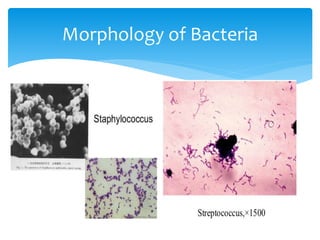
 Bacteria have characteristic shapes .
 Can be classified into these basic groups:
 Cocci (spherical)
 Bacilli (rod shaped)
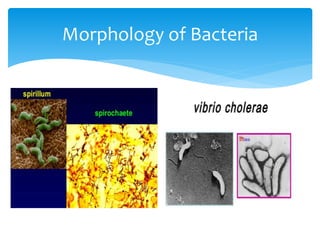
 Spirochetes (spiral)
 Vibrio (coma shaped)
Morphology of Bacteria
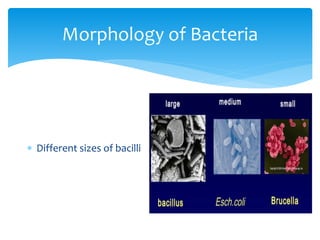
 Different sizes of bacilli
Morphology of Bacteria
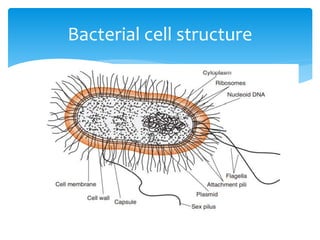
Bacterial cell structure
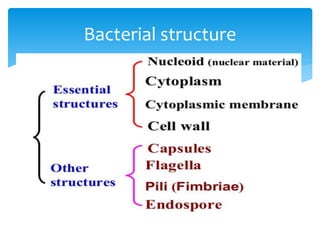
Bacterial structure
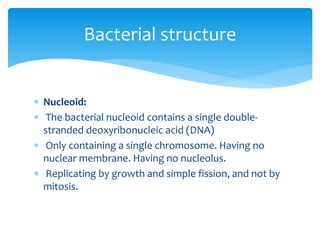
 Nucleoid:
 The bacterial nucleoid contains a single double-
stranded deoxyribonucleic acid (DNA)
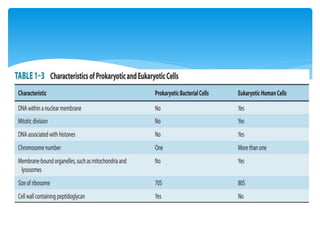
 Only containing a single chromosome. Having no
nuclear membrane. Having no nucleolus.
 Replicating by growth and simple fission, and not by
mitosis.
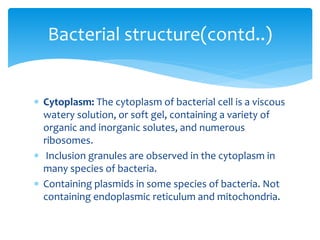
Bacterial structure
 Cytoplasm: The cytoplasm of bacterial cell is a viscous
watery solution, or soft gel, containing a variety of
organic and inorganic solutes, and numerous
ribosomes.
 Inclusion granules are observed in the cytoplasm in
many species of bacteria.
 Containing plasmids in some species of bacteria. Not
containing endoplasmic reticulum and mitochondria.
Bacterial structure(contd..)
 Bacterial ribosomes:
 They are the site of protein synthesis as in eukaryotic
cells, but they differ from eukaryotic ribosomes in size
and chemical composition.
 Bacterial ribosomes are 70S in size, with 50S and 30S
subunits.
Bacterial structure(contd..)
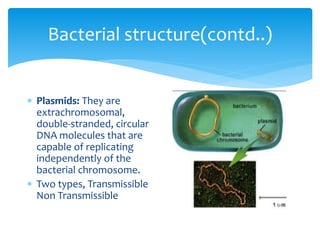
 Plasmids: They are
extrachromosomal,
double-stranded, circular
DNA molecules that are
capable of replicating
independently of the
bacterial chromosome.
 Two types, Transmissible
Non Transmissible
Functions of plasmids : Plasmids carry the genes for the
following functions and structures of medical importance.
 Antibiotic resistance
 Resistance to heavy metals, such as mercury and silver
 Resistance to ultraviolet light, which is mediated by DNA
repair enzymes.
 Pili (fimbriae)
 Exotoxins, including several enterotoxins
Bacterial structure(contd..)
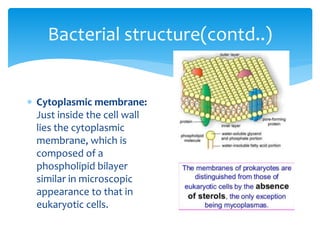
 Cytoplasmic membrane:
Just inside the cell wall
lies the cytoplasmic
membrane, which is
composed of a
phospholipid bilayer
similar in microscopic
appearance to that in
eukaryotic cells.
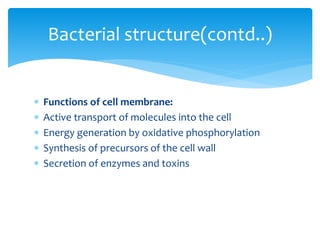
 Functions of cell membrane:
 Active transport of molecules into the cell
 Energy generation by oxidative phosphorylation
 Synthesis of precursors of the cell wall
 Secretion of enzymes and toxins
Bacterial structure(contd..)
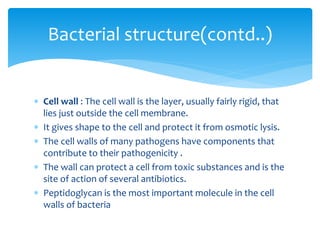
 Cell wall : The cell wall is the layer, usually fairly rigid, that
lies just outside the cell membrane.
 It gives shape to the cell and protect it from osmotic lysis.
 The cell walls of many pathogens have components that
contribute to their pathogenicity .
 The wall can protect a cell from toxic substances and is the
site of action of several antibiotics.
 Peptidoglycan is the most important molecule in the cell
walls of bacteria
Bacterial structure(contd..)
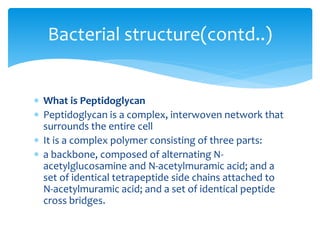
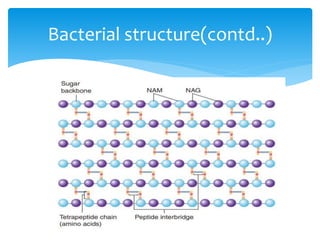
 What is Peptidoglycan
 Peptidoglycan is a complex, interwoven network that
surrounds the entire cell
 It is a complex polymer consisting of three parts:
 a backbone, composed of alternating N-
acetylglucosamine and N-acetylmuramic acid; and a
set of identical tetrapeptide side chains attached to
N-acetylmuramic acid; and a set of identical peptide
cross bridges.
Bacterial structure(contd..)
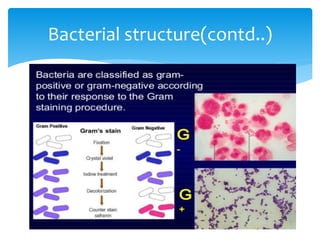
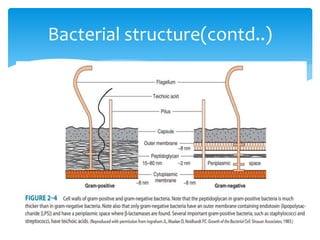
Cell walls of Gram positive and Gram negative bacteria
 In gram-positive bacteria, there are as many as 40
sheets of peptidoglycan, comprising up to 50% of the
cell wall material.
 In gram-negative bacteria, there appears to be only
one or two sheets, comprising 5~10% of the wall
material.
Bacterial structure(contd..)
Special components of Gram-Positive Cell Walls:
Teichoic Acids :These are water soluble polymers.
 Two types of teichoic acids: wall teichoic acid (WTA),
covalently linked to peptidoglycan, and membrane teichoic
acid, covalently linked to membrane glycolipids are called
lipoteichoic acids (LTA).
The medical importance of teichoic acids
 Induce septic shock when caused by certain gram positive
bacteria
 Teichoic acids also mediate the attachment of
staphylococci to mucosal cells.
Bacterial structure(contd..)
 Special components of Gram-negative Cell Walls
 An outer membrane containing lipopolysaccharide
(Lipid A + polysaccharide)which is an endotoxin and
responsible for endotoxic shock
 A periplasmic space where β-lactamases are found
 Peptidoglycan layer is very thin
Bacterial structure(contd..)
Structures outside the cell wall
 Capsule
 Flagella
 Pili (Fimbriae)
 Glycocalyx (slime layer)
Bacterial structure(contd..)
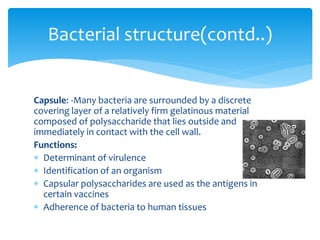
Capsule: -Many bacteria are surrounded by a discrete
covering layer of a relatively firm gelatinous material
composed of polysaccharide that lies outside and
immediately in contact with the cell wall.
Functions:
 Determinant of virulence
 Identification of an organism
 Capsular polysaccharides are used as the antigens in
certain vaccines
 Adherence of bacteria to human tissues
Bacterial structure(contd..)
Flagella: Flagella are long, whip like appendages that
help in the movement of bacteria.
They are composed of many subunits of protein
flagellin.
Medical Importance:
 Flagella may play a role in pathogenesis by propelling
the bacteria towards the site of infection e.g. E. coli
and Proteus species (common pathogens of UTI).
 Identification of bacteria e.g. Salmonella species
Bacterial structure(contd..)
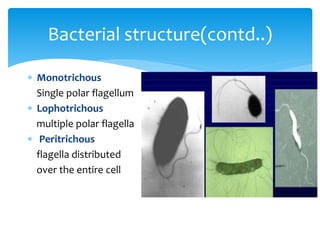
 Monotrichous
Single polar flagellum
 Lophotrichous
multiple polar flagella
 Peritrichous
flagella distributed
over the entire cell
Bacterial structure(contd..)
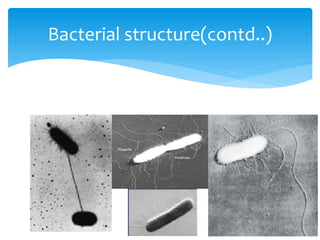
 Pili (Fimbriae): Many gram-negative bacteria possess rigid
surface appendages called pili (L "hairs") or fimbriae (L
"fringes"). They are shorter and finer than flagella; they are
composed of structural protein subunits termed pilins.
Two types
 Ordinary pili (used for attachment)
 Sex pili (forms the attachment between the male (donor)
and the female (recipient) bacteria during conjugation) .
Bacterial structure(contd..)
Bacterial cell structure and functions.pptx

Bacterial cell structure and functions.pptx

  • 1.
    Bacterial cell structure andfunctions Dr. Rabia Sadaf Assistant Professor Pathology
  • 2.
     My studentswill be able to identify shapes of bacteria.  They can describe different parts of bacterial cell and their functions.  They can also understand the differences between gram positive and gram negative bacterial cell wall. Learning Objectives
  • 3.
     Bacteria havecharacteristic shapes .  Can be classified into these basic groups:  Cocci (spherical)  Bacilli (rod shaped)  Spirochetes (spiral)  Vibrio (coma shaped) Morphology of Bacteria
  • 4.
  • 5.
    Morphology of Bacteria Different sizes of bacilli
  • 6.
  • 8.
  • 9.
  • 10.
     Nucleoid:  Thebacterial nucleoid contains a single double- stranded deoxyribonucleic acid (DNA)  Only containing a single chromosome. Having no nuclear membrane. Having no nucleolus.  Replicating by growth and simple fission, and not by mitosis. Bacterial structure
  • 11.
     Cytoplasm: Thecytoplasm of bacterial cell is a viscous watery solution, or soft gel, containing a variety of organic and inorganic solutes, and numerous ribosomes.  Inclusion granules are observed in the cytoplasm in many species of bacteria.  Containing plasmids in some species of bacteria. Not containing endoplasmic reticulum and mitochondria. Bacterial structure(contd..)
  • 12.
     Bacterial ribosomes: They are the site of protein synthesis as in eukaryotic cells, but they differ from eukaryotic ribosomes in size and chemical composition.  Bacterial ribosomes are 70S in size, with 50S and 30S subunits. Bacterial structure(contd..)
  • 13.
    Bacterial structure(contd..)  Plasmids:They are extrachromosomal, double-stranded, circular DNA molecules that are capable of replicating independently of the bacterial chromosome.  Two types, Transmissible Non Transmissible
  • 14.
    Functions of plasmids: Plasmids carry the genes for the following functions and structures of medical importance.  Antibiotic resistance  Resistance to heavy metals, such as mercury and silver  Resistance to ultraviolet light, which is mediated by DNA repair enzymes.  Pili (fimbriae)  Exotoxins, including several enterotoxins Bacterial structure(contd..)
  • 15.
    Bacterial structure(contd..)  Cytoplasmicmembrane: Just inside the cell wall lies the cytoplasmic membrane, which is composed of a phospholipid bilayer similar in microscopic appearance to that in eukaryotic cells.
  • 16.
     Functions ofcell membrane:  Active transport of molecules into the cell  Energy generation by oxidative phosphorylation  Synthesis of precursors of the cell wall  Secretion of enzymes and toxins Bacterial structure(contd..)
  • 17.
     Cell wall: The cell wall is the layer, usually fairly rigid, that lies just outside the cell membrane.  It gives shape to the cell and protect it from osmotic lysis.  The cell walls of many pathogens have components that contribute to their pathogenicity .  The wall can protect a cell from toxic substances and is the site of action of several antibiotics.  Peptidoglycan is the most important molecule in the cell walls of bacteria Bacterial structure(contd..)
  • 18.
  • 19.
     What isPeptidoglycan  Peptidoglycan is a complex, interwoven network that surrounds the entire cell  It is a complex polymer consisting of three parts:  a backbone, composed of alternating N- acetylglucosamine and N-acetylmuramic acid; and a set of identical tetrapeptide side chains attached to N-acetylmuramic acid; and a set of identical peptide cross bridges. Bacterial structure(contd..)
  • 20.
  • 21.
    Cell walls ofGram positive and Gram negative bacteria  In gram-positive bacteria, there are as many as 40 sheets of peptidoglycan, comprising up to 50% of the cell wall material.  In gram-negative bacteria, there appears to be only one or two sheets, comprising 5~10% of the wall material. Bacterial structure(contd..)
  • 22.
  • 23.
    Special components ofGram-Positive Cell Walls: Teichoic Acids :These are water soluble polymers.  Two types of teichoic acids: wall teichoic acid (WTA), covalently linked to peptidoglycan, and membrane teichoic acid, covalently linked to membrane glycolipids are called lipoteichoic acids (LTA). The medical importance of teichoic acids  Induce septic shock when caused by certain gram positive bacteria  Teichoic acids also mediate the attachment of staphylococci to mucosal cells. Bacterial structure(contd..)
  • 24.
     Special componentsof Gram-negative Cell Walls  An outer membrane containing lipopolysaccharide (Lipid A + polysaccharide)which is an endotoxin and responsible for endotoxic shock  A periplasmic space where β-lactamases are found  Peptidoglycan layer is very thin Bacterial structure(contd..)
  • 25.
    Structures outside thecell wall  Capsule  Flagella  Pili (Fimbriae)  Glycocalyx (slime layer) Bacterial structure(contd..)
  • 26.
    Capsule: -Many bacteriaare surrounded by a discrete covering layer of a relatively firm gelatinous material composed of polysaccharide that lies outside and immediately in contact with the cell wall. Functions:  Determinant of virulence  Identification of an organism  Capsular polysaccharides are used as the antigens in certain vaccines  Adherence of bacteria to human tissues Bacterial structure(contd..)
  • 27.
    Flagella: Flagella arelong, whip like appendages that help in the movement of bacteria. They are composed of many subunits of protein flagellin. Medical Importance:  Flagella may play a role in pathogenesis by propelling the bacteria towards the site of infection e.g. E. coli and Proteus species (common pathogens of UTI).  Identification of bacteria e.g. Salmonella species Bacterial structure(contd..)
  • 28.
     Monotrichous Single polarflagellum  Lophotrichous multiple polar flagella  Peritrichous flagella distributed over the entire cell Bacterial structure(contd..)
  • 29.
     Pili (Fimbriae):Many gram-negative bacteria possess rigid surface appendages called pili (L "hairs") or fimbriae (L "fringes"). They are shorter and finer than flagella; they are composed of structural protein subunits termed pilins. Two types  Ordinary pili (used for attachment)  Sex pili (forms the attachment between the male (donor) and the female (recipient) bacteria during conjugation) . Bacterial structure(contd..)
  • 30.
  • 31.

Editor's Notes

  • #12 Inclusion granules are an excess metabolite stored as a nutrient reserve. 
  • #13 eukaryotic ribosomes are 80S in size, with 60S and 40S subunits.
  • #29 Three types of arrangement are known: monotrichous (single polar flagellum), lophotrichous (multiple polar flagella), and peritrichous (flagella distributed over the entire cell).
  • #30 Mutants of Neisseria gonorrhoeae that do not form pili are nonpathogens.