© Tech Mahindra 2013© Mahindra Satyam 2012
© Tech Mahindra 2013
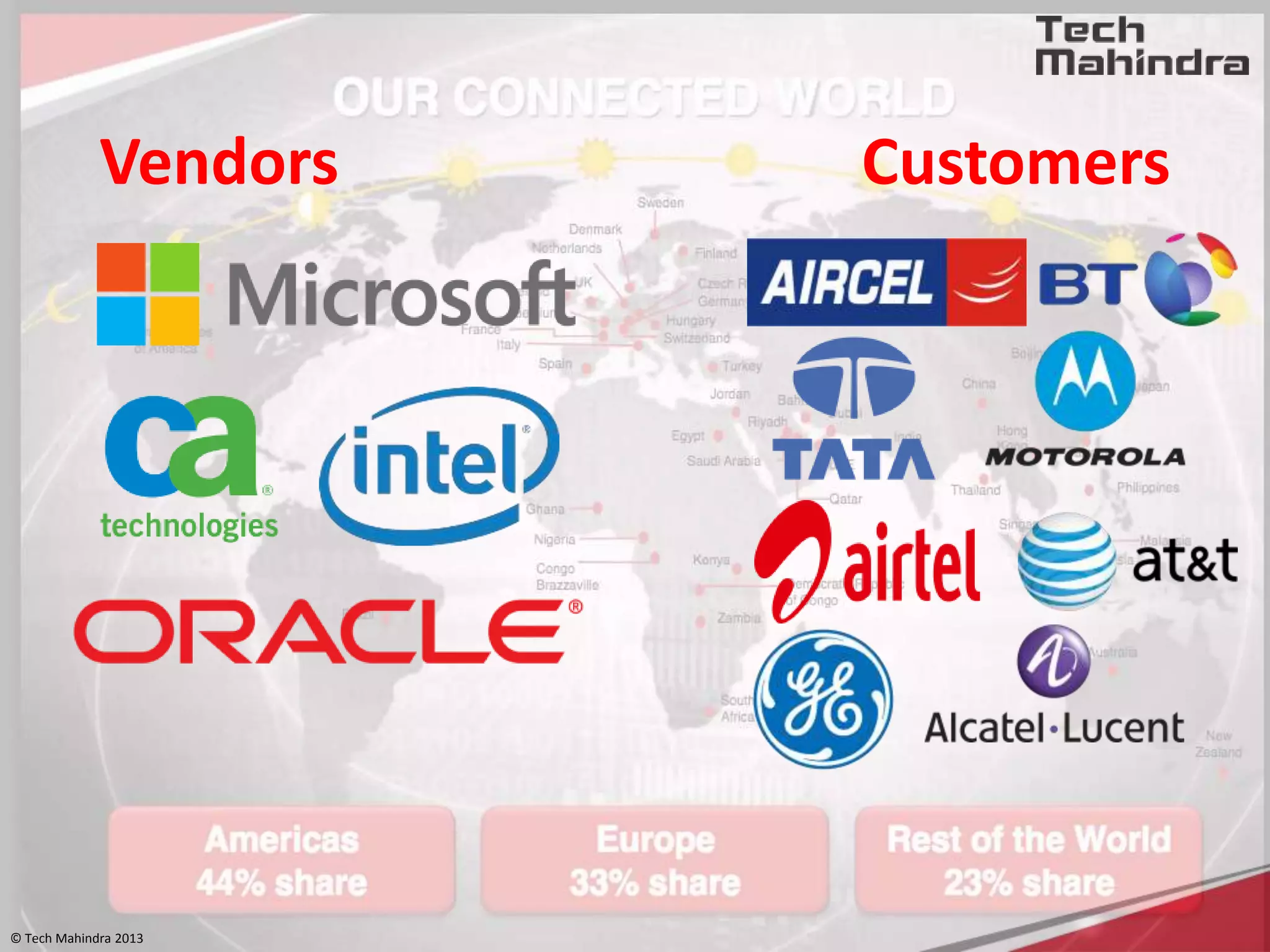
Vendors Customers
© Tech Mahindra 2013
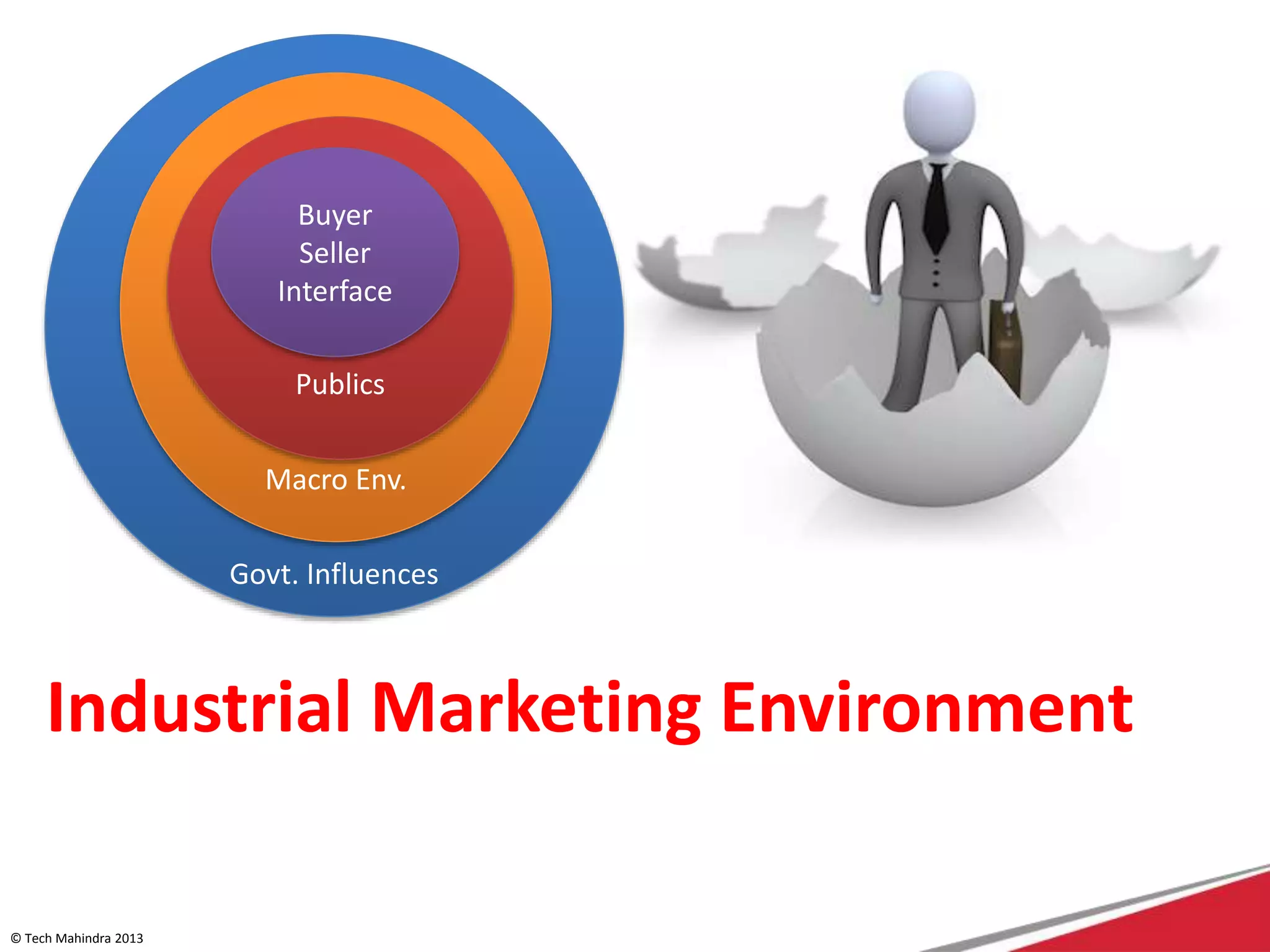
Industrial Marketing Environment
Govt. Influences
Macro Env.
Publics
Buyer
Seller
Interface
© Tech Mahindra 2013
Buyer Seller Dyad
© Tech Mahindra 2013
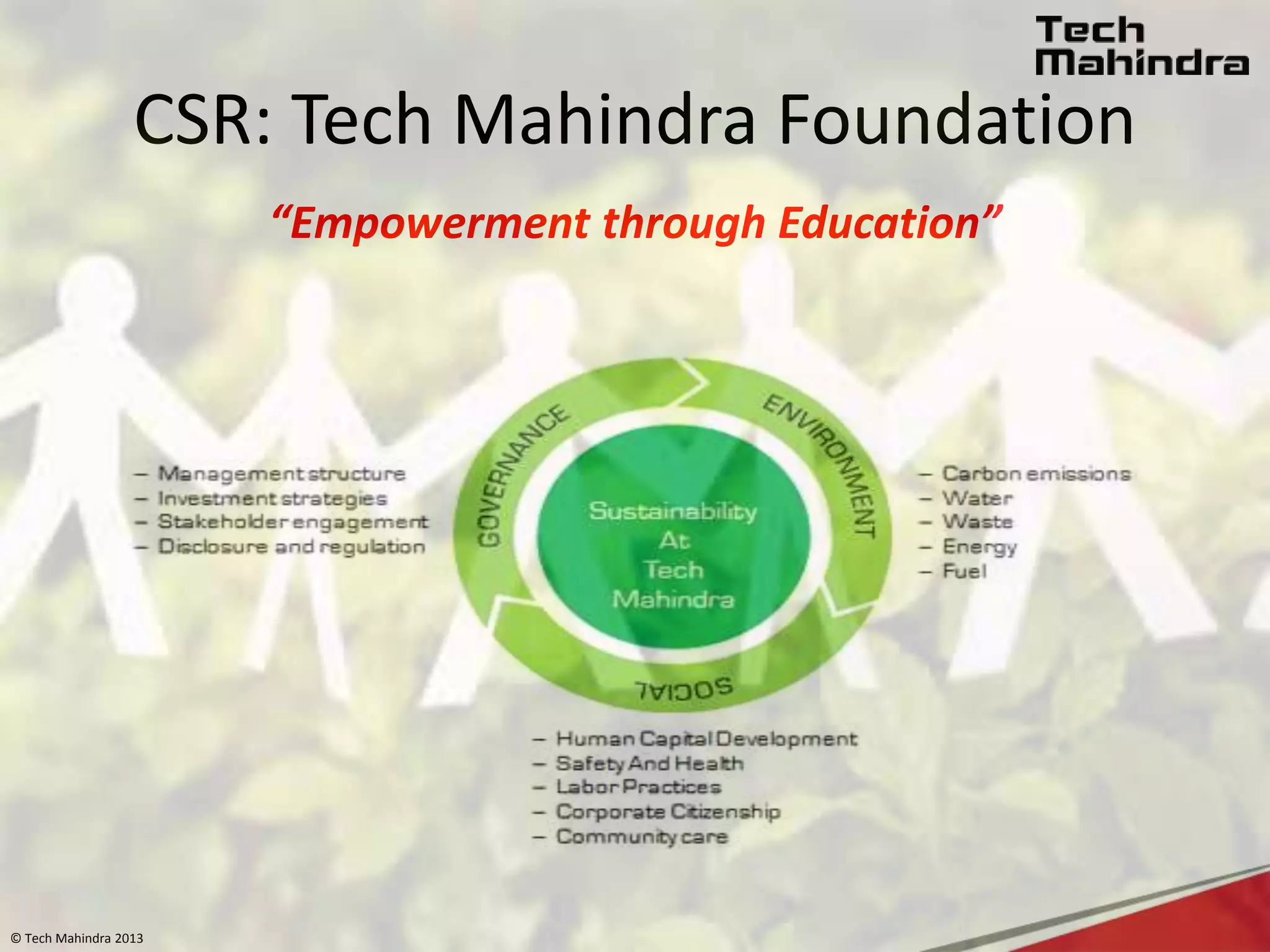
CSR: Tech Mahindra Foundation
“Empowerment through Education”
© Tech Mahindra 2013
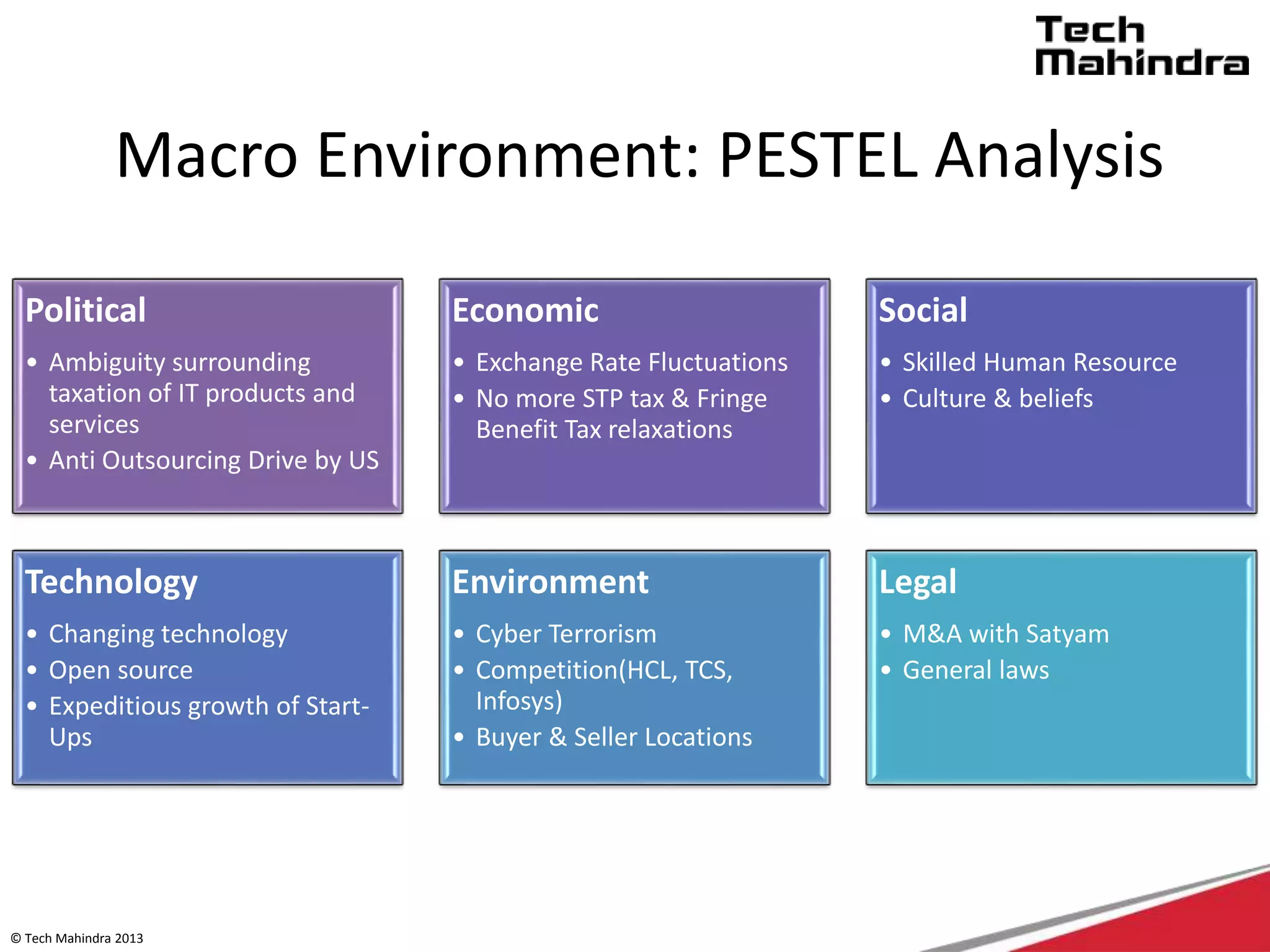
Macro Environment: PESTEL Analysis
Political
• Ambiguity surrounding
taxation of IT products and
services
• Anti Outsourcing Drive by US
Economic
• Exchange Rate Fluctuations
• No more STP tax & Fringe
Benefit Tax relaxations
Social
• Skilled Human Resource
• Culture & beliefs
Technology
• Changing technology
• Open source
• Expeditious growth of Start-
Ups
Environment
• Cyber Terrorism
• Competition(HCL, TCS,
Infosys)
• Buyer & Seller Locations
Legal
• M&A with Satyam
• General laws
© Tech Mahindra 2013
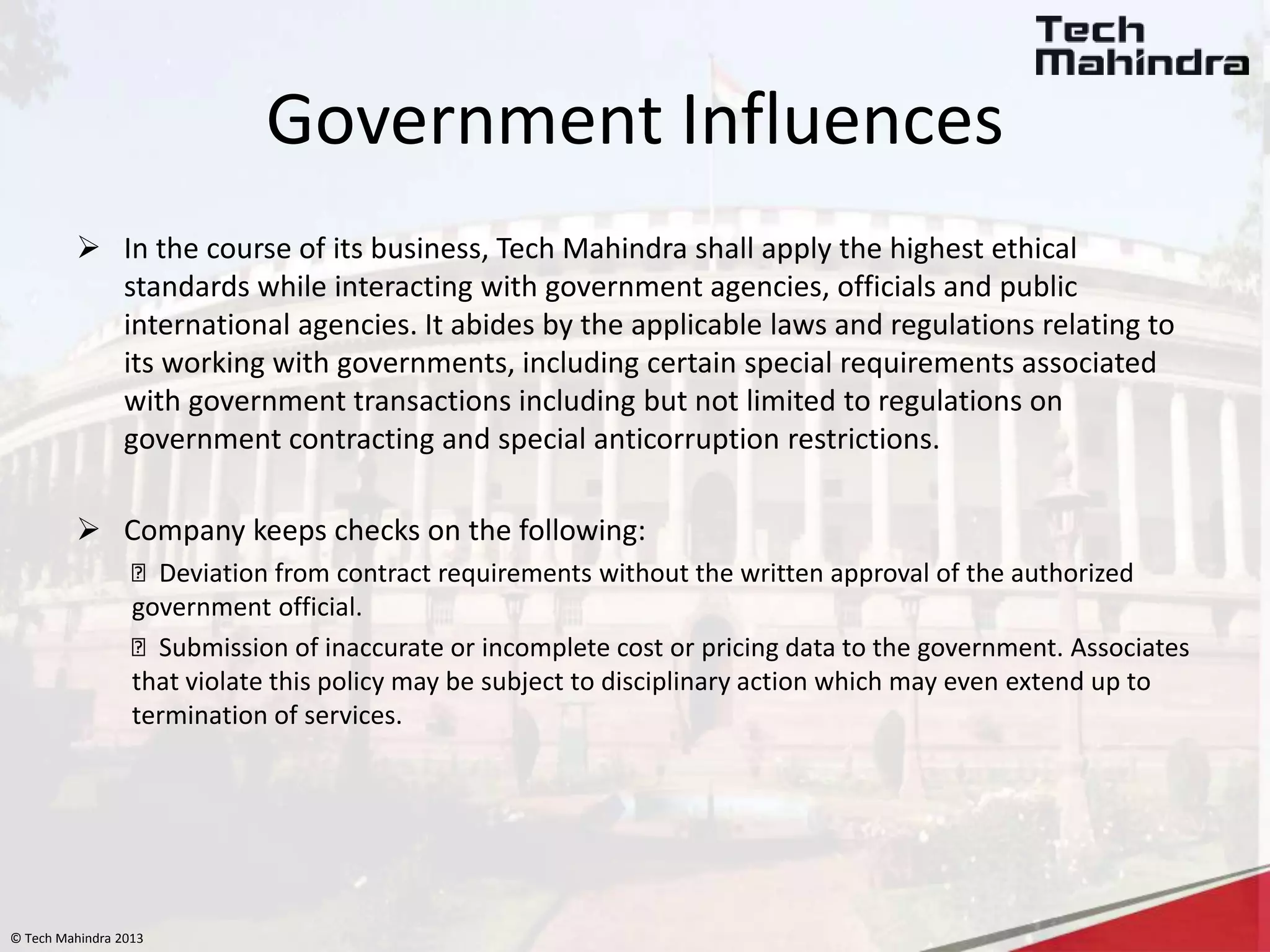
Government Influences
 In the course of its business, Tech Mahindra shall apply the highest ethical
standards while interacting with government agencies, officials and public
international agencies. It abides by the applicable laws and regulations relating to
its working with governments, including certain special requirements associated
with government transactions including but not limited to regulations on
government contracting and special anticorruption restrictions.
 Company keeps checks on the following:
Deviation from contract requirements without the written approval of the authorized
government official.
Submission of inaccurate or incomplete cost or pricing data to the government. Associates
that violate this policy may be subject to disciplinary action which may even extend up to
termination of services.
© Tech Mahindra 2013
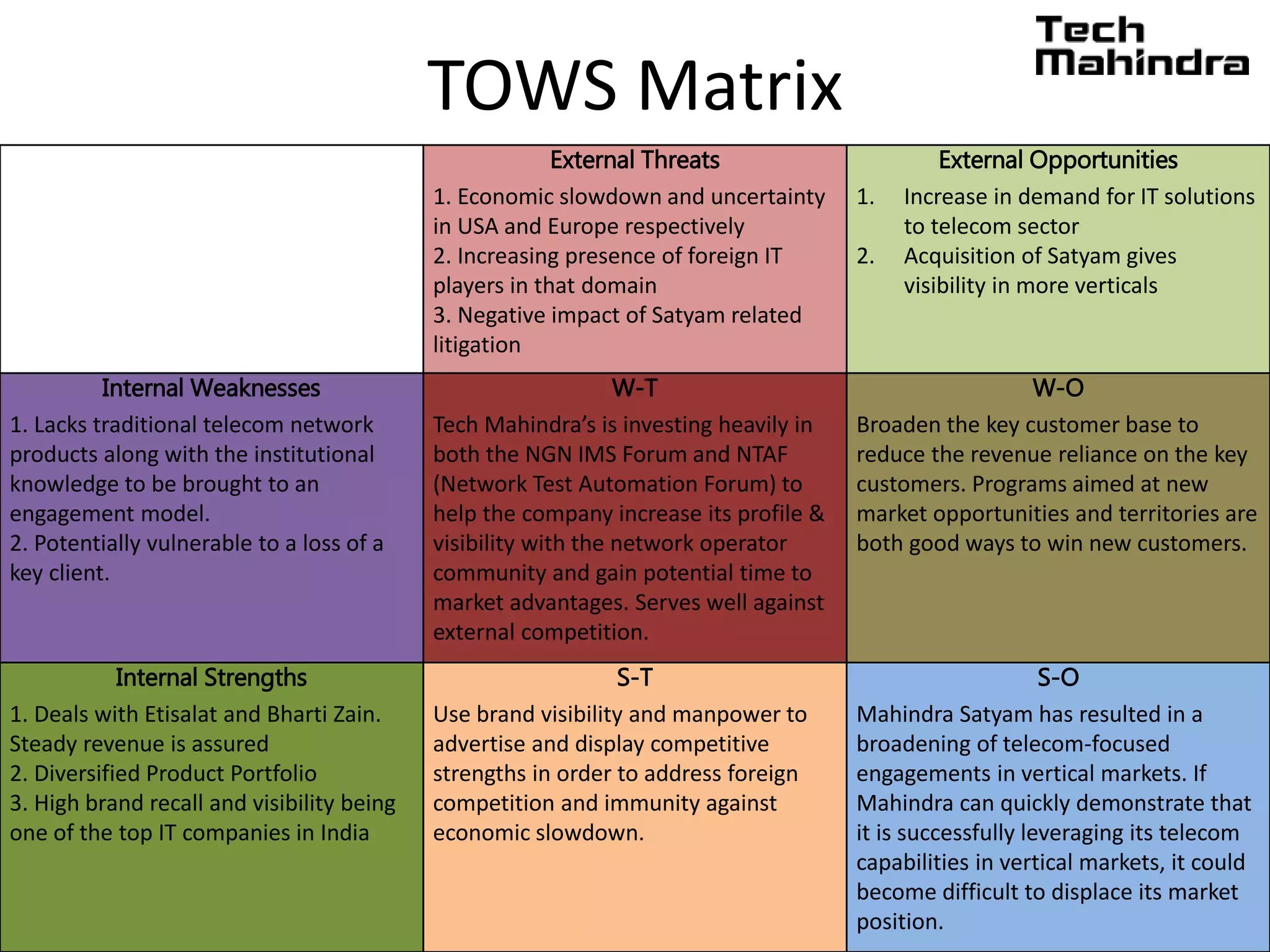
TOWS Matrix
External Threats
1. Economic slowdown and uncertainty
in USA and Europe respectively
2. Increasing presence of foreign IT
players in that domain
3. Negative impact of Satyam related
litigation
External Opportunities
1. Increase in demand for IT solutions
to telecom sector
2. Acquisition of Satyam gives
visibility in more verticals
Internal Weaknesses
1. Lacks traditional telecom network
products along with the institutional
knowledge to be brought to an
engagement model.
2. Potentially vulnerable to a loss of a
key client.
W-T
Tech Mahindra’s is investing heavily in
both the NGN IMS Forum and NTAF
(Network Test Automation Forum) to
help the company increase its profile &
visibility with the network operator
community and gain potential time to
market advantages. Serves well against
external competition.
W-O
Broaden the key customer base to
reduce the revenue reliance on the key
customers. Programs aimed at new
market opportunities and territories are
both good ways to win new customers.
Internal Strengths
1. Deals with Etisalat and Bharti Zain.
Steady revenue is assured
2. Diversified Product Portfolio
3. High brand recall and visibility being
one of the top IT companies in India
S-T
Use brand visibility and manpower to
advertise and display competitive
strengths in order to address foreign
competition and immunity against
economic slowdown.
S-O
Mahindra Satyam has resulted in a
broadening of telecom-focused
engagements in vertical markets. If
Mahindra can quickly demonstrate that
it is successfully leveraging its telecom
capabilities in vertical markets, it could
become difficult to displace its market
position.
© Tech Mahindra 2013
Buy Grid Model
© Tech Mahindra 2013
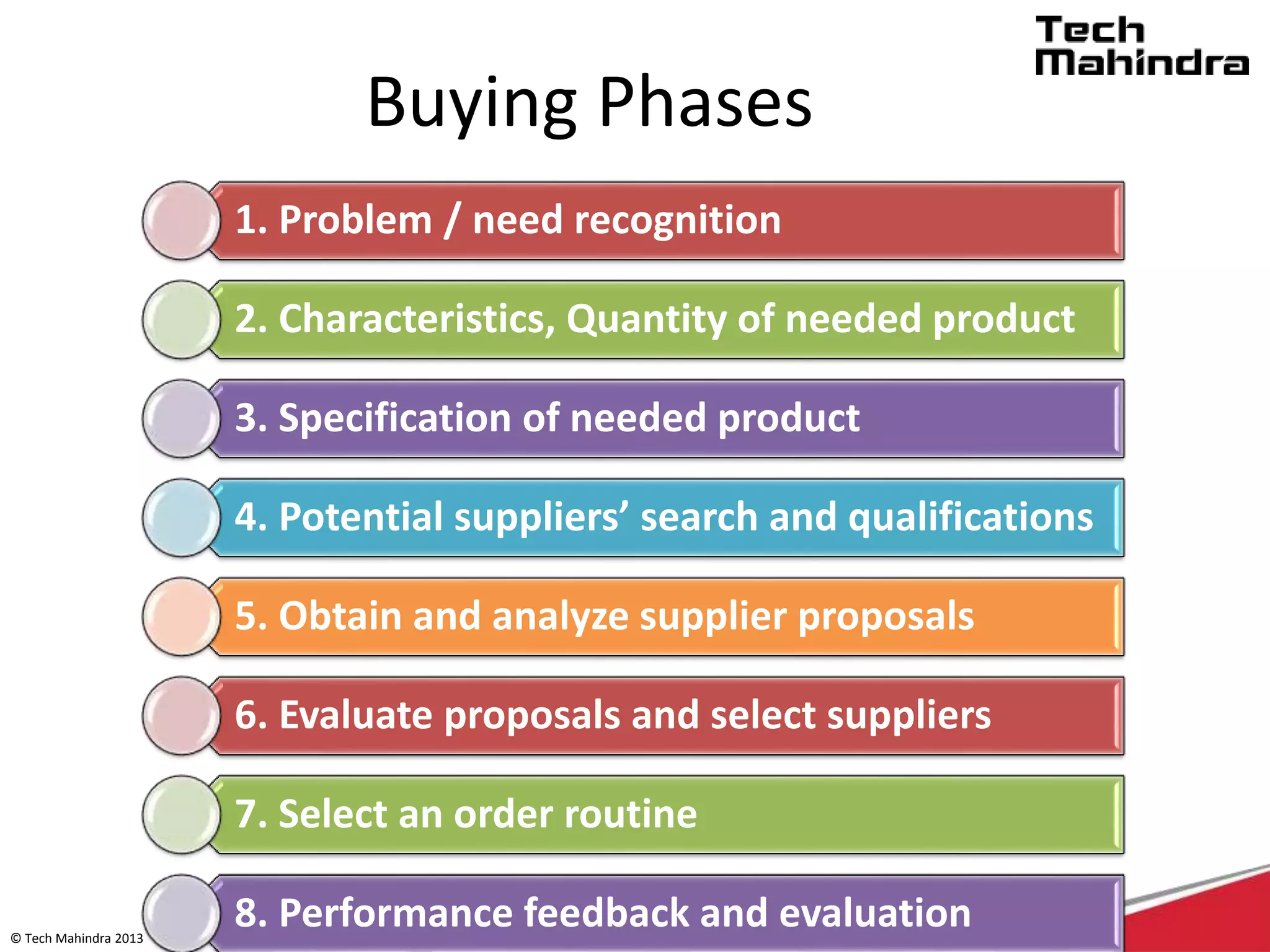
Buying Phases
1. Problem / need recognition
2. Characteristics, Quantity of needed product
3. Specification of needed product
4. Potential suppliers’ search and qualifications
5. Obtain and analyze supplier proposals
6. Evaluate proposals and select suppliers
7. Select an order routine
8. Performance feedback and evaluation
© Tech Mahindra 2013
Buying Situation – Modified Rebuy
Before
PeopleSoft 9
SPARC T2 and
T3 servers
Oracle Exadata
Database
Machine X2-2
After
PeopleSoft 9.2
SPARC T5-4
server
Oracle Exadata
Database
Machine X4-2
© Tech Mahindra 2013
Sheth Model
© Tech Mahindra 2013
Segmentation, Targeting & Positioning
© Tech Mahindra 2013
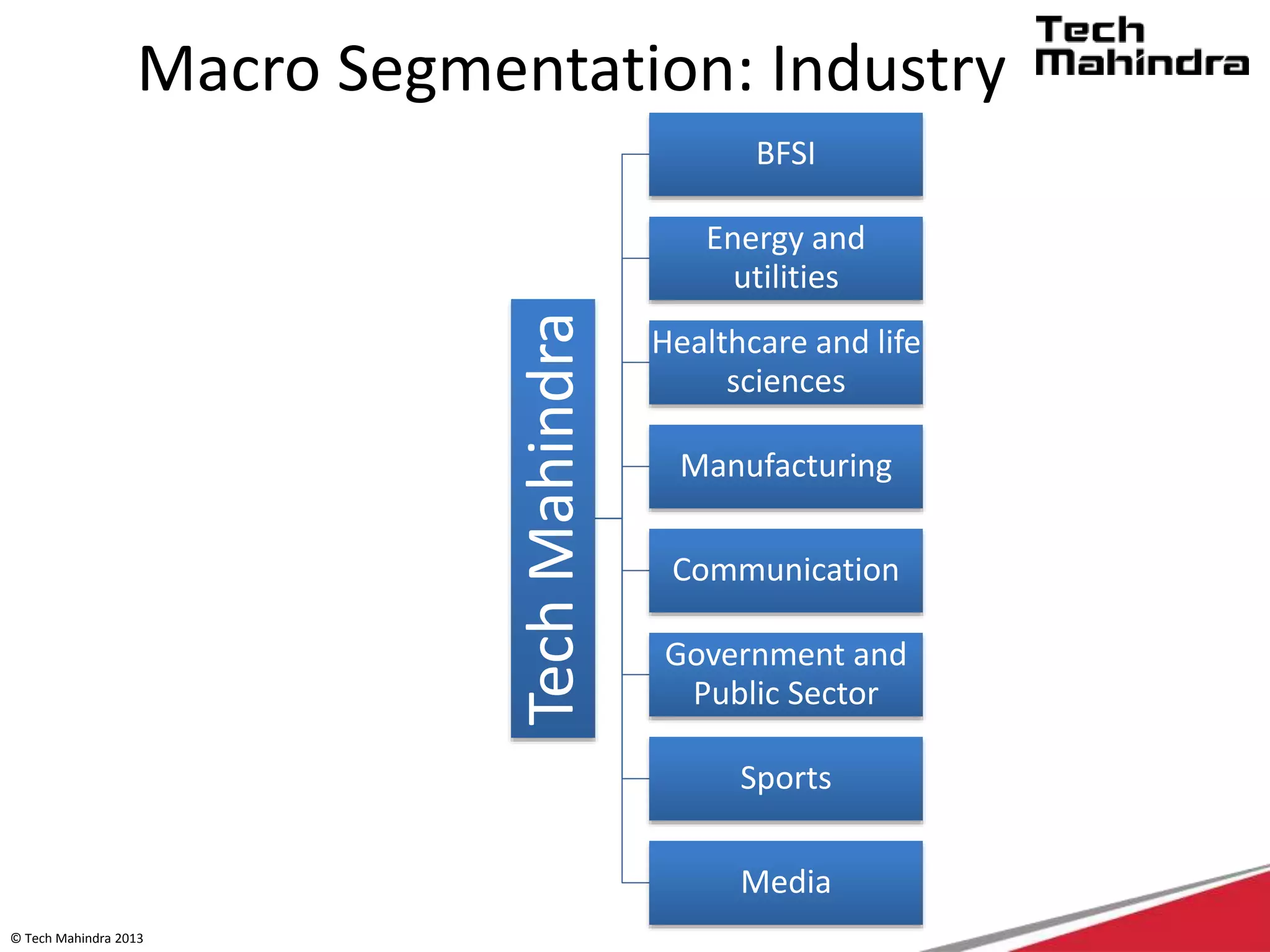
Macro Segmentation: Industry
TechMahindra
BFSI
Energy and
utilities
Healthcare and life
sciences
Manufacturing
Communication
Government and
Public Sector
Sports
Media
© Tech Mahindra 2013
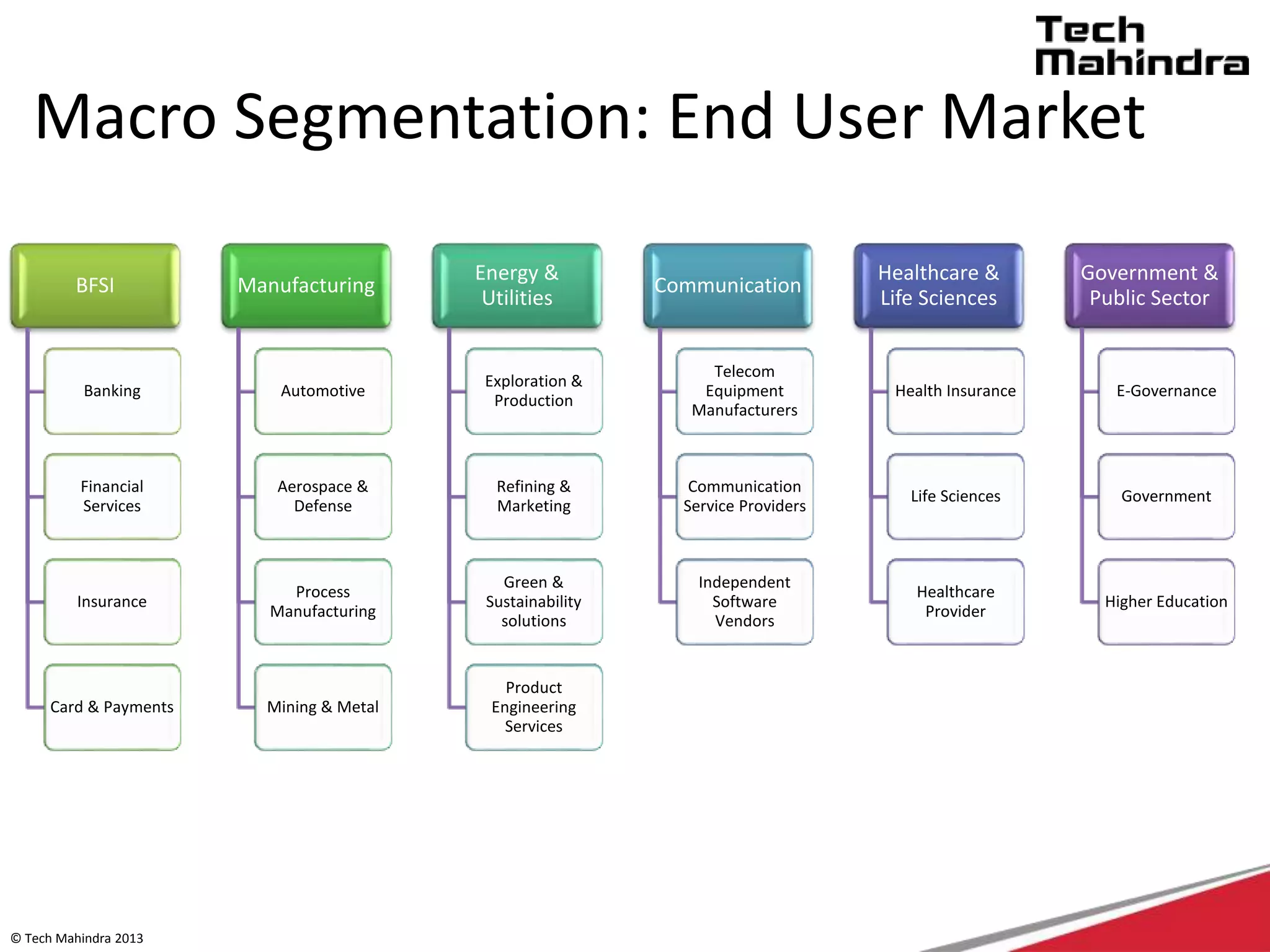
BFSI
Banking
Financial
Services
Insurance
Card & Payments
Manufacturing
Automotive
Aerospace &
Defense
Process
Manufacturing
Mining & Metal
Energy &
Utilities
Exploration &
Production
Refining &
Marketing
Green &
Sustainability
solutions
Product
Engineering
Services
Communication
Telecom
Equipment
Manufacturers
Communication
Service Providers
Independent
Software
Vendors
Healthcare &
Life Sciences
Health Insurance
Life Sciences
Healthcare
Provider
Government &
Public Sector
E-Governance
Government
Higher Education
Macro Segmentation: End User Market
© Tech Mahindra 2013
Big Data
Cloud
Computing
Content
Delivery
Networks
Device Testing
and
Certification
Digital
Enterprise
Services
Green and
Sustainability
Solutions
Long term
Evolution
Internet of
things
New
Generation
Supply Chain
Smart Grid
Spend
Management
Systems
Macro Segmentation : Product Application
© Tech Mahindra 2013
Micro Segmentation
Organizational
Variables
Purchasing situation
Phases
Customer Experience
stage
Customer interaction
Product innovativeness
Organizational
capabilities
Purchase Situation
Variables
Inventory requirements
Purchase importance
Purchasing policies
Purchasing criteria
Structure of buying
center
Individual
variables
Personal
characteristics
Power structure
© Tech Mahindra 2013
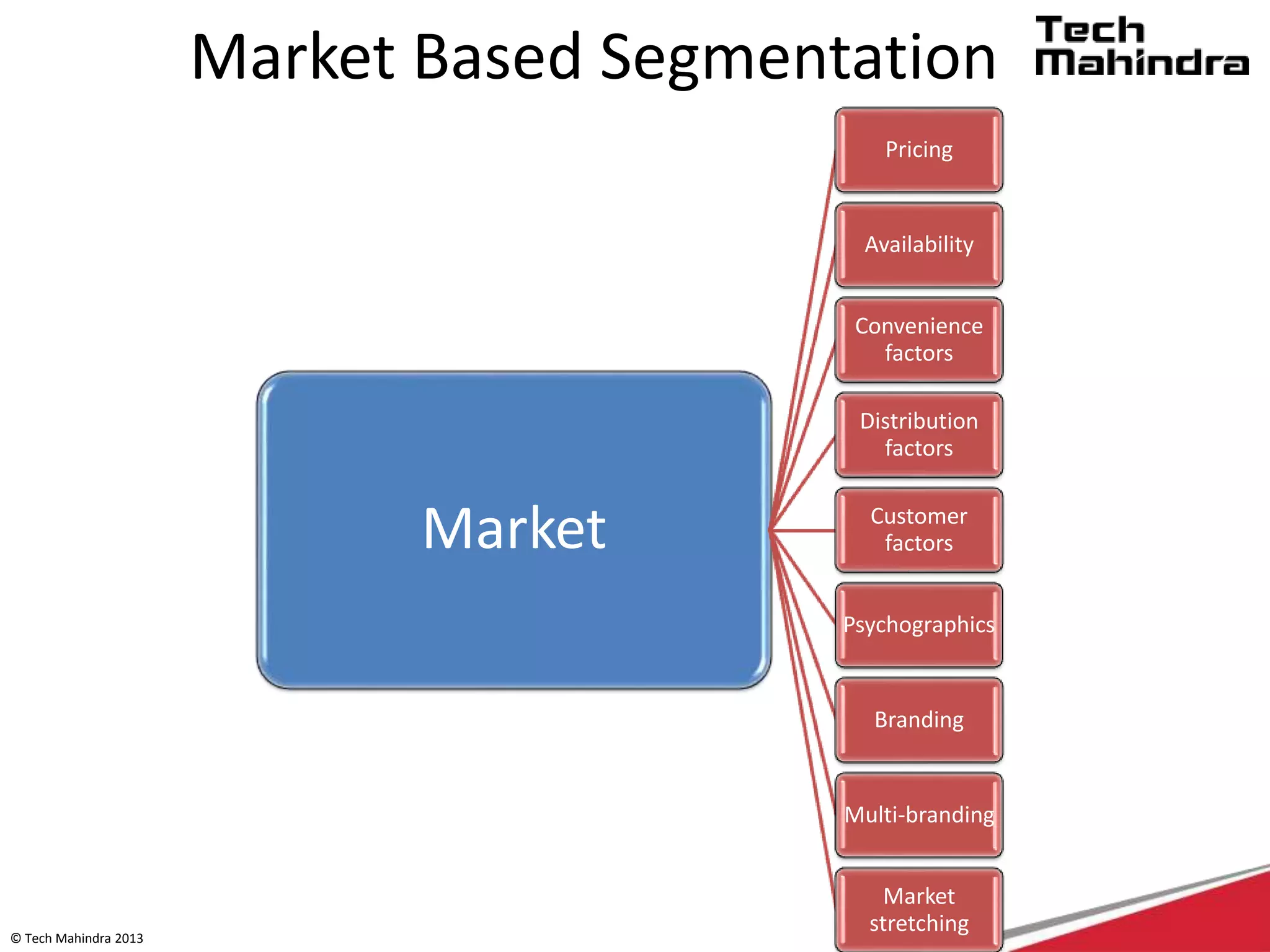
Market Based Segmentation
Market
Pricing
Availability
Convenience
factors
Distribution
factors
Customer
factors
Psychographics
Branding
Multi-branding
Market
stretching
© Tech Mahindra 2013
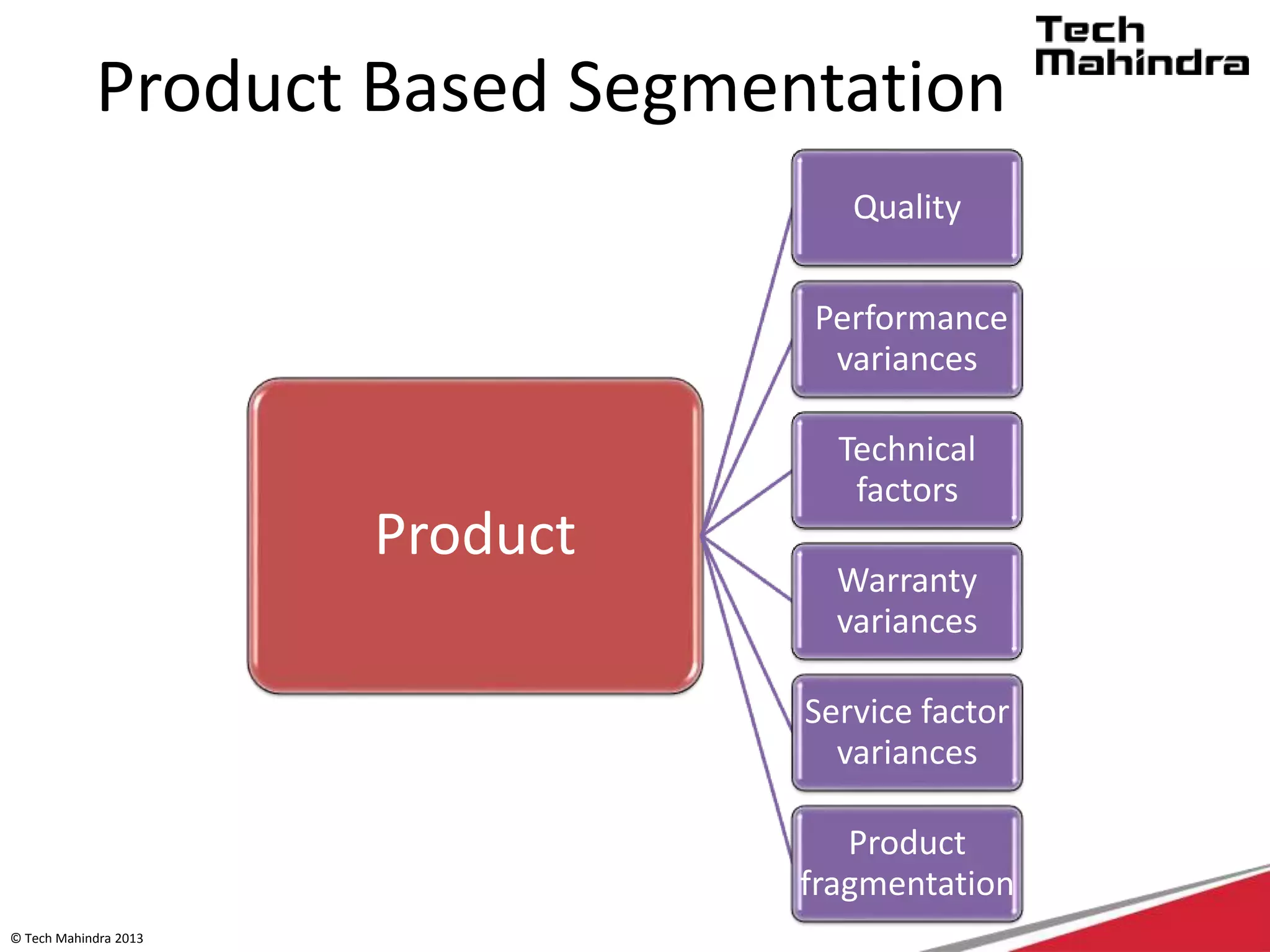
Product Based Segmentation
Product
Quality
Performance
variances
Technical
factors
Warranty
variances
Service factor
variances
Product
fragmentation
© Tech Mahindra 2013
Differentiated Targeting
M1 - BFSI M2 – Energy &
Utilities
M3 -
Manufacturing
P1 – FATCA
solution
P2 – Water
Lifecycle
Management
P3 -
Commodity
Trading & Risk
Management
© Tech Mahindra 2013
Undifferentiated Targeting (
Manufacturing Industry)
M1 –
Automotive
M2 –
Aerospace and
Defense
M3 – Process
Manufacturing
P1 – Digital
Marketing
P2 – Technical
Publications
P3 – Analytics
© Tech Mahindra 2013
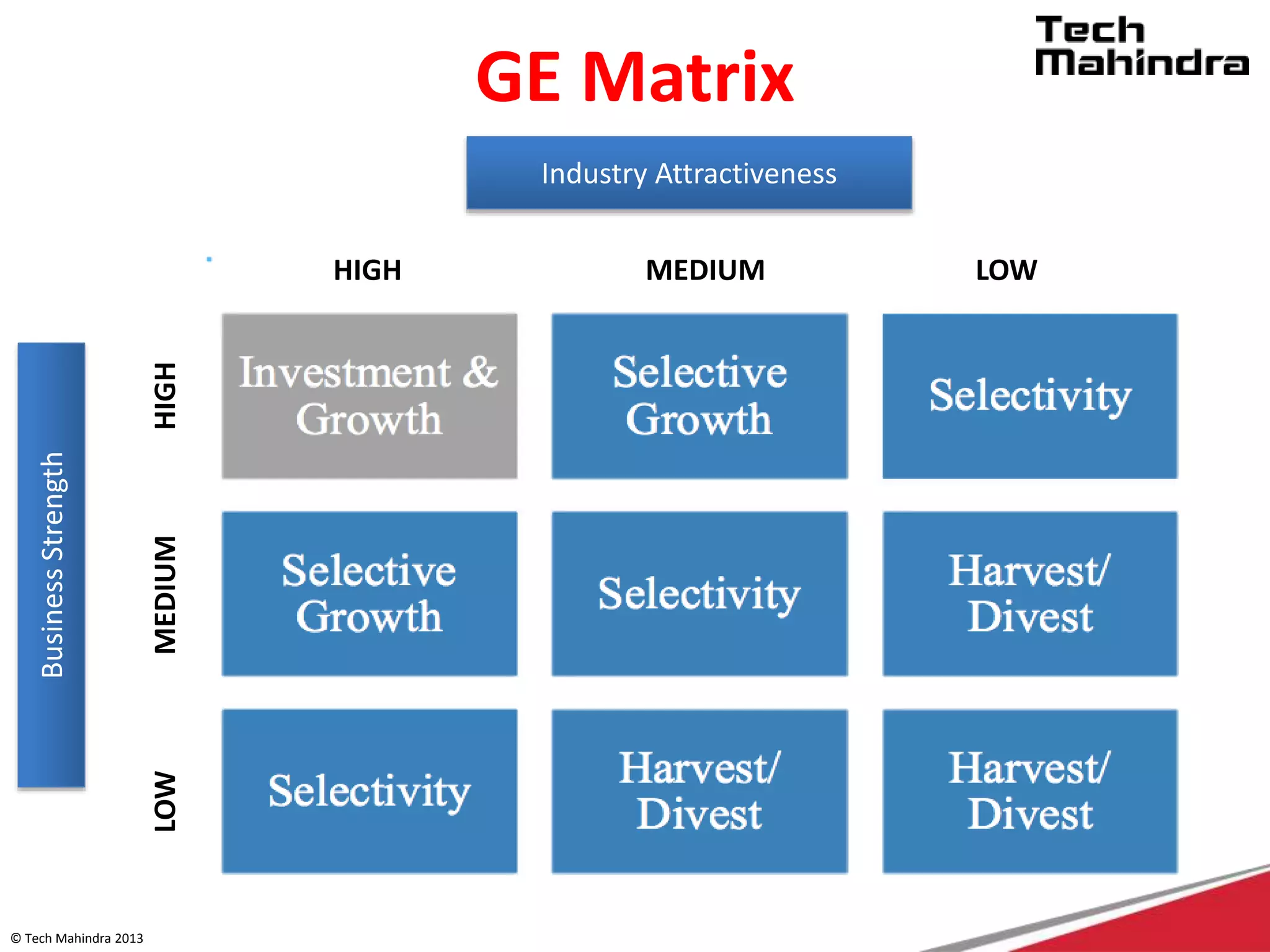
GE Matrix
Industry Attractiveness
BusinessStrength
HIGH MEDIUM LOW
LOWMEDIUMHIGH
© Tech Mahindra 2013
Diversification
© Tech Mahindra 2013
Mahindra group launches
‘Mobomoney’, india’s first
contact-less digital payment
ecosystem
Tech Mahindra and WSJ.
Custom studios launch ‘in the
future’ digital and print
Tech Mahindra and
Metricstream announce
global partnership with
launch of GRC center of
excellence
Mahindra genze and AT&T
bring IOT capabilities to two-
wheel transportation
Tech Mahindra takes Grameen
Koota live with temenos T24,
boosting delivery of financial
services to low-income
households
Tech Mahindra launches
AQTTM, the future of
automation AQTTM framework
impacts process, quality, user
experience, time-to-market
and cost-to-deliver.
© Tech Mahindra 2013
© Tech Mahindra 2013© Mahindra Satyam 2012
Shubham Gupta (J016)
Bhumil Kamdar (J020)
Dhruv Mahajan (J023)
Ayush Shah (J035)
Manav Sheth (J038)
Mangalam Singhal (J039)
Abishek Kumar (J043)

B2B for Tech Mahindra

  • 1.
    © Tech Mahindra2013© Mahindra Satyam 2012
  • 2.
  • 3.
  • 4.
    © Tech Mahindra2013 Vendors Customers
  • 5.
    © Tech Mahindra2013 Industrial Marketing Environment Govt. Influences Macro Env. Publics Buyer Seller Interface
  • 6.
    © Tech Mahindra2013 Buyer Seller Dyad
  • 7.
    © Tech Mahindra2013 CSR: Tech Mahindra Foundation “Empowerment through Education”
  • 8.
    © Tech Mahindra2013 Macro Environment: PESTEL Analysis Political • Ambiguity surrounding taxation of IT products and services • Anti Outsourcing Drive by US Economic • Exchange Rate Fluctuations • No more STP tax & Fringe Benefit Tax relaxations Social • Skilled Human Resource • Culture & beliefs Technology • Changing technology • Open source • Expeditious growth of Start- Ups Environment • Cyber Terrorism • Competition(HCL, TCS, Infosys) • Buyer & Seller Locations Legal • M&A with Satyam • General laws
  • 9.
    © Tech Mahindra2013 Government Influences  In the course of its business, Tech Mahindra shall apply the highest ethical standards while interacting with government agencies, officials and public international agencies. It abides by the applicable laws and regulations relating to its working with governments, including certain special requirements associated with government transactions including but not limited to regulations on government contracting and special anticorruption restrictions.  Company keeps checks on the following: Deviation from contract requirements without the written approval of the authorized government official. Submission of inaccurate or incomplete cost or pricing data to the government. Associates that violate this policy may be subject to disciplinary action which may even extend up to termination of services.
  • 10.
    © Tech Mahindra2013 TOWS Matrix External Threats 1. Economic slowdown and uncertainty in USA and Europe respectively 2. Increasing presence of foreign IT players in that domain 3. Negative impact of Satyam related litigation External Opportunities 1. Increase in demand for IT solutions to telecom sector 2. Acquisition of Satyam gives visibility in more verticals Internal Weaknesses 1. Lacks traditional telecom network products along with the institutional knowledge to be brought to an engagement model. 2. Potentially vulnerable to a loss of a key client. W-T Tech Mahindra’s is investing heavily in both the NGN IMS Forum and NTAF (Network Test Automation Forum) to help the company increase its profile & visibility with the network operator community and gain potential time to market advantages. Serves well against external competition. W-O Broaden the key customer base to reduce the revenue reliance on the key customers. Programs aimed at new market opportunities and territories are both good ways to win new customers. Internal Strengths 1. Deals with Etisalat and Bharti Zain. Steady revenue is assured 2. Diversified Product Portfolio 3. High brand recall and visibility being one of the top IT companies in India S-T Use brand visibility and manpower to advertise and display competitive strengths in order to address foreign competition and immunity against economic slowdown. S-O Mahindra Satyam has resulted in a broadening of telecom-focused engagements in vertical markets. If Mahindra can quickly demonstrate that it is successfully leveraging its telecom capabilities in vertical markets, it could become difficult to displace its market position.
  • 11.
    © Tech Mahindra2013 Buy Grid Model
  • 12.
  • 13.
    © Tech Mahindra2013 Buying Phases 1. Problem / need recognition 2. Characteristics, Quantity of needed product 3. Specification of needed product 4. Potential suppliers’ search and qualifications 5. Obtain and analyze supplier proposals 6. Evaluate proposals and select suppliers 7. Select an order routine 8. Performance feedback and evaluation
  • 14.
    © Tech Mahindra2013 Buying Situation – Modified Rebuy Before PeopleSoft 9 SPARC T2 and T3 servers Oracle Exadata Database Machine X2-2 After PeopleSoft 9.2 SPARC T5-4 server Oracle Exadata Database Machine X4-2
  • 15.
    © Tech Mahindra2013 Sheth Model
  • 16.
  • 17.
    © Tech Mahindra2013 Segmentation, Targeting & Positioning
  • 18.
    © Tech Mahindra2013 Macro Segmentation: Industry TechMahindra BFSI Energy and utilities Healthcare and life sciences Manufacturing Communication Government and Public Sector Sports Media
  • 19.
    © Tech Mahindra2013 BFSI Banking Financial Services Insurance Card & Payments Manufacturing Automotive Aerospace & Defense Process Manufacturing Mining & Metal Energy & Utilities Exploration & Production Refining & Marketing Green & Sustainability solutions Product Engineering Services Communication Telecom Equipment Manufacturers Communication Service Providers Independent Software Vendors Healthcare & Life Sciences Health Insurance Life Sciences Healthcare Provider Government & Public Sector E-Governance Government Higher Education Macro Segmentation: End User Market
  • 20.
    © Tech Mahindra2013 Big Data Cloud Computing Content Delivery Networks Device Testing and Certification Digital Enterprise Services Green and Sustainability Solutions Long term Evolution Internet of things New Generation Supply Chain Smart Grid Spend Management Systems Macro Segmentation : Product Application
  • 21.
    © Tech Mahindra2013 Micro Segmentation Organizational Variables Purchasing situation Phases Customer Experience stage Customer interaction Product innovativeness Organizational capabilities Purchase Situation Variables Inventory requirements Purchase importance Purchasing policies Purchasing criteria Structure of buying center Individual variables Personal characteristics Power structure
  • 22.
    © Tech Mahindra2013 Market Based Segmentation Market Pricing Availability Convenience factors Distribution factors Customer factors Psychographics Branding Multi-branding Market stretching
  • 23.
    © Tech Mahindra2013 Product Based Segmentation Product Quality Performance variances Technical factors Warranty variances Service factor variances Product fragmentation
  • 24.
    © Tech Mahindra2013 Differentiated Targeting M1 - BFSI M2 – Energy & Utilities M3 - Manufacturing P1 – FATCA solution P2 – Water Lifecycle Management P3 - Commodity Trading & Risk Management
  • 25.
    © Tech Mahindra2013 Undifferentiated Targeting ( Manufacturing Industry) M1 – Automotive M2 – Aerospace and Defense M3 – Process Manufacturing P1 – Digital Marketing P2 – Technical Publications P3 – Analytics
  • 26.
  • 27.
  • 28.
  • 29.
  • 30.
  • 31.
  • 32.
    © Tech Mahindra2013 GE Matrix Industry Attractiveness BusinessStrength HIGH MEDIUM LOW LOWMEDIUMHIGH
  • 33.
    © Tech Mahindra2013 Diversification
  • 34.
    © Tech Mahindra2013 Mahindra group launches ‘Mobomoney’, india’s first contact-less digital payment ecosystem Tech Mahindra and WSJ. Custom studios launch ‘in the future’ digital and print Tech Mahindra and Metricstream announce global partnership with launch of GRC center of excellence Mahindra genze and AT&T bring IOT capabilities to two- wheel transportation Tech Mahindra takes Grameen Koota live with temenos T24, boosting delivery of financial services to low-income households Tech Mahindra launches AQTTM, the future of automation AQTTM framework impacts process, quality, user experience, time-to-market and cost-to-deliver.
  • 35.
  • 36.
  • 37.
  • 38.
    © Tech Mahindra2013© Mahindra Satyam 2012 Shubham Gupta (J016) Bhumil Kamdar (J020) Dhruv Mahajan (J023) Ayush Shah (J035) Manav Sheth (J038) Mangalam Singhal (J039) Abishek Kumar (J043)

Editor's Notes

  • #7 Good communication is a key to successful marketing, and it is particularly important for positive personal selling results. The buyer-seller dyad is flexible and efficient, closes sales, and provides feedback.
  • #8 Mahindra Educational Institutions (MEI): School education, Employability & Technical Education    
  • #9 The present Tax benefits that the company is enjoying as a result of its ‘Software technology parks’ (STPs) will lapse by 31st march 2010. This will result in further reduction in income for Tech Mahindra. However this factor would be common for other I.T. companies as well.
  • #14 For over 10 years, Tech Mahindra had been using Oracle’s PeopleSoft applications to manage 80% of the company’s business processes, such as financials, purchasing, and human resources (HR). After a merger with Mahindra Satyam, Tech Mahindra faced the challenge of integrating up to 150 custom applications, 90% of them running on SQL servers. Low-levels of data visibility between the two companies caused delays in customer response times and diminished competitiveness. Tech Mahindra had a positive experience using PeopleSoft applications for over a decade and decided to upgrade to PeopleSoft 9 to take advantage of new functionality. The company also considered a range of hardware vendors, including Microsoft, IBM, HP, and Dell. It chose Oracle Exadata and the SPARC T5-4 server with Oracle Solaris 11 because Oracle offered a more cost-effective, high-performance, and scalable platform that would enable seamless integration with PeopleSoft applications.
  • #15 Purchase orientation: supply management Modified rebuy- Peoplesoft application to manage 80% of business processes such financials, purchasing, and HR (Over 10 yrs) Update to version 9.2 post satyam acquisition Vendors: IBM, Microsoft, HP ,Dell then oracle gave more cost effective high performance After a merger with Mahindra Satyam, Tech Mahindra faced the challenge of integrating up to 150 custom applications, 90% of them running on SQL servers. Low-levels of data visibility between the two companies caused delays in customer response times and diminished competitiveness. Tech Mahindra had a positive experience using PeopleSoft applications for over a decade and decided to upgrade to PeopleSoft 9 to take advantage of new functionality. The company also considered a range of hardware vendors, including Microsoft, IBM, HP, and Dell. It chose Oracle Exadata and the SPARC T5-4 server with Oracle Solaris 11 because Oracle offered a more cost-effective, high-performance, and scalable platform that would enable seamless integration with PeopleSoft applications. Sparc t2, t3, t5-4 servers from oracle
  • #16 Ved Prakash Nirbhaya - CIO
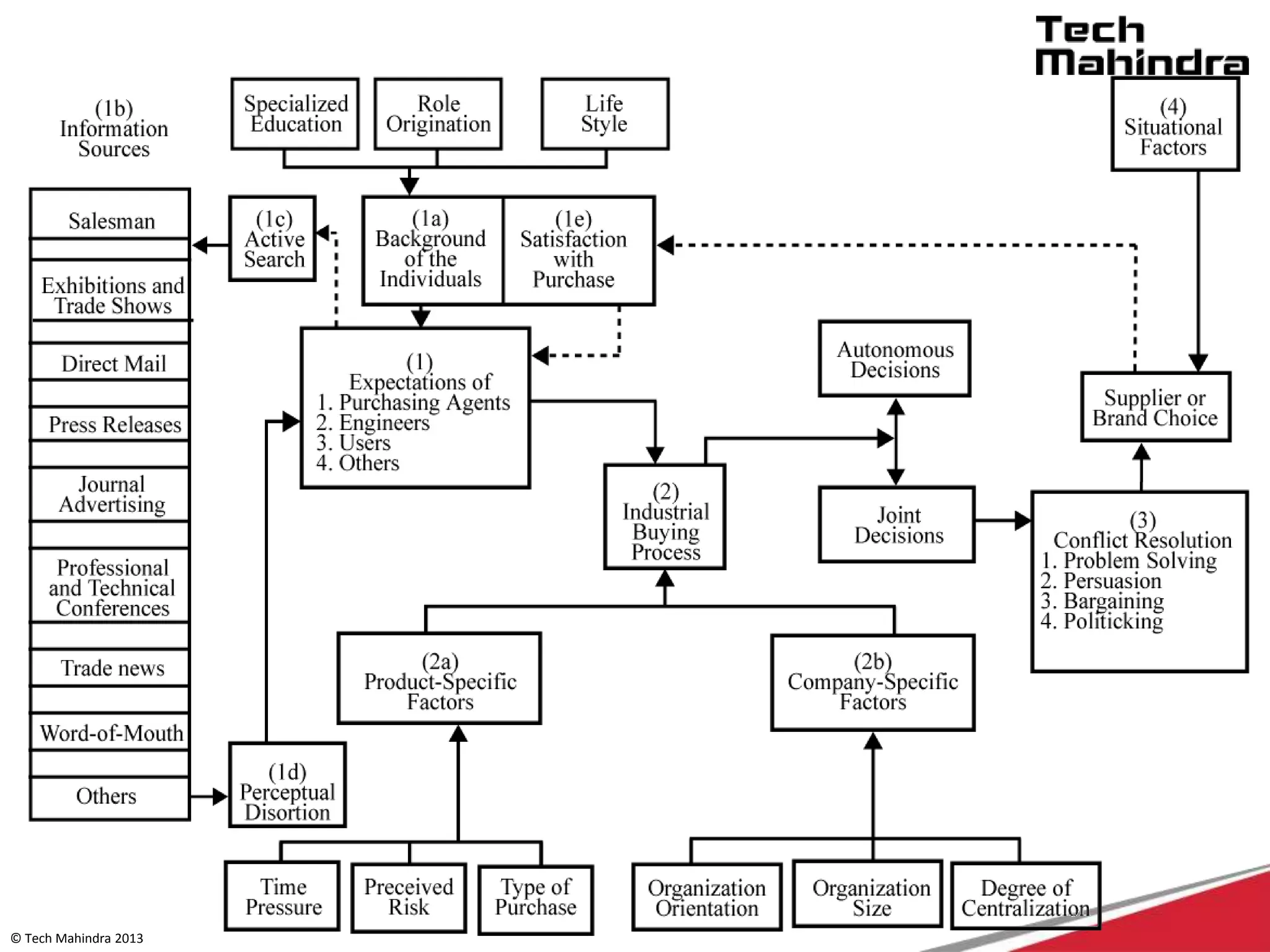
  • #17 Company Specific Factors Organization Orientation – Supply Chain Management Organization Size – Large ($ 3.9 billion dollar) Degree of Centralization – Highly Centralized Product Specific Factors Time-Pressure – After the merger of Satyam and Tech Mahindra, time constraints over the PeopleSoft 9.2 Perceived Risk – That Oracle might not live up to the expectation of delivering PeopleSoft 9.2 Type of Purchase – Modified Rebuy
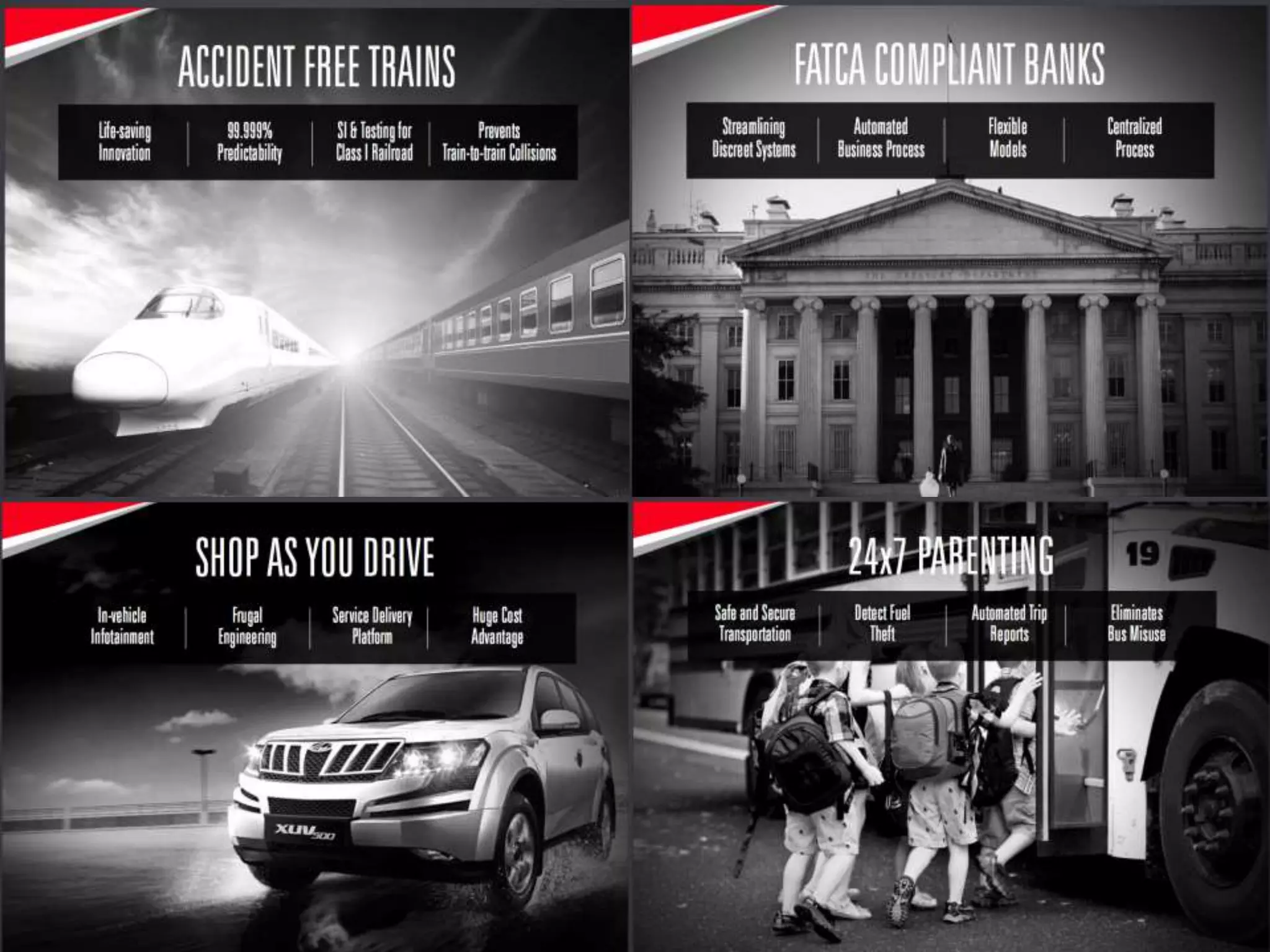
  • #25 FATCA: Foreign Account Tax Compliance Act 
  • #35 Governance, Risk and Compliance (GRC)