Wireless Curriculum Development Section
ISSUE
ISSUE
WCDMA RNO Single Site
Verification
1.0
1.0
Confidential Information of
Huawei. Security Level: Internal
2
Chapter 4 Problem example for site verification
Chapter 3 Single site verification
Chapter 2 Single site verification preparation
Chapter 1 Single site verification overview
Course Contents
Confidential Information of
Huawei. Security Level: Internal
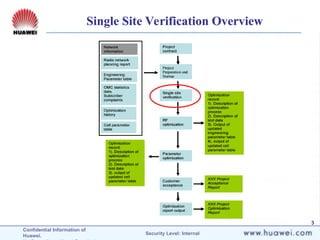
3
Single Site Verification Overview
Confidential Information of
Huawei. Security Level: Internal
4
Single Site Verification Overview
Purpose: The single site verification test is a part of the
WCDMA network optimization to ensure that the basic
functions of the cell are normal, such as call access, call
quality, handover and so on.
Confidential Information of
Huawei. Security Level: Internal
5
Single Site Verification Overview
Content: Through the single site function verification, the follow
ing functions for each cell shall be checked as normal :
 Verify coverage ( CPICH RSCP & Ec/Io )
 Verify scrambling code
 Verify no installation faults (e.g. crossed feeders)
 Make service call test
Confidential Information of
Huawei. Security Level: Internal
6
Single Site Verification Overview
Tools:
 Drive test scanner, used for collecting the pilot signal data. Agile
nt E6455C;
 Test UE, used for service verification and system message colle
ction. Qualcomm 6200 & Motorola A835 mobile;
 Data collection software, used to display and log the signal stren
gth, UE status, signal message and so on in time. Agilent E6474
A software;
 Data analysis software, used to resolve message, analysis signa
l, solve problem and so on. Actix Analyzer software.
Confidential Information of
Huawei. Security Level: Internal
7
Chapter 4 Problem example for site verification
Chapter 3 Single site verification
Chapter 2 Single site verification preparation
Chapter 1 Single site verification overview
Course Contents
Confidential Information of
Huawei. Security Level: Internal
8
Single Site Verification Preparation
Before the single site verification, we should only ensure the f
ollowing conditions have been met.
 Alarm Check
 Cell Status Check
 Parameter Check
Confidential Information of
Huawei. Security Level: Internal
9
Single Site Verification Preparation
Alarm Check
 The product support engineer will be responsible for checking
and resolving all the alarms. It is important for the optimization
engineer prior to any field test to check with product support
engineer regarding any alarms especially intermittent alarms.
Confidential Information of
Huawei. Security Level: Internal
10
Single Site Verification Preparation
Cell Status Check
 The product support engineer will be responsible for checking
and resolving all the cell state problems. It is important for the
network optimization engineer prior to any field test to confirm
with product support engineer regarding cell state.
Confidential Information of
Huawei. Security Level: Internal
11
Single Site Verification Preparation
Parameter Check
 The optimization engineer need to ensure the radio part
parameters configuration list has been achieved. In the list the
radio part parameters includes: the scrambling code, power
setting, neighbor cell list, handover parameter etc.
Confidential Information of
Huawei. Security Level: Internal
12
Course Contents
Chapter 4 Problem example for site verification
Chapter 3 Single site verification
Chapter 2 Single site verification preparation
Chapter 1 Single site verification overview
Confidential Information of
Huawei. Security Level: Internal
13
Site Checklist.xls
Single Site Verification
Site Verification Items:
 Installations: CPICH RSCP, CPICH Ec/Io, Rx Antenna Swap Te
st
 Settings: Frequency & SC, Cell reselection parameters, LAC/RA
C, Neighbor List.
 Functions: LA/RA update, 3G<->2G Cell reselection, SMS (MT
& MO), Voice (MT & MO), VP (MT & MO), PS Attach & Detach,
PS service, Voice/VP/PS soft handover, Voice 3G->2G handove
r.
Confidential Information of
Huawei. Security Level: Internal
14
Single Site Verification
Test Process 1
 Items: LA update / RA update / PS Attach
 Purpose: Verify the LA update and RA update functions are
normal, the PA attach function is normal.
 Method: Power on the Qualcomm mobile, if the ‘WCP’ indication
is shown on the mobile screen, it means the LA update
procedure is OK, the RA update procedure is OK, the PS attach
is OK.
 Notes: If the ‘WC’ is shown on the mobile, it means the LA
update is OK. If the ‘P’ is shown on the mobile, it means the RA
update and the PS attach is OK.
Confidential Information of
Huawei. Security Level: Internal
15
Single Site Verification
Test Process 2
 Items: PS Detach
 Purpose: Verify the PA detach function is normal
 Method: Choose “Menu -> 5 -> 9 -> 2” on Qualcomm mobile, if
the ‘WCP’ indication is changed to ‘WC’ indication on the mobile
screen, PS detach is OK.
 Notes: N/A
Confidential Information of
Huawei. Security Level: Internal
16
Single Site Verification
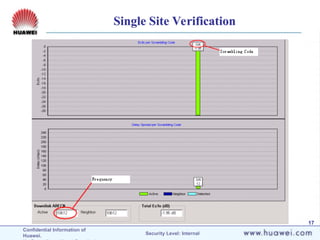
Test Process 3
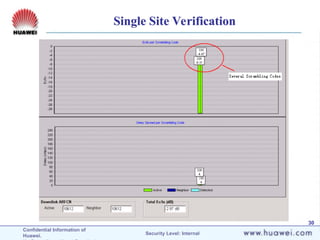
 Items: Frequency and Scrambling Code
 Purpose: Check the frequency and scrambling code for the verifi
ed cell is right or not. If it’s wrong, maybe the parameter setting
or the Tx antenna installation have some mistake.
 Method: Setup the Agilent E6474A software, observe cell freque
ncy and scrambling code from UMTS CPICH View window. Che
ck the frequency and scrambling code for the verified cell is as s
ame as planning.
 Notes: N/A
Confidential Information of
Huawei. Security Level: Internal
17
Single Site Verification
Confidential Information of
Huawei. Security Level: Internal
18
Single Site Verification
Test Process 4
 Items: CPICH RSCP and CPICH Ec/Io
 Purpose: Check the CPICH RSCP and CPICH Ec/Io for th
e verified cell is normal or not. If it’s abnormal, maybe the
Tx antenna installation or the downlink interference have s
ome problems.
 Method: In the Agilent E6474A software, observe CPICH
RSCP and CPICH Ec/Io from UMTS Status View window.
Check if CPICH RSCP is higher than -85dBm and CPICH
Ec/Io is higher than -8dB.
Confidential Information of
Huawei. Security Level: Internal
19
Single Site Verification
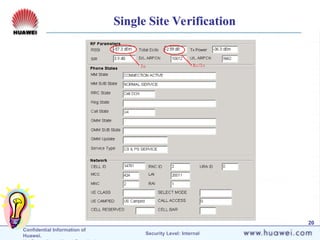
 Notes:
The mobile shall be near the site
The CPICH RSCP and Ec/Io can be seen from scanne
r or Qualcomm mobile. Use the Qualcomm mobile to c
heck the CPICH RSCP and CPICH Ec/Io.
When we use the Qualcomm mobile to check the CPI
CH RSCP and CPICH Ec/Io, the Io and Ec/Io shall be
obtained, the CPICH RSCP shall be obtained through
calculation: Ec = Ec/Io + Io
Confidential Information of
Huawei. Security Level: Internal
20
Single Site Verification
Confidential Information of
Huawei. Security Level: Internal
21
Single Site Verification
Test Process 5
 Items: Voice Call (MT & MO)
 Purpose: Verify the voice call function is normal and the voice
call quality is good
 Method: Make the dialing test of 3G speech service between two
3G mobiles, one for the terminating call and another one for the
originating call. Test the speech communication quality by your
feel.
 Notes: Qualcomm or Motorola mobile
Confidential Information of
Huawei. Security Level: Internal
22
Single Site Verification
Test Process 6
 Items: VP Call (MT & MO)
 Purpose: Verify the VP call function is normal and the VP call
quality is good
 Method: Make the dialing test of 3G VP service between two 3G
mobiles, one for the terminating call and another one for the
originating call. Test the speech and photo communication
quality by your feel.
 Notes: Motorola mobile
Confidential Information of
Huawei. Security Level: Internal
23
Single Site Verification
Test Process 7
 Items: PS service
 Purpose: Verify the PS function is normal and the PS quality is
good.
 Method: Make the dialing test of 3G PS service, which include
WWW browsing and file downloading. Test the PS connection
quality by your feel.
 Notes: Qualcomm or Motorola mobile
Confidential Information of
Huawei. Security Level: Internal
24
Single Site Verification
Test Process 8
 Items: SMS (MT & MO)
 Purpose: Verify the SMS function is normal
 Method: Make the dialing test of 3G SMS service between two
3G mobiles, one for the terminating call and another one for the
originating call.
 Notes: Motorola mobile
Confidential Information of
Huawei. Security Level: Internal
25
Single Site Verification
Test Process 9
 Items: Cell reselection parameters, LAC/RAC, Neighbor List
 Purpose: Check the parameters setting for the verified cell.
 Method: UE shall read the system information when UE is in idle
mode. Collect UE reserved message and check the parameters
with Actix Analyzer software after the drive test.
 Notes:
 Cell reselection parameters: SIB3
 LAC/RAC: SIB1
 Neighbor list: SIB 11
Confidential Information of
Huawei. Security Level: Internal
26
Single Site Verification
Test Process 10
 Items: 3G->2G voice handover, 3G->2G cell reselection, 2G-
>3G cell reselection
 Purpose: Verify the 3G->2G handover and 3G<->2G cell
reselection functions are normal.
 Method: Find a place where there is 2G signal without 3G signal.
One mobile is keeping a voice call and another one is in idle
mode. Move from 3G to 2G, the mobile with voice call shall
handover to 2G and the mobile in idle mode shall reselect to 2G.
Move from 2G to 3G, the mobile in idle mode shall reselect to
3G.
 Notes: Use the Motorola mobile to do the test, the ‘3G’ or ‘2G’
indication is shown on the mobile screen
Confidential Information of
Huawei. Security Level: Internal
27
Single Site Verification
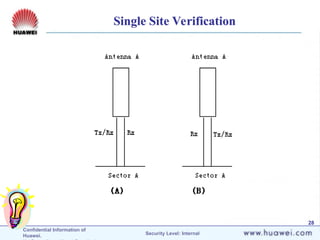
Test Process 11
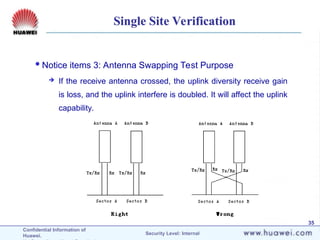
 Items: Antenna swapping test
 Purpose: Verify the Rx feeder installation is right.
 Method: Switch the transmitter from one feeder to another,
check the RSCP changed or not. If no change happened, it
means that the feeder is correct.
 Notes: Check the RSCP from scanner
Confidential Information of
Huawei. Security Level: Internal
28
Single Site Verification
Confidential Information of
Huawei. Security Level: Internal
29
Single Site Verification
Test Process 12
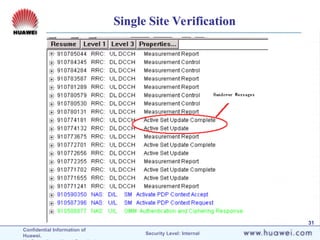
 Items: Soft handover (Voice, VP, PS)
 Purpose: Verify the soft handover function is normal
 Method: Take a speech service or VP service or PS service call
and keep it. Verify the soft handover from one sector to another
sector. During the process, observe the CPICH scrambling code
changing from Agilent UMTS CPICH View, and observe the acti
ve set update message from UMTS Protocol Messages View.
 Notes: N/A
Confidential Information of
Huawei. Security Level: Internal
30
Single Site Verification
Confidential Information of
Huawei. Security Level: Internal
31
Single Site Verification
Confidential Information of
Huawei. Security Level: Internal
32
Single Site Verification
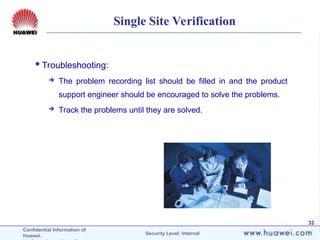
Troubleshooting:
 The problem recording list should be filled in and the product
support engineer should be encouraged to solve the problems.
 Track the problems until they are solved.
Confidential Information of
Huawei. Security Level: Internal
33
Single Site Verification
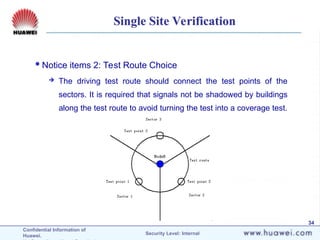
Notice items 1: Test Point Choice
 We shall choose the test point where the CPICH RSCP of target
sector is high enough and that of other sector is poor.
 The test points should be chosen near the site and ideally with
line-of-sight to the site.
 The test points should not be chosen under the site as the signal
of other sectors of same site is strong too.
Confidential Information of
Huawei. Security Level: Internal
34
Single Site Verification
Notice items 2: Test Route Choice
 The driving test route should connect the test points of the
sectors. It is required that signals not be shadowed by buildings
along the test route to avoid turning the test into a coverage test.
Confidential Information of
Huawei. Security Level: Internal
35
Single Site Verification
Notice items 3: Antenna Swapping Test Purpose
 If the receive antenna crossed, the uplink diversity receive gain
is loss, and the uplink interfere is doubled. It will affect the uplink
capability.
Confidential Information of
Huawei. Security Level: Internal
36
Course Contents
Chapter 4 Problem example for site verification
Chapter 3 Single site verification
Chapter 2 Single site verification preparation
Chapter 1 Single site verification overview
Confidential Information of
Huawei. Security Level: Internal
37
Problem Example for Site Verification
In the site verification, following problems have been found
 Scrambling Code Setting is wrong: The scrambling code from
scanner and mobile is different from the planning
 After feeder swapped, the CPICH RSCP is 20dB lower than
before.
Confidential Information of
Huawei. Security Level: Internal
38
Answers
Scrambling Code Setting is wrong
 The Scrambling Code may be wrong in RNC, check the datashe
et in RNC.
 If the Scrambling Code from scanner is the same as that of anot
her sector in same site planned, maybe the TX/RX feeder is cros
sed to the another sector.
Confidential Information of
Huawei. Security Level: Internal
39
Answers
After feeder swapped, the CPICH RSCP is 20dB lower than
before:
 The RX feeder is crossed to the antenna of another sector. In
this case, the CPICH RSCP will be high in the coverage area of
the other antenna. Check the connection between the feeder
and the antenna.
Confidential Information of
Huawei. Security Level: Internal
40

B05 WCDMA RNO Single Site Verification.ppt

  • 1.
    Wireless Curriculum DevelopmentSection Wireless Curriculum Development Section ISSUE ISSUE WCDMA RNO Single Site Verification 1.0 1.0
  • 2.
    Confidential Information of Huawei.Security Level: Internal 2 Chapter 4 Problem example for site verification Chapter 3 Single site verification Chapter 2 Single site verification preparation Chapter 1 Single site verification overview Course Contents
  • 3.
    Confidential Information of Huawei.Security Level: Internal 3 Single Site Verification Overview
  • 4.
    Confidential Information of Huawei.Security Level: Internal 4 Single Site Verification Overview Purpose: The single site verification test is a part of the WCDMA network optimization to ensure that the basic functions of the cell are normal, such as call access, call quality, handover and so on.
  • 5.
    Confidential Information of Huawei.Security Level: Internal 5 Single Site Verification Overview Content: Through the single site function verification, the follow ing functions for each cell shall be checked as normal :  Verify coverage ( CPICH RSCP & Ec/Io )  Verify scrambling code  Verify no installation faults (e.g. crossed feeders)  Make service call test
  • 6.
    Confidential Information of Huawei.Security Level: Internal 6 Single Site Verification Overview Tools:  Drive test scanner, used for collecting the pilot signal data. Agile nt E6455C;  Test UE, used for service verification and system message colle ction. Qualcomm 6200 & Motorola A835 mobile;  Data collection software, used to display and log the signal stren gth, UE status, signal message and so on in time. Agilent E6474 A software;  Data analysis software, used to resolve message, analysis signa l, solve problem and so on. Actix Analyzer software.
  • 7.
    Confidential Information of Huawei.Security Level: Internal 7 Chapter 4 Problem example for site verification Chapter 3 Single site verification Chapter 2 Single site verification preparation Chapter 1 Single site verification overview Course Contents
  • 8.
    Confidential Information of Huawei.Security Level: Internal 8 Single Site Verification Preparation Before the single site verification, we should only ensure the f ollowing conditions have been met.  Alarm Check  Cell Status Check  Parameter Check
  • 9.
    Confidential Information of Huawei.Security Level: Internal 9 Single Site Verification Preparation Alarm Check  The product support engineer will be responsible for checking and resolving all the alarms. It is important for the optimization engineer prior to any field test to check with product support engineer regarding any alarms especially intermittent alarms.
  • 10.
    Confidential Information of Huawei.Security Level: Internal 10 Single Site Verification Preparation Cell Status Check  The product support engineer will be responsible for checking and resolving all the cell state problems. It is important for the network optimization engineer prior to any field test to confirm with product support engineer regarding cell state.
  • 11.
    Confidential Information of Huawei.Security Level: Internal 11 Single Site Verification Preparation Parameter Check  The optimization engineer need to ensure the radio part parameters configuration list has been achieved. In the list the radio part parameters includes: the scrambling code, power setting, neighbor cell list, handover parameter etc.
  • 12.
    Confidential Information of Huawei.Security Level: Internal 12 Course Contents Chapter 4 Problem example for site verification Chapter 3 Single site verification Chapter 2 Single site verification preparation Chapter 1 Single site verification overview
  • 13.
    Confidential Information of Huawei.Security Level: Internal 13 Site Checklist.xls Single Site Verification Site Verification Items:  Installations: CPICH RSCP, CPICH Ec/Io, Rx Antenna Swap Te st  Settings: Frequency & SC, Cell reselection parameters, LAC/RA C, Neighbor List.  Functions: LA/RA update, 3G<->2G Cell reselection, SMS (MT & MO), Voice (MT & MO), VP (MT & MO), PS Attach & Detach, PS service, Voice/VP/PS soft handover, Voice 3G->2G handove r.
  • 14.
    Confidential Information of Huawei.Security Level: Internal 14 Single Site Verification Test Process 1  Items: LA update / RA update / PS Attach  Purpose: Verify the LA update and RA update functions are normal, the PA attach function is normal.  Method: Power on the Qualcomm mobile, if the ‘WCP’ indication is shown on the mobile screen, it means the LA update procedure is OK, the RA update procedure is OK, the PS attach is OK.  Notes: If the ‘WC’ is shown on the mobile, it means the LA update is OK. If the ‘P’ is shown on the mobile, it means the RA update and the PS attach is OK.
  • 15.
    Confidential Information of Huawei.Security Level: Internal 15 Single Site Verification Test Process 2  Items: PS Detach  Purpose: Verify the PA detach function is normal  Method: Choose “Menu -> 5 -> 9 -> 2” on Qualcomm mobile, if the ‘WCP’ indication is changed to ‘WC’ indication on the mobile screen, PS detach is OK.  Notes: N/A
  • 16.
    Confidential Information of Huawei.Security Level: Internal 16 Single Site Verification Test Process 3  Items: Frequency and Scrambling Code  Purpose: Check the frequency and scrambling code for the verifi ed cell is right or not. If it’s wrong, maybe the parameter setting or the Tx antenna installation have some mistake.  Method: Setup the Agilent E6474A software, observe cell freque ncy and scrambling code from UMTS CPICH View window. Che ck the frequency and scrambling code for the verified cell is as s ame as planning.  Notes: N/A
  • 17.
    Confidential Information of Huawei.Security Level: Internal 17 Single Site Verification
  • 18.
    Confidential Information of Huawei.Security Level: Internal 18 Single Site Verification Test Process 4  Items: CPICH RSCP and CPICH Ec/Io  Purpose: Check the CPICH RSCP and CPICH Ec/Io for th e verified cell is normal or not. If it’s abnormal, maybe the Tx antenna installation or the downlink interference have s ome problems.  Method: In the Agilent E6474A software, observe CPICH RSCP and CPICH Ec/Io from UMTS Status View window. Check if CPICH RSCP is higher than -85dBm and CPICH Ec/Io is higher than -8dB.
  • 19.
    Confidential Information of Huawei.Security Level: Internal 19 Single Site Verification  Notes: The mobile shall be near the site The CPICH RSCP and Ec/Io can be seen from scanne r or Qualcomm mobile. Use the Qualcomm mobile to c heck the CPICH RSCP and CPICH Ec/Io. When we use the Qualcomm mobile to check the CPI CH RSCP and CPICH Ec/Io, the Io and Ec/Io shall be obtained, the CPICH RSCP shall be obtained through calculation: Ec = Ec/Io + Io
  • 20.
    Confidential Information of Huawei.Security Level: Internal 20 Single Site Verification
  • 21.
    Confidential Information of Huawei.Security Level: Internal 21 Single Site Verification Test Process 5  Items: Voice Call (MT & MO)  Purpose: Verify the voice call function is normal and the voice call quality is good  Method: Make the dialing test of 3G speech service between two 3G mobiles, one for the terminating call and another one for the originating call. Test the speech communication quality by your feel.  Notes: Qualcomm or Motorola mobile
  • 22.
    Confidential Information of Huawei.Security Level: Internal 22 Single Site Verification Test Process 6  Items: VP Call (MT & MO)  Purpose: Verify the VP call function is normal and the VP call quality is good  Method: Make the dialing test of 3G VP service between two 3G mobiles, one for the terminating call and another one for the originating call. Test the speech and photo communication quality by your feel.  Notes: Motorola mobile
  • 23.
    Confidential Information of Huawei.Security Level: Internal 23 Single Site Verification Test Process 7  Items: PS service  Purpose: Verify the PS function is normal and the PS quality is good.  Method: Make the dialing test of 3G PS service, which include WWW browsing and file downloading. Test the PS connection quality by your feel.  Notes: Qualcomm or Motorola mobile
  • 24.
    Confidential Information of Huawei.Security Level: Internal 24 Single Site Verification Test Process 8  Items: SMS (MT & MO)  Purpose: Verify the SMS function is normal  Method: Make the dialing test of 3G SMS service between two 3G mobiles, one for the terminating call and another one for the originating call.  Notes: Motorola mobile
  • 25.
    Confidential Information of Huawei.Security Level: Internal 25 Single Site Verification Test Process 9  Items: Cell reselection parameters, LAC/RAC, Neighbor List  Purpose: Check the parameters setting for the verified cell.  Method: UE shall read the system information when UE is in idle mode. Collect UE reserved message and check the parameters with Actix Analyzer software after the drive test.  Notes:  Cell reselection parameters: SIB3  LAC/RAC: SIB1  Neighbor list: SIB 11
  • 26.
    Confidential Information of Huawei.Security Level: Internal 26 Single Site Verification Test Process 10  Items: 3G->2G voice handover, 3G->2G cell reselection, 2G- >3G cell reselection  Purpose: Verify the 3G->2G handover and 3G<->2G cell reselection functions are normal.  Method: Find a place where there is 2G signal without 3G signal. One mobile is keeping a voice call and another one is in idle mode. Move from 3G to 2G, the mobile with voice call shall handover to 2G and the mobile in idle mode shall reselect to 2G. Move from 2G to 3G, the mobile in idle mode shall reselect to 3G.  Notes: Use the Motorola mobile to do the test, the ‘3G’ or ‘2G’ indication is shown on the mobile screen
  • 27.
    Confidential Information of Huawei.Security Level: Internal 27 Single Site Verification Test Process 11  Items: Antenna swapping test  Purpose: Verify the Rx feeder installation is right.  Method: Switch the transmitter from one feeder to another, check the RSCP changed or not. If no change happened, it means that the feeder is correct.  Notes: Check the RSCP from scanner
  • 28.
    Confidential Information of Huawei.Security Level: Internal 28 Single Site Verification
  • 29.
    Confidential Information of Huawei.Security Level: Internal 29 Single Site Verification Test Process 12  Items: Soft handover (Voice, VP, PS)  Purpose: Verify the soft handover function is normal  Method: Take a speech service or VP service or PS service call and keep it. Verify the soft handover from one sector to another sector. During the process, observe the CPICH scrambling code changing from Agilent UMTS CPICH View, and observe the acti ve set update message from UMTS Protocol Messages View.  Notes: N/A
  • 30.
    Confidential Information of Huawei.Security Level: Internal 30 Single Site Verification
  • 31.
    Confidential Information of Huawei.Security Level: Internal 31 Single Site Verification
  • 32.
    Confidential Information of Huawei.Security Level: Internal 32 Single Site Verification Troubleshooting:  The problem recording list should be filled in and the product support engineer should be encouraged to solve the problems.  Track the problems until they are solved.
  • 33.
    Confidential Information of Huawei.Security Level: Internal 33 Single Site Verification Notice items 1: Test Point Choice  We shall choose the test point where the CPICH RSCP of target sector is high enough and that of other sector is poor.  The test points should be chosen near the site and ideally with line-of-sight to the site.  The test points should not be chosen under the site as the signal of other sectors of same site is strong too.
  • 34.
    Confidential Information of Huawei.Security Level: Internal 34 Single Site Verification Notice items 2: Test Route Choice  The driving test route should connect the test points of the sectors. It is required that signals not be shadowed by buildings along the test route to avoid turning the test into a coverage test.
  • 35.
    Confidential Information of Huawei.Security Level: Internal 35 Single Site Verification Notice items 3: Antenna Swapping Test Purpose  If the receive antenna crossed, the uplink diversity receive gain is loss, and the uplink interfere is doubled. It will affect the uplink capability.
  • 36.
    Confidential Information of Huawei.Security Level: Internal 36 Course Contents Chapter 4 Problem example for site verification Chapter 3 Single site verification Chapter 2 Single site verification preparation Chapter 1 Single site verification overview
  • 37.
    Confidential Information of Huawei.Security Level: Internal 37 Problem Example for Site Verification In the site verification, following problems have been found  Scrambling Code Setting is wrong: The scrambling code from scanner and mobile is different from the planning  After feeder swapped, the CPICH RSCP is 20dB lower than before.
  • 38.
    Confidential Information of Huawei.Security Level: Internal 38 Answers Scrambling Code Setting is wrong  The Scrambling Code may be wrong in RNC, check the datashe et in RNC.  If the Scrambling Code from scanner is the same as that of anot her sector in same site planned, maybe the TX/RX feeder is cros sed to the another sector.
  • 39.
    Confidential Information of Huawei.Security Level: Internal 39 Answers After feeder swapped, the CPICH RSCP is 20dB lower than before:  The RX feeder is crossed to the antenna of another sector. In this case, the CPICH RSCP will be high in the coverage area of the other antenna. Check the connection between the feeder and the antenna.
  • 40.
    Confidential Information of Huawei.Security Level: Internal 40

Editor's Notes

  • #10 面向小区,通过 RNC 的 LMT 或者 M2000 检查小区状态,检查各个小区是否都已经建立完成,小区“数据有效指示”是否“有效”,小区“后台管理状态”是否为“解闭塞”状态。小区状态检查可以通过 RNC LMT 的 MML 命令查询,查询指令为【DSP CELL】。对于各种非正常状态,应分析其原因,并尽量排除故障。
  • #11 在测试准备阶段,需要进行如下工作: 1、从运营商的优化人员处核实各站点的功率是否已经允许发射。 2、从产品支持工程师处了解待测站点是否存在告警问题,小区当前状态等。 3、获取测试用的空闲终端号码。 4、检查测试设备(UE + Scanner)工作是否正常。 5、测试用 Checklist 打印纸件。 6、前期整理出完整的《XXX 项目 WCDMA RNP 无线参数配置表》。 7、测试前熟悉测试基站的情况,包括小区ID、扰码、全向站/定向站、天线方向角/下倾角、天线高度、环境类型等。 8、在地图上初步确定测试点和测试路线,对选定站点的各个扇区,每一扇区确定一个测试点。测试点和测试路线选择方法见后。
  • #38 答案可以不必写出,此页可无。 如果有答案,不必写到胶片+注释中。