B04 WCDMA RNP Site Survey feature parameter description
1.
Wireless Curriculum DevelopmentSection
Wireless Curriculum Development Section
ISSUE
ISSUE
OWJ101101 WCDMA RNP Site
OWJ101101 WCDMA RNP Site
Survey
Survey
1.0
1.0
2.
Confidential Information of
Huawei.Security Level: Internal
2
Site survey is the base of a mobile communication
network. So it is very important.
On a mobile communication network as a whole,
whether an appropriate place has been selected for
a NodeB will affect not only its own coverage but
also the locations of all other NodeBs and even the
coverage of the entire network.
Review
3.
Confidential Information of
Huawei.Security Level: Internal
3
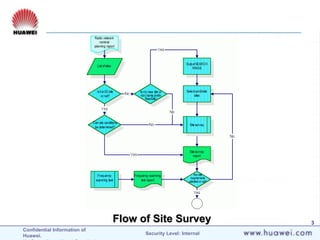
Radio network
nominal
planning report
OutputSEARCH
RINGS
Listof sites
Is ita 2G site
or not?
Is ita new site or
not (name prefix
NewSite)
Selectcandidate
sites
Can site conditions
be determined?
Site survey
Site survey
report
Frequency
scanning test
Frequency scanning
test report
Are site
requirements
satisfied or not?
Flow of Site Survey
Flow of Site Survey
4.
Confidential Information of
Huawei.Security Level: Internal
4
Objectives
Know how to select candidate
sites
Know the preparation of site
survey
Know how to survey sites
Know about the survey report
Upon completion of this course,you will be able to:
5.
Confidential Information of
Huawei.Security Level: Internal
5
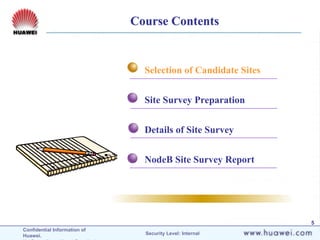
Course Contents
Selection of Candidate Sites
Site Survey Preparation
Details of Site Survey
NodeB Site Survey Report
6.
Confidential Information of
Huawei.Security Level: Internal
6
1.1 Precondition for the
1.1 Precondition for the
Selection of Candidate Sites
Selection of Candidate Sites
1.2 Principles for the Selection
of Candidate Sites
1.3 Select Candidate Sites
Selection of Candidate Sites
7.
Confidential Information of
Huawei.Security Level: Internal
7
Precondition for the Selection of Candidate Sites
System Simulation Personnel provide the following materials
based on the nominal planning report prepared in the radio
network nominal planning phase:
Engineering Parameters Sheet
A topographic map or city map, contains the
BS topology information, antenna azimuth
information and coverage prediction information
Selection of Candidate Sites
8.
Confidential Information of
Huawei.Security Level: Internal
8
Precondition for the Selection of Candidate Sites
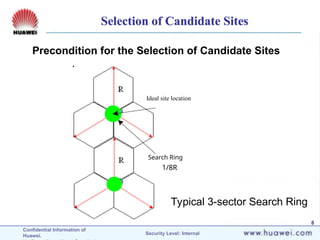
Ideal site location
Search Ring
1/8R
Typical 3-sector Search Ring
Selection of Candidate Sites
9.
Confidential Information of
Huawei.Security Level: Internal
9
1.1 Precondition for the
Selection of Candidate Sites
1.2 Principles for the Selection
1.2 Principles for the Selection
of Candidate Sites
of Candidate Sites
1.3 Select Candidate Sites
Selection of Candidate Sites
10.
Confidential Information of
Huawei.Security Level: Internal
10
Principles for the Selection of Candidate Sites
1. Fulfill requirements as specified in the
nominal planning report whenever possible
Appropriate cell structure
Antenna height requirement
Installation environment requirements
Ensure coverage of key areas
Selection of Candidate Sites
11.
Confidential Information of
Huawei.Security Level: Internal
11
Principles for the Selection of Candidate Sites
2. Do not select a location on a high
mountain in a urban or suburban area
3. Avoid environmental influence
high-power radio transmitter, radar
station, etc
4. Among buildings in a downtown area,
take advantage of building heights to
construct a layered network
5. Give consideration to negotiations on
candidate sites.
Selection of Candidate Sites
12.
Confidential Information of
Huawei.Security Level: Internal
12
1.1 Precondition for the
Selection of Candidate Sites
1.2 Principles for the Selection
of Candidate Sites
1.3 Select Candidate Sites
1.3 Select Candidate Sites
Selection of Candidate Sites
13.
Confidential Information of
Huawei.Security Level: Internal
13
Select Candidate Sites
Candidate sites are usually supplied by third parties
based on the site requirements provided by Network
Planning Survey Personnel . A third party may be a
property agency.
Selection of Candidate Sites
14.
Confidential Information of
Huawei.Security Level: Internal
14
Course Contents
Selection of Candidate Sites
Site Survey Preparation
Details of Site Survey
NodeB Site Survey Report
15.
Confidential Information of
Huawei.Security Level: Internal
15
Preparation before Set-out
Collect project documents as below:
- Project documentation
- Network background
- Local map
- NodeB site Survey Form
- Contract Configuration List
- Existing network information
Site Survey Preparation
16.
Confidential Information of
Huawei.Security Level: Internal
16
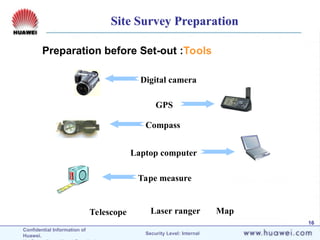
Digital camera
GPS
Compass
Laptop computer
Map
Tape measure
Telescope Laser ranger
Preparation before Set-out :Tools
Site Survey Preparation
17.
Confidential Information of
Huawei.Security Level: Internal
17
Site Survey Coordination Meeting
Find out about the local electromagnetic environment and perform
frequency scanning tests if necessary.
Identify survey and cooperation personnel.
Prepare vehicles and equipment.
Develop a survey plan and identify the survey routes. If the area to
be surveyed is large, divide the personnel into several groups and
conduct surveys at the same time.
Develop initial solutions for power supply and transmission
systems, etc.
Obtain information on frequency bands, maximum transmit powers
as well as azimuth and down tilt of the existing co-site antennas.
Site Survey Preparation
18.
Confidential Information of
Huawei.Security Level: Internal
18
Course Contents
Selection of Candidate Sites
Site Survey Preparation
Details of Site Survey
NodeB Site Survey Report
19.
Confidential Information of
Huawei.Security Level: Internal
19
3.1 NodeB Site and Surroundi
3.1 NodeB Site and Surroundi
ng Environment
ng Environment
3.2 Survey and Design of the
Antenna & Feeder System
3.3 Feeder Cable Selection
Details of Site Survey
20.
Confidential Information of
Huawei.Security Level: Internal
20
NodeB Site and Surrounding Environment
1.Take pictures of the site overview
2.Collect the latitude and longitude of the site
3.Surrounding environment
4.Roof information (If roof available)
Details of Site Survey
21.
Confidential Information of
Huawei.Security Level: Internal
21
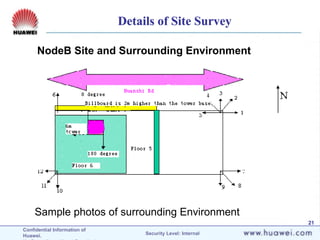
NodeB Site and Surrounding Environment
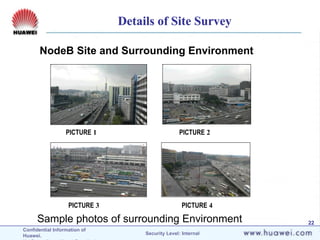
Sample photos of surrounding Environment
Details of Site Survey
22.
Confidential Information of
Huawei.Security Level: Internal
22
NodeB Site and Surrounding Environment
PICTURE 1 PICTURE 2
PICTURE 3 PICTURE 4
Sample photos of surrounding Environment
Details of Site Survey
23.
Confidential Information of
Huawei.Security Level: Internal
23
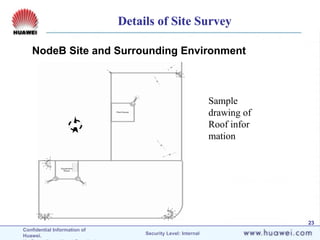
Sample
drawing of
Roof infor
mation
NodeB Site and Surrounding Environment
Details of Site Survey
24.
Confidential Information of
Huawei.Security Level: Internal
24
3.1 NodeB Site and Surroundi
ng Environment
3.2 Survey and Design of the
3.2 Survey and Design of the
Antenna & Feeder System
Antenna & Feeder System
3.3 Feeder Cable Selection
Details of Site Survey
25.
Confidential Information of
Huawei.Security Level: Internal
25
Survey & Design of the Antenna & Feeder System
1. Antenna type selection
2. Antenna height
3. Antenna azimuth
4. Antenna down tilt
5. Antenna installation and co-site antenna
isolation
6. Space diversity distance
7. Omni antenna installation requirements
Details of Site Survey
26.
Confidential Information of
Huawei.Security Level: Internal
26
Survey & Design of the Antenna & Feeder System
Antenna type selection
in a urban area
in a suburban area
in a rural area
along a highway
in a mountainous area
in a tunnel
indoor
-For details, see remark for this page
Details of Site Survey
27.
Confidential Information of
Huawei.Security Level: Internal
27
Survey & Design of the Antenna & Feeder System
Antenna high
Heights of antennas for different cells of the same NodeB are allowed to
be different from one another.
In a plain urban area, the effective antenna height above the ground
should be within the range of 25m-30m.
For a NodeB in a suburban area, the effective antenna height above the
ground should be within the range of 40m-50m.
The antenna height of an isolated site should not exceed 70m.
If an antenna is too high, the signal level received from under the antenna
maybe very poor (so-called "blind under tower"). This phenomena is more
obvious in the case of an omni antenna.
Too high an antenna is likely to cause such problems as cross coverage
and intra/inter-frequency interference, which will degrade the network
quality.
Details of Site Survey
28.
Confidential Information of
Huawei.Security Level: Internal
28
Survey & Design of the Antenna & Feeder System
Antenna azimuth
Azimuth of antennas have been determined in the
nominal planning phase. During the site survey, we
should make adjustments of these azimuth
according to obstacles around the site to prevent
them from affecting the signal propagation.
-For details, see remark for this page
Details of Site Survey
29.
Confidential Information of
Huawei.Security Level: Internal
29
Survey & Design of the Antenna & Feeder System
Antenna down tilt
The antenna tilting control the coverage and reduce intra-
system interference.
Down tilt angles should be set in consideration of such factors
as the transmit power, antenna height, cell coverage and radio
propagation environment.
The down tilt angle of an antenna should be determined
based on the actual condition to reduce interference on other
cells, ensure the coverage and avoid unnecessary blind areas.
If the mechanical down tilt angle is too large, the horizontal
antenna pattern will be distorted.
Details of Site Survey
30.
Confidential Information of
Huawei.Security Level: Internal
30
Survey & Design of the Antenna & Feeder System
Antenna installation and co-site antenna isolation
-60° relative to
antenna azimuth
-60° relative to
antenna azimuth
+60°
+60° relative to
antenna azimuth
> 30°
<=30° Antenna azimuth
Antenna
azimuth
Wall
Wall
See remark
Details of Site Survey
31.
Confidential Information of
Huawei.Security Level: Internal
31
Survey & Design of the Antenna & Feeder System
Antenna installation and co-site antenna isolation
d
h
= down Tilt
’ = guard angle
= ( -10dB angle of vertical diagram)/2
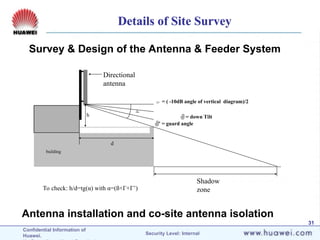
To check: h/d=tg(α) with α=(ß+Γ+Γ’)
building
Directional
antenna
Shadow
zone
Details of Site Survey
Confidential Information of
Huawei.Security Level: Internal
34
Survey & Design of the Antenna & Feeder System
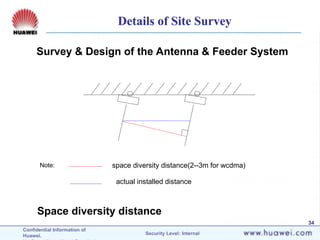
Space diversity distance
space diversity distance(2--3m for wcdma)
actual installed distance
Note:
Details of Site Survey
35.
Confidential Information of
Huawei.Security Level: Internal
35
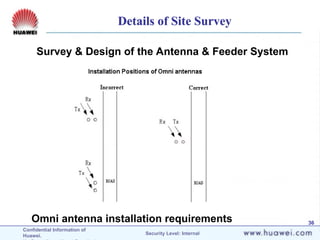
Omni antenna installation requirements
Survey & Design of the Antenna & Feeder System
The isolation distance between an omni antenna and tower
is required to be more than 2m, and the effective horizontal
diversity distance between omni antennas is required to be
more than 2m (3m is recommended).
Omni antenna should be perpendicular to the horizontal
plane.
Details of Site Survey
36.
Confidential Information of
Huawei.Security Level: Internal
36
Omni antenna installation requirements
Survey & Design of the Antenna & Feeder System
Details of Site Survey
37.
Confidential Information of
Huawei.Security Level: Internal
37
3.1 NodeB Site and Surroundi
ng Environment
3.2 Survey and Design of the
Antenna & Feeder System
3.3 Feeder Cable Selection
3.3 Feeder Cable Selection
Details of Site Survey
38.
Confidential Information of
Huawei.Security Level: Internal
38
If a feeder cable is longer than 50m, a 5/4'' feeder cable sho
uld be used; if it is shorter than 50m, a 7/8″ feeder cable sho
uld be used. 1/2″ feeder cables are used to connect the jum
pers between antennas and feeder cables as well as betwe
en feeder cables and cabinet-top connectors.
Feeder cables must not be over bent, and their external con
ductors should be well grounded 。
Feeder Cable Selection
Details of Site Survey
39.
Confidential Information of
Huawei.Security Level: Internal
39
Course Contents
Selection of Candidate Sites
Site Survey Preparation
Details of Site Survey
NodeB Site Survey Report
40.
Confidential Information of
Huawei.Security Level: Internal
40
To avoid information errors due to failed memories,
identify problems of each candidate site in a timely
manner and develop a solution for them, the survey
personnel should output on site a XXX Project XXX Site
Survey Report for each site. The survey personnel should
then submit these data to the regional office and Network
Planning Dept. as well as to the Operator to be signed
and archived by the latter. All the items must be
completed and the signature field must be filled with the
signatures of survey personnel.
NodeB Site Survey Report
#26 Select antennas for a NodeB in a urban area
A. Directional antennas with 60-65° wide horizontal lobes and 13° wide vertical lobes are recommended.
B. Select antennas with a gain of about 15dBi.
C. It is recommended to select antennas with a preset electrical down tilt between 2° and 6° plus a mechanically adjustable down tilt.
D. Dual polarization antennas are recommended.
Select antennas for a NodeB in a suburban area
A. Select directional antennas with a horizontal half-power angle of 65° or 90° based on the actual condition.
B. Select antennas with a gain between 15 to 18dBi.
C. Decide whether to select antennas with a preset down tilt based on the actual site condition.
D. Both dual polarization and single polarization antennas can be used.
Select antennas for a NodeB in a rural area
A. Select 90° or 120° directional/omni antennas based on the actual condition and requirements.
B. The gain of directional antennas selected should be high (16-18dBi) while that of omni antennas should be 11dBi.
C. Antennas with a preset down tilt are usually not recommended. Null filling antennas are recommended for NodeBs at high places.
D. Vertical polarization antennas are recommended.
Select antennas for a NodeB along a highway
A. Directional antennas with a narrow beam and high gain are usually recommended. 8-shaped, omni or distorted omni antennas can be also used based on the actual condition.
B. Antennas with a preset down tilt are usually not recommended because of the long coverage distance required of a NodeB along a highway.
C. Vertical polarization antennas are recommended.
D. The front-to-back ratio of the antennas selected should not be too high.
Select antennas for a NodeB in a mountainous area
A. Middle/high gain antennas are usually recommended. Omni antennas with a down tilt beam can be also used based on the actual condition.
B. The gain of directional antennas should be within the range of 12-17dBi, while that of omni antennas should be 11dBi.
C. Vertical polarization antennas are recommended.
D. Select antennas with a preset down tilt for a NodeB on a high mountain.
Select antennas for a NodeB in a tunnel
A. Low gain Yagi antennas are usually recommended, and leaking cables can be used in a subway or tunnel.
B. The gain of Yagi antennas selected is within the range of 10-12dBi.
Select antennas for an indoor NodeB
A. Low gain omni antennas or directional antennas with 90° wide horizontal lobes are usually recommended. High gain antennas, which are logarithm periodical antennas in most cases, can be selected for lifts,.
B. The gain of omni antennas selected should be 2dBi, while that of directional antennas should be 7dBi or 11dBi.
C. Vertical polarization antennas are recommended.
#28 Follow the principles below to set antenna azimuth:
Azimuth of antennas should be set from the point of view of the entire network. Under the precondition that the coverage requirement can be fulfilled, azimuth of antennas for the three sectors of each NodeB in an urban area should be about the same to avoid the complexity of adding new NodeBs in the future. Azimuth of antennas at an independent NodeB located between urban and suburban areas, along a transportation trunk or in a suburban area can be adjusted to cover key targets.
The main lobe of an antenna should point to the high traffic area to enhance the signal strength and communication quality in it.
The cross coverage depth between adjacent sectors in an urban area should not exceed 10%, and the angle between antennas for adjacent sectors of the same NodeB should not be less than 90°.
The cross coverage depth between adjacent sectors in a suburban or rural area should be appropriate, and the angle between antennas for adjacent sectors of the same NodeB should not be less than 90°.
To avoid pilot pollution due to cross coverage, try not to point the main lobe of an antenna directly to a straight road, river or construction with a high reflectivity, e.g. metal.
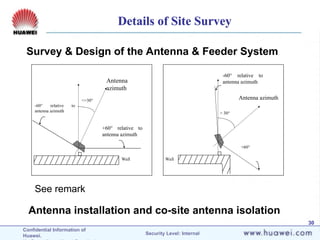
#30 Install the directional antenna on the wall with the radiation direction of the antenna perpendicular to the wall. In the case of an antenna with a horizontal half-power angle of 60° or 65°, if its azimuth angle must be adjusted, the angle between the radiation direction of the antenna and the normal direction perpendicular to the wall is required to be less or equal to 15°. In this case, the signal reflected back from the wall only have a very small influence on the signal in the radiation direction as long as the front-to-back ratio of the antenna is more than 20dB.