International Journal of Engineering Science Invention 
ISSN (Online): 2319 – 6734, ISSN (Print): 2319 – 6726 
www.ijesi.org Volume 3 Issue 9 ǁ September 2014 ǁ PP.12-17 
www.ijesi.org 12 | Page 
Correlation between Non-Destructive Testing (NDT) and Destructive Testing (DT) of Compressive Strength of Concrete Duna Samson1, Omoniyi, Tope Moses2 1 Senior Lecturer, Civil Engineering Department, Abubakar Tafawa Balewa University, Nigeria 2Graduate Student, Civil Engineering Department, Abubakar Tafawa Balewa University, Nigeria ABSTRACT : This work presents a study on the correlation and comparison between Destructive and a Non- Destructive Method (Rebound Hammer) of testing the compressive strength of concrete. Concrete cubes of 100mm x 100mm x 100mm were produced using concrete mix of grade 20N/mm2, 30N/mm2 and 35N/mm2 and cured for 7, 14 and 28days. A total of 90 cubes were produced and used for the study. Regression analysis was carried out on the data using MINITAB 15 to establish linear mathematical relationships between compressive strength and rebound number. The Compressive strength and rebound number were taken as the dependent and independent variable respectively. The results showed that the coefficient of correlation of all the proposed models ranged between 91.6%-97.9% indicating a perfect relationship between compressive strength and the rebound number. The average percentage of the residual error was determined to be 1.78%, 1.29% and 1.32% for proposed models of concrete cured at 7, 14 and 28days respectively. This implies that all the proposed models are highly significant. KEYWORDS : Compressive Strength, Concrete, Destructive testing (DT), Non-Destructive testing (NDT), Regression. 
I. INTRODUCTION 
Concrete is a composite material produced from the combination of cement, fine aggregate, coarse aggregate and water in their relative proportion. It is a ubiquitous building material because its constituents are relatively cheap, and readily available. In addition to that, concrete in its fresh state has the ability to be moulded into any desired shape and size. The strength of concrete is its most important property (especially when needed for structural purposes) alongside its durability. Therefore, it is very important to ascertain the compressive strength of concrete before subjecting it to its anticipated loads. Compressive strength of the hardened concrete can be determined using the destructive and non-destructive testing (NDT) methods. The destructive testing (DT) method is carried out by crushing the cast specimen to failure while the non destructive is carried out without destroying the concrete specimen. The main disadvantage of the destructive testing methods is the length of time it takes for the results to be ready, the equipment and the power required. The rebound (Schmitz) hammer is one of the most popular non destructive testing (NDT) methods used to test the strength of concrete. This is due to its relatively low cost and simplicity in use [1]. Although the non destructive testing (NDT) results are much quicker compared to the destructive methods, they are more of an approximation than exact compressive strength values [2]. In as much as the rebound hammer results are quicker, and do not destroy the surface of concrete tested, there is no established relationship between the compressive strength obtained using NDT and DT [3]. The aim of this research is to compare concrete compressive strengths measured using destructive method and those measured using the NDT and to develop regression equation relating them. 
II. MATERIALS AND METHODS 
Materials: Ashaka brand of Ordinary Portland Cement (OPC) was used throughout the research work. It was tested in accordance with BS 12:1978 specification. The coarse aggregate used throughout the experiment was from an igneous rock source and procured from a local quarry site in Bauchi, North East Nigeria. It was tested in accordance with BS 882:1983 specification. Fine aggregate used was sharp sand obtained from a stream at Bayara close to Bauchi Metropolis. Portable drinking water was used for the production of concrete and as such no test was performed on it. Table 1 shows the result of preliminary test conducted on the materials. 
III. METHODS. 
Production, Casting and Curing of Concrete Specimen. 
Concrete of grade 20N/mm2, 30 N/mm2 and 35 N/mm2 were used for the study. The mix design was done in accordance with BS 882:1973 specification for normal weight concrete. Batching of concrete
Correlation Between Non-Destructive Testing…. 
www.ijesi.org 13 | Page 
constituents was carried out by weighing using the manual weighing machine. Mixing of the constituents was done manually until a uniform mix was obtained. Concrete cubes of size 100mm x 100mm x 100mm were produced from the freshly prepared concrete. The production was carried out in accordance with BS 1881: Part 108:1983 specification. The specimen were de-moulded after 24hours and immersed into the curing tank filled with water and cured for 7, 14 and 28days. Ten concrete specimens for each grade and curing period were produced. A total of ninety (90) cubes were produced for the study. Non-Destructive Testing (NDT) of Concrete using the Rebound Hammer : The NDT of compressive strength of concrete was carried out using the rebound (Schmitz) hammer. The test was based on the principle that the rebound of an elastic mass depends on the hardness of the surface against which the mass impinges. The rebound hammer weighs 1.8kg and is suitable for use both in the laboratory and in the field. It was used to test the hardened concrete at the end of the each curing period. The test was repeated ten (10) times on each concrete specimen, and a total of ten (10) readings were recorded as specified by ASTM C805-1997. Destructive Testing (DT) of Concrete Compressive strength using the Compression Machine: The compressive strength test was carried out using the compression machine (ELE NO: 1886-1-3924). The test was carried out in accordance with BS 1881: Part 3: 1970 specification. Ten (10) concrete specimens for each concrete grade of 20N/mm2, 30 N/mm2 and 35 N/mm2 were tested after curing for 7, 14and 28 days. The compressive strength of the concrete cubes was calculated using equation (1). Compressive strength = (1) 
IV. RESULT AND DISCUSSION 
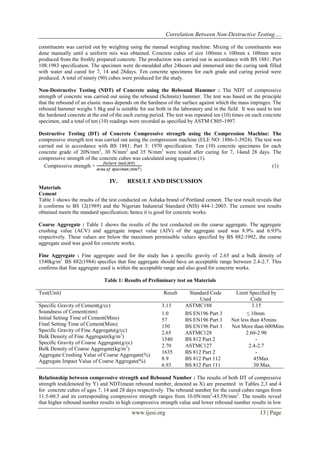
Materials Cement Table 1 shows the results of the test conducted on Ashaka brand of Portland cement. The test result reveals that it conforms to BS 12(1989) and the Nigerian Industrial Standard (NIS) 444-1:2003. The cement test results obtained meets the standard specification; hence it is good for concrete works. Coarse Aggregate : Table 1 shows the results of the test conducted on the coarse aggregate. The aggregate crushing value (ACV) and aggregate impact value (AIV) of the aggregate used was 8.9% and 6.93% respectively. These values are below the maximum permissible values specified by BS 882:1992, the coarse aggregate used was good for concrete works. Fine Aggregate : Fine aggregate used for the study has a specific gravity of 2.65 and a bulk density of 1540kg/m3 BS 882(1984) specifies that fine aggregate should have an acceptable range between 2.4-2.7. This confirms that fine aggregate used is within the acceptable range and also good for concrete works. Table 1: Results of Preliminary test on Materials 
Test(Unit) 
Result 
Standard Code Used 
Limit Specified by Code 
Specific Gravity of Cement(g/cc) Soundness of Cement(mm) Initial Setting Time of Cement(Mins) Final Setting Time of Cement(Mins) Specific Gravity of Fine Aggregate(g/cc) Bulk Density of Fine Aggregate(kg/m3) Specific Gravity of Coarse Aggregate(g/cc) Bulk Density of Coarse Aggregate(kg/m3) Aggregate Crushing Value of Coarse Aggregate(%) Aggregate Impact Value of Coarse Aggregate(%) 
3.13 
ASTMC188 
3.15 
1.0 
BS EN196 Part 3 
≤ 10mm 
57 
BS EN196 Part 3 
Not less than 45mins 
150 
BS EN196 Part 3 
Not More than 600Mins 
2.65 
ASTMC128 
2.60-2.90 
1540 
BS 812 Part 2 
- 
2.70 
ASTMC127 
2.4-2.7 
1635 
BS 812 Part 2 
- 
8.9 
BS 812 Part 112 
45Max 
6.93 
BS 812 Part 111 
30 Max. 
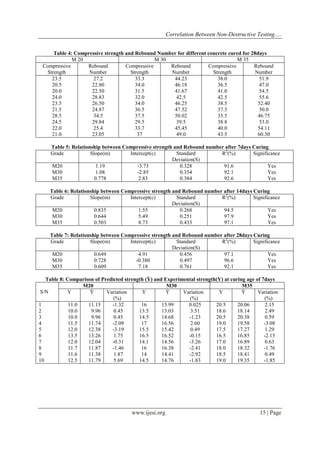
Relationship between compressive strength and Rebound Number : The results of both DT of compressive strength test(denoted by Y) and NDT(mean rebound number, denoted as X) are presented in Tables 2,3 and 4 for concrete cubes of ages 7, 14 and 28 days respectively. The rebound number for the cured cubes ranges from 11.5-60.3 and its corresponding compressive strength ranges from 10.0N/mm2-43.5N/mm2. The results reveal that higher rebound number results in high compressive strength value and lower rebound number results in low
Correlation Between Non-Destructive Testing…. 
www.ijesi.org 14 | Page 
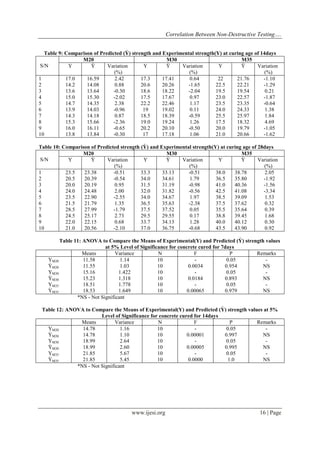
compressive strength. The compressive strength and rebound number were also seen to increase with curing age. These trends are similar to the findings reported by [4]. Table 5,6 and 7 shows the results of regression analysis carried out on the different mixes and cured for 7, 14 and 28days respectively. Due to the linear relationship between the compressive strength and the rebound number, a linear model of the form shown in Equation 2 was selected to fit the data. (2) Where x represents the mean rebound number and y represents the corresponding compressive strength while m and c represents the slope and intercept respectively. The correlation coefficient (i.e. R2) as seen in Tables 5,6 and 7 ranges from 91.6%-97.9%. These correlation coefficients agree with those obtained in earlier works [5]. This means that there is an excellent relationship between compressive strength and the rebound number. This also implies that the independent variable (rebound number) is a useful predictor of the dependent variable (Compressive strength) and thus the proposed models are highly significant [6]. Comparison was also made between the predicted compressive strength (using the regression models) values and the actual compressive strength (experimental) values. The comparison results for all the regression models are presented in Tables 8, 9 and 10.The results reveals that the difference(in percentage) between the Experimental and Predicted compressive strength values varies between 0.025%-5.69%, 0.11%-4.69% and 0.05%-3.34% for all concrete mixes cured for 7,14 and 28days respectively. The average percentage of the residual error was determined to be 1.78%, 1.29% and 1.32% for concrete aged 7, 14 and 28days respectively. These values are not large which implies that all the proposed models are valid. Therefore, the models can be used to predict the compressive strength of concrete to a high degree of accuracy [7]. One way analysis of variance (ANOVA) was carried out to compare the experimental and predicted values of compressive strength at 5% level of significance (P>0.05). The results are as presented in Tables 11, 12 and 13 for concrete cured for 7, 14 and 28days respectively. The P-values is a measure of the likelihood that the true coefficient is zero. All the P values exceeded the selected level of significance (P>0.05). This implies that there is no statistically significant difference between the means of the experimental and predicted value of compressive strength. Thus, the proposed relationships can be used to predict to a high degree of accuracy, the compressive strength of concrete members if the rebound number is determined [8]. Table 2: Compressive strength and Rebound number for different concrete cured for 7days 
M 20 
M 30 
M 35 
Compressive Strength 
Rebound Number 
Compressive Strength 
Rebound Number 
Compressive Strength 
Rebound Number 
11.0 
12.5 
16.0 
17.45 
20.5 
22.12 
10.0 
11.5 
13.5 
14.70 
18.6 
19.65 
10.0 
11.5 
14.5 
16.23 
20.5 
22.53 
11.5 
13.0 
17.0 
17.97 
19.0 
21.51 
12.0 
13.54 
15.5 
16.92 
17.5 
18.54 
13.5 
14.28 
16.5 
17.94 
16.5 
18.0 
12.0 
13.25 
14.10 
16.12 
17.0 
18.05 
11.7 
13.11 
16.0 
17.81 
18.0 
19.88 
11.6 
12.70 
14.0 
15.98 
18.5 
20.0 
12.5 
13.04 
14.5 
16.31 
19.0 
21.21 
Table 3: Compressive strength and Rebound number for different concrete cured for 14days 
M20 
M 30 
M35 
Compressive Strength 
Rebound Number 
Compressive Strength 
Rebound Number 
Compressive Strength 
Rebound Number 
17.0 
18.01 
17.3 
18.5 
22.0 
25.90 
14.2 
15.0 
20.6 
22.92 
22.5 
26.80 
13.6 
14.48 
18.6 
19.75 
19.5 
21.47 
15.0 
16.47 
17.5 
18.90 
23.0 
27.50 
14.7 
15.33 
22.2 
26.34 
23.5 
29.05 
13.9 
14.95 
19.0 
21.0 
24.0 
31.0 
14.3 
15.12 
18.5 
20.02 
25.5 
34.25 
15.3 
16.90 
19.0 
21.34 
17.5 
19.05 
16 
17.43 
20.2 
22.56 
20.0 
21.98 
13.8 
14.72 
17.0 
18.14 
21.0 
23.7
Correlation Between Non-Destructive Testing…. 
www.ijesi.org 15 | Page 
Table 4: Compressive strength and Rebound Number for different concrete cured for 28days 
M 20 
M 30 
M 35 
Compressive Strength 
Rebound Number 
Compressive Strength 
Rebound Number 
Compressive Strength 
Rebound Number 
23.5 
27.2 
33.3 
44.23 
38.0 
51.9 
20.5 
22.80 
34.0 
46.18 
36.5 
47.0 
20.0 
22.50 
31.5 
41.67 
41.0 
54.5 
24.0 
28.83 
32.0 
42.5 
42.5 
55.6 
23.5 
26.50 
34.0 
46.25 
38.5 
52.40 
21.5 
24.87 
36.5 
47.52 
37.5 
50.0 
28.5 
34.5 
37.5 
50.02 
35.5 
46.75 
24.5 
29.84 
29.5 
39.5 
38.8 
53.0 
22.0 
25.4 
33.7 
45.45 
40.0 
54.11 
21.0 
23.05 
37 
49.0 
43.5 
60.30 
Table 5: Relationship between Compressive strength and Rebound number after 7days Curing 
Grade 
Slope(m) 
Intercept(c) 
Standard Deviation(S) 
R2(%) 
Significance 
M20 
1.19 
-3.73 
0.328 
91.6 
Yes 
M30 
1.08 
-2.85 
0.354 
92.1 
Yes 
M35 
0.778 
2.83 
0.384 
92.6 
Yes 
Table 6: Relationship between Compressive strength and Rebound number after 14days Curing 
Grade 
Slope(m) 
Intercept(c) 
Standard Deviation(S) 
R2(%) 
Significance 
M20 
0.835 
1.55 
0.268 
94.5 
Yes 
M30 
0.644 
5.49 
0.251 
97.9 
Yes 
M35 
0.503 
8.73 
0.433 
97.1 
Yes 
Table 7: Relationship between Compressive strength and Rebound number after 28days Curing 
Grade 
Slope(m) 
Intercept(c) 
Standard Deviation(S) 
R2(%) 
Significance 
M20 
0.649 
4.91 
0.456 
97.1 
Yes 
M30 
0.728 
-0.380 
0.497 
96.6 
Yes 
M35 
0.609 
7.18 
0.761 
92.1 
Yes 
Table 8: Comparison of Predicted strength (Ỳ) and Experimental strength(Y) at curing age of 7days 
S/N 
M20 
M30 
M35 
Y 
Ỳ 
Variation (%) 
Y 
Ỳ 
Variation (%) 
Y 
Ỳ 
Variation (%) 
1 
11.0 
11.15 
-1.32 
16 
15.99 
0.025 
20.5 
20.06 
2.15 
2 
10.0 
9.96 
0.45 
13.5 
13.03 
3.51 
18.6 
18.14 
2.49 
3 
10.0 
9.96 
0.45 
14.5 
14.68 
-1.23 
20.5 
20.38 
0.59 
4 
11.5 
11.74 
-2.09 
17 
16.56 
2.60 
19.0 
19.58 
-3.08 
5 
12.0 
12.38 
-3.19 
15.5 
15.42 
0.49 
17.5 
17.27 
1.29 
6 
13.5 
13.26 
1.75 
16.5 
16.52 
-0.15 
16.5 
16.85 
-2.15 
7 
12.0 
12.04 
-0.31 
14.1 
14.56 
-3.26 
17.0 
16.89 
0.63 
8 
11.7 
11.87 
-1.46 
16 
16.38 
-2.41 
18.0 
18.32 
-1.76 
9 
11.6 
11.38 
1.87 
14 
14.41 
-2.92 
18.5 
18.41 
0.49 
10 
12.5 
11.79 
5.69 
14.5 
14.76 
-1.83 
19.0 
19.35 
-1.85
Correlation Between Non-Destructive Testing…. 
www.ijesi.org 16 | Page 
Table 9: Comparison of Predicted (Ỳ) strength and Experimental strength(Y) at curing age of 14days 
S/N 
M20 
M30 
M35 
Y 
Ỳ 
Variation (%) 
Y 
Ỳ 
Variation (%) 
Y 
Ỳ 
Variation (%) 
1 
17.0 
16.59 
2.42 
17.3 
17.41 
0.64 
22 
21.76 
-1.10 
2 
14.2 
14.08 
0.88 
20.6 
20.26 
-1.65 
22.5 
22.21 
-1.29 
3 
13.6 
13.64 
-0.30 
18.6 
18.22 
-2.04 
19.5 
19.54 
0.21 
4 
15.0 
15.30 
-2.02 
17.5 
17.67 
0.97 
23.0 
22.57 
-1.87 
5 
14.7 
14.35 
2.38 
22.2 
22.46 
1.17 
23.5 
23.35 
-0.64 
6 
13.9 
14.03 
-0.96 
19 
19.02 
0.11 
24.0 
24.33 
1.38 
7 
14.3 
14.18 
0.87 
18.5 
18.39 
-0.59 
25.5 
25.97 
1.84 
8 
15.3 
15.66 
-2.36 
19.0 
19.24 
1.26 
17.5 
18.32 
4.69 
9 
16.0 
16.11 
-0.65 
20.2 
20.10 
-0.50 
20.0 
19.79 
-1.05 
10 
13.8 
13.84 
-0.30 
17 
17.18 
1.06 
21.0 
20.66 
-1.62 
Table 10: Comparison of Predicted strength (Ỳ) and Experimental strength(Y) at curing age of 28days 
S/N 
M20 
M30 
M35 
Y 
Ỳ 
Variation (%) 
Y 
Ỳ 
Variation (%) 
Y 
Ỳ 
Variation (%) 
1 
23.5 
23.38 
-0.51 
33.3 
33.13 
-0.51 
38.0 
38.78 
2.05 
2 
20.5 
20.39 
-0.54 
34.0 
34.61 
1.79 
36.5 
35.80 
-1.92 
3 
20.0 
20.19 
0.95 
31.5 
31.19 
-0.98 
41.0 
40.36 
-1.56 
4 
24.0 
24.48 
2.00 
32.0 
31.82 
-0.56 
42.5 
41.08 
-3.34 
5 
23.5 
22.90 
-2.55 
34.0 
34.67 
1.97 
38.5 
39.09 
1.53 
6 
21.5 
21.79 
1.35 
36.5 
35.63 
-2.38 
37.5 
37.62 
0.32 
7 
28.5 
27.99 
-1.79 
37.5 
37.52 
0.05 
35.5 
35.64 
0.39 
8 
24.5 
25.17 
2.73 
29.5 
29.55 
0.17 
38.8 
39.45 
1.68 
9 
22.0 
22.15 
0.68 
33.7 
34.13 
1.28 
40.0 
40.12 
0.30 
10 
21.0 
20.56 
-2.10 
37.0 
36.75 
-0.68 
43.5 
43.90 
0.92 
Table 11: ANOVA to Compare the Means of Experimental(Y) and Predicted (Ỳ) strength values at 5% Level of Significance for concrete cured for 7days 
Means 
Variance 
N 
F 
P 
Remarks 
YM20 
11.58 
1.14 
10 
- 
0.05 
- 
ỲM20 
11.55 
1.03 
10 
0.0034 
0.954 
NS 
YM30 
15.16 
1.422 
10 
- 
0.05 
- 
ỲM30 
15.23 
1.318 
10 
0.0184 
0.893 
NS 
YM35 
18.51 
1.778 
10 
- 
0.05 
- 
ỲM35 
18.53 
1.649 
10 
0.00065 
0.979 
NS 
*NS - Not Significant Table 12: ANOVA to Compare the Means of Experimental(Y) and Predicted (Ỳ) strength values at 5% Level of Significance for concrete cured for 14days 
Means 
Variance 
N 
F 
P 
Remarks 
YM20 
14.78 
1.16 
10 
- 
0.05 
- 
ỲM20 
14.78 
1.10 
10 
0.00001 
0.997 
NS 
YM30 
18.99 
2.64 
10 
- 
0.05 
- 
ỲM30 
18.99 
2.60 
10 
0.00005 
0.995 
NS 
YM35 
21.85 
5.67 
10 
- 
0.05 
- 
ỲM35 
21.85 
5.45 
10 
0.0000 
1.0 
NS 
*NS - Not Significant
Correlation Between Non-Destructive Testing…. 
www.ijesi.org 17 | Page 
Table 13: ANOVA to Compare the Means of Experimental(Y) and Predicted (Ỳ) strength values at 5% Level of Significance for concrete cured for 28days 
Means 
Variance 
N 
F 
P 
Remarks 
YM20 
22.90 
6.27 
10 
- 
0.05 
- 
ỲM20 
22.90 
6.08 
10 
0.0000 
1.00 
NS 
YM30 
33.90 
6.45 
10 
- 
0.05 
- 
ỲM30 
33.90 
6.28 
10 
0.000 
1.00 
NS 
YM35 
39.18 
6.58 
10 
- 
0.05 
- 
ỲM35 
39.18 
6.09 
10 
0.0000 
0.997 
NS 
*NS - Not Significant 
V. CONCLUSION 
The following conclusions are drawn based on the outcome of the experiment and analysis: 
[1] High rebound number results in high compressive strength while low rebound number results in low compressive strength. 
[2] The correlation coefficient of the proposed models ranges from 92.1%-97.9%. This shows an excellent relationship between compressive strength and the rebound number, and thus the rebound number is a useful predictor. 
[3] Due to the high correlation coefficient of all the proposed Models which ranges from 91.6%- 97.9%, all the models are highly significant. 
[4] The average percentage of residual error for all the proposed model was 1.78% 1.29% and 1.32% for concrete cured for 14 and 28days respectively. This further confirms that the models can predict the compressive strength of concrete to a high degree of accuracy if the rebound number is established. 
[5] There is no statistically significant difference between Experimental and Predicted Strength Values 
REFERENCES 
[1] Luke M, S(2012). Using the Rebound Hammer. Proceedings of the 11th Annual Mongolian Concrete Conference, June 2012. [2] Aguwamba, J.C and Adagba, T, A comparative Analysis of the rebound Hammer and Ultrasonic Pulse Velocity in Testing Concrete. Nigerian journal of Technology. 31(1), 2012, 31-39. [3] Aguwamba, J.C and Adagba, T, A comparative Analysis of the rebound Hammer and Ultrasonic Pulse Velocity in Testing Concrete. Nigerian journal of Technology. 31(1), 2012, 31-39. [4] ASTM C805-08, “Standard Test Method for Rebound Number of Hardened Concrete”, American Society for Testing and Materials, West Conshohocken, PA, 2008 [5] Cemex USA (2013) Proper use of the Rebound Hammer Updated to reflect the changes to ASTM C805. Technical Bulletin. Retrieved From: www.cemexusa.com (July 9th, 2014) [6] Jen-Chei. L, Mou-Lin. S, and Chang-Huan. K. Estimating the Strength of Concrete Using Surface Rebound Value and Design Parameters of Concrete Material. Tamkang Journal of Science and Engineering, 12(1), 2009,1-7 [7] Hassan, R. H(2012). Correlation between Destructive and Non-Destructive Strengths of Concrete Cubes Using Regression Analysis. Contemporary Engineering Sciences, 5(10), 2012, 493 – 509 [8] Multiple Regression and Model Checking (2011). Tutorial, Department of Mathematics and Statistic, University of Reading. pp 1-6

B0391012017

  • 1.
    International Journal ofEngineering Science Invention ISSN (Online): 2319 – 6734, ISSN (Print): 2319 – 6726 www.ijesi.org Volume 3 Issue 9 ǁ September 2014 ǁ PP.12-17 www.ijesi.org 12 | Page Correlation between Non-Destructive Testing (NDT) and Destructive Testing (DT) of Compressive Strength of Concrete Duna Samson1, Omoniyi, Tope Moses2 1 Senior Lecturer, Civil Engineering Department, Abubakar Tafawa Balewa University, Nigeria 2Graduate Student, Civil Engineering Department, Abubakar Tafawa Balewa University, Nigeria ABSTRACT : This work presents a study on the correlation and comparison between Destructive and a Non- Destructive Method (Rebound Hammer) of testing the compressive strength of concrete. Concrete cubes of 100mm x 100mm x 100mm were produced using concrete mix of grade 20N/mm2, 30N/mm2 and 35N/mm2 and cured for 7, 14 and 28days. A total of 90 cubes were produced and used for the study. Regression analysis was carried out on the data using MINITAB 15 to establish linear mathematical relationships between compressive strength and rebound number. The Compressive strength and rebound number were taken as the dependent and independent variable respectively. The results showed that the coefficient of correlation of all the proposed models ranged between 91.6%-97.9% indicating a perfect relationship between compressive strength and the rebound number. The average percentage of the residual error was determined to be 1.78%, 1.29% and 1.32% for proposed models of concrete cured at 7, 14 and 28days respectively. This implies that all the proposed models are highly significant. KEYWORDS : Compressive Strength, Concrete, Destructive testing (DT), Non-Destructive testing (NDT), Regression. I. INTRODUCTION Concrete is a composite material produced from the combination of cement, fine aggregate, coarse aggregate and water in their relative proportion. It is a ubiquitous building material because its constituents are relatively cheap, and readily available. In addition to that, concrete in its fresh state has the ability to be moulded into any desired shape and size. The strength of concrete is its most important property (especially when needed for structural purposes) alongside its durability. Therefore, it is very important to ascertain the compressive strength of concrete before subjecting it to its anticipated loads. Compressive strength of the hardened concrete can be determined using the destructive and non-destructive testing (NDT) methods. The destructive testing (DT) method is carried out by crushing the cast specimen to failure while the non destructive is carried out without destroying the concrete specimen. The main disadvantage of the destructive testing methods is the length of time it takes for the results to be ready, the equipment and the power required. The rebound (Schmitz) hammer is one of the most popular non destructive testing (NDT) methods used to test the strength of concrete. This is due to its relatively low cost and simplicity in use [1]. Although the non destructive testing (NDT) results are much quicker compared to the destructive methods, they are more of an approximation than exact compressive strength values [2]. In as much as the rebound hammer results are quicker, and do not destroy the surface of concrete tested, there is no established relationship between the compressive strength obtained using NDT and DT [3]. The aim of this research is to compare concrete compressive strengths measured using destructive method and those measured using the NDT and to develop regression equation relating them. II. MATERIALS AND METHODS Materials: Ashaka brand of Ordinary Portland Cement (OPC) was used throughout the research work. It was tested in accordance with BS 12:1978 specification. The coarse aggregate used throughout the experiment was from an igneous rock source and procured from a local quarry site in Bauchi, North East Nigeria. It was tested in accordance with BS 882:1983 specification. Fine aggregate used was sharp sand obtained from a stream at Bayara close to Bauchi Metropolis. Portable drinking water was used for the production of concrete and as such no test was performed on it. Table 1 shows the result of preliminary test conducted on the materials. III. METHODS. Production, Casting and Curing of Concrete Specimen. Concrete of grade 20N/mm2, 30 N/mm2 and 35 N/mm2 were used for the study. The mix design was done in accordance with BS 882:1973 specification for normal weight concrete. Batching of concrete
  • 2.
    Correlation Between Non-DestructiveTesting…. www.ijesi.org 13 | Page constituents was carried out by weighing using the manual weighing machine. Mixing of the constituents was done manually until a uniform mix was obtained. Concrete cubes of size 100mm x 100mm x 100mm were produced from the freshly prepared concrete. The production was carried out in accordance with BS 1881: Part 108:1983 specification. The specimen were de-moulded after 24hours and immersed into the curing tank filled with water and cured for 7, 14 and 28days. Ten concrete specimens for each grade and curing period were produced. A total of ninety (90) cubes were produced for the study. Non-Destructive Testing (NDT) of Concrete using the Rebound Hammer : The NDT of compressive strength of concrete was carried out using the rebound (Schmitz) hammer. The test was based on the principle that the rebound of an elastic mass depends on the hardness of the surface against which the mass impinges. The rebound hammer weighs 1.8kg and is suitable for use both in the laboratory and in the field. It was used to test the hardened concrete at the end of the each curing period. The test was repeated ten (10) times on each concrete specimen, and a total of ten (10) readings were recorded as specified by ASTM C805-1997. Destructive Testing (DT) of Concrete Compressive strength using the Compression Machine: The compressive strength test was carried out using the compression machine (ELE NO: 1886-1-3924). The test was carried out in accordance with BS 1881: Part 3: 1970 specification. Ten (10) concrete specimens for each concrete grade of 20N/mm2, 30 N/mm2 and 35 N/mm2 were tested after curing for 7, 14and 28 days. The compressive strength of the concrete cubes was calculated using equation (1). Compressive strength = (1) IV. RESULT AND DISCUSSION Materials Cement Table 1 shows the results of the test conducted on Ashaka brand of Portland cement. The test result reveals that it conforms to BS 12(1989) and the Nigerian Industrial Standard (NIS) 444-1:2003. The cement test results obtained meets the standard specification; hence it is good for concrete works. Coarse Aggregate : Table 1 shows the results of the test conducted on the coarse aggregate. The aggregate crushing value (ACV) and aggregate impact value (AIV) of the aggregate used was 8.9% and 6.93% respectively. These values are below the maximum permissible values specified by BS 882:1992, the coarse aggregate used was good for concrete works. Fine Aggregate : Fine aggregate used for the study has a specific gravity of 2.65 and a bulk density of 1540kg/m3 BS 882(1984) specifies that fine aggregate should have an acceptable range between 2.4-2.7. This confirms that fine aggregate used is within the acceptable range and also good for concrete works. Table 1: Results of Preliminary test on Materials Test(Unit) Result Standard Code Used Limit Specified by Code Specific Gravity of Cement(g/cc) Soundness of Cement(mm) Initial Setting Time of Cement(Mins) Final Setting Time of Cement(Mins) Specific Gravity of Fine Aggregate(g/cc) Bulk Density of Fine Aggregate(kg/m3) Specific Gravity of Coarse Aggregate(g/cc) Bulk Density of Coarse Aggregate(kg/m3) Aggregate Crushing Value of Coarse Aggregate(%) Aggregate Impact Value of Coarse Aggregate(%) 3.13 ASTMC188 3.15 1.0 BS EN196 Part 3 ≤ 10mm 57 BS EN196 Part 3 Not less than 45mins 150 BS EN196 Part 3 Not More than 600Mins 2.65 ASTMC128 2.60-2.90 1540 BS 812 Part 2 - 2.70 ASTMC127 2.4-2.7 1635 BS 812 Part 2 - 8.9 BS 812 Part 112 45Max 6.93 BS 812 Part 111 30 Max. Relationship between compressive strength and Rebound Number : The results of both DT of compressive strength test(denoted by Y) and NDT(mean rebound number, denoted as X) are presented in Tables 2,3 and 4 for concrete cubes of ages 7, 14 and 28 days respectively. The rebound number for the cured cubes ranges from 11.5-60.3 and its corresponding compressive strength ranges from 10.0N/mm2-43.5N/mm2. The results reveal that higher rebound number results in high compressive strength value and lower rebound number results in low
  • 3.
    Correlation Between Non-DestructiveTesting…. www.ijesi.org 14 | Page compressive strength. The compressive strength and rebound number were also seen to increase with curing age. These trends are similar to the findings reported by [4]. Table 5,6 and 7 shows the results of regression analysis carried out on the different mixes and cured for 7, 14 and 28days respectively. Due to the linear relationship between the compressive strength and the rebound number, a linear model of the form shown in Equation 2 was selected to fit the data. (2) Where x represents the mean rebound number and y represents the corresponding compressive strength while m and c represents the slope and intercept respectively. The correlation coefficient (i.e. R2) as seen in Tables 5,6 and 7 ranges from 91.6%-97.9%. These correlation coefficients agree with those obtained in earlier works [5]. This means that there is an excellent relationship between compressive strength and the rebound number. This also implies that the independent variable (rebound number) is a useful predictor of the dependent variable (Compressive strength) and thus the proposed models are highly significant [6]. Comparison was also made between the predicted compressive strength (using the regression models) values and the actual compressive strength (experimental) values. The comparison results for all the regression models are presented in Tables 8, 9 and 10.The results reveals that the difference(in percentage) between the Experimental and Predicted compressive strength values varies between 0.025%-5.69%, 0.11%-4.69% and 0.05%-3.34% for all concrete mixes cured for 7,14 and 28days respectively. The average percentage of the residual error was determined to be 1.78%, 1.29% and 1.32% for concrete aged 7, 14 and 28days respectively. These values are not large which implies that all the proposed models are valid. Therefore, the models can be used to predict the compressive strength of concrete to a high degree of accuracy [7]. One way analysis of variance (ANOVA) was carried out to compare the experimental and predicted values of compressive strength at 5% level of significance (P>0.05). The results are as presented in Tables 11, 12 and 13 for concrete cured for 7, 14 and 28days respectively. The P-values is a measure of the likelihood that the true coefficient is zero. All the P values exceeded the selected level of significance (P>0.05). This implies that there is no statistically significant difference between the means of the experimental and predicted value of compressive strength. Thus, the proposed relationships can be used to predict to a high degree of accuracy, the compressive strength of concrete members if the rebound number is determined [8]. Table 2: Compressive strength and Rebound number for different concrete cured for 7days M 20 M 30 M 35 Compressive Strength Rebound Number Compressive Strength Rebound Number Compressive Strength Rebound Number 11.0 12.5 16.0 17.45 20.5 22.12 10.0 11.5 13.5 14.70 18.6 19.65 10.0 11.5 14.5 16.23 20.5 22.53 11.5 13.0 17.0 17.97 19.0 21.51 12.0 13.54 15.5 16.92 17.5 18.54 13.5 14.28 16.5 17.94 16.5 18.0 12.0 13.25 14.10 16.12 17.0 18.05 11.7 13.11 16.0 17.81 18.0 19.88 11.6 12.70 14.0 15.98 18.5 20.0 12.5 13.04 14.5 16.31 19.0 21.21 Table 3: Compressive strength and Rebound number for different concrete cured for 14days M20 M 30 M35 Compressive Strength Rebound Number Compressive Strength Rebound Number Compressive Strength Rebound Number 17.0 18.01 17.3 18.5 22.0 25.90 14.2 15.0 20.6 22.92 22.5 26.80 13.6 14.48 18.6 19.75 19.5 21.47 15.0 16.47 17.5 18.90 23.0 27.50 14.7 15.33 22.2 26.34 23.5 29.05 13.9 14.95 19.0 21.0 24.0 31.0 14.3 15.12 18.5 20.02 25.5 34.25 15.3 16.90 19.0 21.34 17.5 19.05 16 17.43 20.2 22.56 20.0 21.98 13.8 14.72 17.0 18.14 21.0 23.7
  • 4.
    Correlation Between Non-DestructiveTesting…. www.ijesi.org 15 | Page Table 4: Compressive strength and Rebound Number for different concrete cured for 28days M 20 M 30 M 35 Compressive Strength Rebound Number Compressive Strength Rebound Number Compressive Strength Rebound Number 23.5 27.2 33.3 44.23 38.0 51.9 20.5 22.80 34.0 46.18 36.5 47.0 20.0 22.50 31.5 41.67 41.0 54.5 24.0 28.83 32.0 42.5 42.5 55.6 23.5 26.50 34.0 46.25 38.5 52.40 21.5 24.87 36.5 47.52 37.5 50.0 28.5 34.5 37.5 50.02 35.5 46.75 24.5 29.84 29.5 39.5 38.8 53.0 22.0 25.4 33.7 45.45 40.0 54.11 21.0 23.05 37 49.0 43.5 60.30 Table 5: Relationship between Compressive strength and Rebound number after 7days Curing Grade Slope(m) Intercept(c) Standard Deviation(S) R2(%) Significance M20 1.19 -3.73 0.328 91.6 Yes M30 1.08 -2.85 0.354 92.1 Yes M35 0.778 2.83 0.384 92.6 Yes Table 6: Relationship between Compressive strength and Rebound number after 14days Curing Grade Slope(m) Intercept(c) Standard Deviation(S) R2(%) Significance M20 0.835 1.55 0.268 94.5 Yes M30 0.644 5.49 0.251 97.9 Yes M35 0.503 8.73 0.433 97.1 Yes Table 7: Relationship between Compressive strength and Rebound number after 28days Curing Grade Slope(m) Intercept(c) Standard Deviation(S) R2(%) Significance M20 0.649 4.91 0.456 97.1 Yes M30 0.728 -0.380 0.497 96.6 Yes M35 0.609 7.18 0.761 92.1 Yes Table 8: Comparison of Predicted strength (Ỳ) and Experimental strength(Y) at curing age of 7days S/N M20 M30 M35 Y Ỳ Variation (%) Y Ỳ Variation (%) Y Ỳ Variation (%) 1 11.0 11.15 -1.32 16 15.99 0.025 20.5 20.06 2.15 2 10.0 9.96 0.45 13.5 13.03 3.51 18.6 18.14 2.49 3 10.0 9.96 0.45 14.5 14.68 -1.23 20.5 20.38 0.59 4 11.5 11.74 -2.09 17 16.56 2.60 19.0 19.58 -3.08 5 12.0 12.38 -3.19 15.5 15.42 0.49 17.5 17.27 1.29 6 13.5 13.26 1.75 16.5 16.52 -0.15 16.5 16.85 -2.15 7 12.0 12.04 -0.31 14.1 14.56 -3.26 17.0 16.89 0.63 8 11.7 11.87 -1.46 16 16.38 -2.41 18.0 18.32 -1.76 9 11.6 11.38 1.87 14 14.41 -2.92 18.5 18.41 0.49 10 12.5 11.79 5.69 14.5 14.76 -1.83 19.0 19.35 -1.85
  • 5.
    Correlation Between Non-DestructiveTesting…. www.ijesi.org 16 | Page Table 9: Comparison of Predicted (Ỳ) strength and Experimental strength(Y) at curing age of 14days S/N M20 M30 M35 Y Ỳ Variation (%) Y Ỳ Variation (%) Y Ỳ Variation (%) 1 17.0 16.59 2.42 17.3 17.41 0.64 22 21.76 -1.10 2 14.2 14.08 0.88 20.6 20.26 -1.65 22.5 22.21 -1.29 3 13.6 13.64 -0.30 18.6 18.22 -2.04 19.5 19.54 0.21 4 15.0 15.30 -2.02 17.5 17.67 0.97 23.0 22.57 -1.87 5 14.7 14.35 2.38 22.2 22.46 1.17 23.5 23.35 -0.64 6 13.9 14.03 -0.96 19 19.02 0.11 24.0 24.33 1.38 7 14.3 14.18 0.87 18.5 18.39 -0.59 25.5 25.97 1.84 8 15.3 15.66 -2.36 19.0 19.24 1.26 17.5 18.32 4.69 9 16.0 16.11 -0.65 20.2 20.10 -0.50 20.0 19.79 -1.05 10 13.8 13.84 -0.30 17 17.18 1.06 21.0 20.66 -1.62 Table 10: Comparison of Predicted strength (Ỳ) and Experimental strength(Y) at curing age of 28days S/N M20 M30 M35 Y Ỳ Variation (%) Y Ỳ Variation (%) Y Ỳ Variation (%) 1 23.5 23.38 -0.51 33.3 33.13 -0.51 38.0 38.78 2.05 2 20.5 20.39 -0.54 34.0 34.61 1.79 36.5 35.80 -1.92 3 20.0 20.19 0.95 31.5 31.19 -0.98 41.0 40.36 -1.56 4 24.0 24.48 2.00 32.0 31.82 -0.56 42.5 41.08 -3.34 5 23.5 22.90 -2.55 34.0 34.67 1.97 38.5 39.09 1.53 6 21.5 21.79 1.35 36.5 35.63 -2.38 37.5 37.62 0.32 7 28.5 27.99 -1.79 37.5 37.52 0.05 35.5 35.64 0.39 8 24.5 25.17 2.73 29.5 29.55 0.17 38.8 39.45 1.68 9 22.0 22.15 0.68 33.7 34.13 1.28 40.0 40.12 0.30 10 21.0 20.56 -2.10 37.0 36.75 -0.68 43.5 43.90 0.92 Table 11: ANOVA to Compare the Means of Experimental(Y) and Predicted (Ỳ) strength values at 5% Level of Significance for concrete cured for 7days Means Variance N F P Remarks YM20 11.58 1.14 10 - 0.05 - ỲM20 11.55 1.03 10 0.0034 0.954 NS YM30 15.16 1.422 10 - 0.05 - ỲM30 15.23 1.318 10 0.0184 0.893 NS YM35 18.51 1.778 10 - 0.05 - ỲM35 18.53 1.649 10 0.00065 0.979 NS *NS - Not Significant Table 12: ANOVA to Compare the Means of Experimental(Y) and Predicted (Ỳ) strength values at 5% Level of Significance for concrete cured for 14days Means Variance N F P Remarks YM20 14.78 1.16 10 - 0.05 - ỲM20 14.78 1.10 10 0.00001 0.997 NS YM30 18.99 2.64 10 - 0.05 - ỲM30 18.99 2.60 10 0.00005 0.995 NS YM35 21.85 5.67 10 - 0.05 - ỲM35 21.85 5.45 10 0.0000 1.0 NS *NS - Not Significant
  • 6.
    Correlation Between Non-DestructiveTesting…. www.ijesi.org 17 | Page Table 13: ANOVA to Compare the Means of Experimental(Y) and Predicted (Ỳ) strength values at 5% Level of Significance for concrete cured for 28days Means Variance N F P Remarks YM20 22.90 6.27 10 - 0.05 - ỲM20 22.90 6.08 10 0.0000 1.00 NS YM30 33.90 6.45 10 - 0.05 - ỲM30 33.90 6.28 10 0.000 1.00 NS YM35 39.18 6.58 10 - 0.05 - ỲM35 39.18 6.09 10 0.0000 0.997 NS *NS - Not Significant V. CONCLUSION The following conclusions are drawn based on the outcome of the experiment and analysis: [1] High rebound number results in high compressive strength while low rebound number results in low compressive strength. [2] The correlation coefficient of the proposed models ranges from 92.1%-97.9%. This shows an excellent relationship between compressive strength and the rebound number, and thus the rebound number is a useful predictor. [3] Due to the high correlation coefficient of all the proposed Models which ranges from 91.6%- 97.9%, all the models are highly significant. [4] The average percentage of residual error for all the proposed model was 1.78% 1.29% and 1.32% for concrete cured for 14 and 28days respectively. This further confirms that the models can predict the compressive strength of concrete to a high degree of accuracy if the rebound number is established. [5] There is no statistically significant difference between Experimental and Predicted Strength Values REFERENCES [1] Luke M, S(2012). Using the Rebound Hammer. Proceedings of the 11th Annual Mongolian Concrete Conference, June 2012. [2] Aguwamba, J.C and Adagba, T, A comparative Analysis of the rebound Hammer and Ultrasonic Pulse Velocity in Testing Concrete. Nigerian journal of Technology. 31(1), 2012, 31-39. [3] Aguwamba, J.C and Adagba, T, A comparative Analysis of the rebound Hammer and Ultrasonic Pulse Velocity in Testing Concrete. Nigerian journal of Technology. 31(1), 2012, 31-39. [4] ASTM C805-08, “Standard Test Method for Rebound Number of Hardened Concrete”, American Society for Testing and Materials, West Conshohocken, PA, 2008 [5] Cemex USA (2013) Proper use of the Rebound Hammer Updated to reflect the changes to ASTM C805. Technical Bulletin. Retrieved From: www.cemexusa.com (July 9th, 2014) [6] Jen-Chei. L, Mou-Lin. S, and Chang-Huan. K. Estimating the Strength of Concrete Using Surface Rebound Value and Design Parameters of Concrete Material. Tamkang Journal of Science and Engineering, 12(1), 2009,1-7 [7] Hassan, R. H(2012). Correlation between Destructive and Non-Destructive Strengths of Concrete Cubes Using Regression Analysis. Contemporary Engineering Sciences, 5(10), 2012, 493 – 509 [8] Multiple Regression and Model Checking (2011). Tutorial, Department of Mathematics and Statistic, University of Reading. pp 1-6